Volume 13 Number 10
Inside This Edition Publisher’s Commentary Who did all this damage?
5
12A-4981 Hwy 7 East Ste 254 Markham, ON Canada L3R 1N1
Chrysler’s “Intrepid” prowler ready for the street
7
Ph: 905 640-3048 Fax: 905 640-7547 Main e-mail: blueline@blueline.ca
Star Wars on snow
10
- Publisher / Editor Morley S. Lymburner e-mail: bluelinepublisher@rogers.com
Leaf-spring suspension helper
11
Officers should use caution with new powers
12
Top US court restricts thermal imaging use
14
Eurocopter signs big deal
14
PUBLIC RELATIONS The art of saying nothing
15
Sergeant Barry Gordon police leader of the year
16
Great Lakes motorcycle training seminar
17
VITALITY Ten steps to a fit lifestyle
18
December 2001 Blue Line Magazine
- General Manager Mary Lymburner, M.Ed. e-mail: bluelinesales@rogers.com - Managing Editor Mark Reesor e-mail: bluelineeditor@rogers.com - News Editor Les Linder e-mail: bluelinenews@rogers.com - Advertising Mary Lymburner Kieran Huggins Bob Murray Dave Douglas e-mail: bluelinesales@rogers.com - Pre-press Production Del Wall - Contributing Editors Communication Skills Terry Barker Police Leadership Robert Lunney Tactical Firearms Dave Brown Technology Tom Rataj Psychology Dorothy Cotton Case Law Mike Novakowski Blue Line Magazine is published monthly, September to June, by Blue Line Magazine Incorporated with a mailing address of: 12A - 4981 Hwy. 7 East, Ste. 254, Markham, Ontario, L3R 1N1. Individual magazines are $3.50 each. Subscriptions are $25.00 per year or $40.00 for 2 years. (Foreign - $50.00 U.S.)
DEEP BLUE 19 Shortening those emerg waiting room blues The race goes to the quickest Cross-jurisdictional information sharing goal of federal program
20
CASE LAW 22 Right to search depends on context of arrest “Servant leadership” subject of conference
23
Canadian Police Research Centre keeping standards high
24
Vietnamese organized crime expanding globally
26
BLUE LINE CLASSIFIED
27
Saskatoon hires new police chief
28
Retired OPP Commissioner H.H. Graham dies
29
The Last Noose British Columbia
30
BOOKS Author turned artist in the BC Coast
31
Printed in Canada by Garson Graphic Services Inc.
A bearhug goes a long way
33
- Affiliations-
Cooperation in Akwesasne
36
PRODUCT NEWS
37
THE BACK OF THE BOOK Help wanted - competent management
38
BLUE LINE READING LIBRARY
39
©2001 - All articles are protected by copyright. No part of this publication may be reproduced or transmitted in any form or by any means, electronic or mechanical, including photocopying and recording or by any information storage or retrieval system without permission from the publisher. Internet activity is monitored and use or reposting of material on the Internet is restricted. All material submitted for publication becomes the property of Blue Line Magazine unless other arrangements have been made with the publisher. The authors, advisors and Publisher accept no liability whatsoever for any injuries to persons or property resulting from the application or adoption of any of the procedures, tactics or considerations presented in this magazine. Readers are cautioned and advised that articles presented herein are edited and supplied for your personal awareness and should not be used for further action until appropriate advice and guidance is received from a supervisor, Crown Attorney or other person in authority. Established in 1988, Blue Line Magazine is an independent publication designed to inform, entertain, educate and upgrade the skills of those involved in the law enforcement profession. It has no direct control from a law enforcement agency and its opinions and articles do not necessarily reflect the opinions of any government, police, or law enforcement agency. Blue Line Magazine is a private venture and as such is not funded through any level of government agency, union or association.
International Association of Law Enforcement Planners Canadian Advertising Rates & Data International Police Association The Police Leadership Forum The Canadian Press Newswire
ISSN #0847 8538 Canada Post - Canadian Publications Mail Product Sales Agreement No. 176796 December 2001
3
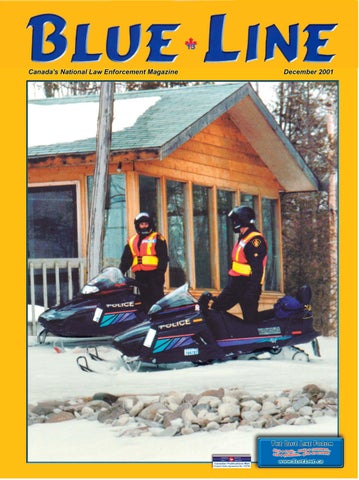
Officers who patrol remote cottage country by snowmobile get a foretaste of things to come with this month’s cover shot of two members of the Ontario Provincial Police. Chrysler’s Intrepid police package garnered a lot of attention on the floor of the International Association of Chiefs of Police show in Toronto. Technology columnist Tom Rataj takes a look at the first Chrysler Cruiser since the ’80s in his article, which begins on page seven. But Chrysler has been building police cars since the 1930s — so we take a look back at some Mopar classics, beginning on page nine. New federal legislation, scheduled to be passed this month, gives police extra powers to investigate suspected terrorists. Some experts say the changes could threaten civil liberties and advise police to use caution. Kathryn Lymburner’s story is on page 12. If recent events have been getting you down, you may want to consider joining the ‘Secret Society of Happy People,’ which encourages people to talk more about happiness and tries to discourage ‘parade rainers.’ That story is on page 13. Although turbine engines attract a lot of interest, most organizations end up buying the cheaper piston engine helicopter, which makes Robinson Helicopters the North American sales leader. The details are on page 14. Sergeant Barry Gordon of the Cape Breton Police Service is this year’s Police Leadership Award winner. Gordon has worked tirelessly to improve his community and their relationship with the police. That story is on page 16. Anyone tired of whiling away the hours in the emergency waiting rooms for doctors to look at a mentally ill suspect will be interested in Dr Dorothy Cotton’s column on page 19. Cotton explains how working with the local mental health crisis team and coming up with the right forms can help speed things up. All of us at Blue Line would like to thank everyone for their interest and support during the year and wish you all a very Merry Christmas and a Happy New Year. Blue Blue Line Line Magazine Magazine
Who did all this damage? by Morley Lymburner It amazed me but I wondered if the officer managed to catch and charge the guy after he came back to find his police car damaged to that extent. I sat in the car in astonishment. What really got me was the torn dash and the deep gouges in the steering wheel. This was no average citizen’s car. It was a police car. I can understand the coffee stains and the cigarette ashes on the seat and floor. But the big notch I found in the steering wheel was neatly cut by a knife. It was easy to see that this criminal took his time to do it. The damage to the dash was clearly caused by someone cutting, tearing and pulling at it. The four plastic dash vents had been smashed out. The speedometer read only around 60,000 km so it could not be caused by normal wear. How could a police officer permit the criminal he had arrested do this damage? I had to wonder what type of mind would do this kind of thing. If this was caused by a prisoner or citizen left in his car alone I would be amazed that the officer did not search for the knife he used to cut the notch in the steering wheel. But the thing that had me completely mystified was how this criminal got behind the wheel in the first place and was permitted all the time it took to do this. Or could it be... Naw! No way! It couldn’t have been... The police force has come a long way since the old days of six and four cylinder Ford Fairmonts with bench seats that left your partner chewing on his knee caps or crushing your shoulder on turns. I can still remember trying to respond to major occurrences with a two door slant six Plymouth and no roof lights. Flashing my headlights and honking my horn caused me to spend more time responding to calls on the sidewalks and boulevards than on the highway. On hot summer days, while wearing my buttoned up long-sleeve shirt, tie and cross strap, and my hat firmly crushed onto my head, I would pick up speed and note the level of dust in the air came higher off the floor as my speed increased. Many a pursuit was called off due to the amount of dust in the air and in my eyes. One officer had written on the door that since the speedometer had not worked for the past six months the speed limit was when the dust was eight inches off the floor. He had drawn a line to indicate this on the door panels. I tried it. He was right! We have come a long way yet we have many, many more improvements to make. The biggest improvement necessary, however, is the attitude of the person who’s butt is on the driver’s seat. Proper respect for the issued equipment is more important than ever. Police forces today are routinely ordering cars with air conditioning, split bench seats, cloth seats, tinted glass, and good sized engines. They are installing computerized video terminals, improved light and sound packages and better first aid kits. The police vehicles of today are painted better with some of the best reflective material in world. Officers enjoy hat December 2001
racks, night stick holders, hand radio holders, and in most instances even a place to put that cup of coffee. We now ride on the best tires that money can buy. And that isn’t all. If you have any ideas on how to improve on perfection you can do this as well. Many agencies have Equipment Committees set up for this very purpose. All that is asked in return is to take reasonable care of YOUR office. As police officers you are taught to have respect for other people’s property. Unfortunately some officers forget that the car they are in is not their car. If
5
you can’t respect the property then at least respect the environment you choose to work in. If you find something wrong have it fixed or let the officer-in charge know about it. Even better - let that slob who does this damage know how lucky you are to have the equipment you have. It was not too long ago you didn’t have it and in most cases it isn’t written anywhere that it has to be given to you. But if you really find you can’t keep yourself from damaging that cruiser then put on some good shoes and walk a beat for a while.
by Tom Rataj From the late 1960’s through to the early 1980s, Chrysler Corporation dominated the domestic police car market with the Plymouth Fury, attaining an estimated 80 percent market share. Ford with their Custom 500, General Motors with their Bel Air and American Motors with their Ambassador (remember Adam-12) shared the balance of the market in those days. Building ‘police’ cars in the 60s and 70s was more of a battle to see who could drop the biggest, baddest V8 into their ‘police’ version. The early 1970s Ambassador, for example, featured a 5.9 litre, 200 hp V8. Since Chrysler’s withdrawal in 1989, market dominance has been a constant battle between General Motors and Ford, with Ford the eventual winner when GM withdrew their rearwheel drive Caprice in 1996. During the 1980s Chrysler’s offering dwindled to the Dodge Diplomat/Plymouth Fury/ Chrysler Caravelle (depending on year, nameplate and country). I never had an opportunity to drive a V8 powered version, having to make do with a non-police version Caravelle with the lame carburetted “Super-6” that certainly did not have performance as its forté. The Ford Police Interceptor (Crown Victoria in civilian trim) remains the undisputed market leader, although GM has started to make some inroads with their new front-wheel drive Impala. Various trade publications and internet bulletin boards suggest that there is great pent-up demand for a new Chrysler police vehicle and a few North American police agencies have been December 2001
quietly using civilian Intrepids. The Intrepid is badged as a Chrysler in Canada and a Dodge in the US, although both vehicles are manufactured in Chrysler’s plant in Brampton, just west of Toronto. Intrepid Arriving The first time I had an opportunity to drive a Chrysler ‘LH’ platform vehicle (Intrepid/Vision/Concorde) in the early 1990’s I was thoroughly impressed. Performance, handling, comfort and design-refinement more in common with European cars made it hard to believe it was manufactured by the same company that made those late 80’s Caravelles. For the 2002 model-year, Chrysler is officially re-entering the police-vehicle market with the introduction of the Intrepid Police Pursuit and Special Service vehicles. While not a technological marvel by any stretch, they do offer the police market a number of innovations. Starting under the hood, the new 2002 Intrepid uses a 3.5-litre Magnum V6 engine (also available in the top-of-the-line civilian Intrepid R/T) that develops a peak of 242 hp at 6,400 rpm and 248 lb-ft of torque at 3,950 rpm. Not only does this engine have a fair bit of get-up and go, it also burns so cleanly that the Intrepid is certified as a low emission vehicle. The standard transmission is a four-speed automatic transaxle with overdrive. Fuel economy rating is 18 mpg city/26 mpg highway, placing the Intrepid between the Chevrolet Impala and Ford Police Interceptor. This engine features a special flap in the manifold that controls the amount of air fed to the cylinders at different engine speed, increasing fuel 7
economy and horsepower. The flap remains closed at low rpm and opens at higher rpm. Severe-service is one of those automobile industry terms that was defined by the police vehicle segment. To that end, Chrysler has also added external coolers for engine oil, transmission fluid and power steering fluid, while general engine cooling is also a severe-duty system. Stopping power comes from standard fourwheel disc brakes (also offered on the civilian Intrepid R/T), although they have been given the “heavy-duty” treatment, with ABS as standard and traction control available as an option. Nascar Equipment The Chrysler NASCAR R&D department has supplied a separate brake cooling system for the Intrepid, consisting of a pair of air-intakes and hoses that supply a generous amount of cool air directly to both front brakes. This will hopefully add life and efficiency to the brakes and eliminate some of the ‘smoke-inthe-fenders’ problems that result from racing to radio-calls. Road contact is maintained with 16”x7” steel wheels shod with P225/60R16 Goodyear Eagle RS-A’s with a V-rating. Equipment Mounts To accommodate all the police equipment inside the car, the usual ‘auto-stick’ floormounted shifter from the Intrepid R/T has been eliminated in favour of the traditional steering column mounted shift lever. With the floor now cleared for the installation of police equipment, Chrysler has develcontinued page 9
oped unique equipment mounting rails that come factory-installed (see photo). The dual rail system provides a crash-test certified base complete with threaded mounting holes evenly spaced along their entire length. They extend from under the dash to the rear of the front bucket seats, providing numerous mounting options. Supporting all the police equipment is an issue for fleet managers and installers. Starting with a 160-amp alternator, Chrysler engineers have also added 100-amp battery power and ignition-switched feeds located under the dash, and an additional 100-amp feed located in the right side of the trunk (along with a ground-stud). To overcome tactical problems relating to daytime running lights, the police version of the Intrepid includes a stealth-mode switch that turns off the instrument cluster and radio indicators and dims the transaxle selection indicator to the lowest legal limit. In the options list, switchable daytime running lights are included while the quad halogen headlamps include an automatic-off feature. The headlight system is also pre-wired for alternating headlights. Comfort The passenger cabin includes height-adjustable front seatbelt anchors and a tilt and height adjustable steering column. The standard front bucket seats have manual lumbar support, with an optional eight way power driver’s seat. The
able to take it for a spin. I have driven several regular civilian versions of the Intrepid over the last several years and have been very impressed. Ride and handling is far superior to either the Ford Interceptor (in which I have logged many thousands of kilometres) or the new Chevrolet Impala (which, granted, I have only taken for a short test-drive). Overall cabin comfort is far superior to the competition, with the cabin-forward design providing ample space both front and rear. Even the inclusion of a prisoner barrier should not significantly reduce interior space. The overall seating position is a bit lower than in the Interceptor or Impala.
INNOVATION: Equipment mounting rails come factory-installed between the seats. instrument panel is complimented with a 240 km/h (150mph) certified and calibrated speedometer with tachometer and odometer/trip odometer. The engine is electronically governed to 220km/h (137 mph). I had an opportunity to sit in the 2002 Intrepid (pre-production) police model on display at the 2001 IACP trade show, although I wasn’t
RWD On The Way? Rumours suggest that for the 2004 modelyear, a rear-wheel drive Dodge police vehicle, possibly even with a V-8, will be introduced. The four-door Charger R/T concept vehicle shown by Chrysler features a supercharged 4.7liter, SOHC, 16-valve, V8 engine rated at 325 horsepower and could very well be the basis for the rumoured rear-wheel drive police car. The introduction of the new Intrepid Police Vehicle should certainly stir up this market segment and keep Ford and GM from resting on its laurels. For more information contact Tom Rataj at technews@blueline.ca
Chrysler has built police cars since the ’30s Plymouth and The Mopar paDodge used to rule the trol cars got the bigpolice market and ofblock 413 in 1963, ten appeared on the which generated 360 small screen. Some of hp and 470 lb-ft of the most famous potorque from a single lice cars are Mopars; carb and ran the quarthe Plymouth Furys ter mile in 16 seconds. and Dodge Diplomats By 1965, when Plyused in Hill Street mouth had a Belvedere Blues, the Bluesmobile, and Fury Pursuit with 31 Plymouth the Plymouth in Car an optional 330 hp 54 and the Plymouth 383, Mopar scout cars Satellites in Adam-12. were used nearly everywhere. The Dodge Polara The more modern Chevorlet Caprice took pursuit, with a 413, managed the quarter mile in over the market when Chrysler withdrew in 15 seconds flat, with a top speed of 208 km/h 1989 and Ford’s Crown Victoria became the (129 mph). only rear wheel drive police car in town when Dodge received the 440 Wedge in 1966, GM scrapped the Caprice platform. which pumped out 365 hp and 480 lb-ft using a Chrysler has a long history of building ve- single carburettor, and was available only in the hicles for fleet use, starting Polara Pursuit. Other pawith the Plymouth heavytrol cars could get a 330 duty taxi, which was often hp 383, which, despite used by police, built in the their bulk, would rocket 1930s. from 0 to 60 mph (97 km/ In 1956, Chrysler ’s h) in 7.7 seconds. first police package was In 1968, the Belvedere offered on Dodge Coronets; Pursuit was released with a year later, Dodge offered a 330 hp police engine and the 325 Hemi, with a varia package that resembled ety of performance pack(except cosmetically) the ages and a top power rating Road Runner. In LAPD of 310 hp. By 1959, a Buse, the Belvedere was ex47 Plymouth body Dart Pursuit was tremely successful and available; most agencies chose the 325 hp 383, well-liked, gaining the nickname ‘four-door though there was a special 330 hp 383 with Roadrunner.’ tuned intakes that had better highway performThe 1968 Polara 440 was one of the fastest ance. Twenty eight state police departments patrol cars ever made and handling and braking had Dodge fleets by 1962. of all these scout cars was said to be quite good. December 2001
9
68 Plymouth Fury Patrol cars in this era were normally available as two-and four-door sedans in lowest trim levels and were available in base or pursuitclass versions. There were also emergency wagons, which were specially modified station wagons. 1969 was the year of the ultimate patrol car. For a quarter century afterwards, nothing could match the performance capability of the 1969 Polara Pursuit. This was the apex of the highpower era, the last year before lower compression engines and tightening emissions requirements. The Polara, with its 375 hp 440, sleek new ‘fuselage’ bodystyle and standard 3.23 axle, could do 0-60 mph (97 km/h) in 6.3 seconds, the quarter mile in 14.3 seconds (at over 99 mph), and run out to a top speed of (or, by some accounts, above) 237 km/h (147 mph)! It took 25 years, a Corvette engine and a four-speed transmission for any other police cruiser to match these figures. Chrysler’s lineup in 1969 included the Polara, Fury, Coronet and Belvedere, four cars which fell roughly into the luxury category when sold to regular consumers. For the police, most luxury features were yanked, leaving only beefed-up drivetrains (not necessarily including higher
power!), suspensions and electrical systems. Available engines included the venerable, low-power Slant Six; the “economy V-6,” 318, the performance-oriented, low-buck, workhorse 383 and the powerful 440. Engines began losing compression in 1970 to comply with new emission standards. The big 440 HP (high performance) cars could ‘only’ make it up to about 227 km/h (141 mph). 1971 basically marked the end of the high compression era and the introduction of the 360 small block. Engines in 1972 were detuned even further. Midsize cars finally became available with the high-power 440 which, despite the power loss of the past few years, made them lightning quick. Even the big Polara could still reach over 209 km/h (130 mph) and run 0-60 (97 km/h) in around seven and a half seconds. There were 15 police engines offered in 1974, including a four-barrel 360. On top was the 275 hp 440 and a 250 hp 400, available in both full sized and intermediates. The Los Angeles Sheriff’s Office found the 440 to beat the Matador 401 and Montego 460; the 360equipped, 200 hp Dodge Dart outran a 350 Nova, running from 0 to 60 mph (97 km/h) in 8.1 seconds. The 318 saw its first duty as a pursuit in 1979, when Chrysler added a four-barrel carb, raising output to 155 hp. It propelled scout cars for ten years, until 1989, when the Volare’s successor went out of production. The 360 was the top engine, pumping out 195 hp and capable for duty in the lighter St. Regis (seen frequently in Hill Street Blues), and could move a Volare to 100 mph (161 km/h) in under 23 seconds — better than the 1978 Fury 440.
70 Plymouth
76 Dodge
72 Plymouth 77 Plymouth
74 Plymouth Sources Edwin J. Sanow and John L. Bellah www.allpar.com/squads/history.html Ken Beaton - Movie Cars www.totacc.com/kbmoviecars/
StarWars on snow by Morley Lymburner
Looking like something from a StarWars prequel movie, the new “Redline 1300 Revolt” exudes the radical new mind set of today’s snowmobile designers. Breaking from the “monopolistic mind set of the big four,” Californiabased Redline Snowmobile came up with a design that would be appealing to the 20 to 40 year-old winter sport enthusiast. In their promotional material Redline pumps industry competition by stating “We at Redline would like to thank the competition for standing still for the past twenty years.” The 1300 Revolt packs a huge power punch with a 225hp motor which positions it as one of the most powerful in the market. The front suspension system, called the “T-15”, is a patented swing-arm design which was adapted from other racing industry sport vehicles. Redline claims it is one of the most easily tuned suspensions in the industry and provides superior bump absorption and weight transfer control. The units are at present in limited supply with back orders at least six months behind in the U.S. and Canada. The demand is great however and police agencies and park wardens should take note of the technique of marketing speed in this industry. For further details phone 760-599-1003 or e-mail to redlinesnowmobiles.com. December 2001
10
87 Plymouth
Leaf-spring suspension helper by Dave Brown The basic leaf spring has been suspending Canadian police vehicles since covered wagons first crossed the prairies with the newly formed North West Mounted Police in 1874. In recent years, the leaf spring suspension and live axle design has been supplanted by independent coil suspension under most automobiles, but the simple leaf spring is still found underneath many trucks and vans used by police, K-9 units, resource officers and EMS technicians. Although easy to manufacture, the leaf spring is prone to ‘axle wrap’ under acceleration. Axle wrap is when the rotational forces of the tire cause the spring to bend into an S-shape, resulting in wheel hop and lost traction as the tires jump up and down in response to heavy acceleration. Also, as a vehicle is loaded with weight, the arch of the spring tends to straighten, leading to more body roll in corners and bottoming out on the suspension stops. Additional leaves can be added to the spring stack, but this results in a rough ride when empty. Modern leaf-sprung vehicles have always been a compromise between control when loaded and ride when empty. In 1992, the government of South Africa commissioned a study on the safety of heavily loaded vehicles. Their Department of Road Safety approached a South African company called Autospring Manufacturers Ltd. with the hope that they could design a product to improve vehicle safety. The result was the Roadmaster Active Suspension system, which is now marketed around the world and has been installed and tested by several government agencies in Canada and the United States. A typical example is the New Jersey Forest Fire Service, who installed the kit on a four-wheel-drive one-ton fire truck used on everything from paved highways to trails scratched out of the bush. Manager Tom Ehichower told Blue Line Magazine that they were very pleased by the kit and noticed an instant improvement in handling with no loss of ride quality. The Roadmaster system has been tested and approved by TUV Institute for Vehicle Technology in Germany, DTC Dynamics of Switzerland and the South African Department of Transport. It uses a unique coil-spring design that adds tension to the leaf spring, causing it to better maintain its arch. The coil stretches under load and strengthens the rear leaf for heavier weights. (See photo.) Because the coil acts in tension, it works progressively to absorb the load without adding harshness to the ride. The benefits are obvious even when not loaded. Blue Line tested the Roadmaster Active Suspension kit on a Chevrolet Blazer, typical of the type of SUV used by K-9 and EMS units. After installation, the rear ride height was raised about half an inch, which tended to level the truck. There was no discernible difference in the ride, but the vehicle cornered noticeably flatter. The handling also tended to December 2001
be more neutral in cornering (see sidebar article on ‘Understeer versus oversteer’). When tested with a heavy load, the ride stayed the same but the vehicle was much more controlled when cornering. The system is a simple and inexpensive upgrade to any vehicle equipped with leaf springs. It seems to have few side effects and Roadmaster says their technicians would be willing to work with any agency to fit a kit to a leaf-sprung vehicle not listed in their literature. Kits are currently available for most recent Ford, Dodge, General Motors, Honda, Jeep, Nissan and Toyota trucks and vans with leaf
suspensions. Although the brochure says they should take about an hour to install, Blue Line found that it will likely take several hours and should be performed by an experienced mechanic with access to a lift and a good torch for removing frozen suspension bolts. It should be noted that the Roadmaster kit does not allow a vehicle to be loaded beyond the manufacturers’ maximum Gross Vehicle Weight Rating. Take a look under the back of your vehicle and if the rear end is suspended by leaf springs, Roadmaster can probably help improve the control. This product is Distributed in Canada by Pro-Lift Services Inc. of Goderich, Ontario; their web site is: www.activesuspension.com.
Understeer versus oversteer No, this is not how you want your steak cooked in a restaurant. The terms understeer and oversteer refer to the handling balance of a vehicle in a constant-state cornering attitude. If the front end tends to ‘push’ wide and the vehicle wants to straighten in spite of the turning angle of the front tires, it is called understeer. If the rear wants to swap ends, and corners with little steering input from the front tires, it is called oversteer. Handling balance is dependent on many factors and manufacturers usually design the majority of vehicles to understeer in a constant-state corner. Understeer is probably safer for your grandmother to drive because the correction for an understeering vehicle is to simply release the accelerator. A vehicle that oversteers requires more skill to steer the front in the direction you want to go. NASCAR stock car racers learned years ago that an understeering car (called ‘push’ or ‘tight’ in Southern parlance) is slow; an oversteering car (called ‘shove’ or ‘loose’) is faster, but trickier to drive. For the trained officer, a neutral or slightly oversteering car is better to drive at high speeds. Unfortunately, drivers usually have little control over the designed-in balance of a vehicle, although most manufacturers try to keep the handling of their police vehicles more neutral than the street versions. Officers are also very familiar with the ability to temporarily ‘break’ the rear end away with ‘power-on oversteer.’ Many rear engined Porsche drivers are also uncomfortably familiar with a concept called ‘trailing-throttle 11
oversteer,’ where the rear end tends to break suddenly loose around a corner simply by releasing the accelerator. There are some adjustments that drivers can do to affect the handling balance of a vehicle. To decrease understeer, add more stiffness to the rear suspension, transfer weight from the front to the rear of the vehicle and optimize the tire contact patch on the front tires. To decrease oversteer, add more stiffness to the front suspension, transfer weight to the front of the vehicle and install larger tires on the rear than the front. One way to add stiffness to the rear suspension is to install a thicker anti-roll bar on the rear; they only deflect with differential travel in the rear suspension so have no effect on ride or handling except in corners. The Roadmaster Active Suspension, on the other hand, adds stiffness with any deflection of the suspension, so it improves both cornering and acceleration. To maximize the contact patch, a tire should be at its optimum pressure. Most street tires develop maximum traction at a higher pressure than the car manufacturers’ recommendation and just slightly below the maximum pressure listed on the tire sidewall. Racers have learned to use these even slight differences in tire pressures to balance their cars. For an even simpler description of the difference between understeer and oversteer, try this test. Go racing into a corner too fast. If the passenger is scared, it is oversteer. If the driver is scared, it is understeer.
Officers should use caution with new powers by Kathryn Lymburner Police officers should be cautious and exercise discretion in using the powers contained in new anti-terrorist legislation, to be passed by parliament this month, warn two Ontario university professors. Life in the United States and Canada changed dramatically on September 11th. Americans now often don’t feel safe even travelling within their own country and, with the US Postmaster General unable to guarantee the safety of the mail, bio-terrorism has become a growing threat. Canada hasn’t been immune from the growing fear and uncertainty south of the border. Within days of the attacks on the World Trade Centre and the Pentagon, fingers were being pointed at the Canadian government, accusing it of helping to harbour the terrorists before their fateful entrance into the United States. In response, the federal government introduced legislation in October that would give law enforcement officers more freedom to search for, interrogate and prosecute suspected terrorists. These new powers include: • Allowing police to carry out ‘preventive arrests’ against people who they suspect are about to commit a terrorist act. • Permitting ‘investigative hearings’ by which police could compel someone with information on a terrorist activity to appear before a judge and answer questions. • Allowing police to obtain one-year surveillance warrants on suspected terrorists, up from the present 60 days. • Amending the Evidence Act to protect information obtained by foreign intelligence agencies when used in a Canadian court. • Amending the Firearms Act to allow armed air marshals, mainly from the United States, to fly into Canada. Many are concerned the new legislation leaves the door open for rights and freedoms entrenched in the Canadian Charter of Rights and Freedoms to be violated. Justice Minister Anne McLellan reportedly insists that every aspect of the bill respects the Charter and vowed to fight any legal challenge. “People who live in daily fear of their personal security and safety,” she said, “cannot live in a free and democratic society. Freedom must not be a victim of terrorism.” Despite her reassurances, skeptics warn that
there is still room for interpretation. “The definition of terrorism is difficult (in this legislation),” warns University of Western Ontario (UWO) Professor Ian Brodie, an expert on legal issues in politics, American politics and human rights policies. “It includes a whole lot of activities that most people wouldn’t consider as being terrorist. For example, any act that is taken to intimidate someone for religious reasons or that threatens an essential service counts as terrorist.” Brodie notes that, outside of this current context, “there are not many religious motivations that would trip that part of the legislation,” which will be around “long after Osama bin Laden is no longer a factor in world affairs.” The Department of Justice defines terrorist activity as action “taken or threatened for political, religious or ideological purposes and [that] threatens the public or national security by killing, seriously harming or endangering a person, causing substantial property damage that is likely to seriously harm people or interfere with or disrupt an essential service, facility or system.” The legislation doesn’t explain specifically what is meant by an essential service, facility or system. What constitutes “political, religious or ideological purposes”? For example, what would prevent anti-abortion protesters from being arrested for terrorist activity or drug traffickers being brought before a judge because their activities threaten public security by seriously harming a person? “The legislation is a bit of an overreaction,” says UWO Professor Miriam Lapp, a professor of political science specializing in Canadian and Quebec politics and political behaviour. “The Canadian government definitely feels that it has to appear to be responding in a forceful way to the September 11th attacks and threats of biological terrorism so the reaction seems to be a bit excessive.” How the government is going to go about im-
For further details go to BlueLinks at www.blueline.ca
December 2001
12
plementing the new legislation is yet to be determined. Brodie notes that “this is just legislation and it’s hard to tell how it’s going to effect anybody in the country until we know whether there are going to be resources to come for policing and who is going to get those resources. “Is it all going to be RCMP money or is it going to be a balance of the RCMP and other police agencies?” Despite his misgivings, Brodie agrees that a better identity system, such as the proposed ‘Maple Leaf Card,’ will assist officers in establishing a suspect is who they say they are and make it more difficult for immigrants to Canada to change or replace their identity. “Officers could then pull someone over and say ‘here’s the driver’s license and this is actually who this person is,’ whereas now, when you check out the driver’s license you have no idea that who this person says they are is really who the government believes them to be.” The identity card would effectively decrease the ability of a person using Canada as a temporary safe haven to disappear and assume a new identity, he adds. Even with new and improved measures of identifying immigrants, some are concerned that Canada’s border and security methods would still be weak without a massive overhaul of the system. “Even if some of the hijackers came through Canada,” says Lapp, “most of them came through the United States directly from other countries. Canada should not be seen as the weak link in this chain of security. The United States is just as large, if not a bigger weak link than Canada.” Brodie agrees. “The Americans are worried because they think that anybody can get into Canada, change their identity and slip into the United States, which, as it turns out, is a possibility. They are more concerned though about the two countries taking border controls and identity issues much more seriously. The Americans are trying to play catch up in these areas and we are going to have to play catch up (too)... because we are in the new reality as well.” However, Lapp cautions the law enforcement community to not let this new, unprecedented power take the place of good old fashioned basic police work. It takes hard work to uncover the links and evidence necessary to have a reasonable cause to arrest somebody, and that shouldn’t stop just because it has become easier to do. “My greatest fear is that the powers will be used in the absence of real evidence and background checking. Don’t stop doing what you’ve been doing already just because these new powers are there — and don’t succumb to the temptation to believe that every person of these beliefs has the same convictions as terrorists and needs to be suspected. That’s the greatest danger.”
Don’t even think of raining on my parade “Happiness isn’t the absence of pain, annoyance or the mundane” But who’d have ever predicted this level of pain, so cruelly inflicted? Our nation and the world are currently being challenged to co-exist with intense levels of chaos. Is it possible to be happy under these circumstances? “Absolutely, happiness is just a moment,” says Pam Johnson, founder of the ‘Secret Society of Happy People.’ “There are many different kinds and the society has identified 21 types of happiness to help people identify how diverse the experience can be.” It has come up with amusement, anticipation, bittersweet, borrowed, celebration, cheerful, contentment, exuberance, fun, giving, grateful, humour, joyful, love, peaceful, playful, relief, satisfaction, spiritual, surprise and sweet. The Society believes happiness is contagious and that when more people talk about happy events and moments, it will be chic for everyone to do it. “Somewhere between The Ed Sullivan Show and The Jerry Springer Show, talking about being happy became politically incorrect,” says Johnson. “We’re more comfortable airing our dirty laundry than telling people we’ve had a happy moment.” In the midst of chaos it’s easy to ignore the many happy moments that take place simultaneously. If we intend to happily co-exist with chaos, we can’t ignore our moments of happiness, she says, even if they are in shorter supply due to continuous chaos. Other things people can do to happily coexist with chaos include: • Being pro-active: Even when we instinctively want to react emotionally to chaos, it’s important that we approach such situations with a desired outcome in mind and react accordingly. • Pursuing your passion and making time to participate in activities that make you smile and feel good. It may be spending time with loved ones, playing the piano or golf, singing, dancing or volunteering. Our passions are positive for us and the world. • Be compassionate with yourself and others. Recognize that many people are emotionally hurting, therefore we need to honour and respect these feelings and possible reactions. • Practicing patience: Everyone must practice patience when in the throes of continuous chaos; patience with the time it takes for emotional healing, the time needed for chaos to subside and the need to find pro-active solutions for chaotic situations. Utilizing quick-fix solutions only creates additional future chaos. “It takes an uncommonly brave person to live a happy life,” says Johnson, and uncommon courage in the midst of chaos to recognize moments of happiness, be pro-active, purse our passions, find compassion and practice patience. Happily co-existing with chaos means we’re dancing with chaotic moments - not ignoring them - but leading the dance towards happy moments, she says. The ‘Secret Society of Happy People’ began in August 1998 to encourage people to talk more about their happiness and discourage ‘parade-raining’ — parade-rainers are “people who don’t want to hear your happy news.”
It began receiving international attention in December 1998 when Ann Landers told people to “not send those happy holiday newsletters” with their Christmas greeting cards. The society challenged her, declaring August and August 8 as ‘National Admit You’re Happy Month and Day’ (19 state governors sent proclamations) and organized voting for the ‘Happiest Events, Inventions, and Society Changes of the Century,’ which was named by Parade Magazine as the ‘Best List of the Century.’ It also puts out a ‘Happiest Events and Moments’ of the year list. More than 850,000 people from around the world have contacted the society, which currently has 15 chapters, including one in Canada, and is happily growing. It’s even beginning another secret society, this one for happy kids and teens. You can become an ‘amused member’ for free by visiting the society’s website at http:// www.sohp.com — but getting more involved in the hilarity will cost you. Signing up as a ‘playful member’ costs $10, being a ‘content member’ sets you back $20 and a ‘humorous membership’ is $30. The all-out ‘cheerful charter membership’ is $50. Johnson notes that “membership alone can’t make you happy, but it can give you a happy moment, maybe more.” Society founder Pam Johnson, the author of ‘Don’t Even Think of Raining on My Parade: Adventures of the Secret Society of Happy People,’ is working on her next book, ‘Happily Co-Existing with Chaos.’ For further details go to BlueLinks at www.blueline.ca
For further details go to BlueLinks at www.blueline.ca
December 2001
13
Top US court restricts thermal imaging use Ruling makes life harder for airborne law officers US police agencies wanting to use thermal imaging equipment at a suspicious building and have the evidence stand up in court will now first have to get a warrant. The US Supreme Court decided in June in a 10-year-old case that “police may not routinely use a heat sensing device to see if marijuana may be growing inside a private home.” Federal agents scanned the Florida home of Danny Lee Kyllo in January, 1992 with a thermal imager and saw that the roof over the garage and a side wall were much hotter than the rest of the house. Suspecting that Kyllo was using powerful grow lights to cultivate marijuana indoors, agents used the thermal pictures, along with information from informants and utility bills, to convince a federal judge to issue a search warrant and found more than 100 plants. Kyllo was arrested and charged and pled guilty but appealed, challenging the use of the
thermal imager evidence. The court rejected the appeal, ruling that “he had no reasonable expectation of privacy in the heat emitted from his home.” The 5-4 majority decision written by Supreme Court Justice Antonin Scalia overturned this decision. A US Supreme Court ruling can only be overturned by a change in the law. Thermal imaging is one of the technologies that has fuelled the growth in police aviation and there would be dramatically fewer law enforcement helicopters in service without it. The ruling will make life trickier for airborne cops who might spot a ‘hothouse’ while using the devices for some other purpose since they won’t be able to use it as evidence in court or even to support an application for a search warrant. There are ways around this problem — increasing conventional surveillance on a suspect property, for example — but that would require more money and resources.
The Supreme Court made a poor decision because it was ill-informed about what thermal imagers can and cannot do and apparently believed they could see through walls, says Airborne Law Enforcement Association (ALEA) Western Region Director Kevin Means. “The Supreme Court is clearly opposed to law enforcement using any technology that would enable them to see activities inside a home without a search warrant,” Means, who’s also a pilot with the San Diego Police Department, was quoted as saying. “So am I. “The problem is, this simply is not what thermal imagers allow us to do. You can sense the fears of the court when you read phraseology in transcripts such as ‘intimate activities within the home,’ etc. Thermal imagers do not have the ability to ‘see through’ anything. They simply detect heat. In the case of illegal indoor-marijuana grows, thermal imagers are used to detect heat anomalies commonly associated with those grows.”
Eurocopter to supply 15 choppers to L.A. to hold on to three MD heliThe Los Angeles County copters for training purposes. Sheriff ’s Department has The new birds will be signed a deal with Eurocopter equipped with FLIR System’s to buy as many as 15 AS 350 new model 7500 thermal imager B2 helicopters. — LA will be the launch cusThe department was also tomer — and the latest Garmin considering Bell Helicopter’s moving maps based navigation 407 and the MD 600N. Eurocopter AS 350 B2 system. “We put all the aircraft The LAPD, which operates 17 helicopters through a very extensive evaluation program conducted entirely by members of my unit, who and one airplane, has also decided to standardwrote the specs and designed and conducted the ize on the Eurocopter B2 and recently took evaluation,” Aero Bureau Commander Captain delivery of its 10th 350 B2. Another neighbour, Huntington Beach, has James A. Di Giovanna was quoted as saying. “When all of the points were tabulated, it opted for MD Helicopters, buying a third MD was clear that the B2 was the aircraft of choice.” 520N. Quietness of the MD was one selling The department currently has 22 aircraft point but Supervisor Sgt. Tom Arnold said they — three Cessna airplanes used for transport also appreciated the speed of the MDs. “They are so quick to respond to emergenand long-range surveillance and 19 helicopters, 12 of them MD machines. It exchanges the heli- cies that they are the first on the scene about 98 percent of the time,” Arnold was quoted as saycopters every seven years and 7,000 hours. The department was looking for one aircraft ing. “We find that once the helicopter arrives, that could patrol in the mountains and still per- the suspect or activity is usually stopped by form well in the high desert, says Di Giovanna. the immediate desire to hide or escape.” The Tucson (Arizona) Police Department It plans to begin replacing its current fleet in the first quarter of next year, though plans opted for a Bell 206B-3 equipped with all
For further details go to BlueLinks at www.blueline.ca
December 2001
14
the bells and whistles — a FLIR Ultra 7000, Night Sun, Lo-Jack car tracking system, NAT public address, Wulfsberg 5000 tactical radios and a PAR engine monitoring system. The cabin even has ‘Heli Guard’ composite armour which will stop rounds of up to 7.62 mm but only adds 23.5 kilograms (52 pounds) to the aircraft’s weight.
Piston engine helicopters biggest sellers Many helicopter buyers are choosing piston over turbine engines, making Robinson Helicopters the most successful North American manufacturer by far for the first half of the year. Seventy two percent (217) of the 303 new civil helicopter delivered in the first half of this year were powered by piston engines, according to figures from the US Aerospace Industries Association, with Robinson taking the lion’s share of the total. Robinson delivered 79 R22s and 118 R44s during the period, selling nearly four times the number of its nearest rival, Bell, which sold 54 units. Robinson builds fully-equipped police helicopters on its production lines and buyers say they’re cheaper to operate and maintain than turbine powered models. Butler County, Ohio, for example, recently bought a Robinson R44 after considering buying a light turbine machine. “The acquisition cost is more than twice as much as the Robinson R44s” and operating and maintenance costs (of the turbines) didn’t make much sense economically,” chief pilot Deputy Dave Pratt was quoted as saying. Butler County had five military surplus OH58s it received free of charge five years ago but Pratt said the Robinson’s performance is very close to the turbine powered OH-58 and its operating costs are much lower.
PUBLIC & MEDIA RELATIONS
The art of saying nothing by John M. Muldoon, APR • It’s under investigation. • That’s an area we would rather not talk about right now. • When the investigation is complete, we’d be glad to share the details with you. Sound familiar? These are just a few of the phrases meant to deflect and say nothing. One of the cardinal rules in media relations is never say ‘no comment.’ According to author and media relations consultant Ian Taylor, “not commenting is one thing… saying no comment is something else entirely.” Since the September 11 terrorist attack, the rules have changed. There are many times in the police environment where it is not appropriate to provide details on an investigation to protect the rights of the victim, the accused, maintain the safety of the community or protect issues of national security. Today, with the threat of terrorism more real than ever before, there will now be some times when police services will elect to withhold confidential information during the course of an investigation. Aside from the morale or civil liberties aspects, the question remains, what do I say? In his book MediaSpeak, (University of Toronto Press,1999), IanTaylor gives a number of examples of things you might say. Here are some statements that are far more appropriate than no comment. They clearly indicate why you can’t answer the question or when you will be able to speak about a matter. These statements will not likely be used as quotes, but you must write them in a way that is open and clear, in case you are quoted saying them. When you say you can’t comment on something, there’s a perception that you’re withholding information from the public because there’s something that you don’t want people to know. If there’s a reason you don’t want information released, and you’re not required by law to release it, then you need to explain the reasons for the policy, instead of saying no comment. You want to indicate why there are others better able to answer the question than you can. Be prepared to repeat these statements several times in an interview: • I don’t know the answer to that specific question at this time. I can put you in touch with someone who can help you, or I will research the information for you and get back to you. When’s your deadline? • I’m sorry, but the privacy act and regulations prevent/prohibit me from speaking about that specific matter. I’m sure, as a reporter, you’re well aware of the privacy laws which are in effect in this instance. I’m sure your newsroom is just as concerned about privacy issues. • We are not authorized to release any information on security activity, because the release of that information might diminish our security efforts. We can tell you, however, that security is our number one priority and we’re constantly working to improve security measures; December 2001
for instance… • …does not provide any details on bomb threats for the same reason that newsrooms do not release information on security threats that they receive — because such release often leads to more bomb threats, many of which turn out to be a hoax. • There is no evidence to support the allegation. (Or, there’s no evidence to suggest that… is connected in any way with… The investigation continues to focus on all matters relating to… • The judge has issued a publication ban on the case which prevents me from speaking about matters before the court. A number of issues surrounding this case will be dealt with in the courtroom over the course of this inquiry/ case/trial. We will be stating our position at that time. Plan your response — be prepared for the unexpected questions — keep to your script. Saying nothing is an art, and practice makes perfect. John M. Muldoon, APR, is president and senior public relations counsel, Bedford Communications International, and the former public affairs director of Peel Regional Police. He can be contacted at (905) 849-8279 or by email at bedford@home.com
15
Sergeant Barry Gordon — police leader of the year The number and variety of programs, is one of the friendliest people in the initiatives and projects Sergeant Barry community and his personal and profesGordon has created and supported speaks sional demeanour makes those around volumes for his leadership ability and the him feel comfortable and valued. He is a example he has set for all of us. skilled communicator and has a teamwork His tireless efforts help people unattitude with everyone. derstand us and our commitment to crime A leader by example who respects prevention, volunteering, communityeveryone equally and actively seeks and based policing and social development. incorporates their input and ideas, Gordon Citizens feel comfortable bringing forth is a well liked and respected member of concerns, providing input and working the community. with him. An outstanding citizen off the job as Gordon demonstrates what a dedicated well as on, he carries a picture of his and conscientious police officer can do when family tucked inside his police hat and opportunity presents itself. somehow finds the time to be actively Following in his father’s footsteps and involved in his children’s school events joining the Glace Bay Police Department and sports activities. A devoted father in 1975, he became a Cape Breton Regional and husband who sets a positive role Police Service (CBRPS) member in 1995 model for others, he is also active in his and assumed the role of community liaison parish and was described by Sister officer in 1998. Martha Eileen as “faith-filled with exGordon has developed an uncanny abilcellent moral values, compassionate, ity to know what a safe and healthy comdedicated to his family, God and his community should look like and actively enmunity.” courages the community’s input so that all He’s managed to bridge the gap to sevcan share in a common vision. Others emeral area minority groups, inviting First NaBob Pilon president of the Police Leadership Forum brace his creative drive and, time and again, tions drummers to perform and helping presents annual award to Sergeant Barry Gordon. he is able to rally their support and particiestablish a boys and girls club with reprepation. His insightful assessments quickly besentatives from First Nations. the first program of its kind in eastern Canada. come shared goals and invariably another project The changing and evolving nature of poNow know as Merchant Beware, it’s dediaimed at enhancing life in the community is uncated to pro-active problem solving, increas- licing demands the constant professional dedertaken. ing security and awareness in the downtown velopment of its members. Gordon places a Gordon’s vision of his and the CBRPS’s role business area and developing working part- high value on education and enjoys learning goes far beyond a prescribed job description, by doing, participating with others and sharnerships and contacts. encompassing community groups and agencies • Starting a free program to teach seniors com- ing experiences. who share similar goals. Social service organizaHe recently completed a Senior Police Adputer and internet skills. Enthusiastically emtions, business representatives and educators ministrators Course and is the only officer on braced across the entire municipality, the proalike are all familiar with ‘Barry’ through his varithe Child Restraint Committee, a provincial inigram is run by volunteers. ous endeavours in partnership with them. • Helping to implement a Seniors Watch pro- tiative to improve travel safety of children. He Among Gordon’s many accomplishments: gram, where police volunteers regularly call also belongs to sub-committees on public edu• Bringing various agency representatives toseniors to ensure they’re okay, and the Vial of cation and the enforcement and professional degether to establish four community policing Life initiative, where seniors fill out medical velopment of police officers, has conducted offices in less than two years and recruiting information sheets which are stored in their seminars for parents on the proper use of child and training a team of volunteers to staff them. refrigerator for quick reference by police, fire safety seats and secured funding for a pam• Recognizing the connection between poor school phlet on the safe transport of children. or medical personnel in cases of emergency. performance, Gordon got a grant to hire unemGordon also trains fellow officers in restora• Establishing kid’s community offices in three ployed college graduates to assist students. tive justice, family violence awareness and elementary schools where students can go for • Organizing information sessions for taxi drivmulti-culturalism. help with bullying and other issues. ers, dispatchers and business owners with the It’s abundantly evident Gordon has congoal of fostering a co-operative effort to en- • Establishing in 1974 what is now the longest tributed significantly to the well-being of his running police boys and girls club in the resure the safety of drivers and customers. Algion, inspiring youngsters to constructively colleagues and community. The seven commuthough Cabbie Watch is still being developed, apply their energies and teaching them the nity offices — there were none when Gordon it has already helped make things safer. became Community Liaison Officer three years value of fair play, honesty and integrity. • Organizing a Merchant Watch Committee, • Playing a key role in forming the CBRPS’s ago — have become an integral part of our made up of local business representatives, poFamily Violence Volunteer Response Team, proactive, community-based policing philosolice, seniors, youth and the general public. which responds to calls from officers when a phy. Their success is a testament to his monuThe pilot project, begun in early 1998, was domestic assault takes place to offer emotional mental efforts. The truckloads of donated food, employsupport to victims, address their immediate ment opportunities, students assisted and enneeds and provide referral information. • Hiring young people who had almost given couraged, smiles on children’s faces when they up on their dream to become productive citi- see him, volunteers inspired by his creativity, zens and giving them on the job training and dedication and enthusiasm, respect from fellow officers and esteem he’s held in by the commusupport through an internship program. • A skip for food program in which students nity — these are simply a few of the reasons were encouraged to participate in a food drive why the nominating committee felt Barry Morley Lymburner bluelinepublisher@rogers.com while re-introducing skipping as recreational Gordon exemplifies outstanding leadership and Mary Lymburner bluelineadmin@rogers.com exercise. Now the largest skipping event in citizenship and is deserving of this year’s PoMark Reesor bluelineeditor@rogers.com Nova Scotia, it’s been a huge success and is lice Leadership Award. now in its third year. Les Linder bluelinenews@rogers.com This is an edited version of Gordon’s nomiThe role of community liaison officer was Advertising bluelinesales@rogers.com nation for the Police Leadership Award. created with someone like Gordon in mind. He
NOTICE Blue Line Magazine e-mail address changes
December 2001
16
Great Lakes motorcycle training seminar The annual Great Lakes Police Motorcycle Training Seminar continues to expand. It has grown from a local competition for the greater Toronto region to a full-blown, three-day international conference and training seminar drawing motorcycle officers from across Ontario and the United States interested in challenging and improving their riding skills. The 2001 seminar was hosted by the Peel Regional Police Service and held in the spacious confines of the Hershey Centre parking lot. A sea of pylon cones was set up in all manner of designs, intended to push rider and motorcycle to their limits. The seminar is spread over three days and concludes with a culminating competition/exam and awards and certificate presentation banquet. Officers from all services work together to help each other master the demanding skills. The Seminar is broken into three main areas: • Main skills section: A series of five skills designed to test the rider’s ability to negotiate tight lanes and turns. • Slow ride section: Requires the operator to go as slowly as possible through a marked lane
without going outside or putting their foot down. • Challenge section requires riding through a timed course that tests the rider on a varied set of police related tasks. The final test is scored on all sections, with the main representing 50 percent of the final mark and the others 25 percent each. Joe Furman of the Fairfax County, Virginia police department was the overall champion this year and was awarded a one-of-a-kind champions ring.
For further details go to BlueLinks at www.blueline.ca
December 2001
The board of directors, which consists of representatives from Peel, Toronto, York, Waterloo and Durham Police Services and the Blue Knights Motorcycle Club, thank Peel Regional Police for their efforts in hosting the event and our numerous corporate sponsors. They’re also extend their gratitude to police services for permitting their officers to help organize and participate in the seminar. The board is constantly seeking new members and attendees to bring new and fresh ideas to the seminar and make our profession safer for all involved. If you’re interesting in helping to organize the 2002 seminar or would like further information, visit the Seminar web site at http:// members.home.net/glpmts/home.htm or contact Sgt. Andy Norrie of Toronto Police Service at (416) 808-1900 or Dave Haggarty of Peel Regional Police at (905) 453-3311,ext. 7034. Submitted by Sgt. Andy Norrie, Toronto Police Service
For further details go to BlueLinks at www.blueline.ca
17
Ten Steps to a fit lifestyle by Cst. Lori Betts In December 2000, a 5 ft. 8 inch, 41-yearold, 20-year veteran police officer had his annual physical with his doctor of 20+ years. After the usual tests, his physician and long-time friend sat him down and said, “Randy, blood pressure and heart rate look okay, your cholesterol is slightly elevated, but overall, okay. Your weight, however, is another story. “Every year you are a few pounds heavier, which means that, at this rate, health problems will probably start developing within the next couple years. Let’s add some exercise into your rather sedentary lifestyle. Go home, open your front door, have a look at your stairs and just climb them for five minutes a day to start. Once you find this easy, increase the time.” That’s exactly what Randy Patrick did, though not right away. First he ate his way through the holidays, all the while thinking of what his doctor had told him. On January 7th, he stepped on the scale at home and it registered 203 pounds. He was shocked and confused. How could this have happened? Now was the time for action. Randy reviewed his eating habits. His typical day consisted of no breakfast, other than a cup of coffee, a sandwich for lunch and a midafternoon snack at work of chips and/or a chocolate bar. He grabbed as many snacks as he could pack in prior to dinner — after all, he’s really hungry and needs it. He had large portions of whatever food is being served for dinner; his children affectionately call him the ‘vulture’ because he gladly consumes anything left on their plates. Water is not a regular part of his routine. And so began the journey of rethinking his lifestyle, both nutritionally and physically. Once Randy visited a few web sites and read some nutrition and fitness articles, he realized that
his eating habits were less than stellar and his physical workout program was non-existent. Randy began slowly climbing his home stairs, 10 in total, for five minutes. Two days later he added a two-mile walk with his dog and, the same week, began a lengthy stretching routine. Since he was on the floor anyway, he decided he might as well throw 20 sit-ups and 10 push-ups into the mix. As the days and weeks passed, he gradually increased his physical activity time and changed his eating patterns. It wasn’t long before he added a lightweight workout into his program and by April 2001, he was jogging up and down his stairs for 30 consecutive minutes daily and his walks had become a brisk, 30-minute workout. While his physical routine became a fixture in his life, so too did a healthy eating style. Now when he awoke in the morning, he ate a breakfast of bran cereal. Upon arrival at work he grazed on items like raisins, dried apricots and bananas throughout the morning. Lunch still included a sandwich, though with healthier ingredients, and also a vegetable, baby carrots and an apple. He happily munched on a granola bar for his afternoon snack, when he still wanted one. He began his fitness routine immediately upon arriving at home to deal with this difficult time and avoid the temptation of ‘pigging out’ on snacks prior to dinner. When dinner came, the portions were smaller and the meal healthier, consisting of lots of chicken, salads and vegetables. Water was also no longer a stranger to Randy; he now drinks between three and four litres every day.
Case Screening: Finding DNA Evidence While people are beginning to understand the value of DNA testing, few realize that it’s only as powerful as the ability to find samples from all of the items gathered at a scene. The process of searching the evidentiary items, called case screening, is the truly investigative aspect of forensic biology. Just as ident officers comb a scene for items that should be sent to the lab, the forensic biologist searches the items to determine which should be sent for DNA testing. Case screening combines visual examination with tests for biological fluids like blood, semen and saliva; identifying them is a way to find a sample. A spot not easily visible to the naked eye may point to a critical DNA sample that will identify or clear a suspect in a case. The skill is in knowing where and how to look. While finding a bloodstain on a white shirt may not seem difficult, forensic biologists often have to find a minute stain on surfaces December 2001
that hide its colour or in difficult materials such as Persian carpet. Substantial skill, patience, experience and attention to detail are required to either find a small stain or state conclusively that the carpet is negative for biological fluid. As in any forensic work, the findings of this phase of casework must be suitable for court. Every step, from describing an item to documenting findings from the various tests for biological fluids, must be unambiguous and defensible. The choice to test some items and not others must have a sound rationale beyond simple cost savings. Again, it is the training and experience of the scientist that makes the difference. Given the complexity and importance of this aspect of forensic biology, it’s not surprising that case screening creates a bottleneck and accounts for the backlog seen in many laboratories. 18
Randy was seeing real progress physically and was intrigued when an officer he worked with mentioned the fitness pin program. He showed him the many pins he had accumulated over the years and explained a little about the testing. This was the type of goal Randy needed to push forward with his exercise program. He reviewed the testing standards and noticed there was the option of running a mile and a half for the aerobic activity. Running was something he had not done willingly before; after all, there had never been a need and he certainly didn’t find it entertaining. On May 12th, he went home, clocked out a mile and a half course with his car and decided to give it a try. He was able to run the entire thing feeling pretty good and found it to be more entertaining than climbing stairs at home. Slowly he incorporated a running program into his routine, replacing the stair workout. Soon the neighbours could see Randy running every day of the week, five kilometres each time. Charity runs began in late May and Randy ran in all of them. On Wednesday, June 13th, 2001, Randy successfully completed all components of the fitness pin program, scoring 94%. His diet had completely changed and he was feeling great. On average, he was working out for one-and-a-half hours daily, combining running, stretching, light weight lifting, pushups and 500 abdominal exercises. Not all the news was good, however. Randy has experienced some knee discomfort due to his daily runs, so he went back to the Internet to add some aerobic cross training into the mix. One last note. When people started to notice Randy’s lifestyle changes and especially his weight loss, they would ask, “so how much do you want to lose anyway?” Randy’s reply, “I haven’t really given it much thought. I’m not really doing this necessarily to lose weight. I just want to feel better and live longer and healthier.” Of course, Randy did lose weight, dropping from 203 pounds to between 152 and 155. Has Randy even tried losing weight before? Yes, lots of different diets came and went. The weight would drop off, but within months of finishing the diet he would be 10 pounds heavier than when he started. He’s more positive this time, because he understands that diets don’t work over the long haul. By changing his lifestyle, he has incorporated wellness into all aspects of his daily life. Congratulations Randy and to all those who have had similar adventures. Anything is possible. Start by embracing the “10 steps to a fit lifestyle” into your life! Or in simple terms “Go home, open your front door and walk those stairs!” Cst. Lori Betts is with the Peel Regional Police Service recruiting unit.
Shortening those emerg waiting room blues by Dr. Dorothy Cotton Ph.D., C. Psych. Constable McGillicuddy was definitely looking much older than the last time I saw him. He probably WAS much older than the last time I saw him, but at least he was alive and well. He had survived the dread emergency room experience; gives me the shivers just thinking about it. You know the drill — call comes in, man acting a little weird — off you go and find someone hiding behind a bush, muttering, carrying on an animated conversation with an invisible someone. You can make out the words, “...die... stop it!! I can’t...” but that’s about it. A long time later the two of you are cheerfully sitting in the emerg waiting room, and an even longer time later he is cheerfully heading out the door and you are still doing paper work. What’s wrong with this picture? Ah, where to start. Why don’t those doctors listen? What is their problem? Do they work on commission and get paid more for broken legs than broken minds? I don’t think there is any subject I have talked about with more police officers than the frustration of dealing with emergency rooms. So imagine my surprise when I was talking to one police officer and I started my usual “yeah, all that waiting at emerg stinks... ” line — and he said, “oh, we don’t have that problem.” Huh? Come again? “Let me get this straight,” I said. “When you take a mentally ill person to the hospital, the doctors see them right away and they get admitted to hospital in a timely fashion?” Frankly, I thought I was hallucinating. “Well,” he confessed. “It doesn’t always work. Sometimes we have to wait for an hour.” One hour? That’s hardly enough time to get cup of coffee. This situation clearly merited investigation, so I poked and prodded. How did they do this? Well, there were several things as it turns out. First, they have a liaison set up with a local mental health crisis team. When there is a situation involving a mentally ill person who might have to go to hospital, they call the mental health folks. This has a couple of benefits. They can advise what to do with the troubled person; sometimes it means taking them to hospital and sometimes doing something else. The net result is that when they get to the hospital, the docs are more likely to pay attention because they KNOW the patient has been screened. (I hope this isn’t a big surprise to y’all, but I have observed that cops and docs don’t always agree about who needs to be in hospital and who doesn’t). Just in case, this police force also has a form they use specifically for situations involving people with mental disorders. It outlines the problems and the observations in a systematic way and it is passed on to the folks at emerg. There are a number of these forms drifting around, all for the same purpose. I think the
most effective are short enough that cops actually fill them in (since we all love paperwork so much!) but also have wordings that are closely tied to the Mental Health Act so it is harder for the docs to ignore them. This particular police force also has a service agreement with not only the crisis people but also the emergency rooms in the area. It appears to work. Hot damn! Of course this is not the only police force with a plan that works. There are a number of them out there. Most involve the essential quality of actually sitting down and talking to the hospital folks. All this of course leads to an interesting question: do police really waste huge amounts of time sitting in emerg? By my calculations, if 1.75 hours of police time per day per county is used and you divide that by the square root of your shoe size, it means that seven light years of police time is used up per megawatt but only on Tuesdays. Okay, so we have no data. Very few police forces actually keep track of how much time is spent hanging around the emerg. It definitely seems like a lot. An even more interesting question is, is this time well spent? One of my police chief friends argues that all the complaining is simply sour grapes. What could possibly be a better use of time than keeping a troubled and
dangerous citizen safe and sound? Maybe sitting in the emerg is not such a waste of time. What would be really useful to know is how effective all this sitting around is. Of all the mentally disturbed folks that are taken to hospital by the police, how many are actually either treated or admitted? If most are, then I would argue that the waiting is time well spent, although cutting it down would still be a good thing. If only a small proportion of people brought in by police are admitted or treated, then one has to wonder if there isn’t another more efficient and effective way of dealing with the problem. The curious thing about this is that in most cases, we haven’t the faintest idea what happens to people brought in by the police. Seems to me we should know how many are just turfed back out, how many get treated, how many get admitted. That kind of information would surely make it easier for everyone to do their jobs. I’m ready to start counting. Care to join me? Dr. Dorothy Cotton has been practicing psychology for more than 20 years, “providing service for adults of all ages.” She holds degrees from McGill, Purdue and Queen’s Universities and can be reached by email at deepblue@blueline.ca.
For further details go to BlueLinks at www.blueline.ca
December 2001
19
The race goes to the quickest Cross-jurisdiction information sharing goal of federal program by Eleanor Willing The Canada Public Safety Information Network (CPSIN) will allow the many jurisdictions of Canada’s criminal justice system to network and share information electronically. The system can be viewed as a very large and busy ‘food chain,’ involving many independent yet interdependent components. Within this system, all of the practitioners — police officers, parole or correctional officers, prosecutors or customs and immigration officials at the border — have one thing in common; they need current, complete and timely information to make informed decisions that preserve public safety. This information currently doesn’t reside in any one place, format or even language. Consider the time and effort involved in gathering information on sentencing or protection orders from the courts, background on offenders unlawfully at large from corrections or criminal history data from the Canada Police Information Center (CPIC) and provincial registries. Now, consider a future environment where these sources are connected — let’s call it a National Criminal Justice Index (NCJI) — where data can be gathered instantaneously and electronically from across the country and potentially, around the globe. Integrated Justice Information Initiative (IJI) and CPSIN CPSIN was created in March, 1999 through a five-year Integrated Justice Information Action Plan prompted by the recognition that modernized information flow could only serve to increase public and officer safety. It could also reduce, if not eliminate, delays in the criminal justice system, increase efficiency, make justice more accessible and responsive and save money by avoiding duplication of effort. The plan focused on two basic but essential objectives; improving public safety and increasing the confidence of Canadians in the criminal justice system. The initiative is first and foremost about enhancing public safety by eliminating obstacles to quick and effective information sharing across the criminal justice system. This means being better equipped to locate and capture criminals and process them through the criminal justice business cycle. It also entails getting connected, both locally and nationally.
NOTICE Blue Line Magazine e-mail address changes Morley Lymburner bluelinepublisher@rogers.com Mary Lymburner bluelineadmin@rogers.com Mark Reesor bluelineeditor@rogers.com Les Linder bluelinenews@rogers.com Advertising bluelinesales@rogers.com December 2001
To realize this common goal, it’s essential that the law enforcement sector have modern technology platforms to support case management and decision-making, in turn enabling electronic transactions between agencies. Further, some key middleware is required that will allow officers to obtain useful information concerning a perpetrator, or suspect, from elsewhere in Canada. This middleware will enable the NCJI to provide one-stop information shopping, enabling widely separated sources of information to be gathered instantaneously and electronically. This is the essence of the work on what has been termed Integrated Justice Information. The initiative is not about physically integrating system platforms or the wholesale reengineering of business processes. New opportunities afforded by recent innovations in technology enable the linking of justice systems across agencies and jurisdictions, without the need to create a ‘mega-system.’ On a practical level, the IJI Action Plan set out the means to create CPSIN, ultimately envisioned to be the foundation for a powerful, integrated national information network linking various sources of information for the benefit of criminal justice practitioners and Canadian society as a whole. CPSIN Takes Shape Putting all the various pieces together electronically will create CPSIN, which will support the information sharing that is crucial to ensuring public safety. With it, police officers as well as other criminal justice stakeholders will be able to do a number of things that they cannot readily do at present, such as: • Determining the correctional status of any person. • Accessing the complete criminal history of any person, including those with provincial infractions. • Viewing a judge’s sentencing rationale immediately after it’s rendered. Virtually every jurisdiction in Canada has taken steps down this path of information integration with British Columbia and Ontario in particular making great strides. Federal Components of CPSIN The key components of the CPSIN initiative at the federal level include: • Renewing CPIC, which will continue to be modernized and enhanced by the RCMP over the next several years. • Creating a new NCJI, which will provide criminal justice partners access to enhanced information on crime and offenders. • Developing policies, standards and common tools to assist criminal justice agencies in improving information sharing. Reaching a consensus over standards with provincial and territorial partners is crucial. • Introducing an Integrated Police Information Reporting System (IPIRS), a case manage20
ment system which will allow the RCMP to apply one-time data entry and data re-use, enabling its officers to carry out their responsibilities more efficiently. • Renewing the Offender Management System, which will allow Correctional Service Canada to better manage offenders in custody and successfully and safely re-integrate them into society following their release. This system will provide for rolebased sharing of offender information with partners. • Creating a Conditional Release System (CRS) that will provide automated support to the staff and members of the National Parole Board responsible for conditional release processes. This system will capture and make available information required by other justice stakeholders. • Creating a Global Case Management System (GCMS) for Citizenship and Immigration Canada. Replacing aging and unconnected equipment with one integrated, modern, online system is expected to reduce costs and improve client services. • Connecting federal prosecutors by developing seamless information management systems that address prosecutorial functions, particularly in respect to complex cases. • Enhancing partnerships between criminal justice agencies and achieving an appropriate balance between optimizing information value and use and the privacy rights of Canadian citizens. Other related initiatives include the development of an evaluation framework and cultural change management. CPSIN In The Global Village As to CPSIN’s place on the international stage, a Data Standards Secretariat is developing standards, using ISO conventions, to enable agencies to exchange data. Nine federal departments and agencies are creating a data dictionary of criminal justice information which, when finished, will contain an estimated 750 core data elements. The NCJI could potentially be accessed by our criminal justice partners around the world. Given that organized crime, terrorist groups and trans-national criminals cross and exploit our boundaries, developing state of the art international information sharing networks is crucial to ensuring the safety of citizens worldwide. Criminals can move from one jurisdiction to another but regardless of how stealthily or quickly they do so, information about them can always travel quicker. In today’s information age, the race truly does go to the quickest. Eleanor Willing is the senior marketing and communications advisor for the Integrated Justice Information Secretariat branch of the Solicitor General of Canada. She can be reached at (613) 990-2660 or by e-mailing willine@sgc.gc.ca
More time to cool off in Ontario The window installer raced over to the woman’s home. She had said the severe storm had blown out her kitchen windows and water was pouring in. The place was a mess, but within a couple of hours, the panes were replaced and the woman could start cleaning up. When the client refused to pay the bill, the window installer planned to take her to small claims court but he couldn’t - he didn’t have the details in a written contract. Recent amendments to Ontario’s consumer protection legislation ensure the installer is entitled to reasonable payment if: • This was an emergency home repair job • The consumer solicited the seller • The consumer asked for the work to be done within 10 days Ontario’s Ministry of Consumer and Business Services advises businesses to protect their interests by setting the three points listed above in their contracts. In emergency renovation work, effective Aug. 3, 2001, direct sellers must be able to prove that all three conditions were met to avoid having to refund money to a consumer who cancels a contract within 10 days. Ontario’s Consumer Protection Act was amended in May to increase the cooling off period for door-to-door sales to 10 days from 48 hours. Other changes, such as the emergency home repairs provision, were delayed until Aug. 3 to give companies time to change their business practices and forms and ensure that the contracts given to consumers contain the necessary information. Consumers
will be entitled to the following protection under the amended Consumer Protection Act: • In addition to the name and address of the buyer and seller, a description of the item and price, delivery dates and charges and start and finish dates must all be stated clearly on the contract. • The consumer may cancel the contract within 10 days of signing by sending a registered letter to the seller or by personally delivering the letter to the address on the contract. • Consumers who sign a contract sold by a doorto-door vendor may cancel it if goods are not received or services provided within 30 days of the date promised. • Consumers will have the option of cancelling the contract up to a year after signing it if the company doesn’t provide the required information and the business could be required to refund any fees or payments made within that period. In order to avoid potential conflict if contractors do not begin home renovation projects until the 10-day cooling off period is over, the amendments include safeguards so that true emergencies may be resolved quickly and efficiently. If the consumer cancels the contract, the seller will be allowed reasonable compensation for services, provided only if the consumer solicits the seller and the consumer asks for the work to be done within 10 days. These facts should be documented in the contract. For more information, contact the Ontario Ministry of Consumer and Business Services. For further details go to BlueLinks at www.blueline.ca
December 2001
21
Right to search depends on context of arrest by Mike Novakowski Vehicle Searches Vehicles are “legitimately the objects of search incident to lawful arrest, as they attract no heightened expectation of privacy that would justify an exemption from the usual common law principles.” The power to search may even extend to include a motor vehicle from which the person had emerged at or shortly before the time of their arrest. Provided the search is rationally connected to the arrest (safety, evidence), “there is no logical reason that the entirety of what may be reasonably said to be the surroundings ought not to be searched.” This may include vehicle trunks, which are not necessarily forbidden. Again, the search must be connected to the arrest; searching the trunk on an arrest for outstanding traffic fines would not justify a search, for example. In R. v. Smellie (1994) 95 C.C.C. (3d) 9 (B.C.C.A.) leave to appeal to S.C.C. refused (1997) C.C.C. (3d) vi (S.C.C.), the accused argued that the search, which included the removal of a door panel, wasn’t within the scope of search incidental to arrest. The Court held that previous judgements of the Court “make it clear that in searching a vehicle as an incident of arrest, the police are entitled to at least search the interior of a vehicle as well as the trunk.” In R. v. Speid (1991) 8 C.R.R. (2d) 383 (Ont.C.A.), leave to appeal to S.C.C. denied [1992], 1 S.C.R. ix, police were refused the issuance of a search warrant by a justice of the peace. Police nevertheless proceeded with a search of the accused’s vehicle, which was in the immediate surroundings following his arrest. In dismissing the appeal, the court stated unanimously that: In our opinion the police officers were entitled to search the appellant and the car driven by him, which was still in the immediate surroundings, as an incident of the appellant’s lawful arrest in order to discover and preserve relevant evidence… The fact that the search and seizure were not conducted immediately upon arrest, but only after the refusal of an unnecessary search warrant, did not interfere with this entitlement. Residential Searches It is “well recognized that the home is granted the highest degree of protection from unwanted state intrusions.” In proper circumstances, a search may be conducted of a residence, or parts thereof, as an incident to arrest. For example, in R. v. Golub (1997) 117 C.C.C. (3d) 193 (Ont.C.A.), police searched the accused’s residence after arresting him outside the door of his apartment. The nature of the call December 2001
may proceed but police must cease questioning the arrestee until a reasonable opportunity to contact counsel is provided.
involved a firearm and the emergency task force was used. As a result of the search, a firearm was found under a bed mattress. The Court found that the police interest in protecting the safety of those at the scene outweighed the privacy interest of the individual and was therefore justified incidental to arrest. The initial focus on whether an incidental search in a dwelling house is legal will depend on the lawfulness of the arrest. Thus, where a search of a hotel room used as a dwelling resulted in the seizure of papers that were strewn about the room, the papers could be lawfully seized provided the initial arrest was lawful. In R. v. Joly (1999) 118 O.A.C. 334 (Ont.C.A.) appeal to S.C.C. dismissed [2000] S.C.C.A. No. 18 (S.C.C.), police walking through the accused’s apartment following his arrest and briefly examining evidence in the bathtub was proper. However, they must recognize that the person’s dwelling has a heightened expectation of privacy as compared to other places (ie. vehicles) and the spatial scope of a search incidental to arrest will be restricted. Simply because a person is arrested in their home does not warrant a top to bottom search, even though that happens to be their immediate surroundings. Because of the increased privacy expectation in a home, officer safety may in some cases warrant a broader search power in a dwelling (such as the case in Golub) than a search targeting the gathering of evidence. Right to Counsel Although a person who is arrested must be advised of their right to counsel under s.10 of the Charter, an incidental search need not be suspended while the arrestee is afforded a reasonable opportunity to exercise that right. It 22
Summary Whether a search is incidental to arrest first hinges on its legality; if the arrest is not lawful, the resultant search will not be lawful. If it is valid, the second test is whether the search was truly incidental to the arrest. It must be undertaken for a purpose connected or related to the arrest, such as safety or evidence gathering, and will include focal, spatial, and temporal limits. The focal limit refers to the articles that are the focus of the search, including weapons or evidence. Reasonable grounds to believe that they will be found are not a prerequisite to this power of search, unlike swearing an information to obtain a search warrant. The spatial limit refers to the place to be searched, which could include the person, a motor vehicle, residence or other place in which a person may have a reasonable expectation of privacy. The test is whether the targeted area is properly circumscribed as immediate surroundings. A search that exceeds this boundary will not be authorized in its excess. In addition, the greater the expectation of privacy, the greater the justification required and the more limited the scope. The temporal limit refers to the time between the search and the arrest. Generally, the search will occur shortly after the arrest. Failure to promptly carry it out will not always make it invalid; although the court may draw an adverse inference from the delay, this can be defeated by a reasonable explanation. Finally, the search must be conducted in a reasonable manner. Legality alone will not save a search that is excessive in its execution. Police aren’t entitled to conduct a search as they choose and must demonstrate that the physical manner or intensity was appropriate, not abusive or otherwise disproportionate to the objectives sought or other circumstances of the situation. These boundaries on the common law power to search incidental to arrest must be carefully considered and dutifully respected. Mike Novakowski is a 12 year member of the Abbotsford Police Department (B.C.) and currently seconded to the Justice Institute of British Columbia Police Academy as a legal studies instructor. He’s spent the majority of his career in patrol, including seven years with the emergency response team. He has agreed to be Blue Line Magazine’s Case Law Editor. You can email him at caselaw@blueline.ca.
“Servant leadership” subject of conference by Tom Cline I had the good fortune to attend the 10th Annual International Ethics Conference in cowboy country, Dallas, Texas in October. It was put on by The Center for Law Enforcement Ethics at the Institute for Law Enforcement Administration, a division of the Center for American and International Law. Representatives attended from police departments across our wheat covered plains as well as Canadian representatives from several major policing and correctional agencies. The “bread for the head” fed to the attendees was nutritional and will take me some time to digest. Here’s my first reaction to the themes served up for our mental consumption. First, as individuals we are responsible for our own actions and choices, ethical or not. Choices we make have a ripple effect that can lift up or tear down our families, friends, organizations and society. As a group our disposition toward ethical behavior is seen in the form of a bell curve. Studies show that about ten per cent of the police act ethically almost always and are relatively unaffected by outside influences like politics, peer pressure and run of the mill temptations. They have a sturdy moral foundation anchored by strong beliefs and a desire to remain true to their mission. On the other side of the bell are seven to ten per cent of us that — I hate to say this — are on the verge of ethical bankruptcy. Ethical considerations seldom weigh on the mental scales of this group, which can find a way to justify any choice or behavior. It reminds me of a comment about policing I heard some thirty years ago: “This is the only job I know where you can come to work broke, tired, hungry, horny, hankerin’ for a fight and go home after one shift with all your needs satisfied.” Too often a police culture allows these renegades to wreak
Out of the Blue by Dave Bluestein
havoc until the organization is threatened by or actually falls victim to a major scandal, usually investigated by outside forces. The rest of the ethical bell curve carries 80 per cent of law enforcement members, some of us leaning to one side of the bell or the other. This, the largest group, seems to be in a state of flux and can be influenced one way or the other by politics, peer pressure or events. I believe ethics training can influence them to more frequently resist the omnipresent forces pulling us toward the dark side. The second theme I took away from this conference is the struggle and responsibility leadership has to set the standards and tone in an organization. I suspect the bell curve for leaders is strikingly similar to that of the rank and file. I may be wrong but it seems that, far too often, the ten per cent of leadership on the dark side edge of the bell have more influence on the tone and morale of the troops than those embracing ethical conduct. Eighty percent of the rank and file is looking for strong ethical leaders to model, encourage and give them permission to act ethically. Unethical leaders are quickly recognized and
subordinates maintain their ethics in spite of them, not because of them. There is an eroding and dampening effect on ethical behavior when leadership fails to model and promote it. Law enforcement leaders today must be pro-active if they wish to avoid the scandal and hardship incurred by outside investigations. Finally I was reintroduced to a 2000-yearold concept that I hadn’t studied since the good Sisters presented it in my grammar school curriculum. It is called Servant Leadership. It was endorsed and taught as a business philosophy by Robert Greenleaf, who describes it as “a practical philosophy that encourages collaboration, trust, foresight, listening and the ethical use of power and empowerment.” Servant-Leadership sounds like a great model for modern police organizations as it applies to both leaders and troops. The conference was well attended and it’s the first time in 33 years that I’ve seen the ideas presented, which is heartening and hopeful for all of us as well as those we serve and protect. May the force be with you. Tom Cline, retired from the Chicago Police Department after 31 years of service, is author of Cop Tales! (Never Spit in a Man’s Face Unless His Mustache is On Fire). He continues serving the CPD as a trainer and instructional designer. To sample a Cop Tale!visit: http://members.aol.com/Coptales
Dalhousie University Certificate in Police Leadership “I think the program was instrumental in helping me attain my promotion. I speak highly of the program and recommend it to other officers in my service.” Courses in this unique distance education program include: > Police Leadership and Management Development > Communication Skills for Police Personnel > Community-Based Policing > Problem-Oriented Policing > Police Human Resource Management > Budgeting and Financial Management Sgt. Chris Willis > Legal Issues in Policing Child Abuse Detective > Policing and the Law of Human Rights Hamilton Police Service > Advanced Police Leadership > Managing Police Performance: Coaching Skills (includes a 3-day workshop)
Our winter term will begin on January 28! If you would like more information or wish to have a brochure mailed to you please contact Sherry Carmont-MacBean, Program Manager at (902) 494-6930. You may also write to Sherry via e-mail at CPL@Dal.Ca or to the address below. Detailed information and registration forms can also be found on our web site. Henson College, Dalhousie University 6100 University Avenue Halifax NS B3H 3J5 www.dal.ca/~henson/police/indexcpl.html
Learning Solutions for a Changing World
For further details go to BlueLinks at www.blueline.ca
December 2001
23
Canadian Police Research Centre keeping standards high by Julie Graham The motto of the Canadian Police Research Centre (CPRC) is ‘Making A Difference’ and that’s just what it does through its projects, technical and annual reports and website. A partnership of the Canadian Association of Chiefs of Police, RCMP and National Research Council, CPRC’s works to ensure that the best equipment and information sources are available to Canadian police. It leads and helps focus a national program of research, development, evaluation and commercialization in the law enforcement and public safety sectors. CPRC tests and evaluates such products as rescue devices, nylon duty belts, duty belt suspenders, vehicle stopping devices and specialized items of clothing, assesses commercial proposals and refers them to potential end-users. It ensures that necessary research is contracted out and, finally, that any products successfully developed are commercialized. It establishes and maintains links with national and international agencies, universities and manufacturers and disseminates information through technology partner associates to law enforcement agencies. The CPRC acts as a broker, putting the right people together to make things happen, and promotes establishing standards; recently, for example, it helped revise standards for police riot helmet and face shields. It has approximately 45 projects on-going in any given year, including research projects and evaluating products and prototypes for commercialization. Generally a technical report is issued on completing a project which is available free on the CPRC website - www.cprc.org - or in printed form, though some may be restricted. An annual report, published every summer, is also available on the web site and copies are distributed to police departments. The CPRC works hard to keep in touch with the law enforcement community by attending seminars and events like the Blue Line Magazine Response Trade Show each April. The Centre presently has a staff of six; four are members of the RCMP Science and
NOTICE Blue Line Magazine e-mail address changes Morley Lymburner bluelinepublisher@rogers.com Mary Lymburner bluelineadmin@rogers.com Mark Reesor bluelineeditor@rogers.com Les Linder bluelinenews@rogers.com Advertising bluelinesales@rogers.com December 2001
Technology Branch and there’s one each from the National Research Council and Edmonton Police Service. Examples of recent and current CPRC projects: • Dr. Della Wilkinson of the RCMP continues her work, in cooperation with the Defence Research Establishment Suffield, to recover fingerprints from chemically contaminated crime scenes. The US Department o f Defense also helps fund this project. • The RCMP researched and developed a book on the forensic examination of automotive tires. The Forensic Tire Impression Identification Book, which the CPRC is publishing and distributing, will benefit law enforcement and forensic science communities world-wide. • The ‘Decomposition in the Marine Environment’ project is spearheaded by Dr. Gail Anderson of Simon Fraser University, with assistance from the RCMP, Canadian Coast Guard, Canadian Amphibious Search Team and the Vancouver Public Aquarium. As in previous insect succession studies, pig carcasses — their size is similar to a human torso — are attached to weights and taken by divers to specific depths. Regular dives and the use of underwater video and still cameras permit the study of arthropod succession. • A similar project, ‘Decomposition in the Great Lakes Environment,’ is being conducted by Bill Wylie and members of the Niagara Regional Police Marine Unit Underwater Search and Recovery Unit. Once again, the Coast Guard is providing valuable assistance by setting out the sites for the pig moorings. The study has already helped evaluate underwater digital photography equipment for evidence recording. While the pigs were in position, the unit expanded the scope of the study by surveying the death sites — the submerged pig carcasses — using a towed side scan sonar and a 360 degree scanning sonar. The successful results give police proven tools to locate and map images of submerged victims in depths ranging from shallow to 1,000 feet. • Is the hanging a suicide or a murder? Last year, a graduate student, working with the Ontario Provincial Police Technical Identification Services Unit in Barrie, Ontario, conducted a very comprehensive practical study of ligatures and suspension point morphology to help differentiate one from the other. • Dr. David Sweet of the Bureau of Legal Dentistry at the University of British Columbia is completing a study of whether DNA evidence can be extracted from human teeth. • Dr. John Oliver of the Alberta Research Council has developed processes to identify inkjet printer types by examining their printing pattern on a document. A training course, databases and protocols for examination may be developed. 24
• ‘The eye in the sky: Evaluation of police helicopter patrols,’ published by CPRC this year, details the evaluation conducted in London, Ontario and recently won the International Association of Law Enforcement Planners Project of the Year Award. • Robert Kennedy of the RCMP in Ottawa continues with the collection and statistical analysis of footprint data in order to scientifically support the theory that feet can be identified to footwear. • A series of Internet and computer security manuals distributed by the CPRC and contact networks, which include information on how to properly conduct on-line undercover investigations, have been adopted by several North American agencies to supplement their training programs. • Missing, an interactive, educational computer game, is designed to help children ages 10 to 14 years develop strategies for safe Internet use. CPRC contacts and partnerships have led to increased use and acceptance of the game in both Canada and the US. • PS3 will be a research and development cooperative effort to test and provide new public safety information technologies, services and products. These information technology solutions and distance training opportunities will be delivered over a secure application service provider and benefit all law enforcement personnel. International CPRC projects include: • Paint Data Query (PDQ) The National Institute of Justice (NIJ) is funding the paint data query, a database of automotive paint developed by the RCMP. Automotive paint samples from Canada, the US, Japan and the European Union are included. Fifty five forensic laboratories in the US, 23 in Europe, nine in Canada, seven in Australia and five in Japan can presently access the material, which has helped police investigate hit and run incidents. • Firearms Reference Table NIJ is also funding the firearms reference table, a software database with information on almost 19,000 ‘parent firearms’ and 79,000 ‘child records.’ There are 12,400 images of 3,100 different firearms as well as a glossary of terms and information on the various companies manufacturing firearms. This reference table is currently being licensed. • Multi-Hit Test The Canadian General Standards Board is coordinating the drafting of a standard for daily personal use body armour. An instrument has been developed to perform a reproducible, multi-hit test, representing shots from a machine gun. It fires a series of three shots which strike the target in close proximity. The rate of fire is variable; each barrel is laser aimed and the speed of each round is recorded. A database of results will be used to develop a test procedure relating to the standards for personal use body armour. NIJ has contributed funding and expertise to this project.
Top ten in the first ten In 2000, CPRC celebrated its 10th anniversary by selecting ‘the top ten in the first ten’ — projects from the first ten years which were felt to have made the greatest impact and were most representative. Visit our website at www.cprc.org or phone 613-998-6343 to learn more. 1. Blast suppressant foam containment system The current ‘Blast Guard’ system uses a variety of leading edge components to mitigate and neutralize explosive ordnance devices. Development began in the early 1990s, with CPRC funding in partnership with the Department of National Defense and private sector industries, using fire fighting foam and nozzle technologies. The technology has been licensed to The NBC Team and is in use world-wide. 2. Bomb suit Stemming from research by the RCMP’s Explosive Disposal and Technology Section, with CPRC funding, the bomb suit and helmet have been commercialized, successfully marketed and used around the world. The suits offer a high degree of protection and comfort for bomb disposal and de-mining operations and are currently manufactured by MedEng Systems. 3. Warthog The warthog was developed by Sgt. Dan Jones of the Edmonton Police Service. This small, pocket-sized device can stop a high speed car chase before it begins and is an excellent example of how a low tech idea can have a major impact. CPRC funded the initial prototypes. 4. InvestigAide software The first known police expert system was
developed at the National Research Council (NRC). InvestigAide focuses on break and enter profiling and identifying the professional B&E criminal. Current users in Canada, the US and Britain have experienced noticeable reductions in break-ins. 5. Geographic profiling This investigational aid was developed by Kim Rossmo of the Vancouver Police and, with the assistance of the NRC, transferred to a Canadian company, Environmental Criminology Research Incorporated. These systems are now helping to investigate serial offences in Canada, the US and Britain. 6. Forensic entomology CPRC has supported and encouraged Dr. Gail Anderson of Simon Fraser University since 1993 in her goal of establishing a database of insect succession for each biogeoclimatic zone in Canada. Studies have been completed in British Columbia, Alberta, Saskatchewan and Manitoba. British Columbia RCMP have prepared a training video on collecting entomological evidence. 7. Ammunition study As law enforcement agencies moved from traditional revolver sidearms to semi automatic pistols in the 90s, there was a need to convert service issue ammunition. Since comparison data was not available, firearms examiners in the RCMP laboratories developed a testing methodology to gather terminal ballistic data. This protocol has since become the standard testing procedure in the objective selection and procurement of service issue ammunition; the technical report relating to this study is CPRC’s all time best seller/ giveaway. 8. Radar health study There was a perception in the early ’90s that police had a higher incidence of testicular can-
For further details go to BlueLinks at www.blueline.ca
December 2001
25
cer than the general public and that this might be due to using radar equipment. CPRC conducted the world’s first epidemiological study on the health effects of police radar, surveying over 55,000 officers in the five largest Canadian police agencies. The study concluded that police incidences of testicular cancer was the same as the general population, but there were indications police have an increased risk of skin cancer. 9. Internet skills There’s a growing demand for technology training but also concerns over its cost in both time and money, leading CPRC to explore the possibility of distance learning. The Basic Internet Searching Skills and Internet Relay Chat courses were developed with the help of other agencies and companies the searching skills course has since become the Canadian Police College’s first distance learning program. 10. Tec Dye Exposing exhibits to super glue fumes is a common technique for recovering fingerprints on plastic, metal and glass. TEC is a fluorescent dye, developed by Dr. Della Wilkinson with funding from the CPRC and NRC, used to further reveal the fingerprints. It has proven to be a valuable tool in the recovery of prints from human skin. For further information contact John Arnold at 613-993-3737. You can also find out more at the Response 2002 Trade Show April 23-24, 2002.
Vietnamese organized crime expanding globally by Henry Hollinger Police were used to conduct ethnic cleansing and remove hundreds of thousands of Chinese and Vietnamese after the fall of South Vietnam in 1975. Vietnam shut itself off from the west and was governed and policed in the Soviet/East German style. Underground criminal organizations flourished but were mostly restricted to doing business in Vietnam. It was almost impossible to leave the country as a free person and trips to the west were almost unheard of, though travel to eastern block countries were somewhat easier. Vietnam sent thousands of migrant workers to East Germany and other eastern European countries in the 1980s to help settle foreign debts. They worked cheaply, mostly in factories, and were expected to send some of their earnings home to support family and indirectly, the government, a practice that continues. After the eastern block collapsed, the Vietnamese Government implemented “Doi Moi’, moving toward a structured capitalist system which also changed the dynamics of criminal enterprises. The government did away with the exit visas citizens required to leave the country, allowing criminals to travel with ease and conduct international ‘business.’ There is now free movement in and out of Vietnam and you can visit with an entry visa. They first branched out to eastern Europe and the remnants of the Soviet Union, smug-
gling vast quantities of cigarettes and people. They moved on to Australia and began importing heroin, then expanded to North America and set up a variety of enterprises, including drug dealing, black market activities, loan sharking and underground movement of currency. Third world countries are sometimes overrun by organized crime groups because of a lack of corruption and a lack of police intervention. The majority of their activity still involves smuggling of illegal and/or fake goods and money laundering. Vietnamese authorities have fought smuggling from neighbouring countries for many years but widespread corruption, sometimes involving high level authorities, has prevented them from making a significant impact. The branches all have connections with their homeland and many members have links through family or come from the same hometown or province, for example. Organized crime is now flourishing in Vietnam, in some cases doing business with triads and yakuza. Age and gender don’t matter in Vietnamese organized crime operations and US currency is widely used, as is clear in the following news story: HANOI (Reuters)-Twenty-three people went on trial in Vietnam on Monday, accused of drug trafficking and circulating counterfeit US dollars,
and all but one could face the firing squad, official media reported. The defendants, including three women, were charged with trafficking more than 91 375gram packages of heroin (75 pounds), nearly two kilograms (4.4 pounds) of opium and counterfeit US dollars with a face value of $92,200, state-run newspapers reported. A court official in the central province of Ha Tinh, about 400 km (250 miles) south of Hanoi, told Reuters the trial was scheduled to last for five days. “This is a big case for our province,” he said. Monday’s Lao Dong (Labour) newspaper said the ring bought narcotics abroad and resold them in Ho Chi Minh City, Vietnam’s main business centre, and in the northern city of Vinh. It said one defendant committed suicide in prison after he was arrested in the central highland province of Kontum. The paper said 22 of the defendants faced the death penalty, which in Vietnam is carried out by firing squad. The Tin Tuc (News) newspapers said one of the female defendants was 70 years old. Trafficking 100 grams (3.3 ounces) of heroin is punishable by death or life imprisonment. According to the U.N. International Drug Control Programme, 65 people were sentenced to death last year for drug-related offences, compared with 82 in 1999. Vietnam has been identified by international anti-drug agencies as an important trafficking route from the Golden Triangle opium-growing region, which covers parts of Myanmar, Laos, Thailand and south-western China. Vietnam’s government and police are trying very hard to cope with these emerging problems, but unfortunately do not have the training and equipment we are lucky to have here. I would like to encourage all investigators to use the Vietnamese Police in conducting international investigations leading into Vietnam. I also urge all Asian crime investigators to join the International Association of Asian Crime Investigators (www.iaaci.com) to build and expand a world wide network of Asian Crime investigators. More information on Vietnamese organized crime groups is available from: www.nhandan.org.vn (in Vietnamese and English) www.czechia.com/iir (in Czech and English) Cong An Magazine ( Police Magazine in Vietnamese) An Ninh the Gioi newspaper (in Vietnamese) Viet Nam News (in English) - The writers travel to Southeast Asia and interview police officials in Vietnam and Germany. Henry Hollinger is a qualified court expert on Asian gangs and organized crime. He’s travelling to Vietnam Dec. 9 to continue his language studies and will conduct research in various regions in southeast Asia, including the Golden Triangle, and meet with local police. He can be reached by e-mail at asiacop@hotmail.com or, on his return at the end of March, by phone at (403) 862-1788. The views expressed in this article do not necessarily reflect those of his employer, the Calgary Police Service.
December 2001
26
Blue Line’s Classified advertisements are a free service to law enforcement agencies and related personnel support groups. Other persons or organizations may place their notices in this section at a price of $50 per insertion up to 25 words. Pre-payment by Visa, MasterCard or Cheque only please. Send information and pre-payment to: 12A-4981 Hwy. 7 East, Ste. 254, Markham, ON. L3R 1N1 or Fax (800) 563-1792 or E-mail to bluelinesales@home.com
Up-Coming Events January 27 - February 2, 2002 Canadian Police Alpine Games Silverstar Mountain, Vernon, BC Book your leave now to attend the 16th annual alpine games at Silverstar. Designed for all levels of skiers and snow boarders, finishing off with the ‘DOWNHILL.’ Contact Sgt. Ian Wightman at (604) 717-3103 or email ian_wightman@city.vancouver.bc.ca. February 19-23, 2002 American Society for Law Enforcement Training (ASLET) Terrorism Seminar Anchorage, Alaska ASLET has assembled a group of world renowned experts on terrorism to headline its 15th Annual International Training Seminar, including retired FBI agent Dr. Thomas Strentz, 21-year Secret Service veteran Carl Kovalchik, New York City Deputy Chief Paramedic Dr. Paul Maniscalco and Com-
mander Alan Morris, retired Director of Training at the Naval Special Warfare Center in California. These trainers, authors and consultants serve as a resource to front line responders charged with shoring up security and restoring order after crisis situations. To register call ASLET’s national office at 301668-9466, or go to their website at http://www.aslet.org. March 6 - 7, 2002 42nd Annual Police Hockey Tournament Vaughan - Ontario Hosted by York Regional Police. To register or for more information, go to http:// www.policehockey.com or contact Ron Ralph at 905-881-1221 x7221 or John Miskiw at 905881-1221 x7850. April 10 - 12, 2002 3rd Annual Police Leadership Conference Vancouver, BC The conference is being held this
year at the Westin Bayshore Resort and Marina in Vancouver and emphasizes that leadership is an activity, not a position. The theme is ‘managing change through principled leadership.’ Participants of all ranks will be taught to become community leaders. A two-day seminar on ethics training will follow on April 13 and May 11. Contact S/Sgt. Murray Lunn at the Justice Institute of BC at (604) 528-5824 for more information or to register or go to http://www.policeleadership.org.
April 23 - 24, 2001 Response Trade Show Markham, Ontario Blue Line Magazine’s sixth annual law enforcement and emergency response trade show, promoting products and services for all law enforcement personnel. Call (905) 640-3048 to register as an exhibitor or attendee.
For further details go to BlueLinks at www.blueline.ca
August 4-9, 2002 Annual Conference on Alcohol, Drugs and Traffic Safety Montreal, Quebec The 16th annual International Council on Alcohol, Drugs and Traffic Safety (ICADTS) Conference will be held in the Palais des Congrès de Montréal convention centre. It will build on acquired knowledge to push ahead with greater scientific understanding of impaired driving and seek to spur efforts to reduce it. Call (514) 3951808 or e-mail info@opus3.com for more information.
For further details go to BlueLinks at www.blueline.ca
For further details go to BlueLinks at www.blueline.ca
December 2001
March 18-22, 2002 16th Annual Forensic Identification Seminar Toronto, Ontario Hosted by the Toronto Police Service, the seminar includes lectures, workshops and a trade show. This years event will be held at the Colony Hotel in downtown Toronto. Call Det. Cst. Rodger Davie or Det. Cst. Martin Doyle at (416) 808-6869 for more information.
For further details go to BlueLinks at www.blueline.ca
27
Saskatoon hires new police chief by Mark Reesor Saskatoon has hired a 27year veteran Calgary inspector as its new police chief. The city’s board of police commissioners settled on Russell Sabo after launching a nationwide search to replace former chief Dave Scott, who was just six months into a new three year contract when he was abruptly fired in June. Sabo has been signed to a five year contract at an annual salary of $120,000 plus performance bonuses to be determined by the board. He was set to take over Dec. 3, replacing interim chief Jim Mathews, also a Calgary import. Former Calgary chief Christine Silverberg was hired as a consultant to help find both an interim and permanent replacement for Scott. Sabo says he learned about the Saskatoon job opening in a newspaper ad. Sabo intends to first get to know the people in the department and then reach out to the community. “The police and the community are one,’’ he said at a news conference announcing his appointment. “The police get paid to do what is everybody’s job to do (and) that is provide a safe and secure environment. That is what we
are going to do as a group.’’ Sabo worked his way up the ranks in Calgary and was most recently in charge of police training. ‘The one subject I teach all recruits is community policing,” he was quoted as saying. “It is the subject I am passionate about. It is something that has been important to me and part of my life for the past 27 years. I found that it works — and works well.” The board narrowed the field down to the top five candidates and Sabo best fit the bill, according to Saskatoon Mayor Jim Maddin. “We were looking for someone with very strong connections to the community and a proven track record of that. That came out loud and clear in this case,’’ Maddin was quoted as saying. “We needed somebody to come in here and not only rebuild the Saskatoon Police Service itself, but policing and other issues with members of our community. “We know we have issues with aboriginal people that need to be addressed.’’ In an earlier interview, Maddin said the city needs to continue working on a “public relations front between our police and the public. We need to restore some of the confidence and credibility that was lost with respect to that serious issue (the conviction of two Saskatoon officers of unlawful confinement in a case where a native was dropped off on the outskirts of the city)... I think everybody really wants to see a brighter future and is willing to work toward that.” He foresees some reorganization within the service and expects the new chief to look at current resources, staff deployment and internal issues such as succession planning and promotion and transfer policy. The board said it wanted a “new direction for policing” when it fired Scott, who was told his vision for community policing clashed with that of the board. The announcement in early September that the Saskatoon Police Service had been awarded the 2001 Community Policing Award for communities with 100,001 to 250,000 residents had some questioning Scott’s firing. The department was given the award, which is presented by the International Chiefs of Police and ITT Industries Night Vision, in recognition for its Absentee Assessment Team
For further details go to BlueLinks at www.blueline.ca
December 2001
(AAT), which uses truancy as an identifier for at-risk youth. The award citation states the service’s “adoption of community policing was at the core to the success of the initiative, which focused heavily on community partnerships.” Saskatoon City Council sent a letter thanking and congratulating Scott “for this significant award for community policing.” Maddin says winning the award is “excellent and certainly shows that there is support for innovation by rank and file members of the police service. This award was realized by good, diligent hard work on the part of some of our police officers...” He acknowledges that the police administration, including Scott, supported the program “from the outset... the Saskatoon Police Service has some very good programs that have been established over time and I know that there was some very, very strong support from the former chief for many of these programs.” The firing came down to the board feeling “that the basic essentials of policing in Saskatoon were along traditional lines. There were some nice programs overlaid on top but the fundamental style was pretty much traditional. The board is interested in moving more from that traditional policing in a fundamental sense into more of an open community model.” Maddin added that, while he hasn’t seen the award or read much about it, his understanding was that it “was given through Constable (Joceline) Schriemer with respect to a program that she was running...” Cst. Joceline Schriemer The AAT program, run in cooperation with the school boards, government, community organizations and the Saskatoon Tribal Council, assists the absentee child and their family in meeting their needs, reducing the need for referrals and eliminating duplication of services. The program has helped the city to reduce identified youths “at-risk behaviour before they become entrenched in street life,” according to the citation.
For further details go to BlueLinks at www.blueline.ca
28
Retired OPP Commissioner H.H. Graham dies Ontario Provincial PoCommissioner Graham,” said lice Retired Commissioner Commissioner Gwen Harold Hopkins Graham Boniface. “Commissioner died Nov. 3 at the age of 84 Graham led the force through in Toronto, Ontario. a time of change and will be Graham served in the top remembered for his innovative position of the provincial response to a changing envipolice force for more than ronment and his keen awareeight years, from Feb. 28, ness of what the OPP means 1973 to Dec. 31, 1981. to Ontario.” H. H. Graham, as he Graham led the force was commonly known through eight years of conthroughout his 41-year tinual evolution. In a tribute OPP career, joined the force published at the time of his Jan. 1, 1941 at age 25 and retirement, he was recognized was first posted to Lonfor having guided the force don. A year later he was to a position of influence transferred to Sarnia, where within the police community. he served for eight years Under his leadership, “the H. H. Graham before being promoted to OPP did more than keep pace inspector in 1949 and transferring to the OPP with the times, it provided a standard of excelCriminal Investigation Branch (CIB) at gen- lence sought by many forces.” eral headquarters in Toronto. Just 33, he had Graham was a member of the International, the distinction of being the youngest CIB in- Canadian and Ontario Associations of Chiefs spector on the force. of Police and an early graduate of Harvard AsGraham became chief inspector of CIB in sociates in Police Science. He was also a presi1961 and two years later was named assistant dent of the Ontario Public Service Quarter Cencommissioner of the newly formed special serv- tury Club, a recipient of the Canadian Centenices division. He was promoted to deputy com- nial Medal, a commander in the Order of St. missioner of operations in 1971 and became the John and a knight in the Military and Hospitaller eighth OPP commissioner in 1973. Order of Saint Lazarus of Jerusalem. “It is with regret that members of the OnHe is survived by his wife Pat, four daughtario Provincial Police note the passing of retired ters and five grandchildren.
December 2001
29
British Columbia By Blair McQuillan Aaron ‘Bud’ Jenkins was born in Coles Valley, Nova Scotia on July 14, 1935 and grew up on a farm near Codys, New Brunswick. The youngest of two brothers and three sisters, he was a loner and regarded as being ‘different’ by members of his family. The area and time Jenkins grew up in did not condone behaviour which was not deemed to be ‘normal’ and his strict Anglican family increased the pressure to lead a traditional life. Leo Anthony Mantha was born on December 22, 1926 in Verdun, Quebec and like Jenkins, was raised by aging parents. He grew up under the Roman Catholic faith, which was the center piece in an unhappy childhood. After passing the eighth grade at the age of fifteen, Mantha dropped out of school and began to work at the CN rail yards in Pointe, St.Charles to help support his family; he had his first sexual encounter a year later. “I fell in with a fellow who hung around with a gang at home. He was attending college then. I was working. He was a good-looking guy. He didn’t stay home long, though, because he went into the ministry. He became a priest.” That was Mantha’s first homosexual relationship. Torn between his faith, which condemned gays, and his attraction towards the same sex, he joined the Navy as a stoker and, while on tour, continued to be involved in relations with other men. Jenkins was a top student who received above-average grades in both Sunday school and the high school from which he graduated in 1954. He began a career as a bank clerk in Sussex before being promoted to a similar placement in Saint John, where he was pursued by an older man. The affair that followed both intrigued and revolted Jenkins. As a result, he began dating a women named Lorraine and volunteered at the Anglican church to help rid himself of the guilt he felt. Doubting his masculinity, he joined the Navy in July 1965. Superior officers deemed him to be a “very poor recruit.” In a report issued in August he was regarded as “highly effeminate and emotionally unstable.” Jenkins soon discovered that all he had to do to find men was to wear his uniform while on leave. He entered many anonymous homosexual relations which always left him feeling guilty when he returned to his ship. Navy records indicate that in 1957 Jenkins began to wear woman’s clothes and investigated the possibility of having a sex-change operation. He was removed from active duty and given a job as a pay writer due to tension and depression he was suffering. After arriving at the H.M.C.S. Naden base in Esquimalt, B.C., Jenkins received help from a Navy neuropsychiatrist named Dr. Douglas Alcorn. Alcorn listened to Jenkins tell him of his sexual behavior and of the numerous opportunities he had to perform oral sex on servicemen and December 2001
that after his fight with Jenkins he concluded Jenkins was a “homowent to the Naden and killed him. sexual of the feminine type.” Mantha also told the officers Mantha was discharged from that he had set out to kill himself the Navy in April 1956 under after taking a dozen aspirin and part of the Naval Service Act drinking a twenty-sixer of rye. His created to “promote economy plan was to drive over a cliff but he and efficiency.” He moved to was interrupted by an MP on paVictoria to work as an engineer trol. Mantha then drove into a parkthe same year. ing lot and went undetected to During his Naval career Jenkins’s barracks but maintained Mantha, like Jenkins, sought out that he only wished to talk to him. many encounters with men and Mantha selected George drank to drown the guilt. He also Gregory to be his lawyer, who received many reprimands for offences ranging from impaired driv- Leo Anthony Mantha came across evidence which suggested that Jenkins had not been ing to going AWOL. On one occasion he stormed onto the bridge of the Haida to killed by the knife but by the punches he had lecture a captain on the quality of the food being taken to the head during the fight with Mantha. Gregory knew if he could prove this to a jury served on the ship. Mantha was a regular at a bar known to gays Mantha would have to be found guilty of manin the military in Victoria called the Empress slaughter instead of murder. Despite the fact that Gregory made a strong Hotel. It was there that a bartender, Donald Perry, introduced him to his cousin, Jenkins, who was case based on medical evidence and the testimony of respected physicians, the Crown and a fantasy come true for Mantha. The two spent most of their time drinking jury both seemingly refused listen. However, the entire courtroom sat on the and having sex until Mantha had to ship out. However, he stayed in close contact with edge of their collective seats when Mrs. Evelyn Higgins took the stand. Higgins revealed a secret Jenkins writing to him twice a week. During Mantha’s absence Jenkins became Mantha had kept since his childhood when she wary of the thought of having a permanent ho- told the court she was not his sister but his aunt. Mantha was raised to believe his grandmosexual relationship. As a result, Mantha found a letter from him upon returning to Vic- mother was his own mother. He was told his toria in August which explained that he wished real mother was his sister, Edith. The family’s to be his friend and nothing more and was religious beliefs led them to keep the secret until Edith revealed the truth to her son by accicrushed, but determined to gain back his love. After Mantha made attempts to confront dent during an argument. “After that,” explained Evelyn “Mantha him, Jenkins decided to have a talk with his persistent admirer. He told Mantha he had just withdrew into himself.” Dr. Alcorn, the same man who treated used him and his money, claimed he was going to marry a girl and that Mantha could save him- Jenkins, was brought to the trial to give his diagnosis of Mantha. He told the court that Mantha self by becoming an Anglican. Mantha was angered and frustrated by the had a sickness known as Kemp’s disease. “He has been, as he was brought up in a lecture. A test showed he hit Jenkins with such force that small skull fragments were driven into strict, religious Catholic home, fully aware from childhood of the unacceptable character of his his brain. After the fight Jenkins went to back to the tendencies,” he testified. “He has shown the features which I enNaden base and Mantha decided to kill himself. Just after midnight on September 6, 1958, counter frequently in homosexuals. These are Able Seaman Ronald Cooke awoke to screams that the individual only with the greatest degree and turned on the lights to find Jenkins’ dead of mental effort secures control. Society expects body. He had a cut across his forehead and a from the homosexual a degree of chastity and a total deprivation of any expression of their deep wound at the base of his neck. With the exception of the individuals who emotional drives that would be under other cirstood around the body there was no one in the cumstances only be expected from a person who barracks. A bloody knife with a ten-inch blade had taken a vow of celibacy. This results in was discovered a few feet away room the body. time in gross mental disturbances.” Dr. Alcorn told the court that Kemp’s disAfter examining the body a navy doctor ease leads to “an acute state of panic, fear or concluded Jenkins had committed suicide. Among other miscellaneous items in his rage that occurs in homosexuals. During this locker, detectives found postcards from Mantha. period the patient is capable of violence directed As the morning light began to break the police both towards himself and to other people.” Jenkins murder was evidence of this, he conwent to visit Mantha to see if he had any information which may help them determine why cluded. A jury of Mantha’s peers found him to be Jenkins killed himself. When Mantha learned Jenkins was dead he guilty as charged and he was hung just after thought the detectives were joking at first. How- midnight on April 27, 1959 in an abandoned ever, once he accepted the truth he admitted elevator shaft which served as a gallows. 30
Author Terry Barker turns artist on the BC Coast by Morley Lymburner
She is a delightful raconteur, and I just wanted her to keep talking. Her store, “The Front Porch”, opened in 2000. It’s an apt title, named to complement “The Back Deck.” She carries fine decor for home and garden, unique and original. “We hope that folks will lunch in the courtyard again this summer and enjoy the sunshine,” Barbara said. “And don’t even think about that old jail. It was moved over to Dolphin Street eons ago!”
Terry Barker has been a long-time contributor to Blue Line Magazine and its readers’ interests in communication skills development. The author of The Five Minute Police Officer and Boss Talk has now produced something completely different. It would appear that it was also quite enjoyable for him as well. When reviewing his new title Sunshine Sketches, I was surprised to find he has hidden skills I hadn’t seen before. Not only does this book show a wonderful talent in architectural sketching but Terry has turned out to be quite a history buff as well. As the subtitle suggests, it’s a reflection of the area in which he and his wife have retired. Terry began modestly enough by sketching some area buildings and selling them at a local farmer’s market and found a large number of people wanted him to draw their houses. As he complied, he found the people living in the houses were as interesting as the structures themselves. This book is a compilation of these sketches and stories. Although the book has a very regional flavour I found myself entertained by this intriguing little piece on page 82: The Back Deck Restaurant is a favourite bistro for knowledgeable Sechelters who want to sneak away to devote some sunny hours to a cappuccino and a chat... But did you know that you are drinking that cappuccino just behind where Sechelt’s jail used to stand? It was built in 1950 as part of the Police Station and Andy Johnston’s Magistrate’s Court, right next to the Holy Family Roman Catholic Church. That made sense - if an inmate wanted to mend his ways, the priest was close enough to get to him before he changed his mind. There was an earlier jail in a tiny cabin tucked away in an orchard on Wharf Avenue between Cowrie and Teredo. In Helen Dawe’s Sechelt, you’ll read that it was “long rumoured that the log cabin opposite the Wakefield Inn... served as Sechelt’s first jail, but this is false. The first jail in Sechelt was established in 1939, when the police and relief departments... rented one of the Union (Steamship’s) orchard cottages.” The Coast News of January 1949 referred to it as a “6x8 cottage with a galvanized bucket for toilet facilities”. A far cry from today’s widescreen colour TV’s and golf courses! Barbara Cupit knows a lot about the early days on the Coast. Her family has owned property in Roberts Creek since 1944, and now she and husband Jim are the proud owners of the Back Deck and the courtyard stores. We were drinking a cup of Earl Gray in her new store, The Front Porch, while she told me stories about times gone by. We looked out the window into the courtyard. It seemed like a fairyland in the making. “Did you know that Cowrie Lane used to be called Shadowbaux Lane?” she asked. Actually, I did know that but I didn’t let on. December 2001
To order e-mail Terry Barker at tbarker@dccnet.com.
31
A bearhug goes a long way by Darlene Buffett Who would have thought something as simple as a seatbelt awareness safety campaign would pave the way for the OPP Bearhug Band? The band changed its name in 1992 to coincide with the campaign slogan “the second best hug in the world is the one you get from your seat-belt.” A lifetime seems to have passed since that day and what a life it has been. An appearance on a CBC radio show heard in Thunder Bay led to a performance at the Little Peoples theatre in Hearst, Ontario and on to Kenora, Fort Francis, Sault Ste. Marie, Perth, Delta, Brockville — the list goes on. The band offers a variety of songs, all wellknown by children, and incorporates some very important safety messages, delivered with the help of emergency services personnel. For example, ‘Puff the Magic Dragon’ brings out a firefighter and Sparky the Fire Dog to speak about smoke detectors and fire exits. A person from Hydro One speaks of the dangers of power lines after ‘This Little Light of Mine’ and ‘Wheels on the Bus’ brings on messages about school bus safety and where to safely wait for the bus. This is the most entertaining way to teach important life lessons. The children already know the songs so remembering the messages are easy. Peterborough businessman Peter Norris recognized the importance of what the band was trying to do, approached Sgt. Gord Magee and, following a meeting, made a large donation, saying “see what you can do.” The band hasn’t looked back. Word of mouth is still the best advertising and it shows. Major corporations such as Shoppers Drug Mart, Dairyland, Coach Canada and, most recently Canada 3000 have, along with the OPP, provided the necessary funding — but what good would the sponsorship be without the tireless efforts and talent of the band members? Many hours of personal time is donated to ensure the band’s success and a special thank you goes to family members who realize the importance of what the group is trying to do and give
freely of their loved ones. The band is led by Magee, OPP Central Region, a commercial pilot who previously served in the Canadian Armed Forces. His 21years of police service has made him very aware of the problems facing our youth. His expert banjo playing and lead vocals make him a very lively member on stage. Magee took piano lessons as a young child and taught himself to play the banjo. When he’s not on the road, he makes the most of his family time; the band played 10 shows their first year for the Peterborough School Board but now performs as many as 20 - 25 shows per month. The other members of the group are special constables. Jim Freake, who’s the road manager and plays lead guitar and vocals, spent nine years in the Canadian Air Force as a nuclear safety and small arms instructor and range officer and had his own show band, the ‘Country Knights,’ while stationed in Europe. He’s played with an impressive list of entertainers over the years, including Bobby Bare, The Everly Brothers, Kitty Wells, Charlie Pride, Hank Snow, Barbara Mandrel and Tex Ritter. Wes Lee started playing fiddle and mandolin at the age of 10 and, after a “fashion,” learned to play bass guitar, tenor banjo and chord on the piano. Lee comes from a musical family — his father, brother and sister all played instruments — and was a member of a country west-
For further details go to BlueLinks at www.blueline.ca
December 2001
32
ern band, ‘The Silver Lake Ranchers,’ at the age of 16. He also played with several other bands and his musical talent continues to entertain as he plays for other groups, benefits, charitable organizations and fund raising projects. I believe he is the only one in the group to have ever seen a Unicorn! Tommy Barnes has been with the band for the past two years, playing the steel guitar and dobro and adding a unique sound to the band. Nicknamed ‘Chief Chumukamuka,’ Barnes does an excellent job on ‘Blue Hawaii.’ He was involved with the Ontario and National Conservatories of Music and co-founded the Canadian Amateur Music Pageant and currently operates the Continental Academy of Music in Peterborough. He has been playing since the age of 12 and started teaching music at 13. Irv Miller does something you don’t see everyday - he’s a left-handed bass guitar player and has played with the band for a year and a half. Miller didn’t have much interest in music during his school years, only learning to play guitar after he finished school. Time has been very good to him; over the 30 years he’s fine tuned his playing ability to the excellence he exhibits today. Monty Flindall, the most health-conscious member, has been with the band for three years. Playing the drums since the age of 12, Flindall spent five years in the North Umberland Symphony Orchestra and works as a custodian in the OPP Cobourg detachment. A competitive body builder since 1997, he placed as high as fourth in a provincial level competition. If you look closely as he moves on or off stage, you will notice he doesn’t wear shoes; he wasn’t allowed to wear shoes in the house while practicing and is still most comfortable playing in his sock feet. The band occasionally uses step dancers Kelly O’Donnell and Jasmine O’Hara. Two of Ontario’s finest step dancers, these girls have the crowds clapping and cheering throughout their performances. Both girls have been dancing since the age of five and it certainly shows. Getting this group to and from performances is the job of the one and only Frank Helferty, ‘bus driver extroidinaire.’ Retired as a continued page 34
sergeant after 35 years with the OPP but not able to completely retire, he currently works at Coach Canada. Mascots Gert and Bert the Safety Rabbits, Monty the RCMP Bear, the Dairyland Cow, Life Bear and their new traveling companion Sparky the Fire Dog interact with the audience and are favourites with children. The band has performed as the opening act for a number of very well know entertainers, including John McDermott and Natalie McMaster and played at a wide variety of events, including Canada Day festivities, country fairs, the International Plowing Match, CNE, Canadian Country Jamboree and the Canadian Bluegrass Festival. The award winning band took its show on
the road in a big way in May, 1999, touring western Europe for 10 days and performing for community groups, school children and NATO personnel stationed there. The European tour brought a lot of goodwill to our forces and a little bit of home. The trip was so successful that the band was invited back in September. The band doesn’t just entertain children — a special musical program was developed specifically for seniors. While performing “golden oldies” that they know and love, fire safety, 911 and telemarketing fraud tips are delivered. Countless thank you letters from seniors attest to the band’s popularity and each letter is an invitation for a return visit. Many seniors listen to the band’s CD ‘Bearhuggin’ With The Big Kids,’ which includes
such favourites as White Cliffs of Dover and Music Box Dancer. The band also has a CD for kids which features the children’s program, including various emergency services personnel delivering messages about bicycle safety, 911, water safety, drugs and safe places to play. Proof that children are getting the message came when Cobourg firefighters responded to a mattress fire in a residence in January, 1999. They found two children at the bedroom window, huddled under a blanket they had made into a tent to help block the smoke and get fresh air. When questioned, the girls said they learned what to do from listening to a fireman delivering the message at the Bearhug Band show at their school. The band has received hundreds of letters of appreciation from school children and adults alike. OPP Commissioner Gwen Boniface noted in a letter her office received 73 tributes between February and November 1999 alone. “This is truly a major achievement, not only reflective of your dedication and hard work and that of your fellow band members, but also of the band’s ability to adapt and address its safety messages to a variety of interest groups with varying safety needs,” wrote Boniface. “The Bearhug Band and what it exemplifies reflects proudly on you and the other members of the band as individuals, and on the OPP as a whole. You are to be applauded for willingly donating your time and effort to such an important and worthwhile cause.” If you would like more information on the band, please contact Darlene Buffett, administration manager, at (613) 498-1811or by e-mail at: bearhugband@excite.com.
Antigonish RCMP win international award Antigonish, Nova Scotia RCMP have been selected to receive an international award recognizing its community-based, pro-active policing. The detachment will receive the International Association of Police/ITT Industries Night Vision Community Policing Award for communities with 20,000 or fewer residents. Central to the RCMPs community policing program in the community is CAPRA, “a problem-solving model to achieve longterm solutions for community issues by making the community and its resources an integral part of the problem-solving process,” according to the award citation. The force has worked with the community to determine the root causes of crime, both perceived and actual, through partnerships, meetings, outreach and working closely with town and county councils. “The efforts of the Antigonish RCMP Detachment to incorporate the community in guiding policing goals,” the citation concludes, “has allowed it to provide more effective and satisfactory service.” December 2001
34
Inter-agency Cooperation in Akwesasne
by Tonia Dawson As hemispheric presidents and prime ministers began to descend on Quebec City for the Summit of the Americas in April, non-governmental organizations geared up to use the event to protest against the globalization of free trade. Many American protesters planned on crossing into Canada at the Seaway International Bridge, which straddles the St. Lawrence River, with the City of Cornwall, Ontario at one end and the Mohawk Territory of Akwesasne on the other. This placed Akwesasne in the middle of a situation that could have led to turmoil and the disruption of the peace they work so hard to preserve. As the summit grew near, the Akwesasne Mohawk Police Service developed a contingency plan to maintain order while continuing normal services to their community. They enlisted the assistance of the RCMP, First Nations police from Tyendinaga, Kahnawake, and Kanesatake, the OPP, Cornwall City Police and Canada Customs. The coalition developed a plan to allow people their democratic right to express their opinion in a peaceful and lawful manner while minimizing the disruption to the general public. December 2001
The ultimate goal was to ensure that Akwesasne remained a safe community for residents, protesters and police officers. The community and their police service are to be commended on achieving their goal of maintaining peace and harmony during a situation which could have led to violence. Akwesasne Mohawk Police Chief Lewis Mitchell was “pleased with the results and the cooperation of both the American and Canadian police agencies.” He also commended the community leaders of Akwesasne and the community as a whole for their participation in maintaining order. Mitchell felt it was “a combination of police services and the community that facilitated a positive and non-confrontational outcome.” About 1,000 protesters from both the United States and Canada passed through Akwesasne. “Many protesters did not expect the police to speak with them and appeared impressed that they were escorted across the bridge by ten Native police officers, who walked with them instead of patrolling them,” noted OPP Inspector Jim Potts. Police officers and Mohawk Council of Akwesasne Chiefs addressed each individual vehicle, expressing community concerns, their hope 36
for peace and the position of police, peacefully engage them before they had a chance to possibly become hostile. Cooperation between police and the community “was instrumental to the peaceful results of the day,” says Potts. The collaboration of police on both sides of the border and the community of Akwesasne is a shining example of how cooperation, experience, dedication and the belief in peace can be successful. “It gave me a good deal of pride and satisfaction to be a part of and to see brother and sister police officers from many agencies standing shoulder to shoulder on traditional Aboriginal territory to preserve peace,” said RCMP Inspector Len Busch. “It spoke to me of inclusiveness and self determination for not just Aboriginal police officers, but also for all those we are called upon to protect and serve.” The accomplishment of the day has permitted the community to continue on with their daily existence and continue with their philosophy of enhancing peace, harmony, justice and the Mohawk culture. Reprinted from the First Nations Policing Update.
New Mailroom Safety Equipment Announced PathogenSafe.com, a division of Genesis Laboratories of Grand Junction, Colorado, announced on November 8, 2001 their new mailroom safety equipment that allows employees to have a high degree of safety in opening Anthrax and other biohazard suspect letters and packages. Using proven “glove box” technology, the suspect mail is placed into the airtight box, which is housed in user protective viewable panels. Once secured, the suspect mail is opened (using air-tight Nitrile gloves) under a high intensity UV (bio-hazard killer) germicidal light. Should any powder or other suspect contaminant be found, then a CSV-1 sterilizing spray is used to kill any potential contaminant. Weighing just 20 pounds, this unit is entirely portable and can effectively and safely be used in a vehicle, such as Emergency Response vehicles, SUV, or VAN and runs on 120 volt AC or 12 DC volt power. For additional information, contact Bob Ballantyne, President, Genesis Laboratory Systems, 1005 N 12th ST., Grand Junction, CO 81501, phone: 970- 241-0889, or visit them on the Internet at http://www.PathogenSafe.com.
December 2001
Improved Intersection clearing Star Warning Systems, a division of Niagara Falls ON based Star Headlight & Lantern Co. Inc., announced their new “Star Interceptor” emergency response roof light system at the October IACP Trade Show held in Toronto. The new design comes in a choice of four configurations, all of which include a combination of strobe, rotator and Halogen spot lights. The unit itself is compact with dimensions of 117 cm. (46 inches) wide by 12.7 cm. (5 inches) high. Star Warning Systems states the new light bar warning system has a wider design for bet-
ter light distribution - allowing improved intersection clearing rotator angles and room for more versatility in lamp configurations to suit the end user. It has sloped end domes for a better vehicle contour profile while attached to the roof of modern motor vehicles. The unit has a patented shock-mounted rotator system and dual ball-bearing rotator spindles for smooth, quiet and long lasting rotator operation. To find out more about the “Star Interceptor” you may contact Star Warning Systems by phone at 905-357-0222, fax at 905-357-9122 or e-mail to: Sales@StarWarningSystems.com .
New Letter Bomb Protection Nabco Inc, of Pittsburgh PA, recently announced production has begun on its new Total Containment Vessel (TCV) ideal for rapid loading of suspected letter bombs. Nabco claims their Portable TCV unit, designed for one-person ease of operation, is the smallest and most affordable total containment vessel on the market. The unit features a patented “SpinSafe” feature which allows for simple, rapid loading. Nabco claims the unit can contain up to three pounds of C-4 explosive and be re-used repetitively.
37
The unit is said to be easily removed from buildings and would be ideal for government and corporate mail rooms. Its dimensions are such that it can move through any standard doorway and the access port can take anything up to 13 inches wide. Nabco has a long history of supplying a wide array of transportable explosive containment vessels used by bomb squads and specialized units around the world. For further information call 412-231-8558 or e-mail jay@nabcoinc.com.
Help Wanted - Competent management by Morley Lymburner Policing in the real world at times means... not thinking about the real world. The line between actual reality and implied reality can be intentionally blurred by politicians or politically motivated police management. A case in point would be trying to fathom the rationale in disbanding the Montreal and Surete du Quebec auto theft squads. Another would be breaking up Toronto Police traffic units into smaller components. Disbanding drug squads fits the situation I am describing almost perfectly — and if it isn’t happening in your neighbourhood it probably will be sooner or later. All across Canada law enforcement agencies are trumpeting the lowering crime rate. The numbers look good but the sharp side of this double edged sword is justifying police budgets and maintaining a viable level of competent personnel to politicians. In our push to lower crime rates many organizations have performed a little slight of hand. Instead of fighting the crime that exists there appears to be a desire to change the laws and policies until the crime becomes either nonexistent or unenforceable. The other trick is the result of being in a downward spiral of losing personnel to ever tightening budgets because the crime rate looks so good. I am quite sure that when the bean counters in the Montreal and Quebec Provincial Police looked at their auto squads they could rationalize radical cuts by crime stats and numbers of dollars spent per arrest. I am sure arguments about how many stolen autos are used in bank robberies would not bother them. Certainly the numbers of officers and citizens killed and injured while trying to apprehend auto chop-shop thieves would be completely ignored. The fact that Quebec is world renowned for its auto theft experts would be ignored and the loss of this expertise among police ranks would have no impact at all. In a similar vein, Toronto Police looked at their traffic units and decided they need not have a strong centralized and consistent presence on the streets. Several years back they decided to chop up five units into 17 parts. The rationale fails me on this one. The continuity and consistency of traffic enforcement went out the window along with the mentoring process that ensured consistent methodologies in the future. The best places in the city to speed today are streets that mark the police division boundaries. The fact that the car racing youth know this but the police don’t, recently resulted in the deaths of a few of them. That happens when police forget that much of their job is to protect people from their own misadventures. Not because they are bad kids, they are just out of control. Canada’s recent moves toward legalizing marijuana is the first step in saving millions by reducing police, courts and correctional facility December 2001
budgets. There is no doubting the fact that the bean counters have turned a coveting eye toward these expenditures. It is a slippery slope. So how did things come this far? In my humble opinion it has been the result of a lack of understanding of demographics and a lack of upper management with appropriate persuasion skills. Demographically the Western world, and North America in particular, is seeing the results of an aging ‘baby-boom’ generation’s effect on the crime picture. The armed hold-up man of the 60’s and 70’s has come to terms with an aging body. If you can’t jump over the cashier’s counter you hire someone who can (organized crime) or you ‘fly a kite’ or ‘pass paper’ to make a living. In both scenarios the chances of being caught are small and when you are the chances are good and you’ll likely encounter a confused jury or wimpy judge when it comes to sentencing. Then you get the old “who really cares if the insurance company gets ripped off” atti-
Accident Support Services Beretta Blue Line Reading Library Blue Links BMW Motorcycles CIDBase Concealable Body Armour Dalhousie University davTECH Analytical Services Delmas Manufacturing Ltd Denton Technologies Detect Investigations Director of Operations Emergency Vehicle Restorations Flir Systems Henry’s Laser Labs
32 35 39 34 29 21 40 23, 31 25 27 28 14 15 28 8 27 13
tude. This negative attitude is a big factor in police policies that direct less cooperation in investigating insurance crimes. For many years the insurance industry has been trying to get the message out that if they get ripped off we all pay for it. It’s easy enough for public agencies to simply reduce their budgets by not pursuing these types of criminals. This results in rising credit card fraud, arson and auto theft. No one really is all that concerned when the cost of investigations can be hidden in the budgets of large, profitable corporations whose user fees increase in direct porportion to falling police budgets. Some firms actually find a way to make money by pointing to their own losses and using this as an excuse to raise user fees beyond what’s needed to cover their losses. Since the beginning of socialized policing it has been recognized that the best kind of crime deterrence can only be gained through non-profit enforcement and investigations. Someone has obtained notoriety, and no doubt a great deal of promotion, through an attitude which promotes down-sizing, outsourcing, devolution and budget transference. It is a game of Russian Roulette with an inevitable outcome. Law enforcement in the public realm is losing control of the crime picture and ultimately crime itself. There is a need for radical change that will see these trends reversed. The recent revelations from the FBI Director that they are woefully lacking in intelligence and technology and need help from municipal police forces should be the wake-up call we all need. There is a particular need for people who can understand and work well with the system but still have the courage to stand up to those who would take the reality out of policing. If you fit the style, you should have a future.
Litton PRC Lloyd Libke Police Sales Matte Industries MegaTech Micro Video Nine-One-One Outerwear Panasonic Canada Pelican Products Police Ordnance Printrak Robinson Helicopters Response Trade Show 2002 Squadfitters Tetragon Tasse Triform Business Systems Ltd Viking Metals & Military Supplies Westervelt College
26 27 12 6 27 21 4 2 29 33 5 37 17 19 15 17 13
Find out more about these advertisers through BlueLinks at www.blueline.ca 38
IMPAIRED DRIVING Forming Reasonable Grounds
N TIO EDI RD I H T
GINO ARCARO
1
$46.00
Described as a “Paper Police College”, this unique and comprehensive Canadian text book is designed to instruct you in the workings of the Criminal Code of Canada in a logical, easy to read fashion.
3
$58.95
4
Advanced material ideal for academy and departmental training programs and for all law enforcement officers. This very real-life book will not only teach you about the “Tactical Edge” it will help keep you on it.
$48.95
Tactics for armed encounters. Positive tactics designed to master real-life situations. This book deals with tactics police officers can employ on the street to effectively use their own firearms to defeat those of assailants.
5
$14.70
$17.95
6
“The ability to deal with the public in all its forms, moods and temperament with a ‘System’ allows even experienced officers to feel a new confidence.” Give Terry Barker’s “System” a try, it will prove to be a valued tool.
Written by the author of The Five Minute Police Officer, this book is a must read for anyone looking toward a managerial level career. This book has been evaluated by college training staff and psychologists around the world.
$21.00
12
19
This book is a comprehensive study of Canada’s drinking driver laws. Excellent resource for police officers, prosecutors or anyone interested in the administration of laws toward drinking drivers.
$58.95
The main concepts of Tactics for Criminal Patrol states that “vehicle stops are golden opportunities for unique field investigations which ... can lead to major felony arrests.” For officers who want to stop smugglers in transit.
BASIC POLICE PROCEDURES SECOND EDITION
The North West Mounted Police Police Mounted Their First Decade
23
$29.95
Police officers are seekers of truth and facts. This book will help officers to interview people with the ultimate goal being to identify the guilty party in an effective manner, consistent with the requirements of any tribunal or court.
28
$24.95
24
Gino Arcaro
$24.95
33
This book covers the first decade in the history of the North West Mounted Police, 1873-1883, a decisive period in the history of Western Canada. The book examines the beginning of the force and the difficulties it faced.
$55.00
A hands-on case study approach combining the most recent materials with case studies and exercises making the connection between literature and practical applications of key ideas and concepts.
l From legendary Sam Steele to Nelson Eddy in Rose Marie. From the Great March West to the Musical Ride, the Mountie shines as an image of strength, courage and the Canadian way. A must read for RCMP members of those interested in the force. k This book effectively bridges both the theoretical and practical aspects of police work. It surveys current research and policy to examine the structure, operation and issues facing policing in the 1990s and the approaching millennium.
26
$16.95
$24.95
27
From the author of the Court Jesters series comes a hilarious collection of real-life tales from those who battle crime. Stupid crooks, cops with a sense of humour, incidents gone wrong - this book has it all.
$45.00
31
The sequel to A Double Duty, this book covers the 1885 North-West Rebellion. The role of the Mounties has been down-played by historians, but this doesn’t do justice to the officers who battled at Duke Lake, Loon Lake and more.
32
$55.00
This book is a comprehensive text that covers the most elementary knowledge that a police officer must process in order to apprehend, charge and gather evidence against the criminal element in our society.
This book, reviewed in the Jan. 2000 issue, responds to the need for a comprehensive leadership development model for the education and training of police, justice and public safety supervisors, managers and front line officers.
l A pocket-sized durable drug reference manual designed for street cops. This book is a quick reference book that explains symptoms officer would view in people under the influence of the most common street drugs.
29
$45.00
34
$20.00
k Blue Line Magazine has been the officer’s choice for law enforcement news, features and information for more than 10 years. The magazine’s 10 annual issues cover topics including firearms, private policing, communications, training, computer technology, and forensics.
$ 25.00
B
Tax Included
FILL OUT THIS ORDER FORM AND SEND BY MAIL OR FAX. ORDERS MAY ALSO BE SUBMITTED VIA BLUE LINE’S WEBSITE.
ORDER FORM
Catalogue Selection Number
Amount
( + $6.00 Shipping for first book)
Name:
City:
Province:
Postal Code:
Phone:
December 2001
( + $2.00 Shipping each additional book)
Address:
7% G.S.T. Sub Total
Signature:X
Subscription to Blue Line Magazine (Tax Incl.)
Total
CARDHOLDER WILL PAY TO THE ISSUER OF THE CHARGE CARD PRESENTED HEREWITH THE AMOUNT STATED HEREON IN ACCORDANCE WITH THE ISSUER’S AGREEMENT WITH THE CARDHOLDER
Fill out and Fax to 1-800-563-1792. You can also order by phone at (905) 640-3048, on the Internet at www.Blueline.ca, or mail your order to: 12A-4981 Hwy. 7 East, Suite 254, Markham ON L3R 1N1 39 December 2001
q
q
Credit Card Number
q Cheque
Enclosed
Make cheques payable to Blue Line Magazine
Expiry Date