April 2004 Volume 16 Number 4
Blue Line Magazine 12A-4981 Hwy 7 East Ste 254 Markham, ON L3R 1N1
Canada
Ph: 905 640-3048 Fax: 905 640-7547 eMail: blueline@blueline.ca — Publisher — Morley S. Lymburner eMail: publisher@blueline.ca
— General Manager — Mary Lymburner, M.Ed. eMail: admin@blueline.ca
— Editor — Mark Reesor eMail: editor@blueline.ca
— News Editor — Les Linder
Publisher’s Commentary 5 U.S./Canadian officers are to be congratulated Education, Enforcement and Engineering 6 Utilizing three “E’s” to reduce railway accidents Traffic problem may not be police problem 8 Your police expertise can solve traffic problems Investigative diligence 12 A Project Overview of Western Serial Killings Alberta police service to investigate Feds 14 Justifying wrist restraint
16
OPP testing in-car digital video cameras
19
DISPATCHES
19
DEEP BLUE Complaints nip wrongdoing in the bud
20
NEWS CLIPS
21
Gangs, guns & graffiti
22
Newfoundland recognizes its top cops
24
eMail: news@blueline.ca
— Advertising — Mary Lymburner Dean Clarke Bob Murray eMail: sales@blueline.ca
— Pre-press Production — Del Wall — Contributing Editors — Communication Skills Terry Barker Police Management James Clark Tactical Firearms Dave Brown Technology Tom Rataj Psychology Dorothy Cotton Case Law Mike Novakowski Blue Line Magazine is published monthly, September to June, by Blue Line Magazine Incorporated with a mailing address of: 12A - 4981 Hwy. 7 East, Ste. 254, Markham, Ontario, L3R 1N1. Individual magazines are $5.00 each. Subscriptions are $25.00 per year or $40.00 for 2 years. (Foreign - $50.00 U.S.) All material submitted for publication becomes the property of Blue Line Magazine unless other arrangements have been made with the publisher prior to publshing. The authors, advisors and Publisher accept no liability whatsoever for any injuries to persons or property resulting from the application or adoption of any of the procedures, tactics or considerations presented in this magazine. Readers are cautioned and advised that articles presented herein are edited and supplied for your personal awareness and should not be used for further action until appropriate advice and guidance is received from a supervisor, Crown Attorney or other person in authority. Established in 1988, Blue Line Magazine is an independent publication designed to inform, entertain, educate and upgrade the skills of those involved in the law enforcement profession. It has no direct control from a law enforcement agency and its opinions and articles do not necessarily reflect the opinions of any government, police, or law enforcement agency. ©2004 - All articles are protected by copyright. No part of this publication may be reproduced or transmitted in any form or by any means, electronic or mechanical, including photocopying and recording or by any information storage or retrieval system without permission. Internet activity is monitored and use or reposting of material on the Internet is restricted.
This publication is a private venture and receives no subsidy or grant from any level of government.
— Affiliations — International Association of Law Enforcement Planners Canadian Advertising Rates & Data International Police Association The Police Leadership Forum The Canadian Press Newswire Printed in Canada by Janson Printing Service
Halifax police honour outstanding officer 24 Conference to draw forensic experts
25
CASE LAW 26 • Searching briefcase after arrest lawful • Warrantless entry and arrest upheld • Investigative safety search upheld • ASD testing not needed prior to demand • Officer’s ALS caused by work injury COMING EVENTS
30
Blue Line Trade Show
33
INCREDIBLE
42
Morale on the job The effects of conflict on officer safety
44
PROFILE 45 Association sets alcohol testing standards The case for Miranda
46
Montreal’s robbery homicide unit
48
Passport blanks aid terrorists Hundreds of thousands of stolen blanks
50
TECHNOLOGY Radio Frequency Identification (RFID)
52
Painkiller addiction is a growing problem 54 Street gangs rule teen prostitution
55
CORRESPONDENCE
56
Funniest cop uses humour on the job
58
The origin of constables and cops
60
New Canadian bills harder to copy
61
BACK OF THE BOOK In search of truth, on the Internet
62
ISSN #0847 8538 Canada Post - Canadian Publications Mail Product Sales Agreement No. 176796 June 2003
3
Things have changed a lot since CN Police were founded in 1923. Back then the force was looking for tall, neatly dressed men who didn’t drink on or off duty. If married, “his wife must not talk too much,” according to an advertisement for officers. As Blue Line West Coast Correspondent Elvin Klassen tells us, officers have protected railway property and passengers, and the public, through the years and have begun using ‘the three Es’ to reduce railway accidents. Blue Line Publisher Morley Lymburner, a former Toronto traffic officer and firm believer in the “pristine beauty of traffic,” writes about how on-street analysis of traffic patterns and roadway designs can make traffic even more beautiful, free up officers and reduce collisions — if only more traffic cops embraced the theory. Who ever heard of a self-financing police department? Peter J. Raleigh has the unbelievable story of an Alberta police service which hasn’t taken a dime of public money for the last eight years — and has never received even a penny from the Federal government in its 105 year history. The unusual force has been chosen to take over the federal sponsorship scandal investigation, beginning April 1. Our always busy case law columnist Mike Novakowski looks at the legal justification for handcuffs; his other contributions include cases which hinged on warrantless entry and arrest, an investigative safety search and an ASD test. We have a rundown on the eight annual Blue Line Trade Show; there’re many new features planned and this year’s show promises to be the largest yet. In other features this month, Danette Dooley writes about the growing problem of OxyContin and other prescription drug addiction in the Maritimes, the recognition of top cops in Halifax and Newfoundland and a forensic conference taking place in St. John’s this summer; Dr. Dorothy tackles the difficult subject of how police services handle complaints — and the officers who make them and Jeff Stillings explains how conflict among supervisors and the rank and file can have a big impact on officer safety. APRIL 2004
4
APRIL 2004
U.S. and Canadian officers are to be congratulated by Morley Lymburner In the early evening of February 19th a man in Niagara Falls, New York terrorized a motorist with a gun and stole his pickup truck. Some sharp-eyed city police officers saw the truck being driven dangerously and attempted to stop it but the armed and desperate criminal decided he wasn’t going to stop for anyone or anything. The ensuing high speed pursuit wound its way to the Canadian border. A few defenseless, unarmed, Canada Customs officials, whose unofficial motto is “Get the cash — let the Americans worry about terrorists,” watched helplessly. The American desperado accelerated toward an open lane and crashed through the plastic pylons. At this point the pursuing US officers also went through in what I would describe as an attempt to stop an extremely dangerous criminal from hurting Canadians — something the top levels of Canada Customs, post 9/11, obviously feel is not that important. After crashing the stolen car a couple of miles further on, the gunman ran from the scene and was pursued by Cst. Ed Bednarowski, who courageously fought him hand to hand, even after being shot at, and successfully disarmed him. There is no way to say enough about the courage of this officer. His unselfish act helped
June 2003
to bring a very scary situation to an end. We should also congratulate the US officers who continued across the border. They showed great fortitude in attempting to stop this wantonly dangerous individual. If they disengaged when they saw Canadian police engage, then they showed good common sense as well. When it comes to stopping someone this dangerous, considering Canada Customs officers have absolutely no way to stop a determined person, there should be no problem in continuing a hot pursuit into Canada. It is completely logical. Given Canada Customs “just go for the cash” attitude, I would suggest this renders their real authority to nothing more than the toll collectors on that bridge. If Canada was serious, it would arm its border officers and have crash barricades or tire shredders in the roadways. There are many arguments that can be brought to bear on this issue but the true tragedy is the resulting death of a pedestrian struck by that out-of-control driver who could not be stopped at the Canadian Border. If the US officers had remained behind this vehicle, with their lights and sirens blaring, would that pedestrian have been in the roadway? If the border station had been better equipped and the Customs officers armed, would that woman be alive today? If those circumstances had been reversed,
5
you can rest assured that the vehicle would have been stopped, perhaps with a dead body inside — and the good news in that story would have been that a 40-year-old American mother would be able to go home to her family. When it comes to chasing down desperate criminals eluding police, we might as well leave the real work to the police... on both sides of the border. It is time the Canadian and US governments establish protocols that will permit the actions that took place on February 19th. The chief of the Niagara Falls, New York, police advised the media that he felt his officers were justified in their conduct. “I’m very confident in the actions they took,” he said, “and I fully support their efforts.” I most certainly agree. In all seriousness, it should be remembered that those officers, in the true free-world style of policing, are not soldiers from another realm. The British tradition of policing is as simple as understanding Sir Robert Peel’s description that “the police are the public and the public are the police.” If this principle is accepted on both sides of the Canada/US border, and it is, then there should be no problem. Give all those officers a pat on the back — and find that killer a warm jail cell and three square meals a day for the rest of his life.
APRIL 2004
Education, Enforcement and Engineering Utilizing the “three E’s” to reduce railway accidents by Elvin Klassen Would-be officers applying to CN Police in 1923 had to meet some unusual requirements. The ideal man needed to be “taller than average folk so that he can see over the heads in the crowd,” always neatly dressed, never take a drink (on or off duty) and “his wife must not talk too much.” 2004 marks CN Police’s 81st year, although railway police — watchmen and special guards — have been around since the mid 1880’s, employed to protect special shipments such as tobacco, liquor and silk. During the war years, CN Police, with the help of special guards, protected bridges and other vital structures. The force reached its peak strength of 700 officers in 1958 but was down to 325 in 1988 and just 73 today, with another 26 wearing the uniform of the Grand Trunk and Illinois Central railways, CN subsidiaries. “The CN Police is a unique police department providing law enforcement in a corporate environment,” says Chief Serge Meloche who, along with seven inspectors, supervises 65 uniformed officers. Deriving its authority from section 158 of the Canada Transportation Act, a CN Police officer’s jurisdiction extends “on property under the administration of the railway company and in any place within 500 metres of property that it owns or administer.” This allows them to enforce all federal laws and statutes. As special provincial constables, they can also enforce all provincial acts and have the same authority as any other Canadian police officer. Officers are stationed in Canada’s major urban centres and six US cities and are tasked with helping CN achieve its corporate goals and objectives, which include being the safest railroad in North America. The force is committed to providing ‘customer oriented policing,’ including protecting the peace, preventing and eliminating crime and prosecuting perpetrators of criminal acts against CN or its facilities. Officers are pro-active, recommending ways to improve security, prevent crime and reduce train/vehicle collisions. They also work in partnership with other police departments and organizations to improve safety throughout the CN rail network. For example, CN containers and cars in the Vancouver yard and waterfront areas are vulnerable to thefts and break-ins. Officers arrested one gentleman known as ‘Mr. C’ on eight different occasions over a two-year period, recalls Cst. John Meneray. “In one B&E, Mr. C left the doors open on a refrigerated container. This would have cost CN $200,000 if we hadn’t caught him, as the load of produce would have gone bad. Several individuals have been arrested for B&E to our containers but never have we encountered anyone as good as he at breaking into rail cars.” Working in conjunction with other police
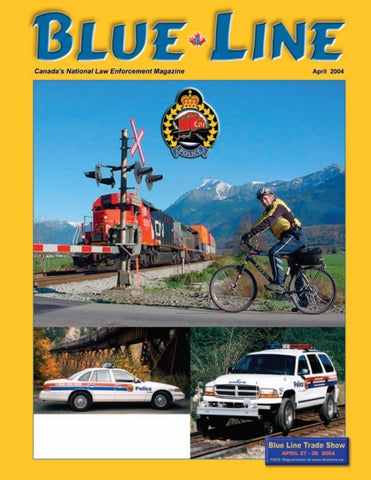
CN Police Cst. Darren Duffill and Cst Darren Dyck check out the current status of train cargo in the Vancouver area. Standard patrol cars, as shown above, are augmented by a wide variety of transportation modes as indicated by the cover picture on this edition.Technological advances assist officers in locating potential crime locations and hazardous situations along the extensive rail lines threading through British Columbia to the rest of Canada.
and federal agencies, CN Police were able to obtain a deportation order against Mr. C, who wasn’t a Canadian citizen, and have him sent back to Portugal last year. Seven officers and an inspector work out of the Vancouver office. Two of them, Constables Darren Dyck and Darren Duffill, received the Queens Golden Jubilee Medal last year; it recognizes “Canadians who have made a significant contribution to their fellow citizens, their community or to Canada.” Vancouver officers are dispatched by a 24hour communications centre, says Cst. Patrick Brisard, a trained intelligence officer. “Cameras are used extensively in rail yards and officers are on call 24 hours a day. Each one has an assigned area between Vancouver and Boston Bar, a distance of 185 kilometres. This helps us get to know the community and its special needs.” All CN officers go through a complete police training program, says Dyck, a criminal 6
investigator, and are taught how to use alcohol screening devices so they can check employee blood alcohol levels. They also frequently use radar to control speeds across the system. Officers issued 1,300 tickets last year in BC alone, notes Insp. Dan Ritchie, who’s in charge of the province. Infractions include speeding, illegal possession of alcohol, failing to stop at flashing red lights and trespassing. Some 316 Canadians were struck by trains last year, says Cst. Norman Witzell, a community services officer and coordinator of ‘Operation Lifesaver.’ Targeted at all ages, its goal is to raise awareness of the dangers of railway crossings and trespassing on tracks. Officers do countless safety presentations for school children, scouts and other groups and put up displays at special events. Billboards throughout the province spread the message that “together we all can make a difference.” Officers also meet and build relationships with pedestrians and cyclists by patrolling on APRIL 2004
mountain bikes, which were obtained free through a partnership with the Insurance Corporation of British Columbia. Offenders are less likely to run if approached by an officer on a bike, as they know it’s more difficult to get Inspector Dan Ritchie away. CN Police employ Crime Prevention Through Environmental Design (CPTED) strategies to examine the root causes of criminal activity. Rather than just focusing on ‘target hardening,’ they look at external factors that may attract crime and conduct security audits. A trained officer inspects a site, looks at crime that has occurred there in the past and develops a comprehensive plan for the manager to implement. This service is available to all clients and has helped achieve significant reductions in crime. The force works closely with other agencies, including Canadian and US border officials, to prevent terrorism and respond to various threats. A mock emergency is held regularly and new thermal imaging technology is being introduced to scan freight as it’s moved within Canada and to the US. Using the 3 E’s — managing education, enforcement and engineering — CN Police have significantly reduced the number of Canadian railway accidents and made shipments across Canada and the US more secure. Inspector Dan Ritchie can be reached at dan.ritchie@cn.ca or 604 589-6647. Elvin Klassen, Blue Line’s west coast correspondent, can be reached at elvin@blueline.ca.
Grant available to communities with rail safety initiatives
Two years ago Canadian National announced a $300,000 donation to the Safe Communities Foundation, an organization that promotes healthy and safe job sites and communities across Canada. "Supporting the Safe Communities Foundation is a natural fit for CN since safety is one of our core values," said John Dalzell, CN's vice-president of Risk Management, and a member of the Safe Communities Foundation (SCF) board of directors. "We have worked hard to earn our position as one of the safest Class 1 railroads in North America. The CN Police service has played an active role in Canadian communities for decades and we look forward to strengthening our community ties through our participation on local Safe Community committees." CN and the SCF encourage all communities across Canada to become safe communities. "A strong culture of safety gives us all a
sense of security and it also makes good business sense," said Paul Kells, vice chair and founder of the SCF. "According to the World Health Organization, for every dollar spent on being a safe community, society saves $40." Included in CN's donation is an annual $25,000 CN Safe Community Fund that will be shared by safe communities that qualify to receive this incentive. Communities interested in becoming a Safe Community through the SCF program must submit a safety business plan. In order to be eligible for the $25,000 CN Safe Community Fund, a community must feature rail safety components in its safety business plan. For more information, visit the SCF web site at www.safecommunities.ca. The Safe Communities Foundation promotes safety across Canada and provides funding to communities that want to implement plans to improve safety.
Brief history of the CN Rail Police
In the late 19th century, rail lines and property in Canada were located all over the country. Increases in crimes such as armed hold-ups and hijackings made the need for system-wide policing more apparent. After many years of lobbying the Federal Government, the railway companies operating in Canada were successful in establishing their own Police Departments. Railway police officers, incorporated into the initial Railway Act of Canada in 1860, had similar powers of arrest and enforcement as those granted to other federal and provincial police departments. The CN Police Service was formed in 1923 following the creation of the Canadian National Railway Company, an amalgamation of the Grand Trunk Western Railway, Grand Trunk Pacific, Intercontinental Railway, National Transcontinental, Canadian Northern, in addition to numerous small railway lines. Today, CN Police reflects the challenges and complexities of ensuring a safe and secure environment for rail freight traffic throughout North America.
June 2003
(Site Licenses Available)
PURCHASE YOUR COPY AT THE BLUE LINE TRADE SHOW
7
APRIL 2004
Traffic problem may not be a police problem Your police expertise can solve traffic problems and free up officers by Morley Lymburner It is an unfortunate system that relegates the traffic enforcement branches of police services to just enforcing traffic laws and investigating collisions. In some agencies little has been done to break the chain of handing out tickets and filling out accident reports. Certainly the concept of harm reduction through traffic studies is one area that has seldom been accepted in traffic cop circles. One area in which traffic officers could focus for collision reduction is in on-street analysis of traffic patterns and roadway design. Many levels of government hire traffic engineers to monitor and redesign intersections, roadbeds and traffic control devices. The fact of the matter is that police officers see the roads more frequently than the engineers. They can determine very quickly, if given the opportunity, where a problem exists and how to correct it. Police managers could focus more on the talent pool within their own agency before looking toward outside sources that could have tainted opinions. One under utilized talent available to most agencies is the trained collision reconstructionist. Most agencies call these officers out to investigate fatalities and other serious incidents. Seldom are they sent to study traffic problems with the view toward reducing collisions and thereby freeing up police resources. These skilled officers can be invaluable to any agency on several points. • They know the streets and roads they patrol; • They understand driving habits; • They have seen enough collisions to know what went wrong; • They have been trained to look beyond the obvious;
• They have been trained in the causative factors of collisions; • They have been taught the basics of collision physics, sciences and math; • They have been trained to communicate their findings in a clear fashion; • Their report is viewed as unbiased to community groups and governments alike. Putting these people to work to prevent collisions only makes good sense. The following case study was submitted some 18 years ago. I have changed some details to emphasize some of the background politics surrounding this study. Traffic Study of exit drive Wankle Corp. 1775 First Street, Maple City
This study is a result of a letter of concern received by this police force from Mr. R. F. Smith of Wankle Corp. and Mr. W. Jones of the Maple City Engineering Dept. Location of this study is the western exit/ entrance to the Wankle Corp. Building at 1775 First Street. The drive is located about 100 metres south of the intersection of Second Av-
8
enue and situated on the east side of First Street and just north of a natural preserve city park. The road way has four lanes of traffic consisting of two lanes northbound and two southbound separated by a core left turn lane. The posted speed limit for First Street is 50 km/h. The road curves to the east just south of the Wankle Corp. exit/entrance. It is also situated just west of the Maple City Administration Building. The complaint is regarding the hazards, either encountered or perceived, of the employees as they exit the driveway of Wankle Corporation and onto First Street. Basic concerns involved near and actual collisions with speeding vehicles going northbound. The city claims the problem is with speeding vehicles while Wankle Corp. claims both a problem with speeders, design of the road or the placement of exit/entrance onto this road. Traffic Survey and Study This location has been an on-going speed complaint zone for the past four months with a police officer assigned to radar duty for a total of 82 hours. A total of three violation tickets have been issued. One for speeding and two for lane change violations. A survey of traffic on First Street indicated that traffic was heavy but that speeds were not excessive. On December 12 between 16:15 and 16:45 hrs. a total of 165 vehicles were counted going northbound and their speeds monitored by an unmarked vehicle. Speeds up to 49 km/h = 135 Speeds 50 to 55 km/h = 25 Speeds 56 and up = 5 The highest speed recorded was 61 km/h and this was only one vehicle. Traffic exiting 1775 First Street was monitored between 17:10 and 17:30 hrs. A total of 77 vehicles left the lot between these times. A total of 44 vehicles turned left and 33 vehicles turned right. After completing this observation it was determined that a greater hazard existed for those turning right. The main reason for this was that left turning vehicles cleared each lane quicker and were removed as an immediate hazard to northbound vehicles while right turning vehicles made a slower acceleration from their stopped position and caused some traffic to slow down to accommodate the reduced APRIL 2004
June 2003
9
APRIL 2004
speed. It was also noted that many right turning cars made a quick lane change to get into the left lane of traffic in order to make a left turn at Second Avenue (a distance of about 100 metres north of the exit). Several exits from the lot were performed by this writer and it was found that due to the unusual obstructions to the south, northbound traffic came into view quite suddenly. This appeared quite intimidating to left turning traffic when coupled with the southbound traffic which tended to flow at a higher rate of speed. It is felt that driver apprehension could be a factor in the local traffic problems. Technical Analysis Due to this unusual problem a deeper investigation was taken with regard to the road character to determine if there were any corrective measures that could be made. The First Possible Point of Perception (FPPP) was measured from the standard stopping position of exiting traffic from Wankle Corp. It was found that the first point at which drivers could see each other was 55 metres to the south of the exit. The Coefficient of Friction of the road surface was measured by drag sleds. At the time of the tests the road surface was dry and the temperature was -9 Celsius. The road was in good repair and appeared of uniform composition. Calculations at the time indicated a friction factor of .69. The Average Radius of the Curve was measured on the west edge of the northbound lane of traffic. It was found to be a median of 85.88 metres. The Critical Curve Speed was calculated
by utilizing the two figures above. It was concluded that a vehicle travelling in the northbound passing lane would go out of control at a speed of about 86 km./h. A vehicle driving in the curb lane was calculated to go out of control at approximately 80 km/h. Upon analysing the above figures it was concluded that the curve in the roadway was adequate for the existing traffic flow, speed limit and the road surface character. Due to all of the above factors it appears that only the location of the driveway could be brought into question. Security of Space and Time We know the speed limit was appropriate. The traffic flow was moving at an acceptable rate of speed and it was not a heavy flow for the road design. It was felt that 55 metres to the first possible point of perception to northbound vehicles from the driveway was not appropriate. Given the usual sequence of events leading up to a collision we discovered that it would take a vehicle travelling at 50 km/h at least 14.26 metres to slide to a stop if all brakes function properly on a dry road surface. On top of this we added a further 10.7 metres to allow for the average driver reaction time of .75 seconds. This now took us to almost 25 metres to stop. This permitted only 30 metres to allow for perception delay. If we had a perception delay of only two seconds the remaining distance was consumed and we could potentially have a collision. If we increased the speed of the vehicle from 50 km/h this safety zone distance was reduced dramatically. For instance at 60 km/h the total space consumed by an alert driver was al-
10
most 36 metres and the chances of a collision were increased dramatically. Observations and Conclusions As previously stated only one vehicle in a half hour was found to be at 60 km/h and no vehicles had been found at 80 km/h. It is not felt that the problem in this complaint is speed. It has been well established that if a person came to a stop before the prolongation of the curb and did not see a car coming from the south, he could make the left turn safely with a car with even normal to modest acceleration. The motorist would only need to check if traffic coming from the north was clear. The only real hazard with left turning traffic at this location would be driver hesitation. To this end it is felt that steps could be taken to increase the perception point (sight-line) by removing some of the bush at the bend in the road and eliminate the parking of cars by the west edge of the parking lot. Right turning traffic is another problem that must be addressed. It was found that most vehicles exiting made a rapid left lane change, or a wide right turn in order to get into the left lane. This is to get over to the left turn lane for Second Avenue which leads to a major arterial roadway and expressway used by most of the motorists on this street. Numerous northbound vehicles were seen to be interfered with by this activity. This hazard was made even more serious by the fact that the only escape route for other northbound motorists was to swerve to the left into southbound traffic or swerve to the right and strike curb lane traffic or another right turning car from the parking lot of Wankle Corp. It is the conclusion of this study that the problem is not one of enforcement but rather engineering. This exit should be removed or turned into an entrance only location. To accommodate exiting traffic another location should be considered at the east end of the property. It has been noted that to do so the City would have to complete a street that has been on the drawing boards for the past ten years. The location is presently being used as a parking lot for City Hall. Records indicate that the city has made requests of Wankle Corp. in the past to pay for the construction of this street extension but the company had refused citing the fact that the street was necessary for proper traffic flow in the area, the city hall’s usage as well as for future development of vacant land immediately to the north of city hall. Although police should periodically monitor this location it is in no way an issue that can be addressed by enforcement. The problems arising out of this location have long been attributed to a policing and enforcement issue. It has become quite evident this is in fact a dispute between city hall and Wankle Corp. that can only be resolved through engineering and road improvements. Both corporations have been looking toward each other to pay for these improvements. For the safety of the public this report encourages these two parties to come to an agreement to solve this problem. In any future civil litigation arising out of these issues both the city and the corporation would have difficulty extricating themselves from liability if this study is not appropriately addressed.
APRIL 2004
June 2003
11
APRIL 2004
The Canadian Press Photos: M. Lymburner- Blue Line Magazine
The body count of women — missing or murdered — is mind-numbing. Three current investigations, all in close geographic proximity and involving missing women going back two decades, have galvanized public attention with thorough shock and horror — and questions. In the Vancouver area, the RCMP’s ‘Project Evenhanded’ deals with a list of more than 60 missing and murdered women that dates back to the early 1980s. The project was set up shortly before the arrest of pig farmer Robert Pickton and includes many suspects other than Pickton, although he remains the primary focus and faces 22 first-degree murder charges. In Edmonton, the RCMP’s ‘Project Kare’ tries to find answers to more than five dozen women missing and murdered in Alberta. In Seattle, the Green River task force still searches for more bodies after police finally caught their monster, Gary Ridgway, who has confessed to 48 murders. Striking similarities stand out among the three major projects: the women were almost all drug addicts and prostitutes, they began disappearing as far back as two decades ago and police took a long time to make a significant arrest. In Edmonton’s case, there still have been no arrests. Inevitably, questions arise about the attention — and personnel — that police put toward
investigating the huge number of missing women. Project Kare has only been set up recently, replacing the former ‘high-risk missing persons project.’’ It involves only the RCMP, not the Edmonton city police, even though many women disappeared in that city. Project Evenhanded was only set up in late 2001 and is a joint task force involving the RCMP and Vancouver city police, who were getting nowhere in investigating missing women through its solo ‘Project Amelia.’ The Green River task force, initiated in Washington State, has been in action for many years but didn’t catch Ridgway until November 2001. Pickton now stands accused of being Canada’s worst accused serial killer and Ridgway is the worst convicted serial killer in U.S. history. Police investigative techniques have been questioned ever since Clifford Olson, the selfstyled ‘Beast of B.C.,’ pled guilty to 11 murders in 1981. At the time, the RCMP came under intense criticism for their handling of the investigation and it was revealed that detachments within Greater Vancouver failed to share and pursue information they had on Olson. That inability or slowness of police agencies to work together seems still to be a problem in the Edmonton investigation. “We are working in harmony with Edmonton (city) police services but they are not represented on the
12
project,’’ said Alberta RCMP spokesman Cst. Al Fraser. “Although we may not have a representative of whichever municipal police agency sitting at the table, that does not mean we are not sharing information back and forth.’’ Project Kare’s predecessor involved many Alberta municipal police forces sharing information about more than 80 missing and murdered women across the prairies, but those cities aren’t included in Project Kare. Like the Vancouver missing women joint task force, it is slow to get rolling. “We’re getting it set up right now,’’ said Fraser. “We just moved into the investigative stage from the analytical.’’ So far, only three RCMP members — an inspector, staff sergeant and sergeant — are working full-time on the project, “putting together infrastructure and going through applications for people of expertise,’’ said Fraser. The plan was to increase those numbers significantly this year. Project Kare’s slowness in getting rolling has been criticized by a former Edmonton city police officer. JoAnne McCartney, a former vice officer who now runs a program aimed at getting hookers off the street, said it may be a “public relations exercise’’ to calm anxious families and secure government funding. She had hoped it would be a joint venture by RCMP and Edmonton Police. After media reports in Vancouver in the late 1990s began to point out the huge number of missing women, Vancouver city police became besieged with questions about what was going on. Their consistent reply was that there was no evidence to suggest a serial killer was responsible or that the women were even being killed. Without hard evidence they were being murdered, the conclusion was that they likely moved on to another city. The Vancouver city police investigation was understaffed. The RCMP wasn’t brought on board until late 2000. The joint investigation was still getting set up, establishing DNA databanks and sorting through lists of primary and secondary suspects, when a tip led police to Pickton’s farm and his eventual arrest in FebAPRIL 2004
ruary 2002. the women are missing Advancements in from Vancouver,’’ which is DNA technology have under city police jurisdicgreatly assisted investigation. tors and the Pickton invesPerhaps the comtigation has also stimuments of one of the leadlated scientific discovery. ing investigators in the Dr. David Sweet, a forenGreen River killings sums sic dentist involved in the up the seemingly continucase, told a scientific conous problem of informaference the case offers tion-sharing. “We don’t manufacturers of detecting have any connection with equipment a chance to say the Vancouver task “try this out and we’ll see force,’’ said Det. Kate how it works and we’ll see Larson of the Green River where we can improve it.’’ task force. “We have Despite the overrecords that (Ridgway) whelming number of had come up there (to the missing and murdered Robert Pickton’s pig farm has become the focus for the investigation of 60 missing Vancouver Vancouver area) but it was women and missing chil- area women spanning over 20 years. The site has seen the world’s largest systematic forensic with a family member and dren, Canada still is only analysis of almost all the soil on the property looking for bone fragments for DNA analysis. at this point we don’t have talking about a national connection to Gary DNA databank. At a conference in Quebec last didn’t exist previously. “When I got the Olson Ridgway and any victims in Vancouver.’’ fall, former solicitor general Wayne Easter said case, I had to use men that were available,’’ he The investigators in Seattle and VancouCanada needs a bank for missing persons to said. “I didn’t get to pick and choose.’’ ver do talk, though Larson admits “we spare families the pain and frustration of searchNorthrop points out that information may haven’t in quite some time... certainly we ing, often for years, for loved ones who may be have been shared but not necessarily pursued exchanged information early on but at this dead — but Easter said the idea needs further between detachments about Olson, whose mur- point we’re so focused on our cases down study because of the costs involved and privacy ders crossed several different RCMP detach- here that we really haven’t had a great deal issues, particularly those surrounding adults ments. “You have these individual little terri- of exchange with the Canadians.’’ who seemingly disappear but who might not tories that are seemingly looking after their own want to be found. little bailiwick,’’ he said. This is a sample feature from Blue Line News Week, an Bruce Northorp, the now retired RCMP Northrup suggested the Pickton joint task executive news briefing service produced and e-mailed superintendent who was in charge of the Olson force should have been set up much earlier, weekly by Blue Line Magazine, in cooperation with Canada To subscribe or for further information go to investigation more than 20 years ago, says there though he admits “it may have been hard to Press. www.blueline.ca or phone 905 640-3048. is a “structure’’ to the Pickton investigation that interest the RCMP in following it up because
June 2003
13
APRIL 2004
Alberta police service to investigate Feds by Peter J. Raleigh
“It is quite a coup for a department such as ours,” says Pembina Police Service Chief Len Lotherton. “For once being a forgotten police service actually paid off.” Lotherton was responding to the news that his agency had been selected to investigate criminal activity in the much vaunted Liberal sponsorship scandal. The 105 year-old Alberta Police Service was selected to take over the investigation after the RCMP decided it was in a conflict of interest situation. Initially appointed to investigate any criminal wrong-doings, it soon became known that the force had accepted over $1 million of sponsorship money for its anniversary celebrations in 1997. In light of this information, the RCMP decided to hand the case over to an agency that has never received any federal funding. Finding such a service was far more difficult than first expected. Many weeks of investigation revealed almost every department in the country had accepted some form of funding from the federal government at one time or another. RCMP Supt. Don Beagle explained it was quite a learning experience tracking down and sniffing out such a force. “The problem was complicated because we finally realized the only way Ottawa actually knew a police department existed was when their hands were out like baby birds in a nest, squawking for federal funds. It was a relief to find this agency in Pembina, Alberta.” The community of 9,000 consists of hardworking people who simply refuse to have anything to do with federal handouts, says Lotherton. “In fact when I accepted this job, that was one of the first points brought to my attention; I couldn’t apply for any grants from any level of government. It has given us a certain level of independence.” The RCMP was happy to discover the service worked on a high level of fiscal integrity. More than 38 years ago then chief Noel Federallis set up the Pembina Police Trust Foundation. The force placed five percent of its annual budget into the revocable trust and reinvested the earnings for the next 30 years. The foundation has grown to just over $14.6 million and for the past eight years has fully financed the 21 officer department. “Every year we find a small surplus which we send back to town council as a sort of Christmas bonus from all of us,” says Lotherton. The surplus last year was, coincidentally, five per cent of its budget. “What better police department to investigate the sponsorship program than one that has its own fiscal house in order,” Beagle stated. Pembina Police have been given $360,000 to cover the costs of setting up the investigation; its four most senior officers will begin enquiries April 1st. Another $138.5 million has been set aside for hiring consultants and forensic accounting experts needed to get to the bottom of the scandal.
Chief Lotherton, shown with the force’s newest police cruiser, prides himself with having the most fiscally responsible police service in the country.
Lotherton bristled at suggestions that accepting that huge sum may hurt his force’s credibility or taint its proud history of not accepting federal handouts. He told reporters that “every last cent of the money has been fully justified, including the $25 million cost of constructing a building for the investigators in downtown Pembina.” “Do you have any idea how much such a building would have cost in Ottawa? We are saving the government tens of millions of dollars by building it here — and our officers, consultants and experts can review the documents and conduct interviews electronically just as well here as they could there, and at a much lower cost; and since our officers are involved, it only makes sense to use it as a new police station too.” Interviews will be done through video conferencing, Lotherton says. He refused to comment on reports that ad agency CorrupAction was setting up a Pembina office. It’s important to remember why Pembina Police were chosen for the investigation, Lotherton stresses — “because our hands are clean and we can do the job better than any other police service in the country... “There is no doubt that our people can do a credible job on this investigation,” Lotherton says. “Last year these officers took a course on investigative interviewing at the Blue Line Trade Show down there in Ontario. This year they’re going to take a course of study by Tony Moreno on Organized Street Gangs. I insisted on it because it will help them understand how the internal mechanisms of many government departments function.” Lotherton says his force needs to replace the officers working on the federal investigation. “Prime Minister Paul Martin has given us a firm deadline; we must have our completed report on his desk not a day later than Dec. 1 2009, so we have to begin hiring new officers immediately. We know it will be a bit of a hardship until we get them replaced. “Since our top investigators have been taken away, we would prefer applicants with 14
investigative experience if possible, but other forms of experience will be considered.” Applicants can go to www.pembinapolice.ca and fill out the online application form beginning April 1st. For further information, contact Len Lotherton at lotherton@pembinapolice.ca. For more details on applying go to www.pembinapolice.ca.
APRIL 2004
Justifying wrist restraint by Mike Novakowski
Canadian police are authorized to exercise reasonable and necessary force over persons under arrest or in lawful custody. Section 25 of the Criminal Code protects them and others in using reasonable force when administering or enforcing the law. It reads: Every one who is required or authorized by law to do anything in the administration or enforcement of the law… (b) as a peace officer… is, if he acts on reasonable grounds, justified in doing what he is required or authorized to do and in using as much force as is necessary for that purpose. When police make an arrest, it’s not uncommon for them to exercise control by using physical restraints, usually handcuffs, in the interests of safety, to prevent escape and/or to prevent evidence from being destroyed. However, the discretion to use them on every occasion, under any circumstance, is not an unfettered right. Their use is subject to limits, including intended purpose and the manner in which they’re applied. Thus, two common issues arise when considering their use — permissible application (why) and appropriate application (how). These aspects are commonly intertwined. Permissible application Early Canadian jurisprudence reasoned that using handcuffs was permissible where a prisoner had attempted or was likely to attempt escape. In Fraser v. Soy (1918) 30 C.C.C. 367 (N.S.C.A.), the plaintiff sued police for false arrest and trespass in handcuffing. Justice Longley of the Nova Scotia Court of Appeal stated: If the (police officer) believed that it was necessary to handcuff them, I think that pretty nearly ended the matter. A policeman has always a right to judge of the circumstances attending a case, in the matter of a sudden arrest, and if he makes up his mind one way or
the other it should be conclusive, only excepting one thing, that is, if the circumstances under which the handcuffing is done were needless and gave reason to suspect that there was a particular desire to administer harshness in it, then it would probably be open to question; but usually a policeman is the sole judge of the circumstances under which he is to arrest and the fact that there were (three suspects) to (two policemen) seems to me sufficient authority. Sixty-one years later, in R. v. Cunningham (1979) 49 C.C.C. (2d) 390 (Man.Co.Ct.), the court considered the use of physical restraint in securing a prisoner on board a ship after the captain arrested him. In this case, the court held that: A peace officer or person affecting an arrest is legally entitled to secure his prisoner, such as by handcuffing him or binding him, if he does so reasonably and if he has good reason for doing so. The judge supported the use of physical restraints even though there was no belief the prisoner may escape, expanding their application to ‘good reason.’ This could include pro-
16
tecting police from the prisoner, the prisoner from self-abuse or to prevent the prisoner from destroying evidence. By securing the prisoner, police may then transport them to a secure facility to perform a thorough search without fear evidence may be destroyed or rendered useless. In a more recent case, Gregory v. Canada 2002 CFT 420, the plaintiff brought an action against the government alleging that her Charter rights were violated when a customs officer arrested and handcuffed her. Federal Court Justice Lafreniere held that a peace officer must establish a reasonable basis to justify using restraints. In this case, the officer testified that he was attempting to eliminate any possibility of escape or injury. Even though that possibility is difficult to gauge, the court refused to secondguess him and found it “was reasonable in concluding that the handcuffs were required”. Furthermore, “the interests of enforcement officers in ensuring their personal safety and that of the detained person and the public must be taken into account”.
APRIL 2004
However, the Court made the following caution: My decision should not be interpreted as condoning a blanket policy of handcuffing suspected persons. The public expects enforcement officers to set high standards of truthfulness and honour, while demonstrating a devotion to duty. They also expect that the officers will be responsible and accountable in their use of the powers provided by law. The unvarying use of handcuffs on all persons arrested without regard for the seriousness of the offence, a reasonable apprehension of violence, risk of escape, or the condition of the arrested person is improper. Appropriate application Handcuffs, like any mechanical police ‘tool,’ require skill and basic knowledge to use. Although minimal under ideal conditions, improperly applying them can result in injury; too loose and they can be removed by the arrestee, assisting in escape or posing a threat to safety — too tight can result in decreased blood flow through the area of restriction, causing discomfort or injury to the wearer. In Carr v. Gauthier (1992) 97 D.L.R. (4th) 651, the plaintiff brought an action against the defendant police officers for assault in using handcuffs. Alberta Court of Queen’s Bench Justice Cooke, finding in favour of the plaintiff, stated: Two aspects however do trouble the court. First, the handcuffs were… far tighter than required. Secondly and more important by reason of the intent manifested by it, the plaintiff was left in the police station for some extended period of time with his hands tightly cuffed behind his back because (the officer) could not find the keys to release him… I find that the plaintiff was deliberately left in this state as punishment for the verbal abuse and intimidation the (police) believed they suffered from the plaintiff. The court found the retributive motivation was an inappropriate application of the handcuffs and constituted an assault on the plaintiff, awarding him $2500 in damages for humiliation, discomfort, soreness and bruising. In Showler v. Shipley (1989) O.J. No. 2360 (Ont.Dist.Crt.), the plaintiff brought an action against police for assault and battery resulting from his arrest in a strike situation described as “volatile and potentially violent.” In assessing the application of handcuffs in the case, Justice McDermid stated: The handcuffs were applied very quickly to immobilize the plaintiff and to prevent him from re-entering the fray. In the heat of the moment, they were applied incorrectly. In the circumstances, I cannot say that either (officer) acted negligently in doing so or with any intention of harming the plaintiff or causing him discomfort. It must be emphasized that all of these events involving the plaintiff occurred within a matter of seconds in a hostile environment. In Forster v. Cineplex Odeon et al., 2001 BCSC 229, the plaintiff’s hand turned blue and he sued police for negligence in handcuffing him too tightly. The court found he had resisted arrest and struggled while being handcuffed, making it hard to double lock them, and that June 2003
they were either secured too tightly or tightened during the struggle. In dismissing the plaintiff’s action, BC Supreme Court Justice Lowry said “given that Mr. Forster struggled to the extent he did in resisting the handcuffs being secured, he cannot be heard to complain that they were placed on his wrists too tightly or that they were not doublelocked to prevent them becoming tighter as he continued to struggle.” Clearly, the situation and motivation for applying handcuffs are significant factors in assessing the appropriateness of their use. As in Showler and Forster, it was recognized that the circumstances of the situation had bearing on the manner in which the handcuffs were applied. Under ideal conditions with a submis-
17
sive and cooperative prisoner, there would be little justifiable reason for improper application. However, with a combative and resistive individual, a ‘text book’ application is, in some cases, unlikely. Summary Handcuffs must be applied for a legitimate purpose and in a reasonable manner and are not intended to be used to humiliate or punish an arrestee. Rather, when used for a bone fide purpose, they are an invaluable tool to prevent escape, preserve evidence and protect the public, police and prisoner. You can contact caselaw@blueline.ca.
Mike
Novakowski
APRIL 2004
at
OPP testing in-car digital video cameras
The Ontario Provincial Police has installed digital video cameras in 12 cruisers in Kenora and 22 in the Greater Toronto Area in a year-long pilot project. The cameras, which cost $12,000 each, can capture more than nine hours of audio and video, along with a date and time stamp, on a re-recordable DVD in the trunk of the car. Officers turn the DVD in at the end of each shift and its contents are transferred to another DVD and stored. The equipment will help maintain the highest standards of professionalism and enhance officer safety, the force says. Officers want the technology in their cruisers, says OPP Supt. Bob Goodall, who notes they have reacted positively to the trial. “It’s an excellent example of the OPP’s commitment to maintaining the highest standard of professionalism and unbiased policing services.” One camera is mounted in the windshield and the other is focused on the rear seat. They can be turned on by the officer through a switch on a wireless microphone or by a master switch in the car and begin recording automatically if sirens or lights are activated or if the vehicle is involved in a crash. Goodall notes that it’s provincial police policy that the cameras must be running at all times when the officer is dealing with the public. He’s optimistic they will cut down on the number of contested traffic charges, reducing court time for officers and leaving them more time to patrol. “This new state-of-the-art technology has proven to be an effective frontline policing tool, by providing irrefutable video evidence... and will enable us to observe and evaluate police/ citizen interaction in some of our communities.” The cameras will save time and money on cases that might otherwise be thrown out for lack of evidence, says OPP Sgt. Cam Woolley,
who notes he’s stopped people who end up denying the charge in court — “but the camera never lies.’’ Not all Ontario police are enthusiastic about the idea. Toronto Chief Julian Fantino said in December that installing cameras, as recommended in an Ontario Human Rights Commission report on racial profiling, would imply that police officers aren’t trustworthy. “I don’t believe our police are so corrupt, so dishonest, so racist, that we need to have body packs on them, cameras on their back and watchdogs at everything they do,” Fantino said at the time. The OPP says recorded images will be used only as evidence and not released to entertainment shows as is done in the US. The force installed video cameras in a number of cruisers about 10-years ago but they malfunctioned in the winter, which is one reason the new units are being tested in northern Ontario this time. Cameras are very common in the US and have been used by the RCMP in select areas for more than 10 years.
Veteran RCMP dog handler, Cpl. James Galloway, was killed during a standoff with an armed man on February 28 in Spruce Grove Alberta. The 31 year officer had set his retirement date for June this year. The officer died after being hit by a single bullet from a .303 rifle in the hands of Spruce Grove resident Martin Charles Ostopovich, 41, who was shot by police and later died in hospital. Galloway helped organize a civilian search dog service and in 2002 he won the Queen’s Golden Jubilee Award for his significant contribution to society. Just two weeks prior to his death he and his dog Cito rescued a cold and hungry young boy who had disappeared in a wooded rural area. Galloway was given a full regimental funeral service held in Sherwood Park on Friday March 5th. His trusted dog, Cito, kept vigile at the head of his casket throughout the service. Vancouver police Chief Jamie Graham defends the provision in the Criminal Code that allows police to remove citizens to other parts of a city for breaching the peace. He says it’s a good law and a good tool for police officers to quell disturbances that require people to be removed from certain areas. He says it’s not the policy of the law that he sees as a problem, but rather the individual application and individual cases where it can become troublesome. A funeral service was held for Ontario Provincial Police Constable Terry Seecharan on March 1st in Brampton, Ontario. The 32-year-old was killed in Brampton after his car hit a flatbed trailer unloading construction equipment. The officer was on his way to work at the time of the crash. Nearly 400 officers lined the streets near a Brampton funeral home to honour Seecharan. Former Premier Ernie Eves also paid his respects to Seecharan, who worked as a legislature officer before joining the OPP a year ago. The head of the Toronto Police Association is adamant that his members be allowed to endorse political candidates. Rick McIntosh says he is prepared to fight all the way to the Supreme Court of Canada to win that right. McIntosh calls it a matter of freedom of speech. However, the Police Services Board says the Police Services Act is clear that no city police officer can engage in political activity. Board vicechairman Pam McConnell says the province is being asked to clarify whether officers can make endorsements. Police Chief Julian Fantino says he will wait for the province to clarify the act before charging anyone.
See us at the Blue Line Trade Show 18
Ed Keyes, the President of the Canadian Association of Police Service Boards, worries crime will escalate if penalties for possession of marijuana are reduced. He pointed out the large number of grow operations as an indicator of the magnitude of the problem. Keyes is calling for a delay in the marijuana decriminalization bill. He says a national drug strategy to address education and treatment issues should come before decriminalization. APRIL 2004
June 2003
19
APRIL 2004
Complaints nip wrongdoing in the bud by Dr. Dorothy Cotton, Ph. D., Psych.
Someone recently asked me what police service I worked for and I had to ‘fess up that I actually work in a prison most of the time.” It’s a pretty interesting job, believe it or not — for a psychologist, anyway. I do ‘assessments’ — psychological tests, which is a lot like being a detective. My job is to figure out what’s going on in someone’s brain. Since opening up heads and having a look is generally frowned upon — and can get quite messy — I have to collect clues from how people behave and their answers to questions and use them to figure out which parts of their brain work and which parts don’t. I ask people to define words, remember lists, solve puzzles, draw pictures, figure things out, control impulses, sort things, add or subtract, write, guess — all sorts of things. If I want to find out if someone is good at abstract reasoning, I’ll ask questions about how two things might be alike — for example, “what’s the same about a shoe and a sock?” or “how are jam and peanut butter alike?” Here’s one for you: Q. How are police services and hamsters alike? The answer? A. Both sometimes eat their offspring when threatened. I was talking the other day to a guy who had made a pretty serious complaint about another police officer. He hadn’t made it lightly but felt he had to do something about the things going on that weren’t cricket. I got the impression he wouldn’t do it again, which is too bad really. I’d be the first to agree that things get a little messy when people make complaints about their co-workers — but I dare say they get even messier if someone knows bad things are going on and does nothing. You’re damned if you do and damned if you don’t. Of course the flip side is someone making complaints about those who didn’t do anything wrong. Sometimes it’s an honest mistake and
sometimes it’s not, but there are two things I can say with some certainty: 1. There seems to be a huge amount of stress involved with making complaints, whether you’re the complainer or the complainee 2. Each police service needs to figure out ways to make this process as ‘un-damaging’ as possible My confidential sources tell me that the usual procedure is to avoid targeted people like the plague. Whispering at the water fountain is always popular, or running when you see them coming. Other tried and true strategies include believing every rumour you hear (the juicier the better), assuming the worst, ostracizing the culprit (you can decide who that is), pretending you’re too tough to let this stuff bother you, running for cover and playing role reversal (making the accused into an accuser and vice versa). I’m sure you could add to this list. So what’s the answer? Well, I hate to sound pathetically simplistic but you might consider putting yourself in the other’s shoes. Before tarring and feathering the person who made a complaint, think about what they’re going through — and if making a complaint against someone simply because you dislike them or
20
didn’t get promoted seems like a good idea, ask yourself what on earth makes you think you have the right to put a co-worker through that. I don’t need to tell you folks that complaints are a pretty serious business. It’s absolutely imperative that people who see wrong-doing speak up and point fingers and that leadership supports them, provides guidance and doesn’t treat them as criminals. Oh sure — the person in the middle of the mess will need to read up on stress management strategies but the organization has some responsibilities too. It needs to make sure it’s safe to take the high road, say what needs to be said and make mistakes. That doesn’t mean it’s peachy keen to screw up but making a mistake shouldn’t diminish your basic rights as a human being — to err is human, after all. Basically, it is all about dignity, respect, integrity — all those corny things that get written into our mission statements. In my mind, it doesn’t really even matter who’s wrong and who’s right. In my line of work, I see lots of people who’ve done some pretty awful things, sometimes accidentally and other times on purpose. Some screwed up just once and with others it’s a lifetime pattern, but right or wrong, they’re all people and they all deserve a certain degree of basic respect. It can be hard to show it sometimes, but if we can’t, we’re back to the hamster analogy. The people involved in complaints will be part of our services long after the complaint has gone away, unless they choose to go away — and it’s almost always the good people who end up leaving; after all, they’re the ones who can find new jobs the easiest! People learn from experiences and what they learn is up to us. So what does your service have in place to help the people caught up in the complaint process? If your answer is “nothing,” then… well… that really is a shame. Dr. Dorothy Cotton is Blue Line Magazine’s Psychology columnist and she can be reached at deepblue@blueline.ca.
APRIL 2004
EDMONTON — An Edmonton Crown Prosecutor announced on February 27th, the abandonment of charges against 19 members of an alleged cocaine trafficking ring. After nearly five years, and a reported cost of $36 million, the case never made it before a jury. The Crown conceded it was so unwieldy they could not bring it to trial in a reasonable amount of time, as guaranteed in the Charter. It began in September 1999, when hundreds of police officers arrested 68 people and companies in raids in Edmonton and Red Deer, Alberta. Over the years, charges were dropped against several of them and officials split the case into two prosecutions in an effort to simplify proceedings. In spite of this the federal Department of Justice said it finally had no choice but to pull the plug. Wes Smart, the federal department’s director of prosecutions on the Prairies stated in a press conference, “We have to give priority and abide by the right of an accused to have their trial within a reasonable time. We’re not in a position to say at this time we can do that or the court will be able to do that. Therefore, we must end it.’’ Officials also stated the Crown was also unable to fulfil its obligation to disclose mountains of evidence to the defence in a timely fashion, and the case was not well co-ordinated with police. Federal Justice Minister Irwin Cotler said his department will draft amendments that will cut paperwork by clarifying what core information should be given to the defence. Federal prosecutors had appealed an Edmonton judge’s decision last fall to stay charges against 11 accused in one of the two drug-ring cases on the basis that their trial had been unreasonably delayed. Prosecutors dropped that appeal Friday and stayed charges against the eight remaining accused in the other case. Police say the massive effort wasn’t a complete loss. They note 24 suspects pleaded guilty and a handful were deported. All told, 7.5 million pieces of paper were produced, each of which had to be funnelled to each suspect’s defence lawyer. Some suspects had up to four defence lawyers, who also received hundreds of cassette tapes holding an estimated 250,000 conversations. Don Beardall, the federal Justice Department’s anti-organized crime coordinator, said much has been learned. “There’s a need for Crown prosecutors and police to work together from the outset of an investigation to make sure it’s well-organized, that the disclosure is well-managed and that the prosecution will flow with maximum efficiency,’’ he said. Supt. Raf Souccar, director-general of the RCMP’s drugs and organized crime section, said police have changed their training and procedures. He pointed out that they now appoint disclosure officers at the outset of an investigation, not at the end of the investigation. He also pointed out that Investigators have received more training on maintaining June 2003
electronic databases. The price tag on the massive case continues to climb as more bills come in. Of the $36 million, $23.7 went to defence lawyer fees, $5.6 million went to federal prosecution costs, and the rest went to police and court costs. *** QUEBEC — Quebec’s public security minister has announced the creation of a special squad to investigate allegations of abuse and corruption in the province’s informant and undercover agent program, especially in Montreal. The squad will be composed of seven investigators from the provincial police, Montreal police and RCMP, Jacques Chagnon said. A prosecutor from the justice department has been assigned to the investigation but details of the team’s mandate remain to be determined. Chagnon said he hopes the investigation will shed light on allegations contained in audiotapes that were dropped off in December. An association of informants and the Parti Quebecois said the announcement was a step in the right direction but added that an independent public inquiry would have been better. “There are a few informants who have taken enormous risks to make the allegations, but there are many others who are not in a position to speak,” said Jim Boivin, a former informant. It was announced earlier that the provincial police investigation about the Montreal police force’s treatment of informants and un-
21
dercover agents was ending. That investigation was announced in December by Chagnon. *** HALIFAX — Nova Scotia has yet to act on a nine-year-old recommendation to remove archaic and potentially hurtful language in its legislation dealing with mental health issues. The “custody of lunatics,’’ for example, is one of the phrases in the Incompetent Persons Act; “any lunatic being at large may be apprehended under warrant from two justices of the peace,’’ the law states. It also refers to an “insane person’’ as someone deemed incapable of managing his or her affairs. Bill Laurence, legal research counsel for the Law Reform Commission of Nova Scotia, said Tuesday his office filed a report to the province in 1995 that, in part, addressed old, inappropriate language in the Incompetent Persons Act and suggested alternatives. “The proposals were made and nothing seems to have happened in the meantime, so it doesn’t seem as if that advice was taken up,’’ he said. A government official said the province is planning to update its legislation. Other potentially offensive language can be found in such statutes as the Hospitals Act and Inebriates Guardianship Act. The latter uses the term “habitual drunkard’’ to describe an alcoholic.
APRIL 2004
Gangs, guns & graffiti by Heinz Kuck
My gang is my familia, my protection, my life. You see this? My pistola, what do you think? It’s my life or yours, my way out. To put you down, mother f…. means nothin’ to me. My ‘placa,’ my graff, I can hit up to show my turf. I can roll call my familia. If one of my homies gets capped, I can honour him with a R.I.P. If I see your mark, I can cross it out. Look at my mark; it’s on my skin, on your wall, in my heart… it’s my nation! This came from an 18-year-old gang member whose sole occupation is simply to stay alive. He not only describes the deadly link between gangs and guns but also the indivisible connection with their irresistible trade mark, gang graffiti. Viewing gang graffiti, which has four primary compositions and hence, distinct purposes, offers a glimpse into what it’s like to be a ‘home boy:’ • Hitting up: involves using the gang symbol or icon as much as possible. Emblazoned throughout a neighbourhood, this type of tag not only identifies boundary (turf) but acts as a banner for recruitment and a means of intimidation. • Roll call: A wall covered from top to bottom,
end to end, with the ‘street names’ of all members. It symbolizes gang strength through shear numbers and celebrates individual reputations. • Cross Out: Spray painted Xs which obliterate a rival gang’s graffiti, making it clear the intruders have the will and daring to enter its turf and cross out their tag. Seen as a show of defiance and challenge for dominance. • “RIP” (rest in peace): Memorializes dead gang members. RIPS are generally represented by a colourful mural depicting a member’s death but can also involve a short ‘rap,’ statement or simply a listing of names, pay-
22
ing homage to the slain. Whether through the use of tattoos, bandanas, clothing or graffiti, gang symbolism is internationally recognized as a potent means of espousing the virtues of ‘family,’ conformity, brotherhood and respect, all in a blood soaked race for criminal dominance. S/Sgt Heinz Kuck has been a member of the Toronto Police Service since 1979 and is the service’s Graffiti Eradication Program coordinator. He will be presenting the first national graffiti eradication and training course April 27 and 28 at the Blue Line Trade Show. Go to http://blueline.ca/ tradeshow/seminars.php to register or for more information.
APRIL 2004
Newfoundland recognizes its top cops by Danette Dooley
Newfoundland high school students will recognize the Royal Newfoundland Constabulary’s (RNC) 2003 police officer of the year as the student who hung out with them between classes last year. Cst. Stephanie Motty was actually working undercover for the RNC/RCMP drug team. Motty joined the force in 2002 and was only 19 years when posted to the street patrol unit. A year later she was transferred to the drug team in an undercover operation to target high school drug users and sellers. Motty enrolled in courses, enabling her to be around the school mornings, recesses and lunch – target times for drug activity. As a result of her work, 72 drug charges were laid against 32 students in several high schools last May. Motty was nominated for the award by her supervisor and fellow police officers, who noted that, in putting the good of the schools and communities before her own needs, she displayed traits on which policing is built. “From day one she conducted herself in a professional manner and followed the directions given to her,” the nomination reads. Motty says it’s gratifying to be recognized and described her undercover work as a great experience, one she didn’t hesitate to undertake. “Not too many people get such an opportunity so early in their career and I was very honoured when they asked me to do it.”
Sgt. Paddy McNeil
to see the police officers recognized for the tough jobs that they do on a daily basis.”
Cst. Stephanie Motty
“Very rarely does anybody stand up and thank the police for doing their job,” noted RNC Chief Richard Deering. “It’s nice to come on a day like this where it is a good news story and
Halifax Police recognize outstanding officer Det. Cst. Gordon Graham has been named the Halifax Regional Police Officer of the Year, nominated by his peers as an officer seen to uphold a standard of distinguished public service in policing. Presently working with the force’s High Risk Offender Unit and an ERT member since 2000, he has also spent time in patrol, drugs and GIS. Graham “embodies all the positive attributes of a police officer,” a fellow officer said. “His attitude toward this profession helps inspire newer constables hitting the streets for the first time. He has left an indelible mark on those he has worked with and deserves to be recognized for his continued dedication to his profession and for serving as an excellent role model for those of us who come behind him.” “It is the norm for him to have at least one person under arrest before the rest of us in the office have had the chance to have our first coffee,” another officer commented. “You can well imagine how popular he is for that on certain mornings. That being said he truly is an exceptional police officer and I cannot think of anyone more deserving of this award.” Graham said the best part of getting the award was knowing his peers nominated him; “that knocked my socks off really.”
RCMP top cop Sgt. Paddy McNeil of the Baie Verte Detachment, a 26-year veteran known for his work in bridging the gap between police and youth, is the RCMP’s top Newfoundland cop. McNeil and his family recently moved from Pasadena and he was nominated by people in both areas for his fund-raising activities and investigative skills. “This (his transfer) results in a great loss to our community but a great gain for Baie Verte,” the nomination reads. “He worked tirelessly to achieve success and put closure to a tragic case which brought much relief to a family that was distraught.” The case in question saw Malcolm Cuff convicted of manslaughter in connection with the 24 year-old unsolved murder of Janet Louvelle, who disappeared from Corner Brook in 1979. Her body was found in a wooded area outside the city four months later. McNeil began to focus on Cuff, who was already serving a sentence for the murder of another woman in 1983, three years ago; Cuff is now serving a 14-year sentence for the girl’s murder. Louvelle’s family considers the officer to be their “guardian angel.” McNeil says they feared the case would never be resolved and notes “it was a big weight off their shoulders” when charges were laid. He was especially pleased to be able to bring the case to a conclusion for the sake of Janet’s son, a baby at the time of his mother’s murder. “I feel really very good for Janet’s son, who never really knew his mother. He was kept abreast of what was going on… he feels relieved and now he can get on with his life knowing his mother’s death has been solved.” Danette Dooley can be contacted at dooley@blueline.ca.
24
APRIL 2004
Conference to draw forensic experts
by Danette Dooley
In a post 9-11 world, an RCMP presentation on biochemical threats is expected to draw large numbers to the Canadian Identification Society’s (CIS) 27th annual educational conference, set for June 27 to July 1 in St. John’s Newfoundland. A fellowship of police and civilian crime scene examiners and scientists, the CIS has hundreds of members across the country and some internationally. Canadian identification officers have long recognized the benefits of annual meetings. The CIS was founded in 1978 with the mission of bringing together the forensic professions, encouraging research in their respective fields and providing a means to distribute findings. The Royal Newfoundland Constabulary (RNC) and the Newfoundland government will host the conference, which is titled, appropriately, ‘Forensics on the Rock.’ Sessions will be primarily focused on those in the forensic science field, says RNC Cst. Jim MacDonald, who will be making a presentation and is coordinating the conference with help from civilian employees and forensic identification officers in Labrador West and Corner Brook. Environment Canada will demonstrate its remotely operated vehicle (ROV), which can be requested by police to assist in underwater recovery of evidence and searching areas too hazardous for divers. It was used several years ago in Newfoundland in a missing person case.
June 2003
blood splatter specialists and MacDonald sees the conferother forensic scientist specialence as a way for experts in the ists attended. forensic identification field to Top forensic identification learn about what’s happening in specialists are expected to attend the rest of the country. “Ideas will again this year. Presentation will be traded on all kinds of evidence be made on the latest in evidence gathering techniques, both old gathering techniques and new foand new,” he notes. rensic technology, with some Other items on the agenda inopen to the general public. Preclude establishing Canadian footsenters will include: wear accreditation standards; the • Memorial University Professor subject gained a lot of prominence Elliott Leyton (crime trends in the in the US after the O.J. Simpson US and Canada) Royal Newfoundland trial, MacDonald says. Constabulary • Dr. Simon Avis (investigating “Fingerprint accreditation Cst. Jim MacDonald deaths) will also be discussed by the • Federal crown attorney Juan membership,” he notes. “This will O’Quinn (entering forensic evidence and exset the guidelines for national standards for finpert opinion) gerprint and footwear examiners”. Last year’s CIS conference was held in • OPP Sgt Paul Rosato (virtual crime scenes) Ottawa and was co-hosted by the International Association for Identification (IAI). Over 800 specialists in fields such as forensic crime Visit http://www3.nf.sympatico.ca/juan.burton/Information.htm more information on the conference. Danette Dooley can scene examination, latent fingerprint and foot- for be contacted at dooley@blueline.ca. wear examiners, crime laboratory technicians,
25
APRIL 2004
Searching briefcase after arrest ruled lawful by Mike Novakowski
An ownership claim of a briefcase found in a stolen vehicle does not necessarily alter the scope of a search incidental to arrest, Ontario’s top court has ruled. In R. v. Mohamad, (2004) Docket: C36120 (Ont.C.A.) police received a tip from custom officials investigating a stolen vehicle being exported to Amsterdam. A police detective went to a used car business where a Yukon truck with the same vehicle identification number (VIN) was reportedly parked and arrived just in time to see it being driven on the lot. He blocked it and noted while speaking to the driver that the VIN in the vehicle and a van parked beside it were glued to the dashboards, leading him to suspect they were fake. The driver said the truck belonged to the business owner, Mr. Jebo, who was arrested for possessing stolen property. A tow truck was called to remove the two vehicles for forensic examination. The van was unlocked and the keys were in the ignition; an officer entered, looked around and discovered a briefcase. He opened it and saw documents with Mohamad’s name on them. As the tow truck arrived, Mohamad ap-
OPP preparing for recruitment program The Ontario Provincial Police is preparing for its second OPPBound recruitment program, scheduled to be held this summer in Orillia. This year the program will strive to increase awareness of employment opportunities for Aboriginal women and men in policing. The one-week camp serves as a vehicle to give qualified prospects an opportunity to explore a career with the OPP. Participants will learn about the history and traditions of the force and the program will include a number of mentoring sessions where key Aboriginal officers can share their experiences. Participants will also have the opportunity to experience a week in the life of an OPP recruit at the academy, taking part in firearms exercises, fitness drills, police vehicle operations and other practical exercises. The first OPPBound program was targeted at recruiting females; of the 100 women who attended in 2003, 78 entered the recruitment process at its conclusion. One has recently been hired and many others are in the final stages of the process. The application deadline for OPPBound2004 is May 1 and there are 100 slots available for the five-day mini recruit camp, which will run July 11 - 15 at the force’s academy in Orillia. More information is available from opp.ca or by calling the force’s recruitment unit at 1-866-393-3337.
proached the officer and told him the briefcase was his and that he had forgotten it after earlier test driving the van, which he claimed he was going to buy. A further search of the briefcase turned up a dealer’s licence plate, air tickets to Amsterdam and documents to ship the van to Amsterdam. The officer left to give the tow truck operator instructions and returned to discover Mohamad had taken the briefcase to a neighbouring building. The officer found him and told him to take the briefcase back to the van so it could be thoroughly searched. The suspect complied and police discovered sealed envelopes containing counterfeit VIN plates, stickers, parts and certification labels. Mohamad denied knowledge of the items or how they came to be in his briefcase. His passport, driver’s license and other evidence was also found in the briefcase and he was arrested and charged with possessing the stolen truck and van, as well as a third vehicle found later. At his trial in the Ontario Superior Court of Justice, Mohamad argued police had no authority to open and search the briefcase once they learned he owned it; since he hadn’t been arrested and wasn’t a suspect in any crime, there was no basis to issue a search warrant until after the briefcase was opened. Thus, he contended his rights under s.8 of the Charter had been breached and the evidence was inadmissible. The Crown, on the other hand, asserted police were permitted to search the van and its contents to discover and preserve evidence. The trial judge agreed and found no Charter violation. In his view, the officer had seized the stolen van and had the authority, incidental to Jebo’s arrest, to inspect it and its contents. Mohamad appearing on the scene and claiming ownership of the briefcase did not alter the officer’s authority to search it. The accused went to the Ontario Court of Appeal arguing, among other grounds, that the trial judge erred in admitting the briefcase search evidence. In arguing that one’s s8 Charter rights, which protect against unreasonable governmental intrusion, were violated one must first demonstrate that they had a reasonable expectation of privacy. If this burden is met, they must show the police search was unreasonable. The circumstances determine whether a person can reasonably expect privacy - it’s a contextual approach. In this case, the accused contended he had privacy only in the contents of the briefcase, not the stolen vehicle. In support, Justice Cronk stated: In the contemporary context, briefcases often house highly confidential personal and business information. They can serve, in a practical sense, as portable offices for their owners. In my view, owners of briefcases generally have a reasonable expectation of privacy in the contents of their briefcases. 26
However, even where a person can establish a privacy interest in the item, the search will not infringe s.8 if police have the lawful authority in the circumstances to search it. Search incident to arrest does not require a warrant or independent reasonable and probable grounds for the search. In those respects, it is an exception to the ordinary requirements for a reasonable search. Rather, the right to search derives from the fact of the arrest, which itself requires reasonable and probable grounds or an arrest warrant. If the arrest is unlawful, the search is also unlawful, Justice Cronk said. However, in this case, Mohamad did not contest the lawfulness of Jebo’s arrest, the manner of the search or its warrantless nature. Rather, he suggested that once the accused claimed ownership, continuing to search the briefcase contents exceeded the incidental search scope because there were no grounds to believe he had committed a crime or that the briefcase contained evidence. The law is clear that a search incidental to arrest requires a legitimate purpose connected to the arrest. As Justice Cronk noted, “the legitimate purposes of search incident to arrest extend to the protection of evidence from destruction at the hands of the arrestee or others and to the discovery of evidence that can be used at the arrestee’s trial.” The officer testified he was looking in the briefcase to locate evidence concerning the theft of the van and the “re-VINing” scheme. He said he had seized the van and the trial judge found he had a duty to inspect it and its contents to discover and preserve any evidence. The Ontario Court of Appeal agreed, finding the officer “had one of the purposes of a valid search incident to arrest in mind when he conducted his search of the briefcase, that is, the discovery of evidence concerning the charges against Jebo.” In holding the search of the briefcase closely connected to Jebo’s arrest, Justice Cronk stated: (The officer) wasn’t obliged to simply accept the (accused’s) assertions of ownership of the briefcase and of an innocent explanation for its presence in the stolen van and to terminate the search of the briefcase on the basis of those assertions. That proposition, urged by the (accused), defies common sense and, if accepted, would render the search incident to arrest power meaningless in circumstances where, but for the ownership claim, it is being lawfully exercised for the purpose of discovering or preserving evidence relating to a crime. The requirements for a valid search of the briefcase as an incident to arrest had been satisfied. The search of the briefcase and its contents wasn’t unlawful or unreasonable and the evidence obtained was admissible. The accused’s appeal against conviction was dismissed. Visit www.ontariocourts.on.ca for a complete copy of this judgment.
APRIL 2004
Warrantless entry and arrest upheld The Manitoba Court of Appeal has ruled that the warrantless entry and arrest of a murderer at his father’s home was lawful, even though police did not have prior judicial authorization. In R. v. Guiboche, 2004 MBCA 16, police responded to the home of a woman who had been brutally beaten to death. The suspect, her live-in boyfriend Guiboche, fled the scene before they arrived. Officers guessed he may have gone to his father’s home and several went there about three hours after finding the body; one “snuck up” through the yard, entered an open porch and knocked on the back door, which was answered and opened by the accused’s father. The officer stepped over the threshold and told him they were looking for the accused; the father said he was upstairs and suggested they be quiet. After further discussion, police arrested the sleeping suspect, seized clothing as evidence and took fingerprints, hand swabs, breathalyzer samples and photographs. At trial in the Manitoba Court of Queen’s Bench, the judge found police had exigent circumstances, as defined under s.529.3 of the Criminal Code, to enter the house without a warrant and make the arrest. The officer testified he was concerned about safety and the preservation of evidence such as blood, tissue and fluids from the extremely violent murder scene. The judge didn’t criticize police for the way they approached the back door, stating they were not expected to announce their presence by a “march through the yard with a brass band.” The evidence was admitted and a jury convicted Guiboche, who appealed to the Manitoba Court of Appeal arguing, among other grounds, that the trial judge erred in finding the evidence properly admissible. Justice Freedman, authoring the unanimous judgment, held that the trial judge erred in finding s.529.3 applicable in this case. As a pre-condition to allowing warrantless entries into dwelling-houses to effect arrests, the section requires police to have reasonable grounds that the person they want to arrest is inside. In this case, officers admitted they had no grounds to believe Guiboche was there until after they entered. The entry and arrest The justices went on to conclude that the warrantless entry and arrest was nonetheless lawful through informed consent. Freedman
was satisfied that the accused’s father gave permission by his actions for police to enter and look for Guiboche, even though there were no actual words of consent — and that obviated the need for a warrant. The father was the homeowner, had a reasonable expectation of privacy in the house and, as the court noted, was “an active participant assisting the police and his conduct and communication showed more than mere acquiescence or compliance.” Justice Freedman stated: Once (the officer) made clear the purpose of his attendance (i.e., they were looking for the accused), (the accused’s father) could have said nothing, or he could have declined to speak, or he could have questioned (the officer), or he could have asked (the officer) to leave. Instead, without any further action by (the officer), (the accused’s father) told him that the accused was upstairs and not to say anything. Moreover, he entered into a discussion with (the officer) and provided him information about the layout of the upstairs, where the accused was. This was clearly in connection with the purpose of the visit. (The accused’s father) knowingly and willingly facilitated the police’s achieving their objective. Once police found Guiboche, they were entitled to arrest him because they had the necessary reasonable grounds, as required under s.495(1) of the Criminal Code. As for the impact stepping over the doorway had on the legality of the arrest, Justice Freedman stated: It is clear to me that in relation to their entry into the house, the police acted in good faith, without trickery, without misleading… and, importantly, without any degree of force whatsoever (unlike in Feeney). They knocked on the door and (the accused’s father) opened it, stepping back. (The officer) stepped over the threshold, without any words of invitation by the homeowner to do so. That act, in and of itself, is insufficient to render unlawful what followed. A warrant to enter was unnecessary and the arrest was therefore lawful. The search A person can make a challenge alleging their s.8 Charter right against unreasonable search and seizure was violated only if they can first establish they had a reasonable expectation of privacy. Although a homeowner has a
reasonable expectation of privacy in their own home, a visitor, depending on the circumstances, may not. “For all persons, their dwelling-house is, at law, their castle, but it is not necessarily anyone else’s castle,” noted Freedman. In this case, Guiboche did not testify or call evidence and it was established that he lived at the victim’s residence for seven to eight years. Guiboche failed to establish any reasonable expectation of privacy at his father’s house, which was nothing more than a “hideout” for him, and his s.8 Charter rights were not engaged. The evidence was properly admitted at trial and his appeal was dismissed. Visit www.canlii.org for a complete copy of this judgment.
Investigative safety search upheld A police officer does not have to suspect a person has a weapon to search them, for safety reasons, during an investigative detention based on articulable cause, Alberta’s highest court has ruled. In R. v. Davis, 2004 ABCA 33, a city hall worker called police to report seeing the accused conduct several drug transactions near a hotel. Two officers were dispatched and saw Davis, who matched the description provided, and approached. He was detained for investigation, handcuffed and pat-frisked for weapons. A bulge around his shin turned out to be a small Pringles potato chip can. Officers opened it to look for weapons and found crack cocaine wrapped in tin foil packages. Davis was arrested, charged and subsequently convicted of possessing cocaine for the purpose of trafficking in the Court of Queen’s Bench. He appealed to the Alberta Court of Appeal, arguing that both the detention and search were unreasonable in the circumstances. Justice Berger, writing for the unanimous court, concluded that police are authorized in detaining a person if they have an articulable cause to believe they’re engaged in criminal activity; thus they’re also entitled to search for weapons if it’s reasonable and necessary for safety reasons. Such an encounter is neither an arbitrary detention under s.9 of the Charter nor an unreasonable search under s.8. Davis’ argument that police could not open the container unless they expected to find a weapon inside also failed. In holding that the trial judge was correct in finding the search reasonable, Justice Berger stated “the issue is really the reasonableness of the search given the size and utility of the Pringles canister as a hiding place for a weapon.” The appeal was dismissed. Visit www.albertacourts.ab.ca for a complete copy of this judgment.
28
APRIL 2004
ASD testing unnecessary before making demand Police may demand a breath sample before making sure the alcohol screening device (ASD) is warmed up, tested and ready to go, Ontario’s top court has ruled. In R. v. Danychuk, (2004) Docket: C39898 (OntCA), a police officer stopped the accused after observing a vehicle weaving over the line and smelled alcohol inside. Danychuk admitted to drinking two beers but refused to provide a breath sample. The officer cautioned him about the consequences of refusing and asked again, but he replied “no, I will go to court.” Although the officer had the screening device beside him, it had not been tested. Danychuk was convicted; the Ontario Court of Justice concluded the officer had the ASD available forthwith, ready to be tested and presented to him. However, the Ontario Superior Court of Justice overturned the conviction, ruling the Crown didn’t prove the ASD was available forthwith because it hadn’t been tested to ensure it was ready to accept a sample, the officer had not yet presented it and the purpose of the test and consequences of refusing wasn’t explained. The Crown successfully appealed to the Ontario Court of Appeal, arguing that 254(5) of the Criminal Code makes it an offence for a person to fail or refuse, without reasonable excuse, to comply with a demand for a breath sample into an ASD under s.254(2).
June 2003
The demand requires the person to “provide forthwith” a breath sample and imposes a duty on police to administer the test “as soon as reasonably practicable or within a reasonable time, having regard to the provision and circumstances of the case.” It is not a prerequisite of a valid demand to prove police were immediately ready to administer the test or that they advised the motorist of the process and consequences of not com-
29
plying with the demand. In other words, the ASD need not be warmed up, tested and operational before a sample is demanded. Nor does the officer have to explain the process or consequences of failing to comply. In summary, Justice Blair held: A timely demand is validly made pursuant to subsection 254(2)… where (a) the individual to whom the demand is made has been operating a motor vehicle, or has care or control of that vehicle; (b) the peace officer who makes the demand reasonably suspects that the individual to whom the demand is being made has alcohol in his or her body and (c) the police officer is ultimately in a position to require that the breath sample be provided before there is any realistic opportunity to consult counsel. Where, as here, there has been an outright refusal to provide a breath sample, it is not a prerequisite to such a demand that the Crown establish the approved screening device was present at the scene, tested and ready to accept a sample, or that the police officer presented the device to the driver and explained the purpose of the test and the consequences of a failure to provide a sample. The appeal was allowed and the conviction was restored. Visit www.ontariocourts.on.ca for a complete copy of this judgment.
APRIL 2004
Officer’s ALS caused by work injury In a landmark decision, BC’s Worker ’s Compensation Appeal Tribunal (WCAT) ruled that a work-related injury triggered the neuromuscular disease ALS (amyotrophic lateral sclerosis) in an on-duty police officer. The officer, who fell on his left shoulder after being tackled by a suspect in a domestic disturbance, applied for compensation, describing injuries to his shoulder, neck, back, hands, knee and head. He was initially diagnosed with a non-disabling soft tissue strain and the Worker’s Compensation Board (WCB) accepted only the health claim, with no time loss from employment. However, the symptoms — which now included ongoing weakness, loss of coordination, spasms, muscle wasting and slurred speech — persisted. After further medical examination, he was diagnosed with ALS, commonly known as Lou Gehrig’s Disease. The board concluded that the shoulder strain was the only compensable injury and that the other ongoing problems and disability were related to ALS and therefore non-compensable. The officer appealed to the Worker’s Compensation Review Division, which found the cause and effect relationship between the incident and the onset of ALS had not been explained. Relying on medical opinions that the muscle wasting was too advanced to be connected to the assault and that research had not demonstrated a reliable correlation between ALS and trauma, it decided there was less than a 50 per cent probability the officer’s ALS was related to the assault. The officer appealed to the WCAT, the final level of appeal for WCB claims. An expert gave oral evidence that the trauma suffered during the incident likely triggered the ALS based on the following: • the officer’s young age — just over 30 years; only 10 per cent of ALS victims are under 40 • the temporal relationship between the onset of the symptoms and the injury • the symptoms first appeared in the injured area and spread outward The expert also testified that there can be tremendous variability in the speed of symptom progression — the rapidity of onset and deterioration could be attributable to the officer’s young age. Forced to choose between compelling statistical information and studies and an expert’s medical opinion, the tribunal went with the expert, ruling that the compensable work-related assault triggered the disease. A complete copy of this decision (WCAT-2003-04407) is available online at www.wcat.bc.ca. Contact Mike Novakowski at caselaw@blueline.ca.
April 27 – 28, 2004 8th Annual Blue Line Trade Show Markham ON Trade Show for law enforcement personnel from across Canada to view and purchase a wide spectrum of products and services of the latest technology in the law enforcement industry. Admission is free by pre-registration. Simultaneous 2 day conference with 4 training seminars requires separate pre-registration and fee. See topics below. Registration and information at: www.blueline.ca/tradeshow, email admin@blueline.ca or 905 640 3048. April 27 or 28, 1:00 – 4:00 Lessons from a Gang Cop Markham, ON Delivered by internationally renowned gang expert Tony Moreno, this half-day seminar and training course will focus on how law enforcement and other front line professionals can learn the key principles of maintaining mental, physical and emotional well-being in dealing with youth and violent gangs. For more information and registration at: www.blueline.ca/tradeshow or email admin@blueline.ca, 905-640-3048. April 27 or 28, 9:30 - 12:30 Unmasking Urban Graffiti Markham, ON This half-day training seminar is an award winning blueprint of how police services and community partners can win the war on graffiti. Delivered by Heinz Kuck, internationally recognized as Canada’s authority on graffiti eradication. For more information and registration at: www.blueline.ca/tradeshow or email admin@blueline.ca, 905-640-3048. April 27 & 28, 9:00 – 4:00 Investigative Interviewing Markham, ON A 2-day intensive training course is a must for professionals who want to take there investigative skills to the next level. Delivered by Gord MacKinnon author of the book Investigative Interviewing. More information and registration at: www.blueline.ca/tradeshow or email admin@blueline.ca or 905-640-3048. April 27 & 28, 9:00 – 4:00 Public Information & Communications Markham, ON A dynamic and intensive, 2-day training course for participants working in teams or as individuals. Participants will receive a template for their Public Information Officer duties as well as a “Media Checklist” template, be able to prepare a “Crisis Plan Checklist” for their organization, will work with the workshop leader to produce a working plan to become more pro-active with the media in their community and will take part in a communications exercise designed to test the skills learned on the course. Delivered by Jim Stanton, considered one of Canada’s foremost experts on media relations. More information and registration: www.blueline.ca/tradeshow or email admin@blueline.ca or 905-640-3048. April 27, 2004, 9:30 – 3:00 Police Leadership Forum Markham, ON The annual conference held at the LeParc Conference Centre, 8432 Leslie St will feature keynote speaker Sheldon Greenberg, Ph.D. , from Johns Hopkins University. The annual Police Leadership Award will be presented to the recipient at the noon luncheon. Contact: Peter Lennox, 416 808-7876, www.utoronto.ca/ policeleadershipforum. Pre-registration at www.blueline.ca, more information on page 32.
30
May 3 – 5, 2004 Canadian Critical Incident Spring Conference Halifax, NS Hosted by Halifax Regional Police at Casino Nova Scotia Hotel. The Conference is for Crisis Negotiators, Tactical Officers, and Incident Commanders. Participants will be hearing a number of educational lectures and major incident debriefs. Registration information and details: www.commandpost.tv or spiced@halifax.ca or Sgt Don Spicer (902) 490-5154. May 5-7, 2004 Ontario Women in Law Enforcement Conference Niagara Falls, ON For more information, go to www.owle.org or call 905257-4588. May 10-13, 2004 Auto Theft Investigators Mississauga, ON The 32nd annual training seminar of the North-East Chapter of the International Association of Auto Theft Investigators. Contact: Det Jeff Davis at jeffrey.davis@peelpolice.on.ca or 905 453-3311 x7302 or www.iaati.org. June 13 – 15, 2004 National Pipeline/Convoy/Jetway Workshop Vancouver/Burnaby, BC This national program will include: Cdn and US program overview, bus and airport interdiction, CMV examination/search, national security threat brief, club drugs, legal issues/panel, BC bud and grow ops, BC organized crime agency, and more. Contact: Sgt Rob Ruiters, rob.ruiters@rcmp-grc.gc.ca or 306 7803462 or Sgt Pat O’Brien, patrick.o’brien@rcmpgrc.gc.ca or 902 873-7625. June 14 – 18, 2004 Clandestine Laboratory Safety Certification Vancouver, BC Vancouver Police Department will host the basic course ($600) and recertification (June 18; $100) . Contact: Cst David Duncan, In-Service Training Co-ordinator, dave_duncan@city.vancouver.bc.ca or 604 717-3126. June 14 - 18, 2004 Forensic Anthropology Seneca College, King City, ON Intensive classroom and field course on examination of human remains, processing shallow graves and collection of forensic samples. Course is led by Greg Olson, a recognized authority on shallow grave investigation. Course applicable to academic credit. For more info: www.senecac.on.ca/law or Jeff Agro at 416-491-5050, x5090. July 11- 18, 2004 Can-Am Police - Fire Games London, ON Featuring 60 events, both traditional and career specific. More information and registration: www.canamgames.london.ca or 519-661-4742. September 20 – 24, 2004 Homicide Investigators Course Vancouver, BC 8th annual course hosted by the Vancouver Police Homicide Squad. For information and registration contact: Cathy Love, 604 717-2500 or email cathy_love@city.vancouver.bc.ca or Det Rich Akin, email richard_akin@city.vancouver.bc.ca or 604 717-2512.
APRIL 2004
Blue Line Magazine is pleased to present its eighth annual trade show designed specifically for buyers and sellers of law enforcement goods and services. This year’s event features companies, individuals and organizations with a keen interest in showing and demonstrating what they have to improve the day to day operations of officers and civilians engaged in this noble task. Whether you are involved in public or private law enforcement initiatives or simply have an interest in what is new in the field you will find Blue Line Trade Show to be a worthwhile event to attend. What follows is a brief overview of the companies and services you can view at this year’s event. 21st Century Coatings (Canada) Ltd. Booth 503 21st Century Coatings Canada is a leading manufacture of novel fluorinated coating technologies designed to provide superior performance to conventional coating systems. 21st Century Coatings has specifically developed a series of coatings designed to repel graffiti and ease removal through the use of environmentally friendly chemicals. Geo Enviro Group is a corporate partner with 21st Century Coatings and is specifically focused on the production of environmentally friendly chemicals for use in graffiti removal and commercial / industrial cleaning applications. We provide a complete solution to graffiti removal and abatement and offer our services through qualified contractors worldwide. Airmunition Booth 609 Airmunition is the only “reloadable” training, simulation ammunition. Totally non-toxic and can be used with minimal safety equipment. Train as you deploy. Available in many firearm configurations and platforms. Artcal Graphics & Screenprinting Booth 204 Artcal Graphics specializes in retro-reflective Page 8 fleet graphics for Police, Fire, Ambulance as well as Municipal Fleet Vehicles. With 25 years experience, we take pride in our quality warranted products and exceptional service. Our graphics are found all across Canada. Blue Line Magazine Booth A Featured will be the complete list of books reguPage 63 larly listed on the Blue Line Reading Library page in the magazine. Also available will be a variety of back issues of Blue Line Magazine. Due to demand, the cover photo of the February 2002 cover will be available in 11x17 poster format. BMW Motorrad Canada Booth 200 BMW Motorrad Canada Page 13 is pleased to announce our participation once again in Blue Line’s 2004 Trade Show. We will be exhibiting some of our Authority Motorcycles, which have many applications including police, paramedic, rescue work and other patrol duties. BMW Authority Motorcycles offer
superior performance, safety, and low cost of maintenance. In addition to some of the many standard features like ABS, dual batteries, heated grips, adjustable electric windshield, and adjustable seat height, you can also custom order specialized options such as sirens along with front and rear flashing light systems. Canadian Law Enforcement Training College Booth B The Police Foundations Department of Canadian Law Enforcement Training College specializes exclusively in Police Foundations Training, Law Enforcement and Police Studies. We are registered, approved and recognized as a Private College in Ontario. As such, we are required to meet very high and demanding standards as set out by the Ministry of Training, Colleges & Universities. Motivating students and helping them to achieve their goals is our utmost priority. Since 1985, thousands of students have completed our training courses. Our candidates have one thing in common: the desire to get the highest quality instruction, and the best possible training. Current Corporation Booth 303, 305 Current is clearly focused on Light, Mobility, and Safety. We are the exclusive Canadian Distributor for ITT Night Vision, Maxa Beam Searchlights, Zistos Camera Corp., DIOP Thermal Imaging, Eotech Inc., Startron OST, and Gyrocam. Current specializes in tactical equipment and surveillance equipment for short to extremely long range applications, for sea, land and air. Current also supplies Triple-Sensor camera systems, in un-stabilized configurations for land-based applications and in stabilized configurations for marine applications. Our newest products are a Gyro-Stabilized searchlight that is 20 million candlepower, and the Universal Night Sight to change a day gun into a night gun instantly. Deeley Harley-Davidson Booth 406 From a modest beginning in 1917 to the Canadian distributorship, Deeley and HarleyDavidson represents a bond of mutual trust looked upon with great envy by the rest of the motorcycle industry. Trev Deeley and Don James formed Deeley Harley-Davidson Canada in 1973 becoming the first Harley-Davidson distributorship in the world for HarleyDavidson® and Buell® motorcycles, Genuine Motor Parts®, Genuine Motor Accessories®, MotorClothes® and branded products and serv34
ices provided through a national network of authorized Harley-Davidson and Buell Retailers. Deeley's celebrated the Harley-Davidson 100th Anniversary with 'The Ride Home from Canada' in August 2003. Four separate rides traveled over 8000 km on their way to Milwaukee, Wisconsin, for the 100th Anniversary Celebration and Party. Diemaco Law Enforcement Booth 203 Diemaco is a Canadian owned and operated enPage 22 gineering and manufacturing facility located in Kitchener, Ontario. For over 25 years Diemaco has provided weapon systems to the Canadian Government, and now supplies 6 NATO countries and several selected allies. Diemaco is the Center of Excellence for Small Arms to the Canadian Forces and is responsible for manufacturing, engineering, repair and overhaul, training, and documentation. Diemaco is an AQAP 1 qualified facility, we meet ISO 9001 and MIL-Q-9858A quality standards. Diemaco is committed to providing the highest quality weapons, service, and integrated logistics support to our military and law enforcement customers. ECCO Shoes Booth 502 ECCO began operations in 1963 as a family owned shoemaker’s shop in Denmark. Over the years it has evolved into one of the world’s leading shoe manufacturers. Our patented, one component outsole construction and heel shock absorption, keeps ECCO on the forefront of technology. Whether it’s ON or OFF ROAD, Business or Casual – every ECCO product is characterized by unsurpassed comfort, premium quality, rigorous attention to detail and superb styling. With our complete line of men’s and women’s shoes we are able to successfully offer ‘One Stop Shopping’ to the Law Enforcement market. In addition to our great collection of shoes, ECCO also offers the most comfortable and functional Tactical Boot. Some features of the ECCO Tactical Boot: full grain leather uppers, 100% waterproof Gore-Tex Duratherm insulation membrane, fully gusseted tongue for high waterproof line, full length shank, direct injected polyurethane midsole/outsole, and 1100 Denier Cordura shaft and tongue. Some benefits of the ECCO Tactical Boot: keeps out cold yet is breathable for warmer weather, anatomically shaped, light, flexible, APRIL 2004
hardwearing and quiet, shock absorbent – protects knees and back, internal shank supports full body weight for long periods of time. Eotech Inc Booth 504 The Holographic Weapon Sight (HWS) is the 1st electro-optic sighting system to apply holographic technology to small and medium sized weapon platforms. When used in Close Quarter Battle (CQB) environments, this revolutionary weapon optic delivers amazing speed and accuracy gains, uncompromising use of peripheral vision, leaves no muzzle side operator signature and is packaged in a compact, durable unit. When the situation is critical, so is the performance of your equipment. Fast, accurate target acquisition can make the difference…and this is exactly what separates the HWS from any other sighting system. Engaging around physical barriers or in awkward shooting positions are now made with ease while ensuring rapid reticle to target lock-on. Electronics Wholesale Booth 507 ElectronicsWholesale.com carries a full line of CCTV Cameras: (Color, B&W) Monitors: (Regular and LCD) Capture Cards: (30Fps240Fps, 4CH-16CH) Connectors: (BNC, RG6) Cable:(RG6, Cat 5e & Cat 6 Cable) Wireless Cameras: (Spy, Covert) With 6 Locations across Canada we are a happy to pass on our very competitive pricing to all of Canada’s National Law Enforcement & Emergency Response Departments and their Personnel. We also carry Brand Named Commercial and Consumer Audio/Video Products by Hitachi, JVC, RCA including Home Theater supplies and accessories. Emergency Vehicle Restoration Booth 104 Emergency Vehicle ResPage 60 toration Ltd. a factory authorized dealer and service facility since 1999, extending the life of your fleet vehicle assets to help create breathing room in your budget. Restoration costs less but with quality that is comparable to new vehicles with the same warranty. The price of a restoration is half the cost of a new cruiser or SUV. EVR Ltd. only uses OEM replacement parts making restoration that much easier, as you can receive warranty repairs on the vehicle at your local Ford, Chrysler, or GM Authorized Service Shop. Restoring your fleet to extend your budget dollars! FAMCO LTD Booth 202 We specialize in the manufacturing and training of high angle equipment for professionals within specific industries for rescue and tacJune 2003
tical applications. Our ‘black line’ equipment is designed to meet strategic needs and operate under harsh conditions found within military and tactical operational forces. We also provide fall protection for technicians working at heights in marine, air and ground environments. Famco’s equipment program is based around rope access techniques developed around the European IRATA program. Ferno Booth E Ferno is a global leader in the manufacture and distribution of Emergency Medical and Emergency Response equipment including personal protective equipment and rescue devices. Although primarily focused on the EMS and Fire Industries, Ferno has recently expanded its markets to include the law enforcement community most notably with Police Marine Units. Emergency shelters, which can be deployed in under a minute are ideal for temporary Command Posts and Crime Scene Management, are the latest addition to the Ferno line. FINTRAC Booth 401 FINTRAC, the Financial Transactions and Reports Analysis Centre, is Canada’s financial intelligence unit. We are an independent federal government agency with the mandate to detect and deter money laundering and terrorist financing. Our primary mission is to provide law enforcement with financial intelligence related to our mandate. To do this, FINTRAC receives millions of transaction reports a year from virtually all financial institutions and financial intermediaries. These transactions, along with other vital information that we collect, are thoroughly analyzed. Once we believe, on reasonable suspicion, that the information we have would be relevant to an investigation or prosecution of an offence relating to our mandate, we disclose designated information to the appropriate Canadian police force. First Choice Armor Booth D First Choice Armor & Equipment, Inc. is an international leader in personal protection technology and design. As an ISO 9001:2000 certified company, First Choice has pioneered the development of innovative ballistic/stabshank resistant vests and protective equipment that is state-of-the-art, lightweight and comfortable. First Choice provides their premium equipment to both law enforcement and military agencies. FLIR Systems Booth 204 The ThermoVision® Scout is the latest in infrared camera technology offering superior tracking capabilities for a wide variety of law enforcement applications. Handheld, lightweight, rugged and easy to use, the 35
ThermoVision Scout is ideal for search and rescue, patrol or SWAT operations. This new infrared camera allows officers to see suspects or victims clearly in complete darkness or fog, through foliage and in other hard to see situations, often times from 300 feet away. ThermoVision Scout incorporates true infrared detector technology that offers substantial detection capabilities above and beyond the “low level light” technology currently on the market. FLIR also provides heads-up display glasses for superior image acquisition and high resolution infrared cameras used by law enforcement operations in Canada. Goodbye Graffiti Booth 111 Goodbye Graffiti is the world leader in graffiti removal and abatement technology. We remove from any surface, anywhere, using our complete line of environmentally friendly graffiti removal products and our custom manufactured graffiti vehicles. Our successful EverClean Program, which encompasses a zero tolerance to graffiti, allows any organization to say Goodbye (to) Graffiti in an effective and economical way. These custom designed maintenance programs can benefit everything from park benches to shopping malls. When you want it done right call Goodbye Graffiti. We’re cleaning the world one wall at a time. Kinwood Audio Visual Booth 408 Kinwood is Canada’s largest stocking distributor of professional recording media and related packaging. We are a full product and service provider for the nation’s law enforcement, security, surveillance and government agencies. Your digital media requirements including CD, DVD, Audio and Video can be customized to meet your specific department’s needs. Our packaging repertoire includes storage boxes, labels, sleeves, silk-screening and shrink –wrapping. Media duplication services are also available. International Police Association Booth 603 The International Police Association (IPA) is one of the most unique and interesting social organizations in the world. This fraternal organization is dedicated “to unite in service and friendship all active and retired members of the law enforcement service throughout the world.” The IPA strives to enhance the image of the police in its member countries, and to facilitate international cooperation through friendly contacts between police officers of all continents. Membership now exceeds 300,000 officers in over 58 countries and is steadily rising. Membership is open to any serving or former Police Officer meeting the requirements as set out in the Canadian Section Constitution. Membership is offered regardless of rank, race, sex, color or creed. APRIL 2004
LabelNet Inc Booth 410 Labelnet’s high definition badges, epaulette sleeves & insignia are unique for their exquisite detail and their durability. Sophisticated CAD softwear in the hands of our skilled designers ensures the most accurate reproduction of your logo, coat-of-arms or other important images. Our high-speed Swiss looms weave the design with precision while getting your order to you in…well, a flash! Our customers include police services, fire & rescue departments, various Government of Canada agencies as well as private institutions and clubs. Bright colours that last for years and do not shred, fade or fray; Lettering of unsurpassed clarity that is always legible – never ragged or distorted: these are the hallmarks of a shoulder badge that one wears with pride year in and year out. Labelnet Inc. high definition badges & insignia, setting you apart from the rest. Lasik MD Booth 112 LASIK MD is a leading laser vision correction centre that provides state-of-the-art technology at an affordable price. LASIK MD has performed over 115,000 procedures to patients across North America using the world’s leading excimer laser, Bausch & Lomb’s Technolas 217-Z. LASIK MD is owned and operated by Canada’s leading laser eye surgeons. Our surgeons are amongst the most highly trained and experienced refractive surgeons in the world with years of education and training. Our doctors perform the Lasik procedure in Montreal, Toronto (East and Downtown), Mississauga, Niagara Falls, Ottawa and Calgary. Leupold Canada Booth 611 America’s Optics Authority, is a familyowned, fourth-generation company that manufactures the world’s most rugged, waterproof, accurate and dependable tactical optics and riflescope mounting systems. The newly expanded line of Leupold Mark 4 optics is mission specific and includes Long Range/Tactical, Mid Range/Tactical, Close Quarter/Tactical and Precision Rifle riflescopes. The MR/T and PR scopes are new for 2004. The Leupold Mark 4 line also includes a 12-40x60mm Tactical spotting scope. New Leupold Wind River Katmai Series binoculars will also be of interest to law enforcement personnel. Lloyd Libke Law Enforcement Booth 501 Lloyd Libke Law EnforcePage 61 ment Sales Inc. , formerly known as Lloyd Libke Police Sales, is working closely with the founder Lloyd Libke to offer continuous service in the sale of Winchester law enforcement ammunition. Along with the distribution of Winchester
ammunition, Lloyd Libke Law Enforcement Sales is expanding its law enforcement line to include the sales of law enforcement firearms and accessories. Current product lines include Smith & Wesson handguns , Glock handguns, Bushmaster firearms, Remington firearms, Mossberg firearms, Uncle Mikes Duty Gear, Streamlight flashlights, Mag-lights, Hatch gloves, Peerless handcuffs, Leupold scopes, Bushnell scopes, Beamshot lasers and firearm cleaning accessories. Domenic and Steve Saverino, along with the Lloyd Libke Law Enforcement staff, are pleased to hear from you. Matte Industries Booth 211 The cartridges of conventional ball point pens are Page 46 open to permit ink to be fed to the point. The secret behind the Fisher Space Pen lies in the unique design characteristics of the ink and the high precision manufacturing tolerances of the ball point and socket. The ink is fed to the ball point by gas pressure permitting the pen to write in any position. An additional benefit of the closed design is that it keeps the pen from drying out giving the Fisher Space Pen an estimated 100 year shelf life. Due to its unique design and reputation for writing in extreme conditions the Space Pen® has become the pen of choice for Law Enforcement, Military, Astronauts, Tradesmen, Fire-fighters, Coast Guard and more. MD Charlton & Co Booth C, 302 M D Charlton has been Page 11 providing a wide range of top quality equipment to Canadian law enforcement agencies and security companies for the past 25 years. Featured will be Wiley X Eyewear, Streamlight flashlights, Original SWAT boots, ASP Expandable batons, Hatch gloves, Hiatt handcuffs, and our custom leather/nylon accessories. We will also be displaying our new Laser Devices Inc. tactical weapon mounted lighting systems, Nine One One Outerwear and Salient Search tools including their NEW Series 75 self lighted pocket size inspection mirror. Medtronic of Canada Booth 500 Medtronic of Canada is the Canadian subsidiary of Medtronic Inc. the world’s leading medical technology company. Medtronic Physio-Control was formed in 1998, when Physio-Control, a leader in the design, manufacture, sales, and service of automated external defibrillators (AEDs), and manual defibrillators, merged with Medtronic. Medtronic Physio-Control currently has more than 350,000 units in operation worldwide, and the LIFEPAK 500 is the most popular AED ever produced with more than 100,000 units in use. 36
Police use of AEDs in the United States has doubled survival rates (9.0% to 17.6% in Miami-Dade County), and police forces in Canada are now committing to AED use, with the LIFEPAK 500 as their AED of choice. Mega-Technical Booth 103 Mega-tech is very pleased Page 5 to be able to offer to our customers a list of suppliers that are consistently rated number one in the industry. By providing these highly rated products and a full factory trained service department Mega-tech is truly able to offer a one stop shopping experience that will ensure our customers of the satisfaction that they deserve. At Mega-tech that is a guarantee. Our product line has been expanded dramatically and we look forward to the official opening of our new eastern office to provide both sales and service support to Eastern Canada. National Firearms Association Booth 105 The National Firearms Association is an alliance of Canadians dedicated to preserving our firearms heritage. Along with safe and accountable ownership and use, we strive for practical and cost effective legislation that respects the rights of law-abiding Canadians. Novo Technologie Booth 510 NOVOLOG LE......TECHNOLOGY AT IT’S BEST! 85% of all significant information within the public safety services derives from human speech....That is why Novo Technologie has developed a digital recording solution that responds to the needs of the police services industry.....NOVOLOG LE . Our solution manages and regroups vital voice information that originates from the police station and/or the patrol vehicles in a single solution. Novo integrates dictated report modules that will facilitate the police officer’s workload by eliminating any kind of paperwork the police officer requires to complete. Do yourself a favour and ask us about the PAPERLESS POLICE OFFICER interface we have.....PPO the most effective return of investment any police station could wish for!! Ontario Glove Manufacturing Booth 205 The Ontario Glove Manufacturing Company, Limited... A tradition of excellence since l914. Ontario Glove has always offered customers the latest in hand protection, safety equipment and industrial solutions. Now we're taking you to the leading edge of technology with on-line ordering. Our site features hundreds of Ontario Glove's best-selling products. These include, but are not limited to; every kind of hand proAPRIL 2004
tection imaginable, CSA approved personal safety products, and custom made clothing. We even manufacture safety vests to fit every regional specification. Just sign in using your secure log-in and password, and you will have instant access to your company specific pricing, quick-order list, and past order history. Many customers are already taking advantage of this helpful and time-saving ordering method. It's user friendly and always available. Visit www.ontarioglove.com today and see for yourself just how easily it can work for you! Pacific Safety Products Booth 301 Pacific Safety Products Page 27 Inc, manufacturer of the PROTECTED BY PSP line of soft body armour, is Canada’s leading provider of protective vests to law enforcement, military and public safety personnel. Founded in 1984 PSP been bringing everyday heroes home safely for 20 years, and has grown to include more than 130 employees at three Canadian facilities in Kelowna, British Columbia; Brampton, Ontario; and Arnprior, Ontario. These facilities are equipped with complete design, production and research capabilities, and at the head office in Kelowna PSP houses one of the most advanced ballistic research labs in North America. Panasonic Canada Inc. Booth 400 Panasonic Canada Inc. is a sales subsidiary of Page 4 Matsushita Electric Corporation of America, the North American arm of Matsushita Electric Industrial Co. Ltd. of Japan, one of the world’s premier manufacturers of quality electronic products for industry, business and the home. Panasonic manufacturers a full line of rugged and semi-rugged notebook computers. The TOUGHBOOKTM series is designed to withstand the demanding conditions of mobile professionals in fields that include law enforcement, military, utility, and first response markets. Ruggedized features include a full or partial magnesium case that’s 20 times stronger than ordinary plastic, a shock-mounted hard drive, and sealed keyboards that resist the hazards of dirt, dust and spills. Patlon Industries Booth 106 Established in 1953, Patlon is a ISO 9001:2000 certified Canadian engineering sales company. Patlon works closely with and exclusively represents some of the world’s foremost manufactures of Nuclear, Biological, and Chemical detection and prevention equipment. Among the world-leading NBC product manufactures Patlon works with are Aircontrol Technologies, Argon Electronics, Karcher, MGP Instruments, and Smiths Detection. In June 2003
conjunction with these companies, Patlon provides electronic products for NBC training, detection, prevention, protective clothing as well as decontamination for individuals and communities. Patlon also maintains a fully equipped facility to provide training as well as testing, calibration, maintenance, repair and overhaul. Pelican Products, Inc Canada Booth 201 The world’s most technically advanced flashlights Page 53 and toughest protector cases. New from Pelican is advanced super bright Recoil LED Technology which combines the brightness of a conventional light with the long life and durability of an LED. See this new technology in Pelican’s Super SabreLite LED and M8 LED. All Pelican flashlights are manufactured to be the brightest, toughest and safest lights in the world. Pelican protector cases are dustproof, corrosion proof and virtually indestructible. Every Pelican product is backed by our legendary lifetime guarantee – if you break it, we replace it … forever! Peltor Booth 309 Aearo is the leading manufacturer of safety products with brand names such as Peltor, EA-R & AO Safety. Peltor is the world leader in earmuff hearing protection & Communications equipment. Be sure to check out the latest advancements in Peltor “Tactical” headsets and see a variety of our new communications accessories. EAR is the #1 earplug sold worldwide and offers numerous options to meet your hearing protection requirements. AO Safety protective eyewear provides superior protection in a variety of styles sure to fit your needs. Use Aearo products to protect & outfit yourself with the best the industry has to offer. Polar Pin Booth 609 Polar Pin offers the law enforcement community custom made badges, embroidered crests, lapel pins, bullion wire crests, leather ID wallets, lanyards, and epaulets. · Police badges for law enforcement agencies and EMS agencies · Competitive pricing on police badges without compromise to quality · Guaranteed satisfaction and professional service Police Leadership Forum Booth 114 The goal and mission of the Police Leadership Forum is Page 32 to enable members of police organizations to become effective leaders of positive change. It has a vision to be a world leader in the promotion and development of 37
leadership practices that continuously improve the quality of police services. The “Forum” is a not-for-profit corporation which can represent all police employees, from all positions and from all parts of the country. The “Forum” also seeks to be a clearinghouse for training resources and research materials which promote continuous learning. It is also seen as linking leaders, resources and information with the dynamics of police operations; facilitating information sharing among police professionals and practitioners. The annual Leadership Award is presented to persons who are seen to be promoting standards and recognizing the performance of individual leaders in action. The award will be presented at the annual awards noon luncheon during the Blue Line Trade Show on Tuesday, April 27. Pro Security Gear Inc Booth 509, G, 514 Pro Security Gear Inc. located in Woodbridge is Ontario’s best source for quality law enforcement and security supplies. Pro Security Gear is the Exclusive Canadian distributor for Crimson Trace Laser Grips and the Exclusive distributor for Atlantic Body Armor in Ontario. Pro Security Gear offers a wide range of products from top manufacturers such as SWAT Boots, Uncle Mike’s, Streamlight, Hatch, ASP, Casco, Monadnock and many more. Pro Security Gear is a one stop shop providing both uniforms and equipment under one roof at great prices and service. Drop by Booth G at the show and see demonstrations of the Crimson Trace Laser grips and the latest in Body Armor. Remington Arms Gravel Agency Booth 312 Remington Arms Company is the oldest and ONLY gun and ammunition manufacturer in the United States. We have a complete line of law enforcement and military applicable shotguns, sniper rifles and ammunition. Our 870 Pump 12 Gauge Police shotgun is the standard in law enforcement shotguns and our 700 police sniper rifles are also the mainstay of the marksmen arena. We have the most current and innovative handgun, shotgun and rifle ammunition in the market including Golden Saber Bonded ammunition and the new TAC 8 Tactical buckshot. Gravel Agency is a law enforcement sales agency and distributor for Remington Arms. Visit us at Remingtonle.com and see the entire line of Military and law enforcement products. · All police badge lettering is MELTED GLASS (cloisonne) not paint · Solid base metals insure uniform color · No weak adhesives used in badge construction, only strong silver soldering APRIL 2004
Safety Express Booth 310 What sets us apart from the competition is obvious...our ongoing commitment to customer satisfaction. With no minimum to buy, stock on site for cash and carry and next day delivery, we are a leader in our industry. Let us be your health and safety partner and we’ll help set you apart from the rest. Whether you order online or over the phone, one of our customer service representatives will ensure that you get what you need. Every product is backed by our 100% guarantee, so you can order with confidence. Salient Manufacturing & Security Booth 304 Salient Manufacturing & Security Products Inc. continues to expand their line of surveillance and tactical equipment to complement their current line. New this year are the Search Buddy Portables and The Portable Detective Series 75. The Portable Detective Series 75 is a compact lighted mirror which can be attached to a duty belt or carried in a shirt pocket. Lightweight and versatile. The Search Buddy Portables are innovative small mirrors, magnifiers and retrieval tools offered individually or in kits for ultimate flexibility and problem solving. The Portable Distractor is a unique extendable, portable and lightweight pole which enables tactical units to conduct glass breach procedures and deploy diversionary devices where height poses inaccessibility. Sciax Booth 300 Sciax is an emerging leader in defense imaging systems for law enforcement and military personnel engaged in counter-terrorism and other special security operations. Sciax is the manufacturer of Wolf Pack, the company’s tactical remote viewing system used by law enforcement and military organizations in North America and Europe. Customers include, military and law enforcement agencies of the US and German Governments, contraband interdiction units of Canada Customs, and LAPD-SWAT. Wolf Pack is designed to provide reconfigurable, remote viewing capabilities to law enforcement and military users. The system is a collection of modular, interchangeable components organized into six sub-categories; display devices, power sources, camera modules, camera extensions, accessories, and other sensors. By connecting components from within these six sub-categories, users can configure a capability appropriate to the task at hand. Securesearch, Inc. Booth 512 Securesearch, Inc., a Toronto company, has been producing training aids, videos, posters and publications, since 1970. Our products are
used by police, customs, other law enforcement agencies, security and intelligence services, courthouses, military services, nuclear generating stations, embassies and airport security worldwide. They include: inert explosives; inert IEDs; explosives recognition kits; explosive simulants for x-ray training; microtrace explosives & pseudo-drugs marker pens for canine training; airport security kits; smuggling training luggage for customs; posters on explosives, drugs, firearms & security; simulated firearms, stun guns & grenades for x-ray / metal detector training; x-ray reference photos on bombs & their components; video training programs on bombs & smuggling techniques. SecuriSource Inc Booth 512 SecuriSource Inc., a Toronto based company, founded in 1993, is a leading manufacturer and distributor of superior quality security products, specializing in counterfeit and fraud detection. Our R&D department, continues to develop and patent new products, as fast as technology changes, to help identify counterfeit; bank notes, credit cards, passports, travellers cheques, drivers licenses, business cheques, and many other sensitive and negotiable documents. In addition to our popular ID2000™ counterfeit detector scanner series, we have added our newly developed patent pending BILLBUSTER™ Applicator detector for Canadian bills, as well as IR (INFRA-RED) technology now available and used for counterfeit detection. We also carry a line of theft detection products. Our customers include banks and other financial institutions, big-box stores, retail stores, law enforcement, government offices, schools, gas stations, hotels, restaurants, tourist attractions, money exchanges and many other locations. Sherlock Anti-Theft Marking Booth 605 Sherlock Antitheft MarkPage 17 ing Inc. markets and distributes a patented process consisting of permanent engraving of an identification number on a vehicle in order to reduce its value on the black market and thus reducing vehicle theft. Over 52 parts on the vehicle are marked including all glass, lights, wheel covers and over thirty-five engine parts. This process has been proven over the years to be the most effective deterrent against vehicle theft. The process is presently available in Quebec, Ontario and Germany. Silsco Marketing Booth 109 Silsco Marketing is the exclusive distributor of Nutritel Meal Replacement Protein/Energy Bars in Canada. Nutritel bars are a cutting edge; Canadian developed and manufactured, nutritionally balanced product line. A delicious 38
tasting bar that is, ideal as a nutritious, satisfying snack, which could replace a meal at home, work or on the go. Silsco also distributes other lines of nutritional products to retail stores, health clubs, teams and institutional facilities throughout Canada. Silsco is pleased to offer wholesale pricing on its products to all Police, Fire and EMS service professionals. Sokkia Corporation Booth 411 Sokkia Corporation is an eighty five year old company whose sole business is the manufacture of electronic surveying equipment. In 1994 Sokkia sold the first five Total Stations and Data Collectors to the Ontario Provincial Police and since then over 50 police agencies around Ontario have adopted this method, and Sokkia’s equipment for accurately surveying and mapping fatal accidents and crime scenes. The latest models of equipment host such features as “reflectorless” technology, which allows the officer to locate objects remotely (without another officer standing at the evidence point with a reflector) and Windows based on-screen mapping so the officer can view the diagram instantly as it is being surveyed. Sygma Wireless Booth 402 SYGMA WIRELESS Inc. is a full service wireless system integrator providing end-to-end solutions for the emerging and rapidly growing mobile workforce. SYGMA WIRELESS effectively combines over 15 years of IT experience with cognitive expertise to deliver innovative solutions from design through implementation, to ongoing support. SYGMA WIRELESS' corporate resources are structured to provide excellent service quality and price competitiveness. SYGMA WIRELESS will deliver the results you expect on time and on budget. Our tailored solutions will help reduce costs, bring you closer to your customers, optimize workforce productivity and provide new revenue opportunities. SYGMA WIRELESS' consultants have a structured "project" approach that ensures your installation is successfully implemented as quickly as possible. Meet the SYGMA WIRELESS' team of experts to discuss the full spectrum of services provided. Tac Wear Inc / Rogue DSI Booth F Tac Wear Inc is proud to exhibit their line of High Page 50 Tech Performance Apparel. Tac Wear has created apparel specifically designed for the rigours of the Emergency Services profession using proven performance fabrics such as CoolMax®, NOMEX® and Thermolite® by DuPont®. These vastly superior materials ensure that Police, Ambulance and Fire personnel are comfortable and protected while on the job. You chose a career that is unique; you should be wearing gear that is functional by design. APRIL 2004
The Shooting Edge Booth H, 610 The Shooting Edge is Canada’s premier profesPage 29 sional provider. We pride ourselves in knowing that the products we supply to the security community are used to protect not only the user but society. We provide firearms and accessories, ammunition, optics, less-lethal options, tactical communications and can source those hard to find parts. All product lines we represent are fully serviced by our wellstocked, factory trained, in-house support staff. By Professionals for Professionals. The Training Edge is Canada’s ONLY private tactical training centre. We provide world class instructors in a world class training facility. We feature an INDOOR, 3 story assault and “method of entry” tower. Courses offered range from various tactical firearm, tactical EMS, industrial rescue, many various rope courses and complete less-lethal packages. By Operators for Operators. University College of Cape Breton Booth 213 The University College of Cape Breton (UCCB) would like to inform you about the Bachelor of Arts Community Studies (BACS) degree for police officers and others who do not hold an undergraduate degree. The BACS degree, offers advanced standing to police officers. By obtaining an undergraduate degree, police officers may be eligible for promotion opportunities within the policing field. Additionally, for people in corrections, for example, there are special transfer credit opportunities for those who wish to enter the BACS degree program after successfully completing one and two year diploma programs. The BACS degree can be completed part-time by distance. VoiceCapture Digital Recording Booth 404 VoiceCapture Digital Recording supplies digital and analog recording equipment for Police interview rooms as well as portable recording situations. A full digital suite of products are featured in both video and audio from recording to transcription. This supplier is hands on and offers turnkey solutions as well as onsite training of staff. Vostek Electronics Booth 508 Vostek Electronics has built a reputation of producing only the highest quality video products. Our specialty is designing and manufacturing some of the smallest video transmitters and receivers in the world. The most advanced of these transmitters available is the “World’s smallest” 2.4 GHz unit. Our products are original and designed professionally through exhaustive research and development. They are manufactured using the highest quality components and PC boards. We support the products with a complete one year warranty. There are over 60 different RF video products June 2003
available, and we can also design and customize any RF product for your needs. Westervelt College Booth 607 Graduates of our Police Page 55 Foundations program are taught in a police academy style, where their training exceeds the requirements set by the Ministry of Colleges and Universities, the Solicitor General of Ontario, and the Police Services of Ontario. Trained by active and recently retired police officers, uniformed cadets are subjected to disciplined physical and academic daily regiments that are expected of today’s police officers. With training in over 26 courses of study in the interpretations of social issues and statutory law, including numerous volunteer experiences, our students are more than prepared and extremely motivated to enter the “World of Policing”. Whelen Canada Booth 512 Whelen Engineering Company designs and manufactures state-of-the-art visual and audible warning equipment including strobe and halogen lightbars, beacons, power supplies, sirens and secondary lighting products. William Scully Ltd Booth 101 At William Scully Ltd., Page 64 we are celebrating our 127 th year as approved manufacturers and suppliers of uniform
headwear and accoutrements to Governments and Agencies across Canada. William Scully Ltd. manufactures Uniform Caps, Crested Buttons, and Ceremonial Regalia. We do extensive work with gold threads, specialty fabrics and metallic braids. We are Canada’s original and most complete Regimental and Police outfitter and we stock dress, regalia, bullion hand-embroidery, and an extensive selection of custom uniform hardware. We design and manufacture Identification Badges and offer computerized engraving, hard enameling, electroplating, badge repair and medal mounting services. We are a trusted manufacturer of record for these controlled items. Zoll Canada Booth 403 According to the American Heart Association, portable automated defibrillation has the potential to be the single greatest advance in the treatment of ventricular fibrillation cardiac arrest since the invention of CPR”. Zoll’s AED Plus with Instantaneous CPR Feedback, designed specifically for non-medical professionals, is the only public access defibrillator available today that coaches rescuers through all steps of the American Heart Association’s Chain of Survival. It provides vital visual and audio cues to ensure effective defibrillation and CPR technique to help achieve the recommended depth and rate of chest compressions. Defibrillation combined with better CPR technique means a better chance of saving a life.
Technology & education at its best by Dean Clarke
For the last seven years Blue Line has worked tirelessly to bring Canada’s national law enforcement community a place to view the latest and greatest in technologies from companies across North America. In part this is an extension of our magazine which helps our community have a close up look at new trends in the market place. This year marks our eighth annual trade show introducing attendees to a number of interesting new technologies along with an excellent seminar and training series chalk full of information. Education How is it that you can become more knowledgeable at the career you have chosen? Well it comes down to good old fashioned affordable education. At this year’s trade show we are partnering with professional educators who are leading the way in there respective specialties in urban graffiti, gang/cop sociology, media relations and investigative interviewing. All seminar participants are also entitled to visit the trade show exhibit floor, at no extra charge. The Police Leadership Forum (PLF) will be presenting its fifth annual Police Leader of the Year award at a luncheon April 27. This is the first year the PLF, which recognizes and encourages a standard of excellence that 39
exemplifies leadership as an activity, not a position, has partnered with Blue Line by holding its award presentation at the show. To register see more information on page 31. Technologies As always technologies is a major focal point of our trade show, and this year we have many new faces entering on the scene all showing the latest in hi-tech digital technology along with the best in body armour, duty gear, clothing and other assorted goodies. An extra special treat for all of you this year is the Airmunition booth sponsored by The Shooting Edge where you can come out and try the latest equipment and see just how good of a shot you really are! Companies at our trade this year are without a doubt at the forefront of this ever changing industry and gladly come out to support the Canadian law enforcement community. Being Canada’s national law enforcement magazine carries a responsibility that we take seriously, its your support as our readers over the last 16 years that has made us even better. We will continue to offer you the latest in information not only through the pages of Blue Line Magazine but thanks to you at Canada’s largest attended law enforcement trade show. Pre-registration is free through our web site – simply go to blueline.ca and click on the trade show banner. See you there! APRIL 2004
Public Information Communications Date: April 27 & 28, 9:00 - 4:00 Presentation: 2-day multi-media Accreditation: Certificate Cost: $495.00 + GST Course Description: This workshop is designed to create an atmosphere that encourages the preparation necessary for capitalizing on crises and creating achievement out of adversity, inspiration out of confrontation, and opportunity out of danger. The world changed on September 11, 2001. Police agencies face some unique challenges in handling the media in emergency situations.. Practical advice is shared with participants from our experience in dealing with many of Canada’s major police departments. The workshop material is presented within the context of the Incident Command System. This is a dynamic and intensive, twoday seminar that will see all participants intensely involved in the program - they will work in teams and as individuals. We will also present participants with a template for their Public Information Officer duties as well as a “Media Check-list” template. They will also be able to prepare a “Crisis Plan Checklist” for their organization. On day two, participants will work with
the workshop leader to produce a working plan to become more proactive with the media in their community and will take part in a communications exercise designed to test the skills learned on the course. Understanding how to develop, update and prepare for the worst possible event is a potent antidote to the pitfalls of a disaster. During this workshop participants will learn the importance of: • developing a proactive media strategy, • training personnel to handle the worst possible crisis questions, • responding promptly when a disaster occurs, and, • rebuilding the organization after a crisis. Extensive use is made of real world television clips, newspaper articles and magazine stories to illustrate good and bad examples of police departments and other organizations that have experienced major crises and how they responded. A workbook is provided. Presenter: A graduate of Simon Fraser University, Jim Stanton brings to his seminars more than 30 years of first-hand experience as an army officer, broadcaster, trainer, communicator, and public speaker. Jim Stanton is President and Founder of Jim Stanton & Associates, an Ottawa based communications and training company with offices in Canada and the
USA. Since 1989, Jim has trained emergency officials from many of Canada’s major cities and provinces, including law enforcement agencies, ambulance services, fire departments, the Ontario & Alberta Fire Colleges, the Canadian Police College, the Ontario Police Academy & Emergency Measures organizations in B.C., Alberta, Saskatchewan, Newfoundland, Manitoba, & Ontario. A frequent guest lecturer on crisis communications and the media, Jim has also trained many private sector company spokespersons and organizations to be ready when a crisis occurs. He assisted the Region of Halifax during the crash of Swiss Air 111 as well as the city of Winnipeg as they prepared for the flood of 1997. Stanton & Associates recently completed the emergency public information plan for the city of Richmond, B.C. and worked with the city of Calgary in providing strategic communications assistance during the Kananaskis G8 Summit last year.
Investigative Interviewing Date: April 27 & 28; 9:00 - 4:00 Presentation: 2-day multi-media Accreditation: Certificate Cost: $250.00 + GST
• The Mechanics of the Interview • Detecting Deception • The Essential Steps • Verbal Signs of Deception • Tactics for Overcoming Deception
Course Description: Day One: • Introduction • Types of Witness and Witness Psychology • The Law Relating to Interviews (Case Law and the Charter) • Important Legal Concepts for the Interviewer • The “Non-Accusatory Interview Technique”
Day Two: • Using Tactics and Thematics • Dealing with Denials • Physical Indicators of Deception (includes body language) • Analysis of Statements by both Witness and Accused • Conclusion and Wrap Up Presenter: Det/Sgt Gord MacKinnon, with over 30 years of experience in law enforcement, has
worked in a multitude of areas including uniform patrol and criminal investigations as well as specialized in areas of underwater search and recovery, fraud investigation, and intelligence. He is an acclaimed lecturer in the techniques of investigative interviewing and has taught officers of police services across Canada, as well as being a course instructor at a community college. Gord MacKinnon is the author of the book Investigative Interviewing, available in the Blue Line Reading Library.
Unmasking Urban Graffiti Date: April 27 or 28, 9:30 - 12:30 Presentation: ½ day multi-media Accreditation: Certificate Cost: $50.00 + GST Course Description: Unmasking Urban Graffiti is a comprehensive and dynamic exploration into the arcane world of urban graffiti. The presentation draws upon community consultation, empirical policing experiences, and academic research focusing on the causes and consequences of this physical disorder crime. The end result is an award winning blueprint of how police services, community partners, city officials, and educators, can win the war on graffiti vandalism, and reverse urban decay. Unmasking Urban Graffiti involves a high energy, multi-media presentation di-
vided into three distinct areas. The first area journeys deeply into the deviant mind set of the graffiti vandal. Offered no where else in Canada, this provocative PowerPoint presentation, 6 years in the making, will teach you how to recognize and decipher the seven definitive styles of graffiti found throughout the Canadian urban landscape. You will also learn to understand the ultimate in offender motivation, and the complexities of the graffiti sub-culture. The second area involves an overview of the award winning Graffiti Eradication Program, its design, development and delivery. It looks at the programs blueprint which utilizes a five part community inclusive formula embracing; eradication, education, enforcement, empowerment and economic development. The third and final area presents to participants a template and methodology in which they will be able to design and de-
velop their own graffiti abatement projects, custom formatted, for their own property, neighborhood, community, or city! Presenter: Architect of Canada’s most successful graffiti eradication p r o g r a m ; speaker, writer, educator Heinz Kuck brings with him 25 years of law enforcement experience with a strong academic foundation, having been granted certificates in Advanced Police Sciences from Humber College, as well as a Bachelor of Arts Degree from York University. He is internationally recognized as the Canadian authority on graffiti vandalism.
Lessons from a Gang Cop Date: April 27 or 28, 1:00 - 4:00 Presentation: ½ day multi-media Accreditation: Certificate Cost: $50.00 + GST Course Description: Based on the insights contained in his book of the same name, the Lessons From A Gang Cop seminar is led by internationally recognized gang expert Tony Moreno of the LAPD. This seminar is unlike any other in law enforcement today. It does not focus on gangs, their origins or their criminal activities. Rather, the seminar will present the key principles Tony Moreno believes are essential for the mental, physical and emotional well-being of law enforcement and other front-line professionals dealing with violent gangs and fighting to make our communities safer. Full of inspiring stories and no-nonsense practical advice, this seminar is an indispensable resource for any law enforcement professional wishing to be more effective, successful and productive.
Presenter: A 28-year veteran with the Los Angeles Police Department Tony Moreno. is an internationally recognized gang specialist who has devoted his entire career to developing information on gangs, investigating gangs and gang-related crime, and providing training to tens of thousands of law enforcement professionals, agencies and private companies. Tony’s reputation as a gang cop is well chronicled. The nickname given to him by LA gang members, “Pac-Man”, and the yellow Plymouth Fury police vehicle he drove for five years, were used in the story line of the movie “Colors”, starring Robert Duvall and Sean Penn. Some Wisdom from the Expert My advice in dealing with Canadian police officers is the better they know their neighbourhoods and the people they work with the better they can detect changes and the emergence of gang activity. You need to be objective in assessing the crime activity and gang activity. If you know the people, they will tell you when there is a rise in gang activity. The key is knowledge
of your particular area. The gang activity is different from city to city, but police need to be able to recognize the problem. I've seen cities in the U.S. deny they have a gang problem and if they do that it just gets worse. I'm not totally aware of the gun laws in Canada but my experience is that they do make a difference from the prosecution angle. Once a crime is committed there is increased sentencing, which is effective. I don't believe it is something that will prevent gang members from using guns but I believe it serves society in the long run if there is stiffer sentencing. But criminals seem to find guns, no matter where they are. Proud sponsor
A father facing drug charges argues a trooper made an unconstitutional search by changing his son’s apparently soiled diaper and finding a bag of crack hidden inside. The diaper change was a search conducted without probable cause, Walter Martin argued in asking the court to throw out the evidence. Martin, 30, was scheduled to be tried on the charge; his wife, Tawana Fairley, pleaded guilty to a lesser charge in the fall. Trooper Douglas Humphrey discovered the drugs last June after pulling Martin over for speeding. Humphrey learned Martin was a suspect in a drug investigation and a search by a drug-detection dog led Fairley to admit she had marijuana, court documents said. When Humphrey lifted the 18-month-old boy, he noticed “a large load’’ in the baby’s diaper, which turned out to be cocaine. —— A central Alberta hunting guide was fined after he was caught by his own camera roping a bighorn sheep. Cody William Tippe, 25, of Caroline, Alberta, was fined $500 after pleading guilty in provincial court. Court heard that Tippe dropped off some film for processing and when store staff developed the film, they noticed a picture of him with a lasso around an animal’s neck. Staff alerted the Banff National Park’s warden service and Tippe was charged under the Wildlife Act with unlawfully disturbing or holding wildlife in captivity. Court heard that Tippe never intended to harm the animal. —— A man who told police a spilled coffee was the reason he pulled up to a drive-through window with no pants on was sentenced to 45 days in jail Friday. Wayne Jantzi, 42, told a police officer he took off his pants and shirt after spilling hot coffee he purchased at a Stratford, Ontario Tim Hortons. Then, on his way to Kitchener, he pulled into another drive-through window in New Hamburg for another cup of coffee. The female employee who took his money saw him naked from the waist down and went to get a male employee; when he looked, Jantzi was covering himself with his arm. The employee got Jantzi’s licence plate number and called police, who tracked him down.
“I ask you to take judicial notice that Tim Hortons coffees are extremely hot,’’ Mark Nowak, Jantzi’s lawyer, told Justice David Carr before sentencing. “There may be serious burns.’’ Carr accepted the joint proposal of the Crown and defence for a 45-day jail sentence after Jantzi pleaded guilty to committing an indecent act. “Driving through Tim Hortons in your state of dress is completely inappropriate,’’ Carr said. “Frankly, I don’t really care about the reason you had no pants on... I’m sure you caused significant consternation in the mind of the (female employee) who was just doing her job.’’ Jantzi has 67 convictions on his criminal record, including one for committing an indecent act in 1996. In 1999, he was jailed 21 days for making indecent phone calls. —— The man who oversees the cadaver program at the University of California, Los Angeles (UCLA) has been arrested on suspicion of stealing body parts. Police are investigating whether employees stole and sold body parts from cadavers donated to the university’s medical school. UCLA says more arrests are likely and that one other employee is on leave during the investigation. Henry Reid, who was taken into custody, is being held on $20,000 bail. The University Police Department isn’t commenting. A LA Times story quotes sources saying dozens of cadavers donated to the willed body program are believed to have been sold. —— It’s a good thing James Bond worked for Britain’s MI-6 spy agency because he’d be too tall to work for the MI-5 domestic spy agency under its new recruiting guidelines. Britain’s national intelligence service has posted new guidelines for field agents. The Daily Telegraph reports the agents can’t be six feet tall; the limit is 5' 11" for men, 5' 8" for women. The application form says agents should be able to blend into the background. Britain is recruiting one-thousand new spies over the next few years. Its secret service, MI6, has no height restriction. —— Singer Beyonce’s band came to the aid of a 91-year-old driver in Palm Beach, Florida,
42
chasing and holding down a suspected carjacker. Police said Reynold Caleen, a great-grandfather of nine, tried to fight off a knife-wielding suspect when he grabbed the elderly man’s wallet in the parking lot of a drug store, knocking the suspect’s knife out of his hands and kicking him several times as the pair wrestled to the ground. Lead guitarist Shaun Carrington, bass guitarist Kern Brantley and drummer Nissan Stewart, in town to rehearse for a tour with the singer, pulled in front of the suspected carjacker as he tried to drive the elderly man’s car out of the parking lot and chased him when he ran. An employee tackled the suspect; the bandmates held him down until police arrived. “Gotta protect society as much as we can, you know?’’ Stewart told a local TV station. Caleen’s wife, Faye, confessed the couple never heard of Beyonce. “We’re more of the John Wayne generation,’’ she said. The suspect was charged with armed carjacking and battery of a person over 65, a felony in Florida. —— US authorities are probing a possible crossborder drug-smuggling ring after a 16-year-old U.S. girl was arrested for allegedly transporting B.C. pot on a regular school-bus run to Blaine, Wash. Authorities said the girl was carrying 3.6 kilograms of marijuana worth $25,000 in her backpack when she was taken into custody at the border crossing last month. The grade 10 student allegedly told police she was supposed to get paid $300 to carry the drugs for someone else and that she had smuggled pot three times before her arrest on Feb. 20, Whatcom County deputy prosecutor Thomas Verge said. The girl lives in Point Roberts, Wash., a small community uniquely located on the tip of peninsula, meaning students must travel by bus across the Canada - US border in order to go to school in Blaine. The girl, described by her principal as a “strong student and a fine girl,’’ was charged with possession of a controlled substance with intent to deliver. The Point Roberts girl was the fourth case since October in which teens were allegedly used as drug mules to smuggle B.C. bud into the U.S.
APRIL 2004
Morale on the job The effects of conflict on officer safety by Jeff Stillings
In the make-believe world of movies and TV, characters like Dirty Harry often began their shift by arguing with and getting a tongue lashing from their supervisor. After being lambasted for his not so by-the-book police tactics, Dirty Harry responded by saying “can I make a statement?” “What is it?” snaps the lieutenant. “Your mouthwash ain’t makin’ it.” Conflicts with management seemed to go hand-in-hand with other parts of the job. Dirty Harry would return to work with the same vigour as a recruit fresh from the academy, unshaken, as though nothing had ever happened, but how does that translate to the real world? Ass chewings from a supervisor, whether deserved or not, or a less than amicable roll call from the shift sergeant affect us as we head out for patrol. We can’t just shake it off and hit the streets without heavy clouds hanging over our heads or letting our displeasure stew within, only to be vented later in confidence among coworkers; this does have an impact on our job performance and safety. Understand this — over half our physical strength can be temporarily lost when our morale and esteem is lowered. For proof, try an experiment taught by Dr. Alan Zimmerman, noted motivational speaker and employee morale expert. Ask a coworker to stand upright with their arms raised out and parallel to the ground and tell them to resist as you push down on their arms. You’ll find it’s difficult to push them down to their sides. Next, pick a job topic — nothing overly personal or insulting, as this is only an experiment. Tell them their shoes don’t match their clothes, they’re a terrible employee and they write awful reports, for example and then attempt the same experiment, after asking your subject to remember what you just said. Surprisingly, you’ll find little resistance this time, because when we’re demeaned or insulted, our emotions directly affects our physical strength. This phenomenon may present a serious threat to officer safety and it’s important for
police managers to be aware that demeaning or reprimanding a subordinate can affect their job performance and physical strength. It’s equally important that officers realize they could be vulnerable when their morale is lowered. Morale maintenance There are basically three types of managers: • Laisse-faire or ‘country club’ - a leader in title only, like Lt. Col. Henry Blake (MASH) or Sheriff Andy Taylor (Andy Griffith Show). An anything goes type leader who’s more concerned with being everyone’s friend than being the dean of discipline (Andy Taylor never even carried a gun). • Democratic or middle of the road - perhaps the most well balanced of the three, this leader can adjust to various levels of strictness, depending on the situation. A good example is Blake’s predecessor, Col. Potter, or the “let’s be careful out there” sergeant from Hill Street Blues. Respected by his team, this leader can wear many hats to both maintain employee morale and make the necessary decisions to get the job done. • Authoritarian - an extreme, “my way or the highway” dictator. What they say goes. General Patton might fall into this category. It’s important to know how all three leadership styles play a role in law enforcement. The laisse-faire attitude of Sheriff Taylor worked well when supervising his sole deputy, Barney Fife. Clearly an authoritarian leader wouldn’t work well in Mayberry but would certainly come in handy and instill confidence in battle situations or while executing a highrisk search warrant. None of us have perfect supervisors — and they don’t have perfect employees. There are certain things, such as who we work for and who works for us, that are clearly beyond our control, but having interpersonal skills in our ‘mental toolbox’ might give us the edge when handling morale-affecting situations. Take a step back Supervisors need to take an introspective look at their management style and the approaches they take when handling an employee 44
counselling scenario. If you find yourself taking a more authoritarian style approach, ask yourself if it’s necessary for the situation — and try the sandwich approach, beginning and ending with positive comments and sandwiching the negative in the middle. For example, perhaps an employee is sporting a moustache longer than department standards permit and wearing an unauthorized holster. Begin the discussion by mentioning how new officers and trainees look up to him as a role model; tell him “I consider you to be one of my sharpest officers,” then discuss the need to conform to department standards, specifically the moustache and issued duty holsters, so as to set the right example to the newer officers. You might end the meeting by reinforcing the good work he’s doing or mentioning a good arrest he made recently. The ‘disciplined’ officer leaves the meeting with the objective reached and without a negative attitude about his supervisor that might create more problems down the road. The sandwich approach applies equally to the subordinate who wishes to address a concern with a supervisor. Beginning the discussion with a positive comment puts them off guard and sets up the curve ball that follows. Again, try to end the meeting with a positive comment. Morale run amok Abuse ad hominem is a result of an adverse relationship where anything said by the other is immediately viewed in the negative. For example, Rush Limbaugh might show abuse ad hominem towards Bill and Hillary Clinton in his radio show. Officers in a department might exhibit it toward their chief or other supervisor after a series of negative experiences by interpreting only negative meanings to their messages. Hereafter, subsequent meetings or directives from that supervisor may be received with rolled eyes and viewed only as negative, resulting in a slow deterioration of morale on the job. The bottom line Abuse ad hominem is the end result of a slippery slope of fallouts between management and rank and file. A good leader will remain aware of the long-term effects that their decisions may have on morale. Remember, managers know the right thing to do but leaders do the right thing. Using different approaches toward discipline may help maintain a healthy relationship with subordinates. Whether you give or receive the orders, understand that actions affect morale, job performance and physical strength in performing our dangerous jobs. Jeff Stillings is a 16-year law enforcement veteran and currently a special agent with the US Department of Homeland Security, Bureau of Immigration and Customs Enforcement. He has degrees in both criminal justice and organizational leadership and development and has worked as both a border patrol and police officer. He can be reached at Jeffrey.Stillings@dhs.gov.
APRIL 2004
PROFILE
Association sets alcohol testing standards
The Canadian Society of Forensic Science (CSFS) established a “Special Committee on Breath Testing” in 1967 to study scientific, technical and law enforcement aspects of breath tests for alcohol. The Committee developed recommended procedures for the performance of breath tests as well as minimum standards for training police officers in the use of the equipment, for the administration of a breath test program and for the materials to be used with the equipment. These standards were published in the society’s Journal in December 1969, coincident with the introduction of the so-called “Breathalyzer” laws in Canada. Because of these initial contributions to the development of a high standard of practice and because of the widely-recognized expertise of the Society and the members of the Committee, the Department of Justice invited the Committee to be its principal scientific advisor on matters related to breath testing, a function that has continued to the present day. Performance standards for “Approved Instruments” and “Approved Containers” (for breath samples) were developed in 1971 and for “Road-side Screening Devices” (now referred to as “Approved Screening Devices”) in 1975. These standards were revised in 1977 because of the rapid changes in technology that were occurring. Because of the concern of the Committee that its recommended minimum standards for training and direction of breath test programs were not being followed in some jurisdictions, they were again emphasized by re-publication in 1980. In 1981, specifications for Breathalyzer® ampoules and for Alcohol Standards were formalized to make them uniform across the country. Also, recommended operational procedures for Approved Road-side Screening Devices and training standards for users of the Devices were developed. The operational procedures for Approved Instruments were revised and an evaluation procedure for these Instruments was adopted. The following year an evaluation procedure for Approved Road-side Screening Devices was developed. In 1983, changes were made in the standards for Approved Containers for breath samples to more adequately recognize the significance that might be attached to the results obtained from them. An evaluation procedure was also developed. The use in several jurisdictions of Approved Instruments in mobile units both on land and water prompted the preparation in 1985 of an operational procedure for the mobile use of the Breathalyzer® Model 900. Amendments to the Criminal Code of Canada in 1985 caused the Committee to focus attention on blood samples for alcohol. A standard, an evaluation procedure, and an operational procedure for “Approved Containers” (for blood samples) were approved. Because of this broadening of the interests of the Committee, its name was changed to the Alcohol Test Committee (ATC). The many changes in the recommendations over the years prompted the Committee to conJune 2003
solidate them into one document published in 1986. In this format they have become more readily available to the legal, police and scientific communities as well as to manufacturers and suppliers of equipment and materials. The purpose of these recommendations is to maintain and, if possible, enhance the quality of the results obtained in alcohol analysis for law enforcement in Canada. As predicted in the 1986 publication, changes continue to occur requiring the Committee to regularly undertake complete reviews of the standards and procedures. The extent and
45
pace of technological change led to a revamping of the evaluation standards for Approved Instruments and Approved Screening Devices; these were published in 1995. More general revisions are presented in the Society’s Journal. Changes will continue to occur with new developments in science, technology and the law. The ATC will continue to attempt to anticipate these changes, monitor developments and act accordingly. For more information on becoming a member you may go to www.csfs.ca.
APRIL 2004
The case for Miranda by David J. Krajicek
It was just after midnight on March 4, 1963, when Sandra Smith, an abnormally shy 18-yearold, stepped off a bus at Seventh St. and E. Marlette Road, five blocks from her home in north Phoenix. The teen had worked the late shift as a ticket agent at the Paramount Theater downtown, and now she walked briskly toward home along an eerie, unlighted street made more menacing by overarching trees. Halfway home, Smith heard an automobile engine crank to life and she turned to see an old sedan pull out from behind a building and head toward her. The car passed, then abruptly stopped. A man got out and walked directly to the nowterrified teenager. Smith felt a sharp object at her neck as the man said “don’t scream and you won’t get hurt.” He opened the car’s back door, ordered Smith to the floor, then bound her wrists and ankles with rope. He seemed adept, as though he had done this sort of thing before. The man got in and drove as Smith pleaded with him. He responded “just be quiet and I won’t hurt you” but the young woman feared the worst. She worked at her bindings and tried to memorize the man’s description – dark, perhaps Mediterranean or Mexican, about 25, with black hair combed back. She also thought of advice offered by an older sister — it is less dangerous to submit than resist when facing rape. After 20 minutes, the sedan stopped in the desert northeast of Phoenix. The man got in the back seat and ordered Smith to disrobe. She refused, pleading that she was a virgin, but he had no mercy. He removed the teen’s clothing and had his way with her. He then ordered Smith to dress, drove her back to her neighbourhood and took $4 from her purse. Before driving off, he said something queer; “pray for me.” Link to other crimes Smith ran to the home of her older sister, who phoned police, and Carroll Cooley, the young detective who caught the case, quickly noted similarities – including a general physical description and the use of a knife – between the Smith rape and other crimes reported
in Phoenix. Meanwhile, Dave Henry, a relative of the victim, played detective by staking out the bus stop near Smith’s home. Five nights after the rape, Henry spotted a sedan with a lone male occupant that cruised suspiciously past the corner several times. When Henry approached the car, it sped off. He reported to police that the car was an old gray Packard with an Arizona license plate beginning with DFL. Through state records, Cooley learned that a 1953 Packard with the tag DFL-312 was registered to Twila Hoffman of Mesa, east of Phoenix. The next day, he paid a visit but learned from neighbours that Twila was now Mrs. Ernest Miranda and that the couple had moved out three days before, using a truck marked United Produce. A long rap sheet Cooley learned Mesa police were well acquainted with Ernest Miranda, a 23-year-old of Mexican descent. His rap sheet included arrests for assault with intent to commit rape in 1956, robbery in 1957 and auto theft in 1959. The detective visited United Produce and learned that Miranda was a dock worker on the
46
night shift. On a hunch, he checked at the post office and found that Twila Miranda had filed a change-of-address notice to W. Mariposa St. in Phoenix. Cooley and his partner went there the next morning, March 13, and in the driveway sat a gray, four-door 1953 Packard, tag number DFL-312. Twila, carrying an infant, answered the door, and Cooley said “we would like to speak with Ernest Miranda.” Cooley, a five-year veteran, was about to begin an interrogation that would lead to a revamping of arrest procedures for every cop in America. Twila woke her husband, and he agreed to go to police headquarters to talk about an undisclosed investigation. He was not arrested, and he rode unrestrained in the back seat, making small talk with the detectives. The officers took Miranda to a detective bureau interview room and told him about the rape of Sandra Smith. Cooley fibbed that Miranda’s car had been identified as the perp’s vehicle. Miranda denied everything but consented to stand in a line-up. Police brought in Smith and Betty McDermitt, robbed at knife-point the previous fall. Her assailant had attempted rape, but McDermitt talked him out of it. After viewing the four-man line-up, each woman reached the same conclusion: Miranda might be the right man, but she could not be certain. Trying for a confession Frustrated, Cooley returned to Miranda, who asked “how did I do?” “Not too good,” Cooley said. He fibbed again, telling the suspect both women had fingered him. Miranda said “I guess I’d better tell you about it, then.” He proceeded to recount every detail of each crime, including his request that Smith pray for him. Cops had no doubt he was the perp. Miranda agreed to make a written statement, so Cooley gave him a standard form on which the suspect attested by signature that he had confessed “voluntarily and of my own free will, with no threats, coercion or promises of immunity, and with full knowledge of my legal rights, understanding any statement I make may be used against me.” Below, Miranda wrote a crude, 120 word description of the Smith rape. Smith and McDermitt were then brought into the interview room, and this time they positively identified him as their assailant. Miranda, APRIL 2004
in turn, identified the women as his victims. He was then arrested. At Miranda’s trial for the kidnapping and rape of Smith, his attorneys sought unsuccessfully to block use of the confession as evidence. Miranda was convicted and sentenced to 20 years in prison, and the lawyers mounted a series of appeals, arguing that Cooley had violated Miranda’s Sixth Amendment right to counsel by coercing a confession. To the highest court In 1966, Miranda vs. Arizona made its way to the U.S. Supreme Court, and that February attorneys John Frank and John Flynn made their case to the justices that Miranda had been denied access to legal counsel. But in its landmark decision issued June 13, 1966, the high court ruled 5 to 4 that Miranda’s Fifth Amendment rights against selfincrimination had been violated. The ruling set aside the conviction. The majority opinion, written by Justice Earl Warren, said police and prosecutors must proactively and clearly inform crime suspects of basic rights and cease interrogation any time a suspect asks for a lawyer – requirements that went far beyond the old interrogation protocol that hinged on whether a statement was voluntary or coerced. Cop-show dialogue has helped to sear into our national memory the four sentences that became known as the Miranda warning: “You have the right to remain silent. “Anything you say can and will be used against you in a court of law. “You have the right to talk to a lawyer and have him present with you while you are being questioned. “If you cannot afford to hire a lawyer, one will be appointed to represent you before you answer any questions.” These words were not contained in the 60page Supreme Court opinion. They were written by Harold Berliner, a California county attorney who was tapped in 1966 by that state to write a short, clear warning that could be distributed to law enforcement personnel. Berliner, who moonlighted as a printer, marketed his Miranda warning on wallet-size cards to law enforcement agencies across the nation, and his language soon became the American standard. Despite opposition from notable lawyers and politicians, including Richard Nixon, the warning named for Ernest Miranda, a rapist and robber, has held up to this day, including an affirming Supreme Court decision. Miranda the man did not fare so well. First, he was retried and convicted, even without his disputed confession. And then came what some saw as his comeuppance. Out of prison in 1976, he got into a fight in Phoenix with two men, both Mexican nationals, and Miranda was fatally stabbed. The man who did the knifing was never caught, but Phoenix police arrested the second man. Detectives began their questioning of the suspect with the Spanish phrase “usted tiene el derecho de mantenerse callado...” In English, we know it as “you have the right to remain silent. ...”
Wordsmithing is the key Shortly after the U.S. Supreme Court’s decision which required that suspects in custody be warned of their Fifth Amendments right, California Attorney General Thomas Lynch ordered a meeting of all district attorneys in the state to discuss how law enforcement would accommodate the stipulations in the ruling. Lynch determined that a warning would be needed and he assigned Harold Berliner, a state district attorney and Doris Maier, a longtime deputy attorney general with the task of drafting the appropriate language. Meeting in Sacramento, Berliner and Maier tried to find the practical words that would express the court’s notion, in language simple enough for an ordinary suspect to understand. Two hours into the meeting, Harold Berliner wrote seven words on a piece of paper. “You have the right to remain silent.” After a pause, he added “anything you say can and will be used against you in a court of law.” In July of 2000, the U.S. Supreme Court upheld Miranda in a 7-2 decision. Writing for the majority, Chief Justice William Rehnquist began by stating “you have the right to remain silent.” He went on to argue that in the 34 years since the court’s ruling “Miranda has become embedded in routine police practice to the point where the warnings have become part of our national culture.” The U.S. wording is a bit more precise and has four components; 1. You have the right to remain silent. 2. Anything you say can be used against you in a court of law. 3. You have the right to have an attorney present now
and during any future questioning. 4. If you cannot afford an attorney, one will be appointed to you free of charge if you wish. But — in the U.S. you can be arrested without being read your Miranda Rights. The lack of reading Miranda rights does not protect a person from being arrested, only from incriminating themselves during questioning. All police need to legally arrest a person is “probable cause” — an adequate reason based on facts and events to believe the person has committed a crime. Police are required to “Read him his (Miranda) rights,” only before interrogating a suspect. While failure to do so may cause any subsequent statements to be thrown out of court, the arrest may still be legal and valid. Even without reading the Miranda rights, police are allowed to ask routine questions like name, address, date of birth, and Social Security number necessary to establishing a person’s identity. Police can also administer alcohol and drug tests without warning, but persons being tested may refuse to answer questions during the tests. Canada has followed this example but not with the preciseness of the American wording. Canadian police must use words similar to the effect that: “It is my duty to inform you that you have the right to retain and instruct counsel without delay. You have the right to telephone any lawyer you wish. You also have the right to free advice from a legal aid lawyer. If you are charged with an offence, you may apply to the Legal Aid Plan for assistance using a phone number I can supply you with right now. Do you understand what I have just said? Do you wish to call a lawyer now?”
David J. Krajicek can be reached at DKrajicek@aol.com. June 2003
47
APRIL 2004
Montreal’s robbery homicide unit a success by Nelson Wyatt The man in the red Ferrari jacket had been arrested as an accomplice in the killing of a Montreal police officer. The case was closed, but that jacket nagged at one of the members of the new robbery-homicide squad. “Who the hell is this guy — I’ve seen that red jacket before,’’ Cmdr. Andre Bouchard remembers the case analyst saying. A database check quickly revealed the man was known for more than flashy clothes. “Four armed robberies in Montreal and seven in Toronto,’’ is what Bouchard said the analyst found. “He’s in for a long time.’’ The merging of the old robbery and homicide sections into one unit under the Montreal force’s major crimes division is an innovative measure that has helped the city ditch its old title as the armed robbery capital of Canada. It’s given detectives the chance to bear down on organized crime and make pioneering efforts such as putting all cases on more accessible computer discs instead of being piled into boxes needing to be dragged into court. While other Canadian police forces have major crimes divisions, Montreal is believed to be the only one with a combined robberyhomicide unit. Other police forces, such as Laval, just north of Montreal, are checking it out to consider adapting it to their own force. The best known robbery-homicide division belongs to the Los Angeles Police Department and it has been immortalized in such TV shows as Dragnet. It has handled such high-profile investigations as the gruesome Manson family murders, the O.J. Simpson case and the killing
of rapper Notorious B.I.G. since it started in 1969. The LAPD unit has a similar mandate to the Montreal team, handling high-profile, complicated homicides and major robberies as well as sex crimes and cold cases, said Capt. Allan Michelena, the division commander. Los Angeles, a city of about four million, had 506 homicides in 2003 and 16,455 robberies. “The real advantage to having these types of divisions is you’ve got to get your best people focused on these difficult crimes and give them the resources they need so they can solve them,’’ Michelena said of the idea behind his unit of 65 detectives. “They get the most complicated cases, the tough cases. The murders we get aren’t gimmes, they’re always a tough murder.’’ Bouchard, who heads Montreal’s major crimes division, said the city closed out 2003, the combined unit’s first year with about 100 armed robberies and 42 murders. There were 329 armed robberies and 55 murders in 2000 when he took over the unit, which has a solution rate of between 70 and 80 per cent. The decision to merge robbery and homicide detectives into one unit is only one factor in the low numbers, Bouchard noted.
48
“Most of our robberies were done at the time by people who have a problem with drugs — crackheads, heroin addicts and things like that,’’ Bouchard said. Many of them would be caught but were sent to rehabilitation centres — again — when they were sentenced and often never showed up for treatment. “We’d be arresting the same guy over and over again,’’ Bouchard said. The police devised a strategy with the courts where no guilty pleas are allowed unless one of Bouchard’s detectives is present to testify on the accused’s background, including their history in rehab. If the accused has already been sentenced to rehab on the outside, he’ll get another chance — “but he gets it behind bars.’’ If it’s his first time and he skips treatment, the rehabilitation centre is obliged to tell the Crown and an arrest warrant is issued. Attacking the problem from that angle allowed Bouchard’s detectives to concentrate on things such as organized crime, which he said is behind most of the city’s armoured truck heists and smash-and-grab robberies. “It gave us a chance to make bigger arrests,’’ Bouchard said. “We’ve got these organized crime guys in jail now for seven, eight years plus we’ve diminished to almost nothing our narcotics guys doing robberies.’’ Bouchard credits the dip in murders in 2003 to the lack of a biker war, the efficiency of ambulance and hospital trauma teams keeping victims alive and cold weather at the beginning of last year. “People weren’t going out so we weren’t getting the murders in the clubs where a guy would look at another guy the wrong way then punch him and he’d die,’’ said the quick-talking Bouchard, who’s been a cop for more than 30 years. With the decline in homicides and armed robberies, Bouchard said police decided to refocus their efforts, especially with a new federal DNA data bank starting that increased the likelihood of more cold cases being solved. Now Bouchard has detectives with expertise in robberies and homicides working on the same team with a case analyst. LA does not mix its detectives because the volume of crime requires its investigators to be specific in their expertise, Michelena said. The Montreal cold case squad, which is also part of the unit, also has two members of the RCMP who work with the Montreal police to polish their investigative skills because the federal force does not investigate homicides or robberies in Quebec on its own. “In a year-and-a-half, we’ve had 11 resolutions of old cases,’’ Bouchard said. Michelena echoed Bouchard’s emphasis on the value of DNA, noting that the Los Angeles detectives had just arrested a man in a 30-yearold case. “He killed about five women that we’re aware of and then he kind of laid off,’’ Michelena said. “We got him. He’s 75 years APRIL 2004
old and now we got him in jail but back in the ’70s he was out on a little rampage.’’ Most members of the Montreal unit have about 15 years experience and there is one woman in the unit. Bouchard considers her one of his best interrogators. “She has a way about her,’’ he said of the detective’s ability to get suspects to open up. “It’s the way she speaks to people, the way she connects. I don’t know if it’s eye contact — whatever, it’s great.’’ Bouchard noted that working homicide is one of the most stressful jobs in the police department and the new organization has given detectives more time with their families, cut overtime and eliminated burnout. “It could be the most rewarding job when you bring a child back to their parents who has been kidnapped — we’ve done that. It could also be a great job when 20 years later, you can advise a family that the guy who killed their dad 20 years ago is in jail today. We didn’t forget. “And yet it can be the worst of the worst when you have to knock on the door at five o’clock in the morning and say that your 15year-old child was killed in a drive-by shooting and just have the mother fall into your arms. “We speak for the guy who’s dead or the lady who’s dead. They can’t speak for themselves.’’ This is a sample feature from Blue Line News Week, an executive news briefing service produced and e-mailed weekly by Blue Line Magazine, in cooperation with Canada Press. To subscribe or for further information go to www.blueline.ca or phone 905 640-3048.
June 2003
49
APRIL 2004
by Mort Rosenblum Associated Press
Stolen blank passports in the hundreds of thousands, along with millions of other virgin documents, allow known terrorists to breeze across borders, Interpol officials said. Ronald Noble, Interpol’s first American secretary general, said only 34 of the 181 member countries have agreed to share their data — but, together, they report 80,000 missing passports. “This is only what’s on file,’’ Noble said. “You can imagine the rest. If we don’t have a global database with everyone contributing, think of all the terrorists and criminals trading in documents.’’ By multiplying the 34 members’ lists of stolen blank passports by a factor of five, Noble said, the number reaches 400,000.
Although he did not single out countries, other Interpol officials said that the US, Britain and Germany were among Interpol members that did not share their databases. All members are able to consult the list, even if they do not contribute information to it. Although many more passports are stolen from travellers around the world, the blanks allow terrorists and criminals to insert their own photographs, physical descriptions and names of choice. Unless the numbers appear in a worldwide computerized database so that border police can identify them, anyone can use a custom-made blank to move undetected. When Italy recently decided to co-operate, authorities sent Interpol the numbers of 200,000 missing travel documents. Within two days, Noble said, police in other countries had
50
made arrests. A senior Interpol official said he expected Washington to soon begin supplying data to the list, though US Justice Department spokesman Mark Corallo had no immediate comment. Besides passports, stolen documents include other permits and certificates that allow suspect travellers to obtain visas or establish false identities. “These are all numbered documents so you don’t have to worry about false positives, translations or Arabic names that are so hard to match,’’ Noble said. “All anyone has to do is punch in a number.” Even with improved security methods, stolen documents are common across the world. Since many countries still send passport blanks to small embassies and consulates in distant capitals, thieves need only to break in and crack what are often simple safes. In some cases, corrupt officials sell the documents in bulk. One South American country that Noble would not name admitted to 50,000 missing documents. Buyers are frequently criminal organizations that sell documents to anyone willing to pay, or to terrorist groups that use them for their own covert activities. “Criminals and terrorists know how law enforcement works,’’ Noble said. “If they steal a credit card, they blow it out in two days and then dump it before they are caught. It has a number.’’ With travel documents, he said, the practice was similar. Terrorists might risk quickly crossing a border once or twice with a stolen valid passport, but they won’t keep it long. Noble, 47, has been secretary general since 2000, is on the law faculty of New York University and was the US Treasury Department’s chief law enforcement officer. According to international security specialists, Washington’s reluctance to supply data to Interpol reflects a broader problem faced by the world’s largest cross-border police organization. Interpol officials, speaking on the condiAPRIL 2004
tion of anonymity, often complain bitterly that the US, among others, accepts all information but refuses to share crucial data in return. US authorities acknowledge a general policy of caution, saying that Interpol’s worldwide membership leaves too many potential security gaps, but the picture has changed since 9/11, Noble argues. “Law enforcement agencies are always going to keep some things from everyone else,’’ he said, “but the US is sending many more ‘Red Notices’ (fugitive alerts) and they tell us much more than before. If a country lets you know that a certain person is known and wanted, how much more do they have to tell you?’’ At the same time, Noble admitted that such databases as the stolen-passport list suffer when large countries do not take part. In the end, he said, it is in everyone’s interest. Some factors will prevent complete co-operation, Interpol officials said. If a country loses a large number of documents, authorities may be embarrassed to say so, or they may cover a theft, but world powers with access to wideranging intelligence are better off sharing it, Noble argues. “The best security for your own passports is to warn others when they disappear,’’ he said. “UN and world leaders should commit themselves to reporting passports as soon as they’re stolen.’’ When chasing lawbreakers, Noble says, it does not matter whether information comes from friends or foes, as long as it results in capture. He laughs at the mention of a wanted poster near the computer centre. Under the
June 2003
photo of a gaunt bearded man identified as Osama bin Laden, it warns “subject might be violent and dangerous.” Noble loves to point out that the first international warning to capture bin Laden came not from a Western power but rather from Libya, at the time a stalwart member of the axis of evil. This is a sample feature from Blue Line News Week, an executive news briefing service produced and e-mailed weekly by Blue Line Magazine, in cooperation with Canada Press. To subscribe or for further information go to www.blueline.ca or phone 905 640-3048.
“.....I’ve got a feeling that the governmentn has had these hazardous material suits, a lot longer than they’re letting on!....”
51
APRIL 2004
Radio Frequency Identification (RFID) by Tom Rataj
A new technology promises to make it easier for police services to keep tabs on equipment, supplies and seized property and evidence. Radio-Frequency Identification (RFID) tags, very small electronic devices which can be added to just about anything, are the latest development in inventory control technology. They will significantly reduce the manual labour required to manage inventories and significantly impact every facet of daily life once they become commonplace. Merchandise management systems were developed for retailers and wholesalers looking for an alternative to the ‘hands-on’ system of tracking each piece of merchandise. Manufacturers began shipping items with easily visible universal product codes, which could be quickly read by scanners; they not only retrieved price and product information but allowed the tracking of sales and inventory levels. Unfortunately many of these systems are somewhat inaccurate due to theft and other variables, forcing manual inventory counts to verify their numbers. Hardware RFID tags use a thin, ‘uniquely-identifiable,’ passive microchip about the size of a grain of sand which can be easily built into merchandise at the point of manufacture; they store product serial number information in up to 96 bits of data and can transmit it up to five feet. A tag scanner emits electromagnetic waves that activate the passive chip, which then sends its information. Larger, more complex, active tags have also been developed to track boxes, pallets and shipping containers. They can transmit information over a much greater distance and some are battery powered. While the basic concept has been around for a number of years — the technology is used in building access cards and chips implanted under the skin of pets, for example — it’s recently taken off, fuelled by a drop in cost and business demand for improved efficiency.
Scanner hardware and software account for much of the cost of setting up a system. The tags are very cheap — from five to 50 cents each (more complex tags can run several dollars apiece) and the industry expects this to drop to a cent or less, making it feasible to include them in every piece of merchandise sold, replacing bar code systems. Proverbial cost cutting American retailing giant Wal-Mart has already embraced the technology and is demanding its 100 top suppliers use it on all merchandise they sell to it by January 2005. One retail analyst estimated that WalMart will save as much as US$8.4 billion per year on inventory related costs once the project is fully implemented. The US Department of Defence has also implemented a similar project with its 23,000 suppliers to reduce the cost of warehousing and counting the 45 million items it handles. Both MasterCard and American Express conducted limited pilot projects of RFID based credit cards in selected US markets last year. Since they don’t have to be physically swiped through a card reader, they allow transactions to be completed much faster than with traditional cards. Law enforcement use The possibilities for police are almost endless — from warehousing supplies, equipment, seized property and evidence to managing the daily use of portable equipment such as radios, radar and laser units. Complete audit trails could be maintained for each item, subject to the various requirements unique to it. Continuity of evidence could easily be maintained by tagging each piece and actual usage of portable equipment such as ra-
52
dios could be tracked for budgeting purposes. Investigations of stolen property will also be impacted, requiring a full understanding of the scope and technology involved. Sealed shipping containers and trailers could readily be scanned without being opened, allowing for rapid inspections of whole yards full of equipment. Like any technology, RFID can be misused; organized crime could forge or deliberately falsify tags to prevent detection of illicit shipments of contraband, for example. Privacy Privacy advocates worry large corporations will misuse RFID and that it will be the first step toward an Orwellian ‘Big Brother is watching’ world. They speculate companies, government agencies and/or criminals could use it to scan homes and businesses to gather intelligence on the amount and type of merchandise inside. This appears to be more paranoia than fact, since the tags can only communicate several feet. The weak radio signals can easily be blocked by metals and dense liquids, making it virtually impossible for this type of scenario to occur. Some unusual applications of the technology are already being planned and implemented though. Stories circulated that tags were surgically implanted under the skin of some Mexican children so they can be tracked if they’re kidnapped — and a Brazilian company has supposedly done the same thing with employees as a way to control access to buildings. Since microchip implanting in pets and livestock has already been done for a number of years, this shouldn’t come as a surprise. Some prisons are already heading in that direction by using tagged wristbands to track the movement of inmates. The American Civil Liberties Union, the Electronic Privacy Information Centre, the Electronic Frontier Foundation and Privacy International have all signed a petition urging governments and the industry to establish privacy policies and procedures before the use of this technology becomes widespread. You can reach Tom Rataj at technews@blueline.ca.
APRIL 2004
Canada called haven for fraud artists by Steve Fairbairn An American trade official called Canada ‘a haven’ for telemarketing fraud artists as Canadian officials said they’re making antifraud materials available to the US. “A large amount of the fraud that comes into the United States over the telephone comes from Canada,” Steven Baker of the US Federal Trade Commission said after a news conference by Canadian officials. Canadian penalties for telephone fraud are not as stiff as those in the US, Baker said. US offenders can be sentenced to five years in prison for each defrauded victim, while violators in Canada usually receives only a fine or short prison term. Telemarketing fraud is a problem of international proportions that’s being made worse by the Internet, said Baker. “There’s lots of people in the U.S. that concentrate on Canadians. There are Canadians that concentrate on the UK, there’s people in the Netherlands that also concentrate on Canada.” Baker was among those attending a news conference hosted by Industry Minister Lucienne Robillard, who announced the US is adapting some Canadian anti-fraud literature for its own use. She said the material will also be offered to the United Kingdom. Robillard dodged questions about whether Canada needs tougher penalties, saying the federal cabinet decides on changes to the Criminal Code. “We’re always ready to look with our enforcement agencies if we have to change some regulation or some legislation,” she said. Canada is trying to take advantage of tougher US laws where applicable, said OPP Det.-Const. Gus Laforge, who runs the anti-fraud hotline PhoneBusters. “Extradition is something that we are seriously looking at and have looked at in the past where these fraudsters are sent to the states to face the sentences down there,” said Laforge. The news conference was also told that public education is important because catching such crafty criminals is difficult and time consuming. Sgt. Gilles Deziel, an RCMP spokesman, said telephone and Internet fraud is a huge problem, but it’s difficult to determine its magnitude. “If their wallet has been stolen, they (the victims) will contact police,” said Deziel. “In the case of fraud, sometimes they’re not aware or they’re embarrassed to phone.” The most common fraud is identity theft - when one’s personal information is used to commit a crime, said Laforge. Con artists use tricks such as claiming to represent foreign lotteries, he added. “You’re asked to send tonnes of information on yourself to Amsterdam, to Spain, to all over the world and there is no lottery,” he said. “Who knows what they’re doing with that.”
Volunteer discovers will and bundles of cash Shirley Stewart has come across dirty diapers and lot of other strange things while sorting donated goods at a Lower Mainland thrift store, but nothing prepared her for the discovery of a will and bundles of cash. The money emerged as Stewart, a volunteer at the Share Family and Community Services store in Port Moody, east of Vancouver, went through a carload of donated goods. When she opened up a grocery bag, there were more grocery bags inside, doubled up and bound so well with string that the contents were hidden. Stewart tore one of the bags open and the first wad of cash became visible inside a sandwich bag. “At first, I thought someone had been playing with a copying machine,’’ she said. When all the currency was
counted, she realized she had found almost $170,000. Stewart said she immediately called over another volunteer and a supervisor to tell them what she had found. She then went through a garbage can she had been using and found some personal papers she had just thrown away. The papers contained the name of the man who had once owned the donated goods and the cash. Later, others at the thrift store found the man’s will in an old chocolate box. The money was deposited in a bank for safekeeping and, the next day, staff found the lawyer who was acting as the man’s executor. The donor was a man in his 70s who had recently died, without a family. His will stipulated that most of the cash was to be given to charities.
Woman tries to pass million dollar bill A Georgia woman who tried to use a fake $1million bill to buy $1,675 worth of merchandise at WalMart was quickly arrested and police later found two more of the bills in her purse. The US Treasury does not make $1-million bills, but similar-looking currency is sold in some souvenir shops. The fake bill featured a picture of the Statue of Liberty, police said. “It looks real, but of course there’s nothing real about this,’’ said Stacey Cotton, police chief in Covington, about 50 kilometres southeast of Atlanta. “People do crazy things all the time.’’ A store clerk immediately noticed the bill was fake when Alice Pike, 35, handed it to her on Friday, Cotton said. Pike then tried to use two gift cards worth only $2.32 to buy the merchandise, but when that did not work she again asked to cash the $1-million bill, Cotton said. The store then called police. Pike was charged with forgery. Her phone number was unlisted and she could not be reached for comment. June 2003
53
APRIL 2004
Painkiller addiction is a growing problem by Danette Dooley and Mark Reesor
The abuse of OxyContin and Dilaudid, two powerful prescription painkillers, is becoming an increasing problem across the country and especially in the Maritimes, where it’s leading to major social problems. At least seven people died from overdoses in Newfoundland and Labrador alone last year and the government has set up a task force to look into the problem. “Newfoundland seems to be the lead province in the abuse of OxyContin,” provincial Health Minister Elizabeth Marshall noted in making the announcement. Police say abuse of the drugs, which have been nicknamed ‘Hillbilly Heroin,’ have caused the crime rate to increase, since addicts will do almost anything to get it, no matter what the cost. Crushed and snorted or injected, the two powerful narcotics can be as or more addictive than crack cocaine. Dilaudid is eight times more potent than morphine by weight and is referred to by some as ‘drug store heroin.’ “We’ve had incidents as young as 15 (years old) and one of our fatalities was 52,” said Deputy Chief Joe Browne of the Royal Newfoundland Constabulary. “It’s covered all age categories.” Marshall wants to create a computerized network that will track all drug prescriptions, but she says that is several years and millions of dollars away. The task force, which was scheduled to present its final report last month, included representatives from the departments of health, justice and education. The province asked Purdue Pharma, the manufacturer of OxyContin, to help the task force come up with an education campaign and a company representative was scheduled to visit the province. The company is currently attempting to develop a less-addictive alternative to the drug. Police in Nova Scotia say they’ve also seen an increase in OxyContin abuse – so much so that areas of Glace Bay and North Sydney are now known as ‘Cottonland.’ People have no trouble getting their hands on the prescription drug for severe pain, according to Cst. Greg Gouthro of the street crime and drug unit. “We have a lot of physicians that are filling out a lot of prescriptions for them... people are selling them, people are stealing to get the pills. The last couple of armed robberies are related to the pill itself.” One pill is worth as much as $80 on the street. Pharmacists say they only keep on hand enough pills for what they’ll need in the run of a day and always keep them locked away. The drug is easily available on the Internet, where prescriptions can be obtained by simply filling out a short form. In 1995 Canadian doctors wrote fewer than 600 prescriptions for OxyContin. That number has increased to more than 190,000 (and more than 1.5 million prescriptions for oxycodonebased medications), which is still a fraction of the 6.5 million OxyContin prescriptions written by American doctors. Sales in the US have increased from $55 million to more than a billion dollars last year, making it the top selling brandname prescription pain killer.
Maureen Harvey and her daughter before Sonya left for the rehab centre in Quebec (note Sonya’s arm).
Sonya (light blue sweater) and her cousin Gillian at the rehab centre after about two months of treatment.
A CBC-TV forum on the problem in St. John’s attracted hundreds of people. Several audience members voiced concern that the OxyContin task force doesn’t include an individual who has or is battling the addiction and can understand the dynamics of withdrawal and the need to get more of the drug. Trying hard to control his anger, one young addict’s voice struck a chord with those listening to his story. The individual has been fighting various drug addictions for the last two decades. “When you started the prescription monitoring program I was seeing up to 30 doctors a week,” he said in admitting his two-year addiction to OxyContin. Doctors in Newfoundland wrote about 700 OxyContin prescriptions in 1998, according to the CBC, but that number rose to more than 13,000 last year. Security companies blame addicts for an increase in shoplifting, saying they’ll do just about anything to get money to buy the drug and often arm themselves with knives or needles. In order to deal with the problem on a longterm basis, it was suggested there must be an extensive education plan, effective prescription drug-monitoring program and serious penalties not only to those who abuse the drug by double doctoring but also to physicians who write the prescriptions. Doctors are currently monitoring themselves but many feel this has to change to make them more accountable for their actions. Two years ago the province’s recovery centres saw one person addicted to OxyContin; last year that number grew to 67 and today there are upwards to 15 people being treated at any given time. The number would be much higher if there were more centres in operation. Perhaps the saddest information to come to light over the OxyContin issue is the fact that at least seven people died last year from OxyContin overdose. Some believe that number could be much higher. That problem was brought into the public eye by Maureen Harvey, the mother of Sonya Harvey, who was recently convicted of double doctoring in order to feed her OxyContin addiction. Harvey says her daughter was on a pathway to destruction and the family “has been through hell and back” trying to help her. She gave a gut wrenching description of her daughter’s arm af-
ter two years of injecting the drug, noting “it was like a mangled piece of driftwood, with lumps and twists and turns, infection almost like boils...” If anyone feels OxyContin isn’t out of control in Newfoundland, they need to think again, Harvey said. “We picked up our daughter (on the street) on the 14th of November and we were driving her from one location to another. In the midst of her high I said ‘where can you possibly get this drug?’ and her comment to me was that ‘you can plant me down anywhere in this city and I can make a 360 degree turn and I can tell you where I can go and put my hands on this drug.’” Sonya is now enrolled in a rehab program in Quebec because there’s nothing available in Newfoundland. It’s too early to tell if she’ll be successful in conquering her addiction, her mother says. Harvey is hoping that shedding light on the problem will help others get the help they need and demonstrate just how serious the drug can be. Unlike alcohol and other drugs, she notes, when crushed and snorted or liquefied and injected directly into the veins, just one OxyContin pill can kill.
54
Danette Dooley can be contacted at dooley@blueline.ca. OxyContin is an opium derivative approved in the US in 1995. When used properly, it contains a time-release mechanism that spreads its release over a 12hour period, but that can be circumvented by crushing the tablet, either through chewing, crushing and snorting like cocaine or crushing, dissolving in water and injecting like heroin. Its elevated opiate dosage makes it highly addictive. It’s easily available, since it’s covered by most health insurance plans and is cheap and dependable, since it can’t be laced with other substances. People who take the drug repeatedly can develop a tolerance or resistance to its effects. Thus, a cancer patient can take a dose of oxycodone (doctors commonly prescribe it to cancer patients as an alternative to morphine) on a regular basis that would be fatal in a person never exposed to it. Most individuals abuse it to gain the euphoric effects, mitigate pain and avoid withdrawal symptoms associated with other drugs. As with other opioid drugs, respiratory depression is the chief hazard, occurring most frequently in elderly or debilitated patients, usually following large initial doses. Other common side effects include constipation, nausea and vomiting; sedation and dizziness; headache and dry mouth; sweating and weakness. Oxycodone causes pupils to restrict, even in total darkness. Pinpoint pupils are a sign of overdose. APRIL 2004
Street gangs rule teen prostitution by Albert Sevigny
The bar built around the stage of an east end Montreal club is packed. With her back to the audience and legs spread wide apart, the girl bends over, smiles and winks while Donna Summer’s She Works Hard for the Money blares out over the sound system. ‘Melanie’ insists she’s 18, though she doesn’t look to be a day over 15. She and other dancers work in small-town bars throughout Quebec; their ‘set’ lasts for three dances and they end up naked. Isolated little booths in the back are used for lap-dances, where the girl can be fondled by the ‘client’ as he pleases. The tips are good, but the club always gets a piece of the ‘action.’ The girls are moved from club to club because the managers like to offer each a fresh supply of ‘new’ girls. The massage parlour is open 24 hours a day. The client comes in, pays his money at the door and takes his pick of the studio’s ‘talent.’ Further discussions are made with the girl in the privacy of the cubicle, but the house always gets its cut. Another girl has a different arrangement; using a pager, she’s on-call all the time, returning client calls immediately and arranging to meet them at their earliest convenience. Clients choose her number from among the 14 pages of escort services advertised in the Montreal Yellow Pages — or from the hundreds of ads placed in the city’s local newspapers every day. Most of these girls are still in their ‘teens, many have been gang-raped and police say the majority work for one of the city’s many street gangs. Juvenile prostitution has become big business for them over the past 20 years and Montreal police are serious about putting an end to it. “Juveniles are one of our main priorities,” says SPVM Insp. Andre Lemaire. “We’ll do everything we can to protect them, but people have to know that juvenile prostitution isn’t only a police problem... it’s a social problem.” Everyone has to pitch in and do their part if this problem is going to be solved, Lemaire says. “It’s always the same pattern,” says Richard Desjardins, who runs Kekpart, a drop-in centre for teens located on the South Shore. “The gangs always go for the most vulnerable girls... the runaways, the ones in the youth centres. “They’re nice to them, they take them out, they buy them clothes, they buy them jewellery and before you know it, the girl is head over heels in love with them... that’s when the fish gets reeled in.” It doesn’t take long before the girl finds herself in a bad situation, Desjardins says. Sex becomes the price for acceptance and, little by little, the girl is forced to do ‘favours’ for her boyfriend. Before long she’s selling sex because he ‘needs’ the money and is soon just another ‘ho’ in his stable. A gang-rape is usually part of a girl’s initiation into gang life because it destroys her self-respect, he notes. “One girl was forced to have sex with 15 members of the gang after she had ‘done’ her first client,” says Desjardins. “She still didn’t think it was worth telling the police about it... she was too embarrassed and she didn’t want June 2003
to get her boyfriend in trouble.” The girl’s parents asked him to help when they found a suicide note in her room after she left for school. “I don’t have the right to be happy,” she wrote. “Under my picture they should write DANGER in big letters because I’m the big problem... my friends hate me and think I’m stupid... I think I’m going to kill myself because I’m so fed up...” The girl, now 15, is enrolled in one of Desjardin’s recovery programs. Listening “is the first step to getting a kid back on track,” he says, but the youth centre also has a computer workshop, recording studio, classrooms and a working TV studio. Desjardins pointed out a new CD that his ‘crew’ recently produced entirely by themselves. “These kids have to create a world they can fit into if they are ever to make it out of the one they left,” he says. “They all want to be on MuchMusic.” Desjardins believes that a lot of juvenile prostitution could be avoided if the media were more responsible. He, along with others in the community, believes that the lines between pop culture and criminality are blurred and that a lot of disturbing images are being created that have very little to do with the realities of the average teenager. Lemaire agrees; “the media have got to be more responsible,” he says, pointing to the many escort service ads in newspapers and
55
phone books as an example. Statistics about juvenile prostitution tell a strange story. While gang members can be anywhere from 13 to 26 years old, most of them come from single parent families and are ‘visible minorities’. Gang life is highly mobile, transitory and short lived. Only three to five per cent remain members long enough to become hard core criminals and they’re who the SPVM’s Sans Frontieres (without borders) unit will concentrate on, Lemaire says; “if these guys want to act like big-time criminals, we’re going to treat them like big-time criminals.” He doesn’t think the unit will have much trouble making a case against them. “I’ve never seen one (hard-core) who didn’t have a long criminal record. They’re undependable, they’re unstable and, unlike the bikers, it’s easy to get close to their leaders... they won’t last long.” Other officers aren’t so sure. One source says the demand for young sex won’t go away and, as long as there’s a buck to be made, there’s plenty of people ready and eager to provide the service. “There’s no shortage of escort services,” he says, “and there’s a big demand for sweet young things out there... the problem is that these are kids... and there’s a big difference between having sex with a kid and having sex with anybody else.” Albert Sévigny is Blue Line Magazine’s Quebec correspondent. He can be reached via eMail at albert@blueline.ca.
APRIL 2004
There has been a considerable amount of attention in recent issues of Blue Line Magazine as to the types of firearms, notably the sidearm, used by Canadian police officers. In that coverage, reference is specifically made to the Smith & Wesson semi-automatic pistol the RCMP chose for its general duty members in 1994 and the fact that pistol has a magazine disconnect safety. When the magazine is removed from the pistol, any round remaining in the chamber cannot be fired. In a commentary contained in your June issue, the author takes issue with this safety feature and refers to the tragic death of one of our members, Cst. Dennis Strongquill. Unfortunately, we are unable to respond to the author’s statements in that case as the matter is still before the courts. One of the accused has appealed her conviction. What we can say is that the RCMP’s overriding concern at all times is the safety of the public and its employees. That same concern
was paramount in the RCMP’s original decision to acquire the Smith & Wesson pistol for its general duty members, a decision we stand by today. The RCMP participated in extensive research and consultation prior to deciding that the Smith and Wesson was the most suitable firearm for our general duty members. Our Armourer Section reviewed the pistol evaluations conducted by many police services in Canada including Vancouver, Edmonton, Calgary, Peel Regional and the Ontario Provincial Police. Our final evaluation form was a modification of that used by the OPP and was designed with input from the Ontario Police College and our RCMP Firearms Training Section at the academy. We provided our sample evaluation form to four major pistol manufacturers and sought their comments or suggestions. We received favourable comments and no suggestions regarding the evaluation. During the practical phase, 62 pistols from seven manufacturers were evaluated by 253 people, both experts and others with limited firearms knowledge. The author of the June commentary cited two shooting incidents but did not refer to any research or studies to support his position. The RCMP must consider the safety of the public and its employees in all circumstances, not just when we are dealing with criminals in a situation where lethal force is necessary. During our research and consultations with other
police services and gun manufacturers we learned of a number of accidental discharges with semi-automatic pistols which did not have a magazine disconnect safety. It was clear that had the pistols been equipped with a magazine disconnect safety in some of these incidents, injury or death would have been averted. On the other hand, we were unable to identify any documented incidents where a pistol needed to be fired when the magazine wasn’t inserted. A broad cross section of the force was represented at the Semi-Automatic Pistol Recommendation Meeting held in May of 1994 and there was considerable discussion over the advantages and disadvantages of a magazine disconnect safety. The result of those discussions was that majority consensus deemed the benefits of the magazine disconnect safety far outweighed the disadvantages. The decision by the RCMP to select the Smith & Wesson pistol is supported in the Canadian Police Firearms Survey included in your December, 2003, issue which acknowledges that “most officers report they are happy with its accuracy and satisfied with the force’s choice.” As long as there is choice there will be debate and unanimous decisions will be difficult to achieve. What is important is to make an informed choice. The RCMP is confident that it made the right choice in 1994 and that the decision remains valid 10 years later. MD (Mike) Lynn, Sergeant Senior Firearms Instructor NCO i/c Firearms Training RCMP “Depot” Division Training Academy
I just enjoyed reading your article on Cold Case Squads. (March 2004 Page 16) Thank you for publishing it. For your list of Cold Case Units please add Regina Police Service. Detective Sergeant Rod Buckingham Cold Case Homicide Regina Police Service 1717 Osler St Regina rbuckingh@police.regina.sk.ca 306 777 8649
I just finished reading your column in Blue Line Magazine(March, 2004) last night during my midnight watch. I found your position on the safety of the Smith and Wesson handgun interesting. As a former member of the regional agency you talk of I remember the selection process involved in the final decision to go with the Smith. Although I feel you raise valid points regarding the unseating of the magazine and hence the ultimate inability to discharge a chambered round, this too was also examined by members of the agency’s selection staff. From what I recall, the issue of an officer not
56
APRIL 2004
being able to fire a round due to an empty well was a valued asset to the overall feature of the product, as the department had suffered several accidental discharges while still possessing issued six shot revolvers, one occurring in the station house I was assigned to, and the last involving a colleague I knew while at the HQ range. Fortunately the only casualties were a rampaging locker and cabinet drawer respectively. I feel from a personal perspective that after seeing men handle weapons during shift change and hustling to get to briefings, etc. the disconnect has saved many a man from tragedy at worst, embarrassment at the least. Although this is not the same as the possibility of needing that round should it occur in the field, I have yet to have heard of, or know of anyone involved in, a shooting incident real time who didn’t settle the argument within a standard magazine capacity or have it settled for them. Seemingly it would appear the likelihood of the situation you describe does not out weigh the enhanced safety need of these agencies. On a last note, there is also the ever present issue of costs. To alter any manufactures product from original design will no doubt involve some cost to the customer. During the mad rush to equip staff with autoloaders a few years back, many an executive committee demanded above all else that products fall within specified budgets. Any “customizing” unless absolutely necessary was seen as a luxury and was quickly struck down. The bottom line was that the department was only going to pay for what was a must and nothing else. In hindsight many departments are now re-evaluating their selections to see where they can improve and I’ve even heard of some in the US returning to revolvers for various reasons. So there you have it. Christopher Lennon Ottawa ON
on pistol design. Don’t get me wrong, I do respect his knowledge and input but not on this issue. Some modern pistols are made so that an armourer can change the controls such as the mag catch to the other side for left handed users, although lefties can be trained to use a standard pistol regardless. As a police instructor I still have mixed feelings on this feature. In 1993 I lost a good friend (shot) due to another officer not unloading his chamber. If our pistols had the disconnect feature he would not be dead, but I agree this feature can be deadly in a gunfight if the mag is not seated (a whole other debate on tact mag loading) — we see a lot of that in training our “average” skilled officers — or something in the cruiser hits the mag catch, unseating the mag? I tend to believe that some manufacturers have just kept the feature as a matter of common practice. It is an ongoing debate if it should be on a police pistol. I have a book written by Fairburn and Sykes (1942) that states there should be no safeties on any combat pistol. I believe that good training and a “switched on” user is the only safety that any “combat” gun should have. Not talking civilian target guns here. I think we need to continue the debate in our circles and it was nice to see someone like you who is not afraid to bring up this matter for debate. Mike Ashford
Just wanted you to know I enjoyed reading the article in this month’s Blue Line(March, 2004) regarding the Smith and Wesson safety disconnect. I have held the same stance since the RCMP adopted the gun, although it’s not my place to say much as I belong to a Nova Scotia municipal agency and use Sig Sauers. Good points and I thought you should know this. Well done! Ken Fraser Kentville NS
As a police firearms instructor and shooter/ collector since I was young, I read your article on the RCMP magazine disconnect with great interest. I recall reading Dave Browns article back in the December issue of Blue Line. I wished I would have replied to Brown’s article because I disagree with some of his comments June 2003
57
APRIL 2004
World’s funniest cop uses humour on the job by Gregg Smith Michael Mancini is a very funny fellow. In fact, he recently was named law enforcement’s funniest cop, the result of winning the third American Society of Law Enforcement Trainers (ASLET) Funniest Cop Competition. The event was held in St. Louis, Missouri, site of the 5,500-member international organization’s annual meeting. Ironically, Mancini was also winner of last year’s competition, emceed by Tonight Show host Jay Leno. Mancini’s been a comedian longer than he’s been a cop, 15 years in fact. The Santa Cruz, California funny man has performed at colleges, comedy clubs and private parties all over the west coast. But it wasn’t until he became a law enforcement officer in 1997 that he was best able to use his comedy. “Humour is powerful when you need to release tension or defuse a stress-filled situation,” remarks Michael. “I’ve used it time and again on the job. And being a police officer actually helps my comedy act because of the real-life situations I encounter, then later use in my act. Often times it’s truth stranger than fiction.” There was the time when he was parked at a four-way stop. A teenage driver passed, stuck his arm out the window as if to make a left hand turn, flipped a finger at the officer, then made a right hand turn. Upon being pulled over, the young driver said something about his freedom of speech being violated. “Oh, I’m not pulling you over for that,” explained the officer. “But you hand-signalled for a left hand turn, then turned right....” As deputy harbormaster for the Santa Cruz Port District, Officer Mancini’s job involves harbour patrol and water rescue activities. One of his favourite marine stories involves two boaters who had made an emergency call — their boat was sinking. Hurrying to the rescue, Michael and his partner found two men standing on the bow of the boat, while the stern was already underwater. They quickly attached a line and began to tow them to the nearest buoy since shore was too far. “Hey,” yelled one of the boaters. “Shouldn’t we turn the lights off?” “Why?” responded Mancini. “ Aren’t we going to electrocute all
the fish?” they replied. His life’s ambition is to keep doing what he’s doing. “I love my job and performing comedy,” he enthuses. One of the prizes he won at ASLET was a concealable bullet resistant vest made by Second Chance Body Armor, perennial sponsor of the world’s funniest cop competition. Because he had won a similar vest the year before, he decided to donate this year’s vest to an officer who didn’t have one. And that’s another ambition of his. He intends to raise funds from his comedy appearances for fellow officers who don’t have the money to purchase body armor. “Every officer should have the opportunity to wear a vest.” He’s not afraid of self-deprecation, as when he talks of telling his wife that he believes her best friend is attracted to him. She, of course, asks why. His response: “After she finished talking to me and I was walking away, I heard her say, ‘What an ass.’” He often sets his sights on eyewitness accounts, such as the woman who made a U turn right in front of him. When he pulled her over and questioned why, she considered only a moment and replied: “I really wanted to go straight but saw the sign that said, “No, yoU turn.” An accomplished comedian, Michael was spending 50 weeks a year on the road, driving to clubs, colleges and corporate settings. Ven-
58
ues ranged from Washington State University to the University of Montana, and clubs as far away as Canada, Grand Cayman and Anchorage. In addition to burnout and experiences such as driving through heavy snow for a show, he decided he wanted to spend more time at home. His department is supportive of his continued performances; in fact, a fellow officer was one of those who encouraged him to participate in the ASLET competition. He’d heard about it last October when he performed for the police departments throughout California at a conference that was held in Monterey. A woman from the Ontario Police Department contacted him to suggest that he enter the World’s Funniest Cop event. His wife agreed and the rest is history. He came. He saw and he conquered. “There were some really funny people there,” he states quickly when congratulated on his achievement. “On that particular night, I had the best show according to that audience.” The audience, he adds, responded well to each person who performed. Michael continues to average about one show a week to diverse groups, including Seagate Technology, the Hospice Caring Project, and the Monterey Bay Dental Hygienists’ Society. He mixes general topics with a unique law enforcement perspective, and estimates that 70 percent of his performance is scripted; the rest is impromptu. His goal is to meet police departments from all across the country. Ross Amicucci, a liaison officer with the public schools in suburban Detroit, found himself in second place twice— the first when he drew the slot immediately following Jay Leno, and the second when the audience awarded him the runner-up position. Just his luck, he laments, to have appeared the following day on a radio show after two ministers: “First I follow Jay Leno and then God…” Two sergeants gave him information about the competition which he mulled over and decided to enter. His audiences have ranged from a country bar filled with bikers and strippers who will “eat you alive if you don’t know what you’re doing,” to county fairs and clubs in New York and Chicago. He has opened shows before groups of 10,000-15,000 people at the DTE Music Theatre in Michigan.
APRIL 2004
In addition to working in law enforcement for the past 13 years, Ross coaches football and track at the school where he has an office. He views the connection with comedy as a release from the demands of a career made more complex by changes occurring within our society. Noting that cops interact with the entire spectrum of individuals “homeless people to PhDs,” he welcomes the opportunity to attend future conferences and benefit from the training. Ralph Murphy, an officer with the NYPD the past 17 years, made his entrée into comedy four years ago. After taking a workshop in Manhattan, he chose the top club for his fledgling set, and recalls that “after I got my first laugh, it was a high I can’t explain.” Like all comedians, he has had his share of bad experiences, and describes performing as like jumping out of a plane with a parachute that may not open… sometimes it doesn’t. The evening in Ontario was a once-in-alifetime experience, he says. “Life comes down to a few important moments, and this happened to be one of them, as far as my aspirations to be a working comedian,” he comments, noting that he’d never performed in front of so many people. He also had never seen anything like the conference and the range of activities. “I wish I had known about it before so I could have gone other years,” he states. Ralph envisioned himself as a firefighter, following in his father’s and brother’s footsteps, but his
June 2003
dad suggested that he take a test for the police department in the interim. “In the blink of an eye, I was a cop,” he recalls. “Someone came up to me on a corner and asked a question. I didn’t even answer because I didn’t realize they were talking to me.” As opposed to choosing to be a cop, he says comedy chose him and, upon retirement from law enforcement, he plans to work as a full time comedian. Living in New York has yielded the opportunity to work with noted professionals like Colin Quinn, Joy Bahar, Tony Rock and John Diresta. Jay Leno was a hit. The crowd loved him. The consensus seemed to be that he is a really nice guy who — even better— loves and supports cops. “Agreeing to host our event shows Jay’s strong commitment to law enforcement,” says Frank Hackett, ASLET Executive Director. “The fact that he volunteered, on his day off work, to entertain and then even stayed to introduce each competitor is greatly appreciated.” Michael Mancini can be reached by e-mail at Michael@makeulaff.com or Phone: 831 234 - 8660.
59
APRIL 2004
The origin of constables and cops by Len Ross
Police officers hear certain words so many times during a day or lifetime that they become sort of background noise - like static on a patrol radio - but did you ever wonder where they came from? Many of the words used in modern police work are very old; some go back centuries and even millennia. The word constable comes from the Roman Empire circa AD 395. Problems within the regime were causing government leaders to lose some of their most valuable servants. To keep them and ensure good service, the emperor and aristocracy conferred titles and promotions on attendants of noble birth, including comes stabuli, which means master of the horse or master of the stable. Eventually, a master of either could become a great officer of the state, along with his groom or marshall. Consequently these titles and many others, wound up in the Thesodosian Code of AD 438 - a Roman legal code, copies of which were distributed to the various parts of the empire, particularly the western section. When Gaul (France) broke away from the empire in AD 486, the comes stabuli became an officer of the French king. Given steadily increasing powers, this office came to be the highest of the imperial household and, in time, evolved into commander of the army. Comes stabuli was changed to the old French conestable, which was introduced to England via the Norman Conquest and was eventually changed to constable. Nowadays when one hears the term, we tend to think of the rank and file officer of any Canadian police force, but in days gone by it was one of the highest titles in Europe. The Statute of Winchester (England, 1285) created the position of constable for keeping the peace. Two were appointed for each jurisdiction and they became the first ‘high’ or chief constables; the position was replaced in the 19th century by paid police forces. The offices of the constable of France and the lord high constable of England have long been extinct but the title of constable has survived to typify those men and women who are the backbone of modern policing. As time marched on, the title police officer
the large copper buttons on police uniforms • Cop came from the star shaped copper shields on police officers’ hats • The letters in cop were an acronym for Constable on Patrol or Chief of Police One source says that British policemen once wrote c.o.p. after their signatures on police reports; the significance of this is unknown and I cannot verify whether it was done. The name ‘copper’ first appeared in writing in 1846, when a British newspaper reported “as they (the public) pass a policeman, they will exhibit a copper coin, which is the equivalent of calling the officer copper.” I believe the term copper came from the same source as constable — the old French word caper, meaning seize — via the Norman Conquest. The evidence seems to bear this out. This article was reprinted from the March/April edition of The Roundup, the International Police Association’s (IPA) region two newsletter. Visit http://www.ipa.ca for more information on the IPA’s Canadian section.
UN concerned about Vancouver injection site
became popular. Within the strictest meaning of the word, police refers to ‘those in charge of the administration of a city.’ It’s basically the same word as policy or plan of action. These root words stem from the Latin politia (civil administration) and the Greek polls (city). With the advent of the 19th century and the beginnings of professional police forces, slang words emerged to describe officers. Most were unflattering and muttered beyond the officer’s hearing; common terms included old Bill, rozzers, blue boys, the fuzz, pigs and, most recently, the filth. Once derogatory, cops is now commonplace and little, if any, offence is taken by it. Many colourful stories circulate about its origin. Here’s a few of the more common tales: • Cop was short for copper, which came from
60
VIENNA — A United Nations board has criticized a Canadian safeinjection site for drug users in a new report, saying it violates international drug treaties. The International Narcotics Control Board monitors drug use around the world; it says Vancouver’s provincially-run site, the only one of its kind in North America, basically allows people to “inject drugs acquired on the illicit market with impunity.” The report concluded Canada is violating international drug treaties it has signed with the site, a three year pilot program partially funded by Health Canada. The UN board says it will review the site again in three years. It also criticizes Ottawa’s planned legislation to decriminalize possession of small amounts of marijuana. “The board is concerned that the revisions could contribute to the mistaken perception that cannabis is a harmless substance,” the report said. The safe-injection site, which opened last year, is intended to give addicts a safe place and clean equipment to shoot up. Critics say it encourages drug use and does nothing to help addicts to quit their habit. Vancouver Mayor Larry Campbell dismissed the report, saying the board has consistently refused to acknowledge any of the site’s benefits. “I have virtually no faith in this agency whatsoever,” he said. “It’s funded almost entirely by the United States. It has no concept of harm reduction. It’s typical ‘let’s fight a war on drugs.’” Campbell accused the board of criticizing any government action that does not follow U.S. policy. The Vancouver Coastal Health Authority operates the site, and spokesman Clay Adams said the authority doesn’t intend to change the way it operates as a result of the board’s report. “Our strategy is that substance abuse is a health issue and that frankly criminal approaches, law-enforcement approaches are not the total solution to it.”
APRIL 2004
New Canadian bills harder to copy
In its latest move in a long-time chess match with counterfeiters, the Bank of Canada has introduced a new, high-security $100 bill and launched a major public awareness campaign to spread the word. There were more than 208,000 counterfeit notes passed in 2002, compared to 1.35 billion genuine bank notes in circulation. The steep rise in counterfeiting over the last decade is a worldwide phenomenon, caused largely by the availability of inexpensive and high-quality personal computers. Canadians are using paper cash more than ever, the bank says, noting that the number of notes in circulation has risen by 16 per cent over the last five years and the total dollar value has gone up 22 per cent. Although only a small percentage of bank notes in circulation are actually bogus, counterfeiting is a crime that chips away at confidence in the currency and hurts the economy. It’s a criminal act that is bad for the reputation of Canada, its currency and banks. The sole issuer of Canadian currency, the Bank of Canada has traditionally unveiled new notes and launched them into circulation on the same day, but this time it tried a different approach by allowing a training and public education period of seven weeks. The $100 bill entered circulation March 17th. To keep ahead of counterfeiters, its research and development team committed to using the latest technology and worked with partners in Canada and beyond to develop a highly sophisticated note that it says compares favourably with international currencies. “A well-informed public that knows how to tell a genuine bill from a fake is a key ally in our efforts to reduce counterfeiting,” said Governor David Dodge at the unveiling of the $100 note Jan. 28. “These security features are reliable, quick and easy for everybody to use.” The bank works with police agencies to raise awareness about how to deter counterfeiting and why it is necessary to enforce the laws. Representatives are available across Canada to train people on the new anti-counterfeiting features in the new $100 bill, the third to be issued in the Canadian Journey series (the $10 note was introduced in 2001 and the $5 note in 2002.) The bank expects to introduce the $20 and $50 notes by the end of this year. The new security features found on the front and the back of the new $100 note are: 1. Holographic stripe: Tilt the note and brightly coloured numerals (100) and maple leaves will “move” within this shiny, metallic stripe on the front of the note. Colours June 2003
will change through the various shades of the rainbow. There is a colour-split within each maple leaf. If you look carefully, small numbers (100) appear in the background of the three-dimensional stripe. The stripe has curved edges. 2. Watermarked portrait: Hold the note to the light and a small, ghost-like image of the portrait appears to the left of the large numeral (100). A smaller numeral (100) is also evident. This watermark is embedded in the paper and can be seen from both sides of the note. 3. Windowed security thread: Hold the note to the light and a continuous, solid vertical line appears. From the back of the note, this security feature resembles a series of exposed metallic dashes (windows) that change colour from gold to green when the note is tilted. Small characters (CAN 100) are printed on this security thread, which is woven into the paper.
61
4. See-through number: Hold the note to the light and, just like two pieces of a jigsaw puzzle, the irregular marks on the front and back will form a complete and perfect number 100. Look for this feature between the watermark and the large number (100). The new $100 note also incorporates familiar security features, such as raised ink (intaglio), fine-line detailing, micro-printing and ultraviolet fluorescence. The $100 note features images depicting the theme of exploration and innovation, including a 1632 map by Samuel de Champlain, a birch-bark canoe, a satellite map of ecological zones, the RADARSAT-1 satellite and a reception antenna. On the front is a portrait of Sir Robert Laird Borden, Canada’s prime minister from 1911 to 1920. Visit www.bankofcanada.ca/en/banknotes for more on the new banknotes and their security features.
APRIL 2004
In search of truth, on the Internet by Reid Goldsborough
Is it true? That’s the most important question to ask when you’re online. Truth telling has never been a requirement on the World Wide Web; standards for accuracy, to a large extent, don’t exist. As a general rule, the ‘real time’ communication that takes place in instant messaging sessions and chat rooms is the most unreliable. Usenet newsgroups, forums and discussion groups, where people have more time to ponder their posts, are one step up on the reliability scale and Web sites are generally the most reliable; since they’re more permanent, more care goes into creating the information on them. One reality of the online world is that anybody can play expert — and many do. You frequently see, for instance, lay people playing lawyer, offering legal opinions about complicated subjects and advising others what’s legal and what’s not, when it’s clear all they’ve done is ‘Googled’ to a statute or court case and don’t have a clue what its limitations are or how to interpret its meaning. Even with those who don’t pose as experts, less fact checking typically happens online because of the conversational nature of discussion groups and because the Internet operates without the gatekeepers of the traditional media, who require a certain level of expertise and professionalism.
Artcal Graphics & Screen Printing BCIT Blue Line Archive CD Blue Line Reading Library Blue Line Trade Show BMW Group Canada Law Book Central Saanich Police Ceramic Protection Corp Conrad Grebel University College CVDS Dalhousie University Danbar Enterprises davTech Analytical Services Dictaphone Canada Diemaco Law Enforcement Emergency Vehicle Restoration Federal Signal Gordon Contract Sales Henry’s Integral Designs John E. Reid Laser Labs LETS Lloyd Libke Law Enforcement Sales Matte Industries
8 51 7 63 40, 41 13 21 59 29 12 59 57 25 16 58 22 60 45 49 52 58 56 57 48 61 46
Traditional print and electronic media outlets aren’t all bastions of accuracy and reliability, of course, with supermarket tabloids, for instance, employing completely different standards than weekly newsmagazines. I’ve personally worked, either as an employee or freelance contributor, for a variety of traditional and ‘new media’ publications. Currently a freelancer, I’m being only mildly self-serving by saying that the highest standards I’ve seen up close are those of print publications. It’s not that journalists are saints but they are trained, by education or experience, to place
MD Charlton Mega Tech Micro Survey Software Northrop Grumman Pacific Safety Products Panasonic Pelican PGW Defence Technologies Pride in Service R Nicholls Distributors Second Chance Body Armor Sensors & Software Sherlock Antitheft Tac Wear Tetragon Tasse The Shooting Edge Tiejin Twaron Toronto Police Gift Shop Triform Vancouver PD Homicide Visteon Automotive Systems Westervelt College William Scully Ltd Winchester Wolverine Supplies xwave
62
11 5 42 23 27 4 53 52 28, 44 19 2, 9 22 17 50 20 29 43 42 25 10 31 55 64 15 47 51
truth above all else and see telling the truth as their job. Journalists aren’t necessarily experts though and this includes computer columnists. I’ve personally felt like a charlatan sometimes when writing about a subject I had no personal experience with, but one truth about journalism is that what you need to know above all else is what you don’t know. You quickly learn how to find people who know what you don’t and what questions to ask them. As a reader, you should be skeptical, not cynical, about information you come across, regardless of whether its source is a traditional or new media outlet. Ask yourself if it’s true but also ask: • Who’s behind the information? Different sources employ different levels of thoroughness in research and factchecking and different levels of objectivity • Why is the person or organization presenting the information? Individuals and organizations often have agendas, sometimes explicit, sometimes hidden. Advocacy groups and individual companies, for instance, have different reasons for putting out information than news organizations and government agencies. • Is the information paid for? Ads and advertorials, whether labeled or not, are inherently less credible than other information. When in doubt, send the site an e-mail asking about its policies. • Does the information diverge from my current understanding? If it diverges widely and may affect an important business, health or family decision, try to verify it with at least two other sources. Your local librarian can be a valuable resource here. • Is the information current? A lot of deadwood data is floating around in cyberspace at Web sites that haven’t been updated in several years. If the site doesn’t include a “last updated” line or otherwise date its content, check out some of its links. If more than a couple are no longer working, the information at the site may no longer be up to date either. Whether online or off, the byword is and will likely always remain, ‘caveat lector’ — let the reader beware. As you might expect, there’s lots of information on the Internet on how to determine the reliability of online information. Here are two good Web sites: • How to judge the reliability of Internet information (http://www.mhhe.com/mayfieldpub/webtutor/ judging.htm) • Evaluating Web information (http://www.lib.vt.edu/ research/evaluate/evaluating.html) Reid Goldsborough is a syndicated columnist and author of Straight Talk About the Information Superhighway. He can be reached at reidgold@netaxs.com or http:// www.netaxs.com/~reidgold/column APRIL 2004
June 2003
63
APRIL 2004
64
APRIL 2004