APRIL 2003
2
April 2003 Volume 15 Number 4
Blue Line Magazine 12A-4981 Hwy 7 East Ste 254
Inside This Edition Commentary Taking pride in gun ownership should be a privilege
5
A new beginning in Northern Ireland
7
An opportunity for change An award winning police outreach program for the sex trade worker
10
Markham, ON L3R 1N1
Canada
Ph: 905 640-3048 Fax: 905 640-7547 eMail: blueline@blueline.ca — Publisher — Morley S. Lymburner eMail: publisher@blueline.ca
— General Manager — Mary Lymburner, M.Ed. eMail: admin@blueline.ca
— Editor — Mark Reesor
Reflections of a Saskatoon beat cop 12 Three Saskatoon officers reflect upon their contributions to policing a prairie city Canadian police need patrol carbines
14
PRODUCT NEWS
17
If it’s predictable - it’s preventable Motto of Vancouver Police/University partnership
18
eMail: editor@blueline.ca
— News Editor — Les Linder eMail: news@blueline.ca
— Advertising — Mary Lymburner Dean Clarke Bob Murray eMail: sales@blueline.ca
Vancouver Police started with one officer 20
— Pre-press Production — Del Wall
Policing centre serves Chinese community 21
— Contributing Editors — Communication Skills Terry Barker Police Management James Clark Tactical Firearms Dave Brown Technology Tom Rataj Psychology Dorothy Cotton Case Law Mike Novakowski Blue Line Magazine is published monthly, September to June, by Blue Line Magazine Incorporated with a mailing address of: 12A - 4981 Hwy. 7 East, Ste. 254, Markham, Ontario, L3R 1N1. Individual magazines are $3.50 each. Subscriptions are $25.00 per year or $40.00 for 2 years. (Foreign - $50.00 U.S.) All material submitted for publication becomes the property of Blue Line Magazine unless other arrangements have been made with the publisher prior to publshing. The authors, advisors and Publisher accept no liability whatsoever for any injuries to persons or property resulting from the application or adoption of any of the procedures, tactics or considerations presented in this magazine. Readers are cautioned and advised that articles presented herein are edited and supplied for your personal awareness and should not be used for further action until appropriate advice and guidance is received from a supervisor, Crown Attorney or other person in authority. Established in 1988, Blue Line Magazine is an independent publication designed to inform, entertain, educate and upgrade the skills of those involved in the law enforcement profession. It has no direct control from a law enforcement agency and its opinions and articles do not necessarily reflect the opinions of any government, police, or law enforcement agency. ©2003 - All articles are protected by copyright. No part of this publication may be reproduced or transmitted in any form or by any means, electronic or mechanical, including photocopying and recording or by any information storage or retrieval system without permission. Internet activity is monitored and use or reposting of material on the Internet is restricted.
This publication is a private venture and receives no subsidy or grant from any level of government.
— Affiliations — International Association of Law Enforcement Planners Canadian Advertising Rates & Data International Police Association The Police Leadership Forum The Canadian Press Newswire
Drone cars operated by ‘drivespatchers’ 22 DEEP BLUE How about a 20 foot pole?
24
East European-based organized crime
25
CASE LAW
26
BLUE LINE 2003 TRADE SHOW
28
Practical digital photography Buying a digital camera? Here’re a few things you should know
36
TECHNOLOGY Easy alteration presents a challenge
40
The Market Place
41
A holistic approach to racial profiling
42
From Newfoundland to Moscow
44
CORRESPONDENCE
45
NEWS CLIPS
46
COMING EVENTS
47
Partners for driver education
48
Negotiation 101 What to do until the negotiator arrives
50
THE BACK OF THE BOOK We need a new court system... or an Amish judge
54
Printed in Canada by Janson Printing Service
ISSN #0847 8538
Canada Post - Canadian Publications Mail Product Sales Agreement No. 176796 APRIL 2003
3
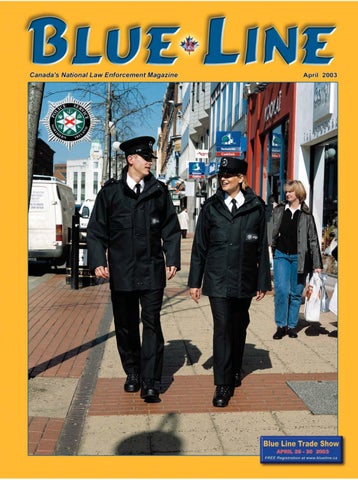
The political parties of Northern Ireland agreed on a future government for the region and committed to respecting human rights in the 1998 Good Friday Agreement. Pivotal to peace in the region was establishing an independent commission to report on policing in Northern Ireland. The Independent Commission for Policing in Northern Ireland produced a report in Sept. 1999 which made 175 recommendations. One of them was to establish an independent Office of the Oversight Commission to monitor the implementation of these changes. Three of the seven members are Canadian, including retired police chief Robert Lunney, a semi-regular writer for Blue Line Magazine. Bob has written an article describing the new policing initiatives in Northern Ireland, which have breathed new life into a very proud but challenged police service. We’ve dedicated this month’s cover to the Police Service of Northern Ireland and its more than 8,000 members, who work relentlessly to keep the peace in a troubled land. A major feature this month is the annual Blue Line Trade Show. Now in its seventh year, the event attracts between 800 and 1,000 attendees annually. Its primary focus is to put Blue Line readers in touch with law enforcement goods and services. This year the show is also a perfect venue to learn. We’re presenting a series of seminars touching on a wide range of subjects, from media relations and street gang investigation to rapid deployment in schools under attack and coping with shift work. See page 28 for more details. In other features this month, we profile Saskatoon’s award winning Operation Help program and look back at 100 years of policing in the prairie city; John Weiler explains why police need patrol carbines; Elvin Klassen looks at an innovative partnership Vancouver police have with Simon Fraser University and touches on the department’s history; Dave Brown has the first of a two-part series on digital cameras and Tom Rataj tells how easy image alteration presents problems for police.
APRIL 2003
4
Taking pride in gun ownership should be a privilege by Kathryn Lymburner Gun control is a continuously resurfacing problem in Canadian society. Legislation on who should have access to which guns has been written and rewritten for decades. Many firearm owners have adamantly opposed gun control legislation, asking why they should be punished for another’s irresponsible use of a weapon. The fact of the matter is that gun control should exist and continue to exist within Canada. As the saying goes, it is not the guns that kill people but the people who kill people. While this may be true, it is the tools that these people use to kill another that causes problems in the first place. Close to a billion dollars has already been spent on the national gun registry system and more was recently allocated; there’s no question that money could be put to better use, perhaps to prop up our failing health care system or to improve education. The issue cannot be completely abandoned though. Thousands of people in Canada and around the world are affected by guns each year. They are used to wage wars, overthrow governments, control natural resources and terrorize citizens. Canada is less violent and more peaceable and it is for this reason that Canadians should be willing to license their weapons and use them responsibly. We have the ability to create a society free from the terrorizing use of arms and we have
APRIL 2003
managed to do so thus far. We must continue to regulate them in the hope that our lead will serve as an international example of how guns can exist in society, encouraging other nations to adopt a similar approach. Canadian owners are more likely to use their firearms for hunting, target shooting or gun collecting, whereas in the United States most firearms are used for self-defence. A direct comparison of Canada to the US further illustrates my point. According to a 1994 work by Thomas Gabor of the University of Ottawa, “the firearm homicide rate in the United States is six times the Canadian rate (12,000 to 2,000).” This number represents a problem that has grown in the United States, and is beginning to grow in Canada. It is all well and good for us to examine these numbers and decide that Canada is doing fine and nothing needs to be improved. Those 2,000 firearm-related homicides represent a needless amount of deaths whose numbers will only rise as time and complacency goes on. Canada needs to be proactive in its approach towards gun control before the statistics reach those of the US. The American Constitution allows for the right to bear arms, whereas the Canadian Constitution does not. Canada is therefore afforded the opportunity to have more strin-
5
gent gun controls, in contrast to an almost non-existent firearms policy in the US. In Canada it is a privilege to bear arms, not a right. A privilege is something granted to an individual who has shown the ability to handle it responsibly, whereas a right is granted to all individuals from birth. We are not guaranteed the right to drive, it’s a privilege. When someone has shown that they are able to obey driving rules and regulations, they are then allowed to operate a vehicle. Gun ownership should be viewed in the same light. Once proficiency in gun safety is achieved a privilege is earned and a person can enjoy and take pride in the results. We have the unique vantage point of being able to see what the Americans have done wrong on the arms control issue, because we are their neighbours. It is our duty towards other Canadians, and indeed the world, to make it a better place. By attempting to regulate one area in society that causes considerable devastation, we are ensuring that this world is in fact a better one. By regulating firearms in Canada we are making the statement that our citizens want to be free from harm and want to pursue the ideals of life, liberty and security. These three things cannot be obtained if our lives are cut short, if our liberty is threatened or our security is diminished by the brute force of a gun.
APRIL 2003
6
A new beginning in Northern Ireland by Robert Lunney “It is important for everyone to recognize the difficulty in implementing changes of a scope and magnitude unparalleled in modern-day policing. Despite this difficulty, the reforms are going forward at a genuinely good pace.” — Thomas A. Constantine, oversight commissioner, December 2002 Sectarian and political division racked Northern Ireland for more than 300 years and deeply affected other parts of the United Kingdom. Through the time of “The Troubles” and later, horrific bombings and murders were carried out and many lives lost, including those of 302 police officers. The Belfast Agreement of 1998 introduced a peace process and established the foundation for a ‘New Beginning.’ Policing remained a major issue of contention. In the wake of the agreement, the government appointed the Independent Commission on Policing, chaired by Chris Patten, former governor of Hong Kong. Patten and a select panel carried out extensive studies and hearings throughout Northern Ireland and visited five countries, including the US and Canada. The Commission issued a report in 1999, popularly known as the Patten Report, recommending 175 changes affecting the Royal Ulster Constabulary (RUC).
APRIL 2003
two major themes of human rights and policing with the community. Aside from the continuity provided by serving officers and support staff, almost everything else will eventually be transformed.
Core principles The impact on the RUC was dramatic and involved fundamental changes, including a new name — Police Service of Northern Ireland (PSNI) — badge, flag and uniform. The core of the recommendations focused on the
7
Oversight process Patten recommended that an eminent person from a country other than the UK or Ireland be appointed oversight commissioner to monitor and report to the British Parliament on the change process. Thomas A. Constantine, former New York State police superintendent and director of the U.S. Drug Enforcement Agency, was appointed to that post in May 2000 and authorized to engage a small group of colleagues to assist in the task. I was fortunate to join that original group; others include former RCMP executive officers Alan Hutchinson and Roy Berlinquette. The team represents a broad scope of experience and skills. The oversight commissioner is required to report to Parliament three times a year. During our visits we receive reports, make observations and meet with PSNI contacts and other gov-
ernment and community sources while assembling information on how the change process is advancing. Early in the planning stage we developed 772 indicators of performance on which to conduct the evaluation. The process is extremely rigorThomas A. ous, and it has to be. The auConstantine dience for the commissioner’s reports is well informed and prepared to be critical. We are aided by an expert panel of senior police officials with international experience who first met in 2002 to assist in refining and substantiating our position on a variety of operational and management issues. Alan Hutchinson RCMP Commissioner Giuliano Zaccardelli and OPP Commissioner Gwen Boniface are among the members, providing excellent advice and encouragement. My personal responsibilities include policing with the community, information technology, management, personnel, culture ethos and symbols. Expectations for progress There are expectations for steady progress in all fields of the change process, but due to the scope of the challenge, it will take time. Constantine estimates embedding the ‘Patten framework’ will require seven to ten years. The conceptual and cultural changes required for
Terrorism still a factor Despite making great strides in policing over the past four years, Northern Ireland is still plagued by sectarian violence. Seventeen people, all civilians, were killed last year, one more than the previous year. The ongoing terrorist threat by both republican and loyalist groups is reflected in the increased shootings and bombings. Bombing incidents increased from 177 incidents involving 206 devices in 2000/01 to 318 (407 devices) last year. Shooting incidents went from 331 to 358. In addition, 315 people were charged with terrorist and serious public order offences, up from 269 the previous year. Casualties from paramilitary-style attacks dropped to 302 from 323 -- 200 of these were attributed to loyalist groups and 102 to republicans. More than three-fifths of all casualties (190) were shot. Police and soldiers recovered 97 firearms and 96.2 kilos of explosives. There were 2,808 parades; 2,785 were legal and 28 were disorderly. APRIL 2003
transition to an authentic community policing model is likely to occupy twenty years, paralleling our experience in North America. Thus far the police have completed the structural changes to establish a more decentralized management model by creating 29 district command units but program changes are just underway. One recommendation that will gladden the heart of street police officers everywhere — reduce the size of headquarters! PSNI has also been charged with implementing a major information technology upgrade over five years. Computer based systems were under-funded in the past as the service expended resources on security and public order. They have a very long way to go but plans are complete and the government is willing to make the investment. Other requirements of the change process relate to: • policing in a peaceful society • public order policing • accountability, size and composition of the service • recruiting, training, education and development • co-operation with other police services Challenges and learning opportunities Managing change of this magnitude is a complex process. Everything is connected to everything else in police organizations and no change is possible in isolation. The PSNI and Hugh Orde, its new chief constable, face the staggering challenge of adapting to a new system of governance, installing a new vision of policing, overhauling the organizational structure and designing new business processes and information systems while, above all, ensuring
that good people are nurtured, morale sustained and police performance improved. There are many lessons Canadian police can learn from the PSNI experience as this process unfolds. Evolution of the human rights component has been the most interesting to me so far. The PSNI have been committed to building their new foundation on respect for human rights. Every aspect of recruiting, training and operations instills the need to fully acknowledge and observe human rights under all conditions and at all times. A body of knowledge and supporting codes has been developed for the task. In concept and design this is an impressive goal totally consistent with democratic principles and one that Canadian policing would do well to examine. The second lesson, and this is technical, is the process developed for the oversight task. To our knowledge, there is no equivalent to the model we are applying, and it may prove a helpful template for oversight and audit under less stringent conditions. Go to www.oversightcommissioner.org to see all reports of the oversight commission; a comprehensive listing of recommendations and indicators of performance may be found in Report no. 2, September 2001. Robert Lunney is an occasional columnist with Blue Line Magazine, a former RCMP Supt. and chief of Edmonton and Peel Regional Police Services. He can be reached at lunney@blueline.ca.
New chief believes in community partnerships Hugh Orde, 43, took over as chief of the Police Service of Northern Ireland Sept. 2, 2002. Orde joined the Metropolitan Police Service in 1977 and initially served in central London, but was posted throughout the city during his early career. Promoted to commander in 1997, he assumed responsibility for borough-based community and race relations training and took the lead in setting up Operation Trident. He was responsible for the community safety partnership portfolio at New Scotland Yard, developed the diversity strategy and crime and disorder partnerships and provided information to the Lawrence Inquiry team. Orde was selected as deputy assistant commissioner in Oct. 1999, attached to the commissioner’s private office at New Scotland Yard and awarded an OBE in the Queen’s Birthday Honours 2001. 8
A conforming vision The vision for the new Police Service of Northern Ireland is set out in the Good Friday Agreement: It is essential that policing structures and arrangements are such that the police service is professional, effective and efficient, fair and impartial, free from partisan political control; accountable, both under the law for its actions and to the community it serves; representative of the society it polices and operates within a coherent and co-operative criminal justice system which conforms with human rights norms. The agency emblem explores the notion of inclusiveness and parity through the simple stylistic representation of a variety of symbols that reflect diversity, hope and the desire to mutually respect and protect difference through policing. The sunburst surrounding the roundel represents a new beginning or new dawn for the new police service. The shape is echoed in the central star, which provides six areas between its rays for a series of symbols – all of equal prominence — scales of justice, harp, torch, olive branch, shamrock and a crown. The centre-piece houses the Cross of Saint Patrick, which places all six symbols in the context of Northern Ireland. The simple rendering of these symbols in a neutral format of things that both unite and divide reflects an inclusive society where all values, common interests and differences are recognized, celebrated and protected.
APRIL 2003
9
by Shelly Ballard Saskatoon has been plagued by problems related to the sex trade for many years. Prior to Operation Help, police efforts to control it and related criminal activity were marginal at best. Despite undercover initiatives and high profile officer presence, it continued to flourish and there was a constant stream of people going through the revolving door of a justice system that criminalizes an industry driven by poverty, racial suppression, drug addiction and intimidation. Many people believe it’s a choice; the entertainment industry often portrays it as exciting and glamorous. The reality is a world of drugs, violence and having sex with someone you just met — in a car, the back room of a shabby house or a third rate hotel room — in return for money, food, drugs or a place to sleep. It’s not glamorous or exciting and no one chooses this life. The solution Operation Help is an innovative, non-traditional, inter-agency team approach to the problems of the sex trade that focuses on alternative measures and uses positive support mechanisms to encourage lifestyle changes. The entire premise is one of respect. Degrading words such as ‘prostitute’ or ‘hooker’ are not found in the Operation Help team vocabulary. Sex trade workers are victims and treated with the respect and compassion deserving of people who have been victimized. The program is based on intensive and continued support and begins with an undercover street level operation where police officers pose as johns to apprehend them.
Each is made aware of the help available to make positive lifestyle change through a support circle, which consists of one person from each Operation Help agency and creates an environment of support and encouragement. The first step is to identify why the person is on the street and establish attainable and measurable goals for them to work towards. There is normally a combination of issues, including legal concerns, substance abuse, childcare, housing, safety, spiritual considerations and counseling; each team member and agency has a role to play in providing help and support. When they commit to changing their lives, Operation Help representatives do everything possible to make sure it happens. Occasionally they require persuasion by the criminal justice system. The process is very labor intensive due to the nature of the clients, but the team never gives up, celebrating successes by attending graduations from detox or treatment centers, birthdays and other occasions. Front line team Saskatoon Police Service (SPS): Initiates the Operation Help process via an undercover operation and then assists with security issues such as intimidation or threats from pimps. EGADZ: A youth drop-in centre located in downtown Saskatoon that provides a safe haven for at-risk youth. It provides two outreach workers who serve as brokers between workers and the various treatment and support centers available and offer advice, understanding, counseling and friendship. Department of Social Services: Assists with
financial and housing issues. Volunteers: Operation Help is fortunate to have a lawyer, who ensures rights aren’t compromised, and a aboriginal court worker, who gets to know the client, a large percentage of which are aboriginals, and helps them to trust the ‘system, which is often viewed as white. The court worker is also a constant reminder of the support that is available. Elder: From the aboriginal community; assists with spiritual guidance and cultivates a relationship based on trust and honesty. Sex trade survivor: Also cultivates a relationship based on trust and honesty. The challenges Breaking down stereotypical barriers and attitudes police and other agencies had about each other was one of the first challenges the team had to overcome. Time was spent learning to appreciate each organization’s function and philosophy about the sex trade. A common goal was realized and objectives agreed upon that met the needs and requirements of the agencies involved. All decisions are made as a group and team members have equal input into the decision-making process. Agency administrative bodies quickly embraced the concept with an appreciation for the coordinated effort, paving the way for social workers, judges, prosecutors and the community at large to accept Operation Help as an alternative to the traditional criminal justice system approach. The trust that developed between the front line team members was reflected in undercover police operations that, for the first time, included non-police personnel. This was a dramatic departure from the norm. The civilian component of the team learned to appreciate the officer safety concerns associated with undercover operations. Gaining the trust of sex trade workers was one of the biggest challenges the team faced. The notion that a group of strangers would want to help them get off the streets was a foreign concept. Many of the individuals introduced to the team for the first time felt there was an ulterior motive or hidden agenda. The magic of the project surfaces when they realize they just want to help. The impact Operation Help has had 51 clients to date; 10 have stayed off the street and many of those that went back asked the team not to give up on them. The sweetest sign of success has been
APRIL 2003
10
the three who heard about the program, came to the police station on their own and asked for assistance. Operation Help has had a multi-level impact on the community. Police have developed a relationship of trust with sex trade workers, who now regularly come forward with information on criminal activity. This has led to charges being laid in many investigations, several criminals taken off the street and a decrease in crime rates. Of particular note are charges against pimps, johns and pedophiles. Information from citizens who live in the stroll and downtown areas indicates that activity in Saskatoon is slowing down; even one of the most vocal community activists has publicly expressed support for the project. Police officers have shown the community that the sex trade is just another example of victimization. School presentations to at-risk youth show the hazards of becoming involved and how to recognize the warning signs of a pimp’s recruitment effort. Operation Help has provided positive recognition, through the media, to all the agencies involved.
Replicating the program All that is needed for other communities to replicate this program is a group of dedicated people from agencies who are willing to work together, believe in what they are doing and don’t accept no for an answer. They need to be accountable to themselves and each other and sincerely respect and appreciate the people they are trying to help. Earning their trust is necessary for the program to be a success. Conclusion Operation Help is an innovative, radical approach to a problem faced by communities around the world. The out-of-the-box thinking and dedication in the face of adversity required
Funding The social services and justice departments fund the program. This covers the salaries of two outreach workers who are based out of EGADZ but dedicated to Operation Help functions, honorarium for the elder and outreach van expenses. The team lawyer and aboriginal court worker volunteer their services and don’t receive honorariums. The Saskatchewan Legislative Assembly has recommended funding for the program be expanded.
APRIL 2003
11
to tackle this initiative has earned recognition, appreciation and admiration from victims, the community and national and international organizations. The National Youth Justice Department in Ottawa is presently conducting an indepth evaluation of the program, with the intent of developing a model for national implementation. The SPS is very proud to be one of the founding organizations of this program. Shelley Ballard is a SPS constable. This article helped the service win the prestigious Achievement Award from the International Downtown Association, beating out more than 80 entries from around the world. For more information on Operation Help, call the SPS vice unit at (306) 975-8255.
From call boxes to computers Celebrating a century of Saskatoon policing My name is George Donald and my first day of work with the Saskatoon Police Department was May 8, 1908. Little did I know that in seven short years, after a huge scandal, I would become chief and remain so for 31 years. Coming from Scotland, as most cops did back then, I felt at home in Saskatoon, then a small city of about 5,000 people. Chief Dunning handed me a pair of used trousers and tunic the day I started, then dusted off a used hat and pointed me towards the street to start enforcing the law. The hours were long — 13 to 14 hour days, seven days a week — and there was no backup, as we had only five officers, including myself and the chief. The police and fire stations were both in the city hall but we had our own quarters, one floor above our two wooden cells. Winters were cold — there was no heat in our rooms — but the pay was good; $60 per month. The department had already handled a few murders before my arrival. Someone found the body of a little baby girl in the manure pile adjoining the stockyards; poor thing, her killer was never found. Murder number two was a love triangle; it seems Mr. Sharope got tired of sharing his wife with Mr. Mechalchuk and shot him in the head with a .38 calibre rifle. He was found not guilty — after all, this was still in the days of the ‘Wild West!’ After losing the status of capital city to Regina, the government gave us the University of Saskatchewan as a consolation prize. By 1912 our city had grown to 28,000 people. The boom was phenomenal; a church site bought for $500 in 1904 sold for $42,000 in 1910. We expanded to 11 officers to keep up and moved into a larger space in the basement of the new city hall. Life was good — we now only had to work 12 hours a day and got a whole day off every two weeks. This was also the year that John James (I called him Jessie) was hired as our first detective and we started taking fingerprints. The department bought a state of the art communications system for us beat cops the ‘Gamewell Call Box’ system. It was incredible. We would call in every hour as we walked the beat. If the light on top of the box was on, that meant we had a call from the office and someone likely needed our help. We wondered what they would think of next! With some of our men off to fight in World War One, walking the beat was challenging. I don’t know how many times I arrested Masie Wilson. The judge really nabbed her one time, fining her $50 for selling liquor — and another $4.50 for selling herself. The big scandal hit in November 1915; I remember it clearly. Well-known criminal Frank Heaton was caught by the Edmonton Police and confessed that two of our detectives, Springer and Reeves, harboured and protected criminals in Saskatoon as long as they committed crimes outside of the city. The community was shocked. Even Chief Dunning was imAPRIL 2003
plicated; he was thought to have condoned the practice by not doing anything about it and protecting women of disrepute. The chief resigned, the detectives went to jail and I became the new chief. I had just seven years of experience under my belt but was ready to lead our department out of the cloud of distrust. After our boys came back from the war in 1918 our community began to rebuild itself. The Saskatoon Police Association was formed in 1919, filling a long-felt need in police circles and drawing the men closer together. The first contract dealt with seniority, special duty pay, plain clothes allowance and court attendance. Prosperity continued through the 1920’s until the wheat crop crash in 1928. The price dropped from $1.78 per bushel to 38 cents and money became very tight. I went to bat for the boys, trying to get more officers to deal with the hundreds of unemployed men riding the rails into town, looking for a job on the farms. The Depression was in full swing when we hired some veterans to be special constables to help deal with these vagrants. We also had to deal with lots of Chinese with drugs and several murders, including a mother with mental problems that killed her four children and then herself. The Second World War began just as we started coming out of 10 years of drought and tough times. Once again police officers enlisted and I was forced to hire men 60 and even 70 years old. Discipline went downhill — we even caught some of them smoking in uniform and docked them a days pay. Finally it was time for me to pack it in. After 38 years of policing, I was sorry to go but everything has to come to an end sometime. The Kettles Years My name is Jack Parker and I began with the department as a beat cop on Oct. 1, 1953. I remember my first day clearly; I got to the police station early and asked Bob Comrie if I could see the cells. I felt a breeze when we went in — apparently the window was always left open for ventilation. What I didn’t realize until moments later is that one of the prisoners, in for break and enter, had tied his bed sheets together and escaped out that window! We got him a few days later though. Chief James Kettles was my boss — ‘Diamond Jack,’ they called him. He was a sharp dressed man, very articulate and well educated. 12
He liked to speak publicly on moral issues, arguing, for example, that mini-skirts caused an increase in sexual assaults. He told ‘drug saturated hippies’ there was no place in the city for them and their “free love” — and certainly no place for homosexuality, as morals were already low enough. You wouldn’t dare argue with him; after all, there was a chain of command, you know. We were well trained though and Kettles made sure we had equipment. He got us cars, the first police radios in Saskatchewan, Colt .32’s on our hips and a new gold badge to wear proudly on our chests. We added a morality and youth section, river rescue, pipes and drums band and our first K-9 team, Vern Passet and his dog Tonka, a white German Shepherd. The first Aboriginal and female officers were hired and Kettles struggled in vain with city council and the board of police commissioners to get a new building approved for the department. With the introduction of the Labour Act and the five-day work week, more officers needed to be hired to make up for the two days off. There were 250 of us by the late 70’s and things were really getting crowded. Kettles finally managed to get us a new station in 1977 but he wasn’t around long enough to enjoy it; the city didn’t renew his contract and he was given just 30 days to sit in the new digs before being officially retired. Today My name is Joanne Balint and I’m one of the first female officers the department hired. I began Jan. 2, 1973 and retired just last month. Things have changed during my tenure; I went from wearing a silk blouse, skirt and carrying my gun in an issue purse to staff caps and uniform pants and saw policing change from a male dominated profession to the diverse field we see today. Walking the beat is a lot different — in fact, there’s not much walking at all these days. The advent of police cars, motorcycles, radios and laptops has seen to that. The call boxes are stored away, the buffalo coats are antiques and the memories are being compiled into a book. From one police officer and no civilians in 1903 to 348 officers and 83 civilians today, the Saskatoon Police Department has seen many changes — but one thing hasn’t changed. What once inspired a young man to become a police officer in the early years still lives in the hearts and souls of the women and men who police today. This unwritten, unspoken legacy of dedication never changes and is something we’re all very proud of. The author of this article, Susan Grant, is a constable with the Saskatoon Police Service. Her book, The Memory Box – One Hundred Years of Policing in Saskatoon, is due to be published in June. Contact her at susan.grant@police.saskatoon.sk.ca for more information.
Montgomery County police Chief Charles Moose, who led the hunt for the Washington-area sniper suspects, has signed a book deal to tell all. Former Newsweek reporter Charles Fleming will help Moose write Three Weeks in October: The Manhunt for the DC Sniper. The deal will come under the scrutiny of Montgomery County officials, who have warned Moose about ethics rules that bar police commanders from taking even small speaking fees about the sniper shootings. A 38-year-old Georgetown man has been sentenced to three years in prison in connection with an accident that claimed the life of Terry Ryan, president of the Durham Region Police Association. Scott Webb had a blood-alcohol level two-and-a-half times the legal limit when his minivan crashed Ryan’s a car on a highway near Whitby in May 2002. Ryan was killed instantly and his car was demolished. Revenue Minister Elinor Caplan says Canadian customs agents won’t be getting guns but all will be issued protective vests, pepper spray and batons. Caplan said the government does not want Customs to become another police force, so agents don’t need firearms to carry out their duties. Caplan also said CCRA would continue employing students as customs agents, in part because of seasonal fluctuations in workload. The use of students has been a primary concern for the union, which says their inadequate training puts them and the country in danger. Vancouver Mayor Larry Campbell said in February that photo radar could be brought back as a way of stopping street-racing. Campbell made the comments in response to complaints from the public over the sentences given to two men who were found criminally negligent in the death of pedestrian Irene Thorpe, who were not jailed for the deadly street race. Campbell, who as mayor chairs the police board, said he has discussed the possibility of photo radar with Police Chief Jamie Graham, who said he’ll look into it. Al Hutchinson will take over as Commissioner of the Office of the Oversight Commissioner of the Police Service of Northern Ireland by the end of 2003. He will succeed Mr Tom Constantine who has held the position for the past three years. Hutchinson, currently Chief of Staff, served with the RCMP for 34 years, rising through the ranks to Assistant Commissioner. He retired from the RCMP in January 2001 following three years as Commanding Officer “O” Division. Deputy Chief Ron Bain of the Peel Regional Police has been seconded to work on a special project for the Ontario government. The project will involve a review of the amount of paperwork police officers are required to complete as part of their regular duties with the goal to reduce the amount of time spent on these duties and increase time spent on patrol and front-line work. The secondment is for a minimum of six months. Former Niagara Region Police Chief John Shoveller, a man described as a consummate police officer who loved the law, died of brain cancer in February. Shoveller, a Niagara Falls native who devoted 34 years to policing, died at age 67. He began his career in Elliot Lake, Ont., before moving back to the Niagara Region and working through the ranks at the regional service. Current chief Gary Nicholls said he developed a respect for Shoveller after working with him as a junior officer for many years.
APRIL 2003
13
Canadian police need patrol carbines
by John Weiler Requiring or even training officers to fire at distances beyond 15 meters with a handgun is tactically unsound; that weapon is intended for sudden, unexpected threats at close proximities. The probability of missing the intended target at greater distances, especially in highly dynamic encounters involving movement, low light and survival stress responses, is very high and may become a serious liability issue. At these distances, it is far more prudent to teach officers to disengage, select another option or even try to get nearer to the threat. That’s why some police services issue shoulder mounted weapons, most commonly the 12 gauge shotgun, to patrol officers or, at the very least, to specialized containment and tactical officers. It is a very effective weapon when used within the confines of its capabilities. Among its merits — it’s intimidating, simple to operate, has incredible firepower at close range, a well documented history of reliability and is relatively inexpensive — but its greatest advantage is the ability to fire a large variety of projectiles, including less-lethal and chemical munitions. While the 12 gauge still has a place in law enforcement, its current role as an ‘all-purpose’ weapon is limited by its shortcomings, which include harsh recoil, low ammunition capacity, slow reloading, potential risk to bystanders, short effective range and imprecise accuracy. Firearms instructors and police administrators need to address and re-evaluate these and other problems. The patrol shotgun is poorly suited to smaller stature officers because of its size and length. Many have difficulty controlling recoil and may create stoppages simply because their arms are not long enough to cycle the action properly. As a result, their effectiveness with it is far from optimal; numerous officers I have spoken to or instructed recognize this and are reluctant to deploy it. Police services issue a combination of buckshot and slugs; although there are many varied options and procedures for using these rounds, they both have limitations. The standard OOB buckshot load contains nine .33 calibre pellets which travel at a muzzle velocity of approximately 1300 feet per second and have an effective safe range of approximately 20 meters. Beyond that distance, the risk of delivering stray pellets beyond the dimensions of the average torso is very high. Furthermore, the buckshot pellets are constructed of soft lead and quickly deform when striking a solid object. They’ll quickly tear apart if fired through steel doors or vehicle panels, for example, drastically APRIL 2003
reducing their effectiveness. The standard slug load consists of a single one ounce projectile with a muzzle velocity of approximately 1400 feet per second and an effective range generally considered to be 50 meters. At that point, ballistics and shooter ability become inhibiting factors. The slug is also constructed of soft lead that deforms quickly when striking solid objects and loses speed and energy quickly because of its size and weight, making it ineffective at longer ranges. Shotgun projectiles will generally not penetrate soft body armour at longer ranges due to their large diameter and relatively slow velocities. Therefore, dealing with highly prepared and motivated individuals may leave an officer with very limited choices in a potentially lethal confrontation. Consider the option of issuing semi-automatic patrol carbines which, to date, have not found their way into many police cruisers. Perhaps this is because many individuals have misconceptions about their capabilities and believe they’re plagued with over-penetration problems and excessive fire-power. This is simply not the case. Many studies and articles have been published throughout the law enforcement community discussing the suitability of the .223 for general patrol use. The bullet is light, dissipates energy quickly and, at 60 grains, has one-third the weight of a .40 caliber projectile. The threat of firing it through one individual and possibly striking other bystanders is highly overstated, as is the danger of major over-penetration inside buildings. Studies by the FBI and numerous other agencies have shown that .223 bullets penetrate less and dissipate energy quicker in many common building materials than some handgun bullets, due to their size, weight and construction. Due to the extreme popularity of the .223 Remington (also known as the 5.56 NATO) cartridge in the US, most ammunition manufacturers have made significant design and performance advances. Many police-specific loadings are now available. Unlike shotgun ammunition, these rounds were designed specifically to incapacitate humans and are not simply variations of common hunting ammunition. The controlled expansion bullet is also very capable of penetrating body armour and still being effective at longer ranges.The standard .223 cartridge consists of a 55 to 68 grain bullet traveling at an average muzzle velocity of 3200 feet per second. At this speed, it can not only cause a permanent wound cavity but also a temporary stretch cavity, which helps in damaging body tissue and causing shock. Shotguns and carbines chambered for 9mm or .40 S&W cartridges fire at velocities below 2000 feet per second and don’t cause a temporary stretch cavity, thereby limiting their effectiveness at achieving rapid incapacitation. The .223 bullet is capable of sustaining a significant amount of energy and velocity at distances well beyond 75 meters, the maximum range most officers should ever consider firing due to the risk of stray shots in an urban setting. There are other advantages — carbines have significantly less recoil than shotguns, allowing much faster and effective follow-up 14
shots when necessary, and many have shorter stocks that suit smaller officers. As a result, they may be less intimidated by the carbine and more likely to deploy it. Its increased accuracy makes a carbine a viable option in many settings where a pistol and shotgun may not be effective — high-risk vehicle stops, active shooters, stand-offs involving suicidal individuals and most other containment situations. The semi-automatic carbine can also be reloaded much quicker and easier than a shotgun — an average magazine holds 20 to 30 rounds, which is ample for most situations a patrol officer may encounter — and they’re easy to train with. The action operates similar to a pistol — there’s no need to manually work it for each shot as with a shotgun. Combine this with the low recoil factor and you have a weapon that is quick, accurate and very effective even at longer ranges. Most carbines would not be individual issue so lasers and other optics are not recommended since they can be very temperamental and easily damaged, which would negatively affect accuracy. Standard ghost ring type sights are durable and provide ample sighting power for the distances police fire at. Many patrol type carbines have been thoroughly tested and evaluated by both military and police agencies. They have a proven reliability record and their ballistic superiority over shotguns is well documented. As with any new equipment, purchase cost and training time must be considered and justified but are more than offset by the benefits of changing from patrol shotguns to patrol carbines, both from a practicality and civil liability standpoint. Classed as ‘general purpose’ weapons, patrol shotguns have supplemented handguns for many years. They’re often misunderstood and used in situations and at ranges for which they were never intended. A quality semi-automatic carbine with proper ammunition may be one of the most versatile and effective weapons available to the patrol officer, offering both greater accuracy at longer ranges and less potential hazard to bystanders than the shotgun. They also have far greater potential to incapacitate an individual quickly than any handgun cartridge, even at close range. Furthermore, the carbine cartridge will predictably go through many building materials while still being able to penetrate soft body armour and maintain accuracy to distances beyond 75 meters. With increasing violence in the US and better armed criminals, many police agencies have begun using patrol carbines. Although these statistics don’t translate directly to Canada, we can certainly draw from the experience and lessons learned by our American neighbours. Patrol carbines should be seriously considered to augment the patrol shotgun and better equip officers to deal with any situation they might encounter. John Weiler is a use of force instructor at the Ontario Police College. He can be reached at john.weiler@jus.gov.on.ca or 519-773-4227.
APRIL 2003
15
APRIL 2003
16
The Diemaco C8A2 carbine is the latest version of the C7 battle rifle family. This Canadian made carbine is 5.56 mm NATO (.223 cal), tested for military and police ammunition and gas operated, air cooled and magazine fed. Diemaco says the heavy, rotary hammer forged barrel and improved chamber configuration have made this the primary carbine used by general military and special forces in Denmark, Norway, The Netherlands, Canada and the UK. The weapon is modular in design and combat proven, the company adds, and can be configured to meet the needs of police forces. A semi-automatic version is available.
The SG 552 Commando is a compact intervention weapon designed by Swiss Arms for elite units. It is an accurate, handy, powerful, compact and operationally versatile weapon ideal for police use, the manufacturer says. It uses 5.56 (.223 Rem) cartridges, is semi-automatic with selective single shot and three round bursts and has special corrosion protection. Overall length with butt folded is only 504 mm. The weapon also has rapid reloading, stackable magazines available in 20 or 30 round clips. Swiss Arms claims it has a much longer life cycle than any AR15 system and is available with timely supply and complete servicing and support from the Canadian representative.
The Heckler & Koch G36 is a compact carbine equipped with a shorter barrel and handguard, developed in close collaboration with the German Army Special Forces, the company says, in order to satisfy the tactical requirement of small weapon dimensions and low weight for airborne and military task force units like the German ‘Crisis Reaction Forces.’ The G36K is an extremely effective specialist with full assault rifle capabilities over low and midrange distances, the company says, and is chambered for .223 ammunition. It’s actively used by police services in BC and Ontario and is available in all kinds of trigger configurations, including safe semi only, safe semi two round burst, safe semi three round burst, etc.
The Bushmaster XM15 E2S Patrolman’s carbine is said to be designed for situations requiring a lightweight yet rugged firearm with high firepower. Created with the police officer in mind, Bushmaster says it includes all the features of an M4A3 type carbine, with the addition of a 16" barrel. A ‘bird cage’ style muzzle suppressor is fitted and the four-position, telescoping butt stock offers light weight, ease of carrying and quick handling. The A3 type removable carry handle has a 1/2 minute of angle, dual aperture, M16A2 rear sight system. With the handle removed, an officer can mount a variety of scopes, optics or night vision devices to the Weaver type rail base of the ‘flattop’ upper receiver. The carbine operates in semi-automatic mode and will accept all capacity AR15/M16 type magazines.
The Beretta Cx4 Storm is said to be designed with rounded forms for an ergonomic, snagfree and innovative appearance. The rubber stock comb provides a comfortable rest for the cheek and the magazine is inside the grip to protect it from impact and the environment. Beretta says the controls are very similar to those found on the popular 92FS pistols, so most shooters will be immediately familiar with its operation. Pull can be lengthened in .6" increments, from 13 ¼” to 15", by adding one to three stock spacers (one is provided). Multiple sling attachment points allow a multitude of carry options. The retractable forward accessory rail extends out from the fore-end, allowing quick mounting of a tactical light or laser unit. The front post sight is adjustable for windage and elevation, while the rear ghost ring sight has long and short-range apertures. APRIL 2003
Ruger K-Mini 14 centerfire, autoloading carbines are said to offer inherent accuracy, light weight, low recoil and a quick repeat shot capability that would work well in a law enforcement environment. Constructed of relatively few components, they are claimed to provide the convenience of an autoloader without its complexity. The weapons simple, rugged design ensures dependable performance even with rough use, Ruger says. The K-Mini 14 carbine is designed to get the most out of the powerful .223 cartridge and the company says it’s perfect when a few quick shots are needed. The safety blocks both the hammer and the sear, and the slide can be cycled with the safety engaged. A lock mechanism holds the bolt open for cleaning and inspection. 17
The Armalite M15A2 law enforcement carbine comes complete with two 20 round, LE stamped magazines and a lifetime warranty. The company says the 5.56 mm weapon has a proven design and thousands are used by law enforcement agencies across North America. Armalite states that the M15A2 combines improved safety for urban use when using tactical rounds with increased range and accuracy over all handgun cartridges and shotguns. Carbines can be built to suit exact agency requirements and demo units are available from the Canadian distributor.
The Colt model LE 6920 law enforcement carbine is specially designed as a police weapon system and features many of the combat-proven advantages of the military M4, the company says. It comes as a 5.56mm (.223 Rem), gas operated semiautomatic with a locking bolt, has a standard 20 round magazine, barrel length of just over 16 inches and weighs just under six pounds. It comes with a carrying handle, which detaches to allow a tactical sighting system to be mounted, and integrated M16A2 target style rear sight, adjustable for windage and elevation to 600 meters. Two 20 round magazines, cleaning kit and carry sling are standard and the company says the gun can be field stripped without special tools.
Constable cheats death An unarmed special constable is lucky to be alive after avoiding a swarm of bullets during a traffic stop. The incident occurred in March north of Grande Prairie, Alberta. Cst. Michael McKenna was questioning the driver of a pickup truck when the driver moved to the passenger side, where McKenna saw a rifle. The driver got out and shot toward the cruiser as McKenna ran back towards it. The cruiser was hit numerous times on the driver side, Cpl. Trent Boughen of the Grande Prairie RCMP said. He added McKenna was lucky to escape. McKenna fled and radioed for help. RCMP and county police responded, surrounded the location and found the driver lying next to the pickup with a self-inflicted gunshot wound. He was taken to an Edmonton hospital and later died. A .22-calibre rifle was seized. Municipalities hire special constables to enforce traffic and bylaws, jobs Mounties don’t have time for. They’re not permitted to carry firearms. The County Reeve and at least one counsellor say the officers should be able to use lethal force in their own defence.
If it’s predictable - it’s preventable Vancouver Police and University partnership provides unique solutions by Elvin Klassen
Vancouver Police and Simon Fraser University (SFU) are working together to develop policing strategies that will deal with chronic problems more effectively. The partnership began after the department tried, unsuccessfully, to track cases of women hurt in domestic incidents requiring police intervention and turned to SFU for help. The university’s criminology department provided a researcher to study the cases and develop annual profiles of the type of crime, area where it was committed, relationship between offender and victim and age and sex of those involved. It also tracked whether children were involved, drug and/or liquor abuse, employment status and arrests/charges. The Vancouver Police Department (VPD) was now able to evaluate interventions and use the results to adjust policies and training. The first two annual reports showed there were arrests in 45 to 50 per cent of such domestic cases. The arrest rate climbed to about 65 per cent after the force trained all front line officers on the dynamics of the incidents, stressing the power imbalance, risk assessment and witness and child protection issues. Two years after additional instruction in investigative techniques and case preparation, the rate jumped to 75 per cent. One of the dilemmas facing police during this time was whether officers should prosecute the offender even if the victim didn’t want them to. It was felt that allowing the victim to decide if charges should be laid would personalize the crime, further expose them to intimidation and send the message that it wasn’t worthy of police intervention.
Concerns that such a policy could deter victims from contacting police were put to rest by the annual studies, which showed the total number of cases reported rose by about 30 per cent. The research, conducted at very little cost, provided police with empirical evidence and enabled them to develop effective policies and training. Homicide patterns and alcohol A ten-year study of Vancouver homicides showed that 51 per cent occurred in an area representing just seven per cent of the city. The common factors were alcohol abuse, knives and trivial altercations. An entire SFU criminology class spent three months getting an accurate picture of the pubs, patrons, management, and alcohol issues in the city’s downtown eastside. Police and school researchers then interviewed bar patrons, asking how often they visited, how much they drank, where they lived and how safe they felt. Among their findings: • 50 per cent didn’t live locally and appeared to be attracted by illegal or anti-social
activities • Patrons who abused alcohol feared being victims of crime Police began strictly enforcing city and provincial regulations, instituted undercover surveillance and stepped up uniformed patrols and liquor and business inspections, resulting in the suspension of 23 business and liquor licenses over two years. It was feared closed establishments would reopen across the street but this didn’t happen. It was also discovered that many poor patrons in the area didn’t have proper living spaces and used the licensed premises as their living rooms, indicating a need for safer facilities. Clustering effects of licensed premises Vancouver’s downtown eastside has many licensed premises and it was thought they had reached a ‘critical mass,’ beyond the ability of the neighbourhood to deal with the resulting public disorder and safety problems. Two SFU doctoral candidates examined this relationship. They established four control areas and obtained police computer aided dispatch data detailing all incidents, calls for service and alcohol related calls/arrests. Other city departments supported and contributed to the study. Results indicated there is some validity to the idea that a neighbourhood has a ‘carrying capacity,’ which is very significant to city planners and police managers alike. It was found that the number of problems increases dramatically as new drinking establishments open. Neighbourhood foot patrol The litter, graffiti, discarded needles, disorderly conduct and drug abuse in the east side greatly concerned the local police and community, since they contribute to a spiral of urban decay. An entire SFU criminology class periodically photographed the area over a three month period and watched to see if the presence of beat officers would help. The goal was to conduct this snapshot annually over five years but it was discontinued after the first semester because of funding problems. Youth at risk Eight SFU students began analyzing troubled youth two years ago and are working on a proposal to develop a common database linking service providers who respond to youth at risk.
APRIL 2003
18
Traffic enforcement effectiveness The amount of visible police traffic enforcement needed to convince drivers to slow down was studied by Vancouver Police and the Insurance Corporation of British Columbia (ICBC). Varying levels of static (radar and laser) and patrol-based enforcement was done during evening rush hour on Granville Street. Officers ran checkpoints at various locations but much of the work was done with marked and unmarked vehicles. Enforcement was discontinued some weeks to measure the latent effect on motorists. The impact was measured in the following ways: • Consultants observed traffic conflicts (near misses) and violations to determine how the increased enforcement affected driver behaviour • A telephone survey determined whether drivers on Granville Street were more aware of police activity than other motorists • Three covert speed-measuring devices were used to collect both historical and test period data for analyses • More than 7,000 ICBC collision claims for the Granville corridor were analysed to determine trends in the frequency, severity, time and location of accidents The results were disappointing. An average of 2.3 tickets were issued per hour — 84 per cent for speeding — but Granville motorists were largely unaware of the increased enforcement. Officers often had trouble detecting and apprehending violators because of the high traffic volume. Average speed and the number of observed violations and vehicle conflicts were
APRIL 2003
not affected. The majority of collisions on Granville Street occur during peak travel periods. The average cost per claim for accidents occurring between 0900 and 1900 was $2700 but that figure increased by more than six times for those occurring between 0300 to 0400. The afternoon rush hour accounted for the highest number of accidents, while the late evening and early morning hours accounted for the greatest risk per vehicle. This appears to have major implications for traffic enforcement. The traditional assumption that high crash locations can be made safer with increased enforcement may be flawed, since it doesn’t take into account the type of accident and relative risk associated with traffic conditions and time periods. The many minor accidents occurring in heavy traffic are likely not influenced by police presence. Likewise, speed is determined by the traffic flow, with little driver discretion. Traffic enforcement during non-peak travel periods may be more effective in targeting specific problem driving behaviour. The RCMP and ICBC conducted a similar study in the neighbouring city of Burnaby which concluded that static enforcement during off-peak hours and in the opposite direction of rush hour traffic may be more effective in preventing accidents. For more information, contact VPD Insp. Robert Taylor at bob_taylor@city.vancouver.bc.ca or 604 717-3535. Elvin Klassen can be reached at elvin@blueline.ca.
19
Vancouver Police started with one officer Just 400 people called Vancouver home when the city was incorporated in 1884. The first policeman, John Stewart, was appointed two years later and issued a blue suit with a silver star worn on the left breast and a Keystone Cop style helmet. Englishman John Clough, who’d lost his right arm while working on a railroad gang in the US, was hired to take care of prisoners in the ‘jail,’ which was actually just cells added to the constable’s cottage. Vancouver was on the brink of prosperity when disaster struck on July 13, 1886. A fire set to clear brush in an area that is now in the city’s downtown was fanned by strong winds and quickly got out of control, consuming 1,000 buildings and leaving 28 people dead in just 45 minutes. Stewart ordered Clough to release the lone prisoner in the constable’s cottage as the inferno approached and they ran for their lives. New Westminster sent food to help the citizens of the devastated city and the jailer, who was rumoured to have hid blankets stolen from the jail in the woods, became a hero when he distributed them to displaced residents. On the morning after the fire, Mayor Alexander McLean went to look over what was now a pile of still smoldering ashes and spotted some whiskey barrels floating in the water; they had been cast adrift by saloon keepers, who were desperate to save them from the fire. Looking around, McLean saw Jackson T. Abray standing nearby, who had just discovered that the small store he owned was completely destroyed. McLean turned to him and said “Abray, I am swearing you in as constable. Your first duty is to retrieve those barrels.” Abray did as he was instructed, and spent the next four years as a policeman. Two other men were appointed under similar circumstances and a number of special constables. Suddenly, Stewart had a police force to lead. He had no uniforms though — they had gone up in smoke — so he ordered more from Seattle. In the meantime, badges were made from American silver dollars, with one side smoothed down and engraved Vancouver City Police; a pin was soldered on the other side.
APRIL 2003
The old constable’s cottage was also destroyed so police worked out of a tent which was also used as City Hall. Prisoners were chained to a stump and given a canvas screen to use for privacy. The city was rapidly rebuilt, and was soon larger than it had been before. A new building was put up to serve as city hall, police station and jail — it was also used as a Sunday School and general meeting hall for the next 18 years. It contained four cells and a small exercise area.
20
The city had no money to pay the builder, who refused to let them in until he was paid. The three constables sworn in each had to write and sign, in their own hand, this oath of office, which hasn’t changed much over the years: I ________ do swear that I will well and truly serve Our Sovereign Lady, the Queen, in the office of police constable for the city of Vancouver, without fear or favour, affection, malice or ill will; that I will, to the best of my power and ability, cause the peace to be kept and preserved, and will prevent all offenses against the person and properties of Her Majesty’s subjects and others, and that I will, to the best of my skill and knowledge, discharge all the duties thereof faithfully and according to law. So help me God.
Policing centre serves Chinese community by Elvin Klassen Vancouver’s Chinatown, the largest in Canada and second only to San Francisco in North America, has become a key cultural centre and tourist haven. Many of the buildings display colourful and exotic architecture. The first Chinese emigrated from California in 1858, attracted by the Fraser Valley gold rush. Chinatown was still a small, isolated, three block area as late as 1950 but waves of Chinese immigrants swelled the population in the lower mainland from 15,000 in 1961 to 342,000 in 2001. Today they make up 17 per cent of the greater Vancouver area. With the help of area residents, the Vancouver Police Department established a community policing centre, one of 18 in the city, to help police Chinatown and connect with the city’s Chinese population. Citizens and businesses can meet and work with officers there in a non-crisis environment. Their goal is to strengthen communication and co-operation with police and make services more accessible. Some 70 volunteers assist the six part time staff and one officer assigned to the centre, which assists in taking reports of crime, missing persons or lost property. It also coordinates Neighbours First, a non-profit community program which helps identify and act on security, safety and hospitality concerns and promotes and coordinates community watch, street cleanup and other anti crime initiatives. Centre members support and counsel residents, work with and provide information on the justice system and court process and ac-
company victims going to hearings or meeting with counsel. They also help replace documents, complete victim impact statements and apply for criminal injury compensation, victim’s assistance or legal aid. The centre offers “interpretation and translation in Cantonese, Mandarin and English, both for the police and the citizens in the community,” says Emma Louise Tang, a criminology student at Simon Fraser University and part time employee. “We provide public education services to Chinatown,” adds Eric Lau, another employee.
Bears seized in marijuana arrest Two overweight black bears that were seized in a marijuana arrest of a Canadian man at the BC border have been placed on a diet. Brenda Kolb, clinic director at the Sarvey Wildlife Center, about 65 kilometres north-northeast of Seattle, said Corky and Pumpkin each weigh 135 to 180 kilograms - rather than the normal 90 to 115 kg - because they had been fed high-calorie diets of raw turkey. The two seven-year-old bears, decoys in what US Customs spokesman Michael Milne said was a sophisticated smuggling scheme, now eat dry dog food, fruit, vegetables, berries and bread - more like what they would eat in the wild, Kolb said. Despite bad or broken teeth, she added the bears are otherwise in good condition. Corky and Pumpkin were impounded and taken to the Sarvey centre in February after customs agents at Blaine found about 75 kilograms of marijuana worth about $500,000 in a hidden compartment in the trailer in which they were riding. Duane Christopher Bradley, 23, of Abbotsford, BC, was arrested and $180,000 in cash was seized. He was charged in a US District Court in Seattle for possession of marijuana with intent to distribute. APRIL 2003
21
“The introduction of the Canadian system of police services, legal services, crime prevention and safety issues are valued in the community.” The Chinatown Watch Patrol Program is coordinated through the Centre. Volunteers on foot or riding bicycles perform community checks, encourage local businesses to work against crime and “serve as valued ambassadors for tourists that come to visit Chinatown,” says employee Sunny Leung. They also remove graffiti, monitor and locate graffiti spots and encourage local merchants, staff and volunteers to help combat the problem.
New Drone patrol cars reduce budget concerns York Regional Police (YRP) have turned the international policing community on its ear with the world’s first police car that’s remotely operated by dispatchers. The Drone Car Development Program (DCDP) is part of YRP’s new Chief Armand Labarge’s commitment to implementing community policing without having to spend any more money. There was no room in the budget to hire officers to walk the beat and get to know citizens in smaller communities as has been done elsewhere, Labarge says, so he decided instead to have existing officers do double duty. “If this first car is successful,” says Labarge, “we are going to begin pulling officers out of police cars and get them to walk the beat. If something happens — robberies or assaults — the dispatcher, now referred to as ‘drivespatchers,’ will immediately send a drone to pick up the nearest officer, who will then head to the scene.” The officer will initially take over manual control of the car, though that may change, he notes. Once there, the drivespatcher starts the cruiser and sends it to the next area where it’s needed. Labarge says drivespatchers will be able to answer some calls for service — alarms, missing persons, even accidents — without an officer. “More than 90 per cent of burglar alarms are false, so we’ll send a drone to investigate. It will use thermal imaging to sense if someone is inside and, if they are, we’ll send an of-
APRIL 2003
ficer to the scene.” The imaging system can also track missing persons “without taking up an officer’s time,” he says, and the high tech equipment can fully document an accident scene in less than five minutes. “Forget the drive-in accident reporting centres,” Labarge says. “The drone will take care of it, take statements — those involved are remotely interviewed by the drivespatcher and hold their license and insurance up to the camera — and a report is generated automatically within minutes.” “It just made sense for York Region, the hi-tech capital of Canada, home to more than 800 companies including IBM, ATI, Sun Microsystems, Motorola and Hewlett Packard, should come up with this,” says Jennifer
22
Runyan, who heads the force’s Drone Car Development Program. “We spend less per capita on policing services than any other community in the Greater Toronto Area. We’re very proud of that and we’re counting on this to reduce our spending even further, perhaps to the lowest in the country.” Runyan’s quick to explain that YRP won’t be letting any officers go — at least not right away — but it won’t be making any new hires for the foreseeable future until the full impact of the DCDP can be assessed. Initial testing is now underway on the first vehicle and a ‘drive station’ has been installed at YRP headquarters in Newmarket, Ontario. The drivespatcher, wears a virtual reality helmet, much like those used by the military to control remotely operated aircraft. A video dis-
Field testing drone car at OPC Track
play is linked directly to the remotely operated car’s cameras and instrumentation and also shows dispatch computer information overlaid over the video. The drivespatcher sits in a control chair outfitted with a steering wheel, gas pedal and brake, which is linked directly to the car through a secure, encrypted radio link. Each turn of the wheel or throttle or brake input is sent to servo motors in the car, which replicates their actions precisely, says Runyan, who maintains that the operator can see better than they would if they were actually in the car. “The helmet display, because it’s so close to their eyes, is equivalent to watching a 72 foot video screen at a distance of just four feet,” she notes. “It’s better than being there because of the high resolution, digital technology we’re using. There’s four high definition cameras in the car — one looking out the left window, one looking out the right window, the main forward looking camera and one looking out the back. The drivespatcher glances to the left or right and sees the equivalent camera — and they glance up to see behind; it’s just like looking in the rear view mirror... “There’s even a camera with a wide angle lens mounted on a roof antennae, which gives an ‘eye in the sky’ view of the car and its surroundings. This allows them to see anyone approaching the vehicle or pedestrians at red lights,” she says. That camera, which is mounted in a small, lightweight dome, also gives the ‘driver’ a good view of the road ahead, warning them of potential problems before they reach them, Runyan adds. “Drivespatchers tell us they really miss the system when driving their own cars the conventional way,” Runyan says. “They say it feels claustrophobic, not being able to see the area
APRIL 2003
around them and having their field of view restricted.” The car uses a ‘spread spectrum’ radio system to keep in contact with headquarters, technology originally developed for the US military. Radio signals are split up and sent over several frequencies, making them resistant to interference. “As long as the signal makes it through on one frequency, there’s no problem,” Runyan says. If the signal does get interrupted, the car instantly switches to the cellular phone network. It’s also equipped with radar, allowing onboard computers to bring it to a stop without hitting anything, even if all radio contact is lost. Runyan says the system is so powerful, it may eventually be linked directly to the dispatch computer and, using GPS, send cars directly to areas they’re needed without using a drivespatcher. The car currently can only be driven in the daytime, though a thermal imaging and night vision system similar to that used in the force’s helicopter, is being developed. Runyan says that system will allow drivespatchers to see much better at night than an officer in a conventional car. “There will be no more hiding in the shadows with this,” she says. “It will pick up heat signatures, which will be very useful for finding people hiding behind bushes or in long grass — even in corn fields.” She’s tight lipped about the cost of the program, but does credit the generosity of partners, including Sun, Motorola and Philip’s Electronics, with keeping costs reasonable. The companies contributed engineering expertise and electronics to help develop the car, a 2003 Ford Crown Victoria Police Interceptor and are considering commercializing the technology. “Who knows - if it catches on, we could make millions from selling it to police forces across the country and even around the world,” Runyan stated. “The future is here today,” Labarge concludes. “We are proud of the innovative technology and team effort that went into this concept. “The Drone Patrol vehicles are the ideal alternative and permit our officers the flexibility of meeting the community on a one-to-one basis but still be available for radio response when required. Welcome to the 21st Century.” It is anticipated that the prototype vehicle will be on display at the upcoming Blue Line Trade Show.
23
How about a 20 foot pole? by Dr. Dorothy Cotton Ph. D., Psych. The trouble with being a psychologist and mucking around in some else’s turf — yours, for example — is that every now and then you stick your foot in your mouth. I have a hard enough time keeping track of the politics and landmines in my own field, let alone yours, so I often run ideas for columns by some of my police buddies. Sometimes they say, “oh, what a good idea” or “I can’t imagine why anyone would be interested in that,” but other times they say “RUN!! Run for your life!!! Don’t touch that one with a ten foot pole!!!” That was the reaction when I suggested that, given police persons are shift workers, a column about sleep might be a good idea. I myself am firmly committed to sleep and fully intend to do so one day soon. Since I have spent most of my career hanging around places like prisons and hospitals, I’m well acquainted with shift workers — nurses, guards — and I have worked with people who have done extensive research on sleep deprivation, particularly in conjunction with depression. I am well aware of how difficulty with rotating shifts increases with age and how sleep deprivation decreases cognitive functioning, causing people to make bad decisions, become short tempered and even resort to substance abuse. I have read the studies showing that memory function is impaired if you don’t get enough sleep and how you are more likely to have a car accident. I have even had the dubious pleasure of falling asleep on the floor in my office one day.
APRIL 2003
Please don’t mention this to my boss, OK? I am also aware of the literature showing that it is a bad idea to interview witnesses or suspects who haven’t slept for 21 hours or longer because they’re likely to tell all kind of odd stories that you can’t make heads or tails of. People interviewed after a period of no sleep tend to be suggestible but also confused. They change their stories often and are more likely to misunderstand questions and give in to leading questions. I am not going to touch this subject. No sirree, not me. There will be no column on sleep. I don’t want to get tangled up in all the union/ management arguments about who should work how many shifts in a row, whether officers can have secondary employment or what to do about overtime. Don’t ask me to argue with unions who ask for really bizarre shift plans when research shows rotating with the clock is far less harmful than rotating against it; some have even had the nerve to suggest that napping might not be a really terrible idea after all. I don’t have the answer to the questions about what you’re supposed to do when short staffed because everyone has the bubonic plaque or a UFO landed in your jurisdiction without advance warning. Of course, there might be fewer people with the bubonic plaque if you had figured out the shift schedule better. Persistent fatigue accompanying bad shift schedules leads to decreased immunities and more sick time which means more overtime which means… I am getting tired just thinking about it. The one thing I am DEFINITELY not going to talk about is the effect of sleep deprivation and fatigue on the gastro-intestinal system, because I just can’t imagine a polite way of discussing the issues related to being stuck in a cruiser with a person whose GI system is act-
24
ing up and… oh please. Let’s not go there. And for SURE I am not going to be the one to suggest that some people actually do try to interview suspects at 3 a.m. because… well, because there seems to be all sorts of good reasons at the time, even though the really convincing testimony turned out to be wrong. I’m certainly not going to take sides in the argument one police chief put forth that it was all the drinking and smoking that officers did, not the double shifts, that caused fatigue; and we won’t even mention stuff like divorce rates. It’s really kinda too bad actually. Sleep would have been such a good topic.
Night patrol OPP officers rescued after crash through ice Two officers with the Ontario Provincial Police’s snowmobile patrol received a stern safety lecture after their snowmobiles sank in Lake St. Clair. The sergeant and senior constable were about 500 metres from shore during their February outing when their snowmobiles crashed through the ice, police said. The officers, who were wearing insulated flotation suits, made it safely to shore and were uninjured. The accident occurred during an evening patrol in an area where an impaired snowmobiler was arrested the night before. Greg Wood, who was visiting his parents’ lakefront home, said he was next to a window overlooking the lake when he spotted two lights travelling across the ice late evening. “‘Those idiots are heading for the open water,’ I told my mother,” Wood was quoted as saying. The rear machine disappeared first, followed by the second one after its driver apparently swung around to investigate. Wood ran out into the dark with a flashlight and cellphone, while his mother dialled 911. One of the machines stayed afloat briefly, the operator flashing its light to the shore. After it sank, Wood said he heard three quick gunshots, a signal for help. Wood said he came upon the men and helped guide them as they crawled to safety. “I started giving them hell for being out there. I didn’t know they were police officers,” Wood was quoted as saying. The snowmobiles were on loan from the Owen Sound provincial police to the local detachment. The two specially equipped machines were pulled out, dried off and put back into service, police said.
East European-based organized crime by the Criminal Intelligence Service Canada - 2002 Report East European-based organized crime (EEOC) in Canada includes groups originating in the former Soviet Union, Poland, Hungary, Romania, Bulgaria and the former Yugoslavia. Power tends to be concentrated among those whose origins can be traced to the Soviet Union, which include groups originating not only in Russia proper but also Belarus, Ukraine, Transcaucasia (such as Georgia and Chechnya) and Soviet Central Asia. The centre of Canadian EEOC activity is in Southern Ontario but groups are also reportedly active in the larger urban centres of Québec and BC and, to varying degrees, in other provinces. Known for their entrepreneurial and opportunistic tendencies, the groups are quite adaptable and strongly motivated by profit. As a result, they will engage in any type of criminal activity or attempt to penetrate any market sector they view as being vulnerable for exploitation. In Canada, EEOC groups are involved in a wide spectrum of criminal activity, ranging from various street-level crimes to more sophisticated economic crimes requiring specific technological expertise. As a means of achieving a sense of legitimacy, they have used bona fide businesses as fronts for their illegal activities. Groups are well-connected to a vast network of contacts. While those in Canada operate primarily in conjunction with their global counterparts, mutually beneficial relationships with traditional and Asian-based organized crime groups and outlaw motorcycle gangs have been struck for specific purposes. These alliances allow them to operate more easily and
APRIL 2003
reach markets of criminal activity that would otherwise not be accessible to them. Globally, EEOC activity is known for impacting economies and societies where it takes root. As a Canadian example, losses attributable to an East European-based automobile theft ring in Ontario has been conservatively estimated at more than $17.5 million. While other economic costs, particularly those related to counterfeiting and fraud, are not known, the 1998 high-profile case involving YBM Magnex could serve as an indicator of the potential. Their most frequently reported criminal activities in Canada include: financial and insurance frauds, prostitution, theft, large-scale shoplifting, commodities smuggling, luxury vehicle theft and illegal export and money laundering as well as illicit drug importation and trafficking. Unlike other groups, who have been seen participating in either vehicle or commodities smuggling, EEOC is extensively involved in both activities and play a significant role in organized theft and exporting cars. They also smuggle many stolen Canadian and US consumer goods to the former Soviet Union and other European countries via both legitimate
25
business and criminal operations. They and other organized crime groups also manipulate technology and use the Internet to pull off financial frauds. Credit card ‘skimming’, e-commerce site hacking and fraudulent credit card purchases are just some of the ways they exploit the web. Outlook Canadian EEOC groups will continue to take advantage of technological advances and transnational criminal connections to smuggle commodities, import drugs, launder money and conduct sophisticated frauds. It’s anticipated they will also surface in areas where they haven’t previously been seen and will continue collaborating with other prominent organized crime groups to extend their reach. They’re also expected to keep trying to attain substantial profit by conducting criminal activities in Canadian sectors vulnerable to penetration. This article is designed to present a review of targeted organized crime groups and their activities, based on intelligence and investigation reports from Canadian and international enforcement agencies. In an effort to assist Criminal Intelligence Service Canada in this endeavour Blue Line Magazine will be running a series of monthly articles based on the findings of CISC in their 2002 final report. For further information go to www.cisc.gc.ca.
Evidence inadmissible despite warrant by Mike Novakowski A search warrant doesn’t allow police to go on a fishing expedition, Ontario’s top court has declared. In R. v. Fawthrop, (2002) Docket: C36382 (OntCA), a mother complained to police that a family friend engaged in improper sexual conduct with her daughter and took two Polaroid photos of her private areas. Interviews with the complainant and victim convinced the investigator the accused still had the photos and may be a pedophile who had child pornography. She consulted a psychiatrist with expertise in pedophilia, who advised that pedophiles generally collect and keep child pornographic materials. Based on this information, she obtained a warrant to search the accused’s home for four items directly related to the offence — cameras, film and negatives, developed photographs depicting the victim, photo developing receipts and “any pedophile collection, which may or may not include” items such as magazines, video and
APRIL 2003
audio tapes, writings, computer discs, etc. The warrant was executed and although police only located a Polaroid camera directly related to the mother’s alleged complaint, they also found and seized other child pornography. The charge related to the complaint was subsequently withdrawn but a possession of child pornography charge proceeded. At trial the investigator, who was present but didn’t participate in the actual search, was the only police officer to testify on the voire dire. The trial judge found that because the psychiatrist had no contact with the accused, he couldn’t know if he was a pedophile, so there was no link with pedophilia sufficient for reasonable grounds to believe pornographic material existed at his home. Therefore, the warrant was severed, valid only to the extent that it authorized searching for the four items directly related to the complaint; the search for the pedophile collection was invalid. However, since the warrant was valid for the four items, the pedophile collection located and seized would have been found during the valid portion of the search. The trial judge ruled that its seizure was authorized by s.489(1) of the Criminal Code and the accused was convicted. Moreover, even if he was wrong in holding the seizure lawful, he would have nonetheless admitted the
26
evidence under s.24(2) of the Charter. The accused appealed to the Ontario Court of Appeal arguing, among other grounds, that the trial judge erred in finding the seizure lawful under s.489(1) and in admitting the evidence. The seizure Justice Borins (Justice Catzman concurring) found s.489 of the code authorizes seizing items not specified in a search warrant if police, while lawfully executing a warrant or other duties, believe on reasonable grounds that the item has been obtained by, used in or will provide evidence of the commission of an offence. Similarly, the common law plain view doctrine also allows the pedophile collection to be seized if it was immediately obvious to and discovered inadvertently by the officers executing the lawful portion of the warrant. Both these seizure authorities only allow an officer to seize items that are visible during an otherwise lawful intrusion, but do not permit an affirmative search. However, since the only officer testifying was not physically involved in the search, there was no evidentiary foundation for the court to properly conclude that the items were in fact lawfully located under either s.489 or the plain view doctrine. Because the test “is not whether the police
would have found the items in plain view… but whether they did (in fact) find the items in plain view while executing a valid warrant or while lawfully present in the (accused’s) residence,” the search and seizure was unreasonable and thus a violation of s.8 of the Charter. Admissibility The search warrant process is meant to prevent a search based only on suspicion that a crime might have been committed, which is all the investigator had in this case with respect to the pornographic collection. This search, based solely on suspicion, was a ‘fishing expedition’ of the accused’s home and rendered the s.8 Charter breach serious. Furthermore, the majority characterized the quantity of child pornography seized, which included two short stories and 35 images, 12 of which depicted a young girl engaged in fellatio, for the most part as small and relatively mild, thus the offence was relatively minor. In concluding that admitting the evidence would bring the administration of justice into disrepute and warranted exclusion, Justice Borins stated: In my view, in the circumstances of this case, to fail to exclude the impugned evidence would be to sanction the results of a fishing expedition engaged in by the police based on their suspicion that the appellant possessed what (the investigator) described as a “pedophile collection.” To rule that the evidence is admissible
APRIL 2003
would seriously diminish the appellant’s s. 8 Charter rights by giving approval to the practice of obtaining a warrant to search for items which the police have reasonable grounds to believe may be found in an individual’s home and using the warrant as a means to engage in a fishing expedition for a shopping list of items which the police only suspect may also be located in the home. Stated somewhat differently, a failure to exclude the pedophile collection would enable the Crown to introduce evidence through the back door that it was unable to introduce through the front door. Justice Simmons, in a dissenting opinion, agreed that since the officer who actually seized the items did not testify, the trial record did not support the application of s.489. However, she believed the seriousness of the violation was mitigated because police acted in good faith. They would have been able to form one of the requisite beliefs under s.489 had they actually examined, on an item by item basis, the material they ultimately seized while looking for the two photos related to the complaint and listed in the valid portion of the search warrant. In her view, the offence was serious and the admission of the evidence would not have brought the administration of justice into disrepute. The accused’s conviction was set aside and an acquittal was entered. Contact Mike Novakowski at caselaw@blueline.ca.
27
BLUE LINE SEMINAR SERIES
The Blue Line Trade Show will be featuring a series of Seminars. The following is an overview of these sessions. All seminars held at LeParc Conference Centre 8432 Leslie Street, Markham Ontario For more details go to www.blueline.ca/tradeshow
Police Communication and Public Image; Two-part Seminar series Cost: $80 per course (plus GST) Register online at www.blueline.ca and click on tradeshow and then seminars.
Course No. 1
Communicating In Crisis April 29th 9:00 to 11:30 a.m. This half day session teaches the eight rules for communicating in a crisis, what to look for in a qualified spokesperson during a crisis, what you should be saying... and what the public wants and needs to hear from their police.
Course No. 2
Image, Perception and Police April 29th 1:00 to 3:30 p.m. This half day session focuses on the importance of a police department’s public image, who and what portrays the image of the police department, the important distinction between perception and reality, and how the media play a huge role in shaping a community’s public image of its police.
Presenter Two seminars will be presented by Halifax-based media and public relations expert Judy Pal at this year’s Blue Line Trade Show on April 29th. Judy’s topics will be communicating to the media in crisis situations and how to project a positive image to your community. Both these seminars are parts of a larger more intensive two week course Judy presents on the subject of Police and Media communications. These courses serve as a sampler for the attendee to become more informed on the subject and also to see if this type of work is suited to them.
Who Should Attend • All public and community relations personnel • Any personnel interested in media relations • These courses would be suitable for all levels of police and private security personnel. APRIL 2003
Coping with Police Shift Work April 29th 9:00 to 11:30 a.m. and 1:00 to 3:30 p.m. April 30th 9:00 to 11:30 a.m. Free with pre-registration Register online at www.blueline.ca and click on tradeshow and then seminars.
Course Outline Sergeant Carl Mason discusses his research on police shift work and proposals for designing shift schedules which support leadership and help police officers perform. The seminars are provided free, compliments of the Police Leadership Forum. Pre-registration is required. Go to www.blueline.ca and click on trade show and then seminars.
Presenter
Carl Mason has been a police officer since 1981 and holds a B.Sc in applied psychology. As a member of the Merseyside Police Shift Review team, he’s lectured across Europe on shift work and officer health, safety and welfare, and the effects of working time regulations. He is currently a member of the work scheduling unit, which specializes in organizing working time and allocating resources.
Who Should Attend • All personnel on shift work, their supervisors and health and safety personnel
Ontario Gang Investigators Association (ONGIA) April 29th or 30th, 1:30 to 3:30pm Cost: $50 per session (plus GST) Register online at www.blueline.ca and click on tradeshow and then seminars.
Course Outline This seminar aims to empower police and civilians alike with the tools necessary to combat street gangs. You’ll learn the tell tale signs of gang membership and their key motivational factors. Criminal street gangs impact the community in reprehensible ways. The Ontario Gang Investigators Association has partnered with Blue Line Magazine to offer an intense gang training module for the civilian and law enforcement communities. We will examine the history of criminal street gangs and the most common warning signs of gang membership and association. This will heighten delegates’ awareness of the various stages of gang involvement. We will discuss key strategies which focus on interdiction, intervention and education. Upon successful completion, each attendee will receive a certificate from the Ontario Gang Investigators Association.
Who Should Attend • All front line officers • Investigators • Crime analysts • Crime prevention officers 28
Southern Ontario Law Enforcement Association (SOLETA) April 29th or 30th, 9:30am to 11:30am Cost: $50 per session (plus GST) Register online at www.blueline.ca and click on tradeshow and then seminars.
Course Outline With the recent tragic events thrust into the forefront of our society you now have the unique opportunity to be trained in Extraordinary Rapid Deployment at the Blue Line Trade Show in April. Extraordinary Rapid Deployment (ERD) training is vital to all police officers, particularly those on the front line. Ontario has now made this training mandatory for officers responding to calls to schools where an armed suspect is believed to be on the premises. The Blue Line Trade Show gives you an opportunity to be appropriately trained in this response mechanism. The course examines actual incidents and provides critical information for first responders. It shows specific officer deployment tactics, formations, and cornering strategies. Also covered are police, contact, and rescue team priorities, equipment, and procedures. Attendees will receive a certificate of attendance upon completion of the seminar series.
Presenter A Halton Regional Police officer with over 15 years of experience, Chris Collins is the tactical rescue unit team leader and the founder / president of the Southern Ontario Law Enforcement Training Association. He can be reached at soleta@cogeco.ca.
Who Should Attend • All front line officers • Supervisors • Tactical officers • School liaison officers • Campus police services
Where You Should Go
BLUE LINE TRADE SHOW
8432 Leslie Street, Markham Ont.
Canada’s National Law Enforcement Trade Show LIST OF EXIBITORS
LeParc Conference Centre
Artcal Graphics & Screenprinting Austech Development Inc Blue Line Magazine BMW Motorrad Canada Canadian Police Research Centre Canadian Centre for Abuse Awareness Canadian Mounted Police Association Canadian Tactical Cognitech Dalgas Enterprises Inc Diemaco Draeger Canada ECCO Shoes Canada Everest VIT Inc FLIR Systems Gentex Corporation Great Lakes Police Motorcycle Training Hazmasters HGI Wireless International Police Association KI Canada Kolder Canada Laerdal Medical Canada Lamberth Consulting Leupold Canada Lloyd Libke Law Enforcement Sales London Police Service Maritime Services Matte Industries MD Charlton Co Ltd Medtronic Physio-Control MIAD Canada Mobile LED Canada MSA Canada National Firearms Association Ont Assn. Police Motorcycle Instructors ONGIA Ontario Police Supply Panasonic Canada Inc Pelican Products Inc Canada Police Leadership Forum Portraits in Pencil by A G Hobbins Pro Security Gear Royal Canadian Mounted Police Salient Mfg & Security Products SEALS Action Gear Sensors & Software Inc Sherlock Antitheft Marking Inc SOLETA Symbol Technologies Canada Tac Wear Inc Telex Communications Inc Telum Corporation The Current Corporation The Shooting Edge Toronto Police Service Trauma Management Group VISA Corporation VisionSphere Technologies Whelen Canada W H Stuart & Associates York Regional Police Service
8432 Leslie Street, Markham, Ontario
APRIL 2003
April 29, 2003, 0900 – 1700 April 30, 2003, 0900 – 1600 TRADE SHOW & Career Fair REGISTRATION Pick up your FREE pre-registration badges at the door. To pre-register fill out the registration form at www.blueline.ca Or phone in the details to 905 640-3048. Non-pre-registered guests pay $10.00 at the door.
Featured Seminars Pre-registration and fee required
Ontario Gang Investigators - ONGIA Extraordinary Rapid Deployment – SOLETA Communicating in Crisis – Judy Pal Image, Perception and Police - Judy Pal Coping with Police Shift Work - Police Leadership Forum
29
Blue Line Magazine is pleased to present its seventh annual trade show designed specifically for buyers and sellers of law enforcement goods and services. This year’s event features companies, individuals and organizations with a keen interest in showing and demonstrating what they have to improve the day to day operations of officers and civilians engaged in this noble task. Whether you are involved in public or private law enforcement initiatives or simply have an interest in what is new in the field you will find Blue Line Trade Show to be a worthwhile event to attend. What follows is a brief overview of the companies and services you can view at this year’s event. Artcal Graphics & Screenprinting Booth 309 Artcal Graphics specializes in retro-reflective fleet graphics for Police, Fire, Ambulance as well as Municipal Fleet Vehicles. With 25 years experience, we take pride in our quality warranted products and exceptional service. Our graphics are found all across Canada. Austech Booth 501 Austech is a software development company and the bar code systems integrator. We specialize in providing turnkey bar code system solutions along with our application software products for asset management, tool crib management, inventory control and item movement tracking. We have the latest technologies to offer our customers with real time data collection and wireless interface to their existing systems. As a solution partner of the leading bar code equipment manufacturers such as Intermec, Symbol and Zebra, we offer total bar code system solutions that include flexible and easy-touse database applications, bar coding software and hardware, implementation, training and support. Blue Line Magazine Booth A Featured will be the complete list of books regularly listed on the Blue Line Reading Library page in the magazine. Also available will be a variety of back issues of Blue Line Magazine. Due to demand, the cover photo of the February 2002 cover will be available in 11x17 poster format. BMW Motorrad Canada Booth 509 BMW Motorrad Canada is pleased to announce our participation once again in Blue Line’s 2003 Trade Show. We will be exhibiting some of our Authority Motorcycles, which have many applications including police, paramedic, rescue work and other patrol duties. BMW Authority Motorcycles offer superior performance, safety, and low cost of maintenance. In addition to some of the many standard features like ABS, dual batteries, heated grips, adjustable electric windshield, and adjustable seat height, you can also custom order specialized options such as sirens along with front and rear flashing light systems. Canadian Police Research Centre Booth 113, 115 PoliceLearn.com is a partnership/ consortium that will support, develop and deliver to the public safety community elearning over the Internet. The consortium will APRIL 2003
offer high quality police training and technology courses delivered over the Internet to police learners worldwide. Security Clusters Canada (SCCan) is an initiative that brings together parties that share an interest in the safety and security of Canadians. For Canadian security industries, SCCan promotes opportunities for jobs, consulting, world class products and system integration. For first responders, SCCan means awareness of and greater influence in creating tools that maximize self and public safety. Canadian Centre for Abuse Awareness (CCAA) Booth 507 CCAA will be showing a video of the First Annual Ontario Law Enforcement Ride for the Prevention of Child Abuse and will have information packages, registration forms and pledge sheets for officers who want to join this year’s ride. We’re also highlighting our abuse prevention program for children to show people how the money they raise is spent. BMW is a supporting sponsor and we will have one of their motorcycles on hand for you to admire. Canadian Mounted Police Association Booth 101 The primary activities of the Canadian Mounted Police Association are: Initiating contact with as many Mounted Unit Police Services as possible; encouraging mounted officers to participate in mounted unit competition; encourage public awareness of the presence and benefits of Mounted Unit policing; publication of the Hoofbeat monthly newsletter. The author of the book, The Mounted Squad will attend to autograph copies of this book. Canadian Tactical Booth 409 Canadian Tactical is the Exclusive North American distributor for BR-Group (BR-Tuote, Ase Utra and SAK) weapon suppressors. BRGroup is one of the largest manufacturer of firearm suppressors in the world with models to fit any weapon from .22 to .50 BMG, from entry carbine to sniper rifle. Canadian Tactical counts among its customers, the Canadian Armed Forces, Law Enforcement, Federal Corrections and Conservation Agencies across Canada, in addition to the US Military. Cognitech Booth 406 Cognitech Forensic Video Suite software now has revolutionary fully automatic, intelligent universal demultiplexer and the remote software for on-line VCR-Control. The new software product is “Build Your 30
Own Forensic Video Workstation”, which includes Cognitech Video Investigator, Video Active and Acquire Gold with VCR Control. These breakthrough software technologies will enable our customers to integrate top of the line hardware into Forensic Video Workstations at a cost. This accomplishes savings of 50%. The forensic video processing software capability should be the focus of your system, not the hardware (e.g. disk-array), which by now can be found in a standard PC technology. Dalgas Enterprises Booth 609 Dalgas Enterprises Inc is a Canadian owned company specializing in custom made lapel pins and badges including, embroidered crests, bullion wire crests, awards, and magnets. Dalgas Enterprises will provide you with friendly reliable service, top quality products and competitive prices. The company can reproduce your police, fire or EMS logo or any other design that you require, and create a unique lapel pin or badge to meet your specifications. There are no setup fees or die charges. Diemaco Booth 203 Diemaco is a Canadian owned and operated engineering and manufacturing facility located in Kitchener, Ontario. For over 25 years Diemaco has provided weapon systems to the Canadian Government, and now supplies 6 NATO countries and several selected allies. Diemaco is the Center of Excellence for Small Arms to the Canadian Forces and is responsible for manufacturing, engineering, repair and overhaul, training, and documentation. Diemaco is an AQAP 1 qualified facility, we meet ISO 9001 and MIL-Q-9858A quality standards. Diemaco is committed to providing the highest quality weapons, service, and integrated logistics support to our military and law enforcement customers. Draeger Canada Booth 106 Draeger Tubes detect over 500 different gases quick and simple. Our gas Analyzer CMS combines high accuracy with simplicity and flexibility. Portable and fixed gas detection are available for many toxic and combustible gases. Draeger’s respiratory line ranges from half mask cartridge respirators to S.C.B.A.’s. ECCO Shoes Booth 502 What began 40 years ago as a family-owned shoemaker’s shop in Denmark has evolved into one of the world’s leading shoe manufacturers. The mobility of feet has always been the focus
of ECCO. This is why comfort will continue to be a universal value of our shoes, and a trademark for ECCO as a brand. ECCO shoes are anatomically shaped to provide ultimate comfort, shock absorption, and support. The foot controls the shoe, not the other way around. ECCO is a full line shoe manufacturer. We offer One Stop shopping to the Law Enforcement market. Our shoe selection ranges from a complete line of men’s and women’s outdoor, casual and city styles, all the way up to the world’s most comfortable Tactical Boot. Some of the features and benefits of ECCO Boots: full grain leather upper; 100% waterproof GORE-TEXâ keeps feet dry and allows them to breathe; bellowed tongue for “high waterproof line”; full length shank; polyurethane, injected, midsole/outsole (comfort and hardwearing); 1100 denier Cordura shaft and tongue; and, incredibly light, flexible, and reliable. Everest VIT Booth 308 Everest VIT has an unmatched, technologically-advanced line of remote imaging products and services that can meet your visual inspection needs. Our products give you visual access to hard-to-reach places or hazardous areas and provide you with detailed and documented inspection data. Everest VIT is completely focused on remote imaging. FLIR Systems Booth 301 The ThermoVision® Scout is the latest in infrared camera technology offering superior tracking capabilities for a wide variety of law enforcement applications. Handheld, lightweight, rugged and easy to use, the ThermoVision Scout is ideal for search and rescue, patrol or SWAT operations. This new infrared camera allows officers to see suspects or victims clearly in complete darkness or fog, through foliage and in other hard to see situations, often times from 300 feet away. ThermoVision Scout incorporates true infrared detector technology that offers substantial detection capabilities above and beyond the “low level light” technology currently on the market. FLIR also provides heads-up display glasses for superior image acquisition and high resolution infrared cameras used by law enforcement operations in Canada. GENTEX Booth 310 GENTEX is a developer and manufacturer of protective products for police, military and civilian markets worldwide. Through innovative design engineering and close customer support, we maintain a leadership position in all of our product lines, including communications and ballistic protective helmets, engineered coated woven fabrics such as chemical defense and aluminized textiles, aviator helmets, oxygen masks, electret microphones and testers, light vehicle intercom systems, and a range of APRIL 2003
ballistic and laser eye protection devices. Gentex has also integrated devices into protective ensembles for soldiers, aviators and medical treatment personnel. Founded in 1892, the company remains privately held. Hazmasters Booth 503 Canadian owned, our 7 branches from coast to coast offer 24-hour emergency service, an experienced, friendly and knowledgeable team, local inventories and an extensive line of safety, hazmat, spill response and abatement products. For more than 14 years, Hazmasters has been a leader in these areas, and we work closely with the major manufacturers in our industry to provide the highest quality and newest technology to our customers. We also offer training/consulting services, product rentals, and we service products as well. HGI Wireless Inc Booth 303 HGI Wireless Inc., a supplier of Law Enforcement bait and covert vehicle tracking and surveillance systems designed specifically to combat auto theft announces the release of an enhanced version of its industry-leading Stinger® technology. HGI’s Stinger® systems are in use by over 100 Law Enforcement Agencies throughout North America and have achieved remarkable success, reducing auto theft rates by as much as 40%. The system, which was designed in close cooperation with the Law Enforcement industry, gives agencies unprecedented real-time monitoring and control of vehicles deployed for bait or covert purposes. The phenomenal success of the HGI Stinger® technology has been featured on programs such as Dateline and TechTV. International Police Association Booth 103 The International Police Association is one of the most unique and interesting social organizations in the world. This fraternal organization is dedicated to unite in friendship all active and retired members of law enforcement throughout the world. The IPA strives to enhance the image of the police in its member countries through friendly contacts between police officers worldwide. The purpose of the association is strictly cultural, social and recreational. KI Canada Booth 403 Our goal is to help you to take reasonable steps to minimize the damage to life and property in the event of natural and man made political disasters. We offer Health Canada approved Potassium Iodide KI pills to prevent uptake of Radioactive Iodine in a Nuclear emergency, Hepa air filtration machines the main component of your Safe Room , Escape and Particulate face masks, your first line of defense against infectious diseases and contaminated atmospheres. 31
Kolder Canada Booth 410 As a pioneer of rechargeable flashlights, Streamlight has made the latest advances in this technology available to every law enforcement and fire department in the country. In the process, Streamlight has won a number of approvals from government, law enforcement agencies and independent authorities. And they’ve built a reputation for power and progressive design that no other company can match. The Streamlight Stinger series of Rechargeable Lights are now the duty light for nearly one million law enforcement officers in the US, Canada and Europe. Laerdal Medical Canada Booth 305 The Laerdal Company was established in 1940. During our first two decades, we created innovative toys and books for children. In 1960, with the introduction of the Resusci Anne manikin, our company dedicated itself to advancing the cause of resuscitation and emergency care. Today, Laerdal Medical is dedicated to helping save lives with products for CPR Training, Airway Management, Advanced Life Support Training, Spinal Motion Restriction, Trauma Training, Monitoring and Defibrillation. Our commitment is to every health professional and volunteer who has learned how to save the life of a family member, friend or stranger in need. Lamberth Consulting Booth 112 Founded by Dr. John Lamberth, one of America’s leading experts on racial profiling data collection and analysis, Lamberth Consulting’s mission is to help law enforcement agencies and their communities proactively assess and deter the practice and/or perception of racial profiling. Within the past decade, Lamberth Consulting has successfully assisted numerous agencies within Michigan, Ohio, Kansas, Texas, Nevada, California, New Jersey and Missouri by providing racial profiling assessments, law enforcement training and legal advice. Please join us at our seminar “Addressing the Perceptions of Racial Profiling” from noon to 1 p.m. on Tuesday and Wednesday. Leupold Canada Booth 210 Leupold and Stevens is a family owned, fourth generation company that has been manufacturing precision optical products in the U.S. for more than half a century. The firm’s founder, Markus Friederich Leupold, established the clarity of purpose that is still seen at Leupold & Stevens with his famous words: “We solemnly promise never to let down on quality, the customer is entitled to a square deal.” Leupold’s success has been built on commitment to absolute customer satisfaction and commitment to the shooting sports. Leupold is known for their reputation for producing the finest quality riflescopes, binoculars, spotting scopes, and mounting systems in the world.
Lloyd Libke Law Enforcement Sales Booth 402 Lloyd Libke Law Enforcement Sales Inc. , formerly known as Lloyd Libke Police Sales, is working closely with the founder Lloyd Libke to offer continuous service in the sale of Winchester law enforcement ammunition. Along with the distribution of Winchester ammunition, Lloyd Libke Law Enforcement Sales is expanding its law enforcement line to include the sales of law enforcement firearms and accessories. Current product lines include Smith & Wesson handguns , Glock handguns, Bushmaster firearms, Remington firearms, Mossberg firearms, Uncle Mikes Duty Gear, Streamlight flashlights, Mag-lights, Hatch gloves, Peerless handcuffs, Leupold scopes, Bushnell scopes and firearm cleaning accessories. Domenic and Steve Saverino, along with the Lloyd Libke Law Enforcement staff, are pleased to hear from you. London Police Service Career Fair The men and women of the London Police Service are dedicated to community service and strive to deliver the highest possible policing response to community needs. The London Police Service responds to in excess of 120,000 calls per year and while it is a major part of our mandate to respond in a measured and timely fashion to these calls, a greater and more strategic focus for us, in recent years, has been to be more proactive in addressing community issues that negatively impact on the safety and security of the community. Come and join a growing and energetic team committed to excellence! Maritime Services Booth 416 Maritime Services Police and Fire Section is a division of the Triton Marine Group located in Vancouver, BC. The Raytheon Commercial Infrared group of products is distributed in Canada by Maritime Services. This includes handheld cameras, vehicle and boat mounted pan and tilt cameras, infrared security cameras as well as driver safety oriented automotive/ heads-up display systems. For OEM applications, build-around infrared engines are ready to be adapted and fitted to meet operational requirements, on land and water and from aircraft as well. Matte Industries Booth 211 The cartridges of conventional ball point pens are open to permit ink to be fed to the point. The secret behind the Fisher Space Pen lies in the unique design characteristics of the ink and the high precision manufacturing tolerances of the ball point and socket. The ink is fed to the ball point by gas pressure permitting the pen to write in any position. An additional benefit of the closed design is that it keeps the pen from drying out giving the Fisher Space Pen an estimated 100 year shelf life. Due to its unique design and reputation for writing in exAPRIL 2003
treme conditions the Space Pen® has become the pen of choice for Law Enforcement, Military, Astronauts, Tradesmen, Fire-fighters, Coast Guard and more. M D Charlton Co Ltd Booth C, 302 M D Charlton has been providing a wide range of top quality equipment to Canadian law enforcement agencies and security companies for the past 23 years. Featured will be Wiley X Eyewear, Streamlight flashlights, Original SWAT boots, ASP Expandable batons, Hatch gloves, Hiatt handcuffs, and our custom leather/ nylon accessories. Nine One One Outerwear products will include outerwear, rain gear, bike suits, down-filled products and Nomex tactical suits. We will also be featuring Salient Search tools and their NEW Search Buddy kits. Medtronic of Canada Booth 601 Medtronic of Canada is the Canadian subsidiary of Medtronic Inc. the world’s leading medical technology company. Medtronic Physio-Control was formed in 1998, when Physio-Control, a leader in the design, manufacture, sales, and service of automated external defibrillators (AEDs), and manual defibrillators, merged with Medtronic. Medtronic Physio-Control currently has more than 350,000 units in operation worldwide, and the LIFEPAK 500 is the most popular AED ever produced with more than 100,000 units in use. Police use of AEDs in the United States has doubled survival rates (9.0% to 17.6% in Miami-Dade County), and police forces in Canada are now committing to AED use, with the LIFEPAK 500 as their AED of choice. MIAD Systems & Itronix Booth 209 Itronix Corp, the world’s leader in implementing wireless, rugged mobile computing systems, has introduced the GoBook II laptop computer, the world’s most advanced wireless, rugged laptop. Designed with integrated wireless features that support up to three wireless networks concurrently and the most powerful processor on the market P4 1.8 GHz., GoBook II exceeds Mil Spec 810F test standards, making it the most durable and rugged PC in its class. Itronix produces 6 different size footprints of products, all using, Common Radio Module Architecutre, (CRMA). MIAD Systems of Markham is the lead partner and service center for Itronix in Canada. Mobile LED Canada Booth 401 MobileLED is a trade name of Sign of the Times, LP - a San Antonio, Texas based Limited Partnership. Sign of the Times and MobileLED are wholly owned by Sign of the Times, LP. The Model MD-550 and other MobileLED merchandise and products are manufactured in Korea by Vissem Electronics Co., Ltd. - a division of Samsung. Every at32
tempt has been made by Sign of the Times, LP., MobileLED and Vissem Electronics Co., Ltd. to produce the highest quality mobile LED display units on the market. All MobileLED merchandise and products are FCC approved. We at MobileLED are dedicated to provide the highest quality products and courteous service. The company’s growth and products have been carefully planned to ensure this continued reputation for excellence. MSA Canada Booth 611 Mine Safety Appliances Company, MSA, is the largest company dedicated to producing a complete range of equipment and systems for workers and plant protection. MSA is a global company with 27 operating companies, serving customers on five continents. Our products help protect lives in more than 120 countries. These products are used by major Law-Enforcement agencies throughout North America and include respirators, respirator cartridges, gas masks, riot control products, fire helmets, shields, self-contained breathing apparatus (SCBA), thermal imaging cameras, hard hats, head protection, fall protection products, harnesses, lanyards, lifelines, confined space equipment, training, consulting services, hearing protection, eye & face protection, monitors, portable instruments, and permanent gas detection equipment.. National Firearms Association Booth 105 The National Firearms Association is an alliance of Canadians dedicated to preserving our firearms heritage. Along with safe and accountable ownership and use, we strive for practical and cost effective legislation that respects the rights of law-abiding Canadians. ONGIA Booth 104 The Ontario Gang Investigators Association (ONGIA) was modeled, in part, after the successes of the many gang investigators associations in the United States. ONGIA is honoured to be the first Canadian member of the National Alliance of Gang Investigators Associations (NAGIA). The Ontario Gang Investigators Association (ONGIA), is committed to supporting the efforts of a co-ordinated network of gang investigators and members of the criminal justice community. This is achieved by sharing information about gangs and providing gang related training and education. Since its inception in 2001, ONGIA has facilitated criminal street gang information sharing sessions, an annual conference and was the recipient of a grant from the Ministry of Public Safety and Security. Current ONGIA membership is representative of approximately twenty different law enforcement agencies in Canada and the United States.
Ontario Association of Police Motorcycle Instructors Booth 107 The purpose of the association is to provide a medium for credible training, information and equipment sharing to assist motorcycle instructors and trainers in the promotion of safety for all police trained motorcycle operators. This will be achieved by collectively gathering resources of police motorcycle experts to develop and maintain minimum course standards and assist Ontario Police Services by providing valuable information relating to liability and corporate responsibility. O.P.S. Inc (Ontario Police Supply Booth 204 O.P.S. Inc. is an Emergency Response Supplier. Our customers are Police, Fire, Private Security and some Government agencies. O.P.S. Inc. covers these personnel from head to toe with only the best brand name products on the market. O.P.S. Inc. is the authorized dealer for Flying Cross by Fechheimer, Gold Star Shirts, Rocky Shoes & Boots, Canadian Body Armour, Streamlight, Stop Tech Equipment, Raines Duty Gear, ASP, Neese Rainwear, Forensic Crime Scene Evidence Cover-ups, Biohazard Equipment, Traffic Vests, SlugMaster and Cyclone unloading stations, and Hi-Tec duty belts to name a few of the product lines. Please drop by Booth 204. We would be glad to see you, and show you the quality of our products. Panasonic Canada Inc Exhibit 200 Panasonic has deployed over 25,000 rugged notebook computers into law enforcement organizations throughout North America. Our top of the line CF-28 Toughbook can be found in many public safety organizations throughout the US and Canada. Panasonic offers a full range of rugged notebooks suited for the public safety market including the CF-28 and our newest model the CF-50. For more information on the Toughbook lineup, drop by our booth. Pelican Products Canada Booth 201 Pelican Products, Inc. (Canada) is the manufacturer of the toughest, watertight protector cases and the most safety approved flashlights for hazardous locations in the world. Pelican’s law enforcement flashlights, the Black Knight Series, features a wide range of different size rechargeables, all available with 110V transformer, 12V plug-in charger, or a direct wiring rig. This year we introduced our 1st lithium powered flashlight – Pelican’s M6. The Xenon bulb in the Black Knight Series will penetrate snow, rain, fog and smoke belt holsters and traffic wands are available for most. Pelican cases will protect sensitive police equipment such as weapons, ammunition, laptop computers, finger printing kits, drug testing equipment, intoximeters, assault evidence cases, forensic equipment, defibrillators, crime scene photo cases, and many other applications. APRIL 2003
Pelican traditional case line (1120 – 1750) are available with pick n’ pluck foam, padded dividers, or no foam configurations. Lid organizers are also available as an option and all 19 cases can be secured by locks. Pelican MicroCases (1010 – 1060) are also available with pick n’ pluck foam. All Pelican Cases and Flashlights come with Pelican’s legendary You break it, we replace it … forever guarantee. See us in Booth 201.
of police training and experience is deemed essential. Typically, regular member duties are broad in nature, and include such police activities as the investigation of major and or “white collar” crime both nationally and internationally, the conduct of a wide range of investigations under the provisions of various federal and provincial statutes, and the provision of a variety of policing services under contract to provinces and municipalities throughout Canada.
Police Leadership Forum Booth 110 The Police Leadership Forum is sponsoring a three-session seminar with Sgt Carl Mason, Merseyside Police, who will discuss his research on police shift work and proposals for designing shift schedules to maximize working time and resource allocation. The Police Leadership Forum provides opportunity for police officers to share results from innovative leadership and learn from each other. Please register at www.blueline.ca and click on trade show and then seminars.
Salient Manufacturing & Security Products Inc Booth 304 Salient Manufacturing & Security Products Inc. continues to expand their line of surveillance and tactical equipment to complement their current line. New this year are the Search Buddy Portables and The Portable Detective Series 75. The Portable Detective Series 75 is a compact lighted mirror which can be attached to a duty belt or carried in a shirt pocket. Lightweight and versatile. The Search Buddy Portables are innovative small mirrors, magnifiers and retrieval tools offered individually or in kits for ultimate flexibility and problem solving. The Portable Distractor is a unique extendable, portable and lightweight pole which enables tactical units to conduct glass breach procedures and deploy diversionary devices where height poses inaccessibility. And finally, the Series 9000 Pole Cam is a compact, telescoping video & audio system designed for rapid deployment and tactical reconnaissance.
Portraits in Pencil by A.G. Hobbins Booth 205 Portraits in Pencil by A.G. Hobbins offers clients the opportunity to commission a drawing(s) or purchase a limited edition print(s). Commissions: Have your favourite photographs transformed into priceless works of art that will be treasured for generations to come. A unique gift idea - ask about capturing a proud moment for a graduating or retiring police officer. Each commissioned portrait is drawn on 100% acid free paper and comes with a certificate of authenticity. Prints: Various limited edition prints are available for as little as $30. Some prints are personalized by the artist by adding your own badge number! Pro Security Gear Inc Booth E Pro Security Gear Inc. located in Woodbridge is quickly becoming Ontario’s best source for quality law enforcement and security supplies. Conveniently located just northeast of Highway 7 and Weston in the heart of Toronto’s northern region, Pro Security Gear is open 7 days/week and offers a wide range of products from top manufacturers such as Uncle Mike’s, S&W, Atlantic Body Armor, Hatch, Garrett, Streamlight, Bison, ASP, Casco, Monadnock, Ridge Tactical Boots, Aero Mode Apparel, Newcon, Vidisco X-Ray, Control Screening, Rapiscan, Schall…etc. Drop by Booth E at the show for ongoing workshops by leading representatives on Tactical Baton techniques, Body Armour, Security Training and more… Last but not least, don’t forget to enter our draw for daily giveaways!!! Royal Canadian Mounted Police Career Fair The Royal Canadian Mounted Police, members perform duties for which a full working level 33
SEALS Action Gear Booth 409 SEALS Action Gear is a Canadian company supplying the law enforcement and military market with the highest quality in tactical clothing and equipment. Established in 1993, SEALS Action Gear not only carries several major tactical equipment product lines, but also designs and manufactures custom tactical clothing and nylon load-bearing gear for a wide range of applications. From load-bearing vests, packs and pouches to holsters and magazine carriers, our equipment has seen duty around the world. We also carry a wide variety of protective gear, including goggles and gloves, as well as footwear, hydration gear, duty gear and other tactical accessories. Sensors & Software Booth 412 Sensors & Software designs and manufactures ground penetrating radar (GPR) instrumentation. GPR provides a high-resolution, non-destructive technique for forensics investigations. The innovative Noggin® subsurface imaging system offers the latest GPR technology at a price most users can afford. With its real-time display, the Noggin® systems allow fast, accurate data acquisition with results that can be interpreted on the spot. Results can be printed in the field or downloaded to a PC for further post processing and analysis. Choose from either the SmartCart or SmartHandle configuration.
Sherlock Antitheft Marking Inc Booth 605 Sherlock Antitheft Marking Inc. markets and distributes a patented process consisting of permanent engraving of an identification number on a vehicle in order to reduce its value on the black market and thus reducing vehicle theft. Over 52 parts on the vehicle are marked including all glass, lights, wheel covers and over thirtyfive engine parts. This process has been proven over the years to be the most effective deterrent against vehicle theft. The process is presently available in Quebec, Ontario and Germany. Southern Ontario Law Enforcement Training Association (SOLETA) Booth 414 The mission of the Southern Ontario Law Enforcement Training Association has been, and remains the singular goal of “leading the way” in the provision of enhanced law enforcement training opportunities for the increased professionalism and service to the law enforcement officer. Established in 1999, the executive who are all law enforcement volunteers, establish training sessions on such topics such as: OMG’s, Stolen Automobiles, Interviewing and Interrogation, Surviving Cross Examination / Note
Taking et al. The not for profit association facilitates these training sessions by seeking out experts who have already instructed in their particular field, and then hosting the event. Symbol Technologies Canada Booth 206 Symbol Technologies, Inc. (NYSE:SBL), founded in 1975, is a global leader in secure mobile information systems that integrate application-specific hand-held computers with wireless networks for data and voice and bar code data capture. Symbol products and services increase productivity and reduce costs for the world’s leading retailers, logistics and transportation companies, government agencies, manufacturers and providers of healthcare, hospitality and security. Tac Wear Inc Booth 510 Tac Wear Inc is proud to exhibit their line of High Tech Performance Apparel. Tac Wear has created apparel specifically designed for the rigours of the Emergency Services profession using proven performance fabrics such as CoolMax®, NOMEX® and Thermolite® by DuPont®. These vastly superior materials ensure that Police, Ambulance and Fire personnel
are comfortable and protected while on the job. You chose a career that is unique; you should be wearing gear that is functional by design. Telex Communications Inc Booth 615 Telex Communications, Inc. is a leader in the design, manufacture and marketing of sophisticated professional audio, wireless, multimedia, aircraft, broadcast and communications equipment for commercial and industrial customers, as well as government agencies. Telex Communications Inc. designs and manufactures communications systems for every major TV network, has installed cockpit communications systems in thousands of advanced tactical communications systems for the military and law enforcement. With headquarters in Minneapolis, MN, Telex Communications Inc. employs approximately 3,000 people in 37 locations worldwide. Telex Communications markets its products under the brands Telex, Electro-Voice, RadioCom, AudioCom, RTS, Dynacord, Midas, Klark Teknik, University Sound and others. Telum Corporation Booth 202 Telum Corp provides gunsmithing, nuclear instrumentation, first response training, sales, custom design, and training to the military and law enforcement community. We are licensed for the gunsmithing of non-restricted firearms, restricted firearms, prohibited firearms, prohibited devices, and prohibited handguns. We can provide training of security personnel, evaluation and clean up of contaminated areas. We are licensed for the retail sales of nonrestricted and restricted firearms to Military and Law Enforcement as per our prescribed purposes. We are licensed for the manufacture of non-restricted firearms, restricted firearms, prohibited firearms, prohibited handguns and prohibited devices. We offer comprehensive training in the following fields to the Military, Law Enforcement and Civilian arenas: firearms use, identification, handling and safety, unconventional explosives, and radiation threats. The Current Corporation Booth 300 The Current Corporation is a specialized distributor of Gen III head mount monoculars and binoculars, cameras and night navigation systems. Along with night vision technology, The Current Corporation distributes six-million candlepower hand-held searchlights, thermal imaging equipment and vessel mounted environmentally housed xenon searchlights with a 1 1/2 mile white light beam or a 2000-metre infrared beam. The Shooting Edge Booth F The Shooting Edge (TSE) is the fastest growing provider to the professional LE and security community. Based in Calgary, Alberta,
APRIL 2003
34
the organization prides itself on a high level of customer service and quick reactive support. TSE has also formalized relations with SigArms Academy and offers many of its courses right here in Canada at its 15,000 sq. ft. facility. TSE also distributes and supports a number of quality lines including; Swiss Arms (SIG), DPMS, XS Sights, Schmidt and Bender, RUAG Munitions, Kimber and MORE. From Suppressors to Sub-Guns to Sniper platforms to Simulators, The Shooting Edge offers qualified service and support which is truly second to none. Toronto Police Service Career Fair The Toronto Police Service endeavours to hire the finest members for every position. Candidates must be well qualified, enthusiastic, interested and committed to a career in law enforcement. The Toronto Police Service continually strives to ensure that it represents the diverse communities it serves. Employment with the Toronto Police Service, a world class organization, can provide you with a rewarding and challenging career with the opportunity to make a difference in your community. We are dedicated to delivering police service, in partnership with our communities, to keep Toronto the best and safest place to be. Trauma Management Group Booth 315 The Trauma Management Group is a leading provider of trauma response services throughout Ontario. TMG offers a comprehensive portfolio of services designed to reduce the effects of trauma on organizations, families and individuals. TMG assists Emergency Medical personnel in providing for the well being of the victim and their family members. Professional trauma counselors are available to assist on site, in the home or 24/7 for phone support. Services are available in both official languages.
APRIL 2003
TMG has developed courses specific to emergency medical professionals to assist in situations unique to EMS: Critical Incident Stress Management (CISM); Delivery of Death Notification; Understanding and Preventing Compassion Fatigue; How to Deal with Victims in Crisis.
Whelen Canada Booth 512 Whelen Engineering Company designs and manufactures state-of-the-art visual and audible warning equipment including strobe and halogen lightbars, beacons, power supplies, sirens and secondary lighting products.
VISA Corporation Booth 603 The protection of account and transaction data is an intrinsic component of daily business. Poor data protection practices put the entire financial services community in a vulnerable position - an account compromise at one merchant can result in fraudulent activity at other merchants. It can also undermine cardholder confidence in the payment card system. To help merchants make their environment more secure, Visa has introduced the Account Information Security Program. The global program provides merchants with a tool kit to protect cardholder data held “at rest.” In Canada, Visa works with Cyberfraud, a Canadian based vendor with International partners, to help merchants assess their vulnerabilities and recommend corrective/preventative measures in a cost-effective manner.
W H Stuart & Associates Booth 208 W.H. Stuart & Associates is an International Financial Services Firm with Head Offices in Unionville, Ontario and Atlanta, Georgia. We have been in business for over 20 years and our associates are made up of professionals from various different backgrounds that possess an entrepreneurial spirit. W.H. Stuart specializes in educating members of Defined Benefit Pension Plans such as OMERS, HOOPP, CAAT and OTPP. Many of our Pension Specialists, who have “lived” the plan, assist members of the above mentioned pension plans, providing information on all aspects of the plan.
VisionSphere Technologies Inc Booth 405 FaceCam integrated with UnMask, VisionSphere’s face recognition software, is a layered biometric face recognition device. Designed and built for secure access applications, FaceCam has been configured to provide online identification for police identification applications. Using the user’s facial features, this integrated product verifies the identity of the user seated at a computer workstation and maintains authorized access to applications and data stored on the workstation or on the workstation’s servers. It’s Me consists of UnMask, integrated with VisionSphere’s interactive camera.
35
York Regional Service Career Fair We believe that our employees are the most valuable resource. Our empowering work environment encourages innovation, participation, open communication and respect for the opinion of each staff member. We focus on developing our skills, processes and programs to meet the changing needs of the communities we serve. We lead by personal example and provide our people with the appropriate resources and training. We understand and accept responsibilities and are accountable for our actions. Success through teamwork comes from a working partnership with our diverse communities. We are prepared to demonstrate courage and take a stand on important beliefs and ideals. Come join our team.
Practical Digital Photography Buying a digital camera? Here’re a few things you should know.
Capturing the image If you’re comfortable with computer jargon, then digital camera terminology shouldn’t be too much of a stretch. If not, you could always do what I do — ask a ten-year-old to explain it. Instead of light-sensitive film, digital cameras capture an image on an electronic sensor. Most use a CCD (Charge-Coupled Device), but some use a cheaper CMOS (which probably stands for ‘some-other-kind-of-device’). CCD sensors are expensive to manufacture and the area available to capture an image is often much smaller than that of 35mm film. This causes a few complications and is one of the biggest reasons why many digital photos still have a distinctly ‘digital’ look to them — and why dig-
P h o t o s :
Now’s a great time to be getting into digital photography. While we’re decades away from totally replacing film, affordable technology has matured to the point where it’s now practical to take all your pictures with a digital camera. Strangely enough, the same characteristics that make them less practical for pro photographers, especially those with limited budgets, make them ideal for police officers. Here’s some tips on selecting one — or making the one you already have work better for you.
Photos: Henry’s
by Dave Brown
FUJ
NIKON
OLYMPUS
ital won’t replace film for many years. On the other hand, the smaller CCDs have an interesting side effect that may work to the advantage of law enforcement officers. The size of sensors varies from camera to camera. I know this may be very hard to believe but manufacturers like to publish product specifications skewed toward marketability instead of clarity (no, really — it’s true). Manufacturers specify sizes using obscure numbers such as 2/3-inch, 1/1.8-inch, 1/2.7inch or 1/3-inch. These actually date back to the 1950s and described the outer diameter of picture tubes on those newfangled black and white TVs — you know, the ones that displayed the fuzzy images of programs like the Ed Sullivan Show that we all used to watch Sunday nights. In other words, these numbers are about as useful to the average person as knowing the hydraulic pressure in the Boeing 747 flight control system (it’s 3000 PSI, by
the way). Sensors are also differentiated by their resolution — the amount of digital ‘dots’ or pixels captured and stored. This is a product of the number of pixels along the width of the sensor multiplied by the number along the height, usually expressed in millions of (or mega) pixels. For example, a two megapixel camera captures images 1600 pixels wide by 1200 pixels high (yes, I know this comes to 1.92 million pixels, but did you really think the manufacturer was going to round this number DOWN in their advertising?) In practical terms, most any digital camera will be fine if you just want to view pictures on a computer monitor or publish them on a web page. A two or three megapixel camera does a fine job if you wish to print your shots and there are even some reasonably affordable, advanced cameras in the five and six megapixel range.
Suggested maximum print size: Camera One megapixel Two megapixel Three megapixel Four megapixel
Print Size 4x6 inches 5x7 inches 8x10 inches 8x12 inches
It’s best to buy the highest resolution camera you can afford, but most people will be wellserved by a three megapixel model with a good lens, which I’d take over a four megapixel camera with a cheaper lens. Lenses The size of the CCD sensor is also important, even if the manufacturer’s specs don’t mean much, because the amount of picture that you see through the viewfinder is a function of both the focal length of the lens and the size of this sensor. In simple terms, the smaller the CCD, the less the apparent field of view that will be captured. The result — very short focal-length lenses on compact digital cameras behave like longer lenses on film cameras, simply because the potential picture area of a CCD is much smaller than that of a 35mm film frame. This is known as the ‘focal-length multiplier effect’ and means that a 12mm lens on a digital camera may have the same field of view as an 80mm telephoto lens on a 35mm film camera. On another digital camera with a larger sensor size however, that same 12mm lens may be the film camera equivalent of a 28mm wide-angle. This makes comparing digital camera lens difficult. Most manufacturers give you both the real focal-length numbers (almost useless) and the equivalents to 35mm cameras, which tell you the field of view. However, raw focal length numbers do provide one useful piece of information — the closer they are to their 35mm equivalent, the larger the sensor. All other factors being equal, a larger sensor will give you
APRIL 2003
36
better pictures because each pixel can contain significantly greater detail. To find how your digital camera lens compares to 35mm, simply divide 43 (the diagonal size of the 35mm film frame) by the diagonal of the actual size of the CCD. Multiply this by your lens focal-length to arrive at the 35mm camera equivalent. For example, if your digital camera has a 1/3-inch CCD, the image capture area actually measures 4.8mm by 3.6mm and the diagonal is 6.0mm. Forty three divided by six yields a focal-length multiplier effect of 7.2. So if your digital camera lens zooms from six to 12 mm, it will have the same field of view as a 35mm camera with a 45 to 85mm zoom lens. That may sound like an impressive zoom range but keep in mind that this is a very tiny CCD! Using it to photograph a large group of people, even at its widest setting of five mm, would mean standing a long ways back to get everyone in. Here is a graphic comparison of the image capture area of some more typical film and digital cameras: A
B
C
Area A = medium-format film camera frame (56mm by 42mm) Area B = 35mm film camera frame (36mm by 24mm) Area C = advanced digital camera (12.8mm by 9.6mm) = basic digital camera (4.8mm by 3.6mm)
D
It’s no wonder film can still capture greater detail than even the best digital camera. Here’s some more common CCD sizes, as the manufacturers describe them, and their actual sizes and focal-length multiplier effect: CCD Size Actual width
Actual height
Diagonal
Focal-length
1/3-inch 2/3-inch 1-inch
4.8mm 8.8mm 12.8mm
3.6mm 6.6mm 9.6mm
6.0mm 11.0mm 16.0mm
Multiplier 7.2 3.9 2.7
1 2/3-inch 24.0mm
16.0mm
8.5mm
1.5
APRIL 2003
The multiplier effect essentially turns the short, compact lenses on digital cameras into longer, telephoto lenses, making it easier to bring distant objects closer. Short lenses also have a wide depth of field, meaning that more elements in your frame will be in focus and everything from the foreground to the background will be sharp. This is what gives digital photos their distinctive look. A wide depth of field sounds like a good thing, but it conflicts with the way our eye sees the world. Our brain is used to seeing photos, TV shows and movies shot on 35mm film. We tend to ‘filter’ out extraneous information that our eyes see and photographs with narrow depths of field similarly filter out unnecessary detail in much the same way by keeping much of it out of focus. Most viewers find it more pleasing if the point of interest is sharp but the background is blurred by using a more narrow depth of field; shorter lenses can’t do that, so digital photos look different. However, this ‘disadvantage’ actually works to the benefit of police officers. Imagine taking a photo of an accident or crime scene and having more of the detail equally in focus. Who cares if it’s not ‘pleasing’ to the eye? The focal-length multiplier effect is also useful when taking surveillance shots, for example. It’s much easier to handhold a small digital camera with its short lens than to try and hang onto one of those long lens-and-camera combinations you often see shooting from the sidelines at football games. Camera types Although not exact definitions, most of today’s digital cameras can be classified into one of three categories: Point-and-shoot: Have a separate lens and viewfinder; you look through a small window above the lens to view
37
Zoom Lens Reflex (ZLR): NIKON KODAK Use advanced, non-removable zoom lenses. You see what the camera does, since you’re looking through the lens. ZLRs usually feature long zoom ranges make the image bigger, simply crop it tighter and some models allow you to add wide-angle on your computer, which is essentially what the or telephoto adapters. camera is doing anyway. Some manufacturers even advertise an optical zoom range, a digital Digital single-lens reflex (D-SLR): zoom range and then multiply those numbers Professional-level, usually built on pro film to give you a grossly-inflated total zoom range. camera bodies, and accept a wide variety of Don’t fall for this! lenses. When comparing cameras, don’t forget that the price does NOT include any lenses — Storage media and that even the most expensive D-SLR usuOnce the image is captured by the CCD, ally has some degree of focal-length multiplier it’s stored in your camera’s ‘memory.’ Digital effect, so your favourite 24mm wide-angle lens cameras feature removable memory cards of may now behave more like a 40mm. Within various sizes — the size you need depends on the next few years, the race for ever-higher reso- how high your camera’s resolution is and how lutions will slow but you should see the price many shots you would like to take before your come down on D-SLRs. The focal-length mul- card is full. tiplier effect will also be reduced as CCD senYou WILL need spare cards because digsors become larger. In fact, Canon has just in- ital camera manufacturers still insist on includtroduced their EOS-1DS, which has a CCD sen- ing only the absolute minimum size card with sor the same size as a 35mm film frame. your new cameras. There are several types: Digital cameras with built-in lenses can • Smart Media: Also called Solid-State Floppy often change their focal-length by zooming in Disk Card (SSFDC), these were one of the first or out, but be careful! This is another area memory cards on the market. Not much larger where manufacturers attempt to snow us with or thicker than a postage stamp, they are somemeaningless specifications. They often prowhat fragile and come in capacities up to vide two numbers, one for optical zoom range 128MB, are reasonably fast and rely on the and one for digital zoom. The ONLY range camera to control the in-out processing. All where the lens actually moves to magnify the brands perform roughly the same so you can image is the optical zoom range. In digital buy larger cards based almost solely on price. zoom mode, the camera merely magnifies the • Memory Stick: A proprietary format used by pixels — and any distortion and digital ‘noise’ Sony cameras and currently come in capaciin your shot. ties up to 128 MB. Other manufacturers are Ignore the digital zoom range numbers and beginning to produce them. never use this mode. If you absolutely have to • Secure Digital (SD): The newest type of card
APRIL 2003
on the market. They are quite tiny and can currently be found in sizes up to 256 MB. • Compact Flash (CF): Currently the most widely used media. Only slightly larger than the older SmartMedia cards, they’re available in sizes up to one GB and have a built-in controller for faster processing, which means storage speed varies among brands and even models. If the speed your camera saves pictures is important to you — this is more of a concern in three megapixel and larger models — consider shopping around for faster CF cards. Unfortunately, there’s no standardization in write speeds so it’s hard to compare one brand’s ’12X’ card to another’s ‘Ultra.’ Premium CF cards can be worth the money however, especially if you have to wait for your photo to be saved or are using your still camera to record short video clips. One trick that pro photographers have used for faster write speeds is to format the CF card with a larger allocation file size than the default, which results in slightly reduced capacity. Use your computer instead of your camera to format the card — in Windows XP, go to control panels, performance and maintenance, administrative tools, computer management, disk management. Try a four or eight K file allocation size for a 128MB CF card. This little tip has worked very well for some owners but not at all for others. If you’re comfortable digging through disk format settings, it may be worth a try. Don’t be too concerned about the type of storage media your camera uses. It’s not a “VHS versus Beta” format war and they will all coexist for a few years, at least. Some camera manufacturers are even hedging their bets by providing slots for two types of cards. Photos: Henry’s
your scene. There’s nothing wrong with this except that close-up objects may appear fine in the viewfinder but shift position in the picture. This is called parallax error and is due to the distance between the lens, which the camera sees through, and the viewfinder, which you’re looking through.
38
Digital images Okay, you drag out your camera, line up the shot, push the shutter release and wait... and
wait and wait. First, the camera has to focus, adjust the exposure, fix the colour balance and finally take the shot. One of the most aggravating aspects of digital cameras is the so-called ‘lag time’ between when you hit the button and when the camera finally takes the picture. There’s no easy way around this. Some are faster than others, but you often have to adjust your style to anticipate the action that is about to happen rather than what IS happening. Once the picture’s taken, it’s written to the memory card as a digital file. You can select which type it uses — the two most common are TIFF (Tagged Image File Format) and JPEG (Joint Photographers Experts Group). TIFFs are uncompressed, meaning that the file size will be three times the actual resolution of your camera. For example, a three megapixel camera will store three colours — red, green and blue — for each pixel and your files will thus be nine MB in size. JPEGs are compressed, meaning that the computer in your camera looks at every single pixel and discards those it decides aren’t needed. Essentially, it looks for areas of matching or near-matching colours and instead of storing three colours for each and every pixel over and over again, stores a description that says something like “store these 100 pixels as the same colour.” Someday I would like to meet this Joint Photographers Experts Group, whoever they are. They have revolutionized how we store digital photographs and made it MUCH easier to deal with large file sizes. Compressed JPEGs are virtually identical to uncompressed TIFFs when saved at the highest quality settings. You can specify the amount of compression you want. Everyone uses slightly different terminology, but consider the compression scale to start at acceptable and then quickly drop to ‘don’t even THINK about it.’ In other words, unless there is a very good reason, always use the highest quality compression setting for your JPEG files. Every manufacturer has slightly different terminology but for the best compromise between file size and quality, most shots should be taken at the highest resolution your camera is capable of and saved as JPEGs using the best quality setting. The one drawback to JPEGs is that the quality deteriorates each time you save them so it’s best to save them as TIFFs on your computer. Do all your adjustments to the TIFF; the finished version can then be saved as a JPEG. Some manufacturers even include a third file format option, which is usually proprietary and goes by various names, such as Nikon’s RAW format. These files are only slightly compressed, if at all, and must be saved as another format once you finish tweaking. The interesting thing about these files is the possibility of using them as evidence in court. Provided they are still in their proprietary format, they could not have been modified from what originally came out of the camera. In next month’s Blue Line, I will look at some of the other advantages of digital cameras for police officers and how to use them to get shots that ARE pleasing to the eye — and what to do with all these great shots. APRIL 2003
Dave Brown’s advise on submitting pictures to Blue Line Magazine One of the great things about writing for Blue Line is the number of readers who approach me every day and say how much they love my articles and ask where we get all those great photographs. (Actually, this never happens, but I’m still hoping that some day a reader will approach me and say something other than “keep your hands where I can see them sir!”) The answer — about the photographs, that is — is that our readers and writers send them to us. Unfortunately, many great submissions don’t end up in the magazine for a variety of technical reasons. Here are some points to keep in mind: • We need good quality, well exposed and composed prints or high resolution electronic files. JPEGs are fine, provided they’re saved at the highest quality setting; files should be at least 200 dots-per-inch (DPI) at the final printing size. Please do not send 72 DPI pictures designed for web sites — NO amount of tweaking will get them to reproduce properly. • We prefer vertical format. Many otherwise excellent images don’t make our cover simply because they were shot as horizontals. Try turning your camera on its side once in a while! • Please be sure to tell us who took the picture, who’s in it and what’s happening. • We almost never return photographs. If you want them back make special arrangements. • When posing people, please ensure no one wears sun glasses and all faces are seen. • Pose people together tightly, and remember... backs are not photogenic!
39
by Tom Rataj
Digital image authentication Easy alteration presents a challenge
Mainstream photography is rapidly making the transition from 35mm colour negative film to digital. Sales of digital cameras increased significantly last year after significant price cuts, especially to three megapixel and better models. The advantages are many — you can instantly review pictures, deleting the bad ones and recomposing or making exposure adjustments to correct the problem, for example, and there’s no waiting to get the film developed. Every photographer, regardless of skilllevel, can experiment and see the results instantly. No more paying $12 to $15 for film and processing and then being disappointed by poorly exposed and out of focus shots. Digital photos are essentially free since recording media can be used over and over again and most cameras have top quality rechargeable batteries that last for years. These advantages also make digital photography attractive to law enforcement. Digital photos can be made available or transmitted to officers within minutes. Forensic investigators at a crime scene can readily experiment with different shots and know instantly what turned out. Aside from training and the cost of acquiring the camera (they’re two to three times more expensive than equivalent 35 mm models), storage media and related infrastructure, the ongoing expense is minimal. The photographic end of case preparation and disclosure processes are also simplified and more budget-friendly, since hundreds of images can be stored on a 50 cent CD-ROM. When the case goes to court, pictures can be displayed on computer monitors or televisions. This allows everyone to simultaneously view them and is much cheaper than passing around expensive 8x10 enlargements.
Evidence Along with individual testimony, physical evidence is the mainstay of any judicial proceeding and often crucial to the outcome of a case. As with witnesses, its veracity is subject to examination and cross-examination. As we all know, the defence often tries to undermine the credibility of witnesses, their testimony and any physical evidence tendered by the crown — and digital images will be no exception. The widespread perception that they can be easily and flawlessly edited by just about anyone, as popularized by the entertainment media, creates a credibility challenge to their use in court and is likely to delay their introduction. The truth is that undetectably altering a digital photography is not as simple as we are led to believe and success depends on a person’s skill, the type of editing being done and quality of the software used. Many functions are simply computerized versions of techniques perfected a long time ago by skilled photographic technicians. Since darkroom techniques are complex and require a lot of time and skill, the authenticity of film and prints are rarely challenged in court. Digital images, on the other hand, can be edited with relative ease and have yet to be widely accepted, so they’re likely to be intensely scrutinized for quite some time. It will likely take years for them to pass the ‘tests’ established by various levels of courts so they can be used regularly as evidence. The tests will probably centre on a process which establishes the authenticity of an image, supported by the testimony of the photographer.
Roadside test for drug impairment
Verification With some of those issues in mind, Canon has introduced an incremental solution — a digital camera and proprietary card reader and software combination that verifies the authenticity of a digital image.
Winnipeg Police and the province’s Justice Department are working on a roadside test to measure drug impairment. In the meantime, the RCMP is asking for more officers trained to detect when drivers are impaired due to drug use. Manitoba RCMP spokesman Sergeant Steve Saunders says he’s never succeeded in prosecuting a charge of driving while impaired by marijuana — or any drug. Police say any drug impairment tests developed should be made mandatory. Saunders says the proposed changes still have to be drafted then approved by lawmakers. He says only two Mounties in Manitoba have specialized training to recognize when a driver is impaired by drugs. APRIL 2003
The new Canon EOS-1Ds is an all-digital, single lens reflex (SLR) camera built on a strong, magnesium-alloy body and can accept Canon’s extensive line of auto-focus lenses and flash units. At its heart is a CMOS (complimentary metal-oxide semiconductor) image sensor measuring 24 x 36 mm, the same size as 35 40
mm film; that means that, for the first time, lenses have the same coverage area on a digital SLR as they do on 35mm cameras. The 1Ds is capable of capturing an image at a maximum resolution of 4,064 x 2,704 pixels, which translates to a whopping 11.1 megapixels, and can use Canon’s extensive line of EOS lenses, flashes and accessories. Images can be recorded simultaneously or individually in both JPEG and RAW (uncompressed) formats, creating file sizes of 4.1 and 11.4 MB respectively on Type I or II Compact Flash (CF) cards. The camera features a 45-point auto-focus system, 21-zone evaluative light metering system, 10-mode white balance and five mode colour matrix selection. It’s also capable of shooting images at three frames-per-second (FPS) in 10 frame bursts, has an ISO range of 100 to 1250, a maximum shutter-speed of 1/8000 second and flash-sync speeds up to 1/250 second. What makes this camera unique is its ability to record additional verification information in the Exchangeable Image File Format (EXIF) header, which is used by most digital cameras to store such things as settings and make and model. This data is normally stored in the ‘public’ area of the header so that it can be read by image editing software but the 1Ds also writes to a private area.
This information, which can only be read by the camera and Canon’s Digital Image Verification Kit (DVK-E1), confirms that the image has not been altered. When an image is viewed on the camera’s LCD, a small lock icon is displayed to indicate that it is authentic. Once the CF card is removed, the images can only be verified using the DVK-E1. Unfortunately, an image copied to a computer or other media (such as a CD-ROM) cannot be verified and the system doesn’t work with other equipment so its versatility is limited. The $12,000 to $13,000 CDN cost of the camera — the DVK-E1 kit is another $2,600 — also limits its usefulness to law enforcement. While this is an incomplete solution, it indicates that Canon is seriously addressing authenticity issues associated with digital imaging.
APRIL 2003
41
A holistic approach to racial profiling by Karl Lamberth and Jerry L. Clayton Today’s law enforcement leaders face many challenges — budget issues, changing workforce profiles, increased and changing community service expectations — and the issue of racial profiling. How it’s dealt with has a tremendous impact on an organization, the community it serves and the relationship between the two. We have identified several critical elements common to agencies who have successfully addressed the issue and present them to help others develop a holistic and solutions oriented approach. Defining outcomes and providing leadership Successful police leaders have long understood the need to anticipate problems and needs facing their service and the communities they serve; racial profiling is no different. Commit to the issue and develop and implement a strategic plan that supports a holistic, solution-focused approach. A successful strategic plan requires welldefined outcomes relative to the issue. These will be different for each service and depend upon its specific environment and circumstances. Common goals may include risk reduction in terms of media exposure and litigation, increasing officer morale and developing a better working relationship with community groups and the media. The position assumed is critical to achieving these outcomes. Each message must be carefully considered and leaders need to make sure it includes their support for addressing racial profiling, without showing lack of support or belief in street officers and their supervisors. This commitment serves to acknowledge the possibility of the practice in the profession and reinforces the agency’s commitment to providing the community with equitable and non-biased law enforcement services. Analyzing stop data – you can’t manage what you don’t measure Police services often address racial profiling by collecting the demographic information (race, ethnicity, age, etc) of citizens involved in traffic stops. The purpose is to determine whether members of suspected ‘targeted
APRIL 2003
groups’ are being stopped at rates disproportionate to that which they travel the roadways. The key to this activity is developing a ‘benchmark’ or comparison data set. Stop data analysis is done by examining the comparison data set, the agency’s traffic stop data and other relevant information to determine if certain groups are stopped disproportionately. Without measuring whether a problem exists, the agency cannot appropriately respond with much confidence. If the data supports equal treatment of individuals regardless of race but the community still perceives there is a problem, then clearly training officers on “how to make objective stops” risks wasting valuable time and money. The service would be far better served by addressing the roots of those perceptions and work to develop positive PR and change perceptions. Conversely, if a behavioural problem exists, then failing to identify and properly address it leaves the service vulnerable to litigation. Moreover, without legitimizing the issue through proper measurement, any efforts taken to address it may be viewed as insincere. Inclusion and communication Holistic solutions to racial profiling are usually accomplished through inclusion and communication. The successful model includes the critical step of identifying and preparing key and relevant stakeholders and getting them involved. There are two primary groups; internal — individuals and groups who are part of the organization, such as officers, front-line supervisors and support staff, and external — community groups, civil rights groups and media, for example, who
42
are directly or indirectly impacted by the service’s decision to address the issue. How these groups are included depend on the circumstances each jurisdiction faces and their perceived relationship with police. In some situations, groups may best be served through communication and education relative to the service’s goals, purpose and the impact issues such as racial profiling have on staff. In other situations, mature relationships may benefit from interactive working sessions where external groups contribute to the decision-making process. External engagement must be initiated quickly and is important regardless of police leader’s perception of their relationships with these groups, because of how sensitive the issue is and their lack of trust for police. Early engagement gives each group much needed insight into others’ perspectives and opinions and may help generate greater support, since it helps them better understand the issues — and they may be more loyal to a process they helped create. Internally, it’s essential that the leadership understand the decision to address this issue can create genuine concerns among their staff. Creating opportunities for them to express concerns and provide opinions about how to best address the issue is an excellent method of education for leadership. Conversely, these activities are also a useful way of educating the staff on the agency’s position and the community’s perspective on the issue. Align agency practices – practicing what you preach When developing any program, it’s essential that affected employees understand the reasons for its existence. Unless all levels are encouraged to participate, the program may be a waste of time. Addressing these issues, however, is not terribly difficult or time consuming. It begins with listening and developing a clear and objective understanding of employee perceptions and subsequent beliefs relative to the issue. Police agencies who’ve successfully addressed racial profiling have used focus groups and structured interview techniques to collect data from all levels of the organization, in an effort to better understand the staff’s beliefs and perspectives of racial profiling. Some of the questions that are explored include: • Do officers understand the necessity to address this issue?
• Do officers feel that they will be rewarded for practicing non-biased stops? • Do officers feel the agency is really committed to addressing this issue? This picture of internal perception will aid the service in focusing on any areas of policy, procedure, controls or communications that could serve to strengthen its position relative to identified outcomes for the program. The key here is to continually refer to identified outcomes (developed by the command staff) and to keep asking what can be do to achieve these outcomes. Educate and train – developing knowledge and skills Another critical component for a service attempting to successfully address the issue is appropriately informing and educating about its
activities, conclusions, actions taken and lessons learned. Presentations, articles or memos are a lower-cost way of educating and communicating, and can be quickly implemented to inform and develop support for projects, goals and strategy. If gaps are found in core perceptions or skills, however, training may be the best course of action. Remember that to be truly effective or, as we might say, to truly achieve the outcomes identified at the start of the project, training must be targeted towards meeting the needs of officers, and/or community members. This means courses such as diversity education, while beneficial in their own right, may be off the mark relative to agency goals. Taking the time to listen to officers and community members can be invaluable in helping to determine which course of action to take
Teaching a hot subject on a cold day
for training. Other inputs will include data analysis results and conclusions from conducting an agency practice review. Measuring success This step really should start right from the beginning to be truly effective. Like picking a destination before one takes a trip, an agency ought to develop specific outcomes for activities that can be measured objectively (against a standard). For example, complaints can be counted, officer understanding of the issue can be tested, community awareness of law enforcement activities can be measured through satisfaction surveys and stop data analysis can be conducted to check for changes in officer behaviour. The key point is to develop expectations for success relative to each activity, and then to measure performance on an on-going basis. It’s crucial that police services take the lead in addressing this issue. This will give them a far greater chance of affecting the outcomes that they develop. Waiting until an outside group or institution raises it may force the agency into a defensive position that can be very hard to overcome. To assist in determining how well prepared your service is to address racial profiling, we have developed an assessment checklist. It can be completed in five minutes and will help you identify problem areas. Lamberth and Clayton have co-created a suite of racial profiling training courses. Join their seminar “Addressing the Perceptions of Racial Profiling” from noon to 1 p.m. on Tuesday & Wednesday at the Blue Line Trade Show.
Bill Hiscott, a fire investigator with the Ontario Ministry of Public Safety and Security, and Toronto Police Sgt. Lawrence Pavan are shown monitoring a fire scene reconstruction. Staged last month with the assistance of the Toronto Fire Department, the study session in arson investigation was held in conjunction with the Toronto Police Forensic Training Conference. Held each March in Toronto for the past 17 years, the event attracts people from across Canada. The one week series of seminars are designed to enhance the skills of forensic investigators. The event gives registrants a chance to talk with internationally recognized experts in various forensic disciplines. Following closely on the heels of this event is the annual Blue Line Trade Show, now in its seventh year. Held in Markham, Ontario, and at a warmer time of year, the event attracts between 800 to 1,000 attendees. Its primary focus is to put Blue Line readers in touch with goods and services available to the law enforcement community. The Blue Line Trade Show is also a perfect venue to be taught something new. Blue Line has lined up a series of seminars touching on a wide range of subjects, from media relations and street gang investigation to rapid deployment in schools under attack. To learn more, simply see the back cover of this issue or go to page 28 or visit www.blueline.ca for more up-to-date information about the seminars and trade show. APRIL 2003
43
From Newfoundland to Moscow by Danette Dooley When Howard Dyke joined the military almost two decades ago, the 18year-old from Pasadena, Newfoundland had no idea his career choice would take him to countries he’s only read about in school books. Now policing at the Canadian Embassy in Moscow, Dyke’s military career has also seen him posted in Shelburne, Nova Scotia; Amman, Jordan (six month tour during Gulf War); Goose Bay, Labrador and Kingston, Ontario. As part of a six-man Military Security Guard Unit (MSGU), Dyke and his team are responsible for providing security to the embassy on a round the clock basis. In addition to protecting the embassy chancery, compound and outbuildings, the group is also responsible for the safety and security of Canadian diplomatic staff and their families in residences located throughout Moscow. Dyke’s security duties encompass everything from key control and security patrols within the embassy to lock maintenance. He recently completed a correspondence locksmith course, is enrolled in a police leadership course through Henson College in Dalhousie and plans on starting a correspondence electronics course soon. As part of its security service, the MSGU conducts safety briefings, informing people on safe practices and how to avoid some of the more common problems encountered in Moscow. These were initially given to staff but are
Dyke braving the frigid temperatures in front of the Russian White House. now offered to spouses as well. “We also recently hosted a safety briefing for Canadian members of a dance troupe playing in Moscow, as they had concerns following the now infamous Moscow theatre siege,” Dyke says. In October, 2002 a gang of heavily armed Chechen militants stormed a Russian theatre and held 700 people hostage. All but two of the 129 hostages killed died when Russian troops used a strong, opiate-based gas to end the three-day siege. Dyke was in another part of the city at the time and wasn’t touched personally by the horror. “We awoke on the morning the story broke and headed to the airport for a previously planned trip to Dublin, Ireland, so we were as remote from it as someone in Canada.” Dyke’s wife Julie Coutour was born in Quebec but grew up as a ‘base brat;’ her late
father was in the air force. She accompanied her husband to Moscow and has found work at the embassy. Dyke says life in Moscow’s quite different from that in even the largest Canadian cities. With a population said to be around 15 million, it is far larger, and one of the most noticeable aspect of daily living is the traffic. “People have to plan any driving or else they may find themselves sitting in traffic for hours in an attempt to go only a few kilometres.” The many positive aspects make up for the negatives though, he says. Even a city as old as St. John’s, Newfoundland pales historically when compared to Moscow’s long and very colourful history. “To stand on the worn cobblestones of Red Square and think back to the huge military parades of the Soviet era (and) look across the square to Lenin’s Tomb and behind that, the walls of the Kremlin, is truly breathtaking.” Although he’s lived in Moscow for a year, Dyke still stops and stares in awe at the buildings and statues. “Growing up in Pasadena, I always read books about places like this but never really pictured myself living and working in such a historic city.” Dyke regularly reads Blue Line and visits the web site. “Working in this environment, one is remote from the law enforcement world and judicial system in Canada. We concentrate on security here, so it is nice to keep one’s finger on the pulse of the events back home.” He also stays in regular contact with loved ones back home, no matter where in the world he might be. “My family has always followed my exploits and shared the joys, downfalls, stresses and strains. I’m sure my grandmother has had many a sleepless night worrying about whatever part of the world I’m in and this is probably more the case now with the recent car bombing and theatre siege in Moscow.” Dyke plans on staying in Russia for another one to three years. “We’re loving it so far,” he says, noting that the hazards inherent to living there are present in any large metropolis. “Common sense is the best defence in ensuring you avoid problems. When I call my grandmother I try to impart this to her but she is, I think, unconvinced. Maybe she thinks I lack common sense!” Dyke’s grandmother is quick to admit that she misses the boy who spent much time at her house. “Oh my, I’m lonely but I’m happy for him because he’s so happy and that’s the main thing. He’s spent most of his time with me when he wasn’t in school and after school so I saw quite a lot of him and what’s why I misses him so much; but he was always a good boy and now he’s a good young man,” she says proudly, adding she leaves his fate in the hands of a higher power. “The best way I feel about it is that I trusts God to take care of him wherever he’s too. After all, He’s the only one who can.” Danette Dooley is blue line’s east coast writer andcan be contacted at dooley@blueline.ca.
APRIL 2003
44
Thanks for your commentary in the February issue of Blue Line. We are a department of special constables and work for a town and municipal district in Alberta. Our main duties revolve around enforcement of municipal bylaws and traffic patrols on rural county roads. We do these duties without sidearms, as do other special constables throughout Alberta. As a former police officer, with a department of former police officers, it concerns me when public perception and misleading information is put ahead of officer safety. We carry batons and pepper spray and also have unloaded shotguns locked in our vehicles (primarily for animal control and putting down animals injured on the highway), however at a traffic stop gone bad on a lonely rural road, the options an officer has when faced with deadly force can dwindle very quickly, especially when the closest police back-up is 30-45 minutes away. I also found your comment on municipal enforcement officers not knowing the background of the people they meet to be very accurate. Many times I have been dealing with an individual regarding a traffic or bylaw offence and later find out that he had an extensive criminal background and has been violent to police. We don’t even have access to CPIC. All we can do is check information on drivers records with the DMV database. Don’t get me wrong, the municipalities that we work for are very conscious of officer safety and they equip us as well as they are permitted
(under the shirt body armor, etc) but the police act in Alberta does not give the municipalities the authority to provide sidearms to their special constables. We will continue to conduct our patrols and keep our fingers crossed that we will not meet up with the ‘wrong person.’ It’s nice to know that there is someone else, outside of our organization, that understands what we are going through. Chief Cst. Chris Garner Regional Constable Service Bonneyville, Alberta I can’t resist dropping a line to tell you how much I enjoy Blue Line and, in particular, your to-the-point comments in every magazine. I first met you when I was with the RCMP in Steinbach and Blue Line at that time was just trying its wings. The magazine has now become a must read for all police officers and reports accurately on all fronts of police work. That is refreshing. I read your comments on the real gun problem in Canada and agree with you all the way. It is unfortunate that the officers we count on to protect us are largely ill equipped for the job. The criminals come better equipped than even our best police forces. Then we expect enforcement officers to go out with only their smiles and good humor to protect them from criminals with the best firepower available. Something wrong with this picture. Well done Morley. Chief Cst. Rick Fuellbrandt R.M. Hanover, Manitoba
Danette Dooley can be contacted at dooley@blueline.ca
APRIL 2003
45
TORONTO — Armed with new information, police hope to broaden the war on impaired driving to include those high on illicit drugs. Toronto Deputy Chief Mike Boyd announced the goal to police and Corrections Canada officers graduating from a three-week course on how to detect those impaired by drugs. The graduates, from across the country, are now considered drug recognition experts. The training program originates from British Columbia, where police say they’ve successfully convinced courts to accept officers’ testimony during impaired driving trials. *** TORONTO — Two Russian women who drove across Canada in what the RCMP called the world’s largest bank-machine fraud scheme were sentenced in February to 20 months imprisonment. The trial judge said the two women, age 32 and 45, were low level players and willing participants, not the masterminds of the sophisticated plan that required considerable technical expertise. The women were invited from Russia and brought to Canada to start what they thought was a legitimate business. Once they arrived, they met with eight others and in exchange for four per cent of profits, started the frauds from Vancouver to Sudbury. The RCMP tracked 1,299 of 4,000 fraudulent cards and found bank accounts in five major Canadian banks were defrauded of at least $1.26 million. Japanese Citibank also has lost about
APRIL 2003
$375,000. Police have recovered $1.2 million. PIN numbers were stolen from White Label ATM machines in Vancouver, blank cards were created and the women withdrew thousands from the victims’ accounts, said Mocha. The two pleaded guilty to the charge in February and spent 54 days in custody. *** VANCOUVER — Canada Customs officials have seized $2.75 million in the six weeks since they were given permission to seize large sums of undeclared money at border crossings. More than $1.35 million came from just three busts at BC border crossings. The money was carried by people suspected of being involved in organized crime, money laundering or terrorism. They were stopped under new federal cross-border currency regulations which took effect Jan. 6. Anyone crossing the border with $10,000 or more is now required by law to declare the amount to customs officials, regardless of whether the funds are in cash, stocks, bonds, treasury bills, promissory notes, bank drafts or money orders. *** REGINA — Marijuana with a street value of $9.2 million was seized by RCMP officers in southeast Saskatchewan. The illegal drugs were seized in January after several vehicles were stopped for Highway Traffic Act violations, RCMP said. When Moosomin and Broadview RCMP
46
stopped an eastbound vehicle for a Highway Traffic Act violation, an investigation resulted in the Mounties finding nearly 300 kilograms of marijuana in the vehicle with a estimated street value of $4 million. Two additional seizures were made near Moosomin when police stopped a vehicle on the Trans-Canada Highway for a minor traffic offense. Police seized nearly 50 kilograms of marijuana and $28,800. RCMP also stopped a semi-trailer and searched the vehicle, discovering $3.9 million worth of hidden marijuana. Charges have been laid against seven individuals from Winlaw, BC, Toronto and Brampton, Ont. *** PRINCE GEORGE, BC — A strategy being examined by city staff and local RCMP would have landlords finds whose homes have been turned into drug houses. “The idea is to make landlords responsible for the people they rent to,” Rob Whitwham, administrative services director for the City of Prince George was quoted as saying. Cst. Mike Caira. of Prince George RCMP said a lot of houses are owned by absentee landlords and we wants to get them to be more actively involved. Whitwham said city staff are studying the possibility and looking at bylaws in other communities. For instance, a Surrey bylaw allows the municipality to recover costs related to marijuana grow operations and drug labs.
April 11 - 13, 2003 CFNPA Annual General Meeting Sault Ste. Marie, ON Open to all Cdn. First Nations Police Assoc. members. Contact Art King at cfnpa@bmts.com or (519) 422-0039. April 14, 2003 SOLETA Stolen Auto Seminar Oakville, ON Learn how to identify stolen vehicles. Go to www.soleta.ca or contact D/Cst Sean Baker at sean.baker@hrps.on.ca or 905825-4747, x24. April 14 - 17, 2003 LEBA Basic Cycling Course Welland, ON Niagara Reg. PS hosts this level ‘A,’ Law Enf. Bicycle Association certified class. Contact: Cst. Gord Duncan, gduncan@nrps.com or (905) 688-4111, x4234. April 14 - 17, 2003 Reid Technique Seminars Moncton, NB Three-day regular and one-day advanced Reid interviewing and interrogation seminars, hosted by RCMP Moncton. Contact: Joel Saule, (506) 859-2565. April 25 - 27, 2003 TPS Multi-Faith Retreat Pickering, ON Personal growth and renewed hope for police, civilian and aux. members, friends and family. Contact: Grant MacNeil at (416) 808-8229/(416) 808-8202 (fax). Apr. 28 - May 2, 2003 Certifed Fitness Course Aylmer, ON (OPC) Presented by Police Fitness Personnel of ON, the certification lets candidates use Cdn. Physical Activity, Fitness and Lifestyle and ON Police Fitness Award program test protocols. Contact: Claire Shaw at (519) 773-5361. April 29 - 30, 2003 Blue Line Trade Show Le Parc Conference Centre 8432 Leslie St. Markham, ON Blue Line Magazine’s 7th annual law enforcement/emergency response trade show, promoting products and services for all personnel. Call (905) 640-3048 to register as an exhibitor. Attendees can register at www.blueline.ca. APRIL 2003
April 29, 2003 Communicating in Crisis: A Survival Guide Overview Le Parc Conference Centre 8432 Leslie St. Markham, ON Learn the eight rules for crisis communication, what to say and how to choose a qualified spokesperson. This half-day session with media expert Judy Pal is at the Blue Line Trade Show. Go to www.blueline.ca, click on trade show and seminars to register. April 29, 2003 Image, Perception and Police Le Parc Conference Centre 8432 Leslie St. Markham, ON This half-day session with media expert Judy Pal focuses on police image -- who/what portrays it, perception and reality and how media shapes it. Go to www.blueline.ca, click on trade show and seminars to register. April 29 - 30, 2003 Extraordinary Rapid Deployment (ERD) Training Le Parc Conference Centre 8432 Leslie St. Markham, ON Southern ON Law Enforcement Training Assoc. is offering ERD training at the Blue Line Trade Show. Go to www.blueline.ca, click on trade show and seminars to register.
enforcement agencies and their communities address the practice or perception of racial profiling through assessment, training and litigation support. We’re doing a presentation on the subject at the Blue Line Trade Show from 12 to 1 pm, April 29 and 30th. E-mail info@lamberthconsulting.com or call (610) 358-5700 to register. April 30 - May 1, 2003 Air Crash Recovery King City, ON An intensive, two day program at Seneca College - King Campus, geared to air crash investigation and recovery. Contact: S/Sgt. Greg Olson, (905) 830-0303 x7400. May 2, 2003 OWLE Awards Banquet Mississauga, ON Annual ON Women in Law Enforcement awards banquet. Contact Det. Myra James at (905) 546-4614 or mjames@hamiltonpolice.on.ca for tickets or more information. May 5 - 9, 2003 Fragmentary Osteology King City, ON An intensive one week course at Seneca College - King Campus teaching bone recognition from fragments. Contact: S/Sgt. Greg Olson, (905) 830-0303 x7400.
April 29 - 30, 2003 ONGIA Street Gangs Seminar Le Parc Conference Centre 8432 Leslie St. Markham, ON The Ontario Gang Investigators Association (ONGIA) is offering a street gang seminar at the Blue Line Trade Show. Go to www.blueline.ca, click on trade show and seminars to register.
May 5 - 9, 2003 Advanced Interdiction Techniques Course Oakville, Ontario Designed for all experience levels; teaches fundamental and technical tactics, terminology and problem areas of interdiction stops. Contact Chris Collins at soleta@cogeco.ca or 905-320-8093.
April 29 - 30, 2003 Coping with Police Shift Work Le Parc Conference Centre 8432 Leslie St. Markham, Ontario Sgt. Carl Mason speaks on his shift work research and proposals for designing schedules supporting leadership and helping officers perform at the Blue Line Trade Show. Presented from 9-11 and 13 Apr. 29 and 9-11 Apr. 30. Go to www.blueline.ca, click on trade show and seminars to register. April 29 - 30, 2003 Racial Profiling Le Parc Conference Centre 8432 Leslie St. Markham, Ontario Lamberth Consulting helps law 47
May 7, 2003 2003 Intl. Emerg. Response Day Strathroy, ON Cdn. and US police display vehicles and meet the public at this annual event, hosted by the Strathroy-Caradoc Police Service. Contact: Cst. Bob McIlmoyle at bmcilmoyle@strathroycaradoc police.on.ca or (519) 245-1250. May 11 - 14, 2003 Western Canada Robbery Investigators Conference Calgary, AB Hosted by Calgary PS. Robbery Unit; includes case study, undercover techniques, electronic file management and disclosure victim impact. Go to www.calgarypolice.ca/inside/ robbery_conference.html or call (403)206-8787 for more. May 12 - 15, 2003 CAPE Annual Conference Ottawa, ON Cdn. Assoc. of Police Educators annual conference. Theme is Learning from Experience. Go to www.algonquincollege.com/pr/ CAPE2003 for more. May 14 - 15, 2003 Basic Man Tracking King City, ON A two and a half day course at Seneca College - King Campus involving both daytime and night tracking. A must for SAR officers. Contact: S/Sgt. Greg Olson, (905) 830-0303 x7400. May 20 - 23, 2003 LEBA Basic Cycling Course Welland, ON Niagara Regional Police Service is hosting this level ‘A’ class, certified by the Law Enforcement Bicycle Association. Contact: Cst. Gord Duncan at gduncan@nrps.com or call (905) 688-4111, x4234.
Police partners in senior driver education by James Pasternak When Sgt. Bob Paterson, a 12year OPP veteran, steps in front of an audience, it doesn’t take much to get people listening. After all, his message prevents injuries, reduces property damage, saves money – and, most importantly, saves lives. But even though the subject matter is serious, Paterson is not addressing new recruits or laying the groundwork for an undercover operation. In fact, he’s teaching older Canadians successful driving strategies for increasingly congested roadways clogged with hostile motorists. “If all of us, regardless of age, become better informed, then we will be better drivers. If you’re a more comfortable and better driver, it will mean a lot less anxiety,” says Paterson, “and I think lives will be saved.” Paterson is spearheading Drive Wise, a driver-education seminar de- Photos: Paul Lawrence signed for seniors and other groups. The program is a shopping basket of succinct Sgt. Bob Paterson demonstrates to a group tips, suggestions and driving strategies which are, of senior citizens the appropriate way to view in fact, preventive measures against the most behind your car when reversing. The Drive likely causes of accidents and mishaps faced by Wise program teaches defensive driving older Canadians on the road. The program is cur- strategies to seniors. rently being offered in Caledon, ON., a region and rural routes, where speed limits exceed 60 northwest of Toronto. The Canadian Association of Retired Per- kilometres an hour. Drive Wise provides spesons (CARP) believes that driver education and cific driving strategies to reduce the risk of colprevention will ensure the safety of seniors and lisions when travelling on these roads. Also, with crashes on private property, such preserve their right to drive. With the growing number of older Canadians on today’s roads, it as parking lots, on the increase, it has an oftensays there’s an increasing validity and urgency overlooked tip: plan ahead for running errands or visiting friends and family to avoid peak drivfor driver education. CARP is partnering with Drive Wise, act- ing periods. “It’s better to go grocery shopping or to pick ing as both a sponsor and content adviser; and by working with its regional chapters and rep- up your dry cleaning or visit your friends at 10 resentatives, it intends to expand Drive Wise a.m. on Tuesday than at 7:30 in the evening,” says Paterson. “If we can convince people to across Canada. “Drivers of all ages can benefit from driver drive in off-peak hours, they’ll have a much education,” says CARP communications direc- safer, more peaceful trip.” Drive Wise also teaches defensive driving tor Judy Cutler. “It can only make our roads a safer place for everyone. Our long-term objec- strategies when approaching intersections, one tive is to make this program a national strategy.” of the most likely locations for accidents inThe importance of education is more than volving older Canadians. “One important area to reflect upon is your anecdotal. According to Leo Tasca, team leader of special projects in Ontario’s Ministry of ability to conduct left turns and your ability to Transportation, empirical evidence indicates navigate through intersections,” says Paterson. With roadside assaults on the increase, the that driver performance can be improved program cautions those involved in a mishap through group education sessions. The philosophical core of Drive Wise en- with a driver who becomes increasingly agitated courages seniors to take a preventative, go-slow to remain in the vehicle until the police arrive. Despite media reports on seniors involved and common-sense approach to driving. The police are pleased to endorse it because the safe in high-profile driver incidents, older Canadidriving strategies taught are derived from traf- ans are safe drivers. For example, in Ontario the fic mishap statistics and it gives concrete ad- number of collisions per 10,000 senior drivers vice on how to avoid the most likely scenarios continues to drop. In fact, the percentage of drivers in the 55 and older age group involved in causing crashes. “I’d like them to think about the rules of the collisions is lower than in any other age group. There’s a greater urgency to become inroads, the laws for one thing… (to have) a better understanding of proper driving skills. Things volved in driver education because, as the like better hand positions, car seat positions, number of 50-plus Canadians on the roads increases, a new dynamic is emerging in vehicle scanning, braking techniques,” says Paterson. For example, Transport Canada found in safety and navigation. For instance, although the 1996 that three-quarters of fatalities involving collision rate per 10,000 licensed seniors is dropdrivers age 65 and over occurred on highways ping, the number of collisions involving older APRIL 2003
48
Canadians is increasing simply because of the greater number of drivers in this age bracket. Although seniors are not involved in any more accidents than other age groups on a per capita basis, they are at greater risk of serious injury or death when one happens. “There isn’t any question. There is what is known as the frailty factor, which applies to older drivers,” says Tasca. “Put starkly, they are more likely to be killed in a collision. So when a collision is a fatality, it’s more likely the fatality is a senior driver, even though it may not even be their fault.” Under Ontario’s Highway Traffic Act, a physician is required to report any patient 16 years of age and older who has a medical condition which, in the opinion of the physician, may make it dangerous for them to operate a motor vehicle. However, much of the risk for mature Canadians on today’s roads can be reduced with driver education. “There are a lot of things individuals can do in preparation for the years when they are going to be under greater scrutiny by the ministry,” says Tasca. CARP will work with Drive Wise to ensure that mature Canadians in particular and the population in general can make it safely from A to B on our increasingly congested roadways. “It is our goal to ensure that as many drivers as possible have the skills necessary to drive safely, retain their licences and preserve their independence,” says Cutler. Go to www.50plus.com/carp/drivewise to find out more about the Drive Wise program or call 1-888-532-8888, x100 for more information.
APRIL 2003
49
Hostage Negotiation 101 What to do until the negotiator arrives by Heather Gray It’s the call every patrol officer dreads… the armed and barricaded suicidal gunman, the domestic disturbance that takes a potentially deadly turn or an armed robbery that goes awry. No matter how experienced the officer, there’s always trepidation and a detectable rise in blood pressure while enroute to one of these calls. One’s mind races into high gear. What’s in store for me at this call? What do I need to do first? How do I talk to the subject? Negotiations as a police tactic The tactic of using negotiations, backed by a SWAT team or similar tactical presence, began in New York City in the 1970s. Officers, Frank Bolz and Harvey Schlossberg felt most situations with fatal outcomes could probably have been peacefully resolved. This progressive move became the model that grandfathered the method adopted and utilized by police agencies throughout North America. This was a marked departure from the previous standard operating procedure of using only a heavy police presence, where tactical resolutions could, and often did, end badly. Front line officers are well-advised to learn and remember the fundamental truths about crisis negotiations. Nearly all of the tenets learned will be useful in many different types of crisis intervention and all areas of policing. They will help in handling any type of crisis and give us the opportunity to hone our skills on calls where there’s less at stake. Fundamental negotiation truths Time is on your side; it’s imperative that the first responder slow down the chaos and drama of the incident so that others, especially
APRIL 2003
the subject, may follow suit. As time passes, the subject will become fatigued and be more willing to explore options. Mistakes occur when decisions are hastily made. The key is to evaluate, at each decision point, the best option available. Don’t forget to breathe! Ask early for what you want. Many a negotiator has made the mistake of concentrating so much on establishing a good rapport with the subject that they forget to simply ask them to come out. This may seem fundamental but is often overlooked. The subject does not want to kill anyone. Very likely they just want to feel better about some crisis in their life which they haven’t been able to cope with. The role of first responder or negotiator is to tap into their psyche to determine how to move them away from seeing violence as an option. Find the subject’s humanity and show them yours. The challenge here is to make a human connection with them. It’s often difficult to imagine how to connect with someone whom we seem to have so little in common with, but it is possible. Setting aside our own arrogance and ego affords the opportunity to see how bewildered, distressed and out of control this person feels. We don’t have to like the subject, just be gracious enough to allow them their perspective and to try to understand it. The officer’s beliefs, values and biases simply do not matter. It is imperative to consciously set aside our own beliefs and values because those are not germane to the situation. This conscious move will then allow us to really absorb the subject’s reality and see it from their perspective; they will likely pick up on this acceptance of their view and this will, in turn, build rapport. The subject is operating from a position 50
of weakness. This desperate measure is an attempt to regain some power or control over the situation. The truth is the best option; always stick to it but be careful how you use it. Reframe the issue and put a positive spin on it, whatever the topic. Focus on the positive rather than the negative parts of the incident. Promise only what you can realistically provide and deliver on that promise; your word should be impeccable. You are not the decision-maker. Never forget that you’re merely the conduit to a peaceful resolution. This role frees you from having to engage in a battle of wills or meet/refuse demands. Someone else — the faceless, nameless commander — makes those decisions. This also nurtures the relationship of ‘us’ and ‘we,’ which implies a collusion with the subject so s/ he is not alone. There’s a significant difference between a true hostage-taking and what is known in the business as a ‘non-hostage incident.’ When a robbery goes awry and the cornered gunman takes hostages, it is with the notion (misplaced though it may be) that they may prove valuable as a bargaining tool. Non-hostage incidents are critical situations where an individual in severe crisis holds people who aren’t valuable as bargaining tools but rather represent some visceral and emotional connection to the subject. These are the most common situations that front-line personnel will face and include domestics that have reached a climactic point or a troubled employee barricaded at work and holding his boss and several co-workers. Make no mistake, they are the most dangerous and difficult to resolve. There are no substantive demands — items that a cornered person may want in exchange for a hostage, such as transportation out of the country, immunity or money — in these emotional incidents. Contain, isolate or negotiate? A first responder may find themselves in the delicate and often stressful position of having to manage a crisis before much other support has arrived. Clearly, the top priority is one of ensuring, to the extent possible, the immediate safety of everyone involved. The first officer to respond to a volatile situation will very likely set the tone for the remainder of the event because the first 30 to 60 minutes of an incident are the most critical. This . . . continued page 52
is when emotions are running at their highest; an already dangerous situation has the potential to explode when police arrive. The first considerations should be: • contain the area and ensure the subject does not leave • determine what weapons are involved • establish who is involved and whether they are hostages, family members or others with the subject • request all support required – tactical, emergency medical services, perimeter presence. Advise dispatch of the safest arrival route. • if there are witnesses, detain them for intelligence-gathering and statements Once the area has been properly contained, you can communicate directly with the subject. The safest communication methods have been widely debated but the first responder may not have the luxury of specialized tools or being able to proceed like a properly trained and equipped negotiator. Whether in the unenviable position of having to cope with a face-to-face negotiation or using a telephone at a safe distance, the goal is exactly the same — find a safe way to resolve it. The human condition – creating a bond Gavin de Becker, author of The Gift of Fear, is considered one of the world’s foremost authorities on predicting violent behavior and threat assessment. Based in Los Angeles, he’s advised the CIA, Secret Service, Supreme Court and other levels of the judiciary, along with
countless corporations and celebrities, on how to assess and manage potentially violent people and situations. De Becker’s perspective is that almost all people relate to others and their environment in the same way. He says we all: • seek connection with others • are saddened by loss • dislike rejection • like recognition and attention • will do more to avoid pain that we’ll do to seek pleasure • dislike ridicule and embarrassment • care what others think of us • seek a degree of control over our lives With this in mind, we can begin communicating with someone knowing that they will respond to the warm acceptance of another human being. The biggest challenge to a first responder or negotiator in a crisis situation with a career criminal is that they have a healthy degree of skepticism about law enforcement. The most effective way to short-circuit that negativity is to describe your role (if you can) and refer to yourself by your first name rather than rank and surname (too formal). This may seem a simple thing, and many officers may be reluctant to do it, but it has a profound effect. It’s that preliminary move to touch the subject’s humanity, and show them our own, that can move the rapport-building phase along much faster. All of the autocratic tactics and demands that officers are accustomed to using and which would prompt a subject to comply under normal circumstances, will not work in this type
of critical situation. When we ask the subject to tell us their story we want to encourage them to tell us their ‘perspective.’ This is a major change from asking to hear a person’s ‘side’ of the situation, which implies that there are two opposite and opposing viewpoints. The word perspective itself allows for many views and interpretations, no one being ‘right’ at the expense of the others. This is an important distinction. Crisis intervention - the basics Crisis: Any situation in which a person’s ability to cope is exceeded. Crisis intervention – purpose • defuse intense emotions • return the subject to a normal level of functioning • buy time, both for the subject to get grounded and to prepare other tactics and support • establish rapport and communicate empathy • gain valuable intelligence for the next phase (if it’s required) Crisis state • emotions, not reason, are controlling the subject’s actions • if the subject feels s/he is in a crisis, they are • there has been a precipitating event in the last 24 hours • the situation is perceived to be a threat to the emotional, psychological and physical needs of the subject. In this state people typically turn inward, away from usual support systems, and feel isolated as a result. When normal coping mechanisms do not work, the subject goes into crisis. The challenge to police is to try and return the subject to a normal level of functioning. Crisis characteristics • exhibiting all types of behavior • impulsive, may exhibit inappropriate, unproductive or counterproductive behavior • tunnel vision • lowered attention span • intense emotional reaction • lack of realistic perspective • disorganized approach to problem-solving • physical problems • self-medication or substance use/abuse A person cannot sustain a crisis state indefinitely. Eventually, they become tired and may start to consider options they’d previously rejected or tried unsuccessfully. The handoff It’s important to know what to expect when the tactical team and trained negotiators come into the picture. Typically, the crucial process of intelligence gathering begins the moment a crisis negotiator is notified of a situation. As much information as possible is gleaned from all relevant sources, police databases, CPIC, witnesses, dispatch information, weapons, those involved, situational context (what recently happened to bring this person to a crisis point), the subject’s support system, etc. Clearly, any and all information that
APRIL 2003
52
the first responder has is extremely important so keep notes to the extent that it’s possible; as the situation progresses, jot down everything from the lay-out of the premises to the subject’s mood or stated issues. Often a first responder may establish a rapport with a suspect before negotiators arrive. In that situation, the primary negotiator may choose to act as a coach rather than risk a hand-off, listening to both sides of the conversation and offering suggestions on how to proceed and tactics that may prove useful. If he/she decides a hand-off is possible, the first responder gently introduces the subject to the transition, explaining the role of the negotiator and telling them the name of the primary negotiator. In almost all of these critical incidents, the subject will expect to speak to a negotiator at some point so this generally doesn’t present a problem. There will ideally be three trained negotiators. The primary takes the lead in communicating with the subject, the secondary supports them and is a sounding board for tactics and recordkeeping (timeline, demands, deadlines, offers, etc.) and the third acts as the intermediary, gathering intelligence and liaising with the command post and tactical team leader. When negotiators take over a situation, the first responder can expect to play a key role in the process, providing support where it’s needed the most and attending and contributing to the operational debriefing (a post incident meeting where all those involved, from dispatch to tactical and front-line officers, dissect the incident and evaluate the
APRIL 2003
effectiveness of the tactics used). In summary There is no magic or panacea that will guarantee success when facing people in crisis. People who are good at handling negotiations are sometimes bestowed with great power, but it’s
important to remember that almost all front line officers connect with people well; we do it all the time. The key to handling a barricaded person with a gun or suicidal individual is making a deliberate connection and influencing them toward a safe resolution.
Heather Gray is a former police officer with 20 years experience, eight as a hostage/crisis negotiator. She joined the Regina Police Service (RPS) in 1983 and was one of only eleven female officers. She and a colleague formed the first female partnership in 1992, working in an area of the city with the highest rate of violent crime. After an intensive selection process, she was selected to be the first female hostage negotiator in 1992 and excelled. With her knowledge of human nature, coupled with an empathetic and engaging communication style, she truly connected with people in dire crisis. The Crisis Negotiation Team worked jointly with SWAT, responding to dozens of hostage and barricaded gunmen and suicidal individual calls. Gray received her crisis negotiation skills training at the Canadian Police College and received advanced training with the LAPD and FBI. She was also a member of the RPS CISM (Critical Incident Stress Management) team, spent
three years as a CID Child Abuse Unit detective and was promoted to corporal in 1998. Gray’s training projects have included familiarizing 160 citizens in most aspects of modern policing (RPS Citizens Police Academy), lecturing within the Crime Prevention and School Patrol Unit and training voluntary and involuntary participants in the Saskatchewan DWI (Drive Without Impairment) program. She also taught at the Saskatchewan Police College and has received many commendations, including being cited for being calm under pressure, bravery and for her dedicated research, writing and presentation skills. Gray launched her own company, Dynamic Consulting, in 2000. It focuses on corporate training and development, specializing in workplace violence — defusing hostility, negotiation strategies, workplace bullying, respectful workplace and child abuse issues (prevention, detection and investigation). She’s the only independent consultant licensed to use the Mosaic program, a threat analysis system developed by Gavin de Becker, the author of The Gift of Fear and one of the world’s foremost authorities on predicting violent behaviour. Gray can be reached at info@heathergray.net or (866) 988-2484.
53
We need a new court system... or an Amish judge by Morley Lymburner I am often amused at the mechanism of the hallowed halls of justice. It is indeed the grand old lady of society. In its Victorian charm it moves along at a pace that is as plodding and graceful as the horse drawn carriages of a bygone era. Indeed I believe the whole system has all the hallmarks that would be quickly identified and appreciated by the old order Amish. In the midst of a world moving in fast forward, in spectacular reverence to science and technology it is nice to take a break and catch a glimpse of an Amish carriage. Invariably it is being drawn on the roadside by a slick looking mare with a shiny coat. Its pace is a healthy trot on a good day and the rhythmic beat of the horse’s hoofs are simply inspiring to watch. A splendorous modern day glimpse of the past viewed in real-time before the eyes of the modern-day beholder. The only other place you can get this same experience is by sitting in a courtroom. The fast-paced, science driven prosecutions of today proceed at blinding speed with the aid of modern technology and police officers who know how to wield it. The officers are educated to a degree never before seen in policing. The training is consistent and the processes used are studied and practiced to a science. The methods of detecting and apprehending criminals would make Sir Arthur Conan Doyle shrink away from even thinking about writing Sherlock Holmes novels. Yesterday’s fiction has not only become today’s reality but has been left behind in a technological dust bin. The huge avalanche of paper and data bits are funnelled into a court house that teems with the hustle and bustle of likewise trained clerical staff and prosecutors who process the information and schedule it for the courts. After this process the cases are then shoehorned into the courtroom door. As it opens to receive the material everything suddenly moves in slow motion. It is as if the air has become the same consistency of water. All of Newton’s laws of inertia are suspended as the material drags down and slowly flutters to a stop at the judge’s docket. Ladies and gentlemen, welcome to a 21st century courtroom. Notice the rules of order and decorum. It is exactly the same pace and quality of life our ancestors experienced over 150 years ago. It was a world of relative peace and tranquillity. A world where nothing was faster than a horse drawn carriage and nothing ever should be. In fact everything moves at a civilized pedestrian pace with plenty of stops to view the scenery or simply have a chat with your neighbour. In this realm the judge is king and the rule of law sacred and followed to the letter. It is a world that takes a long and sober look at the actions of an accused through the eyes of the police and witnesses. It is a world of philosophical debate between sparring partners who possess enough knowledge of this old order to APRIL 2003
know how to manipulate it to their own ends. It is a world that sanctifies truth and honour and prides itself at stridently maintaining its traditions and decorum. Is there any hope that this system might ever come to the reality that the world can no longer afford it? None what-so-ever. The pillars and walls are staunchly guarded and supported by a legal profession not attracted to change. Nor is it tolerant of competition. The system is nicely cushioned by a firmly entrenched school system that encourages little or no background checks on its students. A system that shows tremendous encouragement for its members to become politicians who then ensure only laws supportive of their system and training are tol-
911 Unity 42 Academy Products 47 Advanced Interactive Systems 46 Artcal Graphics & Screenprinting 24 BC Institute of Technology 45 Blue Line Reading Library 55 Blue Line Trade Show 56 BMW Group 19 Brink’s Canada 18 CALEA 52 Canadian Forces 15 Canadian Standards Association Insert Canadian Tactical Ltd 19 Ceramic Protection Corp 49 Dalhousie University 25 davTech Analytical Services 35 DuPont 6 Federal Signal 7 FLIR Systems 53 Gordon Contract Shoes 20 Harley Davidson 9, 45 Henry’s 42 Hi-Tec Intervention 39
54
erated. And all of this is fed to a propaganda machine that convinces the public it is in their best interest to have a 11th century system of justice. We are in a different world than in 1066. We have new age crime set in a new age world. Many criminals of today are far more organized than the court system that judges them. Today’s criminal also knows the system they are manipulating and, thanks to modern information media sources, it is not as inscrutable as it once was. The organized criminal of today knows the system is supported entirely by a process of delay and plea bargain. They know the jails are too full and the courts are backlogged to the gables. They know the true value of their crimes in society and rely on the sluggish process to keep themselves free and circulating at maximum capacity. Come to think of it I don’t think the Amish would appreciate this court system. At least they have the integrity of knowing why they remain the same and they do not try to force-feed the rest of society into validating their existence. We need to streamline the judicial process and get more judges, courtrooms and jails to keep up with the better level of policing out there. Above all we need to take a long serious look at the trial process and create a judicial system that works better than it did 937 years ago.
IBD Products 37 ITI Instrument Technology 23 KEYper Systems 27 Laerdal 51 Laser Labs 45 LETS 37 Lloyd Libke Law Enforcement Sales 27 Matte Industries 23 Maritime Services Police & Security 26 Mega Tech 41 MicroSurvey Software 5 MSA Canada 16 Nine-One-One Outerwear 21 Northrop Grumman 11 Panasonic Canada 4 Pelican Products 2 Pride in Service 10, 50 Second Chance 13 Tetragon Tasse 22, 38 The Shooting Edge 46 Triform Business Systems 36 Westervelt College 39 Wolverine Supplies 44
APRIL 2003
55
Artcal Graphics & Screenprinting Austech Development Inc Blue Line Magazine BMW Motorrad Canada Canadian Police Research Centre Canadian Centre for Abuse Awareness Canadian Mounted Police Association Canadian Tactical Cognitech Dalgas Enterprises Inc Diemaco Draeger Canada ECCO Shoes Canada Everest VIT Inc FLIR Systems Gentex Corporation Great Lakes Police Motorcycle Training Hazmasters HGI Wireless International Police Association KI Canada Kolder Canada Laerdal Medical Canada Lamberth Consulting Leupold Canada Lloyd Libke Law Enforcement Sales London Police Service Maritime Services Matte Industries MD Charlton Co Ltd Medtronic Physio-Control
APRIL 2003
MIAD Canada Mobile LED Canada MSA Canada National Firearms Association Ont Assn. Police Motorcycle Instructors ONGIA Ontario Police Supply Panasonic Canada Inc Pelican Products Inc Canada Police Leadership Forum Portraits in Pencil by A G Hobbins Pro Security Gear Royal Canadian Mounted Police Salient Mfg & Security Products SEALS Action Gear Sensors & Software Inc Sherlock Antitheft Marking Inc SOLETA Symbol Technologies Canada Tac Wear Inc Telex Communications Inc Telum Corporation The Current Corporation The Shooting Edge Toronto Police Service Trauma Management Group VISA Corporation VisionSphere Technologies Whelen Canada W H Stuart & Associates York Regional Police Service
56