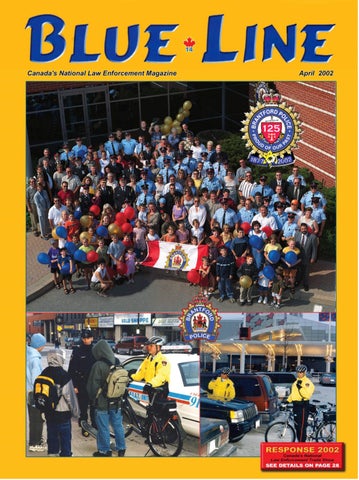
Volume 14 Number 4 April 2002
Inside This Edition Publisher’s Commentary 5 How about providing a refuge from the law
Blue Line Magazine 12A-4981 Hwy 7 East Ste 254 Markham, ON Canada L3R 1N1
Ph: 905 640-3048 Fax: 905 640-7547 e-mail: blueline@blueline.ca
- Publisher / Editor Morley S. Lymburner
The Brantford Police Service celebrating 125th anniversary
6
Crime fighters, times two Law enforcement duo gets double take
14
e-mail: publisher@blueline.ca
- General Manager Mary Lymburner, M.Ed. e-mail: admin@blueline.ca
- Managing Editor Mark Reesor e-mail: editor@blueline.ca
- News Editor Les Linder e-mail: news@blueline.ca
- Advertising Mary Lymburner Dean Clarke Kieran Huggins Bob Murray Dave Douglas e-mail: sales@blueline.ca
- Pre-press Production Del Wall - Contributing Editors Terry Barker Communication Skills Robert Lunney Police Management Dave Brown Tactical Firearms Tom Rataj Technology Dorothy Cotton Psychology Mike Novakowski Case Law Blue Line Magazine is published monthly, September to June, by Blue Line Magazine Incorporated with a mailing address of: 12A - 4981 Hwy. 7 East, Ste. 254, Markham, Ontario, L3R 1N1. Individual magazines are $3.50 each. Subscriptions are $25.00 per year or $40.00 for 2 years. (Foreign - $50.00 U.S.) ©2002 - All articles are protected by copyright. No part of this publication may be reproduced or transmitted in any form or by any means, electronic or mechanical, including photocopying and recording or by any information storage or retrieval system without permission from the publisher. Internet activity is monitored and use or reposting of material on the Internet is restricted. All material submitted for publication becomes the property of Blue Line Magazine unless other arrangements have been made with the publisher. The authors, advisors and Publisher accept no liability whatsoever for any injuries to persons or property resulting from the application or adoption of any of the procedures, tactics or considerations presented in this magazine. Readers are cautioned and advised that articles presented herein are edited and supplied for your personal awareness and should not be used for further action until appropriate advice and guidance is received from a supervisor, Crown Attorney or other person in authority. Established in 1988, Blue Line Magazine is an independent publication designed to inform, entertain, educate and upgrade the skills of those involved in the law enforcement profession. It has no direct control from a law enforcement agency and its opinions and articles do not necessarily reflect the opinions of any government, police, or law enforcement agency. Blue Line Magazine is a private venture and as such is not funded through any level of government agency, union or association.
- Affiliations International Association of Law Enforcement Planners Canadian Advertising Rates & Data International Police Association The Police Leadership Forum The Canadian Press Newswire Printed in Canada
ISSN #0847 8538 Canada Post - Canadian Publications Mail Product Sales Agreement No. 176796 April 2002
Special bulletin for public agents no. 29 16 New US regulations for non-residents purchasing and importing firearms and ammunition Safe home adapts to residents
16
VITALITY 19 Professional trainers must also be students WINNING STRATEGIES FOR LIFE De-stress yourself
20
NEWS CLIPS
21
Bridging the gap Police and researchers collaborating to fight child abuse –– Part 1 of 4
22
CORRESPONDENCE
24
DEEP BLUE 26 You can learn a lot from A Beautiful Mind RESPONSE 2002 TRADE SHOW
28
How to recognize and support people with Parkinsons
34
DOWN EAST 36 DNA Databank helps nab repeat sex offender Prepare for a safe prom now, keep your sons and daughters safe
37
CASE LAW Warrantless in-home arrests
38
Police force merged after 127 years
51
TECHNOLOGY Computers in your palm
42
BOOK REVIEW Anger is not an emotion
46
BLUE LINE CLASSIFIED
47
Policing the great lakes
48
THE BACK OF THE BOOK 54 Street cops are real intelligence gatherers 3
Blue Line Magazine is pleased to present Response 2002, our sixth annual trade show designed specifically for buyers and sellers of law enforcement goods and services. The companies, individuals and organizations have a keen interest in showing and demonstrating products and services to improve police officers’ day to day operations. Whether you are involved in public or private law enforcement initiatives or simply have an interest in what is new in the field, you will find Response Trade Show to be a worthwhile event to attend. The Brantford Police Force, which is celebrating its 125th anniversary this year, traces its history back to 1847 when the town was formed and the first bailiff hired. Our look at the service and its history begins on page six. Criminals might think they’re seeing double when they encounter the King brothers. The rookie Durham Police officers are thought to be just the second set of identical twins to work for an Ontario police force. See page 14. We begin a four part series on ‘bridging the gap’ between police and researchers to fight child abuse. Wilfrid Laurier Psychology Professor Dr. Kim Roberts, who has spent years researching children’s allegations of abuse, and student Sean Cameron tell us on page 22 that both sides can gain by working together. Dr. Dorothy Cotton points out on page 26 that you can learn a lot from A Beautiful Mind, the recent movie about John Forbes Nash, Jr. Police and security guards often mistake people with Parkinson’s Disease for drunks or drug users. Judy Hazlett and husband Roger Buxton explain how to tell the difference in an article beginning on page 34. Danette Dooley tells us how the National DNA Databank helped nab a sex offender on page 36; Gary Direnfeld has tips on helping teens make it through one of the most dangerous occasions in their lives - Prom Night - on page 37; Mike Novakowski has case law on page 38; Tom Rataj looks at palm computers on page 42 and Les Linder tells us how the 127 year old history of the Meaford Police-Thornbury Police will end July 1. Blue Blue Line Line Magazine Magazine
How about providing a refuge from the law by Morley Lymburner
I would like to bring forth an argument in favour of bringing back the old punishment of banishment as an alternative to the death penalty... or any other crime society feels it befits. When ever I hear the words “death penalty” it brings back an old story I once heard. The story was about a sailor who was cast upon the sea after his ship sunk. The sole survivor, he drifted for three days holding onto a piece of debris from the ill-fated ship. On the morning of the third day he opened his salt encrusted eyes and found himself laying on a warm sandy beach. He feared he had washed up on an uninhabited island and began to wander along the shore. Suddenly he was overcome with joy. He found a gallows with a man at the end of its rope dangling in the breeze. “Thank God!” he exclaimed... “Civilization.” The word civilization sure takes a hard rap in many circles when it comes to the judicial processes. Judges are derided for lenient sentencing, parole boards are chastised for letting the bad guys out too soon and lawyers are viewed as... well... we won’t even go there. Coupled with this is a negative opinion of the prison system that the public views as a country club in which the inmates do not spend enough time habituating. And then we have the complaints of how much it costs to incarcerate these individuals. And — good golly — we do
April 2002
have those wonderful boot camps. And so the dilemma goes on. Well sometimes it’s worth our time to go back in time to find a just-in-time solution. Back in the Renaissance period of Europe the Dutch and the Danes had an idea (stolen from the Bible no doubt) of setting up communities of refuge as opposed to dungeons. In these select communities anyone who committed an offence could take flight and the law would not go after them as long as they stayed within these communities. The only way a person could feel free to leave the places of refuge was to negotiate with their victims or their families. If they gave their permission then the person was free to leave and re-join society. One aspect of these communities of refuge that early criminologists were interested in was what was the crime rate like when your entire population is made up of criminals. Their studies indicated that it was in fact quite low and in some categories lower than the general population. The main reason for this was because it was known as their last place of refuge. Screw up here and you would be returned to “civilization” as known by our sailor friend. Many of the inhabitants of these communities learned or brought trades with them that they could teach others. In many cases the person made no effort to come out of the commu-
5
nities and spent the rest of their lives happy to be an upstanding citizen in a less than upstanding community. Can there be a better place than Canada to create such communities? There is no doubt we have enough vacant real estate to build them. The extra money we now spend on guards, walls and security can be put into buildings, streets and insulation... lots of insulation. Why? Because when your community is built on the north shore of Baffin Island the “walls” are a thousand miles thick. Unlike the days of old there will be no need to take flight from the law. The law in fact will supply the flight. But is all this just fanciful thinking? Not when we have to pay isolation bonus fees to station people up there. And what about who keeps order. The inmates themselves of course. After all they are playing the ultimate game of survival. As a little bit of insurance perhaps the government could have some Arctic Military Training facility somewhere within a four-hour flight radius. Communication links to the outside world could be well controlled and the lines should always be open for those who wish to negotiate their way out. Okay maybe I haven’t thought out all the details yet... but there’s the framework. A gift... from me to civilization as we know it.
by Susanne Rigglesford The Brantford Police Service has been protecting its citizens since the community officially became a city in 1877. In fact, the first high bailiff was actually appointed in 1847, at a salary of 60 pounds a year, when Brantford became a town. That’s a long history when you consider
April 2002
that the first official police force in Canada was established in 1835 in Toronto, according to Introduction to Policing in Canada. Back then Brantford, which is about 55 miles southwest of Toronto, was known for its many taverns and a constable or night watchman’s main duties appeared to be dealing with drunks and citizens desecrating the Sabbath by fishing and bathing in the Grand River.
6
Although the 125th anniversary slogan is ‘proud of our past,’ there were a few occasions when things went seriously awry; the service was the subject of five boards of inquiry in the early days, including one royal commission. One ‘not so proud of our past’ incident occurred in the first year when officers tried to rescue two liquor informers from a mob of angry innkeepers (Brantford had prohibition at the time under a bylaw called the Dunkin Act). The tide turned and police found it necessary to seek refuge in the jail. The incident did not reflect well on either group. Another hiccup occurred in 1885 when a safe was stolen in the middle of the night and cracked open the next day. The culprit fled from Brantford’s first police chief, Harry Griffiths, Cst. Thomas McMeans and some concerned citizens and managed to escape. Griffiths was demoted to sergeant as a result of this embarrassing incident and McMeans was dismissed, which must have been doubly humiliating as he also lost his job examining outhouses and water closets as city sanitary inspector. John Vaughan, who had recently moved from Toronto, was appointed the new chief. He was virtually unknown to the good citizens of Brantford, prompting some local ne’er-do-wells to impersonate him and offer lawbreakers the chance to avoid arrest — for a fee. With the appointment of Raymond T. Fitzpatrick May 1, the Brantford Police Service will have had 20 chiefs since its inception, with each providing strength and leadership to their staff. Perhaps the most poignant career was that of Charles Slemin (1904 to 1922), a 30-year veteran of the Toronto Police Force who had been involved in many high-profile cases, including helping to capture a man wanted for stealing $9,000 from the US Treasury. Slemin was the first Canadian police officer to be presented with the King’s Distinguished Service Medal in 1912 but his career came to a sudden end 10 years later when the police com-
mission forced his retirement following a board of inquiry. Slemin became a turnkey at the county jail after retiring, working there until 1934 when, at the age of 79, he was badly beaten by three men during a jail-break; a sad ending to a brave, distinguished policing career. The service was housed in the city hall for its first eight years and had a special room outfitted for prisoners. Conditions were so deplorable that Griffiths would sometimes take his prisoners home and lock them in his parlour. The first police station was used for 65years, the second for 37-years and the current Elgin Street station for just over 10 years. Even by today’s standards, the present station is considered a modern, state-of-the-art, facility. This can be attributed to (retired) Chief Alvin ‘Jake’ Barber, who played a major role in the early planning stages and saw the project through to fruition, on time and under budget. There has always been a friendly rivalry between the firemen and policemen in Brantford. The fire hall was next door to the first station and it was said police on the night shift would wake the firemen by clanging garbage can lids and ringing the fire bell. Firemen would retaliate by dumping buckets of water on passing officers from the second floor of the fire hall, which was likely one of the reasons the current station is located five kilometres away from the main fire hall! One of the biggest brawls in Brantford took place at the turn of the century and involved some 40 youths. The guilty parties, who all attended local schools, were fined $3.85 or 20 days in jail. It wasn’t a battle over drugs or alcohol though — the melee was started by a snowball fight. A little later in the century a constable was assigned to act as a truant officer, patrolling the streets in search of children skipping school. Things are more pro-active today — since the fall of 2000, a full time resource officer works in each local high school and a school safety officer visits each public school throughout the year. In the early years, a beat officer checked the locks of each downtown premise, ensured the street lamps were lit, responded to bar fights and cleared many a drunk from the streets. These officers became acquainted with all the citizens in this area and were able to find out about illegal activities through their informants. Prior to the mid-1970s, Brantford’s core was a bustling hub of activity but has gone the way of many Ontario downtowns; it’s now a sad collection of deserted stores and boarded up businesses. Many attempts have been made to bring shoppers back to the core and in 1986, Eaton’s Market Street Mall opened. Beat officers re-emerged, three constables were dedicated to policing the core and a suboffice was opened. The downtown was reborn but it didn’t last. Eaton’s shut its doors a few years later and most of the other stores closed or moved on. ‘Brantfordians’ don’t give up easily though and continued trying to revitalize the downtown. Wilfrid Laurier University opened a satellite campus in the former library in the fall of 1999 and a charity casino rolled into the town
shortly after, moving into a building which was originally constructed in 1991 as an international telecommunications centre. The plug was pulled on funding and the building, which was only a shell, became a white elephant until the casino arrived. The Brantford Police Service now has six members in the beat unit, including a sergeant, and patrol the core on mountain bikes, foot and cruisers. They not only enforce criminal, provincial and municipal laws but provide a valuable community resource . “Enhancing the quality of life for the citizens living, working and visiting the core” is their mandate and part of the proactive policing philosophy. The downtown police sub
office has been expanded and there’s also a fulltime casino liaison/crime analyst officer. Like other mid-size police services across Ontario, Brantford police are facing financial constraints and government downloading. Young officers, attracted by higher salaries, move to larger police services but the force has been through hard times before. During the Great Depression, salaries were cut by five per cent on the first $1,000, 7.5 per cent on the second and 10 per cent on the third and two people were let go. Even though times were hard, the station was made available as an overnight shelter and bologna sandwiches and coffee were handed out to thousands of down-and-out individuals.
For further details go to BlueLinks at www.blueline.ca
April 2002
7
In 1941 a constable was paid between $3.75 and $4.50 daily and it wasn’t until 1957 that half premiums on health insurance were provided. During the ‘Rae Days’ of the mid 1990’s, when the Bob Rae NDP government required Ontario public servants to tighten their belts, members of both Brantford Police Associations negotiated three days off without pay. Salaries have increased to $58,000 a year today and the service’s operating budget was $13.5 million in 2001, a far cry from the $3,500 it received in 1877. Also gone are the days when a constable spent the bulk of their career attending calls and performing what, at times, can be mundane patrol duties. The service has a wide variety of branches in which to serve, including criminal investigation, crime stoppers, forensic identification, traffic, drugs and criminal intelligence, and some of the work is innovative and pioneering. The January, 2001 edition of Blue Line highlighted the benefits of the service’s High School Resource Officer program, the first of its kind in Ontario. It was met with a great deal of suspicion and negativity when introduced in 1990 and only one school agreed to participate, but its overwhelming success among parents, teachers and most importantly, students soon convinced all community schools to become involved. The Drug Abuse Resistance Education (DARE) program was introduced to half of Brantford grade six students in 1998 as a pilot project. It’s now offered to all grade six students and will be taught to all grade nine stu-
April 2002
Chief Charles Slemin served 1904-1922
Brantford officer on patrol (circa 1937)
dents by the high school resource officers. The service is researching the effectiveness of the program. DARE Brantford is overseen by a board of directors drawn from the community and funded by local corporations, service clubs and foundations. Older programs are also being continually fine-tuned and modified to reflect the changing times. The School Safety program, which oversees school safety patrollers, has operated for 40 years. The duties of the school safety officer originally entailed attending schools to provide safety talks and performing crossing guard duties when required. Say No to Strangers, the only film available to them, had been repaired so many times, recalls (Ret.) Insp. Len Ellins Senior, a safety officer in the 1960s, that it was just half its
8
Old Brantford Police Station in service for 65 years
original length. Safety officers now come in contact with 12,000 students at 42 schools and oversee some 1,100 safety patrollers. This program has blossomed into an important learning tool, providing a wide range of educational topics geared at children from kindergarten to grade three (soon to expand to grade four). Grade five to eight students are visited on a special request basis. The current school safety officer, Cst. Brad Cotton, has further enhanced the program by developing an educational game called So You Want to be a Safety Gazillionaire, modelled on the TV game show ‘Who Wants to be a Millionaire?’ It’s been enthusiastically received by children, who have so much fun playing it they don’t realize they’re also learning important safety information. Policing has become a valuable, community resource which makes the city a safer and healthier environment in which to live and work. The important community partnerships that the service has had the good fortune to develop over the years assist it greatly. The valuable input received from such agencies as the Children’s Aid Society, Nova Vita, Pine Tree Native Centre, St. Leonard’s Society, Brantford General Hospital, both school boards and the Sexual Assault Centre are important in determining the needs of residents. Victim Services moved into our station in April, 1999 to help crime victims or in tragic circumstances or disaster. Greater emphasis has been placed on the rights and well-being of the victim by all police and ensuring that they are offered support, assistance and comfort has confirmed our dedication to the community. This is nothing new for Brantford Police, which has been doing this since the Depression. In the past ‘Brantfordians’ used to boast about being from the birthplace of the telephone, which was conceived of, invented and developed by Alexander Graham Bell in the city. For the past 25 years, however, they are proud to say Brantford is the hometown of Wayne Gretzky, who is probably the greatest athlete of our time (3,239 career points, including playoffs). On the other hand, it’s a toss up between Wayne and his dad, Walter, as to who is more beloved in the community. A gala is planned for April 27 to celebrate the service’s 125th anniversary and to raise money for five local charities. Local financial
to depict both local and law enforcement related elements. A downside to the occasion is that the service is losing Chief Bob Peeling, who has led the service for the past four years. Peeling, who has been instrumental in delivering innovative, crimeprevention programs, is retiring at the end of April. His continuing dedication to making the city a safer community and improving the quality of life has been evident throughout his 35year policing career. A committed community volunteer, Peeling is well respected by the citizens of Brantford and service members were proud to serve under his command. One of his initiatives was beginning the process to be accredited with the Commission on Accreditation for Law Enforcement
Agencies (CALEA), which is being overseen by Staff Sergeant Jeff Kellner. Brantford would be just the fourth Ontario police service and the tenth in Canada to be accredited. The service looks forward to CALEAs official confirmation of what the members already know, that the Brantford Police Service meets the highest level of quality standards available for law enforcement. Susanne Rigglesford has been a civilian member of the Brantford Police Service for 19 years and is the deputy chief’s executive assistant. Heather Ibbotson of Brantford’s daily newspaper, The Expositor, which is celebrating it’s 150th anniversary this year, helped in the editing.
Chief Robert (Bob) Peeling institutions and corporations are helping to sponsor the event — it’s clear the service has many friends in the community. A book on its history, Peacemakers and Lawbreakers, written by local journalist Heather Ibbotson and made possible by the Brant Historical Society’s successful application for a grant from the Ontario Trillium Foundation, is being published to mark the milestone. Cst. Jason Miller, a member of the beat unit and a talented portrait and landscape artist, designed the 125th anniversary logo. Miller belongs to the Police Artists Association of Canada and has painstakingly designed the logo
For further details go to BlueLinks at www.blueline.ca
April 2002
9
The History of Brantford The history of this city is traced back more than three centuries to a time when the Native tribes lived in the magnificent forest wilderness of the Grand River Valley. The prime figure in the history of Brantford was Captain Joseph Brant, leader of the Six Nations peoples. Brant, known as “Thayendanegea” to his people, fought on the English side during the American Revolution. At war’s end, Brant chose to remain an ally of the Crown and requested land in Canada for his people. Through the efforts and negotiations of Joseph Brant, the Six Nations were granted a tract of land six miles in depth on each side of the Grand River from its mouth to its source. In 1784, Brant led his tribes from their lands in the Mohawk valley of upper New York State to the Grand River Basin, where they crossed the river and became known as Brant’s ford and, hence, the location and history of Brantford had begun. However, because of the obscurity of the headwaters of the Grand River, much of the land granted to the native people was never settled by the Iroquois for the simple reason that they did not know it was there. Brant sold some of the adjoining land to white farmers, many of who were his friends, so that the Iroquois could learn from them and develop agricultural and farming skills. The Joseph Brant Monument was made from French Cannons in 1886. It is located in
Victoria Park, downtown Brantford. The first non-aboriginal settler, John Stalts, arrived in the village in 1805. By 1818, the European population consisted of twelve people, and five years later there were 100 people. In 1826, a meeting was called to name the
For further details go to BlueLinks at www.blueline.ca
April 2002
10
village. After many suggestions, the name of Brantford was chosen in honour of Captain Joseph Brant. In 1830, the remainder of the village site was sold by the Six Nations to the white settlers. The town of Brantford was incorporate on July 28, 1847. By this time, the Natives feeling pressure from the Europeans, had slowly moved to the south side of the river to land held in trust for them to set up their homes. This land was know as the Six Nation Indian Reserve and now is call Six Nations of the Grand River. The County of Brant was established in 1852. On May 31, 1877, with a bustling population of 10, 000 people, the town of Brantford became a city and began to grow into the prosperous community of 90,000 that it is today. In 1870 Alexander Graham Bell, inventor of the telephone, moved to Brantford with his parents from Scotland. Bell is considered one of the greatest inventors of the 19th and 20th Centuries for his invention of the telephone, the research of which was performed in the family home in Brantford. The invention made him a millionaire by the age of 35. In 1876 the first long distance telephone call was actually achieved by Bell between the city of Brantford and the nearby town of Paris. This feat proved the viability of the massive global communications network that was about to become reality in the 20th century. The huge empire known today as Bell Corporation, Bell Canada Enterprises, Nortel Networks and hundreds of subsidiary corporate entities tie their historical success to Alexander Bell’s initiatives. Listed among one of Canada’s modern wonders and Brantford’s leading citizens is the family of hockey legend Wayne Gretzky. When being interviewed about his early years Gretzky beams with pride about Brantford and all it has meant to him and his family. The admiration is certainly mutual with an expressway named after him and an adoring population that never hesitates to boast of this home-town hero.
FBI targeting Earth Liberation Front The FBI has put the Earth Liberation Front at the top of its list of US domestic terrorism threats. “During the past several years, special interest extremism, as characterized by the Animal Liberation Front (ALF) and the Earth Liberation Front (ELF), has emerged as a serious terrorist threat,” says director Louis Freeh. The FBI estimates that ALF/ELF have committed more than 600 criminal acts in the United States since 1996, resulting in damages in excess of $43 million US. “Since 1977, when disaffected members of the ecological preservation group Greenpeace formed the Sea Shepherd Conservation Society and attacked commercial fishing operations by cutting drift nets, acts of eco-terrorism have occurred around the globe,” Freeh says. “In recent years, the Animal Liberation Front (ALF) has become one of the most active extremist elements,” he says, adding that, despite the destructive aspects of ALF’s operations, its operational philosophy discourages acts that harm “any animal, human and nonhuman.” Individuals become members of ALF not by filing paperwork or paying dues, he notes, but simply by engaging in “direct action” against companies or individuals who utilize animals for research or economic gain. Direct action generally occurs in the form of criminal activity to cause economic loss or to destroy the victims’ company operations. “The ALF activists have engaged in a steadily growing campaign of illegal activity against fur companies, mink farms, restaurants and animal research laboratories,” he says.
It’s estimated the group has caused more than $45 million (US) damage to the US fur and medical research industry alone during the past 10 years. Freeh says the agency considers it a terrorist group “whose purpose is to bring about social and political change through the use of force and violence.” Disaffected environmentalists formed a radical group called ‘Earth First!’ in 1980, engaging in a series of protests and civil disobedience events. In 1984, members began ‘tree spiking — inserting metal or ceramic spikes in trees — to thwart logging. The ELF was founded in Brighton, England in 1992 by Earth First! members who refused to abandon criminal acts as a tactic when others wished to mainstream Earth First!. The ELF advocates ‘monkeywrenching,’ a euphemism for acts of sabotage and property destruction, including tree spiking, arson and sabotaging logging or construction equipment, the FBI says. The most destructive practice of the ALF/ ELF is arson, according to Freeh, who says the ALF/ELF criminal incidents often involve preactivity surveillance and well-planned operations. Members are believed to engage in significant intelligence gathering against potential targets, including the review of industry/trade publications, photographic/video surveillance of potential targets and posting details about potential targets on the Internet. The FBI is dedicating 1,669 people, nearly 16 percent of all special agents, to fighting domestic and international terrorism, an increase of 224 percent over the past 10 years. For further details go to BlueLinks at www.blueline.ca
For further details go to BlueLinks at www.blueline.ca
April 2002
11
Crime fighters... times two! Law enforcement duo gets double takes by Stephen Shaw Meet rookie constables Wayne and Wes King, Durham Regional Police’s new secret weapons and a dose of double trouble for crooks. The crime-fighting duo, 27-year-old identical twins born five minutes apart, not only share duplicate genes, friends and hobbies, but they’re leading parallel lives, travelling the same career path that now has them in uniform. Believed to be just the second set of twins to work for the same police force in Ontario, the Oshawa natives, who share an Ajax condo with a friend, were sworn in last August after graduating from the Ontario Police College. The King brothers were born Sept. 26, 1974, and since that day they’ve been attached at the hip, figuratively speaking. Both attended high school in Oshawa, graduated from Trent University with degrees in sociology and cultural studies and spent five years in the advertising field working in Toronto as account executives for large international companies. When Wes was a victim of layoffs about a year ago, he began considering a career in policing, and Wayne was of equal mind. “When l was a little boy I always thought about policing, both of us did. I decided (to apply as a police officer) first, and Wayne jumped in,” says Wes, the ‘older’ twin. “If you really break our lives down, we’ve done everything together; same schools, same jobs, same friends — we even have the same taste in cars. We’ve never really been apart. It wasn’t planned, we’re just close. We’ve always been best friends, for better or worse.” Wayne adds, “We’ve just had the same interests all our lives. We’ve been together our whole existence.” In their uniforms or plain clothes, the pair are virtually mirror images. Only a sharp eye or close friends and family members can tell them apart, which has led to some confusion and a few laughs around the police station. Wes is assigned to Whitby’s 18 Division while Wayne works out of 17 Division in Oshawa. When Wes was recently assigned to the Reduce Impaired Driving Everywhere (RIDE) team, based in Oshawa over the holi-
Photo: A.J. Groen
Durham Regional Police Constables Wes (left) and Wayne King share crime fighting duties along with their genes. The identical twins, 27, were sworn in last August and now police the streets of Durham Region as uniformed officers. days, he arrived at the station one night to start his shift just as Wayne’s ended. Colleagues stared bewildered at Wes, thinking it was Wayne beginning yet another shift. On another occasion, when Whitby was short staffed, Wayne was assigned for one shift to his brother’s station to fill the void. Needless to say, there were a few perplexed faces. “Few can tell the difference when we’re walking around the stations,” says Wayne. They not only share physical traits, they dress in the same style of clothes and share similar personalities. During an interview at po-
lice headquarters, the brothers often complete each other’s sentences. There are a few subtle differences, however, such as height and weight. At 6-foot-3 Wayne is about one inch taller and 10 pounds lighter. Academically, both were strong, though Wayne scored “two or three” marks higher; each excelled at writing and was weak in math. Wes is slightly more athletic, though both played minor hockey and are competitive water skiers. While their parents “didn’t make a big deal” about it, the novelty of being identical twins has always attracted a fair bit of attention, not that they mind the double takes, along with the pressure of constant comparisons, they say. “Who’s taller, who’s thinner, smarter or whatever, everyone compares you. We help each other, push each other to make the other better,” says Wes. Emotionally, they share a sublime connection, the Kings say, sharing the instinctive mutual ability to know when something is wrong with the other. “It’s a bigger connection than most people, just a gut feeling. If Wayne is having problems or I’m having troubles, it’s a joint problem,” says Wes. This article was reprinted with approval of the Ajax/Pickering News Advertiser.
For further details go to BlueLinks at www.blueline.ca
April 2002
14
Intimidation: Crime or lawful tactic? by John McKay I was recently asked to review a use of force complaint against the police. The situation as it was first described to me was that an officer placed his open hand on the chest of a large, combative subject and said in a loud angry voice “if you don’t shut up, I’ll shut you up.” The third party who saw this believed he had witnessed an assault and made a complaint. Interviews revealed that what he had seen was the culmination of a lawful arrest, where the male subject had resisted two officers by punching, kicking and biting until he was handcuffed. He continued to threaten them with a verbal tirade which included the usual racial expletives. He was still at it 10 minutes later when one of the officers placed his hand on the subject’s upper chest and shoulder and said to him rather loudly, “shut up or I will shut you up.” At that point, our hero quieted down and became compliant. The officer denied assaulting the subject in his statement but agreed to the facts as described by the witness, saying his goal was to intimidate the subject into settling down so that he would not have to physically engage him again. What do you think? Did the officer commit an assault or is intimidation a legitimate police tactic? The Merriam-Webster dictionary defines intimidation as “to compel or deter by, or as if by, threats,” adding it implies inducing fear or a sense of inferiority into another. It gives “bully” as a synonym - bully “implies intimidation through threats, insults or aggressive behaviour.” As I wrestled with that definition, I realized that police use intimidation effectively in many areas. One of the purposes of the helmet, goggles and nomex masks of ERT personnel is to intimidate armed and dangerous subjects into compliance. The Vancouver Crowd Control Unit used the shield banging very effectively during the Stanley Cup riot of 1994 to intimidate rioters. The goal in both instances is to deter subjects from physically resisting; armed subjects generally comply when they encounter ERT personnel and rioters generally leave once the shield banging starts. It appears that they do so because they feel afraid or inferior. It may even be said that they were bullied into compliance by threats and aggressive behavior. As I reviewed this and other use of force situations I realized that intimidation is a tactic that police use but rarely discussed. We recognize that we use force according to law and as subjects increase their resistance levels, officers lawfully escalate as required. Tactical communication techniques generally rely on the concept of deflecting verbal abuse, as taught in judo, and eventually gaining compliance. As a martial arts practitioner for over 35 years, I can tell you that judo doesn’t always work as a physical response to an attack, which is why karate and boxing is also taught. I believe that the same holds true for tactical communication. Deflecting the verbal abuse of an opponent doesn’t always work and so intimidation, which has also been called verbal karate, has a legitiApril 2002
mate role to play in gaining compliance. While we have a lawful requirement to use ‘reasonable force,’ I believe we are also ethically obliged as professionals to use the least amount of force necessary for compliance. If intimidation succeeds without having to use physical force, the tactic is both legal and ethical. There’s no doubt police must treat the public with dignity and respect and I am not suggesting that we use intimidation in a gratuitous manner or that it become an excuse for abuse. I am saying however that if a verbal escalation which could be termed as intimidation can be justified, then that escalation is both legal and moral. I was asked during my investigation if intimidation was taught at the academy level to police recruits. I had to admit that it is not even discussed, most likely because it is a ‘high risk, high gain’ technique open to abuse by those not experienced enough to understand how to properly apply it. The prosecutor handling the file conceded he had learned techniques in his practice that were not taught in law school and agreed that intimidation was probably best taught by a mentor such as a field trainer. What do you think? John McKay is an inspector with the Vancouver Police Department Operations Division, a use of force instructor since 1980 and has served in ERT and crowd control units. He can be contacted at: JOHN K. MCKAY 204-3495 Cambie Street Vancouver, BC V5Z 4R3 (604) 541-8467.
15
New Sales Manager Appointed Blue Line Magazine Publisher, Morley Lymburner, is pleased to announce the appointment of Dean Clarke as the Magazine’s Sales Manager. Dean is a graduate of the Seneca College Law Enforcement Program and had gained considerable experience in private seDean Clarke curity before entering the field of advertising sales. Dean moved into sales and marketing at Laurentian Media before taking over as Sales Manager of Special Projects with Woodbridge-based Promotive Communications Inc. “Working for Blue Line Magazine is the best of both worlds for me,” says Dean. “My first keen interest was law enforcement and policing. My second is advertising sales. I can’t think of a place that is more right for me than working with Blue Line. It not only brings together my two best interests but I was blown away by the scope and magnitude of this operation. I have never worked for a publication that has gained this level of respect from its readership.” Dean will be responsible for managing the overall marketing and sales operations of Blue Line Magazine’s monthly and weekly publications as well as Trade Show and Internet Web Page integration.
Safe home adapts to residents by Roaxanne Beaubien An innovative home merging the principles of Crime Prevention Through Environmental Design (CPTED) and universal design won two awards for the Calgary Police Service and its project partners. It won the Mayor’s Award for Accessibility and the Alberta Home Builders Association honoured the project with the Best Innovation Award. “We wanted to show people that you can have a home that’s safe and you can have a home that’s accessible without having to look like an accessible, safe home,” says Cst. Shalin Kashyap of the Calgary Police Service (CPS) Crime Prevention Unit. An essential component of the service’s crime prevention and community policing strategies, some 140 officers, more than 10 per cent of the total complement, is trained in CPTED. Kashyap completed two 40-hour courses – the basic and the advanced - seven years ago and has been assessing homes, businesses and communities ever since; for the last three years, it’s been a major part of his assignment in the Crime Prevention Unit (CPU). The home, dubbed the Universal Home for Safe Living, was planned and built through a partnership between the CPU, a graduate environmental design student and a homebuilder. The unit and its partners came up with the idea in 1999 when they envisioned taking the traditional “safe home” display a step further than the usual physical safety recommendations
The award team shown in the home’s kitchen, from left to right: Avi Amir, of Homes By Avi, Constable Gerry Bailey, Sergeant Marty Fulkerth, Staff Sergeant Paul McCorquindale and Constable Shalin Kashyap. Seated is Linnie Tse of Designs for Living. of locks and bars, Kashyap said. Universal design advances barrier-free or accessible designing, based on the premise that people change as they age and a home should accommodate that while offering dignity and independence. Hallways are wider than usual, for example, the kitchen sink can be lowered for wheelchair users or the elderly and the electrical outlets are higher than standard positioning. The universal design and CPTED are complementary, according to Kashyap, because the fundamental goals are the same. “We can increase the quality of life for individuals in their homes and communities. As we
increase the quality of life, people feel safer, more confident and are more willing to explore and engage with their environment. So quality of life is the fundamental driving force behind the synthesis,” he says. CPTED is guided by three basic principles: • ‘Natural access control’ directs where people enter and leave a space, reducing the chances for criminal activity • ‘Natural surveillance’ influences items such as window placement, lighting and landscaping • ‘Territorial reinforcement’ promotes a sense of ownership and clearly defines property lines and private and public spaces. Kashyap and other CPTED specialists work closely with the Calgary planning and building department and assess large city projects and public spaces. Residents wanting home assessments are referred to one of the seven district offices which have community liaison officers trained in the program. The CPU also published a comprehensive pamphlet outlining CPTED techniques, with photos targeted at builders, planners, architects and others creating safe communities. With Calgary’s fast-growing population and residential building boom, demand for CPTED is growing. It’s difficult to keep up with requests, says Cst. Kashyap, but with break-ins topping the list of citizen concerns, the program enjoys strong support from the top ranks. You can get more information on the program by emailing cps@calgarypolice.ca
Roxanne Beaubien works in the Public Affairs/ Media Relations Unit of the Calgary Police Service.
For further details go to BlueLinks at www.blueline.ca
April 2002
16
Special Bulletin for Public Agents No. 29 New US regulations for non-residents purchasing and importing firearms and ammunition The United States is implementing new regulations that impact on non-residents purchasing firearms and ammunition. The new regulations also impact on non-residents importing firearms and ammunition into the US, though some exemptions do exist. Canadian residents who will be temporarily bringing firearms and ammunition into the US, or who wish to purchase firearms and ammunition while there, will feel the effect of new regulations which came into force February 19, 2002. These regulations, enacted from 1998 US legislation, are not connected to Canada’s firearms legislation. The 1998 legislation arose from recommendations made after a 1997 shooting by a non-resident at the Empire state Building. The events of September 11th hastened their implementation. The new US regulations generally make it unlawful for Canadians and other non-residents to possess and receive firearms and ammunition in the US. Exceptions for purchasing firearms and ammunition Exceptions to the new US regulations include: • Non-residents who have the firearm directly exported to Canada by a US licensed firearms dealer. • Non-residents who have a valid US state issued hunting licence/permit or an invitation to a US competitive sports-shooting event, proof of residency in a state within the US for at least 90 days and an alien or admission number issued by the US Immigration and Naturalization Service (INS). • Law enforcement officers in the US on official business do not require a state-issued hunting licence/permit or an invitation to a US competitive sports-shooting event. However, the 90-day residency and alien or admission number requirements must still be met. Exception #1 Canadians can choose to have a US licensed firearm dealer export a firearm directly to Canada, bypassing the new red tape. Non-residents who choose to have the Federal Firearms Licensee (FFL) export their firearm directly to
Canada do not require the hunting licence/permit, the alien or admission number or the proof of 90-day residency. Exception #2 When selling a firearm to a non-resident who is taking possession of the firearm and who will personally export it, the FFL must see a valid state-issued hunting licence/permit (unless the non-resident falls into another exception category). Other accepted documentation, besides the hunting licence/permit, is an invitation to a national, state, or local competitive target or sport-shooting event, but the non-resident must meet the 90-day residency requirements. Re-enactors and sport shooters (not invited to a competition) will need to acquire a hunting licence. Most states issue hunting licences/permits to non-residents. The hunting licence or permit can be acquired in one US state and the firearm can be purchased from an FFL in a different state. All non-residents must provide an INS issued alien number or admission number when purchasing a firearm from an FFL. If not already in possession of such a number, one can only be obtained from an INS inspector at a US entry point. It cannot be obtained from within the US. The 90-day residency requirement remains unchanged. Exception #3 If Canadian law enforcement officers are in the US on official business, they do not require a state-issued hunting licence/permit or an invitation to a national, state, or local competitive target or sports-shooting event to purchase firearms or ammunition while in the US. However, the law enforcement officer must have resided in a US state for at least 90 days and have an INS-issued alien or admission number.
For further details go to BlueLinks at www.blueline.ca
April 2002
Importing firearms and ammunition into the US Canadians bringing firearms into the US must show US Customs a pre-approved American import permit, as well as a valid state-issued hunting licence/permit or an invitation to a US target or sports-shooting event or a permit to display firearms or ammunition at a sports or hunting show. The shooting event or show must be sponsored by a national, state or local firearms trade organization devoted to the competitive use or other sporting use of firearms. To apply for the import permit, non-residents must submit to the Bureau of Alcohol, Tobacco and Firearms (ATF) form 6, part 1, Application and Permit for Importation of Firearms, Ammunition and Implements of War, which is available from the ATF or the Canadian Firearms Centre. It must be submitted along with proof of a state-issued hunting licence/ permit or an invitation to a US target or sportsshooting competition or a permit to display firearms. Re-enactors and sports shooters who are not invited to a competition must purchase a hunting licence. US authorities recommend allowing 6 to 12 weeks for processing time. As in the past, Canadians who temporarily import their firearms and ammunition for an approved purpose do not need a US export permit. Questions and forms Any questions on these new requirements should be directed to the ATF by calling 1-202927-8330 or visiting their web site at www.atf.treas.gov. Form 6 is available from the Canadian firearms Centre by e-mailing: canadian.firearms@justice.gc.ca or faxing 613 941-1991. Information for public agents Any public agent or police officer can use the CFC police information and referral line at 1 800 731-4000, ext. 2064 (E) or 2063 (F) to obtain information or to obtain publications that are available. The same operators can also be contacted by e-mail at: police.firearms@justice.gc.ca.
For further details go to BlueLinks at www.blueline.ca
17
by Blair McQuillan Robert Rae Cook was charged with fraud when he arrived in Stettler, Alberta on Saturday June 27, 1959. It had been just four days since he was released from prison as part of an amnesty granted to non-violent prisoners in honour of the Queen’s visit to Canada. RCMP Staff Sergeant Thomas Roach had questioned Cook about a new Chevy he had bought in Edmonton and Cook told him he’d used his father’s ID and the family station wagon as a trade-in. Roach explained to 21 year-old Bobby that he was not 52 year-old Ray Cook senior and charged him with driving with improper insurance. He placed him in a holding cell and set out to inform the elder Cook of his son’s whereabouts. The Cook family lived roughly 100 meters from the detachment where Bobby currently resided and Roach found no sign there was anyone home when he went to the door. A routine inspection of Bobby’s trunk revealed two suitcases and a metal box. The suitcases contained four pairs of children’s pajamas, a pair of sheets, a lady’s wristwatch and an album containing photographs of Cook’s step-mother. The box held a bank passbook belonging to Ray Cook which showed a balance of $4,000, the birth certificates for Bobby’s five step-brothers and sisters, tax notices, a marriage license and report cards belonging to the children. Roach went back again to the Cook residence to verify Bobby’s story with his father and was surprised to find that the door gave way to the force of his knock. He walked through the house, saw the Saturday edition of the Calgary Herald on the floor but noticed nothing unusual and left. On the following day police returned to find Ray Cook. A faint odour of dried blood and decayed flesh hung in the air and police found the source in the detached garage near the house. Floorboards concealed the bullet riddled body of Ray Cook in a grease pit; beside him lay his second wife, Daisy May, who had also been shot. Underneath the bodies of the two adults, wrapped in Thursday’s edition of the Calgary Herald, were the blood soaked bodies of the five Cook children; they’d been beaten to death with the butt end of a single barrel shotgun which was more than 50 years old. Inside the house police saw that some one had attempted to cleanse the walls of bloodstains and there were only ten fingerprints found. Under the mattress in the master bedroom was a prison issue blue suit with a red tie — Bobby Cook’s suit and tie. Along with the suit was a white shirt, which was too small to be worn by Bobby. The laundry mark was stamped ROSS on the collar. When Cook learned of the deaths of his family he cried for over an hour and refused to answer questions. He was arrested and charged with the murder of his father. Bobby was born in Hanna, Alberta, on July April 2002
Alberta While cruising around town Cook 15, 1937, the only son of Raymond was stopped by Constable Braden and Josephine. His mother died when and told to go to headquarters. He he was nine and his father married voluntarily complied, which is where Daisy May 17 months later and bethis story began. gan an expansive family. The pathologist concluded the Bobby collected 19 charges in murder victims had been dead for at seven years, half of them for auto least 24 hours and no longer than 72; theft, first getting in trouble at age 13 since they were found before noon when he stole a car while on vacation Sunday, that meant they had been with his parents in Banff. murdered sometime between ThursAlthough Bobby admitted to beday at 11 am, when Bobby was in ing a car thief, he contended he was not a murderer, claiming to be nowhere Robert Rae Cook Edmonton, and 11 am Saturday, when Cook was driving around near the scene of the crime at the time it took place. He told police that on June 23 Camrose. Since Bell had seen Bobby in Camrose on (Tuesday) he was celebrating his release with Friday and the car dealers saw him on Thursother former inmates in Saskatoon. He checked into the Commercial Hotel in day in Edmonton, police concluded he had to Edmonton the next day, he said, and during the be at the crime scene close to midnight on Thursafternoon went to a car dealership and asked day, a time Cook maintained that he was headabout trading in the station wagon for a new car. ing to Edmonton. Although the Crown had a circumstantial He claimed he then stole a car and drove to Bowden where he retrieved $4,300 in cash he case they still managed to convince a jury that had hidden before he was sent to prison. Late Robert Rae Cook was guilty. He was sentenced Wednesday he returned to Edmonton and threw to be hung April 15, 1960, granted an appeal and again found guilty. He was hung just after a party for a group of ex-cons. On Thursday morning, Bobby and a friend midnight Nov. 14 in Fort Saskatchewan, deborrowed a truck and traveled to Stettler to see spite the fact that there were still many loose his family. Cook walked into Stettler just be- ends in the case. For example, during the first trial Bell told fore 5 pm after being dropped off outside town, he said, and had a beer with his dad before going the court he had seen the suitcases and metal to the house. Ray told Bobby the family was box in the trunk of Bobby’s car when he going to move to British Columbia and Bobby stopped him in Camrose. However, a second said he gave his dad about $4,000, the remain- constable who searched the trunk for liquor ing money from his cache, as a gesture of good stated that he could not remember recall seeing will. In return Ray gave his son the family car, those items. Another question involved the Calgary which Bobby was to trade in. Arriving back home at about 9:30 p.m. af- Herald. Police discovered the Thursday edition ter some guests of his parents had left, Bobby in the pit and the Saturday edition on the front said he gave his prison suit to his father and left porch but nobody saw the Friday edition. The the house again at about 10:30 p.m. to head for absence of the paper would imply that someEdmonton, which was a two-and-a-half hour one was in the house Friday. John Mitchell told the court that he had drive, to trade in the wagon with Ray’s license, registration and insurance. Bobby had planned seen a letter from Bobby’s father stating that he to purchase the new car, return home and then would inherit the family station wagon upon wait for more instructions regarding the move his release from prison. Mitchell also testified that he had seen Bobby in a cafe between midto BC, he said. At roughly 1:30 a.m. Friday, witnesses said night and one am, the time the Crown claimed they saw Bobby at a cafe and then the Pig ‘N the murders were taking place. Wilson even tesWhistle, where Cook met Sonny Wilson, broke tified that he and Cook were responsible for the break-in at the dry cleaners but that testimony into a dry-cleaners and stole $30. When the dealership opened Friday morn- was deemed unreliable. The investigation turned up information ing, Cook purchased a ’59 Chevrolet Impala, telling the salesman he was Ray Cook, a diesel that Bobby had made an enemy in prison by technician making $750 per month. He was on the name of Oliver Durocher. Cook defended his way to see friends in Camrose before the an inmate against Durocher’s sexual advancements and, as a result, he swore revenge against dealership realized they had been conned. Cook was stopped twice by RCMP con- him. A police informant told a Vancouver ofstable Jack Bell in Camrose. The first time he ficer that Durocher may have known somewas lectured by the officer for making an illegal thing about the murders. It was also discovU-turn and was nabbed again on Saturday for a ered that Durocher was in Stettler during the time of the murders but was never sought for liquor infraction. He then drove back home, he said, where he questioning. An RCMP report stated that four of the found his family had seemingly vacated the house. Inside he found the metal box and suit- ten fingerprints found didn’t match any of the cases, which he put in his trunk. Bobby claimed family. They were compared with those of Cook he believed his family had already gone to BC. but came back with negative results. 18
VITALITY
Professional trainers must also be students by Peter Shipley Dynamic simulations must be designed in a very deliberate and progressive manner to build recruits or officers’ confidence. The effect on a very confident individual’s performance has been well documented by Bandura (theory of self-efficacy) and many use of force experts. Training academies and use of force instructors often complain they need more time to conduct use of force training. Research appears to indicate that properly designed simulations can lead to lower arousal rates, thus greater potential to perform at an optimal level. To test this, I.C.A.T. Judgemental Training System exposures were compared to simulation training involving an actual human suspect. The study was part of a larger look at perception as reported in the OPP Review. All subjects were asked how many I.C.A.T. scenarios and dynamic simulations with Simunition they were in while at the Ontario Police College. The 10 subjects (recruits) then participated in an I.C.A.T. simulation, followed by a simulation involving a human subject. Their maximum heart rates were recorded at the time when the threat was presented. After they completed I.C.A.T. but before the human simulation, they were told to perform a tactical breathing exercise. The simulation required they respond to a break and enter in progress during which they were confronted by a suspect with an edged weapon who didn’t engage the officer, obeyed their commands and made no attempt to escalate the occurrence. Afterwards heart rates were recorded, along with descriptors of threat cues they identified. Eighty per cent of the 10 subjects’ heart rates actually decreased after repeated training exposures, which is an important finding as this relates to the arousal control component of training. The two subjects whose heart rate increased had only done one previous Simunition exercise (self-reported), whereas the others had done it at least twice. The average heart rates for the human threat simulation were 14 beats per minute lower for the eight subjects. However, even when the higher heart rates are included the average is still 10 beats per minute lower. Explanations regarding these very important findings could include: • tactical breathing exercises implemented prior to officers entering the room had the affect of lowering the heart rates. • additional I.C.A.T. simulations given to recruits allowed them to be exposed to a similar situation which gave them more confidence, thus lower heart rates, even when confronted with an actual human suspect. There are a number of possible explanations that can explain the decrease for the subjects heart rates between the ICAT Simulator and the human/threat simulation; I have outlined two: • It would appear that gradually introducing threats during training should be a major part in developing effective simulations. It’s important to introduce threats from a static position initially, up to and including a fully dyApril 2002
namic simulation. This approach enables students to react appropriately once they recognize the threat. Just as important is the ability to recognize potential threat cues and be ready to react to them in a spontaneous situation. This develops confidence in their decision-making ability and controls stress arousal levels. • Police training programs and simulations must challenge officers not only from a subjective judgmental viewpoint but also from a psychological and physiological basis. These performances are evaluated, in many cases, by outdated standards that don’t take into account the physiological dynamics that police officers are under in very stressful conditions. The most efficient way to evaluate whether programs or simulations are challenging to your officers is to monitor their performance, decision making and physiological responses. It’s clearly understood that the main objective of simulations should be to ensure the officer not only utilizes the correct force option but also ensures that the lowest force option specific to the situation (while acknowledging impact factors) is selected and utilized. Far too often trainers don’t spend the time necessary when debriefing simulations. This isn’t always their fault but they are responsible for ensuring there’s enough time for a thorough debriefing, something too often rushed even though it’s the most critical component. Many organizations
19
don’t allow adequate time for proper training because of fiscal or organizational pressures. The days are long past when a trainer had no need or desire to involve him/her self with anything other than delivery. A fully committed trainer/instructor today must go beyond the prestige of being an ‘instructor;’ the real professional must always be a ‘a student of their craft.’ Trainers and researchers would greatly benefit from taking another look at how they design simulations and occurrence exercises. Evaluating whether they meet the criteria for trainees to perform fine, complex and gross motor skills under stress is a difficult task and it’s critical students recognize their abilities and limitations to perform these motor skills. Researching this will assist you in validating your training and identify areas that need to be addressed. For police officers to maintain a highly efficient performance standard, training with early threat recognition through visual, auditory and tactile cues is the foundation for successful and meaningful simulation development. Articles for this column are supplied by Police Fitness Personnel of Ontario (PFPO) members. Contact President Peter Shipley at (705) 3297546 or e-mail peter.shipley@jus.gov.on.ca.
De-stress yourself When life gets you down, turn it around by Audrey Pihulyk Stress is a word that is often used today in standing of what job skills are lacking and get- velop healthy coping skills to deal with these. a variety of contexts. We may talk about job ting the required training to compensate is an The first step is to admit to the irrational stress or the stress of retirement, exercise, fam- important step towards job satisfaction and the thoughts and take responsibility for them and ily problems or even traffic tie ups. Stress has a reduction of stress. Are your time management for your subsequent actions. Accepting yourdifferent meaning to different people. and organizational skills adequate? As employ- self as you are, being truthful with yourself and Think, for example, of a wife who deals ees, being aware of our options and what action taking the challenge to change comes next. Then daily with the challenges of caring for her hus- we can take empowers us to deal with the reduce your expectations of yourself and othband with Alzheimers or the bus driver whose stresses in the workplace. ers, reject perfectionism and the judgment of route takes him through the busy center of a Family dynamics that can produce stress yourself and others. All of this involves risk large city. Even though their situations are dif- include births, deaths, illnesses, separations, taking, a necessary component for change. ferent, both experience stressors that make de- divorce and the care of aging parents. How these The effort to change should also include a mands on them physically and emotionally. are handled between spouses can add to or re- ‘stress action plan.’ When faced with an immeHowever, enjoyable activities like planning lieve stress. Husbands and wives were raised in diate stressful situation, stop what you are doa wedding or giving birth to a baby can also different families, each having their own priori- ing, clear your mind of all thoughts, identify the produce stress. Hans Selye, the father of stress ties and patterns of behaviour, so it is no won- irrational thoughts that precipitated the stress, research, defined it as “the nonspecific response der that the greatest area of family stress comes replace them with more realistic ideas and then of the body to any demand made upon it.” It from the interactions between them. take the risk to develop new habits of behavior. can be either positive or negative. Positive stress A rather effective strategy for immediate Heavy demands are made on our energy and can be challenging yet joyful, while negative time, financial, mental and physical resources by release of stress is called the “quieting reflex”. stress can be destructive. Every day we are faced family obligations. Not only are there immediate Upon becoming aware that something is getting with the issues that challenge us, whether they family matters to tend to but the social obliga- on your nerves, keeping your eyes open, say a be family, job, financial or environmental. tions of children, community and friends further word, such as ‘relax’ and smile a little. Then The majority of us start the day preparing drain our already stretched resources. giving yourself this suggestion, “alert, amused for work, where we spend about 25 percent of Financial problems can also be a major con- mind, calm body,” inhale an easy, deep abdomiour adult life. Remember the saying, “Find a tributor to stress and can be alleviated or re- nal breath and let your jaw and shoulders go job you love and you’ll never work another day duced by living within one’s means, putting limp while feeling the weight of heaviness and in your life?” Unfortunately, there are job money aside for emergencies, cutting back on warmth flowing the tension right out of your stresses that can undermine even the jobs we some luxuries and by shopping wisely. body. The type of stress relieving strategy used love and make them stressful. Our minds are powerful entities and act as is not important as long as it works for you. Having trouble getting along with the boss rudders that direct our emotions and actions. When it seems that life is getting the better ranks near the top of that list. Some of the prob- Some irrational thoughts a person could have of us we can turn it around and reduce stress by lems may be caused by the boss’s temper and concerning their job may come in the form of taking control of the situation, relaxing and depossibly by miscommunication over projects perfectionism, fear of error, authoritarian atti- veloping effective coping strategies. and deadlines. Depending on the severity of the tude, low self esteem, the need to be continuAudrey Pihulyk is a ‘humour-cilator’ who speaks at issue, one can always consider leaving the job, ally affirmed and misplaced job expectations. conventions and for organizations on ‘Winning Stratbut there are alternatives. Understanding and When we nurture these illogical thoughts they egies for Life.’ You can reach her at 1-866-484-2197 then developing strategies to help diffuse the release hormones which have negative effects or by email at audrey@possibilitiesnetwork.com or boss’s uncalled for outbursts may at least bring on both our emotional and physical well being. through her website, www.possibilitiesnetwork.com. some relief. Developing clear written guidelines Unfortunately irrational thoughts such as about project may also help avoid misunder- feeling that others are being unfair, excluding us standings. Finally, as a way to keep the peace, in decision making or not stroking our ego when you could decide to go with the flow, realizing we need it also extend into family and social The Great Mac Attack! that your boss has a problem. life. Note that all of these are narcissistic. It is by Tony MacKinnon Inadequate job skills are another issue that said that a person wrapped up in themselves could cause job stress. Having a clear under- makes a pretty small package. We need to dei REALLY FEEL, THAT THESE LAST FOUR NIGHTS WORKING OUT HERE IN SUB-ZERO TEMPERATURES HAS GIVEN US A NEW RESPECT FOR EACH OTHER ... !
For further details go to BlueLinks at www.blueline.ca
April 2002
20
Moncton, NB –– Canada’s justice ministers are throwing their weight behind the push for more effective anti-theft devices on automobiles. They’re asking automobile manufacturers to speed up implementation of immobilizers on new cars. The ministers were responding to a plea from the sister of an Ontario police officer who was killed while pursuing a stolen car in 1999. *** Yarmouth, NS –– RCMP say an officer was hurt while trying to handcuff a prisoner for transfer in February. The incident happened while the prisoner was being taken from a holding cell inside the Yarmouth detachment. The officer was struck in the face and lost consciousness for a brief time. While he was down, police say the prisoner attempted to remove his service revolver which went off in the process. A second officer heard the commotion and came to the first officer’s assistance. The officer wasn’t seriously hurt in the scuffle. *** Ottawa, ON –– A new, tougher replacement for the Young Offenders Act is now the law of the land. The Youth Criminal Justice Act received royal today in Ottawa, although the provinces are being given some time before they have to start enforcing it. The new law will allow the provinces to sentence serious offenders as young as 14 years of age in adult court. It also permits publication of the names of young criminals given adult
sentences, or those given a youth sentence for one of several serious offences, including murder or sexual assault. *** Edmonton, AB –– Three RCMP officers have settled their lawsuit against the Public Complaints Commission just days before it was scheduled to go to trial. Supt. Dennis Massey, Const. Amrik Virk and Const. David Joyes sued the commission in 1996 claiming their reputations were damaged by a public inquiry into the way police handled the violent Giant Mine strike in Yellowknife in 1992. It was a strike that culminated in the murder of nine men in an explosion. Massey said he is frustrated he and his colleagues won’t get a chance to clear their names, but the financial risk was too great. A union official alleged the officers used excessive force when they pointed guns at pickets. *** Toronto, ON –– There’s an allegation the Hells Angels are recruiting law enforcement workers to try to steal information from police computers. The accusation was made at a Toronto police conference by Tony Cannavino, head of the Quebec Provincial Police Association. Cannavino says at least four people with access to police computers have been charged in the past six months with selling information to the Hells Angels. He says the biker gang targets secretaries as well as security and maintenance personnel.
For further details go to BlueLinks at www.blueline.ca
April 2002
Crown Point, NY –– A man armed with a rifle killed his girlfriend and a state trooper last month, then shot himself to death. Trooper Lawrence P. Gleason went to the home of Amanda Olcott after she called police, saying her ex-boyfriend had threatened her with a knife, police said. While Gleason and Olcott were talking inside, James Scharpf arrived and fired three shots into the mobile home, killing the officer, police said. Gleason, 28, had been sworn in as a state trooper in May 2001.
Ontario Provincial Police to host conference The Ontario Provincial Police is hosting this year’s Ontario Association of Chiefs of Police (OACP) conference at Deerhurst Resort, Huntsville, from June 16 to 19. The theme of the 51st annual conference is Intelligence-Led Policing. Subject matter will focus on providing law enforcement leaders an opportunity to exchange ideas and develop new strategies and partnerships as they prepare for today’s policing challenges, which now include the major threat of terrorism at home and abroad. World-renowned Lance Secretan, an international best-selling author, award winning columnist and one of the foremost thinkers on leadership and re-awakening spirit and value in work will be one of the keynote speakers.
For more on the conference, go to www.oacp.on.ca.
For further details go to BlueLinks at www.blueline.ca
21
Bridging the gap Police and researchers collaborating to fight child abuse by Sean Cameron & Kim Roberts To most people, university research means laboratories, controlled studies and professors who get little exposure to the real world and what happens outside of academia. In some circumstances, this may not be far from the truth but there are researchers interested in doing applied research on real world phenomena that directly benefits public organizations. An example is our work on children’s eyewitness testimony. Our goal is to develop effective practices for interviewing child abuse victims to increase the reliability of children’s statements and the effectiveness of prosecution. Kim Roberts has helped police forces around the world interview children for several years. Having recently moved to Canada, she’s excited to be working with some of the most respected police in the world. It’s no surprise to any officer who has investigated child abuse that one of the most targeted elements of a prosecution case is the question, “is the child telling the truth?” It’s common for the process and content of investigative interviews to be scrutinized. The courts, public and the media hold police officers to high standards, expecting them to be knowledgeable about the latest research and techniques and trained to administer them. This can be a significant cost and time commitment for child abuse investigators, who may already be overworked and over budget. This highlights the mutual benefit of researchers collaborating with police for a common goal – child protection.
Part 1 of a 4 part series
Dr. Kim Roberts (above right) completed her doctorate in psychology at the University of Sheffield in England and has collaborated with police forces in Europe and the U.S.A. She recently spent five years working with Dr. Michael Lamb at the National Institute of Health in Bethesda, Maryland, researching children’s allegations of sexual and physical abuse. Roberts currently works as a professor of psychology at Wilfrid Laurier University. Sean Cameron is completing a master’s degree in psychology at Wilfrid Laurier University. His interest in forensic psychology stems from working as a child counsellor for the past three years in British Columbia. What police gain from collaborating with researchers • Free training on the latest interview processes and procedures. • Access to the most current research on children’s memory and testimony. • Consultation on difficult cases. • Scientific support for investigative procedures that stand up to courtroom scrutiny. • Access to state of the art video and audio recording equipment.
What researchers gain from collaborating with police Collaborative research with police is beneficial to researchers in many ways. We gain important insight and expertise from experienced officers in the field and can conduct research in a manner conducive to improving the well being of our community. We are fortunate to have the opportunity to slide the balance of research to include actual abuse cases and thus tackle real issues our society faces. The Changing Face Of Research The majority of research on children’s eyewitness testimony is conducted on staged events in a laboratory. Although it’s important in controlling environmental influences uncontrollable in the real world, there’s always the question about whether this stuff actually works outside the lab. Our research with police involves assessing closed cases and assisting with new ones to increase the quality of children’s eyewitness statements. Our work with them is confidential and we never disclose individuals or departments when presenting research in academic journals or press releases (unless, of course, it is requested by the particular police force). Publishing our research can influence policy makers if the current constraints placed on police — not enough staff, poor equipment, not enough time, no child friendly interview rooms, etc — don’t allow for the most effective prosecution. As the majority of our research is published or presented at conferences, policy makers and governmental stake holders can see real examples of how funding or policy changes can af-
For further details go to BlueLinks at www.blueline.ca
April 2002
22
fect child abuse investigations. An example of how this type of research changed policy is the creation of the US Justice Department’s Guide For The Collection and Preservation of Eyewitness Evidence. Published in 1999, it established a nationwide protocol for effective identification procedures spawned from researcher-police collaboration and shifted funding and policy across America to more reliable procedures. There is arguably no greater tragedy than seeing a child sex offender acquitted because the validity of a child’s statement was called into question. Issues such as these are at the heart of our motivation to help police create rock solid cases against these atrocities. Research has repeatedly shown that children can be reliable witnesses under the right conditions. Coming up… In the next few editions of Blue Line, we will present real examples of challenges faced by police in prosecuting child sex offenders and show how researchers can help. Our second article will explore questioning techniques, how difficult it is to get information from children and provide recommendations based on the latest research. Article three will examine the use of language in child interviewing and look at research on how children’s understanding of questions affects their testimony (e.g. the use of jargon or words with multiple meanings). The fourth article will present special aspects of children’s memories of sexual abuse and explore the very real danger of children confusing memories (e.g., confusing memories of a real experience vs. something seen on TV or confusing memories of multiple incidents of abuse) and how age is related to the completeness and accuracy of children’s eyewitness testimony.
Truck collision stats down slightly by Les Linder Only about 18 per cent of fatal vehicle collisions involve tractor trailers or straight trucks, according to Transport Canada. A 22-page report, prepared by the Road Safety and Motor Vehicle Regulation Directorate in December 2001, reviews the number of injuries, fatalities and property damage caused in vehicle collisions which occurred between 1994 and 1998. Approximately 43,800 collisions involving heavy trucks occurred each year, representing four per cent of all vehicle collisions; 554 people were killed in collisions involving heavy trucks, while 2,586 people were killed in other collisions. The number of fatalities per 10,000 tractor-trailers averaged 22 over the period, with a low of 17 in 1998. In contrast, there were about six fatalities per 10,000 straight trucks over the five years, which remained the same for the last four years. The combined number of fatalities in collisions involving trucks averaged 12 per 10,000 heavy trucks. There were 65 heavy truck occupants killed, 444 occupants of other vehicles and 45 pedestrians. The contributing factors behind fatalities and injuries were coded into four categories: driver condition and action, vehicle condition and environmental conditions. Drivers of cars, light trucks and vans were recorded as having a driver condition “other than normal” more than four times
more frequently than the drivers of heavy trucks in fatal collisions. In fatal crashes, drivers of passenger vehicles were also recorded as having a driver action “other than driving properly” almost three times more frequently than the drivers of heavy trucks. The most frequently recorded driver condition for drivers of heavy trucks and passenger vehicles involved in accidents was due to inattention. The second most frequent conditions were caused by fatigue or falling asleep and impairment due to alcohol. Driving too fast for road conditions was the most frequent cause of heavy truck accidents. Disobeying traffic control, failing to yield and driving in the wrong direction were the next most common causes. The majority of fatal collisions involving heavy trucks occur during daylight hours, in clear weather conditions and on dry road surfaces. The most common causes for collisions involving cars, light trucks and vans were driving too fast for conditions, failing to yield right-ofway, driving in the wrong direction and disobeying traffic control. Overall, collisions involving heavy trucks and the number of vehicles and victims involved decreased slightly over the period. Reaching the goals set out in the Road Safety Vision 2010 to decrease the number of collisions, injuries and fatalities on the road will depend largely on influencing general driving behaviour.
Comments or expressions of interest in collaborating with the authors for research or training purposes can be made to kroberts@wlu.ca - we look forward to hearing from you.
US using hightech detectors at borders Highly-sensitive gamma ray and neutron flux sensors capable of detecting nuclear and radiological material have been deployed at US borders, overseas sites and at various points around Washington, D.C. They’re also being temporarily installed at special events such as the recent Olympics to counter what the White House deems a possible threat by terrorists bent on using weapons of mass destruction to wreak havoc. The United States’ best commando unit, Delta Force, has been tasked with stopping, by any means possible, anyone having such a device, and turning over the weapon to Nuclear Emergency Search Teams scientists. The Bush administration believed that terrorists had a 10-kiloton nuclear device in their possession and were planning to detonate it in New York City, according to a Time Magazine article. For further details go to BlueLinks at www.blueline.ca
April 2002
23
I would like to compliment the staff members of Blue Line for an excellent publication and the tremendous number of issues covered in-depth. I would particularly like to thankyou for your support of the York Regional Police Archaeological/Forensic Recovery Team in the past several years and for featuring our upcoming courses. To date, we have had a number of requests with respect to our courses, one from Halifax, Nova Scotia and one from Whitehorse in the Yukon because of your publication. Some of our course candidates have been introduced to us through past Blue Line editions and we have had a number of inquiries about our team. Our police service has received requests for team presentations from outside agencies, the majority based on “word of mouth” and by having read your articles and course advertisements. Once again, KUDOs from the guys on the team and we really appreciate your support and kind comments. All the best, S/Sgt. Greg Olson, York Regional Police Archaeological/Forensic Recovery Team In response to “Who did all this damage?” Publisher’s Commentary - Dec. 2001 Blue Line: Just a note to advise that our cruisers were suffering the same steering wheel damage. We traced it to the sidearm hammer of several of our larger right handed officers. We solved it by going to our local automotive store and buying a low cost rubber steering wheel cover (we stopped at those and didn’t add the fuzzy dice for the mirror or the religious statue for the dash). The damage was stopped and no damage was noted to their firearms. We haven’t been as successful in other areas. Some officers use the cruisers as
garbage receptacles and other damage goes on!!!! Carl Cameron, Walkerton I have been following the articles on vehicle damage with interest; in fact, we have the original article posted on our bulletin board. I concur with David Armitage’s additions to the damaged equipment list. I would like to add damaged gasoline credit cards to the list. Some officers are too lazy to place them back into the dash and instead they shove them over the large interior light. This causes the corners of the cards to curl and then they will not work in the swipe machines. Some of our cards lasted less than 10 weeks. Another problem is with the trunk equipment. It constantly is left in a state of disarray. Our steering wheels were also victim of knife like cuts and gouges. We found that the cause was that some officers when exiting caught their gun butt on the wheel. We solved this problem by installing after market steering wheel covers on the steering wheel. The covers greatly improve the steering wheel’s appearance and we haven’t had any complaints about their use. Your articles are interesting and are read by most of our officers. It’s nice to here that other agencies have to deal with the same problems. Sgt. Bob Bruce, Fleet Coordinator, Miramichi Police Force I would like to let you know that I fully support you in regards to the use of internal carriers while wearing your vest. When I first came on, I was issued a second hand vest and decided to purchase my own. I ended up buy-
For further details go to BlueLinks at www.blueline.ca
April 2002
24
ing a type level IIIA vest, which I have always worn under my uniform except when working on cold nights while wearing my sweater and jacket over top. I was recently issued a new vest by the service, not surprisingly with a blue outer carrier. They had no internal carriers in my size. I have always maintained a strong belief in officer safety, which starts with your health & fitness level. For over a year now, I have been unable to obtain an internal carrier for the vest I was issued as they do not issue them anymore (a supposed cost-saving measure) and I consequently have refused to wear it. When on parade I have been questioned as to why I am not wearing my vest like everyone else. I explain it is under my uniform as always. You mention the fact that criminals will have the advantage. This is true and is well illustrated by the fact that even a supervisor is assuming that you are not wearing a vest because it is not shown overtop like all the rest. I have had arguments with junior officers who say they take their safety seriously but there seems to be a willful blindness to the obvious point of the vest being worn outside the uniform. I wanted you to know I have followed your articles from day one and will continue to support you and my fellow officers by wearing my vest concealed — the way it was designed. Thanks for your commitment to officer safety. Chris Bradley Toronto Police Service I am responding to the article you wrote in the February 2002 issue, Can we legislate around discretionary limitations?. I for one agree that the blood alcohol limit should be lowered to 50mg from 80mg of alcohol in 100 ml of blood. As to your suggestion about making it a provincial offence, there are some provinces where there is a law in regards to the alcohol limit in a person’s blood. I am stationed in Newfoundland and under the Highway Traffic Act it states, upon an analysis of a breath sample by an approved screening device, if it is determined that the driver of a motor vehicle or a person who has the care or control of a motor vehicle has a blood alcohol content 50 mgs of alcohol in 100 ml of blood and over, a 24 hr suspension is automatically issued. This suspends a person’s driving privileges for 24 hrs and they are required to pay all outstanding fines and a $100 reinstatement fee within 30 days from the suspension date. Failure to comply with the reinstatement requirements will result in the indefinite suspension of their drivers licence until they do comply. If a certain individual receives three or more 24 hr suspension within a 24 month period, the above still applies except the suspension period. Suspension periods is as follows: Three 24 hrs suspension - two months, Four 24 hrs suspensions - four months, Subsequent 24 hrs suspensions - six months,
Multiple suspensions results in the person taking an alcohol dependency evaluation. As well, every person has the right to challenge the readings and provide breath samples into an approved instrument but they also are informed that if they fail the approved instrument, they will be facing a charge under Section 253 CC. I just wanted to let you know that even if we can not charge someone under Sec 253 CC for blowing 50 mgs of alcohol in 100 ml of blood, we can still take them off the road here in Newfoundland. Frank Stevenson Springdale, Newfoundland I would like to inform you that I appreciated your commentary in the February 2002 Blue Line issue (exterior vests). I am presently living this new trend you speak of within my own organization. I agree with you when you say that the exterior vests put police officers at a disadvantage. I’ve talked about this new trend with several officers that work for police agencies in Quebec and in Ontario. I have come to the realization that many police forces are following this new trend and making it mandatory for their officers to wear the exterior vests. This is totally appalling to me. How can individuals at government level or simply within a police agency, oblige an officer to wear an exterior vest, while knowing the risks associated to its use? I strongly believe that it should be mandatory for all officers to wear body armour. I am a police officer and safety is of the utmost importance to me. Like other officers we do our very best to protect and serve our respective communities. Unfortunately,
there are certain risks associated with our profession, but we accept these risks. After reading your commentary, I decided that I would see my union representative in order to shed light on this situation. If you would be able to guide me and or send me information on this topic, it would be greatly appreciated. Cst. Shawn Kemp-Dunberry Publisher’s Response: What agency are you with that made exterior vests mandatory? The RCMP just made wearing a vest mandatory but did not stipulate exterior carriers specifically. As far as in-depth studies there are none. Nor are there any studies showing the positive benefits of the carriers. It is all simple logic. 1. Exterior vests can’t help but be hotter... it ads two more layers of material over a shirt and vest. 2. They may lead criminals to target re-alignment, i.e. the head and below torso. 3. They look ugly and menacing to the public. 4. They provide a handle to gain control of officers (lower belly, lower back, upper front, upper back, front right and left, back right and left... you’re a bloody walking six pack.) 5. They are totally unnecessary with the modern armour that is available today. 6. They are totally unnecessary for the number of hot shirt-sleeve-order days there are in Canada. (US Cops wouldn’t be caught dead in them... and they get real heat). 7. They are a perfect defence against first degree murder... ( I was aiming for the officer’s vest just to scare her and I accidentally hit her in the head). There are more but those are my top seven. Go for it and let me know how you make out.
Board rules customs officer not at risk A customs officer wasn’t in any danger when he refused to inspect an allegedly dangerous war criminal, a federal health and safety board official ruled in February. However, board officials said in their decision that customs officers need better protection when dealing with potentially dangerous situations, and urged they be given protective equipment as soon as possible. A document obtained by a major Toronto newspaper revealed that a customs officer at Pearson airport refused to deal with a Serbian traveller on Jan. 2 because immigration officials believed he was an “alleged ... dangerous” war criminal from the Balkans. The document says a passenger with a coded information card presented himself to customs officer Murray Star and the card indicated the man was dangerous. Based on information from immigration officials, Star refused to work, believing his safety was at risk because he wasn’t adequately
equipped to protect himself in a confrontation. Police were called, but the document indicates they took at least 25 minutes to respond and a customs superintendent processed the traveller without incident before they arrived. Robert Gass, a health and safety officer with Human Resources Canada, ruled that Star was not in danger when he encountered the passenger, who was later determined to be a landed immigrant and legally in Canada. Gass, however, said it was understandable that the officer perceived danger. Although some customs officers now have use-of-force training and can make arrests on certain warrants, Star doesn’t yet have these powers. Gass indicated that for this reason his only option was to remove himself. Customs officers have been seeking protective equipment such as body armour, batons and pepper spray. Although it is under review, the federal customs agency has so far denied their request. For further details go to BlueLinks at www.blueline.ca
April 2002
25
You can learn a lot from A Beautiful Mind by Dr. Dorothy Cotton Ph.D., C. Psych. Ok, here’s the deal: my house, tomorrow night at 8pm. I will provide the popcorn, you bring the beer. Deal? We’re going to watch a movie. Think of it as a new form of in-service education. I’ve been thinking about and reviewing the teaching curricula for a variety of police education programs related to mental illness — there’s some real interesting and well thought out stuff out there. As I was sitting in the movie theatre on the weekend though, it occurred to me that you could learn a lot from the movie A Beautiful Mind. Have you seen it? The story is essentially this: very smart but odd man goes off to hoity-toity Ivy League school where he struggles to come up with some new idea that will make him famous. He also visibly struggles with social interactions. He doesn’t much like people and has poor social skills. Story progresses but to cut to the punch, he eventually becomes flagrantly psychotic, has visual hallucinations, is very paranoid, sort of lives in an altered fantasy state, doesn’t believe anything anyone tells him, gets obsessed with stuff, has treatment, finds out that treatment may take away your symptoms but it also takes away things like your sex drive and your ability to be creative — and your friends, in a way. Stops meds, gets crazy, attacks wife and around and around we go. It is a pretty good portrayal of mental illness, all in all. It’s worth watching (professionally) from several standpoints. First of all, mental illness is really hard to comprehend if you haven’t really spent some time with a mentally ill per-
son. This movie does a decent job of capturing the essence of the problem and by a curious twist early on (I am not going to give away the whole thing) really drives home the point that to the affected person, the delusions and hallucinations are real. The movie also demonstrates the horribleness of living with the disease, both for the sufferer and for the family. It makes clear that schizophrenia is a biological disease, not a failure of willpower or a result of stress. There is one scene in which a bunch of students are making fun of the way that the lead character walks. It is an incidental thing but again brings home the fact that schizophrenia is a disease of the brain and that it affects many physiological systems in the body. We tend to be most aware of the mental symptoms but other systems are affected as well. Indeed, as you probably know, some people with schizophrenia do walk funny, talk funny, move funny. OK, the movie is ready to go. Never mind that I burned the popcorn. Here are the questions you might ask yourself as we go along: • Near the beginning, John (the main character) is not yet crazy but there are a number of hints that he’s not quite right. Can you pick them out? • What was your initial reaction to the psychiatrist’s observation about John’s long-time best friend? If you felt that way, how do you think John felt? • John is giving a talk when he is first apprehended and dragged off to the psychiatric hospital. Since this movie takes place in the olden days, it is literally the ‘men in the little white coats’ who come and take him away. If this happened today, it would no doubt be you
Commissionaires Great Lakes Donates State-of-theArt Wheelchair to Veterans at Sunnybrook Hospital Canadian veterans at one of the country’s largest hospitals are getting around much easier thanks to a donation from the Commissionaires. Commissionaires Great Lakes donated a ‘Nimble Rocket’ for the use of veterans at Sunnybrook & Women’s College Health Science Centre in Toronto. The Canadian-made wheelchairs are the most technically advanced in the world and retail for more than $12,000 each. Manufactured in Concord, Ontario, they’re capable of moving in any direction indoors and providing excellent stability outdoors. The innovative design allows users to move sideto-side, forward and in reverse, and spin on the spot.There’s no need for car-like backups, parallel parking or three-point turns. “The Nimble Rocket provides considerable advantages in terms of being able to move around a crowded April 2002
environment with maximum function,”saysDr.GeoffFernie, Director, Centre for Studies in Aging, Department of Surgery at Sunnybrook. Fernie’s research and technology team helped develop the chair. Formed in 1925, the Commissionaires is Canada’s largest private security organization. It is an independent, self-supporting, not-for-profit entity that provides meaningful employment for former members of Canada’s Armed Forces and the RCMP. There are more than 13,000 Commissionaires in Canada serving government, business and institutions from Newfoundland to British Columbia. Complete details on the Commissionaires are available on the National web site at www.commissionaires.ca. 26
folks (the police) who got called. What would you have done if you had gotten the call? • Do think John would have received treatment in your jurisdiction had you taken him to the local emerg or other mental health facility? Does he seem to meet the criteria for involuntary admission under your local mental health act? If you are not sure, what else would you have to know to answer the question? • If you believed that you were involved in work that was of critical importance to the world at large, then someone gave you a pill that took away that belief, took away your friends and took away your sex drive (and performance ability), would you take it? • At one point when John is out of control, his wife frantically tried to call the psychiatrist. Again, nowadays, it would be more likely that she would be phoning you for help. What would you have done? What would you have advised her? • Although it is not made graphically clear in the movie, I find it hard to believe that John was not suicidal at times. Wouldn’t you be if your life were like his? If he had been suicidal and you arrived on the scene, what would you say to him? Well, you get the drift. Like I said, it’s a movie worth seeing. There are a few things in it that are NOT typical, of course; I’ve been in this business for a zillion years now and I don’t recall any of my patients winning the Nobel Prize (although some have thought they should). As far as treatment is concerned, bear in mind that this was 40 or 50 years ago. Believe it or not, we have made a lot of progress in treating schizophrenia. Medications are much better, have fewer side effects and we don’t do ‘insulin shock’ any more. It is also worth noting that John’s hallucinations were pretty unusual — most schizophrenics do not SEE things. They hear them and they think unusual things but visual hallucinations are not all that common. Finally, John does eventually develop some understanding of his illness and comes to know that much of what he is experiencing is not real. Alas, that is very unusual. It’s not something you can count on — and indeed trying to convince someone that they are wrong about their beliefs is not a very good tack to take (actually, this isn’t even a very good approach with people if they are NOT psychotic. Ever tried to argue with a friend about religion or politics? Scary, eh?) All that notwithstanding, have a look at the movie. The bathroom is at the top of the stairs to the left. Shall I stop the video while you go? Dr. Dorothy Cotton has been practicing psychology for more than 20 years, “providing service for adults of all ages.” She holds degrees from McGill, Purdue and Queen’s Universities and can be reached by email at deepblue@blueline.ca.
Suspects nabbed in Mountie wounding they couldn’t hide for very A Manitoba RCMP officer shot in the face while trying to pull long,’” RCMP Sgt. Steve over a stolen car is recovering in Saunders was quoted as saying. hospital and writing notes to comDaniel Jonathan Courchene, municate with family members. 25, and Michael Gary Regamy, Cst. Mike Templeton, 30, is 20, are charged with attempted murder. expected to make a full recovery. Doctors operated to remove the An intensive manhunt involvbullet lodged in his neck. ing Winnipeg police and RCMP The wounded officer, who is began Feb. 22 and ended early unmarried, joined the Brandon Tuesday morning when a heavily Police Service in 1998 before bearmed tactical unit surrounded an apartment building in north Wincoming an RCMP officer in PorCst. Mike Templeton tage la Prairie in July 2000. nipeg for several hours. RCMP Cst. David Peter said Other residents were quietly Templeton has a knack for keeping things light evacuated and a female occupant of the suite in in his high-pressure job. question and her daughter were allowed to leave “He would walk by and say something so during negotiations with the two men. About five hours after initial contact was made, positive you couldn’t help but smile. He’s an asset to this detachment and someone we’d like the men surrendered with their lawyers present. to get back as soon as we can,” Peter was quoted A 15-year-old girl who was arrested last as saying. week in Portage La Prairie is also charged with In February, Templeton followed a stolen the attempted murder of Templeton. car for about 30 kilometres from Portage la PraiRegamy was one of six men charged last rie to a road near Oakville and called for backup. spring in the alleged torture of an Edmonton Before it arrived, the suspects opened fire, man over a drug debt. He was released on bail Peter said. Despite being hit after two bullets and a preliminary hearing set for March 25. went through the front windshield, Templeton A warrant was issued for his arrest for failradioed for help. ing to comply with conditions of his release. Although words were still difficult for A warrant was also issued for Courchene’s Templeton, he gave a thumbs-up and thanked arrest for not meeting with his parole officer. Winnipeg police after learning the men accused He was sentenced to six years for taking part in of shooting him were in custody a week later. the 1996 Headingly jail riot near Winnipeg but “His direct comments were, `I knew it was was out on statutory release after serving twojust a matter of time. I knew they could run but thirds of his sentence.
April 2002
27
LIST OF EXHIBITORS Confirmed list as of March 8, 2002
AcSys Biometrics Corp Alexander Battery AOI Security Athabasca University Blue Line Magazine BMW Canada Inc Boomerang Tracking Canadian Centre for Abuse Awareness Canadian Police Research Centre Canadian Safety Equipment Ceecom Inc Controlled Access Systems C.O.R.E. Digital Pictures Corporate Security Services Dalgas Enterprises Danner Boots davTech Analytical Services Deister Electronics District Security Services Essential Service Providers E-Witness Flying Cross by Fechheimer Gentex International GHW Venture Development Hi-Tec Intervention Identex id-Mouse Inc International Police Association Inuktun Services ISR Canine Training Jane’s Information Group K & K Enterpises Laerdal Medical Lees Motivation Lite Tech Emergency Vehicle Lighting LiveLink Training Network Lloyd Libke Police Services Martin & Levesque / Blauer Matte Industries M D Charlton Navitrak International Nine-One-One Outerwear Offshore Inflatable Boats Omnes ad Unum Ontario Police Supply Original S.W.A.T. Outdoor Outfits Panasonic Canada Pelican Products Canada Pine Tree Law Enforcement R Nicholls Distributors Salient Manufacturing Second Chance Body Armor Star Warning Systems Stop Tech Ltd The Current Corporation TSM Whelen Canada Winner International xwave April 2002
LeParc Conference Centre 8432 Leslie Street, Markham Ontario April 23, 2002 - 0900 to 1700 April 24, 2002 - 0900 to 1600
REGISTRATION Pick up your FREE pre-registration badges at the door. To pre-register fill out the card on the opposite page and fax it to 905 640-7547 or phone in the details to 905 640-3048 or go to www.blueline.ca and click on the Response 2002 button. Non-registered guests pay $ 1000 at the door.
28
8432 Leslie Street, Markham Ont.
Blue Line Magazine is pleased to present Response 2002. This is Blue Line’s sixth annual trade show designed specifically for buyers and sellers of law enforcement goods and services. This year’s event features companies, individuals and organizations with a keen interest in showing and demonstrating what they have to improve the day to day operations of officers and civilians engaged in this noble task. Whether you are involved in public or private law enforcement initiatives or simply have an interest in what is new in the field you will find Response Trade Show to be a worthwhile event to attend. What follows is a brief overview of the companies and services you can view at this year’s event.
Emerging Technologies The Emerging Technologies section of the Response Trade Show is a collaborative effort of the Canadian Police Research Centre (CPRC) with Blue Line Magazine. The intention is to provide a venue for new ideas and concepts to be shared with the end user and provides an opportunity for evaluation and feedback as to the utility of such new ideas. The CPRC is a partnership between the Canadian Association of Chiefs of Police (CACP), the Royal Canadian Mounted Police (RCMP) and the National Research Council (NRC) Canada and is staffed by personnel from the RCMP and NRC. Its structure and terms of reference allow it to deal effectively with police equipment and information research, development and evaluation. The CPRC has a national focus, a single coordinated effort to support research and develop technologies for Canada’s law enforcement community. It also promotes interaction between the police community, government, industry, universities and other research organizations. The CPRC provides "technology partner" evaluation services to Canadian police agencies, participating government agencies, security firms, and Canadian industry. AcSys Biometrics Corp CPRC — Emerging Technologies
AcSys Face Recognition System (FRS) is an advanced face recognition system capable of fulfilling all biometric security needs relating to identity authentication, controlled access, and surveillance. It provides unparalleled verification and identification, true scalability, easy integration, and easy maintenance. The biometric templates used to authenticate identity are engrams produced by an advanced artificial neural net known as HNeT (Holographic/Quantum Neural Technology). These engrams cannot be reverse engineered to build an image of the individual, and thus provide complete data protection. AcSys FRS can be implemented as a stand-alone solution, or integrated with existing security solutions. It requires no proprietary hardware. AOI Electrical Inc Exhibit 104 A.O.I. Electrical Inc. is the manufacturer of the “Airbag Options” brand airbag control switch. With more and more patrol units being equipped with mobile data terminals in the front passenger space, our product is now a real ne-
cessity. “The Switch” allows the Officer to turn the airbag off to prevent a deployment that would lead to the destruction of the terminal in the deployment zone, and also stops a needless deployment when the seat is empty. Our product is in use in more than 15,000 law enforcement vehicles. For more information go to our website at aoielectrical.com. Alexander Battery Corporation Exhibit 605 We specialize in Communication batteries, Alkaline, Nicad and Lithium ion batteries to meet any need, along with battery reconditioners to help enhance and maintain performance. We also custom design battery packs for special applications.Some of the brands we carry include Duracell, Saft, Panasonic, Alexander Technologies and Cadex Electronics. We also carry a wide range of innovative lighting products from Petzl and Emissive Energy. Athabasca University Exhibit 505 Athabasca University offers a 2 + 2 degree in Criminal Justice. It builds upon the already successful criminal justice programs of Cana-
dian colleges, allowing graduates to advance in their careers while continuing to work in the field. As an applied degree, the BPA Criminal Justice offers students the practical administrative skills and advanced education in areas, such as, community policing, white collar crime, civil liberties, law and policing that are increasingly required for employment and advancement in the criminal justice field. We will be bringing information outlining our degree. Blue Line Magazine Exhibit 205, 207 Featured will be the complete list of books regularly listed on the Blue Line Reading Library page in the magazine. Also available will be a variety of back issues of Blue Line Magazine. Due to demand, the cover photo of the February 2002 cover will be available in 11x17 poster format. BMW Motorcycles Exhibit 615 BMW Canada Inc. is pleased to announce our participation in Response 2002. We will be presenting some of our models which have many applications including police, paramedic, rescue work and other patrol duties. BMW Authority Motorcycles offer superior performance, safety, and low cost of maintenance. In addition to some of the many standard features like ABS, dual batteries, heated grips, adjustable electric windshield, and variable-height rider’s seat, you can also custom order specialized options such as sirens and front and rear flashing light systems in red or blue. Boomerang Tracking Exhibit 504 Boomerang Tracking Inc. assembles, markets and distributes the Boomerang® and Boomerang2™ proprietary products using technology patented by the Company. The Boomerang Tracking Systems offer the most effective and efficient tracking technologies providing a solution to the growing car theft epidemic across North America. The systems are capable of locating stolen automobiles, heavy equipment and valuable objects, even those located in shipping containers or underground parking garages, resulting in over $70 million in recoveries to date.
April 2002
29
Canadian Centre for Abuse Awareness (CCAA) Exhibit 311 CCAA will be showing a video of the First Annual Ontario Law Enforcement Ride for the Prevention of Child Abuse and will have information packages, registration forms and pledge sheets for officers who want to join this year’s ride. We’re also highlighting our abuse prevention program for children to show people how the money they raise is spent. BMW is a supporting sponsor and we will have one of their motorcycles on hand for you to admire. Canadian Research Centre
Controlled Access Systems Inc Exhibit 503 Controlled Access Systems Inc is the Canadian Distributor of Recognition Systems Biometric Hand Readers and related accessories. The goal of any access control system is to let authorized personnel into a specified place. Only with the use of a biometric device can this goal be achieved. Imagine a key that can’t be copied, lost or stolen,“Your Hand is the Key.” Biometrics identify people by a unique human characteristic. The size, shape and thickness of a hand are just some of the unique attributes recognized. With over 40,000 units in use worldwide…The NO compromise security solution is at HAND!
CPRC — Emerging Technologies
Emerging Technology Host The Canadian Police Research Centre is a subsidiary of the National Research Council. As the main national police research clearing house they will host the Emerging Technologies section of the Response Trade Show by featuring products, concepts and initiatives from companies designed to improve the working environment of law enforcement in Canada. Your opinions on these displays are much valued input to future improvements and you are encouraged to visit and give feedback from the field on the products, ideas and concepts presented. Canadian Safety Equipment Exhibit 502 Canadian Safety Equipment will be exhibiting a new self-contained breathing apparatus designed specifically for the police service for use in both tactical and explosive disposal applications. This mask fits comfortably within a bomb disposal suit and is currently in use in the Police Service in both Canada and the U.S. We will also be showing our new kit for decontamination of chemical and biological warfare agents. Ceecom Inc Exhibit 508 Ceecom Inc. provides two system solutions for the police forces. Wavehop Police is a complete solution that provides officers with wireless access from their PDA (Palm or Pocket PC) devices to access records, e-mail, vehicle information, licenses, warrants and images (mug shots) as well as update central databases on-line at anytime, anywhere. No data is stored on the PDA and no synchronization is necessary. Full encryption (128 bit) for secure, data transfers. QMS System is an end-to-end supply chain system of agency supplies, facilitating the effective requisitioning, purchasing, management and distribution via the Internet. Built on the robust SQL Server 2000 platform, it’s a fully integrated solution with both windows and web based screens, enabling officers to review the on-line catalog, enter their orders, update their profiles and confirm receipt of goods. Packed with all the Ceecom ERP functions for inventory, warehousing, procurement, receiving/shipping, bar code and reporting, the QMS System empowers management to streamline and achieve cost efficiencies never before imagined. April 2002
C.O.R.E. Digital Pictures CPRC — Emerging Technologies
APRIL is a unique software program that creates a stream of images of a person’s face as it changes with age. The program uses scanned photographs or digital files and from a single input image creates a stream of aged images of people from 6 to 80 years in virtually every ethnic group. APRIL is a creation of the Development Group of C.O.R.E. Digital Pictures, one of the leading digital effects and animation studios in the motion picture and television industry. Corporate Security Supply Exhibit D Corporate Security Supply Ltd. offers a wide selection of Evidence Handling and Property Room Storage solutions. Ask us about Surelock, the new Evidence Tracking System, which combines database management, inventory control and bar code technology. Other products include the most Tamper Evident Evidence Bags on the market, Reusable/Disposable Property Storage Bags and Valuables Pouches, Fingerprint products that benefit in more consistent fingerprints and no clean-up, Evi-Dry bag, a breathable bag used during removal of moisture, Restraints, Gun Racking Systems, Impulse sealers, Tamper Evident Labels, Spit Hoods and Protection Masks, Bike Hooks. Dalgas Enterprises Exhibit 605 Dalgas Enterprises Inc is a Canadian owned company specializing in custom made lapel pins and badges including, embroidered crests, bullion wire crests, awards, and magnets. Dalgas Enterprises will provide you with friendly reliable service, top quality products and competitive prices. The company can reproduce your police, fire or EMS logo or any other design that you require, and create a unique lapel pin or badge to meet your specifications. There are no set-up fees or die charges. Danner Exhibit 410 Danner is a footwear icon. We are one of few remaining North American based companies still making domestic, hand-crafted footwear, as we have done now for almost 100 years. Our heritage is from the Pacific Northwest where good footwear vs bad footwear in a 30
workplace application, could mean the difference between life and death; exactly as it does in the law enforcement profession. Danner utilizes many novel footwear manufacturing techniques that ensure our footwear is more stable, comfortable and supportive. These very same features in-turn make a Danner a very long lasting boot. The irony with a Danner is that in the long walk, our customers actually end up paying less for their footwear, while at the same time receiving a boot of the most highest calibre; a boot that is endorsed and recommended by various podiatric associations through-out the world! NOTHING COMPARES TO A DANNER BOOT. davTECH Analytical Services Exhibit 203 davTECH Analytical Services (Canada) Inc. provides Sales, Service, Engineering and Consulting Services to customers throughout Canada, the United States and Asia. We are Canadian exclusive distributors for McCoy’s Law Line, Laser Atlanta Optics, NPAS, MEDTOX Diagnostics, Akers Laboratories, Intoximeters, Guth Labs, RepCo, Roche, Akers Laboratories, and P.A.S. Systems. Our operating divisions in which we service our customer base of 1200 plus clients include; a) TRAFFIC SAFETY PRODUCTS (Radar, Lidar & Speed Trailers sales & certified service): McCoy’s Law Line, Laser Atlanta Optics b) ALCOHOL DETECTION DEVICES: Intoximeters, NPAS, PAS Systems, Guth Labs, RepCo c) SUBSTANCE ABUSE TESTING: Medtox Diagnostics, Akers Labs c) Media Services: Silent Witness, Sony, Gyyr. Deister Electronics Inc Exhibit 301 Deister Electronics provides a comprehensive range of Guard Tour and Electronic Verification Systems, with 10 software packages, 6 data collector models and 3 options of checkpoint types (magnetic, proximity & bar code). Applications include security patrol, weapons control and evidence tracking. For the ultimate in personnel safety, Deister can also supply “Real Time” systems. These systems are interfaced with 2-way radios which provide both emergency/panic alarm and man-down alarm options. Deister’s full product range of Security and Electronics systems includes: Guard Tour Verification Systems, Proximity and BioProx Access Control readers and cards, vehicle immobilization, computer security and encryption devices, fixed asset and check in/out software. District Security Services Inc Exhibit 307 District Security Services offers complete services for residential, commercial, industrial and corporate needs. Personnel includes: trained, uniformed security officers; mobile patrols and inspections; private response; body guards and drivers; man/dog teams; and armed guards. Systems installations include: CCTV system installation; alarm system installation; card access control system; anti-shoplifting systems, security audits and security consulting. We are fully licensed, insured and bonded.
Essential Service Providers Exhibit 609 Essential Service Providers is committed to providing their clients with the tools to achieving their highest Emotional, Spiritual and Physical well-being. Through a network of healing arts, ESP will create with you a program that addresses your specific needs, and provide solutions through natural, holistic and intuitive avenues. Solutions may be provided through vitamin and mineral supplements, herbal remedies, specific nutritional concerns, workshops and seminars to address emotional needs, acupuncture, massage therapy, and other healing modalities, as well as non-denominational spiritual guidance. Flying Cross by Fechheimer Exhibit 202 Flying Cross by Fechheimer offers complete in-stock line of quality union-made public safety uniforms. Our products include shirts, trouser, outerwear, and complete bicycle patrol uniforms. Flying Cross by Fechheimer’s Outerwear includes Gore-Tex garments offering waterproof, windproof and breathable heavy winter jackets and spring/fall lighter jackets as well. We also offer sweaters with W L Gore’s unique WindStopper lining transforming an otherwise traditional military sweater into a breathable, windproof garment for superior wearer comfort. Visit Fechheimer for the latest in functional, stylish and high-quality garments in a variety of fabrics and colours designed specifically for law enforcement. Gentex International Exhibit 310 GENTEX is a developer and manufacturer of protective products for police, military and civilian markets worldwide. Through innovative design engineering and close customer support, we maintain a leadership position in all of our product lines. Products include communications and ballistic protective helmets, engineered coated woven fabrics such as Chemical Defense and aluminized textiles, aviator helmets, oxygen masks, electret microphones and testers, light vehicle intercom systems, and a range of ballistic and laser eye protection devices. Gentex has also integrated devices into protective ensembles for soldiers and aviators. Founded in 1892, the company remains privately held. GHW Venture Development Exhibit 506 GHW Venture Development specializes in leading edge safety products. Our unique product lines meet the highest standards for quality and performance. Of special interest to police forces are our Turboflare Electronic Flares and Traffic Wands. These products are unmatched for their visibility, durability and ease of use. This safe, cost effective, battery operated or rechargeable electronic flare makes traditional flares obsolete. See and be seen with confidence with Turboflare Electronic Flares and Traffic Wands. Hi-Tec Intervention Exhibit 501 Hi-Tec Intervention is specialized in design, fabrication and sale of nylon duty belts and accessories for police officers. Our products April 2002
are 100% made in Canada, allowing high quality, unbeatable prices and shipping time that meet your highest expectations. Our product line also covers all accessory needs for K9 units, dog and handler. Many prestigious agencies in Canada and USA are choosing Hi-Tec Intervention when they need special attention to quality and detail. Come and compare! Identex CPRC — Emerging Technologies
For over 15 years, IDENTEX has been an innovative provider of comprehensive asset protection programs. The programs have established an extremely effective tool in Asset Protection, and can be designed to protect virtually all corporate assets, including tools, computers, works of art, sports memorabilia, diamonds, etc. Many large corporate sites have reported over a 50% reduction in losses after introducing our Asset Protection Programs as a primary loss prevention measure. Success rates have run as high as 90-100%. IDENTEX has expanded into Brand Protection. Globally corporations invest millions in developing “Brand Identity” and delivering on “Brand Promise”. In fact in many cases the value of this identity may be greater than the product itself. The IDENTEX technology can be integrated during the manufacturing or distribution process. Analysis of the technology can then be used to address such issues as quality control, genuine product verification, and supply/distribution chain diversion. Our fully integrated programs enable clients to authenticate their product at any point in the supply cycle.
2001.The west coast company, in collaboration with leading Urban Search and Rescue organizations in the US, operates an ongoing R&D program dedicated to the development of robotic systems for use in USAR situations. International Police Association (IPA) Exhibit 101, 103 The International Police Association is one of the most unique and interesting social organizations in the world. This fraternal organization is dedicated to unite in friendship all active and retired members of law enforcement throughout the world. The IPA strives to enhance the image of the police in its member countries through friendly contacts between police officers worldwide. ISR Canine Training Exhibit 106 I.S.R has imported some of the best working dogs from the Czech Republic for their breeding program; from females that were bred to the Europe I.P.O Champions and from bloodlines such as Pohranicni Stade. We have puppies to adults. Bred for general purpose to detection work. We now have puppies that were sired by Frankie Anrebri who is the Czech Republic I.P.O Champion. All of our dogs are large bone, strong and are bred to work. We guarantee all of our dogs for health, temperament and performance. We also bred Labrador Retrievers for detection work. These dogs are from the best hunting and field trial stock available. We can be contacted through our web site at www.k-9services.com.
id-Mouse Inc CPRC — Emerging Technologies
id-Mouse has developed a fingerprint authentication device which also features computer-mouse functions of pointing and clicking, while continuously verifying the users authenticity at each Mouse-click. The id-Pointer is self-contained and does not require external computer processing power. This allows the device to be implemented in a variety of products including PC’s, Workstations, PDA, WAP, as well as access control and process control systems. The most important and unique feature of the id-Pointer is the fact that no external database is required to compare the fingerprint. All processes are executed within the id-Pointer and only a unique Password, based on parts of user’s minutiae, and the Public Key supplied by the service provider, will exit the id-Pointer. This provides the ultimate solution in privacy protection; a topic much discussed with biometrics authentication specialists. Inuktun Services Exhibit 603 Inuktun Services Ltd is a Canadian company specializing in the design and manufacture of remotely operated, mobile robotic systems and modular system components for use in confined spaces and hazardous environments.Small, versatile and rugged mobile robotic systems produced by Inuktun were successfully used in early search efforts at “Ground Zero” in New York following the World Trade Center disaster of September 11, 31
Jane’s International Exhibit 110 Established for over a century, Jane’s is the world’s leading publisher of defense, transport and security related information. You may know Jane’s in terms of our yearbooks, most likely Jane’s Fighting Ships but are not aware that Jane’s has greatly expanded and enhanced its portfolio to include law enforcement and public safety information. At Response 2002, the full range of Jane’s data will be available to view online including ‘COPcase’, a new online database of community oriented policing case studies. Several publications will also be on display for you to browse through including: Police and Security Equipment, Managing the Police manuals and many more. K&K Enterprises Exhibit 416 K&K Enterprises presents six hard hitting motivational posters that are geared toward Law Enforcement. These real to life colour posters are designed by cops for cops. At present there are six different posters that stress officer safety, fitness and the proud to serve concept. Officer safety and fitness is of paramount importance. These dramatic posters serve as a constant reminder that in this line of work the concepts Train Hard - Stay Fit - Stay Alive are not negotiable. The posters are 18x24 in full colour gloss and can be placed in law enforcement training facilities, lunch rooms, locker rooms, or even in the officer’s home.
Lees Motivation Canada Exhibit 303 Designers and manufacturers of quality custom jewelry such as rings, pendants and watches since 1886. Specializing in custom police rings since 1985. Currently supplying numerous police agencies and units with custom rings. No die cost for police rings. We also source and supply other custom award items with crests or logos: pens, pins, clocks, badges, plaques, etc. Over 40,000 unique customized items. Sales agent is Jim Simmons, retired police officer. Lite Tech Emergency Vehicle Lighting Exhibit 305 LiveLink Training Network Exhibit 404 The LiveLink Training Network is a highly successful distance education system operated by the Toronto Police Service that provides cost effective training videos to police services and law enforcement related agencies. Programs, which are broadcast live via satellite, include both a training video and an interactive discussion with subject matter experts. Those watching may phone in and ask questions of these experts, helping to ensure they have a more thorough understanding of the information presented. Videotape copies of these programs may also be purchased. Comprehensive written support materials are provided for each topic. Lloyd Libke Police Sales Exhibit 402 Lloyd Libke Police Sales was established in 1983. Owner Lloyd Libke has extensive experience, both in Law Enforcement and in the field of Firearms and Ammunition, having served 22 years with the Royal Canadian Mounted Police and many years with Winchester Canada, first as Product Service Manager and later as Manager of Advertising and Public Relations for Canada. When Winchester closed their Canadian Operation, Lloyd set up his Company in order to supply Winchester products to Law Enforcement agencies throughout Canada. Since Winchester is one of the leaders in research and production of ammunition both for sporting purposes and Law Enforcement, Lloyd is in a position to assist the police in procuring the best product for their particular requirements and also to answer any questions concerning products on the market for police use. Martin & Levesque \ Blauer Exhibit 400 High Performance Uniform Outer Wear with Gore-Tex waterproof breathable liners, including jackets, overpants, and rainwear reversing to High Vis Yellow. New Croostech liner with NFPA 1999 blood born pathogen protection. Sweaters with Gore-Tex Windstopper and fleece jackets reversing to High Vis Yellow. The best jackets and pants for police, security and EMS people on the market! April 2002
Matte Industries Exhibit 211 The cartridges of conventional ball point pens are open to permit ink to be fed to the point. The secret behind the Fisher Space Pen lies in the unique design characteristics of the ink and the high precision manufacturing tolerances of the ball point and socket. The ink is fed to the ball point by gas pressure permitting the pen to write in any position. An additional benefit of the closed design is that it keeps the pen from drying out giving the Fisher Space Pen an estimated 100 year shelf life. Due to its unique design and reputation for writing in extreme conditions the Space Pen® has become the pen of choice for Law Enforcement, Military, Astronauts, Tradesmen, Fire-fighters, Coast Guard and more. M D Charlton Co Ltd Exhibit C, 302 M D Charlton has been providing a wide range of top quality equipment to Canadian law enforcement agencies and security companies for the past 21 years. Featured will be Streamlight flashlights, ASP Expandable batons, Hatch gloves, Hiatt handcuffs, and our custom leather/nylon accessories. Nine One One Outerwear products will include outerwear, rain gear, bike suits, down-filled products and Nomex tactical suits. Navitrak International Exhibit 113 Navitrak provides advanced GPS-based navigation, mapping and tracking solutions designed for airborne and ground personnel. Navitrak is the supplier of AeroNavitraker(TM), a GPS-based moving map display system that provides real-time positioning, vector rendering enhanced street address lookup, and on-the-fly log replay for airborne crews. The Digital Navigation Assistant(TM) is a rugged, handheld GPS unit with best-of-class features. These systems are used by law enforcement, military, search and rescue, forestry and utility services for emergency response and post-mission analysis. For more information, please visit Navitrak’s web site at www.navitrak.com. Nine-One-One Outerwear Exhibit 306 Nine-One-One, Canada’s premiere outerwear brand has been serving law enforcement, security and emergency services across North America for over 15 years. We are committed to manufacturing quality and construct our product line utilizing the latest innovations in fabric and findings researched and tested to meet the performance expectations of customers and industry standards. Offshore Inflatable Boats Exhibit 407 When it comes to Rescue Boats or Patrol Boats, Offshore has a series of tough dependable vessels which can meet your requirements. Offshore offers a complete series of Professional use inflatable boats which are especially 32
designed for durability and performance under the most rugged conditions. Zodiac lines include either fully inflatable boats or Rigid Inflatable Boats (R.I.B.S) in a variety of sizes and performance specs. Offshore maintains a full service capability with engineering and maintenance shops available on a 24 hour basis”. Offshore service includes a custom design facility which can take a standard Zodiac boat and turn it into a specialized vessel...designed around your function” Offshore can service and maintain every vessel which it sells. Omnes ad Unum Inc Exhibit 317 Omnes ad Unum is proud to have created non-departmental, non-rank structure law enforcement and emergency services recognition jewelry. The Blue Line ring is designed for universal recognition of officers around the world. We are presently represented in 37 states in the USA and across Canada. Always remember Omnes ad Unum “All Together as One” www.911unity.com. O.P.S. Inc (Ontario Police Supplies Inc) Exhibit 206 0.P.S. Inc. is an Emergency Response Supplier. Our customers are Police, Fire, Private Security and some Government agencies. 0.P.S. Inc. covers these personnel from head to toe with only the best brand name products on the market. 0.P.S. Inc. is the authorized dealer for Flying Cross by Fechheimer, Gold Star Shirts, Rocky Shoes & Boots, Canadian Body Armour, Streamlight, Stop Tech Equipment, Raines Duty Gear, ASP, Neese Rainwear, Forensic Crime Scene Evidence Coverups, Biohazard Equipment, Traffic Vests, to name a few of the product lines. Please drop by Booth 206. We would be glad to see you, and show you the quality of our products. Original S.W.A.T. Exhibit 509 Since the introduction in the Canadian marketplace, the Original S.W.A.T.® line of uniform footwear is quickly becoming the boot of choice for professional from Coast to Coast. Original S.W.A.T.® footwear provides uniformed professionals with a boot that is comfortable, durable and inexpensive without sacrificing quality materials and workmanship. It is the only boot on the market that is made on an athletic last using the latest modern cushioning system usually found only in athletic footwear. This gives Original S.W.A.T.® boots a true athletic shoe fit and feel. “Sportshoe comfort – Tactical Performance”. Outdoor Outfits Exhibit 112 Outdoor Outfits has been manufacturing uniform outerwear since 1945. Over the past 57 years we have earned a reputation for being one of the leading quality manufacturers of Uniform Outerwear. Our full line includes: Bomber Jackets, Spring / Fall Jackets, PROTEX - Waterproof/Breathable garments, Raincoats, Parkas, Coveralls, Police Leather
Jackets, Work Clothing, All Weather Clothing, and Rain Cap Covers. Currently we supply Police, Fire, Correctional, Transit, Security, Public Works Departments, Ambulance Companies and others. We also supply all levels of government, Federal, State, Provincial, County and Municipal. Along with these we also supply many commercial accounts across Canada and the United States. Panasonic Canada Inc Exhibit 200 Panasonic has deployed over 25,000 rugged notebook computers into law enforcement organizations throughout North America. Our top of the line CF-28 TOUGHBOOK can be found in numerous public safety organizations throughout the US and Canada. Today, we offer a full range of rugged notebooks including the latest CF-28 transflective model and the wearable CF-07 PC. For detailed information on our lineup of notebooks, please visit www.pansonic.ca. Better yet, drop by our booth to see the latest CF-28 and CFM-34 TOUGHBOOKS from Panasonic. Pelican Products Inc (Canada) Exhibit 201 Pelican Products, Inc., (Canada) is the manufacturer of the world’s toughest watertight protector cases as well as manufacturing the most safety approved flashlight for hazardous locations in the world. Pelican’s law enforcement flashlights, the Black Knight Series, has a wide range and different sizes of rechargeable available with 100v transformer, 12v plug-in chargers, or, direct wiring rigs. The Xenon bulb in the Black Knight Series will penetrate snow, rain, fog and smoke. Belt holsters and traffic wands available for most. Pelican cases will protect sensitive police equipment such as weapons, ammunition, laptop computers, finger printing kits, drug testing equipment, intoximeters, assault evidence cases, forensic equipment defibrillators, crime scene photo cases, and many other applications. Cases available with pick n’pluck foam, or with padded dividers, or empty. Lid organizers available as an option. All 17 case sizes can be secured with locks. Unconditional lifetime guarantee on all lights and cases. See us at Booth 201. Pine Tree Law Enforcement Exhibit 512 The less-than lethal power punch sock round 12 gauge & 37/40 mm was developed to overcome the shortcomings of conventional bean bag ammunition. Specialized material design is used to minimize penetration generally associated with bean bags. This round remains in a more aerodynamic design due to its 6” tail. This design virtually eliminates missed target zones. R Nicholls Distributors Exhibit B For over twenty years R. Nicholls Distributors has been distributing the most advanced law enforcement products from Canada and around the world. Whether it is firearms, ammunition, vehicle products, clothing, tactical gear, night viApril 2002
sion or body armour, we have the experience, knowledge and training needed to help you make an informed choice. The R. Nicholls Police and Security Stores were created as resources for local public safety departments. These stores carry the duty gear, uniform clothing and footwear, officers need. Amongst our full line of police products we will be showing new products from Blackhawk tactical gear, the all new line of Surefire tactical lights, Stiener Binoculars and Rhinoflex uniform fabric. Salient Manufacturing Exhibit 304 Salient Manufacturing & Security Products Inc. continues to expanded their line of surveillance tactical equipment to complement their current line. New this year is The Portable Detective Series 75, a compact pocket lighted mirror, The Portable Distractor, Pole Cam Series 9000 with audio and the Reverse Door Viewer. The Portable Detective Series 75 is a compact lighted mirror which is attachable to a duty belt or small enough for a pocket. Lightweight and versatile. The Portable Distractor is a unique extendable, portable and lightweight pole which enables tactical units to conduct glass breach procedures and deploy diversionary devices where height poses inaccessibility. The Series 9000 Pole Cam is a compact, telescoping video & audio system designed for rapid deployment and tactical reconnaissance. The Reverse Door Viewer is an optical system designed to permit reverse surveillance through a door viewing lens. Second Chance Body Armor Exhibit 500 Featuring the new Ultima Level II soft body armor, 37% lighter than previous technology, wrapped in Gore-Tex Comfort Cool pad covers. Lightest, thinnest, most comfortable Second Chance vest. New Second Chance Ballistic Helmets and Shields, featuring revolutionary, lightweight ballistic technology. Star Warning Systems Exhibit 601 Star Warning Systems is a 100% Canadian owned company. We manufacture & service what we sell. We have a full line of lighting products and systems directed to the automotive, industrial, railroad, police, construction and marine markets. Our company holds 2 patents in Canada and 1 in the United States for our cutting edge research in the strobe light products. Currently we are working on a full line of L.E.D. products directed mainly at the police market. We will be displaying at the show our full line of strobe lights, rotating lights, bar lights, traffic directors (arrow sticks), backup alarms and remote power supply strobe & halogen systems. Stop Tech Ltd Exhibit 204 The Stop Stick family of tire-deflation devices are used to stop/prevent high speed pursuits. Engineered to deflate tires without blowout, teflon-coated quills act as valves, releasing air at a safe controlled rate. The entire family of Stop Stick tire deflators represents an excellent, non-lethal force capability with proven operational flexibility. 33
The Current Corporation Exhibit 300 The Current Corporation is a specialized distributor of Gen III head mount monoculars and binoculars. cameras and night navigation systems Along with night vision technology, The Current Corporation distributes six-million candlepower hand-held searchlights and vessel mounted environmentally houses xenon searchlights with a 1 1/2 mile white light beam or a 2000-metre infrared beam. TSM Exhibit 409 T.S.M. is the exclusive Canadian supplier for 50 Degree Co. cooling vests and E-flare electronic road flares. The T.S.M. cooling vests are geared for E.D.U., Public Order & Tactical units as well as special events carried on in hot summer climates. These vests will last up to 4 Hrs. and will drastically reduce sweating and heat stress. The E-flare electronic road flares cost of operation is almost 1/5th the cost of standard road flares, don’t give off fumes, burn or pollute. They don’t cause night blindness or distort perception of depth. We also carry a line of economical hydration packs up to 100 ounces. Whelen Canada Exhibit 213 Whelen Engineering Company designs and manufactures state-of-the-art visual and audible warning equipment including strobe and halogen lightbars, beacons, power supplies, sirens and secondary lighting products. Winner International Exhibit 406 Winner International, manufacturer of “The Club”, the world’s Number 1 auto anti-theft device, selling over 30 million units worldwide. Winner International has been at the forefront in developing public/private partnerships with law enforcement & government agencies, and their associated alliances, in Motor Vehicle Anti-theft Education and Prevention Initiatives throughout North America. “The Club” is the only anti-theft device that is ENDORSED by the National Fraternal Order of Police. Winner International has also developed “Phase IV”, the premier tactical OC spray for law enforcement only use. xwave Exhibit E xwave’s Computer Aided Dispatch (xwaveCAD) is a completely modern dispatch solution that takes an integrated approach to dispatching Police, Fire and Ambulance. xwaveCAD tightly integrates radio interfaces, mapping, police mobile workstations, hand held devices, GPS/ AVL, fire hall alerting, paging systems, E911 ANI/ ALI, inter-jurisdictional messaging, state and local databases into a unique graphical desktop designed to enhance dispatching. The system enables multiple departments to seamlessly share a common dispatch system while maintaining the highest standards of officer safety and service to the public.
How to recognize and support people with Parkinson’s by Judy Hazlett and Roger Buxton Police can quickly resolve and minimize the trauma of people behaving strangely in public if they can distinguish unusual but benign behaviours caused by medical conditions from genuinely threatening or illegal actions. As the number of people with such disorders increases, a result of the greying of the population, police services have a responsibility to learn the most commonly misinterpreted medical conditions and how to assist an affected individual if needed. Take people with Parkinson’s Disease, for example - it’s quite easy to think they are drunk or high on drugs and, as a result, patients have been denied service at liquor stores or escorted out of shopping malls by security against their will. This violates their right to freedom from discrimination due to handicap, contained in provincial and federal human rights statutes. They want to go about their normal activities in public knowing that the police will not only correctly identify their condition but also know how to help them if and when they need it. Parkinson’s is a movement disorder which most commonly affects the elderly (about one per cent of people over 60 have it), though a growing number — about 15% of people with the disorder — contract it at a much younger age, some even in their 20s. Symptoms are mild at the onset and can be well controlled by medications but as it progresses over several years,
they become more severe and drugs become less effective. This results in uncontrolled visible symptoms, often causing equally disturbing and attention-attracting side effects, both of which can be misinterpreted. In its later stages, a person is typically so severely afflicted that no antisocial behaviour is inferred. Consequently, people in the middle stage of progression, particularly if they are young or middle-aged, are the ones most at risk for misinterpretation of condition or intent based on their behaviour. The symptoms of Parkinson’s are best described by the acronym STOP, which is especially useful to remember as the basic characteristic of Parkinson’s is to stop a person from moving. • S stands for SLOW, referring to the slowness of movements, which is most evident in reduced manual dexterity but also seen in general paucity and speed of motion and reduced facial expression, often resulting in an apparently angry stare and reduction in the loudness, intonation and clarity of speech. Mus-
Dalhousie University Certificate in Police Leadership Managing Police Performance: Coaching Skills for Police Workshop “This workshop gave me an opportunity to both network with fellow officers and experience growth. There was a great deal of information presented and excellent presentations and presenters.” Cst. Arlene Kramble-Krasnesky, Winnipeg Police Service, Coaching Workshop Participant
Courses in this unique distance education program include: > Police Leadership and Management Development > Communication Skills for Police Personnel These distance > Community-Based Policing education courses > Problem-Oriented Policing > Police Human Resource Management will begin > Budgeting and Financial Management September 3! > Legal Issues in Policing > Policing and the Law of Human Rights > Advanced Police Leadership
Our next workshop will be in Ottawa April 5-7. Register today! If you would like more information or wish to have a brochure mailed to you please contact Sherry Carmont-MacBean, Program Manager at (902) 494-6930. You may also write to Sherry via e-mail at CPL@Dal.Ca or to the address below. Detailed information and registration forms can also be found on our web site. Henson College, Dalhousie University 6100 University Avenue Halifax NS B3H 3J5 www.dal.ca/~henson/police/indexcpl.html
Learning Solutions for a Changing World
For further details go to BlueLinks at www.blueline.ca
April 2002
34
Judy Hazlett and Robert Buxton cles become stiff and strength and stamina are diminished, frequently resulting in fatigue. • T stands for TREMOR, probably the best known symptom, which usually affects the arms but can also involve the head and legs. and often occur in only one limb. They occur when the limb is at rest and can disappear when one consciously undertakes a task. • O stands for OK INTELLECTUALLY. Cognitive faculties are rarely diminished by Parkinson’s, though it is easy to think that they are when a person has difficulty speaking and conveying body language. • P stands for POSTURE. The typical posture is stooped, bent forward at the waist and tipped forward on the toes, leading to a rapid, shuffling gait verging on a trot, with precarious balance. The inability to initiate walking, called ‘freezing,’ can be particularly difficult. Falling forward is a common hazard. It’s important to appreciate that every Parkinsonian has their own unique set of symptoms so do not expect to see all of them in any one person. However, their severity increases under stress and likewise diminishes when calm is restored, so you can expect to see them change when encountering a police officer. Medication used to alleviate symptoms — there is presently no cure or accepted method to halt the condition’s progression — also causes changes over a fairly short time period. The drugs take about 15 minutes to an hour to work after swallowing and wear off after a period of 30 minutes to several hours. This becomes more unpredictable and they wear off more rapidly as the disease progresses so a person’s level of functioning can change in just a few minutes from normal to being totally unable to move or vice versa. Such large and rapid changes in mobility can easily create a credibility problem, especially when they involve the use of handicapped facilities such as wheelchairs and disabled parking permits, yet these fluctuations are entirely
unavoidable. Parkinsonians invariably carry their medications (tablets) with them and take them as infrequently as once per day or as often as every half-hour. Officers should be aware of this necessity and allow them to take their medications when required. Another consequence of medications at the middle-to-advanced stage of progression is dyskinesias — repetitive writhing motions of the body and head and swinging of the limbs, frequently combined with facial, arm and wrist contortions and laboured speech. Like the regular symptoms of Parkinson’s, it can easily be misinterpreted as due to being drunk or high and, in severe cases, can resemble a seizure. It always attracts attention and often causes concern and sometimes fear in onlookers, which is why police are called to intervene. However, dyskinesias is simply due to the inability of the body to use Parkinson’s medications smoothly and most commonly affects middle-aged people who have had Parkinson’s for ten years or more — about 20 per cent of the Parkinson’s population. It can last from 15 minutes to a few hours and can come on rapidly and without warning and wear off just as abruptly, often taking the person from and to an immobile state without any significant time in an intermediate normal state. Such wide fluctuations in ability to move are challenging enough without having to endure the skepticism and suspicion of disbelieving members of the public. A police officer can provide an immense level of comfort and relief by understanding the situation and providing protection and whatever other assistance may be requested. It should be clear by now that any Parkinsonian exhibiting significant symptoms in public is unlikely to be up to no good. They don’t make good bank robbers, as they cannot write the demand note legibly, cannot aim the gun steadily, will fumble with the money and cannot make a fast getaway! Instead, the difficulty in performing any normal voluntary act of motion, especially with their hands and walking, makes them physically vulnerable in public. For example, they: • Often cannot cross a road within the time allocated by pedestrian signal lights. • Are at significant risk from being knocked over or tripping and falling in crowds or in doorways, revolving doors, turnstiles and escalators. • Often experience fatigue in large public spaces such as stores and supermarkets and need a place to sit (which is often non-existent). • Become embarrassed when dropping utensils and eating sloppily in restaurants. • Worry about being robbed when handling money. • Are regarded suspiciously when trying to enter a debit card PIN at a cash register or at a bank ATM. They are always concerned about medications wearing off unpredictably, leaving them immobile in an unsuitable location. Whether they are ‘off’ (the medications are not working) or dyskinetic, they are prone to being labelled strange, weird, crazy, drunk, drugged or some
other similar epithet which could result in the police being called to intervene. Once the nature of their behaviour has been correctly assessed by a police officer though, the tasks a Parkinsonian requests of the police are quite simple, yet they can be of monumental importance to someone unable to move freely. Use the acronym APE to guide your actions with a Parkinsonian: • Assist their physical situation. • Protect from injury, criminal opportunism, or other risk. • Enforce human rights codes which make it an offence to discriminate on the basis of handicap. ASSIST is another acronym to guide officers: • Ask if they have a medical condition and if so, what it is. About one third of Parkinsonians wear a MedicAlert bracelet, so if you have trouble hearing what the person is saying, ask to see the bracelet. Most importantly, ask what you can do to help. • Safety - maintain the person’s safety and reduce vulnerability. Do not restrain if he/she is dyskinetic. • Stress - minimize stress and create calm. • Individual - every Parkinsonian’s symptoms and response is unique, so do not make assumptions about what they require. • Satisfy the person’s immediate stated needs. They will probably be simple, like accompanying them to a place to sit, making a phone call to home or for a taxi, obtaining a drink or possibly assisting in taking medication out of a container in a pocket or purse. • Trust the Parkinsonian. They usually know what they need and want to be treated with respect and dignity as if they were your own parent. These are straightforward actions which will be appreciated by Parkinsonians. We hope you will see the value of including this material in your training programs because Parkinsonians certainly want police to respond correctly to their situation. Judy Hazlett, who developed Parkinson’s in her twenties, taught for many years and received awards as a special education teacher. She benefited greatly from an experimental treatment for Parkinson’s and keeps moving by skating, hiking, dancing and practicing yoga and is active in the Parkinson Society Canada. She can be reached at jhazlett@istar.ca. Roger Buxton is Judy’s husband and participates in her many endeavours. He has worked in the aerospace industry and presently runs his own consulting company. He can be reached at rbuxton@ca.inter.net. The couple, with support from Parkinson Society Canada and the Ontario Ministry of Citizenship’s Community ACCESS-Ability Program, give multimedia presentations about Parkinson’s to police services. They’ve also made a short video in conjunction with the Toronto Police Service called Recognizing The Symptoms of Parkinson’s. Contact Alwyn Robertson at Parkinson Society Canada at (800) 565-3000 or alwyn.robertson@parkinson.ca for more information. The society web site — www.parkinson.ca — provides medical and patient services information. For further details go to BlueLinks at www.blueline.ca
April 2002
35
DNA Databank helps nab repeat sex offender by Danette Dooley Not yet two years old, the National DNA Data Bank is quickly becoming one of Canada’s most powerful crime-solving tools. The Royal Newfoundland Constabulary (RNC) recently used it to help nab a repeat sex offender, the first match in the province for a sex-related crime. The RNC was called to a Mount Pearl basement apartment last December when a female was awakened by a tapping noise on her window. She looked out to see a man, wearing a Halloween mask, masturbating by her window and immediately called police. The suspect had fled by the time they arrived, but not before ejaculating on the victim’s window. The evidence he couldn’t withhold was enough for DNA analysis. “Our forensic identification officer collected the semen. It was sent to Halifax where a profile was compiled. The profile was sent to the National DNA Bank in Ottawa and we were fortunate enough to get a match,” says Constable Ralph Mitchell of the RNC’s sexual offences unit. As a result of the incriminating evidence, a 26-year-old Mount Pearl male was charged with and pled guilty to committing an indecent act, mischief, trespassing, two breaches of probation and other charges. He was sentenced to 21 months in jail and three years probation at the end of February. “This was pretty traumatic on the victim,” Mitchell explains. “She was so pleased when she heard we’d gotten the match. Her comments to me were, ‘I never thought this would be solved.’ But when we got the information back, it was a perfect match.” Opened for business in July, 2000, the bank is part of the RCMP’s National Police Services, which also includes the Canadian Police
Information Centre (CPIC), the Criminal Intelligence Service of Canada, Forensic Laboratory Services and the Canadian Police College and Identification Services. With a start-up cost of $10.6 million and an annual cost of about $5 million, the bank is available to all law enforcement agencies across the country. It includes a crime scene index containing profiles of DNA samples from unsolved crime scenes and a convicted offenders index containing DNA profiles from adult offenders, young offenders and military offenders convicted of serious offences. The information can be cross-referenced to find a match in the system to identify repeat offenders, according to RNC inspector Ab Singleton. “When an offender’s profile is entered into the data bank, their DNA is checked against the crime scene index. So every new entry, whether on the offender side or on the crime scene side, is checked to see if there’s a potential match.” Singleton explains that because of the cross-matching technology, offenders can never be sure previous crimes won’t some day catch up with them. “If the exhibits are in the crime scene data bank and they are convicted of an offence ten years down the road, we’ll get a match.” Over 2,000 police officers in jurisdictions across the country have been trained to collect DNA samples that are forwarded to the Ottawa bank for testing. Only a minute amount of DNA, sufficient to cover the head of a pin, is required to identify a person. In order for the evidence to be entered into the data bank, a court must order the taking of a DNA sample upon conviction of certain of-
Seeking Information on sexual assault evidence The Vancouver Sexual Assault Unit is seeking the assistance of all police services in Canada in researching social and procedural policy regarding the collection of forensic evidence specifically from unconscious sexual assault victims. Vancouver police have recently investigated up to six cases of unconscious sexual assault victims who have been taken to emergency wards at area hospitals. The health care providers would not collect any forensic evidence from the unconscious victim because that action is contrary to their health care guidelines. In British Columbia, health care providers require informed consent from patients in most cases. A research assistant, Aaron Hutchinson, April 2002
has been assigned by the Vancouver Police to seek out input from stakeholders and decision-makers who may have knowledge or opinions on this issue. Interest is specifically requested on: • Statutes governing forensic procedures. • Agreements in principle between the police and health care providers. • Common-law defence principles regarding acts of good faith and public necessity. Anyone with information or opinions on these matters is requested to contact Hutchinson at achutchi@sfu.ca, fax your response to the squad at (604) 257-3704 or mail it to the Vancouver Police Department, 312 Main St., Vancouver, BC V6A 2T2. 36
fences, referred to as ‘primary designated offences.’ These include serious violent and sexual offences such as murder, sexual assault, assault with a weapon and assault causing bodily harm. The court may order a sample to be seized after the conviction of ‘secondary designated offences,’ including assault, child pornography, indecent acts, failure to stop at the scene of an accident, dangerous or impaired driving causing death or bodily harm, assaulting a peace officer, robbery, break and enter with intent and arson. “If a person is convicted today of a primary offence, the court can make an order that the person provide a sample for inclusion into the National data bank,” Singleton explains. “If they are convicted of a secondary offence, the obligation is on the crown to make application to the court for an order that the sample be provided,” he adds. Under the legislation’s retroactive process, prosecutors can apply to the court for an order authorizing the taking of bodily substances from an offender convicted of a designated offence that was committed before the legislation came into force. Approximately 250 dangerous offenders, 1690 repeat sex offenders and 130 serial murderers met the criteria of the legislation’s retroactive scheme when the bank first opened. Because DNA analysis reveals aspects of a person’s genetic code, every effort has been made to balance the right to privacy with the need for police officers to collect evidence. Consistent with the DNA Identification Act, strict procedures have been imposed governing the handling of profiles and biological samples to ensure privacy is protected. The legislation clearly stipulates that samples may only be used for forensic DNA analysis and access to profiles and samples are strictly limited to those directly involved in the operation of the data bank. Only identifying information like the convicted offender’s name is given to the appropriate law enforcement authorities to investigate and prosecute criminal offences. Getting the first sex-related match less than two months after the crime was committed has convinced Newfoundland police officers how quickly and effectively the process can work. Singleton is confident the bank will continue to be a superb investigative tool not only to the RNC but police departments across the country. “With advances in DNA technology and with this national data bank, from a policing perspective, we believe that it will continue to assist us in expediting the investigation process by identifying who is responsible for certain designated offences under the Criminal Code of Canada.” Danette Dooley can be contacted at dooley@blueline.ca.
PRESS RELEASE PRESS RELEASE PRESS RELEASE PRESS RELEASE PRESS RELEASE PRESS RELEASE
Prepare for a safe prom now It is spring and young girl’s fancies are turning to thoughts of their school proms and graduations. Prom night and graduation parties present high here risks for these young debutants and parents had better come prepared. The US National Highway Traffic Safety Administration (NHTSA) reports that at age 16, which is the highest risk age for drivers, 48 per cent of deaths were passengers and slightly more 16year-old females were killed as passengers than as drivers. More females will be a passenger of a male teen driver on prom night than any other time of the year across North America. Speeding, alcohol use, multiple passengers and driving between 12 and 3 a.m. are the deadliest factors and the prime recipe for car crashes. In 2000, 34 per cent of male drivers involved in fatal crashes were speeding and 23 per cent of speeding drivers involved in fatal crashes were also intoxicated. Between midnight and 3 a.m., 77 per cent of speeding drivers involved in fatal accidents were intoxicated. Get the picture yet? Parents who want to reduce the risk of their child’s involvement in a car crash should do the
Place your agency crest
following: • Check your brakes and brake fluid. Teenagers speed the most. They are interested in how fast the car can go but parents should be interested in how well the car can stop. Make sure your vehicle is in its best mechanical shape if your teen is taking the wheel. • Limit the number of passengers your teen is allowed to transport. The risk of a car crash goes up exponentially for each passenger added. • Be a good role model and do not drink and drive, ever. Teens are very sensitive to hypocrisy and determine their behaviour by what they observe in their parent, not by what the parent says. Tell your teen not to drink and drive and lead by example. • Insist that your teen and all passengers wear their seat belts and again, lead by example. Parents must wear their seats belt too. • Do not allow your teen to drive after midnight. If transportation is required after midnight, make alternate arrangements. Act as chauffeur, car pool with another parent or arrange for a taxi. It is better that the parent loses one night’s sleep than the life of their child. Remember, the prom is but one night a year. To be really safe, parents must concern themselves with teen driver safety 365 days a year.
For further details go to BlueLinks at www.blueline.ca
April 2002
Even though prom night is in the spring, most fatal car crashes actually occur in the summer months. Safe driving doesn’t take a holiday. To ensure safe driving year round, parents are advised to participate in safe driving programs such as the I Promise Program, which has parents and a teen enter into a mutual safe driving contract and then provides a means for their mutual accountability. It’s been developed with the input of thousands of people from organizations worldwide. Parents who want to prepare best for prom night and the other 365 nights of the year can go to www.ipromiseprogram.com and print out a registration form. Parents of daughters should especially insist that their teenage boyfriend be on the program. Gary Direnfeld is a social worker, public speaker and author who has worked with teens and families for over 25 years. He developed the I Promise Program to keep his own son safe when he reached driving age. His son has been driving now for eight months without incident. Mr. Direnfeld can be reached at: I Promise Program 20 Suter Crescent, Dundas, Ontario, Canada L9H 6R5 905 628-4847. eMail: gary123@sympatico.ca.
For further details go to BlueLinks at www.blueline.ca
37
Warrantless in-home arrests by Mike Novakowski
Looking forward from Feeney
There is a recognized distinction between the police power to arrest and entering the premises to carry it out. The legal authority to arrest a person does not by itself justify an entry into a private residence to effect it. Since the decision in R. v. Feeney [1997] 2 S.C.R. 13, entering a dwelling house is generally prohibited unless police are in fresh pursuit or in cases of urgent circumstances. Entry is permissible under the charter when the interests of law enforcement outweigh the privacy interest of the individual in the home. In the recent case of R. v. Duong and Tran 2002 BCCA 43, officers canvassing a neighbourhood for witnesses to a home invasion knocked on the front door of a residence. The officer felt a rush of warm, humid air carrying the odour of both burning and growing marijuana when a male opened the door and saw a female standing inside as he questioned him about the home invasion. The male was “fidgety,” rocking on his heels, looking over his shoulder, avoiding eye contact and attempting to pull the door closed behind him. The officer waited for backup to arrive and then arrested the male and female, inside the residence, for growing marijuana. They
also checked it to make sure there was no one else present. While inside, police made several observations, including noting a padlocked basement door, fans humming in the basement and a locked rear basement door. A search warrant was executed and a commercial marijuana grow operation in the basement and other evidence linking the arrested occupants to the premises was seized. Following conviction the accused appealed, arguing police violated their right under the charter to be secure against unreasonable search or seizure. They asked that the evidence be excluded because the arrest, entry and walk through following the arrest were unlawful. Section 529.1 of the Criminal Code, parliament’s response to the Feeney decision, allows police to enter a residence without a warrant to arrest in exigent circumstances if they have the power to arrest under s.495 and reasonable grounds to believe the person is in the residence. Exigent circumstances are defined as including those when an officer believes on reasonable grounds that entry is necessary to prevent the imminent loss or destruction of evidence relating to an indictable offence. In this case, the officer had both reasonable
For further details go to BlueLinks at www.blueline.ca
April 2002
38
grounds to arrest and to believe the person was present. Likewise, the standard for assessing the existence of exigent circumstances is reasonable grounds. In other words, the officer must believe such circumstances exist and that belief must be supported objectively. The trial judge concluded they existed after accepting the officer’s testimony that: • If he left to get a warrant the accused could escape and he would subsequently be unable to identify him. • The accused and anyone else inside could destroy evidence. • Because of an officer shortage that evening he would have difficulty obtaining additional officers to watch the house. • He was dealing with an ‘active’ crime rather than one that could be dealt with later. The accused argued that a commercial marijuana grow operation could not be dismantled and destroyed in the hour it would have taken the officer to obtain the warrant, unlike cocaine, for example. Although the BC Court of Appeal agreed that the operation couldn’t be completely destroyed, other evidence linking the accused to it such as documents and fingerprints on equipment could be eliminated had they been left inside the home for that hour. The court refused to interfere with the trial judge’s conclusion that exigent circumstances existed. The court also examined whether the entry of the premises and the initial search were lawful as incidental to arrest under common law. For a search to be incidental to arrest, it must be: • Lawful. • For a valid investigatory objective. • Conducted in a reasonable manner. Because it was lawful, the officer’s “entry of the premises without a warrant to ensure its security and to preserve evidence was a lawful incident of that arrest and was not carried out in an unreasonable manner.” The entry and search were therefore lawful under common law and statute. In R. v. Grothiem, 2001 SKCA 116 an officer investigating a complaint that a vehicle had struck a tree found a damaged evergreen, a trail of fluid and a long black skid mark leading to a nearby driveway where a truck with extensive front-end damage was parked. The officer knocked on the door of the house to ask about the accident and someone yelled “come in.” He entered and found three men with whom he was familiar; one of them was injured. The accused entered the room, was unsteady on his feet and appeared intoxicated. When he was about to explain what happened the officer asked who was driving the vehicle. The accused stated he had been driving and accidentally ran into the tree while turning into the driveway. The officer concluded the accused was impaired, placed his hand on his arm and suggested the two step outside or go to the police
car to discuss the matter but the accused brushed his hand aside and braced himself against the door jam. The officer grabbed him, pulling him through the doorway and hastily advising that he was under arrest. At the station, the accused subsequently provided breath samples over the legal limit. At trial, the judge found the officer’s presence in the home and the arrest lawful. On appeal, the Saskatchewan Court of Queen’s Bench ruled that, although the officer had been lawfully in the accused’s home, the arrest was inappropriate because an in-home arrest absent exigent circumstances is a grave matter. Since the officer “should have left the premises and attempted to obtain an arrest warrant,” the arrest was unjustified, the results of the breath tests excluded and the conviction set aside. The case was appealed to the Saskatchewan Court of Appeal, which found the officer was lawfully present in the home of the accused at the time of arrest. He was invited in, had not been told to leave and so had reasonable grounds to make the arrest for impaired driving causing bodily harm, which was ruled lawful. The conviction was restored. In R. v. Castro, Stinchcombe, & Ferretti, 2001 BCCA 507, police intercepted phone calls between the three accused suggesting they were organizing a drug deal at a hotel. They set up surveillance and saw two men who appeared to be keeping watch outside two rooms registered to Stinchcombe. Castro and Ferretti, carrying a brown bag, entered one of the rooms and left about an hour later without the bag. They were arrested but officers didn’t find drugs or large amounts of money. Another man, identified as Mostell, left the room at 2:40 a.m. and was tailed but officers lost him; it wasn’t known whether he was carrying drugs or money. Although they didn’t have a warrant, police decided to enter and arrest the occupants, fearing they may have been warned by Mostell
and were either destroying the evidence or barricading the room. They found two people in one room and Stinchcombe asleep in the other. They obtained a search warrant, found a kilo of cocaine under a mattress in his room and arrested him. The two men in the other room provided evidence implicating the three accused. Although the BC Court of Appeal ordered a new trial on a disclosure issue, it rejected Stinchcombe’s appeal that the drugs seized in the search should be excluded because the initial entry was made without a warrant. The court accepted the trial judge’s decision that the entry was necessary to preserve evidence and police action did not exceed the requirements of the situation, accepting that there was a “real risk that Mostell, who eluded the police, could have tipped off those in the rooms.” Furthermore, the drugs were found as a result of a search authorized by a warrant. In R. v. Hofung (2001) Docket: C31904 (OntCA), an undercover police officer purchased heroin several times from a suspect. During a culminating drug deal which ended the four month undercover investigation, police arrested one suspect in a car outside an apartment. A second was picked up in the lobby of the same building after leaving an apartment believed to be the source of the drugs. Officers believed some drugs were still in the apartment, along with the person who supplied them, forced entry without a warrant and arrested the accused. After several firearms were observed in a bedroom cabinet, they secured the apartment and obtained a search warrant to seize the weapons and two loaded handguns subsequently found under a couch in the living room. In assuming without deciding that the warrantless police entry and search of the apartment was a s.8 charter breach, the Ontario Court of Appeal admitted the evidence because the police had “well-founded” concerns about weapons inside the apartment in light of the unfolding events that day.
For further details go to BlueLinks at www.blueline.ca
April 2002
39
In R. v. Adams (2001) Docket:C34243 (OntCA), police purportedly obtained the consent of the superintendent of a rooming house to enter a shared laundry room where the accused was ultimately arrested. He was searched and a controlled drug was found, leading to the charges before the court. The accused challenged the entry to arrest; if it was unlawful, the resultant search incidental to it would be unreasonable as the arrest formed the foundation for the search. The Ontario Court of Appeal reasoned that the general prohibition against warrantless entry into a dwelling to effect an arrest is not restricted to a suspect’s dwelling and applies equally to the dwelling of a third party. Furthermore, because the police tricked the superintendent by stating their purpose in entering was to investigate a noise complaint when their real purpose was to arrest the accused, consent was not properly informed. Thus, the entry and search were unreasonable and the evidence was excluded. In R. v. Schulz 2001 BCCA 601, police attended the accused’s residence to give him information at the request of an outside agency. They knocked, someone inside said “come-in” and the officer opened the door and saw him sitting at the table; he immediately got up and closed the door behind the officer. Smelling burning marijuana, the officer advised the accused of this and that the residence would be searched, arrested him for possession of a controlled substance and called for backup. The responding officer entered to “ensure that no other persons were present in the premises and to preserve any evidence.” A warrant was obtained and incriminating evidence located which formed the basis for a conviction. The accused appealed, arguing that the arrest was unlawful because there were insufficient grounds, making the incidental search unreasonable so the evidence should have been excluded. The court found the officer had sufficient
grounds to arrest and that the initial search of the residence was incidental to arrest. The appeal was dismissed. In R. v. Haglof 2000 BCCA 604, police attended a property damage hit and run accident from which the driver had fled. After obtaining address information on the registered owner of a license plate provided by a witness, police went to his residence 15 minutes after the accident. A neighbour told them she had seen the accused’s vehicle race down the lane and disappear; an officer noted the accused’s residence was on a dead end and there was nowhere else for the vehicle to go other than the garage. Police knocked on the door and saw the window blinds move from someone peeking out. After 25 minutes on scene (a total of 40 minutes after the offence), officers entered the residence through a rear sliding door, located the accused and arrested him for hit and run. During a sweep to ensure no one else was present, injured or hiding and to secure the home, they discovered a marijuana operation in the basement. The court found the chain of events close enough to a fresh pursuit to rule the entry lawful. The evidence obtained following police entry was untainted and could properly support the search warrant they subsequently applied for and were granted. More About Fresh Pursuit A person cannot defeat a lawful arrest that has been set in motion by seeking refuge in a private premise. In the words of C.J. Lamer in R. v. Macooh [1993] 2 S.C.R. 802 (S.C.C.), “It would be unacceptable for police officers who were about to make a completely lawful arrest to be prevented from doing so merely because the offender had taken refuge in his home or that of a third party.” Hot or fresh pursuit has been defined as a
continuous pursuit, conducted with reasonable diligence so that the commission of the offence, pursuit and capture may be considered as forming part of a single transaction. Fresh pursuit does not require continuous and uninterrupted visual contact with the fleeing suspect. For example, a suspect rounding a corner and briefly lost from sight will not defeat this doctrine. Likewise, police may pursue a person fleeing into a dwelling even if the police do not observe that person enter. Similarly, a pursuit that ends almost as soon as it begins, such as a person fleeing from a driveway into a dwelling, will still amount to hot pursuit. It’s not necessary that the offence for which a person is being pursued be criminal. Where police have the power to arrest for a provincial offence, entry into a dwelling is also justified. Undoubtedly, fresh pursuit occurs when they are lawfully in a position to effect an arrest and the suspect takes flight from the officer’s presence; evasion is contemporaneous with the arrest attempt. Although they need not witness the initial crime, they do require the necessary power of arrest prior to flight. Cases will also arise where the officer arrives on the scene of an offence and the suspect has already fled. Police investigate further and find information which causes them to shadow or track the suspect to a dwelling. In such a case they neither observe the offence or the suspect’s entry into the dwelling and do not attempt an arrest. The test is whether the events linking the offence to the capture are close enough together to be considered as forming part of a single transaction (R. v. Haglof 2000 BCCA 604), since there must be “real continuity between the commission of the offence and the pursuit undertaken by police” (R. v. Macooh [1993] 2 S.C.R. 802 (S.C.C.)). There is no fixed formula for when
a fresh pursuit becomes stale and each circumstance will need to be taken in context and turn on the facts of the individual case. For instance, entry following the application of a police tracking dog shortly after the commission of an offence may amount to fresh pursuit. Summary In short, the following principles can be extracted from the above cases: • The legality or illegality of police entry is determined at the moment of inception — for example, entry based on exigent circumstances — and doesn’t change from the result (eg. evidence was not being destroyed). • Non-consentual entry into a dwelling house to arrest is generally prohibited unless law enforcement’s interest outweighs the individual’s right to privacy. • Compelling law enforcement interest favouring warrantless entry includes fresh pursuit and exigent circumstances. • Exigent circumstances are to be considered from the perspective of the officer based on reasonable grounds (subjective/objective analysis). • Entries can be justified under both statute (Parliament’s response to Feeney) or at common law incident to arrest. In either case police must face exigencies of the moment. Where they involve preservation of evidence the standard is reasonable grounds but when safety concerns are involved, the standard — reasonable suspicion — is lower. • The belief that evidence will be destroyed does not require that all of it is at risk. Simply because it can’t all be destroyed does not necessarily establish the absence of exigent circumstances. • In some cases, once an arrest is made exigent circumstances end and officers should consider obtaining a warrant to search further. • An arrest following consent to enter is lawful provided the consent was properly informed. Mike Novakowski is Blue Line Magazine’s Case Law Editor. You can get hold of him via eMail at caselaw@blueline.ca.
The Great Mac Attack! by Tony MacKinnon “They may be dwarfs, miss white, but as far as i’m concerned, eight of you in the front seat, is drive while crowded!”
For further details go to BlueLinks at www.blueline.ca
April 2002
40
April 2002
41
by Tom Rataj
by Tom Rataj
Computers in your palm
Personal digital assistants now much more than electronic date books
In the early days of personal digital assist- Palm Pilot developers. Its Visor product line, market has managed to make serious inroads in ants (PDA), most devices consisted of small which uses the Palm operating system, has the PDA market with the introduction of larger, clamshell cases with mini-keyboards added substantial momentum to the market and high-resolution colour screens and devices feaand small, low-resolution monochrome introduced many new innovations, including turing as much as 64MB of memory. screens. They functioned reasonably The Compaq iPAQ, Hewlett-Packard the ability to add devices, such as well as electronic calendars, phone GPS and memory modules and MP3 Jordana and various Casio models are built books, to-do lists and of course, calplayers. Sony also recently entered around a 206 MHz Intel StrongARM procesculators. the market with its Clié product line, sor and generally feature at least 16MB of flash This basic design, which is still which they call Personal Entertain- memory and 32MB or more of main memory. available today, established a niche Their colour displays measure 240 x 320 pixels ment Organizers. market but remained there due to techOf course, not wanting to miss and, in the newest models, can display 65,536 nological limitations. What really got out on any part of the computer mar- colours at 16-bit colour depth and a 0.24mm the PDA market going was the 1992 ket, Microsoft also entered the fray pixel pitch. Compared to the any of the Palmintroduction of the Palm Pilot. Departseveral years ago with its Window based devices, these screens are spectacular. ing from the basic clamshell form, the As with the Palm and Visor there are a variCE software. This compact mobile Palm Pilot (later shortened to the curety of models available in different conversion of Windows was rent Palm) introduced a much larger, figurations to suit different user needs initially hampered by touch-screen based design that had no and budgets, although PocketPC’s are design problems and Palm physical keyboard and could recognise generally more expensive. hardware that wasn’t up hand-printed text. Instead of using a keyboard, A recent revolution in both the Palm to the task of running the information was accessed, entered and manipu- relatively complex software. and PocketPC markets is the introduclated on the touch-screen using a small plastic, tion of compact and portable keyboards After several revisions and pen-like device called a stylus. that fold-up to a size not much larger major advances in hardware, Like its predecessors it offered a calendar, Microsoft’s product has started than the device itself, as well as the phone and address books, to-do lists and a calcu- to erode Palm’s dominance in the even newer ‘thumb’ keyboard design lator but also introduced basic word-processing, market. Windows CE is availfirst introduced on the RIM Blackberry spreadsheets and other utilities. Pagers (see ‘Now you can put CPIC in able in three versions, the most The market for the Palm grew slowly for the popular being Windows for your pocket,’ Blue Line – February first several years. Advances in technology, in- PocketPC 2002. HP Jordana 2002). cluding huge reductions in the cost of memory, eventually increased its Getting Connected The Hardware functionality. Other manufacturers All the currently available Palms, Visors and The basic 160 x 160 pixel, low-resoentered the market with variations lution, monochrome screen of the Palm PocketPC’s are designed to connect to a peron the Palm theme and the clamshell has unfortunately survived for many sonal computer and automatically synchronize form has also survived, but is now years more than it should have. The information between the computer and the dethe entry-level device in the marintroduction of colour on the Palm IIIc vice. They can be used to read and compose eket. At the top-end, there are powimproved things somewhat, although mail, create and edit documents and spreadsheets erful and expensive pocket-sized the screen wasn’t any larger nor the and display specially formatted Web pages that minicomputers that include PDA resolution any better. Most Palms and have been downloaded off the Internet. functionality. Depending on the make and model, they Visors now include at least 8MB of Palm Inc. has changed hands memory and the newer, faster 33MHz can also record and play back audio and many several times over the years and Motorola Dragonball processor. There accept a variety of memory-upgrade cards and Compaq Ipaq continues to release new versions are a wide variety of models available PC-Card specialty devices including GPS modof their original design concept. Its most direct in configurations to suit different user needs and ules, cell-phones, wired and wireless network competitor is Handspring, which was estab- budgets. cards and modems. lished a few years ago by some of the original Built-in wireless networking, including The Windows CE/PocketPC side of the BlueTooth, is being added to many new models. Kodak and other manufacturers offer addon digital cameras that provide basic digital photography. PDA’s can also be used to run PowerPoint type presentations when connected to a digital projector. Getting Organized Probably the single biggest benefit of using a PDA is the ability to get and remain highly organized. The higher-end units have enough power and memory to provide a complete pocket-sized solution that is capable of storing large amounts of useful information. Inputting large amounts of information directly into a PDA can be laborious and time consuming when only using the stylus. They all connect to and synchronize with desktop computers For further details go to BlueLinks at www.blueline.ca
April 2002
42
though, making the information far easier to enter. A portable keyboard, which costs about $150, can also make inputting information on the PDA a relatively easier task. All Palm based devices and PocketPC’s also feature infrared transceivers that allow the devices to send and receive information from one PDA to another or to infrared equipped devices such as a printer. Dollars and Cents As with any electronic device, prices range from the basic, affordable models up to the luxury range. Palm, Visor and Clié devices start in the $150 range and go upwards to the top of the line at $800. Most PocketPC units are just plain expensive, ranging in price from $299 upwards to the $899 range. The Future Voice recognition for data entry and device control is already available and should become standard within two years or so. Wireless networking, including BlueTooth technology, should also become the norm very soon. Palm is currently putting the finishing touches on version 5.0 of the Palm operating system, which will, among other things, offer support for the Intel ARM processors, larger (320x320) colour displays and built-in wireless networking for home and office environments. Intel has already released plans to introduce newer versions of their ARM based processors running at top speeds as high as 400 MHz. They use as much as 50 per cent less energy than the current 206MHz model and include a version of Intel’s speed-step technology, which speeds up or slows down the processor based on what function it is performing. For Policing Novatel Wireless’ MissionONE, Aether’s PocketBlue and Tritech Software System’s wireless component provide access to police systems using a PDA and/or the RIM Blackberry Pager communicating over the data portion of public cell-phone networks. While certainly not a perfect solution, a PDA can be an excellent foundation for wireless data access by officers assigned to foot, bicycle and motorcycle patrol. However, security issues and the lack of ruggedness of most PDA’s, will likely delay widespread deployment in the law enforcement field. Conclusions From humble beginnings, the PDA has blossomed into a serious and powerful handheld computing platform which is an excellent personal organizational tool but also the foundation for an increasingly wide range of other uses. They offer foot and bicycle officers a way to access data, enhance efficiency and effectiveness and improve personal safety. For more information on the companies and products mentioned, go to www.blueline.ca
April 2002
New under vehicle search system Search Systems has introduced its new Searchcam Under Vehicle Inspection System (UVIS), designed to allow security personnel to quickly and completely inspect the undercarriage of vehicles for contraband, explosives and foreign objects. The company says the UVIS is a “superior, lightweight, technical search system designed for operation in all weather conditions and on all terrain. The small camera head, combined with the articulation feature allows inspection of very small and normally inaccessible areas.” The lightweight probe has been designed so personnel no longer have to place themselves in awkward and unprotected positions, the company says.
New raincoats for Toronto Police Toronto based manufacturer Outdoor Outfits won a contract to supply Toronto Police with new rain suits. The company will be supplying each officer with a lime yellow, two piece, waterproof/breathable reversible rain jacket and pant made with Protex waterproof/breathable membrane, an exclusive Outdoor Outfits product.
The three ply technology layers the Protex membrane between a dark, uniform colour fabric on one side and a high-visibility lemon-yellow tricot on the other side. Toronto Police Chief Julian Fantino had the suits field tested by officers assigned to a variety of uniform duties and said they were given “very favourable reviews.” A third generation family-owned company manufacturing uniform outerwear, Outdoor Outfits has supplied major police departments in both Canada and the United States for more than 55 years.
New holster offers “unheard of” retention A recently introduced holster improves security and redefines retention, according to the manufacturer. Bianchi’s new SL3.2.1 ‘Speedlok’ retention holster allows a level of automatic retention “unheard of before,” the company says, securing the weapon automatically, preventing weapon fallout or take away attempts. “The ‘Auto Retention’ system addresses the problem of time consuming holstering during stressful duty conditions,” says Mike
Shire of Bianchi, who adds “in many cases, the ability to secure the firearm is more important than quickly drawing the firearm.” The holster allows quick, efficient drawing on a single plane of movement, he says; when the weapon is holstered, it’s automatically secured without having to engage secondary snaps, bails or other devices. It can be twisted and pulled in any direction but cannot be removed without deactivating the Speedlok mechanism.
New concealment holsters introduced Michaels of Oregon has expanded its Sidekick Professional line of concealment holsters to include left-hand and tactical models and a thumb break option. The holsters, introduced last year, are made of ‘Kydex,’ which the company says has become the material of choice 43
with police officers because of its strength, light weight and moderate price. All Kydex holsters are injection molded, allowing the company to “produce holsters with a level of detailing that isn’t available using other production methods,” according to brand manager Tom Marx, who adds “they offer superior quality and function at an extremely affordable price.” The holsters are compact and fit snug and close to the body, molding to the wearer’s hip, he says. They have an adjustable carrying angle and the tactical model includes a Velcro adjustable leg strap.
Police force merged after 127 years by Les Linder One hundred and twenty seven years of local policing history in a small Ontario community is about to come to an end. The Meaford-Thornbury Police Service is expected to be replaced by the Ontario Provincial Police on July 1, 2002, part of the provincial government’s restructuring of the municipality, which began in early 2000. Municipal leaders agreed in October 2001 that there should be only one police service for urban and rural areas to avoid duplication of services. The service’s acting police chief and 28-year veteran, Steve Birchall, disagrees and is disappointed with the decision. “The trouble with all this is it won’t be a dedicated service,” Birchall said. “It will be an OPP integrated detachment with its officers working from the Meaford station, but not necessarily working within the municipality. “They will be part of the Grey County detachment and could be sent to police anywhere in that area - it really stretches out the officers.” The service currently has 15 officers and is expected to be replaced by 16 OPP constables, one sergeant and an inspector, but the
April 2002
provincial agency will be required to police a greater area than the current service, Birchall pointed out. “We’ll be going from a police-to-population ratio of one per 500 to one per 780,” he said. OCOPS, the Ontario governmental agency charged with overseeing police services determined the ratio was sufficient, although Birchall feels it is too low.
44
The Meaford service’s officers will be sent for training in the last week of June and are expected to all receive positions with the OPP if they meet required standards. None of the service’s officers have yet to be turned down. Some are expected to be stationed at the Meaford headquarters once the change is made. However, Birchall said the OPP has refused to acknowledge his acting chief position and would not allow him to go before a rank determination board. The only position being offered to him is a Sergeant on the road. Birchall says he has not yet decided whether to accept the position or look elsewhere. Birchall said he and his officers initially took the news of policing change with disbelief. “It didn’t make a whole lot of sense to us. Our costing was cheaper than the OPP and we provided a much more balanced and personal service. “Only one member of the council, which is run by all the rural members of council, supported the old urban area. It gave us the feeling that the rural people are telling the urban people how they are going to be policed.” Birchall said some of the council felt
Meaford was a rural municipality and since the OPP was a rural service, they would be able to handle the job. Birchall laughed at the notion and said Meaford was clearly an urban area. He also attributes the loss of the municipal agency to the community, which he says became apathetic. “We went under a costing process in 1995 and that’s when all the people in Meaford came out in droves to rally around the police service and told the town council that they don’t want to lose their police. The people insisted the council do whatever it had to. “They even demanded that the service be built a new building to replace the old one,” he said with a laugh. The municipality turned down the OPP and Meaford’s population of 10,200 and its officers received a new police headquarters in 1997 to replace its station within the town hall. Meaford was then amalgamated with the neighbouring municipality of Thornbury. “By the time the motion had begun again for the OPP to move in a few years later, the people had already felt it wouldn’t happen and that their own service would still be kept,” Birchall said. “They didn’t protest or take action when the issue was raised again and they were quite surprised and too late when they found out it had happened and that the OPP was going to be taking care of their policing. He added that the community spoke to the councillors to try to change the decision, but they were basically told ‘tough luck’ and that it was too late. “It’s a real shame to see (the service) go. We had a proud and long history that not too
April 2002
many communities can claim themselves,” Birchall said. “A lot of the new equipment in the current building was provided by the public through donations and now it’s going to all be sold off.” Birchall says he’s not ashamed to say his service deserves a pat on the back. “No matter what’s happened, we’ve provided an excellent service to the people. In fact, we were chastised in an OCOPS hearing because our crime rate was so low and part of the decision to move to the OPP was because we were supposedly over-policed,” he said with a laugh. Birchall says he will miss the community spirit a great deal as well as seeing the community call its officers by name and as friends. “You police the parents and then police their children and sometimes we even got to police their children’s children. We really got to know people’s history and family background - that’s all going to be gone.” He said many times his officers could see the cause and effect of people’s actions because they know and understand their backgrounds. The officers could then work to help them and be more actively involved in their lives, rather than just reacting to them. “It’s great to have someone you knew as a kid come up to you and say, ‘Hey mister Birchall, remember when I was 15 and you gave me a swift kick in the butt? Well I’ve straightened up, smartened up, holding a steady job and staying out of trouble.’ “That’s a real good feeling to see you can have such a positive impact on someone and help them grow up in a positive way. It’s one of the best feelings ever - I’m going to miss it.”
45
Anger is NOT an emotion When it comes to complaining, practice can make perfect problems Calgarian author Jeanette Kasper, in her newest book Anger is NOT an Emotion says, “Most of us recognize our own problem behaviours. ‘Negaholics’ know that others are sick of hearing their negativity. Slackers know the resentment their coworkers harbour for them. Poor managers are pretty clear that their management skills aren’t measuring up. Difficult people know they are being difficult. The problem is, you’ve been practising agreeing that their problem behaviour works for you. What do you practice? Have you practiced complaining about that one particular person at work, in your head or out loud? Have you pretty much perfected it? Have you practiced saying I HATE this place! Have you practiced slacking off for most of the afternoon? I have to smile when I see people outside their buildings practicing smoking. Have you practiced being grumpy? How about coming into work in a bad moodand being in a bad mood all day? Are you the Olympic champion? How many of us know a champion complainer? Practice anything enough and we perfect it, good or bad. We perfect our problem behaviors,
then we decide we don’t really like that behavior and we try to change it. We practice the new way once or twice, then give up and go back to the old way because the change wasn’t instantaneous. What we conveniently forget is that the problem behavior wasn’t instantaneous either. We have rules for all of the relationships we engage in at work, home, play, including long and short term relationships. The first time the difficult person engaged in the difficult behavior and we went along with it, for whatever reason, we were agreeing to their rules for the relationship. We didn’t step forward and read our rules. We went along with theirs. Now, we’ve been complaining about the relationship for weeks, months or years, pretending that they are doing it to us when, the whole time, we’ve been practicing going along with them. They’ve practiced one thing — being difficult. We’ve practiced three things — going along with it, not taking responsibility for our own actions and complaining about it. Who’s practicing harder? If you find yourself spending a lot of time complaining about that difficult person, it’s time to ask them to help you change the rules. The
easiest way is to write them a brief note inviting them to a discussion. The letter should have these four elements in order: 1. Validate - say something nice about them. It has to be genuine. 2. Write “I have a problem,” then give the details. Take responsibility for your part. Be as nice as possible but honest. 3. Write “I need your help with a solution.” 4. Set a deadline for the meeting. We hate initiating these conversations because we don’t want to cause a confrontation. When we tell someone they are causing a problem, of course they are going to get defensive. Guaranteed. Let them get defensive at a piece of paper. Meet two or three days later. Both of you will be nervous, but not defensive. How many of us have had these discussions with people, only to see them go back to the old behavior weeks or even days after the discussion. You went back to your old behavior, too. After you ask someone to change their behavior, you have two people to monitor. Catch them (and yourself) trying to go back to the old behavior the first four times they (and you) try and you’ll be on your way to a relationship you enjoy. You’ll find you’ve stopped complaining about the people in your life. Happiness by default? It could happen. While we don’t usually plug self-improvement books, this one’s worth a look for its driving-related advice: learning to manage your anger is the best way to prevent road rage, both in yourself and others. More and more drivers are acting out their frustrations behind the wheel. Some turn to violence, using their cars or other weapons – the extreme end of a behaviour spectrum the media loves to call ‘road rage.’ What’s more common is aggressive driving: basic bad driving habits like tailgating, cutting someone off, speeding and lane-swerving. This, in turn, makes other drivers angry, causing a vicious circle of anger that’s dangerous to everyone on the road. So it’s time to chill and Kasper tells us how. “I’m 37 years-old and spent the first 30 years fighting with an anger I felt helpless to control,” she says. She now lectures on anger management and has taught courses to more than 50,000 people in North America and the United Kingdom. For her, it all started with the recognition that “anger is not an emotion; anger is our defence mechanism.” Driving is tricky enough in the winter without adding anger to the mix. So try Kasper’s approach; and if it doesn’t work, don’t get mad at us! The author, Jeanette Kasper, an international trainer and corporate problem solver, was an angry young woman. But somehow she changed from a selfdescribed “screaming meemie” to a “calm pleasant person.” She wants to help you to change too and wrote this book to tell you how. For more information, go to www.beyouinc.com.
For further details go to BlueLinks at www.blueline.ca
April 2002
46
Blue Line’s Classified advertisements are a free service to law enforcement agencies and related personnel support groups. Other persons or organizations may place their notices in this section at a price of $50 per insertion up to 25 words. Pre-payment by Visa, MasterCard or Cheque only please. Send information and pre-payment to: 12A-4981 Hwy. 7 East, Ste. 254, Markham, ON. L3R 1N1 or Fax (800) 563-1792 or E-mail to bluelinesales@home.com
Coming Events
cation is helpful. Call Greg Olson at (905) 830-0303, x7400.
April 10 - 12, 2002 3rd Annual Police Leadership Conference Vancouver, BC The conference theme is managing change through principled leadership, emphasizing leadership is an activity, not a position. A two-day ethic training seminar follows April 13 and May 11. Call S/Sgt. Murray Lunn at (604) 528-5824 or register at http://www.policeleadership.org.
April 23 - 24, 2002 Response 2002 Trade Show, Le Parc Conference Centre 8 432 Leslie St. Markham, Ontario Blue Line Magazine’s sixth annual law enforcement and emergency response trade show, promoting products and services for all law enforcement personnel. Call (905) 640-3048 to register as an exhibitor. Attendees can register at www.blueline.ca or fax 905-640-7547.
April 13, 2002 Patch Trade Show Stonewall, Manitoba Contact Joe Laroche at (204) 7951952 or mediaart@attcanada.ca April 16, 2002 Diversity Forum Justice Institute of BC Global issues - local concerns, a forum hosted by the BC Police & Diversity Network. Contact Simmie Smith at (604) 599-7689 or simmie.smith@rcmp-grc.gc.ca. April 20, 2002 Patch Trade Show Alliston, Ontario Contact: Bill Couldridge at (705) 7331460 or whodares@sympatico.ca April 22 - May 3, 2002 Osteology for Police Officers York Regional Police An intensive, first year university course geared to police, with emphasis on identifying human remains, ‘animal vs human’ and determining sex, race, stature and age. A background in forensic identifi-
April 26 - 28, 2002 41st Annual Toronto Police Interdenominational Retreat Pickering, Ontario A time of personal growth and renewed hope for police, civilian and auxiliary members, friends, family and associated professionals. Scriptures, audio visuals, healing, liturgy, personal counselling. 70 places available. Contact Grant MacNeil at (416) 808-8229 or (416) 808-8202 (fax). April 27, 2002 Patch Trade Show Calgary, Alberta Contact: mpretired@shaw.ca May 6 - 8, 2002 2002 Western Canada Robbery Conference Vancouver, BC This year’s conference hosted by the Vancouver Police Department’s Robbery Squad and features leading speakers presenting the latest robbery investigative techniques. Contact Stuart Robertson at (604) 717-2541.
May 18, 2002 Patch Trade Show Cleveland, Ohio Contact: John Kasinecz at patchman99@hotmail.com. May 21 - 24, 2002 Vice Investigators Training Virginia Beach, VA Topics include prostitution, gambling, narcotics and liquor violations. The conference is at the Virginia Beach Resort Hotel; discount lodging available. E-mail info@esvia.org or visit www.esvia.org May 28 - 29, 2002 Building Safer Schools and Communities Symposium Chatham, ON Guest speakers include Leena Augimeri of Toronto’s Earlscourt Child and Family Centre, Kevin Cameron, who led the response team after the Taber school shooting and youth profiling expert Dan Korem. Contact Dave Wood at (866) 222-1800, fax (519) 3519800 or e-mail info@getsetnow.org June 4 - 7, 2002 Reid Interview and Interrogation Course Halton Regional Police A combined basic and advanced course at Halton police headquarters. Contact Kate Pulford at (905) 878-5511,x5105 or katherine.pulford@hrps.on.ca. June 22, 2002 Second Annual Law Enforcement Motorcycle Ride to Prevent Child Abuse Canadian Centre for Abuse Awareness/Martin Arnold
For further details go to BlueLinks at www.blueline.ca
April 2002
47
Kruze Memorial Fund Police motorcycle riders will ride from downtown Toronto to Sibbald Point Provincial Park for an entertainment extravaganza. Contact: Ken Doige at (416) 461-6110 or Beth McBlain at (416) 580-7434/e-mail Beth.mcblain@mcblain.com June 22 - 23, 2002 4th Annual Cst. Dave Nicholson Memorial Slo-Pitch Tournament Cambridge, Ontario Open to all police, emergency services and corrections. Men and coed divisions. Contact D/Cst. Brad Finucan at (519) 650-8500, x684. August 4 - 9, 2002 Annual Conference on Alcohol, Drugs and Traffic Safety Montreal, Quebec The 16th annual conference at the Palais des Congrès de Montréal convention centre builds on acquired knowledge to push ahead with greater scientific understanding of impaired driving and seeks to spur efforts to reduce it. Contact: (514) 395-1808 or info@opus3.com. August 26 - 30, 2002 Anthropological Short Course York Regional Police An intensive, five-day course on locating, identifying and recovering human remains, with in-class lectures and hands-on training. Instructors will feature excavating shallow graves, interpreting blood splatter, sharp edge/gunshot trauma to bone and collecting entomological evidence. Call Greg Olson at (905) 830-0303, x7400.
The Ontario Provincial Police has said ‘yes’ to all the communities who have heavily lobbied it to build its new regional headquarters in their community by acquiring a surplus naval craft to patrol the waters of the Great Lakes. “Who says you can’t keep everyone happy,” said a smiling Commissioner Gwen Boniface. “Rather than picking just one community and disappointing all the others, we’ve decided to provide a floating district headquarters. It will spend time in numerous communities so everyone will have access to a real fullservice police facility. “If you have a problem with policing in your community, just head to the harbour.” The ship, valued at over $238 million, will also help promote the OPP to the general public and will be a backup aid to all other police agencies in the province. The ship has been named Her Majesty’s Ontario Ship (HMOS) Boniface but will be affectionately known as the ‘OPP Cruiser.’ It will be outfitted with squad cars, motorcycles, a helicopter and several smaller patrol craft including Jet Ski boats. The OPP Planning Branch first came up with the idea as an economy measure, says Boniface, who notes that most communities in Ontario are concentrated near bodies of water that can be easily reached by the ship, its helicopter or the 23 patrol cars that can be ramped off the front end while in port.
“I have a friend in the Canadian navy who mentioned they were selling a frigate for scrap — for scrap! I talked them into donating it to us for a dollar instead. We’re saving millions and the beauty of this ship is that you don’t have to spend a cent on security. It comes with a complete radar system, 57 millimetre cannons, machine gun turrets, two inch thick steel hull — no one is getting close to this thing unless we let them.” Commissioner Boniface says the OPP TRU team has already expressed interest in using the vessel to handle critical incidents on the water or homes near the shore. “They’ve wanted something like this for a long time,” says Boniface, noting that their requests for surplus military battle tanks had been turned down several times because of concerns the public would perceive their use as overly aggressive and contrary to community-based policing concepts. While performing the $40 million retro-fit, the members were especially excited about discovering 76 guided missiles that came with the ship. Word quickly arrived from the Department of National Defence indicating they were left onboard in error and will have to be returned. “We don’t think we would ever have to use them anyway,” says OPP TRU Team leader Steve Ecrof. “All we have to do is make sure suspects think we have them aboard and the standoff will be over. No one is going to risk having a tactical team fire guided missiles at them.” One of the biggest problems in renovating the frigate was cutting through the front of the hull to install a ramp so vehicles could roll out and go on patrol, says project manager Ekim Sirah. “It took us more than a week to cut an opening,” Sirah says, “and we’re still working on making it completely watertight. They really knew how to build ships back then — this one will be around long after you and I are gone.” The loading ramp will be designed to utilize the ferry docks at Tobermory and South Bay Mouth. These two locations will be used as load-up docking facilities for the beginning and end of each navigational season. Toronto Mayor Mel Lastman is a big supporter of the idea and has already suggested a use for the Boniface in the winter. He has offered a free winter berth in Toronto harbour so it can be used by members of the Canadian mili-
For further details go to BlueLinks at www.blueline.ca
April 2002
48
tary and other staff called in to help clean the snow from Toronto streets each winter. Housing the troops the last time was a major expense, Lastman says, “and since the OPP won’t be using the ship in the winter anyway, we can actually save them money by providing a place to moor it.” Toronto Police Chief Julian Fantino was less supportive of the idea, though he admitted the possibilities were intriguing. “It’s fine for the OPP, with their big budget, helicopters, corporate jet and karaoke nights but we have to face fiscal realities here in Toronto,” Fantino told a packed news conference. “We have enough trouble finding the tax money to put officers on the street to police this city the way it is. Just keeping tabs on the Mayor is taxing enough.” The idea of some sort of floating station to police the Toronto Islands and outlying areas like Scarborough does hold some attraction for Fantino though. He suggests a fast patrol craft housing a dozen or so officers, equipment and amphibious cars would be more suitable for his police service. “That way officers can go out on patrol and then drive back to where the floating station is moored,” he says, adding that the craft could feature a floating garage built on a selfpropelled barge to house the cars, which could be quickly detached in the event of a water pursuit situation. “It could even double as a second station in an emergency situation,” Fantino notes, though he hesitated when asked to comment on rumours of a third craft designed to be used as a floating retreat for senior staff. He concluded by stating categorically that neither he nor any of his staff have even entertained (the idea.) The RCMP is expressing interest in outfitting a similar ship to help it police east coast communities where it is gradually displacing municipal police forces. Corporal Ted Danson says the ship would help extend community-based policing to smaller towns and cities and would also aid in coastal defence in times of war. “Our only concern is how far up the Miramachee we could patrol with such a craft.” Other police departments are also impressed . . . continued page 51
with the idea. Glen Bannon, chief of the Anishinabek Police Service, says he’s looking forward to borrowing the vessel for several weeks in the fall as a pilot project to see if it will cut down on fuel costs for his officers driving between his detachments. “I’ve really appreciated the OPP’s cooperative spirit in the past and look forward to working with them in the future,” said Bannon, who stresses there’s also a strong need for his service to develop closer ties with native forces in Florida, Trinidad and Bermuda. “We’ve needed something like this for years,” Bannon says. “If the pilot project is successful, we will approach the Department of Indian Affairs and see if we can acquire one from the Navy ourselves.” OPP Superintendent James B. Long, officer in charge of the Human Resources Bureau, advises his office is presently looking for officers who would like to volunteer to come aboard the Cruiser for the summer months. “This boat is extremely functional and should save a bundle of money in summer detachment housing costs,” Long pointed out. Every year the OPP seek volunteers to relocate to summer resort areas to patrol the large influx of tourists and vacationers. “The HMOS Boniface is unique in that it can house volunteer officers and their families for the two summer months when the resort areas need extra police presence. Another benefit is that the officer’s spouses can help to keep the ship clean and prepare meals in the galley.” Several police chiefs from smaller agencies around the province have shown their disgust
for the new acquisition. “It is just another example of the OPP trying to guild the lilly with the small town politicians so they will think they can provide better policing than we can,” one chief stated anonymously in a recent phone conversation. “So what if they have a frigate... we save money because we pay our officers less which means we can hire more, give them fewer benefits and there’s no hope for promotion so that means a smaller budget
The OPP Cruiser will be on display at the OACP Conference from June 16 to 20. For further details check out www.on.gov.ca/opp/4u2c.
Destroyer blows drug ship out of water A Canadian warship patrolling the Arabian Sea seized a vessel carrying some two tonnes of hash and later teamed with a US ship to sink the smuggler as target practice. HMCS Toronto was in international waters off Pakistan looking for suspected terrorists trying to flee when she sighted a “dhow” a traditional wooden vessel, towing a speedboat. As the frigate approached, two men jumped into the speedboat and took off. They quickly outran Toronto which turned back to investigate the dhow, chugging in slow circles. “That’s a hazard to navigation, so we decided to board her,” Cmdr. Ian Paterson, the Toronto’s captain, was quoted as saying. A five-member boarding party clambered aboard the 15-metre boat and found one of the holds held 20 packages about the size of cement blocks, each wrapped in blue plastic. They cut one open and found it stuffed with bricks of hash, each stamped with the words Freedom for Afghanistan. The captain was worried about traps and
For further details go to BlueLinks at www.blueline.ca
April 2002
and... Oh!... Blue Line Magazine?... You’re not going to print this are you? I thought it was the mayor phoning.” Commissioner Boniface announced the Boniface would be ready for duty at the beginning of the budget year starting April 1st.
51
told his crew to keep out of a second hold, which was stacked with some 70 to 90 similar packages. The Canadian frigate reported its find to the American naval commander in charge, put a line on the dhow and towed it south overnight. Toronto and US cruiser USS Leyte Gulf were ordered to sink the vessel with its cargo. They took turns blasting it, with Toronto using her main armament, a 57-mm cannon. Leyte Gulf fired heavy machine guns. It took two hours before it sank in flames; Toronto’s shells left it awash but the cruiser put it down. “Wooden vessels are amazingly robust. You can hit it with a shell and frequently the shell will pass right through but the wood stays afloat,” Paterson was quoted as saying. It took hundreds of explosive rounds from the US ship to set the dhow on fire. When Leyte Gulf was finished, there was nothing left. Paterson said his ship has been doing a variety of jobs since joining other Canadian and American warships in the Arabian Sea.
Female officer’s death leaves Toronto force in shock A Toronto police officer, just back on the job from her maternity leave, was killed in a crash as she and her partner sped to an emergency call. Constable Laura Ellis, 31, died when the cruiser she was riding in crashed into a utility pole. Toronto police Chief Julian Fantino went to Ellis’ home shortly after to break the news that the mother of a one-year-old girl was dead. Colleagues said Ellis had been glad to be back and had only one more night shift to work before a few days off with which she could spend with her daughter, Paige. She and her long-time partner, Cst. Ron Tait, had just a few hours left on their shift when they received a call for a possible break-and-enter. Tait, 28, driving the cruiser, was seriously injured, removed from the car by emergency crews and rushed to hospital. Ellis, the first female Toronto police officer to be killed in the line of duty, was pronounced dead at the scene. The last Toronto officer to die on duty was Det. Cst. William Hancox, who was stabbed to death Aug. 4, 1998 during a stakeout. The Special Investigations Unit is attempting to determine what happened. Six Toronto police officers have been desig-
nated as witnesses in the investijoined us in the last year or so and this is the first time they’ve ever gation, but a subject officer - one dealt with anything like this,” Suwhose actions might have led to the injury or death, hasn’t been perintendent Jim Branford was named. quoted as saying. The patrol car, barely recogNeighbour Butch Heroux said nizable as a police vehicle but for she always had a hello and a wave for everyone as she walked her dog the red, white, and blue paint and through the neighbourhood. the unit number stencilled on the roof, knocked down a street sign, Craig Bromell, the president smashed into two trees and came of the Toronto Police Association, to rest around a utility pole. Twisted went first to 42 Division, where metal, broken plastic, police paperhe met with Fantino and together Cst. Laura Ellis they headed to the accident scene, work and the officers’ ticket books where they surveyed the damage. were scattered over the scene. Tait, who’s been on the force six years, suf“Nothing prepares you for anything like fered neck, arm and head injuries. A portion of this. You never think about it,” Bromell was his scalp had to be surgically stapled to his head. quoted as saying. Doctors said the fact that he’s large and in good The SIU said the driver of the civilian car, Velauthampillai Sivaratnam, 58, had been shape helped him survive. Both worked at Scarborough’s 42 Division. treated in hospital and released. Ellis, who’d been on the force five years, also Thousands of police officers from Canada spent a brief period with the division’s commu- and the US attended Ellis’ funeral in Pickering. nity response unit, which patrols high-risk arHer flag-draped casket was carried past a eas. She joined after earning a university degree full police honour guard as the police band in marine biology and was regarded as having a played in tribute. Among the mourners was Tait, who was lot of potential to advance. “She was one of the nicest people I knew at brought from the hospital by ambulance to pay this station. She was so friendly, so happy-go- his respects. lucky,” Det. Martin Woodhouse from 42 DiviMore than one-thousand officers in full-dress sion was quoted as saying. uniform lined both sides of Finch Avenue for a “A lot of young police officers have just sombre funeral procession following the service.
Officer survives shootout A man was shot dead and an OPP officer wounded in a gun battle that broke out after a car was pulled over on Highway 401, just 500 metres from a truck stop near the town of Morrisburg. The dead man, a 37-year-old Montreal resident, lay on his stomach, his head turned to the side, with what appeared to be a bullet wound clearly visible in his forehead, and his arms handcuffed behind his back. Meanwhile, 28-year-old Cst. Dan Brisson of the OPP was being treated at Ottawa General Hospital for non-life-threatening injuries. Police sources said his life was probably saved by protective body armour. Close by the suspect lay a large, dark-coloured semi-automatic pistol, and scattered on the gravel, marked by police tags, were what appeared to be spent brass cartridges apparently ejected from one or more weapons. The OPP clamped an information blackout on the incident, saying the SIU now had responsibility for the investigation. Police sources said the incident occurred after a vehicle with Quebec plates, with a male driver and passenger, was stopped for a traffic violation. As the officer from the OPP’s Stormont Dundas and Glengarry detachment approached the car, he saw something that made him call for backup. He was then joined by two other officers — patrols in the sparsely populated area are by one-person units. As the officers approached the car and spoke to the occupants, a man emerged, shots were fired and fire was returned, the police source said. Brisson was injured and one suspect fatally wounded by return fire from the officers’ Sig Sauer .40 calibre pistols. A second male suspect was taken into custody. The wounded officer was given first aid at the scene, rushed to nearby Winchester Hospital and then transferred to Ottawa General. OPP Commissioner Gwen Boniface visited the scene and the wounded officer in hospital. For further details go to BlueLinks at www.blueline.ca
April 2002
52
Montreal police officer gunned down A Montreal police officer was shot to death in February after chasing a car that sped past his radar trap. Cst. Benoit L’Ecuyer was wearing a bullet proof vest but it didn’t save him when he was fired upon during a foot chase with suspects who ran from the fleeing car Cst. Benoit L’Ecuyer after a collision. “There was an exchange (of gunfire) between the suspects and the policeman,” Yves Charette, director of the police department’s uniformed branch was quoted as saying. L’Ecuyer was hit several times in the chest, arm, shoulder, thigh and leg and then fell to the ground, Charette said. L’Ecuyer, 29, died in hospital about two hours after the shooting in the city’s north end. He leaves a wife and two young children, aged 1 and three years. L’Ecuyer’s father is a retired Montreal police officer while his uncle and brother are also officers. Charette said Benoit was well liked on his team. “He was someone who was passionate about his work and was an excellent colleague many will miss,” Charette was quoted as saying. L’Ecuyer, a seven year police veteran, and his partner noticed a car speeding and ended up in a brief chase with the vehicle. Following a collision between the two vehicles, three suspects got out of the car and a foot chase ensued. L’Ecuyer’s partner, who was not hit, tried to return the fire during the shootout. He was treated for shock afterward. The man sought in the killing was captured in March as he lay sleeping on a sofa in an apartment near Montreal. Police said Stephane Boucher, 24, offered no resistance and said only “OK” after they interrupted his snoring and told him he was under arrest. Boucher was arrested in St-Jean-sur-Richelieu, southeast of Montreal, several hours after a woman first tipped off police he would be there. A Canada-wide arrest warrant had been issued for Boucher. Bouchard said police received a tip from a woman who told them Boucher would be at her place within hours. Police put the residence under surveillance but saw no movement. They then received another call from the woman’s father, who said his daughter had given him a note telling him to phone authorities because Boucher was there. Via the woman’s father, police later contacted her and she told them Boucher was sleeping. “We asked her to keep the door of the apartment open, she did and she left,” Sgt. Bouchard was quoted as saying. “But to our surprise, she walked down the steps, gave our inspector a purse and inside there was a weapon. She said `I don’t like these things. April 2002
She told us she had taken it off him while he was sleeping,” Bouchard was quoted as saying. Officers then moved in and arrested Boucher. He offered no resistance. The woman, described by police as in her 50s, was not charged. Two other people were arrested shortly after L’Ecuyer was killed; they were not charged. More than a dozen investigators had been working full time on tracking down Boucher, who spoke with police twice after fleeing the scene, but refused to turn himself in. Boucher was wanted even before the shooting. He allegedly violated bail conditions by failing to show up for court dates last year on charges of criminal harassment and uttering threats.
53
In June 2001, police issued a warrant for his arrest, alleging he violated conditions of his probation after pleading guilty to stealing cars. Police also want to talk to Boucher about an armed robbery committed at a Montreal post office on Feb. 22. About 3,200 police officers from across North America attended L’Ecuyer’s funeral at Notre-Dame Basilica in March. L’Ecuyer’s widow, Anick Royer, entered the church with the couple’s three-year-old son and one-and-a-half-year-old daughter. Royer remained remarkably composed throughout the service — and received a standing ovation after reading a touching verse about one day reuniting with L’Ecuyer in heaven.
Street level cops are our real intelligence squads by James Clarke It’s been six months since the horrific events of September 11th, like everyone else I can remember where I was and what I was doing when it happened. In my case this date holds other memories for it was thirty years ago on September 11th that I was married. Now this date has become everyone’s day for reflection. Before the dust had settled at ground zero reaction from people in authority was swift. We now find ourselves fighting a war against terrorism as part of a coalition of countries lead by the United States. Along with this commitment we have learned just how unprepared and poorly equipped are our armed forces. Many people in the know have been warning us for years but no one seemed to care. And if no one cares then there is little hope that politicians will do anything. On the home front the government was quick to appoint someone to head up the countries security. Millions will be spent on improved intelligence services, border control and airport security. But unless I missed something, little or nothing is being given to local police to improve their intelligence capabilities or to improve their response to a terrorist act. The decision makers must believe that we can stop them all terrorists at the borders. Now lets think about how we would handle a disaster such at 9-11 in a major centre like Toronto. A sustained response by the police is not reasonable considering their numbers are smaller now than they were just five years ago. The military would of course respond, those who are left after over extending our capabilities in other parts of the world. But would this be enough, I think not. Closing down the downtown core of a city, providing immediate life saving responses while still providing adequate services for the rest of the city would be extremely unlikely in the short run and simply impossible over an extended period of time. I suspect that planning has taken place somewhere but the question is, could we provide an effective response? And what exactly are the resources available? In most Canadian cities today there are eight security officers for every police officer. The increase of security officers is a direct result of a reduction of police officers by politicians trying to cut back police funding. The private sector is being told to protect yourself and those with money have done just that. In the past five years the level of training for security officers has increased dramatically. Many officers are as well trained as the police. If there were a 9-11 in a big city, what plans have been made to use a security force about eight times the size of the Police Service? These men and women are trained in First Aid and C.P.R., Powers of Arrest, Protection of Crime Scenes, Gathering of Evidence and Traffic Direction. What role has been given to them to play in the event of a city crisis? Just think about it for a moment, instead of tying up police officers to do property protection and perimeter control you could use security officers. Present laws provide them the auApril 2002
thority to act as agents for property, and a change in the traffic act would allow them to direct traffic if supervised by the police. This should not be taken as a move to replace police by private security in the normal course of police duties, but only in cases of extreme emergencies. But what about the police primary response which, unless things have changed, is prevention. Police Chiefs at the city level looked for money to become involved in this issue and have been ignored. It would appear that those in power don’t think this is a local problem. They don’t believe that effective training for those protecting possible target areas, along with elite intelligence units dedicated to subversive and terrorist activity in their own backyards is necessary. Or maybe they believe that this funding should be done by the tax payers in each city. After all, so the argument would go, why should everyone in Canada pay for policing terrorists in Toronto? Someone should remind the powers that be that the major contributors to intelligence within this country come from the officers on patrol. The information gathered by these officers provides a great deal of the intelligence used by all sorts of different agencies. Then of course there is a need for someone to analyze it at the entry level in order to pass it along to other levels of government. The need for a team of intelligence officers at the city level dedicated to working on the issue of terrorism is fundamental if proper information gathering is to take place. The problem is that the public sees this issue as a national problem, which should be handled at the national level. The media have done little to look closely at this, with some commenting that the city police should look after their thefts and assaults and leave this is-
Advanced Interactive Systems 37 AOI Electrical 24 Bianchi International 9 Blue Line Cruiser Poster 8 Blue Line Reading Library 55 BlueLinks 53 BMW Motorcycles 27 CALEA 6 Corporate Security Supply 11 Dalhousie University 34 Delmas Manufacturing Ltd 47 Detect Investigations 14 FCPO 16 Federal Signal 44 FLIR 45 Gordon Contract Sales 39 Henry’s 47 International Police Association 38 ITI Instrument Technology Inc. 35 John E Reid & Associates 52 Laser Labs 27 Law Enforcement Training and Supplies 2 2 LiveLink 17, 46
sue with the national or provincial police. The result is there is little political will to support the city level police. This type of narrow minded thinking is responsible for the lack of support and equipment in today’s military. The possibility of future terrorist attacks is real, the question is not if but when. Like crime in general we know it can’t be eliminated but at best prevented to some degree and the impact on peoples lives reduced as much as possible. If this is to be achieved then funding from both the Federal and Provincial governments must be made available to the front lines of policing. James Clark is a founding shareholder and original member of Monad Security Audit Systems. Prior to this appointment he attained the rank of Deputy Chief of Police for the Toronto Police Service. He is currently Director of Operations and acting as team leader in all security audits, preparation of client reports, contract negotiations, innovations in the preparation of Security Officer Training Manuals and Policy and Procedure Manuals. He has also been involved in special consulting and contract work including an invitation from the Russian government to review the City of Moscow Police Force. This was followed by two separate assignments to the City of Fredericton, New Brunswick to investigate and review the entire police force. He may be contacted via eMail at jclark@monadsecurity.com.
Maritime Services Police & Security Matte Industries MD Charlton Mega Tech Navitrack Nelson Thomson Learning Nine-One-One Outerwear Panasonic Canada Pelican Products Canada PI Resources PRC Pride in Service Response 2002 Trade Show R. Nicholls Second Chance Body Armor Sig Arms Teijin Twaron Tetragon Tasse Triform Business Systems Ltd Viking Metals & Military Supplies Westervelt College Wolverine Supplies xwave
21 42 10 16 51 25 11 50 2 40 15 20, 48 28, 56 12-13 7 4 49 5 19 21 23 37 41
Find out more about these advertisers through BlueLinks at www.blueline.ca 54
IMPAIRED DRIVING Forming Reasonable Grounds
N TIO EDI RD I H T
GINO ARCARO
1
$46.00
Described as a “Paper Police College”, this unique and comprehensive Canadian text book is designed to instruct you in the workings of the Criminal Code of Canada in a logical, easy to read fashion.
3
$58.95
4
Advanced material ideal for academy and departmental training programs and for all law enforcement officers. This very real-life book will not only teach you about the “Tactical Edge” it will help keep you on it.
$48.95
Tactics for armed encounters. Positive tactics designed to master real-life situations. This book deals with tactics police officers can employ on the street to effectively use their own firearms to defeat those of assailants.
5
$14.70
$17.95
6
“The ability to deal with the public in all its forms, moods and temperament with a ‘System’ allows even experienced officers to feel a new confidence.” Give Terry Barker’s “System” a try, it will prove to be a valued tool.
Written by the author of The Five Minute Police Officer, this book is a must read for anyone looking toward a managerial level career. This book has been evaluated by college training staff and psychologists around the world.
$21.00
12
19
This book is a comprehensive study of Canada’s drinking driver laws. Excellent resource for police officers, prosecutors or anyone interested in the administration of laws toward drinking drivers.
$58.95
The main concepts of Tactics for Criminal Patrol states that “vehicle stops are golden opportunities for unique field investigations which ... can lead to major felony arrests.” For officers who want to stop smugglers in transit.
BASIC POLICE PROCEDURES SECOND EDITION
The North West Mounted Police Police Mounted Their First Decade
23
$29.95
Police officers are seekers of truth and facts. This book will help officers to interview people with the ultimate goal being to identify the guilty party in an effective manner, consistent with the requirements of any tribunal or court.
28
$24.95
24
Gino Arcaro
$24.95
33
This book covers the first decade in the history of the North West Mounted Police, 1873-1883, a decisive period in the history of Western Canada. The book examines the beginning of the force and the difficulties it faced.
$55.00
A hands-on case study approach combining the most recent materials with case studies and exercises making the connection between literature and practical applications of key ideas and concepts.
l From legendary Sam Steele to Nelson Eddy in Rose Marie. From the Great March West to the Musical Ride, the Mountie shines as an image of strength, courage and the Canadian way. A must read for RCMP members of those interested in the force. k This book effectively bridges both the theoretical and practical aspects of police work. It surveys current research and policy to examine the structure, operation and issues facing policing in the 1990s and the approaching millennium.
26
$16.95
$24.95
27
From the author of the Court Jesters series comes a hilarious collection of real-life tales from those who battle crime. Stupid crooks, cops with a sense of humour, incidents gone wrong - this book has it all.
$45.00
31
The sequel to A Double Duty, this book covers the 1885 North-West Rebellion. The role of the Mounties has been down-played by historians, but this doesn’t do justice to the officers who battled at Duke Lake, Loon Lake and more.
32
$55.00
This book is a comprehensive text that covers the most elementary knowledge that a police officer must process in order to apprehend, charge and gather evidence against the criminal element in our society.
This book, reviewed in the Jan. 2000 issue, responds to the need for a comprehensive leadership development model for the education and training of police, justice and public safety supervisors, managers and front line officers.
l A pocket-sized durable drug reference manual designed for street cops. This book is a quick reference book that explains symptoms officer would view in people under the influence of the most common street drugs.
29
$45.00
34
$20.00
k Blue Line Magazine has been the officer’s choice for law enforcement news, features and information for more than 10 years. The magazine’s 10 annual issues cover topics including firearms, private policing, communications, training, computer technology, and forensics.
$ 25.00
B
Tax Included
FILL OUT THIS ORDER FORM AND SEND BY MAIL OR FAX. ORDERS MAY ALSO BE SUBMITTED VIA BLUE LINE’S WEBSITE.
ORDER FORM
Catalogue Selection Number
Amount
( + $6.00 Shipping for first book)
Name:
City:
Province:
Postal Code:
Phone:
December 2001
( + $2.00 Shipping each additional book)
Address:
7% G.S.T. Sub Total
Signature:X
Subscription to Blue Line Magazine (Tax Incl.)
Total
CARDHOLDER WILL PAY TO THE ISSUER OF THE CHARGE CARD PRESENTED HEREWITH THE AMOUNT STATED HEREON IN ACCORDANCE WITH THE ISSUER’S AGREEMENT WITH THE CARDHOLDER
Fill out and Fax to 1-800-563-1792. You can also order by phone at (905) 640-3048, on the Internet at www.Blueline.ca, or mail your order to: 12A-4981 Hwy. 7 East, Suite 254, Markham ON L3R 1N1 39 December 2001
q
q
Credit Card Number
q Cheque
Enclosed
Make cheques payable to Blue Line Magazine
Expiry Date
Jane’s Information Group K & K Enterpises Laerdal Medical Lees Motivation Lite Tech Emergency Vehicle Lighting LiveLink Training Network Lloyd Libke Police Services Martin & Levesque / Blauer Matte Industries M D Charlton Navitrak International Nine-One-One Outerwear Offshore Inflatable Boats Omnes ad Unum Ontario Police Supply Original S.W.A.T. Outdoor Outfits Panasonic Canada Pelican Products Canada Pine Tree Law Enforcement R Nicholls Distributors Salient Manufacturing Second Chance Body Armor Star Warning Systems Stop Tech Ltd The Current Corporation TSM Whelen Canada Winner International xwave Inc
AcSys Biometrics Alexander Battery AOI Security Athabasca University Blue Line Magazine BMW Canada Inc Boomerang Tracking Canadian Centre for Abuse Awareness Canadian Police Research Centre Canadian Safety Equipment Ceecom Inc Controlled Access Systems C.O.R.E. Digital Pictures Corporate Security Services Dalgas Enterprises Danner Shoe davTech Analytical Services Deister Electronics District Security Services Essential Service Providers E-Witness Flying Cross by Fechheimer Gentex International GHW Venture Development Hi-Tec Intervention Identex id-Mouse Inc International Police Association Inuktun Services ISR Canine Training
Blue Line Magazine’s Sixth Annual Trade Show
April 2002
56