Canada’s Law Enforcement Information Specialists
BlueLine.ca
April 2017
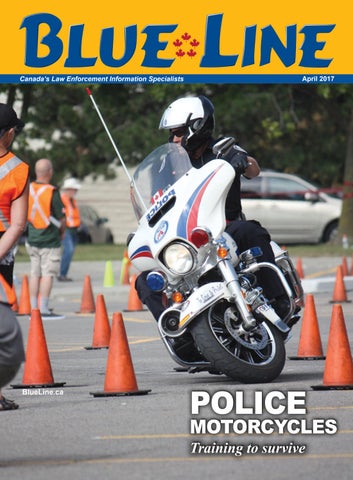
POLICE
MOTORCYCLES Training to survive
NEWLY DEVELOPED APX STRIKER-FIRE PISTOL This ambidextrous semiautomatic striker-fired pistol with tilting barrel locking system comes without pre-cocking striker block. Each slide & cold hammered forged barrel are built of high strength alloy steel with nitrating surface treatment & the lower receiver incorporates a Mil-Std 1913 picatinny rail for all pistol lights & laser options. Manufactured: 9x19mm & .40 S&W Barrel Length: 108mm Overall Length: 192mm
BERETTADEFENSETECHNOLOGIES.COM | STOEGERCANADA.CA | ©2017 BDT Company. A Beretta Group Company
ADDITIONAL TO THE FIRING PIN & TRIGGER SAFETY FEATURES, THE APX PISTOL DOES NOT REQUIRE PULLING THE TRIGGER FOR FIELD STRIPPING & DISASSEMBLY.
WWW.STOEGERCANADA.COM | SYLVAIN@STOEGERCANADA.CA
April 2017 Volume 29 Number 4
Features 6
6
Police motorcycles
10
Ride safe
12
2017 police motorcycles
14
Motorcycle safety is everyone’s responsibility
Training to survive
Investing in rider training
Michigan State Police vehicle evaluation results
May is Motorcycle Safety Awareness Month
10
15
Police academy – older-adult division
16
Criminal intelligence – what’s next?
23
Remembering our Vimy fallen.
Departments 15
16 BLUE LINE MAGAZINE
30 30 27 28 24 27 21 25 29 28 5 22
Advertisers Index Back of the Book Book News Calendar Deep Blue Dispatches Holding the Line Health and Fitness Market Place Product Showcase Editor’s Commentary Technology
Case Law 18
Safety enquiries OK on investigative-detention search
20
No Privacy Interest in Messages Sent to Recipient
3
APRIL 2017
May 2, 2017
The International Centre Mississauga, ON
CANADA’S PREMIER EVENT for the law enforcement community WHO IS BLUE LINE EXPO FOR? • Police chiefs • Police service procurement staff • Customs officers • Military, local, municipal, provincial and aboriginal police • Federal and provincial corrections officers • RCMP • Security Professionals • Fire chiefs and other fire department personnel WHY SHOULD I ATTEND? • Learn from leading law enforcement experts • Network with fellow law enforcement professionals • Browse the latest technology, products and services SPONSORED BY: Gold Sponsor
Silver Sponsors
Police Leadership Award Dinner Celebrating excellence in police leadership. Hosted by Cam Woolley, CP24 reporter and former OPP officer. Keynote address by Mark Saunders, Chief of Police of the Toronto Police Service SPACE IS LIMITED. SECURE YOUR SEAT TODAY! CONFERENCE SESSIONS FEATURING: “Big Data and Investigative Techniques for Law Enforcement” with Michael Akpata, Team Lead Public Safety, Investigations, & Counter Fraud i2 National Sales, IBM “Real or Fake? That’s the Counterfeit Question” with Lorne M Lipkus, Founding Partner, Kestenberg Siegal Lipkus LLP “PTSD: A Journey of Recovery Through Peer Support” with Natalie Harris, Advanced Care Paramedic
Conference Sponsor
Lanyard Sponsor
Awards Gala & Leadership Award Sponsor
Registration Sponsor
Delegate Bag Sponsor
Best Dressed Award Sponsor
Coffee Sponsor Presented by:
“Police and emergency response to Fort McMurray wildfires” with Inspector Mark Hancock, RCMP Wood Buffalo Detachment, Fort McMurray, Alberta
Admission to the Expo is FREE, so sign up online today at
BLUELINEEXPO.COM
Blue Line
EDITOR’S COMMENTARY by Tom Rataj
www.blueline.ca GROUP PUBLISHER Paul Grossinger – pgrossinger@annexweb.com PUBLISHER EMERITUS Morley Lymburner - morley@blueline.ca EDITOR Tom Rataj - tom@blueline.ca ACCOUNT MANAGER Janice Eaton - janice@blueline.ca ACCOUNT MANAGER April Lensen - april@blueline.ca ART DIRECTOR Svetlana Avrutin - savrutin@annexweb.com ACCOUNT COORDINATOR Trish Ramsay - tramsay@annexweb.com CIRCULATION MANAGER Beata Olechnowicz bolechnowicz@annexbizmedia.com COO Ted Markle - tmarkle@annexweb.com PRESIDENT & CEO Mike Fredericks MAILING ADDRESS 222 Edward Street, Aurora, ON L4G 1W6 Publication Mail Agreement No. 40065710 CIRCULATION email: asingh@annexbizmedia.com Tel: 416-442-5600 ext 3553 Fax: 416-510-5170 Mail: 80 Valleybrook Drive, Toronto, ON M3B 2S9 SUBSCRIPTION RATES Canada — 1 Year $30.00; 2 Year $50.00 plus tax USA — 1 Year $100.00 USD PRINTED IN CANADA ISSN 0847-8538 Occasionally, Blue Line will mail information on behalf of industryrelated groups whose products and services we believe may be of interest to you. If you prefer not to receive this information, please contact our circulation department in any of the four ways listed above. Annex Privacy Officer privacy@annexbizmedia.com Tel: 800-668-2374 No part of the editorial content of this publication may be reprinted without the publisher’s written permission. © 2017 Annex Publishing & Printing Inc. All rights reserved. Printed in Canada.Opinions expressed in this magazine are not necessarily those of the editor or the publisher. No liability is assumed for errors or omissions. Readers are cautioned and advised that articles presented herein are edited and supplied for your personal awareness and should not be used for further action until appropriate guidance is received from a supervisor, Crown Attorney or other persons in authority. All advertising is subject to the publisher’s approval. Such approval does not imply any endorsement of the products or services advertised. Publisher reserves the right to refuse advertising that does not meet the standards of the publication.
BLUE LINE MAGAZINE
The lean machine and going to the Gemba With the now seemingly long-in-thetooth “doing more with less” focus for police services, much progress has been made in keeping budgets in check, all the while trying not to negative affect service delivery. Working smarter and more efficiently can contribute greatly towards creating a lean operation while doing more with less. Figuring out how to do that, and what to do to get there is not always that simple. Often-times initiatives in this direction are driven from the top down, with senior managers leading committees, project teams, and audits to identify inefficiencies and create fixes that can and should be made. This is not necessarily a bad thing, since they generally have a good understanding of how it all works, although sometimes, time, distance and politics tends to interfere with that understanding. A potentially effective way to overcome these challenges is by going to the Gemba, a Japanese term meaning “the real place”, to directly look for inefficiencies and waste. Championed many years ago by management at Toyota, it is also a component of the lean management system which also eliminates the operational filters between management and the production floor by having managers look directly at where problems may be occurring. A similar process is Management by Wandering Around where managers wander around the operational floors looking for problems. The emphasis is on random, unscheduled and unscripted wandering, chatting with employees, and trying to get a sense of what’s working well and more importantly what’s not. And all those people working in the Gemba, they are also an important place to start with efforts to create a lean operation, since they see where the problems are and probably have many good ideas about what could be changed to eliminate or reduce waste. One effective way to do this, is to have a simple and robust employee suggestion program that encourages employees to identify the problems they encounter and to offer potential solutions. Engaging those employees not just in the proposal but also in the implementation of their proposed solution can encourage even more participation and improved job satisfaction throughout the organisation. Long established business practices often just trundle along, mostly unchanged year after year, just because it’s always been done that way. When computerisation was first implemented, many such business practices were simply converted from paper to computers and the relatively cheap typewriters were pushed aside for expensive computers and laser printers. Some efficiencies were gained, but in many cases the final product was just a bit easier to create and looked better. 5
To really see significant efficiency gains, what is often needed is a complete re-engineering of business processes, with a design focus on leveraging computer systems and letting the technology do most of the work. This will keep the many expensive employees from doing administrivia that doesn’t contribute to the business function. The re-engineering needs to make fundamental changes to the processes and be sustainable. One impediment to change in the policing world is the traditional command and control military style structure, where so many processes have supervisory approval components. Many of these can be readily replaced by simple, robust, automated and auditable systems that replace hours of work for many employees, with a simple point-andclick transaction by one employee that can be completed in mere seconds. When trying to make changes, management should also be on the lookout for resistance to change that’s driven by individuals who have a vested interest in maintaining a bad system because they profit from it. When dealing with external vendors of services, it may also be very beneficial to contract out the entire business process to the vendor while supplying only the required data and electronic funds to make the process function. This will eliminate many internal soft-dollars costs and be more cost-effective for the vendor as well, which could further drive down the contract price. If done correctly many overhauled business processes can produce major cost savings without negatively affecting the business operation and freeing-up personnel to do their real work. So, what’s going on in your Gemba? PS: Now, if someone could just come up with a machine that automatically scans and digitizes paper memo-books … that would be the ultimate contribution to creating a Lean Machine. Correction
In the article ‘Decision in Crisis – Implications for tactical communication’ which appeared in the December 2016 edition of Blue Line Magazine, it erroneously states that Toronto Police Constable James Forcillo was found guilty of second-degree murder, when in fact he was found guilty of attempt murder. Blue Line Magazine regrets and apologizes for the error. The conviction and sentence are currently under appeal to the Ontario Court of Appeal. APRIL 2017
Photo credit: Glenn Springer • www.photography.to
POLICE MOTORCYCLES Training to survive By Andy Norrie The exact date of the invention of what we currently call a ‘motorcycle’ is blurred with the evolution of the bicycle in the late 1800s. As the motorization of bicycles took hold and commercial production began, their use by law enforcement quickly followed. The Detroit, MI and Evanston, Ill., police departments purchased their first motorcycles in 1908, as did the Toronto Police Department when it purchased and deployed “The Brown” for use by its officers. A historic ledger shows the department paid $230 for the motorcycle manufactured by Brown Brothers Limited of Great Eastern Street, in London, England. The Toronto Police Department purchased another Brown in 1909 and three Triumph motorcycles in 1911, which began a long and storied history of police motorcycling in Canada. The light weight, maneuverability, and small physical footprint of the motorcycle APRIL 2017
makes it an optimal tool for law enforcement duty and for over a hundred years its primary function has been, and continues to be, for traffic enforcement. In fact, I would suggest that the image of a police motorcycle officer is synonymous with traffic enforcement. All of the attributes that make a motorcycle a great tool for law enforcement also make it a dangerous undertaking. Unfortunately, there have been at least 51 line-of-duty deaths of police motorcycle officers since their first use. The first recorded death was that of Constable Robert Forster of the Victoria Police Department who died on November 11, 1920. The most recent Canadian police motorcycle death was recorded on September 20, 2003, when Ontario Provincial Police Constable John Paul Flagg died in the line of duty. Motorcycle collisions are the fourth leading cause of death of police officers in Canada behind gunfire (274), automobile collisions (162), and drowning (58), accord6
ing to the ODMP-Canada website. A RAND Corporation study published in Policing: An International Journal of Police Strategies & Management underscores what we all probably already knew: motorcycle officers are five times more likely to sustain injury in a crash than an officer in a car. As police managers have applied risk mitigation strategies over the last 40 years, there has been more energy and focus applied to better police motorcycle training and equipment. Police motorcycle uniforms continue to evolve from the traditional equestrian-based uniform towards more motorcycle specific safety oriented wear. Training and Rodeos One of the ways to improve the training of police motorcycle officers over the last 40 years has been the creation of police motorcycle competitions and seminars or as they are affectionately known; rodeos. The first such event on record was the BLUE LINE MAGAZINE
Photo credit: Lyn Bartlett
Mid-Atlantic Police Motorcycle Rodeo. It was the brainchild of Corporal A.D. Johnson, a motorcycle police officer with the Prince George’s County Police Department in Maryland. In 1979, the first rodeo was held to improve the skills and working relationships of the motorcycle officers in the Washington D.C. Metropolitan Area. Tragically in 1982, Corporal Johnson was killed in an on-duty motorcycle collision. Early in the 1990s police motorcycle officers from Ontario (including this author) attended this event and were exposed to the high level of rider proficiency and camaraderie that was developed by the participating officers. Canadian officers subsequently created the Great Lakes Police Motorcycle Training Seminar (GLPMTS) as an entity to provide a similar venue in their region. On the west coast a parallel story was unfolding. In 1981 several motorcycle officers from Coos Bay Police, Roseburg Police, Beaverton Police, Gresham Police, and Washington County Sheriff in Oregon as well as Vancouver Police and Clark County Sheriff in Washington State gathered to discuss the need for joint training. The Oregon Washington Motor Officers Association (OWMOA) was created and in 1984 a formal training conference was held in Bellevue, Washington. In 1992 two RCMP officers from British Columbia attended the training conference. The OWMOA eventu-
ally became the North American Motor Officers Association (NAMOA) and in 1995 the RCMP hosted the training conference in Vancouver, B.C. The Canadian officers participating in both the GLPMTS and OWMOA events regular attend events in the others’ region and have formed a strong national networking and fraternal alliance. Here are some of the benefits of participating in properly structured police motorcycle training competitions:
Developing a Winning Attitude When you train for, and participate in, competitions on a regular basis you are training yourself to be the best you can be and to perform within the highest percentile of your abilities. Preparing yourself to face adversity will help you develop a winning attitude. This positive attitude will provide benefits in all aspects of your life, but especially in police motorcycle operations.
COME SEE US AT CANSEC!
BOOTH #1026 MAY 31-JUNE 1 2017 EY CENTRE, OTTAWA YOU CAN FIND US ON THE RANGE MAY 30TH
PROUDLY SERVING MILITARY & LE SINCE 1989.... PHONE (204) 748-2454 EMAIL BRENT@WOLVERINESUPPLIES.COM WOLVERINESUPPLIES.com BLUE LINE MAGAZINE BlueLine_Wolverine_April.indd 1
7
APRIL 2017
2017-03-10 3:31 PM
Photo credit: Glenn Springer • www.photography.to
Mental Strength When you train for and compete in police motorcycle events you will develop a strong sense of your aptitude and your abilities. You will be able to honestly evaluate your own performance without making excuses for underachieving and will be able to critique yourself and develop solutions and strategies to overcome these deficiencies in the future. Superior Motorcycle Riding Ability It is a fact that skilled competitive riders operate at a far higher level of proficiency than their non-competing peers especially when it comes to riding under pressure. If a rider’s ability is only mediocre or average in basic police motorcycle operation, it can be deduced that his/her capabilities will diminish if placed under stress or pressure. Situational Awareness, MultiTasking and Task-Focusing Police motorcycle riding requires multi-tasking to be done proficiently. Riding properly and defensively with the added tasks associated with law enforcement make police motorcycling very demanding. If you are doing it right, you will find it mentally and physically tiring. Police motorcycle competitions represent an excellent way to increase your mental processing speed and your ability to taskAPRIL 2017
focus under high-stress conditions. The day-to-day requirements of riding a police motorcycle will seem like ‘a walk in the park’ after you have trained and competed in a police motorcycle competition. Safer Motorcycle Riding Performance If you were fortunate enough to receive good basic police motorcycle training and you are continually practicing proper riding techniques and methods, you will have a strong basis to prepare yourself for police motorcycle competitions. You will need to build on your fundamental skills to perform well at police motorcycle competitions. Good riding habits and practices will become second nature to you. It will follow you on and off the competitive field. You will know your limits and the limits of your motorcycle when placed in an emergency riding situation. Competitive riding ingrains a keen awareness of motorcycle control. Dealing with Stress One of the biggest benefits of participating in police motorcycle competitions is learning to deal with stress. The introduction of stress into the motorcycle realm during an emergency riding incident could have serious, even deadly consequences. The competitive rider is used to dealing with stress and knows how to channel it while the non-competing rider is not. 8
Motorcycle riding is physically and mentally demanding. Doing it in competition multiplies these demands tenfold and adds the dimension of emotional control as well. Stress and how it manifests itself in each of us is a peculiar thing. It is, however, something we can prepare and train to deal with. With proper coaching and regular practice, competition can help you harness and control your stress and let you use it to your advantage. Exposure to New Techniques, Equipment and Methodologies Police motorcycle competitions are also an excellent venue to observe and evaluate successful riding techniques, new ways of doing things and new equipment. Some of the best techniques and equipment being used in police motorcycle operations have evolved out of the police motorcycle competition realm. The competition venue is where new ideas are presented, demonstrated, debated and proven. The nature of competition means the bar is being continually raised higher and higher and this push for excellence cultivates an environment for improving abilities, ideas and equipment. Participating in police motorcycle competitions is not the panacea for all that is wrong with a police motorcycle program. But, combined with proper and regular training it can be a building block in the foundation of a police motorcycle program. BLUE LINE MAGAZINE
May 2, 2017
The International Centre Mississauga, ON
Award Gala keynote address
by Mark Saunders, Competition is just one component of a good well-rounded police motorcycle program. It cannot replace good realistic and applicable training but it can enhance it and potentially give your riders an edge by giving them the mental, physical, emotional and riding skills to help them “go home at the end of the day.”
BLUE LINE MAGAZINE BlueLine_Colt_Dec.indd 1
Andy Norrie is an Inspector with the Toronto Police Service. He has been a member of the Service for over 33 years and has over 30 years of experience in police motorcycle operations. Andy is a certified instructor and has attended and participated in various police motorcycle training and competition events since 1991 and is one of the founders of the Great Lakes Police Motorcycle Training Seminar based in and around the province of Ontario, Canada. He can be contacted at: andy.norrie@ torontopolice.on.ca, www.glpmts.com
9
Chief of Police of the Toronto Police Service
Admission to the Expo is FREE, so sign up online today at
BLUELINEEXPO.COM
APRIL 2017 2016-11-09 12:45 PM
RIDE SAFE Investing in rider training By Andy Hertel Motorcycles once carried a certain prestige on the roadway, where other vehicular traffic would take notice, make space and give you a wave. Changing lanes, making a turn or merging onto a highway were done with a systematic fusion resembling the coming together of a jacket being zippered up. Today – not so much. It has become a state of rider beware … be really aware. Road safety is a responsibility shared by all road users including pedestrians. The volume of traffic has increased proportionately to the level of distractions drivers now have inside of their rolling metal cages. Combine this with the certainty that 75 per cent of the drivers are running 5 minutes late, and you have the perfect trifecta of concern for the vulnerable motorcycle rider. Rider Safety Rider safety comes down to a few basic things that require thought and practice: APRIL 2017
Attitude is number one on the hierarchy of the safety tree. Being in the right frame of mind, planning to have a safe and enjoyable ride and not allowing yourself to get caught up in any form of road rage or involved in the rat-race, will put you in a better position from the get-go. Preparation is the next branch. A rider should always be both mentally and physically ready to ride, including being wellrested and sober. Be conspicuous by what you wear and where you ride. The choice to wear protective and high-visibility clothing and to ride in the best lane and tire track, are essential tools in communicating actively and passively with other road users. Making good ongoing choices of where you ride, when you ride, who you ride with and how long you ride will also play a role in the overall rider-safety puzzle. There are a lot of pieces to consider, but given some thought and investing a bit of time, the picture becomes very clear in the end. 10
Watch-out There are only two things that motorcyclists have to watch out for on the roads. Everything and everyone. Once we have figured this out, the rest is easy. Truth is, people do not make conscious decisions to go out and purposefully interfere with motorcycle riders. It is not reasonable to suggest that drivers have any dislike for motorcycles or motorcycle riders. There is just a lack of understanding in their world about what riders face on the road every day. A fender-bender to a car driver can really put a damper on their day. A fender bender to a rider can be life changing. Safe riding is not something that is simply planned – it has to be constantly evaluated, updated and executed. There are so many obstacles that come between a safe ride and a life-altering or ending experience. Training The greatest investment in a long and enjoyable riding experience is professional, BLUE LINE MAGAZINE
qualified training. Note, this does not include having your well-intentioned neighbour or spouse show you the basics and provide you with the classic reassurance; “Don’t worry about it, it’s easy. Trust me …” Also, riding skills are not static, in fact, they are quite perishable. Once learned, they have to be nurtured, practiced and upgraded. As we age, our eyesight typically deteriorates, reflexes slow down just a bit and our bodies just don’t sit as comfortably for the long periods of time that they once did. Isolation Automobile cabins have also become pretty engaging environments with an array of multi-media options, climate control and luxurious seating combined with some pretty modern manufacturing that results in isolation from the outside world. Recently, driver assistance options like backup cameras, numerous sensors, speed control and lane assist have caused drivers to pay just a little less attention to the road and their surroundings. Despite some great technological advancements made to cars and trucks, these options have not yet made it to their twowheeled cousins. Conclusion Every day, there are more and more reasons for riders to be aware … to be really aware.
BLUE LINE MAGAZINE BlueLine_Commissionaires_Feb.indd 1
So the really big question is: “Why do we ride?” The simple answer is: “Because we love it.” Ride safe.
11
Andy Hertel is the Program Manager, Motorcycle Rider Training at the Humber College Motorcycle School. Andy has been a rider for 35 years and an instructor for 23 years. He can be reached at: andy.hertel@humber.ca, www.facebook.com/ humbermotorcycle
APRIL 2017 2017-01-11 11:31 AM
2017 POLICE MOTORCYCLES
Michigan State Police vehicle evaluation results
By Tom Rataj The police cars and SUVs get all the attention during the annual Michigan State Police Vehicle Tests held each September at the Grattan Raceway Park in Belding, Michigan (about 260km north-west of Detroit), but police motorcycles are also tested annually on most of the same criteria. For the 2017 vehicle tests, the following motorcycles were tested: 1. 2. 3. 4. 5. 6.
BMW R1200 RT-P BRP Can-AM Spyder Harley-Davidson FLHTP Electra Glide Harley-Davidson FLHTP Road King Harley-Davidson FLHTP Electra Glide Stage 3 Zero DSRP (did not finish all tests due to an early crash)
Tests were conducted in the below categories and subject to the test conditions and equipment as outlined. All distance and speed measurements are done in imperial distances. A Race Logic Vbox3i PGS data collection unit was used to collect accurate data. APRIL 2017
12
Dynamics Tests To determine the overall dynamics of each machine, they are tested for high-speed handling characteristics and performance under a number of different real-world road conditions. BLUE LINE MAGAZINE
FIGURE 1 Dynamics - in seconds Seconds BMW R1200 RT-P
99.14
Can-AM Spyder F3P
117.73
Harley-Davidson FLHTP Electra Glide
109.50
Harley-Davidson FLHTP Road King
110.38
Harley-Davidson FLHTP Electra Glide Stage 3
108.19
FIGURE 2 Acceleration - 0-60m.p.h. - in seconds Seconds BMW R1200 RT-P
4.31
Can-AM Spyder F3P
5.76
Harley-Davidson FLHTP Electra Glide
5.38
Harley-Davidson FLHTP Road King
5.42
Harley-Davidson FLHTP Electra Glide Stage 3
4.43
FIGURE 3 Top Speed - miles-per-hour M.P.H. KM/H BMW R1200 RT-P
136.00 218.87
Can-AM Spyder F3P
120.00 193.12
Harley-Davidson FLHTP Electra Glide
109.00 175.41
Harley-Davidson FLHTP Road King
112.00 180.24
Harley-Davidson FLHTP Electra Glide Stage 3 110.00 177.02
FIGURE 4 Braking Distance - from 60m.p.h. Feet
Metres
BMW R1200 RT-P
135.60 41.33
Can-AM Spyder F3P
118.90
Harley-Davidson FLHTP Electra Glide
135.00 41.14
Harley-Davidson FLHTP Road King
137.50 41.91
36.24
Harley-Davidson FLHTP Electra Glide Stage 3 136.90 41.72
The testing is done on a two-mile (3.22km) road-racing type course containing hills, curves and corners, which are designed to simulate actual conditions experienced in the field by police motor-officers. Each machine is ridden over the course for a total of 32 timed laps, eight laps each by four riders. (Figure 1) Acceleration and top-speed tests The acceleration test is designed to determine the ability of each machine to reach 60m.p.h. (96.56km/h), 80m.p.h. (128.75km/h) and 100m.p.h. (160.93km/h) from a standing start. The machines were all tested by one rider and all the machines were driven for a total of four acceleration tests, two each northbound, and two each southbound (to allow for wind direction). (Figure 2) The top-speed test is designed to determine the ability of each machine to reach its top speed from a standing start within the maximum distance of the 14 mile course. (Figure 3) BLUE LINE MAGAZINE
Braking Tests The brake testing is done to determine the stopping distances for each machine from a starting speed of 60m.p.h., using full ABS brakes applied as in a panic stop. The final figure recorded was the average stopping distance for each machine. Again, as with the acceleration testing, the same rider conducted all the tests. (Figure 4) Conclusions Overall, the best performing machine in all the tests was the BMW R 1200 RT-P, readily and substantially beating all the competitors in dynamics, top-speed and all acceleration tests, and coming in a very close third in the braking test. Not surprisingly, the BRP Can-AM Spyder easily beat the field in the braking tests, owing to the fact that it’s a 3-wheel machine. It managed to come to a stop 16.1ft, sooner than the Harley-Davidson FLHTP Electra Glide, which bested the BMW by a mere 0.60 ft. (7.2”). In all other tests, it finished in last place. The full Michigan State Police Vehicle Evaluation results for 2017 model motorcycle is available in PDF format here: www.michigan.gov/documents/msp/2017_MY_Police_ Vehicle_Evaluation_Test_Book-Final_544109_7.pdf 13
APRIL 2017
MOTORCYCLE SAFETY
is everyone’s responsibility May is Motorcycle Safety Awareness Month
About the Motorcyclists Confederation of Canada
The Motorcyclists Confederation of Canada is the voice of motorcycling in Canada. Their purpose is to create a better riding experience for all Canadians, and to make Canada one of the safest countries in the world to ride a motorcycle. Contact: info@ motorcycling.ca.
Members of the Ontario Provincial Police Golden Helmets Precision Motorcycle Team show their support for the Motorcycle Safety Pledge during the Toronto Motorcycle Show. From left to right: Officers Rick Breckenridge, Lise Grenier, and Jim Gallant. There’s a certain amount of trust required when driving a car on our roads and highways. You hope your fellow drivers are paying attention and are as interested as you are in avoiding a collision. Try and imagine what it feels like to do this on a motorcycle. You are smaller, harder to see, and have nothing separating you from other vehicles but air and your clothes. The Motorcyclists Confederation of Canada (MCC) has an important message for all road users. “Motorcycle safety is everyone’s responsibility,” Dave Millier, MCC Chair explains. “Riding a motorcycle is a safe and enjoyable way to travel, but it requires active participation from all riders and drivers. We need to remember that, behind the helmet, that motorcyclist is someone’s child, parent, neighbour and friend.” Warmer spring weather signals the start of the motorcycle season. That’s why May is officially recognized as Motorcycle Safety Awareness Month. This public awareness campaign has evolved into a national initiative to promote motorcycle safety among all road users across Canada. APRIL 2017 BlueLine_Accident_March.indd 1
14 2017-02-21 9:35 AM
Take the Motorcycle Safety Pledge Everyone has an important role in motorcycle safety. Even if you do not ride a motorcycle, chances are you know someone that does. “At the MCC, one of our goals is to make Canada the safest place to ride a motorcycle,” Millier says. “We hope to achieve this by encouraging everyone – riders, passengers, drivers and loved ones to take the Motorcycle Safety Pledge.” There are simple things that can be done to put safety first. Motorcyclists can pledge to ride within their limits, ride sober, obey traffic laws and make arriving alive their greatest priority. Motorists can pledge to always look twice, and to check blind spots before switching lanes. Motorcycles are harder to see than other vehicles, so double checking before changing lanes or making a left-hand turn can help ensure the safety of everyone on the road. Join the many Canadians that support motorcycle safety by taking the Motorcycle Safety Pledge. Visit motorcycling.ca for details. BLUE LINE MAGAZINE
Police Academy – Older-Adult Division By Brenda Tonn What do you do when you suspect an elder is being abused? If you forgot to take a pill, do you double up the next day? What happens when a will is probated? Did you really win a cruise? These are some of the very common questions people have every day. The creators of Police Academy – Older Adult Division had a vision to help educate our senior population on these issue, and devised this innovative program. Recognizing that it is of great benefit for seniors to be well informed in order for them to live safely and independently for as long as possible, the Police Academy program was originally created through the collaboration of six senior-serving agencies in Manitoba and included the RCMP, the Winnipeg Police Service and their combined grant to the New Horizons for Seniors (Federal) program. The grant and a model from the maritime provinces was used to develop a ‘Made in Manitoba’ resource for senior-serving agencies in Manitoba. Each year the program needs funds to hire a coordinator to promote and support organizations as they host the program throughout Manitoba. The program is designed to inform and educate ‘students’ on safety and security issues. Program topics include: • Elder Abuse • Planning for Your Future • Personal Safety • Frauds & Scams • Safety Aid BLUE LINE MAGAZINE
• • • • • • •
Medication Safety Emergency Preparedness Fire Safety Safe Banking Practices Substance & Gambling Abuse Safe Driving Scooter Safety A step-by-step program package has been created to give to potential program hosts. In this package, there are instructions on how to organize the program, sample PowerPoint presentations, key contacts, sample advertising posters and much more. As the Rural Resource Coordinator, my job is to inform rural and remote areas in Manitoba about the program, and to offer assistance along the way. I am very passionate about getting this information out there. Many times, communities are not aware of the opportunities to have speakers come out and present to them. In Manitoba, we have devised a list of contacts that outline potential presenters on the various topics, while also encouraging the use of local presenters where applicable. In some instances, funding was obtained to offer small grants to hosts to help with planning costs. The participation of local law enforcement is strongly encouraged. We urge hosts to have one or more officers involved in the program, whether they are able to be part of the planning committee, present on some of the topics or attend the graduation ceremony to present diplomas, their participation is invaluable. We believe that this program is a great way to strengthen community relations, too. 15
Many academies have been held in Manitoba. The feedback from attendees is amazing. Participants have indicated their appreciation for the opportunity to learn. The program has been successfully hosted in over 30 locations. We are still faced with the challenge of reaching very remote communities, but we are working very hard to contact them. I strongly recommend that anyone with a vested interest in their communities consider bringing this educational opportunity to their community. The benefits are many, and of course, education is power. Brenda Tonn is the Manitoba Rural Resource Coordinator for the Police Academy – Older Adult Division program. Residing in Plumas, MB, she can be reached at: safeathome@mymts.net APRIL 2017
CRIMINAL INTELLIGENCE What’s Next?
By Ruben Sorge
The catchphrase, “intelligence-led policing”, is commonly heard in law enforcement today, despite being a complex, evolving concept that often lacks clarity. Traditionally, it has been used to support investigations or patrol work.1 It implies that police agencies have added criminal intelligence (CI) analysts to their enforcement tool belt. These analysts are primarily assigned to one of two different tasks. The first is administrative in its focus, is a norm in policing and is most recognizable to the public by the name “CompStat” (COMPuter STATistics - which has its roots with the NYPD). As a performance management system, CompStat has demonstrated an ability to reduce crime and encourage police accountability.2 The second is tactical in its focus, is used by investigation units throughout western policing and is familiar to the public by way of movies and TV shows. Here, a skilled analyst hunts down (a) suspect(s) by sifting through information found across various data sources (the internet, open sources, databases, briefing documents, notes) and by using computer programs to collate that intelligence. When the analyst draws a comprehensive picture of APRIL 2017
the crime, police officers use that intelligence picture to chart their investigation which often results in an arrest(s). Combined, these two types account for the vast majority of analysis that is conducted by police. When you hear the words “intelligence-led policing”, if you think either CompStat (the managerial focus) or tactical (the operational focus), you won’t stray far from the mark. These two analytic enterprises give police agencies vital tools by which to identify and arrest criminals, disrupt or disband organized crime and by which to identify neighbourhood crime problems and press for solutions. As such, the use of criminal intelligence indisputably provides positive benefits to policing and ultimately to the public we serve. But there is something missing. It is poorly understood and rarely recognized in policing circles. But if we move beyond CompStat and tactical intelligence, we open a door to something powerful: strategic intelligence.
agencies throughout Canada quickly establish action plans to address the crisis. And there is always another crisis waiting for attention, whether national in scale or restricted to a smaller municipality or neighbourhood. However, strategic intelligence moves beyond the reactive. By definition, it is “[r] elated to the structure and movement of organized criminal elements, patterns of criminal activity, criminal trend projections, or projective planning.”3 Strategic intelligence is future-oriented and predictive. It takes on a tougher task. It looks to develop a comprehensive, fact-driven picture of the criminal landscape and, after drawing inferences from that fact-picture, makes predictions about the future. Simply put, it seeks to give police agencies and police leaders a “heads-up” about what they might be facing in the near future. When police agencies engage with this kind of strategic intelligence, they become more accurately “intelligence-led”. But there are a few difficulties.
Strategic Intelligence The simple truth is that policing tends to be reactive. Police agencies are excellent crisis managers. A crisis occurs (a spree of robberies, fentanyl related deaths, terrorism) and police
Looking to the future First, police executives do not generally demand this kind of strategic analysis. This is not surprising given that the “here-and-now” usually presents sufficient challenges to an
16
BLUE LINE MAGAZINE
agency and its resources. If an agency is hard pressed to meet existing demands, why go looking for future issues? Second, there is no expectation for analysts to provide a strategic, future, oriented product. As a result, analysts have little familiarity with strategic intelligence and are often uncomfortable when put in a position requiring them to make “predictions”. For some police officers, these predictions are not dissimilar to fortunetelling while some analysts fear the specter of “being wrong”. As a result, few analysts have the skills and disposition needed to produce strategic intelligence reports. Third, our existing police culture has not developed an appetite for strategic intelligence products, nor has it exhibited a proficiency in consuming such products meaningfully. For instance, if it was projected that cybercrime was going to pose a significant criminal threat to an aging population over the next five years (which is not an entirely implausible prediction), what does this mean to specific individual police agencies? Given most are already overwhelmed by the complexity and pervasiveness of cybercrime, what is the real “value” of such a strategic conclusion? Yet, in business, in the military, in institutions, in government, the understanding that strategic, future-oriented projections are critical to success is accepted as a foundational norm.4 What to do? At present, intelligence-led policing has looked to answer the obvious question of “who should we investigate?” It is time to move past seeing the obvious and search for the hidden. It is time to ask the “what’s going to happen tomorrow” question. Now, this question is already pertinent to individual investigations. But strategic intelligence leaves the individual behind and looks at the big picture, the criminal landscape, and here, individuals coalesce into trends and projections. Do we have tools to help answer these sorts of tough questions? We do.
him we defeat him outright or at least weaken him severely”.5 Organized crime groups are enemies to social order and the rule of law. To turn this argument into a reality, the following preconditions must be established: •
• • •
•
The development of a national standard in the criminal-intelligence community by which intelligence is coded and entered into SNA applications, The acceptance of a standard SNA application(s) that allow for cross compatibility, Education and training for analysts, Development of a strategic report template that provides a framework for analysts tasked with preparing strategic reports, Developing among police executives a cultural expectation that, having reviewed a strategic report, the future oriented recommendations presented for their consideration are based on reasonable inferences (competence) drawn from a vetted fact pattern (validity) that can be replicated (reliability).
This builds confidence in the process and product. Conclusions Intelligence-led policing has had many successes. More are needed. Crucially, strategic
intelligence represents the next big step for the criminal intelligence community. The people, the technology and the organizational ability are in place. SNA is available today; big-data mining software tools provide a glimpse into tomorrow. Strategic intelligence should, and must, become a core tool for police decision makers in the future. Now is the time for police leaders to move with a sense of urgency and build a strategic intelligence foundation. Action today will equip future police officers to more effectively engage an increasingly complex organised crime environment as we all continue to serve the public good. Footnotes:
1 Ratcliffe, Jerry. (2008). Intelligence-Led Policing. Portland, Oregon: Willan Publishing. pp. 64-90. 2 See http://www.policeforum.org/assets/docs/Free_ Online_Documents/Compstat/compstat%20-%20 its%20origins%20evolution%20and%20future%20 in%20law%20enforcement%20agencies%202013.pdf 3 See http://www.ialeia.org/component/content/article/2uncategorised/58-standards.html. 4 See https://hbr.org/2016/01/how-big-data-ischanging-disruptive-innovation. 5 See http://www.theusmarines.com/downloads/ FMFM1/FMFM1-1.pdf, pg.35.
Ruben Sorge is an Inspector with the Vancouver Police Department. He is presently seconded as the Bureau Director to the Criminal Intelligence Section of British Columbia and the Yukon. He has over 28 years of policing experience primarily related to operations, investigation and intelligence. He can be contacted at: ruben.sorge@rcmp-grc.gc.ca
Social Network Analysis Today there is much talk about Social Network Analysis (SNA). Simply put, this is an established intelligence tool that identifies links and connections between people, places, objects and other social artifacts for the purpose of revealing useful intelligence. Analysts can apply SNA applications to the larger criminal landscape. It can be used to isolate and expose key vulnerabilities in criminal networks, reveal enforcement opportunities and suggest trends in future criminal activities. This exploitation of strategically identified vulnerabilities is key to future enforcement success. Retired U.S. Marine Corps general A.M. Gray explains, “Of all the vulnerabilities we might choose to exploit, some are more critical to the enemy than others. It follows that the most effective way to defeat our enemy is to destroy that which is most critical to him. We should focus our efforts on the one thing which, if eliminated, will do the most decisive damage to his ability to resist us. By taking this from BLUE LINE MAGAZINE
17 CADS_2017_02.indd 1
APRIL 2017 2017-01-18 4:23 PM
CASE LAW by Mike Novakowski
BC’s highest court has ruled that the police may ask a detainee narrowly tailored safety questions in the course of a protective search incidental to an investigative detention. In R. v. Patrick, 2017 BCCA 57, a police officer stopped the accused driving an SUV at 4:20 a.m. The officer recognized the vehicle’s licence plate number and was aware that someone was attempting to register it in the name of a person whose identity had been stolen. There were also three other large men in the vehicle. The front passenger appeared passed out and was difficult to arouse. A rear seat passenger had two black eyes and a gash on his forehead. After identifying the three passengers, the officer conducted background checks and determined they were known to be involved in the drug trade and violent. Patrick also had a criminal record, but it was dated and the officer did not consider it significant. Three other uniformed officers arrived as backup. Following further investigation at the roadside, the police suspected the vehicle had been obtained fraudulently and everyone in it was told they were being detained for investigative purposes. The SUV occupants were asked to step out of the vehicle, one at a time. The passengers were cooperative and were patted down. When Patrick was asked to get out, he turned to his right with his back to the officer and appeared to be fumbling with something. After two requests to show his hands went ignored, police entered the vehicle and yelled at Patrick to show his hands. He complied and exited the vehicle. As he did so, the officer noticed an oddly shaped, unnatural bulge in the area of his right shoulder under his jacket. The officer told Patrick to keep his hands where she could see them and asked him, “Do you have something on you?” He said he did, patted his right shoulder and, when asked what he had, said it was a shotgun. Police then retrieved a loaded, sawedoff shotgun from under Patrick’s jacket. He APRIL 2017
Photo: Anne Kitzman / Shutterstock.com
Safety enquiries OK on investigative-detention search
was arrested for carrying a concealed weapon, handcuffed, searched and advised of his right to counsel. The three passengers were released at the scene. Patrick was transported to the police station and was charged with three offences related to the discovery of the sawed-off shotgun. At trial in British Columbia Supreme Court, Patrick conceded that the officer had the requisite reasonable grounds to detain him at the roadside for investigative purposes and to conduct a protective pat-down search for safety. However, he contended that the manner of the search - asking him a question instead of patting him down - exceeded the scope of a safety search. The Crown, on the other hand, argued that the two questions asked by the officer were a legitimate extension of the search power incident to investigative detention because these inquiries were motivated by a safety concern. In the Crown’s view, the police are allowed to ask a detainee questions like “Is there something I need to be worried about?” or “Do you have anything on you?” before conducting a protective pat-down search. The judge found that the questions the officer asked Patrick at the roadside and the 18
responses to those questions breached his s. 8 rights. The trial judge excluded the shotgun and other evidence seized at the roadside under s. 24(2). Patrick was acquitted of all charges. The Crown challenged the trial judge’s ruling to the British Columbia Court of Appeal arguing that the trial judge erred in law in concluding that Patrick’s s. 8 Charter rights were violated during the roadside stop. In the Crown’s opinion, a police officer has the power to ask a detainee if they are in possession of anything that may cause injury before embarking upon or in the course of conducting a permissible pat-down search incident to a lawful investigative detention. Patrick took the contrary view, submitting that the police were not entitled in any circumstances to ask questions preliminary to or in the course of a permissible pat-down search. In his view, a search incident to an investigative detention is restricted to physical pat-downs of detained persons. Furthermore, Patrick suggested that the questions asked were impermissibly broad and ran afoul of the strictures governing police powers to conduct a search incidental to an investigative detention. BLUE LINE MAGAZINE
CASE LAW by Mike Novakowski
Search Incident to Investigative Detention After reviewing the case law on investigative detention, the Court of Appeal concluded that the power to conduct a search incident to one is not limited to a physical pat-down of a detainee. Justice Fitch, speaking for the unanimous Court, stated: In my view, questioning a detainee about to be frisk searched as to whether they are in possession of anything that might cause the searching officer injury is minimally intrusive search. In some respects, it is less intrusive than a physical pat-down search. I would hold that narrowly tailored questions of this kind motivated solely by safety concerns are permissible. ... [A]sking a detainee whether they are in possession of anything that might cause injury to an officer about to execute a pat-down search constitutes a justifiable exercise of the powers associated with the duty of police officers to preserve the peace, prevent crime and protect life. That the search takes the form of minimally intrusive questioning as opposed to physical contact does not, stand-
BLUE LINE MAGAZINE BlueLine_G4S_Feb.indd 1
ing alone, make the manner of the search unreasonable. Nothing compels a detainee to answer such a question. It stands to reason, however, that the police will be afforded additional latitude in determining the manner in which the search needs to be conducted if the detainee declines to respond. [references omitted, paras. 102-103] The Court of Appeal also noted that if the police were limited to only physical contact with a detainee, a loaded, sawed-off shotgun – as was found in this case - could discharge on a pat-down, imperiling the lives of everyone present. As well, “detainees may also be in possession of concealed sharp objects like knives or uncapped hypodermic needles that could seriously injure an officer conducting a pat-down search if no prior inquiry is made of the detainee about whether they are in possession of any such items.” The issue about whether or not a response to a safety question would be admissible as evidence at the trial proper, since s. 10(b) had not been provided in this case, was left for another day. The Court of Ap-
19
peal also declined to consider if the openended question asked by the officer was a justifiable exercise of her common law powers, preferring to leave the resolution of this issue to a new trial. Since the trial judge erred in law in considering whether Patrick’s s. 8 rights were violated in the course of the roadside stop, a new trial was ordered on the charges. Editor’s note: Keep in mind that a question like “Do you have anything on you?” is not as narrowly focused as a question such as “Do you have anything on you that could hurt me?” In the former, it could be interpreted as “Do you have anything illegal on you?” and suggested that the officer is fishing for evidence of an offence, such as drugs or other contraband, while the latter appears to be solely motivated by a safety concern. Other narrow variations may include, “I am going to pat you down for my safety. Do you have anything on you that is dangerous or could harm either of us?” or “I am going to search you for weapons or things that could harm me. Do you have anything like that on you?”
APRIL 2017
2017-01-18 12:52 PM
CASE LAW by Mike Novakowski
No privacy interest in messages sent to recipient A man who sent email messages to an undercover police officer posing as a 14-yearold girl did not have a reasonable expectation of privacy in the messages received by the officer. In R. v. Mills, 2017 NLCA 12, a police officer created a Hotmail account for a fictitious 14-year-old girl named “Leann”, together with a Facebook page and profile containing background information. This included information that she was a high school student and a photo obtained from the Internet. About three weeks later, the officer received a Facebook message from Mills (a 32-year-old man). Over a period of approximately three months, there was an exchange of emails. The officer used a public and commonly used screen shot program called “Snagit” to capture all the information on his computer screen during each communication with Mills. A meeting at a park was arranged and, when Mills showed up, he was arrested and subsequently charged with communicating via a computer system for the purposes of committing sexual offences. In Newfoundland and Labrador Provincial Court the police were able to identify the documents produced by the “Snagit” screen captures and testified that they were accurate. The judge, however, went on to conclude that Mills’ s. 8 Charter right to be secure against unreasonable search or seizure was breached because the police failed to meet the requirements under Part VI of the Criminal Code by obtaining authorizations to intercept the electronic communications. In the judge’s view, the police were required to obtain an authorization under s. 184.2 of the Criminal Code. The judge, however, nevertheless admitted the evidence under s. 24(2) and convicted Mills of communicating by means of a computer with a person believed to be under the age of sixteen years for a sexual purpose. He was sentenced to 14 months imprisonment, which was reduced by two months to compensate for the Charter violation. He was also sentenced to one-year probation and ordered to provide a DNA sample. The Crown appealed Mills, sentence to the Newfoundland and Labrador Court of Appeal submitting that the trial judge erred in finding that Part VI of the Criminal Code applied in this case and therefore the judge improperly found a Charter breach upon which to reduce the sentence. In the Crown’s submission, Part VI deals with the “Invasion of Privacy”, which did not apply in this case. Part VI Application Justice Welsh, delivering the Court of Appeal’s opinion, noted that ss. 184 (intercepAPRIL 2017
tion) and 184.2 (interception with consent) under Part VI only apply where there is an “intercept”. But in this case, Welsh concluded there was no intercept. “Where there is direct communication between two people, the intended recipient cannot be characterized as having ‘intercepted’ a communication meant for that person,” she said. “Further, the fact, unknown to the sender, that the recipient is a police officer cannot change the nature of the communication or transform a receipt by the intended recipient into an interception. Viewed from another perspective, if ‘Leann’ had, in fact, been a fourteen year old girl, it could not be said that her receipt of the communications from Mr. Mills constituted an interception.” Since there was no intercept, Part VI of the Criminal Code did not apply and no authorization was required. Use of “Snagit” Using the Snagit computer software did not alter the conclusion that the officer did not intercept Mills’ communications. The Snagit program did not affect the manner in which his communications came into the officer’s possession and the program was simply a means to retain a record of the communications. “Making a copy of a received message, either on paper or electronically, could not, on that basis, be characterized as an interception,” Welsh said. “Making a record of a received electronic communication using a software program for that purpose does not constitute an interception of the communication.” Alternative s. 8 Charter Breaches? In this case, the Court of Appeal found there was no alternative basis for finding a, s. 8 Charter breach because Mills did not have a reasonable expectation of privacy in the messages he sent to “Leann”: ... Mr. Mills was using electronic social media to communicate and share information with a person he did not know and whose identity he could not confirm. On an objective analysis, as the sender of such communications, Mr. Mills must have known that he lost control over any expectation of confidentiality that he appears to have hoped would be exercised by the recipient of the messages. He took a risk when he voluntarily communicated with someone he did not know, a person he was not in a position to trust. Any subjective expectation of privacy Mr. Mills may have had was not objectively reasonable. In the ab20
sence of a reasonable expectation of privacy, section 8 of the Charter was not engaged. I hasten to add that the nature of communications between Mr. Mills and “Leann”, which took place using social media such as Facebook, must be distinguished from communications in which there would, in fact, be a reasonable expectation of privacy. For example, privacy could be expected if the recipient of a communication is the sender’s bank. Such a communication is sent for a particular purpose, using a means of communication that is represented to be secure, that clearly engages objectively reasonable privacy interests. [paras. 23-24] Without a reasonable expectation of privacy, there could be no infringement of s. 8. The Crown’s appeal was allowed; the two-month sentence reduction was set aside and the sentence of 14 months imprisonment was affirmed. However, this additional two months imprisonment was stayed as requested by Crown. Mike Novakowski is Blue Line’s case law columnist. He can be contacted at: caselaw@blueline.ca.
May 2, 2017
The International Centre Mississauga, ON FEATURED SESSION
“Police and emergency response to Fort McMurray wildfires” with
Inspector Mark Hancock,
RCMP Wood Buffalo Detachment, Fort McMurray, Alberta Admission to the Expo is FREE, so sign up online today at
BLUELINEEXPO.COM BLUE LINE MAGAZINE
HOLDING THE LINE by Michelle Vincent
Changing relationships When you look back at the time before you became a police officer, what did your relationships look like, with your personal friends, family members and any intimate partners? Who were you drawn to and what did those relationships and interactions entail? Many of us in the world of policing find that not only do our relationships change in terms of dynamics, the people we are drawn to and spend time with also seem to change over time. Why is that? It may appear obvious to most of us. A typical day in the life of a police officer is very different than the typical day of, let’s say, a business-person. In reality, there really is no such thing as a ‘typical’ day for a police officer. What we see or may be exposed to can range from car accidents to assaults, impaired driving, deaths, abuse - the list goes on and on. We can have a somewhat peaceful and quiet day, where we get the chance to do some traffic enforcement, to a day where we go call to call, without the chance to even process what we have just experienced. Our days can start out peacefully and can change in a second, into a moment of life saving and/or time sensitive action. For me, this was the draw to policing. As a front line officer, I had no idea what the day was going to bring. When we add these varying dynamics and blend them with the chemistry of relationships, the end result can be very interesting. Many times, I would return home from a long shift and just hug my partner and children. I would be thankful that my personal life was not what I had just had to deal with during my shift. In this aspect, my relationships were positively affected by an appreciation of what I had. The challenge comes when we begin to isolate ourselves from everyday society as we notice those stark differences and lose those connections we have been used to in the past. In the world of policing, coming home and sharing a gruesome experience with friends and family doesn’t really go over very well. We might be afraid of judgement and a lack of understanding of how we managed the situation. Even just wanting to unload about a particularly difficult call we attended may be met with a complete lack of empathy or understanding. When this happens, we tend to isolate ourselves from people outside the job and get drawn to those who have had similar experiences. We develop friendships through-which understanding and connection are more common. We develop a lack of appreciation for the seemingly simple daily struggles our non-policing friends and family
members have and we may minimize their struggles. So your presentation went awry today….and you lost a client. I had to let a family know their husband or wife was killed by an impaired driver. Then I had to take one of them to identify the body. We are exposed to extremes on a regular basis. When a partner or friend comes home with their problems, we may not validate their experiences and, as a result, relationships can break down. People find us cold and disengaged, yet their stress is just as real to them as ours is to us. It’s all relative. Having healthy relationships includes connecting with people at work and people outside of work. It is about being able to see and appreciate that others outside of our profession experience issues that are just as real to them. It is finding that balance that allows us to relate with those around us which is also a good indicator of how we are doing from a mental health perspective.
College of Continuing Education
If you find yourself being irritable and/or unable to connect/reconnect with civilian friends and family, perhaps it is time to speak with a mental health professional? Intimate relationships, be it a friendship, familial relationship or partner, can be just as important to your health and well being as exercise and eating healthfully! Studies have shown that those who have close relationships have the same survival rate as those who are non-smokers. Basically, relationships are good for the heart! So let’s nurture these relationships and notice the balance that we get from those we allow into our world of intimate connections. Michelle Vincent is a 15-year York Regional Police officer with a Masters Degree in Arts in Counselling Psychology and a background in equine assisted therapy and workplace reintegration and teaching. Her counselling practice is supervised by a psychologist with a specialty in addictions and trauma. Contact: michelle@blueline.ca.
Certificate in Police Leadership
Only three courses required for your first certificate in this online program: • Advanced Police Leadership • Budgeting and Financial Management for Police Services • Child Soldiers and at Risk Youth (NEW!) • Communication Skills for Police Personnel • Ethics for Police Leaders • Legal Issues in Policing • Managing Police Performance: Coaching Skills for Police Supervisors (workshop) • Police Leadership and Management Development • Policing and the Law of Human Rights • Policing the Modern Community • Strategic Human Resource Management for Police Organizations • Strategic Policing
“The Police Leadership Program at Dalhousie University ensures officers meet the criteria necessary to become the future leaders of tomorrow.” Program Participant
COACHING WORKSHOP Halifax: June 9-11, 2017 ONLINE COURSES Fall Term begins Sept. 5, 2017
Prepare for career advancement today! Detailed information and online registration can be found on our website at www.dal.ca/cce. If you would like further information please contact the Program Manager, Sherry Carmont, by email at CPL@Dal.Ca, by phone at 902.494.6930 or toll-free at 1.800.565.8867.
BLUE LINE MAGAZINE
21 BlueLine_Dalhousie_April.indd 1
Dalhousie University College of Continuing Education 1459 LeMarchant Street, Suite 2201 PO Box 15000 Halifax NS B3H 4R2
APRIL 2017 2017-03-10 3:11 PM
TECHNOLOGY by Tom Rataj
Motorcycle technologies Towards a safer future
I remember watching motorcycle officers in the 60s and 70s, roaring around the suburbs, on their noisy old Harley Davidson motorcycles. During the winter months, they still ventured out on patrol, but with a side-car attached, presumably to increase their odds of staying upright. Those motorcycle, were pretty crude by today’s standards. Thankfully a good helping of technology and sophistication is migrating from the automotive world to the motorcycle world. Here’s a quick round-up of some of the technology now appearing, or coming soon. Lighting Headlight systems are now benefitting from massive upgrades in lighting power and control, courtesy of light emitting diode (LED) bulbs and high-intensity discharge (HID) headlight systems. They produce substantially more quality light for illuminating both the roadway and attracting other drivers’ attention. Headlight upgrade kits are available for a wide range of models, and run in the reasonable $100 range. A newer line of adaptive motorcycle headlight modules are also now available. They use onboard sensors to monitor motorcycle lean-angles and adjust the headlight beam-spread to illuminate darker areas in corners in the same manner as some adaptive headlights in cars. These systems are available as an upgrade, but are pricey at around $1,000. Many motorcycles also feature LED tail, brake and signal lights which are brighter, have better beam control and turn on or off instantly. Bulb upgrades are available for about $35. Stability Control Bosch offers their Motorcycle Stability Control (MSC) system that uses a number of sensors to monitor various aspects of a motorcycle’s behaviour to help reduce instances of loss of control. At a rate of more than 100 times per second, the system monitors numerous factors such as wheel speed and traction, lean-angle, pitch angle, braking pressure and acceleration rate. It also includes: ABS, traction control, launch and wheelie control, cornering and hill-hold control, semi-active chassis control and crash detection with an engine killswitch. Some of the features are automatic and override the riders’ inputs to prevent loss of control. Bosch also offers a cornering-ABS system that helps prevent loss of control when cornering hard at higher speeds. APRIL 2017
Yamaha offers a 6-axis Intertial Measurement Unit (IMU) that provides similar benefits. Honda motorcycles recently demonstrated their soon to be released “Riding Assist Technology” which will, among other things, help riders maintain balance at speeds below 4.8 km/h (3 m.p.h.). They have adapted technology from their ASIMO robot and their UNI-MO self-balancing scooter. Ride-by-wire The old bowden-cable based throttle controls have also been replaced by new electronic ride-by-wire controls that use sensors to measure throttle rotation and speed and send the resulting information to the engine control unit (ECU). The ECU then calculates how much fuel to send to the engine, based on throttle behaviour, input and several other factors. This results in far better control over the engine and the motorcycle and even potentially offers riding modes such as “eco” and “sport” often found in passenger cars. Engines The old air-cooled motorcycle engine is quickly being replaced by water-cooled engines that offer numerous benefits in terms of performance, reliability, lower emissions, better fuel economy, reduced noise and less heat transmission to the rider. Several super-bikes, such as the Kawasaki H2/H2R use superchargers on the engine to further boost horsepower and top speed. Aprilia recently introduced their RSV4 R-FW track-only models that can deliver 22
more than 230hp, which is more than many cheaper “sporty” cars. Future BMW has demonstrated their futuristic concept Motorrad Vision Next 100 motorcycle which is designed to keep the rider in control in an autonomous (self-driving) world. With the Next 100, they claim that no protective clothing, not even a helmet, will be required because all the assistive technologies on the bike will keep the rider safe. A self-balancing system similar to what Honda has demonstrated would keep the motorcycle upright even when parked, while also tailoring the ride to the skill-level of the rider, and allowing the rider to ride more aggressively, especially or corners, while reducing the chances of loss of control. They’ve also proposed a Digital Companion system that supports the rider through special gear, including heads-up display type glasses called the Visor, which can display different types of information in the glasses based on where the rider’s eyes are looking. Helmets Modern motorcycle helmets have also benefitted from years of impact-resistance research and are now getting electronic upgrades including: Bluetooth connectivity, integrated GPS, audio, heads-up displays (HUD) in the visor, integrated and add-on LED lighting and even rear-view cameras. Tom Rataj is Blue Line’s editor and technology columnist. He can be contacted at tom@blueline.ca
BLUE LINE MAGAZINE
REMEMBERING
OUR VIMY FALLEN By Matthew Scarlino One hundred years ago, on the cold, overcast morning of April 9th, 1917, over 100,000 Canadian soldiers were massed in the trenches opposite the German-held high-point of Vimy Ridge. Among them were four constables from the Toronto Police Force. Samuel Henry MacGowan, PC#274, a young Irish immigrant, joined the TPF in 1911 at 23 years old, and was posted at downtown’s No. 1 Station. Andrew Johnson, PC#374, also born in Ireland, joined the TPF in 1912 when he was just 20 years old. He policed Toronto’s west-end Parkdale neighbourhood from No. 6 Station. Robert Cunningham Clarke, PC#540, also from Ireland, joined the TPF in 1914. He was 28 years old and had previous police experience with the Royal Irish Constabulary. William Henry Haynes, PC#451, came from England and joined the TPF in 1912 at the age of 25 years old. Haynes was stationed in the city’s west end at No. 9 Station on Keele Street. He was married and he and his wife Lillie had two young children.
By the end of the day, “Sam” MacGowan, Andrew Johnson, William Haynes, and Robert C. Clarke were among Canada’s over 3,000 dead. News of the victory spread throughout the world, and many historians argue it was at this point that Canada came of age. The Canadian Corps went on to achieve many more great victories, and when the war was over, Canada had its own seat at the League of Nations (the precursor to today’s United Nations). Lest we forget This April 9th, let us remember the bravery and ultimate sacrifice of those Canadian soldiers, one hundred years ago, who helped make Canadian history and end the Great War. Canadian Police officers continue to serve our country overseas on International Peace Operations. Matthew Scarlino is a constable with the Toronto Police Service, currently assigned to 51 Division, on the east side of the downtown core. He can be reached at: matthew. scarlino@torontopolice.on.ca
After years of public service as police officers, these men traded in their police blue for army khaki and answered the call to arms. Stalemate A great offensive was about to kick off, and after more than two years of the deadliest war the world had ever seen, four Canadian divisions would fight as one for the first time in history. They were up against a position that had withstood years of French and British assaults and caused tens of thousands of deaths. Clarke recently returned to the trenches after surviving being shot in the head five months earlier. MacGowan, Johnson, and Haynes had also survived a brush with death on March 1st, when their side’s own poisonous chlorine gas blew back in their direction and the alert enemy decimated their struggling forces with artillery and machine gun fire. Attack At 5:30am on April 9th, 1917, a flare went up, the infantry officers blew their whistles, and the men surged “over the top”, advancing forward and uphill. They gripped their rifles and tucked their chins into their collars as if the flying shrapnel were a rainstorm. Clarke was in this first wave of attacking troops. His battalion reached and captured its first objectives by 7:00am, and paused to regroup. Further north, Johnson, Haynes and MacGowan’s 75th Battalion was following lead elements of the push towards Hill 145 (the high point of the ridge), while the lead elements were taking heavy casualties. By 8:00am, they had advanced further uphill, but their brigade was in trouble – the lead battalions were decimated and the 75th were now in the front line, pinned-down and taking heavy machine gun fire. Meanwhile, Clarke’s unit was further south and forward, and therefore exposed. They started taking increasingly heavy fire, and were ordered to dig in to protect their brigade’s flank. Over the next four hours they suffered 200 casualties. The battle raged on throughout the day and Clarke’s 3rd Division would be the first to hold their section of the ridge and look out to the plains beyond. Johnson, Haynes, and MacGowan’s 4th Division fought for Hill 145 into the following day where it ultimately succeeded. BLUE LINE MAGAZINE
POLICING ... IT’S MORE THAN YOU THINK If you’re career and community minded, consider joining Ontario’s most progressive police service. As a Police Constable or Police Cadet with Peel Regional Police you will be part of a dedicated team that enjoys outstanding training and is committed to our vision; “A Safer Community Together.”
PEELPOLICE.CA/RECRUITING 23
BL_PeelRegionalPolice_April.indd 1
APRIL 2017 2017-03-17 8:15 AM
DEEP BLUE by Dorothy Cotton
On dropping the “F-bomb” I have spent the last decade or so of my professional life working in a wide variety of institutions, ranging from maximum security correctional facilities to the local university. Needless to say, the organizational cultures of these various institutions vary. Thus, at times I have to remind myself about where I am and therefore how I should behave. One aspect of my behaviour that I try (sometimes unsuccessfully) to moderate is my tendency to have somewhat of a foul mouth. Swearing is common in a penitentiary, and no one really thinks much of it. In fact, occasionally, it is actually useful with the offenders. I tend to look a little like a grandmother to some of the guys there and it causes them not to take me very seriously. But I definitely get their attention if I include some carefully chosen un-grandmotherly language in my early interactions with them. Alas, this is not the case when I teach at the university. I am not terribly good at inhibiting and monitoring my speech, so inevitably, at some time doing a lecture or discussion, words come out of my mouth that are definitely not appropriate to the environment. Oops. One of these days, some student is going to complain. (So far, I have included a discussion about social psychology and environmental influences and cultural differences in my lectures and managed to convince the students that it is all part of the learning experience.) Anyhow, it was in this context that an article about the use of profanity by police caught my eye. My own experience with police is that foul language is almost a job requirement, particularly among the front line folks. I can’t say that I know whether or not you all use profanity when you are arresting people (so far, I have managed not to be arrested) but I certainly notice colourful and explicit language in every day conversations. Did you ever wonder what effect this has on the people you interact with (other than each other, and me)? Some researchers at West Virginia University and the Pennsylvania Police College had the same thought. 1 They wondered if “Police profanity may negatively bias policecitizen interactions, and this bias could shape later interactions with community members, impact the quality of police-community relations, or even result in public outcry over excessive use of force,” and thus designed a study whose aim was to determine whether officer use of profanity during arrest led to public perceptions of excessive force. Needless to say, public perceptions are a big issue these days. Whether deservedly or not, the public perception of Canadian poAPRIL 2017
lice is inevitably influenced by the activities of our colleagues to the south, so their observations are worthy of consideration. I will spare you the gory details of the study itself. Take my word for the fact that it involved lots of questions and statistics with complex formulae and Greek letters (or you can read it yourself—see the reference at the end of this column). But in response to the first question of whether people perceived there to be a greater use of force when officers used profanity during an arrest, the answer was yes. Even when the actual objective use of force was exactly the same, it seemed to observers that more force was used if the officers involved used profanity in the process. Study participants commented that officers seemed like they were out of control or intentionally trying to escalate a situation when swearing was involved. There was also a curious effect when the issue of gender was brought into the equation. The impact of the use of profanity did not tend to vary depending on the gender of the person being arrested. Observers tended to rate the use of force as higher whenever females were being arrested, and profanity did not have much to do with that. But if the arresting officer was female, and the observer was also female, then profanity had a greater significant effect. So, in essence, when women were being arrested and the officer involved was also a woman, then male observers did not seem to care much about whether the officer used profanity—but female observers did. So watch your language. Frankly, while no one in the research world has paid much attention to police use of profanity (likely because it seems to be viewed as simply part of the culture), there is a lot of research about use of profanity in general and how it is viewed by others. In my own field, there is research that suggests that overall, profane language dur24
ing a therapy session can lead to the idea that the counselor is less credible or effective, less trustworthy, unprofessional, and insensitive to client needs. In an academic setting, swearing by faculty is linked to perceptions of unethical behavior. But when you get to issues of profanity and women, the issue becomes far more complex. There are studies that indicate that women who use profanity are less credible and viewed more negatively; there are studies that say use of profanity has no effect—and there are even the very occasional studies that say that women are viewed as More credible when they swear (Indeed, as noted above, that is my subjective impression in some instances). Interestingly, the research findings seem to vary a bit depending on when the studies were carried out. Older research, conducted during the times when women were expected to act like women (submissive, “nice” etc.) were more likely to find people aghast that women swore. Maybe this effect is simply decreasing as women are seen as less different from men—at least in the workplace. But back to the use of profanity by police in general…not a lot of real research here. People have suggested there are good reasons to use profanity in policing. It is a way of bonding with colleagues, it is a way to vent and reduce frustration, it can get the attention of the Bad Guys and may elicit more cooperation. It may also help the police officer establish a level of social distance from the people being arrested which makes doing icky things less distressing…who knows? But in the increasingly complex world of public scrutiny and filmed/recorded interactions, it might be worth some thought as to whether the benefits outweigh the liabilities when dropping the F-bomb. Patton, C.L., Asken, M., Fremouw, W.J. et al. J Police Crim Psych (2017). doi:10.1007/s11896-017-9226-0
1
Dr. Dorothy Cotton is Blue Line’s psychology columnist. She can be contacted at: deepblue@blueline.ca.
FEATURED SESSION “PTSD: A Journey of Recovery Through Peer Support” with
Natalie Harris, Advanced Care Paramedic
BLUELINEEXPO.COM BLUE LINE MAGAZINE
HEALTH AND FITNESS by Isabelle Sauve
You are what you prep It is well known that the common adage “you are what you eat” holds much truth. In law enforcement, “you are what you prep to eat” also holds true. A fundamental booster of good health and well-being is the food that we eat. Proper nutrition is important for all and especially for law enforcement personnel as it can help counterbalance the effects of shift work and of job related stressors. Bringing homemade meals, snacks, and beverages to work is an effective way to ensure more control over food intake. In addition to usually being more nutritionally plentiful than restaurant purchased food, there are many other benefits to bringing your own meals to work. Tufts University researchers suggest that even “healthier” fast food options still contain too much salt and fat based on a recent study. This is alarming given that a proper and balanced meal is crucial to curbing hunger levels and fuelling us through our work day. A professor at the University of British Columbia found that Canadians consistently underestimate the calories in restaurant meals, sometimes by up to 900 calories. Purchasing meals from restaurants, cafeterias or food courts now and again is not cause for concern. However, excessive consumption of these meals can have a detrimental impact on your energy, mood and overall health over the course of time. Two additional leading advantages of bringing one’s own meals to work is that food quantity and quality can be controlled. For instance, more vegetables can be incorporated whereas store purchased lunches are typically poor in terms of vegetable content and higher in fat, salt and sugar. Many restaurants offer alluring and tempting “deals” or “value combos” which unfortunately frequently pack unneeded additional calories in the form of dessert or a soft drink for only an extra dollar or two. Packing your own lunch can help fend off these temptations especially following a meal period interruption when hunger is starting to prevail and “anything to eat” will suffice. Law enforcement employees face added challenge, when it comes to healthy eating. Officers are frequently at the mercy of operational calls and work demands which extend over typical meal periods. Work demands can prevent actual meal breaks. Those working in remote locations or small towns may also have very limited access to healthy food, particularly after regular business hours. Having a healthy pre-packed lunch helps ensure that essential meals are not missed and that healthy food is at hand.
We are more vulnerable to making poor food choices or reaching for comfort food when famished or energy deficient. Another important benefit of taking your own meals to work is in the cost saving. Homemade meals come at a fraction of the cost of restaurant meals. Financial experts suggest that those who bring their own
coffee, meals, snacks and beverages on a daily basis can typically save anywhere from $2,000 to $4,000 or more over the span of a year. That’s enough for a getaway vacation! Key to maintaining motivation with bringing your meals to work is in prioritizing health and cost saving. Key to success with this goal is in preparation and routine. Meal prep can save you time in the kitchen and makes it easier to eat healthy despite what your hectic work schedule throws at you. It also minimizes your chances of turning to convenience or junk food when busy or without food. It is about finding what works for you. To stack the chances in your corner in terms of success, it is important to plan. Start with recipes you know and keep it simple. Don’t feel you need to do it all and choose recipes that will have the most impact on your week. Even small amounts of planning and food prep will be beneficial. Simply cleaning and cutting veggies to be stored in individual containers for the week makes for
JUSTICE STUDIES FOR wORkINg FRONTLINE OFFICERS At Humber, we teach the professional and practical skills you need to move up and make a difference in your community and in your career. Further your education one course at a time or work towards your diploma or degree. The Police Foundations Leadership Diploma program provides advanced standing to those working in justice services, including security. • Advanced standing opportunities for justice professionals • Guelph-Humber Justice Studies Degree OFFE PAR RED • Criminal Justice Degree T & ON -TIME • Police Foundations Diploma LINE • Police Foundations Leadership Program • Forensic Identification Services Certificate
BLUE LINE MAGAZINE
communityservices.humber.ca /justiceprofessionals 25
BlueLine_Humber_March.indd 1
APRIL 2017 2017-02-16 2:19 PM
HEALTH AND FITNESS easy nutritious snacks. Having readily available snacks such as nuts and dried fruits in small snack bags can make a difference during a hectic day. Writing out a weekly grocery shopping list and stocking your fridge with the necessary ingredients can support healthy eating. There are countless websites and online groups filled with food and snack ideas. Packing work meals while preparing other home meals can help solidify good habits while simultaneously being time effective. Doubling on meal preparation and freezing leftovers provides for some easy, ready-to-grab meals. Additionally, making a large batch of food to be frozen in individual containers offers easy go-to meals for a few weeks. Dressing up leftovers can keep the taste buds satisfied and seem like a whole new meal. For instance taco leftovers from the night before can become a taco salad or a soft taco lettuce wrap for lunch. The addition of a different sauce or topping can really change the taste. However, do not force yourself to eat things you do not like. Keeping backup staple foods on hand is practical when there aren’t any leftovers available or what you have isn’t quite enough.
To support your goals of healthy eating you may need a quality insulated lunch bag and a variety of containers. Depending on your needs, some bags will keep your food hot or cold (or both). Insulated lunch bags are the modern version of the “brown paper bag”. They also have the added advantage of keeping food fresh and at proper temperatures for several hours. Numerous options are available online, in most department stores, and in bodybuilding and nutrition shops. Consideration should be given to the quality of the insulation and material ensuring it is easily cleanable and that the size of the bag is adequate. Many of the bags come with microwave, dishwasher and freezer safe containers. Alternatively, most dollar or discount stores offer containers in a variety of sizes at low cost. Always ensure the containers are user safe and free of BPA, toxin, lead, etc. Individual containers are practical and will keep your dry foods from getting soggy. Most lunch bags also have a compartment to store extra items such as wipes, napkins, sanitizer, cutlery, snacks and other items as needed. Purchasing a reusable travel mug and a stainless steel water bottle can also save
you money and serve a dual purpose such as keeping your food hot or cold. Freezing a half-full stainless steel water bottle the night before and filling the remainder up in the morning serves as dual purpose- an ice pack for your lunch bag and drinking water throughout the day. Double walled stainless steel water bottles work well as they do not sweat. Alternatively, placing a clean sock over a single walled water bottle or a Ziploc over ice packs will prevent excess moisture from taking over your lunch bag. Another tip for success is to occasionally eat away from your usual work space. Part of the attraction of heading out to purchase meals is in the mental break offered by the change of scenery. Having some flexibility by occasionally treating one’s self with favourite foods and planning for a few cheat days is also important. Isabelle Sauve is a constable with the Ontario Provincial Police, currently with the Emergency Response Team (ERT) at the Almaguin Highlands Detachment in Burks Falls, about 300 km north of Toronto. She is a world-class marathon and ultra-marathon runner and fitness enthusiast. She can be contacted at: isabelle.sauve@hotmail.com.
ARE YOU RECEIVING
News Week?
Subscribe today! www.blueline.ca APRIL 2017 House Ad.indd 1 BL_eNews
26
2017-03-16 4:07 PM BLUE LINE MAGAZINE
BOOK NEWS
DISPATCHES Brenda Butterworth-Carr has been named the new Deputy Commissioner of the RCMP in B.C. Butterworth-Carr has been with the RCMP since 1987, most recently as the Assistant Commissioner in B.C. She also served as the commanding officer of Saskatchewan RCMP for 5 years. She is from the Tr’ondëk Hwëch’in First Nation in Dawson City, Yukon and is the first indigenous woman to hold a number of senior positions with the RCMP. ••• Lorne Blumhagen has been named athe new Chief of Police for the Lacombe Police Service in Alberta. Blumhagen joined the LPS in 2014 after spending 30 years in policing, including time with the RCMP, the Edmonton Police Service and the Camrose Police Service. Blumhagen has extensive specialised investigative experience and has held various executive positions including as president of the Camrose Police Association and as a director with the Alberta Federation of Police Associations. Blumhagen was awarded the PESM in 2012 and the Queen’s Diamond Jubilee Medal in2013. ••• Phil Bailey, the Inspector at the Edmonton Police Service West Division retired in February, concluding a 40-year career in policing, first with the New Glasgow Police Service (NS) and then the EPS since 1981. Bailey held numerous management positions at EPS, including the Investigative Support Branch, Intelligence Support Branch, Internal Affairs, office of the chief, professional standards and a secondment to the Alberta Solicitor General’s Standards and Evaluation branch. He holds the PESM with bar, Alberta Police Long Service Medal, and an IPA Silver Medal. ••• Phil Browne was appointed the new commander of the Ontario Provincial Police Huronia West OPP detachment in Wasaga Beach, Ontario. Browne has 22 years of rural and urban policing service with the OPP and in specialty roles such as their Tactics and Rescue Unit (TRU), dignitary protection and justice official’s protection and investigation section. Browne also served eight years with the Canadian Infantry, including an 18-month posting as a company commander mentor with the Afghanistan Army in 2009/2010.
Reviewed by Tom Rataj
When police become prey The cold hard facts of Neil Stonechild’s freezing death Paperback: 390 pages (and Kobo ebook) Publisher: Audacious Books (Oct. 20 2015) Language: English ISBN-10: 1771411465 ISBN-13: 978-1771411462 Available at: www.amazon.ca and www.chapters.indigo.ca On the cold winter night of November 24, 1990, 17-year-old Neil Stonechild, a young aboriginal man left a residence in Saskatoon, after consuming an amount of alcohol over the preceding few hours. He was not adequately dressed for the intensity of that unusually cold Saskatchewan night. Five days later, his body was found frozen to death in a snowy field on the edge of town. After a short investigation, the Saskatoon Police closed the file concluding that the death was accidental. The coroner listed the cause of death as hypothermia, and toxicology tests revealed a blood alcohol level of almost twice the legal limit for driving. His death was all but forgotten until January 2002, when another aboriginal man, Darrell Knight was dropped off outside of town by two Saskatoon officers. Although he walked home safely, another aboriginal man was found frozen to death several days later, touching off a mediafrenzy about possible police connections to the second death and the death of Stonechild and others over the preceding 12 years. Jason Roy, a friend of Stonechild came forward a few weeks later and alleged that on the night Stonechild went missing, he encountered him handcuffed and bleeding from the face in the back of a Saskatoon police car screaming that “they” were going to kill him. Operation Ferric was soon launched by the RCMP, with a mission to investigate the freezing deaths and their alleged connections with Saskatoon police officers.
This launched what author Candis McLean claims to be the beginning of a lengthy witch-hunt trying to hold someone, anyone, accountable for Stonechild’s death. She alleges that long simmering tensions between local, provincial and federal authorities and the aboriginal communities was fuelled by the politically and financially motivated and ambitious Federation of Saskatchewan Indian Nations (FSIN), the news media and others which ultimately led to a miscarriage of justice. In this detail and content-dense book, McClean examines virtually every element of the case and concludes that two Saskatoon officers, Larry Hartwig and Brad Senger, were scapegoated for Stonechild’s death, despite not even having had contact with him on the night of his death. The officers were never charged criminally but were eventually fired after a Commission of Inquiry later ruled that “Stonechild was probably last seen in the custody of the two officers” and that they had the time to have driven him to the location where his body was found. McClean sets out numerous convincing arguments, based on transcripts, police reports, witness statement and interviews she herself conducted, to support her contentions that this entire series of circumstances was a huge miscarriage of justice. More information can also be found here: http://whenpolicebecomeprey.com/
“Big Data and Investigative Techniques for Law Enforcement” with Michael Akpata, Team Lead Public Safety, Investigations, & Counter Fraud i2 National Sales, IBM
FEATURED SESSION BLUE LINE MAGAZINE
27
“Real or Fake? That’s the Counterfeit Question” with Lorne M Lipkus, Founding Partner, Kestenberg Siegal Lipkus LLP APRIL 2017
PRODUCT SHOWCASE
calendar International Airport Investigators Training Symposium April 10-12, 2017 Richmond Hill, Ontario https://iaits.yrp.ca/
ProQA 911 Send the right information, at the right time, to the right responder, on every call with ProQA® 911 call-processing software. Comprehensive, integrated solutions for police, fire and medical using IAED® Priority Dispatch System® protocols are at its core. Companion QA software AQUA®. www.prioritydispatch.net
Blue Line Magazine EXPO and Gala Awards May 2, 2017 Mississauga, Ontario www.blueline.ca/expo RCMP Synthetic Drug Awareness Workshop May 04, 2017 London, Ontario terrie.goett@rcmp-grc.gc.ca. Canadian Security Conference (CANSEC) show May 31 - June 1, 2017 Ottawa, Ontario www.defenceandsecurity.ca/CANSEC/
Panasonic Toughpad FZ-G1 The enhanced Toughpad FZ-G1 features a 6th generation Intel® Core™ processor with HD graphics, and Microsoft Windows 10 Pro. It features improved WiFi, longer battery life (up to 14 hours), SSD storage (256GB or 512GB), a waterproof digitizer pen and a glove-sensitive touchscreen to allow for all-season outdoor use. The 10.1” ToughPad FZ-G1 is the world’s best-selling fully rugged tablet. www.toughpad.com
BlackBerry KEYone The KEYone is BlackBerry’s latest Android-based smartphone. With a high-resolution 4.5” touchscreen and BlackBerry’s legendary mechanical keyboard with integrated finger-print sensor, the new KEYone is designed for work. Featuring a 64-bit 8-core processor, 3GB RAM, 32 GB user storage (with up to 2TB of extra storage via microSD), a high-capacity 3,505 mAh battery, 12 MP rear-facing camera and an 8 MP front camera both with flash, and the DTEK security package. www.ca.blackberry.com/smartphones
Bayco rechargeable LED area light kit The NSR-1514C is perfect when portability is important. With an impressive 1,000 lumens of light on high and 500 lumens on low, it uses a single sealed push button switch on the lightweight 6061-T6 aluminum body with multi-fin heat sink design which keeps the fixture cool to the touch. It has a heavy-duty magnetic base for attaching to any metal surface. The kit includes an adjustable handle, a 6’ tripod with camlock adjusters, and AC and DC power supply a durable carrying case. www.baycoproducts.com/index.php/product/ scene-area-lights/item/nsr-1514c
APRIL 2017
28
International Police Mountain Bike Association June 5-10, 2017 Delaware, Ohio http://ipmba.org/conference/overview The 26th Annual Forensic Training Conference June 6-9, 2017 Toronto, Ontario www.torontopolice.on.ca/seminars/forensic OACP Annual Meeting June 11-14, 2017 Waterloo, Ontario www.oacpconference.on.ca/index International Association of Crime Analysts Symposium June 19-21, 2017 Halifax, Nova Scotia http://www.iaca.net/symposium.asp National Law Enforcement Occupational Safety and Health (LEOSH) Association Conference 2017 June 21-23, 2017 Regina, Saskatchewan https://raceroster.com/events/2017/10569/ leosh-conference-2017 31st Annual Police Security Expo 2017 June 27-28, 2017 Atlantic City, New Jersey www.police-security.com/ CACP Annual Conference and Tradeshow July 16-19, 2017 Longueil (Montréal), Québec http://cacpconference.ca/ Great Lakes Police Motorcycle Training Seminar August 16-19, 2017 Toronto, Ontario www.glpmts.com BLUE LINE MAGAZINE
MARKET PLACE Don’t Drag your family through Divorce/family court. DON’T DRAG YOUR FAMILY THROUGH DIVORCE/FAMILY COURT.
Choose the civilized way to separate.
LEADING EDGE REALTY INC.
Choose the civilized way to separate.
Antonio Saade 647-567-5175
Stop fighting, start moving forward.
Stop fighting, start moving forward.
Dawn is dedicated to YOU, your family and an
Antonio.Saade@century21.ca
From one police officer to another, I will take care of your real estate needs and make it an easy and enjoyable experience. Contact me and inquire about my services to members in the blue line family and see for yourself what makes me different from other real estate agents.
time to do the right thing for equitable agreement. Dawn is dedicated to It’s It’stime tofamily. do Over 16 years your mediating. YOU, your family and the right thing anstay equitable agreement. Save thousands … and out for your family. of court.
Over 16 years mediating.
Cornerstone Mediation.com
Save thousands ... and stay out of court. 905-567-6833
Cornterstone Mediation.com 905-567-6833 Dawn Porter-Schofield, Acc.F.M, LLM (ADR)
Dawn Porter-Schofield, Acc.F.M., LLM (ADR)
BlueLine_Artcal_Nov.indd 1
2016-10-20 9:27Saade_Marketplace.indd AM BL_Antonio 1
BlueLine_Cornerstone_Nov.indd 1 2017-03-21 2:17 PM
2016-10-20 10:30 AM
BlueLine_FisherSpace_Nov.indd 1
2016-10-20 10:45 AM BlueLine_FreedomLock_Nov.indd 1
BlueLine_PrideinService_Nov.indd 1 2016-10-18 1:20 PM
2016-10-20 11:08 AM
2016-10-21 9:34 AM BlueLine_Summit_Nov.indd 1
2016-10-13 9:57 AM
Stainless Steel Long Shank Spurs Phone: 306-529-2642
www.royalspurs.com
BlueLine_ROYAL SPURS_DEC.indd 1
2016-11-02 12:09 PM BlueLine_Scully_Nov.indd 1
BLUE LINE MAGAZINE BlueLine_Target_Nov.indd 1
29 2016-10-20 11:22 AM BlueLine_Wealth_Nov.indd 1
APRIL 2017 BlueLine_TorontoMuseum_Nov.indd 1 2016-10-20 2:45 PM
2016-10-20 11:48 AM
BACK OF THE BOOK
Don’t go changing By John Sutherland So much of the current talk in policing is of change. Of the pressing need for reform. And, truth be told, there is a great deal in this job that needs sorting out. But, amongst all the conversations about things like modernisation and transformation, it seems to me that we’re in danger of missing something of fundamental importance. Where is the talk, about all that is precious in policing? About the things that must never change? About the things you cannot put a price on, but that we cannot afford to be without? Things like… The simple desire to make a difference Ask most good Coppers why they joined and the answer will be a simple one. They just wanted to make a difference. They still do. It was never about money or status, recognition or reward. It was just about changing the world, one life at a time. It still is. The privilege of public service As the old wisdom suggests, ‘whoever wants to become great among you, must be your servant…’ That precious and old fashioned thing called duty. That willingness to spend yourself on behalf of a cause that truly matters. Discretionary Effort Policing is built and sustained on the willingness of our best people – officers and staff – to do whatever it takes to get the job done. Endless unpaid hours, countless sleepless nights, unnumbered dawn starts and late, late finishes. That willingness to pick yourself up, dust yourself down and go again. Even if you’ve only had a couple of hours’ sleep. Police Culture I can’t remember the last public conversation about police culture that didn’t begin with a presumption of the negative – that it’s a bad thing, something to be done away with at all costs. But here’s the thing … In my experience, 80-90% of what makes up police culture is deeply good.
It’s what persuades remarkable women and men to do extraordinary things. Police culture is brave. Endlessly brave. It is patient and kind. It is compassionate. It pursues justice. It stands in harm’s way. It runs towards. It is an admirable thing. The willingness to take on more As if the day job weren’t challenging enough, there are so many in policing who offer themselves up for more. Public Order officers are volunteers. Hostage & Crisis Negotiators are volunteers. Armed officers are volunteers. They take on even greater risk and even greater responsibility – and all for no additional reward, save the satisfaction of knowing that they have given their all. We would be in a whole world of trouble without them. When to act / When not to Perhaps the most significant power given to any police officer is the power of discretion: the choice of when and how to act – without fear or favour. Used wisely and well, it changes lives. It’s a simple as that. Good Sense of Humour So much of policing is laugh or cry stuff. And I have laughed longer and harder in the company of Coppers than perhaps anyone else. God forbid they ever lose the smiles on their faces at the end of another long shift. In all this inevitable talk of change, it seems to me that there are some things that we must never lose. Things that matter more than I can say.
Advertisers Directory Learn more about these Canadian Law Enforcement suppliers at
www.BlueLine.ca
Accident Support Services Artcal Graphics Blue Line Expo Canadian Ammunition Disposal Century 21 Leading Edge Colt Canada Commissionaires Cornerstone Dalhousie Fisher Space Pen Freedom Lock & Security G4S Secure Solutions Humber Peel Regional Police Pride in Service Royal Spurs Smith & Wesson Stoeger Summit Canada Target Sports Taser TD Wealth Toronto Police Museum William Scully Wolverine Supplies
14 29 4 17 29 9 11 29 21 29 29 19 25 23 29 29 32 2 29 29 31 29 29 29 7
This article was previously published on his blog and is used here with his permission: https://policecommander.wordpress.com/2017/03/08/ dont-go-changing/ John Sutherland is a Chief Superintendent at the Metropolitan Police and is based in a Headquarters Role at Scotland Yard. He joined the Metropolitan Police Service in 1992 and has served in a variety of assignments including as the Borough Commander at Camden and at Southwark. He is a member of the National & International Hostage Negotiator Cadre. Follow John on Twitter: @policecommander
May 2, 2017
The International Centre Mississauga, ON
If you are reading this you should be at Blue Line Expo 2017! Register for FREE at BLUELINEEXPO.COM APRIL 2017
30
BLUE LINE MAGAZINE
UNIFIED EVIDENCE. AUTOMATED WORKFLOW COMPLETE CONFIDENCE. Evidence.com is a scalable digital evidence management solution built entirely in the cloud. Unify your evidence in one place, and share files securely with Crown and other agencies instantly.
ca.axon.io/evidence
, A XON, A xon, Evidence.com, TASER, and ø are trademarks of TASER International, Inc., some of which are registered in the US and other countries. For more information, visit w w w.taser.com/legal. All rights reser ved. © 2016 TASER International, Inc.
M&P® 15 SPORT . AN EXPERIENCE YOU HAVE TO FEEL TO BELIEVE. TM
FEEL PERFORMANCE BACKED BY OUR LEADERSHIP IN MODERN SPORTING RIFLES. PLUS A LIFETIME SERVICE POLICY THAT LETS YOU SET YOUR SIGHTS ON JUST ONE THING – MORE ADRENALINE. * TARGET EFFECT DRAMATIZED
#EXPERIENCE #MANDP AT SMITH-WESSON.COM/MPPISTOLS
M&P®15 SPORTTM