NOVEMBER 2014
2
BLUE LINE MAGAZINE
November 2014 Volume 26 Number 9
6
Features 6 Celebrating 40 years of women on patrol 8
High Hopes & Heels
10
Filling a Vital Role
14
Going 10-7
18
Confirmation Bias
A female police officer’s perspective ecruiting women a challenge for R Afghanistan Police The legal status of “off-duty” police The blue lens viewed through tinted glasses
30 From Q to A
The anatomy of a cognitive interview
Departments
10
38 24 26
BlueLinks Advertisers Directory Book News Deep Blue – We’ve saved you a ton of work 29 Dispatches 27 Holding the Line – A model for resilience 21 Letters 37 Market Place 5 Publisher’s Commentary – Policing by Consent 32 Technology – Listen up Dragon... take this down
30
Case Law 34 35 36
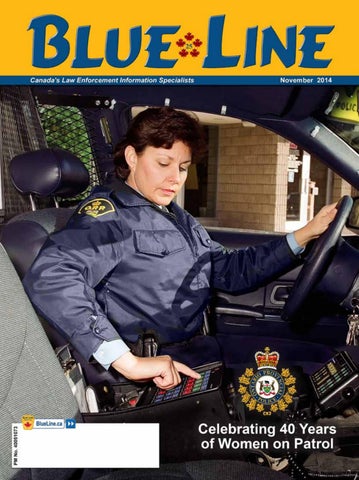
This issue’s cover shows Shannon Petryshyn in a 1996 OPP promotional photograph of her on patrol. Shannon is currently serving at the Orillia Detachment.
BLUE LINE MAGAZINE
3
Demand’s lawfulness determined when it was made Reasonable grounds not required for production order Warrantless phone search ruled lawful
NOVEMBER 2014
NOVEMBER 2014
4
BLUE LINE MAGAZINE
Blue Line Magazine Inc. PUBLISHER Morley S. Lymburner – publisher@blueline.ca GENERAL MANAGER Mary K. Lymburner – mary@blueline.ca SENIOR EDITOR Mark Reesor – editor@blueline.ca NEWS EDITOR Kathryn Lymburner – kathryn@blueline.ca CREATIVE DIRECTOR E. Jolene Dreja – jolene@blueline.ca MARKETING MANAGER April Lensen – april@blueline.ca CONTRIBUTING WRITERS Robert Lunney Dave Brown Mike Novakowski Nancy Colagiacomo Tony Palermo Stephanie Conn Tom Rataj Dorothy Cotton Brent Snook Mark Giles AFFILIATIONS International Association of Law Enforcement Planners Canadian Advertising Rates Data International Police Association The Canadian Press Newswire Access Copyright SUBSCRIPTIONS $30 per year; $50 for 2yrs; US & Foreign: $100 ADVERTISING 888-640-3048 advertising@blueline.ca
www.blueline.ca 12A-4981 Hwy7 East, Ste 254, Markham, ON L3R 1N1 Canada P: 905-640-3048 F: 905-640-7547 blueline@blueline.ca
PRINTED IN CANADA ISSN# 08478538 Blue Line Magazine was established in 1988 as an independent publication to inform, entertain, connect and educate those involved in the law enforcement profession. With no direct control from an enforcement agency, its opinions do not necessarily reflect those of any government or law enforcement agency. The authors, advisors, and publisher accept no liability whatsoever for any injuries to person(s) or property resulting from application or adoption of anything presented in this magazine. Readers are cautioned and advised that articles presented herein are edited and supplied for your personal awareness and should not be used for further action until appropriate guidance is received from a supervisor, Crown Attorney or other persons in authority. All material submitted for publication becomes property of Blue Line Magazine Inc. unless arrangements have been made with the publisher prior to publication. © 2014 All articles are protected by copyright. No part of this publication may be reproduced or transmitted in any form or means, electronic or mechanical, (including photocopying and recording or by any information storage or retrieval system), without prior permission. Permission to reprint may be obtained in advance from Access Copyright 1-800-893-5777.
BLUE LINE MAGAZINE
PUBLISHER’S COMMENTARY by Morley Lymburner
Policing by Consent Eugene Francois Vidocq, the founder of French policing, encouraged and espoused a police service devoid of military affiliation. Later, Sir Robert Peel agreed. Both men argued that the establishment and maintenance of policing must be by public consent. How does policing today measure up to their standards? There certainly has been a slow erosion but things can be done which help to narrow the gap and increase the public’s confidence that local police still seek and appreciate their approval and consent. In most independent municipal police services the public’s consent is more closely established by police services boards (PSB) and their reports to municipal politicians and, through them, directly to the public. With wider jurisdictional policing this closer bond is sacrificed to a more remote nexus with the provinces or federal government through more distant and less accessible representatives. To be fair some municipal contract police allow for a “police committee” to give some suggestions over the manner in which community police function. The attendance to, or acknowledgement of, these committees, however, has the appearance of being completely optional. The prevailing attitude is that police will hear the committee out but not necessarily do what it suggests. This all depends on the approval of a higher, more ephemeral rank. Cops were once hired by size and poverty level and the public didn’t exactly hold them in high esteem. Policing was seen as a job that had to be done by someone. Boston once even considered instituting a draft for police officers. Quite a contrast with policing by consent and Peel’s principles. In today’s environment of “Walmart policing” how much extra should we pay for more control? The public appears to be very accepting of “just-in-time policing” as long as the bill is kept as low as possible. Does cheaper policing mean we must surrender policing by consent? These communities really see police work as something akin to garbage disposal and sewage waste. “We want it to work but don’t want to know the details.” I recently heard an emotional woman explain how her new home turned into a complete nightmare. She and her husband had not known it was a grow-op house until a neighbour told her several weeks after they moved in. She had noticed a musty or moldy smell but hadn’t paid it much attention until one of her children began coughing and another developed hives. The nightmare had just begun. If we truly believe in policing by consent perhaps it is time to give back to the community something tangible which will be appreciated and evoke enormous good will. I suggest using proceeds of crime money to do good in the 5
community. Giving police committees or PSBs some authority over how to spend this money to help the community would go a long way toward giving residents a closer affinity with police. Perhaps funds could be used to compensate victims of crime or assist organizations such as Habitat for Humanity in helping low income families turn their lives around? Another good-will gesture would be paying to restore houses severely damaged by grow ops. After all, the reason they go “underground,” so-to-speak, is because the cops are otherwise too good at catching them. The couple were heavily in debt, having paid close to top of the market price for the home, but had to somehow come up with an extra $40,000 for remediation. Since its inception in 1976, Crime Stoppers has recovered many hundreds of millions of dollars worth of stolen property, helping capture wanted individuals and shutting down drug trafficking operations. A considerable amount of the money recovered through proceeds of crime is at least partially thanks to its efforts. An all volunteer organization, Crime Stoppers volunteers spend countless hours looking for corporate sponsorship to help fund the operations and rewards. Likewise, volunteer groups who work diligently on 24 hour suicide prevention hotlines, could benefit from a cash infusion. Significant funds from police agencies through proceeds of crime would free volunteers from the countless hours of fundraising. Communities could set up liaison committees to disburse money to organizations meeting a certain crime prevention or reduction criteria. Monitoring by local police would be a confidence building exercise worthy of much public appreciation. The RCMP alone has raked in more than $243 million from proceeds of crime revenue over the last 15 years. Most provinces have a similar process – in Ontario it’s called “provincial civil seizures” and brings in around $30 million a year. Much of this money goes into general revenues, with some retained to buy equipment and pay for the programs of sponsoring agencies. In an age that appears to be distancing itself from the early concepts of policing by public consent it’s time for police to show a closer affiliation with the public and a much closer understanding of the public need.
NOVEMBER 2014
Celebrating 40 Years of Women on Patrol
by Cathy Bell The Ontario Provincial Police (OPP) is proud to celebrate the 40th anniversary of women in uniform. Women have been an integral part of the service since its inception in 1909 but were not recruited to uniform ranks until almost 65 years later. Referred to as ‘girls’ in the OPP Review magazine in 1974, then Commissioner Harold Graham proudly acknowledged that there was a definite role for women in policing but with one caveat – they had to qualify for positions in the same manner as men. The only difference was a variance in the height and weight restrictions – they had to be at least 5’4” and 110 pounds. Interestingly, there was a mandatory training component for women. They participated in 20 hours of judo, which was optional for male recruits at the time. Female recruits received equal pay, joined the Ontario Provincial Police Association (OPPA) and were said to be equal in all respects NOVEMBER 2014
to their male colleagues – but their challenges were just beginning. Pre-1974 OPP recruiting posters touted the role of police constable as a “Career for a man who wants to go places.” As women integrated into the organization, there were some who still believed that policing was a career only suited for men. Of the 39 female recruits hired in 1974, several were terminated or resigned within the first months and years of their career. Most of the reasons were straight-forward and not related to gender but some told a different story. There were stated instances of husbands causing trouble for their wives during work shifts and allegations of affairs with fellow officers. Several women cited difficulty adjusting to police work or working at night and some resigned when denied requests for transfer. Female uniform members had been working toward equality since 1913 (and had just been issued revolvers) when Cst. Gerry Doucette began his career with the Toronto Police Service (TPS) in 1975. There were only five 6
female recruits when Doucette attended Ontario Police College (OPC). TPS police women were assigned predominantly administrative duties but a few did go out on patrol with the men. Male officers were very protective of them, recalled Doucette, ensuring they were not harassed or harmed. Doucette left TPS in 1980 to join Timmins Police and when it hired a female, Doucette became her coach officer because he was the only member who had worked with women. His first assignment with the recruit was to keep her away from the media, as she was an instant celebrity and the public was curious about this new addition. Now a member of the OPP, Doucette is happy to see that all the services’ detachments now have female officers. Some bias still exists, he said, but as the OPP moves forward, young members accept that women have an equal place in policing. As a current in-service training instructor, Doucette said women bring common sense rather BLUE LINE MAGAZINE
than brute strength to deal with a situation. The hiring of females required a shift in approach and tactical communication became essential. Techniques and use of force options have evolved and allow an officer, regardless of size or stature, to do their job effectively, he added. One of the issues facing all Canadian police services is the ability to recruit and retain qualified members. While the OPP has hired more than 2,000 women since the original 39 in 1974, currently only 1,300 of the just over 6,100 uniform members are female, representing 21 per cent of the workforce. This is in line with the national average and above most major Ontario police services. “The OPP is actively recruiting qualified officers who reflect the demographics of the communities we police,” said Sandy Thomas, C/Supt. in charge of the career development bureau. “Some of the most important attributes for all recruits to possess include: professionalism, respect, leadership, community involvement and communication skills,” she noted. “The OPP has welcomed women in uniform roles since 1974 and we value the positive impact of those original members who faced unique challenges and opened doors for the advancement of women in the organization.” Over the years, women have filled most uniform positions within the OPP. Retired Commissioner Thomas O’Grady was proud to have increased diversity in the OPP during his tenure when he was succeeded by the first female commissioner, Gwen Boniface. Boniface joined the organization in 1976 and advanced to the top spot while raising a family. She also became the first female president of the CACP. Civilian women have also held senior positions in the OPP. Mary Silverthorn is currently the provincial commander of Corporate Services Command and Diane Nagel served nine years as deputy commissioner, the only civilian female to hold that rank. The OPP is formally recognizing the 40th anniversary of uniform women at several events planned for December 2014. They will include public street displays at OPP General Headquarters, “Lunch and Learn” opportunities and a “Celebration of Women Dinner” at the Mariposa Inn in Orillia Dec. 3. The OPP has steadily evolved since the era of skirts, nylons, heels and guns in purses! “After forty years, the pioneering women of the OPP remain an inspiration for all recruits who have followed and will follow them,” said OPP Commissioner Vince Hawkes. “In my 30 years with the OPP, I have had the privilege to work with many inspiring women – both uniform and civilian. The future holds no shortage of opportunities for recruits of all genders and backgrounds to become exceptional leaders, to innovate and to reach for even greater heights.” Staff Sergeant Cathy Bell works in the Municipal Policing Bureau of the Ontario Provincial Police.
BLUE LINE MAGAZINE
7
NOVEMBER 2014
High Hopes & Heels A female police officer’s perspective
by Irena Lawrenson I had no definite plans for the future after graduating York University in April, 1974 with a BA in Geography and Anthropology. A Toronto Star article announcing “OPP Hires FIRST Women!” caught my eye. I hadn’t considered policing as a career. Women worked in some municipal police agencies but were relegated to the youth bureau, vice or being “matrons” guarding female prisoners. Court victories in the 1970s led to the elimination of discrimination and increased diversity in traditionally male vocations like policing. Suddenly there was an incredible chance to do something different with my life; an opportunity to actually be “a pioneer.” I applied and became one of the first 36 women hired by the Ontario Provincial Police. My original posting was Brantford detachment (west of Hamilton). I was the first and (except for a brief nine month period) only female officer working alongside 45 men for the next 10 years. I bounded up the stairs to the front door my first day, only to be welcomed by this comment from a constable on his way out. “I don’t agree with females being hired as policemen. Never did. Never will. So don’t call me for back up.” My uniform included a miniskirt, pantyhose and a purse to carry a gun, handcuffs, tampons and lipstick. I would ruin many a pair of pantyhose leaping over guardrails, trudging through forests looking for lost children or doing point duty in the bitter cold. I worked shift work, found missing children, investigated vehicle collisions, break-ins, NOVEMBER 2014
assaults, charged traffic violators and impaired drivers and was exposed to death: accidental, suicidal and homicidal. I never felt that I couldn’t do the job yet I thought about quitting every week over those first years. It wasn’t the work or the “clientele.” It was because I felt alienated and isolated. As a young, single woman I was ostracized and had no social life. Officers’ wives didn’t want me attending their parties and few young civilian men wanted to have much to do with a female cop who only had one weekend off per month. Although 90 per cent of the officers I worked with were wonderful supportive, helpful and kind the other 10 per cent made being a lone woman in a 45 member detachment “difficult.” It was complicated. I felt like an outsider, not privy to the same information, banter and respect. I worked alone those first years before two-officer patrol cars became the norm. That didn’t bother me. I accomplished more and there was no doubt in the public’s eye as to who was in charge. If I worked with a man, they would crowd around him, assuming he was in charge. I was invariably outside the circle trying to get people to understand that I was the investigating officer. I had committed to trying policing for two years before moving on. The Montreal Olympics, the first Games after the terrorism in Munich, Germany, changed that. That’s where I met (then) OPP Cpl. Ralph Lawrenson. Two years later we were married. Being committed to him, I was by extension also committed to a career in the OPP. 8
With both of us on shifts, we spent many years like passing ships in the night. After about eight years, I needed a change and enrolled in courses in a brand new field that had some potential to catch on “computer sciences.” Within a year the OPP started its first computer services branch and I won one of the six available positions. We did everything at first: security, back-up, training, audit, but the field exploded so rapidly that we were soon specializing. I chose training and ended up traveling throughout Ontario installing computers and training officers on data entry, retrieval and analysis. With my husband’s support (and I needed that because confidence can erode quickly in an all-male environment) I competed for promotion. Along with Dona Brown and Ginny Aitchison, I became one of the first three female OPP corporals. A few years later, I became the first female staff sergeant. This accomplishment made it to the front page of the Toronto Star. No longer were women in uniform relegated to the Living section! With promotions came reassignments media relations, community services and then, auspiciously, I became the citizen support unit – a new portfolio to deal with domestic violence, sexual assault, child and elder abuse and any other victims of crime. My role wasn’t investigative; it was to change how police dealt with these matters through policy development and awareness. These were new areas of interest in policing. For years, domestic violence was considered a private matter between a man BLUE LINE MAGAZINE
by Elvin Klassen (Edited from April 2004 Blue Line Magazine)
15 year reunion photo of the first class of female OPP officers Front row seated, left to right: 1) Sergeant Pat Bromley 2) Deputy Minister Stein Lal 3) Solicitor General Joan Smith 4) Commissioner Thomas O’Grady 5) Staff Sergeant Irena Lawrenson (nee Sobolewski) 6) Sergeant Patti Page. Centre row, standing, left to right: 1) Sergeant Wendy Wilson 2) Constable Mary Ann Burns 3) Constable Joan Loftus 4) Constable Carrie Dobson 5) Constable Debbie Bruce-Moore 6) Sergeant Darylene Foster 7) Constable Andrea Weir. Back row, standing, left to right: 1) Constable Bernarda (Bernie) Zgavc 2) Constable Nancy Grosmith 3) Constable Debbie Belisle (nee McMillan) 4) Constable Wendy Etherington 5) Constable Maureen Maveety Missing: (undercover) Constable Danielle McLean (nee Bouchard).
and “his wife.” Incest and child abuse were not talked about and no one had even heard of elder abuse. Women were finding their voice and speaking out for the first time. “Break the silence” was the motto for the times. Battered women shelters and rape crisis centres were being established. Laws were being challenged and changed and so was policing. For the first 15 years no more than two per cent of OPP officers were female. Each recruit class had one or two women, just enough to replenish those leaving due to shift work, child and elder care or simply disillusionment. All that changed with affirmative action in the US (employment equity here in Canada). Systemic barriers such as height and weight restrictions were identified and eliminated. Assigned to the clothing and equipment committee, I was able to influence my peers to eliminate the very impractical uniform skirts, introduce a maternity uniform, and the small meter-maid hat we had to wear. My husband and I adopted a Romanian girl who had been institutionalized since birth. I was promoted to inspector shortly after returning to work after parental leave the first female to earn the rank through the regular OPP promotional process. I became the manager of the OPP’s Employment Equity Unit. Recruit classes were gender balanced for BLUE LINE MAGAZINE
the first time ever and the number of female officers increased to 14 per cent! The provincial employment equity legislation was rescinded after five years, my job disappeared and I was re-assigned to policy and planning. In my final years with the OPP, I was the corporate lead for the implementation of Restorative Justice and the Youth Criminal Justice Act, which replaced the Young Offenders Act. After more than 30 years of policing I retired from the OPP in 2005, the first female commissioned officer to do so. Since retiring I have become a professional volunteer sitting on numerous boards, including Couchiching Jubilee House (a transition home for women in crisis), North Simcoe Victim Crisis Services, Barrie Out of the Cold and Colborne St. Clinic. 2014 marks the 40th anniversary of women in OPP operational policing roles. They have become an integral part of the service, greatly influencing the quality of the police profession. I am proud to have been at the forefront of those positive changes. Irena Lawrenson was one of the first female OPP officers and became the highest ranking member of the first group. The mother of two girls, she is now retired in the Barrie, ON, area and may be reached at lawrensons@ sympatico.ca.
9
A 26-year OPP member known for her innovative approach to policing has received the 2003 Police Leadership Award. One of five nominees, Acting Det. C/Supt. Kate Lines previously managed the force’s investigations support bureau and directed the behavioural sciences section. Lines has served in the drug enforcement section, anti-rackets branch and criminal investigation bureau, worked as a uniformed and undercover officer and investigated fraud and major crimes such as homicides and sexual assaults. She became the OPP’s first criminal profiler in 1991 and only the second Canadian to complete the FBI criminal profiling fellowship program. Her vision and dedication to advancing policing and community development has been the primary catalyst behind the introduction and formation of the force’s behavioural science unit, which expanded under her direction to include polygraph services, criminal and geographic profiling, forensic psychiatry, threat assessment, the provincial ViCLAS Centre (Violent Crime Linkage Analysis System), a research unit and the Ontario Sex Offender Registry. Lines’ expertise in behavioural sciences is world renowned, making her a highly sought after guest speaker on the international stage. She holds a bachelor of arts degree in the crime and deviance specialist program and has received general and advanced certificates in police studies and a diploma in police management studies. Lines has been instrumental in providing, promoting and advancing behavioural sciences concepts in Canada and internationally since 1991. Under her leadership, the behavioural sciences section achieved international stature and recognition for its expertise and excellence in investigating violent crimes. Lines is also responsible for forming the first forensic psychiatry unit in Canada; established in 1998, it quickly gained international recognition for its expertise, particularly in crimes against children, child pornography, equivocal death cases, undercover officer stress debriefings and forensic-psychological issues surrounding violent crime cases. Her dedication and vision had made Ontario’s ViCLAS Centre the largest in the world. Lines has received numerous commendations for her contributions to policing and dedication to public safety. The last word goes to one of her supporters, who said “the fact that your work in the study of criminal behaviour is acknowledged world wide is an honour that reflects proudly on you and also on the OPP. “Your foresight in recognizing the importance of creating a behavioural science section within the OPP is a tribute to your professionalism and outstanding dedication to policing. Through your efforts, the OPP has become a recognized leader in criminal investigation.” NOVEMBER 2014
FILLING A VITAL ROLE Recruiting women a challenge for Afghanistan Police
Women play an essential role in Afghanistan law enforcement, searching females at checkpoints and the cars and homes of suspects who hide weapons in women’s rooms, which male officers cannot access. Most recently, police women searched voters entering female-only polling stations. Their presence is vital to Afghan women, allowing them to access justice and report crimes. There is a desperate need for more female police officers. The Afghan Ministry of Interior has only been able to recruit about 2,000 to the country’s 147,000 member police force. The ministry plans to add 2,200 more female officers by the end of this year. The shortfall has been alarming and disconcerting not only for the ministry but also its partners. EUPOL interviewed two of the very courageous and outspoken female officers – 2nd Sgt. Fatema Muqaddam and 1st Sgt. Fatema Khawary – about their work. Muqaddam has worked with the Balkh Provincial Police Command for six years. Khawary has been with the Herat Provincial Police Command for four years. Both women aspired to be police officers from early childhood. Muqaddam is a high school graduate but Khawary has studied for 14 years, which is NOVEMBER 2014
counted as a college graduate in Afghanistan. Muqaddam was inspired to join the force by watching documentary films about foreign police officers. Khawary became interested in the measures and counter measures police take against criminals and offenders. Two of Khawary’s sisters are police officers, making it easier for her to sign up. “My family is broadminded and my two sisters were already in the Herat and Kabul police forces, so I had no problems getting my family’s approval.” It was more difficult for Muqaddam. She ran into three female police officers who were recruiting in the Hazrat-e-Ali Shrine, famously known as Rawza-e-Sharif (the sacred shrine) in Mazar-e-Sharif. Muqaddam spoke to them, got their contact info and returned home to ask the permission of her family. The biggest resistance came from Muqaddam’s oldest brother. His justification was “Decent women do not join the police. Only morally-corrupt women join the police.” Muqaddam did everything she could to persuade him, even weeping days and nights for almost a year, but her pleas fell on deaf ears. Finally, Muqaddam asked the three female recruiters to talk to her brother. 10
After a lengthy discussion, one asked her brother this question. “Look, we work for the police. Do you think we are bad or morally corrupt women?” That won Muqaddam a ticket to the Afghan National Police. She maintains that the three decades of war has tarnished the image of female officers in the country. She ended up being one of the first 14 female police officers in Balkh province in the current regime and the first sergeant in 30 years. Training female Afghan police officers has been a high priority for the EUPOL mission. Senior Training Adviser Christine Edwards developed a 10-day leadership and personal development course covering communication feedback, image, assertiveness, networking, mentoring, motivation, team building, goal setting, leadership and problem solving. To ensure Afghan ownership and to move towards transition, Edwards trained the trainers who took over from her and taught the course for the last three times very successfully. She described the trainees as “keen” and “enthusiastic to learn.” Zulhejja, a female police officer (who goes by one name, like most Afghans), described the course as “useful” and said that she was particularly pleased to learn how she could “lead and motivate a team.” BLUE LINE MAGAZINE
Muqaddam says security agencies gave her a hard time after her recruitment because she had lived and studied in Iran. The situation for women has improved significantly over the years. For example, the ministry approved the Afghan National Police Code of Conduct in 2011, which requires male police officers to commit to nondiscrimination, especially against gender. The then chief of Kabul City Police, General Ayoub Salangi, signed a decree in 2013 to provide female police officers with better working conditions, “preventing their mistreatment and improving gender equality.” Treatment of women as co-equals and colleagues, however, will probably take some time in a war-torn country where women’s mistreatment is almost interwoven into the social fabric. “Education is important,” Khawary maintains. When illiterate women who badly need a source of income join the force, they are assigned janitorial tasks when they are not required to frisk women or search houses, she notes, adding that such officers can not do much due to their inability to read and write. The human rights department at the Ministry of Interior handles complaints of mistreatment from female police officers, says Khawary. Her explanation of the procedures suggests complaints are handled in a very traditional way in the absence of a proper anti-sexual harassment policy. Female officers also face difficulty being promoted. Since headquarters has to approve promotions, evaluation forms are sent to the Ministry of Interior. Both Khawary and Muqaddam are not pleased with the time this takes. Low police salaries are another complaint. “The prices rise but their salaries remain the same,” notes Muqaddam. Another problem the two officers face is personal security. Khawary and Muqaddam both say they cannot travel to or from work wearing their uniform. They leave it in the office, only putting it on after they clock in. However, that doesn’t mean that they do not work after hours. They travel to perilous districts to search homes and women and even BLUE LINE MAGAZINE
stay in the districts for a few nights, if required. Khawary is driven to work in the same old vehicle that was targeted with a hand grenade. She says it was taken away for several days after the incident but returned with few changes and still has a hole in the floor where she puts her feet. The Interior Ministry is working hard to recruit educated women. One of the challenges is the cultural stereotypes associated with women’s work on the force. Afghans have to be made aware of the need for more female police officers and the ministry’s efforts to
11
improve their work environment. More improvements are needed, such as personal security, good income and job satisfaction (transportation, safe working environment etc.) to attract more women to the force. This is an edited version of an article that ran in the September 2014 EUPOL Newsletter. To learn more about police work in Afghanistan, follow Head of Mission Karl Ake Roghe on Twitter (@EupolAfg_HoM) and/or follow EUPOL on Facebook (facebook.com/EUPOLAFG).
NOVEMBER 2014
Spatial Matters in Emergencies
The role of Geographic Information Systems
Figure 1: Routing map in Hamilton’s one-way streets
Figure 2. Water body with solid-filled blue area when aerial photograph is off.
Figure 3. Water body with blue outline when aerial photograph is on.
by Jin Y Xie
available to update CAD mapping data more frequently than every two years. Obviously this could not meet the requirements of emergency services. In order to take the full advantage of advanced capabilities in CAD, it’s crucial to update GIS data frequently to keep mapping data up to date. I was hired as an HPS CAD/GIS Analyst in 2013 and successfully updated the CAD mapping data two times in the same year. The accuracy and currency of the location information provided to dispatchers and first responders improved significantly. Our next goal is to update mapping data even more frequently.
dispatchers can hit a button to get an aerial photograph of an area. When the aerial photography is turned on, solid blue areas show the presence of water. Unfrotunately, the solid blue blocks useful information such as details of small islands. This defect might cause a problem if there is an emergency incident on an island. The dispatchers did not want the blue area to simply be removed. By analyzing the user’s requirement, I found a solution to fix the defect. First, I added an additional layer for the water body with a symbology of “blue-outline” on the map. Then I modified the codes behind the tool button, so that the two water body layers can be switched with a click of a button. When the aerial photograph is off, the solid-filled blue area is on; otherwise the blue outline is on. 4. More information available: I have added more layers on the CAD map in the GIS data update, further enhancing the amount of information available to dispatchers. A. Childcare facilities were added to the CAD map. B. One-way street arrows now show on the street network, a great visual aid to dispatchers and first responders. 5. Legibility and cartographic improvement. The legibility of labels for streets and buildings is improved by applying the approach of scale dependency. When zooming the map in and out, font size and density for the labels adjust for better visual effects. The map symbology is improved as well in the CAD mapping upgrade so there isn’t any symbology confusion for layers such as power lines, railway tracks, etc.
Hamilton Police Service (HPS) is the local Public Safety Answering Point (PSAP), transferring area emergency calls to the fire department, emergency medical service or OPP in addition to the HPS. Spatial matters Spatial information plays a critical role in an emergency call because every incident is associated with a real-world location. Immediate and accurate location awareness can mean the difference between life and loss. The more readily available and clearly visible the information is, the faster the response. Geographic Information System (GIS) has been integrated with CAD. HPS has used Intergraph’s Computer Aided Dispatch (CAD) system to handle emergency calls since March 1994 to enhance functionalities through advanced spatial analytics and data visualization. Today, GIS has already become part of a CAD solution, providing quick call location verification and incident analysis, such as values at risk, location of interest (criminal records history for certain period), etc. As GIS technology keeps evolving, more new powerful analytical and mapping tools are being used in emergency incidents, providing dispatchers and first responders with more valuable information. Currency is critical Capabilities in CAD can vary greatly due to the quality of GIS data. Especially in recent decades, many communities are growing in both area and population, requiring constant updating and maintenance on GIS data to make sure maps are accurate and current. Imagine how frustrating it would be if emergency calls came from new subdivisions but could not always be verified in CAD. Prior to 2012, the resources were not NOVEMBER 2014
Major accomplishments The City of Hamilton’s team maintains quality GIS data and shares it with the HPS. Even though the data format is not compatible to CAD mapping, thanks to the tools of Intergraph’s Geomedia Professional and its extension I/Map Editor, we are able to process and upgrade it to the format that CAD accepts. Here are the major accomplishments in the mapping data upgrade for CAD: 1. The data accuracy and currency for CAD mapping has been greatly improved. Dispatchers and first responders can now access the most current GIS data. 2. Successfully implemented routing capabilities: One-way streets make routing quite challenging so few agencies implement this functionality. This functionality is critical in Hamilton, where there are many unique one-way streets in the downtown area. Accurate routing capability is a safety concern for police officers. By implementing the routing capabilities in CAD mapping data updates, officers are now able to use the functionality without the need for additional devices. 3. F unctionalities improvement: In CAD, 12
Contact Jin Y Xie at JXie@hamiltonpolice.on.ca for more information.
BLUE LINE MAGAZINE
BLUE LINE MAGAZINE
13
NOVEMBER 2014
The legal status of “off-duty” police by John Cameron “2 Bravo 15 is 10-7.” With those simple words the officers in Unit 2 Bravo 15 advise their radio dispatcher and other units that they are going out of service. The terminology may vary among agencies but the message is the same. Time to change and go home. Officers likely don’t give any thought as to whether going off-duty changes their legal status from a peace officer to an ordinary citizen. Most would agree that there are a lot better things to do with valuable off-duty time than ponder esoteric questions. A 1999 case transformed the question of whether off-duty police are officers or private citizens from an esoteric question into, quite literally, a million dollar question. The case had all the elements of a Hollywood script: a bag with almost a million dollars in cash left inexplicably in a Vancouver park; a strange collection of characters claiming ownership, including a mysterious “Mister X”; a man inadvertently stumbling across the bag while out walking his dog Gus. The man just happened to be Cst. Mel Millas, an off-duty Vancouver police officer. Finders Keepers A number of legal issues arose after Millas called police and turned over the money. One of the most fundamental was whether Millas, as a NOVEMBER 2014
finder of apparently lost or abandoned property, had any legal claim to it. The well-known expression “finders keepers” is in many respects a fair reflection of the common law position in Canada and England on the rights of those who find lost property. In the early case of Armory v Delamirie (1722), 1 Str. 505, 93 E.R. a young chimney sweep found a diamond ring and gave it to a jeweller to appraise. The jeweller returned the ring without the stones and the boy sued for their return. The court held that the chimney sweep was entitled to the diamonds and could keep them against anyone except the rightful owner. The rationale from Armory has been applied in several finder cases over the past three centuries. If Millas was treated as an ordinary private citizen he would have a legal claim to the found money, assuming the true owner did not claim it. However, if Millas was treated as a police officer, he would be an agent of the Crown and the government would hold the money for the true owner or it would be forfeited to the Crown. Uncertainty in the Law Somewhat surprisingly, considerable uncertainty existed in law as to the legal status of police officers when off-duty. One viewpoint was that no distinction exists between on and off-duty status. As a result of the nature of the office of constable, a police officer is never off-duty. 14
An alternate view is that there is a valid distinction to be made. It is suggested that the proper approach is to generally treat off-duty officers as essentially private citizens and only on-duty under certain limited circumstances. In British Columbia, support for a distinction between on and off-duty police officers exists in the following sources: • Justice Wally Oppal’s report into BC policing; • The Police Act; • Police training and practices; and • Case law. Oppal Report The Honourable Justice Wally Oppal was appointed in June 1992 to conduct a commission of inquiry into BC policing. The terms of reference were expansive and included an extensive examination of the legislation governing police officers and policing. Justice Oppal’s report suggested that police officers are to be treated as ordinary citizens with private lives during their time off-duty, except where their conduct would injure the reputation of the force. During their time off-duty they are entitled to the same activities as other private citizens. For example, they may engage in political protest, operate a business, vote, run for political office, own property and sue and be sued in their own name as private citizens. If injured while offduty they are not entitled to collect WCB or any BLUE LINE MAGAZINE
other benefits which they would ordinarily receive if injured on-duty. If police officers are involved in a motor vehicle accident while off-duty, their police department has no vicarious liability. The Police Act As a result of Justice Oppal’s report, the Solicitor General made a number of substantial amendments to the Police Act in 1996, including, for the first time, expressly recognizing the distinction between on and off-duty status. The Code of Professional Conduct Regulations (Reg. 205/98) enacted under the Police Act R.S.B.C. 1996, c.367 provides for the circumstances in which off-duty police officers may be subject to discipline as a result of off-duty conduct: Disciplinary Defaults 4 (1). In this Code, “disciplinary default” means: (a) discreditable conduct; (b) neglect of duty; (c) deceit; (d) improper off-duty conduct. Improper off-duty conduct 16. For the purposes of section 4(l), a police officer commits the disciplinary default of improper off-duty conduct if: (a) the police officer, while off-duty, asserts or purports to assert authority as a police officer and does an act that would constitute a disciplinary default if done while the police officer is on-duty, or (b) the police officer, while off-duty, acts in manner that is likely to discredit the reputation of the municipal police department with which the police officer is employed.
BLUE LINE MAGAZINE
BC police training Police officers spend the majority of their time off-duty. When not working, BC police departments do not expect their officers to continue the activities and duties of on-duty police officers. They are not expected to patrol their neighbourhoods, for example, or chase after and flag down speeding motorists. The training at the Justice Institute of British Columbia emphasizes the difference between the expectations on officers when on and off-duty. Officers are instructed that when off-duty they are not expected to take any direct action in situations that they observe, which they would normally react to while on-duty. Of course many officers have chosen to take action when off-duty and their actions have often prevented perpetrators of crimes from escaping undetected. It is stressed that in most instances officers would be without back-up and appropriate weapons with which to defend themselves. They are taught, however, that there are expected to act in some way, such as calling 9-1-1 and staying around to be a witness. Case Law Prior to Millas’ case, only a handful of cases had considered the off-duty status of police officers. In the case of Davis v. Minister of Pensions, (1951) 2 All ER 318 (K.B.), an off-duty war reserve constable was injured on the way to work and claimed compensation for a “war service injury.” Eligibility for compensation depended on whether the injury arose in the course of performance of duty. The constable argued that he
15
should be entitled to benefits because a constable is effectively “on-duty at any time” and although he was outside his regular hours of duty, any accident must be treated as being in the performance of his duties. The court rejected this position. When the prescribed hours of duty of a constable have come to an end and an emergency arises it is his duty to attend to that emergency and at that moment he is on-duty in the strict and narrow sense (...) but until such an emergency arises he is in the position of any other civilian. In other cases off-duty police officers were treated as though they were on-duty. These have generally fallen into two classes. The first class is where the officer, while off-duty, chooses to “put himself or herself on-duty” by acting in the capacity of a police officer after witnessing a crime in progress and taking action. The second class is where officers, although off-duty, act in a manner likely to discredit the reputation of their police agency. Officers putting themselves on-duty The circumstance of an off-duty officer “putting himself on-duty” arose in the cases of R. v. Johnston, (1966) 1 C.C.C. at 226 (Ont. C.A.), R. v. Crimeni ((1992)), 41 B.C. M.V.R. (2d). 2217 (Q.L.) 205 (B.C.S.C.) and Love v. Saanich (District) Workers Compensation Review Board (BC), 1 April, 1993. Johnston involved an off-duty police officer employed privately to direct traffic outside a business who observed several individuals causing a disturbance and chose to make an arrest. The court
NOVEMBER 2014
of appeal stated (at p. 226) that “a police officer is on-duty at all times and he is quite within his rights in making the arrest when he found it advisable and necessary to do so.” Although the language in Johnson appears to suggest that police are always on-duty, it should be more properly seen as standing for no more than the proposition that police can put themselves on-duty by acting in the capacity of a police officer. In the similar case of Crimeni, an off-duty BC municipal police officer observed what he believed to be an intoxicated driver operating a car. After following until the driver voluntarily stopped, he presented his police identification, requested the driver surrender his licence and registration, confiscated the driver’s car keys and directed a private citizen to contact the nearest police detachment. Uniformed, on-duty police officers arrived, arrested the driver and subsequently charged him with impaired driving. The driver argued that his rights under the Charter had been violated as the off-duty officer failed to advise him of his Charter rights to counsel when he stopped him. The court considered the issue of whether the officer, although off-duty, was a civilian or was acting within his police capacity when he detained the driver. After considering the applicable statutory provisions in force at the time (which did not include the since enacted off-duty provisions in The Police Act), it stated: “(The statutes) do not suggest that one ceases to be a police officer merely because one is not acting within the confines of a working day.” The court went on to emphasize the fact that although the officer was off-duty, he had acted in the capacity of a police officer and relied on his police authority: The evidence illustrates that Cst. Tottenham relied on his capacity as an officer in his dealings with the accused – he approached the appellant; presented his police identification; requested the appellant surrender his driver’s licence and registration; confiscated his car keys; and directed a private civilian to help him contact the nearest police detachment. As a consequence, the court held Tottenham was a police officer during the arrest of the driver and had violated his Charter rights by not giving the appropriate warnings. The same reasoning was applied in the
NOVEMBER 2014
case of R. v. Leontowich, 1999 BCPC 8 (CanLII) where an off-duty police officer went to help a motorist outside a coffee shop, only to realize the driver was grossly impaired. The court held: The Crown concedes the accused was detained at the time (the off-duty officer) began her investigation into a possible impaired driving. As a consequence, the failure to provide the accused with the proper Charter warnings leads invariably to a conclusion that the statements made by the accused in response to (the off-duty officer’s) questions are inadmissible. In Love, an off-duty officer investigated a noise outside his home late in the evening and discovered someone attempting to remove a stereo from a car parked in his driveway. The person was casually dressed and armed only with a bamboo tomato stake. The police officer was injured in the course of apprehending the suspect, who was convicted of attempted theft and assault. The officer claimed Workers’ Compensation benefits for his injuries, which he asserted occurred in the course of carrying out his duties as a police officer, although he was off-duty during the incident. The Workers’ Compensation Review Board concluded that the officer’s injuries arose “out of and in the course of his employment within the meaning of the term in the Workers Compensation Act.” The board held that although police officers injured off-duty are not ordinarily entitled to WCB compensation, in this case the officer would be covered because “once he saw objective evidence of a crime in progress, his police officer role was engaged.” In Johnson, Crimeni, Leontowich and ‘Love’ off-duty officers were treated as being on-duty because they had effectively put themselves on-duty by acting in the capacity of a police officer. Discreditable off-duty conduct The issue of discreditable conduct by offduty officers was considered by the Alberta Court of Queen’s Bench in Vanovermeire v. Edmonton Police Commission (1993) , 9 AR (3d) 396. A police officer was disciplined for conducting himself in a manner which would bring discredit upon the Edmonton Police Service. While responding to a domestic abuse call, he met the complainant, a young woman. Later, while off-duty, the officer invited her on a vacation to Illinois, during which he
16
allegedly sexually harassed her. The court decided that, when considering the offence of discreditable conduct, it would be inappropriate to distinguish between on and off-duty activity. It is clear from Vanovermeire that even off-duty police officers are accountable to a certain standard of behaviour 24 hours a day. The million dollar question The question of whether Millas was a police officer or citizen when he found the money was answered on December 20, 1999 when Judge Baird-Ellan heard the case Millas v. Attorney General of British Columbia (1999), B.C.J. 3007 (Q.L.) (B.C.S.C.). Counsel for Millas argued that he was offduty when he found the money, that there was a difference between on and off-duty police officers and that neither of the two classes of cases which would justify treating Millas as an on-duty officer were relevant in this case. It was submitted that, unlike the off-duty officers in Johnston, Crimeni and Love, Millas did not rely on his authority as a police officer in any fashion, or in any manner act in that capacity when he found the money. He wasn’t in the park in any official capacity. He wasn’t investigating any crime. He did not initiate an investigation into who owned the money. It was also submitted that there was no legitimate reputation or discipline issue, as Millas’ behaviour had only improved the reputation of the force for integrity. The court ruled that there was no legal bar to the money being returned to its finder. On the issue of off-duty status of police officers in BC, Baird Ellan J. stated (at para. 7): (Counsel for Millas) has provided the relevant portions of the Oppal Report and an exhaustive review of cases dealing with the rights and duties of off-duty officers. These provisions and authorities all support the conclusion that while an off-duty officer may by his actions place himself on-duty and thereby attract the legal status that that entails, Millas wasn’t acting in an on-duty capacity at the time he found the money and therefore should be treated as any other member of the public. Conclusion The Millas decision lends additional support to the position that a valid legal distinction can be drawn between the duties and responsibilities of a police officer when on and off-duty. In summary, a police officer going 10-7 will have essentially the same legal status as a private citizen with the following exceptions: • Off-duty officers may place themselves onduty by acting in the capacity of a police officer or relying on their authority as such. Off-duty officers who place themselves on-duty will have all the responsibilities of an on-duty officer, such as giving Charter warnings to arrested suspects. • Off-duty conduct injurious to a force’s reputation can result in an officer being treated as, and disciplined as, a police officer regardless of when or where such conduct occurs. • Off-duty officers may be called out for duty by their agency and will be treated as being on-duty. BLUE LINE MAGAZINE
Another case arose after the Millas decision considering the status of an officer when not strictly “working.” In Cooper v. Canada (R.C.M.P.) et al. 2001 BCSC 1788 an injured motorist sued for damages after he was rearended by an unmarked RCMP vehicle. The officer was en route to a personal appointment with his doctor for an annual medical check-up (not required by RCMP regulations) when the collision occurred. The unmarked vehicle was assigned to the officer because he had to be on call, via a pager, at all times. The question was whether the officer “was engaged in the performance or intended performance of his duty at the time of the accident.” The RCMP argued that he was, submitting that regardless of specific duties, a police officer is on duty in a general sense 24 hours a day. In that regard, the defendants cited s.18 of the Royal Canadian Mounted Police Act R.S.C. 1985 c.R-10, which, in its germane part, reads: Duties 18. It is the duty of members who are peace officers, subject to the orders of the Commissioner, (a) to perform all duties that are assigned to peace officers in relation to the preservation of the peace, the prevention of crime and of offences against the laws of Canada and the laws in force in any province in which they may be employed and the apprehension of criminals and offenders and others who may be lawfully taken into custody. Counsel for the RCMP argued that, although the officer was going to a private medical appointment, he was still, like all police officers, on general duty 24 hours a day. Under this duty, he has an obligation to report any breach of the law he sees, prevent it and enforce the law. The court in Cooper held that the officer wasn’t “in the execution” of his duties when driving to his private doctor appointment. As such he would be treated like any other person who rear-ended a vehicle and would be personally liable (although covered by insurance through the RCMP). The court stated: …(T)he law recognizes a distinction between a peace officer being “engaged in the execution of his duty” and simply being on duty, in the sense that he or she is “at work”. … Thus a police officer who is eating dinner while on duty is acting in the course of his duties, but that same officer could not then be said to be engaged in the execution of his duty. (The officer here) was engaged in a personal errand in that he was going to see his doctor for his own private reasons for a medical check-up. In the result, he wasn’t engaged in the performance of his duty at the time of the accident within the meaning of section 21(2) of the Police Act. This article originally appeared in the August/September issue of Blue Line and has been update by the author. A former police officer, John Cameron LL.B. is now a Vancouver trial and appeal lawyer who assists people injured through the negligence of others. He frequently acts for police officers injured in on and off duty car accidents. Contact him at john@cameronlaw.com or 604 681-8888 for more information.
BLUE LINE MAGAZINE
2014 F. Darren Smith Award recipient by Christine Jackson
Jane Naydiuk of the BC Ministry of Justice Police Services Division is the 2014 recipient of the F. Darren Smith Award of Excellence. Presented at the Canadian Police Knowledge Network’s (CPKN) Stanhope Workshop in Charlottetown, the award recognizes Naydiuk’s many contributions to technology-enhanced learning in the Canadian policing sector. More than ever, technology and collaboration are the key ingredients to creating effective, cost-effective learning. Whether the result of inquiry recommendations or in response to an emerging community issue, police are frequently tasked with ensuring frontline officers are trained to respond appropriately and safely. This can present many challenges, not the least of which is getting training to officers in an economical and timely manner. In British Columbia, Naydiuk has been a driving force behind a number of initiatives that prove a collaborative, technology-enhanced approach is a best practice for police learning. “Jane has merged her passions for policing and education to increase the effectiveness, defensibility and accessibility of police training in BC,” says Rachel Graham, who nominated Naydiuk for the award and is a colleague at the Ministry of Justice. “Her efforts have been instrumental in ensuring the province was able to meet its training obligations under the Braidwood Inquiry and other provincially mandated requirements.” A sergeant with the Saanich Police Department, Naydiuk was seconded to the Ministry’s Police Services division in 2007. In the time since, she has been involved in several mandatory province-wide training initiatives. In response to recommendations coming out of Braidwood, Naydiuk worked with municipal, provincial and federal stakeholders, as well as external partners, to develop a technology-enhanced solution to deliver Taser operator training, crisis intervention and de-escalation training to police officers across BC. Similarly, in 2013, she co-ordinated numerous agencies, including the ministry, RCMP, Crown Counsel and victim services to produce a two-part training program to communicate best practices in investigating domestic violence incidents. “Jane has championed the strategic use of technology-enhanced learning solutions to address training requirements for officers across BC. For RCMP in particular, this has been critical for reaching a highly dispersed police force in a timely and consistent manner,” says Insp. Shirley Steele, OIC of Training Services at the RCMP’s Pacific Region Training Centre. “Her ability to mobilize and garner inter-agency co-operation is also leading the way to achieving sustainable education and training for the police community.”
17
Sandy Sweet (left), CPKN President, presents Jane Naydiuk (right) with the F. Darren Smith Award of Excellence at the 2014 Stanhope Workshop in Charlottetown.
In addition to her work on behalf of the province, Naydiuk is also working to advance collaboration and the use of technology in learning at the national level. Much of the content created for the BC initiatives has been adopted in jurisdictions around the country. This hasn’t only promoted the use of established best practices, it has also reduced duplication of effort to create accompanying training resources. Naydiuk has been a long-time advocate of the CPKN and has actively served on its national advisory committee since 2007. In association with the Justice Institute of BC, she has also participated in the Police Sector Council’s Constable Competency Project, the outcomes of which are now being integrated into BC’s recruit training program. “Jane exemplifies the spirit of this Award,” says Sandy Sweet, CPKN President. “Her vision, commitment and leadership in the area of technology-enhanced learning are qualities that the entire police community can celebrate and emulate.” In accepting the award, Naydiuk stressed the contributions of everyone involved. “There have been many people and many agencies who have inspired and informed our journey in BC,” she said. “This award is recognition of that collective effort. Thank you.” The F. Darren Smith Award of Excellence was established by the CPKN in 2012 to recognize and honour individuals in Canadian policing who demonstrate outstanding leadership, commitment and vision in advancing technology-enhanced learning (TEL). Visit www.cpkn.ca/darren_smith_award to learn more.
NOVEMBER 2014
CONFIRMATION BIAS The blue lens viewed through tinted glasses by Brad Fawcett Several coroner’s inquests and public inquiries have recommended front line police officers wear cameras to assist in determining ‘what really happened’ in encounters with subjects. The underlying assumption is that more information, especially images and audio, can only be better. The truth, unfortunately, may be that we now spend vast amounts of time and energy examining irrelevant images and ascribing meaning to them meaning that may be a product of the viewer’s imagination and bias. The video may not speak for itself but it may tell you what you want to hear. Surprisingly, studies have generally shown that more information leads to poorer decisions. In one study college counsellors were given access to high school students’ transcripts, test scores, results of personality and vocational tests and university entrance essays. They conducted personal interviews and were then asked to predict the students’ grades in university. As you would likely guess, those provided all the information felt extremely confident about their predictions. The counsellors were competing against a simple mathematical formula which used the students’ grade point average and score on a standardised test. The simple formula significantly outperformed the predictions of the experts, with access to many more variables. The proliferation of economic and investment data hasn’t assisted professionals in NOVEMBER 2014
making better investments. A study by Paul Andreassen in the late 1980s demonstrated that investors given extremely limited information (they could only see changes in stock prices without any insight into what caused the change) significantly outperformed other investors (they earned twice as much) given access to a wide variety of stock information. The extra information simply distracted the first group as they searched for patterns that would help them predict the unpredictable the market (Lehrer, 2009). Another Lehrer example relates to the increase in the use of invasive procedures to resolve back pain. Magnetic resonance imaging (MRI) provides physicians with high definition images of tissues and structures. Back specialists could now identify bulging and degenerative discs, aggravated nerves and everything else beneath the skin. One would assume that this wealth of previously unobtainable images would lead to accurate diagnoses and improved outcomes for those suffering chronic back pain. The increased diagnostic information resulted in more surgeries but back pain sufferers were likely to receive just as much relief from following the treatment regimen that predated MRIs bed rest. While imaging may identify disc abnormalities in great detail, the abnormality may have nothing to do with the subject’s discomfort. As Lehrer noted, the doctors simply saw too much. They were overwhelmed by the information available to them and simply couldn’t distinguish between the relevant and 18
the irrelevant. As a result, they operated on people to fix disc problems that at times were not related to their back pain. Lehrer expressed the problem succinctly: seeing everything made it harder for the doctors to see what they should be looking at. Readers may be familiar with the Yerkes-Dodson Law, which states that human performance at any task varies with arousal in a predictable curve. As arousal increases, so does performance but only to a point, after which increasing arousal decreases performance. Similarly, an increase in available information may improve understanding, but only to a point. Once inundated with information, especially in the form of video and audio, our ability to make sense of the situation may actually decrease as we attempt to discern patterns and meaning from the data (Cherry, 2014). A tangential issue inherent in the discussion of body cameras, and one not central here, is that the proliferation of video (digital and analogue), forensic evidence, court-qualified experts in various fields and computerization hasn’t resulted in speedier trials; rather, they appear to have added grist to the grinding wheel of justice, nearly bringing it to a halt. Would anyone assert that the courts are more efficient today than 30 years ago? Politicians and police administrators provide annual reports trumpeting additional reductions in the crime rate (Lindell, 2012), yet it takes far longer to prosecute offenders for even the most mundane crimes. Adrian Humphries (2013) summed the situation up BLUE LINE MAGAZINE
succinctly: “The system is sick: Canada’s courts are choking on an increase in evidence.” Added to the burden will be digital video, binders of frame captures, enhanced audio files and other minutiae from the body camera that will now be picked over as the viewer attempts to discern a cause, identify patterns and seek explanations for human behaviour. One can only hope that the officer’s recall and video record will be similar enough, but not too similar, so that the trier of facts can conclude that normal errors in recall occurred, but not that an officer embellished or lied. How do these examples relate to police body cameras? Viewing videos of a use of force incident, after the fact, may cause the viewer to seek meaning and opportunities for interventions that might have changed the outcome. Human beings experience a number of subconscious biases, which assist in making decisions. They are important because of our limited ability to process information. We have a working memory of seven items, plus or minus two (Miller, 1956), which is assisted by these biases, otherwise we would be overwhelmed. Haberland (1997) noted: “At the hub of all cognition and behaviour, including behaviour under threat, lies working memory....” The process of perception is a highly selective, interpretive process. The sensory data we perceive is processed in light of experience, learning, preference, biases and expectations (Fradella, 2006). Video directs our attention
BLUE LINE MAGAZINE
and limits our focus to the visual stimuli, which is further directed and limited by commentators pointing out aspects of the video to which we may have been previously blind. One of the biases that cause viewers to ‘hear what they want to hear’ is confirmation bias (Rabin & Schrag, 1999). Simply put, people often believe too strongly in their favoured hypothesis and an erroneous belief is not likely to be overcome by an infinite amount of information to the contrary. Subtle cues can cause us to form certain beliefs for which we then subconsciously find supportive evidence. For example, an experienced colleague tells a young teacher that boys named Jason are always trouble. The young teacher may find this to be true because the conversation primed them to find evidence
19
supporting the hypothesis. Viewers of police encounters with resisting or violent subjects should be educated regarding the neuroscience of moral judgment (Greene, 2009). Functional MRI (fMRI) studies have shown that the mental states of those involved in an incident are important and will be decidedly different than those viewing the video. Those directly involved are more likely to be making deontological and emotionally based moral decisions while those watching (in many cases with full knowledge of the outcome or being primed by the lead in to the video) will be making utilitarian-based, cognitive decisions. Similarly, Delgado (Delgado, Frank, & Phelps, 2005) researched the effect of reputation on moral-economic interactions using fMRI. They found that being characterised as “bad” affected subjects’ willingness to trust them and partially overrode the effect of feedback. In other words, characterising the officers as “bad” may affect viewers’ willingness to trust them and may override evidence to the contrary present in the video or other evidence. Also, the description of the subject, the person having force applied to them, matters when making moral judgments. The reader can imagine a situation in which a news broadcaster introduces a video of a police-citizen encounter using language such as “Police say they used reasonable force you be the judge.” The tone might imply that the broadcaster feels the force used wasn’t reason-
NOVEMBER 2014
able. The viewer has now been primed to see things in the video that will support that biased position, blinding them to overwhelming evidence to the contrary. This is known as the Focus of Judgement Effect, which drastically alters a person’s attitudes and beliefs through slight changes in wording or format (Lehman, Krosnick, West, & Li, 1992). According to Graziano et al, “Journalists manage the arena and by “framing” the problem in a specific way they influence public perception of the underlying causes of the problem, the potential consequences of the problem and they help establish criteria for evaluating proposed solutions to the problem” (Graziano, Schuck, & Martin, 2010). As an example, media coverage of the Braidwood Commission focused at times on the black “slash” gloves worn by some of the officers involved, alleging that they were worn to intimidate subjects (Theodore, 2009). Evidence indicating the gloves were issue uniform items intended to protect the officers from edged weapons, broken glass and blood-borne pathogens and that they were advised the suspect had shattered a glass window becomes lost to the viewer, who now identifies the gloves as further evidence of wrongdoing or support for characterising the officers as “bullies,” The statements made prior to viewing another “disturbing” video captured by the body cameras of police officers can have a significant anchoring effect on viewers (Strack & Mussweiler, 1997). The reality is many of the images shown are likely to be troubling and the volume sheer number of images available will exponentially increase as body cameras come into vogue with legislators. Mundane images of police officers engaged in routine work are not likely to receive media and, therefore, public attention. Interestingly, the same arguments put forward to entice police administrators and legislators to adopt force options such as conducted energy weapons are now being parroted when it comes to body worn cameras. In fact, they are almost identical: a picture of a police chief quoted saying something to the effect of, “Our agency has seen a 40 per cent reduction in the use of force by officers and a 30 per cent reduction in force used against officers since adopting XYZ body worn camera system. The mere presence of the camera has resulted in subjects surrendering and pleading guilty without the need to even go to trial.” Sound familiar? What was the criticism directed at most police agencies for adopting CEW’s? That they relied on the manufacture’s claims and allegedly biased research when deciding to adopt the CEW. It appears that that criticism might apply in this situation too. The significant difference, of course, is one is related to a force option, the other to police accountability. Legislators, police administrators and oversight groups appear quite willing to move forward with body worn cameras while waiting for the research to catch up. The adoption of body camera technology appears to be a given. The White House enNOVEMBER 2014
dorsed their use for police (Breitman, 2014) as recently as September 16, in the belief that had the Ferguson, MO officer worn one, the shooting might not have taken place and video evidence might have prevented the subsequent rioting (Reuters, 2014). Police agencies are unlikely to impact on the public perception of a police action that has been broadcast and framed as excessive force. Agencies can have an impact in public hearings and other processes arising out of the action during which they may have the opportunity to make the trier of facts aware of these subconscious processes and thereby limit their effect on the viewer. However, the information is not likely to be provided to the public at large by the media covering the hearing, leading to an angry citizenry who cannot understand why the jury, judge, coroner or commissioner did not find fault in the actions of the officers when the evidence was right before their eyes. There are many other issues to be resolved with respect to body worn cameras. These include, but are not limited to, the nature of technology adopted (officer activated, motion or voice activated, etc.), how long the data is retained, who retains it, camera capabilities (low light sensitivity, performance superior to the human eye?), Charter implications (will agencies have to add an official video recording warning to their Charter cards?), etc. This article is not focussed on these issues, but rather the neurological, subconscious effects which may occur when viewing recordings of police incidents. Most readers will be able to point out examples of incidents captured on video that were crucial in exonerating an officer; however others may be able to identify videos that only captured a portion of the incident and created the appearance that an officer acted improperly. Many readers will be aware of the Muller-Lyer Illusion Proulx & Green, 2011) in which the viewer is asked to state which line is longer:
We know (measure them with a ruler) that the lines are the same length but you will never see them that way. Despite all the evidence to the contrary, we still see one line longer than the other. Similarly, the viewer of a controversial police incident captured on a body-worn 20
camera, primed by an introduction, may view the officer actions as wrong, despite all evidence to the contrary, due to subconscious processes such as the Focus of Judgement Effect and Confirmation Bias. Educating triers of fact in these issues may be a necessary step as more agencies adopt the technology. The opinions expressed herein are entirely those of the author and do not reflect those of the Justice Institute of British Columbia or the Vancouver Police Department. Works Cited: Breitman, K. (2014, 09 16). White House Backs Body Cameras for Cops. Retrieved 09 18, 2014, from Politico: http://www.politico.com/story/2014/09/police-body-cameras-white-house-support-110996.html Cherry, K. (2014, 09 18). What is the Yerkes-Dodson Law? Retrieved 09 18, 2014, from About Education: http://psychology.about.com/od/yindex/f/yerkes-dodson-law.htm Delgado, M. R., Frank, R., & Phelps, E. A. (2005). Perceptions of moral character modulate the neural systems of reward during the trust game. Nature Neuroscience, 1611-1318. Fradella, H. F. (2006). Why Judges Should Admit Expert Testimony on the Unreliability of Eyewitness Testimony. Federal Courts Law Review, 1-29. Graziano, L., Schuck, A., & Martin, C. (2010). Police Misconduct, Media Coverage and Public Perceptions of Racial Profiling: An Experiment. Justice Quarterly, 52-76. Greene, J. D. (2009). The Cognitive Science of Moral Judgment. In M. S. Gazzaniga, The Cognitive Neurosciences IV (pp. 987-999). Cambridge: Bradford Books, The MIT Press. Humphreys, A. (2013, 05 03). Canada’s Courts are Choking on an Increase in Evidence. Retrieved 09 17, 2014, from The National Post: http://news.nationalpost. com/2013/05/03/canadas-courts-are-choking-on-anincrease-in-evidence/ Lehman, D. R., Krosnick, J. A., West, R. L., & Li, F. (1992). The Focus of Judgement Effect: A Question Wording Effect Due to Hypothesis Confirmation Bias. Personality and Social Psychology Bulletin, 690-699. Lehrer, J. (2009). How We Decide. New York: Houghten Mifflin Harcourt. Lindell, R. (2012, 01 20). Vancouver Crime Statistics Show Overall Rate Down. Retrieved 09 17, 2014, from The Globe and Mail: http://www.theglobeandmail.com/ news/british-columbia/vancouver-crime-statistics-showoverall-rate-down/article1359243/ Proulx, M. J., & Green, M. (2011). Does apparent size capture attention in visual search? Evidence from the Muller-Lyer Illusion. Journal of Vision, 1-6. Rabin, M., & Schrag, J. L. (1999, Feburaty). Confirmation Bias . Retrieved September 04, 2014, from First Impressions Matter: The Role of Confirmation Bias: http://www. anderson.ucla.edu/faculty/keith.chen/negot.%20papers/ RabinSchrag_ConfirmBias99.pdf Reuters, T. (2014, 08 31). Michael Brown Shooting: Ferguson Police to Get Body Cameras. Retrieved 09 18, 2014, from CBC: http://www.cbc.ca/news/world/ michael-brown-shooting-ferguson-police-to-get-bodycameras-1.2752146 Strack, F., & Mussweiler, T. (1997). Explaining the Enigmatic Anchoring Effect: Mechanisms of Selective Accessibility. Journal of Personality and Social Psychology, 437-446. Theodore, T. (2009, 05 23). Metro News. Retrieved 09 10, 2014, from Psychologist says RCMP’s black gloves mean to bully the public: http://metronews.ca/news/ vancouver/83754/psychologist-says-rcmps-black-glovesmeant-to-bully-the-public/ Brad Fawcett is a 24 year police veteran and a past contributor to Blue Line. He is a full-time use of force instructor and court-qualified expert in use of force, police training and non-firearms prohibited weapons.
BLUE LINE MAGAZINE
LETTERS I am writing to express our most sincere gratitude for all the support you have shown our organization. Your collaboration with our ministry to peace officers has been unwavering for many years. Given your magazine is so well read by the peace officer community, we are indeed blessed by your donation of promotional space in both Blue Line Magazine and Blue Line News Week. Many of our members know you personally as a man of faith and conviction. We are privileged to have you as a member of our fellowship, and one of our strongest supporters. May the Lord richly bless you for the generosity you have shown. Ronald Mostrey, President, The Fellowship of Christian Peace Officers – Canada ••• Outstanding commentary “This dowager needs to pay attention” in the June issue of Blue Line Magazine. Entrenched, old school “because I said it is so” attitudes will not fly with this generation of police officers, and it shouldn’t. Bang on, man! Maurice Brodeur Edmonton, AB
I hunt. I think that abolishing all firearms is wrong-headed they do serve a useful purpose. But for decades I really don’t need anything other than a single shot of limited calibration. I have a concern for the safety and welfare of all Canadians and especially what peace officers face every day and often by themselves. Any help is greatly appreciated I feel very alone in this. Craig Larson Swan River, MB Publisher’s Response I’m sorry to say, Mr.Larson, I do not know of any organization. You have certainly clicked on the aspect that folks on both sides of gun registration issue do not understand. Responsible gun ownership. I have written about this in the past and there is no need for me to get into it again. Go to the ARCHIVE section at BlueLine. ca and select the issue from 2011.10 for my commentary on this subject. Needless to say, gun control has been an issue that has polarized Canadians and really heralds back to the US Gun Lobby industry. When billions of dollars hinges on topics like medicare and gun sales American industry trumps public safety.
••• I have just finished reading your article entitled “Knowing the difference makes a healthy society” in the October edition of Blue Line. As someone whom has a husband in the military and some close friends in the police field, I found your article to be very well written and explained the difference of both these wonderful services perfectly in regards to conflict zones. How you explain the different critical roles each plays while in areas of unrest without making either side better than the other and just equal in their own rights with their skill sets was great. Thank you for writing such a great commentary. Cheers. Trina Lepp Ontario ••• Now that I’m retired I have more time to read and enjoy Blue Line Magazine. I want to pass along many thanks for all your fine work in making this magazine informative and entertaining. Andre Baca Richmond Hill ON
••• I am writing simply as a Canadian citizen. I have actively target shot and hunted for forty years. Throughout that time I have been greatly disturbed innumerable times by gun owners who have manifest antisocial, aggressive, and bullying behaviour. I recently joined a firearms forum primarily because I was looking for some bolt action shotguns to use for water fowling and hopefully the chance to talk reasonably with other hunters. Instead I became increasingly alarmed over psychotic, anti-social comments that were, and still are so glibly posted there. I have my doctorate in educational epistemology with some training in clinical psychology, although I am not licensed to practise as a clinician. I am writing to you in order to ask whether you are aware of any firearms organizations that promote truly responsible gun ownership, which I do not believe the NFA does. Responsibility, especially in the light of this tragic shooting in Moncton, would include gun registry, limiting of the types of guns available to the Canadian public without exception, and perhaps even thorough psychological testing of firearms applicants? I can’t find anything out there like this; everything seems to be all one-sided or the other. BLUE LINE MAGAZINE
21
NOVEMBER 2014
JAMIE’S WISDOM by Peter Legge Leadership was absolutely paramount for former Vancouver and Victoria police chief Jamie Graham. I got to know Graham as a member of the Vancouver Police Foundation board of trustees and would like to share his top leadership lessons. Character is everything; it’s the only real 1. present you can give yourself. f you’re involved in bad or illegal 2. Ibehaviour or live a risky lifestyle, bad things are going to happen to you.
B e punctual. Don’t ever be late for 3. anything. I’d rather wait a few minutes because I was early than arrive late.
Have fun in your command and with your 4. command staff. This job should have
some humour. While you should go at a breakneck pace, bring some humour to the workplace. Try to take leave when you have earned it: spend time with your family.
urround yourself with people who 5. Stake their work seriously, but not too seriously.
s a police chief (or executive), if you 6. Adon’t say to yourself, “I don’t need this bull&%$# anymore!” at least once a month/week (if you do it daily, get another job!) on the way home, you are probably not passionate enough about your work.
ever create a culture that blames the 7. Nother guy.
L eaders cannot always be loved by 8. everyone. Being responsible means
eople who say, “whatever,” “don’t 10. Pworry about it” or “chill out” when
leadership involves responsibility 9. Gtoood the welfare of the group, which means
he day your people stop bringing 11. Tyou their problems is the day you
people don’t like you sometimes, so you just have to piss people off now and then.
that some people will get angry at your actions and decisions. Trying to get everyone to like you is a sign of mediocrity. You’ll avoid the tough decisions and confronting the people who need to be confronted. By procrastinating on the tough choices, you’ll simply ensure that the only people you upset are your most creative and productive. Remember, everyone is watching, especially when someone is in trouble. Right or wrong, make a decision!
talking with me about issues are in for a rude awakening.
have stopped leading them. They have either lost confidence that you can help them or concluded that you do not care. Either case is a failure of leadership. Be graceful, strong and show courage and confidence.
reat leaders are almost always 12. Ggreat simplifiers who can cut through argument, debate and doubt to offer a solution everybody can understand. Get advice from your people and then make a decision. Right or wrong, just make the decision.
he Benz axiom (a forensic pathologist 13. Twho I heard lecture at a homicide con-
ference): If you think that something seems weird, strange, bizarre or kinky then it probably is. This guy made a million dollars and wrote a book on his theory!
e positive; have a “glass half-full” 14. Battitude. No one wants to work for a pessimist. Count your blessings. You got this job because you are valuable and you have something going for you.
NOVEMBER 2014
22
BLUE LINE MAGAZINE
ever quit. Your turn will come. 15. N(Remember the frog half eaten by the big blue heron, arms wrapped around, choking the bird’s neck, he never gave up).
ttitude is everything. If your people 16. Adon’t want to run from home to their car in the morning because they are thrilled to get to work, the problem is you. Get them excited about things.
Don’t wait for your ship to come in, 17. swim out to it. Don’t hide from success or be shy in seeking a promotion or getting ahead. When you’re ready to quit, you’re probably closer than you think.
If you want to build a ship, do not 18. “focus on the workers to gather the wood and tools, assign duties, divide the work and give orders. Instead, teach your people to yearn for the vast and endless sea.” They’ll build you a ship and fight to be with you on it.
E ducation, school and literacy are 19. everything. Just have a look at Korea. Peter Legge, O.B.C. is Chairman/CEO of Canada Wide Media Limited, a $30-million publishing company based in Vancouver with a staff of 140. He is the author of 16 books and considered one of North America’s top 20 speakers.
BLUE LINE MAGAZINE
23
NOVEMBER 2014
BOOK NEWS Canadian Policing in the 21st Century: A Frontline Officer on Challenges and Changes AUTHOR: Bob Chrismas This title, authored by 25-year Winnipeg police S/Sgt. Bob Chrismas, will interest anyone involved in Canadian policing. Chrismas has had a diverse career, spending half his time in uniform and half in various specialty units. He also has a Doctorate degree in peace and conflict studies from the University of Manitoba. Police officers on the job through the last couple of decades have experienced an extraordinary explosion of technological advances and access to information. It has challenged officers to define their role in society and find ways to keep up with continuously evolving and increasing demands. The average citizen now has easy access to information, through the Internet, that only senior government officials were privy to in the past. Every person armed with a smartphone is now a potential citizen journalist and officers are no longer surprised if actions they take on the street are streaming on YouTube or in the mainstream media before they get back to the office to file their reports. Agencies no longer have sole control of news; they now must manage information that is already out in the public domain. Today’s police officers must navigate the complexity of ever-changing technology, sciences, privacy and information issues and ever-increasing demands from the courts and public. Yet, the old policing adage, “all things to all people” still applies. Citizens look to the police, perhaps more than ever, to manage some of the nastiest social problems, despite the fact that police are a small, albeit significant, player in the larger system. Chrismas points out crime is usually a symptom of deeper problems that originate in poverty and lack of education and opportunities. Other government and non-government actors play more significant roles in preventing people from coming into conflict with justice, yet the police are often judged by their effectiveness in preventing crime. This is analogous to judging a doctor for their ability to prevent lung cancer in a patient who smoked for the past 30 years. Many police agencies recognize this fundamental problem and have returned to more community-based approaches that address the root causes of crime, rather than blindly reacting to crime once it occurs. In Winnipeg NOVEMBER 2014
they call this crime prevention through social development. Collaboration and multi-disciplinary approaches are the new mantra for many Canadian police services. This is the new economics of policing, partnering to reduce duplication of services and interagency gaps and increase effectiveness of the larger system. Chrismas experienced the evolution from manual typewriters in his 1989 recruit class to the globally connected digital reality of today. Search warrants that used to take 20 minutes with a magistrate now require 60 page affidavits and incredible skills and knowledge. He describes how ever-increasing demands have outstripped capacity, forcing modern police agencies to return to community-based approaches that may address the root causes of crime. While much has changed in police sciences, challenges and strategies, Chrismas points out that the fundamental values of public safety and maintaining “the blue line” have remained. Perhaps the book’s forward sums it up best. “This book is a testament to police officers everywhere, in recognition of their dedication to protecting the vulnerable and keeping communities safe in increasingly challenging times. The weapons and battleground have changed over the past two decades, but the values they fight for remain the same.” www.booksmanitoba.com/chrismas-robert.html
COP – 43 Years In The Royal Canadian Mounted Police AUTHOR: Bill Sharp Retired after a long career in the RCMP, Bill Sharp entitled his autobiography simply “Cop.” It is an amazingly detailed book on a career that began as a a raw recruit at Depot where Sharp was puzzled why one of his trainers kept calling him “Notso.” Originally thinking he meant “Nutso” he finally realized it was a play on his last name rather than an epithet... or wait... maybe not. He was too worried about his future career to even ask. He was expected to absorb little snipes into that brand new thick skin he was expected to develop over the next six months. After being finally liberated from the “puzzle factory,” he found himself well ensconced in British Columbia, where the next 43 years helped both move and mold him into a self styled police officer with a dizzying array of experiences. Everything from a brief stint on highway patrol, to numerous deaths, 24
homicides and even stopping a major car racing ring. He even tried out for the Musical Ride and counts this as one of his more memorable experiences. COP is designed to remind us all how far we have come. Parts of the book will seem tragic while others are humorous and even innovative. No matter what our personal experience, we can all learn from the experiences of others. When viewed through the lens of today’s modern practices and approaches we must remember that we are all a product of our history. Sharp brings the past into focus. Some readers may feel nostalgia while others may be thankful not to have shared his experiences! No matter which you feel, it makes for an interesting read. http://www.friesenpress.com/bookstore
Applied Physics in Policing AUTHOR: Dan Carrier This book is a work of keen interest from an even keener mind. Dan Carrier is a constable with the Peel Regional Police who became immersed in collision reconstruction. This 144 page book is the result of five years of investigating the dead and dying involved in major vehicle collisions in the west end of the Greater Toronto Area. Carrier leads the reader through the science behind current collision reconstruction techniques. He points out in his introduction that to understand the scientific analysis, it is advantageous to develop an understanding of background information involving collision investigation. As a result, this book is organized so as to cover the following progression: • Basic investigative goals; • Series of events surrounding collisions; • Vehicle dynamics; • The physical evidence at the scene of a collision; • The recording of physical evidence; • The analysis of physical evidence; • The reporting of the analytical findings. There is a significant mathematical component involved in any discussion of the physical sciences. This is also the case in this work. In an effort to ease the reader into the scientific component, Carrier has included a review of the mathematics involved in the analyses he discusses. He has limited the math concepts to those directly related to the analyses and doesn’t bother with those concepts that are merely “nice to know.” Since police testify as witnesses for the BLUE LINE MAGAZINE
prosecution and their equivalents on the defence team are often engineers, this book was designed to provide a common language between all parties involved in analyzing collision reconstruction evidence. “True knowledge is built by understanding the principles behind the analysis,” Carrier says. “Information must be digested in the mind and integrated into practice and analyses. It is my hope that this book will be a valuable reference to those who are actually in the arena as well as those preparing to enter the field of collision reconstruction.”
Fishing for forgotten heroes
http://www.friesenpress.com/bookstore
The Recent History of Terrorism in Canada – 1963 to 2013 AUTHOR: Mark C. Eddy The author chose to begin in 1963 because most scholars agree that was the year the Front de Liberation du Quebec (FLQ), a key part of Canadian terrorism history, was created. Eddy wrote this book to help fill a gap in what is already available about terrorism in Canada. Most books focus on terrorism elsewhere; there’s no shortage of texts about America in the post-9/11 world or Canada’s role in the war in Afghanistan. Consequently, many Canadians may not know that some of the acts discussed in this book even occurred. Eddy provides an original analysis about historical events such as the string of lethal violent attacks against Turkish targets in the early-mid-1980s. How many people know that a Toronto manufacturing plant was bombed in 1982? This book looks at little-known events like these with a fresh, 21st-century perspective. The federal government introduced what it calls Canada’s first counter-terrorism strategy in 2012: Building Resilience Against Terrorism: Canada’s Counter-terrorism Strategy. This is just one example of the new (or amended) strategies/laws the book covers which many other authors have ignored. It also looks at recent planned attacks that law enforcement agencies have thwarted. The planned bombing of Canada Day celebrations in B.C. in 2013, for example, or the Via Rail attacks (the terrorists were busted in April 2013, only a couple of months before they were to put their plan into action). At about 100 pages this book is easy-toread, uses plain language and avoids overly-complicated theories or methodologies. The author feels that terrorism is too important an issue to be left to scholars, politicians, or “the experts.” “My intention,” suggests Eddy, “is to facilitate engagement with all Canadians.”
Morden Police Service Cst. Dane Demianiw and Jeremy Loewen created the first annual “Fishing for Fallen Heroes” tournament in 2011, donating proceeds to the Police and Peace Officers’ Memorial Ribbon Society. Although the goal of the society is to remember officers killed in the line of duty, its primary focus is ensuring their children have the opportunity to attend a post-secondary institution, which is often difficult after the loss of a parent. The fishing derby has a $100 dollar entry fee and includes a complimentary supper Friday night, buffet style breakfast Saturday morning, pig roast Saturday night and breakfast Sunday morning. There are also numerous prizes in a silent auction, ranging from gift cards to a Smart TV.
The fourth annual “Fishing for Fallen Heroes” derby was held Sept. 19 - 21 at Trail End Camp near Lac Du Bonnet, Manitoba. The biggest fish caught was a 33 inch Northern Pike, Biggest Walleye was 21 inches and the biggest Smallmouth Bass was 14 inches. All earned their catchers cash prizes. The fishing derby raised $4,000, boosting the four year total to $11,000. All peace officers and their guests are invited to join us for the 2015 derby, scheduled for the Sept. 18-20 weekend. Have fun, raise money for an amazing charity and network/build contacts with colleagues from other agencies. Visit www.memorialribbon.com for more on the Memorial Ribbon and www.fishingforfallenheroes. com to learn more about Fishing for Fallen Heroes.
http://markeddyauthor.wordpress.com
BLUE LINE MAGAZINE
25
NOVEMBER 2014
DEEP BLUE by Dorothy Cotton
We’ve saved you a ton of work There have been a whole variety of police-ish conferences and workshops over the past few months CACP, CAPG, mental health groups that work with police, oversight bodies, consumer groups... It appears looking at how police interact with people with mental illnesses is the flavour of the month. It’s a bit of a mystery to me how these things suddenly take on a life of their own. It’s not exactly news that people with mental illnesses are spending more time with police (as opposed to mental health services and providers). There’s been plenty of discussion about this for many years. I guess it must have something to do with some kind of tipping point (breaking point, straw that broke the camel’s back?) or something, but it does seem that pretty well everyone is thinking “ENOUGH.” However, just thinking that it’s time for change is a far cry from making changes. Of course, one might also ask “What is it that we want to change?” It seems to me that there are two parts to that question. The broad question is, “How do we change the world or at least our little part of it so that people with mental illnesses have fewer interactions with police in general?” I can’t answer that question in the space of a column. Suffice (for the moment) to say that the answer has something to do with decreasing stigma and improving mental health treatment options, housing and employment opportunities. This part is going to take some major structural overhaul by communities and governments. There is a narrower question, perhaps somewhat less satisfying but more answerable: “Given that police are kind of stuck with this job for the moment, how do we maximize the likelihood that these interactions will end well?” Again, this question leads to a multipart answer, but for sure one of the parts involves education and training. Not exactly news, I admit. Everyone is pretty well already on this band wagon (and if you’re not, shame on you!), but there is training and then there’s training. Until recently, everyone seems to have been pretty well making up their own stuff and I’ve gotta say, some of it is truly outstanding. Then there are those of you who think that handing constables an intro psych text and having them make overheads of the symptoms of schizophrenia is going to do the trick. Not so much. Allow me to introduce you to the TEMPO model, a comprehensive framework for NOVEMBER 2014
training and education for all members of a police agency, based on some of the many fine practices we already have here in Canada and some other places. This work is the product of the Mental Health Commission of Canada (MHCC).1 You can access it online at: http://www. mentalhealthcommission.ca/English/document/36596/tempo-police-interactions-reporttowards-improving-interactions-betweenpolice-and-pe Its real title is: TEMPO: Police Interactions – A report towards improving interactions between police and people living with mental health problems. One of the challenges always facing us in developing this kind of expertise in our own organizations is that we are often reinventing the wheel. The MHCC has already done much of the work for you. They surveyed education programs not only in Canada but elsewhere, reviewed the evidence, examined the gaps... and Voila! Here is a handy dandy gap analysis tool that you can use when looking at your training to see how you measure up and where you fall down. Some of you are quite state-of-the-art and need perhaps a little tinkering but no more. Others need to pull up their socks. So where might you start? Well, you might read the report. You might see if your organization has some of the same gaps that seem to be common across the country, including: 1. Insufficient focus on the issue of stigma and attitudes: You can train up the wazoo in terms of academic knowledge and specific skills, but if folks still equate mental illness 26
with danger and continue making “crazy” jokes in the locker room when the time comes to make a split second decision, the bias will also be toward using a higher rather than lower level of force. 2. Lack of inclusion of people with mental illnesses in the design and delivery of curriculum: You wouldn’t develop educational or liaison programs about the LGBT community without consulting them directly. Nor would you try to improve relations with a racial or ethnic group without including them in the process. Why do we almost uniformly ignore people with mental illnesses in our program development (see #1 for the answer)? 3. Lack of connection between education about mental illness and use of force training: We know that a disproportionate number of force events involve people with mental illnesses yet we treat use of force training as a separate entity from education about mental illness. They are not. 4. Lack of inclusion of call takers, communications and dispatch personnel in training: If these folks get the right info and transmit it in the appropriate fashion, things will go better. Sure, it can be very difficult to figure out what’s going on from a panicked phone call but you want to at least give these folks the tools they need to make a decent stab at it! 5. Ensuring that first responders know what options are open to them: The fact is that we will never make police into mental health professionals and we don’t want to. That means they have to know their counterparts and local agencies and how to work with them and understand a bit about each other’s cultures. Generally, the report acknowledges that while there are common denominators across all jurisdictions, it is also true that training is not “one size fits all.” Different organizations exist in different communities with different resources and needs. Within an organization, the first responders have slightly different needs than the sergeants, ERT-types, communicators or coach officers. What size are you? 1. In the interest of full disclosure I will point out that I am one of the co-authors of the report, so needless to say, I think it is the cat’s meow. Dr. Dorothy Cotton is Blue Line’s psychology columnist, she can be reached at deepblue@blueline.ca
BLUE LINE MAGAZINE
HOLDING THE LINE by Stephanie Conn
A model for resilience Many people are inspired by others who have passed on from this life but made a lasting impression on them and their values. Sometimes clarity about what is important comes from remembering that our time here is limited. I am fortunate enough to have inherited a wealth of life lessons. My father, a police officer for 40 years, passed away this August. I learned from the successes and misfortunes throughout his police career and personal life. He inspired me in life and continues to be a model for my process of building a resilient life. There are many other sources of inspiration living among us now. Last year I was giving a talk on building resilience and asked a large roomful of police officers who they identified as a person who embodied the idea of resilience. After a few moments of awkward silence, I began to hear a rumbling and laughter in the back of the room. I asked what was being discussed and an officer replied that they could easily tell me who wasn’t a role model for resilience an officer that motivated him and others in what NOT to do to survive the psychological demands of police work. This didn’t surprise me; I have heard it regularly in my current research on resilience. Police officers, not unlike people in other situations, learn what doesn’t work for them by looking at the bad experiences of others. In my years as a police officer I heard of many instances of a policy being informally referred to by the name of the officer whose behaviour led to its creation. I think there is much to be gained from knowing what we don’t want to be. Many younger officers look at their parents’ over-commitment to work and the costs of this extreme level of dedication. Learning vicariously from the misfortunes of others only takes us so far in building our resilience. Sure, we can say we will do the opposite of what they did but I don’t believe that is enough direction to always work out well. For instance, if we determine that another person was over-committed to their work and we believe it resulted in burnout, do we under-commit to our work? A middle ground level of commitment? What does that even mean? I think we have to take ourselves a bit further by clarifying what we DO want in our lives, not just what we DON’T want. It is important to identify a positive model for resilience. This could be one person or a combination of people. If you know the person(s) and interact BLUE LINE MAGAZINE
You shouldn’t limit yourself to people you have access to. I have been inspired by people I don’t know personally. I have read about them or their work and their values resonate with mine. I believe it requires that you identify what matters most to you. What do you value? What kind of life do you want? What kind of person do you want to be? What lessons do you want your children to learn from the life you are living? (After all... you are their model.) Once we have some answers to these questions, we are better able to connect with those who are similar and develop strategies for crafting a meaningful life which, in turn, boosts our resilience. with them regularly, you can observe and even inquire about how they are able to achieve and maintain a resilient life. How do they manage complications shift work, health concerns, parenting and financial issues?
27
Stephanie Conn is a registered clinical counsellor and former communications dispatcher and police officer. To find out more visit www.conncounsellingandconsulting.com or email her at stephanie@blueline.ca.
NOVEMBER 2014
‘THINK ABOUT IT’ MESSAGE
SIMPLE AND POWERFUL by Danette Dooley It’s not unusual for a passerby to stop Boyd Merrill. The stranger likely doesn’t recall his name but remembers Merrill’s message – and that’s just the way it should be, Merrill says. “They can’t remember my name but they remember Norm and Fred.” Merrill and his son Jason co-founded “Norm and Fred: Think about Drugs” about two decades ago. Jason was 12 years old at the time. “Jason told me that he wanted me to come talk to his class. He told me that he didn’t want me to preach or say drugs are illegal, and he told me ‘You can’t say I’m a cop so listen to me.’” Merrill wrote a one-man play in 1993. He took the show, which he performs in less than an hour, into school gymnasiums, churches, theatres and anywhere else people invited him. Over the next decade, he gave live performances to more than 150,000 youth and adults in Canada and beyond. His goal – to share the truth about drugs to help his audience make the right decisions. Merrill is a staff sergeant with the RCMP’s “B” Division in Newfoundland and Labrador. In the play, he plays four characters – a farm boy, cop, drug dealer named Norm and university student named Fred. He takes his audience on a journey to the drug world – a place where decisions are influenced by drug use. “It’s based on drug dealers that I knew. People that I’ve lost (from drug abuse) and things that I’ve learned about drugs over the years.” In the presentation, Merrill’s characters Norm and Fred address the drug users, not the sellers or substances. “The cop talks about what he experienced with kids overdosing, about how that made him feel as a police officer dealing with drugs. They see a different side of a police officer,” Merrill says. The character Norm introduces the audience to drugs – from a dealer’s perspective. The dealer isn’t interested in where the drugs came from, Merrill says; rather his only NOVEMBER 2014
focus is on selling drugs and making money. The highlight of the play is the university student. Fred shows the audience the true reality of the drug world and what can happen when you use them or are around them. Fred introduces the audience to someone whose life ended quickly because of drug use. The young man named Timmy represents many people who lost their lives in a similar way, Merrill says. “He replicates my friend Dave, my friend Jessie, my friend John, my friend Mike, all who died from different alcohol and drug substances.” After each live performance, he says, youth approach him looking for help. “Kids were reporting drug use, they were looking for help with addictions, they were looking for help with family issues, they were seeking help for their drug-related trafficking behaviours.” By 2004 Merrill’s career as an RCMP officer prevented him from offering live performances so his presentation was recorded professionally at the Savoy Theatre in Glace Bay, Nova Scotia and put on VHS tape and then DVD. Copies of the video have reached as far as China, England, Europe, South America and all over the United States. In keeping up with technology, Merrill is now reaching out to even more people 28
with his powerful message. Triware Technologies, which hosts the Think about Drugs (www. drugplay.com) website, arranged to upload the material to You ube. Two decades after the presentation was conceived, it’s now available free of charge to youth and adults all over the world who have an Internet connection. “I want people to see the presentation and to share it with others. I want people to see what’s going to happen if you start using dope to solve your problems.” What’s behind the success of Merrill’s message about drugs? It’s exactly what his son wanted – non-preachy and based on actual people that Merrill encountered during his police career. The play is peppered with messages encouraging young and old alike to think before they try. Jason says his father has been able to reach out to so many people because of his ability to think outside of the box. “He has always been the most clever person I know,” he says. His father’s approach in the play is what won the kids over, he says. “He never got up in front of the kids and said don’t do drugs. He never stood there glaring down at them and told them what they should or should not be doing. His message is very clear – just think about it.” The beauty of his father’s presentation, he says, is that when the day comes and kids are faced with situations where they are tempted to experiment with drugs, they’ll remember Norm and Fred and will stop to ponder the consequences of their actions. The statement ‘think about it’ is as simple as it is powerful, Jason says. “They may decide they want to experiment with trying a substance, but thinking about what they are doing may keep them from getting in a car later that night and driving away, potentially hurting themselves and those around them,” he says. While the format of the presentation has changed over the years to keep up with social media, Merrill’s message remains steadfast. “I just want to share the truth,” he says. Danette Dooley is Blue Line’s East Coast correspondent. She can be reached at dooley@blueline.ca
BLUE LINE MAGAZINE
DISPATCHES Orangeville Police Chief Joe Tomei will retire in December after 43 years in policing. Tomei was with the Toronto Police Service for 35 years, reaching thr rank of Staff Inspector. He became the Orangeville Police Chief in 2007 and was renewed early 2013 for two more years. Chief Tomei was the recipient of the Queen’s Diamond Jubilee Medal, the Colin T. Millard Award for Leadership, Innovation and Community Service from the FBI-NAA, the Order of Merit of the Police Forces and the Police Exemplary Service Medal-Third Award. A search has commenced for his replacement. ••• Delta Police Chief Jim Cessford has announced his retirement for early 2015, a year that will mark two decades as Chief in Delta. He joined Delta Police in 1995 and has guided them through years of substantial changes. Chief Cessford began his career over 46 years ago with the Edmonton Police Service, where he served 27 years. He was President of the BC Association of Chiefs of Police, and has lectured at universities and organizations across Canada. He served as Chair of the Canadian Police Research Centre in Ottawa and is a recipient of the Order of Merit of the Police Forces and the Queen’s Diamond Jubilee Medal in 2012. ••• Chief Bob Towns is retiring after serving with Espanola Police Services (EPS) for over three decades. The announcement was made during the monthly Espanola Police Services Board meeting on Sept. 18. “I started in 1978 as a cadet and can say I have seen many changes,” he told the board. “I was 18 years old, out of high school. I started out at the bottom and I am leaving at the top.” Towns was the longest serving member with the EPS, and says he takes pride in the fact. “On behalf of the board, thank you for the 31 years,” said board chair, Chris Gillis. “It’s a real success story to start from the bottom.” ••• Jeff McGuire has renewed another five-year contract with the Niagara Regional Police (NRP). Niagara Police Services Board chairman Henry D’Angela indicated McGuire has been a very dedicated and visionary chief. “He stepped up and is making sure the service is becoming more and more efficient,” D’Angela said. McGuire, 56, was appointed chief of the NRP on June 17, 2012, becoming the eighth chief of police in the history of the service. He was the acting deputy chief of the Toronto Police Service before coming to Niagara and was in charge of 19 specialized units. ••• Hamilton Police named Ken Weatherill their new deputy police chief in October. Weatherill called it the moment he had been working toward for his entire 28-year career. Weatherill has worked everywhere from the traffic division to investigative services, and has worked as the Superintendent of Division 3 since 2012. Weatherill takes over from Ken Leendertse, who retires this year. He officially started his new role October 14.
BLUE LINE MAGAZINE
29
NOVEMBER 2014
From Q to A The anatomy of a cognitive interview by Ryan Bowman A trip down memory lane. Cst. Det. Ray Keenan’s beefy hands dwarf the tiny wooden box sitting at the edge of the table. He delicately brushes a layer of dust off the lid with his thumbs and flips the latch on the front of the box, shaking his head as he does so. When he tilts the top back, the open box reveals an accordion of plastic transparent slides, divided occasionally by white sheets of card stock with tabs reading “E - EYES,” H - HAIR, B - BEARDS” or “G - GLASSES.” The contents in front of Keenan, which haven’t seen the light of day in more than a decade, form what is known as a Smith & Wesson Identi-Kit. Originally developed in 1959, it was designed to create composite sketches of criminals and aid police in catching them. Keenan, who has been with the Waterloo Regional Police Service since 1987, used the Identi-Kit more than 100 times before it was phased out between 1996 and 2000. He says he doesn’t miss it one bit. “It was horrendous,” he says, pulling a handful of the plastic foils from the box and spreading them across the scarred wooden table like pieces of a jigsaw puzzle. NOVEMBER 2014
He scans the slides until he finds one displaying a set of eyes and then, facial feature by facial feature, begins to stack a series of slides one on top of another. With the thousands of possible combinations, he says, it used to take hours to construct a face the victim or witness would recognize. Given the limited options for some of the features, he would sometimes have to manipulate the sketch manually by placing a frosted foil over the stack of images and altering specific details with a pencil. As time-consuming as the re-construction process was, however, Keenan says it wasn’t overly difficult. “The hard part was to get the information out of them,” he says. “As I’m doing this, I don’t know what’s inside their head, but I have to get them to tell me. With some people, you have to sit there and drag information out of them.” This process of information gathering is more of an art than a science, according to Keenan. “Any technician can pull the screens and put them in order. You need to have the artistic ability to take those body parts and make something that resembles a human being. Even better if you can get that resemblance of a human being to look like the guy you want. “It starts with the interview,” he says matter-of-factly. “Always the interview.” Interviewing 101 The reason the interview is so important in creating a composite sketch, says forensic identification technician Lesley Fenton, is because it acts as an investigative tool for detectives; much like a fingerprint or DNA 30
sample, the witness or the victim of a crime is a piece of evidence. “If the evidence is good, we proceed,” Keenan states matter-of-factly. “If there’s nothing I can do with it, the boat’s tied to the shore and I’m not going sailing.” Fenton, who has been sketching composites for the Waterloo Regional Police Service for three years, says the most crucial aspect of an interview is to get the subject in as soon as possible. The “contamination period,” as Fenton refers to it, is the time between the incident in question and the interview. It can be difficult for people to remember specific details at the best of times; when the stress of something like an assault is thrown in and any significant amount of time passes, it only adds to the challenge. William Hockley is a professor of psychology at Wilfrid Laurier University who specializes in recognition memory. He says increased anxiety caused by witnessing or experiencing a traumatic event can narrow attention spans, thus blurring memories. “For example,” Hockley says, “a bank teller may only remember that a robber had a big black gun and a moustache, but not any other details.” Both Keenan and Fenton agree the most difficult interviews are those with victims who have undergone extreme trauma. “Don’t forget, this could have been a rape,” Keenan says. “All the victim wants to do is forget. They don’t want to have to relive it, they don’t want to have to close their eyes and see the person again.” Fortunately, Fenton says, she has only conducted one interview in which the subject broke down. “The image appeared and at first I BLUE LINE MAGAZINE
thought she was laughing,” recalls Fenton. “It wasn’t until her shoulders went and her hands came up to her face that I realized she was crying. She asked me to turn the screen away from her because she felt like he was staring at her. “The tears and the emotions of it don’t make me feel good, but that’s my job. My job is to get that information and if I don’t push a little bit sometimes, I won’t get it.” Fenton says the key to unlocking a subject’s repressed memories without triggering an emotional response is to put them at ease. “It’s not an interrogation,” she says. “You need to be compassionate and supportive so they feel comfortable enough to share their story.” Putting it all together Once her subject is comfortable enough to talk, Fenton will incorporate the modern day version of Smith & Wesson’s Identi-Kit, a computer program called EFIT-V. While the software uses the latest in artificial intelligence technology and its massive database speeds up the process considerably, Keenan says the principles of creating a composite are much the same as 20 years ago. “The actual process is really no different today than it was back then. I think whoever designed the new digital version had to have obviously known the old one.” Instead of focusing on individual facial features, however, EFIT-V uses a recognition and response approach. The technique is based on the theory that people may not be able to describe a face they saw, but may be able to recognize it if they saw it again. It displays groups of computer-gener-
BLUE LINE MAGAZINE
ated faces which the subject must either select or reject based on likeness to the suspect. The rejections are tossed aside and replaced with new faces, which are generated from the selected ones and include slight variations on some of their features. The process continues until the subject has “created” an image they think is close. From there, minor features such as moles or stubble or age lines can be added manually in Adobe Photoshop. Fenton says the $20,000 program can assist in creating remarkably accurate composites, but her major concern is the potential for subjects recognizing faces from elsewhere – the grocery store or a television show, for example. “When we started using this software I thought it was a little bit leading,” she says. “That’s why the interview is so important. I want all the information to come from him or her, not what’s on the computer screen.” When all of the information is eventually pieced together and the subject is satisfied with the image staring back at them, the investigation is out of the hands of the composite artist and into those of the detectives working the case. Gauging the success rate of composite sketches can be tricky, as they may or may not be the sole reason for capturing and ul-
31
timately convicting a suspect. Over the past three years, however, the work of Fenton and her colleagues have been instrumental in about 10 arrests in Waterloo Region. “The best thing about the job is making the connection,” Fenton says. “It’s being able to be involved in the investigation in a way that leads the detectives to find that suspect. The goal is to get the bad guy. “I always cut the article out of the paper and I keep a scrapbook of my published composites,” she adds, her voice etched with a tinge of pride. “It makes me feel like I made a difference and that this piece of the puzzle came together because of the interview.” As for the future of composite sketching, Keenan believes no amount of scientific progress or technological advancement will ever replace the art of the cognitive interview. “Whoever created the program may eventually create shortcuts, but the interview process will always be the interview process,” he says. “That will never change.” Ryan Bowman is a Waterloo-based freelance journalist who may be contacted at ryanjohnbowman@gmail.com or 204-999-8498.
NOVEMBER 2014
TECHNOLOGY by Tom Rataj
Listen up Dragon... take this down
We’ve watched television and movie characters speak to and interact with computer systems for years. One of the most famous early examples was the original Star Trek TV series. Quickly moving into the real world, speech-recognition and control has been available for several years on automated telephone answering systems, allowing callers to navigate via voice. More recently, smartphone users became familiar with speech-recognition and device control applications, including the famous SIRI app on the iPhone. Android has Google Now, BlackBerry has the new Assistant and Cortana was recently launched on the Windows Phone platform. There are also several
aftermarket applications available. The speed and accuracy of speech-recognition software for desktop and laptop users fell well short of the marketing hype for years. As with smart phones, the bottleneck was hardware not powerful enough to handle the complex software and programs with either very limited vocabulary or which could not reliably recognize the spoken word. That began to change about four years ago with the arrival of more powerful computers. Software has increased in complexity and efficiency and can now leverage all that processing power to provide very fast and accurate speech recognition. As I sit here “typing” this article I am quite comfortable, my feet up on the desk and my
arms crossed. I have on a small headset with boom microphone plugged into my desktop computer. The text is being entered into a Microsoft Word document that I opened by using simple plain language voice commands. The software is also designed to use the builtin microphone on most laptop computers, although background noise levels would present a challenge. Naturally Speaking I used the latest version of Dragon Naturally Speaking 13 (Premium), the industry benchmark brand for Windows computers. Not only does it enter the text for me, I can also instruct it to add punctuation marks and capitalize, italicize, bold and underline words. Dragon speech-recognition software comes in three consumer focused versions (Basic, Home and Premium), ranging from $50 to $200. There is also a $600 Enterprise focused professional version for large companies. All work with Windows 7 or newer. Dragon Dictate for Mac starts at $200. Computer hardware requirements are not particularly onerous, so a decent midrange computer would typically be adequate. As one would expect, the complexity increases as you move up the version range. Training The software guides a new user through a tutorial explaining the process and basic com-
NOVEMBER 2014
32
BLUE LINE MAGAZINE
mands and navigation controls. It also steps a user through the training process. You read text on the screen and the software “trains” itself to understand your voice. Dragon uses this initial training session to develop a user profile, which it continuously builds on by constantly analysing your choice of words and language. More than one profile can be created, allowing several people to take their turn at using the software. The training process was surprisingly short and simple, taking only about five minutes. I was quickly using it successful, despite little practice and not much attention to clearly enunciating words. Right from the start the software correctly recognized virtually every word. It was relatively easy to navigate back and correct the few words it didn’t understand by just using my voice to select the words and apply corrections. The primary task of recognizing speech and inputting the text is easy to learn and quite reliable from the start. Learning all the commands and controls to navigate a document or computer and apply formatting can be quite challenging because there’s a lot to learn. I eventually found a command cheat-sheet on the Internet that conveniently groups most of the major commands and controls together on several pages. I printed a copy and put it on my desk for easy reference. Users can also create additional controls and commands based on their needs. The most interesting challenge with this
BLUE LINE MAGAZINE
type of software is learning to formulate your thoughts before speaking them, which is quite a bit different than typing as the words come to mind. Pretty quick The software is surprisingly fast both in recognizing what is said and keeping up with the dictation, even when a user talks very fast. I challenged it with my best imitation of a K-Tel TV commercial announcer, speaking a mile a minute. It kept up almost flawlessly, making very few mistakes. As a test, I just re-read the previous paragraph as quickly as possible. There were a couple of minor errors, likely because I spoke so quickly I didn’t enunciate my words clearly. Speak at a normal cadence, as you would in conversation, and the software easily keeps up and gets every word correct. Primary uses The main use of the software is for creating new text or transposing text from previously written documents. Users with relatively poor or slow typing skills will find it very beneficial for inputting text. Some Canadian police agencies have the Dragon Enterprise version so officers can dictate reports. They review the completed report on screen and manually correct misspelled words or other errors using a keyboard. Using the software in a noisy environment, such as a patrol car or busy investigative
33
office, would present some challenges. A boom microphone that filters out noise would mitigate many problems. While the software is primarily designed to work on a desktop or laptop, it also works with audio files recorded on digital recorders and smartphones. You simply transfer the file to the host computer and process it with the software. It’s designed to work with only a single voice at a time, so it would not be effective in recognizing a conversation between several people. Dragon Naturally Speaking works with virtually any application that accepts text input, including social media, spreadsheets, e-mail programs and most major Internet browsers. Reviews I read several online reviews, all quite favourable. Beyond complaining about the price of the more expensive versions, most reviewers noted the challenges of learning all the commands and controls. All agreed that inputting text was fast and accurate right from the start. Almost all of this article was created and edited through voice dictation, although I did use the keyboard and mouse to navigate some of the document, primarily because I was unfamiliar with all the commands and controls and had limited time. Tom Rataj is Blue Line’s Technology columnist and can be reached at technews@blueline.ca.
NOVEMBER 2014
CASE LAW by Mike Novakowski
Demand’s lawfulness determined when it was made Saskatchewan’s highest court has cautioned against judges confusing the grounds for an arrest with the grounds for a demand. In R. v. Rezansoff, 2014 SKCA 80 several motorists called 911 to report a truck being driven erratically. A police officer followed the vehicle at speeds between 120 and 140 km/h for about 15 minutes before pulling it over. It drove very slowly after the officer activated his lights but he did not see it drive erratically. Rezansoff stopped in a parking lot and slowly and deliberately checked his pockets for identification. His eyes were glassy. Smelling alcohol coming from the truck and seeing a beer case between the two front seats, the officer told Rezansoff he was under arrest for impaired driving while he still sat in the vehicle. Rezansoff immediately got out and fell into the vehicle’s door. He was handcuffed and taken back to the police car. After calling for backup, the officer spoke to the passenger, who admitted he and the driver had both been drinking. Rezansoff was taken to the station, read his rights and a proper demand for a breathalyzer was made. He was given the opportunity to contact a lawyer but declined to do so. About an hour later it was determined the breathalyzer wasn’t working and Rezansoff was taken to another detachment. He refused to properly blow into the breath-
alyzer and a valid breath sample could not be obtained. He was charged with impaired driving, driving while disqualified and refusing to provide a breath sample. In Saskatchewan Provincial Court Rezansoff pled guilty to driving while disqualified, but challenged the impaired driving and refusal charges. The judge found the officer did not have reasonable grounds to make an arrest for impaired driving. Although accepting that the officer had a subjective belief Rezansoff was driving while impaired, he found the officer did not have a proper objective base for that belief. The arresting officer had followed the vehicle for about 30 kms but did not see any bad driving. Further, there was also no evidence the alcohol smell came from Rezansoff’s breath. The judge felt the arresting officer was “jumping the gun” by arresting him while he was still in the vehicle. The judge held Rezansoff’s s. 9 Charter rights had been breached, excluded all the evidence before the officer saw and followed the truck and entered an acquittal on the impaired driving charge. The judge did admit the post-arrest evidence of the refusal to provide a breath sample under s. 24(2) and convicted Rezansoff of refusal, sentencing him to three months in jail and a three year driving ban.
Gear Up with Enter online to WIN great duty gear www.blueline.ca/contest Rocky style 804A is a 9” high full grain leather and nylon upper with the Gore-Tex® waterproof membrane and a Vibram™ outsole that provides excellent traction in all field conditions. The lace-to–toe design allows for easy entry for those with high in-steps or orthotic insoles. Rocky is proud to serve the OPP and TPS. 800-848-9452 or int.orders@rockybrands.com
NOVEMBER 2014
34
Rezansoff successfully appealed his conviction to the Saskatchewan Court of Queen’s Bench. The appeal judge ruled that, since the arrest was unlawful, the breath demand wasn’t valid and Rezansoff was under no legal obligation to provide a breath sample pursuant to the faulty demand he had a reasonable excuse to refuse to comply. This ended the matter and it was unnecessary to determine whether there was a Charter breach. However, the appeal judge nevertheless found a s. 9 Charter breach and possibly also a s. 8 breach. Conducting his own s. 24(2) analysis, the judge would have excluded the evidence. Rezansoff’s conviction was set aside and he was acquitted of refusal. The Crown challenged the refusal acquittal to the Saskatchewan Court of Appeal, arguing the appeal judge erroneously conflated the unlawfulness of the arrest and the lawfulness of the breath demand. In the Crown’s view, there were sufficient grounds for a breath demand. The Crown also submitted that the trial judge erred in finding a s. 9 breach, submitting there were also sufficient grounds for the arrest. Justice Lane, speaking for a unanimous court, agreed that the appeal judge erred by conflating the lawfulness of the arrest and the lawfulness of the demand. “The lawfulness of the demand must be determined at the time the demand and the lawfulness of the arrest must be determined at the time of the arrest,” he said. “Driving while impaired and refusing a breath sample are two separate offences. One does not necessarily follow the other.” Neither lower court considered the lawfulness of the demand as a component of a distinct offence. The court of appeals described the breath demand provision as follows: A plain reading of s. 254(3) suggests the precise point at which a peace officer must have reasonable grounds to believe a person is committing or, at any time within the three preceding hours, has committed an offence under s. 253 as a result of the consumption of alcohol does not matter as long as the peace officer has the reasonable grounds to believe at the time of making the demand (para. 25). The factors articulated by the arresting officer were capable of supporting his belief that Rezansoff was impaired at the time of driving. “It is clear that all of the observations both prior to and after the arrest made by the arresting officer would fully support a demand for a breath sample,” said Lane. “We are satisfied the post-arrest conduct of the accused and the observations of the arresting officer and the admission by the accused passenger they had both been drinking are sufficient to ground the arresting officer’s subjective belief with an objective base.” There were no Charter breaches and it wasn’t necessary for the court to address the other grounds of appeal raised by the Crown. The Crown’s appeal was allowed and Rezansoff’s conviction for refusing to provide a breath sample was restored. BLUE LINE MAGAZINE
CASE LAW by Mike Novakowski
Reasonable grounds not required for production order A production order may be issued on the basis of a reasonable suspicion. In R. v. Fedossenko, 2014 ABCA 314 the accused was taken to hospital by ambulance, accompanied by a police officer, following a single vehicle accident. During transport, he told the investigating officer that he had “a few beers earlier.” The officer smelled a faint odour of alcohol on Fedossenko’s breath and noted that his eyes were red, although he was coherent and not slurring his words. Blood samples were taken at the hospital for medical purposes. Fedossenko was then arrested for impaired driving, read his Charter rights and a blood demand was made under s. 254(3) of the Criminal Code. Fedossenko complied and a second set of blood samples were taken. The following night the investigating officer applied for a search warrant to obtain the medical blood samples. His application was rejected on the basis that he had insufficient grounds to believe an offence had been committed. The officer subsequently received the results of forensic analysis of the blood samples he demanded, which showed a blood alcohol concentration over the legal limit. He used those results to help obtain a production order under s. 487.012 of the Criminal Code for the hospital records related to the medical blood samples. At trial in Alberta Provincial Court the Crown conceded the evidence obtained through the s. 254(3) blood demand was inadmissible. The justice of the peace who denied the search warrant had already determined there were not reasonable grounds to believe an offence had been committed. Thus, the Crown did not attempt to tender this evidence. Instead, the Crown relied solely on the hospital records obtained by the production order to establish Fedossenko’s blood alcohol concentration. Fedossenko objected on the basis that the order was invalid because the investigating officer did not have reasonable grounds to believe an offence had been committed, which he argued was required by s. 487.012(3). The Crown, on the other hand, argued that only a reasonable suspicion that an offence had been committed was required. The judge agreed with Fedossenko, finding the hospital records were obtained in breach of s. 8 of the Charter because reasonable grounds for the production order had not been met, and excluded the hospital records under s. 24(2). Fedossenko was found not guilty of impaired driving. An Alberta Court of Queen’s Bench judge upheld the trial judge’s interpretation, finding that the standard for granting a production order BLUE LINE MAGAZINE
was the same as that required for a search warrant under s. 487(1) reasonable grounds to believe an offence has been committed. The Crown appeal was dismissed. The Crown further appealed to Alberta’s top court, arguing a production order could be issued on the basis of a reasonable suspicion of an offence and that reasonable and probable grounds weren’t required. A view of two Justices Picard and Watson, writing the majority opinion, concluded that both lower courts incorrectly interpreted the language of s. 487.012(3) to mean that only reasonable and probable grounds to believe that an offence has been committed was required. Instead, the language includes reasonable grounds to believe that an offence has been or is suspected to have been committed. This incorporates the option of reasonable suspicion a familiar and constitutionally legitimate standard. Under the circumstances here, the police were not required to show reasonable and probable grounds to believe the offence was in fact committed in order to meet the requirement in s 487.012(3)(a) of the Code. The purpose of the production order was to verify the reasonable suspicion that the offence was committed.
35
Moreover, in the circumstances of this case, it is clear that this wasn’t an attempt by the police to circumvent their duties or to otherwise cure an earlier failed attempt to obtain similar evidence but in a different fashion. The tests are simply different. Nothing in this case had the effect of placing the accused’s medical interests in direct tension with his constitutional rights (para. 8). The Crown’s appeal was allowed and a new trial ordered. Another opinion Justice O’Ferrall, in dissent, would have upheld the appeal judge’s interpretation of the section. “Reasonable suspicion... is not sufficient under... section 487.012(3)(a) for intrusive searches,” he said. A belief based on reasonable grounds is required. A reasonably grounded belief means the person asserting the belief in support of the warrant or production order must subjectively believe that an offence has been or is suspected of having been committed and that there are objectively reasonable grounds for holding that belief. It must be a credibly based belief. Furthermore, even if a different standard were applied, there was insufficient admissible evidence to support the issuance of the production order, O’Ferrall concluded.
NOVEMBER 2014
CASE LAW by Mike Novakowski
Warrantless phone search ruled lawful The Nova Scotia Court of Appeal has upheld the warrantless forensic search of a cell-phone incidental to arrest. In R. v. Cater, 2014 NSCA 74 police launched a massive joint investigation, code named Operation Intrude, into the Spryfield Mob criminal organization for a variety of crimes, including drugs and guns. Police obtained an authorization to intercept the private communications of individuals believed to be involved. Cater, one of the named targets, was arrested as part of the “take-down” day involving about 100 police officers. Several firearms were found in a search of his father’s home. Cater’s Samsung cell phone was seized during the booking process at the police station. An officer removed the battery later that day to prevent damage to evidence stored inside. The phone was sent for forensic analysis a week later and an analysis and subsequent report were completed about six weeks later. Police did not obtain a search warrant before sending the phone for analysis. They also didn’t examine the device or thumb through
text messages or phone calls because they believed doing so could corrupt potential evidence. Forensic analysis resulted in evidence, including text messages, contact information and digital images of firearms, supporting a criminal case against Cater on many weapons offences, including illegal firearms storage, possession and trafficking offences. A Nova Scotia Provincial Court judge found that seizing the phone did not breach the Charter. Cater had been lawfully arrested for possessing a restricted firearm (and could have been arrested for weapons trafficking), was legitimately searched incident to his arrest and his phone was lawfully seized during that search. The judge also ruled that police were entitled to have the phone forensically analyzed incidental to the arrest. The search, he concluded, was also conducted reasonably and no warrant was required. In the event the evidence was unconstitutionally obtained, the trial judge would have nonetheless admitted it under s. 24(2). First, any breach was inadvertent and not serious. The police officers had acted in good
faith and the law with respect to searching cell phones was evolving at the time of this search. Police testified that seizing all arrestees’ cell phones was essential to their investigations and, based on their experience, could provide valuable evidence. The search had a modest impact upon the accused’s s.8 Charter rights and the subsequent forensic search, in the absence of a warrant, was a technical breach. Police clearly had the grounds to obtain a warrant and, had they done so, the evidence would have been discovered. Further, the evidence would have been discovered through a cursory search of the phone and the delay between the arrest and the forensic analysis wasn’t excessive or unwarranted. The device wasn’t a smart phone and had very limited capacity, described by the judge as the technological equivalent of an unlocked briefcase containing correspondence (text messages), an address book (contact information) and photographs (digital images). Finally, the evidence in the phone was valuable to the prosecution and the truth-seeking function of the criminal trial process. Cater was convicted of several of the weapons offences and sentenced to eight years in prison. Cater challenged his convictions on many grounds to the Nova Scotia Court of Appeal, including the constitutionality of the phone search. In his opinion, the trial judge erred in finding the search reasonable under s. 8 of the Charter and ought to have excluded the information found under s. 24(2). The appeal court disagreed. Although the law about searching cell phones incidental to arrest is unsettled currently a Supreme Court of Canada decision on reserve (R. v. Fearon) Justice Saunders found the trial judge did not err in finding no Charter breach. The search was incident to Cater’s lawful arrest. The contents of the phone as extracted, including the metadata, were therefore admissible. Even if the warrantless search was unconstitutional, the evidence should not have been excluded under s. 24(2) as found by the trial judge. She considered the proper factors, her findings were reasonable and her decision to admit the evidence was owed deference. Cater’s appeal was dismissed. Visit www.blueline.ca/resources/caselaw for complete cases. You can email Mike Novakowski at caselaw@ blueline.ca
NOVEMBER 2014
36
BLUE LINE MAGAZINE
MARKET PLACE
BLUE LINE MAGAZINE
37
NOVEMBER 2014
Remember Glen Evely by Michael Mannella This is the story of a hero. Dedicated to serving and protecting, he put his life on the line and ultimately gave it away, but unlike stories where heroism conquers all, this one remains a tragedy. It was a cold and quiet morning on November 13th, 2004 in Vernon, BC. Shortly after 2:15 a.m., the tranquil streets by the Okanagan Valley awoke to the sound of sirens as police chased a cocaine-infused man driving a stolen pickup. After Vernon RCMP broke off their pursuit, the fleeing suspect continued to speed haphazardly through the community before running a red light and colliding with the RCMP patrol car Auxiliary Constable Evely was riding in. He was pronounced dead at the scene. The volunteer officer, uninvolved in the nearby car chase and unaware it would take his life, left behind his wife and two daughters. A throng of more than 3,000 grief-stricken mourners attended the fallen hero’s funeral complete with full regimental honours. Fellow police officers paid tribute to the slain officer and a B.C. Forest Service employee, paying testament to his sacrifice. One would think this story would end with remembrance of his heroic act alongside those of other fallen Canadian heroes, but the story continues. Knit closely along the outskirts of Parliament Hill, the Canadian Police and Peace Officer’s Memorial lists the names of fallen Canadian police and peace officers. Despite its proclamation, “they are our heroes, we shall never forget them,” Evely’s name is nowhere to be found. The reason? He wasn’t a full-time paid officer. That rule was made specifically to keep Evely’s name off the memorial. A targeted revision of the previous rule. “The decision to exclude Evely’s name significantly trivializes the ultimate sacrifice he and his family made, in serving Canada,” says RCMP C/Supt Steve McVarnock, who commanded the Vernon/North Okanagan detachment from 2006 to 2009. “The issue of being a paid officer should not have altered the criteria for acceptance that was revised after his death.” McVarnock points out that officials clarified the memorial’s criteria in 2007 to exclude “auxiliary personnel,” shortly after rejecting Evely’s name for the second time. Yet interestingly enough, it already lists three: Auxiliary Constables Frederick A. Abel and Joseph E. Balmer and Vancouver Police Reserve Inspector Arthur S. Trentham. Memorial co-ordinator Bob Lyon suggested in 2006 that those names should not have NOVEMBER 2014
been added and doesn’t want to again break the rules for Evely. That, at least, makes sense. After all, rules are rules except the original criteria for Parliament Hill’s annual remembrance ceremony which honoured police and correctional officers only was changed in 1995 to include all peace officers in order that all law enforcement members could be recognized. “Glen Evely was part of the law enforcement community regardless and lost his life due to the criminal actions of another individual,” McVarnock says. “He deserves the respect of national recognition for his sacrifice.” That respect is not forthcoming. Evely met all but one of the memorial’s retroactively changed criteria, which requires those named to be: 1) “Sworn” officers. Auxiliaries take an oath prior to being sworn in as volunteer officers. 2) “On duty at the time of death.” Evely was in a marked police cruiser, in uniform. 3) Death “must have been brought on because of official status.” It’s safe to say that if he wasn’t riding in that police cruiser in his capacity as an auxiliary constable, he would still be here today; 4) Acting “in good faith in doing everything that could have been reasonably expected.” Evely went above and beyond his community’s expectations. The only criteria Evely didn’t meet was being a “paid, full-time peace officer.” What a shame and a sham. “Adding the names of Auxiliary officers who die on duty is not a tall order to ask,” McVarnock says. “It’s simply about doing the principled thing honouring all officers who have paid the ultimate price.” Evely’s wife Annie Lavigne and his two daughters would surely agree. So would the hundreds of Auxiliary members who march every September alongside their peace-officer brothers and sisters at the Ottawa memorial ceremony. Evely wasn’t just a peace officer. He was a devoted husband, loving father and Auxiliary Constable. He lost his life while willingly engaged in protecting the people he served. Yes, this story is a tragedy, but as long as people defend the right to remember, the story is not over.
To show your support and be part of a national campaign to add Evely’s name to the memorial wall, visit http://www.surreyauxiliary.org/petition or join Remember Glen Evely on Facebook. 38
Advertisers Directory Learn more about these Canadian Law Enforcement suppliers at
www.BlueLine.ca
911 Gear 911 Supply American Military University Bill Sharp’s Memoir Blue Line Police Leadership Award Canon CRAFM Chrysler Canada Cruisercam Dalhousie University DuPont Canada Inc Edmonton Police Service Fisher Space Pen Humber College IPA Investors Group, Croghan Investors Group, Muldoon Manchester Bed & Breakfast MedicAlert Foundation Canada North Urn Ltd Osgoode Pro Development Pride in Service Rocky Boots Supply Sergeant Taser International Inc TD Wealth, Craig Teel Technologies Canada Triform True Grit Outfitters Underwater Kinetics Canada Vortex Canada WatchGuard Video Wolverine Supplies Wolverine World Wide Canada
37 16 21 37 36 33 32 40 37 11 2 13 37 25 31 37 37 37 15 37 27 37 31 23 4 37 19 35 37 19 37 39 22 29
April 28 & 29 Ajax Convention Centre Ajax, ON BLUE LINE MAGAZINE
BLUE LINE MAGAZINE
39
NOVEMBER 2014
NOVEMBER 2014
40
BLUE LINE MAGAZINE