November 2013
2
Blue Line Magazine
November 2013 Volume 25 Number 9
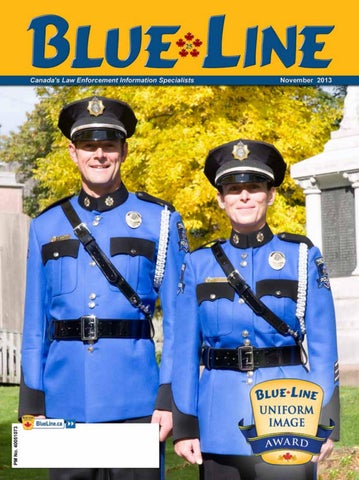
Features 6 From powder blue to royal blue
Recipient of the new Blue Line Uniform Image Award
8 More than meets the eye
The psychological influence of the police uniform
6
10 Getting it together
Harnessing the power of group buying
18 Policing is not counterinsurgency 20 Intelligence-driven transportation security 30 Renewal from a community base
Teaching Afghan police, ethics and the rule of law
Departments 38 Back of the Book – Deposits in the bank of public trust 38 BlueLinks Advertisers Directory 26 Book Review – What happened to Mickey? 24 Deep Blue – To-do list: 1. Make a to-do list 27 Dispatches 27 Holding the Line – Do debriefings help or hurt? 37 MarketPlace 5 Publisher’s Commentary – A ‘preceived’ impression is today’s reality
8 10
Case Law 33 35
Blue Line Magazine
3
Reasonable suspicion suffices for sniff search Top court split on whether police had sufficient grounds
November 2013
November 2013
4
Blue Line Magazine
Blue Line
Publisher’s Commentary by Morley Lymburner
Magazine Inc. PUBLISHER Morley S. Lymburner – publisher@blueline.ca General Manager Mary K. Lymburner – mary@blueline.ca SENIOR EDITOR Mark Reesor – editor@blueline.ca NEWS EDITOR Kathryn Lymburner – kathryn@blueline.ca CREATIVE DIRECTOR E. Jolene Dreja – jolene@blueline.ca Marketing Manager April Lensen – april@blueline.ca Contributing Writers Robert Lunney Dave Brown Mike Novakowski Nancy Colagiacomo Tony Palermo Stephanie Conn Tom Rataj Dorothy Cotton Brent Snook Mark Giles Affiliations International Association of Law Enforcement Planners Canadian Advertising Rates Data International Police Association The Canadian Press Newswire Access Copyright Subscriptions $30 per year; $50 for 2yrs; US & Foreign: $100 Advertising 888-640-3048 advertising@blueline.ca
www.blueline.ca 12A-4981 Hwy7 East, Ste 254, Markham, ON L3R 1N1 Canada P: 905-640-3048 F: 905-640-7547 blueline@blueline.ca
PRINTED IN CANADA
ISSN# 08478538 Blue Line Magazine was established in 1988 as an independent publication to inform, entertain, connect and educate those involved in the law enforcement profession. With no direct control from an enforcement agency, its opinions do not necessarily reflect those of any government or law enforcement agency. The authors, advisors, and publisher accept no liability whatsoever for any injuries to person(s) or property resulting from application or adoption of anything presented in this magazine. Readers are cautioned and advised that articles presented herein are edited and supplied for your personal awareness and should not be used for further action until appropriate guidance is received from a supervisor, Crown Attorney or other persons in authority. All material submitted for publication becomes property of Blue Line Magazine Inc. unless arrangements have been made with the publisher prior to publication. © 2013 All articles are protected by copyright. No part of this publication may be reproduced or transmitted in any form or means, electronic or mechanical, (including photocopying and recording or by any information storage or retrieval system), without prior permission. Permission to reprint may be obtained in advance from Access Copyright 1-800-893-5777.
Blue Line Magazine
A ‘preceived’ impression is today’s reality Over lunch one day a former police chief and I were lamenting the dangers street cops face these days. Today’s proliferation of guns was unimaginable some 15 years ago when he was last in uniform, he said, and patrolling the streets today would make him really paranoid. I agreed with him to a point but suggested that statistically the streets are not nearly as dangerous for cops as he might imagine. He looked somewhat surprised and I took this as my cue to continue. In the 25 years I was with the Toronto Police (formerly and awkwardly known as the Metropolitan Toronto Police Force), we lost 14 officers, I pointed out. Only three were lost in the 18 years since I left and the Toronto Police Honour Roll shows only 22 officers lost their lives in the line of duty in the 68 years prior to my signing up. “Have you ever analyzed why this was?” the chief responded, looking dumbfounded. I admitted that I had not but like to point out the statistic when I hear people suggesting how tough it is out there today. We could credit improved training, better laws and equipment or improved supervision. It could also be due to a complete attitude and behaviour shift by the population and/or police – or perhaps the increase in immigrants wishing to keep a lower police profile. The depth and breadth of such an analysis could keep criminologists and other soothsayers gainfully employed for years. To extricate myself from any deep philosophical debate, I could simply say it is a combination of all of the above. I do agree with the chief to a point, however, and feel that perhaps we need to analyze how really dangerous it can be for officers today. Although I was able to recite off the number of deaths, I could not do a comparison of the ‘walking wounded’ that may be out there. The added pressures placed on officers today creates complications and commutations which never existed in my day. The public expectation of perfect policing can attack an officer’s psyche more than their bodies. The conversation was very enlightening. Today’s officers are trained to the max, the chief pointed out, and well taught what to expect when they reach the street. They have the best equipment and a head full of 5
knowledge on subjects as varied as how to field-strip a weapon to analyzing the psychological behaviours of many of the people they may encounter. In fact, they are trained to such a high degree, he said, that we actually now could be at a stage where mistakes are bound to happen more frequently. It is the old “weakest link in the chain” theory. Use of force, for example, is far more complicated than it once was. Officers carry pepper spray, stun guns, night sticks and firearms. At one time you had only three choices – your hands, night stick or gun. Today the variables on use along with caveats on when not to use these many options can be mind boggling. In a high-pressure situation, the public, and even some managers expect each of Canada’s 67,000 police officers to work in a controlled and predictable fashion on every call, every shift, every day. Each officer must evaluate use of force options in split seconds during a potentially violent situation – and always come up with the right answer. This is only compounded by the calls where such considerations are not thought to be a factor until they suddenly develop without warning. I reflected on what he said and had to agree. What effect does all this have on the street copper who knows cameras are everywhere today? Everyone with a cell phone is their own media journalist. Every person who views a “preceived” screw-up by a cop can now post it to an audience of millions in mere seconds. Our conversation ended in a discussion of methods to counteract the Internet phenomenon. If officers are to be confronted by the most spectacular five seconds of an incident on the Internet, it would be nice if they could counter with the previous 120 seconds. Although loathe to do so, I had to admit that the day of officers wearing body cameras has probably arrived. Can we find one more clip on that uniform please?
November 2013
From powder blue to royal blue
Recipient of the new Blue Line Uniform Image Award by Olivia Schneider Det/Cst. Karen Harling didn’t have to join another police service to get a new uniform. On the same day she was presented with her 15-year service medal, Harling traded in her powder blue dress uniform for a brand new custom-fitted royal blue version – one she began creating six months before as chair of the Truro Police Department dress uniform committee. “There were a few reasons to update the official threads,” says Truro police chief Dave MacNeil. “We’ve had it since the mid-1980s. It’s powder blue and a bit dated.” He adds, laughing, “A lot of the newer officers weren’t too keen on it.” The cloth was also becoming increasingly difficult to source, he adds. The challenge was to create a new dress uniform with a fresh and current look, while maintaining the distinctive feeling of their traditional outfit. MacNeil says the first step was to research different supplier options. The committee eventually decided to go with a tailor in Fredericton which does not mass-produce uniforms. During the design process, the tailor actually opened a new location in Halifax. Harling says it was eye-opening to see November 2013
how much detail goes into one uniform. “There are about 20 different elements and they’re all customizable,” she says. “It’s a lot of decisions.” The new uniform includes a royal blue, high-necked tunic. The colour matches the blue stripe on the pants. Harling says the tailor had to do a custom dye job to get this colour – and that’s not the only thing that’s custom. The entire uniform was customized for the department. MacNeil says nothing was recycled from the old one; everything is new right down to the badge, belt, buttons and cap. However, for the sake of tradition, the new uniform incorporates a black cross-strap, an element that dates back to the 1970s. Harling’s favourite part is the cap, which is a little non-traditional for a Canadian department. “We went outside the box with the caps and chose a full-black eight-point cap,” she says. “It’s a style that’s more common in the US.” The hat also includes a custom cap badge. “We wanted to do something different; something the Truro department could be known for.” Another change is how the new outfit is fitted to each officer. The previous dress uniform was off the rack, with one fitting. The new uniform is not only custom-designed but involves three fittings. Chief MacNeil says that makes a 6
big difference. “You can feel that they’re comfortable,” he says, “and it looks more polished.” Both the public and nearby police departments have been positive about the new look. Truro police officers had a chance to participate in the design decisions, even voting on some of the elements, so the new uniform reflects the ideas of the entire department. “We’re pretty pumped about the uniform,” MacNeil says, and the first officers to wear it agree. After all her work on the project, Harling is happy with the results. At her medal ceremony, many officers complimented her on the new look. “I’m so excited and I’m just really pleased,” she says. MacNeil admits some officers miss their traditional powder blue but hopes they’ll come around to the change. “I say it’s a big change but we still stayed blue.” Andrei Master Tailors – designed and tailored uniform, www.andreitailors.com Pressed Metal Products – all badges and buttons, www.pressedmetal.ca Marlow White – hat and gloves, www.marlowwhite.com Olivia Schneider is Blue Line Magazine’s Maritime correspondent, and can be reached at olivia@blueline.ca.
Blue Line Magazine
Cyber Cop makes powerful impression
Truro Police are not newcomers to utilizing a positive image toward the betterment of their community. The most striking example was the introuduction of “Cyber Cop.” The Truro Police Service developed “Cyber” four years ago as a robotic-like mascot designed to draw the attention of local youth to the hazards of internet bullying. “This is an initiative Truro Police Service did all on its own as part of our commitment to community safety,” said Cst. Jon Keddy, the department’s school resource officer, in a Blue Line article from the December 2009 edition. The officer identified areas of concern in schools directly related to the cyber community but was concerned there were no educational programs available to teach students about potential dangers lurking on the Internet. Keddy described cyberspace as an unsupervised playground for kids and feels education is key to protecting children from online predators. The officer, with the help of two students who worked with the department in the summer of 2009, developed a curriculum to educate children about internet safety, etiquette, and protocol; including text messaging, social
networking and the overall dangers of internet crime and bullying. As part of the program’s development, Keddy approached Police Chief Dave MacNeil with an idea to create Cyber and he quickly agreed. “We’re really proud of the program,” said the chief. “Just seeing the kids’ faces. It was money well spent. It’s definitely a made-in-Truro solution for a problem that was identified in our community.” Cyber wears a shiny white and blue police suit complete with red and blue flashing lights and stands about six-and-a-half-feet tall. A company affiliated with Universal Stu-
dios in Florida manufactured the robotic cop. His slogan is Programmed For Safety and he uses interactive messaging that is known as “Cyber’s Rules” to deliver powerful anti-bullying and safety messages to children. The rules are delivered to students using a high-quality digitally animated PowerPoint presentation created by their program partner, Nova Scotia Community College Motion Animation Department at their Truro campus. Cyber has been directly involved with Truro’s three major schools, reaching more than 2,800 children and has been in demand across the province to assist other agencies.
Presence, command, image The three aspects of law enforcement authority to which all police and security agencies aspire are presence, command and image however they differ on which is the most important. Many studies indicate that image is a primary factor and unspoken asset in encouraging voluntary compliance. Appearance can be the one determining factor that improves community respect for an agency in general and the officer in particular. For many years Blue Line Magazine has looked at Canadian law enforcement attire and apparel with a view toward encouraging an atmosphere of continuous improvement from both agency and industry. Toward this end we have now set aside a single issue each year to recognize the agency which best exemplifies quality improvement and function in its uniform attire and apparel. Emphasis will be placed on the success of the image projected to the community along with the cooperative efforts of both Blue Line Magazine
members, stylists and industry manufacturers and fabricators. The Blue Line Uniform Image Award may be bestowed upon any police or parallel law enforcement agency where a uniform is a primary part of day-to-day operations. The
7
award can recognize design and style of an entire array of uniforms or one improved aspect of the uniform kit which creates a demonstrably enhanced public image. Factors considered include style, safety, comfort and innovation. Apply to be considered for this recognition by supplying appropriate photographs and supporting documentation outlining the process, goals, and achievements made in the attire and/or apparel. All submissions will be viewed by a group of judges with extensive experience in law enforcement, manufacturing, retail and design. Recipients will be the featured cover story in the November edition of Blue Line Magazine and receive a plaque of recognition suitable for display. All submissions may be made to uniforms@blueline.ca before September 15, 2014. Blue Line Magazine will also be entertaining resumes and suggestions for judges for this award up to January 31, 2014.
November 2013
More than
meets the eye
The psychological influence of the police uniform by Richard R. Johnson
Most people can identify law enforcement officers by their official police uniform. When citizens on the street need help, they scan the crowd looking for the distinct uniform of a police officer. Normally, drivers who arrive at an intersection and find someone in a police uniform directing traffic, willingly submit to that person’s hand directions. Criminals usually curb their unlawful behaviour when they spot a uniformed officer. Parents teach their children to respect and trust a person in police attire. In fact, police academy recruits relish the day they can finally wear their official uniforms. The crisp uniform of the police officer conveys power and authority. When officers put on their uniforms, citizens believe they embody stereotypes about all police officers. Research suggests that clothing has a powerful impact on how people perceive each other. The police officer’s uniform represents a tradition as old as the field of law. In fact, dark blue was the chosen colour of early British police officers to differentiate them from the British military, who wore red and white uniforms. Today, most law enforcement agencies select uniforms generally dark in colour with a somewhat paramilitary appearance. Agencies prefer dark colours for their ease in cleaning and their ability to help conceal the wearer in tactical situations. However, why do most agencies insist patrol officers dress in a uniform? Perhaps the uniform psychologically influences the public’s perception of officers. The social significance of clothing Individuals seek clues about others from their appearance. Clothing provides one powerful clue to an individual’s background and serves as a mental shortcut to identify a person’s sex, status, group membership, legitimacy, authority and occupation. Clothing and physical appearance are important in the initial development of social relationships. Studies have revealed that physical appearance, including clothing, remains the factor used most often in developing the first November 2013
impression of someone and has an even greater effect than personality. In early social interactions, clothing has a significant psychological influence on people’s perceptions. In one study, personnel administrators rated the competency of similar female job applicants. They consistently rated the women in conservative, slightly masculine attire as the most competent. In another experiment, both high school students and teachers rated pictures of female athletes dressed either in uniforms or casual 8
clothes. Participants perceived athletes in uniform as being more professional, possessing higher ability and having more “team spirit.” Similarly, other research revealed that both students and teachers rated photos of students dressed in private-school-type uniforms as having higher scholastic ability. The uniform worn by a police officer elicits stereotypes about that person’s status, authority, attitudes and motivations. The police uniform identifies a person with powers to arrest and use force and establishes Blue Line Magazine
order and conformity within the ranks of those who wear it by suppressing individuality. The police uniform can have extraordinary psychological and physical impact. Depending on the background of the citizen, the police uniform can elicit emotions ranging from pride and respect to fear and anger. The power of the police uniform research has supported suggestions about the police uniform’s power and authority. In one study, individuals ranked 25 different occupational uniforms by several categories of feeling. The test subjects consistently ranked the police uniform as the one most likely to include feelings of safety. In another experiment, participants consistently rated models as more competent, reliable, intelligent and helpful when pictured in a police uniform rather than in casual clothes. When an individual wearing a police-style uniform stood on a sidewalk near a corner, drivers committed fewer turn violations at that intersection. This occurred even though the uniform did not represent a real police department in the area and the individual did not display a badge or weapon. In one experiment, a researcher randomly approached pedestrians on a city street and ordered them to either pick up a paper bag, give a dime to another person, or step back from a bus stop. The researcher alternately wore casual clothes, a milk delivery uniform or a policestyle uniform. Only the last resulted in a high rate of cooperation from citizens. Moreover, obedience to the police-style uniform usually continued even after the researcher walked away and did not watch to ensure compliance. To hat or not to hat Although the police uniform in general suggests the authority of the wearer, details about a police office’s uniform, such as the style of hat, or the tailoring, can influence the level of authority emanating from the officer. Study participants in one experiment evaluated photographs of uniformed male and female police officers wearing nine different styles of headgear, including no hat at all. Even though psychological tests showed the participants perceived the officers to have authority under all of the circumstances, the type of hat varied the level of authority
Blue Line Magazine
attributed to the officer. The traditional forage cap and Stetson conveyed more authority than the baseball cap or no hat at all.
wearing dark business suits as more powerful and competent than those who wore lighter coloured suits.
Ditching the tunic Many studies have addressed the influence of eliminating the paramilitary style of the police uniform. In 1969, the Menlo Park, California, police department discontinued their traditional navy blue, paramilitary-style uniforms and adopted a non-traditional uniform hoping to improve police/community relations. The new, non-traditional uniform consisted of a forest green blazer, black slacks, a white shirt and black tie. Officers displayed their badges on the blazer and concealed their weapons under their coat. When other agencies heard about Menlo Park’s attempt, more than 400 other police departments in the U.S. followed suit (excuse the pun). In 1977, after using the blazer-style uniform for eight years, the Menlo Park Police Department determined that it did not command respect; therefore they returned to a traditional, paramilitary-style uniform. During the four years after the Menlo Park police returned to a traditional uniform, the number of assaults on their officers dropped steadily. Experiments with hats and the style of police uniform suggest changes in the design of a police uniform can have an adverse effect on the perceived authority, power and ability to control.
Safety concerns In addition to colour, the condition of a police officer’s uniform and equipment can have an impact on the officer’s safety. Interviews with prison inmates who have murdered police officers indicate that the killers often visually “sized up” the officer before deciding to use violence. If the officer looked or acted “unprofessional” in the assailant’s eyes, then the assailant felt capable of successfully resisting the officer. A dirty or wrinkled uniform or a badly worn duty belt may convey to suspects that officers have complacent attitudes about their job. This complacency can invite violence.
The influence of colour Many police departments wear darker colours. Just as with the style of the police uniform, the colour of the uniform also has meaning. Psychological tests have found individuals associate colours with specific moods. For example, people usually associate red with excitement and stimulation. Tests have also found individuals associate the colour blue with feelings of security and comfort and the colour black with power and strength. Cultural influences did not affect their results, which did not vary with the race of the students. Colour has a considerable impact on clothing and perceptions of the wearer. When people rated pictures of models for attractiveness, clothing colour appeared the most common determinant. Individuals perceived job applicants
9
Conclusions The uniform of a police officer conveys the power and authority of the person wearing it. Research proves clothing, including the police uniform, has a powerful psychological impact. When individuals come into contact with each other, they subconsciously search for clues about the other person to understand the context of the encounter. The police uniform represents a powerfuI clue to the wearer’s authority, capability and status. Additionally, research has revealed the uniform has a subconscious psychological influence on people, based on the person’s preconceived feelings about police officers. Citizens in the presence of a person in a police uniform cooperate more and curb their illegal or deviant behaviours. Selecting a uniform style, following regulations on properly wearing the uniform, maintaining uniforms, and designing policies to address when officers may wear plainclothes, should command serious attention from department managers. After all, the uniform stands as one of the most important visual representations of the law enforcement profession. At the time of original publication Richard R. Johnson, formerly an Indiana State Trooper and military police officer, was an investigator with the Kane County, Illinois State’s Attorney Office and criminal justice professor at Waubonsee Community College, Sugar Grove Illinois.
November 2013
Getting it together Harnessing the power of group buying
by Tony Palermo UK police services are “still wasting millions by not buying jointly in bulk,” the UK Guardian reported in a Sept. 17, 2013 article. The Home Office, responsible for immigration, security, and law and order, set up a dedicated online hub in 2011 to buy police equipment. The expectation was that all 43 forces across England and Wales would be using the procurement site by June 2012, but, according to the article, fewer than half of the services had used it. In fact, only two per cent of all police equipment purchased last year was bought through the site. OPP Supply Services Manager Jackie Reilly wonders why. “Police agencies can really benefit from the buying power of a cooperative purchasing group,” says Reilly, who is also chair of the clothing and equipment side of Ontario’s Police Cooperative Purchasing Group (PCPG). Created in 1996 on the recommendation of the OACP, it is an independent consortium of Ontario police services, separate from the OPP. The PCPG’s purpose is to share equipment, procure information and harness the negotiating power of buying in bulk. The group is made up of both civilian and November 2013
sworn officer quartermasters from across the 20 to 25 Ontario police services who regularly attend the quarterly meetings, though it is open to all 64 Ontario police services. Participation is voluntary and a service doesn’t have to be a sitting member to take advantage of the contracts the group negotiates. In general, the PCPG assigns a member agency – typically a larger service like the OPP or Toronto police – to be the lead for a particular item. As the lead agency, the service is responsible for testing and evaluating it and preparing the Request for Proposal (RFP) on behalf of every Ontario police service. In preparing the RFP, the lead agency takes feedback from all members on what they expect of the item and the options that should be built in to the main contract. For example, some services prefer a certain number of belt loops or type of stripe on a set of pants. Other considerations include expected delivery term and penalties for vendors who don’t meet their obligations. Once everything is agreed upon, the RFP is posted and awarded according to the municipal (or in the case of the OPP, provincial) procurement guidelines. The contract is then posted on the PCPG’s secure procurement 10
web site and made available to every service across Ontario, if they wish to use it. It’s important to note that, with the exception of the lead agency which negotiated the contract, Ontario police services aren’t required to buy that particular item from the vendor; however, negotiated contracts tend to offer considerable savings because vendors prepare their bids knowing they can potentially sell that item to every agency in Ontario. While the cost savings the PCPG buying power offers is attractive, having a collective group presents many other advantages deeper than those on-the-surface savings. “Consider how much it costs to research equipment, test it, put out a formal tender, negotiate pricing and then procure the equipment, especially in a larger service,” says Reilly. “That’s a lot of money and resources. By negotiating contracts with vendors on behalf of everyone, the PCPG saves individual agencies from having to do everything themselves.” How items are tested As an example, the Ottawa Police Service (OPS) is the lead agency for three items, including a winter jacket. The OPS has its own Blue Line Magazine
clothing committee comprised of about 30 members across various sections, including patrol, health & safety, CID and the association. The OPS clothing committee meets three to four times a year and continually looks at new products and whether it should formally test them. “As an estimate, I’d say we look at about four to five items each meeting, of which maybe two to three go to testing,” says OPS quartermaster supervisor Bill Keeler. “If we decide to test an item, it’s a formal process so a lot of time and resources goes into formally testing it.” The OPS ended up evaluating winter jackets for more than a year before deciding on a suitable one. Factors considered included breathability, comfort, warmth, water resistance, how well it withstood repeated washing, the perception of the public and fellow officers and how it performed under day-to-day use by members. “No one has an unlimited amount of money or time,” says Keeler. “By sharing the formal testing of standard issue police equipment, having a group like the PCPG saves Ontario’s police services a lot in terms of resources and time too.” Smaller services also really benefit from the PCPG across the board. “There’s no real disadvantage to participating,” notes Gananoque Police Service Chief Garry Hull. “It doesn’t cost anything to sign up and most of the work in terms of procuring the right equipment is done by them.” Gananoque has about 15 sworn members and, like most smaller services, tests equipment informally. Evaluations are typically done by giving the equipment to a couple of officers who report back on whether they like the item. Groups like the PCPG can take a lot of the upfront guesswork out of deciding whether an item is worth evaluating. Smaller services also definitely benefit from the group buying power of a PCPG contract but it goes beyond just those initial savings, says Hull. Guaranteed delivery times and penalties if the vendor doesn’t meet delivery obligations are huge benefits that would be difficult for a smaller police service to negotiate. “I’m a real stickler for deliver times,” says Hull. “I’m ordering equipment as I need it. So when I need it, I need it delivered within a reasonable time.” Hull also notes that the PCPG contracts gives agencies negotiating power with other vendors. “If you know the PCPG price, it’s not to say that other companies aren’t willing to compete and negotiate if you prefer to deal with a different vendor or select a different product.” Miramichi Police Force Supt. Randy Hansen would like to see something similar to the PCPG created in New Brunswick. As it stands now, agencies in the province share information on an informal basis, if at all. Blue Line Magazine
Chief Garry Hull
“Several years ago they attempted a similar initiative in New Brunswick. Unfortunately they could not get everyone on the same page and it did not go any further. There have been a lot of changes in police administration personnel over the years. I think it’s time to revisit this.” PCPG clothing and equipment chair Jackie Reilly says she receives calls from services across the country and is happy to talk about the group and its negotiated contracts. “I can’t really think of any disadvantages to a group like the PCPG,” says Reilly. “Aside from the obvious dollar savings, there’s a lot of knowledge and experience that is brought together in the group, so it also becomes a great resource and source of information.” Tony is a freelance writer and Blue Line Magazine’s eastern Ontario correspondent. He can be reached at tony@blueline.ca
11
November 2013
Realistic Risk The rules on care or control investigations
by Mauro Succi and Dave McCormack Canada’s Supreme Court defined the term “care or control,” as found under section 253(1) of the Criminal Code, as: 1. an intentional course of conduct with a motor vehicle; 2. by a person whose ability to drive is impaired or whose blood alcohol level exceeds the legal limit; 3. in circumstances that create a realistic risk of danger to persons or property.1 The last aspect of this definition has been the most difficult to prove in court, particularly with a single motor vehicle accident or a driver found sleeping in their vehicle. In these situations, officers often have statements alone to form their reasonable grounds for the care or control offence. The difficulty arises when these statements are excluded during a voir dire, which usually results in the accused being acquitted. The reason courts frequently exclude these statements stems from a 1999 Supreme Court ruling. In situations involving accidents, the court ruled that statements taken from a driver involved in a collision cannot automatically be later used during a criminal proceeding because of the provincial mandatory requirement to report. The protection afforded by the principle against self-incrimination does not vary according to the relative importance of the selfincriminatory information sought to be used. If s.7 is engaged by the circumstances surrounding the admission of a compelled statement, the concern with self-incrimination applies in relation to all of the information transmitted in the compelled statement. Immunity against the use of an accident report in subsequent criminal proceedings is itself a balancing between society’s goal of discerning the truth and the fundamental importance for the individual of not being compelled to self-incriminate. The balance which must be struck in the context of the reporting provision of the Motor Vehicle Act is between a driver’s right not to be compelled to self-incriminate in criminal proceedings and the province’s interest in highway safety.2 That is not to say that courts will routinely exclude statements taken from a possible impaired driver involved in a collision. It is all about the initial approach an officer takes when investigating. The law The essential elements of care or control are: 1. An intentional course of conduct associated with a motor vehicle; 2. By a person whose ability to drive is impaired or whose blood alcohol level exceeds the legal limit; 3. In circumstances that create a realistic risk of danger to persons or property. November 2013
The risk of danger must be realistic. This line of thinking is found in the presumption in law set out in s. 258(1)(a) of the Criminal Code, 3 which provides that an accused found in a motor vehicle driver’s seat is automatically in care or control. However, the defence can rebut the presumption by introducing evidence that the accused had no intention to drive. Parliament’s purpose in enacting the care or control provision was preventive and directed at the inherent danger that normally arises from the mere “combination of alcohol and automobile”. With respect, however, I believe this supports my view that Parliament’s intention in enacting s. 253(1) of the Criminal Code was to criminalize only conduct that creates a realistic risk of danger.4 It is clear that an intention to set the vehicle in motion is enough to create the risk of danger needed to be convicted of care or control. On the other hand, an accused who satisfies the court that he/she had no intention to set the vehicle in motion can still be convicted if it’s proven a present realistic risk of danger existed. In the absence of the present intention to drive, a realistic risk of danger may arise in at least three ways: 1. An inebriated person who initially does not intend to drive may later, while still impaired, change his or her mind and proceed to do so; 2. An inebriated person behind the wheel may unintentionally set the vehicle in motion; 3. T hrough negligence, bad judgement or otherwise, a stationary or inoperable vehicle may endanger persons or property.5 The issue to be determined on the facts of each case is whether any acts by the accused could cause the vehicle to become a danger, whether by putting it in motion or in some other way.6 Therefore, an officer’s observations noted at the scene are critical. They should be prepared to articulate in detail all of the factors that may prove the third element of the realistic risk of danger. 12
Investigating collisions (incriminating statements) In R. v. White,7 the accused struck and killed a pedestrian. White fled the scene and phoned police the next day to report the collision. A police officer went to the residence, heard her version of the event and gave White her Charter rights. White then spoke to her lawyer and subsequently advised the officer that she, on her lawyer’s advice, would not provide a written statement about the collision. In response to a question by the officer, she confirmed some elements of previous statements. White had told the officer she swerved to avoid a deer and struck the person. She also admitted to panicking and fleeing the scene. The officer advised White that even though she wasn’t required to provide a written statement, she would be required to provide a statement under the Motor Vehicle Act. White was later charged with failing to stop at the scene of an accident under the Criminal Code. At the trial, the Crown sought to introduce three conversations the accused had with the officer. On a voir dire, White testified she knew immediately on being involved in a collision that she was under a duty to report it. She stated that she felt the officer came to take a collision report and that she was obligated to speak to him about it. Supreme Court ruling It is now well-established that there is a principle against self-incrimination, a code of fundamental justice under s. 7 of the Charter. The defence argued that all White’s statements should be excluded because of the provincial obligation to report the collision; thus contravening the principle of self-incrimination. The Crown disagreed, arguing that the three statements made under the Motor Vehicle Act did not violate this principle. The Crown argued that: 1) Driving is a regulated activity; 2) All drivers are required to obtain a licence to drive; and 3) In so doing, drivers automatically give free and informed consent to all of the rules of the road, including the requirement to report a collision. Therefore, it cannot be said a driver is coerced to provide a collision report when the occasion arises. The Supreme Court disagreed and excluded all statements made to the officer. The spontaneous utterances of a driver, occurring very shortly after an accident, are exactly the type of communication that the principle against self-incrimination is designed to protect… A driver who makes a statement pursuant to the statutory duty (traffic statute)… is entitled, at least, to use immunity in criminal proceedings in relation to the contents of that statement.8 Further, the court ruled there is an onus on police to clearly explain when a statement is being taken pursuant to the provincial law Blue Line Magazine
requirement or when it is being taken for some other purpose (i.e. possible criminal matter). It set forth a simple question for the courts to decide whether to admit the statements: did the driver give the collision report on the basis of honest and reasonably held belief that they were required to report by law? Lastly, the court concluded the accused must establish on a balance of probabilities that he or she was compelled to provide the statement in the first place and that it is open to the Crown to rebut that an accused was compelled. The rules: (White decision) 1. Statements made under compulsion of a provincial traffic statute are not admissible in a criminal proceeding. 2. Onus of establishing that statements were made under compulsion is on the accused. 3. Accuseds must have reasonably and honestly believed, at the time they gave the statement, that they were required by law to report the collision. The belief may be mistaken and the accused need not have a legal understanding of the statutory duty. 4. Police must clearly delineate for the accused the start and end points of the collision report, otherwise it is reasonable for them to assume they continue to be subject to the statutory duty, regardless of the police purpose in obtaining the statement.9 Post White As a result of the White decision, it was feared mandatory reporting in various provincial legislation governing collisions would create
Blue Line Magazine
many difficulties for police because of statements being excluded from evidence. This fear wasn’t without merit.10 An Ontario Court of Appeal decision addressed this matter (R. v. Soules). The accused was one of four drivers involved in a string of collisions. When the officer asked what happened, Soules quickly said he was driving his vehicle and the officer immediately suspected that he had alcohol in his system. The accused complied with an ASD demand and failed. Soules was arrested for Over 80, advised of his right to counsel and eventually charged with the offence. The trial judge acquitted him, finding that his s.7 and 10(b) Charter rights had been violated, and excluded the statements, citing sections 199 and 200 of the Ontario Highway Traffic Act, which contain the statutory obligations to report accidents on the highway.11 The Ontario Court of Appeal agreed. However, more importantly, the appeal court disagreed with the Crown’s submission that the interpretation of White “has the potential to cripple the investigation of drinking and driving offences where a collision has occurred”. 12 The Supreme Court stated two ways an officer might investigate a collision that may evolve to a criminal matter without concern of the statements being excluded at trial, which was reiterated by the Ontario appeal court. They are: 1) Police can inform the driver that they intend to secure the details of the accident report from sources other than the driver, thus terminating the statutory duty to report; or 2) Police can tell the driver that they will postpone the taking of an accident report until
13
after they have questioned him or her.13 “Given the above, I think it is an unfounded argument that use immunity arising from the information mandated by provincial legislation such as that in this case has the potential to cripple the investigation of drinking and driving offences where a collision has occurred”.14 Conclusion Care or control investigations present a number of new challenges for police. As we have seen, the courts require evidence that a realistic risk of danger existed. Therefore, an officer’s observations, supported with detailed notes, are critical. The investigating officer should be prepared to articulate in detail all of the reasons that led to their belief of the risk that was present. Some of these factors include: • Was the accused sitting or sleeping in the driver’s seat? (presumption in law) • Was the accused sleeping? • Was the seat reclined or in full upright position? • What was the position of the accused’s legs and upper torso?; • Were the brake lights illuminated? (foot resting on brake) • Was the emergency brake on? • Was the seat belt on? • What gear was the vehicle in? (park, drive, neutral) • Were the accused’s shoes on? • Was the engine running? • Was the engine compartment warm? • Where was the vehicle located? (parking lot, highway, ditch)
November 2013
• Did the driver leave the vehicle and re-enter? • Were other lights or accessories on? • Were there any witnesses? (caller reporting a suspicious vehicle, etc.) • Is there evidence to support the accused’s alternate plan? (i.e taxi, friends attending) • Was a tow truck called or on scene? (statements made to tow truck operator, etc.) Lastly, officers are reminded that any suspects in a collision involving a possible impaired offence should be told in simple and clear language from the outset that the accident report will be postponed; thus, avoiding any possible confusion that a statement is mandatory in fulfilling the provincial requirement for the collision report. Doing this would place the onus back onto the accused during any voir dire in arguing that he or she was compelled to provide the statement. 1. R. v. Boudreault, S.C.C. 2012 2. R. v. White, S.C.C. 1999 3. 258(1)(a) C.C. - shall be deemed to have had the care or control of the vehicle . . . unless the accused establishes that the accused did not occupy that seat or position for the purpose of setting the vehicle . . . in motion . . .; 4, 5. Boudreault supra 6. R. v. Wren O.C.A. 2000 7. R. v. White S.C.C. 1999 8, 9. R. v. White (supra) 10. R v. Powers, B.C.C.A. 2006 - The Crown appealed the accused’s acquittal of drive over 80. The British Columbia Court of Appeal dismissed the appeal, finding the accused’s statement that he drove the vehicle involved in a collision was given in the context of section 67 of the B.C. Motor Vehicle Act. The officer asked at the collision scene, “Who is the driver of the car in the ditch?” The accused
November 2013
replied that he was. The trial judge, relying upon Powers’ evidence on the voir dire that he admitted to being the driver because he thought he was required to answer the police officer’s question and report the accident to police, held that Powers gave the report on the basis of an honest and reasonably held belief that he was required by law to report the accident to the police officer. R. v. Velandia, ABPC 2012 – a uniform officer on patrol in Calgary came upon a motor vehicle collision. The officer had not been dispatched to the accident, but simply “stumbled upon it”. The officer testified he was of the opinion that the collision had recently occurred. When asked what had happened, the female driver admitted that she had been cut off by another vehicle. The officer smelled alcohol and, after forming reasonable grounds for suspicion, made an ASD demand. The driver failed and was charged. At trial, the justice excluded the statements made to the officer, concluding: I am of the view that the provisions of the Alberta Traffic Safety Act have, for the purposes of this analysis, the same degree and nature of compulsion as did the statutes in Ontario and British Columbia. In my view, the law as set forth in R v. White, supra, applies to the statements made by Ms. Velandia to Constable Frank. She made those statements because she had a reasonable and honest belief that she was compelled by law to answer the police officer’s questions. She was correct in that belief. In my view, the admission of those statements into this trial would result in a breach of Ms. Velandia’s section 7 right to silence. 11 199(1) Ontario Highway Traffic Act - Every person in charge of a motor vehicle or street car who is directly or indirectly involved in an accident shall, if the accident results in personal injuries or in damage to property apparently exceeding an amount prescribed by regulation, report the accident forthwith to the nearest police officer and furnish him or her with the information concerning the accident as may be required by the officer under subsection (3). (1.1) If, on reporting the accident to the nearest police officer under subsection (1), the person is directed by the officer to report the accident at a specified location, the person shall not furnish the officer described in subsection (1) with
14
the information concerning the accident but shall forthwith attend at the specified location and report the accident there to a police officer and furnish him or her with the information concerning the accident as may be required by the officer under subsection (3). (2) Where the person is physically incapable of making a report and there is another occupant of the motor vehicle, the occupant shall make the report. (3) A police officer receiving a report of an accident, as required by this section, shall secure from the person making the report, or by other inquiries where necessary, the particulars of the accident, the persons involved, the extent of the personal injuries or property damage, if any and the other information that may be necessary to complete a written report concerning the accident and shall forward the report to the Registrar within ten days of the accident. (4) The report of a police officer under subsection (3) shall be in the form that is approved by the Minister. 200(1) Ontario Highway Traffic Act - Where an accident occurs on a highway, every person in charge of a vehicle or street car that is directly or indirectly involved in the accident shall, (a) remain at or immediately return to the scene of the accident; (b) render all possible assistance; and (c) upon request, give in writing to anyone sustaining loss or injury or to any police officer or to any witness his or her name, address, driver’s licence number and jurisdiction of issuance, motor vehicle liability insurance policy and policy number, name and address of the registered owner of the vehicle and the vehicle permit number. (2) Every person who contravenes this section is guilty of an offence and on conviction is liable to a fine of not less than $200 and not more than $1,000 or to imprisonment for a term of not more than six months, or to both and in addition the person’s licence or permit may be suspended for a period of not more than two years. 12 R. v. Soulas, O.C.A. 2011 13, 14 R. v. Soulas, (supra) Mauro Succi and Dave McCormack are instructors with the Ontario Police College. Email them at Mauro.Succi@ ontario.ca or Dave.McCormack@ontario.ca for a more complete dialogue on this subject.
Blue Line Magazine
Prior to moving to a county-wide, non-union police service, Camden City Police Chief Scott Thomson claimed he had shooting investigations “backlogging like burglary cases.” Half of his force was laid off, and the city stated expensive benefits in the police union contract were preventing them from hiring more cops. by Scott Villers After 144 years, New Jersey’s Camden Police Department was disbanded on April 30, 2013 and replaced by a newly formed county agency. The city had run out of money and could no longer afford its own police service. History The 19th and first half of the 20th Century were prosperous times for Camden, which borders Philadelphia. Numerous businesses and industries moved into the city, including a major shipyard, Campbell Soup and RCA. The good times did not last and Camden was declining economically by the 1970s. As businesses and industry shut down or left, the unemployment rate rose, resulting in many residents moving away. The middle class fled because of increasing crime made worse by the introduction of crack cocaine in the ‘80s. Camden’s population dropped to just 77,000 in 2011, down from a 1950 peak of 124,000. Start of the crisis The decline meant a reduced tax base, which reached a tipping point following the 2008 economic crisis. All city departments were cut, including police. Another massive budget cut in 2010 led to the announced lay off of 163 officers, almost half its total strength of 368. An infusion of state money reduced the layoff to 98 but the cuts were still a body blow to a department reeling from an earlier recruitment freeze, which saw officer numbers fall from 450 in 2005. City officials complained that the police union refused to budge on generous pensions and other benefits it had received during the good times, effectively pricing local officers out of a job. Prior to the budget cuts, Camden police had Blue Line Magazine
grown from it’s founding in 1868 to a full-range department with investigative, swat, mounted and K-9 units. The cut in manpower resulted in a major restructuring, including trimming or disbanding units. Desk officers were redeployed to patrol duty and even chief Scott Thomson admitted in a 2011 interview with the New York Times that he had made five arrests since the layoffs began. The average number of cars on the road dropped from 20 to 12. Despite a massive increase in crime, the detective unit was cut. Homicides increased to 67 in 2012 from 40 in 2010. All categories of crime shot up, resulting in Camden being described as the most dangerous city in the United States. Camden’s only growth industry was crime. The city had some 170 drug markets and 600 registered sex offenders. ‘We don’t have any real policing in Camden,” one resident said. “They’re just out here to pick up the bodies.” The beginning of the end The layoffs did little to stem the budget crisis so the city began looking at other policing options. The reality was obvious; the city could no longer afford its police. Camden announced a deal in August 2012 with neighboring Camden County to form a new agency; the Camden County Police Department. Residents and the police union fought the move but the courts sided with the city plan. Camden would be policed by a Metro division of the new county department, which would also police 20 area towns. The county department had lower salaries, benefits, and pensions and drew from an expanded tax base in the more prosperous Camden County. The new era The new police department currently has 15
261 officers and 61 civilian support staff and expects to expand to 400 officers by the end of the year. Thomson is the chief of the new agency, which includes more than 100 former Camden city police officers. Time will tell if this new era in policing is effective in reducing crime in a cost-effective way. Camden’s dire circumstances resulted in a radical solution to the problem of affordable policing. This is not just a problem in the United States but across the world and many police services are meeting the challenge through new and innovative ideas. Canada Canadian police budgets are also under scrutiny. A number of smaller Ontario police services have been disbanded as municipalities signed contracts with the Ontario Provincial Police to save money. Larger agencies like the Toronto Police Service are also dealing with reduced budgets. Managers recently decided to replace sworn officers who carry out booking duties with lower paid court officers. The move is not only innovative but also cost effective. In another example of cost cutting, Scotland’s eight regional police services recently merged to form a national police service. Like Camden, the move was dictated by reduced budgets and a need to cut administrative costs. The lesson of Camden is that police cannot take funding for granted. Innovative, cost effective policing methods must be found to avoid the fate of services like Camden. Scott Villers is a constable with the Toronto police Service and a freelance writer with Blue Line Magazine. He can be contacted through publisher@blueline.ca.
November 2013
Order of Merit
of the Police Forces
His Excellency the Right Honourable David Johnston, Governor General of Canada, presided over an investiture ceremony for the Order of Merit of the Police Forces, held at the Residence of the Governor General at the Citadelle of Québec, on Friday, October 4, 2013. The Governor General, who is chancellor of the Order, bestowed the honour on one Commander, nine Officers and thirteen Members. COMMANDER Comm. Christopher D. Lewis, C.O.M. This is a promotion within the Order. Ontario Provincial Police, Orillia, Ont.
OFFICERS Chief Keith J. Atkinson, O.O.M. This is a promotion within the Order. Brandon Police Service, MB
Chief Paul Douglas Cook, O.O.M. This is a promotion within the Order. North Bay Police Service, ON. Chief Richard Hanson, O.O.M. This is a promotion within the Order. Calgary Police Service, AB
Chief Roderick Robert Knecht, O.O.M. This is a promotion within the Order. Edmonton Police Service, AB Director Marc Parent, O.O.M. This is a promotion within the Order. Service de police de la ville de Montréal, QC
2013 Appointments – PART II
Chief Daniel Colin Parkinson, O.O.M. This is a promotion within the Order. Cornwall Community Police Service, ON
Det. Sgt. Leonard Gordon Isnor, M.O.M. Ontario Provincial Police, Orillia, ON
Chief Constable Robert A. Rich, O.O.M. This is a promotion within the Order. Abbotsford Police Department, BC
Deputy Comm. Douglas Lang, M.O.M. Royal Canadian Mounted Police, Ottawa, ON
Dpt. Drt. General Marcel Savard, O.O.M. Sûreté du Québec, Montréal, QC
Deputy Chief Robert D. Morin, M.O.M. Regina Police Service, SK
Spt. Donald J.J. Spicer, O.O.M. This is a promotion within the Order. Halifax Regional Police Service, NS
MEMBERS Constable Michael Arruda, M.O.M. Service de police de la ville de Montréal, QC
Chief Spt. Joseph Oliver, M.O.M. Royal Canadian Mounted Police, Ottawa, ON
Inspector Adua Porteous, M.O.M. Vancouver Police Department, BC
Spt. Paul Richards, M.O.M. Royal Canadian Mounted Police, Vancouver, BC
Chief Spt. Donald William Bell, M.O.M. Ontario Provincial Police, Aurora, ON
Inspector Allan Godfrey Sauve, M.O.M. Canadian Pacific Police Service, AB
Sgt. Colin Evan Lamont Brown, M.O.M. Victoria Police Department, BC
Chaplain James E. Turner, M.O.M. Royal Canadian Mounted Police, Vancouver, BC
Sgt. Charles Dubois, M.O.M. Service de police de la ville de Montréal, QC
Detective Sgt. Benoit Vigeant, M.O.M. Service de police de la ville de Montréal, QC
Please note that the information in this program reflects the rank and posting of the members at the time of their appointment to the Order of Merit of the Police Forces. Photos: MCpl Vincent Carbonneau November 2013
16
Blue Line Magazine
Threats not something you
‘put up with’
by Leila Daoud Det. Colin Leathem understands how serious threats can be. The seasoned investigator devoted more than two decades of his career to policing in the United Kingdom and later as a member of the Special Branch, Britain’s counter-terrorism agency. Throughout his career, Leathem has sat across the table from the people society fears most. “I’ve interrogated a wide variety of potential threats, from common, everyday threats to ardent members of provisional IRA, IRA sympathy groups and Loyalist terrorists. I’ve even interviewed Osama Bin Laden’s bodyguard when he was flagged coming in to the UK under an alias.” Leathem took on a new adventure six years ago when he moved to Canada to join the Edmonton Police Service as a detective in the threat assessment unit. It receives between two and three threat notifications a day and creates and manages an average of 15 threat assessment profiles a month. Leathem takes all threats seriously. “We never write a file off and close it. The whole point of threat assessment is that we keep ongoing files on individuals and we keep monitoring the situation.” Leathem explains that sometimes the biggest challenge in dealing with threat assessment comes from the police officers who feel threats of harm against them or their families is a normal part of their job; something they have to put up with. “Many times they have this attitude of ‘I’m strong, I’m a police officer, I don’t need to run to threat assessment or employee assistance. It’s just part of my job,’ but it’s not,” emphasized Leathem. “Your job is to patrol, protect and to serve but you also have a responsibility to yourself and to your family to be safe.” Sometimes officers don’t want to bring up a specific threat made to them because of the fear of having to disclose what happened during an incident. “Confidentiality is a huge thing in this office. Let’s be honest, if the member is worried about a professional standards branch complaint, the member will hold back information about what was really said or done during the conversation with the threatening individual. When they are through the doors of my office, they have to be honest; they have to know that what they say here stays here. Knowing that this office is fully confidential, that allows the member to open up.” Once a member comes to the unit with a report, Leathem will conduct a threat assessment profile using standardized tools. For the next six months the unit will keep up with Blue Line Magazine
the member, asking about any other threats, activity, concerns, etc. Leathem makes sure members know he is there for them if they need anything. If the situation escalates, there are a number of things EPS can do for the individual being threatened, including: • Personal protection plans;
17
• Providing advice to officers on how to change their routine; • Making sure members are walked to their car; • Home panic alarms directly linked into HQ or the RCMP if the member lives outside of Edmonton; and • Recommendations at the divisional level to allow the member to bring their CAW, OC spray or service weapon home. Accurate threat assessment is a passion for Leathem. The experienced officer with a quick smile gets serious when explaining why it means so much to him. “I have six good friends from my school days. The kind of friends you can go months without speaking to, but when you call, you just pick up where you left off. Of the six of us, only two of our fathers died of natural causes. The others were killed by sectarian violence in Northern Ireland. Threat assessment isn’t just my job, it’s personal for me.” Leila Daoud is a communications advisor for the Corporate Communications Section of the Edmonton Police Service. Contact her at leila.daoud@edmontonpolice.ca for more information.
November 2013
Policing is not
counterinsurgency by Ken Molloy There’s recently been interest in using counterinsurgency methodology to combat crime in North America.1 Returning veterans have suggested policing methods based on their training and skills combating insurgents in Iraq and Afghanistan. Counterinsurgency does not lend itself as a model for policing and its tools are not available to Canadian police. Counterinsurgency is designed to defeat a group that is trying to take political control away from the legitimate government through arms. The American Revolution of 1776 was an insurgency and the British attempts to stop it were a counterinsurgency operation. Geronimo and the Apache fight against the United States in the 1800s was also an insurgency. As with most forms of warfare, insurgency and counterinsurgency have evolved over time. The current situation in both Afghanistan and Iraq represent an insurgency war; there is a legitimate authority struggling with a shadow group, the Taliban or Al-Qaeda, that is trying to seize power. 2 Military counterinsurgency operations are designed to stop this shift in political power and support the legitimate authority in maintaining its role as the government. Counterinsurgency operations use specific tools to achieve the aims of the government: control of the population, arbitrary detention and extraordinary measures and resources. Policing in Canada is governed by the courts and the law that prevents some of these tools from being used; budgets and resource limitations prevent the use of others. Population control is based on the belief that insurgents can be separated from the population, denying them the ability to hide amongst civilians. 3 In counterinsurgency operations, this has sometimes been attempted by forcibly moving citizens. In Vietnam and Algeria, villages were moved and the former inhabited areas turned into free-fire zones where no law abiding citizen should be. In Malaysia, the British accomplished population control by issuing identification cards and mandating their use at control points. In Canada, police do not have the ability to force citizens, including criminals, to produce identification without cause, nor can populations be moved from areas of the city, so gangs cannot hide amongst honest citizens. Arbitrary detention has long been a hallmark of counterinsurgency operations (military theory uses different names for this concept, but it comes down to the ability to detain people).4 The capability to take suspected insurgents into custody is key to preventing attacks on government or civilians. November 2013
The French used detention in Algeria and the British in Northern Ireland, where laws were passed to allow the detention of individuals for 72 hours without a court appearance, involvement of legal counsel or notification of family.5 In Iraq and Afghanistan, detention is available to the military as a means to deal with suspected insurgents; searches of residences and businesses can be done without a judicial authorization. Canadian police do not have that option; the Charter of Rights and Freedoms forbids arbitrary detention and requires that a person be told why they are being detained and given the right to counsel. Searches require legitimate warrantless authority, or a prior judicial authorization – restrictions not placed on counterinsurgency operations. The United States government sanctioned the use of extraordinary measures to gather information from suspected insurgents. This has included water boarding, rendition and even removal to Guantanamo Bay, to aid in interrogations.6 British operations in Northern Ireland used white noise, sleep deprivation and stress positions to break down prisoners and gain information.7 The French forces in Algeria are known to have used torture.8 None of these methods are available to Canadian police officers. Counterinsurgency operations have extraordinary resources and its doctrine preaches using air power to gain strategic and tactical advantage. While helicopters are gaining in popularity for policing, they are not unlimited. More importantly, counterinsurgency 18
operations can rely on overwhelming manpower resources that policing cannot match. US General Petraeus wrote about and used in Iraq ‘surge of forces’ to attack insurgents.9 The British Army in Operation Motorman used the same theory to combat insurgents in Northern Ireland, adding 4,000 extra troops to combat the Irish Republican Army.10 No Canadian police agency has that number of spare officers sitting idle to allow a ‘surge’ in operations. If a surge were conducted, the area the officers were taken from would suffer since there would be no one to do their work. This is compounded by how long the surge lasts. Iraq and Afghanistan have been going on for 10 years; the British Army deployed to Northern Ireland for 38 years. Canadian police forces could not sustain such ‘surge’ operation without impacting other areas of operations. On the face of it, counterinsurgency is a poor model for Canadian policing. Successful counterinsurgency operations and methods are rare11 and the list of failures is long: Algeria, Northern Ireland, and Vietnam. Even today, Iraq and Afghanistan continue to experience fighting; they are far from settled conflicts. For Algeria and Northern Ireland, counterinsurgency did not end the conflict. It was one part of an end that also used negotiation and political enfranchisement to achieve a solution that ended armed struggle for most of the involved parties. Negotiation is not an option for policing operations. Canadian police are not dealing with insurgents seeking political power and Blue Line Magazine
legitimacy but rather criminals intent on making a profit. Negotiation is not an option for wresting control of a crime ridden area. Negotiating with criminal groups provides them with legitimacy. Modeling after a counterinsurgency operation, besides lacking in tools for policing, also runs the risk of modeling unwanted behaviour. In British operations in Northern Ireland, it has been established that some military members provided information to loyalist paramilitary groups; in some cases, it is known the British military supplied arms and actively participated in paramilitary attacks.12 US soldiers caught up in the war in Iraq mistreated prisoners at Abu Ghraib prison. Such behaviour cannot be condoned by Canadian policing and modeling crime fighting after military operations runs the risk of picking up the bad parts of military operations. There are good points in counterinsurgency operations. The hallmarks of a successful operation, as the British found in Malaysia, are based on providing security for government workers to run their programs, security for businesses to operate, cooperation with local groups and security for the law abiding population.13 These hallmarks are the key to successful community police operations, are not new and their appearance in counterinsurgency literature does not mean that policing needs to model itself after military operations. Policing in Canada must always operate with the law, our partners and the resources that we have available. Counterinsurgency is not one of those resources.
The battle cry of the ‘repugilist’ by Morley Lymburner Although claimed by many sources in the US Army, Marines and Navy, the battle cry “Hoo-Yah” may well date back to First World War Turkey. Many sources believe it may have been derived from the Turkish phrase “Vur Ha!” translated as “Strike!” or “Kill them all!,” which was used by the Ottoman Empire army. The Russians were the targets of the Turkish battle cry during the First World War. They later adopted “Urrah!” to great affect on the Russian front against the Nazi invaders. Facing a charging army of 100,000 soldiers yelling the same angry sound would certainly be unnerving.
In an effort to reclaim the prize, many other sources insist attacking fronts of Confederate soldiers used the war cry during the Civil War. It’s known that many a Yankee trooper wavered on the battle line in the face of the attacking grey-coats’ wild, loud whoops. The final word and claim may be held by our own First Nations warriors, who attacked for more than a thousand years with great gusto and an accompanying war cry intended to startle and intimidate the opposition in the fields of battle. The recipient of many of those battle-cries from attacking Indians, however, were US soldiers. Ah yes... we have come full circle!
1. See 60 Minutes, May 5, 2013, “Counterinsurgency Cops: Military Tactics Fight Crime,” or “Counter-Insurgency “Community Policing” Coming to Kitchner, as reported on basicsnews.ca on March 10, 2013, or “Police Bring Iraq-Style ‘Counter Insurgency’ Strategy to U.S. City on businessinsider.com, May 6, 2013 2, 3. “Best Practices in Counterinsurgency” by Kalev I. Sepp, writing in May, 2005 of “Military Review” 4. “Tactics 101: Corydon and Search,” Armchair General, April 23, 2008, also “Basic Counterinsurgency” by Andrew Wright on Military History Online 5. United Kingdom’s Northern Ireland (Emergency Provisions) Act 1973 and subsequent amendments 6. “A Question of Torture: CIA Interrogation from the Cold War to the War on Terror” by Alfred McCoy (2007) 7. “British Ran secret interrogation center in Co Derry, N. Ireland” as reported by PressTV, August 9, 2013; see also Parker Report of 1971 or European Court of Human Rights in “Ireland vs. the United Kingdom” (Case 5310/71) 8. Les Crimes de l’armee francaise en Algerie” by Pierre Vidal-Naquet, Sept. 3, 2007, on ldh-toulon.net 9. General Petraeus in US Army FM 3-24: Counterinsurgency 10. CAIN: Chronology of the Conflict 11. RAND report: Keys to Successful Counterinsurgency Campaigns Explored, July, 2010 12. “Army ‘colluded’ with loyalist killers,” BBC News, April 17, 2003 13. “Malaya: A Successful Counterinsurgency Operation,” Lt. Col. (USAF) Steven Marsman, 2005 Ken Molloy is a 24 year member of the Winnipeg Police Service. He has been inducted as a Member of the Order of Merit of the Police Forces in 2001 and is a past recipient of the Manitoba Excellence in Law Enforcement Award and the Diamond Jubilee medal. He holds a Masters in Business Administration from the University of Manitoba.
Blue Line Magazine
19
November 2013
Intelligence-driven transportation security by Capt. Matt Sheehy & Capt. Steve Luckey Eternal vigilance is the price of liberty – Wendell Phillips (1737-1809) A flawed premise Since the inception of airline travel, there’s been no method in place to know if the individual who purchased the ticket is actually the person getting on the airplane. This security gap exists despite identification checks which can be easily designed and employed. A biometric match is probably the most efficient and reliable method of true identity verification. Databases are expensive, cumbersome and somewhat difficult to protect but there are other, more effective and efficient alternative security tools, especially with today’s computer power and advanced technology. Define the threat Threat is not about so-called dangerous items, it’s all about intent. Co-author Luckey had the opportunity to work closely with ISA (Israel Security Agency), which protects Ben Gurion Airport and national airline El Al, securing valuable information in an environment that is probably the most highly targeted in the entire world. This experience has provided invaluable insight into asset protection. The Israeli’s look at intent, not simply ‘stuff’ alone and do it very well indeed, as confirmed by their phenomenal success. If the security process triggers the need for advanced inspection, they bring technology and professional security techniques into play. They don’t waste these valuable assets unnecessarily. The recent Transportation Security Administration (TSA) and Transport Canada (TC) directive relaxing restrictions on carry-on items is a step in the right direction, providing the level of trust in passengers is verified by a credible security system. A few years ago we developed a threat driven, trust-based system called TABSS; (Trust Activated Biometric Security System,) in which the status and identity of passengers was based on a blend of behavioral science, technology and tactics that was difficult to defeat. It’s a layered approach in which the passenger becomes a security partner instead of a suspected adversary. Taking defensive items away from trustverified, well-intended people doesn’t increase security, it may actually decrease it. If the 9/11 passengers had gone through effective trust-based security, the outcome could have been much different. These items are legal on El Al because it “trusts but verifies” passenger threat status through observation and interview techniques prior to boarding. Israel uses a layered behavioral observation system November 2013
incorporating in-depth methods of behavioral science in addition to a visible technological security system. Focus on intent Flight attendants have legitimate concerns over relaxing restrictions on threat items and must be assured that a good trust-based security system based on determining intent may be more supportive. Passengers will no longer sit still and let another 9/11 attack occur in the aircraft cabin. The argument that we repeatedly hear from the security establishment (TSA and CATSA - Canadian Aviation Transportation Security Agency) is that there are simply too many passengers to ever examine for hostile intent. This is the normal talking point of those who have a vested interest in preserving the status quo. The result of this inertia is that we have probably killed unknown thousands of people in automobile accidents who chose to drive millions of miles to escape invasive airport security processes. Surveys have shown that if people can get to their destination in eight hours or less, they will drive rather than endure airport security. Statistically, highway driving is estimated to be as much as 20 times more dangerous than commercial flying. This inane politically correct security theatre of doing everything to everybody to appear to be unbiased and fair is ridiculous, inefficient, very costly and negatively effects the entire industry. The damage inflicted by the lack of focus on good behavioral science is astounding. Although difficult to accurately quantify, people have turned away from air travel whenever possible to avoid the dreaded security process. Estimates of lost passenger travel range somewhere between 5 and 10 per cent of total air travel revenue. This is even more significant when one realizes that the profit margin is less than one percent overall. The global air travel industry is reported by IATA to be a $2.2 trillion dollar industry. 20
Solution: Trust & verify Find and ID the no threat passengers and move them out of the queue. The answer is not to look at everyone as a potential security threat but to look for ‘good’ people, verify their trust status and identity and remove them from the huge scrutiny group of travelers as rapidly and effectively as possible. This is a huge psychological win-win for everyone. We know there are at least ten times as many ‘good’ people as those who would possibly do us harm. Good people are very transparent. Almost all people that we know personally pose little or no risk to aviation. As honest and now-trusted travellers, we are entitled to protection from unlawful search and seizure under both the Canadian Charter of Rights and Freedoms and the US Constitution. Luckey spent years researching and developing an electronic passenger pre-screening program called CAPPS (Computer Assisted Passenger Pre-Screening). It became obvious that we know a lot about the individual traveler, based on the information available on the PNR (Passenger Name Record) provided by the person purchasing the ticket. Using this approach, we can analyze trust level, protect privacy, limit searches and actually make the entire security process an almost hassle-free experience that encourages people to actually want to fly, providing we do it correctly. Note: CAPPS flagged nine of the 19 terrorists on 9/11. An enhanced version, CAPPS II, was cancelled in 2004). The travelling public would perceive a trust and verify system as being fair and equitable and accept it as an intelligence-driven approach to aviation security. An electronic advanced classification scoring process can look for ‘good’ people, selecting and accurately scoring more than 95 percent of the travelling public based on readily available, verifiable data. This “trust-butverify” process can identify potential individual threat-status in advance. This data will provide information that can be used to quickly remove Blue Line Magazine
‘good’ people from the huge scrutiny group. The only caveat is that we still don’t know whether the individual represented is the actual passenger or an impostor; admittedly a challenge but hardly insurmountable. There is an inherent cost benefit to this new approach – double the flow-through = one half the cost (2XS (speed) = 1/2 C (cost)). With the wide variety of biometric identification options, it’s not difficult to verify identity. All forms of biometric identification can be represented by an algorithm or line of computer code. We recommend the iris scan over many other methods such as facial recognition (Botox can play havoc with this) and fingerprints as this biometric can actually be compromised by some clever methodology. The accuracy of the iris scan biometric is outstanding. The solution The present NEXUS US-Canada crossborder identification system is a current example of an effective and efficient system and clear proof of concept. People tend to object to touching things that others have touched and an iris scan only requires a quick look into a mirror-type device that requires no physical contact and involves no data base. Pre-registering the individual’s eye geometry takes only a few seconds. It populates the reader looking for a match that agrees with an encrypted algorithm carried on some type of identification the individual carries. The information is very secure and remains the
Blue Line Magazine
property of the traveler. There is no personal information stored on the card, just a reference number that verifies and IDs. A lost card is easily resolved with no loss of information or possibility of fraudulent use. A typical scenario that could electronically signal an alarm: A passenger with no checked bag, travel history, credit rating or financial history pays cash for a one-way ticket. He/she may seem to glow in the dark as a potential threat passenger. A case in point was the underwear bomber, Umar Farouk Abdulmutallab, on Christmas Day 2009. The trust-but-verify system would have caught him. However, there could be another explanation. Perhaps the passenger is an 18-year-old military recruit going to boot camp and bought a ticket with cash borrowed from a relative. One simple question would clear up the alarm and he/she would be reclassified as a non-threat passenger. Developing advanced electronic scoring systems have shown that only about five percent of passengers would ever need to be interviewed. Technology can play a very important part in processing passengers when used properly. Making people stand in long lines, removing shoes and clothing items and taking out laptops is very inefficient and represents a negative experience. The success of red-team security inspections has shown that there are holes in even the best technology, but hiding intent from well-trained security professionals can be very difficult. Combining various additional visual screening techniques adds significantly
21
to the security process without inconveniencing the travelling public. Issuing a personal encrypted identity RFID (Radio frequency ID) card, purchased and controlled by the individual, has proven to be a secure and attractive security option. The cost has come down over the years and people have shown they are willing to participate in these types of trusted traveler programs. Current US-Canada border crossing systems like NEXUS are now being used to also expedite travellers at selected airports. Canada and the US have a joint travel initiative and signed agreement called “Beyond the Border”. Maybe it is time to effectively resource and support this program. This would not only benefit the long-suffering travelling public but would bring a welcome financial bonus to the aviation and transportation industry. Captain Stephen A. Luckey is a retired airline and military pilot and decorated combat veteran. A former chairman of the Air Line Pilots Association National Security Committee, he is an internationally recognized aviation security expert who testified in both US houses of congress on aviation security. Luckey is the founder of Jetana, LLC and presently the Vice President, R&D, for New Evolution Military Ordinance . Captain Matt Sheehy is a retired airline pilot with 37 years experience. He also has extensive experience and expertise in the field of aviation and transportation security. Matt is former OPP Auxiliary Constable and is presently the Director (Canada) with Jetana Security International Security Consultants with head office located in Kalispell Montana.
November 2013
Officers honoured for bravery
by Danette Dooley An RCMP officer set on fire after responding to a domestic dispute says the force needs to do more to help officers who suffer from post-traumatic stress disorder. “I don’t think we take it seriously. That’s my experience having lived it for the past 10 or 12 years,” Sgt. Jagdeep Soin said during a recent telephone interview from his home in Ottawa. “Members are stigmatized… I went through the experience myself… I live it every day. I’d like for senior management to address this issue.” Soin and his partner Cpl. Denise Roussel were presented with the Newfoundland and Labrador Bravery Award on Sept. 11 during a ceremony held in Hopedale, Labrador – the community on the northern coast of Labrador where both officers were burned while risking their lives to save others. The horror unfolded on Feb. 9, 2001 when Soin and Roussel – both constables at the time – responded to the call on snowmobile. The only two officers in the community, they were told the suspect likely had a gun and that there were two young children in the home. “The father had the two kids. One was a three-year-old and one was a six-month-old. He had been drinking… and he was refusing to let other family members get the kids out of the house.” The officers entered the small two-storey home – having no idea what they were about to face. “I yelled out, ‘Edward, I just want to make sure the kids are okay.’ I could hear the kids November 2013
L-R: Cpl. Denise Roussel, Frank Dicker, Nunatsiavut President Sarah Leo, Minister Nick McGrath, Nancy (Tuglavina) Barfoot, Sgt. Jagdeep Soin, Insp. Pat Cahill. (Frank Dicker was recognized for a separate incident where he rendered assistance to a child in danger of drowning). crying. The TV was on the floor, it was all a mess inside. We saw him. He was standing on top of the steps with a jerry (gas) can. He says, ‘Get the f–- out of my house before I burn you guys’… I was standing right next to the woodstove and he threw the gas at us. Both Denise and I caught on fire. There was a big explosion. I still can’t remember how I ever got to the door.” Soin did manage to reach the door, only to find that the pressure from the explosion had caused a vacuum and it was impossible to open the door. The officers were choking on the smoke and fire. “Denise was telling me to open the door. I said, ‘I can’t! I can’t!...’ You could see the flames outside. I thought, I’m never going to see my son again.” Soin said his partner had the presence of mind to use her pistol to break a nearby window and he was then able to get the door opened. He ran out of the home and rolled in the snow to put out the flames. “I noticed Denise wasn’t behind me. I went around the house and she was almost out of the window that she had smashed. Her hand was cut pretty bad. We were both in shock.” Roussel went to a nearby home to call the RCMP’s Happy Valley-Goose Bay detachment to report what was unfolding. Knowing the adult and children were still 22
in the house, Soin asked a woman at the scene (Nancy Tuglavina Barfoot) to get him a ladder. “We (Soin and the woman who got the ladder) climbed up (on the ledge). I knew where the kids’ bedroom was. I was in the process of breaking the window with my pistol when somebody yelled out that he threw the kids out (from a window).” The children were taken to the nursing clinic. After getting down from the ladder, Soin recalls standing by his snowmobile. He was still shaking from the trauma when the man who set the fire walked toward him. “He was like a zombie. He was all black. Charred. There was a trail of blood on the snow. I didn’t know what to think. This man had just tried to kill us.” Soin put the man on the back of his snowmobile and took him to the clinic. “I carried him in my arms into the clinic… he was very badly burned. You could see the bones. I laid him down. The nurses tried to find veins to give him some pain medication. They had a hard time finding (a vein) because most of the skin was gone.” Soin’s voice is filled with emotion when he talks about what happened next. As in many small communities, he knew the man and knew that his actions were fuelled by alcohol. “He said, ‘Jag, can you hold my hand and Blue Line Magazine
pray with me?’ He said, ‘I shook hands with the devil. I hurt my kids.’” Soin said while the man had just tried to kill him and his partner and although he was drunk and on fire, he tried to save his children’s lives by jumping out the window with them. For that, Soin was grateful. “I held his hand and we prayed.” As the two clinic nurses were busy looking after the man who’d set the fire, they asked Soin to hold the three-year-old. The boy, who’d been badly burned and cried constantly, was the same age as Soin’s son. “Those were the longest 45 minutes of my life. Watching this poor child suffer, the constant smell of burning flesh.” Soin’s wife Maxine is a community health nurse in Hopedale – she wasn’t there at the time. She was pregnant with their second child. Their three-year-old was with a babysitter. “She called me all in a panic. She’d heard the news. I told her I was okay.” Both Soin and his partner were treated for their injuries. The man who set the fire died before being medevaced to hospital. First return visit The awards ceremony in September was the first time Soin and his wife had returned to Hopedale since his posting ended over a decade ago. The best thing, for both himself and his wife, was to see the children had healed and were doing well, he says. “Awards are okay but people’s lives are more important… It was nice to see the kids are growing up and doing okay. That was a relief for me.” Soin, Roussel and Tuglavina received the award for their lifesaving efforts. Roussel is now serving in New Brunswick. Soin – who has been with the RCMP for over 20 years – is serving in Ottawa. Soin said while people often talk about how good officers have it when they serve in small communities, policing in rural areas often means a lack of resources. “We don’t have the SWAT team. We don’t have the backup. We don’t have doctors just in case something bad happens. It’s very highrisk policing.” The fire wasn’t the only traumatic incident Soin faced during his three years policing in Hopedale and other northern Labrador communities. There was also a double drowning and a plane crash that killed the pilot and co-pilot. Soin has been diagnosed with severe posttraumatic stress disorder. He was on leave from his job for over a year, returning about six months ago. “You’ve just got to cope with it. You never get rid of it.”
Fishing for Fallen Heroes
In 2011 Cst. Dane Demianiw and Cst Jeremy Loewen, with the Morden Police Service in Manitoba, created the first annual “Fishing for Fallen Heroes” derby held at Trail End Camp near Lac du Bonnet (Manitoba). In 2012 the 2nd annual charity event was held, with people coming from as far away as Alberta, Saskatchewan and all over Manitoba. Every year police and peace officers’ die protecting our communities and keeping the peace and freedoms we enjoy every day. The money raised in the “Fishing for Fallen Heroes” fundraiser is donated to the Police and Peace Officers’ Memorial Ribbon Society which in turn is used to fulfill the six goals of the society, including
the Memorial Ribbon Scholarship. Although the goal of the society is to remember those officers killed in the line of duty, the primary focus is ensuring their children are the ones who benefit by offering them opportunity to attend a post-secondary institution; which in many cases has proven difficult due to the lack of that one parent. The 3rd annual “Fishing for Fallen Heroes” fundraiser is being held on the weekend of September 20-22nd. The Memorial Ribbon Society website can be located at www.memorialribbon.com and the Fishing for Fallen Heroes website can be located at www.fishingforfallenheroes.com.
Danette Dooley is Blue Line’s East Coast correspondent. She can be reached at dooley@blueline.ca
Blue Line Magazine
23
November 2013
Deep Blue by Dorothy Cotton
To-do list: 1. Make a to-do list This has been one hell of a busy fall (the season, I mean). Every year, I say I am going to cut back on the number of things I am doing – and every year...not so much. By November, I always feel like I am going to drop in my tracks. Maybe I get too much summer sun, which melts my brain so I can’t think rationally, since the only words that come to mind in September are “Sure! I’d love to!” Or maybe it’s just bad luck and a bunch of things all come up at once (although the fact this happens every year makes me think it’s not an accident). Part of the problem is that I usually succeed at doing all the things I am supposed to be doing – which leads to a complete lack of insight the next year when the vicious cycle starts all over again. People often ask, “How do you manage to do so many things?” The answer has
November 2013
something to do with a combination of the aforementioned lack of insight combined with an inability to sleep and general bad judgement. Those are the causes but the
24
mechanism I use to keep on top of my way-too-many activities is simpler: I keep to-do lists. The to-do list is as vital as food, drink, sex and sauvignon blanc in maintaining a normal and fulfilling existence. I believe the famous psychologist Abraham Maslow included it in his well known hierarchy of human needs. One can certainly not reach any level of self-actualization without having an intimate acquaintance with the to-do list. One of the reasons they tend to be effective is because the human brain is highly fallible. It tends to forget stuff. If you’re busy, you might simply forget to do things. The cognitive ability that we call ‘working memory’ can generally only hold about seven items at a time; after that, things get dropped. If you have more than seven things on your list, write them down. The brain is very clever about how and what it chooses to forget. For example, we are all well aware of how much easier it is to forget to do something we really don’t want to do – as opposed to something that is fun and rewarding. The brain also tends to mix up memories. One might interfere with another so that they all blur together. Maybe you always dump your car keys on the ledge in the front hall when you get home from work. Or maybe you ALMOST always dump your keys there. How many times have you been absolutely positive that you left your car keys on the ledge in the front hall, only to find them in your coat pocket? How about talking to someone you were at a meeting with and having entirely different recollections of what happened? Just because you are absolutely sure something happened does not mean it really did. ‘Nuf said about the reliability of your memory. The simplest function of a todo list is as a simple reminder. However, curious as it may seem, remembering to do stuff and not doing it may be worse that forgetting it altogether. When the brain does remember things, it is selective. For example, people are far more likely to remember their failures than their successes – and more apt to remember the things they didn’t complete than the things they did, especially if they have no plans to finish Blue Line Magazine
the uncompleted stuff. People in one study were told to complete a warm-up task but then were given another task before they could finish. They kept worrying about the unfinished task, which interfered with doing the new task. However if they were allowed to develop a plan for completing the warm-up task, it stopped getting in the way of the new task. They did not actually complete the warmup task – they just had a plan to complete it. That was good enough! There is actually a name for this (who knew!?) – it’s called the Zeigarnik Effect, which is the tendency to experience intrusive thoughts about an objective that was once pursued and left incomplete. So you not only need to write stuff down – you need to have a plan. It almost seems silly to talk about something as basic as the to-do list but it really is the foundation of any personal organization strategy. There are whole books on how to construct the definitive to-do list. You can even find a history in John Tierney and Roy F. Baumeister’s book Willpower: Rediscovering the greatest human strength. Its third chapter is titled ‘A brief history of the to-do list, from God to Drew Carey.’ I think almost everyone keeps to-do lists of some sort but there is a psychology to lists. Just any old list will not do. The wrong one can slow you down, makes things look hopeless and discourage you from soldiering on. The right list employs many basic psychological principles that motivate and help you become inspired. It can aid in getting MORE done, whereas the wrong list can grind you to a halt. Here is a wrong list: 1. Answer emails 2. Write the Great Canadian Novel 3. Finish/close all files 4. Lose weight 5. Exercise This list contains only five items but I am depressed just reading it. Each item will take a TON of work – and most are probably not achievable at all. The list does not even provide a hint as to how you might get any of this done. Why bother even trying? If you had such a list and a half hour of free time to get started, what would you do? You can’t possibly do any of those items. I’d go for coffee. What if your list read: 1. Reply to email from Fred 2. Reply to email from Mary 3. Reply to email to John 4. Send email to The Boss 5. Think of an idea for a novel 6. Finish the blue file 7. Make an outline for the red file 8. Have yogurt for brekky 9. Walk up the stairs at the office Blue Line Magazine
10. Brush teeth What’s that you say? You already brushed your teeth? Wahoo – one thing you can already cross off. I always include several things that I have either already done – or that only take a few seconds. It makes me feel like I am making progress. I also never include huge tasks, as that tends to overwhelm me. If I wanted to write the Great Canadian Novel, my list would consist of: 1. Think of an idea 2. Identify one main character 3. Identify another less major character 4. Decide where it is going to take place 5. Buy new cartridge for printer ... and so forth. Now THESE are things I can do! The basics of making lists – and getting anything done, really – are all the same: 1. Provide ample opportunity for positive reinforcement 2. Break down all large tasks into small steps 3. Set clear priorities and stick with them 4. Be mindful – think about what you are doing each moment of the day and reflect on how you’re spending your time. 5. Give and receive feedback at every possible step 6. R eview and revise as necessary 7. Be accountable (that means you have to check off things on your list)
25
8. Remember that people are bad at remembering 9. Plan for the future. You can get carried away with to-do lists, assigning times and priorities to your tasks. This is a good idea – as is breaking down important tasks. It’s easy to fritter away your time doing a gazillion five minute tasks because you only have five-minute time slots available. The trouble is, at the end of the day, you might have gotten a gazillion trivial jobs done and never even started on the important stuff. Instead divide the important stuff into five minute chunks. You can also have short term/long term/work/home lists. (If you play your card right, you can spend the whole day making lists and not have to work at all.) It is Monday morning as I write this – always the worst time for feeling overwhelmed because the whole week looms in from of me. I think I will work on this week’s to-do list. The good news is that when it’s done, I can cross “make this week’s to-do list” off my to-do list. I am feeling better already. Dr. Dorothy Cotton is Blue Line’s psychology columnist, she can be reached at deepblue@blueline.ca
November 2013
Book review
What happened to Mickey?
The life and death of Donald “Mickey” McDonald – Public Enemy No.1 Author: Peter McSherry Reviewed by: Morley Lymburner As a bit of a Canadian history buff I got a real kick out of reading “What Happened to Mickey?” – a walk through contemporary Cabbagetown Toronto in the 1930s and ‘40s. The focus is Donald MacDonald, a little hood who hung around “The Corner,” as depression era Jarvis and Dundas was once called. Donald acquired or otherwise adopted the name Mickey and then changed his last name from MacDonald to McDonald. You meet a constant parade of colourful characters on a journey through what was the underbelly of “Toronto the Good.” Some, like Mickey, are suave, and smooth talking while others are a little dim-witted and impressionable. Hookers, thieves, drunks, con men, bookies and pimps – all hustling for a fast buck that’s always just a little beyond their grasp, at least in any great quantity. The cornerstone of this book is the home invasion of prominent restaurateur and bookie Jimmy Windsor. He made a habit of taking his sizable winnings home and it didn’t take Mickey long to come up with a plan to relieve him of this cash. The group of misfits and drunks
November 2013
he took along botched the job, resulting in no money changing hands and Windsor laying dead on the floor of his house. The rest of the story involves Mickey eventually being acquitted and his rise up the criminal food chain as the guy who got away with murder. He used the untouchable mantle to his own advantage and his capers grew large enough to eventually send him to Kingston Pen with a long sentence. “KP” was well known as an institution of criminal higher learning and for Mickey, it was a great way to socialize with the elite of Canada’s wartime hoods and freaks. The relationships eventually evolved into the greatest escape ever from Kingston Pen by Mickey and two other conspirators, one with an even more notorious reputation than he had. Two of the three would never return to KP. The third made it on the lam for almost a year before his capture by a sharp eyed-cop in California. The book supplies colourful backgrounders on all the characters, good or bad. The reader is introduced to the Toronto Police force’s
26
movers and shakers as well as the attorneys who both defended and prosecuted during the period. The police and government corruption the book chronicles eventually came to light, leading to changes in laws and procedures which still guide us today. In the category of “nothing new under the sun” I supply you with the following paraphrased excerpt: Hardened career bank robber Albert Dorland and police agent William Toohey entered the Royal Bank at Church and Wellesley in Toronto on April 7, 1930 with the intention of armed robbery. Dorland spotted a detective in an upper window over a Wellesley Street drug store at the last second and changed his mind. With Toohey in tow, he tried to flee in a waiting automobile. The detectives followed, police fired shots and both Dorland and Toohey were arrested. With no lawyer and imagining he had an agreement for a one-year sentence, Dorland pleaded guilty to carrying a concealed weapon – but the charge was for carrying an offensive weapon and Magistrate Emerson Coatsworth sentenced him to five years. Dorland’s grandmother hired well known defense lawyer Frank Regan, who somehow got William Toohey to sign an affidavit admitting to the facts as he knew them – after which Regan, statement in hand, took the matter to the attorney general. The whole affair was a huge issue in the Toronto press and an inquiry was ordered. Eventually, after 57 witnesses, Mr. Justice Kingstone produced a report censuring the police, labeling their testimony as untruthful and recommending that several Toronto policemen be charged. Dorland, now “Canada’s most famous wronged man,” was released from prison, Inspector of Detectives Alex R. Murray was forced into retirement and Det/ Sgt. Alex McCathie was charged with “shooting with intent to maim” but later was acquitted. Dorland, who Toronto police rightly regarded as a hardened criminal, was arrested for another bank robbery soon after his release and legitimately sent to Kingston for a long stretch. The Dorland Affair intimidated the police and set up Frank Regan’s reputation as a guilty person’s best defense attorney. What happened to Mickey? takes the reader back to the roots of both the criminal and police style of the 1930s and ‘40s. Well-researched and written by author Peter McSherry, who penned a previous book about the infamous Red Ryan, it is both informative and entertaining. Blue Line Magazine
holding the line
DISPATCHES York Regional Police Supt. André Crawford has been selected for the Deputy Chief position left by the retiring Deputy Chief Bruce Herridge. Crawford brings exceptional investigative and operational knowledge and a strong commitment to community. Deputy Chief Designate Crawford will be sworn in on Wednesday November 6, 2013. Crawford commenced employment with York Regional Police in 1986. During his 27-year career, his assignments have included uniform patrol duties, criminal investigations, intelligence, sexual assault, crimes against children, homicide/missing persons and training and education. He has a Bachelor of Arts Degree from the University of Waterloo and is a graduate of the Rotman School of Management Police Leadership Program and the Senior Management Institute for Police in Boston. Superintendent Crawford has also been distinguished with a Chief of Police Award for investigative excellence and with a Gold Medal from the Human Rights & Race Relations Centre. ••• Greater Sudbury Police Chief Frank Elsner will take up the duties of chief of Victoria police filling the position to be vacated by retiring Chief Jamie Graham on December 31st. Elsner, 50, who has three decades of policing experience in B.C. and Ontario, became a Deputy Chief with Owen Sound Police and then Greater Sudbury Police before taking the top job there in 2009. He is now the chairman of the Criminal Intelligence Service of Ontario. Victoria Mayor Dean Fortin, chairman of the police board, said it’s that openness with the public that made Elsner the right candidate. He was the unanimous choice of the board. During his career with Greater Sudbury Police, Elsner focused on traffic safety and improving police response to mental health calls. ••• West Vancouver Police Cst. Louis Beglaw, 50, died Sept. 16, after suffering a medical emergency while on duty at West Vancouver Police Department headquarters. He was given a full military honours funeral on September 20th. Beglaw joined the West Vancouver Police Department in 2003 after graduating from the police academy at the Justice Institute of British Columbia. In 2007, Beglaw became a police dog handler, serving in the K-9 unit with his faithful four-legged partner; police service dog Capone. In addition to his policing work, Beglaw also had a distinguished military career. He joined the Canadian Army Militia with the Royal Westminster Regiment in 1989 and worked his way up to become the commanding officer of A Company. Beglaw served a tour of duty in Bosnia in 2002 with the multinational peacekeeping force. Beglaw leaves behind a wife and two young children. ••• Edmonton’s Chief of Police, Rod Knecht, has signed a two and a half year contract extension. The Edmonton Police Commission announced the extension at its public meeting in October. Knecht joined the Edmonton Police Service in June, 2011, with his initial contract set to expire in June, 2016. “He has demonstrated strong leadership and the Service has made significant advancements under his guidance,” said Shami Sandhu, Chair of the Edmonton Police Commission. “The extension of his contract will ensure consistency and stability as we move toward a safer Edmonton.” Sandhu credits Knecht for helping bring down the homicide rate the city saw two years ago. Earlier this month, Knecht was one of 23 recipients of the Order of Merit of the Police Forces. The new contract extends Knecht’s position as chief until Oct. 31, 2018.
Blue Line Magazine
by Stephanie Conn
Do debriefings help or hurt? by Stephanie Conn There is a strong debate about the helpfulness of critical incident stress debriefings (CISD). Some say they help officers deal with traumas. Others counter that they make matters worse by re-exposing officers to the trauma, including the traumatic information from fellow officers’ perspectives. There is research to support that CISD is helpful, harmful and makes no difference at all – so what are we to believe? Research supports that debriefings facilitate social support with co-workers, normalize traumatic responses with the psycho-educational component, teach officers to manage symptoms that arise, and are well-liked by most who participate in them. The criticism of Critical Incident Stress Management (CISM) is directed at increase of vicarious traumatization from being exposed to the stories of others. For some, it seems to hinder their moving forward because it is more troubling to be forced to talk about and listen to what others have experienced. To be confident that you are doing no harm, it might be wise to focus debriefings on aspects that have been consistently demonstrated to be helpful. For example, research suggests emphasizing the psycho-educational and supportive components while foregoing the discussion of the details of the traumatic event.1 Former police officer John Violanti, an expert on mental health issues affecting police, makes a distinction between interventions that are pathogenic and those that are salutogenic. Pathogenic refers to interventions that script officers into traumatic symptoms because it presupposes a sick role.2 It says “You’re going to get PTSD if you don’t let us help you using these steps” and encourages them to take a helpless, passive sick role that requires outside intervention. Nobody in CISM intends or desires to convey this message; they hope to help fellow officers deal with their exposure to trauma, not make them feel they’re broken unless “fixed” with a debriefing. On the other hand, salutogenic interventions offered by CISM teams convey a more positive message. This approach recognizes that the vast majority of police officers do not develop PTSD despite continuous exposure to trauma. They are, on the whole, naturally resilient and capable of being active in their own healing from trauma with the support of family, friends and professionals. Salutogenic interventions assume officers’ potential for growth and healing. As opposed to the pathogenic script, the salutogenic script would be “I can get through this because I have been trained to handle adversity and I have being doing it,” or some variation of this. 27
I am not proposing that one repeats this script if it does not fit the current situation but, rather, to recognize the individual’s strengths and not merely focus on the challenges. If the officer is experiencing trauma symptoms, these should be acknowledged and they should be offered support that normalizes their response, along with a referral for professional help. Offering assistance that embraces an officers’ natural resilience and does not write a pathogenic script depends on how the intervention is executed. Flexibility is favoured over rigid adherence to a set of procedures. Optional attendance at debriefings is one recommended way of being flexible. Admittedly, making a debriefing compulsory may eliminate the stigma associated with attending because you have to go. A choice adds an element of pressure for some due to outward appearances. However, the problem with mandatory debriefings is the presumption of the passive sick role of the officers. This is to be avoided, if possible. An additional problem with mandating attendance is that it may be perceived as someone merely “checking a box” that they have offered a service without a genuine motive to be helpful. This was the feedback I received in a study of hindered officers coping with traumatic stress. The timing of the debriefing can also be problematic, as it might conflict with time off and/or a sleep schedule. Being flexible with the days and times it is offered is another way to promote a salutogenic outcome. Offering the debriefing in a flexible manner that respects officers’ desire to participate and considers their work/sleep schedules demonstrates that the department supports their well-being. If an officer desires to participate but is not able to make it due to schedule constraints, it is best to follow up individually with them. When they fall through the cracks, it undermines the credibility of the CISM program. Debriefings, like police work, therapy and anything else, can be done well or poorly. We shouldn’t throw out the baby with the bath water. Debriefings and CISM, as a whole, are incredibly valuable forms of support that deserve departmental support. Footnotes
1. Cheryl Regehr (2001). Crisis debriefing groups for emergency responders: Reviewing the evidence. Brief Treatment and Crisis Intervention, 1(2), 87-100. 2. John M. Violanti (2001). Post Traumatic Stress Disorder Intervention in Law Enforcement: Differing Perspectives. The Australasian Journal of Disaster and Trauma Studies, Vol. 2. Stephanie Conn is a registered clinical counsellor and former communications dispatcher and police officer. To find out more visit www.conncounsellingandconsulting. com or email her at stephanie@blueline.ca .
November 2013
Taking note of note taking A scientific-based investigative tool
by Sarah MacDonald, Brent Snook and Zak Keeping In the August/September 2013 issue of Blue Line, former senior federal prosecutor Brad Smith made a very compelling case that note taking is a useful tool for prosecuting cases successfully. In short, he pointed out how well note taking enhances perceptions of an investigating officer’s credibility when testifying and subsequently assists in proving the facts of a case. Note taking is also valuable to the investigative process. To understand why it is a useful investigative tool, we first need to consider briefly how memory works. Once an event is attended to (i.e. an investigator listens to an account from a witness), there are three main stages of the memory process. The investigator must encode the information into memory, store it and retrieve it at a later date (e.g., to answer questions about the interview). Not all information will survive throughout this three-stage process and there are a number of factors that can reduce the likelihood that it will be stored successfully and retrieved. During note taking tasks people might (a) not pay attention to all information or (b) not rehearse the information that was attended to. Without attention and rehearsal the memory may not survive. Taking notes can safeguard against the two previously mentioned threats. Note taking promotes the encoding of information because it increases attention, organization of the material, and elaborative processing of ideas (Einstein, Morris, & Smith, 1985). Taking notes also facilitates storage through the act of reviewing the noted information (DiVesta & Gray, 1972). Investigative interviewing is a demanding mental task requiring much attention and memory for many details. Negative consequences may arise if an interviewer fails to remember or comprehend what an interviewee said. For example, forgetting may prevent interviewers from identifying the people, locations, actions and times that require detailed probing. Poor note taking may also reduce the ability to identify important discrepancies in case facts (e.g., the accounts of witnesses compared against the account provided by the suspect). Although empirical research on the value of note taking for investigative interviewers is lacking, there is a wealth of knowledge about its effectiveness from other domains such as education. A number of empirical studies have reported its positive effects on memory. For example, Kobayashi (2005) gathered 57 studies that investigated the performance of November 2013
note-takers compared to listeners – neither group had the opportunity to review their notes – and found that those who took notes outperformed those who did not in how well they comprehended the material. Recent preliminary research in the investigative interviewing context (by the second author of this article) has shown that note-takers recall more information than listeners and this effect is more substantial when people take quality notes. Furthermore, Kobayashi (2006) and Ryan (1982) demonstrated that giving people the opportunity to review their notes resulted in even greater benefits than just taking notes. Kiewra (1989) also provided evidence that reviewing notes multiple times is more beneficial than reviewing them just once. Research also suggests that the type of notes can affect the level of effectiveness that note taking has on memory for details. Kiewra, DuBois, Christian, McShane, Meyerhoffer and Roskelley (1991) found that participants who organized notes under headings recalled more information than those who used a conventional style of note taking (e.g., a bulleted list of details in chronological order). Additionally, Peper and Mayer (1986) showed that note taking is especially beneficial when the note-taker has a limited amount of prior information on the topic. This is important for interviewers because oftentimes suspects or witnesses are providing previously unlearned information. Reviewing notes is also thought to have a positive effect on the relationship between the interviewer and interviewee. The accurate summarizing of notes aloud by the interviewer is thought to show active listening and genuine concern for what is being said. Further, summarizing provides the interviewee with the opportunity to expand upon and confirm what was said (Shepherd, 2007). Together, the abundance of research on note taking supports its value as an investiga28
tive tool. Not only can it add credibility to an officer’s statements, it may be able to help improve investigations by facilitating recall and comprehension of investigative details. Although additional research into its benefits for investigative interviewing of witnesses and suspects is ongoing, our initial findings are consistent with the many positive conclusions about the value of note taking that have been made in other areas. References
DiVesta, F. J., & Gray, S. G. (1972). Listening and notetaking. Journal of Educational Psychology, 63, 8-14. Einstein, G. O., Morris, J., & Smith, S. (1985). Note-taking, individual differences and memory for lecture information. Journal of Educational Psychology, 77, 522-532. doi: 10.1037/0022-0663.77.5.522 Kiewra, K. A. (1989). A review of note-taking: The encoding-storage paradigm and beyond. Educational Psychology Review, 1, 147–172. doi: 10.1007/BF01326640 Kiewra, K., A., DuBois, N. F., Christian, D., McShane, A., Meyerhoffer, M., & Roskelley, D. (1991). Note-taking functions and techniques. Journal of Educational Psychology, ¬¬83, 240-245. Kobayashi, K. (2005). What limits the encoding effect of note-taking? A meta-analytic examination. Contemporary Educational Psychology, 30, 242–262. doi: 10.1016/j. cedpsych.2004.10.001 Kobayashi, K. (2006). Combined effects of note-taking/reviewing on learning and the enhancement through interventions: A meta-analytic review. Journal of Educational Psychology, 26, 459-477. doi: 10.1080/01443410500342070 Peper, R. J., & Mayer, R. E. (1986). Generative effects of note-taking during science lectures. Journal of Educational Psychology. 78, 34-38. Ryan, M. T. (1982). Effects of paraphrase note-taking on prose learning (Doctoral dissertation, University of Connecticut, 1981). Dissertation Abstracts International, 42(9-A), 3921. (UMI No. 820356) Shepherd, E. (2007). Investigative interviewing: The conversation management approach. Oxford: Oxford UP. Smith, B. (2013, August/ September). Note taking can make or break a reputation or a case. Blue Line Magazine, 20-21. Sarah MacDonald (sm7133@mun.ca) is a third year PhD student, Zak Keeping (zkeeping@mun.ca) is a psychology honours student and Brent Snook (bsnook@mun. ca) is a professor of psychology, all at Memorial University of Newfoundland.
Blue Line Magazine
Juvenile officers do make a difference by Tom Wetzel One of the best rewards for juvenile officers is realizing their actions will show positive returns long after they retire. It must be a special feeling to steer kids in the right direction after they demonstrate poor or immature behavior and appear to be on the wrong path. The role of a juvenile officer can be an important component of any agency’s community policing program. They have the opportunity to develop trust with our most impressible customers and cement lifelong relationships. Their work with young people can also provide increased safety, as the intelligence they gather can alert colleagues to dangerous situations. I asked my friend Donn, who retired after 15 years as a juvenile officer, what he enjoyed about his job. He spoke of learning about successful kids and revisiting them after graduation. He used to leave his business card in the locker vent of a young man he was in contact with at a school, just to let him know he was paying attention. He later received a Christmas card from this gentleman, who had taken over his father’s business. Donn dealt with many ‘lost souls’ in a high school environment who later turned out fine. They may not fully appreciate it but many owe him a small debt of gratitude for believing in them and trying to point them in the right direction. Donn truly felt he made a difference. He had a passion for helping kids and I’m confident this feeling is common with juvenile officers everywhere. They generally look for ways to help young people and find alternatives to protect them from an often overtaxed judicial justice system that may not have the capacity to put a personal touch on all cases. Donn was particularly fond of a diversion program that allowed kids in trouble to avoid the formal juvenile justice system for an inhouse application of common sense justice. Instead of filing charges with the court, resulting in the young person getting a juvenile record, kids arrested for certain crimes who demonstrated the right attitude, could write an essay on why their actions were wrong and work off their offence through actions such as washing police cars. These types of approaches to juvenile justice demonstrate a core element of good community policing which appreciates the balance between the spirit of the law and its letter. Obviously, vicious predatory juveniles who commit violent crimes would be treated differently than a shoplifter who acted on peer pressure. Bridging the gap between juvenile offenders and road patrol officers, who can both be suspicious of the other, can be another useful opportunity for juvenile officers. Their efforts can humanize a juvenile offender’s perception of uniform police officers, who likely arrested Blue Line Magazine
them. Conversely, they can provide another perspective on the juvenile offender to the arresting officers. Instead of just seeing them as wearing a pair of handcuffs, officers may learn more about just who these kids are and what they are about. A good example was when our current juvenile detective emailed a copy of an offender’s written essay about what she did wrong and why. It presented an honest personal assessment, including shame and contrition about her errors, demonstrating why it is worth the effort to try to rehabilitate young people. Also important is the relationships many juvenile officers develop with the young people they come in contact with. The
29
intelligence they gather could save a life one day. The role of a juvenile officer really has the potential to make a difference in the lives of young people and their families and increase safety for fellow officers – but it’s important to appreciate that you don’t need a specialized assignment to influence youth. Our actions, contacts and the relationships we develop with those we serve, regardless of age, can pay large dividends for years. Tom Wetzel is a suburban northeast Ohio police lieutenant, trainer, SWAT officer and certified law enforcement executive. Contact him at wetzel@blueline.ca with your comments or for more information.
November 2013
Renewal
from a community base
Teaching Afghan police, ethics and the rule of law by Tom Rataj Our trip to witness the official graduation ceremony of the last set of EUPOLtaught students, like so many things in Afghanistan, did not go exactly as planned. We stayed just outside of Kunduz at the huge base of operations for the German army, which still runs combat operations against the Taliban and other insurgents in the north. It’s basically a stand-alone city with a 5.5 km wall running around the inside perimeter. It was also home to a contingent of 12-18 Canadian and Dutch EUPOL police trainers that delivered mid and upper-level police management courses and criminal investigation and forensic training. The GPPT (German Police Project Team) also still worked at Kunduz, delivering entry level courses for officers. All training was done at a facility beside the military base. It has three traditional classrooms, one large and three small indoor scenario rooms and an outdoor scenario space for activities such as traffic stops and outdoor crime scene staging. Students ranged from 22 to 54 years old with between one and 36 years of service, many with only basic fundamental training and experience. The majority are November 2013
men, although there are a slowly increasing number of women entering the system. The centre had spent thousands of hours training 576 students since 2009, including police, prosecutors, investigators and ‘train-the-trainers’ trainees. The eight to 20 student classes were taught in the morning in a traditional classroom setting, in English, which was translated into Dari (the language in the east and north) by an interpreter. Students generally had very little formal education, were very eager to learn and often showed up early. Because of the generally low literacy rate, most students were very visual learners. “Tell them, show them and have them do it,” S/Sgt. Jeff Simpkins from OPP Orillia explained, adding that they are very proud people who want to do really well but don’t always have the skills, abilities and training needed to be effective. Graduating students often held their certificates over their head at ceremonies, cheering “For God and Country” because they were proud of their accomplishments. Few had ever been formally recognised for any academic or other accomplishments. Investigative students were taught the basics of fingerprinting, footprint 30
impressions and DNA and how these types of basic forensics don’t lie (like some witnesses might). RCMP Insp. Greg Laturnus was in charge of the Kunduz EUPOL program when I was there. “The ANP do not lack courage,” he told me. “In fact, there is no police force in the world more courageous... They have and continue to make enormous sacrifices for peace and security.” Afghan women, he added, “are perhaps the most courageous policewomen in the world.” The EUPOL-led training was coming to an end; it handed training over to the Afghan instructors it trained in August. Graduation day Kunduz police chief General Andarabi arrived at the gates for the official graduation ceremony but there was a security protocol misunderstanding. His honour apparently insulted, he went back his office. The mix up could not be resolved until a few days later so the graduation went on without him. It became a very informal, low-key event instead of the grand ceremony originally planned. Trainers handed out laminated certificates and class photos to their students. As is the Afghan tradition, a large Blue Line Magazine
festive meal was held for graduates, instructors and special guests. We dined again on local Afghan food – shish-kabob-style grilled chicken, sautéed vegetables, rice and Bolani (a pancake-style flatbread stuffed with herbs and vegetables, sealed and deep fried – a local delicacy). Strategic objectives Kunduz is one of several training facilities which benefitted from Canadian police personnel. The others include Kabul, Herat, Mazar-e Sharif and Bamyan. In addition to training, much of EUPOL’s work also included mentoring Afghan police at many different levels, reinforcing training, and helping managers and supervisors constantly improve their work. The strategic objectives were to develop the criminal investigation division (CID) capability, develop and operate intelligence led policing (ILP) and develop, manage and operate an effective and efficient police command, control and communications system and structure. Justice Since tribal elders, without any formal training, manage much of Afghan justice, establishing a structured civilian police-based justice system is a huge task. The tribal justice system is a mediationbased model that often focuses on what is best for the village instead of finding and assessing responsibility and meting out punishment. It is fraught with problems, including corruption and lack of consistency. As a result, much criminal activity goes unreported. One part of EUPOL police training is the rule of law component, which focuses on establishing and managing cooperation between police, prosecutors and judges, something that has been sorely lacking. It also teaches about establishing anticorruption processes and protocols. The final rule-of-law piece teaches human rights and gender equality – a really tough sell in a country where these concepts are so unfamiliar. Blue Line Magazine
Interpreter’s view I had the opportunity to join an interview with interpreter Hamasa (not his real name), who worked with EUPOL in the Kunduz centre. Despite the personal dangers, he found it a good opportunity and was impressed by the polite, well-trained and professional staff. One of the ongoing problems he cited was the large gap between the civilian population and police because of the ongoing military ‘warrior’ functions of the ANP, necessitated by all the Taliban activity. He translated for courses that dealt with developing cooperation between police and prosecutors, something that did not exist before EUPOL training began. Another course he helped deliver was internal police communications development, something that had also been lacking. Cultural differences proved to be a challenge at times, which he thought could be addressed by better acquainting EUPOL staff with local Afghan cultures and traditions. For example, he noted some took many pictures (as though they were tourists), which offended locals, especially when women were potentially in the shots. He also witnessed interesting bonding between some EUPOL instructors and students. When the training had concluded, 31
both became quite emotional. Hamasa explained some of the difficulties with justice in Afghanistan; the culture, constitution and Sharia law and the informal justice system are often better at finding solutions but aren’t always knowledgeable enough to make good decisions. The Taliban really has nothing to do with Islam, he noted, but is all about economic power and political control. The low literacy rates, poverty, and unemployment allows the Taliban to easily recruit new members, although his impression was that it doesn’t have widespread support in local communities. Canada Day in Kabul We headed back to Kabul July 1. Our small Beechcraft 1900D, 19 passenger twin-engine turboprop plane struggled through some unstable air, leaving a few of us a little uncomfortable. Despite a heightened security level because of suspected suicide bombers, I still managed to make it to Canadian ambassador Glenn Davidson’s residence for the official Canada Day party. Upon return to the GV, I joined a large number of Canadians for an informal party. Truck bomb I heard and felt a dull thud around 0430 November 2013
the following morning which sounded like someone falling out of bed or stumbling in the dark. Over breakfast we were informed that a logistics compound of a NATO contractor 2.5 km away had been attacked. As is quite typical, it began with charging the heavily fortified gate in an explosives-laden truck, which they then detonated. The initial explosion heavily damaged the gate and killed some of the guards. Several attackers wearing body-borne IED’s and armed with automatic weapons then joined in. They died in the ensuing firefight without being able to deploy their IED’s and several additional guards were also killed, raising the final death toll to 12. Police staff college We headed out again after this bad news, this time for a tour of the police staff college in Kabul. Most of the management training was conducted in a converted building while a new purpose-built facility was being completed nearby. The college runs 40 weeks of training annually and has graduated 5,279 students. A separate crime management college also runs a five-week core-investigator course to train beginner to senior detectives. To date, 2,600 students have completed that program. District commander training was also conducted from 2010 to 2012. It had to be followed up with training for provincial commanders who didn’t understand all the good ideas and information their subordinates were bringing back! The students come from various backgrounds, including some newly hired officers with university degrees, although usually nothing directly relevant to policing. Much of the training focused on intelligence-led policing (ILP), command and control processes and procedures, and internal communications and ethics training, including a 10-day rule of law component which tries to raise overall system-level integrity and reduce corruption. Many existing procedures and command and control structures are still based on Russian standards that often include more than 10 levels. EUPOL worked to strip this down to a more manageable and efficient three-level system. Management trainees were also trained on courtroom procedures and standard operating procedures to help guide them from crime scene through to court. This included tabletop exercises and mock trials. Next month More on education, female officers, police districts, head of mission and corruption. Tom Rataj is Blue Line’s Technology columnist and can be reached at technews@blueline.ca.
November 2013
32
Blue Line Magazine
Case Law by Mike Novakowski
Reasonable suspicion suffices for sniff search Canada’s highest court has upheld the reasonable suspicion standard as the threshold for using a dog to sniff out drugs in airline luggage. In R. v. Chehil, 2013 SCC 49, a drug enforcement team at the Halifax airport analyzed the electronic passenger list of an overnight WestJet flight from Vancouver. Chehil paid cash, checked one bag and was the last passenger to purchase a ticket. Drug couriers often travel alone on overnight flights, buy a last minute, walk-up ticket in cash and check a single bag, so they removed his luggage, along with nine other bags, and had them searched by a drug-sniffing dog. It indicated a positive hit on Chehil’s luggage, which police returned to the conveyor belt. Chehil was arrested for drug possession when he collected the locked bag and it was forced open and manually searched. Three kilograms of cocaine was found. He was then re-arrested for possession for the purpose of trafficking and charged. A Supreme Court of Nova Scotia judge ruled that police did not have the necessary reasonable suspicion to deploy the dog near Chehil’s checked baggage, in which he had a reasonable expectation of privacy. He found that only the cash ticket purchase, perhaps at the last minute, could be viewed as suspicious. The remainder of the factors relied upon were open to several neutral explanations. In his view, police failed to conduct further investigation or consider exculpatory explanations for the other factors. Since there were other potentially innocent explanations for the individual factors that could have been dealt with through further investigation, absent such investigation there could be no reasonable suspicion of involvement in drug crimes. Police were, at best, operating on intuition or an educated guess, the judge held. The unauthorized sniff search was therefore unreasonable under s. 8 of the Charter and the evidence was excluded under s. 24(2). Chehil was acquitted. The Crown appealed to Nova Scotia’s top court, which found that the trial judge erred by considering each factor used by police in isolation. Rather than finding potential innocent explanations for each, the proper test was to determine whether all of the circumstances, looked at together, provided a reasonable suspicion. Whether additional steps could have been taken to buttress the grounds was irrelevant; police need only demonstrate they have done enough to establish reasonable suspicion. The appeal court concluded police had sufficient reasonable suspicion to use the dog. The positive indication gave them reasonable grounds to believe Chehil possessed illegal Blue Line Magazine
drugs. His arrest was lawful and the suitcase search reasonable. There were no Charter breaches. It ordered a new trial. Chehil then appealed to the Supreme Court of Canada, arguing that the way police applied the reasonable suspicion standard would authorize generalized searches of a very large number of travellers. It was submitted that the mechanical application of profile characteristics would capture a high percentage of innocent people or racially marginalized groups. He suggested police should have to conduct further investigation of individual factors that were neutral, innocuous and capable of innocent explanation, thus contending that they failed to satisfy the reasonable suspicion standard. Reasonable suspicion The high court unanimously found there was no need to revise the reasonable suspicion standard, holding it was robust, determined on a totality of the circumstances, based on objectively discernible facts and subject to independent and rigorous judicial scrutiny. In the court’s view, the standard prevents the indiscriminate and discriminatory exercise of police powers. “The reasonable suspicion standard requires that the entirety of the circumstances, inculpatory and exculpatory, be assessed to determine whether there are objective ascertainable grounds to suspect that an individual is involved in criminal behaviour,” said Justice Karakatsanis. “It does not require the police to investigate to rule out exculpatory circumstances.” As a result of this case, the following legal principles were underscored: • Using a dog trained to detect certain kinds of illegal drugs through smell is a search that does not require prior judicial authorization. • The common law authorizes the deployment of a drug-sniffing dog.
33
• S niff searches are minimally intrusive, narrowly targeted and highly accurate. • To deploy a sniffer dog, police must have a reasonable suspicion based on objective, ascertainable facts that evidence of an offence will be discovered. • The Crown bears the burden of showing that the objective facts rise to the level of reasonable suspicion, such that a reasonable person, standing in the officer’s shoes, would hold a reasonable suspicion of criminal activity. • The constellation of facts must be based in the evidence, tied to the individual and capable of supporting a logical inference of criminal behaviour. They must be assessed at the time of the search, not after. If the link between the constellation and criminality cannot be established by way of a logical inference, the Crown must lead evidence (empirical, statistical or based upon the investigating officer’s training and experience) to connect the circumstances to criminality. An officer’s training and experience may provide an objective experiential, as opposed to empirical, basis for grounding reasonable suspicion. However, this is not to say that hunches or intuition grounded in an officer’s experience will suffice, or that deference is owed to a police officer’s view of the circumstances based on her training or experience in the field. A police officer’s educated guess must not supplant the rigorous and independent scrutiny demanded by the reasonable suspicion standard. Evidence as to the specific nature and extent of such experience and training is required so that the court may make an objective assessment of the probative link between the constellation of factors relied on by the police and criminality. The more general the constellation relied on by the police, the more there will be a need for specific evidence regarding police experience and training.
November 2013
To the extent that specific evidence of the investigating officer’s experience and training supports the link the Crown asks the court to draw, the more compelling that link will be (para. 47). • The requirement for objective and ascertainable facts permits an independent, after-thefact review by the court and protects against arbitrary state action. • Police must point to particularized conduct or evidence of criminal activity. However, it need not itself consist of unlawful behaviour or a specific known criminal act. • R easonable suspicion (aka. reasonable grounds to suspect) addresses the possibility of uncovering criminality and is a lower and less demanding standard than reasonable probability (aka. reasonable and probable grounds to believe, reasonable grounds to believe), which addresses the probability of uncovering criminality. • Since reasonable suspicion deals with possibilities, innocent people may in some cases be reasonably suspected of a crime. • Reasonable suspicion must be assessed against the totality of the circumstances. “The inquiry must consider the constellation of objectively discernible facts that are said to give the investigating officer reasonable cause to suspect that an individual is involved in the type of criminal activity under investigation. This inquiry must be fact-based, flexible and grounded in common sense and practical, everyday experience. A police officer’s
grounds for reasonable suspicion cannot be assessed in isolation.” • “Exculpatory, neutral, or equivocal information cannot be disregarded when assessing a constellation of factors. The totality of the circumstances, including favourable and unfavourable factors, must be weighed in the course of arriving at any conclusion regarding reasonable suspicion.” • Some factors, on their own, will be insufficient to support a reasonable suspicion, but can nonetheless be used as one part of a constellation of factors. “While some factors, such as travelling under a false name or flight from the police, may give rise to reasonable suspicion on their own, other elements of a constellation will not support reasonable suspicion, except in combination with other factors. Generally, characteristics that apply broadly to innocent people are insufficient, as they are markers only of generalized suspicion. The same is true of factors that may ‘go both ways,’ such as an individual’s making or failing to make eye contact.” • Since the reasonable suspicion standard addresses the possibility of uncovering criminality, it need not be the only inference that can be drawn from a particular constellation of factors. Factors that give rise to a reasonable suspicion may also support completely innocent explanations. • The police obligation to take all factors into account does not impose a duty to investigate further to seek out alternative or possible innocent explanations for constellations of factors giving rise to reasonable suspicion. • Reasonable suspicion does not descend to the level of a generalized suspicion – a suspicion that attaches to a particular activity or location rather than a specific person. “A constellation of factors will not be sufficient to ground reasonable suspicion where it amounts merely to a ‘generalized’ suspicion because it ‘would include such a number of presumably innocent persons as to approach a subjectively administered, random basis’ for a search.” Karakatsanis concluded: In sum, when single-profile narcotic dogs are deployed on the basis of reasonable suspicion, the police intrusion must be connected to factors indicating a drug-related offence. Reasonable suspicion does not, however, require the police to point to a specific ongoing crime, nor does it entail the identification of the precise illegal substance being searched for. The reasonable suspicion held by the police need only be linked to the possession, traffic or production of drugs or other drug-related contraband (para. 37). Profiling The particular circumstances of each case determines whether reasonable suspicion has been met. As for drug courier profiles, the court cautioned about using profile characteristics. In my view, it is unhelpful to speak of profiling as generating reasonable suspicion.
November 2013
34
The term itself suggests an assessment based on stereotyping and discriminatory factors, which have no place in the reasonable suspicion analysis. Rather, the analysis must remain focused on one central question: Is the totality of the circumstances, including the specific characteristics of the suspect, the contextual factors and the offence suspected, sufficient to reach the threshold of reasonable suspicion? The application of the reasonable suspicion standard cannot be mechanical and formulaic. It must be sensitive to the particular circumstances of each case. Characteristics identified by a police profile can be considered when evaluating reasonable suspicion; however, profile characteristics are not a substitute for objective facts that raise a reasonable suspicion of criminal activity. Profile characteristics must be approached with caution precisely because they risk undermining a careful individualized assessment of the totality of the circumstances. In this case, the profiling alleged consisted of a set of factors that the officers had been taught to look for and had learned through experience to look for in order to detect drug couriers. Whether or not these factors give rise to reasonable suspicion will depend upon a police officer’s reasons for relying on specific factors, the evidence connecting these factors to criminal activity and the entirety of the circumstances of the case (paras. 39-41). Reasonable suspicion The police relied collectively, based on their training and experience with prior investigations, upon nine factors in their decision to deploy the drug sniffing dog: 1. The one-way ticket 2. The flight originated in Vancouver 3. The accused travelled alone 4. The cash purchase 5. The ticket was the last purchased 6. The accused checked one piece of luggage 7. The flight was overnight 8. The flight was mid to late-week 9. Drug couriers prefer less expensive airlines, such as WestJet. In her cross-examination, an officer gave evidence that most people meeting this constellation had proved to be drug couriers. The Supreme Court agreed that the trial judge erred by assessing the factors individually, rather than in their entirety. When viewed in their totality, police had a reasonable suspicion that they would discover evidence of a drug-related crime in Chehil’s luggage and a sniff search was justified. It was reasonable and the positive indication by the dog raised the reasonable suspicion to reasonable and probable grounds for arrest. Chehil’s appeal was dismissed and the order for a new trial upheld. Editor’s note: The court also spoke to the dog’s reliability and how it factored into the reasonableness of the search. Blue Line Magazine
Case Law by Mike Novakowski
Top court split on whether police had sufficient grounds Although a reasonable suspicion justifies deploying a drug-sniffing dog, it is not so easy to determine whether police have satisfied that standard. In R. v. MacKenzie, 2013 SCC 50 the accused was clocked on radar travelling 112 km/h in a 110 km/h zone over the crest of a hill. Police saw the car’s front-end pitch forward and it slowed to 89 km/h. Wanting to warn about speeding, the officers made a U-turn and found the car already parked on the roadside two kilometers down the highway. Without apparent prompting, MacKenzie said he was “sorry” and knew he had been speeding. The officer confirmed speeding as the reason for the stop and asked MacKenzie for his driver’s licence and vehicle registration. His hands were shaky and trembling, he was sweating, breathing very rapidly, his carotid artery was pulsing very rapidly and his eyes were pinkish. When asked if he was all right, MacKenzie sought and took some asthma medication, which did not result in any noticeable breathing decrease. When asked, MacKenzie said he was going home to Regina from Calgary, but seemed to be somewhat confused on when he had travelled to Calgary. Even though a computer check came back negative, the officer suspected that MacKenzie was involved in a Controlled Drugs and Substances Act (CDSA) offence. He based this on observations and experience, which included a standardized field sobriety-testing (SFST) course, pipeline and advanced pipeline training and more than 5,000 traffic stops involving 150 discoveries of drugs. He asked MacKenzie to step out of the vehicle, said he was detaining him for further investigation and advised him of his Charter rights. After MacKenzie refused consent to search, a drug dog sniffed around the vehicle exterior and indicated on the back hatch area. MacKenzie was arrested and again given his rights. Three gift-wrapped packages of marijuana weighing 31.5 pounds (street valued at $57,000 to $95,000) were found in the rear hatch area during a search. MacKenzie was charged with possessing marijuana for the purpose of trafficking. In the Saskatchewan Court of Queen’s Bench an officer testified, based on his training and experience, of the factors leading him to believe MacKenzie might be involved in a CDSA offence: 1. Erratic driving (an over-reaction to police presence - 20 km/h below the speed limit and then parking before police activated their lights). 2. Extreme nervousness (the highest he’d seen in a traffic stop, which did not diminish despite the relatively minor reason). 3. Physical signs consistent with marijuana use Blue Line Magazine
(a pinkish eye colour and muscle tremors). 4. Travel on a known drug pipeline (Calgary was a well-known source of drugs, which are typically moved from west to east, and MacKenzie appeared somewhat confused about his trip – indicative of trying to make up a story very quickly). The judge concluded the officer was, at best, acting on a hunch and his “opinions” did not meet the reasonable suspicion standard required for a valid dog search. Since the marijuana was obtained from a warrantless search based on inadequate grounds, MacKenzie rights under s. 8 of the Charter were breached and the evidence was excluded under s. 24(2). Without the marijuana as evidence, he was found not guilty. The Saskatchewan Court of Appeal, on urging by the Crown, found the trial judge erred in discounting the officer’s inferences as mere “opinion” in determining he didn’t have reasonable suspicion. In finding this case was “very close to the line,” the court was satisfied that the “constellation of objective factors” was sufficient to meet the “reasonable suspicion standard.” The dog search was reasonable and the marijuana was lawfully obtained and therefore admissible. MacKenzie’s acquittal was set aside and a new trial was ordered. MacKenzie appealed to the Supreme Court of Canada. Although acknowledging that police could detain him to investigate speeding under Saskatchewan’s Traffic Safety Act, he suggested they could not further detain him for investigation because they didn’t have reasonable grounds to suspect he was connected to a drug-related offence. The court was split (5:4) on the application of the reasonable suspicion standard. Five judges concluded that police had reasonable grounds to suspect MacKenzie. Reasonable suspicion standard satisfied Justice Moldaver, writing for himself and four other justices, concluded police had rea-
35
sonable suspicion sufficient to independently justify both detaining MacKenzie for further investigation and the dog search. The basis for detention and search were the same – reasonable grounds to suspect that he was involved in a drug-related offence. The majority recognized, once again, that the “analysis of objective reasonableness should be conducted through the lens of a reasonable person standing in the shoes of the police officer.” Part of this meaningful analysis includes an officer’s training or experience. Officer training and experience can play an important role in assessing whether the reasonable suspicion standard has been met. Police officers are trained to detect criminal activity. That is their job. They do it every day. And because of that, “a fact or consideration which might have no significance to a layperson can sometimes be quite consequential in the hands of the police.” Sights, sounds, movement, body language, patterns of behaviour and the like are part of an officer’s stock in trade and courts should consider this when assessing whether their evidence, in any given case, passes the reasonable suspicion threshold (reference omitted, para. 62). However, courts should not uncritically accept police training and experience. Nor is deference necessarily owed to an officer’s view of the circumstances because of training or field experience. On the other hand, “the police (must) be allowed to carry out their duties without undue skepticism or the requirement that their every move be placed under a scanning electron microscope.” Matters within realm of police training and experience should not require expert qualifications before their testimony is accepted. Police officers need not be trained pharmacologists or toxicologists or medical doctors before they can give evidence on the factors that their training and experience has taught them provide reasonable grounds to suspect
November 2013
that someone is engaged in the use of drugs (para. 57). In finding the officer’s subjective belief was objectively reasonable, Moldaver outlined a summary of applicable principles attaching to the reasonable suspicion analysis: • Reasonable suspicion must be assessed against the totality of the circumstances. • Characteristics that apply broadly to innocent people and “no-win” behaviour – he looked at me, he did not look at me – cannot, on their own, support a finding of reasonable suspicion, although they may take on some value as part of a constellation of factors. • Exculpatory, common, neutral, or equivocal information should not be discarded when assessing a constellation of factors. However, the test for reasonable suspicion will not be stymied when the factors which give rise to it support an innocent explanation. • Reasonable suspicion looks to possibilities, not probabilities. Are the facts objectively indicative of the possibility of criminal behaviour in light of the totality of the circumstances? If so, the objective component of the test will have been met. If not, the inquiry is at an end. • Assessing whether a particular constellation of facts gives rise to a reasonable suspicion must not devolve into a scientific or metaphysical exercise. Common sense, flexibility and practical everyday experience are the bywords and are to be applied through the eyes of a reasonable person armed with the knowledge, training and experience of the investigating officer. • The reasonable and probable grounds standard is more demanding than the reasonable suspicion standard. It follows inexorably from this that more innocent persons will be caught under it than the reasonable and probable grounds standard. That is the logical consequence of the way these standards have
been defined. • The courts, under the banner of rigorous judicial oversight, must guard against upping the ante for reasonable suspicion to the point that it virtually mirrors the test for reasonable and probable grounds. Police need not have evidence indicative of a reasonable probability of finding drugs under a reasonable suspicion standard. To require more would render the distinction between the standards all but illusory. The majority rejected MacKenzie’s attempts to isolate and examine each indicator by itself and thereby dismiss them in the reasonable suspicion analysis. For example, he suggested the following interpretations: 1. Erratic driving (speeders commonly slow down quickly when they spot a police radar unit); 2. Nervousness (innocent people are nervous when police stop them); 3. Hand tremors (as consistent with nervousness as marijuana use); 4. Pinkish-coloured eyes (many reasons apart from marijuana use); 5. Route (many innocent people drive from Calgary to Regina every day). However, the majority found the factors identified, through the lens of an officer with training and field experience in the transportation and detection of drugs, provided the objective basis to support the belief that MacKenzie might be involved in a drug-related offence: • MacKenzie’s noticeable and pronounced sudden decrease in speed. • He pulled over on his own without being directed to do so. •H is level of anxiety was “some of the highest nervousness” the officer had ever seen in thousands of traffic stops. It was so pronounced that he asked the accused if he was “all right.” • The asthma medication did not abate the extreme degree of nervousness, even though
he knew he was being investigated for a relatively minor speeding infraction. That seemed unusual especially in the context that a record search revealed MacKenzie had no outstanding tickets or violations that might account for his abnormal state of anxiety. • From his police training and experience, the pinkish eye colour and trembling hands were symptoms consistent with a marijuana user – hence the link to drugs and the possibility MacKenzie was concealing them in his car. • MacKenzie was travelling on the Trans-Canada Highway from Calgary to Regina. From training and experience, the officer knew this stretch was a drug route – and MacKenzie slipped-up on what day he had left Regina to go to Calgary. • The officer knew drug traffickers tend to do fast turnarounds – which is precisely what MacKenzie admitted to – before attempting to change his initial response to indicate he had spent more time in Calgary. Since police had reasonable suspicion that MacKenzie was involved in a drug-related offence, they could use a drug dog for the vehicle sniff search. There was no s. 8 breach and MacKenzie’s appeal was dismissed. Standard not satisfied Justice Lebel, authoring a four-member dissenting decision, opined that police lacked the requisite reasonable suspicion to conduct the dog search for lack of objective grounds. In her view, even taking into account the officer’s training and experience, the constellation of factors available to police, including neutral and equivocal factors, were insufficient to ground reasonable suspicion: The police in this case relied on markers that apply broadly to innocent people, or markers only of generalized suspicion, which were at best highly equivocal: slowing down upon sight of the police and pulling over after speeding; acting highly nervous when confronted by the police; sweating on a warm day; breathing rapidly as an asthmatic; having pinkish eyes; using the primary highway route to make a quick turnaround trip between two major cities; correcting an initial response when asked about travel dates; and lacking a criminal record (para. 124). Since the factors, when viewed collectively, did not support a finding that police had the requisite objective grounds for the detention and dog-sniff, the search and post-traffic stop breached s. 8 and 9 of the Charter. The minority would have upheld the trial judge’s decision to exclude the marijuana as evidence. Although the reliability and importance of the evidence to the Crown’s case favoured admission, the seriousness of police conduct and the impact of the breach on MacKenzie’s Charter-protected interests favoured exclusion. The minority would have allowed MacKenzie’s appeal. Visit www.blueline.ca/resources/caselaw for complete cases. You can email Mike Novakowski at caselaw@ blueline.ca
November 2013
36
Blue Line Magazine
MarketPlace
Blue Line Magazine
37
November 2013
Back of the book
Deposits in the bank of public trust by Robert Lunney The most critical factor in democratic policing is securing and retaining the public trust. There is no more important time to call on that reputation than following a critical incident involving the use of deadly force. The public is rightfully concerned about excessive use of force and governments have established investigative procedures to ensure accountability. A new dynamic is now at play; the broad public adoption of audio and visual recording devices with the capacity to broadcast information and images instantaneously. While authorities have always had the responsibility to inform the public as quickly and accurately as possible on the circumstances of a serious use of force incident, the pressure for rapid accountability is today multiplied tenfold. In the crush of demands for a quick resolution, the careful and considered examination of all facts may be left in the dust, and the reputation of a police service and its members shredded beyond repair in a few short hours. The best, and possibly only, short term salvation for police is a draw-down from the Bank of Public Trust. The confidence and esteem with which they are held will be a factor in the early assessment of critical incidents. A trusting relationship cannot be taken for granted. It must be earned over an extended period, not by words but deeds. Information on acts that inspire trust is best conveyed by establishing good working relationships with the long-established print and electronic media and the deft use of social media. Only a former newsperson or public affairs specialist has the experience, skill and instinct to recognize media needs for timing, content and imagery. An experienced media expert can develop and apply a long-term public strategy that will sustain a reputation for integrity and transparency. For the larger municipal and provincial services, direct hiring is the preferred option. For smaller services who cannot afford a permanent position, a part-time or
Advertisers Directory Learn more about these Canadian law enforcement suppliers at
www.BlueLine.ca
on-retainer consultant may fill the bill. Good police work, exemplified by solving high profile or signal crimes, is one of the best ways of building public trust. Beyond that, despite the view that, “If it bleeds, it leads,” a well-placed and timed “good news” story can provoke public interest, reflecting well on the service. Stories related to traffic safety are always relevant. Potential human interest stories may describe a kind and thoughtful act by an officer or police influencing a happy ending to some predicament. That said, the service must take care not to exploit victims or intrude on some selfless act by an officer who does not desire publicity. Each story reflecting professional policing or good news is a deposit in the Bank of Trust. The balance of goodwill built up in that account may be drawn down to offset the next unfortunate event that inevitably comes along. While this will not diminish a truly questionable incident, it will buy time until all facts are known, analyzed and acted upon by the oversight authorities and agency head. Properly administered and measured, the “Bank of Public Trust” is a buffer against snap judgements and instant condemnation. Robert Lunney is the former chief of the Edmonton and Peel Regional police services. He is Blue Line Magazine’s Police Management edtior and he is the author of “Parting Shots - My Passion for Policing.” He may be contacted by email to lunney@blueline.ca.
5 Mile Media
37
911 Gear
37
911 Supply
33
American Military University 23 Andrei Master Taylors
9
Boxer Audio
37
Cdn. Extreme Climate Syst. 24 Cdn. MedicAlert Foundation 14 Cdn. Police Curling Champ. 13 Cdn. Tactical Officers Assoc. 36 Carswell, Thomson Reuters 19 Case‑Tech
37
Charles Sturt University
32
Chrysler Canada
40
Dalhousie University
17
Draeger Canada Ltd
2
E‑Seek
25
Fisher Space Pen
37
Force of Habit Barbell
37
Humber, Institute of Tech 26 Intergraph Canada
21
Int’l Police Association
9
Missing Children Society of Can. 38 MD Charlton
4
Omek International
37
Photography by Kat
37
Pressed Metal Products Ltd 11 Pride in Service
37
Supply Sergeant
34
Triform
29
Underwater Kinetics
13
Vortex Canada
37
Wolverine Supplies
35
Wolverine World Wide (Bates) 32 November 2013
38
Blue Line Magazine
Blue Line Magazine
39
November 2013
November 2013
40
Blue Line Magazine