november 2012
2
Blue Line Magazine
November 2012 Volume 24 Number 9
Features 6 Welcoming the world
Policing one of the world’s natural wonders for 125 years
8 Aboriginal critical incidents A measured and professional response
6
12
Witch-hunt or warranted?
Ignoring investigative policies can erode organizational credibility
16 22
H 2S
Hydrogen sulfide suicides... a new concern for police
The new ‘Social Media’ tool police need (and it’s not Facebook)
Departments 8
38 Blue Links Advertisers Directory 28 Book News 24 Deep Blue – “Procedural justice” not just another pretty phrase 18, 25 Dispatches 19 Holding the Line – Post traumatic stress subject of new column 34 Letters 36, 37 Market Place 35 Product Show Case 5 Publisher’s Commentary – The Brown Report five years later: ‘how we doin?’ 37 Odditorials 26 Technology – Police eyes in the sky
16
Case Law 30 31 31 32
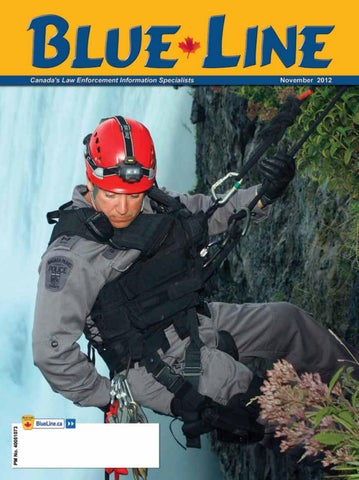
COVER: Sgt Lance Dobbin of the Niagara Parks Police rappelling the Niagara Gorge. Photo: Vince Gircys.
Blue Line Magazine
3
Grounds must be considered collectively Compelling, credible and corroborated tip justified arrest Knock, announce, and break-in rule Reasonable grounds less than prima facie case November 2012
november 2012
4
Blue Line Magazine
Blue Line Magazine Inc. PUBLISHER Morley S. Lymburner - publisher@blueline.ca General Manager Mary K. Lymburner - mary@blueline.ca SENIOR EDITOR Mark Reesor - editor@blueline.ca NEWS EDITOR Kathryn Lymburner – kathryn@blueline.ca CREATIVE DIRECTOR E. Jolene Dreja - jolene@blueline.ca Contributing Writers Mike Novakowski Mark Giles Robert Lunney Dorothy Cotton Dave Brown Tom Rataj Affiliations International Association of Law Enforcement Planners Canadian Advertising Rates Data International Police Association The Canadian Press Newswire Access Copyright Subscriptions $30 per year; $50 for 2yrs; US & Foreign: $100 Advertising 888-640-3048 advertising@blueline.ca
www.blueline.ca 12A-4981 Hwy7 East, Ste 254, Markham, ON L3R 1N1 Canada P: 905 640 3048 F: 905 640 7547 blueline@blueline.ca
PRINTED IN CANADA
ISSN# 08478538 Blue Line Magazine was established in 1988 as an independent publication to inform, entertain, connect and educate those involved in the law enforcement profession. With no direct control from an enforcement agency, its opinions do not necessarily reflect those of any government or law enforcement agency. The authors, advisors, and publisher accept no liability whatsoever for any injuries to person(s) or property resulting from application of adoption of anything presented in this magazine. Readers are cautioned and advised that articles presented herein are edited and supplied for your personal awerness and should not be used for further actions until appropriate guidance is received from a supervisor, Crown Attorney or other persons in authority. All material submitted for publication becomes property of Blue Line Magazine Inc. unless arrangements have been made with the publisher prior to publishing. © 2012 All articles are protected by copyright. No part of this publication may be repoduced or transmitted in any form or means, electronic or mechanical, (including photocopying and recording or by any information storage or retrieval system), without prior permission. Permission to reprint may be obtained in advance from Access Copyright 1-800-893-5777.
Blue Line Magazine
Publisher’s Commentary by Morley Lymburner
The Brown Report five years later – ‘how we doin?’ Former Ontario Securities Commission head David Brown was asked by the prime minister in 2007 to investigate allegations senior RCMP officers covered up problems in the administration of the force’s pension and insurance fund. In his report, released in June 2007, Brown recognized that many of the problems with the pension plan abuse and investigation came from a much broader problem; a truly dysfunctionally managed agency allowed to simply stagnate in place for a hundred years. Since it has been five years since the report and a subsequent task force recommendations were released, I attempted to find out what changes have occurred. As was the case in 2010, when I last looked into this, communication with Ottawa was sketchy, with a few rays of hope in the form of people who promised to talk to me at a future date. There have been changes in some areas. For example, the RCMP can boast of having had three commissioners look at the Brown Report, scratch their heads and struggle to figure out where to go from here. Two years ago I reported seeing a drill sergeant comment “We are not the police, we are the RCMP” in a Depot produced training video. Once again I came face to face with the reality that RCMP traditions do not encourage a view of the broader field of police collegiality. They are not trained with members of other forces. This homogenous, insular training by subtle design encourages members to keep to themselves. They have an opportunity to look over the fence but getting too close is frowned upon. Keeping other police at arms length encourages the status quo. In re-reading the Brown reports I was struck by the following paragraphs prompted by interviews with hundreds of officers across the country. ...We also witnessed despair, disillusionment and anger with an organization that is failing them. With remarkable, but disturbing consistency, we heard of chronic shortages of people and equipment, of overwork and fatigue, of issues of wellness, health and even safety. We learned about basic human management systems that haven’t worked for years: mandatory unpaid overtime; discipline and grievance systems that don’t work; a promotion system with little or no credibility; a sometimes embarrassing record of accounting to the people they serve. These and many other issues came tumbling out through poignant stories of personal experiences related to us personally and in the over 500 confidential emails we received. What emerged was a picture of an honourable and revered Canadian institution with rank and file members and employees struggling to do their best under the tremendous 5
burden of an inefficient and inappropriately structured organization. I polled members of the Blue Line Forum on their vision for the RCMP’s future. For better or worse, here are their recommendations: • The RCMP must have a collective bargaining organ to negotiate working agreements and represent the membership. Every other Canadian police service has one and there is no reason it cannot work for RCMP members. It is the one single factor that would take away at least 90 per cent of the problems they face today. • The RCMP must control its own budget. The elusive, unresponsive and unreachable treasury board has been the phantom scapegoat for a tight fisted senior management loathe to admit it likes shoestring budgets. • The RCMP must give up some of its omnificence. It cannot be all things to all people and solve every problem. Where feasible it should move out of municipal and provincial policing. • Retain territorial and specific federal policing functions. • E liminate duplication. If a government agency has an enforcement and investigative branch, there is no need to duplicate that effort. • Adopt best practice training and take on internal police investigations, police service accreditation and cross border organized crime. • Retain police forensics, where feasible, and national computer databases. • Retain VIP and embassy protection services. • Instill a management attitude and culture which encourages the brightest and best in the ranks. The problems facing RCMP management are challenging and it’s not easy to change old war horses. In the analogy of horse training, change will only occur after considerable pressure is applied to each and every desired manoeuvre. Long held beliefs, customs and traditions are deeply entrenched. It will take an entirely new generation of management people to blaze a new path – a path that every other police service has long established and embraced and that the RCMP could smooth over and greatly expand upon. My challenging question remains unanswered. Five years on, what progress has been made? The RCMP is a valuable part of Canada and we all deserve to see an annual progress report.
November 2012
The Niagara Parks Commission (NPC) celebrated the 125th anniversary of its police service in June, honouring those who protect the 1,325 hectares of parklands and throngs of tourists who visit each year. “The Niagara Parks Police Service (NPPS) is one of the oldest police services in the province of Ontario,” stated NPC Chair Janice Thomson. “Our police play an integral role in ensuring the safe and enjoyable stay of the almost 10 million visitors who come to Niagara and Niagara Parks each year.” The NPPS was founded in 1887 to protect the lands and visitors of Niagara Parks. “It’s my understanding that they were the first policing in the area and that was because of all the popularity that had grown around the falls,” said chief Douglas Kane. “It appears that there were all kinds of hucksters and people taking advantage of it so the government wanted to regain that area and turn it back to the people so that they could come here and not be bothered and hampered by thieves or other people that might take advantage of them.” Officers patrol a 56-kilometre area that stretches from Niagara-on-the-Lake in the north to Fort Erie on the south, dealing with millions of visitors and looking after everything from lost children, and crowd control, to motorists looking for directions. “Our main function is to make sure that tourists are safe and that they can come to enjoy the falls at any hour of the day and night,” said Kane. november 2012
Officers respond to routine calls for service, provide proactive 24/7 patrols, manage the concentrated pedestrian and vehicular traffic, maintain the peace and enforce federal and provincial statutes. NPPS officers also coordinate the security for large scale and high profile events hosted on NPC lands, including New Year’s Eve celebrations. Officers are all Ontario Police College (OPC) graduates and a number are specially trained in high angle and swift water rescue techniques to respond to emergencies in a unique and naturally challenging environment. Other training includes identification services, technical accident investigations, radar traffic enforcement, police motorcycle and bicycle operations, marine enforcement operations, police canine, first aid, physical fitness training and quality service. Civilian members receive OPC training as communicators and a fire safety officer has training from the Ontario Fire College. The service maintains bicycle, motorcycle and marine patrol capabilities and added a canine last year. Nia, a black female German Shepherd, assists in search and rescue and detecting explosives. She also acts as an effective ambassador for the service. The name Nia, short for Niagara, was chosen from over 250 entries in a spring 2011 contest. The NPPS is particularly proud of its partnerships with emergency services on both sides of the international border and private sector partners providing aerial and river based tour experiences. Provincial offences officers join the service with first aid training and are generally enrolled in police foundations or criminology programs at college or university with a view 6
towards a career in law enforcement. Many Ontario police officers in Ontario began their careers as students with the Niagara Parks Police Service, including Kane, who worked as a student officer in the 1970s before moving on to the Niagara Regional Police Service. He retired as a superintendent, having “come full circle to complete a very rewarding career.” Kane still remembers standing out on Falls Avenue as a teenager, whistle in his mouth, directing traffic to and from the country’s most popular tourist attraction. Kane had long dreamed of becoming a cop and, like so many before him and so many since, cut his teeth as a summer hire with the Niagara Parks Police. He learned a lot of valuable lessons back then, but there’s one in particular that’s always stuck with him: “Never stop the horses at your beat.” It’s practical advice at its best, especially on those sizzling dog-days of the peak season. Best to let the next guy down the line deal with the proclivities of buggy-pulling equines. “It’s a great place to work and this is a great job,” said Kane. “It’s like a family here. It really is. The people really want to be here and are happy to come to work every day. I always tell everyone I couldn’t have planned things any better at this point in my career.” Kane, who plans to retire in June 2013, spent most of his policing tenure in St. Catharines with what is now the Niagara Regional Police Service. “It’s a different kind of policing here,” he said. “It’s tourism policing. You deal with everything from lost cameras and passports to lost people to overseeing rescues in the (Niagara) gorge. It’s all about keeping the Blue Line Magazine
public safe though and making them feel safe. People like to see police officers in the parks. That’s why they feel comfortable enough to be wandering around at all hours, 2 or 3 in the morning – because they feel safe. That’s why this service is so important.” A couple of years ago the Ontario government toyed with the idea of disbanding the service, wondering if the duties that eat up about $3 million a year (paid by the Niagara Parks Commission) could be performed more efficiently and cheaply by the NRP. In the end, it survived the challenge. The service, with 20 full-time officers plus support staff and around 30 seasonal hires, clearly holds a warm spot in the hearts of those close to it. Kane said invitations to the June celebration were sent to every former Parks officer still active in policing and more than 100 accepted the invitation. “That’s very nice that people want to come back,” Kane said. “The officers do enjoy their time here and some never leave.” Technically the Parks police are deemed special constables. A local police force, such as the NRP, is allowed to appoint officers to carry out policing in a specific area. Parks police officers are armed and receive the same type of training as municipal police officers. Typical calls for service include vehicle crashes (approximately 100 per year), theft, mischief, counterfeit currency and break-ins. Other more serious incidents include fatal motor vehicle collisions, suicides and attempted suicides, the recovery of bodies, cross-boarder activities and searches in the gorge for missing and injured people. “We are extremely proud of the legacy we have established during the last 125 years,” said Kane. “I know that with the support of the Niagara Parks Commission, our emergency services and private sector partners, we will continue to serve a culturally diverse, worldwide visitor community, which continues to chose Niagara as their travel destination.” Story compiled by Mark Reesor from files submitted by Niagara Parks Police. Photo submissions from Vincent Gircys, Paul Forcier, and Jan Dabrowski. For further information go to www.niagaraparks.com/ about/niagara-parks-police.html
Blue Line Magazine
7
November 2012
by Chris D. Lewis Indigenous populations are reaffirming their spiritual beliefs, nurturing their distinct cultures and aggressively asserting their rights and land claims under a variety of treaties. While this in many respects is a very positive movement, many aboriginals are frustrated with the perception of government inaction and delay towards land claims settlements. They respond with protest activities that sometimes lead to violence. The police service of jurisdiction is usually caught in the middle, trying to keep the peace and protect those in attendance. The Ontario Provincial Police (OPP) has learned much about policing aboriginal critical incidents arising from both positive operations and tragedies; the process has much to teach police services struggling with these issues. Brief history The OPP defines an aboriginal critical incident as one where the source of conflict may stem from the assertion of inherent aboriginal or treaty rights. It can also be any incident involving an aboriginal person or on a First Nations territory with potential for violence that requires an integrated police response. Significant aboriginal protests and blockades occurred in various jurisdictions in the 1970s and 1980s but the one that first truly shocked the country took place in the summer of 1990. A group of armed Mohawk warriors november 2012
from Kanesatake occupied land slated to be a golf course in southern Québec near the village of Oka, also blockading a major transportation route. There was an ancient First Nations burial ground on the land, although the federal government had earlier rejected a claim for the property. The crisis spread until four auto routes were blockaded in solidarity, including a major Montréal bridge that ran through the Mohawk territory known as Kahnawake. Canadian and world attention focused on the nightly images of the Sûreté du Québec, RCMP and eventually the Canadian military staring down armed Mohawk warriors at the barricades. The federal government eventually purchased the property from Oka and cancelled the golf course expansion. The warriors withdrew after 78 days but not before one police officer was fatally shot during an attempt to remove the original barricade by force, sparking a 15-minute gun battle. No charges in the death have ever been filed. After Oka, everyone knew the rules of engagement had changed forever. On September 4, 1995, aboriginal men, women and youths occupied Ipperwash Provincial Park in southwestern Ontario, then a popular summer recreation spot. They believed the park properly belonged to the nearby Stoney Point people and had a number of other historical grievances. Several angry interactions ensued between police and the occupiers. Late on September 8
6, an OPP officer fatally shot one of the aboriginal men during a confrontation. He was eventually convicted of a criminal firearms offence relating to the shooting and resigned following an internal disciplinary hearing. After Oka and Ipperwash, it was clear that, given the perception of government inaction on underlying issues and the emotional commitment to the cause, aboriginal critical incidents had the potential to be protracted, linked, turn violent and jeopardize innocent lives. Outrage and criticism The events at Ipperwash sparked outrage and criticism of the Ontario government’s actions and the OPP response from First Nations, the nearby community and others. The OPP acknowledged that it needed to significantly rethink its approach to aboriginal critical incidents and better prepare officers called upon to police them. By 2000, it had developed an internal document, Framework for police preparedness for aboriginal critical incidents, calling for a measured, culturally sensitive approach, which has guided it in its response to subsequent occupations, blockades and protests (see figure 1).1 Eventually, the new government called an inquiry into the events at Ipperwash to determine the facts and make recommendations to avoid similar tragedies in the future. The OPP incident commander testified for more than 20 days and many other involved officers were also called. Personnel provided Blue Line Magazine
thousands of pages of requested documents. The inquiry absorbed considerable energy and resources from all involved parties for more than two years. Commissioner Sidney B. Linden finished hearing testimony on August 2006 and delivered his report in 20072. “For the most part, I believe that the OPP police/aboriginal relations initiatives conform to the best practices identified in previous inquiries and reports,” Linden noted 3. Canadian and international police services have inquired about the OPP framework document and program as they struggle to improve their own approach to aboriginal critical incidents. The OPP also created a separate Aboriginal Policing Bureau (APB) in 2007 to support effectiveness, enhance its relationships with First Nations communities and assist in responding to a critical incident. Among its many obligations and duties, the APB further developed and oversees the delivery of a respected course on First Nations culture and spirituality for OPP and other law enforcement personnel. The goal is to ensure officers assigned to detachments with significant First Nations populations arrive with some knowledge and competence about aboriginal culture and history. As part of this effort, the APB organized a major powwow on the front lawn of OPP general headquarters in the summer of 2009 to help celebrate the 100th anniversary of OPP service and its relationship with Aboriginal peoples. The OPP is fortunate to have many officers with First Nations heritage who can assist. They are in high demand and care must be taken not to drain this valuable human resource through sheer volume of work and recruiting from other partners, such as First Nations police services.
They receive formal and ongoing training and work openly to mitigate issues through dialogue and mediation. PLT members concentrate on diffusing tension and delivering accurate information to communities, groups and individuals, enabling a safe and lawful environment for free speech and peaceful assembly. The goal is to avoid an escalation that will require a police response and reduce the resources required to manage an incident. Special aspects of aboriginal critical incidents Linden noted in his report that aboriginal protests and occupations are significantly different from other critical incidents and “require unique police resources strategies and responses,” including the involvement of First Nations police officers 4. There are many unique aspects which complicate any efforts to police them efficiently. Jurisdiction is always multifaceted and complex. Under the Canadian Constitution,
the federal government has responsibility for “Indians and land reserved for Indians,”5 but both provincial and municipal governments get drawn into disputes. The OPP directly polices 19 First Nations communities, administers the police services for another 19 and is often the first backup and support for the province’s nine self-directed First Nations police services, which serve 94 communities. Since the OPP polices almost 12,500 miles of highway and an area of 363,865 square miles, aboriginal critical incidents almost always take place wholly or partly in OPP jurisdiction. Determining who actually speaks for a First Nations community is equally complicated. The OPP has policed a controversial land claim protest in Caledonia (Southwestern Ontario) for several years, negotiating with the elected Band Council of the Six Nations of the Grand Reserve, the traditional confederacy leadership, the Warrior society, the Men’s Fire Council, the Ongwehonwe Women’s Council and other groups. Many may expect
Importance of liaison teams The APB also trains and supports the OPP Provincial Liaison Team (PLT) program. In keeping with the framework, its primary focus is relationship building and opening lines of communication with involved parties during response to major events and critical incidents. PLT began as aboriginal liaison teams with a focus on First Nations issues, but the OPP soon realized that it needed good liaison work for all critical incidents, aboriginal or otherwise. The program is an integral part of OPP planning and response to demonstrations, protests, or critical incidents. Members are specially trained, experienced frontline officers who initiate and maintain contact with stakeholders in areas of potential conflict. Blue Line Magazine
9
November 2012
to be consulted before, during and after an aboriginal critical incident, but their position and influence can vary significantly. However, unlike most others, all aboriginal critical incidents have the potential to evoke a solidarity response and cascade into related protests near or on other First Nations communities as a show of support and expression of similar frustrations. Misinformation, whether intentional or accidental, can spread rapidly and often be inflamed by social media. This effect can stretch police resources even further and magnify public concern and anger. Aboriginal critical incidents are often strongly associated with environmental and social justice concerns and can attract supporters from other activist – and sometimes radical – organizations. From a policing perspective, it is wrong to assume that any action at a protest necessarily has the backing of the elected band council or the First Nations community as a whole. An effective liaison team can help determine community support levels for any action and then assist in developing an appropriate police response. The police role is to keep the peace, enforce the law and protect the public. The OPP cannot negotiate or resolve any of the long-standing grievances and treaty issues, but the complexity of negotiations that have been ongoing for hundreds of years invariably affects policing. During the summer of 2010, a First Nations community in northwestern Ontario set up a blockade – a tollbooth – on a major highway to bring long-standing issues associated with the land to the forefront. They specifically chose a short section of highway where their outstanding treaty issues gave them some claim to ownership. While many inconvenienced drivers were adamant that the OPP remove or arrest the tollbooth operators, no government agency ever came forward to establish ownership of the highway and seek a court injunction to remove them. The OPP concentrated on traffic safety at the tollbooth and policing behaviour at the stop until the dispute was settled. Some angry motorists interpreted this effort as assisting the perpetrators. Competing rights Section 2 of the Canadian Charter of Rights and Freedoms extends important rights to anyone on Canadian soil, including freedom of expression, association and peaceful assembly. The OPP works hard to respect these. Section 25 also recognizes and affirms the existing Aboriginal Peoples and treaty rights of the Aboriginal Peoples of Canada. Section 25 states that the guarantees of certain rights and freedoms shall not be construed as abrogating any aboriginal treaty rights and freedoms, including those acquired by the Royal Proclamation of 1763 and land claims agreements past, present and future6. Complicating matters, “colour of right” is a recognized defence for many offences under the Criminal Code of Canada and participants in aboriginal critical incidents are usually november 2012
motivated by a strong and honest belief in their cause and treaty rights. Clearly, the underlying subtext to any aboriginal critical incident is a complex web of competing and sometimes contradictory rights. Sorting that out while keeping the peace is difficult for any police service. Caledonia challenge In late February 2006, a group of First Nations activists occupied the Douglas Creek Estates (DCE), a housing development on the edge of the then quiet town of Caledonia that abuts the large Six Nations of the Grand River Reserve. Some native leaders claim the DCE as First Nations land, among myriad major unresolved land claims in the area. The developer went to court and on March 17, 2006 successfully obtained an injunction directing the OPP to execute warrants of committal for contempt against the occupiers. In Ontario, the sheriff is responsible for enforcing an injunction but the police service of jurisdiction has a statutory obligation to assist if requested or directed to by the courts, although it does have discretion as to when and how to enforce it. Knowing that enforcement would likely lead to a violent confrontation, the OPP waited three weeks, hoping for a negotiated settlement. When none seemed likely, it entered the DCE in the early morning of April 20, 2006, arrested 21 individuals and took control of the property. In this era of instant communication, it wasn’t long before news spread through the Six Nations community. Protest supporters arrived by the hundreds, some carrying shovels and baseball bats. Vastly outnumbered and knowing that further confrontation would likely lead to significant violence and possible loss of life, the OPP properly exercised discretion and withdrew. Ongoing confrontation The OPP found itself policing an ongoing standoff that was growing increasingly violent and confrontational. Among other actions, native protestors and their supporters dragged a section 10
of a hydro tower across Caledonia’s main thoroughfare, Highway 6; dug up the roadway; and blocked passage for several months, severely inconveniencing both commerce and residents. A hydroelectric transformer station was torched and there were many violent confrontations between frustrated residents and aboriginal activists. The land remains occupied by native protestors to this day. The province eventually purchased the land in 2006 to maintain the status quo, pending resolution of land claim negotiations. After the purchase, the OPP went to court to have the injunction, which was still in effect, withdrawn. Public criticism of policing The OPP was severely criticized for what was termed a botched raid on the DCE, with many insisting it should immediately enforce the injunction. Few critics addressed the danger to occupiers, public and officers that further aggressive police action would have sparked. The OPP also has been loudly and regularly accused of practicing two-tier or race-based policing in Caledonia, with critics charging the law is enforced differently for natives compared to others. The OPP strongly rejects this allegation, saying it has practiced proper police discretion in policing the dispute. Canadian court decisions have made it clear that a police officer or service cannot use discretion to favour an individual or group, but there is latitude as to how and when the full force of the law will be used. In fact, the OPP has a strong arrest record in Caledonia. From March 2006 to early April 2011, it laid 176 charges against 77 persons relating to the DCE land claim, including a wide variety of serious charges. In each case, the officers considered public and officer safety in addition to possible incident escalation to determine when to make the arrests. In many cases, charges were laid after officers had completed a full investigation. Critics regularly accuse the OPP of doing nothing in Caledonia and clamour for what they consider contemporaneous arrest, even when officers were occupied with immediate crowd control and minimizing the risk to the public. Blue Line Magazine
1 OPP Framework for Police Preparedness for Aboriginal Critical Incidents, OPP internal document, revised 2005. 2 Report of the Ipperwash Inquiry, volume 4, http://www. attorneygeneral.jus.gov.on.ca/ inquiries/ipperwash/report/ vol_4/pdf/E _Vol_4_Full.pdf (accessed April 7, 2011). 3 Ibid, 90. 4 Ibid, 73. 5 “IV: Distribution of Legislative Powers,” section 91, in The Constitution Act, 1867 (March 29, 1867), http:// laws-lois.justice.gc.ca/eng/ Const/FullText.html (accessed April 7, 2011). 6 The Canadian Charter of Rights and Freedoms, sections 2 and 25, http://www.efc.ca/pages/law/ charter/charter. text.html (accessed April 7, 2011). Chris Lewis is the Commissioner of the Ontario Provincial Police. This is the first article of a two part series. In a future issue of Blue Line Magazine, Lewis will discuss the provision of regular police services in First Nations communities.
The men and women of the OPP have done an extraordinary job policing the Caledonia dispute in a measured and professional response. It is a testament to their training and discipline that there has been no loss of life, although there have been some serious assaults. Extraordinary resources The OPP calculates the cost of policing the Caledonia dispute at the end of each fiscal year. From March 2006 to early April 2011, it spent $46.1 million on policing costs above and beyond the regular local detachment expenses. An estimated 864,283 hours, including 442,937 in overtime, were invested in policing the dispute during the same period. There were 43 incidents resulting in officer injuries requiring first aid and medical attention, resulting in 186 lost work days. Since the Caledonia dispute began in February 2006, the OPP has responded to more than 320 aboriginal critical incidents throughout the province. While Caledonia is relatively quiet at this time, at its height enormous demands were made on OPP resources and personnel, leading to increased overtime and fatigue throughout the province. The underlying causes of the dispute remain unresolved and some hostility lingers. The province and OPP have also been named as defendants in lawsuits resulting from the dispute. Lessons learned Clearly, policing aboriginal critical incidents can be unpredictably draining and expensive. Police executives should be prepared for the worst. Here are some lessons the OPP has gleaned. 1. Communicate. As in all critical incidents, effective communication with all parties is essential. During the Caledonia dispute, the OPP concentrated on the First Nations community and neglected communication with Caledonia citizens. This oversight has been corrected for subsequent aboriginal critical incidents. Police should have a strategy for monitoring and rapidly responding to misinformation, particularly in social media. 2. Be educated. Aboriginal protestors usually have a very strong sense of history, Blue Line Magazine
community and commitment to a belief they are protecting traditional territory, treaty rights and sacred ground. Ignorance of this history and underestimating their commitment can lead to tactical errors that can endanger everyone. 3. Designate a liaison team. These officers play a crucial role in communication for any critical incident. They must be properly trained in negotiation, mediation and psychology and resist identifying too closely with any constituency or contact. 4. Anticipate morale issues. Officers policing ongoing critical incidents suffer through long periods of boredom interspersed with moments of sheer terror. They are often far from their families and support groups and likely to face hostility from both sides of the dispute. Police leadership needs to acknowledge this and take steps to mitigate burnout and boredom. Officers must be informed and praised for their restraint and professionalism, if warranted, especially when critics call for more aggressive tactics. 5. Choose negotiating disputes wisely. The police role in aboriginal critical incidents is to enforce the law, keep the peace and protect the public. Settling the complex underlying issues is a long-term project between high levels of government and the aboriginal community. 6. Expect criticism. Any police service involved in an aboriginal critical incident should expect its actions to be questioned. Agencies must have a detailed framework for the response worked out in advance, communicate it properly to their officers and follow it. Explain the approach consistently to all stakeholders but do not expect everyone to agree with the strategy. The worldwide surge in aboriginal pride and confidence combined with the slow resolution of land claims and undeniably desperate social conditions in many First Nations communities is a perfect storm for major critical incidents. Police services in jurisdictions with significant aboriginal populations experiencing unresolved treaty and rights issues need to prepare for these incidents, share information and learn from each other to prevent future tragedies. 11
The OPP framework for police preparedness for aboriginal critical incidents Objectives • To promote an operationally sound, informed and flexible approach to resolving conflict and managing crises in a consistent manner. • To offer a framework that demonstrates accommodation and mutual respect of differences, positions and interests of the involved aboriginal and non-aboriginal communities, as well as the OPP. • To promote and develop strategies that minimize the use of force to the fullest extent possible. Stages • The framework recognizes three stages of conflict: pre incident, incident and post incident. • I t provides detachment and regional members an overview of what to look for and what can be done. • For best results, the framework should be implemented and followed well before any police action is required. Minimizing the disruption and danger from any aboriginal critical incident requires continuous work of consultation, relationship-building and preparation. Specialized human resources Provincial liaison teams, a director of aboriginal issues, aboriginal critical incident commanders and an aboriginal critical incident co-ordinator are available. Police discretion • The framework says the OPP will investigate and take appropriate action to civil disobedience and unlawful acts. • This action will be completed with carefully measured responses employing only the level of force necessary to ensure the safety of all citizens and maintain or restore peace, order and security. • The use of force is always a last resort. The framework emphasizes that the issues and positions of various parties involved in any aboriginal critical incident are extremely complex and must be understood by police to successfully negotiate a peaceful resolution. November 2012
Witch-hunt or
warranted?
Ignoring investigative policies can erode organizational credibility by Mark Giles One of the most stressful experiences for police officers and employees, generally, is being subject to an internal investigation – especially those administrative in nature where the accused doesn’t have the same protections accorded to those charged criminally. For police agencies and other organizations, these in-house probes can be extremely sensitive to conduct, while challenging professional standards and human resources personnel to find a balance between the rights of the complainant and the accused. Like most actions in today’s complicated police and business worlds, this is where law and policy come into play – laying out “jurisdiction” and investigative process to be followed. How this is accomplished is often an indicator of whether these in-house probes are legitimate and, therefore, warranted or politically motivated – what some refer to as a “witch-hunt.” Most police acts, codes of conduct and other workplace policies are legitimate and put in place for good reason. Challenges arise when these policies are applied with too much zeal, or ignored outright if they hinder progress towards meeting internal or public expectations, or a pre-determined outcome. A recent case with the South Simcoe Police Service in Ontario may be an example of both – a situation that may also have contributed to the chief’s retirement in 2011. After what appeared to be excessive zeal in the pursuit and discipline of a police officer, and ignoring an established and agreed-upon process in eventually firing him, the Ontario Civilian Police Commission (OCPC) found the chief guilty of misconduct. The findings suggest this investigation and discipline went too far and without proper process. Not only had the chief failed to convene a hearing before firing the officer, but the lead OCPC investigator – a retired police superintendent – referred to the internal investigation of the officer as full of bias and intimidation. This raises troubling questions regarding fair treatment and whether the agency was using the tools and resources at its disposal as weapons, rather than in legitimate support of a warranted investigation and discipline. A recently well-publicized case of email snooping with the Calgary Police Service (CPS) shows that even the best police agencies november 2012
Offensive? Five months after receiving a complaint, HR requested this photo be removed from the work place. can make mistakes. Tapping into an employee’s personal email account to acquire evidence led to a privacy complaint and a finding by the adjudicator that this was “exceptionally invasive” and “patently unreasonable in the circumstances.” “What might be okay in finding online sexual predators is not okay in an internal disciplinary matter,” said Peter Marsden, president of CUPE Local 38, noting his concerns with using criminal investigative methods in reviewing the behaviour of employees. To its credit, the CPS not only reinstated the employee, but also quickly apologized. Still, one has to wonder how this situation led to the firing of an employee. Where were the checks and balances on the use of police investigative resources? no monopoly for police agencies There are too many cases where investigations cross the line – or should sometimes never have been started – with police agencies and other organizations going overboard in using staff and law enforcement resources. 12
And police agencies don’t have a monopoly on these witch-hunts – other agencies also appear to be sometimes making up the rules as they go along. After a federal probe was closed in February, the US Anti-Doping Agency (USADA) announced in June that it had evidence cyclist Lance Armstrong had doped and would waive its own eight-year statute of limitations to investigate and prosecute him. USADA is currently empowered to investigate allegations of drug use from 2004 onwards, but decided to operate outside that regulation in Armstrong’s case. “If Armstrong had come in and been truthful, then the evidence might have been that the statute of limitations should apply,” Travis Tygart, USADA’s chief executive, told USA Today. Unhappy with the USADA’s approach, Armstrong called the investigation an “unconstitutional witch-hunt” and a judge seemed to agree, although he apparently didn’t feel it was his role to call it off. “USADA’s conduct raises serious questions about whether its real interest in charging Blue line magazine
Armstrong is to combat doping, or if it is acting according to less noble motives,” such as politics or publicity, U.S. District Judge Sam Sparks wrote in his opinion. In the Armstrong case, the USADA not only ignored its own statute of limitations, but after apparently saying it had 10 former teammates ready to testify against him, refused to disclose who they are or specifically what they would say (other than suggesting the possibility of two former top-level cyclists, both of whom have admitted to doping offences). If police and federal agencies can ignore or loosely apply the rules for disciplinary matters, the situation has become extremely slippery with other public and private-sector employers and the growing prevalence of workplace-respect policies. The problem is not with their intent, which is usually sound, but rather the lack of safeguards, such as those in place for criminal cases, and the sometimes overzealous use of an administrative tool as a weapon against employees. I recently found myself in this situation. First, the human resources department would not even provide the complaint details – a clear violation of its own policy. After keeping me in the dark for several weeks, they then contracted a retired deputy chief of a major Ontario police agency to investigate what turned out to be very minor issues. The retired deputy quickly saw through the motives behind the complaints and told me so, indicating he felt it could be resolved with a quick chat. The HR department, however, decided his investigation wasn’t valid and, four months later, conducted another one. As expected, the issues could have been resolved almost immediately – months earlier – and included asking that I consider removing an “offensive” photo of me and a former police supervisor making an arrest, which was displayed in the corner of my office.
early July after firing a lifeguard for going to the aid of a swimmer outside his assigned area. The story was quickly picked up nationally and internationally, with the lifeguard using media to send out his message without delay. “If I can see someone and I have the ability to help them, I’m going to go help them,” said Tomas Lopez, a lifeguard at a beach in Broward County. “I’m not going to worry about jurisdiction or any other nonsense like that.” Lopez was offered his job back a couple of days later, during an interview on CNN, when a humble employer tried to right the wrong done by an undoubtedly overzealous manager. Lopez politely declined the offer, saying he didn’t have it in him to return, which perhaps illustrates the bad will these situations create. Sadly, however, some employers either don’t get it or choose not to – perhaps lacking the humility to admit they’re wrong or because they have a pre-determined agenda. Awareness of this problem needs to be raised, so that more scrutiny is given to ensuring internal investigations and disciplinary actions are warranted. In doing so, organizational credibility will be maintained, and police officers and civilian employees will have greater confidence in the internal investigative process and its outcomes. Mark Giles is Blue Line’s correspondent for public and media relations. For further information or discussion you may email him at Giles@BlueLine.ca.
Corporate reputation There seems to be a trend towards taking things too far, while abusing process, with in-house investigations ranging from minor employee interactions to more serious issues potentially resulting in discipline or dismissal. With more acts, codes of conduct and workplace-respect policies than ever, internal or politically motivated investigations are happening far too frequently – sometimes ignoring the rules, and using methods and resources far beyond those called for and what is appropriate in the circumstances. Mistakes happen, and apologies go a long way towards mending hurt feelings and reputations, but the fact that investigations sometimes go as far as they do can lead to other negative outcomes. When an investigation or disciplinary action has gone too far, organizations need to quickly address the issue and take responsiblity – as the CPS did earlier this year. Otherwise, the public relations impact can quickly harm corporate reputations, especially with the extensive reach of broadcast and social media today. A Florida employer learned this lesson in Blue Line Magazine
13
November 2012
Second in command The deputy police chief
by Dana Barnett It has been said that successful leaders surround themselves with good people but great leaders surround themselves with people even better than they. Look closely at a great police chief’s deputy and you may find an equally great leader standing in their shadow. The second highest ranking officer in a police service, deputy chiefs reports directly to the chief. Serving as the chief operating officer, they oversee everything from financial and human resources and operations to developing and implementing policing strategies programs and tactics. Their numbers and divisions of responsibilities may vary but the function is always critical to policing because it assumes management responsibility for the day-to-day operation, services and activities. Behind the scenes support Running an organization as complex and dynamic as a police service requires strategic tactical planning. While the chief and municipal police services board ultimately decide on strategic directions, the deputy chief feeds the strategic plan and puts the rubber to the road by operationalizing it. “We breathe life into the business plan,” says Hamilton Regional Police (HRP) DC Eric Girt. “Making it work requires an awareness of many factors – like an understanding of the workload, staffing, financial constraints, adequacy standards, case law, the budget – and current and emerging issues such as psychiatric treatment wait times for emotionally disturbed person calls. This is critical to ensuring our members have the tools to do their job effectively.” To better understand the pressures members face, a deputy chief will often sit in on a shift parade/briefing, visit a block training session with sergeants or go out on patrol. In Ontario they are required to qualify every year, which is fine with to HRP DC Ken Leendertse, who loves interacting with officers when on patrol. “The work the members do on the front line is amazing,” says Leendertse. “They use all the tools to their fullest while at the same time, using their policing skills to identify and arrest the bad guys. The workload is incredible but members are extremely professional and very good at what they do.” Leendertse still makes the occasional arrest when on patrol, noting his most recent collar was an individual he found breaking into his garage. He chased and caught the suspect, who was convicted. “You never stop being a cop” he explains. Public relations One of a deputy chief’s most critical job functions is maintaining crucial relationships with november 2012
elected officials and community stakeholders. In any given week this involves spending countless hours – often into the evening – being active with community organizations, attending various committee meetings or sharing best-practices with other law enforcement agencies. Members of a police command are the face of the organization to the public. They represent all other members - uniform and civilian. This is particularly important when a crisis hits. The deputy chief often plays a critical set of roles in the organization and is responsible for exercising a variety of command functions under the most difficult conditions. When a man opened fire in Toronto’s Eaton Centre in June, Toronto Police Service (TPS) Command members had to deal with the fallout from multiple victims, a fearful public and a barrage of scrutiny over the city’s safety record. TPS DC Peter Sloly, who was acting chief shortly after the shooting, recalls his involvement. “In the weeks following this tragic event, I found myself overseeing the operational impacts of the high profile shooting in the three impacted police divisions (52, 51 and 14) and managing the concerns of the three most impacted city councillors,” said Sloly. “In addition to co-ordinating the operations to deal with the immediate crime/order management priorities, I needed to provide enough information to keep city councillors, the media and the public informed – while maintaining the integrity of the investigation – and supporting the councillors’ efforts to calm their constituents by holding police/community town hall style meetings.” Managing the human dimension Deputy chiefs make a concerted effort to not “change their stripes” just because they were promoted. They know that their people are the greatest asset to the organization and need to make time for them whenever possible. That means trying to keep an open door policy and being available, says Halton DC Andrew 14
Fletcher; if that doesn’t work, go out to the members, he adds. “I often stop in on morning briefings or stop by calls or traffic stops to let them know that I’m out there and paying attention to them. Some will find it intimidating while others will see it as you being one of them.” This may sound simple but when your job requires you to make recommendations or final decisions about specific transfers and promotions, a casual conversation can be a dangerous thing. What you say can sometimes be “treated as gospel,” notes Fletcher. “I once made a passing comment to someone about how I heard they were interested in working drugs. That person misinterpreted it to mean they were getting a spot on the team.” Staying connected means different things to different deputy chiefs but the approach is always the same: make time for people, whether it’s through attending social functions, sending personal notes of recognition to staff or stopping to say hello in the hallway. Next in command? The deputy chief is the only member, besides the chief, directly recruited and appointed by the municipal police services board, so it’s no surprise boards look to them first when a chief moves on. They can be considered the most stabilizing figure in the command, often having spent upwards of 20 years with their organization before being promoted to deputy. This results in a deep-rooted trust with the police executive and membership. They also have established relationships with community groups and other police organizations. When Ottawa Chief Vern White suddenly announced he was leaving to accept a post with the Senate, it was no surprise when 28 year Ottawa Police Service veteran DC Charles (Chuck) Bordeleau was appointed after a brief internal process. It turns out that, not only was Bordeleau in the running for the position, he was in a small group of candidates already being groomed for it. Blue Line Magazine
“When former Chief White was hired (2008), he was given a mandate to plan for succession from within the service,” he says. “Although he left sooner than planned, he was able to ensure the board had two candidates to select from within the ranks of the police service. This was welcome news for our members and the greater community. Having come up through the ranks and born and raised in this community has been a tremendous advantage for me, especially during the transition period.” Bordeleau stands firmly behind the succession planning process in Ottawa. As chief, he intends to play a key role in planning for his successor. “As chiefs of police, it is our responsibility to ensure that we have the depth and breadth in our senior ranks to assume senior leadership roles within our organizations. This requires careful and deliberate planning, which cannot happen overnight. For us to achieve success, we need to look deep into the organization and identify future leaders at least five years out.” Succession planning from within the ranks is not unique to Ottawa. Seven of the 10 largest Ontario police services replaced their most recent out-going chief with an in-house deputy. All things considered, it would seem the job to aim for is not chief but deputy chief; that’s where the action really is. Dana Barnett is a freelance writer located in the Ottawa area. She may be contacted by email to danaisathome@ yahoo.ca
Blue Line Magazine
Regina Police Change Logo REGINA — Troy Hagen, chief of police, admits he was probably the hardest person to convince that it was time to change the Regina Police Service’s logo. But eventually, he accepted the idea, and on Thursday, the 120th birthday of the RPS, the new logo was unveiled in front of the Osler Street detachment. “It’s always going to have a special place in my heart, and it’s served us very, very well,” said Hagen. “You get attached to certain items.” Discussions began 18 months ago about replacing the 1973 logo. Doing so required changing the RPS letterhead and business cards, the decal on patrol cars, uniform shoulder flashes and officer hat badges. A flag with the new logo was raised in front of the detachment at the end of the ceremony. So far, the changes have cost the RPS about $20,000, but should increase once the emblem on the front wall of the detachment
15
is replaced within the next four weeks. The new logo has the RPS coat of arms, a prairie lily, bison and the Canadian Flag. Similar to the previous logo, it also includes the phrase Vigilius Genus Latin for “a most vigilant breed.” “I think the new look is refreshing, and I think it demonstrates that the organization is not sitting still,” said Hagen. After the ceremony, Hagen further explained why it was difficult to change to a new logo. “I’ve been policing for over 33 years now the only shoulder flash I knew was our past one, which we retired just yesterday.” Officers will be able to keep their old shoulder flashes, and some will be on display in the RPS museum, said Hagen. Thursday’s ceremony was only one item on the Board of Police Commissioners meeting agenda. tmceachern@leaderpost.com © Copyright (c) The Regina Leader-Post
November 2012
by Larry Burden You are dispatched to investigate a report of an unconscious person slumped over a steering wheel. Opening the door, you notice a bucket on the floor filled with what looks like powdered chemicals, smell rotten eggs – and draw your last breath. The driver had committed suicide using Hydrogen Sulfide (H2S)gas. Most suicide methods pose little threat to first responders but we now face an alarming new trend that can quickly kill a police officer or EMT who unknowingly opens the door to a vehicle or apartment filled with H2S. Although well known in industries such as sewer maintenance, natural gas and even farming and aquaculture, few Canadian police officers outside of Alberta are aware of its occupational hazards. It is so dangerous that industries who deal with it have mandatory occupational training. New Brunswick RCMP recently responded to the provinces’ first H2S suicide (the second known in Canada). Fortunately the victim posted warning signs on the vehicle advising anyone approaching that there was poisonous gas present and to contact Hazmat. Had the victim not done so the citizen who discovered the vehicle and the first police officer on the scene could have been seriously injured or even killed by inhaling the gas. Google hydrogen sulfide suicide or search for it on YouTube and you will find plenty of november 2012
information about this new method of committing suicide. There are videos showing how to make it along with postings from suicidal people asking how they can kill themselves with it. Sadly, people answer telling them how to do it. Several online articles describe how the trend began in Japan in 2007 when the recipe for “detergent suicides” began circulating on the Internet. The result – more than 220 men, women and children killed themselves (or tried to) within six months. The death toll included family members who tried to save the victim and were overcome by the gas. The methodology quickly spread to the United States and incidents of H2S suicides began popping up in August and December 2008 in California, Georgia and Florida. It has since spread to the US, England and Canada. H2S can pose other problems to first responders when it is used in populated places such as an apartment building, noted Jennifer Adkins in a 2010 Regional Organized Crime Information Center publication (Hydrogen sulfide suicide latest technique hazardous to first responders and the public). In one incident, a young Japanese girl killed herself in her apartment using H2S, causing 90 other occupants to become sick as the gas dissipated throughout the building. H2S has even become a terrorist concern. The “Mujahideen poisons handbook” by AbdelAziz describes how to make the gas. 16
H2S is classified as a “broad spectrum” poison that affects several systems within the human body. It is five times more toxic than carbon monoxide and similar in nature to hydrogen cyanide in that it bonds with iron and prevents cellular respiration. Serious fire risk Not only is it toxic, it is heavier than air and highly flammable. H2S can be ignited at only 260C/500F; to put that in perspective, a cigarette burns at 649C/1200F. When mixed with air (i.e. opening the car door) the gas has the ability to spread a long distance and can be ignited, causing a flashback. Although it has a distinct “rotten egg” smell, high concentrations can cause olfactory fatigue, causing you to lose your ability to smell. Unfortunately there is no proven antidote for H2S poisoning. Current treatments consist of support to respiratory and cardiovascular functions. Low exposure is not likely to cause any long term health issues. Moderate and serious exposure may cause residual problems such as respiratory issues. Serious exposure resulting in coma or convulsion may damage the heart and brain. Hydrogen sulfide can easily be made by mixing commonly found chemicals located under many kitchen sinks. The two primary ingredients are an acid based product (toilet bowl cleansers, acidic based drain cleaners or Blue Line Magazine
acids such as muriatic or sulfuric) and sulfur based compounds (detergents, pesticides). Low concentrations (0 -10 ppm) will cause irritation of the eyes, nose and throat; moderate concentrations (10-50 ppm) will cause headaches, dizziness, coughing and breathing difficulties, nausea and vomiting; high concentrations (50-100 ppm) can cause severe eye damage. At 100–150 ppm the olfactory nerve is paralyzed and the sense of smell disappears. A concentration of 320-530 ppm causes a pulmonary edema (fluid on the lungs) and the loss of breathing function. Half of people die within five minutes of exposure to concentrations of 800 ppm. More than 1,000 ppm causes an immediate collapse and loss of breathing after only one breath. The threat to the safety of first responders cannot be overstated. Someone will die unless we change how we do things. The days of walking up to a vehicle and simply opening the door to check on an unconscious occupant are over; personal safety is a must. Do not rely on your standard issue gas mask. The PC4 gas mask with the FR64 canister is not recommended for a Haz-Mat response to H2S, according to S/Sgt. Ron Matthews, NCO i/c of the RCMP National CBRNE Training Unit. The canister does offer limited protection, as outlined by 3M Technical Data Bulletin #153, and should only be used in emergencies and for escape. Matthews suggests that, without proper training and knowing exactly what you’re dealing with, you let Haz-Mat take the lead in determining proper PPE for Chem/Bio/Rad incidents. H2S can leech out of a car or room where it was released and pose a threat. For example, in October 2010 a Florida State Trooper was hospitalized simply because he touched the car door with his bare hands while investigating a H 2S suicide. The vehicle had such a high concentration of the gas inside that it emitted the smell of sulfur and rotten eggs. Another police officer was hospitalized in St. Petersburg, Florida after inhaling gas from a suicide vehicle. H2S suicides don’t only occur in vehicles. Residents at an Indiana University dormitory noticed a chemical smell in 2010. A search located a dead student inside a closet with a bucket of H2S and authorities evacuated 90 residents. A similar event occurred in Toronto in May 2009 when a woman used H2S to kill herself in the bathroom of her residence. Blue Line Magazine
Don’t be a hero First responders in “hero mode” intent on rushing in to make a rescue may need to be rescued themselves. As Dean Scoville noted in Police Magazine, “of the 72 chemical suicides in the U.S. since 2008, 80 per cent have resulted in injuries to first responders.” Look for the unusual at a scene. So far most H2S suicide victims have posted warning signs on their vehicles – some web sites even provide downloadable signs – but not all suicide victims are that considerate. A 35 year old North Carolina woman didn’t post warning signs and exposed several first responders to a chemical mixture prepared in a bucket in her car. Signs can fall off, blow away or not be visible in the dark. Dealing with these cases requires diligence on the part of everyone from dispatchers to investigators. Call takers should ask about warning signs or the presence of odours such as rotten eggs or almonds when receiving calls about unconscious people in vehicles. They should warn the caller to let police handle the matter
17
and not approach or enter any vehicle or room. These details need to be passed on immediately to first responders so they know they may not be dealing with carbon monoxide poisoning. It takes approximately half a gallon each of the acid and sulfide to produce a lethal amount of gas so first responders should look for containers for liquid inside and outside the car. Other things to watch for: • Can you smell rotten eggs? Look at the victim; are they conscious or unresponsive? What colour is their skin tone? Is their chest rising? • Do not open the door in an attempt to wake an unconscious victim. Instead shout from a safe distance or use a loud hailer. Look for warning signs in or near the vehicle which may be obscured by condensation or vapours. Note the wind speed and direction and evacuate nearby buildings if necessary. • If a chemical substance is suspected or confirmed, follow your agency policy regarding hazardous materials protocols and advise the area Haz-Mat team.
November 2012
• Look for tape around the doors and windows. In the New Brunswick case the victim taped all door seals, including the driver door, so that the tape attached when it was closed from the inside. • Look for containers of household cleaning supplies and buckets containing chemical mixtures. “Persons exposed to hydrogen sulfide pose no serious risks of secondary contamination to personnel outside of the hot zone,” according to an ATSDR (Agency for Toxic Substance and Disease Registry) bulletin. “However personnel could be secondarily contaminated by contacting or breathing vapours from clothing heavily soaked with hydrogen sulfidecontaining solution.” In the New Brunswick case the victim’s clothing wasn’t soaked with any solution but the odour of H2S was very pronounced and the Hazmat team had to strip the body in the hot zone. In addition, odours from the body permeated the double body bags and could not be transported in the body removal vehicle. Instead the body was secured in a hermetically sealed coffin brought to the hot zone. Although body bags are not recommended one can cover the body with a simple sheet while awaiting a proper covering. Another concern is the possibility of off gassing from the lungs when moving the victim. Copycats As H2S suicides become more known we can expect to see more of them. We should not publicize them because that will only lead to more copycats such as occurred in England in March 2011. A couple who met on the Internet chose to kill themselves the same way a couple in Essex England had done five months before. Publicity about H2S can also increase the awareness about the hazards associated to this gas and become a new threat to first responders or investigators in the form of flash bomb
november 2012
DISPATCHES
booby traps. The potential for staged H2S suicides that are actually homicides present further challenges for law enforcement. We need to recognize that this is a growing global problem for first responders and act now to amend our investigative policies and training procedures. References Journal of Occupational Medicine and Toxicology (London, England), “Japanese experience of hydrogen sulfide: the suicide craze in 2008” Kansas City Regional TWE www.kctew.org “Chemical & Detergent Suicides,” Hampden County (MA) Sheriff’s Department “Central Florida Intelligence Exchange,” Intelligence Bulletin Oct. 2010 Regional Organized Crime Information Center – Special Research Report – Hydrogen Sulfide Suicide Agency for Toxic Substance and Disease Registry (ATSDR) Toronto Police Officer Safety Bulletin No. 42/2009 Police Magazine, “Chemical Suicides” Dean Scoville, April 2011 Larry Burden is a Sergeant with the RCMP and is the Operations NCO (East), St. George Detachment, New Brunswick. He may be reached by email to larry.burden@ rcmp-grc.gc.ca or phone 506 755-1130.
18
Québec Suréte Cst. Katia Hadouchi, 23, was killed in a motor vehicle collision while enroute to a radio call near SaintAmbroise-de-Kildare, about an hour north of Montreal. The single vehicle collision occured on September 26th as the officer was responding to a violent domestic call in the vicinity. Hadouchi had been a member of the Suréte du Québec for two years and was alone in the car at the time it went out of control. •••• Bill Lynch has announced his plans to retire as St. Thomas Police chief. Lynch will retire in May after 35 years with St. Thomas Police, a statement from the St. Thomas Police Services Board said. Lynch succeeded Wayne Howard as chief of police in 1998. He started his career with St. Thomas Police as a constable in 1978. Ald. Dave Warden chairman of the St. Thomas Police Services Board, said there has been no process established yet for hiring a new chief. Lynch and Lynn Coates, secretary of the board, have been asked to explore options to hire a new chief and report back to the board. Lynch will continue as chief until May 31, 2013. •••• Former Calgary police chief Brian Sawyer, known for his progressive leadership, died September 30 at the age of 81. A former Victoria RCMP superintendent, Sawyer was sworn in as chief Jan. 8, 1973, when Calgary had only 400,000 people and 793 officers. He is credited for implementing changes such as zone policing, dividing the city into four districts of 28 zones as a way of community building, and bringing in crime prevention programs like Blockwatch and Crime Stoppers and units like the tactical team, sex abuse and child abuse. He also renamed the force the Calgary Police Service. Sawyer retired from the force in 1984 and became the Provincial Ombudsman. •••• Devon Clunis has been named as Winnipeg’s new chief of police. Clunis, a 25-year veteran who is also the police service chaplain, will be sworn in as the city’s 17th police chief during a ceremony to be held at a later date. He will take over from current chief Keith McCaskill, who has served in that role since December 2007. McCaskill announced in March that he intends to retire when his term ends on Dec. 9, 2012. Clunis began his career with the WPS in 1987 and has served in all major areas of the organization. His latest assignment was overseeing the service’s development support branch. •••• Al Frederick has been selected as the new Chief of the Windsor Police Service. Formerly the Deputy Chief, Frederick has spent his entire career with the Windsor force and has been acting chief since Gary Smith’s early retirement announcement in December 2011. Frederick, 51, was born and raised in Windsor and earned bachelor of arts and education degrees at McMaster University. Appointed inspector in 2006, he was promoted to deputy chief in 2007.
Blue Line Magazine
holding the line by Stephanie Conn
Post traumatic stress subject of new column As I reflect upon my childhood as a police officer’s daughter, a sense of pride wells up within me. Don’t get me wrong. It wasn’t easy but it was all I ever knew. When I entered the police world myself at the age of 24 it was a small step from the world I already knew. I started as a dispatcher/call taker/911 operator. I thought it was a good way to make a dollar while getting my psychology degree. It also gave me real world material to reflect on as I was studying the human mind. After three years behind the console, I itched to get on the other side of the radio – to the streets where the action was. My dad hoped I would become a psychologist or lawyer – anything but a police officer – so when I told him I was joining the department, he had his concerns. They were overshadowed by his pride as he pinned on my badge at the academy graduation. My years as a police officer were filled with excitement, paperwork, surprise, fear, paperwork, lasting friendships and more paperwork. My department suffered the loss of two police officers while I was there. When the first was shot, officers swarmed the hospital waiting area. I remember watching the peer support team members connecting with grieving members and thinking, “Why am I not a peer support team member?” I wanted to help others while they were grieving, even if I was also grieving. This was the impetus for my volunteering with peer support. I spent the next year connecting with officers doing proactive training for the team, police recruits and their families. I felt like I was settling into the position nicely and serving others – then came the death of the next officer. This was a gut-wrenching experience because it was yet another senseless death of a brother in blue. I no longer felt satisfied with the level of support I was able to offer grieving officers. I needed to – ached to – be able to do more. Not only had we, as a department, suffered the loss of these officers but we found ourselves plagued with other problems such as alcohol abuse, marital problems, financial difficulties, excessive force, anxiety, overwhelming stress, burnout and cynicism. I was asked to research and present my findings on these problems, which seemed to be worsening. I returned to university to study counselling psychology, focusing on the issues affecting police officers and their families. I relocated to Vancouver and had to make a choice: continue my counselling psychology program to support police as I intended to, or leave the program and return to policing. I had been straddling the fence between being a cop and being a counsellor for some time. I couldn’t do both in my new environment. I jumped off the fence in the direction of being Blue Line Magazine
a counsellor – a cop counsellor. In the course of earning my counselling psychology degree, I made a point of focusing on issues impacting police and researched secondary traumatic stress (STS). What I found was alarming. I knew officers needed support during major critical incidents, which was what brought me here to begin with. What I wasn’t prepared to find was that the lesser traumas, sometimes called small t’s, were the real culprits behind their suffering. The small t’s add up to big problems if not addressed. I interviewed front line officers to determine what helped, hindered and might have helped them to cope with their exposure to STS. Officers reported proactive education helped them to manage it and they wanted more training and better access to information and support. This brings me to where I am today, writing this column. I am trying to get the information out there – to let officers know there are steps they can take to promote their resilience. Consider the saying “An ounce of prevention is worth a pound of cure.” Most of us think about this with respect to our physical but not our mental health. Why would your mental health be any different? What about your relationships? Taking steps toward strengthening them before they become strained just makes sense. Think of it as tuning up your car before it starts making noises indicating something is wrong. Each month I will present information to help you build, maintain or rebuild your psychological armour to have a bulletproof mind. I hope you find information that motivates you to inspect your armour and take a proactive approach to maintaining it. I 19
promise to keep it practical and refrain from using psychobabble. I am happy to be a part of Blue Line and welcome your thoughts at stephanie@blueline.ca . Conn is an experienced therapist, researcher and educator. She has researched and provided evidence-based support services to emergency services employees to promote their well-being on and off the job. She began researching these issues while working as a dispatcher/call taker for three years and continued during her nine years as a police officer. She was a member of the critical incident stress management team, offering support to police employees and family members. She recently co-authored Resilient employees, resilient organizations, published in Canadian Police Chief’s Magazine, based upon her research on the impact of stress. She is continuing her research in career issues and employee wellness by pursuing doctoral studies at UBC. Her experience as a researcher is complemented by more than 10 years as an educator on such topics as stress management, substance abuse awareness, crisis intervention, cultural diversity and maintaining work-life balance. She offers counselling to individuals and couples at her private practice, Conn Counselling and Consulting (www. conncounsellingandconsulting.com), and also provides training to police agencies. Stephanie Conn is a registered clinical counsellor and former communications dispatcher and police officer. To find out more visit www.conncounsellingandconsulting. com or email her at stephanie@blueline.ca .
November 2012
Making the public proud
by Danette Dooley Shortly after submitting his resignation, Royal Newfoundland Constabulary Insp. Sean Ryan thanks those who’d made the greatest impact on him during his 28-year policing career. The town council and residents in the small community of Pouch Cove were at the top of his list. Ryan was the incident commander responsible for co-ordinating the recovery efforts of three teens from that community who drowned in March, 2001. “I am truly honoured to have witnessed this powerful example of the human spirit and the defining hospitality of fellow Newfoundlanders. The spirit of these young men will live forever in me along with the pride and love I hold in my heart for the people of Pouch Cove,” Ryan wrote in an email.. The deaths “tore at his heart,” Ryan said in an interview. His own feelings had to be put aside, however, as he faced scores of media who’d come from near and far to report on the tragedy. “I’m still a father and a man. And I kept thinking of those boys under that ice and even with today’s technology we can’t get to them.” A search and rescue helicopter found one
november 2012
of the victim’s bodies and local fishermen found the other two. Ryan says he learned a valuable lesson from the tragedy. “In retrospect, the experts were the people of the community. The fisherpersons who lived in that community knew the idiosyncrasies of that bay better than anybody else in the world.” Ryan retired Sept. 28 as officer in charge of intelligence and organized crime. He’s accepted a newly established position, director, regulatory compliance, with the Newfoundland Liquor Corporation. A native of Grand Falls-Windsor, Ryan is the second youngest of 21 children and served the bulk of his career with the RNC Criminal Investigation Division (CID). He spent 15 years with the force’s tactical and rescue team. No matter the position held, Ryan looked for ways to make the public proud of the constabulary and its rich history. “We are the oldest police force in North America. We’ve been around since 1729 and I was always hell bent on making sure people didn’t forget that.” Ryan was also instrumental in establishing the force’s canine unit and re-establishing its mounted unit but says one of the most rewarding jobs was working in the sex crimes unit. “I was dealing with people at their worst
20
both from the victim perspective and the offender perspective. They were the most heinous, horrendous crimes that you can imagine but I lived for it and I just loved it. I worked with people who had that same drive when we were in that unit.” Ryan’s determination to learn from other police forces saw him train with numerous police services in Canada and the US. All were phenomenal experiences, he said, and left him with ideas to share with fellow officers. Ryan served on numerous national policing committees and in 2005 was invited to present to a Senate committee on law enforcement’s role in dealing with people with mental illnesses. Ryan has worked with Blue Line psychology columnist Dr. Dorothy Cotton, who he has described as “the patron saint of police mental health liaison and the driving force behind the issue in the country.” In May 2012 Gov. Gen. David Johnston inducted Ryan as a member of the Order of Merit of Police Forces. While he’s looking forward to his new position, Ryan says he’ll miss the RNC and the friendships he’s made over the last three decades – within the force and the policing community throughout the country.
Blue Line Magazine
“I’m so proud of this organization. I’m just one member of a team. I’ve spent my adult life here. If it’s not who you are it has to be a part of who you are.” RNC Chief Robert Johnston considers Ryan a friend as well as a colleague. “Sean is passionate about the RNC and leaves with a lot of memories. A lot of that is because he put a great deal of his heart and energy into the organization.” The constabulary has benefited from Ryan’s creativity over the years, Johnston said, noting that Ryan designed the RNC’s new dress uniform. Johnston said the uniform represents not only the future but also the past. “Sean got it right even down to the details of the whistle that’s affixed to the uniform. There was a time when there weren’t electronic communications like we have today so that was Sean’s attention to detail that made that a reality,” Johnston said. Ryan also played a pivotal role in the design of a legacy sculpture erected at near downtown St. John’s. The sculpture, created by Luben Boykov, features a large statue of an RNC officer in period uniform (1800s) holding a lantern in one hand and guiding a young girl with the other.
Danette Dooley is Blue Line’s East Coast correspondent. She can be reached at dooley@blueline.ca
Blue Line Magazine
Single-member detatchments to be phased out Despite pleas by municipal leaders, singleofficer detachments in small, rural communities will close, RCMP Deputy Commissioner Craig Callens has told B.C.s municipal leaders in September. The Mounties have said they can no longer allow the detachments to continue because of labour laws, and Callens says the RCMP is moving to a minimum three-member detachment model. “There are many reasons for that, not the least of which is officer safety,” said Callens. Delegates to the Union of B.C. Municipalities convention passed a motion Thursday, asking the B.C. government to help pay for additional officers in single-member detachments. But despite the resolution, Callens said, it’s unlikely the stations will stay open. “From an economic perspective, I just don’t think that the province will find themselves in a position to fund us for the type of operational availability and operational response costs that would be associated to a single member post,” he said. Callens also told the annual meeting of 1,500 mayors, councillors and regional representatives that the new RCMP contract signed in March, will ensure police are more responsive and accountable to local government concerns. For years, many have complained the RCMP have had all the control, setting community priorities, deciding the budget, then presenting municipalities with the bill. The new contract changes that, said Callens.
21
November 2012
The new ‘Social Media’
tool police need (and it’s not Facebook)
by Gary Askin I caught my 15 year old daughter doing something extremely embarrassing the other day. I walked into the family room and there she was lying on the carpet, feet up on the couch and – believe it or not – talking on the telephone. I was stunned. “What are you doing?” I asked, pointing to the adult-only communication device. She flashed me that ‘you are too stupid to live’ look that only a teenager can pull off. Her: “It’s a phone, why wouldn’t I use it?” Me: “I dunno, you have spent the last four years constantly texting, BBMing, Tweeting and Facebooking. I’ve never actually seen you use a telephone” Her: “This is so much easier” as she rolled her eyes in disgust, “and I don’t get creeped.” Interesting, I thought to myself. I wondered if my teen was getting weary of social media in general – and did she just use “creep” as a verb? My three teenage kids have always been the barometer for me on what’s in and what’s “so two hours ago.” I knew about Down with Webster, hash tagging and Heelys before any of my fellow parents. My kids are continually opening my eyes to new opportunities and don’t hesitate
november 2012
to let me know what is passé. Teenagers are realizing what law enforcement already knows about Facebook; communicating your likes, desires, wishes and friends builds a database on yourself. Facebook sells this information to advertisers and their ads reflect your interests, which is no coincidence, but creepy people can also exploit this open source information? As a cop, it’s a wonderful tool for us to
22
have criminals populate their own dossier profiles for us. As we saw in the NHL hockey riots last year in Vancouver, some suspects can’t help but post pictures of themselves committing crimes. They may as well just nominate themselves for arrest. We have seen the effectiveness of using Facebook as an open source data base to further our investigations but is it the tool we need to extend our reach into the community and build relationships with our citizens and, in particular, youth? My 18 year old son doesn’t use it at all, my 17 year old prefers Twitter and my 15 year old is back to using the phone. Here are some thoughts and comments as to why teens are moving away from Facebook. • “My dad is my Facebook friend; how bad is that?” • “Because it’s addicting, time wasting, attention seeking/approval and makes a person hate their own life. I find it really boring now. People on Facebook have no life.” • My personal favourite: “I don’t like Facebook, it’s like a prison, you sit around all day, write on the walls while getting poked by random dudes and you hope some shower rapist don’t put you on its list.” It’s possible that teens today are now starting to value face to face interaction and getting annoyed with the drama that comes with this social media tool. I know mine are acutely aware that potential employers and academic institutions are using Facebook to check backgrounds of potential employees and eliminating Blue Line Magazine
candidates at a record pace. It’s not just the kids. GM recently pulled its Facebook ads citing a lack of effectiveness. I’m proof of that, as I have never even clicked on a Facebook ad. Concerns about relevance, privacy and what has been described in the recent IPO as being “massively overpriced” may just put Facebook’s future in jeopardy. So if the youth are actually moving away from Facebook to the next big thing, what is that thing? Mobile apps and if your organization isn’t immediately developing one for your agency you are at risk of becoming a dinosaur in law enforcement. You’re in a war right now, whether you know it or like it – a war to get your message heard over everyone else, a battle to build followers and create relationships in the event the worst happens and you need to communicate with that part of your community which doesn’t watch, read or listen to traditional media. It’s about making those connections with an ever increasing diverse community and securing your future relationships. Keep your Facebook page if you have it – it serves a purpose and helps build a following – but if you don’t have one you should be re-allocating your energy to producing a mobile app before you get left behind. A mobile app that offers a one-click connection to your police organization yields incredible potential and opportunity. More people are now texting than using web sites.
Blue Line Magazine
An app gives your community instant access to your news feeds and existing social media accounts – personally branded with your logo and designed for maximum marketing and improved customer service. The mobile cell phone has become a very personal device to its owner. Create an app and that little icon will be the first thing they see in the morning and the last they see before going to bed. As a police service trying to connect with the community this poses incredible potential. Within a few years most every online product will be accessible through an app. Banking, food, travel and recruiting apps are making their move now. One report states Apple alone receives up to 1,000 apps per day – and that doesn’t include Blackberry or Android. The best part is our product has the potential to sell itself. Whether its crime updates, traffic reports or safety issues our information is interesting and sought out by many. Your police app won’t require the immense publicity other apps do to be accepted and downloaded by your community. Now you can communicate with your public, on your terms. You have the one on one relationship with your community member. No middle man to filter your message. Delivering your message without risk of alteration or editing can create a powerful presence for your agency. If you’re still not convinced, consider that even boy wonder and Facebook creator Mark Zuckerberg has made mobile app development
23
his top priority for 2012. The value of Facebook as an investigative tool is hard to beat. A massive collection of online, open source data, linking people and revealing their likes, dislikes, associations and tombstone data all for free to the curious investigator – but that is only half of what we do. Promoting our anti-crime messaging to ensure healthy and safe communities requires further reach to extend ourselves into our communities. Mobile apps will develop those relationships with the people we protect and will build on our capacity to inform, connect and interact in a contemporary and relevant format. As a cop, I am constantly pursuing antidrug, gang or hate strategies that are sustainable and will resonate with the public (and especially youth). Paying attention to this demographic and what they gravitate to makes good corporate sense. They are “our most precious resource” (however frustrating they can be) and police ought to follow their lead if we hope to build a relationship with them. The social media format they decide on will be the format we must employ to communicate with them. In this regard, they are the leaders and we are the followers Supt. Gary Askin is a 32 year member of the Waterloo Regional Police Service, currently overseeing drugs, intelligence, hate, guns, gangs and special response. C o n t a c t h i m a t G a r y. a s k i n @ w r p s . o n . c a o r http://innovativecops.me for more.
November 2012
Deep Blue by Dorothy Cotton
“Procedural justice” not just another pretty phrase by Dorothy Cotton I was a little surprised to run into a friend who normally works during the day at a shopping mall at 2 PM on a Tuesday. He looked a little sheepish, then a tad angry when I asked if he had taken the day off. He had phoned in sick because his workplace, like most, does not offer the option of phoning in “pissed off.” Over coffee he explained that he accidentally discovered a co-worker had suddenly gotten a new, very cool position in the company which came with some desirable perks like international travel and flexible hours. “The first I heard of this job, Dave already had it! How come no one else had a chance at it?” I was surprised to see my friend angry about this as (1) he does not like to travel and (2) Dave is his best friend, but he wasn’t mad that Dave had gotten the job. It was HOW he got it that made him see red. Apparently it was some kind of back-room-under-the-table decision. Indeed, this is an example of procedural justice in action – or perhaps more accurately, a lack of procedural justice. The term refers to the notion that a process has to be fair and transparent or people get pissed off. According to the Profound Source of All Wisdom (Wikipedia), “Procedural justice is the idea of fairness in the processes that resolve disputes and allocate resources.” It is not so much about how things end up, it’s about how they got to wherever they got to. When you look at the literature on job stress and satisfaction, people who perceive their employers to be fair are happier at work – even if things do not necessarily go their way. I note that my friend in the shopping mall was not even remotely interested in Dave’s new job – and readily admits he would not have been a serious competitor had there been a competition, but the apparently closed and unfair process made him furious all the same. It’s about the process, not the outcome.
november 2012
There has been a significant amount of work done on the role of procedural justice in the courts and criminal justice system in general – see www.courtinnovation.org/topic/ procedural-justice, for example. It makes the point that people are more likely to comply with court demands and follow laws in the future when they perceive the legal process to be fair. This, of course, can be easier said than done. If you think the judge was out to get you and the jury were morons, you may not feel your case has been handled the way it should have been. Part of procedural justice seems to involve simply “playing nice” on the part of court personnel. Procedural justice is important in policing as well. (If it weren’t, I wouldn’t be writing this.) A while back, I wrote a column about a BC study looking at what people with mental illnesses thought about their interactions with police. People were generally as concerned about the way they were treated as the outcome of the interaction. Even when they were taken to the hospital against their wishes, the level of satisfaction with police definitely depended on HOW they were treated rather than the action taken. If people felt like someone at least listened to their side of the story,
24
treated them with respect and explained to them what was going on… These observations are not unique to people with mental illnesses. The same principle applies to all people, really. If you are stopped for a traffic violation because you were driving like an idiot, you might reflect on how you drive – but if you think you were stopped because you are an old man wearing a hat, then you’re likely to not only be indignant about being stopped but less likely to change your driving behaviour. (You might however consider taking off your hat, not that that will help any.) Procedural justice is also closely related to the public’s perception of police legitimacy. Have a look at: www.bit.ly/RyhpNa. The authors of this article point out that procedural justice is one of the cornerstones for the public’s assessment of legitimacy – and that perceptions of police legitimacy have more effect on a person’s decision to break the law than their perception of the risk of being caught or punished. In the police business, procedural justice involves active listening, respect, giving people an opportunity to express their side of things and expressing things clearly. In the workplace, it means being open about policies and procedures, treating people fairly and following the rules, allowing differences of opinions and having a method for dealing with disagreements. It’s kind of like high school math. Remember how some teachers made you “show your work” when you solved problems – and gave you partial credit if you solved the problem the right way even if you ended up with the wrong answer? Getting the method right is the procedural justice part. Dr. Dorothy Cotton is Blue Line’s psychology columnist, she can be reached at deepblue@blueline.ca
Blue Line Magazine
Keeping it family friendly
at the market
DISPATCHES John Gauthier was selected as the new Chief of Police for the city of Timmins and commenced his duties on August 1. He has replaced the outgoing Chief Richard Laperriere. Gauthier is a 20-year member of the Timmins Police Service and had attained the rank of Inspector before being promoted to the top job. His experience includes criminal investigations, uniform patrols, traffic services and drug intelligence unit. Born and raised in Timmins Gauthier is a recent graduate of the Rotman School of Management at the University of Toronto. •••• Fredericton Police Chief Barry MacKnight has announced he will be stepping down on July 1, one year earlier than his 2013 contract. Although not explaining further MacKnight, 49, explained that another opportunity came up that he could not turn down. MacKnight said he was planning to retire in early 2013, but has come to an agreement with the city where the early retirement provisions of the contract will be honoured. MacKnight has been chief for seven years and on the force for 25 years. Leanne Fitch will be the interim acting Chief until a successor is selected.
During the summer, thousands of locals and tourists attend the weekly outdoor “Keady Farmer’s Market” located in the rural countryside of Ontario’s Grey County and just southwest of Owen Sound. The market is packed with over 250 vendors selling a wide variety of produce, deli meats, home baking, crafts, antiques and a wide assortment of just about anything. Members of the Grey County Ontario Provincial Police also pay the occasional visit by means of an information booth serviced by Community Services Officer, Alina Grelik and Marine student, Logan Poetker. “It’s a great opportunity for the public to meet the police in a friendly and unique environment. People ask all sorts of questions
Blue Line Magazine
and receive various hand-outs in relation to crime prevention and other useful information. The younger crowd receive Police Fun Books, Safety Books and many other trinkets intended to make a memorable visit. It also gives children and youth an opportunity to interact with officers on a more personal level. In addition to the static display, Grey County officers often conduct foot patrols on the weekly market days. It’s a great venue for this type of positive exposure,” says Constable Grelik.
25
•••• Deputy Commissioner Line Carbonneau, the highest-ranking woman in the RCMP, who had been tapped by the commissioner to help improve the work environment for women in the force, quietly retired in late May. Carbonneau, who hails from Gaspé, Québec, joined the force in 1975 and trained with the RCMP Depot’s third all-female troop. She took on a number of roles in the force, including general investigations, commercial crime and the prime minister’s protective unit. From 2005 to 2010, she was the commanding officer of Québec’s “C” Division, where she oversaw investigations into the mafia and covert drug operations. In December 2010, she was promoted to deputy commissioner for policing support services. •••• Jennifer Evans was selected as Chief of Police for the Peel Regional Police Service and commenced her duties October 16. She has replaced retired Chief Michael Metcalf. A seasoned investigator, Evans became Peel’s first female police chief in the department’s 38-year history. Evans was appointed deputy chief in 2008. She began her career with Peel Regional Police in 1983 when she joined as a cadet. In 1996 she was seconded to help Justice Archie Campbell in the review of the investigation into serial rapist and murderer Paul Bernardo. She also spent two years working as a Violent Crime Analyst at the province’s ViCLAS centre in Orillia. She was later transferred as officer in charge of the Homicide bureau in 2003. Most recently, she was sent to British Columbia in 2010, assigned to the commission looking into the disappearance of women from Vancouver’s Downtown Eastside between January 1997 and February 2002.
November 2012
technology by Tom Rataj
Police eyes in the sky
ING Engineering
by Tom Rataj An aerial view of the world can be a very enlightening experience, allowing us to see things and their relationships to one another from a completely different perspective. Google Maps/Earth brings to the screen satellite imagery that, until just a few short years ago, was available only to the military, governments, researchers and big corporations. Bird’s Eye and Street View have created a whole new category of accessibility, allowing anyone with a decent Internet connection to virtually travel the world. Want to visit Stonehenge in England but don’t have the time or money? Just fire-up Google Maps, type in “Stonehenge” and press enter. Drag the street-view man onto the ground and there you are doing a virtual walk-about. Who among us have used these tool for investigative purposes? They are useful but be aware that the images may be dated. For example, the images of my house on Google Maps and Street View are more than three years old! A lot can change in three years. Affordability While these services are free and have
november 2012
their place, their limitations should be taken into account each time they are used. Law enforcement agencies having their own eyes in the sky normally require a multimillion dollar budget, something many police services just don’t have (or their short-sighted municipal or regional governments aren’t prepared to provide because they view them as expensive “toys.”) Helicopters Helicopters are probably the best and most versatile aircraft to provide an aerial view for law enforcement purposes. They are reasonably fast, safe to operate, reliable and can provide a platform for a wide variety of technologies to assist police. Their main advantages over fixed-wing aircraft are the ability to hover in a stationary position and take-off and land in just about any type of terrain. Most police helicopters are typically staffed by a pilot and spotter. The pilot is generally solely responsible for flying the craft while the spotter runs all the surveillance and other equipment on board. Equipment generally includes video cameras, thermal imaging system, automated tracking technologies, high-powered spot-lights
26
and a variety of other devices that helps catch bad-guys. Live video feeds can be streamed back to ground stations to provide incident commanders with a better view of a scene. Although helicopters are incredible versatile and effective, they are expensive to operate, have limited flight endurance and require extensive routine maintenance. Putting two or more people in the air is also not without risk. Unmanned aerial vehicles (UAV) For those on a budget, a UAV, also commonly referred to as a “drone,” might prove to be just the ticket. They encompass a wide variety of aircraft, from fixed-wing to helicopter configurations. The most common type is the remotely controlled aircraft piloted by an operator on the ground. Less common, but the next big trend, is the “autonomous” aircraft piloted by onboard computers and electronics that follow a pre-programmed flight plan from take-off, through a complete mission and landing. Probably the most famous UAVs are military drones,, such as the Predator or newer Reaper, used by the US military in various theatres of operation. In addition to being equipped with reconnaissance and surveillance equipment they are typically armed with munitions such as missiles or guided bombs – routinely used to kill suspected Taliban or al-Qaeda insurgents. These UAVs are usually controlled by a “Combat Systems Officer” from a console in a military base back in the US. Their job is often likened to playing a video game. Many military UAVs are quite large; the Predator B, for example, has a wingspan of 14.6m (48’), can carry up to 340kg (750lb) of ordinance, cruise at speeds of up to 390km/h (220 knots) and fly at altitudes of 15.2km (50,000 ft.) for up to 30 hours. In addition to military purposes, unarmed specialty versions of these UAVs are used for border patrol and surveillance. Their Blue Line Magazine
unmanned nature and extended flying time makes them ideal for this purpose. Helicopter based UAVs, such as the Draganfly (www.draganfly.com), are also used for a wide variety of military and non-military purposes. While they lack the long flight times of fixed wing drones, they offer the advantages of being able to stay in a stationary position, fly at lower altitudes and access locations where a full-sized helicopter cannot go. UAVs and policing The use of UAVs in policing is a growing market, driven partially by budgetary pressures that for a lot of smaller agencies precludes the use of helicopters or even traditional fixed-wing aircraft. One of Canada’s leading UAV vendors, ING Engineering (www.ingengineering.com) offers a wide variety of aircraft from small hand-launched fixed-wing aircraft such as the Maveric and quad-rotor Scout up to larger fixed wing extended-range models such as the Serenity and Scaneagle that can remain aloft for up to 24 hours. In business for more than 10 years, ING has more than 30,000 hours of persistent UAV flight times with the Canadian military in Afghanistan and Canadian police services. It offers complete turn-key solutions and full-service surveillance and reconnaissance services on a short-term basis. In mid-September 2012, an Aeryon Scout UAV helped Halton Regional Police find a marijuana crop growing in a rural farm field. Valued at $774,000, it was readily identifiable from the air, growing between rows of corn. Halton has used this UAV since 2009 for a variety of uses, including monitoring crime and collision scenes and search and rescue operations. The Scout is manufactured by Aeryon Labs Inc. (www.aeryon.com) of Waterloo, Ontario and retails for about $60,000. It is piloted from the ground using a touch-screen control pad and can relay live video back to the operator. It can also be programmed to autonomously fly a pre-programmed flight path.
Permits Model aircraft under 35kg (77.2 lb.) do not require a permit when used for “recreational” purposes. For aircraft over this size, a Special Flight Operations Certificate must be obtained from Transport Canada at least four weeks before a flight is planned. Complete information is available at www.tc.gc.ca. There are (rightfully) a variety of regulations controlling the use of any aircraft. Spy vs. Spy As with any other technology, UAVs can also be used by criminals to conduct countersurveillance on law enforcement operations or facilities or competing “businesses.” They could also be used to deliver any type of small
pay-load (guns, drugs, weapons or even an explosive device) into a location that would otherwise be inaccessible. Technological advances in control systems and steadily dropping prices for components used by hobbyists make UAVs a rapidly growing market segment. Police can reasonably expect to encounter unlawful uses and accidents involving these machines. Those wishing to get a hands-on, immersive UAV experience can attend the Unmanned Systems Canada Conference, set for Nov. 6-9 in Ottawa. Tom Rataj is Blue Line’s Technology columnist and can be reached at technews@blueline.ca.
UAVs for other purposes In addition to military and law enforcement purposes, UAVs are increasingly being used in a variety of roles, including atmospheric and scientific research, marine applications, survey and inspection of remote hydro, gas and oil pipelines and the movie and real-estate industries. Toys and models Hobbyists have been building remote controlled model aircraft for years. Many of the electronics required to build more sophisticated aircraft – gyroscopes, accelerometers and compasses – have dropped in price because the components are used in devices such as smartphones. Remote controlled model aircraft kits are available at hobby shops and ready-made model aircraft can be bought for as little as $40. Blue Line Magazine
27
November 2012
book news 56 Seconds – A legacy to officers everywhere
by Morley Lymburner Truth-focused interviewing for investigations
Author: Kevin Byrnes Published by: Canada Law Book
This is a gripping real life story of retired Ottawa police officer and author Syd Gravel. As a young police officer he was forced to shoot a robbery suspect and endured a long walk though the misty flats of post traumatic stress disorder (PTSD). He emerged a changed man, seeking to help others who experience the same self doubting and tumultuous emotions, which can take an enormous toll. In this brief hard-hitting book the reader is taken through Gravel’s two shooting incidents. It was the second which pushed him over the edge but the first helped set the stage for that fall, since he was convicted and disciplined under the Police Act. Gravel eventually began to display and act out the typical behaviours associated with PTSD and recognition was his greatest saviour. After 25 years of surviving his own demons Gravel wrote about his powerful insights. He identifies and shares how to recognize the eight most common symptoms of PTSD, five healing stages of recovery, how to organize workshops for peer support and the four guiding rules to help others suffering from this phenomenon. Gravel has helped develop a comprehensive police peer support network which deals effectively with PTSD sufferers and many have recognized this as his legacy to the Ottawa Police Service. This book is a legacy to police officers everywhere.
This book describes how to use interview techniques to get the truth in any investigation. It includes tips on building rapport, detecting deception, getting your subject talking, verifying the story and ensuring the admissibility of statements in court. Effective interviewing skills are an essential part of any investigation. This how-to guide offers step-by-step guidance on the communication skills that will help you get the truth from victims, witnesses or suspects and practical tips on every stage of the interview process. Author Kevin Byrnes shows how to identify and overcome the barriers that impede truth-telling, recognize and interpret verbal and nonverbal behaviours of deceptive and truthful people, connect with people, make them comfortable and uncover the truth. Real-world examples gleaned from Byrnes’ 28 year career as a police officer show exactly which techniques work and why. Byrnes, who works with Human Potential Consultants Inc. (HPCI), is a designated child abuse and sexual assault investigator for York Regional Police (YRP). He has trained a variety of investigators, including police and security officers and supervisors, and has taught police foundations. He is currently assigned to the YRP Integrated Domestic Violence Unit. This book is a to-the-point narrative directed to anyone interested in forensic interviewing. It is well compiled, appropriately indexed and credible. After all, focusing on the truth is what interviewers ultimately want to achieve.
Available from www.56secondsbook.com.
Available from Canada Law Book at www.carswell.com
Author: Sylvio (Syd) A. Gravel, M.O.M. Published by: Budd Publishing
november 2012
28
Evidence and investigation: from the crime scene to the courtroom
Author: Kerry Watkins, Gail Anderson & Vincenzo Rondinelli Publisher: Emond Montgomery Publications This book comes with an established pedigree in that its genesis was the 1998 Principles of Evidence for Policing, written by James Euale, Nora Rock, Dianne Martin and Jillan Sadek. It falls within the ‘police college between the covers’ genre – a study text which can train any novice about the basic functioning of the Canadian criminal justice system and machinations of investigative and prosecutorial processes. The preface describes the contents appropriately. This book is divided into three parts. Part I provides a working knowledge of the law of evidence, explaining the basics of a criminal trial, the types of evidence and the rules governing admissibility. Part II includes a description of the current law governing search and seizure activities and the requirements for Chartercompliant searches. The importance of continuity and the collection of evidence free of contamination is emphasized, as is the importance of accurate record-keeping. The authors outline the most current information on digital evidence, DNA evidence, crime labs, death investigations and forensic sciences. The rules and techniques that apply to conducting interviews with both witnesses and suspects are clearly set out. Part III returns to the courtroom, focusing first on the legal duty of disclosure and the associated obligations on police, then turning to a detailed discussion of testifying, with a particular focus on cross-examination – an Blue Line Magazine
often gruelling and little-understood stage of a trial for police officers. A wealth of advice is provided on how to function professionally in the witness box and give evidence fully, fairly and firmly. The text concludes with an exploration of the intimate connection between evidence, error and justice by offering suggested ways in which investigators and other professionals can reduce both the risk of error and the effect of errors that do happen. The book is well researched, edited and compiled, with an excellent index and glossary of terminologies. It includes annotations on each page which not only clue in the reader but reduce the amount of page flipping needed to understand the contents. A most welcome addition to any college, university or police training facility.
and the publishing rights to this book. The new owners of the publishing house have now taken the original title and assigned two editors to keep the contents fresh and current. As was the case with the original title this book will help direct the reader to the information needed to successfully investigate and prosecute impaired driving offences. In this second editon the editors asked police and prosecutors what they needed. The result is the inclusion of practical checklists as well as the insertion of a lot of new case law. The book is well researched and indexed, making it easy to find answers in a hurry. No patrol officer should be without this text in their briefcase. Anyone with a concern about drinking drivers will soon put it to good use – and the pages should be well worn and tattered in short order.
Available from www.emp.ca
Available from www.LawProfessionalGuides.com
Investigating impaired drivers: 2nd Edition Editors: Bryce Pashovitz and Therese Koturbash Publisher: Maple Book Publications The original author, Gregory Wm. Koturbash, drew upon his 18 years experience prosecuting violators of Canada’s impaired
Blue Line Magazine
driving laws and developed a considerable understanding of these laws. After the publishing of the original version in 2011 the author was appointed to the Bench of the British Columbia Provincial Court. This necessitated that he divest himself of any interests in “Maple Publications”
29
See page 39 of this issue for more law enforcement books and shop online at www.blueline.ca/store.
November 2012
Case Law by Mike Novakowski
Grounds must be considered collectively Assessing an officer’s grounds requires a totality of the circumstances approach, not looking at each ground individually and dismissing it as innocuous. In R. v. Tran, 2012 NBCA 74, the accused was stopped in a vehicle checkpoint campaign on the TransCanada Highway. The veteran police officer had 21 years experience, including eight with a roving traffic unit which conducts major checkpoints, and noticed “indicators” that made him suspicious Tran was transporting contraband: • He had a British Columbia driver’s license – a contraband-source province; • He was driving a car rented in Montreal – in the officer’s experience those who transport contraband do not want to have their personal vehicles seized; • He said he had moved from BC to Montreal
november 2012
because of the Olympics trouble; • He was travelling to Moncton because he believed he could more easily win at a newly opened casino there than established casinos; • The passenger in the front right seat was extremely nervous; • There was a pillow and blanket in the back seat – if there is contraband in a vehicle, the occupants often sleep in the car to protect it; and • A CPIC check revealed Tran had a BC firearm prohibition, a Manitoba drug trafficking charge and an outstanding warrant for a Québec impaired driving charge, showing frequent moves. A subsequent search of Tran’s vehicle uncovered 20 pounds of cannabis in a suitcase in the trunk. He was charged with possession for the purpose of trafficking. At trial in New Brunswick Provincial Court the officer testified the constellation of indicators matched patterns he had seen repeatedly during his career and were consistent with a person travelling with contraband. Although he testified no single indicator by itself was indicative of Tran being involved in criminal activity, the trial judge found the indicators cited were capable of innocuous
30
explanation and collectively inappropriate to give rise to reasonable and probable grounds. Police were on a “fishing expedition,” the judge found, and the search was unreasonable. The detention was also found to be arbitrary since Tran was detained on the pretence of questioning him on his CPIC record. The evidence was excluded under s. 24(2) and Tran was acquitted. The Crown appealed to the New Brunswick Court of Appeal arguing, among other grounds, that police did not lack the necessary “reasonable grounds to suspect” before detaining Tran. In the Crown’s view, the judge focused on the individual grounds as opposed to using a “totality of circumstances” assessment. Justice Larlee, delivering the unanimous ruling, agreed. Determining whether police had “reasonable grounds to suspect” a person was involved in criminal activity involves both an objective and subjective standard. The objective reasonableness of the detaining officer’s grounds “must be assessed from the standpoint of the reasonable person ‘standing in the shoes of the police officer.’” “There are no hard and fast rules concerning investigative detention and the assessment of articulable cause and no fixed checklist of factors,” said Larlee. “The matter of sufficiency of grounds must be resolved on a case by case basis.” He continued: Reasonable suspicion is a lower standard than that of reasonable and probable grounds. It does not demand absolute certainty or even reasonable probability. It means something more than a mere suspicion and something less than a belief based upon reasonable and probable grounds. The standard is often contrasted with indiscriminate police conduct based on a hunch, intuition or speculation, none of which are sufficient to support an objectively reasonable suspicion (para. 8). The trial judge explained away each of the individual grounds instead of considering the totality of the circumstances (grounds or indicators). “Rather than asking whether the existing grounds were sufficient to establish reasonable suspicion, the trial judge erred in law by taking each and every indicator given by the police officer and speculating about its potential interpretation without considering the global context,” said Larlee. For example, the trial judge speculated on, trivialized and attempted to explain away the indicators. “The cumulative effect of the indicators noted by this experienced police officer met the threshold of reasonable grounds to suspect.” Tran’s detention wasn’t arbitrary and the evidence was admissible. The Crown’s appeal was allowed, Tran’s acquittal set aside and a new trial ordered. Blue Line Magazine
Case Law by Mike Novakowski
Compelling, credible and corroborated tip justified arrest In R. v. Noorali, 2012 ONCA 589 a carded confidential informant told a major crimes unit detective about a male with a gun. The source, who had previously provided information, said the man – brown, perhaps Guyanese, about 5’10” tall, 160 lbs, with a goatee – would arrive at a mall parking lot later that afternoon, with a loaded gun, in a four-door, older-model, gold Toyota Camry with dark tinted windows, licence plate ANEV 261. Plainclothes officers went to the mall and, a few hours later, saw a Camry matching the description turn into the parking lot. The plate matched and they initiated a ‘high-risk takedown’ by boxing the vehicle in and arresting the driver (Noorali) and a passenger for possession of a firearm. They searched the Camry and found a Browning 9 mm machine pistol, two overcapacity magazines (one loaded) and a box with 35 rounds of .380 calibre ammunition. A bag of marijuana, powder and crack cocaine and a scale were found in the trunk behind a speaker box. Noorali was charged with nine firearm, ammunition and related devices counts and two counts of possessing drugs for the purpose of trafficking. In the Ontario Superior Court of Justice Noorali sought to have all of the evidence found in the trunk excluded under s. 24(2) of the Charter, suggesting it was obtained in a manner that
breached s. 8. The judge recognized that “a police officer who makes an arrest or conducts a search at the request or direction of a fellow officer need not personally be in possession of reasonable and probable grounds for the arrest or search so long as those grounds are in the hands of the officer making the request or giving the direction.” Although the detective in this case did not participate in the takedown, he “pulled the trigger” on it and the arrest would only be lawful if he possessed the necessary reasonable grounds. The judge found the detective not only had the necessary subjective belief that Noorali possessed a firearm but that it was also objectively reasonable based on the totality of the circumstances. The information was compelling and the source provided specific details about the suspect vehicle, including where it would be driven, when and that there would be a firearm inside. The informant was not untested and anonymous but a ‘carded’ confidential source who had provided information on at least two prior instances that led to successful seizures of illicit items, including a firearm. The information was corroborated. As predicted by the source, a specific car arrived at the location within the specified time frame. “(The detective) was entitled to regard those circumstances as corroborative, notwithstanding
that the corroboration did not relate specifically to whether there was a firearm in the motor vehicle,” said the judge. “The specificity of the information provided by the confidential source, the past history of the source as a reliable informant and the confirmation afforded when the specific vehicle described by the source was seen doing precisely what the source said it would be doing at the predicted time and place furnished (the detective) with objectively reasonable grounds for his belief.” The arrest was lawful and the search that followed was reasonable as incident to arrest. Noorali was convicted and sentenced to 8.5 years in prison less 33 months pre-trial custody, prohibited from possessing firearms and ordered to give a sample of his DNA. An appeal to the Ontario Court of Appeal was unsuccessful. Noorali submitted, among other grounds, that the trial judge erred in finding the search reasonable but the court disagreed, finding the trial judge correctly applied the law. The detective had the vehicle’s licence number from the confidential informer, the detail in the tip was compelling and the informer was reliable. Noorali’s conviction appeal was dismissed. Editor’s note: The case facts are taken from R. v. Noorali, 2010 ONSC 2558, 2010 ONSC 3747.
Knock, announce & break-in rule by Mike Novakowski Police may force entry as long as they wait a reasonable time after giving proper notice. In R. v. Pan & Ban, 2012 ONCA 581, police obtained a search warrant for a suspected marijuana grow operation. They went to the house, knocked repeatedly and announced they were police and had a warrant. No one answered and, after waiting 30 to 40 seconds, officers opened the door with a bettering ram and entered. Inside they found 1,370 marijuana plants and arrested two people, including Ban. Both accused were charged with production, possession for the purpose of trafficking and theft of electricity. An Ontario Court of Justice judge stayed the charges against Ban, in part, on the ground that police had breached the knock-and-announce rule and Ban’s injuries were a “foreseeable” consequence of this breach. He also found the search wasn’t conducted reasonably under s. 8 of the Charter. In his view, police conducted a “dynamic entry” without any grounds to do so. “The failure of someone to answer the door within 60 seconds when one expects fans to be running is not an exigency that justifies a dynamic entry,” he said. “The knock-and-announce rule is not a ‘knock-and-break-in-the-door-if-no-answer’ rule. Blue Line Magazine
It means that non-violent execution of the warrant must be attempted.” The Crown challenged the ruling before the Ontario Court of Appeal, arguing the judge erred in holding that police did not comply with the knockand-announce rule. Justice Laskin, authoring the judgment, agreed: Unless exigent circumstances exist, the police must knock and announce their presence before entering a home. The knock-and-announce rule has been part of our law for over 400 years... The rationales for the rule are well known: the protection of the dignity and privacy interests of the occupants of the house and the enhancement of the safety of the police and the public (paras. 35-36). Police complied with the knock-and-announce rule. They gave notice of presence (knocked several times), notice of authority (announced who they were) and notice of purpose (stated their reason for being there – to execute a search warrant). Justice Laskin concluded that the knock-and-announce rule is a “knock-and-break-in-the-door-if-no-answer rule.” “If the police receive no answer, they are entitled to force entry into a home,” he said. Since officers complied with the three components of the knockand-announce rule, the judge erred in holding that the Crown was required to justify why police did not comply with the rule.
31
However, the knock-and-announce rule also requires police to give home occupants a reasonable amount of time to answer before forcing entry. In this case, the court would let a judge at a new trial decide whether the 30 to 40 seconds the police waited was a reasonable amount of time before entering. Laskin also opined that “even if (police) did depart from the knock-and-announce rule – by, for example, not waiting long enough before forcing entry into the home – that departure would hardly be so egregious that it would turn this case into one of those exceptional cases requiring a stay.” Since the trial judge erred in principle and exercised his discretion unreasonably in staying the charges, Ban’s stay was set aside and a new trial ordered. Knock-and-Announce Rule Except in exigent circumstances, police must knock-and-announce their presence before entering a dwelling house. In doing so, they must give: • NOTICE OF PRESENCE by knocking or ringing the door bell; • NOTICE OF AUTHORITY by identifying themselves as law enforcement officers; and • NOTICE OF PURPOSE by stating a lawful reason for entry. (see R. v. Cornell, 2010 SCC 31).
November 2012
Case Law by Mike Novakowski
Reasonable grounds less than prima facie case A valid breath demand does not require a prima facie case that a driver is impaired but rather reasonable grounds to believe their ability to drive is even slightly impaired by alcohol. In R. v. Gunn, 2012 SKCA 80 a police officer saw a vehicle being operated erratically late at night when bars close. The driver sat at a four-way stop sign with the right of way for six to eight seconds, seeming to wait for the officer to go first. He made an awkward right hand turn, almost going up onto a curb and failing to immediately straighten out, then drove for some time down the middle of the road, apparently with no destination or to avoid the officer. The driver then went down a side street, turned around and came back. Suspecting impairment, the officer stopped the vehicle. Gunn had glassy and bloodshot eyes, slurred speech and an odour of liquor on his breath – confirming the officer’s suspicion such that he felt he had sufficient grounds to demand a breathalyzer sample under s. 254(3) of the Criminal Code. Gunn was arrested for impaired driving and a breath sample was demanded. The officer noticed Gunn moved slowly and deliberately to the patrol car and seemed to be concentrating on walking. Gunn’s breath samples at the station were twice the legal limit and he was charged with driving while impaired, driving while over 80 mg% and driving while disqualified. A Saskatchewan Provincial Court judge found Gunn was arbitrarily detained under s. 9 of the Charter during the roadside stop. Although he concluded the officer had reason to be suspicious that alcohol may be impairing Gunn’s ability to drive, he lacked the objective basis to elevate that suspicion to the level of reasonable grounds for belief. In his view, the officer provided no evidence of post-arrest signs of impairment, didn’t conduct roadside investigative tests and found no alternate inferences or explanations other than impairment for Gunn’s behaviour. Even though he honestly believed Gunn was impaired, his belief wasn’t objectively sustainable. The Certificate of Analyses was excluded as evidence under s. 24(2) of the Charter and Gunn was acquitted of impaired driving and over 80 mg% but convicted of driving while disqualified and given a one year driving suspension. The Crown appealed to the Saskatchewan Court of Queen’s Bench arguing there was no arbitrary detention, but the appeal judge upheld the acquittal. He too found the officer had reasonable suspicions Gunn had alcohol in his body but the factual basis wasn’t strong november 2012
enough to support reasonable and probable grounds to make a breath demand. The Crown again challenged the lower courts’ rulings to the Saskatchewan Court of Appeal, alleging the appeal judge erred in assessing the reasonableness of the investigating officer’s belief that Gunn was impaired. Justice Caldwell, delivering the unanimous judgment, first examined the legal standard of “reasonable grounds to believe.” A police officer may not demand a breath sample of an individual unless the officer has “reasonable grounds to believe” the individual has, within the preceding three hours, driven while impaired or while over the proscribed limit. This means the officer must subjectively (or honestly) believe the individual has driven while impaired or “over .08” within the preceding three hours and that belief must be rationally sustainable on an objective basis. This does not mean that the Crown has to demonstrate a prima facie case for conviction, let alone prove its case beyond a reasonable doubt; rather, the standard of “reasonable grounds to believe” is one of lesser probability which simply requires the reviewing court to determine whether the factors articulated by the officer who made the breath-demand were reliable and were capable of supporting the officer’s belief that the individual had driven while impaired or “over .08” within the preceding three hours. Where an individual challenges the validity of a breath-demand on the basis that the police officer’s belief wasn’t reasonable, the question for the trial judge is whether, on the whole of the evidence adduced, a reasonable person standing in the shoes of the officer would have believed the individual’s ability to operate a motor vehicle was impaired. This is a question of law and a trial judge’s answer to it is measured on appeal against the yardstick of correctness. When determining whether the standard of “reasonable grounds to believe” has been met, it is important to keep in mind that a police officer need only believe an individual’s ability to drive is slightly impaired. ... (F)or the purposes of s. 253(1)(a) of the Criminal Code, an impaired ability to operate a vehicle may be established where the Crown proves any degree of impairment from slight to great. As such, the precondition to an officer’s authority to make a breath-demand may be satisfied where, objectively speaking, an officer has reasonable grounds to believe an individual’s ability to drive is even slightly impaired by the consumption of alcohol. Given the standard to be met, any inference useful to a police officer when attempting to satisfy it must logically tend to support either (a) a belief that the individual has driven within the preceding three hours, or (b) a belief 32
that the individual’s ability to operate a vehicle is impaired or that the individual is “over .08”. The fact an individual has operated a motor vehicle is, usually, readily established on the evidence without recourse to inferences of fact. However, an impairment assessment necessarily calls for the officer to draw one or more inferences from his or her own observations and the surrounding circumstances. Where the reasonableness of the officer’s belief is challenged in court, the officer must be in a position to clearly articulate sufficient observations and to point to other evidence which would rationally and reliably sustain the officer’s belief of impairment on an objective basis (references omitted, para. 7-10). Further: In a voir dire held to determine the reasonableness of the police officer’s belief, the trial court must consider whether the observations and circumstances articulated by the officer are rationally capable of supporting the inference of impairment which was drawn by the officer; however, the Crown does not have to prove the inferences drawn were true or even accurate. In other words, the factors articulated by the arresting officer need not prove the accused was actually impaired. This is so because that is the standard of proof reserved for a trial on the merits (i.e., proof beyond a reasonable doubt) (para. 15). Caldwell found the Crown had been held to proving an overly onerous standard. Instead of having to establish the “reasonable grounds to believe” threshold, it was being required to prove something more, such as a prima facie case or possibly beyond a reasonable doubt. Post-arrest signs of impairment The court rejected the notion that postarrest signs of impairment are required in assessing the objective reasonableness of an officer’s belief. “The assessment of the reasonableness of this belief must be centred around the factors which actually led the officer to conclude there were reasonable grounds to believe (the accused’s) ability to operate a vehicle was impaired, thereby satisfying the standard imposed under s. 254(3) of the Criminal Code,” said Caldwell. “Therefore, albeit that the initial evidentiary burden is on the accused (to prove a Charter violation), the Crown must, of necessity, adduce evidence tending to substantiate the reasonableness of its officer’s belief... (W)hile it would be helpful, the Crown is under no legal obligation to proffer evidence to establish that the arresting officer has continued to observe signs of impairment after he or she has formed the subjective belief that the s. 254(3) standard had been met Blue Line Magazine
(i.e., presumably, prior to the time the officer arrested the accused or made the demand). Axiomatically then, the fact the Crown hasn’t adduced post-arrest or demand evidence of impairment from the arresting officer does not serve to undermine the reliability of the officer’s pre-arrest or demand belief. While evidence of the existence or lack of post-arrest or demand signs of impairment may certainly assist in the assessment of the reliability of the officer’s belief, the absence of evidence can be of no assistance (para. 20). Roadside investigative tests The court also found that sobriety or roadside screening tests are not a requirement to reasonable grounds, although conducting them would have been prudent. A roadside screening test may be conducted on the standard of “reasonable suspicion”. If a “fail” results from the use of a roadside screening device, the officer may use that information when forming a belief that the individual’s ability to operate a vehicle is impaired by alcohol for the purposes of arrest or a breath demand. The evidence of a “fail” result is also strong objective evidence which will assist the court in its after-the-fact assessment of the reliability of the officer’s belief. However, if the officer already believes he or she has objectively-sustainable grounds to arrest or to make a breath-demand, then the conduct of a roadside screening device test, while prudent and easily-arranged, is not strictly necessary. The same can be said for sobriety tests. What I mean to say here is that while each type of roadside-test will certainly permit the arresting officer and the courts to better ascertain the objective reasonableness of the officer’s subjective belief, it cannot be said that the conduct of any such test is intrinsic to an objectively reasonable belief of impairment. This is so because the Crown can and has often successfully met an accused’s challenge (it certainly did so before the advent of roadside screening devices) through sufficiently compelling evidence of the arresting officer’s observations and the surrounding circumstances which objectively supports the reasonableness of the officer’s belief. Accordingly, by holding the Crown to either proffer evidence of the results of roadside investigatory tests or to satisfactorily explain why it hasn’t done so, a court mistakenly elevates the evidentiary and persuasive burden imposed on the Crown and, thereby, holds the Crown to establish its case on more than a standard of reasonable grounds to believe (para. 21).
position to dispel innocent or innocuous inferences which might also be reasonably drawn from his or her observations,” said Caldwell, who added this caution: This is not to say that the availability of other rational inferences is irrelevant; rather, the fact innocent or innocuous inferences may be rationally drawn from the circumstances may, depending on the soundness or cogency of those inferences, serve either to undermine or to reinforce the reliability of the inference of impairment drawn by the officer; but this requires factual determinations to underpin the inferences, a judicial assessment of the reliability of the inferences drawn and then the weighing of conflicting inferences in context and against the soundness and cogency of the
officer’s inference of impairment, which did not occur here (para. 23). In conclusion, the lower courts misapprehended the burden of proof imposed on the Crown and the legal standard of “reasonable grounds to believe.” However, the appeal court could not determine whether the investigating officer had grounds to make the breath demand. Thus, the Crown’s appeal was allowed, the accused’s acquittal set aside and a new trial ordered. The issue of whether there were reasonable grounds was left to the new trial judge. Visit www.blueline.ca/resources/caselaw for complete cases. You can email Mike Novakowski at caselaw@ blueline.ca
Inferences & alternate explanations While there may well have been a rational alternative, innocent or innocuous explanations for each observation which led the officer to believe the driver was impaired, this did not render the inferences that objectively supported his belief unreliable. “The standard of “reasonable grounds to believe” does not require that the arresting officer be in the Blue Line Magazine
33
November 2012
Letters I write to you with extreme disappointment after having read an article you published by a retired Ontario Provincial Police officer in June/July 2012 – “Law Enforcement West of the Rockies.” You have done Blue Line Magazine an incredible disservice as its longstanding credibility is now in question. The article was so misinformed that you have shown that accuracy is not a concern for your publication. It was so offensive that you have shown that you have no respect for the RCMP members who serve throughout this country. I am at a loss to understand why you published the article as it is clearly inaccurate, biased and riddled with inflammatory comments. I believe that Blue Line, a magazine who calls itself “Canada’s National Law Enforcement Resource Since 1988” bears responsibility for publishing this article. Blue Line chose to publish that “(the RCMP) has been known to use intimidating tactics in its ambitious attempts to control all law enforcement in BC” and “ghostly screams of the women and child victims of Pickton and Olson probably echoed” when the 20 year RCMP policing contract was signed in BC. Regardless of the colour of the stripe on our legs, police throughout this country work closely together; sharing information, working on integrated teams and even covering each other on dangerous calls. This article attempts to weaken our collective public safety agenda by pitting us against each other. I expect more from a magazine who relies heavily on the very people it has just unfairly maligned. Supt Ray Bernoties Officer in Charge, BC RCMP Communications Publisher’s Response My concern here is the part about accuracy of what was written by the author. We invite, and have always invited, contrary opinions and clarifications. It’s what trade magazines do. The offer was extended in this case but not accepted. ••• For close to a decade, I have been asking in writing , politicians and media, “What is a ‘long-gun,’ in Canada.” I have finally come to some conclusions after much research and my findings are quite telling. I was born in the USA (I am now a proud Canadian), and as a former American I know november 2012
what a “long-gun” is classified as in that country. Essentially a “long-gun” (USA) is any long barrel firearm, not a handgun. From single shot 22 calibre rifles to automatic military “grade” assault rifles and everything in between including virtually all shotguns. The roots of the term comes from the Ozarks and initially described the muzzle loading muskets of the late 18th to early 19th Century. Today in the United States there are only two “classes” of firearms – handguns and “long-guns.” In the mid to late 1990s the term “long-gun” was imported into Canada from the US, by American talking politicians. Shortly after “appearing” in Canada, “long-gun” the word, becomes affiliated with the word “registry.” The “billion dollar long-gun registry” has followed and now in 2012 Canada has a law using American hillbilly language to name it. In Canada prior to 1998 provincial and federal electronic Hansard records never record the term “long-gun” as having been uttered by any Canadian politician. A computer search engine called ProQuest has electronic records of American and Canadian published media reports dating back to 1970. From 1970-1995 ProQuest records show two (only) reports or stories published in Canadian print showing the term. Two different individuals being quoted using term “long-gun,” in reports : Globe and Mail Oct. 11 1978 pg.13, Globe and Mail April 11 1981 pg 10. There is no evidence of Canadian politicians or media using the American term “long-gun,” in Canada before 1995 nor in the Canadian Firearms Act. If the reader “searches” American media on ProQuest for the term “long-gun” appearing in American media for the same time period 1970-1995 there are hundreds if not thousands of reports found. So it’s not surprising to say the term is American. Further examination of American media and history before 1970 finds the term “long-gun” used and adopted in the mid/ late 1950s by a fledgling group called the “National Rifle Association” (NRA). The NRA had adopted the term “long-gun” in their political endeavours to “protect” the 2nd Amendment of the American Constitution. Today it is alleged that the NRA is the most powerful political lobby group in the USA. (and world?). Earlier still in the USA, gun control got “serious” at the same time as the national prohibition of alcohol. Gangsters like Al 34
Capone were “running” liquor and killing people (including law enforcement officers). The Bureau of Alcohol, Tobacco and Firearms, (ATF) and the Federal Bureau of Investigation (FBI) were created at about this time to help enforce these arguably unpopular laws. One group in particular had traditionally given US law enforcement problems. This group lived in the Appalachian mountains that run north/south parallel to the Atlantic coast. The men folk of this group were very good marksmen with their “long-guns.” They were also legendary for the “moonshine” they made and sold. This group of Americans were popularly called “hillbillies.” Back in Canada after the Firearms Act was passed in 1995, Hansard provincial records show American leaning MLAs and MPPs began referring to a “long-gun” registry and the Canadian media reporting about “long-gun registry legislation.” After the Auditor General tabled report Dec 2002 Chapter 10, American leaning Conservative Party members, led by Saskatchewan MP Gary Breitkreuz, started reporting that the “long-gun” registry legislation was costing Canadian taxpayers one billion dollars! Suddenly Canadian media literally exploded with “long-gun” registry stories and costs and alleged utility and other ill informed opinions. Virtually all the media were suddenly convinced that the “long-gun registry” was useless and an outrageous waste of money. How this opinion was reached is unknown, however we now know that the term “long-gun” does not appear in any Auditor General Report. How the math was done only the American leaning Conservative party members seem to know and who or what has been informing Canadian media would again be unknown. Today, as a result of “Ending the ‘Longgun’ Registry Act” (SOR/2012-138), Canada is the only G20 country that has NO government agents that register or record serial numbers of commercially imported nonrestricted firearms. In fact there have been some purchases of rifles of late whereby NO identity whatsoever has been asked for. Canada is no longer a ruler in its own house when marching orders come from US-based firearms lobby groups. Geoff Currie Toronto, ON
Blue Line Magazine
product SHOWCASE
Blue Line Magazine
All Hazard Pre-Incident Plan Program CommandScope, developed by RealView LLC gives first responders access to critical pre-plan information, both on-site and en route on their Mobile Data Computers which includes maps, photographs, utility shutoff locations, floor plans, fire protection systems, hazardous material information, Material Safety Data Sheets (MSDS), emergency lockdown procedures, and more.
Fleet Gas Card Holder The Fleet Gas Card VisorWallet from RNR was especially designed for fleets to eliminate the need for screws, adhesives, and permanently mounting gas card holders which can damage vehicles. Featuring clear vinyl with sewn leather holding a one inch wide adjustable elastic strap, this gas card holder opens from the side for easy card access. It can be concealed behind the visor in a consistent place for an entire fleet and all drivers.
In-car Computer Becomes a DVR COPsync, Inc. features VidTac, an incar video system with true high definition 1080p video. VidTac’s unique software turns the existing in-car computer into a DVR without interrupting other programs. Its ultra-compact twin-lens camera system not only doubles the image resolution quality but also the effective visual range of both video and still images. The camera is just 15 cubic inches with a 10x electronic zoom.
Electronic Tracking Chain of Custody Primary Marking Systems, Inc. has developed software to electronically track the chain of custody for evidence and chronological documentation of a paper trail to show the seizure, custody, control, transfer, analysis, and disposition of evidence. This barcode-based software for recording and entering evidence data from a crime scene in the field and/or on the move allows law enforcement agencies using this technology to save, according to estimates, 50 work-hours each week.
Access Control Module Videx announces its latest CyberLock Flex System module. The CyberLock Flex System Keyport is part of an access control system designed to increase security, track and control access, and improve key control. The Keyport module is a component of the Flex System, an expansion with all of the benefits of wired access control to the key-centric CyberLock system. This rugged, weatherized module can serve as both a CyberLock communication device and a Flex System input device.
Next Generation Optics Leupold introduces the next generation in long-range and close-quarter hybrid battlefield optics with the Dual Aperture Gunsight Riflescope (DAGR). The DAGR System integrates the cuttingedge Leupold Mark 6 3-18x44mm riflescope with the CQB-proven Aimpoint Micro T-1. Magnification can go from 1x to 18x in a fraction of a second. It has an overall length of less than 12 inches and weighing just 34.2 ounces.
Laser for Smith & Wesson The LaserLyte UTA-SH laser for the Smith & Wesson M&P Shield mounts easily and quickly on the M&P Shield trigger guard and snugs-up securely to the dust cover. It’s simple to activate with the ambidextrous, ergonomic switch. The laser is easily programmable to either constant on or pulse mode. The “auto-off” feature displays a unique flash after 5-minutes of operation and automatically turns the unit off after 6-minutes.
Security for Apple & Android Users StrikeForce Technologies, Inc creators of out-of-band authentication and antikeylogging keystroke encryption announces MobileTrust. It provides Apple and Android users with important security features to protect user credentials, passwords, online transactions and access to corporate networks. MobileTrust includes a password vault, strong password generator, OATH compliant soft tokens, an encrypted database and the first ever keystroke encryption technology for the mobile marketplace. 35
November 2012
Market Place
november 2012
36
Blue Line Magazine
Market Place
OdditoRials KELOWNA, B.C. – Mounties in Kelowna, B.C., say they’re not sure if an Okanagan woman tied one on or, literally, tied one on – but either way, they admit they’re investigating a story that’s full of hot air. Const. Steve Holmes says in a news release the 32-year-old Kelowna woman called to report she had lost a Christmas tree. According to the police file, the woman tied a helium balloon to the 1.5-metre tree, hoping to impress some friends taking part in a scavenger hunt, but had no idea hope would float. It did, carrying the seven-kilogram tree airborne into the night sky. Holmes says the Kelowna airport was advised, as a precaution, because the woman believed the flying fir was heading north, over Dilworth Mountain Park and toward the runway.
(CKQQ)
••• OREM, Utah – Police in Orem, Utah, say a man who thought he was getting a call from a burglar had actually gotten a call from his dog. Authorities in the community south of Salt Lake City say the man alerted police after he received a phone call from his home phone on his cellphone. Officials say the man heard banging and scratching noises on the line and figured it was an intruder. Police went to the man’s home but didn’t find anything missing or broken. The man later called officers and told them he figured out the mystery.
Blue Line Magazine
He said his dog had grabbed the home phone’s receiver and apparently hit the redial button while burying it in the backyard. ••• BARRIE, ON – Police in Barrie, Ont., say they got a strange call from a local restaurant. A man had entered a restaurant and demanded that staff call police because he was wanted on an outstanding warrant. The only warrant that officers were able to locate for the man was enforceable only in Nova Scotia. However, investigators say the 19-year-old man got his wish and was placed under arrest. Officers discovered that he had just left another nearby restaurant without paying for his $45 bill. He was charged with food fraud and officers say they learned he was also in violation of two separate probation orders. ••• PRINCE GEORGE, B.C. – A would-be car thief in Prince George,B.C., has learned a powerful lesson from a powerless car. He now knows that the Corvette he tried to steal on Sunday afternoon becomes nothing more than a four-wheeled holding cell when the battery dies. RCMP Sgt. Jason Keays says the 21-year-old jumped into the idling Corvette just as the owner was putting away a charger used to revive the sports car’s dead battery. The owner watched in disbelief as the thief rolled 37
up the power windows, locked the power doors – and promptly stalled the vehicle while trying to back out of the driveway. “Unfortunately for the (suspect), he was not good with a standard transmission,’’ RCMP Cpl. Craig Douglass said. The shocked owner wasn’t able to take any action because the man in his car was brandishing bear spray, Douglass said. With not enough juice in the battery to restart the car, the suspect was trapped inside the Corvette after failing to break the window with the victim’s anti-theft steering wheel lock and an axe in his backpack. As police arrived, the suspect was attempting to exit the vehicle after allegedly smashing the driver side window with his screw driver – apparently for no good reason. “As it turns out, all the suspect would have had to do was manually slide the door lock to the side and the door would have opened,’’ Douglass said. (Prince George Citizen)
••• BARRIE, ON – Police in Barrie, Ont., say they were able to help a man get shelter on a frigid night but it wasn’t the kind of shelter he expected. Police say a 60-year-old man called them seeking help getting into a Barrie-area shelter. Officers did some checking and discovered he was wanted by Toronto police on an outstanding arrest warrant. Toronto police were notified and picked him up from the Barrie police station. The man is facing three assault charges and a count of threatening to cause injury to animals. November 2012
Advertisers Directory Learn more about these Canadian Law Enforcement suppliers at
www.BlueLine.ca
The forgotten pain by Tom Wetzel I recently met with Bobbie Parmertor, the father of Danny Parmertor, who was killed in the Chardon, Ohio high school shooting in February. Even with half a year gone by, his eyes betrayed a soul still torn with pain. A razor cut scar across his face would have been less noticeable. Despite all they have gone through, Bobbie and his wife Dina are determined that no other parent ever has to experience the suffering they continue to undergo. They recognize that major changes need to take place to help prevent this growing problem. If not, more and more parents will continue to be victimized from solo mass murderers attacking children in schools. The law enforcement profession has already begun changing its tactics in responding to active killer calls. In the 2006 Dawson College incident Montreal officers recognized that their response must be swift and aggressive. Where in the past officers were taught to wait and put together a team to aggress a shooter, many agencies now train their members to immediately enter a school, respond directly to the shooter and stop them quickly. That can mean entering these combat zones alone if necessary but such is the lot these brave officers face. The faster they can engage these killers, even at great risk to their own lives, the less opportunity and time they have to spread carnage. These tactics are important but what is especially needed is prevention. Because there are potential shooters in far too many schools, an awareness and educational approach which encourages legislative action is needed right now. It should involve a collaborative effort between police departments, prosecutors and schools. We could start by producing a training DVD for every school and police department. It could open with the agonizing interview video of Bobbie and Dina Parmertor on CNN. Their pain screamed out from TV sets throughout the nation about the massive toll november 2012
these shootings take on families. The program would train teachers and police officers how to better recognize the warning signs of a troubled young person who might pose a danger to other students. Early intervention may redirect a child’s misguided energy toward a more constructive thought process. School resource officers are another vital link. They often have their ear to the ground and can spot trouble in advance. With time many children come to view them as friends and confide about what’s going on. If someone enters school hallways to harm and kill children, they will be met by an armed officer. There should be one in every school in the country and schools and police departments need to work together to secure funding to make this a reality. Too many irresponsible gun owners fail to protect their weapons from theft or loss and they can end up in the hands of dangerous people who might be school shooters. Since legislators at the federal level want no part of this, an effort should be made to enact provincial or local ordinances that place a high cost on failing to protect a firearm. These types of laws don’t involve registration issues or any restriction on ownership. Instead they demand responsibility. Besides legislative sanctions, our efforts should also encourage all levels of governments to develop radio, tv and online public service announcements which emphasize the importance of maintaining better control of firearms and encourage responsible gun ownership. Bobbie and Dina deserve to know that an earnest effort is underway to find ways to prevent these tragedies. We as a society owe it to them and other parents who have lost their children to violence. We must learn to recognize trouble in advance and stop it in its tracks. Tom Wetzel is a suburban northeast Ohio police lieutenant, trainer, SWAT officer and certified law enforcement executive. Contact him at wetzel@blueline.ca with your comments or for more information.
38
911 Gear
24
Action Meals
36
American Military University
9
Badge & Wallet
37
Blue Line Expo
15
Blue Line Police Leadership Award 4 Blue Max Lighting
21
CashTech Currency
36
Chrysler
40
City of Fredericton
33
Conerstone Mediation
36
Cummins Allison
15
Dalhousie University
17
Fisher Space Pen
37
Freedom Lock and Security 37 Henrys Photo-Video-Digital
29
Humber College Institute of Tech 21 Integral Tactical
36
International Police Association
24
lnvestigation Counsel Network
13
lnvestors Group
36
Jaycan Developments
36
Maple Publications
36
MPT Structures
37
Panasonic
2
Photography by Kat
36
Pride in Service
37
Royal Canadian Legion
30
Savage Range Systems
23
SEALS Action Gear
26
Stitt Feld Handy Group
22
Stokes International
36
The Patchman
36
Triform
13
Underwater Kinetics Canada
29
Wolverine Supplies
25
Wolverine World Wide (Bates)
27
Blue Line Magazine
Blue Line Magazine
39
November 2012
november 2012
40
Blue Line Magazine