November 2010
2
Blue Line Magazine
November 2010 Volume 22 Number 9
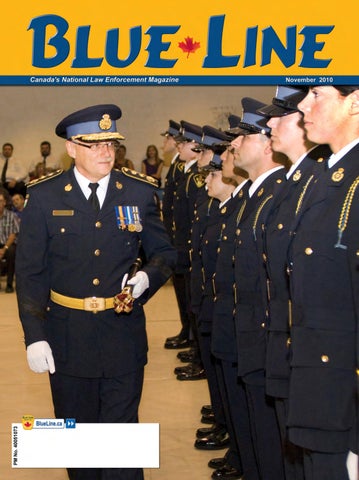
Passing of the tipstaff: Former Ontario Provincial Police Commissioner Julian Fantino, right, passes the tipstaff to newly appointed Commissioner Chris Lewis during the Change of Command ceremony in Toronto Tuesday, August 31, 2010. The tradition of passing the tipstaff has deep roots in policing and shows the authority of the Office of the Commissioner. The tipstaff used in this ceremony was designated as the Commissioner’s official symbol of authority by an Order in Council on October 13, 1969. It is engraved with of the Latin phrase Salus Populi which means “Let the good of the people be the supreme law.” See page 6.
Features 6 Building upon the foundation
16 Empowering present and future police leaders
New OPP Commisioner accepts the tipstaff challenges
8 Breaking the cycle
22 Dispelling myths and moving forward with PEACE
Vancouver Police undergo transformational change
12 RCMP tested by Newfoundland hurricane
Departments
Case Law
38 35 18 19 36, 37 5 28
31
Charter breaches can be addressed at sentencing
33
Search on arrest does not require urgency
Blue Links Advertisers Index Blue Pages Deep Blue Dispatches Market Place Publisher’s Commentary Technology
Blue Blue Line Line Magazine Magazine
33
November November 2010 2010
November 2010
4
Blue Line Magazine
Publisher’s Commentary by Morley Lymburner
Discretion is yours, sayeth the law Blue Line has always considered it important to provide our readers with plenty of case law because modern police officers need to understand why a law or procedure has developed. However, officers must avoid reading so much into case law that they become paralyzed by it. The recent decision by Ontario judge Susan Himel is a good case in point. Himel recently struck down Canada’s prostitution laws, thereby challenging every police officer’s ability to use appropriate discretion in line with community standards. Gone are the days of setting the benchmark for the creation of laws through elected officials. Since the Charter many members of the judiciary have come to believe they have a duty to decide cases on what feels most politically correct rather than basing judgements on existing law. Parliament has now been reduced to the level of either rubber stamping these decisions or creating new laws with the view toward testing the court system rather than community standards. On a ride-a-long several years ago I heard many RCMP officers voice concern about a judge who went very light on drug offences, no matter the type or quantity. They could bust a gang or drug lab, only to see them sentenced to 40 hours of community service or to donate to a local charity in lieu of a fine – or both. This judge refused to convict anyone for driving a car without insurance because the minimum $2,000 fine was, in his estimation, too severe. He was highly critical of police use of force, only levying a fine in the most extreme circumstances. Extreme meant an officer had to spend a few days in hospital. When confronted with these circumstances, police should first and foremost remember that their duty is to prevent offences and their job is NOT a popularity contest. Despite all
Blue Line Magazine
the glowing press spun out by PR departments, policing is not about officers dressing up in fuzzy animal suits or being dunked for charity. It is all about preventing crime. Sending out a strong enforcement image to the community is an effective way to prevent crime. I do not wish to burst any bubbles in the judiciary but true crime prevention is accomplished through the vision of every officer on the street enforcing the law, not within the hallowed halls of the courtroom. Much like a hockey referee, it is the officer patrolling the community that sets the pace for the level of crime. They should never be dissuaded from this duty by a judicial system they feel is not holding up its end of the bargain. A case in point from my own experience was a judge who felt my laying speeding charges of 50 km/h in a 40 km/h zone was inappropriate, preferring I go after those doing 55 to 60 km/h. As he threw out charge after charge, I considered following his advice but decided against it, instead opting to go out of my way to flood his court with offences at exactly 50 km/h in a 40 km/h zone. The judge called me into his chambers and
5
asked me to explain my rationale. I explained it was a new school zone that had just been changed to a 40 km/h limit. Enforcement is the only way I could get the message out to the public. Surprisingly, he saw my point and now understood that we both had levels of discretion that should work in harmony for the good of the community. He agreed to back me up, thanked me for getting the message across to him, returned to the courtroom and proceeded to increase fines upon conviction. You may not encounter a similar judge but law enforcement is not a contest for convictions. I remember some time back when officers were inappropriately evaluated by their “conviction rates.” It is not the duty of police to get a conviction, only to bring a true bill to the courts. Extenuating circumstances are ultimately up to the defence to present and the courts to determine their evidentiary worth. At the street level each officer must determine what level of enforcement is necessary for the good of the community rather than what will please the courts. This discretionary enforcement level should be determined by the officer’s good conscience and tempered by the wisdom of peers and superiors. Nothing should prevent them from being their own trend setter and bringing their own sense of values and creativity to the job that must be done. After all is said, the police selection process is suppose to screen for good judgement and discretionary ability. If you wear the badge, you are expected to have it. This cannot be instilled by any police college, nor by court judgements.
November 2010
Building upon the
foundation
New OPP commissioner accepts the tipstaff challenges by Deb Palmer “Treat everyone you meet with respect.” That was the advice to the fresh faces of the new recruits from a police officer who has provided security for royalty and world leaders and worked as a tactical officer, criminal investigator, polygraph examiner, served on the front line and in a number of specialized positions. He is Chris D. Lewis, the newly appointed Commissioner of the Ontario Provincial Police (OPP). He is well known, well liked and well respected by colleagues – a cop’s cop, friendly and professional. If he’s met you, he likely remembers your name. His style and energy are fresh and invigorating. His values reflect all that the OPP represents. Born and raised in Sault Ste. Marie, Lewis is married to OPP Supt. Angie Howe. They have two grown daughters. He started out as a traffic constable in Kapuskasing 32 years ago and has built a solid reputation. His experience November 2010
is extensive and impressive and his genuine passion for policing has been evident for years. Accepting the OPP’s tipstaff during the August 31 change of command ceremony, Lewis assumed responsibility for one of North America’s largest deployed police services. With close to 10,000 members, including uniform, civilian and auxiliary, the OPP serves thousands of square kilometres of land, waterways and trails. Quite a task, but one that Lewis has prepared for throughout his career. His vision, leadership and credibility have taken him to every area of Ontario, where he experienced front-line administration, investigative disciplines and tactical operations. Prior to serving for three years as provincial commander of field operations, Lewis was the interim provincial commander of strategic services, commanded several bureaus, including information technologies, investigation and investigation support and was eastern regional commander. He directed the criminal investigation branch, formed and commanded the emer6
gency management bureau and worked with the RCMP to establish and lead the Cornwall regional task force on cross-border smuggling. Lewis oversaw the OPP’s response to a variety of high-profile protests and is wellrespected for his contributions to policing within First Nations communities across Ontario. He is a graduate of the FBI National Academy and an Officer of the Order of Merit of the Police Forces. His significant accomplishments have impacted policing at regional, provincial and international levels. His cross-command experience gives him the credibility and knowledge to lead a law enforcement agency that is respected by government, police agencies and citizens alike. “Every officer is a leader in policing and all of our employees are leaders within our communities,” he told the graduating class. He is committed to strong leadership from the top to the bottom. Lewis believes that the organization must develop, mentor and train Blue Line Magazine
supervisors and managers so that they are armed with the proper skills to inspire and lead their teams. Leadership development will be a significant focus as he himself prefers to lead by example and vows to always make decisions that are in the “best interests of the people we serve and the men and women of the OPP.” With a proactive approach to change, Lewis remains committed to the OPP’s high profile provincial traffic safety program, but will seek the balance between traffic safety goals and all of the organization’s other work. Waterway and trail safety is another area where he believes the OPP can reduce injuries and death. His priorities include those that reflect the OPP’s diverse range of services across the province, including criminal investigation, emergency response, crime prevention, community policing and other operational and support activities. Lewis advocates teamwork and plans to engage the experience of four deputy commissioners to move the organization’s agenda forward. Executive leads will support his focus on several other priorities: • Managing protests – not just aboriginal, but the type that police agencies saw during the recent G8 and G20 Summits in Huntsville and Toronto. • Organizational readiness for climate change impacts on emergency planning and response. • Strong media relations. “We need to tell them everything we can without jeopardizing investigations,” Lewis says. He believes that the threat of terrorism is real in Ontario and must be managed efficiently through strong intelligence and investigative support response. Lewis wants the organization to more passionately invest in youth programs. The OPP’s intelligence-led march against organized crime remains strong and he says it’s critical for police forces to move forward as one team to have the greatest impact on the fight against organized crime. “Relationships with partner agencies are stronger than ever. I can’t remember a time in my career that our relationship with the RCMP was stronger; where our partnerships with municipal police services were more effective; or when we worked more cooperatively in crosscommand endeavors internally. We will never let our partners in law enforcement down.” It is important for the OPP to continue to work with community leaders, government agencies, social service agencies and the private sector, says Lewis, adding that strong working relationships are paramount for effective public safety. The often-unsung heroes will not be left off the agenda. Lewis praises the OPP’s dedicated civilian and auxiliary personnel, assuring them that all within the organization will be treated with the same level of appreciation and respect. “We are all critical members of the OPP team,” he notes. The commissioner’s energy extends beyond policing. He is a tireless advocate for many charities and contributes selflessly as a volunteer and fund-raiser for the Ontario Law Enforcement Torch Run, not-for-profit housBlue Line Magazine
ing, Special Olympics and the United Way, to name but a few. Recruits looked to Lewis with admiration and respect during his address. He knows the great task that lies ahead of them because he’s worked hard at it himself. Lewis reiterated the organization’s commitment to energized recruitment initiatives to ensure the workforce continues to reflect the diversity of the many areas the OPP serves. The OPP is ‘an organization of great people doing great things,’ he says, calling the frontline officers doing 24/7 work its ‘face.’ Lewis asks for honesty and suggestions from members and commits in return to do all that he can to improve the people and agency. The OPP has just entered its second century of policing. As the 14th officer to lead the force,
Lewis brings a reputation for successfully implementing and managing change initiatives. It faces bold opportunities and challenges as it sets its course for the second hundred years. It will be Lewis’ responsibility to ensure the best decisions about serving and protecting 13-million Ontarians are made – and for the right reasons. As the honours and traditions continue within the OPP, a humble Lewis is anxious to build upon the foundation laid by his predecessors and to ensure his members are the besttrained, best-equipped and best-led. Deb Palmer is a Communications Officer with the Corporate Communications Bureau of the Ontario Provincial Police. She may be contacted at Deb.Palmer@ontario.ca.
From the crucible of past challenges by Morley Lymburner Everything we see today in Julian Fantino has been developed through the crucible of past challenges. Love him or hate him, he is a man to be reckoned with and never to be ignored. To criminals he is the worst kind of cop – a straight arrow. To police officers he is the quintessential leader. A by-the-book person who understands the value of initiative and individualism. A man who is ready to not only talk the walk but also run as an example for others. After more than 40 years of policing he has decided to leave the badge behind and pick up the mantle of legislator. The story and legend that is Fantino will not likely be repeated in this country. The law enforcement community will see the void and others will competently fill it; just not quite in the same way and possibly not with the same passion. Starting off his career as a security guard in a suburban Toronto shopping mall, Fantino’s drive, even then, was unequalled by his peers. Joining the former Metropolitan Toronto Police was a dream fulfilled and he never looked back, relentlessly marching through the ranks and gaining a reputation as a sturdy and loyal cop and prime investigator. One of those promotions put Fantino in charge of the Jane Street corridor, one of Canada’s toughest neighbourhoods. The northwest Toronto area has had this dubious honour for more than 40 years and it was
7
recognized a no-nonsense senior officer was needed to make a difference. Fantino filled that requirement admirably. Following the old adage that a prophet is seldom recognized in his home town, Fantino accepted when offered the top job with the London Police Service. After fulfilling his contract, he moved on to become chief of York Regional Police and in 2000 was offered the top job with the Toronto Police Service. He had come full circle, carrying his unique brand and style of policing back to his “home” agency. His contract with Toronto completed, he took over the helm of the Ontario Provincial Police at a time of great controversy. Leading a large but widely dispersed police agency gave him many unique challenges and considerable new insights into police work on a large landscape. Heading up 6,000 officers policing small towns, cities and remote rural locales gave him a perspective into what police must do to reduce fear of crime and disorder on a broad canvas. Working with the agency of choice for millions of Ontario residents has burnished and completed Fantino in understanding what is needed for safe communities. Understanding the differences in community values, from concrete jungles to rolling country farms, positions Fantino on a high level of competence for his future political ambitions. Canadians look forward to his future, some with admiration, others with caution or even loathing – but undoubtedly all with a keen sense of interest.
November 2010
Breaking the cycle Vancouver Police undergo transformational change by Ryan Prox It’s 6 pm on a busy Friday and Unit 3B31 is investigating a report of extortion at the Eastern Sweets Emporium. Mr. Sing tells officers what transpired; they enter it into the Police Records Information Management Environment (PRIME) and move on to the next of the many calls for service awaiting their attention. Three weeks later, they read about the arrest of 12 gang members in a takedown of the International Gang (IG) in the daily crime analysis bulletin and Intranet posting. Charges include trafficking, assault and the extortion of Mr. Sing, among several others. “How did this all unfold in what seemed to be a routine call?” they ask themselves. In a word: “analytics” and the new model of intelligence-led policing that is becoming more common across North America, transforming how police operate. The introduction of an integrated analytic system within the Vancouver Police Department (VPD) has brought together virtually every facet of policing under a unified umbrella, transforming how officers do their jobs. The advancement provides the capability to run major investigations, prepare cases for court, analyze shift deployments for efficiency and target crime issues entirely within an electronic environment. While most would contend that technological change is positive, not everyone agrees. Computer aided dispatch and 911 emergency call systems were introduced in the 1970s. The ability to rapidly respond to public reported emergency situations was heralded as a life saving leap forward yet it opened the debate on using technology and the unforeseen imNovember 2010
plications that can profoundly affect and alter policing practices. There were many positive developments with this technological revolution of sorts but also negative consequences that few predicted. To cite an example often attached to the introduction of 911, police were faced with increasing pressure to provide a rapid response to public demands. Based on the volume of calls police agencies received, patrol divisions began curtailing their preventative work. Police were simply too busy responding to delve into the root causes that generated the calls in the first place. As a result, policing evolved from a primarily community-based service to a model of rapid response to calls-forservice. On the other hand, community-policing did not deliver the expected reductions in crime, despite consuming large segments of a police organization’s precious resources. From the perceived shortcomings emerged several alternative crime control agendas, driven largely by police themselves. Unforeseen consequences Intelligence-led policing, “broken windows” policing and CompStat looked at ways to use technology to enhance agency effectiveness at controlling crime. Yet, as with the introduction of 911, these new technologicallybased models encountered many unforeseen consequences. There were three main issues that negatively influenced their effectiveness: • With the introduction of computer-based dispatch, records management and electronic booking systems, agencies were instantly provided a wealth of statistical data on their operations. However, few systems could use the data in a meaningful way or communicate 8
with the disparate systems used to collect the information. • Police lacked the technical abilities to use the systems in the manner for which they were designed. • A lack of ‘consumers’ for the information analyzed. Many agencies resisted technological solutions and even those which adopted a CompStat model often fell short of actually using the information to support operational decisions. Until the development of the integrated investigative and analytic system within the VPD, Canadian police were very limited in their options. Few investigative and major case management systems could communicate between records management, analysis and project/case management systems. This resulted in duplication of efforts and redundancy and required a large contingent of administrative support staff to manually transfer information from one system to another. Apart from the obvious inefficiencies, the more critical issue centred on the lag in available information. Depending on the size and scope of an investigation, it could take from weeks to months to enter information from one system to another. In fact, some who operated under this environment felt the transfer process never caught up and investigators were always operating with dated information of little or no intelligence value. This flawed process contradicts the very principles of intelligence-led policing. By its very definition the model requires information to be analyzed in a methodical and timely manner to help prevent, detect and disrupt criminal activity. The critical element of this process rests on the concept of ‘timely intelligence’. Blue Line Magazine
Under this policing approach, intelligence informs decision making and guides operations by providing real-time solutions. However, these goals are not as straightforward as they may sound and requires a willingness to break down barriers to change and adopt new ways of approaching crime control. Beyond the pragmatics of increasing operational effectiveness and using resources more efficiently, there is a darker side to maintaining the status quo. One resounding issue emerges from the Bernardo/Homolka investigation in Ontario and the more recent case of serial killer Robert Pickton. At the time of the investigations, police agencies were firmly entrenched in stand-alone computer systems that failed to communicate between partner agencies and, in some cases, even within their own police service. The so-called ‘siloing’ of information played a detrimental role in the continuation of the offences, as critical elements of each investigation were scattered over multiple jurisdictions and not available to be shared or reviewed. Individual officers maintained their own Microsoft Access database or Excel spreadsheets containing critical pieces of the puzzle that only they could make use of, making the ultimate goal of apprehending the offenders a far more complicated endeavour. Further, once an investigation was concluded, all the intelligence gleaned and details of criminal activity were forever lost in police archives. While many of these issues were addressed in BC with the advent of PRIME-BC, it is not uncommon for some agencies to persist in perpetuating the siloing mentality. Despite much advancement, some police services still maintain systems requiring manual data-entry. By design, they cannot provide timely intelligence or investigative material, as the manual entry process is typically months behind. Further, once the project or investigation is completed, the rich investigative information is not available to other units or partner agencies. In essence, an information vacuum is created.
have occurred. This wasn’t always the case at VPD. Part of the realization of this model is due to the progressive change in management, resulting in the organization embracing the use of analysts. This required a cultural shift, including trusting analysts for their skills and abilities to provide guidance and objective analysis to assist management in the decision making process. Specifically, the focus of the analyst cadre shifted to a more coordinated program that supports operationally relevant strategic analysis. A blueprint was developed for moving forward in a manner that would support the organizational goals, strategic plan and intelligence-led
policing model. This included improved analyst training, use of technology and the improved sharing, integration and utilization of intelligence. Critical to these goals was developing a central nexus for collecting and analyzing the combined information dispersed throughout the organization. Given that a key tenet of intelligence-led policing is developing actionable recommendations based on sound analysis, the logical focus was to enhance capacity and capabilities in these areas. Several initiatives were undertaken to support an enhanced strategic analysis capability, critical to the success of the intelligence-led policing model because it provides organizational,
A new way Facing these realities, Vancouver PD embarked on a process to change the way it collected, managed and analyzed information. The goal was to implement a process that integrated and coordinated the collective resources of the police service and partner agencies by building an infrastructure that supports intelligence-led policing. The model which VPD has organizationally adopted is premised on timely strategic analysis to identify crime trends and blend together the collective information of the department in a focused manner. Elements of intelligence-led policing permeate throughout the department, such as CompStat, which relies on crime data to analyze trends and identify hotspots requiring special attention. Each facet helps focus enforcement activities in a more effective and efficient manner. The end goal is to switch focus from a reactive policing model to one where potential issues are identified in advance and a variety of tactics and creative initiatives are employed to move beyond the tired mantra of increased enforcement. Quite simply, detecting crime trends early leads to preventing crime from continuing, as opposed to simply reacting to trends after they Blue Line Magazine
9
November 2010
regional and in some cases, national context to a situation, crime issue or gang problem. Returning to the example of Mr. Sing, a series of extortions throughout Vancouver may in isolation appear unrelated. However, when examined in context of other important pieces of information – such as ongoing gang turf disputes, influx of firearms, recent releases from prison and source information indicating one gang in particular is expanding its territory – the events take on greater meaning. The report filed by 3B31 was a critical piece of information that, when analyzed with the total information available, painted a picture of the larger gang problem. Patrol members often overlook this, not realizing that their contribution is essential to the intelligence-led model and absolutely vital to mobilizing enforcement resources. Every piece of information contributes to building the strategic picture. Without a strategic analysis capacity, there is no means or capacity for an organization to be intelligence-led. The VPD analyst cadre is considered one of the best trained, equipped and organizationally deployed programs in North America. The program received awards from the CACP in 2008 and the International Association of Law Enforcement Intelligence Analysts (IALEIA) in 2010 for the progressive blending of technology and organizational capability under a unified program. The analyst program has also caught the eye of domestic and international law enforcement agencies; the program coordinator receives weekly requests to present the successful model. Rigorous training All VPD analysts operate under an incremental training, education and mentoring program. Hiring and screening practices, considered one of the best in the industry, use standardized testing for the skills and abilities needed to excel as an operationally deployed analyst. Recent graduates of the British Columbia Institute of Technology (BCIT) Forensic Analysis Program are considered strong candidates, as they come pre-trained in cutting edge methodology, science, processes and technology. Newly hired analysts are literally able to ‘hit the ground running’. Despite this ability, they undergo a two week, in-house training program covering the fundamentals of analysis, how to present evidence in court, record keeping and use of the VPD’s integrated analytic system, known as the Consolidated Records Intelligence Mining Environment (CRIME). This is the first step in a three year mandatory training program, ensuring the analyst cadre is well prepared to meet the high expectations placed on them. The cultural shift is profound. Analysts are now trusted for their skills and abilities to proNovember 2010
vide guidance and objective analysis to assist management in the decision making process. Specifically, the focus of the analyst cadre has also shifted to a more coordinated program that supports operationally relevant strategic analysis. Realizing these goals requires placing a greater emphasis on building an infrastructure that supports strategic analysis. To better develop this capacity, the VPD adopted a single integrated analytic system to share and exchange information. The days of siloed databases peppered throughout the organization are past. An analyst exchange and sharing network was also established, critical to the free flow of information throughout the department. This takes place in two ways: • The analytic system allows analysts to track their targets of interest and monitor when they are entered in the system or queried by other analysts. • An in-house information sharing system was established, including an analyst intranet website to post questions and completed reports for others to review. The analysts meet every four months to discuss and exchange information with their peers in an open forum. BC is unique The VPD operates in a very unique environment; the entire province functions on the same records management system (RMS), mobile data terminal (MDT) system and computer aided dispatch (CAD) system. Collectively, 10
the system is called PRIME BC, using software designed and built by Versaterm. Adopting PRIME has had a profound impact on policing; every jurisdiction uses the same system to dispatch, collect information and prepare a file for court. The system is so fundamental to the way policing is conducted, the provincial police act specifically mandates its use. Since the advent of PRIME, analysts, managers and investigators have yearned for a way to examine this data and mine it for crime trends, intelligence and strategic developments. The challenge was to build on its strengths and create a system that fully capitalized on the potential of the analysts. This wasn’t as straightforward as one might imagine. It required careful navigation through an environment of provincial legislation, privacy considerations, information security and the technology necessary to support such an undertaking. As with any policing initiative, funding became a primary concern. Securing it required marketing and promoting the merits of data integration and information sharing necessary to support an analytic driven policing model. The support of investigations, patrol, management, finance and information technology (IT) were necessary to move the initiative forward. Without each key stakeholder supporting the concept and resources needed, the system would not have been built. Neutral observers note how the VPD reached a ‘perfect-storm’, where all the prerequisites needed to realize these goals aligned perfectly. After extensive consultation that examined the department’s analytic needs – including diverse areas with unique requirements ranging from planning and research, emergency operations, investigations, crime analysis and intelligence, to name only a few – a system model was developed. The goal was to knit the multi-agency PRIME to a broad range of analytic and data-mining solutions. The solution was developing and implementing CRIME, the first technological solution to integrate the collective information of a police organization under one centralized system capable of conducting detailed analysis. At its heart is a departmental “data mart” which captures a wide range of information and details from the provincial records management system (RMS), CAD, computer arrest and booking system (CABS), critical infrastructure data, cadastral information, population demographics data and court disposition data. It is also worth noting that the VPD uses provincial RMS modules for conducting major investigations, collating criminal intelligence and joint forces projects with agencies such as the Combined Forces Special Enforcement Unit (CFSEU). As a result, every facet of a criminal investigation is captured in PRIME and readily available for analysis in a timely manner. Blue Line Magazine
Within the analytic framework, most records are updated every 24 hours but crucial details, such as those found in the dispatch system, are updated in almost real-time (short delay). They are used mostly for major event management or for critical incidents. The end result is a system that melds the analytic capability to support major investigations, criminal intelligence, source management, wiretap analysis, crime trend identification and organizational resource efficiency reviews. Similarly, the ability to quantify policing issues and measure outcomes has been an elusive pursuit until now. It is not as simple as just hiring more analysts, as is frequently the case. What is required is blending leadership, specialist analytic skills and ability, organizational support and technology. The power of the VPD analytic system rests with the use of the i2 WorkStation, a network analytic solution. The company is considered one of the industry leaders in crime and intelligence analysis products. New era The launch of CRIME heralded a new era in VPD analytic capabilities. For the first time, analysts could query and analyze information and data from a multitude of disparate systems. They could chart criminal associations, identify tactical and strategic trends and map the
Blue Line Magazine
distribution of crime or events. What would normally take weeks could now be done in a matter of minutes. VPD analysts were seconded to the 2010 Vancouver Winter Olympics, providing realtime threat analysis capabilities and situational analysis. In a manner of minutes, they gave commanders a general overview of a situation as it developed, including an analysis of violent suspects, potential outcomes and a recommendation on appropriate response based on previous incidents of a similar nature. A frequent challenge for management is to determine the ‘sweet spot’ on the number of officers to deploy during a major event. Too many
11
can give the impression of an overly policed event and run the risk of alienating the public. Conversely, an under resourced event can quickly turn ugly and result in significant property damage, not to mention a negative image for the event and the host city. During the Olympics, senior management made resource decisions based in part on the analysis provided them. Reports captured hourly, daily and weekly trends, including geographic information system (GIS) overlay maps of the concentration of incidents and the evolving trends. This helped ensure a balanced deployment of officers based on a quantifiable analysis and defensible need. In the past, officers would provide feedback indicating that an event or venue felt ‘off’ and that something was ‘not right’. In today’s fiscal realities, a feeling of ‘not right’ does not justify paying for additional officers. However, a trend analysis of escalating incidents of civil disobedience, violent altercations with police and increased liquor consumption captures this perception of ‘not right’ and quantifiably illustrates the patrol officers’ intuition. It also justifies the overtime necessary to ensure the event proceeds without incident. This was the case during the Olympics, where every expenditure was heavily scrutinized. Contact Special Cst. Ryan Prox at ryan.prox@vpd.ca for more on the CRIME system.
November 2010
RCMP tested
by Newfoundland hurricane
Mounties “go full tilt helping people” by Danette Dooley Some families in rural areas of Newfoundland work up in a lake – their homes surrounded by water – when Hurricane Igor stuck Newfoundland on September 21. Parents tried to keep their children safe as flood water soaked basements and seeped into kitchens and living rooms. Many people fled their homes. The province expected to get heavy wind and rain, said Sgt. Boyd Merrill of RCMP B Division. Instead police began getting reports of road and bridge wash outs and families trapped in their homes. “The wind and rain kept coming. We went from 100 millimetres to 150 millimetres of rain and some towns had 238 millimetres in a one-day period,” Merrill said. More than 100 communities were isolated and without power and a state of emergency was declared in more than 25 communities. Food began to dwindle and gas for generators was just as scarce. Medicines ran low. People worried what would happen if someone took sick while November 2010
others waited it out for days, stranded on the highway. “Every resource and every talent that the RCMP has in Newfoundland and Labrador were utilized during the six-day period from September 21-27,” Merrill said. The hurricane challenged the force’s emergency operations and business contingency plans. “The power went out in our headquarters in St. John’s the first day and for three-and-a-half days the members worked the operational communications centre and the division’s emergency operations centre relentlessly.” Some 20 RCMP members worked in the centres to keep communications going. The rest of the building remained in darkness. “We were able to determine resource needs, equipment needs, what communities needed food and water or other necessary supplies.” Calls to the force’s communications centre doubled, with five out of six calls being hurricane-related. Members also air lifted prisoners out of Bonavista into the penitentiary in St. John’s. The RCMP worked closely with government departments and agencies to get help to those most affected by the hurricane. “We used our partners with the Depart12
ment of Fisheries and Oceans to do inland water patrols in isolated communities to make sure people were safe even though they had no contact with the outside world,” Merrill said. The force also did numerous reassurance patrols to let people know help was on the way. “We used our Twin Otter to drop down into communities where people were in need of seeing somebody from the outside world and we were able to use our patrol vessel “Murray” to deliver emergency medications to people in isolated communities.” Merrill said while people were glad to see the RCMP finally reach their community, the residents’ concern wasn’t for themselves but what havoc the hurricane had played in other areas of the province. “People didn’t have questions about their own issues. All they wanted to know was how everybody else was doing.” Days after the hurricane, military personnel began arriving in Newfoundland to help rebuild roads and bridges. The team consisted of three Navy frigates, a Sea King helicopter and about 1,000 reservists and regular force personnel. Premier, Danny Williams estimates damage done by Igor will run around $100 million. Blue Line Magazine
One man died in the hurricane. Eightyyear-old Allen Duffett of Random Island on the province’s east coast was swept into the ocean when the ground crumbled under his feet as he was going to check on his friend’s cabin. The area wasn’t accessible by plane, land or water for a 24-hour period, Merrill said. “At the 25th hour we were able to utilize a boat from the Department of Fisheries and Oceans to sneak around the island and get into the community and to the residents to let them know that we were going to do a thorough investigation for the missing man.” The RCMP team included investigators, forensic specialists and a police dog. Four days into the investigation the officers, with help from area residents, found the man’s body under a large pile of debris. Although the hurricane is now in the history books, numerous RCMP detachments continue to work with their partner organizations to ensure the safety of residents. “There is nothing we didn’t try to do to help people. Wherever we were needed, that’s where we went.” Merrill said that during the hurricane, serious crime dropped as people tried to make sense of what happened. Looking back on the devastation, he says, RCMP members were resilient and met the challenges hurled their way. “When RCMP members do things like this and get going, that’s when the Mountie comes out in us. We go full tilt helping people. That’s why they call us Mounties.” Merrill said each and every member did what they were trained to do – and then some. “They did what their grandparents taught them to do – to help people – and their resilience paid off.”
Opposite page: Charleston Bridge, Bonavista Bay; Above right: Trouty, Bonavista Bay; Above left: Charleston, Bonavista Bay.
Danette Dooley is Blue Line’s East Coast correspondent. She can be reached at dooley@blueline.ca
Blue Line Magazine
13
November 2010
Breaking down information silos Alberta Police Integrated Information Initiative builds a new future
Photos courtesy of Edmonton Police Service & Alberta office of the Solicitor General.
Temporary Acting Sgt. Dave Radmanovich, left and Staff Sgt. Steven Chwok of the Edmonton Police Service access information through the police agency’s modern system. EPS is to be linked with other Alberta police in a province-wide database. by Ann Harvey Technology is helping make Alberta – and possibly more of Canada – safer for the law-abiding and more hostile to criminals. To ensure that criminals like Paul Bernardo cannot evade capture due to police being unable to quickly share information, the province is linking officers with a province-wide database, the Alberta Police Integrated Information Initiative (API3). Ayaaz Janmohamed, Alberta Solicitor General’s Ayaaz Janmohamed acting chief information officer and executive director of information technology, says the $65 million initiative will also include connectivity to corrections, courts and Alberta Sheriffs. It is the first part of a larger long-term plan to implement available technology for improving information sharing and joint activities such as pursuing vehicles through more than one jurisdiction. “The premise that this whole thing was built on was the Paul Bernardo issue,” he said. The serial rapist and killer, convicted of offences which included two first-degree murders and two aggravated sexual assaults, was sentenced to 25 years in prison in Sept. 1995 and later declared a dangerous offender. Judge Archie Campbell conducted an inquiry into the police investigation of Bernardo’s crimes later that year. “Bernardo moved around between small municipalities in Ontario,” noted Janmohamed. “He was stopped a number of times on traffic violations, but nobody knew that everybody was looking for him so his activities were going unnoticed.” Campbell’s inquiry noted that “had police been working together some of those issues might have been mitigated.” That’s what Alberta is aiming at, Janmohamed said. “Back in 2005, Harvey Cenaiko was the solicitor general and minister of public security. November 2010
Cst. Damien Crockett of the Edmonton Police Service accesses information on a mobile in his police car.
He came from a police background in the Calgary Police Service. The police were looking for the solicitor general to show some leadership in terms of taking policing to the next level. Cenaiko recognized some of the challenges that the police were facing in terms of being able to do things in a collaborative way. He had a vision about transforming policing in the province.” Cenaiko and then Deputy Minister Eric McGann made a proposal to the Alberta Association of Chiefs of Police asking if police were interested in bringing together information from all kinds of law enforcement agencies. Upon getting its agreement “that it would be a great thing to do,” the solicitor-general’s department engaged an Alberta chapter of Deloitte Consulting to study the current situation. The result was the department’s Strategic Information Technology Initiative (SITI), which the Alberta Treasury Board later approved. Janmohamed said SITI’s three parts share $100 million, with $65 million to establish API3, $25 million to improve ministry information management systems and $10 million to investigate the possibility of getting government ministries in other provinces or territories to work with the solicitor general on sharing information. The allocation was approved in 2006. The first part – API3 – was then divided into three phases, he said. “Phase one was to get everybody, all the stakeholders, together, confirm the business case and do a little bit of visioning for the police system. The concept at that time was quite vague.” Then some 15 consultants were hired to scrutinize privacy issues, internal processes in each police agency, connections with criminal justice partners and the federal and provincial corrections services and governance. Study of the second item – police agency internal processes – revealed that each has 80 or more applications dealing with information, including records management, computer aided dispatch and intelligence systems. “The concept of information that’s sitting at Edmonton Police Service being shared with some14
thing that’s happening in Canada was foreign. Each of them had information silos.” They concluded that major systems should be put together to cut through the chaos, Janmohamed said. “Two approaches were suggested. One was that all agencies should use the same software package to ease information sharing. The other was to have all of the information that currently resides in the municipal and First Nations police agencies come together under one roof within one common system.” After much discussion, the latter approach was chosen for API3. Access to information is critical in allowing a smooth and safe handover during a pursuit in which the subject vehicle starts out in the EPS jurisdiction and then crosses into RCMP jurisdiction. “Today that can’t be done unless somebody picks up the phone.” Intelligence information is also critical. An officer who wants to keep track of someone – perhaps a gang member or person with a history of selling drugs – can place a flag in the record management system. Then, when another officer queries that person in the system for something like a traffic stop, a silent hit is generated alerting the officer. Currently this information is not shared throughout the province. If an EPS officer places a flag in the system, only another EPS officer receives the silent hit and can alert the first officer. A Medicine Hat officer who placed a flag would not be alerted. The RCMP, whose members work as federal, provincial and municipal police, is an exception. “They have some federal regulations that prevent them from amalgamating their information with provincial bodies,” Janmohamed said. The RCMP’s record management system (PROS - Police Recording and Occurrence System), can be linked, but the federal force, which polices 22 per cent of Albertans through municipal contracts, has to stay out of that linkage and keep its information separate. “How are we going to create the ability for Blue Line Magazine
an officer in Morinville to be able to look at the EPS data? What we have to do is come up with a mechanism for provincial entities and municipal governments to query the national system and for RCMP members to query the provincial systems in real time.” In the fall of 2007 the AACP endorsed the recommendations and phase two of the information sharing project was begun. A governance structure and service delivery organization to be located in Edmonton were accepted, a working name for the organization was selected and each police agency agreed to go through changes to its regular ‘business’ to achieve the project’s goals. The API3 was born on April 13 and an 18-month procurement process for phase three – the acquisition of the solution for establishment of the service delivery system – began. “We’re at the point now where we’re ready to award it,” noted Janmohamed. “We will build the system. We’re going to be using Alberta’s SuperNet to move information to all of the agencies. We will cut over (bring in) organizations one at a time. They will stop using their existing systems and start using the new centralized system.... “Calgary Police Service is slated to be the first one because its current system has the greatest risk of having issues with the new system. It’s not a modern policing system. We’d like to have our general system stable and operational in Calgary and make sure we’ve ironed out all of the bumps.” The EPS will be last because it has a modern system and will require the least amount of change, he said. The RCMP will share three facets of the system, including provincial computer aided dispatch and the court prosecution package. It will also contribute data to a centralized repository for analysis by provincial intelligence officers. The shared CAD will allow seamless information sharing between agencies, resolving the issue of safe handover of a vehicle pursuit between police agencies. “We’re making officer safety paramount,” Janmohamed said. Having common prosecution package standards will allow the same information elements to be available to all courts in the province, enabling effective disclosure process and speeding the legal system, he said. API3 will also publish to and receive information from the Police Information Portal, which is maintained by the National Police Service. The drawback is that this is not in real time, he said. The information becomes available when the various agencies conduct scheduled uploads. This will be the first centralized province-wide police database in Canada. The projected API3 completion date of 2013 won’t be the final step in police information sharing, Janmohamed said. Alberta may then approach B.C. and Saskatchewan, asking them to collaborate. “BC has already come close to that model,” he said. “They have some challenges around geography and telecommunication. They don’t have something like SuperNet. They have to consolidate their information into three areas in the province; The Island, Lower Mainland and interior of the province.”
Background information on API3
The API3 system will replace individual systems with a single, indexed system that will serve as a ‘single source of truth’ for all agencies. • The API3 project is being funded by Alberta Solicitor General & Public Security and has been endorsed by the Alberta Association of Chiefs of Police. • A team of representatives from six major police services is acting as the API3 Project Delivery Committee and has been working on the system for three years. Hundreds of subject matter experts from agencies all across Alberta have been providing input and assistance in the system design. • An Operations Council and a Governance Council have been formed with representatives from agencies across the province.
Features being considered for the new system
• A common Computer Aided Dispatch application for all agencies in the province, including the RCMP, • Access to Alberta RCMP records systems for municipal/ first nation agencies, • Access to municipal/First Nation agency records for RCMP, • Identification tools, • Case processing and records management, • Intelligence analysis, • Major investigations, • Traffic reporting, • Prosecution preparation package, • Electronic ticketing, • Prisoner handling and arrest processing,
• Property and evidence management, • Scheduling, • Alerts and notifications, • Monitoring, reporting and auditing.
Benefits of a single, indexed system
• Improved public and officer safety, • I mproved police agency effectiveness, efficiency and interoperability, • Common procedures and processes, thereby streamlining work and making upgrades and changes simpler, •F aster, one-stop access to current information for all participating services, including vehicle work stations, • Improved co-ordination of police, justice and corrections’ systems, • Greater level of collaboration between agencies through information sharing, •D irect connections with Alberta RCMP records system provides complete provincial coverage, • Reduction in redundancies through common procedures, •M ore productive time for police officers with less time spent chasing information, educed duplication and better accuracy of info, •R • Standardization of equipment and technology, • Faster prosecution package preparation using standardized formats.
Proposed timeline
• June 2010 – Award contract for system; commence development work, • April 2011 – Pilot version of system installed at Calgary Police Service, • 2011–2013 – Roll out system to remainder of police agencies.
Ann Harvey is Blue Line Magazine’s Western correspondent based in Alberta. Contact her at: aharvey@blueline.ca
Blue Line Magazine
15
November 2010
Empowering present future police leaders
&
by Claudette Lachance
The Ontario Police College’s (OPC) leadership program delivers general training for front-line supervisors, middle, and senior managers of police services. It also has consulted, designed and delivered service-based training to meet specific needs. The OPC conducted extensive job task analyses and leadership needs research in 2005-2006, in tandem with an environmental scan amongst constituents. Information was garnered from across the country on what training managers and supervisors require. The information was used to create a holistic leadership development model that responded to the training needs and would meet new issues as they arose. Model The leadership development model serves as a framework for training, highlighted by a continuum of three areas of focus: Leading self, leading others, and leading operations. Courses address the areas of focus respectively and collectively. The model reflects the learning process for becoming a leader. Focal points include self awareness and management, engaging and leading others and the larger focus of the organization. The model also reflects the process of moving from entry-level leadership at the coach and first-line level to middle management, with more responsibility for people and operations, to the senior level, and the overall vision of the organization. The model addresses the needs of: • S upervisors with 12 months or more experience in their front-line position who have become comfortable with the operational requirements of their job; • middle managers seeking the opportunity for ongoing professional development; • s upervisors and managers at all levels, uniform and civilian; and • p ersonnel with specific job assignments. A series of courses, seminars and workshops on subject-specific topics integrates and embeds skills-based learning in a practical way. Training path The model serves as a framework for training. The offerings are categorized into a structured training path: • Actionable police leadership • LEADER • Strategic police leadership
November 2010
• Focused police leadership Each area of focus targets a series of skills and abilities the leader needs to successfully perform. Both actionable and strategic police leadership streams contain modules scheduled at OPC over one week (this will extend to two weeks as subsequent modules are developed). Participants register for one or multiple modules or, alternatively, they can be delivered on an outreach basis.
16
Actionable police leadership • B uilding leadership strength through self-awareness • Influential police leadership • Emotional intelligence • Delivering service excellence in policing • Business writing Proposed future modules may include ethical leadership, alternate despute resolution and negotiation as well as personal and professional development plans. Blue Line Magazine
L.E.A.D.E.R. Leadership excellence, action, and development for exceptional result is a two-week residential course for police middle managers (staff sergeant and above). Knowledge and skills enhance leadership and management effectiveness. Participants further develop their unique and personal leadership style. Strategic police leadership Modules currently offered include managing service excellence in policing and stakeholder relations. The long-range plan includes: • Systems thinking • Leading change • Ethical duty of care • Executive team • Strategic planning • Project management • Budget planning entoring/coaching for developing •M leadership
• Transition: supervision to leadership – suspended • Media relations • PSA • Prosecutor/hearing officer • Speaker series (conference format). Both the development model and path support the leadership development of municipal, provincial, national, and international police leaders in their commitment to quality policing. Claudette Lachance is a leadership training instructor at the Ontario Police College along with Stephen Adaran, team leader. They can be reached at claudette.lachance@ ontario.ca and stephen.adaran@ontario.ca or visit www. opconline.ca for detailed course information.
Focused police leadership The subject areas stand alone as they are not limited to a specific level or particular job task. The courses vary in length, can be delivered either on-site or through outreach, and are offered in a class or conference format: • Performance management • Team building • Leading a learning police organization
Blue Line Magazine
17
November 2010
Deep Blue by Dorothy Cotton
Tough to understand is easy to dismiss In my next life, I am going to be rich, sit around reading obscure research articles and tell others about them. This really appeals to me because 1. I actually like reading this kind of stuff (as long as there is no test at the end); 2. I stubbed my toe yesterday and my foot hurts so sitting around seems like a good idea – at least at the moment; and 3. I’m always surprised by how much research there is that would be really useful to people if they just knew it existed. Consider a recent issue of the Journal of Experimental Social Psychology. I’ll bet not many of you read it regularly – heck, even I don’t and I am a psychologist – but I happened to run across a reference to an article that sounded relevant. Not that everything in the issue seemed relevant, mind you. I did not read “Creating distinct implicit and explicit attitudes with an illusory correlation paradigm,” for example. Frankly, I have no idea what that title means. There is also an article about framing prisoners and chickens which sounds interesting but I haven’t got to that yet. The article I did read, “Why don’t we believe non-native speakers? The influence of accent on credibility,” was written by a couple of people at the University of Chicago. Their basic premise is that it is (duh) often harder to understand people who are not native speakers (presumably this means native speakers of whatever language we are native speakers of). Since it’s tougher for us to process non-native language, we end up being less apt to believe what these folks say. If someone said something like “Ants don’t sleep,” for example, we are more likely to believe them if they are native English speakers (assuming we as listeners are native English speakers). The thicker
the accent, the less likely we are to believe them. It appears that when we encounter what these authors call “processing difficulty,” we are more inclined to assume that the speaker is not being truthful – as opposed to thinking we are having trouble understanding them. Ergo, we are generally less likely to believe information coming from people with accents than from people without accents. While this in itself it an interesting finding, the author’s other observation was that if you are aware of this bias, you can correct for it – to some extent. In these studies, once it was pointed out to the participants that they were being biased, they were able to counteract it – but only for people with mild accents. Those with thick accents were still kind of screwed. I guess the take home message here is that if you are interviewing, interrogating or otherwise talking to a person with an accent, you might want to think carefully about how much your difficulty in understanding them influences your reaction. Personally, I have no idea whether ants sleep or not, but it would behoove me
not to draw a conclusion based on whether the person who told me this had an accent. Mind you, while that might be the take home message in the narrow sense, the broader message may be that we often make decisions based on factors that really have nothing to do with anything. I noted above that I did not read another article in the journal because the title made no sense to me. Perhaps I should have read a different article first – one called “If it’s difficult to pronounce, it must be risky: fluency, familiarity and risk assessment.” This appeared in the same journal back in 2008 and was written by some people at the University of Michigan. Essentially, their studies indicated that if you use big complicated words that people don’t recognize, they expect the worst. For example, they asked study participants to pretend they were reading food labels and rate the danger of the additives. The names of all the additives were made up but some were easier to decode and pronounce than others (e.g. “Magnalroxate versus Hnegripitrom). The people in the study consistently rated the harder-to-pronounce additives as more harmful than the ones easy to pronounce. Similarly, the authors asked a bunch of people to imagine they were going to an amusement park for a day. They were given a list of made-up rides, some with easy to pronounce names like “Chunta” and others with more difficult names like “Vaivealhtoishi.” People consistently rated the rides with difficult names as more likely to make you sick and more dangerous. At the end of the day, I think what these studies are saying collectively is that sometimes we make decisions based on pretty dumb stuff. We may view it as “instinct” or “gut feeling” – and we may even value our sixth sense as a valuable tool in making quick decisions. That may be true but there is a difference between “gut instinct” based on experience and knowledge and gut instinct based on the very human foibles we all have. Next time you find yourself raising an eyebrow at the dubious information being given to you by a person with a thick accent or dismissing something – a food, amusement park ride or journal article – because the words seem big and tough to decipher, you might want to stop and think for a second. You might be right, but what exactly ARE you reacting to? Dr. Dorothy Cotton is Blue Line’s psychology columnist, she can be reached at deepblue@blueline.ca
November 2010
18
Blue Line Magazine
Relationships under fire Communication 411 by Sandra Cousens “We never communicate; You don’t really listen to me; That’s not what I meant.” It’s not that you’re not communicating. The question is how “effective” are you at communicating with your partner – and are you feeling understood and validated? Effective communication is not only vital in maintaining a healthy relationship, it is also important to our physical well-being. The way we communicate can cause problems and determine the kind of relationship we have. If you misread or fail to really listen to your partner, a minor problem can escalate into a rip-roaring argument encrusted with blame, aggression and frustration. Learning to communicate to satisfy your basic needs and create a better relationship requires – you guessed it, communication. Wow, what a concept! Bet you didn’t see that coming! We all have our own way of communicating. The majority of men like to get to the point. Most women need to talk it out. If you can be patient and respect each others style you will be able to avoid a communication conflict. Dr. Albert Mehrabian, a US university researcher on nonverbal behaviour, found communication effectiveness depends on the following: • seven per cent on the words you use (the message itself); • thirty eight per cent on how you say those words (tone, variety, projection, resonance) • fifty five per cent on your body language (what your partner sees); • ninety three per cent of communication has nothing to do with the actual words we use. Listening is an important skill to learn. Be an “active” listener, not a passive one. There is a difference between hearing and repeating versus actually understanding. In Chinese, the verb “to listen” consists of the characters representing ears, eyes, undivided attention and heart. “Most people do not listen with the intent to understand,” writes Steven Covey, “they listen with the intent to reply.” When we try only to get our own two cents in we fail to see the other person’s point of view. There is no point in trying to communicate effectively if you are angry, anxious, threatened or embarrassed. You may become defensive and that can lead to further misunderstanding. In order to allow yourself to take control of how you communicate you want to refrain from criticizing, patronizing or attacking. Attempting to communicate on a regular basis in a “normal relationship” is difficult. In a police relationship there is the added challenge of work related stress, shift work, confidentiality and exhaustion to work around. Here’s a check list to keep in mind when speaking about a concern (issue) that needs to Blue Line Magazine
be expressed to your partner: 1. Treat your partner with respect. 2. Pick a time and a place that is comfortable for both of you. 3. Gestures, facial expressions and tone of voice can make or break the point you’re trying to get across. Your opening statement will set the tone for the discussion that follows. 4. Use “I” statements and take ownership of your feelings: “I’m feeling lonely because you’re not home as often,” rather than “You are never home anymore.” 5. Express your feelings without judging your partner: “I’m worried about our money situation,” rather than “I’m worried because you are foolishly spending so much money.” Specify what you really want or need. 6. If you have a concern, talk about it sooner rather than later: “When I came home tonight…” rather than “Remember last month when... ?” 7. Limit your talking to the amount of time and number of issues that are comfortable for your partner to absorb. 8. Ask questions that relate to what, how, when or where about the issue. 9. Share the time to talk. Listen and don’t interrupt when the other is talking 10. Empathy means to experience the other person’s perception. It doesn’t mean you have to accept their point of view, just that you understand it. 11. C lear distractions – turn off all electronic devices. 12. Stay cool – keep your anger in check. When you lose your cool your focus in now on your own feelings, not your partners. 13. Leave out criticism. 14. If you do not understand then ask questions. Don’t make assumptions. Clarify. 15. Women – if possible try to get to the point as soon as you can. Avoid going on and on and on like the Energizer Bunny. 16. Men – have some patience. Avoid the tendency to offer a solution immediately. 17. Give your FULL attention. If you are asked to discuss an issue and it is not a good time then set up another time and place and then be there. When you can uncover the underlying emotional level it will become clearer. You might say “I hate my job!” but the underlying issue might be that you have more pressure, a new boss or fear moving into a new position. Nothing can be solved if you don’t express it through communication – so start talking! Sandra Cousens is a speaker and perspective coach with diplomas in wellness, adult psychology, fitness and leadership and more than 25 years experience in the lifeenhancing field. For more, e-mail her at sandracousens@ cogeco.ca or visit www.sandracousens.com .
19
November 2010
Crime fighting and Pop-Tarts Courtesy: L.A. Times, Blue Line News Week LOS ANGELES - The future of crime fighting begins with a story about strawberry Pop-Tarts, bad weather and Wal-Mart. With a hurricane bearing down on the Florida coast several years ago, the retail giant sent supply trucks into the storm to stock shelves with the frosted pink pastries. The decision to do so had not been made on a whim or a hunch, but by a powerful computer that crunched reams of sales data and found an unusual but undeniable fact: When Mother Nature gets angry, people want to eat a lot more strawberry Pop-Tarts. Officials in the Los Angeles Police Department are using the anecdote to explain a similar, but far more complicated, idea that they and researchers say could revolutionize law enforcement. “As police departments have gotten better at pushing down crime, we are looking now for the thing that will take us to the next level,” LAPD Chief Charlie Beck said. “I firmly believe predictive policing is it.” Predictive policing is rooted in the notion that it is possible, through sophisticated computer analysis of information about previous crimes, to predict where and when crimes will occur. At universities and technology companies in the U.S. and abroad, scientists are working to develop computer programs that, in the most optimistic scenarios, could enable police to anticipate, and possibly prevent, many types of crime. Some of the most ambitious work is being done at UCLA, where researchers are studying the ways criminals behave in urban settings. One is working to prove he can forecast the time and place of crimes using the same mathematical formulas that seismologists use to predict the distribution of aftershocks from an earthquake. Another builds computer simulations of criminals roving through city neighborhoods in order to better understand why they tend to cluster in certain areas and how they disperse when police go looking for them. “The naysayers want you to believe that humans are too complex and too random — that this sort of math can’t be done,” said Jeff Brantingham, a UCLA anthropologist who is helping to supervise the university’s predictive policing project. “But humans are not nearly as random as we think,” he said. “In a sense, crime is just a physical process, and if you can explain how offenders move and how they mix with their November 2010
victims, you can understand an incredible amount.” The LAPD has positioned itself aggressively at the center of the predictive policing universe, forging ties with the UCLA team and drawing up plans for a large-scale experiment to test whether predictive policing tools actually work. LAPD officials have begun to imagine what a department built around predictive tools would look like. Automated, detailed crime forecasts tailored to each of the department’s 21 area stations would be streamed several times a day to commanders, who would use them to make decisions about where to deploy officers in the field. For patrol officers on the streets, mapping software on in-car computers and hand-held devices would show continuous updates on the probability of various crimes occurring in the vicinity, along with the addresses and background information about paroled ex convicts living in the area. In turn, information gathered by officers from suspects, witnesses and victims would be fed in real time into a technology nerve center where predictive computer programs churn through huge crime databases. If any of this ever becomes reality, it will be in large part because of Lt. Sean Malinowski, a bookish, soft-spoken former Fulbright scholar who oversees the department’s crime analysis unit. With the blessing of former Chief William J. Bratton and now Beck, Malinowski has spent the last few years immersing himself in the world of predictive technologies. No city in the U.S. stands to gain more from the potential payoff than Los Angeles. The city is one of the most severely under policed in the country, with just shy of 10,000 police officers on its payroll. At any given time, only a fraction of them are on duty,
20
spread across 469 square miles that are home to more than 4 million people. Predictive tools, if they work, would allow the LAPD to get more out of its meager force. The use of crime data by police agencies is nothing new. Many big-city departments today make decisions on how to deploy officers based, in part, on computer mapping programs that track crime patterns and hot spots as they develop. The LAPD and other agencies have become adept enough at channeling this flow of information from officers in the field that crimes committed in the evening are included on the next day’s crime maps. No matter how quickly crimes are plotted, however, these mapping programs leave cops stuck in reaction mode. They show where crimes have occurred in the past, but police still must make educated guesses about where future crimes will occur. George Mohler and Martin Short believe they can change that. In a yet-to-be-published research paper he wrote while at UCLA, Mohler, a mathematician, makes the case that the time and place of past crimes can be used to determine where and when future crimes are most likely to occur. To do this, he argues, police need to start thinking of crimes the way seismologists think of earthquakes and aftershocks. Mohler’s theory stems from a peculiar aspect of crime. Much as an earthquake sets off aftershocks, some types of crimes have a contagious quality to them. When a home is burglarized, for example, the same house and others in its immediate surroundings are at much greater risk of being victimized in the days that follow. The phenomenon is called an exact or near-repeat effect. The same dynamic can explain the way rival gangs retaliate against one another. And, although it is harder to pin down in more complex crimes that are motivated by passion or other emotions, experts believe it holds true there as well. Mohler wasn’t all that interested in what it is about criminals that makes this so. He focused instead on adapting the math formulas and computer programs that seismologists use to calculate the probability of aftershocks, fitting them to crime patterns. (Aftershocks can occur hundreds of miles from an epicenter and many months after an earthquake, while the elevated risk of burglaries and other crimes tends to subside over a matter of weeks and several city blocks.) Using LAPD data, Mohler tested his comBlue Line Magazine
puter model on several thousand burglaries that occurred in a large section of the San Fernando Valley throughout 2004 and 2005. The results, he said, were far more effective than anything on the market today. The program divided the Valley area into patrol zones that were each roughly the size of several neighborhood blocks and then calculated which zones had the highest probability of experiencing burglaries the next day. In one test, in which Mohler assumed there were enough cops to patrol 10% of the area, the model accurately identified the zones where the officers should have gone in order to thwart about a quarter of all the burglaries that occurred that day. Mohler’s approach is a bare-bones dissection of time and space. His former office mate is using high-level math to get inside criminals’ minds. Martin Short earned a doctorate in physics but, like Mohler, he spends much of his time thinking about crime. His research is based on a foundational, common-sense theory in criminology. In it, little attention is given to the social, economic or psychological factors — such as poverty, revenge, greed — that can motivate someone to commit a crime. Instead, criminals are viewed as rational decision-makers who commit crimes only when they come across opportunities that meet certain criteria. For a crime to occur, the theory holds, a would-be criminal must find a target that is sufficiently vulnerable to attack and that offers an appealing payout. An empty house with no alarm on a poorly lighted street, for example, has a much higher chance of being burglarized than one with a barking dog on a busy block. Short’s computer models simulate this decision-making process and give him the chance to decipher how crime clusters form in certain areas that criminals consider prime for plunder. The present models are random and theoretical and therefore not capable of realworld predictions. But with enough funding and computer power, Short said, a far more sophisticated model could be built to replicate actual buildings in real neighborhoods in Los Angeles. Then, he suggested, the decisions of the computerized criminals could be used to predict the movements of actual criminals. Like any radical, unproven idea, predictive
policing has its share of skeptics. Some question whether any amount of number crunching can replace the intuition and street smarts that a cop develops over time. “There is the science of policing, and there is the art of policing,” said LAPD Deputy Chief Michael Downing, who relies heavily on technology as the head of the department’s counter terrorism efforts but remains wary of predictive policing. “It is really important that we learn how to blend the two. If it becomes all about the science, I worry we’ll lose the important nuances,” he said. It remains to be seen whether work like Mohler’s and Short’s can translate into helping cops make day-to-day decisions. The science has progressed only so far. Much of the work at UCLA and other universities focuses on burglaries, because there are a lot of them and their times and locations are easy to pin down. Building predictive tools capable of addressing rarer and more complex crimes, such as homicides and rapes, will be far more complex. Malinowski knows as well that the LAPD will have to overcome significant obstacles. Perhaps most pressing is the need to dramatically upgrade the department’s technology infrastructure and improve the way it collects crime data. And there is a public relations battle that must be won. Malinowski is trying to preempt the likely concerns of civil rights advocates who worry that predictive policing could be used to profile and harass individuals before they do anything wrong. He is quick to say that the technology will not turn the city into a real-life version of “Minority Report,” a 2002 science fiction film in which cops arrest people for crimes they are about to commit. “This will be the opposite of a dragnet, where we just go out and pick up everybody because they’re on a certain street corner at the wrong time. We’ll be basing our decision on facts. It will be dispassionate,” he said. “We still have a Constitution, and we’re still going to be arresting people based on probable cause, not on the probability that they’ll commit a crime.” (LA Times)
Forensics and Security Technology Studies
British Columbia Institute of Technology 604-412-7436 www.bcit.ca/cas/forensics
Blue Line Magazine
BCIT’s Centre for Forensics and Security Technology Studies is Canada’s leading educational provider in forensic studies. Our part-time programs and courses are taught by industry experts with diverse backgrounds in various areas of forensic investigation including: Computer Crime, Crime & Intelligence, Economic Crime, Forensic Health Science, Forensic Science and Video Surveillance.
21
November 2010
Dispelling myths
and moving forward with PEACE
by B rent Snook, Joseph Eastwood, John C. House and Todd Barron We introduced readers to a professional information-gathering approach to investigative interviewing in the Nov. 2008 issue of Blue Line. Much more attention needs to be devoted to training all officers to conduct cognitive interviews with cooperative interviewees, we argued, and to use a conversation management model for uncooperative individuals (also see Snook, Eastwood, Stinson, Tedeschini, & House, 2010). Police officers across the country have expressed great interest in our training initiatives. We want to update our progress and outline future developments in the hope they can provide a potential framework useful for other police organizations – and to respond to four central myths that seem to have emerged around the PEACE method. A quick recap PEACE is simply an acronym for the stages of an information-gathering interview: • P reparation and planning: Interviewers should attempt to learn as much as possible about the subject and case file in general, create a rough outline of the interview structure and plan for all eventualities (e.g., no comment, uncooperative, etc). • Engage and explain: The two central components are to engage the interviewee in conversation and explain what will happen. The purpose is to create an atmosphere where the subject will want to talk (i.e., build rapport) and to ensure they are fully aware of how the interview will proceed. • Account: Get the subject’s account by asking an open-ended question that elicits a free narrative of the event in question. Identify topics from the free narrative and explore each in turn by using open-ended and probing questions. For suspects, interviewers should also identify any inconsistencies between the subject’s account and the available evidence and challenge them about why those discrepancies exist. • Closure: Signals the end of the interview and involves summarizing the main points that emerged – allowing the interviewee to correct or add any information – and explain what will happen in the future. • Evaluation: Occurs after the interview, involves evaluating the information obtained, its effect on the investigation as a whole and the interview process itself through constructive feedback from supervisors. Beyond the stages, PEACE involves teaching interviewers to obtain reliable and accurate information, remain open-minded, act fairly and ask questions to establish the truth. November 2010
Progress and future developments Over the past two years, 45 members from the Royal Newfoundland Constabulary (RNC) and three members of Ontario forces (Greater Sudbury, Halton and Peel) were trained on the PEACE model. Numerous officers have contacted us about receiving training and to learn more about the initiative. Given the growing interest and success of the initial course, we are developing a tiered system of investigative interviewing based on British practices. This ensures all members of an organization gain fundamental interviewing training while members in specialized roles receive the necessary training and supervision to function effectively in their roles. This system also assigns ownership of training to a few highly specialized individuals whose primary responsibility is oversight of all organizationwide interviewing practices. Tier 1: Basic interviewing skills – Introduces every frontline officer to the fundamental concepts associated with interviewing witnesses, victims and suspects. This course aims to teach officers to build rapport, relax interviewees to enable concentration on memory retrieval, eye-closure to avoid distractions, extracting information through free narratives and asking open-ended and probing questions. Officers will learn the basic aspects of human memory and memory enhancement techniques, how to avoid making common interviewing errors such as interruption, overtalking and inappropriate types of questions (e.g., closed-ended, leading). Frontline officers will also be taught to take thorough statements from interviewees. The course would last around three days, allowing all front-line officers to be trained in a timely fashion. Tier 2: Introduction to PEACE – Intro22
duces all members working in investigative units to the underlying philosophy of conducting professional and ethical interviews. Skills taught include how to conduct cognitive interviews (cooperative interviewees) and applying the conversation management model (uncooperative interviewees). Issues covered include ethical interviewing, effective note-taking, basic interviewing concepts, practical issues of interviewing, memory, false confessions, Canadian case law, effective questioning skills and basic communication skills. This course is currently being taught to RNC members and takes two weeks to complete. Tier 3: Child interviewing – This specialized one week course trains members to interview children using the National Institute of Child and Human Development Protocol. Unlike other child interviewing methods, it’s structured to avoid the common errors which prevent children from providing information with evidential value. This model has been validated on more than 40,000 child interviews. Entrance would require submitting examples of videotaped interviews with children to ensure a minimum standard of competence. A post-course exam along with an evaluation of two-post course interviews will be required to pass the course. Tier 3: Significant witness/victim course – A one week course providing intensive exposure to the enhanced cognitive interview and associated techniques. Exposes officers to an in-depth understanding of memory processes, suggestibility and compliance, various memory enhancement techniques associated with the cognitive interview (e.g., witness compatible questioning, using reverse order), questioning skills, self-administered interviews, probing of “don’t know” responses and sketch plans. An interview video is required for acceptance and a passing mark in a post-course exam and interview evaluation. Tier 3: Advanced suspect interviewing – This two week course will provide intensive exposure to the conversation management model of interviewing, expose officers to an in-depth understanding of Canadian case law, suggestibility and compliance and teach how to effectively deal with suspects, accused persons and uncooperative witnesses. A defence lawyer, crown prosecutor and judge will provide officers with their perspectives on investigative interviewing. Participants will learn to conduct efficient and effective interviews, prepare written interviewing plans, ask appropriate questions, deliver cautions effectively and use the “tactical use of evidence” technique to challenge inconsistencies in evidence. An interview video is required for acceptance and participants must pass a post-course exam and Blue Line Magazine
interview evaluation. Tier 4: Interviewing evaluators – Trains highly-skilled investigative interviewers on how to evaluate types of interviews and provide constructive feedback to interviewers. Evaluators will be trained to use the forms required to assess interviews conducted by those practicing the training received in Tiers 1 to 3. Evaluators are selected from individuals who excel on each of the tiered interviewing courses. Tier 5: Interviewing advisor – Responsible for overseeing the investigative interviewing unit, including managing staff members, developing and offering courses, staying abreast (via conferences and research literature) of best-evidence literature on investigative interviewing and conducting organizational-appropriate research. Also liases with major case managers (e.g., ensuring double-blind interviews), evaluates course instructors and interviews evaluators, developing and revising investigative interviewing policies and procedures and monitoring all aspects of an organization’s investigative interviewing practices and training. The advisor must be highly versed in all aspects of investigative interviewing and be proficient with all courses. These courses are aimed at addressing nearly all of an organization’s investigative interviewing needs. Each tier builds on the previous in a way that continually develops the skills of individuals interested in becoming professional interviewers. Feedback sessions (e.g., one-on-one sessions with interviewing advisor and peer-sessions) will take place on a regular basis (e.g., monthly) to make sure the learned skills are being maintained (the feedback component is crucial if learned skills are to be maintained). The tiered system is just one of many different ways to structure investigative interviewing training. Each service must tailor instruction to its own particular needs. Regardless of the exact structure, fundamental principles ought to be included in any training program: • Every member should receive basic training on evidenced-based practices; • All training should contain the same consistent message about the core structure of the interview process, ensuring the same standard of services is delivered across the organization; • The content of courses should be revised as new scientific knowledge on interviewing best practices emerges; • Members in specialized roles should receive in-depth training specific to their jobs; • Most importantly, anyone receiving training must receive constructive feedback on a consistent basis if the efforts put into teaching them are to be rewarded (i.e., produce consistent delivery of professional interviews).
negative misconceptions about the PEACE conversation management approach, used for uncooperative interviewees, have surfaced. 1. PEACE is the same as Reid’s BAI Since the PEACE model is non-accusatorial in nature (best described as an information gathering approach), it is said to be akin to the Reid Technique’s non-accusatorial component (Behavioural Analysis Interview). Beyond the term “non-accusatorial,” such a comparison could not be further from the truth! The BAI involves a series of questions and subsequent observations designed to differentiate between innocence and guilt in possible suspects. Research suggests that it is an ineffective tool for detecting deception (see Masip, Herrero, Garrido and Barba, 2010 review of this method), which means officers are unable to accurately identify human deceptive behaviour and may mistakenly think they are interviewing a guilty person. PEACE attempts to collect as much reliable and accurate information as possible by using scientifically-based interview procedures (e.g., open-ended questions, no interruptions, etc). There is no attempt to use dubious non-verbal cues (e.g., eye-contact) to detect deception. It’s also important to note that the ninestep Reid Technique runs counter to the criminal justice mantra of “innocent until proven guilty.” It starts by concluding that the suspect is guilty (using the BAI) and proceeds to confirm this through active persuasion, meant to increase the anxiety associated with denying the offence, and decreases the perceived consequences of confession (see Kassin, 1997; Ofshe, 1989; Ofshe & Leo, 1997). By contrast, PEACE advocates collecting as much information as possible prior to making judgements about guilt and innocence, allowing officers to remain openminded during the interview. 2. PEACE limits the ability to obtain confessions
A central philosophy of Reid, according to the training book, is that “investigators must deal with criminal suspects on a somewhat lower moral plane than that upon which ethical law abiding citizens are expected to conduct their everyday affairs” (Inbau, Reid, Buckley, & Jayne, 2004, pg. xvi). Consistent with this philosophy, Reid interrogations on this “lower moral plane” involve using theme development, objections to create themes, an alternative question technique and prevention of denials. Joseph Buckley of Reid & Associates recently argued that because PEACE does not include these psychological ploys and trickery (rationalizations and minimizations), investigators are unable to obtain confessions. There are at least three major issues raised with this argument. Firstly, we know little about the ability of either approach to produce confessions. There has never been any attempt to validate the Reid model in its entirety. Its effectiveness in obtaining confessions has never been tested empirically to determine which (if any) components actually contribute to obtaining confessions (the same applies to PEACE). However, research suggests that confession rates hover around 50 per cent in countries using either Reid or PEACE (Milne & Bull, 1999). Second, the real issue pertains to the validity of a confession. It is imperative that any interview technique maximize true confessions and minimize false ones. Research by Christian Meissner and colleagues (University of Texas El Paso) has shown that an information-gathering approach results in fewer false confessions than an accusatorial approach while still producing high levels of true confessions. Other research has shown that some of the coercive techniques contained in Reid may produce confessions in innocent individuals (Russano, Meissner, Narchet, & Kassin, 2005). This tendency, coupled with
Four misconceptions about PEACE Myths and misinformation inevitably surround any novel and promising development. There doesn’t appear to be disagreement with the cognitive interview approach to interviewing cooperative interviewees but some Blue Line Magazine
23
November 2010
the inability of the BAI to identify guilty individuals with a high level of accuracy, raises legitimate concerns about false confessions. As mentioned, PEACE makes no attempt to infer guilt or innocence from a suspect’s behaviour and does not contain any psychological ploys or trickery. Third, preoccupation with confessions is, in our opinion, distressing. The measure of an effective interview ought to be whether it results in a full and accurate account of the event, not whether a confession has been elicited. Rather than doing whatever it takes to get a confession (e.g., through psychologically coercive means that the courts may question), we believe it’s best to collect reliable and accurate information that can advance the investigation as a whole. 3. PEACE will not work in Canada because our laws are different Some have argued that UK case law is designed to allow the PEACE model to be effective because of two major differences: (1) UK officers offer inducements in exchange for confessions and (2) UK suspects do not have the right to remain silent. The notion that police reduce a sentence by up to a third to induce people to talk is erroneous. This is not standard practice in the UK, sanctioned by agencies or used in training. Any attempt to use inducements would be a breach of the Police and Criminal Evidence Act (which regulates police procedures in the UK) and any statements obtained would likely be deemed as unreliable and inadmissible in court. Simply put, the notion that PEACE works in the UK because police can use quid pro quo inducements with interviewees for their cooperation is simply false. Second, the idea that ALL suspects must talk with police is an erroneous caricature of the UK right-to-silence laws. As here, suspects and accused persons have a primary right not to answer police questions. The difference – they are also informed that if they decide to provide information in court that they could have given police during the initial interview (either through silence or spinning a story), adverse inferences about their guilt may be drawn. They are also told that anything they do say may be given in evidence. If a suspect refuses to answer a question about an obvious and concrete piece of incriminating evidence, a police officer may decide to deliver a “special warning.” This mentions that a judge or jury may assume the failure to account for such evidence indicates that an accused had no reasonable or innocent explanation to give. For example, if a homicide suspect chose not to explain why he had the victim’s blood on his clothing during the interview, the judge may (or ask the jury to) make an adverse inference about the suspect’s guilt (in combination with other evidence). Although these practices differ from North American law, suspects are never told they are obliged to speak to police, only that it may be in their long-term best interest to do so. No empirical research has been conducted to see whether these differences in legal rights impact the percentage of individuals who speak with police, however the available evidence suggests that the overwhelming majority of suspects and accused persons in Canada November 2010
(around 90 per cent) choose not to invoke their right to silence (King & Snook, 2009). 4. PEACE is a “soft” interviewing method We are baffled as to why some make this “soft vs. hard” distinction and are not sure exactly what is meant by these terms. We suspect some officers define “hard” as being a forceful challenge to the legitimacy of what is being presented. It might also be that part of the definition means being vociferous in the confrontations about one’s guilt and attempting to persuade the suspect that they are guilty. By contrast, the term “soft” might imply that the interviewers do not challenge suspects about their potential guilt or make raucous challenges. The idea that PEACE interviews do not have a challenge phase (or confrontation about guilt) is false. Rather than confronting people with guilt at the beginning of an interview
“The main goal of any investigative interview is to obtain reliable and accurate information...” (without truly knowing guilt/innocence or without having an interviewee’s side of the story), officers are taught to conduct openminded interviews that collect the information necessary and sufficient to form the basis of consequential decisions. If there are discrepancies or outright contradictions in the interviewee’s account or between what they say and what is known through evidence, they are challenged on those inconsistencies at an appropriate point (typically toward the end of the interview). Direct/boisterous confrontations devoid of substance (i.e., lacking in evidence) are avoided because research suggests that such an approach kills rapport and prevents obtaining valuable information. The challenge phase of PEACE is cognitively demanding for deceptive interviewees who have attempted to weave an intricate web of lies. We know some may object to PEACE because it makes no overt attempt to persuade a non-compliant suspect whom the interviewer thinks is guilty to confess. This objection, however, is in direct opposition to the philosophy underlying the method. The inability of interviewers to determine a suspect’s guilt by observing behavioural cues cannot be emphasized enough. There is an inherent danger in attempts to convince a suspect of unknown guilt to confess to having committed a crime. By obtaining an initial free narrative and using evidence-based challenges, the interviewer is able to reveal innocence or guilt regardless of whether the interviewee admits it. PEACE, therefore, may allow the truth to be revealed without using manipulative and coercive tactics and the risk of eliciting false confessions. Canadian courts have currently endorsed Reid as acceptable. We have simply pointed out that there are numerous concerns about the link between some of the psychological tactics (minimization and maximization strategies) Reid endorses and false confessions (Kassin, 24
1997). We have also, perhaps more importantly, noted that the PEACE model provides a systematic approach to dealing with all types of interviewees – not just suspects. The open-minded information gathering approach is more conducive to obtaining reliable and accurate information, allowing police, judges and juries to make more informed decisions (e.g., lay a charge, conviction). Concluding thoughts This article is not about PEACE vs. Reid, nor were any of our other articles. Our primary goal is to provide officers with the most effective way of conducting investigative interviews – those practices that are grounded in scientific research findings. In light of this goal, we hope readers take three central points from this article: 1. We want officers to know that there is sound scientific knowledge available to them on how to conduct professional interviews. A wealth of information exists on techniques such as cognitive interviewing and organizations should seek to incorporate this knowledge into their training. 2. We think each organization can become self-sufficient with its interview training. The framework presented above is just one model of a potential training structure that could meet the demands of all levels of the organization. 3. We hope we’ve dispelled some potential myths regarding information-gathering interviewing techniques. The main goal of any investigative interview is to obtain reliable and accurate information that can help successfully resolve investigations. We think that the professional interviewing approach known as PEACE remains the best way to accomplish this goal. References
Inbau, F. E., Reid, J. E., Buckley, J. P., & Jayne, B. C. (2004). Criminal interrogation and confessions (4th ed.). Boston: Jones and Bartlett. Kassin, S. M. (1997). The psychology of confession evidence. American Psychologist, 52, 221-233. King, L., & Snook, B. (2009). Peering inside the Canadian interrogation room: An examination of the Reid model of interrogation, influence tactics and coercive strategies. Criminal Justice and Behavior, 36, 674-694. Masip, J., Herrero, C., Garrido, E., & Barba, A. (2010). Is the behavioural analysis interview just common sense? Applied Cognitive Psychology, published online. Milne, R. and Bull, R. (1999). Investigative interviewing: Psychology and practice. Chichester: Wiley. Ofshe, R. J. (1989). Coerced confessions: The logic of seemingly irrational action. Cultic Studies Journal, 6, 6-15. Ofshe, R. J., & Leo, R. A. (1997). The decision to confess falsely: Rational choice and irrational action. Denver University Law Review, 74, 979-1122 Russano, M. B., Meissner, C. A., Narchet, F. M., & Kassin, S. M. (2005). Investigating true and false confessions within a novel experimental paradigm. Psychological Science, 16, 481-486. Snook, B., Eastwood, J., Stinson, M., Tedeschini, J., & House, J. C. (2010). Reforming investigative interviewing in Canada. Canadian Journal of Criminology and Criminal Justice, 52, 203-217. An associate professor of psychology at Memorial University of Newfoundland, Brent Snook can be reached at bsnook@play.psych.mun.ca. Joseph Eastwood is a Ph.D. student at Memorial and can be reached at eastwooj@gmail.com. RNC Insp. John C. House (Criminal Investigation Division) can be reached at jhouse@ mun.ca. Cst. Todd Barron is in charge of the RNC’s investigative interview training and can be reached at tbarron@gov.nl.ca.
Blue Line Magazine
Rescue ’
Ottawa Police Service honor Cst. Czapnik
there s an app for that! It’s getting dark. You’ve been out snowmobiling and have no idea how to get back to the cabin. You have your cell phone with you but there’s no way of telling people where you are. Canadian company RnD Precision Imaging says it has the answer – the ‘Rescue’ iPhone app. The brain child of a former air ambulance pilot and automobile accident reconstructionist, it says the application provides a complete emergency notification service. It knows the local emergency number in most parts of the world and will call it, e-mail or SMS an emergency message to personal contacts, send your GPS location linked to a map and provide a call back number. It also can be auto launched with the press of an icon in case of a medical emergency. The test group for the app included police, paramedics, nurses, fire rescue and hospital administrators, the company says, adding the app was tested across North America, Europe and even Hong Kong and is used by more than 6,000 people.
On Saturday, Sept. 25, 2010, the Ottawa Police Service held a public memorial service for Cst. Eric “Pickles” Czapnik where they unveiled a plaque honouring the slain officer. Cst. Czapnik was killed in the line of duty on Dec. 29, 2009 after being ambushed and stabbed while sitting in his cruiser doing reports. In memory of Cst. Czapnik and other slain officers, OPS Chief Vern White and Cst. Czapnik’s widow, Anna Korutowska, unveiled a blue ribbon sticker that will be placed on all OPS vehicles.
Blue Line Magazine
Visit www.rescue-app.com for more information.
25
November 2010
Procedural justice and legitimacy by Robert Lunney One warm summer day in July 2009 Professor Henry Louis Gates, internationally recognized scholar and Harvard University faculty member, returned by taxi to his university residence in Cambridge after a business trip to China. Listed by Time as one of the year’s most influential Americans in 1997, Gates, a 78 year old black man who walks with a cane, was assisted up the steps to the house by his driver but found the door jambed when he tried to enter. A large footprint was planted on the lower part, as if someone had attempted to kick it in. After unsuccessfully trying to force it open, Gates let himself in by a side door and opened the front door from inside. A neighbour who did not know Gates observed these events and, acting as a good citizen, called 911 and reported a possible break in. The dispatch registered with Sgt. James Crowley, a uniformed Cambridge Police supervisor with a reputation as an elite police officer and instructor on racially biased policing. When no member of his squad volunteered for the call, Crowley, who is white, assigned himself. Back up was on the way but Crowley elected to approach the house and spotted the broken door. Things began to go sideways when Gates responded to his knock. In Crowley’s version, he told Gates why he was responding and asked him to step out onto the porch. Gates became highly excited, exclaiming, “Why, because I am a black man in America?” He refused to leave his home, called an unidentified person and stated “Get the chief” as he was dealing with a racist police officer, telling Crowley he had no idea who he was “messing with” and that he had not heard the last of this. Gates walked back to his kitchen with Crowley following and produced his driver’s license and Harvard identification. At this point Crowley concluded that suspicion of a break in was unfounded and began to leave. Gates followed him outside, continuing to yell at him, and demanding identification. Crowley claims he provided his name three times and he was wearing a name tag. Two members of the Cambridge Police were on the sidewalk, together with an officer from the Harvard University Police and up to seven bystanders. At this point Crowley arrested Gates for disorderly conduct and placed him in handcuffs. Gates said Crowley repeatedly ignored his request for his name, told him “You are not responding because I am a black man and you are a white officer” and pointed out that, due to his age and infirmity, he was an unlikely burglary suspect. Gates was taken to the police station and released after four hours. Five days later, the district attorney withdrew the charge, but this was far from the end of it. US President Barack Obama learned of the incident and, without benefit of further details, remarked to reporters that the Cambridge police had “Acted stupidly.” What had been a local story became a national furor over raNovember 2010
cial profiling. Seeking to end the controversy, Obama decided on a personal attempt at dispute resolution. He invited both parties to join him for a beer in the White House rose garden to share their version of events, hoping to turn the controversy into a positive learning experience. The policeman and professor expressed their respect for each other at the meeting, dubbed the “Beer Summit,” but maintained their differences. Cambridge police chief Robert Haas was unwilling to leave matters in this unhappy state, believing the issues the incident illustrated presented a potential learning opportunity for police and public, with implications beyond his city. At Haas’ suggestion, the Washington DC based Police Executive Research Forum (PERF) put together a review panel of 12 distinguished professionals, including three with experience as chiefs of police. They were tasked with examining all the facts and making observations and recommendations that would be helpful in understanding the dynamics of conflict between police and the public, with the goal of avoiding future unnecessary and destructive disputes. Any officer who has spent time on the street is all too familiar with how minor incidents can go wrong, resulting in complaints against police and overblown controversy. The review panel arrived at some helpful observations about procedural justice, legitimacy, police tactics and the balance of responsibilities between police and the public. Procedural justice refers to the concept of fairness in dispute resolution, rather than to content of the law. The quality of fairness relates to objectivity and the absence of bias. It is a test of conformity when compared with formal or generally accepted rules or standards. Fairness is being just to all. Legitimacy is a term social psychologists use to describe the judgements ordinary citizens make about the rightfulness of police conduct and the extent to which they support the police service. A judge can determine if a police action was lawful and a police supervisor can determine whether an officer acted within the bounds of departmental policy – but citizens will form their own opinions about whether an officer’s actions were measured or excessive, impartial or discriminatory. The review panel addressed the circumstances of the Gates/Crowley incident from 26
procedural justice and legitimacy considerations. Gates believed he was denied procedural justice. Only the citizens of Cambridge could assess whether the incident affected their opinion of police legitimacy. The responsible reaction of the chief encourages the belief that his willingness to invite scrutiny demonstrated his service’s professionalism while also respecting his officer’s version of events. The panel made other observations that most police officers will readily appreciate. Crowley missed opportunities to de-escalate the dispute using verbal tactics and he could have used discretion by not arresting Gates. Gates missed an opportunity to exercise his responsibility as a citizen by recognizing Crowley’s legitimate use of standard enquiry techniques and officer safety precautions. The report observes that had Gates respected the legitimacy of Crowley’s position in the first instance, the situation may not have deteriorated. The panel also suggested that authorities have an interest in explaining to the public why police act as they do in uncertain and potentially dangerous situations, noting citizens have a responsibility to cooperate when an officer is attempting to resolve a complaint. The Cambridge incident may be useful as a case study in police training, but it is more likely that each service will find examples much closer to home. Northern perspectives Now transfer this incident to Canada. It may well have unfolded in the same way, except for one trivial but fascinating detail that demonstrates a cultural deviation between our two nations. When Obama sat down with Gates and Crowley for the “Beer Summit,” each was asked for his preference in suds. The president selected a Bud Light, Gates said he liked Red Stripe and Crowley preferred a Blue Moon. Their differing choice exemplifies the American characteristic of individualism. If the same thing had happened in more communitarian Canada, it is more than likely that each participant, when asked for his selection, would have responded, “Whatever – just make sure it’s a two-four.” The full text of the PERF report is available online at: http://www.cambridgema.gov/CityofCambridge_Content/documents/Cambridge%20Review_FINAL.pdf
Blue Line Magazine
Patrolling parks proactively by Nancy Colagiacomo Longueuil police in south shore Montreal have given neighbourhood parks back to residents by consolidating traditional patrol with a little innovation. As in most urban communities, summer vacations often mean local teens hanging out in the parks much of the night, disturbing the peace and prompting residents to call police to intervene. As in most busy urban centers, a park disturbance call is generally put on the back burner so officers can attend to more urgent matters, resulting in residents either not bothering to call or trying to settle the problem on their own, escalating the situation. Citizens living close by these green spaces often feel intimidated by the young crowds and continuously solicit police to be present in the parks. The bike patrol wasn’t enough; more had to be done in order to restore public confidence. Longueuil police have dealt with this problem for many years and, with the help of local officials and officer creativity, greatly improved the situation with Parc à L’oeil (Park Watch). Under the program, which was begun in 2008 and continuously improved ever since, the service made parks a priority, allowing the public to enjoy green spaces without feeling threatened. Officers and volunteers joined forces, distributing hundreds of surveys door to door asking residents living near parks general questions on safety and to detail their experiences (real or perceived), concerns and satisfaction and/or expectations from police. Their responses enabled police to target the problem areas more efficiently. The visits were conducted during regular shift hours and residents were happily surprised with the personal approach. A one on one opportunity to speak with local police is quite rare nowadays, so the experience was enlightening for both parties. The exercise was repeated at the end of the project to verify that residents noticed a difference over the summer. The second phase of the project consisted of mobilising teams of officers and training them to exclusively patrol, on foot and with vehicles, neighbourhood parks day and night from May to September. The Policiers Patrouilleurs de Parcs (PPP) quickly became accustomed to the usual crowds and goings on in the neighbourhood and shared information with other teams, enabling a continuity of efforts among officers. All 911 calls in the vicinity of any park were immediately redirected to the PPP. Each team of officers was issued a list of the parks that were the most problematic and municipal bylaws likely to be enforced in that area. At the end of the summer, an analyst gathered statistics. The project targeted 66 troublesome parks. Police intervened on various occasions for everything from disturbance, mischief and intimidation to indecent exposure. Response time averaged 17 minutes and fines and arrests increased from 2008 to 2009. Residents have become familiar with the PPP and look forward to meeting and discussing Blue Line Magazine
issues with their local police. Having been part of the project myself, I can confirm that project volunteers and residents contacted were quite content with their police service and found the new approach refreshing. “Police, at all times, should maintain a relationship with the public that gives reality to the historic tradition that the police are the public and the public are the police; the police being only members of the public who are paid to give fulltime attention to duties which are incumbent on
27
every citizen in the interests of community welfare and existence,” – Sir Robert Peel. The project was so successful that other police services have copied it and applied it to their own municipalities. Nancy Colagiacomo is Blue Line Magazine’s Québec correspondent. Anyone with stories of interest on Québec policing may contact her at: nancy@blueline.ca.
November 2010
technology by Tom Rataj
Here come the tablets The personal computer has always been keyboard-centric, originally relying on some version of the 101-plus key keyboard and later benefiting greatly from the mouse and graphical user-interface. The tablet, slate or “touch-screen” computer has quietly worked away on the fringes of the industry for the last 20 years or so in a niche market made up mostly of mobile professionals and various specialized trades. A touch-screen has many usability benefits because there is no intermediate device or process between what the user sees and wants on the screen – just touch what you need. Tablets can take many forms, from a purely touch-screen only device to various versions that mate the touch-screen with a traditional laptop style keyboard. The famous but now defunct PalmPilot really started the small, pocket-sized Personal Digital Assistant (PDA) market with its first commercially successful iteration of the portable touch-screen computer. The Windows Mobile (initially PocketPC) computer still quietly carries-on the concept. Most of these small devices were rendered more-or-less obsolete by consumer and business demand for smart-phones that combine the functionality of a touch-screen PDA with a cell phone, making it possible to carry just one device to accomplish both tasks and more. There are also a wide variety of laptopstyle computers that use the touchscreen with or without the keyboard. Many are convertible laptops with screens designed to rotate 180 degrees before folding back down to cover the keyboard, allowing them to be used purely as a tablet computer. Most now use Microsoft’s Windows 7 with tablet extensions and suffer from some usability issues because Win 7 is not expressly designed as a touch-screen operating system. The shift The current touch-screen explosion began with the introduction of the first Apple iPhone. The brilliantly designed graphical user interface and always-on Internet access set the design direction for the entire industry. The small screen presents many constraints on the user experience, but the cleverly designed, multi-tough interface overcomes many of these. The competition quickly took notice and flooded the market with a huge variety of touch-screen cell phones that try hard to emulate the iPhone. Apple expanded on the convenience of the always-on and portable Internet access by introducing the November 2010
BlackBerry PlayBook iPAD in early 2010, essentially a much larger version of the popular iPOD Touch MP3 player. Built around Apple’s new proprietary 1GHz processor and 256MB RAM, the iPad comes with 16, 32 or 64GB of solid-state storage. Built-in 3G cellular wireless connectivity is an option. All models include WiFi for surfing at home, work or at the corner coffee shop. Apple’s exquisite hardware and software design makes using the iPAD a very satisfying experience. Performance is generally snappy and reasonably intuitive, although Apple newbies will need some time to familiarize themselves with the user interface. The large 9.7” screen is bright and reasonably sharp, although resolution could be better. The Internet surfing experience is very good, although the screen size does create some bottle-necks, and the lack of Adobe Flash compatibility (used for video and other animations on most web-sites) limits full functionality. Out of the box the iPAD cannot print without a third-party application, although a promised November 2010 operating system upgrade is expected to offer printing to printers on a wireless network or those equipped directly with WiFi. 28
The current operating system cannot truly multi-task, although the forthcoming upgrade promises to include that. Prices range from $549 through $879. BlackBerry PlayBook The much rumoured PlayBook (not BlackPad as expected) was announced in late September. It promises to be an impressive 7” multi-touch touch-screen device built around a new 1GHz dual-core processor with 1GB RAM running the new BlackBerry Tablet operating system, which offers true multi-tasking. Both 16 and 32GB solid-state storage versions should be available when it ships in early 2011. 3G and 4G wireless is expected to be introduced later. The PlayBook will include a forward facing 3MP HD camera for video-conferencing and a 5MP HD rear facing camera for general photography, industry-standard micro-USB and HDMI ports and full WiFi connectivity. Initially it will have to be tethered to a BlackBerry smartphone over Bluetooth for 3G capability, which will offer an expanded view of what is on the connected BlackBerry. Although it’s called the PlayBook, it features all the usual BlackBerry Enterprise Server and business security utilities. Blue Line Magazine
While smaller than the iPAD, its dualcore processor should make it operate much faster and its higher pixel-density display should give it better image quality. The ability to use Internet standard features such as Flash is also an advantage. Prices had not been released at press-time. Samsung The Samsung GalaxyTab is expected to be a very slick 7” iPAD clone running the Google Android 2.2 (Froyo) operating system. It will feature cell and WiFi running on a 1.0 GHz processor, a 3MP camera with LED flash, GPS and a wide variety of productivity and entertainment applications. It is expected to ship in 16GB and 32GB versions early in 2011. Prices have not been announced but are expected to be competitive with the iPAD and PlayBook. Toshiba The Libretto W100 is a unique dual touch-screen clamshell tablet computer with a virtual keyboard available on one of the screens. It runs Windows 7 and includes a webcam, solid-state hard-drive, wireless “N” WiFi and Bluetooth and is priced from $1,099. HP At the Consumer Electronics Show in early 2010, Hewlett-Packard demonstrated the Slate concept, an 8.9” capacitive touchscreen tablet computer running Windows 7
Blue Line Magazine
or Android, depending on the model. The actual product hasn’t yet appeared and there are many rumours floating around the industry about whether it will be manufactured. Lenovo The company that bought IBM’s laptop and desktop computer business has the ThinkPad X201 (Convertible) tablet computer, which offers serious mainstream computing power for a wide variety of users starting at $1,499. Lenovo has also displayed a prototype U1 Hybrid, unique because its touch-screen display can be snapped into the lid, which is attached to a traditional laptop keyboard, allowing it to also be used as a laptop with touch-screen capability. Others Many other computer and electronics manufacturers, including Dell, Asus and HTC, have also announced upcoming tablet style products designed to compete with the iPAD and expected on the market in time for the Christmas 2010 shopping season. Business uses While some touch-screen tablets, particularly the iPAD, GalaxyTab and to a lesser degree the PlayBook, are really just entertainment devices, they may offer some legitimate uses in a business setting. The PlayBook appears the most promising
29
because it comes from a business oriented lineage and acts as a larger external screen for a connected BlackBerry. Legal implications The virtually unlimited, anytime, anyplace Internet access all these devices offer has some interesting legal implications, both good and bad. While most of their Web access features are already available on the iPhone, BlackBerry and other small devices, their larger screen size, storage capacity and forward and rear facing cameras allow serious users (of both the good and bad variety) more options. History has shown us that the bad-guys use all technologies as readily as the good-guys when engaged in their “business.” If you think laptops are a hot ticket for thieves, wait until tablet computers become more common. With their got-to-have cache and diminutive size, the expensive little devices will sail out of people’s hands, purses, office desks and coffee-shop tables. The versatility of portable always-on Internet access is the real driving force behind this new market segment. Expect to see lots of activity and plenty of innovations in the months ahead. Tom Rataj is Blue Line Magazine’s Technology columnist and can be reached at technews@blueline.ca .
November 2010
Officer wins fight over benefits and will be fondly remembered
•••
by Tony Palermo A few months back, Cst. Brian Dyck took on Veterans Affairs Canada (VAC) on behalf of all of Canada’s vets dying of ALS. Even while sick and dying himself, Dyck fought hard and won. Sadly, Dyck lost his battle with ALS on Friday, Oct. 8, 2010 – three weeks to the day after winning his fight against VAC. Dyck’s personal battle with ALS was profiled in the Aug/Sept. issue of Blue Line. A former Canadian Forces soldier, he spearheaded a movement to get VAC to recognize the apparent link between military service and the disease. Several studies have shown members are more than twice as likely to develop ALS as the general public – and those numbers are even higher for those who served in the first Gulf War, as Dyck did. Unlike VAC, the US Department of Veterans Affairs recognized the link and since 2008 has provided much needed assistance and benefits to vets living with ALS. Despite this, VAC continued to deny medical benefits to Canadian vets with ALS. After a hard fight, a Global News reporter delivered the good news on Sept. 17. Prime Minister Stephen Harper had instructed VAC to take care of vets with ALS and promised that Canadians would “see some action on that in the not-too-distant future.” Dyck and wife Natali shared tears at the news. “While you always try to be optimistic, I really didn’t think I’d be alive to see this happen,” he said. “This is quite the victory,” she said. “I’m so proud of my husband. What an amazing legacy! It’s a step in the right direction and I guess we’ll really see what it means in the coming days.” A few days later, they found out what Harper’s words meant and were excited to share their news. “WE WON OUR APPEAL!” Natali wrote in an e-mail. “The board ruled in our favour and we will be receiving full pension and benefits. We are so pleased and proud of ourselves. We have been told that this will set a precedent for all the other veterans
November 2010
and military members in Canada. Thank you to everyone who helped make this happen!” Dead at the age of 42, Dyck served his country as a soldier, police officer and advocate for change. He leaves behind Natali, daughter Sophi, many other friends and family, and a legacy for all current and future Canadian veterans with ALS. A personal note I remain inspired by Dyck’s courage and devotion to helping others. A couple of weeks prior to his receiving the good news, I heard from his ALS Society of Ontario case worker Lianne Johnston that he was feeling really down; despite everything he had done to raise awareness and fight on behalf of veterans with ALS, it felt like it wasn’t enough. He really wanted to appear in a promotional video for the ALS Society to show the devastating effects of the disease, she said. Unfortunately, the society didn’t have the money to hire a professional film crew and, given the time sensitivity and because his health was declining, couldn’t use a student film crew. I e-mailed JenCor Entertainment executive producer Colin McKeown and explained the situation. JenCor is best known for TV docu-
30
mentaries such as Truth! Duty! Valour! and, more recently, Courage in Red: Inside the RCMP. It’s important to note that I didn’t know McKeown and had only spoken to him once. Within an hour of my e-mail, McKeown, who also served in the military, had assembled a professional team of script writers, videographers and other production crew who agreed to do the project on their own time. JenCor also donated the use of HD video equipment and an editing suite. Dyck’s video will appear in future ALS awareness campaigns and there is talk about making it available on the society’s web site. Paying it forward and trying to make the lives of others better are not new concepts. Certainly, it’s one of the main reasons people enter law enforcement, the military and related occupations. As this story illustrates, always remember that the kindness of a group can improve the life of one; just as important, the kindness of one can improve the lives of many. Tony Palermo is Blue Line Magazine’s correspondent for the Eastern Ontario & Western Quebec region. A freelance writer and former federal corrections officer, he welcomes all e-mails and stories of interest at tony@blueline.ca .
Blue Line Magazine
Case Law by Mike Novakowski
Charter breaches can be addressed at sentencing Even when an accused pleads guilty, a court can take Charter breaches into account on sentencing. In R. v. Nasogaluak, 2010 SCC 6, an intoxicated driver attempted to evade police during a high speed chase, dangerously reversing his car toward the officer’s vehicle. Nasogaluak came to an abrupt stop and was ordered at gunpoint to get out of his car with his hands up. He didn’t comply, instead placing his feet back inside the vehicle, clutching the steering wheel and door frame. Fearing he would move and strike an officer standing in front of the vehicle, an officer grabbed him and punched him in the head. Nasogaluak let go of the steering wheel and reached out to an officer, who punched his head a second time, pulled him out of the car and wrestled him onto the ground. He was head punched a third time and pinned face down on the pavement, but refused to offer up his hands to be cuffed. He was then punched twice in the back, breaking his ribs and puncturing one of his lungs. No recordings were made of this interaction, even though there were video cameras in the cars. Nasogaluak provided two breath samples well over the legal limit at the detachment. No record was made of the force used during the arrest, the suspect’s injuries or the drawing of a weapon. Although there were no obvious signs of injury and Nasogaluak did not expressly request medical assistance, he stated twice that he was hurt and was seen crying and saying: “I can’t breathe.” No attempts were made to provide medical attention. He was released the following morning, went to hospital and required emergency surgery for broken ribs and a collapsed lung, At trial in the Alberta Court of Queen’s Bench Nasogaluak pled guilty to impaired driving under s.253(a) and flight from police under s.249.1(1) of the Criminal Code but requested a stay of proceedings. Police breached his Charter rights by using excessive force in arresting him, he submitted, and failed to properly report his injuries and obtain medical assistance. If a stay wasn’t granted, Nasogaluak wanted a reduced sentence to remedy the Charter breaches. The trial judge found the first punch was necessary to remove Nasogaluak from the vehicle and prevent him driving away or hitting the other officer. The second was necessary to subdue him and force him to the ground when Blue Line Magazine
he didn’t comply. However, the third punch to the head and the two punches to the back were unwarranted, excessive and violated Nasogaluak’s ss.7 and 11(d) Charter rights. As a remedy, the judge reduced the sentence, using s.24(1) of the Charter to impose a 12 month conditional discharge and one year driving prohibition rather than a typical six to 18 months incarceration. The Crown appealed to the Alberta Court of Appeal. A majority concluded that the trial judge did not make a palpable and overriding error in holding that the use of force was excessive in the circumstances, even though they would not have necessarily made the same finding. The judge considered relevant factors, the speed with which events unfolded and that Nasogaluak was uncooperative and intoxicated and did not interfere with the ruling that the excessive force and failure to report injuries and obtain medical care breached s.7. The court also upheld the sentence reduction as a Charter remedy since it imposed additional punishment or hardship on Nasogaluak but the majority found a sentence falling below a statutorily mandated minimum could not be ordered. Nasogaluak’s conditional discharge for impaired driving was set aside since there was a minimum fine of $600 for a first offence. Evasion has no minimum punishment and the majority did not interfere with the conditional discharge. Justice Côté, in dissent, agreed that a reduced sentence can remedy a Charter breach but it can not be reduced below a statutory minimum. However, he had difficulty accepting that the breaches were so egregious to warrant the remedy of a conditional discharge on the evading police offence and would have re-sentenced Nasogaluak. Both the Crown and Nasogaluak appealed to Canada’s highest court. Excessive force The unanimous Supreme Court of Canada concluded that the trial judge made no palpable and overriding error in his findings that police used excessive force. Justice Lebel, writing the court’s opinion, described the law as follows: (P)olice officers do not have an unlimited power to inflict harm on a person in the course of their duties. While, at times, the police may have to resort to force in order to complete an arrest or prevent an offender from escaping police custody, the allowable degree of force to be used remains constrained by the principles of proportionality, necessity and 31
reasonableness. Courts must guard against the illegitimate use of power by the police against members of our society, given its grave consequences. The legal constraints on a police officer’s use of force are deeply rooted in our common law tradition and are enshrined in the Criminal Code... Section 25(1) essentially provides that a police officer is justified in using force to effect a lawful arrest, provided that he or she acted on reasonable and probable grounds and used only as much force as was necessary in the circumstances. That is not the end of the matter. Section 25(3) also prohibits a police officer from using a greater degree of force, i.e. that which is intended or likely to cause death or grievous bodily harm, unless he or she believes that it is necessary to protect him or herself, or another person under his or her protection, from death or grievous bodily harm. The officer’s belief must be objectively reasonable. This means that the use of force under s.25(3) is to be judged on a subjectiveobjective basis. If force of that degree is used to prevent a suspect from fleeing to avoid a lawful arrest, then it is justified under s.25(4), subject to the limitations described above and to the requirement that the flight could not reasonably have been prevented in a less violent manner. Police actions should not be judged against a standard of perfection. It must be remembered that the police engage in dangerous and demanding work and often have to react quickly to emergencies. Their actions should be judged in light of these exigent circumstances (references omitted, paras. 32-35). Whether or not the trial judge cited the relevant case law and provisions of the Criminal Code, he adhered to the correct legal principles in deciding whether the force was excessive. “Even taking into account the fact that these events occurred over a very brief period of time and that the police had to make hasty decisions to respond to the situation at hand, in my opinion, the court of appeal did not err when it found that the police had used more force than was necessary in the circumstances,” said Lebel. Further, the officers’ conduct amounted to a s.7 Charter violation. Leaving aside the question of whether police may have an affirmative duty to obtain medical assistance for persons under their care, the substantial interference with Nasogaluak’s physical and psychological integrity upon his arrest and November 2010
detention engaged s.7. “The excessive use of force by the police officers, compounded by the failure of those same officers to alert their superiors to the extent of the injuries they inflicted on (the accused) and their failure to ensure that he received medical attention, posed a very real threat to (the accused’s) security of the person that wasn’t in accordance with any principle of fundamental justice,” the court stated. Sentence reduction as Charter remedy The court examined the relationship between the sentencing provisions of the criminal code and the remedy section of the Charter, particularly in the context of responding to
excessive police force. It ruled that, in exceptional cases, a sentence reduction is available as a form of relief under s.24(1) but generally, the consequences of a breach can be addressed through sentencing. Of course, sentencing has a constitutional dimension; s.12 forbids imposing cruel and unusual punishment (ie. a grossly disproportionate sentence that would outrage society’s standards of decency). The Criminal Code sentencing provisions provide judges with a broad discretion in crafting a sentence tailored to the nature of the offence and the circumstances of the offender, subject to case law, the code and Charter. Any mitigating or aggravating factors will then increase or decrease the sentence. Thus, using their broad discretion under the code,
it may be appropriate for a judge to address a Charter breach when passing sentence without resorting to s.24(1). “If the facts alleged to constitute a Charter breach are related to one or more of the relevant principles of sentencing, then the sentencing judge can properly take those facts into account in arriving at a fit sentence,” the court said. It would be absurd to suggest that simply because some facts also tend to suggest a violation of the offender’s Charter rights, they could no longer be considered relevant mitigating factors in the determination of a fit sentence... (T)he sentencing regime under Canadian law must be implemented within and not apart from, the framework of the Charter. Sentencing decisions are always subject to constitutional scrutiny. A sentence cannot be “fit” if it does not respect the fundamental values enshrined in the Charter. Thus, incidents alleged to constitute a Charter violation can be considered in sentencing, provided that they bear the necessary connection to the sentencing exercise. As mitigating factors, the circumstances of the breach would have to align with the circumstances of the offence or the offender, as required by s.718.2 of the code. Naturally, the more egregious the breach, the more attention the court will likely pay to it in determining a fit sentence (para. 48). And further: Indeed, s.718 of the Criminal Code describes the fundamental purpose of sentencing as that of contributing to “respect for the law and the maintenance of a just, peaceful and safe society.” This function must be understood as providing scope for sentencing judges to consider not only the actions of the offender, but also those of state actors. Provided that the impugned conduct relates to the individual offender and the circumstances of his or her offence, the sentencing process includes consideration of society’s collective interest in ensuring that law enforcement agents respect the rule of law and the shared values of our society (para. 49). Even though excessive force by the police can be remedied through a reduction in sentence by applying the code’s sentencing provisions, the court did not foreclose using the Charter’s remedial provisions. “Sentence reduction outside statutory limits, under s.24(1) of the Charter, may be the sole effective remedy for some particularly egregious form of misconduct by state agents in relation to the offence and to the offender,” said Lebel. “In that case, the validity of the law would not be at stake, the sole concern being the specific conduct of those state agents.” Legality & fitness of sentence Although the appeal court did not need to rely on s.24(1) it nonetheless crafted a fit and appropriate sentence in recognizing the serious acts of the police officers and addressing the circumstances of the accused while remaining within the statutory parameters of the Criminal Code. All appeals were dismissed.
November 2010
32
Blue Line Magazine
Case Law by Mike Novakowski
Search on arrest does not require urgency Police do not have to consider exigencies when searching as an incident to lawful arrest, Canada’s highest court has ruled. In R. v. Nolet et al., 2010 SCC 24 three men were travelling along the Trans-Canada Highway in Saskatchewan in an empty 53-foot, Quebec-licensed commercial tractor-trailer. They were stopped in a random check under the province’s Highway and Transportation Act (HTA). Vatsis was driving, Nolet was in the passenger seat and another man, now deceased, was in the sleeping compartment. The truck’s registration wasn’t pro-rated to include the province, the appropriate fuel sticker had expired and the log-book was incomplete and indicated that the truck normally operated east of the Manitoba border. When requested, Nolet agreed to let the officer inspect the empty trailer. The officer thought it “looked odd” but, being alone, decided not to enter, instead choosing to look for more documents – such as previous bills of lading, tickets and other log books – in the tractor. The contents of a small duffle bag the officer found in the sleeping compartment crackled like paper when touched so he opened it, assuming it contained old log-books or travel documents. Instead, he found $115,000 bundled in small denominations, mainly $20 bills. His experience suggested the packaging of cash was typical of drug transactions and the men were arrested for possessing the proceeds of crime. After back-up arrived the trailer was again inspected. The interior measurements were about three feet shorter than the exterior length, indicating the presence of a hidden compartment. The rig was driven about 10 km to the nearest police station and, about an hour and a half later, officers opened up the hidden compartment and discovered 392 pounds of packaged marijuana valued at between $1.1 and $1.5 million. An officer from the Integrated Proceeds of Crime Unit searched the rig the next day to create a contents inventory pursuant to policy. More documentation relevant to the HTA offences was found, including factory decals, registration papers and permits for different companies that, when applied, would make the truck look completely different. At trial, a Saskatchewan Court of Queen’s Bench judge concluded that police inspection powers under the legislation governing commercial vehicles did not permit a warrantless search of the small duffle bag under the circumstances, since the officer had no reasonable grounds to believe that criminal offences had been committed. While the expectation of privacy in a commercial vehicle is generally less than in a private vehicle (which is generally less than in a private home or office), this lesser privacy interest was still entitled Blue Line Magazine
to Charter protection. The judge found the warrantless searches unreasonable, excluded the money and marijuana evidence and acquitted both accused. The Crown appealed. A majority of the Saskatchewan Court of Appeal found that a mere hunch or speculation that a trailer had been altered or re-fabricated, even if hidden contraband was the suspected reason for the alteration, did not taint an otherwise lawful regulatory search. The accused had not established that police used the highway regulatory inspection as a pretext for their actions. The detention wasn’t arbitrary
33
and the search for documents was lawful. There was no s.8 Charter breach and the money should not have been excluded. The arrest was lawful and the marijuana was located during a proper search incidental to arrest. Both items were admissible and a new trial was ordered. The dissenting justice ruled that police could not rely on a regulatory search power once their “focus” became criminal activity. The search authority extended to regulatory matters only and police could not search for contraband as one of the defined purposes of the search. In her view the cash was inadmissible under s.24(2), but the marijuana should have been admitted. Thus, she would have upheld the accused’s acquittal on the proceeds of crime charge, but ordered a new trial on the drug charges. Both accused appealed to the Supreme Court of Canada, arguing that their detention was arbitrary under s.9 of the Charter and the searches following it were unreasonable under s.8. Stage I: Initial stop Random roadside stops for highway purposes must be limited to their intended
November 2010
objective and not turned into an unfounded general inquisition or unreasonable search. The legislation does not provide a general power to search every vehicle, driver and passenger pulled over. However, “a roadside stop is not a static event,” said Justice Binnie, speaking for the entire court. “Information as it emerges may entitle the police to proceed further or, as the case may be, end their enquiries and allow the vehicle to resume its journey.” The initial stop to conduct an HTA document check was valid. The accused were pulled over for a valid purpose and this was not a random check stop specifically set up to locate contraband as well as highway infractions. The random stop program was directly related to legitimate highway purposes; commercial trucking was regulated by legislation in every aspect, thus the initial stop did not breach s.9. Stage II: Regulatory search Under s.32(1) of Saskatchewan’s Motor Carrier Act a peace officer is authorized to “order the driver or owner of a vehicle to submit the vehicle... or the cargo being carried on such a vehicle to any examination and tests that the peace officer considers necessary.” Similarly, s.63(5) of the HTA provides authority for warrantless vehicle searches for evidence of a regulatory contravention under the HTA. “After the initial stop, the officer quickly obtained reasonable grounds to believe that the (accused) were operating the truck in violation of the HTA, having regard to the lack of a truck licence valid in Saskatchewan, the display of an expired fuel sticker and inconsistent entries in the driver’s log-book,” said Binnie. “At the time the officer began to investigate the cab of the tractor unit, it was quite within his statutory authority to search for further evidence related to HTA offences.” Thus, the continued detention wasn’t arbitrary and the search of the tractortrailer unit for relevant papers was authorized. As for searching the cab sleeping area, including the space behind the front seats, there was a reasonable expectation of privacy. Living quarters, however rudimentary, are not a Charter-free zone, but the level of expectation is low since the cab is also a place of work and therefore vulnerable to frequent random checks in relation to highway transport matters. The continued lawful detention and search under s.63(5) did not become unlawful because the officer began to suspect criminal activity. Police patrolling highways are interested in many offences, provincial and criminal. However, “police power, whether conferred by statute or at common law, is abused when it is exercised in a manner that violates the Charter rights of an accused,” said Binnie. I do not agree that the officer’s concurrent interest in contraband (even if it was “predominant”) rendered the HTA search unlawful or unreasonable within the scope of s. 8 of the Charter. As already stated, knowledge of transportation legislation is a requirement to be licensed as a driver. Commercial drivers are well aware of the police authority to conduct random stops and to search a vehicle for evidence of infractions. November 2010
Commercial trucking is a highly regulated industry. Breaching a law will not in itself reduce an individual’s legitimate privacy expectations (otherwise, it would be argued that offenders would always forfeit s.8 protection relevant to evidence of the offence), but here, as events progressed from the police stop to the initial regulatory search of the cab, there was no police invasion of the minimal privacy interest that existed… (T)he expectation that the search might also uncover drugs (did not convert a Chartercompliant regulatory search into a Charter violation) (references omitted, para. 43). The paper-like contents of the bag felt more like items connected to the HTA inquiry than personal clothing or drugs. The warrantless search was authorized by s.63(5) of the HTA and it wasn’t unreasonable for the officer to open the bag. Given the very limited privacy interest, the search did not breach s.8 and the cash was then in plain view. Stage III: Arrest Although the discovery of a large sum of cash may not on its own constitute objective, reasonable grounds to arrest for possession of proceeds of crime, it may contribute to such grounds if the circumstances create a reasonable inference that the money was proceeds of crime. Here, the context was sufficient to supply the officer with the “something more”: three men in an empty, improperly licensed truck making a run across the prairies at midnight on a highway where the truck wasn’t entitled to be. The explanation for where the cargo had gone and why the truck was apparently empty as it headed east did not correspond to the documents, which were riddled with multiple discrepancies. The unexplained $115,000 was in bills of small denominations wrapped in bundles which the police officer believed to be typical of drug dealings… While the Crown did not attempt to qualify the officer as an expert on drug monies, the officer’s experience and training supported the probative value of his evidence on this point. The cumulative effect of the factual elements previously described provides objective support for the officer’s subjective belief that he had reasonable and probable grounds to make the arrests… Looked at individually no single one is likely sufficient to warrant the grounds for the detention and seizure. The whole is greater than the sum of the individual parts viewed individually (references omitted, para. 48). Phase IV: Search after arrest Police may search as an incident to arrest if they’re trying to achieve some valid purpose connected to the arrest, such as: nsuring the safety of the police and public; •E • Protecting evidence from destruction at the hands of the arrestee or others; or iscovering evidence which can be used at •D the arrestee’s trial. Both accused were arrested for possessing proceeds of crime. “It was clearly ‘incidental’ to this arrest to search the vehicle in which the cash 34
was found for evidence of the criminal activity to which the money related,” said Binnie. “The officers’ belief that this purpose would be served by a search of the trailer (given their previous roadside observation of the discrepancy in the dimensions) was itself reasonable. The important consideration is the link between the location and purpose of the search and the grounds for the arrest.” The two hour delay between the roadside arrest and search of the secret compartment at the station did not render it unreasonable. There remained a close causal and spatial connection between the arrest and search. Police were not required to demonstrate a distinct and separate showing of reasonable grounds to search, nor were exigent circumstances needed to further inspect the trailer without first obtaining a search warrant. The trigger for the warrantless search power incidental to arrest is not “exigent circumstances” but connection or relatedness – to search for evidence of the crime to which the arrest related. The search and seizure of the marijuana did not breach s.8 of the Charter; it was discovered during a proper search for evidence incidental to a valid arrest. Stage V: Inventory search The Supreme Court ruled the inventory search was invalid, since it did not, by itself, serve a valid objective in pursuit of the ends of criminal justice because its purposes related to concerns extraneous to the criminal law. The officer’s work in inventorying the vehicle was incidental to police administrative procedures rather than to the accuseds’ arrest, therefore it did not meet the requirements of a warrantless search and breached s.8. Despite the breach, the evidence found was admissible under s.24(2). The task for courts remains one of achieving a balance between individual and societal interests, with a view to determining whether the administration of justice would be brought into disrepute by admission of the evidence. In my view, the evidence found in the “inventory search,” which consists largely of additional trucking documents plus the potentially misleading “decals,” ought not to be excluded. Had the RCMP officers continued their postmidnight search incident to arrest they would have been within their rights to do so and the subject evidence would have been readily discoverable at that time. The subsequent inventory search for administrative purposes of an impounded truck that has already been searched (though less meticulously) should be classified as a technical breach with a minimal impact on the Charter-protected interests of the (accused). The evidence ought to be available for whatever relevance it may have to assist in the resolution of the outstanding charges on their merits (para. 54). The appeal was dismissed. Visit www.blueline.ca/resources/caselaw for complete cases. You can email Mike Novakowski at caselaw@ blueline.ca
Blue Line Magazine
Blue pages
SECRET-LOCK WINDOW BULLETIN BOARDS
CAPS Officers continually confirm that the positive outcomes of their real-life shootings are a direct result of the confidence they developed while proving themselves with their duty ammunition and weapons on CAPS live-fire simulation systems. CAPS Your gun. Your ammo. No excuses. CAPS Inc. 866-559-8591 www.caps-inc.com
Self-stick models available with burgundy, hunter green or charcoal backgrounds. Wall bulletin board looks as if the unit is sealed, yet opens easily if you know the secret. Front door with plexiglass window opens and snaps closed firmly with built-in magnets, yet will never open accidentally. Boards are available with the following options: KLING®, SELF STICK, CORK, TRAKKER, MAGNETIC. For more info on this and other products, ask for free 128-page catalog no. 4601M7. Visual Planning Corporation 1-800-361-1192 Fax: 1-888-563-8730 www.visualplanning.com info@visualplanning.com
Crime stats remain same OTTAWA - The federal government has made crime-fighting a top priority, but new statistics appear to support critics’ claims that general lawlessness has declined or remained the same, not increased. About 7.4 million Canadians - just over a quarter of the population aged 15 and up - said they were victims of a criminal incident last year. Statistics Canada reports that proportion has not changed since 2004. The agency says most criminal incidents reported in 2009 were non-violent. Theft of personal property (34 per cent), theft of household property (13), vandalism (11), break-ins (7), and theft of motor vehicles and parts (5) accounted for 70 per cent of reported incidents. Violence - physical assault (19 per cent), sexual assault (8), and robbery (4) - accounted for the remaining self-reported incidents. Along with economic measures, the Conservative government has made a series of anti-crime initiatives a major part of its policy agenda, despite statistics indicating general crime rates have been in steady decline for more than a decade. The latest Statistics Canada report found rates of violent and household victimization were similar to those reported in 2004, but the rate of Blue Line Magazine
theft of personal property increased 16 per cent, to 108 incidents per 1,000 people in 2009 from 93 in 2004. The highest rates of both violent and household crime were in the Tory heartland - Western Canada, particularly Manitoba and Saskatchewan. The only exception to the trend was New Brunswick, where the rate of violent victimization more closely resembled that in the West. Nearly 1.6 million Canadians, or six per cent of the population aged 15 and up, reported being the victim of a sexual assault, a robbery or a physical assault in the preceding 12 months - similar to the 2004 rates. Physical assault was the most common form of violence, followed by sexual assault and robbery, the agency said. “It was not uncommon for victims of violence to report having experienced multiple violent incidents,’’ said the report. Of the victimized, 74 per cent reported one incident, 16 per cent reported they had been violently victimized twice within the previous 12 months, and 10 per cent said they’d been victimized three or more times. Overall, younger Canadians were 15 times more likely than older Canadians to indicate that they had been a victim of violence within the previous 12-month period. 35
November 2010
Market Place
November 2010
36
Blue Line Magazine
Market Place
Blue Line Magazine
37
November 2010
Remember Glen Evely by Michael Mannella This is the story of a hero. Dedicated to serving and protecting, he put his life on the line and ultimately gave it away, but unlike stories where heroism conquers all, this one remains a tragedy. It was a cold and quiet morning on November 13th, 2004 in Vernon, BC. Shortly after 2:15 a.m., the tranquil streets by the Okanagan Valley awoke to the sound of sirens as police chased a cocaine-infused man driving a stolen pickup. After Vernon RCMP broke off their pursuit, the fleeing suspect continued to speed haphazardly before running a red light and colliding with the patrol car RCMP auxiliary constable Evely was riding in. He was pronounced dead at the scene. The volunteer officer, uninvolved in the nearby car chase and unaware it would take his life, left behind his wife and two daughters. A throng of more than 3,000 griefstricken mourners attended the fallen hero’s funeral – complete with full regimental honours. Fellow police officers paid tribute to the slain volunteer and B.C. Forest Service employee, paying testament to his sacrifice. One would think this story would end with remembrance of his heroic act alongside those of other fallen Canadian heroes, but the story continues. Knit closely along the outskirts of Parliament Hill, the Canadian Police and Peace Officer’s Memorial lists the names of fallen Canadian police and peace officers. Despite its proclamation, “they are our heroes, we shall never forget them,” Evely’s name is nowhere to be found. The reason? He wasn’t a full-time paid officer. That rule was made specifically to keep his name off the memorial. “The decision to exclude Evely’s name significantly trivializes the ultimate sacrifice he and his family made, in serving Canada,” says RCMP C/Supt Steve McVarnock, who commanded the Vernon/North Okanagan detachment from 2006 to 2009. “The issue of being a paid officer versus being a volunteer officer should not have altered the criteria for acceptance that was revised after his death.” McVarnock points out that officials clarified the memorial’s criteria in 2007 to exclude “auxiliary personnel,” shortly after rejecting Evely’s name for the second time. Yet interestingly enough, it already lists three: RCMP auxiliary constables Frederick A. Abel and Joseph E. Balmer and Vancouver November 2010
Police reserve inspector Arthur S. Trentham. Memorial coordinator Bob Lyon suggested in 2006 that those names should not have been added and doesn’t want to again break the rules for Evely. That, at least, makes sense. After all, rules are rules – except the original criteria for Parliament Hill’s annual remembrance ceremony – which honoured police and correctional officers only – was changed to 1995 to include all peace officers so all law enforcement members could be recognized; all but auxiliary officers like Evely. “Glen Evely was part of the law enforcement community regardless and lost his life due to the criminal actions of another individual,” McVarnock says. “He deserves the respect of national recognition for his sacrifice.” That respect is not forthcoming. Evely met all but one of the memorial’s retroactively changed criteria, which requires those named to be: 1) “Sworn” officers. Auxiliaries take an oath prior to being sworn in as volunteer officers. 2) “On duty at the time of death.” Evely was in a marked police cruiser, in uniform. 3) Death “must have been brought on because of official status.” It’s safe to say that if he wasn’t riding in that police cruiser in his capacity as an auxiliary constable, he would still be here today; 4) Acting “in good faith in doing everything that could have been reasonably expected.” Evely went above and beyond his community’s expectations. The only criteria Evely didn’t meet was being a “paid, full-time peace officer.” What a shame – and a sham. “Adding the names of auxiliary officers who die on duty is not a tall order to ask,” McVarnock says. “It’s simply about doing the principled thing – honouring all officers who have paid the ultimate price.” Evely’s wife Annie Lavigne and his two daughters would surely agree. So would the hundreds of auxiliaries who march every September alongside their peace-officer brothers and sisters at the Ottawa memorial ceremony. Evely wasn’t just a peace officer. He was a devoted husband, loving father and auxiliary constable. He lost his life while willingly engaged in protecting the people he served. Yes, this story is a tragedy, but as long as people defend the right to remember, the story is not over. 38
Advertisers Directory Learn more about these Canadian Law Enforcement suppliers at
www.BlueLine.ca
Aero Supplies Safety Products Artcal Graphics Badge and Wallet Bates Footwear Blue Line News Week BC Institute of Technology Call Centre Products Caps Constable Cigar Co CopperBob.com D & R Electronics Co Ltd Dalhousie University FCPO General Dynamics Itronix Group Techna Henry’s Photo•Video•Digital Ingo Global Integral Tactical IPA ITS Canada LightSquared Matte Industries Mega Tech Milarm Company Ltd Mr. Pin Man Inc OPC Tuck Shop Panasonic Prairie Geomatics Pride in Service Realestate4heroes.com Royal LePage Kingsbury Realty SEALS Action Gear Stokes International Strath Craft Ltd SureFire,LLC The Patchman Thomson Carswell TLC Laser Eye Centres Triform Underwater Kinetics Canada Uniforce Tactical Gloves Unique Card Concepts Visual Planning
36 36 36 15 4 21 36 35 36 37 25 27 11 32 35 11 30 37 36 36 9 36 17 30 37 36 40 36 36 37 36 18 37 33 2 37 21 23 13 29 29 37 35
To show your support and be part of a national campaign to add Evely’s name to the memorial wall, e-mail rememberglenevely@live.ca or join Remember Glen Evely on Facebook. Blue Line Magazine
2 nd Ed OUT OF PRINT ition ! com ing s o
on!
Blue Line Magazine
39
November 2010
November 2010
40
Blue Line Magazine