NOvember 2008
2
Blue Line Magazine
November 2008 Volume 20 Number 9
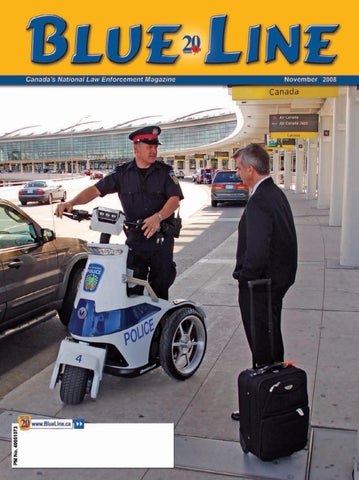
Officers with Peel Regional Police Airport Division board a plane at Toronto’s Pearson International Airport. See page 6.
6 8
eel Regional Airport Division, P tested and ready
16 A passion for diversity, equity and ethics
Preparing for the unthinkable
24 A sticky situation
SPEAR co-ordinates school emergency response
28 Surveillance
22
Your vehicle choice
10 An alternative interviewing method
32 Why do we hate PC?
All we are saying is give PEACE a chance
38 36 38 21 26 37 37 31 30, 33 25 5 18
Advertisers Index Blue Pages Book Review Deep Blue Forensic Science Letters Market Place Medals and Awards News Week Odditorials Publisher’s Commentary Technology
Blue Line Magazine Magazine
Court attendance for Central Patricia
34
Conscripted breath samples not automatically excluded
34
Hit & run applies to single vehicle MVA
33
November november 2008 2008
NOvember 2008
4
Blue Line Magazine
Looking through by Morley Lymburner
green coloured glasses
Appointed last year as Ontario’s Ombudsman Andre Marin wasted no time in launching his first headline grabbing investigation. The former head of the Special Investigations Unit (SIU) decided to have a little look-see at how his successors were doing. He clearly did not find too much. After going to a lot of trouble, at taxpayer’s expense, it’s safe to assume that admitting everything is Jim-Dandy wasn’t an option. So, in the midst of a federal election campaign and collapsing international stock markets, Marin released a report which allowed the media to peek into the teapot to see the tempest. The SIU was looking at investigations into police activity through blue coloured glasses, he complained. This begs the question of whether Marin may be looking through green coloured glasses at an organization lightyears ahead of that which he left ten years ago. Regardless, his report’s 48 hour media life span was enough to get him the attention he so craves. At the end of it all, Marin admitted that he did not actually find any investigations that were improperly performed; no evidence of actual collusion, corruption or incompetence. Eighteen months of scouring, digging, interviewing and reviewing turned up nothing more than an uncomfortable feeling? One of his biggest complaints was that some investigators wore handcuff tie tacks, police agency lapel pins and rings. I recieved media calls for a quote about front line officers’ opinion of the SIU. I responded that the agency adds a level of stress that is certainly not present in other parts of the country. Officers do not look upon them as buddies or get warm fuzzies when they’re around. There is no comfort knowing your split second decision will be reviewed by seasoned investigators, none from your department and then reviewed by civilian overseers to deter-
Blue Line Magazine
mine if criminal charges are warranted. Despite the added stress, I have no real problem with the SIU process. Police officers are always under a microscope. They wield a great deal of power and are entrusted with responsibilities far and above the average citizen. Every 15 minutes of my career was dutifully recorded and reviewed daily by a supervisor. Oversight is not a big deal and the SIU will not go away. It has become recognized as a necessity for many good reasons, so police agencies have adopted an attitude akin to Buckley’s Mixture; “It tastes awful – but it works.” So how does it work? The SIU reassures the public that police are doing their job in a proper and responsible manner. It showed police acted appropriately in 236 of the 238 incidents it investigated last year. There was sufficient evidence to lay criminal charges in two cases and it did so. Clearing away the mist of suspicion is not an easy task. Had agencies investigated their own incidents, or even brought in another police service, the credibility necessary to completely thwart the suspicions of partisanship would be lacking. There is no shortage of conspiracy theorists in this day of mass communications and Internet blogs and there are plenty of MMQBs and people with a grudge against police. An investigator approaching an experienced police officer must assume they are dealing with a person well versed in investigative techniques. Officers practice them each time they talk to a suspect or victim and are well aware of their rights and the rules of evidence. An investigator approaching this person had better have a lot of smarts not readily available to a citizen with no police background and plenty of time. They are not dealing with your average Wal-Mart shoplifter. The SIU investigator’s reports and sum-
5
mations must pass muster with a civilian in charge. Neither the investigators with their police experience, nor their civilian overseer, come with credentials which favour the police. As their resumes make abundantly clear, they are hired for their demonstrated impartiality. Police budgets are the last piece of the puzzle. Before the SIU began in 1990, police services were required to delegate the resources to investigate themselves. An ever watching and curious media made the cases more difficult. Many agencies spent large amounts of taxpayer dollars and side-tracked police resources, only to find their independence questioned. Invariably there would be added legal expenses, civil suits and cash settlements because on a balance of probabilities their nonpartisanship was always in doubt . All media questions are now sent to the SIU. The province, rather than the local agency, picks up the tab for the investigation. This frees resources for other tasks, spares the chief the no end (and no win) job of answering the inevitable and continual charges of partisanship and gives persistent MMQBs one less hook on which to hang their hat. Manitoba has recently decided to institute its own special investigations unit. Given the province’s high profile cases, it is certain the new agency will prove itself invaluable financially, administratively and ethically. When someone as determined as Marin can only find superficial flaws with Ontario’s SIU, you can bet it is a model to emulate.
November 2008
Peel Regional Police Airport Division ,
tested & ready by Capt Matt Sheehy (Ret.) The only thing necessary for the triumph of evil is for good men to do nothing – Edmund Burke (1729-1797) Peel Region and, by consequence, the Peel Regional Police (PRP) are aptly named after Sir Robert Peel (1788-1850), the founder of modern policing and the concept of community policing. Peel’s concept that “the police and community are one” is as relevant today as it was in 1850. The PRP and Peel Region were established on January 1, 1974 with the merger NOvember 2008
and incorporation of the Mississauga, Port Credit, Streetsville, Brampton and Chingaucousy police services. It is now the third largest municipal police service in Canada (after Toronto and Montreal) and the second largest in Ontario. Its 1,800 sworn officers and 700 civilian staff, led by Chief Mike Metcalf, serve the region’s more than one million residents. Airport policing The airport division was began in 1997 when the Greater Toronto Airport Authority (GTAA) contracted with PRP to become the 6
police service of jurisdiction at Toronto’s Pearson International Airport. Headed by then Supt (now C/Supt) Blair Foley, with (now retired) Insp John Byrne second in command, it was based at the service’s Mississauga headquarters. This new unit was temporarily jammed into a make shift and make do headquarters on the second floor of the old Airways Centre building off Airport Road. Although the PRP was well prepared and had planned the transition from the RCMP well in advance, personnel faced many unforeseen challenges in launching a new and unique division and Blue line magaziNe
Divisional Commander Supt Ed Toye (centre), Divisional Inspector Insp Bob Strain (right) and OIC Divisional C.I.B. Det Malcolm Bow (left)
found themselves on a steep learning curve. As a pilot liaison to the new unit representing the Air Line Pilots Association Intl. (ALPA), I saw first hand the dedication of the officers involved. They were determined to be the best airport division in the country and, with the aid of humour, a few profanities and a lot of hard work, they succeeded. The unit today sets the standard for airport policing, and not only in North America. The PRP Airport Division is a global leader in the specialized field of aviation security and policing. Also on staff in those early years was Malcolm Bow, a dynamic and dedicated sergeant who played a leading role in the new unit’s overall success. Attached to the RCMP early in 1996 as part of the PRP advance team, Bow was tasked with assessing what was needed to police Canada’s largest and busiest airport and translating that knowledge into procedures, rules and regulations to train unit members. To succeed, the airport division had to be inclusive and challenge old habits and ways of thinking. It accomplished this by reaching out to the aviation community, especially pilots and flight crews. This was a new way of doing business and a triple “E” hit: effective, efficient and economical. This was the genesis of what continues to be a very close and effective working relationship between the unit and pilots at large. Blue Line Magazine
The trust and close professional partnership built up in those early years is still an essential element in the success of the airport division and should never be taken for granted. Members also participated in Transport Canada working groups, developing training models and hand outs specifically targeted to the issues and concerns of flight crews and other airport personnel. Timely guidelines and advisories were aimed specifically at supporting air crews. The division helped launch airport commanders and counter-terrorism conferences and introduced familiarization flights for ERT and TAC team officers (one of my favourites). This innovative approach to sharing information and learning from other airport security stakeholders paid big dividends and continues to do so today. All of this work showed its efficacy in the level and degree of trust and co-operation evidenced at Pearson in the dark days following 9/11. The division set an example of professional conduct and quiet leadership through those difficult weeks, and continues to provide this example today “The airport community has grown considerably in its ability to provide a safe and effective operating environment across the country at all our major airports,” says the current division commander, Supt Ed Toye. A 30 year police veteran, he joined the PRP in the aftermath of 9/11 and chaired 7
the first meeting of Canadian airport police commanders. “The co-operation between agencies has never been better,” Toye notes. “We understand each others priorities and concerns. We are certainly proud of our relationship with the ALPA, ACPA (Air Canada Pilots Assoc.), ATAC (Air Transport Association of Canada), CAC (Canadian Airports Council), CATSA (Canadian Air Transport Security Authority), Transport Canada and CBSA (Canadian Border Security Agency). “Together we make a great team and we are committed to maintaining and nurturing his unique partnership.” The challenges of airport security remain daunting. Air travel levels have reached and surpassed pre-9/11 peaks and the threats remain real and evolving. The PRP takes nothing for granted. In the face of these challenges, it remains committed to providing a calm, effective and, above all, safe traveling environment. Captain Matt Sheehy retired last year after flying for 37 years and has logged over 20,000 hours as a pilot. He is presently a security advisor to ACPA. An OPP auxiliary officer since 2002, he organized a highly successful 2005 seminar on counter terrorism for the OPP titled (Cops Are the key). He continues to lend his extensive security expertise on aviation related issues to the Peel Regional Police Airport Division and other agencies.
November 2008
Preparing for the
unthinkable
SPEAR co-ordinates school emergency response by Ryan Siegmund Peel Regional Police (PRP) has devised a plan to maintain safe and secure schools and ensure the force can quickly respond to a violent or large scale incident. School/Police Emergency Action Response (SPEAR), a comprehensive computer database and proactive emergency preparedness plan, coordinates the response of front line officers and specialized units. Accessible to desktop computers, mobile tactical units and duty inspectors, the database includes a detailed profile of every school in Peel Region, preparing officers to quickly make critical decisions. First responders can access a wealth of information on the schools, including area maps, floor and site plans; internal, external and aerial photos of the school; tactical plans and data sheets. Officers can examine floor and site plans to help draw a relationship between the school structure itself and the rest of the property. When SPEAR is activated, comm staff call up the school’s data sheet and retrieve predetermined info – which roads need to be shut down, where the staging areas are for emergency services. They also identify who will relay information to the lead officers on the front line. On the way to a call, officers can pull up the floor plans, pictures of the school and preNOvember 2008
determined tactical info on where and how to enter the school, roof access points and entry and escape routes. Printers which work with the rugged laptops used in the field are available so the incident commander or tactical team can obtain paper copies of information. Peel is beginning to roll-out new mobile laptops in cruisers and Saliba says the plan is to also make SPEAR available to them. PRP began developing SPEAR in April 2004 and officially launched the program that November with the co-operation of the public and Catholic school systems in Peel Region. Both boards co-operated in providing the necessary information for the database and trained school staff about the program. SPEAR co-ordinator Grace Kempers created the web based database and went through the “tedious” task of compiling all the different pieces of information needed about the more than 350 schools in the region of Peel. To get the project moving, Kempers sent out a form to all schools detailing what was required from them. Keeping track of the information submitted challenged her organizational skills, she admits. Step two was verifying that the information received was accurate, which required her to visit every school. During her visits, Kempers planned the staging areas and evacuation sites and took the necessary pictures. The complete profile 8
Chief Michael Metcalf
took about six hours per school, she estimates. The schools are responsible for keeping the information up to date by informing police about any changes to physical structures, floor plans and staff. Kempers says one of the nice things about the program is that it was put together with off the shelf software. “It is not a big, high cost venture for anyone to undergo,” she points out, adding the database is also useful for other purposes. Peel Police believe the program is the first of its kind in Canada and is getting inquiries from police agencies across the country, says Saliba, noting the RCMP have adapted the project’s concept and are piloting it in Prince Edward Island. The Ontario Ministry of Community Safety and Correctional Services has also shown interest. Chief Michael Metcalf pointed out that in today’s society, it is paramount that policing agencies have in place strategic plans to address critical incidents. “The SPEAR program has been derived through the visionary leaders within our own organization,” Metcalf stated, “We now possess a state of the art computer program to ensure the matter is resolved as expeditiously and in the safest manner possible.” Contact A/Det. Taufic Saliba at (905) 453-2121 x3620 or Grace Kempers at x3621 for more information on SPEAR.
Blue line magaziNe
Blue Line Magazine
9
November 2008
An alternative
interviewing method All we are saying is give PEACE a chance by Brent Snook and John C. House Police interviews of suspects, accused persons, witnesses and victims is one of the most fundamental aspects of criminal investigations. The primary goals are to seek the truth, obtain information to assist a criminal investigation and elicit a true confession (see Kassin, 1997 and Kassin & Gudjonsson, 2004 for review of the potency of confession evidence in legal proceedings). In Canada, the Reid Technique, a social psychological process model of interrogation, is the most routinely taught and used method to achieve those goals. This ubiquitous interrogation model was first described in-depth in 1962 in the book Criminal interrogation and confessions and has subsequently been taught to hundreds of thousands of investigators around the world (Buckley, 2006; Inbau, Reid, Buckley, & Jayne, 2004; also see Inbau, Reid, Buckley, & Jayne, 2005). “The Reid Technique is widely considered to be the most effective interrogation technique in use today,” according to Buckley (2006), (p. 190). Based on employing the “nine steps” approach to interrogation, it’s claimed that “none of the steps is apt to make an innocent person confess and that all the steps are legally as well as morally justifiable” (Buckley, p. 198). What many readers may not know is that an alternative interviewing method is used in many quarters of the world. As we will attempt to argue in this brief article, Canadian police agencies could be more progressive and consider giving PEACE (Planning and preparation, Engage and explain, Account, Closure, Evaluation) a chance. NOvember 2008
Antiquated and coercive Reid consists of two main phases: the interview and the nine-step interrogation. The interview is non-accusatory in nature and allows the interviewer to gather investigative and behavioral information from the suspect using a behavioural analysis interview (BAI) (Inbau et al., 2004). The officer uses the information obtained to assess an individual’s guilt and decide if an interrogation is necessary. Only individuals judged likely to be guilty are subsequently interrogated using Reid, according to Inbau and colleagues. The interrogation differs from the interview in that it is accusatory in nature and based on an assumption of guilt. It involves active persuasion, meant to increase the anxiety associated with denying the offence, and decreases the perceived consequences of confession (Kassin, 1997; Ofshe, 1989; Ofshe & Leo, 1997). Canadian courts have deemed the Reid technique acceptable. The case of R. v. Oickle (2000) provides the framework for determining a confession’s voluntariness. Canadian judges are directed to consider all relevant factors in making such a decision, including “threats or promises, oppression, the operating mind requirement and police trickery” (R. v. Oickle, 2000, p. 3). Having said that, most cases are not clear-cut. Direct threats of physical harm render a confession inadmissible, for example, but veiled or implicit threats do not necessarily do so. Judgments regarding the admissibility of police trickery are driven by the subjective guideline of whether it “appalls or shocks the community.” Thus, it appears Canadian judges have significant flexibility in deciding whether a confession was voluntary and should be admitted. In the end, Canadian police officers also have some flexibility in the strategies they are permitted to use. Why advocate, you might ask, for another method if the courts have accepted the Reid technique. Reid has come under close scrutiny by a range of academics and police practitioners. As succinctly argued by Saul Kassin 10
(2008), Inbau and his colleagues “recommend a multistep approach that is essentially reducible to an interplay of three processes: isolation, which increases anxiety and the suspect’s desire to escape; confrontation, when an interrogator accuses the suspect of the crime, sometimes citing real or fictitious evidence to bolster the claim; and minimization, where a sympathetic interrogator morally justifies the crime, leading the suspect to expect leniency upon confession” (p. 250). Reid is based on a series of assumptions that lack scientific support, including that interrogators can accurately determine a suspect’s guilt and preventing denials leads to more confessions. Two crucial findings have experts extremely concerned about Reid’s impact on interrogation outcomes: • Twenty five per cent of individuals exonerated by DNA in the US provided a false confession; and • Experimental research has illustrated the link between interrogation tactics and false confessions (see Kassin & Kiechel, 1996; Russano, Meissner, Narchet, & Kassin, 2005) One case that caused concern in Canada was when police officers employing Reid elicited confessions from three young men in 1992. They were subsequently charged with first-degree murder of a 14-year old Regina girl, Darelle Exner (Legge, 2003). Their confessions were exposed as false only after DNA evidence led to the identification of another individual (Kenneth Patton) as being responsible for the murder (he too subsequently confessed). Subsequent analysis of the transcripts showed that the interrogation was highly suggestive and coercive. The effect of Reid on potential false confessions is rather intricate (and beyond the scope of this article). Kassin and Gudjonnson (2003) and Kassin (2008) review evidence illustrating the relationship between Reid-based interrogation tactics and false confessions (or see Kassin’s web page: http://www.williams.edu/Psychology/Faculty/Kassin/index.html). Blue line magaziNe
Lessons from England and Wales Several high-profile wrongful conviction cases in England (e.g., Guilford Four, Birmingham Six) resulted in close scrutiny of investigative practices culminating in wrongful convictions. One issue that garnered a lot of attention was the tactics used to interrogate the suspects. It was determined that the overly manipulative and coercive nature of interrogation practices contributed to the wrongful convictions. In response, substantive reforms occurred, culminating in the adoption of the inquisitorial (non-manipulative or coercive) interviewing method PEACE in 1992. Cases of wrongful conviction have also been uncovered at an increasing rate in Canada. Recognizing the need to prevent wrongful convictions, the Federal-Provincial-Territorial Heads of Prosecutions (FPT) committee set up a working group in 2002 to identify the factors contributing to justice system errors. The committee mandate included ascertaining why wrongful convictions occur, how criminal investigations failed, how police resources could be used more efficiently and ways to ensure cases are resolved in a timely manner. It concluded that criminal investigative failures were sometimes a function of unethical conduct by investigators who blamed the wrong individuals. Investigators sometimes failed to use best practices, it noted, such as appropriate interrogation strategies (e.g., asking open and closed-ended questions). Despite their concerns about interrogation practices and
Blue Line Magazine
research suggesting that Reid-based interrogations can result in false confessions, changes have yet to emerge in Canada. The PEACE model More than 120,000 police officers in England and Wales have been trained to use PEACE, which was created to provide them with a more ethical approach to interviewing. According to Gudjonnson (2004) and Milne and Bull (1999), it can be used to interview witnesses, suspects and accused persons. Here is an overview of the method. 1. Preparation and planning: Interviewers are encouraged to have intimate knowledge of case files before commencing an interview and to establish a schedule with a set of objectives and aims to be met. 2. Engage and explain: The interviewer explains the interview’s purpose, introduces those present in the room, where applicable administers the police caution and Charter rights, establishes rapport with the interviewee and engages them in conversation. 3. Account: Involves obtaining an account of the event by using the cognitive interview (typically used in interviewing agreeable interviewees) and conversation management (for less agreeable interviewees). According to Milne, Shaw, & Bull (in press), conversation management – the crux of PEACE – can be divided into three stages; (i) the suspect account, (ii) the police agenda and (iii) the challenge stage. The suspect account involves listening carefully and noting points of interest that
11
can be pursued later in the interview. Once an account has been taken, the officer should attempt to deal with specific topics or areas in a structured manner by using an appropriate questioning strategy (e.g., using open and closed-ended questions and avoiding leading questions) and checking the suspect’s account of events for comprehension and understanding at the end of each questionanswer session. The process of “probing and summarizing” should be repeated until the interviewer is satisfied that all crucial aspects of the events under question have been sufficiently covered. At this stage, it is recommended that the interviewer not challenge the suspect’s account. The interviewer should then pursue (by probing and summarizing) any areas not covered. As indicated in stage one, the police agenda involves good preparation. The interviewer is encouraged to create a schedule of the topics that need to be covered, such as actual evidence against the suspect, facts that need to be established, potential lines of defence and so on. Aspects of the suspect’s account will then need to be challenged. If any contradictory facts or information remain, the interviewer is encouraged to challenge the suspect as to why such discrepancies exist. PEACE advocates recommend that challenges not be conducted in an aggressive manner but rather as a presentation of information that the interviewee is knowledgeable about. According to Milne and her colleagues (in press), the point of this
November 2008
section is to give the subject an opportunity to comment on the information presented which challenges their account. 4. Closure: Ending the interview by summarizing the main points that emerged, giving the suspect an opportunity to correct any part of the summary or add information, and explaining what will happen in the future. 5. Evaluate: Involves evaluating the information obtained from the interview and how it affects the progress of the investigation and the interviewer’s performance. If you do not find the method intuitively appealing, here are some points that might convince you to consider PEACE as a viable alternative or even a supplementary method. 1. This method does not contain coercive or manipulative strategies, which should appeal to today’s policing ethos. From an organizational perspective, every attempt should be made to weed out practices that may result in wrongful convictions and ultimately damage an agency’s reputation. Moreover, removing coercive techniques will decrease the chances that a confession will be deemed inadmissible, even if it is truthful. 2. Research has shown that, regardless of the tactics used, very few suspects (three per cent or so in the United Kingdom, according to Baldwin, 1993) change their story throughout an interrogation. Regardless of the strategy used, the same proportion of interviews end with a confession. Roughly 50 per cent of suspects in England and Wales confess to their crimes, and that figure did
NOvember 2008
not change after PEACE was adopted. Given this, it seems more desirable to use a non-coercive technique that will result in positive community perceptions of the police organization. Using coercion in an interrogation may result in: offender resentment (especially those who have interacted with police over many years) and undermine public confidence. It can also cause a “boomerang effect,” where a suspect decides not to confess because they felt manipulated or treated inappropriately (see Gudjonnson, 2004 for further discussion of these issues). 3. If 120,000 English and Welsh police officers can continue to conduct effective criminal investigations in the face of such substantive interviewing reform, it’s highly likely that the same results can be reproduced by Canadian police officers. 4. This method contains an attractive suite of training, supervision and monitoring tools that result in the development and maintenance of professional interviewers, including recruits, seasoned investigators and those interviewing vulnerable and special victims. Although anecdotal, officers in New Zealand have commented that PEACE was the best training they had ever received (Grantham, 2008). We believe strongly that a more progressive approach to police interviewing (and interviewing witnesses, vulnerable populations and special victims) is needed in this country. Even if you are not convinced, there is also a practical element to consider. If the Supreme Court bans Reid (or associated manipulative
12
or coercive tactics) – and we think this will happen sooner rather than later – police forces which have adopted the PEACE approach will be well prepared. Interest? A primary goal of this article is to provide Canadian police with a brief overview of an alternative method for interviewing suspects, accused persons, witnesses and victims. The Royal Newfoundland Constabulary (RNC), in partnership with the Bounded Rationality and the Law Laboratory at Memorial University of Newfoundland, has begun working to shift its interviewer training towards the PEACE model. We urge Canadian law enforcement agencies interested in learning more or conducting a pilot project to contact either author so that we might gauge the level of interest in embracing PEACE. An associate professor of psychology at Memorial University of Newfoundland, Brent Snook can be reached at bsnook@play.psych.mun.ca . John C. House is an Inspector in the RNC Criminal Investigation Division and can be reached at jhouse@mun.ca .
References Baldwin, J. (1993). Police interview techniques: Establishing truth or proof? British Journal of Criminology, 33, 325-352. Buckley, J. (2006). The Reid technique of interviewing and interrogation. In T. Williamson (Ed.), Investigative interviewing: Rights, research and regulation (p. 190–206). Collompton: Willan. Campbell, K., & Denov, M. (2004). The burden of innocence: Coping with a wrongful imprisonment. Canadian Journal of Criminology and Criminal Justice, 46, 139-163. FPT Heads of Prosecutions Committee Working Group. (2004). Report on the prevention of miscarriages of justice. Ottawa: Department of Justice. Grantham, R. (2008) Personal communication. Grounds, A. (2004). Psychological consequences of wrongful conviction and imprisonment. Canadian Journal of Criminology and Criminal Justice, 46, 165-182. Gudjonsson, G. H. (2003). The psychology of interrogations and confessions: A handbook. Chichester, UK: Wiley. Holmes, W.D. (2002) Criminal interrogation: A modern format for interrogating criminal suspects based on the intellectual approach. Springfield, Il: Charles C. Thomas. Inbau, F. E., Reid, J. E., Buckley, J. P., & Jayne, B. C. (2004). Criminal interrogation and confessions (4th ed.). Boston: Jones and Bartlett. Inbau, F. E., Reid, J. E., Buckley, J. P., & Jayne, B. C. (2005). Essentials of the Reid technique: Criminal interrogation and confessions. Sudbury, Mass: Jones and Bartlett. Kassin, S. M. (1997). The psychology of confession evidence. American Psychologist, 52, 221-233. Kassin, S. M. (2008). False confessions: Causes, consequences and implications for reform. Current Directions in Psychological Science, 17, 249-253 Kassin, S. M., & Gudjonsson, G. H. (2004). The psychology of confessions: A review of the literature and issues. Psychological Science in the Public Interest, 5, 33–67. Kassin, S. M., & Kiechel, K. L. (1996). The social psychology of false confessions: Compliance, internalization and confabulation. Psychological Science, 7, 125-128. Legge, C. (Producer). (2003, January 28). Disclosure: Inside the interrogation room. Toronto: Canadian Broadcasting Company. Milne, R., & Bull, R. (1999). Investigative interviewing: Psychology and practice. Chichester: Wiley. Milne, R., Shaw, G., & Bull, R. (in press). Investigative interviewing: The role of research. In D. Carson, R. Milne, F. Pakes, K. Shalev and A. Shawyer (Eds.), Applying psychology to criminal justice. Chichester: Wiley. Ofshe, R. J. (1989). Coerced confessions: The logic of seemingly irrational action. Cultic Studies Journal, 6, 6-15. Ofshe, R. J., & Leo, R. A. (1997). The decision to confess falsely: Rational choice and irrational action. Denver University Law Review, 74, 979-1122. R. v. Oickle, (2000) 2 S.C.R. 3. Russano, M. B., Meissner, C. A., Narchet, F. M., & Kassin, S. M. (2005). Investigating true and false confessions within a novel experimental paradigm. Psychological Science, 16, 481-486.
Blue Line Magazine
Family top priority for experienced police percentage were born in 1969, followed by 1963, 1967, 1970 and 1977, making the largest age group 30 to 40 years old. The majority (83.1 per cent) are either married or cohabitating and 64 per cent are two income families; 22 per cent have no dependants, 36.4 per cent have two, 19.2 per cent three and seven per cent four or five. Only 10.6 per cent of respondents said they had other jobs and of those, most owned their own company.
by Irene Barath Family comes first and being able to help others a close second in a survey measuring job and personal satisfaction of graduates from the Ontario Police College. The college’s criminal investigation training and research and evaluation units asked experienced graduates what they felt were the most satisfying aspects of their career and how they define success, among other questions related to job satisfaction, stress and career management. This online survey was made available from November 2005 to November 2007; 218 officers participated, submitting demographic information and responding to questions about how they define success in their personal and professional lives, their biggest stressors and stress management strategies. The survey’s purpose was twofold. Firstly, to determine if the results would support others’ findings, which suggest the largest causes of officer stress are administrative and resource issues rather than daily aspects of their jobs (Ellison, Fisher, Gilmartin, Kates, Voilanti, Kirschman). From this we looked at strategies officers identified to successfully handle stress. Secondly, we looked at how experienced
Blue Line Magazine
police officers defined success in their careers and personal lives, what they expect from their careers and if they see ways their organizations can assist them in being successful. One of the first distinguishing characteristics was the size of a participant’s police service. The split was almost identical, with approximately 25 per cent of respondents in each of the categories (1 to 100, 101 to 500, 501 to 1000 and over 1000 officers). Demographic data indicates 78.4 per cent of our participants were male and the largest
13
Experience The largest group (30.3 per cent) of respondents had six to nine years of service; 17.9 per cent had three to six years, 22.1 per cent 10 to 16 years and 15.6 per cent had policed 17 to 20 years. Most participants were constables (51.8 per cent), but 30.3 per cent were detectives, 11.5 per cent sergeants and five per cent were inspector or above. The majority of officers (71.6 per cent) said they were still with the service which originally hired them. They stayed because they were happy, felt able to look after their family and had sufficient career opportunities. The reasoning of the 26.6 per cent who changed services mirrored those who stayed put; they wanted better opportunities for their
November 2008
families and careers. When asked, more than half of respondents (59.2 per cent) said they would not consider moving to another police service; 40.8 per cent said yes and 2.8 per cent were undecided. More than three quarters (76 per cent) of those who were staying until retirement indicated it was more than three years away; 16.1 per cent of those intending to leave said they would stay for less than three years. Although the demographic information is interesting, the most insightful aspects of the survey are revealed in the responses to open ended questions. When asked to complete ‘I will consider my policing career to have been successful if/when…’ officers focused on the four main areas of retirement, promotion, health and family. Asked to complete ‘Before I retire from policing I would like to…’, the most popular response was ‘to be promoted,’ followed by ‘be the officer in charge of a major investigation’ and ‘have interesting jobs within the service.’ Even the 39.4 per cent of officers indicating that interesting and challenging work was important to them had not identified their next preferred assignment. This is interesting as many were aware that their current assignment would likely last, at the most, between three to seven years. They seemed resigned to the idea that their service would determine their next job or said they would think about where they wanted to go once they saw an interesting posting for a vacant position. Responses to ‘I will consider my life to be successful if/when…’ revealed the same focus around family (children), health and wellness,
financial stability, retirement and promotion. This seems to suggest many officers feel that, in order to be successful, they want to be promoted at least once. The hierarchal structure of police organizations makes it difficult to see a situation where a majority of officers could achieve this objective. Demographic information indicated 56.5 per cent of respondents had written their promotional exams. The reasons given by those who had not included being too busy, not wanting the job, being unsuccessful in a previous attempt or satisfaction with their present position. Two statements participants were asked to complete – ‘My job would be better/ easier/ more enjoyable if…’ and ‘The biggest source of stress for me at work is…’ elicited very similar responses. The majority focused on administration/management and availability of resources, stating they felt their supervisors were ineffective and personal politics were rampant and overwhelmed them. Respondents also felt overloaded by the amount of work they were asked to do. Many felt conflicted between spending time with their families and doing a good job, which included a desire to solve crime and assist victims. This was exacerbated by their increased workload. Given these responses, how can police services ensure job satisfaction, engage staff in their careers and retain officers until they reach retirement age? The first step is to look at why officers still do what they do. The happy officers are focused on their family and communities in addition to being engaged in
serving others. They want to investigate crime, support victims, arrest criminals and make a decent living to provide a good quality of life for themselves and their family until retirement. These are the same values which support the mission statements of most police services, so it would seem reasonable for organizations to support these pursuits. Career planning lacking It is hard to be satisfied with a journey when you can’t plan where you want your work to take you. When asked, 74.3 per cent of respondents indicated they did not have a written career plan for the next year, and 85.3 per cent didn’t have five year plans. Close to half (47.7 per cent) said their service had no one to consult about managing their careers and 19.7 per cent said they did not know if such a person existed in their organization. Of the 36.7 per cent who knew of someone, 67.4 per cent didn’t use them and 24.3 per cent indicated they found a trusted sergeant or senior staff member on their own to ask for career advice. A large majority (84.9 per cent) of respondents said they would consult about managing their careers if a person was available within their organization. Properly trained and resourced, such a person could provide officers with the means to address the biggest obstacles blamed for limiting career success; namely, internal organizational processes (politics, competition, service size), direct supervisors and themselves. Police services are facing many challenges as they do their best to meet the demands of the communities they serve and remain responsible to both internal and external constituents. The responses suggest they face these challenges with dedicated professional police officers who, despite frustrations, continue to seek to serve the community. In an effort to attract, retain and engage their employees, services can ask officers what they need to do their job effectively and trust them to respond in a reasonable and responsible manner. Experienced police officers want to do a good job for their communities and raise their families. This creates a win-win situation and that is always good. References
Ellison, K. W. P. D., M.Div.) (2004). Stress and the Police Officer. Springfield, Ill, Charles C. Thomas Publisher Inc. Fisher, P. M. (2001). The Managers Guide to Stress, Burnout and Trauma in Law Enforcement. Victoria, British Columbia, Spectrum Press. Gilmartin, K. (2002). Emotional Survival for Law Enforcement: A Guide for Police Officers and Their Families. Tucson, Arizona, E-S Press. Kates, A. (1999). Cop Shock: Surviving PTSD. Tucson, Arizona, Holbrook Street Press. Kirschman, E. (1997). I Love a Cop. New York, Guilford Publications Limited, The Guilford Press. Violanti, J. M. a. F. A. (1993). “Sources of Police Stressors, Job Attitudes and Psychological Distress.” Psychiatric News 72: 899-904. Irene Barath is with the Ontario Police College Criminal Investigations Training Unit and can be reached at Irene. Barath@ontario.ca . This article in no way reflects the opinion of the OPC or Ontario Ministry of Community Safety and Correctional Services. NOvember 2008
14
Blue Line Magazine
Train at your keyboard by Christine Jackson The Police Sector Council (PSC) and Canadian Police Knowledge Network (CPKN) have partnered on a new e-learning initiative, offering courses at no cost to Canadian police for a designated introductory period. The first two courses have been completed and are available now: • Firearms identification for public agents: Teaches how to accurately identify and describe a firearm to the Canadian standard and match it to the firearms reference table database. Developed in collaboration with the Canadian Firearms Centre, the course will help individuals and organizations improve the efficiency and accuracy of the information they report under the Public Agents Firearms Regulations. They came into effect at midnight October 31 and require all public agencies to report their firearm inventory to the registrar. Free access to this course will be available until November 30th. • Recognition of emotionally disturbed persons: Disturbing incidents involving mentally ill and emotionally disturbed persons (EDPs) have become increasingly common. Subject matter experts from Dalhousie University’s Department of Psychiatry provided content for this course, which reviews the various categories of EDPs and provides recommended response strategies and ap-
Blue Line Magazine
proaches to deal with individuals in crisis. This course will be available free until December 31. The two remaining courses, Introduction to Aboriginal and First Nations issues and Police ethics and accountability, are still in development and scheduled to be launched throughout the fall and winter. During the free introductory periods, data collected from learners, primarily related to demographics and attitudes towards course content and delivery methods, will be used to evolve future e-learning training opportunities. Training front line officers is a priority for all police services, but also a challenge. Reconciling the time and cost required with the need for a consistent police presence on the street is becoming increasingly difficult. This dilemma is the catalyst behind the new initiative. Funded in part by the federal sector council program and overseen by a national steering committee, the courses were selected for their
15
relevance to a nationwide police audience and are delivered in both official languages. “Enhancing the scope of skills development and learning opportunities for police are core components of the council’s function,” says Geoff Gruson, PSC executive director. “E-learning has proven to be an effective means of delivering consistent training to front-line officers across the country and has potential to alleviate some of the significant training challenges facing the sector today. “This initiative demonstrates a great partnership and a new found level of collaboration among police agencies,” says Gruson. “Each course features one or more content provider organizations that are willing to share expertise and knowledge with the wider police community; an informal peer review process whereby subject matter experts across Canada contribute feedback on course content; and the multi-organizational steering committee to oversee the entire project and ensure the courses are successfully implemented to the benefit of all police services.” The PSC “is playing an increasingly vital role” in developing accessible police training, says Sandy Sweet, CPKN president and CEO. “The council recognizes the looming demands facing the sector and is taking a proactive approach on behalf of all stakeholders.” Visit www.cpkn.ca for more information and updates.
November 2008
Michelle Farrell outside the OPP General Headquarters.
A passion
for diversity, equity and ethics
by Dan Parle Michelle Farrell never dreamed of working in the police sector as a child growing up in Scarborough, Ontario. Daughter of a Trinidadian father and Welsh mother, she hails from a family of educators and was also expected to teach. She studied psychology, English and drama at university but an interest in human rights issues eventually led to law school. “I was very happy working as a tax litigator for Justice Canada and I was the vice president of the Canadian Association of Black Lawyers,” says Farrell. She attended a 2004 solutions-focused meeting on Toronto policing as a black community representative, meeting then Toronto police chief and now OPP commissioner Julian Fantino. Soon after, she accepted an offer from Jerome Wiley, the chief’s legal counsel, to join the service’s legal services unit on a one-year secondment. Wiley became a cherished mentor to Farrell, providing her with many opportunities to work on the complex legal issues faced by police agencies. Since accepting that job, her career has moved away from litigation towards her current focus. She began as the OPP’s director of diversity, equity and ethics in September, 2007. NOvember 2008
“This is absolutely the best job for me and I am happy to be here,” she says. “It’s tricky and often political, but ultimately useful. Public trust in the police is fundamental to the administration of justice and the rule of law. Not small things... which is why diversity is a big topic at police forces across the country and around the world.” The issue was prominent at this year’s CACP conference in Montreal, where the overall theme was ‘Better diversity management through partnership.’ Farrell attended and is a member of the CACP Ethics Committee. Farrell has spent much of her first year in her new job gathering information and planning. “I learned that the OPP had done a lot of good work in introducing the importance of diversity. My primary job is to mobilize the entire organization to participate in the process of describing our challenges and finding solutions. This work is about our culture and each person owns a part of it,” says Farrell, who reports directly to Fantino. The relationship and her wide ranging responsibilities are intended to elevate these issues at the OPP. For her part, Farrell sees the challenges facing police services as greater than simply reflecting the diversity of their communities. The issues are interwoven in a triangle 16
formed by the related but separate areas of cultural competency, human rights and ethics. She is working with her colleagues to position the OPP as a leader with a progressive approach to these disciplines, but recognizes that it will be a continuous evolution. Goals like building an inclusive workforce and dealing positively with workplace discrimination and harassment are part of this process. “Police officers encounter more ethical dilemmas than professionals in most other fields. Part of the challenge for police is that there is always someone telling you what to do. There are detailed policies and police orders on almost everything. Then when you find yourself in a situation in the field, you also have enormous discretion. They are all chiefs in their own cruiser,” says Farrell. Police officers need an ethical structure and a proper understanding of diversity and equity issues so they can make good decisions in a fluid situation. Farrell says people often misunderstand the goal of ethics – it’s not about the “right” answer, it’s about having a process which helps individuals arrive at a good answer; one they are comfortable with. Which begs the question: Can you teach ethics and ethical behaviour? “There is something called ethical decision-making that is absolutely teachable. Blue line magaziNe
You use scenarios and work through the steps with your students to help them learn the process,” says Farrell, who is working with the OPP Academy to develop the curriculum needed in this and related areas. She is also working on a cultural competency questionnaire which will help individuals and departments determine where they stand in this area. Cultural competencies are not static, says Farrell, and can change over time. Some individuals are very anxious about cultural differences and others are not. The level of anxiety is not necessarily related to the amount of exposure a person has had to cultural diversity. “We will need to get better at cultural competency as Ontario gets more diverse,” says Farrell, who has established a diversity, equity and ethics council at the OPP which brings together chief superintendents and superintendents on a monthly basis to discuss these issues. The OPP is also creating regional diversity, equity and ethics councils to provide forums over the large geographic area the force serves. Not everyone understands the importance of the task. Some officers have told her they work in Mayberry (a reference to the classic 1960s television show with an idealized, culturally homogenous small town) and wonder why they need to care about diversity. She points out that even Mayberry’s population was 50 per cent female. In fact, one of the questions Farrell wants to answer definitively is: Do female OPP officers want
Blue Line Magazine
to be promoted? Their under-representation in senior ranks is often explained by a perceived preference for frontline work. Similarly, many police forces have made progress in recruiting officers from minority cultures in the last ten years, but few of these have progressed to senior management. Is this just a matter of time or are there barriers to their progress? She is blunt in pointing out that homophobia, racism and sexism exist, so every organization, including police services, need a co-ordinated approach to deal with the effects. While workplace discrimination and harassment policies represent progress in this area, Farrell says there is much work to be done to identify conflict and workplace restoration. How do you put things back together and move on after harassment or discrimination? “We have problems now with a fairly homogenous workforce. As we get more diverse, we will need to get better at these things,” she says. Farrell is working on a comprehensive strategy for the OPP which she hopes to announce at an upcoming meeting of commissioned officers. She is also planning a conference on diversity, equity and ethical issues for next spring. While police forces have struggled with these issues for some time, she says the effort to find comprehensive solutions is only beginning. Farrell’s position, with its broad-ranging mandate and responsibilities, is new. While
17
she hasn’t ruled out an eventual return to litigation, her passion for the job suggests she will be involved for a long time to come. Dan Parle is a strategic communication officer in the corporate communications bureau at OPP General Headquarters in Orillia, Ontario. He can be reached at Dan.Parle@ontario.ca .
November 2008
byTom Rataj
An entirely new class of miniature laptop known as the Ultra Mobile Personal Computer (UMPC) is taking the world by storm. Also known as a “netbook,” they are the result of Project Origami, a co-operative effort led by Microsoft, Intel, Samsung and others. These diminutive portable computers are generally half the size of a typical laptop but still provide a decent level of basic functionality; enough for surfing the Internet, working with basic documents and spreadsheets and some light multimedia tasks. Many UMPCs use Intel’s new Atom processor, designed specifically for this class of computer. It and other similar ultra low power processors from manufacturers such as AMD, VIA and Transmeta are smaller than typical laptop processors and designed to be very power efficient. Using less “juice” is a core design element underlying UMPC. They are intended to be easily taken-along and used extensively in circumstances where a laptop’s size, weight and short operating times would get in the way. Current units generally use Microsoft Windows XP or Vista, while some of the low-end models use a specially modified version of Linux known as Linpus. NonWindows based units usually ship with the free OpenOffice suite of productivity applications for word processing, spreadsheets, databases and presentations. Weighing in at between 0.9-1.36kg (2-3 lbs), UMPCs generally have a 10-17cm (47”) colour LCD touch-screen, 10 to 20 per cent smaller keyboards and wireless networking and Bluetooth connectivity. Some forego the physical keyboard entirely for a “virtual” keyboard on their touch-screen. NOvember 2008
PCs
The new ultra mobile
Most UMPC’s use 60 to 120 GB harddrives, while some use either a 16 or 32 GB solid-state drive (SSD) instead. While SSD’s are comparatively more expensive than standard hard-drives, they are actually a better choice because they have no moving parts, making them far more resilient in everyday use. They are also more energy efficient and generate far less heat than a regular hard drive when in operation. Random access memory (RAM) is typically 1 GB, although it ranges from a low of 512 MB to a high of 2 GB. As with their larger laptop siblings, UMPCs are available in a wide variety of standard configurations with an extensive list of optional equipment, including GPS, webcams, finger-print readers for security and memory card readers to download photos from digital cameras. All the major and some minor players in the computer and electronics market are entering the UMPC business, including Acer, HP, Dell, Samsung, HTC, MSI and Fujitsu. While most units follow the typical clamshell laptop design, Fujitsu offers unique LifeBook models that more closely resemble a convertible tablet PC design theme, and Samsung offers the Q1, which relies mostly on a touch-screen. Low end UMPC models start at just over $300 and climb to around $800, straddling the mid-range of the budget laptop market. Their unique compact size and features set them apart from regular laptops, although the low prices of some budget laptops makes the buying decision very difficult. Low-end laptops generally have much larger displays, faster processors and larger hard drives, yet cost only a couple of hundred dollars more than the cheapest UMPCs. 18
Hands-on tests done by various computer magazines indicate that the mini machines are reasonably good at basic everyday computing tasks such as word processing, spreadsheets, surfing the internet and e-mail, but are challenged by multimedia other than listening to music. UMPC’s appear to offer a viable and affordable basic computing platform for home, student and light mobile office tasks. They may not be suitable as a primary computer, but their budget price, small size, weight and longer run-times make them a good choice for a secondary computer. The toughest UMPC of them all Taking full advantage of the mini design philosophy and years of experience making market-leading rugged computers, Panasonic recently released its impressive little Toughbook CF-U1. Designed to compete in the specialized rugged UMPC market, it foregoes the typical clamshell design for a compact layout with screen and keyboard both on the face. It features an Intel Atom processor running at 1.33 GHz, 1 GB of memory, a 16 GB solid-state drive (32 GB optional), a 5.6” widescreen (1,024 x 600 WSVGA), sunlight readable TFT LCD touch-screen and a small, backlit, thumb-style keyboard. Standard features include a speaker, wireless networking (802.11 a, b, g and draft-n), Bluetooth and two hot-swappable batteries, giving it an impressive advertised run-time of nine hours. Standard hardware connections include a USB port, headphone, microphone and DC jacks and a multi-pin connector along the bottom edge for docking with an optional cradle. All the hardware connection points Blue line magaziNe
and other access hatches are waterproofed with lockable covers. A variety of optional features and accessories are available, including 3G cellular mobile broadband for Internet access, next generation SiRFstarIII based GPS, barcode and fingerprint readers and a digital camera. As with other Toughbook products, the unit uses a magnesium-alloy chassis that is substantially stronger than the ABS plastic found in most other portable computers. It meets or exceeds a variety of Military Specification (MilSpec) standards for ruggedness, including dust, dirt and water resistance, and can withstand falls of up to 1.2 metres onto concrete. Measuring just 184mm (7.2”) x 151mm (5.9”) x 57mm (2.2”), the CF-U1 is about the size of a thick paperback novel. It operates in a landscape orientation, with the screen across the top three-quarters and the keyboard occupying the remaining quarter. The power switch is to the right of the screen, along with several indicator lights and four hardware buttons which allow a user to switch between up to four concurrently running programs. Several more indicator lights, an up/down scroll button and a plus/minus zoom button are on the left side and aid in navigating the small screen. Despite the Atom processor, it ships with Windows Vista but includes an XP “downgrade” option. Panasonic Canada arranged for a short hands-on demonstration of the just-arrived CF-U1 running Windows XP. The production unit booted up in just over one minute and ran XP very fast and smoothly. The thumb-style keyboard had excellent tactile feedback. The letter keys were arranged in the usual QWERTY layout but placed towards the left and right sides, allowing for easy thumb typing. There are
Blue Line Magazine
numeric keypad and navigation keys near the centre of the keyboard, between the letter keys. While a little awkward at first, I would suspect most users will become familiar and proficient with the layout in short order. The screen is more than adequately bright and crisp, although more mature folk may find its size and resolution challenging. The touch screen wasn’t very sensitive when compared to devices such as the iPod Touch or iPhone, more-or-less requiring the use of the included tethered stylus to select items on-screen. This could be overcome by designing applications geared toward fingertip sized virtual buttons and other screen elements.
19
The CF-U1 would be an excellent tool for police officers patrolling by motorcycle, horseback, bicycle or other non-automotive modes of transportation. Since these specialized types of policing functions are often disconnected from the usual mobile-data applications so much of modern policing relies on, equipping officers with the unit would be advantageous. The Ontario Provincial and Durham Regional police have already expressed interest in the CF-U1, which became available in late September and has an MSRP of $2,399. Tom Rataj is Blue Line’s Technology columnist and can be reached at technews@blueline.ca .
November 2008
CPA elects new president by Danette Dooley Ottawa Police Association head Charles Momy was elected president of the Canadian Police Association (CPA) at the association’s annual general meeting in St. John’s, Newfoundland, Aug. 30. Momy takes over from Tony Cannavino, who did not seek re-election. Cannavino has headed the CPA since it merged with the National Association of Professional Police five years ago. Ottawa born and raised, 46-year-old Momy began his policing career in 1988. He has been with the Ottawa Police Service since 1995 and became association president five years ago. Interviewed just hours after the vote results were announced, Momy was still overwhelmed, but quickly added that he’s definitely up to the challenge and looks forward to working with member associations, government and the association’s board of directors. Also important, he added, is making sure the public continues to understand police issues in Canada. Such backing, he said, is important in helping the association move forward with its priorities at the national level. The association’s highest priority currently is making sure the federal government delivers on a promise to establish a joint federal/provincial fund to recruit 2,500 additional police officers across the country. “Some of the promises that they’ve made
have fallen somewhat short in regards to the funds being allocated to the different provinces. We’re hoping that those funds are going to continue for years to come but, more importantly, what the Canadian public wants to see is those funds being allocated specifically to front line policing,” Momy said. The anti-drug strategy is another important issue on the association’s radar, as is the controversy around Electronic Control Device (ECDs), which it will tackle at the board level, Momy said. The federal election is also on the priority list. The CPAis important not only in representing its 57,000 members but all Canadians, Momy said. “When we look at guns and gangs issues, when we look at drug issues, when we look
at the parole system and the revolving door judicial system that we have in Canada – that has a huge impact on our members as well as the public.” Educating the public and politicians on these issues is crucial in building safe communities, he added. Momy describes the relationship that Cannavino and the board formed with the present government as “second to none... “There has been a good foundation for me to lead the CPA at this point in its history and that will certainly make my job that much easier. I will continue on that same path that Tony Cannavino put forward with the board.” Momy said many of the association’s goals, including setting priorities for the next year, were accomplished at the St. John’s AGM, adding that this was his first visit to the Rock. “Everything I’ve heard about Newfoundland has been very true. The people are fantastic. A very important component of our meetings is an educational component for our members and with the elections, it made it even more exciting,” he said. Past president “A very interesting journey” is the way Cannavino describes his time as CPA president. “When we merged the two national organizations in 2003 a lot of people were skeptical that it could work with a 29-member board. I was lucky to have very strong people with a lot of experience on the board and what was important was making sure we could lobby for our members and for Canadians to make sure this country is safe.” The merger resulted in a strong national voice for police, Cannavino said. “We had so many concerns years ago about Canada’s sentencing, corrections and parole system. There was a committee struck by the government that came out with recommendations and now they are starting to implement those recommendations,” he said. The association also moved forward on a national anti-drug strategy based on education, prevention and therapy and support for those who need it, Cannavino said. As Momy noted, that’s something that will remain a high priority as the association heads into 2009. Cannavino agrees that federal decision makers are listening to the association. “On the hill we have a strong voice. MPs, ministers and the prime minister know we are there. We’re lobbying the parliamentarians to make sure they come up with strong legislation and that they bring the support to the police officers and police personnel, because we need that support.” While he feels he has accomplished a great deal during his presidency, Cannavino admits not everything on his wish list came true. “One of the issues I would have liked to be able to finish would be the one that would let the members of the RCMP get an independent association,” he said. “They are the only ones without an independent association and they deserve that.” Danette Dooley is Blue Line’s East Coast correspondent. She can be reached at dooley@blueline.ca
NOvember 2008
20
Blue Line Magazine
Having power changes your perspective by Dorothy Cotton “What’s the matter with these guys?” a police constable fumed to me the other day, ranting about his agency’s higher-ups. “Can’t they see past the end of their own noses? Have they no idea that this might have some impact on the rest of us peons?” The powers that be had made a ridiculous decision which clearly benefited management but created unintended difficulties for the frontline worker bees. I was just reading a research article (Power and perspectives not taken) written by a bunch of bigwig management professors at some leading business schools. (1) They addressed the fundamental question he posed: Do people in power really have trouble comprehending how others see, think about and feel about things? Uh oh. The answer appears to be “yes.” You might want to pay careful attention here – and that goes for both managers AND worker bees. Frontline officers wield a fair bit of power – perhaps not over their bosses or organizations, but certainly over those out there on the streets. Power is generally defined as the capacity to influence other people and is related to control over resources and the ability to administer rewards and punishments. People achieve power in many different ways. Police officers are given it under the law. Management personnel control resources. In social groups, people exert power in a variety of informal ways; think about the movie Mean Girls. Power also increases goal-directed activity. People with power act more, and act more variably, than those with less power. Why might power diminish someone’s ability to see something from another’s perspective or point of view? For one thing, people with power CAN pay less attention to others. They are less dependent on others, control the resources and can simply ignore other people. Power is also generally associated with increased demands; there have more to do so it becomes difficult to consider the perspectives of everyone under their influence. As an extreme example, think about running for prime minister. How on earth can you consider the opinions of more than a very small minority of Canadians, since there are going to be about 33,390,000 or so different points of view. Can’t be done. Fortunately, most of us do not have to worry about this. One of the studies focused on how those with power think. The researchers hauled a bunch of people into a lab and ran various exercises to “prime” them into thinking they either had, or did not have, power. They told some things like “there is a bunch of money to be handed out to the research participants – you figure out who should get how much.” Others were told “you are going to get some money – what do you think they should give you?” All of the things researchers said Blue Line Magazine
were designed to make the people feel either more or less powerful. After the set-up, they handed all of them markers and said “Make a capital letter E on your forehead.” The people made to feel powerful wrote the E essentially facing the correct way for them to read it. The powerless people wrote it so people facing them (others) could read it. In other words, the powerful people wrote it from their own point of view and the powerless people wrote it from the perspective of others. This is only one tiny study, of course, but it is part of a broader literature suggesting that people in power actually do look at things in a different way. They have a hard time remembering that others do not have access to the same information that they may have, and experience more difficulty looking at someone’s facial expression and sorting out how they are feeling. The literature does not suggest that this is intentional or done on purpose but rather that possessing power leads to a state that makes it psychologically more difficult to take someone else’s perspective into account. In some ways, this loss of perspective is an aid to people in power. If you want to create change, advance your goals or succeed in your
21
mission, you have to “use” people as tools – objectify them to some extent. Generals, for example, could not wage war if they sat around thinking about the individual situation of each person they send into battle. You do not want military leaders to be callous, of course, but they need to have some fortitude and be able to make the tough choices. It is also worth noting that there are factors which can help offset the tunnel vision of a person in power. Accountability helps, as does a feeling of responsibility. People in authority who get out there and schmooze with the worker bees are often more aware of the need to consider other perspectives. I think the take home message from this line of research is that you need to be aware that power does change you – and that goes for front line officers as well as chiefs. You need to know that you are missing some perspectives and may want to remind yourself to seek them out when appropriate. I’m not saying you should allow every offender you pick up to explain why they got this way and how they became involved in a life of crime – but it might help to look at things differently in some cases. The wife who repeatedly returns to her abusive husband, for example, or the kid who seems determined to join a gang. Having the power to take action, combined with an ability to consider different perspectives, is a winning combination. (1) - If this topic interests you, take a look at the article it is based on: Adam Galinsky et al, “Power and perspectives not taken,” Psychological Science, 2006, vol 17 (12) pp 1068-1074.
Dr. Dorothy Cotton is Blue Line’s psychology columnist, she can be reached at deepblue@blueline.ca
November 2008
Court Attendance for
Central Patricia
Andrew Maksymchuk was a member of the Ontario Provincial Police since 1964 and was posted to northwestern Ontario - a location he grew to love and enjoy. Although this book “From Muskeg to Murder” is a personal digest of his experiences, most cops will identify with Maks sense of enthusiasm and adventure. I found this book to be enlightening and the author’s entertaining writing style will keep you engaged throughout the entire book. With Mak’s permission we will be inserting excerpts over the next three issues of Blue Line Magazine. – Morley Lymburner
by Andrew F. Maksymchuk Court attendance for those posted to Central Patricia was usually a three day affair. On Sunday afternoon one of us would go to the Osnaburgh Reserve and contact all the people who had been remanded or summoned to appear in court as well as those for whom we held warrants or who were required as witnesses. Anyone in need of a ride (which was practically all of them) were to be at the roadside at noon on Monday for pickup by the OPP van. Our little group - sometimes as large as twelve - would head south to Savant Lake to board a scheduled passenger train to Sioux Lookout. There we would disembark and trudge up to the detachment. The uniformed officer bringing up the rear of the little parade would be greeted by the knowing smiles of the locals and sometimes would have to endure the catcalls from the more raucous residents. Those in custody would be lodged in the cells while all others would be booked into rooms at the nearby Sioux Hotel. Court would convene on Tuesday morning and we would usually be able to catch the late afternoon train back to Savant Lake. Without any hitches, and if the train was on time, we would usually be back in Central Patricia by midnight. On this particular court excursion, Monday happened to be Labour Day. After loading the prisoner van with several pieces of evidence (recovered stolen property) and a quantity of seized liquor for disposal, I picked up Sarah, a twenty-year-old female, in Central Patricia on a Warrant of Commit-
NOvember 2008
tal for the non-payment of fines. Most of her offences had been for consuming liquor while being under the age of twenty-one. Sarah and I travelled south to the turnoff to the Osnaburgh Reserve where several people were milling about awaiting our arrival. Two young adult males, clutching potato chips and cans of pop, hopped into the back of the police vehicle amidst the farewells of friends and family. I had arrest warrants for both on charges of break, enter and theft. As we continued south I soon drove out of radio range. The base station at the detachment had a transmitting and receiving zone of about 25 miles. Because our detachment was far beyond the reach of any OPP radio transmitter, our radio system was hooked up with that of the Department of Highways (DHO). Within range, we were able to communicate with any radio equipped DHO vehicles and their base station at Medcalf Lake, about thirty miles south of Central Patricia. All other areas were pretty much dead air. Ten miles south of Medcalf Lake the back end of the van began to sway, and I knew I had a flat tire. I got my male charges to help me replace the flat with the only spare we carried and, with fingers crossed, continued on. Thirty miles later, I again felt the familiar sway and realized I had another flat. I was at the forty mile mark and in the middle of no where, midway between Medcalf Lake and Savant Lake. I hadn’t met or seen any other vehicles and my radio calls went unanswered. Then it sank in! It was Labour Day and no one from DHO would be at work until tomorrow. I hustled, the passengers out of the van and we began to
22
walk south hoping to come across a vehicle, fisherman, adventurer or bush worker. As our quartet trudged along the highway a northbound bush plane flew overhead. I waved wildly but it didn’t tip its wings in acknowledgment. Minutes later a second plane droned its way north. It too failed to respond to my anxious flailing. Five miles into our walk-a-thon we were pleasantly surprised by a car approaching from the north. A middle-aged couple, former residents of Pickle Crow, had taken the holiday weekend to return to pick up the last of their belongings. I directed the two male passengers to walk back to the police van and to remain there until I returned for them. Sarah and I then got into the car with the couple and rode on to Savant Lake. With thanks we left the couple at Savant Lake and walked the short distance to the railway station. I needed to know the arrival time of the next passenger train, but the ticket window was closed. The train was scheduled to arrive in the late afternoon, but unless it was running late - which was quite frequently - I didn’t have enough time to pick up my prisoners and return to catch it. I had to go back for the prisoners at the broken down police van, so I left Sarah in the railway station waiting room and began to search for a vehicle to borrow. All businesses were closed except for the Savant Lake Hotel. By the sounds pounding within, I could tell that it was doing a rip-roaring business! I went to the back door of the residence portion of Emmerson Ennis’ general store. As a Commissioner for Taking Oaths, Ennis was the only one in town somewhat connected to the justice system and would likely help. In short order I obtained the keys of his car. The motor rumbled to life and the gas gauge needle pointed to a nearly full tank. My two pedestrian prisoners were sitting on the shoulder of the road beside the van when I arrived and they appeared truly relieved to see me. We loaded the two flat tires into the borrowed car and headed back to Savant Lake. I left the flats in Emmerson’s car intending to call him in the morning to have them repaired. I returned the keys to a coffee table beside the still sleeping man and headed to the train station with my two captives. Not surprisingly Sarah had disappeared. With a stern warning I left the two males Blue Line Magazine
in the station waiting room while I began a search for Sarah. I knew my search had to begin in the most likely spot, the hotel. The boisterous clamour that could be heard from the outside was mild compared to what blasted me when I opened the door to the bar. It was wall to wall people, all standing and talking at once above the cranked up volume of the juke box. The room capacity sign -100- hung like a joke over the bar while the crowd of mainly French-Canadians, Indians and Métis were tipping their glasses and mixing it up together in celebration of this working man’s holiday. It was a place that only a fool in uniform would enter alone. But I needed my prisoner back. So in I went, thinking I know how that Texas Ranger must have felt when he was sent out alone to quell a riot. His success became the unofficial motto of the Texas Rangers: “One riot, one Ranger!” I spotted Sarah seated at a table against the wall. She was with two men and Ida, a girl from Central Patricia whom I knew to be on the Interdicted List. All of them were sipping leisurely on beers. By the time I worked my way to their table, my hat was gone and the room was down to only a dull roar “Let’s go, Sarah. You know you’re not suppose to be here. You too, Ida. You know you’re on the List.” I had taken their two male companions by surprise and they began to rise from their-chairs, protesting my intent to ruin what could be a nice evening of female companionship. With a menacing glare, the men sat back down, probably confused by drink and the shock of the sudden and unusual appearance of a police officer in their wide-open town. The pause gave me enough time to grab both girls and direct them towards the door. Uncharacteristically, they emitted only mild protests though both had a reputation of being feisty, foul-mouthed and belligerent when drinking. I was thankful for their reluctant co-operation for I could tell by the muttered comments that the crowd preferred my prisoners should remain. Just before I reached the exit door, the train station agent appeared from within the crowd and placed my missing forage cap on my head. “You better get the hell outta here,” he cautioned as he squeezed himself between my back and the crowd. I managed a “thanks” for the return of my hat then scurried out the door and down toward the tracks as quickly as the girls would allow. I was glad to find the boys still in the station waiting room, but as soon as I entered they complained of being hungry. It was now early evening and none of us had eaten since morning. The prospect of getting food anywhere in town wasn’t good and I wasn’t about to leave my prisoners alone again. Our only option was to wait for the train and buy something from the dining car. I was almost certain that the afternoon train had come and gone. I didn’t know when the next train was due and there wasn’t anyone Blue Line Magazine
to ask. With no access to a telephone we just sat and waited. It was close to ten o’clock in the evening before I heard voices behind the closed wicket followed by the tapping of the telegraph key. Then the station agent’s wife opened the wicket to inform me that I had missed the afternoon train but another passenger train would be arriving near midnight. It had been contacted and would be stopping here for passengers. The train, finally arrived at twenty past midnight. We climbed aboard and took seats amongst the dozing passengers. By 2:00 a.m. when the prisoners were finally tucked safely away in the cells at Sioux Lookout Detachment, my stomach’s rumbling demand for food was becoming more persistent. Everything was closed up for the night so chances of getting anything to eat was slim. The front door of a Chinese restaurant was closed but the lights were on in back. The back door was cautiously opened by the proprietor. “I know you’re closed but do you think you could cook me up something to eat?” I asked with fingers crossed. He said something in heavy accent that sounded like chicken fried rice. “You bet! One for me and four to go!” I delivered the take out to the jail and wolfed my own down while I considered where I would spend the night. I walked the short distance to the hotel and paid the fee. The only room left in town
23
was as bad as could be expected but I was too damned tired to care. Removing my uniform, I crawled between the sheets not daring to inspect them too closely. Either I wasn’t as tired as I thought or the creepy room lightened my sleep, but I was up early the following morning. I made final court preparations, disposed of seized liquor that I had brought with me, called Mr. Ennis in Savant Lake to have the tires repaired, and contacted Neil to have him send down the warrants we held for Ida. Neil would send them on the next flight out of Pickle Lake. There was no way I was about to charge Ida with the liquor offence in Savant Lake due to the complications of the infraction having occurred outside of our District. Instead I would lay no charges but continue to keep her in custody on the warrants if I received them in time. Court went well. Everyone was convicted and awaiting transport to the District Jail in Kenora, including Ida, whose warrants had arrived at Severn Airways’ waterfront base. Mr. Ennis had returned a call from Savant Lake informing me that my tires would require tube replacement. I purchased the tubes locally before boarding the train late that afternoon bound for Savant Lake. I already knew that I would be spending the night there. If you would like to obtain a copy of Andrew Maksymchuk’s “From Muskeg to Murder” go to www.blueline. ca and check out the Blue Line Library.
November 2008
A Sticky
Situation
Retired North Bay Chief George Berrigan has released his long awaited book entitled “Police Stories - Tales from a Small-Town Cop.” A very entertaining book focussing on the region around North Bay Ontario, it has tales of humour, tradgedy and history. With the author’s permission Blue Line has re-publshed here an excerpt we feel to be of particular significance. – Morley Lymburner
by George Berrigan Television shows depicting crime scene investigators at work make life harder for police investigators, prosecutors, judges, and juries. ‘Expectations of lay participants in the legal process are higher because of the fictional pseudoscientists performing the duties of crime scene investigators. Any criminal investigator or ident officer worth his salt will cringe as fictionalized crime-busters routinely pick up and examine exhibits before photographing them. And have you ever noticed that fictional crime solvers seldom write anything down? The work of real identification officers “ident officers”- has changed significantly since the advent of modern scientific methods and the juggernaut of all ‘crime-solving techniques, DNA, or deoxyribononucleic acid. Regardless of these advancements, real life has not kept pace with crime busters on prime-time television. Constable Paul Louis Bourdon was an ident man extraordinaire. Bourdon had bounced around, career-wise, before finding his niche as an ident officer with the North Bay Police Service. He served as a Mountie, fireman, and OPP constable before settling in North Bay. After a very short stint doing patrol work, Bourdon transferred to the three officer Identification Section. He proved adept at the work, thriving on the challenge of identifying a culprit by trace evidence or fingerprints. A fingerprint is a deposit left on a surface by fats and oils from the fingers or hand. The fingerprint is usually hidden until treated by chemicals or laser; thus the term “latent fingerprint.” He was proud of his success at having identified the man who broke into an apartment occupied by three female university students. When he examined the crime scene, he saw the toilet seat in the “up” position. Being a married man and accustomed to the company of females, Bourdon knew something was not right. After dusting underneath the toilet seat for fingerprints, he lifted a print that matched a suspect. In the mid- to late 1970s, Bourdon was frustrated by his inability to locate fingerprints on plastic bags. Drug squad officers were exasperated when told there was almost no chance of finding prints on the crinkly plastic surface that once contained illegal drugs. He raised the issue on a training course at the Ontario Police College. He asked an instructor why someone had not invented a way of finding these prints. He was told, “That someone will have to be you.” Without giving the matter much thought, he had assumed there was a lab somewhere that NOvember 2008
invented new identification techniques for the officers in the field. The instructor patiently pointed out, “No, it is you folks who come up with things that make your jobs easier.” At that time, the two prime methods of locating latent prints were mechanical brushing using various colours of fingerprint powders, and treating with ninhydrin. Ninhydrin, used for finding fingerprints on documents, posed its own difficulties. The ident officer blew over the chemical, which was in crystallized form in a beaker. The fumes wafted over a suspect document. If a fingerprint was present, it appeared in a purple colour for a few moments before it faded to obscurity. The ident officer had to photograph the print before it vanished. This method posed problems for a jury when the blank document was presented, with the ident officer stating, “You can’t see it, but it is there!” Bourdon experimented with various chemicals using the resources of local industry and Canadore College in North Bay. The efforts were unfruitful. The only beneficiary of the experimentation was the lunchroom coffee fund, as Bourdon frequently “donated” cash for the acquisition of abandoned Tupperware containers that he used to hold a variety of experimental chemicals. As Bourdon’s quest remained in limbo another event unfolded. Constable Dennis Snedgrass had a problem. Snedgrass, who was assigned to radar duty, noticed the range control knob on the radar set had cracked, making it ratchet around the spindle without turning the knob. Snedgrass used a tube of super glue to try to fix the broken plastic knob. To his chagrin, the glue flowed into the innards of the radar set, quickly making it inoperable. Snedgrass delivered the fused radar set and tube of glue to Bourdon, pleading for help. However, any substance strong enough to hold a man to a steel beam by his hard hat was strong enough to give speeders a break by permanently fusing the radar set. Bourdon threw the tube of glue into a corner and promptly forgot about it. A feminine chip off the old block, Bourdon’s daughter was a photographer with the school paper. One of her assignments included the development of raw film. Bourdon borrowed a slightly damaged photo film canister from the police lab. Ident officers had cracked the canister after repeatedly tapping it on a lab countertop during the development process. Bourdon used epoxy glue to fix the cracked joint. Epoxy is a mix of two chemical compounds, which together make a strong bonding material. After a few uses the canister again cracked and leaked. In frustration, Bourdon turned to the super glue. He felt the problem was best attacked from inside the plastic canister. He reached in and filled the plastic crack with the glue. After the canister sat overnight, it appeared to have mended. 24
He instructed his daughter on the photo development process, using the canister to hold the five chemicals that constituted the process. Upon completion, Bourdon noticed clear, lightcoloured fingerprints inside the canister where he had touched it during the repair process. He quickly grasped the significance and deduced that the photographic chemicals had caused the fingerprints to appear. He began experimenting with the photographic chemicals both individually and mixed, but without success - no fingerprints! During the ongoing experimentation, Bourdon’s daughter again cracked the plastic canister. Bourdon resorted to the tube of super glue, leaving the plastic tube to sit overnight. The next morning when he examined his handiwork, he saw new fingerprints. He finally had the answer. It was the glue! The chemical, cyanoacrylate, had enhanced the fingerprints. He began a whirlwind series of experiments with jury-rigged fuming devices. The initial contraption was made using the base of a Kenmore sewing machine with Plexiglas from a local supply store as a cover. The superglue worked like a charm, especially on plastic surfaces like plastic bags. The next few years passed quickly as discussions unfolded with patent lawyers and the National Research Council in Ottawa. Bourdon soon marketed his device under the trade name “Visuprint.” The price for a fuming kit was a reasonable $675. Bourdon, more the inventor than the entrepreneur, soon sold “Visuprint” to an interested buyer. Interestingly enough, Bourdon recalls being called to help a small-town identification officer who was trying to examine a car used in a kidnapping. The ident officer was under pressure to get results and get them fast! Bourdon tried to soothe his concerned colleague and quietly asked if there was a hardware store nearby. Both officers went to the store and bought a plastic tarp and duct tape. The tarp was used to cover the car, the duct tape to hold the tarp to the concrete floor. A hole was cut in the plastic, and cyanoacrylate was pumped into the interior. With a satisfied look, Bourdon said, “Let’s go for lunch.” When the officers returned and removed the plastic tarp, the interior and exterior of the vehicle were covered in previously invisible fingerprints. When Bourdon departed, he left a satisfied colleague behind. The superglue method is now a staple in any crime scene technician’s bag of tricks. In fact, you can even see it from time to time on one of those fictional television shows! (The name “Constable Snedgrass” is fictitious.) The book is published by Borealis Press Ltd in Ottawa (877) 696-2585. It can be purchased at Chapters or Borders OR from the author at policestories.ca by Paypal.
Blue Line Magazine
TRENTON, N.J. - Cries for help inside a Trenton, N.J., home turned out to be for the birds. Neighbours called police after hearing a woman’s persistent cry of “Help me! Help me!’’ Officers arrived and, when no one answered the door, they kicked it in to make a rescue. But instead of a damsel in distress, they found a caged cockatoo doing a convincing imitation. It wasn’t the first time the 10-year-old bird named Luna said something that brought authorities to the home of owner Evelyn DeLeon. About seven years ago, the bird cried like a baby for hours, leading to reports of a possible abandoned baby and a visit to the home by state child welfare workers. But it was only Luna practising a newfound sound. DeLeon says her bird learns much of her ever-growing vocabulary from watching television, in both English and Spanish.
but it turned out to be bread rolls - and one of them accidentally shot the other in the buttocks during the heist. Benjamin Jorgensen, 38, and his accomplice Donna Hayes, 36, were sentenced after pleading guilty to robbing the restaurant in the southern Australian city Melbourne on April 1, 2007. During the April Fools Day holdup, Jorgensen grabbed what he believed was a bag with the Cuckoo’s daily take of about $27,000 in cash but later found it was full
of bread rolls, the Victorian County Court heard. He also fired his gun accidentally during the heist, shooting Hayes in the buttocks. Judge Roland Williams told the robbers they were a “pair of fools,’’ before sentencing Hayes to eight years in prison and Jorgensen to seven. Defence lawyer Greg Thomas said Jorgensen had been under the influence of drugs at the time, had made a full admission to police and was remorseful.
YORK, Pennsylvania - Good thing accused bank robber Brian Waltermyer does what he’s told. Police in York, Pennsylvania, say a hooded Waltermyer walked into a bank and handed a teller a note demanding money. The teller instructed Waltermyer to remove his hood, which he did. He also gave a nice, clear shot of his face to the bank’s security cameras. Police say officers who watched the video recognized Waltermyer and picked him up. He’s now being held on $50,000 bail. ••• GUELPH, Ont. - A 28-year-old man who claimed to be acting out of ‘curiosity’ when he asked seven women to kick him in the groin was sentenced to 60 days in jail. Justice Bruce Frazer said that Jarrett Loft, who had pleaded guilty to one count of mischief, could still pose a risk to the community. However, the judge will allow Loft to serve his sentence on weekends, so he does not lose his machinist job. Court heard that during April and May, Loft approached women on trails in city parks and asked them to kick him in the groin. One of the women, afraid of what he might do if she refused, kicked him repeatedly. Loft, an Oshawa, Ont., native who moved to Guelph several years ago, thanked her and left on his bicycle. (The Canadian Press, Guelph Mercury)
••• MELBOURNE, Australia - Two Australian robbers thought they were hauling away a big sack of cash from the Cuckoo Restaurant Blue Line Magazine
25
November 2008
Lessons learned from a tragic death by Brian Ward
a snowboard and registered for a private lesson. Witnesses saw him practising later that afternoon – they were the last people to see him alive.
Canadian forensic anthropologist uncovers disturbing facts Duncan MacPherson was just 23 years old when he disappeared from the face of the earth. The young Saskatoon hockey player was looking forward to a professional career in Europe after just missing out on a chance to establish himself in the NHL. Anticipating his new job as coach of a Scottish hockey team, he flew to Nuremburg, Germany in August, 1989 to visit an old friend and borrowed his car to take a short holiday. He phoned his parents Aug. 4 to tell them he had arrived; that was the last time they ever heard from him. The hard driving, athletic MacPherson decided to visit Austria to do some snow-
NOvember 2008
boarding and booked a room at a youth hostel in Innsbruck, Austria on Aug. 8. The next day, he drove to a popular tourist attraction, the Stubai Glacier Ski Resort, parking his friend’s car in the lot at the foot of the glacier. The resort is marked with crevasses that are an ever-present danger to skiers and snowboarders. Shortly before noon, MacPherson rented
26
Parents frantic MacPherson’s parents, brother and girlfriend filed a missing person report with Saskatoon RCMP Aug. 21. It was copied to several European countries, including Austria, but MacPherson’s friend felt police there were not taking the disappearance seriously. The family flew to Austria to conduct their own investigation, including handing out missing person posters and photos and appearing on local television to broadcast their appeal. Shortly after seeing them on TV and 42 days after MacPherson’s disappearance, a resort employee contacted police with the news that the car was still in the parking lot. Police searched the glacier area for two days without locating anything and could find no record of MacPherson being registered in area hotels. On its own, the family quickly located the
Blue Line Magazine
nearby youth hostel where he had stayed and obtained his registration card. Learning there was a rental snowboard still unaccounted for, the family decided to hire a team from the Search and Rescue Society of British Columbia to scour the glacier. An intense search using the latest technology failed to turn up any signs of MacPherson and was abandoned two days after it began. Years of appeals to the Austrian government to reopen the case fell on deaf ears.
Nafte was consulted and provided a startling opinion on his death. After examining copies of the X-rays, photos of the body and MacPherson’s clothing. she concluded that his injuries were consistent with a fall and similar to other cases she had seen. She felt that he could have survived the fall but not the crushing or shearing injuries, which could have been caused from contact with snow machinery treads.
Fast forward A maintenance worker at the resort spotted a red glove in the melting snow on July 18th, 2003. Closer inspection revealed a red ski boot, broken snowboard and still clothed remains. Glacial action and melting snow had pushed the body up to ground level from a crevasse where it had been frozen since 1989. Police were called and found MacPherson’s identification on the body. He was still dressed in a yellow jacket and ski pants. A ski boot and portions of the rented snowboard were frozen in the snow. Photos of the clothing show what appears to be red paint transfers in several locations. A police helicopter at the scene was called away but not before officers instructed resort employees to dig out MacPherson’s remains, put them into a body pouch and deliver them to a local funeral home. Police took four days to investigate the scene, which had not been protected. The only post mortem examination done was a set of X-rays because the pathologist had not received a government request to do an autopsy. MacPherson’s body was positively identified using dental records. The official cause of death was listed as multiple trauma consistent with a fall into a crevasse. Ten days after the body was discovered, MacPherson’s parents went to the scene. To their horror, they found slivers of their son’s bones, pieces of clothing and a portion of the snowboard, with the serial number still attached, in the snow. Several days later, MacPherson’s body was cremated.
Lesson learned Duncan MacPherson’s parents spent their life savings trying to find justice for their son. The forensic aspects of the case – the missed leads, botched investigation, conflicting statements and desire to protect a vital part of a country’s economy from an embarrassing incident – are troubling. The questions persist. Could MacPherson have survived? Did he suffer severe injuries, try to climb out, endure more crushing injuries and fall back into the crevasse? Were it not for Duncan MacPherson’s parent’s love and tenacity and the sobre second thought and observations by Myriam Nafte, the lessons from this case would have been lost. “The biggest assumption police made is that this was just an accident,” Nafte said. “Never consider that one case is just like the next.” Visitors still flock to the Stubai resort. Bright red snow grooming machines with tracks almost a meter wide continue to prowl the slopes, grinding and firming the snow. Crevasses still dot the landscape. With files from CBC. Visit cbc.ca/fifth and click on Past Programs and Disappearances/Unexplained to watch the full The Iceman report. Brian Ward can be contacted at forensics@blueline.ca
Death ruled accidental Despite repeated attempts to have police reopen the file, it was concluded in October 2003 that the death was accidental and no one else was involved. His parents appealed in May 2006 but were turned down by the Austrian Minister of Justice, who sent a letter notifying them of his decision. The statute of limitations for civil action expired in July 2006. National media attention MacPherson’s disappearance and subsequent death were documented by Hana Gartner on the CBC’s Fifth Estate in a segment titled “The Iceman.” Noted Toronto forensic anthropologist and teacher Myriam Blue Line Magazine
27
November 2008
SURvEILLANCE
Your vehicle Choice
by Hal Cunningham Part 3 If you have now gained the personal confidence and mastered the art of ACTING, the proper choice of your surveillance vehicle will determine how well you can perform. Mention surveillance vehicle and too frequently “VAN” is the first vehicle related to our chosen profession. I agree that it is an excellent video and observation location. The criminal and project target also relates surveillance to the van. If there is even the hint from their lawyer that they will be the subject of a surveillance project in the future, a van will also be mentioned as a warning that “they’re watching you.” The most suspicious vehicle parked on the street is the van with the dark tinted windows for hours at a time. If a van is used for the difficult “eyes” on the targets street, ensure that you are driven in and later driven out by another operative. During mobile work the van is much more acceptable due to the numbers now on the road. A diverse fleet of vehicles, models, manufacturers, colours and sizes offer the frequent changes that mobile caravan or parallel techniques require. A vehicle that offers large windows to allow a lot of light to shine through and backlight you is not suggested. Raised headrests and sometimes having the front visors down take away the visibility through your vehicle. After you choose the model you prefer, select a neutral colour and a darker interior colour.
The dark interior allows less of an opportunity for light to be picked up inside during day and night hours. Refrain from impressive accents to the exterior such as unique mag wheels, trim packages, extra antennas, dealer stickers, or any other identifying marks. Repair all missing wheel covers and damage immediately. I personally would not choose any white or red tones for the exterior paint choices. My performance and confidence was severely inhibited once by a bright gold Camaro and I refused to use it in my operations. A factory tint is required. This will somewhat protect the surveillance operator from exposure and pick up all the exterior light for a nice reflective cover from outside viewing. Your eye can be protected from the target due to the sun and clouds reflecting away from your car and one would have to be very close to even detect you in the vehicle. The reflection of outside light and lack of back lighting conditions will allow for observations, video and photography closer
than believed possible. Choice of a performance engine is paramount and options such as AM/FM radio, air conditioning, larger tire size, and other creature comforts is appreciated. Ensure the radio equipment is installed under the drivers seat and the antenna is incorporated within the existing radio antenna. Technicians should install an amplified microphone to keep transmissions out of sight. Chewing gum permits you to talk on the radio without the target thinking you are certifiable under the Mental Health Act. All equipment, photographs, notes, video/cameras and personal belongings should be stored out of sight in cases and on the front right floor and rear floor areas within your reach. My briefcase is on the right front floor because, due to my radical driving, that’s where it’s going to end up anyway. By concealing your equipment you’re always prepared in case the target approaches your vehicle and challenges you. I am not a fan of headlight modification system, to shut one off for a change in appearance during night surveillance. You’re better off to have “shade” (other vehicles) between your vehicle and the target vehicle, or at least considerable distance. Know your vehicle and ensure on each and every “eye” location that your headlight running system is shut OFF. Leave those running lights on in any stationary surveillance position and the crew can pack up and go home due to your oversight. Do not let your vehicle show any identifying features inside or outside. It should appear as one of the many vehicles on the road and go totally unnoticed in the crowd. As with your appearance, demeanour, ACT, and body language, your proper vehicle choice will allow you to perform with confidence. Hal Cunningham is presently a surveillance consultant and trainer who teaches techiques to police officers and private investigators. After 30 years with the Toronto Police Service he retired as a Staff Sergeant and was a member of the elite surveillance unit within the Intelligence Bureau. He has been declared an expert in surveillance and counter surveillance by the courts. Hal will be presenting the classroom portion of his three-day course at the Blue Line Training sessions in 2009. For further inquiries phone 613 398-1113 or email: surv.consultants@sympatico.ca
NOvember 2008
28
Blue line magaziNe
Chief Gordon Earl of the Medicine Hat Police Service passed away suddenly at his home on October 11th. A 32 year veteran of the force, Earl rose through the ranks from constable, sergeant, inspector, to deputy chief before being chosen by outgoing chief – and now mayor – Norm Boucher to head up the department in March 2005. Earl also fought hard for the rights of officers in the city as president of the local police association, improving wages and staffing levels for those who worked for the force in 1998 and 2001. According to a statement released by the Medicine Hat Police Commission, Deputy Chief Andy McGrogan will assume the role of Acting Chief effective immediately. ••• Belleville police chief Stephen Tanner has been chosen to be the new chief of police in Kingston. Tanner replaces Bill Closs, who stepped down in June. Tanner will officially take over in Kingston on Nov. 1 and has agreed to a five-year contract with the city force. Tanner, 48, has served nine years with the Bellville Police and seven of those as chief. Deputy Chief Brian Harder will take over as Belleville’s Acting Chief. ••• In a hard-hitting report, Justice Stephen Goudge slammed Dr. Charles Smith, a once esteemed pathologist, as well as Ontario’s former chief coroner James Young and his deputy, Jim Cairns. All three played a critical role in wrongful prosecutions that ripped families apart and damaged lives, Goudge concluded. The report released last month makes 169 recommendations related to the training, oversight and accountability of pediatric forensic pathology. Among other things, he calls for accredited training at Canadian medical schools to certify forensic pathologists and a clear legislative framework for forensic pathologists. ••• B.C. Solicitor General John van Dongen says the funds for the new BC Con Air program is coming from a civil forfeiture program. The forfeiture program allows the government to seize assets used in the commission of crimes, or those received as proceeds of crimes. Van Dongen says shipping criminals out of town is an effective way to keep B.C. streets safe. Vancouver police have flown 19 people out of province, while police in Victoria have removed eight. ••• Cape Breton Regional Police Cst. James John Sophocleous, 48, received a Medal of Bravery from Governor General Michaelle Jean during a ceremony at Rideau Hall held in September. Jean credited Sophocleous with saving a family of six from a house fire in North Sydney in 2005. No one was hurt in the blaze after the police officer kicked the door in and got the family, including four children, out of the burning home.
1 Blue Line Magazine
29
November 2008
September 25, 2008
INNISFAIL, Alta. - Two more names have been added to a national monument to recognize police dogs killed in the line of duty. Fred, a German shepherd who worked with RCMP Sgt. Marcel Guilbault of Chester, N.S., was killed by a hit-and-run driver in April when they got separated during a search for a 77-year-old missing man. “I’ve been at this for 14 years and I don’t wish this for anyone,’’ Guilbault said while standing beside the bronze police dog statue that tops the monument at the RCMP Police Dog Service Training Centre. “It’s hard. I’m crushed. It’s like losing a son ... you get so attached. You work with the dog 12, 15 hours a day,’’ said Guilbault, choking back tears during Wednesday’s ceremony. The monument was erected in 2007 with 32 names after a 10-year effort to recognize canine officers. A bronze name plate was also added to the monument for Rocky, a German shepherd with the police service in Medicine Hat, AB. In November 2003, he was impaled in the chest with a branch while apprehending a suspect under some trees. Rocky continued to work but needed five
surgeries over the years. He died during his last surgery in July 2007. RCMP Insp. Lawrence Aimoe, in charge of the dog training centre, said having no federal legislation to protect police service dogs or horses who die in the line of duty remains an outstanding issue in Canada. New animal protection legislation, which received royal assent in April, did not distinguish between the death of a police animal from the killing of any other animal. “These dogs that are in service make a big difference. A lot of people who might have otherwise got away don’t get away,’’ Aimoe said.
Training animals for police work is a significant investment, costing $30,000 to $50,000. Guilbault has been training a new canine partner at the Innisfail centre. “We just have to keep losing dogs until such time that Canadians are prepared to protect them. I don’t know why that is,’’ Aimoe said. Meanwhile, the centre also opened a new development training area this week to prepare puppies for a possible career in law enforcement. The new fenced area called Russell Ranch, after longtime canine trainer Kerry Russell, is filled with equipment to climb on, under, around and through, to expose them to different surfaces and obstacles. “It’s not that different than a socialized child ready for Grade 1, as opposed to an unsocialized child not ready for Grade 1,’’ said Russell, who led a group of six-weekold puppies around the equipment for an eager crowd. The training centre is where all RCMP police dogs in Canada get their education. The RCMP Police Service dog breeding program has produced more than 90 working dogs that are in service to Canadians and more than 100 are working with other police agencies around the world. Last year 111 puppies went through training and about 30 went on to become police service dogs. (Red Deer Advocate)
••• Oct 07 2008
OTTAWA - A protester who stripped to his underwear outside Ottawa police headquarters while waving placards criticizing two officers faces an unusual Criminal Code charge of libel. Edward Rocco Kwiatkowski, 49, who claims he was beaten by police in 2003, was charged Monday with publishing defamatory libel, as well as with mischief. If convicted of publishing defamatory libel, the husband and father of seven could face as much as five years in prison. His signs targeted Deputy Chief Sue O’Sullivan, who he says has failed to act on his complaints about police actions, and an Ottawa constable who was present when he was arrested. A police spokesman said Tuesday that the criminal charge had nothing to do with the names on the placards and was simply up to the investigating officer’s discretion. “He felt there was reasonable, probable grounds based on the definition of the offence in the Criminal Code,” said Const. J.P. Vincelette. (Ottawa Citizen)
NOvember 2008
30
Blue Line Magazine
RCMP Long Service Medal by Edo van Belkom ORIGINS: The Royal Canadian Mounted Police Long Service Medal is the oldest long service medal in the Canadian honours system, and has been the model for all other Canadian long service medals. The medal was first established by an order-in-council in December 1928 which created an RCMP Decoration to be awarded to commissioned officers after 25 years of service, as well as a long service medal for officers, non-commissioned officers and constables for 20 years of service. However, nothing further was done in regards to the medal until the idea was revived in 1932. In 1933 the original order-in-council was cancelled and a new order creating the RCMP Long Service Medal was issued. The medal was formally established in 1934 by King George V and the first investiture of 71 members and former members of the RCMP finally took place a year later at Cartier Square Drill Hall in Ottawa. For more than 20 years the RCMP Long Service Medal was the only police long service medal awarded in Canada. In
Blue Line Magazine
the late 1950s the Canadian Association of Chiefs of Police created their own long service medal after the Canadian government turned down their request to create a national Police Long Service Medal. That decision was finally reversed in 1980 and the Police Exemplary Service Medal was first awarded in 1982, 47 years after the first RCMP long service investiture. CRITERIA: The RCMP Long Service Medal may be awarded to any officer, non-commissioned officer or constable who is of irreproachable character and who has completed not less than 20 years of service with good conduct. INSIGNIA: A circular silver medal, one and a half inches in diameter. On the obverse is the effigy of a youthful Queen Elizabeth II circumscribed by the words “Elizabeth Dei Gratia Regina.” On the reverse is the crest and motto of the RCMP circumscribed by the words “For Long Service and Good Conduct” in English, and “Pour Anciennete et Bonne Conduite.” There have been three obverses on earlier versions of the medal, one for King George V and two for King George VI, and four different reverses, one bearing the RCMP crest with a Tudor crown for both King George versions, and the RCMP crest with a St. Edward’s crown for the English and French versions of the Elizabeth II
31
issue. The medal is engraved with the recipient’s rank, name and regimental number on the bottom rim of the medal. SUSPENDER: A straight silver suspender bar connected to the medal by a clawed foot. RIBBON: Royal blue with two yellow stripes, one-eighth of an inch wide and one halfinch apart. BARS: In 1954, the wearing of three clasps were approved for wear with the medal: a bronze clasp with one star for 25 years; a silver clasp with two stars for 30 years; and a gold clasp with three stars for 35 years. In 2004 a fourth bar, a gold and silver clasp with four stars was approved for 40 years of service. OTHER: The medal was designed and is still struck by the Royal Canadian Mint. Each medal is presented in a blue leatherette case and is accompanied by two sets of undress ribbons (with applicable clasps) and a certificate bearing the recipient’s name. NOMINATIONS: For further information on the RCMP Long Service Medal, visit the RCMP website at http://www.rcmp-grc.gc.ca. Edo van Belkom is both a special constable and auxiliary constable with Peel Regional Police. he can be contact at VanBelkom@aol.com .
November 2008
Why do we
by Robert Lunney Mention political correctness in any squad room and you’re likely to encounter everything from an air of weary (or wary) defensiveness to thinly veiled derision. In light of recent interpretations of human rights law, this attitude needs to be examined, if only out of self-preservation. Cst. Ali Tahmoupour complained to the Canadian Human Rights Commission in 2001, accusing the RCMP of violating the Human Rights Act. He was engaged by the force in 1999 but terminated before completing the recruit training program. Tahmoupour believed his termination was the culmination of three months of harassment and discrimination on the basis of his race, religion and ethnic or national origin. The com-
NOvember 2008
hate PC?
mission agreed and stipulated remedies. While the decision is under appeal, certain details of the hearings are worth repeating. Tahmourpour stated that an instructor was deliberately “politically incorrect” and did not care who knew this or objected to it. This is an excerpt from the CHRC report: “Dr. Scot Wortley, a criminologist from the University of Toronto, testified on behalf of Mr. Tahmourpour. He was qualified as an expert in racism and policing. Dr. Wortley testified that the term “politically correct” is pejorative and sarcastic. It is meant to convey an attitude of disdain towards human rights. Dr. Wortley stated that when a person in a position of authority states that he is politically incorrect, it may communicate the idea that the system does not take complaints of discrimination seriously
32
and that discriminatory attitudes are tolerated.” The first part of this interpretation may come as a surprise, since the politically correct (PC) expression is freely tossed about in all walks of life, including police circles. The notion that mere mention of the term may result in potential jeopardy is a little startling. Is it BS? ‘Politically correct’ came into vogue in the 1970s and was intended to mean inclusive. It referred to the use of language that would not cause an individual of any demographic (social or cultural) group to feel excluded, offended or diminished. Today, according to Wikipedia, the term is used to describe language, ideas, policies or behaviour seen as seeking to minimize offence to racial, cultural, or other identity groups. Conversely, ‘politically incorrect’ is used to refer to language or ideas that may cause offence or that are unconstrained by orthodoxy. The introduction of human rights concepts into all aspects of Canadian society resulted in the adoption of many changes to terminology under the label of PC. Gender differences are now commonly combined through the use of non-specific terms, such as the gender neutral ‘police officer.’ Out of respect for the disabled, a variety of descriptive but respectful expressions are substituted. Using euphemisms (words intended to make unpleasant things more palatable) to revise terms is not limited to the field of human rights. In our time, and to borrow from the comedy routine of the late George Carlin, toilet paper has become bathroom tissue, used cars are pre-owned vehicles, false teeth are dental appliances and slums are at-risk neighbourhoods. PC can also be a toxic political weapon wielded by both the extreme right and left – and woe betide speakers who find themselves ‘off message’ – but lets return to cop-speak and the common wariness of political correctness. Some theorize that PC is just another form of bullshit to police officers. In his book Understanding police culture, author John P. Crank characterizes bullshit as “a fair minded description of the way officers view their rule-laden administrative environment.” In this context the enforced introduction of euphemisms to counteract sexism, racism or other forms of discrimination through education and training, though well intentioned and desirable, may be viewed as just the latest manifestation of BS. Blue Line Magazine
Better watch what you say Another possibility relates to mistrust of intent. Police officers live in a world of stark and sometimes brutal reality where plain spoken expressionism is valued and, in many circumstances, essential to accurately describe situations and people. I have witnessed police researchers wince but tacitly admire the direct though sometimes crude and crushingly frank descriptions and analysis of front line police officers, unrestrained by the need to disguise or blur the realism of the conditions they encounter. Sanitized terms sometimes stand in the way of describing plain facts and nuanced descriptions get in the way of reporting how things really are. Over-emphasis on the control of expression through PC can lead to a perception that management is attempting a form of obsessive suppression of the truth by imposing petty rules and restrictions, a path leading to cynicism, despondency and destruction of morale. Few would wish to work in an organization where the climate conveys a pervasive threat that “You had better watch what you say.”
On the other hand, PC in its original intent promotes using language that would not cause an individual of any demographic (social or cultural) group to feel excluded, offended or diminished. There is no intent to mislead and I would reject the assumption that all PC is bullshit. Adopting PC vocabulary that promotes inclusivity and civility and lessens the harmful influences of sexism, racism and other forms of discrimination are a welcome contribution to police community relations and help develop a healthy organizational spirit – but this is as far as it goes. Draw the line at the point where the imposition of control over thought, belief, opinion and expression begins to limit freedom of speech and the search for the truth because, let’s face it, some distortions of the original purpose of PC are trivial,
unreasonable or downright malicious and should be ignored or resisted. The journey toward professionalism As policing moves toward professional status, practitioners must think carefully about developing an underlying philosophy or system of beliefs and, while we’re at it, select the terms by which that philosophy will be accurately described. Politically loaded disputes that either disparage support for basic human rights or promote false or extreme versions of PC have no place in democratic policing – but if terminology that recognizes and honours individuals or groups can be substituted without detracting from the truth, then there is every good reason to accept it as a new standard.
Drawing the line Bullshit is a misrepresentation or false claim about what is true, seeking to communicate a certain impression without concern about whether any part of it is true. This lack of connection to a concern with truth is the essence of BS, although a high proportion is harmless whimsy in the day to day policing culture.
Octobe 02, 2008
TORONTO - Technology has stretched the long arm of the law. General Motors of Canada is introducing stolen vehicle slow-down technology through its OnStar service, designed to stop thieves in their tracks. Using Global Positioning System to pinpoint a vehicle’s location, an OnStar adviser can send a remote signal to slow a vehicle down to assist police in arresting the thief, said Tom Odell, technology planning manager for GM Canada. Police services across North America have said they wanted to do more with the remote capabilities available through the OnStar service which is owned by General Motors. Toronto police Sgt. Tim Burrows welcomed the development, saying it will assist officers in catching criminals and even cut down on the possibility of a high-speed chases through busy city streets. “In terms of policing and public safety, this technology is second to none,’’ Burrows said. “If a pursuit was to occur and the vehicle is located and observed, we can stop that vehicle from causing any harm or danger farther on down the road.’’ Before the technology can be used, the vehicle owner must contact both police and an OnStar adviser and request the service. Once OnStar has helped police to locate the stolen vehicle, pursuing officers must request activation of the slow-down. Unknown to the driver, the car’s parking lights flash to let police know they have the right vehicle and then the vehicle is slowed to a crawl, but not stopped, making it easier for police to pull the vehicle over. The vehicle slow-down technology will be made available on some GM vehicles starting with the 2009 model year. (Toronto Sun)
Blue Line Magazine
33
November 2008
Conscripted breath samples not automatically excluded by Mike Novakowski Breath sample results obtained through a demand lacking reasonable and probable grounds should not be automatically excluded. In R. v. Banman, 2008 MBCA, two police officers on speed enforcement patrol spotted a speeding pickup truck at 2:24 am. They stopped it and formed the opinion that Banman was impaired. He was arrested and read his Charter rights, standard police caution and breathalyzer demand and taken to the station for a test. Both his samples were in excess of 80mg% and he was charged with impaired driving and driving over .08. A Manitoba Provincial Court judge concluded the officer making the breathalyzer demand did not have the reasonable and probable grounds required by s.254(3) of the Criminal Code. She ruled the certificate of analysis inadmissible without a s.24(2) Charter analysis. The breathalyzer technician’s verbal evidence was also thrown out. The officer’s lack of rea-
sonable and probable grounds for the demand was a s.8 Charter violation (an unreasonable seizure) and the verbal evidence was excluded after briefly considering s.24(2). On appeal, a Manitoba Court of Queen’s Bench judge found it unnecessary for the trial judge to undertake a s.24(2) analysis in deciding to exclude the sample certificate results because the demand lacked reasonable and probable grounds. The Crown appealed this point to the Manitoba Court of Appeal. Justice MacInnes, writing the decision, ruled the appeal judge erred in finding a demand lacking reasonable and probable grounds will ipso facto require the results be excluded – whether it be a certificate of analysis or verbal evidence – without an s.24(2) inquiry. An inquiry is required regardless of whether evidence of the results are verbal or written. The lawfulness of a search and seizure arising from taking a breath sample – not the admissibility of evidence derived therefrom – will depend on the existence of reasonable and probable grounds. In other words, both the Criminal Code and Charter require reasonable
and probable grounds – s.254(3) as a statutory necessity and s.8 as a precondition to a reasonable search or seizure. However, with a Charter breach, a s.24(2) analysis must follow. Even though a breath sample obtained as a result of a Charter breach is conscriptive evidence – which will generally (but not always) render a trial unfair – there is no requirement that such evidence be automatically excluded without an analysis to determine its admissibility, MacInnes wrote: In my view, it is notable that in other situations where pre-conditions as to police action are required before such action can encroach upon the rights of an individual, the jurisprudence makes clear that, in the event of a breach of the pre-condition and thus a Charter violation, a s.24(2) analysis is required before exclusion of evidence is ordered. This is seen in respect of the obtaining of a search warrant under s.487(1) of the code… the obtaining of a telewarrant… and the obtaining of a search warrant under s.11(1) of the Controlled Drugs and Substances Act (references omitted, para. 50. The Crown’s appeal was allowed and a new trial ordered.
Hit & run applies to single vehicle MVA by Mike Novakowski A driver who flees the scene of a single vehicle accident where a passenger is injured can be convicted of hit and run, the Alberta Court of Appeal has held. In R. v. McColl, 2008 ABCA 287, the accused left a house party around midnight with three passengers to buy more beer. All four had been drinking. While driving down the wrong side of a divided street, his truck swerved and struck a tree. All were injured but McColl left the scene without offering assistance, leaving the passengers behind. They headed to a nearby convenience store where EMS was called. McColl was charged with several offences, including leaving the scene of an accident under s.252(1)(a) of the Criminal Code. At trial in Alberta Provincial Court, the judge held that s.252(1)(a) was vague and had no application to a single vehicle accident where occupants were injured. McColl was found not guilty. The Crown appealed to the Alberta Court of Appeal, arguing the judge’s interpretation was incorrect. Justice Hunt, writing the opinion of the 2:1 majority, agreed, ruling that s.252 does apply to single vehicle accidents where a passenger is injured. Section 252(1) imposes the three statutory duties (stop, give name and address and offer assistance) on the driver and are to be read disjunctively: Every person commits an offence who has the care, charge or control of a vehicle... that is involved in an accident with another person… and with intent to escape civil or criminal liability fails to stop the vehicle... give his or her name and address and, where any person has NOvember 2008
been injured or appears to require assistance, offer assistance. Section 252(2) creates a presumption that a breach of any of the three duties found in (1) demonstrates the requisite intent to escape civil or criminal liability: In proceedings under subsection (1), evidence that an accused failed to stop his vehicle... offer assistance where any person has been injured or appears to require assistance and give his name and address is, in the absence of evidence to the contrary, proof of an intent to escape civil or criminal liability. In holding that s.252(1)(a) includes passengers in a single vehicle accident, Hunt stated: In my view, Parliament intended to include single vehicle accidents when a passenger is injured and needs medical assistance. Use of the term “another person” includes passengers in the same vehicle as the accused driver (para. 18). The majority concluded the trial judge erred and ordered a new trial. A dissenting view Justice Conrad disagreed with her two colleagues, arguing the legislation describes a situation where a vehicle is involved in an accident with another object: Thus, in the case of a vehicle involved in an accident with “another person,” the objects involved in the accident are the vehicle, under a driver’s care, charge or control and a person outside the vehicle. The other person could be a pedestrian or a person sitting on a park bench. It could even include an accident where a vehicle strikes another vehicle which, in turn, strikes a pedestrian, but the accident will still involve 34
the alleged offender’s vehicle being involved in an accident (by striking or otherwise) with an object, including another person, outside of the vehicle. Put in a grammatical context, Parliament intended that the preposition “with” would tie the driver’s vehicle to the other object, be it a person, vehicle or cattle involved in the actual accident (para. 53). In summary, Conrad wrote: (T)he modern rule of interpretation leads to the conclusion that section 252(1), as presently worded, does not create an offence unless a vehicle is involved in an accident with an object outside the vehicle, be it another person, a vehicle, vessel, aircraft or cattle in the charge of another person. It follows that subsection 252(1) (a) applies only to a vehicle that is involved in an accident with another person outside the vehicle. The language and the context of the subsection, along with the purpose of the section as a whole, lead to that conclusion. Parliament did not intend that 252(1)(a) would apply to every incident on a roadway involving a passenger and it did not intend to impose upon cautious drivers the onus of stopping and providing a name and address to a passenger every time the passenger may have been bumped due to the actions of the driver. The legislation is aimed at a driver who is involved in an accident with an outside object and is trying to escape liability (para. 73). Conrad would have dismissed the Crown’s appeal. Visit blueline.ca/resources/caselaw for complete cases. You can email Mike Novakowski at caselaw@blueline.ca
Blue Line Magazine
Homicide
Workshop The OHIA workshop, held at the Embassy Suites Hotel in Niagara Falls in May, 2008, was a resounding success, organizers say, attracting more than 175 delegates from across Canada and the US. Presentations included: • Angelica Pauls investigation – Halton RPS • Robert Stanley investigation – Edmonton PS • Project Cartoon – York Regional PS & Toronto Police Service (TPS) • Christine Jessop investigation – TPS • Project Kyrptic – TPS Integrated Gun and Gang Task Force • Rose McGroarty investigation – TPS • Investigative Critical Thinking – Dr. Richard Belec • Convicting the guilty – Assistant Crown Attorney Steve Sheriff The workshop included a banquet with an awards presentation honouring officers for their contributions to investigating homicides: • The Mike Matthews Award (presented to homicide investigators who have displayed courage, tenacity and compassion, which were Matthew’s hallmarks): Brantford Police Service Dets Richard Boyington and Geoff Nelson, OPP D/Sgt John Celentio, TPS Det Scott Aikman and the Project Bunker team. • The Major Case Management Award for outstanding innovation and achievement in managing homicide investigations. 2008 winner: Waterloo Regional Police Service (WRPS) Cst Ray Ward. • The Lynda Shaw Award (for perseverance and dedication in solving a cold case
Blue line magaziNe
homicide): Hamilton Police Service (HPS) S/Sgt Steve Hrab, Sgt Wayne Bennett, Sgt Mark Petkoff, D/Cst Tom McKittrick and the Ravine Task Force. • Merit Awards 1) Contribution and dedication to homicide investigations: OPP D/Inspectors Dennis Olinyk and Chuck Brennan (retired) and Dr. Jim Cairns, Office of the Chief Coroner. 2) Contributions to homicide education: Halton RPS Insp Al Frost, Niagara RPS S/Sgt Dave Hunter, TPS Sgt Rudy Pasini, OPP Inspectors Steve Rooke and Dan Redmond. 3) Contributions to re-developing the OPC major case management course: TPS Det Peter Code, HPS Det/Sgt Peter AbiRashid, Belleville Police Sgt Beth Harder and WRPS S/Sgt Adrian Darmon. This Homicide Workshop is recognized as an excellent venue for delegates to network both professionally and socially with colleagues from across Canada and the US. Individuals attending are involved in investigating death and homicides and include police, Crown attorneys offices, coroners offices, fire marshalls and SIU investigators. Delegates also meet the sponsors from Adobe, NCI, Carswell and Molecular World, exposing them to the latest technical resources available and contacts from those fields. Visit www.ohia.on.ca to learn more.
35
NOvember 2008
NOvember 2008
36
Blue Line Magazine
Tarnishing us all Much is said, and has been said, about prejudice, intolerance and discrimination against others for simply belonging to a certain identifiable group. I am a member of the smallest visible minority group in Winnipeg. Most of my people are university educated and we are all gainfully employed. Less than 0.1 per cent of us have ever been accused of, or convicted, of a criminal offence. Many of us have sacrificed our weekends, holidays and turned away more profitable opportunities elsewhere to serve others, even those that despise us, for the betterment of the community. And, like all human beings, we, too, are imperfect and fallible. Some of my people have been shot and stabbed for the way we look. Many of us have been beaten and spit upon because of our appearance. Many people call us criminals and gangsters because of the clothes we wear and the cars we drive. When people (including the media) speak of, the real or perceived misconduct of one of ours, they often refer to us as “they” or “those people,” as if to blame my brothers and sisters for the actions of a few. Their broad brushstroke seeks to tarnish us all. Yet despite the wounds we suffer, we often choose to turn the other cheek, Blue Line Magazine
with quiet dignity and self-respect. We soldier on with great pride and honour, while helping to cleanse the wounds of our enemies, despite their hatred and trespasses against us and others. But sometimes, we fight back, most times without much choice, but always with restraint and self-discipline. When we do, people call us murderers. If we had chosen to walk away, they would have called us cowards. And they all believe that they can do it better, having never walked a single step in our boots. I am a member of the smallest visible minority group in Winnipeg. I am a police officer. Miguel Carvalho Winnipeg, MB Letter to the Editor: Winnipeg Sun.
Taser madness I just read the article in the August/September Blue Line Magazine titled “Taser Madness” written by Jamie Graham and John McKay. I just wanted to say it was very well done. Both you guys did an excellent job in portraying the difficult decisions one must undertake when using any use of force option. I myself have stated that i would rather not use the CEW device as a result 37
of the headaches I would anticipate from the court of public opinion. I find it unfortunate that the media has created a we/them attitude when dealing with the public as a result of the articles I have read that lack an unbiased perspective. The recent incident out west concerning the death of a 17 year allegedly killed by a CEW has me frustrated when I read articles that barely hit on the fact that a knife was present. Peter Baxter Toronto, ON ••• I had a chance to read the article “Taser Madness” in Blue Line Magazine today. I was impressed with the writers’ perspective. Probably because I have similar thoughts in regard to the question of “What does the public and courts want from police?” That article should be published in every newspaper across this country. It would be a shame to hide that where only those of us who are scrutinized can read it. I hope you get the support you deserve from other readers. Joseph Picton Welland, ON November 2008
Ignore this book at your peril title: Dispersing the Fog author: Paul Palango
reviewed by: Morley Lymburner
What a revelation! Every Canadian ignores this book at their peril. It needed to be written and needs to be read. There has never been a better opportunity for revamping and re-casting the RCMP and Canadian policing in general. Let’s hope that this book will be the catalyst. Building on two previous books, “The Last Guardian” and “Above the Law,” Paul Palango has brought together a wide array of facts, figures, statistics, inferences and especially informants to tell this tale of two Canadas and two RCMPs. The first Canada is the one we all see in the daily news or political campaigns; information that is processed, homogenized, spun and packaged for our delicate eyes and ears. We accept the shoving, bump and grind of elections designed to push us into the left or right side of every argument so that we can all feel we’re the power brokers of government. The second Canada is the secret side that sees us as nothing more than a life-support system for its greed and power. What the average citizen wants or needs is secondary to their needs and it transcends all political stripes. The political right and left mean nothing. People from the second Canada simply see a problem as only a pay off or a word in the right ear away from being solved. Everyone has a price; it’s only a matter of discovering what it is. These people insinuate themselves into unelected and unseen power. Protected through secrecy legislation, it and its corporate interests thrive and prosper. Canada is described as the best fertilized and plowed field on the globe for this and Palango’s book pulls no punches in naming them all.
5.11 Tactical 911 Supply American Body Armor Best Glove Blue Line Magazine Inc. CalAmp Canadian Police College Copeland Engineering Inc Dalhousie University EADS Groupe Techna Henry’s Impact Cases Itronix
2 35 19 29 26 13 25, 33 28 20 9 21 26 14 4
In the midst of all that is powerful we have the much revered and loved RCMP also revealed as a tale of two RCMPs. The first is the much revered and loved RCMP in the midst of all that is powerful. The first RCMP is the hardworking contract police that make up the majority of the rank and file. They are on the treadmill, under trained, stretched too thin, pushed too far and cared for too little. The second RCMP is the upper management – the privileged “carpet cops.” This group has learned that the halls of power have a narrow door with no windows, and those of the second Canada hold all the keys. Once through the door, temptations abound. An individual hungry for power or
Key Porter Books Lac Seul Police Service Mega Tech Motorola Mount Royal College Original Shoe Co Pentax Technologies SEALS Action Gear Tetragon Tasse Thomson Carswell Tomar Electronics Triform Underwater Kinetics Canada Victoria Police Department
32 30 11 15 17 35 40 22 12 27 17 23 31 31
wealth can easily grow and blossom, feel entitled and use their power of executive privilege and secrecy to cover their tracks. There has never been a Canadian expose as complete nor as explosive as “Dispersing the Fog.” Revelations abound. This book will leave no head in Ottawa unturned. Its revelations will either change the RCMP or plow it under, because there is no other option left. A few examples: • The Royal Canadian Mounted Police have an oath of office radically different from every other Canadian police service. It translates into an oath of loyalty to the force rather than the people of Canada. Obeying orders is placed as the highest level of importance. • Should the RCMP get out of contract policing and ramp up federal policing like never before? • Are there conflicts with an RCMP Commissioner holding the title of Deputy Minister? • The unseen powers in Ottawa have used the RCMP as dupes. The Mounties have become the perfect fall guys for controversies surrounding such affairs as Maher Arar, Karlheinz Shrieber, Brian Mulroney and Jean Chretien. • Members have been manipulated to the point of paralysis in investigating any major incident involving high profile, politically sensitive issues. • Anyone showing initiative or investigative skill in controversial investigations is moved along or promoted into other assignments before any revelations are made public. In one particular politically sensitive investigation, 12 officers were rotated in and out of the file to keep the investigation off balance and out of the news. • Who are the backroom Ottawa boys and what are their motivations? How much money changes hands and who are the payers and payees? • Why can Canada not convict the high rollers in stock market scams or political hierarchies while other countries do it routinely? • Who really paid the bill for the Maher Arar case? Why was a settlement reached so quickly and for such a record breaking amount? I actually felt a knot in my stomach - or is that anger? - as the book connected the dots and finally shed light on why things are the way they are in the RCMP, Ottawa and across the country. As prim and proper Canadians we have a smugness of “it can’t happen here.” We never look to others to see how they have overcome the same concerns because we have never acknowledged the problems. Palango’s book raises a huge number of questions which need answering, and answers a lot of questions we have not thought to ask. It also supplies solutions, if we will only listen. Ignore this book at your peril, because it will not go away. You may get a copy of “Dispersing the Fog” by going to the Blue Line Library in this book or check out the book sales section at www.blueline.ca .
NOvember 2008
38
Blue Line Magazine
Blue Line Magazine
39
November 2008
ONE TOUGH PRINTER A printer made for tough demanding environments. A printer with great print quality and outstanding reliability. The PocketJet printers are small, portable, and in-vehicle mountable. Ready for work under extreme weather conditions, offering Bluetooth PIN security, and providing professional quality output with only one non-messy consumable – paper!
Specification Summary: Resolution: PocketJet 3 – 200 dpi PocketJet 3 plus – 300 dpi Speed – Up to 3 pages per minute Dimensions – H 1.18”, W 10.04”, D 2.17” Weight – 1.12 lb with battery Interface – USB 1.1, IrDA, optional Bluetooth Operating Systems – Windows, Symbian/EPOC, Mac OS/X, Palm, Pocket PC Power Required– 14.4VDC from internal battery, 10-17V from vehicle adapter, 100-240V from AC adapter Yield – over 100 pages per charge Paper – letter, legal, A4, or roll Note: The PocketJet print image actually is printed on the bottom of the page, not on the top as shown above.
shown with optional mounting bracket
NOvember 2008
40
Blue Line Magazine
1-800-543-6144 pentaxtech.com