Blue Line Magazine
2
November 2007
November 2007 Volume 19 Number 9
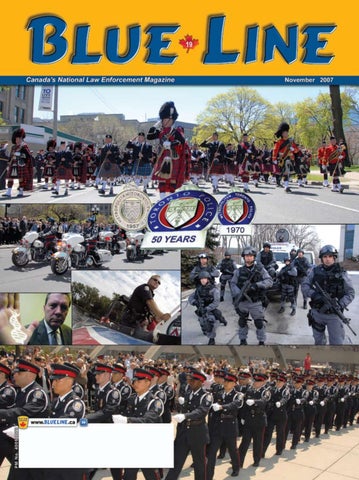
This month Blue Line Magazine salutes the 50th anniversary of the Toronto Police Service. Step through the past, present and future of this remarkable police service. See Story pg 6.
Cover Photo: Kevin Masterman
6 Best in North America
n historical review of canada’s largest and most a famous municipal police force
10 Policing in a new age
24 A challenge in the Yukon
officers trained and ready to tackle the Yukon trails
27 If it’s Monday, this must be China
reflecting a world within a city is Toronto’s challenge
12 Officers’ lives anything but uniform
an enduring friendship develops through post war policing
38 Advertiser Index 38 Back of the Book 36 Blue Pages 26 Deep Blue 35 Dispatches 28 Emergency Services 31 Letters 36 Market Place 20 Media and Public Affairs 25,30 News Clips 21 Odditorials 5 Publisher’s Commentary 22 Technology
32 Ammetre doesn’t breach privacy rights 33 All grounds for arrest must be considered 34 Checking seatbelt use justifies stop
Blue Blue Line Line Magazine Magazine
33
November 2007 2007
Blue Line Magazine
4
November 2007
Recognizing the strengths in their people by Morley Lymburner Scheduling and chasing down leads and sources for this month’s cover story brought back a flood of personal memories of my many years with the Toronto Police Service (formerly and awkwardly known as the Metropolitan Toronto Police Force). The OPP was my first choice but it was not hiring and Toronto was desperate (hey, they hired me). I intended to only stay a couple of years, attracted, like many others who signed on at the time, by the desperate need for a good, steady pay cheque. A quick survey revealed my fellow applicants included teachers, engineers, factory workers, ex-military, recent college grads and drop outs. We had two things in common – we were all under 25 and broke. I was accepted just two weeks after applying, which seems shocking today, but police forces had many more hurdles to overcome in those days. The post Second World War hires were retiring; a 25 year pension opportunity was set for 1970 and the race for replacements had just begun. The news wasn’t all bad for recruiters; that same generation produced a glut of boomer babies (like me) looking for jobs, which had become scarce. The real dilemma could be described as similar to offering a free beer to a tee-toting Scotsman. No one wanted to touch the job but the offer was far too tempting. Would I object to getting my hair cut? the recruiter asked. It struck me as a peculiar question. A cop’s job wasn’t socially acceptable to my generation of flower-power peaceniks who focused on free-love and drugs. For many, the mere thought of no beard and long hair was repugnant, so this question was seen as a show stopper for the not-so-serious applicant. It was no problem for this small town boy, who had tired of living on $11 a week pogey. My previous “career opportunity” paid a mere $50 per week. When the police dangled the princely annual starting salary of $7,250 in front of me, I signed quickly and lost little time
Blue Line Magazine
getting to a barber. The haircut was completed that same afternoon, sideburns and all. I was posted at a police station the very next day. Having no uniform, I reported in my green plaid sports jacket, orange shirt, bell bottom pants and tie, carrying a warrant card and handcuffs in my pocket. My sergeant introduced himself by chewing me out for not bringing my memo book and night stick. I was paired with Cst. Jimmy Kempster, a mild mannered, good humoured, seasoned veteran who was completely unflappable. Our first call was a Yonge Street apartment where a deranged elderly lady said she wanted to kill herself. The superintendent opened the door as soon as we arrived and showed us an empty bottle of lye, part of which the lady had just consumed. Her tongue looked like raw hamburger. Jimmy told me to sit with her on the couch and hold her hands. She was moaning and continually sticking out her raw tongue. I wondered what we were going to do while waiting for the ambulance. Jimmy went to the fridge, grabbed a container of orange juice and encouraged her to drink. She did and it seem to sooth her mouth almost immediately. I was in awe of his cool composure, immediate knowledge of what to do and his persuasiveness. She actually smiled at him like he was her only son. Another surprise was discovering how thin that thin blue line was. After training, I attended my first posting in the busy Jane-Finch area police station and was surprised to learn that the afternoon shift consisted of only four officers. Three more would join us in an hour, but two of us would be walking the beat with nothing
5
but a dime to call the station two hours into the shift. Guess who was walking the beat? One other point struck home. Supervisors never seemed to trust the officers on patrol, and demanded control and discipline whenever you were within their view. On the street you were the boss, the go-to guy to serve, protect and assure the neighbourhood. You were the trusted person, expected to wield authority with wisdom, discretion and judiciousness. Contrast this with the station house, where you did nothing without permission. You were constantly watched and behaviour and decorum were strictly monitored. Any deviation meant swift action, with the usual deduction of pay – four to eight hours for even the most minor violation, and supervisors acted like they believed there was a commission coming for each documentation. I saw a marked change in managerial attitudes as the years went on. As older supervisors left the job, more modern concepts of policing displaced the military authority of the past. There was a period when the hunger for change of style was at a feverish pitch, almost as though pent up energy had been released, and a more collegial spirit of teamwork took over. It was an enlightened era that accepted a variety of policing styles and almost encouraged enthusiasm and innovation. I left the Toronto Police Service a little over ten years ago, but it appears that spirit continues today. The service still suffers from some awkwardness – traffic enforcement, for example, appears to remain an afterthought and modern tools such as airborne patrols are beyond its comprehension. But the core of its strength has always been its people, and I am confident this strength will carry them far beyond any future challenges.
November 2007
by Mike Sale On Sunday, June 11, 1978, the Toronto Star published a headline that spoke volumes: “Metro’s Cops: Best in North America.” This wasn’t the first time such praise had been heaped upon the Metropolitan Toronto Police. More remarkable were that labels such as, “best on continent” and, “one of the finest police establishments in the world,” began emerging a few short years after the force’s amalgamation. These opinions were not unanimously supported when first proposed but fifty years later, the Toronto Police Service continues to be one of the best known and most respected services in the world. Twenty-first century Toronto Police officers are making valuable contributions to the business of policing in one of Canada’s most dynamic communities. Their training is exceptional; their equipment, state-of-the-art. Their methods are sophisticated and precise, and their relationships with the communities they serve help forge new alliances for cooperation in programs promoting and maintaining safe streets. All of this is built upon the legacy, traditions and spirit of the Metropolitan Toronto Police. History With the arrival of the twentieth century, Toronto was swelling beyond its civic borders and into surrounding towns, townships and villages. Each municipality developed its own police force to meet the population’s requirements, however, municipal boundaries soon became invisible and policing services were inconsistently delivered. By the end of World Blue Line Magazine
War II, it was obvious to the Ontario government that consolidating municipal services was a high priority. By 1953, the province had established the Municipality of Metropolitan Toronto, a federation of area municipalities comprised of the City of Toronto, Town of Leaside, Town of Mimico, Town of New Toronto, Town of Weston, Township of East York, Township of Etobicoke, Township of North York, Township of Scarborough, Township of York, Village of Forest Hill, Village of Long Branch, Village of Swansea. While each municipality continued as its own entity, maintaining major roads, expressways, and public transit, were managed by the new metropolitan council. Discussions also centered on amalgamating local police and fire departments to raise standards and improve efficiency. In December 1953, this issue was accelerated by the disappearance of Marion McDowell. Marion McDowell, an East York teenager, was abducted while in a car with her boyfriend in a remote area of Scarborough Township. When both Scarborough and East York Township police were called to investigate, neither force notified the City of Toronto Police or any other police force in the area. Marion McDowell was never found and the case was never solved. Public reaction was intense and prompted government to initiate a study into the feasibility of amalgamating police and fire departments under the new metropolitan government. On September 14, 1954, Metropolitan Toronto Council appointed a special committee to, “study and report on the advisability of 6
unifying the police and fire departments of the metropolitan area.” This seven member task force was led by Charles Otter Bick, Reeve of the Village of Forest Hill, and included the Metropolitan Toronto Chairman, Frederick G. “Big Daddy” Gardiner. During 1955, the committee studied all facets of policing arrangements in greater Toronto. They also travelled across Canada, the United States and Great Britain examining the latest trends and designs for police forces. By the end of the year, the committee recommended that: • On January 1, 1957, all existing police forces in the 13 municipalities of Metropolitan Toronto be dissolved. • A Metropolitan Toronto Police Force be established having jurisdiction over the entire area to succeed the existing 13 police forces and that the personnel employed by these 13 municipal forces would form the original personnel of the proposed Metropolitan Toronto Police Force. • The Metropolitan Toronto Police Force be administered under the jurisdiction of a Metropolitan Board of Commissioners of Police. • An application be made to the Provincial Legislature for the necessary amending legislation to implement the recommendations of the special committee. • The special committee be authorized to confer with the Attorney General, municipal authorities or other appropriate officials to determine how the Metropolitan Toronto Police Force should be established, how the Metropolitan Board of Commissioners of Police was to be constituted, etc. November 2007
On November 15, 1955, Metropolitan Toronto Council adopted the special committee’s report and applied to the Provincial Legislature for an amendment to the Municipality of Metropolitan Toronto Act to permit the establishment of a Metropolitan Toronto Police Force. Each municipality would keep its own fire department. During the months of March and April 1956, provincial and municipal legislation was passed to establish and appoint members for the Metropolitan Board of Commissioners of Police. The ‘Metro Police Commission’ held its first meeting on Tuesday, May 15, 1956, and immediately assumed responsibility for managing all 13 police forces with the goal of establishing the Metropolitan Toronto Police on January 1, 1957. The founding Commission Chair, Charles O. Bick, was appointed to the position of Magistrate to qualify for this new role. At the time, only a mayor or a magistrate (judge) could serve as chair of a police commission, a requirement Metropolitan Toronto followed until 1985, when provincial amendments allowed ordinary citizens to serve. Establishing the amalgamated force was not easy. All 13 municipalities were invited to express their views on amalgamation and nine were opposed for various reasons. Some held strong beliefs that: • Local problems were best left to local police, • A centralized force would lose contact with the public, • ‘Esprit de corps’ would be lost, • ‘Status quo’ was fine, and, • Taxes would rise significantly. However, five of these opposing municipalities agreed that centralizing certain services would be more efficient. The four municipalities in favour of amalgamation believed they had met their full potential within the current structure and a new, larger police force would yield many advantages including: • Centralized purchasing, • Elimination of duplicate services, • Special police bureaus and communications systems, • Police laboratories, • Centralized records and traffic management, and, • Establishment of one police commission to, “administer the entire metropolitan area in an impartial manner.” The Commission also had several priorities to focus on, including establishing a new communications system and finding a suitable Chief of Police. On Thursday, May 24, 1956, the Police Commission appointed Chief Constable John Chisholm, of the Toronto City Police, Chief of Police for the Metropolitan Toronto Police. Blue Line Magazine
The Grand Experiment On the evening of Monday, December 31, 1956, Police Constable Jack Marks went to work as a member of the Toronto City Police Traffic Branch. When he reported off duty the following morning, he was a member of the Metropolitan Toronto Police. Such was the case with scores of police officers in stations across Metropolitan Toronto. After months of anticipation and preparation, the New Year had arrived and a new police force was born. Toronto newspapers didn’t publish on New Year’s Day, 1957, but the night edition for The Globe and Mail’s January 2nd paper was on the streets well before midnight, and first reported on the successful amalgamation after only 18 hours of operation. The story revealed that, “there [was] much confusion” within the Metropolitan Toronto Police Force. Routine reports were not delivered to police headquarters, new district designations were not fully understood by officers and long-held practices of the City of Toronto Police — like notifying detectives of serious crimes — were not followed. It was also obvious that suburban officers required greater adjustments since the new police force assumed organizational and operational features based on Toronto traditions and routines. The Globe and Mail’s story concluded: “There is much to be done to make the new Metro Police Force work, all officers admit. For the time being, however, it is a force in name only.” From the very beginning, the Metro Police Commission had determined that a unified dispatch system was critical to the success of the amalgamation. While the force would have to wait a few more months for this innovation, it was painfully obvious that a new radio system couldn’t be delivered soon enough. On January 3, 1957, two armed bandits robbed the Bank of Montreal at Manor Road East and Bayview Avenue, in the Town of Leaside. The Globe and Mail reported the 7
loss at $1,870, while the Toronto Daily Star claimed only $600 was taken. Metropolitan Toronto Police officers from Toronto, Leaside, North York and Forest Hill all responded to the call, but only the Swansea and Leaside police shared the same radio frequency as Toronto City Police, hampering the operation. In fact, there were nine police radio frequencies in use among the 13 founding forces. At amalgamation the Metro Police Commission determined the police fleet was comprised of 178 automobiles, 157 motorcycles and 18 trucks - for a grand total of 353 vehicles. The strength of the force was 1985 officers and 223 civilian support staff, for a total of 2,208 employees. A senior rank structure for managing the Metropolitan Toronto Police was established with the following ranks: Chief of Police, Deputy Chief of Police, District Chief, Chief Inspector and Inspector. The Chief and Deputy Chiefs were all former members of the Toronto City Police while District Chiefs were, for the most part, former Chief Constables in various suburban police forces. While some of the area Chief Constables joined the Metropolitan Toronto Police as District Chiefs and served in their former municipalities, others chose retirement or accepted new, lower ranks. The duplication of badge numbers from one force to the next also meant that badge numbers needed reassignment. Toronto City Police officers kept their badge numbers while suburban officers received theirs in a vaguely ‘clockwise’ pattern. Even though official records of this transaction are currently missing, most founding members recall that new badge numbers were received by Etobicoke, North York, Scarborough, East York, and, Leaside respectively. Soon the Metro Police Commission was approving a new badge for detectives and plainclothes officers, while uniform officers were issued identity warrant cards. Pocket badges for them would wait until the late 70s. A new shoulder flash was also developed and soon every officer was sporting it on tunics, outerwear and, in summer dress, on their shirts. From the beginning, Charles Bick had been determined to take a rational approach to the business of building this new police force by employing modern methods of analysis and resource management. He had observed that police departments in Detroit and Los Angeles had established planning and research departments within their organizations. By the end of the first week’s operational activity, he was publicly calling for the establishment of a similar office to help maximize efficiency within the police force and determine how many officers were needed for specific jobs. Without any analysis, one thing was certain, November 2007
police officers and staff were leaving the new force. Effective recruiting became a major concern and challenge for the next fifty years. Even prior to amalgamation no one anticipated the need to search for a new Chief of Police. John Chisholm, a native of Scotland, had joined the Toronto City Police in 1920. He had risen steadily through the ranks and achieved an excellent reputation as a detective and administrator. In 1946, he became Chief Constable of the Toronto force and the logical choice for Chief of the Metropolitan Toronto Police. The extent to which Chisholm was affected by the amalgamation and his relationship with the new police commission has been the subject of considerable speculation over the years. In spite of a highly successful career and the appointment to one of the most prominent positions in Canadian policing, John Chisholm chose to take his own life just 18 months after the police force’s formation. The Metropolitan Toronto Police Force was left stunned and suddenly without its respected leader. It took only two weeks for the Commission to decide upon a new chief. James Mackey, a Junior Inspector, was promoted to the top job on July 24th, 1954. He was quickly identified as a highly capable detective and he was reknowned for his dedication and the care he put into preparing cases for court. During the early days of the Metro force, allegations of misconduct were raised concerning police officers in Etobicoke, and Inspector Mackey had been assigned to lead an investigation into these problems. His exceptional handling of the case did not escape the attention of the Metro Police Commission and he became an instant candidate upon the
death of Chief Chisholm. James Mackey served 12 years, the longest term of any Metro Police Chief. His appointment came at a critical time when the force was still struggling to find its way as a new organization. Within a few short years, and under his leadership, the Metropolitan Toronto Police Force would become the envy of jurisdictions around the world! In 1956, the budget for Toronto City Police had been $7.4 million and the city stood to save on policing costs immediately after amalgamation. The first Metropolitan Toronto Police budget totalled $14 million, two million more than had been forecast. This would only be possible if suburban municipalities increased their contributions to the police budget. Metro Chairman Frederick Gardiner reassured the public and politicians by saying that, “a lot of fancy desks and chairs are in there. By the time we rip them out, the budget will be $200,000 or $300,000 less.” A headline in the Toronto Daily Star brought other issues to public attention on March 11, 1957: “City police stations unpainted for 40 years – cars called wrecks.” The story noted that the City of Toronto Police had stopped buying typewriters, furniture and cars while waiting for the amalgamation. Suburban police cars, known to be in very bad shape, were to be replaced by the reassignment of cars from the old Toronto force but many of these couldn’t even make it to the suburbs. On March 17, 1957, the former Toronto City Police general telephone number, Empire-2-1711 (362-1711), became the number to call for the Metropolitan Toronto Police. And finally, on April 1, 1957, a new radio system was installed at 149 College
Street giving central control of all police patrols across the metropolis. For all the difficulties the new force faced, there were some obvious advantages to the new Metropolitan Toronto Police. Municipalities like Mimico, New Toronto and Long Branch, had originally complained they lacked the resources to manage traffic effectively. For example, the new Toronto traffic court normally had about 20 names on its docket. With the introduction of the Metropolitan Toronto Police, motorcycle officers from the former Etobicoke Township were now patrolling these southern municipalities and the court was averaging 250 cases on the docket for each sitting. More than 500 of the original police officers and civilian support staff are with the service today. Their faithful work, and the efforts of thousands of others, established a foundation for future policing professionals to “Serve and Protect.” While the road to today’s success has not always been easy, there remains, within the service, a quiet sense of historical pride enhanced by the excitement and anticipation of a new era. This is an excerpt from a new history book of the Toronto Police being released in December. The book is entitled “Best on Continent a pictoral review of Canada’s largest and most famous muicipal police force.” You may reserve your copy by contacting the Toronto Police Gift Shop at 416 808-7024. Mike Sale is the Toronto Police Historian. He was formerly an Inspector and Director of the Public Affairs section of the Toronto Police Service.
Metropolitan Toronto Police Milestones 1954 Metropolitan Toronto Council establishes a special committee to study and report on the advisability of unifying 13 police and fire departments in the Metropolitan area. 1955 Metro Council accepts the committee’s recommendation that all police departments should be amalgamated and that the Government of Ontario should enact legislation that will make this possible – the amalgamation of area fire departments is deferred but will be raised over and over again in the years that follow. 1956 The Government of Ontario and the Municipality of Metropolitan Toronto enact legislation which establishes the Board of Commissioners of Police for the Municipality of Metropolitan Toronto and appoints seven members to it. The Board holds its first meeting on May 15, 1956 with Charles O. Bick sitting as full-time chairman. On May 24, 1956, the Board announces that Chief Constable John Chisholm, of the Toronto City Police, will become Chief of Police for the Metropolitan Toronto Police which will be established on January 1, 1957. 1957 Thirteen police forces are amalgamated to form the Metropolitan Toronto Police, representing the 13 municipalities in the federation of Metropolitan Toronto. A new radio system is established in the spring of 1957 to unify and improve communications and dispatch capabilities. The Police Commission directs that the Cadet system, for young people between 17 and 20 years of age, be reBlue Line Magazine
1959 A new Metropolitan Toronto Police College opens in the North York community of Willowdale. Cst. John Perkins, 23, is the first Metropolitan Toronto Police officer to die in the line of duty as a result of a motorcycle accident while on his way to investigate a report of a stolen car. Motorcycle helmets become mandatory for Metropolitan Toronto Police officers.
established - with annual salaries starting at $2,312.00. The Metropolitan Toronto Police Association and the Metro Police Commission meet for the first time to negotiate a new working agreement for the Force - the Association is asking for a 14% raise which will add $600 to a first class constable’s annual salary of $4,200 - a $400 raise is also being sought for the 200 civilian employees currently working in the police districts - 1939 was the last year in which Toronto Police earned more than any other police force in Canada - in 1957, police officers in Hamilton and Vancouver are the best paid in the country. 1958 The Metropolitan Toronto Police Hold Up Squad is established. Chief John Chisholm takes his own life and is succeeded by James Page Mackey who serves until 1970 – the longest term of any Metro Police Chief. The Metro Police Commission introduces civilian citations to recognize members of the public who assist the police in their service to the community. 8
1960 The former Toronto City Police Headquarters, at 149 College Street, is no longer capable of accommodating the new force so headquarters is moved to the old Imperial Oil head office building at 92 King Street East at Church Street. 1961 Joan Coppin becomes the first female detective in Canada – she is transferred to the Metropolitan Toronto Police Fraud Squad. 1963 Sergeant Willa Fern Alexander is promoted to the rank of Inspector and becomes the highest-ranking woman in Canadian policing. 1965 The new, round shoulder flash of the Metropolitan Toronto Police is introduced – the new flash is designed specifically for a new ceremonial uniform for mounted officers, but, by 1967, it is being worn on the dress tunics and outerwear of all Metro Police Officers. Initially a black and white crest, it became full colour in 1978.
November 2007
1966 Chairman C. O. Bick reports to the Police Commission that, for the first time in the history of the Metropolitan Toronto Police, a reduction in crime has been reported: crime in 1965 was 4.24% lower than in 1964.
best survive recruiting checks, Adamson: We concentrate on preventing corruption. RIDE (Reduce Impaired Driving Everywhere) is adopted across the Metropolitan Toronto Police Force after a twoyear pilot project in Etobicoke.
1990 The detective rank is re-introduced to the Metropolitan Toronto Police – detectives are equivalent in rank to uniform sergeants; detective sergeants are equivalent to uniform staff sergeants.
1967 Metropolitan Toronto Police Headquarters is moved to the former head office of the International Order of Foresters, at 590 Jarvis Street.
1980 John W. Ackroyd is appointed Chief of Police, succeeding Harold Adamson – Ackroyd immediately announces an external management review of the Metropolitan Toronto Police which will come to be known as the “Hickling-Johnston Report”.
1992 Jean Boyd becomes the first female Metro Police officer to attain the rank of Deputy Chief of Police.
1982 Toronto lawyer N. Jane Pepino, becomes the first woman to sit on the Metropolitan Toronto Police Commission. The universal emergency telephone number, “9-1-1,” becomes operational in Metropolitan Toronto. 616 founding members of the Metropolitan Toronto Police gather at the Sheraton Centre Hotel to receive commemorative watches from the Metro Police Commission. The Metropolitan Toronto Police Force is reorganized to conform to recommendations of the Hickling-Johnston Report – “generalist constable,” “zone policing,” and “model divisions,” become part of the new language of the Metro Police force. The Toronto Harbour Police amalgamate with the Metropolitan Toronto Police to become the MTP Marine Unit.
1995 David J. Boothby is appointed Chief of Police to succeed William McCormack. Michael Boyd is promoted to the rank of Deputy Chief of Police, having jumped over all the senior officer ranks, from Detective Sergeant to Deputy Chief. The Metropolitan Toronto Police Force is reorganized to conform to recommendations contained in the “Beyond 2000” report, a strategy designed to prepare Metro Police to embrace and advance community policing philosophies and practices in preparation for the new century.
1983 Metro Toronto Police record the largest number of armed bank robberies in one day: five, including two at the same bank.
1996 On April 1st, 426 employees (369 uniform and 57 civilian) take advantage of an incentive and retire in the largest departure of members in one day in the history of the Metropolitan Toronto Police - more than 350 recruits are hired in the months that follow.
1968 Metropolitan Toronto Police join the Ontario Police Forces Teletype Network which operates 24 hours-a-day. 1970 Harold Adamson, a former Deputy Chief of Police in Scarborough Township, is appointed Chief of the Metropolitan Toronto Police, succeeding James Mackey. The first Metropolitan Toronto Police recruit class to attend the Ontario Police College graduates from the provincial police training facility – previously, Metropolitan Toronto Police were trained by their own force at the Metro Police College. 1973 After years of chugging along with six-cylinder engines, the Metro Police Force begins to convert its patrol and detective fleets to eight-cylinder vehicles. After losing five Metro Police officers in twelve months (four by gunfire and one struck down by a motor vehicle), citizens rally at Nathan Phillips Square in support of their police force – Chief Harold Adamson’s office can barely manage the volume of “Toronto Cops are Tops” letters and cards. Chief Harold Adamson directs that all left-handed officers will receive left-handed holsters to improve their safety, following three shootings of police constables, two of them fatal. 1974 Metropolitan Toronto Police ranks are realigned to conform with standards across Ontario: patrol sergeants become sergeants and sergeants become staff sergeants detectives, detective sergeants and sergeants of detectives are eliminated – investigative personnel will use the ranks of sergeant and staff sergeant hereafter. 1975 After years of negotiation and rulings, the “two-man car” is introduced for all Metro Police uniform patrols between the hours of 7:00 p.m. and 7:00 a.m. 1977 Metro Police officers shed their traditional long-sleeve grey uniform shirts in favour of new light-blue shortsleeved shirts. 1978 The Sunday Star pronounces the Metropolitan Toronto Police the finest force in North America - this on the first day of a week-long series of articles in which Canada’s largest daily newspaper compares all aspects of policing in Toronto, Los Angeles and Montreal - some of the headlines read, (Toronto) Police are brighter, better trained;Only the
Blue Line Magazine
1984 Jack Marks is appointed Chief of Police, succeeding John. W. Ackroyd. 1985 The Metro Police Commission approves the introduction of the uniform turban for Sikh officers. 1987 Roy Williams is appointed to the Metro Police Commission, becoming its first black representative. The First Annual Law Enforcement Torch Run for Special Olympics, an event sponsored by the Ontario Association of Chiefs of Police, arrives at Varsity Arena in downtown Toronto, the scene of the Provincial Floor Hockey Championships for Special Olympics. Metro Police take delivery of the first 25 white patrol cars, marking the beginning of the end for the yellow police vehicle. 1989 William McCormack is appointed Chief of Police, succeeding Jack Marks. Staff Inspector Jim Clark, head of the Metropolitan Toronto Police Morality Bureau, announces that, for the first time in Metro Police history, cocaine busts outnumber arrests for crimes related to marijuana.
9
1993 The Metropolitan Toronto Police Cadet Program for young people, 17 – 20 years of age, is discontinued.
1998 Metropolitan Toronto and its member municipalities are dissolved and reunite as the new City of Toronto – the Metropolitan Toronto Police Force becomes the Toronto Police Service and the governing body becomes the Toronto Police Services Board. At 22-years-of-age, Ms. Sandy Adelson becomes the youngest member of the Toronto Police Services Board. 2000 Julian Fantino, a former member of the Metropolitan Toronto Police, is appointed Chief of Police to succeed David Boothby. 2005 William S. Blair is appointed Chief of Police to succeed Julian Fantino. Keith Forde is appointed Deputy Chief of Police, the first black officer in the history of the service to attain that rank. 2006 The Toronto Police Services Board marks its 50th Anniversary as the governing body for the Metro Toronto-area policing.
November 2007
by Danielle Francis Toronto is known for its beauty, culture and, above all, diversity. Concerned about the rapidly aging workforce, corporations and organizations, including police, have begun tapping into previously under-represented groups to help stem the projected labour crisis. It’s a two-fold issue for the Toronto Police Service (TPS). It not only faces a projected labour shortage in a few years but strives to reflect the communities it serves to continue effectively policing all Torontonians. This organizational culture shift has not been undertaken without the leadership of the Toronto Police Services Board (TPSB). The TPSB has been forward thinking in setting the tone for the Service’s future, as was evidenced in 2005 when they appointed a dynamic Chief who had a fresh perspective, a history of success, a vast understanding of effective policing, and a passion for diversity. The commitment to change - especially from the top down - was apparent when later that same year, they strategically appointed an innovative Command that carried a wealth of experiences, competencies, and knowledge and also included a visible minority and a female Deputy Chief. Since then, the TPSB has worked closely with the Service in the dismantling of systemic barriers, establishing a policy on race and eth-
nocultural equity for all members, and assisting in the development of a new employment strategy to create a more reflective workforce. Whether it’s translations or cultural understanding in how to proceed with investigations, having a more reflective police service goes a long way in keeping the city safe. It is also important in building community partnerships which, along with strong enforcement, has made Toronto one of the safest big cities in North America. None of this happened by accident. The TPS created a special ‘recruiting, hiring, and customer relationship management’ strategy in 2006 that focused on developing a new method of attracting, interviewing and developing potential officers. So far it has been a success. While many police agencies struggle to fill new hire classes, the TPS has hired 739 new officers since January, 2006. Classes are not only filled with many visible minorities and women, they include people with extensive military or other police service experience. Many officers are in their late 20s, beginning second careers, and bring a wealth of talent, knowledge, education and professional experience. Officers like Constables Crispin Barnes and Yu Ma, who both graduated in early 2006, are the kind of police officers that reflect the changing face of the TPS. Barnes, a native of Ottawa, always knew that he wanted to be a police officer. Although there was no family history of policing, he had
an unwavering desire to one day be in uniform. After studying law and security and graduating with honours from Algonquin College, he moved to Toronto to complete a post-graduate diploma in justice studies at Humber College, where he made the dean’s list. Between attending school and enjoying his new city, he worked in retail for seven years, working his way up to store manager. These years prepared Barnes for the policing world. Dealing with customers – the general public – day in and day out would sometimes be very rewarding and other times quite challenging. He sees the similarities in his experiences now dealing with people who are upset, irate or in need of help. Upon graduating from Humber, Barnes applied directly to be a court officer. He didn’t want to start off his policing career “cold,” wanting to get accustomed to the structure of the TPS, acclimatized to police culture and most of all, used to dealing with criminals. He learned a lot during his two years as a court officer, but what stuck with him the most was his meeting with TPS Deputy Chief Keith Forde, who was a Superintendent at the Training and Education unit at the time. Forde told him he needed to consider policing because “as an officer you’ll be afforded more opportunity, and with more opportunity comes the ability to make change.” Those words motivated him, moving him to be the best that he could be, and
Photo: Kevin Masterman
Blue Blue Line Line Magazine Magazine
10
November 2007 November
when the time was right, he applied. Today, Barnes gives of himself professionally but also to the community. He volunteers with Meals on Wheels, coaches a basketball team in Etobicoke and organized an antiviolence basketball tournament called Shoot Hoops not Guns. He is having fun and enjoying the job while riding the steep learning curve. He knows that deciding to be a police officer at a young age was the right choice. Ma’s story is quite similar. She already knew as a young girl that she wanted to be a police officer; her best friend’s father was an officer and she looked up to him. She studied personal fitness training at the University of Toronto and for many years spent her time helping people – the elderly, disenfranchised, disabled and poor – at the Ontario Disability Support Program (ODSP), which offers financial and employment services to some of the most vulnerable members of society. Ma credits her years with the ODSP for preparing her for the real world that she often sees as an officer. She learned to deal with people from all strata of society with compassion and dignity, regardless of their situation. Ma has found dealing with people as an officer to be the same, and is thankful for her experience. It’s also very helpful to be able to use her Cantonese, Mandarin and Chiu Chow to communicate while on the job, since her division covers eastern Chinatown. She has been called in to translate on several occasions, which she finds rewarding, and appreciates the opportunity to practice languages she doesn’t often use. The Asian community has responded positively to Ma, even though female officers are typically not a common sight in China. Many of them speak to her in Cantonese or Mandarin, as they are so surprised, yet pleased, to see her. Ma has used this to her advantage, choosing to become an official ‘ambassador’ (through the TPS ambassador program) and often attends events geared towards recruiting in the Asian community. Several received a very high and positive response, illustrating the importance of getting out there and motivating others who see that it can be done. The TPS is looking ahead and working towards a more reflective, inclusive workforce and its efforts have yielded unprecedented results. Of the 739 new recruits hired since January, 2006: • 123 are female officers; • 129 have previous military/police experience; • 437 have either an MA, BA or College Diploma; • 359 represent a vast diversity of women, visible minorities, Aboriginals, GLBT and persons with disabilities. Collectively they speak over 35 languages. The TPS is working hard to be an ‘employer of choice,’ and its high calibre of new recruits prove it. Striving for excellence through people and partnerships, it is a leading example to other police agencies across the nation.
Toronto officers lend a hand in Ottawa by Travis Persaud The importance of the Montebello summit mirrored the value of the Toronto Police Service, as officers, many unknown to each other, became a close-knit family working together for the first time. “We took the size of an entire police station and moved it to Ottawa for six days,” S/Sgt. Joe Zubek said, of the recent North America Leaders’ summit in Montebello, Que. The Service, which has no jurisdiction in Quebec, was asked by their Ottawa counterparts to assist with the increased activity in the Nation’s capital. Travelling in buses across the province, over 200 officers – under the watchful eye of S/Supt Mike Federico – descended upon Ottawa to provide security and assist with crowd control during the two-day summit, that brought together Prime Minister Stephen Harper, U.S. President George W. Bush and Mexican President Felipe Calderon to discuss matters concerning North America. Arriving before the start of the summit, officers assembled their “station” at Algonquin College, which had to operate in the same manner as a regular Toronto police station. Officers were trained in various areas including working with a gas mask. As intelligence kept coming in, before and during the summit, Toronto officers were also sent out to patrol areas including Parliament Hill, the U.S
and Mexican embassies and the airport for the arrival and departure of Air Force One. “It was a very fluid operation,” said Cst. Ron Finley, explaining that any plan could change in a matter of minutes. In fact, the possibility of transporting President Bush from Ottawa to Montebello kept circulating and changing – they had to be prepared for him to go by air, land and water. It was the ever-changing aspect of the operation that Finley enjoyed the most. However, Finley said meeting with other Services and officers turned a large, but fairly straightforward operation, into a memorable event. The summit allowed officers to interact and network with police officers from York, Durham, Peel, London and the RCMP. But, as Zubek explained, it provided a unique opportunity for Toronto officers to interact with each other. “We have a big Service,” he said. “We had officers from 22 and 42 Division who would probably not see each other in the course of their careers…and now they have this chance to work together.” The lack of familiarity did not pose any problems as they were working together by the end of day one. “This really brought the Toronto Police Service together. It was a positive and excellent experience. I would do it again in a heartbeat,” Zubek said.
Danielle Francis is a research analyst with the Staff Planning & Community Mobilization Unit of the Toronto Police Service. For more information on the Toronto Police Service, visit www.torontopolice.on.ca or call 416-808-5646.
Blue Line Magazine
11
November 2007
Officers’ lives anything but uniform An enduring friendship develops through post war policing by George Gamester (Gamester’s People - Toronto Star - November 14, 1999)
Excuse us. Mind stepping into the squad car, please? Thank you. Watch your head. Trouble? Not a bit. Just settle back, and let us take you for a ride. That’s Andy behind the wheel there. And the cheerful character on the passenger side is his partner, Smokey. Yes, they are Toronto police officers. And great guys. Now what we’d like to do here is take a little cruise through Andy and Smokey’s lives. And you’re invited to enjoy the trip. First stop is the Horse Palace at Exhibition Park, where Ron “Andy” Anderson is looking for a job. It is December 1, 1945, an exciting time in Toronto. The boys are home from overseas and things are booming. Universities jammed. Housing scarce. Jobs plentiful. Andy is lined up with hundreds of others here because he’s heard the TCP (Toronto City Police) is giving preference to ex-servicemen. He likes the idea of staying active, working outside. Well, no wonder. This is a guy who’s been leading a rather strenuous out door life for five years - most recently in the hedgerows of Normandy, at the Battle of the Bulge and through the bloody fight for the Rhineland. Did you see that movie, Saving Private Ryan? Well Platoon sergeant Anderson, an explosives expert with the First Canadian Paratroop Battalion, actually lived some of that - dropping 32 kilometres behind enemy lines six hours in advance of the D-Day landings to seize key bridges. He is lucky to be alive. Fifty vets are hired at the Horse Palace that day, including Andy and a lad from Scarborough Junction named Warren Shaddock who’s served with the Royal Canadian Medical Corps in the hard slogging through Italy, Holland and Germany. Because of their wartime experience on motorcycles, both Andy and Warren are assigned to the understaffed traffic division on Strachan Ave., near the CNE. They are urgently needed. In this post war boom, everybody’s buying cars and the streets are jammed. At most major intersections in the city, you’ll find motorcycle officers on duty - outfitted with military style black uniforms, complete with gleaming Sam Browne belt, form fitting laced breeches, snappy cap, leather boots and leggings. And, if you look closely at these dashing young men, you’ll note vets such as Andy and Warren also display their World War II campaign ribbons on their tunics. This isn’t their idea. Chief Dennis Draper, a former brigadier general, runs the force along army lines. Among his standing orders: Officers should polish their bullets. Not that weapons are often needed. A constable’s Acme Thunderer police whistle is usually enough. During his motorcycle years, Andy will pull over thousands of cars, alone and without fear. “People were almost invariably respectful Blue Line Magazine
and polite with the police. It was a different city then.” A city where you can drive for years without honking your horn. An era when “road rage” and “the finger” are unknown and auto fatalities are rare enough to make front page news. After several years roaring around on his Harley-Davidson, Andy Anderson receives another assignment - the Accident Car. Now this is a new development. With so much traffic, and the population approaching 700,000, the city needs special mobile units to deal with serious problems. There’s an air of glamour about these cars, painted bright yellow and equipped with sirens and flashing lights, which work in shifts of three to patrol the entire city. Andy is nowteamed with a partner - Warren “Smokey” Shaddock. It’s a perfect pairing. Andy, with his leadership and battlefield experience can handle any emergency. Smokey, equally decisive and sanguine, is a trained medic. Within days, the boys are fast friends. And why not? Born within hours of one another on Nov. 3 and 4, 1922, both are ex-sergeants tempered in the crucible of war. And both are sports-minded sons of World War I vets who were wounded at Vimy Ridge. Exciting work, snazzy uniforms, almost $50 a week - what could be sweeter? Well, how about getting your picture in the paper with good-looking young women? This happens often as the boys are assigned to “guard” Miss Toronto contestants or pose for publicity shots with adoring female fans at the Police Athletic Games. In the real world of law enforcement, one of their big assets is Smokey’s photographic memory. Cruising the city with Andy between accident investigations, he frequently spots stolen or wanted cars because he’s memorized their licence plates. Even a half-century later, he can tell you about 43X10, that hot Merc they nabbed at Bloor and Bay. And let’s not forget W2916 — the ‘39 Plymouth they apprehended with an armed gang of would-be robbers aboard. 12
Yes, it’s a great job - until Sept. 17, 1949. It’s a quiet night, clear and cool. The boys are working the midnight shift in Accident Car No.3 when the dispatcher asks them to check the waterfront. An alarm box has been activated at Pier 9 near the foot of Bay St. “Probably pranksters,” says Andy, wheeling south. But when they reach the lakeshore ...Whoa! “The whole sky was glowing,” recalls Andy. “We got on the radio and told them we had a major fire on our hands. Then we hit the siren and made for the flames.” It was the Great Lakes cruise ship Noronic, all five decks blazing from bow to stem in a dockside conflagration that would snuff 119 lives. Andy and Smokey, the first police on the scene, don’t waste time. Amid the screams of panicked men, women and children stampeding down gangplanks and leaping into the water, Andy rips off his uniform and dives into the bay. November 2007
rescue Making his way to a painter’s raft off the bow, he joins a civilian named Donald Williamson, pulling victims from the water. Meanwhile, Smokey is setting up a first-aid station, organizing a shuttle service of taxis to ferry the injured to St. Michael’s Hospital and establishing triage operation for ambulances. Hour after hour, amid the wailing of the ship’s siren, the screams of the victims and the stench of burned flesh, they do what they can. At dawn, an exhausted Andy Anderson staggers along the dock to retrieve his clothes from the fence where he’d left them. Someone has stolen his wallet and watch. Andy is credited with saving many lives that night. Both he and Smokey receive official commendations for their actions. Years pass. The on-duty partnership ends. With his extraordinary memory and common touch, Smokey moves into court work as an administrator and special prosecutor, rising to the inspector rank with the new Metropolitan Toronto Police. Andy becomes a municipal traffic engineer in Scarborough and performs too well for his own good. Next thing he knows, Mayor Albert Campbell has grabbed him to be his executive assistant. Most mayoral aides last one term. Andy serves a half-dozen Scarborough mayors for 20 years. Looking back, he has scant regard for politicians. But friends? Well, that’s another matter. Having served one another as best man at their second marriages, and having celebrated their 77th birthdays together just two weeks ago, Andy and Smokey remain as close as brothers. Cottaging together, golfing together, observing the 50th anniversary of the Noronic disaster together, they cherish their families and wonder at the disappearance of the order, discipline and security of the Toronto of their youth. But no complaints. Especially in this month of remembrance, when the bugles blow to remind them of the friends who didn’t make Blue Line Magazine
it. And of the abiding truth of those wise old words at the core of their lives: “When you have a true friend, you have everything.” Publisher’s Notes This story was selected for it’s narrative style which reflects some of the atmosphere that existed with the former Toronto Police service. The horrible tradgedy of the Noronic fire of 1949, along with the devastation of Hurricane Hazel in 1954, hastened the creation of the Metropolitan Toronto Police. In 1954, the Toronto Police sent Andy Anderson to Northwestern University on an Accident Investigation course. While there, he was offered and accepted a scholarship to study Traffic Engineering. Once graduated, he joined the Borough of Scarborough as Traffic Engineer in 1959. He later became Executive Assistant to five successive Scarborough Mayors. He is a Past President of both the Ontario Traffic Conference and of the 1st Canadian Parachute Battalion Association. Andy lives in Mississauga with wife Adrienne. They will celebrate his 85th birthday with family this November while cruising to South America. Warren (Smokey) Shaddock retired from policing with the rank of Inspector in 1973. During his policing career Smokey had received seven Merit Marks, three service awards, a Police Long Service Medal with Maple Leaf, and three commendations. He then launched into a second career as the Senior Provincial Prosecutor reporting to the Ministry of the Attorney General. For the next ten years he supervised 10 Toronto area prosecutors. He retired fully in 1983 and moved to the Minden area with his second wife Joan. He passed away in November, 2001 and is dearly remembered by his wife, 2 children, 2 grandchildren and 4 great grandchildren. DO YOU HAVE A STORY? Tell us about an unforgettable person related to the law enforcement field that has touched, changed or enriched your life or the profession in general. Blue Line will review these for inclusion in future issues.
13
November 2007
Better policing with technology by Matt Collison It has been more than 170 years since the small town of York changed its name to Toronto in 1834. The new city’s 9,200 residents elected newspaper publisher William Lyon MacKenzie as their first mayor; three years later he led an unsuccessful rebellion, which was quickly put down before the 100 rebels could reach city hall. The Toronto Police Force was founded the same year as the city, replacing York’s ‘watch and ward’ system, which required able bodied male residents to report as special constables for a fixed number of nights each year. Refusal meant a fine or imprisonment. The first high constable was appointed to lead a handful of volunteers. There were no permanent officers; constables were simply hired as needed. Five full-time, paid constables were appointed in 1835 for one year terms, coinciding with the term of office of the alderman who nominated them. They were paid five shillings for day duty and seven shillings, six pence for night work, a healthy raise from the two shillings (days) and six shillings (night) the conscripts earned. Today That five officer complement – one for every 1,850 residents – has grown to more than 5,700, along with 2,500 civilians, policing some 2.5 million people and answering more than 1.7 million calls for service a year. To keep up with the city’s constant expansion, the Toronto Police Service (TPS) has turned to technology to stay one-step ahead – projects such as a a new public space camera pilot project, launched this summer. The TPS used $2 million from the province, part of a $51 million anti-crime initiative,
to buy and install 15 video cameras in areas which street crime has been a problem. The service is initially using the cameras in different areas of two problem neighbourhoods and will then move them to other high-risk areas of the city if needed. The remotely operated cameras have night vision capability and monitor public areas for criminal activity. They will not replace street officers, notes TPS Chief Bill Blair, but instead be used to help deter crime
and make neighbourhoods safer. The closed-circuit (CC) cameras comply with guidelines issued by the Ontario Information and Privacy Commissioner. Signs announce their presence and community information sessions informed residents about the project. Video from the cameras is stored for 72 hours and then deleted unless it’s used in police investigations. The cameras record 24 hours a day but police don’t watch the live feeds and only review the video when an incident occurs. CC cameras are widely used as a crime prevention and deterrence tool in the United Kingdom and United States. The TPS is also outfitting some patrol cars with cameras and digital video recorders as part of a pilot project to record police interactions with the public. Decals will identify the cars with cameras and officers will also inform those they interact with that they’re being recorded. The cars will have two cameras, one facing forward and the other focused on the rear seat, and record all interactions, including traffic stops and prisoner transportation. Officers will wear microphones and the cameras will begin recording automatically when the siren or emergency lighting is activated or if the car is involved in a collision. The officer can also begin recording manually with either a master switch in the car or a switch on the wireless microphone. Some 200 officers have been trained on the equipment. The pilot project will measure three factors – whether officer and community safety has been enhanced, quality of evidence improved and if the cameras help protect officers from unwarranted accusations of misconduct. Any person who’s recorded by a camera will be able to access the video under the Freedom of Information Act. Another initiative, the TPS anti-violence intervention strategy, helps police and prosecutors deal with armed criminals. Three teams of 18 officers have been deployed to neighbourhoods threatened by gangs. In an attempt to go greener, the TPS tested two Smart cars and two Honda Civic Hybrids under a pilot program and may adopt them on a large scale. The Smart vehicles are already common in London, England, where police find them ideal to patrol congested streets. The pilot program will run until February and, due to the Smart cars ability to operate both in standard and automatic mode with the push of a button, required little training. At a little over two-metres long and with a spherelike frame that offers tremendous impact strength, they are safer than they look. TPS has also been testing roof-mounted infrared cameras for parking enforcement, which automatically record the license plates of parking offenders, vastly reducing the time spent ticketing each vehicle. Matt Collison is a staff writer with Blue Line Magazine. He may be reahed at matt@blueline.ca
Blue Line Magazine
14
November 2007
Blue Line Magazine
15
November 2007
What am I going to do next?
Career management for experienced police officers by Irene Barath “If you keep doing what you’ve always done, You’ll keep getting what you always got” –Morgan W. McCall, (High Flyers,1998). One of the most attractive aspects of a policing career is the diversity of tasks and numerous opportunities offered during the course of 25-plus years. These become available as police services responsibly fulfill their mandate of protecting and serving the community by effectively and efficiently utilizing all resources, including personnel. The status quo has police administrators handling personnel development and management, a process which raises several questions. A 1998 Treasury Board of Canada Secretariat survey suggests asking: • Does the organization alone determine who will be transferred or promoted? • Does a supervisor or manager selectively raise the profile of certain subordinates to provide opportunities within the organization? • Is it the officer alone who must take the responsibility for creating opportunities and preparing themselves for promotion or transfer? An unfortunate reality of police work is that, even with all of the opportunities available for career development, not every officer will get their preferred assignment. This conflict between perceived opportunity and the means for accessing them can be a source of stress. A 2006 study (Operational and organizational police stress in an Ontario police department, by Craig Bennell and Alyssa Taylor) found the top three contributors to stress are: 1. Feeling that different rules apply to different people, 2. Feeling like you always have to prove yourself to the organization and 3. Inconsistent leadership style. These stressors are the reality of the polic-
Blue Line Magazine
ing profession. Let’s consider a male officer employed with a service for eight years. He has completed the requirements for first class ranking and successfully written the promotional exam but hasn’t yet advanced further through the process. For the past two years he has been assigned to a specialized unit which carries some organizational and personal prestige. If the ‘task span’ of this current assignment is five years at most, then the officer should be asking, ‘What am I going to do next?’ It makes no sense to sit back and hope the service will leave him where he is just because he has some specialized skill or currently is very satisfied with the job he is doing. Given that there will be a transfer, the availability of opportunities may create frustration for experienced officers when there are several capable, qualified colleagues vying for the same assignment. The level of frustration can increase exponentially when the expectation and sense of entitlement attached to a prestigious assignment or promotion are not realized. This issue is compounded by the practice of some larger police services to have mandatory rotation of personnel based on a set time frame. This designation of a ‘task span’ translates to experienced police officers who’ve spent three or four years developing a high level of expertise
16
in a given area being transferred out at the time of their highest competence. They are replaced by new officers who take years to acquire this skill set. This does not even consider the job satisfaction experienced officers derive as a result of their expertise and can lead to cynicism. Why should officers learn new skills if they are going to be arbitrarily moved, with no control over where they are sent next? In his book Emotional Survival for Law Enforcement, Dr. Kevin Gilmartin speaks about the two thing officers can control: • their attitude (level of professionalism) and • their integrity. Those who wait for things to happen and complain about the outcomes enter a victim mindset, which can lead to frustration, cynicism and poor decision making. When officers make their own career management decisions, they establish a sense of control over their professional lives. Even when posted in an undesirable assignment or moved from one they did want, they can take back a sense of control and potentially avoid self-destructive decision making by maintaining a positive attitude and acting with integrity. Recent research into stress in policing confirms that, time and again, organizational stressors are more of an issue for police than operational issues. It also supports previous findings that officers indicating a higher level of job satisfaction report lower levels of stress (Bennell and Taylor). Each relates to how the individual perceives their place in and value to the organization, as well as how the organization ranks in their list of overall priorities. This concept is not unique to Dr. Gilmartin. In their book Success Built to Last, authors Jerry Porras, Stewart Emery and Mark Thompson identify the characteristics of ‘builders’ as persons, who “feel compelled to create something new or better that will endure throughout their lifetime and flourish well beyond.” This builder mindset embodies the thought process of a person who exercises autonomy over career choices to define success in their life, on the job and more importantly, away from the job. In my experience, most police officers November 2007
possess the characteristics of builders and want to do challenging work. We are currently undertaking a research study at the Ontario Police College (OPC) looking at how experienced police officers define career success and what they do to manage their careers. The first step in determining if you are satisfied with your job, write Monica Belcourt and Kenneth McBey in Strategic Human Resources Planning, is learning what it takes to make you happy. Do you want to achieve a particular rank or prestigious assignment? Perhaps you define success as a series of assignments at the constable level which allow for flexibility and more time off while never intending to apply for promotion. There is no right or wrong answer – an officer is simply defining how they want to live. Once officers establish priorities they can focus their efforts, handle setbacks with less stress and manage frustrations as challenges. Next, it is important to acknowledge constables must work within the organizational structure to access any opportunities for either promotion or task reassignment. Senior administrators control issues of recruitment, training, retention and ultimately succession management as part of a greater human resources strategic plan, but they cannot implement these strategies alone. The police service has a dual responsibility to protect the community in a dedicated and accountable manner and provide opportunities for its employees. Administrators must work diligently to achieve a balance and understand that, without an engaged and dedicated workforce, police leaders may be captaining a ship
Blue Line Magazine
with all passengers and no crew – an untenable situation. Training administrators and future police leaders is one way to address issues arising when dealing with expectations of lateral or vertical advancement. The OPC offers several courses in police leadership to assist supervisors and managers in developing their own potential and leadership qualities. Training resources are also allocated to help police leaders coach or mentor their subordinates through career development hurdles. Police training can also assist officers at all ranks and levels of experience, providing the knowledge, skills and abilities to manage their own careers by gaining personal insight into their priorities, and helping them set appropriate and realistic goals. This may be the next direction for independent or in service training opportunities. Given the many conflicting priorities a police service has to address, it is unreasonable for a constable to expect the organization, as an entity, to focus on any individual’s career with the appropriate level of interest. When officers abrogate responsibility for their careers, they set themselves up for disappointment and frustration. Let’s again consider the situation with our eight year veteran. With two years invested in a posting and knowing that he will be reassigned at some point in the next three years, this officer should take responsibility and prepare for the next desired assignment. The posting may not be his preferred long-term assignment, but it may be a step forward in terms of personal growth and skills development. It is important
17
to take the next step with an open-mind to the potential benefits instead of focusing on the obstacles and problems it may create. In some cases the organization’s culture makes it difficult for officers to manage their careers. A case in point is when a constable is transferred from what is deemed to be a prestigious assignment, such as an investigative unit, to uniform patrol. The first question their new supervisors and peers may ask is ‘What did you do wrong?’ or ‘Who did you upset?’ It is not relevant whether the transfer is the result of a lateral development opportunity or personal request – the perception is that the movement is negative. This can have a lasting effect on the officer’s attitude about the value of the work and their value within the organization. The potential effects of an undesirable transfer are easier to manage and less stressful for an officer if they understand the rationale. Officers will likely approach work with less cynicism and a more positive attitude if informed about how their transfer fits into the organization’s plans; more so if the officer had input on the assignment and it is congruent with their personal plans and values. Institutional paradigms lead supervisors to ask officers ‘Why haven’t you written the promotional exams or applied for promotion yet?’ The contributions of these foundation level officers are undervalued and they are ignored by the organization instead of valued. Careers can span more than 30 years, with many officers retiring as constables and sergeants. Many handled diverse assignments and enjoyed their level of responsibility while mentoring others. They may never
November 2007
have desired to be supervisors or administrators and wanted only respect from colleagues, family and the community for their contribution. A paradigm shift is required so that whatever path officers choose, the organization supports their efforts and utilizes them in a way that is congruent with their strategic plan. It is up to the officer to decide what path suits them best and to seek this. Doing so benefits the officer and the organization. The officer will have a higher level of job satisfaction – possibly resulting in less stress, increased productivity and improved quality of life – and the police service will gain the services of a loyal, dedicated professional staff member who contributes to meeting the organization’s goals. All police officers begin their career in uniform patrol and many contentedly retire in the same capacity. Police agencies recruit and select individuals with a diversity of interests and experience, so why would they expect everyone to pursue the same career path? It is difficult for an organization to change its culture, but with some work at cognitive restructuring trainers can provide officers with the skills to appreciate their accomplishments and take back control of their futures. This starts with a career analysis and plan. “Until you figure out what success means to you personally and to your organization, leadership is almost a pointless conversation,” Porras, Emery and Thompson note. Officers can not wait to be lead to success. The nature and complexity of their career plan will depend on what stage they are in their policing career and personal life. Older people
are choosing to enter policing and they have life and job experience and family and financial responsibilities beyond themselves. (As of 2005, the average age of an OPC police recruit is 29 years old and 46.7 per cent are either married, have been married or are cohabitating.) The duration and complexity of a career plan depends on the ‘task span’ of the current assignment, present and desired rank, personal priorities and seniority (retirement plans). “Specific goals increase performance (and) if police officers participate in goal setting, they are more likely to accept even a difficult goal than if they are arbitrarily assigned by their supervisor,” writes Paul M. Whisenand in Supervising police personnel. Police officers are dedicated and responsible individuals who must apply these qualities to the nurturing of their career and life plans. After determining a desired career path, officers should choose their next preferred assignment and the qualifications it requires, then talk to someone currently doing that job to learn as much as possible about it, including qualifications, beneficial training and operational concerns. This helps determine whether the job the officer thinks they want is really worth the time and effort required and prepares them for the opportunity once it becomes available – a realistic job preview. Next comes preparation – taking courses, reading books, volunteer work in related areas and other proactive steps. This mobilization is the hardest part of the exercise, with the responsibility for ambivalence or achievement falling squarely on the officer’s shoulders. At this
point, it can be easier to blame a lack of success or unwanted assignment on the organization. When this happens, the victim mindset returns and we hear things like ‘Why did they do this to me?’ or ‘What did I do to deserve this?’ When unwanted assignments or transfers happen despite an officer’s best efforts, it’s time to revert to the control aspects we identified earlier; namely attitude and integrity. The only certainty is that organizations continue to change and evolve so any assignment is sure to be temporary. It can either be managed and learned from or, in cases of undue hardship, accommodations can often be made. Police officers correctly refer to themselves as professionals and, as such, are held to a higher standard by the public and their organization. “Professionalism by definition, involves belonging to a profession and behaving in a way that is consistent with professional standards,” note Lycia Carter and Mark Wilson in their article “Measuring Professionalism Of Police Officers” (The Police Chief, Aug., 2006). “A profession is an occupation that requires extensive study and the study and mastery of specialized skills.” “A large part of this lifetime commitment to the profession is related to the high level of expertise police officers acquire throughout their careers,” a 2003 RAND study of the LA Police Department found (Training the 21st century police officer). “These diverse areas of expertise are acquired only by prolonged education and experience.” Every officer is an individual and each should take time to reflect on why they entered the profession. After determining what they like best about the challenging work they do, each can reconnect to what defines success for them. Finally, they should ask themselves ‘what am I doing in my current assignment and going to be doing in my next?’ Only then can they begin to make things happen for themselves. “Your organization and fate may sometimes determine your path, but it is up to you to make and take those opportunities and grow in ways you choose,” advises McCall. To get started: 1. Do a self-assessment and create your own vision of the future as it relates to your relationship with family, friends, the community, workplace situation and your career plans. 2. Determine your own definition of success by asking yourself what you want and identifying the steps needed to fulfill your vision. 3. Set your long-term and short term goals, then write them down. 4. Learn about your profession and the costs, support, resources, timing and availability of your desired job opportunities. 5. Take steps to make it happen by making the leap. Take the first step, no matter how small, to achieve your goals. 6. Savour each accomplishment and continue to pursue change, growth, personal and professional development. Irene Barath is with the Ontario Police College Criminal Investigations Training Unit and can be reached at Irene.Barath@ontario.ca . This article in no way reflects the opinion of the OPC or Ministry of Community Safety and Correctional Services.
Blue Line Magazine
18
November 2007
Blue Line Magazine
19
November 2007
Getting closer to reality
Truth in advertising and public information tough to achieve by Mark Giles I heard a rumour the other day that made me laugh – one apparently being circulated halfway around the world from its supposed point of origin. Being close to the facts, I chuckled with friends over how reality could have been so distorted. Upon reflection, however, it’s easy to see how it might have happened – the rumour was perhaps what some people wanted to believe, so why ask any more questions? With rumours, the facts are sometimes way off – speculation has often become reality. Whether on a personal or broader organizational scale, the truth can sometimes end up distorted. These distortions are sometimes intentional, but more often simply the result of human nature and organizational culture – a subconscious desire to have things seen in a certain light. Sometimes misinformation is spread through the media due to a failure to properly research a story. It also may be laziness, but can also be a result of not wanting to know more. As the joke goes, the story was just too good to be fact-checked. In 2004, CBS News – in what has been described as ‘myopic zeal’ – hastily reported a disputed story about President George Bush’s National Guard service. The story was based on documents that turned out to be false. Some have suggested that wanting the story to be true and the need to be first with breaking news are the reasons the story was aired without adequate background research. It’s a dilemma faced by media daily – meeting demands for news now, but avoiding the reporting of inaccurate information to the
public. Move too quickly and quality, including accuracy, suffers. Move too slowly and other information and messages fill the gap. The development of advertising and promotional materials can usually be done at a more leisurely pace, but although brochures, posters and web features rarely include outright false information, some can be misleading. Many police recruiting advertisements, for example, ignore the realities of day-to-day police work such as the significant amount of paperwork and time spent completing reports. Instead, recruits see images of tactical team members rappelling from buildings and other glamorous activities. While some police officers do get selected for tactical units, and may even occasionally rappel down the side of a building, the images are certainly not reflective of the reality most new recruits will face, which includes much less glamorous work for the majority of their careers. Internal pressure Organizations want to be seen in the best possible light and there’s often internal pressure to describe the work done by employees in the most favourable way – avoiding themes potentially unappealing to the public or key clients. The result of such thinking, however, can be the inclusion of information in recruit advertising and other promotional material that is reflective of how management wants to be perceived, rather than actual reality. “Police agencies are competing with each other and unrealistic expectations from TV programs like CSI,” said Al Koenig, president
Blue Line Magazine
20
of the Calgary Police Association. “They don’t want to be seen as any less attractive than other agencies, so there’s pressure to ensure recruiting materials highlight the very best opportunities available.” It’s hard to criticize these well-intended recruiting efforts, but while overly attractive ads will likely bring more recruits through the door, they may not bring in the right people. Once the ‘curb appeal’ wears off, the new police officers may find themselves in the wrong line of work. This problem is not unique to policing. A former health-care executive told me recently of a position he had difficulty filling. With the position still vacant after the first series of advertisements, he was advised by his superior to make the position more attractive. As the advertisement became progressively more attractive, the perception-reality gap increased, creating unreasonable expectations and a lower likelihood of a successful match. The Canadian Forces has recently addressed this issue, developing television, print and other recruiting ads that more accurately reflect the reality of military life. These too may overlook some of the more mundane, day-to-day aspects of a military career, but they’re a huge improvement on the old ones with the tag line ‘there’s no life like it’ and an image of a young officer in a business suit carrying a briefcase. Police recruit advertising can include some potentially glamorous highlights of a police career, but should not ignore reality. There are lots of other almost certain benefits of a police career that can be highlighted, including unique life experiences, a 25-year pension plan (varies November 2007
by province or agency), great job security, and the opportunity to make a significant contribution to community safety. Sometimes inaccurate information or urban myths – perhaps developed from previous recruiting campaigns – can drive potential recruits away. The RCMP has been trying to address a misperception that it only wants to hire members of minority groups or those who are bilingual or university graduates – an urban myth likely developed a decade or more ago when job market conditions were different. It’s probably a smart move. With police agencies competing for a dwindling supply of good candidates, a major agency like the RCMP cannot afford to allow a large segment of a target audience to incorrectly believe they’re not eligible to apply. Achieving the balance between accuracy and attractiveness for recruiting and promotional material is a challenge. Key messages and ideal circumstances can be part of the plan, but a dose of reality is important too, if an organization wants to maintain its credibility in the long run. With the right combination of text and images, some creativity, and a focused effort on accuracy, police organizations can improve the likelihood that the recruiting and promotional material they’re sending to the public reflects the realities of the job their frontline officers do each and every day. Mark Giles is Blue Line’s correspondent for public and media relations, military and international issues. He is also a senior communications analyst for defence and foreign affairs at the Privy Council Office in Ottawa. Contact him at giles@blueline.ca
Blue Line Magazine
Badge? Check! Gun? Check! Pooper Scooper? Maybe not. Officials in Madison, Wisconsin, are considering a proposal that would exempt police from the local pooper scooper law. Now, officers who are part of mounted patrols or K-9 units have to pick up after the animals, just like every other pet owner. The measure, to be considered by the city council, would drop the droppings requirement for officers while on duty. One alderwoman notes that picking up the poo can be difficult for the mounted officers who do crowd control at the University of Wisconsin football games. *** The text message about a pot buy got a lot of interest. But not from its intended recipient. West Virginia State police charge Joshua Wayne Cadle with sending a text message about buying marijuana to a trooper’s cell phone. Trooper B.H. Moore says the number once belonged to one of Cadle’s friends. Troopers responded and set up a meeting. The 19-year-old was busted in a parking lot and charged with drug dealing. *** A truck driver is facing a hefty fine after trying to drive away from three police vehicles. In this case, the police vehicles were bicycles. Students at Sutherland Secondary School were on their way home when a dump truck was spotted speeding on William Ave., near the Trans-Canada Highway. The police bicycles started to pursue, but when they ordered the driver to pull over, he smiled, waved
21
and tried to drive away, said a spokesman for the North Vancouver RCMP detachment. About a kilometre later, the dumptruck pulled into a worksite. The cops on bicycles were still in pursuit. The truck driver asked for a warning claiming that he didn’t know he was being pulled over by police. Instead, he was handed a ticket for $196 and given a reminder that speeding, and not stopping for police, is dangerous and against the law. *** A man on a stolen bulldozer has severely damaged the police station in Troy, New Hampshire after repeatedly ramming it. The man was able to tear down large chunks of the front wall. No one was inside at the time, but police said an officer arriving shortly after midnight and saw the bulldozer attack in progress. Thirty-four-year-old Stanley Burt was arrested and charged with criminal mischief, reckless conduct with a deadly weapon and driving and probation violations. The police station and equipment inside, including the phone system, were heavily damaged. *** Cheaters could pay for their sins - if a senator in Colombia gets his way. Senator Edgar Espindola wants people who cheat on spouses to pay a fine of $4,000 and be forced to do community service. Espindola blames marital infidelity for everything from divorce to drug addiction. And it’s not just the cheaters who would pay. Espindola’s proposal would also apply to the lovers of the cheating spouses. But staying true may not make it into law in Colombia. There’s little enthusiasm from other lawmakers over the proposal.
November 2007
Going mobile now more affordable by Tom Rataj Laptop computers used to be expensive luxury items reserved for the well paid mobile professional who needed to take their work on the road. Prices have steadily dropped over the past few years though, and a name brand, entry level notebook is now less than $600. Very competent mid-range models now sell for $1,000 to $1,500 although serious business grade laptops can still command prices of $3,000 or more. With the advent of wireless networking as standard equipment on virtually all laptops, many home users have begun buying them as replacements for desktops. One of the big advantages is mobility – they can use them anywhere within range of their wireless network, including the backyard on a nice summer day. Laptops generally fit into one of three classes. The smallest and lightest, but not the cheapest, are the ultra-light models, feature some of the most leading edge components and small, ultra-thin dimensions. The technologies required to produce these tend to drive up the price by 50 to 100 per cent over a similarly performing general purpose laptop. The mid-range laptop class is the most crowded, with a wide range of prices and features serving a large cross section of customers.
High-end business machines and desktop replacements typically command upwards of $2,000 and feature the best of everything, including top end powerful processors, gorgeous 17 inch or larger wide-screen displays and every imaginable bell and whistle. Since laptops are intended to be carried, weight is an important consideration. Much work has gone into reducing the overall weight of all classes. Ultra-light models can weigh-in at less than four pounds, mid-range laptops typically weigh-in around six pounds and business class desktop replacements can weigh 10 pounds or more. Processors Most laptops use processors designed specifically to conserve battery power. Some higher end models use regular desktop processors, carefully managed to minimize power usage. Most mid-range notebooks use the newer
dual-core processors already seen in desktops. They feature two processor cores in one central processing unit (CPU) chip, allowing them to do twice as much work in the same time (under certain conditions). Intel’s laptop processors are currently the most popular. Its general purpose Core 2 Duo line offers processing speed from 1.6GHz to 3GHz and its cheaper, lower-powered Core Duo processors are aimed at the budget market. Core 2 Duo laptops may also be marketed under the Centrino ‘brand,’ which merely reflects a combination of specifications, chipset and the wireless networking standard used. Intel’s primary competitor, AMD, also offers a range of processors, including the Turion X2 (dual core) processor line, available in speeds of 1.6GHz to 2.3 GHz. Despite its slower speed, it can often outperform an Intel processor because it’s more efficient. AMD also offers its Sempron line of single-core budget processors for the lower end of the market. Displays The biggest trend in laptop displays, other than increasing size, has been the advent of the wide-screen format. Traditional computer displays have a screen ratio of 4:3 and are generally referred to as XGA. Newer wide screen displays (WXGA) generally have a screen ratio of 16:10 and have some advantages over the older screen dimensions, particularly for viewing DVD movies. Ultra-light laptops often feature small screens measuring just 11 or 12 inches diagonally, while most midrange and high-end laptops range from 14 to 17 inches. Display technology has switched more or less completely to thin film transistor (TFT), which are very easy to read in bright sunlight. Many new displays now also use a glossy finish, which tend to display a sharper image than the more traditional matte but can be more challenging to use under some conditions because they reflect a lot of light. Also just coming to market are displays using LED arrays to illuminate the screen instead of the older but still common fluorescent bulbs. LED lights produce truer colours, sharper images, better details in dark areas of the screen and uses less energy, which is crucial for laptops. They also translate into thinner screens, particularly in the important ultra-light class. Batteries The lithium ion (Li-ion) battery is standard in laptops, long ago replacing the older nickel metal hydride (NiMH) battery. A newer version, known as lithium-polymer (Li-pol), is just coming to market. It is more stable and less prone to physical damage and has better power retention and capacity. Most laptops use packs with six battery cells; extended capacity packs use nine or more cells. A laptop battery can typically be expected to function effectively for two to three years
Blue Line Magazine
22
November 2007
before needing to be replaced. Laptop batteries contain toxic materials and should be recycled through retailers (check www.rbrc.org for the location of your local battery recycler). With advances in battery technology and design and ever more thrifty processors, harddrives and displays, many newer laptops have rated run-times of four or more hours. Some larger multi-cell batteries are claimed to provide up to 12 hours of continuous use. Storage The 2.5 inch, 5,400 RPM mobile harddrive is the standard used in the vast majority of today’s laptops. Lower end machines typically have 80GB of storage, midrange machines feature 160GB and high end machines and desktop replacements often feature twice that capacity or more, sometimes spread over two drives. Floppy disks have all but disappeared, although external USB based floppy drives are available. Laptops with solid-state (flash) memory instead of hard drives are beginning to come on the market. They offer as much as 32GB of storage but command a hefty price premium and are somewhat limited because of their smaller capacity. This is the same memory found in digital camera memory cards and USB keys. Solid state memory probably reflects the future of storage, initially in the laptop market, because it has no moving parts and so is faster, lighter, more reliable and cooler running than a hard drive.
by Terri Theodore
VANCOUVER (CP) - The B.C. Coroners’ Service is developing a plan that would give residents the thrill of helping to solve a forensic mystery and could help to end the agony for people whose family members have vanished. A team in the coroner’s identification and disaster response division has been working for more than a year, plugging in data and developing identification frameworks that could match unidentified human remains with a name of someone missing anywhere in the world. The team hasn’t been trying to link names and remains yet, but division director Stephen Fonseca said they have noticed similarities between missing persons inquiries and unidentified remains found in British Columbia. “We’re very excited about it and I’m sure we’re going to bring some closure for some families in the near future,’’ Fonseca said in an interview. That’s just what happened for the family of Susanne Tam, who disappeared on July 13, 1996. Partial human remains were found by a hiker in September, 2005 near Whistler, the resort town about 100 kilometres north of Vancouver. But it took two more years and an advanced forensic technique using mitochondrial DNA to determine the remains were Tam’s. Fonseca spoke with Tam’s family and was happy to at least give them some answers a decade later. “They have some ideas of what transpired,’’ he said. “They can get on with part of their lives.’’ Reviewing old cases, using new science, and getting the public’s help will all be part of closing cold cases.
Fonseca believes the popularity of crime scene identification television programs will help their investigations. “Unfortunately they’re not all realistic,’’ he laughed, adding his job is nothing like TV. But he said it’s curiosity from the public that could help a witness see events unfold and take in more information. “And that information is the type of lead that will help us break a case this year or in 10 years time. Who knows.’’ A website is also expected to be in operation in the next month or two looking to generate leads from the public on cases, or looking for identification on two dimensional models made from remains found. “People have a ton of information out there, they just don’t know how important it is to us,’’ Fonseca pointed out. The group is sharing technology with coroner and policing agencies across the country. They also plug their information into a database that can check for missing persons around the world. The team has reviewed every single unidentified case in British Columbia, but Fonseca said cases dating back to the 1970s and 80s are more difficult because less information is available. They have matched names and remains on a few cases so far and Fonseca said they’re working on more connections, but he believes this is just the start. “There are lots of folks who are desperate to find their brother, sister, mother, father,’’ he said. “And when you speak to those people you can feel their desperation.’’ “It certainly drives us to find something else that we haven’t used before.’’
Optical drives Most laptops include a CD or DVD drive and leading edge models now include the newer HD or Blu-Ray DVD players and burners. The common mechanical tray designs are rapidly being replaced by more compact slot loading optical drives. Networking The majority of new laptops feature 802.11g or the newer emerging standard 802.11n wireless networking (WiFi), but also include an Ethernet port. Some also offer BlueTooth wireless networking for communicating with peripherals such as headsets, wireless external keyboards, mice and printers. A number also have integrated cellular data communications hardware, allowing them to connect to the Internet or a private network where WiFi isn’t available. Rugged Most laptops are assembled around a plastic frame or chassis to help reduce weight, so they don’t fare too well when dropped more than a few centimetres or abused. The plastic frames housing the LCD display panel also aren’t very rigid and, if not handled gently, can flex, breaking the panel and leading to an expensive repair job. A number of manufacturers, including specialist Panasonic and its ToughBook line, now offer rugged computers, some featuring titanium frames. Tom Rataj is Blue Line Magazine’s technology editor and can be reached at technews@blueline.ca Blue Line Magazine
23
November 2007
by Jessica Simon When a suspect flees on foot into the Yukon wilderness, they don’t stand a chance against RCMP Constable Greg McHale. Off duty, he and his wife, Denise, train and place in world class adventure races. Currently, they’re among the world’s top five professional teams. Locally, they organize the 36-hour Yukon Adventure Challenge, a favourite of RCMP “M” Division members. The weekend endurance race entails trekking, traversing, biking and canoeing through more than 160 kilometres of the same rugged terrain that forged the RCMP. To make things tougher, no one, except the McHales, know the course until 12 hours before the start. The Yukon is a natural venue for these events, says Denise, and, “when I think back to when we started out, there weren’t many races for beginners.” The Challenge also improves community relations. For example, this year athletes had to cross Carcross/Tagish First Nation territory. “We went to the First Nation to develop the course, and they were very interested in the effect it would have on the land,” says Greg. “Once they heard the race is non-motorized they gave us permission, no problem.” Although not an RCMP sanctioned event, the Challenge draws the bulk of its support from local detachments. “The biggest thing, and what I’m happiest about, is the effect we have on people in the Force,” says Greg. “Some competitors, who weren’t living healthy lifestyles, went from two-pack-a-day smokers to finishing in the top three.” Blue Line Magazine
In the McHales’ quest to introduce Yukoners to adventure racing, they not only promote an awareness of healthy living, they create a venue for police and civilians to get to know each other in a non-threatening environment. During his years of service, McHale noted that, “RCMP members live in the community but to a certain degree are not a part of it.” With the Challenge, citizens can get to know the members as individuals while they compete against the Force’s finest. And compete is what they did. At 6 a.m. on race day, Corporal Paul Zechel of the Carcross detachment was on hand to launch nine fourperson and five two-person teams in tandem canoes from the shores of Lake Bennett. Contestants included members from Whitehorse, Haines Junction, Teslin and Beaver Creek detachments. At the end of the 15 kilometre paddle, competitors had to traverse a canyon by zipline. One after another, the athletes swept into the rocky gorge. The tough part came when they had to claw their way up the final third of the line. Brute upper-body strength and perseverance saw everyone safely across. “My arms were trembling for hours afterwards,” says Whitehorse Auxiliary Constable Cory Bruneau. Next, was a 28 kilometre trek over an ice-capped mountain pass. At that point the rigours of the trail took their toll. Injury or slow progress forced five teams to withdraw before the finish line. Team Full Tilt was in that group. In 2006, they finished second and were back to beat their best. Made up of Bruneau, Constable Peter Wright and his wife Shannon, and cycle 24
Photo: M. Tribes
maniac Devan McDiarmid, they had plenty of experience. The Wrights had competed in the Vancouver half-marathon and the Klondike Road Relay and Bruneau, who was a complete rookie in the Adventure Challenge debut, had become a well-rounded athlete by 2007. However, part way into the trek, injury felled Bruneau. Teammate Peter explains what happened afterwards. “Once Cory was gone we were really deflated. It ripped the stuffing right out of us, but we pushed through.” Shannon agrees. She had trained in combined sessions of biking and running, and been on the weights since October, but, “it took us to the top of the mountain to get it together after Corey was gone.” They carried on to the next checkpoint and, although disappointed to withdraw, Shannon felt a sense of accomplishment. “I’m really glad we finished the trek,” she says. “It pushed me a lot.” By the half way point, where trekkers hopped onto their bikes for a 90 kilometre ride toward Whitehorse, competition was so tight three teams in the field had grouped together, including Constable Geoff Corbett’s Shakwak Attack. Corbett, who had also competed in 2006, admits that in the inaugural Challenge his fitness level was “okay” and he “just toughed it out.” But this year he lost seven kilos training year round with running, biking, hiking, and November 2007
cross-country skiing. “Once you do something like this, you appreciate what Greg and Denise go through in their own races. I really admire their example.” Denise’s credo of “pain is temporary” and “never settle for less,” buoys contestants in the field. After eight to twelve hours of hard biking, those still in the running had to paddle the same stretch of Yukon River through Miles Canyon where a hundred years ago Superintendent Sam Steele laid down the law that all boats must be portaged rather than risk the whitewater upstream from Whitehorse. Thirty-three hours, and 50 minutes from the start, Corbett’s team finished second in the premier class. “We have the Young Riders Program and Crew Whitewater for youth, but this is the only thing geared toward adults,” he said. “For fitness, healthy lifestyle and camaraderie, it’s great if people are getting into it.” Regardless of how the athletes placed, many are returning next year, although the 2007 Yukon Adventure Challenge is Greg’s last event as a member of the RCMP. He recently resigned from active duty to concentrate on his own racing career, but is sure competitive members will come back to the race, “even if I’m not on the Force.” Visit www.yukonadventurechallenge.com for more information or to register for 2008. Jessica Simon writes crime fiction, featuring the adventures of fictional Auxiliary Constable Markus Fanger, from her home in Whitehorse, Yukon.
Blue Line Magazine
The rate of violent crime in Halifax has decreased and criminal activity among youth is up only marginally, recent data shows, largely disproving assertions that the port city is in the grip of a worsening crime epidemic, experts say. The banner headline on a recent front page of the Halifax Chronicle-Herald declared: ‘Summer of fear.’ Beneath the headline, the daily paper stated that the city had the highest rate of violent crime in the country, and the recent assaults had “shaken us to our very core.’’ But latest numbers from the Canadian Centre for Justice Statistics show that in 2006, Halifax and Nova Scotia as a whole had the fifth highest rate of violent crime in the country, and the rate was continuing a downward trend for the third year in a row. Figures from Halifax Regional Police indicate that violent crime in the first half of 2007 has actually dropped. From last January to the end of June, the rate of violent crime fell by nearly eight per cent, compared with the same period a year earlier. *** The B.C. arm of the RCMP is at odds with the B.C. Federation of Police Officers. An RCMP spokeswoman says detachments around the province have received complaints about a phone solicitation by the federation. Callers are told money raised by the federation will go toward the families of RCMP officers killed in the line of duty. The spokeswoman confirmed the B.C. Federation of Police Officers is conducting a legitimate telephone donation campaign. But she says the federation has no connection with the RCMP and does not support any RCMP programs or initiatives. The RCMP has raised its concerns about the phone campaign with federation officials and says it takes complaints about the campaign very seriously.
25
*** Huntingdon Real Estate Investment Trust has signed a deal under which it will own a $12.5-million police station in Winnipeg and lease it back to the city in a 30-year agreement. Huntingdon said it was selected for the publicprivate partnership behind the planned 33,000-squarefoot East Side Police Station at 1750 Dugald Rd. The station will be built by Bird Construction Co. for occupancy on Sept. 1, 2008. The increasing net rental rates over the term of the lease averages $30 per square foot and will provide an average 7.25 per cent rate of return on investment, Winnipeg-based Huntingdon said in a release. The acquisition will be financed with a fixedrate first mortgage. The City of Winnipeg has options to acquire the property in 2018, 2028 or 2038 at a purchase price of $11 million, $8 million and $1million, respectively. *** Almost 3,000 crimes were committed last year in the UK by suspects too young to be prosecuted. Offences by children under 10 in England and Wales included about 1,300 incidents of criminal damage and arson and more than 60 sex offences, according to figures obtained by BBC under the Freedom of Information Act. Children aged nine or under cannot be charged with an offence in England and Wales, although the crime will be recorded by police. The figures were based on data from 32 of the 43 forces in England and Wales, the BBC said. Of the 2,840 crimes where the suspect was under 10, about half were cases of arson or criminal damage. There were also 66 sexual offences, including a number of sexual assaults on children under 13. The figures also revealed children too young to be charged were suspected of harassment, wounding and burglary.
November 2007
Overcoming the stigma of mental illness by Dorothy Cotton Two newspapers arrive on my doorstep every morning. I read them both cover to cover, never missing a word. Actually, I miss a lot of words, even entire sections sometimes. I suspect most people do, therefore I want to draw your attention to something that’s been in the papers a lot recently, but might have been in one of those sections you missed. It has to do with the Canadian Mental Health Commission. The first thing you need to know about the Canadian Mental Health Commission is that it exists. That in itself is pretty exciting. Mental illness is something most of us prefer not to talk about. Until now, Canada was the only G8 country without a national mental health strategy – and it’s not like we don’t have problems. About one in five of us, including police officers, will have a mental health problem at some point; mental illness is responsible for about a third of all hospital stays and costs us about $18 billion per year. Governments are finally beginning to notice a problem police have known about for years; a significant percentage of calls for service involve people with mental illnesses.
These can be crisis calls, resulting in a trip to the ER, or occasions where the suspect, complainant or victim turns out to have signs of mental illness – and, much as we like to pretend otherwise, sometimes officers have mental health problems. The fact is that wherever there are people, there is mental illness, and it’s about time we got over our misguided notions. Many people live with it and they are not scary, morally weak or hopeless; they are people with a problem.
One of the first things the commission will look at is the issue of stigma and discrimination. The way we treat people with mental illness can be worse than the illness itself. Think about the language used to describe them, for example. There is a national attitude problem and it is about time we did something about it. The commission is also looking at developing a knowledge exchange centre, which would ensure everyone who needs access to accurate information about mental illness can get it. Whether you are a researcher, service provider, family member, person living with a mental illness – or a police officer – you need to be able to find accurate and timely information. Perhaps most significant, because it ties everything else together, is the development of a national strategy – an organized approach – for making things better. This means reforming policies and laws, organizing service providers and making them accessible. This is no small feat. So where do you start with a process this large? Like any other big project, you break it up into smaller bits. There are eight committees – children and youth, mental health and the law, seniors, aboriginal, workplace, family caregivers, service systems and science. If you don’t see any link between these committees and your everyday work, you’re not looking hard enough. Police work overlaps to some extent with all of these but particularly the mental health and law committee. We all know police are spending increasing amounts of time with people who have mental illnesses and that, in many of these instances, this is not am ideal scenario. We also all know that more and more people with mental illnesses are finding their way into the prison system – also not an ideal outcome. I have noticed that police officers tend to have strong opinions about the mental health system. Interacting with it is frustrating and unrewarding for many, yet in some areas there are terrific working relationships and very successful joint initiatives between police and mental health organizations. How do we make sure the commission accomplishes its mission? Well, you tell us. The police point of view will be well represented on the committee by Moose Jaw Police Chief Terry Coleman – and I will also be on the committee. Think of us as conduit. You can work through us – and we hope you will. Tell us what you think needs to be done. We’d really like to hear from you. For more information, check the commission’s website (www.mentalhealthcommission.ca). For more information about joint police/mental health systems ventures, visit www.pmhl.ca. Email your ideas about law and mental health issues to Dorothy Cotton (deepblue@blueline.ca).
Blue Line Magazine
26
November 2007
If it’s Monday, this must be China by Danette Dooley Royal Newfoundland Constabulatory (RNC) Cst. Bob Howard didn’t have much time to rest after the St. John’s Law Enforcement Torch Walk for Special Olympics. He rushed right home, packed and caught the next flight to Shanghai, China. The 23-year police veteran was the only Newfoundland and Labrador law enforcement officer – and one of only a handful from Canada – to participate in the World Special Olympics Games. Howard was among 110 police officers, 11 Special Olympics athletes and 14 support team members from around the world to serve as guardians of the Flame of Hope. The flame was lit in Athens, Greece June 29, officially launching the Global Law Enforcement Torch Run, according to the Special Olympics website (www.specialolympics. org). The team received the torch in Bejing on September 26. Carried by a team of athletes and police through the streets of Athens, the torch then began its global journey to the world games, which kicked off in Shanghai October, 2 and ran until October, 11. Howard participated in the final leg of the Flame of Hope journey, running about 10-15 kilometres a day to help move the torch to its final destination. After the opening ceremonies, he made presentations to Shanghai schools
Blue Line Magazine
and community groups to heighten awareness of the games. The Law Enforcement Torch Run is the Special Olympics’ largest grass-roots fundraiser and public awareness vehicle; more than 85,000 officers from around the world volunteer for the movement. This is the first time the World Summer Games have been held in Asia and only the second time they were held outside the United States. They were expected to draw almost 7,500 athletes, 40,000 volunteers, 3,500 event officials and thousands of families, volunteers, spectators and journalists from every continent. An avid long-distance runner since high
27
school, Howard has been involved with Special Olympics and torch runs for almost two decades. A major crime investigator with the RNC, he participated in the world winter games in Alaska in 2001 and the 2005 winter games in Japan. His volunteer activities would not be possible without the support of family, coworkers and the RNC management team, Howard says. “All our organizations give us the time we need. They’re behind us 100 per cent,” he noted of the employers who make it possible for police to support the games. While he admits it’s a privilege to represent Canadian police, it’s the athletes themselves that the games are all about, Howard says. The athletes exhibit characteristics that people throughout the world could learn from, he adds. Whether the games take place in rural Newfoundland or a country on the other side of the world, they are all about fun, friendship and respect for others, he says. “I remember seeing these athletes run in a race, a lap around the track. One athlete got tired and several of the others stopped and waited for that athlete and walked the rest of the way with him. Seeing them do that, it just makes them all heroes because they are there for each other.” Danette Dooley can be reached at dooley@blueline.ca
November 2007
Strategic emergency management is critical by Jay Hope As Ontario’s Commissioner of Community Safety I am responsible for strategic leadership of all facets of emergency management. I served as deputy commissioner of the Ontario Provincial Police prior to this role, and continue to be a sworn officer, bringing the proud traditions of the OPP to my current post. One only has to look at events around the world this past summer – hoof and mouth disease in England, the lingering effects of Katrina in New Orleans, widespread flooding, forest fires in Greece, hurricanes in Jamaica and Mexico, plane crashes in Thailand and bridge collapses in Minneapolis and Quebec – to realize that strategic emergency management is critical to response and recovery. Ontario has had five declared emergencies and 75 significant events, including the gas shortage, so it’s only natural to think seriously about the possibility of disastrous events. The province has the country’s largest population, most nuclear facilities, greatest convergence of air, road and rail, highest incidence of industrial accidents and a large number of chemical companies. Emergency management (EM) is all about putting in place the necessary plans and arrangements to deal with actual or potential large-scale emergency situations, in order to make our communities safe and secure. On average, we
face approximately 20 declared emergencies a year, ranging from forest fires and floods to wind storms and tornadoes. We also monitor and prepare to deal with the consequences of a wide range of other hazards and risks such as nuclear emergencies, explosions and terrorist activities. These constantly evolving challenges require innovative and timely approaches to reduce the risks faced by our citizens. Over the next year in Blue Line, I will be providing updates and information on the latest news, developments and trends in EM. This will include the groundbreaking emergency preparedness work we are doing with people with disabilities and special needs, our leadership in incident management and many more topics of interest to the law enforcement and public safety community. In my short time as commissioner, I have been impressed by the range and breadth of activities occurring daily in EM across Ontario. Some are very visible, such as our Emergency Preparedness Week events, which we conducted with partners across the province during the first week of May. Other activities, such as our important work with Girl Guides, are aimed at longer-term, ‘grassroots’ changes. I am proud to note that the Girl Guide Emergency Preparedness Challenge Project Team recently won an Amethyst Award, the Ontario Public Services’ top award for outstanding achievement.
Like all other public safety activities across the country, the foundations of what we do are rooted in legislation. In the case of EM in Ontario, the Emergency Management and Civil Protection Act (EMCPA) establishes the province’s legal basis and framework for managing emergencies, defining the authority, responsibilities and safeguards accorded to provincial ministries and communities. One of EMCPA’s key provisions requires Ontario municipalities and provincial ministries to develop and implement an emergency management program. In developing this, they must conduct a hazard identification and risk assessment process, identifying elements of critical infrastructure that might be affected by emergencies. In addition, they must annually maintain a range of other ‘essential’ program elements such as identifying an EM program co-ordinator and conducting annual emergency exercises. A very special organization – Emergency Management Ontario (EMO) – is at the heart of EM in the province. Responsible for coordinating EM in the province, it is involved in all aspects, including responding to potential or actual emergencies or disasters and co-ordinating activities with the federal government. The chief of EMO co-ordinates these activities on my behalf and is responsible for day-to-day oversight and emergency operations. The organization’s official mission is: Through effective partnerships, EMO will lead the co-ordination, development and implementation of prevention, mitigation, preparedness, response and recovery strategies to maximize the safety and security of Ontarians. EMO’s co-ordination role is carried out through the Provincial Emergency Operations Centre (PEOC), a state-of-the art centre located near Queens Park which operates 24-7 monitoring and supporting of EM activities. The PEOC provides the physical space and infrastructure necessary to bring the right people together to effectively manage emergencies. EMO is justifiably proud of this facility and would welcome visits from municipal and provincial delegations. Please feel free to arrange a visit if you are coming to Toronto. EMO has also deployed field staff who work directly with our partners in all parts of Ontario. These dedicated men and women are on the front lines of EM and provide a great (and often unheralded) service both during emergencies and afterwards. While we have made great strides in EM recently, there is much more to be done. In particular, we are looking forward to supporting municipalities and ministries as they move beyond the basic emergency management programs already in place. We also look forward to forging stronger alliances and linkages with other important sectors of the province. I will be discussing these important initiatives and others in upcoming issues. I am excited by the prospects ahead and am motivated daily by the important work we do. I look forward to your dialogue and responses. Jay Hope can be reached at emergency@blueline.ca
Blue Line Magazine
28
November 2007
2007 Order of Merit recipients Forty-four members of the Order of Merit of the Police Forces received their membership insignias from Governor General Michaëlle Jean in a ceremony in Ottawa in May. The order was approved by the Queen in October, 2000; appointments recognize conspicuous merit and exceptional service by police force members and employees whose contributions extend beyond protecting the community. All candidates for admission should be of irreproachable character, exemplified by good conduct, industry and efficiency that serves as a model for others. Nominations can be submitted to the Canadian Association of Chiefs of Police (582 Somerset Street West, Ottawa, ON, K1R 5K2). For more information or nomination forms visit www.cacp.ca.
Cst. Jean-Guy Dagenais, Sûreté du Québec, Sainte-Julie, Que.
Chief Joseph F. Browne, Royal , N.L. Constabulary, St. John’s, , N.L.
S.Supt. Gary Frank Grant, Toronto Police Service, Toronto, ON
Dir. Yvan Delorme, Montreal Police Service, Montreal, Que.
Insp. Myles F. Burke, Cape Breton Regional PS Sydney, N.S.
S. Sgt Sylvio A. Gravel, Ottawa Police Service, Ottawa, ON
A/Dir. Jean-Guy Gagnon, Montreal Police Service, Montreal, Que.
A/ Dir. Yves Charette, Montreal Police Service, Montreal, Que.
A/Comm. Howard Madill, RCMP Winnipeg, MB.
A/Comm. Michael F. McDonell, RCMP Ottawa, ON.
Insp. Charles P. Green, Durham Regional PS Whitby, ON.
Cpl. Thomas D. Clark, RCMP Victoria, B.C.
D.Chief Troy C. Hagen, Regina Police Service, Regina, SK.
Cst. Edward P. Conway, Brandon Police Service, Brandon, MB.
D.Chief Bruce Herridge, York Regional Police, Newmarket, ON.
- Commander Det. Sgt. Tony Cannavino, Sûreté du Québec, Ottawa,ON.
- Officers Chief W.S. Blair Toronto Police Service Toronto, ON.
C/Supt. Randy S. Robar, RCMP Charlottetown, P.E.I.
Chief Ian Davidson, Greater Sudbury PS Sudbury, ON
D.Chief Anthony J. Warr, Toronto Police Service, Toronto, ON.
D.Chief D. Eric Jolliffe, York Regional Police, Newmarket, ON.
Supt. P. J. Keith Duggan, Edmonton Police Service, Edmonton, AB.
S.Sgt. Kathleen A. King, RCMP Winnipeg, MB.
Cst. Ralph E. Edwards, RCMP Hamilton, ON.
Det. Sgt. Derrick Klassen Winnipeg Police Service, Winnipeg, MB.
Sgt. Major Robert Gallup, RCMP Fredericton, N.B.
Insp. Terry W. Kopan, RCMP Vancouver, B.C.
- Members -
,
A/Dir. Diane Bourdeau Montreal Police Service, Montreal, Que.
Insp. Donald J. Adam, RCMP Surrey, B.C.
Chief Cst. James S. Chu, Vancouver Police Dept. Vancouver, B.C.
Sgt. Brenton Baulkham, RCMP Edmonton, AB.
Chief William J. Closs, Kingston Police, ON.
Cpl. Michel Bérubé, RCMP Westmount, Que.
S.Sgt. Warren L. Ganes, RCMP Innisfail, AB.
Cst. Claude Larocque, Montreal Police Service, Montreal, Que.
A/Commissioner Sandra Mae Marie Conlin, RCMP ON.
Chief Allen G. Bodechon, Saint John Police Force, Saint John, N.B.
S.Supt. Richard Gauthier, Toronto Police Service, Toronto, ON
Ms. Louise C. Logue, Ottawa Police Service, Ottawa, ON
Blue Line Magazine
29
November 2007
C/Supt. Patrick McCloskey, RCMP Yellowknife, NWT.
S.Sgt. Lawren A. Nause, RCMP Newmarket, ON.
S.Sgt. David R. Tipple, RCMP St. John’s, , N.L.
Insp. David G. Wojcik, RCMP Halifax, N.S.
Supt. Gordon C. McRae, RCMP Surrey, B.C.
Insp. Brian R. Pitman, RCMP Surrey, B.C.
Insp. Robert J. Williams, RCMP Edmonton, AB.
Chief Cst. Walter L. Zapotichny, New Westminster PS New Westminster, B.C.
S.Sgt. Robert Meredith, RCMP Edmonton, AB.
Sgt. Deborah J. Pond, RCMP London, ON.
D.Sgt. Kenneth S. Molloy, Winnipeg Police Service, Winnipeg, MB
Cst. Lesley-Jane Ripley, RCMP Edmonton, AB.
Sgt. Hugh Robert Muir, Stellarton Police Service, Stellarton, N.S.
Mr. Glenwood L. Selig, Halifax Regional Police, Halifax, N.S.
Chief Brian Mullan, Hamilton Police Service, Hamilton, ON.
Chief Lorne W. Smith, New Glasgow PS, New Glasgow, N.S.
Blue Line Magazine
Organized crime may have brought in more than $2 trillion in revenue last year, about twice all the military budgets in the world combined, says a recently issued report. The “State of the Future’’ report, published by the Millennium Project of the World Federation of United Nations Associations, said organized crime entities generated income from money laundering, counterfeiting and piracy, and the trafficking of drugs, people and arms. One of the countries it singled out was North Korea, which it said makes an estimated $500 million to $1 billion annually from criminal enterprises. The report called organized crime one of the most pressing global issues that needs to be addressed in the next 10 years, along with global warming, terrorism, corruption and unemployment. *** A Vancouver police dog is now considered Canada’s top dog when it comes to taking a bite out of crime. Bear and Cst. Ray Wong have been named the best police K-9 team in the country. They beat out more than 50 competitors at the National Police Dog Championships in Edmonton. Categories included compound search, team event, criminal apprehension, evidence search, tracking and agility. The championship signifies a big comeback for Bear, who had to be resuscitated after being electrocuted in 2002. Bear stepped on an electrical plate while pursuing a suspect.
30
November 2007
I agree with you that the memorial for Canadian Police and Peace Officers in Ottawa should clearly include auxiliary officers (Commentary, May 2007). It should also be located in a much more prominent place on the Hill. However, I am afraid that too many people are afraid to admit that police and peace officers in Canada even exist. They all belong to the RCOS (Royal Canadian Ostrich Society) – just put your head in the sand and you can pretend we don’t exist. Police and peace officers are present everywhere to ‘serve and protect,’ but no one wants to openly admit that we need protection in Canada. John Harris Inspector, Atlantic Police Academy *** A story in Blue Line News Week (Aug. 12) reflected regrets from Kingston Police Chief Bill Closs that the locally sponsored bias-free policing project had not been recognized by government or replicated by other police services. He is quoted as saying he would not enter into such a study again without endorsement by government. Race-based statistical studies of vehicle stops was widely practiced in the United States prior to and during the Kingston study. The disclosure of results in the U.S. seemed only to provoke more controversy and technical arguments among criminologists debating interpretation of the data. There was often more heat than light. If one accepts bias-free performance as a tenet of democratic policing, there are six areas promising a positive influence on outcomes: • Accountability and supervision
Blue Line Magazine
• • • • •
Policies prohibiting biased policing Recruitment and hiring Education and training Minority community outreach Data collection and analysis Based on an assessment of local conditions, police leadership may focus on all or a select number of these initiatives. Nothing in this proposal detracts from the decision of chief Closs to undertake data collection and analysis. On the contrary, he and the members of the Kingston Police Force demonstrated courage, integrity and an outstanding degree of honesty and candour in undertaking this study and releasing the findings to the public. Their efforts advanced the professionalism of policing. Robert F. Lunney Chief of Police (Ret.) ***
As the lights of emergency vehicles flash along the on-ramps to an overpass, a motorcade of hearses approaches silently along the highway below. Lining the overpass are police officers, fire fighters and paramedics who salute while standing shoulder-to-shoulder with civilians, who are waving Canadian flags and paying tribute as the remains of fallen Canadian soldiers pass by beneath them. It’s a scene that has played out many times
31
along a 170-kilometre stretch of Highway 401 in southern Ontario, which has been officially christened the “Highway of Heroes” by the provincial government. It’s the route used to transport the remains of fallen Canadian soldiers from 8 Wing Trenton to the coroner’s office in Toronto for examination. This past summer, Lt.-Col. Jim Legere, a military police officer at 1 Canadian Air Division in Winnipeg, Man., witnessed it himself. Riding in one of the military police escort cars, Lt.-Col. Legere was deeply moved by what he saw. “The outpouring of support for our fallen heroes and their families was beyond belief,” he said. “Never before have I been as proud to wear this uniform.” Police officers, fire fighters and paramedics turn out with cruiser cars, fire engines and ambulances, many of them in full-dress uniform. They provide escorts for the motorcade, temporarily block offramps and on-ramps, and generally watch over the assembled people to ensure their safety. Often, they do so on their own time, as volunteers. The support of these men and women during repatriation ceremonies has helped tremendously during times that were very difficult for the families of the fallen and their comrades. It is help that is very much appreciated. Lt.-Col. Legere says he will never forget what he witnessed this past summer. “It is comforting to know that Canada’s quiet patriotism is very much alive – the torch burns bright and strong.” A/SLt David Lavallee Public Affairs 1 Canadian Air Division
November 2007
Ammetre doesn’t breach privacy rights by Mike Novakowski A person does not have a reasonable expectation of privacy in their power consumption cycles, Saskatchewan’s highest court has ruled. In R. v. Cheung & Huang, 2007 SKCA 51 a confidential source with peace officer and drug investigation experience told police about two nervous looking oriental males. They were seen unloading four or five strings of black pots bound by rope, a green garden hose and two extension cords from their car, which had out of province plates, and carried the items into a residence. A search of the local utilities services showed the monthly average power consumption for the residence was normal. Police asked the utility company to place a digital recording ammetre (DRA) on the accused’s home for two weeks. The device measures and records the amount of power flowing into the home in five to seven minute intervals. The results revealed a significantly elevated level of power consumption over a normal residence of that type and a high cyclical power consumption for 12 hours over a 24-hour period. Police obtained a warrant to search for a grow operation and found Huang inside, along with cash and marijuana. Both Cheung and Huang were charged with producing marijuana, possession for the purpose of trafficking, possession of crime property and stealing power, but were acquitted by the Saskatchewan Court of Queen’s Bench. The judge excluded the power usage evidence under s.24(2). Since the accused had a reasonable expectation of privacy in the information the DRA detected, police violated their s.8 Charter rights by intruding into the privacy of their home. The Crown appealed to the Saskatchewan Court of Appeal, arguing the trial judge erred in concluding the accused had a reasonable expectation of privacy in the DRA readings. The unanimous court set aside the acquittals and ordered a new trial. Although the accused may have had a subjective expectation of pri-
Blue Line Magazine
vacy, it wasn’t objectively reasonable. The DRA readings may have been probative of an illegal grow operation, however they did not disclose intimate details about the accuseds’ lives. The court referred extensively to two Canadian Supreme Court decisions which found a person has no reasonable expectation of privacy in information police had acquired; R. v. Tessling (police used thermal imaging to obtain a heat signature) and R. v. Plant (police checked power consumption records). In allowing the Crown’s appeal, the court stated: First, we note that the trial judge indicated that the information in this case is considerably more valuable to the police, in detecting the illegal activity taking place in the home, than the FLIR data was found to be in Tessling. In our view, usefulness to the police is not the test. As we have noted, the information obtained from the power company in Plant was also valuable to the police, as was the information obtained in Tessling found to be useful. We do not believe, however, that utility to the police is what the court in Tessling had in mind when it talked about the quality of the information. The focus in Tessling, on the nature and quality of the information, was for the purposes of determining whether information about the biographical core of an individual was revealed. FLIR technology may reach the capacity to tell where and what human beings are doing. It is in that respect that the court in Tessling was concerned about the quality of the technology. Like the FLIR technology, a DRA is still “off-the-wall” and not “throughthe-wall” technology, to use the terminology mentioned in Tessling. Secondly, we disagree with the trial judge’s conclusion that the police technique was intrusive in relation to the privacy interest, either in terms of the method used or the information obtained. As to the method, neither in Plant nor in Tessling was the technique found to be intrusive. In Plant, the information was obtained from the power company. In Tessling, the information was obtained by flying over the home, taking a picture and then assessing the image taken. Placing a box on power company property in order to monitor power consumption is no more intrusive in terms of technique than
32
either of these methods. As to what is revealed, we have already touched on this issue. DRA data, like FLIR data, does not show precisely what is going on in the home. Certain inferences, as to the presence of an illegal marijuana grow operation, may be drawn from this information if it is coupled with other information, but as the trial judge herself indicated, DRA data does not indicate conclusively that such an operation is present. … As Crown counsel acknowledged in oral argument, it is inconceivable that a search warrant could be issued in relation to a marijuana grow operation on the basis of DRA data alone. This is so because there could be legitimate bases for both the amount of power consumption and the consumption pattern shown in this case. Again, in that respect, this case is like Tessling where it was decided that no warrant could ever properly be granted on the basis of a FLIR heat profile alone. Finally, on the question of whether the DRA data exposed any intimate details of the accuseds’ lifestyle or core biographical data, the trial judge herself concluded that it would be “somewhat strained to say that this information falls within the ‘biographical core of personal information’ that the Charter is designed to protect or that it affects the ‘dignity, integrity and autonomy’ of the person whose home is the subject of the DRA.” Nonetheless, she concluded that the accused had an objectively reasonable expectation of privacy in this data. As we have indicated, we see this part of the analysis being largely answered by Plant. Plant indicates that the information about the pattern of power consumption at issue in that case could not reasonably be said to reveal intimate details of an individual’s life because electricity consumption reveals very little about the personal lifestyle or private decisions of the occupant of a residence. While the DRA data in this case may be more probative of the existence of an illegal grow operation than the data in Plant, we believe this to be a difference of degree only and not a difference that changes the substantive result of the analysis. We also note that if the power had not been siphoned off by the accuseds illegally, the information that would be necessary for a warrant would have been available in this case, in accordance with Plant. It would be a troubling conclusion if we were compelled to say that the accuseds have an expectation of privacy in information, in which, but for their theft of power, they would have no expectation of privacy (footnotes omitted, paras. 20-23). Since there was no privacy expectation, s.8 wasn’t engaged and there was no reason to address s.24(2).
November 2007
All grounds for arrest must be considered by Mike Novakowski An officer’s grounds for arrest must be examined as a whole, rather than each factor in isolation, British Columbia’s highest court has ruled. In R. v. Todd, BCCA 176 a police officer found the accused asleep while parked at a green light. His car was running and in gear and he had loud music playing. The officer pounded on the driver’s window at least four times before Todd rolled it down, releasing a smell of alcohol, and he produced a ‘Save On More’ card when asked for his driver’s licence. The officer observed that he had “glassy eyes,” made a breath demand, gave the appropriate warnings and arrested him. At the station, the officer again observed that Todd’s eyes were glassy, his face slightly flushed, he was a little unsteady on his feet and his breath smelled strongly of alcohol. Todd provided two breath samples and was charged with impaired and over 80mg%. A British Columbia Provincial Court judge acquitted Todd, ruling in part that the officer did not have objectively reasonable and probable grounds for the breath demand. He looked at individual indicia of impairment and found a possible alternative explanation for each: • The music could have been so loud that the person inside (awake or asleep) may have thought “the bass was a little heavy on the music;” • The person merely produced the wrong card. There was no evidence of fumbling the card or staring at it intently before handing it over; • Glassy eyes – the driver could have been driving for a long time or could have been crying from a recent emotional experience; • The officer never made any inquiries of the driver as to why he fell asleep or asked any questions about liquor consumption. The Crown appealed, arguing, among other grounds, that the trial judge erred in concluding the officer did not have objectively reasonable and probable grounds for the breath demand. The judge agreed and ordered a new trial. The trial judge erred in considering alternative explanations for the indicia of impairment that were not in evidence; “individual pieces of evidence must not be examined in isolation but must be considered in the context of the totality of the evidence.” Todd appealed to the BC Court of Appeal, submitting that the appeal should not have been allowed. Justice Chiasson, writing on behalf of the court, agreed with the appeal judge’s findings. She found that the trial judge erred in reviewing and discounting each indicia of impairment observed by the officer. The proper test is to look at the evidence as a whole, not each piece by itself and speculate on other possibilities. She also commented on the trial judge’s piecemeal approach: The trial judge addressed specific compoBlue Line Magazine
nents of the evidence, but does not appear to have stepped back after, to knit it together as a whole. Had he done so, the whole necessarily would have included reference to the feature of the undisputed evidence, which was the observed odour of alcohol emanating from the car when the window was rolled down, that wasn’t referred to either in the ruling on the reasonable and probable cause for the demand and the subsequent exclusion of the breathalyzer test results, or in the reasons for acquittal on the impaired driving charge.
33
On the issue of conjecture, the trial judge also engaged in out-loud wondering, creating explanations for the officer’s observations that had no foundation in the evidence tendered. There was, for example, no evidence that (the accused) had been driving for 10 hours or just had an emotional experience that made his eyes glassy – yet the trial judge proffered these as potential explanations for that observation in his ruling on the breathalyzer demand issue (paras. 36-37). Todd’s appeal was dismissed.
November 2007
Checking seatbelt use justifies stop by Mike Novakowski Police may stop a vehicle to see if the driver’s seatbelt is buckled even without grounds that a traffic law was broken, the Saskatchewan Court of Appeal has ruled. In R. v. Doell, 2007 SKCA 61 the accused’s truck was stopped because he was seen leaving a bar parking lot without appearing to be using a seatbelt. Doell failed a roadside breath test and was arrested for impaired driving. He provided breath samples over 80mg% at the station and was charged accordingly. At trial in Saskatchewan Provincial Court, Doell argued the seatbelt check was a ruse to stop him – arbitrary under s.9 of the Charter and a violation of his rights. The trial judge disagreed, finding the stop was to investigate a possible seatbelt offence. He would have acquitted Doell if police had charged him with not wearing a seatbelt, because they were uncertain he was wearing one, but officers nonetheless had the right and duty to investigate their suspicion. There was no Charter breach and Doell was convicted of driving over 80mg%. Doell appealed to the Saskatchewan Court of Queen’s Bench, which ruled police could legitimately stop a vehicle if the officer had a rational basis for thinking the driver wasn’t wearing a belt. However, if police stop a driver without any particular reason for thinking a driver is not belted, the stop is arbitrary and violates s.9 of the Charter. In this case, the appeal judge found the officer did not have a rational basis for believing Doell wasn’t wearing his seatbelt, making the stop arbitrary. He excluded the certificate of analysis and entered an acquittal. The Crown appealed to the province’s highest court, arguing the appeal judge erred in holding police unjustifiably violated the accused rights. Justice Richards, writing the opinion of the court, agreed with the Crown. Section 40(8) of Saskatchewan’s Highway Traffic Act allows police to randomly stop vehicles. “A peace officer who… is readily identifiable as a peace officer; and… is in the lawful execution of his or her duties and responsibilities may require the person in charge of or operating a motor vehicle to stop that vehicle.” This statutory authority validly
Blue Line Magazine
limits the rights of drivers in the interests of promoting highway safety if the reason for the stop is related to traffic or vehicle safety, Richards stated. Vehicle stops which are random or arbitrary have been found to be justifiable pursuant to s. 1 of the Charter so long as they are conducted for a purpose which relates to “driving a car, such as checking the drivers licence and insurance, the sobriety of the driver and the mechanical fitness of the vehicle” (see R. v. Ladouceur, (1990) 1 S.C.R. 1257 at 1287; R. v. Mellenthin, supra at p. 624). A stop for the purpose of checking for seatbelt use falls within that rubric. Contrary to the reasoning of the summary conviction appeal judge, in the realm of traffic safety there is no requirement that a police officer have a “rational basis” for believing an offence has been committed before stopping a vehicle. If the reason for an arbitrary stop falls within the scope of the matters identified in Ladouceur and Mellenthin, it can be justified pursuant to s. 1 of the Charter. The mere fact that the stop is arbitrary does not determine its legality (paras. 20-21). Police didn’t stop the driver for a reason unrelated to highway safety. In determining whether a stop is legitimately made for traffic or vehicle safety, a court must focus on the reason for the stop, rather than whether police had a “rational basis” for it. Richards held the stop was made to check whether Doell was wearing a seatbelt. Stopping a vehicle for a
34
seatbelt related purpose is justifiable under the random stop powers of motor vehicle legislation because it is a legitimate reason related to driving a car: In my view, the trial judge made no error in concluding that (the accused) had been stopped for a traffic safety purpose and, more particularly, had been stopped to determine if he was wearing a seatbelt. Constable Rathwell said he had watched (the accused’s) truck traveling through the parking lot “and the driver appeared not to be wearing a seatbelt.” As the truck turned onto Moss Avenue, Constable Rathwell observed “the driver reach across the shoulder and make motions to – as if he were doing up his seatbelt.” He communicated this to Constable Ziola. Constable Ziola made the decision to stop (the accused). He recalled a comment that the driver of the truck wasn’t wearing a seatbelt but did not recall whether he or Constable Rathwell had made the observation. His notes indicated that he could not ascertain for sure whether Mr. Doell was wearing his seatbelt. Constable Ziola relied heavily on his notes and was unable to explain why he would have allowed (the accused) to drive a number of blocks before pulling him over if seatbelt use had been the issue. Nonetheless, he was clear and consistent that the stop was made to check if (the accused) was wearing a seatbelt (para. 25)... Thus, in light of the record as a whole, I see no reviewable error in the trial judge’s conclusion that (the accused) was stopped for the purpose of checking seatbelt use. As a result, it does not matter either that the evidence fails to establish (he) wasn’t wearing a seatbelt or that the evidence offers an arguably thin basis for suspecting he wasn’t wearing a seatbelt. The essential point is this: the stop was made for a purpose contemplated by Ladouceur and Mellenthin and can thus be justified as a reasonable limitation of (the accused’s) rights even if it was arbitrary (para. 28). There was no Charter breach, the Crown’s appeal was allowed and Doell’s conviction was restored. Visit www.blueline.ca/resources/caselaw for complete cases. You can email Mike Novakowski at caselaw@blueline.ca
November 2007
Terrorism and ideology drive violence by Cyril Sweetville Terrorism has been around since the beginning of time. Acts of terrorism have occured since pre-Roman times, impacting the world and affecting many lives. It is part of our history and exists in many forms around the world. Religion, one of the main motivating factors, has debuted as the main foundation for terrorist acts ranging from Islamic militant attacks on Western interests to Tamil Tiger suicide bombings in Sri Lanka. Terrorism is fed by ideology and terrorists are willing to die for their cause. The earliest recorded terrorist event occurred when the Zealots clashed with the Roman Empire over religious values. The Zealots felt that they were unable to commit entirely to their Jewish faith under the Roman government, which considered it pagan, and murdered Roman government officials and Jews who conspired with the Romans. Next came the Assassins, who first came to light when Shiite and Sunni Muslims battled each other on theological grounds. Afterwards they fought the West (Christendom) during the Crusades. Their main cause was defending Islam against the apostates and, later, the Christians and Jews. The contemporary history of terrorism begins during the French Revolution when the French government – led by Maximilien Robespierre – terrorized its own citizens to maintain power based on political ideology. Hundreds of thousands of people were killed. Soon after, the Anarchists began assassinating high ranking government officials to express the group’s ideology, which varied depending on the group. The Anarchists developed the “theory of the ‘propaganda of the deed’ – which recognized the utility of terrorism to deliver a message to an audience other than the target and draw attention to a cause.” This ideology was soon known by the majority of society since the purpose was to spread a message. This brings us to terrorist events of today. Al-Qaeda flew airlines into very symbolic and meaningful buildings to send the West the message that it wanted to rid Islamic lands of Western values. The Toronto 17 attempted to attack Canadian interests based on their sympathetic belief in Islamist doctrine. The Tamil Tigers keep fighting the Sri Lankan government in order to set up a socialist style government, and Basque Separatists want to create their own nation within Spain. Each of these examples contain some sort of ideological influence pertaining to individual goals. As seen, this aspect of terrorism has been with human history since its beginning and will continue, as ideology rests in the hearts and minds of people. Ideology is a set of beliefs – a worldview or religion – created in the heart of an individual, community or nation, and becomes a value Blue Line Magazine
system. Many ideologies have created communities and political foundations in governments – Christian, Jewish, Islam, Communism and Secularism, to name a few. Ideology becomes a concern when it begins to depart from mainstream worldviews and society. For example, the Branch Davidians in Waco, Texas were clearly indoctrinated with extremist Christian theology not accepted by the larger Christian community. These gaps in leadership and oversight led to cultic behaviour and eventually a catastrophic event. The same parallel can be drawn for AlQaeda, which branched off from general Islamic doctrine, developing its own extremist theology which only Jihadists and Islamists would support. It is not supported by many Muslims and only given credence with extremists. This is observed in the Toronto 17 arrests, as these individuals expressed a doctrine that was sympathetic to extremist Islamist goals and posed a threat to Canada’s national security. Such examples show how it is important to understand the religious, ideological and cultural variables behind terrorism. These aspects should not be ignored as they are the tools that drive the hearts and minds of terrorists and must be understood to develop a full contextual understanding of the issue. The majority of terrorists have an ideology – be it political or religious – that needs to be fulfilled. Islamists today want to transform the world into a worldwide Caliphate. The Tamil Tigers hope to create an independent state based on socialism via political violence. Christian cults attempt to seclude themselves from everyday society to avoid government, even though they oppress their own followers. Ideology is an important factor in the lethal mix of most terrorist acts. To ignore it, whether it be religious or political, is to ignore the enemy from within. Government needs to take proactive measures to ensure that a nation’s values continue to be foundational, including talking with various communities to ensure respect and understanding in this time of suspicion and distrust. Cyril K. Sweetville works at the RCMP Major Crime Section – ViCLAS and previously worked in security screening. He can be reached at sweetville@canada.com . 35
A two-vehicle collision has claimed the life of off-duty an Edmonton police officer, Darryl Vandenberg, who had only been with the force for about a year. RCMP say a southbound truck on Highway 21 crossed over into the oncoming lane where it collided with a northbound car being driven by Vandenberg. The 36-year-old father of three died at the scene. RCMP Cst. Christopher John Worden, 30, of Ottawa was shot while responding to a call for police assistance and died later in hospital. RCMP from the N.W.T. and Alberta were brought in to search for the gunman. An arrest warrant for 23-year-old Emrah Bulatci was issued and he was arrested almost a week later in Edmonton following a massive Canada-wide manhunt. Worden joined the Mounties in 2002 and served most of his career in the N.W.T. Word of his death prompted people to bring flowers to the Hay River RCMP detachment. After nine years as the city’s top cop, Regina’s police chief, Cal Johnston, has handed in his resignation. Johnston began as Regina’s chief of police in 1998. His resignation becomes effective March 15.
Public Safety Minister Stockwell Day says he wants made-in-Canada reforms to the law allowing explusion of suspected terrorists. Under the current law, suspects often faced removal based on secrect intelligence gathered by CSIS, heard behind closed doors in Federal Court and never disclosed to suspects. The Supreme Court ruled that the system was unconstitutional and gave the government to design a better approach. Public Safety Minister Stockwell Day has announced $10 million to help the Canadian Police Research Centre establish a base in Regina. The money will give police, firefighters and paramedics the best knowledge, tools and technologies to keep Canadians safe and will be run by Defence Research and Development Canada.
CLASSIFIED FOR SALE: Streit Manufacturing Armoured Car, F-550 Turbo Diesel, 110,000 Kilometres. For Info or Photos Contact Kevin Knight iled@iat.ns.ca or (902) 450-1396
November 2007
Blue Line Magazine
36
November November 2007
Blue Line Magazine
37
November 2007
Police need a culture of visible policing by Chris Braiden To understand what’s wrong with the culture of Canadian policing, which tends to forget that police exist to meet society’s needs, one only has to review the way Edmonton Police Service (EPS) Cst Joe Slemko was treated. Slemko testified on behalf of the Bush family at the inquest into the death of their son Ian, who was shot in the back of the head while in RCMP custody in British Columbia. Slemko is a forensic expert in blood splatters who has testified internationally, for both sides, in criminal cases, and had twice been convicted of insubordination for testifying against the Crown. “The Crown and the police are indivisible,” his superiors said. That’s wrong; the only thing a police officer is indivisible from is the law! No one owns a witness or their evidence. Officers are bound by law to perform their duties with, “absolutely impartial service to law and in the complete independence of the police.” A criminal trial is an independent, unbiased search for truth, regardless of where it leads. It’s not about winning or losing. If the police investigation before hand is not also an equally unbiased search for truth, the trial is compromised from the beginning. From the first day, the RCMP’s treatment of the Bush family has been a national disgrace. One example: when asked when an internal report into the matter would be made public, a staff sergeant replied, “the public has no right to know!” I was an Edmonton cop for 29 years at all ranks from constable to superintendent. Based on that experience, I say without doubt that the primary problem facing Canadian policing is not too much crime; not too few cops; not budgets; and not too little help from the public.
5.11 Tactical 2 Blue Line Magazine 25 C.R.I.S.P. 31 Cogent Systems 30 Cruisercam 20 Dalhousie University 28 Dataradio 22 Defense Aerosols 9 EADS 15 Global Traffic Group 14 Mega-Tech 17 Motorola 19 OLEYLAND Inc 9 Panasonic Canada 40
On the contrary, it is the “culture of the cloth” that has developed at the expense of a “culture of the cause” for which it was created. Monopoly does that to organizations, especially those on the public dollar. It’s a congenital disease of policing, which is the only ticket in town for its product. Monopoly changes what it does to suit itself. Police officers essentially have tenure in their work. Salaries, benefits and pensions are excellent and guaranteed. Their human needs are perpetually met. There’s no more motivation for those needs; they become entitlements. That’s why, too often, police wants trump public needs. Policing’s organizational structure has become excessively and illogically specialized and centralized (a proven fact of management is that you get what you reward). The outcome is that most officers want to get off the street and into a specialized unit as soon as possible, and then move from one specialty to another, fleshing out the resumé. Recruiting commercials and pamphlets actually sell this reality. One police recruiter is quoted as saying, “I tell recruits that unfortunately they will have to spend their first three years on the street before being able to pursue their careers.” The result? A workload analysis of the EPS revealed that 389 of the 468 constables assigned to uniformed patrol divisions already had applications for transfer out. Only five wanted back in! The usual excuse for excessive specialization and centralization is the presumption that specialists make most arrests, but this is wrong. In 1990, uniformed street police made up 34 per cent of EPS officers and responded to all of the 172,000 dispatched calls for service – but get this – they made 85 per cent of total arrests that year, even though they are the most junior officers. Fully 90 per cent of face-to-face con-
Pentax Technologies 4 Pride in Service 16, 34 Schulich School of Business 30 SEALS Action Gear 34 Seneca College 18 The Shoe Network 21 Thomson Carswell 13 Triform 23 Underwater Kinetics Canada 27 University of Guelph-Humber 11 Versaterm 25 Victoria Police Department 27 WatchGuard Video 33 Whitmore & Hobbs 26
tact between police and the public is through that same small percentage of the total. An annual US police study recently revealed that 46 per cent of officers didn’t make a single arrest, 63 per cent didn’t make a conviction arrest and eight per cent made 54 per cent of all conviction arrests. Guess where that eight per cent worked. The solution rate for homicide, rape, robbery and aggravated assault all plunged between 1961 and 1991, the IACP reported. What the chiefs didn’t mention was that during the same period, the proportion of uniformed officers working on the street dropped from an average of 85 per cent to less than half. The reason police wear uniforms is so people can recognize them. It has been a reality forever that uniformed street officers make the vast majority of arrests. Logic being the science of reason, shouldn’t these facts dictate that as many uniformed officers as possible be assigned to uniformed street duties? Shouldn’t that also apply to police vehicles? I read recently that less than 500 of Toronto’s 1,600 police vehicles are marked. Information is the lifeblood of policing, but the community has a lock on it. People will not share sensitive neighbourhood information over the telephone with a faceless voice, but most will divulge it face-to-face with a copper they know. You won’t get that help by sitting in a police office looking at a computer screen. The culture that creates a problem can’t solve it, but cultures can change. The best way to change cultures is gutting and rebuilding the structure that created it. Policing needs to logically restructure itself around the reality of its duty-bound mandate – preserving and maintaining the public peace. That work would be achieved through these three objectives: • Generalize where possible; specialize where necessary; • Decentralize where possible; centralize where necessary; • Design the reward system on the professional sports model. The manager and coach are rewarded for having their players in the right positions on the field. Players are rewarded for filling those positions in a way that leads to the team’s success. There’s no shortage of police in Canada – Canadians spent $10 billion on policing last year alone – it’s just that most officers are rewarded for being in the wrong positions on the playing field. In return, a growing number of citizens are intimidated by and distrust police. Some refuse to call them because of past experience. Policing’s “culture of the cloth” has dictated things for too long. When policing’s ends again dictate its means, it will no longer be cloth-driven; it will be cause-driven! Chris Braiden is president of Chris Braiden Consulting. cbraiden@interbaun.com
Blue Line Magazine
38
November 2007
Blue Line Magazine
39
November 2007
Blue Line Magazine
40
November 2007