www.BlueLine.ca
SEPTEMBER/OCTOBER 2023
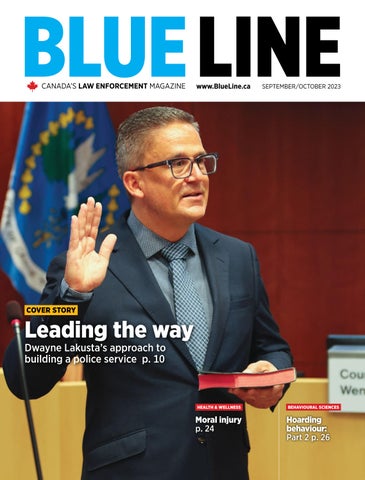
COVER STORY
Leading the way Dwayne Lakusta’s approach to building a police service p. 10
HEALTH & WELLNESS
BEHAVIOURAL SCIENCES
Moral injury p. 24
Hoarding behaviour: Part 2 p. 26
RUGGED. RELIABLE. RESPONSIVE.
CHEVY TAHOE SOLUTIONS CONSOLE BOXES PUSH BUMPERS WINDOW GUARDS GUN MOUNTS CARGO STORAGE
SCAN HERE
TO CHECK OUT OUR FULL PRODUCT SELECTION FOR THE 2021+ CHEVY TAHOE
WWW.GAMBERJOHNSON.COM
@gamberjohnson #GamberJohnson #RuggedReliableResponsive
Contents
10 September/October 2023 Volume 35 Number 5
Features
Columns 4 8 23 24 26 30
Editor’s Commentary Q&A Case Law Health & Wellness Behavioural Sciences Back of the Book
COVER STORY
10 Leading the way
Departments
Dwayne Lakusta’s approach to building a police service. By Brittani Schroeder.
5 5 6 6 29
12 A transformative justice model on Tsawwassen First Nation From “traditional criminal justice” to “Indigenous community justice”. By Neil Dubord and Jassie Ram (Padda).
News By the numbers Dispatches Calendar Marketplace
14 Creating a Canadian database of police use of force incidents: Part 1 Benefits for the police, the public and researchers. By Audrey MacIsaac, Andrew Brown, Bryce Jenkins, Ariane-Jade Khanizadeh, Tori Semple, and Craig Bennell.
18 The YXE First Responders Fitness Festival
COVER PHOTO: THE CITY OF GRANDE PRAIRIE
Police, firefighters and paramedics join together and unite with the community. By Brittani Schroeder.
14 @Blue_LineMag
18
20 Education & Training Directory Check out Blue Line’s 2023-2024 Education & Training Directory for options to bolster your resume, tool bag and more.
24 September/October 2023 | BLUE LINE
3
EDITOR’S COMMENTARY BY BRITTANI SCHROEDER
The changing policing industry
T
his year has truly been flying by. the transition to a municipal police serI can’t believe summer has alvice: Grande Prairie, Alta. This process ready come and gone, and was started in March 2023, when it was children have already gone voted in, almost unanimously, by city back to school. Now, we’re being greeted council. Their first order of business, after by crisp autumn mornings and the creating the Grande Prairie Police Comchanging colours of tree leaves. Soon mission, was to find someone to lead this enough, dare I say it, we’ll be seeing snow new police service, and that’s where falling from the sky. Dwayne Lakusta comes in. Last month, I was able to attend the 118th I had the opportunity to speak with Canadian Association of Chiefs of Lakusta before he was officially Police Annual Summit and Trade Their first sworn in as chief of police, and Show in Ottawa, and it was won- order of I could hear in his voice how derful to see familiar faces and business, after excited he was to get started. make some new friends. There I creating the Through his positions in law learned of a few people who were Grande Prairie enforcement and the Alberta announcing their retirements Police provincial government, he knew and met some newly appointed Commission, of the recruitment challenges members of police leadership. was to find police departments are currentEven as I created this edition’s someone to ly facing across the country, and Dispatches section, it struck me lead this new the need to create diverse teams. how much change was occurring police service, These were two major focuses in the Canadian policing industry, and that’s during our conversation, along with police services and their where Dwayne with what he feels will be the Lakusta comes most successful way to lead this personnel. A lot has happened this year, in. new police service. You can find and a lot of focus has been paid the full story on page 10. to the Royal Canadian Mounted Police And as always, if there is a topic that you (RCMP). They were able to mark and think we should be talking about, and that celebrate the 150th anniversary of the fedfellow officers could benefit and learn eral police service in May, but this came from, please reach out to me at any time shortly after the recommendation for (bschroeder@annexbusienssmedia.com). transformative change was announced in Until next time, happy reading and be March, when the Mass Casualty Commiswell. sion released their seven-volume report on the Nova Scotia 2020 mass shooting. Several municipalities across Canada have considered making the change from RCMP services to a municipal police force over the past few years. Surrey started this transition in 2018, and though the city went through a political struggle this spring as Mayor Brenda Locke tried to have the RCMP reinstated as the police of jurisdiction, B.C.’s Minister of Public Safety and Solicitor General, Honourable Mike Farnworth, directed the city to continue its transition to the Surrey Police Service in July. Now, another Canadian city has started
www.BlueLine.ca Reader Service Print and digital subscription inquiries or changes, please contact customer service Angelita Potal Tel: 416-510-5113 Fax: (416) 510-6875 email: apotal@annexbusinessmedia.com Mail: 111 Gordon Baker Rd., Suite 400 Toronto, ON M2H 3R1 GROUP PUBLISHER | PAUL GROSSINGER pgrossinger@annexbusinessmedia.com PUBLISHER | ADAM SZPAKOWSKI aszpakowski@annexbusinessmedia.com EDITOR | BRITTANI SCHROEDER bschroeder@annexbusinessmedia.com EDITORIAL DIRECTOR EMERGENCY SERVICES GROUP | LAURA AIKEN laiken@annexbusinessmedia.com ACCOUNT MANAGER | JANICE EATON jeaton@annexbusinessmedia.com MEDIA DESIGNER | GRAHAM JEFFREY gjeffrey@annexbusinessmedia.com ACCOUNT COORDINATOR | KATHRYN NYENHUIS knyenhuis@annexbusinessmedia.com AUDIENCE DEVELOPMENT MANAGER BEATA OLECHNOWICZ | (416) 510-5182 bolechnowicz@annexbusinessmedia.com PRESIDENT/COO | SCOTT JAMIESON sjamieson@annexbusinessmedia.com ANNEX BUSINESS MEDIA 111 Gordon Baker Road, Suite 400 Toronto, ON M2H 3R1 Tel. 416-442-5600 • Fax 416-442-2191 Publication Mail Agreement No. 40065710 ISSN 0847-8538 Printed in Canada SUBSCRIPTION RATES Canada — 1 Year $31.50; 2 Year $52.50 plus tax USA — 1 Year $136.50 CAD Occasionally, Blue Line will mail information on behalf of industry-related groups whose products and services we believe may be of interest to you. If you prefer not to receive this information, please contact our circulation department in any of the four ways listed above. Annex Privacy Officer Privacy@annexbusinessmedia.com; Tel: 800-668-2374 © 2023 Annex Business Media. All rights reserved. Printed in Canada. No part of the editorial content of this publication may be reprinted without the publisher’s written permission. Opinions expressed in this magazine are not necessarily those of the editor or the publisher. No liability is assumed for errors or omissions. Readers are cautioned and advised that articles presented herein are edited and supplied for your personal awareness and should not be used for further action until appropriate guidance is received from a supervisor, Crown Attorney or other persons in authority. All advertising is subject to the publisher’s approval. Such approval does not imply any endorsement of the products or services advertised. The publisher reserves the right to refuse advertising that does not meet the standards of this publication.
CONNECT WITH BLUE LINE
www.BlueLine.ca
4
@ Blue_LineMag
BLUE LINE | September/October 2023
www.facebook.com/BlueLineMagazine
www.BlueLine.ca
NEWS PRINCE EDWARD ISLAND
Charlottetown Police add facility dog to their team to support officer well-being
prepared to complete all his duties as a Facility Dog for CPS. Captain will undertake the Certified Facility Dog and Certified Justice Courthouse Facility Dog program under his organization Canine Therapy for First Responders Inc. This 18–24-month long program will ensure Captain meets the high requirements to work within his future role supporting his CPS members, but also community members impacted by crime. He will be trained by Master Trainer and CTFFR Canine Program Executive Director Rhonda Langille from Tatamagouche, N.S. BRITISH COLUMBIA
Delta PD employs innovative technologies
PHOTO: CHARLOTTETOWN POLICE SERVICES
Pictured left to right: Cst. Patrick Hogan, Cst. Robert Schnarr, Det/Cpl Tara Watts and Cst. Mark Woods. Charlottetown Police Services (CPS) have recently welcomed a facility dog, named Captain, who will support the mental health and well-being of their officers. Captain’s handler is Cst. Robert Schnarr. Captain was donated to the service by Canine Therapy for First Responders (CTFFR – ctffr.ca), an organization founded by in February 2019 in honor of Fredericton Police Cst. Robb Costello after he and Cst. Sara Mae Burns were killed in the line of duty in Aug. 2018. Captain is a nine-month-old male Golden Retriever that was bred and donated to CTFFR by Goldens with a Mission, from Yarmouth, N.S. Over the next year and a half, Captain will receive intensive training to ensure he is fully
On July 29, members of the Delta Police Department (DPD) responded to a report of a missing individual who walked away from the hospital. The individual had been admitted for physical medical issues, which were complicated by potential dementia-like symptoms. DPD officers responded to a potential sighting of the missing individual at a park but were not able to locate them during initial efforts. However, the officers persisted and skillfully deployed a drone equipped with an infrared (IR) camera and spotlight. DPD prioritized the individual’s well-being and extended the search to the nearby easement and farm fields. During this expanded search, the drone’s technology proved invaluable. Following the detection of a heat signature, the DPD team used the spotlight and zoom cameras technology on the drone to precisely pinpoint the individual’s location in a brush area. Thanks to the seamless integration of advanced technology and teamwork of the DPD officers, the missing individual was safely located and taken to hospital for
appropriate medical care. Without this technology, locating the individual in the dark would have been a challenging task. Chief Dubord emphasizes, “This incident exemplifies our unwavering commitment to innovation and our commitment to use of all available resources to ensure the safety and well-being of our community members.” ONTARIO
Project Odeon dismantles illegal opioid producers in the GTHA
Hamilton Police Service, in partnership with the Ontario Provincial Police, Toronto Police Service, York Regional Police and several other law enforcement agencies have dismantled a significant producer of fentanyl and other synthetic drugs in the Greater Hamilton and Toronto Area (GTHA). Project Odeon began after police discovered a clandestine laboratory during an overdose death investigation in November 2021 at a residence on Hamilton’s Mountain. Investigators subsequently suspected a link between this death, an earlier overdose resulting in hospitalization and a death at a Toronto condominium. These all occurred within days of each other. From Jan. 1 to July 30, 2023, there have been 606 incidents related to suspected opioid overdoses and 89-suspected drug-related deaths in Hamilton. These numbers have been rising over the past five years. By tracing the origins of some of the lab equipment, investigators were able to identify a company in the United States. This business sold three items of laboratory equipment to an Oshawa-based company. From here, investigators were able to piece together an extended drug network. Warrants were executed in Hamilton, Mount Albert, Smithville, Toronto, WhitchurchStouffville, and Vaughan.
BY THE NUMBERS In July 2023, Statistics Canada released recent data on police-reported crime in Canada, 2022. For more information, please visit www150.statcan.gc.ca.
4% The crime severity index (CSI) increased for the second consecutive year, up 4 per cent in 2022.
@Blue_LineMag
3,576
The number of police-reported hate crimes in increased 7 per cent to 3,576 incidents in 2022.
20 % The two largest increases in the CSI by metropolitan area were Gatineau (+20 per cent) and Winnipeg (+20 per cent).
874
In 2022, there were 874 victims of homicide in Canada, 78 more than in 2021.
September/October 2023 | BLUE LINE
5
NEWS DISPATCHES The City of Bathurst has chosen Guy Thériault as new Chief of Police of the Bathurst Police Force. Thériault assumes his new duties on Sep. 26, replacing Gilles Maillet who was serving on an interim basis. A native of Anse-Bleue, N.B., Thériault began his career with the RCMP in Sep. 1998, joining the New Brunswick Division’s District 5 (Kent) Detachment as constable. He joined Moncton’s Joint Proceeds of Crime Unit in 2006 before assuming the same role in Montreal in 2008. From 2008 to 2014, he acted as a supervisor and team commander in the Organized Crime program. From 2014 to the present, he was either running a detachment or supervising several detachments within specific districts, the latest being as District Commander for the RCMP’s N.B. Northeast District (10 detachments) since 2022.
CALENDAR special investigation section. Suzanne Muir will take over the role of Transit Police Chief Officer on October 1, 2023. Rohan Thompson has been appointed to Deputy Commissioner – Traffic Safety and Operational Support of the Ontario Provincial Police. “I am committed to a safe and secure Ontario by delivering on our comprehensive traffic safety strategy and providing professional support services that meet the needs of our communities and our members.”
Canadian Congress on Real Time Crime Center Operations & Tech Integration Date: Oct. 4 – 5, 2023 Location: Toronto, Ont. canadianinstitute.com/rtcc Interop Canada: Enhancing interoperability for public safety Date: Oct. 11, 2023 Location: Online blueline.ca/virtual-events/interop-2023/ Security • Police • Fire Career Expo West Date: Oct. 24, 2023 Location: Calgary, Alta. emergencyservicesexpo.ca
Treaty Three Police Service (T3PS) Chief Kai Liu recently announced his plans to retire after serving 37 years in policing. Chief Liu served in his role until his contract expired Aug. 31, 2023. “Reflecting on the past 4 years, I am especially proud of our most valuable resource – every member of our service. With your collective dedication to serving our communities, together we have positioned our Police Service for continued success,” says Chief Liu of his time with T3PS. “Having served over 37 years in policing, with the last 15 years as Chief of Police for three police services, the time is right to pass command of our Service to the next leader.”
The Ottawa Police Services Board has announced that Patricia (Trish) Ferguson and Paul Burnett have been appointed as permanent Deputy Chiefs (DC) of the Ottawa Police Service (OPS). Both DC Ferguson and DC Burnett were in acting deputy roles prior to their appointment. “With the help of the courageous women and men of the Ottawa Police Service, I look forward to building trust, meaningful community partnerships, and creating a safer community for our city,” stated DC Ferguson. “The opportunity to continue to work with the amazing sworn and civilian members of this police service is incredibly exciting. It is my goal to continue to serve the citizens of Ottawa by providing a community centered policing approach that focuses on building safe and healthy communities,” stated DC Burnett.
Toronto Police Service members are mourning the loss of their first canine member killed in the line of duty: Bingo. On July 25, police were called after receiving reports of gunshots, and Bingo was fatally shot while searching for a suspect. Chief Myron Demkiw said the brave dog’s death was senseless and tragic. He also expressed condolences to Bingo’s partner, Sergeant Brandon Smith.
The Metro Vancouver Transit Police Board has selected current Transit Police Deputy Chief Suzanne Muir to be the new Chief Officer. Muir will be the first female officer appointed into the Transit Police Chief Officer position since it was created in 2005. Having joined the VPD in 1995, Deputy Chief Muir, brought over 28 years of policing experience to Transit Police, in a variety of operational investigative and administrative areas. She has worked in the operations division, tactical support section, general investigation unit, major crime section, facilities section and
The Woodstock Police Service is mourning the loss of Police Service Dog (PSD) Taz. The Woodstock Police Service K9 Unit responded to a call to assist the Stratford Police Service with a drug related investigation July 3, 2023. While conducting a search, PSD Taz and PSD Striker both appeared to ingest drugs. Narcan was administered and PSD Taz and PSD Striker were rushed to a Veterinarian Clinic. PSD Taz did not make it and died in the line of duty. “We thank Taz for his service to our community and the excellent work he did during his short career.”
Edmonton’s longest-serving policewoman, Cst. Arlene Omilian has retired after 43 years of service to the community. Omilian joined the Edmonton Police Service in 1979. “A training sergeant told me to go home and have babies because I would never make it as a police officer. It made me angry and determined to prove him wrong. Today, nobody can even imagine policing without women being part of it,” recalls Omilian. She was also named the first-ever Edmonton Police Association Patrol Officer of the Year in 2010. She officially retired in May.
6
BLUE LINE | September/October 2023
DEMCON – The Ontario Disaster & Emergency Management Conference Date: Oct. 24 – 25, 2023 Location: Mississauga, Ont. crtdemcon.ca/DEMCON/ Find more calendar events online at blueline.ca/events.
www.BlueLine.ca
STANDING SHOULDER TO SHOULDER WITH YOU Your trusted source for uniform insignia
trimtag.com • contact@trimtag.com • 905-763-7300 @Blue_LineMag
September/October 2023 | BLUE LINE
7
Q&A Recently, editor Brittani Schroeder spoke with S/Sgt. Robert Patterson of the Calgary Police Service Traffic Section and Course Commander for the Canadian Police Ceremonial Training Course about the importance of running a ceremonial training course for the first responder community. Q: How did you get involved? I was an air cadet as a kid and later joined the Canadian Armed Forces reserves. When I became a police officer, I joined the Calgary Police Service (CPS) Honour Guard and became a drill instructor soon after completing recruit training. I’ve been practicing ceremonial skills since I was 12 years old. In 2012, I collaborated with the CPS Sergeant Major at that time to create a formal course, combining our expertise.
8
BLUE LINE | September/October 2023
course successfully took place at the Ontario Police College (OPC) with a record attendance of 70 participants. The 2023 course attracted attendees from nearly every province. With representation from all first responder agencies, including police, fire, EMS, corrections, peace officers and CBSA, it was a resounding success. We even had to close registration and create a waitlist because we could only accommodate so many members.
Q: What kind of skills are you teaching your attendees? The course covers a wide range of skills. We split it into two parts. The “Member’s” course is for individuals with little to intermediate experience in ceremonial training, while the “Commander’s” course targets those with intermediate to advanced skills who aspire to be Honour Guard commanders. The Member’s course focuses on the basic foot drill, marching, saluting, flag carrying, participating in the colour party, and handling arms. In the Commander’s course, assuming attendees already possess these skills, we teach them how to instruct drill, plan and command ceremonial events, and follow proper protocol. They also learn how to pass on these skills to others. During this course, attendees mentor and instruct the Member’s course attendees, and on the final day, they plan and execute the simulation exercise involving different aspects of a Line of Duty funeral service. The Commander’s course is a pass or fail
Q: Why is it important to have these skills? Ceremonial skills are not limited to funerals but are essential for various events such as community parades, citizenship ceremonies, change of command ceremonies, and the Calgary Stampede, where first responders are featured annually. The ceremonial component of policing represents the positive aspects of the profession—demonstrating pride and professionalism while actively participating in the community. Learning these skills instills self-discipline, which is valuable on a personal level. Applying the training in real-life situations, such as the line of duty funeral of two Edmonton Police officers in March, showcases the importance of these skills and how they honour fallen colleagues. Q: Has the idea of running the course twice annually ever come up? While there is sufficient demand to run the course twice a year—one in Alberta and one in Ontario—the logistical challenges prevent us from doing so. As the course organizers, my team and I also have our daily responsibilities as police officers, making it challenging to manage the course more frequently. We plan to alternate between Alberta and Ontario to maximize accessibility for participants. It’s an honour to equip attendees with the skills necessary for community events, ceremonies, parades and line of duty funerals. The ability to teach attendees, who can then pass on these skills to smaller agencies and ensure the development and capacity to handle such events—it’s fantastic. Editor’s Note: This interview has been condensed and edited for clarity. To learn more about the training course, visit cpctc.ca.
www.BlueLine.ca
PHOTO: KAMINI LE CAPELAIN
Q: What is the history behind the Ceremonial Training Course? CPS’ Honour Guard was established in the early 80s and, although not initially, gained considerable support over the past 20 years. Recognizing the need to enhance our ceremonial training, we looked for additional resources outside our police service. However, we discovered that no one in Canada offered such training. We traveled to Virginia to take a course, but it had an American focus, which didn’t align with Canadian traditions. To avoid sending Canadian officers to the U.S. for training, we decided to create our own course in Calgary. In 2012, we started with a small seminar-like format, inviting members from our service, Calgary Fire, EMS and other local police agencies. There were 25 attendees, and it was well-received. We gradually expanded the course. In 2014, I took over as the Sergeant Major for CPS and we expanded the course to a four-day event, where you’d learn and practice new skills on days one and two, you’d start putting those into practice on day three, and on day four we added a full simulation exercise at a funeral home. In 2019, Arbor Memorial started providing us with access to a funeral home and cemetery. In 2020, we aimed to take the course to Ontario. We’d recently been given an endorsement from the Alberta Association of Chiefs of Police and the Association of Sergeant Majors, so we started pursuing an endorsement from the Ontario Association of Chiefs of Police—which we did get. The pandemic unfortunately forced us to cancel that year’s course. Finally, in 2023, the
program that demands a higher level of commitment, as they need to meet specific standards. Failing attendees is difficult, and rare, but it ensures that agencies can expect a certain skillset and performance from the graduates.
THE MOST ADVANCED MODULAR COMBINATION UNIT RESPIRATOR (CUR)
The Avon CS-PAPR™ is the newest generation of CBRN Powered Air Purifying Respirator (PAPR) designed for use in Combination Unit Respirators. The capability to change levels of protection dependent on the threat, now provides the wearer with increased duration on target and safer operation. Avon Protection is recognized as a world leader in respiratory and ballistic protection, delivering life critical solutions for Militaries and First Responders worldwide. As an innovative capability provider, we understand the unique requirements of the modern warfighter and tactical operator. This depth of specialization and understanding has ensured products are designed to protect our users in the most extreme of environments. We have been supplying protection solutions to the UK Ministry of Defense and other allies since the 1920’s and are a primary supplier of integrated protective equipment to NATO, Canadian Armed Forces and the United States Department of Defense Army, Navy, Marines, Air Force and Special Operations Forces.
PORTABLE CRIME SCENE SHELTERS
4’ 6’ 8’ 10’ 12’ PORTABLE, NON-METALLIC, NO LOOSE PARTS, LIGHTWEIGHT AND FITS IN PATROL CAR TRUNK Eflare Beacons are intensely bright Can be seen from over 1 kilometer away without the night vision, point fixation and distance judgement problems associated with strobe and incandescent lights. Eflare Beacons are infinitely versatile Available in a variety of one or two colour light combinations, steady-on or flashing, and in three light intensities. Easily attaches to clothing, vehicles, cones and bollards. Be seen and safe in almost any situation you can think of. Eflare Beacons are portable and simple to use The largest model is 22 cm tall and weighs only 460gm including batteries, making it easy to carry or stow anywhere, and quick and simple to deploy in any situation. Just twist the lens to turn on or off, and place one or more units around to provide a highly visible warning and safety zone around a person, work area, hazard or accident. Eflare Beacons double the safety EFLARES First Eflares provide safety by ensuring maximum visibility, but unlike pyrotechnic flares Responder Kits are there is no risk of fire or explosion, and there are found in Police cars no toxic fumes or residue. across Canada. Eflare Beacons are extremely robust Eflares are waterproof, dustproof and will survive a drop from a one metre height onto a concrete surface. Eflare Beacons are HAZMAT accredited Eflare Beacons are HAZMAT accredited for use in Class 1, Division 2 / Zone 2 hazardous areas.
@Blue_LineMag
Utilizing the Avon MP-PAPR module along with the patented combination hose module, the wearer can seamlessly switch between APR, PAPR and SCBA modes of protection. The single air hose connection for all modes allows the wearer to retain a clear mask cheeks for optimum weapon sighting. The low profile shape of the Avon CS-PAPR delivers best in class integration with SCBA systems, benefiting the wearer with reduced weight and size compared to traditional systems. Modular Methodology allows the user to either add the Avon CS-PAPR to existing fielded systems such as the FM53/4 APR and ST53 SCBA, use as a regular PAPR (Avon MP-PAPR) or revert back to the Avon EZAir configuration. From ballistic protection to blunt impact mitigation; in the trenches, on the water or atop the mountain; Team Wendy has a purpose-built helmet for your mission. Military, law enforcement, search and rescue, and adventure community professionals around the world look to Team Wendy for helmet solutions.
EXFIL® BALLISTIC SL
The Tactical ResQmax™ is the line thrower specifically designed for the tactical world of line-throwing. As with all the ResQmax™ line throwers, the Tactical ResQmax™ is modular and can be used with a variety of accessories for horizontal or vertical line deployment. When equipped with a grappling hook, a climbing line can be deployed to vertical distances up to 110 ft / 34 m, and a tactical ascending ladder can be deployed to vertical distances up to 50 ft / 15 m. Entry points which would otherwise be inaccessible can be breached with ease for method of entry and ship-boarding operations in both land-based and maritime environments.
September/October 2023 | BLUE LINE
9
COVER STORY
Leading the way
Dwayne Lakusta’s approach to building a police service By Brittani Schroeder
10
BLUE LINE | September/October 2023
for me to reconnect and take my lived experiences through other positions to those frontline members every so often.” After EPS, Lakusta took a position with the Government of Alberta as the executive director of law enforcement. In this role, he oversaw the RCMP provincial police service agreement, the provincial peace officer program, Indigenous policing services, and played a key role with the review of the Police Amendment Act.
Chosen to lead After his two-year tenure with the provincial government, Lakusta is on the move again, but this time he’s heading back to his roots in policing as the first Chief of Police for Alberta’s brand-new Grande Prairie Police Service (GPPS). Grande Prairie’s city council voted in early 2023 to create a municipal police service, which would phase out the RCMP over the course of five years. Through his role in the government, Lakusta learned of the upcoming transition and knew he wanted to be part of it. He was also approached see if he would be interested in applying. After an extensive evaluation process, Lakusta was announced as the service’s leader in July. He officially started in the role on Aug. 28. When asked why he believes he will be a good chief, Lakusta hesitated to answer. “I really think the service is a team effort. The group of people will matter most, not one individual.”
From left to right: Commissioner Lois Duke, Commissioner Donna Koch, Councillor Dylan Bressey, Commission Vice Chair Natalia Reiman, Chief Dwayne Lakusta, Councillor Kevin O’Toole, Commission Chair Dan Wong.
That being said, Lakusta brings significant experience to the role from his years with EPS. He credits the many positions he’s held and the great leaders who provided mentorship and supported his aspirations along the way. “I do think I’ve had a unique experience, because I’ve had the chance to work with all police agencies across the province. I understand law enforcement across Alberta and the nuanced issues that are impacting our communities.” Through his role within the government, Lakusta is also bringing operational and administrative experience to the work that goes on behind the scenes in a police department. “I think that gives me a firm foundation to step in as chief.”
Committing to the community Lakusta has a lot of respect for the RCMP, its history and the many great people that work within the www.BlueLine.ca
PHOTO: THE CITY OF GRANDE PRAIRIE
T
he thought of serving the community and making it a safer place was always appealing to Dwayne Lakusta, which is why he decided to become a police officer early on in his life. There were several reasons why he was drawn to the profession, which included the excitement it could bring and the variety of work that he would be exposed to. “I often tell people, when they’re considering a career in law enforcement, that it’s really many careers in one, just due to the number of assignments that you could take on. That’s what I found exhilarating.” Just before Lakusta received his official offer from a police service, he was training to join the local fire department. When he was faced with the choice of being a police officer or a firefighter, there was no doubt in his mind—he wanted to be an officer. “The firefighters do an incredible job, but I wanted to be on the front lines with other cops.” Whether he ended up in the fire service or in law enforcement, it was clear that Lakusta had a passion for helping people. Lakusta worked with Edmonton Police Service (EPS) for just over 26 years. Like any new member, he started his career on the streets. “That’s truly the foundation of policing. Throughout my career, through my many promotions and different specialty areas, I always found myself going back to the streets for at least short periods of time, because I didn’t want to lose touch with the frontline. I knew it was important
rank and file. When it comes to the upcoming transition, what he stresses is that it’s not about RCMP versus municipal policing—it all comes down to the wishes of the City of Grande Prairie. “Every community has their own unique challenges and variables that impact criminal behaviour within the criminal justice ecosystem. There is a great opportunity now for a new police service to identify what factors are impacting and driving crime.” Grande Prairie is said to be one of the fastest growing cities in Alberta. Over the next 25 years, there are going to be challenges that come along with its growing population, and a municipal approach will allow Lakusta and his team to pivot and adapt to those emerging trends. “Certain crime patterns today may change tomorrow, and we need the ability to respond in real time. This municipal force will utilize new ideas, new technology as it comes out, and we will be able to make decisions at the local level—which eliminates a lot of the bureaucratic hurdles that may exist elsewhere. We will be highly effective and responsive to the needs of the city of Grande Prairie.” @Blue_LineMag
A municipal force also provides opportunity for the community to have a more direct voice in shaping the policing priorities and strategies. The establishment of a municipal police service should allow for increased collaboration, coordination with local stakeholders, community organizations and residents. Lakusta wants to tailor the GPPS approach to the specific needs of the city, taking into account the community’s distinct characteristics, demographics and crime patterns. “I want to prioritize community engagement partnerships, develop problem-solving initiatives, and work with the industries here because there are a number of big projects taking place within the city and surrounding areas. We need to make sure that we’re addressing everyone’s needs so we can continue to attract economic investments within the city. I also think we’ll be able to allocate resources more effectively at a local level by aligning them with local priorities, ensuring that we’re equipped to address those new challenges or trends.” Lakusta is excited to be out on the streets with the community once “We’re the again. “As chief, I’m going to be out first new there getting to know the residents municipal of Grande Prairie. A lot of these police people have never been exposed to service in policing outside the RCMP, and Alberta since there may be some apprehension. the 1950s, They may be wondering why we’re and once we headed to a municipal police service, have the and I think it’s important for me to right people earn and build their trust and show in place, them that it isn’t about the colour of we’re going the stripe, it’s about what’s right for to be the community. I also want them to successful.” know that I bring significant experience to the table, all to make Grande Prairie a better, safer place.”
Hiring a new team As the new police service grows, Lakusta knows that it’s going to be of the utmost importance to fully develop the senior leadership team. Once he has those core members in place, they’ll be able to build the team downwards from there.
“I want to bring in leaders with significant experience in policing, people with respected opinions and strong community values. I need them to respect transparency and accountability. There is a high expectation for the police, and quite frankly, there should be.” Lakusta wants to work with people who are passionate about community safety, and are responsive to emerging trends. He’s going to be looking for those who are progressive leaders, with highly valued reputations within their current organizations. He also knows that the GPPS needs to be representative of the demographics of the city. “Diversity is a key factor here. I want there to be diverse cultural and professional backgrounds, to make sure there is as much lived experience being represented here in the department.” When asked how he likes to lead, Lakusta shared that he likes to empower people to make their own decisions. “Micromanaging is not my style. When people have the ability and experience to make decisions, it’s either going to go right, or things will go sideways. I’ll be there to support them through it all. This is how we develop future leaders; they need to challenge themselves. I think overall this creates a healthier workplace.” At the time of this interview, Lakusta already had a few people in mind that he wanted to approach to be on his senior leadership team. “People have also approached me, because they want to be part of what we’re doing here. We’re the first new municipal police service in Alberta since the 1950s, and once we have the right people in place, we’re going to be successful.” The Grande Prairie Police Commission’s task was to find the service’s first chief, and now that he’s in place, it’s up to Lakusta to take it from here and hire the rest of the members. “I like to move quickly – I don’t like to belabour things.” So it’s easy to see why, when his first official day as chief came around, he hit the ground running. September/October 2023 | BLUE LINE
11
FIRST NATIONS COMMUNITIES
A transformative justice model on Tsawwassen First Nation From “traditional criminal justice” to “Indigenous community justice” By Neil Dubord and Jassie Ram (Padda)
O
verrepresentation of Indigenous peoples in the Canadian criminal justice system is an ongoing issue that has received significant attention, including investigation through various inquiries, commissions and mentions by the Supreme Court of Canada. In addition, the Supreme Court of Canada noted that “The drastic overrepresentation of [A]boriginal peoples within both the Canadian prison population and the criminal justice system reveals a sad and pressing social problem.”1 Reconciliation efforts require that institutions do more than simply acknowledge or highlight Indigenous overrepresentation in the justice system. While several initiatives are underway at the federal and
12
BLUE LINE | September/October 2023
provincial levels, it’s important for local communities, including the police, to work collaboratively to develop and implement grassroots solutions to divert individuals away from the traditional criminal justice system. Since 2006, the Delta Police Department (DPD) has been providing contracted policing services with Tsawwassen First Nation (TFN). The DPD has a dedicated Tsawwassen First Nation Service Team (TFNST) delivering respectful and culturally sensitive community-first policing services to TFN. A critical element of the TFNST includes an embedded DPD Liaison Officer who forges relationships with TFN members and stakeholders. DPD has partnered with B.C. Corrections and TFN Government to develop the Community Justice Program (CJP). The CJP’s objective is to mitigate the overrepresentation of Indigenous peoples in the criminal justice system through a united effort that centers on the three C’s: client, community and connection to culture.
The CJP and plans The CJP combines traditional criminal justice elements (police, courts, commun-
ity corrections and prosecutors) with Indigenous community justice elements (community, elders, culture, spirituality and restoration of balance). The CJP effectively blends two justice systems with the goal of diverting clients who have encountered the traditional criminal justice system and providing them with comprehensive wrap-around supports and services. When a TFN Member, including a youth, commits a summary offence2, DPD’s TFN Liaison Officer, Cst. Tegart, works with the CJP team to review the case with the goals of proceeding with a personalized Community Justice Program Plan and advocating to keep the individual in the community. In summarizing his role in the CJP, Cst. Tegart states that “a big part of my job as the Liaison Officer is to engage all levels of the justice system, working with probation and Crown Counsel to find the best possible solution for the individual.” The process of developing a CJP plan is guided by open communication, respect and recognition, and transparency to divert the individual and help them heal within the community. Moreover, the CJP plans are pliable, with recognizing that not everything may go as planned and flexibility may be required to ensure client success. www.BlueLine.ca
PHOTO: DELTA POLICE DEPARTMENT
From left to right: Chief Neil Dubord, Cst. Mike Tegart, Supervisor of Social Services Virgil Awasis, Elder Ruth Adams, Manager of Health and Social Services Katie Alexander and Probation Officer Tyler Curll
Overview: Developing a CJP Plan • Background of the incident is gathered • Consultation process between all partners takes place o Areas of risk and strength are discussed: Mental health, family background, employment/ education, substance use, and attitude regarding the offence • Development of CJP plan, including plan components for services such as: Substance use, health and emotional wellness, culture and spirituality, and community functioning • Evaluate/review the CJP plan • Finalize CJP plan agreement with terms and considerations
THE THREE C’S 1. Client-centered CJP plans are client centered as they focus on helping the client embark on a healing journey by recognizing and addressing intergenerational trauma impacts. The client is involved in creating a healing plan for themselves by identifying their goals and making decisions, creating personal accountability during the process. A partnership between the client and the CJP team is fostered through the plan’s consultation and development process by encouraging clients to participate in creating their personalized programs. As Curll notes, “in our program, power is shared and decisions are collaborative.”
A dedicated team with familiar faces Support from TFN leadership and the community brings together committed individuals who make up the CJP team and are all vital in its success. Every individual is involved in all stages of a CJP plan, from consultation to finalization. The team leads meaningful change and builds relationships amongst everyone involved. • Katie Alexander, Health and Social Services Manager, Tsawwassen First Nation • Virgil Awasis, Family Empowerment Worker, Tsawwassen First Nation • TFN Elder Xw steniya (Ruth Mary Adams), Advisor, Tsawwassen First Nation • Cst. Mike Tegart, TFN Liaison Officer, Delta Police Department • Tyler Curll, Probation Officer, B.C. Corrections
2. Community-centered When an offence is committed, it impacts the entire community. As such, CJP plans are created involving clients, their families and the community to ensure client success. Additionally, Indigenous Elders and community champions are consulted with to provide traditional knowledge and grassroots community support. Cst. Tegart captures the community-centered nature of the CJP plans, stating that “the program encourages me to look at policing through a different lens. It’s about engaging and building relationships with the community.”
e
Additionally, the CJP team works with a dedicated Crown Counsel from the B.C. Prosecution Service and TFN community members, including Elders. A team of dedicated liaisons/representatives from various criminal justice organizations is crucial to the success of the CJP. Virgil Awasis, reflecting on past experiences, notes that criminal justice organizations are often “faceless institutions” with processes that do not work because there is not a direct contact who takes ownership and accountability for the process. The CJP is addressing this concern by placing “faces” on these organizations; Cst. Tegart representing DPD and Tyler Curll representing B.C. Corrections. This is an essential step in building trust with TFN members and in addressing the historical and ongoing effects of colonial systems. @Blue_LineMag
3. Connection to culture-centered CJP plans are connection-centered as they incorporate elements of Indigenous culture, identity and tradition. The plans encourage individuals who may have lost connection to their culture to reclaim spiritual and cultural elements related to land, family, ceremony and language, guided by Elders and community champions. Cultural connection benefits both clients and stakeholders, including justice institutions, through creating respect and understanding of the importance of Indigenous cultures and practices. Impact of the Community Justice Program The CJP is successful and making positive impacts for TFN Members due to its collaborative and personalized process. The success of the CJP is determined by those who have completed the program and the reduction of Indigenous people entering the traditional criminal justice system. Those who have completed the program provide positive feedback, noting that they
feel heard and respected, attesting to the value of active consultation with all stakeholders, including the clients.
CJP Impacts • 100 per cent successful completion of all CJP plans • Positive relationships built between communities and justice systems • Improved connection with community • Decrease in recidivism and administrative breaches • Increase in family and community involvement towards individual and community wellness • Significant increases in TFN Members attending drug and alcohol treatment services and increases in positive results when returning to community The biggest success has been the ability to use the CJP for youth cases, resulting in no youth being criminally charged on Tsawwassen Lands in at least the past five years. As Virgil notes, “the program is changing the landscape for future generations, seeds are being planted and over time, this will result in a whole generation of youth who have not been charged and entered in the criminal justice system.”
Concluding remarks The TFN CJP—in alignment with Article 34 of the United Nations Declaration of the Rights of Indigenous Peoples (UNDRIP)3—is a step forward on the path to reconciliation. The CJP’s collaborative and united effort from the team, Tsawwassen Members, and the community has contributed to its success. It is essential to invite stakeholders to sit at one table together with the community to create innovative approaches with a focus on providing wraparound services. While the CJP is primarily for summary offences, elements of client, community and connection-centered approaches provide a holistic framework for considering other restorative justice initiatives. References
For a full list of references, please visit www. bluelineca/a-transformative-justice-mod-
el-on-tsawwassen-first-nation/ Neil Dubord is the Chief Constable of the Delta Police Department. Jassie Ram (Padda) is the Corporate Services Manager, working with the Office of the Chief Constable at the Delta Police Department.
September/October 2023 | BLUE LINE
13
INFORMATION SHARING
Creating a Canadian database of police use of force incidents: Part 1 Bryce Jenkins, Ariane-Jade Khanizadeh, Tori Semple, and Craig Bennell
C
oncerns surrounding the use of force by police officers are growing, fuelled by perceptions that the police use force too frequently, research showing that force is applied disproportionately to members of certain groups, and views that the mechanisms for holding police responsible for unjustified force are inadequate. Regardless of where these concerns originate, it is to everyone’s benefit – both the police and the public – to address these issues. While there is not a single solution that will resolve all concerns, one crucial step would be the creation of a national database to track the use of force by Canadian police officers. Discussions regarding the development of national use-of-force databases have been ongoing in Canada and the U.S. for years. To fill this void, different news agencies have created databases by using publicly available sources. For example, in Canada, the Canadian Broadcasting Corporation (CBC) has created their Deadly Force database. Databases created by news agencies can help us understand use-offorce incidents and hold police officers accountable, but they have also been criticized. One common criticism is that the cases included in the databases are often not associated with sufficient context, which prevents a full understanding of the incidents (e.g., whether the police were justified in using lethal force).3
A Canadian use-of-force database To address concerns with databases created by news agencies, the authors believe a new national database should be developed in Canada. This database should include both fatal and non-fatal force and should 14
BLUE LINE | September/October 2023
be mandatory for all police services to complete. We agree with Laming (2017) that the database should include: personal characteristics of the officer(s) and civilian, whether the civilian had a weapon, the location of the incident, the nature of the incident, whether there were injuries, whether the officer(s) tried to de-escalate the situation, and the types of force used by the officer(s).3 It would also be important to collect information on the civilian that goes beyond personal characteristics (e.g., whether they were perceived to be experiencing a mental health crisis at the time); actions of the civilian leading up to the use of force (e.g., whether they were being assaultive); and other situational variables (e.g., the number of officers present on scene). Additionally, consideration could also be given to whether the database should capture charges recommended against the officer(s), the nature of those charges, and what the outcome of any charges were (e.g., prosecutions and convictions). A national use-of-force database would benefit the police, the public and researchers who study policing issues. Some of the most important benefits include:
Police transparency. Transparency should be a goal of any police service in a free and democratic society. A national use-offorce database would help achieve this by providing information about how frequently and under what circumstances, police officers use their authority against civilians. It’s not enough for the police to only collect use-of-force data. They must openly share this data with the public so that they can determine whether Canadian police officers are carrying out their duties in a fair and just manner. Perceptions of police legitimacy. Perceptions of police legitimacy refer to whether people view the police as a legitimate source of authority. According to one model of police legitimacy, the construct relates to: (1) perceptions of police lawfulness (whether police officers follow established rules), (2) perceptions of procedural fairness (whether interactions with the police are fair and impartial), (3) perceptions of distributive fairness (whether the police allocate resources fairly across groups), and (4) perceptions of police effectiveness (whether police achieve results).5 In some ways, a national use-of-force database could improve perceived police legitimacy. For example, the database could address police lawfulness in that it would likely show that the use of force by police officers, especially lethal force, happens rarely and is legally justified in most cases. Understanding police use of force. A national use-of-force database would also help people understand when and why Canadian police officers use force. Police-citizen encounters depend on both officer and citizen behaviour. To properly understand these complex, transactional events, and to address concerns about these encounters, we need accurate and reliable information about the officer(s) and citizen(s) involved in use-of-force incidents and about the incidents themselves. www.BlueLine.ca
PHOTO: OWNZA / ADOBE STOCK
Benefits for the police, the public and researchers By Audrey MacIsaac, Andrew Brown,
Developing strategies for improvement. A better understanding of use-of-force incidents could allow strategies to be developed to reduce police use of force. For example, a national database could help explain why fatal incidents occur, which might help police services develop more informed policies (e.g., around the use of less-lethal weapons) and practices (e.g., around scenario-based training) to reduce occurrences of lethal force. Reducing misconceptions about police use of force. A national use-of-force database could also be used to reduce misconceptions the public has about policing.7 For example, the public appears to overestimate how frequently police officers use force. This could be confirmed and corrected using data from a national use-offorce database. For constructive discussions to take place about police use of force, it is important for the police to understand these public misconceptions and for the public to better understand when and why police officers use force.
Addressing problems with databases created by news agencies. As mentioned above, while databases created by news agencies currently house the best available data on the use of lethal force by police officers in North America, concerns have been raised about these databases. For example, these databases often provide only a partial picture of use-of-force incidents. A national use-of-force database, composed of official police data, should provide a more complete picture of use-of-force incidents in Canada.
Conclusion A database like the one described in this article will not eliminate all the concerns Canadians might have with policing; however, it will hopefully address some of their
concerns about police use of force by helping to increase police transparency and accountability. The database would also be of value to the police. Not only would it allow them to show the public that the use of force, particularly lethal force, is rare in Canada and legally justified in most instances, but it will contribute to the public’s understanding of when and why force is used. In an upcoming article in Blue Line, we will explore challenges that will likely be encountered when attempting to create a national use-of-force database. For a functional database to be created, these challenges will need to be resolved. For a full list of references, please visit www. blueline.ca/creating-a-Canadian-database-ofpolice-use-of-force-incidents-part-1/
Audrey MacIsaac, Andrew Brown, Bryce Jenkins, Ariane-Jade Khanizadeh, and Tori Semple are PhD students in the Department of Psychology at Carleton University. You can read more about their research interests at blueline.ca. Craig Bennell is a Professor in the Department of Psychology at Carleton University where he is also Director of the Police Research Lab. He collaborates with Canadian police services to promote evidence-based policing. He has a particular interest in de-escalation and police use of force, where his research focuses on factors that influence police decision-making and strategies for improving training in these areas.
Mobile Patrol ® IMP Intelligent Industry Standard Police eNotes Integration
Efficiencies
CAD RMS DEMS MCM ALPR Scheduling and more...
Customizable Speech to Text DL/ID Scan Audio Recording eTicketing Offline Mode Cross-Platform
Redaction Smart Templates Query RMS & Notes Sketch Digital Evidence Geo Location Analytics
www.e-notes.ca Built for Android, iOS, Windows
BL_DigitalMobility_SeptOct23.indd 1
@Blue_LineMag
2023-08-23 1:26 PM
September/October 2023 | BLUE LINE
15
SPONSORED CONTENT
THE IMPACT OF UNPREDICTABILITY ON MENTAL HEALTH
how natural hazards impact police officers is on its way!
From wildfires to floods, it’s no secret that Canada has witnessed more frequent natural disasters over the past few years. Police officers and other first responders are always there to answer the call when we’ve needed them most, but their mental health has never been more at risk. As these damaging natural events become more common, so does the impact on police officers, who often experience various forms of emotional distress as they witness increased tragedies. Our research shows that public safety personnel already face a significant amount of stress in their daily lives. Adding the stress of unprecedented disastrous natural events can make it very tough for public safety personnel to cope. In times like these, it is important to make sure that public safety personnel have the necessary tools to manage their mental health. For this reason, and many more, it is crucial for police officers to not only understand how to manage physical and mental challenges, but also that there is no shame in seeking help. Awareness around mental health concerns is growing, but there is still work to be done In pre-pandemic times, many Canadians were unaware of the mental health challenges that many police officers and other first responders experience. When the COVID-19 pandemic hit in 2020, awareness of the harsh circumstances that first responders encountered on a daily basis began to increase, bringing mental health conversations to the forefront. While the pandemic certainly helped with general awareness around mental health concerns, less often discussed are the ongoing pressures facing first responders. Beyond the ongoing day-to-day pressures and expectations they face, the recent influx of natural disasters has also added an additional layer of unpredictability that was unheard of in the past. 16
BLUE LINE | September/October 2023
www.BlueLine.ca
Recognizing the impacts of disasters on first responders and the need for tailored resources While natural disasters are physically hard on police officers and other first responders due to the magnitude and severity, they also take a mental toll, as these individuals often witness the direct impacts on people and communities while working to save lives. For example, Canadian police officers are often called on scene as immediate resources when a disaster strikes and are often in charge of helping those who have been directly impacted. This may include - but is not limited to - being responsible for developing and facilitating evacuation plans and transporting evacuees and victims to safe places. As the world expects to witness more unpredictable and extreme natural disasters, police officers will inevitably face more mental health challenges, along with physical risks. This is why it’s incredibly important to have easily accessible mental health resources that are tailored to their experiences and needs. PSPNET was founded to support the mental health and wellbeing of first responders and public safety personnel. Originally developed as part of the Government of Canada’s National Action Plan on Posttraumatic Stress Injuries, PSPNET offers and evaluates internet-delivered cognitive behavioural therapy, also known as ICBT, specifically tailored for current and former first responders. The courses and resources developed by PSPNET aim to help police officers and other first responders overcome their mental health challenges related to their occupation. Tailored support and resources are also available for family members of police officers, many of whom experience mental health challenges of their own.
For more information on the resources available through PSPNET, please visit pspnet.ca.
@Blue_LineMag
September/October 2023 | BLUE LINE
17
TRAINING
The YXE First Responders Fitness Festival Police, firefighters and paramedics join together and unite with the community By Brittani Schroeder
W
The idea Chris Harris has worked for the Saskatoon Police Service (SPS) for 17 years. During his time, he has worked in a variety of units, including VICE, missing persons and frontline patrol. Currently, he is a member of the community response unit, or “bike unit”. Harris’s obstacle course racing background started in 2014 when he competed in his first Tough Mudder event in Whistler, B.C. Harris has competed in 10 Tough Mudder events, including six times at the annual 24-hour World’s Toughest Mudder event. He has completed two Spartan Race Trifectas, which is completion of their sprint, super and beast races in one year, and competed twice internationally in the Obstacle Course World Championships. Angela McEwan has been a police officer at SPS for nine years and spent time working in corrections before being hired. She is also an accomplished weightlifter and CrossFitter. During her time in frontline patrol, she met Harris and bonded with him over their shared love of fitness and competition. In 2020, McEwen and Harris were watching The Spartan Games series on YouTube. “This event brought together 12 men and 12 women from across a number of different racing backgrounds and pitted them against each other in a four-day, multi-event competition,” says Harris. As Harris and McEwen watched the Games, they considered what it would be like to participate in an event 18
BLUE LINE | September/October 2023
like that. It soon blossomed into “What if the event was police versus firefighters versus paramedics?” From there, the two officers were off and running. “We thought it would be a great way to showcase first responders, promote them as athletes and also bring together the three services for a fun weekend. It became this octopus, and we kept sending out tentacles in every direction and it really morphed into a ‘festival’-type of feeling,” Harris explains. There were many challenges to overcome. To start, Harris and McEwen had no credibility or formula to go off of. Questions they needed to answer included: what events are we going to do, how many events and how hard should it be? Harris and McEwen didn’t want this to become another CrossFit competition, because they knew it would scare a lot of people away. They wanted to make it a diverse competition with a wide range of athletes.
Next, they needed to find a venue. The two officers talked about logistics and finally decided on an indoor space, because October in Saskatchewan “can be too unpredictable.” Then, another challenge came in the form of finding the equipment for the obstacles and getting them to the venue. How were Harris and McEwen going to get athletes to buy into this new event? “We were such an unknown product, and we didn’t want to reveal too much about what the athletes would be doing because we felt it may scare them off or intimidate them,” says Harris. “We were at a point where we almost had to shelve the idea for a year and try it again later, because we didn’t think we could get the numbers or the buy-in we needed.” They needed money. They needed community support. They needed prizes, sponsors and donations. Essentially, Harris and McEwen needed everything. How were they going to pull it off? www.BlueLine.ca
PH0TO: KIM ASCHIM
hat do you get when members of law enforcement, the fire service and paramedics come together? You get a new event that unites the community and raises awareness and money for first responder mental health. So how did it all start?
The committee The YXE First Responders Fitness Festival (YXE FRFF) was Harris’s and McEwen’s baby, but they knew they couldn’t do it all on their own. “We knew we needed people at the table from each profession,” Harris says. McEwen knew paramedics Beaumont Sinclair and Nathan Rollack from her CrossFit gym, and when they were approached, they jumped on board immediately, both as competitors and as committee members. Amy Buettner, a firefighter, was also approached and joined the committee as the fire service representative. The charity The committee recognized the importance of having a charitable component to the event. McEwen had previously raised money for OSI-CAN, an operational stress injury/post-traumatic stress support initiative whose mission is to inspire hope and contribute to the continuous well-being and recovery process of veterans and front line protectors across Canada. “OSI-CAN seemed like an easy choice. We were creating a first responders’ event, and first responder mental health is such an important and prominent issue in today’s climate,” says Harris. The team reached an agreement with OSI-CAN that, although the charity is a national charity, all the money that was raised—which reached over $25,000—would stay in Saskatchewan and go toward programming in the province. The outcomes This event was a success in a variety of ways. First, the event boosted morale within the first responder services because it brought people together for a common goal, people who otherwise may not have come together or gotten to know each other. The event featured 20 people from each service who participated in group workouts, motivating each other and helping each other out with equipment, diet, motivation, concerns, advice and more. “This event @Blue_LineMag
boosted pride in our participants’ jobs, because they knew they were representing their respective services,” says Harris. “We had athletes coming up to us and thanking us for letting them be a part of it. I know for me, when I was sitting around on the Sunday night after it was over, eating and drinking with participants from all three organizations, it made me really proud to be a first responder. I know others felt the same.” The event also gave each athlete a sense of accomplishment and purpose. The event put athletes “through the ringer”, and they rose to the occasion. In addition, the first responders got the chance to show off in front of their families. “Every person should be proud of what they accomplished, how they carried themselves and how they represented their respective profession,” Harris says. By hosting this event, police, firefighters and paramedics got to show how athletic they are, and how athletic they need to be to work in those professions. But it also showed the community that they are just regular people. “They’re people in the community who shop at the same stores, go on the same vacations, and eat at the same restaurants. They’re regular people at the end of the day. Many people just see the uniform first and the person second, and I think this helped to change that,” says Harris. Similarly, the event showed each first responder the human side of their colleagues. “When we go to calls and see each other in the field, it’s always business first, or a horrible circumstance. By seeing each other in this environment, you get to know people for who they are rather than what they do. The next time you come across them, there’s a sense of familiarity, and it makes the interaction more positive overall,” Harris says.
The community support To pull it all together, over 65 local businesses sponsored the event in some way. Donations ranged from equipment to money, prizes and
The event boosted morale within the first responder services because it brought people together for a common goal, people who otherwise may not have come together or gotten to know each other.
time. “From having nothing at the beginning to seeing the support the community threw behind the event was awe inspiring. The support of people coming out and watching the actual event was an affirmation that we were doing a good thing,” says Harris. There were massage and physio clinics offering free treatment for the athletes in between events. Food companies also donated meals for volunteers. “Everything we needed or asked for, the community stepped up and provided in some way,” Harris explains. “We could not have pulled this off without the help of our wonderful team of volunteers. My in-laws flew in from New Brunswick to sell 50/50 tickets; people from the Special Constable rank all the way up to the Inspector rank were on the field acting as judges; we had members from corrections and spouses of members coming out to lend a hand, and more. It was incredible,” says McEwan.
Parting advice Harris had some words of advice for others who may be interested in creating a similar event in their town. “Be organized. Be professional. Be committed,” says Harris. This became another full-time job for the committee members, and they put hundreds of hours of their own time into this event. Harris would recommend not doing anything second rate. When the event was over, the team stood back and looked at each other in disbelief at what they had accomplished, says Harris. “Between the athletes who attended, the other first responders who came to watch and the esprit de corps this event accomplished, the whole overall vibe of the weekend can’t be overstated,” says Harris. “Our agencies needed something like this. The chiefs of all three agencies have asked that we do it again, which is ultimately the plan. The sense of wellness it promoted, both mental and physical, was also felt so intensely, we think every major city in Canada would benefit from an event like this.” September/October 2023 | BLUE LINE
19
EDUCATION AND TRAINING
Education & Training Directory 2023-2024 Annex Bookstore Annex Bookstore provides education and training materials, reference books and texts to law enforcement professionals across Canada, providing the information they need to train, operate and successfully grow in their industry. Annex Bookstore is a division of Annex Business Media, a dynamic B2B company comprised of over 60 forward-thinking media brands. All of these brands are built to serve Canadian industries with timely and relevant information and resources. www.annexbookstore.com/police
Bow Valley College Do you want a career in justice? By joining the Justice Studies program, you will attain knowledge and skills required to pursue a career in the various fields of justice where every day offers unique and exciting challenges. These skills provide a sound foundation for your career justice organizations including law enforcement and corrections. Connect with real life justice professionals through practicum opportunities and field experts as your instructors. Apply today at bowvalleycollege.ca/programscourses/community-studies/ justice-studies-diploma---generaljustice-specialization.
Canadian Criminal Justice Academy The Canadian Criminal Justice Academy (CCJA) is Alberta’s newest academic institution with a curriculum and training specifically designed for our criminal justice professionals. Through CCJA’s comprehensive curriculum focusing on police and protective services it provides the knowledge, skills and abilities for today’s officers. Candidates attending the academy will graduate with a Criminal Justice Diploma and a working
20
knowledge of police, military police, corrections, and emergency service roles, functions and practices throughout Canada and the world. For the admission process to the academy, candidates require a nomination, complete a background interview and polygraph examination, design a debt reduction plan, and undertake an interview to determine suitability and readiness. The 21 courses required for graduation will include an international practicum opportunity if the Candidate so chooses. The CCJA 2-year, 5-semester program meets and exceeds the educational requirements for Alberta’s higher education and is an accredited and recognized Diploma. Learn more at www.ccja.ca.
CPKN – Canadian Police Knowledge Network The Canadian Police Knowledge Network (CPKN) is a national not-for-profit that is committed to driving excellence in professional development for policing. Since 2004, we have developed relevant, cost-effective learning solutions that respond to the evolving needs of Canadian police and public safety professionals. As a collaborative network, we work closely with the policing community to create educational resources that save on time, budget, and resources. CPKN offers an extensive catalog with over 160 courses that are informed and vetted by subject matter experts across the country. To learn more: www.cpkn.ca.
Dalhousie University The Police Leadership Program has been providing courses and various certificate options to those working in law enforcement since 1993. Online courses are designed to build on previous education and experience to help all officers on their continuous journey of learning. Every officer can be a leader. All ranks are welcome. Course developers and instructors have a high level of academic credibility
BLUE LINE | September/October 2023
combined with direct policing experience. For more information and to enroll visit www.dal.ca/ policeleadership or contact openlearning@dal.ca, 1-800-565-8867.
Emond Publishing Emond’s trusted resources are an invaluable reference tool for Canadian policing, front-line, and public safety professionals. These educational and practical handbooks, on topics like cybercrime, interviewing and investigation, community policing, and mental health for first responders, are packed with hands-on guidance, real-life examples, and best practices that will equip you to operate confidently and effectively in the field. Start your collection today at u.emond. ca/blueline.
Fit to Serve Online Training Inc. Elite Online Fitness & Nutrition for current & future police officers. Ensure you’re an asset and not a liability to your team. Programming is customized to each client and their goals. For future police, this includes cover letter, resume review and interview coaching with a former police recruiter. Get your dream job! Owned and operated by former police officers with extensive fitness and nutrition coaching backgrounds. Sign up for a free consult call: www.fittoservetraining. com or text 519-274-4264
George Brown College Develop professionally with Continuing Education at George Brown College. Complete programs and earn a credential. Learn at your own pace on a course-by-course basis. Benefit from a mix of online and on-campus courses in Emergency Management, Cyber
Security, Incident Management, Intelligence and Counterterrorism. We also offer Emergency Management Ontario (EMO) certified courses. For more info, contact: Melo K. at 416-415-5000, ext. 6651 or kmelo@georgebrown. ca. Visit coned.georgebrown.ca/ emergency.
Georgian College A leader in providing police and community safety education and training, Georgian College is pleased to offer a fully online Honours Bachelor of Police Studies degree program. Police professionals can fast-track with advanced standing. Qualified first class constables can receive up to 20 credits (50% of the program), with an additional exemption of 10 courses (25% of the program) for those with previously completed post-secondary education. Course faculty are highly regarded professionals in the field. Apply today, intakes offered each semester: https://www. georgiancollege.ca/academics/ programs/honours-bachelorpolice-studies/parttime/#program-information.
HALEO Founded in 2015, HALEO is a virtual sleep clinic whose mission is to provide access to quality care based on clinically proven solutions for those experiencing insomnia or other sleep disorders. Its clinical experts provide personalized professional treatments supported by clinical research and accessible via a mobile application. The services offered range from sleep screening to the management of sleep disorders and have helped improve the health and performance of thousands of people across North America by helping them overcome their sleep problems. haleoclinic.com.
www.BlueLine.ca
Humber College Humber’s part-time Police Foundations diploma program, offered exclusively online, has an excellent reputation within the criminal justice community. Our curriculum is developed to ensure you’ll gain the knowledge and skills needed to succeed in policing. Learning from professors who have real-life work experience in policing, you will graduate with a range of security, problem-solving and administrative skills. Graduates can move on to complete their degree at both Humber and University of Guelph-Humber. Apply now: communityservices.humber.ca/ programs/police-foundations-part-time.
Lethbridge College Ready to make a difference in your community? For more than 50 years, Lethbridge College has offered well-respected justice programming where students learn to promote peace, protect communities and ensure public safety. By enrolling in our Criminal Justice – Policing or Correctional Studies diploma programs or our Bachelor of Justice Studies degree, you’ll be ready for a rewarding career serving others and working collaboratively to build safe, healthy and vibrant communities. Apply at lethbridgecollege.ca/ justice.
Queen’s University IRC With 85 years of experience, Queen’s University IRC offers Professional development training in Labour Relations, Human Resources, and Organizational Development for LR/HR practitioners, managers, and union representatives. Our in-person and virtual programs are delivered by subject-matter experts, and grounded in adult learning principles. The IRC offers coveted certificates in Advanced Labour Relations, Labour Relations, Advanced Human Resources and Organizational Development. Visit us at irc.queensu.ca.
@Blue_LineMag
SeeShell Consulting Shelley is the President of SeeShell Consulting, which provides career and executive coaching and consulting services to clients, with a focus on the unform and first responder communities. Shelley is also the President of the International Coach Coalition, a free online platform that connects clients to their ideal coach, based on credentials, experience, and expertise. How can I or my team help you get to where you want to go? Call me for a free exploratory conversation. Shelley Langille, Certified Executive Coach (CEC) Victoria, B.C., and virtually everywhere else: (250) 415-2580, https://seeshellconsulting.com.
Seneca Polytechnic Get prepared for an exciting career in public safety and law enforcement through Seneca. We offer respected diploma and certificate programs in Police Foundations, 911 Emergency Communications, Advanced Investigations, alongside the innovative Bachelors (Honours) Crime & Intelligence Analysis – the only undergraduate degree of its kind in Ontario. Seneca uses flexible, online and hybrid learning across our curriculum. Learn more about our cutting-edge programs and how to hire students for work placements: www.senecacollege.ca.
Sentinel Security – THE ARENA THE ARENA Law Enforcement Training Academy focuses on helping law enforcement applicants achieve their ultimate fitness and curriculum goals, setting them up for success in their career goals. We work with every police service in the Greater Toronto Area through sentinelsecurityplus.com/ police-development-program/.
Programs include: PREP Test; shuttle run; Wellness and nutrition; Brazilian Jiu-Jitsu; first aid and CPR; executive protection; de-escalation programs; handcuff, baton and sharp edge weapons training; and a state of the art training space. For more information visit: www. TheArenaToronto.com.
Step Training Step Training Inc. is an internationally recognized training network that specializes in providing evidence-based content in areas of de-escalation, mental health and stress modulation. Our courses are structured through the lens of a customer service model, focusing on balancing both human needs and professional needs. Our deescalation program is now being offered to undergrad students at the University of Toronto, bringing together expert instruction, a professional model, and research in areas of emotional escalation. Our professional approaches to training have been delivered to a variety of organizations, including law enforcement, municipal services, teachers, undergraduate students, customer service staff and health professionals. Our train-the-trainer programs are delivered internationally, having worked in Canada, Iceland and across the United States. The training provided within our network focuses on skill-based training. The “should” is assumed and we work to increase front-line responders’ effectiveness in how to manage escalated emotions. Content focuses on creating value, personalization and validation of needs. Expectations, both the responders and the persons are factored into our approach, and we remain mindful and responsive to the public’s general expectations of service and fairness. Partnerships are developed that lead to the reaching of agreed outcomes. www.steptraininginc.com
St. Lawrence College St. Lawrence College offers 100+ programs on our Kingston, Brockville and Cornwall campuses, and online. Engage your critical thinking and problem-solving skills and prepare for a career in criminal justice, law enforcement, corrections and more. Programs include Community and Justice Services and Police Foundations, which is offered in a variety of delivery methods: full-time in person and online, fast-track for those with a diploma or degree, and part-time online. Explore opportunities at stlawrencecollege.ca/blueline.
Stoeger Canada Beretta Defense Technologies is a concept that has grown from the needs of government and law enforcement agencies to cover a wide range of complicated scenarios by providing a unique combination of services, weaponry and equipment - from firearms, ammunition, and optics – to match every operational need. BDT products are sold through Stoeger Canada (1990) Ltd, a Beretta Group Company. Stoeger Canada is the exclusive Canadian distributor for Centanex, Burris and Ase Utra suppressors. For Canadian Agency and customer inquiries, please contact David Macdonald, Manager of Defence & Law Enforcement, at dmacdonald@stoegercanada.ca.
Trident Training Solutions Trident Training Solutions has comprehensive training programs ideal for law enforcement and security agencies. Our training structure is scalable and flexible based on the client’s needs. We incorporate a blended program of virtual training sessions, an online school, and in-person instructor-led classes to allow flexibility. We specialize in de-escalation strategies, legislative authorities, defensive tactics and use of force with a strong focus on practical training. https:// tridenttrainingsolutions.ca/.
September/October 2023 | BLUE LINE
21
EDUCATION AND TRAINING
University of Guelph-Humber Part-time online program. Earn your Bachelor of Applied Arts specialization in Justice and Public Safety. Receive credit for work experience, training and postsecondary study. Complete in 2 to 2.5 years. Students in this program are police officers, paramedics, firefighters, and other frontline public safety workers, and range from new employees to managers, command staff and senior executives. Apply by June 1, 2024 to start September 2024. Open up opportunities: 416.798.1331 ext. 6056, futurestudent@guelphhumber.ca. www.guelphhumber.ca/ futurestudents/jps.
VirTra VirTra provides law enforcement agencies with high-quality training simulators and their associated accessories so they and the communities they serve can remain safe. Simulated scenarios cover a wide range of training points – from de-escalation to active threats – and are designed to be as realistic as possible to mimic real world conditions. In December 2021, VirTra was selected by the Government of Canada to supply simulation training technology to law enforcement across Canada. Learn more at https://hubs.ly/Q020y-nD0.
Wilfrid Laurier University Laurier’s Public Safety degrees are unlike any others; they are offered 100 per cent online and delivered in real-time by instructors possessing decades of real-world experience! We are thrilled to offer the following: Honours BA in Policing; Honours BA in Public Safety; Graduate Diplomas and Master of Public Safety in each of Public Safety Canada’s pillars. Our programs equip students with enhanced skills and broader perspectives to complement a fulfilling career in the public safety sector. With start dates in the Fall, Winter, and Spring terms, and the flexibility to study when and where you want, what are you waiting for? Reach out at publicsafety@wlu.ca for more info.
Wilfrid Laurier University: Centre for Public Safety and Well-Being Our training centre offers specialized police training developed by Canadian policing experts in areas such as Fostering Relationships in Human Trafficking Cases, Gladue Principles, Police Supervision, Emergency Management Planning and Building Resilience During Challenging Times. We have developed partnerships with government agencies, police services and organizations across Canada to bring you the most relevant and credible training available. For current course offerings, or to connect about your custom training needs, visit www.wlu.ca/cpsw.
NOW HIRING
NEW & EXPERIENCED OFFICERS New Officer Benefits
+ Accelerated application process & limited travel required + New recruits start at over $76k/year. All training is paid + Earn over $113K/year after just 5 years + Exceptional pension, benefits, & work/life balance
Experienced Officer Benefits
+ Receive a $5k relocation bonus ¹ + Accelerated training of just 5 weeks + Salary/vacation laterals & pension transfer options ¹ + Career advancement opportunities
Edmonton Advantage
+ Median family home price of $420k ² + Big-city opportunities, cultural pursuits + Festivals, sports, outdoor pursuits & more
¹ Bonus, salary, vacation and pension transfer options may vary. Inquire for further details. ² Median home price taken from Canadian Real Estate Association
22
BL_Edmonton_SeptOct23.indd 1
BLUE LINE | September/October 2023
2023-09-13 3:35 PM
www.BlueLine.ca
CASE LAW
BY MIKE NOVAKOWSKI
Misidentification did not render grounds for arrest unreasonable
PHOTOS: SECONDSIDE / ADOBE STOCK
T
he arrest of a man mistakenly believed to be someone else was not unlawful for that reason alone, since the police nevertheless had the necessary grounds for his arrest. In R. v. Whitfield, 2023 ONCA 479 the police identified a man – Kawayne Edwards – who they suspected of drug trafficking. Edwards had become a target in a largescale drug investigation and police identified two addresses associated with him, including an apartment and two rental vehicles. Using a live covert video feed, police formed the opinion that the apartment associated with Edwards was being used as a drug stash house. Video surveillance showed a man—believed to be Edwards—using a key to enter and leave the apartment on several occasions, including once where he entered empty handed but left with a shopping bag and a box. He was Kadeem Whitfield. Edwards was arrested then seen to enter a car, stay inside it for later in the day at the other location identionly a minute and leave without the red fied in the search warrant. At his trial in the Ontario Court of Justice, box. This car belonged to another target of the investigation. Other people, who were Whitfield argued, in part, that police lacked carrying satchels, backpacks and duffel the necessary grounds to arrest him because bags that were transferred to other individ- they incorrectly believed he was Edwards. uals, were also seen entering the apartment In addition, he contended that simply entering and leaving a suspected at all hours of the day and night. As stash house was not sufficient a consequence, the police obtained “The police grounds for arrest. The trial judge, a warrant to search two locations, were not however, disagreed. In her view, including the apartment, where it required to the mistaken belief that the police was believed drugs and drug para- be correct about the were actually arresting another phernalia would be found. individual did not detract from Prior to executing the warrant at identity of the lawfulness of Whitfield’s arthe apartment, police viewed the the rest. The police reasonably becovert surveillance feed they had [accused] lieved the apartment was being installed and saw a male—matching before they used as a stash house and Whitthe description of Edwards—using formed field had a key for it, indicating he a key to enter and lock the apart- grounds to exercised control over it. The fact ment. The police had observed this arrest.” Whitfield turned out not to be man enter the apartment with a key – Court of Edwards did not make the arrest on previous occasions and one of Appeal unlawful. As a result, Whitfield the rented vehicles associated with Edwards was parked in the building’s under- was convicted of possessing fentanyl for the ground parking lot. On warrant execution purpose of trafficking. Whitfield appealed his conviction to Onday, the man left the apartment and entered the vehicle parked underground. He was tario’s top court, again renewing his suggesthen arrested as he tried to drive out of the tion that the mistaken belief as to his identity parking lot. He was searched incident to rendered his arrest and subsequent search arrest and police found 49.17 grams of unlawful. But the three-member unanimous fentanyl in his possession. When the man appeal court rejected this argument. “The police were not required to be correct was identified, it turned out he was not Edwards as the police had believed, but about the identity of the [accused] before they @Blue_LineMag
formed grounds to arrest,” said the Court of Appeal. “Under s. 495 [C.C.C.], a warrantless arrest is lawful if the arresting officer believes, on reasonable grounds, that the suspect has committed an indictable offence. The standard of ‘reasonable grounds’ focuses on the officer’s state of mind and the reasonableness of the officer’s belief, rather than the actual state of affairs. Reasonable grounds can be ‘based on a reasonable belief that certain facts exist even if it turns out that the belief is mistaken’.” Here, when the police decided to arrest Whitfield, they reasonably believed he was in possession of drugs based on all the information they knew at that time. He was seen entering and leaving what was believed to be a drug stash house; he accessed it with a key and locked it; he was inside for about 25 minutes; and he then used a car in the underground garage that was linked to Edwards, a target in the investigation. There was no basis to interfere with the trial judge’s finding that the police officers’ mistaken belief was objectively reasonable. The fact the police believed they were arresting a different person whom they were investigating for drug trafficking did not, in itself, detract from the grounds for arrest. Whitfield’s appeal was dismissed.
Mike Novakowski is Blue Line’s case law columnist.
September/October 2023 | BLUE LINE
23
HEALTH & WELLNESS BY ISABELLE SAUVÉ
L
aw enforcement personnel are often hailed as heroes who put their lives on the line to serve and protect. The truth is, they also put their emotional and psychological health at risk. Without question, working in law enforcement is demanding on various levels and can take a significant toll, and a substantial risk faced by members is moral injury. This term denotes the psychological distress which arises from exposure to or participation in events that violate one’s moral or ethical code. Morally injurious experiences frequently co-habit within the context of trauma; however, it is significant to highlight that moral injury, although closely associated with post-traumatic symptoms, is considered a distinct and separate syndrome from post-traumatic stress disorder. Undoubtedly, exposure to traumatic events can happen regularly in the field of law enforcement. Officers often find themselves in precarious situations, attempting to navigate to moral safety amidst competing ethical obligations for both care and duty. Furthermore, police officers are often called upon to intervene in situations that involve violence, abuse and neglect they simply may not be able to resolve. Repeated exposure to these incidents can wreak havoc on mental health. The situations can potentiate moral turmoil, which then may lead to significant distress. Exposure examples include being expected to enforce a law the individual does not believe in or witnessing a colleague engage in wrongdoing. Emotional dysregulation can occur as a result of a myriad of emotions such as: shame, guilt, contempt, anger or betrayal. The negative impact can have a wide range of consequences and bolster long24
Addressing moral injury is not only a matter of addressing individual need but also of continuously working towards a more just and ethical criminal justice system. term psychological harm. Left unaddressed, deep feelings of cynicism, depression, helplessness, hopelessness and despair can surface. Over time it can impede one’s ability to perform their duties effectively and to live happily. It can also bolster a loss of trust in the criminal justice system and a sense of isolation from coworkers and the wider community. In more extreme cases, moral injury has invited a host of self-destructive behaviors such as substance abuse, self-harm and death by suicide. Sadly, research results suggest moral injury is a strong predictor of death by suicide among military personnel, veterans and law enforcement members (Cameron et al.). With the recently increased focus on improved psychological support for law enforcement, it’s being recognized that those working in law enforcement are at a higher risk of ex-
BLUE LINE | September/October 2023
periencing moral injury. Mental health professionals are making substantial efforts to address and tackle this issue by providing not only support, but also education. Knowledge can assist law enforcement members self-identify and cope with situations that may predispose them to moral injury. Building on the wealth of existing knowledge related to post-traumatic stress can also be an effective avenue in which to address moral injury. The research already suggests a need for targeted mental, emotional and spiritual tools to taper intense emotions, for the integration of fractured belief systems, a resolution of internal dissonance, the re-establishment of trust and social connections, and the engagement of forgive-
ness and gratitude practices (Griffin et al.). Law enforcement members can also take a proactive approach on their own wellness by adopting preventative measures to promote good health. Taking action—such as talking to a trusted person, objectively reflecting on the morally injurious event, or by seeking professional support—is also indispensable. From an organizational standpoint, continuously working towards a more supportive organizational culture, such as promoting open communication between officers and management, providing opportunities for peer support and mentoring, as well as ensuring that officers have access to the resources needed to cope with the demands of their job, is crucial. Such measures can prevent moral injury and support officers who have already experienced it. Additionally, addressing moral injury is not only a matter of addressing individual need but also of continuously working towards a more just and ethical criminal justice system. Moral injury is a significant health risk for law enforcement professionals that necessitates a multi-faceted approach encompassing several components, such as: offering training and support to officers, creating a more supportive organizational culture, and working towards a more just and ethical criminal justice system. By doing so, we can help to protect the mental health and well-being of members and back them in continuing to serve their communities effectively.
Isabelle Sauvé has a MA in psychology and is a PhD candidate. She is also an ultramarathon/endurance athlete and the Racing the Planet/4 Deserts 2018 Series winner as well as a Guinness World record holder. She can be contacted at: isabelle. sauve@hotmail.com.
www.BlueLine.ca
PHOTO: JON ANDERS WIKEN / ADOBE STOCK
Moral injury: The lesser-known risk to law enforcement
@Blue_LineMag
September/October 2023 | BLUE LINE
25
BEHAVIOURAL SCIENCES BY PETER COLLINS
Hoarding behaviour: Part 2
I
• HOMES – Multi-Disciplinary Hoarding Risk Assessment 26
BLUE LINE | September/October 2023
• The Clutter-Hoarding Scale • The Clutter Image Rating Scale (CIRS) The Clutter Image Rating Scale is a series of photographs in a grid pattern, three images wide and three images deep, totaling nine numbered images, showing different rooms in a home. The first image is a perfectly tidy space and each subsequent image has more clutter than the one prior. A clutter image scale one means perfectly tidy, whereas a clutter image scale nine means severely hoarded to a very dangerous level. When a homeowner, tenant, support worker or building manager is assessing the level of clutter, they will attempt to match the space to the photo that is the most similar. This requires some interpretation, but it is great starting point for discussion. For responding officers and EMS, severe hoarding may limit ready access into the residence. As discussed in part one of this column, the front door and other standard entries may be blocked. If a door is blocked from the outside, responders should check the other doors. In severe conditions, narrow passageways lead from an entrance to usable spaces, with piles of belongings lining both sides of the space which limits movement, especially if a stretcher is required. To clear a path for access to the house, items may have to be moved, which could agitate the individual. There may be personal safety issues as a result of potential pathogens in the home, especially if animals are hoarded, so PPE and masks/respirators should always be worn. Hoarding is treatable. The most common evidence-based treatment is cognitive behavioural therapy (CBT). This therapy focuses on changing thought patterns, emotions and behaviours associated with
hoarding. It assists the subject to identify and challenge their distorted beliefs related to acquiring and saving possessions with the aim of developing alternate coping skills. In conjunction with CBT, exposure therapy may also be used. This therapy involves gradually exposing individuals to anxiety-inducing situations related to discarding possessions, with a focus on preventing the saving behaviour. This can include shopping trips that are ‘acquisition free’ – accompanying the subject to various locations and not having them acquire anything. Exposure therapy will assist the subject to better tolerate stress and to learn that the anxiety will diminish over time. Skills training is another important strategy that can help the individual to learn organization, decision-making and problem-solving skills. This would include building routines for sorting, categorizing and discarding items, skills that can help them better manage their possessions and prevent future clutter accumulation. It’s recommended that only after coping skills are in place that supported cleanouts be attempted. A safety plan must be in place. This is a multi-agency endeavor that will include practitioners and a team of organizers. The goal is to organize, discard and donate items. Unlike the reality television shows, this is challenging and labour intensive. For a full list of references, please visit http://www.blueline.ca/hoarding-behaviour-part-2/. Peter Collins is the operational forensic psychiatrist with the Ontario Provincial Police’s Criminal Behaviour Analysis Section. He is also a member of the crisis/ hostage negotiation team of the Toronto Police Service Emergency Task Force. Dr. Collins’ opinions are his own. Contact him at peter.collins@utoronto.ca.
www.BlueLine.ca
PHOTO: SOUPSTOCK / ADOBE STOCK
n the July/August 2023 column, we defined and discussed hoarding behaviour as a serious mental illness. In this column, I’ll be exploring how police officers can communicate with individuals who suffer from these behaviours. In brief, hoarding behaviour is having difficulty discarding or parting with possessions, regardless of their value. The individual’s experience is the perceived need to save. The idea of and actual discarding of their possessions results in significant distress and impairment. Hoarding creates an accumulation of items that congests active living areas with potential safety concerns and possible dire outcomes. As law enforcement officers, it’s important to be aware that close to 95 per cent of hoarders have cross-associated psychiatric disorders. The hoarding is evident, but the individual may also suffer from a major depression or anxiety disorder, obsessive compulsive disorder or social phobia. Some may experience executive function challenges that include problems with categorization, perception, decision making and prospective memory. Prospective memory involves remembering to perform a planned action or recalling a planned intention at some future point. Examples of naturally occurring prospective memory tasks (intentions) are: remembering to take a medication; mail a birthday card; return a book to the library; or turn off the stove after cooking. There may also be some personality features, such as indecisiveness, excessively exacting standards, and getting “lost” in detail. Addressing hoarding behaviour is a team approach that includes social services and support agencies as essential partners, using various team models. After assessing the severity of the situation, help can be sought from pre-established relationships, such as: housing authorities; public health; protective services (for children, vulnerable adults, and the elderly); social workers; medical professionals (e.g. the family physician, occupational therapists, Victoria Order of Nurses); animal control services; municipal building inspectors; and professional cleaners. Available to clinical members of the team are several assessment tools:
BE A FORCE FOR CHANGE Join Thunder Bay Police Service. Annual Leave Competitive Group Benefits Pension Plan Learn more and apply online: @Blue_LineMag
join.thunderbaypolice.ca
WHY CHOOSE
THUNDER BAY? • Urban living with nature at your backdoor • Clean, green environment • Affordable housing • World-class health and education facilities September/October 2023 | BLUE LINE
27
OUT OF THE COLD STEPHEN METELSKY
Disappearance of Nanaimo woman remains unsolved [RCMP]
N
28
BLUE LINE | September/October 2023
the years and the countless searches conducted to look for clues in the case have resulted in no new developments in the unsolved investigation. Each year friends and family of Young gather at the local RCMP detachment for an “annual walk for justice” that includes marching to a local park. “It leaves a big hole in our heart to not know where she is,” said Young’s aunt, Mary Martin, during a June 2023 interview with Global News. Young’s mother Joanne fought a valiant pursuit to seek justice for her daughter up until her untimely death in 2017. Her family continues to pursue justice for Lisa Marie – and closure in the unsolved case. “We want the public to know this investigation continues to move forward. If you have information that you have never shared with police, now is the time to do so. It’s never too late,” said Gary O’Brien, the RCMP media relations officer. Police are requesting anyone with information to contact them directly at the RCMP Nanaimo major crime unit. The number is: 250-754-2345. The RCMP case reference number is: 2002-22236. Tipsters can also provide information anonymously at Crime Stoppers: 1-800-222-TIPS (8477) or online at canadiancrimestoppers.org/tips. The official RCMP website for ‘Missing and murdered Indigenous women, girls and 2SLGBTQQIA+ people is: rcmp-grc.gc.ca/indigenous-autochtone/ mmaw-fada-eng.htm Stephen Metelsky, M.A., is an author, professor and (ret.) sergeant. Follow him on Twitter @StephenMetelsky.
www.BlueLine.ca
PHOTO: STEPHEN METELSKY / POLICE NOTICES
anaimo, B.C. is a picturesque part of Canada located on the east side of Vancouver Island – a ferry port city with endless views of the Pacific Ocean. June 29, 2002, was the beginning of another warm, long summer that boasted sunset views with rays that cascaded along the coastal shores. The city was bustling and social activities were plentiful. Lisa Marie Young, 21 years of age at the time, was preparing for a night out. Young, who was accompanied by a group of her friends, ventured into Nanaimo to a local bar they had become accustomed to hanging out at. It had become a weekend social tradition, Lisa Marie Young has been missing ever especially during the summertime. There was talk at some point during the since she was last seen leaving the house evening about a party that people were plan- party on June 30, 2002, and the Nanaimo ning on attending afterward. In the spontan- RCMP major crime unit now believes eity of the moment, it sounded like an appeal- Young “may have been met with foul play.” Young, 21 years of age in 2002, is an Ining option to Young and her friends. The serenity and trajectory of the even- digenous woman. She has brown eyes and ing was about to take a nefarious turn, long, black straight hair. She is five feet two inches tall and is described as since the group of friends decided having a thin, slender build, to accept a ride from a man they “[The weighing approximately 117 had met at the bar, who offered to officer’s pounds at the time of her disdrive them all to the nearby party. observaappearance. No one knew the man. Young and tions] point On the evening in question, her group of friends arrived at the convincingly Lisa Marie Young was wearing a party, and the social festivities in the black tank top and a black skirt. continued into the early morning direction of a meaning- She also had a pair of black shoes hours of Sun. June 30. on—they were size eight. At one point Lisa Marie told her ful level of Young was wearing jewellery friends she was going to head back impairon the evening of her disappearinto the city with the man who ment.” ance: a hoop necklace made of drove them, to get something to - Chief silver aluminum that also coneat. She promised her friends she Justice tained a medallion. Young also would return to the party in a Richards has a tattoo of a band of flowers taxicab later on. When minutes turned into hours and with a heart on her right arm. Family and friends have not heard from there was no sign or promise of Lisa Marie returning to the party, her friends grew Lisa Marie Young since 2002. Aside from driving Young in his burconcerned. She never returned and there was no other form of communication be- gundy Jaguar, there is no information that tween her and her friends once she had has been released about the man last seen leaving the party with Lisa Marie Young in left with the man. Police were notified about Lisa Marie’s Nanaimo, B.C., on June 30. The RCMP have interviewed over 100 disappearance. Her friends and family feared the worst. Tragically, investigators people in the case – now classified as a quickly discerned that something devious “homicide” – including the man who had likely transpired. There was no infor- drove Young and her friends that fateful mation about Young’s whereabouts after evening. Police have received numerous tips over she left with the unknown man.
MARKETPLACE
Check it out at BLUE LINKS • www.BlueLine.ca/referrals
LAW ENFORCEMENT INFLUENCERS IN COMPELLING CONVERSATION
Custom rings and gifts, handcrafted in Canada since 1993 for police officers and police organizations across the country
PRIDEINSERVICE.COM 1-800-535-9735 sales@prideinservice.com
Brought to you by
blueline.ca
ARE YOU RECEIVING
Pride in service.indd 1
2018-07-12 BL_TorontoPolice_SeptOct23.indd 2:12 PM 1
News Week? Subscribe today!
BL_PODCAST_AD_MayJune2023_SVA.indd 1 2023-09-14 10:41 AM
2023-05-10 4:13 PM
www.blueline.ca
BL_NewsWeek_Oct23.indd 1
2023-09-14 4:17 PM
TRANSFORMING COMMUNITY POLICING: MOBILIZATION, ENGAGEMENT, AND COLLABORATION, 2ND EDITION Scan code to buy this book
Creating sustainably safe neighbourhoods is something even the most effective and efficient police services can’t do alone. Transforming Community Policing demonstrates how police can empower community actors to address complex social issues in a way that fosters community growth and development, minimizing the need for police-led emergency response. Topics such as community mobilization and engagement, risk-focused policing, crime prevention, interagency collaboration, and police legitimacy are explored in terms of the impact they have on communities both in theory and in practice. Supplemented with scenarios based on real-life incidents from communities across Canada, this essential resource will demonstrate how a community policing framework can be applied to all crime and social disorder threats. $105.00 | Item# 1774622131
Educational Resources for Industry Professionals | 877-267-3473 | annexbookstore.com
BL_Bookstore_MarApr23_CWM.indd 1
@Blue_LineMag
2023-03-02 1:45 PM
September/October 2023 | BLUE LINE
29
BACK OF THE BOOK BY ADAM A. MEYERS
I
was a police officer for 21 years. In April 2016, I was involved in a critical incident when I used deadly force against someone who armed themselves with a hatchet inside a busy department store. I faced many personal and professional mental health challenges after this incident, and it’s taken me many years to get back on track. The issue of mental health is prominent everywhere in the public safety profession and it is an issue that commands a new perspective. Public safety professionals who struggle with mental health challenges often feel devalued and fearful because of the negative attitude society and others in their profession may have against them. As a result, public safety professionals struggling with mental health issues may not get the help they need, for fear they’ll be discriminated against or, even worse, terminated. The public safety profession is a high-stress environment that has been associated with mental health issues. Public safety professionals who openly seek help for anxiety, depression, emotional disorders or post-traumatic stress often face personal or professional criticism, discrimination, and sometimes termination. This shouldn’t deter them from seeking help, but it does. We need to work together to stop the stigma. Public safety professionals may choose to treat their mental health issues with poor coping strategies, such as excessive consumption of alcohol, drug abuse, casual sex and other risky behaviour. These strategies are self-destructive and tend to cause more stress, anxiety and depression. These strategies may also become criminal. As a disclaimer, the following are examples of my poor coping strategies, and they may be triggering to those of you who have coped in similar ways. One of my many coping strategies was to abuse alcohol. Prior to my critical incident I collected wine and enjoyed a glass every now and then. However, after the incident I began abusing liquor, mainly whiskey and 30
BLUE LINE | September/October 2023
The public safety profession is a highstress environment that has been associated with mental health issues.
the cheapest vodka I could get my hands on. I would consume them straight from their bottles, on the rocks, or I’d create my own cocktails by combining over the counter liquid sleeping or allergy medicines. There were times that I would mix in whatever leftover prescription medicines I had in the medicine cabinet, and it didn’t matter if they were prescribed to me or someone else. I was on a prescribed anti-depressant while I was abusing alcohol. The label on this medication specially stated, “Do not drink alcoholic beverages while taking this medication.” This didn’t deter me. I wanted an escape from my emotional pain. Abusing alcohol may have been a quick fix, but it ultimately caused me even more stress, anxiety and depression. Another way I dangerously coped was drinking and driving. Prior to attending any type of social event, I would consume alcohol. I would travel to a nearby liquor store and purchase many small bottles, and I would immediately consume the alcohol in my vehicle prior to travelling to my destination. I would rationalize that it would take about 30 minutes for me to feel the effects of the alcohol, and by the time I was impaired I would’ve arrived at my destination. I was fortunate that I wasn’t arrested by my peers for drinking and driving. I was even more fortunate that I didn’t kill someone. I put my duty weapon to my head at least a dozen times. Sometimes I even placed the barrel in my mouth. I would always remove the magazine,
but for those of you who are not familiar with a variety of duty weapons, if you don’t rack the slide and remove the round from the chamber (barrel) it will still discharge a round. I very easily could have accidentally killed myself. My rationalization was that I simply wanted to hear and feel the metallic click of the trigger being pulled while the barrel of the gun was resting against my right temple. I still don’t truly understand why I did this and sometimes wonder how many times it happened while I was blacked out from excessively consuming alcohol. I’m lucky to be alive. To overcome the mental health stigma in the public safety profession it is important that those public safety professionals who suffer from mental health issues learn to understand, accept and determine what is needed to treat it. It’s time to become a part of the solution and work with those suffering to make mental health issues stigma free. Public safety leaders must take a helpful approach when anyone in their command is struggling from mental health issues. Leaders should establish peer support groups and actively participate in them. Leaders, the question is, are you a part of the problem or the solution? Public safety professionals need to be able to trust the leaders and colleagues of their departments to recognize the obstacles and stigmas associated with mental health. They need to feel comfortable and confident that, if they are involved in a critical incident and later struggle with mental health issues from the incident, help will be available with no strings attached. Remember, mental illness is a medical disorder and not a character flaw or a sign of personal or professional weakness. Adam A. Meyers began his law enforcement career in 2001 after serving as an active-duty United States Army Military Policeman. Prior to and during his law enforcement career, Meyers spent 10 years working for hospitals with behavioural health units.
www.BlueLine.ca
PHOTO: GUSTAVOFRAZAO / ADOBE STOCK
Stop the threat, remove the stigma
SMARTER SECURITY.
STRONGER COMMUNITIES. There are 4,000 commissionaires supporting law enforcement across the country so sworn officers can focus on the job only they can do. commissionaires.ca @Blue_LineMag
September/October 2023 | BLUE LINE
31
DRAGON SKIN
The most comfor table duty belt in the world
®
4 ERGONOMIC advantages over any other duty belt in the world:
1 •No rubbing on upper hip bones 2 •No pulling on lower back 3 •No pinching the sciatic nerve 4 •No squeezing off blood flow to lower legs Sold only in sets ie: (INNER AND OUTER BELT)
100% ERGONOMIC STRETCH
TENTED PA
PATENTED PA
/hitecintervention
www.hi-tec.qc.ca 32
Hi-Tec Intervention
BLUE LINE | September/October 2023
1-(888)-709-4400
TENTED
Made in Canada
service@hi-tec.qc.ca www.BlueLine.ca