BLUE LINE CANADA’S LAW ENFORCEMENT MAGAZINE
www.BlueLine.ca
OCTOBER 2021
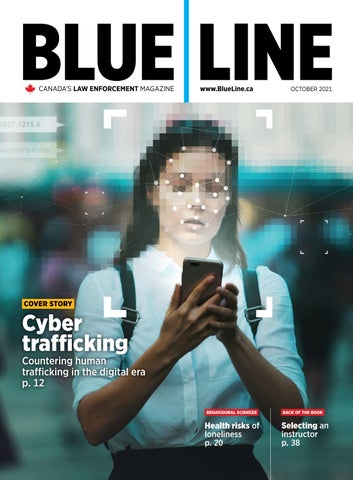
COVER STORY
Cyber trafficking
Countering human trafficking in the digital era p. 12 BEHAVIOURAL SCIENCES
BACK OF THE BOOK
Health risks of loneliness p. 20
Selecting an instructor p. 38
COMMISSIONAIRES VALUES LAW ENFORCEMENT EXPERIENCE Join Commissionaires and put your skills and experience to work to ensure the safety and security of people and property in a wide variety of environments.
COMMERCIAL
EDUCATION
HEALTHCARE
CONDOMINIUMS
MINING SITES
GOVERNMENT
CONSTRUCTION
PORTS
commissionaires.ca
12
Contents
October 2021 Volume 33 Number 8
Features COVER STORY
12 Cyber trafficking
Columns 4 10 16 20 19 22 29 38
Editor’s Commentary Q&A Interviewing & Investigations Behavioural Sciences Technology Case Law Holding the Line Back of the Book
Departments
Countering human trafficking in the digital era. By Brieanna Charlebois.
18 Dedication to community
Sgt. Kelly Prebble named Blue Line’s 2021 Lifetime in Law Enforcement Achievement Award winner. By Brieanna Charlebois.
26 Eye in the sky
How drones are changing policing operations and investigations in Canada. By Sherri St.Cyr.
5 5 8 8 25 37 36 38
News By the Numbers Dispatches Calendar Off the Shelf Marketplace Product Showcase Blue Links
30 Solving surveillance issues in law enforcement
In today’s changing environment, intelligent video surveillance systems are aiding police by providing solutions-based analytics. By Keith D’Sa.
34 Education & Training Directory
COVER PHOTO: ALEXANDER / ADOBE STOCK
Check out Blue Line’s 2021-2022 Education & Training Directory for options to bolster your resume, tool bag and more.
18 @Blue_LineMag
20
30 October 2021 | BLUE LINE
3
EDITOR’S COMMENTARY BY BRIEANNA CHARLEBOIS
BLUE LINE www.BlueLine.ca
The necessity of change
I
t’s no secret that a career in policing I take this opportunity to announce this as is stressful, uncertain and seemingly my last issue as editor of Blue Line. I’d like to ever-evolving. For law enforcement thank all of you, our readers, for welcoming officers, change is often unavoidable, and embracing me as editor over the past but it can also foster adaptation and create year. Though I have made the difficult deciexciting opportunities for growth and de- sion to embrace change in the form of a new velopment. professional venture, I will never forget your There has perhaps been no greater kindness, dedication and tenacity. I am change than with the advent and mass grateful for the lessons I’ve learned from adoption of technology—and the pandemic you over this past year. Your resilience is only amplified our dependence on it. Un- inspiring. fortunately, this also comes with increased Though I had covered crime and policing challenges for police, which is why this in other capacities previously, through issue of Blue Line focuses on cyberpartnerships and fostering procrime and the use of technology in “I am forever fessional relationships—though grateful for police work. most of them virtual—I was able Our news includes a recap of the the lessons to better understand the intricanewly released report on cyber I’ve learned cies of the important work you threats to Canada’s democratic from you do as officers. It has armed me process, the implementation of new over this with important knowledge that technology called What3Words, a past year. I will now be taking with me as new way for Canadian first respond- Your I transition back into a more ers to locate the scene of an emer- resilience is mainstream reporter-editor gency, and features Halton police, inspiring.” role. I now know the issues the first service in Ontario to adopt you’re most passionate about, electronic e-notes. the hurdles you face daily and the strides The CRTC recently mandated all Public you, as law enforcement professionals, Safety Access Points transition to Next have made in recent years. Generation-911 technology by March Now, for some good news! Please join me 2024. So, this month’s Q&A features Peel in welcoming Brittani Schroeder, who will Regional Police Deputy Chief Anthony be taking over as editor going forward. Odoardi, chair of the OACP-led Next Brittani joined Annex (Blue Line’s parent Generation-911 Inter-Agency Advisory company) in September. She graduated Panel. He discusses what NG-911 means from Western University in 2017 with an for the frontline, how agencies can opti- honours specialization in English Language mize on the technology and what police and Literature and a minor in Creative and other emergency service organiza- Writing. She then went on to earn a certifitions should be considering as they ready cate in Publishing from Ryerson University. themselves for the change. When not at work, Brittani enjoys going to Our cover story features the increase in the theatre to watch the latest Broadway human trafficking, how that intersects with musical, spending time at the beach, readcybercrime and the explosion of trafficking ing books, and relaxing with her husband through online portals, particularly since and six-month-old puppy, Buffy. I am the pandemic began (when borders closed leaving you in good hands! and Canadians transitioned life online). Once again, it was a pleasure writing for Other features include a story on how you and learning more about the crucial drones are changing policing operations in work you do as law enforcement officers. Canada and the value of IP surveillance For this and so much more, thank you. camera recordings in investigations. Please feel free to reach out anytime, keep On another note, but in keeping with the up the important work on the frontlines and topic of change, it is with a heavy heart that take care of yourselves. We need you!
Reader Service Print and digital subscription inquiries or changes, please contact Beata Olechnowicz, Audience Development Manager Tel: (416) 510-5182 Fax: (416) 510-6875 email: bolechnowicz@annexbusinessmedia.com Mail: 111 Gordon Baker Rd., Suite 400 Toronto, ON M2H 3R1 GROUP PUBLISHER/VP SALES | MARTIN MCANULTY mmcanulty@annexbusinessmedia.com PUBLISHER | ADAM SZPAKOWSKI aszpakowski@annexbusinessmedia.com EDITOR | BRIEANNA CHARLEBOIS bcharlebois@annexbusinessmedia.com EDITORIAL DIRECTOR EMERGENCY SERVICES GROUP | LAURA AIKEN laiken@annexbusinessmedia.com ACCOUNT MANAGER | JANICE EATON jeaton@annexbusinessmedia.com MEDIA DESIGNER | SVETLANA AVRUTIN savrutin@annexbusinessmedia.com ACCOUNT COORDINATOR | KATHRYN NYENHUIS knyenhuis@annexbusinessmedia.com COO | SCOTT JAMIESON sjamieson@annexbusinessmedia.com ANNEX BUSINESS MEDIA 111 Gordon Baker Road, Suite 400 Toronto, ON M2H 3R1 Tel. 416-442-5600 • Fax 416-442-2191 Publication Mail Agreement No. 40065710 ISSN 0847-8538 Printed in Canada SUBSCRIPTION RATES Canada — 1 Year $31.50; 2 Year $52.50 plus tax USA — 1 Year $136.50 CAD Occasionally, Blue Line will mail information on behalf of industry-related groups whose products and services we believe may be of interest to you. If you prefer not to receive this information, please contact our circulation department in any of the four ways listed above. Annex Privacy Officer Privacy@annexbusinessmedia.com; Tel: 800-668-2374 © 2021 Annex Business Media. All rights reserved. Printed in Canada. No part of the editorial content of this publication may be reprinted without the publisher’s written permission. Opinions expressed in this magazine are not necessarily those of the editor or the publisher. No liability is assumed for errors or omissions. Readers are cautioned and advised that articles presented herein are edited and supplied for your personal awareness and should not be used for further action until appropriate guidance is received from a supervisor, Crown Attorney or other persons in authority. All advertising is subject to the publisher’s approval. Such approval does not imply any endorsement of the products or services advertised. The publisher reserves the right to refuse advertising that does not meet the standards of this publication.
CONNECT WITH BLUE LINE
www.BlueLine.ca 4
@Blue_LineMag
BLUE LINE | October 2021
www.facebook.com/BlueLineMagazine www.BlueLine.ca
NEWS
PHOTO: SASUN BUGHDARYAN / ADOBE STOCK
CANADA
Cyber threats to Canadian democracy
In July, the Communications Security Establishment (CSE) released a report titled
Cyber Threats to Canada’s Democratic Process, which covers the current cyber threat activity affecting democratic processes. Globally, democratic processes remained a popular target for cyberattacks. From 2015 to 2020, the CSE found the vast majority of cyber threat activity affecting democratic processes were attributed to state-sponsored cyber threat actors in pursuit of strategic political, economic and geopolitical objectives. State-sponsored cyber threats with links to Russia, China and Iran have conducted most of the activity against democratic processes worldwide. Cyber threats most often targeted a combination of voters, political parties and election infrastructure. Between 2015 and 2020, cyber threat activity was directed at voters more often than against political parties and elections. “We assess that changes made around the world in response to the COVID-19 pandemic, such as moving parts of the democratic process online or incorporating new technology into the voting process almost certainly
increased the cyber threat surface of democratic processes,” the CSE said in its report. “Most significantly, threat actors can harness and amplify false narratives related to the COVID-19 pandemic to decrease confidence in elections.” The CSE also determined Canada’s democratic process remained a lower-priority target for state-sponsored attacks, relative to other countries. Elections Canada also took extra steps to protect the electoral process, specifically for the federal election, which took place Sept. 20. To read the full report, visit cyber.gc.ca. CANADA
The Auxtera Project
The Auxtera Project is an initiative focused on making justice more accessible by donating digital investigation software and the voluntary services of digital forensic examiners to organizations supporting vulnerable populations. It officially launched earlier this year. Founded by employees of Magnet Forensics, a developer of digital investigation software, the Auxtera Project was created in an effort to bring together the digital forensics community and help ensure that a lack of digital forensic technology and
trained personnel would not stand in the way of justice, namely the safety of children or the protection of other vulnerable populations. “We believe that everyone, regardless of age, gender, race or financial well-being, should have equal access to justice,” said Jad Saliba, Magnet Forensics founder and chief technology officer. “Digital investigations haven’t just played a crucial role in putting our worst criminals behind bars. They’ve helped rescue victims and exonerate innocent people of crimes they didn’t commit. Without access to it, children, racial and ethnic minorities and the financially disadvantaged only become more vulnerable.” Digital evidence has become an important element of the justice system. Successful prosecutions and defences often hinge on critical digital evidence such as images, emails and location data, but the tools used to handle data (and the technical personnel that operate them) can be cost prohibitive for vulnerable populations, leaving them at a stark disadvantage. The initiative is accepting applications from potential beneficiaries such as non-profit, charitable and public sector organizations that work with children, racial and ethnic minorities and those financially disadvantaged. All beneficiaries of The Auxtera Project receive Magnet Forensics’ digital investigation platform, Magnet AXIOM. In addition to the software, North American beneficiaries will also be eligible to be matched with a volunteer from a roster of accomplished digital forensic examiners to help guide their investigations. For more information, visit theauxteraproject.com. - Magnet Forensics.
BY THE NUMBERS In July, the Canadian Centre for Justice and Community Safety Statistics released its report of the 2020 police-reported crime statistics in Canada. It found overall crime levels were lower from March to December 2020 in comparison to the same time frame in 2019. Learn more by visiting statcan.gc.ca.
2 MILLION police-reported Criminal Code incidents (excluding traffic) occurred in 2020— about 195,000 fewer incidents than reported in 2019. At 5,301 incidents per 100,000 population, the police-reported crime rate—which measures the volume of crime—decreased 10 per cent in 2020.
@Blue_LineMag
8%
The rate of decline in the overall CSI in the first year of the pandemic. Statistics Canada found this to be the result of decreases in police-reported rates of numerous offences (including breaking and entering, theft and shoplifting of/under $5,000, robbery and sexual assaults, level 1).
718
more police-reported hate crimes occurred in 2020 compared with 2019, a 37 per cent increase. The 2,669 police-reported hate crimes in 2020 were the largest number recorded since comparable data became available in 2009.
7%
The rate in which the national homicide rate increased last year; from 1.83 homicides per 100,000 population in 2019 to 1.95 homicides per 100,000 population in 2020. Nationally, there were 743 homicides, 56 more than 2019.
October 2021 | BLUE LINE
5
NEWS ONTARIO
Project Southam
PHOTO: DEDMITYAY /ADOBE STOCK
Police dismantled a drug ring in the Toronto region that was allegedly importing cocaine from Colombia and the Caribbean. The 15-month investigation, dubbed Project Southam, was a collaborative effort between the OPP, border guards, the RCMP, York Regional Police and the U.S. Drug Enforcement Administration on the probe that included the seizure of cocaine coming in on aircraft from the Caribbean. Police found nearly 100 kilograms of cocaine, 255 kilograms of cannabis, nearly $400,000 dollars in cash and seven vehicles over the course of their investigation. They said they identified two alleged organized crime groups during the probe, one that purportedly imported and trafficked cocaine from Colombia that was hidden in textiles and another that conspired to import cocaine from the Caribbean. “Despite restrictions at our borders and despite an ongoing global pandemic, organized crime continues to show blatant disregard for the law,” said OPP Deputy Commissioner Chuck Cox in a statement on July 15. “Project Southam has displayed the number of varying commodities and illegal activities that these organized crime groups are involved in—from cocaine to cannabis, and other offences including phishing and mortgage fraud.” Police said the two groups worked together to import high volumes of cocaine into Canada. They found group has ties to Colombia established clandestine laboratories to process the cocaine into a “sellable state”. Police executed 44 search warrants on July 7 at 25 different locations. They made 22 arrests and laid 139 charges. CANADA
Cybersecurity breach investigation
The National Security and Intelligence Review Agency says that between March 9 and 19, a 6
BLUE LINE | October 2021
hacker gained access to an agency network that included a database with names, phone numbers, email addresses and scrambled versions of current and previous passwords. The RCMP is investigating and individuals affected by the theft of the database have been directly notified the review agency said in a notice posted to its website. The records in question included email correspondence with other federal employees, academics, civil society groups, the media and Access to Information requesters, along with complaint allegations submitted by the public for investigation by the agency. The federal Centre for Cyber Security examined the review agency’s information technology systems after the breach and found no evidence suggesting the hacker improperly accessed or stole this other information. The agency said the incident did not affect its classified systems. Acting on a recommendation from the Cyber Centre, the review agency permanently shut down the infiltrated network and related infrastructure and the review agency also reported the breach to the federal privacy commissioner and the Treasury Board Secretariat. ALBERTA
Edmonton police add Braille to warrant cards
for people with vision loss to ask to feel police badges to verify they are legitimate, so the addition of Braille helps to quickly identify police officers and build trust.” The new stickers for warrant cards started being distributed to EPS members in August. ONTARIO
Halton police adopt eNotes
On Aug. 25, the Halton Regional Police Service (HRPS) announced the adoption of electronic notes (eNotes). The HRPS is the first police agency in Ontario (and the second in Canada) to transition members from paper notes to electronic notes. The HRPS eNotes application contains various features the service recognizes as key to policing operations. Officers are now more mobile than ever and are no longer constrained by limitations of paper notes or tied to the computer in their cruisers. They can now access and add to police databases and record systems from anywhere. The use of eNotes also equips officers with a secure means to obtain audio statements and take supplementary photos or recordings. All of these new functions allow for more transparency and credibility to officer notes and include time-stamped entries and increased legibility. All sworn members will be fully trained by early 2022. CANADA
What3Words
PHOTO: EDMONTON POLICE SERVICE
The Edmonton Police Service has added the word “POLICE” in Braille to its warrant cards to help officers identify themselves to people impacted by blindness. After consultation with the local CNIB and sight loss community, the department decided the addition of a Braille sticker to the police warrant card would be the most cost-effective means of providing officers with enhanced credentials. “Police officers can be easily identified in uniform or by their badges when in plainclothes, but we needed another way to be recognized when we were interacting with persons who have vision loss,” said EPS Det. Rae Gerrard. “It is not uncommon
PHOTO: WHAT3WORDS
What3Words is a new way for Canadian first responders to locate the scene of an emergency with ease. Every three-metre square in the world has been given a unique combination of three words by the technology’s developers. When someone calls 911, police departments can send them a link that will assign three words to their location and allow the dispatchers to quickly locate them. There is no cost to implement or use the technology. Users can download the app for free or use the online map at what3words.ca. It is available for iOS and Android. www.BlueLine.ca
NEWS DISPATCHES Rich Johnston was named deputy chief of the Barrie Police Service in June. Johnson joined the Barrie Police Service in 1998 and has served in a variety of roles throughout the Service, including uniform patrol, tactical support and operational support and, most recently, he worked as an inspector responsible for investigative services. Johnston holds an Honours Bachelor of Arts Degree in Philosophy from Queen’s University, Masters in Leadership Studies from the University of Guelph and on July 5, he began a Masters Degree in Applied Criminology and Police Management at the University of Cambridge (United Kingdom). He officially took over the role of deputy chief on June 24. Staff Sergeant Jody Waldron was recently promoted to inspector of the recruiting and professional development section at the Delta Police Department in British Columbia. Waldron began her career with Delta Police in 1993 as a police dispatcher and was officially hired as a sworn officer in 2002. She was formerly head of one of Delta Police’s frontline platoons. In her new role she will continue her efforts to grow and support Delta Police officers in their professional development from hire to retire. Retired Hamilton Police Chief Brian Mullan sadly passed away in July. He was 67. Mullan served as chief from 2003 to 2009. He began his career in 1974 and spent his entire 35-year career in law enforcement with the Hamilton Police Service. As chief, one of his biggest accomplishments was launching a multi-pronged assault on the crack cocaine epidemic in the city. The strategy included stronger enforcement, the creation of a special court and improved liaising with social services. Mullan also stationed more officers downtown, while adding bike and foot patrols. After his retirement from the service in 2009, Mullan went on to become a member of the Parole Board of Canada and also served as a citizen representative with the Ontario Attorney General’s Judicial Appointment Advisory Committee. Mohawk College in Hamilton 8
BLUE LINE | October 2021
CALENDAR also recognized him with its Alumni of Distinction award. Mullan earned a diploma in business administration and a certificate in police science from Mohawk and completed training at FBI national academy in Quantico, Va. He also held high-ranking positions with the Hamilton Community Care Access Centre, the St. Joseph’s Hospital Foundation, the Ontario Association of Chiefs of Police, the Hamilton-Wentworth District Health Council and the Ancaster Lions Club. In July, retired RCMP Staff Sgt. Dale Djos received a pair of Commanding Officer’s Commendations awards for solving two cold case murders during the course of his career. He was one of three members, including retired Cpl. Dan Smith and forensic scientist Hiron Poon, to receive the commendations. They helped solve the 1977 murder of 12-year-old Carolyn Lee and the 1996 murder of 11-year-old Jessica States using DNA technology, which was relatively new and ground-breaking at the time. Retired Constable Kim Turner, who headed the Toronto Police Service Aboriginal Peacekeeping Unit (APU) for over a decade, passed away in July. She was 63. She joined the service on July 19, 1988. Turner, who was Ojibwe, served for many years at 51 Division before being assigned to the APU. In 2008, Turner received the Ontario Women in Law Enforcement (OWLE) Community Service Award. Assistant Director Lonnie Dynna is retiring from the Saskatchewan Police Service after 27 years of service. Dynna joined the Moose Jaw Police Service in 1978 and was seconded to the Saskatchewan Police College as a recruit coordinator in 1992. He accepted a permanent position at the Saskatchewan Police College in 1994 where he has served in various positions over the past 27 years. PROMOTIONS, RETIREMENTS, RECOGNITION • If you have an officer in your agency recently promoted or retiring or an individual you wish to have recognized (major award or recently deceased) you can let Blue Line magazine know by emailing: bschroeder@annexbusinessmedia.com.
NOTE TO READERS: check with all organizers as COVID-19 continues to affect events. Atlantic Women in Law Enforcement Conference Location: Charlottetown Date: Oct. 12 – 15, 2021 awle.org/2021-awle-conference/ BlackBerry’s Annual Security Summit Location: Virtual Date: Oct. 13, 2021 blackberry.com/us/en/events/2021/ blackberry-security-summit Serving with Pride Gala & Awards Night Location: Virtual Date: Oct. 16, 2021 servingwithpride.wildapricot.org Blue Line Expo Location: Vaughan, Ont. Date: Oct. 28, 2021 blueline.ca/events/blue-lineexpo-2020/ Law of Police Conference Location: Vancouver Date: Nov. 4 – 5, 2021 10times.com/law-policing Gang and Organized Crime Professional Development Conference Location: London, Ont. Date: Nov. 15 – 18, 2021 ongia.org/ 59th IAWP Annual Training Conference Location: Niagara Falls, Ont. Date: Sept. 12 – 16, 2022 iawp2022niagarafalls.org/ IACP 2022 Location: Dallas, Texas Date: Oct. 15 – 18, 2022 theiacpconference.org
Find more calendar events online at blueline.ca/events.
www.BlueLine.ca
Q&A In a recent Blue Line, The Podcast, Peel Regional Police Deputy Chief Anthony Odoardi, chair of the OACP-led Next Generation-911 InterAgency Advisory Panel, joined editor Brieanna Charlebois to discuss what NG-911 means for the frontlines, how agencies can optimize the technology and what to consider as they ready themselves for change. Q: For those who may not be familiar with NG-911, can you explain what exactly it is why it’s important?
Next generation-911 is a mandatory replacement from the federal government through the CRTC for all existing 911 infrastructure, systems and procedures across the entire nation. The current 911 system is reaching the end of its life and it can’t keep up with existing technologies. So, the expectation is to modernize the system but it’s not only about new technology. It’s going to impact so many other things, including wellness of the community members who utilize the system, call-takers who answer the calls and our first responders, who attend to them. Earlier this year, the CRTC mandated timelines. The timeline to accept initial calls will be March 2022 and there’s a new deadline for public safety answering points to decommission the existing 911 by March 2025. NG-911 is going to be an enhancement. It will provide greater security for people in crisis and for people in emergency situations. That said, there are some things we need to prepare for to understand the system and then it’ll be about good communication with our communities about how to effectively implement them.
Q: How should provincial agencies and governments be thinking about this?
Part of my role for my Ontario Association of Chiefs of Police (OACP) NG-911 committee is to be a facilitator for many different organizations. My role is to supply the government with recommendations from subject matter experts and explain what it is we need to see and address as we transition over to the new system. More specifically, we’ve determined and asked governing bodies to consider three main aspects: governance, funding and educaThis episode of Blue Line Podcast was sponsored by Deloitte. To listen to the full podcast, visit blueline.ca/podcasts.
10
BLUE LINE | October 2021
mean by that is the 911 system was always meant to be interoperable and able to transfer data to and from various places. NG-911 wants to capitalize on that more effectively and efficiently, which will require PSAPs work together. An example of this is real-time texting. A whole lot of interoperability has to happen with the cooperation of all public safety agencies coming together to understand how and why they want this to roll out, so we can do it successfully.
Peel Regional Police Deputy Chief Anthony Odoardi PHOTO: PEEL REGIONAL POLICE
tion. These are key to moving forward in the process.
Q: What can agencies do to fully optimize the technology?
So, just for some background, the current system works as follows: the secondary Public Safety Answering Point (PSAP) receives information from the primary PSAP, which is the agency that receives the 911 call from the public. So, in order for the next Generation-911 to work properly, the government has determined, going forward, there will be no difference between primary and secondary PSAPs. That’s the main difference from today’s system. Basically, all the PSAPs have to come together—and there’s quite a few of them within Ontario and certainly quite a few across the nation—and decide whether or not to combine services, offer the same services, determine whether they should situated at the same geographical location, and how to consolidate it effectively. All these systems have to be looked at. This is the biggest game changer of NG-911: the interoperability piece. What I
Q: As the world becomes more technologically rich, there is an increased accountability regarding data in police possession and how law enforcement officers use it. What opportunities, risks and/or considerations does this present for emergency service providers?
In the current geo-political landscape, security of data has never been more intense—and rightfully so. We need to treat people’s private information, including some of the information that may come over the NG-911 system, with the upmost respect and security; not use it for any other purpose than to provide safety to our communities. One stream that we don’t often look at when we speak about emergency services is ensuring there is an ethical and transparent way to transmit data, then use it for emergency services. Community engagement in filling the NG-911 dossier is going to be needed so the public can understand what happens to their data. There’s also a necessity for PSAPs to receive this data from the community. The onus is on us to disseminate information to the appropriate public service agency—whether that’s police, fire, ambulance—and to critically, reliably and cyber-securely deliver it so the frontline members so they can respond accordingly. Editor’s Note: This interview has been condensed and edited for clarity. To listen to the full episode, visit blueline.ca/podcasts.
www.BlueLine.ca
INVESTIGATIVE TOOLS POWERED BY THE WORLD’S LARGEST VEHICLE HISTORY DATABASE Solve crimes faster. 5,000+ crime fighting partners.
VEHICLE HISTORY REPORTS
VIN ALERTS
The definitive search tool for vehicle history. Track location, accident data and service records.
Click-it-and-forget-it alerts. We obtain new information on the vehicle, you receive an instant notification.
PARTIAL LICENSE PLATE SEARCH
HIGH MILEAGE ALERTS
Search for vehicles-of-interest with just three license plate characters. Filter by make, model, color and more to narrow down your search.
Identify questionable vehicles involved in dealership and rental car fraud, as well as vehicles with altered VINs.
Vehicles are involved in the commission of 75% of crimes.
Source: FBI
CONTACT US FOR MORE INFORMATION. 800.990.2452 or CFPMarketing@carfax.com
CARFAX FOR POLICE IS A PROUD PARTNER OF
COVER STORY
Cyber trafficking
Countering human trafficking in the digital era By Brieanna Charlebois
Prevalence in Canada
The most recent national data, released by Statistics Canada in May,
revealed there was a record-high number of human trafficking incidents reported to police in Canada in 2019, but experts say this number just “the tip of the iceberg.” While human trafficking comes in many forms, research conducted the Canadian Centre to End Human Trafficking (CCEHT) revealed two overarching types of human trafficking in Canada: sex trafficking and forced labour. “There’s all kinds of ways that exploitation occurs in regards to human trafficking,” said Julie Jones (formally Clegg), founder and CEO of Human Intelligence Services Inc. “The most important aspect of trafficking today is grooming and how it’s done. It’s all about manipulation and coercive control because, as is also common in domestic violence cases, people often don’t realize that they’re in an abusive situation until they become dependent on their abuser, are removed from their support network and can’t get out.” A total of 511 police-reported incidents of human trafficking occurred in 2019, according to Statistics Canada—a 44 per cent increase when compared to 2018 and the highest rate reported since comparable data became available in 2009. Ontario reported the highest number of police-reported human trafficking incidents (representing 62 per cent of Canadian HT cases in 2019), while
Nova Scotia reported the highest rate per capita (almost double the national rate for this crime and representing 10 per cent of all cases). Though these numbers are significant, experts say human trafficking a crime that is often underreported. The numbers are likely much higher.
Economics of human trafficking
$75 million The amount of money the federal government has allocated to combat human trafficking.
“Human trafficking involves the recruitment, transportation or harbouring of persons for the purpose of exploitation, typically sexual exploitation or forced labour.” - Public Safety Canada 12
BLUE LINE | October 2021
Human trafficking corridors are one significant component whereby traffickers control the movements of the person they’re exploiting. The CCEHT defined these corridors as “strips of land or transportation routes that include two or more major cities, used by traffickers to move individuals between sites of commercial exploitation.” “Constant movement between cities and provinces keeps victims of human trafficking confused, isolated and dependent on their traffickers,” the Centre noted in the first-ever study of human trafficking transportation corridors in the country. The routes—identified by law enforcement, frontline service delivery agencies and the media—allow traffickers to exert control and ensure victims have limited opportunities to escape. Indigenous women and girls, newcomers to Canada, Black and racialized women, and those living in poverty are particularly atrisk of being trafficked. It’s also a www.BlueLine.ca
IMAGE: COLDSNOWSTORM / E+ / GETTY IMAGES
O
n June 19, Alberta Law Enforcement Response Team’s (A L E R T ) H u m a n Trafficking and Counter Exploitation unit rescued a 15-year-old girl from human traffickers at an Edmonton hotel. The police investigation revealed she was first groomed online, which then escalated to nude photography and culminated in luring her away from her home, steering her into sex trade. The three men involved were arrested and charged with a total of 35 criminal offences. “Perpetrators are very skilled at grooming and manipulating their victims with gifts, money and affection, but it’s all a mirage,” said ALERT Staff Sergeant Chris Hayes when asked about the arrest. “The type of men, like we saw in this case, are very skilled. They know how to approach, procure and lure young girls away from their home and family to be trafficked.” Sadly, this is not a rare phenomenon. Although the exact number of people trafficked in Canada is unknown, there is growing evidence of widespread—and increasing rates of—international and domestic human trafficking.
crime commonly tied to organized crime networks. It’s lucrative and, in comparison to other crimes, is relatively low risk as it’s often difficult to prove within the justice system. “It’s a very lucrative business for traffickers,” said Shirley Cuillierrier, special adviser to combat human trafficking to the Minister of Public Safety. “A drug trafficker, for example, can only sell a substance once but they can sell a human many times. A main reason they travel from province to province is often to avoid identification by police.” While corridors are a major concern for law enforcement, they are only one piece of the puzzle. Not all trafficked persons are physically moved and, in the current digital age, he internet poses a larger challenge for police. In North America, most trafficking occurs within domestic borders. Many experts have concluded that border closures in response to COVID-19 did not curb trafficking rates. Rather, it made it even more difficult for victims escape situations of human trafficking and access the supports they need. “It’s a crime that is very misunderstood. People often don’t realize human trafficking is predominantly conducted online,” said Jones. “There doesn’t have to be movement for trafficking to occur. People can be trafficked and still be going about @Blue_LineMag
their everyday life.” The overlap between cybercrime and human trafficking thrived during the pandemic. From finding and grooming vulnerable people via social media apps to promoting and soliciting their bodies on the dark web or through encrypted channels, the vast migration online in March 2020 created new opportunities for organized criminals and lone traffickers alike. “As people moved online in unprecedented levels, trafficking became a crime of opportunity. Increased online traffic created opportunity for fraudsters and scammers, but also for predators,” said Matt Richardson, director of intelligence and investigations for the Anti-Human Trafficking Intelligence Initiative (ATII), a non-profit that works in tandem with police offering various tools and intelligence-sharing to fight trafficking.
Social media, cryptocurrency & the dark web
44% The increase of incidents of human trafficking reported to police in 2019 when compared to 2018.
415 The number of successfully identified cases of human trafficking through the Canadian Human Trafficking Hotline in its first year in service.
As technology continues to evolve, experts are calling for more education for law enforcement on the role of social media, the dark web, encryption and cryptocurrency in human trafficking practices, specifically regarding how the crime is facilitated and what evidence is needed to prosecute trafficking offenses. This starts with understanding the types of websites: 1. Surface web: areas of the internet accessible by search engines. It is available to the general public using standard search engines and can be accessed using standard web browsers that do not require any special configuration (such as Mozilla Firefox, Microsoft’s Internet Explorer and Google Chrome); comprises between two and 10 per cent of online data. 2. Deep web: areas of the internet that are accessible through a database (which may be accessible through search engines). Many deep websites consist of data and content stored in databases that support services we use every day (such as social media or banking
websites); comprises about 90 per cent of online data. 3. Dark web: areas of the internet that cannot be accessed through regular search engines or deep websites; relies on connections between trusted peers and requires specialized software, tools or equipment to access. Two popular tools for this are Tor and I2P, commonly used to provide user anonymity. Once logged into Tor or I2P the most direct way to find pages on the dark web is to receive a link to the page from another user; comprises of 0.01 per cent of the internet. Social media (and other networking technologies) provide traffickers the ability to identify, connect and target vulnerable youth. They are able to manipulate potential victims in real-time through virtual communication or by requesting and sharing images. Ultimately, perpetrators have the ability to exert control without being physically present in their victim’s lives. “In the real world, our instincts protect us and our body language reflects that, but because we are sensory deprived online, these reflects are nullified,” said Richardson. “The benefit for perpetrators is the internet is low risk because it’s somewhat anonymous and requires a low investment of time. It allows for more access and opportunity because relationship-building is quick and easy online. They can target hundreds of people at once.” Most grooming occurs through social media apps, on gaming sites or through dating sites. Cryptocurrency exchanges, encrypted apps and the dark web are the most common places traffickers connect and facilitate crime. In response to this, some technology companies are working to aid police in stopping crimes like human trafficking and the sharing of Child Sexual Abuse Material (CSAM). For example, in August, Apple announced their plan to deploy their newly developed ‘NeuralHash technology’, which would have scanned U.S.-based users’ iPhones for CSAM. But, in early September, the company decided to delay the roll out amid widespread criticism October 2021 | BLUE LINE
13
COVER STORY
“Human trafficking in Canada is getting worse, not better.” - Shirley Cuillierrier, special adviser to the Minister of Public Safety to combat human trafficking from privacy groups who argued it set a “dangerous precedent.” “Based on feedback from customers, advocacy groups, researchers and others, we have decided to take additional time over the coming months to collect input and make improvements before releasing these critically important child safety features,” the company said in a statement on Sept. 3. While it is a complex issue with many opinions, Jones, a privacy advocate and human trafficking expert/investigator, said finding a “happy medium” between companies and privacy advocates is vital. The issue now, she said, is big corporations have lost public trust. “The reality is the technology that is being used to create propagate and fuel child sexual abuse is the same technology we can use to stop it,” she said. “We just have to be more creative and innovative in order to find balance between privacy and security, and protection of children.”
Combating a growing issue
Canada is actively working to combat the issue on both national and provincial levels. Law enforcement agencies, justice partners, non-profit organizations and various community groups across the country are actively working collaboratively to improve awareness and early identification of trafficking to protect and support survivors of trafficking, and investigate and prosecute trafficking offences. The primary focus is now on interagency networking, collaboration and intelligence sharing as well as conducting multi-jurisdictional investigations and prosecutions. In September 2019, the federal government introduced its $75 million National Strategy to Combat Human Trafficking . The national strategy builds on the efforts of Canada’s Strategy to Prevent and Address Gender-Based Violence and includes the implementation of the National Inquiry into Missing and Murdered Indigenous Women and Girls’ Calls for Justice. To support these goals, the Minister of Public Safety appointed a special advisor on human trafficking: retired RCMP Assistant Commissioner and member of the Mo14
BLUE LINE | October 2021
hawks of Kanesatake Shirley Cuillierrier. Its strategy also dedicating funding for the Canadian Human Trafficking Hotline, a multi-lingual, 24/7 service that connects callers to supports and services, which launched in May 2019. During its first year in service, 2,390 substantive signals to the service were made, including calls, emails, web chats and web forms, and successfully identified 415 cases of human trafficking. The country is taking a victim-centric approach to the issue. Building on the internationally-recognized pillars of prevention, protection, prosecution and partnership, Canada is also the first country to incorporate a new pillar of ‘empowerment’ in an effort to enhance supports and services for victims affected by this crime. “I think language is important,” Cuillierrier said. “By adding that pillar, we are sending a very loud and clear message to survivors that we’re going to value their experience, and give them a voice and a seat at the table.” Individual provinces have also dedicated funding and allocated resources to combat the issue of human trafficking within their borders. For example, in June, the Ontario government announced the passing of new legislation and made amendments to existing legislation to build upon the province’s $307 million Anti-Human Trafficking Strategy. Then, in July, the Ontario Minister of Education mandated every school board to have a human trafficking policy plan and procedure in place by January 2022. Similarly, in June, Gudie Hutchings, parliamentary secretary to the Minister for Women and Gender Equality and Rural Economic Development, announced $2.8 million to support the following eight organizations that prevent human trafficking, increase awareness and provide support to at-risk populations human trafficking in British Columbia. Some provinces have also instated integrated law enforcement teams to combat human trafficking. One such example is Alberta’s ALERT team, which also employs a Safety Network Coordinator, a survivor with lived experience to aid in investigations through a victim-centric approach.
“Every piece and every voice helps. We need law enforcement to be able to recognize online and offline signs and be comfortable speaking with victims and survivors. There’s definitely room for growth, but we are actively working on it,” said Richardson. “There’s no shortage of officers with the desire to know and do more in the fight against trafficking and I see a lot of positive things coming from the governments. The will is there and that’s all we really need.”
What’s next?
In the majority of trafficking situations, victims are forced into criminal situations—prostitution, drug trafficking, etc.—but Jones is urging Canadians to challenge pre-existing stigmas and to avoid treating exploited people like criminals. She is advocating for more widespread situation consciousness from police. “We criminalize individuals who have been forced into criminal behavior, which means the human trafficking often doesn’t even get brought to light,” said Jones. “Police must be vigilant and look beyond the obvious charges because human trafficking is growing exponentially but it’s flying under the radar disguised as lesser crimes.” This can be done by examining events leading up to the criminal activity, looking at an individual’s living conditions, deciphering how individuals were potentially recruited and how they were potentially managed or controlled by another party. “Human trafficking in Canada is getting worse, not better,” added Cuillierrier. “It’s time to rethink our strategy in terms of who we go after to tackle this issue.” To do so effectively, interagency networking and collaboration, as well as intelligence and multi-jurisdictional information sharing is crutial. “Information sharing is essential in human trafficking cases because of the nature of the crime,” said Jones. “It’s contingent on police to know the transit routes in their jurisdiction, understand how people are trafficked and foster open-communication with other agencies.” The good news, she said, is Canada is moving in the right direction. “We’re making every effort to stop to prevent and prosecute human trafficking, but there still needs to be a lot more awareness, more education, better legislation and better law enforcement training around human trafficking,” Jones concluded. “We’re on our way. We’re just not there yet.” www.BlueLine.ca
INTERVIEWING & INVESTIGATIONS
The implications of Méndez Principles for Canada By Davut Akca
I
Principle 1 - On foundations: Effective interviewing is instructed by science, law and ethics
Canadian researchers have contributed to the interview practices through rigorous research in collaboration with police agencies. Based on the 16
BLUE LINE | October 2021
Principle 5 - On accountability: Effective interviewing requires transparent and accountable institutions
The Méndez Principles were launched internationally on June 9.
findings and the best practices in other jurisdictions, researchers have provided policy recommendations to enhance the interview practices of Canadian police agencies. A closer relationship between practitioners and researchers is needed to translate research into practice and fully implement the Méndez Principles in Canada.
Canadian police cautions. Improvements are needed in these safeguards to ensure effective and humanitarian interviews.
Principle 2 - On practice:
Similar concerns on legal safeguards have also been raised for interrogations with vulnerable populations such as youth and people with mental illnesses in Canada. Coercive interview tactics are particularly harmful for these individuals due to their suggestibility and limited capacity to comprehend their rights, which might lead to false confessions and wrongful convictions. Culturally-sensitive interview approaches for Indigenous people and other vulnerable communities are another aspect that must be taken into consideration.
Effective interviewing is a comprehensive process for gathering accurate and reliable information while implementing associated legal safeguards
The effectiveness of interviewing relies on a process including preparation and planning, relevant safeguards, an open mind and non-coercive approach, establishing and maintaining rapport, appropriate questioning techniques, active listening and not interrupting the interviewee, and in-depth analysis of the information gathered. Research on the current practices have disclosed the lack of effective safeguards against coercion during interrogations, such as limited access to counsel and lack of understandability of the
Principle 3 – On vulnerability: Effective interviewing requires identifying and addressing the needs of interviewees in situations of vulnerability
Principle 4 - On training: Effective interviewing is a professional undertaking that requires specific training
In a recent article for Blue Line,
To ensure the transparency and accountability, standard operating procedures and codes of conduct need to be developed and encouraged. The Canadian Association of Chiefs of Police can lead this discussion and encourage police agencies to agree on these standardized practices with the guidance of Méndez Principles as well as Canadian experts and researchers working in the area of investigative interviewing. Principle 6 – On implementation: The implementation of effective interviewing requires robust national measures
The Méndez Principles need to be adopted into legal, policy, regulatory and institutional frameworks to ensure full implementation. Executive, legislative and judicial authorities need to take necessary measures that are in line with these principles so that the quality and efficacy of interview practices can be enhanced so public safety can be improved in line with international standards. Davut Akca is a research officer at the University of Saskatchewan’s Centre for Forensic Behvioural Sciences and Justice Studies. You can contact him at davut.akca@usask.ca.
www.BlueLine.ca
PHOTO: JOYFOTOLIAKID / STOCK.ADOBE
n 2016, the United Nations Special Rapporteur on Torture, Juan E. Méndez, invited member states to recognize a universal set of guidelines for effective and non-coercive interviewing methods and procedural safeguards to prevent torture, ill-treatment or coercion. He underlined the need to leave accusatory, coercive, manipulative and confession-driven practices behind and adopt rapport-based interviewing. Since 2016, stakeholders across various sectors including policing, intelligence, psychology, law and human rights worked on creating these guidelines in light of the scientific evidence and decades of research findings. The Méndez Principles (a.k.a. Principles on Effective Interviewing for Investigations and Information Gathering) were published and launched in an international event on June 9. The background and details of the six principles were explained in a 43 page document, which provides concrete guidance to authorities on non-coercive interviewing. The document also outlines legal and procedural safeguards that should be implemented during investigations. A recent resolution drafted by the UN Human Rights Council welcomed these guidelines and invited member countries to adopt them. Their implications for Canadian police agencies are as follows.
I discussed the need for a reform in interview training in Canada. A systematic review we conducted on interview training efficacy indicated the effectiveness of even short evidence-based training courses. More investment on these training courses and making them accessible and standardized across Canada is key to success to translate Méndez Principles into practice.
Treaty Three Police Service is a self-administered Policing entity under the First Nations Policing Program in Canada serving approximately 20,000 residents across 23 First Nation Communities. Our General Headquarters is located in Kenora, ON and our South Detachment is located in Couchiching First Nation near Fort Frances, ON. We also have detachments in Wabaseemoong, Grassy Narrows, Naotkamegwanning and Eagle Lake First Nation.
GIZHAADIGEZIWANG OKO WIIJI'IDIWINAN POLICING FOR THE PEOPLE BY THE PEOPLE
NOW HIRING
JOIN NOW RECRUITS & EXPERIENCED OFFICERS VISIT T3PS.CA OR
SCAN QR CODE
LEADERSHIP
Commitment to community Sgt. Kelly Prebble wins Blue Line’s 2021 Lifetime in Law Enforcement Achievement Award By Brieanna Charlebois
B
Importance of partnerships
Community dedication
Prebble began her career as a cadet at the age of 19 in 1992 and became a sworn member two years later, in 1994. Throughout her 29year career, Prebble’s focus has been on fostering positive community relationships. She’s served as a constable, community resource officer, detective, service recruiter, detective sergeant and field supervisor. Her dedication to community policing can be traced back to a relationship she formed with a homeless man during her first position as a patrol officer in Cambridge, Ont. “I helped him whenever I could and, in turn, he made me a better officer,” she said. “The relationship I formed with him impacted the rest of my career.” This mindset led to one of her most notable career achievements. In October 2001, she became one of the WPS’s first community resource officers. She served in the role until March 2004. “The community resource officer role is important because many calls we respond to aren’t policing-related but people don’t know who else to call,” she said. “The goal of this position was to connect people with the proper resources, which ultimately helps the individual and reduces future calls to police.” Prebble’s strong belief in community is also displayed through her continued education at the University of Waterloo in social development studies. A lifelong learner, this program is very important to her personal goal of increasing her capacity to understand society, conflict and the different practices that support community safety. “While post-secondary education is important, I learned more from real world experiences,” she said. “I become more empathic, compassionate and caring about my community as my career progressed.” 18
BLUE LINE | October 2021
Making an impact
In 2013, she was assigned to the WPS’ Rural Detachment. It was there, WPS Superintendent John Goodman said she made her greatest impact. “Kelly is responsible for a large and varied rural community consisting of the three pastoral townships,” he said. “Consisting of small bedroom communities surrounded by large agricultural areas and an extensive Mennonite community, it provides unique policing challenges perfectly suited to Sgt. Prebble’s engaged and supportive style.” In the role, Prebble worked to promote important proactive concepts and improve community safety by preventing crime. She formed strong connections with the local politicians, CAO’s and Mennonite community elders. “Her ability to foster trusting relationships with community partners and the public was quickly recognized as a tremendous asset to the service,” wrote Superintendent John Goodman in Prebble’s nomination letter. “It set Kelly on a path of engaging with and caring for her community that continues today.” She is also leader in providing Crime Prevention Through Environmental Design (CPTED) services to the community and, in 2018, she was designated as an International Crime Prevention Specialist (ISCPP).
Prebble is beloved by the rural communities she serves. “She gives openly of her own time and makes herself available for guest lectures, safety presentations or for just a cup of coffee and conversation,” said Goodman. “It cannot be overstated how important this engagement is to building bridges and creating a safe community.” She is also heavily involved with this organization in supporting the marginalized and those in need of support in the community. “My focus now is building relationships within our diverse communities,” she said. “I approach it from the standpoint of needing to engage in more conversations and less presentations.” Prebble is a part of a recently launched program called Connections, which focuses on relations and resources for local women of colour. “It’s all about building trusting relationships and understanding our role as police within various communities,” she said. For example, after a Muslim family was victim in a deadly terror attack in London, Ont., in June, she learned of a group of local Muslim women who were afraid to walk at night. So, she took it upon herself to meet them for a three-hour chat over coffee to discuss how police could help provide a sense of safety and normalcy. “I was elated by the experience and by the opportunity to open doors and have this mutual understanding and have trust develop was incredible,” she said.
A winning achievement
Sgt. Prebble has dedicated her life to community relations through her police work. Having led an exemplary career, she is being recognized for her commitment to community. For these reasons, it is Blue Line’s honour to present her with this year’s Lifetime Achievement Award. “Supervisors, colleagues and team members have the utmost respect for Sgt. Prebble.” said Goodman. “She is an engaged leader who is continually looking to build solid, safe, healthy and lasting relationships within the service and with the community.” www.BlueLine.ca
PHOTO: WATERLOO REGIONAL POLICE SERVICE
lue Line is proud to present the 2021 Lifetime in Law Enforcement Achievement Award to Sgt. Kelly Prebble of the Waterloo Regional Police Service (WPS). The award is presented to an individual who has shown exceptional leadership, dedication and passion towards their work in law enforcement for more than 15 years.
TECHNOLOGY
BY HILARY RODELA
The future of policing technology
P
olice today need all available tools in order to keep their communities safe. Technology has advanced to meet this need. One type of software allows officers to track and “predict” where and which crimes are most common in their region, which allows them to patrol those areas much more effectively.
PH0TO: FUSUS
The technology
Real-Time Crime Center technology has evolved substantially over the last decade. The purpose of this particular type of technology is to input data collected from the Computer-Aided Dispatch (CAD) system, police shifts and other data like live video and gunfire detection into a system which maps out and calculates which areas of a region may need immediate response or more patrol presence. This not only promotes community safety, but allows detectives to utilize data to find potential leads in cases. Other types of technology also allow law enforcement to watch and conduct surveillance in real-time. This may be used for everyday purposes in a heavy crime area or for undercover purposes, or even for security at large events held in a community. Fusus, the most widely used RTCC platform, has developed this type of technology and has taken it a step further as their Real-Time Crime Center in the Cloud brings various forms of information all into one place, which enhances its use for intelligence purposes. Their mission is to enable law enforcement agencies to work more closely with community members and businesses to mitigate and investigate criminal activity, break down silos and unify security infrastructure and resources. “Fusus enables community members and businesses to easily share information with law enforcement agencies and each other, in order to mitigate criminal activity and increase physical safety,” said Sahil Merchant, chief strategy officer at Fusus. “Our open platform fuses existing security infrastructure, like security cameras, gunfire detectors, license plate readers and panic alarms, into a single pane of glass.” By creating a common operating picture and better situational awareness, Merchant said police officers are able to work more directly with community members. “A digital evidence vault, camera registry, multi-media tips line, community messaging @Blue_LineMag
“The ability to have situational awareness that is in real time is a game changer for police officers and the communities they serve.” and live panic alerts help increase community engagement as well, giving individuals a stake in their own safety.”
The future of policing
Fusus technology allows any type of device, whether it be a drone, traffic enforcement cameras, phones or other forms of loT and public safety-oriented devices to capture and transmit data about events in real time. By integrating all of this security infrastructure in a secure cloud, Fusus has been able to make a real-time crime center affordable for most agencies, who can access this information for the purpose of public safety. The technology may be incorporated into other software systems an agency may already have in place, such as their CAD system, gunfire detection software as well as other forms of real-time security monitoring.
Community and solidarity
No community can function well without police, but it is equally important for police to have a good relationship with their respective communities. “Police need a good relationship with their community to effectively enforce the
law,” said Officer Rodela of the Ruidoso Police Department. “Community members must be able to rely on Law Enforcement to respond to complaints in a timely and effective manner. Equally, Law Enforcement must be able to trust community members will contact them when a crime is committed.” It is a team effort put forth by both parties and technologies such as Fusus helps to bring that partnership together. “Predictive policing software can tell officers what areas they need to focus patrols and enforcement,” said Officer Brendan Rodela. “This will increase effectiveness and create safer communities by stopping and preventing crime.”
Coming together
When a department implements a live stream video security network into their community, they bring forth a new and much more connected version of public safety. This is because with this system in place, police can be more aware of situations and high crime areas, which in turn they can have more of a presence within their communities and as a result bring more safety to civilians. The ability to have situational awareness that is in real time is a game changer for police officers and the communities they serve. Hilary Rodela is a licensed private investigator through the state of New Mexico, a former evidence technician and crime scene investigator. She has worked for the Ruidoso Police Department and the Lubbock Police Department.
October 2021 | BLUE LINE
19
BEHAVIOURAL SCIENCES
Health risks of loneliness
S
ometimes being alone can be beneficial, creating space for reflection, relaxation and recharge. Being alone does not necessarily mean a person is lonely. Instead, it is the perception of being alone that makes the person lonely. Research has shown that this form of isolation is unhealthy and can lead to long-term health issues. What is loneliness? Many definitions go beyond the common one of being in a state of solitude. It is the state of mind individuals will feel when disconnected and isolated leading to an inability to find connection in one’s life. There are many reasons why people can end up alone: death of a loved one, a breakup of a relationship, changing jobs, moving to a new city, living alone for the first time, the list goes on. Most individuals are resilient and eventually will find ways to connect with others. Different types of loneliness have been identified in the psychiatric literature:
Intimate loneliness
Intimate loneliness, or what is termed emotional loneliness, is the perceived absence of a significant relationship; a person one can rely on for emotional support during crises, who provides mutual assistance and affirms one’s values. This form of intimate connection often has considerable self-other overlap (such as that observed between close friends or spouses). 20
BLUE LINE | October 2021
Relational/social loneliness
This is the perceived absence of quality friendships or family connections within one’s relational space; a “sympathy group” that can include among 15 - 50 core social partners whom we will see regularly and from whom we obtain high-cost instrumental support. Like intimate loneliness, social loneliness is found in women and men, though there is some evidence that this dimension may tend to play a slightly greater role in influencing loneliness in women than in men.
Situational loneliness
Environmental factors like unpleasant experiences, discrepancy between the levels of one’s needs and social contacts, interpersonal conflicts, disasters and distance from family can lead to loneliness in old age.
Developmental loneliness
Humans have an innate desire for intimacy and connectivity. It is essential to our development and is balanced with our need for individualism. When we’re not able to balance individuality and intimacy, it can result in a loss of meaning in one’s life, which can lead to emptiness and loneliness. Contributing factors can be personal inadequacies, significant separations, living on the margins of society, poverty, physical/psychological disabilities and developmental deficits.
Internal loneliness
People with low self-esteem an/or selfworth seemingly feel lonelier than their counterparts. It has been theorized that the
reasons for this type of loneliness are personality factors, feelings of guilt or worthlessness, and poor coping strategies in dealing with life’s challenges.
Health risks
A meta-analysis of 40 articles examining the effects of social isolation and loneliness that appeared in the journal Public Health identified a significant association between social isolation and loneliness with increased all-cause mortality and social isolation with cardiovascular disease. A 2012 survey examined data from a cross-section of the Swiss population. Of the over 20,000 participants ranging in age from 15 to 74, approximately 64.1 per cent reported never feeling lonely. Those who self-identified as lonely were more often affected by physical and mental health problems, such as self-reported chronic diseases including high cholesterol levels, diabetes, moderate and high psychological distress, and depression/ impaired self-perceived health. Loneliness is also a risk factor for cognitive decline and the progression of Alzheimer’s disease, recurrent strokes, obesity, elevated blood pressure, decreased sleep and premature death. Loneliness was also significantly associated with problematic lifestyle factors such as smoking and substance abuse. In late childhood and early adolescence, loneliness results in impaired sleep, symptoms of depression and poorer general health. These same effects are seen across the lifespan, but also with increased doctor visits in adolescence and increased www.BlueLine.ca
PH0TO: KLYAKSUN / ADOBE STOCK
By Peter Collins
“Loneliness and the feeling of being unwanted is the most terrible poverty.” - Anjezë Gonxhe Bojaxhiu (Mother Teresa) emergency department use in early to middle adulthood. In terms of age, loneliness was more common in those over the age of 60. This led to the British government declaring loneliness a “hidden killer” of the elderly. In 2018, the British government even appointed a Minister of Loneliness. This year, the government of Japan did the same. Treating loneliness is difficult, however increasing social contact coupled with exercise, walks in nature and mindfulness therapy seems to be beneficial. The internet may give the illusion of connectedness but a 2017 study in the American Journal of Preventive Medicine found that young adults who spend more than two hours on social media daily are twice as lonely as those who spend 30 minutes. Instead of using the internet to soothe loneliness or boredom, it is recommended to reduce screen time and
find ways to share your time with others in person. Face-to-face interactions reduces loneliness. Volunteering also combats loneliness. Focusing on the needs and feelings of others provides relief from the weight of one’s own problems. Turning attention toward someone else helps people feel valued and supported, which allows meaningful, fulfilling relationships the space to grow. Seeking out social interaction with close and distant acquaintances bolsters well-being and reduces lonely feelings. Taking on new subjects and skills expands life experience and creates opportunities to connect with others. Educating oneself can boost self-confidence and reduce feelings of inadequacy and loneliness. Common interests can be a powerful bond in forming a community of like-minded people aspiring toward similar goals.
Justice Studies for Working Frontline Officers At Humber, we teach the professional and practical skills you need to move up and make a difference in your community and in your career.
• Criminal Justice Degree • Police Foundations Diploma • Protection, Security and Investigation Diploma • Border and Immigration Services Certificate • Corrections and Forensic Practice Certificate
Loneliness in our society is increasing, as are the negative health consequences of being lonely. The COVID-19 pandemic is exacerbating this state. If you are lonely, do not feel ashamed or afraid to ask for help. See your family physician for an assessment and treatment. The policing community is a brotherhood and sisterhood, but we must be aware of what to look out for to help care of ourselves and our brothers and sisters in blue, including retirees. Keep in mind you are not alone in feeling alone.
Suggested Readings Cacioppo, S. et al (2015) Loneliness: clinical import and interventions. Perspectives of Psychological Science Mar; 10(2): 238–249. doi: 10.1177/1745691615570616; https://www.mentalhealth.org.uk/coronavirus/loneliness-during-coronavirus https://mentalhealthweek.ca/social-connection-is-the-cure/.
Peter Collins is the operational forensic psychiatrist with the Ontario Provincial Police’s Criminal Behaviour Analysis Section. He is also a member of the crisis/ hostage negotiation team of the Toronto Police Service Emergency Task Force. Dr. Collins’ opinions are his own. Contact him at peter.collins@utoronto.ca.
• Criminal Intelligence Analysis Certificate • Cyber Crime Specialist Certificate • Forensic Identification Services Certificate • Municipal Bylaw Certificate • Private Investigation Certificate
communityservices.humber.ca/justiceprofessionals
@Blue_LineMag
BL_Humber_Oct21.indd 1
October 2021 | BLUE LINE
21
2021-09-13 12:18 PM
CASE LAW
BY MIKE NOVAKOWSKI
No search in examining USB provided by non-state agent
T
22
BLUE LINE | October 2021
“The Court of Appeal found there was no “search” by police when they looked at the contents of the USB.” judge’s view, King’s wife could not waive his Charter rights or provide consent to view the contents of his personal files. When the contents of the USB flash drive were excised from the ITOs, there was insufficient evidence to support the search warrants. Thus, the searches pursuant to the invalid warrants were unreasonable. The judge, however, admitted the evidence anyways under s. 24(2) and King was convicted of possessing child pornography. King appealed his conviction to the Alberta Court of Appeal suggesting the evidence ought to have been excluded. The Crown, on the other hand, contended there was no s. 8 Charter breach at all and, therefore, the evidence was properly admitted.
Was there a “search” by police?
The Court of Appeal found there was no “search” by police when they looked at the contents of the USB. Although his wife’s conduct may have been unethical or an invasion of King’s privacy, it did not engage s. 8 because her activities in accessing his electronic devices did not amount to “state action”. Rather, his wife was acting as a private citizen. Consequently, the police did not take or search anything that belonged to King. King’s wife told police about what she had observed and provided her own copy of what she had seen. And, although King had an expectation of privacy in his electronic devices, the police never intruded into these devices or his privacy. “The mere fact that [King] had an expectation of privacy does not engage s. 8, and the absence of state action at that stage is dispositive,” said the Court of Appeal. “If the police had done what [King’s wife] did, there would have been a s. 8 breach, but they did no more than receive a report from a citizen who said she had found evidence of a crime. Their viewing of her USB flash www.BlueLine.ca
PHOTO: PHEELINGSMEDIA / ADOBE STOCK
he police did not conduct an unreasonable search when they looked at digital photographs surreptitiously obtained by a third party and provided to them on a USB flash drive, Alberta’s top court said. In R. v. King , 2021 ABCA 271 the accused’s wife was suspicious that her husband was cheating. He had a number of electronic devices (mobile telephone, computers and tablets). These devices were protected by a password that his wife did not know. One day she saw him enter his password into his mobile telephone and she memorized it. Looking for evidence of marital infidelity, she accessed his unattended mobile phone without his permission and discovered what she thought was child pornography. She also accessed his computer and an electronic tablet when he left them open and unattended, again finding child pornography. Using her own mobile phone, she photographed some of the images she saw and transferred her photographs onto a USB flash drive, which her divorce lawyer persuaded she to take to police. King’s wife did attend the police station where she told an officer that she thought her husband was in possession of child pornography and handed the USB over. Police examined the contents of the USB and, using what they saw in combination with the information provided by the wife, obtained two search warrants for King’s house, truck and electronic devices. The execution of the warrants uncovered other child pornography images and King was criminally charged. In Alberta Provincial Court, the trial judge recognized that King’s wife was not acting as a “state agent” when she searched his electronic devices, took photographs and transferred them to a USB drive, then gave it to the police. However, the trial judge concluded that King had a reasonable expectation of privacy in the contents of his electronic devices, which was highly personal to him and thus triggered s. 8 Charter protection. As a result, the trial judge ruled that police committed an unreasonable search by viewing the USB’s contents without a warrant. In the
Take control. Body worn cameras from the leader in video surveillance.
Axis body worn camera solutions let you store and handle video on-site or in the cloud, using your systems or ours.* You decide. Either way, you get superior image quality for video that holds up in court. And an easy-to-use, cost-effective solution designed with you in mind. All backed by our worldwide support network.
So go ahead and do it your way.
Find out more at www.axis.com/bodyworn *Thanks to open architecture, Axis body worn camera systems can be used with third-party VMS Video Management System (VMS) and Evidence Management System (EMS), on-premise or in the cloud, or delivered as an end-to-end solution using AXIS Camera Station VMS and AXIS Case Insight EMS.
CASE LAW drive may have been state action, but receiving reports of a crime does not engage [King’s] s. 8 rights.” In finding the conduct of the police did not amount to a Charter “search”, the Appeal Court added: “The requirement that there be “state action” for a Charter breach is effectively negated if private action becomes state action the minute the private citizen interacts with the police. Further, the police are not required to conduct a “voir dire” at the front counter of the police station to look into the source of the citizen’s information before the police even look at what the citizen has brought in. If, as in this case, the police wish to follow up on that information, it may be that they will have to obtain a warrant. But merely looking at [the accused’s wife’s] USB flash drive was not a “search” involving the [accused], let alone a search involving state action.” When citizens like [the accused’s wife] attend at the police station and provide
24
BLUE LINE | October 2021
BL_ILET_Dec20.indd 1
evidence of what they have reason to believe was a crime, the police do not engage in an “unreasonable warrantless search” by examining the evidence provided. The alleged state action took place when the police looked at what had been brought to them. However, examining images whose mere existence may be a crime (or, at the very least, evidence of a crime) is what police do…Examining such evidence does not turn [the accused’s wife’s] private action into “state action” or turn a normal police investigation into a search. Examining such information is clearly “authorized by law”, as the investigation of possible crimes is one of the core duties of the police service. Indeed, the police can hardly refuse to look at what the member of the public has brought in and still discharge their duty to enforce the law. A member of the public who reports evidence of a crime is not purporting to waive anybody’s constitutional rights, or purporting to provide anybody else’s consent, but is merely reporting a sus-
pected crime. The examination of the USB flash drive by the police was not an examination of any thing or place that belonged to or that was under the control of the [accused]. The police were not required to inquire into how the [accused’s] wife obtained the images, because regardless of how she obtained them, her private activities would not be a state Charter breach.” Accordingly, the police examination of the USB’s contents was not obtained through an unreasonable warrantless search, the resulting search warrants were valid, and there was no basis to exclude the evidence under s. 24(2). But, even if there was a s. 8 Charter breach, the Court of Appeal found no error in the trial judge’s admissibility analysis. King’s appeal was dismissed and his conviction was upheld.
Mike Novakowski is Blue Line’s case law columnist.
www.BlueLine.ca
2020-11-16 1:29 PM
OFF THE SHELF Search and Seizure
Authors: Nader Hasan, Mabel Lai, David Schermbrucker, Randy Schwartz General Editors: Brian H. Greenspan and Justice Vincenzo Rondinelli ISBN: 978-1-77255-635-3
Section 487 of the Criminal Code was once followed by section 488. Today, these sections are separated by more than 40 provisions, a mix of digits and decimals. As courts have identified new warrant requirements (situations where police need prior judicial authorization to act), Parliament has obliged by creating new warrants. The amendments, while necessary, were introduced in a reactive and ad hoc fashion. The law has not so much developed as it has accumulated. As a result, the Code contains a labyrinth of specialized warrant provisions, each with its own requirements and limitations. How do investigators choose from the array of options? This is challenging terrain. It helps to have a field guide.
Search and Seizure, from Emond Publishing, is the perfect navigational resource for both the legal novitiate and the seasoned traveler. Authored by four criminal law specialists with expertise in search and seizure, the text is a concise yet comprehensive tool for investigators. While the bulk of the content concerns warrants and other orders, there is a discussion of warrantless search powers, foundational concepts and exclusion of evidence under section 24(2) of the Charter. In essence, the text takes the reader through the process—from the initial drafting of documents to judicial rulings at trial. It will appeal to those seeking general knowledge while satisfying those who need a razor-sharp answer to a narrow question. One of the key features of the text is its treatment of warrants, wiretaps and a variety of other tools used in crime investigation. This includes relatively new orders relating to electronic evidence. In setting out the nuts and bolts of the application process, Search and Seizure dispels much of the mystique for police, practitioners and decision-makers. Chapter 5 is a detailed primer on production orders as well as preservation demands and
SATURDAY Sept 10th
NIAGARA FALLS
CANADA
SUNDAY Sept 11th
MONDAY Sept 12th
orders. These tools, though highly technical, have become increasingly important in the current “data-driven technological age” (p. 136). Other chapters offer a detailed analysis of the various warrant provisions such as the traditional section 487 warrant (Chapter 4), the general warrant under section 487.01 (Chapter 6) and wiretap authorizations (Chapter 14). Some chapters focus on special contexts such as computer searches (Chapter 10), special locations (Chapter 13) and regulatory searches (Chapter 8). Others cover manner of execution (Chapter 12) and post-execution procedures (Chapter 15). Chapter 17 is a concise but thorough primer on the exclusion of evidence. The law of search and seizure is fluid and dynamic. It must keep pace with an ever-expanding digital universe. Search and Seizure is not only a guide to the here and now. It will help chart a path through the uncertain terrain of the future. With its principled analysis, practical wisdom and a hands-on, how-to format, it is a must-read for anyone involved in the enforcement and administration of criminal justice. - ONTARIO SUPERIOR COURT JUSTICE RENEE POMERANCE
TUESDAY Sept 13th
WEDNESDAY Sept 14th
THURSDAY Sept 15th
FRIDAY Sept 16th
Physical Group Activity
SEPTEMBER 12-16
2022
Announcements IAWP IAWP Late Board Late Board Meeting Meeting (LBM) (LBM) Niagara Niagara Regional Regional Police Police Headquarters Headquarters
Featured Keynote Speaker Breakout Training Sessions Lunch & Networking Breakout Training Sessions
For more information visit www.iawp2022niagarafalls.org
Hospitality/Evening Event Schedule not final, programme subject to change.
@Blue_LineMag
BL_IAWP_Oct21.indd 1
October 2021 | BLUE LINE
25
2021-09-13 12:29 PM
TECHNOLOGY
Eye in the sky
How drones are changing policing operations in Canada By Sherri St. Cyr
Historical use of drones
Early drones date back to the First World War where rudimentary unmanned vehicles were built of light-weight foam and propelled by catapults into the air for a few minutes of operation before returning to the ground. The evolution of drones changed drastically during the 1990s when the United States military began to use them for reconnaissance and surveillance purposes in the Persian Gulf and Balkan wars. Nearly 20 years later, the American government outfitted the Predator drone 26
BLUE LINE | October 2021
with missiles capable of targeting and killing enemy militants. Under the Obama administration, military drones accounted for 36 airstrikes in 2008, 54 attacks in 2009 and then a combined number of 194 bombings in 2010 and 2011. Now, drones are performing numerous activities in a variety of professions. For example, surveyors can develop 3D models based on video footage and GPS coordinates recorded by drones. In 2014, a wildfire burned millions of forested hectares near Yellowknife, N.W.T. Equipped with a 24-megapixel camera, a drone was used to take pictures and allow scientists to determine burn severity and the impact on local vegetation, providing a cost-effective alternative to the traditional satellite method. Drones have even been used for health and humanitarian expeditions. Researchers in Tanzania have utilized drones to map bodies of water such as lakes, rice paddies and irrigation channels to produce a list of mosquito breeding sites. Doctors in remote locations of Rwanda have been able to treat patients with the delivery of
Police use and public opinion
For more than a decade, police agencies in North America have implemented drone programs for various operational activities involving searching large tracts of area for lost or missing individuals, carrying out collision reconstruction, monitoring public events and conducting surveillance on blockades and public protests. One of the earliest examples of Canadian police success stories was in 2013 when a young man wandered away from the scene of a vehicle accident in rural Saskatchewan. With the help of a drone equipped with infrared cameras, police were able to locate the unconscious male and transport him to a medical facility. The use of drones by police has provided law enforcement leaders with a viable alternative to traditional operational methods. Drones are less expensive to operate than helicopters and other aircrafts, are easily transferable between sites and are capable of maneuvering within a variety of environments such as forested areas or urban neighbourhoods. However, the use of drones www.BlueLine.ca
PHOTO: MACROVECTOR / ISTOCK / GETTY IMAGES PLUS
T
he use of drones can range from a simple remote-control toy that is flown by a child to a multi-million-dollar military grade machine piloted by trained professionals. They can be operated by humans, programmed to be automatic or a combination of both. The term drone refers to an unmanned aerial vehicle (UAV) or unmanned aerial system (UAS) that includes the drone, the pilot and a process that allows the two to communicate.
medical supplies flown in by drones. During the 2014 flooding in Eastern Europe, a drone was used to assist research efforts by providing real-time information (parts of the region was made unstable by saturated waterway systems and explosive devices left behind from the Kosovo war). While drones have often been associated with military and commercial use, they have also been operated for illegal purposes. Prison officials have observed a rise in the number of incidents concerning prohibited items such as drugs, weapons and break-out tools being smuggled in by drones piloted by outside individuals. In the United Kingdom, drones have not only dropped packages of contraband items including cell phones and cigarettes, but also burgers from fast food restaurants. In Canada, the Transportation Safety Board of Canada has documented over 30 incidents where airplane pilots reported drones within the vicinity of their airborne aircraft as well as numerous reports of drones being flown in contravention to national regulations.
We’re Back LIVE!
2021
expo
Mark your calendars!
THURSDAY, OCTOBER 28, 2021 The Blue Line Expo will be held IN-PERSON at the Paramount EventSpace in Vaughan, Ontario
WHO
WHY
• • • • • • • •
• Learn from leading law enforcement experts • Network with fellow law enforcement professionals • Learn about and purchase the latest technology, products and services
SHOULD ATTEND?
SHOULD I ATTEND?
Police chiefs Police service procurement staff Customs officers Police officers: military, local, municipal, provincial and Indigenous Federal and provincial corrections officers RCMP Security professionals Fire chiefs and other fire department personnel
REGISTER FREE TODAY for Canada’s premier law enforcement conference and trade show
Gold Sponsors Silver Sponsors Delegate Sponsor
BLUELINEEXPO.COM
Lanyard Sponsor
Registration Sponsor
TECHNOLOGY by police departments has not been without controversy. As a result of drone use by the American military and how drones have been portrayed in the media and Hollywood movies, opponents have disputed the purpose of drone programs by describing them as “boys with toys”. Some have argued that police departments were treating crime as though it was a video game. In a 2016 Canadian study titled Police UAV use: institutional realities and public perceptions, researchers found that public support was higher for search missions, locating suspicious items and responding to disasters than surveillance-related tasks such as carrying out routine patrols and identifying individuals at political demonstrations and sporting events. The use of drones for monitoring purposes has also strained the relationship between Canadian police agencies and racialized communities. During a 2014 campaign to advocate for a national inquiry into Missing and Murdered Indigenous Women (MMIW), a fraction of the Tyendinaga Mohawks set up a blockade on
28
BLUE LINE | October 2021
BL_VirTra _Oct21_CSA.indd 1
“The use of drones has provided police leaders with a viable alternative to traditional operational methods.” an Ontario highway. The Ontario Provincial Police (OPP) deployed drones to fly over the blockade to observe the activities of protesters. This decision angered critics who claimed the drones were an intimidation tactic and an “unnecessary use of police resources”. More recently, the Vancouver Police Department (VPD) deployed a drone to search a large homeless community in Oppenheimer Park after one of its residents was shot in the knee. Although the B.C. Civil Liberties Association (BCCLA) assisted the VPD with drafting the operational procedures for their drone program, members of BCCLA expressed concern when drone footage was made public and publicly questioned whether the privacy rights of the park’s residents were violated in absence of a judicial authorization.
There is little doubt that Canadian police departments will continue to operate drones for a variety of functions. By being an eye in the sky, drones have provided police officers with the enhanced ability to carry out their operational and investigative functions, but it’s also important for police agencies to understand the societal and legal implications of monitoring activities and surveillance. Going forward, it will be a balancing act of using the technology effectively while safeguarding the privacy of the very people that they are there to protect. Sherri St.Cyr is an 11-year member with the Metro Vancouver Transit Police. She is working on her Doctor of Social Sciences at the Royal Roads University with a dissertation focus on using mobile applications for delivering information on mental health and addiction services to police officers and employees.
www.BlueLine.ca
2021-07-28 7:31 AM
HOLDING THE LINE BY MICHELLE VINCENT
Policing as a career choice
PH0TO:HELENSHI / ADOBE STOCK
Y
ears ago, policing was a career people entered as a cadet around age 18. They’d graduate and soon begin serving as an officer, retiring around the age of 50. A 30-year commitment was expected. Officers were put through the rigours of basic training and were then assigned to a coach officer for a few weeks, depending on the policing organization. They’d then begin serving the community whenever the organization deemed appropriate. Back then, a police officer was handed their uniform, equipment and sent out to serve. It was an aspired “brotherhood”; a tight knit family. One would often spend more time and emotional energy with their police family than their own home family. Community policing was central in the delivery of law enforcement services. The relationships formed with the people it served was powerful. The community depended on policing and, in turn, police officers depended on the community to inform them of their needs and of events. Stopping into the various stores, restaurants and parks to chat with the owners and employees while grabbing a coffee was welcomed. This was the true definition of community policing at that time. The powers of police were high, perhaps due to the lack of expected transparency and mutual respect experienced. Sometimes this was good and sometimes this was detrimental. While officers were encouraged to improve and adapt in various law enforcement areas, community policing appeared to be at its peak during this era. Today, a career in policing may begin at any age. People in their thirties and older are welcomed. The maturity and wisdom they bring to the delivery of service to their communities is considered an asset. Training remains intense but there are observable differences, such as the new focus on police resilience. Mental health is now at the forefront of training and policing. Terminal illnesses, addictions, mental health issues and suicides are prevalent. One observable difference today is the amount of time police officers remain mentally healthy and capable of serving their communities in this capacity. Perhaps it is simply awareness that has taken over the leadership styles and choices that are made organizationally. Another societal change (also reflected in policing) is people often choose to have more than one career in their lifetime. When we are sworn in as police officers, it may feel like a marriage of sorts, but eventually, we may have the thought, “I need my pension to carry me through” or perhaps you’ve thought you won’t be appreciated or as highly regarded should you choose to leave. We are vital to society, even if we become ill, require time off or desire a complete career change. Our communities need us, but with cell phones recording our every move, community members and even our own policing families may start to armchair quarter-back our actions. As a result, community policing has changed drastically. Don’t let this change who you are as a person. If you start notice yourself changing, perhaps it’s time to pass on the torch. It may be time to explore the many other outstanding and exciting opportunities life has to offer. Perhaps policing organizations, due to the intense emotional and physical toll this career takes on the self, should deem members leaving in good order retired, not resigned. Most, if not all of us,
give of our heart and souls to keep our communities safe and happy. Whether it is for five years or 30 years, the commitment and emotional energy given is the same. Wouldn’t it be wonderful if we valued our members the moment they show interest in a career in policing and long after they transition out of the career? I wonder whether our members would feel freer to follow their hearts desires in what makes them happy. Gone are the days people retire and do nothing more career-wise. Many will actually return to their organization as retirees and provide much needed services to their organizations. Others choose to continue in careers they had previously dreamed of but felt they could not make the time to pursue. When the thought, “I would like to change careers” comes to mind or “I am no longer happy and/or healthy being police officer/civilian”, consider listening to that very important inner voice. It could mean the difference between being healthy, happy and alive, and not. We only have one life to live. Choose to make it wonderful. Michelle Vincent is a retired York Regional Police officer and the founder of The Haven, Ontario’s first non-profit, inpatient treatment centre exclusive to first responders and uniform personnel. Contact her at michelle.vincent@thehaven.cloud.
Thank you for serving our communities! Visit dominionlending.ca/firstresponder to learn more about our competitive rates and cash back incentives! *Some conditions apply
October 2021 | BLUE LINE
@Blue_LineMag BL_Dominion_Oct21.indd 1
29
2021-09-16 3:00 PM
SURVEILLANCE
Solving surveillance issues in law enforcement By Keith D’Sa
I
Key evidence is out of the camera’s eye
A badly-situated camera can miss essential details. Many camera installations are done without proper security analysis that defines the exact purpose for the camera and what angle of view is key to capturing essential details related to an inci30
BLUE LINE | October 2021
dent. A team of professional integrators working closely with law enforcement can determine if the focus should be on violations taking place within a certain perimeter or if the data captured in the recording will be used to provide more precise details. Then, there’s the challenge that occurs when people involved in the incident aren’t captured because they’re outside of the monitored zone. It may seem like they’re simply not there or may be too small for law personnel to determine any useful information. Examples of a poorly positioned surveillance camera can often be found in stores, where you see a thief confronting a cashier with a cap on, blocking the camera looking from above, so no identification can be made. Positioned cameras deliver the most comprehensive field-of-view possible: mounted on wall, poles or columns. They provide a panoramic 360-degree view and a ground-to-sky 135-degree view.
A missed moment by the pan, tilt, zoom (PTZ) camera
Although quite popular, PTZ surveillance cameras can pose challenges
from a forensics perspective. For example, should a sudden incident transpire, the automatic “guard tour” set in the camera installed on a city street with five to ten varying PTZ positions does not conform to the situation. A static multi-sensory or panoramic camera should be “Recent considered. This way, the bad actor advancements is always captured in the camera’s in camera view and forensic professionals can technology determine whether the footage is provide a from a reliable device and the recordpreventative ing has not been manipulated.
element, a tool for real-time monitoring or automatic event assessment, creating safer cities.”
Analog cameras providing low-quality images
Successful investigations can increase significantly if old analog cameras are taken out of the picture. The transition from analog to IP cameras has given law enforcement much better video resolutions. The details always matter to police investigators, so full HD should be considered as standard in any new installation. With higher resolution, more detail is provided, which leads to better identification of people and objects. HD or 4K recordings provide investigators with the important visual details and employ www.BlueLine.ca
PH0TO: AXIS COMMUNICATIONS
n today’s technology-rich environment, intelligent video surveillance systems are making a difference by providing solutions-based analytics to contribute to a safer world. Most often, these systems are used to improve security and to optimize business and city performance. Recent advancements in camera technology provide a preventative element, a tool for real-time monitoring or automatic event assessment, creating safer cities. In the context of law enforcement, the value of IP surveillance recordings is found at a crime scene, where investigators can review the recording as an initial step in their investigation. Most cities today are working with a surveillance system to monitor the city and manage law enforcement resources efficiently. With video recording data, crimes such as aggressive attacks or intrusions into buildings or restricted areas can be detected but, in most cases, police or guards will not reach the scene in time to prevent the incident. Video recordings of high forensic quality are essential in making investigative work easier but low-quality recordings are often provided and there are often issues with camera installations. Here are a few other issues that law officials may have to solve for when dealing with surveillance cameras:
2ND ANNUAL
OCTOBER 26, 2021 ABBOTSFORD INTERNATIONAL AIRPORT, AIRSIDE EVENTS Essential strategies and business information for rotary wing and fixed wing operators, as well as fire agencies and organizations involved in the wildfire sector. Space is limited in accordance with provincial restrictions and safety measures, register today at Aerialfirefighitng.ca. Spend a day with sector leaders, featuring five sessions, exhibitors and aircraft on display.
PLATINUM SPONSOR
GOLD SPONSORS
Topics will include, but are not limited to: • New products and services impacting aerial firefighting • Crew Resource Management, regulations and procedures, ground to air • Opportunities and challenges, domestic and international • Industry leading case studies Early bird pricing of $95 ends September 21, 2021
SILVER SPONSORS
PRESENTED BY
FOR MORE INFORMATION VISIT AERIALFIREFIGHITNG.CA
SURVEILLANCE
street or highway can be difficult when a 4K camera is saving detailed video in five fps. For proper identification, the image frequency should never fall below 15 fps and, to identify moving vehicles, the frequency should be at least 25 fps.
the latest AI analytic applications on high-quality video footage.
Low frame rate leads to missed details
Recordings from older cameras may be a problem for law enforcement investigations as most cannot be used due to low frame rate. Today’s network cameras, where frame rates reach as high as 60
frames per second (fps), the problem can still exist if installers and users are trying to save on bandwidth or storage by reducing frame rate. Law personnel must always consider what scene to hone in on. A large public area monitoring system will not require as high identification accuracy when compared to a vehicle license plate identification system or a cash counting process, for instance. Pointing out moving cars on a
Factors such as challenging light conditions can impede an investigation. Technological advancements in the IP cameras being used in this situation will determine success in tackling those darkest and brightest spots. A wide dynamic range (WDR) employs the latest generation of image processing algorithms and ensures the maximum width of dynamic contrast, also suitable for forensics. Note there are some key principles to follow when installing this device. For example, light sources should not be facing the camera and the lighting of the scene should be as even as possible. During the installation process, external lights or time-controlled lighting should not disturb the scene. Objects can be detected only
+1 867-668-5609 publisher@canadianguns.com www.canadianguns.com
CANADIAN ACCESS TO FIREARMS
The only Canadian buy-and-sell firearms newspaper distributed across Canada! WHY ADVERTISE WITH CATF? Our paper is distributed monthly by subscription and at gun shows, gun trades, gun clubs and select stores across Canada. We shall put you in touch with the active, committed core of Canada’s firearm community!
32
BLUE LINE | October 2021
BL_CATF_JanFeb20.indd 1
www.BlueLine.ca
2019-12-03 11:03 AM
PH0TO: AXIS COMMUNICATIONS
Solve for challenging light conditions
when their brightness is different from their background, so before using the camera, make sure it can handle lighting conditions at different times of the day. With IR illumination, it’s essential to pick a location for lighting based on the distance of the monitored objects and to consider the possibility that the colour spectrum may be affected by temperature.
Incident timing discrepancy
Something police frequently deal with in court hearings is date and time and, more specifically, whether that digital data has been captured accurately. One of the most basic forms of evidence is time and date. Most situations and cases come down to these specific details. There’s no room for any ambiguity (from an overall investigation process and improper camera settings can make matters problematic). For example, some cameras are not set to automatically update during daylight savings time. Even during installation, the calendar data on the camera may not synchronize with the data on the recording device. The
“Video recordings of high forensic quality are essential in making investigative work easier.” good news is there are some modern video management software solutions to help solve these issues by ensuring the date, accuracy and integrity of the recording.
Obstruction of camera and data protection
An investigation can unravel quickly if surveillance systems are poorly maintained or if personnel are working with poorly focused cameras, dirty glass on camera covers or natural elements (like cobwebs) get in the way of performance. Faulty cable connections or a recording unit that has limited data storage can also mean that important evidence remains uncaptured. Negligence or the intentional removal of evidence creates major issues during investigations. It is critical for records to be
protected. With personal data protection always covered in the news, we are starting to see greater responsibility and the obligation for more thorough records and leakage reports, which also translates to improved maintenance for surveillance solutions. Finally, consider something like a wearable, open-platform surveillance device such as body-worn cameras. They are becoming increasingly valuable in law enforcement to capture heated scenarios and are used to complement traditional surveillance. They are robust, lightweight and easy to use. It’s a solution that provides both video and audio and proves helpful in police investigations because wearable solutions have shown they can decrease violent events from occurring.
Keith D’Sa is the country manager for Axis Communications in Canada and is responsible for all business operations in the region, including new business development, marketing, professional services and sales team leadership. D’Sa also manages Axis’ relationship with local distribution and channel partners.
Prepare to Serve and Protect SENECA OFFERS PROGRAMS IN: • Police Foundations • Crime & Intelligence Analysis • Advanced Investigations • Emergency Services Communications (911) Enhance your diploma or professional experience through credit transfer to gain another law enforcement credential. Start making a difference in communities across Canada. LEARN MORE AND APPLY TODAY. senecacollege.ca
@Blue_LineMag
BL_Seneca_Oct21.indd 1
October 2021 | BLUE LINE
33
2021-09-07 1:16 PM
EDUCATION AND TRAINING
Education & Training Directory 2021-2022 Canadian Critical Incident Inc. Canadian Critical Incident Inc. (CCII) provides current, comprehensive and quality education in Crisis Negotiations, Major Incident Command and Incident Response. CCII delivers training in Major Incident Response for Frontline Supervisors, Major Incident Command Scribe, Crisis Negotiator Introduction and Crisis Communication and Major Incident Response for Police Communicators. CCII provides superior customized training to support community safety, reduce liability and advance peaceful resolution strategies in high-risk incidents where subjects are suffering from mental illness and/or are in a state of crisis. To learn more, visit canadiancriticalincident.com.
Charles Sturt University Take the next step in your policing career with an Executive Masters in International Police Leadership from Charles Sturt University. Develop a global perspective on crime and hone your skills to tackle cross-jurisdictional challenges. This postgraduate policing degree is the perfect platform to progress into executive level positions in law enforcement. Delivered online, study at a time and place that suits you. Credit available for Canadian Police College Executive Development Program graduates. Visit: study.csu.edu.au/em-intpolice-leadership, CRICOS 00005F.
Dalhousie University The Police Leadership Program has been providing courses and various certificate options to those working in law enforcement since 1993. Online courses are designed to build on previous education and experience to help all officers on their continuous journey of learning. Every officer can be a leader. All ranks are welcome. Course developers and instructors have a 34
BLUE LINE | October 2021
high level of academic credibility combined with direct policing experience. <b> For more information and to enroll visit www.dal.ca/ policeleadership or contact openlearning@dal.ca, 1-800-565-8867.
Emond Publishing Emond’s trusted resources are an invaluable reference tool for Canadian policing, front-line, and public safety professionals. These educational and practical handbooks, on topics like cybercrime, interviewing and investigation, community policing, and mental health for first responders, are packed with hands-on guidance, real-life examples, and best practices that will equip you to operate confidently and effectively in the field. Start your collection today at emond.ca/blueline.
Georgian College A leader in providing police and community safety education and training, Georgian College is pleased to offer a fully online Honours Bachelor of police Studies degree program. Police professionals can fast-track with advanced standing. Qualified first class constables can receive up to 20 credits (50% of the program), with an additional exemption of 10 courses (25% of the program) for those with previously completed post-secondary education. Course faculty are highly regarded professionals in field. Apply today, intakes offered each semester: GeorgianCollege.ca/policestudies.
Humber School of Social & Community Services Humber Justice can attain higher educational goals through our proven Police Foundations Accelerated Diploma. Three lead
educational institutions (Humber Institute of Technology and Advanced Learning, the University of Guelph-Humber and the University of Guelph) have partnered together to offer educational pathways that include tailored, streamlined programming at the diploma, undergraduate and graduate levels. Liaison: Stephen Duggan, Stephen.Duggan@ humber.ca.
ILET Network ILET Network is the largest global platform and training community specifically oriented to deliver the most actionable and relevant training to Law Enforcement and Public Safety professionals. With over 200 hours of premium video training content, members can interact with the top subject matter experts in the world. With over 75 international organizations already part of the network, there is no shortage of knowledge or information. Learn more by visiting https://ilet.network/.
Queen’s University IRC With over 80 years’ experience, Queen’s University IRC offers training in Labour Relations, Human Resources and Organization Development for LR/HR professionals, managers and union representatives. Our in-person and virtual programs are delivered by subject matter experts and grounded in adult learning principles. The IRC offers coveted certificates in Advanced Labour Relations, Labour Relations, Advanced Human Resources and Organization Development and our website is home to related research papers and case studies. Visit us at irc.queensu.ca.
Safe Tracks GPS Canada SafeTracks provides end-to-end
location monitoring and predictive behavioral solutions that combine our GPS Ankle Bracelets and professional monitoring services with advanced data analytics. SafeTracks core business has been to provide GPS and other electronic monitoring products and monitoring center services to local, federal, and provincial agencies within the criminal justice arena. Our comprehensive GPS monitoring solutions have included a single-unit GPS device with live 2/3-way voice communication technology, a fully staffed, live Monitoring Center and secure, web-based monitoringsoftware. www.safetracksgps.ca.
SeeShell Consulting Some of you may know me from my years at Royal Roads University. I may have left RRU, however, I’m happy to announce I’ve started my own company, SeeShell Consulting, and I will to continue my work with Police and other uniform sectors across Canada. One of my key service areas is in Career and Executive Coaching for police and public safety leaders and organizations, empowering clients in career advancement, transition, and change management. What can I do to help you and your organization thrive? Shelley Langille, Certified Executive Coach (CEC) Victoria, B.C., and virtually everywhere else: (250) 415-2580, https:// seeshellconsulting.com.
Seneca College of Applied Arts & Technology Get ready for an exciting career in public safety and law enforcement. Seneca offers diploma and certificate programs in Police Foundations, Emergency Service Communications, Advanced Investigations and the innovative Bachelors (Honours) Crime & Intelligence Analysis – the first degree of its kind in Ontario. www.senecacollege.ca. www.BlueLine.ca
Sheridan College Prepare for a career helping others. Sheridan College can prepare you for a career in community and public safety. We offer two-year diploma programs in Police Foundations, Community and Justice Services, Investigation – Public and Private, Social Service Worker, and Paralegal; three-year advanced diploma in Child and Youth Care; and a four-year Honours Bachelor of Community Safety at Sheridan’s Davis Campus in Brampton, Ont. Visit www. sheridancollege.ca to learn more.
Step Training Step Training Inc. is an evidence based training group, specializing in Professional De-escalation instruction, serving both local and
international law enforcement and security services. We address the “how” of Deescalation and frame our approach within a model of customer service. Based on years of research and practical application, our programs teach the skills of personalization, validation and communication. Our content is backed by research and is easily applied and articulated. Learn more by visiting www.steptraininginc.com.
University of Guelph-Humber Part-time online program. Earn your Bachelor of Applied Arts specialization in Justice and Public Safety. Receive credit for work experience, training and postsecondary study. Complete in 2 to 2.5 years. Fall entry. Students in this program are police officers, paramedics, firefighters, and other
frontline public safety workers, and range from relatively new employees to managers, command staff and senior executives. Open up opportunities for your future: 416.798.1331 ext. 6056, admissions@guelphhumber.ca, www.guelphhumber.ca/ futurestudents/jps.
VirTra VirTra prepares law enforcement officers with reality-based training so they—and every member of the community—are protected to the best of their abilities. This is accomplished through real-world, de-escalation and judgmental use of force training simulators, accompanied with nationallycertified curriculum. Together, these materials provide a higher standard of police training. To learn more or see this training in action, please visit: https://www.virtra.com/ overview-le/.
Wilfrid Laurier University BA Policing/Keypath Wilfrid Laurier University offers Public Safety Degrees that are 100% online. These degrees are offered at multiple educational levels such as: an undergraduate Honours BA in Policing or Honours combination BA in Policing and Criminology, a Masters of Public Safety as well as multiple Graduate Diplomas. Each of program provides enhanced skills for individuals who want to combine their work experience and training with classroom knowledge. Our commitment is to justice and the sustainability of justice. As a University, we strive to ignite the minds, spirits and hearts of our communities through a scholarly exploration, inspiring our students to challenge the world in all its complexity. www.laurierpublicsafety.ca
TACTICAL CRIME ANALYSIS: RESEARCH AND INVESTIGATION Item #0367605858
$57.95
Research has shown that the majority of crimes are committed by persistent or serial offenders, with as little as seven percent of offenders accounting for approximately 60 percent of all crimes. By focusing police efforts on these prolific offenders and learning to identify, analyze, and resolve the crimes they commit, the law enforcement community can protect and defend the public much more effectively. Tactical Crime Analysis: Research and Investigation provides a comprehensive discussion on both the theoretical and practical aspects of crime series analysis, making it a critical resource for those engaged in crime prevention and investigation. A book for all levels. To buy this book scan here Shop our full selection of law enforcement titles at annexbookstore.com/security
877-267-3473
@Blue_LineMag
BL_Bookstore_HP_Oct21_CWM.indd 1
annexbookstore.com
October 2021 | BLUE LINE
35
2021-08-19 1:37 PM
PRODUCT SHOWCASE
Find more product info at www.BlueLine.ca/products
Axon announces VR Training content
As part of your organization’s de-escalation training efforts, virtual reality (VR) has potential to help officers better respond to a variety of crisis situations. Shown to increase retention rates, VR lets you create a training environment that heightens senses and introduces stressors that are hard to replicate outside of real-world scenarios. That’s why Axon invested in new VR content tailored to the specific training needs of Public Safety. Axon VR Training prepares officers for complex real-world situations by bringing immersive content to devices that can be used wirelessly anywhere through a robust training platform. www.axon.com
FLIR Vue TZ20 Dual Thermal Camera Drone Payload available now
The FLIR Vue TZ20, the first high resolution, dual thermal sensor gimbal purpose-built for the DJI Matrice 200 Series and Matrice 300 airframes is now available in Canada. Featuring both a narrow-field-of-view and a wide-field-of-view 640x512 resolution FLIR Boson thermal camera module, the Vue TZ20 offers greater situational awareness with a 20-times digital thermal zoom capability to complete public safety and industrial inspection missions both near and far. www.flir.com.
36
BLUE LINE | October 2021
BL_Necando_Oct21.indd 1
Meopta MeoPro Air Binoculars available now
Available in 8x42 HD and 10x42 HD, the MeoPro Air binoculars offer advanced optical system and an ergonomic open-hinge design. With extra-low dispersion fluoride glass and Meopta’s proprietary MeoBright lens coatings, the Air delivers maximum resolution and contrast with bright images and colours through the entire field of view. It’s MeoShield anti-abrasion lens coating also offers added protection to exterior lenses in the field. The hydrophobic lens coating easily repels rain, dust and grease from exposed lens surfaces. The body is made from lightweight magnesium-alloy and is protected by durable rubber armoring. It is tripod adapter ready, nitrogen purged and is fully sealed for fogproof and waterproof performance in the most demanding conditions. www.meoptasportsoptics.com.
www.BlueLine.ca
2021-09-14 3:05 PM
MARKETPLACE
Check it out at BLUE | LINKS • www.BlueLine.ca/referrals THE 808 TORONTO POLICE GIFT SHOP 40 COLLEGE STREET TORONTO, ONTARIO M5G 2J3 416-808-7024 gift.shop@tps.ca www.torontopolicegiftshop.ca Custom rings and gifts, handcrafted in Canada since 1993 for police officers and police organizations across the country
PRIDEINSERVICE.COM 1-800-535-9735 sales@prideinservice.com
ARE YOU RECEIVING
BL_Jan_Crimestoppers.indd 1
2018-12-11 2:11 PM BL_TOPoliceMuseum_Oct21.indd 1
Pride in service.indd 1 2021-09-16 2:33 PM
2018-07-12 2:12 PM
News Week? Subscribe today! www.blueline.ca @BlueLineMagazine
@Blue_LineMag
@BlueLineMagazine BL_Ladniak_Oct21.indd 1
@bluelinemag2021-09-08 2:58 PM
WE HAVE YOU
COVERED! Subscribe Today to Canada’s #1 Law Enforcement Magazine. Visit BlueLine.ca to subscribe for FREE!
blueline.ca/opinion/ corrections-corner @Blue_LineMag
October 2021 | BLUE LINE
37
BACK OF THE BOOK BY MICHAEL SODEN
Selecting an instructor
S
electing an instructor may seem money, not your learning. Take me, for easy, but because instructor lev- example. I’ve been teaching consistently els vary so greatly, it’s often not. since 2007 and am very competent around With the advent of social media, firearms, but if you came to me seeking we’ve seen a significant increase in “tac- instruction because you wanted to comtical instructors.” pete in a three-gun competition, I would The definition for instructor is “one who have to refer you to someone else. It all teaches something”. The definition of comes down to the simple fact that intactical is “relating to or constituting structors actually need to be able to teach actions carefully planned to gain a specific the information. It’s important to note military end, showing adroit plansome people simply are not good ning; aiming at an end beyond the “A tactical at teaching information. I also immediate action.” So, a “tactical instructor is know some top tier professionals instructor” is someone who someone who are simply terrible instructteaches you how to plan to achieve who ors. teaches you a desired outcome. It’s better to have a professionVetting is a two-way street. how to plan al that teaches than a professionFrom the student standpoint, to achieve a al teacher. Students must find an being realistic about goals and desired instructor that strikes the perfect skill set is most important in outcome.” balance between adequate teachseeking a course and teacher. ing skills and lived experience. At They must ask, “what exactly am I looking the end of the day, experience cannot be to be taught?”, then find an instructor who taught—and experience is the mother of can provide adequate instruction. From all instruction. The most invaluable lesthe instructor standpoint, not appropri- sons I learned during my career have ately vetting students may indicate two primarily taken place on the street and I issues: teaching is simply about money always incorporate these into my courses. and/or it’s about ego. Neither should have We experiment in training and, if sound, a place in instruction. can then apply it to the street. However, It’s much easier for instructors to vet sometimes what is sound in the sterile students than for students to vet their training environment is a failure in the teachers. Instructors should take on the real world. If this is the case, we can then responsibility of telling students when a reevaluate and add or subtract experienclass isn’t right for them and point them ces from the training program. Students in the right direction. are paying instructors to learn from their As a student, you must realize there are experience. Again, take me for instance. many instructors available to you, espe- When I’m done teaching, I return to my cially on social media platforms. To vet job as a full-time police officer and live the them, start by determining your objective lessons I teach in class. and your goal. If you’ve never picked up So, when seeking out an instructor, don’t a firearm before, the best place to start is forget to ask yourself what you are looking a basic firearms course. There is no shame for as a student. Whatever that is, be realhere. The initial skills I learned 26 years istic and find an instructor that is a good ago are the same as those I practice and match for you and your goals. Lastly, I also use today. What has made me “advanced” encourage you to ask questions (i.e. Have is the ability to do them effortlessly and you ever done what you are teaching? If so, effectively under stressful conditions and how many times? Are you able to verify this when faced with difficult scenarios. What or is it just word of mouth?). Instructors makes me “tactical” is being able to as- should welcome these questions as it will sess the situation, act accordingly and validate both you as a tenacious learner adjust as needed. and them as a qualified instructor. Adding the word tactical seems to make training very exciting, so this is where instructors must also be realistic in their For the past 18 years, Michael Soden has served with knowledge. An instructor teaching outside the Prince Georges County Police Department in Maryland, USA, and is currently a Lieutenant. He is of their skill set and expertise displays a also a police instructor, owner of Gladius Training lack of humility. This likely means that International and teaches in partnership with the Italian teaching is about their ego or about the training company Close Protection Team overseas.
38
BLUE LINE | October 2021
BLUE LINKS Advertisers Directory
Discover more about these law enforcement suppliers at www.BlueLine.ca/referrals Annex Bookstore Annex Business Media Axis Communications Blue Line Magazine Cancom Security Inc. Carfax CATF Commissionaires Canada Dominion Lending Genetec Information Systems Inc. GLOCK Inc. Greater Victoria Crime Stoppers Hi-Tec Intervention Inc. Humber School of Social & Community Services ILET Summits Inc. Ladniak Personal Real Estste Corporation Necando Solutions Pride in Service Seneca College of Applied Arts & Technology Streamlight The International Association of Women Police The Safariland Group Toronto Police Museum & Gift Shop Treaty Three Police Services VirTra Vortex Canada
35 31 23 27 7 11 32 2 29 15 39 37 40 21 24 37 36 37 33 39 25 39 37 17 28 9
Interested in advertising with Blue Line?
Reach the law enforcement community across Canada with an ad in Blue Line and/or in Blue Line News Week, our weekly eNewsletter. Contact our advertising account manager to book your space today: Janice Eaton: 416-527-0191 jeaton@blueline.ca
Visit blueline.ca for the latest news, stories, products, videos, photo galleries and industry events
www.BlueLine.ca
DRAGON SKIN
®
The most comfor table 4 ERGONOMIC advantages over duty belt in the world any other duty belt in the world:
1 •No rubbing on upper hip bones 2 •No pulling on lower back 3 •No pinching the sciatic nerve 4 •No squeezing off blood flow to lower legs Sold only in sets ie: (INNER AND OUTER BELT)
100% ERGONOMIC STRETCH
Made in Canada
www.hi-tec.qc.ca
1-(888)-709-4400
service@hi-tec.qc.ca