BLUE LINE CANADA’S LAW ENFORCEMENT MAGAZINE
www.BlueLine.ca
OCTOBER 2020
COVER STORY
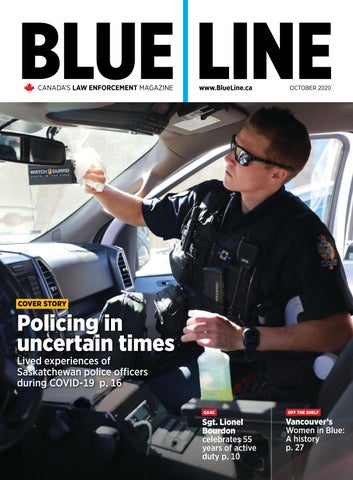
Policing in uncertain times Lived experiences of Saskatchewan police officers during COVID-19 p. 16
Q&AC
OFF THE SHELF
Sgt. Lionel Bourdon celebrates 55 years of active duty p. 10
Vancouver’s Women in Blue: A history p. 27
THE AVERAGE TRUCK NEVER COMES WITH THIS MUCH STORAGE.
BUT THEN THIS ISN’T YOUR AVERAGE TRUCK. The 2021 Ram 1500 Special Service is no ordinary truck, starting with its legendary 5.7L HEMI® V8 engine featuring the fuel-efficient Multi-Displacement System (MDS) Fuel Saver Technology. Variable Valve Timing (VVT) delivers impressive engine performance, while its Class-Exclusive Multilink Coil Spring Rear Suspension* ensures lateral stiffness and superior vehicle control. An available RamBox® Cargo Management System* means you’ll never run out of room — whatever you bring to the job. The Ram 1500 Special Service. With so many great features, no wonder they call it Special.
CLASS-EXCLUSIVE RAMBOX CARGO MANAGEMENT SYSTEM ®
WITH BED DIVIDER*
CLASS-EXCLUSIVE MULTILINK COIL SPRING REAR SUSPENSION*
fleet.fcacanada.ca
1 800 463-3600
*Based on Automotive News Full-Size Pickup segmentation. Excludes other vehicles designed and manufactured by FCA US LLC.
20
Contents
October 2020 Volume 32 Number 8
Features
14 Education & Training Directory
Check out Blue Line’s 2020-2021 Education & Training Directory for various options to bolster your resume, tool bag and more.
Columns
4 Editor’s commentary 10 Q&A 11 Interviewing and Investigations 12 Health & wellness 13 Holding the line 25 Technology 26 Case law 30 Back of the book
COVER STORY
16 Policing in uncertain times
A study strives to capture an in-depth understanding of the lived experiences of Saskatchewan police officers during COVID-19. By Lindsey and Randy Boechler
20 Inside the Blue Line Virtual Symposium
Blue Line hosted its first Virtual Symposium & Product Showcase in July to share best practices for wellness, technology insight and more.
22 Successful citizen engagement programs
The need to improve the way police and other organizations engage the public was a principal motivation for the development of two courses at Dalhousie University. By Jack Novack
Departments 5 5 7 8 8 27 28 29 30
By the numbers News Letter to the editor Dispatches Calendar Off the shelf Product showcase Marketplace Blue Links
24 OPP celebrates Auxiliary Program’s 60 years
COVER PHOTO: SASKATCHEWAN POLYTECHNIC
The Ontario Provincial Police’s Auxiliary Program began on April 1, 1960, and has evolved throughout the years, adapting to the rapidly changing environment of law enforcement. By Jenna Thomson
10 24 @Blue_LineMag
25 October 2020 | BLUE LINE
3
EDITOR’S COMMENTARY BY RENÉE FRANCOEUR
Search and Rescue for Autism: new training for 2020
J
ust like that it’s October and you first responders, emergency personnel and know what that means — time the community at large. It is led by Shanyn for our annual Education and Silinski, a former volunteer fire captain and Training Directory (find it on training officer in Alberta, who I touched page 14). Education as a whole has a new base with at the end of August. look in the world today. At the time of “Autism and neurodiversity are so comwriting this, it now encompasses masks, plex,” she told me. “We’re learning all the spaced seating, face shields and more time... but the saddest thing is our knowvirtual classroom experiences than ever ledge isn’t transferring to the frontline...” before, thanks to the wide effects of 2020’s Back in 2017, an Ontario-based study monopolizing headliner: COVID-19. found about one in six people with autism In law enforcement, education had at least one interaction with and training is also pivoting; it “Not being police over an 18-month period. seems the pandemic has provided able to ask “And while criminal charges the necessary pause and subse- for help in a were laid in only two incidents quent impetus to deep dive into neurotypical involving study participants, some of the learning gaps and work way — it’s police intervention was reinnovatively to close them. For terrifying.” ported to increase distress in example, this summer, I was forabout one third of the cases,” tunate enough to connect with Assistant reported The Canadian Press. Commissioner Serge Côté, the executive SARA aims to ensure better outcomes in director of the Canadian Police College emergency situations. It provides the train(CPC), and Supt. Doug Ross, director of ing for a technical response to incidents the School of Police Sciences with CPC. involving those on the spectrum — to As the guests for the August episode of recognize behaviour and sensory supports. Blue Line, The Podcast, the duo joined me For example, Silinski shared how many to discuss the CPC’s modernization ef- on the frontline are not aware that some forts and leadership development. of those on the spectrum will not make “When we interviewed police chiefs, we direct eye contact. heard them loud and clear — they’d like “Not being able to ask for help in a neuroto have leadership training delivered in typical way — it’s terrifying,” she said. their home communities,” Côté says in the “When they’re having a bad day, it’s so easy episode. “So, we are looking at expanding to misunderstand and so easy for people to the senior police administration course... assume things like, ‘Oh, I’ve seen a bad drug We’re also at the early stages of exploring trip, etc., so that’s what this must be.’ If what I will refer to as a coalition of leader- someone is having a meltdown, they’re not ship development training programs.” giving you a hard time but having a hard It’s an exciting time at CPC as instruct- time; restraining them is not going to help. ors redesign traditional courses and the Space and asking the right questions can college moves forward to fully implement make a difference... it can save lives.” its adjunct faculty program, recognizing Check out sarautism.ca to learn more police services who are contributing to the and sign up to attend the virtual Launch college through subject matter experts. and Learn on Oct. 24. I know I plan to so Stay tuned as I plan to check back in with I myself can better respond to the asynCPC next month. chronous learners in my life. I am also thrilled to spread the word about the just-launched SARA (Search and ICYMI: Find Côté and Ross’s full conversation Rescue for Autism) program. This features at blueline.ca/podcast/ or wherever you get Autism Canada’s proprietary training ma- your podcasts by searching for Annex Business terials and resources for Search and Rescue, Media: Podcasts.
CONNECT WITH BLUE LINE
www.BlueLine.ca 4
@Blue_LineMag
BLUE LINE | October 2020
www.facebook.com/BlueLineMagazine
BLUE LINE www.BlueLine.ca
GROUP PUBLISHER | MARTIN MCANULTY mmcanulty@annexbusinessmedia.com EDITOR | RENÉE FRANCOEUR rfrancoeur@annexbusinessmedia.com ACCOUNT MANAGER | JANICE EATON jeaton@annexbusinessmedia.com MEDIA DESIGNER | SVETLANA AVRUTIN savrutin@annexbusinessmedia.com ACCOUNT COORDINATOR | TRISH RAMSAY tramsay@annexbusinessmedia.com CIRCULATION MANAGER | BEATA OLECHNOWICZ bolechnowicz@annexbusinessmedia.com Tel: 416-510-5182 COO | SCOTT JAMIESON sjamieson@annexbusinessmedia.com
ANNEX BUSINESS MEDIA 111 Gordon Baker Road, Suite 400 Toronto, ON M2H 3R1 Tel. 416-442-5600 • Fax 416-442-2191
Publication Mail Agreement No. 40065710 ISSN 0847-8538 Printed in Canada SUBSCRIPTION RATES Canada — 1 Year $31.50; 2 Year $52.50 plus tax USA — 1 Year $136.50 CAD CIRCULATION email: bolechnowicz@annexbusinessmedia.com Tel: 416-510-5182 Fax: 416-510-6875 or 416-442-2191 Mail: 111 Gordon Baker Road, Suite 400, Toronto, ON M2H 3R1 Occasionally, Blue Line will mail information on behalf of industry-related groups whose products and services we believe may be of interest to you. If you prefer not to receive this information, please contact our circulation department in any of the four ways listed above. Annex Privacy Officer Privacy@annexbusinessmedia.com; Tel: 800-668-2374 © 2020 Annex Publishing & Printing Inc. All rights reserved. Printed in Canada. No part of the editorial content of this publication may be reprinted without the publisher’s written permission. Opinions expressed in this magazine are not necessarily those of the editor or the publisher. No liability is assumed for errors or omissions. Readers are cautioned and advised that articles presented herein are edited and supplied for your personal awareness and should not be used for further action until appropriate guidance is received from a supervisor, Crown Attorney or other persons in authority. All advertising is subject to the publisher’s approval. Such approval does not imply any endorsement of the products or services advertised. The publisher reserves the right to refuse advertising that does not meet the standards of this publication.
NEWS HALTON REGION
Halton Regional Police Service now equipped with ClearMasks
Const. Orakwelu, far right, distributes radios to community Elders at the North Spirit Lake Airport. PHOTO: DOUGLAS PFLUG NORTHERN ONTARIO
Community Policing in action with North Spirit Lake First Nations radio fundraiser
A Nishnawbe Aski Police officer is on a mission to make his community, North Spirit Lake First Nations, a safer place by engaging and connecting Elders with radios — a valuable tool for crisis communications and socializing in an area where cell service is spotty. Uchenna “Miles” Orakwelu, who immigrated to Canada from Nigeria eight years ago, befriended his community policing instructor, Douglas Pflug, a retired sergeant of the Guelph Police Service, when he was attending basic recruit training at the Ontario Police College (OPC) in Aylmer, Ont. “The concepts of community policing that I learned have provided me with the tools that I can now use to reach out and build a better relationship between the police and the First Nations communities I serve,” Orakwelu said. Orakwelu and Pflug have continued their friendship and mentorship and this past summer Orakwelu asked his former instructor for help in further applying the Ontario Association of Chiefs of Police Mobilization & Engagement Model of Community Policing in his community.
Orakwelu serves in the North Spirit Lake First Nations community where cellular service is not always reliable. The territory does however have an FM radio station. This inspired him to procure several heavy-duty radios to distribute among the community Elders. These radios could serve for crisis communication and community socializing, he said. A GoFundMe page was set up with a goal of raising $2,000 to purchase 20 Milwaukee heavy-duty construction radios. In six days, the GoFundMe “North Spirit Lake First Nations Community Radio Fundraiser” surpassed its original goal, raising $3,076. The Home Depot stores in both Guelph and Waterloo, Ont., Milwaukee Tools Canada and the University of Guelph Gryphons Football Advancement Team made generous contributions, increasing the total number of radios purchased to 29. Milwaukee Tools Canada donated $1,000 in batteries and covered the shipping fees from Guelph to Thunder Bay, Ont. There were 56 separate donors through the GoFundMe initiative as well who all contributed to the success of the fundraiser. * Const. Orakwelu was one of the honourable mentions for our 2020 Rookie of the Year Award. Check that out at bit.ly/3lI1z4L.
The Halton Regional Police Service has masked up but in an innovative way to better serve all members of the community. “The wearing of face coverings/masks is known to pose a significant barrier to the Deaf community, as masks make it harder to lip read and understand sign language,” the service announced. To better serve “the demographics of our community,” while continuing to mitigate the transmission of COVID-19, Halton Regional Police Service officers are now equipped with ClearMasks. “Our ability to communicate with the members of our community is absolutely essential,” says Halton Regional Police Service Deputy Chief Roger Wilkie. “With guidance and input from the Bob Rumball Centre of Excellence for the Deaf, we have now removed a significant communications barrier.” By introducing ClearMasks, “anyone from the Deaf community can now have more accessible dialogue with police officers,” adds Jayne Leang, the director of business relations at the Bob Rumball Canadian Centre of Excellence for the Deaf. “In an emergency situation, allowing a person who is Deaf or hard-of-hearing the opportunity to see the officer’s facial expression or attempt to read their lips, helps in the exchange of potentially life-saving information.” These Health Canada-approved masks feature a transparent window, allowing the mouth to be fully protected while also fully visible for those who use speech reading, lip reading or who are profoundly deaf and use American Sign Language — which is heavily dependent on facial expressions.
BY THE NUMBERS Researchers from the University of Alberta looking into the mental health of civilian employees working in police organizations recently published their study results. This was a cross-sectional study of employees working in two RCMP divisions in Western Canada, representing all police officers and civilian employees within Alberta and the Northwest Territories. Ten per cent of potential participants responded. Read the full research article at www.frontiersin.org/articles/10.3389/fpsyg.2020.01031/full.
26%
of the sample screened positive for any mental health condition
@Blue_LineMag
32.8%
22.7%
civilians scored positive
police officers scored positive
Civilians were
1.67 times more likely to screen positive for any mental health disorder compared to police officers
October 2020 | BLUE LINE
5
NEWS WATERLOO REGION
Waterloo Regional Police Service launches its first hybrid cruisers
The Waterloo Regional Police Service (WRPS) has unveiled its first hybrid cruisers, as the service announced it moves towards green technologies. WRPS purchased eight 2020 Ford Police Interceptor Utility Hybrid vehicles as part of a pilot project. “Our investment in hybrid cruisers will not only benefit our environment, but will have a valuable impact on cost savings,” said Bryan Larkin, Chief of Police. “Hybrid vehicle technology will allow us to reduce idling time and, in tandem with the launch of our new idling policy, we aim to reduce idling by our members across the service using gas powered vehicles.” So far, three of the hybrid cruisers have been deployed to Central, North and South divisions. The hybrid cruisers are estimated to save approximately $4,000 per year in fuel costs. VICTORIA
Police launch Community Dashboard
The Victoria Police Department has launched Open VicPD, a “one-stop hub for information” about the Victoria Police Department. “Open VicPD is part of our efforts to be as transparent and accountable as possible,” the department said. “Our interactive VicPD Community Dashboard, alongside our online quarterly reports, publications and other information, tells the story of how we are working towards our strategic vision of ‘A Safer Community Together.’” The VicPD Community Dashboard and the quarterly reports provide data and analysis at different levels of depth, and over different time periods. Some of this information comes directly from VicPD, while other information, like the Crime Severity Index for Victoria and Esquimalt, is produced by outside agencies like Stats Canada. ONTARIO
A tool for guiding all police decisions: the ‘Critical Decision Making Model’
Blue Line sat down — virtually, of course — with Dr. Judith P. Andersen, an associate professor of psychology at the University of Toronto Mississauga, to discuss her team’s research into the state of de-escalation and 6
BLUE LINE | October 2020
The Waterloo Regional Police Service has eight new Ford Hybrids. PHOTO: WRPS use of force training for police in Ontario, as well as their evidence-based ‘Critical Decision Making Model,’ which was just released to the public this summer. In 2016 Ombudsman Paul Dubé published a report, recommending the Ministry of Community Safety and Correctional Services (MCSCS) — which is now the Ministry of the Solicitor General — address training standards on de-escalation and use of force for police in Ontario. The report also recommended the development of a use of force model that clearly identified de-escalation options, and that was understandable to the public. Enter the University of Toronto research team led by Andersen. Their work has resulted in some incredibly thorough, science-based policy recommendations for police training as well as an actual guide for teaching de-escalation and use of force. Andersen and Blue Line’s editor discuss surprises from the research, where the recommendations currently stand, the importance of science-based graphics and much more. Watch the video at youtu.be/aWSdpsYoX6o for the full conversation and visit hartlab.net/ policy-recommendations-for-police-training/ to read the UofT research. FREDERICTON
Police Force dedicates Honour Roll to three members
The Fredericton Police Force has installed a permanent memorial on the ground floor of headquarters to pay tribute to Const. Robb Costello and Const. Sara Burns, who lost their lives in the line of duty two years ago on August 10 during a deadly shooting. This shooting also claimed the lives of civilians Bobbie Lee Wright and Donnie Robicheau. Additionally, nine years ago, Fredericton Police lost another member in the line of duty: 35-year old Const. Perley S. Calhoun, killed during a training exercise. The Fredericton Police Force Honour Roll honours these three members and the “ultimate sacrifice” they paid during their service.
CANADA
Uber teams up with law enforcement for safer communities
According to Uber, it sees an average of 18 million trips a day and, as it is a technology transportation company whose platform physically integrates into its communities, data from the Uber platform can and has helped law enforcement solve an array of criminal investigations. “Whether it is finding a wanted fugitive, identifying a person who is targeting children, locating a missing juvenile, or contacting a rider or driver who may have been a witness to a violent crime, Uber is committed to working with law enforcement to make the communities we operate in safer,” the company states. As Uber grows and expands into new areas of opportunity, it notes it is “paramount that safety continues to be a top priority.” Part of that effort was the creation of Uber’s Law Enforcement Operations team. The team’s goal is to “make Uber the mobility platform law enforcement trusts the most via engagement, partnership and response.” Uber Law Enforcement Operations consists of two teams, Outreach and Response. The Outreach team is made up of former law enforcement professionals turned regional liaisons whose primary responsibility is to engage and partner with law enforcement at all levels. The team achieves these objectives by educating law enforcement on how Uber works as a platform, the data captured and how to obtain that data during a criminal investigation or critical incident. The other component is the Law Enforcement Response Team. Their primary responsibility is to respond to law enforcement requests for information — whether it’s an emergency situation or a legal process request. This team operates on a 24/7 basis with personnel around the world working in concert with one another. The Law Enforcement Response Team manages legal process and emergency www.BlueLine.ca
NEWS requests utilizing Uber’s online portal: www.lert.uber.com. The Response Team will validate law enforcement credentials based on the information provided by the officer or agent submitting a request. The portal contains Uber’s legal guidelines for data requests and frequently asked questions. “The response team has been a crucial partner in assisting law enforcement around the world with providing information during critical incidents such as the Easter terrorist attacks in Sri Lanka and the Route 91 shooting in Las Vegas,” the company states. Recently, Uber Law Enforcement Operations added a much-needed feature to the portal in light of the COVID-19 pandemic. The portal is now equipped to receive and respond to requests for information from public health departments conducting contact tracing investigations. The portal includes resources and instructions on the process for public health departments to submit their requests through the portal. The response team has been responding to
public health requests for several months now, even before the initial spread of COVID-19. To learn more about Uber’s LERT team and how Uber’s data can be used during an investigation, contact a regional liaison. For example, Nick Pailthorpe is based in Toronto and is helping build and lead Uber Canada’s Law Enforcement Operations Team in conjunction with the global head office in San Francisco. Before joining Uber in Canada, Pailthorpe spent three years in Amsterdam covering Europe, Africa, and the Middle East for Uber in the same role. Pailthorpe was formally a detective in the Metropolitan Police, U.K., where he worked for 10 years in various specialist commands. Towards the end of his service, he worked in the Metropolitan Police Cyber Crime Unit, where he was a digital media and fraud investigator. If you are interested in scheduling a training, email Pailthorpe at nickp@uber.com.
LETTER TO THE EDITOR I found your article “Defund the police? – How did we get here?” (on page 22 of the August/ September 2020 issue) to be refreshing. Defunding the police is obviously a non-starter, but as a member of the public and father of three, I am concerned with what we’ve been seeing. I think what Canadians really want to see is use of force outcomes that not only address the officers’ safety, but are also proportional to the infractions involved and that show a high level of concern for the safety of the people affected. I think the time has finally come for a national, independent public oversite agency. A clear, consistent and transparent complaints process will help to restore trust and is in the interest of both the public and our brave law enforcement personnel. - Joseph Magyar Visit www.BlueLine.ca for the latest news, stories, products, videos, photo galleries and industry events.
AXON INTERVIEW ROOM With a continuous buffer, powerful security and high-quality video and audio, Axon Interview Room ensures nothing’s missed and evidence is tamper-free. We offer two versions: an on-premises system that we build into your custody suites and a compact system available in a peli case to support mobile operations. It guarantees full chain of custody with audio and video masking.
For more information, visit ca.axon.com/interview
@Blue_LineMag
BL_Axon_Oct20.indd 1
October 2020 | BLUE LINE
7
2020-09-10 1:38 PM
NEWS DISPATCHES
CALENDAR
Congratulations to Niagara Regional Police Sgt. Tammy Morden, the recipient of the inaugural Canadian Association of Chiefs of Police (CACP) and Axon Canada Diversity & Inclusion Award.
instructors, recognized nationally and internationally, and joined Blue Line in 2018 as the law enforcement expert for our free webinar on first responders preparing together for active threats. Donations may be made to the Stomach Cancer Foundation of Canada at mygutfeeling.ca.
Saugeen Shores Police Chief Mike Bellai (photo) has retired and Deputy Chief Kevin Zettel has accepted the role of acting chief. Bellai became chief at Saugeen Shores in December 2017. He was police chief in Stratford prior to that.
Durham Regional Police Deputy Chief Todd Rollauer has been appointed as interim chief of police. Rollauer began as a cadet with the DRPS in 1987. He has served at the senior level for the last decade, being promoted to inspector in 2010. Prior to being appointed deputy chief in 2018, Rollauer was the Executive Officer to the Chief of Police.
Vancouver Police Insp. Leslie Stevens has been selected as the new deputy chief of Port Moody Police Department.
Chief Bryan Larkin of Waterloo Regional Police Service takes the reigns from Chief Adam Palmer of the Vancouver Police Department as the new president of the CACP (Canadian Association of Chiefs of Police). Inspector Kara Triance (photo) is the new Officer in Charge of the Kelowna Regional Detachment with the BC RCMP. She takes over from Supt. Brent Mundle, who has been transferred to a position within the Southeast District RCMP. Triance is the co-chair of the B.C. Association of Chiefs of Police, Diversity and Inclusion Committee, and is on the executive board for the B.C. Women in Law Enforcement Association. Most recently, she became the first female Officer in Charge of the Sea-to-Sky Detachment in 2016. Cpl. Robert David Daniel, 48, passed away peacefully after a courageous battle with gastric cancer on Aug. 2. He will be lovingly remembered by his wife, Lisa Daniel, and his daughter, Sophia Daniel. Daniel was a dedicated member of the RCMP for the past 20 years on the Division Training Section, as well as being the NCO of the Special Tactical Operations team in Halifax, N.S. He was also one of the most highly regarded use of force 8
BLUE LINE | October 2020
Supt. Brenda Young has retired after more than 28 years of service at Halifax Regional Police.
Lethbridge Police Staff Sgt. George Carscadden has retired. He started his career with LPS in 1997 after nine years with Peel Regional Police. Supt. Cecile Hammond (photo) and Supt. Paulo Da Silva are the two new deputy chiefs of police for York Regional Police. Supt. Hammond has served in law enforcement for 22 years in a variety of operational and administrative roles including as officer-in-charge of the Integrated Domestic Violence Unit and as Inspector of the Real Time Operations Centre. Supt. Da Silva has served with York Regional Police for 27 years in a number of operational and administrative roles, and he is the recipient of the Governor General Exemplary Service 20-year Medal. Alan Treddenick, retired RCMP/CSIS member and the former director of National Security and Law Enforcement Liaison for BlackBerry, has recently been appointed as the director of strategic engagement with the Royal Canadian Mounted Police Veterans’ Association. Since 2017, Treddenick has been the CEO of ATNOH Group, a global risk advisory company.
NOTE TO READERS: check with all organizers as COVID-19 continues to affect events.
True Patriot Love Funded Peer Support Training for Veterans Oct. 15-16, 2020 Fitzroy Harbour, Ont. conta.cc/323IKQH IACP 2020 Oct. 17-20, 2020 Online theiacpconference.org Virtual Adrian Oliver Memorial Run Oct. 17-18, 2020 Online www.adrianoliverrun.com Laurier Online’s Public Safety Degree Programs: What to expect • Webinar Oct. 20, Nov. 3 &17, 2020 Online online.wlu.ca/webinars/weeklywebinar-series Canadian Institute’s Virtual 11th Annual Law of Policing Conference – West Coast Edition Nov. 4-5, 2020 Online www.ongia.org Virtual Annual Meeting of the Criminology Consortium: CrimCon Nov. 18-20, 2020 Online crimcon.org National Symposium on Sexual Assault Cases in the Criminal Court Feb. 27, 2021 Toronto, Ont. www.osgoodepd.ca TACCOM 2021 Show Apr. 23-25, 2021 Mississauga, Ont. www.osgoodepd.ca Fourth International VPD Police Judo Clinic Apr. 27-30, 2021 Vancouver, B.C. policejudo.ca Find more calendar events online at blueline.ca/events.
www.BlueLine.ca
NEWS Sgt. Mike Ashcroft wins Dalhousie’s Bruce MacPhail Award for 2020 The Sgt. Bruce MacPhail Award for Academic Excellence is presented to the municipal police officer who achieved the highest overall average in a concentration certificate within the Police Leadership Program at Dalhousie University in the past academic year. MacPhail began his career with the Amherst Police Department in Nova Scotia and in 1982 he became one of the first police officers with the newly formed Bedford Town Police. He continued on with Halifax Regional Police after amalgamation, eventually heading up their first Auto Theft Unit. He completed the certificate in “Police Leadership - Supervisory Skills” in 2000, and was the first to graduate as a certified police coach in the program. MacPhail passed away in June 2001 after a short and courageous battle with cancer. Phyllis MacPhail established the award in 2001 in memory of her son.
Dalhousie University Police Leadership Graduates Fall 2019 – Spring 2020
Administration Certificate
S/Sgt. Tim Chalmers Timmons Police Service, ON Sgt. Kim Manuel St. Thomas Police Service, ON Sgt. John McMullan Halton Regional Police Service, ON Insp. Paul Roche Royal Newfoundland Constabulary, NL DCP Romano Songor Seychelles Police Force, BC
Advanced Police Leadership Det/Sgt. Davis Baxter Peel Regional Police, ON
International Policing & Security
Cpl. Michael Dunn RCMP, BC Sgt. Tim Williams RCMP, ‘O’ Division, ON Cst. Vanessa Lee RCMP, Strathcona County Detachment, ‘K’ Division, AB
Law and Justice Certificate Cst. Kimberly Lam RCMP, Turner Lake SK Cst. Christopher Main RCMP Inuvik, NT
Supervisory Skills
Cpl. Chris Payette RCMP, Surrey, BC Sgt. Mike Darling Victoria Police Department, BC Sgt. William Groenen RCMP, Medicine Hat, AB Det/Cst. Sandra Rijken West Vancouver Police Department, BC
Sgt. Mike Ashcroft was hired as a patrol constable by the West Vancouver Police Department in 2005 and has served in the Patrol Division, Investigation and Intelligence Division as the Intelligence Officer and Confidential Informant Co-ordinator. He currently serves as the NCO in charge of the Major Investigations Team. Ashcroft has also had the opportunity to work in RCMP-Municipal Police integrated units: the Integrated Municipal Provincial Auto Crime Taskforce, the Integrated Gang Taskforce, and as the NCO in charge of the Integrated First Nations Police Unit in North Vancouver. Ashcroft was promoted to the rank of corporal in 2013 and then to his current rank in 2016. In 2019, he was awarded the E-Division Indigenous Policing Services Officer in Charge Certificate of Appreciation and was also awarded a Chief Constable’s Commendation for his leadership at the Integrated First Nations Police Unit. He holds a Bachelor of Arts from the University of British Columbia and he completed the Dalhousie Police Leadership Certificate with a concentration in administration. Ashcroft is committed to life-long learning and believes the courses taken at Dalhousie have been a major part of his professional development. Congratulations!
This list is not exclusive. Some students could not be contacted and for reasons of privacy and security some did not wish to have their names included. The staff and faculty of the Police Leadership Program want to congratulate all graduates on their success!
UP YOUR GAME For more than 35 years, the College of Continuing Education has been helping people prepare for the next step in their careers. Don’t miss two new courses coming this January • Coaching Skills for Leaders • Public Relations Other courses are available in • Financial Management • Data and Analytics
DAL.CA/UPYOURGAME October 2020 | BLUE LINE
@Blue_LineMag BL_Dalhousie_Oct20.indd 1
9
2020-09-18 9:30 AM
Q&A Sgt. Lionel Bourdon of le Service de police de l’agglomération de Longueuil (SPAL) in Quebec started his career at police de Ville Jacques-Cartier in 1965. He is still actively on duty — his service says he’s the longest serving police officer in Quebec. In fact, SPAL’s media relations says Bourdon just might be in the running for the longest serving officer in the whole country. Below, he shares more of his memories with Blue Line. Q: Congratulations on 55 years in law enforcement! What does it feel like to have such a long career?
ment of agents, the management of schedules, holidays and vacations, overtime; the treatment of complaints from citizens; the preparation of our operational plan and participation in traffic committees for the cities in the agglomeration.
For me, this has been a very beautiful adventure and the years have passed very quickly. I consider myself privileged to have had the chance to be a police officer. I understood that it was not an ordinary job; you had to have a passion for people and public safety. Our work is demanding but it is also rewarding and exciting.
When I was young, we lived in a house by the police station. Longueuil was a small village of about 25,000 inhabitants then. Every day I saw the police on foot, on a motorbike, or in a car leaving and returning to the police station, passing in front of my house. Often when I came back from school, I walked with a policeman who was returning to the station near my home. Later on, around 18 or 19 years-old, I chose this profession because contact with the population was essential for me and also because I knew it would not be a stagnant career choice.
Q: How has policing changed for you over these 55 years?
At the time, in 1965, the salary was $72 a week and, minus taxes, there was $ 56 left. The means of communication were far from what they are today. There was only a fixed radio inside the vehicle. As for service weapons, we went from a simple 0.38 caliber revolver with six bullets to 9mm pistols with three magazines of 15 bullets. Next came the pepper bottles and taser guns, not to mention the evolution of radar devices, the arrival of portable radios and cell phones, etc. Many other aspects of our work have also evolved, such as investigative meth10
BLUE LINE | October 2020
ods, the arrival of DNA, community policing and the computer age.
Q: What is your most memorable moment from your 55 years on the job?
During my career, I have experienced at least three major crises: the storm of the century in 1971, the ice storm in 1998 and the COVID-19 pandemic in 2020.
Q: What has been your favourite role over the years... We know you worked in patrol, the department of judicial identity, in investigations as a detective, and now in road safety?
I loved working as an investigator from 1973 to 1986. One of my biggest investigations was the theft and extortion of $3 million at Wells Fargo Co. Given the importance of this investigation, I worked for several months with the Sûreté du Québec’s major crime investigators, which also allowed me to deepen my knowledge.
Q: What does an average day for you look like now?
Currently, there are 20 officers and two sergeants in the road safety section and I supervise a team of 10 officers in the southern district. My tasks are the assign-
When a recruit enters the field, he or she must realize that the practice differs from theory. At school you learn the basics but each organization has different protocols and it takes a long time to be really operational. The police work becomes more complex over time, so always be very careful during your daily interventions. Also, I would say that it is important to treat the citizens with whom we carry out our interventions as if they were members of our own family. It is through this professional behaviour that the police will gain respect from citizens.
Q: What are your hopes for the future of policing?
For the future, I believe that the modernization of the service will be important and a vital condition for maintaining the bond of trust with the community.
Q: Do you have plans for retirement?
Before leaving the police force, I would like to start setting up a museum, which will be dedicated to the history of police officers here to save the collective memory and bear witness to the progress made. Over the years, I have kept several old objects (radar, breathalyzer, camera, badge, clothing, etc.) as well as many photos and I would like to demonstrate to the new police officers, as well as to citizens, how quickly police services are evolving. www.BlueLine.ca
PHOTO: SPAL
Q: Why did you choose a career in law enforcement?
Q: What is your advice for someone just starting their career in law enforcement?
INTERVIEWING & INVESTIGATIONS BY KERRY G. WATKINS, LL.M.
“Limited time offers” in suspect questioning
PHOTO:KATARZYNABIALASIEWICZ / ISTOCK/GETTY IMAGES PLUS / GETTY IMAGES
O
ne commonly used suspect questioning tactic is what is referred to here as the “limited time offer” (LTO). The LTO involves police telling a suspect, who has typically expressed their desire to remain silent, that “now” (i.e., during the police interview) is their only or best opportunity to tell their side of the story. And further; if they remain silent during the interview and give their account later in court, no one will believe them. This LTO tactic is problematic for a number of reasons. The first problem is that it is not true. The police interview is not the “only” or “best” place for a suspect to give their account. All suspects may exercise their constitutional right to remain silent when questioned by police and choose to testify later at trial, or not at all, and no adverse inference may be drawn from such a choice. In Slater (2014), police stated, “this is your opportunity to come clean … Now is the time…” The court held that such statements can effectively undermine counsel’s advice by suggesting that the only point at which an accused person can tell their side of the story is during the police interview, which is wrong in law.1 When questioning suspects investigators should, therefore, avoid stating anything that may lead a suspect to believe that the police interview is their only or best opportunity to tell their side of the story.2 A second, related problem with the LTO is that it commonly involves police suggesting to a suspect that their credibility is highest immediately after their arrest, typically during a police interview. Courts have characterized such suggestions as amounting to the giving of legal advice and, “(a)s a general rule, the police will always be on dangerous ground in purporting to provide legal advice as a persuasive means of leveraging a prisoner to refrain from remaining silent.”3 @Blue_LineMag
Moreover, such advice is incorrect. The Supreme Court has held that, “…statements are neither more nor less likely to be true based solely on a consideration of when they were made.”4 Justice McLachlin said that the right to silence means that “a suspect has the right to refuse to talk to the police and not be penalized for it…” Having exercised the right to silence cannot logically form a basis for assessing credibility when a suspect later testifies in court.5 Where police go further and explicitly suggest to a suspect that making a statement would be beneficial to their legal interests and remaining silent would be detrimental, these statements have been seen as threats.6 A third problem with the LTO is it’s frequently used in conjunction with overt attempts to denigrate legal counsel’s advice to remain silent. In Cleveland (2019), police suggested to the suspect that his failure to speak during the interview would undermine his credibility later and he should question the value of his lawyer’s advice to remain silent because his lawyer did not know what the police knew about the case.7 The Supreme Court has affirmed that section 10(b) of the Charter prohibits police from denigrating counsel in an attempt to undermine the suspect’s confidence in the value of the legal advice they have been provided.8 Police can reasonably state to a suspect that it is up to them to follow or reject legal
Having exercised the right to silence cannot logically form a basis for assessing credibility when a suspect later testifies in court...
advice, or, more specifically, that it is up to them — and not their lawyer — to decide whether or not to make a statement. However, when police go further and make comments intended to undermine a suspect’s confidence in the legal advice they were provided by, for example, suggesting that the advice was routine and given by uninformed counsel, that is problematic.9 Ultimately, the significance of the LTO tactic to the admissibility of a suspect’s statement will depend on a court’s analysis of the context in which the tactic was used, and on the facts of the particular case. However, professional investigators need to be aware of how courts have viewed various questioning tactics, especially those which amounts to police giving suspects legal advice, and/or those intended to undermine a suspect’s confidence in the value of the advice they have received from counsel.
Footnotes
1. R v. Slater, 2014 ONSC 1562 (CanLII), 40; R. v Boffa, 2018 BCSC 765 (CanLII), 51, 54, 63 2 R v. Organ-Wood, 2019 YKTC 22 CanLII, 58; R v. Jongbloets, 2017 BCSC 740 (CanLII), 86; R v. Davidson, 2017 BCSC 2497 (CanLII), 125, 126 3. R. v. Van Wyk, [1999] O.J. No. 3515 (S.C.), 161 4. The Queen v. B. (K.G.) (1993) CanLII 116 (SCC), 770 5 R v. Crawford, 1995 CanLII 138 (SCC), [1995] 1 SCR 858, 43 6. R. v. J.M., 2017 ONSC 7260 (CanLII), 42, 44 7. R. v. Cleveland, 2019 MBQB 58 (CanLII), 24, 25 8. R. v. Burlingham, 1995 CanLII 88 (SCC), [1995] 2 SCR 206, 14 9. R v. Armishaw, 2011 ONSC 5624, 111; R v. Mujku, 2011 ONCA 64 (CanLII), 36
Kerry Watkins conducted more than 2,000 interviews during his 30-year career, the majority of which was spent as a criminal investigator in specialized units investigating a wide range of matters, including police corruption, corporate fraud and homicide. He is currently director of The Interview Group, a professor at Humber College and an adjunct faculty member in the Ongoing Professional Development Program at Osgoode Hall in Toronto.
October 2020 | BLUE LINE
11
HEALTH & WELLNESS BY ISABELLE SAUVÉ
Children of law enforcement need open communication
12
BLUE LINE | October 2020
is wrong. This can in turn worsen the child’s negative thoughts and feelings and increase their stress level. It also teaches them to hold back from communicating their own feelings and emotions in positive manner. As such, law enforcement children are at an increased risk of exposure to second hand or vicarious stress and trauma due to the nature and culture of frontline professionals. Openly communicating is the ultimate approach. It does not mean every detail must be shared; however, a calm, calculated and age or maturity-appropriate discussion is very healthy. Over time children learn and adapt though various stages of acceptance and understanding based on cognitive development and maturity. Periodic “check-ins” are beneficial and a way to promote an open and honest two-way communication between parent and child. Having that awareness that children may be affected by their parent’s own stress or responses to trauma is essential. Parents should learn to recognize the signs and responses in their children that alert them something is wrong. A change from the child’s norm can be indicative they are facing an issue. Common signs or symptoms include the development of new fears, separation anxiety (particularly in young children), sleep
Many parents attempt to shield or protect their children by actively “hiding” the truth and their feelings about their experiences, stress, or exposure to trauma.
disturbance, nightmares, sadness, loss of interest in normal activities, reduced concentration, decline in schoolwork, anger, somatic complaints, or irritability. Parents should also equip their children with healthy stress reduction techniques such as breathing techniques, physical exercise, engaging in a hobby and positive thinking. Teaching healthy coping mechanisms to children from an early age can assist them in developing resiliency and in overcoming problems or disappointments they may face over the course of their lives. Having a routine and as much “normalcy” as possible despite irregular hours and shift work is also very important. Despite some challenges, the benefits of growing up in a law enforcement family far outweigh the difficulties. After all, children of law enforcement have role models in their lives who make a difference in their communities and are considered heroes by many. Isabelle Sauvé is a 14-year veteran with the OPP, and currently the new Psychological Services Advisor in the OPP’s Healthy Workplace Bureau. She has a MA in psychology and is a PhD candidate. She is also an ultramarathon/ endurance athlete and the Racing the Planet/4 Deserts 2018 Series winner as well as a Guinness World record holder. She can be contacted at: isabelle.sauve@hotmail.com.
www.BlueLine.ca
PHOTO: MARTIN-DM /E+/ GETTY IMAGES
T
he recent outpouring of negative press regarding law enforcement is an opportunity and reminder to “check in” on our loved ones. Children of law enforcement can especially be at risk of being negatively affected by what they are seeing and hearing. They may not have developed the skills and ability to fully process and understand the historical — as well as the social and political — circumstances behind the negative comments being made about law enforcement. Every child is impacted by their parent or parents’ chosen professions. They are also affected by and experience a host of emotions in relation to how their parents deal with work-related issues and personal problems. Children of law enforcement can be positively affected when things are going well for their parents and they can be inversely impacted when things are further along the negative side of the spectrum. Given the stressful nature of frontline work, it may be more likely that children of law enforcement witness their parent(s) face difficult times more often. Research indicates children of law enforcement officers can develop vicarious stress responses by hearing or observing a parent deal with a traumatic or stressful event. Rachel Yehuda, the director of Traumatic Stress Studies Division at Mount Sinai School of Medicine in New York, indicates: “It’s generally understood that children of traumatized people are at increased risk for mood and anxiety disorders but the impacts are far more extensive than previously thought.” Many parents attempt to shield or protect their children by actively “hiding” the truth and their feelings about their experiences, stress, or exposure to trauma. However, children are very intuitive and observant. Knowing a parent is “hiding” something from them can lead to feelings of rejection and isolation in addition to experiencing a vicarious stress response when knowing something
HOLDING THE LINE BY MICHELLE VINCENT
Training the police officer through a psychophysiological lens
PHOTO: COLLEGE OF CERTIFIED PSYCHOPHYSIOLOGISTS
I
magine you are sitting in your police cruiser and a shot rings out in the night. You freeze, the adrenaline courses through your veins. Just as you are about to experience a full dopamine dump, you recall the breathing techniques you learned in the Certificate in Police Mental Wellness course. As you breathe, the words you once heard from the professor come back to you and so you breathe in a more controlled manner and you remember it is Canada Day; that shot you heard was likely a firecracker. The Criminal Code, the Highway Traffic Act, defensive tactics and firearms are all training aspects a police officer is expected to have mastered upon graduation from the Ontario Police College (OPC). Further training with a touch on mental health and several schedule blocks with an assigned coach officer is the next step... Although there has been a great improvement on the delivery of mental health tools and educational resources in police training, are we as organizations and leaders approaching officer training/safety as effectively as we could be? Between mindfulness training, Project Safeguard (an annual psychological assessment for police officers in vulnerable units), peer support and R2MR (the Road to Mental Readiness training), one would think we have a strong physical/psychological connection in the delivery of our training and our services in policing. However, a new leading-edge approach to mental wellness has been brought forth by Dr. Robert Perkins, a professor of applied psychophysiology with the College of Certified Psychophysiologists. (Psychophysiology is research of the physiological and the psyche interaction, their relationship and causal functioning.) The number one cause of death in police officers is suicide, out-numbering line of duty deaths two to one, according to Badge of Life Canada. So, we have to ask — what skill sets are we providing our members in terms of suicide prevention? Perkins suggests a program created by the College of Certified Psychophysiologists: The Certificate in Police Mental Wellness course. The program trains the police officer in peer support through a psychophysiological lens. It is not treatment; it’s psychoeducation. This course is multifaceted in that it provides members with an in-depth @Blue_LineMag
Dr. Robert Perkins
Psychophysiology is research of the physiological and the psyche interaction, their relationship and causal functioning. understanding of psychophysiology. It provides an understanding of how the body works, normalizes perception of the body’s reaction to critical incidents and/or trauma, and emphasizes opportunities to work through these reactions. The Certificate in Police Mental Wellness course teaches “powerful psychophysiological knowledge of the body’s responses to complex trauma associated with law enforcement,” according to Perkins. “These include Critical Incident Stress, PTSD and COVID-19 Traumatic Stress Syndrome (CTSS).” The cost of this intense and in-depth course, $750 US, is minimal when you think about the life-enriched benefits it may bring to our first responders. One example of a psychophysiological resource is Cognitive Meditation Technique (CMT). Meditation has been repeatedly shown to be a powerful resource and
when approached from a cognitive perspective, it can break down learned fears by association. When explored through the eyes of psychophysiology, meditation supports breathing, providing the brain with appropriate amounts of oxygen, which allows the brain to control emotion regulation. Emotion regulation, when practiced over a longer period of time, could reduce mental health issues, increase resilience and provide a frontline tool belt of resources for our members. Trauma intervention skills are taught in the Certificate in Police Mental Wellness course to support those in the role of peer support. The goal of this course is to provide practical skills and knowledge to both sworn and civilian members, empowering them to serve themselves, their families and their organizational families in dealing with the mental health issues that are common among first responders. The successful designation of a Certified Police Wellness Officer may further assist those members in a supportive role in minimizing the effects of mental and medical health issues, Perkins concludes. This could then promote a preventative, responsive strategy. Such a strategy may promote officer-enhancing stress management, a curtailing of illness and the achieving of optimal performance and general well-being. I would also add in: this strategy — especially if it’s delivered organization-wide — could mean a greater likelihood that organizational liability would also be reduced. If training organizations, such as OPC, offered this course for their cadets as part of their academic requirement, they would be providing proactive, preventative tools for future police officers. If something as simple and cost effective as providing psycho-education can reduce the horrific number of police officer deaths by suicide, we would be remiss in not providing it. Let’s inspire our organizations and training agencies to invest in the Certificate in Police Mental Wellness course today. Michelle Vincent is a retired York Regional Police officer and the founder of The Haven, Ontario’s first non-profit, inpatient treatment centre exclusive to first responders and uniform personnel. Contact her at michelle.vincent@thehaven.cloud.
October 2020 | BLUE LINE
13
EDUCATION AND TRAINING
Education & Training Directory 2020-2021
AUTISM CANADA Autism Canada, through their ground-breaking SARA Program, has created specialized training to support individuals with autism. This training includes Recognizing Behaviours, Sensory Supports, plus modules for command staff, training officers and Train the Trainer programming. All modules are currently being offered online. Training is key to understanding and appropriately responding to and supporting the autistic community. These training modules, including the proprietary Search and Rescue for Autism Program, have been developed with the response and autistic community. Together we can work towards better outcomes. This training is open to everyone. Contact Shanyn Silinski at shanyn@autismcanada.org or call 1-800-983-1795 ext. 5.
CHARLES STURT UNIVERSITY Charles Sturt University is a global leader in research and education for professionals in law, law enforcement, investigations, counter-terrorism, emergency management, leadership and security. Our police leadership courses examine the practical challenges of leadership and management in complex contemporary policing and regulatory professional environments. As Australia’s most experienced online university, we know study isn’t your only commitment. Our online courses are flexible so you can study the way that suits you. study.csu.edu.au/courses/ police-security-emergency
14
BLUE LINE | October 2020
COMMISSIONAIRES Your Next Mission Commissionaires values your transferrable skills and your military, police or RCMP background. As a not-for-profit organization, 90% of revenues are returned to our workforce in the form of salaries, benefits, and training. We’re dedicated to providing meaningful employment for veterans, helping them transition back into the workforce. Join Commissionaires and put your skills and experience to work, ensuring the safety and security of people and property in a wide variety of environments, including healthcare, education, airports and seaports, and non-core police services. commissionaires.ca/en/careers/ veterans
DALHOUSIE UNIVERSITY The Police Leadership Program has been providing courses and various certificate options to those working in law enforcement since 1993. Online courses are designed to build on previous education and experience to help all officers on their continuous journey of learning. Every officer can be a leader. All ranks are welcome. Course developers and instructors have a high level of academic credibility combined with direct policing experience. Contact: Gwen Doary at gwen.doary@dal.ca, 1-800-565-8867 or 902-494-8838, www.dal.ca/policeleadership
EMOND PUBLISHING Emond’s trusted resources are an invaluable reference tool for
Canadian policing, front-line, and public safety professionals. These educational and practical handbooks, on topics like cybercrime, interviewing and investigation, community policing, and mental health for first responders, are packed with hands-on guidance, real-life examples, and best practices that will equip you to operate confidently and effectively in the field. Start your collection today at emond.ca/blueline.
GEORGIAN COLLEGE A leader in providing police and community safety education and training, Georgian College is pleased to offer a fully online Honours Bachelor of Police Studies degree program. Police professionals can fast-track with advanced standing. Qualified first class constables can receive up to 20 credits (50% of the program), with an additional exemption of up to 10 courses (25% of the program) for those with previously completed post-secondary education. Course faculty are highly regarded professionals in field. Apply today, intakes offered each semester: GeorgianCollege.ca/policestudies
UNIVERSITY OF GUELPH-HUMBER Part-time online program. Earn your Bachelor of Applied Arts specialization in Justice & Public Safety at the University of Guelph-Humber. Receive credit for work experience and postsecondary study. Complete in 2 to 2.5 years. Open up opportunities for your future: 416-798-1331 ext. 6389, info@guelphhumber.ca. www.guelphhumber.ca/ futurestudents/jps
HUMBER COLLEGE Humber Justice can attain higher educational goals through our proven diploma in Police Foundations Leadership. Three lead educational institutions (Humber Institute of Technology and Advanced Learning, the University of Guelph-Humber and the University of Guelph) have partnered together to offer educational pathways that include tailored, streamlined programming at the diploma, undergraduate and graduate levels. Liaison: Stephen Duggan, Stephen.Duggan@humber.ca.
QUEEN’S UNIVERSITY With over 80 years’ experience, Queen’s University IRC offers training in Labour Relations, Human Resources, and Organization Development for LR/ HR professionals, managers, and union representatives. Our in-person and virtual programs are delivered by subject matter experts, and grounded in adult learning principles. The IRC offers coveted certificates in Advanced Labour Relations, Labour Relations, Advanced Human Resources and Organization Development and our website is home to related research papers and case studies. Visit us at irc.queensu.ca
QUEEN’S UNIVERSITY Queen’s University offers a Certificate in Organized Crime Prevention. Learn from leading industry experts to identify,
www.BlueLine.ca
analyze, and mitigate criminal activity. This 5 day program, offered online this November 2020, is crucial for professionals working in any industry where criminal activity may infiltrate best practices or threaten security such as border control, law enforcement, government, counter-terrorism and intelligence, banking, investment and risk management, accounting, law, business, and more. Register before November 2 at quartsci.ca/COCP
SENECA COLLEGE School of Public Safety Get ready for an exciting career in public safety and law enforcement. Seneca offers diploma and certificate programs
in Police Foundations, Emergency Service Communications, Advanced Investigations, and the innovative Bachelors (Honours) Crime & Intelligence Analysis - the first degree of its kind in Ontario. www.senecacollege.ca
SHERIDAN COLLEGE Sheridan College can prepare you for your career in public safety. We offer two-year diploma programs in Police Foundations, Community and Justice Services, and Investigation – Public and Private, as well as a one-year graduate certificate in Emergency Management, at Sheridan’s Davis Campus in Brampton, Ont. www.sheridancollege.ca
TRENT UNIVERSITY The evolving needs of our communities require a different kind of policing. Trent University offers two new programs that aim to enhance training and professional development for police services. Firstly, The Policing and Community Well-Being B.A. is the only community-inclusive program of its kind. Secondly, Trent’s Senior Police Leadership postgraduate certificate is tailored to provide police leaders with the competencies needed to excel in senior positions. Both programs are offered exclusively at Trent’s Durham GTA campus. Contact: Program Coordinator Amy Spendik (policing@trentu.ca) trentu.ca/futurestudents/policing
WIFRED LAURIER UNIVERSITY LAURIER Wilfrid Laurier University offers Public Safety Degrees that are 100% online. These degrees are offered at multiple educational levels such as; an undergraduate Honours BA in Policing or Honours combination BA in Policing and Criminology, a Masters of Public Safety as well as multiple Graduate Diplomas. Each of these programs provide enhanced skills for individuals who want to combine their work experience and training with classroom knowledge. Our commitment is to justice and the sustainability of justice, now and in the future. As a University, we strive to ignite the minds, spirits and hearts of our communities through a scholarly exploration, inspiring our students to challenge the world in all its complexity. www.laurierpublicsafety.ca
POLICE FOUNDATIONS LEADERSHIP DIPLOMA Designed for working justice professionals, this program provides the critical thinking, research and evidence-based academic foundation required to pursue career advancement or further education. The combination of in-class lectures, group work and online study allows students to continue their education while maintaining a work-life balance. Find out how you can make a difference at
communityservices.humber.ca/ leadershipprogram
@Blue_LineMag
BL_Humber_Oct20.indd 1
October 2020 | BLUE LINE
15
2020-09-04 1:49 PM
COVER STORY
Policing in uncertain times Lived experiences of Saskatchewan police officers during COVID-19 By Lindsey and Randy Boechler Research methods
Data was collected through an online survey, consisting predominantly of open-ended questions. Participants were recruited through an email cascaded by the Saskatchewan Federation of Police Officers (SFPO) and the National Police Federation (NPF). The SFPO and NPF represent the union associations of the Regina, Saskatoon, Prince Albert, Moose Jaw, Weyburn and Estevan municipal police departments, as well as the RCMP “F” division respectively. Survey responses were received between April 20 and May 25, 2020.
Findings
Findings encompassed both professional and personal elements. Although some participants praised organizational leadership and felt
120 survey responses
66
%
of respondents were constables
23
%
of respondents were sergeants
Const. Casey Lea of Moose Jaw Police Service sanitizes his patrol vehicle.
their needs had been met throughout the first wave of COVID-19; other respondents criticized the changes being made and felt a need for clearer communication strategies. A common thread throughout the data was the fear of bringing the virus home and infecting family members. This fear further compounded reports of increased stress, exhaustion and anxiety that many respondents directly related to social isolation and loss of routine activities. This article will focus on findings related to communicating the unknown, impacts on policing and the repercussions of change throughout the first wave of the pandemic.
Communicating the unknown
Some officers have taken the changes and challenges in stride. One respondent stated, “I feel that police are natural adversity handlers and COVID is just one more situation that we have to handle among the many we face daily” (Respondent 27, April 23, 2020). Other 16
BLUE LINE | October 2020
www.BlueLine.ca
PHOTOS: SASKATCHEWAN POLYTECHNIC
P
olicing is difficult on the best of days. Adding a pandemic to already existing stress and scrutiny has challenged many police officers in a way they had never imagined. Not only does COVID-19 present an enhanced risk of personal exposure for police officers, it also has a significant impact on conventional law enforcement. Substantial and rapid changes to workplace policies, procedures and professional roles provided an unprecedented opportunity to capture the experiences of police officers during this time of uncertainty. By conducting a multi-jurisdictional research study, we were able to capture an in-depth understanding of the lived experiences of Saskatchewan police officers during the first wave of COVID-19.
officers expressed having difficulty adapting to the challenges. Negative sentiments most often accompanied top-down communication approaches from administration. Some respondents criticized admin for making inconsistent decisions and not considering input from officers. An officer conveyed his experience of information overload accompanying the large volume of emails being sent, stating, “Patrol members frequently don’t have time to review 50 emails every day. Most of the emails sent by admin looked identical to the point where they weren’t even read any more” (Respondent 198, May 29, 2020). Many officers felt that pertinent information was overshadowed within pages of bullet points overflowing with irrelevant information. Respondents also noted frustration and confusion due to conflicting information being communicated. One officer suggested that, “listening to employees’ suggestions or, at least, acknowledging [suggestions] that were made and @Blue_LineMag
64
%
worked in patrol/ general duty
47
%
were employed in Saskatoon
19
%
worked for RCMP “F” Division
[sharing] why they were rejected would go a long way… Understanding the rationale goes a long way in having people follow directions” (Respondent 57, April 23, 2020). Top down communication often resulted in officers feeling ignored and undervalued, leading to overall dissatisfaction and negative sentiments from respondents. Alternatively, open communication strategies were often well received. Positive sentiments were noted when admin attended shift briefings to provide updates, address concerns and consider input from those on the frontlines. These interactions fostered a sense of understanding and appreciation from officers, resulting in survey responses such as: “I don’t think anyone was prepared for this but my organization is doing its best” (Respondent 66, April 23, 2020), and “I think they maybe weren’t well prepared initially, but have done a great job to get ahead of most issues.” (Respondent 90, April 23, 2020). Being involved in the decision-making process provided officers with a sense of control and security in a time of great uncertainty.
Impacts to policing
Many officers expressed concern regarding COVID-19 being used as a
weapon while responding to calls. Eight respondents reported having been threatened by suspects claiming to be infected. These threats add to the anxiety and stress already faced by police on a regular basis. One respondent noted that the additional threat is “always in the back of our minds, which is draining” (Respondent 65, April 23, 2020). The heightened risk of contracting COVID-19 has resulted in the need to adapt approaches and standards associated with certain offences. Personal protective equipment (PPE) such as masks, gloves, eye protection and coveralls/gowns have been provided in an attempt to protect officers from potential exposure when working closely with the public. However, many respondents felt there were situations where PPE hindered effective policing. Respondents often found there was insufficient time to don PPE and that it carried the potential to create distraction. One respondent recalled his mask moving over his eyes when a prisoner resisted (Respondent 173, May 5, 2020), while another’s eye protection fogged up during an incident, impeding his vision (Respondent 9, April 23, 2020). Multiple safety concerns were raised surrounding how these
Positive sentiments were noted when admin attended shift briefings to provide updates, address concerns and consider input from those on the frontlines. October 2020 | BLUE LINE
17
COVER STORY types of distractions decreased overall situational awareness and could lead to an increased risk of injury for officers. Beyond physical implications of donning PPE, respondents reported communication challenges and difficulty establishing rapport while wearing masks in particular. One respondent explained: People see PPE gear and immediately become intimidated by it. It takes away the personal intimacy of an interaction. At the end of the day, we are all human and basic human interaction is important. If we are unable to properly communicate and connect with someone, our job instantly becomes more challenging – Respondent 85, April 23, 2020 Many respondents found that wearing a mask added to the multifaceted challenges police regularly face when attempting to de-escalate situations or connect with victims. Other changes to daily operations shared by respondents included: addressing low
18
BLUE LINE | October 2020
BL_SevenView_AugSept20.indd 1
priority calls by telephone; not making arrests on warrants; issuing warnings rather than charges for non-violent crimes; and minimizing the number of officers making contact with a suspect during an arrest. These changes have been implemented in an effort to reduce contact with the public, as well as to not overwhelm the judicial system when court resumes. Nonetheless, findings suggest these changes are challenging policing instincts and causing moral distress for some.
Repercussions of change
Respondents expressed mixed feelings regarding the changes taking place in light of the pandemic. Although there were positive responses from some regarding only having to respond to high priority calls, others were frustrated this did not allow them to be proactive in their approaches. One respondent shared her sentiments, writing: Culture right now is not good. A lot of pressure put on patrol officers who are the main people implementing the changes and having
to work the changes... Officers are put in moral dilemmas with regards to not arresting people, executing warrants and impaired drivers… [Policing during COVID-19] has caused me personal resentment towards admin and overall dissatisfaction at work which is not normally like me. – Respondent 98, April 23, 2020 Some respondents claimed the reduction in arrests were negligent while others cited ethical concerns with not charging those who commit offences. Concerns regarding changes to daily operations combined with reduced comradeship led to a decline in morale across several police services. Some respondents directly related reduced interaction with colleagues and the closure of fitness centres to a decline in their mental health. Respondents expressed how comradery is used as an outlet to offload daily stressors. One officer outlined the difficulties she was experiencing: I know it seems small but being able to have a cup of coffee with [coworkers] is a big deal.
www.BlueLine.ca
2020-07-13 1:20 PM
Team bonding doesn’t exist. We are more stressed at work; they closed our gym, admin sends 100s of emails, admin talks to us like we are children, admin implements useless policies and rules that don’t even work; they have made morale go way down. – Respondent 79, April 23, 2020
Concerns regarding changes to daily operations combined with reduced comradeship led to a decline in morale across several police services.
Another respondent described feeling alone and as though all of his mental health retreats had been shut down (Respondent 16, April 26, 2020). Many respondents directly related increased stress, exhaustion and anxiety to the decrease of comradery and emotional outlets that often serve as informal coping mechanisms for officers.
officers throughout the first wave of COVID-19 offered insight needed to inform best practices of policing during a pandemic and will enhance preparedness of law enforcement for future outbreaks. Saskatchewan police officers have experienced multiple stressors on top of those being experienced by the general public. Not only are they worried about being exposed to COVID-19 but have also had multiple operational changes implemented without a voice, been intentionally threatened with COVID-19 by suspects, lost the sense of companionship with colleagues and been denied access to outlets they depend on. One of these circumstances alone would be considered an inconvenience but with all of them
Conclusions
COVID-19 has had an immense impact on day-to-day operations, workplace morale and the overall professional role of police officers. This article focused on research findings related to communicating the unknown, impacts to policing and repercussions of change. Researching the lived experiences of Saskatchewan police
being simultaneously stacked against police officers, these circumstances have taken a detrimental toll on many. It is during these times that it is more important than ever to check in on colleagues, offer support and reach out for support when needed. Lindsey Boechler, M.A., is a research chair with the Saskatchewan Polytechnic Centre for Health Research, Improvement and Scholarship, and she practiced as a paramedic for 12 years. She is the principle investigator of this study and can be contacted at lindsey.boechler@saskpolytech.ca. Randy Boechler is a sergeant with Moose Jaw Police Service. He has spent a large component of his 19-year career as an analyst in the Criminal Investigation Section and is currently working towards completing his M.A. in Police Studies.
Fully Online Program NEW FOR FALL 2021
Bachelor of Applied Arts Justice & Public Safety Complete in 2 to 2½ years
Go back to class to move forward in your career
guelphhumber.ca/futurestudents/jps @Blue_LineMag
BL_UofGuelph_Oct20.indd 1
October 2020 | BLUE LINE
19
2020-09-16 9:30 AM
EVENTS
Law enforcement in 2020:
Inside the Blue Line Virtual Symposium By Renée Francoeur
O
n July 23, in partnership with Annex Business Media, Blue Line hosted its first Virtual Symposium & Product Showcase in an effort to connect Canada’s diverse law en-
Vancouver Police Department Chief Const. Adam Palmer
Brenda Lucki, RCMP Commissioner
More than
200 people signed up
Michael Tibollo, Associate Minister of Mental Health and Addiction
You can still watch the whole symposium here at register. gotowebinar.com/recording/3693808622455902723. Simply enter your name and email and enjoy!
20
BLUE LINE | October 2020
forcement members, from conservation officers to corrections officers to municipal, provincial and federal police officers and beyond. Just over 200 people signed up. In today’s intense global climate, police performance, decision making and officer mental well-being are just some of the critical topics Blue Line’s readers have on their minds. Our Virtual Symposium sought to speak to that, providing insight from subject matter experts on today’s trends and concerns for law enforcement. Vancouver Police Chief Const. Adam Palmer, the president of the Canadian Association of Chiefs of Police, opened the event, followed by RCMP Commissioner Brenda Lucki. Michael Tibollo, Ontario’s first Associate Minister of Mental Health and Addiction, also provided welcoming remarks.
Wellness today
It’s been a particularly heavy year for Canadian law enforcement — we’ve had the pipeline blockades, managing the fury of COVID-19 and the subsequent lockdowns, and most recently the wave of protests against systemic anti-black racism and police brutality, following the global reaction to the killing of George Floyd in Minneapolis. With the open-to-interpretation #defundthepolice hashtag trending, our officers are feeling an array of weighty emotions in their professional lives and in their personal ones, too. The Virtual Symposium & Product Showcase’s three-person panel looked at how all of this is impacting officer mental health and wellness overall, and how to continue to build resilience in this unique, quickly-evolving and difficult climate. www.BlueLine.ca
“We’re seeing demoralization right now,” said Vivien Lee, a clinical psychologist and the founder of the Centre for Trauma Recovery & Growth in Toronto. “When morale is low, communication isn’t flowing the way it should or there is miscommunication,” added Sgt. Beth Milliard of York Regional Police. “Being a frontline patrol sergeant, COVID is on the minds of everybody. Obviously, we’re out on the road — we’re frontline — so we deal with people every day and we don’t know if they have COVID or not. Physical distancing is very hard when we have to go in and arrest people.” She also pointed to officers in her agency who have contracted COVID from their frontline duties. “Fortunately, they’re healthy now and have come back to work but I’ve talked to them and what they’re worried about now is the long-term effects of COVID. We don’t know what they are right now so that obviously weighs on people.” The situation at the moment is creating a perfect storm, Lee added. Watch the full discussion at blueline.ca/ ve-agenda/a-panel-on-officerwellness-in-2020/.
Modern police training
“Evidence based” are two words our law enforcement circles are no stranger to. Steven Poplawski, the director of Step Training Inc., and Judith Andersen, an associate professor of psychology at the University of Toronto Mississauga, provided a definition before launching into their case for why a paradigm shift in police training is needed. “We want to change the approach to instruction education. We want to shift our attention to the officers themselves — what they are going through and what they’re thinking in their decision process,” Poplawski said. “Traditionally, police training has been focused primarily on learning skills to manage external factors. Research in physiology, learning and performance shows that if trainees learn how to manage their internal factors, they will be better prepared to learn and perform external skills in the field.” @Blue_LineMag
Poplawski and Andersen provided examples of how training, and in-particular use of force training, focused course content on the physical skills associated to performance demands. “The skills of handcuffing were taught, without factoring in the human stress responses and physiology of the officer,” they said. The duo also briefly described the iPREP Training Intervention, a program they collaboratively developed, based on data collection. “With iPREP, you’re learning about stress modulation so you’re going to impact all the other areas these officers are trained in — not just in the use of force capacity,” Poplawski said. “I know health and wellness is a major piece in any law enforcement organization right now; iPREP speaks to that.” It also addresses the difference between knowing something versus applying it. “We teach the ‘you factor,’ by which we mean, regardless of the skill or tool you’re trying to use, you are the common factor; it all comes down to you,” Poplawski said. “We have officers trying to use the taser at a distance that will not be effective, even though in training they’re instructed to allow for enough distance to achieve the correct probe spread for an effective deployment... So, we have to address the psychological factor in training because it effects the outcome... and we need objective standards.”
The Virtual Symposium also featured technology-focussed on-demand content that looked at how an app made policing in a pandemic more efficient and the ins and outs of body-worn cameras in a Canadian police context. Check those out at blueline.ca/ virtualsymposium.
Listen in for the full presentation at blueline.ca/ve-agenda/evidence-basedpolice-training-improving-performancedecision-making-and-resilience.
Technology tip offs
Earlier this year, Interpol released a new document, called a “Framework for Responding to a Drone Incident for First Responders and Digital Forensics Practitioners.” Interpol said it hopes this will serve as a reference tool for the many officers who still do not understand these technologies. With this in mind, Blue Line wanted to touch on this from a Canadian perspective. Andy Olesen and Colin Giles, both of Element 3 Robotics, and both with years of experience in the RPAS (Remotely Piloted Aircraft System) emergency services industry, helped do so.
Thank you to the 2020 Blue Line Virtual Symposium sponsors: • BlackBerry AtHoc • Axis Communications • First Response Mental Health • Axon Canada • Reveal Media • Commissionaires • Seneca College • Autism Canada • True North Tradecraft • Osgoode Professional Development • Visual Labs • Prod 360
They walked us through how the industry was the wild west in 2016 up to today where there are now hundreds of drone manufacturers. Olesen touched on some newer UAVs, including the DJI Mavic Enterprise Dual (M2E), which boasts an edge recognition algorithm and a function called isotherm in which you can isolate specific temperature ranges in order to reduce false thermal signatures. “Currently Transport Canada is working with first responders in order to develop and test the process for allowing ‘beyond visual line of sight flights,’” Giles continued. “This includes distances out to a number of kilometers but also simply flying around a structure where the RPAS team loses sight of the flyer.” They also introduced the fairly new Canadian First Responders Robotics Association (CERRA). CERRA recognized there was a lack of consistency in operations and training — there are no recognizable standards in Canada. Using NIST (the National Institute of Standards Technology in the U.S.) test methods and principles to develop and promote standards, CERRA is leveraging relationships and developing guidance for operators in order to move the industry forward together. Catch the entire session at blueline.ca/ ve-agenda/uavs-policing-an-updatefor-2020.
October 2020 | BLUE LINE
21
Designing and delivering successful citizen engagement programs Why police and protective services need to reconceptualize engagement as a professional practice By Jack Novack
T
oo often we think about citizen engagement as a means to ensure that whatever we propose or plan on proposing has some level of acceptance. This is a somewhat political perspective. It is a form of risk management intended to minimize potential fallout. After all, if you can determine how various stakeholders will react, you can take remedial action and avoid any subsequent unpleasantness. This is often referred to as a trial balloon. You float an idea before it becomes public or official and wait to see the response. If the re-
22
BLUE LINE | October 2020
sponse is enthusiastic, or even muted, then the chances are the policy or proposed action will not create any major discomfort. However, is this what citizen engagement is really all about; minimizing unpleasantness for the organization? I would suggest that citizen engagement is much more. It is an inherent part of the way modern public sector organizations undertake their “business.” This will come as no surprise to police organizations that have embraced community-based policing as a vehicle for
greater collaboration with the community and enhanced problem solving. Engagement at this level seems to have produced positive results. But what about the larger picture — especially for some of the more complex problems police have to face on a regular basis? Is there a need for a more comprehensive and systematic approach for police organizations to engage the community? I think the answer is yes. The impetus for greater engagement comes from an increased awareness of the need for openness, transparency and accountability in the decision-making process. It also comes from a genuine and legitimate desire for communities to be included in decisions that affect them and a recognition that an effective citizen engagement process simply produces better outcomes. Again, it will come as no surprise to the police community that ongoing public concerns —especially those that relate to fairness and equity — can lead to public manifestations of frustration; some are peaceful and some are less so unfortunately. Underlying this public discontent are feelings of not being listened to and not being respected. The demonstrated need to improve the way police and other organizations engage the public and the concomitant need to provide a relevant professional skill set was a principal motivation for the development of two courses in citizen engagement at Dalhousie University. In January 2021, Citizen Engagement and Consultation: Purpose and Possibilities will be offered while Citizen Engagement and Consultation: Professional Practice will be offered in April — both through the College of Continuing Education Each course is offered entirely online over a 10 to 12-month period and you can participate whenever your schedule permits. These courses can be taken independently or as part of a certificate program. They are intended to provide a solid understanding of why citizen engagement is important and how to do develop and implement a successful citizen engagement strategy. Moreover, you will learn with your peer group (and other related public sector decision makers) how to tackle issues and problems in a challenging but also safe environment. It is a place to learn, reflect on assumptions and practice the new skills. It will be a learning laboratory. Some of the themes covered in these two courses are described below. www.BlueLine.ca
PHOTO: SDI PRODUCTIONS/E+/GETTY IMAGES
EDUCATION
Democratic decision making
It may come as a surprise to many that democratic decision making is less about the actual decision and more about the process by which decisions are made. One of the principal features of democratic decision making is the peaceful resolution of conflict. Democratic decision making reflects our desire to engage in a peaceful process in order to find a way to move forward and at the same time satisfy as many needs as possible. This is only possible if we spend the time to not only understand our own needs but also the needs of others. This is part of the process of deliberative democracy where we place value on the exploration of issues from a variety of perspectives. This type of engagement produces understanding since it is not just about advocating for one’s own interest but also trying to understand the interest of others. Hence it produces an atmosphere of problem solving and collaboration and, in the process, helps to build democratic capacities. In addition, a process that builds upon diversity of understanding, lived experiences and different perspectives helps to explore possibilities that otherwise might never get noticed, or, put another way (and as stated before): a good engagement process simply produces better decisions. This is especially relevant today as we try to solve very complex societal problems. We cannot do it alone. The naysayers would argue that this type of engagement can be time consuming, expensive and only serves to give a platform for those who are best able to argue their self-interest. There is some merit in this criticism. However, it is much less likely to occur when the process is carefully guided by those who have the expertise and experience to do so. One of the main objectives of the citizen engagement courses is to impart the knowledge and skills needed to produce a successful citizen engagement program.
Good citizenship
We often think about effective citizen participation as something that comes naturally to everyone. In other words, everyone has an equal opportunity to participate and if they choose not to engage then that is simply a personal choice. Yet this assumption is incorrect for a number of reasons. For example, if we think about how someone becomes an accomplished @Blue_LineMag
culture is determined here and is Citizen engagement tional critical to success. If the process is seen as disingenuous or manipulative, the public is a process of will be quick to see through it and subsecollaboration in quent efforts will be encumbered. This which citizens can negative bias, once in place, will be difficult to overcome. Building a positive legacy is be seen as coeasier when you do not have to overcome a negative one. Police organizations are, architects of a doubt, familiar with this. particular decision noThe next precondition is a policy framework within which the consultation takes or policy direction place. Not every engagement has to be the and not just as its same. Here one needs to distinguish between engagements that seek to give inrecipients. formation, receive information, problem musician or athlete, it is usually the product of a lengthy period of practice coupled with some form of mentorship. Why do we think citizens without opportunity, mentorship and practice will automatically have the capacity, confidence and knowledge to be able to participate effectively? The argument is also somewhat self-serving since it places the entire responsibility for participation on the shoulders of the citizen and does not recognize the importance of creating opportunities within which citizen participation is encouraged, respected and valued. Citizen engagement is a process of collaboration in which citizens can be seen as co-architects of a particular decision or policy direction and not just as its recipients. It is also an expression of power sharing where the community has a real stake in the process, its outcomes and evaluation. Would it not be better to have willing partners rather than eternal critics? So, if we are serious about citizen engagement, how do we prepare our organizations for a successful and productive engagement process? How do we use engagement as a means to help develop good citizenship? And what is your role as a law enforcement officer?
Conditions for success
It is a truism that many organizations do a rather inadequate job at citizen engagement. So, what are some of the preconditions for a successful engagement effort? What distinguishes organizations that are successful in this domain from those that are not? The first answer (and no surprise here) has to be genuine support from the senior levels of the organization. This support must come from both the political and administrative leadership. The organiza-
solve and devolve responsibility to the public. Knowing when each is appropriate and the repertoire of techniques available is an important professional and organizational skill set that is explored in detail in the new Dalhousie courses. Engagement is better when it is conducted over time rather than at a specific point in time. As such, there needs to be an appropriate budget allocation that supports this ongoing commitment. The budget is where organizations’ true priorities lie and it distinguishes between those goals that are real from those that are only aspirational. Evaluation of the engagement process is also an important aspect and should be undertaken in a formal and prescribed manner. Lastly, citizen engagement is a relatively new area of professional practice. Where once it was an add-on to an existing and sometimes unrelated job, it is now recognized as an independent field with its own area of scholarship, expertise and evolving understandings. Whether we like it or not citizen engagement is here to stay. The virtues of a wellthought-out citizen engagement program are many and conversely the vices of one that is done poorly or not at all are also many. I think everyone would prefer success and the likelihood of this happening is greater when an engagement program is sponsored, designed and delivered by those who have the support, knowledge and skills to do so. Visit www.dal.ca/faculty/cce/programs/ local-government-and-public-sector.html for more information on the courses mentioned above. Jack Novack is a professor and the program director of the Local Government Program at Dalhousie University.
October 2020 | BLUE LINE
23
AUXILIARY
OPP celebrates Auxiliary Program’s 60 years By Jenna Thomson
T
he year 2020 is yet another significant milestone for the Ontario Provincial Police (OPP) as it marks the 60th anniversary of the OPP’s Auxiliary Program. The OPP Auxiliary Program currently has 56 units and an authorized strength of 1,000 members. The program is recognized nationally and internationally as a leading example of auxiliary police volunteers. Each year, auxiliary members log approximately 160,000 hours of volunteer service that includes community engagement and activities, crime prevention and patrol. “The Auxiliary Program within the OPP has dedicated volunteers who serve with pride, professionalism and honour for a safe and secure Ontario,” says Deputy Commissioner Chris Harkins, Provincial Commander of Field Operations, Ontario Provincial Police. The program has evolved throughout the years, seamlessly adapting to the rapidly changing environment of law enforcement. As the OPP upholds the commitment to the Ontario Mobilization and Engagement Model of Community Policing, auxiliary members share a focus on promoting and supporting many community safety programs to deliver on the OPP’s promise to the people of Ontario – to provide a safe, secure and enjoyable place to live, work and visit. Their duties include traffic control, supporting frontline members at major events, conducting surveys, holding seat belt clinics, assisting with Reduce Impaired Driving Everywhere (R.I.D.E.) initiatives, bicycle inspections and rodeos, safety displays and presentations, foot and road patrols with regular members, victim assistance, tagging evidence, ceremonial duties, supporting other community safety initiatives, and accompanying regular members on marine, ATV, bicycle and snow vehicle patrol. Auxiliary policing is not the primary occupation of these remarkable volunteers. Members of the OPP Auxiliary come from a variety of circumstances; they vary
24
BLUE LINE | October 2020
Each year, auxiliary members log approximately 160,000 hours of volunteer service that includes community engagement and activities, crime prevention and patrol. in age and experience and include people who are pursuing a career in law enforcement as well as professionals who want to make a difference in their community. Their diverse backgrounds offer a wealth of skills and life experiences to the OPP. “I started working for the OPP as a dispatcher in 1998. In 2000, I decided to join the OPP Auxiliary Program not only to volunteer in my community but also to gain insight of what happens on the other side of the radio,” says Auxiliary Insp. Barb Campbell, also the OPP’s regional director for East Region. “While contemplating a potential career as an officer, I realized that my best work was being done in the role of dispatcher, which allowed me to continue my role as an auxiliary in the community.” She goes on to note how her 20-year career as an auxiliary has provided the opportunity to meet so many incredible people, many of whom continue with the program. Others move on within their respective careers or have become police officers for both the OPP and other services. “For those who have joined the OPP, I am able to keep in touch with them and watch
them grow to become extraordinary police officers,” Campbell continues. “I truly believe their auxiliary experiences have prepared them in ways they may never have had if they hadn’t joined the Auxiliary Program. The program offers so much from an internal prospective and also allows the OPP to stay connected with their communities in ways our regular members could not facilitate on their own.” Over the past few years, the program has been taking a leading role in promoting the OPP’s community safety and crime prevention programs. Auxiliary members work with frontline officers and community partners to help educate the public on different ways to help reduce crime and victimization in their communities. Having OPP auxiliary members educated in these areas assists them in bringing awareness to their community of the different risks that exist and how to mitigate those risks. The OPP also gathers feedback from the auxiliary members in regards to the content and effectiveness of the crime prevention programs as they may think and see through a different lens. Auxiliary members participate in programs such as positive ticketing, fraud prevention month in collaboration with the Serious Fraud Office, cannabis education, prevention and reporting of methamphetamine, online reporting, the “Lock it or Lose it” auto theft prevention program, the OPP Robbery Prevention program and the Safeguard Property Security program. From its beginnings on April 1, 1960 up to today, every auxiliary member of the OPP has had an important role in ensuring crime prevention and public safety across the province. “The communities and citizens of Ontario benefit from this program and its members every day,” Harkins says. “I am grateful for the service of each and every member of the Auxiliary Program.”
Jenna Thomson is a strategic communications officer with OPP Community Safety Services.
www.BlueLine.ca
TECHNOLOGY
BY DAVE PHILLIPS
Success in roadside drug testing South Simcoe Police Service committed to road safety with seven Dräger DrugTest 5000 devices available for daily patrols
PHOTO: SOUTH SIMCOE POLICE
S
ince the legalization of marijuana in Canada, our biggest concern in law enforcement has been the potential increase in drugged-driving. As a sergeant, my goal is to keep impaired drivers off the road, so I was encouraged that Drug Recognition Expert and Standard Field Sobriety Training ramped up and the first roadside drug test was approved. After decades of having alcohol roadside screening devices, policing and justice communities were eager to see the effectiveness and performance of drug test screening in the field. In this unprecedented time, the focus remained on how to best serve public safety. While some regions still struggle with how to integrate effective roadside drug testing into their protocol, the South Simcoe Police Service in Ontario has met the moment with confidence and great success. Ontario has implemented the use of roadside devices for administrative sanctions only, keeping them out of criminal court. For some, this is a challenge, but we view it as an opportunity. The ability to test young, novice and commercial drivers is good start in our campaign to reduce drug-impaired driving. The device we use has a decades-long proven record of accomplishment in workplace drug testing and police abroad; however, it is new to police in Canada. Focusing on administrative sanctions has been effective in keeping our roads safe. Non-criminal sanctions are immediate and the penalties serve as an effective deterrent. Motorists who fail the roadside drug test face an administrative monetary penalty and immediate license suspension. In South Simcoe, our program resulted in 32 suspensions in 2019. On day one of using this device, we had a positive test and from there it has been consistent success. In fact, we can proudly boast now that South Simcoe, along with Waterloo Regional Police Service, have become leaders in roadside drug testing in Ontario. While the two regions make up roughly one per cent of Canada’s population, those departments have been responsible for more than 70 per cent of roadside suspensions administered to Ontario @Blue_LineMag
So why have such small departments been so successful? I believe the answer is quite simple: our Traffic and Marine Unit has been fully committed to the roadside testing program. drivers under the age of 22 and more than half of novice drivers in the province. So why have such small departments been so successful? I believe the answer is quite simple: our Traffic and Marine Unit has been fully committed to the roadside testing program. We have seven Dräger DrugTest 5000 devices at South Simcoe, available for daily patrols. Having a single device — or storing devices at the station — is not an effective approach. Inevitably, less people will be tested and the frontline will feel less confident using devices, thus reducing the success of the program. In just over 12 months we have oper-
ationally deployed the Dräger Drug Test 5000 in both winter and summer, and further utilized the device in our marine unit. An advantage of using the Dräger DrugTest 5000, in particular, is its ability to test for both THC and cocaine. While we continue to register consistent numbers of young drivers testing positive for driving under the influence of marijuana, we also see a disturbing number of teens testing positive for cocaine. This is an important factor in making the roads truly safe. We are finding high incidence of polydrug use. If we did not test for cocaine at this point, we would be missing the opportunity to detect the use of another popular street drug by both young drivers and also some commercial truck operators. A 2012 roadside survey conducted in five communities in British Columbia found cocaine was the second-most commonly detected illegal drug, following cannabis. Cocaine showed the greatest increase in percentage of drug-positive samples, moving from 24.3 per cent in 2010 to 33 per cent in 2012.1 Another unexpected benefit of roadside drug tests is they have led to numerous, significant arrests for other crimes, including the seizure of a loaded handgun, large quantities of cocaine and illegal marijuana destined for the streets. Without a full commitment to the program, there can be no success. In a small service and in rural areas SFSTs (Standardized Field Sobriety Tests) and DRE (Drug Recognition Expert) examinations are not always possible. Having a scientific device at roadside that provides an independent result is yet only another tool police can use to help protect our roadways.
Footnote
1. 47, Beirness, D.J., & Beasley, E.E. (2012). Alcohol and drug use among drivers following the introduction of immediate roadside prohibitions in British Columbia: Findings from the 2012 roadside survey 2012. Victoria, B.C.: British Columbia Ministry of Justice. Dave Phillips is a sergeant in the traffic unit with South Simcoe Police in Ontario.
October 2020 | BLUE LINE
25
CASE LAW
BY MIKE NOVAKOWSKI
Roadside ‘strip search’ reasonably conducted: cocaine admissible
A
strip search performed in a mall parking lot was reasonable in the circumstances and the cocaine found in an accused’s groin area was admissible as evidence. In R. v. Byfield, 2020 ONCA 515, plain clothed police officers conducted surveillance on a house after receiving a confidential tip from an untested informer that an individual was selling drugs from it. A vehicle registered to the accused, who was known to an officer from a previous drug investigation, arrived at the house and parked in its driveway. Police saw a man leave the house and get into the passenger seat of Byfield’s vehicle. The driver and the passenger then switched seats and the car was driven to a nearby plaza where it parked. Within minutes, a male got out of a green car and entered Byfield’s car in the rear passenger seat on the driver’s side. After about a minute, the male got out of Byfield’s car and returned to the green car. Believing they had witnessed a drug transaction, the police stopped Byfield’s car as it was being driven out of the parking lot and arrested both of its occupants, the driver and Byfield, who was in the front passenger seat. Byfield was patted down incident to his arrest but nothing was found. A uniformed officer arrived to transport Byfield to the police station, which was located about four minutes away. The transporting officer patted Byfield down again for safety reasons – for the officer, the public and for Byfield – and to prevent the destruction of evidence. During this second pat down, the officer felt a large, hard object in Byfield’s groin area. Believing it was “non-anatomical,” the officer asked Byfield what it was. Byfield replied, “my dick.” Investigating the bulky object further, an officer pulled out the waistband of Byfield’s pants and saw he was wearing a red onesie (also known as long underwear). The officer then pulled out the underwear and saw a large baggie, which he removed. This baggie contained four smaller individual bags of cocaine weighing a total of 184 grams. This search lasted 15-20 seconds according to one officer and less than a minute according to another. Byfield’s genitals were never exposed and none of his clothing was removed. Two male officers, one on each side of Byfield, conducted the 26
BLUE LINE | October 2020
“The search was conducted in a manner that ensured the health and safety of the [accused]...” - the Court of Appeal search at the back of a police car adjacent to a large snowbank where no civilians saw it. Byfield was charged with possessing cocaine for the purpose of trafficking. Before his trial commenced in the Ontario Superior Court of Justice, Byfield brought a Charter motion alleging his rights, under ss. 8 and 9 were violated and the evidence ought to be excluded under s. 24(2). The judge, however, dismissed Byfield’s application. First, the judge found the police had the requisite reasonable grounds to believe Byfield had committed a drug trafficking offence and could be arrested without a warrant under s. 495(1)(a) of the Criminal Code. Second, the judge held the search, which he recognized was a “strip search” despite one of the searching officers’ contrary view, was reasonably conducted as an incident to arrest. The judge accepted the concerns offered by police that the search was conducted for officer safety reasons and to secure or prevent the destruction of evidence. As for the manner in which the roadside search was conducted, the judge found it was reasonable: the health and safety of those involved was ensured; it was minimally intrusive, done as quickly as possible and only involved a brief visual inspection of the underwear area (Byfield’s waistband and underwear were pulled out briefly and minimally); the number of officers involved was appropriate and they were of the same gender; Byfield’s genitals or groin area was never exposed, he was not required to pull down his pants and none of his clothing was removed; no member of the public witnessed any part of the search; no supervisory authorization was necessary in the circumstances; the police had reasonable grounds Byfield was trafficking in drugs; and there was no evidence that the search was aggressive or humiliating. Byfield was convicted of possessing cocaine for the purpose of trafficking and sentenced to 24 months’ imprisonment,
less pre-sentence custody, plus other ancillary orders. Byfield then challenged his conviction before the Ontario Court of Appeal arguing, in part, that the judge erred in concluding that the strip search following his arrest was unreasonable, thus infringing his right under s. 8 of the Charter.
The strip search
The Court of Appeal upheld the lower court ruling. First, the second pat down was appropriate. Second, even though the searching officer mistakenly believed that the mere “rearrangement” of clothing did not constitute a strip search, the motion judge did not err in ultimately concluding that the strip search was reasonable in the circumstances. “The search was conducted in a manner that ensured the health and safety of the [accused],” highlighted the Court of Appeal. “It involved a brief (15 seconds to a minute) visual inspection of the [accused’s] underwear area; the searching officer was the same gender as the [accused]; the [accused’s] genitals were never exposed; no articles of clothing were removed; no member of the public witnessed any part of the details of the search because it was conducted between a police cruiser and a large snowbank; and there was no evidence to suggest that the search was gratuitously aggressive or humiliating.” Moreover, the searching officer’s safety concerns were legitimate: “Given his discovery of the unknown object in [Byfield’s] groin area, further investigation was reasonable and necessary,” said the Appeal Court. “We disagree with [Byfield’s] submission that, because the police station was only four minutes away, the strip search could have waited until then. The strip search was necessary to ensure the safety of all concerned … during this journey to the police station, even if that journey was to be brief.” Since there were no Charter breaches, there was no need to consider s. 24(2). Byfield’s appeal was dismissed.
*-Additional details taken from R. v. Byfield, 2019 ONSC 3954.
Mike Novakowski is Blue Line’s case law columnist.
www.BlueLine.ca
OFF THE SHELF Vancouver’s Women in Blue By Carolyn J. Daley; 2020, 286 pages ISBN: 978-1-9992792-0-2
Advance your policing career
An excellent read; former Deputy Chief Const. Carolyn Daley’s history of the With a focus on executive leadership women in blue in and international policing, the Master the Vancouver of Leadership and Management Police Department (Policing and Security) from Charles is a story that Sturt University will develop your senior needs to be told. leadership capabilities. From the first appointment of a woman Charles Sturt is Australia’s largest to the Vancouver Police Department (VPD) provider of education for law enforcement in 1904 up to 1975, Daley has chronicled the names and histories of women in the professionals and most experienced VPD. Having spent 28 years in the force online university. during which time she reached the level of deputy chief constable, she is in a unique Learn more study.csu.edu.au/master-management-it position to tell of the many challenges faced by women in policing. CRICOS Provider Number for Charles Sturt University is 00005F. She details the gender-based double © Charles Sturt University, 2020. standards women in policing often faced. However, she also speaks in support of the daunting Police Officers Physical Abilities Test (POPAT) on the basis that it was (and still is) fundamental that police officers, both men and women, are equally capable of meeting the physical demands BL_CharlesSturt_Oct20.indd 1 necessary for policing. presented by In her extremely impressive history, the former deputy chief takes her readers through the historical transformation of the VPD into a more gender-friendly era during her 28 years with the force. A true success story in her own career, Daley’s account makes ample reference to other female officers who have enriched the VPD. As an aside, she also includes a somewhat lengthy history of Simma Holt, a well-known Vancouver journalist, who was an early supporter of more women in policing. A must read.
WEBINAR
2020-09-15 1:31 PM
Cloudian Object Storage for Digital Evidence Data
- THE HONOURABLE WALLY OPPAL, QUEEN’S COUNSEL,
OCTOBER 29, 2020 • 1 PM EST
CANADIAN LAWYER, FORMER JUDGE AND BRITISH COLUMBIA POLITICIAN
All attendees receive a $5 Starbucks gift card!
Visit blueline.ca for the latest news, stories, products, videos, photo galleries and industry events
Register today at www.blueline.ca/webinars
@Blue_LineMag
In partnership with
PRODUCT SHOWCASE
Find more product info at www.BlueLine.ca/products
Hawke Optics upgrades Sidewinder riflescope
Leica Geosystems BLK247 wins Best New Product Award
The 3D surveillance product, the Leica BLK247, from Leica Geosystems, part of Hexagon, has won the Security Industry Association’s (SIA) 2020 Best New Product Award. The BLK247 was selected for its “innovative sensor-merging design and use of edge computing to bring a new level of technology to the security industry.” The Leica BLK247 sensor detects changes by using LiDAR, 3D digital fencing that creates digital barriers around a space, and continuous scanning. It is capable of differentiating between still and moving objects and is ideal for locations that must be continuously monitored and protected. leica-geosystems.com
Hawke Optics has redesigned the Sidewinder line. Available in First Focal Plane (FFP) and Second Focal Plane (SFP), every Sidewinder model has a 30mm main tube and is loaded with Hawke’s new H5 optics that bring you a 24° field of view. The low-dispersion, high-grade Crown glass is 18-layer multi-coated. Also new for 2020 are resettable, precision-locking turrets that now have a Witness Window, which provides instant visual confirmation of your turret position. www.hawkeoptics.com
Safariland introduces FoxFury integrated light and handle for shields
The Safariland Group has introduced its next generation of Safariland PROTECH X Series ballistic shields featuring the FoxFury Taker B70 integrated shield light and handle. The X Series feature a LED light with the functionality merged into the handle design. Two handle options are offered: the standard horizontal handle, or a three-position handle design co-developed by Safariland in partnership with FoxFury. The exclusive three-position handle is ambidextrous and features ergonomically designed pressure switches, which are “easily activated by the thumb.” safariland.com
+1 867-668-5609 publisher@canadianguns.com www.canadianguns.com
CANADIAN ACCESS TO FIREARMS
The only Canadian buy-and-sell firearms newspaper distributed across Canada! WHY ADVERTISE WITH CATF? Our paper is distributed monthly by subscription and at gun shows, gun trades, gun clubs and select stores across Canada. We shall put you in touch with the active, committed core of Canada’s firearm community!
28
BLUE LINE | October 2020
BL_CATF_JanFeb20.indd 1
www.BlueLine.ca
2019-12-03 11:03 AM
MARKETPLACE
Check it out at BLUE | LINKS • www.BlueLine.ca/referrals
NEW!
4TH EDITION OF THE POPULAR
INVESTIGATING IMPAIRED DRIVERS The NEW impaired driving laws analyzed and explained in plain language. A must-have resource for anyone involved in the investigation and prosecution of impaired driving.
Custom rings and gifts, handcrafted in Canada since 1993 for police officers and police organizations across the country
PRIDEINSERVICE.COM 1-800-535-9735 sales@prideinservice.com
LawProfessionalGuides.com
BL_5 Mile_Market ad.indd 1
Are you receiving
2019-12-06 9:02 AM BL_Jan_Crimestoppers.indd 1
TORONTO POLICE MUSEUM AND GIFT SHOP Museum hours Mon-Fri 9-4 • 416-808-7020 Gift shop hours Mon- Fri 9-3:30 • 416-808-7024 40 College St Toronto, ON www.torontopolice.on.ca
@BlueLineMagazine
BL_Dec19_TorontoPoliceMuseum.indd BL_MK_Toronto Police Museum ad.indd 11
News Week? Subscribe today! www.blueline.ca
@Blue_LineMag
2019-11-05 2019-10-16 11:38 10:51 AM
Pride in service.indd 2018-12-11 2:11 PM 1
2018-07-12 2:12 PM
Law enforcement influencers in compelling conversation BROUGHT TO YOU BY
BROUGHT TO YOU BY
BL_PODCAST_MAY_SVA.indd 1 @bluelinemag2020-07-08 3:02 PM @BlueLineMagazine
WE HAVE YOU
COVERED! Subscribe Today to Canada’s #1 Law Enforcement Magazine. Visit BlueLine.ca to subscribe for FREE!
blueline.ca/opinion/ corrections-corner @Blue_LineMag
October 2020 | BLUE LINE
29
BACK OF THE BOOK
BY KIMBERLY WILLIAMSON
Parenting resiliency in our first responder children
A
s first responder families we going outside on the deck to do deep are in challenging times and breathing in the fresh air, listening to calmour first responder children are ing music, jumping on the trampoline, feeling the impact. Grief, stress chopping firewood or having a warm bath. and anxiety are some of the main emotions Right now, maybe you feeling stressed, I hear from our first responder children thrown into a new world of homeschooling, and our first responder families right now one you didn’t choose, feeling overwhelmed in my clinical and coaching practice. keeping up with this one more thing added In these challenging times of uncer- to your already overflowing plate. Maybe tainty, it’s essential we take care of our you worry about doing it ‘right’ and your own emotional and mental health child falling behind. so we can be there to hold, sup- The impact Truth bomb: The most import and help our children process of their portant thing your children what is happening around them. parent(s) need right now is to be in an Co-regulation is being with our working emotionally safe home with children when they are having big while the connected, calm, loving parents. emotions and not acting in ways rest of the Bigger truth: Our children can’t we approve, such as yelling or world self learn well without it and we throwing things. It is being able to isolates can cannot perform as well at work stay with our children — holding increase our when we are dysregulated. space for them with a calming children’s It is physiologically difficult presence. Responding to our anxiety. to focus, retain and learn inforchildren in a warm and comfortmation when we are stressed. ing manner in the moment of their big One of my all-time favourite quotes is by emotions and behaviours. It means we Hank Smiths: “Thinking of a child as behavgive our children a safe place to process ing badly disposes you to think of punishtheir thoughts, feelings and behaviours, ment. Thinking of a child as struggling to while in relationship with us. handle something difficult encourages you While I do not believe in time outs for to help them through their distress.” children, I do believe in time outs for parents. As parents we have a responsibility to In my online program, we discuss strat- self-regulate before we can co-regulate egies to develop emotional literacy, our with our children. Our children need us to ability to understand, express and manage co-regulate with them before they can our emotions, in our first responder family. learn to self soothe themselves. It starts with an awareness of what we are Oh, and if you have already lost it and feeling, giving ourselves permission to create flipped your lid at least once today, it’s okay, space to feel and process, rather than acting we are human! Dust yourself off, take some out on the ones we love, snapping at our deep breaths and try again! You got this. children or being irritable with our spouse. If you are interested in extra support for In paying attention to what we are feel- you to meet your first responder family’s ing and experiencing in our bodies, we can wellness and resiliency goals, the First notice when we are starting to get stressed. Responder Family Wellness Center is ofSigns could be breathing rapidly, holding fering individual online coaching sessions, our breath, clenching our fists, muscle so consider booking a free consultation at tension, hot in our face or a knot in our kimberlywilliamsonrsw.janeapp.com. stomach. Our body gives off signals similar to our car flashing the indicator light when This is an abridged version of the article originally we are running out of gas. published on the First Responder Family Paying attention to our stress signals Wellness Center blog. Read the full version at www. empowers us to choose to take ourselves to firstresponderfamilywellnesscenter.com/blog/ parenting-resiliency-in-our-first-responder-children. a time out, to calm our central nervous system, before we turn into Hulk mode. We Kimberly Williamson is the founder and CEO of First can choose a calming, nurturing and sooth- Responder Family Wellness Center. Contact her at ing activity to reduce our stress such as kim@firstresponderfamilywellnesscenter.com. 30
BLUE LINE | October 2020
BLUE LINKS Advertisers Directory
Discover more about these law enforcement suppliers at www.BlueLine.ca/referrals 5 Mile Corner Media Inc.
29
Axon Public Safety Canada (formerly Taser)
7
CATF
28
Charles Sturt University
27
Cloudian
27
Commissionaires Canada
31
Dalhousie University
9
FCA Canada Inc. Fiat Chrysler Automobiles
2
Greater Victoria Crime Stoppers
29
Habitat Lifestyle Medicine
32
Humber School of Social & Community Services
7
Pride in Service
29
Seven View Chrysler
18
Toronto Police Museum & Gift Shop
29
University of Guelph-Humber
18
Interested in advertising with Blue Line?
Reach the law enforcement community across Canada with an ad in Blue Line and/or in Blue Line News Week, our weekly eNewsletter. Contact our advertising account manager to book your space today: Janice Eaton: 416-527-0191 jeaton@blueline.ca
Get our 2021 Media Kit!
Please contact Janice Eaton: 416-527-0191 • janice@blueline.ca www.BlueLine.ca
WE ALL HAVE SOME SKILLS THAT WE CAN BRING TO THE CORPS. I would recommend Commissionaires to any police officer who’s looking to transition out of the force. They’ve treated me with respect. — Kevin Hazel, Security Guard with our New Brunswick and PEI Division
WE KNOW THE
VALUE OF A VETERAN Join Canada’s largest private sector employer of veterans
1 877 322 6777
beyondservice.ca