BLUE LINE CANADA’S LAW ENFORCEMENT MAGAZINE
www.BlueLine.ca
OCTOBER 2019
COVER STORY
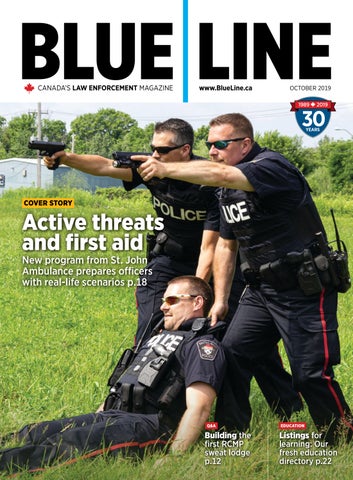
Active threats and first aid New program from St. John Ambulance prepares officers with real-life scenarios p.18
Q&A
EDUCATION
Building the first RCMP sweat lodge p.12
Listings for learning: Our fresh education directory p.22
Contents
18 October 2019 Volume 31 Number 8
Features 7
CACP 2019 in review
Canadian police chiefs and other law enforcement officials gathered in Calgary for the 114th Canadian Association of Chiefs of Police Annual Conference. See our photos! COVER STORY
18 Pumping up first aid training for law enforcement
The new Law Enforcement First Aid course from St. John Ambulance takes what an officer learns in their standard first aid training and enhances that knowledge to address intense situations. By Kevin McGowan
20 Cognitive apprenticeship in police training
Columns 4 12 14 15 16 24 26 30
Editor’s commentary Q&A Interviewing & investigations Holding the line Behavioural sciences Technology Case law Back of the book
Departments 5 5 8 8 27 28 29 30
By the numbers News Dispatches Calendar Off the shelf Product showcase Marketplace Blue links
The role of the coach officer or field training officer has never been more critical than it is today. Police training institutions must take an evidenced-based or evidenceinformed approach to learning in order to design and implement the best possible training curriculum. By Peter Shipley
22 Education & Training Directory
COVER PHOTO: ST. JOHN AMBULANCE
Check out our 2019-2020 Education & Training Directory for various options to bolster your resume, tool bag and more. Whether you’re looking for a job, want to swap careers or feed the lifelong learner inside, these listings can get you started.
12 @Blue_LineMag
20 24 October 2019 | BLUE LINE
3
EDITOR’S COMMENTARY BY RENÉE FRANCOEUR
Retiring police scanners from newsrooms
W
hat was the single most framework for responsible disclosure,” the terrifying device to me as Regina Police Service said in an emailed a greenhorn daily news statement, according to that article. reporter back in the day? It’s indeed time to retire the police scanThe police scanner. The bulky black box ners from newsrooms. with the red light had sat ominously on the We live in a world where social media assistant city editor’s desk. It was almost users are live tweeting positions of officers always on. And if you happened to be the during active threat situations, where Facelone wolf reporter in that weekend, it was book privacy lapses are routine headlines, up to you to make the call to follow-up where people are handing over personal with what you happened to hear. information through apps without a second I honestly tried to ignore the scanner. I thought in exchange for a peek at what have always been a better feature story they’ll possibly look like in 30 years. gatherer than an ambulance-chasing, hard “Personal information is a treasure news scooper. When push came to shove, I trove. Everybody wants it. And everyone preferred using various vetted sources on has the potential to abuse it. The possibilsocial media for real-time updates regarding ities are endless,” writes Ann Cavoukian, road incidents or reports of fires. The police the executive director of the Global Priscanner was just too raw with too much vacy and Security by Design Centre, in a uncertainty. I felt like a spy. Toronto Life article. Fast forward to 2019 and now Cavoukian was the Informamedia outlets in Regina and Sas- This tion and Privacy Commissioner katoon no longer have access to retention of for Ontario from 1997 to 2014 police scanner channels, joining control is and I interviewed her for a story many other Canadian municipal- necessary when I was writing about smart ities, like Toronto and Edmonton. and you as cities and CCTV for SP&T News The change in Saskatchewan law in 2017. She changed my undercomes to comply with the Local enforcement standing of privacy, data and Authority Freedom of Informa- agencies third-party usage, and subsetion and Protection of Privacy have a role quently the way I use my smartlegislation. Essentially, the servi- to play. phone. ces have to protect personal infor“Privacy isn’t about secrecy,” mation and the right to privacy. Things Cavoukian continued in the Life article. cannot be disclosed without consent. “It’s about retaining personal control over The act allows media and civilians to file your information—over your own life.” freedom of information requests to obtain This retention of control is necessary records not otherwise publicly disclosed. and you as law enforcement agencies have According to the Saskatoon StarPhoenix, a role to play. Police in Saskatchewan have Regina Police Chief Evan Bray sent a letter said they are still going to share informato the four media outlets in the city. In it, tion and that is the key here. he said information including names, adReporters, in my opinion, don’t rely on dresses, dates of birth, past criminal the scanners the way they did in the past. charges and other pieces of personal in- There are so many more tools now. Plus, formation were previously shared on the news hounds are trained to cultivate their dispatch channel. curiosity. They are always digging deep“Protecting the private information of er—or should be. They’re creative and individuals and maintaining the integrity of innovative, and so I have absolute faith investigations is not possible if all informa- they will find new ways to chase police tion held by police is made public; the story leads—with or without bulky black legislation recognizes this and provides a boxes in newsrooms.
CONNECT WITH BLUE LINE
www.BlueLine.ca 4
@Blue_LineMag
BLUE LINE | October 2019
www.facebook.com/BlueLineMagazine
BLUE LINE www.BlueLine.ca
GROUP PUBLISHER | MARTIN MCANULTY mmcanulty@annexbusinessmedia.com EDITOR | RENÉE FRANCOEUR rfrancoeur@annexbusinessmedia.com ACCOUNT MANAGER | JANICE EATON janice@blueline.ca MEDIA DESIGNER | SVETLANA AVRUTIN savrutin@annexbusinessmedia.com ACCOUNT COORDINATOR | TRISH RAMSAY tramsay@annexbusinessmedia.com CIRCULATION MANAGER | BEATA OLECHNOWICZ bolechnowicz@annexbusinessmedia.com Tel: 416-442-5600 ext. 3543 COO | SCOTT JAMIESON sjamieson@annexbusinessmedia.com
ANNEX BUSINESS MEDIA 111 Gordon Baker Road, Suite 400 Toronto, ON M2H 3R1 Tel. 416-442-5600 • Fax 416-442-2191
Publication Mail Agreement No. 40065710 ISSN 0847-8538 Printed in Canada SUBSCRIPTION RATES Canada — 1 Year $31.50; 2 Year $52.50 plus tax USA — 1 Year $105.00 USD CIRCULATION email: asingh@annexbusinessmedia.com Tel: 416-442-5600 ext 3553; Fax: 416-510-6875 or 416-442-2191 Mail: 111 Gordon Baker Road, Suite 400, Toronto, ON M2H 3R1 Occasionally, Blue Line will mail information on behalf of industry-related groups whose products and services we believe may be of interest to you. If you prefer not to receive this information, please contact our circulation department in any of the four ways listed above. Annex Privacy Officer Privacy@annexbusinessmedia.com; Tel: 800-668-2374 © 2019 Annex Publishing & Printing Inc. All rights reserved. Printed in Canada. No part of the editorial content of this publication may be reprinted without the publisher’s written permission. Opinions expressed in this magazine are not necessarily those of the editor or the publisher. No liability is assumed for errors or omissions. Readers are cautioned and advised that articles presented herein are edited and supplied for your personal awareness and should not be used for further action until appropriate guidance is received from a supervisor, Crown Attorney or other persons in authority. All advertising is subject to the publisher’s approval. Such approval does not imply any endorsement of the products or services advertised. The publisher reserves the right to refuse advertising that does not meet the standards of this publication.
NEWS WORLDWIDE
Researchers share actionable document on gender, policing and inclusion
Transit Safety Officer Cindy Shigetomi and her K9 partner Raiden at the UP Express terminal at Union Station in Toronto. PHOTO: MATT LLEWELLYN PHOTO: HAUS OF ZEROS ON UNSPLASH
GREATER TORONTO AREA
Metrolinx Transit Safety teams expand to include K9 unit
Metrolinx, a Crown agency that manages public transport in Ontario’s Golden Horseshoe region, has three new team members joining the safety unit this fall. And these ones come with top-notch noses. The company decided to train its own K9 team to investigate suspicious objects, taking some pressure off Toronto Police Service (TPS) detection dogs who have been working behind the scenes at Union Station—Canada’s largest and busiest multi-modal transit hub— since 2013, according to Metrolinx. The three dogs and their handlers hit their first patrols in late September after 12 weeks of training under the leadership of an experienced K9 sergeant and the guidance of TPS trainers. “As canine teams are proven resources at deterring danger and enhancing safety, this was a logical step in taking our efforts to the next level by partnering with TPS,” said Bill Grodzinski, the director of transit safety at Metrolinx. “Our canine officers and partners will be responsible for patrolling both Union Station in Toronto and the remainder of our network.” Metrolinx noted the teams’ sole function is dangerous material detection and they will continue to consult and work closely with
Metrolinx’ police partners on when they should be called in. SURREY
RCMP unveils new, state-of-the-art lab in B.C. PHOTO: RCMP
Each year, the RCMP says its National Forensic Laboratory Services (NFLS) processes thousands of requests from police agencies across the country for forensic services, in areas such as biology (DNA), toxicology, trace evidence, anti-counterfeiting, and firearms and toolmark identification. Back in July, the RCMP took ownership of its new laboratory facility in Surrey, B.C., which replaces the existing 45-year-old Vancouver laboratory. This facility, which is targeted to meet LEED Gold environmental standards, will feature “advanced” telecommunications systems and “specialized” workstations designed to fulfill lab operating requirements. In 2018-2019, NFLS processed 17,154 forensic service requests. The lab is scheduled to be at full operating capacity by this fall.
The scholars behind the inaugural Recruiting, Retaining, and Promoting Women Police Officers Conference/Workshop earlier this year at Wilfrid Laurier University in Brantford, Ont. have released their findings from the two-day event in the form of an “actionable document” for police organizations across the globe. The workshop sought to “to address the gap that exists around policy recommendations and their implementation by policing organizations” in regards to gender diversity and transform the “rich literature on barriers to recruitment, retention, and promotion of women police officers” into tangible recommendations. The document highlights “opportunities for change,” such as: targeting Science, Technology, Engineering, and Mathematics (STEM) programs to work towards developing a workforce with data literacy, computer and science training; creating programs that identify “agents of change;” and redefining competencies required for promotion. It also describes “out of the box ideas,” like examining weaknesses in current harassment protocol and problematizing “the ‘rules of the game’ by securing an alternative face to police leadership through a ‘Direct Entry’ system that appoints nonsworn/‘outsider’ officers.” To read the full document and share it with others, visit bit.ly/2k6RhjO.
BY THE NUMBERS A recent study by the Organization for the Prevention of Violence looked at extremist movements in Alberta. It is based on hundreds of interviews with law enforcement members, community members, service providers and former extremists. More at preventviolence.ca.
10%
rough estimate of the percentage of those who left Alberta to fight for armed groups overseas who have returned
@Blue_LineMag
150-250
2017
2018
Freemen on the Land, anti-authority extremists, in Alberta
600-700 Albertans considered themselves “members” of patriot and militia groups in this year
300-500 Albertans considered themselves “members” of patriot and militia groups in this year
October 2019 | BLUE LINE
5
NEWS SASKATOON
Okihtcitawak Patrol Group picks up fresh vests, gloves, flashlights & more from police
The Saskatoon Police Service, in conjunction with the Saskatoon Police Foundation, presented the Okihtcitawak Patrol Group (OPG) with additional equipment to help them keep people in Saskatoon’s inner-city safe. OPG, an Indigenous safety group of volunteers modeled after The Bear Clan Patrol in Winnipeg, was established in June 2018, after an attempted abduction of a 12-year old First Nation youth. On its Facebook page, OPG describes its mission as “acting as a harm reduction/prevention service,” and notes it strives to protect “the most vulnerable in our community.” Police Chief Troy Cooper and foundation board member Vera Pezer met with members of OPG to deliver newly purchased flashlights, knife resistant-gloves, identifying patches and vests. Earlier this year, the police service also outfitted the group with radios to be used while they are patrolling. ONTARIO
Cannabis Awareness video series provides more insight on use and abuse in the workplace
Emond Publishing and TNT Inc. Consulting Services, which provides various resources and training for policing and security professionals, have launched their “Cannabis Awareness Series.” The series features three videos: • Cannabis Awareness for the Workplace delivers an overview of cannabis, from basic recognition and terminology to the laws that control cannabis use in Canada with Det. John Margetson, a 27-year veteran of the Toronto Police. He serves as a supervisor with the Organized Crime Enforcement-Drug Squad. • Cannabis Use in the Workplace: A Manager’s Guide to the New Legislation outlines the challenges of cannabis use and abuse in the working environment. In this 19-minute video, professor Judy Hermann—who is also the co-ordinator for the Community and Justice Services Program at Centennial College in Toronto—walks the audience through how the new cannabis legislation impacts the workplace. 6
BLUE LINE | October 2019
The Saskatoon Police Service, with the Saskatoon Police Foundation, presented the Okihtcitawak Patrol Group (OPG) with additional equipment. PHOTO: SASKATOON POLICE SERVICE. • Conducting Internal Interviews: Dealing with Impaired Employees in the Workplace equips supervisors and managers with the knowledge and assessment skills to “tactfully approach difficult situations regarding employee impairment and misconduct” with Det.-Sgt. Stefan Prentice of the Toronto Police Service, Special Investigations Unit Liaison. For more information or to purchase these educational videos, visit emond.ca. GREATER TORONTO AREA
Trent University’s post-grad program is “missing link in police learning continuum,” says retired chief
Trent University-Durham GTA (Greater Toronto Area) has announced it now offers senior police leaders a program to train them in the ever-changing and complex accountability, legal and governance frameworks of police services and police services boards. The postgraduate certificate in senior police leadership, offered to practicing police leaders, both sworn and civilian, at the sergeant level and above, can be completed at Trent’s GTA campus in as little as 12 months, the school states. “I believe this program is the missing link in the police learning continuum around leadership and management,” says Murray Rodd, retired chief of police for the Peterborough Police Service, who was involved with the development of the program. “Policing has evolved to include more calls that used to be outside of police mandate and modern police leaders must also evolve with the times.” Dalhousie University in Halifax, N.S., also offers a variety of police leadership certificates online, including an Advanced Police Leadership certificate for officers of all ranks.
TORONTO
Head of police analytics helps launch Ryerson’s new certificate
Ryerson University’s Chang School of Continuing Education is now offering a new certificate for professionals in policing and law enforcement: certificate in crime analytics. Ian Williams. The school says this program, which was just approved to become certifiable this summer and kicked off in September, allows students to “gain practical GIS mapping, data analysis, and decision support, as well as broader foundational knowledge in criminal justice, policing, and criminal behaviour.” Ian Williams, head of analytics and innovation at Toronto Police Service, is the program instructor, a subject matter expert at the Chang School, and he helped prepare the business case. He said he’s always had hopes to see a multi-disciplinary certificate like this come to fruition. The program is designed to hone practical skills that will transfer seamlessly over into the workplace, Williams added, as there is a project component that will feature direct involvement with a police force. Students will also be provided with a critical understanding of the potential uses and misuses of data analysis. “The biggest benefit is just having a standardized program in crime analytics,” he said. “We hope to create a standardized level of expectations...other industries will benefit from these skill sets, too, such as large financial institutions, other security organizations, etc.”
Visit www.BlueLine.ca for the latest news, stories, products, videos, photo galleries and industry events.
www.BlueLine.ca
EVENTS
CACP 2019 focuses on backbone of organizations: “our people”
T
PHOTOS: R. FRANCOEUR
he Blue Line team grabbed their boots and hats for the 114th annual Canadian Association of Chiefs of Police (CACP) Conference in Calgary, Alta., featuring a human resources theme. “This year, we will focus our discussions on our people, the backbone of our organizations,” said CACP President, Chief Constable Adam Palmer. “This conference is about taking a thoughtful and critical look at what we do, how we do it, why we do it, and who is doing it. We will look at police practices, challenges and trends and how focusing on our people can create an environment to improve the health and safety of police officers and civilian members, thereby allowing them to focus on the health and safety of the communities they serve.” The conference theme, “From the top: A strategic HR approach,” translated into sessions on topics such as factors driving strategic human resource planning for the future police workforce; the specialization, civilianization or professionalization of today’s police services; modernizing training with technology; accommodations in a changing police environment; and dealing with high conflict personalities. The conference, which ran from Aug. 12-14, saw about 425 delegates attend and also included a policing trade show with more than 150 exhibits highlighting technology and other tools of the trade. In addition, six new resolutions were adopted by the membership. Next year’s CACP conference will take place in Victoria, B.C. See you there!
See more PHOTOS and a VIDEO from the event at www.blueline.ca/cacp-2019focuses-on-backbone-oforganizations-our-people/
@Blue_LineMag
October 2019 | BLUE LINE
7
NEWS DISPATCHES After a long and hard-fought battle, Russill Fairey passed away on July 25, 2019, at home. He was a proud retired detective-sergeant of the Toronto Police Service, spending the last 12 years of his career with the Hold-Up Squad. He was the recipient of the Canadian Banks Law Enforcement Award. Rest in peace. Peter Sloly (photo), who spent 27 years with the Toronto Police Service, resigning in 2016 at the rank of deputy chief, replaces former Ottawa police chief Charles Bordeleau, who retired earlier in 2019. Sloly was most recently a national security consultant for Deloitte.
Nishan “Nish” Duraiappah (photo), Halton police’s deputy chief of operations, is the next chief of the Peel Regional Police force. He takes over from Chris McCord who was appointed interim chief. Halifax District RCMP welcomes Insp. Sean Auld as the new Operations Officer (west) to Halifax District. Auld was previously with Halifax Regional Police and brings 30 years of experience. Insp. Baltej Dhillon is retiring from the RCMP after nearly 30 years with the force. He was the first officer to wear a turban as part of the RCMP uniform. He’s beginning a new role with the Combined Forces Special Enforcement Unit of British Columbia. Cobourg Police Chief Kai Liu is moving on after accepting a position as chief of police with the Treaty Three Police Service in northern Ontario. Deputy Chief Paul VandeGraaf (photo) has been appointed chief designate. VandeGraaf, who has 28 years’ worth of experience, will be sworn in as the 13th chief of police in the 159-year-history of the Cobourg Police Service. He was previously deputy chief at Belleville Police Service. 8
BLUE LINE | October 2019
CALENDAR Halifax District RCMP is under new leadership with the arrival of Chief Supt. Janis Gray to the position of Officer-in-Charge. A 32-year member of the RCMP, Gray arrived in Nova Scotia after holding the position of director of the RCMP’s Canadian Air Carrier Protective Program and was also the chair of the International In-Flight Security Officer Committee. Saanich Police Chief Bob Downie (photo) has retired after working almost 40 years in law enforcement. Chief Constable Scott Green now takes the reins. Retired Chief Robert P. Johnston of the Royal Newfoundland Constabulary passed away on July 8 after a courageous battle with cancer. Chief Johnston had a significant career with the RNC, stated Chief Joseph Boland in a press release, moving consistently through the ranks from sergeant in 1988 up to his appointment as the 20th chief of police in 2010, a position he held until his retirement in 2014. Chief Johnston is a recipient of Her Majesty Queen Elizabeth II Golden and Diamond Jubilee Medals, and many other awards. Rest in peace. Lethbridge Police Chief Rob Davis accepted a new position as the chief of police in Brantford, Ont., Davis’ home province. Davis has been serving as chief in Lethbridge since January 2015. Camrose Police Service in Alberta has appointed Dean LaGrange as the new chief. LaGrange retired from the Calgary Police Service after 26 years at the rank of inspector and joined the RCMP in Red Deer for 18 months prior to this new role. PROMOTIONS, RETIREMENTS, RECOGNITION • If you have an officer in your agency recently promoted or retiring or an individual you wish to have recognized (major award or recently deceased) you can let Blue Line magazine know by emailing: rfrancoeur@annexbusinessmedia.com.
Atlantic Women in Law Enforcement Annual Training Conference Oct. 15-18, 2019 St. John’s, N.L. www.awle.org Charity Art Show: Police Artists of Peel Oct. 19, 2019 Brampton, Ont. bit.ly/2kD8UIk Crisis Negotiators Course: Canadian Critical Incident Inc. Oct. 21-25. 2019 Barrie, Ont. canadiancriticalincident.com Canadian Police Chaplain Association Annual Training Seminar Oct. 21-25, 2019 Halifax, N.S. canadianpolicechaplains.com Unmanned Canada Oct. 30-Nov. 1, 2019 Ottawa, Ont. www.unmannedsystems.ca Congress 2019: 100 Years of Criminal Justice Nov. 6-9. 2019 Quebec City, Que. ccja-acjp.ca/pub/en/event/congress2019-100-years-of-criminal-justice Ottawa Police Gala Nov. 9, 2019 Ottawa, Ont. www.ottawapolice.ca CACP Counter-Terrorism and National Security Forum Nov. 13-14, 2019 Ottawa, Ont. cacp.ca/ctns-forum.html?mid=281 CATAP Workshop and Conference Nov. 13-17, 2019 Niagara-on-the-Lake, Ont. catap.ca/Violence-Prevention/Events Ontario Gang Investigators Association (ONGIA) Conference Nov. 18-22, 2019 Huntsville, Ont. ongia.org www.BlueLine.ca
S/Sgt. Dan MacLean wins Dalhousie’s Bruce MacPhail Award for 2019 The Sgt. Bruce MacPhail Award for Academic Excellence is presented to the municipal police officer who achieved the highest overall average in a concentration certificate within the Police Leadership Program at Dalhousie University in the past academic year. MacPhail began his career with the Amherst Police Department in Nova Scotia and in 1982 he became one of the first police officers with the newly formed Bedford Town Police. He continued on with Halifax Regional Police after amalgamation, eventually heading up their first Auto Theft Unit. He completed the certificate in “Police Leadership - Supervisory Skills” in 2000, and was the first to graduate as a certified police coach in the program. MacPhail passed away in June 2001 after a short and courageous battle with cancer. Phyllis MacPhail established the award in 2001 in memory of her son. S/Sgt. Dan MacLean of the Peterborough Police Service is the 2019 recipient of the Sgt. Bruce MacPhail Award for Academic Excellence in Dalhousie University’s Police Leadership Program. MacLean began his policing career with the Peterborough Police Service in 1989 and was responsible for starting the Police Services Auxiliary Unit, which has since grown to over 30 members with four supervisors. He was promoted to sergeant in 2009 and staff sergeant in 2016 where he has supervised officers both in Uniform and the Criminal Investigations Unit. He has recently completed the Incident Commanders Course and is now a qualified Incident Commander. S/Sgt. MacLean completed a Certificate in Police Leadership with a concentration in Administration by taking Dalhousie University online courses in police leadership, management, budgeting and human resource management. Congratulations S/Sgt. MacLean.
Dalhousie University Police Leadership Graduates Fall 2018 – Spring 2019
Service Delivery Certificate Cpl. Micheal Berns RCMP, Depot Div., SK Sgt. Blaine Ellerby Calgary Police Service, AB Insp. Rodney Franklin RCMP, “E” Div. HQ, BC Sgt. Sushile Sharma RCMP, “E” Div. HQ, BC
Law and Justice Certificate A/Sgt. Rupi Bansi RCMP, Surrey, BC Det/Cst. Jeremy Brewster York Regional Police, ON Cpl. Lesley Devereaux RCMP, Major Crimes Unit, NL Sgt. Tim Fralick RCMP, Gang Enforcement Team, AB S/Sgt. Holly Glassford RCMP, Northeast Nova District, NS Sgt. Burton Jones RCMP, “F” Div., SK
Det/Cst. Dave McKay London Police Service, ON Sgt. Chris D. Smiley RCMP, Ponoka, AB Cst. Christopher Stuckless RCMP, Yellowknife, NT Cpl. Jonathan White RCMP, Codiac Det., NB
Administration Certificate S/Sgt. Shawn Begg RCMP, Prince George, BC Cpl. Andrew Brand RCMP, Dawson Creek, BC S/Sgt. Kurt Grabinsky RCMP, Revelstoke, BC Det. Sean Hackman New Westminster Police Dept., BC Insp. Mary Henderson Kennebecasis Regional Police Force, NB Sgt. D’Arcy Hueston Halifax Regional Police, NS
S/Sgt. Dan MacLean Peterborough Police Service, ON Cpl. Tara Mason RCMP, Dawson Creek, BC Insp. David Michaud Cornwall Police Service, ON Sgt. Kevin Peterson RCMP, Red Deer, AB Cpl. Carolyn Shaffner RCMP, Wood Buffalo Det., AB Insp. Bruce Singer RCMP, “E” Division HQ, BC
International Policing & Security Sgt. Dana Cuff York Regional Police, ON Cpl. Michael Smook RCMP, Depot Div., SK
Advanced Police Leadership Cst. A.B. Richardson RCMP, Red Deer, AB
This list is not exclusive. Some students could not be contacted and for reasons of privacy and security some did not wish to have their names included. The Staff and Faculty of the Police Leadership Program want to congratulate all graduates on their success.
DALHOUSIE’S CERTIFICATE IN POLICE LEADERSHIP
Become the leader you know you can be
Built for modern policing, our online courses, designed and delivered by academics along with industry experts and leaders in policing, give you the knowledge and skills to advance in your profession. Learn from the innovator in quality police education for over 25 years. WINTER TERM STARTS JANUARY 29
DAL.CA/POLICELEADERSHIP
CCE
College of Continuing Education
October 2019 | BLUE LINE
@Blue_LineMag BL_Oct19_Dalhousie.indd 1
9
2019-09-13 1:56 PM
SPONSORED CONTENT Blueline sat down with Ken Tuckey, Senior Manager, National Fleet and Commercial Vehicles at FCA Canada to discuss the full FCA Law Enforcement Lineup, and each vehicle’s features and benefits to meet the complex needs of law enforcement agencies.
Given the incredible diversity of Canada’s landscapes how well do you see the Ram 1500 functioning in those environments? It’s important to keep in mind that policing doesn’t just take place in an urban setting. It can happen anywhere. Some assignments go well beyond conventional terrains. When those assignments and geography require the capability of a full-size truck, well, we’ve got the answer: the Ram 1500 Classic Special Service pickup. It packs a powerful 5.7L HEMI® V8. It features Variable Valve Timing (VVT) for improved performance and fuel-economy; fuel-economy that’s also helped by our Multi-Displacement System Fuel Saver Technology. All of that gives the Ram Special Service some pretty impressive performance figures: 395 hp with 410 lb-ft of torque, a standard payload capacity that tops out at 694 kg (1530 lb) and up to 4636 kg (10,220 lb) of towing capability. One other thing - the Special Service also features a standard 4X4 transaxle. It’s everything you’ll need for any and all kinds of terrain.
gives the driver a clear view of the area behind the vehicle and helps to make parking safer and much easier. Can you talk about the two engines that are offered on the Dodge Durango Enforcer? Sure. Durango Enforcer offers a 3.6L PentastarTM V6 and the 5.7L HEMI® V8. The Pentastar V6 is Canada’s Best-Selling Engine. Both engines come with a proven 2-speed transfer case. The Pentastar V6 delivers an impressive 293 hp/260 lb-ft of torque and includes very fuel-efficient Stop/Start technology. It also features an 8-speed automatic transmission that delivers incredibly fluid, smooth performance. The 5.7 HEMI V8 engine delivers 360 hp and 390 lb-ft of torque. That’s the kind of strength and acceleration that police work demands. It also features the incredibly fuel-efficient FuelSaver Technology. Factor in the standard 2-speed transfer case with the 5.7L HEMI V8, and your team is ready to take it all on.
What interior features make the Dodge Durango Enforcer a good fit for police work? For a start, the 2019 Durango Enforcer has an expanded interior which will make officers a lot more comfortable. As well, the rear area is higher off the ground, is easier to access and delivers generous usable cargo room—1351 L (47.7 cu ft) with the second-row seat up; and 2393 L (84.5 cu ft) when the seat is folded down. The Dodge Durango Enforcer features an inWhat makes the Ram 1500 Classic terior that’s remarkably well lit: it’s got a glovebox Class-Exclusive RamBox Cargo light, front-fixed LED map lights, second-row dirManagement system so valuable to ectional LED map lights, door lights, an overhead police forces across Canada? console light, rear passenger overhead reading Great question. The RamBox Cargo Management lights, a cargo compartment light and ambient System is designed around pure, police-specific LED lighting for the interior front door handles practicality. On each side of the fully functional and map pockets. cargo bed you’ll find two waterproof, lockable, drainable and illuminated storage bins. Designed Talk to me about some of the safety for complete versatility, they’re ideal for trans- features that are key to making porting supplies. One added advantage: they Dodge Durango Enforcer an excellent each accommodate a number of Accessories policing vehicle. from Mopar®, including made-to-fit holsters that There are so many. For instance, there’s the secure shotguns and long rifles. heavy-duty four-wheel disc brakes that help provide increased vehicle stability and brake Everyone appreciates how police performance by helping to prevent wheel lockup. forces work hard to protect their That’s even under the most difficult braking concommunities around Canada. ditions. There is also Electronic Stability Control. Can the Ram 1500 help protect law enforcement? Which is? Actually, the Ram 1500 Classic is outfitted with It detects a difference between steering input several crucial safety features. All-Speed Traction and the vehicle’s movement during extreme Control determines when to apply the brakes to steering maneuvers. Then it applies the brakes one or more of the driven wheels, and when to and reduces engine throttle to help the driver reduce engine torque in the event one or more maintain directional control. wheels lose traction. This traction system helps the driver stay in control; even under the most Impressive. demanding conditions. It also has a feature we We think so. The Durango Enforcer is also call the ParkView® Rear Back Up Camera. This equipped with something called Trailer Sway 10
BLUE LINE | October 2019
Control which recognizes excessive sway in a trailer and adjusts the throttle and applies brake pressure to help keep the trailer and vehicle under control. Last but not least, something called Ready Alert Braking, which anticipates situations when the driver may initiate an emergency stop and sets the brake pads against the rotors, decreasing the time required for full brake application. The Durango Enforcer is no slouch in the capability department either. It comes with standard AWD that offers serious traction and road manners on a wide variety of streets and road surfaces. With performance and capability being top of mind for law enforcement officers, what are the engines that help Dodge Charger Enforcer navigate diverse terrain, year after year? Well, I’ve already mentioned the 3.6L Pentastar V6. It’s Canada’s Best-Selling Engine for a reason. In the Charger Enforcer it can churn out 292 hp/260 lb-ft of torque and features fuel-saving Stop/Start technology. Our optional 5.7L HEMI® V8 puts out 370 hp/395 lb-ft of torque and its Multi-Displacement System (MDS) FuelSaver Technology offers excellent fuel economy. Both engines are mated to the police-specific 5-speed automatic transmission with column-mounted shifter. What interior features make the Dodge Charger Enforcer unique to law enforcement drivers and occupants? The Dodge Charger Enforcer does a terrific job of addressing your comfort and well-being. Police-specific things like front seats that are sculpted to accommodate a full-service duty belt. All the controls and instrumentation are designed to be touch and eye-friendly. The touchscreens feature full-colour displays that convey critical information with fingertip simplicity. Everything has been thought of. There’s also a large and spacious trunk with plenty of room for police equipment. What safety features make the Dodge Charger Enforcer, the standout choice for our fleet forces? One of the more impressive features comes with the available Officer Protection Package. This technology uses a rear-facing camera and sensors to detect any movement behind the vehicle. When motion is detected, alert chimes sound, lights flash, windows roll up, doors lock and images automatically appear on the vehicle’s Uconnect® interactive touchscreen. It’s extraordinary, really. Ken, thank you for your time. My pleasure. www.BlueLine.ca
2020 DODGE CHARGER ENFORCER The most technologically advanced all-wheel-drive (AWD) system in its class.*
2020 DODGE DURANGO ENFORCER Fuel-efficient 8-speed automatic transmission.
2020 RAM 1500 CLASSIC SPECIAL SERVICE Powerful 395 horsepower, 410 lb-ft of torque.
MORE TORQUE. MORE TRACTION. MORE TECHNOLOGY. fcacanada.ca/fleet *Based on current competitive information for 2019 Ford Interceptor Sedan.
1 800 463-3600
Q&A RCMP Cpl. De-Anne Sack is a policing analyst for H Division in Nova Scotia and a member of Sipekne’katik First Nation. She was the driving force behind erecting a sweat lodge at the RCMP’s headquarters in Halifax last fall, which provides employees “a place for thought and contemplation.” She tells Blue Line she’s proud of the RCMP for supporting the initiative. Q: Why did you decide to choose a career in law enforcement?
Q: How long have you been with the force?
I’m into my 23rd year of policing and have worked in a variety of different roles: operational, crime prevention, supervisor-team leader, detachment commander and Aboriginal analyst in HQ.
Q: You began facilitating sweat lodge ceremonies at an RCMP training facility five years ago. Why? As frontline police officers, there are many heart-wrenching events in our careers that we cannot un-see. They have a lasting effect on us. I turned to ceremony to start my healing journey and ceremony has saved my life. I am a Sundancer with the White Eagle Sundance and this is where I obtained my traditional teachings. When I started my role as the Aboriginal Policing Analyst with Nova Scotia RCMP, one of my responsibilities was the Indigenous Perception Training. Introducing our employees to the scared sweat lodge was an important component for the candidates. We wanted to create awareness, understanding and, most importantly, respect. As a result of having a sweat lodge during the Indigenous Perceptions Training, employees became very interested and wanted to experience more sweat lodge ceremonies.
Q: How long did it take to see this sweat lodge constructed? 12
BLUE LINE | October 2019
Q: What is your most memorable moment from the experience ?
I would have to say the most memorable moment from the sweat lodge was during the first ceremony when a dispatcher RCMP Commissioner Brenda Lucki, left, visits gifted the lodge her father’s tobacco. She with Cpl. De-Anne Sack at the sweat lodge. requested prayers because his health was deteriorating. Another time was when RCMP Commissioner Brenda Lucki came to visit the lodge. What is most memorable is when an employee enters the lodge for the first time with uncertainty and leaves the lodge with a full heart, feeling refreshed and enlightened. That’s the magic of ceremony.
Q: How many take part on any given last Thursday of the month? Approximately six to 10 people attend.
Q: This is part of reconciliation, you have said. How it is working to repair relationships?
Cpl. Sack is a Sundancer with the White Eagle Sundance, which is where she obtained her traditional teachings.
The construction of the lodge took three days with a lot of help from like-minded members and several other Sundancers. The materials used are birch trees, wool blankets, a tarp and lots of rope and string to secure the blankets to the frame of the lodge.
Q: Did you experience any challenges in seeing this project become a reality?
To be honest, there are a few challenges
I mentioned the sweat lodge saved my life and that it is a way of life for me and for many others. The sweat lodge represents a mother’s womb and it is the safest place to be. The sweat lodge at HQ provides teachings, even when it is not in use. Each time a person walks by the sweat lodge and asks about it, it gives me an opportunity to educate them on the lodge and ceremony. This creates an understanding for RCMP employees who might encounter a lodge in their future postings. It ensures that they will know and respect the ceremonial etiquette for the sweat lodge, having been already exposed to it. We are very fortunate to have this in Nova Scotia and I am proud of this division’s commitment towards reconciliation. www.BlueLine.ca
PHOTOS: RCMP NOVA SCOTIA
I grew up in Sipekne’katik, which is a few kilometres from a former residential school, and I bear witness to the issues that result from the tragedies my people endured while attending the residential school. I chose a career in law enforcement because I wanted to make a difference in our communities by changing the narrative of the stereotypical police officer.
with the sweat lodge, such as the lodge being too close to the building. Depending on the weather conditions, smoke permeates throughout the building causing concerns for some employees.
THE STL’ATL’IMX TRIBAL POLICE SERVICE EMPLOYMENT OPPORTUNITIES *Experienced Officers* The Stl’atl’imx Tribal Police Service is seeking experienced Police Officers to join our team. Process for Experienced Canadian Police Officers in BC You may be eligible as an exempt candidate if you are a currently employed member (or have been so employed in the past two years) of a Canadian Police Force whose training and minimum standards are equivalent to that of 2 years service & completion of Block IV with a BC municipal Police service. 1. 2. 3. 4. 5.
Applicants must have a minimum of two years of experience. (Block IV equivalent) Submit a complete application package and disclosure form. You will then be invited to a comprehensive interview, psychological test, polygraph, physical abilities test and medical exam. If successful, you will have an interview with the Sergeant of Recruiting, who will determine if you move forward to a background investigation. The Recruiting Sergeant will request permission to contact your references and ask that you provide a minimum of two letters of endorsement from current and past supervisors. You will need to provide written documentation supporting your police experience.
Process for Experienced Canadian Police Officers Outside BC Our Recruiting Sergeant makes every effort to reduce the amount of travel for our applicants, but please expect to make at least two trips to Lillooet. 1. 2.
Applicants are to submit their application to: Sergeant Dale Austinson Stl’atl’imx Tribal Police Service PO Box 488 Lillooet BC, V0K 1V0 Fax: 250-256-4600 Email: dale.austinson@ stlatlimxpolice.ca
3. 4. 5.
Members serving outside BC are required to write a BC Exemption Exam in order to be eligible. Approval to write the Exemption Exam is granted by BC Police Services. Applicants from outside BC are also required to pass the POPAT physical test. If you are successful you will be invited to a comprehensive interview, psychological test, polygraph, and medical exam. If you are successful, you will have an interview with the Sergeant of Recruiting, who will determine if you move forward to a background investigation. The Recruiting Sergeant will request permission to contact your references and ask that you provide a minimum of two letters of endorsement from current and past supervisors. You will need to provide written documentation supporting your police experience.
Please note that any member hired by the Stl’atl’imx Tribal Police Service is hired on a probationary basis for the term of one year. Any increments or wage increases reflect your date of hire with the STPS only. **Pursuant to section 41 of the BC Human Rights Code, preference may also be given to applicants of Indigenous Ancestry**
INTERVIEWING & INVESTIGATIONS BY KERRY G. WATKINS, LL.M.
Dealing effectively with suspect ultimatums during police questioning
I
t is not unusual for a suspect who is being questioned by police to issue an ultimatum; to say to the investigator that if they persist with a certain line of questioning, the suspect will fully exercise their right to silence and stop talking. The question for investigators is how to deal effectively with such ultimatums. Police have a duty to investigate, which includes questioning suspects, and the law is clear that they may be persistent when doing so. However, persistence alone, unless guided by an informed questioning strategy, can result in suspects who make good on their ultimatums and shut down entirely when questioned about certain issues. In response to this type of resistance some investigators simply give up, while others adopt verbally aggressive approaches. Neither type of response is likely to be successful in maximizing information from suspects during investigative interviews. However, there are a number of steps investigators can take to deal effectively with suspect ultimatums. Professor Deepak Malhotra, of the Program on Negotiation at Harvard Law School, suggests that the best way to deal with an ultimatum is to simply ignore it. Ignoring an ultimatum prevents it from becoming a defining feature in an interaction, a stumbling block over which it is difficult to pass. If it is possible for an investigator to ignore the suspect’s ultimatum by simply continuing on with their line of questioning — assuming the suspect continues to engage in dialogue — that is what they should do. However, in circumstances where the suspect is insistent and their ultimatum cannot be ignored, there are four steps investigators can take to improve their chances of creating and maintaining a productive dialogue with suspects. Step 1.) Positively acknowledge the suspect’s ultimatum. An investigator might say something like, “Thank you. I appreciate you telling me that if I continue to question you about certain areas you will stop talking to me. It shows me that you understand your legal rights — including your right to silence — which you may exercise at any time.” Step 2.) Validate the suspect’s concerns. An investigator might say something like, “I am not in your position and I never have been, but I imagine that if I were, I might 14
BLUE LINE | October 2019
feel the same way you do about being questioned by police.” Step 3.) Reframe the suspect’s ultimatum from an absolute position to one that’s contingent on the stage of the interview and the information the suspect currently possesses. An investigator might say something along these lines: “I understand that with the information you have right now, you feel it would be difficult to continue talking to me if I ask you certain questions, and I respect that. All I ask for the moment is that you listen carefully as I share some information about the investigation with you.” Reframing the suspect’s ultimatum transforms it from a fixed position, to a position that is contingent on the suspect’s current understanding of the investigation, which may, of course, change as the interview progresses and the investigator shares more information with the suspect.
Ignoring an ultimatum prevents it from becoming a defining feature in an interaction, a stumbling block over which it is difficult to pass. Step 4.) Give the suspect options about how they may choose to respond. An investigator might say, “I am going to explain why you were arrested and why you are a suspect in this matter. And I am going to share some of the evidence we have gathered. You can comment as I am explaining things; you can respond when I have finished sharing the information with you; or, you can choose to say nothing at all. It’s entirely up to you.” Typically, the suspect will already have a basic understanding of the issues, but that understanding may change as the investigator shares more information with them. Research suggests that “priming” certain interviewee motivations (such as trust and feelings of security, for example) leads to increased disclosure of information. In this case, emphasizing to the suspect that they are free to engage with the interviewer as they learn more about their situation, can increase the chances of them doing so by priming their feelings of autonomy and bias for action in response to the disclosure of information. It can also result in the suspect
feeling less like they have “given in” if they choose to talk to the interviewer (and it, therefore, increases the chances of them doing so), because their choice was made freely and on the basis of a better understanding of their situation than they had when they issued their ultimatum. When giving the suspect options about how they may choose to respond during the interview, the investigator must be careful not to make any quid pro quo offers; that is, any threats or promises that are contingent on the suspect’s choice of whether or not to talk. Any inducements of this kind, particularly if they infer a legal benefit, will be closely scrutinized by a court in determining the admissibility of the suspect’s statement should they choose to give one. When introducing evidence during a suspect interview, it should be done strategically. Research indicates that evidence should be introduced later in the interview process, not at the beginning. When introducing evidence, an investigator should do so incrementally: moving from the weakest, least specific to the strongest, most specific evidence. And care must be taken not disclose any “hold back” evidence. Investigative interviewers can deal effectively with suspects who issue ultimatums by following the four steps described above. Those steps can be easily remembered using the mnemonic AVRO: acknowledge and validate the suspect’s position; reframe the suspect’s ultimatum; and, provide the suspect with options about how they may proceed during the interview.
References
Malhotra, D., (2016) Negotiating the Impossible. Berrett-Koehler Publishers. Oakland: CA. Neequaye, D., (2018) Subtle Influence and Information Disclosure: How Priming Works in Intelligence Interviews. Centre for Research and Evidence on Security Threats. Comment. June 4th, 2018. crestresearch.ac.uk/comment/neequayesubtle-influence-how-priming-works. Kerry Watkins conducted more than 2,000 interviews during his 30-year career, the majority of which was spent as a criminal investigator in specialized units investigating a wide range of matters, including police corruption, corporate fraud and homicide. He is currently director of The Interview Group, a professor at Humber College and an adjunct faculty member in the Ongoing Professional Development Program at Osgoode Hall in Toronto.
www.BlueLine.ca
HOLDING THE LINE BY MICHELLE VINCENT
Mental healthcare that “works smart”
T
raditionally, we have been reactive in our approach for mental healthcare. We are reactive in a lot of what we do in the world of policing. Whether it is addressing cultural issues with mental health that plague us or mental healthcare in general, we tend to meet proactive change with suspicion and immediate criticism. This is understandable as we are expected to make snap decisions, often life-threatening ones, in a moment’s time. However, this does not always serve us well. When we explore the available options in mental healthcare, we are not always doing so with a clear mind. We may be coming from a place of pain, confusion and/or anxiety when we have a need for a mental health resource. I have spoken in past columns of how We live in an we do not need to reinvent the wheel evolved world. when it comes to providing these types of Now we services for first responders. A safe place understand we where healing and reprieve can occur in must be an oasis with leading edge, therapeutic working smart approaches at a reasonable cost should instead of not simply be a dream. The wonderful working hard. thing is this type of model currently exists in the organization Maison La Vigile in Quebec. The model not only exists, but it is a success. It has also been saving and enriching lives for seven years for first responders and uniform personnel. We live in an evolved world. Now we understand we must be working smart instead of working hard. Yes, we may forget that at times and end up working hard once again as we attempt to resolve a particular dilemma. However, we are quickly reminded of the power of working smart as we experience resistance to the easy-to-burn-out, working hard approach. It is no different in how we provide care for a specialized group, like police officers. That care must be smart care. Maison La Vigile is such an example of a non-profit working smart in how it provides occupational-specific mental health support on an inpatient/outpatient basis—exclusively to first responders and uniform personnel. The cost of the care they provide, which is second to none in my opinion, is supported by L’Association des policières et policiers provinciaux du Québec (APPQ), which has their members deduct $5 from each paycheck. In turn, its members are given free access to Maison La Vigile at any time. It is like an insurance of sorts that grants them 24/7 access to occupationally-specific healthcare with the peace of mind they are with others who have experienced similar traumas. While many in need end up waiting for a workplace compensation board to cover some of the exorbitant costs of an inpatient stay—and one that is not occupational-specific at that—Maison La Vigile provides a free-of-cost opportunity to the members of the associations it has partnered with. In discovering the work smart concept at Maison La Vigile, police officers and crisis workers have recognized there is a great need to bring a similar concept to Ontario and so the founding of The Haven, Maison La Vigile’s Chapter II, is well in the works. The Haven has recently become a registered non-profit organization and has launched an official website, separate from La Vigile’s (thehaven.cloud). Equine-assisted therapy, group ther-
apy, writing therapy and customized, evidence-based programming will all be a part of The Haven’s vision. The Haven will also offer bilingual services, a welcome directive after a recent CBC news story highlighted the lack of a guarantee of access to PTSD services for English-speaking first responders and uniform personnel in Quebec. Right now, The Haven is looking for your associations’ support to establish a location on a large acreage property somewhere within 45 minutes of the Toronto Pearson International Airport in Mississauga. This target area should help with The Haven’s objective to be accessible for all first responders and uniform personnel serving in northern, eastern and western Canada, with a focus on Ontario. Mental health has to be part of the conversation when we talk about working smart for first responders, call-takers and dispatchers. Mention The Haven to your association and let’s make this happen! Michelle Vincent is a 17-year York Regional Police officer in the process of implementing the first non-profit treatment centre that will be occupationally specific for first responders. She is working towards her PhD in Forensic Psychology/Crisis Response. She can be contacted at: michelle@vincent.net
ONGIA 2019 GANG AND ORGANIZED CRIME PROFESSIONAL DEVELOPMENT CONFERENCE
NOV 18-21, 2019
HUNTSVILLE, ONTARIO VENUE Deerhurst Resort, Huntsville, Ontario
ACCOMODATION A wide variety of accommodation options are available starting at $150 Including resort fee + HST
REGISTRATION FEE $300 + HST* (Early bird registration)
This year’s conference will focus on the collection of evidence in relation to street gangs. The difference between intelligence, information and evidence will be explored, as well as the methods and networks used by today’s gangs. As a delegate, you will learn from a network of experienced practitioners and gain knowledge, tools and techniques that are beneficial to you and your agency.
Full conference details are posted at www.ongia.org.
October 2019 | BLUE LINE
@Blue_LineMag BL_ONGIA-Ad_OCT2019_SVA.indd 1
15
2019-09-17 10:34 AM
BEHAVIOURAL SCIENCES BY DR. PETER COLLINS
Understanding paraphilic disorders & the impact on criminality: Part one*
B
y definition a paraphilic disorder involves having a sexual desire or behaviour that causes another person’s psychological distress, injury or death, or a desire for sexual behaviours involving unwilling persons or persons unable to give legal consent. An individual who has the disorder may feel personal distress over their interests, not merely distress resulting from society’s disapproval.1 There are three categories: the deviant behaviour is directed towards children and other non-consenting individuals; involves the pain and humiliation of oneself or one’s partner; or involves fetish items (an attraction to certain parts of the body or inanimate objects). An individual can be diagnosed with a paraphilia solely based on their deviant fantasies. Not everyone with deviant fantasies will necessarily act out on them. Having a deviant fantasy is not illegal and not all paraphilias are illegal, if acted out. However, the line is crossed if the victim does not consent. For example, frotteuristic disorder, which involves rubbing one’s genitals up against another person or a child; in a sexual manner in a crowded area, is illegal because no consent was given. In addition, children can never provide consent. Some experts claim that there are over 500 distinct aberrant sexual behaviours. The DSM 5 (Diagnostic and Statistical Manual of Mental Disorders, fifth edition) concentrates on eight specific paraphilic disorders: voyeurism, exhibitionism, frotteurism, sexual masochism, sexual sadism, paedophilia, fetishistic activities, and transvestism. This is because they are relatively common and some of them involve behaviours because of their noxiousness or potential for harm to others if acted out. Transvestism is included because it may cause
16
BLUE LINE | October 2019
distress for the person who meets the criteria for the diagnosis.
Paedophilia
Although the most common sexually deviant activity in society is exhibitionism, the most common paraphilia seen in a clinical setting is paedophilia. It is also one of the most disturbing. Paedophilia is the erotic attraction to prepubescent children. There are a couple of subsets. Hebephilia is the sexual attraction to children who have reached the early stages of puberty. Infantifiles are people who are aroused with the fantasies of having sex with children who are younger than five years of age; and a subset is nepiophilia – the sexual interest in infants. It is a deeply engrained erotic attraction that is hard-wired. Paedophilia can be treated with a combination of psychotherapy and/ or sex drive-reducing medication but it cannot be “cured.” Not all paedophiles are child molesters and not all child molesters are paedophiles. As noted above, some paedophiles do not act out on their fantasies but are at higher risk for doing so than the rest of the non-paedophilic population—especially when they are disinhibited by drugs or alcohol, or when they are under stress. Some personality disordered individuals may have an attraction to adults but, for a variety or reasons, will sexually offend against children. Paedophiles can also have a particular style of thinking that will allow them to justify and rationalize their offending behaviour. These are known as cognitive distortions.
Paedophiles can also have a particular style of thinking that will allow them to justify and rationalize their offending behaviour. These are known as cognitive distortions.
Child pornography
What role does child abuse imagery play in the life of a paedophile? Seto et al (2006)2 examined a sample of 685 male patients who, between 1995 and 2004, were referred for a sexological assessment, including sexual preference testing.
*Content/trigger warning: paedophilia, child molestation, child pornography, sexual content
As a group, child pornography offenders (those who possessed, received and/or distributed child abuse images) showed greater sexual arousal to children than to adults and differed from groups of sex offenders against children, sex offenders against adults, and general sexology patients. The results suggest child pornography offending is a stronger diagnostic indicator of paedophilia than is sexually offending against child victims. This is because men who sexually victimize children are a heterogeneous group – some will be paedophiles and some will be opportunistic or situational offenders. Child pornography offending is a proxy diagnosis for paedophilia. The demand for child pornography leads to the victimization of children, worldwide, as well, because of the demand for newer and novel child abuse images. The victims of child pornography continue to be victimized as their images can be available, on the internet, in perpetuity. It is a myth that child pornography offenders only view the images and are not hands-on offenders. This is based on the research by Bourke & Hernandez (2009).3 This study compared two groups of child pornography offenders participating in a voluntary treatment program: men whose known sexual offense history at the time of judicial sentencing involved the possession, receipt and/ www.BlueLine.ca
or distribution of child abuse images, but did not include any “hands-on” sexual abuse; and men convicted of similar offenses who had documented histories of hands-on sexual offending against at least one child victim. The goal was to determine whether the former group of offenders were “merely” collectors of child pornography and at little risk for engaging in hands-on sexual offenses, or if they were contact sex offenders whose criminal sexual behaviour involving children, with the exception of internet crimes, went undetected. Bourke and Hernandez showed that the internet offenders in their sample were significantly more likely than not to have sexually abused a child via a hands-on act. They also indicated that the offenders who abused children were likely to have offended against multiple victims and that the incidence of “crossover” by gender and age is high. Bouke and Hernandez’s (2009) finding that a high percentage of child pornography offenders can also be handson offenders has been replicated in other studies including Delisi et al (2016).4 In next month’s issue, other paraphilic behaviours will be discussed including the fact that sexually deviant individuals don’t “specialize” in just one deviant acBL_Jan_Spirito.indd 1 tivity. The majority have cross-associated sexual deviances.
References
1 American Psychiatric Association (2013) “Paraphilic Disorders”. Diagnostic and Statistical Manual of Mental Disorders (Fifth Edition) American Psychiatric Publishing - pp. 685-686. 2 Seto, M. C., Cantor, J. M., & Blanchard, R. (2006). Child pornography offenses are a valid diagnostic indicator of pedophilia. Journal of Abnormal Psychology, 115(3), 610-615. 3 Bourke, M. L., & Hernandez, A. E. (2009). The ‘Butner Study’ redux: A report of the incidence of hands-on child victimization by child pornography offenders. Journal of Family Violence, 24(3), 183-191. 4. Delisi, M., Carapreso, D., Elbert, J., Heinrich, T & Tahja, K. The dark figure of sexual offending; new evidence from federal sex offenders. Journal of Criminal Psychology, 6(1) 3-15. Dr. Peter Collins is the operational forensic psychiatrist with the Ontario Provincial Police’s Criminal Behaviour Analysis Unit. He is also a member of the crisis/hostage negotiation team of the Toronto Police Service Emergency Task Force. His clinical appointment is with the Centre for Addiction & Mental Health in Toronto, and he is an associate professor with the University of Toronto. Dr. Collins’ opinions are his own and may not reflect the opinion of the OPP, University of Toronto or his mother. Contact him at peter.collins@utoronto.ca.
@Blue_LineMag
Make a Difference JUSTICE STUDIES FOR WORKING FRONTLINE OFFICERS
At Humber, we teach the professional and practical skills you need to move up and make a difference in your community and in your career. Further your education one course at a time or work towards a certificate, diploma or degree. Advanced standing is available to those in the Justice Services industry.
communityservices.humber.ca /justiceprofessionals
2018-12-14 3:06 PM
COVER STORY
All of the scenarios in the new Law Enforcement First Aid (LEFA) course draw on the experience of the officers who helped develop it.
Pumping up first aid training for law enforcement
I
t could happen anytime; you’re on duty and someone needs help. It might be a citizen, it could be your partner. It might even be you. While you’ve probably had first aid training before, and you might remember the steps to help someone who is injured, can you perform first aid while in an active threat situation? The new Law Enforcement First Aid (LEFA) course from St. John Ambulance (SJA) takes what an officer learns in their standard first aid training and enhances that knowledge to address these very situations. Focusing on giving first aid in hot, warm or cool zones, including during active threats, the LEFA course is designed to allow a tactical response by officers and then complement it with the skills-based
18
BLUE LINE | October 2019
opportunities to practice life-saving first aid and CPR. The course focuses on techniques suitable for self-aid, buddy-aid and aid for citizens or those taken into custody. “Our goal with this new program is to help law enforcement officers save lives in difficult and intense situations,” says Shawn McLaren, chief learning officer of St. John Ambulance Canada. “The course expands on the skills learned in standard first aid training... For example, it teaches officers to control bleeding with tourniquets, apply chest seals, and how to evacuate casualties using tactical rescue carries. These skills are honed during over four hours of practical scenarios designed to take officers from the initial call, to providing first aid and CPR based on how the situation unfolds.” All of the scenarios draw on the experi-
ence of the officers who helped develop the course, adds Lisa Paul, a former police officer and the current director of Learning, Operations & Community Services for SJA Federal District. “The subject matter experts have over 300 years of policing experience contributing to the development of this course,” she says. The course draws on the knowledge and experiences of police officers at the local, provincial and federal levels, as well as input from Canada Border Service Agency officers, Canadian Armed Forces members, pre-hospital responders and first aid experts, to ensure it is needs-based training, congruent with current law enforcement training practices, all while meeting provincial and federal regulations for first aid training. www.BlueLine.ca
PHOTO: ST. JOHN AMBULANCE
St. John Ambulance uses real-life scenarios in a new needs-based program to help officers control bleeding, apply chest seals and more during active threat situations. By Kevin McGowan
One course: three streams
No matter which LEFA stream you chose, officers will be better prepared with the confidence and skills to provide life saving skills as part of their job.
1. LEFA Dual: Three days, two certificates (SFA and LEFA certificates) The longest version of the LEFA program, LEFA Dual serves as a provincially regulated standard first aid course designed specifically for a law enforcement audience. If your organization mandates all officers need to have a standard first aid certification, this course meets that requirement, plus includes law enforcement-specific training such as additional modules and law enforcement-specific scenarios to practice the skills in tactical situations.
Real-life scenarios
Since each service will have different needs and requirements, SJA is offering three variations of the new LEFA program.
2. LEFA Single: Two days, two certificates (SFA re-certification and LEFA certificate) This stream is used when your officers have a standard first aid certification but it is going to expire. This version of the course serves as a St. John Ambulance standard first aid re-certification* and contains all the law enforcement components and practices from the LEFA Dual (three-day program). *If a re-certification is applicable in your province/territory. Learn more by checking with your local St. John Ambulance office. 3. LEFA Tactical: One day, one certificate It is a challenge to take officers off the road for two to three days, especially if they already have their first aid and CPR certification. For this reason, LEFA Tactical focuses on the most relevant curriculum components from a standard first aid course, such as severe bleeding. The LEFA components that are added would be the use of tourniquets and chest seals. The day is devoted to hands-on law enforcement scenarios based on past officer experiences.
“We wanted the course to be informative but also realistic,” explains Scott Thistle, a longtime SJA instructor and police officer in St. John’s, N.L. “The scenarios we run through are intense and relatable for officers.” This ensures a higher level of motivation in the classroom and ultimately a higher level of understanding, according to Thistle. “Your heart will beat fast when you’re in this classroom; we’re talking about our own real-life experiences and how to apply first aid best practices in an active situation. You’ll be engaged, 100 per cent,” he continues. “One scenario we ran, the subject approached the officers with a knife. The officers responded with lethal force and then gave first aid for the gun shot wounds,” adds Dave Rakobowchuk, a police officer in Smiths Falls, Ont. and SJA instructor. “Another pair opted for a CEW (conducted energy weapon) and had to give first aid for the broken nose sustained when the suspect collapsed to the ground.”
Need-based learning
The LEFA program leans heavily on the “needs-based” or “problem-based” learning methodologies, which fosters an environment of collaboration and problem solving. The instructor, a retired or active law enforcement officer themselves, will have the ability to guide the learners through scenarios around which officers can insert their own experiences. The curriculum modules of LEFA can be customized for specific law enforcement agencies, based on their needs and the expectations of the officers. “For example, emergency childbirth is a module in the LEFA course that received good feedback because officers get in-
ONE COURSE: THREE VERSIONS LEFA STREAM: LEFA Dual Focus • 24 hours (three days) • SFA certification • LEFA certification • Real-life scenarios • Tactical focus
@Blue_LineMag
LEFA STREAM: LEFA Single Focus • 16 hours (two days) • SFA re-certification (if applicable) • LEFA certificate • Real-life scenarios • Tactical focus
LEFA STREAM: LEFA Tactical Focus • Eight hours (one day) • LEFA certification • Real-life scenarios • Tactical focus
volved in this medical emergency,” says Paul, who delivered a baby at a roadside traffic stop three days into her policing career. “This module teaches officers how to support a mother and neonate.” Some services may not need to emphasize certain modules as much and can substitute another scenario that may be more applicable to the experiences of that group of officers.
Long overdue
As the LEFA course was piloted across Canada, one particular theme kept coming up: the content is relevant and applicable to law enforcement officers. One officer who took a pilot in St. John’s, N.L., wrote in his comments, “Excellent expansion of first aid scope to include under-fire situations. Long overdue.” “Comments like this helped us realize that we were on the right track and that law enforcement officers saw the value in this new program,” McLaren says. “It’s very satisfying to know that people have reacted so positively to this program.”
Who will teach a LEFA course?
St. John Ambulance wants to ensure the instructors delivering the course have the experience to make the content credible. This highly specialized course will therefore be only delivered by SJA instructors with current or past law enforcement experience. These instructors may already be part of SJA or can be developed by SJA within each law enforcement agency. “It was our belief that to make the program come alive we needed someone who understood the demands of an officer in a given situation,” McLaren explains. “This practice allows us to help organizations develop internal instructor resources or send in qualified instructors who understand a tactical environment.” SJA’s motto is to “save lives at work, home, and play,” he adds. “This new LEFA course gives officers the ability to do just that for themselves and others in the community, while they continue to do their incredible work.” Learn more about LEFA on www.sja.ca or email training@nhq.sja.ca. Kevin McGowan is a project manager and curriculum developer at St. John Ambulance Canada. He is based in Ottawa, Ont.
October 2019 | BLUE LINE
19
TRAINING
If we are going to develop and support adaptive police learners, then organizations need to develop “personal learning analytics...”
Cognitive apprenticeship in police training
M
ore emphasis needs to be placed on the development of critical and analytical thinking skills in attempting to address the future training needs of police officers. Unfortunately, some police training has not progressed enough in order to address this increasingly complex role. One of the ways to enhance this is ensuring the curriculum is designed with a constructivist principled approach. Researchers Sandhya Baviskar, R. Todd Hartle, and Tiffany Whitney (2009), as well as Brooks and Brooks (1999) provide excellent descriptors of the theory of learning through a constructivist approach. Samuel Yoders (2014) identifies the essential features of constructivism in practice, which include: “learning is characterized by cognitively active learners; learning should happen in context and be structured around related themes or primary concepts; new knowledge constructs are built upon prior knowledge; new knowledge should be applied and feedback provided; learner self-reflection on the learning process is a key learning activity.” This process has to occur in police training and education; not just with new recruits, but coach officers and investigators as
20
BLUE LINE | October 2019
well. New recruits have to learn basic information that is fundamental to policing like the Constitution, the Canadian Charter of Rights and Freedoms, and provincial statutes, use of force, etc., before they can ever “enforce” the law. We shouldn’t be teaching a recruit to handcuff and search someone before they have a clear understanding of what a citizen’s rights and freedoms are. Learning has to be constructed on these related themes and built upon. Subsequent to that they must understand and apply the correct “arrest procedure,” which incorporates key elements such as informing the person they are under arrest as well as providing them with their rights to counsel and ensuring they understand those rights. Vygotsky’s (1978) work in the “zone of proximal development” (ZPD) is absolutely critical in police training, especially for coach officers. Schunk (2012) describes this area as the difference between what a learner can do with or without assistance. Vygotsky’s early work of overcoming this difference centres on “how all knowledge is constructed and where cognitive development occurs” in police training; once recruits master the theoretical knowledge required to be an officer, they have the opportunity to apply this knowledge in practical, realistic simulations. www.BlueLine.ca
PHOTO: OPP
By Peter Shipley
Related to this training is a key element called scaffolding. This process is the educational technique that assists the learner to close the gap in their cognitive ability found in the ZPD (Yoders, 2014). A well trained, knowledgeable, experienced coach officer will be able to effectively guide new recruits through the ZPD. Another important concept for coach officers to understand is what Collins (1991) describes as “cognitive apprenticeship.” This is where the transmission of expert knowledge to a novice occurs in a gradual manner via specific processes, which includes: • task or problem modelling or demonstration • provision for performance feedback • scaffolding via decreasing levels of assistance as the learner progresses, allowing the learner to become increasingly autonomous • mentoring by monitoring progress, evaluating performance and helping overcome specific weaknesses Although this “cognitive apprenticeship” is exactly what should occur in policing, we can always improve how this is constructed both formally and informally in the field. The coach officer, for instance, will demonstrate how to conduct a professional vehicle stop, and then have the recruit perform that task. If the recruit makes a mistake, they should be provided feedback along with the opportunity to demonstrate improved proficiency. One of the ways our police training has implemented scaffolding is through an effectively designed process of feedback and achievement. There are recruits who are released during their probationary period because they just cannot make that transition from the theoretical aspects to practical application in the field. Just because a recruit scores 95 per cent on their academy examinations does not guarantee they will make a good police officer. Asking if they are able to “apply” what they have learned is one of the key questions. Recruits will make mistakes, which is one of the ways in which we all learn. When a learner understands how to apply knowledge in different contexts, then “transfer has occurred” (Medsker, Ertmer, & Newby, 2013, p.52). If, however, the recruit is not demonstrating some of the competencies, they need to be supported and provided with additional opportunities to succeed. They should be mentored continually by coaches monitoring their progress, evaluating performance and assisting them to learn how to apply what they have learned. Although behavioural and cognitive strategies are very valuable and applicable to police training, the constructivist strategies are also important contributors to the learner’s task knowledge. “As all students’ learning will involve errors, tasks should offer opportunities for self-assessment, correction, peer discussion, teacher feedback and other ‘reality checks’” (Teachers Toolbox, n.d., para 1). In policing, errors can be devastating and erode public trust. In fact, Smith (2000) notes that “almost every training program I design benefits from a combination of behaviourist and constructivist approaches” (as cited in Cronje 2006, p. 405). A blend of all three approaches may be needed or, as Medsker, Ertmer, & Newby (2013) point out, we need “adaptive learners” when “optimal conditions do not exist, when situations are unpredictable and task demands change, when the problems are messy and ill-formed and the solutions depend on inventiveness, improvisation, discussion and social negotiation” (p. 63). @Blue_LineMag
If we are going to develop and support adaptive police learners, then organizations need to develop “personal learning analytics” that are specific to the individual as well as to the organization. In other words, , in today’s increasingly complex environment, “police learners” must be “adaptive learners.” If we are going to develop and support adaptive police learners, then organizations need to develop “personal learning analytics” that are specific to the individual as well as to the organization. Although a fairly new phenomenon from higher education, there is a direct application for police leaders to be aware of when deciding how to improve training and education. However, most police agencies do not have the expertise to address this demand. Brown, Iszler and Hall (2012) indicate that between 60-80 per cent of learning takes place outside of formal contexts, yet we spend the bulk of our staff development resources on formal training. Still, others report evidence of up to 70 per cent of what is needed to learn to perform the tasks of the job, does in fact occur informally in the field “on-the-job” (Giovengo, 2017, Biech, 2017, Kirkpatrick & Kirkpatrick, 2015). Van Dam (2012) estimates that the rate is even higher – at 90 per cent. These statistics point to the importance of scrutinizing the initial formal training to ensure the curriculum is well designed from the onset in order to provide a solid foundation for police officers. It is safe to conclude that the majority of our learning occurs informally. The high-quality training that recruits receive make us hopeful the “errors” in judgment they make in the field will be minor in nature. The role of the coach officer or field training officer has never been more critical than it is today. Police training institutions must take an evidenced-based or evidence-informed approach to learning in order to design and implement the best possible training curriculum that supports public safety. This latest research confirms Collins’ (1991) work on the importance of “cognitive apprenticeship.” If most of the learning is occurring informally – “in the field” – and not at the formal police training institution, then policing needs to continue our pursuit of evidence-based approaches to ensure that the initial training curriculum is firmly structured. One final note is that police agencies need to also consider implementing effective and appropriate “personal learning analytics” – not just career mapping. *The opinions expressed here do not necessarily reflect those of the OPP. (This article is a modified version from the original, called “Coaching and evidence-based learning,” which can be accessed in the Journal of Community Safety and Well-being. For a full listing of references, visit www.blueline.ca/ cognitive-apprenticeship-in-police-training.) Dr. Peter Shipley, M.O.M., Ed.D., currently serves at the Ontario Provincial Police Academy in the role of chief instructor and is also the past president of the Canadian Association of Police Educators. He has also recently served as the General Chair of the State and Provincial Police Academy Directors of the International Association of Chiefs of Police.
October 2019 | BLUE LINE
21
EDUCATION AND TRAINING
Education & Training Directory 2019-2020 The Police Leadership Program has been providing courses and various certificate options to those working in law enforcement since 1993. Online courses are designed to build on previous education and experience to help all officers on their continuous journey of learning. Every officer can be a leader. All ranks are welcome. Course developers and instructors have a high level of academic credibility combined with direct policing experience. Contact: Sherry Carmont at police@dal.ca, 800-565-8867, or 902-494-6930. www.dal.ca/policeleadership
Georgian College is a leader in training police professionals. Our ONLINE Honours Bachelor of Police Studies degree program creates opportunities for police officers. Police professionals can fast-track the degree with advanced standings. Qualified first class constables can receive advanced standing for 50% of the program and up to an additional exemption of 25% for post-secondary education. Accelerate your career - apply today! GeorgianCollege.ca/policestudies
Public Safety Leadership Graduate Program. A one-year online graduate program that provides leadership learning for police, fire, EMS and other public safety professionals who are ready for promotion. For working professionals, this program gives those with a degree, diploma or 5+ years commensurate experience the opportunity to enter directly into the Masters of Leadership program at Royal Roads University. Save time and get practical learning in this interdisciplinary program. www.fanshawec.ca/programs/ psl1-public-safety-leadership/next
Advance your career. Earn your Bachelor of Applied Arts, Justice & Public Safety, part-time at the University of Guelph-Humber in Toronto, while you work. Take online and on-campus weekend courses. Receive credit for work experience and post-secondary study. Open up opportunities for your future: 416-798-1331 ext. 6389, info@ guelphhumber.ca or www.guelphhumber.ca/jpsdc.
George Brown College’s School of Continuing Education offers in-class and online courses and programs in the area of Public Health and Safety. Certificate programs include: Advanced Risk Communication, Border Services and Immigration Enforcement, Cybersecurity, Emergency Management, Incident Management, K-9 Law Enforcement, and Security, Intelligence and Counterterrorism. Visit coned.georgebrown.ca/ emergency.
22
BLUE LINE | October 2019
Humber Justice professionals can attain their higher education goals through our proven diploma in Police Foundations Leadership. Three lead educational institutions (Humber Institute of Technology and Advanced Learning, the University of Guelph-Humber and the University of Guelph) have partnered together to offer educational pathways that include tailored, streamlined programming at the diploma, undergraduate and graduate levels. Liaison: Stephen Duggan, 416-675-6622 x 3771; stephen.duggan@humber.ca.
Northwestern University’s Center for Public Safety is a leading training and development resource for public safety professionals. The center offers a full curriculum in law enforcement management and leadership, internationally recognized programs in traffic crash reconstruction, as well as courses in forensics, crime scene investigation, and transportation engineering. Courses take place on Northwestern’s campus near Chicago, at host sites around the world, and online. To learn more, please visit nucps.northwestern.edu.
Osgoode Professional Development offers a variety of engaging learning opportunities specially designed for law enforcement professionals. Topics include: Search and Seizure, Tech Crime, Search Warrant Drafting, Evidence in Criminal Investigations, Money Laundering & Financial Crimes, Indigenous Criminal Justice PostGladue. Our criminal law programs, taught by a faculty of nationally recognized experts, will equip you with the practical information you can use on the job and give you the opportunity to get concise legal updates, valuable insights and have your questions answered. Visit osgoodepd.ca/crim-edu for more information.
Located in one of Canada’s most beautiful National Historic Sites, Royal Roads University has a long history of excellence. This rich tradition has helped shape our unique education model, with online
and blended programs that allow life changing experiences that enable professional and personal transformation. Learn more: www.royalroads.ca Liaison: Shelley Langille, 250-391-2600, x 4119
Seneca College: School of Public Safety. Get ready for an exciting career in public safety and law enforcement. Seneca offers diploma and certificate programs in Police Foundations, Emergency Service Communications, Advanced Investigations, and the innovative Bachelors (Honours) Crime & Intelligence Analysis - the first degree of its kind in Ontario. Learn more: www.senecacollege.ca
Sheridan College can prepare you for your career in public safety. We offer two-year diploma programs in Police Foundations, Community and Justice Services, and Investigation – Public and Private, as well as a one-year graduate certificate in Emergency Management, at Sheridan’s Davis Campus in Brampton, Ontario. Visit www.sheridancollege.ca to learn more.
The evolving needs of our communities require a different kind of policing. Trent University offers two new programs that aim to enhance training and professional development for police services. The Policing and Community Well-Being B.A. is the only community-inclusive policing program of its kind. Trent’s Senior Police Leadership postgraduate certificate is tailored to provide police leaders with the competencies needed to excel in senior positions. Both programs are offered exclusively at Trent’s Durham GTA campus. trentu.ca/policing
www.BlueLine.ca
Wilfrid Laurier University offers Public Safety Degrees that are 100% online. These degrees are offered at multiple educational levels such as; an undergraduate Honours BA in Policing or Honours combination BA in Policing and Criminology, a Masters of Public Safety as well as multiple Graduate Diplomas. Each of these programs provide enhanced skills for individuals who want to combine their work experience and training with classroom knowledge. Our commitment is to justice and the sustainability of justice, now and in the future. As a University, we strive to ignite the minds, spirits and hearts of our communities through a scholarly exploration, inspiring our students to challenge the world in all its complexity. www.laurierpublicsafety.ca
The Centre for Public Safety and Well-Being offers exciting learning opportunities through professional development programs for people working or aspiring to work in public safety. The Centre has built strong partnerships with organizations, government agencies and postsecondary institutions, both locally and internationally, to bring together the best of teaching and learning and incorporating real-life needs and experience in an online format. For current course offerings contact www.wlu.ca/cpsw
Bachelor of Applied Arts Justice & Public Safety
NEW LOOK Not only do we make some of the safest and most durable steel targets on the market, but we also care about the safety of our Police Officers risking their lives every day. That’s why we offer Advanced Pistol Fundamental Courses adapted for Law Enforcements. With our instructor, 4x National Champion in Practical Shooting, our goal is to teach you how to become more efficient with your firearms through techniques that have been proven to work under pressure. Contact: sharla.finn@xmetaltargets.com for more information.
forums. blueline.ca
TORONTO, ON
for professionals
> Credit for previous postsecondary education, training and work experience
Part-time study
> Apply for fall 2020
> 30% on-campus weekend class time in Toronto
> Entrance scholarships
> 70% online
guelphhumber.ca/jpsdc @Blue_LineMag
BlueLine_Oct_GuelphHumber.indd 1
October 2019 | BLUE LINE
23
2019-09-16 11:10 AM
TECHNOLOGY
BY KRISTA BALIKO
T
here’s potential for emotions to run high whenever an RCMP officer responds to a call. Their decisions can sometimes mean life or death. So how can cadets best prepare to de-escalate a situation when a suspect feels trapped, angry and afraid while bystanders are near? How do they stay focused around distractions? These are some of the questions the RCMP’s Greg Krätzig thinks about, and what ultimately led him to reach out to the University of Regina to study scenario training using virtual reality (VR). Krätzig, the director of research and strategic partnerships at the RCMP Depot Division, says that every new RCMP officer must complete an intensive six-month training program at the training academy in Regina, Sask. “While the program covers skills and academic training, it also provides realistic, evidence-based training that helps prepare cadets to keep our communities safe and secure,” Krätzig says. He adds that while most police-public interactions are peaceful and positive, “unfortunately there are also situations that require the police to use force in a rapidly changing situation.” It’s moments like these that necessitate exceptional decision-making skills, and this is the area Krätzig and his research team are delving into. The RCMP has used simulation technology (driving simulators and simulators for marksmanship and judgment training) for many years. But with the rapid development of VR and through discussions with other safety and security partners, Krätzig envisioned using VR as a meaningful way to deliver training that was not previously possible. But now it is. Krätzig knew while the RCMP didn’t have the necessary expertise to work with VR technology, the University of Regina had a rich pool of talent. And that’s where he first met Megan Smith. “We started talking at a university networking event called Digital Future. It provided an opportunity for professionals in various fields interested in technological research and development to swap ideas and, perhaps, to also develop collaborative partnerships,” Krätzig explains. 24
BLUE LINE | October 2019
Megan Smith, in her University of Regina lab, builds a VR-compatible remote control that looks and feels like a real weapon.
Smith wears a VR headset in an urban scene.
At the time, Smith, an associate professor of creative technologies with the Faculty of Media, Art and Performance, was working on a Social Science and Humanities Research Council-funded project where she was using new media art processes to build an augmented reality performance. It involved her riding a networked stationary bike through Google Street View across Canada. Her experience in physical computing (building interactive art works from hardware and software), art, computer science and engineering, was a perfect match for Krätzig’s vision for the RCMP. “I’m always working on how to push visual and sensory experiences and he was looking at implementing virtual reality technologies to enhance the cadet training experience,” Smith says. “We met at the right time.” A year after their first conversation, Krätzig says he reached out again to Smith once he received funding from the Canadian Safety and Security Program and Defence Research and Development Canada.
Krätzig and Smith knew that VR could add an important aspect to cadet training. They imagined the cadets immersed in VR scenarios where they would have to respond to a host of situations via their VR headsets. Smith’s role was to build remote controls that would work in the VR world, but would look and feel like the real weapons an officer would normally carry on their belts. “A lot of the VR industry is still putting regular remote controls in people’s hands to manage situations and scenarios. But a remote control doesn’t mimic what would be in an officer’s hands in a real-life situation. And that can break their presence and detract from the immersive experience,” Smith explains. To overcome this obstacle, Smith wanted to see if she could imitate the weapons the RCMP use in real life, as well as build their tactile assets into a VR remote control. She started by researching and developing the RCMP’s duty pistol as a virtual controller. Then, using a 3D printer, she experimented with the technology. Several iterations later, she produced a VR pistol that includes a functioning trigger. Now she’s working on adding additional weight to improve the realism. Smith says, “It’s important to have a few physical cues in real life that translate into the virtual reality space in order to keep you entrenched in the virtual environment. “You don’t need to replicate an entire space, but you do need a few sensory similarities to keep the cadet embedded in the situation. “Developing smart devices for the RCMP, and placing something in their hands that feels and performs like a real pistol or Conductive Energy Weapon will actually help place the trainees into that kind of immersive situation.” To do this, Smith installed specialized motion-tracking sensors in all the 3D-printed equipment she has built so that the trainees can see the tools move within the VR environment. Smith also works closely with Rhett Krushen, a multi-media designer with the RCMP. He creates the virtual environments the RCMP cadets are immersed in while using the weapons Smith has created. These highly immersive visual environments are designed with sound and interactive characters. “When a user puts on a www.BlueLine.ca
PHOTOS: MICHAEL BELL
Virtual reality’s deep training capabilities
headset, they may find themselves in places like a drug house, a city corner or a rural setting,” Smith explains. While a student interacts with the virtual world, Krushen can manipulate and change what happens in real time. “If a cadet is de-escalating a situation properly, the circumstances also change in accordance,” Smith notes. The virtual environments are designed to be as realistic as possible, and are even able to incorporate sensations such as wind, smells and tactile feedback. For example, in a shooting simulation, the user would hear a gunshot, which would be accompanied by the smell associated with that. “It’s not real life, but you don’t actually need to make it real to stimulate the sense of urgency and responsibility you require to react,” Smith says. The end result is a realistic looking and feeling field-training experience. But can VR adequately prepare someone for real-life situations? For Smith, it’s difficult to describe how immersive it is to someone who hasn’t put on a headset, but she says, “Once you experience it, you understand how engaging and productive it is and what possibilities exist in VR for deep training.” Krätzig agrees VR has to be experienced to truly be understood. “VR has the capacity to elicit powerful reactions,” he says. Describing his own experience using a commercially available VR horror game, he tells of how his heart was racing. “I got the shivers and the hairs on the back of my neck stood up. I was looking behind me because I heard things all around me – it’s what you would expect in the real world.” Krätzig says there are many advantages to using the technology and that’s why the RCMP has begun to research reactions to VR scenarios. “We have done some research with commercially available games measuring ECG (electrocardiogram) data and the physiological responses are incredible.” Krätzig says when they eventually put cadets in these environments, they will experience the emotional response they would experience in the real world. “The VR will add a lot more to their mental library when confronted with stressful situations.” But for the VR scenarios to be effective training tools, the actual tools found on officers’ belts – pistols, Conductive Energy Weapons, and pepper spray – must be @Blue_LineMag
Left to right: a chronology of VR-compatible pistol prototypes developed by Smith.
realistic. “The work (Smith) has done in developing the hardware has been remarkable. In fact, she’s light years ahead of industry in this regard,” Krätzig says. To make them, Smith combines commercially available developer components with custom designed parts, fitting them into the 3D-printed weapons. Working with commercial VR hardware development kits and optical sensors, she is getting excellent object tracking results. “At this stage of the design, I have also developed a way to actually see how cadets manipulate the trigger on their weapon.” This is a crucial part of the technology she’s developed as it allows facilitators to teach the cadets how to react better if needed. “Building these tools has been like solving a puzzle. The pieces exist, and I’m doing the work to find them, then put them together to create a useful, realistic tool, in a way that hasn’t yet been done,” Smith says. However, high demand for the components has resulted in supply issues. But using gaming technology that already exists means that in the long run the cost of VR equipment will be much cheaper than conventional training methods. And more portable, too. The whole setup runs off of a mid-range consumer gaming laptop. “It’s not overpriced,” Smith says. “My goal is to have a kit that can go out to RCMP units across Canada for under $5,000, which includes the headset, VR weapons and computer.” Training modules can also be downloaded on site, allowing for more rapid and mobile training capabilities. “I envision that as procedures or laws change, the RCMP virtual training can be quickly altered to keep pace, ensuring, for instance, that rural and remote areas receive training updates in a timely fashion,” Smith says. Smith is also working on integrating user biofeedback into the system to measure physiological response, refine simulations in real-time, and identify problem areas, allowing trainers to look into how users manage their stress.
Law enforcement agencies and partners worldwide have now expressed interest in her innovative technology. “I am very up to date on VR use within a policing environment, and the commercial products that are selling for hundreds of thousands of dollars cannot come close to what she has developed. She’s a recognized global leader who has done remarkable work on a shoestring budget,” Krätzig says. Given interest in the team’s work from various international groups and professionals in other fields of study, such as medicine, Smith says she is now in the early stages of possibly commercializing the process. But, for now, preparing cadets is the primary goal with the VR training project. Krätzig is duly impressed with what the team has already accomplished, and is excited for the future. “The VR training methods will be an effective complement to the RCMP’s current programming.” And Smith agrees. “I never thought I’d be doing this kind of work when I first came to the University of Regina. But being part of this project has been an incredible experience because it’s reciprocal: I do development work, then take it to the RCMP, who offer feedback, then go back to my lab and make informed changes.” Working directly with the RCMP allows her to thoroughly understand and quickly respond to their technology needs. “This entire process really demonstrates how VR can lead to exceptional training experiences,” says Smith, who adds that her team will continue to work on creating smarter tools, which ultimately will allow for more effective instruction and better learning experiences for everyone, now and into the digital future. * Reprinted with permission of Discourse, the University of Regina’s Research Magazine published by University Advancement and Communications.
Krista Baliko is a research communications strategist with the University of Regina. Reach her at krista.baliko@ uregina.ca.
October 2019 | BLUE LINE
25
CASE LAW
BY MIKE NOVAKOWSKI
Plain view is a seizure power only
B
ritish Columbia’s top court has ruled evidence may be constitutionally seized under the plain view doctrine if it is in the open when the police are lawfully present where it is visible, and lawfully exercising police duties. In R. v. Gill, 2019 BCCA 260, two police officers attended to the accused’s home to execute an impression warrant. It was in relation to his possible connection to an earlier sale of two kilograms of cocaine to a police agent. Gill was near the garage in front of his home and answered to his first name. An officer explained the impression warrant and told Gill he was required to accompany them to the police station to provide fingerprints. In response, Gill motioned toward the front door of his home and indicated that he needed to go inside to tell his brother. The officers told him that he was not to enter the house and that he
was being detained. However, Gill persisted by pulling toward the door. The officers physically took down Gill to prevent him from entering the home. After tackling him to the ground, the officers noticed an unsealed envelope fell to the ground during the struggle. After Gill was handcuffed, an officer retrieved the fallen envelope and placed it on the trunk of the police vehicle. The envelope was then placed upright against the back of the front passenger seat of the police vehicle. The envelope’s unsealed flap gaped open to reveal a 10” x 6” x 3” vacuum-sealed rectangular brick wrapped in brown material and some silver tape. The officer recognized the contents of the envelope as a kilogram of cocaine based on his experience. Gill was subsequently arrested for possessing a controlled substance. The cocaine was processed as an exhibit and Gill was charged with possessing cocaine for the purpose of trafficking.
OSGOODE’S GRADUATE DIPLOMA IN LAW FOR LAW ENFORCEMENT PROFESSIONALS
It’s the only program of its kind in Canada. Designed and co-taught by law enforcement professionals, this flexible, part-time program focuses on the substantive law issues confronting policing professionals in their day-to-day work.
Plain view doctrine
Justice Griffin, authoring the Court of Appeal’s unanimous judgment, first noted the relationship between s. 8 of the Charter and the plain view doctrine:
COURSES INCLUDE: · Policing and the Charter · Police Oversight & Accountability · Policing Vulnerable Communities · Foundations of Evidence for Law Enforcement Professionals
Download a brochure to learn more at osgoodepd.ca/blueline-law
26
In B.C. Supreme Court, the judge accepted the police evidence and found the officer’s conduct in discovering the cocaine brick met the elements of the common law “plain view” doctrine. There was no s. 8 Charter breach; the cocaine brick was admissible as evidence. Gill was convicted of possessing cocaine for the purpose of trafficking. Gill challenged his conviction before a three-member panel of the B.C. Court of Appeal. He argued, in part, that the plain view doctrine did not apply. Among other things, he suggested that the officer conducted an unauthorized search; he did not accidentally stumble across evidence that was in plain view. In Gill’s view, the officer’s conduct— which led him to see inside the envelope— was deliberate and calculated, not unintentional, especially when he placed the envelope upright on the vehicle’s front passenger seat. He emphasized the numerous interactions the officer had with the envelope: picking it up off the ground; placing it on the trunk; picking it up again to move the envelope to inside the vehicle; placing it upright on the front passenger seat so the weight of it combined with the unsealed flap made the inside visible. Gill contended the officer knew he was being investigated in relation to a drug trafficking operation that involved the sale of cocaine bricks, and so must have been “primed” to think about bricks of cocaine. Moreover, he alleged that if touching and moving the envelope did not lead the officer to detect the envelope contained cocaine, visibly seeing the object would not have advanced the officer’s belief that it was immediately apparent that the item was probably connected to criminal activity.
Kerry Watkins, Director, The Interview Group Graduate Diploma Advisory Committee
The key to the application of the plain view doctrine is the principle that s. 8 of the Charter protects reasonable expectations of privacy against state intrusions. The premise is that a person can have no reasonable expectation of privacy in an item in plain view to officers where the officers have a right to be present and are carrying out their lawful duties. [references omitted, para. 32]
BLUE LINE | October 2019
BL_Oct_Osgoode.indd 1
www.BlueLine.ca 2019-09-10 2:57 PM
OFF THE SHELF
After examining the origin of the doctrine, the Court of Appeal elucidated the following points about the application of the plain view doctrine: • Plain view is a seizure power limited to items that are visible; it is not a power to conduct an exploratory search to find evidence of other crimes. • The following four elements must be satisfied for the plain view doctrine to apply: • Lawful justification: The police must have lawful justification to be where they are. • Inadvertent discovery: The discovery of the evidence must be inadvertent. The discovery of evidence need not be a surprise in the sense police did not expect to see it. The evidence must not, however, be discovered by an unauthorized search. • Evidence in plain view: The evidence has to be in plain view — detected through the unaided use of the officer’s senses. • Immediately apparent: It must be immediately apparent to the officer there are reasonable and probable grounds to believe the item is associated with criminal activity. The immediacy requirement means that it is apparent without further investigations. The reasonable and probable grounds requirement means more than mere suspicion is required, but certainty is not required. The officer must not take extra investigative steps, such as manipulating the item, to firm up suspicions of criminality. • The four-element test “is not a mechanical, rigid one but an attempt to explain the doctrine for what it is, and, importantly, for what it is not. The reason for the elements is to minimize the dangers of the plain view @Blue_LineMag
doctrine being used as a pretext to get around the necessity of obtaining a warrant. It is not a way of allowing the admission of evidence obtained by police conducting an unauthorized search. It allows evidence to be admitted because common sense tells us officers should not simply ignore evidence of criminal activity in plain view to them as they carry out the lawful exercise of their duties.” In this case, Justice Griffen found the four criteria for the plain view doctrine had been satisfied: • Lawful justification: The officer was lawfully allowed to be where he was— executing a valid impression warrant— when he saw the envelope. He had the right or obligation to pick up, move and secure the envelope as a personal possession of the accused. • Inadvertent discovery: Not only was the discovery of the envelope inadvertent so too was the discovery of the evidence inside the envelope. The trial judge concluded the officer did not actively take any steps to determine what was in the envelope nor did he suspect it contained cocaine before the contents became visible to him. • Evidence in plain view: At the time the cocaine brick was visible to the officer, after moving it to the front passenger seat of the police vehicle to secure it as personal property, the officer was still acting lawfully. As the trial judge found, in the course of securing the envelope, the officer was able to see in the envelope, inadvertently, not through a deliberate search and the item as in plain view. • Immediately apparent: When the officer saw inside the envelope he could see that it contained a kilogram of cocaine based on his experience dealing with kilogram packages of cocaine. He had seen over 30 bricks of cocaine before. Immediately upon seeing the item, the officer had reasonable and probable grounds to believe it was a brick of cocaine. Gill’s appeal was dismissed.
Mike Novakowski is Blue Line’s case law columnist. He can be contacted at caselaw@blueline.ca.
Ratsnakes By Vincent A. Cefalu; 2019, 319 pages ISBN: 978-1946885968
A recent release, Ratsnakes by Vincent A. Cefalu, is the story of the author and his life as a Bureau of Alcohol, Tobacco, Firearms and Explosives (ATF) special agent, who spent 30 years in the ATF’s undercover (UC) program. Cefalu’s account as a “Ratsnake” (ATF UC operators refer to themselves as “Ratsnakes”) is presented to the reader as the story of two people in the guise of one: the responsible agent, husband and father Cefalu, and the foul-mouthed, hard, and unpredictable undercover operator that he was as well for much of his working life. There is no question that a dual life is a reality of undercover operators and as a testament to this dangerous and potentially damaging psychological dilemma for a cop, Ratsnakes is illuminating. However, what is not clear is if Cefalu consciously wrote in this dualistic style as a writing device to provide tension for the reader, or if he is truly not aware of how conflicted and confusing his life was. I am inclined to give Cefalu the benefit of the doubt that, as a writer, he knew what kind of book he was writing. At times his prose is insightful and provides keen observations about his undercover work. However, all too often, Cefalu’s voice as the hard living UC operator comes through loud and clear. For example, chronically peppering his prose throughout the book with angry profanity, and endlessly calling out superiors in the ATF for their failure to appreciate just how good Cefalu and his fellow UC operators were, does not create a relationship of trust in the author. There is a sense that an underlying motive beyond informing and entertaining the reader is at play. Cefalu tends to make statements that are hard to reconcile with that of a professional law enforcement officer. For example, he believes some cops don’t “get it,” meaning “how best to deal with dangerous criminals,” because, unlike him, they did not learn their craft by having lived as a low-level criminal as a youth. For the general public, there will be disappointment in Ratsnakes... For the full review, visit bit.ly/2lPKM5q. - INSP. J. GIBSON GLAVIN, RCMP, RETIRED
October 2019 | BLUE LINE
27
PRODUCT SHOWCASE
Find more product info at www.BlueLine.ca/products
Sabre’s 3-in-1 Stun Gun Safety Tool
Sabre’s 3-in-1 Stun Gun Safety Tool, which features a stun gun, personal alarm and LED light for maximum safety, is the “most compact design available and comes with extreme stopping power.” It includes strong pain-inducing shock probes, which have an impressive 1.154 microCoulombs (μC) charge. The “attention-grabbing” 115 dB alarm is audible up to 150 metres away and the tool also includes a 70-lumen LED flashlight to help users light their way to safety. www.sabrered.com
Prod360 GSSI K9Vision system
The K9 Vision system from Prod360 allows you to see and listen while remotely controlling your dog. K9 Vision has LED/ DEL lights and a wireless video system, giving you the ability to remotely see what the dog sees during his/her missions. In intervention operational mode you can communicate via the microphones with the individual who is being warned by the dog (who is in front of the dog). The K9 Vision mask can also be equipped (depending on the version) with two cameras (one front view and one back view). The total weight with dog mask is about 1,1023 lb. www.prod360.ca
Fearless Tactical Carrier and Fearless PC from Armor Express
Armor Express (AE) has unveiled its Fearless Tactical Carrier and the Fearless PC (plate carrier system). The fully adjustable plate carrier features armour compartments that can hold multiple size rifle plates and soft armour inserts. The vest features a four-point, quick-release system that instantly drops the carrier, for reassembly in seconds. The Fearless PC features a laser cut attachment platform and can be customized with either the TUBES or COBRA Alpha quick release Dynamic Cummerbund systems with accessory sleeves, so the wearer can kit out just the way their mission requires. www.armorexpress.com
Safariland’s 575 GLS Pro-Fit Inside-the-Waistband holster
Safariland has introduced a super slim 575 GLS Pro-Fit Inside-the-Waistband holster for subcompact handguns. The 575 is now available for several handguns including the Glock 43, Springfield XDS and Smith & Wesson M&P Shield 9mm, .40, .45. The 575 incorporates Safariland’s GLS retention in an open top design with a slimmer, low-cut and compact body, allowing for a comfortable, smaller footprint when wearing inside the waistband. The proprietary GLS secures the firearm once holstered, and retention is deactivated with the middle finger upon acquiring a standard shooting grip. www.safariland.com
Safeguard Equipment’s Compass not just for power utility applications
Safeguard Equipment’s Compass is a piece of technology tailored to making utility as well as first responder jobs safer, according to the company’s founders. It is useful to anyone working or responding to scenes near energized power systems as it provides them with the ability to actually see voltage and current. Once as large as a laptop computer, it’s now the size of a stick of gum, the company notes. Compass is not only able to detect voltage and current; it is engineered to be attached easily to the underside of a person’s headgear. Compass then provides proximity alerts for voltage and current long before its user comes in contact with a threat, the company says. In addition, it also shows the approximate direction of the energized conductor. The company notes this product is also most useful in dealing with downed powerlines after storms. www.safeguardequipment.com
CONTACT US FOR ALL YOUR DEPARTMENTAL NEEDS! PROUDLY SUPPORTING MILITARY & LAW ENFORCEMENT SINCE 1989!
GL06
LESS LETHAL LAUNCHER 40mm SIR/SIR-X ammUNITION availble!
28
BLUE LINE | October 2019
BL_Oct_Wolverine.indd 1
2019-09-04 1:51 PM
Are you receiving
News Week? Subscribe today! www.blueline.ca www.BlueLine.ca
MARKETPLACE
Check it out at BLUE | LINKS • www.BlueLine.ca/referrals
Stainless Steel Long Shank Spurs TORONTO POLICE MUSEUM AND GIFT SHOP
Wayne Harris (306) 529-2642
Custom rings and gifts, handcrafted in Canada since 1993 for police officers and police organizations across the country
PRIDEINSERVICE.COM 1-800-535-9735 sales@prideinservice.com
Shop on line after Jan 15, 2018 at
info@royalspurs.com
www.royalspurs.com
www.torontopolice.on.ca
or in person at 40 College St., Toronto Mon-Fri 9:30am-4pm (416) 808-7020
Ontario Provincial Police Halton Regional Police Serv Aylmer Police Hamilton Police Service Barrie Police Service Hanover Police Service Belleville Police Service Kawartha Lakes Police Ser Brantford Police Service Kingston Police BL_MK_Toronto Police Museum ad.indd 1 BlueLine_ROYAL 2018-03-21 9:23 AM Pride in service.indd 1 2018-07-12 2:12 PMSPURS_2018.indd 1 Brockville LaSalle Police Service Chatham-Kent London Police Service Cobourg Police Service Niagara Regional Cornwall Community North Bay Police Service Deep River Police Service Orangeville Police Service Dryden Police Service Ottawa Police Service $20 Durham Regional Owen Sound Police Service Gananoque Police Service Peel Regional Police CAMH Writes in Greater Sudbury Peterborough Police Servic EXTREME conditions! Guelph Police Service Port Hope Police Service Halton Regional St. Thomas Police Service Hamilton Police Service Sarnia Police Service Hanover Police Service Saugeen Shores Kawartha Lakes Sault Ste. Marie Police Serv Kingston Police Shelburne Police Service LaSalle Police Service Smiths Falls Police Service London Police Service South Simcoe Police Servic Niagara Regional Police Stratford Police Service North Bay Police Service Strathroy-Caradoc Police S Orangeville Police Service Thunder Bay Police Service BL_Oct_CAMH.indd 1 2019-08-30 9:51 AM BL_JuneJuly_ZebraPen.indd 1 2019-05-14 2:22 PM Ottawa Police Service Timmins Police Service
SPOUSE'S GOT YOUR SIX
2017-10-12 12:48 PM
WE HAVE YOU COVERED!
Subscribe Today to Canada’s #1 Law Enforcement Magazine Visit BlueLine.ca to subscribe for FREE @BlueLineMagazine @Blue_LineMag
@Blue_LineMag
@BlueLineMagazine
blueline.ca/opinion/ @bluelinemag corrections-corner October 2019 | BLUE LINE
29
BACK OF THE BOOK BY MARK PILKEY
The positive side of PTSD
O
ne of the discussion topics being on them for so long—something that came up recently at my that led to me abusing alcohol because I PTSD support group for first found it gave the pills “a kick.” It was particularly disheartening to hear responders and military members, Wings of Change, was the posi- fellow officers call me “tick-tock,” as in a tive side of having PTSD. At first, I thought, bomb ready to explode, or to ridicule and “What positive side?!” It seems counter-in- belittle me to the point of destroying most tuitive that such a debilitating illness of my self-esteem. I can only guess that my young daughter could have a silver lining. As I thought about it, however, I realized is the only reason that I’m still here. As that suffering from PTSD has made me much as I was suffering, the thought of my more alert to the fact that you can never daughter growing up without the daddy tell from the outside how much someone she loves so much was just too much for me to bear, and gave me the may be suffering on the inside. strength to keep fighting to One of the things that kept me Suffering live. However, for a while I from getting help was the fact from PTSD stopped wearing my “bulthat PTSD is not often an illness has made let-proof ” vest, just in case that can be seen. If you break your me more someone wanted to shoot or arm, people can see the cast. alert to the People can’t see what’s going on fact that you stab me at a call. can never In a para-military profession, in your head. I, too, used to judge people tell from the such as policing, too often senior claiming to be suffering from outside how officers place more of a priority on disciplinary measures for PTSD, especially when they seemed much “problem officers.” While good to be functioning fine. This is be- someone order and discipline must be cause those suffering from illness- may be es like PTSD and addiction fre- suffering on maintained and mental health issues must never become a “getquently only let people see what the inside. out-of-jail-free card,” sometimes they want them to see. We learn to there is more of a priority on Police Act hide our suffering. We put on a brave face, maybe a chem- charges and punishment instead of finding ically induced brave face; we fight the urge out what, if any, underlying causes may be to stay in bed all day or to isolate ourselves present for the “offending” officer. For the record, two of my platoon mates just so we can maintain an appearance of being “normal.” This can be exhausting as came to me after I’d come back from a we “suck it up” and try to function. We are brief stress leave and asked me if I was OK, afraid of being judged; of being thought of but I wasn’t ready to admit at the time I as weak and that we just “can’t hack it.” had a problem and, unfortunately, I Maybe we’re also afraid that admitting we wouldn’t have felt comfortable reaching out to them even if I had been ready. are suffering will limit or derail our career. The only ones who seemed to underIt wasn’t until I started attending regular AA meetings that I realized what I was stand best what I was going through were really sucking up was a lot of booze. Too two fellow officers who were also suffering often, we “suck it up” until our minds and from PTSD at the time. I’m glad that the climate is changing bodies can no longer keep going. That’s essentially what happened to me and led regarding mental health struggles, espeto the end of my career. After fighting for cially in the usual “suck it up” professions, over two decades, I just couldn’t fight any but it’s still far from perfect. Visit Wings of Change at wingsofchange. longer. This belief that you are weak if you find yourself sinking and ask for help is wixsite.com/wingsofchange and Badge of Life Canada at badgeoflifecanada.org for incredibly frustrating to me. The truth is I was surprised how strong information on these support groups for I was to fight for as long as I did; to not first responders and military personnel. put my service pistol in my mouth or down a whole bottle of the sleeping pills Mark Pilkey is a pseudonym for the author who is a that were losing their effectiveness due to retired police officer. 30
BLUE LINE | October 2019
BLUE LINKS Advertisers Directory
Discover more about these law enforcement suppliers at www.BlueLine.ca/referrals Central Square Technologies 32 Dalhousie University 9 FCA Canada Inc. - Fiat Chrysler Automobiles 10,11 First Responder Technologies Inc. 2 GM Fleet 31 Humber School of Social & Community Services 17 ONGIA 15 Osgoode Professional Development/ Osgoode Hall Law School 26 Pride in Service 29 Royal Spurs 29 Spirito 17 Spouses got your six (CAMH Fundraiser) 29 Stl’atl’imx Tribal Police 13 Toronto Police Museum & Gift Shop 29 University of Guelph-Humber 23 Wolverine Supplies 28 Zebra Pen Canada Corp. 29
Interested in advertising with Blue Line?
Reach the law enforcement community across Canada with an ad in Blue Line and/or in Blue Line News Week, our weekly eNewsletter. Contact our advertising account manager to book your space today: Janice Eaton: janice@blueline.ca 416-527-0191
Visit blueline.ca for the latest news, stories, products, videos, photo galleries and industry events
www.BlueLine.ca
TO PROTECT. SERVE. & HELP RECOVER. Using GPS technology and aerial imagery, OnStar ® can help pinpoint the exact location of a stolen vehicle. And with Remote Ignition Block™ and Stolen Vehicle Slowdown,™ OnStar can help speed up the recovery process by preventing the vehicle from being restarted or by slowing it down when conditions are appropriate. LEARN MORE AT onstar.ca
Requires paid plan, working electrical system, cell reception, GPS signal, armed GM factory-installed theft deterrent system, contact method on file and enrollment to receive alerts. All described features require customer to have an active, eligible paid plan, and properly equipped vehicle. OnStar advisors can assist law enforcement in recovery attempts, after the customer has reported the vehicle as stolen. Additional messaging and data rates may apply. Services are intended to assist with vehicle recovery and do not prevent theft or protect against damage or loss. See onstar.ca for details and limitations. ©2019 General Motors of Canada Company. All rights reserved.