BLUE LINE CANADA’S LAW ENFORCEMENT MAGAZINE
www.BlueLine.ca
OCTOBER 2018
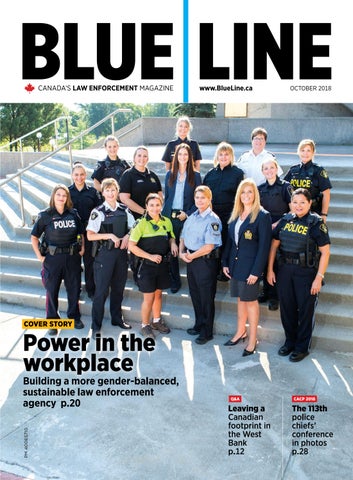
COVER STORY
Power in the workplace PM 40065710
Building a more gender-balanced, sustainable law enforcement agency p.20
Q&A
CACP 2018
Leaving a Canadian footprint in the West Bank p.12
The 113th police chiefs’ conference in photos p.28
OVERTAKE THE WEATHER ONE TIRE. FOUR SEASONS.
A VERSATILE POLICE TIRE OFFERING YEAR-ROUND PERFORMANCE Law enforcement officers need reliable traction and handling to keep control in highintensity situations, regardless of the conditions. The Goodyear® Eagle Enforcer All Weather features a unique combination of tire technology that delivers responsive performance in every season.
POPULAR VEHICLE FITMENTS • • • •
CHEVROLET TAHOE PPV DODGE CHARGER PURSUIT FORD INTERCEPTOR UTILITY FORD INTERCEPTOR SEDAN
TO LEARN MORE, CONTACT: CANADA EAST Jean-Marc Levesque|jml@goodyear.com CANADA WEST Al Chorney|allan_chorney@goodyear.com
Severe Snow
26 Left to right: Pam Ashcroft of the Toronto Transit Commission, Nicesse Modeste of Metrolinx and Susan Wonch of York Region Transit take questions during the Transit Special Constables First Women’s Symposium. PHOTO: R. FRANCOEUR
Contents
October 2018
Columns
Volume 30 Number 8
Features
19 Education & Training Directory
Check out our 2018 Education & Training Directory for various options geared to the law enforcement career hopeful and those striving for lifelong learning opportunities. COVER STORY
20 Changing what power looks like in the workplace Women continue to be underrepresented in police leadership roles, especially at the senior levels. This isn’t about quotas. By Monique Rollin
23 Intelligence gathering
Three studies that draw on psychological science are reviewed to help optimize intelligence gathering techniques. By Alana Saulnier, Julia R. LaBianca, Simon Oleszkiewicz, Christopher Slobogin and Diane Sivasubramaniam
4 12 14 15 18 30 29 34
Editor’s commentary Q&A Deep blue Holding the line Health & wellness Technology Case law Back of the book
Departments 5 5 8 8 32 33 34
By the numbers News Dispatches Calendar Product showcase Marketplace Blue Links
26 Room to grow
Recruiting women as special constables is about much more than being “as good as men.” By David Moskowitz
28 CACP 2018 in review
COVER PHOTO: ANDREANE FRASER
Canadian police chiefs and other law enforcement officials from across the country gathered in Halifax for the 113th Canadian Association of Chiefs of Police Annual Conference. See our photos from the show!
12 @Blue_LineMag
28
7 October 2018 | BLUE LINE
3
EDITOR’S COMMENTARY BY RENÉE FRANCOEUR
www.BlueLine.ca
Seeing is believing
I
t doesn’t occur that often, but every “If my daughter were here, I’d be bringnow and then, when we have our ing her over to your booth to show her how booth set up at a trade show, some- women are heading up a national magaone will exclaim, “when did two zine, for example,” he said to me. That women become the face of Blue Line?” visibility, and the possibility it evokes, is It is never meant maliciously; in fact, it’s crucial to the next generation, he added. often uttered in surprise. Many of our This is why it is so important to analyze readers are still under the impression Blue police culture, its links to a constructed Line is owned by its award-winning idea of masculinity and the walls (plus the founder, Morley Lymburner, but Annex glass ceilings) female-identified cadets/ Business Media is now running the publi- officers still run into today. Knowing cation. My account manager, Janice Eaton, where the barriers lie means we know and myself are the ones you have been where to focus our energies in order to seeing out and about representing the help become more gender-balanced. brand for the past year and a half. I know these conversations are Nevertheless, the comment still “In the uncomfortable; let’s get uncomtakes me off guard, and I almost future, fortable together in an open, safe feel as if I’m expected to justify my there will be space and discuss where to go position. It’s something I think no female from here. And don’t get me many can relate to; women have leaders. wrong, this isn’t about tokenism been feeling the pressure to go There will — this is about support and above and beyond to prove them- just be fairness. This is about meaningselves in traditionally male-dom- leaders.” ful change management. inated industries for quite some - Sheryl Sandberg The more we discuss the gentime — in Canadian law enforcedered barriers in the workplace, ment’s case, since 1912, when Lurancy the closer we are to crumbling them. And Harris and Minnie Miller of Vancouver and that’s just what’s happening, as I saw while Annie Jackson of Edmonton became the attending the Transit Special Constables first females to be hired as police officers. First Women’s Symposium this summer Prove themselves these women did and and the Durham Regional Police First we stand on their shoulders today. These Women’s Symposium last October. Many are women like Gloria Bartley, the first other similar events are occurring across black woman to serve as a police officer in the country. Moreover, the International Toronto, during a time when female offi- Association of Women Police (IAWP) cers had to resign once they had a baby; Conference came to Canada for the first like Sandra Maxwell, the first woman to time this year. join the Saskatoon Police Service in 1977 I fully believe in the Sheryl Sandberg and who was issued a purse to hold her quote, which was shared at IAWP 2018 by service revolver; and like Cpl. Ann Noel, a keynote speaker: “In the future, there the first female to join the RCMP’s Under- will be no female leaders. There will just water Recovery Team in 1989 —when be leaders.” We will get there in policing. management had been using changing One last good news item I want to share facilities as a roadblock. The list of blazing with you before you delve into our champions goes on. “Women in Law Enforcement”-themed Seeing women in a variety of law enforce- issue, is the CBC piece I’d bookmarked on ment roles is believing women can and Ottawa Police Service (OPS) approaching should do these jobs. This philosophy was a local company called Thawrih about something I was reminded of during an developing a hijab for its officers. insightful conversation at a conference a In August, Thawrih’s co-founder told couple months ago with former Windsor the CBC the “tear-away hijab” prototype Police officer Michael Akpata, now with currently being tested is ready for action. IBM Canada. Goodbye to one more barrier.
CONNECT WITH BLUE LINE
www.BlueLine.ca 4
@Blue_LineMag
BLUE LINE | October 2018
BLUE LINE
www.facebook.com/BlueLineMagazine
GROUP PUBLISHER | MARTIN MCANULTY mmcanulty@annexbusinessmedia.com EDITOR | RENÉE FRANCOEUR rfrancoeur@annexbusinessmedia.com ACCOUNT MANAGER | JANICE EATON janice@blueline.ca ART DIRECTOR | SVETLANA AVRUTIN savrutin@annexbusinessmedia.com ACCOUNT COORDINATOR | TRISH RAMSAY tramsay@annexbusinessmedia.com CIRCULATION MANAGER | BEATA OLECHNOWICZ bolechnowicz@annexbusinessmedia.com Tel: 416-442-5600 ext. 3543 PRESIDENT & CEO | MIKE FREDERICKS ANNEX BUSINESS MEDIA 111 Gordon Baker Road, Suite 400 Toronto, ON M2H 3R1 Tel. 416-442-5600 • Fax 416-442-2191
Publication Mail Agreement No. 40065710 ISSN 0847-8538 Printed in Canada SUBSCRIPTION RATES Canada — 1 Year $31.00; 2 Year $51.50 plus tax USA — 1 Year $103.00 USD CIRCULATION email: asingh@annexbusinessmedia.com Tel: 416-442-5600 ext 3553; Fax: 416-510-6875 or 416-442-2191 Mail: 111 Gordon Baker Road, Suite 400, Toronto, ON M2H 3R1 Occasionally, Blue Line will mail information on behalf of industry-related groups whose products and services we believe may be of interest to you. If you prefer not to receive this information, please contact our circulation department in any of the four ways listed above. Annex Privacy Officer Privacy@annexbusinessmedia.com; Tel: 800-668-2374 © 2018 Annex Publishing & Printing Inc. All rights reserved. Printed in Canada. No part of the editorial content of this publication may be reprinted without the publisher’s written permission. Opinions expressed in this magazine are not necessarily those of the editor or the publisher. No liability is assumed for errors or omissions. Readers are cautioned and advised that articles presented herein are edited and supplied for your personal awareness and should not be used for further action until appropriate guidance is received from a supervisor, Crown Attorney or other persons in authority. All advertising is subject to the publisher’s approval. Such approval does not imply any endorsement of the products or services advertised. The publisher reserves the right to refuse advertising that does not meet the standards of this publication.
NEWS
Einat Velichover, business development manager at Dräger Safety Canada, demonstrates how to use the DrugTest 5000, an oral fluid screening device. PHOTOS: R. FRANCOEUR CANADA
FREDERICTON
First roadside oral fluid drug screening device approved
Thousands attend funeral of fallen officers
The Dräger DrugTest 5000 screening system has been approved by the Attorney General of Canada, Jody Wilson-Raybould, as the first roadside oral fluid drug screening device for use by Canadian law enforcement. The screening equipment will be used to detect the presence of THC, the main impairing component in cannabis, and cocaine in a driver who is suspected of having a drug in their body. In making her decision, Wilson-Raybould said she considered comments received from the public and a recommendation by the Drugs and Driving Committee (DDC) of the Canadian Society of Forensic Science. Training on the Dräger DrugTest 5000 will be handled by the RCMP through the online cannabis training portal at cannabis.cpkn.ca/en. More types of drug screening equipment are expected to become available in the future, the feds stated, as the DDC continues to evaluate other oral fluid drug screening equipment for use by law enforcement. Dräger said it is currently in talks with many police services in Canada regarding the purchase of these tools but as of Sept. 12, no Canadian agency had purchased any. Blue Line was among a select group of media invited to preview the device. For more photos and a video from that event, visit bit.ly/2ximgfj.
Robb Costello
Sara Burns
Fredericton’s police chief urged the community to begin its healing journey as officers cleaned up a makeshift memorial dedicated to two constables after they were gunned down. Officers Robb Costello and Sara Burns, along with civilians Bobbie Lee Wright and Donnie Robichaud, were shot dead outside an apartment complex on the morning of Aug. 10, 2018. It ended after police shot the alleged gunman in the abdomen, according to court documents. Thousands of police officers and first responders attended the regimental funeral for Burns and Costello on Aug. 18. Loved ones, colleagues and dignitaries spoke at the ceremony, and a common theme was woven into every speech: the kindness and compassion of the fallen officers. Burns’s husband fought back tears as he delivered a powerful speech in which he asked the surviving Fredericton officers not to feel any guilt about his wife’s death.
“I want each and every one of you to know that she is at peace, and knows that you did everything you could to protect her,” he said. “Don’t burden yourself with the ‘why,’ because you won’t find the answer.” Chief Leanne Fitch issued a lengthy statement on the force’s website on Aug. 19: “I know that none of us will ever forget that day, but in memory of the four people who lost their lives, it’s time for us to heal, so that we can continue to build on their legacy,” she wrote. “There will still be difficult moments as we move forward, but we know that we must.... Thank you to those who made the trip to Fredericton to stand shoulder to shoulder with us, to share our grief, during this difficult time.” Fitch also addressed the legal process, as Matthew Vincent Raymond, 48, appeared in court Aug. 27 to face four charges of first-degree murder. The case was unable to proceed because the lawyers are still awaiting release of the findings of the police investigation. It was adjourned until Sept. 24. “I do not know how long the court process will last, but I do know many of the answers we all seek will come out as the court process moves along,” Fitch wrote. In a previous statement, police asked that the public not speculate about the case or the alleged shooter’s motives. — with files from Alex Cooke, Kevin Bissett, Canadian Press Enterprises Inc., 2018 TORONTO
Ontario special constables discuss industry during First Leadership Summit
About 25 gathered during the Ontario Special Constable Association’s (OSCA) First Leadership Summit to discuss training opportunities, use of force, emergency vehicle status and more on Aug. 10, 2018, in Toronto, Ont.
BY THE NUMBERS
The clock never stops at the Canada Border Services Agency, where on an average day two firearms are seized and there are 21 removals of inadmissible individuals — plus five currency seizures. See below for more statistics from a typical 24 hours at the border.
58,600+ 14,400+ commercial releases processed
@Blue_LineMag
trucks enter Canada
44 drug seizures
29
prohibited weapons seizures
October 2018 | BLUE LINE
5
NEWS Speakers included William Curtis, executive officer of the Special Investigations Unit (SIU), William Rusk of Badge of Life Canada, Gerry McNeilly, with the Office of the Independent Police Review Director (OIPRD), and Mike Duffy with the Police Association of Ontario. Interactive breakout sessions looked at what each organization is doing and brainstormed recommendations for Bill 175, the Safer Ontario Act, which was passed in legislature earlier this year and marks the first update to the Police Services Act in more than 25 years. Suggestions touched on standardization, mutual aid, jurisdictional challenges and removing the five-year renewals special constables have to undergo. See the video at bit.ly/2Qh3RYV. ONTARIO
Internal review to examine suicides among Ontario Provincial Police
The recent suicides of three officers in as many weeks has prompted Ontario’s provincial police force to launch an internal review on what might be preventing those within its Sylvian Routhier ranks from seeking help with mental health issues. In announcing the analysis that will examine suicides and attempted suicides involving force members over the last five years, Ontario Provincial Paul Horne Police also said they would work on developing ways to boost supports offered to officers. “The OPP recognizes that there is stigma associated with suicide and mental Joshua De Bock illness,” Ontario Provincial Police Commissioner Vince Hawkes said. “Although we don’t have all the answers, and I certainly don’t have all the answers, we will continue to work together to break down the barriers and provide support.” The force’s internal review will try to identify similarities between suicides and attempted suicides in the force and look at what might have hindered those individuals from getting help, Hawkes said. A series of roundtables — made up of officers, mental health experts and family of first responders — will also be launched to craft recommendations on how the force can 6
BLUE LINE | October 2018
The Ontario Special Constable Association (OSCA) left no rock unturned during talks at its First Leadership Summit. PHOTO: R. FRANCOEUR improve the mental health assistance it offers, he said. The initiatives will build on the force’s mental health strategy created in response to a 2012 ombudsman report that looked at OPP officers suffering from depression, anxiety and post-traumatic stress disorder due to trauma on the job. The report said the force was failing to help those officers and a list of recommendations was provided. Sgt. Sylvian Routhier, Det. Inspector Paul Horne and Const. Joshua De Bock died by suicide within a three-week period this summer, the OPP said. Their jobs ranged from frontline work to special investigations and they were posted in different parts of the province, the force said. The deaths prompted the head of the union representing provincial police officers to write a deeply personal letter urging members to reach out if they found themselves in emotional distress. Hawkes said the entire force is grieving the loss of the three officers, adding that their deaths left a “tremendous void.” In the last 30 years, the OPP has documented 24 force members and nine retired members that died by suicide, Hawkes said. The commissioner added that the force is also meeting with the province to determine how the government can help provide better mental health support to first responders. — with files from Alanna Rizza, Canadian Press Enterprises Inc., 2018
CANADA
Stats Can notes another increase in Crime Severity Index
Statistics Canada has released its data from the 2017 Crime Severity Index (CSI), which takes into account the number of crimes reported to police and the seriousness of those crimes. Police-reported crime in Canada, as measured by both the crime rate and the CSI, increased for the third consecutive year in 2017. The national crime rate rose one per cent, while the police-reported CSI increased two per cent. This was the third consecutive increase in the CSI following an 11-year downward trend from 2003 to 2014. Most of Canada’s provinces and territories reported increases in their CSI in 2017. The exceptions were Newfoundland and Labrador, Prince Edward Island, Saskatchewan and British Columbia. From 2016 to 2017, more than half of Canada’s census metropolitan areas (CMAs) reported increases in their CSI. See more at bit.ly/2M2D92V. CALGARY
New instrument helps wildfire and arson investigators
MANITOBA
Dakota Ojibway Police Service changes name
The Dakota Ojibway Police Service (DOPS), headquartered in Long Plain First Nation, Man., has transitioned to “Manitoba First Nations Police.” The service says all changes of police equipment, material and rebranding will continue over a two-year period. DOPS provides policing in six First Nation communities and announced it wanted to “have a name that is inclusive of all First Nations in Manitoba.”
Left to right: Kevin Hayes, Alex Urinso, Gwen O’Sullivan and Nadin Boegelsack are using the instrument to develop new investigation methods. PHOTO: MOUNT ROYAL UNIVERSITY A new instrument at Calgary’s Mount Royal University is helping investigations into wildfires, arsons, oil spills, chemical releases and other environmental forensics. “You’ve heard of crime scene investigations. This is the same idea but in an environmental context,” said Gwen O’Sullivan, PhD, www.BlueLine.ca
NEWS an environmental science professor at Mount Royal and environmental forensic researcher. “We’re determining who’s liable or responsible for cleaning up contamination or if wildfires are human caused.” The $550,000 instrument is a two-dimensional gas chromatography, time-of-flight mass spectrometer, or GCxGC TOF-MS. It separates complex mixtures to detect compounds at very low levels to provide three-dimensional analysis. In the case of an oil spill, the instrument can assist in establishing what spilled where, who spilled it and how the oil is breaking down and reacting to aid cleanup. Chemistry Matters, a company co-owned by MRU adjunct professor and arson investigator Court Sandau, is already using the system. ONTARIO
Occupational-specific treatment facility for first responders expanding
La Vigile, a Quebec-based, non-profit treatment program that is occupation-
@Blue_LineMag
BL_Oct_TorontoCommunity.indd 1
Melissa Petriglia, left, and Michelle Vincent are two committee members of The Haven and the driving force behind seeing it implemented in Ontario. PHOTO: MICHELLE VINCENT al-specific for first responders and uniform personnel, is opening an Ontario therapy retreat called The Haven to fill the gaps in the current mental health resources available in the province. “Being a mental health clinician that specifically works with first responders, it’s become clear that there’s a need for occupational-specific treatment that’s available in a
timely way, that’s of no cost or low cost,” says Melissa Petriglia, a psychotherapist and committee member for The Haven. Like La Vigile, The Haven will be a medically supervised treatment centre with a mission to provide occupational-specific resources from outpatient services of psychologists, to treatment of comorbid mental health issues of addictions, anxiety, depression, PTSD and operational stress injury on an inpatient basis. “The Haven is going to save lives,” says Michelle Vincent, a York Regional Police officer and fellow committee member for The Haven. “As first responders, we come to the aid of others. Seeking help for ourselves goes against what we are trained to do.” Since opening in 2003, La Vigile says it has helped more than 2,500 people. The Haven project is at the beginning stages of implementation and the organizing committee is currently seeking support for government funding as well as other funding opportunities. Visit bit.ly/2MZRqm9 to leave your electronic signature and spread the word.
October 2018 | BLUE LINE
7
2018-09-14 10:59 AM
NEWS CALENDAR Back on Track Conference & Gala - Odd Squad Oct. 19, 2018 Vancouver, B.C. www.oddsquad.com Unmanned Canada Oct. 30–Nov.1, 2018 Vancouver, B.C. unmannedsystems.ca The Blue Ball Nov. 2, 2018 Woodbridge, Ont. badgeoflifecanada.org The Canadian Critical Incident Fall Seminar Nov. 4–7, 2018 Niagara Falls, Ont. canadiancriticalincident.com 3rd International Policing Cybercrime Summit Nov. 5–7, 2018 Fredericton, N.B. cata.ca/IPCS2018 APCO Canada Nov. 5–8, 2018 Montreal, Que. apcocanadaconference.com Atlantic Women in Law Enforcement Annual Training Conference Nov. 6–9, 2018 Moncton, N.B. www.awle.org Trust & Confidence in Policing: A Canadian Perspective Nov. 14–16, 2018 Toronto, Ont. cacp.ca/trust-and-confidence-inpolicing.html?mid=447 ONGIA 2018 Nov. 20–23, 2018 Huntsville, Ont. ongia.org Symposium on Search & Seizure Law in Canada Dec. 6, 2018 Vancouver, B.C. www.osgoodepd.ca
8
BLUE LINE | October 2018
DISPATCHES Antje McNeely is the 17th chief of Kingston Police and the first female police chief for the 167-year-old service. She is also the first chief of police to be hired from within the organization since 1994. McNeely, currently deputy chief, started as a constable in 1985 after completing her bachelor of science degree. In 2017 she helped establish the External Sexual Assault Case Review Program, which provides external, independent reviews of sexual assault cases investigated by Kingston Police. She will be officially sworn in on Nov. 30.
interim basis since the departure of former Insp. Kevin Kunetzki in May. Kendall began her law enforcement career in 1997 and has served in the Federal Drugs and Organized Crime Awareness Unit as well as an advisory aide in the office of the Commanding Officer, Deputy Commissioner Todd Shean.
Insp. Sheree Ortman of the Regina Police Service has retired. She represented Canada during the 2015 World Police and Fire Games and is a frequent guest lecturer at the University of Regina.
The chief of the Nishnawbe-Aski Police Service (NAPS), Terry Armstrong, has announced his retirement. He began his career as a First Nations constable in Pikangikum in northwestern Ontario in 1984, later becoming an Ontario Provincial Police officer before taking the reins at NAPS as police chief in 2013.
A number of Canadian women were recently honoured as part of the International Association of Women Police (IAWP) Foundation’s 2018 Annual Recognition Programme. Const. Kelley McIntyre (top photo) of New Brunswick’s Kennebecasis Regional Police took home the Officer of the Year Award. Niagara Regional Police Supt. Cindy White received the prestigious “Excellence In Performance” and Sandra Kurdziel (bottom photo) with Hamilton Police Service was bestowed with the Civilian Achievement Award. The women were celebrated during IAWP’s 56th Annual Training Conference in Calgary in August. Sgt. Sandy Harvey retired from the Royal Newfoundland Constabulary (RNC) after 37 years. She is the longest serving female officer in RNC history. The Leduc RCMP in Alberta have promoted Sgt. Dale Kendall to the rank of inspector and detachment commander. Kendall has been serving in this position on an
Const. Rose Grant was honoured as B.C. RCMP’s longest-serving instructor of the Drug Abuse Resistance Education (D.A.R.E.) program at a ceremony at the Merritt, B.C., detachment this past summer.
The Canadian Association of Chiefs of Police (CACP) announced Chief Constable Adam Palmer of the Vancouver Police Department (VPD) has been elected to serve as the new president of the association for a two-year term. Palmer took command as the 31st chief constable of the VPD in 2015 after serving as deputy chief. He has been a member of the CACP since 2010, and has served on the association’s Counter-Terrorism & National Security as well as the Organized Crime committees. He takes over the presidency from Gatineau Police Service Directeur Mario Harel. Calgary Police Chief Roger Chaffin is retiring in January after three years in the role and 32 years in law enforcement. He was previously a CPS deputy chief, having joined the service in 1986. In 2015, Chaffin was appointed to the Order of Merit for Police Forces. He has also received the Queen Elizabeth II Diamond Jubilee Medal, Federal Exemplary Service Medal, Alberta Law Enforcement Long Service Medal, Calgary Police Service Distinguished Service Medal and Calgary Police Service Chief’s Award of Excellence. www.BlueLine.ca
Sgt. Dawn Rose wins Bruce MacPhail Award for 2018 The Sgt. Bruce MacPhail Award for Academic Excellence is presented to the municipal police officer who achieved the highest overall average in a concentration certificate within the Police Leadership Program at Dalhousie University in the past academic year. MacPhail began his career with the Amherst Police Department in Nova Scotia and in 1982 he became one of the first police officers with the newly formed Bedford Town Police. He continued on with Halifax Regional Police after amalgamation, eventually heading up their first Auto Theft Unit. He completed the certificate in “Police Leadership - Supervisory Skills” in 2000, and was the first to graduate as a certified police coach in the program. MacPhail passed away in June 2001 after a short and courageous battle with cancer. Phyllis MacPhail established the award in 2001 in memory of her son. Sgt. Dawn Rose of Toronto Police Service (TPS) is the 2018 recipient of the Sgt. Bruce MacPhail Award for Academic Excellence in the Police Leadership Program. Rose began her policing career in 1989 and was promoted to sergeant in 2006. In 2013, she was transferred to the Diversity & Inclusion (D&I) Unit, where her duties included providing support and guidance to members on issues related to the Ontario Human Rights Code, diversity and inclusion, delivering Human Rights/D&I training and creating the TPS Human Rights Strategy. In 2014, Rose was selected to be one of the Fair and Impartial Policing® (FIP®) trainers for TPS and delivered FIP® training to over 500 front-line officers and supervisors. In 2015, she was seconded to the Police and Community Engagement Review (PACER) as a member of the implementation team for the PACER Report’s 31 recommendations. She holds the professional designation of Canadian Certified Inclusion Professional (CCIP). She has undergraduate degrees in Justice Studies and Adult Education, and has recently completed her master’s of education in Digital Technologies. In addition to her certificate in Police Leadership, she has a certificate in Teaching Effectiveness and another one in Inclusive Leadership. Rose is committed to life-long learning and plans to continue with professional development and furthering her education.
Dalhousie University Police Leadership Graduates Fall 2017 – Spring 2018 Advanced Police Leadership Certificate Sgt. Sébastien Decaens RCMP, Major Crimes, N.B.
Administration Certificate
Const. Jean-Pierre Bouchard RCMP, Saint-Leonard, N.B. Cpl. Robert Buller RCMP, Depot Div., Sask. Sgt. Matthew Cacchione RCMP, National Div. CROPS Sgt. Joe Cantelo Kennebecasis Regional Police, N.B. Cpl. Christine Day RCMP, Ridge Meadows, B.C. Sgt. Stuart Foster RCMP, Lake Cowichan, B.C. Const. Edward Gavel RCMP, Fort Resolution, N.W.T. Cpl. Jaime Lutz RCMP, Meteghan, N.S. Det. Barb Martin London Police Service, Ont. Sgt. Nicholas Novacich Aylmer Police Service, Ont. Supt. Shawn O’Reilly RNC, St John’s, N.L. Const. Scott Parsons Peel Regional Police, Ont.
Sgt. Roshan Pinto RCMP, “O” Division Cpl. Dylan Powell University of Sask., Protective Services, Sask.
Law and Justice Certificate
Cost. Kyle Camalush RCMP, Barriere, B.C. Const. Michael Dosdall Ottawa Police Service, Ont. Sgt. Tanya KlingeN.B.erg Waterloo Regional Police Service, Ont. Det.- Const. Holly Murray South Simcoe Police Service, Ont. Sgt. Paul Wilson York Regional Police, Ont. Cpl. Russel Yugai RCMP, “E” Division
International Policing & Security
Marc-Olivier Bouchard Correctional Services Canada, Cowanville, Que. Const. Véronique Côté RCMP, Caraquet, N.B. Const. Sabrina Goyer RCMP, Caraquet, N.B.
Cpl. Robert J. Lewis RCMP, Federal Serious and Organized Crime, B.C. Sgt. Randy Mason OPP, Orillia, Ont. Sgt. Mark Rushton Town of High Level, Alta.
Supervisory Skills Certificate
Cpl. Christine Day RCMP, Ridge Meadows, B.C. Const. Jennifer Dowden RCMP, Niagara Shiprider, Ont. Cpl. Aaron Glode RCMP, Halifax District, N.S. Staff Sgt. Sean Gregson Calgary Police Service, Ont. Const. Julie Lefebvre RCMP, CFSEU Red Deer, Alta. Cpl. Nicola Olson RCMP, Depot Div., Sask. Sgt. Dawn Rose Toronto Police Service, Ont. This list is not exclusive. Some students could not be contacted and for reasons of privacy and security some did not wish to have their names included. The Staff and Faculty of the Police Leadership Program want to congratulate all graduates on their success!
DALHOUSIE’S CERTIFICATE IN POLICE LEADERSHIP
Skills for now Better career tomorrow
Built for modern policing, our online courses, designed and delivered by industry leaders and experts, give you the knowledge and skills to advance in your profession. Learn from the innovator in quality police education for over 25 years. REGISTER AT:
DAL.CA/POLICELEADERSHIP Winter Term starts January 29
October 2018 | BLUE LINE
@Blue_LineMag BL_Oct_Dalhousie.indd 1
9
2018-09-07 2:30 PM
SPONSORED CONTENT
U.S. show model shown for representation purposes only. Not available in Canada as shown. Aftermarket equipment shown.
Blueline sat down with Ken Tuckey, Senior Manager, National Fleet and Commercial Vehicles at FCA Canada to discuss the significance of the 2019 Dodge Durango Enforcer, its features, benefits and its role on the Enforcer team. “We are excited to announce the 2019 Dodge Durango Enforcer, which was revealed in June at the National Sheriffs’ Show in New Orleans. Our pursuit line has now expanded, and the Durango Enforcer will join the team, alongside the Charger Enforcer. This SUV will attract a wider audience and meet the ever complex needs of law enforcement agencies.” – Ken Tuckey
What is the significance of having the 2019 Durango join the FCA Enforcer team? Well for one, it provides law enforcement agencies more choice from FCA. They already have a number of great vehicles to choose from like Dodge Charger Enforcer, Ram 1500 Special Service and Dodge Durango Special Service. But we understand that 10
BLUE LINE | October 2018
as policing becomes ever more complex, law enforcement agencies have an even broader spectrum of needs. So, it follows that more vehicle choice will help address those needs. The addition of the 2019 Dodge Durango Enforcer to our lineup will make it even more comprehensive. This will ensure law enforcement agencies are getting the most out of their Fleet from FCA. What can police teams expect from riding in the 2019 Dodge Durango Enforcer? The 2019 Dodge Durango Enforcer has been designed with a more spacious interior, increased ride height, and – with the addition of an available HEMI® V-8 engine – improved performance and efficiency. The interior cabin has been designed for long work hours and includes 8-way power adjusting driver seat controls for increased comfort and flexibility. This allows for customizable seating configurations which provide for maximum comfort. Police work is team work. Traveling with a team means everyone needs to be comfortable for longhaul patrol shifts. The 2019 Dodge Durango Enforcer is more comfortable than ever, featuring a more spacious interior. It’s even outfitted with a class-exclusive K9-friendly Tri-Zone interior control. That way the four-legged team members are well taken care of, too.
Can you provide insight into the performance features of the 2019 Dodge Durango Enforcer? We built this SUV to provide law enforcement teams with the edge needed to get the job done every day. The 2019 Dodge Durango Enforcer offers 3.6-litre Pentastar VVT V-6 engine standard. This award-winning engine is rated at 293 horsepower and 260 lb.-ft. of torque. For even more power, there’s the available 5.7L HEMI® V-8. It’s rated at a best-in-class 360 horsepower and 390 lb.-ft. of torque. The V-8 model includes the segment’s most technologically advanced AWD system; with a segment-exclusive active transfer case to improve real-world fuel economy, while also enhancing the vehicle’s traction and handling. The Durango Enforcer earned a fuel economy rating as good as 9.6 L/100 km highway with the 3.6-litre Pentastar V-6 and 10.9 L/100 km with the 5.7-litre HEMI® V-8 engine. Both models are equipped with an eight-speed automatic transmission and all-wheel drive. What safety features stand out on this new model? There are a number of new additions and safety improvements. New for 2019, the front fascia has been completely redesigned, giving the vehicle a more modern and powerful look. Integrated brake-cooling air ducts allow for quick braking when it matters most. They’ve also been designed to offer improved durability resulting in enhanced officer safety. Off-road capability has never been better. Durango’s heavy-duty anti-lock brakes now deliver an impressive 96-0 kilometres per hour (60 mph) stopping distance of 40.8 metres (134 feet). The ParkView® rear backup camera with ParkSense allows for easy parking in any environment. And the included spot lamp wiring prep package means enhanced visibility in all situations, a key factor in many policing situations. These are just a few of the improvements and additions in the 2019 Dodge Durango Enforcer. There are many others, including some key improvements in suspension and braking to enhance officer safety. These include a performance-tuned suspension system, load-levelling NIVOMAT shocks, a pursuit-rated brake package, and front- and rear-stabilizer bars and 18-inch tires on aluminum wheels. www.BlueLine.ca
U.S. model. Not available in Canada as shown.➤
MEET THE NEW ENFORCER ON THE TEAM. INTRODUCING THE 2019 DODGE DURANGO ENFORCER. It packs a powerful 3.6L Pentastar V6 engine with a fuel economy rating as good as 9.6L/100 km highway.∞ Or, push it further with a 5.7L HEMI® V8 engine powered by the segment’s most technologically advanced AWD system. It goes where you go, with two-speed transfer case for true low-range off-road capability. Everyone rides comfortably, with class-exclusive K-9 friendly Tri-Zone interior temperature control.† The heavy-duty antilock brakes deliver a 96 km/h to zero stopping distance of 40.8 metres when you need it. Best-in-Class 3,265 KG (7,200 LB) towing capability† and ParkView® Rear Back-Up Camera° means it’s ready for anything coming or going. The 2019 Dodge Durango Enforcer is here.
BEST-IN-CLASS
HORSEPOWER AND TORQUE* 360 HP / 390 LB-FT
CLASS-EXCLUSIVE
K-9 FRIENDLY TRI-ZONE† INTERIOR TEMPERATURE CONTROL
fleet.fcacanada.ca
1 800 463-3600
∞Based on 2018 EnerGuide ratings. City fuel economy rating as good as 9.6L/100 km. Your actual fuel economy will vary. See your dealer for details. †Based on the latest available competitive information for the Ford Police Interceptor Utility. °This is a driver convenience system, not a substitute for active driver involvement. The driver must remain aware of their surroundings and be prepared to take corrective action to avoid collisions. *Claim applies to the 5.7L HEMI V8 engine. Based on the latest available competitive information for the Ford Police Interceptor Utility and combined horsepower and torque ratings. ➤ U.S. show model shown for representation purposes only. Not available in Canada as shown. Aftermarket equipment shown.
Q&A
Q: How did your career in law enforcement begin?
I actually started my career as a radio communications operator in 1991 in Thunder Bay for the Ontario Provincial Police as a civilian. I truly felt like I wanted to do more but at the time I had small children; it wasn’t until around 2000/2001 when I received my badge with the OPP. I was a uniform officer in the Nipigon Detachment and a short time after that I became a regional abuse issues co-ordinator for the northwest region. I did this for a number of years, dealing with domestics and working with stakeholders and the communities. That was very challenging. After that I added a detective sergeant component to my portfolio, at which time I was responsible for the investigation and supervision of major crimes within my region. This afforded me the opportunity to fly into remote reserves. I really enjoyed working within these communities and the investigations, the team atmosphere. I did a summer deployment in Pikangikum, Ont., as a supervisor. We would fly in for two weeks and then fly out for two weeks so if we had to transfer a prisoner, we would have to do it by boat... It’s a different type of policing you have to do in a fly-in community and I truly enjoyed the challenge.
Q: How did you find your way to this specific deployment?
The OPP advertises internally for a 12
BLUE LINE | October 2018
pool of applicants and you are selected through the RCMP for international deployment. So you don’t really know where you’ll be going — you can kind of pick locations on some of the applications, but you don’t know when they will come. In my case, after I applied, I had got called for an interview with the EU Palestine mission, but I had also been receiving a large number of correspondences from EU Ukraine through the OPP.
Q: What did you expect and what kind of surprises met you in Ramallah?
Having travelled to many remote First Nations communities, I knew your expectations are never the reality because every place is quite different. I read a little bit and had spoken with another Canadian
Snapshot of Canadian peacekeepers
125,000+ Canadian peacekeepers have participated in dozens of international efforts over the past six decades
Aug. 12
National Peacekeepers’ Day in 2018; ceremonies held across Canada, including a ceremony at the Peacekeeping Monument in Ottawa
member that was there, but I think I was better off not having expectations; it was such an opportunity, I wanted to take it all in. I knew I’d be living in Jerusalem and our office was 45 minutes away, in the West Bank. You read about the conflict and the walls and that type of thing but you cannot visualize it, and what the reality is for some people, until you’re there. For example, some Palestinians will never see the sea, even though it’s so close, being that they can’t obtain the visas to get through. A lot of the settlements are intertwined in some parts of Israel and yet they are still quite segregated in terms of what they can do. I wasn’t expecting that type of thing. Driving was definitely a surprise; it’s a big adventure. There’s a lot of traffic and the rules are very different — you didn’t see baby car seats for example in the West Bank. You’re also always in tune to safety because it is an active war area so we always maintained a situational awareness. Of course, we had a lot of turmoil when I was there in terms of moving the American embassy to Jerusalem. We drove diplomatic vehicles and sometimes we would be driving home — I lived on the edge of Mea She’arim — and there would be overturned garbage containers on fire, stone throwing. The biggest surprise was the vulnerability of the people behind the walls. We had to go to a meeting in the different part of the West www.BlueLine.ca
PHOTO: OPP
In honour of National Peacekeepers’ Day earlier this year, Blue Line spoke with Det.-Sgt. Caren Ashmore of the Ontario Provincial Police’s West Region Crime Unit in Wellington County. Ashmore spent 16 months in Ramallah, Palestine, as part of the European Union Co-ordinating for Palestine Police Support. Deployed as a police advisor for accountability, she was appointed acting deputy head of the Police Advisory Section six months in.
Bank, not Ramallah, and we were called by security because the checkpoint we were going to use was closed. We were in an armoured car with armoured equipment and it took us another four hours to get out of the West Bank because if they close one checkpoint, they can close the next one by the time you get there, too. You really feel that vulnerability of being behind a wall and it’s not easy to go in and out.
Q: What was a typical day like?
We would convoy to the office from our homes in Jerusalem with security and radios in our vehicles. We had to live in Jerusalem to have access to various exits, such as flying out of Tel Aviv or Jordan; security had to check our homes and we could only live in certain areas. Some days we couldn’t go into the office because of heightened security. I worked in a very open space where we had 28 advisors, all international. I was the only Canadian. There was one other female there for my first eight weeks, but other than that, I was the only female police officer in our section. And I was the only native speaking English speaker. Our section was accountability so one of the first things I did when I got there was help complete code of conduct training for officers within the Palestinian Civil Police. That was really rewarding because we were able to go to all the different offices. This was very similar to going to some remote First Nations offices that were not in such a great state. Whenever we’d go to a meeting, we’d brief with the chief of that district and of course we’d have traditional coffee and tea. He would tell us about his district. They are very proud people, but just absolutely wonderful. If we were doing code of conduct training, we’d discuss how it would go forward, as we’d set it up to be delivered by one of their trainers. They wanted to hear directly from us how we do it back where we live. They were super appreciative and very respectful. We started tracking how many males and females were at the training — the Palestinian Civil Police is predominantly males. It was very rare to see another female there... They are working on trying to increase their numbers. Essentially my role was to advise them, more so on a strategic level.
Q: What are you most proud of in regards to your police advisor accomplishments?
My mission was extended three months because I became responsible for the mentorship for the Palestinian Civil Police Research, Planning and Development Administration. What we did then was the development and completion of the Palestinian Civil Police Strategic Plan, which was for 2017-2022. When I came into it, a mentor had been in place there doing the work for eight months. I was pulled in because he was leaving, but we were already behind. Part of our mission mandate, which ended in June 2018, was to ensure that the strategic plan was completed because it was in line with the security sector plan, which governs all Palestinian states. So it was a really important document to finish. As such, my focus shifted from the accountability section but I was happy how the code of conduct training had gone and proud that we had opened the first, walk-in public complaint office in Ramallah. That allowed citizens of the West Bank to go in
if they had issues with officers and file complaints that would be reviewed by the accountability department, depending on the issue. I also ended up becoming the acting deputy head of the Police Advisory Section, moving into a senior management and leadership role. Managing international and national advisors as well as civilian members was extremely rewarding and challenging of course, too. I was the first OPP member to ever have a mission extended and I was very proud I was able to finish the strategic plan and leave that Canadian footprint there by transferring my knowledge and skills through mentoring, advising and giving [the Palestinian Civil Police] a platform to move forward with.
Q: What is your advice to other law enforcement officers interested in similar peacekeeping work?
Three things: Expect the unexpected. Be patient and just be open — enjoy the oncein-a-lifetime experience.
BODYGUARD TM
Apparel
● Cost Effective Uniform Solutions ● Great Quality ● In-Stock Items ● Quick Turn-Around 905.565.7576 1.800.996.9499 sales@spirito.com
www.spirito.com October 2018 | BLUE LINE
@Blue_LineMag BlueLine_Feb_Spirito.indd 1
13
2018-01-24 12:13 PM
DEEP BLUE
BY DOROTHY COTTON
The questions around the work police do with people with mental illnesses
I
was recently reading the Canadian Police Executive Research Agenda Summary from the CACP (Canadian Association of Chiefs of Police) Research Foundation and I noted “policing persons with mental illness” made the Top 10 (No. 2 actually). I have been involved with this issue for about 15 or 20 years now. So on the one hand, I am always gratified to know that people are thinking about this. On the other hand, I got to wondering what it is that we still need to research. On the surface, I suppose there are obvious issues about how much training and what training is really effective; what kinds of joint response initiatives are most effective; what kinds of relationships between mental health systems and police services actually work. And there are a zillion questions simply about what the real numbers are: What percentage of police calls involve people with mental illnesses? Are joint response initiatives cost effective? What do the numbers look like for people with mental illnesses as victims rather than perpetrators...and so on. I’d like to see a detailed analysis of the situations that are handled well — and the ones that go south. Are the latter examples of individual police officers who just have bad judgment and impulse control problems — or are they reflections of faulty or inadequate training?
14
BLUE LINE | October 2018
Everyone is doing training related to de-escalation up the wazoo these days, and that sells well politically and with the public (public trust and confidence is No. 1 on that aforementioned research agenda, so this is nothing to sneeze at). But in my mind, the really big question is:
Is it better if more people are apprehended and taken to hospital or fewer? What about customer satisfaction? I’d like to see more work around perceptions of procedural justice.
How do we address the issue of stigma — which is, in my humble opinion, the most common reason why people phone the police to start with? No one phones the police when people have an asthma attack or a stroke. But somehow, the link between mental illness and violence is pretty stuck in our minds; ergo, we phone the police. The media is no help in this regard. When some horrible crime occurs, the first thing we are told is that the person “is mentally ill.” But is that true or do we just consider that when someone does something unfathomable, they must have a mental illness? And I note we never hear about other medical conditions a person might have — probably because we just assume these other conditions are not related. The media never say “John Smith, who has terrible acne, was charged today with…” or Tarif Baqri, who was known to have been treated unsuccessfully for irritable bowel syndrome….” But I digress. How do we get the public to reinterpret behaviours as signs of illness and not signs of dangerousness? I wonder if anyone has ever tried to go back to families and members of the public and ask them why they called the police to start with. Did they not know what else to do or who else to call? Was it the only service available? Had they had good interactions with police in the past? (I have always suspected that the better police get at handling these calls, the more likely they are to be called in the future, which is ironic.) This fundamental question seeps
into much of the work police do with people with mental illnesses. Why are there even provisions for mental health-related apprehensions written into most mental health acts? And what about the ever-present issue of the “police record check,” a largely made-up and imaginary way to be paranoid and biased when we feel like it? Why are we still including mental health apprehensions in many cases? Other questions? I’d like to see some epidemiological data that might tell us which police services are doing well in this area and which struggle. Of course, demographics will have a lot to do with this. I have no doubt that there are differences between New York’s Lower East Side and say, Oakville, Ont. Taking that into account, are there police services that are generally doing a good job and others that are not? Which begs the question... what is “a good job” anyhow? Of course for starters, not shooting people is a good idea. But that is such a oneoff kind of measure I am not sure what purpose setting goals around shootings really serves. It’s not that the goal of not shooting people is not important. One death is 10 too many. But it does not reflect the whole picture — or even most of the picture. It might be a marginally useful measure if you are a very big service. Maybe the issue is use of force in general? Or not. Are more calls or fewer calls better? Is quicker resolution or more time spent on a call better? Is it better if more people are apprehended and taken to hospital or fewer? What about customer satisfaction? I’d like to see more work around perceptions of procedural justice. As is often the case, figuring out the question may be harder than figuring out the answer. Dr. Dorothy Cotton is Blue Line’s psychology columnist. She can be contacted at: deepblue@ blueline.ca.
www.BlueLine.ca
HOLDING THE LINE BY MICHELLE VINCENT
Occupational-specific wellness for “the big picture”
W
hen we ponder the significant events that have occurred nationwide in our policing family —from the shooting of our members in Onanole, Man. and Fredericton, N.B., to our Ontario Provincial Police officers who have died by suicide — we have to ask ourselves what we are doing as a society to support the surviving members. The impact of these events, along with the traumatic experiences we face as police officers on a regular basis, must be considered when looking at our long-term health and well-being. We are exposed to critical incidents — events most people see as acute trauma — on a regular basis and we have to understand that is not an ordinary lived experience. Being a PhD student at present, I have the opportunity to participate in a variety of research and discuss with other experts the available resources and leading-edge practices in health and wellness for public safety professionals and beyond. That being said, with so much discussion and academic focus on this topic from a variety of angles, I have to wonder whether we are missing “the big picture.” We have some fantastic educational programs aimed at suicide prevention being delivered in our policing organizations right across Canada. Some organizations are equipped with peer support teams and Critical Incident Stress Management (CISM) teams who are trained in supporting their members on an individual and group basis. Additionally, many organizations have listed psychological professionals in various geographical areas for their members to utilize at their discretion. These professionals specialize in dealing with first responders — they expedite the intake process for first responders, understanding the importance of availability in a time of crisis. As we look at the mental resources available for first responders, it is important to note the existing gaps in these services. For example, while psychological testing plays a part in @Blue_LineMag
When we have more first responder/ uniform supervisory personnel at the forefront of our own mental health care, we can say we are indeed getting “the big picture.”
identifying potential issues and vulnerabilities, many of us are very good at playing the game in relation to that testing. We need to identify where resources are most needed, as well as the specifics in exactly how we deliver and access these resources. When a member is in crisis, it may be a struggle to accomplish the simplest tasks, let alone undertake the action of locating resources and accessing them. I have written in previous columns of the challenge of reaching out and locating the most effective resources when we are in crisis and so it is best to do so prior. For example, selecting a psychologist or other mental health professional we connect well with (or one our fellow members recommend) while we are in a good mental health state, so that if/when a crisis occurs and we need support, reaching out is a phone call away. We need to go a step further and have more occupational-specific resources involved as an accessible and non-profit option. How many first responders’ lives would be saved if we were able to provide 24/7, culture-specific, confidential mental health care on an inpatient/outpatient basis? How many lives would be enriched if the government paid for police-specific health benefits — just for us — and/or medical supervision to manage the specific and unique addictions we as law enforcement officers are having?
There are very few professions that expect their members to put their lives at risk in order to keep their communities safe. If we want our members to continue to serve in a mentally healthy, clear-minded way, is it not our duty as a society to provide the best services to support the maintenance of their well-being? Having customized resources that are readily available and easily accessible for our members and our police families may lift a heavy burden of silence that hangs over our communities in terms of how we manage our members who need support. Let’s gather as members in this honourable (and vulnerable) profession to notice when a particular resource has been especially supportive in our healing journey. Let’s then share that resource. Let’s be open to new opportunities for confidential, safe, occupational-specific care that may support us being more present and available to our families, friends and communities — a result of a mentally healthy lifestyle. Let’s be inspired, as individuals, policing organizations and in the policing profession as a whole, to identify what is working in our world in terms of resources and what is lagging behind. Let’s get more of us partnered up with the currently available resources — the need for our support is great. When we have more first responder/uniform supervisory personnel at the forefront of our own mental health care, we can say we are indeed getting “the big picture.” Michelle Vincent is a 17-year York Regional Police officer with a master of arts in counselling psychology and a background in equine-assisted therapy, workplace reintegration after a critical incident and long-term leave, as well as teaching. She is in the process of implementing the first non-profit treatment centre that will be occupationally specific for first responders and is working towards her PhD in Forensic Psychology/Crisis Response. She can be contacted at: michelle@smith.net.
October 2018 | BLUE LINE
15
CanadianAssociation AssociationofofChiefs ChiefsofofPolice Police Canadian
CACP AWARDS AWARDS CACP Callfor forNominations Nominations Call
Proudly sponsored by
N TAI O T IN OA N LA LA W AA W RADR DF OF RO RT RTAR FAFFI FCI CS AS FAEFTEYT Y NA
National Police Award Applications may submitted TheThe National Police Award for for Applications may be be submitted Traffic Safety Safety recognizes recognizes by by all all sworn, sworn, full-time full-time Traffic excellence, dedication dedication andand employees employees of Canadian federal, excellence, of Canadian federal, initiative field traffic provincial, provincial, municipal First initiative in in thethe field of of traffic municipal andand First
ACHIEVEMENT AWARD FOR TRAFFIC SAFETY safety safety enforcement officers Nations Nations police police agencies, agencies, by by enforcement officers This award recognize s an officer who has dedicated significant effort and time in road safety, devoting part of their career to further traffic safety initiatives. This award recognizes members of the policing community who have made outstanding contributions to traffic safety over a period of time.
across Canada. purpose Sheriffs,military, military,andandrailway railway across Canada. TheThe purpose of of Sheriffs, awardis isto toidentify identifyandand police police agencies. Groups within thisthisaward agencies. Groups within commendactive activeenforcement enforcement agencies agenciessuch suchas asdivisions, divisions, commend personnelfor fortheir theirwork workto to sections sections detachments personnel andand detachments areare improvetraffic trafficsafety safetyandandto to eligible. eligible. The nomination improve The nomination willwill be be encourage others implement endorsed endorsed senior officer. encourage others to to implement by by a a senior officer. new initiatives or publicize those Nominee(s) Nominee(s) have made new initiatives or publicize those willwill have made an an
whichthey theyarearealready already outstanding outstanding contribution to road in inwhich contribution to road Applications may be submitted by any sworn, full involved. award is specific safetyduring duringthetheprevious previous involved. TheThe award is specific to to safety time Canadian federal, provincial and municipal outstandingachievement achievement calendar calendar year year through through an anoutstanding police officers, including military and railway completed or or reaching reaching a a educational, educational, enforcement, enforcement, police services and sheriffs. The nomination must completed significant milestone within trainingor orcommunity-based community-based significant milestone within thethe training be endorsed by a senior officer. Calendar Year. Best practices programs. programs.Submissions Submissionsmust must Calendar Year. Best practices Electronic submissions are encouraged. Please collected collectedthrough throughthetheaward award show showclear clearsupport supportforforroad road limit to 500 words. Email nomination materials to process process shared broadly with safety safetyinitiatives initiativesandandshow show areare shared broadly with the CACP a t cacp@cacp.ca. Support material Canada’s police community results that work. Canada’s police community . . results of of that work. such as video, CD and promotional material may be submitted separately, referencing your Electronic submissions to be forwarded to cacp@cacp.ca. Details Electronic submissions areare to be forwarded to cacp@cacp.ca. Details electronic submission. regarding application process and submission deadline regarding thethe application process and submission deadline willwill be be posted CACP website at www.cacp.ca. posted on on thethe CACP website at www.cacp.ca.
information nomination application submission requirements available FullFull information on on thethe nomination application andand submission requirements areare available at at www.cacp.ca www.cacp.ca
Ontario Association of Chiefs of Police
OACP AWARDS Call for Nominations
Proudly sponsored by SCHOOL RESOURCE OFFICER – AWARD OF EXCELLENCE COMMUNITY SAFETY AND CRIME PREVENTION AWARDS This award is presented in recognition of the accomplishments of police agencies and their community partners working together to improve community safety and well-being. Nominees will demonstrate their commitment to and understanding of Ontario’s Mobilization and Engagement Model of Community Policing and will identify how they have collaborated with their community to address an area of concern or situation of elevated risk within the community. The project may not be complete, nor does it have to have been initiated with this model. The submission should demonstrate how the project fits within the framework of the model, enhancing community safety and well-being. Applications may be submitted: by all full-time provincial, municipal and First Nations Police agencies supported by the Chief of Police, Commissioner or their designate In electronic (pdf) format only. Please limit submission to 500 words Attachments will not be considered part of the submission but will be accepted as supporting material.
The Ontario Association of Chiefs of Police (OACP) seeks to recognize an officer who has contributed to the overall well-being of students and the community at large in an exemplary manner – an officer who has strived to build the relationships required to bridge the gap between students, schools, communities, and the police. The application will outline how the nominee has made a positive difference in their community through development and delivery of student-directed programs and through their mentorship and leadership provided to students to achieve positive outcomes. The Nomination Application will describe how the nominee demonstrates excellence in his or her work with students, schools and the community through: • •
Championing Innovative Programming and Student Success Commitment to Excellence
• Teamwork and Community Partnership YOUTH SERVICE VOLUNTEER AWARD The Ontario Association of Chiefs of Police (OACP) seeks to recognize a currently serving sworn officer or civilian member of an Ontario police service who has contributed in an exemplary manner through volunteerism to the overall well-being of youth. The member does not need to be in a youth serving role. Applications may be presented by all serving members of Ontario Municipal, Provincial or First Nations Police agencies.
Full information on the nomination application and submission requirements are available at www.oacp.ca or by contacting oacpadmin@oacp.ca.
HEALTH & WELLNESS BY ISABELLE SAUVE
Your health depends on water
W
ater is life. Over 60 per cent of the human body is composed of water. In fact, proper fluid replenishment is an essential part of health, proper body functioning and preventing dehydration. Dehydration commonly occurs when there is loss or removal of water in the cells. It can be a dangerous condition, exposing one to serious potential health problems and even death. Humans have survived up to eight weeks without food and strictly consuming water; however, survival only lasts a short three to seven days without water. We tend to be reminded of its importance in summer months or under warm conditions where we are more susceptible to being re-acquainted with the feeling of thirst. However, water is an important part of every day and night, particularly for shift workers. Our bodies are constantly losing water, which we must diligently replenish. Under extreme conditions it is possible to expel as much as 1-1.5 litres every hour. If not adequately replenished, fluid levels can fall quickly and cause a drop in blood pressure, which can be fatal. Even mild dehydration causes stress to the body. Every living cell in our bodies needs water to grow, reproduce and survive. Contrary to the general thought, lean muscle mass has more water content than fat; leaner people can generally tolerate greater water loss than overweight individuals. Water plays a major role in regulating body temperature through respiration and perspiration. It also allows the body to expel waste. Water acts as a lubricant for our joints, promotes proper digestion, helps deliver oxygen to the body and is needed by the brain to manufacture neurotransmitters and hormones. Proper hydration also boosts the immune system and helps maintain skin health. Proper fluid intake is needed for optimal mental and physical per18
BLUE LINE | October 2018
Common known side effects of shift work, such as fatigue, nausea, or headaches, can be further exasperated by lack of proper hydration.
formance. Shift workers have the supplementary challenge of keeping well hydrated, as these work conditions are often not conducive to regular eating and hydration. Common known side effects of shift work, such as fatigue, nausea, or headaches, can be further exasperated by lack of proper hydration. On night shifts, it is particularly essential to hydrate the body. The “jet lag” effect and interruption to the normal circadian rhythm is worsened by a lack of proper hydration. Shift workers can wake up from sleeping after a night shift with side effects akin to a hangover as a result of dehydration. Many turn to caffeine as a means of warding off these side effects which can further worsen the level of dehydration. In a culture of coffee drinking as a social practice, it can be easy to consume too much caffeine and excessive consumption of caffeinated drinks or alcohol causes the body to lose water. Unfortunately, law enforcement uniforms do not promote the regulation of body temperature. Uniforms are typically heavy, layered, dark in appearance and limited in breathability. As a result, uniforms can be taxing on wearers and the effects can be worsened, especially under warm conditions. As a rule of thumb, when exposed to hot conditions in uniform or exercising for less than one hour,
plain old water is sufficient to replenish the body’s needs. Beyond this, an electrolyte “replenisher” should be considered. A thorough review of the available options is beyond the scope of this article but in general the best kind contains the proper balance of carbohydrates, sodium, calcium, magnesium, and potassium. Many sports drinks contain too much sugar and sodium and should be diluted with equal parts of water. This will also minimize the risk of gastro-intestinal upset caused by many sports drinks. It is also important to pay particular attention to hydration before — as well as after — exercise or going out in hot conditions. The key is to maintain proper electrolyte balance. It is possible to drink too much water, leading to a condition called hypoatremia or “water-intoxication” when sodium levels become too low due to excessive fluid intake. Over hydrating is rare and most commonly seen amongst endurance athletes. The tint of one’s urine can be used as an indication of hydration. Pale yellow, not clear, is ideal. For healthy individuals, there is a positive correlation between urine colour and dehydration; the darker the colour, the greater the dehydration. Most experts agree that drinking to thirst is the best approach. The main source of hydration should be water. The most obvious and instinctual way of hydrating is through drinking but fluids are also gained from the food we consume. Other effective hydrating options include coconut water, liquid saturated chia seeds, soups and freshly squeezed fruit juices, eating vegetables and/or infusing water with lemon or ginger for some fun flavour. Isabelle Sauve is a 10-year OPP veteran currently with the Emergency Response Team (ERT) at the Almaguin Highlands Detachment in Burks Falls, about 300 km north of Toronto. She can be contacted at: isabelle.sauve@hotmail.com.
www.BlueLine.ca
EDUCATION
Education & Training Directory 2018-2019 New Cybersecurity program coming soon! Visit coned.georgebrown.ca/ emergency. The Police Leadership Program has been providing management education to law enforcement since 1993. Our authors/instructors have a high level of academic credibility combined with direct policing experience. Online courses are designed so that students can continue to work and immediately employ skills learned. Contact: Sherry Carmont at cpl@dal.ca, 800-565-8867 or 902-494-6930.
Humber Justice professionals can attain their higher education goals through our proven diploma in Police Foundations Leadership. Three lead educational institutions (Humber Institute of Technology and Advanced Learning, the University of Guelph-Humber and the University of Guelph) have partnered together to offer educational pathways that include tailored, streamlined programming at the diploma, undergraduate and graduate levels. Liaison: Stephen Duggan, 416-675-6622 x 3771; stephen. duggan@humber.ca. 800-565-8867, or 902-494-6930.
George Brown College’s School of Continuing Education offers in-class and online courses and certificates in the area of Safety, Security and Emergency Management. Certificate programs: Advanced Risk Communication, Border Services and Immigration Enforcement, Emergency Management, Incident Management, K-9 Law Enforcement, and Security, Intelligence and Counterterrorism. @Blue_LineMag
Georgian College opens doors for police officers, and has always been a leader in training police professionals. Now the opportunities are even greater. Fast track your degree with advanced standings in the Bachelor of Human Services – Police Studies online degree. Qualified first class constables can receive advanced standing for 50% of the program and up to an additional exemption of 25% for post-secondary education. www.georgiancollege.ca/ academics/part-time-studies/ programs/bachelor-of-humanservices-police-studies-bhsp
Wilfrid Laurier University’s 100% online undergraduate degree programs in policing and combination in policing/criminology, as well as graduate degree and diplomas in public safety provide enhanced skills for individuals who want to combine their experience with classroom knowledge. Our commitment is to justice and sustainability now and in the future, so we strive to ignite the minds, spirits and hearts of our communities through excellence in teaching and learning, in the discovery, scholarly exploration, and application of new ideas, and in instilling the courage to engage and challenge the world in all its complexity. laurierpublicsafety.ca
Northwestern University’s Center for Public Safety is a leading training
and development resource for public safety professionals. The center offers internationally recognized programs in traffic crash reconstruction, a full curriculum in law enforcement management and leadership, as well as courses in forensics, crime scene investigation, and transportation engineering. Courses take place on our campus near Chicago, at host sites around the world, and online. To learn more, please visit us at nucps.northwestern.edu.
Osgoode Professional Development offers a variety of engaging learning opportunities specially designed for law enforcement professionals. Topics include: Search and Seizure, Tech Crime, Search Warrant Drafting, Evidence in Criminal Investigations, Money Laundering & Financial Crimes, Indigenous Criminal Justice PostGladue. Our criminal law programs, taught by a faculty of nationally recognized experts, will equip you with the practical information you can use on the job and give you the opportunity to get concise legal updates, valuable insights and have your questions answered. osgoodepd.ca/crim-edu
Located in one of Canada’s most beautiful National Historic Sites, Royal Roads University has a long history of excellence. This rich tradition has helped shape our unique educational model, with programs that provide life changing experiences that enable professional and personal transformation. www.royalroads.ca
Sheridan College can prepare you for your career in public safety. We offer two-year diploma programs in Police Foundations, Community and Justice Services, Paralegal, and Investigation – Public and Private, as well as a four-year Honours Bachelor of Community Safety degree program, at Sheridan’s Davis Campus in Brampton. Visit www.sheridancollege.ca.
Advance your career. Earn your Bachelor of Applied Arts, Justice & Public Safety, part-time at the University of Guelph-Humber in Toronto, while you work. Take online and on-campus weekend courses. Receive credit for work experience and postsecondary study. Open up opportunities for your future: 416-798-1331 ext. 6389, info@ guelphhumber.ca or www.guelphhumber.ca/jpsdc.
Levene MBA in Public Safety Management integrates technical public safety management, business fundamentals, change management and strategic leadership. It is designed for those wanting accessible, flexible learning alternatives, recognition for prior learning/work experience, advanced standing, and transfer credits. Advance your career in public safety management. Learn more at levenegsb.ca/mbaps or contact levene.advising.ca.
October 2018 | BLUE LINE
19
COVER STORY
Changing what power looks like in the workplace
Feminist police leadership can build a more gender-balanced, sustainable organization
I
t seems like the time has come once again to have a hard discussion on reframing the gender balance issue in law enforcement. Women continue to be underrepresented in police leadership roles, especially at the senior levels: about 15 per cent of leaders within the 21 per cent of uniformed officers in Canada are women and about seven per cent are female police leaders in the United States. This is the highest proportion of Canadian women leaders ever recorded — compared with seven per cent in 2007 and less than one per cent in 1987, when I began my career. Data collection from Statistics Canada on females employed by police services only began in 1986, when women accounted for only four per cent of all officers. For those of us who are employed in organizations of less than 150 officers, women hold even fewer leadership positions and there are fewer opportunities for advancement, according to the Status of Women.
20
BLUE LINE | October 2018
Female command staff leads noticeably few police organizations and yet over 60 per cent of the world’s university graduates are women. Moreover, women control the powerful majority of consumer goods buying decisions, as reported by numerous reports and media sources, and hold some of the most powerful positions in North American business. I recently explored the topic of “Feminist Leadership” for HQ Magazine, the official publication of the Ontario Association of Chiefs of Police. The theory of feminist leadership explores our conception of power and leadership in work environments, which is inextricably linked to the lopsided social and cultural structures that marginalize women. Feminist leadership as opposed to “feminine” leadership recognizes equality, mutuality and the absence of gender role behaviours. Catalyst, the North American-based non-profit research and advisory, reported in 2007 women in
384
the number of female senior officers in 2017, up from 348 and accounting for 15% of senior officers
21%
of officers were women across the RCMP and municipal stand-alone police services (excluding First Nations)
leadership positions face specific dilemmas as a result of a gender “double bind,” such as polarized perceptions, forcing them to work towards higher standards of competency than their male counterparts to be recognized. I would argue that since that study, little has changed. In this divide — a woman’s potential on one side, and their relative absence from the highest levels of leadership on the other — it is tempting to argue about “fairness” and “equality,” or to assume that surely the skilled, competent women who don’t make it to the top must be doing something wrong if they are not considered for the position. There seems to be a struggle between balancing leadership teams without tipping the balance towards competency exceptions or the perception of concessions. This seems to be the challenge — building a gender-balanced organization without making exceptions on leadership competency. OK, but just what is “leadership competency?” Edwin Meese and P. J. Ortmeier reported competencies required of police leadership in the 21st century as communication, problem solving, analytical thinking and ethical decision-making. These “transformational leader competencies” were cited as the example that would create a more gender-balanced www.BlueLine.ca
PHOTOS: ANDREANE FRASER
By Monique Rollin
Members of the Algoma Women in Law Enforcement include local, provincial, federal and First Nations police as well as corrections, Canada Border Service Agency officers, and other women in the Sault Ste. Marie, Ont. law enforcement community.
organization and culture, according to Patrick J. Hughes in his 2011 text, A New Sherriff in Town: The Barriers of Structural Discrimination Facing Women Leaders. People make the assumption that women will excel at nurturing competencies, such as developing others, inspiring and motivating others, relationship building, collaboration and teamwork. But the competencies with the largest positive impact to organizational success are actually: taking initiative, displaying integrity and honesty, and driving for results. These are not nurturing competencies. A 2012 Harvard Business Review study stated competencies women excel at were getting things done, being role models and delivering results. These skills describe leaders who take on difficult challenges, ensure that people act with integrity and who achieve challenging results. We know the police culture, deeply rooted in paramilitary leadership, is still bound by traditional leadership models that focus on strong authoritative leaders, leaders as individuals, leaders that value power and position, and leaders that are inclined to feel safe in finding common characteristics amongst one another. @Blue_LineMag
16% of officers were women across the First Nations self-administered services
32
women are sworn in on Sept. 16, 1974, with the RCMP as their first female officers
Women often find themselves outsiders in this group, especially those who find their transformational leadership strengths in a feminist leadership style. The feminist leader: • challenges bias • is non-hierarchical • is focused on the collective • is people and process-centred • shares in the satisfaction mutual power and influence brings Feminist leadership is about changing what power looks like in the workplace. Our organizations would change significantly if we focused on building community and relationships, and if our leaders are recognized because they are as concerned about
people as their own personal power within our organizations. I would suggest that members who felt cared about, valued, respected and empowered would report higher leader competencies than in those they see in constant competition for power, often at the expense of others. Leadership styles and positions should be as diverse as the members they serve; yet too often the women who possess these skills are left behind in the power struggles of hierarchies. Advanced leaders have figured it out: diverse gender balance delivers better and more sustainable performance. Take a cue from the private sector: another Catalyst study from 2011 showed companies with
Law enforcement leaders have been taught to fear the recognition of gender differences, such as different communication styles, leadership proficiencies or career goals, rather than to become skilled in understanding and supporting them. October 2018 | BLUE LINE
21
COVER STORY
more gender-balanced leadership teams outperform those with less by 26 per cent and a 2014 Gallup study revealed gender diversity increases success in business. Additionally, female leaders are more likely to consider competing interests and take a co-operative approach when making decisions, according to a 2013 study conducted by A.T. Still University in Arizona and McMaster University in Hamilton, Ont. The best leaders prefer leading the change rather than following it. They know that to do this they need to add a diversity of experience and opinion to their teams. In other words, the more women leaders on the team, the higher the team’s social intelligence. Leaders who allow their opinions and personal bias to be challenged by the viewpoints of others are the transformational, inclusive mentors that we need. It would only make sense to focus on the leadership competency of a more gender-balanced diverse team, rather than just the traditional leadership competencies of its current members and those they
feel comfortable with — those who are just like them and don’t present a challenge in rationale. Joining knowledge and awareness of equity, diversity and inclusion (EDI) in our day-to-day work is essential to organizational and leadership success. EDI is a recognized practice that helps us see things from differing and new perspectives. This will strengthen the capacity of work teams, create a positive and respectful work environment as well as a workforce and police agency that is reflective of our diverse communities. It also means we need to invest in officer training, targeted recruitment efforts and partnership/community engagement to legitimize our relationships with diverse communities to do a better job at representing them. And that includes women. Building a more gender-balanced organization takes planning and determination. We need to put the focus and the accountability where change happens: on the frontlines and we need to focus on the barriers women are facing daily. As with
30th Anniversary Edition
The 2019 Annotated Tremeear’s Criminal Code, Police Edition + ProView eBook The Honourable Mr. Justice David Watt and Madam Justice Michelle Fuerst
Order # L7798-8520BE-65201 $152 Hardcover + eBook August 2018 approx. 2920 pages L7798-8520BE ProView eBook only A26551-19ON-65201 $127 Print only L7798-8520-65201 $127 Shipping and handling are extra. Price(s) subject to change without notice and subject to applicable taxes.
Also of Interest Ontario Highway Traffic Act – Law Enforcement Edition 2019
Get quick access to the important cases. Authoritative commentary, case summaries of appellate court decisions, and cross references to related provisions help you understand how the parts of the Criminal Code interact. The 2019 Annotated Tremeear’s Criminal Code, Police Edition: • Features thousands of Supreme Court of Canada and provincial appellate Court decisions • Cross-references the appropriate specimen jury instructions (Watt’s Manual of Criminal Jury Instructions) • Includes offence tables that allow you to classify an offence, determine maximum and minimum sentences, and the range of sentencing options and orders; forms of charges; and a table of concordance To purchase or to inquire about the Police Edition, please contact your Information Solutions Associate, or call Customer Relations at 1-800-387-5164 (toll-free) or (416) 609-3800 (in Toronto). Available risk-free for 30 days
Order # L7798-8527-65201 $75
© 2018 Thomson Reuters Canada Limited 00253EV-93712-NP
22
other change management initiatives, the responsibility ultimately falls to leaders to communicate to members what the benefits of diverse leadership are. They must also communicate what it will do to better represent everyone’s voices and give their female members a voice in that process. Be that as it may, many police managers (both male and female) are still uneducated in all things gender. Law enforcement leaders have been taught to fear the recognition of gender differences, such as different communication styles, leadership proficiencies or career goals, rather than to become skilled in understanding and supporting them. We have been forced to repeat the refrain “only competence counts” instead of changing our thinking about what the definition of “competency” is and that diversity in leadership competencies may contribute to better performance, innovation and morale. This isn’t about quotas; men and women alike are intensely uncomfortable with targeted quotas for women. Men feel that they are deeply unfair, while women are insulted at the idea of being perceived as getting promotions only because of their gender. We need to remove systemic barriers and take the weight away from those coveted tasks and assignments that influence promotion decisions. We need to provide opportunities like mixed-gender development teams. We need to look at processes aimed at balancing the organizations’ overall culture and integrity, rather than just promoting women. It’s about balance; of course not every woman is a leader, but every woman can lead within her area of influence if barriers and biases are challenged and removed. Police services need strategies and goals to address real barriers, develop plans to track/analyze demographic data on applicants and new hires, implement methods to improve objectivity and transparency in the promotion process, and create methods to address perceptions of stigmatization. Until this happens, leadership teams will not fairly represent the characteristics of neither the agency’s members nor the communities they serve. Insp. Monique Rollin has served for 31 years with Sault Ste. Marie Police Service and is currently assigned as the division head of Investigation Services and Professional Standards. She is also president of the Algoma Women in Law Enforcement. Reach her at m.rollin@ssmps.org.
BLUE LINE | October 2018
BL_Oct_ThomsonReuters1.indd 1
www.BlueLine.ca 2018-09-04 3:35 PM
RESEARCH
taught to present already known information upfront in a friendly manner, use disconfirming or confirming suppositions to collect information, and avoid posing questions. Untrained interviewers were instructed to use approaches of their own choice. For the test phase, all interviewers received the same case file stating that they were gathering intelligence on a possible terrorist attack, describing information already known about the attack and listing three objectives: 1.) Increase knowledge on the planned attack, 2.) Mask their information interests, 3.) Make the informant willing to talk with them again.
Intelligence gathering Implications of subject and public perceptions
By Alana Saulnier, Julia R. LaBianca, Simon Oleszkiewicz, Christopher Slobogin and Diane Sivasubramaniam
I
ntelligence gathering techniques by law enforcement, such as interrogation and technologically mediated surveillance, are essential for effectively deterring, detecting and responding to wrongdoings, but these techniques can be problematic (for example, imposing on legal rights to privacy or contravening expectations of human rights through invasive or overzealous practices). With concerns of terrorism running high globally, it is no surprise that intelligence gathering techniques are highly prioritized by law enforcement. However, it is also important that practical applications of these techniques by police be optimized through research. Here are brief reviews of three studies that draw on psychological science to better understand and manage intelligence gathering methods. @Blue_LineMag
STUDY 1 INTERROGATIONS: Does the Scharff Technique work? (Oleszkiewicz, Granhag, Lefsaker & Kleinman)
Gathering intelligence from uncooperative subjects is difficult, but unobtrusive elicitation tactics can be useful. This study evaluated the effect of training in the Scharff Technique, a rapport-based interview technique that avoids overtly appearing to collect information.1 The study evaluated the performance of Norwegian military officers either before or after they were trained in the Scharff Technique. The officers interviewed mock informants who were advised to be “semi-cooperative” (for example, hold divided loyalties between the interviewer and criminal associates). Trained interviewers were
501
participants across two experiments featured in Study 2
286
participants for Study 3
Scharff-trained officers adhered to the training by presenting known information upfront, identifying opportunities to present (dis)confirming statements, and posing very few questions. In contrast, untrained officers tended to highlight negative consequences of withholding information, emphasize opportunities to collaborate, pressure the subject and pose many questions. Comparing the approaches revealed that Scharff trained officers conducted shorter interviews and were perceived by the interrogated subject as more knowledgeable about the case, less eager for information, and more successful in masking their information interests. Both trained and untrained officers were equally successful in gathering information on the attack and left their sources equally willing to talk with them again. This study replicates findings from a recent study with police handlers, 2 showing that professionals rarely use Scharff tactics but that evidence suggests this training can enhance professionals’ use of unobtrusive elicitation tactics.
Effectiveness and ethics are crucial drivers of public support for interrogation techniques. October 2018 | BLUE LINE
23
RESEARCH
Gathering intelligence from INTERROGATIONS: How does the public feel about torture? uncooperative (LaBianca & Meissner) This second study focuses on the factors subjects is difficult, that affect attitudes toward torture and other interrogation tactics used in but unobtrusive counter-terrorism investigations. Two elicitation tactics experiments explored how interrogator nationality, interrogation technique and can be useful. STUDY 2
success of the technique impact attitudes toward the interrogator and the interrogation, including perceptions about the warmth and competence of the interrogator, inferences about why the interrogator behaved as he did, and judgments about the acceptability, ethicalness, and effectiveness of the technique used. Across two experiments, 501 American participants read a scenario in which an interrogator was tasked with quickly eliciting information from a suspect. All participants read largely the same story, with the exception of the factors of interest. Interrogator nationality varied in both experiments. Additionally, in Experiment 1 the technique was varied (torture, accusatorial or direct questioning) and the outcome of the interrogation was left ambiguous, while in Experiment 2 torture was always used but the outcome (successful or unsuccessful) was varied. Results from Experiment 1 suggest that people favour accusatorial techniques over torture and direct questioning despite their inherently manipulative tactics, possibly because people are relatively familiar with accusatorial techniques.3 However, results from Experiment 2 suggest that people perceive interrogators to be more competent and approve of torture more when torture is successful. In both experiments, the nationality of the interrogator did not influence participants’ perceptions of the interrogator or of the technique used. Also, when people judged that the interrogator was more competent and warm, and when they saw the interrogation technique as effective, ethical and chosen due to perceived situational constraints, they were more likely to approve of that technique. These results can assist law enforcement in educating the public about current interrogation techniques. For example, effectiveness and ethics are crucial drivers of public support for interrogation techniques, so research demonstrating the effectiveness of ethical techniques 24
BLUE LINE | October 2018
(like the Scharff Technique discussed previously) will help law enforcement enhance public support.
STUDY 3 SURVEILLANCE TECHNOLOGY: How does the public feel about mass surveillance? (Saulnier & Sivasubramaniam)
This final research project focuses on intelligence gathering more broadly, exploring civilian perceptions of surveillance by law enforcement. Research about police-civilian interactions suggests that relational concerns (like whether a citizen is treated respectfully) improve people’s judgments and behaviours towards police, including perceptions of police legitimacy.4 Increased legitimacy allows police to rely on co-operation rather than coercion in enforcing the law. This study looked at whether relational concerns are also relevant to technologically mediated, intelligence-led policing. Some research suggests that “mass” law enforcement scrutiny communicates to citizens that they are primarily objects of police suspicion, thus undermining public perceptions of trust and police legitimacy;5 however, a more thorough understanding of these reactions is needed. In this study, 286 Australian participants read a story about a traveller at an airport who is directed, without explanation, to additional screening, where their belongings are searched but nothing illegal is found. Participants read one of four story versions, which were created by varying two factors of interest. One factor was the “source” who directed the traveller to additional screening: this was described as either a customs agent (personal) or an automated kiosk (technological). The other factor was the description of the traveller: the person was described as either a racial minority (out-group) or a non-minority (in-group). After reading
the story, participants answered questions about the interaction. Overall, technological encounters were evaluated more positively — more trusted and acceptable — than personal encounters. One possible explanation for this finding is that familiarity with a technology (such as airport scanners) prompts greater comfort with it. Police utilization of surveillant technology that is less familiar than a scanner (e.g., body-worn cameras, drones, Shot Spotter) might not be as trusted by citizens. As such, it is important for police to familiarize citizens with novel law enforcement technologies through campaigns that convey a willingness to be transparent regarding their functions, purposes and data retention practices. A second finding was that encounters with in-group members were evaluated more positively than encounters with out-group members. In-group membership may prompt less critical evaluations of surveillance because shared social identity encourages co-operative behaviour. If so, officers may have to dedicate extra care to familiarizing “out-group” members (e.g., racial minorities) with new surveillant technologies.
Study reflections (Slobogin)
The study on the Scharff Technique invites comparisons to the widely used “Reid Interrogation Technique” that involves bluffing about evidence, rationalizations (for example, telling the suspect, “The victim was a bad guy...” or, “You’ll feel better if you confess...”) and pretending to be sympathetic to the suspect’s plight. If research could show the Scharff Technique, along with other non-accusatorial alternatives, are just as effective as the Reid technique in obtaining admissions, more controversial interrogation practices might be worth abandoning. However, Oleszkiewicz et al.’s study does not allow for a direct comparison of the two techniques, because the untrained professionals relied on direct questions rather than Reid tactics. At the same time, the study’s positive findings about the Scharff Technique are not necessarily applicable to the typical interrogation context. While the Scharff group elicited more information than the control group, the control group garnered just as much information about the attack. Further, it is not clear from this study how well the technique would work if the target is entirely uncooperative, which may be the case in the typical suspect interrogation. www.BlueLine.ca
LaBianca and Meissner’s research raises similar comparative questions. One of their findings is that the accusatorial approach, which is essentially the Reid approach, was viewed as “more competent” than either torture or direct questioning. Accusatorial questioning was also seen as the “least disposition-driven and most situationally-constrained.” Those findings indicate the public is quite willing to support Reid-based techniques despite the risks they are known to pose. Saulnier and Sivasubramaniam’s research moves from the interrogation context to examine whether technologically-aided surveillance undermines government-citizen trust. The findings suggest that such surveillance, at least of the mundane type studied, is more relationally positive than person-based surveillance. This result is not entirely surprising. Consider which citizens might see as more oppressive: a CCTV camera or a cop on every corner? Consider more specifically the finding that an airport scanner was viewed more positively than human “scan-
ners.” That result might stem from the fact that machine scanners operate in a neutral fashion that humans find hard to replicate. If scanners are perceived as doing a better job of scanning everyone objectively in the same way, such technological forms of surveillance could well enhance respect for law enforcement. In sum, Oleszkiewicz et al.’s and LaBianca and Meissner’s findings demonstrate that different interrogation practices generate different sentiments in targeted subjects and members of the general public, but further research is required to advance understandings of the relative effectiveness of various interrogation tactics. Saulnier and Sivasubramaniam’s findings raise important issues about the increasing prevalence of surveillance in society more broadly, in particular, public perceptions of technologically mediated surveillance in combination with racial minority status. Understanding the broader consequences of interrogation and surveillance is crucial to the generation of socially responsible intelligence gathering techniques.
1. Granhag, P. A., Kleinman, S. M., & Oleszkiewicz, S. ”The Scharff technique: On how to effectively elicit intelligence from human sources.” International Journal of Intelligence and CounterIntelligence 29, (2016): 132-150. 2. Oleszkiewicz, S., Granhag, P. A., & Kleinman, S. M. “Eliciting information from human sources: Training handlers in the Scharff technique.” Legal and Criminological Psychology (2017): Advance online publication. 3. Kassin, S. M., Leo, R. A., Meissner, C. A., Richman, K. D., Colwell, L. H., Leach, A. M., & La Fon, D. “Police Interviewing and Interrogation: A Self-Report Survey of Police Practices and Beliefs.” Law and Human Behavior 31, (2007): 381-400. 4. Mazerolle, L., Bennett, S., Davis, J., Sargeant, E. & Manning, M. “Procedural Justice and Police Legitimacy: A Systematic Review of the Research Evidence.” Journal of Experimental Criminology 9, no. 3 (2013): 245-274. 5. Tyler, T., Jackson, J. & Mentovich, A. “The Consequences of being an Object of Suspicion: Potential Pitfalls of Proactive Police Contact.” Journal of Empirical Legal Studies 12, no. 4 (2016): 602-636. Alana Saulnier, PhD, is an assistant professor and criminology program co-ordinator at Lakehead University in northern Ontario. Julia R. LaBianca, PhD, is at the University of Texas in El Paso. Simon Oleszkiewicz, PhD, is a postdoctoral fellow at Iowa State University. Christopher Slobogin, J.D., LL.M., is the criminal justice program director at Vanderbilt University’s Law School. Diane Sivasubramaniam, PhD, is a senior lecturer at Swinburne University of Technology.
PRODUCT SHOWCASE
ATLAS
BALLISTIC SHIELDS
ELITE SERIES SAFETY LIGHTS
Lightweight and fully waterproof thermal binocular based on 12-micron technology. The ATLAS delivers a high-resolution thermal image.
Exceptional visibility on the move while using weaponry. Level III+, Level III++ and Level IV ballistic shields available in regular or X-large size.
Innovative, safety-oriented, magnetic wearable light. Rechargeable : 12 hrs running time. Accessories : bike mount, shirt clip, arm strap, etc.
@Blue_LineMag
BL_Oct_Distributionelite.indd 1
October 2018 | BLUE LINE
25
2018-09-17 12:01 PM
SPECIAL CONSTABLES
“We see things from a different perspective and I think it’s really important in the workplace to have a whole array of perspectives and skills.” - Susan Wonch, YRT sergeant
The role of a special constable is evolving in Ontario and organizations need to have the empowerment of a women-balanced workforce. Left to right: Jennifer Cottrell, Winnie Huang and Nariman Darwish. PHOTO: ONTARIO SPECIAL CONSTABLE ASSOCIATION
Room to grow
Recruiting women as special constables is about much more than being “as good as men” By David Moskowitz
H
eroes, co-workers, mothers, sisters, aunts, grandmothers, wives, and partners: these are just a few of the names we use on a daily basis when referring to some of the most important people in our lives. The policing community has evolved in relation to women and the roles they take, specifically in relation to the positions women are hired to. They are held to the same hiring standards as men and are valued the same. The question remains why are organizations in this policing community having such a difficult time recruiting women into positions? In Ontario, there are various avenues for women to explore a career in law enforcement. The traditional well-known avenue is being hired in the role of a municipal, provincial or federal police constable. The less thought of position would be that of the special constable. In Ontario, as in other provinces, there is an established secondary tier of policing to complement the local policing community. Those spe26
BLUE LINE | October 2018
cial constables are employed by organizations such as transit, community housing, courts and higher learning institutions. The job of special constables in these companies involves the same and/or similar responsibilities of their counterparts in the policing communities, and because of that, various organizations that employ special constables look for many important qualities in potential candidates. Constables must be honest and have the utmost integrity. They must display courage and perseverance, along with compassion and understanding. These qualities are human traits, not gender traits, and they are the ones that dictate a good constable. Women often approach and solve problems from different angles and lenses than their male counterparts. Most special constable organizations recognize these differences and see them as a vital component of their future recruits. That being said, if you were to look deep into the stats of each organization, female-identified special constables would
not be a majority of the constables. In some agencies they don’t even make up a small minority. For example, one transit agency in Canada only has two female special constables. Is this the fault of the organization? The answer is no. All the organizations looked at for this article have been diligently seeking to employ women but have inevitably run into a supply and demand issue. In speaking to recruiters from three major organizations, they advised that most qualified women will either choose to be hired by a police agency first or, once hired by a transit law enforcement company, they move onto one of the many policing agencies shortly afterwards. How do we curb this from happening and encourage women to look at the profession of being a special constable as an option equal to the policing agencies? Three groups in the Greater Toronto Area have recently joined together to try to combat this problem. The Toronto Transit Commission (TTC), Metrolinx and York Region Transit (YRT) have established the First Women’s Transit Special Constables Symposium, which took place on Aug. 25, 2018. This sold-out symposium was a one-day event with various presentations and workshops, including a panel of long serving as well as new female special constables. Practice for the physical component of the hiring process was also available, in addition to an interview techniques seminar. “One of the reasons I think women do so well in this role is... I think we are able to communicate a little bit differently,” said Susan Wonch, a sergeant and supervisor with YRT, during the symposium. “We see things from a different perspective and I think it’s really important in the workplace to have a whole array of perspectives and skills.” Wonch, who also noted she was the first one in her unit to be pregnant, added www.BlueLine.ca
SPECIAL CONSTABLES
Left to right: Pam Ashcroft of the Toronto Transit Commission, Nicesse Modeste of Metrolinx and Susan Wonch of York Region Transit discuss training, the trials of shiftwork and balancing family during the First Women’s Transit Special Constables Symposium in August 2018. PHOTO: R. FRANCOEUR
The First Women’s Transit Special Constables Symposium was a sold-out, one-day event with various presentations and workshops. PHOTO: R. FRANCOEUR
challenges will be there, no matter what profession you choose. “It’s what you do with them that counts.” TTC, Metrolinx and YRT are leading the way in encouraging an inclusive and diverse workforce. Networks such as Ontario Women Law Enforcement (www. owle.org) have also been leaders in promoting women in the profession of special constables in this province. The role of a special constable is ever evolving in Ontario and those organizations need to have the empowerment of a women-balanced workforce. Women have to be encouraged to see the benefits of each organization. Each organization canvased offers a competitive salary and pension, maternity leave, career development and challenging work. These are all attributes that should attract a high-calibre woman. Each special constable organization also @Blue_LineMag
“Never lose that which makes you unique and valuable — and always look to support one another.” - Jessica Langley, Metrolinx sergeant offers vast differences to potential candidates. For example, companies in the transportation industry offer an opportunity to work closely with subways, streetcars and buses, in relation to moving hundreds of thousands of customers on a daily basis. This exposure to interactions with the public is unfounded in other policing agencies. In another organization, you can have the opportunity to work closely with families of community housing. If you are employed by a higher learning education
organization, this provides the opportunity to work in a transitioning community and the specific challenges associated to those areas. There is also the opportunity to work with the transitioning offenders in our court system. Being a special constable in Ontario is an awarding career opportunity and should not be passed up or thought of as a just another stepping-stone to policing. The opportunities to learn, grow and invest in a worthwhile career are abundant. When speaking to some women who have been employed as special constables for more than 10-15 years, they said they originally wanted to be a constable for a municipal, provincial or federal agency, but have realized the opportunities and experiences gained while being a special constable were beyond their expectations. Jessica Langley, a Metrolinx special constable sergeant, originally began her career as a special constable with the thought that it would serve as an interim step towards a traditional policing job. “What I discovered was an opportunity to lead significant changes in a growing field, work in a capacity of public safety and give extra attention to issues impacting our customers they otherwise would never receive,” Langley said. “I found my work was making a real difference to the quality of life of our customers and making real changes in the safety on the Metrolinx transportation system.” Additionally, she credits Metrolinx for the opportunity to grow into leadership roles and develop new positions that are “positively affecting our work capabilities and service towards public safety.” It’s a rewarding experience that continues to grow, she noted. “For current and future recruits – never doubt the value inherent in the individual qualities each person brings into this role,” Langley said. “As women, we belong and add value to the organization not because we are ‘as good as the men’ but because we add our diversity in thought and action as individuals. Never lose that which makes you unique and valuable – and always look to support one another.” David Moskowitz is currently the president of the Ontario Special Constable Association, a role he has served since 2015. He has also been a transit special constable with the TTC for the past four years. Reach him at president@ specialconstables.ca.
October 2018 | BLUE LINE
27
Cannabis, cross-border sharing and pill presses: CACP 2018 Also to note, the chiefs passed a resolution urging the Trudeau sight from leaders in Canadian policing as well as take in new government to negotiate an updated sharing agreement with the technology on the bustling show floor at the Canadian Associ- U.S., stating the current procedure presents “challenges in terms ation of Chiefs of Police (CACP) Annual Conference, featuring of the voluntary collaboration of service providers, co-operation the theme: “Policing in an ever-changing world.” between police forces, the implementation of certain investigaThe 113th conference celebrated the launch of new online tive techniques and the effective implementation of international training on cannabis legislation for all Canadian police officers, mutual legal assistance in criminal matters.” in both official languages, thanks to the RCMP, in partThe association also passed a resolution urging Public nership with CACP and the Canadian Police Knowledge Safety Canada to further amend the “Controlled Drugs Network (CPKN). and Substances Act to comprehensively vet persons The online course, entitled Introduction to Cannabis importing pill presses, have them specify the intended Legislation, is now available at no cost to all Canadian use and to regulate their domestic sale.” They stated the police services in Canada on the CPKN portal. The goal illicit use of pill presses has increased the availability of See more of this training is to “inform and educate police officers street drugs containing synthetic opioids. PHOTOS and a in Canada on how to consistently apply the new laws VIDEO from the event Next year’s CACP will take place in Calgary, Alta. See surrounding cannabis.” you there! at bit.ly/2wl1Wu3
28
BLUE LINE | October 2018
www.BlueLine.ca
PHOTOS: R. FRANCOEUR
Blue Line travelled to Halifax, N.S., in August to gather in-
CASE LAW BY MIKE NOVAKOWSKI
Search warrant’s impossible execution date should have been noticed
O
fficers need to pay attention to detail on the face of their search warrants or risk possible invalidation on review. In R. v. Campbell, 2018 NSCA 42, a police officer prepared a warrant to search a home with the time in which the warrant could be executed, along with its accompanying ITO, and submitted it through the tele-warrant procedures. A justice of the peace authorized the search warrant. On its face, the justice directed, “This warrant may be executed between the hours of 6 p.m. on the 7th day of May, 2016, and 9 p.m. on the 7th day of January, 2016.” Police executed the warrant and Campbell was charged with unlawfully producing cannabis, two counts of possessing a firearm while prohibited, and unsafe storage of a firearm. In Nova Scotia Provincial Court, Campbell argued the warrant was fundamentally flawed on its face because of its date range. Since the warrant was invalid, he submitted, the search constituted a breach of his s. 8 Charter right to be secure against unreasonable search and seizure. The judge agreed, finding the error on the face of the warrant was more than a mere typographical error. In the judge’s opinion, both the justice of the peace and the police were negligent. She found the issuing justice or the executing officers, with a minimum of care and attention, could have noted the facial error. The warrant was found to be invalid and the evidence excluded under s. 24(2) of the Charter. Campbell was acquitted of all charges. The Crown challenged the trial judge’s ruling before the Nova Scotia Court of Appeal, arguing the erroneous and factually impossible time for the warrant’s execution did not render it invalid. Rather than requiring the warrant only need meet the reasonableness standard (authorized by law, based on reasonable grounds and conducted in a reasonable manner), the Crown contended the trial judge required a standard of facial perfection. The Crown maintained that the error was a typographical mistake that did not invalidate the @Blue_LineMag
“Here, the warrant was not ‘regular’ on its face — it contained an obvious error with respect to the time frame for execution [...] It was well within the purview of the trial judge to infer either that the obvious error was not noted by police, or conversely, they acted on it notwithstanding the error.”
- Justice Bourgeois
warrant, nor render the search of the home unreasonable. The Crown also asserted that the trial judge erred by injecting the common-law concept of negligence into the reasonableness analysis. The warrant, as the Crown claimed, was presumptively valid and therefore the trial judge erred in quashing it.
Search warrant validity? The Court of Appeal noted “the time frame for execution specified in the warrant is an impossibility and a clear error.” It also concluded that the trial judge did not require perfection from the police nor improperly consider the presence of negligence. First, the trial judge was aware that some errors on the face of a warrant could be mere typographical and trivial in nature and would not impact the warrant’s presumptive validity while other errors could
be far from harmless and invalidate a warrant. Second, negligence is not confined to tort claims and can be used in determining the nature of an error on the face of a warrant. Courts often use terms such as “negligence” and “carelessness” when assessing police conduct, i.e. whether the police have grounds for a warrant or when undertaking a s. 24(2) analysis. In this case, it was not an error for the trial judge to conclude that the failure of the police to notice the obvious error on the face of the warrant was negligent. There is an expectation that executing officers should assure themselves they are about to act in accordance with the terms of a warrant. Thus, they need to read it. “Here, the warrant was not ‘regular’ on its face — it contained an obvious error with respect to the time frame for execution,” said Justice Bourgeois for the Appeal Court. “It was well within the purview of the trial judge to infer either that the obvious error was not noted by police, or conversely, they acted on it notwithstanding the error. No evidence was offered to explain why or how the police acted in the face of an obvious error on the warrant.” As for the admissibility of the evidence under s. 24(2), the Court of Appeal found the trial judge considered appropriate factors and did not err in excluding it. The Crown’s appeal was dismissed and Campbell’s acquittals were upheld.
Mike Novakowski is Blue Line’s case law columnist. He can be contacted at caselaw@blueline.ca.
TRAIN WITH US • Pistol, Carbine, Less Lethal, and specialty courses including Vehicle CQB. • Barrett, B&T AG, Daniel Defense, and Accuracy International Amourer’s Courses. • Foreign Weapons Instruction. • Training tailored to your specific needs available at various locations.
October 2018 | BLUE LINE
29
TECHNOLOGY BY PETER SLOLY
Emerging tech that can make smart cities safer High-tech still needs to be high-touch
E
Next-generation 911
It’s already in practice: Based on the success of a recent pilot project2, Vancouver police are using predictive models to identify areas in the city where residential or commercial burglaries are anticipated and then dispatching officers to deter potential thieves. What makes predictive policing especially attractive is its potential to prevent crime, which is the best way to keep communities safe and increase community confidence in policing.
AI: Combining police with algorithms
A recent study suggests smart technologies could help cities reduce crime by 30 to 40 per cent, and enable 20 to 35 per cent faster response times for emergency services.
The 911 systems we use to reach police and other first responders in an emergency haven’t changed much in the roughly 50 years since their introduction. Dispatchers field citizens’ calls and relay information verbally, using traditional telephone and radio technologies. Next-generation 911 (NG911) services coming online can dramatically improve the quality of information. Operating over internet-based networks, NG911 systems can transmit a vast array of digital data. As well as calling 911, citizens can send texts, photos, videos and more, which dispatchers can review and send directly to responding officers.
digital platforms can be a powerful way for police and citizens to build safer communities together. One of the world’s first examples of this is in the Dutch city of Groningen, where police introduced a prototype of an NG911 mobile app called ComProNet (community protection network). During a crime or other incident, police can use ComProNet to send a push notification to every user’s smartphone and launch a Twitter feed for the incident. Similarly, citizens who witness a crime can press the app’s alert button to connect to a police operations centre and send information such as photos and videos.
Smartphones, social media and citizen partners
Predictive policing: Preventing public safety problems
Smartphones enable citizens to capture and share detailed information in near-real time with police, whether through NG911 systems, social media sites, or dedicated public safety mobile apps. The ability to rapidly exchange information and participate in joint problem solving on 30
BLUE LINE | October 2018
Predictive policing harnesses the power of big data and analytics to sift through historical public safety data, police blotters, criminal behavioural data, camera feeds, social media and more to predict when and where crimes and other forms of public disorder are likely to occur.
With NG911 systems, predictive policing and engaged, smartphone-wielding citizens, police services could soon find themselves deluged with data and other information. Artificial intelligence (AI) systems can help here. They could be used to prioritize or consolidate calls made from similar areas or dealing with similar incidents — grouping multiple reports of an assault outside a club, for example. They could identify a caller’s language and route it to an appropriate dispatcher, or provide real-time voice-to-text translation. AI chatbots could provide human-like responses to non-emergency calls, such as reports of a stolen bicycle. These are but a few examples of the potential use cases. Machine learning and neural networks are already being used to provide facial-recognition solutions for video surveillance footage, freeing police to focus on applying their expertise, experience, ethical standards and empathy to complex public safety issues.3
New technologies offer great potential — and risks
The technologies we’ve described open up tremendous opportunities, but they also create risks and challenges. Key areas of concern include: • Cybersecurity: NG911 and other technologies mean police services will amass more data in more formats than ever before. They’ll need to ensure they have robust cybersecurity in place to protect themselves from cyberattacks and to respond swiftly and decisively in the event of a breach. www.BlueLine.ca
IMAGE: DELOITTE CANADA
xponential technologies, big data and advanced analytics are revolutionizing policing across Canada and around the world. While they can’t replace the human element and back-to-basics policing, these real, emerging, or aspirational technologies are disrupting traditional policing models for the better. They’re providing new ways to help police services connect to citizens, build trust and strengthen relationships with communities. They can also improve public safety — a recent study suggests smart technologies could help cities reduce crime by 30 to 40 per cent, and enable 20 to 35 per cent faster response times for emergency services.1 That’s the kind of results smart cities the world over are seeking in their quest to capitalize on emerging technologies to help improve the delivery and cost-effectiveness of services to their citizens. The following are some examples of promising technology enablers for police services.
• Data privacy: Protecting citizens’ privacy and guarding against the disclosure of personal information is a top priority. A good approach to consider is privacy by design, which calls for embedding privacy into organizations’ processes, procedures, and ways of working from the outset, rather than bolting it on at the end. • Community-friendliness: The most advanced public safety tools and technologies will be a waste of resources if they’re not intuitive to use. Designs taking a human-centred approach — ensuring innovations are desirable, easy to learn and simple to use — can make the difference. • Talent strategy: For police to effectively use innovative tools, they’ll need to recruit people with new kinds of skill sets or upskill current staff.
Make a Difference JUSTICE STUDIES FOR WORKING FRONTLINE OFFICERS
At Humber, we teach the professional and practical skills you need to move up and make a difference in your community and in your career. Further your education one course at a time or work towards a certificate, diploma or degree. Advanced standing is available to those in the Justice Services industry.
communityservices.humber.ca /justiceprofessionals
These are not insignificant challenges, but collaborating with other agencies and third parties can enable police services across Canada to mitigate the risks of new technologies while capitalizing on the opportunities. These opportunities promise groundbreaking change. Analytics, AI, big BlueLine_Feb_Humber.indd data 1 and mobile connectivity have the potential to not only make our cities smarter but safer too. To realize this vision, police services and the communities they serve must understand that deploying new technologies doesn’t mean sacrificing the human element that’s so essential to their Order # relationship. In the smart, safe city, highL7798-8549BE-65201 $120 tech needs to be high-touch. Building a Hardcover + eBook solid foundation of trust and then improvapprox. 2640 pages August 2018 ing key services can provide a great launch L7798-8549BE pad for further innovation. 1. “Report: Smart city technology could dramatically improve quality-of-life indicators.” Smartcitiesdive. com, https://www.smartcitiesdive.com/news/ smart-city-technology-quality-of-life/525495/. Retrieved June 29, 2018. 2. “Vancouver police say new program would stop crime before it happens.” The Vancouver Sun, July 21 2017. http://vancouversun.com/news/ vancouver-police-say-new-program-could-stopcrime-before-it-happens . Retrieved Jun 29, 2018. 3. “Street surveillance is everywhere.” The Economist, May 2, 2017. https://www.economist.com/ technology-quarterly/2018-05-02/justice . Retrieved June 29, 2018.
Peter Sloly is a partner at Deloitte and a former deputy chief of police with the Toronto Police Service.
@Blue_LineMag
ProView eBook only A26516-19ON-65201 $100 Print only L7798-8549-65201 $100
Shipping and handling are extra. Price(s) subject to change without notice and subject to applicable taxes.
Also of Interest
New Edition
2018-01-29 10:15 AM
Martin’s Annual Criminal Code Police Edition, 2019 Edition + ProView eBook Edward L. Greenspan, Q.C., The Honourable Justice Marc Rosenberg, and Marie Henein, LL.B., LL.M.
Fully annotated by three of Canada’s most respected criminal law experts, Martin’s Annual Criminal Code, Police Edition continues to deliver excellent value with the highest quality content. Valuable features include: • Additional case law supplements, annotated by the author team (upon request) • All Acts fully annotated with thousands of reported and unreported cases • Forms of charges for the Criminal Code and the Controlled Drugs and Substances Act, as well as a quick-reference offence grid • Concordance with recent amendments • e-Notes: emailed to subscribers directly containing legislative changes as they become available (free of charge)
Ontario Highway Traffic Act – Law Enforcement Edition 2019
To purchase or to inquire about the Police Edition, please contact your Information Solutions Associate, or call Customer Relations at 1-800-387-5164 (toll-free) or (416) 609-3800 (in Toronto).
Order # L7798-8527-65201 $75
Available risk-free for 30 days
© 2018 Thomson Reuters Canada Limited 00253EV-93375-NK
PRODUCT SHOWCASE
Find more product info at www.BlueLine.ca/products
Roshel starts production of new armoured carrier
DJI Matrice 200 series The DJI Matrice 200 series from OmniView Tech carries visual and/or thermal sensors, providing situational awareness of potentially dangerous situations such as fires, searches, and natural disasters. Incident commanders can use data collected by the M200 to make smarter and better decisions, protecting life and property while minimizing the safety risk to rescue personnel. It is available in three models (Matrice 200, Matrice 210, Matrice 210 RTK). www.OmniViewTech.ca
Roshel Defence Solutions says it has started serial production of its recently developed and tested multi-purpose Armoured Personnel Carrier (APC) – Senator. The APCs of this series are produced from start to finish at Roshel’s manufacturing facility in Toronto, Ont. The Roshel Senator is a high mobile multi-purpose transport vehicle, which was specifically developed for peacekeeping and law enforcement applications. This platform offers various interchangeable function modules, such as Medical Evacuation, Anti-riot, Command & Control Centre, EOD, NBC, Reconnaissance, etc. roshel.ca
FrontLine 2 body worn camera When wearing FrontLine 2, IndigoVision’s second generation Body Worn Video camera, every incident is seen, heard and recorded thanks to its 28 hours, encrypted on-board recording, 130-degree lens, HD video and high fidelity audio. It has an IP54-rated, impact-resistant casing and weatherproof micro USB. FrontLine 2 is also highly configurable, with four programmable control buttons and pre-record functionality. www.indigovision.com
Part-time study Bachelor of Applied Arts Justice & Public Safety
Toronto, ON
> Degree completion for professionals
Complete your degree in 2 to 2.5 years! > Build on your credentials and open up opportunities for career advancement. > Credit for previous postsecondary education, training and work experience. > Part-time. A mix of 70% online study and 30% on-campus weekend class time in Toronto. > New entrance scholarship!
>>> guelphhumber.ca/jpsdc 32
BLUE LINE | October 2018
www.BlueLine.ca
MARKETPLACE
Check it out at BLUE | LINKS • www.BlueLine.ca/referrals
Stainless Steel Long Shank Spurs Wayne Harris (306) 529-2642
Custom rings and gifts, handcrafted in Canada since 1993 for police officers and police organizations across the country
PRIDEINSERVICE.COM 1-800-535-9735 sales@prideinservice.com
BlueLine_FisherSpace_Nov.indd 1
2016-10-20 10:45 AM Pride in service.indd 1
info@royalspurs.com
www.royalspurs.com
BlueLine_ROYAL 2018-07-12 2:12 PM SPURS_2018.indd 1
2018-03-21 9:23 AM
TORONTO POLICE MUSEUM AND GIFT SHOP Shop on line after Jan 15, 2018 at
www.torontopolice.on.ca
or in person at 40 College St., Toronto Mon-Fri 9:30am-4pm (416) 808-7020
BlueLine_Summit_Nov.indd 1
2016-10-13 9:57 AM BL_MK_Toronto Police Museum ad.indd 1
2017-10-12 12:48 PM BlueLine_Scully_Nov.indd 1
2016-10-21 9:34 AM
WE HAVE YOU COVERED!
Subscribe Today to Canada’s #1 Law Enforcement Magazine blueline.ca/opinion/ Visit BlueLine.ca to subscribe for FREE corrections-corner @Blue_LineMag
October 2018 | BLUE LINE
33
BACK OF THE BOOK JIM ASPIOTIS
Breaking down silos one conversation at a time
S
ilos! This has been the common When law enforcers come together, complaint relating to informa- experience and best practices are shared. tion and intelligence not being Connections are built that are of immedishared between agencies and, in ate benefit and have lasting benefits down some cases, within agencies themselves. the road. This was recently demonstrated The Ontario Gang Investigators Associ- when a conference delegate from correcation (ONGIA) actively seeks to reduce tions in Northern Ontario connected information silos by bringing law enfor- with an investigator from the Toronto cers together. area. They were able to comONGIA is made up of individpare notes on a gang member uals from a diverse cross secoperating far from their tion of the justice community home base. who are actively involved in the In the fall of 2017, ONGIA criminal investigations, prosheld its annual conference in ecutions and supervision of Windsor, Ont. Nearly 300 gangs and organized crime delegates assembled from 60 groups. Established in 2001, agencies, five provinces and ONGIA has adopted the motto four states. With its current of “Learn, Share and Stay Safe” When law and past membership, as the driving mindset behind enforcers come ONGIA has connected people how the association serves its together, and agencies throughout experience and Canada and North America. members. This is an exciting time for ONGIA advocates for educa- best practices ONGIA. The 17th annual tion and networking, and a way are shared. conference is being planned we accomplish this is through Connections and will be held in Ontario’s training and engagement are built that Muskoka region from Nov. events. Since its inception, are of 20-23, 2018. It will focus on ONGIA and ONGIA members immediate the evolving trends and crimhave trained thousands of law benefit and inal activities that have beenforcers and members of the have lasting come prevalent in this millencommunity — from senior po- benefits down nium, such as the movement lice command and justices to the road. away from street level crime church groups and schools. into more sophisticated Invariably, after every training event our speakers are approached money-making ventures (like human with new information or a tip. For law trafficking and smuggling). Additionally, today’s gang member is enforcement, institutional silos can always be broken with interpersonal con- more ruthless, more independent, more nections. Silos are broken one conversa- mobile and tied to the cyber world. This has challenged law enforcement to extion at a time. The premier event for ONGIA is our pand intervention techniques. Technoltraining and development conference, ogy is changing the playbook. I hope you continue to break down your which has run annually since 2001. It is the largest continually run gang confer- own silos by attending whatever relevant ence in Canada and is an ideal venue for law enforcement events you can this fall members of the law enforcement com- and strive to make those helpful connecmunity to learn. Organizers carefully tions in and outside the lecture halls. consider relevant topics to create learnJim Aspiotis is the president of ONGIA. ing that pays dividends. However, as imHe is also a deputy superintendent at the portant as the lectures are, we have found Toronto South Detention Centre with the the networking and relationship building Ontario Ministry of Community Safety & that happens outside the lecture hall is Correctional Services. Reach him at just as critical. president@ongia.org. 34
BLUE LINE | October 2018
BLUE LINKS Advertisers Directory
Discover more about these law enforcement suppliers at www.BlueLine.ca/referrals Accident Support Services
16, 17
Dalhousie University
9
Distribution Elite
25
FCA Canada Inc.
10, 11
First Response Environmental
35
Fisher Space Pen
33
Goodyear Tire & Rubber Company
2
Humber School of Social & Community Services
31
Pride in Service
33
Royal Spurs
33
Smith & Wesson
36
Spirito
13
Summit Canada Distributors Thomson Reuters
33 22, 31
Toronto Community Housing
7
Toronto Police Museum & Gift Shop
33
University of Guelph-Humber
32
William Scully Ltd.
33
Wolverine Supplies
29
Interested in advertising with Blue Line?
Reach the law enforcement community across Canada with an ad in Blue Line and/or in Blue Line News Week, our weekly eNewsletter. Contact our advertising account manager to book your space today: Janice Eaton: janice@blueline.ca 416-510-5238
Visit blueline.ca for the latest news, stories, products, videos, photo galleries and industry events
www.BlueLine.ca
EMERGENCY SUPPORT SERVICES TO LAW ENFORCEMENT
CURRENTLY UNDER CONTRACT TO NUMEROUS POLICE SERVICES Clandestine Drug Lab Dismantling • Mobile Decontamination Trailer Fentanyl Decontamination Unit • Murder/Suicide/Trauma Response High Hazard Chemical Response • Full CBRNE Response • Mobile Lab/Drug Analysis
Providing Emergency Services since 1995
1-866-SPILL01 (774-5501)
SMITH & WESSON
M&P®9 M2.0
TM
SKU: 11761 • 10 ROUNDS • 9 MM
10 Round - 9mm SKU: 194420000 UPC Code: 022188127928
Total of four interchangeable palmswell grip inserts.
SPECIFICATIONS Model: SKU: Frame Size: Caliber: Action: Capacity: Barrel Length: Front Sight: Rear Sight: Frame Width: Overall Height: Overall Length:
M&P®9 M2.0™ 11761 Full 9mm Striker Fire 10+1 Rounds 4.25” (10.8 cm) Steel - White Dot Steel - White Two Dot 1.3” (3.3 cm) 5.5” (12.7 cm) 7.4” (18.8 cm)
OTHER FEATURES Sight Radius: 6.5” (16.5 cm) Grip: Polymer Weight: 27.6 oz. (782.0 g) Weight Empty Mag: 2.8 oz. (80.3 g) 10 Round Magazine Barrel Material: Stainless Steel Armornite® Finish Slide Material: Stainless Steel Armornite® Finish Frame Material: Polymer Finish: Black UPC Code: 022188870640
• High grip to barrel bore axis makes the M&P pistol more comfortable to shoot reducing muzzle rise and allowing for faster aim recovery. • Proven optimal 18-degree grip angle for natural point of aim. • Four interchangeable palmswell grip inserts for optimal hand fit and trigger reach - S, M, ML, L. • Aggressive grip texture for enhanced control. • New M&P M2.0 crisp trigger with lighter trigger pull. • Tactile and audible trigger reset. • Accurate 1 in 10” twist M&P M2.0 barrel. • Extended rigid embedded stainless steel chassis to reduce flex and torque when firing. • Armornite® durable corrosion resistant finish.
1-800-331-0852 MADE IN USA
www.smith-wesson.com NASDAQ: AOBC
REV010517