BLUE LINE CANADA’S LAW ENFORCEMENT MAGAZINE
www.BlueLine.ca
OCTOBER 2017
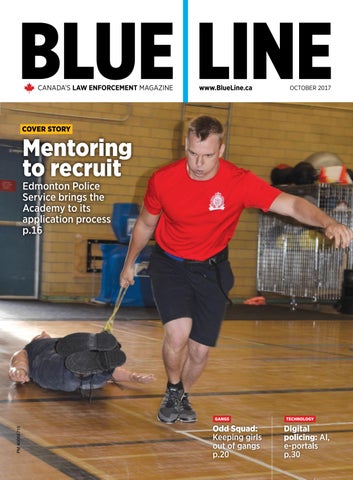
COVER STORY
Mentoring to recruit
PM 40065710
Edmonton Police Service brings the Academy to its application process p.16
GANGS
TECHNOLOGY
Odd Squad: Keeping girls out of gangs p.20
Digital policing: AI, e-portals p.30
M&P® 15 SPORT . AN EXPERIENCE YOU HAVE TO FEEL TO BELIEVE. TM
FEEL PERFORMANCE BACKED BY OUR LEADERSHIP IN MODERN SPORTING RIFLES. PLUS A LIFETIME SERVICE POLICY THAT LETS YOU SET YOUR SIGHTS ON JUST ONE THING – MORE ADRENALINE. * TARGET EFFECT DRAMATIZED
#EXPERIENCE #MANDP AT SMITH-WESSON.COM/MPPISTOLS
M&P®15 SPORTTM
Contents
20 October 2017 Volume 29 Number 8
Features COVER STORY
16 The future of police recruiting in Edmonton
Edmonton Police Service tackles a recruitment challenge with its new Mentoring Academy, believed to be the first of its kind in Canada. By Cheryl Voordenhout
20 Keeping girls out of gangs
Odd Squad Productions is launching a different kind of gang education program — one tailored for young women. By Renée Francoeur
24 Education & Training Directory
Check out Blue Line’s 2017-2018 Education & Training Directory for various options geared to the law enforcement career hopeful as well as those striving for lifelong learning opportunities.
Columns 4 10 12 14 15 26 30 34
Editor’s commentary Q&A Deep blue Health & wellness Holding the line Case law Technology Back of the book
Departments 5 5 7 8 28 32 33 34
By the numbers News Calendar Dispatches Off the shelf Product showcase Marketplace Blue Links
25 Motivators of a confidential human source
COVER PHOTO: CHAD ORYDZUK, EPS
The recruitment and handling of confidential human sources is one of the most dangerous activities a police service can become affiliated with. By Stephen G. Metelsky
10 16 @Blue_LineMag
25 October 2017 | BLUE LINE
3
EDITOR’S COMMENTARY BY RENÉE FRANCOEUR
Reviewing School Resource Officer programs
E
very October issue of Blue Line the OPP’s jurisdiction, but I wonder how includes an Education & Train- having such a figure might have altered the ing Directory, so naturally I atmosphere of those days when the dogs found my ears perking to any were brought in to search the lockers. news smacking of the hallowed halls of In this month’s Q&A (see pages 10-11), knowledge. With school back in session, I Chief Marlo Pritchard of the Weyburn noticed one particular story was receiving Police Service in Saskatchewan told Blue a lot of attention: officers in schools. Line how it was Glen Kosar, the first SRO My inbox filled with Google at the Regina Police Service, Alerts during the last week of It is a fact of whose influence served as a catAugust when the Toronto Dis- life that alyst for his career choice. So a trict School Board voted to axe violence SRO program really can make a the School Resource Officers happens in difference. (SRO) program pending its own and around That doesn’t mean these types review. Canadian Press reported schoolyards, of initiatives don’t need regular this was due to “racial and an- but I believe reviews and adjustments to betti-immigrant” bias concerns. The having some ter serve the constantly evolving move came shortly after the To- kind of law student body’s needs. Nor does it ronto Police Services Board ap- enforcement mean that there aren’t real issues proved a review and evaluation present with how the programs have been of the program, as recommended from time to rolled out at certain high schools in a report from Chief Mark time is part and how they may be failing cerSaunders, to be carried out inde- of improving tain groups. As one school board pendently by Ryerson University. public trustee put it, while armed police According to the police board’s safety. in schools can make some stuagenda from that meeting, the dents feel safer, they can also report states, “The objective of this review make others feel intimidated. We need to is to assess the current implementation address this, for sure, but I’m not sure an and environment of the SRO program, outright removal of SROs is the answer. taking into consideration the variety of In fact, I think it could create a wider gap viewpoints of and experiences with the between law enforcement and marginalprogram, using the principles of inclusiv- ized communities. There becomes less ity, equity and safety.” accessibility and exposure to personable When examining the objectives of both law enforcement faces for youth in a safe, reviews, one can honestly view them as neutral setting. positive and necessary steps — compliAs I write this, an 18-year-old male is rementary to Toronto Police’s goal of mod- covering in hospital after being stabbed ernization. However, I am sure some during a fight near G.L. Roberts Secondary would have preferred to see the school School in Oshawa, Ont. It is a fact of life board wait until these reviews were com- that violence happens in and around plete to make any decisions, like Toronto schoolyards, but I believe having some kind Mayor John Tory told reporters. of law enforcement present from time to Typically, SROs are stationed in various time is part of improving public safety and schools throughout the country, while improving relationships between police many other schools boast liaison officers and students, especially students who in some capacity. I did not have one in my perhaps have had negative connotations small town high school, which was under and/or experiences with the field.
CONNECT WITH BLUE LINE
www.BlueLine.ca 4
@Blue_LineMag
BLUE LINE | October 2017
www.facebook.com/BlueLineMagazine
BLUE LINE www.BlueLine.ca
GROUP PUBLISHER | PAUL GROSSINGER pgrossinger@annexweb.com EDITOR | RENÉE FRANCOEUR rfrancoeur@annexweb.com ACCOUNT MANAGER | JANICE EATON janice@blueline.ca ACCOUNT MANAGER | APRIL LENSEN april@blueline.ca ART DIRECTOR | SVETLANA AVRUTIN savrutin@annexweb.com ACCOUNT COORDINATOR | TRISH RAMSAY tramsay@annexweb.com CIRCULATION MANAGER | BEATA OLECHNOWICZ bolechnowicz@annexbizmedia.com COO | TED MARKLE tmarkle@annexweb.com PRESIDENT & CEO | MIKE FREDERICKS ANNEX BUSINESS MEDIA 80 Valleybrook Drive, Toronto, ON M3B 2S9 Tel. 416-442-5600 • Fax 416-442-2230 Publication Mail Agreement No. 40065710 ISSN 0847-8538 Printed in Canada SUBSCRIPTION RATES Canada — 1 Year $30.00; 2 Year $50.00 plus tax USA — 1 Year $100.00 USD CIRCULATION email: asingh@annexbizmedia.com Tel: 416-442-5600 ext 3553; Fax: 416-510-5170 Mail: 80 Valleybrook Drive, Toronto, ON M3B 2S9
Occasionally, Blue Line will mail information on behalf of industry-related groups whose products and services we believe may be of interest to you. If you prefer not to receive this information, please contact our circulation department in any of the four ways listed above. Annex Privacy Officer privacy@annexbizmedia.com; Tel: 800-668-2374 © 2017 Annex Publishing & Printing Inc. All rights reserved. Printed in Canada. No part of the editorial content of this publication may be reprinted without the publisher’s written permission. Opinions expressed in this magazine are not necessarily those of the editor or the publisher. No liability is assumed for errors or omissions. Readers are cautioned and advised that articles presented herein are edited and supplied for your personal awareness and should not be used for further action until appropriate guidance is received from a supervisor, Crown Attorney or other persons in authority. All advertising is subject to the publisher’s approval. Such approval does not imply any endorsement of the products or services advertised. The publisher reserves the right to refuse advertising that does not meet the standards of this publication.
NEWS CALGARY
Calgary upgrades Opticom traffic signal system
PHOTO: OPP
MONTREAL
Project Hope reaps largest single drug seizure in OPP history The Ontario Provincial Police says it has concluded an intercontinental investigation, dubbed Project Hope, which has netted 1,062 kilograms of pure cocaine — the largest single drug seizure in OPP history. The wholesale value of this seizure is estimated to be worth $60 million, while the eventual street value, once cut, is about $250 million. During the investigation, three individuals responsible for importing enormous quantities of cocaine from Argentina were identified and linked to cocaine transported on ocean-going vessels in shipping containers to the Port of Montreal for distribution in Ontario. The OPP worked with Canada Border Services Agency over several months to identify the containers and locations. Subsequent investigation identified links to various caches of cocaine at a CBSA warehouse, at the Port of Montreal and in Stoney Creek, Ont. Project Hope was conducted by the OPP Organized Crime Enforcement Bureau (OCEB) and Provincial Operations Intelligence Bureau (POIB) in partnership with CBSA, Peel Regional Police, the Financial
Transactions and Reports Analysis Centre of Canada (FINTRAC) and the United States Drug Enforcement Administration (DEA). OTTAWA
Email transformation saga continues for RCMP
News sources have reported RCMP’s plans to go ahead and develop a temporary new email system after delays from the feds to harmonize the entire federal government email system. RCMP spokesperson Cpl. Annie Delisle told Blue Line Shared Services Canada (SSC) has been responsible for the majority of the RCMP’s IT infrastructure, such as servers, networking and email, since 2011. “The RCMP continues to work with SSC on the email transformation initiative,” she said. “The project is progressing and SSC has upgraded the RCMP’s GroupWise infrastructure to provide stability to the environment and help move to a more supported version of the program.” She added, “SSC has also agreed to an Exchange/Outlook solution for the RCMP. The RCMP is currently working with SSC in the design options and once the environment is fully in place, the RCMP will migrate from Groupwise to Outlook/Exchange. The RCMP is not proceeding with its own email system.”
Calgary has upgraded its Opticom traffic signal priority system from Global Traffic Technologies (GTT) to access GPS-enabled technology. When an emergency vehicle needs to navigate an intersection, the Opticom Emergency Vehicle Preemption (EVP) system onboard the emergency vehicle sends a request to the intersection’s controller ahead of its arrival. If the request is granted, the light turns green and the vehicle receives a clear path. Opticom allows public transportation agencies to extend or truncate green cycle times, GTT states, and in turn, transit vehicles are on the road less, which can “significantly reduce fuel and other fleet operations costs.”
The City of Calgary. PHOTO COURTESY GTT. In Calgary, Opticom EVP and TSP systems are integrated and now the existing solutions are being upgraded from Infrared-based technology to GPS-enabled, which avoids the need for line-of-sight communication between the vehicle and the intersection. GTT also recently deployed this system in Lévis, Que.
BY THE NUMBERS
There were 50 stand-alone municipal police services across Canada that served a population greater than 100,000 in 2016, according to Stats Canada. The following numbers are in relation to those 50 services from 2015-2016.
17
Saw an increase in their rate of police strength.
@Blue_LineMag
24
Saw a decrease in strength.
236
per 100,000 population for police strength in Victoria, B.C. was reported as the highest rate.
9
Reported no notable change.
October 2017 | BLUE LINE
5
NEWS STAND OFF, ALTA.
Blood Tribe Police reports positive change for Kainai Indian Days
The 51st annual Kainai Indian Days event was held this summer on the Blood Reserve in southern Alberta, which is historically the busiest time of year for Blood Tribe Police Service (BTPS). This year, however, the service says things were “remarkably different” when it came to charges laid. The community of Blood Tribe hosted a rodeo, competition powwow, baseball tournament, traditional hand games and a fair that attracted “thousands of people to the community.” BTPS says it deployed all available resources and was supported by partners such as Lethbridge Police Service, RCMP and Alberta Sheriffs. In comparison to the 2016 event, there were fewer calls for service, less prisoners and crime severity was reduced, according to BTPS. EMS and police did not deal with any fentanyl overdoses this year, compared to 2016. “BTPS contributes this positive change to their enforcement efforts but also recognizes how the community has taken a stance against the illicit drug trade since a state of emergency in 2015, which was a result of the fentanyl overdose death toll,” the police service stated. “The community has worked diligently to spread awareness and many have made remarkable efforts to inform police of any suspicious activity.” BTPS received 96 calls for service and a total of 35 charges were laid for various offences. CANADA
Thumbs up for oral fluid drug screening device pilot
Results from an oral fluid drug screening device pilot project suggest the devices can be successfully used in Canada, according to Public Safety Canada, to identify drivers who test positive for certain drugs, and can provide another tool for law enforcement to detect and deter drug-impaired driving. While drivers can currently be tested for impairment by Drug Recognition Experts 6
BLUE LINE | October 2017
PHOTO: BTPS
(DRE) and Standard Field Sobriety Testing (SFST), Public Safety Canada, in collaboration with the RCMP and the Canadian Council of Motor Transport Administrators (CCMTA), led the pilot project to test the use of oral fluid drug screening devices as an additional tool for detecting drug-impaired drivers. Feedback from officers involved in the pilot project was largely positive, Public Safety Canada reports. Officers reported that the devices were “easy to use” and successful in various weather, temperature and lighting conditions. The officers also noted their “comfort and confidence” increased the longer they used the devices. Two oral fluid drug screening devices, the Securetec DrugRead and Alere DDS-2 were used in the pilot and approximately 15 per cent of all volunteers who participated in the project registered a positive drug reading. WINNIPEG
2023 World Police and Fire Games coming to Winnipeg
The World Police and Fire Games organization has picked Winnipeg as the host city in five years’ time, beating out San Diego and Adelaide, Australia. The biennial athletic event is open to active and retired law enforcement and fire service personnel throughout the world. The 2017 games in Los Angeles recently wrapped up with many Canadians returning with medals. The 67 competitions included events such as submission grappling, paintball, open water swim, stair race, ice hockey and more. ONTARIO
OPSEU pres: full institutional searches needed “right now”
The president of the Ontario Public Service Employees Union (OPSEU) is calling on Corrections Minister Marie-France Lalonde to intervene with ministry bureaucrats who
“continue to stall on plans to conduct full institutional searches of the system’s correctional facilities.” “Last December, we received ministerial permission to start conducting these searches, which involve a thorough search of the premises and a body scan of every offender,” said Warren (Smokey) Thomas. “It’s the only way to root out the weapons, drugs, and other contraband that have been circulating since before full-body scanners were installed.” In May 2016, then-Corrections Minister Yasir Naqvi announced that all correctional institutions would have a full-body scanner by 2018. To date, just under half have been equipped, Thomas said. Previously, jails used metal detectors, which could not perceive objects like ceramic knives. A correctional officer at Central East Correctional Centre was slashed by an inmate using a ceramic knife this summer. The officer was sent to hospital, where he received 24 stitches. “The problem is, they didn’t get rid of existing weapons using these scanners after installation,” Thomas explained. “There hasn’t been a single institutional search using the full body scanners. And look what happened.” ONTARIO
154 new graduates to support corrections reform
Ontario has hired an additional 154 new correctional officers as the province says it “continues to reform its correctional system by investing in staffing.” The officers graduated on July 28, 2017, from the eight-week Correctional Officer Training and Assessment (COTA) program and are being deployed to 18 of Ontario’s 26 adult correctional facilities. They will also help “improve the delivery of rehabilitation and reintegration programming and strengthen mental health supports,” the province states. “Congratulations to Ontario’s newest correctional officers. As our government www.BlueLine.ca
works to reform the province’s correctional system, we need more people, with the right skills and training, to meet the needs of those in our custody and to ensure the safety of our institutions,” said Marie-France Lalonde, minister of Community Safety and Correctional Services. “I look forward to working with you, and with the dedicated staff in institutions across the province.”
greatly enhance our community’s capacity to support individuals who are engaged in the sex trade and would like support to leave.” ONTARIO
Teams shortlisted for OPP modernization phase two project
OTTAWA
Conference Board seeks to improve emergency response
A new briefing by the Conference Board of Canada provides recommendations for improving the effectiveness of emergency responses to terrorism-related events. “Emergencies that result from acts of terrorism continue to evolve globally,” said Satyamoorthy Kabilan, director of National Security and Strategic Foresight with the Conference Board of Canada. “The attack in Ottawa on October 22, 2014, showed that Canada is not immune to this threat and there are areas, such as communication and effective partnerships, which need implementation.” The report, Insights on Emergency Response to Terrorism Events, makes six recommendations. For more, visit www.blueline.ca/news/ conference-board-of-canada-seeks-toimprove-emergency-response-4605. ST. JOHN’S
PHOTO: OPP
Blue Door program receives $2.3 million
Under the National Crime Prevention Strategy (NCPS)’s Measures to Support Exiting Prostitution, the feds have funnelled $2.3 million in funds to the Blue Door program, delivered by the Thrive Community Youth Network in St. John’s, N.L. The Blue Door program aims to support individuals in exiting the sex trade and/or sexually exploitive situations, including sex trafficking. It will be delivered in collaboration with the Coalition Against the Sexual Exploitation of Youth, which includes representation from police services, Eastern Health, Newfoundland and Labrador Housing Corporation, shelter services and individuals with lived experience. “Thrive is thrilled to be officially launching the Blue Door program in St. John’s,” said Angela Crockwell, executive director of Thrive CYN St. John’s. “The program is the first of its kind for our province and will @Blue_LineMag
CALENDAR IACP Annual Conference & Tradeshow Oct. 21-24, 2017 Philadelphia, Pa. www.theiacpconference.org Serving with Pride Gala Oct. 21, 2017 Toronto, Ont. www.servingwithpride.ca Canadian Critical Incident Inc. Fall Seminar Nov. 13, 2017 Niagara Falls, Ont. www.canadiancriticalincident.com
Infrastructure Ontario (IO) and the Ministry of Community Safety and Correctional Services (MCSCS) have shortlisted three teams to design, build, and finance nine new detachments for phase two of the Ontario Provincial Police (OPP) modernization project. The detachments will be built to replace buildings at the end of their useful lifespan and will be located in: • Huron County Detachment, 325 Albert Street, Clinton • Port Credit Detachment, 2735 Argentia Road, Mississauga • Hawkesbury Detachment, 1425 Cameron Street, Hawkesbury • Manitoulin Island Detachment, 488 Boozeneck Road, Little Current • Marathon Detachment, 101 Peninsula Road, Marathon • Parry Sound Detachment, 1 North Road, Parry Sound • Fort Frances Detachment, 200 McIrvine Road, Fort Frances • Moosonee Detachment, 16 Butcher Road, Moosonee • Orillia – TBD Under the first phase of the OPP modernization project, Ontario replaced 18 detachments, regional headquarters and forensic identification services with 17 new facilities in 16 communities.
CONNECT WITH BLUE LINE
www.BlueLine.ca @Blue_LineMag www.facebook.com/BlueLineMagazine
CACP Counter Terrorism & National Security Forum Nov. 15-16, 2017 Ottawa, Ont. www.cacp.ca Ontario Gang Investigators Association Conference Nov. 20-23, 2017 Windsor, Ont. www.ongia.org 2017 Chief’s Gala Nov. 23, 2017 Toronto, Ont. www.chiefsgala.com Canadian Public Safety Interoperability Workshop Dec. 3-6, 2017 Ottawa, Ont. www.citig.ca IPA Region 2 Annual Christmas Party Dec. 9, 2017 Vaughan, Ont. www.ipacanadaregion2.com NSSF Shot Show Jan. 23-26, 2018 Las Vegas, Nev. www.shotshow.org CACP Information, Communication & Technology Committee Workshop Feb. 25-28, 2018 Vancouver, B.C. www.cpa-acp.ca
October 2017 | BLUE LINE
7
NEWS DISPATCHES Insp. Gerri Forscutt, a 26-year member of the Winnipeg Police Service, was promoted to the rank of superintendent in June. Mark Neufeld has been appointed Chief of Police for Camrose Police Service after Darrell Kambeitz retired in May. Before moving to Edmonton in 1993, Neufeld was with the Vancouver Police Department and has about 26 years of experience between the two agencies.
wlu-ba_policing-ad_quarterpage_blueline.indd 2 BlueLine_Wilfrid_Oct.indd 1
Andrew Parsons, minister of Justice and Public Safety and Attorney General, an2/6/17 9:58 2017-09-05 9:03AM AM nounced the appointment of Royal Newfoundland Constabulary Supt. Joe Boland, as Chief of Police. Boland began his career with the RNC in 1983 after graduating from the Atlantic Police Academy. Since then he has served in many branches, including Patrol Services Division, Criminal Investigation Division, Operational Support Services Division and the Recruiting and Training Unit. He has served both as president and vice-president of the Royal Newfoundland Constabulary Police Association, and been awarded the 20-year Police Exemplary Service Medal, 30-year Police Exemplary Service Bar and Her Majesty Queen Elizabeth II Diamond Jubilee Medal. Before becoming chief, Joe was the Officer in Charge of Patrol and Operational Services Division. The International Police Association - Region 2 - “Canadian Section” welcomes Braden Baron (Peel Regional Police Service),
Linda Boag-Moores (Toronto Police Service, retired), Jim Drake (OPP Auxiliary), Fran Saltzman (RCMP, retired) and Robert Johnson (Toronto Police Service) as its newest members. The International Police Association (IPA) is a worldwide non-profit organization with 420,000 members in 63 countries. Blood Tribe Police, which polices Canada’s largest First Nations reservation in Stand Off, Alta., celebrated a handful of promotions from first class constable to senior constable: Hadiga Little Wolf, Bradley Chief Body, Dana Chief Body and Grant Shade. In order to be eligible for promotion to senior constable, members must have at least eight years experience and successfully complete a promotion readiness exam. Supt. Greg Burnett retired in June after 28 years of service with the Winnipeg Police to take a position as an adviser to the Minister of Justice and Attorney General of Manitoba. PROMOTIONS, RETIREMENTS, RECOGNITION • If you have a senior officer in your agency recently promoted or retiring or an individual you wish to have recognized (major award or recently deceased) you can let Blue Line magazine know by email to: dispatches@blueline.ca.
www.BlueLine.ca
Dalhousie University Police Leadership Graduates
Bruce MacPhail Award for Academic Excellence goes home to Halifax The Sgt. Bruce MacPhail Award for Academic Excellence is presented to the municipal police officer who achieved the highest overall average in a concentration certificate within the Police Leadership Program at Dalhousie University in the past academic year. MacPhail began his career with the Amherst Police Department in Nova Scotia and in 1982 he became one of the first police officers with the newly formed Bedford Town Police. He continued on with Halifax Regional Police after amalgamation, eventually heading up their first Auto Theft Unit. He completed the certificate in “Police Leadership - Supervisory Skills” in 2000, and was the first to graduate as a Certified Police Coach in the program. MacPhail passed away in June 2001 after a short and courageous battle with cancer. Phyllis MacPhail established the award in 2001 in memory of her son. The 2017 recipient of the Sgt. Bruce MacPhail Award for Academic Excellence, Const. Amit Parasram of Halifax Regional Police, attended Dalhousie University where he received his Bachelor of Science degree in psychology. In 2010 he graduated as valedictorian from Halifax Regional Police’s Police Science Program and was awarded the Sgt. Bruce MacPhail Award for Excellence in Policing. Parasram immigrated to Canada from Trinidad and Tobago as a child and has lived in Nova Scotia for most of his life. He has worked as a patrol officer, coach officer and was assigned to Halifax Regional Police’s Mental Health Mobile Crisis Team. He is currently assigned to the Chief’s Office. Parasram thanks his wife Heather, daughter Aurora, and his brothers and sisters for their support and encouragement of his continuing education. His parents, Jai and Sero, have always instilled in him the value of education and lifelong learning and he says he believes the courses taken at Dalhousie have greatly contributed to his professional development. Having had the opportunity to meet Phyllis MacPhail in 2010, Parasram says he is honoured to be the first officer to bring the award home to HRP. Congratulations to Const. Parasram!
Fall 2016 - Spring 2017 Service Delivery Certificate
Det. Paolo Fiore York Regional Police, Ont. Sgt. Trina Gosse Insp. Dave Andrews OPP, PCC, Orillia, Ont. Peel Regional Police, Ont. PO1 Amanda Holt Maj. Steeve Gregoire CF Military Police, Borden, Ont. CF Military Police, Ottawa, Ont. Cpl. Chris Hutchings Const. Brian Moore RCMP, Edmonton CFSEU, Alta. OPP, Almaguin Highlands Det., Ont. Const. D. Prasad Const. Skylar Peddle RCMP, Antigonish Det., N.S. RNC, Corner Brook Det., N.L. Cpl. Tim Williams Cpl. Matt Picard RCMP, Burin Peninsula Det., N.L. RCMP, Taloyoak Det., Nunavut Const. Adam Richardson Administration RCMP, Red Deer Det., Alta. Certificate Const. Diana Stratton RCMP, “K” Division, Alta. Det. Davis Baxter Sgt. Ryan Wentzell Peel Regional Police, Ont. RNC, Corner Brook Det., N.L. Cpl. Jean-Luc Bedard RCMP, MMIWG Inquiry, Ont. Law and Justice Marc-Olivier Bouchard, CX-02 Certificate CSC, Cowansville Inst., Que. Const. Daniel Bray Sgt. C. Brunet-Smith RCMP, Ross River Det., Yukon RCMP, “O” Division, Ont. Sgt. R.W. Dixon Sgt. David Butcher RCMP, Surrey Det., B.C. Saugeen Shores Police Service, Ont. Const. Adam Fewer S/Sgt. Shaun Crabbe RCMP, Baie Verte Det., N.L. OPP, Red Lake Det., Ont.
College of Continuing Education
Cpl. Sébastien JF Decaens RCMP, Lamèque Det., N.B. Cpl. Anthony Gaudet RCMP, “J” Division, N.B. Cpl. Rob Lewis RCMP, “E” Div. Headquarters, B.C. Sgt. Jason McNeil Halifax Regional Police, N.S. Const. Mark Prill Saanich Police Department, B.C. Insp. Rod Stafford Weyburn Police Service, Sask. Sgt. Kevin Zettel Saugeen Shores Police Service, Ont.
Supervisory Skills Certificate Const. Amit Parasram Halifax Regional Police, N.S. Cpl. Dylan Powell University of SK, Protective Services, Sask. This list is not exclusive. Some students could not be contacted and for reasons of privacy and security some did not wish to have their names included. The staff and faculty of the Police Leadership Program want to congratulate all graduates on their success!
Certificate in Police Leadership
Have a degree already? A post-degree certificate only enhances your skill-set as a police officer. Continuing education is an important asset for leadership development, and our courses are developed by police leaders and academics to help prepare you for that next promotional opportunity. Prior post-secondary experience is not mandatory. A certificate program does not have the same admittance requirements as a degree program and does not require as many courses, so it is a good path for those looking to step into academics. We are proud to see former students in senior leadership positions all over Canada.
“The Managing Police Performance: Coaching Skills for Police Supervisors workshop is a “…great course! Provides a good coaching skills foundation for new coaches and supervisors...” S/Sgt. David M. Zackrias, Ottawa Police Service COACHING SKILLS WORKSHOP Halifax: Nov. 3-5, 2017 ONLINE COURSES* Winter Term begins Jan. 29, 2018 *All courses are online except Managing Police Performance: Coaching Skills for Police Supervisors which begins with a 3-day workshop.
Prepare for career advancement today! Detailed information and online registration can be found on our website at www.dal.ca/cce. If you would like further information please contact the Program Manager, Sherry Carmont, by email at CPL@Dal.Ca, by phone at 902.494.6930 or toll-free at 1.800.565.8867.
Dalhousie University College of Continuing Education 1459 LeMarchant Street, Suite 2201 PO Box 15000 Halifax NS B3H 4R2 October 2017 | BLUE LINE
@Blue_LineMag BlueLine_Dalhousie_Oct.indd 1
9
2017-09-01 1:55 PM
Q&A Weyburn Police Service is currently celebrating 60 years since its rebirth. Chief Marlo Pritchard gives Blue Line the details on the unique “split service” history and lessons he’s learned from his 35 years in law enforcement, including time as a civilian police officer in the United Nations mission in Kosovo. Q: You completed two tours of duty as a civilian police officer in the United Nations mission in Kosovo. Can you share any lessons from this role that you carried with you to Weyburn?
The welcoming aspect was special — seeing how the community reached out to introduce themselves and inviting me to different functions. I probably hadn’t even been here a week and I had a number of individuals stop by and have ‘tea with the chief.’ It was something you don’t see in a bigger service very often, I think, so I found it very interesting.
Q: Why did you choose law enforcement as a career path?
That is a funny story because at first I really had no interest in law enforcement. You talk to a lot of people who were focussed on policing right from when they were little kids. I wasn’t one of those. Regina Police Service had their first school resource officer at my high school and he saw some potential in me and tried to keep me out of trouble. He encouraged me to consider policing as a career. So it was strictly because of the influence of that officer, Glen Kosar, and 35 years later I’m still here.
Q: What is the toughest part of the job?
There are a number of challenges when you become chief. You come from a different rank and now all of a sudden you’re the final say. You don’t have that safety net. You can get input from others but ultimately you have to make those final decisions. You’re dealing with different issues and priorities and trying 10
BLUE LINE | October 2017
to base that on experience as well as the needs of organization and the community.
SNAPSHOT OF THE WEYBURN POLICE SERVICE
Q: How is being a police chief in Weyburn unique to other locations?
1913
When you’re a police chief in any community, you have to adapt your police services to meet the needs of that particular place. One community might have a gang issue — fortunately we do not — and another one may have something different, but a lot of the trends I saw in Regina, we see here, too. We’re probably more fortunate in one aspect, as a smaller community, and that’s that we can often take our time. In bigger services, just because of demand, you can’t always spend the time that you’d like and need to on the files. We were also voted in as the fifth best place to live in Canada — and it really is a great community to live in and police in. There is a huge amount of support.
Weyburn Police Department first formed
1957
Service re-established after a temporary transition to RCMP in 1944
1993
First female officer, Const. Caroline Chartrand, hired
This experience shaped my thinking and I realized the importance of the rule of law. When I was in Kosovo, it was shortly after the war, and there was definitely a disruption of the rule of law — things we take for granted, like vehicle registrations, government functions, parking rules. You would see spontaneous violence because of the lingering issues in a post-conflict zone. I also took away the important of working with the community because without that support, we’re really just an occupying force. You need a community connection to police because that’s what we are — an extension of the community.
Q: How is Weyburn Police celebrating its 60th anniversary this year?
We have rebranded with new shoulder flashes and we’re updating our cars over the next year or so. We held a two-day open house and that was a phenomenal turnout — we lost count after 2,000. We had tours and one constable has developed a video of our history (youtu.be/REYIk0VjToo). Donations were collected for our local youth centre — we were able to raise almost $1,400. From the feedback, the community really appreciated it. At the end of September we are also having an Emergency Services Ball, a black tie event. We’re partnering with fire and EMS and, while we’ve had ‘policeman balls’ before, maybe 20-25 years ago, I think this is probably the first time www.BlueLine.ca
PHOTO COURTESY WEYBURN POLICE SERVICE
Q: You’ve been chief for five and a half years now. Coming from Regina to a smaller city, what would you say has been your most memorable moment?
all the emergency services have come together for a ball.
Q: Anything from the force’s history that is surprising?
What’s unique about the Weyburn Police is its split service. It started back when Weyburn became a city in 1913 with Chief Const. Blaikie as chief until 1933. The department disbanded in 1944 and it went to the RCMP. Historically, no one knows why. There is a lot of speculation it was because of resourcing due to the Second World War. We haven’t been able to find any documentation, though. Twelve years later the city council decided they wanted to go back and reinstitute their own police service and so on July 1, 1957, the Weyburn Police was established again under the leadership of James E. McCardle. Also, we were one of the first Saskatchewan services to complete in-car cameras about 18-19 years
ago. One of our own, Const. Jeffery Bartsch, was the first Canadian police officer to run a full marathon in uniform and he’s still going strong with that. Weyburn Police Service was also highlighted in Reader’s Digest in the late 1990s or early 2000s, as an interesting side note, for its community policing and Reader’s Digest staff came out and did a ride-along.
Q: What would you say are the most pressing challenges for the Canadian policing community?
There’s no doubt in my mind that we are not really capturing what is happening to the Canadian economy or the true number of victims from cybercrime. A lot of these kinds of reports are going straight to banks, not police agencies. Then there are jurisdictional issues because many of these perpetuators are residing
offshore. How do you disrupt them? How do you hold them accountable? The technology to work on these challenges and the costs of that are also quite phenomenal.
Q: What kinds of changes would you like to see in Canadian policing?
We’re seeing a slow evolution of policing because of the changes in technology and the demands from the communities. You’re seeing an increased need for more blending of specializations, etc. The days of small town police services trying to do it all are gone. You’re outsourcing many different things and I think bigger agencies will end up doing that, too. The boundaries of Weyburn Police, for example, and Estevan Police are blended and we work much more closely together now than in the past — just for efficiencies. I think that will expand.
Weyburn Police’s online history states RCMP Const. Henry Lett received a commendation in 1903 for arresting an American gunslinger by the name of Idaho Kid, who had come to Weyburn, “got drunk and began to shoot up the town.”
©2017 Whelen Engineering Co., Inc. All rights reserved.
WHEL0012_BLUELINE_HORZ_NOFDIC.indd 1
@Blue_LineMag
BlueLine_Whelan_May.indd 1
4/13/17 5:08 PM
October 2017 | BLUE LINE
11
2017-04-17 9:23 AM
DEEP BLUE
BY DOROTHY COTTON
Changing organizations’ personalities
T
wo of the local hospitals recently amalgamated here in my hometown. It is an interesting pairing between your basic government-type psychiatric hospital and a long-term care/geriatric hospital, operated by a Catholic organization. Some years ago, the government decided to get rid of its psychiatric hospitals, so the psych hospital was handed over to the Catholic organization. Ergo these two organizations came under the same governance structure but were maintained as two different physical facilities. Although there was a degree of shared higher management, generally the two institutions retained some level of separation. But only until April 2017. The patients and staff from these two organizations moved into a brand new shared building this 12
BLUE LINE | October 2017
spring, which houses all patients who broadly fall under the rubric of “long-term care.” This includes both people with serious and persistent mental illnesses, and people with acute physical disabilities, including those who are not expected to recover. The two hospitals, in their former incarnations, had very different organizational cultures. It has been interesting to watch how these cultures have melded, how they have failed to meld, and in what areas there has been conflict. While the example I’ve given above comes from the healthcare system, many of you will be familiar with instances in which the same process has played out in police services. Sometimes, it is simply a matter of two relatively smaller police organizations coming
You have to get the informal leaders on board. You have to make sure that the reasons for the change and why it might be a good thing are made clear to the masses.
together. In other cases, large provincial or federal organizations have literally taken over small municipal ones. Sometimes this works and sometimes it doesn’t. There are a variety of reasons for conflict — the most obvious including differences in union contracts, pay scales, seniority lists, policies and procedures, etc. But equally challenging can be the issues of trying to blend two or more organizational cultures. Interestingly, this does not only happen when two different organizations are joined. The same kinds of difficulties can emerge when one organization attempts to change its own culture, or when it had already changed the organizational culture but there remains those hard-core employees, often older and higher in seniority, who resist the shift. What exactly is organizational culture anyhow? One might think of it as the personality of the organization. The culture reflects the shared values, assumptions and beliefs of the organization, which often go beyond the written policies. Sure, we all get a certain number of sick days per year. But are you allowed (either officially or unofficially) to take a sick day if you have a sick child? Do you use up your sick days because otherwise you “lose them?” Does everyone take a sick day when they are not sick now and then or do people only call in when they have the plague? How likely are you to rat out a co-worker? Does the organization really act like its employees are its biggest asset or, as I believe the Dilbert comic once said, are they the seventh or eighth most important, somewhere after carbon paper? Is competition valued over co-operation in an effort to pry the best out of everyone? Is innovation a good or bad thing? (I once worked for an organization where my boss described me as “a change agent.” I thought that was a compliment. Turns out it was a condemnation.) How is power distributed and used? What kinds of behaviours are actually rewarded? Do you get brownie points for actually doing something meritorious, or are rewards www.BlueLine.ca
based purely on hanging around forever? So how does one change an organization’s culture? I am tempted to say (snidely), “Good luck with that.” Anyone who has been through this process knows that it is not easy. Of course, the first step is figuring out what you are trying to change. When two organizations come together, it is often not obvious where the areas of disagreement are. For example, if you compared the contracts of the nurses at two different hospitals, you might find both specify the same number of sick days. So it might look like all is well there, but if use of sick days is pretty free form in one facility and not in the other, and a manager from one organization ends up with staff from the other, there is going to be a problem. Curiously, it has been my experience (as one who tends to hang around at the bottom of an organization rather than the top) that senior managers seem to think: rules are clear, people abide by rules, communication is top-down and formal
leaders are the people with impact. I’ve got to say it never looks quite like this to me! That’s not to say that strong leaders, clear goals and a meaningful strategic plan are not essential to organizational change. But these are not enough. You have to get the informal leaders on board. You have to make sure the reasons for the change and why it might be a good thing are made clear to the masses. You have to be able to take on the naysayers — which means knowing who they are. You have to make sure that the structure of the organization actually supports the new goals. Then there are the human resources issues. You have to have the right people on board at all levels. Sometimes (often?) that means turfing some of the old guard and it definitely means hiring a different kind of person. If you hire the people you have always hired, you will have the organization you have always had. And then there is policing. In just the 15-20 years I have been involved in this field, there has been tremendous need for
change. I do pre-employment assessments for quite a number of police services and I am starting to see some different people come in the door. I don’t just mean different cultural and language groups; I mean different backgrounds, ideas and goals. Will they fit in? My guess is that many will struggle in a culture that was designed for another time. How will organizations support them? There are no magic answers. To the senior managers who are trying to implement change, I say, “Good luck.” To everyone else I say: Wake up and smell the coffee. It ain’t 1975 anymore. If you aren’t part of the solution, you are part of the problem. If the words, “We have always done it this way” tend to come out of your mouth, I have bad news: you are part of the problem.
Dr. Dorothy Cotton is Blue Line’s psychology columnist. She can be contacted at: deepblue@blueline.ca.
Move forward in your career. Bachelor of Applied Arts Justice & Public Safety
Toronto, ON
> Degree completion for professionals
Complete your degree while working! > Build on your credentials and open up opportunities for career advancement > Credit for previous postsecondary education, training and work experience > Online and weekend classes allow you to balance work and studies
>>> guelphhumber.ca/jpsdc
@Blue_LineMag
BlueLine_UofGuelph_Oct.indd 1
October 2017 | BLUE LINE
13
2017-09-11 9:40 AM
HEALTH & WELLNESS BY ISABELLE SAUVE
Rest to perform
T
rain harder. Be more active. Focus more. Set clear goals. Work harder. These are amongst the adages we have come to equate with personal, social and work performance. Indeed, no one will argue the wisdom behind such motivational and inspirational words. There are countless books and articles providing advice on how to “do more.” Our society continually comes up with innovative ways for us to be more productive. However, sometimes doing less is actually doing more. For example, physical overtraining can be more harmful than missing a workout session or two. Furthermore, rest and relaxation offer great benefits for our minds and bodies. Rest management is an integral part of good health, proper recovery and rejuvenation. Planned rest should reflect and fit harmoniously with one’s lifestyle. As an illustration, someone training for a highly demanding physical endeavour will likely require more rest in light of the demands being placed on the mind and body. Elite athletes master the art of daily built-in rest periods to allow for multiple quality training sessions. This routine maximizes the body’s ability to recover and be ready to train again sooner. Research has proven muscles and cells — including blood,
brain and other tissues — do repair more efficiently when the body and mind are at rest. There are numerous health benefits associated with incorporating rest into one’s daily schedule. Unfortunately, there is no equation that fits everyone. Finding the right balance is essentially established by trial and error. Rest requirements also shift according to personal circumstances. Our society is not always aware — or understanding — of the importance of rest and its positive impact on productivity. This is somewhat surprising since studies show regular rest periods in a workday boost alertness and productivity. Many European countries recognize the value of napping and many businesses shut down in the afternoon for the purpose of a quick power nap. It permits workers to recharge and get back to work feeling re-energized. Experts agree that a 10 to 20-minute nap is enough to refresh the mind. It essentially gives the brain and body a reboot. A convincing study recommends a 17-minute resting/relaxation period follow every 52 minutes of work. This equation achieved highest employee productivity per day compared to other work-to-rest formulas. Additionally, subjects presented a reduced level of work related stress and fatigue. Another experiment established subjects
were able to refocus and recharge by merely closing their eyes and relaxing for one minute every hour. This knowledge begs whether or not rest should be made mandatory in the workplace. A rested body and mind promotes better decision making and appropriate situational decision making is at the heart of law enforcement work. Law enforcement personnel are subject to erratic schedules, including night shifts and long working hours that affect the body’s internal clock. While it is possible to somewhat grow accustomed to these work conditions, it does not negate that it takes a toll. These professionals are Fatigue is also notoriously guilty of pushing cumulative if themselves to an unhealthy level and improperly denying their tiredness. Fatigue is managed and cumulative if improperly managed chronic and chronic fatigue can easily set in, fatigue can even without one realizing it. easily set in. Rest should be performed in a quiet environment. Sitting in front of a TV or computer does not provide enough of a disconnect to truly “reset.” Allow yourself a break from technology. In fact, plan for unproductive downtime. It is healthy to sit and “just be.” Research shows disconnecting is vital to learning and memory retention. In addition to taking daily resting periods, we can also benefit from breaks from our hobbies, sports and projects. The tennis champion Roger Federer recently illustrated this. He took six months away from competition only to return stronger, more focused, and win Wimbledon for the eighth time at the age of 36. He won this most recent Grand Slam tournament without losing a single set. It was a true attestation to the effectiveness of taking a calculated step back to refocus and re-energize the mind and body. Stay tuned for upcoming columns, which will delve deeper into the topics of sleep, means of relaxation and recovery. Isabelle Sauve is a 10-year OPP veteran currently with the Emergency Response Team (ERT) at the Almaguin Highlands Detachment in Burks Falls, about 300 km north of Toronto. She can be contacted at: isabelle.sauve@hotmail.com.
14
BLUE LINE | October 2017
www.BlueLine.ca
HOLDING THE LINE BY MICHELLE VINCENT
Time off work isn’t just for physical ailments anymore
A
lthough I believe we have improved significantly when we look at how we address time off at work, I feel we still have a long way to go in how we ascribe value to it and manage it as individuals. Time off is integral in the world of policing but there is an unspoken word amongst us officers that we must be justifiably ill in order to take a sick day. Time off in the culture of policing is seen as time off from a profession where the members do not feel the organization can manage without them. Those of us who have been serving for many years often experience this belief — the job won’t get done unless we are there to do it. Hopefully this is starting to change with the next generation of officers. When we think of the healthy things time away from work brings, it is difficult to understand why we are so hard on ourselves — and our colleagues — when it comes to this topic. I don’t think there is a unit I have worked in where snide remarks were not made about someone who was away on sick time or where a colleague hasn’t felt the need to fully explain their entire life history as to why they were not well enough to come in. Let’s rework the concept of time off so we are not afraid of what others will think, say or do. We live perceptual lives and everything we experience is a result of our perception. With this in mind, perhaps allowing ourselves the time off — regardless of the reason — would improve the work environment, resulting in more of us not requiring as much time off, or being ill as often or for as long. We have the power to apply those changes as leaders in our work environments, recognizing that time off work for mental health illness is just as important as it is for those injuries and illnesses that are visually observable. Perhaps this is the issue we are challenging ourselves @Blue_LineMag
with — no different than what we as a culture are coming to accept in regards to occupational stress injury. We may also want to look at how taking time off of work for mental health needs may be another form of preventing long term injury. It’s an interesting concept to explore as first responders are in the limelight when it comes to occupational stress injury, PTSD, anxiety and depression, along with a myriad of other ailments that are now “acceptable” for us to have. I wonder, if we took the time we need to look after ourselves and our loved ones from the start — from a dietary, physical, mental and, yes, a time off perspective — if we might improve our resiliency and therefore our vulnerability to these serious issues. If we notice we are coming down with the flu, either during our block of work or just prior to our first day, and we take that small bit of time off to look after ourselves from a physical perspective — including but not limited to getting the extra sleep we may need — instead of coming in sick and spreading germs, we physically strengthen not only ourselves but also those around us. It should be no different from a mental health perspective. For example, let’s say we are experiencing
Let’s rework the concept of time off so we are not afraid of what others will think, say or do.
depression as a result of a bad call. Perhaps it’s nothing too serious but we are emotionally depleted and notice our irritability from a lack of sleep due to our minds being wrapped up in the call. Taking time off would allow us to get some sleep, nurture the soul (without saturating it with the next call), perhaps research some mental health services, and ultimately take the time needed to care for that part of ourselves that is not visible when it is injured or unwell. It is our responsibility to manage our time off. As leaders, we have the power to demonstrate how to come to work at our best. Then we are able to deal effectively with the often-challenging incidents we are handed in the course of our day/ night shift. We have the power to ensure we will be effective backup when our partners need us and we do this by changing the perception of the value of time off and choosing to care for ourselves. Michelle Vincent is a 15-year York Regional Police officer with a Masters Degree in Arts in Counselling Psychology and a background in equine assisted therapy, workplace reintegration and teaching. Her counselling practice is supervised by a psychologist with a specialty in addictions and trauma. She can be contacted at: michelle@smith.net.
October 2017 | BLUE LINE
15
COVER STORY
The future of police recruiting in Edmonton By Cheryl Voordenhout
WEEKS
Length of Academy
of confidence, or discomfort with the demanding academy expectations that often go hand-in-hand with police training. In response, the EPS created the Mentoring Academy. Believed to be the first of its kind in Canada, the Academy selects previously deferred applicants from communities and demographics that are under-represented in the EPS — women, newcomers and Indigenous Canadians, for example — and
Nine people from the first Academy have been hired into the next recruit class and two more are making their way through the eight-stage application process. 16
BLUE LINE | October 2017
helps prepare them to complete a police officer application and to be successful in police training. The program, which ran its first pilot class in spring 2017, takes police hopefuls through 12 weeks of mentoring, fitness testing, practice interviews, scenarios and workshops. Topics such as ethics in policing, active listening, effective presentations and situational awareness are covered. The goal is to help prepare participants for what they will encounter in the application process, as well as in training, should they succeed in being hired. “It came out of necessity,” says Staff Sgt. Robinder Gill, who instigated the program. “We live in a very diverse community, and the www.BlueLine.ca
PHOTOS: CHAD ORYDZUK, EPS
12 A
s the police organization for one of Canada’s fastest growing multicultural cities, the Edmonton Police Service (EPS) had an interesting recruitment challenge on their hands. Recruiters felt that good candidates were failing their applications due to small problems that could be easily solved with a bit of mentoring – problems such as a lack
The Academy is by invitation only and there’s a sense of pride in that, EPS says.
EPS, like most other police agencies, doesn’t accurately reflect that diversity. We had to ask ourselves why that was the case.” Currently, about 22 per cent of EPS sworn members are women, while 11 per cent identify as a visible minority or Indigenous person. Part of the issue, notes Gill, is that many people from these under-represented communities lack the mentorship and support to make it through the demanding recruit selection and training process. “Sixty per cent of police officers had someone in their immediate family or social circle who was a police officer,” Gill says. “Many of these individuals in the Mentoring Academy are trying to run the same race, but they’re behind the start @Blue_LineMag
line already because they don’t have the same supports.” Academy participants are selected based on a review of their file, with special attention paid to the reasons they were deferred in any previous attempts to get hired by the EPS. “Some of the applicants who don’t make it through the first time have what it takes. They just don’t know it themselves,” says Heather Smith, the program’s co-ordinator. “The fact we’ve selected them for this program — that we’re investing this time into developing them — shows them that we see their potential, and that helps build their confidence.” Smith notes that recruiters were surprised by a discrepancy between the number of women who attended
“We then feel confident we’re sending the highest calibre of individuals into our application process.” - Staff Sgt. Robinder Gill the EPS’s Women in Policing information session versus the number of women who actually applied. “There’s a disconnect,” she says. “Sometimes women need reassurance that they can do this job. The ‘gap’ in their skills is really just their perception. It’s fair to say this is probably the case for most minority applicants, too.”
16 Participants in 1st Academy
October 2017 | BLUE LINE
17
PROUDLY SUPPORTING MILITARY & LAW ENFORCEMENT FOR 26 YEARS!
LESS LETHAL AMMUNITION
The first pilot class took police hopefuls through 12 weeks of mentoring, fitness testing, practice interviews, scenarios and workshops.
Currently, only 22 per cent of EPS sworn members are women.
W O LV E R I N E S U P P L I E S . C O M PRODUCT T&E AVAILABLE UPON REQUEST!
18
BLUE LINE | October 2017
BlueLine_Wolverine_Oct.indd 1
The second class started in September with 16 participants registered, including one who has relocated to Edmonton specifically to take part in this program.
process are scoring three to seven points higher on their BDI component than those who have not gone through the Academy and are, on average, 7-15 seconds faster in the obstacle course portion of the fitness testing. Nine from the first Academy of 16 people have been hired into the next recruit class and two more are making their way through the eight-stage application process. This is leading to an unexpected benefit for students who go on to recruit training. “There are quite a few of us in my recruit training class that are from the Mentoring Academy,” says Karianne Veillette, who participated in the pilot and started recruit training in August. “It’s definitely a great support system because we already have www.BlueLine.ca
2017-09-11 9:13 AM
PHOTOS: CHAD ORYDZUK, EPS
P 204-748-2454 E brent@wolverinesupplies.com
To develop the curriculum, recruiters looked at the places where applicants typically struggle: physical fitness, often a challenge for those working multiple jobs or juggling family responsibilities; and the behavioural descriptive interview (BDI), cited by many as the hardest part of the application process. The BDI asks applicants to describe particular experiences and how they handled them. Interviewers are looking for evidence of competencies such as adaptability, perseverance, interpersonal skills and stress management — skills that Academy students do have. “They’ve had plenty of challenging life experiences; they just may not have much practice articulating them in a way that resonates with police recruiters,” Smith says. Although the program is still in its infancy, it is already showing results. Participants who go forward into the application
COVER STORY
“Some of the applicants who don’t make it through the first time have what it takes.” - Heather Smith this Academy is by invitation only,” says Smith. “There’s a sense of pride in that. And the expectation when you go into training is even higher.” Academy participant and new recruit Conrad Whetstone agrees: “You see the passion and dedication these people are putting into you, trying to give you the best chance of success, and it makes you very proud to have been selected.” With the full support of EPS leadership and a successful pilot behind them, the Recruit Selection Unit plans to continue running this ground-breaking program.
“I see this as changing the way we recruit for sure,” says Gill. The second class started in September with 16 participants registered, including one who relocated to Edmonton specifically to take part. Recruiters are optimistic about the direction the Mentoring Academy is taking, not just in terms of widening the net to increase options for recruitment, but also for the possibilities it offers as recruiters start to consider people with different but equally valuable skills. “Traditionally, we had this box, and we looked at people based on how they fit into that box,” Smith says. “But when you have people with vastly different life experiences, how are you supposed to evaluate them the same way?” For more information, visit joineps.ca. Cheryl Voordenhout is a communications advisor and has been with the EPS for a year. Previously she held writing and communications positions with the City of Edmonton and the Government of Alberta.
team building experience from our time in the program.” Recruiters also rave about the value of the Academy as a screening tool. “In the normal application process, we get about eight hours with each applicant,” Gill says. “With this program, we spend 36 hours with them.” The extra time gives recruiters a chance to assess the character of each participant and determine whether the applicant has the values and integrity to uphold the high standards of the EPS. “We then feel confident we’re sending the highest calibre of individuals into our application process,” Gill says. While it is true that students are getting a hand up, recruiters are quick to note that it’s not a free ride. After the Academy, participants still need to go through the normal application process, and if selected, they enter a recruit training class like any other new recruit. “Everyone knows October 2017 | BLUE LINE
@Blue_LineMag BlueLine_Georgian_Feb.indd 1
19
2017-01-11 11:54 AM
GANGS
Keeping girls out of gangs Odd Squad’s new Her Time... program centres the gang conversation on young women By Renée Francoeur
F
or several years, Det. Anisha Parhar worked in covert intelligence in British Columbia where she heard many haunting things, but it was the conversations of gang member’s wives and girlfriends that served as a catalyst for a new endeavor she and fellow Det. Sandy Avelar are piloting this fall. It’s called Her Time... and it will make its debut to a handful of B.C. schools under the umbrella of Odd Squad Productions, a non-profit started by Vancouver police officers in 1997 with a mission to educate youth about the dangers of drug use
20
BLUE LINE | October 2017
and criminal behaviour, including the slippery slope of gang involvement. Her Time... is a two-tiered initiative — “reactive and proactive,” Parhar explains — and is tailored to reach young women and high school girls who are at risk of becoming involved in gangs or who are already tied to one. “Her Time... is something I’ve wanted to do for a long time,” says Parhar, who works in a gang crime unit alongside Avelar in B.C.’s lower mainland. “In intelligence, I experienced an angle of policing many officers are never exposed to. You’re
Sandy Avelar
Anisha Parhar
listening to these guys and girls when they think no one is listening and you really see the raw and human side of these people. I heard a lot of abuse and a lot of instances where the girlfriends would take the fall. I was introduced to the whole culture of it.” Hearing that vulnerability through the static — “when they’re calling their other girlfriends and telling them about what the gangster boyfriend is doing and how they really feel” — made Parhar want to do more. “These girls don’t even know where to turn, and there are resources in place, but it’s not always the most approachable thing for a young female that is scared and stuck, and maybe doesn’t have positive female examples. This is where Sandy and I thought we could step in. We’re both really into fitness and the outdoors. So Her Time... is big on getting out there and being healthy, having fun and realizing you can buy your own Louis Vuitton purse; you don’t need to be dating Joe or Jack or Bob to do so.” www.BlueLine.ca
“These girls, with no previous criminal history, are carrying firearms in their purses and they end up taking the fall. A lot of them are students...” - Det. Anisha Parhar
Her Time... seems to be the only female-specific gang awareness and prevention program of its kind in Canada, according to Doug Spencer, an Odd Squad gang expert and former VPD constable. “All of us here at Odd Squad agree something like this is long overdue,” Spencer says. “We focused on the issue years ago with [Vancouver Police officer] Dawn Richards and it was powerful. In our talks today, we try to touch on girls in gangs and the reasons they are attracted to the lifestyle. The concept is a no-brainer and it’s a conversation so badly needed out there.” CADS_2017_02.indd 1 According to a 2015 B.C. Combined Forces Special Enforcement Unit (CFSEU-BC) community report, a gang-related homicide or attempted homicide ocAt Humber, we teach the professional and curs every 10 days on average and over a practical skills you need to move up and make 10-year period the province witnessed 15 female victims of gang violence and 35 a difference in your community and in your mass gang shootings (involving multiple career. Further your education one course at a victims of gun violence at one location) time or work towards your diploma or degree. claiming 85 victims. The Police Foundations Leadership Diploma “In the last couple of years alone, program provides advanced standing to those there’s been six wives or girlfriends murworking in justice services, including security. dered out here,” Spencer continues. “Three of them in front of their very young children. It’s just getting ridicu• Advanced standing opportunities lous. They’re normal girls... They just for justice professionals don’t understand the risk.” • Guelph-Humber Justice Studies Degree OFF In fact, during the week Blue Line spoke with sources for this article, four people PAR ERED • Criminal Justice Degree T-TIM died in the Metro Vancouver region, in& O • Police Foundations Diploma cluding a man and woman who were killed nlIn E E in Langley, B.C. Police said at least one of • Police Foundations Leadership Program the attacks was drug related and one vic• Forensic Identification Services Certificate tim was known to have gang ties, according to media reports. Unfortunately, a wealth of information and statistics in regards to young Canadicommunityservices.humber.ca an women and gang association isn’t readily available. /justiceprofessionals
JUSTICE STUDIES FOR wORkIng FROnTlInE OFFICERS
@Blue_LineMag
2017-01-18 4:23 PM
GANGS
1945
First recorded work on gangs in Canada
6%
of gang members thought to be female in 2002
12%
of B.C. gang members thought to be female
3%
of Ontario gang members thought to be female
22
“Historically, young women have remained relatively ‘invisible’ in the gang literature for a variety of reasons, including: a primary research focus on male gang activity; offending, violence and gang membership being regarded as male behaviour; and limited police attention paid to female gang membership,” reads Public Safety Canada’s May 2017 report, Youth Gangs in Canada: A Review of Current Topics and Issues. “Further, given the limited amount of research conducted on gangs in Canada in general, a specific focus on females and their experiences in gangs is even less frequent.” The study goes on to reveal it was estimated six per cent of Canadian gang members were thought to be female in 2002, ranging from a low of three per cent in Ontario to a high of 12 per cent in British Columbia. “However, because women are
BLUE LINE | October 2017
BlueLine_CDNDecon_Oct.indd 1
“Historically, young women have remained relatively ‘invisible’ in the gang literature for a variety of reasons, including [...] limited police attention paid to female gang membership.” - Youth Gangs in Canada: A Review of Current Topics and Issues less likely to be arrested by police, it is possible that these figures are underestimated,” it states, adding that Michael Chettleburgh, a recognized Canadian expert on street gangs, says the true number may be closer to a third of all gang members. Additionally, a 2008 research paper from the British Columbia Ministry of Public Safety and Solicitor General suggests, “the number of female gang members is higher now, as sources indicate that female gang involvement in Canada has been on the rise.”
Her Time... is still in its early stages. When Parhar spoke with Blue Line, she and Avelar were in the thick of filming segments and gathering female ex-gang members to serve as presenters. The detectives plan to incorporate a hefty dose of physical activity and organized sport into its agenda, and will target both high school and post secondary age groups. “High school girls are the ones who are more impressionable and they’re being recruited at that age because of their insecurities. We
www.BlueLine.ca
2017-09-15 1:28 PM
want to say: these are the things that could happen to you,” Parhar says. “At the post secondary level, we have our more reactive approach and are dealing with girls who are most likely already in relationships, so our chat will serve as a resource, handing out our information so they can reach out to us — the females in the gang squad — because many, we find, are too intimated to talk to the men on the job.” The project is named to encourage autonomy, curiosity and open-endedness, which is why it includes the ellipsis. Parhar and Avelar say they will present as “one of the girls,” leaving the uniforms behind for a more powerful impact. The detectives hope the project will also serve as a wakeup call to other police officers across the country. “By doing this, Anisha and Sandy are opening up a whole new world for police AUTHORIZED DEALER departments to get to these young girls before they get themselves in this dilem1055, LOUIS-MARCHAND STREET, BELŒIL // info@prefair.ca // P 450 446-7060 // 1 866 855-7060 ma,” Spencer notes. “A lot of times, as officers, we go for the guy that has the gold chains, baggy jeans and who’s driving the tinted-out car, and we ignore who’s in the passenger seat,” BlueLine_Prefair_June.indd 1 2017-05-26 2:12 PM New Publication Parhar says. “What we’re seeing now is The Canadian Cyberfraud these girls, with no previous criminal Handbook: A Professional Reference history, are carrying firearms in their purses and they end up taking the fall. A Claudiu Popa lot of them are students or waitresses, Recognizing scams and attacks is the first step we’re finding.” in raising a barrier against cyberfraud at work She asks her fellow officers to keep it in and at home. But how do you keep up with the mind that the girlfriends may not only be ever-evolving schemes of online fraudsters? involved in gang activities, but they may be involved unwillingly or participating Benefit from the insights of an industry veteran, because of pressure. a trusted cybercrime expert and corporate Order # “It’s not only about carrying weapons. security advisor to Canadian organizations. 987799-65201 $98 It’s the fact that they do sit in those pasThe Canadian Cyberfraud Handbook: Softcover senger seats, next to the boyfriends that approx. 250 pages A Professional Reference classifies a technique, are showering them in gifts and money, April 2017 describes the outcome, suggests avenues for 978-0-7798-7799-7 and when they’re targeted, it’s the girlavoiding this type of event, and offers potential Shipping and handling friends who end up being sprayed with options for reducing its impact. are extra. bullets.” Price(s) subject to change without notice It can be as easy as taking one extra step In this first Canadian guide, you get a clear and subject to applicable taxes. and talking to these girls, Parhar adds. and concise look at cyberfraud − what it is and “Pull them aside, too, and let them what your role is in identifying abuses and know they’ve put themselves in a dangerreporting breaches. ous situation. Sometimes, for one person, that little comment is enough,” she says. “Taking the time is huge. That’s someAVAILABLE RISK-FREE FOR 30 DAYS thing Sandy and I make sure to do. We Order online: www.carswell.com | Call Toll-Free: 1-800-387-5164 | In Toronto: 416-609-3800 always search the girls, as well as the guys, and you end up finding out a lot in just a © 2017 Thomson Reuters Canada Limited five minute conversation.” 00241QI-89454-NP
YOUR TACTICAL
DEALER
@Blue_LineMag
EDUCATION
Education & Training Directory 2017-2018
American Military University provides career-relevant and affordable online programs that help equip students for roles within the law enforcement community. AMU has more than 200 degree and certificate programs including Law Enforcement Executive Leadership, Homeland Security, and Intelligence Studies. Our degrees prepare students for service and leadership in a diverse, global society. Visit www.PublicSafetyAtAMU.com/ Canada.
Bow Valley College’s Justice Studies Diploma is one of the only programs in Canada offering an Aboriginal focus. Choose this specialization for your second year of study, and open the door to rewarding and diverse career opportunities. Make a positive difference in Indigenous and non-Indigenous communities across Canada. Visit bowvalleycollege.ca to learn more.
CPKN is a leader in innovative learning solutions for Canadian police. As a not-for-profit, community-based organization, CPKN focuses on advancing learning and education through collaboration and technology. We provide a comprehensive range of learning services and, through a national stakeholder network, support an ongoing dialogue about issues and challenges facing the community. www.cpkn.ca.
24
BLUE LINE | October 2017
The Police Leadership Program has been providing management education to law enforcement since 1993. Our authors/instructors have a high level of academic credibility combined with direct policing experience. Online courses are designed so that students can continue to work and immediately employ skills learned. Contact: Sherry Carmont at cpl@dal.ca, 800-565-8867 or 902-494-6930.
Humber Justice professionals can attain their higher education goals through our proven diploma in Police Foundations Leadership. Three lead educational institutions (Humber Institute of Technology and Advanced Learning, the University of Guelph-Humber and the University of Guelph) have partnered together to offer educational pathways that include tailored, streamlined programming at the diploma, undergraduate and graduate levels. Liaison: Stephen Duggan, 416-675-6622 x 3771 or stephen. duggan@humber.ca.
George Brown College’s School of Continuing Education offers in-class and online courses and certificates in the area of Safety, Security and Emergency Management. Certificate programs: Advanced Risk Communication, Border Services and Immigration Enforcement Certificate, Emergency Management, Incident Management, K-9 Law Enforcement, Public Health Emergency Management, Security, Intelligence and Counterterrorism. Visit coned.georgebrown.ca/ emergency.
Get your degree, part-time online! Are you working in the field? Looking to advance your career? Fast-track with up to 75 per cent advanced standing in our Bachelor of Human Services (Police Studies) program based on your professional experience and previous education. Learn more at GeorgianCollege.ca/ parttimestudies or contact us at 705-722-5149.
Northwestern University’s Center for Public Safety is a leading training and development resource for public safety professionals. The center offers internationally recognized programs in traffic crash reconstruction, a full curriculum in law enforcement management and leadership, as well as courses in forensics, crime scene investigation, and transportation engineering. Courses take place on our campus near Chicago, at host sites around the world, and online. Visit nucps.northwestern.edu.
OsgoodePD offers legal professional development programs designed for lawyers and senior professionals. Our open-enrollment programs range from one-hour webinars, one-day programs and multi-day certificate programs. For those who want a deeper experience, our Professional Master of Laws (LLM) in Criminal Law is offered part-time and with distance learning options. Learn from leading legal minds. Visit osgoodepd.ca/bluelinemag for more information.
Located in one of Canada’s most beautiful National Historic Sites, Royal Roads University has a long history of excellence. This rich tradition has helped shape our unique educational model, with programs that provide life changing experiences that enable professional and personal transformation.
Sheridan College can prepare you for your career in public safety. We offer two-year diploma programs in Police Foundations, Community and Justice Services, and Investigation – Public and Private, as well as a one-year graduate certificate in Emergency Management, at Sheridan’s Davis Campus in Brampton, Ont. Visit www.sheridancollege.ca.
Advance your career. Earn your Bachelor of Applied Arts, Justice & Public Safety, part-time at the University of Guelph-Humber in Toronto, while you work. Take online and on-campus weekend courses. Receive credit for work experience and post-secondary study. Open up opportunities for your future: 416-798-1331 ext. 6389, info@ guelphhumber.ca or www.guelphhumber.ca/jpsdc.
The BA in Police Studies offers opportunities to expand one’s knowledge and skills in preparation for, or advancing a policing career. Online courses, recognizing prior learning and transfer credit allows students to complete their degree at a distance. Sworn officers receive up to 27 credit hours for their police training. www.BlueLine.ca
INVESTIGATIONS
Motivators of a confidential human source By Stephen G. Metelsky
W
hat propels criminals to provide sensitive information to police under the guise of being a confidential human source? The recruitment and handling of sources is one of the most dangerous activities a police service can become affiliated with. The first phase of assessing the viability, credibility and reliability of a confidential human source involves identifying and determining the core motivators to decipher why a person becomes a confidential source. This should involve a continual process for the duration of the source’s involvement with the police, due to motives being fluid and not fixed. The motivators of an informant may fluctuate throughout their covert tenure with the police; therefore, the importance of continually assessing and reassessing their behavioural motives is key to ensure the balancing criminal pendulum is benefiting a police service and not potentially hindering it. The three most common types of motivators for people to provide sensitive information are:
• In exchange for judicial consideration, • Monetary compensation, • The civic duty to do the right thing. The sources that provide information to the police merely on the grounds of “doing the right thing” typically do not seek or request compensation or consideration from the police. However, these types of sources still require a significant amount @Blue_LineMag
The sources that provide information to the police merely on the grounds of “doing the right thing” typically do not seek or request compensation or consideration from the police. of due diligence from the handling officer(s), in tandem with adhering to respective policies and procedures. Such handling becomes problematic when sources are more actively embedded within organized criminal groups. In these circumstances, the underlying motives for co-operating with the police may not be evidently clear to the handling officers, particularly if they are inexperienced handlers. A hypothetical scenario involving an entrenched organized criminal being handled by two relatively inexperienced handlers can potentially translate into exposing a police service to the elevated risks of confidential human source handling. With that said, the two most dangerous types of motivators a confidential human source can possess is: wanting to seek revenge (against competing organized crime groups) and/or attempting to corrupt a police officer. Organized criminal groups, like certain outlaw motorcycle
gangs, routinely encourage members to actively compromise and corrupt a police officer in order to snatch inside information about arrests, warrants and investigations. The human source motivators of ‘revenge’ and ‘corruption’ were tragically exposed in the FBI’s handling of a former Boston mafia boss: James “Whitey” Bulger. Bulger did provide information to his FBI handler — agent James Connolly — but it was to eliminate his competition, the Italian mafia in Boston, and to facilitate the expansion of his criminal enterprise. Eventually, the relationship between Bulger and Connolly involved the dissemination of information from the FBI directly to benefit Bulger — including the identities of other confidential sources, some of whom were murdered due to the one-way information exchange. It’s an extreme and relatively isolated case, but it highlights the importance of adhering to
the policies and guidelines for handling confidential human sources, including (but not limited to): meeting a source with a partner, protecting the identity of a source, maintaining the flow of information from source to the police (never the opposite), refraining from divulging your personal information and/or exchanging information electronically, documenting information so it can be followed up on for verification, reliability and corroboration; and knowing the differences between a source and an agent. Never task or direct a confidential human source. A confidential human source handler wants to know what a source sees and hears when they are active on the streets. Once a source is tasked with something as simple as retrieving a phone number, the handler has essentially elevated that source into the role of a police agent. That now incorporates a whole slew of additional policies, procedures and regulations. At the end of the day, be professional and adhere to your respective policies and procedures, seek advice from other experienced handlers and/or consult with a designated Crown attorney versed in this type of intelligence work. Meanwhile, Connolly, the former FBI agent and confidential human source handler, is now living in a federal prison where orange is the new white(y). Stephen G. Metelsky, M.A., is a criminologist, writer & organized crime historian. He is a former intelligence sergeant & currently a professor at a Toronto area college. Follow @StephenGm_Jr or email him at smetelsky333bcm@ cogeco.ca .
October 2017 | BLUE LINE
25
CASE LAW
BY MIKE NOVAKOWSKI
Handcuffing did not eliminate safety concern
A
safety search of an assault arrestee’s bag was justified even though there was no information he possessed a weapon and was handcuffed at the time the search took place. In R. v. Aviles, 2017 ONCA 629, the police responded to a report of an assault occurring at a Mac’s Milk convenience store. The victim told police he knew one of the attackers by name. The other two attackers were a dark skin man wearing baggy hip-hop style clothing and a woman. The victim said he had lost a shoe during the assault and police found it in a nearby alley. Then, while talking with the police, the victim pointed through the convenience store window to three people approaching, a woman and two men, and identified them as his attackers. One of the men was the individual the victim had identified by name. The other man was Walter Aviles. He was wearing a black pea coat, black jogging pants, brown boots and a black baseball cap. Aviles was arrested for assault and handcuffed. During the arrest, a grey single-strap shoulder bag dropped from his shoulder. He was escorted to the police car, given his right to counsel and caution, and searched incident to arrest. Two cell phones and a wallet with $160 in cash were found on his person. Police also picked up Aviles’ shoulder bag and searched it quickly for a weapon for officer safety reasons. Inside the bag, police located a leather box containing a digital scale and several types of narcotics. Aviles was re-arrested for possessing narcotics for the purpose of trafficking, re-advised of his right to counsel and cautioned. A further search of the bag revealed a large knife inside its top flap as well as three cellphones. At the police station, Aviles was again searched and a bag of cocaine was found in his pea coat pocket. He was charged with possessing controlled substances for the purpose of trafficking and carrying a concealed weapon, but not with assault, as the victim did not want to pursue the assault charge. At Aviles’ trial in the Ontario Superior Court of Justice the judge found that Aviles had been lawfully arrested for assault. The police had satisfied both the subjective and objective components for reasonable and 26
BLUE LINE | October 2017
probable grounds. First, the officer had received a report of an assault directly from the alleged victim. Second, the officer had somewhat corroborated that the assault had occurred from finding the victim’s shoe in the alley where he said he had lost it during the assault. Third, the victim expressly identified the three people approaching the convenience store as the three attackers. Finally, the three people matched in significant detail the description that the victim had initially given: two men and a woman; one man named and known to the victim; the second man (Aviles) with dark skin. In the judge’s view, “a reasonable person placed in the position of [the arresting officer] would conclude that there were indeed reasonable and probable grounds for the arrest.” Since the arrest was lawful, there was no s. 9 Charter breach.
The initial search for the purpose of officer safety and the detection of a possible weapon, in the context of an assault arrest, was objectively reasonable in the circumstances. As for the searches, the judge found they were all incident to the lawful arrest and re-arrest of Aviles. The initial search for the purpose of officer safety and the detection of a possible weapon, in the context of an assault arrest, was objectively reasonable in the circumstances. Therefore, there were no s. 8 Charter violations, and Aviles was convicted of possessing controlled substances for the purpose of trafficking and carrying a concealed weapon. Aviles then challenged his convictions before the Ontario Court of Appeal arguing, among other things, that the police did not have reasonable and probable grounds to arrest him for assault and that the judge erred in finding that the police had grounds to search the shoulder bag, incident to his arrest for assault. He submitted that the police breached his ss. 8 and 9 Charter rights and the evidence ought to have been excluded under s. 24(2).
Reasonable grounds for arrest
Aviles argued that the police had the neces-
sary objective grounds to arrest the person named by the victim but nothing more than a suspicion to believe he was the second man involved in the robbery. He submitted that he was not wearing baggy hip hop clothing as described by the victim and the named assailant could have been walking with a different person by the time he showed up after the assault at the convenience store. But the Court of Appeal disagreed. Although the arresting officer testified that a pea coat would not be considered baggy hip hop style clothing, the police “were entitled to rely on the victim’s identification of the [accused] as one of his assailants from only a short time before.” There was no arbitrary detention under s. 9.
Search incident to arrest
Aviles contended that the initial search of his shoulder bag was not a lawful search incident to arrest. There was no suggestion that a weapon had been used in the assault and no basis to believe there would be one in the bag. Also, there was no danger to police because all three accused were handcuffed. The Court of Appeal rejected this submission too. Here, Aviles was under arrest and there was no option for him to leave or take the bag away. Because of the arrest, the police had the power to search it for officer or public safety, preserving evidence, or discovering evidence relevant to the offence for which Aviles was being arrested. And since the police would be taking the bag to the station, the officer was concerned for safety and believed the bag should be checked for a loaded firearm. This concern was informed by Aviles’ arrest for a violent offence even though there was no report of a weapon as part of the assault. Furthermore, the fact all arrestees were handcuffed did not eliminate an objectively reasonable concern of danger to the police from a loaded firearm in the shoulder bag. As Justice Feldman noted, “the trial judge made no error in his conclusion that the officer had both a subjective and objectively reasonable basis to conduct a search of the bag incident to the [accused’s] arrest in all the circumstances of this case.” There was no s. 8 Charter breach against unreasonable search and seizure and therefore no need to conduct an admissibility analysis under s. 24(2). Aviles’ appeal was dismissed. www.BlueLine.ca
Total corroboration not required for informer’s tip
E
very detail of an informer’s tip does not need to be verified by independent investigation before it rises to the level of reasonable grounds for arrest. In R. v. Dunkley, 2017 ONCA 600, the police were surveilling a suspected cocaine dealer’s residence when they saw Orlando Dunkley, a slim black male about six feet tall with a dark jacket, park a silver Honda Accord on the street near the house at about 9:05 p.m. The Honda’s license plate was registered to a female at an out-of-town address. An officer recalled receiving information earlier that month from the handler of a confidential informer that the male driver of a silver Honda Accord with the same license plate number was a high-level cocaine
@Blue_LineMag
BlueLine_AMU_Oct.indd 1
supplier in town. The informer had described the male as thin, black, in his thirties and from out of town. The informer was believed to be reliable by the handler and the information was first-hand. This information was shared with the other members of the surveillance team and the police saw the suspected cocaine dealer showing Dunkley out of the house around 9:33 p.m. When Dunkley drove away from the house, officers formed the belief that he was the suspect described by the informer and that they had grounds to arrest him for possessing cocaine for the purpose of trafficking. As he drove to a nearby McDonald’s drive-through at 9:47 p.m., he was stopped and arrested. Dunkley was patted down incident to his arrest and his car was also searched. Six
cellphones were recovered from Dunkley’s pants pockets and the centre console of his vehicle. As well, $1,200 cash was found in a backpack in the back seat of the car along with a handwritten list of names and phone numbers and a large, empty Ziploc bag.
“The tip was compelling: it contained sufficient detail to ensure that it was based on more than a mere rumour or gossip.”
- Court of Appeal
Dunkley’s car was moved to the police station where a more extensive search was conducted, which the police regarded as a continuation of the roadside search incident to arrest. Several plastic panels that concealed “natural voids” within the vehicle were removed. Behind the plastic panel on the rear driver’s side arm rest, police found about US$440,000 and a loaded handgun wrapped in saran wrap. Behind the rear
October 2017 | BLUE LINE
27
2017-08-29 10:26 AM
CASE LAW
passenger-side panel, approximately 5.5 kilograms of cocaine was found, packaged in various quantities. Dunkley was charged with drug and firearms offences. In the Ontario Superior Court of Justice Dunkley argued his arrest was unlawful and that the evidence found when police conducted their searches incidental to it should be excluded. The judge, however, held that the arrest was lawful and admitted the evidence. The judge found the police had the requisite grounds to justify an arrest under s. 495(1)(a) of the Criminal Code. First, the house being watched was the residence of a suspected cocaine dealer. Second, Dunkley entered the residence and left with the suspected cocaine dealer about half an hour later. And finally, Dunkley’s appearance and vehicle completely matched the information provided by the confidential informer. The judge found this was not an innocent coincidence and Dunkley’s presence at the address corroborated the informant’s tip. As for the searches of Dunkley and his vehicle, the judge concluded they were proper as an incident to a valid arrest. The purpose of these searches was to discover and preserve evidence with respect to possession for the purpose of trafficking. The delay involved in moving the vehicle to the police station did not preclude the subsequent search from being one properly conducted as an incident to arrest. Dunkley was convicted of several offences including possessing cocaine for the purpose of trafficking and firearms-related offences. In Ontario’s highest court, Dunkley appealed his convictions submitting, among other things, that the trial judge erred in finding that his arrest was based on reasonable and probable grounds. Moreover, he contended, the evidence seized, incident to his invalid arrest, should be excluded under s. 24(2) of the Charter.
The arrest
Since the arresting officer had no personal dealings with the informer, Dunkley suggested there was no evidence capable of providing an objectively reasonable basis that the arresting officer could rely on the handler’s statement about the informer’s reliability. Further, Dunkley argued that the trial judge should not have ruled out an innocent coincidence and the police were required to confirm the accuracy of the tip through independent investigation before acting on it. The Court of Appeal, however, found the 28
BLUE LINE | October 2017
OFF THE SHELF
trial judge properly determined whether the police had the necessary reasonable grounds to arrest arising from the informer’s tip. “The tip was compelling: it contained sufficient detail to ensure that it was based on more than a mere rumour or gossip,” said the Court of Appeal. “The tip was credible. The tip was corroborated: the surveillance team independently observed a vehicle completely matching the description given by the informant arrive at the very residence they were staking out for drug trafficking.” The Court continued: [T]he police are not required to corroborate the very criminality of the information given by the informant through their independent investigation, and it is not necessary to confirm each detail in a tip. The police must only be satisfied that the possibility of innocent coincidence is removed based on the conformity of the events actually observed to the pattern anticipated by the tip. [References omitted, para. 15.] In this case, the trial judge correctly found that the possibility of innocent coincidence had been removed: He correctly held that the attendance of a man fitting the description provided by the informant, in the same car identified by the informant and at the house of a known cocaine supplier, was clear corroboration of the tip that rendered it sufficiently reliable to be acted upon, despite the absence of evidence from the informant’s handler. The supplier let the [accused] into his house and escorted him back to his car. The high degree of suspicion attached to these non-criminal acts was sufficient to remove the possibility of innocent coincidence. [para. 16.] Dunkley’s arrest was lawful, there was no s. 8 Charter violation and it was therefore unnecessary to conduct a s. 24(2) analysis. Dunkley’s appeal was dismissed and his convictions were upheld.
An Ounce of Prevention: Navigating Your Way Through Damage Control and Crisis Response By Allan Bonner; 2010, 322 pages ISBN: 978-1926755021
When a crisis occurs, it’s too late to begin crisis communications planning. “Your organization must not only do the right thing but be seen to be doing the right thing,” Toronto-based crisis management consultant Allan Bonner says. “Poor communication often makes people think of the worst, and people who think the worst of you can make your crisis more costly.” In a crisis, you want to help frame perceptions of the situation. He stresses there is no guarantee that communicating about risk will calm people. Indeed, it might do the opposite, inclining them to worry more. But given today’s world, he argues the risk information is likely to get out anyways, so you want to grab at least modest control of the agenda. In addition to framing, Bonner alerts us to “signals,” a type of framing. You will have more trouble if your event appears to be a signal that a technology or industry isn’t being well managed or you have underestimated the risk. Bonner recommends that your communications be based on short, positive, memorable statements, which he calls SOCKOs — an acronym for “strategic overriding communications knowledge objectives.” The messages must be strategic in intent, and focused on the most important — overriding — information at hand. And yes, you can write SOCKOs ahead of time and keep them in your crisis plan (and hope they never need to be used). An Ounce of Prevention will help you in all aspects of crisis management. With an accompanying DVD, it takes you step- by-step through crisis planning and what to do if one should strike. It’s not only big picture, but also focuses on details, down to how to set up the desk in your public affairs room and what type of microphone to use in news conferences. - HARVEY SCHACHTER
Mike Novakowski is Blue Line’s case law columnist. He can be contacted at caselaw@blueline.ca.
*A version of this review was originally published by the Globe and Mail.
www.BlueLine.ca
JOIN US FOR OUR 10 YEAR ANNIVERSARY!
PROUDLY PRESENTED BY
2017 CHIEF’S GALA THURSDAY, NOVEMBER 23, 2017 BEANFIELD CENTRE — EXHIBITION PLACE RECEPTION - 6:00 P.M. DINNER - 7:00 P.M. ENTERTAINMENT | LIVE & SILENT AUCTIONS GALA HOST: CHIEF MARK SAUNDERS, O.O.M. GALA CO-CHAIRS: BRIAN MONIZ • PAULA SILVER HONORARY CHAIRS: BILL BLAIR, C.O.M. • JENNIFER KEESMAAT • JOSEPH MANCINELLI • PAUL GODFREY ZLATKO STARKOVSKI • JEREMY DIAMOND • SANDRA ZISCKIND • NICK MIGLIORE • PAUL KHAWAJA
MASTER OF CEREMONIES: BEN MULRONEY, CTV’S ETALK DAILY GALA PRESENTER: JENNIFER KEESMAAT, CHIEF PLANNER, CITY OF TORONTO
GALA SPONSORS: SPONSORSHIP OPPORTUNITIES ARE AVAILABLE - CALL (416) 808-7933
PLATINUM SPONSOR
GOLD SPONSORS
SILVER SPONSORS BLUE LINE MAGAZINE • CANASA-CANADIAN SECURITY ASSOCIATION DONICH LAW • EXHIBITION PLACE • G4S SECURE SOLUTIONS POSTMEDIA • TORONTO POLICE SERVICES BOARD • TRIDEL
ch ie fsg al a.c om
TECHNOLOGY
BY DEREK DOBSON
A vision for digital policing
C
hange is a natural part of the human experience and the extent to which organizations embrace fluidity in their operating environment is an excellent indicator of their strategic health. Police services are not immune to disruptive change. Technological, demographic and sociological shifts are creating megatrends that will reshape the communities that police agencies serve. This disruption is having a significant impact upon the nature of policing. New operating models are being leveraged to deliver essential police services more effectively and digital tools are delivering significant new capabilities to officers on the front line.
Enabled citizens or capable criminals?
The information age represents a social and industrial revolution and police services must keep pace with the change that surrounds them. By 2050 two-thirds of the global population will live in cities and urban areas will welcome more than one million new inhabitants per week over the next 40 years. This shifting population will be more connected 30
BLUE LINE | October 2017
The public will expect police forces to provide more effective deterrents to crime, faster response times, improved clear up rates and far more transparency.
than ever, with the number of Internet-enabled devices growing exponentially. By 2020 our world will include over 50 billion connected “things” and by 2025 over 75 per cent of all members of the workforce will be digital natives. The costs of sensors and electronics, broad band connectivity and on-demand cloud computing will fall dramatically in future years, while the computing power of mobile platforms will continue to increase. The cost per gigabyte of storage has dropped from $592 in 1992 to $0.03 today and it continues to plummet. Meanwhile, the standard iPhone 7 is over 1,300 times more powerful than the computers that took Apollo 11 to the moon. The ‘always-on,’ globally-connected and mobile-empowered population will generate an expansion in technology applications that improve quality of living for citizens. Eighty-seven per cent of citizens already say that they are seeking seamless, connected experiences from their public and private sector service providers and this will drive change in policing. The future operating environment for police services will include
cities that are system driven environments. Areas of operational responsibility will include a web of citizens, service providers and government agencies that are intimately connected through mobile devices that leverage huge amounts data through Artificial Intelligence (AI) and robotics applications. This reimagined future will profoundly affect the workforce with up to 50 per cent of all jobs on the planet being replaced by a digital labour force by 2030. For police services, robotics and AI may allow agencies to improve the productivity of their members by 40-80 per cent while reducing costs by up to 50 per cent. They will provide opportunities for the redeployment of vital human capital into public facing roles. The threat environment is also changing and technology is undoubtedly enabling criminals. Criminal and terrorist organizations are becoming increasingly sophisticated and interconnected. The Internet provides borderless connectivity, anonymity, accessible target data and an effective publicity platform for miscreants.
Improving the bottom line by enabling the front line
Of course, some things will remain constant in this changing world. Police services have become used to tight operating budgets and fiscal pressure will remain high. Despite the growing number of citizens within most urban jurisdictions, police services will be called upon to reduce costs and this will result in a continuing drive to lower head count while concurrently providing a greater police presence on the streets. Operational priority will be increasingly focused on core policing tasks with a clearer delineation of responsibilities between public safety stakeholders. Shared, digitally enabled processes will provide greater co-ordination between these organizations. This network of stakeholders will include public and private sector service providers who will partner with police forces www.BlueLine.ca
to deliver the operational support in areas such as social work response, prisoner handling and traffic management. These agencies will use shared situational awareness tools and interoperable command and control systems. In some areas, regional and municipal services will be amalgamated. Technology will enable the ever-widening adoption of “shared service” arrangements for corporate services such as HR, finance and IM/ IT. It will also help reduce costs in specialist areas such as forensics. In many instances, organizational redesign will be undertaken to transfer some administrative and civil law tasks to other federal, provincial or municipal agencies. New governance models will be established to provide greater cost transparency and public accountability. Process change, organizational redesign and cross boundary working will be enabled by automation, digital case management and cloud storage, analytics and data exploitation capabilities. Government bodies, regulatory authorities and citizens will have the ability to assess open source data in order to review police activities and results. This wave of change is already under way. Insights gained through data analytics will transform the way work is done by uncovering patterns. Officer wellbeing, behaviour and proficiency will be digitally monitored to ensure professional standards are maintained and that adjustments are made in behaviour patterns before they present a problem. Digital technologies will allow police services to improve asset utilization, reduce costs and liberate officers from their stations in order to allow them to spend more time in the community. Mobile digital technology will be a force multiplier that will help put more officers on the street without increasing the number of sworn officers recruited. They will provide improved command and control facilities and better ways to complete tasks in the field as opposed to the office. Citizens will demand new ways to access police services and yet they will still expect to see officers in their neighbourhoods, despite the growing imbalance in the officer-to-inhabitant ratio in many operational areas. Social media tools will be relied upon more heavily to deliver better outreach, messaging and communication with the public, community
groups, the media and key influencers. E-portals will allow citizens to interact with police services and to rapidly share information that can be used to deter and disrupt criminal activity. The public will expect police forces to provide more effective deterrents to crime, faster response times, improved clear up rates and far more transparency. Devices such as body-worn cameras will create a requirement for increased data storage and new tools for analysis and dissemination of information collated. Algorithms and AI tools will be necessary to collate, distil and interpret the vast amounts of data gathered by ubiquitous surveillance devices, including moving and static images from CCTV and mobile cameras, acoustic information and communications data. Information and intelligence sharing is already being facilitated — and mandated — at unprecedented levels. There will be a rapid increase in the adoption of data analytics to enable predictive policing
models, better threat analysis and scenario planning. Policing has evolved considerably since the days of Sir Robert Peel, who is credited with creating Britain’s Metropolitan Police in the early nineteenth century. The advent of the digital era is creating a case for significant change in the way that services are delivered, and new operating models are emerging that focus specifically on the management and exploitation of data. Information has always been a strategic resource in policing and it is now the key to operational success. By adopting the technologies outlined above and adjusting their operating procedures, police services will be able to embrace change and usher in the modernization that is so acutely needed. Derek Dobson is EY’s Global defence chair and leader of the firm’s Canadian Defence, Security and Resilience practice. Find him on LinkedIn or visit www.ey.com for more information.
OSGOODE’S PART-TIME PROFESSIONAL LLM IN CRIMINAL LAW AND PROCEDURE Outside Toronto?
DEVELOP YOUR EXPERTISE Get out from behind your desk and into a rich learning environment that puts you in a room with highly engaged and inspiring peers, including Chiefs of Police, Senior Investigators and criminal lawyers, who are just as passionate about what they do as you are.
Attend class via videoconference from anywhere in Canada, and complete your degree from your home or office.
Take the time to explore the pressing and challenging issues affecting the Canadian criminal justice system. Learn more at osgoodepd.ca/blueline
October 2017 | BLUE LINE
@Blue_LineMag BlueLine_Osgoode_Oct.indd 1
31
2017-09-08 1:03 PM
PRODUCT SHOWCASE
Find more product info at www.BlueLine.ca/products
First Tactical’s Defender Series pant and shirt
MantisX firearms training system
MantisX is a patent-pending firearm attachment that helps firearms enthusiasts and professionals train more efficiently. While attached to a pistol or rifle, it analyzes every shot and generates actionable data you can use to improve your shooting mechanics. To use, connect MantisX to the accessory rail of any firearm, just like you would any other firearm attachment (No rail? The company offers adapters). It works with live fire, dry fire, airsoft and CO2. Then, install the smartphone application, turn on MantisX, and pair the device with a phone via Bluetooth Low Energy (BLE or Bluetooth 4.0). www.mantisx.com
BlueLine Grid’s Grid bot for Cisco’s Spark
BlueLine Grid, a developer of critical communications technology, has announced the “Grid bot” for Cisco’s Spark platform. The technology is a connector that links all other communication channels — such as SMS, email, Skype, Slack and mass conference calling — all from within Cisco’s Spark collaboration platform, according to the company. The initial use case involves connecting silos between government agencies and corporations to “advance public safety and emergency communications.” Cisco Senior Product Manager Dan O’Malley noted the solutions are available in Canada, adding that Cisco is currently testing similar solutions with a Canadian-based police force and is actively looking to expand to other public safety groups. www.bluelinegrid.com
32
BLUE LINE | October 2017
First Tactical’s Defender Series “maintains the professional look needed when on normal patrol” but also boasts specialized pockets for oversized gear, a custom yoke to eliminate unwanted bulk and oversized sleeve pockets. The Defender Series is the first to use a two-way, mechanical stretch NYCO fabric with wicking, according to the company. Articulated elbows, running gussets, and vented mesh locations provide “advanced movement and breathability that make hot days with full gear a little easier.” The Defender Shirt is made with a 6.5oz, 100 per cent polyester jersey body and the pants are cotton and Cordura nylon mix. First Tactical also notes its “Double Tough Knee” features an extra layer of welded reinforcement and a zippered side access pocket that accepts First Tactical’s Defender Knee Pad. The pants also feature a Comfort Flex Action Waist, reinforced belt loops and more than 25 pockets. www.firsttactical.com
AmpliVox’s Mity-Lite Plus portable PA
AmpliVox Sound Systems has introduced a re-designed version of its Mity-Lite Portable PA System. The compact 40-watt SW320 Mity-Lite Plus now supports two digital wireless microphones, allowing multiple presenters to be heard by audiences in rooms up to 1500 square feet. The SW320 weighs eight pounds and can be set on a tripod, worn on a shoulder strap, or carried for use anywhere. It includes two digital 2.4 GHz wireless microphone receivers, as well as a wireless handheld mic that stores in the handle of the unit when not in use. Additional handheld, headset and pendant wireless mics are available in bundle packages. With its portability and simplicity of us, the SW320 Mity-Lite Plus fits a wide variety of sound system needs, including emergency response, public safety, education, recreation and business presentations. www.ampli.com
Are you receiving
News Week? Subscribe today! www.blueline.ca www.BlueLine.ca
MARKETPLACE
Check it out at BLUE | LINKS • www.BlueLine.ca/referrals Don’t Drag your family through Divorce/family court. DON’T DRAG YOUR FAMILY THROUGH DIVORCE/FAMILY COURT.
Choose the civilized way to separate.
LEADING EDGE REALTY INC.
Choose the civilized way to separate.
Antonio Saade 647-567-5175
Stop fighting, start moving forward.
Stop fighting, start moving forward.
Dawn is dedicated to YOU, your family and an
Antonio.Saade@century21.ca
From one police officer to another, I will take care of your real estate needs and make it an easy and enjoyable experience. Contact me and inquire about my services to members in the blue line family and see for yourself what makes me different from other real estate agents.
BL_Antonio Saade_Marketplace.indd 1
time to do the right thing for equitable agreement. Dawn is dedicated to It’s It’stime tofamily. do Over 16 years your mediating. YOU, your family and the right thing anstay equitable agreement. Save thousands … and out for your family. of court.
Over 16 years mediating.
Cornerstone Mediation.com
Save thousands ... and stay out of court. 905-567-6833
Cornterstone Mediation.com 905-567-6833 Blue Line AD R3.pdf 1 2017-09-05 Dawn Porter-Schofield, Acc.F.M, LLM (ADR)
Dawn Porter-Schofield, Acc.F.M., LLM (ADR)
2017-03-21 BlueLine_Cornerstone_Nov.indd 2:17 PM 1 C
3:49 PM
PRIDE IN SERVICE
2016-10-20 10:30 AM BlueLine_FisherSpace_Nov.indd 1 2016-10-20 10:45 AM HONORIS ET FIDELIUM “HONORING THE FAITHFUL”
M
Y
CM
MY
CY
Custom rings and gifts, handcrafted in Canada since 1993 for police officers and police organizations across the country
CMY
PRIDEINSERVICE.COM 1-800-535-9735
K
BlueLine_FreedomLock_Nov.indd 1
2016-10-18 1:20 PM BlueLine_Moneysworth_Oct.indd 1
2017-09-06 Pride in service.indd 9:55 AM 1
2017-05-19 8:31 AM
BlueLine_Wealth_Nov.indd 1 2016-10-13 9:57 AM
2016-10-20 2:45 PM
Stainless Steel Long Shank Spurs Phone: 306-529-2642
www.royalspurs.com
BlueLine_ROYAL SPURS_DEC.indd 1
2016-11-02 12:09 PM BlueLine_Summit_Nov.indd 1
PUBLIC SAFETY AND POLICING:
A DVA N C E D T E C H N O L O G Y S O L U T I O N S
VISIT BLUELINE.CA/BLACKBERRY TO LEARN MORE
October 2017 | BLUE LINE
@Blue_LineMag BlueLine_Scully_Nov.indd 1
2016-10-21 9:34 AM
33
BACK OF THE BOOK BY CHRIS JACKEL
BLUE LINKS
A false misunderstanding of segregation
Advertisers Directory
here has been much debate in we’re seeing an increasing number of inthe news, social media and so- mates specifically requesting to be segrecial service reports on segrega- gated. Why? For many reasons: entitletion/solitary confinement and ments are the same, they feel safer, they interest groups, such as the Ontario Om- no longer have a cell-mate, and, most budsman’s office, have been calling to importantly, when a regular unit is locked abolish or strictly limit the use of segrega- down (staffing shortages, code responses, tion in Ontario and Canada’s correctional weapon proximity, etc.), they won’t be institutions. This stance fails to take into restricted from the yard, phone calls and consideration the reality faced by correc- showers. tional officers daily. For these reasons, inmates are now It is indisputable that the segregation considering segregation to be “prime real of inmates with mental illness is detri- estate.” mental to their well-being. Correctional With this occurring, beds for the instaff has consistently agreed that those mates who truly need to be segregated — with severe mental illness are not suited the violent ones — are not often available. for a custodial environment, let alone The inmates are all fully aware of the desuited for segregation. creased segregation bed space However, as a result of dec- Offender and this has lead to inmates ades of political errors, the On- advocacy having stand-offs with staff, tario government has criminal- groups are threatening to kill staff, assaults ized mental health. There is no also quick on officers, damage to property, denying that segregation is to condemn riots and other disturbances beover-used in Ontario Correc- the use of cause repercussions are minimal. tions for those with serious segregation Consequently, the safety of mental health issues. The opti- for the correctional staff has been jeopmum solution is to provide violent ardized. Inmates who were segaffordable housing and access to inmate; yet regated due to behavioural contreatment/medication in the they fail to cerns are now being promptly community, but in the absence propose any and unjustifiably released to fulof this, resources, infrastructure, practical fill the government’s mandate to training and increased staffing housing decrease the use of segregation. alternatives. These inmates are merely being levels are desperately needed. Offender advocacy groups are displaced and transferred to also quick to condemn the use of segrega- regular units in other institutions where tion for the violent inmate; yet they fail to the cycle of their violence and insubordinpropose any practical housing alternatives. ation resumes. While correctional officers maintain that Correctional staff members have grown segregation remains a useful tool to fearful of the influence of various external manage violent and hostile behaviour, the groups who have created a false misunderMinistry of Community Safety and Cor- standing of segregation. If impractical rectional Services has implemented pre- policy changes continue to be impleliminary policy changes for all classes of mented, the safety and security of institusegregated inmates, in the interest of so- tions, staff and inmates will continue to be cietal appeasement. jeopardized. The ministry does not need Historically, segregated inmates re- to review its segregation practices; it ceived their basic entitlements but with needs to review all its practices. less frequency than inmates living on Chris Jackel is an Ontario correctional regular units. This was meant to be a officer at the Central North Correctional sanction for inappropriate behavior. Now, Centre. He is currently the OPSEU with the recent changes, all segregated (Ontario Public Service Employees Union) inmates are entitled the same privileges as MERC (Ministry Employee Relations those on regular living units. Since then, Committee) corrections division vice-chair.
American Military University
T
34
BLUE LINE | October 2017
Discover more about these law enforcement suppliers at www.BlueLine.ca/referrals 27
Canadian Ammunition Disposal Service
21
Canadian Decon Solutions
22
Century 21 Leading Edge Realty
33
Cornerstone
33
Chief’s Gala
29
Dalhousie University
9
FCA Canada Inc.
36
Fisher Space Pen
33
Freedom Lock and Security
33
Georgian College
19
Humber College
21
Moneysworth and Best Quality Shoe Care
33
Osgoode/York University
31
Prefair, Imrico Ltd
23
Pride in Service
33
Royal Spurs
33
Smith & Wesson
2
Summit Canada
33
TD Wealth
33
Teel Technologies
8
Thomson Reuters
23
University of Guelph-Humber
13
Whelen Engineering Company Inc.
11
Wilfrid Laurier University
8
William Scully
33
Wolverine Supplies
18
Wounded Warriors
35
Interested in advertising with Blue Line?
Reach the law enforcement community across Canada with an ad in Blue Line and/or in Blue Line News Week, our weekly eNewsletter. Contact one of our advertising account managers to book your space today: Janice Eaton: janice@blueline.ca 416-510-5238 April Lensen: april@blueline.ca 416-294-6994
www.BlueLine.ca
“We have always recognized the need for mental health support for First Responders in Canada. We are here to make a difference.” Scott Maxwell, Executive Director, Wounded Warriors Canada
here to honour and IN We’re support Canada’s ill and injured Canadian Armed THIS Forces members, Veterans, First Responders TOGETHER and their families.
PROGRAMS OFFERED WWC Peer Support and Family Assistance Fund Couples Based PTSD Equine Therapy COPE (Couples Overcoming PTSD Everyday) PTSD Service Dogs First Responder Resiliency Program
AVAILABLE AT NO COST
WOUNDED WARRIORS CANADA
WE WANT YOU!
CONTACT US TODAY Programs@woundedwarriors.ca Honour the fallen Help the living
1-888-706-4808
woundedwarriors.ca
Ergonomics meets supersonic.
BEST-IN-CLASS SHOULDER ROOM. BEST-IN-CLASS HORSEPOWER.* The 2017 Dodge Charger Enforcer is a marvel of ergonomics. Best-inClass* front shoulder room. Customized seats with designed-in “scoop” to accommodate a duty belt. Even a column-mounted shifter that opens up room for laptops. Such a comfortable, spacious interior almost makes you forget you’re sitting in such a powerful vehicle. Almost. Until you experience the Best-in-Class horsepower * of its 5.7L VVT V8 engine. Or the more fuel-efficient 3.6L Pentastar TM VVT V6. Then you remember. This is a car that’s all business. Inside and out.
fleetchrysler.ca *Based on the latest available competitive information for 2017 Ford Interceptor Sedan. 2017 Dodge Charger Enforcer shown equipped with aftermarket upfit.
1 800 463-3600