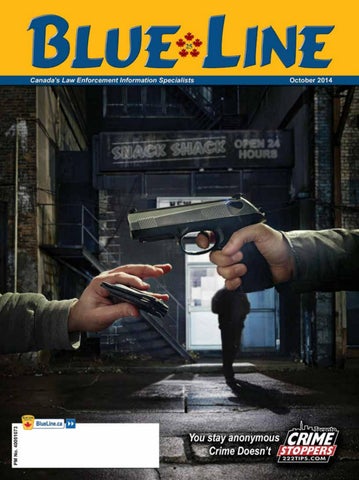
OCTOBER 2014
2
BLUE LINE MAGAZINE
October 2014 Volume 26 Number 8
Features
6
6
Not a Snitch Line
8
Teaming up to Detect Liars
12
Order of Merit of the Police Forces
20
Extremism in Canada
New book reflects on a crime fighting dynamo
Keeping control of extreme responses
24 Good News for Police Research in Cana da 28
Have You Ever Been Scrummed?
36
Education Directory
Today’s 24 hour news cycle can put you in the spotlight
Departments 8
46 34
Blue Line Advertisers Directory Deep Blue
– Unjust to release mental health act info
10 Dispatches 40 Holding the Line – Depression in policing 45 MarketPlace 5 Publisher’s Commentary
– Knowing the difference makes a healthy society
38 Technology – Video gets personal with body-worn cameras
Case Law 41 42 44
20 BLUE LINE MAGAZINE
3
Odour alone justified drug arrest Preservation concern may justify night search Charter breaches warranted excluding evidence
OCTOBER 2014
OCTOBER 2014
4
BLUE LINE MAGAZINE
Blue Line
PUBLISHER’S COMMENTARY
Magazine Inc.
by Morley Lymburner
PUBLISHER Morley S. Lymburner – publisher@blueline.ca
Knowing the difference makes a healthy society
GENERAL MANAGER Mary K. Lymburner – mary@blueline.ca SENIOR EDITOR Mark Reesor – editor@blueline.ca NEWS EDITOR Kathryn Lymburner – kathryn@blueline.ca CREATIVE DIRECTOR E. Jolene Dreja – jolene@blueline.ca MARKETING MANAGER April Lensen – april@blueline.ca CONTRIBUTING WRITERS Robert Lunney Dave Brown Mike Novakowski Nancy Colagiacomo Tony Palermo Stephanie Conn Tom Rataj Dorothy Cotton Brent Snook Mark Giles AFFILIATIONS International Association of Law Enforcement Planners Canadian Advertising Rates Data International Police Association The Canadian Press Newswire Access Copyright SUBSCRIPTIONS $30 per year; $50 for 2yrs; US & Foreign: $100 ADVERTISING 888-640-3048 advertising@blueline.ca
www.blueline.ca 12A-4981 Hwy7 East, Ste 254, Markham, ON L3R 1N1 Canada P: 905-640-3048 F: 905-640-7547 blueline@blueline.ca
PRINTED IN CANADA ISSN# 08478538 Blue Line Magazine was established in 1988 as an independent publication to inform, entertain, connect and educate those involved in the law enforcement profession. With no direct control from an enforcement agency, its opinions do not necessarily reflect those of any government or law enforcement agency. The authors, advisors, and publisher accept no liability whatsoever for any injuries to person(s) or property resulting from application or adoption of anything presented in this magazine. Readers are cautioned and advised that articles presented herein are edited and supplied for your personal awareness and should not be used for further action until appropriate guidance is received from a supervisor, Crown Attorney or other persons in authority. All material submitted for publication becomes property of Blue Line Magazine Inc. unless arrangements have been made with the publisher prior to publication. © 2014 All articles are protected by copyright. No part of this publication may be reproduced or transmitted in any form or means, electronic or mechanical, (including photocopying and recording or by any information storage or retrieval system), without prior permission. Permission to reprint may be obtained in advance from Access Copyright 1-800-893-5777.
BLUE LINE MAGAZINE
Police officers and soldiers have different duties; a fact both must understand when the other takes over. This principle of police and military being willing to relinquish control and take it back is what makes a stable and safe society and country. The events in Ferguson, Missouri dramatically emphasize this point. We must get back to basics and understand there is little virtue in confusing the police and military role. If there is no difference, as some suggest, why are they separate entities? Would it not be far more convenient and fiscally responsible to simply let police handle the military function during civil disobedience? Major events over the past century have affected and afflicted both the Canadian military and civilian police. Canadian policing took an abrupt turn just after the First World War, when de-mobbed but still military trained former soldiers backfilled the ranks of police forces across the country. This was once again reinforced after World War Two when huge numbers of former soldiers filled most civil service jobs. Over the years Canada de-militarized dramatically while the US increased its military prowess through a mandatory draft during the 1950s and ‘60s. It still has a hybrid of this same system but rooted in the state administered national guard. As a result almost all US police agencies have military discipline, structures and outlook and officers are comfortable with this command and control style. The opposite scenario exists here. Almost all Canadian police officers are trained from the ground up to a civilian policing style. Command and control is seen as subservient to individual initiative but they are taught the rudimentaries of military discipline. I’ll let you judge which system is better. During the ‘90s Canada started placing police in active war zones. These officers were confronted with a function they were not trained to handle, causing trauma and stressors they had not anticipated when volunteering. On the other side of the coin Canada s over emphasis on placing soldiers on the peace keeper pedestal, which dates back to the mid ‘50s era, has obscured the purpose of the military. This not only confuses but also heaps far too much stress on the individual soldier and their otherwise straightforward function. Soldiers are trained to fight but then informed they should work like police officers. This is bad strategy. It short circuits their military function and, in a multi-cultural country like Canada, confuses the roles of police and military in the minds of the public. 5
Both the military and police in Canada have been forced into unnatural positions, by design or circumstance, for which they do not traditionally function well. The current and past situation in Haiti is a fine example of the differing roles. Canadian police officers were placed in Haiti in the early ‘90s to assist local law enforcement and guide them toward a proper policing function. The country’s civil structures were suddenly put in great turmoil. The rule of law broke down, paramilitary units competed for control and the idea of simple policing was lost. This required a military response. Once a semblance of order was restored, there was a need for the military to step back and police to resume day-to-day peace keeping. Police from Canada and other countries returned under a United Nations mandate to help re-establish a civilian law enforcement structure. One of the fundamentals of modern policing, based on Peel’s principles, is that a military organization should not conduct police work. Police officers are to be selected from the general population because they best understand the populace and day-to-day functioning of the society they watch over. It is this intimate knowledge which helps them prevent crime and keep the peace. Police use force as a last resort the vast majority of arrests an officer makes involve no resistance whatsoever. The organized use of force, and threats of it, is the primary (although far from singular) function of the military, and when called upon is either practiced or implemented daily. The future of a well managed country rests in the hands of both police and the military and the ability of police officers and soldiers to understand their appropriate roles. Ferguson helps to illustrate and underscore these principles. Police made efforts to restore order and the rule of law. Once it was recognized they could not accomplish this goal the military stepped in to restore that order. Once order is re-established, the military bowed out gracefully and police resumed their work. It should not be rocket science but too many people do not understand this.
OCTOBER 2014
NOT A SNITCH LINE New book reflects on a crime fighting dynamo by Cal Millar Crime Stoppers is extremely effective at fighting crime, but most people, including many police officers, have no idea how the program operates. There is a general consensus that Crime Stoppers is a snitch line operated by police for gutter dwellers to squeal on other street lizards, but that is completely false. The newly-published 304-page book What is Crime Stoppers dispels the misconceptions, confusion and misunderstanding that people have of the crime-solving concept that came into existence 38 years ago. My book describes Crime Stoppers as a world-wide network of independent charitable organizations set up in local communities to take anonymous tips on unsolved crime. Programs are managed by volunteer boards and operate arms length from the police. The key to success is an absolute guarantee of anonymity for anyone providing tips on unsolved crime. There has never been a case where the name of a caller was revealed. Crime Stoppers was initially established to solve the July 1976 slaying of a 19-year-old university student, Michael Carman, in Albuquerque, New Mexico. Following a successful conclusion it developed into a partnership between police, media and the community to solve crime. Today, 1,700 Crime Stoppers operate in cities on six continents. They not only take OCTOBER 2014
anonymous tips on cold cases but have become multi-faceted organizations working to improve the safety and security of communities. Detective Greg MacAleese, one of the homicide investigators probing the Carman killing, came up with the idea of broadcasting a re-enactment of the shooting death which occurred during the gas bar robbery and having the local television station appeal for witnesses to come forward. It is a common place approach these days, but in 1976 it was a novel idea and also an attempt to break a sense of fear and apathy in this southwestern U.S. community, with the dubious distinction of being one of the most crime ridden cities in the country. To encourage callers, the detective also promised anonymity and a cash reward for information leading to an arrest. MacAleese, who was born in Canada and worked as a reporter for the Associated Press before becoming a police officer, knew a crime re-enactment would have a dramatic appeal in Albuquerque, but had no inkling that Crime Stoppers would become an international crime fighting organization. According to the book, the idea of simply taking tips to solve cold cases has been superseded by technological advances, direction from the court, promotional opportunities provided by various media outlets and public demands for Crime Stoppers to take a more proactive role to enhance security. The book also points out that Crime Stoppers remains a community-based program that pays cash for tips from anonymous 6
callers, but says local programs have adopted a variety of other initiatives to increase services and make neighbourhoods safer. They include projects to protect students and staff in schools, campaigns against illegal dumping of hazardous chemicals and dangerous waste, initiatives to combat drinking and driving and efforts to safeguard wildlife and natural resources. The majority of calls relate to drugs, but tips to Crime Stoppers programs have solved thousands of homicides, assaults, arsons, robberies, break-ins and numerous other crimes. A crime is solved every 14 minutes by Crime Stoppers and accumulative statistics show tips to the program have helped solve more than two million crimes. Through the years there have been at least one million arrests and almost $10 billion in stolen property and narcotics recovered as a result of tips to the program. Retired Ontario Provincial Police Commissioner Thomas O Grady is quoted in the book as ranking Crime Stoppers, DNA and fingerprinting as the three top innovations in modern day policing. Robert Lunney, who headed police operations in Edmonton, Winnipeg and Peel Region before retiring, said the leader of any police agency would be guilty of mismanagement if Crime Stoppers wasn t included in the arsenal of weapons used to combat crime. The book outlines the intelligence network that has developed through Crime Stoppers with national police agencies in various countries, BLUE LINE MAGAZINE
including the RCMP, FBI, Scotland Yard, U.S. Marshal Service, Drug Enforcement Agency, Bureau of Alcohol, Tobacco and Firearms, Interpol and the United Nations Office on Drug and Crime. In addition, through the Internet and other communication advances, Crime Stoppers can make global appeals for information. In recent years, Crime Stoppers in the United Kingdom requested assistance from programs in other countries to solicit information regarding the 2007 disappearance of three-year-old Madeleine McCann while vacationing with her parents in Portugal. The renewed appeal led to some promising leads and Scotland Yard investigators are currently focusing efforts on eight persons of interest who were in the vicinity when the child vanished. Although Crime Stoppers programs in North America closely follow the concept designed by MacAleese, the book details how the scheme operates in other countries and highlights some cases that law enforcement agencies hope to solve through tips. In the Netherlands, the Crime Stoppers program known as “M” doesn‘t pay rewards since it’s considered a civic duty to tell authorities what a person may know about a crime. However, the anonymity aspect is vital since it allows people to fulfill their responsibility without the requirement of testifying in court. Crime Stoppers in South Africa also doesn’t compensate tipsters with cash, but police or private organizations will post rewards for serious offences, including the slaying of officers. In those situations, however, the individuals must voluntarily reveal their identity to collect the money. There are actually two parallel Crime Stoppers programs operating in South Africa; a tip line called Crime Stop operated by the South African Police Service takes anonymous calls over the telephone and Crime Line, a privately operated program, receives information via text and online messaging. The book says Crime Stoppers was implemented in South Africa in the early 1990s and efforts are underway to introduce the program to Nigeria, Ghana, Botswana and Namibia. South Africa is faced with the same crime concerns that confront communities in Canada such as murder, drug trafficking, muggings, robberies and criminal activity targeting automatic teller machines. The Crime Stoppers program recently teamed up with the country’s National Parks Service to combat the slaughter of rhinos, one of the most endangered species in the world. Crime Stoppers kicked off a campaign against poachers who had killed around 600 rhinos at South Africa’s largest animal preserve to harvest the horns for traditional Chinese doctors. They grind them into medicine for their wealthiest patients in countries around the world. The book details the growth of Crime Stoppers through the Caribbean and into Central America while highlighting some of the crimes in that area which police are anxious to solve, including the May 4, 2014 slaying of Dana Seetahal. The 58-year-old prosecutor and former senator was ambushed by gunmen while driving to her home in Trinidad. She was shot at least five times and senior police have described the BLUE LINE MAGAZINE
slaying as a well-planned and co-ordinated hit. Homicide investigators have also appealed through Crime Stoppers to help identify the individuals who killed Bert Clarke, a 59-year-old security guard, during a November 27, 2013 robbery of a van delivering cash to a bank in Tobago. Rewards of $1 million in Trinidadian currency have been made available to help solve these slayings. Although most Crime Stoppers programs in Canada and the United States cap reward amounts between $1,000 and $2,000, the book reveals that Crime Stoppers Australia is offering $1 million each to find the killers responsible for 13 homicide incidents known as the Child Murder Cases which over a 34 year period claimed the lives of 18 individuals, mostly young people. Since Calgary set up the first Crime Stoppers program in Canada in 1982, the growth and success across the country has been phenomenal. The book indicates that 100 Crime Stoppers units now operate in Canada and defines Regina Crime Stoppers as a typical program. Its volunteer board regularly hosts events to raise funds or promote the tip line number to the community. Also highlighted are two cases that Regina residents want to see solved: the July 5, 2004 abduction of five-year-old Tamra Jewel Keep-
ness and the savage August 6, 2010 slaying of a couple and their three-year-old-son who came to Canada to escape ethnic violence that has raged in their native Burma for decades. The book, available from Amazon.com, describes Crime Stoppers initiatives undertaken in various cities, including Hamilton, Windsor, Toronto, Edmonton, Vancouver and programs throughout the Maritimes. It also highlights a campaign by the Canadian Crime Stoppers Association to combat human trafficking, which has become a major concern in communities across the country. Cal Millar retired 10 years ago after a lengthy career as a Toronto Star general assignment reporter concentrating on crime and policing issues. He is a founding member of Toronto Crime Stoppers, served as director with Crime Stoppers International and on the board of Halton Crime Stoppers. Millar has written four other books. Find my Killer and I m Missing Please Find Me feature appeals from Crime Stoppers programs. How a Colonel Became a Killer and Keep Kids Safe are general interest crime books. Millar has two adult children and a grandson, he resides with his wife in Burlington.
Anonymity has its rewards An Ajax barn restorer learned the rules of Crime Stoppers the hard way. Brett Maynard stumbled over something unusual at a vacant, boarded-up farm near Cobourg in 2011 a large item covered with a tarp. When Maynard peeled back the cover, he found a Kubota mini-excavator. The stickers had been removed but he was still able to make out the owner’s name on the arm. A quick phone call confirmed the machine didn’t belong to his partner, who remembered hearing that a construction company owner had lost more than $60,000 worth of equipment in a theft a few weeks earlier. His partner suggested Maynard call Crime Stoppers so he could collect a cash reward. Maynard did so but was put on hold for 15 minutes and then cut off. Growing impatient, he called police, “thinking they were the same thing.” Two officers showed up, called the owner, who confirmed the machine was his, and told Maynard the case was closed. Minutes later, he called back Crime Stoppers with the officer’s badge number and information. He was given a personal identification number and asked to call in a week but when he called back, was told he was ineligible for a reward because he was no longer anonymous. Once you give up your anonymity, you are no longer a Crime Stoppers tipster, Toronto Crime Stoppers co-ordinator Darlene Ross confirmed. There is no option. That’s why the call centres have no call display. “That compromises the program,” Ross said. This program works only on anonymity. “People who give up their anonymity then become a witness, not an anonymous tipster. If people found out that we were paying people and we knew who they were, that would take
7
away people’s trust in the program,” Ross said. Once you give your name we end the call, added Crime Stoppers spokesman Lorne Simon. It’s the principle. Crime Stoppers Facts • To be eligible for a Crime Stoppers reward of up to $2,000 in cash, you have to remain anonymous. Once you give your name either to police or to a Crime Stoppers call-taker, you are ineligible. • Once you phone in a tip to Crime Stoppers, you are given a personal identification number and it is your responsibility to check back with them periodically to see how the case is progressing. • Once the case has been resolved, your information is taken to the next board meeting and the board decides the amount you are eligible to receive. • Once the payment is authorized, you (or a friend or relative) take that identification number to a bank branch (the bank differs among jurisdictions: in the Toronto area, it’s TD Canada Trust) and present the number. The amount is verified with Crime Stoppers and you receive the cash payment.
OCTOBER 2014
Teaming up to
DETECT LIARS by Normand Borduas Police have used polygraphs for decades to establish guilt, involvement or innocence of suspects. Unfortunately, the examination often is done at the end of an investigation, after all other means have failed, and the suspect must agree to take the test for it to be useful. Knowing that a large portion of polygraph tests carried out by police involve innocent people, it’s no surprise that tools have been developed to help police get an edge at the start of an investigation. Many guilty subjects will not show up for a polygraph examination, often on the advice of their lawyer. they don’t want to chance not “beating” the test. “Research on indicators of deception from demeanour have not been given much systematic attention, even though some of them might yield measures of comparable or perhaps greater accuracy than the polygraph,” the National Research Council stated. Considering the limitations of the polygraph test, I’ve been working toward developing a method to help detectives in lie detection in the early stages of their investigations – “the OCTOBER 2014
TEAM approach.” As a detective-sergeant for the past seven years, I have been spending a large portion of my time in Montreal interrogation rooms. Every case I encountered offered a different challenge in lie detection, mainly because, as research has shown, people hide their lies in different ways. It became obvious that detecting them is a lot harder than I originally thought. I rapidly developed an interest in lie detecting tools and was able to get training in forensic interviewing at the Canadian Police College. This included statement analysis and Synergology (lie detection using nonverbal cues) and video interrogation at École Nationale de Police du Québec. It was a real eye opener on how to detect deceit. Former polygraph examiner Neil Barker taught the course and offered an interesting point of view. “How many tools to detect deception will I use to determine the subject’s truthfulness?,” he would ask himself while investigating a case. Sometimes, the facts allow an officer to quickly identify potential suspects and deceptive subjects. In other situations, such 8
as physical child abuse cases, you may have several potential suspects. Identifying the most probable is then paramount to determining the investigation’s direction. If a detective can identify a perpetrator among a series of suspects with seemingly equal potential, the next decision could break the case wide open. Detectives often rely on their gut feeling in the early stage of an investigation. Few investigators are properly trained in methods of lie detection such as Scientific Content Analysis (SCAN), Reality Monitoring (RM), Criteria Based Content Analysis (CBCA), Synergology (from Philippe Turchet), Behaviour Analysis Interview (BAI) or micro expressions from Eckman’s studies. An investigator’s experience and impression about an individual will often be the only guide in judging a person’s truthfulness. They will be correct about 50 per cent of the time, the same as a layperson. One major advantage of using lie detection tools are that they can be used without the suspect’s knowledge or consent. Different investigators using the tools might come to the same conclusion about a subject’s truthfulness, for different reasons. BLUE LINE MAGAZINE
Each officer may interpret verbal and non-verbal signs of deceit in varying ways. Some may place a greater emphasis on certain cues used to detect lies, where others might find them less conclusive. I became conscious of my own limitations and biases when I faced difficult challenges in cases and began looking for ways to adapt my training and experience to get better results in evaluating the people in front of me. I developed an approach to lie detection to improve the likelihood of correctly determining whether an individual was being honest. “TEAM” – Target, Extract, Analyze and Maintain – also illustrates the concept that we are taught as young police officers: “working in a team makes us better and stronger.” To be effective, lie detection must be done by a team of two or more experienced investigators. Tunnel vision is the worst enemy. The help of a partner to confirm or dismiss analysis of the lead detective helps alleviate any biases. I assembled a team in Montreal to prepare and conduct the interrogation of a suspect in major child abuse cases. Included were forensic psychologists, a Sûreté du Québec criminal profiler, polygraph examiners and experienced interrogators from our investigative unit. The results exceeded our expectations. Each member’s expertise offered a different perspective on the problems that arose during the preparation and suspect interviews.
non-verbal behaviour) with a criterion such as “quantity of details in a statement” from the CBCA list, will significantly improve accuracy in differentiating lies from truths. Research has established that a truthful statement will contain more details than a deceptive one. Analyzing body language while a person gives an account of the event (with or without sufficient details) will provide useful information to evaluate the subject’s statement. Because Pinocchio’s nose exists only in fiction, combinations of non-verbal changes and verbal cues are essential to draw any type of conclusion. A combination of two verbal tools of detection is also another good way to improve the likelihood of detecting deceit and truthfulness. For example, combine the criterion contextual embedding of the CBCA list with spatial and temporal details of the RM list. The CBCA criterion is more general and described as placing the story in a time and place in connection with a habitual activity. The RM criterion adds the spatial and temporal details of the events that have been found to be relevant in differentiating truthfulness from deceit. Research has shown that a combination of tools will improve the accuracy rate of police officers in evaluating the truthfulness of a statement.
Extract
The next step is to extract information. Knowing where and when deceptive suspects
are lying is the first step toward convincing them to tell you the truth. No less difficult, extracting the truth from an unwilling suspect poses many challenges. Several interviewing techniques can be used but an investigator must appear genuine and build a rapport with the subject. Many police manuals offer different alternatives in interviewing to obtain a confession and officers adapt them to their own personality. One of the most effective ways to extract the truth is tactfully questioning a suspect. Some techniques will suggest introducing evidence in bulk or at the end of an interview. When a tactical approach is used, the evidence against the suspect is carefully introduced only when required and necessary. Whether the case has lots or little evidence to incriminate, careful planning of the introduction will insure that only the required information is provided in order to convince a suspect to admit guilt. Present too much proof and you risk shutting a suspect down and making them feel there are no advantages to confess. On the other hand, present too little evidence and suspects might not feel the need to tell the truth, believing that police don’t have much on them. The truth resides in the details and effective questioning techniques are the key to identifying discrepancies and obtaining sufficient details that might force them to change their version and finally tell the truth about events.
Targeting
The major difficulty in assessing if someone is lying is to identify where or when they lied. Many deceptive people will embed their lies in a large truthful statement. Lie detection tools like SCAN, RM, CBCA, BAI or Synergology may be useful at this point to pinpoint lies. The more tools you use, the more effective you become at separating fact from fiction. Only when you match the verbal response with the non-verbal behaviour do you get a complete portrait of the statement. Take, for example, a man being interviewed for physical abuse on his child. The beginning of the interview usually consists of building rapport with the subject. Then, a detective will ask more direct questions about the accusations. Do not conclude anything from only one gesture when observing a suspect. On the other hand, a combination of several body movements or a change in behaviour may provide very good clues on the suspect’s truthfulness or deception. For instance, a change in position on a chair, hands disappearing under the thighs, scratching of a certain body part or crossing arms or legs can all serve to illustrate deception at times or a change in willingness to co-operate. To identify those changes, an investigator needs to assess the suspect’s baseline behaviour. This would usually be done during the non-accusatory phase, when preliminary information is sought about the individual and the issues discussed are non-threatening for the subject. Combining Synergology (the study of BLUE LINE MAGAZINE
9
OCTOBER 2014
Analyse
Not all facts are known at the early stages of most investigations. Once you identify an area where you believe a suspect is lying and persuade them of this, you still need to verify whether they told you the truth or more lies (this may come later in the investigation through warrants, additional statements from witnesses or co-accused). The analysis is sometimes an ongoing process during the interview. New evidence coming in from ongoing search warrants, for example, should be provided to the officer conducting the interview. This new information is contrasted with the statement the suspect has provided. The officer will then adjust questioning accordingly. This will prevent the individual from making a false confession that would go undetected. Later in court this analyses will also serve to establish that the subject is now telling the truth about involvement in the case, since it is supported by the facts subsequently acquired. Famous wrongful convictions cases in Canada and the US involved incriminating statements by suspects that were not later matched with the facts of the case or were not validated. The importance of holding back evidence is essential to protect the investigation and validate an accused’s statements. This consists of facts known only by certain police officers on the case, the victim and the accused. Withholding such evidence from the public or people outside the “need to know circle” will allow police to identify a false confession, verify a truthful one or incriminate others.
Maintain
Lastly, officers must maintain their relationship with the suspect at the closing of the interview, keeping in mind that they have confessed their involvement in the case. For
OCTOBER 2014
DISPATCHES
this to happen, as mentioned earlier, rapport had to be built. At the interview conclusion, regardless of whether the suspect confessed, the rapport must be maintained. No one can predict when (or if) a suspect might want to sit down again to provide police with further information about the case (confess) or become an informant. Maintaining the same professional attitude from start to finish will signal to interviewees that your openness doesn’t end with the interview and they might be more inclined to come clean at a later date. Lie detection is a difficult task and not everyone is good at it. It takes training, practice and a methodology such as the TEAM approach to improve the chances of differentiating fact from fiction. Knowing where the lies are is useful. Even if a suspect does not confess it will guide a detective in their next course of action. Montréal Police Det/Sgt. Normand Borduas specializes in investigative techniques training. A graduate of the University of Montréal, Québec Police Academy and CEGEP John Abbott College, he is an expert in statement and video analysis. Contact him at Normand.borduas@ spvm.qc.ca for more information.
10
Port Hope Deputy Police Chief Bryant Wood was appointed Acting Police Chief as of Monday, Sept. 1 and will become police chief when current Chief Kevin McAlpine retires on April 13, 2015. Wood started his policing career in 1993 with the Ontario Provincial Police. He transferred to the Port Hope Police one year later and has been there since. McAlpine is being credited for introducing a comprehensive management plan and encouraged career development within the service. Since becoming Deputy Chief, Wood has pushed to modernize the Criminal Investigations Branch and enhancing the skills to respond to the communities needs. ••• After 40 years in law enforcement, Sault Ste. Marie Police Deputy Chief Bob Kates retired effective September 26. The team I’ve worked with is part of the reason why I’ve stayed for 40 years, Kates told the local media. Kates, 62, began in early 1974 with the Toronto Police Service. Soon after, an opportunity arose to join the Sault Ste. Marie Police Service, and Kates began as a constable in October 14, 1974. Technology has changed policing so much, Kates said. It’s probably time to retire when some of the equipment I used is in the museum, Kates laughed. ••• Chief Bill Blair will not stay on as head of the Toronto Police beyond next spring, according to a statement published by the board in August. The Toronto Police Services Board has decided not to renew Blair s employment contract. His last day in office will be April 25, 2015. For the ten years he has led the Toronto Police Blair has been credited for improving relationships with the community, making human rights a top priority and bringing policing into the 21st century. Many have suggested that although he has navigated the city through many turbulent years much of his positive efforts were never known or understood by many in the community. ••• Waterloo Regional Police named former Guelph police chief Brian Larkin to the top role in the force. Larkin, 43, began his career with the Waterloo force in 1991. He became Guelph’s Deputy Chief in 2010 and was named Chief in 2012. In Waterloo Region, he replaces outgoing Chief Matt Torigian, who retired in April to become Ontario’s Deputy Minister of Community Safety. Guelph police will began seeking a replacement for Larkin in August. ••• Insp. Bill Renton has been promoted to Chief-Designate to the Woodstock Police Service and will take over the full chief position as of Jan. 1, 2015, when Chief Rod Freeman retires. Before joining the Woodstock organization in 2010, Renton spent 30 years between the RCMP, OPP and Haldimand-Norfolk Regional Police. Among the cases he handled while with the OPP were the occupation at the Douglas Creek Estates in Caledonia and the 2009 abduction and murder of Tori Stafford. Renton is currently the chair of the Ontario Homicide Investigators Association.
BLUE LINE MAGAZINE
BLUE LINE MAGAZINE
11
OCTOBER 2014
Order of Merit
of the Police Forces His Excellency the Right Honourable David Johnston, Governor General of Canada, presided over the annual Order of Merit of the Police Forces investiture ceremonies at Rideau Hall on Tuesday, September 9, 2014.
2014 Appointments
D/Chief Bruce Kenneth HERRIDGE, O.O.M. York Regional Police, ON
D/Chief Mark Stephen CHATTERBOK, M.O.M. Saskatoon Police Service, SK
Deputy Chief Stephen BECKETT, O.O.M. Waterloo Regional Police Service, ON
Chief Mark Douglas MANDER, O.O.M. Kentville Police Service, NS
Det. Staff/Srgt. Dominic S. C. CHONG, M.O.M. ON Provincial Police, Orillia, ON
Chief Charles J. BORDELEAU, O.O.M. Ottawa Police Service, ON
Chief Thomas Andrew MCGROGAN, O.O.M. Medicine Hat Police Service, AB
Chief Supt. Paul Warren COONS, M.O.M. Royal Canadian Mounted Police, Ottawa, ON
A/Comm. Kevin Charles BROSSEAU, O.O.M. Royal Canadian Mounted Police, Winnipeg, MB
A/Comm. Gilles MICHAUD, O.O.M. Royal Canadian Mounted Police, Ottawa, ON
Chief Supt. Gary James COUTURE, M.O.M. ON Provincial Police, Smiths Falls, ON
Deputy Chief Trevor Daniel DAROUX, O.O.M. Calgary Police Service, AB
D/Chief Murray William STOOKE, O.O.M. Calgary Police Service, AB
C/Supt. Marlin A. DEGRAND, M.O.M. Royal Canadian Mounted Police, Edmonton, AB
OFFICERS
D/Chief Cst. Robert A. DOWNIE, O.O.M. Saanich Police, Victoria, BC
Chief Bradley S. DUNCAN, O.O.M. London Police Service, ON
MEMBERS Chief John T. W. BATES, M.O.M. Stratford Police Service, ON
Director Michel DESGAGNÉ, M.O.M. Ville de Québec, QC
Chief Officer Neil DUBORD, M.O.M. Metro Vancouver Transit Police, New Westminister, BC
Chief of Police Michel FOUCHER, O.O.M. Régie intermunicipale de police Thérèse-De Blainville, QC
Chief Jean-Michel BLAIS, M.O.M. Halifax Regional Police Service, NS
Constable Stéphane EID, M.O.M. Service de police de la Ville de Montréal, QC
Director General Debra FRAZER, O.O.M. Ottawa Police Service, ON
Chief Supt. Roderick Neil C. BOOTH, M.O.M. Royal Canadian Mounted Police, Prince George, BC
Supt. Selwyn FERNANDES, M.O.M. Toronto Police Service, ON
Director Francis GOBEIL, O.O.M. La sécurité publique de Trois-Rivières, QC
Chief Louis BRUNEAULT, M.O.M. Service de police de la Ville de Saint-Jérôme, QC
Chief Leanne Jane FITCH, M.O.M. Fredericton Police Force, NB
Chief Troy HAGEN, O.O.M. Regina Police Service, SK
Inspector Kenneth BURTON, M.O.M. Royal Canadian Mounted Police, Chilliwack, BC
Sergeant Brian A. FOOTE, M.O.M. Royal Canadian Mounted Police, Chilliwack, BC
OCTOBER 2014
12
BLUE LINE MAGAZINE
C/Supt. William Charles FORDY, M.O.M. Royal Canadian Mounted Police, Surrey, BC
Staff Sgt. Andre Pierre LECLAIR, M.O.M. Royal Canadian Mounted Police, Burnaby, BC
Supt. Michael PORTEOUS, M.O.M. Vancouver Police Department, BC
Chief Insp. Mario FOURNIER, M.O.M. Service de police de la Ville de Montréal, QC
Rita LEE-IRVINE, M.O.M. Hamilton Police Service, ON
Supt. Gregory Robert PRESTON, M.O.M. Edmonton Police Service, AB
Sgt. Robert Joseph S. GALLANT, M.O.M. Royal Canadian Mounted Police, Fort Simpson, NT
Sergeant Marc LÉPINE, M.O.M. Sûreté du Québec, Boucherville, QC
Staff Sergeant Peter J. QUILTY, M.O.M. Royal Canadian Mounted Police, Red Deer, AB
Captain Frédérick GAUDREAU, M.O.M. Sûreté du Québec, Montréal, QC
Chief Jean Paul LEVESQUE, M.O.M. Thunder Bay Police Service, ON
Sergeant Sup. Pascal RICHARD, M.O.M. Service de police de la Ville de Montréal, QC
Det. S/Sgt. Frank L. GOLDSCHMIDT, M.O.M. ON Provincial Police, Orillia, ON
Chief Yung-Kai LIU, M.O.M. Cobourg Police Service, ON
D/Chief Frank ROSELLI, M.O.M. Peel Regional Police, ON
Superintendent Robert GOULD, M.O.M. Waterloo Regional Police Service, ON
Director Randy MAR, M.O.M. Ottawa Police Service, ON
Supt. Lorne SCHWARTZ, M.O.M. Royal Canadian Mounted Police, Surrey, BC
Superintendent Kevin HACKETT, M.O.M. Royal Canadian Mounted Police, Surrey, BC
Supt. Anne MCCONNELL, M.O.M. Waterloo Regional Police Service, ON
D/Chief T. Brent SHEA, M.O.M. London Police Service, ON
Chief Laurie L. HAYMAN, M.O.M. Strathroy-Caradoc Police Service, ON
Constable David MCFADDEN, M.O.M. Peterborough Lakefield Community P.S, ON
Superintendent Jeffrey H. SIM, M.O.M. Vancouver Police Department, BC
Supt. Kenneth Wayne HESLOP, M.O.M. London Police Service, ON
Chief Peter Joseph MCISAAC, M.O.M. Cape Breton Regional Police Service, Sydney, NS
D/Chief Alban Gerard SINGLETON, M.O.M. Royal Newfoundland Constabulary, St. John’s, NL
C/Supt. Angela Louise HOWE, M.O.M. ON Provincial Police, Orillia, ON
Supt. Robin Emmanuel MCNEIL, M.O.M. Halifax Regional Police Service, NS
Det. Inspector James M. G. SMYTH, M.O.M. ON Provincial Police, Orillia, ON
Corporal Laurel Karen KADING, M.O.M. Royal Canadian Mounted Police, St. Albert, AB
Det. Insp. Thomas A. MURPHY, M.O.M. ON Provincial Police, Orillia, ON
Florence STEWART, M.O.M. Peel Regional Police, ON
D/Chief Wayne KALINSKI, M.O.M. Orangeville Police Service, ON
Inspector Mark W. NEUFELD, M.O.M. Edmonton Police Service, AB
D/Chief Cst. Leslie John SYLVEN, M.O.M. Central Saanich Police Service, Saanichton, BC
Superintendent Daniel KINSELLA, M.O.M. Hamilton Police Service, ON
Det. Insp. Christopher A. NICHOLAS, M.O.M. ON Provincial Police, Kanata, ON
Chief Supt. Larry TREMBLAY, M.O.M. Royal Canadian Mounted Police, Ottawa, ON
C/Supt. Scott Alexander KOLODY, M.O.M. Royal Canadian Mounted Police, Winnipeg, MB
Det. Insp. William Charles OLINYK, M.O.M. ON Provincial Police, Kenora, ON
Staff Sergeant Lynne TURNBULL, M.O.M. Ottawa Police Service, ON
François LANDRY, M.O.M. Service de police de la Ville de Montréal, QC
Chief Dennis James POOLE, M.O.M. Chatham-Kent Police Service, Chatham, ON
D/Chief Desmond WALSH, M.O.M. Timmins Police Service, ON
BLUE LINE MAGAZINE
13
OCTOBER 2014
Ontario to get new police billing formula TORONTO - Most municipalities that pay Ontario Provincial Police (OPP) for local law enforcement will see their policing costs go up over the next five years, the governing Liberals said in August. The OPP is introducing a new billing model that the government said will simplify, clarify and more evenly distribute costs among municipalities, who are concerned about having to hike property taxes to pay rising policing costs. Community Safety Minister Yasir Naqvi said the new model, which would separate base costs and service call costs, won’t increase the amount of money the OPP recovers from municipalities. But it will change how much those communities are paying for OPP services, which have varied widely throughout the province. Some municipalities are paying less than $10 a year per household, while other similar communities are paying over $800 per year, he said. Ontario’s auditor general criticized those discrepancies in the 2012 annual report, also noting that while crime rates have gone down, policing expenditures have gone up. Of the 324 municipalities who rely on OPP services, 207 will see an average increase of about $83 per property, which will include business and industrial properties as well as
OCTOBER 2014
households, while 115 communities will see their cost decrease by about $70 per property. The changes will be phased in over five years, starting in January, with annual increases capped at $40 per property, Naqvi said. Decreases will start at $18 and reach $98 in the final year. “This will provide stability and predictability for both taxpayers and municipalities,’’ he said. The bill will be split 60-40 between base costs - which includes routine patrols, crime prevention, local detachments, officer training and administrative duties - and calls for service, such as a car accident. Municipalities are not charged for provincial duties those same officers may perform, such as patrolling provincial highways and waterways, said OPP Insp. Bert McDonald of the Municipal Policing Bureau. They’re also compensated when officers are called out to major events, like the devastating Goderich tornado or the upcoming 2015 Pan Am and Para Pan Games. Naqvi said all municipalities will end up paying the same amount – about $203 per property – to cover base costs. Communities will also get “very detailed’’ reports on the type and volume of service calls. The new model may clarify policing costs, but it does nothing to contain them, which is
14
a big concern for many towns and cities, said Pat Vanini of the Association of Municipalities of Ontario. According to the OPP, salary, benefits and overtime account for about 85 per cent of the bill it sends to municipalities. “I don’t know any municipal government where policing costs isn’t the highest portion of the tax bill,’’ Vanini said. “It’s in Toronto, even where municipal forces are.’’ The OPP received an 8.5 per cent wage hike this year after a two-year pay freeze, having signed a contract with the province that guarantees they’ll be the highest paid cops in Ontario. The cash-strapped Liberals have said for several years that there’s no new money for salary increases as they struggle to slay a multibillion-dollar deficit. But critics remain skeptical, saying the hefty pay hike proves it’s just lip service. Naqvi insisted that there’s no new money for pay hikes, but wouldn’t say whether the Liberals’ commitment to make the OPP the top paid police in the province would be withdrawn in their next round of negotiations with the Ontario Provincial Police Association. Click on the Blue Line News Week Subscribe button at BlueLine.ca to receive this weekly news service.
BLUE LINE MAGAZINE
BLUE LINE MAGAZINE
15
OCTOBER 2014
LINKING YOUTH AND POLICE
Delta Police challenge students to link up on the links by Nikki Hewitt A friendly battle for golf supremacy brews each spring on the neatly manicured greens of two British Columbia golf courses, One hundred high school students from across the province converge on two courses in Delta and the neighbouring city of Surrey, eager to show off their drives, chips and putts for a chance to win great golf swag, a trophy, scholarship money and of course, bragging rights. Minus the dry course, warm April sunshine and mountain views, this golf tournament could take place in any Canadian province. What makes it unique is the 22 Delta police officers playing alongside the students; it is believed to be the only one of its kind in North America. The tournament began in 2004 when then Delta Police School Liaison Officer Cst. Ian Pitcairn realized he was focusing most of his time on students who were in trouble and leaving out the ‘good’ kids, who he calls the ‘95 per cent.’ “We need them on our side,” says Pitcairn. “These kids deserve our attention as much as anybody else. And as a (school) liaison (officer) that was something that I worked hard on trying to keep 95 ‘per cent-ers’ on our side, because if we lose them, we’re in trouble as a society.” Fast forward to 2014 and Pitcairn, a recruiting officer for the past seven years, is retiring and handing the reins of the Student Golf Tournament over to Cst. Mark McKinnell, an avid golfer who has grown to love the event as much as his predecessor did. OCTOBER 2014
“It’s very competitive,” says McKinnell. “It’s a super fun day but everyone is there to play their best and win. It’s not like mini golf.” While the competition is hot, there is plenty of time for students and officers to connect on the course. “You can see the bond,” says Pitcairn. “They’re nagging each other, laughing at each other when they miss. That’s great to see because their guard is down and they feel comfortable enough with that police officer to be able to say that to them.” Pitcairn says the members get just as much out of the tournament as the students do. “This wasn’t designed to try to keep kids out of trouble, that wasn’t what this was,” says Pitcairn. “This was a way for police officers and kids to get together in a non-threatening environment where they could learn something about each other and they have.” “When we’re playing, they have lots of questions. They want to know about the job and they see you (police) a lot differently towards the end,” says McKinnell. “I’ve known some of these kids for three to four years, starting in grade 9, and you see them grow.” The success of the tournament about a thousand students have participated over ten years goes beyond the fun and camaraderie on the course. Past golfers include PGA tour pros Nick Taylor and Adam Svensson, a recent Jack Nicklaus award winner for the top collegiate golfer in the United States. “I had golfed with fire fighters before, but never police officers,” Svensson recalls. “It was kind of cool, chatting with police on the course. I had never chatted with that many 16
police before. It was cool to see their perspective on golf and life.” Svensson, a graduate of Earl Marriott in South Surrey, says he had fun when he played (2009) and remembers how well dressed and behaved everyone was. “It’s a great tournament for high school kids who want to get better,” says Svensson. “It gives them a chance to play against some pretty good golfers and get tournament experience at the same time.” Nine of the past 10 tournament winners have gone on to full-ride scholarships south of the border. The tournament is organized by the Delta Police Department, Delta Police Association and Delta School District teacher Bill Richards, and is hosted by two high end golf courses: Kings Links by the Sea and Northview Golf and Country Club. “I think that’s what makes the tournament, is the course,” says McKinnell. It has taken volunteers, sponsors and a lot of time to make the tournament a success, something that’s bound to continue with Pitcairn’s retirement. “I’m more than confident this tournament will continue on. You put your heart and soul into it because you know it’s providing something to a lot of different people, which is really cool.” Nikki Hewitt is a co-ordinator with the Delta Police Corporate Planning and Communications department.
BLUE LINE MAGAZINE
Transit police dogs keep system moving by Carolyn Baldridge Dogs are of great assistance to the Metro Vancouver Transit Police (MVTP) in efficiently preserving and maintaining the safety of those who use public transit. The Metro Vancouver network includes three advanced light rail rapid transit lines, 68 km of guide way, 49 SkyTrain stations and up to 1,400 buses operating on 200 routes. The network moves more than one million passengers daily. Public transit networks around the world have become the target of terrorist attacks in recent years. MVTP officers are specially trained to identify suspicious behaviour that may be linked to terrorist activity. Explosive detection dogs are one of the tools at their disposal. Unattended items are regularly identified in and around transit hubs and SkyTrain stations. Officers use the H.O.T. principle (Hidden? Obvious? Typical?) to help determine whether there may be a risk to public safety. When an item is determined to be suspicious, the Transit Police Dog Service is called in to assist.
BLUE LINE MAGAZINE
Without a dog, a package could result in large scale evacuations and system shut downs, potentially inconveniencing thousands of transit customers. Dogs are able to quickly determine the absence or presence of explosives. Early elimination of suspicious packages keeps transit stations open and minimizes system disruptions. The unit has two dogs: Bailey, a five year old black Labrador and Lucie, a three year old chocolate Labrador. Both are trained to detect a variety of explosives. The dog service added a new vehicle to its fleet in August. The Ford Interceptor Utility Vehicle is a welcome addition and will offer the dogs and their handlers a more comfortable and higher profile means of response. The service is regularly called upon to assist other policing organizations because of its specialization in detecting explosives. Two additional dogs will be added later this fall to answer the high demand for service. Contact MVTP Senior Communications Advisor Carolyn Baldridge at Carolyn.Baldridge@transitpolice.bc.ca for more information.
17
OCTOBER 2014
MOVEMBER by Jill Kenney Men are preparing to dust off their razors. It’s nearly Movember, the month formerly known as November, when thousands of men around the world will sprout moustaches in the name of men’s health. Thousands of Canadians commit to sign up at Movember.com to raise awareness and funds for men’s health, particularly prostate and testicular cancer and male mental health. These generous Mo Bros start clean-shaven on the first day of the month and groom their way to a fine moustache. Supported by the women in their lives, Mo Sistas, they together seek out sponsorship for their efforts. More than 173,000 participants helped raise more than $32.8 million last year. Police forces across the country united under MOPO, The Great Canadian Police Challenge, embracing the moustache more than ever before. With 1,216 Mo Bros and Mo Sistas and 131 teams raising over $252,705 you can be sure to see many moustaches sprouting to help patrol the streets this hairy season. From the sighting of the first moustache, Movember is all about having fun while doing good. It provides a chance to bring health, humour and camaraderie into the workplace. The Halifax Regional Police (HRP) team embraced the moustache for the third consecutive year in 2013, seeing 29 Mo Bros and Mo Sistas raising more than $5,500. Behind every great moustache is a great Mo Bro, encouraging his fellow friends to get involved. Pat O’Neil has helped lead the way with the HRP team. “It started with just a couple of us at the station,” he noted. “We heard about it and decided to join in on the fun.” After signing up and starting a team, O’Neil and the team look forward to their annual shave down event. “Last Movember we got some of the team together at Carlo’s Family Barber Shop in Bedford for an early morning group shave down. You have to start clean shaven so it was a great way to kick off the month.” “The moustache can act as an icebreaker when dealing with the public,” O’Neil noted. “You find yourself talking about moustaches, which is fun and great to be able to connect with the community on that level.” OCTOBER 2014
Mo Bro and Toronto Police officer Jason Albanese sports his majestic stash from last year’s event.
More than 2.72 billion conversations were held last year about men’s health and 99 per cent of participants talked to someone about their health, “You definitely find that there is more talk about men’s health during Movember than any other time of the year. It’s great to see that kind of awareness,” said O’Neil. Movember is a grassroots movement, led in many cases by passionate men such as Greg Carwithen and Michael Labossiere, who led the Burnaby RCMP team, The Burnaby Fuzz, to the MOPO championship by raising more than $23,000. “Myself and Michael started up the team in 2010 for fun. Looking at how far we’ve come we never imagined that it would get this big, so we’re going to continue to grow both our moustaches and team,” said Carwithen. Like many participants Carwithen’s motivation is personal. “My dad suffered from prostate cancer, so the cause has always been close to me. Luckily he is now cancer free but many on our team have been affected by the cause, so it’s something we are all very passionate about supporting.” As the leading global men’s health organization Movember works to get men to become proactive about their health. “I think it’s great that Movember gets 18
men to open up about their health and help break down barriers. It feels like we are catching up with women’s health movement,” said Carwithen. While raising awareness for men’s health, many participants also join in on the fun of fundraising. From auctions to office bake sales and fundraising events, there’s plenty to enjoy throughout the month.
The Rules
1. Once registered at Movember.com each Mo Bro must begin on the 1st with a clean-shaven face. 2. E ach Mo Bro must grow and groom a moustache for the entire month. 3. Don’t fake it. No beards, goatees or fake moustaches. 4. Use the power of the moustache to create conversations about men’s health and to raise funds for prostate cancer, testicular cancer and mental health. 5. Each Mo Bro must conduct himself like a true gentleman. Sign up at Movember.com today and start a team to join MOPO The Great Canadian Police Challenge. Contact tyler.small@movember.com for more information.
BLUE LINE MAGAZINE
BLUE LINE MAGAZINE
19
OCTOBER 2014
Keeping control of extreme responses by Rick Parent and James O Ellis III US Homeland Security and FBI reports have noted a national resurgence in extremism over the last decade. Adherents have adopted concerns over immigration as a call to action following the economic downturn. Similar European groups have also emerged based on anti-Islamic sentiment. Right-wing extremism encompasses a large, loose, heterogeneous collection of groups and individuals espousing a wide range of grievances and positions, including: anti-government/individual sovereignty; racism; fascism; white supremacy/white nationalism; anti-Semitism; nativism/anti-immigration; anti-globalization/anti-free trade; anti-abortion; homophobia; anti-taxation; and pro-militia/ pro-gun rights stances. Extremists may reach these stances from either religious interpretation or secular reasoning and there is often conflict amongst various groups within this sphere. The similarities in targets and modus operandi suggest that these actors are best evaluated as a highly complex yet interconnected community. There are several distinct types, including: 1) General white supremacists (e.g., Aryan Brotherhood, Ku Klux Klan); 2) Single Issue terrorists fixated with one particular ideological issue, such as taxes or abortion; OCTOBER 2014
3) N eo-Nazis who maintain an anti-Semitic, racist, nationalist and homophobic ideology; 4) Militia and patriot movement members skeptical of the centralized government; 5) Christian Identity adherents that believe Whites are the true “chosen people;” and, 6) Sovereign citizens who hold that the federal government is currently illegitimate. Some extremists overlap these types and any description of the constellation of groups is merely a snapshot, as there is a constant flux in the membership and fortunes of any given group. It can be difficult to appreciate the scale and complexity in any given country. An extremist may be a member of several different groups simultaneously or in rapid succession and may opt to act in accordance with a group’s agenda or independently. Examples of Canadian groups include: Ku Klux Klan (KKK) The oldest right-wing extremist group active in Canada. The KKK crossed into Canada from the United States in the 1920s, with Klan groups appearing in Ontario, British Columbia, Alberta, Saskatchewan and Quebec under various names, such as the Kanadian Ku Klux Klan, the Ku Klux Klan of Canada and the Ku Klux Klan of the British Empire. The Klan has thrived on racist, nativist and anti-Semitic sentiments that have appeared both 20
explicitly and implicitly within the fabric of Canadian history, society and institutions over time. A fiercely Protestant organization, it seeks to defend Western Christian civilization by repatriating or eliminating Jews, visible minorities, homosexuals, Communists and Catholics. Skinheads Emerged from the British punk music scene and adopted their fashion from Nazism to maximize shock value. The skinhead movement began in East London in the 1960s, then coalesced with the punk scene in the 1970s and became associated with groups like the UK’s National Front by the 1980s. Skinheads came to Canada in the 1980s and internationally number in the tens of thousands with members in more than 30 different countries, comprising vast transnational networks. According to a previous survey of worldwide Neo-Nazi Skinheads by the Anti-Defamation League, Canada was ranked 11 in terms of skinhead activity. Canadian skins have been labelled anti-American, anti-immigrant, anti-free trade and anti-homosexual. Some individuals have belonged to the cadet corps or military reserve.
United States
Like Canada, the US has a long history of racism, xenophobia, nativism and hate crimes. There are 150 hate crimes reported in the BLUE LINE MAGAZINE
United States every week. According to the Extremis Crime Database (ECDB), there were some 540 financial schemes perpetrated by far right groups and individuals from 1990-2010, including tax avoidance. They also committed more than 370 homicides over the same 20 year period, claiming more than 600 lives. US right-wing extremists are fragmented and heavily influenced by religion, particularly Christian fundamentalism. Examples of violent encounters and shoot-outs with law enforcement personnel include: the North Dakota tax protestor Gordon Kahl; The Order’s Robert Mathews (killed on Whidbey Island, Washington); and Randy Weaver’s armed standoff in Northern Idaho at Ruby Ridge, where three were killed. The Branch Davidians of Waco, Texas were held as martyrs by Timothy McVeigh, gun rights advocates, anti-government militia groups and others. American right-wing extremists have been very active in abortion related-attacks since the 1980s. Anti-abortion terrorists have resorted to arsons, shootings and bombings, often killing case workers, doctors and others. In the 1990s, tactics changed to include targeting individual workers. The 9/11 attacks inspired resurgence in white supremacist, anti-Semitism and anti-immigrant sentiments. There was a spike in anti-minority hate crimes in both the US and Canada. Leaders used the attacks to criticize pro-Israel US foreign policy and to highlight the dangers of immigration and diversity as an attack on white culture. Noteworthy is that there has been a national resurgence over the last decade, with groups adopting concerns over immigration as a call to action, fuelled by the economic downturn. The FBI has identified them as the first category of serious domestic terrorist threats and investigations have targeted groups like the KKK, COTC, Aryan Nations, National Alliance and Christian Identity followers. The US Department of Homeland Security (DHS) identified the election of an African American president and the deep recession, with its credit squeeze, home foreclosures and high unemployment, as unique drivers for radicalization. DHS noted similarities between the current economic and political climate with those in the 1990s, which spurred the growth of the right-wing extremist movement. Research has also shown a clear trend of recruitment of active military personnel and veterans. This occurs at both the leadership and foot soldier levels. Indeed, groups are more likely to attract recruits with a history of military service than any other type of US domestic terrorist organization over the last 25 years. Also significant is that convicted right-wing extremists disproportionately possess military experience. One study showed that nearly half of newly minted extremists had negative experiences during their military service. One powerful recent example is Timothy McVeigh, the Oklahoma City bomber, who had well-documented misgivings about his military service in the first Gulf War. While military service does not breed extremism, the link between soldiers and right-wing violence BLUE LINE MAGAZINE
should not be surprising given the history and make-up of many of these organizations.
Lone wolves and small cells
Lone wolf attacks are chiefly linked with white supremacists, Christian Identity adherents, tax protestors, survivalists, sovereign citizens and anti-government activists in the US. The threat has been consistent over the last two decades and represents a significant proportion of attacks. DHS assessed that “the threat posed by lone wolves and small terrorist cells is more pronounced than in past years,” and that
21
“(W)hite supremacist lone wolves pose the most significant domestic terrorist threat because of their low profile and autonomy – separate from any formalized group – which hampers warning efforts.” Part of this concern relates to the threat from lone wolves armed with chemical, biological, radiological and nuclear (CBRN) weapons. Lone wolves and small cells have demonstrated the capability to acquire and use CBRN weapons, as shown by Bruce Ivins in his anthrax letter campaign in 2001 that killed five and sickened 17 others while disrupting postal
OCTOBER 2014
Discussion
and government facilities. In 1993, Thomas Lavy was caught trying to enter Canada with 130 grams of 7 per cent pure ricin. Anders Behring Breivik detonated a car bomb near the prime minister’s office in Oslo, Norway on July 22, 2011, killing eight and injuring 30. He then went on a 90-minute shooting spree at a youth Labour Party political conference on Utøya Island, killing 69 people and injuring dozens more, including more than 60 teenagers. Breivik’s writings were meant to inspire other lone wolves and suggested that CBRN weapons could be useful in follow-up attacks. He indicated that his attacks were a reaction to Norway’s multicultural society. The son of a Norwegian diplomat, Breivik was a fundamentalist Christian, belonged to an anti-immigrant/anti-Islamic party and called for civil war. He used his criminal trial as a soapbox to promote his radical beliefs. Breivik rationalized his attacks, stating “The attacks on the government headquarters were preventive attacks on traitors to the nation, people committing or planning to commit cultural destruction, including destruction of Norwegian culture and Norwegian ethnicity.” Recent incidents and arrests in the United States include:
Internal Revenue Service building, killing himself and Vernon Hunter and injuring 13 people. He blamed the agency for his financial troubles and espoused antigovernment views.
Oct. 22, 2008, Alamo, TN, Daniel Cowart and Paul Schlesselman, two neo-Nazi skinheads, were arrested in Crockett County for planning to assassinate then-presidential candidate Barack Obama.
Oct 3, 2010, Calgary, AB In Canada, Tyler Sturrup, a founding member of a Calgary white supremacist group, pleaded guilty to second-degree murder in the beating death of Mark Mariani. Mariani, who was savagely kicked and stomped on Oct. 3, 2010. The 47-year-old Mariani was frail with Crohn’s Disease and unable to defend himself. Sturrup, 28, helped found the Western European Bloodline supremacist group. He was arrested seven months later. Tyler Sturrup, 28, pleaded guilty to the second-degree murder in the beating death of Mark Mariani.
May 31, 2009, Wichita, KS, Anti-abortionist extremist Scott Philip Roeder murdered Dr. George Tiller during a Sunday morning service at his church. Feb. 18, 2010, Austin, TX, Andrew Joseph Stack III, a 53-year-old software engineer, flew his plane into the OCTOBER 2014
Jan. 18, 2011, Spokane, WA Kevin Harpham, a white supremacist, placed a Swiss Army backpack bomb along the route of the Martin Luther King, Jr. Day parade. The device contained shrapnel and a chemical found in rat poison. Aug. 5, 2012, Oak Creek, WI Wade Michael Page killed six and injured three at a Sikh Temple before killing himself. He had been a dedicated white supremacist for over a decade and became attracted to neo-Nazism during his six years in the military. Apr. 13, 2014, Overland Park, KS Frazier Glenn Miller, a former KKK Grand Dragon, was arrested for killing three outside a Jewish Community Center and a senior living community the day before Passover. None of the victims were Jewish. A former Green Beret in Vietnam, Miller had been forced to leave the military over his racist views.
22
Canada has been historically home to a collection of surprisingly influential extremists in the global movements associated with white supremacy – Neo-Nazism, Identity Christianity, Creativity, skinheads, anti-abortionists, tax protesters, sovereign citizens and others. Based on historically strong connections and exchanges between Canadian extremists and those abroad, it would be wise to presume that Canada is not immune to the rising trends in the US. Europe and beyond. The Canadian KKK, Skinheads and many other groups have kept right-wing extremism an ever-present threat within the Canadian context. There is also a growing concern that violence will also erupt from the Freeman on the Land movement and sovereign citizens, who declare themselves to be beyond the Canadian government’s jurisdiction. Though certainly active, Canadian groups have so far been less effective in carrying out physical attacks than their brethren south of the border. Future extremism and terrorism in Canada will likely be perpetrated by individuals or small groups of like-minded people. These smaller groups can harbour more extreme and aberrant ideologies than those of larger organizations and may be more willing to inflict mass casualties. Amateur terrorists have no organization or sponsor to protect, see no reason to limit their violence, fear no backlash and, like McVeigh, feel they need a body count to attract attention and promote their cause. Beginning with the Anti-Terrorism Act of 2001, Canada has restructured its legal framework and security apparatus, enhancing national security. Given the rapid rate of immigration into Canada, it is plausible that right-wing extremist violence could flare up along the lines of similarly motivated attacks in the US and Europe. With a better understanding of this phenomenon, Canadian law enforcement agencies can develop effective, evidence-based policies and procedures for preventing future violence and terrorism, including acts aimed at undermining the integration of immigrants within Canadian society.
Authors’ Note
Article is based upon a TSAS (Canadian Network for Research on Terrorism, Security and Society) Working Paper, Series 14-03: “RightWing Extremism in Canada.” Available on line. Dr. Rick Parent is Associate Professor, Police Studies Program, School of Criminology, Simon Fraser University and was a Vancouver police officer for more than 25 years. His research and expertise focuses upon police use of lethal force, including the phenomena of suicide by cop. Contact: rparent@sfu.ca James O Ellis III, MA, is Senior Fellow, Memorial Institute for the Prevention of Terrorism, which is funded by the DHS, and a former Fulbright scholar at the University of St Andrews. Contact: ellismipt@gmail.com The authors are researchers for the Canadian Network for Research on Terrorism, Security and Society (TSAS), funded by Public Safety Canada.
BLUE LINE MAGAZINE
Judges Gone Wild Christine Stroemer for divorce mediation. There’s nothing particularly unusual about that, except that Stroemer had handled Blakely’s own divorce and she knocked more than $60,000 off of his $108,000 legal bill after receiving the referrals. Blakely got caught when his ex-wife tipped off the state Board on Judicial Standards.
It’s kind of a given that judges should have good judgment. And most of them do. But as for these folks, well... judge for yourself. •••
Judge William E Singletary, who was elected to the Philadelphia Traffic Court in 2008 Background
While running for the judgeship, Singletary was caught on video promising favourable treatment to campaign contributors at a “Blessing of the Bikes” motorcycle club gathering in a Philadelphia park. “If you all can give me $20 – you’re going to need me in traffic court, am I right about that? ... Now you all want me to get there. You’re going to need my hook-up, right?” he told the assembled crowd over the PA system. The footage soon found its way to You Tube. (Singletary is also a church deacon and blessed the bikes.)
What Happened
Singletary was charged with four counts of misconduct and found guilty of all four, enough to cost him his judgeship. But the state Court of Judicial Discipline let him off with just a reprimand and probation. Legal Footnote: Singletary was perhaps the only traffic court judge in the country who was legally barred from driving: In 2007 his license was suspended after he racked up more than $11,000 in unpaid traffic tickets and fines for reckless driving, driving without a license, driving without insurance and other charges. His license was reinstated in 2011. •••
Judge C. Hunter King of the Orleans Parish Civil District Court in New Orleans Background
Louisiana public officials are prohibited from using on-the-clock government employees as campaign workers. But that didn’t stop King from suspending court for a week in October 2001 and ordering court employees to spend the week selling tickets to his $250-a-plate campaign fundraiser. When questioned under oath, Judge King denied everything ... until he learned that his court reporter had recorded him threatening to fire any worker who didn’t sell at least 20 tickets. (King fired the court reporter when she didn’t sell her tickets.)
What Happened
What Happened: Judge King pled guilty to conspiracy to commit public payroll fraud and received a six-month suspended prison sentence. He was also thrown off the bench and disbarred. BLUE LINE MAGAZINE
What Happened
Judge Elizabeth Halverson, a Clark County, Nevada, District Court judge Background
Halverson may have set some kind of unprofessional conduct land-speed record after taking the bench in January 2007. In her first four months on the job, the state’s judicial discipline commission received more than a dozen complaints about her behavior. They alleged that Halverson abused court staff with racial and religious slurs, sexually harassed a bailiff and made him feel like a “houseboy” by assigning him menial personal chores, endangered courthouse security by hiring unqualified personnel as bodyguards and admitting them into secure areas of the courthouse, hired a computer technician to hack into courthouse email accounts, made false statements to the media about three other judges she believed were conspiring against her, fell asleep on the bench during two criminal trials (and one civil trial) and ordered a clerk to swear in her husband so that she could question him under oath about whether he’d completed his chores at home. “Do you want to worship me from near or afar?” she reportedly asked one court employee.
The Board recommended that Blakely be removed from the bench, but the state Supreme Court let him off with a censure and a six-month suspension without pay in 2009. That made Dakota County prosecutor Larry Clark so angry that he ran against-and defeated-Blakely in 2010, winning 57 percent of the vote. (Blakely says that he didn’t realize at the time that his conduct had created the “appearance” of a conflict of interest.) •••
Judge Carlos Garza, a New Mexico magistrate judge Background
What Happened
After recusing himself from a 2006 drunk-driving case involving a woman he was dating, Garza told a court clerk to clear the woman’s license of the charge before she met the legal requirements for having it cleared. In another incident with the same woman, Garza tried to intimidate a deputy marshal who pulled the woman over for speeding. Garza, a passenger in the car, reportedly told the deputy, “I’ll take care of these tickets. Do you know who I am?” Garza got himself in even deeper trouble when he failed to comply with a judicial standards commission order that he submit to a drug test. He eventually did take the test ... and was found to have 14 times the legal limit for passive exposure to cocaine in his system. The commission also accused him of cutting the hair on his head and body to prevent samples being taken for the drug test. (Garza claims that’s not why he cut his hair.)
•••
Garza ran for reelection unopposed in November 2006 and won; the next day the state Supreme Court barred him from the bench for life and ordered him to pay $16,000 to reimburse the judicial standards commission for the cost of its investigation.
Halverson was suspended from the bench six months into her judgeship and charged with 14 counts of judicial misconduct. In 2008 she was removed from the bench for life. But by then she’d already lost her reelection campaign.
Judge Timothy Blakely, a family court judge in Minnesota’s First Judicial District Court Background
For a number of years Judge Blakely was in the habit of referring people who came before his court to a St. Paul attorney named 23
What Happened
Update
Garza made headlines again in April 2008 when he was arrested for failure to appear in what had once been his own court, where he was scheduled to go on trial for driving with a suspended license, failure to display registered license plates and speeding. OCTOBER 2014
GOOD NEWS
FOR POLICE RESEARCH IN CANADA by Robert Lunney Since the 1990s, when austerity budget cuts eliminated a research unit in the then Ministry of the Solicitor General of Canada, policing has laboured on without the benefit of an objective central research capacity to guide progress and share information. Responsibility fell to the CACP to fill the gap through the formation of a research foundation but progress stalled for lack of funding. In 2012 the CACP board stepped up to fulfill the foundation’s objective by re-constituting its board of directors. The mission is to create and develop the highest standards of effectiveness in law enforcement by fostering and encouraging research. A survey of police research needs culminated in a November 2012 summit meeting in Vancouver to assemble a list of priorities. The foundation published the Canadian Police Executive Research Agenda in March 2014, a comprehensive report that identifies needs and priorities. Available on the CACP web site, the agenda clearly established that Canada’s police require relevant, evidence-based research that will: 1. Lead to better decision-making. Today’s police leaders work in an increasingly complex environment and require access to authoritative, reliable and time sensitive research in order to make informed decisions. 2. Promote a broad approach to problem solving. Police leaders encounter problems and issues closely linked to community safety, health, housing and social service matters. Police require access to research from a broad range of experts to assist in developing strategies and solutions to problems. 3. Advance the profession of policing. Each generation of police leaders must add to the body of evidence-based research passed on to successors. This is how a profession develops and matures. Based on the summit’s facilitated discussion and in-depth assessment, six priority issues were identified that form the agenda. While no ranking is assigned, highlights are presented below. OCTOBER 2014
1. Human resources
Police leaders identified a number of key issues, including leadership development, impact of the changing face of society and civilianization of roles traditionally assigned to sworn officers.
2. Funding & financing
A clear priority for police both today and in the years ahead. Police leaders seek to understand with greater nuance and clarity what is driving the cost of policing and how to evaluate benefits to the community.
3. Community engagement
Building stronger relationships with the communities we serve is a priority. A number of key issues came to the foreground including how the public wants to engage with police, how we may communicate more effectively and how we help the public understand the full range of what we do, the challenges we face and the difference we make.
4. Operations
Operational issues were seen as being critically important. Police leaders must focus on developing strategies to quickly adapt to new types of crimes and other issues surfacing in an ever-changing society. Specifically, we are concerned about the following questions: • How do we capture knowledge (e.g., gained from major events) and exchange best practices with one another? How can our learning be improved? • How do we best identify, share and use research that has already been conducted? Police leaders are focused on creating a continuously learning community, benefiting from the experiences of others and not duplicating efforts.
5. Impact of technology
This obvious and on-going issue was discussed in different terms including operations, impact of social media, affect on budgets, changing nature of crime and investigations and the need for far-reaching co-ordinated efforts to address these concerns. Another issue was the need for more practical laws 24
and legislation to allow police to effectively investigate technology-centric crimes.
6. Policing models
Police leaders know that as the context and needs change, so too must policing. Challenges exist with respect to the changes required and their impact. As a result, police leaders are asking important and essential questions: • How do we quantify different models (e.g., tiered and community policing)? • What are the metrics and outcomes of new community policing models? • Is there a common definition of “core policing?” Is it changing and if so, how? • What is the best community investment strategy to reduce crime and disorder and the draw on police resources?
Police research portal and catalogue
The board identified a pressing need for an open and easily searchable catalogue of police research. An offer at this critical point from Public Safety Canada (PSC) to create a portal and catalogue on government servers was readily accepted. The next step was a canvas of CACP members requesting a sample of recent police research to enable the PSC librarians to begin gathering and cataloguing the material for easy retrieval. They began the task in January 2014 and are now well on the way to meeting their objective. While there is much to be done on establishing procedures and obtaining the necessary authority to reproduce information, a soft launch of the portal and catalogue are tentatively scheduled to occur before the end of the year. This is excellent news and a credit to the collaborative spirit established between the ministry and police community. Working together, we are confident this project will provide a helpful source of innovative materials for the benefit of professional policing and the citizens we serve. Robert Lunney is a member of the CACP Research Foundation Board of Directors.
BLUE LINE MAGAZINE
BLUE LINE MAGAZINE
25
OCTOBER 2014
LEARNING TO ADAPT AND PERSEVERE by Danette Dooley The Royal Newfoundland Constabulary welcomed 12 new constables to its ranks in late August. Touted as the oldest police force in North America, the RNC’s roots date back to 1729. In addressing the new constables, RNC Chief Bill Janes spoke of the intensive year of training the new recruits went through. They can be confident, Janes said, that they possess the knowledge, skills and ability to carry out their responsibilities and serve the people of Newfoundland and Labrador. However, he reminded the new constables that their education is far from over. “Next week you will come under the guidance of a coach officer who will help you to put into practice all that you have learned and will teach you many new lessons. In policing you will need to be open to learning and building new skills throughout your career,” Janes said. Policing is a career where officers are expected to live by the laws they enforce, added Janes. They are expected to be courageous and, while others can choose not to act when a crime is in progress or in a circumstance involving personal risk, must act to defend others and the law. While officers are expected to treat all citizens, regardless of their station in life, with respect and dignity, Janes said, at times this will be challenging; dealing with someone who has committed a crime against a vulnerable person, for example. “Your sworn obligation is and always will be, to seek the truth. We are never to act as judge and jury.” The new recruits will learn quickly, Janes said, that standing up and making an ethical decision is not always the easiest or most popular path. “As police officers, people will turn to you during crisis and conflict for guidance and leadership. Never compromise your principles,” he advised. In her speech on behalf of the graduating class, Cst. Stephanie Pelley drew a quote from J.D. Houston: “If you want something in your life OCTOBER 2014
you’ve never had, you’ll have to do something you’ve never done.” Pelley said that she and her classmates learned that there were many things they had never done before. None of the recruits were mentally or physically ready for the demanding physical training, she said. “None of us had ever ran up the side of Quidi Vidi Lake (in St. John’s) carrying their 200 pound classmate, or for two cadets, they’d never knelt by the side of Quidi Vidi begging the ducks for water.” Although the runs never got any easier, she said, they soon became the norm as 12 teammates would show up before sunrise each and every morning, ready to sprint historic Signal Hill, do a surprise PARE test, run through waist high puddles, do 21 sets of Mile One stairs or some other strenuous activity. “Our class trained five days a week, every week... Together, we did things we had never done before and although we didn’t realize it at the time, we were learning to adapt to the situation and to persevere.” Pelley spoke of two significant events new to all 12 recruits. The first was the Gallow’s Cove Trek in Witless Bay, Newfoundland. “This event had us race through 8 kms of rocky, wooded terrain while carrying a 50- pound rucksack. Not only had we never run in these conditions before, most of us didn’t even know what a rucksack was,” she admitted. After completing the trek the recruits encountered a cliff that dropped straight to the Atlantic Ocean and had to rappel over it on a single cable. The second team building exercise was dubbed “Brass Monkey.” Recruits hiked about 100 kms. into the woods in mid-February, enduring minus 35 degree temperatures and wind gusts up to 125 km/hr. “Our class truly came together as a team for this event, picking each other up when the wind blew us over, tightening snow shoe straps and sharing boots when feet got wet.” Pelley thanked family and friends, on behalf of her troop mates, for their understanding and support during the training period. “There were often days where we went 26
without seeing you due to our early mornings and late nights. Without your support we would not be here today.” She also thanked veteran RNC officers who guided and taught the class throughout the training process. Since Memorial University of Newfoundland (MUN) began offering its one-year program in police studies a decade ago, 223 officers have graduated. Pelley thanked both the instructors and the administrative staff at the university for their commitment to the program. “The courses we took at MUN have provided us with valuable knowledge and have allowed us to become educated, well-rounded police officers. Memorial University provided us with the opportunity to better ourselves not only academically, but professionally, too,” she said. Pelley’s final comments were addressed to her classmates. During their rigorous training, she said, they saw the best and worst of each other. It was during the worst of the situations that the soon-to-be constables came together stronger than ever, she said, eager to face the next challenge as a team. “Each and every one of you should be proud to be standing here today as you have completed some of the most demanding, rigorous training imaginable. Our training has provided us with confidence, skills and determination, which we will use to create safer communities through policing excellence.” It wasn’t lost on these young men and women now ready to serve and protect that their training began in the very same place where they were presented with their police badges. “One year ago today we met in this gym (Memorial’s Field House) and today we are a 12-person family that is about to become the newest members of an even larger family. It has been a pleasure to train with you,” Pelley said. Danette Dooley is Blue Line’s East Coast correspondent. She can be reached at dooley@blueline.ca
BLUE LINE MAGAZINE
Officer remembered 83 years late On May 16, 1931, police officer John B. Lunt was killed in the line of duty in Baie-d’Urfé, Quebec while attempting to stop a car for speeding. As he waved for the offending female motorist to pull over, Lunt’s motorcycle collided head-on with a car coming from the opposite direction. The officer’s skull was fractured, which caused his death a few hours later. Four days later, an emergency meeting was held by distraught members of Baie-d’Urfé town council, who gathered to discuss the death of their police chief, pay for the funeral costs and name a new chief. The town also voted to provide Lunt’s grieving widow and young daughter with a monthly compensation of $24.16. That was the last anyone would hear of Lunt and his family, were it not for Ontario Provincial Police sergeant Dave Brown, who, eight decades later, teamed up with a pair of hard-nosed retired Montreal police investigators and Baie-d’Urfé Mayor Maria Tutino to honour Lunt’s legacy. On May 12, under a bright spring sunshine, Lunt’s name was officially read out during a special memorial ceremony attended by about 200 police officers, politicians and families of deceased cops. The service was held at the Nicolet Police Academy in Nicolet, Que. Lunt’s name was also added to the memorial stone on the grounds of the academy as Tutino, retired Montreal police inspector Paul Dufort, Station 1 commander Richard Thouin and Lt. Pierre Houbart looked on. Lunt’s story has been revived by some old-fashioned detective work conducted by three retired officers from two different provinces who decided to follow up on a pair of leads. It started in 2009, when Jean-Marc De Nobile, a 32-year veteran of the Montreal police department who today volunteers as the head of the Montreal Police Museum, who received an inquiry from Brown, asking him about a cop killed in the West Island in the 1930s. Brown hit the jackpot last October when a Smiths Falls Police officer sent him a news clipping from an old Toronto newspaper. The headline read: “Motorcycle Officer Killed As He Waves Auto to Curb” and this time, the officer’s name was identified as John Lunt, along with Baie-d’Urfé, and the date of the incident. Brown forwarded his information and it eventually landed on the desk of De Nobile at the Montreal Police museum. He in turn contacted several persons to assist including Mayor Tutino who made a timely discovery. She found a book at Baie-d’Urfé town hall that identified Lunt as the town’s police chief. More research led to a document that detailed the special municipal council meeting of May 20, 1931. Everything fell into place after this discovery. Now the only missing pieces of the puzzle are the whereabouts of Lunt’s family and the location of his burial plot, Dufort said. Reached at his home in Mississauga Brown, the man who launched the Lunt revival, said “helping to correct what the passage of time had lost, truly makes the hours of searching worth the effort. Officer Lunt has finally been properly remembered for his supreme sacrifice... Rest in peace officer Lunt, you are not forgotten.
BLUE LINE MAGAZINE
27
OCTOBER 2014
by John M. Muldoon You’re surrounded by microphones, with cameras just inches from your face. Reporters are yelling questions at you, pushing and shoving to get your attention. You’re being scrummed. It can be quite a daunting experience if you’re not prepared. A scrum is a term for a rugby offense. In this context it has nothing to do with rugby. We are talking about a media scrum. This is not an organized media news conference either. Most scrums are usually spontaneous, at the scene of a crime or incidents. Reporters usually try to find a person from the police or a person in authority willing to provide what is known in the news business as the “Five Ws” (Who, What, When, Where and Why). Other times scrums are formed to solicit comments from persons on events or situations such as the outcome of a court case. Today the media work on a 24-hour news cycle, continually submitting updates on a particular story all day long. In days past, reporters would submit a story and do a follow-up the next day. Today’s media are more competitive than ever before, now covering news from every angle until they have totally exhausted all leads. The difference in 2014 is the world has changed and now news gathering is almost instantaneous with the “citizen journalist.” With the advent of social media, every person with a OCTOBER 2014
cell phone or tablet has the option of becoming a “citizen journalist,” taking photos or video of events as they happen. They then upload it on Facebook, Youtube and other social media platforms. Additionally, news organizations constantly monitor social media and in many cases accept and run with photos or videos of breaking news before all the information has come together. The advent of social media and new electronic devices makes for the possibility that every officer could become an instant media spokesperson or might be captured in the line of carrying out their duty. Be warned. If you see something on social media (Facebook, YouTube, Instagram, Twitter or even in a blog), that you feel should be responded to, don’t take matters in your own hands. Contact your police service, media spokesperson or corporate communications officer in larger police services. They are in a better position to assess the materials and know how to reply on behalf of your police service. Some officers have refused to open personal accounts to social media just so they won’t be contacted on their own time and be expected to reply. What is recorded or said on any of the social media networks is there to stay. “In terms of ‘citizen journalist’ this is becoming more common,” says Dave Selby, communications director for the Durham Regional Police. “We basically treat a citizen journalist the same as a real journalist, who is 28
just representing the public anyway. We would give them the same answers as a seasoned reporter. A citizen journalist will film anything and post it online without waiting for an explanation, so the same level of professionalism in responding is very important.” Scrums today take on a different context than years ago because you may never be quite sure who are the working media. Most police services have a designated spokesperson to be the main contact point with the media, but in some situations, the contact might be the chief, a senior officer, the lead investigative officer or even a patrol officer whoever can deliver the facts at that moment. Scrums can be very unnerving for most police officers and media spokespersons. The media is trying to catch you unprepared and off guard, hoping for “off the cuff-type” remarks. Each scrum is different, driven by its own energy and dynamic. If the majority of the scrum is made up of electronic media, then there is a need for short, punchy sound bites. Print media will typically ask for more details. Here’s a scenario: you’re the lead investigator at the scene of a serious criminal investigation and there are 15 media people anxiously waiting at the yellow perimeter tape, looking for any information you can give them. How do you prepare for this? The simple answer you’re the person with the information. Take charge. BLUE LINE MAGAZINE
In this situation, you need to deliver the framework of a basic story who, what, when, where, why and possibly how. You can only give the media the “bare bones” details information that won’t impede the investigation or have legal ramifications. This will provide an official police source and usually puts the story in context with the other versions that reporters may already have collected from neighbours or witnesses. Remember, you don’t give your opinion or personal thoughts. You are to provide only the facts. There are a few things to consider before you walk up to that line to answer questions or give a statement. First, mentally prepare what you want to say and how much you can say, then prepare answers to questions that you think might be asked. Second, prepare yourself for the fact that once the scrum starts, you will have little personal space. The cameras, microphones and audio recorders will literally be in your face. Try to maintain a calm demeanor and relax. Uneasiness or nervousness gets amplified on television. “A tidy uniform, some deep breaths and calm approach still win the day on television and on Youtube,” says Durham’s Selby. “About 70-80 percent of what people will absorb will not be the words, but how the officer handles herself or himself under pressure.” A few pointers are in order here: • If you are wearing a suit, make sure your tie is straight and you look your best. • Don’t ever wear sunglasses while doing a scrum. People will think you have something to hide. They want to see your eyes. • If possible, always stand for a scrum. Don’t get trapped sitting at a table if you can help it. By standing, you maintain control over the scrum. • If you are in uniform, wear your hat. It is one of the distinguishing symbols of your authority and easily recognized by the public. • If you’re called out in the middle of the night to an incident it’s advisable to prepare yourself as if you’re going in to work. Appearances go a long way in maintaining your professional status in the eyes of the community. • Pick your spot and be conscious of the background. If you’re walking up to perimeter tape, pick a spot where the background is acceptable. A marked cruiser is always good, but sometimes it has to be the structure or location of the crime scene. Don’t worry if the media are huddled at one end of the scene and you want to use another background. They will follow you. When you find the point where you want to stand and the cameras are rolling, here are a few tips to make your situation a little easier. • Initially, talk directly to the cameras that are in front of you. Once the questions start, try to reply directly to the person asking the question. Don’t worry about the cameras, they will follow you. Just speak directly to the questioner. • Always try to answer the questions clearly BLUE LINE MAGAZINE
and succinctly without rambling on. • D on’t speculate and try not to say “no comment.” An example of what you might say “we are in the early stages of the investigation and that is all I have for now.” “No comment” gives the impression you are hiding facts. • Know when to stop. Once you have answered the same question a number of times by different reporters and have delivered all the information you are prepared to release, it’s time to leave. Some news media may want to talk oneon-one outside of the scrum. If you have given all the information that you have available, don’t do one-on-one interviews because you might just be speculating on the answers.
29
Also, if you walk away from the scrum and the media follow, don’t get into any conversations with fellow officers or others close to where the scrum took place. News media and the public have been known to keep their recording devices running just in case you let something slip. Get a fair distance away before you have what could be considered a private conversation, no matter how innocent it may sound. In review, try to control your situation. Be aware of your background. Try to give yourself some breathing room. Take a moment to collect your thoughts before you answer a question. Don’t be afraid to take a deep breath and remember you control the pace of the questioning. Don’t let a reporter interrupt you. If one does, just stop and calmly say you want to finish your answer, then move on to the next question. To be prepared, periodically review your police services’ media relations’ policies and theory. Remember, you can be scrummed anywhere and at anytime. You could be recorded and videoed at any occurrence or incident. “Be careful out there.” John M. Muldoon, APR, FCPRS, LM (johnmichaelmuldoon@gmail.com) is a former Peel Regional Police Public Affairs Director. He is currently the Manager of Communications and Public Affairs (on temporary leave) for the Toronto District School Board.
OCTOBER 2014
FORGOTTEN NO MORE by Doug Marianchuk Canadian Pacific Railway Police Cst. Robert MacIntosh was on routine duty checking boxcars in Calgary when nearby rail workers heard gunshots. They rushed to investigate and found him laying on the ground. He had been shot once in the chest. The workers quickly sunmmoned help from two Calgary police officers. An ambulance was called and MacIntosh was rushed to hospital but passed away without regaining consciousness. Examination revealed the .32 calibre bullet passed through his right arm just above the elbow and into his chest. Although he had a revolver in hand, it had not been fired. It was September 4, 1912. MacIntosh, who had only been on the job for three months, became the first CP police officer to be killed in the line of duty. CP, Calgary Police and the Pinkerton Detective Agency investigated. Thieves operating in the area had broken into several boxcars containing alcohol. MacIntosh had hoped to surprise them. The investigators confirmed this by finding several bottles of whiskey on the ground outside an open boxcar. It was believed MacIntosh surprised the thieves, ordered them to halt and was subsequently shot. MacIntosh had showed his fellow members a photo of his wife and three children earlier in the day and remarked that he wanted to get a picture taken of himself in his dress uniform to send back home. Investigators discovered that, in the rush to get to work, he had forgotten his issue sidearm at home and borrowed a spare revolver. An examination showed the spare had a broken trigger spring and was incapable of being fired. I read about MacIntosh in the Canadian Pacific Police Service (CPPS) Month in Review, which reprinted an article on his death from September 5, 1912, and discovered that his name was not on the Canadian Police and Peace Officers Memorial. Getting him honoured required doing some research to show he met the criteria. The article indicated MacIntosh had come from the Strathy area of Scotland so I e-mailed the local historical society, which replied quickly and put me in touch with David Mackay, a great nephew. Two weeks later Christine Feltham, 73, contacted me. A granddaughter of MacIntosh, she was a wealth of information. She unearthed a photo of her grandfather and even a copy of the photo of his wife and three children that he had showed to his co-workers. With Christine and David’s help, I was able to put together a short history. MacInOCTOBER 2014
tosh and his brother-in-law sailed to Nova Scotia from Liverpool on the SS Canada and eventually went to Calgary. Robert was hired by CP and prepared to have his family sail over from Scotland. He was killed before that could happen and his brother-in-law returned to Scotland with his body. MacIntosh was subsequently buried in Strathy. His widow, Anna, opted for the return of his body instead of the small pension that CPR offered – it was one or the other. She continued to live in Scotland until her death in 1969. While conducting the research I came across a second member of the CPPS who was killed on duty yet not honoured on the national monument. Cst James Urquhart of the Vancouver detachment was killed April 21, 1930. He was also born in Scotland and served with Glasgow police before emigrating to Canada for a better life. Urquhart joined the Winnipeg police before transferring over to CP. He was released from duty to serve in the First World War and returned five years later a decorated hero. On the day of his death he was posted at the Columbia Street crossing in Vancouver. While protecting the crossing Passenger Train 30
4 pulled out of the station. Urquhart stepped back from its path and was struck from behind by a west bound freight train and killed instantly. He had no next of kin. Both MacIntosh and Urquhart’s names were to be added to the national memorial as historical additions in September. MacIntosh will also be included on the Alberta Police and Peace Officers Monument and Urquhart on the British Columbia Police Monument. Six CPPS members have been killed in the line of duty. The other four, who are already on the national monument in Ottawa, are: Cst. Anthony TIERNEY: Shot and killed in Moose Jaw April 8, 1922. Investigator James MACKIE: Shot and killed in Montreal September 8, 1933. Cst. George HOWARD: Struck and killed by a train December 23, 1936. Investigator Grant MARTIN: Struck and killed by a vehicle in Toronto April 29, 1989. CPPS Sgt. Doug Marianchuk works in the Edmonton detachment. This article was sybmitted to Blue Line by Darwin Pearson.
BLUE LINE MAGAZINE
BLUE LINE MAGAZINE
31
OCTOBER 2014
AN ILLUMINATING IDEA Mitigating risk in risky low light situations by Richard Johnston It follows that in low light settings, the ability to perceive a threat and react quickly is compromised by the reduction of data reaching the brain through the eyes. As the amount of data decreases, the reaction time increases – Ontario Police College (OPC) pistol training manual.1 A business plan submitted to Barrie Police Service (BPS) senior command had one goal – present a reason-based argument for the benefits of equipping frontline uniform personnel with an integrated handgun light system. Selection of the specific equipment, test and evaluation, pilot project, training and subsequent adoption of the business plan took place over six months. The BPS is becoming the first police service in Ontario, and possibly Canada, to issue an integrated weapon light to every front line officer. While this may seem like a simple equipment purchase to some, for others it recognizes the importance of the front line officer, the backbone of every police service. OCTOBER 2014
BPS administration and senior officers deserve recognition for their forward-looking approach to an equipment issue long identified as a ‘need to have’ by frontline ranks. They unanimously supported the plan and expedited the acquisition of the integrated weapon lights after equipment selection, procedural and regulatory requirements and training was completed. As a mid-sized service, BPS has the advantage of economies of scale. It is organizationally nimble enough to acquire equipment at minimal cost but large enough for it to have a broad organizational effect. The integrated light system was never meant to replace an officer’s flashlight. Its sole purpose is assisting an officer in making better decisions once articulable grounds already exist for drawing their weapon. Officers who believe their or another person’s life is in mortal danger require as much information as possible to make the best decisions in the least amount of time. Officers recognize the danger involved in low light situations and are trained to deal with threats that they are aware of. The unseen threat 32
poses the greatest danger. Any equipment that enables them to take in an increased amount of visual information is of critical value. “Perception is received from the five senses. Under conditions of extreme stress, the brain prioritizes these senses, giving the precedence to vision.” 2 Current high-risk, low-light situation tactics require officers to begin from a disadvantaged position. They must employ a single-hand weapon drawn position while holding a flashlight with their support hand. As of 2013, the OPC instructs officers in a number of techniques to deploy with handguns drawn in high-risk low-light situations.3 These tactics are built around the premise that using a flashlight requires an adoption of physical manipulation which is not in accordance with universally identified shooting principles, specifically grip.4 All current single hand flashlight techniques compromise the known best practices in shooting principles. “One’s grip is by far the most important fundamental with respect to effective shot placement and speed in a confrontation.” 5 The obvious advantage to integrating the light source with the weapon is that an officer can grip their gun with both hands while still illuminating the area, enabling them to adhere to the principles of good marksmanship. Anecdotal evidence suggests that one has far greater ability to maintain positive control of a weapon with two hands rather than one. The benefits of exerting greater pressure on the frame in a high stress situation is hardly arguable. ‘Two hands are better than one.’ Training: We chose a model to test after reviewing all integrated lights on the market. Our selection happened to function with near idenBLUE LINE MAGAZINE
Project to improve response times
tical muscle mechanics with our current holster and firearm. While a new holster was necessary, the drawing and operation of the weapon with the light had a minimal learning curve. Scenario-based training was conducted using simulated ammunition in our training facility. Both male and female test subjects of varying levels of experience were drawn exclusively from frontline personnel and conducted high risk scenarios. Of note is the scenario where officers had no cause to draw their integrated weapon light system (the scenario was set up to have the officer only require a flashlight to accomplish the task). Frontline officers once again rose to address the cynics. They understood the differences between a task requiring a flashlight versus a high risk, low-light situation requiring their weapon to be drawn and the need for an integrated light. Cost: Given the technology, quality of equipment and size of the BPS, the cost was not prohibitive. Like other fixed costs, it is being spread over a three year staggered implementation. While frontline officers will be the first to be equipped, all operational officers will eventually be issued both a plain clothes and uniform holster. This idea started and remains focused on improving the ability of frontline officers to carry out their work in the safest fashion possible. Stay safe.
OTTAWA - A secure online portal that will let police share and receive realtime information with partner agencies in the National Capital Region should be operational by 2016. Known as the Intersect Situational Awareness Network, the new portal is a project of Operation Intersect, established in 2006 to promote information sharing among the region’s first responders and emergency management agencies. Participation has grown to 28 agencies, including local, provincial and national police services in the NCR, municipal governments, fire departments, paramedics, emergency measures organizations and federal departments such as Public Safety and Health Canada. Funded by an $800,000 investment from the Canadian Safety and Security Program, the project — led by Ottawa police — will allow participants to access and share “situational awareness information” about such things as demonstrations, marches, accidents, road closures and active crime scenes. The posted information will be unclassified — much of it available on the Internet or social media — but some could be sensitive, said Kevin Logue, Operation Intersect’s program manager. Currently, Operation Intersect agencies share information by email or phone with Logue, who passes it on to other partners. “The communication between agencies is very good at the moment,” Logue said. “But it will only get better with this.”
Officers on the scene of an event will be able to provide live updates to the web portal from their mobile devices, a capability that Logue said “is going to be huge. It’s going to be a very big win for all the partners in the NCR.” Agencies will receive an alert when new information is posted. Some will simply be subscribers, but other agencies will be able to share new developments with users. The portal may or may not improve response times, Logue said, but it will definitely improve response co-ordination. That should enhance public confidence in the police and other participating agencies, he said. While Logue said the threat posed by hackers “is something we have to keep in mind,” he said the portal will be hosted within a “high-resilience environment that’s strong and secure.” Project team members — who include the Ottawa Police Service, the RCMP, the cities of Ottawa and Gatineau, and ESRI Canada, a company that specializes in GIS mapping programs — are in the process of deciding which technology platform to use. Logue said they hope to have a “testing environment” available to core agencies before the end of this year and test the model during Canada Day next summer. Police officers are “very excited” about the development of the new portal, Logue said. “They can really see the value of having this at their fingertips.” (Ottawa Citizen)
Click on the Blue Line News Week Subscribe button at BlueLine.ca to receive this weekly news service.
References
The Ontario Police College Basic Constable Training Program Pistol Training Manual, September 2012. Revised 8/29/2012. 1. Page 59 2, 4 & 5. Page 27 3. Pages 62-63 Rich Johnston is a Barrie Police Service sergeant. Contact him at rjohnston@barriepolice.ca with questions or for more information.
BLUE LINE MAGAZINE
33
OCTOBER 2014
DEEP BLUE by Dorothy Cotton
Unjust to release mental health act info One of the challenges of writing of a monthly column is resisting the inclination to repeat oneself ad nauseam. I am quite capable of going off on a harangue with alarming frequency about issues I feel very strongly about. So far I have been able to resist the urge, largely informed by my belief that this would lead to the end of my journalistic career. Therefore, before writing today’s column, I checked my index and reassured myself that my last treatise on this topic was in January 2010. I figure half of you readers weren’t paying attention back then and the other half probably have early dementia and won’t remember what I said four years ago, so I am safe. The issue? Inclusion of mental health act apprehension information on that dubious and ill-defined commodity known as the “police record check.” I have ranted about this issue for almost 10 years and no one has ever paid the slightest bit of attention to the extent that I actually stopped ranting as I noted people were starting to roll their eyes when they saw me coming. Somehow the topic has recently gotten a bit of traction (no thanks to me, I will add). I think we all know the issues. Basically, when a person is apprehended under a mental health act (and that is APPREHENDED, not arrested!!!), there is a nasty possibility that this information will come back to haunt them later. It can find its way to US Homeland Security and prevent nice old ladies from taking cruises. Potential employers may take a pass after seeing it and eager university students can be prevented from finishing their degrees in things like nursing and social work because of it. It can even prevent volunteers from reading stories to children at the local library. The justifications for this have varied over the years: • Public safety concerns, including my absolute favourite story, told to me by a police records person. “What if a boy scout leader previously made a suicide attempt and we didn’t report it and he took a bunch of boys on a camping trip in Northern Alberta and he committed suicide and all the boys were left unattended and froze to death?” • We do not release this information to employers, just to the person so they have control over it. (Uh huh. Like the employer is going to say “it’s fine with me if you don’t want to share your police record check info we’ll hire you anyhow.”) • We could get sued if we don’t release the information and they go nuts in the workplace and kill everyone. (You could get sued if someone falls down the stairs in your headquarters but I am guessing you all have stairs anyhow.) OCTOBER 2014
• If a person has been apprehended under the mental health act then they are dangerous. That’s what the Mental Health Act says. (Ah, would that life were so simple). Personally, I am fairly convinced that no one really believes any of these rationalizations. I think police services release this information because they kind of gradually drifted into it without a lot of forethought and found it was hard to back out so rationalize it instead. I have yet to find an agency that actively made a decision 10 or 20 years ago to deliberately include this information and developed policy accordingly. 1 Oddly enough, for reasons not clear to me, this issue suddenly got traction about six months ago. Ontario Privacy Commissioner Ann Cavoukian filed a notice of application for judicial review in June, the first in the commission’s 27-year history, to modify the way Toronto Police discloses mental health records and logs them into CPIC. Similarly, British Columbia’s information and privacy commissioner said there should be greater control over what is divulged in police information checks. Elizabeth Denham looked at the increasing use of employment-related record checks that can disclose sensitive personal information, including mental health illnesses and suicide attempts and gave the practice a thumbs down. The Civil Liberties Union and John Howard Society have a few things to say on the subject (http://ontario.cmha.ca/news/new-reports-onpolice-record-checks-unveiled/), as does well known and very thoughtful lawyer Richard Steineke (www.sml-law.com/wp-content/ uploads/2013/06/Greyar186.pdf). It will be interesting to see where this issue goes. There are hints of good news. The OACP recently updated and revised its LEARN protocol (http://www.oacp.on.ca/ 34
news-events/resource-documents/learn-guidelines-police-reference-checks) and has done a pretty decent job with a very complex topic. 2 It has largely restricted reporting of MHA information bravo! Now if police services would just USE this protocol. Perhaps some of the police agencies who are less discriminating with their reporting should have a chat with some of the services that have never reported this sort of information. Yup, there are many police agencies who told me (when their colleagues were not looking) that they have never reported this sort of information and there has never been a problem. They could also talk to their colleagues in Saskatchewan, where policy forbids such releases, and see if the world has fallen apart. (Saskatchewan has had flooding in the last few years but I am pretty sure it’s not related to anyone’s mental health history.) Perhaps all of us should stop and think about the assumptions that underlie this reporting. Mental illness=danger? I don’t want “those people” working near me or my kids? Not my problem? We just release the info it’s up to others how it gets used? Are police responsible for everyone else’s hiring decisions? Really? 1.While this column focuses on releasing mental health information, I will readily acknowledge that the problems with the nebulous “police record check” extend far beyond this issue alone. 2. Actually, I am certain there is probably some person/ police organization out there who did carefully consider the options and make this decision in advance of an issue arising... but I have yet to find them. Dr. Dorothy Cotton is Blue Line’s psychology columnist, she can be reached at deepblue@blueline.ca
BLUE LINE MAGAZINE
It was 50 years ago (September 1964) that the City of Toronto hosted the Beatles in their Canadian debut. This photo, courtesy of the City of Toronto Archives, shows how the local police kept themselves busy. Inspite of a security perimeter around the stage at Maple Leaf Gardens many ecstatic fans made valiant efforts to reach their idols. When asked in an interview how they like Toronto Ringo responded that they hadn’t seen much of the city. Just the airport, the inside of the car, their hotel room and lots of police. Ringo said the run from the airport with the police escort was one of the best and well organized he had ever seen. Well organized security detail was correct. When the Mayor of Toronto went to the King Edward Hotel to greet them he was turned away by police. The following day the “Fab Four” were escorted into a police paddy wagon “for their own safety” and spirited off to the airport destined for Montreal.
BLUE LINE MAGAZINE
35
OCTOBER 2014
EDUCATION DIRECTORY
AMU provides career-relevant and affordable online programs that help equip students for roles within the law enforcement community. With more than 180 degree and certificate programs—including Law Enforcement Executive Leadership, Homeland Security, and Intelligence Studies— our degrees prepare students for service and leadership in a diverse, global society. www.PublicSafetyAtAMU.com/Canada
Justice professionals can attain their higher education goals through our proven diploma in Police Foundations Leadership. Three leading educational institutions (Humber Institute of Technology and Advanced Learning, the University of Guelph-Humber and the University of Guelph) have partnered together to offer educational pathways that include tailored, streamlined programming at the diploma, undergraduate and graduate levels. Liaison: Stephen Duggan, 416-675-6622 ext 3771; stephen.duggan@humber.ca
BCIT’s Forensic Science and Technology program is Canada’s leading educational provider in forensic studies. Our part-time programs and courses are taught by industry experts with diverse backgrounds in various areas of forensic investigation including: Computer Crime, Crime & Intelligence, Forensic Health Science, Forensic Science and Video Surveillance. 604.412.7436 bcit.ca/cas/forensics
Lethbridge College has been delivering justice programming for more than 40 years. Employers hire our grads because they can count on the outstanding training and skills of our alumni. Join this prestigious group and make your community and country a better place. Visit www.lethbridgecollege. ca and welcome to your future.
CPKN is the leading provider of technology-enhanced learning for police and law enforcement professionals in Canada. Created by the community to develop efficient and cost-effective training solutions, CPKN also serves as a hub for broader dialogue and collaboration on police training and education issues. Please visit www.cpkn.ca to learn more.
Sheridan College can prepare you for your career in public safety. We offer two-year diploma programs in Police Foundations, Community and Justice Services, and Investigation – Public and Private, as well as a one-year graduate certificate in Emergency Management, at Sheridan’s Davis Campus in Brampton, Ontario. Visit www.sheridancollege.ca to learn more.
Georgian College opens doors for police officers. Georgian has always been a leader in training police professionals and now the opportunities are even greater. Fast track your degree with advanced standings in the Bachelor of Human Services – Police Studies online degree. Qualified first class constables can receive advanced standing for 50% of the program and up to an additional exemption of 25% for post-secondary education. Contact: PTS-Orillia@georgianc.on.ca
We have been providing first class leadership education to police officers since 1993. Our authors/ instructors are second to none, having a high level of academic credibility combined with direct policing experience. Our distance courses are designed and delivered so that personnel can continue to work and immediately employ skills learned. Contact: Sherry Carmont 800-565-8867, 902-494-6930 or www.dal.ca/cce. OCTOBER 2014
Sgt. Bruce MacPhail Award for Academic Excellence at Dalhousie University
The University of Guelph’s online MA(Leadership) program offers a broad multi-disciplinary approach which deals with leadership issues relevant to the public, private and not-for-profit sectors. The program, which combines e-Learning with residential components, is designed to empower individuals with leadership knowledge and experience, allowing them to increase their self awareness and competency, in order to contribute to ethical leadership, organizational transformation and the betterment of society. Visit www.uoguelph. ca/cme/ma-leadership
TRAINING Invest in yourself and your staff with specialized training taught by leading industry experts. April 28th & 29th, 2015 Stay tuned for course updates. www.blueline.ca/expo 36
Cst. Tim Chen-Sizeland is the winner of the 2014 Sgt. Bruce MacPhail Award for Academic Excellence in Dalhousie University’s Police Leadership Program. This award was established in 2001 by Phyllis MacPhail in memory of her son, Sgt. Bruce MacPhail of Halifax Regional Police. It commemorates his dedication to life-long learning in the field of law enforcement. Tim joined the York Regional Police service in the spring of 2008. Since that time he has served in the uniform patrol capacity at the 2 District station in Richmond Hill, on B Platoon. Tim immigrated to Canada from the UK in the year 2000, following his marriage to a Canadian whom he met while teaching English in Japan. Prior to joining the police service Tim worked in the private sphere as a legal editor and purchaser. Tim received his Certificate in Police Leadership in the Law and Justice Concentration by completing the Police Leadership and Management Development, Legal Issues in Policing, and Policing and the Law of Human Rights courses, and has found great insight and increased knowledge of the legal issues and leadership challenges within policing. The course format and delivery were found to be a perfect fit with the shift schedule of policing, and the detailed feedback from course instructors were invaluable. Tim is a believer in the value of continuing education, and is thankful that Phyllis MacPhail established the Sgt. Bruce MacPhail Award in memory of her son. Tim would also like to thank his wife Maria for her unflagging support and encouragement during the process of studying. Tim’s immediate career development aspirations are to receive CIB training and apply for a position within a divisional CIB investigating persons’ crime. The staff and faculty of Dalhousie’s Police Leadership Program want to congratulate Cst. Chen-Sizeland on this significant accomplishment!
BLUE LINE MAGAZINE
Police Leadership Graduates Fall 2013 - Summer 2014
The Staff and Faculty congratulate all graduates on their success! SERVICE DELIVERY CERTIFICATE S/Sgt. Shannon Anderson York Regional Police, ON Cst. Al Halimic York Regional Police, ON Cst. Jim Hamper RCMP, Ottawa, ON Cst. Damian Kowalewich Saanich Police, BC D/Chief Del Manak Victoria Police Department, BC Sgt. Roderick Rustad Military Police, CFB Edmonton, AB Cst. Jeanne Vestergaard RCMP, Nanaimo, BC LAW AND JUSTICE CERTIFICATE Cst. John Arscott Waterloo Regional Police Service, ON Cst Tim Chen-Sizeland York Regional Police Service, ON S/Sgt. Sean Darling RCMP, Regina, SK
A/Sgt. William Lamour Espanola Police Service, ON
Brady Stevenson Dept. of Fisheries and Oceans, Dartmouth, NS
Cpl. Ian Ihme RCMP, Maskwacis, AB
Det/Cst. Jeff Swrjeski OPP, Prov. Operations Intelligence Bureau, ON
Sgt. Shawna Marie McPherson RCMP, Chilliwack, BC
Sgt. Aly Virji Toronto Police Service, ON
Insp. David Thorne RCMP, Winnipeg, MB SUPERVISORY SKILLS CERTIFICATE Cst. Adam Caissie RCMP, Saint John, NB Det/Cst. Bill Charnock York Region Police, ON Darlene Crowell RCMP, Lunenburg County District, NS Cst. Dianne Hartery RCMP, Rawdon, NS Cpl. Alanna M. Jardine RCMP, Lloydminster, AB Sgt. Douglas Ritchie York Regional Police, ON
ADVANCED CERTIFICATE IN POLICE LEADERSHIP Det. Mike Bassier Peel Regional Police, ON Cst. Brent Legere Fredericton Police Force, NB Sgt. Alan Scott Peel Regional Police, ON Cst. Mike Smook RCMP, Sault Ste. Marie, ON Sgt. Jason Watson Peel Regional Police, ON This is not exclusive. Some students could not be contacted and for reasons of privacy/security some wished to not be included.
Cpl. Matthew Mader RCMP, Truro, NS Cst. Susan Mitchell Halifax Regional Police, NS Cst. Thomas Murphy RCMP, Halifax, NS Cpl. Bobbi Simmons-Beauchamp Fredericton Police Force, NB Cst. Coralee Wagner Canadian Pacific Police Service, Calgary, AB ADMINISTRATION CERTIFICATE D/Chief Mike Bellai Stratford Police Service, ON Det. J. Todd Christie Peel Regional Police, ON S/Cst. Sean Connolly McMaster University Security Services, Hamilton, ON S/Sgt. D. Jeffrey Dunham London Police Service, ON S/Sgt. Gary Eng Peel Regional Police, ON Dean Flynn Dept. of Fisheries and Oceans, Blanc-Sablon, QC Cpl. Erin Fraser RCMP, Sidney/North Saanich, BC S/Sgt. Nav Hothi RCMP, Surrey, BC Sgt. Brian Johnson Ontario Provincial Police, ON
BLUE LINE MAGAZINE
37
OCTOBER 2014
TECHNOLOGY by Tom Rataj
Video gets personal
with body-worn cameras You wouldn’t have to crawl far out the proverbial limb to predict that most uniform police officers will soon have body-worn video-cameras (BWVC) as part of their standard equipment. The documentary power of video, increasing public demand (obsession?) for greater accountability and transparency and the affordability of technology are all coming together to make it a growing reality for more and more officers. As with other police video (in-car, public CCTV and interview), the evidence gathering and documentation ability of video cameras is virtually impossible to beat. They generally produce a very good quality and, more importantly, neutral record of events.
Accountability and transparency
In the wake of numerous incidents of alleged or actual police misconduct and excessive use-of-force, BWVCs are a natural and increasingly affordable solution. Many incidents are recorded by civilians using smartphones, with the videos quickly posted to YouTube or shared with the ever scandal-hungry news-media, creating huge public-relations challenges for all police agencies. Unfortunately many videos fail to capture the point-of-view of the involved officers and also miss the events leading up to what actually gets recorded and publicized. Since use-of-force always looks ugly to the public, regardless of any legal justifications officers may have had, BWVCs can serve a substantial role in documenting an entire incident from the physical perspective of the officer. Numerous coroner’s inquests and other public and internal inquiries into police use-offorce incidents and police-caused deaths have repeatedly recommended that all front-line officers be equipped with BWVCs. Some studies of pilot projects have found that BWVCs reduce officer use-offorce incidents by 60 per cent and citizen OCTOBER 2014
complaints by 88 per cent. It is suggested that officers probably use force far less often when they are wearing a camera and citizens probably behave better when they know that their behaviour is being recorded. The number of vexatious, malicious and strategic complaints against officers also quickly drop once cameras become commonplace. When implementing this technology, agencies need to ensure that the public understands that the equipment will help create the accountability and transparency the public so often demands.
Benefits
Many police activities are dynamic and unfold rapidly. A lot happens in a very short period of time. Officers can only remember so much about the order of events, who said what and what they saw. Tunnel vision and the fight-or-flight effect can quickly influence their memory. The BWVC creates a reliable record of the situation and, when reviewed, allows the officer to produce far more accurate and detailed notes and provide great evidence at judicial and other proceedings. As an investigative tool, a BWVC also offers many benefits. An officer investigating domestic violence, for example, can easily obtain a fresh and spontaneous video statement from a victim or a witness immediately after an event. Pilot projects have clearly demonstrated that BWVC evidence often prevents complaints from being filed against officers. It also helps in the early resolution of criminal cases because police can present far more credible evidence. Agencies need to sell the benefits of the technology to officers when implementing these devices so they don t just see the potential negative sides. As with in-car camera video, officers generally begin to see the benefits as a very useful tool to make their jobs easier in so many ways. 38
Policy
Establishing a solid but flexible policy about when to record is critical to the success of any implementation. Some agencies record every interaction between officers and civilians; most require officers to only record calls for service and other enforcement, investigative and arrest situations. Recording every interaction may undermine community relations by preventing the informal relationships between officers and the public that are often very valuable. There also needs to be some kind of policy directive about turning a recording off part way through a mandated event. Officers would need to explain why they shut off the camera or didn’t turn it on in the first place. As with most other police video, BWVC policy should include guidelines and common-language wordings to inform civilians that the officer is video-recording their interaction. Many agencies using BWVCs also randomly review the footage for compliance with agency policy and may also use it for training and administrative reviews.
Technology
The affordability of BWVCs have made them much more common. The price drop has been driven by the massive economies of scale created by the smartphone market. With more than one billion smartphones shipped last year, the cost of the main components camera, microphone, battery and software has plummeted. Better-quality cameras that record at 720p or 1080p HD video typically run in the $800-$1,200 range, although cheaper units are available. Cameras are typically housed in a rugged, waterproof case roughly the size of a large pager. Video is recorded onto standard SDHC memory cards. Most come with some type of desktop software to view and enhance video. Most units are designed to be mounted on an officer’s chest, where they provide a BLUE LINE MAGAZINE
wide-angle view in front of the body. The drawback to this is that the camera can easily be obstructed by hands or equipment and may not show exactly what the officer is looking at. Several units are designed to clip to glasses or a hat. These generally offer superior video because they show what the officer is looking at and are less likely to be obstructed. Mounts are less robust than most chest-mounted units and more prone to becoming dislodged during dynamic situations. Chest mounted units include the Panasonic WV-TW310 Series wearable camera ($1,000), Reveal Media RS3-SX ($700), Taser AXON ($400), L3 Mobile Vision VIEVU. Wolfcom and other companies also offer units. Head-mounted point-of-view units include Taser’s AXON-Flex ($600), Google Glass ($1,500) and a Wolfcom unit. One of the major challenges of implementing BWVC systems is that they add weight and one more piece of hardware to the already crowded police uniform.
its infancy but will grow very quickly thanks to a combination of public demand for greater accountability and transparency and rapidly dropping hardware prices. Agencies and officers need to embrace this technology and make it work for them. Policing techniques and processes will need to
change but many of the changes are probably long overdue. Tom Rataj is Blue Line’s Technology columnist and can be reached at technews@blueline.ca.
Infrastructure
The infrastructure needed to support cameras and all that video is often forgotten in discussions about BWVCs. Hardware, software, storage and disclosure systems can quickly add up to millions of dollars in extra costs. Cameras need carrying cases, batteries and/or charging stations and a simple tamper-proof method for cataloguing and transferring video from the device to a storage system. Once uploaded, the video needs to be securely stored, backed-up off-site and subject to access controls and simple investigative and disclosure processes to make it an efficient tool. Most agencies choose to do the whole infrastructure part it in-house with off-theshelf software licensed from the equipment vendor, although several vendors also provide cloud-based storage and management services for a per-device fee. Recording retention periods need to be established, because if an agency saves everything, forever, the costs of storage will quickly grow, even with the extremely low cost per MB we see today. Retention policies should probably be based on the nature of the incident recorded, primarily categorized by evidentiary and non-evidentiary. Disclosure of recordings for investigative, court and Freedom of Information Act needs also need to be addressed, as do the costs and process of producing the disclosure medium, usually a DVD.
Public demand
The body-worn video-camera era is still in BLUE LINE MAGAZINE
39
OCTOBER 2014
HOLDING THE LINE by Stephanie Conn
Depression in policing Is the whole world going down the drain?
More police officers suffer from depression than post-traumatic stress disorder. Despite the prevalence, there appears to be a hesitancy to accept this medical condition as legitimate. After all, police who suffer appear to have nothing to be depressed about. They have their jobs, family, friends, money and their health. This line of thinking only compounds the angst and shame officers feel. They know that they oftentimes don’t have these reasons yet they still experience depression. My hope for this column is that I can deconstruct some myths. All of the officers I have worked with have been human beings and are susceptible to human experiences such as depression and anxiety. Statistics show that one in four people will experience a mental health issue so it only stands to reason that police will also suffer from mental health issues. Some research has even shown that officers have higher rates of depression than the general population.1 Yes, pre-employment screening might reduce the chance that a person currently experiencing depression will be hired but it is no assurance that they will never experience depression. That is like saying that we passed the physical exam when hired so we should expect to never develop any health problems. This logic is ludicrous, right? The stigma of depression adds insult to injury. Some believe that being depressed means that you are weak; that you can’t handle the job. I don’t think I’ve heard an oversimplification so brutally unfair. First, depression is a medical condition that is genetically inherited. Second, this inherited gene interacts with the person’s environment to produce (or not produce) depressive thoughts, feelings and behaviour. Beyond the inheritance of depressive
genes, there are many other factors involved in producing depression such as thyroid levels, sleep deprivation, side effects of many medications and exposure to light (or lack thereof on night shift). None of these sound like character flaws or weaknesses to me. Let’s consider the typical police environment. Every day officers are called to deal with negative events and be in contact with negative people. When they have a genetic predisposition to depression and are chronically exposed to negative events and people, it is to be expected that depression will occur. It doesn’t mean that it will be permanent, nor does it imply that it will be so severe that they cannot continue working. It simply means that they will have to seek treatment for the chemical imbalance that occurs. Even without a genetic predisposition to depression, chronic exposure to negative events can shift a police officer’s positive worldview to a negative one. A large-scale
study has shown that 70 per cent of officers working in high stress environments reported depressive symptoms.2 There are many names for this occurrence and just as many theories to explain it, including vicarious traumatization, burnout, cynicism and moral distress. Whatever name you use, depressive thoughts, feelings and behaviours oftentimes accompany each of these. It is hard to imagine that the world is a positive place when you are only ever called to deal with it when it is not. Police see the worst in people and may lose their faith in mankind. I’d be depressed if I lost my faith in mankind. The narrative in your head might sound something like this: “People treat people horribly. The world is going down the drain. I can’t do anything about it but I am expected to.” Does this sound familiar? Organizational stressors are oftentimes the bigger culprit when it comes to an officers’ changing worldview. Policies, procedures, unsupportive supervisors or co-workers tend to worsen views of mankind even more than the “bad guys” do because officers don’t expect to face so many organizational hassles. The way forward is to challenge the negative thoughts in your head because they are also oversimplifications of reality. Not all people treat each other horribly. In fact, if you look for it, many people are often kind and generous. You may have to look for examples outside of your work to improve your chances of finding them, but it is worth the effort. This may be especially difficult because once a person is struggling with depression, there is a tendency to withdraw from others. Knowing this tendency can help challenge you to broaden your worldview by spending time in your personal life looking for the good in people. Find your purpose outside of work and you will find a way to feel you are making a difference and more examples that the world is not going down the drain. 1.Violanti, J.M. & Drylie, J.J. (2008). Cop-i-cide: Concepts, Cases and Controversies of Suicide by Cop. Springfield, IL: Charles C. Thomas. 2. Gershon, R. R. M., Barocas, B., Canton, A., Li, X., & Vlahov, D. (2009). Mental, physical, and behavioral outcomes associated with perceived work stress in police officers. Criminal Justice and Behavior, 36(3), 275-289. DOI: 10.1177/0093854808330015. Stephanie Conn is a registered clinical counsellor and former communications dispatcher and police officer. To find out more visit www.conncounsellingandconsulting. com or email her at stephanie@blueline.ca.
OCTOBER 2014
40
BLUE LINE MAGAZINE
CASE LAW
Odour alone justified drug arrest The BC Court of Appeal has upheld a drug suspect’s arrest on the basis of marijuana odour detected by an officer during a traffic stop. In R. v. MacCannell, 2014 BCCA 254 a police officer stopped the accused after observing his truck speeding along a highway, approached the driver’s side and spoke to MacCannell through an open window. He obtained a driver’s licence and other documents and began walking back to his car. The officer smelled vegetative marijuana as he passed the rear door and immediately returned, told MacCannell he could smell an “overpowering smell of marijuana” coming from inside and arrested him. A cardboard box containing 50 starter marijuana plants was found behind the driver’s seat during a vehicle search. The officer also found marijuana in a Mason jar and baggie on the passenger side and four pounds of dried marijuana in the truck’s canopy area. A further 34 pounds of marijuana, cannabis resin and $4,000 in cash was located at the police station. In BC Provincial Court the officer testified that the overwhelming odour of vegetative marijuana was the only basis for his conclusion that he had reasonable grounds for the arrest, but he could not estimate the quantity from smell alone. The officer found the smell so overpowering that he formed the opinion “there was marijuana actually present in the pickup, not the remnants of smells from marijuana being there at some time previously.” The judge noted the officer’s extensive experience involving marijuana investigations and ability to distinguish between the distinctive smells of “burnt,” “growing or vegetative” and “dried” marijuana. The judge concluded that the smell of vegetative marijuana, without any other factors, was sufficient for the officer to form the necessary reasonable grounds to arrest MacCannell for possession. The judge also held that the existence of other possible explanations for the smell did not mean that the officer could not have reasonable grounds to arrest based on the odour alone. MacCannell was convicted of possessing marijuana for the purpose of trafficking. MacCannell appealed his conviction before BC’s top court, suggesting that his arrest was unlawful and the vehicle search incidental to that arrest was unreasonable. He first suggested that under s. 495(1)(a) a peace officer may only arrest for an indictable offence. Since the officer could not determine the quantity of marijuana, he could not have reasonable grounds to believe the accused possessed more than 30 grams (making it indictable); possession of 30 grams or less is a summary only offence. Second, if the arrest was made under s. 495(1)(b), odour alone was insufficient to constitute reasonable grounds. Third, the officer failed to consider other possible explanations of the presence of marijuana such as a medical access authorization. BLUE LINE MAGAZINE
Reasonable grounds
Justice Garson, speaking for the court, rejected MacCannell’s arguments. He found the arrest was lawful under s. 495(1)(b), which “permits an officer to arrest an individual who is committing a criminal offence, either summary conviction or indictable. “An officer may only arrest an individual for an offence under ss. (495(1)) (b) where the officer personally witnesses facts or events that can support an objectively reasonable belief that the suspect is presently committing an offence,” said Garson. He continued: (A)n arrest for possession of marijuana in the circumstances of... this case is based on ss. (b) not ss. (a). As the Crown argues in this case, ss. (b) provides for the arrest of an individual whom the arresting officer “finds committing any offence,” whether summary or indictable. The significance of the arrest being under ss. (b) is that proof of the offence of possession does not depend on the amount of marijuana being greater than 30 grams. Mr. MacCannell’s argument that the officer could not have known or have had reasonable grounds to believe he was in possession of more than 30 grams is irrelevant (para. 33). The court found that the odour of marijuana alone, in this case, was sufficient to
41
by Mike Novakowski
ground a credible belief that an offence was being committed. The officer had a subjective belief that MacCannell possessed marijuana. This belief was also objectively reasonable. “Standing in the shoes of the officer, with his extensive experience, objectively he could easily have held a credibly based belief that (the accused) was in possession of vegetative marijuana,” said Garson.
Alternate explanations
The court also rejected MacCannell’s submission that the officer was required to consider and rule out other potential innocent explanations for possession of the marijuana, such as an authorization to possess for medical needs, or that the odour could have been left from earlier use of the vehicle to transport. (The reasonable grounds) standard does not require an officer to satisfy him or herself that there is evidence of proof beyond a reasonable doubt or even a prima facie case. All that the officer must have is an objectively reasonable basis for believing the suspect is presently in possession of marijuana, without necessarily ruling out potentially innocent inferences, defences or lawful excuses (para. 45). The arrest was lawful and the search incidental to arrest did not breach s. 8 of the Charter. MacCannell’s appeal was dismissed.
OCTOBER 2014
CASE LAW by Mike Novakowski
Preservation concern may justify night search The disposable nature of items sought in a search warrant can provide the grounds necessary to authorize the night time search of a residence. In R. v. L.V.R., 2014 BCCA 349 a police investigation involving sexual offences against two youths resulted in the accused’s arrest. While in custody awaiting his first court appearance, police sought a warrant to search his home during the night for a number of items, including computers and devices capable of storing or recording digital photographs, hard copy photographs and firearms and weapons. The reasons the officer provided in the grounds for the ITO to justify a night search were: • The accused was in custody for a court appearance and the evidence sought was required prior to his appearance; • Police officers were maintaining continuity of the residence; and • The officer was working her last night shift and would not be available for a few days; in this time there would be an opportunity for loss of evidence if the warrant wasn’t executed prior to the accused being released from custody.
OCTOBER 2014
Furthermore, the justice of the peace was informed the house would be empty during the proposed hours of the search. The warrant was granted setting the hours for search as 11:35 pm to 5:30 am. Police seized a computer and various storage devices containing photographs of a naked female and a video of a male and female having sexual intercourse. Charges were laid, including several related to sexual offences. During a voir dire in BC Supreme Court the officer testified, in part, that she believed the accused would go before a judge within 24 hours of his arrest and might be released. If freed, she feared he would remove or destroy evidence. The accused maintained that all evidence seized under the warrant should be ruled inadmissible under s.24(2) of the Charter because the search and evidence seizure violated his rights under s. 8. Among his arguments was that the ITO did not meet the statutory requirements of s. 488 of the Criminal Code justifying a night search. The judge noted that in exercising the search, police did not rouse residents in the middle of the night and that the issuing
42
justice knew the house would be unoccupied. The judge concluded there were reasonable grounds for a night search, referring to three factors in upholding the warrant: the evidence could be quickly destroyed, the matter was very serious and it was certain no one would be at home when the warrant was executed. The evidence was admitted and the accused convicted of several offences. The accused challenged the ruling before the BC Court of Appeal, arguing the judge erred in finding a valid basis for the night search. Under s. 488 of the Criminal Code, a search warrant issued under s. 487 or 487.1 may only be executed by day (6 am to 9 pm) unless the justice is satisfied that there are reasonable grounds for it to be executed by night (9pm to 6 am), those grounds are included in the ITO and the warrant authorizes the search by night. The accused argued that since he would not have been released from custody before the morning, there was no realistic concern he could destroy evidence because police were maintaining continuity of his house. In his view, maintaining continuity of a residence as constituting sufficient reason for a night search was related only to police convenience. It did not provide reasonable grounds for a night search. His possible release did not pose any realistic threat to the investigation since police were watching his residence. Nor did the officer’s un-availability after her shift serve as a valid basis since she wasn’t needed to execute the warrant. Justice Saunders, writing the court’s opinion, agreed that the “the officer’s future availability to search the premises generally would not rise to a reasonable ground for a night search in circumstances in which a co-investigator is, presumably, capable of conducting a search.” Maintaining continuity of the residence and the concern as to the timing of the accused’s release, however, related to preserving evidence, a concern that could provide a proper basis for a night search. In deciding whether there were reasonable grounds, Saunders stated: What is reasonable depends on all the circumstances. It is a practical, common-sense question. Good faith on the part of the affiant is important in answering this question, but subjective belief does not provide the whole answer. The criteria in s. 488 contains an objective aspect: in the circumstances known at the time the search warrant was issued, was it reasonable that the search warrant be executed at night? Section 488 does not set “necessity” as the basis for a night search warrant, BLUE LINE MAGAZINE
but rather engages the situational term “reasonable grounds.” A night search may be reasonable in one situation but not in another, depending upon a host of factors. The gravity of the substance of the investigation, the likely occupancy of the residence and degree of disruption to privacy the search may cause, the nature of the items that may be found in a search and the needs of the investigation are but a few (paras. 24-25). The court found the trial judge did not err in upholding the warrant because of the three factors he identified: (1) the fact no one was home during the hours proposed for the search, (2) seriousness of the matters under investigation and (3) the disposable nature of the items sought. “While the police still required specific authorization to search at night (s. 488), the absence of any resident is highly relevant and the judge was correct to consider the diminished degree to which privacy interests would be affected in the circumstances by a search at night,” said Saunders. “Likewise, the seriousness of the offence was a proper consideration.” As for the disposable nature of the items sought, there were two connected reasons the police officer gave in the ITO for seeking the night search: (1) the need for police to maintain continuity of the residence and (2) the possibility the accused would be released. The investigating officers considered that the items referred to in the search warrant were of sufficient importance to justify the continuing police presence to establish continuity and the police officer completing the ITO correctly understood the burden on the police to bring (the accused) before the Provincial Court without delay. The officer had no way of knowing if and when (the accused) might have been released. In the event he was released he could be expected to travel immediately to his residence, risking destruction of items in the residence unless the police were present to prevent this from happening. All of this meant that the investigation required a continuing police presence at the residence until the search began. However, until it began the police officers securing the residence were effectively an idling motor. Such idling might have been of no moment had the residence been occupied and had there been a real risk of rousing sleepers, but such wasn’t the case. In my view, the relative waste in police personnel simply waiting for the crack of day, with no corresponding benefit to any resident, is a factor supporting the judge’s ruling. I cannot say the judge erred in finding the officer’s concern, when the ITO was sworn, provided reasonable grounds for a night search in all the circumstances (para. 28). The court rejected the accused’s submission that the search warrant was invalid in authorizing a night search. His appeal was dismissed and his convictions upheld. BLUE LINE MAGAZINE
Anti-Radicalization in development The RCMP is developing a program to stop Canadians from becoming radicalized by violent ideologies, a new report reveals. The RCMP is putting in place the Countering Violent Extremism (CVE) program to stop Canadians at risk of being radicalized. The police force says it aims to have the program in place by year’s end. The RCMP says it will work with families of “vulnerable individuals” who are experiencing behavioural changes. It also says the program will include educating Canadians on the role of law enforcement and the responsibilities that they, in turn, have in safeguarding Canada. The government points to its 2012 counter-terrorism strategy as a means of dealing with potential threats.
43
The strategy aims to prevent, detect, deny and respond to terrorism. It also cites a law passed in 2013 that made it illegal to leave or attempt to leave the country to commit certain terrorism-related offences. The legislation was criticized by some because it also allows preventative detention of some suspects. The Public Safety Canada report says there is also concern about what happens when so-called “extremist travellers” leave the countries in which they are fighting. “Some extremist travellers returning to the West may pose a threat. The much greater number of experienced extremist travellers returning to the Middle East, Africa and Asia magnifies the threat to those regions,” it said. (CBC News)
OCTOBER 2014
CASE LAW by Mike Novakowski
Charter breaches warranted excluding evidence Complying with s. 10 of the Charter while arresting a drug trafficker would not have compromised an ongoing police investigation into gang violence, Canada’s highest court has ruled. In R. v. Mian, 2014 SCC 54 Edmonton police were investigating gang related homicides and other violence. The investigative team obtained a wiretap authorization allowing them to intercept private communications of a principal target. One of the calls they heard related to the purchase of half a kilogram of cocaine. Visual surveillance of the intercept target revealed interactions with Mian, who drove a grey Chevrolet Malibu and was believed to be the cocaine supplier. While surveillance was ongoing, a detective instructed other officers to make a routine traffic stop of the Malibu. They were to use every effort to find appropriate grounds to search the car without relying on the detective’s information so as not to compromise the ongoing homicide investigation. The officers were told that there were already grounds to arrest the driver, which they could rely on if they could not find other grounds. They pulled over the car as it left a bar and removed Mian. He was holding a cell phone, which police removed. A pat-down search revealed $2,710 cash on his person. A vehicle search turned up cocaine, an additional $1,340 cash, another cell phone and Mian’s wallet. Some 22 minutes after the Malibu was pulled over, Mian was advised he was being arrested for possessing cocaine for the purposes of trafficking. Another two to five minutes passed before he was advised of his Charter right to retain and instruct counsel. Mian was charged with possessing cocaine for the purpose of trafficking and possessing currency obtained by the commission of an offence. In the Alberta Court of Queen’s Bench, Mian sought the exclusion of all of the evi-
dence under s. 24(2) of the Charter. He argued that he was arbitrarily detained and arrested, subjected to an unreasonable search and seizure and not properly advised of the reason for his detention and right to counsel. The judge found that although the arresting officers did not have grounds of their own to arrest Mian and conduct the searches, they could rely on the grounds gathered by the detective and surveillance team that there was a significant quantity of cocaine in the Malibu. Thus, Mian’s detention wasn’t arbitrary and the searches of his person and vehicle were lawful. However, the judge ruled that Mian’s s. 10 (a) Charter right to be informed promptly of the reasons therefor and his s. 10 (b) right to be informed of his right to retain and instruct counsel without delay had been breached. In the judge’s view, there must be exceptional circumstances to justify suspending the rights, which did not exist in this case. There was no satisfactory reason for not advising Mian immediately of his s. 10 rights on arrest and waiting 22 minutes to inform him of the reason for his arrest and right to retain and instruct counsel breached s. 10(a) and (b). The evidence was excluded under s. 24(2) and Mian was acquitted. The Crown appealed to Alberta’s highest court, arguing that the trial judge erred by failing to find exceptional circumstances justified the suspension of his s. 10(a) and (b) rights and in excluding the evidence. The court raised a new issue for consideration and ordered a new trial on the basis that the trial judge relied on impermissible cross examination; allowing a police witness to be questioned about the veracity of evidence given by another officer. The court found it inappropriate to engage in an analysis of the Crown’s other grounds of appeal, including the s.10 issues.
Mian appealed the order of a new trial to Canada’s top court, which included a determination about whether the trial judge erred in finding breaches of s. 10(a) and (b) and his analysis and decision to exclude the evidence. The Crown suggested the 22 minute delay in complying with the informational duties was justified by exceptional circumstances. In the Crown’s view, a more transparent drug arrest would have compromised the integrity of the separate and ongoing wiretap investigation into gang violence. Justice Rothstein, speaking for a unanimous seven member panel of the Supreme Court of Canada, found there was no basis to overturn the trial judge’s conclusion that Mian’s s. 10 rights were breached. Even if the need to protect the integrity of a separate, ongoing investigation is an exceptional circumstance which could delay their implementation of s.10 (a) or justify the suspension of s. 10 (b) rights, exceptional circumstances did not arise on the facts in this case, as found by the trial judge. The trial judge found as a fact that there was insufficient evidence to support the assertion that immediate compliance with s. 10 of the Charter would have compromised the broader investigation. The trial judge acknowledged that (the detective) testified that the delay was due to concerns about compromising the ongoing investigation. However, the judge went on to find that there was no evidence about why simply advising (the accused) of the reason for his arrest or informing him of his right to counsel would have frustrated the ongoing investigation of (the principal target) and other gang members. Ultimately, the trial judge found that there was no evidence of a “real and present danger that the operation would be frustrated or compromised.” The Crown hasn’t established a legal basis for assailing these factual findings (references omitted, para. 75). Since there were no exceptional circumstances to justify the police delay in complying with their informational duties, Mian’s s. 10 (a) and (b) rights were infringed. As for excluding evidence under s. 24(2), the trial judge was owed considerable deference. He applied the proper test – the seriousness of the Charter breach, the impact of the breach on the protected interests of the accused and society’s interest in the adjudication of the case on its merits. Mian’s appeal was allowed, and his acquittal restored. Visit www.blueline.ca/resources/caselaw for complete cases. You can email Mike Novakowski at caselaw@ blueline.ca
OCTOBER 2014
44
BLUE LINE MAGAZINE
MARKET PLACE
BLUE LINE MAGAZINE
45
OCTOBER 2014
Advertisers Directory Learn more about these Canadian Law Enforcement suppliers at
www.BlueLine.ca 911 Gear
45
911 Supply
44
Aeryon Labs
9
American Military University
33
Blue Line Police Leadership Award 17 C.R.A.F.M.
40
CPKN
17
Counterfeit Deterrence Award
Carswell, Thomson Reuters Chrysler Canada Inc
48
OTTAWA – The Bank of Canada is pleased to announce the recipient of its 2014 Law Enforcement Award of Excellence for Counterfeit Deterrence. This award was established in 2004 to recognize the work of Canadians in the field of law enforcement in deterring and preventing the counterfeiting of Canada’s bank notes. This year, the Bank is honouring Mr. Bruce Macdonald for his remarkable personal initiative in developing and delivering an effective anti-counterfeiting prevention program for criminal justice students. As an instructor at the Lethbridge College’s School of Justice Studies program, Mr. Macdonald provides a strong foundation to students from across the country seeking a career in law enforcement. To date, more than a thousand students have taken part in his program.
Cruisercam
45
Dalhousie University
37
Draeger Safety Canada
31
Edmonton Police Service
11
Fisher Space Pen
45
Ford Fleet
2
Georgian College
21
German Shepherd SCC
45
Henry’s Professional Services
19
Humber College
29
Intergraph Canada
43
Investors Group - Croghan
45
Investors Group - Muldoon
45
Lethbridge College
10
Mag Instrument Inc.
47
Manchester Bed & Breakfast
45
This is the first time that the award has been given to someone who is not an employee of an accredited police service, underscoring the value the Bank places on education and the importance of a multi-faceted approach to counterfeit deterrence. “Bruce’s passion for the counterfeit deterrence program and his devotion to his students make him stand out,” said Richard Wall, Chief of the Currency Department. “The Bank of Canada wishes to highlight the important contribution he has made toward ensuring the safety of Canada’s currency.” Mr. Macdonald was honoured during the annual conference of the Canadian Association of Chiefs of Police in Victoria, B.C. For further information you may contact Marie Terrien, Senior Compliance Analyst for the Bank of Canada at 613 782-7779.
35, 42
MIssing Children Society of Can. 46
OCTOBER 2014
46
Mitsubishi Motors
35
North Urn Ltd
45
Osram Sylvania Ltd
4
Pride in Service
45
TASER International
15
Toronto Police Chief’s Gala
39
Triform
41
True Grit Outfitters
45
Underwater Kinetics Canada
14
University of Guelph
14
Vortex Canada
45
WatchGuard Video
25
Wolverine Worldwide / Bates
27
BLUE LINE MAGAZINE
BLUE LINE MAGAZINE
47
OCTOBER 2014
OCTOBER 2014
48
BLUE LINE MAGAZINE