DECEMBER 2009
2
Blue Line Magazine
December 2009
Volume 21 Number 10
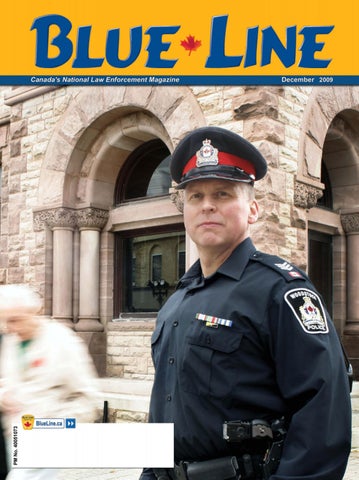
Acting Sgt. Wayne Sczepanski of the newly re-formed Woodstock Police Service graces the cover this month. Situated in the flat farm lands of southwestern Ontario, the city of Woodstock has seen many changes over the past 10 years. The changes have encompassed administration, identity and growth. Their police service has experienced the same changes and the recent move to return to its former name and structure has created a feeling of rejuvenation within the ranks. Read more in their profile on page 6. Photo by Mark Garrett
Features 6
16
Canada’s newest police service hits the streets
9 Switched on
Thirteen years later, killer confesses Gregory Bromby has finally admitted to killing Tara Manning
18 Effective risk management
Inside the RCMP’s elite PPG
The new preferred Taser target zone explained
12 Police homicide-suicide no longer a secret
30
Tearing down the “blue wall” is just the beginning
Preventing and investigating firearms crime
Departments
Case Law
38 38 14 20 20 37 23 36 5 28
33
Advertisers Directory Back of Book Deep Blue Dispatches Letters Market Place Odditorials Product News Publisher’s Commentary Technology
Blue Line Magazine
3
Investigative detention triggers right to counsel
dECEMBER 2009
DECEMBER 2009
4
Blue Line Magazine
Publisher ’s Commentary by Morley Lymburner
A back-up to remember “Thirty-one-O-two... thirty-one-O-two... Attend the drug store at Weston Road and Finch. A man causing a disturbance.” Seemed like a routine call and I wasn’t too far away. A man causing a disturbance was a routinely-heard radio call but there’s no telling what you might face on arrival. “Ten-four on that dispatcher. Any other information?” “Nothing here – just a call that a person is yelling in the store.” It was 1715 and things were busy. I suggested back-up if it was available. “Just handle the call, 3102. It’s pretty busy out there you know,” he growled. Police dispatchers of that era were coppers on the glide path to a gold watch or else they were already looking at one for their time checks. One quickly learned they were not to be trifled with. They were, without exception, male, grizzled, cynical, had done it all and had a “sixth sense” about every call dispatched. They knew every street in the city and could tell you where to get a good veal-on-a-bun or a free coffee with a little “extra” on a cold night. They understood what coppers were doing even before they did it. They could tell by the tone of your voice or your call history that you were having a gab fest with another car behind a plaza. Just when you thought you put one over on the old street supervisor their booming voice would crackle over the radio sending you to another call. You could meekly object that you were just finishing up the last call but he would somehow know your coffee was getting stale and the lively conversation could wait. They excelled at chases because they knew every nuance of every street, alley and dead-end cul-de-sac. They would artfully move converging cars in an ever tightening net until the pursued would see police in all
Blue Line Magazine
directions. No helicopter patrol could envision the chase nor foresee its conclusion clearer then the old-timers manning the mics. They could tell by the sound of an officer’s voice when a chase should be called off. Few supervisors would dispute their knowledge and experience because they knew the collective wisdom in the communications bureau outweighed any semblance of their own self importance. There was a downside to this brain trust. If short on patrol cars an old dispatcher trick would be to change the call description so only one car instead of two had to respond. A domestic dispute on a very busy night would become an “unknown disturbance” call, for example, requiring only one car to respond and report if backup was required. They would gamble that something was available if backup was needed. The problem, of course, was that far too often things went sideways very fast. An officer often had to venture some distance from their car to check out the call. Scout car officers rarely had portable radios and, even if they did, their transmission range was sketchy at best. By the time it became obvious backup was needed, the officer would invariably find himself on the ground wrestling a suspect into submission. “One is in custody,” the officer would radio back upon reaching the scout car. The victorious dispatcher would get to take another two-car call off their list with a car to spare. Things looked normal when I arrived at the drug store and I couldn’t see anything unusual through the window. I entered and a cashier with tell-tale saucer round eyes pointed toward the back. I headed down the long aisle toward the dispensary. The pharmacist looked at me and, using his eyes, directed my attention to a thin man with the hood of his green parka pulled over his head. The man had his back to me and was rocking
5
back and forth. As soon as I spoke, he spun around and lunged at me with a plastic butter knife. I raised my arm to redirect him and saw the blade break as it struck my coat sleeve. The ferocity of the subsequent blows to my body and head took me completely by surprise. I reeled back while he continued screaming and pummelling me with his fists, managing to grab one arm while he continued hitting me on the side of the head with the other. The man’s screams were deafening. I grabbed his other arm and quickly realized this seemingly frail man was very strong. Obviously high on speed, he had sought out drugs from the only source he could think of. We both fell to the floor and I managed to roll on top of him but had no idea how I was going to control such a violent person. A knee and arm suddenly crashed down on the suspect and I heard a reassuring voice say “here, I’ll give you a hand.” Must be an off-duty officer, I thought. I was almost right – it was my partner’s high school age son, Steve Sanderson. Turning the wired suspect over we managed to put on the manacles and carry him, kicking and screaming, to the cage in the back of my car. With a big broad smile he shook my hand. I thanked him and suggested he might visit our recruiting office. He simply smiled, laughed and said “no thanks.” He must have had other plans even at that tender age. Steve went on to found Accident Support Services and, as president, has maintained his tradition of backing up every copper on the street.
dECEMBER 2009
newest Canada s ’
police service hits the streets
by Carla Garrett As the sun peaks over the horizon, Cst. Don MacKenzie finishes his last shift as an Oxford Community Police Service officer. His in-coming shift relief, while reporting for duty at the same Dundas Street headquarters in the City of Woodstock, dons a different badge, shoulder flash and attitude. At 7:01 a.m. on Chief Rod Freeman Oct. 19, 63 officers of the now defunct Oxford Community Police Service (OCPS) became members of the bornagain Woodstock Police Service (WPS). “Everything we have been waiting for has come to fruition,” says MacKenzie, whose dad was the last chief of the former WPS. “It’s nice DECEMBER 2009
the political turmoil is done and we know where we are going... we know what our future is.” Around 6 a.m. OCPS quietly ended its reign with a false alarm call in the north end of the city. Signs were placed by the phones reminding staff to answer “Woodstock Police” as officers took pictures of one another under Woodstock Police banners erected throughout the station. “You can feel the momentum building in the station,” says Chief Rod Freeman, who came in just after 5 a.m. to see out OCPS and usher in the new force. At 8:02 a.m. officers cleared their first Woodstock call – a heated domestic argument between two residents over a cabbage resulting in a breach of probation charge. OCPS was created in 1999 as a partnership between Woodstock and three surrounding townships: Norwich, East Zorra-Tavistock and Blandford-Blenheim. It was a controversial process, taking nearly two years to complete, as was the partial disbandment of the force. “We worked very hard to get where we are at 7:01 a.m. today 6
and we are proud to have accomplished it,” says Freeman. “How many times can you be part of the creation of a new force? It’s a rare event.” To the general public, the transition is seamless. Besides large ads in local newspapers announcing the rebirth of the WPS, it is difficult to notice the change of guard – but to the officers, it’s more than new letters on the front of the building. “It’s a brand new fresh start for officers,” says Cst. Randy Rudy, driving down the still empty streets of downtown Woodstock. “As a resident of Woodstock, I am personally excited about it and think citizens will see a real front line difference.” Rudy was one of eight officers on the first day shift patrol of the new WPS. “It’s a chance for us to prove ourselves to the community, create a new identity here. We as officers and as a police service will dictate how this will unfold,” says Rudy, adding it’s an opportunity to reconnect with the community, “get in their faces and work together.” Blue Line Magazine
The first shift of the renewed Woodstock City Police Service. Left to right: Deputy Chief Daryl Longworth, Cst. Randy Rudy, Cst. Sean Morris, Cst. Tim Pinder, Cst. Nathan Hergott, Cst. Josh Coates, Staff Sergeant Marci Shelton, Cst. Marius Kerkhoff, Cst. Jarrod Sylvester, Sgt. Elaina Taylor, Cst. Craig Murray, Sgt. Don Thomas, Cst. Neil Butler, Cst. Jim Dalueg and Chief Rod Freeman.
Excitement has bubbled since the Ontario Civilian Commission on Policing Services approved the proposal for a Woodstock-only police force on Sept. 4. “When the Oct. 19 date was set, it immediately improved officers’ morale,” says Freeman. “My hope is to make this the premiere police service in the province – one that our members can be proud of and a police service our community of Woodstock can be proud of – just as they were of the previous Woodstock Police Service.” The former WPS had been a thriving force in the Friendly City since the 1800s and had grown to include 38 constables, five sergeants, an inspector, deputy and chief in 1998. Today, WPS is made up of 65 uniform members, supported by 26 fulltime and 12 part time civilian staff, in a community of about 37,000. The city has five patrol zones, including a downtown foot patrol, and boasts a domestic violence unit, criminal investigations branch, containment team, drug unit and a canine unit – even with a now reduced size. While a handful of officers and civilian staff from the former WPS remain, the chief is quick to point out this is “a new Woodstock Police Service.” “It’s a new century, with new members, and we want to create our own culture… it’s an opportunity to move forward,” Freeman told the first WPS shift during morning briefing as each member was issued new badges and warrant cards. “We’ll do it all together. There will be bumps… but we will come out on the stronger side.” Blue Line Magazine
Besides the name itself, there is little comparison between the old and new WPS when it comes to appearances. The big, green “W” from the 1998 WPS shoulder flash has been replaced with a more modern design. The new hat badges and shoulder flashes were redesigned using the same blue, red and white as the OCPS but now sport the Canadian flag and scales of justice with the slogan “Protecting our Community.” Freeman says the officers were actively involved in designing and creating the badges. “It’s something the guys can be proud of because they came up with it,” he adds. New graphics were installed on 17 cruisers after five surplus vehicles were sold at auction and everything with letterhead was reprinted to reflect the new force crest. Besides a new look, WPS is also under the direction of different management. Former chief Ron Fraser, who led the OCPS from its creation, announced his retirement earlier this year. He was replaced by Freeman, who was hired as deputy chief in September 2007, leaving his post as chief of the Orangeville Police Service. “I’ve relocated my family here for the long term, believing very strongly that this is the community I wanted for my wife and to raise my two young sons in,” he says, adding, “Woodstock is a safe community, there is no question about that... (but) we will always strive to be safer.” Freeman started his police career in 1978 and the 52-year-old has proudly served the communities of Timmins, St. Thomas, Fergus and Orangeville. 7
He is passionate about policing and has earned a number of awards, including the Ontario Medal for Police Bravery for his role in rescuing a 13-year old girl trapped under the Beatty Dam in Fergus. He has also been inducted as a Member of the Order of Merit for the Canadian Police Forces. Eighteen-year policing veteran Daryl Longworth began as deputy chief this fall. He was born and raised in the city and has a long history with the WPS, dating back to 1989 when he joined the auxiliary unit. Longworth signed on with the Halton Regional Police Service in 1992, serving Oakville, Georgetown and Milton before leaving in 1995 to return to his roots with the WPS. He spent 10 years in the criminal investigations branch before quickly rising through the ranks to briefly become inspector in February and then deputy chief in October. Fourteen OCPS officers of various ranks were displaced by the reorganization but have since taken jobs with the Ontario Provincial Police, who now police the departed townships. While Woodstock Mayor Michael Harding regrets they were unable to keep such a unique partnership alive, he says he is enthusiastic about “going back to our roots... “They will be able to concentrate solely on urban-style policing,” he notes, adding officers will be better known to the community. Concerned about the drug trade in the city, Harding says the chief has already made a personal commitment to eradication. “I think Rod will bring back a former aggressive policy on drug enforcement.” dECEMBER 2009
Oxford Community Police Population served - 62,000 Crime rate - 5,913/100,000 population (9 per cent decrease 2006-2007) Clearance rate – 30 per cent Per capita cost - $209 Woodstock Population - 37,000 Estimated cost per capita - $251.29 (based on 2009 budget figures) Projected budget - $10.6 million
OCPS spent the summer of 2008 targeting dangerous drug dealers from out-of-town who chose to set up shop in Woodstock. Numerous arrests were made during multiple, simultaneous drug raids. “This targeted effort was very successful,” says Freeman, but he adds that illegal drugs continue to pose a big threat to community safety. The service was recently embroiled in a number of high priority investigations – most notably the abduction/murder of 8-year-old Victoria Stafford, which made headlines across Canada. “The incredible magnitude and extreme
intensity of this criminal investigation taxed the resources of our police service and cut deeply into the physical and emotional wellbeing of all our staff,” says Freeman. Victoria is now a constant reminder that the “unthinkable can happen here,” he adds. A combined investigative effort between OCPS and the OPP resulted in the arrest of two suspects who are currently before the courts facing a variety of criminal charges. It had also been less than a year since the local force discovered off-duty OPP Cst. Laurie Hawkins and her family, who had suffered an accidental carbon monoxide poisoning in their Woodstock home.
“The accidental death of an entire family had a significant impact on our community, was an enormous loss for the police community and took a tremendous toll on the emotions of a large number of our own personnel,” says Freeman. Also, just over a year ago in November 2008, officers were thrust into a murder investigation that had them digging for evidence and a dismembered victim in the backyard of a Woodstock home – that case is currently before the courts. Only months earlier, patrol officers responded to a tragic car crash where a four-month-old baby boy was killed. A woman was charged with impaired drivingrelated offences. “Throughout all of these challenges, our officers and support staff demonstrated the depth of their commitment to duty, professionalism, resilience and their immense talent in bringing these serious investigations to conclusion,” says Freeman. Prior to the partial disbandment, the crime rate for the OCPS was 5,913 offences per 100,000 population, with a nine per cent decrease in reported crime occurring between 2006-2007. The population served by the OCPS was upwards of 62,000, compared to Woodstock’s 37,000, however the majority of calls originated in the city. “About 80-85 per cent of our work was in the city,” says Freeman. “We may see an initial drop in calls for service but our workload won’t change too much.” What you will see, he says, “is an organization that has been revitalized, with a second wind able to address all issues, with a new energized police service dedicated to ensuring community safety within the City of Woodstock, in partnership with our citizens.” Carla Garrett is a freelance journalist working on assignment with Blue Line Magazine. She may be contacted by email to carlalgarrett@yahoo.ca.
DECEMBER 2009
8
Blue Line Magazine
on
Switched Inside the RCMP’s elite PPG by Tony Palermo With an elevated threat of danger and risk to their personal safety, protection for heads of state, dignitaries and other VIPs isn’t an option. The U.S. Secret Service and Papal Swiss Guard are highly visible and well known names in personal protection. Others, such as Israel’s Shin Bet, whose very name translates to “the unseen shield,” are more covert and not as well known to the public. In Canada, the RCMP’s Personal Protection Group (PPG), is responsible for protecting the prime minister, governor general and certain VIPs in the National Capital Region. Although not well know to the general public, the PPG is a very elite group which is well respected and recognized in personal protection circles worldwide. With a dedicated strength of approximately 180 personnel and more that can be drawn upon as required, it is divided into three specialized details. The Prime Minister’s Protection Detail (PMPD) is responsible for protecting the PM and his immediate family, both in Canada and while abroad. Headquartered in Ottawa, it also guards the official residences, including 24 Sussex Drive in Ottawa and the Harrington Lake Estate near Chelsea, Quebec. The Governor General’s Protection Detail Blue Line Magazine
(GGPD) is also headquartered in Ottawa and is tasked with protecting the governor general and their immediate family, both in Canada and while abroad. It also guards Rideau Hall, the official residence. The Very Important Persons Security Section (VIPSS) protects dignitaries, Internationally Protected Persons (IPPs) and anyone else the minister of public safety designates. In Ottawa, the local VIPSS is a part of the larger PPG. However, there are several other permanently staffed VIPSS throughout the country and many more VIP trained officers that can be called upon, as required, in support of operations anywhere in Canada. These other VIPSS units report directly through their regional chain-ofcommand. Typical VIPSS clients include ex-prime ministers, the chief justice of the Supreme Court of Canada, designated Canadian ministers and foreign diplomats. Its client list grows as threat levels increase. The VIPSS are also tasked with supporting the PMPD and GGPD when these groups visit their area. Not your A,B,Cs (average babysitters & chauffeurs) As a veteran officer with approximately 25 years of service, Cpl. Bill Demeau laughs when reflecting on how his colleagues view protective policing officers. “A lot of people within the police force tend to view VIP security as taxi driving for the elite.” As 9
the national training co-ordinator, Demeau knows that this judgement couldn’t be further from the truth. Once the officers have passed an extensive background check, personnel file review, fitness test and a series of interviews, they are tentatively accepted into the PPG. The key word is tentatively. Regardless of their rank or title, all officers entering the group are required to take an advanced driving course and basic two week VIP course with three primary components – bodyguarding, motorcade driving and security planning. They must pass each with a high standard to graduate. They receive other specialized training and mentoring specific to the demands of their assigned unit and ultimately, the unique requirements of their clients. Much of it involves the operational and security aspects of protective policing. Also included is what could be considered hobby training, albeit non-optional and with a tactical twist. For example, Harrington Lake Estate is nestled on the edge of Harrington Lake and surrounded by the hills and trees of Gatineau Park. Therefore, all members of the PMPD are trained boat operators and skilled in using ATVs and snowmobiles. As for the other hobby-type training, “just look at what a normal Canadian family does,” says Insp. Bruno Saccomani, OiC of the PMPD. “They might like to go hiking. They might like to go camping. Maybe they go trekking or fishing. All of that needs to be dECEMBER 2009
associated to a normal family in power as well; and, as protective policing officers, we must be able to provide a seamless service to all of those activities.” If that isn’t interesting enough, Saccomani offers a teaser. “Speaking in general terms, many of our members are also trained in the art of motocrossing.” In an environment where mistakes can be deadly and potentially pitch the country into crisis, the bar is always set high. Not surprisingly, this includes physical conditioning. “Physical fitness plays a big part in personal protection,” says Supt. Guy Comeault, OiC of the PPG. “All of our officers are required to annually pass the Physical Abilities Requirements Evaluation in under four minutes (PARE-4) – and that applies to everyone in the group, from managers right down to the newest members, regardless of age.” Cst. Gilles Gougeon agrees that physical fitness is extremely important. As a 44-yearold officer with 22 years of service, he knows first-hand the challenge an energetic and fit VIP can present. “You know, Mr. Chrétien is a funny, happy-go-lucky type of guy. The way you see him on the news is pretty much how he is. When Mr. Chrétien was prime minister, he would go up those stairs (at Parliament) two at a time. If he could lose the bodyguards, he’d do it just as a challenge.” Even though he’s now 75, Chrétien hasn’t lost a step, he adds. “Even today, if you’re working with Mr. Chrétien, he’s a man that walks at a fast pace. So, you better keep up with him!” There is a lot of work that goes on behind the scenes and hidden elements to protecting VIPs that people, including other police officers, will never see. Most only see the well-dressed protection detail standing around doing what appears to be, at least on the surface, a lot of nothing, but as Comeault says, “we better be doing it well.” Switched on Close protection officers, otherwise known as bodyguards, are the last line of defence between a threat and a VIP. If all of the other protection systems are breached, the bodyguard needs to be able to react confidently and without any hesitation. The more time and space that a bodyguard has to react, the better their chance of neutralizing the threat. Time and space are created by always DECEMBER 2009
knowing what is going on around them. They must be totally tuned in to their environment, their eyes like lasers, constantly scanning the crowds and surroundings. They must evaluate what they see and hear. If a threat is detected, it must be dealt with quickly. As any protection specialist will tell you, the hands are the most dangerous part of the human body. If you know what the hands are doing, you know what is going on. However, it is important to note that not all threats are as blatant as seeing a weapon or hearing the cries of “Allahu Akbar.” You can’t take anything or anyone for granted. Threats sometimes come from the unlikeliest of places. A good example of this is the “shoe incident,” which occurred in December 2008, while then US President George Bush was speaking at the Iraqi Prime Ministers Palace in Baghdad. Baghdadiya television journalist Muntathar al Zaida threw both his shoes at Bush before being taken to the ground by a fellow journalist. “Think about the sequence of events,” says Saccomani. “Here’s this journalist. All of a sudden, he lifts his left leg up at the knee, puts it on to the other knee, lowers his right hand down to the heel of his left shoe, pulls the shoe off with his right hand, brings the shoe back behind his head and then swings. I mean, how many opportunities did they have to tackle this guy? And then, it didn’t just happen once. It happened twice!” Lessons learned? Saccomani acknowledges that individual mistakes happen but he has no patience for total failures. “There are no lessons learned here,” says Saccomani. “Someone should have detected the anomaly. It’s the basics.” Saccomani uses an expression to emphasize the importance of being tuned in. “What I say to the guys is, once we’re in action, you’re switched on. You’re different people. The clues are there. They’re always there.” Security planning and visits Whether it’s a foreign dignitary visiting Canada or our PM travelling here or abroad, much background planning is necessary. A co-ordinated effort between the PPG and multiple industry partners is required in order to ensure a safe and secure visit. These partners are from all levels, local all the way up to international, and may include governments, intelligence organizations, police forces, foreign security agencies and community groups. Information is collected 10
and analyzed and a multi-layered security apparatus for the visit is built. The result of this massive effort is known as the security plan. Security plans are highly individualized and depend on several factors. In general, think of answering who, what, where, when, why and how and then breaking each answer down into hundreds, if not thousands, of smaller categories and points. Again, the goal is to ensure a safe and secure visit for everyone, including the public, from start-tofinish. Every minute detail must be assessed. Problems must be anticipated and solutions developed. Multiple emergency contingencies must be put in place. Literally everything – weather, location, indoor or outdoor, political scene, type of crowd, location of hospitals along the route, blind spots, all the way up to biological, chemical and other types of attacks – must be analysed, discussed and planned for. There must be as much control of the environment as possible. As Saccomani points out, all of this must be considered while keeping in mind the overall marketing message of the VIP. “Whether it’s the prime minister or a foreign government official, it’s important that we know what the objective of the event is and what message they are trying to send. Then, we will look at how, from a security perspective, we can assist them in sending out their message constructively, all the while protecting them.” When a foreign VIP plans to visit Canada, the PPG will be advised by Foreign Affairs and International Trade Canada’s Office of Protocol. Protocol office staff will discuss the nature of the visit and itinerary with PPG’s VIP co-ordinators and a security plan will be developed. While other foreign security agencies will be involved in this process, PPG will be the lead co-ordinator and ultimately, the lead protection force that ensures a safe and secure visit. All visits present their own set of unique challenges, though some are definitely more challenging than others. When newly-elected U.S. President Barack Obama visited Ottawa in February, 2009 for his first official visit on Canadian soil, he was enjoying sky-high public opinion. Everyone wanted a glimpse of him so planning was about as in-depth as you can get. Despite having an extensive security plan and apparatus in place, Obama threw a curveball at the PPG when he decided to walk through Ottawa’s historic Byward Market district for a Beavertail and souvenirs. Blue Line Magazine
“There’s a great example of where we’d have to adjust accordingly,” says Comeault. “It’s not in the program, it’s not prepared for and we have limited time to get on with it.” When our prime minister visits a location, whether it’s in Canada or abroad, a travel officer (TO) from the PMPD is assigned to lead all aspects of the visit. Their responsibility is to co-ordinate the development of the security plan and, on the day of the visit, advance it through its scheduled course. The TO is also responsible for dealing with any problems that might arise. When the prime minister visits abroad, the TO is also tasked with auditing the host country’s protection force. The TO conducts an in-depth evaluation of their capabilities, analyses the security package being offered and then identifies gaps that may not necessarily meet the PMPD’s standards. If there are gaps, security of the visit becomes a more integrated and involved operation between the PMPD and foreign protection force. Security planning will always be a fine balance between security and accessibility. Protection specialists describe it in terms of driving and having your foot on the gas pedal. If things are happening on the world stage or intelligence suggests that more security is required, then you apply more pressure to the pedal. If things are quieter, you ease off a bit. It’s a constant adjustment which comes from both sides. “I feel for a VIP coming into this new world in that all of a sudden they’re like a bird put into a cage,” says Comeault. “However, we have to ensure their safety and security. We’re not there to restrict their movement. We’re there to enable their movement in the safest way possible.”
Constantly evolving Personal protection will always be intelligence based. Security will always be adjusted based on local and world issues and the unique circumstances of each individual VIP and visit. In order to remain relevant, the security apparatus and manner in how that security is applied is constantly evaluated. If new tactics are employed by those wishing to harm Canada’s VIPs, then the PPG must also develop new tactics. Saccomani spent a considerable amount of time developing the procedure manual for the PMPD, and even included an adapted quote from the great French poet, Victor Hugo: The future has many names. For the weak, it means the unattainable. For the fearful, it means the unknown. And, for the courageous, it means opportunity. Saccomani writes in the manual: When there are novel and improved methods for performing our duties more effectively, the PMPD will adjust and remain amongst the elite of VIP protection. “What I’m saying is that I realize that I don’t know it all,” says Saccomani. “We have the opportunity to travel the world and be exposed to so many different threats, systems and security protocols. I look at how other people do things. If someone else is doing something better than us, I’ll speak to our training people and have it injected right away.” No hesitations. Switched on. Tony Palermo is an Ottawa area freelance writer on assignment with Blue Line Magazine. Contact him at tony@ tonypalermo.ca for more.
Joining the personal protection group Cst. Charles Mason joined the RCMP in September, 2006, after spending close to five years as an officer with the Toronto Police Service’s 33rd Division. He has worked a variety of positions with the Mounties, the most recent being as a member of the PPPD. Mason loves the challenges and the “get it done” attitude of his fellow officers and supervisors. The PPG hires on a continuous basis and officers interested in making the change should tell supervisors of their interest. Available positions are posted internally on HRMIS and officers must be releasable. Mason cautions aspirants to, “make sure you inform yourself and do your homework before even considering a change. The expectations are high and the responsibility is huge. I often tell my police community friends that it’s like apples and oranges. You have to find that switch inside of you to go from being a beat cop to a VIP bodyguard.” That being said, Mason is glad that he made the change, “I never would have imagined that one day I’d be wearing a suit and tie, protecting Blue Line Magazine
the prime minister of Canada and his family. It’s been a great experience; a great honour and duty to be part of such a unique group.” For officers considering the change, here is some sage advice from two senior PPG officers: Supt. Guy Comeault, OiC, Personal Protection Group: • I’ll be frank. This isn’t for everyone. Not everyone can go from active policing to being a personal protection officer in charge of a VIP’s safety. • That being said, we take people from a variety of backgrounds and with various skill sets, whether it be general policing, highway patrol or investigations. • Have good interpersonal skills, a good reputation and a solid file. This will carry you a long way. Insp. Bruno Saccomani, OiC, Prime Minister’s Protection Detail: • I’m looking for leaders. I need people that are capable of thinking on their feet. All of our members are cross-trained in every role and they switch roles regularly to keep those skills fresh. The idea is if we’re out there and we take casualties, someone else can step up to the plate, on the fly and execute that role.
11
• You need to be extremely flexible. On a normal week, the PM might do three or four events. If an election is called, most of us will be travelling Canada doing five events a day, for 40 days straight. • As an example of what I look for in a members file, I like to see that the officer was picked from a general duty roster to go to another unit. That right there shows me a member was identified by his peers as being motivated. Or, perhaps the member has written several search warrants. Search warrants are a complicated task. They don’t write themselves. If a member has taken the time to write search warrants, they’re driven. • PMPD is a very tight group. Group dynamics are important. You’re going to need to gel with the other members of the group. When I’m considering an applicant, sure, I talk to the applicant but I also make a lot of other calls to find out more about them. • You need to be receptive to continuous learning and training. If you’re accepted to PMPD, there’s going to be another six to eight months of intense training before you’re ready to perform the duties of a PMPD protective policing officer.
dECEMBER 2009
Police homicide-suicide
NO LONGER A SECRET Tearing down the “Blue Wall” is just the beginning by Antoon Leenaars London Police Service (LPS) Acting Insp. Kelly Johnson and Supt. David Lucio (shown at right)both died from single gunshots on June 7, 2007. The coroner determined the tragic incident was a murder suicide, said Chief Murray Faulkner in a public statement four days later. As part of its response, the LPS established a committee, with myself as the lead investigator, to investigate. My partner Dr. Peter Collins, a first rate forensic psychiatrist with the Ontario Provincial Police, and I undertook a retrospective investigation, called a psychological autopsy. Many questions arose. Was this a rare event or is there a homicide-suicide (H-S) epidemic among police? Are they like homicides or suicides? What do we know about them? The best-known study of police suicide is of the 93 which occured during New York’s great epidemic of the 1930s, including five murdersuicides, which I figure would be well above expectations (the definition of ‘epidemic’). It was established then and since that H-S was more like suicide than homicide. Suicide (S) and thus, H-S, is not only intrapsychic (existing or taking place within the mind or psyche), but also interpersonal, with a person – or as Gregory Zilboorg, the leading investigator of the 1930s epidemic had convincingly shown – an ideal, e.g., possession of service gun, promotion. A most important question thus arises: on a continuum, when does a discrete individual event of suicide become a relationship one; from suicide pacts – ranging from co-equal involvement such as lovers to one of pressure and coercion, such as Arthur Koestler and his wife – to unwilling victim and a perpetrator, as in Lucio and Johnson or even mass murdersuicide bombers/terrorists such as 9/11? Looking at the New York police suicides: • Could we have predicted the five H-Ss? DECEMBER 2009
• Could we devise a psychological autopsy, the lead forensic method of investigation into such deaths, to predict and discriminate them? • Could we compare a sample of the 88 police suicides (non-homicides) to the five homicidesuicides? • What empirically-based knowledge would we then have? • Why did the police suicides and higher rate of H-S occur in New York? • Could we interview the survivors of the New York deaths? • Could they help us to understand the tragedies? There is a striking lack of general (common) evidence to adequately solve and thus, predict, cases of police H-S. The unfortunate 1930s tragedy has already repeated itself in New York and elsewhere. For example, a LAPD officer murdered his estranged wife and her lover before killing himself on Aug. 12, 1992; a Detroit officer shot his wife, a fellow officer, and then himself, in public, on Sept. 23, 2009. In the only study to date, John Violanti (Homicide-suicide in police families: Aggression full circle, 2007) identified 29 cases of H-S in the US from Jan. 2003 to Feb. 2007. This is well above expectation. However, it was assumed to be an underreporting and the data were unreliable (the Web). The reason is straightforward; investigations are not allowed. Can you treat say, cholera, without evidence? There are no studies in Canada, and the events are not restricted to North America. A South Korean officer indiscriminately murdered 57 people and injured 38, using police weapons, before killing himself on April 28, 1992. Thus, it is easy to conclude that the deaths of Lucio and Johnson are not isolated. The evidence clearly shows that the epidemic wasn’t restricted to the 1930s or New York but is indeed a pandemic – an epidemic around the world. Even though the problem is widespread, 12
it appears to remain a secret, much related to what are called “blue walls” (such as barriers, stigma, dissembling and the like), not unusual with police mental health issues. It is a common problem. Violanti came to the same tragic conclusion as I did. Police officers appear to be at a much higher risk for H-S than the general population. Like in the 1930s, he found that relationship problems appear to be highly implicated, including domestic and workplace violence. Alcohol use is often a precursor, and the service pistol is almost always used. Mental disorders, notably Post-Traumatic Stress Disorder (PTSD – a common problem among police) – and depression are most frequently noted. There are unresolved problems, frustrated needs, stresses and regressive states. It was easy to conclude that these deaths are more like suicides than homicides. H-S is S. In addition, there is a further tragedy; H-S among police has a profound effect (aftershock) on police officers’ families, friends, community and police services. Yet, similar to the 1930s, nothing is done. Avoidance prevails. As was well documented with Vietnam veterans, this approach only exacerbates the trauma and would predict more H-S among police. Investigator Jack Kamerman observed this after the 1930s epidemic – so did almost all other investigators, including Bruce Danto after his 1970s studies of suicide among Detroit police. Incidentally, 33.3 per cent of the suicides Blue Line Magazine
Danto studied were homicide-suicides. That data was hidden – kept ‘a secret’ – he noted. There was a masking, a dissembling – and this is so today. Why? In a most unique study in Norway, AnnMarie Berg and her colleagues (2006) found that few officers seek help for PTSD, suicide risk, etc. The 10 per cent that did turned mainly to their family doctors. There are blue walls, often reinforced by the ‘macho’ blue culture, notes NYPD officer/ psychologist Dan Rudofossi in his 2006 book, Working with traumatized police officerpatients. The World Health Organization (WHO, 2006) has further identified occupational risks to the environmental fraction of violence, not only for mental health but also physical health (disease). There is a significant environmental factor to disease for police compared to most other occupations. Simply being a police officer places a person at risk for suicide, homicide-suicide and much more, yet there are evidence-based solutions. Officers do not need to kill or to die. We can prevent H-S. Will police services have the courage to allow investigations? Only after we understand an event, as Dr. John Snow showed in London’s 1854 cholera epidemic, can we predict and control it. Or will the secrecy, identified over 80 years ago, continue? I encourage you to read our report on the Lucio/Johnson deaths, where we note that Johnson, “possessed the character and dynamics more like a person who died by suicide than a female perpetrator of homicide.” H-S is S.
Blue Line Magazine
There were common contributing factors: emotional disturbance (depression, anxiety), stress (historical and interpersonal problems but no domestic violence), alcohol abuse and the availability of a firearm. Zilboorg, in the 1930s, Violanti today and I, in my forthcoming book, Suicide and homicide-suicide among police, offer the same beginning evidence. The fact that police are professionals sanctioned to use deadly force is always relevant. Most important, the evidence to date also shows that homicide-suicides among police are complex, multi-determined events. There are no simple answers and therefore no simple solutions – but there are solutions, if we only implement them. Police services need to be officer-centred. The epidemic of the 1930s was stopped. Can we do the same? Zilboorg, Violanti, Danto, (Kris) Mohandie, Collins and many others offer many ways to do so. I offer some 24 recommendations in my book. We can save officers’ lives. The first step is to no longer keep this problem a secret. Once the secret is out, we can better predict potential H-S among our suicidal officers. Visit www.police.london.ca/Newsroom/PDFs/luciojohnsonreport.pdf to see the full report. Dr. Antoon A. Leenaars is a mental health, public health and forensic psychologist. He has served as an expert investigator/witness on wrongful death, suicide, homicide and homicide-suicide cases for police services and justice systems. E-mail draalee@sympatico.ca for more on his forthcoming book from Baywood Publishing Company Inc.
13
dECEMBER 2009
Deep Blue by Dorothy Cotton
Good candidates not always good hires A small police service was considering adding a pre-employment psychological assessment to its standard assessment of police candidates. The officer who called me was clearly not persuaded it was a useful thing to do; he was just the unwilling front man for someone else’s idea. It’s surprising in this day and age to find a few police services which don’t include a psych assessment as part of the hiring process. You may think it’s not a cost effective strategy to avoid bad hires, feel people do not pull the wool over your eyes in interviews or are confident of your ability to weed out the undesirables. I’ve got news for you (aside from the fact that you are wrong); there are still good and compelling reasons for getting a psych assessment before hiring someone. The most obvious reason is simply because some of the characteristics that make a person a good – or bad – candidate are tough to spot. It’s easy to screen out those with serious psychological problems – they are usually weeded out long before the psych assessment. What is a bit trickier is identifying the perfectly normal, mentally healthy people who may not be suitable. This group can include candidates who do not work well on their own and need more structure; cannot take charge of a situation and prefer to remain in the background; get bored easily and just might be inclined to stir up trouble if things get quiet; or think in absolutes and see everything as black or white. These kinds of people may have very good work backgrounds and present well in interview – but still not be ideal candidates for policing. Another good reason to do a pre-employment psych assessment is simply to cover
DECEMBER 2009
the organization’s butt. It IS the industry standard these days. Hire someone without a screening who does something perfectly dreadful that ends up on the front page of the local paper and you offer ready ammunition for a wrongful hiring suit. I can just hear the court proceedings now: “So Chief Cornercutter, you are telling me that when you hired this officer here, who has been charged three times in the last year with inappropriate use of force, you never did any kind of psychological assessment to see if he was impulsive or had self control problems?” There are also always a few people who somehow get past the interviews and competency discussions, provide good references, have good work experience – yet still are not good candidates. I sometimes see these
14
folks in interviews – and oddly enough, they say some really amazing things to psychologists, or at least to THIS psychologist. It is quite unbelievable. I don’t know whether it’s because they let down their guard because I remind them of their mother or because they (like a lot of the general public) think I can read their minds so they might as well be frank – but people freely volunteer information that sometimes makes me fall of my chair. In keeping with the spirit of the season – sharing, mirth, ho ho ho, etc – I would like to tell you about the five worst responses I have heard of 1. First, here’s the “I can’t believe you just told me that in a job-related interview” category: “So tell me, what brings you to policing? Why are you interested in a career as
Blue Line Magazine
a police officer?” 1. I really like blood and gore. I just love shows like CSI. I mean, all those body parts... it’s just fascinating. I’d just love to be doing big car accidents – you know, like when people get killed and you have to get the jaws of life out. Cool. I’d love that. 2. I have had a ton of speeding tickets over the years. I like driving fast. I figure being a cop, I can drive really fast and not get a ticket or anything. I can do chases and stuff. 3. I really like uniforms – I want a job with a uniform. People look at you different if you have a uniform. My first job was on one of the Dickie Dee ice cream wagon things. I was 14 years old. The other kids just wore jeans but I got myself a whole white outfit and hat and everything. 4. Well, I am 35 years old now and I have just seemed to drift from job to job. I really don’t know what I want. I never really thought about being a police officer but my friend Joe just got hired and he seems to like it so I thought I’d give it a shot. Besides, I’d like something steady – police don’t ever seem to get fired even when they break the law (this candidate had been let go from several other jobs). 5. I think this police force has some real problems – must be run by idiots as far as I can see. You read in the paper all kinds of dumb stuff they do. I figure I am smarter than most people so after a couple of years, I’d like to get promoted and probably be chief one day and try to sort out some of the problems. I really don’t much want to spend any time driving around in a cruiser or doing shiftwork but I figure I can stand it for a year or so. And in the “I can’t believe you just said that” department: 1.”Is there anything else you think I should know about you?” To be honest, this police service is not really my first choice but I was turned down by service B. Word on the street is that this police service is easier to get into so I figure if I can get in here then after a couple of years I can transfer to service B. 2. “Do you have any experience working with disadvantaged populations?” You mean like loonies and wackos and retards? Nah, I try to keep away from stuff like that. It’s not real police work anyhow, but I am sure I’d be fine with those loser groups if I had to be. 3. (To an older candidate) “Why are you looking at making this career change at this point in your life?” I’ve always wanted to be a police officer and feel that, since everything in my life is just perfect right now, this is a good time. It’s the ideal time. (This might have been more convincing had he not just told me his wife had recently charged him with assault, he had been laid off from his most recent job and was heavily in debt – all Blue Line Magazine
things that oddly did not come up in his other interviews!) 4. “Tell me about a time in your life when you had to deal with something really stressful.” I guess that would be when my dad was ill. He’s pretty old and frail. I figured he wasn’t going to live much longer cuz he’s so old. When you get that old you can’t do anything much... I mean, he needed to be looked after – really elderly.... by that age no one is really mentally with it any more. “So how old IS your dad?” Pretty old – 52 I think. 5. “I see you are currently unemployed. Can you tell me what you have been doing for the last six months?” I quit my job. I decided to take time off and prepare for this job. I really want to be a police officer so I wanted to be prepared. “Oh – so have you done some ridealongs?” Um – no, not yet, but I’d like to. “Have you done any volunteer work? I see on your resume you are volunteering at the XYZ Agency” Well, I have not really started yet, but I plan to. I’ve heard that might be helpful for getting in. I should do that. “How about post secondary education? I see you finished high school. Have you taken any courses or done any reading up on policing on your own?”
15
I bought a book about policing in Canada but I have not read it yet. “I see here that you have not yet passed the physical fitness test. How are you preparing for that?” Yeah, I gotta get on that. I think I might join a gym. “Has that been part of what you were doing for the last six months to get prepared?” No, not yet – I figured I had better get ready for the interviews and stuff first. “I am a little unclear here. You said you took six months off to prepare to get a police job but I am not seeing what you did during this time to get ready. How exactly were you preparing?” Well, I have thought about this a lot. You’ll be happy to know that none of these folks were hired – at least not by police services I work with. Maybe YOU hired them. They all looked good on paper and interviewed well. I guess that’s what makes them scary. Maybe a good psych assessment might help. 1 - These stories are based on real interviews by me and my colleagues across the country. I have changed the exact details of these quotations to maintain the privacy of the individuals and the police services involved, but the drift is for real. Dr. Dorothy Cotton is Blue Line’s psychology columnist, she can be reached at deepblue@blueline.ca
dECEMBER 2009
13
years later, killer confesses
Gregory Bromby has finally admitted to killing Tara Manning, 13 years after the Dorval teenager was raped and stabbed 51 times inside her family’s home. by P.A. Sévigny It’s been 15 years since Michael Manning heard his daughter Tara’s alarm clock go off while he was making an egg sandwich for breakfast. When nobody turned it off, he went to wake her up for school. “I still remember how the cover was drawn up to her chin,” he said, tears flowing down his face. “I still recall how I thought she was sleeping until I touched her… and when I pulled the cover off, that’s when I knew my baby was dead.” During an exclusive interview, Manning told Blue Line how he often thinks Tara’s killer, Gregory Bromby, took two lives after he raped and killed his daughter. “It’s been 15 years since that bastard killed my daughter and it’s been 15 years since I’ve had more than two to three hours of sleep per night.” While he still mourns Tara’s death as much as he did the day she was buried, Canada’s National Parole Board recently informed him his daughter’s killer would soon be on the street and living in a half-way house in Blainville, one of Montreal’s more distant suburbs. “It doesn’t really matter,” he said. “I’m here, he’s there and Tara’s still in her grave.” It does matter because Michael Manning is a Canadian hero. This is the man who convinced Parliament to pass a law giving police the right to test every suspect’s DNA upon arrest for a capital crime. “DNA tests changed homicide investigations forever,” said retired SPVM homicide detective Steve Roberts. “It’s the biggest development since fingerprints.” Police all over the country agree. Compulsory DNA tests continue to help officers solve cold cases, get convictions in more recent cases and, best of all, DNA tests often provide the innocent with their very own ‘Get out of jail free’ card. After Tara was murdered, it’s difficult to imagine what life was like for the Manning family. Sloppy police work led the authorities DECEMBER 2009
to treat the Manning family and Tara’s boyfriend as their main suspects. Manning also had to carry the additional guilt of knowing he was passed out on the sofa only a few feet from Tara’s bedroom door, after having a few too many beers while watching the evening’s hockey game. Michael Manning clutches a picture of his daughter, Tara, After voluntary DNA tests outside a Saskatoon courthouse. finally absolved the family from perior Court for a warrant to get their sample. any suspicion, there were no breaks in the Bromby’s DNA proved to be a perfect match case until police were told about another girl with the killer’s sample. Now police knew who was raped and told she would be killed he had raped and smothered Tara Manning if she went to police. The victim had let her with her pillow and stabbed her 51 times in rapist stay over in her C.D.N. (Côtes-Desthe chest and upper body. Neiges) apartment because she knew him and Only weeks after Bromby was indicted, felt bad when he said he had no place to go the crown informed Manning that their case for the night. He later woke her up, showed was in trouble. Under sections 7 and 8 of his knife and pushed her back on the bed. the Charter, Bromby was within his rights to “I’m crazy, I’m nuts,” he said, repeatedly refuse to submit a DNA sample and, as such, stabbing her mattress and pillow while raping the evidence could be declared irrelevant and her. After he finished, he said it was too bad inadmissible in court. Without the sample, but he would still have to kill her because there was little proof he killed Tara, which he really didn’t want her to go to the police. would effectively scuttle the trial and allow “I’ve already killed another girl,” he said, Bromby to walk out of court a free man. “so as far as I’m concerned, it’s not really This was too much for Manning. Local much of a problem.” The girl bargained for Liberal MP Clifford Lincoln organized a her life, promising she wouldn’t tell the cops. meeting with federal justice minister Allen He believed her and left after taking some Rock, who told Manning he too had a 10 money and her bus pass. Once he was gone, year-old daughter so he didn’t need to be she did see the police and told them about the convinced about the justice of his case. rape and the boy who threatened to kill her. “Mister Manning, you must show me She also told them his name: Greg Bromby. the Canadian people want this law,” he said. Bromby already had a record and, after Manning did just that. Friends and neighhe was arrested, someone recalled how his bours began to circulate a petition and he name was on a list of all those who had met Montreal philanthropist Micheline Bourecently visited the Manning family’s home chard, one of the city’s better known business before Tara was murdered. Police already women. Once Manning told Bouchard how had a sample of the killer’s DNA because he Tara’s killer could be set free to kill again, didn’t wear a condom. However, they had no it took her only a few days to put together evidence to forge a link between the killer’s an impressive support group to organize his DNA and Greg Bromby because he used a project to amend Canada’s criminal code. condom when he raped the girl in Montreal’s Four of the best public relations firms in C.D.N. borough. the city got to work on the project and within Police asked Bromby to provide his DNA weeks, Manning’s quest for justice was frontbut he refused, forcing them to go to the Su16
Blue Line Magazine
page news across the country. He still recalls how one PR professional told him “it’s one vote per two pounds of paper in a petition but it’s 500 votes for every personal letter you send to your federal MP.” Manning’s petition was soon transformed into a letter campaign and every office on Parliament Hill was flooded with mail demanding compulsory DNA tests for any capital crime suspect. Preston Manning’s Reform Party immediately supported the initiative and political pressure was then brought to bear on the nation’s new official opposition: the Bloc Québecois. After hearing about Manning’s efforts to seek justice for his murdered daughter, former BQ leader Lucien Bouchard invited Manning to meet him in his Ottawa office. “He was wonderful,” said Manning. “Very courteous and very polite. When I told him about Tara’s murder and the possibility her killer could walk, he said he understood and would do everything he could to help push the law through in time for the trial. He was still recovering from his illness and I still remember how I had to help him out of his chair. That’s when I knew this man knows what it is to suffer.” On the final day before summer recess, Reform MPs used the question period to ask Rock if the Liberals would consider joining with them and the BQ to approve Bill C-104, which called for compulsory DNA tests for capital crime suspects. Hansard demonstrates how Rock tried to evade the question; a
Blue Line Magazine
follow up asked if he would personally assume the responsibility for any more crimes committed by Bromby and others, who would be free to walk the streets if the government refused to pass the bill. Manning recalls how Rock hesitated before telling the House the Liberals would support C-104 if both the BQ and Reform also agreed to support it unanimously. Before the sun set on June 22, 1995, the bill went through its three readings and was passed in record time. Compulsory DNA tests for capital crime suspects were now part of the Criminal Code and Bromby would spend the next 13 years of his life in jail. “That was the day Allen Rock stood up,” said Manning. “That was the day the man stood up and was counted.” Fifteen years later, Manning is living in a basement apartment in the deepest reaches of Montreal’s west end suburbs. After two cups of coffee and three cigarettes, he is ready to face the world. He’s overweight, smokes too much and is visibly hung-over. While looking at Tara’s picture, he lit up another one before telling Blue Line he still regrets not kissing his daughter just minutes before she went to bed the night she was killed. “I miss her,” he said. “Dear God, I miss her so much.” P.A. Sévigny is a freelance reporter working for Blue Line Magazine on assignment in the Montreal region. He may be contacted by email to albertsevigny37@hotmail.com
17
dECEMBER 2009
Effective risk
management
The new preferred Taser target zone explained by Stephen Tuttle Vice President of Communications TASER International Having just taught at the Canadian Police College in November, I encountered several issues. Notably our Taser Training Bulletin recommending a new preferred target zone came up first. To begin, we occasionally modify recommendations and warnings to reflect a “best practices” approach for our law enforcement clients to consider. These modifications take into account the most recent research data, customer feedback, and risk management knowledge. The recommendations should be viewed as best practices that mitigate risk management issues resulting in more effective deployments while maximizing safety considerations such as avoiding face, neck, and chest/ breast shots – not a significant change in how our products should be used. While statistics from risk managers show that the Taser ECD has played an important role in decreasing excessive use of force claims, we are encouraging “smart use” of the Taser ECD with the targeting recommendations to promote best practices risk management and to avoid any excessive use of force claim or litigation against law enforcement. Law enforcement officers are required to make split-second judgments in circumstances that are dynamic, tense, and uncertain. Our targeting recommendations do not alter an DECEMBER 2009
officer’s ability to assess and determine the most effective use of the Taser ECD. The recommendations simply provide guidance on physical factors that an officer may consider when deploying a Taser ECD – much like consideration for pregnant women, persons in water, or persons on a high ledge. While Taser International will continue to support our customers in legal proceedings, even in cases where probes strike outside of the preferred target zones, two questions arise: 18
1. Why was the preferred target zone changed? The answer to this has less to do with safety and more to do with effective risk management for law enforcement agencies. As the training bulletin points out, arrest scenarios often involve individuals who are in crisis and are at a heightened risk of serious injury or death, regardless of actions taken by law enforcement. Also, sudden cardiac arrest is a leading cause of death in the United States, and often occurs in an arrest scenario. Should sudden cardiac arrest occur in an arrest situation involving a Taser electronic control device (ECD) discharge to the chest area – plaintiff attorneys will likely file an excessive use of force claim against the law enforcement agency and officer and try to allege that the Taser ECD played a role in the arrest related death by causing ventricular fibrillation (VF), an arrhythmia that can be fatal without intervention. The available research does not support this and demonstrates that while it may not be possible to say that an ECD could never affect the heart under any circumstances, the risk of VF is extremely rare and would be rounded to near zero. However, law enforcement is left defending a lawsuit and disproving a negative, which is difficult to do. Independent field results indicate a risk factor of 0.25% 1 for serious injury from use of a Taser brand ECD – while the risk of affecting the heart is much lower. By simply lowering the preferred target zone by a few inches to lower center mass, the goal of achieving neuro-muscular incapacitation (NMI) can be achieved more effectively while also improving risk management. Blue Line Magazine
Additionally, it lessens the risk of shot placement into areas that are undesirable such as the head, face, neck, and female breast. Using this preferred targeting for all ECD handhelds, as well as the new Taser XREP projectile, provides a uniform targeting pattern for the customer, consistent with other less lethal weapons, including impact projectiles. Also, this preferred area results in increased effectiveness by allowing the bottom probe to affect the lower extremities such as the pelvic triangle and legs. This ability to achieve incapacitation while improving risk management is a best practice recommendation. 2. Can I still deploy my Taser ECD into the chest? Yes. Please note that the recommendation for intentionally targeting the preferred target zone is qualified by “when possible” and “unless legally justified.” These qualifiers address the reality that an arrest situation is fast moving and dynamic, and that exact shot placement in a preferred target zone is not always going to be possible. In addition, it may not even be possible to intentionally aim the ECD, but rather point and shoot. This recommendation also recognizes the reality that sometimes it is legally justified to aim for areas outside the preferred target zone, for example, if an officer is being attacked by a suspect wielding an edged weapon and the only shot is to the face or chest area. It is important to note that the preferred target zone does not mean that other areas are prohibited. However, when the situation allows for sufficient time to intentionally aim the ECD and from a best practice standpoint, it is recommended to try, when possible, to aim for the preferred target areas shown in the new training bulletin for all the reasons stated above. While this may require some slight modification to traditional target acquisition by lowering the point of aim several inches to lower center mass, this will play an important role in reducing risk management issues and avoiding litigation. Another issue is the introduction of the Taser Extended Range Electronic Projectile (XREP) which played a role in the new preferred targeting zone. The Taser XREP is a self-contained, wireless electronic control device (ECD) deployed from a 12-gauge pump-action shotgun. It delivers a similar NMI bio-effect as our handheld Taser X2 ECD, but can be delivered to a maximum effective range approaching 100 feet (30.48 meters). The XREP projectile autonomously generates NMI for 20 continuous seconds. The battery supply is fully integrated into the chassis and provides the power to drive the XREP projectile engine and thereby “wireless” compared to traditional hand held Taser ECDs. While the XREP can be deployed from 12-gauge pump-action shotgun, Mossberg and Taser International have joined forces to produce the Taser X12™ Less Lethal Shotgun Less Lethal Shotgun (LLS) utilizing a re-engineered Mossberg 500 pump-action shotgun to optimize the Taser XREP. The Taser X12 Blue Line Magazine
includes Radial™ Ammunition Key technology to prevent the system from deploying lethal 12-gauge rounds in order to remove the possibility of end users accidentally firing a lethal round in a less-lethal system during high stress situations. No other system on the market today prevents the operator from inadvertently deploying a lethal round. In addition, it incorporates a uniquely designed twist, rifled barrel that optimizes the performance of the XREP, ensuring that an optimum spin rate is imparted upon the projectile as it exits the barrel to ensure the greatest distance, stabilization, and accuracy possible. Finally and perhaps of most importance
19
in Canada is the new Taser X3. The Taser X3 provides the ability to deploy three cartridges semi-automatically and can simultaneously incapacitate up to three subjects. The multishot system allows the user to recover from a miss and also gain voluntary compliance with its “Warning Arc” even while loaded. Its dual lasers allow greatly assist in adjusting to the new preferred targeting zones by indicating where the bottom will hit. The Taser X3 has enhanced its safety characteristics with Pulse Calibration System and Charge Diffusion Probe design which actually makes it easier to comply with Braidwood Commission findings. Its new Pulse Calibration System (PCS) constantly monitors and calibrates electrical output to deliver a Precision Shaped Pulse that provides more consistent effects on the target and improved safety characteristics. Also, its enhanced sensors and Trilogy Log record Taser discharge electrical characteristics of each and every pulse and whether a human pulse hit human tissue. 1 (01/15/09) Bozeman W, II WH, Heck J, Graham D, Martin B, Winslow J., Safety and Injury Profile of Conducted Electrical Weapons Used by Law Enforcement Officer Against Criminal Suspects. Annals of Emerg Med. 2009, doi:10.1016/j.annemergmed.2008.11.021.
TASER International may be called toll free at 800978-2737 ext. 2006. There is also a Media Hotline: 480-444-4000. You may also email the author at: Steve@TASER.com.
dECEMBER 2009
Letters As Commissioner of the Ontario Provincial Police (OPP) and on behalf of our 8,900 uniform and civilian employees, I extend my sincere appreciation to you and your staff for the excellent promotion of the OPP’s 100th Anniversary in Blue Line Magazine. In 2008, during our planning stages, you generously agreed to assist us during 2009 as we celebrated a century of policing service to the citizens of Ontario. You committed a good number of Blue Line pages to the OPP in all issues from January through to October, the month of our 100th Anniversary. I commend you particularly on the October issue, which is a great tribute to the OPP. The OPP has been honoured to have your national magazine publish so many of our articles along with those authored by you and your staff. Once again, thank you for profiling our organization and its people during this milestone year. Your ongoing support for the Ontario Provincial Police is very much appreciated. Julian Fantino Commissioner Ontario Provincial Police ••• Ahhh Morley! It’s such an honour to have served with you and know a little of you and your personality. Your uncovering and persistence in the unfolding of the “new” OPP badge is a tribute to your policing investigation techniques! Well done! David Stewart Pickering, ON
DECEMBER 2009
Morley: I just read your commentary on “Hilda.” I would follow this up with a comment concerning two of our present police leaders. Julian Fantino started out as a loss prevention officer at Yorkdale Shopping Centre and Bill Blair did the same at Fairview Mall. As a security consultant for the past 14 years, I often use both of these fellows as examples of what the future can be for a security officer in a mall. Jim Clark Toronto, ON ••• I read with interest your article, in the November issue of Blue Line Magazine about Hilda. She sounds exactly like the woman who worked at the Shoppers Drug Mart at the Don Mills shopping centre. I attended Don Mills Collegiate in the 80s and the woman who worked as the store detective there was famous. The kids always told stories about how you should never steal from Shoppers Drug Mart because she will catch you. You have a great magazine! Rob Stewart Toronto, ON Response: Yes indeed! One and the same. She worked at Shopper’s Drug Mart but I believe she was contracted through a loss prevention firm. Morley
20
The federal prison ombudsman, Howard Sapers, says mental health-care services for offenders are under extreme pressure. In his annual report released last month he said there are still shortfalls in capacity, quality and standards when it comes to helping mentally ill prisoners. Sapers reported that demands are increasing dramatically in this area of corrections and warehousing the mentally ill burdens the justice system and does nothing to improve public safety. Incidents of prisoners harming themselves - a symptom of illness - are on the rise. He calls for the hiring of more mental health professionals and additional care units in each region. •••• Nova Scotia’s justice minister Ross Landry says security guards and bouncers will need mandatory training in order to work in the private security industry under proposed legislation. The proposed bill will enhance public safety and security by eventually raising standards through a set of regulations and code of conduct that will be eventually developed. Landry said the amendments are the first in 35 years and the new legislation will be similar to that already introduced in Ontario, Quebec, Alberta, British Columbia and Manitoba. The bill expands the sectors that will require licensing to include those currently not regulated. Landry believes the training provisions will likely eventually involve such things as helping security personnel understand their role and responsibilities. He said that might involve teaching them how to handle violent situations without resorting to force immediately. •••• The University of Western Ontario has hired former Ontario Provincial Police Commissioner Gwen Boniface to review the recent violent, high-profile arrest of a student. University officials said campus police were called to the school’s Social Sciences building on the afternoon of Oct. 14 after reports a man was acting erratically. The 90-second video shows several campus and London police officers wrestling with the man. Zeljkovic was charged with mischief, resisting arrest, escaping custody and assaulting a peace officer. Boniface's duties will include reviewing the arrest, which sparked controversy on-campus and drew national media attention. Recommendations from the review will be made public, the school pledged. Among the things the university said it wants Boniface to look into are whether the situation was preventable and the training and resources available to campus police. •••• Scott Burns has replaced the retiring Chuck Mercier as deputy chief of the Durham Regional Police Service. “Scott Burns is an outstanding police leader, distinguished by his ability to achieve objectives through partnerships,” said police services board chair Terry Clayton. “He has the talent and skills needed to advance the Service’s commitment to problem-oriented policing.” Burns has been a police officer in Durham for the past 23 years, beginning in frontline patrol, then serving in a variety of operational and administrative units. He has built strong committed teams and is skilled at implementing, leading and guiding change throughout the police service, the board says. Burns was previously the officer-in-charge of the Nuclear Security Division.
Blue Line Magazine
YOUR SAFETY OUR MISSION PROTECTING PROTECTORS MSA offers the levels of safety needed to protect the protectors. MSA’s Police Line of products range from Respiratory protection to unmatched Ballistic protection. With today’s increasing need for specialized police protection. We have invested even more resources toward our state-of-the-art research and engineering capabilities. Call us and request a copy of our catalogue of the full line of Police Line products.
A C H H E L M E T S B O D Y A R M O R H E A R I N G P R O T E C T I O N R E S P I R AT O R Y P R O T E C T I O N I N S T R U M E N T S Blue Line Magazine
w w w. m s a p o l i c e l i n e . c o m 21
1.800.MSA.2222
dECEMBER 2009
Cyber cop
Truro Daily News
educates youth on Internet dangers by Sherry Martell There’s a new cop on the school beat in Truro, Nova Scotia, and he’s targeting cyber crime. Truro Police Service introduced its newest crime-fighting member “Cyber,” a robotic-like mascot. In a show of flashing lights and electrified music at Truro Elementary School. “This is an initiative Truro Police Service did all on its own as part of our commitment to community safety; said Cst. Jon Keddy, the department’s school resource officer. The officer has identified areas of concern in schools directly related to the cyber community but was concerned there were no educational programs available to teach students about potential dangers lurking on the Internet. “The Internet and the whole cyber world is an asset but you have to treat it with respect,” said Keddy. He describes cyber space as an unsupervised playground for kids and feels education is key to protecting children from online predators. DECEMBER 2009
The officer, with the help of two students who worked with the department last summer, developed a curriculum to educate children about Internet safety, etiquette and protocol, including text messaging, social networking and the overall dangers of Internet crime and bullying. As part of the program’s development Keddy approached police Chief Dave MacNeil with an idea to create Cyber, the department’s new Internet cop mascot. “We’re really proud of the program,” said the chief. “Just seeing the kids’ faces today. It was money well spent. It’s definitely a made in Truro solution for a problem that was identified in our community.” He said funding for the new initiative came from the department’s community policing operational budget but declined to give an exact cost. Cyber wears a shiny white and blue police suit complete with red and blue flashing lights and stands about six and a half feet tall. A company affiliated with Universal Studios in Florida manufactured the robotic cop. 22
His slogan is Programmed For Safety and he uses interactive messaging that is known as “Cyber’s Rules” to deliver powerful anti-bullying and safety messages to children. Children will also be able to collect Cyber’s Rules on animated collectible cards, and computer mouse pads. The rules will be delivered to students using a high quality digitally animated power point presentation created by program partner Nova Scotia Community College Motion Animation Department, Truro campus. Cyber will be directly involved with Truro’s three major schools, reaching more than 2,800 children. “Cyber crime is growing worldwide and through education and awareness we hope to reduce the impact of cyber crime on our community and possibly further if this mascot trend continues abroad,” said Keddy. For further information contact David MacNeil, Chief of Police, Truro Police Service 902 897-3274 dmacneil@ truro.ca.
Blue Line Magazine
OdditoRials WINNIPEG - It wasn’t officially a cold case, but police officers looking for a man who had breached a number of court orders found him hiding in a refrigerator. Court heard that Terrence Hanska was recently arrested in a west Winnipeg apartment building after another man told an officer to go look in the icebox. When the officer discovered Hanska and asked him what he was doing there, he replied he was “chillin.’’ “He’s lucky he didn’t suffocate,’’ said Judge Mary Kate Harvie. “That stunt of hiding in the fridge concerns me because it shows that you are not thinking at all.’’ The judge ruled Hanska, 19, had cooled his heels in custody long enough and sentenced him to 55 days time served. Hanska’s sentence included an earlier conviction for assaulting his former girlfriend during an argument over rent money.
(Winnipeg Sun)
••• SURREY, B.C. - Using boiling oil to fend off attackers, a popular way to defend castles, has proven effective against modern day thieves. Employees of a Surrey, B.C. fast-food restaurant thwarted a man, who walked up to their drive-thru brandishing a knife and demanding money, with hot oil. Police say as the suspect was reaching in through the window to grab money from the cash drawer when a restaurant worker tossed a litre of boiling oil at him. The man fled with some of the money but other bills were left on the ground. The RCMP was looking for a man in his 20s with a slender build who may be suffering from burns to his face and neck. ••• KAMLOOPS, B.C. - It took some doing, but Todd Holmes finally convinced B.C. authorities he was the man responsible for an unsolved Toronto bank robbery, a judge heard.
Blue Line Magazine
The 45-year-old Kamloops, B.C. man pleaded guilty in provincial court to robbery and was handed a four-year jail term in what Judge Chris Cleaveley called one of the most unusual sentence hearings he’s ever been a part of. Holmes turned himself into police not once, but twice. Late last year, he went to Vancouver police and told them he was responsible for a Toronto bank robbery in April, 2008. Holmes claimed he ran from the bank with $3,000. Vancouver officers told him they could not find the file in their system and turned Holmes loose. He returned to Kamloops and went to the local RCMP detachment with the same story. Kamloops Mounties also told Holmes they could not locate that file. Holmes went on to describe when, where and how he robbed the Toronto bank. He then told investigators where he was staying, so they would know where to find him. Kamloops Mounties contacted Toronto police and officers were able to track down an unsolved bank robbery at the place and time described by Holmes. He was arrested in December and has been in custody since. Defence lawyer Don Campbell told the court his client has spent the better part of the last 30 years in jail for many, many offences. It seems the man has become “significantly institutionalized’’ and feels more comfortable in jail than out, Campbell said. The Crown asked for a jail sentence of four to seven years, noting the man has a lengthy criminal record. The judge imposed the lesser end of the Crown’s range, saying the fact that Holmes turned himself in must be taken into account. “But for that fact he may never have been apprehended for this matter,’’ Cleaveley said.
(Kamloops Daily News)
These articles are excerpts from Blue Line News Week.. A weekly executive reading service available by email every Thursday. To subscribe, visit www.BlueLine.ca or call 905 640-3048.
23
dECEMBER 2009
Waking up Canadians
by Danette Dooley
As Canada’s chief of defence staff, Gen. Rick Hillier headed both the country’s regular and reserve forces – a total of about 85,000 soldiers. Many of the reserves serve with police forces. In his memoir, “A soldier first: Bullets, bureaucrats and the politics of war,” the retired general recalls referring to those who kill our men and women in uniform as “detestable murderers and scumbags.” He needed to say something to wake up Canadians, Hillier recalls, and something significant to make his mark with the servicemen and women. While admitting that he didn’t plan to say those exact words, he has never regretted them. “All of a sudden the people of Canada got a wake-up call, which was truly what was needed,” Hillier writes. Often touted as “a soldier’s soldier,” Hillier was born in rural Newfoundland and enlisted in the Canadian Forces in 1973 through the regular officer training plan program. He
graduated from Memorial University of Newfoundland in 1975 with a B.Sc. degree. He was appointed commander of the army in May 2003 and selected as commander of the NATO-led International Security Assistance Force (ISAF) in Kabul, Afghanistan in October of the same year. Hillier was promoted to chief of the defence staff in February, 2005 and stepped down from that position in 2008. In his memoir, he describes former defence minister Gordon O’Connor as a good soldier who often went around him for answers. “Gord constantly reached out for information from generals or colonels in the army, navy or the air force, or would go directly to a colonel running a base with a question. It seemed to me he was asking the advice of the lower ranks of the Canadian Forces in order to get the answer he wanted, not the answer I would necessarily have given him as head of the Canadian Forces.” Representatives of the Prime Minister’s Office (PMO) tried to steer him away from the
media, he adds, preferring to send O’Connor to deliver the news. Hillier was adamant that his time with reporters was his way of helping rebuild Canada’s faith in the forces and was not prepared to back down from such opportunities. Hillier recalls numerous occasions when he continued to do things his way – especially when a decision concerned his soldiers and their families. When the body of Captain Nichola Goddard, the first female killed in combat, arrived, he says the PMO suggested that the flagdraped coffin be kept from the media. “Our view was that if the family didn’t want to talk to the media or didn’t want the media present, then they could make that decision,” he recalls. “The family was our first priority, so we did exactly what they wanted, not what we might have preferred.” Shortly into his address at a recent launch of his book in St. John’s, Newfoundland, Hillier said he didn’t set out to write a military memoir. “I thought we needed a Canadian book on leadership and I wanted to write it. When I talked to some publishers about it, they said, ‘Great, but we want the autobiography first.’” Hillier describes the morale of the CF in the early to mid-nineties as “lower than whale’s poop... “We were cutting people out, we were getting rid of equipment, we were closing bases, we stopped training at bases but the number of places we were being deployed kept going up and up… it was a real tough time in the Canadian Forces.” Those serving their country at the time did not feel their fellow Canadians supported them, he says. While Hillier’s memoir lays much on the line with regards to how he felt about and dealt with some of the country’s top political figures, it is also a tribute to all Canadian soldiers. Hillier says he’s proud that he stuck with the forces for more than 35 years, saying he enjoyed every day on the job. He’s also proud that he “had a small part to play” in reconnecting Canadians with the men and women of the military, explaining that “Once you get that achieved, all things are possible in the Canadian Forces.” What is evident from the final pages in Hillier’s memoir is that his name will undoubtedly be connected to this country’s military for many years to come – fine with him, as, “my intentions are to never retire,” he writes. “I’ll continue to support both my successors… and the men and women who serve them. If you want Rick Hillier as your enemy, disrespecting those uniformed treasures and their families will be the surest way to guarantee it.”
Danette Dooley is Blue Line’s East Coast correspondent. She can be reached at dooley@blueline.ca
DECEMBER 2009
24
Blue Line Magazine
Below the radar A true hero
by Brian Ward This is the slogan printed on the back of more than 5,000 t-shirts that have been sold in Canada and also donated to Canadian Armed Forces personnel over the past three years. The not for profit sales campaign is the project of Nancy Clark, a 29-year veteran of the civilian branch of the Toronto Police Service who serves as a communications operator with the service’s 9-1-1 call centre. “My main goal is to have our troops serving overseas in Afghanistan feel the love at home,” Clark stressed. “I want people to see the shirts and take a moment out of their day to think about our soldiers over there.” For every shirt sold in Canada, Clark ships a second to the Afghanistan theatre of conflict. She estimates more than 2,000 shirts have been given to military personnel to date. She has now decided to donate a baseball cap to each soldier instead of the t-shirt. The caps are only available to military members. She funds the daily operating costs of the project on her own without taking any financial returns for herself and now counts celebrities such as Don Cherry among her strong supporters.
under their dark blue uniform shirts on Fridays. “I can’t believe the enthusiasm of the troops for the Toronto Police Service and for police officers in general. Here they are thousands of miles away but they want to make sure I thank police for protecting their families and friends until they return,” Clark said. Each shirt is sold for $20 and this covers the donation of a second shirt or baseball hat to a member of the military. Nancy says she is ready to create hats and shirts for any agency in Canada that can get her an order of 150 or more. There are more than 2,000 troops still on the waiting list. You can contact Clark at nancycdntroops@yahoo.com to order a shirt. She can only accept cash, cheques or money orders and has yet to move her campaign to a web site.
Slogan was a problem Clark got the inspiration for her slogan from similar motivational messages seen on other shirts, but ran into initial opposition from the military because of her use of “God.” It was felt that mention of a Christian deity in a Muslim world would not be well received by the country. Families and friends, however, continued to send the shirt to Afghanistan until the furor died down. The shirts come in red or black and those supplied to the military have the Canadian flag and “Toronto Police” emblazoned on the front. The hats worn by the troops are black and red and are embroidered with a Toronto Police logo and Canadian flag. She receives letters of appreciation from Afghanistan on a regular basis, along with photographs of entire platoons and units wearing her shirts. Clark’s voice broke when she told of some of the troops sending her pictures of their wives and children as their way of saying thanks for her efforts. Wear red on Friday Although Clark hopes the shirts are worn any day of the week, the campaign to wear red on Friday as a show of support for the military makes her initial colour choice ideal. “I think the wives and children like the red but the men seem to buy the black shirts,” she contends. She has sold a number of black shirts to police officers, who wear the black shirt Blue Line Magazine
25
dECEMBER 2009
The biggest security operation in Canadian history VANCOUVER– Should terrorists plan to attack Canadian targets during the Olympic Winter Games they can expect a security team of 17,000 waiting for them when they get here. In what is billed as the biggest security operation in Canadian history, the federal and British Columbia governments are spending $900 million to help ensure Canada’s games are incident-free. “The most important thing is that security is not what the Games are about,” says John Furlong, the Vancouver Organizing Committee’s CEO. “For Canada and for the RCMP and for the Canadian Armed Forces, security represents an opportunity to show the world a good way to organize this – a Canadian way.” For Furlong the “Canadian way” means ensuring everyone is safe while at the same time not being heavy-handed, pushy or overzealous. This won’t be an easy task. The Olympics are a major target for international terrorists. According to documents obtained by Sun Media in 2007, the RCMP had identified Canada as the fifth most important “Christian” target behind the U.S., Britain, Spain and Australia, in a 2004 al-Qaida document. We also remain the only listed country that has not been attacked. Documents obtained by Sun Media the following year reveal RCMP concerns the Games could prompt an increase in demand for sex-trade workers that may lead to the human trafficking victims into Canada. The Integrated Security Unit, under command of the RCMP, will be responsible for policing these threats. It means co-ordinating the 4,500 Canadian Forces troops, 7,000 RCMP and municipal police officers from jurisdictions around the country and another 5,000 private security guards. “It’s like setting up two Super Bowls every day for a month,” says the ISU’s Sgt. Mike Cote. “This is by far the most complex and largest security operation the RCMP has ever undertaken.” The private security contract alone is worth almost $100 million. Contemporary Security Canada is currently hiring people by the thousands
at its Vancouver recruiting centre for jobs that pay from $16 to $30 an hour with $2.50 per hour bonus for guards that stay until the Games are over. “People need to pass the security training as well as provincial exams and become licensed security guards in the province of British Columbia to work for us at the Games,” said Derek Gagne of Contemporary Security Canada. The private guards will be responsible for running the airport-style security checkpoints at venues but will be under the supervision of police officers. The RCMP’s job is to provide security at all of the venues, regardless of whether they’re competitive or not, it will be responsible for vetting each of the 5,000 private guards hired for the Games. It also means that aside from securing the mountainsides in Whistler and the Richmond Olympic Oval outside Vancouver, the RCMP’s ISU will provide security for Vancouver’s waterfront where the athlete’s village, BC Place stadium and international media centre is located. Aside from marshalling tens of thousands of spectators, it means keeping the athletes safe. When the competitors board their team bus in the athlete’s village the bus will be sealed. When the bus arrives at a checkpoint it will be swept with mirrors for bombs. The seal will be checked, and if it has been broken, all of the athletes will be ordered off the bus and made to pass through airport-style security before being allowed to enter the venue. Just south of the border, in Bellingham, Wash., the U.S. government has spent $4.5
million US to build and run the Olympic Coordination Centre. The centre will co-ordinate the security efforts for over 40 U.S. federal, state and local police agencies to respond to natural or man-made disasters during the Games. From the beginning, there were always fears the cost of providing this type of security would grow uncontrollably, and so far, those fears have been justified. In 2003, security costs were estimated at $175 million, but by February of 2009 that had risen to $900 million. Under the updated security agreement the B.C. government will pick up $85 million of that and agree to forgo $165 million in federal infrastructure money slated for the province in exchange for the feds picking up the rest of the tab. The budget includes a $137-million contingency fund that organizers hope will be enough to secure the Games. Premier Gordon Campbell says he is very excited to be hosting the Olympics and is not worried about the rising costs of security during an economic downturn. “It’s pretty clear that the federal government will provide the security that is required regardless of what’s happening with the economy,” Campbell told Sun Media. Security by the numbers $900M - The total security budget for the 2010 Winter Olympic Games security personnel. $491.9M - The amount the RCMP’s Integrated Security Unit is getting to provide security for athletes, coaches, officials and all the venues. $212M - The amount Department of National Defence will get to bring 4,500 troops to Vancouver for the games. $97.4M - The portion of the RCMP’s budget that will be spent on private security. $11M - The Canadian Security Intelligence Service budget to provide intelligence about possible security threats. $9.8M - The budget Industry Canada gets to provide communications support for security agencies during the Games. $1.2M - The amount being given to Citizenship and Immigration Canada for security screening measures and visas for visiting teams. $1.2M - The money Public Safety Canada gets to co-ordinate the various security agencies. $137M - The contingency reserve set aside for additional security measures. $33.8M - The funding Transport Canada gets to ensure the safe movement of aircraft along the Sea-to-Sky corridor and to inspect transportation systems. $1.4M - The amount the federal government will contribute to the federal employee benefit plan. This article was excerpted from Blue Line News Week. This weekly executive reading service is available for email delivery every Thursday. To subscribe to this service go to www.BlueLine.ca or phone 905 640-3048.
DECEMBER 2009
26
Blue Line Magazine
Winnipeg murder capital of Canada... again! WINNIPEG – Manitoba again has the dubious distinction of being the province with the most homicides per capita last year, while Winnipeg kept its title as the country’s murder capital. The grim news from a Statistics Canada report released in late October notes Manitoba had 40 of the 611 homicides that occurred across the country in 2008. The majority of homicides were in Winnipeg, which had 30 last year. The national homicide rate was about two per cent higher than the year before, and was attributed mostly to jumps in gang-related killings in British Columbia and Alberta. Abbotsford-Mission, B.C., had the country’s highest homicide rate of cities with 100,000 to 500,000 people. The city had eight homicides last year, some of which were connected to a local gang war. The report also said the rate of women killed was at the lowest level since 1961. The drop might be due to fewer spousal homicides, which tended to involve men killing women in the majority of cases. “Does it mean domestic violence incidents are down? I don’t think so,’’ said Lori Rudniski, chairwoman of the Family Violence Consortium of Manitoba, a group of 30 organizations dealing with domestic abuse. “At the agency levels, we’re seeing more complex needs from the women and the
Blue Line Magazine
families, (and) we’re seeing the impact of longer-term incidents of domestic violence.’’ The StatsCan report notes 24 per cent of homicide victims in 2008 were women. The report says there’s more gang-related killings since the 1990s, cases which typically are crimes against men. Of the 611 homicides across Canada, 62 were spousal homicides. Women are three more times likely to become victims of spousal homicide than men, with 45 women and 17 men killed by a current or former spouse. There were also 27
27
people who died at the hands of either a former girlfriend or boyfriend. Vancouver had 54 homicides in 2008, with a rate of 2.37 per 100,000 people. Montreal had 48, with a rate of 1.27 per 100,000 people. (Winnipeg Free Press) This article was excerpted from Blue Line News Week. This weekly executive reading service is available for email delivery every Thursday. To subscribe to this service go to www.BlueLine.ca or phone 905 640-3048.
dECEMBER 2009
Technology by Tom Rataj
Good riddance Vista, hello Windows 7 Microsoft launched the much hyped replacement operating system (OS) for the aging Windows XP (circa 2003) just over two-and-ahalf years ago. With a strong focus on improving core security and updating the user-interface to a more modern and efficient design, Vista debuted with much anticipation and fanfare. A lengthy list of incompatibilities and inconsistent, often sluggish performance quickly diminshed the excitement. Despite numerous small fixes and two major service-packs, Vista often still limped along, especially on older XP-era hardware. Although many fundamental problems were fixed, Vista is still widely considered a poor product. Sales were good in the first few months but many business and home users stayed with XP for fear of turning their well running computers into sluggish doorstops. Windows 7 Returning to the “Windows” name, version 7 retains much of Vista’s flashy good looks, core security features and modern user interface improvements. It was officially launched on October, 22 and my testing agrees with extensive tests by computer magazines, trade publications and numerous corporate customers – it is a solid, stable and considerably faster product. The credit for many of the improvements goes to extensive real-world user testing. Microsoft widely distributed early test versions (known as “Betas”) to software developers and other professionals for testing and feedback. The general public were also able to test-drive the almost finished final product when Windows 7 release candidate 1 came out in May. Installing Windows 7 (Win7) onto an empty hard-drive is quicker and easier than Vista, requiring little user intervention. Upgrading from an existing Vista installation is also straightforward. There’s no direct upgrade from XP so users will need to back-up all their files prior to doing a “clean” installation. A fresh “Vista-esque” interface greets a new Win7 user. It is at once very familiar but also a little different. Everything has a cleaner look but there are many small usability refinements to go with the “eye-candy.” The changes start at the round glowing Windows start button in the lower left corner of the screen and continue all the way across the bottom with the task-bar and system tray. Click on the start button and the start-menu window opens to reveal appearance and functionality changes. Moving up the left side and hovering over a program icon quickly produces a list of most frequently used or recently opened files for that program, making it easier to return to previously used files. The right half of the start menu has also been overhauled by rearranging or renaming some items and removing others entirely. The task bar across the bottom of the screen has also been made over. The buttons are not DECEMBER 2009
only larger and glow when the cursor moves over them, they also function better. Place the cursor over a button representing open items from a program and up pops a window containing thumbnail images of the open items. Move over each thumbnail for a full-sized preview version of that item. Click once on the thumbnail of an item to make it the active window. This enhancement is very well done and greatly improves access to active programs while reducing clutter along the task-bar. The constantly nagging system tray notifications in the lower-right corner of the taskbar have also been tweaked. The user now has much more control over the amount and type of notifications. Inactive icons have been moved to a small pop-up window that is accessed by hovering the cursor over an up-arrow icon. The useful Vista sidebar application, which allowed users to display a variety of “gadgets” such as clocks, calendars and weather reports along one side of the screen, now permits gadgets to be placed anywhere on the desktop. Controlling the size and shape of program windows is also different. Drag a window to the top of the screen and it fills the entire desktop; drag it back down to reduce it to its previous size. Dragging a window to the left side of the screen and another to the right automatically resizes both to share the screen horizontally. The most unusual part – shaking a window minimizes all other open program windows to the taskbar. The new Win7 libraries feature takes a huge, but not quite complete, step towards helping users organize and quickly find files on today’s typically capacious hard drives. Opening Windows Explorer renders a clean, two-pane window with a default list of libraries down the left side. Standard libraries for docu28
ments, music, pictures and videos are displayed and connect back to Microsoft’s default userfile directories such as ‘my documents.’ Users can easily create their own custom libraries or links in libraries to files located in other than predefined locations. Security Microsoft has made many improvements to the way security features interact with users, particularly to the widely despised user account control (UAC) – that annoying warning that always asked for permission before installing programs or running certain kinds of tasks that could threaten security. The Win7 UAC can be turned off or changed to two intermediate levels of protection. The number of items that trigger warnings has also been greatly reduced, resulting in far fewer interruptions. The new Win7 solution centre replaces Vista’s security centre with a reworked design and some content changes. It will still nag the user to install anti-virus software and turn-on automatic updates, both very sensible and important recommendations. The decent BitLocker hard drive encryption software introduced on some versions of Vista is improved and there is now also a BitLocker to Go version for portable devices. Laptops and other portable data storage Blue Line Magazine
devices can easily be encrypted to make them inaccessible to all but authorized users. Unfortunately, both versions of BitLocker are available only on the top-of-the line ultimate and corporate enterprise edition. Protecting against loss, theft or hard drive failure is easier in Win7; users can back-up any files or folders they chose to CD or DVD in all versions. The professional and ultimate editions allow back-ups to networked hard drives. The autorun feature has been modified to disallow non-optical drives such as USB keys from automatically starting when inserted. This should greatly reduce the chance an infected USB key will automatically spread malware. At work Win7 includes many improvements to enhance deployment in a corporate environment, though some features work only in conjunction with Windows Server 2008 R2. Dynamic driver libraries make corporate hard drive imaging far more efficient, while branch cache technology helps manage and reduce data traffic to remote offices that may not have high-bandwidth network connections. AppLocker helps enforce and maintain standard software configuration, preventing users from installing unauthorized (and potentially infected or unstable) software on corporate computers. Networking The new homegroup networking feature makes it much easier to set-up home networks and manage laptop network connections.
Blue Line Magazine
Individual wireless profiles can be easily configured and managed so that computers and equipment on one network (home, for example) become available while devices on another are unavailable. The integrated firewall is also easier to use. Performance Win7 starts up and shuts down much faster – almost twice as fast as Vista, according to tests done by a major computer magazine – due to its lighter footprint and much fewer system processes which start automatically. The Vista to Win7 upgrade experience is much improved because most device drivers (the small software programs that let the OS talk to peripherals such as printers) will continue to work. Win7 has also improved the integration of touch-screen functionality and added more multi-touch features, which will be useful as these devices become more common. Windows Paint has been substantially enhanced with the ribbon toolbar, first introduced in Office 2007. The calculator, also unchanged for 15 years, has new programmer and statistical modes, a history feature and various common templates for figuring out mortgage and loan rates, fuel mileage and converting imperial to metric. Requirements It’s probably not worth upgrading computers more than three or four years old and still running Windows XP, but it’s likely worth moving to Win7 on machines which came
29
with Vista preinstalled (generally after January 2007). Microsoft has a free downloadable Win7 upgrade adviser to make the decision easier. The minimum hardware requirements are fairly low. Realistically any computer with a dual or quad-core processor, beginning even in the sub-$500 level, will run Win7 with excellent results. Check on-line for all the recommended specifications. Editions Win 7 is available in three retail versions: Home premium, professional and ultimate, priced from $129 through $349 depending on whether it’s an upgrade or full version. There is also a starter edition, which comes only on pre-installed on netbook computers, and an enterprise edition (designed for large corporate clients), available only directly from Microsoft. All versions are available in both 32 and 64-bit. Family pack pricing allows the installation of home premium on up to three PC’s. Some students may also be eligible for relatively cheap upgrades directly through Microsoft and educational software distributors. Microsoft has really done its homework in developing Win7, finally producing a solid, reliable and stable operating system. This is a worthy successor to the solid reliability of Windows XP and generally a “should” upgrade if your current computer is running Vista. Tom Rataj is Blue Line’s Technology columnist and can be reached at technews@blueline.ca .
dECEMBER 2009
Preventing & investigating
firearms crime
by Lyn Doran Canadian Firearms Program In 2008, the RCMP amalgamated several organizations dealing with firearms to form the NEW Canadian Firearms Program (CFP) – a comprehensive single source for both regulatory and investigative firearms-related assistance, guidance and information – for police and for the public. Public safety is the main focus of Canadian policing. So when there are organizations or new initiatives that can help police maintain or improve public safety in Canada, particularly at no additional cost to the individual police services, they should know about it. Here’s what all police groups in Canada should know about the RCMP Canadian Firearms Program in order to take full advantage of it. Investigative Support All Canadian police groups can rely on the CFP for frontline support and assistance with firearms-related issues. Whether they need help tracing the origins of a found
that offer firearms expertise to police across Canada. Director of this group, C/Supt. Geoff Francis, encourages police officers to contact FIESD more often. He points out that, although Canadian police officers are capable and well-trained, they don’t necessarily have, “the time or specialized training to do a proper firearms investigation.” For that, they can rely on the services of FIESD:
firearm, preparing search or seizure warrants, determining charges, organizing exhibits or writing court documents, there are experts within the CFP who can capably guide them. The CFP’s Firearms Investigative and Enforcement Services Directorate (FIESD) is comprised of a number of specialized groups
National Weapons Enforcement Support Team (NWEST) • Helps frontline police in all aspects of firearms investigations; • Provides guidance in firearms tracing; • Assists in firearms classification and identification; • Guides police in crime gun analysis; • A ssists with warrant development and execution; • Provides advice and expert witness services in firearms prosecutions; • O ffers firearms-related training for law enforcement agencies. Firearms Operations and Enforcement Support (FOES) • Collects and provides actionable information to frontline police for firearms investigations; • Prepares regional or national tactical/operational overviews to assist police in their investigations and prosecutions involving the illicit movement of firearms; • Collects, analyses and disseminates firearms crime statistics and other firearms-related information for law enforcement audiences. Canadian National Firearms Tracing Centre (CNFTC) • R esponded to more than 1500 tracing requests in 2008; • Provides tracing services to ALL canadian police groups; • Works directly with and exchanges tracing information with batfe; • Member of interpol and integrated weapons and explosives tracking system. Specialized Firearms Support Services (SFSS) • Includes the firearms reference table (frt) which stores over 130,000 written and photographic records established to accurately and systematically standardize the identification and classification of firearms. Frt group provides police with firearms technical advice • Also includes the Mobile Service Delivery Vehicle (msdv) program, which will see cfp firearms personnel travelling across Canada
DECEMBER 2009
30
Blue Line Magazine
in specially outfitted vehicles, collecting and providing firearms-related information and materials to police groups; • The msdv will be equipped to dispose of unwanted quantities of seized or found ammunition for which police have no other means of disposal. Regulatory Functions Licensing firearms owners and users and registering firearms helps to create an environment of accountability. Thorough security screening of licence applicants reduces the likelihood that individuals who may pose a threat to public safety will be given a firearms licence. Continuous eligibility screening further ensures that licence holders who have done something which could call into question their continued use and ownership of firearms are brought to the attention of the CFP. Police know this and rely on the timely, relevant and perhaps life saving information that they receive via CPIC from the Canadian Firearms Registry Online (CFRO). CPIC queries result in almost 10,000 checks to the CFRO daily, alerting police to the presence of firearms before they attend locations or interact with individuals. The safety benefits of being forewarned about when or where firearms might be encountered are difficult to measure because they are mostly preventive, but many police value the assurance that this service provides. CFRO information also supports many criminal investigations where firearms are involved.
Blue Line Magazine
Chief Firearms Officers (CFO) also play a vital role in the CFP’s contribution to public safety. There is a CFO for each province and territory in Canada, and many of them or their Firearms Officers (some of whom are seconded police officers) have established mutually beneficial working relationships with their local police services. This group bridges the regulatory and investigative functions of the program. A Firearms Officer can offer guidance in interpreting the Firearms Act, verify licensing and registration data, assist with affidavits to support police investigations and provide general safety information regarding firearms ownership, use, storage and transportation. When a CPIC check results in a Firearms Interest Police (FIP) hit, indicating that a licensed individual may pose a safety threat to themselves or the public, the relevant CFO is notified and required to investigate and determine if the incident needs to be acted upon. CFOs will often liaise with police regarding these incidents, in the interest of public safety. The Public Agents Firearms Regulations, which took full effect in 2008, provide another kind of firearms reporting information that is useful to police. Having a centralized database record of all agency and protected firearms contributes to public safety because it serves as a valuable investigative and intelligence tool. It helps to combat firearms trafficking because it aids investigators in monitoring the locations, movement and distribution of illicit firearms in Canada.
31
CFP in Action A concerned citizen provided the police with information about a web page where young men were posing with numerous firearms (handguns and long guns) while drinking and socializing. From comments made on the site, the location of the residence was determined. Local police were able to identify one of the men on the page as well as his residence. The Canadian Firearms Program was then able to confirm that another man living at that residence, believed to be the father, had a collection of 20 restricted, prohibited and non-restricted firearms. A check of these firearms, provided by the CFP, confirmed they were the same type shown in the photos on the web page. The detailed list of registered firearms associated to that residence helped to confirm they were the same firearms in the photos. Police were subsequently able to obtain and successfully execute a Public Safety Search Warrant and seize all firearms. Criminal Code charges were laid in relation to the use and storage of the firearms, and police applied to have the guns forfeited and destroyed so they would no longer pose a danger to the public. CFP/FIESD Contact Information CFP Police Information Line 1-800-731-4000 (ext. 2064) Police Investigative (Emergency) Support Line: 1-866-920-0553 NWEST Regional Contact Information Eastern Region: (902)444-3349 Quebec Region: (514)280-2140 Head Office (Mississauga): (905)795-5235 Western Region: (604)341-0199
dECEMBER 2009
The Quebec police complaints system by Nancy Golagiacomo For years Québec police officers have lived with the possibility of being served “the little brown envelope,” which is how the province’s code of ethics commissioner notifies them that they are being investigated. Regardless of the legitimacy of the complaint, officers are still unnerved by the process. The Québec police ethics system – Commissaire à la Déontologie Policière – began in 1990 and oversees the conduct of all sworn police officers, special constables, wildlife protection officers and highway controllers. It governs conduct according to the code of ethics, le Code de déontologie des policiers du Québec (R.R.Q., O-8.1, r. 1). The code determines the duties and standards of police conduct, aiming to ensure citizens are protected by developing high service standards and maintaining a professional awareness of human rights and freedoms. To be admissible under the police act, a complaint must be: • Aimed at an officer in the performance of their duties and in their relations with the public; it must concern a breach of the code of ethics and must be in writing; and • Filed no later than one year from the date of the event or awareness of the event.
The Québec ethics system is made up of the police ethics commissioner and committee, both civil authorities. The commissioner receives and examine complaints against officers and, based on the information, may either: • Dismiss the complaint due to insufficient evidence or bearing; • Recommend conciliation; or • Order an investigation. If it appears that a criminal offence may have been committed, the complaint is submitted to the appropriate police force for a criminal investigation. All complaints not dismissed or sent to police to investigate must be submitted to conciliation, and the process is mandatory for law enforcement officers. The investigation is an exceptional provision.
The commissioner must demand an investigation when: • The complaint is considered to be of public interest; • Requested to do so by the minister of public security; or • Conciliation fails. A complaint is of public interest when it involves: • Death or serious injuries; • A situation in which the public’s confidence could be seriously compromised; or • A criminal or a repeat offence. If the investigation turns up sufficient evidence, the commissioner cites the officer before the police ethics committee, a specialized administrative tribunal that ensures citizens are protected in their relations with law enforcement officers. The committee offers citizens an opportunity to assert their rights and officers an opportunity to be heard before an authority that is accessible, independent, impartial and knowledgeable about police ethics matters. The committee sees to it that the code of ethics is enforced and respected and encourages police forces to develop high standards of service to the public and respect individual rights and freedoms. It also sanctions behaviour deemed derogatory under the code. The commissioner receives hundreds of complaints, some legitimate and others frivolous. There were 1,599 complaints against officers from April 1, 2008 to March 31, 2009, almost 10 per cent more than the previous year. Findings are released in an annual activity report. The 2008-2009 report, released in September, revealed that almost half the complaints received were in reference to Article 5 (an officer must act in a manner as to preserve the confidence required by his function). Thirty-two per cent of complaints were about officers abusing authority and 15 per cent referred to Article 7 (an officer must collaborate with the administration of justice). Only one per cent of complaints were about officers breaching the Charter of Rights. Eighty per cent of complaints were settled in 90 days or less, which is quite remarkable considering the increase. The police forces are split into four categories: Sureté du Québec (QPP), Montreal City Police (SPVM), all other municipal police agencies and others (special constables, wildlife protection officers and highway controllers). Nancy Golagiacomo is Blue Line Magazine’s new Quebec correspondent. She is a Captain with 20 years service with the Longueuil Police Service and has a Masters degree in Public Administriation from l’Université du Québec. Anyone with information of interest about Quebec policing are invited to contact her by email to Nancy@ BlueLine.ca.
DECEMBER 2009
32
Blue Line Magazine
Case Law by Mike Novakowski
Investigative detention triggers right to counsel Addressing an issue it would not answer in R. v. Mann, Canada’s highest court now holds that a person subjected to an investigative detention has the right to a lawyer, as guaranteed in s.10(b) of the Charter. In R. v. Suberu, 2009 SCC 33, two men tried to buy a $3 bottle of beer using a $100 gift certificate purchased with a stolen credit card earlier that day at another Liquor Control Board of Ontario (LCBO) store. An employee stalled the men until police arrived. One officer approached Suberu as he walked towards the exit; another spoke to the other man. “He did this, not me, so I guess I can go,” Suberu said. The officer followed him out of the store and, as he was getting into the minivan, said “Wait a minute. I need to talk to you before you go anywhere.” The officer asked Suberu where he was from, who the man inside the store was and who owned the van, but didn’t advise him of his right to counsel under s.10(b) of the Charter. The officer was radioed information that the two suspects bought the certificates with a stolen credit card and Suberu’s van matched the description and plate number of the vehicle involved. He asked Suberu for identification and ownership and, while waiting, spotted a LCBO bag containing liquor, Wal-Mart bags and several boxes of new merchandise behind the front seat. Suberu was arrested for fraud but protested his innocence. A search of the van turned up a black purse with information about the owner of the stolen credit and debit cards. At trial in the Ontario Court of Justice the officer said he detained Suberu because he wasn’t sure about the extent of his involvement in the incident, and questioned him to look into what was going on. The trial judge concluded the circumstances of the case involved a, “momentary investigative detention” and the questions were merely preliminary or exploratory to determine if Suberu was involved. Suberu’s right to counsel under s.10(b) wasn’t triggered until a few minutes into the encounter, he ruled, when the officer determined Suberu was involved and could not be let go – a point which happened to coincide with his arrest. There was no Charter breach and Suberu was convicted of possessing a credit card obtained by crime and two counts of possessing property obtained by crime under $5,000. He was sentenced to 90 days in jail and placed on one year probation. The Ontario Superior Court of Justice dismissed Suberu’s appeal, finding s.10(b) wasn’t engaged by an investigative detention. An unanimous Ontario Court of Appeal panel found he had been detained at the outset of the encounter with the officer. However, the court Blue Line Magazine
interpreted the words “without delay” found in s.10(b) allowed for a brief interlude between the beginning of an investigative detention and when the detainee is advised of their right to counsel. Police may ask exploratory questions during this time to determine whether more than a brief detention is necessary. Since the officer informed Suberu of his right to counsel without delay – taking into account the permissible interlude – s.10(b) wasn’t violated and Suberu’s appeal was dismissed. Suberu appealed to the Supreme Court of Canada, which had to determine whether he was detained and, if so, how s.10(b) applied to the circumstances. Was there a detention? Suberu argued he was detained some time prior to his arrest, submitting that the officer’s conduct during the initial part of the encounter effectively detained him, thereby triggering his right to counsel under s. 10(b). In R. v. Grant the Supreme Court, “adopted a purposive approach to the definition of ‘detention’ and held that a ‘detention’ for the purposes of the Charter refers to a suspension of an individual’s liberty interest by virtue of a significant physical or psychological restraint at the hands of the state.” Because a detention can manifest in both physical and psychological forms, “police actions short of holding an individual behind bars or in handcuffs can be coercive enough to engage the rights protected by ss. 9 and 10 of the Charter.” However: (N)ot every interaction between the police and members of the public, even for investigative purposes, constitutes a detention within the meaning of the Charter. Section 9 of the Charter does not dictate that police abstain from interacting with members of the public until they have specific grounds to connect the individual to the commission of a crime. Likewise, not every police encounter, even with a suspect, will trigger an individual’s right to counsel under s.10(b). ... (I)t is clear that an individual may be detained within the meaning of the Charter without being subject to actual physical restraint. Where the subject is legally required to comply with a demand or direction that interferes with his or her liberty, detention is usually easily made out. Where there is no legal obligation to comply but a reasonable person in the subject’s position would conclude that he or she had been deprived of the liberty of choice, a detention is also established. Even when an encounter clearly results in a detention, for example when the person is ultimately arrested and taken in police custody, it cannot simply be assumed that there was a detention from the beginning of the interaction. Given 33
the immediacy of the s.10(b) obligation to inform a detainee of his or her right to counsel, it is important to determine if and when an encounter between the police and an individual effectively crystallizes in a detention. It will depend on the circumstances. It is for the trial judge, applying the proper legal principles to the particular facts of the case, to determine whether the line has been crossed (paras. 3-5). The court continued: While a detention is clearly indicated by the existence of physical restraint or a legal obligation to comply with a police demand, a detention can also be grounded when police conduct would cause a reasonable person to conclude that he or she no longer had the freedom to choose whether or not to cooperate with the police... (T)his is an objective determination, made in light of the circumstances of an encounter as a whole. However, this latter understanding of detention does not mean that every interaction with the police will amount to a detention for the purposes of the Charter, even when a person is under investigation for criminal activity, is asked questions or is physically delayed by contact with the police... (T)he meaning of “detention” can only be determined by adopting a purposive approach that neither overshoots nor impoverishes the protection intended by the Charter right in question. It necessitates striking a balance between society’s interest in effective policing and the detainee’s interest in robust Charter rights. To simply assume that a detention occurs every time a person is delayed from going on his or her way because of the police accosting him or her during the course of an investigation, without considering whether or not the interaction involved a significant deprivation of liberty, would overshoot the purpose of the Charter (paras. 22-24). The obvious markers of detention were not present in this case. Suberu wasn’t physically restrained prior to his arrest, nor would he have been subject to legal sanction for refusing to comply with the officer’s request that he “wait” – but would “the officer’s conduct in the context of the encounter as a whole… cause a reasonable person in the same situation to conclude that he or she wasn’t free to go and that he or she had to comply with the officer’s request”? The court stated: (I)n a situation where the police believe a crime has recently been committed, the police may engage in preliminary questioning of bystanders without giving rise to a detention under ss. 9 and 10 of the Charter. Despite a police request for information or assistance, a bystander is under no legal obligation to comply. This legal proposition must inform the perspective of the reasonable person in the circumstances of the person being questioned. dECEMBER 2009
The onus is on the applicant to show that in the circumstances he or she was effectively deprived of his or her liberty of choice. The test is an objective one and the failure of the applicant to testify as to his or her perceptions of the encounter is not fatal to the application. However, the applicant’s contention that the police by their conduct effected a significant deprivation of his or her liberty must find support in the evidence. The line between general questioning and focused interrogation amounting to detention may be difficult to draw in particular cases. It is the task of the trial judge on a Charter application to assess the circumstances and determine whether the line between general questioning and detention has been crossed. (The trial judge’s) findings on the facts, supported by the evidence, lead to the view that a reasonable person in the circumstances would have concluded that the initial encounter was preliminary investigative questioning falling short of detention (paras. 28-29). Using the three factors of assessing a psychological detention, absent a legal obligation to comply, the court held the trial judge’s findings supported the view that Suberu wasn’t under detention. (1) Circumstances of the encounter • The initial part of the encounter was of a preliminary or exploratory nature; • The officer was engaged in a general inquiry; • The officer had not yet zeroed in on Suberu as someone whose movements must be controlled; • A possible crime had just occurred and the police had arrived to investigate; and • The officer engaged Suberu in an attempt to
DECEMBER 2009
orient himself to the unfolding situation. (I)t would be absurd to suggest that (the officer) should give everyone present their right to counsel before proceeding to sort out the situation... (I)t would also be unreasonable to require that the right to counsel be given the moment the police approach any suspect in the process of sorting out the situation. In the circumstances here, one man appeared to be involved in the matter under investigation and another, (the accused), had attracted attention. (The officer) was engaging him to determine... ‘if there was any involvement by this person’... (I)t occurred to (the officer) that this man might be involved. However... he did not at that time believe he had sufficient information to act on his suspicion by detaining (the accused). It was only after he received additional information over the radio linking the (accused), the van and the contents of the van to an offence that he believed the (accused) was involved in a criminal act such that he could not allow the (accused) to leave the scene. As a whole, the circumstances of the encounter support a reasonable perception that (the officer) was orienting himself to the situation rather than intending to deprive (the accused) of his liberty. Further, (the accused) did not testify or call evidence on that matter. In summary, the circumstances... do not suggest detention (para. 32). (2) Police conduct • Did police conduct, taken as a whole, support a reasonable conclusion that Suberu had no choice but to comply? • Although the officer said, “Wait a minute, I need to talk to you before you go anywhere,”
34
he did not obstruct Suberu’s movement but rather simply spoke to him as he sat in his van; • The encounter was “a very brief dialogue;” and, • The conduct of the officer, viewed objectively, supported the view that only preliminary questioning was occurring to find out whether to proceed further. Characteristics of the individual • Would a reasonable person in the circumstances have concluded by reason of the stated conduct that he or she had no choice but to comply? (T)he fact that a person is delayed by the police is insufficient to ground a reasonable conclusion that he or she wasn’t free to go, or that he or she was bound to comply with the officer’s request for information. Mr. Suberu did not testify on the application and there was no evidence as to whether he subjectively believed that he could not leave. Nor was there evidence of his personal circumstances, feelings or knowledge. The only evidence came from (the officer)... that he was merely “exploring the situation”. The officer testified that Mr. Suberu never told him that he did not wish to speak with him and that the conversation wasn’t “strained” (para. 34). As a result, the court concluded that Suberu wasn’t detained prior to his arrest. Was s.10(b) triggered? Although, “(t)here was no right to counsel because there was no detention,” the court felt it necessary to decide, “whether the right to retain and instruct counsel ‘without delay’ means that these duties must be executed immediately at the outset of a detention, or whether these duties manifest at some later point subsequent to the start of a detention.” Section 10(b) protects the right of a person in detention or under arrest to obtain legal counsel. In describing the rights afforded, the court stated: Once engaged, s.10(b) imposes both informational and implementational duties on the police. The informational duty requires that the detainee be informed of the right to retain and instruct counsel without delay. The implementational obligation imposed on the police under s.10(b) requires the police to provide the detainee with a reasonable opportunity to retain and instruct counsel. This obligation also requires the police to refrain from eliciting incriminatory evidence from the detainee until he or she has had a reasonable opportunity to reach a lawyer, or the detainee has unequivocally waived the right to do so (para. 38). The court went on to hold that if there is a detention, the police must inform an individual of a right to counsel immediately, even in short investigatory detentions: The concerns regarding compelled selfincrimination and the interference with liberty that s.10(b) seeks to address are present as soon as a detention is effected. Therefore, from the moment an individual is detained, s.10(b) is engaged and, as the words of the provision dictate, the police have the obligation to inform the detainee of his or her right to counsel “without delay”. The immediacy of this obligation is only subject to concerns for officer or public safety, or to reasonable limitations that are prescribed by law and justified under s.1 of the Charter (para. 2). Blue Line Magazine
Further: (T)he purpose of s.10(b) is to ensure that individuals know of their right to counsel and have access to it in situations where they suffer a significant deprivation of liberty due to state coercion which leaves them vulnerable to the exercise of state power and in a position of legal jeopardy. Specifically, the right to counsel is meant to assist detainees to regain their liberty and guard against the risk of involuntary self-incrimination. A situation of vulnerability relative to the state is created at the outset of a detention. Thus, the concerns about self-incrimination and the interference with liberty that s.10(b) seeks to address are present as soon as a detention is effected. In order to protect against the risk of self-incrimination that results from the individuals being deprived of their liberty by the state, and in order to assist them in regaining their liberty, it is only logical that the phrase “without delay” must be interpreted as “immediately.” If the s.10(b) right to counsel is to serve its intended purpose to mitigate the legal disadvantage and legal jeopardy faced by detainees and to assist them in regaining their liberty, the police must immediately inform them of the right to counsel as soon as the detention arises. To allow for a delay between the outset of a detention and the engagement of the police duties under s.10(b) creates an ill-defined and unworkable test of the application of the s.10(b) right. The right to counsel requires a stable and predictable definition. What constitutes a permissible delay is abstract and difficult to quantify, whereas the concept of immediacy leaves little room for misunderstanding. An ill-defined threshold for the application of the right to counsel must be avoided, particularly as it relates to a right that imposes specific obligations on the police. In our view, the words “without delay” mean “immediately” for the purposes of s.10(b). Subject to concerns for officer or public safety and such limitations as prescribed by law and justified under s.1 of the Charter, the police have a duty to inform a detainee of his or her right to retain and instruct counsel and a duty to facilitate that right immediately upon detention (paras. 40-42). The court rejected the Crown’s contention that police could suspend the right to counsel in the course of short investigatory detentions as a reasonable limit under s.1 of the Charter. There are circumstances where police pull over a driver and give a demand for sobriety tests without providing s.10(b) rights, but that breach is saved under s.1. The Supreme Court wasn’t persuaded that there should be a general suspension of the right to counsel for investigatory purposes, with or without some form of use immunity such that incriminating evidence gathered prior to informing an individual of his s.10(b) right would be inadmissible. “Because the definition of detention... gives the police leeway to engage members of the public in non-coercive, exploratory questioning without necessarily triggering their Charter rights relating to detention,” the Court said, “s.1 need not be invoked in order to allow the police to effectively fulfill their investigative duties.” The majority rejected Suberu’s appeal and upheld the convictions. Visit www.blueline.ca/resources/caselaw for complete cases. You can email Mike Novakowski at caselaw@blueline.ca
Blue Line Magazine
35
dECEMBER 2009
Product News
X-Ray Screener Training First Choice Armor M.U.S.T.Shield Officers continually confirm that the positive outcomes of their reallife shootings are a direct result of the confidence they developed while proving themselves with their duty ammunition and weapons on CAPS live-fire simulation systems. CAPS Your gun. Your ammo. No excuses. CAPS Inc. 866-559-8591 www.caps-inc.com
Guardian Extreme Tags Master Lock designed a tag for virtually all conditions: dust and dirt, high humidity, UV radiation, harsh chemicals, frequent washdowns, or extreme temperatures. These tags are made from industrial-grade polypropylene, work both inside and out in various surroundings, do not need to be replaced, and remain easy to read in spite of harsh environments. Master Lock 905-829-4155
DECEMBER 2009 2009 November
The ballistic shield allows for more versatile use during tactical operations. At just 14 pounds, the 24”x36” M.U.S.T. is approximately 30 percent lighter than shields of the same size. It has an ergonomic design relying on the operator’s bone support versus muscle support and can be carried easily for extended periods of time.
This new fully –illustrated manual, written by Bruce Koffler, covers a wide range of explosives, electrical, electronic, mechanical and chemical components, and containers used in improvised explosive devices (IED) with hundreds of full-colour photos. Many of the photos are cutaway and exploded views, to show the subcomponents and different materials that make up the items.
Kehoe LE Distributors 519-740-5003 www.kehoele.ca
Securesearch Inc 416-492-5349 www.securesearchinc.com
LED Tactical Flashlight
Portable Drug Test
The AE P.I. packs a lot of punch for its size. 200 Lumen output, with projection distance up to 300’, beam convergence 15 degrees fixed. Run time 4hrs, using rechargeable lithium ion, 2200mAh battery with fading to 6 hours, or 2 hours with CR123A lithium batteries, for times when recharging is not an option. The AE P.I., measures 5.5” long, and weighs just 3 ounces.
The Draeger DrugTest 5000 is a portable, hygienic system with a simple, three-key operation. It tests oral fluid samples for drugs of abuse, such as amphetamine, designer amphetamines, opiates, cocaine and metabolites, benzodiazepines and cannabinoids. Offering precise diagnostic evaluation and data management, it is ideally suited to establish a safe and error-free process.
AE Light 541-471-8988 www.AELight.com
Draeger Safety Canada Ltd. 905-821-8988 www.draeger.com
36 36
Blue Line Line Magazine Magazine Blue
Market Place
Blue Line Magazine
37
dECEMBER 2009
Back of Book
Open letter to Prime Minister Stephen Harper by Eric Rebiere I am a 26 year veteran of the RCMP. I was medically discharged in 2006 because of occupational stress injuries sustained while serving Canada as a United Nations Police Officer in Croatia and Kosovo. Your web page only mentions your message about supporting our military in Afghanistan. What about the Canadian police officers who work under the same conditions? Just recently an RCMP sergeant received serious shrapnel wounds in his leg as a result of a suicide bomber. I and the many other disabled veterans who have served Canada on missions abroad find it insulting that you and your government have not publicly acknowledged the contribution and sacrifice Canadian police officers have made, and are making, for Canada. I am not sure if you were made aware of my demonstration on Parliament Hill Nov. 2 (probably not), but the on duty RCMP security detail certainly was. Sir, my intentions here are quite honourable. The big question I have for you and, in particular, Commissioner William Elliott – does RCMP management tell officers who are considering serving in Afghanistan what they will face if they are seriously injured and can no longer work for the Force? The Canadian military has the Veteran’s Charter program to help disabled veterans get a new start in civilian life. The RCMP has nothing for disabled veterans such as myself who have been medically discharged. I believe management is leaving out this important detail because, if the truth was known, no one in their right mind would volunteer to go to Afghanistan.
RCMP management asks for volunteers to go to these very dangerous places and has a moral responsibility to take care of those who come back seriously disabled and can no longer function as officers. The military has responsibly dealt with this for its people but the RCMP could not care less for disabled veterans such as myself. It simply does not want to waste money on disabled veterans who no longer work for it. The RCMP Veterans’ Association has been asking the Force to fund the Veteran’s Affairs Canada Veterans Independence Program (VIP) so that elderly RCMP vets can get the snow cleared in winter and their grass cut in the summer, allowing them to live in their homes for as long as possible. Again, its all about not wasting budget money on those no longer with the Force.
BlueLinks Advertisers Directory www.BlueLine.ca Accident Support Services Int’l AE Light Badge & Wallet Blue Line Online Bosik Technologies Canada Law Book Cdn. Police Knowledge Network CAPS Inc Colt Canada Dalhousie University DavTech Analytical Services Draeger Canada DuPont George Brown College Glentel In the Line of Fire Infrared Technologies Canada International Police Association Kehoe LE Distributors Master Lock Matte Industries Mega Tech DECEMBER 2009
Insert 36 37 23 25 Insert 29 36 15 32 Insert 36 2 4 17 19 31 14 36 36 37 13
Meggitt Training Systems MSA Canada OPC Tuck Shop Peak Time Prairie Geomatics Pride in Service Priority Dispatch Remington SEALS Action Gear Securesearch Strath Craft The Patchman The Tac Shop Thomson Carswell Toronto Police Museum Triform Underwater Kinetics Canada Winkler Police Service Wolverine Supplies Wolverine Worldwide Inc Work Authority York Regional Police Service 38
40 21 37 37 37 37 35 25 26 36,37 37 14 31 23 13 24 29 17 34 30 20 27
The RCMP “Needs Assessment Report” (dated June 1, 2006 and on the Force’s web site) says there are more than 6,000 disabled RCMP veterans; approximately 30 per cent have an occupational stress injury such as post traumatic stress disorder (PTSD). The Canadian military has developed an awesome support program called Occupational Stress Injury Social Support (OSISS) that helps serving members and their medically discharged veterans recovering from occupational stress injuries such as PTSD. RCMP management has been reluctant to become a partner with the Department of National Defence (DND) and Veterans Affairs Canada (VAC), even though it knows serving officers with PTSD could really benefit from this program. Thankfully, DND and VAC have an open door policy for disabled RCMP veterans such as myself, and this is very much appreciated. Some disabled RCMP veterans with PTSD somehow make their way to OSISS groups. Since the Force does not fund the program, I have decided to become a trained volunteer so I can give something back by helping others who have become disabled. I sent a letter to Commissioner Elliott asking him what priority he has placed on the RCMP becoming a partner in the OSISS program. He did not reply. Considering that OSISS was recommended in the RCMP’s June 1, 2006 needs assessment report and nothing has been done since, it’s quite obvious as to what priority he has placed on this very beneficial program and the well being of the RCMP officers serving in Canada and abroad. I would like to get a personal response from you and not a form letter like the one your executive correspondence officer sent me the last time. As a veteran who has served Canada and sacrificed part of myself for this country, I do believe I deserve a minute of your time. Eric Regiere retired from the RCMP after 26 years service and currently works as a volunteer to assist officers suffering from post traumatic stress disorder. He may be contacted by email to rebiereeric@hotmail.com.
Blue Line Magazine
Blue Line Magazine
39
dECEMBER 2009
DECEMBER 2009
40
Blue Line Magazine