Volume 12 Number 8 October 2000 Blue Line Magazine
12A-4981 Hwy 7 East Suite 254 Markham, ON L3R 1N1 Phn: (905) 640-3048 Fax: (905) 640-7547 e-mail: blueline@blueline.ca
- Publisher Morley S. Lymburner e-mail: bluelinepublisher@home.com - General Manager Mary Lymburner, M.Ed. e-mail: bluelinesales@home.com - Editor-In-Chief Blair McQuillan e-mail: bluelineeditor@home.com - Advertising Mary Lymburner Rhonda Shuker Bob Murray - Pre-press Production Del Wall - News Editor Les Linder e-mail: bluelinenews@home.com - Contributing Editors Communication Skills Terry Barker Robert Lunney Police Leadership Dave Brown Tactical Firearms Tom Rataj Technology Gino Arcaro Case Law Blue Line Magazine is published monthly, September to June, by Blue Line Magazine Incorporated with a mailing address of: 12A - 4981 Hwy. 7 East, Ste. 254, Markham, Ontario, L3R 1N1. Individual magazines are $3.50 each. Subscriptions are $25.00 per year or $40.00 for 2 years. (US/Foreign - $50.00) All articles are protected by copyright. No part of this publication may be reproduced or transmitted in any form or by any means, electronic or mechanical, including photocopying and recording or by any information storage or retrieval system without permission from the publisher. Internet activity is monitored and use of material on the Internet is restricted. All material submitted for publication becomes the property of Blue Line Magazine unless other arrangements have been made with the publisher. The authors, advisors and Publisher accept no liability whatsoever for any injuries to persons or property resulting from the application or adoption of any of the procedures, tactics or considerations presented in this magazine. Readers are cautioned and advised that articles presented herein are edited and supplied for your personal awareness and should not be used for further action until appropriate advice and guidance is received from a supervisor, Crown Attorney or other person in authority. Established in 1988, Blue Line Magazine is an independent publication designed to inform, entertain, educate and upgrade the skills of those involved in the law enforcement profession. It has no direct control from a law enforcement agency and its opinions and articles do not necessarily reflect the opinions of any government, police, or law enforcement agency. Blue Line Magazine is a private venture and as such is not funded by any level of government agency, union or association. Printed in Canada by Garson Graphic Services Inc.
- Affiliations-
International Association of Law Enforcement Planners Canadian Advertising Rates & Data International Police Association The Police Leadership Forum The Canadian Press Newswire Periodical Publishers Exchange
ISSN #0847 8538
Canada Post - Canadian Publications Mail Product Sales Agreement No. 176796 October 2000
Inside This Edition Publisher’s Commentary
4
Correspondence
6
Growth, knowledge and acceptance After 15 years the Six Nations Police continues its evolution
9
Keeping the circle strong An aboriginal community gains control over prescription drug abuse
11
Award recognizes innovative approach 12 to youth justice Is it a toy gun or the real deal?
14
Replica guns - An officer’s field guide
16
Don’t ignore domestic violence
18
Toronto helicopter project lifts off
20
Chopper takes to the skies to locate marijuana
20
RCMP may charge tuition
21
Officers die in plane crash
21
Technology Successfully searching the internet can be a real challenge. But using the right tools and a few tricks can improve your level of success
22
Henson College Graduates Fall 1999 - Spring 2000
23
Is your dive team up to standard?
24
Zaccardelli takes over as commissioner
25
Complacency and bad habits
26
Have you been scrumed?
27
Victims services and the national parole board
28
Vitality The minimum exercise for healthy results
30
Product News
32
List of Advertisers
32
Blue Line Classified
36
Bandwagons Comments and housekeeping issues
38
3
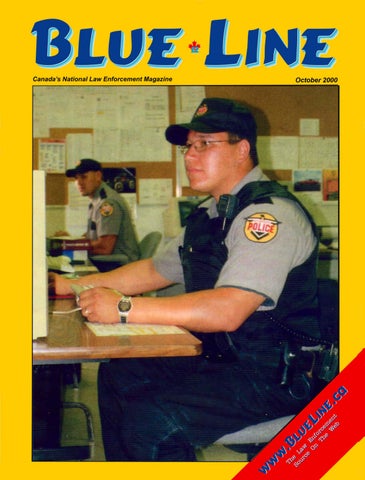
Six Nations Police Cst. Marwood White appears on the cover of the October issue. White and his fellow officers who serve with the Six Nations Police Service in Ontario, share a special bond with the community they are sworn to protect. Blue Line Magazine News Editor Les Linder provides readers with a detailed profile of how Canada’s first stand-alone First Nations Police Service has fared during its first 15 years. Replica firearms, the Firearms Act and law enforcement do not always go hand-in-hand as Blue Line Magazine’s Tactical Firearms Editor Dave Brown learned while preparing the piece which can be found on page 16. In this edition, we also bring you the story of two veteran Winnipeg Police officers who were the first recipients of the new Minister of Justice National Youth Justice Policing Award. Csts. Willie Ducharme and Rick Kosowan received their awards, in recognition of their community policing efforts, at the annual Canadian Association of Chief of Police Conference in August. News of policing and helicopters is in the air and Blue Line Magazine has endeavoured to supply you, our loyal readers, with up-to-date information that has been swirling around in Toronto, London and northern Ontario. John Muldoon continues his series on law and enforcement and the media. In this issue he has provided the low-down on scrums. If you have ever had to face microphones, cameras and spotlights, you’ll want to turn to page 27. Robert Lunney has put finger to keyboard and can once again be found in the pages of this magazine. After having returned from the United States recently, he provides us with some comparisons and contrasts between the “land of the free” and “our home and native land.” Of course, we have a lot more in store for you between the covers of the October issue. You will find the regular mix of timely news, exciting product information and thrilling features that you have come to expect. Enjoy. Blue Line Magazine
COMMENTARY On August 29th two officers received the Canadian Banks’ Law Enforcement Award at a banquet held in their honour at the annual gathering of the Canadian Association of Chiefs of Police. Detective Leonard P. McGowan, Toronto Police Service’s Fraud Unit, was instrumental in ending the activities of three organised criminal groups, preventing millions of dollars of potential losses to individual Canadians and the banking industry. His work and dedication targeted an organised crime group dealing with counterfeit credit cards. He also worked with foreign and domestic law enforcement agencies to round up criminals involved in cashing fraudulent cheques. In another case, Detective McGowan investigated a series of mail thefts targeting a number of financial institutions. In these three cases, 14 suspects were arrested, a number of charges were laid and large amounts of money were recovered. Corporal William James Trudeau, of the Victoria Police Department, placed himself at extreme risk to apprehend two lifelong criminals following a bank robbery in Victoria. During a high-speed chase, the bandits fired several shots at Corporal Trudeau’s motorcycle yet he managed to assist other officers in apprehending the robbers despite sustaining injuries when his motorcycle crashed. One of the suspects was sentenced to 18 years in prison while the other is awaiting his sentence hearing. On behalf of Det. McGowan and himself, Cpl. Trudeau made the following comments at the Award ceremonies. “I am pleased to accept this award not only for myself, but for all of the members of the City of Victoria Police Department who were involved in the arrest of both Stephen Reid and Allan McCallum on June 9th, 1999. The arrest of these two criminals was a result of team work involving police men and women on the street, as well as civilian employees working in the communications center. There were numerous police officers involved in any number of ways, from traffic control in the area, to the emergency response team searching an apartment building for, and arresting Stephen Reid. I would also like to take a moment to recognize some people directly involved in this, who sometimes seem to get lost in the shuffle and excitement. After I had concluded giving evidence against Stephen Reid in December of 1999, I was asked how I felt about the publicity Stephen Reid had been receiving since the June robbery. For those of you who don’t know, Mr. Reid had been portrayed by some in the local and national media as a kind of Robin Hood character. A person of note because of a book he had written, and because of the life he led since being released from prison so long ago for dozens of robberies he had committed. October 2000
Because of some of those stories and articles, Stephen Reid was a star, a media darling. He just made a mistake. After all, in those countless admitted robberies, all involving firearms from handguns to shotguns, he had never hurt anyone. I could not imagine how intelligent reporters and writers could think no one was hurt in those robberies. I took the opportunity to point out to the reporter on those court house steps that Stephen Reid was not a “bank robber.” You can’t rob a bank. A bank is a building. What he did do was walk into a bank, threaten and terrorized those bank employees with the use of a shotgun. He robbed people of their dignity and emotional well-being.
5
Those bank employees are someone’s father, brother, husband, mother, sister or wife. They had a gun pointed at their heads not knowing if they would ever see their loved ones again. How can anyone say this man, Stephen Reid, never hurt anyone? Ask his victims how they feel. Ask them if they were hurt. Apparently, the friends of Stephen Reid, who made him out to be some sort of unfortunate soul, never thought of that. They have never had to look down the business end of a shotgun. To all those employees of the Royal Bank of Canada at 304 Cook Street in Victoria, who had the unfortunate experience of being robbed at gun point by Mr. Reid, part of this award belongs to you too.”
Blue Line Magazine
I’d like to respond to the “Back of the Book” article by Robert Stevens in your August/September issue. The article was titled “Life sentences are only for Senators”. My point in writing to you is not to debate the issue of consecutive life sentences. Rather I would just like to correct some misinformation. In the last line of Mr. Steven’s article he makes a statement which is factually incorrect and which could lead readers to make the wrong assumption about how life sentences are administered in Canada. He states “Convicted killers in Canada average about seven years” meaning I believe that they only serve that long in prison. That is not correct. A life sentence in Canada means that the convicted person is accountable to the criminal justice system for the rest of his/her natural life. Parole eligibility is laid out in the Criminal Code and the Corrections and Conditional Release Act. Where life is the minimum sentence, i.e. for murder, parole eligibility is between 10 and 25 years. Therefore the earliest an offender could get out would be 10 years. Most “lifers” however are not released at their earliest eligibility. The decision to release any offender on parole is made after a thorough assessment of the risk that offender will present to the community. There is no such thing as an automatic release for an offender serving a life sentence. Any offender released on parole continues to serve the sentence in the community, is supervised by a parole officer and has to abide by several conditions, including reporting to the police. The parole can be revoked for a breach of a condition, without committing a new offence, and the offender is returned to prison. I hope that your readers will understand that not all life sentenced offenders are released on parole, and that those who are released certainly serve substantially more than seven years in custody, and then remain under supervision for the rest of their lives. Simonne Ferguson Regional Director National Parole Board Ontario Region Out of sight, out of mind? There is little more rewarding for a police service, I suspect, than almost eradicating a problem as serious as drug trafficking from its community (New Westminster police crackdown on drug dealers, June/ July, 2000). Having worked with members of this service, among hundreds of others throughout B.C. and Alberta, I can attest to the fervour with which I am certain this problem was tackled and applaud the service for its efforts. A question conspicuously absent in the article, however, is “Where did the problem go?”. As long as we rely almost entirely on the police to address these issues, we can expect approaches focused on additional officers, ‘rigid enforcement’ and police saturation. It also follows that we can expect little more than the displacement of yet another complex social issue to another jurisdiction. October 2000
When will we learn that shifting problems from community to community is resource intensive, expensive, and futile? When will we start to direct our resources and attention to more effective and comprehensive strategies and address the root causes? When will we realize the limited scope and resources of police are insufficient to adequately address these issues? This shift in thinking, epitomized in community policing rhetoric, needs to occur and this is yet another example of how overdue it is. Darren R. Caul Calgary, AB Having just read your editorial comments regarding external body armour (It’s time to talk, June/July 2000), I feel that you’ve hit the nail on the head. I work at a medium sized detachment and of the approximately 45 members, I know of only three that wear an internal carrier when wearing their vests. I’ve heard the excuse that internal carriers are far too hot and uncomfortable in summer ( I suppose our US counterparts in the south must be superhuman to withstand their heat with a vest under the shirt). And what about the winter? In my opinion, the external carrier also present a sloppy appearance in many cases. The gap between the bottom of the vest and the top of the trousers is quite a contrast especially in the RCMP where our shirts are grey and the carrier is navy blue. This is very apparent with members that are overweight. In an occupation that is under constant public scrutiny, a neat, professional image is very important. I have also seen occasions where a member has removed his or her vest in the office for comfort while catching up on paperwork and an urgent call has come in. The member in one case left their vest on the back of the chair in their rush to get out to the call. Having said this, it is undoubtedly preferable to have police officers wear an external vest than no vest at all. I will continue to utilize my internal carrier and encourage others to do the same. Name withheld by request I would like to make some additional remarks to your commentary in the June/July 2000 issue of Blue Line Magazine regarding the external vest carriers. Being one of the many front line officers issued the dark blue carriers, complete with plastic hooks and rings resembling more of a parachute harness than anything else, I tend to agree with your position on the matter of external body armour. I don’t believe in advertising the ace up my sleeve that could save my life, should some bad guy decide to save the taxpayers a few dollars in paying out my retirement pension. Therefore, I ensure that my armour stays under my uniform at all times. I do, however, disagree with some of your other points. In your commentary, you addressed the all-important public relations argument. You made comparisons to the military and Vietnam era soldiers with the new era cop and his intimi6
dating appearance. Nobody wants a bunch of commandos running around our streets scaring our children, right? You lapsed back to the good old days where, “At one time police agencies were more interested in giving their officers a more dressed and authoritative appearance”. Well, I too remember those days. I think that it is this type of thinking that keeps us from progressing at the speed of the criminal. Things have changed for a reason. Yes, it would be nice to still be dressed in shiny leather soled Oxfords, pressed dress pants, a cap that never falls off, and a perfect length tie with a gold tie clip. Unfortunately, the 10 per cent of the time I need good grip rubber soled boots, extra pockets to carry the myriad of additional tools that we carry in pants that won’t rip while I’m jumping fences or searching bushes, and no tie and hat to lose in the process, far outweighs the 90 per cent of the time my life doesn’t depend on it. John Rajman Fort McMurray, Alberta Publisher’s Response Thanks for the comments... and what you say is absolutely correct. I really meant that there is no motivation for the garment industry if the demand for a sharper looking uniform is not there. I want to encourage officers to go for the functional style but think about the appearance of what they are buying. The old tunic I wore back in the early 70’s was horrible to work in but looked good. We don’t want that. It was dictated from the top brass by price and looks and the cops weren’t even in the equation. Let me start by saying that I really enjoy your magazine. It is an accurate and informative publication that provides “chaffless wheat” for the reader. I just wanted to give you a quick pat on the back. Your recent repeat commentary on external soft body armour carriers was right on the mark (no pun intended). Here in Windsor, the internal carriers are used and I am convinced we made the right decision based on the rationale you provided in your article. Thanks for spreading your wisdom on the matter to everyone in the policing community. On a different note, I also wanted to tell you that I really enjoyed an article you did a while back about the need for new recruits to seek the advice of their local pastor in addition to being physically and mentally fit. It is my opinion that if a person is spiritually strong, the other things fall into place easier. Without such focus, an uphill battle is assured. Like many, I know this from experience. Here in Windsor, we are blessed by the strong chaplaincy program and services offered by our two participating clergy. They do a magnificent job. Barry Horrobin Windsor Police Service Publisher’s Response Thanks for the kind words and we will keep repeating the same messages until we are sure it is heard. Blue Line Magazine
Growth, knowledge and acceptance After 15 years the Six Nations Police Service continues its evolution by Les Linder Since they took over from the Ontario Provincial Police in 1985, the Six Nations Police Service has had to face a set of unique challenges in bringing safety to the community and trust in its police officers. Leading this agency is Police Chief Glenn Lickers, a native of the Six Nations community and formerly a seven-year member of the RCMP. When the community’s band council committee began spearheading a police initiative and looking for someone to lead the way, Lickers saw it as an opportunity to go home and serve his community. However, going back to the Six Nations community of approximately 21,000 people and creating a police service that would be accepted by the community was going to be a challenge. “There was only myself and one other officer who had any experience or history in policing when we started here,” Lickers said. “We had to start from scratch and train new recruits. This meant almost our entire service was comprised of young, inexperienced officers.” Despite the lack of experience among the officers, they had one thing going for them which the community embraced; all the members that joined the fledgling agency were from the community. Lickers felt people would be more accepting of officers drawn from their own community. “Every officer here has a vested interested in what they are doing because it’s their family and friends they are serving,” he said. “The big plus is that it is more than just a job because you are working toward making the community you live in a safer place.” Lickers said another benefit of such a system is that officers can see the results of their efforts as the years pass. “A lot of times in other urban settings, policing just becomes a job where you just go in to do the work that needs to be done,” he said. “In many places you don’t get to see the results of your success and see the impact you have.” Sgt. Rob Davis has had the opportunity to witness those changes. The 29-year old has been with the Six Nations Police for six years and said the changes over the past 20 years have been amazing. “I can remember seeing two OPP officers trying to cover the whole reserve when I was a kid,” Davis said. “There was a lack of respect for them because they were seen as outsiders. A lot of people wouldn’t even talk to them if they witnessed a crime.” Since the new agency was formed, Davis said many people have become more trusting of the police but there are small groups that still lack respect or trust. “There are a few people here who won’t October 2000
TAKING CARE OF BUSINESS: Sgt. Rob Davis (left) and Cst. Les Skye (far right) consult on matters with fellow officers outside of the Six Nations Police Headquarters. accept Canadian law as the law of the land and believe that the Criminal Code is a foreign law that has been imposed on them,” Davis concluded.
9
This mistrust has a legacy born from the hated Indian Act of earlier years that saw Draconian type regulations imposed on the mobilcontinued page 10
Blue Line Magazine
ity and freedoms of First Nations people. Davis said the reason people are more trusting now is because they know who the officers are and that they are not a nameless stranger in a uniform. “Everyone in the community knows each other well and we understand people’s situation or problems.” Problems can occasionally arise from this, though, when an officer is related to someone being investigated by police. However, the 20member police service is now large enough to assign a different officer to a call or investigation if a conflict of interest occurs. Chief Lickers advises that with such close ties to the community, police accountability is rarely a problem. If an alleged discrepancy involving an officer on duty should arise, the police service is usually notified promptly. Lickers believes that this accountability is what determines whether or not the Six Nations Police Service will continue to function. “We came into existence by the passing of the band council resolution,” Lickers said. “They could pass a motion to disband us if they wanted to. That’s a reality for us and I don’t believe there are many, if any, non-native police services that have to work under those conditions.” The policing agreements negotiated between the agency and the government is for either three or five years in length, depending on what the government decides. Lickers points out that it is difficult to attract quality people when he can only assure them they have a five year policing agreement. He is confident, however, the force will be around much longer. Lickers points out there is a positive side to this limitation. “If band council had to do something as drastic as disband us, they would only do so if there was a lot of pressure from the community to do that. The only time you would see that pressure is if we weren’t doing our jobs. Therefore the fact that we still exist at all is an endorsement of our efforts,” Lickers concludes. The Six Nations community has had its fair share of negative experiences with law enforcement in its history. Both the RCMP and OPP were mistrusted by the community and received little respect for their authority. Lickers wanted to make sure that when his police service took over, history would not repeat itself. To accomplish that, he set up a system to educate people about the police service and what to expect from them. It’s an ongoing responsibility that each officer has adopted.
A BIT OF HISTORY: Pictured here in a photograph which appeared in the October 1991 edition of Blue Line Magazine are (from left to right) Constables Terry Martin, Richard Johnson, Misti Anthony, Ronald Johnson, Chief Glenn Lickers, OPP Insp. Bill Hutton, Constables Martin Miller, David Whitlow and Rocki Smith. The Six Nations was the first stand-alone First Nations Police Service in Canada.
“A lot of young people are participating in “We could always use a few more officers,” co-op programs and enrolling in college police he said. “There’s been a great demand for anfoundations programs and law and security other community services officer. People want classes,” Lickers said. “They can now see First us to be involved in more programs with them Nations peoples involvement in policing has and I would like to be able to provide that.” snowballed and that policing is just another A future “wish list” for the force would be opportunity out there for them.” to start its own forensic identification unit so Cst. Les Skye, 27, saw an opthey will not have to depend on an portunity to serve his own commuoutside agency for that service. nity five years ago and dedicated “Once we reach our ideal complehimself to getting on the force. He ment, we will be able to focus enattended college to study law and tirely on providing our community security and served as an auxiliary with more specialized services,” officer for 10 months. Lickers said. “I tried out several times before Since the force was created, the being hired,” Skye said. “I was depeople of the Six Nations Police Servtermined to serve in my own comice have had a set of goals they munity.” wanted to achieve. Lickers points While almost all police officers out that it was a community venture in any service have a close sense of with many difficulties in the beginLickers comradery, Skye says it is even ning. However, in the end, what succloser among Six Nations officers. cess they’ve enjoyed was through their own “We understand each other really well and efforts and not handed to them in a fail-safe know exactly how the other person thinks,” he package. said. “We’ve been together so long that there is Skeptics told him he should have used a great communication between us.” transitional period when first starting the poWhile Lickers said he would like to get more lice service, but he knew the community would funding to expand his service a bit further, he never accept it. also feels he is close to his ideal complement. “We had to take the bull by the horns and ask the community to be patient with us.” The community was asked to afford them the opportunity to make mistakes. It was only through this community tolerance that a more solid foundation could be built. LET US HELP ! Lickers says for the most part the commuImprove service to your citizens and save money nity did give them the breathing room they Participating police agencies realize immediate benefits needed. “Every year that went by put experience Currently under contract with Toronto, London, Barrie, Thunder Bay and Ontario Provincial Police under our belt. We have always said we will Call Steve Sanderson for more information do what is right for the community. As long as we maintain that, then we’ll be around for 111 Toryork Drive, Weston, ON M9L 1X9 a long time.”
Is your police service facing budget constraints?
Tel: 877 895-9111 Fax: 416 745-5555 Web: accsupport.com
SUPPORT SERVICES LTD. October 2000
10
For further information contact Six Nations Police Service at (519) 445-4191 or Fax (519) 445-4894. Blue Line Magazine
Keeping the circle strong An aboriginal community gains control over prescription drug abuse by Nicholas Levesque Reprinted From: Pony Express When Cst. Stephen Gloade observed the violence and injury to residents in two Mi’kmaq communities near his Nova Scotia RCMP detachment because of widespread misuse of prescription drugs and the pills that were making their way into the schools and into the hands of young children, he knew drastic action was needed immediately. Gloade and aboriginal community health nurse Margie Pelletier both felt the problem did not need to be contained; it needed to be wiped out. Because of his efforts, Gloade was awarded the Nechi Medal of Distinction at a banquet hosted during National Drug Addictions Awareness Week in Edmonton this past November. The award honours individuals, agencies, and communities who have had a positive impact on addictions awareness and healing through their “tireless strength, initiative and devotion to keeping the circle strong.” Gloade worked with two Mi’kmaq First Nations to combat the substance abuse and violence that plagued their communities. As a result of the success of his initiative, similar programs have been established in other areas of Canada. Gloade has been stationed at Baddeck Detachment since April 1996. Baddeck (pop. 1,064) is one of the largest communities on the Bras d’Or Lakes watershed on Cape Breton Island. It is located about 350 km northeast of Halifax. The detachment polices Wagmatcook First Nation (pop. 558) and an area adjacent to the Waycobah First Nation reserve (pop. 623). By calling together the communities’ doctors, medical service advisors, pharmacists, addiction and drug counsellors, and police officers, Gloade got them to focus on the misuse of prescription drugs. The group met for the first time in February 1997 at the Victoria County Memorial Hospital in Baddeck. The strategy brought dramatic results. By June of 1997, after the first meeting on prescription drug misuse, the sale of prescription pills in Wagmatcook had declined 90 to 95 percent. What’s more, between April and December 1997, arrests by members of Baddeck Detachment dropped to 110 persons, down from 174 during the same period in 1996. Forty-three of those arrested in 1997 were Wagmatcook band members, down from 113 the previous year. In 1998, the total was 120 persons, only 42 of which were Wagmatcook band members arrested on the Wagmatcook community. Health Canada statistics show that, between 1996 and 1999, the top two prescription drug users in Wagmatcook obtained some 40,000 fewer pills, or an average of 18-and-a-half fewer prescriptions yearly each, assuming dosages of one pill per day. This means that some 40,000 pills did not reach the community. Gloade acknowledges the contribution of Health Canada, which also helped produce an educational video on the Baddeck experience. “If not for them taking a special interest in our group, it would never have reached the level it has today,” he says. “There is no secret forOctober 2000
mula or special magic to what we have helped accomplish. It’s all due to everyone sharing the same goal and keeping the protection of our children in mind.” Gloade’s strategy has captured the attention of the health community, addiction counsellors and enforcement officers elsewhere. The Indian Brook Detachment in Shubenacadie, about 55 km north of Halifax, called Gloade for information after hearing about his prescription drug misuse meeting. Indian Brook is attempting a meeting in their community following the same
structure as the one held in Baddeck. Gloade has also travelled to British Columbia and Quebec to give presentations on his program. Nechi Training, Research & Health Promotions Institute celebrated its 25th anniversary this year. Since its foundation, Nechi has earned an international reputation as a pioneer in the field of addictions recovery and a credible resource for research in Aboriginal population health. Cst. Stephen Gloade can be reached at 902 295-2350.
Constable killed in crash A veteran police officer died in late August as a result of injuries sustained after suspected thieves crashed into his cruiser with a van. Cst. Alain Forget of the St. Hubert police service, located on the south shore of Montreal, died a short time after the incident. The incident began when three armed suspects robbed a credit union. Witnesses notified authorities with a description of the
vehicle used in the crime and when the vehicle was seen by police a chase ensued. A roadblock was erected to stop the suspects, but they failed to comply and instead rammed the cruiser, said Luc Bousquet of the St. Hubert police. Two of the three suspects sustained minor injures in the crash. They were all taken into custody following the incident.
WORLD CLASS PROTECTION AND COMFORT A complete armour line (we pioneered them). The toughest protection standards (we meet them). Unlimited accessory and custom options (we offer them). As important as these features are, protective apparel in thc real world demands one other critical component... comfort. That’s why at ÆGIS our designers place a special emphasis on material selection and fabric weaves so that our products meet your most demanding standards of protection and durability and are comfortable to wear. Day in and day out. Real world comfort that makes ÆGIS a world class body armour supplier to national and international police and peace keeping forces.
ÆGIS Engineered Textile Products Inc. ____________________________ 251 Fifth Avenue Arnprior, Ontario K7S 3M3 Tel: 613-623-6001 Fax: 613-623-6169 www.aegisinc.on.ca 11
Blue Line Magazine
Award recognizes innovative approaches to youth justice In communities all across Canada police officers are coming up with new ways to deal with youth in trouble with the law. There is a growing appreciation of the value and effectiveness of early intervention to deal with or prevent youth crime and many individual officers are leading the way in the implementation of new approaches to youth justice. Anne McLellan, the federal minister of justice, wants these special efforts to be recognized. Her department teamed up with the Canadian Association of Chiefs of Police to establish a new award - the Minister of Justice National Youth Justice Policing Award - to recognize the outstanding and innovative achievements of police officers dealing with youth crime. The new award was presented for the first time on Aug. 27, at this year’s annual CACP conference in Saint John, N.B. The minister’s award was created to “recognize the efforts of police officers, singlely or as a team, who undertake their work in a manner that reflects, promotes and is consistent with the spirit and goals of the government’s Youth Justice Renewal Initiative, particularly the new Youth Criminal Justice Act.” The new Youth Criminal Justice Act, known as Bill C-3, was introduced to Parliament during the last sitting and will be on the agenda again when the House of Commons resumes this fall. It has the following overall objectives: • to prevent youth crime by addressing the circumstances underlying a young person’s offending behaviour; • to ensure meaningful consequences for offences committed by youth; and • to improve rehabilitation and reintegration for young persons returning to the community. The awards program highlights this approach to youth justice and recognizes outstanding examples of its use by police officers across Canada. Many officers are already working with community organizations to deal with young people outside the court process. They have discovered measures that repair harm
Pride in Service A ring of exceptional quality to show your “Pride in Service”
$
39
95* per month
*10 payments for the ladies 14K or the mens large 10K
800-535-9735 October 2000
Cst. Rick Kosowan caused to victims as well as re-integrate young people into the community. This community-based approach brings victims into the process and enhances a community’s sense of safety. It provides extra support for young people in trouble. It is less costly than expensive and lengthy formal court procedures and it involves a new way of policing. The Minister’s Award draws attention to this new approach to policing and provides an opportunity to highlight the outstanding achievements of individual police officers who are practising it in their own communities. The awards process started with a call for nominations in June of this year. Police services, other organizations, communities and individuals were invited to nominate police officers who had found innovative ways to deal with and/or prevent youth crime. Nominators were asked to describe their candidates by addressing key themes, such as creativity and innovation; the use of police discretion in finding ways to work with offensive behaviour outside the courts; how youth accountability was maintained and communitybased solutions encouraged; and how the nominated officers fostered a partnership approach to working with young people in trouble. The response was remarkable. Almost 50 entries were received from a variety of organizations working in the youth justice community. Most were from police departments, but many also came from community groups, schools, and Aboriginal organizations. Each one nominated one or more police officers who had made a special difference working with youth in their own community. In the end, two veterans in the Winnipeg Police Services, Csts. Willie Ducharme and Rick Kosowan, were selected for the Minister’s Award. These two officers went into Winnipeg’s tough north end as community policing officers in 1995. The area is well known for its problems - low incomes, many single parent families, alcohol and substance abuse, drugs, gangs and prostitution. The two officers set out to establish them12
Cst. Willie Ducharme selves as a friendly presence in the community and to build trust with youth along with their elders, school officials and other community leaders – especially in the Aboriginal community. One of their first acts was to hold a community dinner modelled on the Aboriginal tradition of an annual spring feast provided by a tribe’s peacekeeper/warriors. Since there was no police budget for an event like this, the two officers canvassed community merchants and gathered enough food and drink for the 600 people who attended. The feast was held at the Indian and Metis Friendship Centre in Winnipeg’s north end. It was a great success and got the two officers off on the right foot in this tough community. Slowly, but surely, their outreach efforts began to pay off. Increasingly, young people in trouble, their parents and their teachers sought the counsel of Constables Rick and Willie. On duty or not, they were glad to respond. They began to mediate problems and took the training needed to facilitate community justice forums. In the last two years they have made significant progress with the Community Justice Forum approach and have helped many young offenders and their victims arrive at just solutions to problem behaviour without resorting to the formal courtroom process. At the same time, they have spread the message of their new approach to other communities and have acted as role models for youth and for others who want to build better, safer communities. Ducharme and Kosowan have been involved in many other activities as well. The list includes: an Aboriginal employment programme; work with gang members and other youth at Winnipeg Native Alliance; travel to northern communities to prepare youth for the transition to urban life; a police summer student/recruitment programme; and Aboriginal teachings and ceremonies for recruits and members of the Winnipeg Police Service. Ducharme and Kosowan have been honoured by the Aboriginal Community for their efforts, Blue Line Magazine
having been given Aboriginal spirit names and with Honour Dances. Their names were put forward by the Indian and Metis Friendship Centre of North Winnipeg and their candidacy was strongly supported by other community leaders. Because of their outstanding work, Constables Willie Ducharme and Rick Kosowan were selected to receive the Minister’s Award, but a number of other police officers were also recognized for their innovative approach to youth justice too. Four officers received Certificates of Distinction; three others were accorded honourable mention and the selection committee singled out an officer in Northern Ontario as deserving of “special” mention. Certificates of Distinction Certificates of Distinction went to four officers. Cst. Ian Bourke of the Halifax Regional Police developed a Bullying Hotline to deal with the underlying issues that lead to youth violence and leads mediation sessions for a wide range of incidents from daycare bullying to violence with a weapon in school. Sgt. Mark Houldsworth of the Ottawa Carleton Police Service has done a tremendous amount of work in the areas of early intervention and pre-charge diversion. Among his achievements is the development of an innovative project to work with children under 12. Cst. Richard Schaaf works with a social worker to provide services to sexually exploited and high risk street youth through the High Risk Youth Car. With the assistance of a veterinarian, he has arranged for animal care for pets of street youth through the Street Youth Pet Veterinarian program. Cst. Andrew Tolchard of the RCMP detachment in Maple Ridge, B.C. created Drug Free Zones in local high schools and led research efforts into the causes of school violence. The latter has led to the development of learning materials now used in schools.
Police Service in the Wunnumin Lake region north of Sioux Lookout, Ontario. In the short time Constable George has been in the community she has created a positive new dimension to the relationship between local youth and the police through programmes she has started, often contributing her own funds to the programmes. These include a girls’ club that meets at her home and sports with local youth. She also works with the court system to develop community-based solutions to youth crime. The commitment and innovation shown by police officers working with youth in trouble in all parts of Canada is truly remarkable. In today’s society, the nature of policing is changing, especially with respect to youth justice. The Minister’s Award recognizes the important contribution police make to ensuring a balance between protecting society and ensuring that youth who do come into conflict with the law are treated appropriately. There are lessons to be learned from the examples and experience of the many excellent candidates nominated for this year’s award. They have set a high standard for future years. We can learn from the experiences of these projects and we can begin now to think about nominations for next year’s awards.
For more information on the Minister’s Award contact Lori Pope at (613) 954-3038.
Honourable Mention Honourable Mention went to Cst. Dan Williams of the Edmonton Police Service for his creation of the innovative “Reality Check” program he set up for youth and their families. This was originally focused on the Asian community but has since expanded to include youth from all ethnic backgrounds. Cst. Richard Morris of the Winnipeg Police Service also received an Honourable Mention for having successfully implemented community justice forums and initiated the popular Aboriginal Village project to foster understanding among youth and police in his community. The Québec City Public and Community Relations Division is another Honourable Mention, for its programme Support and Alternative to violence through Sport (SAS). Through this initiative, youth who have committed a violent crime are placed in a judo club where they learn respect, self-esteem, self-control, and responsibility through the discipline of judo. Special Mention The final award of the day was a “special mention” that went to Cst. Jacqueline (Jackie) George of the Nishnawabe-Aski October 2000
13
Blue Line Magazine
Is it a toy gun or the real deal? by Dave Brown It seems criminals are not yet ready to give up their guns. On New Year’s Eve, a distraught father held an emergency room doctor hostage in a Toronto hospital, demanding treatment for his son. Fearing for the doctor’s life, police were forced to fatally shoot the gunman. In April, a Mississauga woman was held up at gunpoint. In May, three Markham area teenagers were arrested after a crime spree that included pressing a gun to the head of a youth until the victim gave up his wallet and bank card. All of these incidents involved toy guns. Because of these and other similar events, Ontario legislators are now considering a private member’s bill banning the sale of replicas. The federal government has already declared replica firearms to be prohibited devices. So why are these things still on the street? Well, it’s not quite that simple. Not all replicas are banned, and not all imitation firearms are considered replicas. So what is currently prohibited? More important, can police target such potential weapons without interfering with legitimate ownership. From the officer’s perspective, anything that looks like a firearm must be treated as such until proven otherwise. Once a subject has been safely disarmed, however, the issue of legality can become quite cloudy. Fake firearms can look very real but may still be legal to possess. Some fakes have even been illegally modified to discharge live ammunition. Police agencies in Canada have encountered real firearms that have been modified to look like toys, with particularly deadly consequences for officers. What is a replica? The term “replica firearm” initially sounds like a contradiction in terms. Something is either a replica or a firearm; technically, it cannot be both. However, the term has a distinct legal definition. Under the Firearms Act, a “replica firearm” is a precision model made from wood, metal or moulded rubber that looks nearly identical to the firearm it represents, and cannot discharge projectiles, or discharges only harmless projectiles. Replica firearms became prohibited devices under the act on December 1, 1998. Not all “replicas” are considered replica firearms. Under the act, most toys are distinctive enough from real firearms in size or colour to be exempt. Replicas of antiques are also exempt. Even replica firearms may be possessed without restrictions if they were acquired before December 1998. An “imitation” firearm is different. Under Section 85 of the Firearms Act, an imitation holds the same status as a real firearm when used during the commission of an indictable offence. This definition could encompass replicas, toys or even a finger stuck in a jacket pocket accompanied by an implied threat that it is a firearm. To lay a Section 85 charge, the October 2000
A quick firearms quiz Take a look at the five photographs below. Which firearms are replicas? The answers are provided at the end of this article.
Figure 1
Figure 2
Figure 3
Figure 4
Figure 5 required elements are that the item was a firearm or an imitation of a firearm, and that the suspect used it while committing or trying to commit another indictable offence or while fleeing either. Toy guns that look real It is not illegal to simply possess a replica firearm unless it can be proven that it was acquired after December 1, 1998. But what about anything that even looks like a gun when used in a crime. Pellet guns, for example, can look very real, especially to the crime victim staring down the barrel of one. To illustrate the problem for officers, consider the photographs which accompany this 14
article. Which of the following, from Figures 1 to 5, depict a real firearm? The answers can be found at the end of this article. Real guns that look like toys Real looking toys used to commit crimes are not the only problem for police agencies. Detective Staff Sgt. Peter Shadgett of the Ontario Provincial Weapons Enforcement Unit reports encountering several examples of starter pistols converted to fire real .25 and .32 calibre cartridges. Experts at police forensics labs have been able to modify starter pistols to fire live ammunition in less than a day. Without the need for blueprints and scientific documentation, he esBlue Line Magazine
Figure 2 is a Glock timates that the same Model 17 9mm handgun. guns can be converted on “From the officer’s Although real, it utilizes the street in less than half perspective, anything more plastic in its conan hour. that looks like a struction than the imitaThese weapons are a firearm must be tion gun in Figure 1. potential deadly combitreated as such until Figure 3 is a plastic nation of visual intimidaproven otherwise.” model of a S&W semition and lethality, and automatic. Although an seem exclusively deexact model, close examisigned to trap unwary police officers. Shadgett even reports that some nation reveals a “plasticky” look to what should criminals have been caught with real firearms otherwise be metal parts. Figure 4 is a starter pistol designed to imipainted in bright fluorescent colours designed tate a Berretta handgun. The overly shiny finish to look like toy guns. and relatively poor quality of the metal can someWhat to do? times be indicators that it is a starter pistol. The first piece of advice is to be careful of Figure 5 is a S&W Model 686 .357 Maganything, toy or real. When considering possinum handgun. It too has what appears to be an ble seizures or Prohibition Orders, follow all overly shiny finish, but the quality of the metal legal guidelines. Be aware that mere possession and the fit of the parts are much better than any of a replica is not a crime. imitation handgun. On the other hand, police can be pro-active As you can see, trying to determine the about such public safety issues. Instead of waitstatus of a firearm in good light and using close ing for politicians to act, agencies could request examination can be difficult enough. Now picthat retailers remove offending items from their ture a dark street and a couple of very scared shelves, even if they may not fall into the legal humans during a sudden confrontation. category of replicas. Stores could take simple steps to ensure they are sold only to legitimate buyers. Dave Brown is Blue Line Magazine’s Tactical Firearms Training Editor. Although The answers to the photo quiz regularly consulted on firearms and trainFigure 1 is a starter pistol as typically used ing issues by the Canadian Firearms Cenin the film industry. It is actually heavier than tre, even he admits that the topic of replithe real Glock semi-automatic pistol that it imicas can be confusing. tates.
Expand your skill set. Be able to properly handle a high-profile escort assignment. Offer a qualification your peers can’t match.
Globe Risk’s Close Protection Specialist Courses Close Protection (CP) is far more than just standing behind your VIP and being vigilant. It requires long hours of planning, advance work, coordination, SOP’s, specialized equipment, training and organization. Getting it wrong can spell tragedy for your VIP and your career. Getting it right can mean a high-profile, high reward job well-done.
The Highest-Quality Instruction Our Instructors are primarily former members of the British Special Air Service (SAS). They have trained presidential bodyguard units around the world and personally protected VIP’s such as:
PM Margaret Thatcher The British Royal Family Pope John Paul II
WANT TO KNOW MORE? Call 416 564-4979
October 2000
15
Blue Line Magazine
Replica guns - An officer’s field guide Is it possessed for a legitimate reason? Even after December 1, 1998, replica firearms may be bought, sold, manufactured, imported or exported for certain legitimate reasons. Replicas may be possessed or lent to persons such as Canadian Firearms Safety Course instructors, or people in the motion picture, theatre, television, video or publishing industry.
by Dave Brown You have recovered a possible replica firearm. Now what? Here are some suggestions to determine the safety and legality of a replica. Is it safe to handle? Use the PROVE procedure to safety check the firearm. Even if you are certain it is a toy gun, never assume it is not loaded with live ammunition until you have performed a thorough check. Even blanks can cause serious injury at close range. Proceed as follows: • Point the firearm in a safe direction and keep it pointed in that direction until the safety check is complete. Keep your finger well clear of the trigger guard. Many starter pistols are cheaply made and have trigger pulls significantly lighter than real firearms. They may discharge simply by opening the action. • Remove all ammunition. Remove the magazine FIRST, then open the action to remove any chambered cartridges. • Observe that the chamber is empty. - Verify that there are no cartridges left in the grip or feed path of the firearm. • Examine the inside of the barrel for obstructions. While keeping the firearm pointed in a safe direction, use a flashlight to look down the barrel from the muzzle end. Has it been illegally converted to fire live ammunition? Semi-auto blank firing pistols must have some kind of restrictor plate threaded inside the barrel. Close inspection will usually reveal threads cut inside the first few inches of barrel and a plate with a small opening threaded in from the muzzle end. This restrictor plate is designed to channel gases from the blank backward in order to cycle the action for each shot. Without the momentum of a bullet exiting the front of the barrel, a blank firing gun relies on these gases to open the action and feed the next blank. If a blank-firing gun were ever loaded with a live cartridge, an instant explosion would result. Therefore, if a starter pistol has been illegally converted to fire live ammunition, this restrictor plate will be missing. A good clue that you may have seized an illegal conversion is that the inside of the barrel is threaded, but there is no restrictor plate. Possible charges: Possession of weapon for dangerous purpose, Section 88 C.C.C.; Carrying concealed weapon, Section 90 C.C.C.; Weapons trafficking, Section 99 C.C.C. Does it resemble a real firearm? Toys, starter pistols, model guns, air guns and pellet guns are not always easy to classify. To meet the definition of a prohibited device under the Firearms Act, a replica must be intended to resemble a real firearm with near precision. Secondly, a replica cannot discharge a projectile, or discharges only a harmless proOctober 2000
THE PLATE: Semi-auto blank firing pistols must have some kind of restrictor plate threaded inside the barrel. jectile. Firearms that discharge blanks and only incidentally resemble a real firearm are not likely to be considered replicas. Toy guns are not likely to be mistaken for the real thing by someone with a reasonable knowledge of firearms and are also not replicas. Some air guns which fire harmless projectiles have been classified as replicas under the Firearms Act. After an assessment by the RCMP Central Forensics Lab, the model guns commonly referred to as “air-soft” guns manufactured by the Tokyo Marui Company are considered replicas because: • they closely resemble real firearms in size, colour, appearance and configuration, and • the projectiles they fire are not likely to cause serious injury. In other words, they are intended to exactly resemble a real firearm and only incidentally discharge a harmless projectile. When was it acquired? Replica firearms (except replicas of antique firearms) became prohibited devices under the Firearms Act on December 1, 1998. Businesses and individuals could keep replicas they owned prior to December 1, 1998 and there is no licence required to possess them. Therefore, even if it meets the definition of a replica firearm under the act, it is not illegal to possess it as long as it was acquired prior to that date. Does it fire pellets or blanks? Many pellet guns closely resemble real firearms, but if the pellet it discharges may be used for activities such as target practice, it would not be considered a replica. Pellet guns that fire the typical .177 or .22 calibre pellets that would cause an injury such as an eye penetration are not considered replicas. Starter pistols that fire blanks are also not likely to be considered replicas under the Firearms Act. 16
Was it used or intended as a weapon in a crime? If the item in question was used to commit an indictable offence and if the item resembled a firearm, it does not have to meet the same legal standards as a replica firearm. If it appears real enough that someone is likely to believe it is a firearm, then it becomes an “imitation firearm.” When used to commit or attempt to commit an indictable offence, imitation firearms can be treated exactly like real firearms under Section 85 of the Firearms Act. If it is a pellet gun and was used to intentionally cause bodily harm to a person, it also becomes an indictable offence. Possible charges: Using firearm or imitation during another offence, Section 85 C.C.C.; Possession of weapon for dangerous purpose, Section 88 C.C.C.; Causing bodily harm with air gun, Section 244.1 C.C.C. For more detailed information on firearmsrelated charges, contact the Canadian Firearms Centre, Legislative Training Unit, and ask for a copy of their “Police Officer Field Guide.” This article can only provide a brief outline of the topic. For all legal references, consult the Firearms Act and related regulations. The issue of replica firearms is complex and evolving, and authority for any action must only be derived from provisions of the legislation and decisions of the courts. Contact the Canadian Firearms Centre for current information on the status of replica firearms. They publish several fact sheets on replicas on their website at www.cfc-ccaf.gc.ca. For further advice on replicas, or if you have information on an usual weapon that could benefit other agencies, please contact Detective Staff Sgt. Peter Shadget of the Ontario Provincial Weapons Enforcement Unit at (905) 612-7065.
Bill C-7 now in effect Police can now access the criminal records of pardoned sex offenders under a law that came into effect on Aug. 1. Bill C-7 improves the ability of police services to conduct thorough background checks of anyone who wants to work with children, including those who were pardoned of certain sex charges. Notices on the records of sex offenders listed with the Canadian Police Information Centre will let police know that a pardoned record exists so they can make a request for the solicitor general to unseal it. The new law was given unanimous support from all parties in the Commons when it passed its third reading. Blue Line Magazine
Upgrading OPP mobile communications by Pamela Sunstrum Reprint: OPP Review Telecommunications within the Ontario Provincial Police is being reshaped over the next four years. The OPP is amalgamating its radio communications operations into five strategically located centres and converting to a common network shared with other government agencies. The OPP is one of five, public safety agencies whose radio networks are being consolidated as part of the Government Mobile Communications Project (GMCP). The digital system is called FleetNet. Other agencies are the ministries of health, transportation, natural resources and correctional services. FleetNet takes advantage of advanced technologies which offer considerable benefits, including electronic mapping. Dispatchers will be able to enter an address and an area map will appear. Network implementation involves significant infrastructure and site renovation. According to Infrastructure Support Bureau Commander Chief Supt. Gary Witherell, the conversion to FleetNet also provides “an opportunity to realign OPP dispatch functions and balance workload across the province.” Over the next four years, the OPP will amal-
Government Mobile Communications Project GMCP is a partnership between the Ontario government and a private sector consortium led by Bell Mobility Radio Inc. Established in 1998, it is a 15-year, $300million project to consolidate and replace five provincial government, two-way radio, public safety radio networks. FleetNet The province-wide, VHF, digital, twoway trunked radio network for voice dispatch service is based on Motorola SmartZone™ technology. The design, functionality and features are oriented entirely for public safety and emergency services. FleetNet uses existing government and Bell Mobility radio sites and will provide continuous coverage over populated and travelled parts of the province. To connect the large number of sites, Bell Mobility will establish five operating zones (OPP ComCentres will connect to these zones), each with its own network controller to provide management of network traffic and network interfaces. When fully operational, the common infrastructure will provide new, sophisticated technologies, enabling more flexible, responsive and effective province-wide front-line emergency service and public safety in Ontario. October 2000
gamate 11 existing ComCentres into five. OPP Telecommunications Unit Manager Insp. Murray Laberge says, “By establishing five strategic locations, we can realize infrastructure savings and bring on new technologies to accelerate and improve service delivery.” Three sites have been identified - London, Orillia and North Bay. London will serve southwestern areas currently covered by Chatham, Mount Forest and London. Orillia now provides dispatch services for central Ontario. It will maintain its facility and amalgamate services for the Greater Toronto Region, now provided by Aurora. Both centres will begin operations in 2001. North Bay will continue to provide dispatch for northeastern Ontario, with the new radio network being phased in between 2002 and 2004. Amalgamation in eastern Ontario is planned for 2002 and in northwestern Ontario through 2004. Locations have yet to be finalized. Realignment will be seamless to the public and front-line service. Witherell notes, “The result will ensure full officer coverage and safety at all times, regardless of dispatch location. Current emergency telephone numbers will not change and there should be no noticeable difference in service.”
AR15 / M16 OPERATORS COURSE By ROTAC TRAINING AND ARMOURER SERVICES Certificate Course Operator’s course for LAW ENFORCEMENT OFFICERS ONLY that use the AR15 or M16 weapon system. The course exceeds Ontario Provincial Adequacy Standards for Tactical / Containment Teams. The course also includes instruction on techniques, utilizing the rifle in situations directly related to Tactical and Containment deployment. An in-depth operator’s manual is included with the course and upon completion each student will receive a certificate, course of fire outline, individual test marks and performance assessment for his or her training records. Course Requirements • An AR15 or M16 rifle of any configuration • 1500 rds .223 Rem. Ammunition • Duty Handgun, 200 rds • Duty Holster/belt • Eye/ear protection, Ball cap, and body armour • Appropriate weather clothing
Course length: Class Size: Tuition:
Course Content • History and Nomenclature • Range Safety • Fundamentals and Position shooting • Shooting on the move and CQB drills • Vehicle stops and unknown distance drills • Ballistics comparison lecture and demonstrations • Low light shoot and judgmental shooting • Cleaning and maintenance
Four Days Limited to 12 students $300.00 per student and must be pre-registered Instructor’s resume available on request.
Call to reserve space and more details:
Tetragon-Tasse Distributors Inc. Phone: 905 828-9803 Fax: 905 828-6390 Toll Free: 800 387-6542 Email: tetragon@idirect.com Web: www.tetragon.ca 17
Blue Line Magazine
Don’t ignore domestic violence by Connie Snow A neighbour calls to report a father and son fighting on their front lawn, or maybe a small child calls to say mommy and daddy are arguing and he’s afraid because furniture is being thrown around. Judging from the noise in the background, you quickly appreciate the sound of despair in the child’s voice. A patrol unit is dispatched and, with a sense of cautious urgency, the officers are en route to yet another domestic dispute. Often not knowing what to expect, they hurry to an unpredictable and often dangerous situation. Questions race through the officer’s minds. How many people are involved? Are there weapons on the premises? Has the aggression been heightened by alcohol or drugs? In the early 1990s, incidents of family violence were reported on an average of three times daily in St. John’s, Nfld., with the number of calls tripling between 1988 and 1992. What makes people act and react the way they do? Why are they generally “in control” at work or in a public place, but allow themselves to so easily lose that control at home? Have they been allowed to? Did someone say it was okay? For decades, society has tacitly condoned violence in the home, treating it as a private matter. A change in thinking is long overdue. That also includes police officers who are not exempt from the rest of society but rather, are an integral part of it. Law enforcement officials must familiarize themselves with the dynamics of family violence and the pro-active role that they should be playing. No longer can
ions about the kids precipiindividual cases be treated tate the argument. Alin isolation: the “big picthough the children haven’t ture” must be considered. actually caused the vioBetween 1990 and lence, they are quick to 1992, there were six rollblame themselves for it. call training sessions inUnfortunately, chilvolving almost 150 Royal dren are not always “inNewfoundland Constabudirect” victims. Over 50 lary patrol officers: two per cent of child abuse four-day seminars on child takes place in the home abuse and domestic vioand some of these vulnerlence; and an ongoing pubable “little people” are so lic awareness program with severely beaten they have the media’s assistance. The to be hospitalized. Often RNC has endeavoured to they cannot bring themsensitise its members to selves to say that one of this issue and lessen contheir parents was responcentration on the reactive sible. This type of dysrole traditionally taught functional environment during initial recruit trainoffers little nurturing and ing. This trend will consupport for children, and tinue. they begin to “act out” to Community groups get attention. have sometimes been quesUsually police officers tioned about their sincerity initially encounter these in dealing with domestic “disobedient” children in violence. Political motivatheir teen years. By this tion and the possibility that time, they likely have bethe problem is grossly excome or are well on their aggerated are sometimes way to becoming break used as arguments to raise and enter felons, substance doubt to any group’s comabusers and/or runaways. mitment in dealing with this In other words, they will social problem. grow up to become offendThis logic rarely takes into account the reality of STOP THE VIOLENCE: Law enforcement ers and/or victims. And the cases involving the violence officials must familiarize themselves with the cycle begins again. The biggest enemy in that front-line workers see dynamics of family violence and the pro-active dealing with this problem every day. The truth is that role that they should be playing. is denial. The victim denies, the severity of domestic For children who are surviving the offender denies, the child denies violence has heightened. More victims are seeking medical attention. in violent homes, these feelings are and society denies. No one really There are greater numbers of cases non-existent. Even though they may wants to talk about it because, in involving weapons and more peo- witness violent episodes daily, chil- doing so, you must acknowledge ple are barricading themselves in- dren are generally protective of their that there is a problem. But in the same way society parents. They have been told reside their homes. It sometimes seems ironic to peatedly not to discuss what goes became outraged about impaired driving, drug use and child abuse, use the word home. Usually this on “inside these four walls”. Things become even more con- the issue of violence in the home term denotes warmth, peace and fusing when differences of opin- must be brought to the fore. If you security.
Get the REAL TRUTH every time you interview If interviewing for deception is part of your job you must attend this two day seminar Investigative Interviewing - By Dana Rodden • Vancouver • Halifax • Toronto
October 23 - 24, 2000 November 9 -10, 2000 November 13 - 14, 2000
For further details and/or a brochure, please call: SECURITY MANAGEMENT SERVICES Brenda Anderson - 416 360-1902 or 1-800-208-2113
Email: info@secuman.com October 2000
18
Blue Line Magazine
think you’re not affected because it’s not happening in your house, think again. It could be your sister, your cousin, your nephew, your grandfather or your co-worker. The more people talk about domestic violence, the less helpless they feel: “Maybe someone will believe me after all.” Community groups, including the police, must give people this opportunity. Employers can make the workplace a safe place to talk. Employee access programs, counselling and support groups are springing up all over, particularly in large corporations. For some victims, the workplace is a refuge. If employers support the notion that this problem is a private matter, they ignore the fact that some of their employees are working under a great deal of stress. The result is a frequent absenteeism, limited attention spans because of preoccupation with domestic problems, and sometimes even threatening phone calls while on the job. Affected workers also worry daily about co-workers adversely judging them and, of course, the ever-present fear they will lose their jobs if the truth comes out. Employers, like everyone, should attempt to understand the problem. They should provide public information on the subject, offer referrals to professional agencies and continuously practice prevention. In 1981, London, Ont., became the first Canadian city to implement an aggressive charge policy. In July 1991, the results of their 10 year study were released. Encouraging victims to report and following up on complaints resulted in some very worthwhile findings, not the least of which is that the incidence of repeated violence was “significantly reduced” a year after charges were laid. Some studies claim that in as high as 70 per cent of the cases where charges were laid, violence was reduced. So what’s the message? Society is forcing the offenders to assume responsibility for their actions - and isn’t that the way it should be? Police departments are not the only agencies who could and should take a pro-active role - the whole community must become involved. Society, including the police, has a role in educating the public about family violence, helping victims talk about the problem and widening the circle of support. If the police are accused of trying to make the job easier by promoting public awareness around this issue, then so be it - the police are guilty. This “self-serving” interest stems from the desire to make the community a safer place for everyone - including police officers’ own families. So the next time you hear an eight-year-old boy say in desperation “help me”, be ready to answer the call - the entire call. Insp. Connie Snow has been a police officer since 1975. She left the RCMP and joined the Royal Newfoundland Constabulary in 1980, where she has served in the criminal investigation division and acts as the police service’s co-ordinator on domestic violence. October 2000
Child prostitution law struck down An Alberta judge has found a provincial law which allowed authorities to temporarily detain suspected child prostitutes in safe houses to be unconstitutional. In her July ruling, provincial court Judge Karen Jordan said the law lacked procedural safeguards to protect the rights of the individuals who were detained. The legislation violated the Charter because it failed to give detainees the right to answer to allegations or the right to judicial appeal, Jordan ruled. She also found the law to be unconstitutional because authorities did not need a search warrant to enter a building if they had reasonable grounds to believe child prostitution was taking place inside. However, the judge said she did not feel the legislation infringed on a person’s right to legal counsel. The law was challenged by lawyers for two teenage Calgary girls on the grounds it violated Charter rights to be free from arbitrary detention and unreasonable search and seizure. The lawyers also claimed it exceeded the province’s jurisdiction.
The Protection of Children Involved in Prostitution Act, proclaimed in February 1999, classified children involved in the sex trade as victims of sexual abuse. Suspected child prostitutes could be taken into safe houses for up to three days, without a child apprehension order from the court. Children also did not have automatic access to a lawyer. Jordan said the existing Child Welfare Act can sufficiently deal with child prostitution and sexual abuse. Bina Border, lawyer for one of the girls, said the child prostitution act victimized the suspected prostitutes by placing them in what amounted to a jail for three days only to put them back on the street to face pimps who may beat them or force them to turn more tricks to make up for money lost during their time in detention. Some critics also suggested that the law simply drove the child sex trade underground. Since the legislation was proclaimed 390 detentions were made involving 181 girls and two boys. Of those, seven 12-year-olds were taken off the street. Most children were between 15 and 16 years of age.
Westervelt College Excellence in Education Since 1885
Now Call nrol To E
Police Foundations Training delivered in an intense one-year “Police Academy” environment Advanced status available to those with: • 1 or 2 years Law and Security • 1 or more years University • Career related experience Westervelt College 1060 Wellington Road London Ontario N6E 3W5 1-877-668-2001 (519) 668-2000
Teaching tomorrow’s professionals, today!
Toll Free
19
Blue Line Magazine
Toronto helicopter pilot project lifts off The sometimes turbulent Toronto police helicopter pilot project officially got off the ground in August. As a result, the police service will have two choppers patrolling the skies over the city for at least the next six months. “This is indeed a special occasion and one that the Toronto Police Service has looked forward to for a long time,” said Chief Julian Fantino. “This is truly the realization of a very important public and officer safety enhancement whose time is long overdue.” In fact, incorporating an air support unit into the police service’s delivery model has been 11 years in the making. It appeared as though plans to implement a helicopter unit were imminent last year, but Toronto City Council eventually quashed the initiative. However, after much diligence on the part of a number of interested parties, the project was resurrected and eventually approved. “This will be an interesting venture,” said Toronto Police Services Board member Sandy Adelson. “Certainly, our board and the police service are dedicated to continually enhancing both safety and service and hopefully this project will help us to do that. “I am definitely interested in seeing the results, both from a policing perspective and from a community perspective.”
Four police constables and one sergeant will staff the new air support unit, which will operate seven hours a day, six days a week during peak times, usually after 7 p.m. The six-month pilot project will cost just more than $1 million. Toronto Mayor Mel Lastman noted that the helicopter project will not cost taxpayers a single cent. The majority of the cost has been covered through private donations, while the remainder - a total of READY TO GO: Toronto Police Chief Julian Fantino and Mayor $250,000 - will be Mel Lastman show their enthusiasm for the new helicopter. paid for through a provincial government grant. he hopes to have even more choppers in the air The mayor added that if the program should during the next three years. prove successful, the city auditor estimates that The Bell 206B helicopters are each a permanent helicopter unit would account for equipped with a searchlight, P.A. system and only one per cent of the overall police budget. surveillance camera technology which includes Lastman also said that if the need were proven thermal imaging.
Chopper takes to the skies to locate marijuana An annual drug eradication program, co-ordinated by the Ontario Provincial Police, officially got off the ground at the beginning of August, with criminals covering the tab for the threemonth project. In previous years, the OPP’s two permanent helicopters were used, time permitting, for drug eradication. This year, the OPP drug eradication program received a grant of $313,000 for the full-time use of a leased helicopter dedicated to aerial surveillance of marijuana growing sites around the province. The funding, provided through the Criminal Intelligence Service of Ontario, supports crime prevention initiatives with the assets of criminal organizations seized as a result of police investigations. OPP Drug Enforcement Section Manager Det. lnsp. Jim Hutchinson said aerial surveillance is a valuable tool in monitoring and locating the least visible growing locations and obscure plots often adjacent to marshes and rivers. “The full-time availability of a leased helicopter for a more intense campaign of surveillance is a great asset to this year’s program, especially as growers seek better ways to camouflage their illegal growing sites,” Hutchinson said. October 2000
OPP helicopter pilots and police officers, experienced in the detection of marijuana, will be responsible for the aerial surveillance. On the ground, officers will access identified sites, confiscate the plants and launch criminal and proceeds of crime investigations. This year’s drug eradication program, being carried out in co-operation with the RCMP, municipal police services, OPP regions and Crime Stoppers, builds on two consecutive years of record seizures of marijuana plants. In 1999, more than 110,000 plants were seized with an estimated street value of $120.7 million. “Another important asset in our drug eradication program is the public,” said Hutchinson. “We encourage anyone with information about possible growing locations or suspicious activity around fields and wooded areas to contact their local police or Crime Stoppers.” The overall goal of the eradication program is to target large sophisticated growing operations and enterprise traffickers, making significant outdoor cultivation of marijuana as unattractive as possible. According to Hutchinson, the extensive aerial surveillance and ground investigations are intended to increase seizures of marijuana plants across the province. In addition, officers will lay charges where appropriate, confiscate cultivation and harvesting equipment and pursue proceeds of crime linkages to enable asset seizures related to criminal activity. 20
The leasing of a helicopter dedicated to drug eradication allows the OPP’s two helicopters to continue to focus on search and rescue services throughout Ontario.
Researcher crunches chopper numbers An Ontario researcher will soon know if the city of London’s police helicopter trial was a success. In August, Paul Whitehead, a professor at the University of Western Ontario who specializes in criminology, said he has gone over the numbers and was close to finding an answer. However, he will not reveal his conclusions until they are published later this year. The police chopper’s year-long trial ended in June. It was part of a $446,000 study financed by both the provincial and federal governments, along with private companies. As part of his research, Whitehead examined nine types of crime including stolen cars, theft from vehicles, and break and enters.
Blue Line Magazine
Mounties may charge tuition Hopeful Mounties may have to pay tuition to be trained, a national news agency reported in July. The RCMP wants to increase the number of cadets being trained at the academy in Regina from an average of 500 per year to a maximum of 1,200 per year due to the force’s high attrition rate. “When we have an increase in the number of cadets that we put through the academy, that also increases additional pressures, including financial,” The Canadian Press quoted RCMP Sgt. Paul Marsh as saying. “And a tuition fee is just one of several options being carefully considered by our senior executive.” In recent years, decreases in funding have led the force to limit overtime, postpone equipment purchases and lay off support staff. The Regina academy was temporarily closed almost
three years ago as a cost-saving measure and as of last fall the force announced it would no longer be giving cadets a $498 training allowance every two weeks. Marsh said it’s too soon to place an amount on a possible tuition fee. “You won’t see any changes implemented, if any are implemented at all, to the current recruiting or training process prior to April 1, 2001,” Marsh was quoted as saying. The force wants to train 1,200 cadets a year for at least three years to cope with the expected shortfall from retiring members and gaps left from the suspension in training. An estimated 150 jobs become available each year when members retire. There are currently almost 20,000 people employed by the Mounties, including civilian personnel.
Two officers die in plane crash Two RCMP officers died in an August plane crash at Teslin Lake, B.C. Sgt. Ed Mobley and Special Cst. Tim Nicholson were both killed when the Cessna Caravan they were flying crashed into the lake, Staff Sgt, Hugh Stewart said. Mobley was a pilot at the Prince Rupert detachment and Nicholson, a flight engineer from Ottawa, was filling in for a colleague who was
October 2000
on vacation. The plane had made two trips on the evening of the crash to drop off emergency response team members from across B.C. for training. The cause of the crash was not immediately known. Teslin Lake is located in northwestern B.C. near the Yukon border.
21
Omnes ad Unum (All Together as One)
10 kt. Gold Blue Line Ring The thin blue line of fired enamel engraved around the entire ring is symbolic of the law enforcement family. Each ring is engraved with the phrase “Omnes ad Unum” and your badge number as well as a registration number for authenticity.
Wear Your Ring With Pride Contact: Gary Clue (ret. Det./Sgt. Hamilton Wentworth Police)
877 470-1420 Web: www.911unity.com
Blue Line Magazine
Seek and you shall find
by Tom Rataj
Successfully searching the Internet for the information you need, can be a real challenge. But using the right tools and a few tricks can improve your level of success.
Specialised Sites In addition to general purpose search sites, there are also numerous specialised search sites, many of which highlight the investigative potential of the Internet. Some of the more useful sites include Canada Post’s postal-code lookup site (www.canadapost.ca/CPC2/ menu_01.html) and Bell Canada’s directory assistance site (www.canada411.sympatico.ca), which helps you find business and residential phone numbers across Canada. Another specialised site that Search Engines And has investigative potential is Directories www.infospace.com. It provides Some industry estimates put a whole range of tools for finding the number of search sites on the people, reverse-listing checks on Internet at over 8,000. They conphone numbers and various inforsist of search engines, directories mation cross-reference features. and metasearchers. There are also InfoSpace even includes several numerous stand-alone search tools (like EasySeeker, Copernic, FIND IT HERE: Blue Line’s website provides links to many search interesting and time saving tools, GuruNet, and X-Portal) that run engines for those who want to locate information on the Ineternet. such as the ability to view neighbour and map information for resiweb searches from your computer dential listings. PeopleSearch is aninstead of using the search tools at factor is the way you enter your information in other similar specialised search site that helps a particular site. locate addresses and phone numbers: Using the right type of tool for the job is the search form. Most search sites include a number of dif- w w w. p e o p l e s e a r c h . n e t / p e o p l e s e a r c h / important. A search engine is an automated program that searches for the information you want ferent search types, which range from simple peoplesearch_deluxe.html. by looking for websites that contain the word one-word searches to complex multi-word Conclusion or words you are looking for. A directory on the “Boolean” searches. Using more than one keyWith the wealth of information available on word in your search will generally increase your other hand, is a listing of websites compiled by the Internet today, estimated to be growing at editors who search for information and then chances of finding what you want. How you one million new pages each day, finding what enter and connect multiple keywords in the organize it by subject. Metasearchers are simyou need constantly becomes more difficult. ply search engines that look for your informa- search field varies from site to site so it is best By using the right tools and the right struction by simultaneously using numerous search to check the individual site’s instructions. ture to do your searching you will increase the Boolean searching is supported by most engines and directories at the same time. likelihood of finding what you need in short Some search sites like Alta-Vista major sites and allows you to initiate very spe- order. If one search site fails to return any ap(www.altavista.com) are a combination of search cific searches. When I did a simple search on parently relevant information even after subengine and directory, and are able to provide the “Rodrigo” (the famous Spanish composer) I mitting a very specific search, another site might was deluged by mountains of pages, many of best of both worlds. return a wealth of information on your first In the past several years, many of the search which had nothing to do with the composer. attempt. When I searched for “Rodrigo Composer” the sites have changed themselves from being pure search sites to being one-stop-shopping Inter- results improved somewhat, but still contained net sites known as “portals”. They provide a many sites about other people named Rodrigo. Some helpful search sites When I entered a Boolean search on little bit of everything in the hopes of becoming “Rodrigo AND Composer” the search results While this is by no means an exhaustive your default page. All of this is of course driven listing of search sites, it will hopefully help by advertising revenues that are generated by contained very few irrelevant hits and provided me with a wealth of information about the comyou find what you are looking for with a little the number of visitors to the given site. poser and his music. less frustration. The latest addition to the Internet search The typical structure of a Boolean search Some of the more popular general-pursites are “expert sites” such as www.abuzz.com pose search sites include: which allow searchers to pose questions about includes an “AND”, an “OR” and an “AND www.google.com – a search engine/directory. any given subject. On-staff experts or other visi- NOT” switch. Some sites use plus and minus www.altavista.com – a portal with search entors to the site then reply to your query. The signs to achieve the same purposes. Many sites have advanced search screens that allow you to reply can arrive in minutes or within several gine. just enter your key words in the search field days, dependant on various factors. www.excite.com – a portal with search enand then select the Boolean search switches gine, www.yahoo.com – a portal with search Structure from an on-screen list instead of having to learn engine/directory. The degree of success you have when the correct syntax. Since each site varies somewww.dogpile.com – a metacrawler. searching any given site depends on many dif- what, the best practice is to read the help tips www.metacrawler.com – a metacrawler. ferent factors, many of which are simply be- at each site. Many sites also provide sorting www.profusion.com – a metacrawler. yond your control. The single most important options and rankings for hits.
With an estimated one billion web pages (and counting), the Internet has become the wild west of the information age. Trying to find the information you need, can be a time consuming and frustrating chore, that often seems to go in circles or just end up at numerous dead links or completely irrelevant sites. Virtually anything you want to know about is out there, but finding it requires a number of different search strategies, tools and a few tricks.
October 2000
22
Blue Line Magazine
Henson College - Dalhousie University Certificate in Police Leadership Graduates Fall 1999 - Spring 2000
Graduates from Fall 1999- Spring 2000 (this list is not exclusive. Some students could not be contacted and for reasons of privacy and security some did not wish to have their names included). Level 1 A/Det. Dave Beech Hamilton-Wentworth Regional Police, ON Cst. John Christopher Bewsher RCMP, Hopedale, NF Cst. Heidi Burkholder RCMP, Cole Harbour, NS Lt. Michael Chartrand Montreal Urban Community Police Service, PQ Cst. Linda Conley Barrie Police Service, ON Cst. Mark Fentiman Medicine Hat Police Service, AB Cst. Elizabeth Ford-Loo RCMP, Iqaluit, NT Cst. Luana Giroux RCMP, Bonnyville, AB Sgt. Glenn Hanna RCMP, Toronto, ON Cst. Donovan T. Howell Peel Regional Police, ON Cst. Mona Kauffeld RCMP, Kelowna, BC Sr. Cst. Doug W.J. Marshall OPP, Moosonee, ON Cst. Gaston Potvin RCMP, Flin Flon, MB Det. D. Robert Ryan Peel Regional Police, ON Cst. Kevin Schur RCMP, Kimberley, BC
Administration Sgt. K. Craig Duffin RCMP, Vancouver, BC Cst. Don Jorgensen Peel Regional Police Service, ON Cst. L. Gerry Kerr RCMP, Athabasca, AB Cpl. Bradley Kleinsasser RCMP, Portage la Prairie, MB Staff Sgt. Paul Laventure Calgary Police Service, AB Cst. Jeff Mitchell Peel Regional Police Service, ON Sgt. Anthony A. Ross RCMP, St. John’s, NF
Law and Justice Cpl. David B. Burrows RCMP, Winnipeg, MB Det. Kathy Holt Hamilton-Wentworth Regional Police, ON Jane Mulkewich Hamilton-Wentworth Regional Police, ON Cst. Barry Raymond Pitcher RCMP, West Prince, PE Cst. Craig Sharpe Kingston Police, ON Sgt. G. Derek Smith Lunenburg-Mahone Bay Police Service, NS
Service Delivery Capt. Robert C. Edwards DND, Halifax, NS Cst. James Hogan Toronto Police Service, ON Cpl. Bradley Kleinsasser RCMP, Portage la Prairie, MB Cst. Douglas Noel RCMP, Trinity-Conception District, NF Staff Sgt. Tim Petro Medicine Hat Police Service, AB Cst. Ben Prystay RCMP, Estevan, SK Cst. B. G. (Blaine) Rahier RCMP, Banff, AB Cst. Don Scott Waterloo Regional Police Service, ON
Supervisory Skills Cpl. Cameron G. Moore Moose Jaw Police Service, SK
Advanced Police Leadership Insp. James J. Begley RCMP, Vancouver, BC Chief Rod Freeman Orangeville Police Service, ON
Cpl. Cameron G. Moore Moose Jaw Police Service, SK
Dalhousie University Certificate in Police Leadership
Level 2 Det. Cst. E.M. (Ted) Clark OPP, Casino Niagara Enforcement Unit, ON Cpl. Warren S. Gherasim RCMP, Deline, NT Cst. Michael Murphy Ottawa-Carleton Regional Police , ON Sgt. Larry Nobbs Durham Regional Police Service, ON Sgt. Robert Percy Halton Regional Police Service, ON Det. Jamie Porter Mississauga, ON Cst. Chris Wills Hamilton-Wentworth Regional Police, ON
Level 3 Cpl. Richard E. Draper DND, Beijing, PRC Sgt. Bob Fontaine West Vancouver Police Dept., BC Det. Cst. Tim Gore York Regional Police, ON Sgt. Ken Poley Calgary Police Service, AB Sgt. Bradley A. Spriggs Ottawa-Carleton Regional Police, ON Cpl M.F. Lise Thompson RCMP, Ottawa, ON Cpl. Bruce Weir Kentville Police Service, NS
October 2000
“The quality of courses offered in the Certificate in Police Leadership Program is outstanding. Policing and the Law of Human Rights is a ‘must have’ course for the operational police officer.” Cpl. Catherine McCrory, Commercial Crime Section, RCMP, Milton, ON. Courses in this unique distance education program include: > Police Leadership and Management Development > Communication Skills for Police Personnel > Police Human Resource Management > Policing and the Law of Human Rights
> Problem-Oriented Policing > Community-Based Policing > Legal Issues in Policing > Advanced Police Leadership
> Budgeting and Financial Management for Police > Managing Police Performance: Coaching Skills * (includes a 3-day workshop)
- Phone 902-494-6930 - Fax 902-494-2598 - E-mail CPL@Dal.Ca
To obtain a brochure or Registration Form, call our Information By Fax line at 1-800-932-0338 or locally at 481-2408 and request Document #0211. You can also access our website at the address below. For more information, contact Sherry Carmont-MacBean, Program Manager at (902) 494-6930 or write to Sherry at the address below or via e-mail at CPL@Dal.Ca.
Henson College, Dalhousie University 6100 University Avenue Halifax NS B3H 3J5 www.dal.ca/~henson/police/indexcpl.html
23
Learning Solutions for a Changing World Blue Line Magazine
Is your dive team up to standard? by Geoff Greenwell Since the late 1970s police dive teams have been operating in most parts of Canada. Their duties include search and recovery of forensic evidence, body recovery and occasionally rescue. Police dive teams are now a common sight on TV and in newspapers and magazines. The perception of the general public is that these divers must be highly trained due the hazardous types of dives they are often called upon to perform. Is this the reality however? In 1998, an Ontario officer was killed attempting to save the life of a child who was trapped in an overflow channel. Questions were asked about the risk versus reward of exposing the diver to such a hazardous environment when the child had probably already expired. In the mid 1980s the RCMP developed their own in-house induction course to respond to the mandate of providing dive teams in remote parts of Canada. This process seemed to be satisfactory until the death of Cst. Frank Carriere during a hull search in Cape Breton, N.S., in 1997, which raised some serious doubts about the training course. What training do the various police units in Canada have and is it suitable for the hazardous nature of the work being performed? With the introduction of CSA Z275.4-97 “Competency Code for Diving Operations” by the Canadian Standards Association in 1997, a new code of practice was effectively offered to the occupational diving community. Compliance with the code is voluntary unless it is adopted into provincial legislation at the request of the provincial WCB or Department of Labour. The intent of CSA Z275.4-97 is to offer a
October 2000
INTO THE DEEP: A diver makes his way through the water. set of minimum standards that any individual performing work underwater is required to be trained to and conversant with. The challenge facing police divers in Canada is to now meet this standard through appropriate training. Training The vast majority of police dive units are using Self Contained Underwater Breathing Apparatus or SCUBA as it is more commonly known. The training outlined in CSA Z275.497 for occupational scuba divers requires academic study in the areas of physics, physiology, equipment, commercial dive tables, First Aid/CPR, oxygen therapy, dive accident man-
24
agement and hazards and regulations. In addition, divers are required to log either 900 minutes of underwater time to become certified to operate up to 20 metres in depth or 1,200 minutes if they wish to work up to the maximum depth of 40 metres. A panel of industry experts, representing all areas of the occupational diving community, including police and fire department divers, developed this training standard. It was felt during the two-year development period that upon completion, all provinces and territories should adopt the standard and insist that any divers operating within their jurisdiction meet the standard via a mix of training and experience. In January 1997, CSA Z275.4-97 ‘Competency Standard for Diving Operations’ was released as a finished product and circulated to the industry. British Columbia, Yukon Territory, Northwest Territories and Nunavut were the first jurisdictions to adopt the standard. Other provinces have struggled to have the standard adopted by their various parliaments. The Labour Boards’ of Nova Scotia, Newfoundland, New Brunswick, Alberta and Saskatchewan have all expressed the desire to adopt the standard but have experienced resistance from industry. Without a singular national standard, working divers are beginning to experience the difficulties of not being able to cross provincial boundaries if their work requires them to. For example, any diver wishing to work in B.C. must prove that they hold current certification as outlined in CSA Z275.4-97. This has eliminated the opportunity for Albertan divers to work in B.C. as Alberta has not enforced the standard and consequently no training schools exist in Alberta. The only training agency in Canada that has created courses specifically to meet all levels of the CSA standard from Occupational Scuba to Unrestricted Surface Supplied Supervisor is the Commercial Diving Group (CDG). From its head office in North Vancouver, CDG organizes training for individuals at a number of training centres across the country and conducts courses on location for groups needing WCB/CSA Scuba or Surface Supplied training. “When the Canadian Standards Association introduced Z275.4-97, we knew it was important to develop curriculum to meet the requirements of the standard,” said Michael Curlook. the vice president of CDG. “It has been very difficult for divers living in the areas of Canada that have not adopted the standard to access training. “We have conducted courses for groups in Saskatchewan, New Brunswick, Nova Scotia, Nunavut, Northwest Territories and British Columbia. Individuals have also travelled to our head office for training from every other part of Canada. We welcome inquiries from any group of public safety divers who are interested in our new SARTECH Diver courses. They are the only courses in the country that meet the Blue Line Magazine
CSA standard and are tailored to suit the needs of police and fire dive units.” If training and funding is available, then we assume that police teams would be readily participating in upgrading their skills and knowledge to make their diving safer and more effective. However, it seems this is not the case. The Saanich police dive team based in Victoria, B.C., was established in 1979 and is one of the few groups that have participated in WCB/CSA recognized training since the introduction of Z275.4-97. “You want a capable and competent diver who doesn’t take unnecessary risks, lots of times you’re recovering a human body, so you need someone who’s got both the mental and emotional stamina to deal with that aspect,” Insp. Sherry Dwyer, who is in charge of the Saanich dive team, said in a recent issue of WCB’s Worksafe magazine. “It’s a lot different to recreational diving, we don’t dive in ideal conditions when we’re doing rescue or recovery.” Most police teams in Canada are still relying on recreational training despite repeated announcements from the major recreational agencies that their courses are not to be used as a basis for occupational diving, and that they accept no liability for the consequences of using their training in place of WCB/CSA recognized programs. A few more pro-active departments have sought out the training programs offered by U.S. based specialized training agencies that offer short public safety diver courses. Unfortunately, these programs do not meet the requirements of Z275.4-97 and are not sufficient to satisfy the WCB’s and Labour Boards across the country. So why are the police teams in Canada not upgrading their training and improving their operational standards? “There are a number of reasons for the slow progress of police teams adopting Z275.4-97,” Curlook said. “Budgetary restraint is a common issue, a lack of awareness of the standard and the training solutions, and often fear that the course will be too difficult and teams will fail and be disbanded.” “Police chiefs have to recognize that their personnel are in danger without adequate training. The underwater environment is unforgiving of mistakes and can be extremely challenging for even the most experienced divers,” commented Bart Bjorkman, a veteran CDG instruc-
current litigation between the RCMP, Labour Canada and the Carriere family.
THE RESCUE: Divers head to the scene. tor at a recent Sartech course in Yellowknife, NWT. “It would be inconceivable to put an officer on the street without proper firearms training, yet commonly we see police divers in hazardous environments with little awareness of the danger to themselves. They simply feel it is part of their duty,” added Curlook. The delegation of training within police departments to specific individuals is a contributing factor to the lack of adequate training. The person in charge of staff development and planning is often not familiar with diving and relies on the advice of team members who are not considering the liability of their actions. The financial and emotional ramifications of having an accident or incident during an operational dive are being clearly exhibited in the
Conclusion It seems that diver training is low on the priority list of most police departments across the country. Indeed the fire community is embracing training much more openly. It is unfortunate that changes in legislation and the implementation of training are often the results of serious accidents or fatalities. The underwater environment is unpredictable and police teams are often required to work in areas of very poor visibility or high current; the recovery of evidence, sunken vehicles and bodies requires very specific training. Cst. Shelly Smith from the Saanich police dive unit summed up the need for suitable training in her comments in a recent magazine article: “You have to be fit and you have to use your head because, ultimately, you’re in charge of your own safety, you have to know what you’re doing because it can be life or death.” As more provincial governments adopt CSA Z275.4-97 in the next year, and with ample training dollars being made available to police departments, it will be interesting to see if the proper training of police dive units to improve the safety of their diving operations, is recognized. The Commercial Diving Group can be contacted by phone at 1-800-722-3483 or by e-mail at: info@divinggroup.com
Zaccardelli takes over as commissioner during his tenure as the head of The RCMP have a new comthe force. missioner to bring a fresh look Zaccardelli is a 30-year vetand different style to the agency. eran of the RCMP. Giuliano “Zack” Zaccardelli, He served as commanding of52, was named as the RCMP’s ficer of the RCMP for all of Onnew top cop by Prime Minister tario except the national capital Jean Chretien in August after region from 1995 to 1997 and has former RCMP commissioner Phil held position as deputy commisMurray announced his retiresioner since 1998. ment. Zaccardelli has also worked in Some law enforcement insidthe commercial crime unit and ers predict the new commissioner Zaccardelli criminal operations branches in will focus on partnerships with other domestic and foreign police services Ontario, Quebec, Alberta and New Brunswick.
The Surveillance Specialists Security & Surveillance Technologies Prototyping Sales, Services & Rentals Audio & Video Enhancements With Court Support Covert Cameras
North American Polaris Inc. joe@NorthAmericanPolaris.com www.NorthAmericanPolaris.com Phone: (416) 247-9412 October 2000
25
Blue Line Magazine
Complacency and bad habits You cannot just identify a bad habit and stop doing it. The only way to neutralize a bad habit is to deliberately replace it with a good one. Take a pro-active role in doing things tactically as often as possible; even in the absence of an obvious threat. If done repeatedly, dayafter-day, the new behaviour will soon be automatic. On that fateful day when a subject does turn violent, you will be in a good position to protect yourself. Don’t let the infrequency of violence determine your habits. Base your tactics on worsecase scenario’s. Look for opportunities to perform tactically sound activities even if you don’t expect violence or resistance. Do things right, day-after-day so they become automatic and consistent. If nothing ever happens then no harm is done. If something does happen, you’ll be glad you took the time to take control of your habits and behaviour.
by Randy LaHaie Reprint: The Spotlight In officer safety, a police officer’s primary enemies are complacency and bad habits. Statistically, a police officer’s job is not particularly dangerous. However, it is volatile. The potential for sudden violence is often present. Despite the volatility of police work, many of our duties are repetitive. The majority of situations, whether handled tactically or not, are concluded without incident. Complacency is natural when a job gets too routine or repetitive. Often “tactical errors” are made repeatedly without consequence. Over time, training and the mental mechanisms intended to keep us safe can erode. The brain constantly and automatically scans the environment for signs of danger. We notice and respond to what is unique, unusual or threatening. Repeated exposure to situations, even if they are volatile, dulls our defence mechanism and awareness. People exposed repeatedly to high places, reduce their fear of heights. People afraid of public speaking get more comfortable in front of an audience after repeated exposure. Likewise, police officers, repeatedly exposed to potentially violent situations, become less concerned and cautious about them. Psychologists call this “habituation.” Where Bad Habits Come From Habits are behaviours repeated over and over again until they become automatic. Psychologists estimate as much as 90 per cent of our dayto-day behaviour is carried out unconsciously. Life would be overwhelming if we had to think of everything we do. In order to free up the limited “storage space” of the conscious mind, the brain automates repetitive tasks. Getting dressed, driving a car, daily rituals and routines are done on “autopilot.” Your attention is directed predominantly toward what you perceive as new, different, interesting or threatening. This automation process can backfire if our behaviour places us in vulnerable positions or filters out the cues we need to detect and respond to sudden aggression. Over the course of our duties we turn our backs to subjects, lean over in front of them, drop our guard and end up being preoccupied and distracted while within
October 2000
Randy LaHaie is a member of the Winnipeg Police Service. He serves as a patrol sergeant and officer safety co-ordinator.
BE PREPAED: Never get too comfortable. arms reach of potentially violent people. Without us realizing it, these dangerous habits are repeated day-after-day until they become automatic. Throughout the course of our duties, we provide numerous windows of opportunity to potentially violent subjects that they don’t act on. We soon become habituated to danger and vulnerable to spontaneous aggression. Replace Bad Habits With Good Ones It is impractical to apply survival tactics in some situations and not others. The most dangerous situations are not those when violence is anticipated but when it isn’t. Research into assaults on police officers reveals that, in most cases, they were unaware an assault was about to take place. In the majority of contact weapon assaults (knives, clubs, etc.) for example, attacks occurred unexpectedly and the victim officers were unaware of a weapon until after they were assaulted.
26
Corrections commissioner retires The head of Canada’s prison system retired in September after serving as the head of correctional services for eight years. Ole Ingstrup, who was the commissioner of correcIngstrup tions from 1988 to 1992 and again starting in 1996, is moving on to pursue other interests in management and criminal justice. “During his tenure, Mr. Ingstrup has displayed an unwavering commitment to the protection of society,” said Lawrence MacAulay, the federal solicitor general. Ingstrup, 59, was first appointed to the commissioners job in 1988 replacing Real LeBlanc. He was appointed to the job again in 1996 by Prime Minister Jean Chretien to replace John Edwards, who resigned following a critical report by Justice Louise Arbour into a prison riot at the former Kingston, Ont., prison for women. During his 17 years of service in Canada, Ingstrup held positions as chairman of the national parole board, principal of the Canadian centre for management development and commissioner of corrections. Lucie McClung, a former assistant commissioner who most recently worked as the assistant secretary of priorities and planning with the Privy Council Office, was selected to replace Ingstrup. Blue Line Magazine
Have you ever been scrumed? by John Muldoon Do you know what it’s like to have your back against the wall, microphones and cameras just inches from your face, reporters yelling questions at you, being pushed and shoved so they can get your attention? Well then, you’ve been scrumed. One of the basic rules of today’s working media is the need to get the news first and fast. Today, deadlines are much tighter and more demanding. Most police services have a designated spokesperson to be the contact point. But in some situations, the contact might be the chief, a senior officer, the lead investigative officer or even the officer on patrol — whoever can deliver the facts at that moment. A scrum, a term for a rugby offensive, differs from a media conference because it’s spontaneous. It usually happens wherever the media can track down the person that can provide them with the facts of a story or comments regarding the investigation. Scrums can be very unnerving to most police officers and media spokespersons. The media is trying to catch you unprepared and off guard. Any kind of “off the cuff-type” remarks are what they’re hoping for. Each scrum is different. Each is driven by its own energy and dynamic. If the majority of the scrum is made up of electronic media, then there is a need for short, punchy sound bites. If there is more print media, then there is a need to get into details. Here’s a scenario: you’re the lead investigator at the scene of a serious criminal investigation, and there are 15 media anxiously waiting at the yellow crime scene perimeter tape, looking for any information you can give them. How do you prepare for this? The answer — take charge. In this situation, you need to deliver the framework of a basic story — who, what, why, where, when and possibly, how. You can only give the media the “bare bones” details of the investigation or what you feel comfortable sharing that won’t impede the investigation or have legal ramifications. This will provide the media with the official police source and usually puts
SCRUMS: The media can show up anywhere and at any time. Are you prepared? the story in context with the other versions that the media may already have collected from neighbours or witnesses. But before you walk up to that line to answer questions or give a statement, there are a few things to consider. First, mentally prepare what you want to say and then prepare answers to questions that you think might be asked. Second, prepare yourself for the fact that once the scrum starts, you will have little personal space. The cameras, microphones, and tape recorders will literally be in your face. Try to maintain a calm demeanour and relax. Uneasiness or nervousness gets amplified on television. Pick your spot and be conscious of the background. If you’re walking up to perimeter tape, pick a spot where the background is acceptable. A marked cruiser is always good, but sometimes it has to be the structure or location of the crime scene. Don’t worry if the media are huddled at one end of the scene and you want to use another background. They will follow you. When you find the point where you want to stand and the cameras are rolling, here are a few tips to make your situation a little easier. Initially, talk directly to the cameras that are in front of you. Once the questions start, try to reply directly to the person asking the question. Always try to answer the questions clearly and succinctly without rambling on. Don’t speculate and try not to say “no comment.” Know when to stop. Once you have answered the same question a number of times by different reporters and you have delivered all the information you are prepared to release, it’s time to leave.
No Die s! rge Cha A Ring of Exceptional Quality to Show Your “Pride in Service” CALL TODAY FOR YOUR FREE COLOUR BROCHURE Check out our new web page at
1-800-535-9735
www.pride-in-service.on.ca
Pride in Service P.O. Box 705 Pickering, Ontario L1V 3T3 Fax: (905) 509-6933
October 2000
27
If you’re called out in the middle of the night to a situation it’s advisable to prepare yourself as if you’re going in to work. Appearances go a long way in maintaining your professional status in the eyes of the community. The situation covered here is quite controlled because of the crime scene perimeter. But in many situations, you’ll be walking out of an office or building when the media will descend and ask for comments or updates. Again, try to control your situation. Be aware of your background. Try to give yourself some breathing room. Take a moment to collect your thoughts before you answer a question. You control the pace of the questioning. Don’t let yourself be interrupted by a reporter. If you are interrupted, just stop and calmly say you will finish the question first and ask the reporter not to interrupt. To be prepared, periodically review your police services’ media relations policies and media relations theory. Remember, you can be scrumed anywhere and at anytime. John M. Muldoon, APR, is President and Senior Public Relations Counsel, Bedford Communications International, and was the former Director, Public Affairs, Peel Regional Police. He can be contacted at (905) 849-8279 or e-mail: bedford@cgocable.net
XHE #1, 5510-3rd. St. S.E. / Calgary, AB T2H-1J9
*ALL WEATHER OUTDOOR TECHNICAL CLOTHING CUSTOM DESIGNED TO MEET YOUR SPECIFIC NEEDS AND DESIRES!* *SERVING THE INDUSTRY SINCE 1991* *100% DELIVERY GUARANTEE* *BUILT FOR THE BEST... BY THE BEST!*
*MUNICIPAL POLICE * SECURITY * *R.C.M.P. * BIKE PATROL UNITS*
1-800-214-6861 Blue Line Magazine
Victims services and the national parole board The National Parole Board is an independent administrative tribunal in the federal Solicitor General’s Department. The board is responsible for making decisions regarding parole and other forms of conditional release for federal offenders serving sentences of two years or more throughout Canada and for making parole decisions for provincial offenders in all provinces and territories except Ontario, Quebec, and British Columbia, who have their own provincial parole boards. The authority of the board comes from the Corrections and Conditional Release Act and the Criminal Code. By law, the National Parole Board must review every offender for some form of conditional release after they have served a portion of their sentence. Protecting society, including the victim, the victim’s family, and the community, is the main consideration in whether to grant or deny conditional release. What is a Victim? According the Corrections and Conditional Release Act, a victim is a person to whom harm was done or who suffered physical or emotional damage as a result of an offence. If the victim is dead, ill or incapacitated, the spouse or a relative, anyone who has custody of that person or is responsible for the care or support of that person or a dependant is recognized as the victim’s representative. A person can also be considered a victim if harm was done to them, or if they suffered physical or emotional damage as a result of an act of an offender, whether or not the offender was prosecuted or convicted for that act, if a complaint was made to the police or the Crown Attorney, or an information was laid under the Criminal Code.
What Kind of Information Can Be Disclosed to a Victim About an Offender? At the request of an identified victim, staff from the National Parole Board and/or the Correctional Service of Canada, will disclose factual information such as: • the offender’s name. • the offence of which the offender was convicted and the court that convicted the offender. • the date of commencement and length of the sentence that the offender is serving. • the eligibility dates and conditional release review dates applicable to the offender. The Privacy Act limits the amount of detailed information which can be provided in some cases. National Parole Board or Correctional Service of Canada staff can however determine if the interests of the victim outweighs any invasion of the offender’s privacy, and if so can disclose information such as: • the offender’s age. • the location of the penitentiary in which the sentence is being served. • the date, if any, on which the offender is to be released on unescorted temporary absence, escorted temporary absence, parole or statutory release. • the date of any hearing for the purposes of a review. • any of the conditions attached to the offender’s unescorted temporary absence, parole or statutory release. • the destination of the offender when released and whether the offender will be in the vicinity of the victim while travelling to that destination. • whether the offender is in custody and, if not, the reason that the offender is not in custody.
How can information and services be accessed? In Ontario, the National Parole Board and the Correctional Service of Canada have had a shared Victim Information Services Unit since September 1995. The unit provides information on federal offenders to victims, their families and/or representatives. The unit operates out of the National Parole Board office at 516 O’Connor Drive in Kingston and can be reached at 613-634-3857, or fax 613-634-3861. The unit will also provide liaison with the institution where the offender is housed, or the parole office where he/she has been released. Other NPB regional offices in Canada also provide Victim Information services. Every regional office has a toll free number at which the caller can leave a voice-mail message 24 hours a day. A staff member will return the call in person as soon as possible the next business day. Correctional Service of Canada (CSC) has a duty officer available 24 hours a day who can be accessed by calling October 2000
your local CSC Parole office listed in the government pages of the phone book. Any of the board’s Victim Information offices will assist a victim or representative to contact the appropriate NPB regional office if the offender is no longer in the victim’s region. There is no fee for accessing any National Parole Board Victim Services office. They encourage police services, victim agencies, and others to call any of the offices to receive more detailed information on the various types of conditional release decisions, how they are made, decision registry and victim information services. The toll-free voice-mail numbers and regular office numbers of all five National Parole Board regional offices are: Location Pacific/Yukon Prairies/NWT Quebec Atlantic Ontario/Nunavut
Toll-Free Voicemail 1-888-000-8828 1-888-616-5277 1-877-333-4473 1-800-265-8644/8744 1-800-518-8817
28
Office 1-604-870-2468 1-306-975-4228 1-514-283-4584 1-506-851-6345 1-613-634-3857
• whether or not the offender has appealed a decision of the National Parole Board. Victims who contact the National Parole Board or Correctional Service of Canada to request ongoing notification of reviews, parole decisions, or release dates, will be included in the victims’ registry and will be notified as these events occur without having to make a separate request each time. Victims can also use the services of a third party such as a Victims Services agency or a police service or Crown Attorney’s office to contact the board. Victims’ addresses or phone numbers are not provided to the offender. Can Victims, their Families or Representatives, and Members of the Public Attend Parole Hearings? Yes. The Corrections and Conditional Release Act permits the National Parole Board to admit observers to hearings. Anyone over the age of 18 may apply to be an observer at an offender’s hearing by contacting the nearest National Parole Board office. Sixty days notice is recommended. Currently, observers are not permitted to speak at the hearing, but this is under review. They may however submit information to the board, at least 15 days prior to the hearing, for consideration in the review of the case. No taping or photographs are permitted to be taken at the hearing, however, observers are free to take notes. In most cases, hearings take place in a federal penitentiary where the offender is incarcerated. The hearing is an interview between the offender and National Parole Board Members, conducted to assess the risk the offender may pose to the community should he/she be granted conditional release. Board members prepare for the hearing by reviewing all the file information in advance of the hearing, including any victim impact statements or letters. They then review the offender’s case with the offender at the hearing, asking detailed questions about the offence, its impact, the offender’s understanding of the damage he has done, what he has done to attempt to change his behaviour, and his release plans. The board then makes the decision based on a thorough assessment of the risk the offender presents to the community if released, taking into account the criteria set out in the law. Board members provide the offender with reasons for their decision at the hearing. Who Can Access National Parole Board Decisions? The National Parole Board maintains a registry of all decisions it renders regarding conditional release of offenders. Anyone, including victims, victim agencies, or police services, who demonstrates an interest in a specific case may make a request to the board to obtain a copy of a conditional release decision about that case. Blue Line Magazine
DNA Data Bank opens for business The new national DNA Data Bank, which will give Canada’s police community a powerful new tool for criminal investigations, was officially introduced in July. “This is a major step forward for law enforcement in Canada,” said federal Solicitor General Lawrence MacAulay. “The data bank puts Canada among a handful of countries to have such a national system in place. It will help ensure that those guilty of serious crimes will be apprehended more quickly while excluding the innocent from suspicion.” The data bank will be housed at RCMP headquarters and will include DNA profiles from young offenders as well as adult civilian and military offenders who are convicted of serious crimes. It will also include a crime scene index, which will contain DNA profiles from unsolved crime scenes. The information can be cross-referenced to find a match in the system. “History has shown that everywhere a data bank has opened in the world, cold crimes have been solved,” said RCMP Deputy Commissioner Curt Allen. “Together with our partners in Canada’s police community, we can and will solve the most heinous of crimes and help keep our streets safer.” Canada’s National DNA Data Bank will rely on new robotic technology as well as a state-ofthe-art computer sample inventory and tracking system. The DNA Data Bank, together with Anjura Technology of Ottawa, has developed a proprietary coding system that catalogues and barcodes every sample entering the lab and follows the sample through each lab process. In addition, sample matching will be conducted in a secure manner using a unique network and software program called the Combined DNA Index System (CODIS) developed by the FBI and the U.S. Department of Justice, and provided to the National DNA Data Bank for law enforcement purposes. CODIS has become the world standard for recording data bank DNA profile matching information and will ensure reliable and accurate transmission of match information. The result of these innovations will be a data bank that can process more samples in less time and at a significant reduced cost. “This combination of the best available technologies will help make Canada’s DNA Data Bank one of the most effective, for law enforcement investigations,” said Dr. Ron Fourney, officer in charge of the National DNA Data Bank. “We anticipate that this could easily represent a 50 per cent cost reduction in sample processing compared to similar data banks in the world.” About 2,000 peace officers in police jurisdictions across Canada have been trained to collect the DNA samples that will be forwarded to the data bank for testing. Only a minute amount of DNA - sufficient to cover the head of a pin - is required to identify a person. Canada’s National DNA Data Bank was created by an Act of Parliament. The bill was introduced in the House of Commons by the federal solicitor general. The legislation was proclaimed and went into effect on June 30. October 2000
Conference to focus on financial crime Canadian Solicitor General Lawrence McAulay and U.S. Attorney General Janet Reno are among the more than 650 delegates invited to attend an international conference in October focusing on money laundering and financial crime. Hosted by the Society for Study of Criminal Enterprise in the Pacific Rim and co-sponsored by the RCMP and U.S. Customs Service, the Pacific Rim Money Laundering and Financial Crimes Conference is the first event of its kind to focus on the Pacific Rim. RCMP Insp. Kim Clark, the president of the society, said the Vancouver conference will give decision makers from more than 50 countries an opportunity to meet face-to-face, form strategies and exchange information. The conference will focus on the future of financial crime and how to balance public and private sector interests. “Financial investigations have five core business lines that are affected,” Clark explains. “There’s the legal profession, ac-
29
counting, banking, information technology and last, but not least, law enforcement. “Those five business sectors all have an interest in the money.” Clark said he hopes the conference will help build bridges among the countries represented at the conference and lead to advance crime prevention initiatives including standardized legislation, international agreements, mutual legal assistance treaties, international sharing agreements and extradition treaties. “We have a global economy,” said Clark, who has been investigating white collar crimes for the past 27 years. “So it’s fine for Canada to stand up and say, ‘We’ve instituted these measures (and) this legislation,’ but if (other countries) haven’t done anything then our efforts are lost.” The countries represented during the conference, which is to be held from Oct. 20 to 24, will include Canada, the United States, Australia, France, England, China, Vietnam, Cambodia, Hong King and China.
Blue Line Magazine
The minimum exercise for healthy results by Robert Seguin Resistance training is usually accomplished by isolating body parts and through repeated external weight manipulation stressing into an overload. What’s an overload? Anything that causes the muscle to adapt beyond its original capacity in a few days so as to be able to function beyond its original levels. Increased muscle function also leads to overall body reduction in fat mass and increased lean body mass. The minimum quantity and quality of exercise for a healthy adult is roughly one set of 10 to 12 repetitions for 10 basic exercises twice a week. An article in Physician and Sports Medicine entitled “Strength Training: Rational for Current Guidelines for Adult Fitness Programs,” suggested working major muscle groups through 11 basic movements including chest press, shoulder press, triceps extension, biceps curls, lat pull downs, abdominal curl up or crunches, quadriceps extensions, leg curls (hamstrings) and calf raises. It is suggested that these sets be done twice a week, at a weight which brings you to fatigue in one set (if under age 50).
Functional Balance Circuit B: biceps curls, triIn critiquing the list of baceps extension, abdominal sic exercise I would suggest apcrunches or stabilization exerproaching the list with a couple cises and low back stability or of changes. Since most people extensions. are predisposed to injury if Circuit C: Leg extensions, leg they have postural and muscucurls, abduction and adduction. lar imbalances, I recommend Optional calf and toe raises. functional symmetry in training agonist and antagonist. That Efficiency would be balancing chest press Combining the exercises in with seated rowing, or shoulgroups of four following a patder press with lat pull downs tern of working one, then its for example. antagonist, then working anNext, I would include abother functional group of two duction and adduction. I generopposites, while recovering ally don’t do calf raises if the from the first two exercises person walks or runs a lot, but if provides a timely return to the I were to include calf raises, I original exercise at around three PUMPED UP: How much would do toe raises to maintain minutes. This cuts down on the should you train? functional symmetry. This proctime necessary to do a whole ess takes an exercise and mirrors body routine if completing one it with the opposite movement reversing the hori- exercise at a time and waiting through the recovzontal, vertical or lateral movement. ery between sets without doing anything. Also Therefore my basic exercises would be 12 the best time to train a muscle is when it is neuin number and include three circuits: rally blocked by the antagonist i.e., when you Circuit A: chest press, seated rowing, shoul- are pulling the push muscles are neurally blocked. So train pullers while resting pushers, flexors der press. lat pull down. while resting extensors.
The Victoria Police Department Invites you to
Come On Over! We are now accepting applications from experienced officers What do we have to offer? • A progressive Department that is a trendsetter in many areas including alternative Use of Force Measures and the first fully digital Forensic Unit in Canada.
• Training and Career Opportunities with a Department that encourages personal and professional growth.
• Quality of Life with Canada’s west coast living and climate at its best combined with city policing without being in the big city.
Now, what do you have to offer? Interested? Please send your resume to: Human Resources Division Victoria Police Department 850 Caledonia Ave. Victoria BC V8T 5J8 QUESTIONS? www.victoriapolice.org Ph: 250 995-7302 October 2000
30
The Minimum Combined Exercise Routine To return to the minimum quantity and quality of exercise, the combined minimum for aerobic exercise and strength training for healthy adults is three days a week of aerobic exercise at a minimum intensity of 60 per cent (a fast walk for most) and one set of 10 repetitions to fatigue for 10 basic exercises two times a week. This could translate into Monday, Wednesday and Friday cardio (walk,jog, blade etc.) and Tuesday, Thursday in the weight room for 30 minutes. This adds up to two hours a week of exercise over five sessions alternating between aerobics and strength every other day. Therefore a complete work-out can be done in two hours a week to pursue goals of cardiovascular health and fitness and strength training where the later goals are: • maintaining or making a minimal muscular fitness and health gain, and • not to optimize strength, power, and hypertrophy. Above and Beyond: Periodization For those who are more enthusiastic and pursue the later goal above of optimizing their strength, size and power, periodising your program into months where you progressively pursue or focus on a distinct level of physiological ability is suggested. The suggestion here is to concentrate on machine balanced weight for three months while progressing through strength endurance base Blue Line Magazine
Niagara Region swears in new police chief training, then strength base training, then maximal growth/force level. Endurance levels are achieved between 15 and 25 repetitions with lighter weights. Maximal strength and muscle size gains are achieved at the four to six repetitions range of weight training with near maximal weights. This is not for the beginner. No one should start at maximal efforts of four to six reps without a sufficient base of weight training tolerance built up. After three months of progressing with machine stabilized weight stacks it is suggested to reduce the weights back down and start again at endurance levels with free weights. This will cause the stabilizer and synergiser muscles that balance free weights to combine with the already stronger prime movers to develop a more complete functional ability more akin to the essential demands of policing in pursuit and apprehension - which usually includes movement in an unstabilised or free environment. Vitality is provided by the members of the Police Fitness Personnel of Ontario. The PFPO consists of sworn and civilian police personnel from across the province who volunteer their time to promote health and fitness. For more information on the PFPO contact Peter Shipley at (705) 329-7546.
October 2000
Nicholls has been in charge of a vaThe Niagara Regional Police riety of units during his career inService has a new chief of police. cluding uniform patrol, professional Gary Nicholls, a former deputy standards, major crime and district chief with the southern Ontario command. force, was chosen for the top job Nicholls is a graduate of the by the police services board in AuOntario and Canadian police colgust. leges, as well as the FBI National Nicholls had been the acting Academy. chief since June, when former chief Nicholls He also recently graduated with Grant Waddell retired. A 32-year veteran of the Niagara force, a B.A. degree from Brock University.
Checkstop breached Charter: judge An Alberta judge ruled in August that police violated the rights of a group of Hells Angels by detaining them at a roadblock three years ago. The roadblock took place in July 1997, when a number of Hells Angels chapters held a so-called patch-over ceremony in Red Deer where the Grim Reapers bikers joined the Hells Angels. About 150 bikers and two of their lawyers were stopped while traveling to Calgary for up to four hours by a joint force of 130 police officers. Lawyers for 16 bikers who faced 26 traffic-related offences argued the charges should
31
be thrown out because the checkstop was used in an effort to allow police to search for criminal activity. Provincial court Judge Allan Fradsham said he found breaches under three sections of the Charter including security of the person, arbitrary detention and search and seizure. Fradsham noted that he found no breaches “of freedom of mobility or freedom of association.” While the decision only carries authority in Calgary, it is being closely monitored by other police services across the country and could have an impact on how bikers are investigated.
Blue Line Magazine
Police Ordnance selected as distributor of less lethal munitions Police Ordnance Company Inc. of Markham, ON, is pleased to announce that they have been selected as the Canadian distributor of Combined Tactical Systems Inc.’s less lethal munitions. Combined Tactical Systems Inc.(CTS), a supplier of high reliability explosive components to the U.S. Military, is committed to the production of innovative, less lethal products that are safer, more reliable, and user friendly. CTS also recognizes the importance of competitive pricing in today’s tight fiscal environment. Product Highlights CTS developed the Super-Sock™ Less Lethal Bean Bag ammunition for the 12 gauge shotgun, a product which quickly caught the attention of the law enforcement community, and is now recognized as the industry leading bean bag round.
CTS Flash Bang™ Distraction Device - an innovation in distraction devices, this product has 10 radial vents top and bottom, does not launch when discharged, and retains its effectiveness when adjacent to an obstruction (i.e. flush with a wall). This single use device comes
Fast, strong, compact - the Quickstep ladder The Quikstep Ladder System enhances the effectiveness of the law enforcement industry. Both patrol and tactical units can benefit from the portability and speed with which the ladder can be deployed. These features are key in emergency and quick response situations. The Quikstep Ladder deploys quickly and quietly to a fully extended position in seconds. Aluminum alloy and stainless steel construction, give the Quikstep Ladder a very high strength to weight ratio. The Quikstep Ladder is extremely compact relative to the operational length of the ladder. This enables the ladder to be stored and transported with ease, either like a briefcase or with one of our optional backpacks or bags. Once folded, it can easily be placed in the trunk or behind the seat of your vehicle. The Quikstep Ladder has been tested to meet the NFPA 1932 and Grade 1 specifications giving it a 300 lb working load rating. For more information email M.D. Charlton Co. Ltd. at mdc@mdcharlton.ca for a distributor near you.
Wolverine Supplies is the exclusive Canadian distributor for Accuracy International and Armalite Specialist models available to suit the individual requirements of Military, Police, Varmint and Target Shooters. For more information on the Accuracy International as well as the full range of ARMALITE Rifles and Carbines, contact:
Wolverine Supplies Internet: www.wolverinesupplies.com October 2000
P.O. Box 729, Virden, MB R0M 2C0 Phone: 204-748-2454 Fax 204-748-1805 Email: jhipwell@mb.sympatico.ca 32
with a precision fuse, and like all CTS grenades, has an integral pull ring safety to prevent accidental release. Packaged in cartons of 12. Please contact 905-479-2223 or 1-800-3879751 for further product information and pricing. List
of
Advertisers
Accident Support Services Aegis Blue Line Reading Library Canadian Body Armour Commercial Diving Group Dalhousie University FATS (Firearms Training Systems) GALA Diamond Jewelry Globe Risk Henry’s Hi-Tec Intervention Hi-Tec Sports HSS International Laser Labs Michaels of Oregon Maritime Services Police & Security Micro Video Products North American Polaris Omnes ad Unum Pads Fitness & Supply Panasonic Canada Pearson Peacekeeping Centre Pelican Products PK Van Bodies Police Ordnance Pride in Service Rocky Shoes & Boots Savage Range Systems Security Management Sirchie Finger Print Tetley, Walker & Associates Tetragon Tasse Triform Business Systems Ltd True Traffic Safety Victoria Police Department Viking Metals & Military Supplies Westervelt College Wolverine Supplies XTE Custom Designed Outerwear
10 11 39 5 29 23 8 18 15 36 15 33 21 13 7 31 25 25 21 36 4 37 2 26 17 12, 27 40 24 18 35 34 9, 17 13 36 30 31 19 32 27
Blue Line Magazine
Second Chance founder wins Power of Performance Award from Dupont Kevlar Richard Davis, founder In 1995, the year DuPont and president of Second introduced Kevlar Correctional fabric, the company used proChance Body Armor, was honoured recently with DuPont prietary construction techKevlar‘s first Power of Perniques to build stand alone stab-resistant soft body arformance Award. The tribute was presented mour that passed rigorous testto Davis and his company for ing standards. Since then, the vest’s popularity with correcbeing the first body armour manufacturer to recognize the tions facility personnel has need for corrections officers to spread worldwide. Second Chance, located in wear personal protection. “Second Chance was the Central Lake, MI, is the primary manufacturer to deworld’s largest manufacturer of soft, concealable body armour. velop that market some five years ago,” explained Glen Its founder and president, RiRoberts, DuPont Kevlar busichard Davis, is credited with inventing this life-saving, patness development manager. “So we thought it was time to ented technology. To date, Richard Davis recognize their contribution to company products have docuwhat has become an integral part of the growing mented ‘saves’ of more than 800 users. personal body armour market.” In addition to body armour, Second Chance The award was presented at Second manufactures a range of anti-ballistic and antiChance’s annual sales meeting in Atlantic puncture personal protection systems for law City. DuPont is the manufacturer of the mul- enforcement, tactical, corrections, and special tipurpose Kevlar, a fabric which is a prime duty applications. Additional information can be found at component of many of Second Chance’s vest models. www.secondchance.com.
New mobile antenna for imager camera Scott Health & Safety is proud to announce the introduction of a new magnetic mounted mobile antenna for use with its Eagle Imager Camera. Offered as a customer option for the current dish, Scott’s magnetic mounted antenna is the ideal solution for departments looking to reduce on the scene setup time for IR equipment. The antenna’s unique magnetic mounting base attaches quickly and easily to a truck or command vehicle, thus eliminating the need for tripod and dish set-up. Its receiver has also been engineered for optimum time efficiency with a
“one time only” set-up feature. The Scott mobile antenna is omni directional, and does not require pointing in the direction of the camera. Scott Health & Safety is a division of Scott Technologies, Inc., the Cleveland-based designer and manufacturer of high-performance respiratory protection systems, gas detection instruments and other life saving products. Feel free to visit our web site at www.scottaviation.com or call Scott Health & Safety at 800-633-3915.
Keep a drug expert ‘right in your briefcase!’ At last... a fast easy way to calculate the value of Marijuana Grows and quantities of Methamphetamine, Cocaine Hydrochloride (powder) and Cocaine Base (rock). These simple to operate “Calculators”, used extensively by Law Enforcement Agencies across Canada and the USA, take the guesswork out of calculating the value of your next drug investigation. Convenient - Saves Time - Reduces Errors - Creates Consistency Call today to order your complete set of 4 Calculators Tetley, Walker & Associates, 1638 Strathcona Street Crossfield, AB T0M 0S0 1-877-457-4579 October 2000
34
Pelican Products opens Canadian warehouse Pelican opened the doors of its new Canadian distribution centre on Sept. 1. Located in Edmonton, AB, the new centre will act as both a distribution hub and sales office for the Canadian market. Pelican has actively sold its products in Canada for more than 20 years and now recognizes the need to be closer to its customers there. Using the blueprint created when opening Peli Products in Barcelona, Rick LeBlanc, General Manager of Canadian Operations for Pelican was kept busy doing all the many things needed to get the business off the ground. LeBlanc worked previously with Pelican’s distributor in Canada and so he comes to us with a good knowledge of our product range and our business. All members of Pelican are looking forward to the opportunity this new distribution centre offers. Canada is currently one of the fastest growing economies in the world and this move puts Pelican in a prime position to take advantage of that. For more information, please phone (310) 326-4700 or (800) 473-5422.
Pelican sues to protect patents and designs Pelican Products, Inc. has filed suit in United States Federal court naming as defendants Koehier-Bright Star, Inc., Hubbell, Inc and Home Depot, Inc. Pelican claims amongst other things, that the named parties knowingly and wilfully conspired to, and participated in, patent infringement, trade dress infringement, unfair business practices and false advertising. Pelican manufactures and distributes a very distinct line of high quality, industry specific safety approved flashlights. This suit was filed as a result of the defendant’s introduction of a flashlight line that infringes upon a number of long standing patents held by Pelican Products, Inc. In filing this suit, Pelican seeks to protect its rights associated with these patents and designs. “These knock-offs are a blatant attempt to confuse the market place at the expense of Pelican Products and ultimately to deceive our customers,” according to Dave Parker, Pelican’s President and C.E.O. “After 25 years of research, development and marketing of safety lights to the industrial market, frankly, we’re going to protect our name and hard fought position as well as ensure that consumers get what they pay for.” Pelican Products, Inc. is a leading manufacturer of safety approved, hand held lighting equipment and protector cases. These products are sold globally through a worldwide distribution network. In business since 1975, Pelican employs aver 400 people in its sales and production facility located in Torrance, CA. Blue Line Magazine
Blue Line’s Classified advertisements are a free service to law enforcement agencies and related personnel support groups. Other persons or organizations may place their notices in this section at a price of $50 per insertion up to 25 words. Pre-payment by Visa, MasterCard or Cheque only please. Send information and pre-payment to: 12A-4981 Hwy. 7 East, Ste. 254, Markham, ON. L3R 1N1 or Fax (800) 563-1792 or E-mail to bluelinesales@home.com
Up-Coming Events October 2 - 3, 2000 39th Annual Ontario Traffic Conference / Safety Education Conference The conference is open to law enforcement, educators, public health, social services and related organizations. The conference features a variety of speakers focusing on traffic and community safety related issues. Contact Cst. Chuck McDonald at (705) 423-2894. October 2 - 4, 2000 Women in Policing Conference Saskatoon - Saskatchewan The Saskatoon Police Service in partnership with the RCMP will be hosting this conference. Topics such as health and family, stress management, and motivational speakers will be on the agenda. Contact Cst. Susan Grant at (306) 975-8235.
October 12 - 15, 2000 National Aboriginal Policing Conference Regina - Saskatchewan Conference participants will discuss topics relevant to policing in aboriginal communities including youth, treaties, gangs, cultural awareness and sensitivity. More than two dozen speakers from across Canada will share their experiences and expertise. For more information call (877) 237-2273. October 14, 2000 Patch Collectors Trade Show Waterloo - Ontario For more details on this show contact Henry Gacparski at (519) 632-7724. October 16 - 20, 2000 Demystifying Palm Prints and Courtroom Testimony Techniques Aurora - Ontario Hosted by the York Regional
_______True Traffic Safety_________ Duty equipment for the professionals in the public safety services.
Police Forensic Identification Section, this course is designed for latent print examiners and AFIS Techs. The testimony component is designed for anyone who testifies in a court of law. Contact Cst. Gordon Bond at (905) 830-0303, ext. 7807. October 21, 2000 Patch Collectors Trade Show Alliston - Ontario For more information on this show contact Bill Couldridge at (705) 733-1460. October 24 - 25, 2000 Reid Interview & Interrogation Technique Oakville - Ontario The Halton Regional Police Service is hosting this course. For further details contact the training bureau at (905) 8785511, ext. 5105. November 5, 2000 Patch Collectors Trade Show Trois Rivieres - Quebec For more information on this show contact Martin Caron at (418) 871-4698. November 6 - 8, 2000 Canadian Critical Incident Association Seminar Niagara Falls, Ontario Includes daily refreshments, full buffet lunch, hospitality suite, casino night. Free parking available. Room rates guaranteed until October 5, 2000. Please call 1-800-263-7135 to make your own reservations under the CCIA.
Complete line of Uncle Mike’s gear Streamlight, Surefire & Pelican flashlights AND MORE! Contact us for more information: Tel: 604-277-5652 and FAX: 604-277-5654
November 11 - 15, 2000 107th Annual International Association of Chiefs of Police Conference San Diego - California For more information on this annual conference, which is regularly attended by police chiefs, senior law enforcement officials, exhibitors and other police executives from more than 100 nations, call 1-800THE-IACP. November 13, 2000 Stolen Vehicle’s Seminar Oakville - Ontario This seminar, hosted by the Southern Ontario Law Enforcement Training Association, will cover topics including stolen vehicle trends, VINs and preventative procedures. Contact Sean Baker at (905) 878-5511. January 22 - 26, 2001 February 19 - 23, 2001 Ice Rescue Trainer Program Toronto - Ontario The Toronto Police Marine Unit will be offering this five-day program to all EMS personnel. For further details contact Sgt. Steve Henkel at (416) 808-5800. April 30 - May 11, 2001 May 28 - June 8, 2001 Level One Coxswain Course Toronto - Ontario Back by popular demand, this 10-day program boating course is for all levels of law enforcement personnel and support staff working with law enforcement. Contact Sgt. Steve Henkel at (416) 808-5800.
PADS FITNESS SUPPLIES Confrontational Simulations Equipment Defensive Tactics Training Products Knowledgable Staff Competitive Prices 9624-74th Street, Edmonton, Alberta Phone/Fax: (780) 490-0144 Dale Kliparchuk - Director / Instructor October 2000
36
Blue Line Magazine
October 2000
37
Blue Line Magazine
Comments and housekeeping issues by Robert Lunney For the past three years I was pleased to be included on the Blue Line masthead as the contributing editor on police leadership. Pleased but not proud, because my contribution was irregular due to absence from the country. Now I’m back and that’s going to change. Like many people who have been away from home, I need to re-connect. For the benefit of more recent readers, I ended a 44-year police career in 1997. For the first 21 years I was a member of the RCMP, retiring in 1974 as a superintendent. After that, came 12 years as chief of police in Edmonton, three years as commissioner of protection, Parks and Culture at Winnipeg and seven years as chief with Peel Regional Police in Ontario. On retirement, I began a consulting practice. The PERF Connection In 1998, I joined the Police Executive Research Forum (PERF) for full-time work in their Washington, D.C. office, and for the past 22 months I maintained a temporary residence in that city. PERF is a membership organization of chiefs of police of the larger cities, with a research and management services capability. My active assignments involved planning and advisory responsibilities and a variety of projects in U.S. cities. I worked the major police conferences and coordinated the 1999 Problem Oriented Policing Conference in San Diego. Partnered with another former chief I conducted organizational problem solving assignments with troubled police agencies and together we produced a video film on a model community policing operation in Florida. I joined a team travelling to Israel to lay the groundwork for a fascinating people-to-people initiative, and spent ten days with the Hong Kong Police Force developing a strategic overview of their future information system needs. Altogether, it was a tremendous learning experience. I’m back in my Toronto base now but will continue to work with PERF in the U.S. and on other projects here in Canada. What can be learned from the U.S. Let me share some perspectives on the contrast between Canada and the United States. There is much to admire in American policing. The best people and the exemplary departments are very good indeed. The work ethic of American police leaders and their determination to win through adversity is truly impressive. The general standard of formal education among police officers in the better departments is growing and the benefits are demonstrated through their ability to respond intelligently to community needs. Once, years ago, an American police chief October 2000
asked me why I spent time at conferences and training sessions in the U.S. I said it was because it gave me access to a great pool of innovation. He snorted, “That’s not innovation, that’s desperation.” That was in the 1970’s... and he was right. While there are obvious advantages to peeking over the fence to see what the neighbours are up to, some of our differences are quite significant. Canadian policing is rounded in the constitutional commitment to peace, order and good government. This directs Canada’s police to focus on order maintenance, with law enforcement a strong, but secondary, task. Many American forces are primarily law enforcement agencies. The coming debate in U.S. policing is whether that law enforcement culture is a contributing factor to social discord and if so, how it should be changed. The Trouble with Guns Our respective attitude towards firearms is one glaring example of another national difference. My wife and I kept an apartment in a pleasant community in the district near Connecticut Avenue in Washington D.C. The streets were safe; the neighbourhood abundant with greenery and the main street was lined with attractive shops and restaurants. A general sense of civility prevailed. That is until one pleasant day in May when I emerged from the Metro to find a horde of distressed people milling about on the street and a heavy presence of police officers. It was family day at the Metropolitan Zoo. A dispute had erupted between two groups of youths, and one had opened fire with a 9-MM pistol, spraying shots into the crowd. Seven people were seriously wounded. One boy who was critically injured survived the ordeal but was crippled for life. In two recent incidents a woman in North East Washington was shot and killed by a stray bullet while hanging drapes in her living room. Another woman, out for an early morning stroll, was shot in the head when she stepped between two youths arguing on the sidewalk. In the last month of our residence, the papers reported how two young brothers home alone were playing guns with weapons found under their parent’s bed. One shot the other dead, “accidentally.” They had cheated the storage box and the trigger locks. Shootings are so common they are relegated to the third page of the city section of the newspaper. And that is just Washington. Gun crime and misadventure with firearms is in epidemic proportions in many parts of the United States. 38
Are We Missing Something? A recent poll found that nearly half of all Americans keep a firearm in their home. On the eve of the Million-Mom March to advocate gun control staged in Washington in May, a spokesman for Virginians Against Handgun Violence said he was startled by the number of people who claimed to have stared down the barrel of a gun. I attended a presentation by a college professor who is an advocate of the proliferation of firearms on grounds that his research demonstrates that when more people carry guns, the result is a reduction in crime. He proposed that since registration fees and more extensive firearms training qualifications appear to be a deterrent to gun ownership, fees should be lowered and compulsory training reduced. The predicted result: Less crime. Go figure. In the United States, by contrast with Canada, there are 3.5 times the number of firearms in circulation per capita, including 77 times more handguns. The homicide rate in the U.S. is 12 times that of Canada. Murders are committed with handguns 15 times more often and with all firearms 8.7 times more often. A Precious Difference A large and vocal segment of the American public, abetted by powerful special interests, refuses to admit the problem is the proliferation of guns. After every tragedy, be it a Columbine, or another episode of workplace violence, the search is on to blame failing family values, education, poverty, drugs, police response or whatever. Only rarely will guns be mentioned. The police have been staunch advocates of firearm control, but their voice is lost in the politics. Lately the president has spoken out in favour of effective controls, supported by a growing groundswell of public opinion. It will take time, but rationality may win out in the end. It reminds you that some differences are worth holding on to. We returned to our Toronto base on Canada Day. It’s good to be back home. Finally, Publisher Morley Lymburner has invited me to take a more interactive role in promoting discussion on police leadership and ethical issues. I welcome that opportunity and will try to keep this column fresh with challenges and ideas. Robert Lunney can be reached by email at blunney@policeforum.org Blue Line Magazine
IMPAIRED DRIVING Forming Reasonable Grounds
N TIO EDI RD THI
GINO ARCARO
1
$46.00
Described as a “Paper Police College”, this unique and comprehensive Canadian text book is designed to instruct you in the workings of the Criminal Code of Canada in a logical, easy to read fashion.
3
$58.95
4
Advanced material ideal for academy and departmental training programs and for all law enforcement officers. This very real-life book will not only teach you about the “Tactical Edge” it will help keep you on it.
$48.95
Tactics for armed encounters. Positive tactics designed to master real-life situations. This book deals with tactics police officers can employ on the street to effectively use their own firearms to defeat those of assailants.
5
$14.70
“The ability to deal with the public in all its forms, moods and temperament with a ‘System’ allows even experienced officers to feel a new confidence.” Give Terry Barker’s “System” a try, it will prove to be a valued tool.
$17.95
6
Written by the author of The Five Minute Police Officer, this book is a must read for anyone looking toward a managerial level career. This book has been evaluated by college training staff and psychologists around the world.
$21.00
12
19
This book is a comprehensive study of Canada’s drinking driver laws. Excellent resource for police officers, prosecutors or anyone interested in the administration of laws toward drinking drivers.
$58.95
The main concepts of Tactics for Criminal Patrol states that “vehicle stops are golden opportunities for unique field investigations which ... can lead to major felony arrests.” For officers who want to stop smugglers in transit.
The North North West West The Mounted Police Police Mounted Their First Decade
23
$29.95
Police officers are seekers of truth and facts. This book will help officers to interview people with the ultimate goal being to identify the guilty party in an effective manner, consistent with the requirements of any tribunal or court.
28
$24.95
24
$24.95
25
This book covers the first decade in the history of the North West Mounted Police, 1873-1883, a decisive period in the history of Western Canada. The book examines the beginning of the force and the difficulties it faced.
$27.95
William McCormack, a former Toronto police chief, relates some of the city’s most famous murder cases. The reader is taken directly into the inner circle of each investigation, where the murderer’s steps are traced.
l From legendary Sam Steele to Nelson Eddy in Rose Marie. From the Great March West to the Musical Ride, the Mountie shines as an image of strength, courage and the Canadian way. A must read for RCMP members of those interested in the force. k This book effectively bridges both the theoretical and practical aspects of police work. It surveys current research and policy to examine the structure, operation and issues facing policing in the 1990s and the approaching millennium.
26
$16.95
From the author of the Court Jesters series comes a hilarious collection of real-life tales from those who battle crime. Stupid crooks, cops with a sense of humour, incidents gone wrong - this book has it all.
$24.95
27
The sequel to A Double Duty, this book covers the 1885 North-West Rebellion. The role of the Mounties has been down-played by historians, but this doesn’t do justice to the officers who battled at Duke Lake, Loon Lake and more.
$14.95
30
31
$45.00
This book, reviewed in the Jan. 2000 issue, responds to the need for a comprehensive leadership development model for the education and training of police, justice and public safety supervisors, managers and front line officers.
This book takes you along for the ride as a 12-year veteran of the Vancouver Police Department describes some of his most interesting calls. The stories will help you understand what it’s like to work Vancouver’s high-crime areas.
l Filled with up-to-date, detailed news from coast-to-coast, Blue Line News Week is a must for all law enforcement agencies who want to stay informed. All 52 weekly issues can be delivered to you by fax or mail.
29
$200 Faxed OR $100 Mailed
$45.00
T
k Blue Line Magazine has been the officer’s choice for law enforcement news, features and information for more than 10 years. The magazine’s 10 annual issues cover topics including firearms, private policing, communications, training, computer technology, and forensics.
$ 25.00
B
Tax Included
FILL OUT THIS ORDER FORM AND SEND BY MAIL OR FAX. ORDERS MAY ALSO BE SUBMITTED VIA BLUE LINE’S WEBSITE.
ORDER FORM
Catalogue Selection Number
Amount
( + 5.00 Shipping for first book)
Name:
City:
Province:
Postal Code:
Phone:
October 2000
( + 2.00 Shipping each additional book)
Address:
7% G.S.T. Sub Total
Signature:X
Subscription to Blue Line Magazine (Tax Incl.)
Total
CARDHOLDER WILL PAY TO THE ISSUER OF THE CHARGE CARD PRESENTED HEREWITH THE AMOUNT STATED HEREON IN ACCORDANCE WITH THE ISSUER’S AGREEMENT WITH THE CARDHOLDER
Fill out and Fax to 1-800-563-1792. You can also order by phone at (905) 640-3048, on the Internet at www.Blueline.ca, or mail your order to: 12A-4981 Hwy. 7 East, Suite 254, Markham ON L3R 1N1 October 2000 39
q
q
Credit Card Number
q Cheque
Enclosed
Make cheques payable to Blue Line Magazine
Expiry Date
Blue Line Magazine