---------~------....
Discover New Ideas, New Technology and New Solutions You can't afford to miss this show
Explore and collect new information
Compare options
See live demonstrations
Discover new suppliers
Improve your operations
Negotiate your best deals
------------------------------------------ -------April 21, 1998 - 11 :00 to 20:00 hours April 22, 1998 - 10:00 to 17:00 hours
LeParc Conference Centre 8432 Leslie Street Markham, Ontario Canada
More Exhibitors... More Demonstrations... More Response! Phone 905 640-3048 or Fax 905 640-7547
Volume 9
nside this edition r ~!!'.-!: , £
Number 10
December 1997 - Editor I Publisher-
Publisher's Commelltary
5
Morley S . Lymburner
Legal Briefs
6
The Clipboard
7
Phone (905) 640-3048 - Fax (905) 640-7547 E·MAIL : BlueLineMagazine@CompuServe.Com - News Editor -
Blair McQuillan - Contributing Editors -
Ballistics & Firearms Survival Tactics Case Law Computers & Technology
Manfred Benton Joel Johnston Gino Arcaro Tom Rataj
- Advertising -
Mary Lymburner (Director) Phone (905) 640·3048 Fax (905) 640-7547 Don Disher Phone (41 6) 604-8793 Fax (416) 604-8497 - Illustration -
Tony MacKinnon Steffon Sepa - Production -
Del Wall
Blair McQuillan
General Manager
Mary K. Lymburner, M. Ed. - Contributing Writers -
Robert Lunney Sue Pritzker Scott Spicer K. Grant Watkins
Raffi George Davis Dee Kramer Owen Percy
Blue Line Magazine IS published monthly. September to June. by Blue line Magazine Incorporated with a mailing address of' 12A · 4981 Hwy. 7 Eas~ Ste.254, Markham, Ontario, l3R 1N1 . Individual magazines are $3.50 each. Subscriptions are $25.00 per year or $40.00 for 2 years. (U.S. & Forei gn · $50.00) All articles are protected by copynght. No part of this publICation may be reproduced or transmilted In any form or by any means, electronic or mechanical. Including photocoPYing and recordmg or by any information storage or relneval system without permission from the publisher. Internet actiVity IS momtored and use of matenal IS restncted on the Internet All matenal submitted for publication becomes the property of Blue Line Magazme unless olher arrangements have been made With the publisher. The authors. advisors and publisher accept no liability whatsoever for any InJunes to persons or property resulting from the application or adoption of any of the procedures. tactics or considerations presenled In this magazine. Readers are cautioned and adViSed that articles presented herein are edited and supplied for your personal awareness and should not be used for further action until appropnate advice and gUidance IS received from a SUperviSor, Crown Attorney or other person in authonty Established In 1988, Blue Line MagaZine is an Independent publication deslQned to Inform. entertain, educate and upgrade the skills of those Involved In the law enforcement professlOfl It has no direct control from a law enforcement agency and its opinions and articles do not necessarily renect the opinions of any govemment. police, or law enforcement agency Blue Line Magazine Is a private venture and as such is not funded by any level of government agency, union or association.
Blue Line Magazine is printed in Canada by Garson Graphic Services Inc.
- AffiliatioflsInternational Association of Law Enforcement Planners Canadian Police Information Network (CPINET,QRG) Canadian Advertising Rates & Data ~ International Police Association " The Canadian Press Newswire Periodical Publisher5 Exchange
ISSN #0847 8538 Canada Post Canadian Publications Mail Product Sales Agreement No. 176796
o.cemw'997
I
9 Witn essing a Ca nadi a n vision qu est Rajji's account of a 1000 mile healing journey to mend relations between the RCMP and First Nations. T he Teslin La ke story
10
L ightba rs Five vendors present information on their lalest versions of lightbars
12
RCM P Pre-engi neered detachments
18
Computer Shop pers G uide A layman's guide for buying a new computer by Tom Rataj
20
T he Du ty to Cooperate 22 Ca nadian Police Motorcycle 23 C hampionships better tha n ever Megatario 24 Rumours. distrust and unease: the Solicitor General answers questions posed on behaifofOntario Chiefs T he gove rnm ent res ponse to Feeney 25 Cover blown off Unde.'cover proj ect Ca n Police enter to save potentia l victims?
28
Product News
30
Blue Lille Classified
32
Tell-Seven
33
ews
29
38
Crimillally F unny
List of Advertisers Barrday Inc. BlueMax Lighting & Emergency Code 3 Dalhousie University Federal Signal Ford Canada Gaderian Inc. Geomatics International Ileli- orth Aviation Imagis Cascade La er Labs L.E.O . Products & Training MD Charlton Motorola orthern Plains Leather Omni Support Services Pad Fitness Supplie Police Outfitters Pro Carry Systems R icholls Distributors Rocky hoes & Boots Star Ileadlight & Lantern turm Ruger Tetragon Tasse Whelen Engineering Wolverine Supplies
5
33 17 II
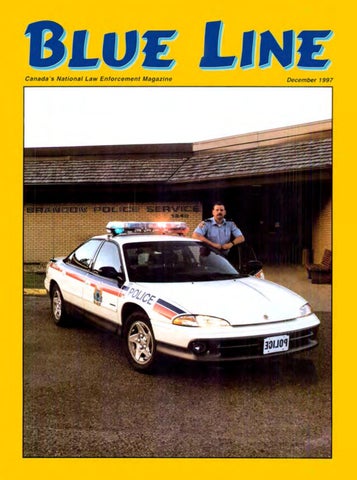
Constable tew Brown proudly show off Brandon Police Sen ice's newe t Chrysler Intrepid. When asked about the one feature he liked the most about the new patrol car, hi comment was, "The air bags work!" Just months before thi shot was taken, Brown got a unique opportunity to te t the crash protection in an accident that saw him hit a vehicle speeding through a stop sign with enough im· pact that it took rescue workers over an hour to extricate him from the wreck. The combination of seat belts and the airbag meant he walked away with no injuries (and a tough time explaining to the Chief\,,,hat happened to their brand new crui er!) Brandon Police er ice has found the Chrysler to be quick and reliable. They are al 0 popular with the public as exemplified by one highly intoxicated lady being transported to a detention facility. In between a slew of expletives, she commented, "You jerks got no right to arrest me! You're all jerks! But...," a he looked around, " ... you sure got really nice cars!"
34
27 31 17
28 37 25 21 19 4 25 31
29 23 16 15
40 26
8
29 36
IX! \ QU Hf·Wt= !"I:l~ "TQ t=~~A't ., Li'yuu uu\'\! u t!.UU i pllUlu \!ssuy 'illlply S\!llU it illlu LHu\! Lill\!. II . , 'm'lll u i't '\!\! n 'U-y\!Ul' :ul.JsCl'lI!Liull ii', '\! US\! it.
As we close ou t aliI' ninth year of publication we look back all a very successful year for Blue Line Magazine. We have appreciated all the support givel/ to us by both ollr readers and advertisers. Oil behalf of all the staff of Blue Lille Magazine I wish you a Merry Christlllas and a happy, prosperous and safe New Year.
an
32
-\0/-_________________B_L!!~g~!~~
Decelllber, 1997_ _ _ _ _ _ _ _ _ _ _ _ _ _ _ _
Delivers INSTANT response while juggling multiple, impossible demands inthe WORST WEATHER from the craziest locations. Just like you. "now I see what you mean"
W he n you need to he more
no matter where your job
places, meet Ing more l:r1tica I
takes you ~ All integrated into
dema nds, no o ne de livers control
y tems that add up to greater
better than Motoro la VO ICl' and
mind for you and the
data
ystcm.,. Wit h wire less d,lt,l
organizations you serve. o matter what critical
opera tIOna I prod lIcti VIC}
demand
you meet, find out
how Motorola's wireless data df lciency . And the ~)'.,tems
" O RTF
can help make your
' omm Pa d to ne t Im pos ible demand a lot
gIve YOll Informatio n more reasonable. ,Keess on demand, on-site-
1-800-268-5758 \\ II/t,n }vur ruJIO k'n'I('~ ilT il.
MOTOROLA M , Motorola, and FORTE ar. trademarks of MOlorola, Inc. C 1997 Motorol , Inc. hnp1/www.motorola .com
Land Mobile Products Sector Wl hat you lIet'l!T thougbt poSSIble:'"
---------------------------------------------------------------,
(
PUBLISHER'S COMMENTARY
A light at the end of the ... vacuum tube??? by Morley Lymbllmer While putting together this month's articles about emergency lights I began to think how far we have come. I remember a day when the rule of the day was to keep the rabble ignorant of what is out there so they won't demand something better... and possibly more expensive. Such was the case (should I add - not too long ago?) with regard to emergency warning systems on police car. Step back with me in time ... I can still hear the rationale from the old chief ~!IIIi!;" constable in this fanciful vignette. "Safa .. Safe,: .. Who said that ... ? Get him out of here before he poisons the minds of the rank and file with this 'safer' nonsense' Yes the good old days' They certainly don i make 'em like that any more. Back in the old days, when men were men and women stayed home , we drove th e good old two door Plymouths with slant six engines and no roof lights at all. They were good old sturdy steeds. The department even gave us the good '01 sturdy Motorola radios that were so tough they were still 1V0rking after 35 years of use. Oh sure once in a while we had to give the vacuum tubes a lillIe tap but they kept on working nonethe-less. Only whimps needed to make a lot ofnoise with a siren. We were a resourceful breed back then. In the city we knew that every other car
had a two tone horn so we simply disconnected one of the horns so aliI' police cars would sound a little different than the rest. Boy when we honked that horn we sure got noticed! And those useless jerks who would be laughing at us weren i to be paid allention to. I remember gelling a callfor a man who cut his hand off in an industrial accident. 1 got to the scene and two men piled him into the back seat of my scout car (after 1 pulled the back of the seat forward to let them in) and we were off to the hospital. Hey, 1 was in a marked car andjlashing my headlights and honking the horn and those jerks in Font of me just looked back in their reG/'view mirror
as if they were just curious as to what I was doin. They just stopped in front of me and I had to drive right up on the sidewalks and over yards to get around most of them. I can i believe citizens can get so stupid. I even yelled out the window to get them to move over and they just stared at me. They must have known I was a cop ... I had my hat on' A roof light was a rarity in this department all right. Although I remember thefew cars that did have them. They were those wimpy traffic cars. They never did work right. 1 remember the first time 1 used one of them. I put on the red light well it was sort of dark, cloudy amber- and hit the siren. The headlights went dim and the '01 Motorola went dead. I stopped the cruiser and leaned under the dash and tapped the vacuum tubes in the radio. Then proceeded to the call on the sidewalks and over the yards without the lights and siren. Emergency lights are just a pain. "
WORLD CLASS PROTECTION AND COMFORT The toughest protection standards (we meet them). A complete armour line (we pioneered them). Unlimited accessory and custom options (we offer them). As important as these features are, protective apparel in the real world demands one other critical component ... comfort. That's why at Barrday, our engineers and designers place a special emphasis on material selection and fabric weaves so that our products meet your most demanding standards of protection and durability and are comfortable to wear. Day in and day out. Real world comfort that makes Barrday a world class body armour supplier to national and international police and peace keeping forces.
TOP: Barrday Advanced Tactical Armoured Vests (A TA V) offer maximum flexibility and protection for police and military tactical applications. LEFT: Barrday offers a variety of external carriers for soft body armour including our functional and popular CLEAN FRONT carrier.
Barrdal_ _ ADVANCED TEXTILE SO LUTIONS Barrday, Inc., P.O. Box 790, 75 Moorefield Street, Cambridge, ON, Canada Nl R 5W6 Tel: 519-621-3620 Fax: 519-621-4123
. 254(2) of the Criminal Code." Mr. Ju tice Boyle tated during the trial that it was the "care and control" of the car\\hich \\as being introduccd, not the driving abi lity. There was no evidence that the accused had lell the care and control of his vehicle before Im paired drivillg acqll itta l overtllmed The British Columbia , upreme ourt has n:\ersed an acquittal decision concerning a minor driving accident mvol\ ing an impaired driver. Police \\ere called to a minor rear en d collision at about noon. n oOker arrived on the scene rough I) 10 mmutes al1er rccei\ ing the call and proceeded to mtervle\\ the \\itness and those involved. When he IIltervie\\ed the driver of the olli:ndlllg \ehlcle he noted the cent of an alcoholic be\ erage on the dmer's breath, and asked hlln to take a test into an approved screening dey I 'e. TIllS breath test reglsll:red a fail, and so the oflicer th:manded a formal breathalyscr test to be conducted. The tnal Judge had acquitted the defendant becau,e the brcathalyser test was conducted \.. hen the arrestlllg orlicer did not have reasonablc grounds I()r the test at the roadside. pon appeal Mr. Justice Bo}le noted that "The trial Judge found as a fact that the officer armed about one hour al1er the colliSIOn and made the demand about one half hour later. lie found the ol1ieer una\\ arc of the passage of time, but 1()LInd that passage \\lIS an unreasonable dela) bet\\een the dming and the demand . l ie I()und the demand, therefore, did not come \\ithin
being arrested. s Mr. Justice Boyle stated in hi conclu ion, "Perhap care and control was taken from the respondent for I0 or 15 minute before the demand, but to say that broke the chain \\ould be unreasonable. The officer wa carrying out a reasonable, general investigation ofa collision." Mr. Justice Boyle ordered a ne\\ trial. CI,ildllOod eXllal abllse charges call be laid after limitatioll period expires
In British Columbia it is now easier to bring about se\.ual abuse claims. In two recent Briti h olumbia ourt of Appeal decisions validated the modifications B.C. proposed to it LimitationsAct. In effect, they have removed the limitation period which was imposed upon victims wishing to eek retribution. In A.R. v. The hildren's Foundation, the plaintiff claimed he was e\.ually abu ed by a counsellor between the ages of ten and eleven. The counsellor was employed by the Foundation. Thc abuse allegedly happened in 1975 and 1976. Previously there wa a t\\O year limitation pcriod where once a child turned 19, they had until the age 01'21 to report the incidence ofabu e. The only exception would have been if the plain-
COllditiollal elltellce overtllmed ill impaired drivillg cOllvictioll
ABDUCTED T hi i a monthl) column supplied by th e Royal anadian lounted Police 1iss in g Children's Registry in coopera tion with Blu e Lin e MagaLine. All material supplied is copyrigh t free and may be distributed to local media.
Readers who feel they know the whereabouts of this child are asked to call :
(613) 993-1525 or Fax (613) 993-5430 National Center for Missing and Exploited Children
1- 800 - 843 - 5678 Sex:
Name of Child:
Female
Alexandria Camille CYPRIAN Oato of Birth:
Rac.:
89-07-14
Black
Date Last Seen
. Missing From:
Hel!jhl
Wetghl
4 feet
701bs .
Half
Eyes
Blk Brown
Th is young girld was last seen on the 9th of May 1997 at Fort Worth, Texas. She is believed to be in the company of her mother. The child has a slight over bite and a scar under her right eye. Known Abductor
Chere Lyn TOMAYKO is the child's birth mother. She is female , white, 30 years of age (23 FEB 68) 5 foot 2 inches tall and a slight build . She has blonde hair and blue eyes . A picture was not available. There is no known occupation for Tomayko but she IS known to be very wealthy and may circulate among persons of her own economic level. It IS unknown if they are in Canada but it is a possibility.
BLU£ L'N£- - - - - - - - - - - - - - \\6l M
9
tiff could prove that they had no way of defending them elve m a court oflaw, no evidence that \.. ill prove the abu e e\.isted until aller the period had begun. In 1990, their \\ere considerab le modification made to the act, which included the provision that stated a person was no longer restricted by this time period on any action based on the misconduct of a sexual nature. This ruling is 0 important because the abuse may not be recogni7ed as such until well afler the age of majority, or the victim may not feel able to deal \\Ith the issue at their pre ent tate of maturity. PrevlOu Iy, if a victim was considering charges, and they \\ere near the end ofthcir limitation period the} wou Id be encouraged n t to press charges for the fact that they had taken too long. victim will no longer be placed in a situation where they are till recovering p ychologically from the abuse, and yet have to c ntinue with a trial. In a prior ca e the B.C. court of appeal decided that an employer could vicarious ly be charged for the se\.ual abu e perpetrated by an employee. The case involved a boy who wa abused bet\\een the ages of 10 to 12 b} another counsellor at the f·oundation. Leave is currently being sought by the loundation to appeal to the upreme Court of Canada. The greate t impact of these declions \.. ill be felt by Victim of abuse at foster homes, chools, hospitals, intltutions and similar facilitie becau e there is no longer a limit on the period of time in which you have to report any misconduct, but the victim can expect a larger monetary amount in retribution from the e faci lities.
Mr. Justice Marc Rosenburg of the ntario ourt of Appeal sentenced Mr. icola Biancofiore to a 15 month period of incarceration, o\erturnmg the prc\ ious decision of an 18 month conditional sentence. In April 1995 Biancofiore, \.. ho was on pr bation, took hiS brother's Corvette \.. Ilhout permission and sped through Etobicoke. lie lost control of the vehicle and crashed into a guardrail and a concrete pole. lie had with him two passenger. Both were ejected from the car and fell onto another high\.. ay below. The male passenger sustamed serious injurie , but the more erious consequence \\ere those of the fema le passenger\\ho can no longer\\ork and \.. ill need on tant care for the rest of her life. Mr. Biancofiore pleaded guilty to dangerous driving cau ing bodil} harm, driving over" 0" and taking an automobile \.. ithout consent. The trial judge gave a sentence of 18 months imprisonment, to be served in the community, and 240 hours of community service. When overturning the decision Mr. Justice Rosenburg tated that "The trial judge must still consider whether or not imposition of the conditional sentence \.. ould be consistent \\ ith the purpo e and r levant pnnciples and objectives of entencing". In his ummary he concluded that "general deterence is the paramount objective in sentencing for offences of drinking and driving, especially where serious con equences result". Mr. Justice Rosenburg conceded that drinking and driving offences "occupy a unique postion in criminal law".
zinB ----------------------1V~~------------------- December, 1997
he Awarded: Blue Line Magazine's
News Editor, Blair McQuillan, received a Southern Ontario Newspaper Guild Award in October. McQuillan , who is studying journalism at Durham College, was recognized by the ewspaper Guild for academic achievement. "The award came as a surprise to me," McQuillan said. "It's an honour to be recognized by your peers." Blair has been working for Blue Line Magazine for over four years. lie first came to the magazine in a journalism co-op program from secondary school. His talent was immediately recognized and his first assignment turned into the cover story for the ovember 1993 edition. Blair was later offered a permancnt po ition with Blue Line. He is presently the News Editor for Blue Line Magazine as well as the main editor for Blue Line ews Week, a publication that ends out Canadian law enforcement news on a weekly basis by mail and fax Broadcast. "We are extremely proud of Blair 's achievements," said Morley Lymburner, Publisher of Blue Line Magazine. "Many years ago we recognized the need to nurture a writcr from the ground up so that he wou ld get a firm understanding of the police experience in addition to journalism from Blue Line' term of reference. Blair's abilities and attitude fit our criteria ju t right." Blair is continuing his studies in journalism at Durham College in 0 hawa, Ontario. The award was presented to Blair on ovember 12th at a presentation ceremony. Retired: Terry Barker, author and seminar leader, has retired from teaching after 23 years. " I retired from stand-up teaching last year," Barker said. " I turned 70 in September and decided that, much a I loved teaching police
officers, I could do without those early morning starts." While his in class teaching days are over, Barker keeps busy working with Hcnson Collcgc's police distance education course. " I'm starting my fourth year with ll enson College now, " Barker says. "My classroom is my mailbox now." Raised : Ontario Provincial Police officers in the northwestern part of the province raised $ 158,000 for this year's "Cops for cancer" fundraising campaign. Of the eight northwest OPP detachments the top three money makers included Atikokan, which pulled in $22,000, Red Lake, which raised $42,000 and Kenora, which led all detachments with $53,000. A total of $550,000 was contributed nationwide. Members of the detachments had their heads shaved as part of the fundraising effort. Appeal : The Supreme Court of Canada has agreed to hear an appeal ofa lower court decision that den ied Mounties of the right to form a union. The Quebec Court of Appeal ruled the RCMP's right to collective bargaining is not covered under the Canadian Charter of Rights and Freedoms. While the court said the 15,000 officers can form an association, it added that didn 't included being accredited as a union . Hearing : Four suspended Montreal police constables are currently -7o-.",It.. facing a second poi1J~~R~ 'lice-ethics commission hearing. The new commis ion was created after a Quebec uperior Court judge ruled the first one failed to give the officers a fair hearing, In June 1995 , constables Pierre Bergeron, Louis Samson, Michel Vadeboncoeur and Andre Lapointe, were convicted of assault causing bodily haml to Ri-
Ii chard Barnabe during an arrest on Dec. 14, 1993 . The officers have appea led the conviction. Barnabe suffered injuries whilc in pol icc custody afler leading police on a highspeed chase. lie lapsed into a coma and died 29 months later in May 1996. Guilty: A sergeant with Ontario's iagara Regional police pleaded guilty to seven Police Act charges in October after a sto len knife and improperly ~~~~~~ stored weapons were discovered at h is home. Ronald Delano plead guilty to charges of discreditable conduct, corrupt practices and deceit at a hearing. The inquiry was told the incident began when a man wanted to turn in a 12-gauge shotgun and some knives for destruction. Delano, a 27-year veteran, took the weapons back to the office, but put them in his locker instead of turning them over to the property room, Insp. Ian Fiddes testified. Police later found a cache of weapons at his home. Cleared: An internal investigation conducted by the Thunder Bay Police Service cleared two officers of misconduct in late October. The officers had been accused of racially insulting a local native woman in an incident that took place during the summer. A police report found there was no clear evidence "that the officers committed a misconduct by making racial conducts." The report also dismissed two other complaints filed by the woman after a July 31 incident with two male police officers. Charged : Allen MacDonald, a former police services board chair charged with firstdegree murder in the death of an Ontario Provincial PoCoffin lice officer, will face additional charges. MacDonald, 49, has been charged with two counts ofpoint-
1 ing a firearm, attempted murder, possession of a restricted weapon and threatening death in relation to the murder. opr Const. Thomas Coffin, 32, was gunned down while off duty last May. Coffin was sitting in a Penetanguishene bar when a man walked in, put a gun to the back of Coffin's head and fired a single shot, police said. MacDonald's preliminary hearing has been scheduled for March. Arrest :A man arrested in Ontario ~ in early November is . believed to be the first ~ U.S. fugitive ~~ , . caught in ~~~2 Canada for Internet fraud offences, the RCMP announced. ew York resident Eugene KashpurefF, 33, was arrested by an RCM P immigration task force in Brampton and charged with being in Canada illegally. The FBI alleges Kashpureff twice interrupted service to thousands of users worldwide in July, causing significant economic damage. The authorities allege the suspect hijacked calls made to a U.S. government location and sent them to his own site. <",
. .7
Guilty: Les Graham, the former head ofa ll alton poli ce crime unit, was convicted of trying to cover up an assault on a murder su pect. Graham, 52, was handed a one-year conditional sentence and ordered to complete 100 hours of community ervice. Graham, a retired pol ice inspector, received the sentence for planning to suppress or destroy a video tape that showed an officer slapping a murder suspect twice on the face and for planning to deny the assau lt ever happened. Det. Doug Ford assaulted the suspect in an interview room at the major crime office in Oakville, Ont., in April 1995. Ford plead guilty to assault in the summer.
December, 1997 \]7 BLUE LINE ------------------------------~~~------------------------------- nnagaz;ne
The Rugel· Eagle-Youl· Shield of Dependability on a FirealID
®
rr / U? II arId's 1710S / cornpl'ehensive line oj' law en/orceIn nt firearrns.
/I ril e f or a free lew e/ ~rO rCelll eJlt cata log. SI I1 I"111 . Hil ger ~ CO Il1! >a Il ~ . 111(' . \ [(11: CO\ (' 1"1111 1(' 111 Sen ice"
200 Hil ge r Hoad 1> 1"(',,("0 11 . \ l'i ZO Il H 8();{0 I -C) 18 1
Fa "\ : (.)20 )-S-t 1-88;)0
Witnessing a Canadian vision quest by R affi
I've ju t returned home dazzled "'~I"C:~""_/ by an extraordinary event, a
Canadian 'peace story' akin to the dismantling of the Berlin Wall, and I want to fully undertand what I have witnessed. Did this really happen, or was I imagining things? Did I really see the huge painted canoes in the water, did they really travel a thousand mile in one month? ould it really be that Canada' national police force ha joined with aboriginal peoples to carve out a new leaf in the history ofthi land? It was like a really good dream ... actually, more like a vision quest come to life. When the idea was born in the heart and mind of artist Roy Ilenry Vickers (a Tsimsian from Kitkatla, near Prince Rupert, BC) and shared by his good friend Ed Ilill (a staff-sergeant in the Royal Canadian Mounted Police), it was a unique eed that could not know its destiny. This seed was conceived in faith between two friends from previously conflicting cultures, with a vision to heal wounds from over a hundred years back. Each had his own knowledge of pain and dysfunction. Roy in his sixth year in recovery from alcoholi m and aware of the scourge of addictions in aboriginal communities; Ed, as a law omcer, encountering first-hand the misery that amict addicts of any colour. When I met Roy two years ago, he wa firmly rooted in the gifts of recovery-of self, of culture, of integrity. The quiet strength of his voice spoke heartfelt word of his own healing journey and of his wish for others to find themselve and know their connection to the bounty of reation. Roy's words, like his evocative visual images that are known far and wide, made sound pictures of a man with a mission. That mi ion turned into Journeys 1997 for VisionQue t, a healing journey of a thousand miles made with three canoes and 70 pullers (including 50 Mounties), to mend relations between RCMP and First Nations and help raise $5,000,000 for an Addiction Recovery Center to be built in Briti h olumbia, a center unique for having the RCMP's active involvement and support. A demanding voyage, physically and emo-
tionally, this sea saga along Canada's west coast yielded gi fts to all those who signed up to pull together. "We found out very early that this wasn't about paddling," one Mountie \ told me. It wa about a sharj 0 u ring of stories, cultures, and ney's end was in the determination and teamVictoria where I work that kept the canoes gowas invited to pering through rain, gu ty winds form during an all-day and occasional swells. Along the way, the ;;;:~~~~~~j musical celebration and benwaves of emotion overflowed, bringing tears efit for VisionQuest on the to every face. grounds of Royal Roads UniIn over 20 villages and towns where the versity by Esquimalt lagoon. After I was done singing, with a throng of well-wishers I walked weary paddler looked to rest, there were scenes of historical significance. The travellers were down to the water to greet the great painted canoes. We saw the three vessels approach in greeted by the excited members of indigenous communities, where some elder can still recall unison, now sitting still, paddle upright. We a time when the tradition of ocean-going cedar heard the reque t to come ashore. The Esquimalt vessels was still alive. Paddles held upright and chief said, "No, first you must sing us a song of canoes huddled together, various pullers asked peace." We waited. Roy Vickers, standing tall, the assembled chiefs and elders permission to led the paddlers in ong. Many voices became disembark. "We come in peace and respectfully one in the afternoon sun. Permission was granted. The men and wOlr.en disembarked and ask permission to come ashore." The Royal Canadian Mounted Police had were embraced by the jubilant gathering. Roy come to apologize. and I hugged like old friends, and I thanked him The offer of reconciliation was a new sight for his vision and hi courage. and ound in these lands where, for decades, I talked to a number of aboriginals and the RCMP's arrival brought pain and sufTeromcers, all sharing stories of transformation ing to aboriginals. In this summer of 1997, Inand of how much this voyage had meant to spector John Grant, in full 'red erge' uniform, them. A gentle breeze on this perfect August was apologizing for the misdeeds of the pa t. day, with hope - hope for new beginnings, a It was a sincere attempt to tend to the festering realization that we can only put the past behind us if we have the courage to look at our wound of a terrible blight, the brutal intolerance of native culture: the thell of land, the part in it honestly. It is hard to underestimate assignment of English names to the people, the the healing impact ofa police apology to communities whose culture was shattered by sysoutlawing of languages and customs, the abduction of children from their families. tematic institutional abuse, whose people long This apology, made at each stop, was met to transform patterns of addiction, suicide and with forgiveness every time. atives now despair. The R MP apology, while not yet walked with Mounties in a rare atmosphere of expressed by everyone in the force, has the mutual trust, and children watched with wonwholehearted blessing of Commissioner Phil der. It is more than an apology. I see it as a gift Murray. At a celebration dinner following the to all of us, whatever our origins. It models pullers' arrival, cited for his part in supporting something precious and not seen enough, what VisionQuest, Commissioner Murray spoke every parent tries to teach every child, to say from the heart about the importance of this you're sorry for something you hould not have journey and the change that he feels is now at done, for something you regret. And it sets an hand.
December, 1997_ _ _ _ _ _ _ _ _ _ _ _ _ _ _
---\\gl~.---------------B-LUE L.NE D M a gazine
In a \\orld that often seems short on good ne\\s, somethll1g big is afoot here If you don ' t sec tillS process as historic, \OU ha\e on ly to thinl; of the state secur ity forces of countries around the \\orld and ash. \\ hlch of those agents of colonial ptmers have cyer apologl/ed to the II1dlgenous peoples they harmed l nusual accommodations In a post-modern ",odd. The 'sacred hoop' mending in all Illanner of'unpretllctable \\ay., no cure too ",i ld to hope fllr, no miracle too great to come, no reality toO fixed . These da)s, there IS a strange magiC thatmoc"s e\en our reasonable despair, impairs cynics, dares us to "eep to the high road, challenging the qual it) of CVCr) vibration \\e giH! thought and forn) to. Day dreamll1g ntm, "British (olumbla", I "~I) to m)sclf, \Vhat a strange name. 11 0\\ odd to carn on colonllllism's dual yo"c in the namc f(11 thi~ tcrritor) . In Victoria, over lunch at the home ofa friend, gluing out at the Idy lI ic dntl\Yood beach of ion/a les Bay m) eycs court the hI rl/on and the mountall1s beyond . The \\ah:r Shll11merS goldcn pearls, scagulls sklln the photonic bre\V, humans \\alh. the low tide. MlI1d \Vanders, tllne docs Its standing stlll tnc" al!all1. \esterday, Ro) Vich.ers to ld mc IllS canoe \H\S Tsimsian dcslgn, but made of fibrcglass, at400 pounds, it provcd much faster than the traditional, hea\ Icr cedar canocs. n alchemy of tcchnolog) and ancestra l dust IS at play, old and nc", merge in unprecedented allo s. Thcsc times arc fu ll of complementar) In\Cntlons, fusion, s)nerg), defyin' neat dlstll1ctlOns. All bets arc ofT Poss lbi lIt) rell!ns supreme, here 111 an ada, from the I luron, J..anata, meetll1g place. Ralli is a slI1ger, song\Hller, 111ternatlonall) acclaimed fam ily entertainer, and \\riter. lI is ecolog) ad\ocac) IS a blend of his lo\e f"or children and f"or the I' arth, and spca" s of love and tolerance as the foundati on of a sustainab le society. (her the last fe,\ ) cars, Ralli has \\or"ed in support of a number of aborigll1al peop les.
1 III' \'isic", Que .. 1 HecoVl'r11 facility I hl' estahli,hlllent of slich a f,ICIlIt~ \\111 pnl\ Ilk pel1plc frolll ,til \\alk. of' lif,\! the opporlunlt) to f:ll:e, and hopefully 0\ cr1:01lle, ,Iddll'tions. I'n lgrallls \\ III be ofkrcd 1111 all t) pes of uddlCt ions: alcohol, drugs, SL , ,\S \\ell ,IS po\\er and control addiCtions. lundill" Illr VlslonQucst IS prm Ided thwlI 'h pn"lte dllnatlllns, the tinalll:ial asI t,lIIce 01 carin" cOlpor,1l10ns, and the prolllotlon 01 1:\ enh organl/ed and ,uppOlled by the RC\tl'. VlslOnQlIe,t Reco\ en SO ' ld\ I' IIIel1lporated under the 1:1.:11(' \\:1 01 Bntl h <. lllull1bla . Donations ,all be l'lIt pay able to VlslonQul!st Rl'1.'0\1:1\ "i()~let:, 6':; 7 \\c t , 7 \\1.' ., Vanwu\ 1.'1 , IIC. V"/.. I K6 .
"0
The Teslin Lake Story Followillg is the sequence of evellt!> of tlliI true story. Curiously, th ey do Ilot forlll a straigllt lille as is so oftell tile case. Ratller, tlley forlll a cire/e. Tile story begills, ellds alld begills agaill witll tile RCMP. .. The first event occured in 1985. The setting was the exqui ite and uncomplicated beauty of the rugged northwest comer ofBriti h Columbia that borders the Yukon. On that March 19th morning, along the hores of Teslin Lake, the air wa crisp and cold. A deranged individual was moving with amazing speed through the bushe , yet he was barely making a sound. The objective of the special RCMP Emergency Respo nse Team Pi<'lIIret/lop 10 hoI/om camou fl aged in po01. MiA. Budu), sition on the ground lI'ilh hi, dog Trooper, was to capture and Mid",e/Oros.lh, fUJiilil·e. arrest Michael Oro Ilulhell' Thom. T/illJiil EMer - an American draftdodger, turned-bushman who had earned a reputation for alanning and bizarre behavior. lor 13 years, the suspicions surrounding him \\ere plentiful and inc luded murder. The R MP members did not expect Oros to be arrested quietly. And no one was kidding themse lves by expecting it to be easy! Oros's surviva l ski ll s were astonishing and legendary. S"illcd with a gu n, he was also known to never miss a shot. And he had open ly expres ed an IIltentto " ill policemen! Oros had spcnt the previous night on Big Island . This was disq uieting to the Tlingit people in the area because by doing so, Oros had trespassed on sacred ground. The island wa in fact the gravesite of a Tlingit shaman. They "ne\\ this \\as sure to di turb the spirit of the haman buried on the is land and there would be consequences fo r Oros. erio us conseque nces ... ad ly, Oro was able to comp letely circle around the Mou nt ies and attack from the rear - a feat be lieved to be physica lly impo sible f"or any human, given the bu h and now conditions. Oros instantly ki lled Constable Mike Buday with his fi rst shot. In the same motion, he turned and aimed at onstab le Garry Rodger and pu lled the trigger. im ul taneou Iy, onstab le Rodgers caught movement in the bushes and saw what he described as "a face strange ly g lowing." li e raised his rifl e and fired at the almost im pe rcept ible g limpse of Oros's face through the tangled tree branches. The bu ll et truck its mar" preci el). Oros was dead. Constab le Rodgers should have been, too. Oros had fired fi rst! What happened to prevcnt the second RCM P Ollicer's death? ubsequent investigation proved the gun was fired and worked perfectly. Miracu lously, the bu llet didn 't. The percu sion cap had an inden ta-
tion where it had been struck, yet something had prevented it from firing. And how wa the bu llet that onstable Rodgers fired able to find Its mark? The odd are astronomica ll y against it! The .223 caliber bullet that Con table Rodger fired could have easil) been deflected by a twig or even a rall1drop. [:\opert mar"smen shoo" their heads in amatement ""hen they vie\\ed the path the bullet trave lled. .Pic'llIrt!lllol' to bottom " It i impossiRo)' lIellrJ' Hd<er.' . Arli,l. ble," they said. • SISgL Et/llill, A rIM. Perhaps the b"p. Joltll GTttIlI ReMP Tlingit People \\ere right all along. They believe that diville spiritual intervention \\as at work that da) on Teslin Lake ... The stor) picks up ten years later to the da) bac" on the 'horeline of Teslin La"e. A Tlingit [Ider ha given his traditional blesing to a group of men gathered there with a vision and a quest. In a ullique blend ofcircull1stances, a plan to tum tragedy into triumph was unfo lding to the group - most were RCMP members, all ",ere strong friends. ccompllshed We t Coast artist and gt. Ed Il ill, had dreamed of comR MP pleting a painting to commemorate onstab le Mike Buday. I lis friend and noted international artist - Roy Ilenr) VicJ...ers also had a dream. Il is was to see the opening of a facility for the treatment and healing of addictive personalities, so he suggested they collaborate on the painting. With the support of the R ' MP behind them, the sale of lim ited ed ition prints wou ld begin the funding. They looked for an image to paint, and found it on March 19, 1995 stand ing on the shore ofTeslin Lake looking towards haman I land. It \\as framed by a group of mountains called "Sheep tanding By Il im elf," locally referred to as the Aces. ncannily, the scene the) chose ... (they found out later from Mounties \\ho were there that fatefu l day 10 years ago) \\as precisely the one that ' onstable Mi"e Buday \\as looking at the moment he died. The sa le of the limited edition prints of the painting they created, aptly named" heep tanding By Il imself," was instantly successful and raised the first 100,000. In June 1996, ommissioner Phil lip Murray, on behalf orthe R \11' committed to turning the concept of a recovery faci li ty into a reality with the official launching of the project no\\ called VisionQuest. The Officer in harge of this hi tOr)-making illitlatl ve IS In p. John Grant, who wa stationed in Teslin during the Oros incident and \'vas instrumental in the evolution of the VisionQuest concept. The circle begins again ...
Sheep Standing B y Himself
The Artists '/Sgl. E(I Hill, RCMP I have been a Mountie for 29 years and I see the establishment of a recovery centre as playing a significant role in crime prevention and community policing. I have felt the effects of addiction in my personal life and I know that real, meaningful change can not occur without recovery and hea ling. It is important to me that I do what I can to see that everyone has the opportunity to "tum their life around" and reach their own fu ll potential. I look forward to the day the ribbon is cut to officially open the first VisionQuest Recovery Centre. You can help make it happen, and I hope you do. Together, this dream will become reality.
-
Roy Henry Vickers-
During the winter and spring of 1992 I began my journey of healing and recovery. It is a path on wh ich I regained my selI' esteem, sense of belonging, and unconditional love; it i the path of the teacher, healer, warrior and vi ionary. My vision is to share this journey by encouragi ng and assisting other to heal from the effects of abuse by e tablishing a national recovery centre. This will begin a proce s of moving fami lies [rom dysfunctional systems to functional groups. The canoe ha a prominent place in the live of the orthwe t Coast people and it holds a special place in mine. Much of my work as an artist incorporates the line of the traditional Northwe toast canoe. As ajoint project with B ' Western Canoeing and Kayaking Inc., I was recently involved in the design and production of a model called orthern Dancer under the Clipper name. The result is a 31 foot ocean going craft with traditional lines and handling made from fiberglass and kevlar. It weighs under 500 pounds, seats II and is affordab le and availab le to anyone. orthern Dancer i large enough to make long trips yet mall enough to be easily trailered. My canoe and a sister model which belongs to the RCMP, will take part in Journeys 1997-the historic voyage from Il aze iton to Victoria. I have been blessed with many career highlights which include my work being pre ented to Iler Maje ty Queen Elizabeth II , American President Bill Clinton, Russian Pre ident Boris Yelt in, as well as the heads of all the Commonwealth countrie in 1987. I have completed works for the Vancouver International Airport, aanich Commonwealth Centre in Victoria, as well as numerou commissions for corporation and private collectors. But I consider my greatest accomp li shment to be the pride and honor I bring to my family, my people, and all those who e li ves I can touch in a positive way.
The VisionQuest Music 0 is now hitting the airwaves! The title song - River oj Love co-written by David Fo ter, really captures the essence of what the VisionQuest Initiative is all about. Copies of the CD went out to many HMV stores in British Columbia. They are available for $9.99 plus taxes. You can show your support for Vision Quest, and receive a high quality CD with some beautiful songs sung by the like of - Amy Sky, Dan lIill, David Steele, Douglas Pashley, Fara, Roch Voisine, Saffron Henderson, Tanya Hancheroff, Roy Henry Vickers, Stephen Ranney, Raffi, Shari Ulrich and Michael Creber. I f you would like to hear the music in its entirety, call your local radio station and request "The River of Love." Short clips of some of the songs are provided on The web page at www.TheVQnet.org.
Ordering Instructions To order VisionQuest CD, send cheque/ money order for $9.99 per CD (plus $3.88 GST, PST, &1 1) To: ThcVQNet Network Inc. 304 - 15047 Marine Drive White Rock, B.C. Canada V4B I C5 Please allow 2 weeks for delivery.
VisionQuest CD Songs River of Love - (Lyrics) Audio Clip - Mac (AIFF) - P (WAV) Prayer - arration by Roy Ilenry Vickers Green H ills of Earth - Douglas Pashley Thank You ong - Roy Ilenry Vicker & tephen Ranney Paddling ong - William Wasden -Audio Clip - Mac (AIFF) - PC (WAV) Beginnings - Douglas Pashley & dward Ilenderson First Peoples - Ram, M. Creber
Dalhousie University Certificate in Police Leadership Spaces are still available in the following new courses: Policing and the Law of Human Rights This course will discuss such topics as hiring practices and discrimination on the basis of gender, age, race and handicap; accommodation of pregnant police officers; mandato!)' retirement; alteration of police uniforms to accommodate religious beliefs; operational policing; issues related to internal police discipline; human rights commissions, boards of inqui!)' and tribunals. Problem-Oriented Policing Rather than focusing exclusively on offenders as the source of police problems or on arrest and prosecution as the only solution, problem-solving expands the focus of police efforts to address the full range of causes or conditions that created these problems. You will learn numerous strategies to help you act in a problem-solving capacity, including who to talk to, what questions to ask, which agencies to consider in your solution, and how to support and assess the process.
***
These are ju t two of the seven courses available to you. To obtain a brochure or Registration Form, call our Infonnation By Fax line at 1-800-932-0338 or locally at 481-2408 and request Document # 0211. For further infomlation, call Cara L}1111 Garvock, Program Information Officer at (902) 494-6930 or write to Cara Lynn via E-mail at CPL@Dal.Ca or to tlle address below: Henson College, Dalhousie University HENSON 6100 University Avenue re-I __ « .. " lIalifax, NS B3H 3J5 Learning Solutions Web site: http://www.dal.ca/-hensonlcert-pl.html for a Changing World
~~~lm______________~~L
V
8_ LU£L'N£
_______________
Magazine
I1~tBilllsLbdJ[?0 In thIs column Bille Line Magal'inc provides private in dustry an opportun ity to speak about their product or services in their own ""ortis. Readers should be aware that a ltho ugh Blue Li ne supp lied th ese companies w ith an edit rial outline the following articles are writte n b the mar)..eters of th e s ubject mate ri a l and Blue Line d es not accept respon ibi lity for the accuracy of c laIms made.
Code3
Rear Vie ll'
Cl de 3, a subsldlal) ol"Publie Salet} I quipmen t entered thc Canadian marJ...ctplace ellectl\el) III 1981 . ."1Il c that timc ode 3 products have become the benchmark in the emcrgcnc) lightIng and sound industl). In 1985, aller cxtenslve testlllg and cvaluatlon, thc RCM» cho. e ' ode 3 light bars. 'ode'" lightlllg products at that tIme, and since, have passcd all tests perlimned b} the R MP Telecom SectIon III Ottlma. rhc prime directivc of Public ' alet} r·. quipment, IS to lim1l a partnership with our customers. to ofler them eflectivc lighting products, cost el"lective pricing. combincd \\ith "real" al~ ter sales sel"\ ICC. We arc 111 this business for the long haul . and want to maintain a positivc on'Olll ' relatIOnshIp \\Ith our clients. In order to c\aluate the various t}PCS of lightlll ' S) stems avallablc today, requires an understanding of some of the baSICS of lightlllg sCIence . LIghting cngllleers lise the term "Cllnspieuity", to dcscribe the abilit} ofa flashIll' \\arnlng light to capturc thc attention of a \ le\\er. There arc threc primary factors that account lilr the abilit} ofa \\<llming light to command a \ic\\er's attention. (I) The light output of the dcvlcc (2) The color ofthc light cmitted, ,\Ild ( ) The Ilash duration, or \\hat is knO\\n as the "actt It} level". Ithough It may bc an accurate measurcment of light IIltensil). candlepo\\er or "candela" is not an eflectl\t: \\a} of comparing the \ isual perlilrl1lance of a light sourcc. Thc correct \\,1) to measure thc total amount of light energy present IS a method called "Ila~h energy". Perhaps the best \\a} to cxplain "flash cncrgy" \\ould be to e"l.plalll ho\', a light metcr would measure Ilash encrgy. The ehart represents how thc light output signals from a strobe and halogcn warning light FLASH ENERGY COMPARISON
•
Strobe Flash
Halogen Flash
BLUE L'NE- - - - - -M ag
zin
ourcc, would look on a graph . Notice that the strobe light produces a vcry ta ll , but narrow bur t ofenergy on thc graph, showing a very high peak of intensity for about 250 micro econds (a microsecond is .0000 I of a second). Compare that with a halogen light nash . Although the peaJ... intensity of the halogen is only I '20th that of the strobe light source, the duration the light is on (cye ti me dwel l) is 100 ti me thatofthe trobe. On the graph, its easy to ee that the area under the ha logcn curve meets or exceed the total nash area of the strobe signal. Whcn comparing halogen and strobe lighting systems, that draw the samc amount of current, thc halogen light system will provide equal or greater light output whilc offcring the highcst flash energy of any light source currently on the marJ...et. TaJ...e into consideration also, that the power output of a strobe power supply, and the light output of a strobe tube continually diminish over time. Rotating signals provide a strong primary signal and strong secondary signals off mirrors and other devices that lengthen the eye dwell time of the nash . And since the rotating light sourcc ha a continual output, the light bounce olTbuildings, cars and other obstructions. ThereI'ore it is easy to continually mar).. the location of the emergency vehicle. In addition, rotating light systems emit a continual glow of light from their Icnses, evcn \"hcn the light signal is not pointed directl y at the viewer. This wou ld suggcst, that if you are using directional strobes (as is most commonly uscd), you need to combine the strobc with rotating light signal to provide a constant marking light, locating the vehicle. The "MX Light Bar System" Although Public afety manufactures and markcts strobe products for speci lic markets, we arc best kno\\n fo r our halogen technology. Because of the high initial purchase price of strobe equipped light bars, plus, thc high co t of replacing strobe power supplies and strobe tubes, Public afety Equipment developed the "MX Light Bar ystem". Public alety's objective in designing the "MX Light Bar y tem", was to provide the end user, with a "base un it" light bar, that could be litted wi th a wide variety of options, to satisfy all the requirements ofpoliee, fire, EM and public \\orks customers. The "MX Light Bar ystem" has accompli hcd this objectivc, in all markets. vailable in lengths 01',18" , 29",36" , 47", 51",5 ", and 69" thc "MX Light Bar ystem", with its "dual" decJ...s, gives end user the po\\er, and feature nexibility, to get everything they want from a single light bar. Lcss than 6" in hcight, thc "dual" decJ.. MX Bar, gives you primary 360 degree unobstructcd
- - - - - - IG2!
ignal protection from upper deck rotators/mirrors and or trobes, ""hile the lower deck is dedicated to providing a platfoml for a wide variety of special-purpo 'e lights, including, 2, 4, or 6 takedown, allcy light , comer sweeping intcrsection light , strobes, or a full length directional arrO\\ ti).. in thc rear po ition . In total, thcrc arc seven lengths availablc, in 58 dilTerent ba ic MX Bar configurations, plus 38 availablc options, to modify those 58 basic configuration . Thc MX Light Bar ystem is available in halogcn, strobc or a combination of strobclhalogen. Thc "MX Light Bar ystem" model7317 A " I" has bccomc one of the mo t popular light bar configuralton., prc. ently in use, by major anadian police departments. The 7317A "/" specifications Length :47. 115" WIdth : 11.75 " IIclght: 6.0" Weight: Sib (wIth arrowstiJ...) Motors: Multiple pole,with RP suppressionnctwork Rot. Outboard : SOw, 60,000 CP, 100 PPM Rot. Inboard : (1) SOw, 60,000 P, 200 FPM Takedowns:(4) SOw, 60,000 P, nood Alley lights: (2) 50\\, 60,000 CP, nood ArrowstiJ...: 8 lamp - 27w Iialogens Intersection lights: (2) SOw, 60,000 CP 120' swccp, 220 !-PM Ampcragc draw: 3.1 amps pcr SOw. Upper Lenses: clcar polycarbonatc Lowcr Lenses : clcar, polycarb nate erod} namics: 97.90 0 of clcan roof performancc otc: in place of an Arro\', tik, 4-50w rear tationarics can be installed with a modcl 710 Muti Mode na. her. Price: 880 to 1180 dcpcnding on options. Warranty: A tandard one year warranty applies to part and \\orkmanship and multi-}car warranties arc available on request. Parts and Maintenance: Public safety has warranty repair station in every major province in anada. ormal tum around time is 48 hours. Customers using public safety lighting products Public afet) ISproud to be the number one choice of\\ell over 250 major police & fire departments in Canada. Some of the agencies presentl} uSlI1g the M Light Bar }stem includc: Royal Canadian Mounted Pol icc, Quebec Provincial Police, Montreal Police Dcpartment, Toronto Metro Police, Thunder Bay, Ont. Ministry Of Transport, Toronto Airport Authority udbur, Ilamiiton Wentworth Rcgional, Anishinabek Police ervice, Winnipcg Police Departmcnt, Regina Police Department, Brandon Pol icc Department, Leflbridge Police Departmcnt, I dmonton Airport Authorit}, Vancouver Airport Authority, Victoria Pol icc Departmcnt.
m
V-I------ - - - - - - - - - - - -- -- December, 1997
FEDERAL SIGNAL Vista Strohe Lighthar
Vista Halogen Lighthar Expertise and Science Join in Lightbar Design A dvice fro m Real Users Co mhined With alional S tanda rds and E n gin eering S tudies Create New Lightha r Choice
Emergency vehicle warning equipment has come a long way since the days of the revolving "gumball" light atop a Dodge cruiser. Today' law enforcement agencies demand that emergency lighting systems be both effective and helpful by offering a variety of lighting functions that support public and omcer safety. Whether or not a lighting system is effective depends on how the manufacturer applies it technology in support of fundamental scientific principles. Making it helpful come about only by compiling the expertise of real users, asking what they want in a lighting system, and then making ure their needs are met. A Focus Group of Experts About two years ago, Federal ignal Corporation convened a focus group made up of public safety e>..pert fTom around the world to learn what they wanted in a new lightbar. Engineers would combine focus group input with their own expertise earned since inventing the lightbar in the 1960' to create the new VISTA lightbar. The results of the u er survey fell into two categories: general preferences and de ired features. General preference for lightbar type split 50:50 between strobe and halogen. Stronger preferences showed up on issues of configuration and shape. Two thirds of the group liked the idea of two-level lighting, separating primary warning from econdary or "helpful" lighting. A similar fraction favored non-linear lightbar hape. Focus group members also identified de irable features by type, and ranked each according to importance. First place ranking went to the need to "meet or exceed what's currently on the market." Other important feature included "must be within range we are pending now," ( econd place) and "maintenance/service mu t be quick and easy" (third place). Coming in fourth and fiflh were desires that the lightbar "meet/cxceed officer/public safety needs" and that "the lightbar be aesthetically pleasing." Making Safety a Science As important as user input i to new product design, engineers must also consider company knowledge gained over time as well as studies conducted by industry standards organization . For e>..ample, independent research over the years ha uncovered these important fact: • 32% of all accidents involving emergency vehicles occur at or near inter ections • for every ten mile an hour increase in speed a driver's peripheral vision decreases 30'
• a light's Effective Intensity is more important than Peak Intensity, since desirable human response to the warning signal is determined by brightness and duration • liability exposure can be lessened by complying with industry standards (e.g., ociety of Automotive Engineers, ( AE); Automotive Manufacturer's EquIpment Compliance Agency, (AMECA); California Admistrative Code, (Title 13); etc. Although Iightbar de ign i driven by prior research and rigorou indu try standards, Federal Signal performs additional, exhaustive studie of emergency warning product of their own in state-of-the-art optical, audio and environmental labs. This way, practical engineering issues are resolved by thoroughly understanding how variables like optics, temperature, vibration, moisture, dust and corrosives are counterbalanced by the most suitable choice of materials for the job. New product under development are routinely tested to AE Recommended Practice J575, Tests for Motor Vehicle Lighting Devices and Components. Final production samples are submitted to AMECA, an independent agency, for evaluation and certification. Creation of the VISTA Lightbar This exercise of bringing together user expertise, experience and the principles of emergency lighting safety to create a new lightbar took Federal two years and over a million dollars worth of tooling. Judging by the remarkable market acceptance of VISTA lightbar , Federal ignal can claim success in meeting officer and public safety needs. Specifically, the following characteri tics are incorporated into the VI TA product line. More Choice Than Any Other Lightbar. ince focus group preferences for lighting type plit evenly, Federal engineers made VISTA lightbars available in strobe, halogen or a mix of the two. A two level design, pioneered by Federal's StreetHawk lightbar, i also used. Choice of lighting type and location i up to the user. Light Output Lamp reflectors are computer designed and highly polished for remarkable optics. Primary rotators, alleys and takedowns are all 50 watt lamps. Signal Master traffic advisor lamps are 27 watt each. Strobe models employ 15 joule, 72 quad or double fla h trobe heads featuring an "Action Pattern" eliminating dark time. Independent tests of a standard production model rotator light measured 56800 candlepower maximum, through the dome. This is more than three times the specified minimum (SAE Photmetric Test - CIa s I). Light Projection A major advantage of the two level design is separation between upper level primary warning lights and lower level secondary lighting. This helps ensure full 360' coverage (reference AE J845). Additionally, to address dangerous intersections, the primary lighting is offset so light is projected equally to critical 45' angles. Optional lower level intersection clearing lights (VistaRay halogen orVistaBeam trobe) add in-
0
creased urgency \\hen operating through high tramc area. Power Draw Amp draw is a function of lightbar model type, size and the number and kind of function desired. Low amp dra\\ strobe models dra\\ as little as 19 amps. The average amp draw ofa typical four rotator halogen model is 26.4 amps with a peak draw of 42 amps. With so many choices available, models can be configured to meet particular power limitations. Environmental Testing Results Independent tests confirm VISTA halogen lightbars comply with all AE J595 standards for photometrics, colour, lens warpage, corrosion, vibration, moi ture, dust, extreme temperatures and durability (AMECA certification of test results pending). Besides complying with both SAE high and low temperature flash rate tests (30'C to +50' ), it's important to note VI TA lightbars in service in Alaska since earlier this year report no temperature related concerns. Expected Component Life Expectancy/Maintenance As stated above, VISTA lightbars comply with SAE J595 for vibration and durability. Additionally, Federal ignal's own tests for these major parameters are more stringent then AE's. Components are run until they fail, which generally occurs after thousands of hours of cycled use. Actual component life expectancy is dependent on usage and environmental e>..posure, among others. Common serviceable parts are easy to reach and replace without special tools. Warranty Federal ignal warrants new products for two years on parts and one year on labour. Lamps, flash tubes or batteries are not covered. Availability of Parts Federal ignal Corporation has a network of stocking distributors throughout Canada. Lightbar manufacturing is performed in University Park, Illinoi . Units Sold The first VI TA strobe models were introduced in November of 1996, with the halogen version coming out in February of 1997. Over 3500 lightbars have shipped since introduction. One hundred into anada alone. Customer acceptance to the wide choice of con figurations has been remarkable - almost 900 different models have been set up thus far to meet an extremely broad user base around the world. Suggested Retail Pricing Lightbar pricing varies among the many choices available. The simplest 36" halogen model has a list price ofUS$335.00. The list price of the most e>..pensive 53" strobe model i U $2663.00. But a a guideline, a 44" VISTA 5-rotator halogen Iightbar with front and rear flashers, takedowns, alleys and a built in Signal Master traffic advisor lists at US$I 038.75. An 8-head strobe equivalent is U 1468.75. Pricing may vary with large bids and reseller costs. Federal ignal will continue to listen to real u ers when developing emergency warning equipment. The company understands that to protect and serve, you must be seen and heard.
BLUE LINE
December, 1997_ _ _ _ _ _ _ _ _ _ _ _ _ _ _ _ _ _--\ 13 f - - - - - - - - - - - - - - - - - - - - Magazine
Star Warning Systelns bar. othing destroys a bar light quicker than salt water. Take Down Lights : The e lights are used to give the officer a ~~~~:~~~"t::;;'__ \1...E;3I;::-."'~W1 good view of the
I'or a majority of police departments selecting a light bar for their new vehicle is a daunting task . bery year there are more and more light bars on the market and everyone IS clallnlIlg theirs IS the best. We at Star Ileadlight, ,vould like to give you some basic k1l()\\ ledge to help you select the best light to fill your needs and budget. Size: II' the light bar IS gOlIlg on a car, 48 inches IS the common SI?e to accommodate all the most popular options. hlr any othcr vchic le, motorcycle, truck, etc. you can ask the light bar manuf~lcturer \vhat they ofl'cr for your application or, check \vith other police departments Componen ts: You need to choose bet\veen strobes or rotatl11g halogen lights. Remember the number one o~lecti\ e IS for the light to be Visible 360 degrees. (Jenerally strobe lights require less mal11tenance and arc highly visible at night or dUring adverse \\eather condlllons. Strobe tubes \vllllast any\vhere, dependl11g on usc, from a year tofh e }cars. 'osts f(lr strobes arc higher up Ii·ont but rep:m, malIltenance cost and the dmvn time more than offset the initial cost. Rotating halogen lights pro\ ide excellent 'vIsibility in bright day time condll1ons. In daytime rotatlllg lights also reflect ofl"background obJects better. One of the requirements \\ ith rotators is maintenance. The gears of the rotators must be kept free of dirt and grit and be lubricated regularl) for optimum performance. In cold climates condensation in the light bar may free?e rotators, causlIlg motor burn out. Wht:n handling halogen bulbs, oils from the hands can contaminate the surface of the bulb causl11g premature failure. After maintenance, aJvvays remember to reseal the bur light correctly "ith a new gasket. This \\ III prevent contamlllants from entering the
stopped vehicle and its occupants. Thi is your afety net, make sure these lights are bright. Two SO-v.aU halogen bulbs with good renectors are needed. Alternating Rear Flashers: Amber or rear fla hIIlg lights are to wam traffic behind your vehicle to slow do""n and proceed with caution. Do not have these lights so bright they prove to be a hazard to approaching vehicles. Alley Lights: An alley light must be able to provide good illumination to the sides of the vehicle. Make sure you get a wide-angle lens. In some situations, you may find t""o lights \~III give better coverage. Siren and SpeakerR: The siren/PA should have a pm\eroutput of I00- ""atts. The peakershould be mounted in the front of the vehicle, either the grill or bumper. This ""ill reduce the chances of hearing damage for the officer and \~ill help prevent the siren drowning out the radio. Sequential Traffic Director: The traffic director, like its name implies, is used to convey information to approach ing vehicles. In situations vvhen there are not enough officers on the scene the traffic director lends a hand in keeping traffic flowing around the accident. Warranties and Services: Make sure that any company you deal with has been in business long enough to have a good reputation, in the long run they are the ones you need to deal With. Mo t manufacturers will have a minimum of a one-year warranty on everything except the bulbs. Generally iI' you have a problem, it will show up in this length of time. When obtaining parts or service you want the least amount of aggravation possible. Manufactured in Canada with a large di tribution network is a bonus.
distance. The highe t activity level, or attenTomar Electronics est tion-getting flashes or flickers, i needed so the signal can be rapidly picked up by the motorist ' movement sensitive peripheral vision." Tomar Electronics has accomplished this with its patented eobe technology built into each power supply.
~~~i~~=jFij~r!'
'
Rear View
Tomar 930N-4B05 Heliobe Ughtbar (High Visibility Enhanced Strobe Ughtbar) "C(lnsplculty - the abillt} or a flashing emergene} light to capture the attention of a motorist." "The highest possible flash energy is needed to allo\\ the \\aming signal to he seen from the great-
eobe technology produces more candela-seconds per joule or electrical energy than any other strobe or Ilalogen lighting system. It has the highest efficiency in the conversion or electrical power to light. More light. Less heat. onventional trobe lights have a high percentage or dark time between strobe impulses. This results in a poor point ofrererence. In other\\ords, this make the vehicle difficult to track, i.e., its velocity and distance.
Do not let )ourselfbe convinced that brighter is better, the obJecti"e is to Enunciate the police vehicle, not blind everyone around it! Star-Bar Light Features I. tar' heavy extruded aluminum base v\11I not bend, \\arp, or sag, providing a superior \~eather tight cal. 2. All lenses are tough polycarbonate and aerodynamically designed to lice through the air ror exceptional vehicle efficiency. 3. Ilalogen rotators, take do""n lights and alternating flashing lights are made or hightemperature,pace age thermoplastic that \vill \\ithstand the rigors of police use under all environmental conditions. Ir anything should happen to the unit, all parts are individually replaceable. Reflectors are powerrocused ror ma,imum light output and efficienc\-. 4. Our (robe" tar-Paks", are available in double or quad flash. Power levels can be as high as 30 Joules per head, providing a bri lliant sequence while only consuming 6 amps-peak current draw. 5. All bar lights are tailor-made to meet each department's requirements. We wi II \\ork \\ith you to custom manuracture any special product you like. 6. Manufactured III Canada. Sequential Traffic Director The "Star 'uk" Traffic Director IS designed to give you mobile on-site traffic-directlllg capabilities. Use it on locations ror roadside repairs, to steer traffic away rrom dangerous situations and to keep traffic flowing. Lach "tar tik" gives you rour distinctive signal pattem with the turn ofa dial. Lefl arrow, right arrow, center-out and wigwag. Custom programming is also available. Our super bright incandescent bulbs give you e,tra light IIltensit) \\ ithout the higher cost and current dral11 of halogen bulbs. Ma,imum current dra\\ is 7 amps. With the optional Lbracket the "Star tik" \\illmount directly to our bar light. Thi product is also designed and manufactured In anada.
Recently, most manufacturers have improved thiS Situation by providing multiple secondary flashes to their trobe lightbars. Tomar, ho\\evcr, has taken this improvement a step rurther. lach strobe lamp in their Iightbars produces 51' flashes per strobe burst. This is the highest in the industry. eobe technolog} e,tends the d\\ell or "on time" or a ingle strobe lamp to a full 50 perccnt. i, neobe strobe-flashes separated by 83 milliseconds rorm a single hal r-second strobe burst. Each lamp cycle 60 times per minute ror a flash rate or60 multiple fla hes per minute (mrpm). In a eobe t\\o-Iamp y tem, the lights are on a rull 100 percent or the time. B} compari on, a two-lamp douhle-flash strobe system \~ith a 70 mfpm rate has only a 30 percent on-time. A quad-flash strobe system at the same 70 mrpm rate has only a 60 percent on-tlmc. The eobe s!'\-flash bur t produces a light signal that appears to burn or glow continuously. eobe lights have a slight flicker rather than si,
vi ually eparate multiple flashes. lience, the appearance of a continuous glow. The eobe power supply is so reliable that Tomar offer a 10-year replacement warranty. In addition, Tomar ha found that the eobe technology significantly increases the ervice life of a strobe lamp. Neobe technology does not fire the strobe lamp like a conventional strobe power source. Its unique firing system puts less stress on the lamp. Average life expectancy of a strobe lamp is now approximately 3,000 hours (e.g., using the lightbar continuously for 3 hours a day every day, life expectancy would be approximately 3 years). In comparison tests conducted by various p0lice departments in Canada, the Tomar 930 -4805 lightbar has been rated o. I in brightness, warrant), maintenance and service. In broad daylight, the Tomar lightbar can be seen from 7 kilometers away. The Neobe technology prevents "washout" in bright conditions. One police force stated that the Tomar lightbar i visible over 8 kilometers !Tom the air as opposed to Ie s than one kilometre for a conventional lightbar. This is attributed to two factors: intensity and unique "flickering" fla h panem. Features: • P ned power supplies, waterproof connectors and hermetically sealed lamps make this Iightbar totally waterproof and dustproof. TIlis prevents any moi ture and grime buildup - an all-too common and uufavorable condition prevalent among conventionallightbars. To relamp the lightbar, simply remove four stainless screws. There are no dome lenses that crack or discolour, no moving parts to replace. This reduces the frequency of equipment failure which translates to lower maintenance cost and shorter vehicle downtime. • Traffic director flash panem built into rear lamp.
The entire lightbar becomes a directional indicator for approaching motorists with a choice of left arrow, right arrow or center-out. • Low current draw. Firing twelve neobe lamps in high intensity requires 14 amperes average at 12.8 volts. Firing twelve neobe lamps in low intensity requires 4 amperes average at 12.8 volts. • pecial cold weather capability. eobe works where others do not and features an instant on full light output at temperature ranging from -50 degrees to +50 degrees Cel ius. Halogen rotator bars freeze at low temperatures, and strobe bars have much reduced brightness in such weather conditions. • Meets or exceeds all AE, CCR Title 13, AAMVA, and AMECA requirement for a Class I warning light. • Twelve Xenon eobe lamps - 360 degree coverage with emphasis on front comers. • Front comer-intersection lamps. • ever dark bar - Tomar's patterned 6-flash sequence timed so the bar is al\\ays lit for maximum orientation and tracking. The Tomar 930 -4805 Iightbar was tested by a Canadian police agency against six other lightbars currently in use by other departments. Ilere are ome of the officers' actual comments: Question: How effective was this lightbar when stopping vehicles? "Lightbar was very effective and the drivers were much quicker to stop when the eobe was used. Most drivers commented that it was much more visible." "Impressive seeing the reflection of the lights bouncing off the street sign in daylight!" "Extremely effective ... instantaneous results even in bright sunshine."
"Very. What else can I say'? From on officer's safety vie\\ point, I think this light bar wa a great improvement." Question: In a general statement, what is your opinion of this equipment~ "This bar is extremely effective because of its unique strobing effect - different than any strobe bar I've seen prior to this." "Very effective. Very vi ible. Very much an improvement in the area of officer safety and the safety of the public as a whole." "Fantastic! I was en route to an MVA with injurie during daylight hours. Conditions were rain and wet. I had motorists pulling over a block ahead of me. This has never happened before in my 20 years of operational experience. This significantly decreases an officer's stress while enroute to a call. It also decreases the possibility of collisions." Ba ed on the above comments, one can see a pattem emerging regarding the Tomar 930 -4805 Iightbar. Officers unanimously agree that it long range warning capability and high visibility combine to help them perform their jobs with a higher degree of safety and effectiveness. Currently, there arc more than 300 Tomar 930 4805 Iightbars in use across Canada. Blue Max Lighting and Emergency Equipment Ltd is the exclusive Canadian distributor for Tomar Electronics Inc. TIle Company is located in Vancouver, B.C.
The Leaders in Law Enforcement Supplies - Since 1980
I tEEDlE5J.\fE
Over 50 blood-borne pathogens can be contracted by accidental needle sticks. The Needlesafe NX2000 disposes of neddle tips and seals the remaining barrel to prevent seepage. Comes with a one year warranty, case, and charging kit.
Biohazard kits are available with a top grain leather carrying case or a nylon Cordura case. Inside each case is a CPR mlcroshield, latex gloves, and a disinfectant hand wipe. We can specially design your own departmental biohazard kit. VISIT R. NICHOLLS ON THE INTERNET AT: www.rnicholls.com
~aft1t9 ~~ /6 aft fUIIt ~ ~!
fit
R. NICHOllS
~ DISTRIBUTORS Inc
\.I5f
ONTARIO QUEBEC ALTA, SASK, MA BRIT1SH COLUMBIA EWFOU DLA D OVA SCOTIA, PEl EW BRUNSWICK
TIL: (905) 629-9171 TIL: (514) 442-9215 TIL.: 1 (800) 561-3246 TEL: (604) 669-5170 TIL.: (709) 368-0999 TIL.: (902) 455-4858 TIL: (506) 832-0675
FAX: (905) 629-9184 FAX: (514) 442-9581 FAX: (403) 973-3291 FAX: (604) 669-5179 FAX: (709) 368-0991 FAX: (902) 455-4859 FAX: (506) 832-0681
December, 1997 8LU£ LIN£ ------------------------------~~~-------------------------------- Anagazine
Whelen Engineering
Edge Series Light Bars by 1/()Il'{ml Ba Al!
1h~ hll!~ 1I1!l1l bar \Ia, introduced in 1983 at the I (P c7l11fer~nce 111 Detroit, Michigan. Featur111 • a 10\1 protile design, directional strobe and halog~n light modules, the I dge lIas an iml11ediate success, .lI1d quickl) gained prominence as a top choice filr lall enl(lrcement and other cl11ergencj services. Let's re\ie\1 I'dge light bars in tcnns or the selection ent~ria that mo,t 1,1\\ enforcement agencies appl) \Ih~n ticleloping purchase specifications. Thes~ cnt~ria include I isibilit), runetionalit), relil\bilit~, ph~ ,ieal electncal characterIStiCS and \\arrant) customer support. Visibility In th~ II1ter~,t of protecting their liabilIt), most IUrISlfIctlOns preli:r to utili/e a recognilcd lighting . tandard in lieu or deleloping their o\\n. I.dge SerIes II 'ht bars are 11 C CcrtIfied to SAl J 1318 ... tandard l"ilr Class I I mergcnc) Vehicles. ThiS specIfication establishes minimum intenslt) lalues throuchout 160 degrees. Fdge light bars meet and ('\ceed the SA I .,peci ficatlons. OptiC deSign IS cntical to the I'dge's success. Solid tate Idge light bars do not utili/e rotating
light assemblies; the) are comprIsed entlrel) of directional strobe and halogen light modules. In addition to the parabolic rellectors used for helix strobe tubes and halogen lamps, Whelen introduced the linear strobe tube and linear parabolic reflector, I~hich feature. an ultra \\ Ide-angle (approaching 180') light pattern. Our linear design delivers the same light intensit) at 45 degree angles as it doc. in a straight-on measurement. This provides exccllcnt visibilit)- at critical Intersection angles. Edge light bar lenses feature spreader OptiC ' to increase light pattern height and \\idth. With the Edge, I~e offer four sclectable flash patterns: CometFlash, Double Flash, Rapid Random I lash and Action Flash. These high-impact flash patterns all produce attention getting signals that dcmand motorist responsc and are readily tracked. Di fferent fla h patterns may be sclected according to traflic conditions. Our Action Flash pattem offers the grcatest variation In flash mtenSlt\ and flash rate, combining a ml\ of our CO;llctllash and Rapid Random flash pattcrns. Functionality \\e offer 120 model of [dgc lIght bars and almost as man)- options, so that you may equip your I.dge lIght bar according to your local requirements and budget need. Edge light bars are available \~ith four to twelve strobe module. Lcns sections and intcrior filters for certain modulcs are available in all five safet) colors.
,,
~~~~~~,----- - - ~
I
I
THE DUTY BAG. For pros by pros,
Your o ffie
on the road , Well thought- ut. Easy ace ss . Tougt cordura Nylon. Good bal nc', Customlzabl int rior. 30 day m on y-back guarantee.,, __
__
Options include man) variations of takedol~n and alle)c light, front and rear fla hers, spCClali7ed inter ection lighting modules and Traffic Advi or (sequential arrol~) selections. For advanced traffic control and communication, lIe introduced our mart rro\\ 1esenger for the Edge thl spnng. The "mart ArrOl\ Messenger is an LED Matri\ dispia) capable of scroll ing up to 12 text and ymbolic messages on Its displa). The ['dge light bar is highly controllable, al10\\ ing you to turn on the entire light bar, forward or rear lighting according to your immediate requirement. Our 90 Ilatt (output power) strobe power supplie let JOU 'electively turn paired group of strobe light module on or off at the touch of a Illtch. Reliability In fourteen lears, the Edge has proven It elf in perforrnan e and reliability for all types of emergenc) vehicles and apparatus. Designed for a tenlear service life, the Edge tarts I~ith a rugged, extruded aluminum I-Beam cha I, \~hich holds all electronics and lighting modules. Len es fit to the I-Beam, sliding in using a tongue and groove configuration. ' peclalized gaskets are used bet\~een lens sections to prevent the entrance of mOisture. Our po\~er supplies and fla her modules are full)c encapsulated for \1 cather and moisture resistance, \ Ibratlon damping and heat dissipation, \1 hlch extends their service life. All components for Fdge light bars are tested m our enl lronmcntal chamber, at temperature. from-40'C to 65'C, and humidit, levels from 0-99 0 o. II component in the Edge light bar are modular, permitting quick and efficient service, minimizing downtime Physical/Electrical TIle Ldge features a IOI~ profile design. At 3-3:4" (93.25mm) it offers IO\~ wind resi tance and minimal dete tablht\ 111 the elenll1g hours \Ihen not turned-on, free of motors and high-~urrent incande. ent lamp. , the Ldge places a 10\1 to moderate current demand on a vehicle's electrical supplj. A t)pi al Edge light bar \1 ith eight strobe modules and halogen flashers II ill utilize appro\imatel) 20 amps -l]pically one-half the current drain of rotating light bars. Actual current drain is dependent upon the model selected. Warranty I Customer Support I·.dge light bars are hacked by a two or five year factOr) direct lIarrant), depending on the model selected. POIler supplies and other module ma) be returned to our factOr) at Chester, Connecticut or Warrant) Facility at Yarnlouth, ova cotia for erv ICC \1 Ithout pnor authorization. Once recelled, modules are t)plcally processed \Iithin t\IO business da)c and return hipped by surface transportation. I \pedited, one-da) turnaround and hipping are ofTered at additional cost. \\e maintam a large staff for service and customer support at Che~ter, Connecticut and Yarmouth, ova Scotia. Technicians are available during normal bW,lI1ess hours to provide on-line, telephone support. upport IS also available b) facsimile and e-mail via our Internet Web Si te \~\~\I. \Ihelen.com. HO\\ard Berke IS the Senior Vice Pre ident in charge of ales and Marketmg ofWhclcn LnglneerIng Compan), Inc.
.II
nLu£L'N £______________~~I_-------------~ Dff~~~ 1~7 M 9 zine _ U-
Animated message is clear, readable and portable
D&R Electronics Co. Ltd. of Concord, Ontario, has announced a new rear deck hiinten ity L.E.D. message bar called the ROAD ALeRT, th at displays a series of customized messages and symbols to warn approaching motori ts of cond itions ahead. This innovative design is encased in a water resistant aluminum extruded cha sis that i approximately 42 inches wide by 4 inches high. The ROAD A LERT is comprised of numerous high intensity L.E.D. light ource, combined with a microprocessor, which controls the di play movement in a smooth flowing animation. When activated, the sign is c learly visib le, even in bright sunlight conditions.
"We were really taken by surprise on the popularity of this item," says Massimo Tari, VP and sales manager of D&R Electronics. "We originally developed it for the Ontario Ministry of Transport for their highway enforcement patrol vehicles, and have since found police services all over North America are interested in it." The ROAD ALERT utilizes a small remote control panel which stores up to 120 preprogrammed messages, plus, left, right and center out arrow symbols. The control unit also features a dimmer switch to be used during night time operation to reduce motorist's glare. For further details or literature contact D&R at 90S 660-0620, fax 90S 660-8034.
Innovative Police Products of Barrie, Ontario has teamed up \\ith First Choice Collectibles of Mississauga to present a new collectible die cast metal RCMP car that doubles as a presentation bank. The I '24 scale coin banks feature superb styling and authentiC RCMP detailing. Markings are available in both the new white paint design and the older blue and white style. Those ordering the first models in the series will be among the first to be offered another planned addition to the neet early next year. This will inlcude a limited edition Ford Crown Victoria commemorating the 125th anniversary of the Royal Canadian Mounted Police. The cars sell for around 19.99 each plus shipping and taxes. Further information can be obtained by calling Mike Poulin at 800-3067076 or Mike Dunnlllg at 70S 734-1802 or Fax at 70S 734-0396.
CrimeMAPPER
GIS and desktop mapping technology designed with police, for police
TRY THE REST••• BUT CHOOSE THE BEST The MX 7000 has everything you need in a vehicle lighting system. Lower deck options include takedowns, alley Lights, flashing stationary lights, intersection lights, pursuit lights, strobe lights and a built-in ArrowStik.
The MX 7000 is the single most effective vehicle lighting system ever developed
• Uses, displays, and plots Computer Aided Dispatch (CAD) data • Aids police in visualizing and analyzing crime incident patterns • User-friendly, easy to learn and operates in police syntax • Windows 3.1 and Windows95 compatible
IIIIIILCODE3 ®
PUBLIC SAFETY EQUIPIVIEIVT, IIVC.
Barry Shane & Associates Phone 403 938-5348 Fax 403 938-5274
3370 South Service Rd. phone (905) 632-4259 Burlington , Ontario L7N 3M6 Fax (905) 333-0798 Email: richard_normon@geomotics.com WWW: http://www.geomotics .com/
fied project delivery process that racilitates in-house contract management. Building Features ingle torey with rull basement A hybrid of tandardized designs • Wood rrame constru tion using locally avaIlable material and built in a residential style pace ranges from a minimum of 200m' to 443 m' for an establishment or 15 employees. • ecure area contain three jail cells, guard room, breathte t room , secure interview, shower, and weapon storage. ecure vehicle bay adjoining cell area for direct and controlled escort. • Open office plan ea ily eApanded ror ruture need . • Modular systems furniture which allows ror in tallation or all electrical/communication needs not initially installed or required in the fixture. Promote pace reduction and reduced building maintenance co ts. • tandard R MP requirement for eAhibit torage, community policing interview room, by George Da!';,' private office, exercise room with locker hower facilitie , general storage and mall HOlDING CEll. 2 In 1991, the R ' MP IIlltiated a building kitchenette. C!lI. design program aimed at producing a Results to Building series of sll1aller detachments that reProgram and RCMP duced contractlllg and administrative Pre-Engineered Detachment Operations costs, \\ere aesthetically suited to the • Construction costs range Area = 262 M' surroundlll I Comll1ul1lty and could between 450,000 and easily he constructed throughout 800,000 depending on ' anada uSlllg local lahour and readize of building and ite ily aVllllahle materials. specific engineering landmaJOr portion of the appro:-.iscaping. Cost reductions omet mately 750 R 'MP detachments now are estimated at an averoperated hy the RCM P, are located age or 30% over custom In small or rural communities across building design. ' anada . TYPically, total establish• Use of repetitive buildments III these buildlllgs vary from ing design reduces con2 to R employees. Past practices for sultant costs on average by detachment huildlllg constructIOn III 500 0 . S(CURt 8o\y these areas predominantly took the • Permits reduction of poform 01 custom buildlllg deSign uslicing cost to the R MP, IIlg a commerCial IIlStltutl nal ty Ie Provinces and Municipali01 construction, \~lth archite tural tie. and engll1cering consultant services • Po itive respon e from pro Ided by Public Work & ovCommunities on environcfllmcnt Serviccs anada . While mental impact · Positive economic benthese buildings providcd excellent efits to local communitie policing accommodation, they were • Reduced lead time to respond to new e:-.pensive to design, usually olTered limited ommunity Policing needs. ne\lbliity in material usc and perrormance On The Road To Change specllications, IIlcorporated comple\ and difCustom building designs that reticuit to ser~lce IW building systems, and fle t functional preferences and rigid Irequently did not SUit the aesthetic en ironmately 10 detachment have now been conlevel of material performance have been the ment or the community. The result wa u utructed in variou area of anada and evmethod of con truction for the pa t twenty all) high costs for design and con truction to eral more are being planned ror the ruture. year . In an Organization of our size, a move the Government and our Policing on tract Design Features to seek common agreement on que tion inpartners in the communitle . • De ign models to serve e tablishments of 2 volving tandardized pre-engineered de ign fhis is the accommodation sector that the to employees and may be expanded to 15 and standards of performance would nece Slemp loyees. RCM P targeted for review and a se sment. The tate a change from building practices as we RC I' In partnership with perational and • Expan ion capabilities for all bui lding core knew them . While the concept of having a Secullty Policy centers and RCMP Divisions, area, (ce ll-admini trative-vehicle) downsized and cost reduced generic building set out to n:-engineer a detachment that wou ld pace is reduced/shared. Lower building levdesign that could be repetitively u ed in any address RCMI' program and policing client fuels arc utilized for operational use. part of the country was widely acclaimed as a ture needs on a force-wide basis. • on ulting design fee cost reduction mean to address budgetary re trictions. The implification of construction practices, maroad to finding a building design acceptable Over a period of t\~ years, the RCMP terial and bui lding mechanical ystems. constructed hulidlllg prototypes for evaluation to all RCMP Divi ions was not without its dif• Balanced to suit community aesthetics/enand IIlcorporated the best recommendation ficultie . vironment and renect probity of public eAand changes III a final design version. The e Our initial elTort focused on finding a penditure common de ign olution that would serve all designs \\ere distributed to all R MP Divi ion \\ho suhsequently adapted their specific needs an be built locally purpo es, both for our Field Property Manageto create a personaliled model that would be • Designed ror local repair/maintenance ment ection and the operational police mem• Reduced con truction time frame - implibers. Recommendations from all Divisions constructed on a repetitive basi . ApproAi-
RCMP Pre-Engineered Detachments
o
BLU £ L'N£- -------------1G8! M 9 zine Vf-_ ___________________ December, 1997
across the country were applied to a single working design and three prototype were constructed for evaluation. A second and improved generation of standardized buildings followed. At thi point, it was assumed that we had a final product that would satisfy our functional and financial objectives force-wide . Initial reaction from Property Management ections and operational members across the force of the new detachment varied in its prai e or condemnation. For some, the building embodied real property policing changes that were unde irable and dimcult to adjust to, such as the sharing and reduction of space or locating functions on the lower level of the building. The fact that we had moved away from a lyle of con truction that utilized higher cost and longer life span materials, gave rise to concerns that we may be creating operational maintenance problems for the future. For other faced with limited budgets and a diminishing ability to renew or replace capital building inventories, thi type of change was welcomed and timely. Police members in the field have both praised the building for its space and amenities and others have criticized it for lack of ame; undoubtedly a renection of past experiences either good or bad. Communities have largely recognized its design character a friendly and suitable to their local environment. In one instance however, where the building was ituated in a predominantly commercial environment, its residential style apparently earned it the nickname "Little I louse on the Prairie". otwithstanding varied reactions to the new detachment design, our property manager in each Division acro the country continued to support the initiative, but maintained the need for flexibility with respect to pecifications and in some instances, the provi ion of pace. At this point, it was clear to us that we were close to establishing new guideline for detachment style accommodation consistent with our program objectives but that the wheels could come off the cart ifwe couldn't obtain full agreement of our property management sections across the country to use it. We had premi ed our uccess in meeting new program objectives on the principle of design tandardization for all users, a tool that had been used in the past and now wa again being attempted. It had not been fully successful then and it was beginning to appear that in spite of our efforts to address problem areas, history would repeat itself. We reamrmed that our program objectives of cost and size reduction were correct and supported by field personnel and concluded that our delivery wa wrong. Our response to this
was to recognize that full design standardization was neither practical nor warranted and that design specification nexibility could be provided to divisions without jeopardizing functional and financial goals. Conversely, ifRCM P divisions did not exercise control on the scope and frequency of design changes, we would inevitably revert to past practices of custom building design and higher costs. With thi in mind, divisions proceeded to add their own personal touches to the building design and in effect, create a standard design model that could be repetitively used for their own division operation . One of the first RCMP divisions to quickly adopt and capitalize on pre-engineered building designs was "J" Division ew Brunswick, with its property management operation located in Fredericton. They quickly moved to adapt and expand the original basic building design for 8 employees, to suit detachment operations for 15 employees in size. These reworked designs were intended to meet urgent policing demands under the recently developed District Policing operations adopted for ew Brun wick. In a space 00 years, "J" Division has constructed three pre-engineered detachment buildings at locations in Grand Ilarbour, Blackville and ackawic. This innovation on the part of "J" Division allowed them to meet policing commitments to communities within a time-frame that could otherwise not have been possible. The net financial savings to the "J" Division Capital Construction Program for
each building is estimated at $300,000. Reduced building ize and operating cost have allowed the RCMP to pass on police service cost reductions to both the Province and the communities. Since these buildings have been con tructed, the division has conducted postconstruction evaluation with member at each location and has liaised with community leaders to assess the impact of the new building on the community. In all locations, both the members and the community have responded positively. All this is to say, the lessons of making real property changes in an organization the size of the RCMP, in a world with restricted budget, where time is limited and availability is a word of the past, can be difficult and hard won. In retrospect, the exercise we took on to bring about change to 0 large a segment of our real property portfolio, now seems daunting in scope. Ilad we understood the full implications of what was involved, we may very well have concluded at the beginning that it was not feasible. While the results of our efforts produced a new style of detachment that is a hybrid of standardized designs of the past and the more recent custom designed building, the real lesson of this project is that change is inevitable and can be welcomed for the new opportunities it brings. We know that new operational requirements and fi cal restraints are right around the comer to challenge police facilities into the future. George Davis \\orks for the Property Management Branch of" the ROyal Canadian Mounted PolIce. For further information phone: 6 13 993-3191 or Fax 6 13993-9003.
The ASP BreakAway® assures that an extremely efficient vehicle entry tool is instantly ovailable. The BreakAway con be safely corried at all times. The design retains duty keys and may be used as a control tool. It will withstand long years of rugged field use. When seconds counts, release ofthe wrap around Safety presents an incredibly effective window entry tool. Contad Tip
*M.D.CHARLTDH CD. LTD.
*
Box 153, Brentwood Bay, B.L YBM 1R3 Phone: 250 652-5266 Fax: 250 652-4700 East Phone: 519942-9235 Fax: 519-942-9246
TECHNOLOGY
COl11puter Shopper's Guide just in til11e for Christmas - a lay,nan's guide to buying a new calnputer by Tom Rafaj In the computer vvorld of techno-babble, and uncontrolled usc of acron)ms, It IS a daunting tas" mdeed, to buy a nev\ computer. ot only this, but then to spend thousands of dollars on a system vv ithout "nO\vin' \vhat to look for and \vhat to avoid . fhe folll)\\ ing lay man's guide to buy ing a new computer is desi ·ncd to glllde)' ou through the process and to help you buy the right machine for your needs, at the best possible price. Bu) no means e,,haustl",e, I th111" It covers all the malor Issues. MAC or' pC
Wadmg headlong mto this hotly debated tOpiC flrst-ofl' and at great ris" of offending the passionate I) de\oted Macmtosh users, perhaps the easiest \vay to address this argument is from the price issue. pple omputers, the company that develops and manufactures the Macmtosh, or Mac computers, has long held a reputation as blllld111g easy to use computers. While m its ear" da\ s the Mac \vas b\ far easier to usc than a pcrsolial computer (P(\ the ovemhelmmg success of' Mlerosof1 Windows, has narrowed the usability gap to the point that the choice bet\veen the 2 more or less boils dO\vn to personal preferences. That ha\ ing been said, the massive market share held by the Pend of the computer market, leaves the Mac In the 10°'0 range, \\ IIh resultant highcr pncmg not onl) for the computers but li)r accessories and sofhvare as \\ell. To bU) a Mac system Similarly equipped and comparabl) perfiml11ng to a name brand PC, \V iII set \ \lll bac" an e"tra 15-25° 0. And ",hen you sho~lId alreadv e"pect to pay around 2000 for ,I lkcent baSIC sy stem, the e. tra cost of a Mac bewmes a substantial factor. The final problem of course IS that Mac's and P "s spea" a di f1crent language, so they don't easil) coexist with one l11other. Compatibility problems are far les serious these day s, but thc) still e:\ist, starting \\ ith somethl11l! as simple as ho\V a dis"elle is hlr1llalled. No-Name Vs. Name-Brand
rhe nile ofthumb here IS "you get v"hat you pa) lilr". Iffi)re 'Imple, you \vere to buy an IBM, you \\ ill get a PC that is "engineered" b) a multibillion dollar company that \vIIi almost certainly be around In 2 or J years. dditionally, everything on the machl11e \vlllli"ely \vor" togethcre"tremely \vell, and the overall quality of the components \\ 111 also generally be high. On the other hand, if you bu) a no-name "clone" \OU get a machine that is "assembled" from components built by various companies, \\I\h the overall quality of the machine boiling d\l\\n to the quality of the components used, and the e pertise of'the assembler. Warrant) claim on no-name machmes are also highl) depende11t 011 the store still bemg m busine 's for the lile orthe \\arrant), and vvith the volatility of
BLU£ L IN£ Magazine
Hardware
computer market there are plenty of has-beens. Your new machine \Von 't be able to do much without sof1ware, v~hich is where name brand machines have an advantage. They generally come loaded with a dozen or more program from leading software companies like Microsoft, Corel, and Lotus. These software bundles have all the es ential programs you will need for vvord processing, number crunching, surfing the Internet, organi7ing yourself and a decent selection of games to entertain you. All the sof1ware will also generally be properly licensed full- featured versions. No-name machine generally come only with Windows 95, and a collection of "lite" versions and shareware programs. While you will still be able to do many ofthe ame thing as on the name brand machines, this type ofsof1ware is far from full featured. While no longer a prevalent as before, many no-name machine come loaded with "bootlegged" copies of 011\~are, \vhich is like buying a car with a stolen stereo in the dash . All these issues aside, and comparing feature for feature, on the hardv~are side at lea t, a major name brand machine will exact a 25-40% price premium, over a no-name clone. By "major" name brand I mean the big guys in computing, such as IBM, Compaq, Ilewlett-Packard, I C, A T, Acer, Pack.ard-Bell, etc. lightly lower on the price cale and competitivel) featured are second tier name brand machine as embled by mailer companie and mail-order hou es such as Dell Computers. IPC Bondwell and eani" are two of the larger Canadian companies that build decent machines that compete head to head with the major name brand, while offering a substantial price advantage. One other source for P 's at discount prices arc factory refurbished machines offering many name brand machines for 50-60°'0 of their original retail price. Most of these machines ha e had a failure of some "ind during the first few months of their warranty period, and have been replaced outright by a new machine. The manufacturer fixes the problems, ets the machine up like brand-new, warranties it the ame and puts it on the shelf a a refurbi hed unit, with a very attractive price.
The best rule of thumb in thi area is to stick with vvell known brand names, and buy the biggest and fastest hardware you can afford, because advances are coming at break-neck speed, and the hardware will be outpaced substantially within 6 month . The following is a listing of mmlmum standards that I \Vould recommend you insi t on when you start hopping. They include some of the better name brand manufacturers that con istently score the top industry awards: • Central Processing Unit (CPU) Intel Pentium 200Mhz \\Ith MMX technology, • Random Access Memory (kAM)32 Mb,(rDO or DRAM are better and best), • liard Drive 2.3 GB or bigger, (We tern Digital, eagate, Ma"tor, Quantum) • FAX Modem ~6 K \vith voice mail capability, ( RobotiCS, Motorola, or Ilayes) ound ard 16 bit, \vith peaker; and microphone, ( oundBlaster), * D-ROM 16 speed or better (Ple"tor, Teac, ony, Panasonic, or any other 'imilar name brand.) • Monitor 13" with.2 mm dot pitch or smaller, (on), EC, Mitsubishi, View onic.) • Printcrs-In"jet(withcolour)orlaser(bla konly), the choice is yours, and forget about dot matnx. There are s me pretty enticing alternatives to Intel brand P , on the market the e days. Intel compatible processors from AMD, yri" and IBM offer a major price break. on system, vvhile pro\lding equivalent performance figures and acceptable level of "compatibility" wi th Intel proces or . IB\I1 and Compaq both market machines with non-Intel processors that are several hundred dollar cheaper than similarly equipped Intel equipped machines. Memories Memory IS one of those things that you can never have en ugh of. While you may get by reaonably \\ell \~ith only 16 MB of memory, 32 MB i the most practical minimum standard here. II is cheaper and simpler to get 32 \11 B right from the tart than to add an ther 16 MB m the future. Computer memory i a complex i sue that isn't as simple as just adding m reo COO mem ry i. faster than standard, and DRAM is faster sti ll. COO is probably adequate (and more or less standard these da)s). Spinning Storage
liard-drive space never seems to be enough, and with the cost per megabyte constantly dropping, 2.3 GB is a reasonable minimum, wi th many ma hines being shipped with 4 GB or bigger hard-drives. Major name brands like those above, con istently score top marks in consumer test. Communication
The ne\~ international tandard for 56,000 BP modem speeds is expected to be set near the end of this year, or early next year. Ilere aga in, the name brands mentioned earlier are the ones
-------------------1G~----------------- December, 1997
to stick to. While U Robotics uses "52K x2" technology and Motorola uses "K56Flex" technology, they have both been offering to upgrade their equipment to the new international standard for free, once it is set. The fax side of the modems i limited to 14,400 BPS because of various factors so every modem will have that speed on the fax side. Voice capability i a coming standard that you should insist on. Look for "full duplex speaker-phone" on the feature Ii t, and you can't go too far wrong.
Sounding Off The industry standard sound card is the "Sound Blaster" brand, with everyone else building card to be compatible. And since compatible doesn't always mean equal when it comes to sound cards, it's well worth the few extra dollars to buy the industry standard. This of cour e doe n ' t mean that other cards don't work well, it's ju t that most software i written for the oundBlaster standards.
Shiny Discs CD-ROM, or Compact Disc-Read Only Memory, a fancy term for compact di cs for the computer, ha become an industry standard on virtually every machine in the la t two years. During that time, they have increased in speed from 4-speed (4X) to 24X and beyond, although much of that speed i n 't usable because the CD's aren't optimised for much more than 4X. The next generation of CD technology, DVD (which doe n't actually stand for anything, but is often referred to a Digital Versatile Disc) is arriving in high-end machines, and isn't worth investing in quite yet.
Pic ture That La t but not least, and one of the most important decisions, comes the monitor. Not to dimini h the importance of all the other component of a PC, the monitor is perhaps the mo t important. If you want to save a few dollars on your system, this is not the place to do it. The monitor is the component that you interact with the mo t, and a poor quality monitor will detract from the overall pleasure of your new PC, and will need to be replaced sooner. Watch out when buying a package deal name brand machine; stores often ubstitute a smaller and cheaper unknown "name brand" monitor to trim the package price. Fourteen-inch monitors are the outgoing standard, being supplanted by 15" monitors. At around 500, a top quality 15" monitor is only about 100 more than a 14", yet in practice you get 30% more screen space than with the smaller monitor. Look for monitors with 28mm dot pitch or Ie s (26mm). Dot pitch refers to the space between the fine dots that make up the creen. The closer together they get, the clearer the picture gets. Avoid anything larger than 28mm dot pitch, especially in larger monitors, such as 17" models. If you stick to name brands anywhere in your P this is the place to do it. NEC and ony are more or Ie the benchmark brand for computer monitors, although they do exact a bit of a price premium. Alternately look for a brand that features a "Trinitron" (made by ony) picture tube. ome of the better monitors down market from the EC and Sony, include the ViewSonic, Phillip Magnavox, and GoldStar. For around 350 more you can even move up to a 17" monitor, but remember to follow the above rules.
Put It To Paper
resolution. Unless you need one, don't bother.
Buying a fancy machine and not being able to put anything on paper makes the machine somewhat useless. Printing technology has progressed by leaps and bounds, with inkjet printers dominating the home market, because most of them can print in colour. Three or four hundred dollars will buy an excellent printer from liP, Epson, Cannon, or Lexmark. Just be forewarned that inkjet printers are the most expensive home printing solution; with refill cartridges often reaching the $40 mark. The most important things to look for here are that the printer ha a eparate cartridge for the coloured inks. ome models have one cartridge with black and the 3 primary colours together. I f you use up all the red , you need to replace the whole cartridge to get more red, regardless of how much black ink is left. The other solution i to buy a laser printer. While limited to black ink, they are fast, cheap to operate, and capable of printing at very fine resolutions. liP, Brother, and NEC all make excellent laser printers for around 500, with a few Brother models in the 300 range. Be wary of LED laser printers, which can be costly when you run out of toner. Look for printers capable of600 x 600 dpi (dots-per-inch), which represents the number of ink dots it can put to paper, per inch both horizontally and vertically. Many cheaper printers print at 300 x 300 dpi (90,000 dots), which in actual fact is a lot les than 600 x 600 dpi (360,000) and results in coarser text, graphics, and shading. Dot-matrix printer are pass&, beyond the fact that they are noisy, and generally have lousy
Warra nties Beware the extended warranty! Mo t name brand systems come with I or 2 year warranties, with some of the smaller name brands offering 3 and 5-year warranties. Many large retailers will graciously offer to provide an extended warranty for a price. Generally these extended warranties consist of nothing more than increased profits for the stores. Unless you buy a laptop, in which case it's probably a good idea, extended warranties are a waste of money. Safety & Security I'm sure I don't need to tell anyone in this publication that computers are a major target of theft. Look for a good after market locking system, and spend the $30-50 to buy one and lock up your new machine to deter casual thievery. Theil isn't the only threat to your machine. The quality of the power coming out of the wall is often poor, not to mention the affects of just one small lighting bolt. At the very least, get a decent surge suppressing power bar, or better yet buy an Uninterruptilbe Power upply (UPS) for about $200. This will protect your system, and all your important information, from virtually any harm that will come your way.
A Fina l Word ince you could very easily spend 4000 or more on a decent system, shop very wisely, use this article as a general reference, and talk to lots of people that have bought computers recently. Everyone will have a different opinion, and every sales person I have ever met will want to sell you that $4,000 sy tem, when the one at hal fthe price will probably be quite adequate.
Hatch Leatherman Maglite Multipliers Rapid Rotation Uncle Mikes Protective Optics Qu ick-Kuf Remington Streamlight Zak Tools Co.
G17
December, 1997 BLU£ LIN£ ------------------------------4~~-------------------------------- ~a gaz;ne
(
BANDWAGONS
J~~~~~~~~
The Duty to Cooperate by Robert F. Lunney No is ue bedevils policing in Ontario more than the duty to cooperate. The Director of the , recial Investigation Unit (S IU), the Chiefs and A ociations arc deadlocked over compliance with this provi ion of the Police Act. In the eye of a si.-:able portion of a normally sympathetic public, the police appear to be evading accountability and operating beyond scrutin) of the law. Thi is a poor reflection on the character of policing, and a perception that cannot be ignored by government. In a democratic society, the rule of law is a fundamental principle with no exceptions. There is a brief history to Ontario's dilemma. A Task Force on Race Relations and Policing was appointed by the Ontario Government in 19 8 in resp n e to complaints that police were biased in their treatment of racial minorities. The recommendations of the Task For e were in nuential in bringing about sweeping changes to policing in the Province, including the recommendation that led to formation of the IU. Part VII of the Police ervicesAct of 1990 directs the IU to investigate the circumstances of serious injuries and deaths of members of the public that may have resulted from criminal offences committed by police officers. The IU Director is required to lay criminal charges on findings of reasonable ground. ection 113(9) of the Act states, "Members of police forces shall co-operate fully with the members of the unit in the conduct of inve tigation ." The Police hie~ and PoliceAs ociations n:que ted the first Director ofSI U to establish terms and condition under which Part VII would be administered. The Director issued Standard Operating Procedures, still used today. onsi tent with the duty to cooperate the Chief of Police must upply to the IU copies of all relevant statements and duty reports made hy rolice onicers, except those of ubject 01'liccr who have withheld consent. A "subject onicer" is ne whose conduct appears to have caused the death or injury being invcstigated, and who may be charged with a criminal 01'icnce a a result. The protocol goe on to state that thc Unit will respect the Charter and Common Law rights of all police officers, including the right of a designated subject onicer to rcmain ilent. It also says that the Unit will c pcct and rcquire officers who are in a position to provide information about an occurrence being investigated, other than subject 01'licers, to mak.e them elves avai lable at reasonablc timcs for interview by Unit investigators. Although the police are uneasy about the mandatc and credentials of SIU, statistically the consequcnce of intervention has not been extreme. Thc Unit was created in September 1990. Up to December 1996, 1,029 investigation were completed, and charges laid in 27, or 2.6°;0 ofcascs. Yet thc anxiety per ists. Some officcr maintain that certain decisions to charge have been ba cd on factors other than
objective evidence to appease vocal critics. SKY may change the designation of a witness officer to subject officer status as the investigation proceeds, another source of misgiving. In the latest move by the Province's Attorney General, a retired judge who is an experienced mediator was appointed to resolve differences. It was suggested that the mediator 's work might not be complete until December. In my view the problem revolves around the wording of Section 113(5), the provision that limits the SIU to investigate instances that may have resulted from criminal offences committed by police officers. When an officer involved in a shooting or some other serious incident sees an SIU investigator walk into the room, that officer knows without doubt that he or she is in jeopardy of criminal prosecution. Little wonder that most officers request counsel and remain si lent unti I advice is at hand. It quickly becomes a guarded and emotiona ll y charged situation for all, including witness officers. Police officers who nonnally would be eager to describe what happened to justifY their actions are isolated, sequestered, and forced to think and act like a suspect. This is quite bewildering for an officer who has responded to a life-threatening situation and often has performed bravely. What happens next depends on the circumstances and the flavour of legal and association advice. There are many instances when subject and witness officers have cooperated promptly. In other instances the subject officer has refused to provide a statement re lying on Charter Rights to remain silent. Even witness officers have delayed for weeks before agreeing to meet the SIU investigator. The responsibility to account for acts committed in the line of duty is an expectation in every democratic society. Unti I the recent flare up in Ontario, there were few serious challenges to the process. The authority to apply force legitimately and dead ly force in particular is the condition that sets the police apart from other citizens. Having placed their trust in police to use this power sparingly and judiciously, the public has every right to know the full particulars of incidents that result in serious injury or death. The fundamental values and beliefs of policing commit every officer to acting responsibly, ethica ll y, competently, and without deception. The purpose must be served, but the 1990 Act is irretrievably flawed in the attempt to ensure accountability. Any mediated settlement not reflected in legislation wi ll be short lived. The situation is too highly charged, and much rhetoric has been expended in adopting positions. Despite the forthcoming attitudes of some officers and the Director's willingness to negotiate and accept statements not taken under caution, inevitably there will be a legal challenge and endless bickering over any practice or protocol not substantiated in law.. By contrast carefully crafted legis lation can bal-
8LU£ L'N£- - - - - - - - - - - - - - \ Q M ag a zine
ance the constitutional rights of officers without compromising the public interest in allowing the SIU to complete its fact-finding mission. A new mandate for SIU could break the stalemate by specifically recognizing the public's interest in investigating the particulars rather than make reference to criminal offences having been committed. The distinction between subject and witness officers could be eliminated, and all involved officers could be subject to the duty to cooperate. The legislation could be amended to statutorily protect officers against the statement being used in subsequent court proceeding to incriminate an officer. The right to consult counsel would be unaffected. Officers could be required to assist SIU with their investigation in the immediate aftermath of the incident except for circumstances when injuries or extraordinary circumstances exist. This is the practice of police investigators in the case of any important investigation of members of the public, an observation that has not escaped the public. In those predictably few instances where the Director finds reasonable and probable grounds to believe that a criminal offence has been committed, it could remain the Director's responsibility to lay the charge. Taking the next step, it could be a condition of employment that officers cooperate with an SIU investigation. Any officer refusing to cooperate within a reasonable interval could be dealt with under the Code of Conduct. The new mandate could also allow the Director to make recommendations with a view to improving current police practices or policies, which may have been a contributing cause to the resulting death or serious injury. The objective is to learn from our mistakes, not wear them . Coroner's inquiries have served the same purpose for years. The public is patient and understanding. They deserve accountability, and assurance that authorities are working together to improve police operations whenever possible. They appreciate that the real problem is not individual frailty or incompetence of police officers, but this system of inquisition and how we end up protecting criminals more than victims and police officers. With full accountability to the rule oflaw and the public trust, these new amendments could protect and support those officers who have acted in good faith under exceedingly diflicult and stressful conditions. The police are doing a difficult and sometimes dangerous task for society. They venture where it is perilous to go, and stand in the way of violent assaults. When they have performed their duty in good faith and to the best of their ability, they should not be compelled to stand in the shadow of criminal suspicion until exonerated by investigation.
Robert Lunney is available by Fax at 416597-8211 or by E-mail atrf.lunney@sympatico.ca
V f - - - - - - - - - - - - - - - - - - - - - - December, 1997
Canadian Police Motorcycle Championships better than ever by Scott Spicer. Police officers left their hometowns from all across Canada to . compete in the 7th annual Ca\\ ~; nadian Police Officers Motor;~"q.: /1. cycle Championships held on ~ ~v $ b t<i~"I.O""'O ,,,+ La our Day weekend at ~trf *.tJ.,t> 0",,' Shannonville Motorsport Park. As usual, it wa a fantastic weekend of racing and with so many changes (for the better), many of the 27 participants were already getting excited about next year's event. ew for this 1997 season was a 4-member team of police officers who had been racing across Canada promoting road safety and alcohol awarene known a Team COPS (Canadian Officers Promoting afety). cott Spicer and Rick Brunato from the Toronto Police ervice, Derek Vammus from Peel Regional Police ervice, and Benoit Amyot from SPCUM were chosen by their respective placings in the 1996 Police Championships to race identical Iionda CBR 600's with Dunlop Tires at six di fferent race tracks from British Columbia to ova cotia. Race day aturday was sunny and hot and offered up yet another new and exciting show for the Championships. Scott picer, the event co-ordinator and President of the Canadian Police Officers Motorcycle A ociation, belongs to a very elite police team called the "Metropolitan Toronto Police, Winged Wheel Precision Motorcyle Team". The e oflicers performed their show during the lunch break in front of the crowded grandstands right on the front straight! The re t of the afternoon was spent anxiously awaiting the three o'clock start for the Canadian Police Officers Motorcycle Championship Race. As the police oflicer racers made their way around the track for the warm up lap of the eight-lap race, cott picer had the pole position becau e of his top qualifying time with Derek Vammus in the 2nd pot. To no ones urpri e but his own, Ed Pearsell, the correctional oflicer from Parry Sound, won the 3rd be t time for his pot while Benoit Amyot rounded out the front grid with the fourth best qualifying time. The green light signalled the start of the race and all of them were off to a clean start. Upon exiting comer one Ole riders were still close together, but as they headed toward comer two the story began to unfold. Scott and Ed were neck and neck before d Pear ell took the lead by out breaking picer and ecuring the race line into comer two. Pearsell hung on to the lead through comers 3, 4 and 5 but with picer and Vammus right on his tail, he went a little too hot into corner 6 and cartwheeled the bike. Fortunately he was not hurt. Meanwhile, a terrific battle was taking place behind the leaders. Mark Tonner from the Vancouver P.D., wa licing and dicing with Toronto copper Peter Benney for the fourth and final spot on next years COPS racing team and the chance to represent Team Canada in Monza, Italy. Right behind that duel, was a close race between Mike Jenkins, Wes Kudren ki, (affectionately known as one ofthe fat boy racers), and Rick Brunato all from the Toronto Police Service. Unfortunately for Rick, he had made a costly judgement error on the back traight causing him to lose precious seconds and position. Following closely behind that battle were the other members, Andy Jasiak from the Ontario Provincial Police, Mike Domony trom Metro Toronto and Glen McDonald from the OPP duelling with the new-
comers, Fred Desgagnes from urete du Quebec, and Larry Butler from Vancouver, who were showing off their new found racing skills in pure raw form. The final standings for the 1997 Police Championships showed Scott picer taking the checkered flag followed by 2nd place winner Derek Vammus and Benoit Amyot taking the third podium spot. Peter Benney nagged the fourth spot away from Mark Toner, followed very closely by 6th place Wes Kudrenski and 7th place Mike Jenkins. Rick Brunato, managed to capture the 8th spot after earlier difficulties while Fred Desgagnes finished an impressive 9th with Mike Domony rounding out the top ten finish. Andy Jasiak and Larry Butler finished up with the 11th & 12th pots while Glenn MacDonald, who crashed earlier in the practice session, decided to play it cool and brought up Ole rear.
racing this year, Laura Kerluke from the Vancouver Police Dept. Fred Tomie, another PCUM officer, had an outstanding race (it was his first time at hannonville) finishing in the 8th spot just in front of ean Picavet. Wafik Avakian, an officer from teo Eu tache, (due to unforeseen circumstances) onl} arrived ju tin time to put on some race leathers happily finished up the top ten racers. The II th place fini her was veteran rider but first time racer Jeff Jones, a sergeant from the London Police Service. La t but not least were two newcomers, Rob Rowland from Peel and 24-year-old OPP constable Mark Loucas who had received his motorcycle licence when he joined the job only ten months earl ier. Another hugely successful Championships Race is fini hed for another year. A lot of credit goes out to the participants from across Canada for their efforts and congratulations to the winners and runner-ups. Until next year's event - stay cool and keep the rubber side down. ·\nyonc interested 11\ ml,re details regarding the Canadian Polil:e (Wirers Roadracing Championships rna) contact Scott at 905837-5491. e-mail: COps~/lnterloE.com
Law Enforcement Equipment and Supplies
'lHbwdetdH9
THE ROAD WIZARD TRAFFIC TEMPLATE
The consolation race, which was under way by five o'clock, proved to be just as exciting as the premier race, because the race leader was none other than Kathia Leroux from the Montreal Urban Community Police (SPCUM). Ilowever, things got a little shaky for the 23 year old when she looked behind her and saw Les Dannell from Peel Regional Police coming up fast behind her through Allen's Corners. Not about to give up the lead so close to the finish line, Kathia gave it all he had and hung for the win; a first ever for a female contender. Les Dannell of course grabbed 2nd place & rounding out the podium finishers was Rob mith from Peel Regional Police Services. Jim McManus, the enthusiastic Scot man trom Calgary City Police came in a close 4th just in tront of OPP constable Greg McNab and Steve Moore from Toronto. The 7th place finish went to the only other female officer
• PRACTICAL, HIGH QUALITY • DESIGNED BY A POLICE OFFICER • DURABLE - Will provide years of dependable service • ORANGE COLOUR- For poor light and easily found if dropped or misplaced AVAILABLE IN TWO SIZES: ROAD WIZARD JR.- 5" X 2 3/: = $ 9.95 ROAD WIZARD- 83/ 8" X 35/ 8" =$13.95 Available in Canada exclusively from
POLICE OUTFITTERS 283 Wilson Street East, Ste.111 Ancaster, Ontario L9G 288
Ph : 905648·7288· Fax: 905648·9222 Email: pcoutft@icom .ca Mail Order Only
----\G3IL-_______________ B _ LU£ LIN£ V
December, 1997_ _ _ _ _ _ _ _ _ _ _ _ _ _
Magazine
l ______~~~~____~1 Edilor'\ ole:· Tllil colllllln II bll.l ed 011 Iwo precepls. Tile firsl is IIIlIl Onlllrio is IIndergoillg radiclll cllllllges ill policillg over Ille 1It'-r:1 six 11101111'.' (/Jullhil will reqllire considerable allenlion. Tile secolld, 1I11d perlwps 1II0s1 illlporlllnl, is Ille lIddllge "IIow Olllllrio goes so lIIay go Ille rell oj Ille c(JIII/lry . .. Dill' 10 tllese fllclors BIlle Lille Magll zine IIl1s tllken 011 Ille services of 1I professiolllll invesliglllive reporler 10 keep on lop of Illillgl tllul reporl btlc!. 10 ),011 ellcil 111011111. If Ille colllllln is nolllsking Ille qllesliolls ),011 wOlllt/like 1I11swered silllply leI us knolV by 1II1IiI, plullle, fax or elllllil. illforllllllilill fOlllld tIIlile fronl of Illis book.
Rumors, distrust and unease: the Solicitor General answers questions posed on behalf of Ontario Chiefs by Dee /(ralller
....\ There is good ne\l. and there is - • bad. There is monel that \\ill be alallable to help Ontario municipalities \Iith their restructurmg and amalgamations. But the not-.o-good nel\S is that it is not speci tical I) earmar~ed tor the police. fhe January I, 1998, deadline of the new Police "IeI'I Ices ct, Bill 105, is rapidl) approaching, and Illr the ne\t si months I \1 ill be follo\1 mg the rapid changes that arc happening in Ontario policing. l.eading up to an intervie\1 \Ilth the Iionourable Rohert (Boh) \\'. RunCiman, 'olicitor General and 1inish:r 01 Correctional erv ICC' that occun:d in late Octoher, Blue Line did a quic~ survey of ( hids or Police askmg them \Ihat questions they \\(Hild like the Solicitor Jeneral to ans\\er. ome of the qucstlllllS retlcct thc high IClcl of distrust llcleloping hetlleen municipal police serliccs and the ~olicit(lr General's ollice, as IIcli as 1\lth the opp "hackrool11" managers. '1he minlsh:r is a son-spoken man II hose commitment to policing goes ba k at least eight years from his day s in Opposition. One uncle lias an Opp crgeant and another I\as the Deput) Chler of Police m Brochille. Ihe lirst question posed to the millister was ahout the changing face or policing. Bill 105 \\ill restructure and amalgamate police scrv iccs \\ith the ultlilltlle 'oal of haling fCII er police services. san overlie\\, the mini. tcr sayS that the new legislatIOn \\ill result in larger mlll1lcipal policc services, an opp \Iith an increasing sphere ofintluence, and an all-hut absent RCMP. (The RCMp arc now out of airports, 11111 oon he out of shiPPing, and their onl) actil it) 111 Ontario \\ill he for jOint- force operations and dru!! imestigatlons). But there lIill he no huge change trom December 31 st, 1997 to January 1st, 1998 Most of the 576 muniCipalities most all~cted hI the nell legi.lation \\ ill continue hem' policed h~ the OPP - the onl) dltTerence hCIll' that the\ I~ill receive a bill for the service. 1unicip,;1 restructuring \\111 he an ongoing proces, thr the nc\t fCl\ lears Yct dCCldlllg what kllld or Jloliclllr to go for is not the easiest of decisions cspccialh If a munlcipalit) has never had to ma~c this ~lIld of choice before. But mone) has hccn set aside to help them. There arc two funds that II ill soon he available, but there IS one problem - thc monel is eannarkcd for the general retnl(turlll' ofthc municipalities, not just for policIIlg. I he (ommunlt) Rcimestment Fund is slated lilr 570 millllln, and the Rc tructurlng Fund I. slated till .800 million. The Criteria for both these lunds \\ill onl) he released III Deccmber- "certainly h, the end of the) car". " I hese funds II ill not go specificall) to police restructuring," \\ams the Minister. "The) \\ill n w
to the municipalities. We have got out of the percapita grant process for policing so I think they will be more general in nature. I don't want to speculate \Vhat the) \ViII be tied to." During this transition, the Minister concedes that the OPP will, by default, cover most of the policing in the province. This is especially true for the more remote municipalitie that are too small to consider creating their own force, or not close enough to another municipality to consider amalgamation. There is some concem that the OPP have purposefull), put in lo\~ bids to the mall communitie \\ hich \\illmean a reduced ervice dOlvn the road. But the minister has looked into this issue and is reassuring. "The OPP underbidding d es not hold up to crutiny. It is not accurate, but \Ve are concerned about what is being aid. We are reviewing the protocol for these so-called competitions to ensure that it is a level playing field." On the question of statT cut-backs, the mini ter docsn't see any reductions in terms of front-line officer , but there will be changes in administration. "And how that all shake down" i yet to be seen, he say. "I think it' a lery exciting time ror policing," say. the minister. "It's a time of ignificant change and challenges. People coming up through the ranks get the bit between their teeth and run with the new idea \Iith great enthu iasm and interest. ome of the fellows that have been around policing for 20 or 30 years are less enthusia tic about the changes. Police leaders are having to adapt. They are having to be more in line with working within cost-etTective operations, being aware of the needs of the people the)' are serving, and even more accountable from the top to the bonom. Those who can't adapt, are moving onto other profe sions." Trying to tackle ome of the source of tension bet\\een municipal forces and the OPP, the minisfhe minister galt! Blue Lille some other interesting little tid-hits of intonnation: • The Leeds Grelll ilk communit), the ministcr's area, is subcontracting to the OPI' lor the ne\t fivc years, hut is using this time to tllnn a count) - 1\ Ide pol ice ser\ icc to take olcr. • The neighhoring police COmmUlllt~ to Smiths Falls camc up agaJnst the opp in a bid for suppl)IIlg police serlices to Snllths I ails. and lion. * t the moment the opp has 37 municipal contracts and there are a rell more coming up. • Kcmpt\ ille has opted to mOle to OPP policing from a smalll11unicipal force. • A) car and a half ago, Orillia lIent Irom a municipal service to opp policillg. • 1111: nc\\ cit) or KlI1gston (lonlled h) these mUlllci-
ter had thl to ay: "We have received some complaints that ~ome 01'1' have said thlllgs that have upset municipal force and \\e are reviewing this to make ure that only the appropriate people are speaking on behalf of the opp:' It seems that an OPP officer has been saying that if someone dumps a body in a municipality, and there' a homicide investigation, the municipalit) will be stuck \lith the re ponsibility. This is not neces aril} true, say the mini ter. Each case \~ill be dealt \\ith individually. On the Issue of\\ho \ViII be paying for \Ihat, \\hat is more Important to the mini ter, i that the OPP do not get tuc~ \\ ith Cr\ ices that arc present I) provided b)' already-e tablished municipal ervices. Another rumor the minister is trylllg to dispel is that I~hen IIltemal audits are performed on municipal police ervice ,and irregularities are found, information is leaked to local media; similar information on OPP audits is not released to the public. "I have received a couple of complaints at the municipal level and m) deput) is pursuing these vlgorousl)' to en ure that there i a level playing field," ays the mini ter. "If someone ha a concem, the) hould hale no fear of contacting me. We \Vant everyone to be treated fairly in thiS process. Thi is my commitment. I am not here to pia)' favorites for the municipal force or the OPP. I am not here to favour the OPP in terms of decisions that I make. I am here to ensure that the people of Ontario get the best police ervlce at the faire t price." On this strong note, the interview ended with a promise that there could be the opportunity for Blue Line to meet \\ith the mini ter again to ask more que tion . If you have a question you would like to a k the miniter, plea e u e Blue Lille' 24 hour fax hotline: 905 640 7547.
* The \lmister "planlllng a police management lllpOSltllll in the nCII )car that \\ill hnng III e\perts from around the lIorid to talk to police ahoUl managel11ent mcthod~. • An announccment \\ill he made this month (Dcccmher) ahout the tlm:e Proceeds of Crimc fund~ - t\\O funds arc for pol icc programs and equipment and one IS Ibr communlt) programs. onprofit organi/3tions that fight again t rune and drugs could make applicatilln~ under the muniCIpal tlmd . * opp Commi:sioner O'(lrad~ IS retiring next) ear and a search finn ha~ been retained tolo(l~ tor applicanL" and to make n:commcndatlons to a gOIemment COnll1l1ttee {'or conslderalion. The) 11111 in tum ma~e n:col11mendations to the Premier. SJ
BLUE L 'NE ------------------------~~ M ag zin V J_------------------------- D ecelllber, 1997
Minister of Justice tables response to Feeney case ~
Anne McLellan, Minister of Justice and Attorney General of Canada, \j.U jI. today tabled legislation in the 5 ~ House of Commons responding \+ to the May 1997 Supreme Court •• of Canada decision in R. v. ~, ' . ~ Feeney. A key objective of these ~ .~ .. amendments is to provide police CANADA across the country with the power to enter a home to arrest someone. The proposed legislation contains amendments to the Criminal Code that would enable police to obtain a warrant from ajudge to enter a private dwelling to arrest or apprehend a person. In add ition, the legislation wou ld clarify that authorization from ajudge is not needed in urgent circumstances where it is not practical to obtain a warrant. In R. v. Feeney, the Supreme Court of Canada ruled that, in order to protect the privacy rights of Canadians under the Charter, police must obtain a warrant before they enter a private dwelling to arrest or apprehend someone The ruling caused concern among police and victims' organizations that public safety might be put at risk in certain circumstances as a consequence of the delay required to obtain a warrant to enter The proposed legislation gives police clear procedures they must follow before entering a private dwelling to arrest or apprehend an individual. In keeping with the constitutional requirements identi fied by the Supreme Court of Canada, the Criminal Code wi ll be amended to require that, as a general rule, peace officers obtain a warrant authorizing entry before they enter a private home to arrest or apprehend someone. The legislation provides clear and simple procedures to obtain such a warrant. It also al lows police to obtain a warrant by telephone or by any other means of telecommunication. This will help police obtain warrants more easily and will be particularly useful for those working in remote locations, or when it would not be possible to both monitor a suspect and appear before a judge to apply for a warrant to enter. The legislation will also allow police to enter a private dwelling without a warrant to arrest or apprehend in certain exigent or pressing circumstances. This would include situations where entry is necessary to prevent bodily harm or death or to prevent the loss or destruction of evidence. The proposals have no effect on any existing federal or provincial statute that allows peace officers to enter private dwellings for other purposes than arrest or apprehension ofa person. In addition it has no effect on the common law which permits police or other peace officers to enter a private dwelling to arrest a suspect when they are in "hot pursuit" of the suspect. "Public safety must always be our top priority and police must continue to have the ability, within the law, to effectively respond to crime," Minister McLellan said. "This legislation strikes a reasonable balance between the powers available to police to protect our safety and the privacy rights of Canadians." In developing the legislation, the Department of Justice consulted extensively with other federal departments and agencies as well as the
B
police community, legal organizations and the provinces and territories. Minister McClellan has also instructed her officials to continue their consultations with provincial and territorial officials in order to assist the police in taking full advantage of the new tools available to them in this bill.
CRACK/DOWN ON WINDOW TINT
Background On May 22, 1997, the Supreme Court of Canada delivered its decision on R. v. Feeney. The Court ruled that, as a general rule, police required a warrant to enter a private dwelling to arrest someone. The decision overturned existing case law that did not require the police to obtain a warrant to enter if the arresting officer had reasonable grounds to arrest omeone and, prior to entering, indicated his or her presence, authority and reason for entry. The Supreme Court of Canada found that, in this situation, the privacy rights of Canadians under the Charter were not adequately protected. The Attorney General of British Columbia, later joined by other provinces and the federal govennment, successfully applied to the Supreme Court of Canada to suspend its judgement for six months so Parliament could address the effects of the ruling. The government is doing so through the legislative proposals introduced today.
Clear procedures for applying for warrants The proposals reflect the Supreme Court of Canada decision by requiring police officers to obtain an authorization or a warrant before entering a private dwelling unless exigent circumstances exist that would make it impractical to do so. Proposed amendments to the Criminal Code would allow a peace officer to apply in person or by any means of telecommunication to a judge or justice for a warrant authorizing: • the peace officer to enter a private dwelling to arre t a person if the judge or justice is satisfied that a warrant of arrest for that person exists and there are reasonable grounds to believe that person is in the dwelling; or • the peace officer to enter a private dwelling to arrest a person whose identity is known or who can be identified if the judge or justice is satisfied there are reasonable grounds to arrest that person and to believe that person is in the dwelling. The proposed legislation would also allow a judge, when issuing an arrest warrant, to also authorize entry of a specific dwelling if the judge is satisfied that there are reasonable grounds to believe that the person subject to the arrest warrant is or will be inside.
Entering a private home without a warrant The bill would allow peace officers to enter a private dwell ing without a warrant in "exigent" or pressing circumstances where it is not feasible to obtain one. These include, but are not limited to, situations where: • there is a reasonable suspicion that entry is necessary to prevent imminent bodily harm or death to anyone; or • there are reasonable grounds to believe that entry is necessary to prevent imminent loss or destruction of evidence.
Window Tint Testers LAB TESTED FOR ACCURACY EASY TO OPERATE TENS OF THOUSANDS IN USE THIS DEVICE WILL SEND A MESSAGE TO ILLEGAL TINTERS!
# I Tint Metei
M
Shouldn't You Be Using The Same Meters Other Cops Are Using?
calillF 80Q.452.2344 Northern Plains Leather Company 616- 4 th Ave East Regina, Sask.,CANADA-S4N 4Z5 Tel: 306 545 I 028--Fax 306 569 3321
MANUFACTURER OF TOP QUALITY LEATHER GOODS
* Shoulder Iloisters
* Concealment Holsters * Magazine Cases
* Duty Belts
* Garrison Belts
* Belt Keepers
* lIandcuff Cases * Flashlight Cases * Key Holders * Mace Cases
* Expandable Baton Cases * Pager Cases * Cell Phone Cases * Badge Wallets * Badge/] 0 Cases * Competition Ilolsters * Competition Accessories * lIandcuff Keys • LEATHERMA uper Tool For Catalogue call
1·800·340·0296
BLO ----\\2sfr. D ________________ £ LIN£
December, 1997_ _ _ _ _ _ _ _ _ _ _ _ _ _
Magazine
The strategic use of silence in investigative interviewing by K. Grant Watkins, M.A.
Synopsis rilOse involved in investigative IIltervlev\lng are u. ed to hell1g in control. Silence in an IIltervlew selllllg IS often perceived h investigators as a loss of control. Silence however, \\hen used strategically, is a posilive and po\\erful techl1lque for elicltlll ' Information. The strategic usc of silence III an IIltervle\\ \\111 result in a greatcr quantity and quality of 111 formation belllg obtall1cd from the subjcct.
Introduction
While it i true that unintentional ilence denote a lack of .ce and preparation, the strategic use ofsilence in an interview is a positive and powerful strategy for eliciting information from a subject. The strategic use of silence takes advantage of deeply ingrained social norms and sound psychological principles to encourage interviewees to produce more and better information than they might do otherwise. In order for this to occur in practice, the interviewer has to realize that deliberately introducing a pause into the interview does not mcan that s!he has relinqui hed control of the interaction. On the contrary, the interviewer is doing something. fhe is intentionally being si lent and listening, and in 0 doing !he i exerting a powerful innuence over the interaction . ilence is an intense form of interaction. The power of silence as an information gathering strategy nows from people's need to brcak periods of silence. Mo t individual have been socialized to cnd long periods of silence in social settings by making a relevant comment. Maintaining si lence during social interaction require continuous effort. This effort causes stress, and for this reason pcople are inclincd to end the ilence by speaking. ilcnce is also an ambiguous form of interaction, and ambiguity cau e tres . People attempt to reduce this ambiguity by providing additional detail and/or clarification to the interviewer. They may al 0 request confirmation fr m the interviewer that they are meeting hi '
"There is wisdom in timely silence which IS hcller than all speech" Plutarch (A.D. 95) Most investigators fail to take advantage 01 an c.'drcmcly powerful intcrvievving tcchnlque, Silence. The purpo e of this article is: to e,amille \\h) the technique of strategic ilence IS not used to its fullest potential in victim \\Itness InterVle\\S, to determine vvhat makes silence such an etlcctlve tool for elicitIn' informatIOn, and to demonstrate ho\\ 111tervie\\ers can usc Silence in their own investigations to Improve both the quantity and the quality of IIlformatlon they are able to obtain from IIltervlewees.
Discussion Most Individuals who conduct investigative IIlterviews arc used to being in control. \i hether the IIlterVle\\er is a police onker, pnvate IIlvesligator or so ial worker, s he is tmllled to take control of the investigative process . TIllS propensltj for a. sumlllg control carnes over IIlto the social interaction that vve knovv 01 as the lIl'vestlgatlve intervle\\. Unfortunately, control 111 the conte,t of the interview, is most onen interpreted narrovvly as meaning that the intervievver has to dominate the interaction. The interViewer feels responsible for the pace and direction of the interview. Sfhe leels the need to continuallj enter the interaction 111 order to "keep things moving"; to maintalll some diSCipline so that the interview heads in the "nght direction". ilence, in this conte,t is seen as a negative development, something to be avoided.
----
Star Warning Systems
-----------_
....
~"'-. :.
I
- - .-·1.
~~--
-------- --
:."~
L~.
""
'.
-. . -- -
•
Every Ughtbar cllstom built to meet your requirements STArt tteadlight & Lantern Co. 01 Canada Ltd. 8591 Earl Thomas Ave ., Niagara Falls , ON L2E 6X8
Phone: 905 357-0222 Fax: 905 357-9122 www.starheadlight.com
BLUE LINE
Q
her expe tat ion . ocial norms and the internal stress the generate, predi pose interview subject to want to ay more and to do 0 in more detail, when they are presented with period of si lence. The accomplished interviewer takes advantage of these forces by asking a question and then letting the subject an\Ver, fully. Re earch has shown however, that the typical police interviewer for example, tend to interrupt hi !her subject after only 7.5 seconds. This is a ignificant problem, because the uninterrupted narrative portions of subject statement ha e been hown to contain some of the mo t accurate and detailed information that the ubject has to offer. Even when police interviewer allowed their subjects to answer without interruption, the average amount of time between the end of the subject's response and the beginning of the next que tion wa one econd . Once thi ort of tempo is e tabli hed in the interview it is unlikel that the 'ubject will be encouraged to elaborate on his!her ans\\er, and thus the potential to gain additional information is lost. The deliberate u e of ilence will slow the pace and help to remedy this problem. When the subje t completes hi !her answer and has stopped talking, the interviewer should maintain a purposeful silence lasting at least 3-5 seconds (force jourself to actually count it out in your head). Thi will prompt the subject to respond with more talk and more complex thought. The initial question, when posed to the subject, will result in the "easy stuff' coming forth. ilence will draw out much morc igni ficant information. The strategic use of silence will always be most effective when it follow an open ended question, because there is always more detail that can be provided by the subject. ilence su tains the interviewer' question, increasing its power. It often prompts the subject to e,hibit important verbal and nonverbal behaviours \\hich should serve as clues to the astute interviewer that there is more information lying beneath the surface, and that the present line of inquiry ha not yet been fully explored. The subject will typically respond to silence with such phrases as, "let me say it again", "let me clarify that last point", "what I mean is", "what else can I say", "is omething wrong", "do you want me to go on". Or through a combination of shoulder shrug and open palm hand gestures, the subject will indicate to the interviewer that s!he is seeking guidance on how and where to proceed next. The wi e interviewer will respond to such behaviour by employing a combination of pau es and prompts to wring additional information from hi her ubject, while minimizing the potential for contaminating the subject' " tory" b introducing information of his own. uch prompts consist of head nods and hand gestures; phrase such as, "continue", "go
Magaz;ne ---------------------\~J-------------------- D ecember, 1997
on", "what else", "I see", "okay"; expressions such as "uh-hmm" and "uh-huh", all of which are designed to indicate to the subject that the interviewer i listening attentively and expects to hear more. These prompt are tactical reponse by the interviewer which take advantage of the structure of conversation; the subject is forced to continue the "conver ation" because it is hislher turn and the prompt requires a reply. Strategic silence results in more and better information being obtained from the ubject because it helps him/her to express themelves. It allows the subject the time to search their memory for pertinent information and to formulate their thoughts so that the information i conveyed clearly to the interviewer. People do not express themselves in a clear seamIe s narrative, but in a series of thoughts marked by hesitation, tumbles, false starts and pauses. It is precisely at these points that the naive interviewer jumps in to ask another question. As a result of such interruptions the subject's thought and communication proces es are hindered. S/he also receives the strong, and ollen unintentional message from the interviewer, that whatever else s/he was about to say is not of interest.
Conclusion The strategic use of si lence is a powerful, yet little u ed interviewing technique. It i a simp le and effective alternative to the direct question, but one that interviewers have considerable difliculty applying in practice. A concerted effort to use deliberate silence in investigative interviews wi ll yield significant result in both the amount and quality of information an investigator is able to gather. Strategic silence is 0 effective that it is used routinely in p ychotherapy and counselling as an active trategy instead of questions. Tho e involved in conducting investigative interviews owe it to them elves and to the people they serve, to develop their information gathering skills to the highest degree possible. This means that inve tigators must overcome their personal and profes ional tendency to see ilence as a negative thing, and recognize it as a positive and powerful strategy for gathering information. The interviewer who chooses to incorporate the trategic u e ofsi lence into their repertoire of skills, will experience the power of the philosopher's aflirmation that there is indeed, "".w isdom in timely si lence that is better than all speech". I\.err) G. Watkins is a Detective Constable \\ith the Metropolitan Toronto Police Service, and is currently assigned to the Tramc SCI', ices Detective Oflice. During the past ten years he has had the opportunity to work Ill: uniform patrol, fraud investigation, at-scene accident investigatIOn, Coroner's Task rorce probing the TTC subwaj crash or 1995, and trartic criminal investigation. Ilis professional interest is the area of invcstigati ve intervie\\ ing. II is academ IC qualifications include a Bachelor's Degree In Crilllinolog} and Political Science, UI1Iversity of Toronto; and a Master's Degree in Criminolog}, University of Toronto.
On October 30th Anne McLellan, Minister of Justice and Attorney General of Canada, tabled before Parliament a new set of proposed regulations to support the Firearms Act. Thi set of regulations also includes amendments to regulations that were tabled in November 1996. "The goal of these regulations is to foster a culture of safety across Canada, as well as to ensure the effective and efficient administration of the new firearnls legislation," said Minister McLellan. "We have tried to accommodate a much as possible the concerns of fireann owners and users, while ensuring that firearm are u ed safely at all times." The regulations were developed following
extensive consultations with firearm users and industry groups, including the ser Group on Firearms - an advisory group to the Government established in 1995 - victims of violence, police, Chief Firearms Oflicers from across Canada, shooting organizations, women's organizations, health professionals, and businesses. After review by Parliament, the Firearms Act and regulations will be brought into effect on October I, 1998. Anyone with questions on the new firearms legislation or the proposed regulations, or requiring the plain language guide to the propo ed regulations, is invited to call the toll-free Canadian Fireanns Centre enquiries line at 1-800-731-4000.
ESIGNED
TO SERVE AND
PROTECT
CROWN VICTORIA
INTERCEPTOR
I.,..i! 341: i:tJ ,I.lIij ii i3it) 80X 1580, STATION '8', MISSISSAllSA. ONTMIO l4Y 4G3 • TOll FREE 1·800·888-5515 fAX: ~05) 584·2053
BLUE LINE ----\\2i!t D ________________ Magazine
December, 1997_ _ _ _ _ _ _ _ _ _ _ _ _ _
REVIEWS
Cover blolNn off Undercover project
hy Owe/l Per(l' ~ol1le select otlicers of the la\~ III WinnIpeg have had a lot to do aller their shills for the last fe\\ months. The e otlicers have shQ\~n theIr dedicatIon and passion by being Undercover \\ ith a fe\v friends. These otliccrs lead douhle lIves and tlmay shock. you to discover that they also hold do\~n solid positi ns as ... mllSIClans. Thc hand ndercover, compri. ed of thrce v inlllpcg polIce constahle and three self-proclaimed 'n ck.ers' has relea, ed its first self-tItled alhul1l, complete \\ ith 10 tracks. The rock hand pia} s eIght of theIr onginal songs, and the dISC IIlcludes 3 Bruce pnngteen cover and a tra k. wntten hy a friend of the band.
The band's music can be de cribed a cia sic rock. and roll with a hint of pop, country and alternative. The one thing the band create with their music is energy. Undercover is made up of four brothers and two friends, joined together in their passion for rock and ro ll and po lice work. Band members include Kevin Lee ibson (lead vocals, rhythm guitar, percu sion), Ray l lope (keyboards, backup vocal ), Michael J. Taylor (rh}thm guitar, backup vocal ), Robert Taylor (bass gui tar, backup vocals), Jerry Taylor (drums, backup vocals), and Dave Taylor (lead guitar, backup vocals). The band members are all in their 20's, 30's and 40's, and are a far cry
,
The ideal turbine helicopter for Police patrol:
Schweizer 330 Safety Visibility and Economy
He/i-North Aviation Inc.
Tel: 705 693 0856 Fax: 705 693 0858
BLU£ L'N£- - - - - - - - - -----1Q M
rrom the tereotypical police band. Undercover doesn't seem to want people to know about their relation to law enrorcement, although it doesn't change anything. Many shows that they play are completed without anyone knowing that they are omcers or the law. When the crowd does find out, they are often shocked to discover that cops have lives too. Robert Taylor explains. "One orthe places we played, ome kids came up and one said," 0 you're policemen? I didn't think policemen did stufT like this." Many people don't think that cops 'do that kind orstufT'. People don't reali e that omcers have human qualities as well. The love or music and comraderie is one that these omcer have not ignored . They ha e such a de ire to play, that they find time to coordinate their work chedules in order to practice. The rocus orthe band is on music, not law enrorcement, but with hair or the band member being omcer , It i dimcult to ignore the theme. The band claIms that they try to avoid any controverslallync ,but the theme or ome or their songs deal with suicide, calling 900 phone number and "Would It Be Alright", the second track on the album has an obvious theme or intimacy. This is a matter or opinion as to whether the content is appropriate, becau e the omcers are not involved in policing when they are playing music. The Police and the band have not received any complaints as oryet. When you listen to the album, you're not listening to police omcers playing instruments, you are listening to musician. All stigmati m are dropped when the music begin , because the whole concept isn't about who's who, it's about what' what and the 'what' is the mu ic. o matter who plays it, it still has the same impact and the same me sage. lryou enjoyed a song, \~ould you change your opinion orit ir you knew omething about the artist? Undercover hope not. They want people to enjoy their music ror v"hat it i , not who plays it. Thi band has many plans to play ror charity and other cau e , and they hope to ,tick together and continue to have fun playing their mu ic. With the help of many supporters and promoter like Earl kundberg and Top Dawg Promotions, ndercover can do just that. This band is a hining example of our anadian police omcers doing good ror the community and them elves in their free time. The band is all about ome guys who have a love for mu ic \~ho are acting on it, they just happen to be ome of the country's finest. T"or a COP) o f this CD contact) our local mus ic store or call Top 1)3\\ g PromotlollS at 204 944- 1033 or I~l\' 204 949-0821 .
9azine - - - - - - - - - - - - - - - - - - - - - \ VI_ _ _ _ _ _ _ _ _ _ _ _ _ _ _ _ _ _ _ _ Decelllber, 1997
'[he ~rcaro :Jiles by Gino Arcaro
The is ue of police entry into a house without a warrant to search for and arrest a person was featu~ed i~ last mO~llh 's article, in the Feeney case. In thiS article, police entry Into a house will be disc.u sed again regarding a different issue - to protect life and prevent death or injury. In emergency cases where a person requires immediate assistance in a dwelling house, police officers are reliant upon the content ofa radio broadcast to forn1 reasonable grounds and make decisions about entering houses to protect potential victims inside the.house. ufficient information reported by a complainant to the dispatcher facilitates the reponding officer's decision. However, in ome situations a complainant may only be able to dial 911 without verbally conveying information. Consequcntly, the responding officer may only have a disconnected 911 tclephone call to make a decision about entering a house. 0 authority is found in statutory law. No case law decisions directly related to thi issue. Officers relied on a combination of the common law authority to protect life to enter a hou e and the principles established by the upreme Court of anada in R. v. Landry. Although this i sue appears to be a imple common sense topic, the Ontario Court of Appeal in R. v. God?y (1997),made a significant ruling relating the police authOrity to enter a house to investigate the nature of an unknown problem following a disconnected 911 call. In this matter officers received a radio call of ~n "unknown problem" at an apartment, originatIng from a 911 call where the phone was disconnected before the caller spoke. This type of call repre ents the second highest priority to the police, second only to a call of an "officer down". . Four officers responded to the apartment. They listened at the door before knocking and heard nothing. Aller knocking on the door it was partially opened by a person later identified as the accu ed person who a ked, "What do you want?" An officer asked," Something has occurred here. Is everything all right?" The accused responded, "Sure, there is no problem." An officer stated he would like to find out for himself if there is a problem inside the apartment. The accused tried to close the door but an officer prevented the closing and entered, followed by the other officers. A woman was found in a bedroom with a swollen black eye and she advised the accused had hit her. The accused was arrested but resisted the arre t and a struggle ensued. The accused wa charged with assaulting the woman and an officer. The trial judge acquitted the accused of both charges. Thereasons were: i) the accused testi fied that the accused had slipped and fallen against some furniture, and ii) the officers' entry into the apartment wa unauthorized which rendered all subsequent pol icc action illegal. The trial judge ruled that a mere 911 call and a denial of entry did not constitute reasonable grounds to enter without a warrant as required by case law. ' The Crown appealed this decision to a ummary Conviction Appeal Court. The appeal was allowed. The 911 call and denial to enter did constitute reasonable grounds to enter. The appeal judge stated, "One can only speculate as to what the response would have been had
Can Police enter to save potential victims?
the pohce taken no for an answer only to have it reported later that a homicide had taken place." The accused appealed to the Ontario Court of Appeal. The court unanimously dismissed the accused's appeal for the following reasons: - the police had no intention ofarre ting anyone when they entered the apartment. - the reason they entered was t~ determine the origin and reason for an interupted distress call, and they considered it their duty to respond. - section 42( I) of the Police Services Act of Ontario explains the duties of a police officer to be: (a) preserving the peace, (b) preventing crimes and other offences and providing assistance and encouragement to other persons in their prevention, (c) assisting crime victims. ection 42(3) states that a police officer ha the powers and duties ascribed to a constable at common law. - the upreme Court of Canada, in R. v. Dedman (1981), stated that "at common law. the principal duties of police officers ar~ the preservation of the peace, the prevention of Crime, and the protection of life and property." based on the Supreme Court of Canada's statement the Ontario Court of Appeal empha ized that a po: lice officer's duty to protect life is a "general duty." - a disconnected 911 call does not constitute reasonable grounds that an indictable offence has been committed. However, it does constitute reasonable grounds to believe that an emergency existed in the apartment and that the caller was in distress. Although the reason for the call was unknown the police were clearly obliged to investigate further. no time existed to obtain a warrant to enter and no warrant exi ts that may be obtained to ent~r under these circumstances. - by making a 911 call, an occupant h~s asked for help and is a king for direct intervention. A compelling public interest exists in prompt and effective police response to a 911 call. The common law is Oexiblc to recognize modem circumstances. Where human life and safety is at stake it is in the public intere t that the police enter the dwelling house rather than leave and find out later that an avoidable death had occurred. In summary, the court concluded that the forced
entry in response to a disconnected 911 call was a justifiable u e of policc powers. The officers had authority to enter the apartment without a warrant and without con ent, and they were acting in the lawful execution of there duties when the officer wa assaulted.
r----------------, Go AHEAD ••• MAKE YOUR DAY WITH
NESS SUPPLIES Distrib utors of confrontational simu lations equipm e nt for all law enfo r c em ent defensive tactics training . Know l e d gab l e staff, competitive prices, No P. S.T. For more details call or write:
PADS FITNESS SUPPLIES 9624-74th Street, Edmonton, AlbeJ"ta PhonelFax: (403) 490-0144 Dale K/iparc/lllk - Director / IlIstrllctor
TRAINING FOR REAL WORLD
ON TARGET WITH THE NEW FX BLUE MARKING CARTRIDGES!
Use them with FX Red Marking cartndges to stage more true-to-life team scenarios!
On the street. .. in the field ... in a crisisl Prepare your personnel for the real-life situations they are likely to encounter. Developed With law enforcement and military professionals, the FX system IS bUilt around non-lethal marking cartridges. It includes easy-to-install convelSlon kitS, safety-nng Inserts and protective gear
iii Exclusive Ontario & Western Canada Distributor . . Tetragon- Tasse
Phone 1-800-38POLICE
Fax 905-828-6390
D~~~~ 1~7_ _ _ _ _ _ _ _ _ _ _ _ _ _~~~-------------~ 8LU£L'N£ j - - - - - - - - - -- - - - - -- ---=-= M a gazi ne
Mobile phone camera and sound transmitter ,' pymaster specialises in providing custOIl1-butltsystems to ll1eetthe specific needs of all types of customers ranging Ir m governments to individuals in the UK and oversea. Its spol.esman said: "We live in an increasingly h:llardous world, where per onal assault and International terron marc ollen a realtty for an e er-burge ning number of high-profile people on a global calc, and everyda travel creates added vulnerablltty." Big advances in miniaturi ation in computer technology have helped to create a gro\\Ing tndustry In camera, transmitters and mart cards that are in rea ingly being u. cd for effectIve covert . urveillan e. ( ne of the pymaster items on offer, which is a bo n to investigative television journalIsts, IS a camera and sound transmitter hou ed tn a fal.e mobile ph ne that transmits to a video imicas. cite recorder hidden in a briefcase. lar system \'vill end pi tures through a microwa\-e linl. to a location up to 0 kilometres a\'va . The Itst of cunningly disgui ed "buggtng" devices, which until recently nly existed tn J mes Bond-ty pe film , ranges from oca- 'ola can. ,watche ,pen. and calculator to ordtnary h usehold electrical plugs. ( ne major reason cited for the increa ing interest in these device ' is the intense ompetltlon \\lthln the business sector that i forcing ompanles to resort to covert operations to protect new research ideas, goods in transit and agatnst thell. nSlng out of this is ajustifiable apprehenSIon that the privacy of people could be abused and therefore tringent law are reqUIred to stop the illegal use of these devi es. Mtndful ofthi' ituation, pymaster director MIchael M, rl.s says his business has built Its repUlntlon n betng a referral pint in the survei lIan e Illarl.et and stre ses the c mpany "docs not ttlstall surveillance equipment any-
This innocent-looking brief case hides a powerful transmitter that c(lptures images via a dummy mobile phone and relays th em to a video cassette recorder hidden inside. Th e pictures can also be trlln s mitted through 1I microwlI ve link to a loclltion liS far liS 80 kilometres.
where or for anyone but can put a team together to carry out sweeps (detection of 'bugs')". Even more exciting deve lopment in the survei ll ance sector are on the horizon. overt security tagging, for in tance, ha assumed more urgency as thieve devi e cleverer ways to beat existing y tems. Briti h retailer lost 700 million pounds terling in 1995-6 through store thell . Anti-theft systems are u ually put on goods by staff in the shop but a new generation of electronic tags applied as part of the package from the factory will ave co ts. The centre of attention are the new electronic article urveillance (EA ) security tags with a wide-ranging p tential for retai lers.
Security Camera that can recognize a disguised face 8.1' Koji Al.umllnyi I-. computer company ha launched a urH:lllance system that can recognize a race from a cr(md captured on a ecurtty camera, even ir the pmon is disguised. I-.no\\n as Mandral.e, the syskm \\as de\cloped b} oll\\are & ystcms Internaltonal (, . 1), of .outhern England, headed by PhIlIp Bo\\c and Patrtcia Idcom. The technique IS ba ed on advances in ncural intellIgence, or neural network technology, in \~hich an ordinary computer i programmed and tratt1ed to behave as if it \\ere a networ).. of simple human brain cells. The technology at the ystem' heart is biometrtcs: thc process of collecting, proces ing and storing detaIls ora pers n' phy ical characteristic on computer. Then, lil.e the brain, the computer can be taught to perronn ta I.s by being shown hundr~ds or thousands or facial image stored in an Ima ,~ library In the proce ,it learn from examples as \\cll as Irom its mistal.esju. t as humans do. To PIC).. out a person among a crowd captured n a closcd-etr uit teleVIsion screen, Mandrake is
capable of earching 250 images a econd in an existing database of facial images of kno\\TI persons, from which it compares and identifies the targeted per on by matching key facial features. One af the most vital elements of this sy tem i it human-like ability to cope with different views of the race by taking into account variations orhead orientation, lighting condition, kin colour, pectacJes, make-up and earring , racial expressions, facial hair and ageing to picl. out the right per on.
81U£ L'N£- - - - - - - - - - - - - 1Gij? M
The tags are radio frequency transp nders carrying ilicon chips that, when implanted on any item, will enable a retailer to keep track of its movement anywhere in the world through a computer linked to a satellite. Through a series of radio link down to the malle t item on the store shelf, the retailer can determine the exact location and precisely what good are in stock. nlike present barcodes on goods, which are really only proximity detectors transmitting lo\\-frequency ignal that trigger alarms near door, the new smart-cards can be read while still in boxe and therefore the location of tolen items can be traced at any time. While the advantages are enormou , high cost and competing technologie are problematic area waiting to be resolved. Meanwhile, orne large K shops such as the home-goods retailer, Habitat, upermarket chain Tesco and most large music retailers are already experimenting with LA tags. The Article umber Association, the British bod that allocate barcoding codes and make ure computer in retailing and distribution understand the same electronic language, has thrown it \\eight behind the mart-tag development. But it say that barcodes and smarttags \~ould probable co-exist for orne time. But onc fact remains: a decade into the 21 t century, urveillance technology for personal protection and of manufactured goods would be much cheaper and far better than they are today. And those who persist in using the technology with evil intent \\ould have to work harder than before to defeat the sophisticated new system.
,X
r or more tnl c.mnattOn contact Sp~ master. Park Lane. London. United Ktn!!doll1. WI Y 4DII. Telephone : +44 171 49 ) 663) . Lmati : sp: master II compusen e.com This is possible because, according to Mr Bowe, the computer has been programmed to concentrate on the part of the face bet\~een the top or the e}ebrow and the bottom of the chin, and rrom one temple to the other. "It ignores hairstyles, facial haIr, glasse and Je\\ellery. Another u eful application of Mandrake I acce control. y tem in conjunction with a wallmounted panel con ealing t\\O cameras. When a person types in a per onal identification number or in erts a card, the access control system compare the peron on camera with the image for that person in the database. Biometric identification systems are being introduced all over the world and the commone t fonn, finger-printing, has been used by law-enrorcement agencies, banking, defence, \~elfare and immigration control for years. Other popular forms that are in use are retina ·scans; hand geometry, thumb cans and vOIce recognition. ---~-
I or mnr< infonnalion cnnla,l <"olh ' arc &. s ~ lem, Inlcrn.ll l(>nal l Id. 3 Bri,,,,1 \\ .1.. ShIUl'h, Ikrbhirc. l nilcd Kmgdnm, SI I 3()1 Ielcpho nc' 44 1751 528720;. I a 44 17" 6l).j 74 7. I ·mail
gaz;na ----------------------\V~-------------------- December, 1997
New infrared hand held camera
Integrates Video and Voice
imaging for growth detection, when pursuing suspects into buildings, dark alleys or across unlit field . PalmlR 250 lets officers bring ightSight along on stake-outs or into dangerous situations where eeing a suspect without being seen is a life-or-death advantage. Firefighters can now see through smoke and detect hot spots to determine the source of a fire. For marine users, quickly scanning a coastline or the horizon for missing boaters will never be easier. The portable unit can also speed rescue operations as well as help navigate unsafe waters or unfamiliar harbours. Search and rescue teams can safely move inside buildings to find people trapped in rubble, determine potential hazards such as gas or oi l leaks, and even detect weak spots in dams holding back nood waters. "Our customers have been asking for an economical, ea y-to-u e hand held NightSight unit for sometime," said tuart Klapper, director, ightSight marketing and sales. "The PalmlR 250 puts the same advanced FUR technology found in the 200 series into a compact that can be used for any street or in-thefield application where people need to see in dark or hazardous conditions."
This product incorporates a tiny video camera built into the headset worn by the Rescuer. Locator lights on each earcup provide easy identification of th e Rescuer ' s position in dark places. L-=--_ _ _ _ _--l RESCOM 2 provides voice communication for more than 15,000 feet among all members of a rescue team and al 0 sends a video picture. That lets the supervisor monitor the procedure and act quickly in an emergency. RESCOM 2 is the first product of its kind anywhere in the world to marry voice with video. This product was developed at the Spec ial Electronics & Designs plant In Kincardine, Ontario, Canada. RE COM 2 is used in waste water app lications, fire and rescue, bomb disposal, mining applications and anywhere a hands free operation is required that voice and video communications will enhance. RESCOM 2 was officially premiered at th e National Safety Council , in Chicago, October 27th to 29th .
A new infrared camera that fits into the palm of your hand. The PalmlR 250, Texas Instrument ' new portable hand-held thennal imaging camera, offers all the capabilitie of militarystrength thennal imaging in a convenient, affordable and compact unit. With a viewi ng range of 2400 feet and a weight ofju t 2.6 pounds, the PalmlR opens a new realm of possibilities for marine, urveillance, and law enforcement app li cations. Police officers can now use infrared
For further information contact Maritime Services Ltd., 3440 Bridgewa) St.,Vancouver, Be V5K IB6, 604 2944444 fax 604 294-5879.
hH more Information please contact Daniel M MacDonald, 800 665-2740.
When YOUR investigation takes a wrong turn... "'-0
en
(9 ~(Q
~M• r-0
--l
·c N
coCO
cll) °0
co- en
0> ::J
co en
><
en CO LL 'en en ~
I
0 0
CO Q> CO ::: C"')
::J
W
en en
• ~en
SOCIAL INSURANCE NUMBER VERIFICATION VERSION 2.0 VaI,dalaS Canadian Sociallns..ance NUIT'bers • IclenbAos Non·Vaid SIN Numbers Indic3leS RegIOn Of Issue And Status • Password Access • Reqolfes No Database
Q>(Q
~~
WIl) 0
·c 0
- en co
c
-
0 ..... ::J
Q)
:r: C 0 L{)
co .r:.
0 N
Affordable r eal' 2000 Compliant So{lu 01 ... PI'OJlI (lms FOI' M S-Wi ndowS« 3.1, 95 and NT Enl'iranmpn IR a nd ('ompatibl, N elu,o,.ks
Q.
WE are always here to straighten out the problem!
PO. BOX 64565 • UNlONVllLE • ONTARIO • CANMJA • LJR 0M9
Tel: (905) 305-8460
Fax: (905) 305-8461
E·Mall: ossl@interlog.com
--------------------------------------------------------------~
Blue Line's Classified advertisements is a FREE service to law enforcement agencies and related personnel support groups. Other persons or organizations may place their notices in this section at a price of $40.00 per insertion up to 25 words. (paid subscribers pay $30.00) Pre-payment by Visa, MasterCard or Cheque only please. Send to:--
Up-Coming Ev December 3 - 5, 1997 'onference Ie Orlando - Florida The Second nnual International PTI'I) onrerence IS being hosted hy the r'lorlda CPTED 'twork . Th" conference wlil hl'ln ' the world's top PTED spcClllilSh. cl'lmll1ologist and experts together to discuss strategies, tedlnl411es and II1I1Iallves that arc being applied around the world. I'm mOle informatIOn call tan art 'I' at (941) 15R 9RRR.
larch 2 - 3, 1998 Police Labour Relations 'onference Toronto - Ontario Once agall1 the lolice ssociation of Ontario will be holding its twoday conference on poilee labour relations. In the past. over 225 police personnel representing ran\..: and rile, sel1lor onieers, chiefs of' police, polIce sel"\lces board memb'rs, government offIcials lind lawyers have attended thIS conference hlr more detaib call (lJ05) 670· 9770.
1arch 2 - 6, 1998 Sexual '>sault InvestiAators seminar Toronto - Ontario 1"111: Metropolitan Toronto Police "'e u.11 \Sault, quad i, hosting the IlJ9R, exuill "ilUIt InveSl!g,ltors Senllllar at the olony II00ei In Toronto. The rIve day
seminar will deal with many aspects or sexual assault investigation and give the sexual assault investigation specialist invalu able knowledge which will enhance their investigative skills . eminar and panel speakers will include proressionals rrom many difrerent areas of expertise, all of whom will bring a wealth or knowledge to the attendees. Registration is 200 per person and a special room rate is orrered at the hotel. For more inrormation contact Del. Ruth chueller or Del. Marie Drummond at (416) 808-7474.
pril 15 - 18, 1998 Leadership '98 onference Vancouver - British Columbia Brochures for the conference were mailed out to all police agencies in eptember. Ir you have not received a brochure, or would like more information about the conference contact hief onstable Peter Young at (604) 525-5411 .
pril 21 - 22, 1998 Bw£ LIN£ MAGAZIN£
Response '98 Markham - Ontario anada's first independent trade show directed specifically at those involved in law enforcement. This is an opportunity to check out the latest products and services avai 1able in an atmosphere designed to encourage both understanding and acquisition of the goods and services law enforcement practitioner, require. For further informa-
tion contact Blue Line Mag<lline at (905) 640-3048 or rax (905) 640-7547.
May 14 - 19, 1998 13th nnual Peace Officers Memorial elebration leveland - Ohio
May 2 - 6, 1998 Canadian Traumatic tress Network 1998 Forum Toronto - Ontario
Held each May, this celebration al lows officers from across the nited tates and Canada to honour all fallen law enrorcement and corrections officers, in addition to sharing in camaraderie and fellow ship. For further information contact the Greater Cleveland Peace Officers Memorial Society at (216) 621-3 30.
The theme ror the second forum for CTS is "Traumatic tress : Let's Get Practical" . Conrerence session topics will include ac countability in the trauma industry, burnout in CI M teams, cross cultural issue in trauma, family services, legal issues, line or duty death, suicide, victims of violence and workplace trauma programs. For more information contact the Canadian Training Institute by phone at (416) 665 3889.
May 4 - 8, 1998 udden Death [nve tigation for Police and Medical Investigator Edmonton - Iberta The Edmonton Police Service Homicide Section and the Office or the Chief Medical Examiner for the province of Alberta are hosting this seminar specifically designed for those who are on the front line of sudden death investigations. A variety of topics will be presented in one hour lectures, with plenty of time allotted for discussion and questions. For further information regarding the conference contact Del. Doug Fisher or Det. Keith Kilshaw at (403) 424-7248 .
Police Motorcycle Owners & Operators Do you own or ride a Kawasaki, Harley, Honda, Police MlC? Ir yes, we would like to hear from you. The Police Motorcycle Historical Association is looking for Motor Officers and Collectors who are interested in a International Police Motorcycle Organization . For further information please fax us at (888) 227-2827 or e-mail us at: PMH @ bc.sympatico.ca
Are you looking for the perfect Christmas gift for the cop in your life who has it all'? Check out Page 39 for the solution to your yule-tide problem.
Submitting a Classified Ad?
\\oherine SUI)plics arc the e,clushe anadian distributor for ccuracy International. Please send your inqlliri e~ to:
Don't hesitate. Send it now! People submitting an advertisement or announcement to Blue Line's Classified section should plan ahead.
WOLVERINE SUPPLIES
All submissions should be received atlea.st four months prior to the event in order to ensure that it is placed in from of Blue Line's thousands of monthly readers well in advance. This will give interested panies ample time to make neces<;ary arrangements to attend the event and ensure your best impact. The address is written at the top of this page and the Fax line is Toll Free. Don't forget that agencies selling surplus equipment can list them here for FRE .
John & Pat lIip\\ cll 80,729, Virden, 1anitoba Canada ROM 2 0 Ph: 20.. 748-2454 Fa,: 20" 748- 1805
G
BLUE L INE_-=-_ _ _ _ _ _ _ _ _ _---IV~------------------ December, 1997 Magazine
O'Grady announces plans to retire from provincial force Commissioner to leave service after 10 years as top cop
Cops make history with child porn bust Ontario provincial police made the largest sel/ure of child pornography in the province's history in mid-October. The material was sci/cd during two separate raids. The confiscated pictures show children, mainly boys, engaged in sex with adults, other kids and animals, said Del. S/Sgt. Bob Matthews, who heads an Ontario pro. incial police las" force on child pornography. Matthews also said some pictures involved bonlhlge and urination and that some ol'the children appear to be as young as two. A raid on a cottage west of Bracehridge, Ont.. on Sept. 30, netted over 32,000 image files discovered on a computer hard dnve. Police also confiscated 9X5 Iloppy disks, 51 computer CDs, twelve IOO-megabyte disks and 10 hackup tapes. An earlier raid on an Oshawa home resulted 111 the seiwre of 10,000 computer riles, 500 videotapes and a camera. The Sept. 4, raid followed a three-year investigallon Matthews said there is no connection between the two men arrested,
Commissioner O' Grady has been involved Thomas B. O ' Grady announced that he in continuous learning with respect to policwill retire as Commissioner of the Ontario Proing and administrative matters, as a student and vincial Police on or before May 31,1998, after an instructor throughout his camore than 10 years in that post and reer. more than 40 in policing. He spent a year as an instrucommissioner O'Grady, 60, has provided seven months notice tor at the Ontario Police College. to allow time for officials at the He is a graduate of the FBI aMinistry of the Solicitor General tional Academy operated in conand orrectional Services to dejunction with the University of Virginia, the FBI ational Execuvelop and implement a process to tive Institute and the ationa] Deselect a successor, and for that infence College. dividual to take up the position. Commissioner O ' Grady is an He has also indicated that the time frame would accommodate officer of the Order of St. John of any transition period that may be Jerusalem and the holder of the deemed appropriate. Police Exemplary Service Medal In announcing his retirement, with Bar, and the Canada 125 Commissioner O'Grady said that Medal. although difficult at times, it has He is a member of the Royal O'Grady been a very rewarding experience. Canadian Military In s titute , Harvard Associates in Police " I am proud to have led the move of the OPP from Toronto to its new stateScience, FBI ational Executive Institute, of-the-art headquarters in Orillia in 1995, and the Ontario and Internationa l Associations to have presided over the most significant reof Chiefs of Police and is a past Pres ident of organization of the force since the I 960s - the the Canadian Association of Chiefs of Popurpose of which was to derive effectiveness lice. and efficiencies." The Cobourg-born officer began his policing career with the RCMP on May 15, 1956 and served in Ontario and Newfoundland beWITH fore leaving in 1959 to become a member of the Ajax Police Force, In September, 1951 , he joined the OPP and (High Visibility Enhanced-Strobe Technology) spent the next II years in Field Operations at Bradford, Stayner and Huntsville detachments. In 1972, he transferred to the Investigations area of the force and for 15 years was involved in the investigation, supervision and management of cases involving fraud, counterfeiting, homicide and organized crime activities. During this time, he advanced through the ranks and concluded his involvement in investigations as a Chief Superintendent, Commander of Investigation Support Division. In 1987, he returned to Field Operations as Division Commander for Southeastern Ontario. He was promoted to Deputy Commissioner in December 1987, while on a year-long course at the National Defence College. LIGHTING & EMERGENCY EQUIPMENT, LTD He was appointed Commissioner on Feb. #5-17675 661h Avellue, Surrey, Be V3S TXI Pholle: 604574-4062 Fax: 604574-4055 IS, 1988. Email: bluemax@sprilll.ca - Web page: www.blllemaxcallada.com
ENFORCEMENT
ATTITUDE
TOMAR 930N HELIOBE LIGHTBAR
DecemWe~1997 _________________________~V ~j-____________________________8__LUE LINE Magazine
THE PROFESSIONALS TOLD US THEY WANTED
IICIOICI"
---------------------------- $11081 ---------------------------
---------------------- . .O&IN --------------M
IISI4 UGHIBARS FROM FEDEUL SIGNAL! "We need to be more visible while in pursuit through intersections ... " "Secondary lighting choices that make risky conditions safer for the public and us " "A variety of lighting combinations that can make us really distinctive ... " "A strobe bar that's reliable ... " "A halogen bar with a lower profile ... " "Make relamping quick and easy ... " This is what public safety officials all across the coun try told us when we asked, "O .K., tell us what you REALLY need!"
MORE CHOICES THAN EVER BEFORE! To meet the needs of departments nationwide, the new VIST"x'" lightbar is available in both strobe and halogen versions . Both versions
THE BEST IN EMERGENCY UGHTING JUST GOT AFFORDABLE! provide numerous multi-level lighting options that increase visibility in both emergency and non-emergency situations .
TRUE 160 0 WARNING POWER!
Visibility at For more information intersections is 'l:-,.~,,""IJI'" call Federal Signal at critical for (708) 514-4745. public and officer safety. That's why VISTA lightbars have primary warning lights OFFSET to project light all the way around the vehicle.
FEDERAL SIGNAL CORPORATION Emergency Products 2645 Federal Signal Drive, University Park, IL 60466 ~Fed ral Signal Corporation, 1996
More choices also means being able to better match your budget. VISTA lightbars are modular in design and manufacture and come in a wide variety of standard models, sizes and colors. Or, call and we'll build one to your specifications. All are attractively priced.
r - - - - - - - - - - - - - - - - -- - - - - - - - - - - - - - - - - -----
Mounties alter fitness test for women, report says Before the force made the current changes most females had to take the test three times Fitness requirements mandated by the RCMP have been altered in an attempt to allow more women to join the force. A federal review has shown recruiting officers were alarmed last year by the number of females who failed the police service's new Physical Abilities Requirement Evaluation (PARE). "The main reason was lack of upper-body strength," an RCMP employment equity report said. Even though some took the fitness test more than once, up to half of the females still failed, said Jean Bonneau, a sen ior civilian administrator with the RCMP. As for the men, about 80 per cent passed, usually on the first attempt. "Maybe it's a reflection of society," Bonneau was quoted as saying. "Females, in general, don ' t seem to be as fit as males. They fail the fitness test, even though the norms are made for females." Before the force implemented the current changes most females had to take the test three times before passing. Bonneau said there are now fewer failures, but he was unable to pro-
vide up-to-date figures. Those have been the only changes made " If you're a bigger person, the test is to date, although the upper-body test is under easier, no doubt," Bonneau was quoted as review. Trainers aren't sure how it can be made saying. "But it's doing us a faeasier without compromising vour. It's getting people to the RCMP requirements. academy who are motivated and The entire fitness test is cur"If there is a rently the subject of a complaint have the best possible qualities problem we have a before the Canadian Human to be a police officer." Prior to going to Regina for Ri ghts Commission. A Montreal moral obligation basic training RCMP hopefuls woman, who was rejected by the to look at it." must run about 350 metres, perRCMP, claims the test is disform an upper-body weight excriminatory. ercise requiring pushing and pull- Jean Bonneau A ruling has no t yet been ing, complete a standing broad made in the case. Bonneau said jump approximately two metres the changes did not result from long and carry a heavy bag for 15 metres. the complaint. Part of the test must be completed in four " If there is a problem we have a moral obminutes, 45 seconds. ligation to look at it," Bonneau was quoted as The portion of the test requiring pushsaying, adding that there is more to policing ing and pulling seems to trouble fema les the than chasing thieves on foot. most. "A fitness test in general does not measLast fall, RCMP recruiters began to give ure the physical abilities required to be a poIice officer." women a series of exercises to improve their fitness before test time. Recruiters also shortThe employment eq uity report lists women, natives and visible minorities as the ened the board jump requirement by about 10 centimetres earlier this year. top recruiting priorities for the RCMP.
Investigations unit rules in favour of Toronto cops Two Toronto officers were cleared by the province's Specia l Investigati ons Unit in the death of a bank robbery s uspect shot in the back while attempting to e lude police. Both Det.-Const. Phil Gerrits and Det. Martin Woodhouse were cleared of any wrongdoing in the shooting death of 22-year-old Manish Odhavji because the officers th ought their lives were in danger, SIU director Andre Marin said in mid-October. Blinding rays from the sun and Woodhouse's mistaken belief that he'd been shot were two main factors in the decision to use deadly force, Marin said. "I am satisfied that the evidence of the subj ect officers shows that they honestly, but mistakenly, believed in the existence of a threat," Marin was quoted as sayi ng in clearing the officers. Odhavji was killed on Sept. 26, after he and a gang of robbers hit a bank north of Toronto. When the bandits fl ed the scene they were pursued by more
than 30 police officers in over 12 police vehicles and an airplane. A number of rounds fired from pistols and shotguns struck area homes . The suspects split up into three cars at a school parking lot near the bank during a botched get-away attempt. Two suspects were apprehended after their jeep crashed into a ditch . A third suspect was arrested after bei ng pulled from a separate vehicle. Odhavji was struck by two shots after he jumped from a car and attempted to flee on foot. He died in hospital two hours later. Though he was unarmed when shot, the Toronto Sun newspaper reported police discovered weapons in the car he rode in. Police said the bandits were part of a gang known as the " Cherokee Bandits", who had been hitting banks and jewellery stores in the area for about nine months. The robbers, who got their name because they used stolen Jeep Cherokees, made off with an estimated $1 million during their crime spree. Charges have been laid against five men.
r;;)
Courts seize marijuana growers' property under new federal law Two Ontario men lost thcir property in two separate cases involving marijuana crops in October. A Brockville man convicted of growing marijuana became the first person to have his land seized under Canada's new law which allows courts to take property where the narcotic has been grown. Lan'y Scott, 43, was handcd an IS-month conditional sentence when he pleaded guilty to marijuana production. The court also ru led to confiscate Scott's 220-acrc property. New legislation under the Controlled Drugs and Substances Act, which camc into effect in May, allow courts to sei7e offence-related properties. Judge Rommel Masse confiscated tools, a generator and an all-terrain vehicle in addition to Scott's land, which is estimated to be worth $100,000. The marijuana crop grown on the property had an estimated value of $1.2 million .
The land will be sold by the Sei/ed Property Management Directorate. A portion of the money will go to provincial law enforcement. In a second ruling which took place later thc same week, 42-year-old Michael Jakes also had his land taken from him. Jakes was gi ven fi ve weeks to vacate his liS-acre premises near Chantry. He also lost a new two-storey home which sits on the property. The house and land are worth an estimated $75,000. Just days after the OPP arrived at his home, Jakes plead guilty to marij uana growth and production and hcing in possession of property bought with thc proceeds of crime. He was also given an ISmonth conditional sentence. ''The message is if you're going to grow (marijuana), or you'rc going to allow it, you're going to lose your property," Crown prosecutor Harry Clarke was quoted as saying.
·BLU£ LIN£
December, 1997 _ _ _ _ _ _ _ _ _ _ _ _ _ _ _ _ _-\~r--------------------MagaZine
Officer involved in Airbus affair quits, charges dropped When I gl. Fraser hegenwald, the Mountie IllClllg a hearing relating to the Alrbu, alTair, quit the force In late October the charges agllln,t him were §l1olIiol;1Ni46i' dropped . Fiegenwald, who w,\', to go before an IIltemal hearing over allcgatlon, hc Icaked IIlfOnmltlonlO ajournalist, announced he accepted ajob with a consulting company spccialiling in personnel ,ccurity. "I Intend to take some time olT to enJOY my relln!mcnt and \~ind down from thc ordeal I havc endured over the la\! 10 months before ,taning my new career," I I Telmald was quoted as saying. R MP Sgl. ndre Guertin con fllmedthatth' chargC\ again,tthe former ofncer relating to breaking a secrecy oath and dlsl'raceful conduct have been withdrawn. Guertin said hegenwald\ decision to retire from the force and the R MP\ de CISIon to drop the charges were separate malters . Hegenwald was the head 01 the Air· bus In\C\lIgallon, ~hich probed allegatilllls Ihat former prime minister Brian 1ullOnC} took kick backs in the sale of iIbus jets to Ir anada. Hegenwald ha, denied allegation, Ihal he leaked details of the Investigalion . In a statement Fiegenwald said: "While I deplore the way I was dealt with by th' executive of the RCMP, I have the utmost rC\p 'ct for the men and women \\ ho make up the hean and soul of the force" On Oct. X Fiegenwald appeared belore I 'liow officcrs at a barbecue to help nils' funds to pay legal bilh, which the R( M P refused to cover. li e estimaled the legal fees to be $.'0,000. hegenwald ~as offered the person nel security position during the lundrals'r "When my future associate heard of my goal, an offer was made that I couldn'l refuse ," he ~as quoted as say· ing. In his speech to fellow officers, foiegelmald said hIS former colleagues in the commercial crime unit would make arran 'ements to return all donations to his legal defence fund .
Two Durham officers off on peace mission Two stafr sergeants will become the first hair will work III the traditional role as moniDurham Regional Police orricers to take tors. part in an overseas peacekeeping miS-~. The two officers, who will be on sion. • tour for six months, left Canada to beS/Sgl. Don ArscoU and ISgl. Tom • • gin their mission on ov.21 . ameron are the rirst of II orricers ~~ The Durham police will provide who will take part in ajoint peacekeep- ~ two new officers ror the United ations Civili,ln Police mission every six months. ing mission in Bosnia - Herzegovina with the RCMP. It is expected that the initiative will be an Hair of the orficers going will be working ongoing partner,hip between the RCMP and on human rights investigations and the other the Durham Regional Police ervice.
BLUE L'NE- -- - - - - - - - - - - - 1G67 M a g azina V l - - - - - - - - - - - - -- -- - - -- December, 1997
Officers off to Bosnia for six-l11onth tour By Nigel Moore It was an honour to have the opportunity to say farewell to our r=-___-...~ four officers from the Waterloo Regional Police Service participating in the International Police Task Force, United ations Mission in Bosnia-Herzegovina (U MIBH). On Aug. I, the RCMP invited 20 municipal police forces from across the country to participate in the Bosnia Mission. The Waterloo police immediately issued an invitation for volunteers and within a week, 22 officers had applied for consideration. ix officers were selected, four as primary candidates and two as alternates. The four primary officers are Sgt. Dan Anderson, Sgt. Robert Gould, Sgt. John Shabatura and Const. David Bishop. The two secondary officers are Const. Mel Snyder and Const. Jack Juricich . Their main role in this mission will be the investigation of human-rights violations. In addition, they may assist in peacekeeping and training Qf local police officers. An official signing ceremony was held at Waterloo's headquarters on Sept. 25. Contracts were signed among the six participants, Chief
SIGNING ON - (L-R) Sgt_ Robert Gould, Const. David Bishop, Const. Jack Juricich, Sgt_ Dall Andersoll, Const. Mel Snyder, Sgt. John Shabatura, Chief Larry Gravill and Supt. Joe Healy. Larry R. Gravill and RCMP Superintendent Joe Healy, Officer in Charge of International Training and Peacekeeping Branch. "We are very pleased and honoured to have people contribute their time on behalf of this service and on behalf of the community to ensuring and preserving a democratic approach in another county," Gravill said. "This is a tremendous mission." The ceremony represented the first time that a municipal police service has participated with the RCMP during the Bosnia Mission. Superintendent Joe Healy thanked the police service.
"This helps us out at a time when our resources are strained," he said. On Oct. 9, Sgt. Anderson, Sgt. Shabatura and Const. Bishop packed their two all otted "barrack boxes." The boxes were fillcd with equipment and personal belongings. They left on a lengthy trip, flying from Ottawa to Toronto. Later that evening they boarded a flight to Frankfurt, Germany. A connecting flight took. the contingent to the City of Zagreb located in northern Croatia where they stayed over night. The next day the officers boarded a bus for a seven-hour trip to Sarajevo. Following six more days of training, the officers were given their assignments. Sgt. Shabatura was sent to Pale, just outside of Sarajevo. Sgt. Anderson is posted in Velika Kladusa in the orthwest corner of Bosnia. It is a relatively quiet area on the Croatian border. onst. Bishop is also on the Croatian border. He was sent to Brcko in the ortheastern section of the country. This is an area which was heavily damaged during the war and tensions are still high. Both Sgt. Anderson and Const. Bishop are involved in general policing duties at this point, but their duties could change at any time. Sgt. Gould, the fourth primary officer, left Canada to begin his mission on Nov. 21.
COMPUTERIZED ARREST & BOOKING SYSTEM Occ.No: 96-0078
Hair· Hair length Eyes.
Surname ASH
Sex M Given 1 Freder..:.:ic::::k~_ _ _--l Given 2 John Complexion: Maiden NIA Marital Height 190 cm Weight: 95 kg Race: Cau DO B 1960/07/16
Age 35
BUild: Medium -
Offences General Address
Alerts
Checklist
Features
Alias
Forensic
Marks
Citizen
oesc,: _ _ _ _ _ _ _----, LT
PIC Date: 1997/08/08
Primary: ./
Delete
List Pic
New PIC •
Save Browse
New Search Find Lineup
<III
<III
•
Import Copy
Filters NUM
\377
BLUE LINE December, 1997 _ _ _ _ _ _ _ _ _ _ _ _ _ _ _ _ _-IVr____________________ Magazine
Humorous tales of laughable oddities from both sides of the thin blue line
Judge pleads no contest to biting defendant after hearing Judge In We\t irglllla pi 'ad no conte\[ to ballery and re\lgned from hi\ pO\llIon In 0 vember alter alleg
in g hi s robe a nd confronting Willen afte r he cursed at the judge while being led out of court. About six peo-
edly biting a de '~!~!!!!!~r pleinthecourtroom i'endant\ nose at the wi tne ssed the inciend of a court ca ... e. dent. They said the Joseph Troisi , a judge returned to the .ludl'e with th' Pleasant... ounty bench after the confrontati o n and Ireult our!, lace\ up to a year in carried on as if nothing had happrison and a 5(X) 1II1e for alleg pened. edl attad in g 29 year-old Bill Troisi claimed he didn't intend \i itten on June 26. to bite Witten, w ho suffered a l roisi. 47, abo laces federal bmise on the tip of his nose. ~' IV Ii nghh charges that carry a A rep0l1 prepared for the state maximum 10 year sentence. upreme ourt said Troisi, who Ihe Incident allegedly oc became ajudge in 1992, has been cum:d aner Trol\1 refused to reI-nown to lose his temper whil e o n duc' Witten's . ·Hl,(X)O bail while the bench. he appealed his sentence for illeThe report stated th at Troisi g"lIy entenng a hU\lIless and grand has lost con tro l of his temper a tolarc 'ny Troisi wa ... accused of steptal of 19 times over the past two pllll' down Imm the bench, discard· years.
Ca~ackerbecomesthe
victim of April fool's day An Orlando, Fl.. carjacl-er played the fool on April I, when he deCided to steal one of only a handful orcars 111 the city protected by an in-car tracking sy\tem . The car was part of a fleet owned by a company which produces a tracking <;ystem . As part of its expansion program. the company had just established operations in the area and had installed the trackll1g system 111 several em ployee cars to demonstrate the system. On April I , one of the company'., employees was parI-cd outside of a shopping mall and speaking on hiS cellular phone vvhen a man ap proached the vehicle and
The Great Mac Attack! Life viewed from behind the badge and imagination of Tony MacKinnon
asked for a quarter. After the employee gave the man a quarter, he produced a gun. took the car and drove off. As ludi: would have it. the employee's car was one of the demon.,lIation \ehides equipped V\ Ith the tracklllg system . The employee immediately contacted local police and explained that the car could be lound If he contacted his new ollice. The vehiele v\a., traced to a location 20 miles away from the site where It was stolen . When police arrived on the scene they found the car. Un fortunately. the carjacker had JUq left.
Bandit robs bank, gives cash to public bank 111 eallle, Wash ., was the target of a modern-day Robin Hood in late Jun e . An unarmed man wa lked into th e Washington Federal avings Bank and handed a bank teller a note demanding cash. authorities said. fter the teller complied with his request, he walked outside with an undisclosed amount of money which he calmly distributed to passers-by. When officers arrived on the ,cene they discovered a crowd of over 100 people had gathered around the man. FB I ~pokeswoman Roberta Burroughs said . The man was throwing the money into the air and the people were grabbing it. " People had no idea where this money was coming from," Burroughs was quoted as saying. " ome were ask ing him , 'Did you win the lottery?, li e said, ' 0, I'm rich .'" Mo. t of the loot was recovered. and the FB I asked anyone who received stolen bilh to return them to the bank. David Deyoe, 39, was charged wi th suspicion of bank robbery.
BLU£ L'N_£____________________________~U~~.-------------------------- DeCembe~ 1997 M 9 zin
7!l!Je Blue L ine Rea d ing l/.iblfarJP
o
58.95
'I1le Great Mac Attack!
Ta<!1:ll!al
Communication" IC ..
. _.- ..... ...., ,.,.... "' ••• " . . . . . . . .
, . - - - - - -- - - -- .,--:".#,. ,tt •
- . ... . ....
..",.j .•
"
..... .
...... ''I
:
.'---:-:~\,- :,iJ:.i'9t"
h m',"
r:",TfOI, /U-
WlI'lI'Jf&,'oI l"liI'l'IIQJfi'loI..;·
.,-p.
1t,"frl'LI""f,. I"fH/~hltr
"''''',',· (JlOY''.\.u ),."-"...,.,.~~":,:,:,:~--,-
Give yourself a subscription to DWE LINE MAGAZINE Why not start the season right by giving yourself a one year subscription to Blue Line Magazine? FiU out the order form below and surprise yourself with the perfect Christmas gift that keeps on giving.
,,,'Hil i .\f,'t lu
_ _......,.,,,, t 1J(I,"<t''''''''~ '
Both of the above 18 X 24 inch pnnts are from onglnal 0011m "OCIVII' nOlnllnln< on the right depicts a police dog while the painting on the left a "Then and Now" theme. These numbered edition prints are available at a price of $69.95 each Also available In a beautiful mahogony frame. double matt and protective glass at a pnce of $230.00 Organizations wishing to purchase volumes of these limited edllions for fund raising purposes may contact Mary at Blue Une MagaZine for special bulk rates.
QUANTITIES ARE LIM ITED
Fill out this handy order form and send by mail or save time by using a fax.
r-------------------------------- ------- I o I i11 0 I o Cheque Enclosed (Make cheques payable to Blue Line Magazine) _
VIs.4
erD..
Place Credit Card Account Number Here
( + 5.00 Shipping for first book)
Name _ _ _ _ _ _ _ _ _ _ _ _ _ _ _ _ _ _ _ _ _ ____
1--7'--«,-----
....
Add ress _ _ _ _ _ _ _ _ _ _ _ _ _ _ _ _ _ _ _ _ _ ___
'"'"
City _ _ _ _ _ _ _ _ _ _ _ _ _ _ _ _ Province _ _ _ __
~
Postal Code _ _ _ _ _ _ _ _ Phone _ _ _ _ _ _ _ _ _ _ __ Customer Signature X._ _ _ _ _ _ _ _ _ _ _ _ _ _ _ _ _ __
( + 2. 00 Shippin g eac h add iti o na l book)
~~-----------------+-----~ 7% G.S .T.
~
~------------------------
Sub Total
~----~
Subscription to Blue Line Magazine (Tax Incl.)
CARDHOLDER WILL PAY TO THE ISSUER OF THE CHARGE CARD PRESENTED HEREWITH THE AMOUNT STATED HEREON IN ACCORDAN CE WITH THE ISSUER'S AGREEMENT WITH L THE _CARDHOLDER _______________________________ _______
Total
12A - 4981 HWy. 7 East, Ste.254, Markham, Onto L3R 1 N1 Phone: 905 640-3048
24 Hour Toll Fre e F AX 1- 8 0 0 -563-1 792
~
CROSSTECIr CORJ)lJRIt Footwear Fabri NYlON
Rocky Shoes & Boots. Inc.
THE REAL DEAL SINCE 1932.
WE'VE GOT You COVERED. y: u depend on instinct, your partner. and your equipment. That's why Rocky hoes & B ots creates more high performance footwear for the widest range of applications than any other ompany. Proven on the streets, RO KY R -T X b ots are guaranteed waterproof, and al\\a)-s comfortable. Rod,).... liminator boots now utilize th'IIlIlO\atIH: RO T H fabric lining that's durably waterproof a" well a resi"tant to blood, body nuids, and commoll chemicah. ow that's a shield against more than ju<,t th' menl'>. or a dealer near you, call 1-800-421-5151. Made in the U.S.A.
Eliminator