Let Polaroid improve that image... and your investigative edge!
MicroCam SLR
Acmel Close-Up Came ra
It fits right into the eyepiece or phototube of your microscope so there's no cumbersome set-up. And because it's an SLR mera, you view your specimen directly through the camera lens you know what you see is what you get.The camera eject the film automatically when the exposure is complete. And, of course, the film develops itself.
Ideal for crime scene investigations requiring tight close-up photographs ... and right now! The Acmel Polaroid camera can provide sharp and detailed pictures and is simple to use. Provides the following magnifications; 0.2 - .025x; 0.4 - 0.5x; I x, 2x, 3x. Perfect for that snow print that just won't last or that tire track similar to the car at the body shop.
MP4+
Miniportrait 403
The ver atile MP 4+ offers police officers a modular camera uitable for any copystand application, whether it be a firearm , a fingerprint or a forged document. A wide variety of law enforcement organizations find the MP 4+ a convenient way to g t black and white or colour instant images in a range of sizes.
The Polaroid Miniportrait 403 mUltiple image camera is designed to provide quality identification pictures seconds after you click the shutter. System comes with a cutter that trims the prints into 4 separate pictures and a laminator that can produce a laminated card ready to issue in minutes.
Phone 905 545·8877
85 Ottawa Street North Hamilton, Ontario L8H 3Y9
Fax 905 545·2892
October 1994 Volume 6 No.8
IN THIS ISSUE
ID...tbe..Shadaw OLtbe..Creator
Features Publisher's Commentary - Morley Lymburner Improving The Odds Personal Body Armour Not Simply Myth and Magic Armour Can ' t Help If Not Worn .. . All The Time! What Are The Odds For Armour Protection On The Streets Have You Seen This Child First National Crime Symposium Great Success - Martin Groleau Technology: CPIC Does Windows - Tom Rata} Britain To Set Up World's First Criminal DNA Database News Beat Turbans Allowed In RCMP Officer Justified In Shooting New Judges May Be Badly Biased Quebec RCMP Bust Drug and Laundering Ring Ontario Implements Child Porn Probe Chief Has Picture Taken By Photo Radar The Last Noose: Prince Edward Island - Blair McQuillan A Closer Look: The Beretta Semiautomatic Pistol - Manfred W. Bentin Life Saving Armour In OPP Dress Code: Alan Ferguson - Toronto Star World Police Motorcycle Championships - Dave Stewart Police Commission Gives In To "Strike" Tactics - Myron Love A Community Policing Partnership Mending Fences: Tinkering, Blaming & Spending - Gary Miller In The Shadow Of The Creator - Morley Ly mburner Patch Profile Blue Line Classified Cops Are Outgunned By Crooks Bullet Manufacturer Says Case Law: The Standard of Proof for Impairment - Gino Arcaro Court Jesters - Peter MacDonald Product News & Views - The "Unmentionable" Need - Gerry Rowsom
5 6 9 12 13 13 14 15 15 16
17
18 20 21 22 23 24 25 26 29 30 32 35 36
38
List of Advertisers Barrday, Inc
36
Highwood Manufacturing
33
Bates Shoes
40
Laser Eye Centre
23
Bell Arte
2
L.E.O. Products
32
Beretta USA
4
Nicholls Distributors
7
Canadian Body Armour
30
Nine-One-One Outerwear
9
Carswell Publishing
34
Pads Fitness Supply
33
Concept Seating
21
Ram Sportswear
30
Conium Computers
23
Second Chance
11
Denrus Micro Solutions
35
Signaflex
19
Dupont Canada Inc
8
SWS Sales
24
Galianos Polygraphe Expert
24
Tactical Products
30
Glock
37
Tetragon-Tasse
29
H.D.Brown
31
Triangle Technologies
35
Honour .nd
,..,...,r... .nd. new beg;""/1JfI
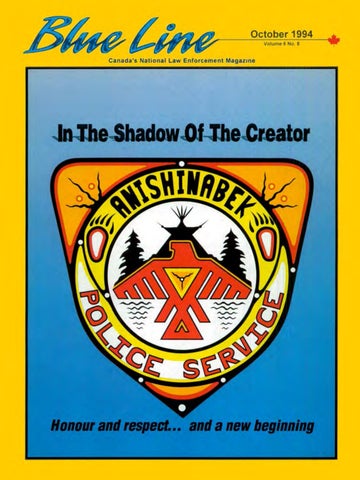
This issue we have the crest of the Anishinabek Police Service gracing our cover. You will fmd a Commentary piece on page 5 and the complete story surrounding this new police service on page 26. We congratulate the Anishinabek people on the creation of this new and innovative police agency and look foward to their success. Inside this issue you will fmd many articles of interest to those concerned about personal body armour. While doing research on this subject it was discovered that, as one manufacturer stated, "there is a lot of smoke and mirrors to deal with." We found there was a lot of subtle disagreement between styles, types and preferences of body armour. It was decided to include an angle that we felt had not been dealt with properly up to now. That is the history of where this personal body armour had come from, who invented it and how did it develop. You will fmd these stories start on page 6. Next month we willietthe manufacturers tell their own stories about what is new in body armour. We hope you will enjoy this two part series and have a better understanding and appreciation for that armour we hope you put on each and every day. This month we also present a series of articles outlining the story behind the last persons to be hung in each of Canada's provinces. Blair McQuillan, our staff writer, did much of the research and reports it was quite fascinating doing the research. We have entitled the series "The Last Noose " and begin with the "Land of Anne" on page 18. Once again we hope you enjoy this issue and don ' t forget to put on your vest.
ndabetter ....eworld. anywhere ouwon
Model 92/96 Centurion and Model 92/96. 17/ high
capacity horlelwd alld talldard version oftlw wgendar)' Pistol l/rat protect ,1IllCrica.
Model 92/ 960.
/)ollhi uLium 01111', Feullln'l l/t,k Ilid II' I III
ll'llh Il() xl mal lafcly /('lW allLl a /!on""J /111111111('(.
Model 92/ 96
Centurion. Sew --..",...
/lOrU'IIcd, hig/r-capacity version oflhe 92/96FmO<lel . 15+lfirepqu r(9I11m) and JJ+ljirepau.'er (, /0 cal.), with a compact iud lide alld barrel,
Mod I 92/96F.
I.{'golJur)' rdi"nllil)'
Model92F Stainless. III tI
feature , reliability andjirejxr..cer of the tandard 92FPistol, \ 'C'"«lmatlc Lainie finish , Solid staillw slide and barrel. Black pIa tu grip .
III gmlll or /0 wli""r, ................
1,,)+1 fircpau.oa([nlllll) ami JJ+ljin'/!{roL'L'f( /0 cal,). IAmMe/ IIII,?1 "L/IOII, !t'il/r i!xlcmal la[l'lr/cI ()(king I
r,
Ber tta Operating Systems F Mod I - /~J/I~~ ' In 'k ~LlIOII, 14'/111 xhrnu/ 'i<l/d,v df,()(kln~
Model 92/96D Centurion. Dollble
actioll ollly t'l!rsioll of tire IIlllnoll. Featllre lick lide y temwit/r 110 exlcmal afety iet'l!f alld a bobbed hammer.
r
o Mod I -/NI4~~ uLlum OIl1.V
14'11/10141 Iu(dv mr (IIkk \lui J
8) Beretta U.S.A.
Model 92EL. 17U1iegendary
reliability and fealllre of tlUi 92F. " Jeitll bnght bllU!d finish , distinctire gold inlay and richly grailled waIn lit grip ,
3-dot and tritium night sighl amilubl;!,
Volyme 6 Number 8 - October 1994
- EDITOR I PUBLISHER Morley S. Lymburner Phone (905) 640-3048 - FAX (905) 640-7547 - Contributing Editors Ballistics & Firearms Survival Tactics Case Law Supervisory Principles Peer Counselling Computers & Technology
Manfred Benton Craig Best Gino Arcaro Robert Hotston Neil V. Thompson Tom Rataj
- ADYERTISING Mary Lymburner (Toronto) Phone (905) 640·3048 FAX (905) 640.7547
Ron Ganton
(Vancouver)
Phone (604) 274·3849 FAX (604) 274·9091 Richard Hubbard (United States & Quebec) Toll Free (800) 268-5503 Fax (905) 51J.13n
- CONTRIBUTING WRITERS Gary Miller Myron Love Craig Best Blair McQuillan Neil Thompson Morley Lymbumer - ILLUSTRATION Tony MacKinnon Bette Clark Dave Sills Dave Bluestein
General Manager Mary K. Lymbumer, M.Ed. Blue Une M.g.z;ne Is published monthly. September to June, by Blue Line Magazine Incorporated with a mailing address of: 12A· 4981 Hwy. 7 East, Ste. 254, Markham, Ontario, L3R 1N1. EdItortal and copy II conaldered to be con.,ltIeIy laparate from aclveo1lalng ..lea. No convnItmtnt 10( editorial covwag. can lonn any part 01 I lilt IgrHllltnl All eo1Iclea . . prottcttd by copyrl~Noplrtolthllpublcationmayberaproduc:edornntmitttd
In any fonn or by any melnl, .itc:tronic or mteIIankaI. inducing photocopying andracorclng orby any Infonnalion Itorlgt00rtblevaJ lyatem without ptrmillion from the publlhw. Th. authon. advlaon and pubUahw ICCept no Uabltily wflaIIotvwlor any Injurltt to penonl or property r"ulting from the appNcation or ldoptlon 01 any 01 Ihl procedur.l. lactiCI or conaldtrotlonl pmtnlad In WI mag.ul... R. . . . . . cautioned and advIltdthatlrtlclea pmtnlad hwtln . . tdI\ad and luppied for your penonaJ awar""1 and lhould not be Uled for furthw ac:Iion until appropriata advice and guldanCll1 received from a lupervllO< or Crown AlIDmty. BJut Unt Mag,zlnt II an Indaptndtnl publcatlon dealgned to tn\IrttIn, tduc:ata and upgrade the skiUs 01 tholtlnvolved In th.1aw .nforctmtnl proftllion. It h.. no dlrtct control from a law tnforcemtn\agency and Ita opinions and Irtlclea do notnec"urliy rtfltd the opinions 01 any govemmant. polca, or law tnfOt'ctmtn\ agency.
Blue Line Magazine Is printed in Canada By Pro Art Graphics
.
-Member-
international Alioclatlon of LAw Enforcement Planners Canadian Advertiling Rat.. & Data Periodical PubUlhers Exchange
~~~a.
GARD ~ ISSN #0847 8538 Canada Post Canadian Publications Mail Product Sales Agreement No. 176796
Last April Blue Line Magazine was invited to follow along with the progression of a new beginning for First Nations Policing in Canada. But it was found to be far more than a beginning of a new police force. To the organizers and community leaders it was an indication of how they have come of age with the "whiteman's" community. As I attended the training seminar near Orillia last June, I was invited to join a circle of police officers and members of police services board members. At that time I feltthatthis was simply a convenient way to converse as a group. I was later to find that the significance of the circle, and inclusion in it, was far more meaningful than originally thought. For centuries it would seem as though the First Nations people have been walking in a shadow of gloom over what was a great people and lifestyle. As if in mourning they drew inward, in many respects cutting themselves away from, and being cut off by, mainstream society. Historically it is very understandable. The coming ofthe whiteman was a considerable culture shock to a basically peace loving society that existed in tune with nature. The Indians were the people who understood man's vulnerability. For thousands of years they had learned to adapt to the environment and understood the true power of "the Creator". When the seasons change there was nothing man could do to stop it. Life was not looked upon as something that simply begins and ends. Everything was seen to go in circles. The seasons changed, the sun rises and sets, the moon passed through its phases and man was born and returned to the soil. The traditional "Medicine Wheel" was a very powerful factor in native culture. Again it represented nature's wheel and how everything made by the "Creator" was in balance. If someone was sick or a relationship was troubled it generally meant that something was out of balance in the "wheel" of life. It was at times like these that it was necessary to determine what was out of cycle and bring things back to balance so the cycle of life can continue. Upon the arrival of the whiteman the native peoples saw a new culture that came with ideas of opportunity and exploitation. A people who were motivated by greed and denied man's weakness or subservience to nature. They came with unimaginable ambition, tools and technology to ensure their success. By brute force or guile they would have their way.
Slowly but continuously the whiteman forged ahead. The first nation people were a hindrance to their progress and ways of controlling them and putting them out of the way were sought. An arrogant attitude of superiority caused many of our forefathers to hasti ly produce treaties that were, at best, ill thought out and vague. Both sides had their own idea as to what they were signing. Today it is clear we have a different type of native. We have a more knowledgable First Nations people and one who understands the full impact of what history has dealt them. There is a strong feeling of receiving back what is rightfull y theirs. This is a generation who can understand far more clearly what both sides of the cultural table was thinking when the treaties were signed. The First Nations people also understand to survive they must open up the dialogue with governments and must be respected on equal terms as a nation, not just a people. They gave up land but never gave up their idea of community or nationhood. As I entered that circle of cops I discovered each participant's desire to "keep the circle strong." As each officer spoke about their sense of community and duty it finally dawned on me. It is the strength of the group that gives strength to the individual. The strength of the circle ... everything in balance ... the strength of the wheel... the power of the Creator's presence. I was honoured that day to experience a police training session like none other. I came away fee ling these people have come of age. They deserve every bit of the autonomy they desire. The control over how they keep their own peace in their own community is vital to a new beginning for a very proud people. We have no right to deny them this. "We have watched and learnedfrom the whiteman's ways but are stuck with the cards played by our ancestors, " said one native leader to me as we spoke over lunch . "They never understood the rules of that game completely. It is up to us, who understand that game, to pick up those cards and play by the whiteman's rules. A bigpart of that is to try to right the wrongs of the past to some degree. We understand that we must live, as much as possible, with the whiteman's society and respect our neighbours. But we must have honour and respect for the ways ofour ancestors and the will of the Creator. We all walk in the shadow of the Creator. "
~ ~~ October, 1994 _ _ _ _ _ _ _ _ _ _ _ _ _ _ _--'l~I--------------..... -=-.!:=c'""'~ ~-~ . ~7-
ness, his experience with the shooting and his military training lead Davis to become When it comes to a cop facing down a crook there is no interested in the possibilities of the then new Kevlar material. Geneva Convention on how the battle will be fought. Davis found that unlike military casualties, police officers were most often shot unde:- conditions which were totally by surprise and at close quarters. He also realized that with this element of surprise in favour of the perpetrator the use of a visible flak jacket would cause more shots to the head. Thus he came up with the idea of a concealable body armour that was more comfortable for encouraging constant use. Davis then set to work making the first concealable body armour and setting up Second Chance Body Armor. He then set about the arduous task of convincing police .. officers that they should wear it and that it will work. This proved to be the most diffi~ cult task of all and is one that still exists. Davis initially attempted to make sales ~ to police departments and found little in"5 terest. He found himself fighting what he ~ referred to as the "Pre-Pearl Harbour" syn~ drome. Nobody believed it could happen to them or their department. This apathy Personal Body Armour is one way to tilt the balance ofpower in your favour. But it was terrifying to a man who had faced only works if it is used and used regularly. While doing research on this subject one message came through loud and clear. No body armour has ever failed to do what it down three attackers in an alleyway and was designed to do. In the next two issues of Blue Line you will be introduced to knew that the odds of it happening to a cop ome nice to know information about personal body armour. The series is designed was extremely high. to inform you on what is good about it and shaller afew myths as well. Davis fmally got frustrated with putting his Second Chance vest up against the It is difficult to believe that in the past was very quickly identified as suitable for firing range and shooting at it to show officers that the bullet would not pass ten years 33 Canadian police officers owe law enforcement purposes. their lives to the talents and ingenuity of a Early statistics indicated that over 80 through. They were always impressed but woman and a Pizza store owner. percent of police officer gunshot casual- somehow never convinced. Finally he atIn 1965 a Du Pont scientist, Stephanie ties were from lower powered handguns tended a session with about 40 members Kwolek, invented an extremely strong up to 38 calibre. A surprising 85 percent of of a police force and went to the front polymer based fibre that later received the these were shot in the upper back or chest podium, pulled out a .38 calibre handgun Registered Trade Mark of "Kevlar". She areas, locations which would be normally and placed it up against his chest and fired. found that the fibre had the same tensile protected by body armour. He then smiled and told the astonished strength of steel yet was pliable enough to These statistics were enlightening but officers that just because you are shot does be woven into a fabric. far from encouraging. The big job was to not mean you haven't got a second chance. Ms. Kwolek served with distinction for determine how to first of all manufacture Davis has since demonstrated this on over 40 years with Du Pont and retired in 1986. the product and, most importantly, get 150 other occasions. he was recognized as the scientific com- every officer in the country to wear it. At one point he convinced a Detroit munities leading researcher in polymer This last part was the most difficult special police squad to obtain the vests. A and fibre sciences. he presently holds 17 because most police agencies were made purchase order for $2500 to equip them U. . patents and 86 foreign patents related up of ex-military people who only remem- was turned down by a city purchasing to her work. She is also the proud recipient bered the 25 pounds of dead weight they agent. Two officers were later killed beof many honours both nationally and inter- had to carry in Vietnam. It was not going to fore they decided to go ahead with the purchase. nationally including the Prince Phillip be an easy sell by any means. In 1969 a Detroit Pizza store owner, This departmental resistance was in Award for "Polymers in the Service of Mankind." Richard Davis, was accosted by three mug- stark contrast with the officers on the street In 1967, at the height of the Vietnam gers in an alleyway. Davis was shot twice who knew the streets and the threat. Davis War, tests on an intricately woven 1/8th by the assailants and returned fire striking simply shifted his focus from the chiefs office to the copper on the streets. With inch portion of Ms. Kwolek's creation suc- two of the three. ce sfully stopped a .22 calibre rifle bullet. Davis recovered from the incident but each individual vest sold he guaranteed he The perfecting of the material weave his business did not. Shortly after the inci- would refund the officer if their departfinally achieved a level of protection that dent his uninsured pizza business was ments decided to purchase them as standard issue. The policy eventually paid off would stop bullets from handguns. Al- burned to the ground. Driven by a need to find a new busi- for Davis and the cop on the street. though not as useful to the military field it
J
8
) - - - - - - - - - - - - - - - - - October, 1994 ~~~~~================~6~------------------------
~
TACTICAL VE§T This unique one piece wraparound ballistic vest is the standard by which all other police Special Operations vests are judged. The basic design provides ballistic protection in all areas covered by the nylon cover. There are no hidden gaps or non-protected areas under the cover. The smooth front cover design permits the use of sewn-on or removable pockets, as well as excellent compatibility with common load bearing vests . When functioning for long periods of time in a police tactical environment, the number one choice in ballistic armour is the Armour of America fifth generation Tactical Vest.
Optional: Front plate pocket for 10" x 12",14" x 12", or 14" x 14" hard armour insert.
HARD ARMOUR
ARMOUR OF AMERICA
Hard armour inserts produced by Armour of America all feature a ceramic faced impact surface. No use of ferrous or non-ferrous metals. The use of such material in hard armour inserts can be dangerous. Projectiles impacting metal will either produce excessive small fragments or ricochet.
(SA APPROVED
BIOKINETII:§ CANADIAN POLICE RIOT HELMET
The CANADIAN Police Riot Helmet is the culmination of a five year joint effort between Biokinetics and the RCMP. A combination of fibre reinforced resin and four different polymers has resulted in a helmet that provides protection against a steel pipe to the face, as well as it does to the rest of the head. It is also impervious to caustic liquids and flaming hydrocarbons, and possesses a faceshield with optical properties equalled only in NATO aircrew helmets.
PROTEK POLICE BODY PROTECTION EQUIPMENT The purpose of the development of the PROTEK body protection equipment was to provide police officers acting in violent demonstrations or riots with an optimized protection against knocks, kicks or missiles. Highly flexible and fully adjustable interactive parts protect all areas of the body without constraining body movement. Please contact us for complete details and information.
These and a wide variety of other fine p roducts are available from
R.NICHOLLS INC. Distributors
LONGUEUIL, QUE. OnAWA SALES, ONT. MISSISSAUGA, ONT. EDMONTON, AB. FREDERICTON, N.B. GOULDS, NFLD. TRURO, NOVA SCOTIA
TEL: (514) 442-9215 TEL: (613) 737-0261 TEL: (905) 629-9171 TEL: (403) 973-3999 TEL: (506) 385-2484 TEL: (709) 368-0999 TEL: (902) 893-3288
FAX: (514) 442-9581 FAX: (613) 737-0261 FAX: (905) 629-9184 FAX: (403) 973-3291 FAX: (506) 385-2499 FAX: (709) 368-0991 FAX: (902) 893-3227
ci nti t report that about one and one-half million people are infected with the AIDS vim .
Occupationally tran mitted bloodborne infection account for an e timated 250 death per year.
DuPont BioWear di po able apparel can help protect you from infectiou fluid . n
,
In y ur w rk, you can't afford to tak unnece aty chance. With infc ti n by bl me path gen uch a viru e and ba tcria an ever-pre. ent p ibility, you need all the protection y u can get. r y ur If... and th e y u go home to. rtunatel , u an unt on DuP nt BioWear apparel. Ma I int com~ rtabl ,ea y-to-wear protective apparel of yvd: , yvek' Barri tat and om~ rMax™fabric , DuPont Bi Wear ffer n ed d pr tection in a variety of chemical and iral sur : ituati n .
Gamen of DuPont BioWear feature quality con truction and generou izing for men and women in a ariety of tyle . . And the e are the FA ou can live with. For more information about DuP nt BioWear arment caJll-800-663-7027 toda .
<®]iTINr
BioWear™ nly by DuB nt
spills, and even bull gorings, helicopter crashes, and lightning strikes. FBI statistics indicate that hundreds of additional lives could have been saved had personal body annour been worn. Nothing protects totally - but today' s personal body armour is the best ever available.
Classification
Illitially people marketillg body armour IIad a problem cOllvillcing cynical cops tllat tllese products could actually do wllat tlley claimed. Tile development of standards lias fo r tile most part removed tile almost mystical claims made by earlier producers of armour and lias created a IIigll credibility factor witll law enforcement agencies world wide. During the early 1970's, the invention of concealable body annour by Michigan based Second Chance Body Annour and the availability ofKevlararamid fiber made production of routinely wearable body armour practical for the first time. Since the introduction of the Kevlar material other products have come on the market that possess the same tenninal ballistic capabilities. Allied Signal created the Spectra material as a waterproof flexible thin shield and more recently as HyperLite which mixes Spectra shield material with a Spectra based cloth. European based Akzo created the Twaron fi bre which is similar in concept to Kevlar and can be woven into a fabric for use in annour. Today's applications go far beyond personal body annour. These materials have been used effectively in military helmets, shielding for police cars and helicopters, tire reinforcement and most recently in weapon unloading stations (see article this issue). Modem manufacturers of body annour are increasingly moving toward hybrid mixing of materials in order to accomplish maximum protection with maximum comfort for the officer. In this quest for balance competition is keen and innovation and creativity is nothing short of amazing. Although bullet resistant vests are pri-
marily designed to ballistic standards, they truly are personal body armour. They have protected hundreds of police officers from death or serious injury during handgun, shotgun, club and slashing knife assaults. Personal body annour has also helped minimize injury during automobile accidents, falls, explosions, fires, motorcycle
Personal body armour is de igned to resist firearms threats which range in severity from small caliber handguns to high velocity rifles. Fireanns threats are predicated on these factors: composition and geometry of the projectile, weight (mass) of the projectile, impact velocity of the projectile, impact angle of the projectile, composition and thickness of the projectile jacket. Because of the wide variety of weaponry and ammunition, including hand loads, that are available to the general public, the factors listed above may change, leading to a change in level of protection required. For example, annour designed to defeat a copper jacketed 9 mm lead core bullet at a given velocity will not necessarily defeat the same round at the same velocity if that bullet has a steel jacket. To this end it was recognized fairly early that some sort of standards must be set for the types of body annour available to officers. To date there are two recognized standards set for testing armour. One standard is set by the National Institute of Justice (NIJ Standard) and the other is the Personal Protective Armor Association (PPAA Standard). Debate and argument exists on the manner by which annour should be tested but the major consensus still follows the NIJ Standard simply be-
Custom Canadian Manufacturer Any Task ••• Any Season ~~~----~~~~
Extensive line of outerwear including Jackets, Parkas, Insulated Pants, Bicycle Foul Weather Suits & Shorts
~--~~
Full range of fabrics to choose from Waterproof breathables, Leathers Zip·ln Zip-Out Insulations made with Thinsulate
~ ~~.'" October, 1994 ------------------>.~)---------------~::::...!:..<=>;~~~~-=-
cau e it is viewed by many as being more objective in appearances. The test ammunition specified herein i ba ed on up-to-date, comprehensive reearch and represents the most common threats to members of the law enforcement community. Personal body armour covered by this standard is classified into five level of protection.
NIJ LevelllA This is the minimum level of protection that any law enforcement officer should wear. This level represents protection from low energy handguns (.22, .25, .32, .38), horter barrel medium energy handguns (.3 57 Magnums, 9 mm and .45 ACP) and many .22 rimfire rifles.
NIJ Level II Thi level represents protection from higher velocity, medium energy handguns uch a six-inch barrel .357 Magnum . It also represents protection from most shotguns. 92% of those United tates officers slain with firearms between 1980 and 1987 that might have been protected by body armour needed the protection afforded by Levels II and IIA .
NIJ Level iliA This level represents historically infrequent threats from high energy handguns . Bullet resistant ve t in this classification may not be comfortable for full time wear by all persons in all situations, particularly during warm weather. This level also represents protection from 9mm submachine guns. The wearer of this level of protection is most likely to encounter multiple hits from automatic weapons.
NIJ Level III
wear. Typically, it is carried or issued for special situations.
Body Armour Selection Selection ofthe appropriate amount of protection and coverage is vital to maximizing the number of officers who survive life threaten ing incidents because they wear soft body armour. Generally speaking, the more protection and the greater coverage, the better an officer is protected - but only if that officer can and will wear the armour selected. Current information suggests that armour wearability might not have been adequately considered in many purchasing decisions. The general rule of thumb for selection of concealable body armour is:
Buy only as much protection as you can comfortably wear - all the time!
body armour. Over 92% of those officers whose lives might have been saved by soft body armour needed torso protection from low-medium energy handguns, .22 rimfire rifles and shotguns. These incidents ranged from one to five torso hits, averaging less than two . On the positive side, the IACPIDU Pont Kevlar Survivors ' Club data shows that officers whose lives are being saved by body armour are surviving the same types of assaults (and accidental threats) as those who are dying without armour.
Specific Issues To Consider The types of weapons being stolen, confiscated and used to commit crimes in your region are all strong indications ofthe threats with which law officers might be assaulted. To the extent that wearable protection against these threats can realistically be provided, they should be considered in the selection process.
Changing Threats During the early 70's when soft body armour was first developed, most officer fatalities were from low energy handguns. These " Saturday night specials" today, represent only about half ofthose incidents where the use of concealable body armour can prevent a tragedy. Today's officer clearly needs protection from low to medium energy handguns, .22 rim fire rifles and shotguns. Many law enforcementpractitioners believe the trend towards higher energy threats will continue. Again, to the extent that wearable protection against these increasing threats can realistically be provided, they should be considered ......'---"--_ _ _ _---"=""_...a. in the selection process.
Officer'S Weapon This level represents protec- New York State Trooper Skip Beijell dispLays typicaL bruise tion from typical high power hunt- caused by .357 magllum halldgull. No serious illtemal Typically, about one out of every five officers feloniously slain is ing rifles and NATO military ri- illjuries resulted. killed with their own service fles . Typically soft body armour weapon. Therefore, compatibility of the General Background in this category is augmented with addiRecent studies initiated by the PPAA officer' s weapon and ammunition with his! tional materials, such as steel, ceramic or indicate that the law enforcement profes- her body armour is fundamental. This is not rein forced plastics. aution: ertain types of Level III armor sion is growing more dangerous. Total only important to recognize in the body may not withstand four or five impacts assaults and assaults with firearms are in- armour selection process, but also in any from bullets specified in Protection Levels creasing, more than I % per year, as are weapon or ammunition selection process. Work Environment accidental duty deaths. Since most ofthese in IIA , II , lIlA . Temperature, humidity, normal work deaths occur during routine duty assignN/J Level IV Thi level represents protection from ments, this makes the daily wearing of environment and type of duty assignment armour piercing bullets fired from rifles. concealable body armour even more im- are all important considerations to the extent that they may well impact the type of oft body armour of lower protection lev- portant than before. Conducted by Du Pont with the assist- coverage and amount of protection that is els will not stop this type of threat without being augmented with additional materi- ance of the FBI and IACP, these studies wearable. Armour configurations being al , such as steel, ceramic and/or rein- indicate that more than one third (236) of considered should, when possible, be evaluthe 657 felonious fatalities that occurred in ated for wearability in the climate, work forced plastics. Levels III and IV represent special pur- the US during 1980-87 might have been environment and type of duty assignment pose armour not designed for full time prevented by wearing soft, concealable in which they will be used.
~~~~~~~=============-=t 10 )-_ _ _ _ _ _ _ _ _ _ _ _ _ _ _ October, 1994
Individual Preferences There is growing recognition that the ability of an officer to be comfortable and mobile while wearing body armour can be a highly individualistic issue. For example, some officers can wear relatively heavy, stiff, high coverage armour without discomfort. Others feel heat stress and/or claustrophobia in lightweight, soft armour with full side-panel protection, but will willingly wear the same vest without side panels. Here again, the issue is to select as much protection as the officer will wear.
Side Panel Versus No Side Panels Recent statements that "most common fatalities among officers wearing armour result from bullets entering an officer's side between the front and rear armour panels" are erroneous. FBI data shows that during 1980-1987, 125 law officers were killed feloniously while wearing soft body armour. 10% in what might have been the side panel region. While side panel protection is desirable and increases protection, this selection decision must be measured against whether or not the individual officer can and will wear the extra coverage.
Water Repellency Non-water-repellent fabrics exhibit a temporary reduction in ballistic capability when soaking wet(> 15% moisture pickup). When the armour dries, full performance is restored. For this reason, an officer who might expect to become soaked during his assignment should consider purchasing water-repellent treated body armour. However, today's water-repellent treatments tend to make ballistic fabrics noticeably stiffer, and some officers feel hotter and less comfortable wearing them. Both the FBI and Du Pont have conducted scouting studies on the effect of perspiration on body armour. Through June 1989, there is no evidence to suggest that an officer might soak his vest with enough sweat, during normal duty assignment, to affect ballistic performance.
The Teflon Scare There has been a lot oftalk about Teflon coated bullets penetrating body armour. Bullets coated with teflon tend to be the much higher calibre bullets designed to penetrate armour. These bullets are of the NATO military type and are not of the types used on the calibres of weapons personal body armour is designed to stop. Again it should be made clear that personal body armour is designed to protect officers from the types of weapons he or she will most likely come into contact. Do not let the fact you are wearing body armour overide your concern for safety. Good common sense must be present in abundance whereever firearms in use.
Second Chance is setting the standard by which all other concealable armor will be measured! Monarch™ is constructed of 1 00% fourth generation ballistic fabric... ARAFlEXTM*IV. Monarch's exclusive Butterfly Lite™* stitch pattern delivers superior multiple hit capacity in All THREE threat levels without loss in ballistic flexibility. The exclusive GORE-TEX COMFORT COOlTM* breathable ballistic panel cover surpasses All Nil waterproof-
ing standards and the CooIMax T "* carrier system offers supreme comfort wear in all temperature zones. No other concealable armor available to the police community today has any two of Monarch's advantages. Monarch is, by far, the .___~." lightest, most flexible, breath- ?-- ';'"~ able and most comfortable .~ concealable body armor _~ "'~,',. . made today ...
ifE -;
by the world's most successful soft body armor manufacturer! ~
SECDND CHANCE
P.o. BOX 57B' CENTRAL LAKE, MI 49622
~
800·253·7090 • FAX 616·544·9824
-MONARCH r",. ARAFlEXTIot And Butterfly lite T IC .ne registued tr~demAru of Second eNnCt for ",hich patents iIIrt' p4':nding. CORE-TEX COMFORT (OOlfl( is ill rqij:tered t,a<klna,k of W.l. Core &- AssociiltH, Inc. Cool~'( I'" is iI registered trademark of DuPont.
------------------~g~------------~~~~~~~ -~~ October, 1994 -----------------\~ ~
1991 - An Edmonton Police officer responded to a call con~=~ cerning a domestic dispute . Upon arrival at the suite door, the officer was met by a man holding a hunting knife. As the officer requested he drop the knife, hewas stabbed in the abdomen.
1991 - A Peel Regional Police on routine patro l stopped to check out a suspiciously parked car. Upon questioning and subsequently searching the driver, the officer discovered a revolver. At this point, the passenger exited the vehicle and commenced firing at the officer. The officer was struck once in the back near the spine with a 9mm bullet. ~~-/officer
~
1991 - Ontario Provincial Police officer with the canine unit was called in to track three Olltario Provillcial Police Sergeallt Jim McGuigall didn't IIave to be sllol armed robbery suspects in the to be convillced to wear his body armour aIL tile lime, but a youllg officer _. bush of Northern Ontario. ~t9''':o>.:o;:»,.. ullder IIis command did. COllstable Scott Couse (upper left) of tile Barrie Detacllmellt stopped a speedillg car wllile patrollillg higllway 400. He was While tracking the suspects, the officer ullaware til at tile occupants IIad just murdered tile two occupants of tile was ambushed and shot in the chest with a vellicle. COllstable Couse approaclled tile car alld was sllot at point blank range ill tile clle t witll a IIeavy calibre bullet. Ollly tile armour lie was wearing saved 12 gauge shotgun from a distance of apIlls life. "The mes age came through loud alld clear," said Sergeant McGuigan. This proximately 2 metres. isju tone ofthe 33 stories collectedfrom Canadian Police Officers by Du Pont Inc. over the pa tten years. Each story is a stirring reminder ofthe lives that could have been lost if it were 1I0t for the body armour WOTll. What follows is just a sampling.
Y!!lf!!
1981 - While attending a hospitalon other business, an Edmonton Police officer appeared Y.:zt~~ on the scene of an incident involvIng a federal prisoner who attacked his guard with a home-made knife. While subduing the prisoner, the officer was severely sla hed on his chest and stomach. ~ ••COU'' '
1984 - A Vancouver Police officer, while on foot pursuit of a robbery suspect, was shot '\ J' in the front torso area with a 12 'to'D ",,+ . ... gauge shotgun. WhIle down, the officer was shot in the back.
....... u....
1988 - A Vancouver Police officer, while investigating a residential break and enter, began ~ ;- a conversation with the suspect -v'"• .....' .'" who had been posing as the
owner. The suspect pulled a 6 inch bayonet and stabbed the officer.
1988 - Halton Regional Police officer, while pursuing a sus~I~~."'" pect on foot, was ambushed ~ '" and knocked unconscious with ··.'o"·~ a wood plank. The officer was then stabbed twice in the back with a flat end screwdriver.
\,
thrown out of the club. The patron returned with a 9mm semiautomatic and shot the officer 3 times in the front panel of his vest. ,
1993 - Upon investigating a call that someone was being threat~ .. ! ened a Metropolitan Toronto Police officer had a cup of coffee thrown into his face and was stabbed repeatedly with a pair of garden shears.
t ..
-~~
0.
If your agency experiences an incident where a member of your force was saved by protective body armour or you would wish more details on other saves you may call Du Pont Canada Inc. at (905) 821-5601 or write them at: PO Box 2200. Streets ville. Mississauga, ant. L5M 2H3.
~~~--------------------------712~-----------------------------------
} - - - - - - - - - - - - - - - - - October, 1994
ur
The chart above shows the results of studies performed by U.S. Department of Justice through interviews with perpetrators. Although the subjectofpolice officer deaths is grim, the knowledge gained can be beneficial when trying to understand the threat that exists on the streets. The report states 72% of the victim officers in the incidents selected for study were killed as a result of handgun wounds.
Other weapons used in the victimization ofthese officers include rifles at 13%, shotguns at 9%, and other weapons at 6%. The clear predominance of handguns as the weapon of choice used to victimize officers leads to further delineation of the handgun cartridge types. The chart above shows the differential involvement ofa variety of handgun cartridge types in the killing ofthese officers.
In the selected study incidents, the .38 Special was used in 41 % of the slayings as compared to the .357 Remington magnum in 15%. The 9mm Luger and .32 Smith & Wesson were used in 10% each. Although specific cartridge types used in the killings have not been included in the FBI historical data, handgun calibres have. The data on all officers killed during the past decade indicate similar weapon use with .38 calibre handguns being used 39% of the time, .357 magnums 24% of the time, and 9mm weapons 9% ofthe time. Interestingly, 85% ofthe victim officers in the study did not discharge their service weapons. This information about handgun type and use has implications for tactical and training aspects related to reducing the likelihood oflaw enforcement officer deaths. Another interesting portion ofthe study was the response of the perpetrators when asked why they selected the weapons they used. The answers were a true enlightening picture of the American life style. Over 72% said they chose to use a handgun because of its availability. It also found that only a small portion were actually familiar with its use prior to the incident. For acopy of this study write U.S. Dept. ofJustice, Federal Bureau ofInvestigation, Uniform Crime Reports, Washington DC. 20535.
Have You Seen This Child? This is a monthly column supplied by the Royal Canadian Mounted Police Missing Children's Registry in cooperation with Blue Line Magazine. All material supplied is copywrite free and may be distributed to local media.
Readers who feel they know the whereabouts of this child are asked to call
(613) 993-1525 or Fax (613) 993-5430. Or
National Center for Missing and ExplOited Children Name of Child: EMMA CHARLOTTE HALLAM
Sex:
Date of Birth: 15 DEC 86
Race: WHITE
Details
Height 4FE£T
Weight: UNKNOWN
Hair
Date last Seen MAY 16,1991
Missing From: LEEDS, ENGLAND
BLONDE
Known Abductor. HAS A 8ROAD YORkSHIU ACC£NT, A MARTIN HALLAM ~=::PA~~~;~':!'£~~~~~o~~:~£ IN
FEMALE
Eyes BLUE
Sex: MALE
Date of Birth: MAY 1,1960
Race: WHITE
Relation To Child FATHER
Height
Weight: t1NKNOWN
Hair Eyes GINGER BRN. t1NKNOWN
6'1"
1-800-843-5878
--------------------~~J _____________~~~~~Lb~~~~ October, 1994 -----------------------'.~ ~
By Marti" Groleau rime Prevention Ontario, in association with the rime Prevention Association of an ada, hosted the I st National rimePrevention ymposium at the Days Inn Jlotel in Mississauga, Ont., April 2830, 1994. It was the first all-Canadian, crime prevention practitioners' symposium to be held in ntario . ver two hundred people from across anada and the United States attended the ' Aim for Change" symposium which brought together representatives who hared a common objective: making their communities safer. Delegates who participated in the symposium included police officers, educators, retail sale employees, civilian volunteers, local transit authorities, and government representatives, to name only a few . The symposium also provided an e cellentopportunity for manufacturer who specialize in crimefighting technology to display their late t offerings. Delegates had the opportunity to meet manufacturers' representatives and discuss trategies with regard to preventing crime.
Breaking Social Conditions Vs. Increasing Punishment The symposium opened with keynote peaker Ross Hastings, a leading criminologi t from the University of Ottawa, whose remarks focused on crime prevenlion through social development. "We have to layer into our concern for enforcement and punishment, a concern for rehabilitating the people who commit crimes and more importantly, set up services and programs for the people who are at ri k at becoming those individuals," said I [a ting . Ilastings believes crime is usually a predictable behaviour and he advocates focu ing our resources on breaking the cycle of poverty, unemployment, illiteracy and other social conditions which are conducive to leading individuals to commit crimes. Ilowever, although an increasing number of police officers agree with this principle, the public as well as politicians ha yet, to be convinced. According to Iia tings, politicians need to look at social development instead of changing laws, in ord r to impose harsher penalties to fight rime. This particular point, however, is not
shared by fellow guest speaker Bob Horner, former M.P. and chairman of the Twelfth Report of the Standing Committee on Justice and the Solicitor General. In his address, Horner stressed the fact that we must focus on youth, referring to proposed changes to toughen the Young Offenders Act. He strongly believes that "young offenders become the adult offenders of the future" . Therefore, we must "ensure that the punishment fits the crime" in order to discourage young people to commitcrimes. " We must also take priority in educating our children about violence and crime," he continued.
A Learning Experience for Many Street crime, elder abuse, violence in schools, tourism crime, gangs, community policing, telemarketing fraud, the occult and the prevention ofretail theft were among several workshops featured on the agenda during the two-day event sponsored by 14 companies and organizations. These workshops allowed delegates to share information, strategies and techniques on crime prevention, while exploring new approaches to proactive community policing. The street crime workshop directed by a detective from Metro Toronto Police discussed the growing problem of youth violence in the community and how to minimize it through education and enforcement. The telemarketing/con games workshop covered a variety of tele-marketing pitches and provided advice to business retailers and the general public on how to better protect themselves. The occult presentation featured an expert police officer from the Chicago Police Department who gave a fascinating lecture on the identification and investigation of ritualistic criminal activity, which is becoming increasingly prevalent in our society. Other workshops such as elder
~~~~~~~==========================~14~
abuse, victim services and volunteer management focused on specific issues related to each of those target groups . Sgt. Don Jones of the Kenora District headquarters of the OPP was one ofsevera I representatives who took part in the symposium . " I was particularly impressed with the presentation on street crime which gave me new ideas on how to deal with school boards, in an effort to establish a policy on the issue of youth violence," said Jones. "The conference also gave me the opportunity to share policing experiences with representatives from other provinces. I think it was a valuable learning experience," he added. Rosin Barley, the symposium coordinator and Crime Prevention Ontario representative for the Town of Oakville, Ont., had high hopes that this conference would give participants ample opportunity to engage in a collective problem-solving process. Barley maintains she was satisfied with the feedback provided by attendees at the close of the conference. " I th ink that these talks served a dual purpose in the sense that people got to share information amongst themselves, and that they will hopefully return to their communities with a more creative approach on crime prevention which will benefit everyone," she explained.
Individuals Recognized At the close of the symposium, 16 Ontario citizens received a provincial award from Ontario ' s Solicitor General and Mnister of Correctional Services, David Christopherson, in recognition oftheir contribution in a crime prevention endeavour within their community. Among the award recipients were people who had given countless hours to work as volunteers in such programs as Neighbourhood Watch, Block Parents, Citizens on Patrol, Crime Stoppers, and M .A.D.D. (Mothers Against Drunk Driving).
Nex t Year - "Aim For Change" The theme for the 1995 National Crime Symposium will be "Aim For Change". This is scheduled for April 27 to 29 at the Days Inn Hotel, Mississauga. It is expected that this second symposium will be bigger and better than this year. For further information contact Rosemary Raycroft (705) 326-6464 Fax (705) 325-7725 or Kirk Anderson (416) 324-4308 - Fax (416) 324-4302.
_______________________________ Ocwbe~1994
A pre-release review of upcoming Windows version of the CPIC interface
Tom Rataj Computers and Technology Editor
The Canadian Police Indata between applications, an formation Centre (CPIC) : """_ on-screen tool-bar for com," " " _ mon functions and a menusection of the RCMP is all set to release version 1.0 of - """_ bar for complete application their newly developed : . "_ control. " ,,~ CPIC for Windows ver. Microsoft Windows version of the CPIC interface. Set - - """ TM 1.0 will provide users with for fall release, the new 'l. A'TCDjOS· O~ the same basic functionality Graphical User Interface IVll .N r 1(2 of the current non-windows (GUI) will allow officers all version, while adding many across the country to use L' new and enhanced features. CPIC in the same familiar i'"\l. lDLL A real boon to users will be Windows environment L:::::=========:!J the hypertext-based and many of them already use on a daily basis. searchable on-line help feature which will Major advantages over the current GITS provide assistance for many of the more III terminal package include drag and drop complicated search types. The status bar data manipulation, cutting and pasting of also provides specific information about
.. -.,
..
'WINDOWSTM COMBlAr'J"'fOT
what the current field is used fo r and any special data types or formats required. Because of the inherent ease of use of the Windows interface, especially for novice users, the new CPIC for Windows should also provide daily benefits by assisting inexperienced CPIC users with the abi lity to find and learn all the benefits the system has to offer. You will probably have to upgrade your station computer if it was the old "meatgrinder" (olivetti) that was orignially sent out with the first version of the DOS CPIC system back in the early to mid 80's. If you have any doubts forget them. There is nothing better than the latest technology to make your work environment run slicker. By the time this goes to press some users may already be using this interface. Minimum hardware and software requirements include a 486 personal computer with 8MB RAM, Microsoft Windows version 3.1 or better, and EICON communications cards and software.
Britain To Set Up World's First Criminal DNA Database Britan is to establish the world's first criminal DNA database, under the Criminal Justice and Public Order Bill now being considered by Parliament. According to the British Home Office the Forensic Science Service (FSS) branch is currently evaluating a pilot study into the costs and operation. When complete it will be the world's most comprehensive database, records of convicted criminals' DNA samples (known as Generic Fingerprints). Unsloved cases will be collected stored and matched much the same as is presently done with fingerprints The police will take samples from people they arrest, charge or convict without having to ask for their consent. However, records of those cleared during the investigation will be deleted. The report on the Royal Commission on Criminal Justice chaired by Lord Runciman, and published in July this year, recommended a national DNA database and wider powers for British police to take DNA samples, on par with fingerprints.
Presented by the staff of t he C.O. Bick College This is an opportunity for individuals involved in law enforcement and the security industry to see t he latest in products and services from a variety of sources. Over 40 exhibitors will be displaying their products and services with many items available for purchase on site. Alloy Welding Active Canadian Beretta USA Corp. Blauer Clothing Blue Line Magazine Bole' Canada Canadian Automobile Association Canadian Body Annour Cases Unlimited Conium Computer Sales Dalcom Communications Inc. Denrus Micro Solutions Draeger Canada Ltd. E.T. Cellular Glock Inc.
H.D. Brown Hi-Tee Sports Canada Ltd. Highwood Manufacturing Honeywell Protection Services Investors Group Jim Tranter Sales & D&R Sports Kioss Kop Shop Unlimited l.E.O. Supply Lloyd Libke Police Sales
November 9 - 10 10:00 A.M. to 6:00 P.M.
M.D. Charlton Co. Ltd. Magic Lantem Communications Nine-One-One Outerwear Polaroid Canada Inc. Quorum Electronics Second Chance Body Annour Shuriken Distributors Inc. Sights Beyond StairMaster Canada SWSAgency Tactical Products Tetragon Tasse Total Life Fitness Equipment Triangle Technologies Inc.
4620 Finch Avenue East, Scarborough (At Brimley Road )
~==~~~!;J .. ~
October, 1994 - - - - - - - - - - - - - - - - I . § ) - - - - - - - - - - - - - -...
...news beat ... news beat ... news beat Turbans Allowed In RCMP Inkster made right decision court says The Federal Court of Canada has ruled that Orthodox Sikhs in the RCMP can continue to wear turbans instead of the force's traditional stetson. Madam Justice Barbara Reed said former RCMP Commi ioner Norman Inkster did not act unonstitutionally in 1990 when he allowed ikh officers to wear their religious headgear wh i Ie in un iform . This statemen t came after dismissing a suit by three retired Mounties and the wife of a former officer, all of whom reside in Alberta. The four have not decided whether or not they wi 11 appeal the ru 1ing. The su it was filed by the group in March 1991 , after they claimed that Mr. Inkster' s decision violated the force ' s non-religious nature, wa di criminatory and should be struck down . Currently, the RCMP employs two member who are orthodox Sikhs and wear a turban at all times. Other non-orthodox ikh on the force do not wear turbans. Mo t major police forces in Canada allow ikhs to wear turbans, and over the pa t ten years changes have been implemented to permit headgear in the courts and the Iiouse of Commons. llowever, when Mr. Inkster recommended in April 1989, that the national police force's uniform code be amended to allow turbans, there was a negative reaction which was overwhelming. The animosity was especially strong in Western an ada where the force played a historic role with its incarnation as the North West Mounted Police. Kirsten Mansbridge, the wife of a former officer began and became part of th group who launched the lawsuit, began a petition to Parliament which contained
What's News In Your Area? lue Line Magazine is always on the lookout for news as it relates to law enforcement. Information of interest would include new or outgoing chiefs of police profiles, innovative programs or results of inquirie ,studies and reports. It can be written by your elf or simply a newsclipping either mailed or faxed . Chances are that ifit is of intere t to you it will be of interest to other . Use our toll free FAX if you wish at I 00563-1792.
210,000 signatures of police and citizens who signed from 1989 to 1990. Judge Reed concluded that while the public wishes to have a police uniform devoid of any religious symbols, she does not feel a Canadian' s right to religious freedom is infringed upon when dealing with a turbaned RCMP officer. Only having to look at a religious symbol is not an infringement on one' s religious freedom, explained Judge Reed in her ruling. She also added that those who began the lawsuit presented little evidence which suggested a compromise in regards to religious neutrality with the altering of the uniforms . Judge Reed rejected the notion that by permitting the Sikhs to wear turbans the RCMP is discriminating against other officers' religions. For example, the former officers argued that the Roman Catholics were not allowed to wear a chain with a cross. Judge Reed said it is hard to determine whether or not the special privilege given to Sikhs is discriminatory when other religions do not place the same importance in regards to wearing certain items or apparel.
Officer Justified in Shooting Howard Morton, head of the Special Investigations Unit (SIU), which explores all police shootings, announced that Constable Richard Shankwasjustified in firing his revolver three times because he thought his life was in danger. Shank, a rookie with the Metropolitan Toronto Police shot and killed Ian Coley on April 20, 1993, after a foot chase which resulted from the constable and his partner conducting a roadside spot-check for impaired drivers. Mr. Coley was a passenger in one of the cars. In his report to the Attorney General, Mr. Morton indicated dissatisfaction with portions of the invetigation.They included (a) a 50-minute time lapse between the incident and when the SIU was notified; (b) the fact the officer was permitted to keep a semi-automatic gun in addition to his police revolver; (c) the circumstances in which the car carrying Mr. Coley was stopped; and (d) Constable Shank's refusal to be questioned by the SIU. Mr. Morton also recommended that there be research into the legality of police stopping the car that night and chasing Mr. Coley when he fled , because the law is uncertain in regard to these issues.
New Judges May Be Badly Biased Private Inquiry Report States Some Ontario judges may be too biased to hear many of their cases, says a new study released by the Mackenzie Institute. The study is entitled "The Law Union of Ontario - An Inquiry " by John Gunning. It raises questions about many recent Provincial nominations to key legal positions and the political neutrality of many Ontario judges. The study reports thatJudge Walter Hryciuk probably never had a chance in his sexual harassment case; that some Ontario legal clinics engage in "organized, politically one-sided, lobbying of government," and that political interference in the judiciary is growing. The report concentrates on members of a group called the Law Union. They describe themselves as " a group of socialist and progressive lawyers, law students and legal workers." They have grown beyond their 1960' s-era radical roots to gain tremendous influence over the law, the police and the Provincial government. The report fou nd that many members
of the Law Union see the law as a way of causing fundamental change to society without the informed consent of Ontario citizens. Now, some Law Union members have been appointed as judges in Ontario courts while others have acquired important positions within the Province' s civ il service, agencies, boards and comm iss ions. Gunning points out that judges and key civil service lawyers are meant to defend the liberal democratic system, not undermine it. Havingsome Law Union members in such positions is " like giving a drunk the keys to the liquor cabinet." The report's author was a lawyer for many years before leaving practice in 1991 to pursue other interests. The Mackenzie Institute shares Gunning's concerns about the long term prospects for the rule of law in Ontario. The paper is the third in a series on law and order issues in Canada. For more information contact John Thompson The Mackenzie Institute, Toronto, Ontario 416-214-1388
~~~~~~~=============~ 16}-_ _ _ __ _ _ _ _ _ _ _ _ _ _ October, 1994
...news beat ... news beat ... news beat Quebec ReMP Bust Drug and Laundering Ring On August 30 the RCMP in Montreal, Quebec City and TroisRivieres assisted by the Surete du Quebec and MUCPD simultaneously arrested 41 persons and searched 160 residences, places of business and financial institutions in the province of Quebec, other Canadian provinces and abroad. All persons arrested will face charges of laundering proceeds of crime, possession of property obtained by certain offences, conspiracy to launder the proceeds ofcrime, narcotics importation, conspiracy to import narcotics, and conspiracy to traffic in a narcotic. The RCMP thus concluded a four-year undercover operation conducted by the
Ontario Implements Child Porn Probe After a London, Ontario, investigation revealed large-scale sexual exploitation of children, a special l2-member task force was launched in Ontario. The yearlong project involves London, OPP, and Metro Toronto police. The London based probe has already resulted in 1,500 charges against 32 people. Among those arrested are a high-school principle, a youth home director and a former municipal politician. London police chief, Julian Fantino, feels the probe will generate arrests of people who are looked upon as honourable citizens in the community. The probe began when London police were notified that 40 video tapes involving children performing sexual acts with adults were discovered in a local river. After finding another 53 tapes, detectives were successful in identifying 32 victims and 10 suspects. Fantino said because the London force didn't have the resources to continue the probe, which rapidly expanded to other parts of the province, other forces were approached . The Ontario Solicitor General did not wish to discuss the tactics police are using or the amount of money the province is spending on the task force.
October, 1994
Montreal Proceeds of Crime and Drug section. If all funds involved are eventually seized under the Proceeds of Crime Act all police agencies involved could fmd themselves sharing well over $200 million in cash and assets. Two major investigations involving two major groups were launched under this undercover operation. The first consisted of a group of 26 persons, having international contacts they will be charged with conspiracy to traffic in cocaine. In this case, the RCMP seized 558 kilos of cocaine which was tracked by ship from Columbia. Several suspects wiJJ also be charged with laundering over $100 miJJion in cash, $65 million of which was transferred to various foreign countries. Over200 accounts in 29 banking institutions have been frozen by the RCMP. Several more applications to freeze bank accounts wiJJ also be made. In Canada, restraint orders dealing with the residences, vehicles and places of business have been executed in several cities. A second group of 12 persons under investigation will be charged with importing and distributing hashish from Jamaica. They will also be charged with laundering over $4 million. Part of that group was being investigated jointly by the RCMP and the Organized Crime Squad of the Surete du Quebec in St-Jerome. This police operation, which focused on the proceeds of crime and drug trafficking, is regarded as the largest of its kind ever to take place in Canada. The media
were treated to quite a story when it was revealed the RCMP set up a phoney fmancial institution in down town Montreal across the street from a law firm suspected of involvement. Stories released indicated that over the past four years persons from the law finn regularly delivered gym bags full of cash for the cops to invest and dispose of. The investigation is still ongoing and further arrests and seizures are forthcoming.
Chief Has Picture Taken by Photo Radar Police Chief Doug McNally has long been regarded as Edmonton ' s biggest antispeeder. However, McNally, who was the driving force behind Edmonton's "Speed Kills" campaign, was recently nabbed by photo radar. The Chief was caught by one of his own photo radar cameras while on his way to work on the morning ofJuly25. McNally, was cruising at 66 km\h in a 50 km\h zone. In his own defence the Chiefsaid itwas his first day back to work after vacation and he had other things, like a police commission meeting, on his mind. The heavy-footed McNally went on to advise the media the fact that he got caught drives home the message the photo radar units are not biased. Chief McNally admitted he had indeed made a mistake and that he had learned his $60 lesson.
FLASHES By Tony MacKinnon
"] still say we should have bought a Photo Radar, instead of trying to make our own. .. "
---------------'l0f---------------~ =-"'=~~S&. - ..~;-
Prince Edward Island This is a series outlining the details surrounding the last persons to hang in each province By Blair McQuillan The case against Fred Phillips and Earl Lund was not air tight by any means. The evidence was circumstantial and the feeling was that the court would become more of a three ringed circus than a chamber of ju tice. It was the last week in June 1941 as the jurors entered the courtroom in harlottetown , Prince Edward Island. Ilowever as the jurors took their seats their minds were quickly taken from the summer heat to a cold night on January 30, 1941 . It was a little past eleven when Phillips and Lund made their way out ofthe movies at the apitol Theatre. The two men had been drinking moonshine throughout the two shows they had watched that night and a they set out on the deserted streets they tried to think of how they could acquire another bottle. arl Lund was 29 years-old . He was a threatening character with black eyes which were permanently locked in a squint and a large crooked nose. Earl was in the midst ofcelebrating his parole after serving seven year of a ten year sentence for armed robbery. I1is companion, Fred Phillips was a skinny blue eyed orphan of25 years. He had red hair and a smooth freckled face. Phillips had nothing to celebrate, he was just along for the ride. oon the two men found themselves in front of Trainor' s Meat Market. The market was a two story building with a shop downstairs and living quarters above. When Lund and Phillips noticed a light still burned in ide the establishment and they found the door was open, they decided to go inside. terns Webster and Anthony Lund, arl's cousin, were two of Charlottetown 's beat constables. Just before midnight as the officers walked along the same interection they witnessed a man rush around the comer near the market. Because the nowbanks were piled so high, they could only make out the top of the man's head and his hat. The officers thought itwas odd that the lights were still on at Trainor's Market.
Fred Phillips The owner of the market, 78-year-old Peter Trainor, was a man who was routinely in bed by 10:30 PM. Constables Lund and Webster decided to investigate. As Constable Lund looked through a latchhole he noticed the shadowed outline of his cousin Earl standing behind the cash-register. Constable Lund first used his billy-club to tap on the window and when there was no response he broke the glass and went inside. At this point the lights went out. Boxes toppled and the sound of glass shattering rang out during the struggle in the dark. As the officers managed to apprehend Earl Lund, Fred Phillips stood at the top of the stairs with Peter Trainor's .23calibre Smith & Wesson revolver levelled at the two constables. However, the gun fa iled to fire and Stem s Webster ran up the stairs and after a short struggle, seized the second man. When the constables turned the lights on again, they found blood stains throughout the market and a distinct trail which led to the storage area. In the back room they fo und the body of Peter Trainor. To say Trainor had suffered a brutal fate would be a grave understatement. Peter Trainor was stabbed 22 times. One wound had severed his spinal cord. The deceased was almost completely decapitated. A twelve-inch wound ran from the back of Trainor' s neck to his right ear. The man's fa lse teeth had been knocked out and his eyes were still open. Phillips and Lund were taken to the Queen's County Jail. Both men were well known to the police and both had begun their criminal activities at the age of 17.
The police fmnly believed they had a sound case. So sound in fact that they felt their was no need to extract a verbal or written statement. However, the evidence was purely circumstantial and no one had witnessed the murder. The police remained confident none the less. Motive, opportunity, weapon and the condition of the accused provided enough circumstantial evidence to gain a conviction for the two men . There still remained one oddity. Of all the knives and cleavers in the store the Crown failed to produce the actual murder weapon. The presiding judge was Albert C. Saunders a former premier of the province and the prosecuting attorney was none other than the present premier, Thane Campbell . Campbell, who also shared the office of Attorney General, felt there were no existing Crown Attorneys capable of handling a capital offence prosecution. With two high profile personages as these it was no wonder the headlines across the Maritimes took a brief break from news of the war raging in Europe. For the defence was local lawyer Lester O ' Donnell, who based his case on the theory that the unidentified stranger the officers had observed that night committed the murder. O'Donnell tried to explain that the man could have killed Trainor and left before the accused could comprehend what had happened in their drunken state. The first task O ' Donnell accomplished was proving the weapon in the court was not the weapon used to kill Peter Trainor. This was verified by the coroner who testified that the blade was not sharp enough to produce the wound which nearly decapitated the store owner. However, Ph i11 ips and Lund pretty much managed to convict themselves on the stand. The two men maintained that they had gone into the store in search of ale but could not locate the owner of the establishment. Both men professed their innocence. Lund maintained that the gun he was holding was a cap gun he had picked up in the store. The next thing they knew the two constables were coming through the window and they decided to flee . The testimony of both Lund and Phillips, though similar in nature, were too similar in speech. There individual accounts seemed rehearsed and fabricated. What little damage they had not done to themselves while delivering testimony came under cross-examination conducted
~~~~~~~==============t, 18 J-_ _ _ _ _ _ _ _ _ _ _ _ _ _ _ October, 1994
by Thane Campbell. "If you were in the store not doing anything improper why didn't you open the door and let the policemen in?" Campbell asked. "They would have arrested us if there was anything wrong," Phillips replied . "What gave you the idea there was something wrong?" "Well, by the cops hitting the window." "I n other words, your minds were rather prophetic." "I heard lots of fellows that were innocent of things they were convicted of," Phillips said lamely. Judge Saunders spoke to the jury for three hours and even re-enacted the murder before he allowed the jury to deliberate. At one point the judge left the bench and produced an imitation blackjack and started into a dramatic recreation of the death of the elderly storekeeper. The dramatics included voice inflections and tone changes as the jury viewed the judge take on the parts of both the victim and suspects. Quite an entertaining show. The jury returned in less than thirty minutes with a guilty verdict.
ENERO
Fred Phillips and Earl Lund were sentenced to be hanged on August 20, 1941. Although many pleas were made on their behalf, the two men were executed as scheduled. At a time in history when so many law abiding citizens were dying in a war overseas it was difficult to raise any sympathy for the two convicted killers. Constable Stems Webster witnessed the execution and in Alan Hustak's book "They Were Hanged" described it as follows: "They finished their last meal chicken sandwiches and tea at two 0 'clock in the morning, and walked to the gallows so calmly you might have thought they were going to the movies. They were really tough characters. They stood outside the gallows which were built in a big enclosure outside the prison walls. Phillips dropped nicely, but Lund was powerfully built. He must ofhad an eighteen-inch bull-neck on him, and he was strangling. The hangman had to jump on his shoulders to help him out of his agony. " Next Month
Saskatchewan
IREER
At last, an in-service training session that's convenient, inexpensive and - suprisingly - fun!
Each month, Blue Line Magazine covers Canada's fast-changing law enforcement scene so you - and your career - are in tune with all the latest developments in: Book Reviews Case Law Classifieds Commentary Community Programs Equipment Interviews News
New Regulations Products Profiles Research Studies Supervisory Principles Tactics Technology
As well as biting editorial that is geared to Y!lliI best interests. A subscription to Blue Line Magazine is a valuable tool that can broaden your understanding of the law and related issues and keep you on top of developments in your profession. And so what if its fun to read! This can happen for only $2.50 per month ($25.00 per year) or as low as $2.00 ($40.00 for 2 years).
Phone (905) 640·3048 or Fax Toll Free 1·800·563·1792 You can pay by VISA MasterCard You'll be doing yourself - and your career - a real favourl
October, 1994
Signaflex Inc. 975, bou\. Industriel Est, bureau 106 C.P. 944, Victoriaville (Quebec) G6P SYI Phone (SI9) 75S-IS10 - Fax: (SI9) 75S-6727
-----------------I81----------------"'~=...!=~~fIm:~ ."'5£Z~
works.
SLIDE - All Beretta pistols feature the
The Beretta Semiautomatic Pistol By Manfred W. Bentin Firearms & Ballistics Editor Welcometotheworldofsemiautomatics. The countdown is on for all police departments ~ .. ~ to make a decision to choose • I, \l one of the many good semi ' s from well known manufacturers on the market today. My advice ; take your time, read about the different models and their features, te t fire many models for accuracy and function and if needed seek the advice of an expert. Remember, you have to liv with what you choose for a long time. Last April Blue Line Magazine arranged to have me visit Beretta USA and is one of a rie I have been assigned to complete Ii r you . Aller an impressive plant tour I took part in the armourer course for the model 92 erie emiautomatic pistols. B retta, the world' s oldest firearms company, opened it U A production facilities in Accok ek, Maryland, in 1977, with a e ond facility in 1991 in Pocomoke City. The plant in Accokeek employs appro imately 500 people and it is here the 450,000 9mm M9 pistols (92F) for the US military are being manufactured. r tta manufacturers the 92 series pistols in different models in calibre 9 mm Parabellum (9x 19) to meet the needs of the military, police and civilian market. In calibre.40 & W it is called the 96 series. Let's have a closer look at the model92F: A TION - The Beretta pistols are true double action pistols. The model 92F has an e posed hammer which is equipped with a drop-catch notch to prevent accidental di charge from inadvertent hammer fanning. This system also permits an immediate re- trike of the primer in case of a mi fir . To fire your first round, you have a long and heavy trigger pull (you really have to want to shoot). After the action cycle once, the hammer stays cocked and your trigger pull is lighter and shorter for fa t and accurate shot placement. LO 'J(J G Yo TEM - The model 92F i a em iautomatic pistol designed for the 9mm parabellum (9x 19). It is recoil operated and functions on the short stroke delayed blow-back principle. The locking y tern is an oscillating locking block to ecur the locking of barrel and slide at the moment of peak chamber pressure. This
W
type oflocking system has the advantage of straight barrel reciprocation for accuracy without utilizing gas pressure in the mechanical functioning. MANUAL SAFETY - The slide mounted safety is ambidextrous. It can easily be rotated between "ON" and "OFF" by a flick of either the shooter' s left or right thumb. The safety also is a decocking lever wh ich moves the rear striking section of the two piece inertia type firing pin out of hammer striking reach before the hammer drops safely against the breech. The safety also disconnects the linkage between trigger and hammer. This makes it possible for the shooter to lower the hammer safely over a chambered round . Loading a round from the magazine or unloading a chambered round with the safety in the "ON" position is therefore an extremely safe procedure. AUTOMATIC SAFETY - All Beretta models have an automatic safety called the "firingpin block safety". Its location is in front of the rear sight. This "block" is always engaged and blocks the firing pin at any time the trigger is released. This prevents the firing pin from moving forward should the weapon be dropped landing on the muzzle or should the hammer be shock or impact released from the rear. The firing pin block is not mounted in a blind hole but rather in a through hole which allows irrigation of dirt. During the last few millimetres of trigger travel the block is moving upwards (visual indicator) out of the way of the firing pin. Only at this point can the firing pin reach the primer. The firing pin block is placed as far from the breech face as possible, reducing the chance of carbon and brass shavings buildup. This firing pin block safety can easily be checked by the shooter before loading and using the firearm. With the empty gun pointing in a safe direction the trigger is slowly pulled. Just before the hammer drops the firing pin block will rise from its location, indicating the safety
open slide design . This allows 180 0 ejection and provides for easy chamber inspection as well as free access to the chamber in case of extraction failure and/or cartridge jamming. In case of lost or damaged magazines the open slide makes it very easy to use the pistol in single shot mode. The extractor also serves as a "Chamber Loaded Indicator". When a cartridge is chambered, the extractor head protrudes outside the slide breech, exposing a red warning signal. In the dark, the protrusion can be felt by touch.
SLIDE CATCH AND MAGAZINE RELEASE BUTTON - The sl ide catch and magazine release button are conveniently located on the right side of the aluminumalloy frame. They can easily be reached and operated with the thumb of the shooting hand (right hand shooter). Left hand shooters can reach the slide catch with the index finger of the shooting hand . The magazine release button can be reversed for left hand shooters in a matter of minutes. SIGHTS - The fixed front and drift adjustable rear sight are designed for quick location on target. The fixed front sight is an integral part of the slide to avoid sight loss often encountered with conventional front sight mounting. The rugged rear sight can - in an emergency - be used to cock (load) the pistol. Factory installed three dot Trijicon night sights are available. FIELD STRIPPING - The 32F is designed for ease of field stripping. It can be done with the safety in the "ON" or "OFF" position. The disassembling latch can easily be operated even under extreme cold weather conditions with fingers numbed by cold. The trigger does not have to be pulled (dry firing) to field strip the pistol, hence greatly reducing the risk of a live round being fired accidentally. So, if you are in the market for .semiautomatic pistols, the Beretta 92F IS one seriously to be considered. It is a very reliable weapon loaded with sound safety features. Being adopted by the American Military it has undergone rigorous testing under all conditions and this is something everyone benefits from who purchases a 92F or a 36 series pistol.
Beretta model 92F peciflcations TYPE: Double action emiautomatic, locked breech, delayed blowback. CALIBRE: 9 mm Parabellum SAFETY: Manual ambidextrous RIFLING: 6 lands & grooves, R.H. pitch IGHT RADIUS : 6.1 " FRAME: Alloy frame, matte fini sh. GRIPS: Plastic or walnut WEIGHT (empty): 34 oz. MAG. CAPACITY : 15 Rounds .
- - - - - - - - -- - - -- -j 201-_ _ __ _ _ _ _ _ _ _ _ _ _ _ October, 1994
By Alan Ferguson - Toronto Star On July 9, 1991, on what might have been the last day of his life, OPP Constable Jan Nickle was tracking fugitives in dense bush near Gogama, between South Porcupine and Sudbury. As he and his German shepherd, Magnum, reached the top of a sandy bank Nickle saw the upper half of the face of a man two metres away, half-hidden in a clump of birch trees, lowering the barrel of a sawed-off shotgun. He doesn't remember hearing the blast. He just felt an "awful impact" that struck him with "the force of a sledgehammer" and a "white-hot heat" spreading across his upper body. When his colleagues got him to hospital, they found pellets lodged in his belt and lining the pockets of his uniform. There was massive bruising to the right side of his chest. Nickle was lucky, the doctors told him. If he hadn't been wearing body armour, he'd very likely be dead. Statistics compiled by medical experts show that across Canada over the past decade, wearing body armour has spared at least 35 police officers who would otherwise have suffered life-threatening injuries. In North America as a whole, the figures show 320 police officers died needlessly because they weren't wearing armour. Until today, the armour was available to the 4,481 officers ofthe Ontario Provincial Police, but wearing it was optional. But as of the first day of Septem ber, they are under mandatory orders to wear it while on duty. Tricia Rudy, product manager for Canadian Body Armour Ltd., the Brampton firm that supplies the OPP, says the change in rules is related directly to the fact that "too many officers were dying." The OPP says the armour does more than stop bullets. It can ward off a knife thrust, or lessen the injuries sustained in car accidents. Constable John Richardson Jr. of the OPP detachment in New Tecumseth says he owes his life - and the joy of seeing his new born son - to his vest. On a "gun call" to back up a fellow officer, Richardson was racing south on Highway 10 near Tottenham one June evening in 1991 at speeds of up to 130 kmIh. Rounding a bend, he saw another car coming directly towards him on the wrong side of the highway. Both drivers swerved, but their cars collided head on. Richardson's vehicle ended up in a ditch and caught fire. His seat belt had snapped and the broken steering column was pinned against his chest. Volunteer firemen hacked him out. He was a mess, but he was alive. "I've always said that but for the vest I would have died," he says. "I could have
been impaled." Raw recruits at the OPP training academy in Brampton are told to wear their armour from day one. But Inspector Ron Fox, deputy director of the academy, also warns them againstthe "John Wayne" syndrome: the idea that wearing a vest somehow makes them invincible. "It's only a tool," he says. "There is no such thing as a bullet-proof vest." The vests are made of two panels of Kevlar 129, a high-tensile fabric capable
of absorbing the energy from a bullet without breaking. The impact generates heat, deforming the bullet so that it mushrooms, spreading the impact across the panels. Nickle now 33 and an II-year veteran of the OPP canine unit based in Sault Ste. Marie, says wearing the vest "is just common sense - you wouldn't drive a car without tires." Though the force of the shotgun blast knocked him to the ground in 1991, he was still able to draw his 9 millimetre service revolver and empty the magazine into the trees. One ofhis eight shots hit the fugitive in the forehead.
e against disabling back pain Draw the
Enhances officer safety Durable, steel frame construction resists seat-back failure during collisions and extreme acceleration. Comfortable with superior back support Seat configuration accommodates required police equipment. Orthopedically benefidal design reduces stress and fatigue. Lowers maintenance costs High-strength polyethylene shell and DuPont fabric combine to reduce seat maintenance and replacement costs.
Saves money Reduces worker's comp claims and lost manpower hours by helping to prevent lower back stress and driver fatigue. Improves job performance. Adjusts to fit you Fixed and adjustable lumbar support helps reduce back-related problems. Height and tilt adjustments, too.
- FREE BROCHUREWrite or call for all the facts that can improve comfort, safety and officer performance while redudng overall operating costs.
The PRO COPPER®Seat From Concept Seating Inc.
4141 W. Bradley Rd., Milwaukee, WI 53209
1-800-892-5563 IN CANADA CONfACf: Peter Randell, Randell Marketing and Consulting, 416-491-6454
~==~~~ -~.,~
October, 1994 - - - - - - - - - - - - - - - - - - ' l 0 1 - - - - - - - - - - - - - -.....
r
France, Switzerland and Denmark. Team Canada riders Kevin Cisaroski and Lance Campbell were placed within the top 12 riders taking part in this very demanding competition. The average speed for the riders was approximately 137 km\h on the 3.8 km and 15 corner race track. Based on the accumulated times of alI 3 riders with their fastest 141aps these were the official standings of the World Team race:
Two Seconds From uo/d
Position Total TIme Fastest Ave.TIme Slowest Ave.Time #1 Italy 109'0795 139.551 kmlh 136.532km1h #2 France 110'16.31 139.971 kmlh 132.683 kmlh #3 Switzerland 111'1284 136.155 kmlh 132.725 kmlh #4 Germany 112'03.31 136.691 kmlh 130.174 kmlh 128.464 kmlh #5 Denrrurt 112'32.54 135.250 kmlh #6Canooa 1.12'3820 134.727kmlh 126.524kmlh
Team anada's intrepid road racers pictured above (L-R) Scott Spicer, Peter Benney, Mike J nkins, Kevin Cisaroski, Matt Parr and Lance Campbell By
Dave tewart
~"A~O~ The 4th World Police
motorcycle races was held at the Circuit Paul 'I '1~ Ricard near Toulon, \~~ . ~? France from the 9th to " ~. _ .... ,s>~ ' the 12th of May, 1994. • tP Atthis event a total of 57 police officers from 15 countries and 16 team (France initially entered 3 separate 3 man teams) were fully registered on the fir t day. A ide from alI of the Team France officers having the advantage of local knowledge of the race track, it was also learned that Team witzerland had gone to th e pense of renting the circuit for a four day period for practice about six weeks prior to the race. The Iionda motorcycles supplied were ab olute factory stock CBR 600 R's fitted with center tands and headlights. The unlop tires fitted on the bikes were not the pecial race compound as previously mentioned by the organizers, however, given the abu e they were subjected to they to d up well. The lap timing was greatly a si led with the use of the on board computer quipped on each bike. 9th May The fir t day consisted strictly ofpractice es ions for all riders to get familiarized with the track. Ilowever, it was noticeable that many European riders had air ady previously used the circuit. 10th May Timed Laps The fa te t individual lap was run by car Bellini (Italy) with 1'37.39. Canada' fa test rider was Lance ampbell CR . .M.P.) in 6th position with 1'38.89, followed by K vin Cisaroski (Winnipeg Police) in 12th position with a 1'40:04. urmostjuniorrider(onlyhis second time <II
(l)
~~~~/~
on a race track), Matt Parr (Peel Regional), came next recording a I '42.52 in 26th overalI position. These three riders were then folIowed by Scott Spicer (Metro Toronto) I '43.55(3 Istposition), Peter Benney (Metro Toronto)witha 1'43.95 (32nd) and Micheal Jenkins with a I '51.22 (55th). 11th May World Team Race Each of the 3 team members had to complete the 151ap race around the 3.8 km circuit for the team to qualify for any finishing position. The Team Canada racers (Campbell, Cisaroski and Parr) rode a fast but a generalIy conservative race. Canada was drawn to lead off the first session on the track for the event riding with the officers from HolIand and Ireland. By the time the chequered flag was given to the racers, Team Canada had lapped riders from both HolIand and Ireland. As a result of this also occurring to other countries in sessions (and an objection lodged by two managers), a revised system of awarding final team positions had to be instituted. The new system was based on each rider's fastest 14 laps instead of the complete race event of 15 laps. The order of race sessions were: (1) Canada, HolIand, Ireland; (2) Finland, Denmark, U.S.A.; (3) Mexico, Italy, Germany; (4) Norway, Switzerla~d, Belgium; and (5) U.K., France, Romanta. During the race only a few riders were faster than their times the day before. The only Team Canada rider to be faster was Kevin Cisaroski recording a 1'39.23 on lap number fourteen. Lance Campbell had a 1'39.91 (Lap 15), while Matt Parr rode safe with a 1'45.23 (Lap 15). In the category of the team's single fastest lap and as well as the category of the 3 fastest laps, Team Canada came 5th in the World standings following after Italy,
These teams were also followed by Norway, U. .A., United Kingdom, Ireland and Belgium respectively. 12th May World Police Champion Race The fastest rider for each country on qualifying day (lOth May) rode in the individual race. LanceCampbeII riding for Team Canada was positioned in the 2nd line of the starting grid. All the motorcycles had new tires and were fitted with new brakes. The drivers were given a total of four warm up laps to get the bikes broken in again. . For the first four laps Lance was In a comfortable 4th or 5th position following the 'semi-pro' racers from Italy, France and Mexico. He was ready to strike for better position, however he lost traction in a corner when he pushed it just a little to much and low sided sliding off onto the gravel. He was able to get back up and after checking the bike for damage rejoined the race. Lance unfortunately spent the remainder of the 15 lap race fighting back from 13th position and finally finishing in 10th position. Lance did manage to record his fastest everlaptimeduringLap#11 with a 1'38.50. With the lap times he had been turning for the past three days it was not an unreasonable expectation that Lance would have finished at least 4th position overall perhaps better. The Team Canada riders worked together as a unit and the riders have to be pleased with what they did achieve with less than two seconds per lap separating them from many awards. Sometimes the glory of winning eludes even the best of riders. This year we have to be content knowing that we did compete with a professional team not only in actions but also in appearance. Our top riders did their utmost to satisfy the best wishes of the sponsors and others who helped to get them to France. We are now dedicated to the fact that within the next two years we will find those elusive two seconds to match those 'semi pro' racing police officers!
~t============================---o~c-to~b~e-~~J~9~94
II By Myron Love Prairie Correspondent In the annals of labour disputes involving police forces, the early summer strike by Saskatoon police officers was unique. Rather than walking off the j ob and endangering pub lic safety, the Saskatoon police specifically targeted their employer, the Police Commission with their strike actions. " We assured the public that our fight was with the board only and the average person wouldn 't even notice that we were on strike," says Constable Tim Korol, president of the Saskatoon Police Association. "The public appreciated the way we handled the strike and supported us. We received a lot of positive media coverage. We were on the front page of the local paper on 30 of the 40 days that we were striking. That kind of pressure was effective in helping push the board into negotiations." Saskatchewan is one of the few jurisdictions in Canada where police have the right to strike. The Saskatoon situation came about, according to Korol, because the po lice commission refused to bargain. "After 30 months of bargaining, there had been no movement. That is why we
I took strike action." The strike revolved around procedural matters for the most part. As Korol explains, the police officers started with small measures which gradually escalated. They started by refusing to write out police reports, for example, handing in photocopies oftheirnotebooks instead. They refused to attend standard morning meetings. They stopped using the computers and terminals in their cars which they plastered with posters outlining their grievances. They called one-to-three hour study sessions
Let Technology Give You The Edge Automate yourself with a computer from the people who care for copsl
THE LASER EYE CENTRE
,
S UIl-
wE ~ &7
Two Yea r Parts
~.
l'
And
Labour Guarantee NY WUEIl E
I N ('~ANAIJA ,.
3860X- 40 - $1399,00
Each System Includes..•
40 Mhz. mother board 170 Meg. Hard Drive 4 Meg. Ram(expandable to 32) Super VGA 14" Colour Monitor
200 Watt Power Supply Desktop Case or Mini Tower Turbo/Reset Switches 1.2 Mb Disk Drive (5.25) anellor 1.4 Mb Disk Drive (3.5) 2 Serial Ports 1 Parallel Port 1 Game Port Enhanced 101 Keyboard 1 Meg. SVGA Graphic Card Microsoft/PC Compatible mouse Power bar with surge suppressor MSDOS
4860LC- 40 -$1499,00 40 Mhz. mother board 170 Meg. Hard Drive 4 Meg. Ram(expandable to 32) Super VGA 14" Colour Monitor
486SX-33 - $1549,00 33 Mhz. local bus mother board 170 Meg. Hard Drive 4 Meg. Ram (expandable to 32) Super VGA 14" Colour Monitor
Change your life Lase r K, an investigational procedure, is used to reshape the cornea for clearer vision without glasses or contact lenses.
--
Hardware Software Accessories Training
NO MORE GLASSES! Medical Breakthrough Corrects Nearsightedness
including all officers, responding only to emergencies during those times. Finally, they withdrew their services from detention centres and courthouses. "The administration never knew what we were going to do next," says Korol. On Saturday, July 23, following day long discussions, the two sides agreed to settle the issues of wages by binding arbitration - which the police association favoured all along, according to Korol. Other outstanding issues were to be addressed with the help of an appointed conciliator. The police officers resumed their normal duties the next day.
4860X-33 - $1799,00 33 Mhz. local bus mother board Math Co-processor 260 Meg. Hard Drive 4 Meg. Ram (expandable to 32) Super VGA 14" Colour Monitor
For more information about a free life"
Software I Hardware Microsoft Windows MS DOS (with manuals) 9 Pin Dot Matrix Printer HP Deskjet 500
- $ 59 - $ 59 - $199 - $379
Other popular software prices available upon request Add GST to an orden. Ontario ....Ident. add PST
We will load & configure y our comp uter and software before we ship!
:~ CONIUM COMPUTER SERVICES
: ...... == ~
5 Gainsbrook Court, Whitby, Ontario LIR lW9
Telephone
(416) 543-1127
24 Hour Fax (905) 430-7779
--------------------~~ Lb ~~~ ~ October, 1994 - - - - - - - - - - - - - - - - - - \w J_------------~~==~~~ ~
The Prudential Insurance Company of America announced its sponsorship of the ntario Provincial Police (O.P.P.) ' B' Divi ion ommunity Policing initiative at a new conference last July. The news conference was held jointly by Bob McKnight, President, The Prudential Insurance Company of America, Canadian perations and O.P.P. " B" Divi-
Handgun Safety Security Versatility From the Police Station to the car... From the car to your home ••• Your gun remains secure and unaccessible.. unless YOU need it.
sion Chief Superintendent W.J. (Bill) Closs. " By working together, we have defined a number of areas where our sponsorship would benefitthe community most. The O.P.P. is committed to community policing, and we have agreed to sponsor local community policing committees in ' B' Division,' said Bob McKnight, President, The Prudential Insurance Company of America, Canadian Operations. The biggest component of the program was realized when Mr. McKnight presented the keys to the O.P.P. "B' Division's new Community Policing vehicle to Chief Supt. Closs. "The Prudential specially modified a 31 foot motorhome to enable the O.P.P.'s " B" Division to use it as a mobile community policing office in the local communi-
ties," said Chief Superintendent W.J. (Bill) Closs, of the O.P.Po' s "B' Division. The motorhome is painted in the O.P.P. colours of blue with a gold accent stripe at the bottom of the vehicle, and includes the colour logos of both The Prudential and the O.P.P. Across the top on both sides of the motorhome is the message 'The Prudential Insurance Company of America and the o.P.P. ... your partners in community policing. " The motorhome will be used at local events, and will help community policing officers to heighten their involvement in local special events. And, in special circumstances, it will be used as a mobile command centre for major operational incidents. " We' re pleased that The Prudential is a strong supporter of community policing and itscommitrnenthas been demonstrated by supporting a variety of our efforts," added ChiefSupt. Closs. Mr. McKnight summed up The Prudential 's involvement by saying, " We believe Community Policing can be successful because it allows individuals and the police to resolve mutual community concerns. It fits very closely with our theme, Taking Care of People. " The O.P.P. is divided into three divisions in Ontario. " B' Division spans from Barrie to Cornwall and north to Pembroke. Throughout this central and eastern Ontario region, there are 110 Community Policing committees, with approximately 1,375 community members. For further detai Is contact Chief Superintendent W.J. (Bill) Closs, Ontario Provincial Police, " B" Division, (613) 634-4381.
~crease The Efficiency Of Your Investigations Include
Polygraph In Your Investigative Team To increase the efficiency of your investigations, GPE can supply your agency with proven expert polygraphic examinations specific to crime testing, pre-employment and periodiC screening .
Complete Bilingual Services Across Canada This handgun secunty locker is designed for secure storage of up to 3 handguns on the wall or in the car. It features a 'QUICk Re/eese System' offering instant access and a keyless entry lock mechanism and solid steel constructJon complete with mount brackets.
Member of American Polygraph Association Canadian Association of Police Polygraphists
For f urther detail call or write:
CP 85, Succ "C"
SWS Sales Agency
Montreal, PQ H2L 4J7
Box 142· Site 1, Brechin, Ontario LOK 1BO
1·800·267·7972
Phone: 514 946-8235 Fax: 514 449-7510
~~~~~~~=============={24}-
_______________
October, 1994
.,,"'-~ By Gary Miller
Tinkering Blaming & Spending (The aftermath) Why do politicians push for ever more restrictive gun ownership laws when it is obvious the problem lies with violent criminals in iIIicitpossession of weaponry already illegal? Because it is an easy concept to sell to the public who may believe, want to believe, that more oppressive gun regulation, aimed directly at law abiding gun owners will result in fewer gun related crimes. It's a fanciful, unproven argument at best. But it creates in the public's mind the impression that their legislators are doing something when in fact such action is tantamount to meaningless. Last spring, when Georgina Leimonis was murdered at Toronto ' s " Just Desserts" Cafe by a thug wielding a sawed off shotgun, it came as no surprise to learn that the offender had not received an F.A.C. or complied with any regulations whatsoever in relation to firearms . Are new regulations likely to press him into compliance? Of course the question is rhetorical. The official reaction to the young woman's murder was remarkable. Before the day was out, at least one ill advised police spokesperson and some ofthe media were apportioning part of the blame for the homicide to the robbery victims themselves because they, in failing to cooperate fully with the armed robbers, had provoked them . What an appalling misappropriation of responsibility. On June 16 of this year, young Metro Toronto Police Constable Todd Baylis, after upsetting an assaultive suspect with the absurdly ineffective pepper spray, was murdered by a semi automatic pistol in the hands of that suspect, an unlawful alien. The villain was made out to be more the firearm than the suspect. In true political fashion, elected officials, knowing that both murders arose ultimately and largely from government ineptitude, hastily assigned the blame for last spring's tragedies elsewhere. In a furious spate of damage control, the government off-loaded fau It to isolated incidents, the "system", to demoralized and downsized immigration officials, to the public, to inadequate gun control, to the suspects' land of birth and the airlines for allegedly not helping to expidite CanaOctober, 1994
dian deportation orders. The Following are the favoured, officially safe targets of blame: Tile Fault of Inadequate Gun Control Soon, the politicians were rumbling on ad nauseam about the mass surrendering of guns by blameless citizens, still more gun laws, more controls broadening the defmition of restricted weapons. Not one word was uttered on why the present restrictive gun control laws don't work (because offenders are rarely severely penalized by the courts). Well, then it must be the laws fault. Make more laws. Tile Fault of Tile Public Government funded visible minority spokespersons were quick to allege (with no discernible proof) that the public at large was causing stress to their particular visible minority. They challenged as "insensitive" the public outcry against these savage murders and characterized it as another example of de facto racial discrimination against the visible minority to which the suspect belongs! Let me see ifI have this straight. It 's the racist public 's fault. Tile Fault of Tile Victims The Toronto hooligans who committed the crimes, it would seem, were only playing out their part. As night follows day, they snapped under the unbearable provocation, from law abiding, tax-paying citizens being robbed on the one hand and two aerosoltoting uniform policemen trying to protect themselves on the other. Just what were the criminals to do? The victims were resisting being robbed or assaulted. Clearly, one can see the victims were atfault. Moral: Blame anyone but tile actual perpetrators. So, according to self styled government experts, one might say these tragic affairs can be put down to: (1) a need for more gun control laws (2) racism and prejudice on the part of the public and (3) uncooperative victims, roughly in that order. One might say what? If the public can be persuaded (and perhaps it can) to buy that load of barnyard swill, those who govern us will be absolutely delighted. Even now, after a long hot summer, our legislators may subtly but relentlessly push the above hogwash as the root cause of the problem and may yet get away with it, too. Butwhy should our elected representatives want to do this? Ifnot the public's, just whose interests are they saving? The answer, although really cynical, is simple. If you have the stomach, read on!
Tile Plan It means that, after the perfunctory hand ringing and regrets, Parliament need do nothing, apart from what it has already done so well, namely: Tinkering, Spending and Blaming. (I) Tinkering with the " easy fix" of adding yet another layer of misdirected gun control laws which at the end of the day only restrict the law-abiding citizen. They do absolutely nothing to stop the spread of illicit firearms among increasingly arrogant criminals. (2) Spending more millions for group "sensitivity training" anti-racism sem inars and encouraging citizens to surrender their guns. (3) Blaming the public and police, not the crooks who infringe on others' basic rights to function lawfully within our society. This is like prescribing cough medicine for a broken leg. Such devices as the above mentioned are no substitute for courageous action. It is not like the meaningless government shuffle now going on over "getting tough" with young offenders by making redundant cosmetic changes to the Young Offenders Act. Surely mandated politicians will indulge in this sort of hocus pocus. We're All To Blame - Not! By subtly blaming the whole community for those avoidable murders and at the same time skillfully deflecting the blame away from themselves, politicians hope their soft game plan will please the professional activists while patronizing the special interest groups and only briefly disturbing the long suffering, tax paying masses. However, conspicuously missing from this game plan will be tougher laws penalizing dangerous criminals, specifically armed and violent offenders. Also missing will be the restoration of traditional police powers stripped away via Charter challenges in recent years or directing and empowering courts to pass down heavier sentences. Tile Sad Trutll Special interest and minority groups, thanks to public funding and powers given to them by the Charter of Rights and Freedoms, have long had an iron grip on what our governments do. The truth is Canada' s silent majority has practically no influence in events at all. The Canadian public dislikes confrontation and is tired of being insulted, misled and called names. Some day this sleeping giant will awake and the retribution will be terrible. (Ask the federal Tories.)
------------------\§I--------------~~~~~~~ ."'~.~
ership to the police services supplied there were no real incentives, structure or consistent policies in place to satisfy the needs Honour and respect... and a new beginning of these culturally different communities. Some Provincial Police NCO' s had diffiBy Morley Ly mburner culty understanding the native officers who felt they had a clearer understanding of the people and community. This lead to considerable frustration and friction on both sides. Officers found themselves coming into conflicts with the parent force for employing unorthodox methods . One officer related how an officer was reprimanded for • using his police car to pick up a prescrip5 tion for an elderly widow on his reserve. Another was dismissed after getting into ~ an argument with an 1 CO because he :. routinely picked up native hitchhikers and ~ drove them to the reserve from town. A g third officer was dismissed because he ~ routinely directed some young offenders _ _ _..J to the band council for adjudication of Til creation of the Anishinabek police service in Ontario hails a new beginning for offences rather than bring criminal charges Fir t ations communities and sets the standard by which other police services, and before the court. ind ed ntire provinces, can learn about policing their communities. Shown above is Members of some First Nations com-
ID-ThaShadoW-OLTlla Creator
t
th official ribbon culling ceremony held in Garden River. Blue Line Magazine was r cently honoured to witness this new beginning and the publisher submits the f ollowing article. -----~--.. The ceremony celebrat-
ing the opening of the Anishinabek (simply pronounced Anish-inabek) Police Service last August 15th was progres ing as exp"cted. Glen Bannon, the new chief of police, carried a ceremonial taff into a circle which inluded the members of the police services bard and other dignitaries . The intricately carved wooden staff contained several item ymboli ing the past and future of the new police ervice.
it
quarters building located in the Garden River First Nation Territory just east of Sault Ste.Marie, Ontario. The new police headquarters building will act as the administrative head offtce for the new police service as well as the Garden River Detachment. The police service will initially consist of four detachments and 21 police officers. The new police service mandate includes contract policing agreements with communities wishing to avail themselves of their services. I was invited to attend this opening ceremony as well as the training and orientation seminar in June. The resulting experience was an amazing introduction to a group of dedicated and sincere officers with a most enviable ability to focus on and identify with their communities.
A Quest For Strength
uddenly a small gust of wind carried an eagle feather from the side of the ceremonial staff and with an almost dramatic nouri h it noated gently to the podium. The chief and other dignitaries stood back and I ked at the eagle feather and called r a enior con table to attend the front. They went into a brief conference and the con table reverently picked up the feather and walked from the stage with it. TIle occa ion was the opening of the new Ani hinabek Police Service Head-
Prior to the formation of this unique police agency Reserve constables were appointed by the Ontario Provincial Police Force and assigned to police over 80 First Nation territories across the province. The OPP administrated and supervised the officers since 1975 and supplied the officers with all their equipment. The officer's authority came under legislation set up by the OPP and the day to day operations were managed by the officers in charge of nearby detachments of that parent force . Although the arrangement was seen to give some semblance of community own-
~~~~~~~============================t26r-
munities across the province went into negotiations with the province of Ontario and the provincial police with the view of gaining more independence and control over the police services supplied to their communities. They found their best cooperation came from the Ontario Provincial Police Native Policing Branch headed up by upt. Gwen Boniface. What followed were several years of negotiating, community meetings and legislative amendments and changes to accommodate native concerns. The result was the creation of a self managed First Nations policing authority with equal status with all other police agencies in the province. Their mandate includes the ability to hire, regulate, control and maintain a fully functional police service. Part of this new autonomy is the right to negotiate and contract the supplying of police services to any community in the province and to recognise and promote the talented officers amongst them .
Strength Is Not In Words Blue Line Magazine was invited to a training session near Orillia, Ontario in June. This one week training and orientation was established so that all members of the new police service and the members of the Police Services Board could go through a series of workshops that would assist each participant in their future responsIbilities. One of the tasks of one group was to establish a mIssion statement. It was the introduction of this statement which was the topic of conversation around the circle
__--------------------------- Ocfobe~J994
argument. The group had, since the chief left the room, also come to the same conclusion and were themselves struggling with the issue of trying to convince their chief. Smiles were fmnly in place as the circle, which was once weakened, was now made strong. A feeling of oneness was present in the room between attendees of attendees when observed by Blue Line. who barely knew each other. When the session broke for lunch I One officer objected to a word used in the statement and suggested a different interviewed several officers and got their word be used. He gave his reasons for the opinions about the training session. The change and the rest of the attendees were unity of spirit of the officers was quite invited to respond to this young officer's impressive: "1 came to this session with the idea it concerns. Each argument brought forth indicated a great deal of interest and con- was going to be the same old bullshit we cern for the appropriate image the state- got at the police college. 1 was wrong. 1 am ment was to reflect to the people they were leaving herefeeling strong. Feeling 1 have much to contribute to my community and to serve and protect. The new chief of police argued against my people. " ''1feel 1 have been given real direction. the young officer's use of the changed word. He gave his argument in favour of 1feel good about myselfand my new police leaving the original statement in tact. He service. " "We are the foot soldiers. We are the spoke quite firmly . Some more debate continued after that and more rationale began ones who have to go back to our communito come forth favouring the change. The ties and try to do the best we can. 1 was a chief stood up and left the room and the little worried about that and worried about where 1 would fit in to this larger police debate continued. force. This week has given me a realfeeling that my views and opinions are important and that they will be heard. 1 am glad 1 came. " "1 feel great pride in my new police service. We are the Anishinabek Police Service. Ifwe can remember this circle we will be stronger for it. A decade ago 1 had a different idea ofwhat being a cop was all about. 1 lost that enthusiasm as the years went on. This training session helped me regain myvision.1just have to keep remembering the circle. " "1 came to watch withAt a break in the sesout thinking 1 was going to sion I asked the chiefwhat learn. 1 did more. 1 grew he was feeling about the and learned at the same mission statement changes time. 1 think 1 also gained at that time. He quickly some healing as well. " stated, "That young officer "Ifthere 's one thing 1've was right and I was wrong. Sometimes it is difficult ii.~~~~ learned it 's that our strength will never be in our laws or when your pride gets in our numbers or guns. It will your way. Sometimes you begin to feel that you have L..-_ _ _ _ _ _ _ _---J be in our people. " all the answers and wisdom because of Strength Is Not In Numbers your position and age. Sometimes a person Although the initial strength of the can dismiss the opinions of others without really listening to what is being said. I was Anishinabek Police Service is 21 officers it wrong in there. I was listening but not can grow to a maximum of 222 officers hearing. I realised that and knew I had to through a cost sharing agreement signed leave the circle to think this all over." with the Anishinabek (Union of Ontario When the circle resumed the chiefstood Indians) and the Canadian and Ontario before his subordinates, whom he now governments. The present contracted agreeconfessed were really his peers, and told ment runs until the end of 1996 and inthem he felt the officer was right in his cludes four First Nations communities.
.ii••
SAGAMOI(
October, 1994
There are presently ten other communities negotiating for services. The general feeling is the police service could be as large as 80 officers by the time the existing contracts are up for renewal. Currently the Anishinabek governs a total population of around 32,000 First Nation people in 43 communities. The territories affected stretch from Thunder Bay to Golden Lake (150 km east of Ottawa) and south to around the area of Sarnia. However the four initial detachments of the Anishinabek Police Service will be located at Garden River, Sagamok, Curve Lake and Saugeen territories. The police service has one chief of police and Staff Sergeant who is acting deputy chief ofpolice located at the administrative headquarters near Sault Ste.Marie Ontario. Each detachment has a sergeant in charge and a senior constable to manage the day-to-day operations.
Strength Is Not In Speeches At the opening ceremonies ofthe headquarters building Commissioner Tom O'Grady of the Ontario Provincial Police and chief of police G len Bannon addressed those gathered. The following is an excerpt of their speeches.
Commissioner Tom O'Grady "I'm very honoured to be here today to offer my sincere congratulations and also to offer congratulations on behalf of the Solicitor General and the honourable David Christopherson. We offer those congratulations to the communities ofGarden River, Sagamok, Saugeen and Curve Lake on the initiation of your new police force. I wish also to congratulate the federal government and the provincial representatives for helping to develop this agreement which establishes the Anishinabek Police Service. "I guess I see myself speaking to two audiences today, one is the audience of the people of all the first nations, their peace keepers and the chief of their peace keepers. The other audience is the members of the Ontario Provinical Police. This is truly
-----------------'l0~-------------...~==~~~ -!;J. . ~
n e ample of taking a vision of what cou ld be, and having the courage, foreight and determination to create together a police service to serve the needs of your community. , [ know that all three parties worked very carefully and very diligently to over com hurdle, but in the end they often relied on each other's good faith to create the agreement. , For you, the Anishinabek people, the creation of your police service is an opportunity to implement a system of justice in ke ping with your tradition and your value and your way of life. It is an opportunity to elect and develop your own peacek pers. It is also an opportunity to set your own policie and your own priorities. And finally an opportunity to participate as an equal partner in Ontario's policing community. "For the PP, by the signing ofa prot col agreement, we will be able to offer our e perience, our expertise and our reource similar to the way that we would offer them to any other police service in ntario. Our relationship with you and with your police service, I hope, will alway be a pecial relationship. Our hope is to a si t you to reach your objective of b coming a mature, professional standalone peace keeping service, serving your communitie with dignity and respect. " I'm very proud oftheOPP. You would e p ct that, and I take pride in our working relationship with Ontario's First ations p ople. The road has not always been mooth. My organization particularly over the la t 20 year has grown in its under<
stand ing of First Nations cu lture. But I feel we still have much to learn. While mistakes are still made and misunderstandings still occur, the OPP's role in the development oftoday's agreement, I hope, will be seen as clear evidence of our commitment to FirstNations community policing. Along the way it will be the opening of communication that will be the most important to all of us."
Chief Of Police Glen Bannon "Today is a proud day for myself and for our 21 peace keepers, with the official raising of our flag, the blessing of our building and our grounds and all of you here to celebrate this opening. " I would really like to thank my family, my wife, my two boys for allowing me to apply for this position and supporting me on the move here ... and moving with me. "I would also like to thank Mr. Charles Cornilieus, Mr. Frank Shawbedees and Mr. Ron Boissoneau for having the strength
and the determination to continue to negotiate with the governments and to make these things happen. I also would like to thank Canada and Ontario for being receptive to these negotiations. "I would like to further thank the Ontario Provincial Police for their guidance and continual support. They are working with us in a true marriage of police services to better serve the people of the province of Ontario. I would like to thank the Royal Canadian Mounted Police for their involvement in our training and the guidance we are getting from them to assist us in being a strong and independent police service. "I thank the citizens of our communities. I would like to thank superintendent Gwen Boniface for her continual support and the support of the people in her branch. "In my short career as police chief I have suffered from the pressures of governments. Not just federal and provincial but our local band government as well. But I came to learn something just a few days ago in a reading. It said that pain is temporary, butthe pride we have will last forever. I am proud of the police service we have created here and I'm looking forward to a very strong and positive working relationship with the Ontario Provincial Police and the Anishinabek Police Service. "At this time I will formally read the mission statement of the Anishinabek Police Service.
"We shall provide a community based peace-keeping service, in tlte spirito/partnership with all nations, honouring each one's unique/le sand tlte Creator's gifts with dignity and respect. "
Anishinabek Police Service Headquarters Chief Glen A. Bannon Garden River Detachment OIC Sg!. Morley R. Pine RR #4 Site 5, Box 59 Garden River, ON P6A 5K9 Phone 705 946-2539 Fax 705 946-2859 Sagamok Detachment OIC Sg!. George J. Trudeau PO Box 548 Massey, ON POP 1PO Phone 705 865-2868 Fax 705 865-2524 Curve Lake Detachment OIC Sg!. Jack R. Whatung General Delivery Curve Lake, ON KOL 1RO Phone 705 657-8892 Fax 705 657-8892 Saugeen Detachment OIC Sg!. John A. Trudeau PO Box 1119 Southampton, ON NOH 2LO Phone 519 797-2014 Fax 519 797-3845
Sagamok Detachment
Saugeen Detachment Curve Lake
.&~~~~~~=============~ 28}-
_______________
October,
1994
Strength Can Be Found In People
Police And Peace Keeper
Upon concluding the ceremonies Chief Bannon brought everyone' s attention back to the eagle feather falling to the ground from the staff at the biginning of the ceremony. Chief Bannon pointed out the historical powers, reverence and respect given to the eagle's feather. In native folklore the eagle feather symbolises honour and respect. The eagle is seen to act as a messenger between the Creator and man He advised that when an eagle feather falls to the ground it is seen as a sign from the Creator and it must be given to honour someone special. Bannon pointed out that because the feather is the highest honour that can be bestowed upon another person he had called upon a spiritual elder, senior constable Valentine Eshkakogan, to consult with to determine the significance of the feather dropping. Those gathered had all previously agreed that the feather should be presented to Superintendent Gwen Boniface. As the officer in charge of the First Nations & Contract Policing Branch of the Ontario Provincial Police itwas her untiring efforts and co-operation that was much appreciated. Constable Eshkakogan, who had kept reverent control of the feather throughout the ceremony, came forward and presented the feather pointing out that the feather falling at the beginning of the ceremony can be seen as a strong affirmation oftheir decision from the Creator. Many hard-nosed cops would view this entire proceeding as simply quaint or filled with superstition. But perhaps we should all stop and take stock of our own lives and our own culture. What do we have to contribute that can be equal or superior to a culture that has survived ten thousand years without poisoning our waters or plowing under our grass for concrete? What type of protective services do these people want, need and deserve? An occupying army of strangers or a peace keeper dedicated to the people and place in which he or she lives? Many of our communities should be envious.
October, 1994
the Union of Ontario Indians. In the middle of the bird is atriangle which signifies the Creator at the centre of all things. The Thunderbird was incorporated into the police service crest by native artist Perry Mcleod Shawbigic as the central theme and represents power, strength, pride, integrity and goodness. In the background can be seen the top of atepee or wigwam which signifies safety and shelter. The significance of the forests and water are also represented in the circle. The larger circle is the symbol of the creator who has control of all things in the world. The circle itself represents the world in balance with nature and the ongoing cycle of life as The opening of the headquarters designed by the creator. building was one visible step toward The circle also represents the realization of the Anishinabek Pothe "medicine wheel" and lice Service. Other steps included the represents many things increation of the department crest. cludingthefourdirections, The top picture is the offical crest the four seasons and the of the agency while the bottom picture races of man. The two bear shows the actual shoulder patch worn paws are representative of by the officers. They differ In that the man and woman and their patch contains the words 'Peace '--_ _ _~----...I place within the circle repKeeper". It was pointed out that this is to instill in resents their Inclusion into the creator's plans. the officers and the community that the primary The lightning bolts coming from the circle function olthe officers is that of keeping peace and indicates the power generated by the combination of order in the community. As an agent for community all the elements in nature and is also incorporated healing rather than an instrument of retribution. with the colour of gold which is looked upon as the The central symbol of the crest is the modern world and howtechnologyhas enriched the "Thunderbird" as designed by Frank Meawasige for lives of everyone today and in future generations.
Tetragon-Tasse
Proud Supplier Of Equipment To The Anishinabek Police Service
Just One Call... We'll Supply It All!
1-S00-3SPOLICE
_ _ _ _ _ _ _~9 ~
~-~~ _~
~
~£_~ ",) /!U~AJ/
~ ~l~l\~\l
~ bml/~\~V~SS
This is a free service to law enforcement agencies and related personnel support gro~ps . Other perso~s or ~rganizations may pla~e their notices in this section at a price of $40.00 per Insertion up to 25 words. (paid subscribers pay $30.00) Prepayment by Visa, MasterCard or Cheque only please. Send to:12A·4981 HWy. 7 East, Markham, ON. L3R 1N1 Fax (800) 563·1792
ctober 20-2 1, 1994 hild bu e Preve ntio n onference Toron to - Ontario TheIn titute for the Prevention of Child Abu e pre ents its 9th Annual Conference, " Know More": Prevetnion Through Education, at the Delta Chelea Ilotei. For details contact the con· ference oordinatorat(416)921-3151 Fax (416) 921-4997 . ctob r 26·27 9th nnu alldenti lication eminar Toro nto· nt ario TIle Metropolitan Toronto Police Foren ic Identification Branch will be p n ringatwodayseminaratPolice Ileadquartel's 40 ollege treet. For furtherdet il contact Rick McKeown, tan Piotrow ki or Rick Bunting at (416) 324-6195 ove mber 9· 10, 1994 rctItcrMctroTorontoP 'ceTrade ow carbo rough - Ontario The tafTofthe Metropolitan Toronto Police ollege in conjunction with Blue Line Magazine will host their econd annual trade show. This event will attract over 50 companies and individual with products and services of interest to law enforcement. The how i open to all emergency services per nnel. For further details contact Paul Vorvi at (416) 324-0590 or Fax (416) 324-0597. ovem ber 26, 1994 In Harmony With T he ommun ity ew 1arket · ntario York Regional Police Male Chorus will pre ent an evening of music at the t. Iizabeth eton atholic Church which will feature music from Ottwa Police, Metro Toronto Police, Ilaiton
Region Police and York Region Police Chroale groups. Proceeds to Big Sisters of York Region. For tickets call upt. Lowell McClenny at (905) 8300303 Ext:7960 Febru ary 7 - 8, 1995 Ma rtial Arts lnsturctors Course Mo ncton - New Brunswi ck The Police Martial Arts Association will be sponsoring a Confrontational Analysis Introductory Course. The two day course will present practical and theory presentations. For more information contact Doug Devlin at (506) 387-5126. Ap ril 27 - 29, 1995 ri me Preve ntion ymposi um Mi i auga - Ontario Plan to attend the 2nd annual Crime Prevention ymposium at the Days Inn, Airport Rd., Mississauga, Ont. For further details call Rosemary Raycroft at (705) 326-6464 or Fax (705) 325-7725 or Kirk Anderson at (416)324-4308 Fax (416)324-4302. J un e 9· 10, 1995 Geo rgia n ollege LA A Reuni on Barrie· Ontario Georgian College LASA Program is hosting a weekend 25th Anniversary reunion for all graduates, consisting of wine & Cheese social, sports day and dance. Contact Nancy Wagner at (705) 722-1535 Fax (705) 722-5 175 .
1':I!HiiS'; +hiii.!tdi Interested in ea rnin g part-tim e re tirement inco me? Now that you have the time, how about the money to enjoy it? all andy Mealing (705) 722-0938 .
1988 Mallard T railer - 36 foot park model situated in existing trailer park at Lake Huron resort community. Park is secure and well forested with heated indoor pool. Ideal for kids, Trailer has double bed and bunk room, front kitchen, living room, with new permanent awning over concrete deck and backing onto forest. Close to sandy beach. all (905) 640-3048.
SHIPS SINK, PLANES CAASH AND CAliS ~EAK OOWN. BUT BODY AIIMooR HAS NEVEII FAILED TO 00 WHAT IT WAS DESIGNEO TO 00.
We.r Your Vest ••• All the time!
Canadian Body Armour Limited Don 't bite t he bullet on comfort
8056 Torbram Road Brampton , Ontario L6T 3T2
Tel : (905) 799-2999 (905) 799-3003 Fax: (905) 799-2890
Peace Officers have a good understanding how close help is for every citizen of this country because they provide that help. When it comes to their own needs, however, they are not so sure. That is where we come in. We are the Canadian Fellowship of Christian Peace Officers, a federal non-profit corporation which encourages peace officers locally, nationally and intemationally to join in fellowship.
PO Box 520 Station " A " Scarborough , Ontario M1K 5C3
If you would like more information on becoming a subscriber or member simp~i' write down your name, address and phone number and mail it to us.
Jesus Christ
M
NEWBlack Kevlar Gloves Snug fitting knit gloves protect hands from cuts & flame. 4S Special ·police" pattern $ grip to enhance grip Incl. S&H Add GST & PST on equipment Where applicaable and suspects
2 6.
Send cheque or money order along with glove size to:
TACTICAL PRODUCTS CORPORATION
30 8evshire Circle, Thornhill, Ontario, L4J 583
SHELL TOP BODY ARMOUR A DIVISION OF RAM SPORTSWEAR
8
SHELl. TOP VEST MAKERS OF BODY ARMOUR CARRIERS. BULLET PROOF VESTS, JACKETS .. SWEATERS. AVAIlABlE TO POUCE, MIUTARY, AND RELATED FORCES
HARVEY KRUGER 3070 DUNDAS ST. WEST TORONTO, ONTARIO M6P lZ7
TEL: (418) 753303 FAX: (41, ,7.20lIl
TEL: (905) 738-4711 - FAX: (905) 738·9469
0 )-______________________________ October, 1994 "'~~~~~~~==========================~3 "
Organized to Serve & Protect When seconds count, it's important to have everything in it's place!
TO-31 Police Cruiser Trunk Organizer
• 13 Individual pockets to hold emergency supplies (blankets, flares, first aid kit, traffic vest etc ... ) • Pocket closures are easily accessible but secure during transport • Fastens to the trunk lid to maximize cargo carrying space • Constructed out of lightweight but tough 420 Denier Nylon
$49.99
PO-40 Police Officer's Equipment Bag
PO-2S & PO-35 Police Officer's Duty Bag
• Designed to be like a mobile office • Holds books, papers, radio, flashlight, nightstick & ammunition • Bag can be secured to the passenger seat in either the open or closed position • Constructed out of lightweight but tough 420 Denier Nylon • PO-25 Duty Bag 19"X14"X8" • PO-35 Duty Bag 19"X14"X11"
$89.99 PO-3S $119.99 PO-25
• Constructed from heavy duty vinyl coated nylon • Trouble Free self healing nylon zipper • Extra large capacity • Tough & durable • 40"X15"X15"
$24.99
Made in Canada
*"
Designed with the input of Law Enforcement Officers
tionally designed our Starfire hollow point to penetrate no more than 10 to 12 inches in 10% ballistic gelatin, which closely approximates human tissue. This provides adequate penetration for the bullet to reach the vitals ofa criminal iftheshot is from the side, but substantially reduces the danger of over-penetration. I have personally spoken with a large number of police officers here in the United States. Without exception, they tell me that when a situation deteriorates to the point where use oflethal force is necessary, their wish is to get the violence over with as quickly as possible to reduce the possibility of injury to innocent bystanders, and, of course, to themselves. They will do everything within their power to prevent the situation from reaching that point. But if it does, they explain, the demise of the criminal(s) that forced the issue is regrettable, but acceptable under the circumstances. In our opinion, the "match" adjective attached to the truncated cone bullets approved for use has very little meaning. It goes without saying that use of an inaccurate bullet would be detrimental to the marksmanship of your officers. However, there are a number of things to consider in this respect. For instance, short-barrelled, ironsighted, semiautomatic handguns, which we can safely say comprise very nearly 100% of those now to be used by Ontario officers, are not inherently accurate at distances over 15 or 20 yards. If a nonaccurized, out-of-the-box, semi-auto can hold its groups within two inches at that distance, it is doing extremely well. And unless the shooter is unusually skilled and practices frequently, the only way those two-inch groups can be attained is by very
This letter is in response to the apparent po ition taken by the Ontario Government with regard to the ammunition supplied to protect the citizens and police of that province. Fir t of all, it would seem that the Provincial Government is taking its cue from the Geneva Convention, which states that only full metal jacket (FMJ) bullets hall be u ed in warfare. This, of course, pr uppo es that both sides will be using the FMJ' ,so neither will have an advantage in that respect. Unfortunately, criminals do not ob- Unlike the crooks in Ontario, the police rve the niceties" of international war- are under the threat of the Controlled far ,and feel free to arm themselves with Expansion bullets. The crooks have the whatever firearms technology is available advantage and Ontario wants it that way. to them, by whatever means they can obtain it. A a result, your law enforcement cavity with attendant tissue disruption. This p ronnel are "outgunned" - at least from has a much greater "discouraging effect" an ammunition standpoint-and working on a criminal who is intent on continuing und r a di advantage. his attack. I'm sure that the provincial governIn today's society, it is not unusual for m nt fe I good about its insistence that a police officer to have to deal with an ntario police "play by the rules." In doing individual whose judgment is impaired by 0, however, they have also placed a handidrug intoxication - and let's face it, the cap on them. The playing field is not level. judgment of most criminals is nottoo good You are correct that an expanded hol- at best. In these instances, a wound that is low point bullet has greater stopping po- not instantly fatal (such as to the brain or tential than an une panded bullet, which upper spinal column) may not even slow tends to make a "pencil hole" through down the attack. In these cases, the officer whatever it hits and continue on to expend is more likely to stop the attack with a much of it energy on whatever is behind hollow point bullet. the intended target. The "stopping" advanThe broad frontal area of an expanded tages of an e panding bullet have long bullet causes it to expend a great deal more been recognized by the Fish & Wildlife of its energy on the initial target, reducing agencie here in the U.S., where in most the danger to bystanders. We have intente tes, it i illegal to use an FMJ bullet for hunting. These bullets too often result in wounded animals who get away, only to die a lingering death from peritonitis, other infection, or slow internal bleeding. There are many situations where FMJ Whatever your product or training needs we deliver on time every time bullet pose a definite hazard to bystandr . n city streets, for instance, they can Michaels of Oregon continue for hundreds of yards at lethal Expanding Baton Buy a shoulder holster or fanny pack ard we will velocity after piercing a criminal, the disthrow in a belt slide holster at no adOtional chargel Training tance depending on the power of the caliWe are holding classes to certify security and bre u ed. In a residence or office building, police officers wishing to carry expandable by tand rs can be killed or wounded sevbatons. Please call for dates & times. eral rooms away - or even in the next building. Course costs $60.00 or It i a proven fact that criminals have $1 50.00 Baton and Case included b n shot through the heart with non-expanding bullets and not only continued their $57 _7 ~ plustaxes attack and killed the officer, but eventually Law Enforcement Officer Products & Training re over d completely from the wound. An e panding bullet, like our Starfire Agent For: Bowmac Gunpar, United Uniform, Dactar Systems, Police Ordnance hollow point which usually expands to 36 Newport Avenue, Courtlce, Ontario L 1E 288 about 1.7 times original bullet diameter, 1 - 800-848- 81 S5 432-7468 produce a much larger permanent wound 436-8747 Fax: Phone: C
J . . - - - - - - - - - - - - - - - - October, 1994
carefully aimed shots off a steady rest. How many times will an officer be shooting at a miscreant under those conditions? Almost all shooting by police officers takes place within a distance of no more than 7 to 10 yards. It is a very poorly constructed factory bullet that does not offer more accuracy potential than a handgun (or the shooter) is capable of delivering at that distance. In fact, our Starfire ammunition is constantly tested for accuracy at our ballistics range. We will not let any out the door that will not group in two inches or less at 50 yards from our accuracy test barrels. Now, let's suppose that a "match" bullet could improve those 50 yard groups by a half-inch, which would translate to onequarter inch at 25 yards. The question is, how many times would that be an advantage in actual police shooting situations? Answer: Probably never. Officer John Pride, who recently retired from the Los Angeles Police Department, has been one of the top shooters in police competitions in North America for years. He has won the U.S. law enforcement championship, the Canadian championship, the Masters and many other competitions - using our standard, off-theshelf Starfire hollow point ammunition. The FMJ truncated cone bullet, be-
cause it has a flat frontal area (meplat), produces slightly more tissue disruption than a rounded or pointed-nose bullet. However, the difference in effect is insignificant compared to that produced by a broadly-expanding hollow point. It should be pointed out that there are other types of truncated cone (TC) bullets. For instance, there are semi-jacketed TC bullets that leave a portion of the lead core of the bullet exposed at the nose. The soft lead expands upon impact, which makes the bullet more effective than a TC bullet that has a copper jacket completely enclosing the lead core. The semi-jacketed type would be somewhat more effective than the FMJ type, but does not offer the broad expansion of a hollow point, nor is the expansion as reliable. There are also hollow point bullets that are formed in the truncated cone style. Some of our Starfire hollow point bullets are, in fact, truncated cones. We hope the foregoing has been of some use, and we wish you much good fortune in your attempt to level the playing field for the Ontario officers - I' m sure each and every one of them appreciates your efforts. Larry McGhee Communications Manager Eldorado Cartridge Corp.
Go AHEAD ••• MAKE YOUR DAY WITH
Distributors of confrontational simulations equipment for all law enforcement defensive tactics training . Knowledgable staff, competitive prices, No P.S.T. For more details call or
PADS FITNESS SUPPLIES 9624-74th Street, Edmonton, Alberta
Phone/Fax: (403) 490-0144 Dale Kliparclruk - Director /Illstructor
"PRIDE IN SERVICE" A RING OF EXCEPTIONAL QUALITY TO SHOW YOUR "PRIDE IN SERVICE"
LINE OF SERVICE RINGS 10K Ladies .............................. $240 10K Mens .............................. $298 10K X-Large Mens ................... $485 • Plus applicable tdX~ and shlppmg
• InqUire about Highwood' premium retirement ring pa( kages and unique ~olid walnut prl"rntation (a~; tor high level recognition
• Highwood Manufacturing is a tru sted suppl ier to Honda Ca nada, The Toronto Blue Jays, 1987 Ca nada Cup hockey team. • ".. . in my fourteen yea rs of dea lings with Highwood, I have always trusted them for unmatched quality, service and integrity." Moe Augustine (Metro Toronto Police Force-Staff Sergeant)
Manufacturer Direct • Highwood's Unconventional Warranty
CALL TODAY FOR YOUR FREE COLOUR BROCHURE (416) 286·4113
.
~ =-"=,.~~~ ~
October, 1994 - - - - - - - - - - - - - ----'\0f-- - - - - - - - -- - - -....
· .. where today's cop is caught between pressures inside the forc e and out on the street! Police Under Pre ure lmks sOCIetal conflicts to key issues from police arbnratlon grievances When does force become excessive? When does familiarity slip over the line into harassment? What incidents must be handled firmly? - and raises provocative questions about the role of police and police departments in the communny. Topics covered include: • Sex and race discrimination • Drugs and drinking • Off-duty offences • The autocratic nature of police departments • Collective bargaining Police Under Pre ure brings home the working life of police officers and raises the larger issues at stake in the relationship between police and the community. ORDER #3287910-160 1993 Hardco er 164pp. 66 .75 0-313-28791-0 Shipping and handling are extra. Pnce subject to change without notice, and to applicable taxe . Published by Greenwood Press, U.S.A.
4
EASY \NAYS TO ORDER Plea e quote rder #32 7910-160 Telephone: Toll Free: 1-800-387-5164 In Toronto: (416) 609-3800
Mail: Carswell One Corporate Plaza 2075 Kennedy Road carborough , Ontario Ml T 3V4
Fax: (416) 298-5094 (24 hours)
ontact: your local Account Representative
Case Law
The Standard of Proof for Impairment R.v. McCallum (1994) Sask. Q.B. by Gillo Arcaro The Criminal Code of Canada does not define the term impairment nor does it specify the amount of evidence required to prove impairment. Two distinctly different defmitions and standards of impairment have been established by case law: (i) marked departure from sobriety, referring to a great degree of impairment. It does not include a slight degree; (ii) any departure from sobriety, referring to a great degree impairment including slight. In April, 1994, the Saskatchewan Queen's bench, in R. v. MacCallum, established a third standard for proving impairment: an accused 's impairment must constitute a material danger to the public. Marked Departure: This term was originally defmed by the Alberta District Court in R.v. McKenzie (1955) as meaning beyond slight impairment. Reasonable grounds of marked departure cannot be formed by means of one single test. It requires a combination of observations relating to a person's appearance, deportment or conduct. The Alberta Court of Appeal, in R. Smith (1992), supported this defmition and standard. Any Departure: Ontario courts have rejected the marked departure defmition and have adopted the any departure standard.
v:
In R. v. Win law (1988), the Ontario district court stated that the Criminal Code does not specifically defme impairment as meaning "marked departure", nor does it specify the degree of intoxication which constitute impairment. Consequently, impairment was defined as including slight impairment. The Ontario Court of Appeal, in R.v. Stellato (1993) agreed that any degree of intoxication, even slight, constitutes reasonable grounds of impairment. The reasons were: (i) no Criminal Code definition exists that suggests a tolerance for any degree of impaired driving, and (ii) if Parliament had intended for impairment to mean "marked departure", it would have defined it as such in the Criminal Code. The British Columbia and Prince Edward Island Court of Appeal have supported this standard. Material Danger to the Public: this new standard was premised upon research and studies that led to over .08 legislation: o .05% blood alcohol level indicates a slight degree of impairment. .08% blood alcohol level indicates materially impaired driving skills. .115% blood alcohol level indicates intoxication. The Saskatchewan Q.B. stated that the crown has the onus to prove that an ac-
o o
cused's ability to drive is materially impaired, constituting a material danger to the public. A material degree of impairment may be proven by an accused's confession or by circumstantial evidence consisting of an accused's conduct, judgment and communication skills. However, no universal standard of evidence exists. In this case, the combination ofslurred speech, slight imbalance, bloodshot eyes, intemperate conduct and poor judgment sufficiently proved a material degree of impairment. Essentially, this judgment states that the level of impairment required to convict for impaired driving should be the same standard as over .08. The McCallum case answered another question: does the fact that a combination of extreme fatigue, rage, or illness may worsen impairment by alcohol, constitute a defence? The court ruled that the effects of these factors on alcohol impairment does not constitute a defence.
MICRO SOLUTIONS SPECIALIZING IN MICRO-COMPUTER SYSTEMS AND SERVICES FOR BUSINESS & HOME
The ViewCam System
.. Lease To Own Available
An Audio/Video Camera Recording System
.. Delivery Anywhere In Canada
For use in Breath Rooms, Statement Rooms, Booking Rooms and Court Rooms. Now, instal/ed in Police Departments in Ontario Some of the benefits of the ViewCam System are: User friendly system requiring no technical expertise Expandible by recording two (2) copies simultaneously thereby eliminating the need to duplicate the original recording for disclosure purposes. The anti-tampering on screen time/date generator provides an accurate record for admissibility in court. Easily adaptable to most room sizes. Provides an accurate unbiased record of statements and events.
Get the evidence on ViewCam ... Call for your free ViewCam demonstration tape TRIANGLE TECHNOLOGIES INC. Law Enforcement & CCTV Security Products
.. Custom Built Computers .. Service to Most Brands .. Upgrades To Existing PC's .. In-Home Consulting (Greater Toronto Area)
.. Insurance Claims
7 Days A Week 9 A.M. To 9 P.M. Phone (905) 824·0920 Fax (905) 824·1724
Long Distance Call
1·800· 728·1901
----\§J-_____________Bfmt~=~~~ ..~~
October, 1994 _ _ _ _ _ _ _ _ _ _ _ _ _
By Peter MacDo11ald ne day, back in the 1940's, Hughie R. Mac nald arrested two men and a woman for being drunk and disorderly in a public place. Moments after they were put in the c II , the woman called out, "Oh, officer, I' ll need Kotex in the morning," and Hughie R. narled," hut up, you ' ll have Com Flakes like the rest of them."
© Not long ago, a Montreal businessman, aft r having a few snorts with some friends, d cid d to call it a day and drive home. Along th way, he was stopped for a spotcheck by police. The constable who detained him detected the smell of alcohol nd 0 he asked him to step out of his vehicle. uring the investigation, the officer's all ntion was diverted to another matter. A Ii w moments latter, the detainee decided h wa n' t going to wait around any longer - 0 h got behind the wheel and drove off. When he arrived home he instructed his wifi that if the police should come to the d r h w to ay he was asleep in bed. hortly thereafter, a policeman knocked ,t th door and to see the man of the house.
When he was told he was asleep, the officer insisted he be wakened. The man shuffled to the front door and the officer asked him where he'd been that evening. He said he'd been home all night, asleep in bed. " Where's your car?" the policeman asked . "In the garage." "Will you let me have a look at it?" " Certainly! Follow me." The man opened the garage door and there it was - a police cruiser, complete with siren and flashing lights.
© DistrictCourtJudgeSpyros D. Loukidelis of Sudbury has a story about a couple of stick-up "artists" who were prosecuted by a friend of his in British Colombia. Two robbers drove into a small shopping plaza. They got out of their car and crouched down behind it to put on stocking-masks. When they stood up they realized that they had their masks on backwards. They eventually solved the problem and went into a Singer Sewing Centre and announced that this was a bank robbery. The lady told them the bank was two doors
down . They thanked her and went into the bank. One of them stood guard and his partner explained to a young teller that th is was a robbery and they wanted money. She fearfully complied. He then looked around and said to the teller that the bag to carry the loot in had been left in the car and would she please lend them a bag. She complied. The two rushed out ofthe bank and the alann was rung by the staff. The man who'd gotten the money had to return as he' d left the car keys on the counter. He then rushed out to join his companion just as the police arrived. There was a shootout and one of the two was wounded before they surrendered. ."...-.....",...---. Peter MacDonald is a lawyer (the Crown type!) from Hanover, Ontario. lIe has previou sly authored five books on the Court le ters theme through Stoddard Publishing in Toronto. I Ie is currently compiling L...:.._---=-..3Ioo....._~ humerous police stories for a future book on this topic. Peter is eager to hear your story. Contributions may be sent to him by Phone/Fax (519) 364-3344
Barrday Inc. Canada's premiere police body armour manufacturer, has produced over 30,000 vests for Canadian Police Officers. Our new lightweight vest, shown here, provides level II protection against 9mm and .357 Mag. It offers greater flexibility and comfort with less bulk than other vests. We are constantly testing new materials to find the most comfortable, flexible and protective vest for police officers. Barrday produces a full line of concealable and tactical armour as well as shields, blankets and other specialty armour products using TWARON , KEVLAR , SPECTRA, and ceram ics to meet any ballistic requ irement. BARRDAY-GUARD m eeting your requirements for b ody and tactical armour
Barrday, Inc.
For further information contact: Barrday Inc., 75 Moorefield St. P.o. Box 790, Cambridge, ON. N7R 5W6 Tel: (579) 627 -3620 TWARON Is a registered trade marl< of AKZO
KEVLAR IS a registered trade mark of au Pont
SP£CTRA IS a reg, t<!fed trade marl< 01 Afiled SIgnal
CAN A HANDGUN LIVE FDREVE ? A pistol Is a tool, pure and
forged rilling. This provides you with smoother surfaces.
simple. And people don't buy
And that gives you far better accu-
pistols to pamper them.
racy, increased proj ectile velocity
That's why the durability
and added strength. It is all but
of Glock firearms takes on a
impossible to blow that barrel up.
special significance. And the reasons for that durability take on a special
And any Glock pistol can be broken down, cleaned
importance in deciding whether
and reassembled quickly with
Glock Is the pistol to buy.
one simple tool.
There are very few parts in a Glock. So it follows, fewer parts wear out or break. About those parts that do exist: the polymer frame Is durable, lightweight and helps reduce recoil. It can't corrode.
work together to assure Glock owners that their Glocks will perform at pre-
The steel slide on a Glock Is Tenifer treated. It can't rust. The barrel features hammer-
clsely the moment they need them. Even if it's the kind of moment that seems to last forever.
Product News & Views
t
By Gerry Row om
very police service has experienced that unmentionable occurrence known as an ' unintentional discharge" somewhere in theirstation. This phenomenon is becoming of particular concern now that the trend to semiautomatic firearms is either happening or being thought about by almo t every police force in the country. ow, thanks to the innovative people at Alloy Welding in Guelph, Ontario, the day of the unintentional discharge could be greatly reduced. For orne time now the Guelph Police ervice ha recognized a need for "unloading stations" throughout the station so that if the "unmentionable" happens then at lea t no-one will get hurt. The concern was not only for the safety of the public and the police officers but in a practical sense there \ ould he a high degree of "liability" on a police ervice that did not have a place where its officers could safely unload their firearms. In the past the Guelph Police ervice had turned its problems for range design over to Alloy Welding. This company has hown considerable skill and ability in firing range innovation. Previously they created the portable moving target system pre ently in wide use by the OPP and many other forces. The innovative people at Alloy then enhanced this system by adding
a remote control activation system for the target movement. From this they then tackled the job of a radio remote "Two Target Decider System". When the problem of creating an unloading station was posed to them they came up with a product that, as usual, surpassed the problem presented. The new firearm unloading station not only eliminates bullet fragments altogether but it is small enough to take up little space and it utilizes old body armour. (The old "reuse and recycle" slogan was not lost on the people at Alloy.) Most unloading stations use sand or water. The Guelph Police wanted something other than this because sand holds some moisture and will eventually rust the steel carrier and water of course becomes stagnant and needless to say becomes very smelly. The old panels of body armour were found to work extremely well as they are light and are designed to stop bullets from ricocheting around inside the unit. The design of this unit is quite unique. Unlike most unloading stations, that are usually large square cumbersome units, this unit does not take up a lot of space and will fit in with almost any office or locker room decor. The best way to describe its design feature would be to compare it with those old floor stand ashtrays that use to grace the halls and offices of most police facilities. Without getting into a great deal of
technical details, the unit is best described as a ten inch diameter pipe with a removable 45 degree elbow fitted on top. When the unit was first tested several clips of.40 cal. and 9mm rounds were fired into this unit and the only thing that could be found was some gun powder residue on the officer's shirt. The crimson red painted unloading station can be quickly placed anywhere in a building and it is recommended that every police facility be equipped with them and placed anywhere that officers may remove their weapons. Entry ways to flfing ranges are obvious but also wherever guns are stored and retrieved. Other locations would be investigative offices, cell block areas and booking facilities for prisoners. Again the criteria should be safety first and the liberal usage of this unit in any police facility should greatly reduce the risk of an unintentional discharge.
For further information or demonstration of Alloy's new "Unloading Station", feel free to contact the Guelph Police Sef1lice, 15 Wyndham St., S., Guelph, Ollt.N1H6N4. (519) 824-1212 or Alloy Weldillg Products direct at (519) 822-0577 Fax (519) 822-9791. Constable Gerry Rowsom is a 25yearveteran and firearms officer with the Guelph Police Service.
'&:'~~~~~~_ _ _ _ _ _ _ _ _ _ _ _---l@}-_______________ October, 1994
CAREER!
ENERGI
Modern law enforcement practitioners need all the tools at their disposal. The biggest and most basic tool is Knowledge. Tlle/ol/owing material lias been reviewed by Blue Line Magazine and are higilly recommended to our readers. Gino Arcaro's latest book
Described as a "Paper Po-
is a comprehensive study
dian text book is designed
of Canada's Drinking Driverlaws. Excellentre-
to instruct you in the workings of the Criminal Code
source for police offieen, prosecutors or any-
of Canada in a logical, easy to read fashion. It concludes
one interested in the administration of taws toward drinking drivers.
each issue with a true investigation which under-
current in the case law
in each chapter.
quoted.
o $34.95
0
vanced material ideal for academy and departmental
training programs and for 811 law enforcement offie·
this book was written to
ers. 554 pages with 750pho-
provide physicians with a comprehensive guide for assessing the health of po-
tographs and drawings. This
very real-life book will not only teach you about the
lice officers. This book displays a direct relation-
-Tactical Edge- it will also
ship between police work and health
help keep you on it.
0
$49,95
0
$58,95
Tales From The Police Locker Room captures many fine examples of police humour. No doubt some ofthese stories have been embellished some-
, - - -- - --, Based on journals Jack Watson kept duringhis fourYukon year RCMP posting in the this book is a tribute Memo r ies toNorth, the great Yukon spirit of
what as they have made
that still lingers on in our
their rounds, buttheyportray a side of police work that the public seldom sees . If you need to "lighten up" a bit this is the book for you.
$46,95 The Ontario Highway Traffic Act
adventure and community
national psyche. This book takes you through the lUgBy Jack Watson
ged lifestyle of a one-man
RCMP detachment during L._ _ __ _...J the 1930's
The Ontario Highway Traffie Act (cross referenced to
appropriate section num· ben provided
"I"!I~'P.i'!'''' Defend you"elfagainst the
threat ofthe -knifeculturc-.
priced version of the HTA
to use your baton and deadly force, how to avoid the fatal
the pocket or briefcase. Order Todayl Quantities
reactions untrained officers instinctively have to sud-
are limited.
den knife attacks and learn some medical self-help if you are stabbed.
works and what doesn't to
o Video Cassette $65.95 A Subscription to Blue Line Magazine No more lining up for the station copy. No more looking around for that back issue with the article you must have right now.
per
Amount
ShIppIng Phone _ _ _ _ _ _ _ _ _ _ ___ 7%GST
October 1994 - BLUE LINE MAGAZINE - MARKHAM ONT
1% f:'n0.;;~.rio: ':;:I~dent. CAROHOlOER WIll PAY TO THE tSSUER OF THE CHARGE CARO PRESENTED HEREWITH I-- "",""....;.;;=;....;;.= - - t -- - +--i THE AMOUNT STATEO HEREON tN ACCORDANCE WITH THE tSSUER·S AGREEMENT WITH Total THE CAROHOLDER .
$22.95
released that is suitable for
Total Pu rchases
PST
languagt in addition to the formal terminology. For
control the assailant. when
City _ _ _ _ _ _ _ _ _ _ _ _ _ _ _ Province________
Customer Signature: ___________________
nal Code sections in street
thisreason you will find the "Shoplifting" , words "Kickback" and "shellgame" included with the
Statutes
0
the book which puts Crimi-
prehensive and reasonably
Name __________________________________________ r-------------~--------,
Postal Code _________
Federal
has an index at the front of
vi.ed Statutes of Ontario 1990. This is the first com-
o Send Invoice with product (Available to Law Enforcement Agencies and Educational Facilities Only) o Cheque Enclosed pte... add 53.00 GST booIllor Ihipping and handling unl"1 otherwill noted. Address ______________________________________
Milligan's Correlated Criminal Code &Selected
Learn how to assess an
Expiry Date
Description
A Canadian Criminal Code written by • cop (or cops, th is book is unique in that it
fore he strikcs, what really
Fill out t"is "andy order form and send by mail or save time by using a fax.
plUI
$17,95
edged weapon assailant be-
o $ 6.95 (Shipping;s included on this item) Place Credit Card Account Number Here
level careers
0
confonning with the Re-
Tony MacKinnon has a remarkable combination of artistic ability, sense of bizarre humour and worldly insight that only a cop could have. This combination has been the basis for a lot of good laughs over the five years he has been contributing cartoons to Blue Line Maga~;ne. Hidden in the back ofTony's cartoons is acertain realism that only a cop can understand completely. Some of the situations are bizarre or off-the-wall but so is much of police work. Many cops identify with some of the situations depicted by Tony or have found themselves in just such a situation. The cartoons in this book are not as much a credit to the profession as they are a credit to the man depicting them .
o
read material for anyone looking for managerial
selected Regulation.) and
o $19.95
o $12.95
lice for promotional candi-
dates. Evaluated by the College training staff and staff psychologists around the world this book is must
t.chment of the RCMP Enjoy this book and give Terry Barker's ·System" a try. It will prove to be one of your most valued tool.
Tactics for anned encounters. Positive tactics designed to master real-life situations. 403 pages of photographs, diagrams and hard lessons of real experience. This book deals with positive tactics officers can employ on the street to effectively use their own fireanns to defeat those of assailants.
ing high risk patrol. Ad-
and Jeremy Brown M D.
o
$13.70
This book is about surviv·
(Health Services, RCMP)
lected as the study text for the U.S. Parks Service Po-
to feel a new confidence It Written with the assistanee of the Gibson's De-
0
$33.00
Co-authored by Alain Trottier, M.D (Directorof Health Services, RCMP)
"The Five Minute Policeman", this book was se-
the public in all its forms, moods and temperment with a ·System" allows even experienced officers
Well indexed and quite
scores the issues discussed
Written by the author of
·The ability to deal with
lice College". this unique
and comprehensive Canl-
Get 10 Issues (1 year) of Canada's National Law Enforcement Magazine sent directly to you each month.
S25.00
(Tax Included)
Just Check Here , . .
0
or 0 2 years for just $40.00
12A· 4981 Hwy.7 East, Ste.254 Markham, Ont. L3R 1N1
FAX TOLL FREE 1·800·563·1792