CRUCIAL
LEGAL
IHfOllMAllOH AT YOUR FINGERTIPS
AGUIOl TO pOlin mmum
THl AHHO TAm m 3 Tmmn CRIH IHAl COOl
Amy Ramsay "", A powerful "how to" guide for police officers when investigating occurrences and laying charges for criminal offences and violations of provincial statutes. Precedents and checklists are provided to assist the officer in processing the rypical federal and provincial offences they will encounter. This handbook also explains the steps to follow when dealing with committal warrants and bench warrants, issuing a subpoena to witnesses, preparing the prosecution court package and bail hearings and filing the reports when the use of force has occurred.
Mr. Justice David Watt and Michelle Fuerst This ground-breaking annotated Criminal Code for the 1990s is now fully revised and updated. Here's what you 'll find in the new Tremeear's 1993 edition: • All legislative amendments passed by Parliament as of June 23, 1992 summer recess • Complete commentaries to and crossreferences for the new mental disorder and firearms legislation • Updated case digests reflecting significant appellate decisions up to July 1992 • Revised and updated index Each section of the Criminal Code is comprehensively annotated with succinct digests of leading decisions extensive textual cross-references to related provisions and Justice Watt's commentary on the seaion's practical operations.
0-459-55111 -6 softcover July 1992 $39.95
UHOlRSTAHOIHG CR IHIHAl OfHH[[S 3rd Edition Barry J. Saxton and Ronald T. Stansfield
These tides are available for a
30-DAY
RISK-FREE EXAMINATION.
The 3rd edition systematically surveys over 200 Criminal Code offences detailing the elements of each offence which must be proven for a conviction, and the rules of law derived from case law. This edition ' incorporates the extensive changes to the weapons offences ' incorporates the extensive changes to arson provisions ' updates the case law.·A perfect companion work to Understanding Criminal Defences and Procedures. 0-459-55113-2 hardcover July 1992 $66.00
UHOlRSTAHOIHG CRIHIHAl O[f[H[[S AHO mmum
Shipping and handling art (Xtra. Prim subjrct to change without 1l0tiu alld subjtct to flpplicablt taxts. 9192
Ronald T. Stansfield An up-to-date reference covering the various defences available to an accused facing criminal charges, and explaining the powers of arrest and search and seizure with and without a warrant. Discusses the defence of mental disorder which has only recently replaced the defence of insaniry. 0-459-55152-3 hardcover June 1992 200pp. $55.00
0-459-5567 1-1 August 1992 hardcover $60.00 Standing order terms available.
THl POem CRIHIHAl COOl m3 Here's the new edition of this "", popular reference used by police officers for many years ... authoritative and without the previous case annotations that had no bearing on police work. As always, it's in Carswell's convenient pocket format so you can take it on the job. The '93 edition incorporates provisions of the new Part XX. I on Mental Disorders, which replaces the insaniry provisions, the recently proclaimed firearms provisions, plus all standard contents. 0-459-55 111 1softcover August 1992 $17.95
Standing order terms available.
ABAS IC GU IOl TOlU IOlH[[ IHCR IHIHAl CAS[S
,,-"
2nd Edition Judge Roger E. Salhany This work is a straightforward guide to the often confusing rules and exceptions of criminal evidence. The author clearly explains the fundamental principles of evidence and relates them to the criminal trial process. This book is divided into three convenient partS examining the admissibiliry of evidence, excluded evidence and proof at trial. 0-459-55 11 6-7 hardcover March 1992 $49.00
October 1992
This Issue
FEATURES Cover Story Supervisory Principles: Robert Hotston Officer Owes Life To Wearing Vest
Keeping Ahead Of The Game 1,350... And Counting An Introduction To Ballistics: D.W.D. Langstroth
Gun Powder Evidence May Get Cheaper N.S. Can't Be Forced To Supply Legal Aid Blue Line Classified
Ontario Regulations On Use Of Force Ontario Police ToT ake Political Action Ontario Outlaws Choke Hold But Approves Pepper Spray Britain Set To Seize Proceeds Of Crime Proposal On Aeeing Felons and Surveillance Released Federal Government To Share Assets From Drug Cases Court Briefs: Hockey Check Was Assault Wife Arrested For Murdering Husband With Stripper Auto Theft Seminar Successful First For Canada Hijack Vs. Lo-Jack. .. No Contest Traffic Direction: Take it seriously or get off the road Inside The LAPD: Part II - Tom Rataj A History Of The Criminal Code Part II - Richard DuPlain Product News & Views: "Thermo Top" Letters To The Editor
3 5 6 7 7 8 8 9 10 12 12 13 13 15 15 18 18 19 19 22 24 26 28 30
NEWS Knock-On Procedure Violates Charter False Arrest Action Dismissed "Clearasil Bandit" To Sue Over Nickname Punker's Artistic Expression Belongs In Toilet Barbados Officers Complain Of Joint Patrols
16 16
17 17 17
CASE LAW Prostitution Laws Valid Supreme Court Rules Supreme Court Relaxes Time Requirements Of Askov
Shooten Blanks
20
21
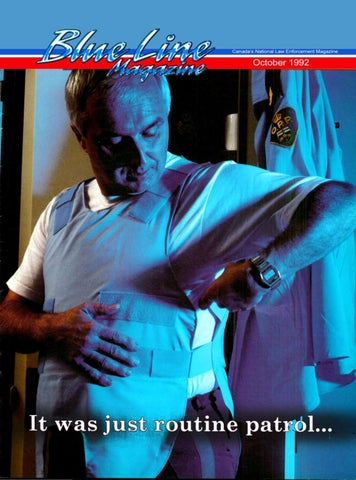
Ontario Provincial Police Sergeant Jim McGuigan gets ready to go out on routine patrol. Last June Jim, and the officers he works with at the Barrie Detachment, discovered there was no such thing as "routine" patrol. Fellow officer Scott Couse was gunned down after what appeared to be a normal traffic stop on the expressway which passes through the city. Scott's life was saved by routinely wearing his body armour. Although also shot in an area outside the armour's protected region, Scott cheated death when the second bullet near his heart was stopped by the Kevlar material in his vest. This month, in a Blue Line exclusive, you will hear Scott's story as well as the story of the vest which saved his life. Ladies and gentlemen ... read and heed. Scott can now enjoy life with his wife, Linda Lee, and two daughters, Alison and Andrea because he took that little time at the beginning of each shift to put on his vest. This month, by popular demand, we have repeated an article which ran a couple of years ago. It relates to officer safety while directing traffic. We have recently heard several stories of officers getting struck while directing traffic. The tradgedy of these incidents was in the simple precautions which could have saved each officer a lot of grief and pain. When directing traffic you must take two things with you. Something to make yourself seen and common sense.
The lightest, most comfortable undergarment vest manufactured in the world today!
T
he CENTAUR vest contains a combination of the most advanced ballistic materials available today, SPECI'RA SHIELDlland II SPECI'RA FABRIC. This hybrid provides excellent protection against high velocity rounds, multiple hits, and blunt trauma and weighs only 15 ounces per square foot , the lightest weight attainable with today 's technology.
Our goal has been to develop an undergarment ballistic vest which would combine maximum performance and maximum comfort. The result is the ENTAUR, a vest that is not only incredibly comfortable but also provides superior stopping power and blunt trauma protection . Manufactured by Pacific Body Armour
These materials are also unaffected by water, body oils and chemicals that are normally destructive to aramid fibres. With proper care and maintenance, Pacific Body Armour guarantees the ballistic integrity of our CENTAUR vests for ten years! Body coverage of the CENTAUR vest is the highest possible without compromising comfort and mobility. The ballistic panels carry high into the shoulder areas and have a full 2" overlap on each side. A. medium vest covers approximately 500 square inches but have an areal density of only .93 Ibs/sq.ft in a N.I.J. standard threat level II. The CENTAUR carrier is constructed of a durable poly/cotton material that is light weight and breathable. On the inside of this material against the body, is HYDROFIL~ an incredible new wicking material that draws moisture away from the body and into the inner fibres . This virtually eliminates that " clammy " feeling normally felt when wearing undergarment vests and helps you stay cooler and more comfortable.
CENTAUR, THE LEADER IN COMFORT AND PERFORMANCE FOR FURTHER INFORMATION CONTACT:
PACIFIC BODY ARMOUR INC. 585 Gaston Avenue, KELOWNA, B.C., CANADA
VIY 7E6 Telephone: (604) 763-1357 Fax: (604) 763-9730 SPECTRA SHIELD and SPECTRA FABRIC are Registered Trademarks of All ied Signal
Supervisory Principles
Vol. 4 No. 8 · October 1992 - EDITOR I PUBLISHER -
by Robert Hotston
Morley S. lymbumer Phone (416) 640-3048 FAX (416) 640-7547
Discretion
- Contributing Editors Weapons & Tactics James Dalueg
Survival Tactics Craig Best
Amnunition & Fireanns Dave langstroth Supervisory Principles
Robert Holston Peer Counselling
Neil V. Thompson
- ADVERTISING Allan W. Stiver (Toronto) Phone (416) 294-5502 FAX (416) 294-8952 Ron Ganton (Vancouver) Phone (604) 274-3849 FAX (604) 274-9091 - CONTRIBUTING WRITERS Chris Braiden Richard DuPlain Craig Best Andrew Smith Neil Thompson Mortey Lyrrburner -ILLUSTRATION Tony MacKinnon Bette Clari< Dave Sills Dave Bluestein BUSINESS ADMINISTRATION Mary K. Lymbumer, M.Ed. Blue Un. Magazine is pobIshed 1TIIlritiy. ~ember to .l.ne, byEb LneMagazile IncorpcntedwiJl amalngad<hs$ of: 12A·4tI1 Hwy. 7 East. Stt. 254, Mar1lllam, OnWio, LlR 1Nt Editori.aland QOPyis considetod to be oompletelyseparate from advortising sales. No commitment for editOOal coverage can form any part of. sale "8J'!01tlenl. All articles aro Pl'olected by copyriaht No part of this pu~.tion may bcrcproduced or transmittedinany fOrm Ofby anymeaAA, electronicormechanicaJ,includingphotocopyiJ18andreoordingorbyanyinfunnaJion storaac or retrieval system without ~on from the publiSher. The adhoro, a<Mocrs and ptdoher .... no iabiIlywhatsoeoer for any iiu'ios tx> persono Of properiy .....i-Q tom the appIicU>n Of adopIion of any 0{ the prooecU... !attics Of ~ presIW1led ... Ihio magazile. Readen are ca.Cioned and ocMoed that ariJ;tes pi'&.....eet horei'I n edied and stJPPied for yoIJ' pononaI aw;nnes. and sha>Jd not be used forltJther action II'Ii apprnpriaIa acMce and gtidance iI roceMed from. ~ Of CrCMl Ailamoy. Blue L.... Magazile is an ildependa'i poJJicaiion <fes9'oed to ertertain, mite and l.I'PIa the • of Ihooe ~ in the law anforcemert profesticn • has no di'eo:! codroI from a law anforcetTllli agrqand is opflions andlWtideo donal necossariyrdod the opflions ofanygowrrrnert or polceagrq..lllue Une Mapzino ls printed In Canada by ProM Gnphie. Umltod.
- Member Intematlonal Assotiatlon of Law Enforeelnelll Planners l'eriocleal PubHsh.rs Exc hange
ISSN 10847 8538 Second Class Mail Registration No.8242
October, 1992
Opinion polls show that many Canadians are frightened about what they perceived to be as an increase of crime and the apparent inability of the criminal justice system to control it. Certain categories of crime, particularly those involving violence, seem beyond the abilities of our justice system to cope. Meanwhile economic conditions worsen and police budgets are cut or frozen . These factors, when combined, mean one thing: the police must do more with less. Many police agencies are falling back on proven methods such as strong crime prevention and community outreach programs to increase police effectiveness through public cooperation. Additionally, police agencies are "rationalizing" their operations to put more police officers on the street by civilianizing positions traditionally held by police officers and experimenting with management techniques borrowed from the private sector. While successes vary between agencies, the most successful innovations seem to have one thing in common - the broadening of the use of discretion by those officers involved and the encouragement of leadership and decisionmaking by all levels. Although police officers have long considered themselves to be "professionals," two key elements have been lacking: adequate training and freedom of discretion. The training factor has been addressed in many jurisdictions. Yet, despite the responsibilities mandated to the police, they have been allowed very little exercise of "formal" discretion by their agencies. They are expected to do exactly as prescribed rules and regulations require. The expectation is that they are supposed to make few, if any decisions on their own, and are trained to perform in accordance with prescribed standards in order to ensure that they treat everyone alike
5
in a supposedly fair and objective way. Yet despite all the supervision and rules, police officers make decisions daily; whether they ignore or pursue, arrest or caution, stay "cool" or "kick ass." These and many other decisions are made routinely by street cops, often in violation of "the rules." Our legal system has long recognized the concept of police discretion. Over a century ago, Canadian courts proclaimed the view that police officers are independent agents of the "Crown" and as such they serve the interests of the public and exercise their powers and perform their duties for the benefit of all citizens. This view has come to reflect the idea that police officers possess special training and experience which enables them to exercise wide discretion in many activities. Many police agencies, in searching for greater effectiveness from ever-shrinking resources, have discovered that one key to success is to allow wider discretion by individual officers where experience and training justifies it. Achieving successes from limited resources requires more effective service from each asset a police agency has. Since its greatest asset is its personnel, it is only logical for supervisors to encourage officers to exercise more freedom of discretion in achieving that increased success. Police officers should be trusted to make independent decisions on how to proceed, what to look for, and the like. Encouraging the use of wider discretion does not mean encouraging officers to "run wild," with no accountability for their actions. It doesn't weaken proper supervision or mean there will be more complaints to investigate. The wider exercise of controlled discretion will lead to more effective policing from more motivated and satisfied officers as well as recognition from the community that the police are there to act in the interests of all.
"
Officer Owes Life To Wearing Vest On 'Routine' Patrol
Sergeant Brad Nudds says that a recent change in rules has helped increase the use of the vests. Now officers may insert their body armour into an overgarment vest holder. This makes it easy to take off the vest and their uniform outerwear at the same time. " In summer they seem to prefer this to wearing the vests under their shirts," he adds. Scott Couse is a family man, with a wife and two small children. They still have a husband and father because he made a habit of wearing his protective vest every time he went on duty.
1 ,350 Saves ...
Constable Scott Couse takes time-out with wife Linda-Lea to send an important me age to all police officers. Wearing body armour should be second nature. Like tying y our shoes. For Scott his daily habit o/putting on a vest saved his life.
If you want to know why you should make a habit of wearing personal body armour every time, all the time, ask Constable Scott Couse of the Barrie Detachment of the Ontario Provincial Police . He owes his life to wearing his protective vest, and says that without it he wouldn 't be here today to tell his tale. " According to the surgeons who operated on me," says Couse, "there's no way I could have survived the bullet which hit me in the chest. " Couse was shot on June 29th with a.38 calibre handgun. He had just pulled over a speeding truck on Highway 400, south of Molson Park Drive. The bullets were fired at an estimated range of less than three feet. At first, says Couse, his conversation with the apprehended driver seemed polite and normal. Seconds later, three shots had been fired from inside the vehicle. One missed, one hit him in the abdomen. The third bullet, as the surgeons told him later, hit his KEVLAR vest exactly in front of the left ventricle of his heart.
Although the attackers drove off, Couse was still conscious. He staggered across the highway and flagged down a passing vehicle to call for assistance. The ambulance came and on arrival at the hospital, he immediately underwent surgery. According to the medical reports, his life was soon out of danger. Before the incident Couse had no reason to suspect that the occupants might be dangerous. Soon after, however, the OPP were able to link them with the murder earlier in the day of two 19-year old men about 120 kilometers further north on the same highway. The following day two suspects were arrested in the Hamilton area. Other officers in the Barrie OPP Detachment feel they have learned a lesson from Couse's experience. " Most of the officers in the District don't need reminding of the importance of wearing their vests all the time, " says Inspector Barry Browning, "but since the incident they've certainly been showing a lot more interest. " Barrie Detachment Commander Staff
6
The remarkable material used in the vest worn by Constable Couse is KEVLAR. Manufactured by Du Pont, KEVLAR is an aramid fibre that is five times stronger than an equal weight of steel. It resists stretching, Is inherently flame resistant and will not melt When a KEVLAR vest is struck by a bullet, the impact energy is absorbed and dispersed from the struck fibres to the other fibres in the weave of the fabric. A large area of the garment becomes involved in preventing the bullet's penetration. This reduces the severity of the shock received by the body. When he's fully recovered, Couse will be enrolled as a member of the KEVLAR Survivors Oub. Co-sponsored by the International Association of Chiefs of Police (lACP) and the Du Pont Company, the club is made up of police officers who have survived potentially fatal or disabling injuries through the use of personal body armour. Couse will join more than 1,350 other officers in a club which lists among its goals "reducing death and disability by encouraging increased wearing of personal body armour." One of the often overlooked benefits of personal body armour is its ability to protect life against far mcr~ than bullets. In fact, more than half of the 'saves' in the records of the KEVLAR Survivors Oub relate to
October, 1992
attack, and the remaining 115 were shot. 107 of those (93%) were shot outside The Personal Protection Armour Association has set up testing and evaluation the protective area of the armour; 51 % standards for Personal Body Armour. In this article they explain some of the in the head, 19% in the neck/upper criteria and myths surrounding the acquisition and use of body armour. torso, 6% in the lower abdomen, 7% in the shoulder/arm hole and 10% in what During the early '70's when soft body from low to medium energy handguns, might have been the side panel region. armour was first developed, most officer .22 rifles and shotguns. The other eight officers died as a result of fatalities were from low energy handMany law enforcement practitioners penetration of the body armour by balguns. These "Saturday night specials" believe the trend towards higher energy listic threats well in excess of the design today, represent only about half of those threats will continue. Again, to the extent capability of the armour. incidents where the use of concealable that wearable protection against these This data indicates that, while side body armour can prevent a tragedy. increasing threats can realistically be propanel protection is desirToday's officer clearly needs protection vided, they should be considered in able and increases protection, this selection the selection process. decision must be measTypically, about one out . 'red against whether of every five officers or not the individual feloniously slain is officer can and will killed with his ~~L wear the extra covown service non-shooting incidents. Protective vests erage , increased weapon . bulk and percephave saved lives in automobile and motorTherefore, cycle crashes, lightning shikes, beatings, tively reduced vencompatibility of "0Ff"' knife attacks, falls, explOSions, thermal tilation and inthe officer's "'-»""--- TRIGGER threats and even bull gorings. creased heat retenweapon and , "ON"' KEVLAR 129 is the latest contribution 'Jf'<----:;>'-- -TRIGGER tion. ammunition made by Du Pont canada to the technolNon-water-repellent with his/her fabrics exhibit a tempoogy of personal body armour. Being 15 body armour is I rary reduction in ballistic percent stronger than previously available fundamental. TESTWEAPON capability when soaking wet fibres Kevlar 129 has made it possible to This is not only PPM Approved design vests which are 20 to 25 percent (>15% moisture pick-up). important to Testing Configuration thinner and lighter while enabling equally When the armour dries, full recognize in the effective ballistic protection. body armour selection process, but also performance is restored. For this reason, KEVLAR 129 is particularly popular in any weapon or ammunition selection an officer who might expect to become with female police officers. Its extra flexibilsoaked during his assignment should process. ity enables it to mold better to the figure and There is growing recognition that the consider purchasing water-repellent reduces the 'bulky' look of older style body ability of an officer to be comfortable treated body armour. However, today's armour. Says Staff Sergeant Nudds, and mobile while wearing body armour water-repellent treatments tend to make •'women officers in our detachment alcan be a highly individualistic issue. For ballistic fabrics noticeably stiffer, and ready take wearing their vests very seriexample, some officers can wear rela- some officers feel hotter and less comously, but anything that can be done to tively heavy, stiff, high coverage armour fortable wearing them. reach 100% usage by both men and women without discomfort. Others feel heat stress Both the F.B.I. and DuPont have is more than welcome. " conducted scouting studies on the effect and/or claustrophobia in lightweight, soft Meanwhile, Du Pont Canada states it is of perspiration on body armour. There is body armour with full side-panel protecdoing all it can to make the vests lighter, no evidence to suggest an officer might tion, but will willingly wear the same vest more flexible, and therefore easier to wear without side panels. Here again, the soak his vest with enough sweat, during every time, all the time. However impor· issue is to select as much protection as a normal duty assignment, to affect baltantthe improvements in comfort and wearlistic performance. the officer will wear. ability, the fibres sti1l have to maintain 'zero In addition to guns, history shows Recent statements that "most comfailare' standards. These remarkable standmon fatalities among officers wearing that personal body armour has proards have been achieved during the 20 armour result from bullets entering an tected many hundreds of officers during years that Du Pont has been supplying officer's side between the front and rear knife, club assaults, automobile acciKEVlAR to companies that manufacture armour panels" are erroneous. F. B.I. dents, motorcycle spills, falls, fires, and protective vests. data shows that during 1980-1987, 125 explosions. Nothing protects you totally law officers were killed while wearing - but today's personal body armour is the soft body armour. Three were killed with best and most comfortable ever availknife thrusts outside the armour protec- able. However, it only helps to protect tion area, seven were killed by vehicular you if it is worn regularly.
Keeping Ahead Of The Game
And Counting
y
October, 1992
7
An Introduction To Ballistics The Ught At The End Of The Tunnel Part II - Intermediate Ballistics by D.W.D. Langstroth This article will cover intermediate ballistics: the time the projectile physically leaves the muzzle of the firearm but is stili near enough to be affected by the flow of powder gasses. I think some clarification may be needed to more thoroughly understand what a gas field (or gas flow) is. Think of a basic rocket; light the fuse, stand back and watch the "gas flow field" drive the rocket. A "gas flow field" in a firearm is basically the same except that along with the rush of hot powder gasses, a projectile precedes most of the gasses. The action of the powder "gas flow field " being behind and with the projectile as It meets the air mass is very important in the design and function of the muzzle crowns, compensators and muzzle venturis. At the time the projectile exits the barrel itis spinning at between 23,000 rpm and 250,000 rpm and is (generally speaking) a relatively stable mass. Approximately seventy-five percent of the energy created by the burning powders goes through the muzzle. Most of It is carried by the hot expanding gasses In the form of heat, pressure and motion. As the gasses pass through the muzzle, they create a flash and blast. Simply put, the distribution of the energy at the muzzle looks like this: 30% -- projectile motion 45% -- powder gases 25% -- heat retained by firearm A shock wave is nothing more than a very Intense sound wave moving very fast. At the muzzle, several shock waves are present and in motion at the same time. There is an outgoing shock wave (that moves a little faster thim the speed of sound) and is heard as a sonic bang. The ingoing wave travels toward the muzzle against the gas flow and eventually achieves a balance. This balance is called bottle shock (because its shaped like a bottle with the open end towards the muzzle) As the gas flow velocity falls the bottle shock shrinks and will dissipate
The "gas flow field" also has two parts. The advanced blast field moves In front of the projectile as it moves down the barrel and exits at the muzzle . The main blast field occurs as the projectile leaves the muzzle and comes into violent contact with the surrounding air. When this violent contact happens it is virtually invisible to the shooter's eye. What the shooter can see (along with everybody else in the immediate vicinity) is a bright burst of light commonly referred to as the flash. Aash is the light created as a result of the super-heated propellant gases mixing with the surrounding air. If you were able to stand in front and to one side of the muzzle and slow down the normal speed of the projectile you would enjoy quite a spectacular light show. Before the projectile exited the muzzle you would see a glowing preflash due to the hot gases and particles that have leaked past the projectile (advanced blast field) . The projectile then thunders out of the muzzle followed by gases hot enough to be seen as visible radiation (main blast field) . This is the primary flash. The gases expand and cool and become compressed by the
bottle shock. The compression causes friction and reheats the gases and creates an intermediate flash . The projectile has created a small vacuum area behind itself and you could see glowing streaks of stili burning powder chasing the projectile as it moves away from the muzzle. For law enforcement purposes "flash" is undesirable as it will cause the shooter to lose his/her front sight and acquired target and let the acquired target know his/her location. There are several methods of flash suppression of which mechanical devices, propellants and propellant additives are most common. I intend to explain these areas in greater detail In a future article. A lot has happened, but our fearless projectile is but a few inches from the muzzle. Tune into the next issue for Part III -- "External Ballistics" or " It Aies Through the Air with the Greatest of Ease.
Gun Powder Evidence May Get Cheaper To Obtain Scientists at the U.S. based Institute of Standards and Technology say they have developed a faster, less expensive way to prove a suspect fired a weapon. The method uses unique patterns of gunpowder "fingerprints" In particles which remain on the hands of people who fired weapons. To this point evidence of this manner has been slow and expensive to obtain. The new Instrument is called a "MECE (micellar electrokinetic capillary electrophoresis) . Officers need only use masking tape to wrap around the hand and the particles from the tape are dissolved in ethanol. This mixture is then injected into the MECE for analysis. The results are obtained in less than one hour scientists say and the test equuipment is only a fraction of the conventional equipment. Scientists at the institute say the MECE technique is practical for forensic use but add, more work is required before it is ready for widespread use In police labs. For further information call NIST at (301)975-3108
e.
8
October, 1992
N.S. Can't Be Forced To Supply Legal Aid A decision brought down this past July in Nova Scotia suggests the Supreme Court of Canada can not force provinces to supply a legal aid program. The decision also made the point clear that some rulings can cause a great deal of confusion for police, courts and the suspects arrested. In this matter police in Nova Scotia were abiding by the Supreme Court of Canada ruling in the Brydges decision which stated police must not only advise the accused of his Right to Counsel but must also advise him he may call legal aid if he can not afford a lawyer. After the ruling came down Nova Scotia lawyers decided to supply police with their names and phone numbers. This system seemed to work well until the Federal government decided to cut funding to the Provinces to help support the program . The lawyers dropped out of the program and were only available during regular business hours. Three days after the Nova Scotia plan was cancelled police arrested a man for driving while his ability was impaired.
The officer, not knowing of the cancelled program, read the suspect his rights complete with the right to contact legal aid. Upon taking the man to the police station the accused was given a list of 12 lawyers he could contact for advice. None of the numbers, however, got through to a lawyer. Feeling his efforts to obtain legal advice useless the man decided to take the Breathalyzer test. At trial the Provincial Court judge threw out the charges stating the accused's Rights had been infringed, not by the officers, but by the system the officers worked under. The case was taken to the Nova Scotia Court of Appeal and a conviction was registered. The three judge panel determined the Supreme Court of Canada had no legal basis for requiring the province to provide better legal aid services. "The result reached by (provincial Court) Judge Sherar could only have been predicated upon the existence of a constitutional right to state funded counsel," the court ruled. In the ruling the appeal court judges referred to three other items of case law which upheld their view. One from Alberta, Ontario and Nova Scotia. The ruling went on to clarify what the Su-
preme Court of Canada stated in Brydges. The decision only held that the accused should be given a reasonable opportunity to retain and instruct counsel and part of that would be to inform the accused of the availability, if any, of duty counsel. The appeal court ruled the police officer afforded the accused with an opportunity " which if vigorously pursued, might have resulted in contact with the one Legal Aid lawyer who was still available or a lawyer who might give free advice. " The court ruled there was no evidence indicating the accused was compelled to take a breath test against his will, and there was no evidence of any other police mistreatment. " The police," the ruling stated, "showed exemplary concern for (the accused's) rights. There was no element of compulsion, no show of urgency." The court concluded the accused in effect abandoned his right to counsel and agreed to proceed with the breath test with out the benefit of counsel. "In effect," the court stated, " that agreement amounted to a waiver of the right to counsel. " The ruling is expected to be appealed to the Supreme Court of Canada for further clarification of the issues.
~'lili
BARRDAY-GUARD meeting your requirements for body and tactical armour For further information contact: EAST: Barrday Inc., 75 Moorefield St. P.O . Box 790, Cambridge, ON. N7R 5W6 Tel: (579) 627 -3620 WEST: Barrday Inc., 5457 Minoru Blvd., Richmond, BC V6X 2B7 Tel: (604) 273-7744 TWARON Is a registered trade mark of AKZO
KEVLAR Is a registered trade mark of Du Pont
SPECTRA and BARRDAY-GUARD are registered trade mar1<s of All ied Signal
I2A-498I Hwy.7 East, Ste.254, Markham, Ont. L3R INI - FAX (416) 640-7547
-
I
Up-Coming Events October 14 - 15
February 8 - 12
Forensic Identification Seminar
International Law Enforcement Winter Games
Toronto - Ontario Th Metropolitan Toronto Police Force, Forensic Identification crviceswillbehostingitsannualserninar at Police Headquarten 40 College St. Toronto. The seminar will have a number of guest speaken covering topical subjects and exhibitors showing products of interest in the field. Registration enquiries may be made to John keaff at (416) 324-6197 or Fax (416) 3246362.
October 13 - 16 We tern Canada Traffic Conference Sa katoon - Sa katchewan The W.C.T.A. is an association of traffic professional s from the engineering , enforcement and education fileds working toward promoting research and education. For further information about their conference contact Murray Totland at (306) 975-2631 .
October 18- 20 Canadian Association Of Road afety Professionals International Conference Montreal - Quebec This international conference is being jointly spon ored by the Canadian Association ofRoad afety Profesionals,Quebec Highway Tansport Association , Transport Canada and the Insurance ociety of Quebec. This year's topic will be Airbags and Seat Belts: Evaluation and Implications for Public Policy. For further details call (5 14)274-3573 or Fax (514) 274-9608.
November 11-13
Street Survival '92 Seminar Toronto - Ontario Calibre Press will be presenting their 3 day seminar at the Toronto Skyline Hotel. For further information call 800 323-0037 or Fax (708) 498-6869.
Ottawa - Ontario The 1993 games will be hosted in Ottawa. The games will be sponsored by the Ontario Law Enforcement A1hIetic Association. All sworn Federal, Provincial, and Municipal Law Enforcement officers, active or retired, are eligible. Events include basketball, broombal~ curling. darts, hockey, volleybal~ and skiing. For further information call (613) 225-1204.
October 31 - November 5 ~ International Association of Women Police Conference The Canadian Branch of the LAW.P. will be hosting the 31st Annual Training Conference to be held in Vancouver B.C. The theme of the session will be "Global Policing: A spirit of unity" For further details call (604) 681-5226 or Fax (604) 681-2503 .
Up-Coming Events is a Free service to law enforcement agencies and related personnel support groups. Other persons and organizations may place their notices in this section at a J'rice of $40.00 per insertion up to 25 words. (paid subscribers pay 530.00) Add 52.00 per word over this amount. Word count does not include phone number or heading. Editor reserves the right to revise, edit or refuse any notice not deemed to be appropriate. Payment, to accompany copy for insertion, may be by cheque, Visa or MasterCard number (include expiry date please) Deadlineis the first of the month prior to publication. (eg. November 1st for December issue) Mail to : Bb4e Line Cklssifred 12A-4981 Hwy. 7 East Ste.254 Markham, Ontario L3R INI
Police Adventurers Wanted Official visits to the police forces of: Singapore, Bejing, Moscow, Taiwan & South Africa VisitingCm, SWAT, Canine, Drug Sqauds. For info send address to Police Travel, Box 58003 - 500 Rossland Rd. W., Oshawa, Ont. LlJ 3LO. Join American & Australian police for world wide tours. 4-32-7
1' :BHidi+i'" ,:,'0!'!'(,11 POINTTS Franchise available We are looking for an ambitious individual or individuals to become the Owner/ Operator of an established franchise . The area to be serviced by this franchise is quite large, with an expanding population base. Cash investiment is required. Please call POINTIS Advisory Limited at (416) 234-9200 4-37-7-8
Watkins Products My husband laughed when I told him I was going to sell Watkins Products. Now he borrows money from me. For more information call Shelly Adrian, Independant Dealer, 798 Linkleas Ave., Victoria, B.C. V8S 5C3 Phone (604) 592-O81l. 4-0-7
Police Supply Sales Position Commission sales person required for uniform, equipment and accessories sales. Must have own vehicle & be willing to travel. Police or Fire experience an asset. Bilingual an asset Reply in writing to: Box 564, Fredericton, N.B. E3B 5A6. 4-22-7
I Los Cabos Mexican Paradise Luxury I-Bedroom Condo, ground floor on beach, spectacular view, Sea of Cortez. 20 feet from patio to swimming pool. Minutes to town. Call (604) 658-8611 4-25-7
or FAX (416) 640-7547 10
October, 1992
GC
ORDON ONTRACT SALES The Most Technically Advanced Boot
Ever Supplied by Cordon Contract Sales A Boot For All Four Seasons Specifically Designed For Uniform Person nel It is only fitting that when
Gordon Sales decided to offer their customers a new boot that it would be designed, component by component, from the ground up . The factory's new direct injected P.U . Sole is an exclusive lug design and offers oil resistance , traction , shock absorption, and a light density midsole that is flexible . This new sole design is the perfect balance between practicality and function . The pursuit of excellence started in the earliest phase of design and development. The outcome is in performance , protection , comfort and reliability resulting in the most technically advanced boots ever supplied by Gordon Contract Sales.
S ty le #4558 (available Nov. 1, 1992)
Specifications 8" black smooth sylflex leather - polishable - non-marking sole/self cleaning sole - fully insulated - cambrelle lined contour arch support/inner sole - lightweight - waterproof -
Also available in Safety Style 5170B = black steel toe boot "CSA" Style 7025 = Tan or Black "Steel Toe & Steel Plate" "CSA" 552 Queen Street West, Toronto, Ontario M5V 2B5 • Tel: (416) 368-5503 • Fax: (416) 368-6818
"Specialists in Uniform Footwear"
New Ontario Regulations Announced On Police Use Of Force And Code Of Conduct New use of force and code of conduct regulations for police officers were announced last month by the Honourable Allan C. Pilkey, Solicitor General for Ontario "The use of force is a safety issue for everyone in Ontario," said Mr. Pilkey. "This regulation will increase public and officer safety by enhancing use of force training for police officers, by providing clear direction to police on the appropriate use of force, and by outlining the accountability the police have to the public. This regulation will help assure the public that the use of force by police will be reasonable and justifiable. " The new regulation, which closely parallels similar Federal legislation aimed at amending the Criminal Code, emphasizes enhanced training at both the recruit and requalification levels, less-thanlethal force options, and accountability mechanisms (including a controversial use of force reporting each time a gun is unholstered) . The Ministry states it will be providing funds of $2.1 million this fiscal year, and $3.5 million next year to upgrade trainIng programs at the Ontario Police College. It reports it will also be providing financial support to municipal police services for training purposes. In announcing the Code of Conduct regulation, Mr. Pilkey said that discriminatory behaviour, including discrimination on the basis of gender, race or disability, may result in disciplinary action under the Police Services Act. "I am confident this regulation will help to safeguard the fundamental rights of all persons in Ontario and will enhance public confidence In Ontario's police services." The Ministry has worked on developing new regulations for some time to ensure they are in keeping with key recommendations of the Clare Lewis T ask Force on Race Relations and PolicIng (1989). As partof the development process, a five-week public consultation was undertaken. This included consultation with an ll-member committee on
public and officer safety, composed of police and community representatives, who met to review the proposed regulations and to make recommendations to the Solicitor General. "I want to thank everyone who contributed to the shaping of these important regulations, " said Mr. Pilkey. "I am confident these regulations are fair and
progressive and will benefit the police and the community in all parts of this province. " Anyone wishing to obtain an outline of the legislation may contact the Ontario Ministry of the Solicitor General's office at (416) 314-3348.
As the old saying goes, "The pot is boiling. " One year from now the Federal government will be facing a new election. Much of the tunnoil in Canadian policing is presently coming from Ottawa and Ontario. Stay in touch. .. read Blue Line Magazine.
Ontario Police To Take Political Action Ontario's 22,000 police officers are set to declare a political war against Bob Rae's New Democratic Party Government. The members of the Ontario Police Association, at their Ottawa convention held in August, accused the NDP of endangering public safety and police lives with its "knee-jerk responses" to every crises. Art Lymer, President of the 8,000 strong Metro Toronto Police Association, stated the situation is so scary that many officers are now ignoring crimes. "They are seeing stolen cars go by and not bothering. They know if they get in a chase and somebody gets injured .. . the officer ends up getting charged .. . Some of them are beginning to say, 'What's the Point? Why should I take a chance?" Delegates attending the meeting were particularly upset at proposed restrictions on police use of firearms. They pOinted to the Stephen Lewis 3-week study which has been viewed as completely anti-police. The Ontario Police Association, an organization comprising some 90 police associations across the province, is planning a public media campaign aimed at convincing Ontarians their safety is at risk due to the government's desire to curb police practices. On a side issue the Province is considering restricting the use of firearms by police officers only in the case where a life is threatened and not serious bcxiily
12
harm. The procedures being looked at would be brought into use if the police were given the use of pepper sprays as an alternative to guns. These changes are being considered even if the requirements of the Criminal Code are not changed. In response Federal Solicitor General Doug Lewis (no relation to Stephen Lewis) advised the Ontario Police Association that his opinion is "We should not change the Criminal Code in any way which would cause police officers to become apprehensive and compromise the safety of themselves or the public. " Lewis assured the members attendingthe conference that before any Criminal Code changes take place they will have ample opportunity to approve any proposals. " You have my undertaking, " Lewis stated, " to see that your ability to protect the public and yourselves is not diminished. " Lewis added that it is easy for legislators and others to talk about restricting police use of force when they are not the ones whose lives are at risk. "The floor of the House of Commons or a boardroom is a far cry from a police officer arresting a drug dealer in a backstreet alley," he said. It was pointed out this was somewhat re-assuring considering that Justice Minister Kim Campbell earlier in the year promised to amend the law to limit the use of deadly force by police across the country.
October, 1992
Ontario Outlaws Choke Hold But Pepper Spray Approved The Ontario Ministry of the Solicitor General made two announcements of significance to Ontario police officers. First, in support of new regulations with emphasis on less-than-lethal force options, the Ministry endorsed the use of aerosol weapons by Ontario police officers. This includes the use of oleoresin capsicum (commonly known as cayenne pepper spray) as a less-than-Iethal force option .. All officers who will be using the spray must undergo specialized training in its use. Once thought to be a contentious issue and needing more research, the use of pepper sprays was approved for use as a pilot project only in some selected police forces . Due to a then vacuwn in the Criminal Code many police agencies across the country adopted the use of the spray before this regulation had approval.It was pointed out that many
I I
Britain Set To Seize Proceeds Of Crime
postal carriers had been using it for years. Public concern was raised on the issue after a Metro Toronto police officer recently shot and killed a bat wielding mental patient. Critics contend the use of the sprays could have spared the man 's life had it been made available to the officer. In addition, the Ministry announced it is issuing a prohibition on the training and use of the carotid restraint (chokehold) by police officers. The Ministry was responding to several incidents across the province and Coroner Jury recommendations. It was felt the approval and usage of aerosol pepper sprays would aleviate the necessity for such training. Copies of the amended regulations and a background paper are available through the office of the Ontario Ministry of the Solicitor General.
~~ Bulk Subscription Rates Single Subscription 1 to 4
$25.00 each
5 to 19 copies per month
$20.00 each
20 to 39 copies per month
$15.00 each
40 or more per month
$12.50 each
The United Kingdom is set to become the first country to ratify a European convention allowing criminals to be stripped of the profits of their crimes, Home Office Minister Michael Jack announced last month Speaking at a conference on European co-operation in the fight against the drugs trade, Mr. Jack urged European partners to follow the UK lead and to strengthen co-operation to trace, freeze and confiscate the assets of criminals. Unlike other co-operatative arrangements, this convention provides a comprehensive framework for international co-operation in the investigation, search, seizure and confiscation of the proceeds of crimes. In his speech Jacks stated, "Any country which flirts with the decriminalization of the law covering softer drugs risks becoming a magnet for drug traffickers."
ARE YOU PREPARED FOR THE NEW FIREARMS REGULATIONS? VARIOUS MODELS OF LOCKS, CASES AND VAULTS AVAILABLE, INCLUDING
I I
TRIGGERLOCK From Masterlock
#0660-90
?pI;;;;
(Prices include handling, shipping and all applicable taxes.) MOSSBERG CABLELOCK For rifles, shotguns, revolvers , pistols, etc
All magazines and invoice will be sent to one address for distribution by the receiver
#0511-95507
12A-4981 Hwy. 7 East, Ste.254 Markham, Ontario LJR INI Fax (416) 640-7547
October, 1992
STOWLINE VAULT 6 shelves. 14 gao welded steel construction.
#0591-H83-5
FOR INFORMAnON ON THESE OR OTHER LOCKS PLEASE CALL:
til 13
3120 Glen Erin Drive, Unit 16
NICHOLLS
MIS5lssau~;i. ~;~ TEL.: (416) 828-1942 FAX: (416) 828-7749
The tools of the trade Law enforcement is no fool's game! Modern law enforcement professionals need all the tools at their disposal. The biggest and most basic tool is Knowledge.
Two of the most important books ever written for those involved in law enforcement STREET SURVIVAL Tactics for Armed Encounters .Positive tactics designed to master real-life situations. 403 pages of photos, diagrams, and the hard lessons of real experience. $46.95
THE TACTICAL EDGE Surviving High Risk Patrol Advanced material ideal for academy and departmental training programs and all law enforcement professionals. 544 pages with over 750 photos and drawings. $58.95
o Five Minute Policeman $13 .70 $75.95 o mtimate Survivors (Video) $15.70 o Boss Talk o Surviving Edged Weapons (Video) $65.95 o CaseManager (Computer Sofiwear)$310.00 $58.95 o Tactical Edge o Case Manager (Single User Version) $150.00 $46.95 o Street Survival o One Year Subscription (10 Issues) to Blue Line Magazine - $25.00 (G.S.T. Included) Binder to hold one year subscription - $12.95(G.S.T. included) Subscribers $10.95 Name:
----------------
Address:
Sub Total G.S.T,
---------------------------Ont. Sales Tax
Municipality ____________ Province _________ Postal Code: Phone: (
)
----------------
Total
7% Goods & Services Tax Extra No Ontario Sales Tax on Books Prices include 'Shipping & Handling
o Send Invoice with product (Available to Paid Subscribers, Law Enforcement Agencies, and Educational Facilities Only) o Please charge my VISA or MasterCard account # Exp. o Cheque Enclosed Signature:
/
Training and upgrading material for the Law Enforcement Community
Marketing
12A-4981 Hwy.7 East, Ste.254, Markham, Ontario, L3R 1N1- (416)640-3048
You may Fax your order direct to (416) 640-7547
New Proposals on "Fleeing Felons" And Electronic Surveillance Released The Honourable Kim Campbell, Minister of Justice and Attorney General of Canada, made public in August proposals which are expected to provide police officers with clear direction on when they can use their firearms in apprehending escaping suspects. The proposals will also restore to them the use of several effective electronic surveillance tools for criminal investigations. Minister Campbell made the announcement as part of her address to the annual conference of the Canadian Association of Chiefs of Police. The proposals to change what is commonly called the "fleeing felon" rule would establish a national standard on the use of force that may cause death or serious harm against fleeing suspects. The proposals would restrict its use to situations where a peace officer believes, on reasonable grounds, that a suspect poses a threat of serious harm or death to the public if the suspect escapes arrest, and where no other reasonable, less violent means to prevent escape exists. The proposals would also apply to anyone lawfully assisting a peace officer. "Peace officers must continue to have the ability to protect the public and themselves from serious harm or death, " said Minister Campbell. "Our ultimate goal must be to ensure that police response to the threat posed by a fleeing suspect is in proportion to the seriousness of that threat and in keeping with current public values. " Many have argued that, as it is currently written, subsection 25(4) of the Criminal Code is out of date and no longer in keeping with modem principles of proportionality and restraint that must characterize any use of force by the state. The proposals are said to provide peace officers with clear, consistent direction on the use of deadly force in apprehending suspects. They are also said to reflect the special circumstances facing peace officers in penitentiaries by preserving their ability to use deadly force in apprehending escaping inmates in situations where they October, 1992
believe the safety of the public is threatened. This proposal reflects current policy and practice relating to the use of force in federal penitentiaries. However they feel the use of possible deadly force would be justified because of the prison's system of placing inmates in institutions according to their level of threat to society. These proposals deal only with the use of deadly force against fleeing suspects. Other use-of-force and self defence prOvisions in the Code would remain unchanged. The second group of proposals announced at the conference deal with electronic surveillance. The proposals would permit police in potentially dangerous situations to have their conversations monitored. The courts would also be able to authorize video monitoring in situations similar to those where audio interceptions are now permitted, and allow police to intercept communications with the consent of a participant in a conversation in order to gather evidence or information relevant to criminal activity. In the past two years, the Supreme Court of Canada ruled on a number of cases which have Significantly affected the law and the practice of investigations conducted by police with the aid of electronic surveillance devices. These devices include concealed radio transmitters that allow conversations to be monitored from a remote location, commonly known as body packs, video surveillance cameras and electronic tracking devices. " These proposals deal with the delicate balance required of the law in order to respect individual privacy rights while at the same time providing law enforcement officers with modem investigative tools," the Minister said. Discussion papers on both sets of proposals will be circulated for comment to members of the police community, legal profession, multicultural organizations, privacy organizations and other groups and individuals interested in the proposals.
15
" I look forward to consulting with the police community and others on these proposals, " said Minister Campbell. "I am confident that, by working together, we can give law enforcement officers the powers and the clear direction they need to protect the public while ensuring that those powers are used judiciously and do not intrude unnecessarily on the basic liberties of Canadians. "
Federal Government To Share Assets From Drug Cases Federal Solicitor General Doug Lewis announced in August the federal government is planning to share assets forfeited as a result of federal prosecutions of drug traffickers. He said that consultations have begun with provincial governments and municipal representatives on a detailed proposal for fair sharing of crime assets when local or provincial police have participated in investigations. Mr. Lewis also said the federal government will set up a federal assets management office and assets sharing regime to complement the current proceeds of crime scheme. "With seizures in money and real assets counting in the millions, the government needs to establish an assets management office and legal framework to manage the assets and administer the sharing of forfeited proceeds," he said. Earlier this year, Mr. Lewis announced the renewed five-year Canada Drug Strategy would dedicate $33 million to create three special anti-drug profiteering units. Located in Vancouver, Toronto and Montreal, the units will have a mandate to go after drug trafficking kingpins. Each unit will bring together local and provincial police, RCMP specialists, forensic accountants and prosecutors to combat money laundering and seize criminal assets. Mr. Lewis noted that the Canada Drug Strategy and its emphasis on education and awareness of the dangers of illegal drugs has contributed to a decline in drug abuse among Canadians.
... news beat ... news beat ... news beat ... B.C. Police 'Knock-On' Procedure Violates Charter Rights Judge says procedure "extremely flimsy" The British Columbia Supreme Court recently threw out evidence obtained from a perimeter search commonly known as a "knock on. " The procedure involves situations were police go to a house were there is believed to be criminal activity and " knock on" the·door to " interview" the person in the house. While they ask questions of the person the officers look around the room looking for evidence of the activity. The method is most commonly applied to situations were other methods of observation or evidence gathering have failed. The B.C. Supreme Court heard a case were Surrey area police officers received information about a man growing marijuana in his house. The officers attended the house and using a "knock on" procedure were invited into the house. The officers began asking the suspect about growing marijuana and he denied the allegation. He then ordered the officers to leave his house and the officers complied. About six months later the officers received a second anonymous tip and three officers again visited the house to "interview" the occupant. While one officer asked questions the other two made observations of some incriminating materials in the room. They left the house and using the information they had seen they obtained a search warrant. The officers used the warrant to do a proper search and discovered over thirty marijuana plants growing in the house. The man was arrested and charged. Upon throwing out the evidence obtained on the search warrant B.C. Supreme Court Justice David H. Vickers followed the Supreme Court of Canada ruling in Regina Vs Kokesch in which warrantless perimeter searches were deemed to contravene the Charter's Section 8 provision against unreasonable searches.
In the Kokesch matter the Supreme Court of Canada stated "where the police have nothing but suspicion and no legal way to obtain other evidence, it follows that they must leave the suspect alone, not charge ahead and obtain evidence illegally and unconstitutionally. " The ruling went on to say the prime purpose of Section 8 was to ensure individual privacy and prevent illegal intrusions onto private property. In the B. C. decision Mr. Justice Vickers stated, "In my opinion, the consequences of Kokesch cannot be avoided
merely by saying 'I went to knock on the door,' particularly where such activity in the past brought a clear denial and rejection of the officers. " The Justice refused to admit any of the evidence obtained on the warrant stating the police, " knew or ought to have known that their presence on the property was an illegal trespass." The court ruled the excuse of going to the suspect's door to ask the suspect about his criminal activity in the hopes that he confesses is extremely flimsy.
False Arrest Action Dismissed A woman arrested by police because she resembled a robbery suspect has had her civil action for false arrest dismissed because she could not prove it was the bank's actions which caused her to be arrested. AT oronto Police circular sent around to banks in the region alerted them to be on the lookout for a female armed robbery suspect. The suspect was described as being a female black, 5 feet 7 inches, in her early 40's, wearing a purple coat, sunglasses and carrying a shopping bag. On the moming of January 31 , 1991, a bank employee in Brampton, Ontario, noticed a woman outside the bank waiting for it to open. This woman was wearing a purple coat, was female black, S foot 7 inches and carrying a shopping bag outside the bank. She was later found to be 40 years of age. The police were called and advised of the woman's presence and her desCription given. A short time late police arrived and arrested the woman, took her to the police car and interviewed her briefly. Police were satisfied this was not the suspect wanted and released her after about ten minutes. The woman then entered the bank and continued her banking transactions and left. The woman began a civil action
16
against the bank claiming the bank had directed police to arrest her. She claimed the bank had reported her as a potential bank robber without reasonable and probable grounds to do so. In reaction the bank stated they had "merely informed the police that the woman matched the description of the wanted bank robber. " They then asked if the suspect was still outstanding and if police were still interested. In the final judgment Ontario Court Justice Sandra J . Chapnik wrote that "the law is well established, that persons who provide information to the police are not liable for false arrest when the arrest is the result of an independent decision by the police. " The judge added police respond to calls of this nature as direction only and not, as was claimed, a demand for arrest. When police arrive on scene of an event on information received it is up to the officer to determine if there is sufficient evidence to make an arrest. These grounds are independent of the information given them by informants. The Justice stated the woman's lawyer, Charles Roach, failed to contradict any of the evidence stating " there was no genuine issue for trial." The court then assessed the woman $500.00 costs. October, 1992
,
... news beat ... news beat ... news beat ...
"Clearasil Bandit" To Sue Police Over Nickname
Barbados Officers Complain Of Joint A convicted Southern California bank deserve to be humiliated," the bank Patrols With Soldiers
robber wants to sue several police agencies and the FBI for naming him "The Clearasil Bandit" in press releases describing him to the public. The reference was made after numerous bank robberies where the tellers mentioned the most noticeable feature was the bandits bad acne. The 24-year-old bandit claims the nickname' 'Clearasil Bandit" has caused him "mental distress and mockery from guards and inmates" at the prison where he is serving his 6 year sentence. "I committed a bank robbery, and I deserve to be punished, but I don't
robber stated. The robber was finally tracked down when a " dye pack" hidden in a pack of money exploded and sprayed green dye over his face that could not be removed. The robber stated he would much prefer to be called the " Dye Pack Bandit" because that is what they caught him with. "An alternative," he stated, " would be to call me 'The Fashion Bandit' because that was the name they gave me the last time I was busted in 1990." The name was in reference to the fact he was known to spend all his Ulgained money on clothes.
Punker's Artistic Expression Belongs In Toilet A punk rock group musician was convicted recently in a Wisconsin court for dropping his pants in front of the audience and defecating onto the stage. The disorderly conduct conviction came after the court viewed a video tape of the "Toilet Rockers" as they played before an audience in the "Odd Rock Cafe" last year. Not only did the musician defecate on the stage but he picked up the feces and threw it into the audience. The accused's defence lawyer, in an argument that could only be desribed as being similar to the charge of the Light Brigade, stated he felt his client "is a serious performer, and there's serious artistic value to what he does. " He then went on to compare his client's behaviourwith other "avant-garde" artists who have used excrement in their work such as Shakespeare, Aristophanes and Samuel Beckett. The prosecutor remarked "If this is art can this man go rent a comer of the art museum and fling feces at people as they go by?" October, 1991
The defence was disposed of in the same manner as most excrement. .. down the toilet! The court decided to be lenient upon hearing both the Punk Rock group and the Cafe were out of business. The accused was convicted and jailed for 90 days and given, in addition, a fine of $1,000.
FLASHES by Tony MacKinnon
"Not too bad... but you're gonna find the next test harder!"
17
Reporting a 100 percent increase in crimes against tourists last year the Barbados government started coupling soldiers with regular police patrols. The joint patrols commenced earlier this year and will continue unless officers wish to work seven day weeks. The President of the Police Association, Hartley Reid, has strongly objected to the measures. He stated there was a fundamental difference between the police and military in that "the police are trained to protect life while soldiers are trained to kill. " Reid continued by saying, "If you recognize police are stressed to the limit and can no longer get the work done, increase the police force." Reid added that if the need to occupy the army is so great then they should give over the army's control to the police and permit them to retrain them to do a proper job. The Justice Minister stated the problem really revolves around the officers who take days off sick when they are really moonlighting at other jobs. Mr. Reid responded if this were true the government should pay them enough so they would not have to moonlight.
Wife Arrested For Murdering Husband Hockey Game "Check" Was With A Stripper Aggravated Assault A woman who is heir to her hus-
Court Briefs
A hockey players cross-check with a high stick was deemed an aggravated assault by a Manitoba Court of Queen's Bench. The vicious attack, initiated by the accused to teach his opponent "a lesson", left the man with a lacerated chin and gums requiring numerous stitches. In his judgment Manitoba Justice Wallace M. Darichuk deemed it unnecessarily violent and not associated with any play. He then added the check fell outside the victim's implied consent to violence during a hockey game as set out In several pieces of case law. The Incident occurred in February 1991 In a Winnipeg hockey arena. The two teams of players decided to play hockey without referees and the game became rougher as the game progressed. At one point in the game the victim skated past the accused and struck him with his elbow. At this the accused "decided to teach him a lesson. " He chased the victim across the rink and, holding his stick chest high, cross-checked the victim near the boards. The accused then forced the stick under the victims face shield and forced him to the ice. Police later laid a charge against the accused and the matter was brought to court. In determining guilt in this matter the judge stated the sole issue was the degree of the victim's Implied consent to violence when he stepped onto the ice at the beginning of the game. The court made reference to a 1991 Ontario Dis-
trict Court decision in Regina Vs. Leclerc where the court ruled that hockey players gave implied consent to some bodily contact but not to "overly violent attacks" or conduct intended to injure. The court then went to a 1989 Ontario District Court decision in Regina Vs. Ciccarelli which set out a four point factor to be considered in assessing the scope of "implied consent;" o the nature of the game played; D the nature of the particular act and its surrounding circumstances; D the degree of risk of injury; and D the state of mind of the accused. In the Manitoba case the court ruled the accused had initiated the check when the puck was not in the area and he had raised his stick with intent to cause an assault rather than to assist in the immediate play of the game. The ruling stated the injuries sustained were caused by the use of the accused's stick but even if it had resulted from the fall to the ice the assault was no less diminished. In conclusion the court ruled "the force employed near the boards was unnecessarily violent, entailed a high degree of risk of injury and was not associated with or related to any play on hand. " It continued by saying the check "would be denounced as falling outside the parameters of any acceptable standard by which the game is played. It would be perverse to find that, under the circumstances, the complainant had implied consent to the assault. "
band's $5 million fortune has been arrested for his murder. Police in Brisbane, Australia, state the weapon she used was a stripper who was paid to strip before the man on his 70th birthday. Police state the man had a bad heart. Marta Jenkins, 58, stated she had no idea her husband's heart condition was as bad as it was when she ordered the stripper to put a little zip in his life. After interviewing her husband's doctor homicide investigators found she had been told a shock of even mild proportions would be too much for him and could even kill him. When police interviewed the stripper they were advised Mrs. Jenkins had hired her for $500.00 with instructions to "make her performance as erotic as possible." Police state the money paid for the stripper was an indication she was to perform more than a normal strip show. Further investigation revealed Mrs. Jenkins had taken in a 35 year-old lover. In a public statement Mrs. Jenkins stated, "even at 70, Paul was a sexually active man. Not only was he an energetic lover, he was always hitting on young girls. The fact is, he was a dirty old man."
IntelliMap/911 Map-based , Artificially Intelligent computer systems for Canadian Law Enforcement. "The Only Intelligent Solution"
Q-,.5y.s
Bull
~
(416) 895-3911
18
October, 1992
Auto Theft Seminar A Successful First For Canada By Tom Rataj
/
Early August saw the 40th annual International Association of 1It~~~ Automobile Theft Investigators (I. A. T. T.I. ) Training Seminar held at the Regal Constellation Hotel on Toronto's airport strip. .
The one week seminar that was cohosted by the Metro Toronto Police Force's Auto Squad and the O.P.P. Anti-Rackets Squad, had almost 500 delegates attending from as far away as Australia, South Africa, England, and Israel. LA.A. T. I. is an American based Association dedicated to uniting private sector and police investigators around the world to investigate and prevent auto theft through cooperation and the development of professional standards. The association meets annually to have an intensive training seminar where delegates can share their experiences and develop those indispensable contacts that make any type of investigative work easier. In addition to a trade show featuring a wide variety of anti-theft, and vehicle location/recovery systems, the training seminars dealt with insurance fraud, chop shops, marine, heavy equipment, and stereo thefts, as well as a number of vehicle identification techniques. As with many of these conferences and training seminars, a successful Companion Program was run for the 150 spouses and guests of the delegates, featuring a selection of tourist type outings throughout the Metro Toronto area, and as far afield as Niagara Falls. Everyone in attendance had an interesting week, especially two investigators from different States in the U.S.A., who discovered that they were both working on what appeared to be the
October, 1992
same auto theft ring. Next year's training seminar will be held from August 1-6, 1993 at the Red Lion Riverside Hotel in Boise, Idaho, with the 1994 seminar slated for Nashville, Tennessee. For details and registration information for 1993 contact: Detective Bob Banta,
7200 Barrister Drive, Boise Idaho, 83704, (208)377-6597 or Fax (208)3756978 For further information about I. A. A. T.I. in Canada, contact: Mr. Roger D. Overton, Chief Special Agent, Canadian Automobile Theft Bureau, 365 Evans Ave., P.O. Box 919, Stn. 'U,' Toronto, Ontario, M8Z 5P9 (416)2525215 or; Detective Tim Aynn, Metropolitan Toronto Police Force, (Major Crime Unit -- Auto Squad) 40 College St. , Toronto, Ontario, M5G-IK2 (416)324-6260.
Highjack VS. 'LO·JACK' ... No Contest! With hundreds of thousands of mo- uniquely identifies it. The Lo-Jack tor vehicles stolen annually in North equipped police cars then track down America (108,000 in Canada alone in the stolen vehicle using the simple track1990), it is no surprise that the next ing hardware, and within a few short logical step after theft prevention is vehi- minutes the vehicle is located. de recovery. Autom6- (F==T'"'==4==~"'>=====;;;;irn Lo-Jack Corporation bile alarm systems claims that of all Lo-Jack are now widely equipped vehicles stolen, (and cheaply) 96% are recovered, along with about 25% of available, but if the bandits, a well-organized theft ring wants a (compared to vehicle they will take a normal 5% it, alarm system or not. arrest rate) . With this realization 'This is cerIn mind, the LO JACK Corporation of tainly an impressive system" said 26Needham, Massachusetts set out about year veteran Detective Tim Aynn of the six years ago with the development of a Metro Police Auto Squad, 'This seems unique vehicle recovery system, that will to be the system that has it all together. help find a stolen vehicle within about 20 It is certainly ideal for apprehending minutes. thieves." The system, involves the installation The Lo-Jack unit costs US.$ 595.00, ofthe Lo-Jack system on the local police plus installation with a starter-disable telecommunications network, alongwith device called "Prevent", now also availthe installation of the Lo-Jack tracking able. Although the Lo-Jack system is in hardware in a number of police vehicles. place in six states in the US., no instalThis is then followed by the installation lations are currently planned in Canada. Further information can be obtained of the Lo-Jack unit in customer vehicles. When the vehicle owner reports the from: Mr. Patrick W. Clancy, Manager, vehicle stolen, Lo-Jack is notified, and Law Enforcement Operations, Lo-Jack the system activates the Lo-Jack unit in Corporation, 72 River Park, Needham, the vehicle. Theunitirnmediatelybegins MA. 02194 US.A. transmitting an electronic signal that
19
j
Case Law (1290-012 -60 Pages)
\
Prostitution Laws Valid Supreme Court Rules Regina Vs. Downey The Supreme Court of Canada upheld the section of the Criminal Code that presumes a person is a pimp if he regularly keeps company with or lives with prostitutes .. The ruling, brought down last May, agrees the sections do infringe on an Individual's Section 11(d) Charter Right to be presumed Innocent but is an acceptable limitation under Charter Section 1. The ruling was, however, a 4 t03 split In the 7 judge Supreme Court. The majority stated the laws were essential to obtain convictions against pimps whom they described as the personification of " abusive and exploitive malevolence." The case involved a Calgary man who ran an "Escort" service. At trial the accused admitted he hired out mature women for the purpose of escorting people to public events for companionship as the customer wished. He admitted to handling calls, detailing women and taking in money, doing the accountIng and banking. When interviewed all the women admitted to having sexual relations with about 90 per cent of their clients but did not consider themselves prostitutes and stated they were in the
business voluntarily and no violence was used to keep them in the business. The Supreme Court ruling stated that although this particular business was not likely the kind of business It had envisioned when drafting the legislation it was nevertheless important for the prosecution of the vast majority of cases. The ruling stated the wording of the law was such that it struck a fine balance between eliminating the law and thereby permiting pimps to brutalize and intimidate rather than require the accused to disprove the facts on a balance of probabilities. "Prostitutes are a particularly vulnerable segment of society. The cruel abuse they suffer inflicted by their parasitic pimps has been well documented. " Mr. Justice Cory wrote. ''The section is aimed not only at remedying a social problem, but also at providing some measure of protection for the prostitute by eliminating the necessity of testifying. "It would be unfortunate if the Charter were used to deprive a vulnerable segment of society of a measure of protection. "The nature of the infringement of section 11 (d) (of the Charter) by section 195(2) (of the Criminal Code) is mini-
~e.eQl(' e~al(ee.
mal. All that is required of the accused is to point to evidence capable of raising a reasonable doubt. " That can often be achieved as a result of cross-examination of Crown witnesses. The section does not necessarily force the accused to testify." In answering other Justice's concerns Mr. Justice Cory added there should be "no concern that the section will result in innocent persons who have non-parasitic legitimate living arrangements with prostitutes being (accused). A description sufficient to constitute evidence to the contrary will generally be included in the Crown's case. If not, such evidence can easily be led. In either event, the presumption will be displaced. " The three judges who disagreed with the majority basically said the section casts too broad a net and that spouses and roommates who legitimately live with prostitutes could be charged. The charge in itself, even if conviction did not follow, would impose hardship and cast a stigma on the person charged. This opinion appears to put little faith in the discretionary abilities of police and Crown Attorneys and did not sway the majority from their opinion that the law was a reasonable exception to the Charter.
New to the job? We would like to start you off on the right foot.
SOFT BODY ARMOUR
The Industry Leader
If you have less than one year on the job send us your name, address and agency's name and we will send you the next five issues free of charge. If you like what you see pay the invoice for the next ten issues when it comes in the mail.
(sold only to law enforcement officers) For further details, please write and ask about New Lower Prices Distributed by :
# .!".~ ~ AfII~~
Karon Distributors Ltd.
,0-rr--""
Box 180, Birdshill, Man ROE OHO· Phone (204) 661 -4868
Jllst .".,••, tif>//
-
12A-49S1 Hwy.7 East, Ste.254 Markham, Ontario L3R 1N1 (416) 640-3048 FAX (614) 640-7547
,.« ., ". ".'.1
// ..
20
October, 1992
Case Law (1147-010A 64pages) (1147-009A) 31 pages)
Supreme Court Relaxes Time Requirements Of Askov Regina Vs. Morin Regina Vs. Sharma Last March the Supreme Court of Canada relaxed the strict time limit restrictions in the Askov decision of 2 years ago. Many have described this action as the power of public opinion sending a strong message to the judiciary. If Askov did anything good it would be in teaching the judiciary what "bringing the administration of justice into disrepute" really means. This new direction, written by Supreme Court Justice Sopinka, clarifies much of the controversy surrounding the Askov matter and in many instances reverses the court's position. The biggest damaging factor behind Askov was caused by the enormous number of charges dropped because the judicial system in place in some areas was overloaded and unable to handle cases within a reasonable time. Askov acknowledged section 11 of the Charter of Rights guarantees every person charged to a speedy trial. In Askov the Supreme Court of Canada stated "a period of delay in a range of some six to eight months between committal and trial might be deemed to be the outside limit of what is reasonable. " The judges and justices in the Provincial Courts saw this as a green light to dump over 52,000 backlogged criminal cases in Ontario alone. The recent Sopinka ruling baSically pOints out the "might" word may have been overlooked. However it should be pOinted out that many jurisdictions just might have seen this as a prime opportunity to dump its workload and thereby take the pressure off the annual budget to improve court facilitys. Certainly was convenient to have the Supreme Court take the fall. In the new Supreme Court decision the rule is that lengthy institutional delays will be tolerated where the delay does not prejudice the accused. The ruling also reverses the onus of proof October, 1992
over to the accused to convince the court the delay has or will hamper them in their defence. In this recent decision Justice Sopinka stated the " outside limit" mentioned in Askov was simply an administrative guideline. He further clarified the ruling by adding that the eight month delay was to begin at a point when both the Crown and defence are ready for trial. The ruling stated, "on the basis that not only do these courts dispose of the vast majority of cases, but that on average it takes more time to dispose of cases by reason of demands placed on these courts. " In another portion of the judgment Justice Sopinka stressed that lower courts should not administer the rulings in a mechanical manner but must ' 'lend itself and yield to other factors. " Among some of the points to consider was the court's ability to handle caseloads due to a sudden population spurt which would put sudden strains on the court system. Areas such as Brampton and Oshawa are prime examples of jurisdictions suffering from this problem. These were two of the regions which caused the Ontario Government to expend over $39.2 million, hire 61 new prosecutors, 168 court administrators, and appoint 27 new judges. Justice Sopinka was particularly hard on the manner in which Askov determined the efficiency of the court system in any particular area. In Askov all nine judges agreed reasonable delays in the court system could be assessed by comparing the court with another "similar" jurisdiction. In the Askov decision It was determined that the Brampton Courts could be compared with a Montreal Court. It was this comparison which gave rise to the six to eight month delay ruling. It was later found the comparison was inapt and, Justice Sopinka added, "Comparison with other jurisdictions is therefore to be applied with caution and only as a rough guide. " In the "Sharma" case the accused
21
was charged with impaired driving and obstructing police on February 17, 1988 when the car was involved in a serious accident. At the first date in court the lawyer representing Mr. Sharma was advised the next trial date would be March 8, 1989. This date was agreeable to the accused's lawyer but on the trial date the lawyer came to court citing a breach of Charter Section l1(b). Mr. Justice Sopinka stated that the case was not overly complex and should not normally take longer than 3 months to prepare the prosecution and defence case. The Ruling continued by saying the only prejudice the accused suffered was due to a bail condition that he not drive his car until the disposition of the charges. On this point the Justice stated the accused could have argued to have the condition removed but he did not. Mr. Justice Sopinka continued by saying, "Mr. Sharma's inaction from his set date appearance to his scheduled trial date shows a noticeable lack of concern with the pace of litigation. " The bottom line on both of these matters was that the accused will have to now come to court and explain further how they were prejudiced by the court's systemic delay. The final result was a four part consideration for judges which included; a the length of delay; a waiver of time periods; a reasons for delay, including inherent time req uirements of the case; actions of the accused; actions of the Crown; limits on institutional resources; and other reasons for delay; a prejudice to the accused. In these two judgments Mr. Justice Sopinka explained and excused the Supreme Court's ruling in Askov by stating, "Embarking as we did on uncharted waters It is not surprising that the course we steered has required, and may require in the future, some alteration in its direction to accord with experience. "
Tak it seriously or get off the road! by Morley Lymburner My attention was drawn to an American police magazine that recently contained an article on traffic direction. The first shock to me was the Introductory photograph to the article. It showed, what I assumed to be, a police officer directing traffic, at night, wearing a dark uniform and no hat. Not even a whistle! This picture got my curiosity as I thought that the author of the story was using It to show everything an officer should not do while directing traffic. Much to my dismay and horror I found that he was using this situation to show how It should be done. " Okay! Okay!" I says to myself, "Let's not judge the story by the poor selection of photographs. " I Ignored the theory that one picture Is worth a thousand words and I read the article. But guess what folks? It got worse. This officer's theory, and I say theory because he could not have survived very many traffic points to develop good practices, was to stare down the vehicle coming at you. Look like the boss, give assertive directions and stare down the driver was his basic concept of what goes on between the curbs. He backed up the story with another hatless, nameless, motionless, assumed-te-be police officer, doing what he cares not to do. I finally got to the point where I had to take a blood pressure break. I returned to the magazine and decided to find out what the officer's credentials were. A thirteen year veteran police dog handler from Washington State. "Okay, Okay, Okay!" I says to myself, " he found my key ... he's got me wound up. " The magazine went Into the trash and I hit the keyboard to write this little ditty. It ain't the "be all and end all" on the subject but at least It may help justify my 17 years as a Traffic specialist. ,.. Rule No. 1 - Be Seen This Is the most Important criteria. Put on a fluorescent vest, wear white gloves, carry a flashlight. Park your cruiser with lights flashing near the Intersection. Any one or all are better than none.
On one ofthe few times you are on display to the public how do you want to be remembered? Erect. sharp and in control or hatless. bored. ill-tempered and sloppy? You really don 't have a chance to make a second impression. Ifyou think TV cops look good then go toHollywood.
,.. Rule No.2 - Wear A Hat
I do not know where this bare-headed, bone-headed, stupid idea came from but too many officers don't wear hats. Your hat Is a necessary part of your job. It Is your professional identity that Is the most readily seen. It sits on the highest part of your anatomy and can be seen at 360 degrees and even above the roofs of the majority of vehicles on the road. Citizens can now have their first clue that a "police officer" Is doing a traffic point when looking over the roofs of the cars In front. Want to make It better? Put a white, or orange, hat cover on. It Is my firm belief that any officer working permanent traffic detail should wear an Issue white hat. An optional he1metwould be even better. ,.. Rule No.3 - Use A Whistle If you think you can yell out directions to motorists today then you have not been informed about the invention of car radios, stereos, tape decks and equalizers. Remember that you are directing PEOPLE not bumpers and headlights. Use a whistle as loud as you can. One long and one short blast for "stop", two short blasts for "go" have been the most effective for me.
22
. . Rule No. 4 - Clear Signals Keep your hands high. Never give a direction with your hands below your head. The motorist Is looking there anyway (he Is impressed by the hat) so you might as well communicate something that you want him/her to do. Remember that this ain't no game of charades. Don't let the hustle of traffic worry you. Go at your own pace. There is nothing less lenient on time than a traffic light. So why should YOU hurry? You are in control and no one does a thing until you want them to do it... Right?! Show the largest mass of your body to the vehicles you want to stop. (You will have to take inventory to decide if that Is front or sideways). Don't permit traffic to move in one direction without stopping up the other direction. If nothing is coming in the "stop" direction don't forget about it. I have found the best policy is to try to get a car in each lane to stop up traffic before letting alternate traffic go. When stopping a lane of traffic look back in the line and determine the car you want to stop. This may be three or four cars back but a good rule is to stop the driver you have established eye to eye contact with. (It's easier than trying to get their attention by riding on the hood or by a well placed bullet in the grill.) ,.. Rule No.5 - C.Y.A. Always think of your back(side). To be a true traffic controller you have to develop eyes in the back of your head. If you can't see in one direction you have to attune your ears to it. Let those ears be your second set of eyes. There are too many motorists out there that appear to own cars with prescription windshields and have just switched cars. They don't see beyond their hood ornament and you are as good a target as any. While we are on this su~ject. .. have you ever noticed that the chances of somebody stopping to ask directions Is directly proportional to the amount of traffic congestion you have at your traffic point. They still think you can take the time to give them directions to the freeway. f"1rmly, but politely, bring them back to reality. Advise them their wheels have stopped rolling and that is against the rules presently in effect. (You can really use your Imagination here) .
October, 1992
First SECOND CHANCE 'save' March 7, 1972
25 77
Total SECOND CHANCE 'saves' by the end of 1974
Total SECOND CHANCE 'saves' by the end of 1976 It is the hat which helps make you look sharp and makes you more visible. It sits up on the highest part of your anatomy and identifies you immediately as being in control.
Officer Partly To Blame At Traffic Point In a British Columbia decision brought down last year (Harris Vs. Starr 945-017 19 pages) the officer directing traffic was found to be 25 per cent at fault for the resulting accident. In this case the officer was directing traffic at an intersection where the traffic lights had failed. It was a rainy night with poor visibility. The officer motioned the northbound traffic to enter the intersection when he saw a westbound car coming too fast to stop. The officer tried to give a last second signal to stop the northbound car but was too late and a collision ensued. In the civil case that followed the court determined that the officer had failed to look eastbound before he motioned the car to go ahead. The judge added that the speeding motorist was 60 per cent at fault and that his attention was " woefully inadequate." However he added that it was clear that the officer should have looked to the east before he waived the second car to enter. The responsibility officers have while working traffic points is very real. It is at times taken for granted and at best considered routine. As you can see the courts take it far more seriously. Officers should try to remember that they are responsible for what happens between those curbs. In effect that gives you ownership of that real estate and it is your goal to make everyone on your property know what the rules are. October, 1992
130 210 288
Total SECOND CHANCE 'saves' by the end of 1978
Total SECOND CHANCE 'saves' by the end of 1980
Total SECOND CHANCE 'saves' by the end of 1982
335 372
Total SECOND CHANCE 'saves' by the end of 1984
Total SECOND CHANCE 'saves' by the end of 1986
433 500 550+
Total SECOND CHANCE 'saves' by the end of 1988
Total SECOND CHANCE 'saves' by the end of 1990
SECOND CHANCE 'saves' by the end of THIS YEAR.
The advantages of wearing Second Chance body armor can really add up! When the United States government patented Second Chance body armor over 20 years ago ballistic nylon was the state of the art fabric that began our climb to the top as America's leadi ng body armor manufacturer in street combat 'saves.' Since that time we have worked with the latest ballistic material technology on the daily market. .. Kevlar 29 and now Kevlar 129. If there is somethi ng better than Kevlar to keep us the leader, we 'd be using it! As our com petition continues to keep pace with our innovative advances we will continue to introduce the latest American-made technology to satisfy the needs of law enforcement across the country and around the worl d. Second Chance street combat knowledge and high-tech man-made fiber technology, found only in America, gives Second Chance concealable soft body armor wearers the advantage they want and need on the street today! ~
SECOND CHANCE """'-./ 'II
P.O. BOX 578 • CENTRAL LAKE , MI49622 • 800-253-7090 Second Chance holds the original U.S. Patents for concealable soft body armor: Nos. 3783449 , 3829899, 3855632 & 3894472
23
I I SI!lt "r}Ol! 1..).\. P. fJ. Part I by Tom Rataj
The LAPD consists of approximately 8,450 sworn police officers, and 2,000 civilian support personnel. It is headed by the Chief of Police, two Assistant Chiefs, five Deputy Chiefs, and 17 Commanders. Structurally it is divided into three administrative sections; Special Services, Administrative Services, and accounting for approximately 84% of the personnel, the Office of Operations, headed by an Assistant Chief who oversees the patrol officers and detectives. The department's jurisdiction covers 465 square miles (1,204 square km.) and a population of 3 .4 million people, with another 5.5 million people in adjacent jurisdictions. The City's population by ethnic breakdown consists of 37% white, 40% Latino, 13% African-American, and 10% Asian/Pacific Islanders and others. A large percentage of the recent immigrants, mostly Latino and Asian/Pacific, are not fluent in English, and generally live and work within their ethnic neighborhoods. Policing such a culturally diverse city is obviously a difficult task at the best of times. To further complicate this situation, Los Angeles was rated in a report published by the Police Foundation in 1991,as having the lowest ratio of sworn officers per resident (2:1,000) and the second lowest ratio of officer per square mile (15:1). And as in the other 6 largest departments in the U.S., the percentage of white officers In relation to the community's ethnic make-up was out of proportion. And If all this didn't make their task difficult, between 1960 and 1989, the City of Los Angeles suffered an increase In reported crimes that was twice the national average, making the LAPD officers the busiest In the U.S. Although they were busy, they also had the highest average number of violent crime arrests per officer out of the six largest cities. They also kUled or wounded the greatest number of civilians (adjusted to police department size), but had only the forth highest number of officers wounded. QUite correctly the Commission Re-
port notes that the actual task of policing under these circumstances would be trying at the best of times, noting that officers are often required to confront armed felons one moment, while dealing with circumstances requiring kindness, caring, and understanding shortly thereafter.
Discipline &Accountability. Numerous uniform and senior officers who were interviewed, indicated that a significant number of officers tended to use excessive force regularly. These officers were in fact well known within their units, but the discipline system did nothing about them, and their supervisors were rarely held accountable for the use of excessive force by their officers. Between January 1987 and March 1991, of nearly 6,000 officers involved in use of force reports, more than 4,000 had less than 5 similar reports, 63 officers had 20 or more, while the top 5% (ranked by number of reports) accounted for more than 20% of all the reports. During this time period alone, one officer had on his file, 13 allegations of excessive force, 5 other complaints, 28 use of force reports, and 1 shooting. Officers frequently send openly racist and prejudiced messages such as " I almost got me a Mexican last night but he dropped the gun too quick, lots of wit" . This despite the fact that all transmissions can and are monitored. Although LAPD policy quite clearly prohibits these types of messages, the Commission was shocked to find that little if anything was ever said or done about these types of messages.
The Seige Mentality The LAPD practices a brand of policing with an emphasis on crime control, through aggressive detection and rapid response to major crimes. This practice when coupled with the work environment has resulted in a siege mentality which causes officers to treat all incidents with the same aggressive techniques without first evaluating whether those techniques are appropriate to the circumstances.
24
This crime control technique is reinforced within the Department through an evaluation system that rewards the top 'hard-nosed' officers who produce the most arrests, tickets, and handle the most calls. The officers are trained to command and confront, not to communicate. Numerous witnesses at the public hearings held by the commission complained about unnecessarily aggressive confrontations with LAPD officers, often using words like 'rude' and 'disrespectful' . A recent internal survey of 650 officers supported this with 62.9% of the officers expressing the feeling that more interaction with the public would improve relations.
Recruiting Investigations Fairly extensive background investigations and psychological testing disqualifies approximately 40% of all applicants to the LAPD Academy, but the Commission found that the testing and background checks didn't appear to be very effective in predicting tendencies towards violent behavior. The background checks seemed to focus more on a history of moral issues such as sexual promiscuity or drug abuse which might eventually embarrass the department, while down-playing the warning signs of previous violent behavior. The process was further complicated by a large case-load for background investigators (120-150 cases each), as well as little or any specialized training. The Commission noted that police work modifies people and their behavior, and that although a candidate may enter the department being well suited for police work, the candidate is very susceptible to behavior modifying psychological stress. It was suggested that as part of a "Wellness" program officers should be taught skills to cope with stress. Furthermore they should be retested every three years to uncover psychological and physical problems. Supervisory officers should also be trained to recognize the symptoms of stress and to counsel and assist officers in coping with it. NEXT MONTH Inside The LAPD The Training Program
October, 1992
Mounties Experience Urban Mounted Patrol
Lance and Dan both have had Musical Ride experience and as a matter of fact Dan was the Ride leader for the European tour a few years back. Dan has recently returned from a United Nations Police posting in the African country of Namibia. After a number of northern Canada postings Lance spent the last few years working in Toronto with the Immigration section. Both officers enjoyed their short posting to the Mounted Unit as patrolling the busy streets and meeting the citizens of Metro Toronto was a great learning ex~ perience to add to their already colourful til c: careers.
.. IV
::IE E
"8
'PEACEMAKER'
~
It'fj your occupation. ... Now let it be your publication/
;;; ::IE ~
Q.
By Jim Davis This past summer saw a new twist in the operation of the Metropolitan Toronto Police Mounted Unit. Two Royal Canadian Mounted Police Constables were transferred to the Mounted Unit as
......-...... ~
--~
an on-going exchange program between the two agencies. Constables Lance Martel and Dan Parlee had the opportunity to ride Mounted Unit horses and patrol the parks and street beats of Metro Toronto.
CONIUM COMPUTER SERVICES
WmTBY -lJRAMPTO - ~fiLTON
386DX-40 CHRISTMAS PACK
$1599.00
40Mhz. mother board with 64k Cache memory 105 Meg. Hard Driye 2 Meg. Ram expandable to 32 Meg.
'1 Cnristmas Specw
LEN CONIUM 5 Gainsbrook Court Whitby, Ontario
WE SIDP ANYWHERE.IN CANADA!
LlR lW9
200 Watt Power Supply Desktop Case or Mini Tower TurbolReset Switches wI keyboard security lock 1.2 Mb disk drive (5 .25) 1.4 Mb disk drive (3 .50) 2 Serial, I Parallel & I Game Port Enhanced 101 keyboard 512 kb SVGA graphic card Microsoft I PC compatible Mouse platfo rm MS Dos 5.0 Power bar with surge supressor Disk storage case
Telephone
Fax
(416) 543-1127 (416) 875-0693
--
~~CONIUM
==COMPUTER . . . . SERYICES
Supe< VGA <o1om mooit"
Special must be ordered before December J 5th for Christmas Delivery
Hardware Software Accessories and Training
486DX-33 POWER PACK PLUS 33 Mhz. mother board with 64k Cache memory Math Co-processor 120 Meg. Hard Drive 2 Meg. Ram expandable to 32 Meg. Super VGA colour monitor
$1999.00
October, 1992
P.O. Box 520 Stn. -AScarborough, Ontario, M1K5C3
Add GST to all orders. Ontario residents add PST October 1992 TWO YEAR PARTS AND LABOUR
GUARANTEE
25
EACH SYSTEM INCLUDES
HARDWARE/ SOFTWARE 9 Pin Dot Matrix Printer 24 Pin Dot Matrix Printer Math Co-Processor 120 Meg Tape Backup Additional RAM !Meg.
-S200.00 - S350.00 -SCall - S299.00 - S 60.00
WINDOWS 3. 1
-S 11 9.00
UPGRADES 120 Meg. to 200 Meg. HD - S260.00 VGA to Super VGA Monitor- S100.00
81/ RJcllaxd OupJalD -
Part 2
1892 ~ 1992 The Criminal Code of 1892 may not appear to be very different from the Criminal Code of 1992 but in at least one Important aspect, the historical code could be considered ahead of its time. The 1892 Criminal Code also provided for a "speedy trial", something 100 years later, that has all but gone the way of the dinosaur. A century ago, courts of General Sessions of the Peace, as they were then known, were empowered by the Code to try all indictable criminal offences except for a small number of the most serious offences. Those serious crimes were to be heard by a Superior Court of Criminal jurisdiction or a provincial High Court, Supreme Court or Court of Queens Bench sitting with a jury. "Part LIV of the 1892 Code provided for a scheme whereby, if an accused was charged with any indictable offence which was within the trial jurisdiction of a Court of General Sessions of the Peace, he could elect to be tried by a county or district court judge sitting alone, in the County Court Judge 's Criminal Court, instead of being tried by the Court of General Sessions of the Peace sitting with a jury. Section 767 of the Code provided that on being brought before a judge of such a court, the accused was to be given the choice of either being tried 'forthwith' before such judge, without a jury, or to remain in custody, or under bail, as the court decides, to be tried in the ordinary way by the court having criminal jurisdiction," according to Philip C. Stenning in "Appearing for the Crown." The text indicates that should an accused person want a speedy trial, a private prosecutor be engaged. "In addition to trials of indictable offences by jury and by way of the speedy trial procedure, the 1892 Code provided that under certain circumstances some indictable offences could
be tried summarily by magistrates sitting without a jury. Magistrates had an absolute jurisdiction to try a small number of specified indictable offences. For a larger number of less serious indictable offences, an accused person was to be given the option of being tried summarily by that magistrate rather than by a judge and jury following a preliminary hearing or under the speedy trial procedure. In contrast, the Criminal Code of 1992 makes little if any reference to a speedy trial. The Canadian Charter of Rights, Section 11, declares only that "any person charged with an offence has the right to be tried within a reasonable time. " In his annotations to Section 11,
noted criminal lawyer Edward L. Greenspan explains that a person is only charged with an offence within the meaning of the Charter when an information is sworn against him alleging an offence or where a direct indictment is laid against him when no information is sworn. The primary aim of Charter Section 11 is, among other things, to see that the accused is accorded fundamental justice. "It is well established," Greenspan continued, "that any waiver of a Charter right must be clear and unequivocal. The accused is not required to assert explicitly his right to trial within a reasonable time and his failure to assert the right does not give the Crown license to proceed with an unfair trial. "Nonetheless, there is a societal interest in preventing an accused from using the guarantee as a means of escapingtrial, " Greenspan added. "Silence or lack of objection cannot constitute a lawful waiver. On the other hand, it may well be that the setting of trial dates and the agreement to those dates by counsel of the accused may be sufficient to constitute waiver," he added.
Flip Flop Landmark Decisions A New Brunswick decision, which was brought down in February was considered a landmark at the time, but was reversed again in June. This June decision also reversed the opinions of the Supreme Court of Canada on its own decision of two years ago. Such is the fickle nature of Criminal Law. A Richibucto, New Brunswick, man facing a Drive Ability Impaired Charge found his case thrown out of court last February because the judge felt the seven month delay in bringing his case to trial was excessive and infringed the accused's right to a speedy trial. The court ruling was based on the famous "Askov" decision which saw almost 100,000 charges stayed across the country due to the courts inability to bring the charges speedUy to trial. A much relieved man left the court room smiling about his good fortune. The court claimed the Crown made no submissions to the court explaining the delay or, more importantly, how the delay did not compromise the ac-
26
cused's defence. This is two of the hoops "Askov" required the Crown Attorney's to jump through for the past two years. The New Brunswick Crown Attorney last February felt the Supreme Court ruling stated a delay of eight months was excessive and they did not have to worry about an "Askov" argument about seven months delay. This decision was bound for future appeals when a new ruling came down from the Supreme Court of Canada which essentially, but not completely, reversed the "Askov" decision. The new ruling stated, among other things, that the accused was required to explain how the delay has prejudiced his defence. It also clarified the issue of eight months by saying it was only a guide line and never meant to be a strict requirement. The" Askov" decision is proof that Criminal Law is not really created but rather evolved A necessary requirement for a free society. October, 1992
No Need For Search Warrants As Italian Police Crack Down On Mafia Italian police have been given the power to investigate and execute searches without warrants following the second assasination of a top judge assigned to investigate Mafia activity. Senior judge Paolo Borsellino was killed when a bomb blew up the car in which he was a passenger . His assasination followed the death of Giovanni Falcone last May. Both judges have been responsible for the jailing of hundreds of top Mafioso gangsters and their Cappos. The tough new powers will strengthen the initiative taking capacity of the police. Under the policy police will be allowed to carry out some searches, including those of entire neighbourhoods, without a judge's warrant. Previously Mafia members were given incentives to inform which ranged from serving sentences under house arrest,
Blue Line Magazine Your mail order book store
early release and provisional liberty. The new prOvisions will permit police to carry investigations further and longer before they are placed in the hands of the judiciary. In addition the Italian government has sent 1,100 Carabinieri (Federal Paramilitary police) to Sicily, while thousands of Italian troops are deployed around Palermo's main jail.
Simply write or Fax the title and publisher to us and we will ship the book to you. Please send payment by cheque, Visa or MaterCard (with expiry date) to:
12A-4981 Hwy. 7 East, Ste.254 Markham, Ontario FAX (416) 640-7547
(please add S1.00 postage and 7% GST)
ALERT! Lipstick Knife The lipstick knife contains a knife blade which extends to approximately 4cm (1 .5"). The knife can be moved in or out of the tUbe. Imbedded in a tube of lipstick, the blade would be very difficult to detect.
..,IFI
CAl
ImWDm
Upgrade your skills at the three-day
CANADIAN POLICE CONFERENCE Wednesday October 28 - 30, 1992
fntraductlon by the MInistry of the So .. .. {O$fensiVe Tactics . from lhe following
TrJlininlnrrack i'~:
Generals OffIce and the Ontario PolICe Coll~~
will be dpolice USft ofForce Training~
...... arranged. Track 'OJ
Ch:: :Int"llnn track~ after each I)essioncan be
.
Police Chemical & Impact Weapons Cst. Doug Ashton Peel Regional Police Force
Police Supervision Dr. Gary Sykes (Director Of) S/W Law Enforcement Inst USA
Police Training Equipment Product Firearms Training Sysrems (F.A.T.s.) Learn about and test your shooting
Supervision & "Police 2,000" Hiliary Robinet The Quantico Group, VA, USA
How to make presentations with confidence & power Fred Pryor Seminars, USA
Skills, accuracy & speed under stress (using lasers) to fire onto a moving screen in programmed scenarios.
Criminal Profiling Martial Arts Kickboxing Seminar Behavioural Sciences, Quantico, VA, USA Kathy Long Federal Bureau of Investigations World Champion & Movie Star
Psychological Basis of Eyewitness Identification Dr. John Turtle, Psychology, York University
Crowd Management & Public Order Asst. Chief Const. David Cansdale Hertfordshire Police, England
Spontaneous Knife Defense Don Garon (Co-developer) P.P.C.T. Knife Defense System
Physical Fitness Programming Dr. Tom Collingwood Inst Aerobic Research, TX, USA
Developing a use of Force Policy Det. Randy Murphy Kansas City Police Department
Crime Forensic Analysis Royal Canadian Mounted Police Ottawa, Canada
Colllferi~lice fee is $2ZS
..s~d cmc;qu.e.~ !1jOllef tirder tQ : .ThePolice.Charter ......< p~02 ~ox~ ' .............. '.' .... ' .. ? Streets~~ge~ Ontario LSM 2B7
-
- - - - - -
Product News & Views
'Thermo Top' More Than Just A Block Heater by Morley Lymbumer
Now here is something every V9hit~ fan housing control Canadian police car should not be without. (or maybe every Canadian car for that matter) . Webasto Thermosystems (Canada) Ltd. of Mississauga recently introduced the 'Thermo Top" auxiliary heating system. This unique system will not only keep the interior of the car warm when you leave it for a time, but will keep the whole engine coolant system warm as well. It does Water connection this quite effeciently with a gas powered heat pump system which uses the existing gas in the car's tank. be an excellent fleet enhancement Webasto reports the unit can be item.Webasto reports it can reduce quickly Installed and when the car is emmissions by as much as 67 percent traded it can be removed for installation and extend the engine's life. It also comes In the replacement vehicle. with an automatic timer to engage the In this high-tech age of computerized system whenever the vehicle needs
rad,o Anaiomyof a 0ffIcIII Chole. Of",. u.s. Militaty. The Beretta 92F has tWKt beattn all rompetJboo U1 txilaustlVe ~ by the mlbtary In fact, the M9 (92F) acru.v.d an unprem1mttd rtllaboilly perbmanct <135.000 Mean ROUIld-; Il<tween Opernbooal MISliIOO rail"", (MRBF). Recent military test reports 1I,,"cate Beretta p..tols have fired over IM,OOO rounds Without a failure. The oombat pnJ\'e11 92F ~ the ~ SIdearm <lthe U.s. mlbtary and law enbttment ageooes around the world. ()pntInc S)'tltml. Beretta oIlln iJur oper.Iiq! S)"""" b' the 92IIlfI "'""" p..tols doobleAlngle ac\IOfl With .. lemal 'laktyM,...dung "'.... IF Model-<), doobielslngle acIIon, ",th external de<:ockIng lever only (G Models), dooblt ac\IOfl only ",thout sak\y Ie\",., (f) Models) and doobIt ac\IOfl only ",th txtemal sak\y lever 0)5 Models). Open SlIde Deslp. Open topsl"" vutually ehrrunates malfuncbons due to J'lll1lTIlllII or SW\~)lIptng and m the nut event that one ottIU>. the deslgn..no...lOr QUICk dean~ It.1<.o atm, the user to =Iy rtload the chamber ont roond t a ~"'" Double ActIon 1\ig.... Th~ p..tol ~ aJ,.~Y' rtady lOr Imme<illlte ftnng by pulling the tngser lOr the first roond mdooble ac\IOfl- roclung the hammer and releasIng IL The l'<'<Ond and all subsequent roonds are fired SIngle arbon. Re..nIbIt _ ...... 1IeIuM Button. ConvemenU)' Iorattd aIonizsKie the tngser 1/IIIInI, It may be poolloned b'lN' by nght or1cl\ IWKied shooter.;. Alto.., fast rtioodlng 0 use a fre;h magazlJle can be kept at the ready m the shooter's free hand. The magaztne III the ""n drutJo romplcttb' free "hen ",leased.
.,u,..,.
The company reports the system has performed well and will warm up both an engine and passenger compartment from 0 to 20 degrees in 30 minutes. For further details call John Vaughan at 1-800 667-8900.
••
Copacity. The 92 Series p..tols otrer magazlJle capaabes<l15. 13, and 8 rounds m9rnm parabelIum The Model 96 ~chambered lOr the new .40 cal cartndge and has a 10 roond maganne. No Glare FInish. Bereua's exclusive Bnmlton® non· reI1ective matte black finish ~ a superior corrosion resIStant coo~ that has OOIlSIStenUy Jl3"l'd all military salt spray tests ~ring maxtmum proIfctIon agamst rust and related maIfunctIom. Longer lasting than
cl:rue~t;'~"-'exc=ve Mltertala And Construction. All 92 Senes pIStols
are manufactured from the highest Quality materials USIng sopIusbcated CNC macIunery to ensurt Ilawless pertOrmance.
SlIde: MacIuned from lugh sIrength steel and Ilrurutoo® coated to a matte black nnish for greater durabitity. Fl1Ime: Macluned from light,,~ig ht aluminum! ZIltOIUum au-craft alloy.
BImI: I hgh sIrength ruckel chrome moly steel and hard chrome lined lOr Joog bft. Grips: Iliaci< plasbc sand blasted to a matte finISh. Wood gnps avrulable. QuIck Plck.up !Mchb. Standanl3-dot sight system is designed lOr QUICk target acqlJlSliJoo. 3-dot tntium mght SIght S»tem also available. Unique Uttr.Sofe DesIp. The sak\y lever> 00 the slide also funclJon '" the pIStol's cJ<:cockinB levers. When pushed dOl<11. the rear part of the firing pm (striker) IS angled out ofalignment .ith the front part of the firing
pin. A famll!! hammer can never break safety and cause an accidental discharge. AutonNItic Flrin, Pin IIIoek. The front part <I the firing pin is blocktd from any IOrward movement unW the tngger IS pulled back. AmbIdextrous Sofety. Easy aa:ess by the thumb of a right or leIl.-handed shooter, it is spring Iooded so it's ",ther positively "00" or pootiveiy "olt.. DIsauembIIn, utc:h, Asunple. elfecbvedevJce that ..no... for easy fieId·slnppmg. Chamber Loaded Indlc.ttor. When a roond ~ chambered, the extrnctor protrudes slighUy to show a red indicator. In the dark, the user can feel the protruding indicator. SunI, FIrm Grip. The front and back <I the gnp are !llOOVed, and the trigger I/IIIInIIS &JUared 011' and !llOOVed lOr a finn grip using ooe to t"" hands or gloves. 'The gnp &arne is I1ared slighUy at the botlom to enhance pointabilityand control during firing.
October, 1992
South African Police Get 5,000 More Officers
cycles, 1,000 vehicles and 28,000 firearms and would spend $24 million on new police stations and offices.
South Africa is recruiting 5,000 new police officers in an attempt to combat an 11 percent increase in crime last year and in particular a 20 percent increase in violent crime. Hernus Kriel, the Law and Order Minister, said recruitment and training of the 5,000 had begun last March. In addition,l1,OOO "Police Assistants" were being hired. The 4,OOO-strong riot squad, which has often been criticized by blacks for heavy-handed tactics, was being replaced by an "Internal Stability Division" (ISO) of up to 17,500 members, who would be specially screened and trained. " We have had a problem with the public perception of riot control. I can assure you I will come down like a ton of bricks on anyone who steps out of line in this unit," said ISO commander Johan Swart. Mr. Kriel said the police had placed orders for 10,000 bicycles, 2,000 motor-
Parents Must Pay Fine For Children
Improve Low Light & Night Shooting Accuracy! Line up Self-Illuminating Marks in Front & Rear Gunsights
self·luminous
T.SIGHTS ™
Three sets of Japanese parents have been held partly to blame for the death of a man attacked by their teenage sons. In the first civil verdict of its kind, the Tokyo District Court ruled parents shared responsibility for the actions of their children. The court ordered the three 17-yearold boys and their parents to pay over $700,000 in compensation to the relatives of the dead man. The youths attacked the 34-year-old man in Tokyo in June 1990 when he criticized them for riding around wildly on motorcycles. He died after one month of the injuries he sustained. In his ruling the judge said the parents failed to properly supervise their children and therefore must share in the responsibility.
improve your scores.
~ NSS _
NIGHT SIGHT SYSTEMS
45 Cynth ia Crescent Box 2968, Station B Richmond Hill , Ontario L4E 1A8 Telephone : (416) 773-0856 Fax: (416) 764-9981
any way you want it.
Mode/ ~~~~ Newwmpac~ high capacity 9mm version of tiw 92F 15 + l firepower with a compact sized sikh andframe.
*
Model 92EL. 1'Iw kgendary "'liability and fea tu",softiw 92F. .. wiih bright blued finish, distinctive gold inlays and richly grained walnut grips.
Beretta U.S.A.
Model 92DIModd 92DS. 7lro "doubk action only" pistols. 1'Iw 92Dfeatures '~lick slUk" wUh no external safety 12ver and a bobbed hammer. 1'Iw 92DS has Ittwmal safety 12vers nwllllwd on the slUk.
Beretta U.S.A. Corp. , Law Enforcement Division, 17601 Beretta Drive, Accokeek, Maryland 20607, (301) 283-2191. October, 1992
29
"
-
Letters To The Editor Blue Lme Masume lIA ....981 Hwy.7E.ut Stc.2.S4, Mod;ham. Ont LJRINI
" ...he beareth notthe sword in vain:" I have enjoyed my first year of subscribing to your informative magazine and thank you for the appropriate articles. For some time I served as an auxiliary police officer in Sussex, New Brunswick an since my move to Owen Sound, Ontario, have missed the action and activity I so much enjoyed there. Your magazine has helped to keep me knowledgeable of things that are happening on the Canadian scene in our police forces . As an ordained minister with over 20 years in the ministry I have been, and continue to be supportive of our police forces - they are "... the minister of God to thee for good. But if thou do that which is evil, be afraid; for he beareth not the sword in vain: for he is the minister of God, a revenger to execute wrath upon him that deeth evil." (Romans 13:4). Again, thank you for publishing an excellent magazine. Rev. David Robins Owen Sound, Ontario Editor's Note I was pleased with reading this letter. The passage quoted is one which has had particular meaningfor me ever since I read it in a version of the Bible called 'THE WAY." In this version the word ''Authorities'' was replaced with the word ''Police 0 Iflcer."11 you ever had thoughts or doubts about the meaning 01 your job Romans 13 would be worthy of your attention.
First Nations Policing I am a First Nations Constable, with the Saugeen First Nation. For those who are not aware of it, a First Nation Constable is not viewed as a police officer by the Province of Ontario but has all the powers and authority of a police officer in carrying out our duties for our respective First Nations. There are four officers in our office. We cover the lake Huron shore line from the town of Southamp-
ton to Sauble Beach, one of the busiest areas in western O ntario throughout the summer, especially on holidays. As a Peace Officer, I look forward to every issue of your fine magazine, especially the recent court decision bulletins that relate to Breathalyzer Technicians as I am also a ''Tech.'' Keep up the good work. A subscription to your magazine is the best way I've spent 25 dollars in a long time. Michael E. Hill Saugeen First Nations Police Service
Speed Kills Article Interesting I would like to comment on how much I enjoy Blue Line Magazine. The "Speed Kills" article (May 1992 Issue) interested me. I am a traffic officer and recently was at the scene of a double fatality. 200 kmIh into a hydro pole. Two dead young men. We really have to "drive it home" to the new drivers out there that indeed, "speed kills. " Keep up the good work. Nick McConnell Richmond Hill, Ontario
Dangers of Running Trains The Same For Police In the attempt to help others many police officers forget some basic precautions. As this article from Staff Inspector W. G.Moody, of the Canadian PacifIC Police, points out it can end in tradgedy The call came in over the police radio shortly after 11: 00 P.M. Saturday February 1st, 1992: An off-duty Michigan State Trooper was involved in a fight and needed some help. Troopers James Deloach and Steven Niewiek - young aggressive and energetic - knew of only one way to respond ... All out! Deloach, 26, and Niewiek, 24, apparently gambled that they could beat a train hurtling down the Grand Truck tracks in a suburb just outside of Detroit. They lost the gamble! Witnesses told police that warning signals were flashing and crossing gates were down as the patrol car passed a line of cars waiting behind the gates and slowed as if it was about to stop. Instead, it went around the gates. The train hit the car broadside and the car erupted in flames. It then carried the cruiser about 1 kilometre down the tracks where onlookers pulled Niewiek from the crumpled passenger side but were unable to read Deloach on the driver's side. He died on impact police said. Niewick died in hospital the next day. Sgt. Val Gardner of the Pontiac Detachment where the two were stationed, said the two officers were hard working, dedicated officers. ''That's the type of guys they were. Someone called for help and they were on the way."
30
Gardner said the call they responded to turned into a minor incident that was resolved by the off-duty trooper by himself. Both officers killed had been given instructions regarding the hazards of going around rail road gates at crOSSings. Staff Inspector W.G. Moody, of the Canadian Pacific Police, brought this story to the attention of Blue Line Magazine. "Railway police in Canada work with 'Operation Lifesaver"', the Inspector said, "and the provincial Safety Councils educating the general public about crossing safety. "last year in this country, of the 388 crossing accidents, 52 people died. Near misses at crossings, reported by the train engineer, are investigated and dealt with accordingly. ''There are 19 railway companies, operating 51 ,000 miles of track in Canada with 23,516 public crossings, 30 per cent of which have automated warning devices. There are 28,500 private and farm crossings. It is interesting to note that a 150 car freight train going 50 km per hour needs 1.1 kilometres to stop. At 80 km per hour it needs about 2.5 kilometres to stop. On the other hand, a car travelling at 90 km per hour can stop in about 70 meters." This article from S/Inspector Moody clearly indicates not only does the public need educating, but in too many cases police officers as well.
October, 1992
Pro Carry Systems Presents: The patrol officer is the backbone of any police force . The Duty Belt is the backbone of the patrol officer. That's why every component of our duty belt system is street-tested and refined to perfection. Our entire system is made of advanced, lightweight, durable and maintenance-free materials, including Cordura, Velcro and Divers Web. The result is a belt system less than half the weight of conventional leather that leaves your back in the same remove, replace or lose. All the equipment on the belt is condition it was in before your shift. Each component on designed for ease of use. The duty holster is precisely fitted the belt acts as a keeper, so your equipment stays exactly to your gun to provide the retention you need. where you put it, and there are no clumsy belt keepers to
Foryears police officers have suffered with "civilian" briefcases, not designed for the rigors of daily duty use. How many times have your files and equipment ended up dumped on the floor of your patrol car or lost under the seat where they aren't any good to anyone?
Pro Carry Systems has the solution. Our duty bag system is designed for patrol officers by a patrol officer. There are handy external pockets for your most used items such as your baton, radio, flashlight and ticketbook. Everything the working police officer needs ... organized, efficient and safe.
WHAT WE MAKE:
SO WHAT HAVE YOU GOT TO LOSE?
Pro Carry Systems manufactures for every branch of law enforcement service, including patrol, bicycle squad, plainclothes, surveillance and tactical equipment. Our innovative approach can help you solve your equipment problems quickly and within budget. Ifyour needs are highly specialized, we can custom design and build to suit those needs.
Nothing! When you purchase our production, you get a 30day, 100% money-back satisfaction guarantee and a life-time warranty against defects in craftsmanship and materials.
Better service, higher quality, competitive pricing. That's our guarantee
All Pro Carry Systems products COme with: - 30 day money back guarantee - Lifetime warranty against defects in workmanship and materials - On-going customer support
l}41 CHAPMAN AVE., COQUITLAM, B.C. V3J-4A2 TEL: 1-800-665-7757 FAX 1-604-931-18841
BMW SPELLS SAFETY ON THE JOB IN JUST THREE LETTERS: ABS Most motorcycle manufacturers put their engineering skill to work getting you going. At BMW we put our best minds to work getting you stopped. Safely. Anti-lock braking systems (ABS) have been used for years on aircraft and high performance cars. Now, BMW has integrated this state of the art technology into our motorcycles, including the K-series Police models.
HOW IT WORKS The ABS system uses an on board computer to monitor front and rear wheel brakes. When ABS senses the brakes are about to lock, it reduces pressure in the wheel brake cylinder up to 7 times a second, and continues to do so until the risk of lock-up has been eliminated.
I monitored F"", on' .." tooth....""~ ... ,,,,"ontty by an electronic control unit to determ ine when intervention by ABS is necessary.
From the officer's perspective, the only change in sensation is an incredible increase in straight line stopping ability. Even applying full brakes in an emergency straight line stop, full oontrol of the motorcycle can be maintained.
WE HAVE WHAT YOU NEED TO GET HOME SAFELY BMW motorcycles are in active use by police departments in 100 countries around the world. We know what you're facing on the streets in congested traffic areas, and what unexpected demands are put on you and your machine.
The outrigger·equipped motorcyle, without ABS, has locked up the wheels and lost stability during hard braking on wet pavement (right). The ASS-equipped bike remains upright and controllable under the same conditions (left).
On rain-slick city streets, BMW can provide that additional edge. And in normal traffic conditions, ABS will give you the confidence to stop consistently in the shortest possible distance.
BMW'S Catalytic Converter Technology for Motorcyles. ----------------------~
Contact Tony Fletcher at BMW Canada Inc., 920 Champlain Court, Whitby, Ontario L 1N 6K9 or call (416) 683-1200. Fax (416) 666-3672
HELPING THE URBAN ENVIRONMENT BMW now offers our Police models with the option of catalytic converter systems. This technology can reduce harmful exhaust emissions by up to 80% without sacrifice to fuel consumption or engine power. As well , the appearance of the motorcycle is unaltered .
RESPONSIBILITY MEANS NO COMPROMISE