BLUE LINE CANADA’S LAW ENFORCEMENT MAGAZINE
www.BlueLine.ca
NOVEMBER 2017
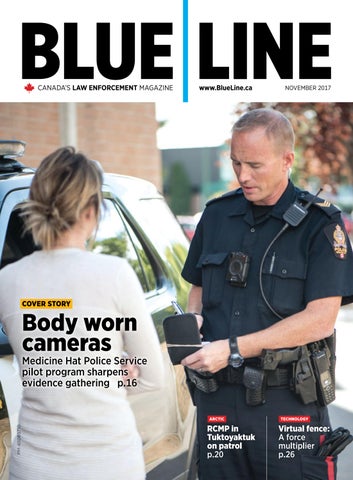
COVER STORY
Body worn cameras
PM 40065710
Medicine Hat Police Service pilot program sharpens evidence gathering p.16
ARCTIC
TECHNOLOGY
RCMP in Tuktoyaktuk on patrol p.20
Virtual fence: A force multiplier p.26
PRIMARY MARK
PRIMARY MARK
PRIMARY MARK
SECONDARY MARK
SECONDARY MARK
SECONDARY MARK
TERTIARY MARK
TERTIARY MARK
TERTIARY MARK
TSTM-55
QUATERNARY MARK
CUT LEVEL 5
TSRE-55
QUATERNARY MARK
TSBR-55
TSCR-55
QUATERNARY MARK
TSAZ-55
RECON
TEMPEST
BREACHER
PURSUIT CR5
AZIMUTH
ERGONOMIC DESIGN HIGH-DEXTERITY 0.5MM LEATHER
FR LEATHER FLAME RESISTANT NOMEX®
FR LEATHER IMPACT PROTECTION
CUT RESISTANCE ERGONOMIC DESIGN
FLAME RESISTANT NOMEX® GAUNTLET CUFF
Mechanix Wear’s Tactical Specialty line is designed to protect law enforcement officers and SWAT professionals with specialized hand protection for a range of scenarios and environments. T/S tactical gloves are built with high-quality goatskin leather and incorporate varying levels of protection such as (ASTM) rated flame resistance.
CONTACT US AT INFO@MECHANIXWEAR.CA FOR A DEALER IN YOUR AREA
THE TOOL THAT FITS LIKE A GLOVE.® TOLL FREE: 877-278-5822 / 604-542-7055 | WWW.MECHANIXWEAR.CA #mechanix
Contents
20 November 2017 Volume 29 Number 9
Features COVER STORY
16 “Proof is in the pudding”
Medicine Hat Police Service pilots body worn technology & in-car cameras for better data management and improved evidence gathering. By Renée Francoeur
20 Tuktoyaktuk RCMP boat builds bridges
As the Northwest Passage continues to open up, RCMP detachments are becoming more important with respect to Arctic sovereignty and traffic patrol. By Robert Frizzell and Nicholas Brame
Columns 4 10 12 14 15 24 26 30
Editor’s commentary Q&A Deep blue Health & wellness Holding the line Case law Technology Back of the book
Departments 5 5 7 8 27 28 29 30
By the numbers News Calendar Dispatches Off the shelf Product showcase Marketplace Blue Links
22 Problem-based learning & coaching police professionals
COVER PHOTO COURTESY MHPS.
The Ontario Police College launched a new Coaching Police Professionals course this year, which embraces a modified learning approach. By Erin Knights and Irene Barath
10 @Blue_LineMag
5
26 November 2017 | BLUE LINE
3
EDITOR’S COMMENTARY BY RENÉE FRANCOEUR
A salute to Const. Michael Chernyk & all LEOs in the face of terror
T
he weekend of September 30, no fatalities. Sharif faces 11 charges, in2017, was a heavyhearted one, cluding five counts of attempted murder. to say the least. “While the investigation continues, early Two women were killed in a reports indicate that this is another exknife attack at a train station in Marseille, ample of the hate that we must remain ever France. An Edmonton police officer was vigilant against,” Prime Minister Justin “viciously” stabbed outside a football Trudeau said on Oct. 1. “We cannot — and stadium after being struck by a car, the will not — let violent extremism take root impact sending him 15 feet in the in our communities. We know air, according to the service. And I think what that Canada’s strength comes then the worst mass shooting in is most from our diversity, and we will not American history took place important is be cowed by those who seek to when a gunman opened fire to realize divide us or promote fear. Edmonfrom his Las Vegas hotel room Canada is ton is a strong and resilient city, window, killing 58 and injuring not immune and I am confident that its citizens to terrorism will support one another to overmore than 500. Who can find the right words and that it is come this tragic event.” when something like this hap- our frontline Edmonton is doing just that, as pens? What kind of healing can officers who demonstrated at its hometown’s we do for such an international, bare the hockey opener where Chernyk gaping wound? I didn’t know burden of received a standing ovation when where to start — other than trying to get he walked out onto the ice during spending the day holding loved a quick the Oilers’ pre-game ceremony. ones — but, as the conversations handle on While many are arguing about turned to gun control, lone wolf these immigration policies in the wake labelling and the ins and outs of threats as of the Edmonton attack, I think hotel security, there was one they’re what is most important is to thing I couldn’t stop thinking unfolding. realize Canada is not immune to about: that brave Edmonton terrorism and that it is our frontconstable, and the role all levels of law line officers who bare the burden of trying enforcement have to play when it comes to get a quick handle on these threats as to threats of terror. they’re unfolding. They are the boots-on-the-ground who This makes it all the more crucial we have to make quick life-and-death deci- continue to look after our law enforcesions, navigate the use of force and ment officers, ensuring they are in their weapons, and protect innocent bystanders best form — physically as well as mental— many of whom are now stopping to film ly and spiritually (more on this, specifically dangerous scenes on their smartphones the value in achieving restful sleep, in instead of fleeing. Isabelle Sauve’s Health & Wellness colAs it stands, Abdulahi Hasan Sharif, a umn on page 14). 30-year-old Somali refugee, is accused of We have to ensure they have access to hitting Edmonton Police Const. Michael the resources and technology they need so Chernyk with a speeding car, stabbing him they can perform the best they can, and and then running down pedestrians with most importantly go home at night, safely, a U Haul truck. Miraculously, there were to their families.
CONNECT WITH BLUE LINE
www.BlueLine.ca 4
@Blue_LineMag
BLUE LINE | November 2017
www.facebook.com/BlueLineMagazine
BLUE LINE www.BlueLine.ca
GROUP PUBLISHER | PAUL GROSSINGER pgrossinger@annexweb.com EDITOR | RENÉE FRANCOEUR rfrancoeur@annexweb.com ACCOUNT MANAGER | JANICE EATON janice@blueline.ca ACCOUNT MANAGER | APRIL LENSEN april@blueline.ca ART DIRECTOR | SVETLANA AVRUTIN savrutin@annexweb.com ACCOUNT COORDINATOR | TRISH RAMSAY tramsay@annexweb.com CIRCULATION MANAGER | BEATA OLECHNOWICZ bolechnowicz@annexbizmedia.com COO | TED MARKLE tmarkle@annexweb.com PRESIDENT & CEO | MIKE FREDERICKS ANNEX BUSINESS MEDIA 80 Valleybrook Drive, Toronto, ON M3B 2S9 Tel. 416-442-5600 • Fax 416-442-2230 Publication Mail Agreement No. 40065710 ISSN 0847-8538 Printed in Canada SUBSCRIPTION RATES Canada — 1 Year $30.00; 2 Year $50.00 plus tax USA — 1 Year $100.00 USD CIRCULATION email: asingh@annexbizmedia.com Tel: 416-442-5600 ext 3553; Fax: 416-510-5170 Mail: 80 Valleybrook Drive, Toronto, ON M3B 2S9
Occasionally, Blue Line will mail information on behalf of industry-related groups whose products and services we believe may be of interest to you. If you prefer not to receive this information, please contact our circulation department in any of the four ways listed above. Annex Privacy Officer privacy@annexbizmedia.com; Tel: 800-668-2374 © 2017 Annex Publishing & Printing Inc. All rights reserved. Printed in Canada. No part of the editorial content of this publication may be reprinted without the publisher’s written permission. Opinions expressed in this magazine are not necessarily those of the editor or the publisher. No liability is assumed for errors or omissions. Readers are cautioned and advised that articles presented herein are edited and supplied for your personal awareness and should not be used for further action until appropriate guidance is received from a supervisor, Crown Attorney or other persons in authority. All advertising is subject to the publisher’s approval. Such approval does not imply any endorsement of the products or services advertised. The publisher reserves the right to refuse advertising that does not meet the standards of this publication.
PHOTO: R. FRANCOEUR
NEWS
MIDLAND, ONT.
7th Annual Pedal for the Past raises $18.4K for OPP Museum
Friends of the OPP Museum, a non-profit organization that supports and promotes the museum, hosted its 2017 Pedal for the Past event on September 30, 2017, in Midland, Ont., at Sainte-Marie Among the Hurons, a national historic site. Serving and retired officers plus friends and family took to their bikes (and their feet) for a 100 km, 50 km or 25 km ride or hike through the Georgian Bay trails. The 62 participants raised $18,400 for the museum in Orillia, Ont. The OPP Museum preserves, documents and interprets artifacts and archival materials that help build an understanding of the history of policing in Ontario since the formation of Upper Canada in 1791. It specializes in the material culture of the Ontario Provincial Police from 1909 onwards. For the full photo gallery, visit blueline.ca/ news/pedal-for-the-past-4775. KINGSTON
Proposed amendments could shift alarm monitoring policy
The exasperation Canadian police services experience with alarm monitoring and the
number of “false” calls is nothing new. For many regions, the false alarm rate has been in the 90-percentile range for years — sometimes decades. Taking a new direction to combat this, the City of Kingston, Ont., held a stakeholder consultation meeting to go over proposed changes to the alarm installation and monitoring regulations in the municipal bylaw, many of which Kingston Police had a hand in recommending. Proposed changes entail shifting the fee structure, explained Greg McLean, policy and program co-ordinator with the licensing and enforcement department at the city. Currently, the first false alarm in a calendar year is free, followed by a gradual increase in fees for subsequent false alarms. This was to curb repeat offenders and motivate alarm companies to address these types of concerns, McLean noted. “Our rate of 97 per cent of alarms being false has been like that for quite a while so that tells us our current approach is not necessarily achieving its objective,” he added. “False alarm stats from the early 90s show between two and four per cent of calls being founded.” Now, the first false alarm will have a fee attached to it and each one after that will cost the same amount. “Kingston Police analyzed what their costs
are to respond to and process an alarm that turns out to be false and came up with an amount — $120 currently — so that amount is what we’re proposing for the first fee through to the fourth one,” McLean said. “We’re moving away from using the fee schedule as a deterrent or incentive to resolve false alarm situations. We’re putting more emphasis on the prospect that police response to alarm systems will be suspended on the fourth false alarm in a calendar year.” McLean said a warning notice would go out after the third false alarm. He mentioned fees for failing to register an alarm system are also being proposed — something brand new for Kingston. “This fee would then be double what it would have been if the alarm had been registered,” he explained. The proposal will go before the standing committee before the For more on end of the year, this story, visit according to McLean. goo.gl/bJXTHS. TORONTO
TPS shows public how it builds budget
The public is getting a closer look at the Toronto Police Service budget through a new webpage at tps.on.ca/budget. Chief Administrative Officer Tony Veneziano said the budget will be more accessible so that it can be better understood and invite community input. He added that the budget has a zero per cent increase for the second consecutive IMAGE COURTESY TPS year.
BY THE NUMBERS
On May 23, 1974, Commissioner M.J. Nadon announced the RCMP would begin accepting applications from women for regular police duties. The number of female police officers has been growing over recent years, as forces across the country strive to change the industry culture and diversify. More from Statistics Canada below.
4%
of Canadian police officers were women in 1986.
@Blue_LineMag
21%
of Canadian police officers were women in 2016.
6% 13%
of senior officers were women in 2006.
of senior officers were women in 2016.
November 2017 | BLUE LINE
5
NEWS CANADA
Operation Pangea going on 10 years strong
Canada was one of 123 countries participating in Operation Pangea X from Sept. 12-19, 2017, which targets the online sale of counterfeit and otherwise falsified and unlicensed pharmaceutical products. This year marks the 10th anniversary of Operation Pangea and included a record number of countries participating in the Interpol-led global week of action. In Canada, Operation Pangea is a joint effort between the RCMP, Canada Border Services Agency, Health Canada and Interpol-Ottawa. Internationally, Operation Pangea X resulted in 400 arrests and the seizure of more than $51 million US worth of potentially dangerous medicines. Involving 197 police, customs and health regulatory authorities from around the world, the operation led to a record number of 25 million illicit and counterfeit medicines seized worldwide. In Canada, inspections at border centres resulted in the assessment of 4,545 packages. Of those inspected, 86 per cent were either seized or refused because they contained counterfeit and/or unlicensed health products, such as illegal prescription drugs. The Canadian street value of the total amount seized and refused is estimated to be $1.76 million. Canadian efforts also resulted in the investigation of 45 websites. YUKON
Old Crow RCMP partner for life-jacket station
RCMP recently launched a safe boating initiative in the fly-in community of Old Crow, Yukon, in partnership with the local government and Co-op.
Health Canada inspecting suspected counterfeit and illicit pharmaceuticals in Montreal, Que., during Operation Pangea X 2017. PHOTO: RCMP The new Life-Jacket Loan & Return Station encourages community members to stay safe in the water by borrowing a life-jacket and returning it afterwards. The idea for such a station was first introduced earlier this spring by Tracy Rispin, general manager of the Old Crow Co-op. On a trip to Fort Yukon, Alaska, Rispin says she had seen a similar set-up and she raised the idea with RCMP and Vuntut Gwitchin Government chief and council. “These rivers are a part of our every day life as Vuntut Gwitchin and over time there has been loss,” Rispin said. “Having life-jackets available for community members will allow both elders and youth to benefit from a safer boating experience, and for all boaters to be better prepared in the event of an emergency on the water,” said Cpl. Yvon Largess, detachment commander, Old Crow RCMP. Whitehorse Canadian Tire contributed the original 50 life-jackets and now 100 are available, leading to tentative plans to add a second life-jacket station at an alternate boat launch in the community for Spring 2018.
EDMONTON
Park honours Canada’s first Aboriginal police officer
PHOTO COURTESY CITY OF EDMONTON
The City of Edmonton unveiled its latest green space, Alex Decoteau Park, named after Canada’s first Aboriginal police officer, who joined Edmonton Police Service in 1909. Decoteau won most major western Canadian races between 1909 and 1916, according to the city, and even earned a place on Canada’s Olympic team to compete in the 5000-metre race in Stockholm in 1912. He enlisted in the Canadian Army at the start of the Second World War, first serving with the 202nd Infantry Battalion, then later with the 49th Battalion. After arriving in France in 1917, Decoteau was killed in the Battle of Passchendaele. REGINA
RCMP adds Richer E.-S. Dubuc to cenotaph
PHOTO COURTESY OLD CROW RCMP
6
BLUE LINE | November 2017
During the Royal Canadian Mounted Police’s National Memorial Service this year at the RCMP Academy, “Depot” Division, in Regina, Sask., the name of Const. Richer E.-S. Dubuc was added to the cenotaph, bringing the total number of fallen members to 238 since the creation of the North-West Mounted Police in 1873. Dubuc died on March 6, 2017, following a vehicle collision near St-Bernard-de-Lacolle, www.BlueLine.ca
PHOTO: RCMP
Que., while responding to an illegal border crossing call. He is also being added to the online RCMP Honour Roll and to the Canadian Virtual War Memorial. CANADA
Bell working on 911 location issues for Apple Watch
Bell customers with the new Apple Watch Series 3 should be aware that their longitude and latitude location may not be supplied to 911 operators when the device is not paired with their iPhone via Bluetooth, the telecommunications company stated. However, in the event of an emergency, 911 Public Safety Answering Points (PSAPs) will contact Bell Mobility to obtain required longitude and latitude information. This is a Bell network issue that affects only Apple Watch Series 3 users connected to the Bell Mobility LTE network, Bell explained. Bell says its network team is “working closely with its technology partners to resolve the latitude and longitude issue as soon as possible.” All other Enhanced 911 (E911) functions are available on the Apple Watch, even when the devices are not paired, including the ability for 911 operators to receive the caller’s telephone number and location to the nearest cell site. ONTARIO
OPP announces Victim Response Support Strategy
The Ontario Provincial Police have announced a Victim Response Support Strategy, which includes several actions they are taking to improve the response to and support for sexual assault victims. “The Victim Response Support Strategy outlines the actions the OPP is taking to ensure victims of sexual assault are able to report their experiences with confidence that they will receive the support and services they need,” said OPP Commissioner Vince Hawkes. “The OPP is committed to investigative excellence, strengthening our relationships with community partners and @Blue_LineMag
agencies, and putting additional accountability measures in place to improve the response to and support for victims.” The OPP Victim Response Support Strategy is the result of the OPP Sexual Assault Data Classification and Investigative Review, which examined sexual assault cases closed by police as “unfounded” between 2010 and 2016. The review included a directive to reopen any sexual assault report that was found not to be properly investigated. Of the 5,322 unfounded cases reviewed, 3,463 (65 per cent) were cleared correctly, 1,859 (34.9 per cent) could potentially have been cleared using another classification, and 12 (0.2 per cent) were reopened for investigation. Both the OPP Victim Response Support Strategy and the review findings can be found at opp.ca/victimstrategy. CANADA
Canadian Military Police Association awards 2017 scholarships
CALENDAR Law of Policing Conference Nov. 20-23, 2017 Vancouver, B.C canadianinstitute.com/8th-annual-forumlaw-policing Ontario Gang Investigators Association Conference Nov. 20-23, 2017 Windsor, Ont. www.ongia.org 2017 Chief’s Gala Nov. 23, 2017 Toronto, Ont. www.chiefsgala.com Canadian Public Safety Interoperability Workshop Dec. 3-6, 2017 Ottawa, Ont. www.citig.ca Toronto Fraud and Anti-Counterfeiting Conference Dec. 6-8, 2017 Toronto, Ont. www.cacn.ca IPA Region 2 Annual Christmas Party Dec. 9, 2017 Vaughan, Ont. www.ipacanadaregion2.com
Left to right: Maj. Steeve Gregoire, Alexis Raymond, and his parents: Nadine and Serge Raymond, retired chief warrant officer. PHOTO COURTESY CMPA Congratulations to the two winners of the 2017 Canadian Military Police Association Scholarship competition: Alexis Raymond and Genevieve Langlois. The judging committee considered academic performance and potential; community involvement; financial need; and quality of the application essay to determine the winners. This year the applications were reviewed by Maj. Steeve Gregoire, CWO Crystal Krammer and Sgt. (retired) Kaven Daigle. Raymond won the University Scholarship and Langlois secured the College Scholarship. Both winners received a $1,000 cheque.
NSSF Shot Show Jan. 23-26, 2018 Las Vegas, Nev. www.shotshow.org CACP Information, Communication & Technology Committee Workshop Feb. 25-28, 2018 Vancouver, B.C. www.cpa-acp.ca Calgary Police Cyber Summit March 4, 2018 Calgary, Alta. www.cybersummityyc.ca ILEETA 2018 March 19-24, 2018 St. Louis, Mo. www.ileeta.org/ileeta-conference-expo
November 2017 | BLUE LINE
7
NEWS DISPATCHES Canadian winners from the International Association of Women Police’s 2017 Annual Recognition Programme include Hamilton Police Sgt. Sara Beck (Award of Excellence), York Regional Police Supt. Karen Noakes (Leadership Award), Halifax Regional Police Const. Stephanie Glendenning (Community Service Award), and Toronto Police Service civilian member Carol Gowanlock (photo), who serves as a court services senior adviser and planner (Civilian Award of Achievement). The awards were presented in Cairns, Australia, during IAWP’s 55th training conference.
Julia Cecchetto is the new chief of Kentville Police Service in Nova Scotia. She was previously an inspector for Halifax Regional Police’s information management section. She is the first female police chief in the province. She started with the Halifax force in 1990, when she says was the eighth woman at the time in the police department.
Justin Palardy, former CFL player, joined the Halifax Regional Police in 2017-03-17 8:15 AM June as a patrol officer. Palardy, originally from Truro, N.S., retired in 2015 from the CFL, where he played as a punter and placekicker for the Hamilton Tiger-Cats, Winnipeg Blue Bombers, Ottawa Redblacks, Saskatchewan Roughriders and the Toronto Argonauts.
Vancouver Police Department has promoted Supt. Howard Chow to deputy chief and inspectors Marcie Flamand (photo) and Martin Bruce to superintendents. The selections were announced after an internal completion was held following recent retirements, including Deputy Const. Warren Lemcke, who retired at the end of September.
POLICING ... IT’S MORE THAN YOU THINK If you’re career and community minded, consider joining Ontario’s most progressive police service. As a Police Constable or Police Cadet with Peel Regional Police you will be part of a dedicated team that enjoys outstanding training and is committed to our vision; “A Safer Community Together.”
PEELPOLICE.CA/RECRUITING
BL_PeelRegionalPolice_April.indd 1
York Regional Police Chief Eric Jolliffe was presented with the Transformation Award for Public Service from the Transformation Institute for Leadership and Innovation this year. The Transformation Awards honour leadership, excellence, development and innovation as well as harmony and the best of cultural diversity. Previous recipients of the award include former Lieutenant Governor Lincoln Alexander and Markham, Ont. Mayor Frank Scarpitti.
Const. Evan Fisher is the newest face to join Treaty Three Police, headquartered in Kenora, Ont. He is stationed at the T3PS North Sub Division office.
Staff Supt. Peter Yuen, Supt. Barbara McLean and Insp. Shawna Coxon are the new deputy chiefs at Toronto Police Service. They join James Ramer and Tony Veneziano. PROMOTIONS, RETIREMENTS, RECOGNITION • If you have a senior officer in your agency recently promoted or retiring or an individual you wish to have recognized (major award or recently deceased) you can let Blue Line magazine know by email to: dispatches@blueline.ca.
www.BlueLine.ca
NEWS SURREY, U.K.
U.K. study of cocaine users leads to “breakthrough” in drug testing
could see the introduction of drug tests for law enforcement agencies to use within the next decade, according to the university. WINNIPEG
Mounties to transfer Louis Riel items
PHOTO: UNIVERSITY OF SURREY
Scientists from the U.K.’s University of Surrey say they have developed a “rapid and highly sensitive” fingerprint test that can take “just seconds” to confirm whether someone has used cocaine. This new breakthrough, published in Clinical Chemistry, comes as a result of what they’re calling “the first large scale study of cocaine users” and could pave the way for the detection of a range of other Class A substances. The team, led by Catia Costa and Melanie Bailey, used chromatography paper to take the samples as part of a technique known as paper spray mass spectrometry. When someone has taken cocaine, they excrete traces of benzoylecgonine and methylecgonine as they metabolise the drug, and these chemical indicators are present in fingerprint residue, the study explained. Importantly, the traces can still be detected after handwashing. “Paper spray mass spectrometry is gaining increasing popularity in forensic circles because it is incredibly sensitive and is very easy to set up a testing system — the units will save laboratories time,” Costa said. “This is the first time it has ever been used to detect the presence of drugs in fingerprints, and our results show the technique was 99 per cent effective in detecting cocaine use among the patients.” Traditional testing methods have limitations, the study went on to note, such as when bodily fluids are tested, there can be biological hazards and often a requirement for particular storage and disposal methods. It is anticipated that this technology @Blue_LineMag
The Royal Canadian Mounted Police has signed an agreement to return certain artifacts once belonging or related to the Métis people and Louis Riel. RCMP Deputy Commissioner Kevin Brosseau, Contract and Aboriginal Policing, along with Manitoba Metis Federation (MMF) President David Chartrand and Métis National Council (MNC) President Clément Chartier signed the agreement at the MMF’s Annual General Assembly in Winnipeg, Man. The artifacts include a crucifix and knife, as well as a book of Riel’s poetry. These and other items are currently on public display in the RCMP Heritage Centre next to the RCMP Academy in Regina, Sask. The signed agreement states that the RCMP Heritage Centre will continue to act as caretaker of the items until the Métis Nation finds a suitable location for them. The formal transfer of the items is expected within the next two years. Louis Riel’s crucifix was donated to the RCMP in 1959 by the daughter of a sergeant major who guarded Riel during his trial. PHOTO COURTESY RCMP
“It’s important to me, certainly on a number of levels, but absolutely being a person of Metis descent that those items be returned,” Brosseau said. Riel’s crucifix was donated to the RCMP in 1959 by the daughter of a sergeant major who guarded Riel during his trial. The sergeant major allegedly acquired the crucifix shortly before Riel was executed. The hunting knife believed to have been Riel’s was donated to the RCMP in 1947 by a university professor and veteran of the Northwest Campaign. It was given to him by a young man who knew of the professor’s history. The true origin of the knife has not been fully verified. Riel’s published book of poetry, Poésies Religieuses et Politiques, was gifted to the RCMP in 1943.
DURHAM REGION
DRPS app brings crime mapping to the public
The Durham Regional Police Service (DRPS) has launched a new app to allow users to “easily and conveniently” connect with police. The app was developed in collaboration with several community partners and community groups as a part of DRPS’s strategy on “leveraging technology to co-create public safety.” Citizens can access DRPS information directly on their Android and IOS smartphones and devices, including the crime mapping tool in order to see what crimes are occurring in their communities. They will be able to access DRPS social media platforms and also have the ability to file a police report for certain crimes, such as mischief and theft from motor vehicles. There’s also a “Know Your Rights” feature that outlines the rights of citizens and a push notification feature, which will alert the user with community safety alerts in the event of any major regional emergencies. This app also has a 360-degree video feature, which will allow the community to immerse themselves into the duties of service members from bike patrol to community response. WORLD
Police outnumbered by private security in most countries
New research from The Guardian finds that private security guards are becoming an increasingly common sight across the world. The data shows there are an estimated 7 million private security workers in India compared to just 1.4 million police officers. Similarly, in China there about 5 million people employed in private security compared to a police strength of 2.7 million. According to Forbes, the U.S. Department of Labor claims there are over 1.1 million private security guards in the U.S. compared to 666,000 police officers. See a corresponding Forbes infographic at tinyurl.com/ybhd6l92 for more. November 2017 | BLUE LINE
9
Q&A The Dakota Ojibway Police Service (DOPS) snuffed out 40 candles on its birthday cake this year. It is a recognized self-administered agency located in southern Manitoba, serving the Birdtail Sioux, Canupawakpa Dakota, Long Plain First Nation, Roseau River, Sandy Bay and Waywayseecappo First Nation communities. Acting Chief Rick Head provides insight on what it’s like to lead one of the longest operating First Nation police services in Canada. Q: What is your favourite part of the job?
First Nation have both chosen DOPS as their police service just within the last two years, so those are big changes for us.
It’s the relationships I have with all those employed at DOPS. I’ve seen a lot of courage, dedication and examples of professionalism. I see the members wearing their badges proudly, diligently supporting their communities. They are out there as role models and they always make themselves available.
Q: The Dakota Ojibway Tribal Council recently declared a state of emergency due to drug use. What is the situation?
As in any organization, it lies in balancing the needs of policing with, ultimately, the money in your bank account. That continues to be a constant theme for many agencies. Frontline officers are always needed. It’s all interconnected: HR issues and funding.
Q: You have worked in several locations. Can you share more about these experiences?
I’m in my 25th year of policing right now and my career has taken me over four provinces and territories. My background is with the RCMP and in fact I’m still an RCMP officer — I’ve seconded to be the Acting Chief of Police at DOPS. The agreement is I’ll be with them for a year or so. I began in 1993 in Nova Scotia. I moved to Newfoundland where I was involved in many different facets of community policing and I was also a polygraph operator. I’ve lived in Iqaluit, where I was promoted to staff sergeant and commissioned to take over the RCMP detachment at Portage la Prairie and 10
BLUE LINE | November 2017
the secondment for this role took place on May 15. I’m humbled to be given the opportunity to be a part of DOPS. Being chief here and working with these communities has been the highlight of my career so far.
Q: What has changed at DOPS since its inception?
DOPS has seen tremendous growth. In 1977 it began with nine police officers and one chief. Today we have 36 sworn members and 12 support staff members. A big change I’m seeing that is fantastic, and that we’re encouraging, is the incorporation of a lot of indigenous culture into the criminal justice system. We’re working on partnerships with the province now to develop a more robust youth restorative justice program along these lines. Our goal is to position ourselves as the police service of choice for First Nation communities in Manitoba and others in the province seeking alternatives in policing. Long Plain First Nation and Waywayseecappo
SNAPSHOT OF DOPS
1977
Originally established as the Dakota Ojibway Tribal Council (DOTC) Police Department
6
First Nation communities make up the jurisdiction
1997
DOPS Police Commission empowered by Council of Chiefs of the Dakota Ojibway Tribal Council
Q: How is DOPS approaching the drug concern?
We have a full time community policing person and she has increased her efforts to educate youth in schools about drug use. Also, we’ve done a much stronger job in the past six months of utilizing intelligence www.BlueLine.ca
PHOTO: DOPS
Q: What is the toughest part of the job?
You have to keep it in perspective: DOPS serves six small communities in rural Manitoba, so we’re certainly not seeing the numbers that we are in the big inner cities when it comes to drug use. We haven’t had much interaction with fentanyl but we’re aware of it. We’re more concerned about methamphetamines, as they’re cheap and the effects last longer, and we have seen a degree of rise there. And alcohol abuse is still a major contributing factor to most crime we see. These are national issues; they’re not specific to First Nations communities. We’re all facing the same type of emergency when it comes to the increase of different types of drugs. The good thing about the council’s declaration is they’ve acknowledged that there’s a problem and they’ve announced they need help. And we’re here to support them.
from sources to execute more search warrants. We’re hoping that will improve further and we’d love to see more funding to build a team of people who work directly in intelligence, as information moves quickly from community to community.
celebration event, an elder talked about the move to self governance, including the incorporation of traditional beliefs into how we deal with people who commit offences. I’m excited to see how that develops over the next year.
Q: What is the council’s plan for the drug treatment centre?
Q: What wisdom can you impart regarding what it takes to be a successful police leader for First Nations?
The council of chiefs is covering plans for a centre as well as other future, drug-related initiatives. We’ll certainly support them and we would utilize those resources. I hope [the centre] comes to surface and it becomes available for First Nations people.
Q: What do you see is the future for First Nations policing?
We’re seeing the First Nations communities returning to root beliefs and spirituality. At our 40th
When you’re dealing with small communities and smaller police forces such as DOPS, funding continues to be an issue, but you need to be strong and positive for your communities, continuing to persevere when it comes to crime prevention efforts. Encourage your members to take a grassroots approach when it comes to getting out into the communities and partnering with groups to deliver more effective service. Secondly, that one-on-
one relationship is so important, especially in First Nations communities. I’ve met all the chiefs and councils. When you have that relationship, they understand you care about the community and then it makes policing smoother. They see it’s not just a job for us — it’s more of a calling.
Q: What advice do you have for people who want to advance their careers in policing?
Keep in mind: until you’re ready to serve people, you’re not ready to lead them. You have to be available and willing to be mentored along the way. Sometimes people can get defensive when they’re given guidance but I have always been very open to receiving direction and criticism, and incorporating the changes I need to. If you have a good attitude and you’re willing to learn, you’ll go places.
Visit facebook.com/ dakotaojibway policeservice for more photos and video from the 40th celebrations and open house, held at headquarters in Long Plain Reserve No. 6, near Portage la Prairie, Man.
PART OF YOUR TEAM
We do our job so you can do yours. Our proven non-core police services allow you to do what you’ve trained for.
1 877 322 6777 commissionaires.ca
@Blue_LineMag
BlueLine_Commissionaires_Nov.indd 1
November 2017 | BLUE LINE
11
2017-10-05 2:47 PM
DEEP BLUE
BY DOROTHY COTTON
Talking to people whose first language is not English
I
am a big fan of British TV shows and so I often find myself watching British “cop” shows. One thing that always strikes me is the obtuse wording they use for the Miranda-like warnings they give. I had to watch quite a number of British shows before I figured out exactly what the words were — and even more shows before I figured out what they actually meant. Part of my difficulty had to do with accents; I am really bad at understanding accents. But the language they use also seems a little convoluted to me. And I am a native English speaker. There has been a great deal of research done in the U.S. about whether people actually understand Miranda warnings — not an easy thing to research, as apparently there are over 200 different version sof the Miranda. To cut to the chase, it looks like somewhere between 10 and 30 per cent of people do not really understand what they are being told. Interestingly, this research has focussed on people who have mental illnesses, or are of limited intellectually ability. One can only wonder if 12
BLUE LINE | November 2017
people whose first language is not English actually understand what they are being told. Here in Canada we of course do not have Miranda warnings — but we do typically have a standard rights blurb we recite to people we are arresting. Do people understand that — in particular, do people whose first language is not English actually understand? I wonder... I found a copy of what is purported to be standard rights advice in a book on standard Canadian legal practice and procedure. It said: I am arresting you for [name of offence(s)]. You have the right to retain and instruct counsel without delay. You also have the right to free and immediate legal advice from duty counsel by making free telephone calls to [toll-free phone number(s)] during business hours and [toll-free phone number(s)] during non-business hours. Do you understand? Do you wish to call a lawyer? You also have the right to apply for legal assistance through the provincial legal aid program. Do you understand?
I have asked a whole bunch of police officers I know if anyone has ever given them advice or even formal instruction about how to talk to a non-English speaker, and they all said: “We get an interpreter ASAP.”
If you check this out using the readability stats that Microsoft Word has, it is apparently at the Grade 7 reading level. On the surface, that is good. But consider if you did not speak English as a first language: in this blurb, it refers to what we might simply call “a lawyer” as (1) a lawyer, (2) counsel, (3) duty counsel, and (4) legal assistance. Do these all mean the same thing? If not, what’s the diff ? And if they do all mean the same thing, why are we using four different terms in the same blurb? Imagine if you are not completely fluent: you might be thinking, “Gee, he said I can call ‘counsel’ but then says I can call a lawyer. Why can’t I call a counsel if that’s what I can have? The point I am trying to make here has nothing to do with rights warnings (although it applies to them). The point is that we need to give some thought as to how we talk to people whose first language is not English. I have asked a whole bunch of police officers I know if anyone has ever given them advice or even formal instruction about how to talk to a non-English speaker, and they all said: “We get an interpreter ASAP.” That’s all well and good, but sometimes you can’t and sometimes there is not time and sometimes the situation does not warrant it. In these instances, it helps to remember that we all tend to speak in the professional code or jargon of our occupation, and that maybe we might want to tone that down. My advice? Based on work done by people who know about these sorts of things, I recommend: 1. Don’t yell and don’t exaggerate the pronunciation of what you are saying. It does not help. 2. Use short sentences and pause between them — and avoid filler and non-essential information. If someone asks for directions, don’t say, “Take the third right past the white church, at the second set of lights.” Say: www.BlueLine.ca
• Go to the second set of traffic lights (because you don’t really mean “lights.” There are lights everywhere.) • Pause. • Turn right. • Pause. 3. Try to separate the words when you speak. The hardest thing can be to figure out where one word ends and the next begins. Don’t say, “do-ya wanna...” but rather “do___you___want__to...” 4. Needless to say, avoid police jargon and abbreviations. I’ll tell you a funny story about abbreviations. I came to Canada a zillion years ago from Boston. I think I was here for six months before I figured out when people were talking about B.C., they meant British Columbia — not Boston College! 5. Avoid colloquialisms and slang. If someone asks you how long he or she is going
to have to wait, saying “till the cows come home” is not likely to be helpful. 6. If someone does not appear to understand, try repeating exactly what you already said (assuming you have paid attention to the above suggestions) and just giving them a second attempt at understanding, rather than giving them some new altogether to try to sort out. However, if they still don’t get it, try to simplify further. 7. Many people learn English in a way that makes their written comprehension better than their oral comprehension. You can try writing something down and showing it to them along with saying it. 8. Try to limit the use of words that have multiple meanings. Consider even the very simple direction, “Get down.” Do you mean go purchase a feather duvet?
By now I suspect a substantial number of you are thinking, “Well, DUH.” But my experience has been that many really do not know how to speak to someone who is communicating in a second language. When I am shopping in a French community, for example, I want to kiss the feet of people who clue in and — rather than saying (in French), “If you want to try that on, there is a limit and the change rooms are by the appliance section,” — they say: “Do you want to try that on?” Pause. “You can take eight things.” Pause. “Go over there.” (Point). I get that! Dr. Dorothy Cotton is Blue Line’s psychology columnist. She can be contacted at: deepblue@blueline.ca.
©2017 Whelen Engineering Co., Inc. All rights reserved.
WHEL0012_BLUELINE_HORZ_NOFDIC.indd 1
@Blue_LineMag
BlueLine_Whelan_May.indd 1
4/13/17 5:08 PM
November 2017 | BLUE LINE
13
2017-04-17 9:23 AM
HEALTH & WELLNESS BY ISABELLE SAUVE
Achieving restful sleep
A
recent study from Rand Europe had a startling finding: 33 per cent of the population in Canada is not getting enough sleep and that’s including children. The study went on to find experts estimate that lack of sleep costs the Canadian economy up to $21.4 billion a year due to decreased work productivity, including 80,000 working days lost per year. Sleep specialists recognize workplaces have a strong impact on employee wellness and thus should promote healthy sleep patterns. Proper length of sleep on its own could have a significant positive impact. For example, merely having those who routinely sleep under six hours try sleeping six to seven hours instead could add $12 billion to the Canadian economy. Sleep deficit can have a reciprocal and compound effect on unhealthy behaviour, such as excessive alcohol consumption, poor nutrition and lack of physical activity. A poor night’s sleep can impede decision-making, memory, learning, concentration and mood. In 2016 fatigued drivers accounted for at least one in five collisions on Canadian roads and a minimum of one fatality on a daily basis. Law enforcement officers are not immune from this statistic. In fact, shift work and a high level of stress on the job are considered prime factors of sleep deprivation. It was found that going 18 to 24 hours without sleep has similar side effects to being legally impaired by alcohol. The following factors can assist with achieving restful sleep:
While alcohol consumption can have a relaxing effect, excessive consumption leads to fragmented sleep. Food or drinks containing caffeine should be avoided five hours before going to bed. Studies also show it is best to avoid eating heavy meals near bedtime.
Educate friends and family
It is crucial for your friends and family to be informed and mindful that you must sleep after a night shift. They can assist by promoting an environment that is conducive to proper sleep and make plans with your needs in consideration.
Regular routines
Minimizing blue light
Electronic devices emit light at wavelengths that affect the hormone melatonin. Melatonin promotes sleep, and thereby, use of electronic devices during sleep hours can detrimentally impact quality of sleep. Employers should set a good example of “respect for sleep” by not sending or expecting emails after hours. In addition, devices should be shut off or on silence mode while sleeping.
Minimize stress
Doctors warn against dwelling over the day’s stressors. Engaging in a relaxing hobby, meditating, or going for a walk can be enough to reduce stress and clear one’s mind. Even a quick five-minute mindfulness exercise of focusing on breathing can significantly reduce stress.
Diet and exercise
Exercise at least three hours before bed, for more than half an hour. This is especially important for those who have relatively static work conditions such as law enforcement officers sitting in a cruiser for long periods of time.
In 2016 fatigued drivers accounted for at least one in five collisions on Canadian roads and a minimum of one fatality on a daily basis. Law enforcement officers are not immune from this statistic.
Getting out of bed when the alarm goes off rather than hitting the snooze button assists with a healthy sleep routine. Upon awakening, we experience ‘sleep inertia’ which is that ‘groggy’ feeling that is worsened by lingering in bed. Going to bed and waking up at a similar time each day as much as possible, including days off, will help to keep the body’s clock in sync. Additionally, minimizing the number of night shifts worked in a row and avoiding frequent rotating shifts is important. The ‘circadian’ rhythm is so highly ingrained that the night shift is going against the body’s natural instinct to sleep at night and be awake during the day. It is easier to rotate from day shift to night shift than the reverse order. Avoiding court, paid duties, and other engagements between shifts is also essential. The body likes to operate on a routine.
Bedroom temperature
Clinical research shows 20 to 22 degrees Celsius represents the thermo-neutral temperature most conducive to sleep. Restful sleep is critical for the body’s ability to repair. In fact, sleeping on average less than six hours per night has a 13 per cent higher mortality risk than sleeping between seven and nine hours. Let’s all try to catch a few more z’s.
Natural light and darkness
Exposure to natural light helps the brain distinguish between day and night-time so open those curtains and step outside. When sleeping during the day, ensure the room is as dark as possible. 14
BLUE LINE | November 2017
Isabelle Sauve is a 10-year OPP veteran currently with the Emergency Response Team (ERT) at the Almaguin Highlands Detachment in Burks Falls, about 300 km north of Toronto. She can be contacted at: isabelle.sauve@hotmail.com.
www.BlueLine.ca
HOLDING THE LINE BY MICHELLE VINCENT
Contrast, solutions and growth
I
t always fascinates me how we as human beings experience change and contrast. We often see these occurrences as big, scary monsters thrusting us into the unknown. We — especially as police officers — often equate that dark abyss of change with a loss of control. A sense of control in the world of policing is essential but many outside of this culture struggle to comprehend just how essential. It is our duty, as frontline officers attending to chaos, to control the situation and ensure the safety, security and integrity of our community and investigations. We are required to control our emotions as we attend highly volatile calls. We must be in control of situations that can be life-and-death experiences for others and ourselves. When contrast, as a result of change, occurs and we attempt to control it (as we are inadvertently trained to do), it can be very disconcerting — especially when we are expected to “just accept it” and move along. That being said, contrast has its benefits: it pushes us to ponder what we truly want. Even if that process entails noticing primarily what we do not want. Imagine how we would experience sound if silence was not in our world. Or how about darkness? Without darkness we might not appreciate light. It is all in the way we choose to look at it. Contrast is an instigator that often compels us to seek solutions. In turn, that leads to learning, information-seeking, networking, support development — all aspects that develop personal growth. Noticing change and labelling that change with an emotion can be a great way to restore the feeling of control in our thinking experience. As we practice reframing by identifying the emotion through repetition, it becomes second nature. Once the refram@Blue_LineMag
ing of the experience of contrast takes place, solutions are much more readily available for the mind to not only access, but to also utilize, shape and mould into that “ah ha” moment. The interesting part about this concept is we deal with contrast and change consistently throughout our workday. Our frontline calls rarely — if ever — summon us because people are getting along or managing well. We are intricately woven into people’s lives and continuously challenged to come up with creative solutions so we do not have to return or have our partners return to deal with the same situation over and over again. This is where intention comes in. Intention is like the spice in our recipe for the baked good of growth. Noticing intention in the process of contrast and change can be very effective in ensuring resistance is not blocking our pathway to the multitude of available solutions, as well as ensuring we are not distracted from our ultimate goal. Plus, approaching situations of change and contrast with intentionality (or at least a noticing of intention) also provides us with a sense of control. An example of this process might look something like this: I am attending a challenging domestic call where I have to make an arrest on the count that a minor assault was disclosed. I have made a good connection with the suspect in this domestic assault and I can see he/she has ended up in this place as a result of his/her lack of anger management. Intention is threefold; I want to ensure the safety and security of the victim in this incident, follow procedure and obtain resources for the family so they can be successful moving forward. The suspect is arrested, placed on the conditions subsequent to the incident and advised that resources of anger management/
Noticing change and labelling that change with an emotion can be a great way to restore the feeling of control in our thinking experience.
psychological services will likely be made available for him/her as a result. The contrast in this situation for the officer is: potentially feeling as though the assault is minor and perhaps just a one-off. The solution might be: reframing that thought into seeking out and providing valuable resources to both the accused and the family for a potentially happier, healthier household. The result: all experience growth. If we can be open to jumping right in and welcoming the contrast — perhaps seeing it as a director on our life journey and embracing it as an emotional guide — we may find ourselves with more creative solutions and feelings of accomplishment. Michelle Vincent is a 15-year York Regional Police officer with a Masters Degree in Arts in Counselling Psychology and a background in equine assisted therapy, workplace reintegration and teaching. Her counselling practice is supervised by a psychologist with a specialty in addictions and trauma. She can be contacted at: michelle@smith.net.
November 2017 | BLUE LINE
15
COVER STORY
“Proof is in the pudding” Medicine Hat Police Service pilots body worn technology for better evidence and data management. By Renée Francoeur
12+ Hours of battery life for the Axon Body 2
B
ody worn technology in Canada today isn’t about police services playing Big Brother to their officers. It also isn’t about recording every little interaction with the public. It is about balancing privacy with operations and the efficient collection of evidence in this highly
“We need to continue to be innovative in the use of technology best practices.” - MHPS Chief Andy McGrogan
interconnected 21st century environment, says Insp. Joe West with Medicine Hat Police Service’s operational service division. The southern Alberta service began a six-month body worn technology pilot with Axon Public Safety Canada Inc. this September. It features six officers testing out Axon Body 2 cameras as well as two in-car cameras, Axon Fleet, and the company’s Canadian Cloud-based digital evidence management solution, Evidence.com. MHPS is the first police force in Canada to use Axon Fleet, launched last year, in the field. “The purpose is to see how much value there is in dash cam and body cam versus the body cam alone,” West says. Other goals of the pilot, which is free of charge for the full duration, include: • Enhancing the collection of evidence, • Enhancing transparency, public trust and confidence; • Enhancing officer accountability and professionalism; • Protecting officers from unfounded allegations of misconduct; and • De-escalating volatile situations.
Axon Fleet is upgraded continuously behind the scenes, the company says, and is part of a network that connects mobile, Cloud and wearable technologies. PHOTO COURTESY AXON 16
BLUE LINE | November 2017
While body worn cameras (BWCs) remain a hotly debated topic worldwide — and a technology Canada as a whole has been slower to test out — MHPS Chief
Andy McGrogan told the press he believes “we need to continue to be innovative in the use of technology best practices,” to help shape the future of policing’s information management strategy.
The ground rules
About a year ago, MHPS conducted an in-house survey with nearly 90 per cent of officers responding, according to West. Of those, about 83 per cent were in favour of body worn cameras. “That gave us an idea of how the membership felt about it, so they seem to be completely on board,” he says. “We have had what we believe to be unfounded accusations against officers in the past and I know I’ve heard conversations around the building along the lines of, ‘Well, if we’d have just had body cams, this wouldn’t even be an issue.’ Anecdotally, I think we could see a reduction in complaints [against officers]. And it goes both ways; it’s basic human nature that when you know you’re on video, you tend to be extra conscious of your conduct.” www.BlueLine.ca
hoping that the proof is in the pudding, so to speak, and [BWCs] will speed those types of convictions or guilty pleas up,” West says. Additionally, with just three weeks under its belt, the pilot has already been sparking positive talk among Crown prosecutors, he adds, who were remarking on how the videos are giving them better insight and providing them with a 3D context to police work on the ground.
A Canadian lens
MHPS’s six-month pilot consists of two in-car cameras and six officers testing out body cams — all using Axon’s Canadian Cloud-based digital evidence management solution, Evidence.com. PHOTO COURTESY: MHPS
West says MHPS analyzed a number of body worn camera (BWC) policies already in place among forces in Canada, including Calgary Police Service, which is currently evaluating vendor proposals for a new BWC program — after filing a $586,000 statement of claim due to technical issues against the winning bidder in a 2014 request for proposal to purchase 1,100 BWCs. MHPS rolled out its own take on a BWC policy for officer training purposes before securing the pilot. This policy was also based on findings from the 2015 guidelines published by the Office of the Privacy Commissioner of Canada, which included recommendations such as implementing a system to ensure retention policies are adhered to and minimizing, to the extent possible, the recording of innocent bystanders, among others. “The big thing is: should cameras be on all the time?” West notes. “So @Blue_LineMag
our policy gives a lot of discretion to officers. There are some ground rules — if you’re actively investigating something or if you’re on your way to a call for service, for example, [the BWC] should be turned on. But it’s not to be on for the whole shift.” He says one example where the new tech proved especially useful was during a recent mental health incident and arrest. “You can see through the video that the officers did a great job of trying to de-escalate and forming the grounds for the arrest. They made the arrest. There was a physical altercation and they brought it back and said, ‘You have to see this,’” West says. “I think they were quite satisfied to see some good work captured and that the video showed them doing it by the book — it was a use-of-force transaction and everything turned out OK.” When it comes to resist-arrest calls and similar situations, “we’re
70
Hours recording time available on Axon Body 2
64 GB of storage available on Axon Body 2
Over 314,200 cameras have been purchased globally from Axon and can be found in 38 major city police departments in North America, says Vishal Dhir, Axon’s managing director for Canada & Latin America, but the company only launched its Cloud solution in Canada in 2015. Furthermore, Canadian pilots with Axon products just started up in 2016. A municipal bylaw agency in Russell Township, located southeast of Ottawa, was one of the first to test out Axon’s BWCs in the Great White North. “They had positive results and actually had an officer accused of mistreatment, but because they had the footage on the camera, they were able to show what really happened and it was dealt with in 15 minutes rather than moving into a full investigation, which can be costly to the agency,” Dhir says. Free field-testing, he says, allow agencies to judge the value of BWCs on their own. “We are so close to the U.S. that a lot of the initial conversations I had with chiefs and agencies last year were about transparency and accountability, because those were the messages we were hearing from the States,” Dhir adds. “Those aren’t the primary issues we’re dealing with in Canadian policing. When you look at the U.K. model or the one in Australia, we see different use cases for body worn and those are what Canadian agencies need to be looking at.” November 2017 | BLUE LINE
17
“If you’re actively investigating something or if you’re on your way to a call for service, for example, [the BWC] should be turned on,” says MHPS Insp. Joe West with the operational service division. “But it’s not to be on for the whole shift.” PHOTO COURTESY: MHPS
MHPS conducted an in-house survey with nearly 90 per cent of officers responding. Of those, about 83 per cent were in favour of body worn cameras. He goes on to cite Australia’s Queensland Police Service, which has been working with the Crown for an accelerated evidence program in regards to domestic partner violence using video captured in the field and Evidence.com. Interviews recorded in the field, rather than back at the station, mean more raw emotion, Dhir continues. “From doing this, [Queensland Police] found they were experiencing a 60-70 per cent decrease in summary meetings because there were so many early pleas of guilt,” he says. “And when they started advertising what they were doing, more people were calling in because the problem was actually being dealt with much faster.”
Power & time
“Battery life” is often whispered about as a BWC flaw, but that is old news, Dhir insists, pointing to officers in Fredericton, N.B., whose shortest BWC battery life was over 12 hours when one officer was 18
BLUE LINE | November 2017
pulling overtime with the Axon Body 2. “Even then, it didn’t turn off — the battery indicator let the user know it needed to be charged,” Dhir explains. “A customer in Nunavut is using our first generation camera and they still get 10 hours plus video and their shifts are eight hours long. Montreal piloted with us last year and they were routinely getting 12 hours plus.” Concern over how much time is needed to process the data — bringing it back to the station, uploading and then tagging the information — has also been expressed. And it’s been addressed, according to Dhir. “We’ve paired mobile devices with our body cams so officers can tag video in their downtime while in their cars, rather than waiting to upload,” Dhir says, speaking to Axon’s mobile app, Axon View. “All of the metadata is uploaded once you go back to the station and dock the camera — none of the information stays on the cellphone.”
32,256
Calls for service in 2016 for MHPS
6
FEET The height both Axon products were drop tested to
114 Officers staffing MHPS
Other features include: redactions that are built right into the system and built-in workflows to allow for transcription for chain of custody requirements. In fact, Axon body worn footage has a “forensic chain of custody,” according to Dhir, which means it creates a unique ID and a Sha-2 hash on each video uploaded to Evidence. com, “so you always know it’s the original.” It also pinpoints the IP address to who opens and accesses that information and captures every interaction with that piece of evidence in the audit trail, Dhir says, never altering the original (you’re always working with a derivative). “These are the types of things Cloud-based systems allow you to do because you have the computing power to do it, but you also have the auditability, which is far more secure and accurate than the paper chain of custody policing has in place today.”
Price tags
A lot of the BWC cost estimates from former studies were based on on-premise solutions only, Dhir notes. They’re accurate if you have such a solution because they account for building out your own data centre and infrastructure to store it all. With respect to BWCs and using Cloud vs. “on-premise” solutions, Axon says it has “routinely found the cost to be at least 70 per cent less of the estimated cost of on-premise.” The amount of storage high-quality video requires has always been a stumbling block, according to West. “But with Cloud-based storage, we don’t expect our costs to be any higher than some of our costs now with our servers,” West says. “The video processing and packaging for Crown is really at your fingertips. We’re convinced it’s secure and we’re confident about it.” (Data is protected all the time, even when the camera is “at rest,” Axon notes.) The hardware costs are around $499 per camera but as for final numbers, West says the service will look at how much data is collected and processed, how many times it’s deposited and retrieved, etc. to determine the overall cost of implementing a permanent BWC program. www.BlueLine.ca
“We’re approaching it with the knowledge that it’s going to be much more cost-effective than having to come up with some sort of process on our own and store it here on site,” West says.
In-car revisited
Similar to BWCs, Axon wanted to up the efficiency of in-car cameras with the 2016 launch of its Axon Fleet product. “We wanted to change how in-car is thought of,” Dhir says. “They’re really expensive for one and take a lot of maintenance.” He explains that, while it’s not a large kind of camera — ringing with all the bells and whistles — its simplicity means good field-of-view and easy management — from tagging to offloading. “Typically a police car has to go out for a few days to have an in-car camera installed. We can do it in about an hour because the setup is simplified and all Cloud connected.” Meanwhile MHPS hasn’t had in-car cameras since the days when the VCR was locked in the trunk. “We’re looking at this as part of the whole video program but I think we’ll capture more with the body cams,” West says. “I’ve had more feedback about that from the officers — not so much from the in-cars.”
BWC down the road
DEALER AUTHORIZED DEALER
1055, LOUIS-MARCHAND STREET, BELŒIL // info@prefair.ca // P 450 446-7060 // 1 866 855-7060
JUSTICE STUDIES FOR wORkIng FROnTlInE OFFICERS
BlueLine_Prefair_June.indd 1
Currently, all the video from MHPS’s interview rooms and cells are burnt to disk, according to West. “I see that all going to the Cloud in the future, maybe five years from now,” West speculates. Cloud technology is helping the efficiency side of policing, Dhir deduces. “We have to find better ways to allocate police time, especially with budgets being so restricted.” In a Canadian policing context, major cities are starting to look at BWC for better evidence gathering and faster trials and investigations, he adds. “But in my opinion, it’s more about the backend of systems because one of the challenges in policing right now is information management — moving from an infrastructure world to an information world will be a big transformation.” As for West, he advises those interested in BWC programs do their research. “It was critical that we came up with a policy. It was critical that we closely examined privacy issues, looking hard at the privacy commissioner’s guidelines and making sure the Crown persecutors were on board,” he says. “Those are the key things in developing the program.” @Blue_LineMag
YOUR TACTICAL
At Humber, we teach the professional and practical skills you need to move up and make a difference in your community and in your career. Further your education one course at a time or work towards your diploma or degree. The Police Foundations Leadership Diploma program provides advanced standing to those working in justice services, including security. • Advanced standing opportunities for justice professionals • Guelph-Humber Justice Studies Degree OFF PAR ERED • Criminal Justice Degree T & On -TIME • Police Foundations Diploma lInE • Police Foundations Leadership Program • Forensic Identification Services Certificate
communityservices.humber.ca /justiceprofessionals
2017-05-26 2:12 PM
PATROL Tuktoyaktuk RCMP has an ocean-rated, enclosed cabin Lifetimer boat with two 115-horsepower outboard engines, making it is “one of the fastest boats in the community.” PHOTO: CONST. NICOLAS BRAME
Tuktoyaktuk RCMP boat builds bridges By Robert Frizzell and Nicholas Brame
A
s the Northwest Passage continues to open up for longer periods each year, marine traffic and patrolling is top of mind for RCMP in Tuktoyaktuk (Tuk), a small northern community situated on the Arctic Ocean in the Northwest Territories. The marine environment, vibrant with wildlife like Arctic char, beluga and bowhead whales, plays a vital role in the daily life of many of the locals, as well as for tourism. In the summer months, marine activities range from day trips from Inuvik to Tuk, up the surging Mackenzie River, to sailing large vessels through the Northwest Passage. And there to monitor all this movement is the Tuk RCMP, responsible for policing this vast territory, which includes the Arctic coastline stretching along the Alaskan and Yukon borders, and east of Tuk for more than 100 kilometres.
20
BLUE LINE | November 2017
This slice of land was rarely touched by tourism until more recently, the RCMP says, as environmental changes opened it up, allowing more vessels to transit the once untouchable waterways in the summer. Tuk is also home to large saltwater lakes that are accessible by boat via the Arctic Ocean. Within the Tuk RCMP’s jurisdiction are two large islands: Herschel Island — situated north of the Arctic coastline in Yukon, about a one-day sail from Tuk — and Henderickson Island, nestled in Kugmallit Bay and home to the traditional whaling grounds of the Inuvialuit people. These grounds are still used today, located about a 30-minute boat ride west of the community. As a result of its small size and remote location, Tuk does not currently house agencies, like Canada Border Services Agency, to deal with the growing boat traffic. But
1950
RCMP first arrive in Tuktoyaktuk
RCMP say they have built strong partnerships with the CBSA and the Canadian Coast Guard station based in Iqaluit, Nunavut, which monitors the Arctic Ocean’s marine radio and traffic. In fact, Tuk RCMP says it regularly assists the CBSA in dealing with international marine travellers coming from Alaska, as Tuk is the first Canadian community travellers arrive at on their trip east through the Northwest Passage and the Arctic Ocean. Tuk Mounties have assisted travellers from all over the world, clearing Canadian customs and registering foreign firearms that are being brought into the country for wildlife defence. As the Northwest Passage continues to remain open longer, RCMP detachments situated along the coastline are becoming more important with respect to Arctic sovereignty and the security of Canada’s most northern and remote border. “Summer 2016 was great,” recalls Const. Nick Brame. “You never knew when a sail boat would arrive and almost weekly we would hear from the community that a new boat had landed somewhere in town. We would go out and speak with the crew and do the border inspection. Everyone was very friendly and often invited us below deck for coffee and shared stories about their trip along
Tuk RCMP police the Arctic coastline, stretching along the Alaskan and Yukon borders, and east of Tuk for more than 100 kilometres. PHOTO COURTESY: CONST. CHRIS KELLY www.BlueLine.ca
Certificate in Police Leadership
the passage so far. I have to say there was more than one boat that looked bigger and College of had nicer furniture than my house!” Continuing Education Tuk RCMP has an ocean-rated, enclosed cabin Lifetimer boat, custom built for the rigours of the high Arctic. With two “I started this journey to increase my 115-horsepower outboard engines, it is one Have a degree already? understanding of human rights and how it affects us as police officers and employees. of the fastest boats in the community, A post-degree certificate only This [Policing and the Law of Human Rights enhances your skill-set as a police according to RCMP, allowing officers to course] has led me down a path that I would officer. Continuing education is never have imagined. Today, not only can I travel large distances quickly and interan important asset for share my educational understanding of cept other vessels if necessary. The added human rights and policing with my leadership development, and co-workers, I also get to practice it as a horsepower also helps when the detachour courses are developed by Commissioner with the Nova Scotia police leaders and academics ment is called for other duties, such as Human Rights Commission.” to help prepare you for that next tugboat service or passenger shuttling. promotional opportunity. Cst. D. Prasad, RCMP, Last fall a large barge became stuck on a Antigonish Det., NS Prior post-secondary experience sand bar and with winter setting in, the is not mandatory. A certificate ONLINE COURSES* program does not have the same company responsible for it decided to send Winter Term begins Jan. 29, 2018 admittance requirements as a a large tugboat up from Vancouver to pull it Early Bird Discount up to Nov. 27, 2017 degree program and does not out. However, one of its props became tan*All courses are online except Managing require as many courses, so it is a Police Performance: Coaching Skills for good path for those looking to step gled in lines and it was sent adrift. into academics. We are proud to Police Supervisors which begins with a “We just happened to be out on the see former students in senior lead3-day workshop. water patrolling when we were called to ership positions all over Canada. assist the tug that was getting dangerously close to beaching itself,” Brame says. Prepare for career advancement today! “We attached a towline that was as thick as my leg to our boat. A little 16-foot Lund Dalhousie University Detailed information and online registration can be found on our took another line and we tugged that website at www.dal.ca/cce. If you would like further information College of Continuing Education tugboat out to sea for a few hours, where please contact the Program Manager, Sherry Carmont, by email 1459 LeMarchant Street, Suite 2201 it could safely anchor.” at CPL@Dal.Ca, by phone at 902.494.6930 or toll-free at PO Box 15000 1.800.565.8867. Due to the wind and the size of the other Halifax NS B3H 4R2 boat helping with the pull, Brame says they were “zigzagging all over the place” and, while it seemed like they were moving that ship for hours, after looking at the GPS, BlueLine_Dalhousie_Nov.indd 1 2017-10-05 2:55 PM Brame says “we realized we only moved it about one and a half kilometers.” The boat is an “exceptional tool operationally” but also a “great bridge when it comes to building community support and lasting relationships,” notes detachment commander Sgt. Marco Papillon. “We annually help out the junior Rangers by bringing them supplies for their summer camp — we can carry quite a bit due to the size of our boat and the Rangers really appreciate it.” The Auxiliary Coast Guard also uses the RCMP boat for search and rescues on the Arctic Ocean. “The Coast Guard volunteers are very active, be it getting the boat ready in the spring/fall to regular maintenance to doing exercises and actual searches,” Papillon says. “During that time, the officers are working side by side with local community members and that has a positive effect for both the officers and the volunteers, and it’s well received by the rest of the community.” Const. Robert Frizzell hails from P.E.I. and has been posted in Behchoko, Tuktoyatuk and now Aklavik, N.W.T. Const. Nicholas Brame has served in Tuk for a year and a half. Prior to this post, he was an auxiliary constable with the West Shore RCMP in B.C.
@Blue_LineMag
EDUCATION
Problem-based learning and coaching police professionals Setting the path for a successful career By Erin Knights and Irene Barath
22
BLUE LINE | November 2017
situations, how people learn, PBL, Failing Forward, Bloom’s Taxonomy, de-escalation, cognitive load and courageous conversations, with the interwoven golden threads of leadership theory and emotional intelligence. Coach officers are the first line of supervision and a successful one demonstrates their ability to build the legacy of their police service by creating an independently functioning peer. These professionals have the responsibility of not only training new officers, but also socializing them into the organization and — if this is done well — that is a reflection of their ability to lead others. Although the primary focus of the training is to develop coaching professionals, there is an extra, underlying benefit. Through the process of writing a personal mission statement and journaling, the participants are provided the opportunity to reflect on their own contributions and commitment to the effective, efficient and values-based delivery of policing. Furthermore, the course takes a holistic approach, so that many of the lessons learned and insights gained become immediately useful — not only in their job as coach officers, but in their role as colleagues, peers, friends and family members. 1. Cleveland, G. and Saville, G. Police Society for Problem Based Learning. www.pspbl.org
Erin Knights is an instructor at the Ontario Police College, currently working in the Leadership Development Unit. She can be reached at erin.knights@ontario.ca or 519-773-4280. Irene Barath is an instructor and team leader of the Leadership Development Unit at the Ontario Police College. She can be reached at irene.barath@ontario.ca or 519-773-4458.
www.BlueLine.ca
PHOTO COURTESY PLC
‘H
onour the learner’ is both the motto of the Coaching Police Professionals (CPP) course and foundation of the problem-based learning (PBL)1 instructional method. Based on this motto, The CPP the CPP course is now being offered course by the Leadership Development focuses as Unit (LDU) at the Ontario Police much on the College (OPC). ability of the After 18 months of research and coach to evaluation, OPC launched the new patiently CPP course to replace the previous explain, one in early 2017. The intense, weekdemonstrate, long program follows a robust evaluate and agenda that embraces a modified support the PBL-approach rather than a tradnew officer itional, lecture-based format. as it does on OPC hosted the pilot program in the September 2016 and obtained comknowledge prehensive feedback from a variety and of Ontario police services, which processes was used to modify the curriculum they impart. to further meet stakeholders’ needs. As of July 2017, the course has been facilitated six times (twice on site at OPC and at four satellite locations: Thunder Bay, Windsor, Sault Ste. Marie and Niagara). Each yielded positive reviews based on both the content and the unique delivery process. There are currently two remaining courses slated for Fall 2017 and the 2018 schedule has yet to be determined.
OPC staff engaged police professionals to share insights and information during the research and development phase of the CPP course. Inevitably, discussions prompted reflection upon one’s own experience with their coach officer. For better or worse, the impact of their coach officers was both significant and memorable. Given the importance of the initial connection between the rookie officer and the police service, the CPP course focuses as much on the ability of the coach officer to patiently explain, demonstrate, evaluate and support the new officer as it does on the knowledge and processes they impart. Coach officers are assigned a significant responsibility in the socialization process and are most often selected based on their ability to act as role models of professional practice. These experienced officers are the gateway between the OPC Basic Constable Training (BCT) program and operational policing. They ensure the continuation of learning for the recruit by facilitating the transference of basic knowledge and skills learned at OPC into the practical applications of policing. By teaching, guiding and evaluating the new recruit as they build critical thinking and problem-solving skills, the coach officer helps mould the lessons learned into a context of real life, while modelling the professionalism expected of all officers. Pre-course readings and assignments as well as in-class exercises provide numerous opportunities for learners to apply leadership theories to operational situations. Discussions and assigned work covered in the curriculum includes multiple intelligence, positive deviance, brain science during stressful
JOIN US FOR OUR 10 YEAR ANNIVERSARY!
PROUDLY PRESENTED BY
2017 CHIEF’S GALA THURSDAY, NOVEMBER 23, 2017 BEANFIELD CENTRE — EXHIBITION PLACE RECEPTION - 6:00 P.M. DINNER - 7:00 P.M. ENTERTAINMENT | LIVE & SILENT AUCTIONS GALA HOST: CHIEF MARK SAUNDERS, O.O.M. GALA CO-CHAIRS: BRIAN MONIZ • PAULA SILVER HONORARY CHAIRS: BILL BLAIR, C.O.M. • JENNIFER KEESMAAT • JOSEPH MANCINELLI • PAUL GODFREY ZLATKO STARKOVSKI • JEREMY DIAMOND • SANDRA ZISCKIND • NICK MIGLIORE • PAUL KHAWAJA
MASTER OF CEREMONIES: BEN MULRONEY, CTV’S ETALK DAILY
GALA SPONSORS:
SPONSORSHIP OPPORTUNITIES ARE AVAILABLE - CALL (416) 808-7933
DIAMOND SPONSOR
PLATINUM SPONSOR
GOLD SPONSORS SILVER SPONSORS BLUE LINE MAGAZINE • CANASA-CANADIAN SECURITY ASSOCIATION CERISE CATERING • DIGNITY MEMORIAL • DONICH LAW EXHIBITION PLACE • G4S SECURE SOLUTIONS • POSTMEDIA REILLY GROUP OF COMPANIES • TAV MALHOTRA • TORONTO EVENT CENTRE TORONTO POLICE SERVICES BOARD • TRIDEL
ch ie fsg al a. c om
CASE LAW
BY MIKE NOVAKOWSKI
Vehicle search incidental to investigative detention upheld
T
he Ontario Court of Appeal has found a safety search conducted incidental to an investigative detention permitted the police to search a trunk when officers responded to a man with a gun report. In R. v. Lee, 2017 ONCA 654, police received a 911 call stating that an Asian male was observed in his car in a parking lot near a liquor store with what the 911 caller believed was a gun. A vehicle description was also provided. Two patrol officers were dispatched to the call at 8:23 p.m. The officers also received a message on their on-board computer. The message read: WL2 SCARBOROUGH WIND-MOBILE ADDRESS AVAILABLE BY THE LIQUOR STORE IN A WHITE VEH -BKND714 COMP SAYS HE SAW A LARGE BAG IT WAS IN THE TRUNK OPEN COMP BELIEVES HE SAW A GUN - 1M/A. SIAN-30-40’S COMP SAYS HE JUST DROVE BY A CAR AND BELIEVES HE SAW A GUN THINKS THIS MALE IS DEALING DRUGS COMP IS IN A CAR AND DROVE BY THE SUSP VEH-ITS DARK INSIDE THE CAR AND BELIEVES HE SAW IT IN THE MALE’S POCKET SAYS THE MALE WAS BY HIMSELF AND IN THE DRIVER’S SEAT VEH COMES BACK AS RENTAL CAR TRIED TO FIND OUT HOW HE SAW THE GUN IN THE DARK DRIVING BY-CHANGES HIS MIND BELIEVES HE SAW IT MALE ALSO HAS A BRN HAT ON COMP COULD NOT EXPLAIN/CLARIFY EXACTLY WHERE THE GUN MAY BE
Emergency 911 gun calls are designated with the highest priority and the officers were only seconds away. The officers checked the liquor store parking lot at 8:24 p.m. but there was no vehicle matching the description. They then drove along a nearby street and saw a vehicle matching the description, including licence plate number, pulled over with its engine running. Lee was the lone occupant, occupying the driver’s seat. He was 24
BLUE LINE | November 2017
Asian and wearing a brown hat. The officers approached him, ordered him to show his hands, opened the car door and removed him from the vehicle. The officer told Lee he was under investigative detention for the 911 gun call. Lee said, “No! No!” in response to the word “gun.” He was patted down for weapons but none were found. A search of the interior of the vehicle’s cabin also did not reveal a gun. Police then opened the trunk by pushing the trunk release button. They saw a duffle bag in the trunk. An officer lifted the bag and found it heavy. He unzipped it, thinking there could be guns inside, but instead found 23 kilograms of cocaine. No gun was recovered.
The majority also cautioned the police about routinely searching cars incidental to an investigative detention. Lee was arrested for possessing a controlled substance for the purpose of trafficking at 8:39 p.m. and advised of his right to counsel. The following day the police obtained a warrant to search Lee’s vehicle and seize the duffle bag and cocaine. Lee sought the exclusion of the cocaine from evidence at trial in the Ontario Superior Court of Justice under s. 24(2) of the Charter. The judge ruled that the 911 call was not unreliable simply because it was ambiguous as to where exactly the suspect was storing a gun — in his car or in his pocket. She found the other details provided by the caller, and the fact that the officers found a vehicle matching the caller’s description in the vicinity of the identified
location, made the caller a “reasonably reliable source of information.” The officers reasonably believed Lee was probably the person the 911 caller had seen, on the basis of the information in the call. They reasonably inferred there could have been a gun in his car. And since the gun was not on Lee’s person or in the car’s cabin, the judge accepted the officers’ evidence that the gun was likely in the trunk. The judge found, in part, the police were justified in searching the trunk under the common law power to search incidental to an investigative detention. The judge did, however, find a s. 10(b) breach when the police did not inform Lee of his right to counsel immediately upon detaining him for investigative purposes. But the 90-second delay in doing so was minimal, there was no bad faith and the police did not elicit any statements from Lee. Moreover, there was no connection between the s. 10(b) breach and locating the drugs, and trial fairness would not be compromised. Therefore, the judge did not exclude the cocaine. Even if there had been a s. 8 breach, the judge would not have excluded the evidence anyways. Lee was convicted of possessing cocaine for the purpose of trafficking. Lee appealed his conviction to Ontario’s highest court, arguing that the search of his vehicle was unreasonable under s. 8 of the Charter. In his view, the search of the trunk was not authorized under the common law. He also contended that the evidence ought to have been excluded under s. 24(2).
Search incidental to detention
Lee raised several points challenging the reasonableness of the search under the common law. He submitted that there was no confirmatory evidence from the patdown search or the search of the car’s cabin that a weapon existed. He also claimed that, once these searches were completed, there was no reasonable basis remaining for a belief that he had immediate access to a firearm. Nor were there any specifically articulated safety concerns. Furthermore, Lee argued that the trial judge failed to consider the exculpatory statements he uttered and the police failure to question him prior to the search. Before determining whether the search in this case was justified under the common law power of search incident to detention, a majority of the Court of Appeal www.BlueLine.ca
noted the search power’s scope was not limited to only a pat down of a detained person. Searches of vehicles may be authorized in appropriate circumstances provided the police believe that the search is necessary for their own safety of the safety of the public. Such belief must be objectively reasonable. In this case, the majority found the investigative detention lawful. The police had a reasonable suspicion Lee was connected to a crime. “Based on the 911 call, ‘[the officers] were discharging their common law duty to preserve the peace, prevent crime, and protect life and property,’” said Justice Weiler. “As a result of confirmation of the specific information in the call [...] the police had reasonable grounds to suspect that the [accused] was connected to a particular crime, possession of an illegal weapon, a gun, and his investigative detention was necessary.” The detention was also brief.
Trunk search
As for the search of the trunk, it was reasonably necessary to ensure the safety of the police and the public. “[T]he police had reasonable grounds to believe that their safety and the safety of the public was engaged and they were entitled to conduct a protective pat-down search of the [accused],” Weiler said. “In the particular circumstances ... they were also entitled to search the cabin of the car.” She continued: At the time of the 911 call, the caller specifically stated the trunk of the car was open and there was a large bag inside. Although the caller indicated he thought the person in the driver’s seat had a gun in his pocket, he also indicated he could not explain or clarify exactly where the gun might be. When the officers approached the vehicle, the trunk was closed. The trial judge found the officers reasonably believed the person driving the car was probably the person who had closed the trunk. [...] In holding that the officers’ belief was reasonable and that the inference they drew was a reasonable one, the trial judge was assessing their evidence objectively; she did not base her decision solely on the sincerity of the police officers’ subjective belief, as asserted @Blue_LineMag
by the [accused]. Once the police had searched the [accused’s] person and the car’s cabin, it was not an unreasonable inference that the gun might be in the trunk. [paras. 57-58] Furthermore, “the nature of the search, a search of the trunk of the [accused’s] car, was not demeaning to his dignity, integrity or individual autonomy.”
“Importantly, this decision must not be read as condoning an unlimited search of a car for police or public safety purposes whenever there is an investigative detention.”
- The majority
No immediate threat?
The police testified that Lee posed no threat while he was detained but that a member of the public was “probably going to be … affected by it down the road” if he had a gun in the trunk and was allowed to drive away without his trunk having been searched. So, even though the police believed the immediate threat to public and police safety was over once the driver and body of the car had been searched, it was apparent that an immediate concern for the safety of the public remained. “This concern was reasonable because had the police not searched the trunk of the car, and had the [accused] been allowed to leave, he would still have had access to any firearm in the trunk simply by pressing a lever and re-opening the trunk,” said Weiler. “Although actual harm might only occur in the future, a present danger of harm existed that had not been dispelled. The only way the police could complete their duty to protect the public from the risk of harm was to search the trunk.”
Exculpatory statements?
The majority concluded that the trial judge did note Lee’s exculpatory statements, but the police were not obliged to act on these assurances.
Failure to question?
As for the police not questioning Lee before searching, Weiler found the police were not required to do so. “Given the circumstances and the fact the detainee is under no obligation to respond to ques-
tions, the police were under no duty to question him,” she said.
Warning!
The majority also cautioned the police about routinely searching cars incidental to an investigative detention: Importantly, this decision must not be read as condoning an unlimited search of a car for police or public safety purposes whenever there is an investigative detention. The jurisprudence makes it clear that it is the totality of the circumstances that must be considered in every case. It is a very factually driven analysis. [para. 65]
Admissibility
Even if there had been a Charter breach, the majority would nonetheless uphold the trial judge’s decision to admit the evidence.
A second opinion
Justice Pardu, concurring with the majority that the evidence obtained from the search was admissible under s. 24(2), would have found the search in this case was not authorized and therefore breached Lee’s s. 8 Charter right to be secure from unreasonable search and seizure. She found that “police powers of search incident to investigative detention should not be expanded beyond what is necessary to deal with immediate safety concerns.” In this case, she concluded that the trunk search under the common law as an incident to Lee’s investigative detention did not meet the parameters established in R. v. Mann. “Once no weapon was found on the [accused’s] person or inside the cabin of his vehicle within his accessible reach, no further immediate safety hazard existed; the [accused] had no immediate access to his trunk and had no means to immediately retrieve anything from the trunk or from the luggage in the trunk that could pose such as hazard,” she said. Pardu would have also admitted the evidence under s. 24(2). Lee’s appeal was dismissed and his conviction was upheld.
Mike Novakowski is Blue Line’s case law columnist. He can be contacted at caselaw@blueline.ca.
November 2017 | BLUE LINE
25
TECHNOLOGY BY TOM JOYCE
Multiply and conquer: creating a virtual fence
“G
“La Verne is not a big city by any stretch of the imagination, but because we are in Los Angeles County, we see our fair share of criminals, either passing through our community, or specifically coming into our community to perpetrate crimes,” said Sgt. Chris Fenner of the La Verne Police Department. “We’ve
The law enforcement agencies that will win the battle are the ones that will know when a wanted vehicle enters the community.
PHOTOS: VIGILANT SOLUTIONS
ood fences make good neighbours.” Although Robert Frost meant for that line to be ironic, in the right context, it should also be taken literally — like when it comes to ways to aid law enforcement agencies and safeguard communities. Technology is increasingly being used as a force multiplier to help law enforcement agencies protect and serve. One way agencies are turning technology into a crime-fighting tool is through installing a “virtual fence” around a perimeter (city limits, a parking lot, etc.) with a network of license plate reader (LPR) cameras. These virtual fences are installed in municipalities across the country and serve not only as a way to surveil the average citizen, but also to give law enforcement officials a way to multiply their effectiveness and keep neighbourhoods safer, especially from “outside-in crime,” where criminal elements cross city or county lines to commit crimes outside of where the perpetuators reside.
seen otherwise peaceful communities turned upside-down by crime. When that happens, it impacts everything — property values, quality of life, business and much more. We wanted to take a very proactive measure to reduce the crime that is taking place and prevent future crimes from ever occurring.” The police department looked at its options and learned about the concept of a virtual fence. “We saw other neighbouring communities create a virtual fence using LPR cameras and heard about the results they were generating,” Fenner said. The La Verne Police Department installed a network of 21 fixed cameras, including hardware (cameras, communication boxes, brackets and cabling); services (site survey, commissioning and training); and storage of all plate detections and analytics for investigative use. Fixed LPR cameras were installed at key entries and exits, called choke points. The cameras detect all vehicles entering and exiting through the choke points, capturing the plate number and image, as well as the time, date and location. A robust back-end allows for investigative analytics and real-time
Case in point: La Verne, Calif.
La Verne, Calif., is a small community with a population of around 30,000 citizens. 26
BLUE LINE | November 2017
www.BlueLine.ca
OFF THE SHELF
It’s up to agencies to protect their areas of geographic responsibility with any force multipliers they have access to. force multiplier for our department,” Fenner said, “and is helping us prevent as well as reduce crime.”
PHOTO: VIGILANT SOLUTIONS
Vulnerable targets
alerting — no IT integration required. Fenner said the virtual fence in La Verne has had a significant impact: The police department has identified and stopped dozens of occupied stolen vehicles entering La Verne, compared with the one or two stolen recoveries annually prior to having the fixed cameras. “Stolen vehicles are often used to perpetrate other crimes and I can say without a doubt that we prevented crimes from taking place by stopping these vehicles,” Fenner said. “Some of these vehicles were entering residential areas at one or two in the morning with loaded firearms and burglary tools. As a result of these stops, we have also apprehended individuals wanted for more serious crimes, such as kidnapping and assault with a deadly weapon.” In addition to a noticeable impact on the department’s ability to protect neighbourhoods from known vehicles of interest, the solution has also helped to investigate and close cases more rapidly. “We have solved numerous residential and commercial burglary cases using vehicle descriptions such as year, make and model, or a partial plate, coupled with the location,” Fenner said. “We have located at least three domestic violence suspects using historical data to understand where the suspects’ vehicles have previously been seen.” La Verne’s installation shows how a fixed camera solution effectively wraps a virtual fence around a geographic area of responsibility to detect when suspicious vehicles enter the area, and boost a law enforcement agency’s investigative strategies to develop leads and solve cases. “The system has been a tremendous @Blue_LineMag
Every day, law enforcement agencies are being asked to do more with less, to be prepared and readily produce investigative leads. Yet threats to community safety continue to grow, from the potential for lone-wolf shooters to crime pouring in from neighbouring cities. Areas like universities, schools, business campuses, airports or arenas — just to name a few — are self-contained communities that are increasingly targeted by criminals and terrorists. It’s up to agencies to protect their areas of geographic responsibility with any force multipliers they have access to. The law enforcement agencies that will win the battle are the ones that will know when a wanted vehicle enters the community — a vehicle that may be carrying a person considered dangerous. These agencies will be able to expand their reach and fight crime without stretching their workforces. They will also have the tools at hand to develop investigative leads and close cases faster. Sometimes good fences do make good neighbors – and a virtual fence helps safeguard neighbourhoods and communities across the globe. After 21 years at the New York Police Department — first patrolling the streets and subways of New York City and later as lieutenant-commander of the NYPD Cold Case Squad — I can attest to the need for law enforcement to use every available tool to protect communities and citizens. Forward-thinking law enforcement agencies see the virtual fence solution and advanced data analysis as proactive steps toward safety and crime prevention — as a force multiplier, a way to do more with less. And isn’t that what agencies are called to do every day? Tom Joyce is the vice-president of Vigilant Solutions and a retired member of the NYPD in the rank of Lieutenant-Commander of Detectives. He can be reached at trjoyce99@gmail.com.
Transforming Community Policing By Hugh C. Russell; 2017, 376 pages ISBN: 978-1-55239-649-0
Hugh Russell’s Transforming Community Policing: Mobilization, Engagement and Collaboration (2017) is a well-informed, evidence-based text, which blows holes in the old stereotype that community policing is the soft side of the profession. The book stands “community policing” on its head and describes what the community, with the encouragement and support of police, should be doing to prevent crime and anti-social behaviour. This is the first text that moves beyond the standard litany of warm and fuzzy community activities police add to their already over-burdened repertoire in the name of “community policing.” Russell pulls no punches in reminding those of us in policing that we cannot arrest our way out this situation. He challenges us to re-think, restructure and retrain to make a difference. Transforming Community Policing emphasizes that police cannot do this alone; we must mobilize and support members of a community as they take on more responsibility for their own safety and well-being. Police must be seen as just one of many specialized agencies working equally and equitably with one another. As Russell says to police, “Don’t do it; but do things that get it done!” Almost every chapter highlights the one factor that underpins transformative community policing: relationships. Relying on the latest and best research in “police legitimacy,” plus practical experience with street checks and other police-public interactions, Russell asserts that police cannot stimulate community action if their relationships with the community are not positive and strong. Therein lies a challenge for the future of policing. This is an excellent teaching book. It should be the cornerstone for all justice and police foundations programs and the bible for active police officers. - CHIEF ANDREW FLETCHER, SOUTH SIMCOE POLICE SERVICE; CHAIR, ONTARIO WORKING GROUP ON COLLABORATIVE, RISK-DRIVEN COMMUNITY SAFETY; VICE-PRESIDENT, ONTARIO ASSOCIATION OF CHIEFS OF POLICE
November 2017 | BLUE LINE
27
PRODUCT SHOWCASE
Find more product info at www.BlueLine.ca/products
Hardwire soft armour ballistic panels
Esterline’s Thin eXtreme Rugged TX series/2 Displays
Esterline Corporation is releasing a new version of its Thin eXtreme Display series. The TX series/2 display is available now in two sizes: the TX-126/2, 10-inch diagonal 4:3 aspect ratio, and the TX-340, 15-inch diagonal 16:9 aspect ratio, ready for full HD sensors interface and display. Designed for harsh ground vehicle and helicopter environments, these products feature high-brightness performance, touch screens, GVA/ NGVA keypad layout, as well as multiple video format interfaces to meet requirements for driver, commander and gunner positions. www.esterline.com
Safariland’s Hardwire soft armour ballistic panels are manufactured from interlaced Dyneema fibers pressed under 25 million pounds of force at precise temperatures, says the company, which turns multiple layers of fibers into a single system. As the ballistic panels dissipate bullet energy, less material is required, reducing overall panel weight. Level IIIA armour weighs 68 pounds per square foot. www.summitcanada.ca
B-Cam Compact camera
B-Cam Ltd., a supplier of body-worn security cameras, has unveiled its new Compact camera. It boasts a 110 mm by 60 mm frame and over eight hours continuous recording, according to B-Cam, as well as the ability to record in 480pa, 720p (HD), 1080p (FHD) or 2000p (2K resolution). It’s also capable of both low-light and infrared recording, and comes equipped with a rear two-inch configurable display screen. The Compact is waterproof, has memory of up to 64GB and weighs 170 grams. www.b-cam.net
Code 3 Gemineye wireless quad camera system
RHF director series muzzle brakes
RHF has released a new director series of muzzle brakes for firearm enthusiasts and dealers. Available in a variety of finishes (stainless, natural, black oxide) and colours (black, burnt bronze, coyote tan), the RHF Tactical Director and Hunter Director employ a patented design that “increases accuracy and aids night vision.” They also come with a life-long warranty. www.rhfmuzzlebrakes.com
Visit www.BlueLine.ca for the latest news, stories, products, videos, photo galleries and industry events. 28
BLUE LINE | November 2017
Code 3, a manufacturer and developer of light and sound emergency products, has launched the wireless quad camera system. Code 3’s Gemineye wireless quad monitor provides drivers with a 360-degree sense of security when manoeuvring patrol cars, prisoner transports, anti-riot vehicles and command centres by providing visibility of up to four blind spot angles at once, according to the company. The entire system, including cameras, can be set up “in less than 30 minutes with no need to run any wires other than power,” Code 3 adds. Models are expandable up to four cameras and each unit uses an integrated digital SD card. www.code3esg.com
Voodoo Tactical boot
Voodoo Tactical has developed a nine-inch tactical boot available in desert tan roughened suede and black action leather. Boots feature double stitching and a side zipper with hook-n-loop zipper flap as well as a foam-padded collar and tongue for shin and ankle protection with vapour-wick lining. A slip-resistant compound Dura-grip outsole, sewn pull-on loop and removable comfort cushion footbed offer support and a metal loop speed lace system is also featured. www.voodootactical.com
www.BlueLine.ca
MARKETPLACE
Blue Line AD R3.pdf
1
2017-09-05
3:49 P
Check it out at BLUE | LINKS • www.BlueLine.ca/referrals
C
LEADING EDGE REALTY INC.
M
Antonio Saade 647-567-5175
Y
CM
Antonio.Saade@century21.ca
MY
From one police officer to another, I will take care of your real estate needs and make it an easy and enjoyable experience. Contact me and inquire about my services to members in the blue line family and see for yourself what makes me different from other real estate agents.
BL_Antonio Saade_Marketplace.indd 1
CY
CMY
K
2017-03-21 2:17 PM BlueLine_FisherSpace_Nov.indd 1
2016-10-20 10:45 AM BlueLine_Moneysworth_Oct.indd 1
2017-09-06 9:55 AM
Stainless Steel Long Shank Spurs Phone: 306-529-2642
Custom rings and gifts, handcrafted in Canada since 1993 for police officers and police organizations across the country
PRIDEINSERVICE.COM 1-800-535-9735 Pride in service.indd 1
www.royalspurs.com
BlueLine_ROYAL 2017-10-02 9:47 AMSPURS_DEC.indd 1
2016-11-02 12:09 PM BlueLine_Summit_Nov.indd 1
2016-10-13 9:57 AM
WE HAVE YOU COVERED!
Subscribe Today to Canada’s #1 Law Enforcement Magazine Visit BlueLine.ca to subscribe for FREE @Blue_LineMag
November 2017 | BLUE LINE
29
BACK OF THE BOOK BRUCE C. KRUGER
BLUE LINKS
Police leaders must address WSIB abuse
Advertisers Directory
y life was forever changed care, nor financial support, for daily living after pulling the trigger in needs. Benefits have been unfairly can1977 and taking the life of a celled, treatments rejected, houses lost penitentiary escapee who and families destroyed. Unbeknownst to was about to kill a police recruit. me, I had been deemed to reach my level As a result of my long journey through of maximum recovery on the same day hell with post-traumatic stress disorder that WSIB gave me benefits. This unjust (PTSD), I’ve learned mental illness is truly designation came after I struggled for over a horrendous and lonely injury, requiring 800 days to obtain these benefits. The fact much compassion and care. Unfortunately, that my condition is worsening doesn’t an underfunded, failing health agency — qualify me for additional assistance. the Workplace Safety and InsurAmazingly, I have never been ance Board (WSIB) — creates an I believe notified or examined by any untenable recovery atmosphere there are WSIB personnel to warrant this for us. WSIB is responsible for the hundreds of status. Nevertheless, the specialrecuperation of on-duty injuries us who are ized treatment I so desperately but it actually inflicts harm to unable to require is now completely cut off. many police officers and other receive The Ontario Network of Infirst responders suffering from acceptable jured Workers Group and the Operational Stress Injuries (OSI). levels of Federation of Labour recently In 2010, I endeavoured to have care, nor submitted a major research pathe Ontario ombudsman (André financial per to ombudsman Paul Dubé. It Marin at the time) investigate the support, for outlined over 550 mentally inlack of treatment and assistance daily living jured workers who, like myself, for police officers with PTSD by needs. were also refused help and/or their policing services and the Benefits benefits by the WSIB. A WSIB Ministry of Community Safety have been oversight tribunal had deterand Correctional Services unfairly mined these findings in their (MCSCS). With the help of To- cancelled, appropriately titled report, No ronto Sun reporter Mark Bono- treatments Evidence. kowski, along with the OPP Vet- rejected, Still, the ombudsman has reerans’ Association and the OPP houses lost fused to conduct a thorough inCommissioned Officers’ Associa- and families vestigation into WSIB. It’s imtion (COA), we gained sufficient destroyed. perative that he does, otherwise support for the ombudsman’s no reasonable change will occur, investigation into how the OPP and as proven by the past seven years. MCSCS addressed operational stress injuI wonder where our police associations ries affecting police officers. It resulted in are when it comes to this issue? Where is his scathing report, In the Line of Duty. the hewn cry from them to their member“Both the OPP and Ministry have been ships, encouraging everyone to contact reluctant to acknowledge and tackle oper- the ombudsman? ational stress injuries among police and If WSIB took wheelchairs or crutches have shown little leadership in imple- away from physically challenged officers, menting proactive, preventive programs would there be a protest from policing to help officers,” Marin concluded in the groups? Most definitely, I say. Why not the 2012 report. same loud support for our mentally inHe made 34 recommendations, forcing jured officers who are denied their special positive change within Ontario and beyond. needs? Unfortunately, the ombudsman would Det./Insp. Bruce C. Kruger retired from not investigate WSIB’s conduct at that the OPP after 30 years, having received time, as I had also requested. several bravery and life-saving awards. He I believe there are hundreds of us who is a life-member of the OACP and Town are unable to receive acceptable levels of Crier of Bracebridge, Ont.
Century 21 Leading Edge Realty
29
Commissionaires
11
Chief’s Gala
23
Dalhousie University
21
M
30
BLUE LINE | November 2017
Discover more about these law enforcement suppliers at www.BlueLine.ca/referrals
Fisher Space Pen
29
Georgian College
21
Humber College
19
Mechanix Wear
2
Moneysworth and Best Quality Shoe Care
29
Peel Regional Police
8
Police Leadership Award
31
Prefair, Imrico Ltd
19
Pride in Service
29
Royal Spurs
29
Summit Canada
29
Taser International
32
Teel Technologies
8
Whelen Engineering Company Inc.
13
Interested in advertising with Blue Line?
Reach the law enforcement community across Canada with an ad in Blue Line and/or in Blue Line News Week, our weekly eNewsletter. Contact one of our advertising account managers to book your space today: Janice Eaton: janice@blueline.ca 416-510-5238 April Lensen: april@blueline.ca 416-294-6994
Visit blueline.ca for the latest news, stories, products, videos, photo galleries and industry events
www.BlueLine.ca
2017 winner: Const. Cinda Michael
Leadership is an Activity not a Position... The Annual Blue Line Police Leadership Award recognizes and encourages a standard of excellence and pride in service to the public. The award is open to active Canadian police officers below the rank of senior officer. The winner will be profiled in the May 2018 edition of Blue Line Magazine and honoured at Blue Line Expo.
DEADLINE: February 16, 2018
NOMINATE someone deserving of this prestigious
PRESENTED BY
recognition at blueline.ca/leadership
THE COMPLETE PUBLIC SAFETY PLATFORM Capture better quality evidence, and manage it all on Evidence.com, where you can easily organize, retrieve and share files in a secure, cloud-based system hosted in Canada.
LE A RN MORE AT C A . A XON.COM
, , ,Axon, Axon Body 2, Axon Capture, Evidence.com, X2, and TASER are trademarks of Axon Enterprise, Inc., some of which are registered in the US and other countries. For more information, visit www.axon.com/legal. All rights reserved. © 2017 Axon Enterprise, Inc.