Spectrum® II Jacket Imadel 78190) with GORE-TEX® fabric is made with a Taslan/ Nylon outershell. The breathable GORETEX fabric is waterproof and windproof to keep you dry and comfortable. The Spectrum jacket is tailored with biswing back construction for superior mobility. Comfortable knit neckband, windcollar, and zip-out Thinsulate® lining will keep you warm in any conditions. Reflective stripes on collar, sleeve tabs, and concealable pocket tabs are standard. All Spectrum jackets came with a 3-year guarantee from Fechheimer.
I Ii • U L A T I 0 Ii
rEX
0
!rOO
""
:J W LGore Asoocioles. tt Th,nsuioIeT• is a Irodemork c:13M.
For a free catalogue of all the quality Flying Cross by Fechheimer garments, just call Tricia Rudy Enterprises, Inc., Kettleby, Ontario at 905-726-4404 or Fechheimer at 1-800-543-1939. Visit our web site at www.fechheimer.com
CROSS Y FEe
Wear It With Pride.
Volume 11 Number 9
INSIDE
THIS
EDITION
November 1999 Publisher's COlllmentary
5
- Editor I Publisher -
6
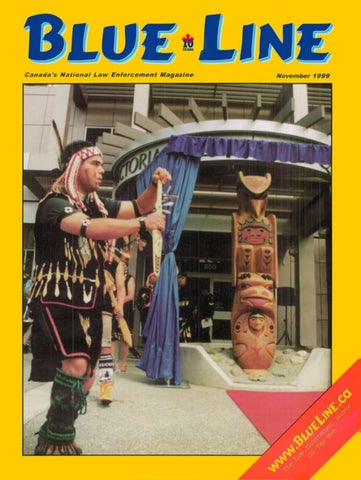
Morley S . Lymburner Forthejirst time anywhere in Canada a First Nations ' totem pole has been raised in front ofa police station
Email:blueline@blueline .ca Ph : (905) 640-3048 - Fax (905) 640-7547
General Manager Mary K. Lymburner, M.Ed . Email: bluelinesales@home.com - News Editor Blair McQuillan Email: bluelineedltor@home.com - Advertising Mary Lymburner (Director) Phone (905) 640-3048 Fax (905) 640-7547 Bob Murray Phone (905) 640-6506 Fax (905) 642-0900 - IIlustration Tony MacKinnon Steffon Sepa
Canada commemo.-ates 100 years of parole
9
1999 police leadership nominee
12
The chase to protect service dogs
14
Vancouver Police Department homicide investigator's course
16
Letters to the editor
17
- Pre-press Product ion Del Wall Blair McQuillan
18 Patrol proceduresfroll1 The Law Enforcement Handbook
- Mechan ical S pe c ificat ions Gary Welch Phone (905) 466-5039 -Contributing Ed ito rsPierre Descotes Ballistics & Firearms Dave Brown Tactical Firearms Police Leadership Robert Lunney Communication Skills Terry Barker Case Law GinoArcaro Computers & Technology Tom Rataj - Contributing Write rsFloyd Cowan Brian Brennan Rik Davie MarkWelch Blue Une Magazme IS published monthly, September to June, by Blue Une Magazine Incorporated wllh a mailing address of; 12A • 4981 Hwy. 7 East, Ste. 254, Markham, Ontario, L3R 1N1 . Individual magazines are $3.50 each. Subscriptions are $25.00 per year or $40.00 for 2 years. (Overseas - $50.00) All artICles are protected by copynght. No part of this publicahon may be reproduced or transmitted In any form or by any means, electronic or mechanical, Including photocoPYing and recording or by any information storage or retrieval system Without permission from the publisher. Internet activity is monitored and use of material on the Internet is restricted, All matenal submitted for publication becomes the property of Blue Une Magazme unless other arrangements have been made with the publisher The authors, advisors and publisher accept no liability whatsoever for any Inluries to persons or property resulting from the application or adoption of any of the procedures, tactics or conSiderations presented inthiS magazine. Readers are cautioned and advised that articles presented herein are edited and supplied for your personal awareness and should not be used for further achon unhl appropnate adVice and gUidance IS received from a supervisor, Crown Attomey or other person In authority Established In 1988, Blue Une Magazine is an independent publication designed to Inform, entertain, educate and upgrade the skills of those Involved In the law enforcement profession. It has no direct control from a law enforcement agency and ItS opimons and articles do not necessarily reflect the op,mons of any government, police, or law enforcement agency. Slue Line Mar/ulne is a private venture and as such is not funded by any level of government agency, union or association. Blue Line Magazine is printed In Canada by Garson Graphic Services Inc.
- Af filiationsInternational Association of Law Enforcement Planners Canadian Advertising Rates & Data International Pollc:e Association The Canadian Press NeMwire Periodical Publishe,. Exchange
ISSN #08478538 Canada Post Canadian Publications Mail Product Sales Agreement No. 176796
YEARS
November, 1999
Forensic computing utility
20
Technology by Tom Rala} 22 The lime to check your PC is really here Project Turnaround
24
Highway Help Program
26
Loo.:. .:. .=-_. . .El.
Hook-on reflective sign alerts passing motorists to call police to aid stranded vehicle
PenonalComputing by Reid Goldsborough
28
Innovation Policing effective communications
30
Product News
31
Classified
32
Tell-Seven - Law Enforcement News
33
Most Wantell
34
Criminally Funny
38 LIST
Aegis Blue Line News Week Canadian Police Association Canadian Police Products Accessories Commercial Business College Dalhousie University DavTech Analytical Flying Cross by Fechheimer Ilenry 's Laser Labs
OF
ADVERTISERS
9 37 35 32 29 23 15 2 32 17
LiveLink Training Program
II
Malle Ind ustries Mega Tech
26 8
0
On August 7th, British Columbia police servicesjoined with FirstNations peoples from Vancouver Island in a Unity Feast. The ceremony was intended to heal long standing cultural wounds between the police and First Nations peoples and was deemed a complete success. In a pecial ceremony at the fTont oCthe Victoria Police Headquarters a ceremony was performed and a special totem pole was unvei led as a permanent reminder of the bond that has developed between the two cultures. The Unity feast was not the on ly action the police have taken, Officers have attended native sweat lodges regu larly and an Aboriginal Workshop was held involving the T'sartlip community and members of the RCMP, Victoria and Esqui malt Police departments. This mon th our cover honours this initiative and our west coast correspondent, Floyd Cowan, files his report on this significant event beginning on page 6. The year 1999 marks the IDOth Anniversary of parole in Canada. On page 9 you wi ll read about the history of this organ ization. Although considerable media focus is brought to a few failures not much attention is given to the overwhelming evidence of success. This month you may perhaps get a clearer understanding as to why the organization has survived and marvel at its abi lity to do what it is doing and the necessity to continue. This month you will read about many technological advances in law enforcement tools. Other features include innovative courses made available for those interested in law enforcement at both the academic and appl ied levels of the field.
Most Wanted Nonh Sylva Pads Fitness & upply Panasonic Canada Pentax Technologies Pride in Service Rocky Shoes & Boots Sokkia Corporation Tetragon Tasse The PERCS Index Tribute to Ileros Triform Business Systems Westervelt College
34 37 32 4 7 28 40 27 21 27 32 17 25
BLUE LINE Magazine
Panasonic
First we gave it a built-in antenna - simply add the integrated wireless modem to access the CDPD . ARDIS and
MOBITEX networks from the field . Then we gave it a fully sealed keyboard. a gel-cushioned HD and a bright . anti-glare colour display that's readable in sunlight . Finally. we wrapped it all up in a magnesium alloy housing that's 20 times stronger than plastic and can withstand a fall of three feet onto solid concrete. It's the CF-27 TOUCHBOOK from Panasonic . Because if you can take it . you can take it with you .
www.panasonic.ca/toughbook 1-800- 265-0616 All brand namesllogos are trademarks or regis tered trademarks of their respechve holders.
Publisher' s
Commentar~
by Morley Lymburl/er
It may be time to wake up about 12-hour shifts After many years of good fortune my wife and I finally became a victim of a crime. I must say it certainly took a long time for the criminal element to catch up with us but they finally did. We also had a rude awaken ing as to the modern day methods police use to help the crooks. While vi iting a nearby community rose garden we came back to our car to find the driver's window sma hed and my wife's purse stolen from it. From my many years of giving advice to other victims I was ready for thi event and grabbed my cell phone (which was mercifully left by the bandits) and called the local police. Four hours later an officer arrived to look over the scene and take a report. The officer was apologetic and advised the day shill should have handled it but they were probably at the end of their 12-hour shift and simply skipped out. I informed the officer that I had called in all the credit cards for cancellation and that one of them had gone fraud by the time I had called. We had searched the area, checked the garbage bins in the parking lot, interviewed the motel owner across the street, the waitress at the re taurant next door and the ticket taker at the entrance to the gardens. We had spoken to several other car owners as they returned to their cars nearby and had a good talk between ourselves about the eries of event leading up to the incident. After all this we came up with a description of two very good su pect . All wa given to the officer and he was grateful for the ground work we had done. Two days later we received more information and found another card had gone fraud that
DON'T WORRY FOLKS - I'LL GET YOU A DAY SHIFT OFFICER TO HANDLE THIS! ' "
------- -
we did not know was in the purse. The card company advised the card had extensive use with local merchants. Feeling there could be some good information to follow-up on I called the police station. I was advised the officer was on days off and I would have to call back in another four days to pass along the information. My attempt to give advice on the advisabi lity of interviewing witnesses while their memories were fresh fell on deaf ears. "I'm sorry sir, but the officer is on his days off and you can speak to him when he comes back." It should be pointed out that in this case l have nothing other than an editorial interest. The real victim in all this is my insurance company. My portion of the loss (the deductible) can be written off as experience. l did wonder, however, how a victim of a more serious crime would feel when confronted with the not-so-comforting words "call back later". This incident did cause me to do a little dig-
ging on the entire is ue of 12-hour shifts and the results are not merely interesting, it is downright scary. uffice to say my readers will be supplied with much more about the subject in upcoming issues. But I thought I might a well put everyone on notice that many studies have shown the 12-hour shift cycle to be downright dangerous to your health. Long term u e of the 12-hour cycle has shown people to be in poor health due to sleep deprivation and interruption ofthe body's natural sleep cycles. One other factor i equally alarming. What does all this do to the citizens who expect to be protected by officers who become sleep deprived and make every effort to run and hide from routine calls. But the scary part comes form a tudy of the Three Mile I land uclear Power Plant disaster. Workers at that facility worked 12-hour shills and were found to be actually ha llucinating. If it is bad for engineers checking guages then it is at least equally dangerous for officers who must make clear judgement calls on a daily basis. Many of tho e decisions are life and death one . It isn'tthatno one knows about this. A quick internet search reveals there are 17,196 sites dealing with police shifts. A quick run-through of about 30 found no one had anything good to say about 12-hour shifts. 0 what i going on here! As long as the 12-hour shift is in place the crooks are going to have a hay-day while zombie cops find a place to curl up.
Your comments are expected.
Commentar~
Don't criticize the lI'Iessenger by Blair McQ uillall Some shocking statements were made by a police officer recently who chastised a citizen for calling in a tip that re ulted in an embarrassing gunpoint takedo\vn. A tipster driving along a highway called police in Alberta via his cell phone in July to report that he had just seen a man tuffan apparently limp, lifeless body into a car and drive off. Police immediately dispatched a half-dozen cars to intercept the suspected murderer. A gunpoint takedown soon followed and two touri ts lay face down on the side of the highway before the real story was uncovered. There was no lifeless body. The occupants of the car, a male and female, were on their way to an event in the province when the woman learned of a death in her immediate family. The woman wa sitting in the ditch on the edge of the road grieving over her loss when the driver de-
YEARS
cided they should resume their journey. He was helping the distressed woman get back into the vehicle when the tipster apparently happened by. Naturally, this made for an interesting story, which was eventually placed on the national news wire. But the case of mistaken identity wasn't of as much interest as the statements made by a police officer who blamed the situation on a "busybody with a cell phone who should have minded his own business". The officer went on to suggest that wouldbe tipsters should be absolutely certain the infonnation they are supplying is valid before they trouble the police. So what was this good, although misguided, amaritan supposed to do? Should he have pulled over on the side of the road and asked the driver if he was in the mid t of stuffing the body of a dead woman into his car? And if the driver had been doing just
that, wouldn't the police then be inve tigating a double homicide? The public has been told repeatedly by police not to put themselves at risk by approaching individuals who they feel may be committing a criminal act, but instead call the local authorities. Obviously, this citizen was listening and acted in accordance with this advice. Having a member of a police service blast omeone for making an honest mistake that err on the side of caution is no way to e tablish a bond with the public. Of course, it is understandable that the officers involved in the takedown must have felt both embarrassed and angry. No one likes to be sent on a wild goose chase, e pecially when it results in such an unfortunate scenario. But don't discourage the public from upplying infornlation because of one bad incident. The next tipster just might have information leading to a major arrest.
\5l~----------- OUI£ LIN£ Magazine November 1999 - - - - - - - - - - - - - - - - I V I
Seeking a higher understanding
by Floyd Cowa"
Viclorio :\ Chief of Police, Paul Battershill, arrived allhe Unity Feast Ceremony at Ihe head of a prflce.Bioll of Regional Chiefs of Police (Top). Sgt. Gary Green, (above left) was the drilling force behind Ihe Unify Feast with Charles Elliott (above right), who carved the totem pole guardillg Ihe fronl enlrance 10 Ihe Vicloria Police building. Everyone in attendallce was illviled 10 siglllhe "Pledge of Unify" (opposite lop) which stated, "We hereby pledge from this day forlh, 10 build a comm/mify which is respectful of all persons... " Throughout the ceremollY lIalive drulllmers sellhe lempo for Ihe Ullity Feast. (opposite bottom)
Bu,£ L'N£- - - - - - - - - - - - - - - \Q ~agaz;ne
For the fir t time anywhere in Canada a First ations' totem pole has been raised in front of a police station, put there as a symbol of unity between the Victoria BC law enforcement agency and the ative people of the area. Two years ago the Victoria PD formed a Diversity Unit to improve relations between the police and the various cultural, re ligious and nati onal groups that live in the city. gt Gary Green, an Identification pecialist, was madeAboriginal Liaison Omcer and through these vol unteer duties, and many meetings, carne up with the idea ofrai ing a totem pole that would help in the healing process between the police and atives. arver harles Elliott designed a pole that has a Thunderbird at the top, and a Killer Wale at the bottom protecting a human with its tail.The totem ymbolize unity and protection th rough
~~_--------------------------------- November, 1999 YEARS
For Gary Green this was the "proudest moment" of his police career. "As we enter the next century, our society is looking for answers to our co ll ective problems and social issues. A clear examination indicates there needs to be a higher understanding between cultures. Greater understanding leads
the balance of the spiritual and physical powers of the Thunderbird and the Orca. The Thunderbird's sacred spiritual power mani fests itself through the spiritual realm. It holds sacred duty to the Great Spirit. The Orca, holds awesome physical power and intelligence, is a friend of man and a protector. Man is secured and protected by the balance of power of the spiritual and the physical, shown in the unity of the Thunderbird and Orca. Elliott says, "This pole is symbolic of the police who are the protectors of all people of all nations." On August 7, the third Anniversary of the opening orthe new Victoria Police Station, community and Native dignitaries gathered for an unveiling ceremony at which many speeches were given. Ilistorian, Dr. Phyllis Senese, stated that for the police to say that they were wrong and that they need to change "makes this a staggering historic occasion." Victoria Police Chief Paul Battershill stated, "This totem will remind us ofthe commitment that we are making to build a community that is respectful of a ll people. Our actions will determine the kind of community our chi ldren and grandchildren will live in." Dr. Samuel Sam, a Tsartlip Elder who was invited to speak, was driven to the ceremony in a restored 1940's police car. "When I got out of the car," he said, "and I saw the native police officer and then when I saw the police woman I thought, this is a real unity feast. We have always prayed for such a timc as this, whcn colour wouldn't matter." Then he smiled and said, "The first time I was brought to the police station in that car, it was under much di fferent circumstances." The dignitaries and the public were asked to sign the Pledge of Unity which reads: "Today, on August 7th, 1999, as we come together to honour our First Nations People, we hereby pledge from this day forth, to build a community which is respectful of all persons, regardless of their gender, culture, ethnic or religious backgrounds. Let us build in unity the world of our new millennium, enriched by this diversity and strengthened by the spirit of compassion."
to better communication, which leads to tolerance and respect toward each other." Relations between the police forces of Canada and the Natives have not been good, and the effort to improve it by the Victoria Police does not stop with this one event. Many police officers have and are going to native sweat lodges, and weekend long workshops have been held to introduce them to Native culture. A bursary has been established that will be presented annua ll y to Native students who wish to pursue a career in law enforcement. The mistakes of the past will not be forgotten soon, but the holding of a Unity Feast is a sign that the police are moving in the right direction.
weapon against wasted time.
Your job is tough. Your time is valuable. And you have enough to worry about without the headache of filling out forms back at the station. Make your job easier by printing information directly from your vehicle with the Pentax®PocketJet®II. Just connect this ultra-compact printer to your mobile data system and output reports, citations, warrants, and maps without ever leaving your car! You can even secure your printer with our optional vehicle mount. The PocketJet II runs off a DC adapter or Hi-Cd battery and prints crisp text and graphics at speeds up to three pages per minute. And its rugged design means it can withstand most hot and cold extremes in your vehicle. Call 1-800-543-6144 for a free information package and to learn about the PocketJet II demo program.
• PEN"I TECHNOLOGIES
www.pentaxtech.com
G!I------------ 8111£ LIN£
YEARS
November, 1999 ______________________________-\~~---------------------------------------- ~agazine
H rked vehicle marked to the , under roofline, rear facing systems for Ford Crown
Consoles customized to fit any and your accessory needs.
TRIES patrol vehicle safer to protect officer and prisoner.
The most advanced technology available today. rechargable Black & ueCKflr Packs)
MEGA·TECH ~.~
all: 1-800-700-79
Canada commemorates 100 years of parole To commemorate the centenary of parole, the National Parole Board has lIndertaken to p llblish a history of parole and conditional release. While the book will not be available for pllblic distriblltion lIntillater, the following is (Ill e.xcerpt from a IllStOry of the parole and conditional release in Canada. Parole came about as partofa wi 11ingne at the tum of the century to experiment with new things. The I 890s were a time of energy and optimism in Canada. Prime Minister Wilfrid Laurier promi ed that the 20th century would be the century of Canada. People looked forward to a new era of prosperity and progress, and they were ready to try new things. The public mood was exactly right for the introduction of parole. OnAugu t I I, I 899, An Actto Provide for the Conditional Liberation of Convict - the Ticket of Leave Act was enacted by the Canadian Parliament. The anadian Ticket of Leave Act was based almost word for word on the British legislation. There was no reference in the text to the purpose of conditional relea e, though ticket ofleave was generally understood to be a fonn of pardon. Prime Minister Laurier, in introducing the new legislation, described the kind of person the act was de igned for: " ... a young man of good character, who may have committed a crime in a momentofpa ion, or perhaps, have fallen victim to bad example, or the innuence of unworthy friends. There is a good report on him while in confinement and it is supposed that ifhe were given another chance, he would be a good citizen." This statement renected the growing concern about the effects of imprisonment on young and first offenders. Penitentiaries, many people believed, were schools of crime where the (relatively) innocent should not be kept. There were other considerations as well. Parole could be used to mitigate disparities in prison sentence, which caused a great deal of di content among prison inmates. It was also cheaper to release some inmates early rather than maintain them in prison at $254 a year. The sooner a man could be paroled, the sooner he could get back to supporting himselfand his family. The act did not set any minimum ternl ofimprisonment before parole could be granted. Nor did it make any provision for supervision, though prisoners on ticket of leave had to register with and report regularly to the local chief of police. They al 0 had to agree to obey the law, abstain from leading an "idle and dissolute life" and avoid the company of "notoriously bad characters." Because ticket ofleave was considered an experiment, the government took a cautious approach at fir t. There were fears that parolees might discredit the system by behaving badly and Olat "unde erving inmates might make a cynical use of the ystem." Not many were granted. There were 145 license granted in the first year - five were forfeited. And there was no supervision in the community. There were no parole officers. Offender were only required to report to the police. In practice, parole worked even better than even it strongest advocates believed it would. By \905, \ 082 offender had been granted tickets ofleave. One hundred were forfeited; 24 for new offences and 76 for breach of conditions.
In that same year, the government decided it was time to hire a permanent parole officer and Brigadier w.P. Archibald, of the Salvation Anny was invited to become Canada's first Dominion parole officer. Archibald had already acquired a lot of experience as the Director of the Salvation Army's Prison Gate Branch. For eight years he worked alone; criss-crossing the country, interviewing inmates in prison and supervising those who had been released. It was not an ea y job considering the size of Canada. Archibald wore out two suitcases.
But the workload was growing too much for one man. Several time he and the Inspector of Penitentiaries recommended that each of the provinces take re ponsibility for provincial parole and that federal parole officers be appointed in each province. But no action was taken until 1913. That year the Remissions Branch wa created in the Department of Ju tice. During its first three decades, the Ticket of Leave Act was administered mostly by the Salvation Army, the R.C.M.P. and local police force. By March 31,1925,17,686 offender had been released on ticket ofleave from federal and provincial institutions. More than 94 per cent had successfully completed thcir sentences; 436 (2.5 per cent) had been convicted of new offences while 594 (3.4 per cent) had been revoked for technical violation . But the period was not without its problems. There were complaints that criteria for ticket of leave were unclear and rather subjective. There was political interference in decisions. There were also the inevitable high-profile cases that prompted public attention, more studies, more reports, and more recommendations for change. The case of Norman "Red" Ryan, was perhaps the most pectacular parole failure in Canadian history at that time. His was a pivotal case in
WORLD CLASS PROTECTION AND COMFORT The toughest protection standards (we meet them). A complete armour line (we pioneered them). Unlimited accessory and custom options (we offer them). As important as these feature.s .are, protective apparel in thc real world demands one other CrItIcal component... comfort. That's why at lEGIS our designers place a special emphasis on material selection and fabric weaves so that our products meet your most demanding standards of protection and durability and are comfortable to wear. Day in and day out. Real world comfort that makes lEGIS a world class body' arm~)Ur supplier to national and international police and peace keepmg forces.
lEGIS Engineered Textile Products Inc.
'"%
~
\~
lEGIS f q;
~-t'\\"~
~
F ifth Avenu e g 251 Ar~rior, Ontario
Q
K7 3M3 Tel: 613-623-6001 Fax: 613-6236169 www.aegisinc.on.ca
~-----------------\0 9 } - - - - - - - - - - - - BLUE L INE YEAIIS
November I 1999
_
{-_ _ _ _ _ _ _ _ _ _ _ _ _ _ _ _ _ _ _ _ M a gazine
the hlstol) ofconditi nal release. Ryan was a hero to his felk \~ mmatesand a celebrity in the outside \\orld. Rcd Ryan was a bank robber and escape artist with a long criminal career. lie wa serving a life sentence for anned robbery at anada's famous Kingston Penitentiary. l ie had become a model prisoner and a clo e friend ofthc chaplain. l ie volunteered to work as an orderly in the prison and became a mentor to youn 'er inmates, advi ing them to learn from his mistakes. While \\orking in the mailbag repair shop, he designed a pick-proof lock that was adopted by p st om e acr ss the country. The media published storie about Ryan's miraculous transrornlation. One paper reported ho\,O' hc had u. ed . ome of hi tolen loot to help an allmg ~istcr. Work began to petition the overnor eneral for a ticket of leave. ome very innuential people, including the Prime Mini ter supported his case. The Prime Mmi ter even came to vi it him III prison and lell convinced he should be gl\en anothcr chance. fhe \\arden \\as agaill. t it, the Director or the RemiSSions Branch wa again. t it and the Mlilister of Justi e \\as again. t it. But all were overruled by the Prime Minister and on July 24,1935, Red Ry3l1 \\a! released on ticket oflcave. Ryan was given a numbcr orjob offers. People IIII cd up to shake his hand. lie wa accepted and lion lied by Toronto high ·ociety. Ilis picture appeared frequently in the society page . Even the police gave a banquct in his honour. I ... crYlhing he did made headlines. At one POlilt hc declared that "aller all the publicity my casc has received, irl \\ere to go back to a life of Crime, It \\ould be the biggest blow the ticket of Iea ... e system could receive." n May 24, 1936, t\\O ma ked men entered a liquor store In . arnm. The hei t went bad and police arm,ed. There \\a. a rerociou gun-fight. Both bandits were killed as well a one poli eman . When the masks were removed, one of the robhers was immediately recognized a Red R)an. In the a!lennath, it became evident that Ry3l1 had hcen Ieadmg a d uble Lire. During the period 01' release, he had heen invol ed in a string or serious Crimes, IIlcludlllg at least one murder. Thosc \\ho had champIOned Ryan's cause \\ere hUllllliated. nle same newspapers that had lionl/cd Ryan and had 13111 ured for his release, nm\ crupted in angl) editorials again t parole. I lis prcdlctlon had pro ... en correct. !ler the incident, the number of ticket of leave leIl by halfand \\ould not recover ror at least the ne ... t t\~enty years. bven aller two decadcs, the case of Red Ryan ontinued to haunt the Rcmlssion ervice. But It wa. n' t until the Fauteux Report r 19~6 that change were finally made. That rePOl1 \\lIS an IIlsightful3l1aly is or 3I1ada' criminal Justice system. It concluded that parole wa (or should he) an integral part of the sentence and should occur as naturally as the warrant or committal. I vel) inmate, regardless of hi offence or sentence should, therefi re, be entitled to a parole review. The 'ommittee recommendati n envisioned
BLU£ L'N£ M
9
zin
the creation ora dynamic, comprehen ive, autonomous, profe sional, national parole y tem. new Parole Act wa approved by Parliament in August 1958 and was proclaimed into law on February 15, 1959. The Parole Act authorized a parole board of three to five member appointed by the Government for term not to exceed ten years. The Remi ion ervice was renamed the ational Parole ervice, headed by an xecutive Director who reported directly to the Chairn13l1 ofthe ational Parole Board. The Legislator envisioned a very powerful organiLation. The ational Parole Board wa given "exclusive juri diction and absolute di cretion to grant, refu e, or revoke parole". There \~a automatic re iew for every ca e. The Board also had the power to revoke or u pend any sentence of whipping or the la h. And they were given re ponsibility to conduct inquirie pursuant to the royal prerogative of mercy. The new parole act embodied almost all of the suggested reforms that had been put forward over the previou 60 years.
The ational Parole Board had an immediate impact. In 1959, it approved almo t 1,000 federal paroles, the greate t number ever. Between 1959 and 1967, the Board granted over 9,000 federal parole (36 per cent of the more th3l125,OOO application received). The combined federal and provincial total wa over 20,000 granted. In 1969, the Board made nearly 15,000 parole and clemcncy decisions. Workload became a serious problem. The Board's first decade ofexi tence was dimcult but it was pioneering and exhilarating. The econd decade may have been exhilarating but it wa al 0 chaotic. The Board was enlarged to nine member to pernlit the conduct of face-to-face hearingsat lea t three members per panel. ew type or relea e program were introduced uch as day parole and mandatory upervi ion, which meant all orrender who had earned remission would be relea ed automatically and placed under the supervi ion or a parole omcer. The inmate right movement or the 1970 rorced the Board to pay greater attention to due process and the duty to act fairly. It gave inmates the right to have as i tants at their hearing , access to all the inrormation used by the Board in its decision-making and, eventually, led to the establishment orthe Appeal Divi ion or the Parole Board. By the 1990 PB wa a relatively open, confident, "battle-hardened" organization. A lot of what had been learned in the previou three decades, had been implemented. 0 much change had occurred that the Parole Act had become outdated. It was time ror new legisla-
tion,legi lation that would be more compatible with the reality orthe day 3Ild the expectation orthe future. In ovember of 1992, the Parole Act wa replaced with the orrections and onditiona l Release Act. The ational Parole Board of anada ha een its hare of ch3l1ges and improvements during the past forty years. • It grew from five members to nearly 100 today. • It went from a centralized Board to five regional tructures. • It moved from paper reviews to face-to-face hearing. • It went from clo ed hearings to hearing open to the public. Imost 3500 people, including victims and journalists have attended parole hearing in the pa t five years. • Parole decisions are better documented and justified. And are available to the public. early 3,000 request ror 7,000 parole decisions in past four year. • With the orrections and onditional Re lea e Act in 1992, victim have been given a greater role in the parole decision making process and are entitled to more information about offender. ince 1992, there have been more than 30,000 contacts with victim . • A new election proce s identi fies the mo t experienced and qualified people. • The performance of Board member can be evaluated and they are guided by a code of profes ional conduct. Throughout the years, there were frequent changes to legi lation in response to concerns about public safety or to improve the reintegration of offender. There were even the occasional calls for abolition. But parole has survived and the fundamental principles have remained in tact for a century. That it has endured ror a hundred year , is a tribute to: • the pioneering effort of enlightened rerormers and private citizens in the late 19th century. • many legi lators and parlirunentarian wh recognized the value or conditional release to the reintegration of the offender and its contribution to the protection orsociety. • the countless thou ands or men and women \Vho \Vork with offenders 3Ild believe that orrender can and do change. • countless thou ands or offenders who did change and became lavv-abiding citizens. The Value of Parole Result t day also demonstrate clcarly that parole works! It is 311 effective strategy ror public arety through a controlled and gradual reintegration or offender into the community. Offenders on all type orparole relea e do well in the community. The majority of parolees complete their entence ucce sfully without reoffending (9 out of 10). Rate or reoffending are low. One in 100 are re oked ror an offence of violence. Over the past five years, the annual number or iolent incident involving parolee has declined by 70 per cent. Parole has evolved into a dominant progranl in the field of corrections and Canada's ational Parole Board ha become a recognized world leader in parole and conditional release.
-----------IQ 0 1 - - - - - - - - - - - - - - - - - - - November, 1999 TURS
r-'-"~~~~_
100% Canadian Law Enforcement Content
LiveLink Television Network
SPECIAL 1999 YEAR END OFFER
The following Police Training Programs are now available for sale at the special bundle price of $500. 00 for all ten Packages (postage handling included. Delivery by December 31, 1999)
~I
The above Training Programs Include: Field Lesson Guide / Training Precis / Research Material/Quiz
TORONTO POLICE VIDEO SERVICES UNIT 416-808-4336 Ask For Craig Smyth or Dan Murphy E-mail: videoservicesunit@torontopolice.on.ca Web: www.torontopoli ce.on.ca/videoservicesunit
1999 Police Leadership Nominee Leadership Forum
.' . The Regina Children's Justice Centre Nothin9 we d o f or children is ever wasted. They seel"\ n,'t t o notICe us, and they seld ol"\ Her thanks, but wh at we do f or thel"\ IS ne ver wasted.
The Regina hildren' Justice entre (R J ) developed out of ideas formulated by a number of people in ju tice, Regina Department of ocial er ices (RD ) and the Regina Police ervice (RP. ). Through a process of community consultation and the addition ofre ource' from the Department of Justice's ervices Fund, a plan was developed to try and further increase the level oreooperation and integration that wa already occurring on serious child abuse ca e . The 'entre is set up 0 that each social \vorker worb with either a pair of police officers or an individual officer, and is referred to a an investigation team . The case arc assigned to each individual officer but their team member maya ist on an individual case, a, the need ari e ,Thi arrangement is also helpful to assist in training new, 01'Ii ers that come into the unit. There arc live pol icc officer who have not been assigned a wor"er in the entre who work 111 a coordinated way with child protection w rkers in Regina Region, on ca e of child abu e which occuror arc discovered on exi ting ca es. The teams in the Regina hildren's Justice entre primarily wor" on ne\, reports orchild abuse \vhere there is n urrent involvement with 0eial. ervices. 'ases where physical or se ual abuse ofa child is disclo cd or suspected are referred to the 'entre through the police or hild Protection Intake. Reports made through Mobile risis Services also go through hild Protection Intake . he entre reviews the referral and does a complete chec" of the ocial ervices history as \vell as any police history. Ajoint deCision is made between the ocial work supervisor orthe entre, the police supervi or and the hlld Protection Intake supervisor regarding the most appropriate investigative response. Once assigned t an inve tigative team, cases are done in a c mpletely integrated manncr. The II1vestigative team review the referral andJollllly dccldes h w to proceed. Joint decisions about who t interview fir t, who should conduct the intcrview , \vhat issue to cover, and \\ho \\0111 do what tasks during the inve tigation arc made. Whenevcr intervicws are required the team try to complete thcm at their office in the Wascana Lnergy Building. They have two oil rooms i'br II1tcrvic\\ing childrcn and witnesse \\oIth Video taping capability and they video tape every IIltervic\v done in the ro ms. In ituation \\-hcre an IIltcrvie\\ at the office is not warranted thcy try to audio tapc thc interviews.
The team conducts video taped suspect interviews at the police building. Maintaining a good record of contacts and interviews i critical to the potential prosecution of ca es. The use of video tape has enhanced the cases which go for prosecution. In fact the prosecutors have noted fewer cases are required to go to trial and more guilty pleas are being entered. In addition the tapes have limited the number of times interview of children are required as therapists, coun ellors and other social workers can review the tapes rather than re-interview the children. REFERRAL PROCESS The mandate of the Regina Police ervice and the Department of Social Services is to inve tigate report of suspected child abuse. Deci ions to conduct ajoint investigation are guided by the principles outlined in the Provincial Child Abuse Protocol, the legislation in the Child & Family ervicesAct and the Criminal Code. CRITERIA FOR REFERRAL a es meeting the following criteria are referred to the entre for review and an appropriate investigative response. It is recognized that many will not clearly meet the criteria, however, joint review of the e cases is till recommended: o Disclosure of physical or sexual abuse of a child which indicates a criminal offence may have occurred. o An injury(ies) to a child that does not have a rea onable explanation. The age of the child and the nature of the injury will impact on the decision to do ajoint inve tigation. o Physical injurie where there are medical indicators that child abuse has occurred. Reports of child neglect of a life threatening nature (i.e. starvation, medical neglect of a evere nature or child abandonment). o Pattern of injuries or incidents ofa su picious nature. o In assessing any referral for its appropriateness for a joint investigation, the age of the child, the nature of the injury and their ability to adequately respond to the situation they are in are risk factors that may also be considered. o The intent/motive of the parent or caregiver in causing injury to a child. o The family tructure and their willingness to address identified problems. o The relative safety of the child in their present circumstance, taking into consideration the home environment on a physical and emotional level. o The impact on the family ofajoint investigation. Is a Ie intrusive approach appropriate? o The frequency of incidents (i.e. sexual knowledge beyond the age of the child, intrusive
BLU£ L'N£ - - - - - - - - - - ----1Q12
and/or acting out behaviour beyond nom1al developmentallimits). o Behavioural indicator in children indicative ofphy icalor exual abuse. o History of criminal activity relevant to fan1ily life including child abuse, substance abuse or domestic violence. Alcohol or drug abuse involved in the incident. o Indication of mental illness with re pect to the parente ) or caregiver(s). o The overall functioning or capacity of the parent(s) or caregiver(s). SCREENING & CONSULTATION All case considered for joint investigation have complete background check done on both ocial ervice and Police ervice information y tem and PIC as required in order to facilitate deci ion making as to the mo t appropriate inve tigative respon e. Case which are ambiguous or where there i a history concerning child wei fare involvement may also be referred for additional background checks and consultation with the R J . REFERRAL SOURCES For non-urgent or unclear situations, the supervisory team ofthe Regina Children's Justice entre is available on a regu lar weekly basis ror ca e con ultation. Meetings are held with Child Protection Intake every Tuesday at I :30P.M. Arrangements to discuss a case can be made with either upervisor or the intake supervisor. Referrals from other sections of the Regina Police Service are reviewed by the RCJC. Reports involving existing child protection cases are immediately ent to the appropriate unit and the R JC will consult with that unit as to the most appropriate means or investigation. ew cases indicating a joint inve tigation may be required are assigned to a team in the R JC and the Intake nit will be advised of the a ignment. Reports indicating child protection concern(s) which do not require ajoint investigation will be forwarded to the Intake Unit for their review. REPORTS RECEIVED BY CHILD PROTECTION INTAKE The Intake Unit reviews all new child welrare reports including Mobile Crisi ervice reports. Cases clearly meeting the above criteria are referred to the RCJ through the social work supervisor or cover. The ocial work upervi or will confer with the tarf ergeant ror acceptability and case management. Case not clearly meeting the criteria for joint inve tigation will be conrerenced with the
~ag azine ________________________________________~~~----------------------------------
November, 1999 YEARS
ers operate as a team to jointly investigate intake supervisor and the supervisors of the allegation of child abuse. This integrated RCJC. team is co-located for an approach which In situations where Intake initiates the is unique in Canada. The team is made investigation and discovers in the course up of 12 police officers, five social of the investigation that physical or ~. . . . . . . workers and two support staff. sexual abu e of a criminal nature may have occurred, the superviMission Statement sor of Intake will identify this to the Centre and a joint decision re... to provide an integrated garding ajoint investigation wi ll investigation into allegations be made. of child abuse that meets the
REPORTS RECEIVED ON EXISTING CHILD PROTECTION CASES upervi ors of Family Service Units will forward written referrals to the supervisor or the RCJ or backup upervisor when there is a disclosure or suspicion of physical or sexual abuse or serious neglect ora chi ld on any active Family ervice ca es. Urgent situations may be referred by phone wi th written information to follow as soon as po sible. The taff Sergeant or designate will review the infonnation, including any other relevant police information and detennine whether ajoint investigation will be necessary and discuss with the upervisor of the unit making the referral the most appropriate team to conduct thc investigation.
SUMMARY The Rcgina Chi ldren's Justice Centre is a child friend ly place where police and social work-
mandate of the Regina Police Service and the Department of Social Services in a manner that minimizes trauma to the child victim. The Goals of the centre are: 1. To protect children under the age of 16 years. 2. To prevent re-occurrences of child abuse
November , 1999
gation portion of the Provincial Child Abu e Protocol. 2. To reduce the po sibility of victims and offenders not receiving identified services which may result in further victimization. 3 . To produce more comprehensive investigations for u e in both criminal and family courts. 4. To create a distinct investigative unit that wi ll provide investigation and assessment of physica l and sexual abuse referrals, and en urc appropriate follow-up intervention, by Fam ily ervices or Justice. 5. To en ure greater safety for workers involved in investigations. 6. To improve joint training opportunities for police officer and protection workers and identify ajoint training package for future use.
For further information on becoming a member of the Police Leadership Forum or for nomination information for the 2000 Award con tact:
The Police Leadership Forum clo Canadian Police College Research Centre P.O. Box 8900 Ottawa, Ontario K1 G 3J2 Telephone 613 998-0793 Facsimile: 613990-9738
university's director of police executive management programs. "We can now provide the program en ior Police E ecuti e in a manner that peoEd ucational De eiopment Program ple fTOm Unger, Sask., Preparing for tomorrow's challenges to Yellowknife, WT., can take it at the same time and not have th e need to travel. "We can deliver it anywhere in the world that has an Internet connection." Students enrolled in the SPEED prog ram are required to take three graduate The delivery of a police management delevel classes in strategic human resources manvelopment program offered through the Univeragement, project management and organizational sity of Rcgina becamc a lot fastcr this fall. development and change. Students must also For the past two years, the university has complete workshops on topics including interoffered its enior Poli ce Executive Educational personal ski lls, lobby ing strategies and pol icing Development program (SPEED) at its campus and strategy development. in askatchewan. However, this year, it ha exThe program delivered on the university's panded the program to give police officers from camp us is a little more in-depth in th at it allows around the world the opportunity to take the students to take additiona l classes in administracour e at home through the Internet and an intive law, social issues in management and lategrated CD . bour relations and co llective bargaining. "The SPEED program is an executive deStudents enrolled in the distance learning velopment program for senior officers designed program must complete as igned reading each to help them get an appreciation and understandweek before referring to a lecture on the CD ing of some of the key fun ctions and issues in and attending a virtual class on the Internet, comexecutivc managcment," said Rocky Izumi, the
YEARS
The Object ives a r e : 1. To enhance the effectiveness of the investi-
plete with one to 20 students and a professor. Izumi said both the on campus and distance leaming options allow officers in the program to be exposed to students outside of the law enforcement field. All classes are integrated ones involving tudents enrolled in the university's busine s admini tration, resource management and SPEED programs. 'The police get to talk with people that come from lightly different backgrounds so that it's not so insular and they get to make connections with pcople outside of the policing industry," he said. While the progranl is still in its infancy, officer who have taken the two-year cour e have found it both beneficial and challenging, Izumi aid. "The officers fmd it extremely rigorous. They find there i a heavy workload because the e are graduate clas e ." The SPEED progranl was created by the university following the release ofa study that indicated a high retirement rate in the province's police services over the next few years would leave agencie without qualified people to fill the top ranks. "What we're trying to do is speed up the training and education process for people that must become executive managers in the police services in the next five to 10 years," Izumi said.
G"
mo" "'o=,t;o, oo,'ao' Rooky lrum'
by phone at (306) 585-4728, or email izumih@ uregina.ca
________________________~~r------------------------------8-L~!g~!~!
The chase to prrofect service dogs by Rik Davie
When officers with the Durham Regional Police ervice answered a disturbance call outside of an 0 hawa, Ont. bar early thi year, a chain of event began which cou ld ee one officer's bond with hi partner change anadian crim inal law. Two officer were trying to ubdue two upeets, and n t having a lot ofsucces with the two burly and vi lent men. third offi er, st. Dave Moun teven, arrived and became involved in a dangerous stnlggle. ssaulted phy ieally and wre tling with a violent man in a battle that had the potential to turn tragi at any time, the officer called to hi partner for help. Mounsteven's partner leapt from the cruiser and immediately grabbed the uspect by the arm, allowing Mounsteven to escape from the barmge ( f blows being mined on him. Dazed, Mounsteven wa unable to assi t his partner for a few moments. The suspect kicked Moun teven' partner continually in the ribs, cracking ome of them, and rained blows on his head and body. But the suspect still held tightly as Mounsteven regained his feet and assisted the other officer in ubduing another suspcct. nly when Mounsteven as ured hi partner that all was well, was the death grip on the econd suspect released . Moun teven's partner col lapsed to the ground in severe pain from the numerous blows he suffered protecting hi partner and the two fellow of1icers fr m the atta k. Mounsteven's partner required immediate cmergeney mcdical attention and several weeks ofreeupemtion before he could return to work. li e was unable to testify and the suspect who assaulted him was never punished for the attack because there i no law to protect Mounsteven's partner. l ave Moun teven's partner i a dog named ' hase. The coumgeou canine may well have saved his partner's life, and the lives of the other of1icers that night. t the very lea t, he aved them from serious injury. But who will protect ha e and the hundreds orpoli e ervice dogs like him patrolling the streets In cities acros anada? IfMounsteven has anything to say ab ut it, the Cnmlllal Code so n will. I rw,trated by the cnlelty to animal laws now in clrcct that do little or nothing to curb per on who IIllllCt sulTering on animal , the officer has begun a crusade to amend the current tatute so that police service animal are recognized as a distinct category. "We have to do omething to protect the e animals," Mounsteven said. "There have been several dogs killed in the line of duty - Troy, in Ilamilton and aesar in algary. Imo t everyone remembers loud II. "These aOimals go out and erve the public every day just as an officer doe . They de erve somc protection under the law." Mounsteven point out that in some areas of the nited tate, uch as ew York tate, there are separate penalties under the law for
tho e who hann police service animals. "The horses are included in the laws along with the dogs, and so they shou ld be," he said. upport for his fight is coming quicker than Moun teven imagined. "I am setting up meetings with some of the local MPP's who have expressed an interest in helping us to do this," he said. Help from the Canadian Police Association is already in the works. Durham Regional Police A sociation President Terry Ryan aid that the national group "is already working on it from ajustice committee point" and will continue to do so. Durham Regional Poliee hief Kevin McAlpine has also thrown his support behind the members of his K-9 Un it, one of the most successful in the country for its size. Dan Mathew, the in pector in charge of Durham's service dogs, said he fully supports his K-9 Unit's plans to bring changes to the riminal Code. "Certainly, we will do whatever we can to assist him in this effort," said Mathews, a military and police veteran with more than 30 years of experience. " It is a commendable thing that this officer and his fellow handlers are doing, and long overdue in my mind." York Regional Police Chief Julian Fantino, the former head ofthe Canadian As ociation of Chiefs of Police, has said he wants to meet with Mounsteven and di cuss the possibility oflobbying the federal government. "These dogs are a part of the police officer," said Fantino. "They are as the arm of the police officer, an extension of him. To do harm to one of these fine animals in the lawful perfornlance of his duty is to do harm to the officer. I would be proud to be part of any effort that seeks to recognize this." Mounsteven aid that this is not the first time talk of such changes to the laws have arisen. "There was a lot of talk about doing it aller Troy was killed in Hamilton," he said. Troy, a police service dog, attacked an arnled suspect who his handler believed was about to draw a firearnl on another officer. Troy took the bullet that could have been meant for the officer and was killed in the effort. His handier still wears the dog's ervice badge around his neck years aller the tragedy Mounsteven knows how the officer feels about his lost partner. "They are with you all the time," he said of
BLUE L'NE- - - - - - - - - - - - - - - \ Q nnagazine
the three-year-old German hepherd, who lives with the officer, hi wife and their small child. Mounsteven found out after only two weeks on the road what his partner is capable of. "I was trying to make what looked to be a simple arrest when things got out of hand," Moun teven said . "Thi guy got the better of me fast and was beating on me pretty good. l ie was huge and it had reached the point where I was thinking to myself, 'This guy is going to kill me. Thi i how it' going to end right here. ' "I relea ed Chase from the cruiser (with an automatic door opener) and he jumped the guy. He turned the whole thing around, and took a heck of a beating himself." Moun teven is continually in awe of what his partner can do. "With only my command he got out of that cruiser and saved my life, I'm certain ofthat. "Every week I send him into situations I' m not sure he can get out of because that's hisjob -to go where it may be unsafe to send a human officer," aid Mounsteven . "And he goes becau e I tell him to, and for my approval. The least we can do is afford all of these dogs, and hor e ,some protection under the law that recognizes the contribution they make to the quality oflife in our communities." Durham Region Crown Attorney John cott agrees with Mounsteven and is working with him to make it a crime to poi on, hurt, kill or as ault a police service dog performing his lawful duty. Moun teven would like to see a maximum penalty offive year. Inspectors for the Durham Regional Ilumane ociety have jumped on the bandwagon, as did newly appointed Ontario Attorney General Jim Flaherty. "I would welcome a meeting where we could discu s bringing this proposal to the fall meeting ofju tice mini ter to get approval and backing for it. I commend this officer for his initiative in this," Flaherty said. But Moun teven is quick to point out he is far from alone in the fight. "I have spoken with handlers who have lost dog, and the guys on my team are behind it to the max," he aid. "They are saying, 'Ju t tell us what to do. '" What to do, is omething that Moun teven i learning very quickly as the fight to protect his own partner snowballs into a fight for recognition of all service animals. The fight is gaining the kind of momentum it takes to change laws in anada. This cru ade ha not interfered with Moun teven's police duties though. On Oct. 2, 1999, he was named Police Officer of the Year at an annual awards dinner held by the Lions Club ofOshawa. A few days later he and Chase made their IDOth arre t in the year-and-a-ha lf they have erved the people of Durham Region a a team. "You don 't have to be a dog handler to know the valuable contribution these animal make," he aid. For more information on this initiative contact Cst. Dave Mounsteven at 905-579-1520. Rik Davie is a police and courts reporter with the Durham Post. He lives in Nestleton Ont. with his wife Linda.
~~_------------------------------- November, 1999 YEARS
Courageous canine saved life of his police partner by Brian Brel/I/an, Calgary H erald ~I'l!"*
Tiga was a Calgary police dog with an arrest record sec.. ond to none. If there are ~ .-. other police dogs in \ ~ ~ :, Canada with more than ''''I 400 captures to their ~<0 {1,~ '!...'~r.t/:~ credit, Const. Rich yberg V ha n't heard of them. Rich was Tiga's owner and trainer from the time the black male Gernlan shepherd was an eight-week-old puppy. He was born to two Calgary police dogs named Tel and Cora, and inherited their skills. From the time he first aw him, Rich knew that Tiga would make an exceptional police dog. "I pent hour watching the dogs at the kennel . When he ate, he'd stand right in the middle of the food dish and if any of the other dogs tried to eat around him, he'd go after them. So I knew he was the dominant one." At the time he brought Tiga home, Rich was working as a patrol officer on Electric Avenue, and a sisting the canine unit a a human quarry for police dogs in training - "essentially a bite bag." Tiga learned to be aggressive by working with the other dogs in training, and he developed his social skills by being around Rich's three children. "The socializing, and the getting used to people, is everything," ay Rich. "I never once worried about the dog going aller my kids." Rich and Tiga worked together for five years as full-time partners, then for another three on a part-time ba i aller the dog retired . More than a partner, Tiga was a protector. Rich ay he owes his life to the dog. In one instance, Tiga tracked and disarmed a robbery suspect hiding behind a hedge with a 9 mm handgun waiting to ambush Rich. 'The dog grabbed the guy by the shoulder, and actually yanked the gun right out of his hand." On another occasion, Rich was attacked by a man high on drugs and armed with a screwdriver. The constable was stabbed twice in the ve t and once in the arm before Tiga subdued the culprit. "We had the fight of our life on that one." Dogs don't win official citations or promotion for police work, but Tiga did receive a medal from the tam pede board for community service. lie also won several awards in police dog competitions. Rich 's mother Glenda recalls that Tiga alway knew when he was supposed to be on the job, and when it was OK for him to relax and take off the uniform - so to speak. "I f Rich was working at this end of town, and took his upper break with us, the dog would sit in the driver 's seat of the police car, very aloof and traight, and bark at us if we came near the vehicle," she says. " But any other time, when he came here in Rich' car, he was just like a member of the family." She says the family likes to say jokingly that whenever Rich trail a bad guy, he uses what Tiga taught him . A Herald story in December,
~.
~ . (.:..\
t!::l~
t '.
ri.
1996, characterized Rich and h is partner Const. Terry Larson as "human bloodhounds" for tracking a 16-year-old rape suspect through snow and semi-darkness to his Calgary home. Tiga retired from the police force in 1994 after being diagnosed with lupus, a disease ofthe immune system where the body becomes allergic to itself. It is rarely found in dogs. Because
the di ease is aggravated by stress, Rich thought it best to take his partner out of active service and put him out to pasture on his acreage. Rich believed the disease was incurable. However, information he obtained via the Internet suggested otherwise and brought him to the door of Dr. Michael Hannigan, a Calgary vet who succeeded in curing Tiga with an anti-rejection dmg normally given to human transplant patients. " I brought Tiga out of retirement twice since then, for three and four months at a time," says Rich. His new lease on life gave Tiga the chance to add 100 more collars to his arrest total ofJO I. "Exceptional service from a dog who loved to work," ay Glenda. Lymphatic cancer finally put an end to the dog's ability to work. Rich had him mercy killed in early July. "I always told myself that I would never let the dog suffer, and he was in a lot of pain." Tiga was 10. " My first memory of Tiga is as a Ooppyeared pup trying to corral his human kids - my grandchildren at the playground, and keep them all together," says Glenda. "My final memory isofa sick old guy lowly walking around his acreage checking it out. He had no energy to even greet me as I got out of my car." "We went through thick and thin, that dog and I," says Rich . " Probably the hardest thing I've ever done in my life was putting him down."
davtech Analytical & Media Services (Canada) Inc.
ALCOHOL BREATH TESTING BAC DataMaster-C
Intoximeters GUTH LABORATORIES Oodycote ANALEX RepCo SALES SERVICE SUPPLIES
CANADA WIDE
L E. TRAINING D.O.T. TRAINING ACCESSORIES
25-8 Northside Road Nepean, Ontario K2H 8S1 (613) 596-0030 (800) 331-581 5 Fax: (613) 596-9769 Pacific Region (888) 523-9072 email: davtech@fox.nstn.ca
Qt------- - - - - - 8LO£ L.N£
YEARS
November, 1999 ----------------------------~~r-------------------------------------- ~agaz;ne
Ilomicide. quad was faced with the ncar eliminatton of its training budget. Rather than allow cutbacks and fiscal constraints t limit professional development, the squad members displa}ed some outside-the-bo:\ thinking and ame up \\Ith a creative solutton. I lopes were high when thc first Ilomicide Invcstlgator's ourse \\as run in eptember 1997, but few could ha've foreseen ho\\ successful It \\ould become. funds raised from the course have enabled squad members to attract top level speakers each }ear and in turn, allow the squad to participate 111 other high calibre trainII1g semll1ars \\orld\\ Ide. The c ur e now pro\ Ides the bulk offundll1g for any training not pro\ Ided by the PD. I ach jear, the bar has been raised in terms of the qua lit} ofpresentatton and the timelines of the material. The 1999 our e held the week of, eptemher 13th proved no e:\ception. This \ car, the ancouver Police Department approved the course for education credit for their members \\Ishll1g to usc It toward promotion and mcremental pay raises. sin previ u years, the course had somethmg to offer everyone from the most Junior delegates up to the most e:\perienced major erime investigator. The addition of VID Technol gie Inc. as a corporate sponsor, funding trom the Provincial Attt I11C) General's office and the Justice Institute I' Be. and a strong core of committed volunteers have combined to help keep course cost down \\hlle pmvldll1g top-rate instructi nand facilitie . IJ) Technologies had an opp rtunity to strut Its stufTIIl the 1'01111 ofa presentation by st. )rant Fredericks of the Vancouver Police Department. st. Fredericks demonstrated the nev \Irtual reality crime s cnc c mputer soflware and hardware givll1g the over 200 delegate a sneak
peck at thi huge breakthrough in major case managemcnt. All ca e information is stored on a ingle D-ROM that allows a virtual walk-through of the crime scene. The computer links the scene, photos, foren ic , tatements and reports. Ea h of the sessions had something to offer, '" hether from a "how-to" per pective or as a detailed explanation ofa high-profile investigation . Mo t se sion gave delegates both - everyone walked away with a better idea of the challenges which the pre enter faced and advice as to what worked well and what they would have done differently. Brother Grego\") Miles of the ew York tate Police spoke on the Trauma Induced By Officer-Involved hootings, Det/Sgt. Dennis Gerard of the O.P.P. outlined the ins and out of Major ase Management, and Dr. Owen Beattie of the ni er ity of Alberta di cussed Exhumation and Physical Anthropology. A retul11 speaker and favourite, teve heriff, detailed innovative techniques in case law interpretation and provided strategies on how to use these "to take the bad guys off the streets". As a lawyer, prosecutor and the author of"Convicting The uilly", heriffupdates his book annually with new decision and ca e law urrounding issues central to major crime investigation. Two fa cinating ca e tudies were pre ented to the delegates - The Abbotsford Killer and Operation Godfather. Inspector Rod Gehl of the Abbot ford Police spoke as the team leader of the joint forces operation which ultimate ly tracked down and convicted Terry Driver, who taunted police and terrified residents for months before his arre t for the murder ofTanya mith and the attempted murder ofM i ty Cockerill. Oct. Rick Crook of the Vancouver Police pre ented Operation Godfather, a case involving three gangland-style homicides in Vancou-
BLUE l'NE- - - - - - - - - - - - - 1 Q Anaga zin
gained international attenDr. Hellry Lee tion. Thi file held a nUl1lber offirsts, including being the longest-running trial in Briti h olumbia history and seeing juror Gillian Gues convicted for obstructingjustice as the result of her affair with one of the six accused - all of\\hom were acquitted. Dr. Ilenry Lee, hief riminalist and DIrector of the tate Police Forensic Laboratory for onnecti ut, completed the \\eek's list of speakers. Dr. Lee is best-known for hiS involvement in the O.J . impson trial and discussed advanced homicide in estigative techniques and D. .A. analy i . Many of the delegate were first-tlme viSItors to Vancouver from as far away as Ilawaii, Alaska, Texa, olorado, Washington D. . and Ontario and thoroughly enjoyed the beauty of the area and the ocial activities organiled for the evenings. Detecti e hief In pector Dag Anderson of the ational riminallnvc tigation Division of ""eden added a European navour to the group. The 1999 Vancouver Police Ilomicide our e was a uccess due largely to the dedication, commitment and organization ofthe numerous volunteers and sponsors. Planning is already underway for the Year 2000 course set for the week of eptember II - 15th. Should you wish to attend or require more information please email Del. Ron Lepine, VPD: ronJepine@city.vancouver.bc.ca Sgl. A\Boyd - Vancouver Police Homicide Squad DeVest Lori Shenher - Vancouver Police Homicide Squad - Missing Persons
~r----------------------------------
ovember, 1999 TEARS
LETTERS TO THE EDITOR I amjust writing you to tell you that I rather enjoy your magazine. I have been fortunate enough to happen by the odd copy here and there within the institution, and find it rather informative. Ilowever, I do have one serious complaint. That being, the only time I read about corrections, be it municipal or federal, is a lillie black eyed blurb in the very back of the magazine. It almost seems like you have forgotten that we are "law enforcement officers" as well. It is bad enough that civilians have no understanding of what we do or the extreme dangers we face, but, to get it from other agencies.? ..... We are officers not guards. Guards wear orange vests hold stop signs and walk children across the street. We are sworn law enforcement officers, given the title of officers, and are recognized under the criminal code as law enforcement officers. It would be nice to be respected as such ... we hate being called guards.!! !!!! We only have one ally in the public sector, and that is a reporter by the name of Mike Harris with the Ottawa Sun. He is willing to stick up for the officers in this industry, and trust me, we need all the support we can get. It would be nice if your magazine recognized us as an integral part of law enforcement. And began infonning other agencie of what we endure, our successes as individual officers, our accomplishments. Do you know what I earn as a Level I Officer... offthe top of your head? I doubt it. [make 32k a year, must face infectious diseases such as hepatitisA,8,C,0, HIV, tubercu10 is, tetanus, walk unarmed amongst 300 to 600 cons, face being stabbed, beaten, taken hostage, or killed. I must defend myself against arnled murderers, rapists, cop killers, drug dealers and child molesters, while the only safety net I have is a lillie personal alarm I push when things go violently wrong. I feel that we deserve respect both from the public and most certainly from our brother/ sister officers. It would be nice to be recognized and included, as officers within your magazine and not be just a blurb in the last page. We put our lives on the line to protect yours as well... at least be our ally in our battle for recognition.
Chris Knudsen Collins Bay Penitentiary Correctional Service 0/ Canada
««««««»»»»»»»> I havc just reviewed the June/July edition and as usual I found it to be informative. Ilowever, in relation to your section on 'Criminally Funny', page 53, we take exception to one of the comments. "If you know someone who tortures animals and wets the bed, he is either a serial killer or he works for Internal Affairs." We are not thin skinned and can take the ribbing of those we deal with. Internal Affairs Investigators have a difficult job and they are scrutinized by everyone. In most cases, they too are police officers tasked with the onerous responsiYEARS
November, 1999
bility of investigating their fellow officers. These comments, however, go beyond the fun, the funny and ribbing to the point were they are unprofessional. As a Law Enforcement Magazine, the perpetuation of these types of comments do nothing to enhance the integrity and professionalism of investigators and Police Services. When this sentiment dominates the mindset, none of Law En forcement's upstanding members will want to do this job.
(Name withheld by Editor)
Editor's Notes OOPPPS'" Certainly is bad/orm isn ~ it!! II Every once in a while one o/these do get past us. We certainly try our darndest to separate the wheat Fom the chaff with the mountains 0/ material we get bllt regrettably these two got by us. in the past we have been caught with foul-ups in our language, in our photographs, cartoons, editorials and even display some apparent insensitivity. We rely on this type o//eedback from our readers to keep us on ollr toes. Thanks to bOlh writers /01' the advice. We really do want to hear about these things. We would rather you tell liS about it than to simply grumble and walk away. Sometimes more damage can be done by long suf/ering silence than simply letting us know what bugs you. in this last paced environment we rely on our readers to keep us in touch ... and in tune.
leading in IIII note-taking solutions li:.-.:.corm NEW Personal Time & Event Record Book For Year 2000 The ideal Shirt Pocket Monthly Planner - Triform SPP24/2000 RECORD & CONTROL Court Dates, Overtime, Paid Duties, Time Off, Paid Sick Days, Regular Hours, Training and Education, Meetings, Appointments, Special Days & Social Events 32 pages plus cover, 3 1/2" x 5" (notebook companion size), an attractive grained embossed black vinyl Carrying Case (model SPP24C/Black) is also available to hold the Monthly Planner and Business Cards. Monthly Planner is sold separately and as a set with the Carrying Case. • MEMO BOOKS. NOTEBOOKS· DUTY BOOKS 200 writing pages, numbered 1 to 200, plus information pages, bound book, sewn construction, choose from 33 stock notebooks. Available in four sizes from 3-1/8 x 5-1/2 to 3-1/2 x 5-3/8, incl. 3-1/4 x 4-7/8 and 3-1/2 x 5 inches. • INVESTIGATION RECORD BOOK - TRBi0 150 writing pages, numbered 1 to 150, bound book, sewn construction, plus pages of graph paper, names, address and numbers. Ideal Case Book for Criminal Investigations, size 11 x 8-1/4 inches, black leather like Carrying Cases available TL-11-C (Portfolio style) and TS-11-C (3-Ring, Zippered style). • CARRYING CASES (Covers) 5 different materials including black Leather, black Cordura Nylon, Leather Cloth & Vinyl, both Open Book Style and Locking Clasp styles. Choose from 28 different models. • GOLD STAMPING OF CARRYING CASES (Covers) Your service name and crest in Gold, White or Silver. • CONTROL OVER YOUR NOTEBOOKS (1) Issuing, (2) Returning, (3) Storing, (4) Retrieval Have your Notebooks Imprinted with THE PROPERTY OF your service name and serially numbered, corresponding Index Control Cards available, shipped in special sturdy stacking file units. • TICKETS HOLDERS AND FORMS HOLDERS They make writing easier, also store and protect what you write from view & weather. A wide choice of styles, sizes and construction materials (aluminum & fabric) Telephone: (416) 226-6000 • Fax Toll Free: 1-800-563-1666 (Canada & USA) Please contact us for product information. Visit: www.triform.com
Triform Business Systems Limited
Serving you since 1958.
91------------ BLU£ LIN£
________________________________~~
nnagazine
WorlfiQg the Streets Excerpts from Chapter 1
The Law Enforcement Handbook by Desmond Rowland & James Bailey (Reprillted witll perm issioll of ITP Nelsol/)
Part 2 of a 4 Part S eries III. Covering the Pa trol A rea A Attitude I. Alway pre ent an alert, businesslike, and di ciplined appearance while on patrol. 2. Do not loiter on the treet, in business pin es, or in parked cars. . Do n t cngage in lengthy, idle conver ation . 4. Be Oell.ible in patrolling your area. (a) Do not follow a fixed route or . chedule. (b) Backtrack and change direction frequently ) Report to your di patcher or supervisor as soon a po ible when ever you are required to leave your patrol area on una signed dutie .
B. Communications I. Radi o: a. The primary method of maintaining c mmunication between headquarters and the officer on patrol, and between patrol units. b. Be ause of the high volume of radio traffic and limited channel available to most police department ,mes ages must he clear, brief, and to the point. c. Mo t p lice departments use the IO-code orsimilarcode y temstoen urebrevity and confidentiality oftran mission. TI P: Knoll' exactly what YOll want to say bejbre opening the microphone for transmission. This precalltion will avoid hesitations and long pauses, which block other officers' messages. d. , peak into the micr phone u ing a normal voice and rhythm . There is no need to slow down y ur normal rate of speech or to raise your voice. e. Fvery time you exit your vehicle, call in with your location and purpo e in leaving. f. When requesting a records check, provide only relevant infomlation to the di patchers: names, dates of birth, vehic le licence number, etc. enera l descriptions of suspects or vehicles are of no value in retrieving records information. g. If you su pect that licence markers have been switched or that a subject i u ing false identification, have the dispatcher read back the description or other information on file. h. Ifou receive no calls fora lengthy period of time, ask your dispatcher to do a test. If the button on your microphone isjammed, you may be treating your uperior and fellow omcers to a revealing personal
commentary that may not be appreciated. Interrupt another officer's transmission only in the case of an emergency. Do not use the police radio for casual conversations. 2. Te le phon e: a. A vital supplement to radio communications. b. Use the telephone for lengthy, detailed, or highly confidential exchanges of infonnation. c. Learn the locations of all the operative pay telephones in your patrol area. d. Refrain from using wireless telephones for sensitive conversations. I.
C. Sources of Information I. Develop contacts in your patrol area by adopting a friendly, approachab le attitude. a. Be helpful and grant reasonable requests whenever possible. b. Don ' t accept favours or take actions not appropriate to your role as a police officer. 2. Useful sources ofinfonnation: a. Commercial or industrial security officers b. Delivery people (mi lk deliverers, mail carriers, bakers, dry cleaners, etc.) c. Newspaper distributors d. Drivers who make night deliveries to newspaper boxes e. Clean-up and maintenance people f. Taxi drivers g. Persons who frequent certain locations in the area regularly, such as bus stops, allnight restaurants, etc. h. eighbourhood gossips i. Juveniles 3. Conduct yourselfin a dignified manner, but
BLU£ L'H£- - - - - - - - - - - - IQs
never appear uninterested when people come to you with their problems. You will discourage them from approaching you when they may have important information. 4. Vary your approach to potential sources of inFormation, according to the circumstances. a. Business people such as merchants, news vendors, and restaurant owners may usually be approached openly. b. Persons with criminal backgrounds or connections may fear being seen with a police officer. They may sometimes engage you in apparently meaningless or unnecessary conversation. This could be a sign that they have important inFormation For you. (I) Continue talking to allow them to indicate their message verbally, or through gestures. (2) Warn the inFormant off and walk away if you perceive a potential problem for him. Your discretion and good sense will encourage future cooperation. 5. Use names, preferably flfSt names, unless you feel the person would like to be addressed more formally. People like being addressed by name, and are more cooperative if they feel known and respected as individuals. 6. Maintain a reference file on all the persons you contact. a. Use your notebook or file cards. b. List the subject's nanle, nicknames, address, and the time and date of each contact, with a brief description of the incident. c. Classify your sources according to the types of information they may have, indicating the best approach to use to obtain it. d. [fyou use cards, file them alphabetically by last name. A geographic cross-index can also be helpful.
EXAMPLE: During a major investigation, detectives in our drug squad discovered Ihal a young rookie officer had maintained an extensive file of contacts he had developed during his routine patrol duties. The drug squad traced several persons through leads he provided and made several important arrests. His information was directly responsible for cracking a major drug ring. 1 awarded the officer a letter of commendation for his initiative. 7. Your sources will judge you on your honesty and sensitivity in handling the information that they reveal. Avoid violating that trust whenever possible. 8. Paid informants can be a valuable resource,
~agaz;ne ------------------------------------------4~~---------------------------------- November, 1999 YEARS
of their presence. (2) Use the reflections in store windows to "see around corners." b. Pause frequentl y in shadows to observe without being seen yourself. c. Check the interiors of buildings and rattle doorknobs to ensure that the premises are secure. d. Watch for persons loitering or hiding in doorways and entrances. e. Listen carefully for the sound ofbreaking glass.
but use caution. a. orne persons may become offended at your offer of payment for information. b. Fund for infomlation are usually available only to officers in crinlinal investigation units such as robbery, homicide, and drugs. c. The Infonnant's motivation may be suspect. (I) He maybe seeking revenge. (2) He may wish to get into your good graces because he anticipates having problems with the police in the future. (3) He may be trying to cover his own crimes by blaming somebody else. (4) He may be low in funds and hope to sell you useless infonnation. d. Your infonnant may also be selling the same infonnation to another officer without your knowledge. 9. Your contacts can save your life. a. If they know you, they will tend to watch out for you. b. They may warn you if a dangerous individual is in the neighbourhood. c. They may come to your aid in a physical conflict in which you are outmatched. 10. Members of the "criminal element" who are not currently wanted can sometimes be useful infornlants. a. They may wish to ensure the arrest of a criminal whose actions have frightened or outraged them. b. They may consider police officers as "fellow players" -i.e., as individuals on the opposite side ofthe sanle game. c. They may hope to establish their good citizenship in your eyes by offering infonnation.
NOTE: Their cooperation will usually evaporate if they feel you are harassing them unnecessarily. SholV them respect, but avoid becoming overly reliant upon their information. YoulIlay have to take action against them someday. II . Daily newspapers and other publications that carry sales advertisements for used cars heavy machinery, etc., can help you keep o~ top of what is happening in your patrol area. (a) Reports on current events can indicate potential problem areas. (b) Advertisements about sales can identi fy businesses that will have large amounts of cash on hand. ( c) Want ads can assist in locating stolen property, particularly motor vehicles, stereo equipment, cameras, and furniture.
D. Foot Patrol Procedures I. Don't fall into a routine for covering your beat. (a) I fyou patrol your beat along certain streets and make regular stops at specific times and locations, crinlinals will soon learn your habits and take steps to avoid you. (b) Tum corners as often as possible to avoid being followed. (c) Rerrain from taking meal or coffee breaks at the same time and place during your shift. (d) Reverse the direction of your patrol
YEARS
November, 1999
often and at random. (e) Take short-cuts through lanes and alleys. 2. Pause often during your patrol and look around you. If you aren't paying attention to your surroundings, you aren't patrolling, you're strolling. 3. Walk near the curb during daylight patrol. This technique offers: (a) A better view for observing street activity. (b) Less chance of obstruction by pedestrians on the sidewalk if you are required to take quick action. (c) Higher police visibility as a crime deterrent. 4 Walk near buildings during night patrol. a. Check the glass on store fronts for cracks or broken glass. (I) Keep your eyes to the front to avoid tipping offburglars that you are aware
E. Motor Patrol Procedures I. Get out of your vehicle regularly to develop personal contacts in the neighbourhood. 2. Obey all traffic laws, for both safety and public relations reasons, unless you are enroute to an emergency. 3. Maintain a cruising speed of30 km/h during your patrol. This is slow enough to allow you to make detailed observations without imped ing the traffic flow. 4. Recommended patrol patterns: a. Zigzag (start at one corner of the patrol area and work your way diagonally across it to the opposite comer) b. Cross c. Cloverleaf 5. If you are patrolling with a partner, divide the observation area around your vehicle so that: a The officer driving covers his field of vision in a clockwise direction from 6 o'clock to 4 o'clock. b. The passenger officer covers the area in a counter clockwise direction from 6 o' clock to 8 o ' clock. c. The officer who is driving has responsibility for and control of the police vehicle. He must not allow his observations to interfere with its safe operation. 6. Don' t fall into the habit of using only the main arteries in your area. Most criminal activity occurs out of sight of busy streets. 7. Check the potential trouble spots in your patrol area frequently. 8. Don't hide behind hills, curves, or signboards to trap traffic violators. This is bad public relations and serves to erode community confidence in the police sense of fair play. 9. Stop periodically among parked cars or at the entrance to side streets to observe activity on the street. 10. Check the occupants of vehicles that stop beside or behind you at intersections and keep an escape route open. II. Check parking lots in your patrol area regularly for abandoned or stolen vehicles.
This four-part series comprises only one of the 19 chapters contained in
The Law Enforcement Handbook. A copy may be purchased direct by contacting rTP elson at: 416 752-9100.
______________________-J~r--------------------------- BL~!g~!~!
A forensic computing utility that does it a ll by Mark Welch
Th e mo t important tools for a Forensic Computer Investigator are his software utilities. A new utility caUed " Encase" ha been developed by programmer Sean McCreight and his company Guidance Software in California. This program has been in u e for about a year in the U..A. There is an enthusiastic users group of investigators who seem anxiou s to share th eir experience. Over th e pa t few months, word has been spreading to Canada and about a dozen different investigative age ncie have purchased Enca e. Traditional Procedure To highlight the new features of Encase, it is ncces ary to describe the existing situation for investigator. Before the advent of Encase, inve tigat r have been forced to use a separate utility for ea h tep of the eizure of computer data and it ubsequent analysi . Typically an inve tigator would have to follow these step: • se M DO to create a boot di kette. • Use everal D command to manage the onventional and extended memory ofa target computer. • U. e a hard disk locking utility to ensure that no changes were inadvertently made to the hard di k. • ttach a portable torage device to the target c mputerand then in tall driverutilitie forthe device. • Use a utility that make a bit stream, mirror image copy of the target drive onto the portable t rage device. • Use the same copying utility to restore the copy ofthe target drive onto a dedicated, completely eparate partition of the lab computer's drive. • Use another utility to extract the slack space fr m the c py of the target drive. The slack pace is output a a separate file onto a different partition . • se yet another utility to extract the Lmalloeated space from the copy of the target drive. The una II ated pace is output a a separate file onto a di fferent partition. • se threc separate utilities to do "Key Word earche "on the active, the slack space and the unallocated pace on the copy of the target drive. • The result of these three searches are output to three more output file or to the screen of the lab computer or to both. • To view the utput file , yet another utility like tepad must be u ed. • I f the investigator find clues in those output file, then he mu t repeat the searching procedure using the clue he has gleaned in the fir t sear h. Yet more output file are generated . • I f there i more than one di k involved, the entire procedure of making a copy and searching it must be repeated for each hard disk, each floppy and each D. ROM. Disadvantages to the Traditional Procedure • An investigator cannot open and view the files on a target drive without performing the copying pr ccdure. The copying procedure can take hours or even days depending on the size f the target drive and the speed of the conne ti n between the portable storage device and the computer.
buy their own. Other utilities are only licensed for use by police officers, so corporate security officers are excluded.
New Features on Encase Sean McCreight, the developer of Encase, has consulted with a wide range of Forensic Investigators and has designed Encase to address the problems outlined above. • The Pro version of Encase can be connected by a Lap-link cable and the investigator can search the entire target drive including the lack pace and Unallocated Space without having to go through the time consuming process of copying the drive and then restoring the copy to a lab computer. As well as searching the drive, the investigator can view and open files on the target drive. Furthermore, all of this is accomplished without booting up the target drive and without allowing one byte of data to be changed on the target drive. • This procedure can quick ly produce a large number of output fi les. Since maintaining continuity of all the evidence developed is crucial, the profusion of similar output files can quickly become a problem. • The process of repeating the large number of teps to search each separate hard and floppy disk is time consuming. • All of the utilities described work in the DO command Iine mode. That means that the investigator must type in the actua l commands accompanied by various subcommands, known as switches, to perform the desired searches and output. It requires a fair bit of training and experience to use these utilities effectively. • The mirror image that is created is exactly the same size as the target drive. Consequently the ana lysis computer hard drive must be even larger that the target computer's largest drive. As well a separate, dedicated partition must be created to ho ld the copy. • If an investigator discovers a file that is deleted but sti ll intact, he must use yet another utility to restore and open the file. • When it comes time to create a report of his analysis, the investigator must use a word processing program and then cut and paste bits and pieces from tile various output files. • These utilities only work on FAT 16 files for DO & Windows 3.x or some work on Fat32 for Windows 95/98. • Many ofthe utilities are licensed only to one specific, named investigator. Other investigators cannot legally borrow tJlat utility but must
BLU£ L'N£- - - - - - - - - - - - IQ
• This Pre-view feature is of tremendous value if an investigator faces the common situation of searching a premise with a large number of computers where there is only evidence on one of those computers but the investigator does not know which one. • The Pre-view feature is also valuable where a computer mayor may not contain evidence. The investigator can deternline in advance whether it is worthwhile to spend the hours or days necessary to make a copy of the drive and then search it in the lab. • Encase will generate its own Boot Diskette, relieving the investigator of the problem of creating his own and then worrying about copyright issues regarding the files placed on the Boot Diskette. • Encase keeps track of and holds the results of all searches internally. The results can be displayed easily and incorporated into a report from within Encase. • All of the searches involved in one particular case can be done on all the hard drives, floppy disks and CD-ROMs in one pass. This saves a lot oftime. • Encase has a powerful "GREP" search capability that allows the investigator to search for things like any telephone numbers or any credit card numbers or any Internet Protocol address even when the specific number is not known. • Encase uses a Windows Explorer type interface, so all of the commands are of the Point & Click variety. The investigator is not required to learn a variety of arcane typed commands. • Encase can make a compressed copy of the target drive. This can save enormous space
~agaz;ne --------------------------------------~~r--------------------------------- November, 1999 YEARS
on the lab computer. • Encase does not need a separate partition for the copy of the target drive. • Encase can restore and open deleted fi les that are still intact. • Encase creates a report that can be ea ily customised to contain exactly the search results that the inve tigator considers relevant. • Encase works on FAT 16, FAT32 & NTF files. • The Encase licence is only limited to one peron using it at a time, but different individuals can use it at different times. Guidance oflware tries to restrict the sale of Encase to police, government and corporate security agencies but the licence does not restrict it u e to police agencies. • Encase can be used on a Network so that mUltiple investigators can work on a complex case simultaneously. • A disadvantage of Encase is that a tape drive cannot be used as the portable storage device. • Guidance Soflware is willing to te tify in court if challenged about the workings of Encase. Shawn McCreight is actually anxious to have Encase challenged in court so that the precedent of it being accepted can be established. Encase i being used by many police and government agencies in the United States. They have all reported enthusiastically on how reliable Encase is and how much easier it has made their investigations . Some Canadian investigators have been re luctant to use Encase becau e there is a dispute and civi l lawsuit going on between Guidance Software and another firm. It is difficult to understand their objections. All who have tried it agree that Encase works superbly and none of these skeptics can articulate what effect a civil dispute might have on how the software works. Perhap this i just a natural human tendency to resist change. Guidance Software is continuing to strongly support Encase with knowledgeable technical support and many free improvement that provide added features. Training is also available but not really needed for a knowledgeable Forensic Computer investigator. Encase comes in 3 versions: • The Standard - all of the features except the Preview for about (U D) 450.00. • The Pro version - all of the features including the Pre-view feature, about $(U 0)995.00. • The Demo Version can be used to do all of the search features on the computer where the program is installed. It cannot make mirror image copies. It cannot do Pre-views. But it can be down loaded for FREE from the Guidance oftware Web site at www.guidancesoftware.com. Encase is also available in a French and a Gemlan version.
Nearly $600,000 awarded for crime prevention efforts in Nova Scotia Communities across Nova cotia successful efforts to prevent crime are are getting some help in their efforts tho e involving all members of the ~ to prevent crime. On eptember 24th, community," said Minister McLellan. Anne McLellan, Minister ofJustice and The e projects make clear that ova cotians possess both the determinaAttorney General of Canada, antion and the spirit of innovation that is nounced jointly with Michael Baker, Nova Scotia Minister of Justice, that required to tackle the root causes of the GovemmentofCanada will award crime and to promote safer communities." nearly $600,000 to fund 3 I crime prevention projects in the province under The ational Strategy has identithe ational Strategy on Community fied key target groups that include Safety and Crime Prevention. children, youth and families, which figure prominently in the projects be"Preventing crime and promoting safety are priorities for the people of ing announced today. All the projects Nova Scotia - and they are priorities empha ize local action to reduce for the Government of Canada," said crime, increase public safety and Minister McLellan. "These projects enhance public awareness about the causes of crime and are ba ed on demonstrate the importance, and the community needs and resources. value, that we all place in acting toJoan Jones, a member of the Joint gether and acting early to do something about crime." Management Committee which administers the National Strategy's Mobilization " If we are to be successful in dealing with crime, we can't just treat the problem, we have Program, said : "Individually and collectively, groups applying to Community Mobilization proto find solutions," said Minister Baker. "That i gram have demonstrated a commitment to ervwhy these community-based projects are so important. They get to the root causes of crime, ing all of the peoples that make up their commuand help us to build safer, healthier communinities. In addition to addressing many of the root ties." causes of crime , these projects wi II help The National Strategy, which takes an earlystrengthen communities themselves." Funding for these projects is being provided intervention approach to crime prevention and under the Community Mobilization Program of community safety, supports innovative, grassthe National Strategy on Community afety and roots responses to the problems of crime and Crime Prevention . Phase II ofthe trategy, anvictimization. Among the community projects being funded in today's announcement are ininounced on June 2, 1998, by the Minister of Justiatives to actively strengthen community nettice and the Solicitor General of Canada, includes $32 million a year in federal funding to help Caworks, identifY and develop realistic and relevant prevention measures and empower families to nadians undertake crime prevention initiatives in deal with such problems a violence and drug their communities. Under the Community Moand alcohol abuse. bilization Program, communities in ova Scotia will receive a total of$3.5 million over five years. "We know from experience that the most
TRAINING FOR REAL WORLD
ON TARGET WITH THE NEW FX BLUE MARKING CARTRIDGES!
Use them with FX Red Marking cartridges to stage more true-te-life team scenarios!
On the street... in the field ... in a crisisl Prepare your personnel for the real-I~e situations they are likely to encounter. Developed with law enforcement and military professionals, the FX system is built around non-iethal marking cartridges. It includes easy-to-install conversion kits, safety-ring inserts and protective gear.
iii Exclusive Ontario & Western Canada Distributor . . Tetragon-Tasse
Ph one 1-800-38POLICE Fax 905-828-63 90
G1?~----------- OUIE LINE
YEARS
November, 1999 ______________________________-\~r---------------------------------------- ~agazine
Technology
The time to check your PC is really here Procrastinators take notice, tomorrow has arrived and January 01, 2000 is less than 61 days away. If you have an older PC now is the time check that it's ready for the big year.
by TOI/l Rnlaj
Well, despitc all the hype in the mainstream ncw mcdia about the dreaded "Year .000 Bug," many of us have putolrmal.lI1g surc our P , are ready, after all, It'S not Dc ember Ist yet. Don't pamc and don't despair, te ting your machll1e tal.es mere minutes and doesn't reqUIre an propeller-head type kills. Wa back in the middle of eptember, just be~ re I penned thi piece, I finall g t over m min r procrastination streak and at d wn and did the Y2K test on the two machines in my ollice. The "old" ma hine is a 4+ year old no-name clone that I had custom-built. I was somewhat Vv rned about it. The "new ma hine is barely 6 months old, and like the old ma hll1e, I. a ustom-built machine. I wa n't \\orned about thiS ma hll1e pa sing, becau e I did m home\\ork before specifying the components. Testing 1, 2, 3 The main Y2K hardware problem, centres around a little chip on the motherboard that contall1s a device known as the "Real-Time I k" or RT '. Thi. devi e keep track of the date and lime regardless of whether your machine i on or olT. The Motorola #M 146 I , or it compatible brands, can handle all the Y2K hurdles, and IS the benchmark used by mo tte t . To handle the transition, the RT needs to be capable f correctl switching from December 11, 1999to January 0 1,2000 at the stroke of mldlllght. It also needs to be able to handle the leap-year issue when February 29th, 2000 rolls around . ithough testing for this may sound compic:>., It really isn't. ssuming that you, or s meone you know i connected to the internet, thi IS the easiest place to tart. Log-on and make your \\a to w\\w.ntsl.com, locate their Y2K test kit" Mark2000" and download it. It is only 16"-b In SI/e so it takes less than a minute to dlmnload. Read the detailed in tructions below and run the test ( go ahead it' easy.) Ir our computer pas es the e three test , ou've got one les. thing to worry ab ut. Ifit doesn't, don't despair becau e there are a number of hardware lution available. Hardware Solutions The first p sible s lution i to contact the BIOS manufacturer and ee if there is a BI upgrade available that correct Y2K problem on your particular machine. If there i n't, there IS stili a hardware soluti n available. It con i t of an e:>'plUlSlon card that IS inserted into an available slot in y ur P . Thi e:>.pansion card bypa. ses and replace the BIO on the motherboard with a completely Y2K complaint
replacement BIO . nle you have previously intailed new parts inide your computer, you may want to call on omeone that has to help you figure out the correct board to buy and how to in tall it. Two of the many hardware Y2K fixe I came acro were the Fernlink 2000 series of card. available in anada through TL Advancements at (905) 837-0866 or www.stl.on.ca. They feature a complete line of cards and software olution for every P • including laptop. They range in price from 109to 225. TimeFix RT available at 1-800-463-7149 or www.fix2000pc.com. is only an I A card and is priced at $150. Ifyour P i really old and not compliant, thi may be your only option. The simple Y2K work-around for older systems could have been as easy a re etting the year portion of the date to 1971 prior to the witching hour. Unfortunately in a blunder almost as bad as the Y2K mistake, the RT on PC's u es a base date of January 01, 19 O.lfyoutry to et the year any earlier you are left with an "Invalid Date" re ponse. Both IBM mainfranles and U IX ba ed computer will function on compliant hardware becau e the operating systems support ba e dates of January 0 I, 1900 and January 0 I, 1970 respectively. Software Problems A uming that your computer' hardware is compliant, the next issue is with the oftware. ome computer software companie have already tated publicly that there are Y2K issues with some older ver ion of their oftware and that they will not be is uing fixe . Of course they ugge t that u ers upgrade to the newer version ofthe software to avoid any problems. If you think it is only the little companies, even Microsoft has identified and repaired Y2K problems in last year's Windows 98! To help iden-
tify Y2K issues in their software packages, Microsoft provide a free testing utility that will te t all their oftware on your machine. It i available through their Y2K information ite at: http:/ www.microofl..com/canada/year2k1. The primary problem with non-compliant ofl.ware i that it may re ult in corrupted data when it needs to deal with the date. orne files created using non-compliant software may also contain date information that only contain two digits for the year instead of four. Dependant on what the data i ,you mayor may not have problems. Among many other , McAfee offers a utility, the Y2K urvival Kit, that provides a complete hardware and software te ting package. It is available online at www.mcafee.com or at the retail level for around 50. In Closing It i interesting to see how the indu try that created the problem, has rallied around and come up with a solution for every pos ible Y2K problem on every P . Fortunately in the bu ine s spirit ofthe Internet era, it i po ible to at lea t diagno e any hardware problems your machines may ha e without pending a cent. Y2K analy ts and programmer on the other hand, are commanding top dollar for their services. ood luck, and go to your computer right now, download the te t and get to it, it's easy! Detailed Instructions ForYMark2000 To complete the te t, you will need to make a bootable diskette and copy the test program to it. To do this, format a blank diskette making sure to check-off the" opy system files" box in the Format dialogue bo:\, copy the downloaded file to the diskette, and double click on the file to decompres it into it various component, remove the diskette, eAit Window and tum off your m3 hine, re-in rt the di kette, and tum your machine back on . It won't tart Windows, but will leave you at the good-old D prompt, which should look omething like this: A: At this point type "2000" and press enter. After a few seconds you will see a screen full of white text, with one line of yellow te.xt asking you if you accept the tenns of the licence agreement ( type "y" for ye ), then sit-back and watch the te t. The te t re ult for each of the three tests will be di played when they are completed, and if your machine passe all three, the following summary will be di played: "- This system correctly upports the Year 2000." Rem ve the di kette from the drive, rejoice, and re tart your P .
BLUE L'NE- - - - - - - - - - - - - - - \ G ; ! M
9
zin
VI------------------
ovember, 1999 YEARS
'S handwriting Reserve Force on standby truly individual? Ransom notes and other handwritten documents that provide clues to criminal cases may soon be easier to analyse, thanks to research being conducted by University at Buffalo computer scientists. Researchers in U B's Centre of Excellence for Document Analysis and Recognition (CEDAR) have been awarded a $428,000, 16-month grant from the National Institute of Justice to develop computer-assisted handwriting-analysis tools for forensic applications. The new tools will for the first time make avai lab le to law-enforcement investigators quantitative methods for analysing handwriting in an effort to identi fy writers of specific documents - who also may be suspects in criminal cases. "Our first focus in this project will be to establish on a scienti fic basis whether or not handwriting is truly individual," said Sargur Srihari, Ph.D., SUNY Distinguished Professor in the UB Department of Computer Science and Engineering and director ofCEDAR. "We will be asking' is the handwriting ofdifferent individuals truly distinct?''' CEDAR i the largest research centre in the world devoted to developing new technologies that can recognize and read handwriting. In the United States, it is the only centre in a university where researchers in artificial intelligence are applying pattern-recognition techniques to the problem of reading handwriting. Over the past more than 10 years, CEDAR developed and refined software now used by the U.S. Postal Service to read and interpret up to 80 percent of all handwritten addresses on envelopes. That expertise attracted the attention of the National Institute of Justice (N1J), which has been directed to establish a scientific basi for handwriting testimony in court cases. Efforts to analyse handwriting in criminal or civil cases have involved obtaining samples of writing ITom potential suspects or witnesses and then comparing them with the writing in the document in question. A 1993 upreme Court decision stated that in order for expert tcstimony to be admitted in court cases at any level, a scientific basis for that expertise must be proven through research and the peer-review process. But because relatively few, if any, objective criteria exist for analysing handwriting, it has yet to be regarded with the same confidence level as other kinds of evidence. For instance, human analysts now need to make elaborate measurements about such details ofa person's writing as how often a certain slant or loop occurs. The software under development at U B wi II be able to estimate automatically the slant angle of someone's script, as well as other features of an individual's writing. Those features and quantitative data about them - such as how often they occur and in what context can then be compared with the writing in the document under investigation. Srihari and his colleagues at CEDAR are analysing handwritten addresses gathered from their postal research; they also will be collecting individual handwriting samples ITom a cross section of the general population. For further information call Ellen Goldbaum at 716-645-2626.
for Operation Abacus
OTTAWA - The Department of National Defence has determined that the Reserve Force will playa key role in Operation Abacus - the Canadian Forces' Y2K contingency plan to respond to potential calls for military assistance to federal, provincial and territorial authorities in response to any disruption to Canada's essential services. Op Abacus has been developed to allow the Canadian Forces to assist in mitigating the impact of the potential Y2K problem on essential services, while continuing to fulfil national and international defence tasks. As the millennium approaches, the Canadian government intends to continue to provide programs and services vital to the health, safety and security of Canadians with minimum disruption. If it becomes necessary for the Canadian Forces to deploy personnel in support of Op Abacus, the troops will be sel f-supporting so as not to impose an extra burden on Canada's infrastructure. The Canadian Forces Op Abacus plan calls for participation by both regular force and reserve personnel. It is estimated that 65 per cent of Can ada's 30,000 primary reservists have civilian employment or attend an educational institution. Reservists have been put on stand-by for Op Abacus only as a matter of prudent planning. An initial assessment indicates that while the effect ofa Y2K problem on Canada's infrastruc-
ture is not fully known, the most likely scenario represents a "potential for disruption to Canadians' essential services" as opposed to a "complete collapse" of those services. Reservists' services may not be required, but employers and educators will be making a contribution to the health, safety and security oftheir fellow Canadians by granting them time off, if necessary, during Op Abacus. Reservists across Canada have been advised by their units to put in leave requests with their civilian employers and educational institutions well in advance of December 31, 1999. Reservists have served in a number of domestic military operations over the past several years in response to natural disasters and other emergencies. These include the 1996 and 1997 Saguenay and Manitoba floods, the January 1998 ice storm in Eastern Canada and the recovery operation of Swiss air Flight III off the coast of Nova Scotia in September last year.
For add iti onal information about employer supp0l1 for reserv ists duri ng Op Abacus or for in fo nnation on the Canadi an Forces Lia ison Cou nci l (Cf LC), its programs, o r Canada's Reserve Force, please ca ll : 1-800-567-9908.
Using the convenience and cost-effectiveness of distance-education, earn a Certificate in Police Leadership in any of four different concentrations: ~ Service D elivery
~ Law and Justice ~ Administra tion ~ Superviso ry Skills
We also offe r an Advanced Certificate in Police Leadership , which is d e signed in collaboration with the agen cy in which you work. Please call for prerequisites and details.
Please contact us for descriptions of the courses that you need to earn a Certificate in Police Leadership in one of these areas
Courses begin on January 31, 2000 Register before December 10 and receive $50 off your tuition! To obtain a registration form, or a free brochure, call our Information By Fax line at 1-800-932-0338 orlocally at 481-2408 and request Document # 0211; call Sherry Carmont-MacBean, Program Manager at (902) 494-6930 or write to Sherry via e-mail at CPL@Dal.Ca or at the address below: Henson College, Dalhousie University 6100 University Avenue Halifax S B3H 3J5 www.dal.ca/- hensonlcert·pl.html
HENSON COLLEGE
Learning Solutions for a Changing World
91------------ OUIE LINE
YEARS
November, 1999 -----------------40
M a gazine
Project Turnaround Opening eyes can vvin support
IIblllilted bJ' 1Il/1i/l/x Regiol/l/I Police
When L Terry Grave pitched the idea for a summer day camp for kids \\ho wouldn't usually be able to attend camp, he didn't reali7e the positive Impact the camp would make not only on the J...id , but on an entire community. I rom day one, Graves and Project Manager Bruce Mosher had the upport of corporate and government sponsors to provide the m neyand basic needs of the camp. Ilo\\ever, they had some doubt as to the results. "We knew the kids would eome and get something out of it', said Graves. "But \\e really didn't expect the incredIble outcome \\e gOL" ,raves based his camp on one belief most police ollicers have. "Ilow many of us ha e watched as busy, inqulslu\e children changed to bec me the youth \\e chase through bacJ...yards and the adults wh an: IIlcan:erated in our institution, all the while J...mm.lIlg It \Vas happenmg and feeling fru trated and helpless as \\e \\<lIched? Professionals, police oflicers, social \\orker ,school teacher and principals can picJ... them out for you." On July 4th, 1999 Iialifax Regional Police, through ILs VOU01 Program, and in cooperation with Iluman Resources and Development anada, the 'ommlmit) Moblh".<1tl n Program, tI1e department and the community began Project Turnaround. The proJect \\as born out of a need to make a dillerence III the lives of the e children. The camp involved 160 youth, age 10-13 from diverse bacJ...ground ,in an activity-ba ed pro 'ram \\hlch exposed them to a variety of e'perlences and community resources. These experiences helped broaden their hori" nand decrease their chances of victimization.
Participants were picked up and dropped off at their homes each day. The "Junior Police Cadets" were exposed to topic uch as police and emergency operation , discipline, team building, personal development, life kills, fine arts and science. Police officer from different units visited each day and hared their role in the community. ince the camp tarted, Ii alifax Regional Police have received letters praising the camp from parent whose children were involved and members of the community who have een the camp in action. One person wrote, "[we1wish to expre sour sati faction at eeing your people doing such an utstandingjob in handling, training, di ciplining and providing fun and improved elf-esteem for the youth of IRM. We are impre sed with the activities, which we judge are designed to help the children who most frequently fall through the cracks and get into major trouble in the various neighbourhood ofour city ... thank you for putting a high value on the worth ofchildren ... " The gratitude of the parents and campers is obvious. Walk down Gottingen treet in the urban core ofllalifax and you'll ee many of the youngsters wearing their "camp uni form" of the Youth Program ball cap and T- hirt. One parent wrote, "My on attended Project Turnaround the last week of July. When he got home, he would share with me his thoughts about the day's events. I thought you may be interested in what one teen had to say. l ie liked the outings, drill, meeting new people, officer who were 'easy to hang with' and were out of un iform! Officer are now een a 'people too' . I lis dislikes were that the program was too short, would have liked to challenge police officers to a competition in the gym and would have liked more drills (pu h-ups, it up , etc.). According to my on, the program on a cale of I to 10 rated an 8.5 I think that's great!" Another parent wrote about her son who was very nervous about attending the camp. he
wrote, "by the time he came home on Tuesday, he would tell us about all the fun things he had done and the good lunches you made for the kid . lie ha had a great week and made new friend ... He is now very eager to join the Youth Program ... I can't thank you enough for giving him one of the best weeks of his summer." Much thanks goes to every officer who made the extra effort to be part of the program, even if it was only for an hour, to talJ... to these kid ," ay ra e . "The difference they made to the kid and the program was enormous. One parent summed up the program's objective in her letter,l hope your project will continue to grow and in years to come, these young folk will follow in your footstep. I, for one, am proud of what you are doing." ... so are we.
BLU£ L'N£- - - - - - - - - - - - - - 1G;7 M g a zin V r - - - - - - - - - - - - - -- - - - November, 1999 YEARS
John Doe charged in rape, kidnapping In a novel legal manoeuvre that stretches the law to match the developing cience of mapping the human genetic code, a prosecutor in Wi consin has filed sexual assault and kidnapping charges against a defendant who has no name. In a story out of the New York Times it is reported that "John Doe" is known only by his D A code, extracted from semen samJr, DNA pIe from three sexual as- .J/OJ{fl}/f'j saults. Samples that have -'jOf been tested afler six years of storage in a police property room. "We know that one person raped these three women," said the prosecutor, Nonnan Gahn, asistant district attorney for Milwaukee County. "We just don't know who that person is. We will catch him. The prosecutor's strategy is an attempt to keep within the ix-year statute oflimitations for bringing a charge from running out in the only one of the three cases where that has not already happened. A warrant mu t identify the person to be arrested, and this one names "John Doe, unknown male with matching deoxyribonucleic acid profile!" The warrant, signed by ajudge in September, will keep the tatute oflimitations from expiring, which in this case would otherwise happen in November. Now, every month, a Federal Bureau oflnvestigations computer will compare the numbers that describe "John Doe's" D A with thou ands of genetic sample from around the country. "John Doe" is typically used in a warrant when the accused is known by an alias or by a physical description . The Milwaukee case is unusual in that it described the su pect by only DNA infonnation. The case raises several questions of law and science. Can a per on be identi fied on a warrant by biometric evidence, such as a D A code or fingerprint, or is a more traditional identification required, such as a name and date of birth? And is the legal concept of a statute of limitations relevant in an age ofD A testing of o ld evidence? Legal experts say the case wou ld be challenged, but has merit. The three D A samples were collected in 1993. In each ca e, on the city' north ide, a man grabbed a woman from behind, told her he had a knife, took her to a quiet place, raped her, and demanded money, police said. A fier she reported the crime, vaginal and cervical swabs of semen were collected at a hospital. The samples waited at the police evidence room, along with 2,800 other unexamined rape kits. To test them all would have swamped the tate crime lab, which already has a backlog. So Detective Lori Gaglione and her colleague in the city ' Sensitive Crimes Unit culled out the best cases, based mostly on human factors, such as the availability of victims and witnesses. From the 53 samples tested, one case
4
matched a convicted rapist in Minnesota. Another matched a convicted rapist elsewhere in Wisconsin, allowing charges to be filed only eight hours before the statute of limitations expired. And the three samples were found to match each other. The law in Wisconsin, as in other states, requires that a warrant identify the accu ed. If the name is not known, the law allows identi fication "by any description by which the person to be arrested can be identified with reasonable certainty." "My argument is going to be that genetic code goes we ll beyond reasonable certainty," Mr. Gahn said "On this one we're pushing the envelope as far as we can!" In section 511 of the Canadian Criminal Code it states that a warrant issued under this part shall "name or describe" the accused. It is the description of the accused that would parallel this case from Wisconsin. However since their is no statute of limitations for serious offences in Canada it is uncertain under which circumstances this would be effected in Canada. With the onset of anada's DNA data bank there could be some need for discussion of this subject with regard to summary offences in the future. Commentary on this subject would be welcomed in future issues of Blue Line Magazine.
The Great Mac Attack! hy TallY Mucliillflflll
Westervelt College Excellence in Education Since 1885
Police Foundations Training delivered in an intense one-year "Police Academy" environment Advanced status available to those with: • 1 or 2 years Law and Security • 1 or more years University • Career related experience
<5 l"IA.II~Il£O
Westervelt College
Teaching tomorrow's professionals, today!
Toll Free 1-877-668-2001
1060 Wellington Road London Ontario N6E 3WS (SI9) 668-2000
IUS
~
.
';I
::, I
:'
-'"
QI-- - - - - - - - - - - BLUE LINE
YEARS
November, 1999 ----------------40
Magazine
Get Hooked on the Highway Help Program Canadian Association of Chiefs of Police Road Safety Program Launches Nationwide The IlIghwa)' Ileip Program wa created to olrer motorists a 'are and effective means to both give and receive assi tance in the event of roadside emergencie . The simp le soluti n for tranded motori ts is to hook the highly visible Ilighway Ileip ign onto their window, which then prompts pa ing motorists to provide a si tance by calling the police uSing their cellular phone. Thi pro ess alllms help to be obtained without putting the stranded motorist or the G od amaritan at risk. riginall)' launched in Ontario by the Ontano ssocl3tlOn of hlefs of Police in 1996, the IlIghway Ileip Program IS now expanding natloll\\lde through the efforts of the anadian SSOCl3l1on of hlers of Police ( A P) and police services natIOnwide. 1lle Ilighway Ileip Program will beo/licially launched natlom\lde in December during atlonal Safe l riving Week.. All police services are bell1 'ask.ed to participate in this kick.-oITby hostIng a media event dUring thi week. This would IIlclude ISSUing a media release and inviting the media for a photo shoot and interview opp nunit .nle program \\111 suppl)' police ervice with all necessar)' informatIOn and media material. Police ollicers have found it easy to integrate the Illgl1\\a)' Ileip Pr granl into their various ongoll1g community afelY activities. Therefore, followlllg the launch, we ask. that poli e services incorporate it into their afety presentatIOns, displays and pecial events. The program will provide a continuous upply of program materials Including po ·ters, brochures, and sample Ilighway Il eip igns. A Sign of the Times The hook-on, reflective II ighway Ileip ign is a necessary addition to every vehicle, for it's unique deSign olTers ma imum vi ibility day or I1Ight and 111 all weather condition . "The II ighway Il eip ign is very easy to ee, more so than the" all Poli e" igns that get propped or taped inside the vehicle's window, \\hlch arc dillicult to see through tinted window, dUrin' the \"lnter because of fog or snow and especiall at night," e.\plains Chief R. Larry Gravill, PreSident orthe A P. The Illghwa)' Ileip ign hooks ont the out-
ide of the window and protrudes into trallic, making it visible from both directions. Ileip can then be received without having to leave the ecurity of one's vehicle. A New Way To Help With the Highway Help Program, "Good amaritan "are now provided with a new way to help others, without stopping, and without jeopardizing their own safety. This program has been designed 0 people don't top. Instead, when a sign is seen in use, motorists are asked to note the location of the vehicle and call the police, who will then send the nece sarya sisLance. "The Highway Help Program will ensure that stranded motorists will get the help they need from the profe ionals be t equipped to lend a istance," explains ChiefGravil1. Police Services Promote the Highway Help Program "As a result of the superior vi ibility and proven efTectivenes of the Ilighway Ileip ign, along with the public education component of
,,..~ O""TM t l' =-0", ~:"H_-::: =-::~ ge s persona .
U"n/t's upside down . in ('xtreme tempcI'atu,.es. unde,. water ,
(I" ('ur/w,,/('ss paper. over grease
1-888-772-2350
~
.rnatte.ca
""d fingerpri"ts ....
ftsher ~EPE"
X
the program, we (CA P) recommend that all police ervice bring the Highway Ileip Program to theircommunitie ," states hief ravill. The Ilighway Help Program is an excellent afety initiative that fit into various egments of policing including: • Crime Prevention - increa ing potential of help arri ing sooner • Tra/lic afety - reducing trallic congestion and expo ure to the elements • Community Outreach - by incorporating it into community safety activities • Public Relations - exempli fie people helping people Sold On A Non-Profit, Community-Service Basis The CA P is pleased to announce that the Canadian Tire orporation i the ational Retail Partner of the Highway Help Program. Beginning in December 1999, the new fully reflective Highway Help ign will be available at all Canadian Tire stores across anada and other participating retail outlets. They will be sold on a non-profit, community service basis for 4.99. ompanies, organizations, colleges and universities are also getting involved by purchasing bulk quantitiesofllighway llelp igns for distribution to their employees, members and ludents as a "we care about your travel safety" initiative. This aspeet of the progranl has gained great response with over 250 organizations already involved, with anywhere fi'om 50-25,000 employees. The program \\ould be pleased to provide further informati non how companle in your community can also become involved in this manner.
If your police service has not yet confirmed participation in the national launch, it is not too late to do so. Please contact Tracey Maclaurin at 1-888466-5486, Ext. 2, for more information and to become involved.
BLU£ L'N£- - - - - - - - - - - - - - - I Q M 9 zin V I - - - - - - - - - - - - - - - - - - November, 1999 TEARS
On SIll/day October 3 at 10:00 a.m., Toronto A mbulance, Toronto Fire S ervices and Toronto Police S ervice joinell together on the Toronto wllterfrollt for a ullique pllOtogmph. Persollnel, both two alld four legged, as well as the newest vehicles fro m the respective agencies were showcased ill an impressive group shot. The photo will be one of twelve f eaturing Toronto emergency services ill the Toronto Emergency S ervices Milllenium Calendar. This highly collectible calendar will be sold, with the net proceeds being dedicated to the Toronto Children 's Breakfast Club, ",hich is a charitable organizatioll dedicated to providing nutritious breakfasts f or high needs children in the City of Toronto. This evellt took place at the Toronto Port Authority Pier 51, ",hich is located at 8 Unwin Avenue. For furth er info rmation, please contact Sgt. Craig Young at 416-808-1900, pager 245-5544 #91108.
Quarter Master Version 3.1 Inventory Software for Uniform Issue
SOKKIJ\TMCorporation CHOOSE THE TOTAL STATION THAT EVERYONE ELSE IS USING!
Increase productivity, efficiency and accuracy. Save time and effort. Is your expensive uniform and equipment issue under control? ~
~ ~ ~ ~
~ ~ ~
Track all aspects of uniform issue incl uding s izes, seria l numbers and val ues Al ways know what is issued, in stock and on order Purchase order system for ordering from vendors Dozens o f reports for prev iewing and printing De fine your own in ventory codes and de cripti ons Track in ventory by the member and by the shill Complete hi story of transactions User friendly, powerful , Y2K compliant Windows app lication
Request our fu lly fu ncti onal trial version ava il able with written tutori al at no cost and no ob ligation. Con/acl:
The PEReS Index Inc. Phone: 1-800-328-1388 Internet: www.percs.com E-Mail: don @perc.com
"Za YEARS
FACTORY DIRECT SALES/SERVICEIRENTALS/SUPPLIES Stake Flags / Paillt / Flagging Tape / Saf ety S upplies
Call for IllOre illformation and a free catalogue on our full line of products and service: Toll Free: 1-800-476-5542
SOKKIJ\ ™ Corporation 1050 Stacey Court, Mississauga , ON L4W 2X8 Telephone: 905-238-5810 Fax: 905-238-9383 email: [lihills@ [lsinet.com
\2771-- - - - - - - - - - - BLU£ LIN£
November , 1999 ______________________________-\~~---------------------------------------- ~agaz;ne
PERSONAL COMPUTING
The Latest in High-Speed Internet Access By Reid Goldsborollg h
bourhood, wh ich doesn' t F:2!iz::il~~~~iiiiiiill~====;====:JI=C~Z!~m::i:i:~ '01 " , 01 " ,, '''', ' present significant security th .
<obi .
~1IIIII ~~~H::om:~e~.~!!!!!IilmiJ:::::::=:ii~lIIIIIlIIIII~ arisks fo r home users but can be rea on for busines e to opt
The Jold Rush 01'2000 ha ... begun. nlil,.e the great KI ndike I~ ,old Rush ora century ago, this one IS fix the rich surfing experience mad ' pos.~ible by high-;peed modems. It's also a race for the wallets and pocketbooks of consumers both mdlviduals and bu inesses who have been compIa III IIlg about the World Wide Wait and arc wi ll ing to put their money \\here theIr mouths are. II igh-speed, or broadband, Internet servIce cost. a premium over the , 15 to 20 per month that conventIOnal servi e ty plcall costs. But there' good ne\\ s hen:. With the incn:asmg availability of digital ubscnber !tne ([ . L) Internet connections from telecommunIcations companie , cable modem companlcs nO\\ have real competition, which is puttlllg pressure on both industries to keep price low. I',ach industry has a poor rcputation regarding pri mg. able companies, without meaningful competitton, have routinely jacked price up for cable TV sef\ i e \\ell beyond the rate of inn atton. nd ph ne companies could already have lml1ed the broadband marKet had they priced earlIer ISf) services alTordably and not been afhmj of cannihalt.'ing theIr lucrative T I and similar buslIless-class servIces. I orlunately for consumer , ~ r the time beIII anyway, cah le companies and phone companIes arc offering 10\ price, sometimes below theIr cost, as a way of bui lding marl,.et hare. Bell 'anada's D LoITering, called Bell : mpatlco I figh • peed Edition ervice, at http:/ \\\\\\.hcll .c, highspcededition, provides D L connc tton orup to 960 kifobits per econd of dO\\nstream speed and up to 120 I,.il bits upstream. Pnclllg IS 40 per month for Bell longI
for D L.
Slq" Up
In''''
ToWOUliltl'te~.~nlS"" ..leet yOUt lout cable PJ(Mdtr
,plea ..
msS HAW)
O",oOSL
. .............. ..... ...,..., .....-... :""""'" .
ONUNEI
([D)COGECO
""-'
~
"""-""""
Vldeon c•••,.-j.... AIIlb
..'" ........- .... -C....... h.(Q '''''011IIII II1II H.....
. . . . . 1._ . 1'14 . . . . . . . "H....... ~IIIIIH • •
...........,.-.
... ,deo•• ahpn. !
I..l.l.:..LIl:.
di tance phone customers and 50 per month for non-customers. One-time activation charges range from 35 to 250. D L connection are typically tated as maximum peed .Actual peedsareoften le , depending on your distance to the phone company' neare t central witching office and other factors. Though the increa ing availability of D Lis cau ing the late t buu, cable Internet acce is ti II a tempting choice. Excite Home, at http://www.home.net. i the large t cable Internet acce provider in anada. It partners with local cable TV companies such a Roger, haw, ogeco, and Videon to pro ide ervice to customers. You can link directly to the e companie at http: // www.home.com/signup-canada.htmI. Price for acces is typically 40 per month, with installation charge usually between 100 and 200. Though the max imum peed of typical cable network is 10 megabit per econd, actual down tream speeds u ually range from 300 kilobits per second to 3 megabit per econd, and upstream speeds are ometimes limited to 12 I,.ilobits per second. Cable modem users share bandwidth with other u er in their neigh-
"PRIDE IN SERVICE" Rin g of Exce ptional Qualit to how our " Pride in ervice"
Both D L and cable Internet access offer substantial advantage over conventional modem access. You have a continuous connection to the Internet, which saves the time of having to _.DSL log on each time. You ,"et . <lt. ........ .....--.tt -.-....... 0......_...._ don't tie up your voice phone line when con:~.:.t<> ::::...:t.-::''' .•.".• nected, so if you currently have two phone line becau e of your Internet u e, you may be able to ave money by cutting back down to one. Most important, acces ing the Internet through a D L or cable modem imply lets you do thing faster, whether earching for infonnation, Ii tening to a ound clip, or watching a video. Thi peed increa e make u ing the Internet a different experience, opening up totally new uses, from backing up crucial files on your hard drive to a afe remote location to accessing on- li ne dictionaries, encyclopedias, and other reference material a fa t a from aD-ROM . A number of Web site have prouted recently with offerings that are targeted specifically toward broadband u ers, including ExciteExtreme at hllp: www.excitextrellle.colll. nap at hllp: speed. snap. COlli, OnBroadband.com at http: 1V1V1V.onbroadband.colll, and Il eat.net at hllp: IV IV W. heat. net. Though chance are greater than ever that you' ll be able to get high-speed Internet ervice if you want it, availability is still the thorn in the ide of the br adband industry. Many providers offer form at their Web ite that you can fill out, with your address or phone number, which will then indicate whether ervice is available at your location. For tho e WIthout D L or cable acces , atell ite Internet access is an option . Di recP , at http: www.direcpc.com. provides up to 400 ki lobits per econd of downstream speed, though you need to use a conventional modem for ending data up tream. Prices including a ubscription to an Internet er ice provider range from 30 per month for 25 hour of use and one e-mail account to 130 per month for 200 hours ofu e and four e-mai l accounts. .,..... ~ • • fuI ..
. ....... P"O •• " . ...... o . IkW. .... If> • I ... . ~''"
•• t<> .... _~_.,., • ••" '. "" I· . . ..."
. . . t..<rI'- ... 0hIW0", ""' . . . . .
...et
('>\11. TOOA' FOR' Ot R FREE COLOUR BROCII RE 1-800-535-9735 Check out our new web page at www.pride·in·service.on.ca
Pride in Service P.O. Box 705 Pickering, Ontario L1V 3T3 Fax: (905) 509·6933
BLU£ L'N£- -M
gazine
- - - -- - - - - IQ
V r - - - - - - - - - - - - - - - -- - November, 1999 YEARS
Business college presenting police courses Individual with an interest in becoming a member of a police service in Ontario can now get a hand up in attaining that goal through a Toron to area business college. ommercial Business College is the fi rst private in titution to offer the Police Foundations training course in Toronto. This 1200 hour course has been put together by professionals whose main focus is to ensure that the graduates wi ll have the best possible chance to pass the Provincial Admissions examination and thereby be hired by one of the police departments in Ontario. ommercial Business College is a registered and recognized private school and placement agency in Ontario. The College is registered with the ational Association of Career Colleges, The Ontario Association of Career Colleges,
Workers Compensation Board, and The Ontario tudent Assistance program. Since 1985, thousands of students have successfully completed training courses. They receive superb classroom instruction in a relaxed environment. Students are highly motivated and trained to work in their chosen field. In conjunction with the support and direction by the placement agency, there is an onus placed upon the tudent to develop and utilize their career self-management, job retention and self-direction skills.
The student employment placement success rate for 1998 speaks for itself: 84% of our students, within 90 days of graduating, were working in various employment positions in the greater Toronto area. We are no,"", in the proces of diversi fying our training programs and expanding our training sights to encompass the Region of Peel and York Region. Motivating students to set and achieve their academic and career goals is top priority. uperiorquality instnlction is the main concern. Going the extra mile for the candidates, under-promising and over-delivering is the trademark at Commercial Business College and C.S.S.I.B.
-Wo uld You Like A Career As a
Guess What! You are NOT Y2K compatible! Every computer in the world using Windows 95/98 or Windows T has a small section that is not defaulted to a proper date function. It is easy enough to fix and Microsoft ays it ean not imagine a way in which it cou ld be fatal. They advi e they have corrected the issue in future relea e though. CHECK IT OUT. .. .1J29
RegIonal Sethngs Propelltel
ROO'"
.!tongsl Numh.1 c~,er.cyl T.".
Dol.
IlnoutLoc.le;l
Shofldale
5""'doI·......,Ie.1
iiiiii--- - - - - ,
~hc<IdoI.",..
~~ .......
Q~e
~M/dI_ MI;j/dt~~~,,------.
sep.wator
Long dole ~~~.z Long dole ~ r:dd"'M""'MM""'w"'----_ _ _ _ _---' Long d... II"",
1_. MMMM dd _
I) Double click on "My Computer". 2) Doub le click on "Control Panel". 3) Double click on "Regional ettings" icon. 4) lick on the "Date" tab at the top of the page. Where it says, "Short Date Sanlple", look and ee if it shows a "two digit" year. Of course it does. That's the default etting for Windows 95, Windows 98 and T. Thi date RIGIIT HERE is the date that feeds application software and WI LL NOT ro llover in the year 2000. It wi ll ro ll over to 00. 5) Iick on the button acros from "Short Date tyle" and select the option that shows, mm! dd/yyyy. (Be sure your, selection has four Y' showi ng, not two). 6) Then click on "Apply" and then click on "OK" at the bottom. Easy enough to fix! However, every single installation of Windows worldwide is defaulted to fai l Y2K rollover. How many people know about it? I low many people know to change it? What! ! will be the effect? Who knows! But this i another example of the pervasiveness oftlle problem. Now YOU know - pass it on. YEARS
OFFI
R
Police Foundations Training Course
If you are looking for an exciting career as a police officer, you want the mo t effective and shortest possible pre-training. Become qualified to write the Provincial Admis ion Examination. Call for a personal interview and assessment.
Successful candidates will be able to apply for positions in areas such as:
Toronto Police Service Ontario Provincial Police Regional Police Services Security & Surveillance Correctional Services Court Houses Immigration and much more ...
C.S.S.I. B. with
Commercial Business College Celebrating our 15th succes iful year
41& 480 - 154& Yonge/Eglinton, Toronto Website: www.training-cbc.com
November, 1999 ____________________________
9 1 - - - - - - - - - - - - 811J£ L.N£
~~
~agazine
INNOVATION
Policing effective cOll1l11unications hy Ie/lillie Kllr"lI1..
It's 6:30 a.m . The Peel Regi nal P lice ergcant is asscssing the last 24 h urs ofp lice logs chce~ inr for major incidents to report to the mcdla. half-hour later, the phone tarts to ring. Thc calls are from police beat reporters inquirIIlg about dctails on the latest crime activity for thc mornlllg ne\~s run - part of the regular poiI e roundup. By :00 a.m ., a news release i Issued on Canada ew 'Wire by Peel media relatl( ns glvlllg full dctail ofan overnight robbery and an allcmpted se,ual assault. It's now 9:00 a.m. The ergcantjoins a confcrencc call with 12 other internal departments to discuss police clTorts on the incidents, and to dctcrmillc if further communication with the mcdia and community is required. The decisi n IS usually bascd on issues of public afety, or gainlllg the public's assistance in helping to olve a casco lollo\~ Ing thc conference call, the ergeant rcturns to the mellia relations desk and begin \\or~lI1r (n the ne,t round of communication. Ilc brlclh rcfkets on the past. lie remember a time \~hcn thc mcdla were le 's demanding. lie also remcmbers a time when thcrc were fcwer mcdla outlets. nd, most importantly he remembers hO\\ onerous the communication pr ce used to bc. John Muldoon, director ofpublic affairs for the Pccl Regional Pol icc, sa s all of that has changcd - and the Pcel Police ervicc has ehangcd its communlcati n method to keep pace. "We'\e got to ha\e a c nstant stream of eommulllcatlon to the media," say Muld n. "It has to bc tllncly, it has to be clectroni ,and it has to gcnerate media coverage. Thc m re people \\ho ~now, the bettcr the chance of Peel bCll1g sueecssfullll its poli e effort and communication cfTorts. "Thc rcality orthe media cnvironment is that n:portcrs don't havc time to chase every police story - ncg:ltlve or positive - so we sh uldn't makc thcm dig for It," he stres cd." ur bjectl\C IS to pro\ idc accurate, simultaneous and nc\\s\\orthy II1fornlalion directly onto the editorial scrccns III nc\\srooms." Th ' most rcccnt change in the Peel Regional Pol icc mcdla rclations department was a move Irom papcr to clcctronic delivery of new reIcascs. rhls \\as accompli hed through the serviccs of Canada c\\sWire ( W). "We saw scveral immediate benefits of usIIlg Canada c\\sWire including huge internal sa\ Ings In tlmc and rcsources, an increa e in cllitorial covcrage and an increase in attendance at nc\\s eonfercnces," aid Muldoon. "Lct's face it, police force compete for mcdia attcntion . We did our homework and detcrnllm:d that the media look to W for timeCritical information. To be fair to all media outIcts, \\C bclieve It's Important that e eryone reCCI\CS thc nc\\s:lt the same time. The media let us kmm that our IIlformation is being monitored on ' W round thc clock on their main cditorial ne\\sroom systems."
Jim Morris, the lead police reporter for radio 680 News in Toronto, is dependent on timely and accurate information from reaterToronto rea (GTA) police forces. Morris is fir t to react to breaking police storie for the 24-hour new tation. "I have many tool of the trade to do my job, but it certainly help me report more accurate and timely storie when police i sue new release as infornlation become available," aid Morris. "This ensure that everyone get the news at the ame time. "During the ancy Kidd bank teller murder investigation in Brampton, earlier this year, Peel Police really helped u keep up to date by issuing several news release a day. We could go straight to air with the update. And it really cut down on the number of calls I made to the poIice station." ome beat reporter have taken electronic ing a communications to a per onal level. pager service, they can keep up with Peel Regional Police new releases by regi tering for W' Portfolio E-mail ervice that automatically e-mails new releases to a regi tered email addre . The e-mail is bounced to the pager, which in most cases is capable of receiving the fir t62 character of the e-mailed new relea e. In effect, the reporter can get the headline of the new release while they are mobile. They can then react immediately on the road. t Global TV in Toronto, As ignment Editor al John tone ays police communications i adequate, but has a long way to go. To achieve effective communication with the media John tone offers the following tip: ' II Don't be afraid ofthc mcdia. Tell reporters what you know; ay "I don't know" when you really don't know. 2/ Be available. When you i sue a news release, en ure the contact per on is readily available. The contact Ii ted hould be the per on best prepared to an wer the question - u ually the investigating officer or the media relation department. 3/ Hold a news conference. It' easier to tell every media outlet at the ame time instead of trying to deal with individual reque ts when a major ca e i unfolding. Every media outlet hould get the infonnation at the same time.
4
Be aware o I' need oflelevi ion. Tele ision requires good isual. If it' a drug busthow the drugs. If it's a missing per on upply a photo. Ifit's a robbery - supply the urveillance video. 5/ Take advantage of heroic action. The media like good human interest storie abo ut heroic police officer ' or citizens. Recognize this as a good tory and coordinate a new conference so that media can interview the heroic officer. 6 Take advantage oftiming. Police force will get better coverage of community programs, like anti-drinking and driving campaign, if the force can do some proactive communications following an incident of that nature. The media are alway hungry for a follow up tory after the initial "bad new" story. AI 0, most televi ion assignment desks have developed a story lineup by 10:00 a.m. 0 en ure you give at least a day' notice on an announcement about a community campaign so it's in the daybook ummary. Peel Regional Police have realized benefits in it ongoing proactive communication efforts. The Media Relations department pend about 40 per cent of its time generating positive media coverage through program like the Internet afety ommittee, Peel Crime toppers, and Brampton afe ity Awards. " ews releases are just part of our communi ation proce s," said Muldoon. "We also do photo pportunitie, send photos on the W photo wire, and we have added our internal experts to Pro et, a service ofC W, which Ii t our police expert in a vvorldwide database a ccs iblc at no chargc to the media:' Keeping pace with change has been an exciting and fulfilling experience for Peel Regional Police. The benefits speak for them elves. And Muldoon i more than happy to peak loudly about them. Melanie KurLUk, i\ the Corporate Communication, \tanager for Canada e\\,Wire. If ~ou \\ould like further detail, about an~ orthe program .. mentioned in thi' article \OU rna, contact her at: .. melanie.kurzuka new~\\ ire.ca
BLU£L'N£ ----------------------~0 30 _~-----------------------------~~ M ag zin e ____ _ __ __ _ __ _ _ _ _ _ _ _ _ _-\_ November, 1999 YEARS
r -- - - - - - - - - - - -- - -- ------------------ -- .. --.. .----.-
PRODUCT N e: VV S
Desig",ing crime out of our homes By Patrick Hook, former Chief Inspector with the Metropolitan Police
might otherwise have done. Getting this message across to planners and architects lies behind a series of presentations made by police officers to architects in the A police force in the English MidManchester area as part of an aclands has laid claim to a 40 per cent creditation scheme. lnfonnally strucreduction in crime following the introtured, the idea is that those archiduction of a scheme to 'design out' tects who had received some traincrime at the planning stage of building ing in the principles of Secured by developments. And it is all being done Design, and who were willing to give with the help of computer technology. a written undertaking that future In this little-known area of police projects would take account of its work, crime prevention officers in the principles, could describe themWest Midlands force are among the selves as accredited by the police. first in the United Kingdom to have Anecdotal evidence suggests taken delivery of a computer-aided that the accreditation is taken seridesign (CAD) system similar to that ously by a number of the larger employed by most architectural finns. practices in the area with details apThe new software costing 8,000 pearing on their letter heads and in pounds sterl ing is being used to allow the entrance foyer of their the specially trained officers to comPC patrol - holV liaison with police, and the computer, is helping premises. ment on plans submitted to them as architects to make the home environment more secure. "From the police point of view," part ofa national Secured by Design said Gordon Dickson, an architectural liaison award scheme now supported by all 43 forces its performance measures for the provision of officer with the GMP and a fully qualified archiin England and Wales. social housing. tect, "it gives us access to most ofthe practices Extensive refurbishment programmes of While none ofthis places any obligation on in Manchester, right up to senior partner level publicly owned housing stock within the West either body to take the advice of police there and means that we need spend far less time Midlands, involving Secured by Design princihas, in the last 18 months, been a significant viewing plans submitted by such practices after change in attitude among all sections ofthe buildples, has allowed direct comparisons to be made in 'before' and 'after' levels of crime. Substanwe have told them what we expect." ing industry towards pol ice involvement. While tial reductions in all forms of antisocial behavOvershadowed by more glamorous exploits this may, in part, be due to a recognition ofthe elsewhere in the service the successes achieved iour, especially burglary are normal, according special skills that police bring to the crime preby crime prevention officers have, for too long, to Inspector John Smith, an Architectural Liaivention debate, there is little doubt that it has been hidden from view and not been given the son Officer in the West Midlands Police, the also to do with the growing practice of appointrecognition that they so richly deserve. [t seems normal. And the pattern is, it seems, being reing industry professionals as architecturalliaihardly credible that while the Department of son officers. peated allover the country. "Achieving a substantial reduction in crime Transport has an annual publicity budget of six Several forces have appointed civilian permillion pounds sterling to drive home the twin on estates to which the basic principles of crime sonnel with an architectural, surveying or planmessages combating drink/driving and speeding, prevention have been applied is not difficult," ning background to liaise, on behalf of police, a scheme that has already demonstrated its ability said Assistant Chief Constable Jack Acton, diwith their opposite numbers in the industry. John to substantially reduce crime has no central funds rector of the Home Office Crime Prevention Magrath is a Member of the British Institute of College at Easingwold, northern England. and must sink or swim by its own efforts. Architectural Technologists and one oftwo pro"What we say to builders is that it is possible fessionally qualified architectural liaison officto anticipate certain types of crime. Once they ers with the Greater Manchester Police (GMP). For more infonnation contact: know this, they can takes steps in the planning The other is an architect. "There are certain aspects in planning which process to minimise the risk of crime occurring. Assistant Chief Constable Jaek Acton, There are numerous examples ofestates built in police officers are not as aware of or trained to Director of the Home Office Crime the 1960s and 70s whose designs provide the opappreciate as a person who comes from an arPrevcntion College, The Hawkhills, portunity for the criminal, including frrst-Ievel chitectural background," said Mr. Magrath. "We Easingwold, York, United Kingdom, Y06 walkways, paths that lead behind houses and comoffer to planners an understanding of the built 3EG. Telephone: +441347825060. Fax: munal areas that reach the building line." environment and an ability to comprehend de+441347825099. Originally aimed at private developments it tailed drawings but on the other hand we have Inspcctor John Smith, Architectural Liaison is now local authorities and housing associations, not got the expertise in criminal matters that a Officer, West Midlands Police, PO Box 52, with their continuous responsibi Iity for their tenpolice officer would have. Whenever I go on Lloyd House, Colmore Circus Queen sway, ants, that are the strongest advocates of the prinsite for an inspection I try to take a police crime prevention officer with me so that we bring our ciple that crime can be designed out or least reBinningham, United Kingdom, B4 6NQ. duced. One particular development outside Bircombined strengths to the process." Telephone: +44 121 6265000. Fax: +44 mingham in central England had the number of What is clear is that the principles of Se121 6265020. burglaries reduced from 21 in the year before cured by Design has benefits, not only for the John Magrath and Gordon Dickson, the introduction ofthe scheme to just two in the people who will eventually live or work on the Architectural Liaison Officers, Greater following year. All other forms of crime on the development but for the police, the construction Manchester Police, PO Box 22 (5. West estate dropped by between 40 and 50 per cent. industry and local authorities as well. As Jack PDO), Chester HOllse, Boyer Street, In the wake of such successes the GovernActon pointed out, a reduction in crime means Manchester, United Kingdom, M 16 ORE. ment issued a circular directing all local authorifewer calls to the local ity for police, greater conTelephone: +44 161 872 5050. Fax: +44 ties to involve police crime prevention officers fidence in the finished product by the buying 1618561506. in the planning process, while the Housing Corpublic and a high occupancy rate by local auporation, last year, included security as one of thority tenants who feel more secure than they
YEARS
Q r - - - - - - - - - - - BLUE LINE Anagazine
November, 1999 _ _ _ _ _ _ _ _ _ _ _ _ _ _ _ _ _
~~
Blue Line Classified Blue Line's Classified advertisements is a FREE service to law enforcement agencies and related personnel support groups. Other persons or organizations may place their notices in this section at a price of $50.00 per insertion up to 25 words. Pre-payment by Visa, MasterCard or Cheque only please. Send information and pre-payment to: 12A-4981 Hwy.7 East, Ste. 254, Markham, ON. L3R 1N1 or Fax (800) 563-1792 Up-Coming Events ovember 3 - 5, 1999 Recertification ourse for Negotiaton Sarnia - Ontario Ilosted by the ~amia Police ervice and the (anadlan ntlcallncident ssoeiation this \\111 be a reIi"csher course lor current negotiators \\ho need to update their resumes . ~talT ~gt. Barney Mc elll} ami Dr. Peter Collins will act as IIlstructors. I or infornlation contact (sl. Bruce Williams at (S 19) 144-81161 e\I.179. ovcmber 8 - 11, 1999 12th nnuailloid- up Squad Robber) I", cstigator • eminar Toronto - Ontario lor inlormation on the hold-up squad robbery Ill'>esligators seminar. hosted by the Toronto Police Service. contact Det. . teven Proulx at( 416) 808-7150.
ovember 13 - 16, 1999 International ssociation of Ar on Investigators Seminar Regina - askatchewan The conference will include an indepth look at the principles of fire behavior, ientific fire investigation, reconstruction. fire deaths and case studies. Contact Del. gt. Dave Schulz at (306) 777- 636. ovember 19, 1999 'eco nd nnualOntario Women In Law Enforcement Banquet 1ississa uga - Ontario The banquct v"ill honor award recIpients in the following categories: ommunity ervice, Mentoring, [. xce lIence- in- Perfonnance, Leadership, Valor and Officer of the Year. ontact st. Katherine Pulford at (905) 815-4747. ext. 5105. ovember 26 - 28, 1999 Rap e Aggression Defence Instructor 's Program Toronto - Ontario This three-day instructor' program
is a cost efTective way to obtain your own sel f defence in tructor and offer this program to women in your community. Call MoniqueAltmann at (416) 978-2323.
more information contact gt. tephen Henkel at (416) 80 -5800.
ov. 29 - Dec. 3, 1999 Fraud Investigators onference Toronto - Ontario This conference is open to all inve tigator who deal with is ues of fraud, including law enforcement officers, corporate ecurity, government regu latory bodies and private investigation agencies. For details contact the Toronto Police Fraud quad at (416) 808-7300.
February 10 - 11 , 2000 Fourth Annual Conference on hild buse Issue iagara Falls - Ontario The iagara Regional Police ervice' hlldAbuse Unit will host this conference geared towards law enrorcement agencies, child welfare ervice and any other agency involved in the field of chi ld abuse. Topic will include haken Baby yndrome and the emotional effects on children who witne s or sufTer domesti abuse. ontact Lianne Daley at (905) 688-4111, ext. 5100.
January 24 - 28, 2000 February 21 - 25, 2000 Icc Rescue pecialist Program Toronto - Ontario The Toronto Police Marine Unit i orfering this COlif e on two occasions. The course introduces emergency ervices personnel to the equipment and proper techniques to safely conduct ice rescues. For
March 6 - 10,2000 exual ssault Investigators eminar Toronto - Ontario The Toronto Police ervice is ho ting this five-day seminar which will deal with many aspects or sexual as ault investigation. For details contact Det. C t. Tracey Mar hall at(416) 08-7448.
Canadian Police Products & Accessories
Thinking of a unique Christma Gift?
}(Ulr nUlnber one police supplier
was written by well-known poet Brenda Solman, with respect to her husband and all other police officers . A Tribute to Heroes will soon be hung with pride in every police station .
Duty Bags $65.00 Gear Bags $12.00 Plus quality leather police products and accessories
A Tribute To Heroes
Order now for your doubte matted framed print available for only s115.~ plus S&H . (A portiol/ ofeaclt sale goes iI/to a tru,tful/d/or families ofs/ail/ officer.)
ol11l11ittell to total customer satisfaction
Call 1-800-342-1 031
Phone 416783-7827 or 416523-4553 Fax 416785-5099
or E-mail: brenharsolman@hotmail.com Visa or MasterCard accepted
DS FITNESS SUPPLIES Confrontational Simulations Equipment
De/en ive Tactics Training Products Knowledgable Staff Competitive Prices treet, Edmonton, Alberta Phone/Fax: (780) 490-0144 Dille Klipllrcllllk - Director I lllstrllctor
BLU£ L'N£ -----------~ Magazin
~~ f.~~
~\0~t-lf ~
Photographic and Video Specialists OUf indu
trial department tand ready to help with your imaging need
Law Enforcement News From Blue Line Magazine
Inspirational officers overcome injuries Two police officers who were seriously injured in eparate incidents during the pa t 12 month are showing remarkable progress. R M PC t. Laurie White, who lost a leg when she was hot a year ago, returned to duty on Oct. 5, while Toronto Cst. Patrick Ferdinand, who was shot in the face during a July pur uit, said he hopes to return to work in the new year. White was hot on ov.27 1998 while trying to serve a warrant on a man in a Kitimat, B. ., home. The man later committed suicide. "I stepped down off the little step by the door and all of a sudden I heard a big bang," White wa quoted a saying during a news conference held two weeks after the shooting. "At first it was sort of silly, I thought I'd stepped on a balloon because I was still standing and I didn't know what that was. "I looked down because the pain started searing through my leg and I could see smoke coming from my leg." White' leg was shattered by the shot from the high-powered rine and had to be amputated. The officer, who had two year's of police experience and turned 29 a couple of days after the hooting, endured three operations before
Street to be named in honour of officer A street in Toronto will be named in memory of a city police officer who was murdered more than a year ago. Council approved William Hancox Avenue for a street near a small park in a 400-home subdivision curHancox rently under development. The subdivision is located in the east end of the city where the officer spent most of his career. Thirty-two-year-old Det. Cst. Bill Hancox wa working undercover from a van parked in a strip mall on Aug. 4, 1998 when he was stabbed to death. "It's something for his kids," said Cst. teve Kelly, who spearheaded the plan to have a street named afler the father of two young children. "That was the idea behind it; some kind oflasting testament for the family." A park located in the area where Hancox grew up has also been named after the 10-year police veteran. YEARS
being released from a Vancouver hospital in December. She then new to Brockville, Ont., to spend Christmas with her family. On ew Year's Eve, the officer was in Ban ff for her best friend's wedding. When White returned to her first day of duty, nowers and cake were waiting for her. "I spent most of the morningjust having fun here," she was quoted as saying. "It was really, really hard work. "Soon I'll be back to the old grind." Just days before White returned to work, Ferdinand held a new conference to publicly thank those who helped him following a shooting and announce his plans to be back on the job by January.
The 41-year-old officer was shot in the face while chasing a van he suspected had been u ed in a robbery. The bullet entered Ferdinand's right cheek and exited through his left. Ferdinand suffered damage to his left eye and the left side of his face remains paralysed. Ilis hearing has also been affected by nuid on both ear drums. Reading from a prepared statement, Ferdinand thanked two passersby who were hailed a heroes for helping the officer when they aw him slumped in his cruiser after being shot. They positioned their cars in front of the con table's cruiser and helped guide it to a stop as the officer passed out in the front seat. Ferdinand also thanked police in Toronto, Durham and York regions, Toronto police Chief David Boothby, Toronto Poli ce Association President Craig Bromell and the first two officers who arrived on the scene following the shooting. "I'm very lucky that I'm still here," Ferdinand was quoted as saying. The officer also called for a helicopter for the Toronto force. He said police should be given every tool available to fight crime.
Private funeral service held for provincial police constable A funeral service was following the accident. held in October for an On"He's a very well-retario Provincial Police ofspected officer at this deficer who was fatally injured tachment." while directing traffick along Mercier, of Weiland, a highway. Ont., had transferred to the iagara OPP detachment Despite being killed while on duty, there was no in 1994. He had served police funeral for 34-yearwith the Kapuskasing deold Cst. Chuck Mercier. His tachment prior to the family requested that the futransfer. neral be a private affair limOfficers who attended ited to family and friends. his funeral wore suits rather Cst. Chuck Mercier The 13-year police vetthan dress uniforms. Mercier is survived by eran was killed on the mornhis wife and two children. ing of ept. 30 near t. The driver of the truck, whose name ha Catherine's when a truck crashed into the not been relea ed, was not injured in the back of his parked cruiser while he was directing traffic at a construction site. crash. "We're obviously all very saddened," The driver reportedly told police he had fallen asleep at the wheel. Cst. Val Arrowsmith was quoted as saying
G~----------- BLU£ LIN£ M a gazin e November, 1999 - - - - - - - - - - - - - - - - \ 0
L..L_ _ _ __
Law Enforcement News From Blue Line Magazine
Number of female officers reaches record high, justice statistics show There are more female police oflicers in nnada than ever before, accord1l1g to figu re re leased by the 'anadinn 'entre for Ju -
lice. :tatlstics from 199 how \"omen make up 12 per cent of the nallon's police oflicers, up from 10 per cent a year earlier. s a result of the increasc, women represented two per cent of senior oflicers, four per cent of non-com miss I ned officers and 16 per cent of constables. By comparison, in 19 6 Ie s than one per cent of senIOr and non-commi sioned officers were female and women made up just five per cent of constables. The lusllce report also found female officers tend to be younger than male officers. More than two thirds of the female officers were under 35, \"hlle t\"O thirds of male officers were 35 or older. Results of the survey were released a the
RCM P prepared to celebrate the 25 th anni versary of policewomen in the RCMP. Thi rty-two women made history on ept. 16, 1974, by becoming the fi rst rema le members to be hired by the Mountie. One week later, Troop I 7 began training at Depot Divi ion,the RCM P training academy. They graduated in March 1975. There are cu rren tl y 2,045 regular rema le me m be rs employed by the R M P. This number represent approximate ly 14 per cent of the tota l regular member pop ul ati on and includes II members orthe ramo us Troop 17 who are ti ll members orthe redera l rorce. " I am encouraged to ee their numbers increasing and more women entering the higher ranks," R MP Commissioner Phi lip Murray said in a news release. "The rorce can only benefit from the unique contributions policewomen will continue to make in the new mi llennium."
HeMP labour code trial set for spring The RC M P has been ordered to stand trial and race labour code violatIOn charges in the death or one or Its divers. st. hancols Carriere drowned on Nov. 29, 1997, \"hile searchll1g the hull or a gypsum rreighter ror drugs 111 the Brm; D' or Lakes 111 Cape Breton, N.S . The rorce faces SIX charges under the Canada Labour Code in relation to the elght-}ear RC\I1P veteran's death . The} lI1c1ude: - Removing evidence without authoriz.a tion rrom a safet) officer; - F-ailll1g to properly train, equip, and supervise arriere dUring the dive; - I ailing to ensure his health and safl:ty at work ; - F-ailll1g to ensure that each employee II1volved 111 the operation was aware of all pOSSible satct} hazards. The Mounties arc appealing the trial order, sa} II1g the rorce should not be bound by parts orthe labour code. The trial is scheduled ror April 25 .
No wrongdoing in chase deaths: SIU
22 September 1953
HEIGHT 5'10" (178 cm)
WEIGHT 169 Ibs. (77 kg)
Non-white
HAIR Black
Male
EYES Brown
CASE DETAILS IDENTIFYING MARKS: Pointed ears, soft spoken . ALLEGED DETAILS: On March 17, 1995, TAMATEYshot and killed a man he believed was responsible for his wife leaving him . After she had left her husband , TAMATEY's wife lived for a short time with the victim and the victim's common-law-wife, but there is nothing to suggest she was intimate with the victim. Following the shooting, TAMATEY's apartment was searched and his jacket revealed gunpowder residue on the right sleeve . He was also Videotaped entering and leaving th e building where the murder took place, at the time of the murder. CONSIDERED ARMED AND EXTREMELY DANGEROUS.
Two Ontario police orficers were c leared in eptember or any wrongdoing in a highpeed chase that resulted in the death oran officer and a youth. udbury Region police gt. Richard McD nald was struck and killed by a minivan neeing police on July 2 as he was laying a pike belt across a highway. eventeen-year-old Peter oganosh, a pasenger in the minivan, was killed when the vehicle struck a Iight pole. Four investigators with Ontario's pecia l Inve tigations Unit, a civilian agency that probes deaths and injurie involving police, were assigned to look into the circumstances surr unding the incident. "We're pleased the I investigation has been completed," udbury Region police Supt. Ian Davidson was quoted as ying. " I don't think anyone here is urpri ed that no officer was round to have acted in an unprores ional manner." Two youths, ages 15 and 16, were arrested in connection with the incident. The 16-year-old races two counts or criminal negligence causing death, whi le the 15-yearold was charged with theftoran automobi le over
5,000. They also race additional charges.
BLU£ l ' N£ - - - - - - - - - - - - - 1G;7 ~ag zine
~~_----------------
N ovember, 1999 YEARS
Open Letter To The Public Policing Community The Canadian Police Association is the national umbrella organization for provincial and national police associations across Canada. We have representation from all provinces, the RCMP and the national railway police; 275 member associations for a total membership of 30,000 frontline police personnel. In addition to traditional labour-relations issues, we represent our membership on the national front regarding criminal justice reform issues that impact the public, victims of crime and our members. The purpose ofthi open letter is to inform the police community and police governance about an issue that is of growing concern to rank and file police officers and should be a concern to you. The issue: Privatc ecurity. The Canadian Police Association is concerned that private security is being considered, and in some jurisdictions touted, as an alternative or substitute for trained police officers. Our concern is not job protection; our concern is protection of the public, the public interest and accountability to the public. Private security is not the police. Thcy arc not trained to the same high standard public police services must maintain, they do not have the appropriate status and authority to enforce all aspect of the law, and they are not subject to the public accountability mechanisms the public expects and demands for the police. We are concerned that so-called 'ancillary functions' of the police (prisoner escorts and supervision, court security, traffic control, some general patrol functions) are being considered for contracting out to private security firms. We are concerned about confusion in the minds of the public, exacerbated by security firms adopting uniforms and vehicles similar to those used by the police. The Canadian Police Association is opposed to the encroachment of private security into public policing responsibility. We are oppo ed to any devolution or hybridization of the ollice of constable. Our objective is to protect the ollice and the profession. We invite you to join us in this position. We encourage you to attend the upcoming National Conference on Private Security in Toronto, ovember28-30,1999. ome participate in the education, discu sion and debate on this very important issue. For registration information please contact the Canadian Association of Chiefs of Police at uite 1710, 130 Albert Street Ottawa, Ontario KIP 5G4 or through the Internet at cacp~1 trave[-net.com or by phone at 613-233-11 06. Yours in public service,
~ o ..
POLIti "UO~I"TlO" 0'
Mounted Police Assoclal ion of Onlario
,~
Grant Obst President Canadian Police Association
Association de la police monu'e . df'rOntario
'------
Law Enforcement News From Blue Line Magazine
Joint forces operation results in bust, arrests
Police cannot wear uniforms while protesting, Menard says Quebec provincial police officers arc no longer allowed to \veal their uni fon11S or can) lircanns \\hcn the) are not \vork.ing, Public "Iecurit) Mini ter Serge Menard announced. The decision was made It)IIQ\\ IIlg adem nstration b) about 200 oIT-dut) provincial pol ice ollicers in eptember who disrupted a Parti Quebecois meeting in Drumm ndville. The demon trator wore their uniforms and ser ice revolvers. "We decided that the direetlve on the \\earlng of un iforms ,\ould be modified to mak.e It clear that the uniform can be ,vorn onl) during police duties," Menard wa quoted as sa) mg. The public securit) minister said the directive also make
it clear that officer cannot wear their service revolver during 01'1'duty demonstration . Any exemptions to the nev rules will have to be approved by a non-unionized officer, Menard said. The new directive d es not prevent officer rrom attending police runeral in unifonn. Po lice held the eptember demon tration to call ror a 7.5 per cent alary increase over the next three year and salary parity with Montreal city police. TIle province ha offered all public e tor employee a five per cent increase in pay. fficers re pected the new directive during a second demonstration . About 200 officer \"ore civilian clothes during a protest held out ide their headquarters in 0 tober.
Edmonton police arre ted 45 people and could lay more than 300 charges rollowing a major cocaine bu t. The bu t and subsequent arre t are being hailed as a ignificant blow against sian organized crime. A 14-monthjoint rorce operation came to an end in eptember when police raided more than three dozen location in the dmonton area, Fort McMurray, Red Deer, Ponoka,Alta., and areas orBriti h olumbia and the orth- West Territorie . Officer with Edmonton city police, the R MP and Calgary police, were investigating Asianba ed criminal activity. dmonton police gt. Bryan Bou langer said the arrests represent a large portion of the dial-adoper drug trade. During a raid on an Edmonton apartment police eized a kilogram or cocaine with an estimated treet
va lue between 3 ,000 an d 45,000. ix people ranging in age rrom 13 to mid-20 were arre ted inside the dwelling. Two male su pects fled onto a rourth-floor balcony and climbed over the railing when they heard police attempting to enter the apartment. The u pect , a 21-year-ol d and a 15-year-old, either rei I or jumped to the parking lot below. Both later died in hospital. A ratality inquiry into their death will be held. either death icon idered suspiciou . Police hope the raids, which involved more than 370 officers, will end month or violence bet\veen two organized drug gang who have waged war in dmonton. Almost nine kilograms orcocaine wa seized during the operation along with cash and other
good .
Facing a dangerous or unknown substance?
POTENTIAL HAZARDS Fire or Explosion HIGHLY FLAMMABLE: Will be easily ignited by heat, sparks or flames Vapours may form explosive mixtures With air. Vapours may travel to source of ignition and flash back. Most vapours are heavier than air. They will spread alorlg ground and collect In low or confined areas (sewers, basements. tanks). Vapour explosion hazard Indoors, outdoors or in sewers . Some may polymerize (P) exploSively when heated or Involved in a fire. Runoff to sewer may create fire or explosion hazard. Containers may explode when heated. Many liqUids are lighter than water. Hea lth Inhalation or contact With matenal may irritate or bum skin and eyes. Fire may produce irritating, corrosive and/or tOXIC gases. Vapours may cause diuiness or suffocation. Runoff from fire control may cause pollution. Public Safety Call Emergency Response Telephone Number on Shipping Paper first. If Shipping Paper not available or no answer, refer to appropnate telephone number listed on the inside back cover Isolate spill or leak area immediately for at least 25 to 50 meters (80 to 160 feet) In all directions. Keep unauthOrized personnel away. Stay upwind. Keep out of low areas Ventilate closed spaces before entering. Protective Clothing Wear poslltve pressure self-contained breathing apparatus (SCBA). Stnuctural firefighters' protective clothing will only provide limited protection.
EVACUATION Large Spill Consider initial downwind evacuation for alleast 300 meters (1000 feel).
Spill or Leak Fully encapsulating, vapour protective clottllr19 should be'Mlm for Spills and leaks WIth no fire.EUMINATE all ignition sources (no smoking, flares, sparks or flames in Fire immediate area). Do not touch or walk If tank, rail car or tank truck is involved in through spilled material. Stop leak if you can a fire, ISOLATE for 800 meters (112 mile) '---::--:--::-::-::--_ _ _---' do itwrthout risk. DO NOTGETWATERon in all directions; also, consider initial evacuation for 800 spilled substance or inside containers. Use water spray to meters (1/2 mile) in all directions. reduce vapours or divert vapour cloud drift. FOR CHLOROS/LANES, use AFFF alcohol-resistant medium EMERGENC Y RESPONSE expansion foam to reduce vapours. Fire
CAUTION: All these products have avery low flash point: Use of water spray when fighting fire may be inefficient Small Fires Dry chemical, C02, water spray or alcohol-resistant foam. Large Fires Water spray, fog or alcohol-resistant foam. Do not use straight streams. Move containers from fire area if you can do it without risk. Fire involving Tanks or CarlTrailer Loads Fight fire from maximum distance or use unmanned hose holders or monitor noules. Cool containers with flooding quantities of water until well after fire is out Withdraw immed~ ately in case of rising sound from venting safety devices or discoloration of tank.ALWAYS stay away from the ends of tanks. For massive fire, use unmanned hose holders or monitor noules; if this is impossible, withdraw from area and lIetfirebum.
Large Spills Dike far ahead of liquid spill for later disposal. Water spray may reduce vapour; but may not prevent ignition in closed spaces. FIRSTAID
• Move victim to fresh air. • Call emergency medical care. •Apply artificial respiration if victim is not breathing. •Administer oxygen If breathing is difficult. • Remove and isolate contaminated clothing and shoes. • In case of contact With substance, immediately flush skin or eyes with nunlllng water for at least 20 minutes. • Wash skin with soap and water. • Keep victim warm and quiet. • Ensure that medical personnel are aware of the material(s) involved, and take precautions to protect themselves.
BLU£L'N£ ----------------------~~r------------------------------~~ Magazin
V
November, 1999 YEARS
Law. Enforcement News From Blue Line Magazi n e
Timeline for implementing Ontario's policing standards may be extended ~
Some municipalities may be hard pressed to implement Ontario's new policing standards on time due to a lack of time and money. Amendments outlining minimum standards for police services across the province were introduced nine months ago and come into force in 200 I . The amendments under the Police Services Act require municipalities to cover the cost ofa number of services and programs including 24hour commu nicati on centres, officer training, e lectronic surveillance technology and victim assistance programs. Moe Hodgson, an adviser with the Solicitor General's Ministry, said the standards are probably the most major change in policing in the province in the last four decades.
Hodgson also said that while municipalities are supposed to have a plan of action in place by the end of the year, some have yet to review the new standards. Some municipalities have recently completed amalgamations and are now just beginning to exanline the standards, while others are still deciding whether local, regional or municipal police will be responsible for delivering policing in their area. Money is another major issue, Hodgson said. Municipalities that are already required to finance their own police services will now have the added expense of ensuring the standards are met. Hodgson said there may be some regions that will have to receive some financial support and Solicitor General David Tsubouchi said he's willing to extend deadlines for those municipalities that need more time.
Tsubouchi wants tougher pursuit penalties Life sen tences and life-long drivThe solicitor general said he is pressuring Ottawa to amend the Criminal er's licence bans sho uld be handed Code to a ll ow for life sentences in to motorists who ki II innocent bystanders while fleeing police, Oncases where drivers kill while trying to tario's solicitor general said in Sepflee from police. He has a lso spoken to Transportatember. David Tsubouchi told about 50 deltion Minister David Turnbull about increasing penalties under Ontario ' s egates at the armual Ontario Senior Officers ' Police Association conference Highway Tramc Act for drivers who that the province'S Conservative govTsubouchi attempt to evade authorities. Banning police chases is not the ernment has zero-tolerance for anyone who attempts to evade police and the practice answer, Tsubouchi said. Instead, stiffer penalmust be stopped. ties are needed to deter criminals.
A Weekly Digest of News for the Law Enforcement Community
If you need current information on any of the following topics you need to subscribe to Blue Line News Week Police Procedure Forensic Evidence ommunity Based Policing Court Rulings Legislation Awards
Criminal Code Charter of Rights Special Investigations Unit Amendments Helicopters Firearms
Major Arrests Solicitor General Correctional Service Technology Police Act Inquests
To order a subscription call 905 640-3048 52 Weekly Issues by Mail $100 per year YEARS
52 Weekly Issues by Fax $200 per year
November, 1999 ____________________________
Youth strategy needed: McLellan Canada needs a national strategy to deal with young offenders under the age of 12, Justice Minister Anne McLellan said. The federal government wants to work with the provinces, social welfare agencies and communities to deal \\ ith children who aren't covered under the youth justice system. "We do not think the criminal justice process is the appropriate one for a child under 12," McLellan was quoted as saying. "We need a strategy to deal with them." The justice milllster said kids under 12 could be better handled under a national system that incorporates existing provincial child welfare and mental health systems. Less than 100 children under the age of 12 commit violent crimes each year, McLellan estimated. The federal government introduced the Youth Crimlllal Justice Act la st spring but the ne\\ legislation on Iy applies to youths between the ages of 12 and 17.
NORTH SYLVA CO. DIY. OF PARKLANDS MANOR INC.
Law enforcement distributors for:
FEDERAL GLOCK HATCH MAG-LITE MICHAELS OF OREGON PEERLESS REMINGTON SMITH & WESSON STREAMLIGHT WINCHESTER ZAK handcuff keys Contact us fo r more information or fo r the dealer nearest you. Contact: Domenic Saverino
Tel: (416) 242-4867 E-Mail: nsc@myna.com
\ 3 i 7 r - - - - - - -- - --BLVE LINE ftnagazin e
~~
Humorous tales of laughable oddities from both sides of the thin blue line
Is that really how it happened? The fill/II will/: lire lI('tlllll .ltlltem ellt.1fll /lllt! 11 11 ill\ lIrllllCe fllr m l wh ere t!ril'ers IIttemptell til 1/lIIIItUIrhe the (Ietails of all 11('dt!ellt ill 'he fewe.l t word.1 poslible: fhe !HI, \hlS all over the road. I had to
As I approached the intersection a sign suddenly appeared in a place where no stop sign had ever appeared before. I ""as unable to stop in time to avoid the acc ident. To avoid hitting the bumper of the car in front, I struc).. the pedestrian .
~\\erve.1 nUlllber of times before I hit hIm .
pedl!stnan hit me and \\ent under my car.
• I told the police that I was not injured, but upon removing my hat found that I had a fractured skull.
I pulled :ma} Irom the side of the road, g lanced at Illy \l1other-in-law and headed over the elllhan~ment.
• I was sure the old fellow would never make it to the other side of the curb when I stmck him .
In Ill) attclllpt to ~ill a ily, I drove into a telephone pok
I was thro""n from the car as it lell the road. I was later found in the ditch by some stray cows.
• I had heen driv IIl g Il)r 4() years \\ hen I fell askep at the \\heel and had an aCCIdent. I \\as on Ill) \\a) to the doctor \\ith rear end troubk \\hcn Ill) unlversal.10int gave way causlIlg IllC to have an aCCIdent.
• The indirect cause of the accident was a little guy in a small car with a big mouth. The pedestrian had no idea which direction to run , so I ran over him .
te/lQnSepa
A dying man's final words R eprinted from: Court J esters There' nothing funny about murder, but humour can erupt in suc h cases too. The late Arthur Maloney, Q. ., loved to tell about an Ontario murder tria l where a policeman te tilied: "When I arrived, the victim was till a live and he said ... " " lI old it! Don't ay anything more!" the judge warned. " I'll have to determine whether your evidence i admissib le." A word of explanation. Quite properly, hearsay evidence may not be given in court; it's dangerou and unfair to allow it. Technically, what the deceased said to the policeman is hearsay; the deceased i n't a ai lable to affirm or deny what he's alleged to have said. But rule are made to be broken, and there are excepti ons to the ban on hearsay evidence. For centurie , the courts have said that a "dying declaration," though hearsay, may be given in evidence. It's presumed that no one who' about to meet his Maker would dare die with a Iie on his lips. This is one hell of a presumption because many people wouldn't he itate to exit lying, but that' the law. As is usual in uch cases, the judge told the jury to retire to their room and he tarted to conduct a "voir dire" - a trial within a trial -to determine whether they hould be permitted to hear what the deceased said to the policeman . That would depend on whether the statement was a dying declaration, and that, in tum, hinged on wheth er the man knew he was dying when he said what he said. For everal hours, the lawyers for the Crown and the defence argued subtle legal point. The rown, of course, contended that the statemen t was a genuine, honest-to-God dying declaration and should be admitted into evidence. The defence argued that the deceased didn't know he was dying when he spoke and so his utterance shou ld be kept out of the record. The judge aid it was a toughie and he wanted to study orne precedents and think about things overnight. In the morning, he announced that he had decided that the statemen t wa admi sible. The policeman returned to the stand. " ow, omcer," the Crown Attorney said, "yesterday you were about to tell us what the decea ed aid when you arrived on the scene. Please telilli s Lordship and the jury what he said." "Well,heju tsaid 'Ugh!' and died."
BLU£ LIN£- - - - - - - - - - --{Q M
gazin
~I_----------------
November, 1999 YEARS
r---------------------------------
G)$39.95
0$58.95
0$48.95
0$14.70
0$17.95
@$21 .00
@$58.95
Described as a " Paper Police College'" this unique and comprehensive eanadian text book is designed to instruct you in the workings of the Criminal Code of Canada in a logical. easy to read fashion.
Advanced material ideal
Tactics for amlcd cnCOUIllers. Positive tactics de-
"The ability to dea l with the public in all its ronn s, moods and temperament with a 'System ' all ows even experienced oHicers to feel a newconfidcncc." Give Terry Barker's "System" a Lry. it will prove to be a valued tool.
Written by the author of
This book is a compTe-
The main concepts ofTae-
The Five Mmute Police Officer, this book is a must
hcn sivc study of Canada's drinking driver laws. Excellent resource for police officers. prosecutors or anyone interested in the administration of l aws toward drinking drivers .
that "vehicle stops are golden opportunities for unique field investigations which ... can lcad to major felony arrests." For officers who want to stop smugglers in transit.
for academy and deparlmental training programs
and for ullinw enforcement otTicers. rhis very real-life book will not only teach you about the "Tacti cal Edge·· it wi ll he lp keep you on it.
signed to master real-life situations. This book dea ls w ith tactics police officers can employ on the street to dfcctivcly usc thcirO\\ill fireanns to defeat those of assai lan ts.
read for anyone looking toward a managerial level career. This book has been evaluated by college training stafT and psychologists around the \\ orld.
@$27.95
@$29.95 Th is book covers the fi rst decade in the history ofthe North West Mounted Police, 1873·1883, a decisive period in the history of Western Canada. The book examincs the beginning of the force and the difficulties it faced.
Policeonicersarc seekers of truth and fuets. This book will help officers to interview people w ith the ultimate goal being to identify the guilty party in an effective mrulllCT. consistent with the requirements of any tribunal or court.
From the author of the
William McCormack , a former Toronto police chief. relates some of the city's most famous murder cases. The reader is taken directly into the inner circle of each investigation. where th e murderer 's steps arc traced.
Court Jesters series comes a hil arious col1ection of real-life tales from those who battle crime . Stupid crooks. cops with a sense of humour. incidents gone wrong - this book has it a ll.
....( Filled with up-to-date. de· tailed ne\\:s from coast-to-coast, Blue I.ine News Week is a must for all law enforcement agencies w ho want to stay informed. A 11 52 \""eekly issues can be delivered to you by fax or mail.
force.
,... Blue Line Magazine has been the officer's choice for law enforcement news, features and information for more than 10 years. The magazine's 10 annual issues cover topics including firearms, private policing, communications, training, computer technology, and forensics.
both the theoretica l and practica l aspects of police work. It su rveys cu rren t research and policy to e'\aminc the structure, operat ion and issues facing policing in the I 990s and the approaching millennium.
$24.95
The sequel to A Double Duty, this book covers the 1885 North·West Rebellion . The ro le of the Mounties has been dO"lI·played by historians, but this docsn't do justice to the officers who batt led at Duke Lake, Loon Lake and morc.
....( From legendary Sam Steele to Nelson Eddy in Rose Marie . From the Great March West to the Musical Ride, the Mountie shines as an image of strength, courage and the Canadian way. A mu st read for RCMP members of those interested in the
> This book elTectively bridges
®
tics for Criminal Patrol states
®
$45.00
This book takes you along for the ride as a 12-yearveteran of the Vancouver Police Department describes some of his most interesting calls. The stories wi ll help you understand what it 's like to work Vancouver's high-crime areas.
FILL O UT THI S ORD ER FORM AN D SEN D BY MA IL OR FAX. ORD ERS MAY ALSO BE SU BMITTE D VIA B LUE LINE'S WEBS IT E.
r--------------------------------------~ l1li£.] ~l I] ~ ~.. iij[e] ~l ~'j " ( + 5.00 Shippin g for fi rst book)
Name: Address:
(+ 2.00 Shipping each additional book)
m1--"'",..<'''--------
-
en ~
City:
Province:
Postal Code:
Phone:
Signature: X CARDHOLDER WILL PAY TO THE ISSUER OF THE CHARGE CARD PRESENTED HEREWITH THE AMOUNT STATED HEREON IN ACCORDANCE WITH THE ISSUER'SAGREEMENTWITH THE CARDHOLDER
" 70/0 G.S.T. ~~-------------------------------4------~
.c
~
Sub Total
.-~~~-------------------------
Subscription to Blue Line Magazine (Tax Incl
--+-----------1
Total
or r'- -I II] 0 VISA
Fill out and Fax to 1·800·563·1792. You can also order by phone at (905) 640-3048, on the Internet at www.Blueline.ca. or mail your order to : 12A-4981 Hwy. 7 East, Suite 254, Markham ON L3R 1N1
.r.. o
Credit Card Number
Cheque Make cheques payable to Enclosed Blue Line Magazine
Expiry Dale
~------------------------------- -------~
Criminals don't take off for " now days"
en Resistant: Bloodborne P~tho~ach and every Gore tests fab~~71 _Standard T~st run , to ASTM F . ce of Protective Method for Re~I~~afo Penetration by Clothing Mat~;~a passing results. Bloodb o rne p atho gens-WI
ELIMINATOR 2 ® Waterproof & blood borne pathogen resistant Your job is to fight crime, not the elements. Snow, rain , mud and chemicals from an accident site are no match for ROCKY Eliminator? boots with CROSSTECHiI footwear fabric . Keeping you protected, CROSSTECH is waterproof and bloodborne pathogen and common chemical resistant. Combined with 600 grams of Thinsulate Insulation for added warmth , ROCKY· Eliminator? boots give you the confidence to take control of the day. N
For your nearest dealer, call 1·800·421·5151.
www. rockyboots.com ROCKY Shoes and Boots, Inc . • 39 East Canal Street . Nelsonville, OH 45764 NG
*"
No CAOSSTECH" ~ t.bnc. 110Wy ~ be""', even when new And b: bentef ..... ctec:W!e wolt1 WMI', !Mr, IIbtaion and oI\er ~"""'I,M c..n.n.dUM"'~douroonl!'Cll AOCKY'"sr.:..ntBoott,lnc.nt WLOoreWld"-ocialea.Inc.""'noguerantMdhowhprocb:twlperlormn
"*- CROGSTECH" an:! OOR£ lEX".,. ~ d W L Gore tnd ~.... nco ThrwJate '.11r8CIrIfNIrk 01 3M. 01999 ROCKY'" Shoea and Booca. Inc.
IOntario Police Supplies • 1-800-365-0892 I