Discover New Ideas, New Technology and New Solutions You can't afford to Iniss this show
Explore and collect new information
Compare options
See live demonstrations
Discover new suppliers
Improve your operations
Negotiate your best deals
~----------------------------------------
April 21, 1998 - 11:00 to 20:00 hours
-- --------
April 22, 1998 - 10:00 to 17:00 hours
LeParc Conference Centre 8432 Leslie Street Markham, Ontario Canada .......................illllillllt:...... .....1IIIII1_IIiIII~i....M ..t:iIIIIiiIliIIIIIIIl. .
I
i
I
Phone 905 640-3048 or Fax 905 640-7547
Volume 9
Number 9
November 1997
Publisher 's Commentary
5
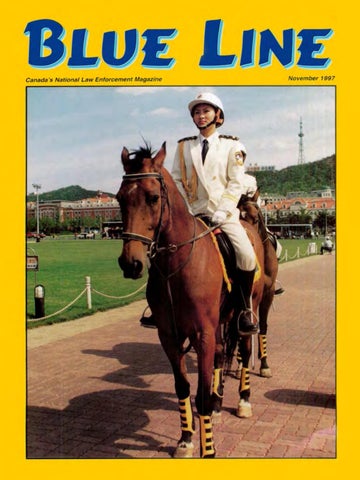
C hin ese p olice acquirin g skills from th e hoo fs on up Dalian, China's new Mounted Police Unit.
6
- News Editor-
The Clipboard
9
Blair McQuillan
Emergency Services show th eir stuff 10 L ess th a n lethal force 12 Response options - In search of the 'Phaser' Bridging the gap in as katoon 14 Member Cha rter of Rights with the 16 Halton Regional Police Service 17 Surveillance and your vehicle Celebrating gender differences 18 Megatario 19 What is going on with Ontario policing Intern a tion a l coo per a t io n th e 20 a nswer to firearms misuse 22 S-days takes city by storm Sudbury Regional Police participate in snowmobile safety program. On an y Sund ay 24 Competition shooting helps keep your skil ls sharp! What are you doing this weekend? Forensics lab bites d own on crime 25
- Editor I Publisher-
Morley S. Lymburner Phone (905) 640-3048 - Fax (905) 640-7547 E-MAIL: BlueLineMagazine@CompuServe.Com
- Contributing Editors -
Ballistics & Firearms Survival Tactics Case Law Computers & Technology
Manfred Benton Joel Johnston Gino Arcaro Tom Rataj
- Advertising -
Mary Lymburner (Director) Phone (905) 640-3048 Fax (905) 640-7547 Don Disher Phone (416) 604-8793 Fax (416) 604-7451 - Illustration -
Tony MacKinnon
Stefan Sepa
- Production -
Del Wall
Blair McQuillan
- General Manager -
Mary K. Lymburner, M.Ed . - Contributing Writers -
Jim Davis Chuck Konkle Grant Obst Dee Kramer Sue Pritzker
Robert F. Lunney Joel Johnston Hal Cunningham Dave Brown Brad Daisley
Blue LIne Magazine IS published monthly. September to June. by Blue Une Magazine Incorporated with a mailing address of' 12A·4981 Hwy. 7 East, Ste. 254, Markham, Ontario, L3R 1N1. Individual magazines are 53.50 each. Subscriptions are $25.00 per year or $40.00 for 2 years. (U.S. & Foreign' $50.00) All articles are prolected by copynght. Nopartof this publication may be reproduced or transmitted in any form or by any means. electronic or mechanical, Including photocoPYing and recording or by any informallon storage or retneval system Without permission from the publisher. Internet activity IS mOnitored and use of matenal IS restricted on the Internet All malerial submitted for publication becomes the property of Blue Une MagazlI1e unless other arrangements have been made with the publisher The authors, adVisors and publisher accept no liability whatsoever for any inluries to persons or property resulting from the appllcallon or adoption of any of the procedures. tactics or considerallons presented In this magazine. Readers are cautioned and advised that articles presented herein are edited and supplied for your personal awareness and should not be used for further acllon until appropnate adVice and gUidance IS received from a SUperviSor Crown Momey or other person in authonty Established in 1988, BlueLineMagazineisan independent publication designed to inform, entertain, educate and upgrade the skills of those involved in the law enforcement profession. ~ has no direct control from a law enforcement agency and its opinions and articles do not necessarily reflect the opinions of any governm e n~ police, or law enforcement agency. Blue Line Magazine is a private venture and as such is not funded by any level of government, union or association.
Blue Line Magazine is printed in Canada by Garson Graphic Services Inc.
- AffiliatiollsInternational Association of Law Enforcement Planners Canadian Police Information Network (CPINET.ORG) Canadian Advertising Rates & Data ~ International Police Association " The Canadian Press Newswire Periodical Publishers Exchange
ISSN #0847 8538 Canada Post Canadian Publications Mail Product Sales Agreement No. 176796
Case Law Blue Line Classified Ten-Seven News Criminally Funny
26 30 31 38
List of Advertisers Barrday Inc. BlueMax Lighting & Emergency Canada Law Book Dalhousie University Digital Descriptor Systems Geomatics International Heli- orth Aviation Imagis Cascade Laser Labs MD Charlton Motorola ine One One Outerwear orthern Plains Leather Pacitic Body Armour Pads Fitness Supplies Police Outtitters Pride in Service Pro Carry Systems R Nicholls Distributors Rocky Shoes & Boots outhwest University Special Electronics & Designs Streetquip Tetragon Tasse The Police Charter Tricia Rudy Enterprises V-Sec Systems
November,1997 ____________________________
5 36 29 37 17 25 10 8 I5 II 4 32 21 33 15 23 23 13 21 40 30 30 27 26 17 19 35
o police omcer can look more impre sive then when mounted on a horse. It is an image ofanother more tranquil age when the whole world moved at the pace of a horse's gait. The advantages of this image are not lost on the Chinese police authority. Over the past couple of years they have been attempting to create more mounted patrols for their bustling cities and popular municipal parks. One of the biggest obstacle they had to get over was the complete lack of omcers appropriately trained for this type of work. They made inquirie with Canadian police omcials and came up with retired Metro Toronto Police training omcer Jim Davi . With well over 35 years of experience in the Governor General's Horse Guards and the Metro Toronto Mounted Unit, Jim was the perfect choice. In this edition Jim supplies us with a few reflections of his visit and the omcers he met in China. Jim's story and photographic essay begins on page 6 in this edition. In another photo essay Chuck Konkle gives us an overview of the tirst annual Emergency ervices Day at the Canadian National Exhibition. Organizers invited police, military, tire and ambulance personnel from across the country to bring their people and their equipment to how the public how their tax dollars are spent to make them safer at home and on the streets. Chuck reports the event was a tremendous success. On page 14 Saskatoon police omcer Grant Obst writes about his face to face encounter with the efTects of racism while simply doing his job. This is followed by an article explaining the function and purpose of the Canadian Centre for Police Race Relations. It makes fascinating reading and food for thought. This month we present the first of a sixpart serie on what is happening to Ontario Policing. The changes are coming so fast that Blue Line has assigned an investigative journalist to dig into this and report back each month. The tirst instalment can be found on page 19 in a column called Mega/aria. This edition is full of many other articles and column of interest and we are sure there is something for everybody. Your comments are expected ... and respected.
-4~~--------------------------------B-L~~g~!~~
So you want a radio system with
KILLER technology, AWESOME flexibility, HEADACHE-FREE installation, and you want it with a
smile?
(smile)
With voice and data systems
That's because Motorola
from Motorola, a smile is
all but created the state of
one outCome our technology
the art in profe sional
will deliver.
ot just any
two-way communications.
~mile, but one that comes from
complete peace of mind. Peace of mind you can rely on, knowing your organization i getting the optimum in communications cffi ien y and cOntrol.
50 learn how Motorola can deliver your unique voice and data communications solution. We'll even smile when we answer the phone:
1- 800 - FM - RADIO
MOTOROLA Land Mobile Products Sector M . Motorola and XTS 3000 are trademarks of M otorola. Inc. C1997 Motorola. Inc. http//www.motorola.com
\'(Ihat you never thought pOSSible.''''
PUBLISHER'S COMMENTARY
Are "Banana Republic" rulings becoming the norm in Canada? by Mo rley Lymbllrner Okay folks! I am having trouble with this one. Last June the upreme Court of Canada became extremely polarized on points of law which I have never seen before. The majority deci ion in the Feeney matter not only flies in the face of numerous previous case law rulings but the upreme Court actually gave the government six months to make a new law that will make the ruling fit. It has even taxed my ability to put a po itive spin on it or to give you guidance in the matter. GinoArcaro's ase Law in this edition contains the full (more or less) story in this matter. In a nut hell it involves a police officer who entered a residence to arrest a man on a suspicion of committing homicide. The difficulty of the ca e law ruling from the Supreme Court of Canada is that it tated the officer needed a search warrant (or some sort of judicial authority) to enter the premises to search for a person. A rooky right out of a police academy knows that no uch thing exists in law. You can get a search warrant for things but not people. When the upreme Court was asked about this they decided to go Full steam ahead and gave parliament six months to change the law so that their decision would be okay. In my humble opinion this is the first time
that I can recall the Supreme Court of Canada actually creating law rather than interpreting it. This is the tuff that revolutions are made of and if the Supreme Court of Canada has not crossed the line it has certainly walked on the slippery edge. It certainly begs the question "who is running the asylum?". When reading the case law it would appear that Justice John Sopinka has dissected and analyzed the Feeney case to a fine degree. But it is remini cent of the three blind men describing what an elephant looks like. They are all correct in their deductions but they have not quite put the whole picture into perspective. They have also seriously misjudged the audience's opinion on the process. Given the revelations in the Moran inquiry, and other matters in which wrongful convictions have been registered, it can be understandable that the public, and even the judiciary, would have their faith in police investigations shaken. It is difficult to fathom how this would affect the clear thinking of the Supreme ourt of Canada but in this case my fear is that it has. I have never seen such a majority decision where the minority decision is at such extreme poles. Five Justices said the police fouled up so bad that it made the justice system look badl y in the public's view. Four Jus-
tices state that the officers should be commended for a job well done. What are we minions to make of th is? l am at a loss to know. This all brings me back to what I have always professed . Do not make bad rules work. And you make them work by OT following them. Cops can be the worst violators of this rule. They too frequently cut corners to "get the job done."No one begged you to become cops ... you chose the job for better or for worse. Follow the rules and if flak comes your way imply explain where the blame is to be directed . And if you have done everything correctly then five ju tices in the upreme Court of Canada take the flak. The unfortunate thing is that they really don 't appear to take flak because there is no sys[em in place to give them flak. I contacted the Department of Justice in an attempt to get a copy of the new legislation to be released later this month. They could not supply me with anything yet because it had not been before Cabinet yet. I asked if there was a light at the end of the tunnel and was advised there is light. My only concern is how bright is the light going to be. [n the meantime I can only suggest in similar circumstances you can only cordon off the house and wait for the u pect to willingly come out. It ain't nece arily justifiable but it is necessarily justice.
WORLD CLASS PROTECTION AND COMFORT The toughest protection standards (we meet them). A complete armour line (we pioneered them). Unlimited accessory and custom options (we offer them). As important as these features are, protective apparel in the real world demands one other critical component ... comfort. That's why at Barrday, our engineers and designers place a special emphasis on material selection and fabric weaves so that our products meet your most demanding standards of protection and durability and are comfortable to wear. Day in and day out. Real world comfort that makes Barrday a world class body armour supplier to national and international police and peace keeping forces.
TOP: Barrday Advanced Tactical Armoured Vests (ATA II) offer maximum flexibility and protection for police and military tactical applications. LEFT: Barrday offers a variety of external carriers for soft body armour including our functional and popular CLEAN FRONT carrier.
Barrday_ _ ADVANCED TEXTILE SOLUTIONS Barrday, Inc., P.O. Box 790/ 75 Moorefield Street, Cambridge, ON , Canada N1R 5W6 Tel: 519-62 1-3620 Fax: 519-621-4123
Chinese ~olice acquiring skills from the hoofs on up
Jim Da vis is showlI here directillg several Chillese police officers ill the fin e art of police m O llllt~(1 patrol. La~ t sprillg Jim was il/vited by the Dalian Police to give them some pointers fro m Ills WIM expeflence a a mOlillted police trainer frolll the M etropolitan Toronto Police. Jim was in vite(1to tell Bille Lille S readers about th e e.xperience. by Jim Da vis T\,o ycars ago thc Dalian, hina, Municipal Public ccurity Bureau (Police) tarted up a Mountcd nil. Thc biggest hurdle they had to overcome wa that it had never bcen done beforc in hina and they had no officers that had ever riddcn a h r e. Undauntcd by their limitations the Dalian Police has been courageously training and gathering I.n "ledge literally from the hoofs up and from around the v"orld. The purpose of this ne" unit is to provide a high visibility patrol function in the city's do\\n town core. The unit patrols the city quare for both crime prevention as '\cll as a public relation. display for the citilcns and tourists. sccondary use is for parade, pecial events and IP e 'cort duties. , this i the first Mounted nit to be started in hina, the police leaders sent out II1quiries for mounted police training and I.nowledge. I was honoured to be invited to conduct s me Mounted nit training for this agen y and aller 5 year of urban mounted police patrol e perience felt that this would be an enjoyable challenge. Iler a g od" anadian ir" night, totalling 15 h ur, I arrived in Beij ing on May 3 I Sl. Two Beijing officers and two Dalian officer greeted me (I was n t to hard to pick out of the crowd) and literally whisked me through cust ms and immigration. Much to my surprise the next two day were spent touring the reat Wnll, the Forbidden ity, the reat Temple and Tinnnnmen Square. My graciou hosts also wined and dined me nt a four-star hotel called the "Tianlun Dynasty." n "Air hinn" 767 to I. myself, my Dalian interpreter and host Lhang Di for the
one-hour night to the city ofDalian. I was further surpri ed to find I had attained the level oflocal celebrity status when we were greeted by a television crew and senior police officials. Aller a cordial greeting I was whisked away and taken to a comfortable room in the "Police Ilotel." This terminology, given my police experience, certainly raised my eyebrow and put a well humoured smile to my lips. Many things can be misconstrued in translation. My interpreter's only way to describe something similar to a ranking officer's living quarters in a police facility as opposed to ajail cell was to describe it as a "hotel". Il is sensiti ity was appreciated. Dalian, China, is a big beautiful, modern, progressive city located on a peninsula jutting into the Yellow Sea. A city of six million people that, along with the ultra modern architecture, building construction and manufacturing, eems to be very we tern in appearance. In fact all of China is opening its doors to tourism and western business. 0 where is thi more evident than with what can be seen in its modern hote ls, clean safe cities, and beautiful zoologica l parks. This Western appearance is most striking when one views the American impact every where. Most notable of which includes advertisements for tobacco, Coca Cola, McDonalds, K.F.C. and even "Thi Bud's for you." After our supper at the "Police Hotel" we started our discussions and I was first introduced to the very keen and enthusiastic Mounted Unit staff. The Mounted Unit is made up of ten male and five female officers (Knights) with ten mounts purchased from I long Kong and Manchuria. At the time of my arrival two new mounts were in training and
Dalial/ Police Headquarters is the centre piece of this modem city of 4 million situated 0 1/ a pel/insula j utting iI/to the Yellow Sea.
the police had aggressive plans to double the unit size over the next year. The senior officer include a nit om mander, a Political 1'ficer, a second in charge Training Officer, Assistant Trainer, upply Officer, Army Veterinary Officer and they all are attached to the enior Patrol Commander. The next two weeks were very busy. Due to the language differences all of my instruction ,other than universal body language, had to be translated through my very capable aid Alex un. I had originally hoped that the training level of the unit was beyond the basic level so as to allow for advanced training skills. This was not the ca e however, and I found that much of my time was pent on basic equitation, section drill, street proofing, neck reining and sword drill. I found that each of these fine officers were very eager and made the task of teaching much easier.
I filled my days introducing the oflicers to various aspects of Metropolitan Toronto Mounted Police training skills. As this is the fir t and only Mounted Unit in hina, I felt a deep en e of re ponsibility to impart what knowledge I could in a brief period of time.
I was always conscious of the fact that they had no one else to guide or assist them in the intricacie of urban mounted police patrol. I made it clear to them that it would normally take 15 week of intense training to make a treet-wise mounted officer. I was very impressed with their modern stabling facilities. The two custom six-horse tran ports, dress uniforms and patrol uniforms were something to behold and would be the envy of any Mounted Patrol Unit. I couldn't help but admire the fact that they had done an out tanding job in such a very short time to produce such a well organized Unit. I wa honoured to be invited to attend hina and doubly honoured to impart some training and knowledge, if on ly for such a brief time. It will take many more years of training to bring thi Mounted Unit up to Western standard. Training is a never-ending task and a prerequiite for Mounted Police Units. Upon taking my leave on June 15th I assured them that we are ava ilable for future assistance. It is hoped that with the conclusion of my visit their equitation policing journey will blossom and thrive.
Jim Davis sllown at tile cenlre of tllis piclllre willi (left) Duliun Police Director Zlwp Xin Ming, Hllung zllen fa, Police Political Officer (left of. Director) Li zllen x~ung, Di~ector. of Du/iun Police Pulrol Division, (Riglll) ZIIung di, Police Secretury of Foreign Affairs, TUI/1 pil1g, Direclor ofllle MOllnted Palrol,
MUI1Y oflhe lessons learned were uppropriately p'Il1CIIluled by tile occassionallessol1 from "Ille scllool of IIurd knocks." Tile sllpervisor of tile IInil (lefl) fOllnd Ollt Ille difficllllies 11101 can urise wllile altempting to teacll a IIorse 10 jllmp over obstuc/es. Albert (James) Davis \\as one of the original founding members of the Governor Genl!ral's Ilorse Guards Caval!) Squadron \\ hl!re hl! has riddl!n for over 32 years. He has participatl!d in most of the escort positions including escOlt eommandl!r. r:arly on in his involvement \~ith the Guards Jim was introduced to the Metropolitan Toronto Police MOllntl!d Unit and became an active ml!mbl!r in 1960. Hl! then spent the next 34 ) ears as an officer attached to their Mounted Unit perfonni!lg mal1\ patrol and ceremonial duties. lie \\a' deSignated a Rldin" instructor in 1966 and the Rldmg Master in 1988. o Ji;n retired from the PolIce Ser\i~e in 1994 but still assists the Cnit in the preparations for competitions that take place at .. tht: Canadian National l xhlbitlon and in the Ul1Ited States. Ill! IS l!lIlTently the Prl!sldent of the Canadian Mounted Police Association and the editor of its nl!\\ slcHer '"Hoofbeat'" For further inlormatlon abollt the Association you may call Jim at 416 261-5093 or hi" 416261-2316.
------------------------------~(7?~---------------------- BLU£L'N£ November,1997 --------------------\V~---------------------- Magaz;ne
Accused can be fingerprinted without charges being laid b, Sue Prillker In a B.. :upreme ourt ruling it I-\oa. decided that fingerprinting a suspect prior to formal charges being laid was not an invasion of pm,a , .
"The principles of fundamental justice are not violated b the requirement that per 'ons arrested for indictable ofTences provide their fingerprints," Mr. Justice Preston stated in his decision last December. There has been much debate in B. . coneen1l1lg whether or not fingerprinting was a direct vlOlatl n of , ection of the Charter. In I'ebruary 1995, hukar Mattu was arrested for a, saultlllg a \~oman \\ ith a tire iron. lie \~as ne\er formall, chargcd, but several months later IllS fingerprillts \~ere found at the scene of an armed r bbery. Mr Mattu argued at hiS trial for robbery that the Identification of ' nmillais ct had been Violated because the police had taken hiS fingerprints before la, ing an, charges. lie argued that the fingerprint. should be dismissed from the evidence.
In a previous hearing, the B.C. upreme Court had ruled that a per on had to be both in custody and charged with an indictable ofTence to be fingerprinted . In this case the accu ed was fingerprinted afler being taken into cu tody for a drunk driving charge. The fingerprints were ent to the RCM P database, where they were then linked to an armed robbery. ince the accused had not been formally charged at the time of his fingerprinting, the judge felt that the act had been violated.
Ilowever, in the Mattu case the judge dismi ed the appeal stating that no a t had been violated based on the theory that "all per ons in lawful custody" includes those per on which at the time of arrest are found committing summary conviction acts under the criminal code. "A disjunctive reading of ection 2. 1 of the Identification of riminals Act would include in the category of persons who \~ere subject to fingerprinting all per ons 'in lawful cu tody, '" Mr. Justice Preston informed the court. Thejudge also concluded that police have a common law right to take an accused's fingerprint at the time of arrest. The existence of this law means that there was no charter violation. Mr. Justice Preston noted that "the argument that the taklllg of fingerprints was justi fied as common law wa not before the court in the preceding cases." Mr. Ju tice Preston stated in hi conclusion that "the importance of the process of collecting anad maliltaining fingerprint i to be balanced against the magnitude of the intrusion of the process into the afTairs ofthose who are required to provide fingeprints". In this case, the fingerprinting of Mr. Mattu did not sacrifice the fundemental priciples of justice.
COMPUTERIZED ARREST & BOOKING SYSTEM Hair' Hair lenglh ":": M:ed':"",u- m- - t Eyes Brown Sex M Complexion Medium Mantal Cmn Law
95 Age 35
_ -
kg Race Cau BUild, Medium -
Alerts
Checklist
Alias
ForenSIc
List Pic
Desc'
LT Smllh'---_ _ __ __.....,--,-_ _P_r_,mary' ,/
Delete
~
Save Browse
New PIC
...
November ,1997
~
New Search Find Print
__________________________~~~-------------------------------B-L!!~g~!~~
e Buried: Elliot Ness, the famous federal agent who broke AI apone's liquor operations during prohibition, was laid to rest in a Cleveland cemetery in eptember. IIi ashes had been kept by his son and his son' widow for 40 year. Rebecca McFarland , vicepresident of the leveland II istorical ociety, aid that ess did a lot for the city and it seemed appropriate that he shou ld receive a proper burial. e s died of a heart attack at the agc of 54 while working in oudersport, Pa. Ilis family was so poor they couldn't afford a proper burial.
E3
Searching : RCMP officers in Montreal came across $74,000 worth of two-dollar coins that were tolen from a CN Rail yard in July 1996. Oflicer are till looking for another 2.9 million worth. The coins were stolen after a truck drove into Montreal CN Rail yard and made off with 1.5 million two-dollar coins. The coins were discovered in a warehouse on the Kahnawake Mohawk reserve during a September raid. The money was found along with over 100 million in drugs, illegal cigarette and alcohol, paper currency and stolen property. Dropped: The number of crimes reported in Sudbury, Ont. , declined during the first eight months of 1997. A total of 8,207 criminal offences were reported to the udbury Regional Police during the eight-month period, that's down from 9,760 at the same time last year. Police Chief Alex Mc auley said the drop in reported crime is due to an improving economy and effective police work that has placed repeat offenders behind bar . "A lot of crime is committed by the ame people, over and over again," McCauley was quoted as saying.
1
Sgt. George Corcoran, an Ontario Provincial Police officer, plead guilty in mid-September to tealing 80,000 from the force and defrauding a business of 100,000. Between 1992 and 1994, while working as a sergeant with the Brockville detachment, Corcoran was entrusted with about $80,000. At his suggestion the money wa put into a safety deposit box and he held the only key. In May 1994, Corcoran was promoted to detachment commander at the Kanata detachment and asked to return the key, but failed to do so. In August 1994, two officers viewed the register for the box and found money had been removed on three occasions. Corcoran's bank records indicated he made deposits into his account around the same times. Also in 1994, Corcoran tried to replace the missing money by defrauding an Ontario company. A sentencing hearing will take place in Brockville, Ont., sometime in December. Corcoran's lawyer, Mike Edelson, aid the officer has seriou mental health problems.
e
Sentenced: A 16-year-old youth _
•
•
'"p,",;b" roc stabbing a de-
tective at a courthouse in ewmarket, •• Ont., was sentenced for the offence in eptember. The offender plead guilty to the attempted murder ofDet. Bob Wiche and an aggravated assault on Det. Dave Kingston , who was tabbed while attempting to aid Wiche. The youth received a threeyear entence. Wiche was stabbed in the back while attending a preliminary hearing on a manslaughter charge in June. The charge against the officer was later dropped. The youth was a friend of the individual Wiche was accused of killing. ,a,
November,1997 ____________________________
Acqui tted : A ew Brunswick ~I"", RCMP officer who ~ad '~;' :" been charged with ~s~ 'c sexually assaulting -:; , . '> a woman, was 'found not guilty in late eptember. Cpt. Andrew Munro was charged with a aulting the woman at Biggar Ridge, .B., in 1995. The woman had claimed that Munro forced her to perform oral sex in the front seat of a cruiser after he questioned her for several hours regarding missing money. Munro, a 20-year veteran, told the court nothing sexual occurred between them. The woman's ex-boyfriend also testified that the woman told him a different story about the assault than the one she told the jury. Sworn In : The Peterborough Community Police Service swore in its new top cop in early October. Deputy Chief Terry McLaren replaced Kevin McAlpine who left to become the chief of the near by Durham Regional Police ervice. McLaren joined the Peterborough force two years ago. Review: Metropolitan Toronto police stations reviewed their files in early October to ensure court cases hadn 't been misplaced. A memo was released to unit commanders after police in the suburb of York came acro s a number of files dating back to 1993 in a filing cabinet. Police said the problem, which was clerical, has been fixed. Ilowever, over 100 cases involving minor offences had to be withdrawn as a result. It is believed the problem was i olated to one division. Awarded : Ontario's HamiltonWentworth Regional Police ervice and B.C.'s Co-ordinated Law Enforcement Unit have both won an international policing award. The Webber Seavey Award for Quality in Law Enforcement will be oflicially presented to the forces by members of the Interna-
tiona I As ociation of Chiefs of Police in Orlando, Fla., on Oct. 27. The two forces competed for the award with over 185 other poIice services.
a
Seized: Canada Customs inspec~ tors made three cocaine u seizures in a single \Ill day at Toronto's 1;( Pearson Interna;.. tional Airport in , eptember. ~'tHI<.~ A drug- niffing dog initially alerted inspectors to a container which held over 30 kilograms of cocaine. The drugs were stashed in a shipment of fruits and vegetables from Trinidad on Sept. 27, officials said. On the same day, an additional 6.4 kilograms in cocaine was eized in two separate incidents involving passengers from Antigua. Burned: Four vehicles owned by Quebec's provincial police force were burned in early October at the ervice's "iiiiiiii~ headquarters. A van owncd by a Quebec government agency was al 0 set on fire. o one was injured as a result of the crime. Witnesses told police they saw four suspects flee the scene in a grey car. Il was not immediately know ifbiker gangs were involved in the fires. The province has been trying to crackdown on the Rock Machine and Hell'sAngel , who have been battling for control over the province's drug trade.
A1
New Force?: A British Columbia I nd ian band may soon have their own police force. Penticton Indian Band Chief tewart Phillip says the members voted in favour of establishing a native police service. Roughly two dozen band members have already undergone police training at the First ations Ju stice Institute, althou gh more training would probably be needed.
~~~--------------------------------B-L~!g~!~~
cy Service
1etro Toro//to Police Colol/r PlIrty lelld the plIrade held lit the ClI //lIdill// lItio//lIl Exhibitio// i//Illte A I/g ust. Th e Federlll Jtlllillll Police ( f/Nlbi//ieri) were the fefltl/retllllltioll :5 p olice f orce of th e dllY lIml represellted by 1I specilll colour pllrty ill the pllrade. This WlIS the first year of the lIew 1I111111f11 el'ellt which felltl/res displays of em ergellcy services equipmellt 1I11d p ersollllel. by
hl/ck KOIlf,./e
6:30 a.m ., :aturday 23 ugust 1997 a crisp and sunn morning on Toronto's waterfront. The ' anadian ational I hibition ( Nt:) grounds arc silent at this early hour; the Midway is quiet; the bandshell, deserted. The onl) ound to be heard are the rush or water onto the breakers and cU\YlIlg of seagulls over ake Ontario. Ovcr thc nc\t few hours that \yould all chan 'c dramatically . In a \vell co-ordinated, albell frlcndly, InvaSIon, several hundred police, lire, ambulance and military pcrsonnel and their
equipment would descend on the E to take part in the Ist Annual Emergency ervices Day. With the quiet help or a small amy or 01unteers and members orthe International Police Association, the multi acre C E bandshell site \yould oon be transrormed into one orthe largest displays or contemporary emergency apparatus that Toronto has een in the past decade. The day began fittingly with a huge parade. Marching units and colour parties including a contingent orCarabinieri repre enting Italy, the 1997 C E "Feature Nation", led a cavalcade or
The ideal turbine helicopter for Police patrol:
Schweizer 330
/
,
Safety Visibility and Economy
Tel: 7056930856 Fax: 7056930858
Nove mber,1997 ____________________________
pipe band, motorcycle, police, ambulance and fire vehicle and even medal winning athletes rrom the World Police Fire games, through the ground and pa t a reviewing stand where dignitarie , led by the Iionourable Art I:ggleton, Mini ter or ational Derence, took the salute. Aller the march-past, people strolled about a land cape highlighting items as divere as mobile command posts, antique and current police car and a bevy ormonster fire trucks including a huge Pearson Airport rig. There \yere exhibits or bomb disposal teams, ultra modern ambulance buses, hazardous waste command posts, a canine unit, anadian avyamphibi us crall and divers and a water show by the Toronto Fire Boat, William Lyon McKenzie. There \\a also a obering display or vehicle ratalities and state or the art countenllea ures offered by diver e traffic units with hardware ranging rrom accident reconstructionists to motorcycle to sleek expressway cars. In an equally contemp rary commentary to the ad reality or lire in many parts or the \vorld, the Army demonstrated mine clearance equipment including a War aw pact mine kit and an RM I rem te mobile investigator - robot. Thcre \.ere things ror young people too like Elmer the arety Elephant, a robot named "Pee ee lIerman", a DARL race car in police colour and arety displays rrom the anadian Red ross. As they wandered the grounds, the public wa greatly entertained by bandshell perrormer representing variou police ervices; \vhile the nearby waterrront played host to the Ontario Canoe championships and, in a cause near to law enrorcement hearts, pecial Olympics competition and challenges. ome or the teams
~~~--------------------------------B--L~~g~!~~
POLICE
*M.D.CHABLTOH CO. LTD. raced in craft made with the help of staff from Correctiona l Services at Mimico, Ontario. The on ly thing missing to make the day truly complete was the planned appearance ofHMCS Okanagan, a Canadian Navy submarine which, according to insiders, wasj ust a few days short of berthing and becoming an integral part of the festivities. But if a real sub didn't make it, there was always this piece of trivia for those that cared to know. The participants devoured 500 giant sub sandwiches and 1,200 donuts courtesy of the day's gracious sponsor Guild Electric, 20 ca es of soft drink compliments of Coca Cola Canada and enough coffee to keep them awake until next year's extravaganza; which, by the way, promises to be even bigger and better!!! StatTSergeant KGE "Chuck" Konkel organiled the Ist Emergency Services Appreciation Day. IIe is a 20 year veteran of the Metro Turonto Police. I Ie previollsl) served with the Royal Hong Kong Police and wrote a best seller, the '"Glorious East Wind" - based on his experiences there. I Ie is currently completing a police thriller set in Mexico which is scheduled for international release in 1998.
CO~D~IRE STOI'S 1~I1U~
(~ ()I~ I) !
*
ODOR SEAt Encapsulates & Destroys Odors Naturally
.:'41'-
• Environmentally Safe • UL Approved • Biodegradable • Prevents Reignition • Rapid Cooling EHect • Reduces Smoke • No Messy Cleanup • Non Toxic • Non-Corrosive • Available in 5 and 55 Gallon Drums which can be easily added to existing systems
• Biodegradable • Environmentally safe • Liquid User Friendly • Non-Toxic • Non-Corrosive • Non-Flammable • Does Not Stain • Contents EPA-SNAP Listed • Can be easily added to existing apparatus - Cost effective I
Box 153, Brentwood Bay, B.C. V8M 1 R3 Phone: 250 652-5266 Fax: 250 652-4700 East Phone: 519 942-9235 East Fax: 519-942-9246 Email: mdc@mail.island.net
Novembe~1997 ____________________________-4~~--------------------------------B-L~!g~!~!
Less than lethal force Response options
In search of the fPhaser'
by Joel Johnstoll
It is a very p st-m dern approach to create a gadget to ' olve' problem. Whether or not the gadget is uitable for the task, afe, effective (or even trul works in the real world) eems to be of secondary concern v"hen weighed against the potl:ntiolly huge profit margin that exist if we con be mode to believe that it may work. Protection of people and the preservation of Ii Ie ond property i at the core of the police mondote . Law enf< rcement professionals the \\orld over endeavour to res Ive connict, to deescolnte confrontation and to deal effectively with violent and dangerous behaviour at the lowest possible level of intervention . Sometimes the I west p ssible level of intervention involves the use ofa firearm, where a subject is shot, and may sub equently die. This normally occurs In ituations where a subject, actlllg unlav\fully, has placed the life of others III Immlllentjeopord} of grievous bodily harm or death. While the n tion of saving lives is po itive and must always be striven for, it cannot be striven lor at the e'pen e of the lives of those s\\orn to uph Id the laws that we as a society hove generally agreed upon, or tho e who would be innocently victimized by people engaging in unlawful, violent and dangerous behaviour. The concept of weapons that have less lethol consequence, is not a new one, it i ground that hos been covered many time. tun guns, taser guns, glue guns, net guns, bean bag guns, rwen guns, grapple nets and poles, mace, pepper spra 5 ... the list goes on. Mass marketing of la\\ c' securit}, and per onal defense gadgets to o learful, ImpressIOnable public, liability con. CIOUS administration., and organization that are financially strapped to provide the proper training to their personnclmake perfect sense to the entrepreneur. The} arc all potential buyers of the solve-all gadget.
Imagine ifpolice officers d idn 't need to use their guns. Even in the face of imminent deadly force by a subject engagcd in unlawful, violent behaviour. Imagine if we had a tool, a gadget, that would ensure we never had to u e phy ical force against people, and certainly never had to hoot people with a firearm. We wouldn't have to train, and we wouldn't have to worry about the high-liability issues of u e of force, a long as our people knew how to aim or deploy the gadget. ... Wouldn't that be nice! We all witne sed a great fraud perpetrated against law enforcement, and the general public, in the early 1990's when pepper spray wa mass marketed to the law enforcement community and an increasingly frightened pUblic. A number of police officers were killed or severely injured as they placed their faith in canned sprays that would, as claimed, 'stop anyone under any circumstances'. imilarly a number of women were exuallyas aulled, murdered, and/or severely injured while holding this misplaced faith in a product that wa and continues to be touted as having the ability to 'take the fight out anyone'. OC spray use has been linked to dozens of in-custody deaths across North America. True it ha not been tagged as the causal factor in all but one of these deaths, but it is a product that we are unfortunately learning about every time we u e it. Ilowever in the mad ru h to market the 'answer'to the lethal force problem these i ues were never properly addressed. The users and the recipients remain the 'laboratory rat ' . The Learning Channel on cable television has recently been running a program for public consumption on less than lethal weapon . A eemingly innocuous topic, save for the criminal ele-
Nove mbe r , 1997 ____________________________
ment who view these perhaps previously not considered weapons as potential options for their endeavours (armed robberie , exual assaults, home invasions, muggings, car-jacking, etc.). The other real problem with programs like this one, is that they mould and hape public perceptions and beliefs. True the weapons are out there, they have been invented and they are available for use. However when they are deliberately placed in the context as a replacement for conventional firearms for law enforcement professionals, it is a dangerous and misleading notion that has very real and very serious repercus ions. People who view these hows are jury members, administrators, judges, lawyers, members of the media, lobbyists, pecial intere t group members, and ju t regular people who form public opinion. Profe ionally directed, written and edited how Iike these have a tremendous impact on a public with limited knowledge. When tools or gadgets such as the e are shown as replacement for the firearm, we confuse an impressionable public, we begin to create tandards that are in many case not achievable in real-world confrontation, and we create indecision among law enforcement profesional when faced with a deadly threat. Yet the media and bureaucrat cling to the pie in the ky dream that some magic answer, some comfortable olution, exi t to effectively deal with extreme behavioural problems, where no one has to get hurt. A very key distinction has to be made here: Between I) a spontaneous, imminent deadly force encounter, where omeone i literally about to be killed or grievously injured by someone engaged in iolent, unlawful behaviour, where there is no time to escape and no opportunity to negotiate; And 2) a non- pontaneous, potentially dangerou ituation, where time to make decision exists, there i some distance from the threat, some physical cover is avai lab Ie, and no one i in imminent jeopardy of death or grievous bodily harm. At thi time there is no tool or gadget that exists to solve the spontaneous deadly force encounter. omeone is about to be killed or grievously injured, imminently, by a violent lawbreaker. This means stabbed, bludgeoned, burned, folded , mutilated, spindled, shot or hurt in any other way the warped human mind can conjur up. learly there is a need to stop this imminent action immediately. There can be no room for error, and imply slowing the per on down will not suffice. They must be stopped OW! hould we pepper pray uch a per on? Mace them? pray them with glue? Tase them? I can speak from personal experience. Ilaving been sprayed with three different varieties of law enforcement strength pepper prays, having been
~~r--------------------------------B--L!!!g~!~~
exposed on several occasions to tear ga (mace), it didn't even low me down, let alone stop me. I have been hit with 100,000 volts from a stun gun and it didn't even cause me to drop the training knife. The firearm deployed to a jljiiilllliii vital, incapacitating target (heart, spina l co lumn , brain stem, centre of mass) on the body is the only tool that has a reasonable chance of stopping someone immediately. I truly believe that if someone had a loved one who wa in imminent dangcr of being killed by a violent lawbreaker, they would want that per on topped OW! They likely would not approve of the deployment of glue, or pepper spray under such circumstance, hoping that it would work. o whell do you us them? In situations where time, distance, and cover cxi t, and where no one is in imminent jeopardy, law enforcement professionals already refrain fi'om deploying lethal force. Officers are trained to disengage and contain, to communicate, to summon specially trained unit (negotiators, emergency respon e members, canine units, etc.). When there is time and no one is in danger, law enforcement profes ional willu e alternative weapons in an effort to control resistive, even violent behaviour. But make no mistake. There is no less lethal option available to replace the firearm. Their contexts of application are completely different. When law enforcement officers shoot at a static paper target in a controlled, safe, training environment they hit the target about 80% of the time. Bear in mind this is a stress-free environment where the target doesn't move and poses absolutely no threat to the officer. In realworld deadly force encounters law enforcement officers hit the target about 15% of the time when aiming at the largest, slowest moving part of the target- 'centre of mass'. This is because now a life is in danger, the target moves, the environment is strange and dynamic, and the officer's heart races. I have had member of jurie a k me "why couldn't the officer shoot the knife out of his handT'. Others have asked "why didn't the officer shoot him in the leg?". Aller a recent police shooting here in Vancouver a member of the media telephoned and asked why our officcrs didn 'tthrow a net over the gun-pointing subject. Reasonable questions for the uninitiated. This simply demonstrates a lack of undertanding of the dynamics of confrontation, the effects ofstress on perfonnance, the ineffectiveness and inappropriateness of many of these 'less lethal option', and the limited abilities of human police officers. It also very clearly demonstrates the effect thatllollywood has on people' perceptions. Given that officers only hit the desired target about 15% of the time in actual street confrontations when they aim at centre of mass, can you imagine what that percentage would fall to if officers began aiming at small, illusive, fast moving targets like hands, knives, guns or legs? It wou ld likely be less than one percent.
Shooting the leg or arm will not stop a violent, goal-oriented assailant from carrying out hi task. On many occasions even centre of mass shot have failed to stop violent, drug-induced, goal-oriented a ailants, with tragic results. Aside from the obvious lack of control of an imminent deadly force threat, the other problem is that errant bu lIets travel somewhere, potentially endangering innocent lives. In a true deadly force encounter, these 'less lethal' weapons are indeed frequently less lethal for the perpetrators of violence, but far more lethal for those charged with controlling such violence. Is there a solution? We have all een one solution. Even if you weren't a fan of the original Star Trek you couldn't help but to have seen the 'Phaser'. There was no confrontational problem that the Phaser couldn't olve. Remember the Phaser
could' freeze', 'stun', or cause people to disappear. et the Phase,. on 'freeze', and the assai 1ant or enemy was fro7en in place. lI e couldn't move, he couldn't even breathe, but he wasn't hurt. Imagine if we in law enforcement had the Phaser. We could frceze people in their tracks, with the knife, gun or club in their hand. They could do harm to no one. Further we could cart them into court for the judge or jury to see them as we saw them on the street. They would be wearing the same clothes, have the same look in their eyes, be in the same state that they were in when we arre ted them. They would not be sanitized, sobered up, and wearing their' unday best'. Presumably this would make gaining convictions more likely. This is, however, a serious ubject and street-level law enforcement isn't Ilollywood, it's real-life. We should never stop searching for a solution to this seemingly unsolvable problem of extreme violence. We are obligated to continue to search for such answers. But in realistic tenns we are a long way off, and until we addre s the problem of violence in our culture at the grass roots level we will continue to have to deal realistically with deadly force behaviour. The only real tool at our disposal still remains the firearm. Jo.::1 A. Johnston is th.:: Control Tactics Coordinator for the Vancouver Poli.::e Department and the Dd'.::nsive Tactics I'ditor for Blue Line Maga/ine.
. - -----,,
--~~~-
, I
I
Ambidextrous; fast extraction, Badge holder; mag &. cuff pouches. Secure b It fastener.
THE DUTY BAG. For pros by pros. Your offic on the road. Well thought-out. Easy cce s. Tough cordura Nylon. Good bal nee. Customizable int rior. 30·day mon y ba guarantee. , I
_________ .JI
-
Bridging the gap I n Saskatoon by Grallt Obst
Recentl}, m, partner onstable ean Ta} lor and I wcre on patrol in one or the most crilllcndden, povert,-stricken neighbourhoods or a katoon. It's our usual bcat, and we worl" there by hoice. There arc very rew dull moments and we onen lind our. clvc in thc thicl" or things just thc \Va} \~C likc it. It \~as ab ut 7: 0 in thc morning. Wc wcrc half an hour awa} rrom finishing our last 12- hour night shin. 8} :00 a.m. \\C \,ould be olTduty for rour days. We "cre aught-up on our papcr work and just mal"ing one la t tour of the district bcfore hcad1l1g ba I" to thc tation . Things \\crc \\indlllg down - r 0 \VC thought. Pros titll te We were cruising sl wly through an industrial area \\herc prostitutes u ually bring "johns" to complete their transa tions. Thc ri ing sun was shining brightly and wc didn't c\pect t find any acltvlt} III the arca. Ju. t then I aught s mc movement out or the corncr or my eye. p ahead to the right or our police crui cr V\C saw a }oung abonglllal wom, n. he vvore a tight s\\eater and a short mini-sl"in. Iler hair was d}ed orange and she v\ore heav} mal"e-up. We assumed she was one or the "v\orl"ing girls." We thought it wa. trange that he was alonc, wrill"ing across a descrtcd parf...ing lot. There were no vehicles around and shc lool"ed upsct. can steen:d the car In her direction and as v"e got closer \\e could sec that her clothcs v\crc c\trcmel dihevelled. Iler sv\eatcr \Vas on ba kwards and her torn underclothes \\ere visible, hanging like rag . alllt Illve tigatio ll
s she heard our car approaching, she turned to 1001" at us. Tears had caused hcr hcav} mascara to run dO\vn her chcel"s and \\C v,crc sure that shc needed help. ' he glanced at us everal times but mad\.! no move to comc towards us. ' he continued \~all"ing across thc lot, obviously not wanting to have an} thing to do with us. Iler pacc quickened and she wall"ed with grcater determination. I called out to her, asklllg ir\\e could peal" v"ith her. She began to wall" faster as shc crossed the gravel \ ard of the grain terminal I t and \\e continued to Il)llo\\ her. I ru f...ed her again ir v\e could help hcr. I.,can and I had both decided that \\e v\ere n V\ involH!d In a se\ual as ault inve tigation. The distressed young woman continued on mut\.!, carf) mg her black pike-heel cd shocs in one hand. She yelled bacf... at us, "I just got rapcd, and Il"now v\here he lives." gain I a ked her to stop so we could tall" to hcr, but this time I got out orthe car and tartcd to walk beside her so I could speal" to her without yelling. Without looking at me she repeated, "I I"now where he lives and I \\ III handle It." allllillg Cfforts I conltnued to tf) to calm her down. I e\pllllll\.!d that ifshe didn't let us help her, the same thill' could happen to omeone else. hc aid that her \vay \\ould ensure "this jerI" would get v"hat's coming to hIll1 ." I tried several more time to rea on with her, but with ut suc ess.
I have always prided my elf on being able to communicate with people, even under e\tremely difficult conditions. Many time, ean and I have defused potentially violent domestic disputes simply by talking with the parties involved. We talked a di traught man down fro m a bridge when uicide seemed his only altemative. And recently, several of my colleagues and I were able to get another emotionally di tre ed young mental health patient to put down a knife she had been holding at her throat. But thi ituation presented me with a roadblock. There was no way this upset young woman was going to let me help her. he was not prepared even to tell me her name let alone hare with me any orthe detail orher assault. White Law Agel/ts I al 0 couldn't help but get the reeling that this victim saw me and ean a agents orthe white man' law - a proce she didn't trust. It is al 0 qui te likely that any contact thi young lady had with the police in the past probably had her on the wrong side orthe law. There was no way she was going to tell these two white cops what had happened to her. Dejected, I got back into the car to discuss the ituation with ean. We were not prepared to simply write this one olTas "no complaint." ean also pointed out that the next murder we inve tigated woul d be directly related to this incident ir we didn't do something. As we spoke, our victi m continued across the railway track toward the residential area or our district. We rollowed, continuing to try to get her to peak to us - with no re ult. A boriginal Officer It was apparent to u that at the very least we had to try to identify this woman, even irthat meant rollowing her home. ean scanned the on-board computer to ee irthere were other officers on duty who could help us find out who he was. As we canned the roster, onstable Emie Loutit's name jumped olTthe creen at us. rnie i an Aboriginal officer who ha been with the askatoon Police
Nov mber,1997 ____________________________
ervice ror about ten years. lIe is a well-known and re pected police officer among the Aboriginal community in our district. Like ean and me, Emie is al 0 a member or the patrol division, working on the West ide of askatoon. He is vel) familiar with many orthe street people in the area. We got on the radio to Ernie and he said he would be there as soon a he could. In the meantime, I got out orthe police car and began rollowing the ,i tim on root. It was obvious that she had decided to avoid us by using back alleys to make her v~ay home. A we waited ror Ernie to make hi way to our area, we aw tv~o more women we knew to be prostitute. ean explained to them what we v"ere doing and a ked irthey would speak to the woman we were rollowing. As the two young women approa hed our victim, Ernie arrived. FlIll tatell/ell t I really didn't think Ernie would have much luck convincing this victim to talk to him, but to my a tonishment, he hadn 't pent more than two minute peaking to her outside his patrol car when he climbed into the car with him and began relatlllg the detail or the incident. [ventually, Ernie was able to get a rull statement, including the detail orthe assault, a de cription or the su pect and the vehicle u ed III the olTence. As we arrived at the police station to packup our equipment and head home, I explained to ean that I'd be spending the next few day at the anadian entre ror Police Race Relations' Annual eneral Meeting. We both thought it was fitting after our e\perience that night, but it was al 0 a good e\.ample of how much more work has to be done to bridge the gap betv.,een the police and aborigillal ommunlty in our area. More elTort must be concentrated on developing mutual trust bet\\een the police and the Aboriginal and visible mmority communitie vve serve and on increa ing their representation in police services. ituatlOns like thi one accentuate the need r, r organization like the CCPRR. Expall iO Il - at e llts Many police ervice are continuing to be forced to cut training and eommunity-ba ed policing initiatives. It i preci ely the e area that must be expanded irvve are going to gain the confidence or all the communities we serve. More time and re ource have to be directed toward cultivating the relation hip between the police and our Aboriginal and visible minority population. ome politicians and taxpayer may sa} \\e imply can't alTord to increa e police budget to establi h and expand programs to accomplish this. I ugge t we as a community can't alTord not to.
e. onstahle (,rant Ob~t has lx:..:n a police ollicerlll ">a~f...atche\\an for rourtel!n y\.!ar~ . lie eurrentl) \\ or I" as a District e. onSlabl\.! III the Patrol Di\ i~ion of the I.,asl"atoon PolK\.! <';CI'"\ IC":. Grant also SCI'"\ e as th..: Prcsident of the.: l.,a,l"atchc\\an I'cd\.!ration of Police Ollic\.!rs and is thc anadiaJl Police Assoeiation\ deSignate to the Canadian Centre f\lr Polil:e-Race Rclations Board of(Il)"emors. I k \\as rec\'!llll~ n:-elected as Vic\.!Chair ofth\.! Cl PRR I xecu\l\\.! (Ol1lllllttC\.!
~~~--------------------------------B--L!!!g~!~~
The Canadian Centre for Police-Race Relations A Canada 's population become more diverse, the need for mutual understanding and respect between police officers, visible minority and Aboriginal communities becomes more crucial. The Canadian entre for Police-Race Relations has been working with these partners for more than six years to advance and promote po itive policerace relations. The Centre's newest program of work, a national educational program, will help local police services, visible minority and Aboriginal communities work together to improve race relation and reduce incidents of a racial or racially-based nature. The Canadian Centre for Police-Race Relations was established in 1991. It represents a partnership between federal, provincial and municipal govemments, police services, the private sector, Aboriginal and visible minority communities throughout anada. In September 1995, the Centre became an independent, non-govemmental organization. One year later, a new Executive Director and an action-oriented program of work were in place. The tafT, including two police secondments was secured to carry out this program of work and advance the Centre in its new role. Executive Director AI Cook is confident of the positive results of this program of work . "The Centre has taken a very exciting direction and I know we have the right team for the job." A Natiollal Program The Centre has responded to reque ts from and initiative by First Nations, Aboriginal and vi ible minority communities from acro s Canada by developing its national program of work. The program includes a series of community-police problem- olving workshops which began in May this year. The Centre provides experienced facilitators and the framework for community and police representatives to work together on mutually agreed agendas. The empha is in all workshops is on identi fying practical issues, developing ways of dealing with these issues and planning future cooperation. In pector Terry Friday was seconded to the Centre in March 1997 for this work by the Ottawa-Carleton Regional Police ervice. lIe is an experienced trainer and community police officer who come to the Centre after having setup Ottawa-Carleton's Diversity and Race Relations Uni t in 1994. Ottawa-Carleton Regional Police Chief, Brian Ford, appointed Inspector Friday to establish the Unit for the new amalgamated police organization. "Chief Ford recognized the challenges of policing the diverse population of Ottawa-Carleton," says Inspector Friday. As the entre's Director of Training, Workhop and Evaluation, Inspector Friday supervises and facilitates workshops designed to meet the needs of specific communities and police services acro s Canada. Constable Jocelyn Mimeault of the Royal Canadian Mounted Police will a sist Inspector Friday with this program of work when hejoins the Centre in eptember. Constable Mimeault has ex tcn ive experience working with Aboriginal commun ities in askatchewan. In addition to his involvement with this program of work, he will be developing a community outreach program to consolidate links with First ations, boriginal and visible minority communities and police training institutions.
As part of this program of work, the Centre will develop and deliver workshops across Canada between May 1997 and May 1998. The flfst of these workshops was held in Moncton, New Brunswick on May I and 2 to address the issues of youth gangs, violence and raci m. Teachers, youth, police and community members worked together to identify concems and develop effective communication and conflict resolution kills. Police participants encouraged a former gang member, then on probation, to attend the e workshop sessions. Inspector Friday remembers the young man was reluctant to speak on the fir t day but was sharing his experiences as a member of a visible minority gang by the second day. lie described conflicts between his gang and other white and skinhead gangs and their tactics for control and recruitment. After making contact with other workshop participants he has begun working to use his knowledge of gangs to help prevent this type of racial conflict. "The basis for all workshops is to leave participants with the ability to be resourceful, develop partnerships in the community, discuss issues and find solutions to specific issues. The Moncton workshop wa de igned to assist that community to become a conflict-resolving community," says Inspector Friday. The House of Commons Security Service requested the second workshop and it was delivered on June 28 and 27. This workshop was designed to identify the skills, knowledge and attitudes necessary for security staff who interact with people of diverse cultural and ethnic backgrounds. The se sions paired ecurity officers with youth representing diverse culture. Together they examined factors that affect communication between ecurity staffand visitor to Parliament Hill. This was a pilot workshop conducted in French and based on its evaluation, the entre will deliver the same program in English to more members of the stafT. The Centre is also a partner in a project of the Odawa Friendship Centre which has conducted two police-community relations workshops in Ottawa and is planning a eries across Canada. The Centre is contributing an evaluation component and assisting with program development. Publicatiolls and Infonnation The Centre's bulletin Relations is published bi-monthly and features success stories and inspirational article on issues of police-race relations. Communications Officer, Joanna Kerr says circulation of this information is vital for community groups and police to leam from the work of others and create a larger network of information-sharing and cooperation. A copy of the Centre's most recent publication, Police-Race Relations: A Resource Book, edited by Professor J. V. Stein, was launched at the Alberta Govemment's II th Annual Managing Diversity Summer Institute in Calgary this July. The manual offers a compilation of training activities and resources recommended by race relations and diversity trainers. Copies have been distributed widely to police chiefs and training institutions across Canada. The Centre for Police Race Relations may be contacted at 800-461-1123 or Fax 613741-5010
Q
Go AHEAD ••• MAKE YOUR DAY WITH
ITNESS SUPPLIES Distributors of confrontational simulations equipment for all law enforcement defensive tactics training. Knowledgable staff, competitive prices, No P.S.T. For more details call or write:
PADS FITNESS SUPPLIES 9624-74th Street, Edmonton, Alberta Phone/Fax: (403) 490-0144 Dale Kliparchuk - Director / Instructor
CRACK/DOWN ON WINDOW TINT
Window Tint Testers LAB TESTED FOR ACCURACY EASY TO OPERATE TENS OF THOUSAN DS IN USE THIS DEVICE WILL SEN D A MESSAGE TO ILLEGAL TI NTERS!
# I Tint Meter
M
Shouldn't You Be Using The Same Meters Other Cops Are Using?
COII/lf: 800.452.2344 BLUE LINE
November,1 9 97 - - - - - - - - - - - - - - - - - - - - \ V f - - - - - - - - - - - - - - - - - - - - - M a g a zine
/n /9 the Haltoll Regional Police Service, in an effort to reassure employee of all gender and ethnic backgrollnd , decided to create (Ill employee charter of right. Thi formulation)Va accompli hed through a collaborative proce that included all employees of the police ervice. It purpose wa to leave IlO doubt in anyone ' milld a to the type of treatment they hould expect from their peer and upervi or . rhe following i the re 1111 of this innovative concept.
[ HnLTOn RCGlOnnL POLICC SCRUICC mcmBCR CHnRTCR or RIGHTS ] I TROD TlO : Wherea every member ha the right to be E THICS: Ethic ha been defined a the upreme principle of treated fairly and within the intent of our philosophy of fair, "right" or "justice", a tandard of conduct that shun ofTensi e, equitable, unbia ed, en itive and informed treatment of all abusive, vengeful or di criminatory conduct. Thi moral en e member within our participatory management environment, it of conscionable conduct must be an integral part of all person i. the view that the dignity and ba ic fundamental human within the Halton Regional Police ervice. rights f < II employee mu t be respected. J USTICE/ FA IR ES S: The a pect of "just and fair" 'I his harter i rea ted to c nfirm and protect the e rights treatment ha been de cribed a the "crowning glory of n twithstanding that other document ofgovemance within all virtues" and as a reality of "truth and action". When the Police ervi e may more aptly apply. In conjunction J<Jj~~v.:;...n " u ,.". _ <.:rOo:\ fair practice are evident, especially when we are called upon to exerci e authority, those who are with these related document, the ervice wi hes to open all avenue of communi ation, u ing all ubject to authority are more likely to be receptive method, to en ure that the phil phy of fair, ju t to it impact and con equence when they percei e and acknowledge the ju t and fair application of and ethi al treatment prevail . V R E: The right a erted within the management proce . All members hall act thi harter may be invoked by any aggrieved in a manner that i fair and ju t, without member at any time when he/ he is of the discrimination or prejudice. opini n that fair,ju t and ethi al treatment ha PRI CIPLE: The under tanding and practice of principle ha been ba ed upon the belief that it not been applied. otwith tanding the fa t that other procedure may al 0 apply to any particular is the basic adherence to the truth upon which all other dispute, a member may ele t the harter as a method truths are based. [t is the tandard by which we govern of eliciting right without fear of retribution by any other person. our beha iour. All member will be profe ional and open to ny n wh feel that hi !her right have been infringed or denied debate/discussion and to earch for truth when i ue ari e for m y apply t the applicable b dy of governance in orderto obtain which the question may be a ked, "What i right, fair and ju t under the circumstance?" such remcd a the b dy con ider appropriate and just under the circllmstance , in acc rdance with the harter procedure. HO EST Y: Honesty in all it a pects i the undeniable I h' deci ion of thi body a to whether omeone' right have requirement of all member . There i an unqualified expectation that the police, above all other, will be honest in the ful filment been vi lated hall be determined a final subject to the application of I v . of their dutie . In it application it brings a demand to comply L EA DER /lIP & MA GEM E T: The following are the con ciou Iy with the command ethic di cipline. That i , to obey leadership and management belier of the I [alton Regional Police all lawful order. If one hould di agree with the order or it , ervicc: intent, it will become a duty to di cu s that order with the authority U That all member have equal value to the well-being of the who is ued it at an appropriate time. I f, following the discus ion of the i ue, the order remains unchanged, then it mu t be rganilati n and contribute to the achievement of our ervice goal- to the public. That there must be open and constructive complied with and a urance given that the sub equent c mmunication at all levels and that all conflict hould be compliance of the ubordinate will be a if the order were one' re olved. own. rhat all member hould adhere to the highest standard of I TEGRITY: Integrity i mo t often demonstrated by the exerci e personal and profe i nal mpetence, integrity and of the completene of a re pon e to the demand of office. impartiality. Member shall be totally committed to the purpose and function 'I hat all member have are pon ibility to encourage that the of their office and tand to it defence when other would opt for ondu t a de cribed herein is followed by their peer and an ea ier route. A long a per onal belief tand for the function manager, and that they be c mmitled to work together to of an office, so must one's integrity and determination not waver continue to enhance and develop a genuine "worth place". from it demand. 'I hat all member h uld operate under fair and equ itab le CITA TIO : Within the alues which hold u together a a proud per onnel practice . ervice organization and a members in a free and democratic anada, I hat all member hou ld pr vide a are, hea lthy and mutua lly by evidence of our ub cription below, we hereby endor e and supp rti e work environment. upport the principles, values and beliefs contained in thi harter I h,\t all member mu t maintain a work place free from which wa created by the members, and for the members of the haras 'ment and di crimination and en ure that all members Halton Regional Police ervice and from thi day forth hall repre ent omply with thi policy. That the confidentiality of all partie our management operating doctrine and way of life. and witne e t a complaint mu t be protected to the greatest degree p ible. An nym u c mplaint hall not be con idered . igned and ealed the25th day of ovember, 1993
November,1997 ____________________________
~~~--------------------------------B--L~!g~!~~
If you have now gained the per onal confidence and mastered the art of ACTING the proper choice of your surveillance vehicle will determine how well you can perfonn. Mention urveillance vehicle and too frequently "VAN" is the first vehicle related to our chosen profession. I agree that it is an excellent video and ob ervation location. The criminal and project target also relates urveillance to the van. If there i even the hint from their lawyer that they will be the subject ofa surveillance project in the future, a van will also be mentioned as a warning that "they're watching you." The most suspicious vehicle parked on the street is the van with the dark tinted windows for hours at a time. If a van i used for the difficult "eyes" on the targets street, ensure that you are driven in and later driven out by another operative. During mobile work the van is much more acceptable due to the numbers now on the road. A diverse fleet of vehicles, models, manufacturers, colours and sizes offer the frequent changes that mobile caravan or parallel techniques require. vehicle that offers large windows to alIowa lot of light to shine through and backlight you is not uggested. Raised headrest and sometimes having the front visors down take away the vi ibility through your vehicle. After you choo e the model you prefer, select a neutral colour and a darker interior colour. The dark interio r all ow less of an opportunity for light to be picked up inside during day and night hours.
Refrain from impressive accents to the exterior such as unique mag wheels, trim packages, extra antennas, dealer stickers, or any other identifying marks. Repair all missing wheel covers and damage immediately. I personally would not choose any white or red tones for tile exterior paint choices. My performance and confidence was severely inhibited once by a bright gold Camaro and I refused to u e it in my operations. A factory tint is required. This will somewhat protect the surveillance operator from exposure and pick up all the exterior light for a nice reflective cover from outside viewing. Your eye can be protected from the target due to the sun and clouds reflecting away from your car and one would have to be very close to even detect you in the vehicle. The reflection of out ide light and lack of back lighting conditions will allow for observations, video and photography closer than believed possible. Choice of a perfonnance engine is Paranlount and options such as AMfFM radio, air conditioning, larger tire size, and other creature comforts is appreciated. Ensure the radio equipment is installed under the driver seat and the antenna is incorporated within the existing radio antenna. Technicians should in tall an amplified microphone to keep transmissions out of sight. Chewing gum permits you to talk on the radio without the target thinking you are certifiable under the Mental Health Act. All equipment, photographs, notes, video/cameras and personal belongings
should be stored out of sight in cases and on the front right floor and rear floor areas within your reach. My briefcase is on the right front floor because, due to my radical driving, that's where it's going to end up anyway. By concealing your equipment you're always prepared in case the target approaches your vehicle and challenges you. I am not a fan of headlight modification system to shut one off for a change in appearance during night surveillance. You're better off to have "shade" (other vehicles) between your vehicle and the target vehicle, or at least considerable distance. Know your vehicle and ensure on each and every "eye" location that your headlight running system is shut OFF. Leave those running lights on in any stationary surveillance position and the crew can pack up and go home due to your oversight. Do not let your vehicle show any identifying features inside or outside. It should appear as one of the many vehicles on the road and go totally unnoticed in the crowd. As witll your appearance, demeanour, ACT, and body language, your proper vehicle choice will allow you to perform with confidence.
Next month: Surveillance clothing Hal Cunningham has been declared an expert in surveillance by the courts and has started an instructional techniqes course on the subject. For further information contact him at 416 716-3107.
~~~~~~~~~~~~~~~~~~~~~~~ The Police Charter Exca libur House 8 - 3164 Pepper Mill Court Mississauga, ON L5L 4X4 Tel: 905820-9845 Fax: 905820-3566
C ut Costs
•
Save Ti me
With
Digital Descriptor Systems, Inc. Complete Line of Identifica tIon Products Compu-Capture 2000 :> [3 ook faster than ever
bad es
Next quarter events (Oct - Dec (97) • Firearms Tra ining • Use of Force • Bodyguarding urveillance • TOM PLATZ • Ilandcuff In tructor • The Police Charier Bodyguarding Video • Mike Mandel's Hypnotically Funny Show ov. 12 & 13
Compu-Sketch Compu Capture ISDRS -:' Ve rofy suspect w 'h
o ' tH o-o e m,lIe -:> Idenh y suspcct With 0' e to nn y ookup
-:- S etch a co poslte 111 minutes 0 art shc expcrlence required -:> l br ary 01 over 40 000 'eat res
?
C aLI fo r yo ur FREE C alendar of Events! The Pol"", Charler IS now opening franchISe units, to qualified personnel. Protected territories available '" Canada and Worldwide
Call today for your FREE on-site demonstration I 215-752-0963 ~~~~~~~~~~~~~~~~~~~~~~~
November, 1997 _____________________
~\Vll------------------------B-LU£L'N£ D Magazine
BANDWAGONS
Celebrating gender differences by Robert F. Lunney
attributable to elr- election. In other case it ground schools ror police leader or the ru"Women are een as more succe rul is due to gender tereotyping by male managture, and the offer tremendous opportun ities ers. Women officer are ambivalent about thi ror per onal growth and fulfilment. bosses than men becau e they worlo.. harder and tendency. The more assertive and ambitiou During the early years or integrat ion, their rem in inc appr a h i better suited to the modern team-based office." This statement regard it a evidence or a glass ceiling or women were rorced to contend with a strong taken from a recent story on the Reuters wire eclu ionary decision making, being diverted internal police culture entirely male domiservIce, referred to an u tralian tudy, which rrom the rront line core policing role where nated, with e ery process determined by male surve cd worlo..er in anada, the .. , and unre erved recognition is available. Others are tendencies. ven today, some women till get e\" /ealand. on. ultant Linda Bisnette helpaware orthose ractor , but actually perpetuate ahead by relying on male model or power or full p inted ut that they are not saying that the tereotype by eeking out the day jobs, hardball strategy. These women mistake surmen can't be "emp wering leaders" too, but away rrom rront line action, becau e it suits vival ror success. They complain about the "These re. ults help to di credit the myth that their per onal desire, ocial needs or ramily glass ceiling, but they have helped erect it; by women are unsuited to leadership positions and situations. The e must be difficult choices ror accepting a heritage of men's fighting stratesugge t that men might have ome- ....----...----------------,........---. gies. It time now to put that behind us in thing to learn rrom women". favour of a more authentic approach. The capacity for superior intui tive t ra e value, this could be talo..en as an example of the pit ralls or gender power is commonly attributed to women. stereotyping. The qualities or empaIntuition i the sum orapplied knowledge th ,caring and hard work are haracand practical thought; processed through teristic. orman upervis rand manthe ubcon cious capabilities of the mind. Intuition i a prime ingredient of trateagers, female and male. The underl)'II1g message, ho\"ever, is that the gic thinking. It can be consciously \"orld f worlo.. i changing in our 111learned, improved and tested through decision making. Leadership candidates formati nal ciety and that Io..nowledge worlo..ers desire and require dif'among both women and men should rofering supervisory and managerial cus on development oflheir intuitive power , but women may have an innate abilmethods than was appropriate to the industrial age or in the military tradiity. Women are also credited with natural lion . Police officers are primarily power or ocial intelligence: The ability Io..nowledge \"orlo..ers. De pite the unto understand ho" and why individual denIable phyical clements orthejob, and groups behave as they do and to erpolice offiecrs today must possess a reetively work with them to achieve deconsldcrable Io..nowledge of the law, sirable goals. cnmlllal procedure, bu ines systems I would argue ror understanding and and II1rornlatlon technology. celebratIon of gender difference . Both Ilavll1g IIptoed around the trap or men and women should reclaim their natural biological complementarity. Genstereotyplllg, I'm now going to blunder ba 10.. in by admitting that it was der dIfference then become opportunimy observation that women' atties ror learning and growth. Let's putgendercompetition to rest and relieve women tributes arc proving exceptionally aluable in upervisory and management roles. women aspiring to promotion. In the back from living out male behaviour patterns Man \.. omen who earned promotion are adept room or the police culture, boldness and a in policing. at managll1g detail and any task requiring prewillingnes and ability to do the "dirty work" Women' de tiny is largely in their own clslon and accuracy. Where men tend to genis still con idered a prime as et for acceptance hand. Women cannot expect a male domieralJ/e and take unwarranted rislo.. , women roand promotion. Time pent in a "day job" may nated culture, however well intentioned its cus on meticulous attention to detail. This abilbecome a comrortable backwater, detrimental leader or the upporting efforts orsympathetic It combined with a willingnes to accept acin the competitive career proce s. partner, to willingly surrender to change the countabllity produces highly effective and deThe prototype or the community policing method and attitude that ha perpetuated its pendable perrormance. Loolo.. around you. Is it organization presents an extraordinary opporexistence. Women mu t achieve the next pronot true that highly qualified women have been tunity ror women to change the confining and gre ive steps not through reliance on legislatulti fying tructure or too many or the role tion and regulation, but by bold and deterselected II r tasks where efficien y of proce s i. a major requirement of the job? The" atch they have accepted, by employing their natumined action on their own term and in their 22" is that many I' these job meet the in idiral abi lities in an exciting environment. There own way. By u ing the kills acquired through is evidence in the business world that women education that many women possess in abunous criteria or the day-job or inside job, adding weight to another part of the tigma expeare succeeding brilliantly a small business dance, by using unique approache to probnenced b women in policing. entrepreneurs. ntrepreneurial kills are prelem olving and innovation occurring to There remain a tendency ror women to cisely what are needed to exploit the elements women by nature; and by demonstrating pergra .. ltate to specialized role: rime Prevenorcommunity policing: Partner hips; Problem i tence, determination and energy. lIOn; Drug I ducali n; exual A ault r hild Solving; mpowerment; and Ownership. buse IIwestlgator; Fraud investigator; ourts Women in rront line roles in policing Robert Lunney is available by adminIstratIOn; and other jobs once the exclushould reach out with de ire ror the opportuFax at 416 597-8211 or by nities ofrered by ommunity Stations or slve domain of women berore the advent or integrated ·taffing. In many instances this is eighbourhood Beat. These will be the E-mail atrf.lunney@sympatico.ca
November,1997 ____________________________
~~~--------------------------------B-L~!g~!~~
Editor's Note:-This column is based on two precepts. The first is that Ontario is undergoing radical changes in policing over the next six months and this will require consillerable attention. The second, and perhaps IIIOSt important, is the addage "how Ontario goes so may go the rest of the country." Due to these factors Bille Line Magazine has taken on the services of a professional investigative reporter to keep on top of things and report b(lck to YOll each month. If the coillmn is not asking the questions you would like answere(/ simply let us know by mail, phone, fax or email information found at the front of this book.
What is going on with Ontario policing: Running up the down escalator by Dee Kramer Probably the most significant change will be theamendmenttothePolice ervicesAct, Bill 105, which is meant to come into effect in January 1998. I say "meant to" because the changes the Act is asking for are so enonnous that it is going to take more than a wave of a hand in the Legislature to make these changes a real ity. The Act is very extensive. Some of the more sign ificant changes are structural. Some municipalities (576 in number), that for historical reasons received free pol icing from the Ontario Provincial Police (OPP), are now going to have to collect property taxes and pay for their policing. But it is not "a given" that the OPP wi ll do their policing. That is just one choice. There are other possibilities. Municipalities can contract with the OPP, but they could also fonn their own police service. They could amalgamate into, or share policing with a neighboring municipality (the most popular choice so far), or choo e to have the OPP oversee their rural areas while subcontracting their urban areas. It is all up fo r grabs! Choosing what to do has been overwhelming. Some municipalities don't feel they have the expertise to make a choice, some feel that the OPP will be getting the contract just because that is the easiest option, and others worry that if they accept a low quote it means they wi ll be receiving inferior service. Connected to these changes is the redrawing of municipal boundaries. Many people are saying the municipal elections to be held this month will be very exciting. Not onl y could the municipal boundaries in Ontario be redefined, but Metro Toronto is being recreated into a "megacity", with significant organizational and budget changes. The Act will also give more civilian authority to the Police Service Boards. The composition of the Boards wi ll change to have more community members, and municipal councils wi ll have the authority to approve police budgets. The implications of this are still evolving. Another major step is a reshuflling in the Solicitor General's office. The legislation cuts in half the number of discipline oversight agencies. The old Ontario Civilian Commission on Police Services now takes over two other departments: the Boards of Inquiry and the Office of the Police Complaints Commissioner. The idea behind this is to have a tronger filtering system so smaller issues can be resolved at the more local level. The second huge wave of change comes from the 27 recommendations made by Justice Archie Cambell in his report common ly known as: "The Future of Policing". The Cambell Report highlights the problems with the Bernardo investigation. Paul Bernardo raped or sexually assaulted at least 18
women, and killed three women between May 1987 and December 1992. The Cambell Report concluded the delay in identifying Bernardo was not because of "human error or lack of dedication or investigation skills", but because of systemic failure. It was possible for Bernardo to fall between the cracks because there wasn't a system in place "based on cooperation, rather than rivalry, among law enforcement agencies." He goes on to say, "There were times during the separate investigations of the Scarborough rapes and the St. Catharines rapes and murders that the different police forces might as well have been operating in different countries." Crimes no longer happen within jurisdictions - they often are world-wide operations, and this development demands the sharing of infonnation. Breaking down territorial barriers between jurisdictions is much easier said than done, but working on achieving this is one of the major goals of the police restructuring. The commitment to implement the recommendations comes with a $25 million - over five years - price tag. The money is being spent on training and a data base that links information across national jurisdictions. The system, called ViCLAS (Violent Crime Linkage and Analysis System), will have officers inputting detailed information of their investigations while they are in progress (for more information on ViCLAS see the August/September 1997 issue of Blueline). This focus on technology is demanding a new
kind of leadership. Police chiefs and their deputies have to be more operationally oriented and take a very hands-on approach with the front- line officers. They also have to be comfortable with the evolving technology, and the boundarylessness of the new policing. They have to be willing to turn to other municipalities, other jurisdictions, and the OPP especially for interjurisdictional crime. And they have to be excellent administrators who are good at media relations. Quite a tall order! The third wave is hitting the Ontario Provincial Police who have been going through three years of major restructuring. The OPP has centralized its 12 specialized areas of expertise at its head office in Orillia. The tactical units, homicide investigations, and forensic identification teams are all now based in Orillia and are deployed across the province as they are needed regionally. Restructuring, however logical and efficiencymotivated, usually means staff reductions. The OPP has a strong commitment not to reduce the number of front-line police, but new recruits now have to go through a much more stringent selection process focus ing on physical endurance and stamina. Early retirement or severance packages have been offered to quite a number of administrators and chiefs of smaller municipal jurisdictions. This has not been without its inevitable difficulties. Policing in Ontario is changing so fast, that alii can say is keep tuned to this column. The next enthralling episode will be brought to you next month!
EMERGENCY SERVICES MOTIVATIONAL P OSTERS These hard hitting motivational posters and mousepads are the first in a seri es of 12 real to life colour posters that are designed with a common theme; "Train Hard, Stay Fit, Stay Alive" Ideal reminders for all police, security and correctional personnel these posters make an ideal gift or enhancement for lunch rooms, training faci lities or rec rooms. Posters & Mousepads are $ 12.00 each. Retail Sales Tricia Rudy Enterprises 905 833-4654 U.S. Sales Mississauga Imports 905567-4806 Distri butor Info rm ation K&K Enterprises Phone/Fax 905 883-4960
Novembe~1997 ____________________________-4~~--------------------------------B-L~!g~!~!
International cooperation the answer to firearm misuse hy The (1Ilf1diall Firear ms entre
When it come to keeping firearms out of the wrong hands, an international study has shown that international cooperation is the answer because no country acting alone can do the job. The nited at ion International tudyon I' irearm Regulati n al 0 hows that many other countries around the world hare an ada 's deep concern about the ri I,. that firearm p se when they fall IOto the hand of criminals. J me' Ilaye , of the anadian Firearms 'entre ( F ') ob erved that firearms misu e is a complex problem with no easy an wer . " Ilowever," said I Iayes, "I find il inlere ling that in the nited Kingdom, which has very strict regulati ns n firearnl owner hip, the rate of firearm homi ide per 100,000 population is only one-fi Ilh Canada' . The United tates, which has uneven regulation offireanns from state to state, has a firearm homicide rate that is ten times "anada's,"
" anada IS n tal ne with it ne\ firearms regulations," added Ilayes, who c ordinated the IOternallonal project team. "The urvey hows that many countries have taken step to improve their regulations over the last five years." The study, \."hich was completed within 14 months, IS the first of it kind. Forty- i;.. countries, representing two-thirds of the world's population, all world rcgion , and a cross section of developed and developing countries, responded to the detailed questionnaire. "In 'anada, \."e are interested in how mu h commonality of approach there is around the \~orld," says the ' 1" 's Tony DiltenhofTer, a research e;..pert With the international team . "This survey gives us a birds-eye view of what countnes have been dOlllg regarding firearms regulatIOn ." ro sillg border - internatioll al cOll cern major frustration for many of the countries that participated in the U. . study is the Illegal trallicking of firearm across internatIOnal borders, made possible by weak firearm regulall)l1 III some countries." uns originally used for mllital) purpo es very quickly cross borders III Civilian hands aller conflict ollen through crimillal networks," says Ilayes. "There arc strong concerns around the world about smuggled arms and how they relate to organI/ed crime and illegal drugs." In 'anada, the federal government and the province of Ontario have ~ nned a ore Group to combat the illegal movement of firearms. The '( re lfOUP will support cooperation am ng law enf1xcement agencies, share information on illegal firearms, and target pecific area where firearnl trallieking i uspected. The province of Quebec and Briti h olumbia are expected to .lOin this lIlitiati e Ilayes says the . howed that import and e\port cOlllr Is are not enough on their own to restrict the smuggling of firearms . According to the rep rt, more consistent regulations arc required worldwide to combat the prob-
lem. Law-enforcement agencie al 0 need to trade information on the illegal movement of firearms and cooperate in tracing firearms. Ilayes say the survey will help in the development of international policies to deal with firearm-related crime and public afety problems. The study howed that all of the participating countrie regulate firearms to orne extent. Most recognize that firearm have several legitimate ci ilian u e, uch a hunting or target-shooting. And many countrie reported that they have undertaken ignificant policy or program initiatives within the la t five year to further protect their citizens from the criminal and violent mi u e of firearm. TIle U. . respo nds The re ulting drall report provided valuable input for developing policy recommendations, which were used a the basis for aU. . re olution spon ored by Australia, Japan, Canada, and Me\ico, and co-sponsored by 33 countries repre enting Africa, outh America, Europe and A ia. According to Ilaye ,"The urvey is an ongoing process. In the meantime, Ilayes noted, anada has an obligation to comply with the recommendations that have already been made. Bllilding an illternational consenslls While an ada played a leader hip role in the new United Nation international tudyon firearm regulation, the F 's Tony Dittenhoffer, a re earch expert with the project team, says the team members worked hard to en ure that the study reflected the consensu of all countrie . "The tudy and it recommendations are the product of a lot of collective work and collective thinking," ays DittenhofTer. "And the leadership role Canada played was essential to achieving the consen u ." The CFC' James Ilayes, coordinator of the international project team, recalls how each U.N . member country was "very intere ted" in the study's contents. "Every page of the study gives new information on thi ubject," he says. "The survey reult give governments a valuable instrument to use as a basis for regulating the mi use of firearms. The survey is al 0 a good tarting point for tho e involved in re earch and policy work - it hows them what que tion to a k. The idea for the survey was born in May 1995, at the inth United at ions Congress in airo, when Japan put forward a resolution asking for an international study to find out what regulatory and administrative controls exist in
GQ7
variou countries to deter illegal acti\ ities invol ing firearm . The resolution received the unanimou upport of the 138 countrie represented at the ongres. ]lIstice Minister accepts House of Co 1111/10 liS recomm endations Re ponding to recommendation from a parliamentary committee, the Ju tice Mini ter recently agreed to amend the draft regulations on firearms to simplify procedure and lower co ts for certain individuals and bu inesses. In February 1997, the tanding ommittee on Ju tice and Legal Affairs presented 39 recommendations on how to improve the draft regulation, which had been tabled in ovember 1996. Amendments to the drall regulations include making fees for visitor who come to anada with firearms payable only once a year, in tead of e cry 60 days, and reducing certain fees and the co t of ome business licences. This will be of benefit to the motion-picture industry and the import-export industry, among others. Other amendments include treating most reproductions of antique firearms as antiques, not firearm. In this way, the e reproduction will be exempt from all except the safe- torage provision of the Firearm Act. The federal government will also work with the provinces and territories to ensure that Canadian' privacy is well protected acro s the country when they provide information for firearms permits and register their firearm . The federal government will al 0 attempt to clarify or simplify many of its administrative procedures related to privacy. Before making it recommendations, the tanding ommittee heard from representatives of such group as the motion-picture industry, hunters, historical re-enactors, manufacturers, museums, Ab riginal people, public-health bodie , and Chief Provincial Firearm fficer. For a copy of the Government Response to the House of Commons Standing Committee on Justice and Legal Affairs, which describes the amendments to the firearm regulations to date, caI/1-800-731-4000.
United Nations recommendations - measures III regulate firearms 1\1I:1111.1er natlOn~ should' • con~ldl:r Il11plementmg rcgulations on firl:arms, including salctj and storagl: rules, appropriatl: penalties lilr firearms ollcnces, amncsty program~, licen~in g s: stcms, ,lJ1d record-keeping Sy stcms. • promotc bilateral , regional and mtcrnational cooperation, pal1lcularly \\ith rcgard to smuggling and technical assIstance; • ask Interpol to de\ clop a standard, II1temational 5) stem for elassif") ing and Identi I) IIlg firearms, and • encourage other international organll<ltions like the World Cu';tlllIlS Organi/ation and the World Ilealth Organi/ation to undertake \\ork on the trade of firearms and thc c\change of lircarm information .
BLU£ L.N£
November,1997 --------------------\V~-------------------- Magaz;ne
Canadian Firearms Centre Bulletin #1 0 The Canadian Fireanns Centre (CFC) is the group of federal and provincial partners charged with implementing the Fireanns Act. The purpose of this column is to provide basic information on specilic areas of the Act and on the implementation proce s. The Fireanns Act is not yet in force. It i expected to come into effect in 1998. The exact date will be announced beforehand. Inspections of People's Home Sections 101 to 104 of the Firearms Act allow in pections to ensure compliance with the Act, but they place strict limitations on inspection powers. For example, inspector may inspect someone's home only if they have reasonable grounds to believe the home contains: a) a business involving firearm or other items regulated by the Act; b) records of uch a business; c) a lireanns collection; d) records of such a collection; e) a prohibited lirearm; or f) 10 or more firearms. Even then, in pectors must give the occupant or owner reasonable notice of an inspection, unles the home is being used for a flfearms-related business. Inspectors must seek the occupant's consent for the inspection or get a warrant. If there is no con ent or warrant, an inspection cannot take place. There are also limits on where inspectors may in pect. Inspectors may inspect only tho e places in the home where they can reasonably expect to find firearms, prohibited or restricted weapons, prohibited devices, prohibited ammunition, or records ofa fireanns collection or business. Under Section 105 of the Act, an inspector may ask to see a firearm that he or she be-
lieves is in your possession. This is to allow the Registrar to verifY information in the Registry. In that situation, the inspector must give you a reasonable amount of time to produce the firearm. NOTE: The inspection powers in the Firearms Act are not search and seizure powers. They may only be used to ensure compliance with the Act and regulations. If a criminal offence is suspected, then police must resort to the search and seizure powers provided for by other laws, such as the Criminal Code. Inspections of Businesses Firearm-related busines es have been inspected routinely in the past, and will continue to be inspected under the Firearms Act, to ensure compliance with the law. A major role of inspections is to check business records and inventory, to make sure that all firearms are stored safely, that fireanns transactions are recorded properly and that all firearms handled by a business can be accounted for. At present, inspecting records is a very timeconsuming task because, in many cases, thousands ofledger entrie have to be checked manually. The registration of all firearms in the new, automated registration system will make the task much easier for businesses and inspectors alike. It will also help inspectors to identifY patterns of theft and underground networks that may be supplying the black market with firearms. If you have any questions about the Firearms Act and Regulations, you may call tollfree telephone number, 1-800-731-4000.
til
Northern Plains Leather Company 616- 4 th Ave East Regina, ask.,CA ADA 4 4Z5 Tel: 306 545 1028--Fax 306 569 3321
MANUFACTURER OF TOP QUALITY LEATHER GOODS • Shoulder Iioisters • Concealment Iioisters • Magazine Case • Duty Belts • Garrison Belts • Belt Keepers • IlandcuIT Cases • Flashlight Cases • Key Holders • Mace Cases • Expandable Baton Cases • Pager Cases • Cell Phone Cases • Badge Wallets • Badge/l D Cases • Competition Iioisters • Competition Accessories • lIandcu IT Keys • LEATIIERMA uperTool
www.northernplainsleather.com
The Leaders in Law Enforcement Supplies - Since 1980
R. NICHOLLS DISTRIBUTORS Inc.
ALTA, SASK. MAN. BRITISH COLUMBIA NEWFOUNDLAND NOVA SCOTIA, PEl NEW BRUNSWICK
TEL.: (905) 629-9171 TEL.: (514) 442-9215 TEL.: 1 (800) 561-3246 TEL.: (604) 669-5170 TEL.: (709) 368-0999 TEL.: (902) 455-4858 TEL.: (506) 832-0675
til
FAX: (905) 629-9184 FAX: (514) 442-9581 FAX: (403) 973-3291 FAX: (604) 669-5179 FAX: (709)368-0991 FAX: (902) 455-4859 FAX: (506) 832-0681
Novembe~1997 ____________________________~~r--------------------------------B-L~!g~!~~
-days take city by storm nowmobile-Student-Safety-Surviva l-Security by Blair McQllillan
Iligh school students in udbury, Onl., are learning how to nowmobile safely thank to a joint program between the p lice, a local high h 01 and sp n or . The Days program, e tabli hed in Feb. 1992, i a unique two day eventthatteache tudents about nowm biling, safety, urvival and se urity. " s far a I know it' the nly program of its kind III anada," aid udbury Regional Police nst. ]eorge Ilagen, the creator of the Days program . "It's a two day venture. The first day is in-class theory and the econd day is a practical da ." , Days, whi h i held at Li ely Di trict ecndary School e ery February, i a certificate course that is open t tudents over a two-year period. n day one, first year tudent learn about municipal, provincial and federal nowmobilerelated law, basicurvival "ill and nowmobile mechanics. "It's mlllor stufT," Ilagen ays ofthe mechanics course. "We tea h them how to change belts and plugs and h w to do some troubleshooting." t the same time, e ond year tudents are gl~en the opp rtunlty to learn ab ut snowm bile product IIlfonnatlOn and orienteering. II students must complete fir t aid training and \\or" together during a urvi al course. The survival course is a hands-on essi n in which students are , plit into groups and rotate through various mock survival cenario. They include two eparate nowmobile accident, a case whcre a sn wmobiler has fallen through the Ice and a shelter survival situation. "We break thcmup into four groups," Ilagen said. "They then rotate through the stati ns and gamer \\hatevcr infonnation they can." The cour e, \\hlch averages 0 student a car, IS concluded with a trail ride at the end of the second day. The ride give students the opportUllit to appl more of the "ill they've learned, in luding appl, ing proper procedures at road crossings and recogniling speed limits. "The trial ride i u ually about 70 kilometres," Ilagen said. " n average itla t for about five hours." S Day in truct rs include members of the Sudbur police, the local PP detachment, Whltelish First ation Police, the Walden Fire Department, ' udbury ir Ambulance and local bUSinessman Ron Kanerva. The police usually handle the legal aspects of the course, \\hile the lire and air ambulance crcws oversee some of the practical se sion , Ilagen and a repre entative from the Mini try of atural Resource are re ponsible fI r teaching the urvival and orienteering cia e '. "Ilike the utdo r ," aid Ilagen, wh is al 0
a provincial in tructor with Fur and Ilarvest Management. "I've also taken training in urvival and orienteering." Kanerva, who owns a local nowmobile dealership, ha supported the program since it began. l ie give lecture and supplie snowmobiles for the mechanics course. "We give riding and technical eminars," Kanerva said of his bu iness' involvement. "It educates the children and stop accidents at the grass roots." Ilagen aid topping snowmobile related acidents and death is the program' main focus. " Days started as a re ult of orne fatalities in the area. We took it upon ourselve , as a community based initiative, to do omething about it." Ilagen first contacted Lively District econdary chool in Jan. 1992, the ame eason in which five young nowmobilers lost their lives, and asked ifhe could conduct a half-hour seminar in the library. The school granted him an hour, but many students were unable to attend so the principle a ked him to come back a month later. "I suggested we make it a bigger event," Ilagen aid. "We more or les put the program together from that point." Lively' Vice-Principle, colt Darling, said the chool was more than willing to accommodate Hagen's request. "We thought there wa a natural partnership between the law enforcement and educational in titutes," Darling said. "It's an excellent educational tool." Darling, an Days organizer for the pa t two year, said both the school and tudents benefit from the program. "The benefit to the school is the ecurity of the student. We're concerned about them 24hours-a-day, even days a week," he aid, "If you train them properly when they're teenager, they'll be life-long safe driver ." Hagen aid the region' new-found sense of ecurity i n't the only po itive aspect of the program. "In the five year we've been running the
0
November, 1997 --------------------------------4
22
program \\e haven't had a fatality. If you talk to stop omcer and trail wardens they'll tell you they've noticed a difference in the young snowmobilers becau e of the program," Ilagen also aid past students have noticed how helpful the program is and many approach him to ofTer as i tanee with future sessions. "I've had students who've gone through the program phone me and ask if they can come back and help." In recent year other ehool and police service have ob erved Day clas e and are now interested III starting their own program, Ilagen aid. "Over the last couple of year I've been getting phone calls from other agencie that want to come and see how it's done," Ilagen aid. "We've gotten ome positive feedback from the agencies that have tried it." Two udbury-area high schools, onfederation and t. Charles College, have both implemented their own Days programs. t. Benedict and helm ford will start two more this year. Manitoulin I land OPP have also tarted an Days program With their local high school and nearby E ponola is planning to follow suit. Police ervice and schools currently planning to implement the Day program have an advantage now that Ilagen has produced a free how-to manual. The instruction book has also been given to other interested agencies. "The manual has gone out to all the snowmobile clubs in the province, all the snowmobile as ociation (in anada) and some went to the international snowmobile meetings in Barrie this year," Ilagen aid adding that both the ntario and anadian federation of nowmobile clubs endor e the program. Ilagen said Days has been a great success and he hasn't made any plan to change the program's curriculum in the near future. lie said his main g al i to see Days expand to other police services and municipalitie . 'Thi year we're hoping that it takes on a new life of its own throughout the province."
8LUE LINE
0·------------------------------------- Magazine
Stats released on alcohol abuse in fatal traffic collisions [n late September Transport Canada released information on the blood alcohol concentrations (BACs) of drivers fatally injured in motor vehicle collisions in the Canadian provinces and territories during 1995. The figures indicate that 35.4% of those killed in motor vehicle collisions had a blood alcohol concentration over 80mg in 100mi of blood and a further 8% had alcohol levels present in their blood but less than the legal maximum. The information is derived from the Traffic Injury Research Foundation (TTRF) Fatality Database, which consists of data collected from reports prepared by provincial coroners, medical examiners and investigating police officers. Access to this data is provided by provincial and territorial agencies under cooperative agreements with TIRF.
Rate of Testingfor Alcohol In Canada, the rate of testing deceased drivers in motor vehicle collisions has been uniformly high, so considerable confidence can be placed on the data reported . For example during 1995 the rate of testing ranged from 75% in Prince Edward Island to 100% in the Yukon and the Northwest Territories. Testing rates were over 90% in five jurisdictions and over 80% in eight jurisdictions. The average across all jurisdictions was 84% - 1617 of 1924 fatally injured drivers were tested for the presence of alcohol in blood. This is comparable to a testing rate of 85% in the previous year.
Alcohol levels [n Canada, among tested drivers, 43.4% of them had been drinking and of these 35.4% had cxccssivc BACs. The number in excess of the legal limit presents a figure that is down slightly from the 36.6% reported the year before and reaches a nine-year low. The previous low levels reported were in 1990 which tied with the 1994 level. The highest reported year in the past nine years was 1987 when the figure was 43.1 % of tested deceased drivers and the fairly consistent downward trend since then may indicate a more responsible public attitude toward alcohol.
Gender Ofthe 1,6 17 fatally injured drivers tested, 81 % were male. Among males, 46.6% had been drinking, compared to 30.1 % of the females. Males were also more likely than females to be in excess of the legallirnits - 38.3% versus 23.4%.
Vehicles Percent of Fatally Injured Drivers Tested for Alcohol : 1995 100
"0
* ~
i'Q)?
>
:§ "0 d"-
o CAN
BC AS SK MB ON PQ
NB NS PEl NFlD YK NWT
Jurisdiction
Over the nine-year period, the incidence of illegal BACs among fatally injured female drivers has been consistently lower than among males. The percent of males who were over 80mg decreased between 1987 and 1990, increased in 1991, and then decreased each year thereafter. The trend for women differed slightly from males over this 9-year period, especially between 1994 and 1995. Over this recent time period, the percent of females increased from 17% to 23.4%, while the percent of males who had excessive BACs decreased from 40.7% to 38.3%
Age Drivers age 2 [-25 were the most likely to have been drinking (57.4%); those age 26-35 were the most likely to have illegal BACs (47.7%). The percent offatally injured drivers who had been drinking and the percent who had excessive BACs declines dramatically after age forty-five. The overall downward trend in alcohol use by fatally injured drivers differed slightly across age groups. Fatally injured drivers aged 46 and over showed the largest decrease over the nine years - from 29.2% in 1987 to [6.9% in 1995. The 26-35 year age group also showed substantial decreases in the percent of over 80mg fatalities, from 54.9% to 47 .7%. Among fatally injured drivers under 21 years of age, the percent with excessive BACs has varied little over the 9-year period. In 1995, fatally injured drivers aged 26-35 (47.7%) and those aged 21-25 (46.5%) had the highest incidence of illegal BACs.
Fatally injured drivers of trucks/vans (excluding tractor-trailers) had the highest incidence of drinking (49.5%) and illegal BACs (42.7%). The lowest incidence of drinking and illegal BACs was found among tractor-trailer drivers - none of the 29 fatally injured tractortrailer drivers had consumed alcohol. Over the nine-year period, fatally injured drivers of trucks/vans (excluding tractor-trailers) had the highest percent of illegal BAC, and the percent of illegal BACs was very comparable for automobile drivers and motorcycle/ moped drivers, particularly in recent years. The percent of motorcycle drivers exceeding the legal limit has decreased since 1993. The percent oftrucklvan operators who exceeded the limit increased by about 2% from 1994 to 1995. Among automobile drivers, the incidence of illegal BACs decreased from 1987 to 1990, increased in 1991 and has declined thereafter. The decline since 1993, however, has been small (35% in 1993 compared to 34% in 1995). In the case of tractor-trailer drivers it is worthwhi le noting that over this 9-year period, 1995 was the only year in which none of the fatally injured tractor-trailer drivers had consumed alcohol. However this is mitigated by the fact that the numbers have traditionally been so low that it has been impossible to determine trends. For further infolll1ation contact: Dr. Brian Jona h Director, Transport Canada Tel : 998- 1968 Fax : 990-2913 Email: JONAIIB@TC.GC.CA
Hatch FriskMaster GklVes Undercover Holsters Sure.Fire Laser Lights Fox 40 Whistles Saunders Clipboards TraffIC Templates Handcuff Keys
Leatherman Pocket Tools Spyderco Knives Protective Optics Sunglasses Nite-WriterPens
CorouraDutyGear Mag·ln. Flashl~Ns Bio-Hand Cleaner Gun Cleaning Kits
Fannypacks/Holsters T-Shirts Coffee Mugs
"PRIDE IN SERVICE"
If we don 'I "ave it, you dOIl'1 need it!
• Quality name brand me rcha ndise • Com petative pricing • A single s ource for all yo ur supplies • Call fo r yo ur FREE catalogue
POLICE OUTFITTERS 283 Wilson Street East, Ste .111 Ancaster, Ontario L9G 288
A Ring of Exceptional Quality CALL TODAY FOR YOcR FREE COLOUR BROClIURE
Ph: 905 648-7288 - Fax: 905 648-9222
1-800-535-9735 Pride in Service PO. Box 705 Pickering, Ontario L1V 3T3
FAX : (905) 509·6933
November,1997 _ _ _ _ _ _ _ _ _ _ _ _ _
Email: pcoutft@icom.ca
--\G3l~.--------------B -UJE LINE D Magazine
On any Sunday What are you doing this weekend? ompetition shooting helps keep your skills sharp!
the la t shot echoed away at the 1997 anadian Police ombat A ociation's ational ham pi nships, the planning had alread started ~ r 199 . The Winnipeg Police ervice has ho tcd thc ational hampion hip at its impressive Art Bridgewater Mem rial Park hooting range for the last de ade, but 199 will ee the yearly pist I mat h move t the Edmonton Police range. While sh oter have enjoyed the over\ helming hospitality of the "Friendly Manit bans"-a it tate on their licence platesm. n were I J..ing forward to a new venue and a fre h tart for police combat shooting. Police Pist I mbat, or PP shooting, began as a means for of1icer to practice for yearly qualification and, not just incidentally, harpen the skill that may be required on the treet. While the treet relevance of the sport ha diminished in light of more modem techniques, it remain an exciting competition that the wh Ie family can enjoy. Dc. igned around the once ubiquitous reolver, the port requires shooter to accurately engage silh uette target at distances ranging from 7 to 50 yard , firing anywhere from 6 to 24 round at a time and utilizing a variety of h ling p siti ns such as standing, kneeling, silting and prone. Many of the revolver u ed for competiti n tend t be highly cu tomized and designed specifi ally f, r PP hooting. There are al 0 side events for ervice revolvers, service semiautomatics and snubno e revolvers. While it may eem trange to shoot a revolver . port in a world dominated by semiaut matics, it remain an excellent way to practice basi marJ..sman hip skills as well as hone the mind and inspire self-confidence in ability. In light of the in rea ed use of semi-au tomati for police carry, however, The anadian P lice ombatAssociation ( P A) took
a radical step in 1997 with the introduction of the Duty Pistol Event into Canadian PPC shooting. This is an entirely new event, designed specifica lly to attract more police officers into the port and to practice the actual kills they may need to one day save a life. New Dutl} Pistol Event The Duty Pistol vent is designed so that the average police of1icer can literally step out of their patrol car and be entirely equipped to shoot a competition. It specifically allows only the duty pistol that the officer carries, or for civilian PPC shooter, the same type of pistol carried by of1icers in Canada. This means that there are no highly customized guns, competition sights, reduced trigger pulls or add-on accessorie of the competition class pistols. In fact, even blackening the sights to reduce glare is banned. Iioister and magazine pouches must be exactly as issued. A level II retention holster (or higher) is required for those not issued gear. The equipment rules are designed 0 that there is a level playing field among all competitors and on ly ski ll and abi lity detennine the winners. It also means that newcomers can shoot the Duty Pi tol Event with no costs invo lved for equipment; only an inexpensive entry fee and am munition . As opposed to the precise accuracy and leisurely time limits of the regular combat events, the duty pistol event is primarily up close and per onal. Times are a much more realistic recreation of real situation and the entire event introduces a "hot range" concept to the sport. This means that the shooter is olely responsible to keep the pistol stoked up and functioning, from the initial load command to the final stage. They are re tricted to a maximum of three magazines, and those confined to 10 round magazines can easi ly, if busily, keep up. With the introduction of thi s new event, the CPCA records a eparate awards and class systcm just for this
event. The 1997 Canadian ational hampion hip in Winnipeg was the very fir t time the event wa tried at the national level and, judging by the feedback from the hooters, it promi e a lot of fun for the future.
A Day at the Range The entire port of combat shooting has al 0 evolved in other ways. While number of participants in handgun shooting are down acros the country, there is an increa ed family orientation about the port. Year ago, departments funded competitive hooters with money for ammunition and travel. This ha largely disappeared with the increa ingly tighter budgets of most agencies. The shooters that were there ju t to party have been replaced more by families out for a weekend of fun together. While the social aspect orthe sport is still the number one reason why shooters come out every match, combat shooting has moved away from its hi torical party-hardy roots, when "pistol hooter" really meant "drink-till-midnite, piss-till-dawn." SllOotillg for Flin The Canadian Police Combat Association has een the future of pi tol shooting in anada. Dwindling numbers of participant in the traditional events have forced a rethinking. P A President, Claude Labossiere even admits the introduction of the new Duty Pistol vent is to get more officers involved in the sport. li e says that it i only part of the drive for new CP A members and he cites a lower CP A fee for first year hooters, and an inexpensive entry fee for tho e wi hing to shoot on ly the Duty Pistol vent as significant steps toward enticing new hooters into the sport. While the welcoming of civilians into the sport as as ociate members in the last few years really brought a fresh competitiveness and an increased awarene of safety, the need still exist to get police of1icers away from behind the televi ion et and onto the range. 1997 Grand Aggregate Champion, Robin Comes, point out that shooting is not an intuitive activity. It requires mental di cipline and concentration on target basics such as sight picture and trigger control. Competition in any of the events helps to sharpen skills but, most important, in pire a sense of elf confidence. The result can only be more competent of1icers and increased afety for the citizen they are worn to protect. hooting for fun can be one of the very few recreational activities in the world that may also save your life. omewhere in anada, there will be a pistol competition this weekend. The participants will all have a lot of fun The officers that take part will be more confident in their abilities and more valuable to their departments and their partners. Everyone benefits (except the bad guys). What are you doing thi weekend? Da\1! Bro\\'n is Blue 1.lIle Maga/incs I irearl11s training .:ditor and is also the coordinator of demonstrations for Response '.Iii, Blue l.in.:'s second annualtratle sho\\ to be held next April 21 and 22. J or further inl()rmation \ ou rna, contact [)<l\ e h\ Pholle/
[.ax at 204 4HH-0714. .
------------------------------~~~-----------------------8LV£L'N£ November,1997 ---------------------lD/-~--------------------- Magaz;ne
Forensics lab bites down on crill1e Canada's first foren s ic dentistry lab By Brlld Dllisley The Lmvyers Weekly anada' fir t facility devoted exclu ively to forensic dentistry is now open for business at the Univer ity of Briti h Columbia. The Bureau of Lega l Dentistry (BOLD) officially opened April 28 at the university's Faculty of Dentistry will focus its efforts on the use of forensic denti try in criminal investigations and prosecutions. A key project will be the study of DNA extrac ti on from teeth. The bureau's forensic work and research efforts are viewed by its head, Dr. David weet, as necessary in part to overcome the increasing ability of criminals to cover their trail. "I think the perpetrators of crime are becoming more sophisticated. Rapi t are wearing condoms; they are not leaving the kind of evidence they used to. "They are reading books by Patricia Cornwell , a mystery writer whose sleuth is a forensic scicnti t and others who are telling people in much detail how forensic science works, and they are prepared to try to hide or not leave any evidence."
Smaller traces "That means the forensic scienti t have to be much more sophisticated as well, because they are looking for even smaller traces of evidence at the crime scene," said Dr. weet, a lecturer in the Department of Oral Medicine and urgical ciences who acts as a forensic odontology consultant for the provincial coroner's service, the R MP and the Vancouver and Victoria police departments. "Thi laboratory will provide an opportunity to develop technique that look with more specific tests at even smaller amount of evidence that are left behind, and to develop analysis techniques that can draw conclusions about who was at a crime scene or reconstruct the events of a crime." Forensic dentistry, described a "the overlap" between the dcntal profession and the legal profession by Dr. weet, is not uncommon in Canadian court rooms. There are some aspects of legal practice, both civil and crimi-
nalmatters, that require dental input because there is dental evidence involved. " I spend mo t of my time analysing dental evidence in either criminal or civil matters, and then advi ing either lawyers or the court on my findings," said Dr. weet, who handles about 60 cases a year involving the use of dental evidence to identify unknown bodies. Another 12 to I 5 cases involve human bite marks. One of his most famous cases involved the identi fication of a murder victim in 1991 . The victim, a 29 year-old cocktail waitress, had been shot four times in the head, tossed in a dump ter in a downtown Vancouver alley, soaked in gasoline and set on fire. The dumpster's s hape worked to increase the heat of the fire, and the body burned at 2,000 degrees Fahrenheit for 30 minutes leaving only a few charred remains. The victim's teeth, however, survivcd the heat in surprisingly good condition. When a local man reported his girlfriend missing a few days later, Dr. Sweet was called in and matched the body's teeth to the mi sing woman's dental charts. At the same time, a woman was arrested for using the victim' credit cards. She led police to a possible suspect. When police searched the uspect's car, they found trace of blood and an empty gas can in the trunk. Investigators quickly concluded the woman had been killed in the car, or that the car had been used to transport the body to the dump ter.
No blood link But there was still no way to link the blood stains with the victim. All attempts to extract tissue samples or 0 A evidence were impossible because there was so little left: of the body. Once again, the police turned to Dr. weet. With X-rays, he determined three unerupted and impacted wisdom teeth had survived the fire in fairly good condition. He then removed the teeth and
November,1997 ____________________________
found enough tissue inside them for 0 A analysis. The result was a positive match with the blood in the suspect's ear and a guilty plea. Dr. weet said his interest in forensic dentistry began in the early 1980's when he was a practising dentist in Cranbrook, B.C. Local police asked him to assist in the identification of a car fire victim who was believed to be one of hi patients. "The thing that I remcmber the most is how little there was lell of this poor body," he said. The victim's teeth, however, had survived the blaze well enough that he was able to identi fy some dental work he had completed only a few months earlier. In 1995, Dr. Sweet completed a PhD in forensic science at the University of Granada in pain, where he developed a new technique for extracting DNA from saliva lell behind in a bite mark. Dr. weet is particularly interested in this research because there are so many problems trying to match bite marks physically with dental impressions.
The 0 A extracti on technique he developed is now well known and widely used. While at UBC, Dr. Sweet proposed developing a laboratory and research facility devoted solely to forensic dentistry. The provincial government liked the idea and agreed to fund it as part of a crime fighting initiative it was promoting. The government subsequently contributed $500,000 to the project for construction of the lab and equipment purcha es. UBC provides salaries, office space, and administrative support. One of BOLD's first projects will be to study how DNA in teeth breaks down as a body decomposes. "The body goes through so many changes and perpetrators can put the body through so many different things that we don't know what happens when, for example, the teeth come out of salt water or fresh water or if they 've been buried in a shallow grave that has acidic soil. All these environmental tudies have to be done." Dr. Sweet is also looking at new ways to catalogue material for DNA analysis from teeth .
CrimeMAPPER
GIS and desktop mapping technology designed with police, fo r police
• Uses, displays, and plots Computer Aided Dispatch (CAD) data • Aids police in visualizing and analyzing crime incident patterns • User-friendly, easy to learn and operates in police syntax • Windows 3.1 and Windows95 compatible
Geondic:s .lIenlCllional ~~ ~
........
-~
Inc .
3370 South Service Rd . phone (905) 632 -4259 Fax (905) 333-0798 Burlington, Ontario L7N 3M6 Email : richard_norman@g eomatic • . com WWW : http://www .geomatics.com/
~~~--------------------------------U-L~!g~!~~
Warrantless forcible entry into house to make an arrest R. v . Feeney (1997) Supreme Court of Canada hy Gillo Arcaro
Determinin g whether a et of circumstances c nstitute rea nable grounds to arrest an oOcnder \~ithout a warrant may be the most igni fkant de isi n that a pol ice officer makes n a c nsi tent basis. De iding whether to forclbl enter a hou. e to make an arrest without a wan'ant i equall ignificant. Officers commonly make these decisions, not while itting in the c m ~ rt of an office referring to statutes or casc 1m , but, \~ithin minutes or econd, \\hll' potential danger e,ists to life. The.e two deci i n are example of the unIque difficultie. that are inherent to a police offi er's de ision-making and problem- olving demands. The upreme urt of anada, in R \' Feene)'(I997) made ignifi ant rulings regarding these i.. ues. Difelice: The ofTen e relating t the Feeney case \~as murder. ircl/l/I.I ((lIIces : The b dy of an 5 year old man was found in hi s home, at :20 a.m. lie had suffered five blow to the head with an iron bar r si milar object. The e,act time of death could not be determined. The victim had last been seen alive the previ us evening. During the preliminary in estigation police found blood splattered 1I1side the vi tim's house and a pac).. of portsman cigarettes at the crime . eene. pon in formation re eived, three officers attended at the . cene of a motor chicle colliSIOn ab ut half a kilometre from the vic11m's house. The VIctim's pi k-up truck was II und in a ditch . witne s informed officer the truck \\ as in the ditch at 6:45 a.m. he identified the 'uspect by given name only and ad-
vi ed he had een him walking along a road a few minute earlier where the victim lived carrying a bottle of beer or cup or coffee. The u pect's residence wa known to be a trailer situated on another person 's property. Upon arrival at the property where the su pect lived, a witness informed the police the uspect had stolen a truck from the property where the trailer wa situated and that the suspect returned home at 7:00 a.m. li e had been drinking and was currently leeping in the trailer behind the re idence. The officer in charge of the inve tigation went to the trailer, knocked on the door, and identified himselr by saying, "Police." Aller no an wer was received, the officer entered the trailer went to the u pect's bed, shook the suspect's leg and aid, "I want to talk to you." The officer a ked the uspect to get out orbed and move to the rront or the trailer in better light. The officer aw blood plattered all over the front of the suspect and read the right to coun el and cautioned the su pect. The right to coun el did not include reference to a toll free number. The officer arre ted the uspect and asked whether he under tood hi right to counse l. The uspect did not initially respond . When a J...ed again, the suspect answered, "Of cour e, do you think I' m illiterate?" Immediately allerward, the officer asked the u pect how he got the blood on him. The suspect answered that he had been hit in the race with a baseball bat the day before. The officer seized a pair or blood stained shoes, a package or portsman cigarettes and the blood tained thirt worn by the su pect. At 12: 17 p.m., the su pect lell a message
TRAINING FOR REAL WORLD
ON TARG ET WITH THE NEW FX BLUE MARKING CARTRIDGESI
Use them With FX Red Marking cartndges to stage more true-to-hfe team scenanos l
On the street... in the field ... in a crisis! Prepare your personnel for the real-hfe situations they are likely to encounter. Developed with law enforcement and military professionals, the FX system is built around non-lethal marking cartridges. It includes easy-te-install conversion kits, safety-ring inserts and protective gear.
iii Exclusive Ont:ario & West:ern Canada Dist:ribut:or III Tetragon- Tasse Phone 1-S00-3SPOLICE Fax 905-S2S-6390
for a lawyer to call the police station . At 12:33 p.m. , a breath ample wa taken . The suspect was not informed that he did have a choice about whether to give the breath ample in that situation. The u pect wa detained in a cell. At 9: I0 p.m., two detective began interrogating the u pecl. The u pect stated, "I should have a la\\yer," but the questioning continued. The suspect con res ed that he truck the victim, stole cigarette, beer, and ca h rrom the victim's house. lie put the cash under his matearch warrant was obtre s in hI trailer. tained to earch the u pect' trai ler and to eize the hoes, the portsman cigarette, and the money beneath the mattre . A second interr gat ion occurred at 3:05 a.m. It lasted ror I I '2 hours. The suspect had not poken to a lawyer. Two days aller the arrest, the uspect was fingerprinted at 9:25 a.m. and again at 10:54 a.m. The su pect poke to a lawyer ror the first time in between the fingerprinting essions.
Existil1g law ection 495 riminal ode creates a police officer's power or arrest without warrant but doe not e tabli h guideline or procedures regarding forcible entry into dwelling hou e to arre t an offender without a warrant. A warrantle arrest mu t include ubjective and objective ground. ection 495( I )(a) C. . creates the ubjecti e requirement for a warrantless arrest, rererring to the condition that the individual police officer mu t believe that reaonable ground e,ist that the offender committed an indictable offence. The objective requirement was added by the . . . in R. v. torrey (1990). Thi rerers to a conclu ion that must be made by a judge that rea onable ground actually did exist to belie e that the offender committed an indictable offence. The test used to make this conclusion i , "Would a reasonable person tanding in the hoe orthe officer believe that reaonable ground exi ted?" In other words, the bjective te t is an evaluation or what a reaonable person \\ould believe with the officer' ame J...no\~ledge . A problem e:\ist when an offender, whom the police believe on reaonable grounds has committed an indictable offence, i in a house and the police are not given con ent to enter. A earch warrant to search a place ror an offender cannot be obtained because no such warrant exists. earch warrants may be obtained to earch place for physical items only. The riminal ode has no provi ion that e tablishe a earch warrant to search any place ror an offender. The . . . , in Eccles v. Bourque (1975), authorized police officers to rorcibly enter dwelling houses without consent to make arrests with a warrant, ifreasonable grounds e. isted that the accused person was in the house and proper announcement preceded the entry. In R. v. Landr), (19 6), the .c. . authorized the police to enter a house without permis ion
to make an arrest witho ut a warrant, if the requirements of sec. 495 Crimina l Code and tho e in Eccles v. Bourque are met. The upreme Court made the Landry decision because the Criminal Code does not provide for a warrant to earch a place for an offender and to prevent offenders from hiding inside a house to avoid arrest. Therefore, a combination of th ese three case law decisions and sec. 495 C.c. establish the fo llowing rule: A warrant less arrest fo llowing forcible entry into a house is lawful if: i) subjective and objective reasonable grounds exist that the offender committed an indictable offence; ii) reasonable grounds exist that the offender is in ide the house, and iii)proper announcement is made before entering; iv) before forcing entry, admissions into the hou e must be requested and denied; v) if exigent circumstances exist, a proper announcement and request for admission are not required. The accused was convicted of second degree murder after a jury trial in the Supreme Court of British Columbia. He appealed to the British Columbia Court of Appeal who unanimously dismissed the appeal. The accused appealed to the Supreme Court of Canada who allowed the appeal in a 5-4 decision, and ordered a new trial. The three questions surrounding the accused's appeal to the Supreme Court of Canada were: I. Did the police violate sec. 8 Charter during their investigation? 2. Did the police violate sec. 10(b) Charter? 3. What evidence, if any, should be excluded under sec. 24(2) Charter? The primary issue raised in the appeal was the authority of the police to enter a private dwelling house to make an arrest without a warrant. Justice Sopinka wrote a lengthy judgment for the majority. The dramatic conclusions may have significant impact on the procedures used by officers in the future to arrest offenders in dwelling houses. In this case, Justice Sop inka ruled that: • rea onable grounds existed that the accused was in the trailer, based on the information received by the police. • however, subjective grounds did not exist. This conclusion was based on two factors: a) the testimony of the officer in charge of the investigation that he did not believe he had reasonable grounds to arrest the accused when he entered the trailer; b) the officer did not arrest the accused immediately upon entering the trailer. Instead, the arrest was made after the blood stains were seen on the accused's shirt. • objective grounds did not exist in this case for the fo ll owing reasons: a) the absence of sUbjective grounds implie the absence of objective grounds, unless the officer has an unreasonably high tandard; b) the objective requirement created by torrey is an addition to the subjective requirement created by sec. 495 c.c. The objective test does not replace the subjective test. Therefore, if reasonable grounds did in fact objective ly exist despite the
absence ofthe officer's belief that reasonable grounds did not exist, the objective requirement is not met. If the officer did not believe that reasonable grounds existed but the bel ief was wrong because reasonable grounds objectively did exist, then the final conclusion will be that reasonable grounds did not exist unless it is determined that the officer's standard of determining reasonable grounds was unreasonably high. • four prominent facts composed the evidence known to the police prior to entering: i) the deceased person 's truck appeared to have been stolen before it had been involved in the collision. ii) the accused had been seen walking near the scene of the accident iii) a witness assumed that the accused had driven the deceased person's truck because the accused had been involved in a collision at the same location while driving another vehicle earlier. iv) an occupant at the accused's residence told the police that the accused returned home at 7:00 a.m. after drinking all night and had earlier been involved in a collision, while driving another vehicle, at the site where the victim's vehicle was found. This evidence did not constitute reasonable grounds to arrest the accused for murder. It constituted mere suspicion only. Consequently, when the accused entered the trailer, the subjective and objective belief was predicated on mere suspicion. • the Landry authority to forcibly enter a
house to arrest a person without a warrant no longer applies. The police must now obtain a warrant before forcibly entering a house to arrest an offender. Before forcibly entering a house to arrest an offender for an indictable offence, the following new procedures apply: i) a warrant must be obtained first. Justice Sopinka stated that the police must obtain judicial authorization for the arrest by obtaining a warrant to enter the dwelling house for the purpose of arrest, ii) the warrant must be obtained on the basis of reasonable grounds that the offender committed the offence and that he or she is inside the house. iii) a proper announcement must be made before entering. An exception occurs when an officer is in "hot pursuit" of an offender. The Court did not fully address an exception for exigent circumstances, tating that there was no need to for this issue to be decided in the Feeney case. The Court stated that exigent circumstances did not exist in this case. This new law creates confusion about two prominent issues: I. Since the Criminal Code does not provide for a search warrant to search houses for offenders, what document must be used as the warrant? 2. What are the police expected to do in emergencies when they are called to a house and hear circumstances that indicate an indictable offence is being committed inside the house?
Spyderco Uncle Mike's Streamlight Surefire Lights Protective Optics Casco Batons Hatch Gloves Damascus Gloves Hi- Tec Boots Body Armour Gunleather Belts & Accessories Strong Leather & Nylon Gear
(Continued. ..)
STRONG
~ Batons
TWO LOe'nTION~ TO ~ERVE "OU gETTER
STREETQUIP Law E nforcement & R escu e E q u ipmen t 1344 Youville Drive Unit 5 O r leans, Ontario K1C 2X8 Tel: 613 834·7028 . Fax 613 834·5589
November,1997 ____________________________
220 R oyal C r e st Court U nit 8 Mar kham , Ontario L3R 9Y2 ii-~~e-
Tel: 905 475·3117 . Fax 905 475·5128
~~~--------------------------------B-L~!g~!~~
In re p n. e t the first question, Ju stice ,'opinh.a tated that, "I fthe ode currently fail to pr vide speei fically for a warrant containing pri r authori/ation, uch a provision should be read in. While thc absence of uch a provi. inc uld have a profound inOucnce on the 'ommon law pov,er of arre t, it ab ence cannot defeat a con titutional right of the individual. nce a procedure to obtain prior authori/ati n is created, the concern that suspect may find permanent sanctuary in a dwelling house di appears." Regarding the eeond question, Justice . opinh.a "refrained" from deciding whether an e'l.igent cir um tances exception exi ts to the new warrant requirement. Exigent circumstances include an emergency where the safety of the police or publi is in danger, or \vhere the p ssibility exists of de truction of evidence. ccording to Ju tice pinka, exigent ircumstan e did not exist in this case because "the situation was the same a in any ca. e after a seri us crime has been committed and the perpetrator has not been apprehended." In his opinion, the safety of the public or the police wa not in jeopardy. Regarding the blood tains, the Justice tated that the police had "no h.n wledge of evidence that might be de. troyed." Ju tice opinh.a did not agree with a unanimou. deci i n by the Briti h olumbia ourt of ppeal, in whi h Justice Lambert wrote, " The p lice were fa ing a ituation which could bl.: cia ified as an emergency, or as exigent circum tances which would require immedi-
ate action, and that in addition they were facing circumstance where the possibility of the de truction of evidence, particularly evidence in relation to bloodstains, was a real one and had to be addre ed."
R ight to COIl IlSel- sec.lO(b) Charter The majority ruled that the police violated the accused's sec. IO(b) Charter right to counsel. The rea on for this ruling were: • the right to be in formed of th e right to eoune l begins immcdiately upon arrest or detention. According to R. v. Therens (1985), detention occurs when a police officer assumes control over the movement of a peron by demand or direction. In thi case, detention began when the police officer shook the accused's leg and told him to get out of bed. The accused shou ld have been in formed of the ri ght to coun e l at that time. In tead, the right to coun el wa read after the accused moved to the li ghted area where the blood stains were see n. the accused wa not g iven a rea onable opportunity to exercise his right to counsel. li e was not given acces to a telephone before he was que tioned in ide the trailer about the blood on the shirt and hoe. Consequen tl y, the tatement in the trailer was taken after a ec. I O(b) Charter violation.
Search warrant - sec. 8 Charter The majority ruled that the search of the trailer with a warrant constituted a ec. 8 Charter violation. The rea ons were: • the police learned about the shirt and shoes as the result of the initial search and inter-
ASDflCTED T his is a monthly column s upplied by th e Roya l Ca na dia n Mo unt ed Police Miss in g hildren 's Registry in COOIJer a tion w ith Blu e Lin e Maga zin e. All material supplied is copyright free and may be distributed to local media.
Readers who feel they know the whereabouts of this child are asked to call :
(613) 993-1525 or Fax (613) 993-5430 National Center for Missing and Exploited Children
1 - 800 - 843 - 56 7 8 Sex:
Name of Child:
Male Date of Birth :
85-09-06 Eyes
106cm 14 Kg
Short Black
Brown
Date Last Seen· Missing From: 19 Jun. 1937 from Toronto, Ontario, Canada. Child;5 company of his father. Child has, small birthmark on Itff foot
Known Abducter
Allan Mann (Father) is presently 45 years old (52-09-24). He is 175 cm (5'9"), 66 Kg (146 Ibs.) with brown eyes and black hair. From date last seen, Allan had an Afro . He is known to wear a mustache. Noticible scars on leg, hand and back of neck . Pierced right ear. He could be wearing glasses . Allan is a trained designer/draftsman in aeronautics . Allan and Jermaine are believed to be in Canada .
November,1997 ____________________________
view inside the trailer. the location ofthe stolen money was learned a the result of the interrogation at the poIice station. • all of the evidence was obtained after a Charter violation had been committed . •
Fingerprillts - sec. 8 Charter The accused' fingerprints were found on the victim's refrigerator and on an empty beer can found inside the victim's truck. Taking fingerprints from an accused constitutes a search and seizure related to the accused person's body. The .c.c., in R. v. Beare (198 y ruled that taking fingerprints from an offender following a lawful arrest i reasonable and does not constitute a Charter violation. Ilowever, the majority ruled that since the arrest in thi ca e was unlawful and involved a number of harter vio lations, the taking of the accu ed's fingerprints constituted a sec. 8 harter violation.
Adlllissibilil:1J of evidellce - sec. 24(2) The final i ue related to the dmi sibility of the evidence obtained by the police including the shirt, shoes, cigarettes, fingerprints, and tatement made in ide the trailer and at the police detachmenL Admissibility of evidence is determined by applying sec. 24(2) Charter. The prominent element of sec. 24(2) harter is whether the admi ion or exclusion of evidence obtained after the commission ofa harter violation will bring the administration ofju tice into di repute. The . . . , in R. v. Col/illS (/9 7), establi hed general policies that mu t be used to determine whether evidence will be admitted or excluded. Disrepute was defined as a concept that involves ome element of community views. A "reasonable person te t" wa estabIi hed as the tandard u ed to make the determination regarding the reputation of the admini tration of ju tice. The test involve the perception of a reasonable person, defined as an average person within a reasonable community. Included in the number of factor created by the Collins case, but not exclu ively, were element that pertained to the fairness of the trial. The majority of the .c.c., in R. v. lillman (1997), refined and clarified the trial fairness factor by summarizing the following rules: I. Each piece of evidence must be classified as conscripti e or non-con criptive. onscriptive evidence refers to evidence that the accu ed is compelled to incriminate him elfat the behe t of the state by means of a statement, the use of the body or the production of bodily amples. oncon criptive evidence refers to evidence that the accu ed was not compelled to participate in the creation or discovery of the item, such as phy ical items. 2. The rown ha the onus to prove on a balance of probabilities that con criptive evidence would have been discovered by nonconscriptive mean . Failure to do so will re ult in the determination that con criptive evidence will render the trial unfair. As a general rule, thi evidence will be excluded without consideration of the eriousness of the breach or the effect that exclusion will have on the reputation of the administration of justice. 3. If the Crown uccessfully proves that con criptive e idence would have been dis-
~~r--------------------------------B--L!!!g~!~~
covered by non-conscriptive means, the admission will generally not render the trial to be unfair. The shirt, hoe, cigarettes, and money were not conscriptive evidence. However, the seizure of these item occurred after erious Charter violation. The police "showed little regard for his ec. I O(b) rights." Consequently, these items were excluded under sec. 24(2) Charter. The statements and fingerprints were conscriptive evidence. They were excluded becau e their admission would adversely impact the fairness of the trial which would harm the reputation of the administration of ju tice. In ummary, the majority set aside the conviction and ordered a new trial. Dis enting judgment Justice L'lleureuxDube, and three other Justices opposed the ruling stating that the arresting officer did have rea on able grounds to believe that the accused committed the murder. The S.C.c. decision in R. v. Silveira (1995) was referred to as an example that a private dwelling house does not offer immunity from a police investigation. Justice Dickinson was quoted from Eccles v. Bourque that, "the criminal i not immune from arre t in his own home nor the home of one of his friend ." The entry into the trailer wa considered lawful. The search warrant was properly issued. The fingerprinting wa an incident of a lawful arrest and did not violate the harter. The accused was properly informed of the right to counsel. The police have no obligation "to assure themselves po itively that an accused understands what his right to counel entails. It was recognized very early in harter juri prudence that placing this burden on the police would be prohibitive and would inhibit legitimate police investigative techniques." The police did not violate ec. IO(b) harter by que tioning the accused becau e he did not invoke his right to counsel. In this case, the police had no indication from the accused that he wanted to speak with a lawyer. Finally, the dissenting minority "commended" the police for acting quickly to prevent further violence after a "savage, physical beating innicted on a helpless victim for no apparent reason."
AMUST FOR TODAY'S POLICING...
Handy and lightweight, but heavy on the law! IT CONTAINS
• Full and accurate text of the Criminal Code
EVERYTHING YOU
• Examples of regularly used forms of charges • Includes full text of a number of related Criminal Statutes
REQUIRE IN A CRIMINAL CODE
INCL DES • Controlled Drugs and ubstances Act with Commentary • Firearms Legislation
(PIC 638)
SEPTEMBER 1997 .... SOFTCOVER
Multiple Copy Discounts Available 1-5 copies .............................. $23.95 6-25 copies .............................$23.35
26-50 copies ...........................$22.75 51 -99 copies ..........................$22.00 100 or more copies ...............$21 .00
ADDITIONAL POLICING TITLES...
Transition period The Supreme Court of Canada, upon realizing their judgement would require legislative changes to uphold its own decision in this matter, granted a ix month transition period on June 27, 1997, to determine the document that will be u ed a authorization to enter a house to arre t an offender and who will have jurisdiction to i sue it. The requirements created by the Feeney decision were stayed for the time period beginning May 22 and ending ovember 22, 1997. During thi time, the procedures establi hed in Landry will apply to circum tance where forcible entry is nece sary into a dwelling house to arrest an offender without a warrant. Gi no Arcaro is Blue Line Maga /inc \ Casc L l\\ Ftlitor. lIe is presently a pro fcssor of La\\ I:nfo rccment at Ni agara Co ll egc and th e nuth or o f num erous tex ts in c ludlllg III/paired Dril'illg and Crill/illollllvestigation Forming Reasollllble Gro llnd~.
Police Legal Access System on CD-ROM A completely computerized Criminal Code with related statutes. Includes Force's policies and procedures, and other information cust mized to suit.
Base Price: $5OO/year
I Policing in Canada:
Issuesfor the 21 st Century A collection of essays urveying the Canadian experience in policing in the last 20 years. Provides insight into the new millennium.
(PC 233) • July 1997 Perfectbound ·190 pp . • $35 ISBN 0-88804-244-2
Shipping & handling charges are extra (unless payment accompanies your order) Pnces are sublect to change Without notice and to applicable taxes
Available for a 30-Day Risk-Free Examination - Order Today!
f*l
TO ORDER. CAll TOll FREE: 1-800-263-2037 or 1-800-263-3269 Toronto Area: (905) 841 -6472 • Fax: (905) 841 -5085
CANADA See us on the Web at: www.canadalawbook.ca
LAWBOOK Canada Law Book Inc., 240 Edward St., Aurora, ON, L4G 3S9
G97
Bl1097
BLU£ L.N£
Novernbe~1997 --------------------------------~~r-------------------------------------- nAagaz;ne
Blue Line's Classified advertisments is a FREE service to law enforcement agencies and related person nel support groups. Other persons or organizations may place their notices in this section at a price of $40.00 per insertion up to 25 words. (paid subscribers pay $30.00) Pre-payment by Visa, MasterCard or Cheque only please. Send to:--
o, cmbcr 8, 1997 5th nnllal " In lI armon) \ ith Thc ommunit " C\\ markct ntario The York Regional Police Male ' horus is hosting thi s mllsical e\.travagan/a. Police choirs from Toronto. Waterloo. Iialt n Region and Ottawa arleton will al 0 perform. l or information call Lowell Mc ' lenny 905 773-1222, e\.t. 79 10. o\ cmbcr 8 - 13, 1997 I nt crn ational oc iation of , omcn Policc 35th nnual Training onfcrcnce ()alla ~ - Te'\as ( Ilicers from over 6 countries 'viii COI1\,ene f r the conference to share infornlati n n technology, increa e professionalism and develop idea and methods for improving the qualit of life ~ rail urcommunities. l or further detail -phone or fax 972727-72 9. Dccembcr 3 - 5, 1997 I onfcrcncc Orlando - Florid a Th' Second nnual International CPTI I) on terence is being hosted b} the I lOrida CPT! D et\Vork. ThiS conference \',ill bring the '~orld 's top PTI D special ists. criminologist and e\perts together to discuss strategies. techniques and 1I11tiatives that arc being applied around the \~orld . f'or more information call, tan arter at 941 59
December 15 - 17, 1997 cg otiator 's Rece rtifi cation our e uelph - Ontario This cour e will be hosted by the Guelph Police ervice in conjunction with the anadian riticallncident sociation. The course is open to all members ""ho have completed the egotiators Cour e at anadian Police ollegeorequivalent. Certificates wi ll be issued. on tact gt. Rod Curran at (519) 824-1212 or FAX: (519) 763-0516. March 2 - 6, 1998 c'\ual ssault In, estigators eminar Toronto - Ontario The Metropolitan Toronto Police e\.ual Assault quad is hosting the 199 e\.ual A ault Investigator 'eminar at the olony Il otel in Toronto. The five day seminar will deal with many aspects of sexual assault investigation and give the se\llal assault investigation speciali t invaluable knowledge which will enhance their investigative kills. eminar and panel speaker \~ill include professionals from many different areas of experti e, all of 'v hom will bring a wealth of knowledge to the attendees. Regi tration is 200 per per on and a special room rate i offered at the hotel. For more information contact Det. Ruth chueller or Det. Marie Drummond at(416) 0 -7474.
eptember. II' you have not received a brochure, or would like more information about the conference contact Chief Constable Peter Young at (604) 525-5411.
ted for di cussion and que tions. For further details contact Det. Doug Fisher or Det. Keith Kil haw at (403) 424-7248.
May 4 - 8, 1998 udden Death Inves tigation for Police and Medical Investigators Edmonton - Iberta The - dmonton Police ervice Ilomicide ection and the Office of the hiefMedical Examiner for the province ofAlberta are hosting thi seminar specifically de igned for police officers, coroner, medical examiner and medical inve tigators who are on the front line of sudden death inve tigations, as 'veil as police officers who are being considered for a homicide or major crimes po ition. A variety of topics will be pre ented in one hour lecture, with plenty of time allot-
May 14 - 19, 1998 13th nnual Peace Office r 1emorial elebration leveland - Ohio During ational Police Week, the Greater Cleveland Peace Officers Memorial ociety, in co-operation with many other law enforcement organizations, pon ors the annual memorial celebration. Ileid each May, the celebration allows officer from acros the United tates and Canada to honour all fallen law enforcement and corrections officers, in addition to haring in camaraderie and fellow hip. For further information contact the Greater leveland Peace Officer Memorial ociety at (216) 621-3830.
April IS - 18, 1998 Leadership ' 98 Confcrcnce ancouver - British olumbia Brochures for the conference were mailed out to all police agencie in
SPECIAL ELECTRONICS & DESIGNS
Submitting a Classified Ad? Don't hesitate. Send it now! People ubrnitting an adverti ement or announcement to Blue Li ne's lassi tied section hould plan ahead. All submi ion should be received at lea t four month prior to the event in order to en ure that it is placed in front of Blue Line' thou and of monthly reader well in advance. Thi will give intere ted partie ample time to make nece ary arrangements to attend the e ent and ensure your best impact. The add res i written at the tope of thi page and the Fax line is Toll Free. Don't forget that agencies selling urplu equipment can Ii t them here for FR
Bachelor of Science - Master of Science
Rescue/Communications System for Bomb Disposal Units
and/or
Doctor of Philosophy in Criminal Justice
Tactical Headphones & Headsets Covert Wireless Video Transmitters
1m Tactic al & Covert Voice Communications
Self-Paced Home Study Programs
Rescue/ Cli mbing Ropes
Southwest University
.. -800-665-2740 26 Years 01 Engineering Solutions! FAX: (519)396·4045 POLlCE-fIRE-RESCUE-NUCLEAR TEL.: (519) 396·8555
2200 Veteran s Blvd ., Kenner, LA 70062 1-800-433-5923 - W ebsite : www.south w est.edu
( redit for pecialized Training and Field Experience)
r:;;;)
BLUE LINE
November, 1997________________________________~~~-------------------------------------- ~agaz;ne
Thousands pay tribute to fallen officers during 20th annual lJIelJlorial service Thousands of officers from across Canada and the United tates gathered on Parliament Ilill on Sept. 28, for the 20th national memorial service for officers who have 10 t their lives in the line of duty. Almost 5,000 officers paid tribute to the six officers who were killed in the last year, and the 419 others who have died ince Confederation. Police, RCMP and correctional officers in dress uniforms marched to the front lawn of the Parliament Buildings. As bagpipers played officers remember their fallen comrades and reflected on the hazards of their occupation. Also in attendance were about 100 relatives, friend and loved ones of some of the slain officers. Sharon Miller stood at the front of the crowd as officers marched by sa luting this
Six officers slain over past year Six names ha\e been added to the list of Canadian la\\ enforcement officers who have been killed \\hile on duty. The latest fallen officers to be honoured at the 20th national memorial service include: - Fishery OI1'icer Dean J. Miller, who died on ept. 18, 1996. Miller \\as a member \,ith the Department of Fisheries and Ocean . - Conservation Officer Kevin R. Misfeldt, Jan. 24, 1997. M isreldt served with Saskatche\\an Environment and Resources. - Correctional Officer A.H . I larrison, \\ho died on Jan . 28, 1997 \\hile serving Springhill Institution . - Scnior Canst. Tom P. Cof1in, who was gunned do\\n on May 31, 1997. Coffin was a member of the Ontario Provincial Police. - Corrections Officer Diane Lavigne, was killed on June 26, 1997. Lavigne workcd lor the Montrea l Detcntion Centre - Correction Officer Pierre Rondeau, who was murdered on Sept. 8, 1997. Rondeau was a member of the Montreal Escort unit.
year's six fallen law enforcement officials. Miller's hu band Dean, a fishery officer died in a training accident on ept. 18, 1996. " I think this i great," Miller was quoted as saying. " I think he wou ld have loved it ifhe was here to see it. It's a good way to meet people who can share our experience." Andre adon, vice-president of the Canadian Police Association, spoke of the need to remember not just those who acrificed their lives, but also the families they left behind. "This memorial day allows us to collectively offer our sympathies to friends and relatives of the loved ones who were slain and whom we must never forget if life is to have any meaning and value. "This year again six more ab urd and unnecessary losses of li fe have been added to the list, deeply bereaving as many grief-stricken
families." The name of every officer who has died on the job since 1977 was read aloud during the service. The reading, a traditional part of the ceremony, took over 10 minutes. Wreaths wcre placed beside the six caps of the slain officers. ear the end of the service colleague held the caps as the officers in attendance walked by for a final salute. The national memorial service began on a much smaller cale twenty years ago, when Ottawa police decided to commemorate the death of an officer with a formal service. David Kirkwood, a 21-year-old police officer who had been on the force for just three months, was shot and fatally wounded on July II, 1977. Ilis colleagues vowed that he would always be remembered.
eat
T e
Life viewed from behind the badge and imagination of Tony MacKinnon 0
1>
• "0
"
... IF HE SMELLS ALCOHOL ON YOUrc! Brc!EATH HE BArc!KSI ... HE'S A -BOOZIT HOUNDI-
"0
" "
g
.., v
o 1)
:> •
BLUE LINE
November, 1997---- - - - - - - - - - - - - _ - - \ 6,...____________________ M agaZin e
Number of Winnipeg street gang members declining, police say askatc hewan and Ontario. The number of young people involved There are Warri ors chapters in both Onin Winnipeg street gangs is declining for the tario and Saskatchewan. A gang closely tied first time in recent hi tory, police said in to the Ind ian Posse, ca lled the entral Posse, early etober. is present in Kenora, Ont. "We're starting to ee a few bright Along with a decline in gang memberlights on the horiLOn," gt. AI ameron, ship, Winnipeg ha experienced a reduction the head of Winnipeg' treet crime unit, in high-profi le treet crime. told the pre ' . "The gang kept grovv- ,--_ _ _ _ _ _ _ _ _ _ _--, During previous summers gang squabbles ing b leaps and bounds have led to hootouts, during 1995 and 1996 but "We're starting to but 1997 has been quiet things seem to have levee a few bright so far. elled ofT in 1997 and even Traditional gang-reimproved a bit." lights on the lated activitie like auto pprol\imately 200 horizon. " theft and robbery remain gang member, many of them oung people, have t. AI Cameron high, but they are not ing creasing at the rate they stopped tak.ing part in gang-related activitie , '-_ _ _ _ _ _ _ _ _ _ _ _• did in the early 1990s, during which time auto ' ameron said. thefts jumped up by allang member hip has mo t 200 per cent. levelled ofTat about 1,375 after year oftreameron added that while street gangs mendou increa es. are not as openly vio lent, they are moving In 1995, there were rough Iy a dozen into other areas of crime and often work street gangs operating in Winnipeg. with biker gangs in an efTort to control prosThere arc currently five active gangs. titution and drug trafficking in the inner The Indian Posse and Manitoba Warriors are thc two largest. The mailer gangs have eicity. "This isn't a case ofma sive rehabilitathcr bccn tak.cn over or disbanded. tion but we have to count our blessing where "They used to ay the only way out ofa we can," Cameron aid . gang \\ as to be carried out, but there arc one 'They are just moving on to more luhundrcd and nincty-some cl\amples of how crative endeavours that tend to draw less atthat is no longcr the case," ' ameron was tention. quotcd as saying. "Fortunately, the crime they are movWinnipeg street gangs have undergone ing to are less random and less violent." c'\pansion and moved into rura l Manitoba,
CustOln Canadian Outerwear
I
rOR THE liO CHi ,· b l\ NY 'I'l\S({ ••• l\NY SI~l\SON Extensive line of outerwear Jackets, Parkas, Insulated Pants Bicycle foul weather suits andshorts Full range of fabrics to choose Waterproof breathables, Leathers Zip-In Zip-Out Insulations Made with Thinsulate All fabrics and designs have been fully researched and field tested to meet the rigours of Canadian emergency services personnel.
Nine-On e-One will custom build to suit your requirements and budgets
Deputy chief sits on federal HIV, drug panel Canada should decriminalize the pos e sion of small amounts of illegal drug for peronal u e, Vancouver's deputy police chief told a federal panel on 11IV and drug use in early October. Ken Iliggin said addiction hould be handled by medical personnel and drug dealers should be handled by law enforcement and legal profe iona l . "I'm not oft on drugs," l liggins was quoted as saying. "People who traffic in this sort of misery hould be dealt with very severely." "Let's get the addicts out of the way for the time being and concentrate on the trafficking and let (the health-care system) try to deal with addiction." I liggins, who at on the panel in Ottawa, said he was motivated to speak out becau e of the I II V-AID epidemic and becau e the current sy tem simply i n't working. "I fwe wiped the chalkboard clean and said how would we deal with the situation now, the la t thing we'd come up with is the present system," the media quoted him as saying. The B. . Centre for Excellence in III VAID recently reported that almost halfofthe 6,000 to 10,000 addicts in the eastside downtown area of Vancouver are believed to be infected ,\ ith III V. Iliggins represented the Canadian Association of hiefs of Police on an II-member panel that delivered a report to Ilealth anada last May. The panel on IIIV,AIDS and injection drug use made a number of recommendation including letting doctors prescribe narcotic for drug addict, decrimina lizing sma ll amounts of drug for individual u e, increasing the number of methadone programs and setting heavy penalties for selling narcotics to minor. I liggins, who has spent a great amount of time ,vorking in the downtown east ide of the city, aid decriminalizing possession of drugs like cocaine and heroin is a nece sary mea ure in the ongoing fight against II IV and AID . lie aid riminal Code changes hould be made in order to show that current possession laws aren't working. The Canad ian A sociation of hiefs of Police ha never formally advocated reducing the nation's drug penalties. Ilowever, the association has stood behind the idea of increasing funding to fight organized criminals importing illegal narcotic into the country. In 1993, the anadian Police Association, which repre ent 4,000 police officers, urged the federal government to remove marijuana p e sion from the riminal ode and make it an ofTence which would result in a ticket, like a speeding ofTence.
Q r____________________ BLU£ LIN£ ---l6
N ovember , 1997 _________________
M agaZina
Canada to have DNA databank in two years: Scott A 0 A databank used to store genetic prorilcs or criminals should be operating in Canada within the next two years, Solicitor General Andy cott said in ~====~ late September. Legislation allowing the storage of genetic inforrnation was re-introduced in the om mons after being axed \\hen the election was called last spring. "The government remains committed to this legislation because it further strengthens our ability to combat crime, especially \ iolent crime," Scott wa quoted as say ing. The newly proposed bill is almost exactly the same as the old one. The legislation would allow police to store 0 A samples taken rrom the hair, saliva and blood orindlviduals convicted orserious crimes, including sex offences. Scott is also proceeding with a controversial element of the bill that mandates DNA samples only be taken rrom individuals who have been convicted of an offence. The Canadian Police Association. which has spent years lobbying for a databank, is opposed to the conviction portion of the la\\ because it doesn 't allow police to take samples from suspects at a crime scene. Other groups concerned \\ith individual rights are opposed to the DNA storage facility because they rear the samples could be used to gain information nbout an individual's personnl traits. Ilowever, the proposed legislation \\ould make such action an offence. "There's no question that the use or o A in an investigation poses complex legal and ethical considerations," colt was quoted ns a) ing. lie said the public \\ill have an opportunity to voice concerns as the legislation is carried through parliamentary proceedings. The assistant commissioner of the ReM P, Jean L' Abbe, said he supports the legislmion . "We have to have a balance between human rights orpeople and what \\e call the right of the relon or ofTender," L' Abbe \\a5 quoted as saying. "I think it's reasonable." The databank, which \\ill be operated by the RCMP. \\iI\ cost about $2.9 million to build and an estimated 3 million a year to run .
Manslaughter charge against officer dropped Manslaughter charges laid against a Toronto-area police officer were abandoned by prosecutors in eptember. York Regional Police Det. Robert Wiche had been charged in relation to the June 1996 shooting death or Faraz uleman, 16. The charge was tossed out or court at the conclusion ofa preliminary hearing. "These criminal proceedings are at an end ro r Detective Wiche," Bre ndan Crawley, a spokesman fo r the Ministry of the Attorney Gen-
eral was quoted as saying. Wiche, 38, shot uleman at the end ora car chase when the suspect struck the officer with a stolen Jeep he was driving. The shooting was the end result or an attempt on behalr or the police and uleman's mother to apprehend the youth, who was wanted in connection with two car-jackings, peacefully. Civil suits launched by Su leman's ramily again t Wiche and the regional force are ongoing.
The choice is yours Pacific Body Armour is dedicated to designing and manufacturing tactical body armor that offers you the ultimate in function, comfort and protection. We listen to professionals in the field. We respond with innovative design using the most advanced ballistic materials available on the market today. Utilizing our in-house testing facility for ongoing research and development, Pacific is a leader in manufacturing high quality armor products. All Pacific tactical vests have rubberized grip pads on both shoulders to secure rifle butt placement Groin protector, ball stic collars and many other options are also available Call for detail 0 th nd t er products I) CfRllflfJ) USI ..
tn.
rdlJII~ Rold\' \rnlPur ,ldhtR" ttl Sdtl(l~ hl\lltutc of IU~lu' I Ild<lrili In de I ng. pndu\ nRand tl~tlll)l Otl(J\armOL 11m "thl"lU\\OIl 1 .• \M.!nCt't'\ \'\'\1 $(1," \trill t( q,13htvandctft'tSmu1mumprot~11on.
r:;:;}
BLUE LINE
1Voventbe~ 1997 __________________________________~~~---------------------------------------- ~agaZine
Police to use internet as means of getting information to the public dOlen Iiallfa\ p lice Iliccrs are r - - -__- - - - - , to be ome uniquely involved in crime prcr)[lrcd t storm thc city trccts prevention, and it may even be able to armed \\ ith cellular phones, laptop help us to solve an incident on-line." computers, digital cameras and canInitially the program will provide ncrs. information about disasters, missing The ollicers will u e thc cquippeople, suspect and e caped convicts. ment to gct in~ rmati n rcgarding One of the ollicers to be involved erimc. and other offences out to thc in the program, onst. hris orman, pubIJ over thc Internet. aid the technology hould be a benefit to the service. Thc pol icc will can the photographs and information onto the "It has to he lp," orman was forcc's \\ebsite. Thc project's main MacD fJlutld quoted a saying. "It's not going to goal is to supply IIlformation to citihurt. It's going to get information out Icns in thc hopes that the} can help olve crimito the people faster." nal cases. gt. Bill owper, the department' Internet "Wc bclicve having this information a ailcommunication officer, said he expect about 20,00 people to use the ervice on a regular baablc almost immcdiately will help our communlty (bccome) a safcr place to live in," hief i once it' up and running. Vincc MacDonald told a new ' conference in late Mayor Walter Fitzgerald said he hopes other eptember. "This is reall} going to hclp us. police force will al 0 take on the initiative. "n1e te hn 109} ... \\ill prO\,ide the itllen The lIalifa\ Police ervice' web ite addre s i www.police.halifax.n .ca. ofllalifa\ Regional Municipalit, the opportunity
Durham police website first to let citizens file crime reports on-line IIrvey page will also give police feedback from community The Durham Regional Police \\ebsitc \vill be the lirst in anada to allO\ web surfers to file reports on some crime. and give pollee Icedbad, in the form of a surve}. fhe websitc, \vhich was officially )pened on cpt. 23, was created by 'onst. eon Presner. "I thought that, con idenng the sile of our department, \ve needed a website," Presner said "It'sjust another means of communi ation." One of the site's m st innovative options for the future IS a police report page which allows cltllens to lill out their o\\n report and e-mail it to police. The reports can be lilled out in minor case \vhere there arc no k.n \\n uspects. "It's coming," Presner said of the plans to open the report page. "We'll be the first in anada to have that." The site features a number of different options I()r web urfers including crime prevention
tip, community service listing, community alerts and warnings about ongoing scams. The ite also provides infonnation for children and teens. Two section, called Teen Planet and Kid's Zone contain • youth-related articles and activities. -ditorial for both kids and adults comes from a variety of source , Pre ner aid. "Wc not only have po li ce officer contributing tuff, but civilians and kids (a well)." The site al 0 contains a communit survey, which give citi7Cns an opportunity to upply p lice with comment and concerns. Pre ner, a part-time Trent Univer ity computer cience tudent, said he has tried to create a site that i more thanju t a bulletin board. " very thing ha to be useful," Presner aid. "That' what my main focu i ." The Durham Regional Police website address is www.police.durham.on.ca.
Police want prostitutes to aid in crackdown Calg<lf} police made an appeal to former area prostitutes III early October as part of an clTort to havc pimps tak.cn olT thc strect. }ear-Iong IIlvestigation called Operation Predator reulted 111 100 pimping, e\torti n, threat and violence related charges being laid against 15 people, vice officer aid. " e think. \ve' e knoek.ed over thc top do's," the media quoted taff gt. hri Magnusson as aying.
The 13 male and two female u pects are believed to have been operating between algary, Vancouver, askatoon and a number of other western cities. ow police want the cx-hooker to help them bui ld their ca e. "The mes age we'd like to get out is come forward," Magnu son was quoted as aying. "The more charge we have against them, the longer they're going to be put away."
Q
Changes already made, Kinnaird says The chief of the ew la gow, .., police ser ice, which came under fire after a man died in its holding cells, ays recommended changes regarding the facility have already been ompleted. Chief tephen Kinnaird aid hi department has been cleared of any wrongdoing in tile death of Pictou Landing re 'ident Jo eph Pro per. "I don't think there wa a crew up," Kinnaird was quoted as saying in eptember. The chiefsaid two of the three inquiry recommendation made by Judge Iyde MacDonald have already been addre sed. Prosper wa found dead in a police holding cell last eptember. MacDonald detennined that he died from a drug overdose. Pro per had con umed alcohol and taken at lea t 40 antidepressant prior to his death. MacDonald ruled the police department was not re pon ible for Pro per's death, but he said he does want Ole force to implement the recommendations. MacDonald asked the town to en ure officer have up-to-date PR training, commisionaire are appraised annually and camera surveillance i improved. Kinnaird said commi ionaires check on pri oners in person every 15 minute and al 0 monitor them with sur eillance cameras. II' a problem ari e , the commis ionaires call in police officer. In Pro per's ca e, he had fallen into a deep leep and the commis ionaire called for help aller he noticed he had topped noring. MacDonald aid that although performing CPR probably wouldn't have aved Pro per's life, he found it disconcerting that no one tried the pro edure. Kinnaird said both commi sionaires and police officer are certified in performing CPR and are re-te ted e ef} three years. Ilowe er, the chief added that in light of MacDonald' recommendations, testing may now be done every year. Kinnaird al 0 noted that while testing can be done no one can be forced to perfonn PR, e pecially in case where a person may have a communicable and potentially fatal disea e. "I don't think there can ever be a directive to ay you must do it," Kinnaird was quoted as aying. Kinnaird said that as for MacDonald's concern 0 er the urveillance ystem, it was improved when the force moved into a new building this summer. The cameras are closer to the cell and have better len es. MacDonald aid that although the old system didn't playa factor in Prosper' death, it lacked clarity. Guards could not make out clear details, just shapes and movements. Kinnaird al 0 aid the commis ionaires are evaluated each year b the department, however he i unsure if the inquiry wants omething more.
BLU£ L .N£
Noventber, 1997__________________~~~-------------------------------nnagaZine
Halifax's port police to get axed Local force, security to take over port duties in new year Ports Canada Police in Iia lifax wcre rccently told the force will be disbanded on Dec. 31. The \\or"- done by the 30-year-old force is expected to be taken over by city police and private securit) guards. Canada \ six major ports forces \\ere originally told the) »ould be disbanded in 1995. But gt. Ken Raulston of the Poliee Association of ova Scotia said the IS-members of the force still find the move unsettling. Raulston said rising crime levels are a concern, but waterfront crime is under control. Il owever, before ports po lice arrived crime was prominent in the area.
"You can go any where from corruption to petty gambling, petty theft and drug dealing," Raulston was quoted as say ing." ow because it 's not happening, they don ' t want us any more." The president of the Iialifax Port Corp., David Bellefontaine, rejected the concerns, saying Revenue Canada's Customs and Excise division, Immigration Canada and the RCMP \\ ill still be enforcing laws at the port. Raulston said he hopes eligible otlicers will be hired by the local force aner the disbandment takes plaee prior to the new year. The others will most likely retire.
Angry inmates protest allowance cut by forming a work stoppage About 200 inmates at the Maplehur t Correctional entre in Ontario began a work stoppage on Oct. 2, protesting the 10 s of their weekly allowance. Inmates stopped working in the laundry and kitchen to prote t the loss and will not resume their daily chores until the $5-a-week allowance ire-instated, aid Doug Kisko, an inmate repre entative. The allowances were cut on Oct. I. Ro s Virgo, a correctional services spokesman, aid Maplehurst is the only facility still conducting a work stoppage. Two other centres held short protests, but quickly returned to work. Virgo said the allowance wa fir t intro-
duced in 1989 at 8 a week. One year later it was increased to 10. However, the provincial government reduced it to $5 two years ago. Kisko said a number of inmates, who enter the jail with little money, depend on the allowance to purchase tobacco and other personal items. I fthe inmates don ' t have any cash they will be more inclined to teal from others and create violent situations, he said. Supt. Michael Stephenson aid the protest hadn't caused any major disruption at the prison. Staff have been doing work usually done by prisoners.
Seniors set to bust up telemarketing scams Telemarketers who prey on seniors and scam them out of thousands of dollars are now being targeted by older folks looking to even the score. SeniorBusters, a volunteer organization for those over 50, will help fi ght fraud by taking information from victims and other citizens who've received suspicious calls from telemarketers. " enior are brutally victimized by this forn1 of crime," Ontario Provincial Police taff gt. Barry Elliot was quoted as saying. The SeniorBusters volunteers will be responsible for calling victims back to make sure they aren't targeted again, storing information in a databa e and helping to educate others about the phone scams. The organization is also dedicated to providing emotional support for those who need help. icole Mathieu, a project co-ordinator, aid the four SeniorBuster phone lines are already getting up to 100 calls a day. Ontario Premier Mike Harris was in orth Bay in early October to help launch the project. Ilarris made the first official call to an elderly victim from SeniorBuster headquarters at the Ministry of Correction Services building.
Because you shouldn't have to search for the news you need Law enforcement news wire stories delivered every week
Ideal reading for... Chiefs of Police Unit commanders Commissioners Associations & Unions Media relations departments Legal branches Internal investigations 52 weeks by mail 52 weeks by Fax
Phone 905 640·3048
$100 $200
Fax 800 563·1792
G5?r- - - - - - - - - - - -BLUE LINE ---IV Magazine
November, 1997_ _ _ _ _ _ _ _ _ _ _ _ _ _ _ _
Woman launches suit against RCMP after attempted murder Victim claims force failed to protect her from attacker B. . \',oman who was almost killed fer from the emotional scars. In documents filed in B.C. Supreme by her ex-common-law husband launched ourt Mooney claims that RCMP officers a lawsuit against the R MP in late eptemin Vanderhoof and Prince George didn't ber for failing to protect her from her at"take reasonab le teps in all the circumtacker. Bonnie Mooney escaped ....-------..., stances to safeguard and protect" her and her family after from Roland Kru J..a by diving two previous incident involvthrough a bathroom window afing Kruska. Both incidents had ter he arrived at her home with been reported to police. a sawed-ofT hotgun on April 29, During one incident, six 19 6. Mo ney's friend, lIazel month prior to the shooting, Mooney had to be put in the hosWhite, was murdered by Kruska, pital aller Kruska beat her with a who also wounded Mooney's cane. daughter Michelle, 12, and then In a statement of claim, Ilenry Wood, set the house on fire before J..i II ing himself. Mooney's lawyer, said the Mounties failed "In part, I'm doing this for lIazel," to delve into Kru ka's violent history, which M ney was quoted a saying." he didn't included convictions for manslaughter and deserve to die a needle s and violent death sexual assault. like that." The claim states that officers "ignored he also said he launched the suit with or minimized" Mooney's complaints of Michelle'. future needs in mind. threats and violence from him. Michelle, now 14, sufTered permanent Court documents site "inadequate shoulder damage from the shotgun blast that training and eduction of RCM P members almo. t took her arm ofT. with particular regard to domestic violence Mooney said she is hoping the suit will and the patterns of behaviour a sociated create hanges so that other women don't with certain types of violent personality, have to go through the same ordeal she did. such as Kru ka' " as factors leading to the She added that she would like the R MP to murder and subsequent law suit. be more accountable in the future. gt. Russ Grabb, an R MP pokesman, either Mooney nor her younger daughsaid lawyer will study the court documents ter, Kristy, now eight, were physically inand then file a tatement of defence. jured. Ilowever, Mooney says they both suf-
ENF
T WI
H TTITUDE TOMAR 9~ON HELIOBE LIGHTBAR
(High Vi i b i lity Enhanced-Strobe Technology)
#5-17675 66th Avenue, urre)" B. C. V3S 7X 1 Phone 604 574-4062 Fax 604 574-4055 Ellwil: bluelllcu1asprint.ca - Web page: www. bluemtLXCUlllIda.colII
Piche family drops wrongful death suit against cop, board The family of a man shot to death by a a katchewan police officer in 1995 announced they were dropping a wrongful death lawsuit because of financial difficulties. Beatrice and Frank Piche originally fi led the lawsuit against the Prince Albert Board of Police Commissioners and onst. David Schluff after their son Floyd wa fata lly wounded. At a news conference held in late eptember, lawyer Ron Piche said the family was dropping the lawsuit for financial reasons. "If we had the taxpayers' dollar, we'd go all the way," Frank Piche was quoted as saying. "Right now, they're hiring two lawyers that cost a lot more than what we were asking for." The Piche family was seeking 85,000, an apology and an explanation of why their son was shot by chlufT. Floyd Piche, 28, was killed aller a bullet struck him in the chest on March 31, 1995. Piche was shot aller he approached chluff with a knife. Piche, who had escaped from prison earlier that month, wa being chased by police aller a woman called to have him taken from her home. chluffshot Piche after he turned towards the officer, who had fallen to the ground. In a news release Ron Piche said the City of Prince Albert intended to devote its reources to di puting the Family's law uit. The release stated that the ity of Prince Albert had hired a private lawyer, in addition to utilizing the city solicitor's legal team.
Civilian employees reach settlement in harassment case Four civilian police employees and the City of Moncton, .B., reached a settlement in a sexual harassment suit in early October. The employee, all women, filed sexual harassment complaint with the ew Brunswick Iluman Rights Commission in May 1996 against pI. Floyd Meunier. Moncton council voted to pay each complainant 5,000 and cover their legal costs. Deputy mayor Joan MacAlpine aid she was glad the city took respon ibility and that the case had already gone on too long. Meunier has been suspended with pay since the complaints were filed. l ie is currently waiting for his disciplinary hearing, which began in eptember, to reconvene. 0 date has been set.
G6?f - - - - - - - - - - - - - BLU£ LIN£ ---'0 M agazin e
Nove mber, 1997_ _ _ _ _ _ _ _ _ _ _ _ _ _ _ _ _
Congratulationsl HENSON COLLEGE
Hats off to the following students enrolled in the Certificate in Police Leadership at Henson College, Dalhousie University.
Learning Solutions for a Changing World
This is a partial list of graduates, as some individuals could not be contacted, and for reasons of privacy, others have asked not to be included with this announcement. Level I Cst. Heather M. Adams Durham Regional Police, Oshawa , ON S/Sgt. Mark E. Andrews OPP, Red Lake , ON Cst. Walter Antoniuk Winnipeg Police, MB Cst. Michel Boissonnault RCMP, Bathurst, NB Cst. David Boyce RCMP, Lloydminster, SK Cst. Tami N. Cogan OPP, Kemptville, ON Cpl. Kevin Crowder RCMP, London , ON Sgt. Adele Y. DesRochers Carleton University Police, Ottawa ON Chief Alan DeWolfe Berwick Police Department, NS Cst. Brad Fawcett Vancouver Police Department, BC Cpl. AI Fouquette New Westminster Police, BC Chief Rod Freeman Fergus Police , ON Cpl. Craig Gibson RCMP, New Minas, NS Cst. Valerie Hay Halton Regional Police , Burlington , ON Cst. Lori Jackson New Westminster Police, BC Cst. Paul Johnston Ottawa-Carleton Regional Police, ON Cst. Kevin R. Jones RCMP, Wabowden , MB Cst. Steven H. Jones Durham Regional Police , Oshawa , ON S/Sgt. Gordon W. King Moncton Police , NB Cst. Kerry Lamorie Ottawa-Carleton Regional Police, ON Cpl. Derren R. Lench RCMP, Prince George, BC S/Sgt. Brian Lobay Edmonton Police, AB Cpl. Matthew R. Lowther RCMP, Eston, SK Pte. Kenneth MacDonald CFB Shearwater, NS Cpl. Donald C. MacGregor RCMP, Charlottetown, PE Aux. Cst. Ron Maginnis OPP, Port Credit, ON Cpl. Stephen Marissink RCMP, Edmonton AB Cpl. M.S. McCarthy RCMP, Granisle, BC Cpl. M.S. (Sput) McCarthy RCMP, Yellowknife , NT Sgt. Morgan McKinnon OPP, Orillia , ON Sgt. Darrell C. D. McLean Victoria Police Department, BC Officer Derek Menard Carleton University Police , Ottawa , ON Ms. Wendy Nicol Intellegence Analyst, RCMP Ottawa 2Lt Sean O'Brien Dept. of National Defense, Ottawa, ON Cst. Clem Paradis OPP, Barrie, ON
Cst. Fredrick Pete Popoff RCMP, Kamsack, SK Mr. Darrell Portz Yellowknife , NWT Sgt. Paul Powers OPP, Mount Forest, ON Sgt. James A. Renaud Essex Police , ON Cst. Barb Saunders Halifax Regional Police , NS Cst. Steve Saunders Halifax Regional Police , NS Sgt. Cheryl-Ann Schatz OPP, Toronto, ON Sgt. K. Jo-anne Scott Ottawa-Carleton Regional Police, ON Cst. Dellrae Sharpe Medicine Hat Police, AB S/Sgt. Michael P. Shea Hamilton-Wentworth Regional Police, ON Cst. Steve Shouldice OPP, Lancaster, ON Cst. Gordon K. Stewart RCMP, Tsay Keh , BC Det. Rick Stewart Edmonton Police , AB Cst. Mauro Tonin Town of LaSalle Police , ON S/Sgt. Barry Unreiner Medicine Hat Police , AB Level II Det. Cst. Randy Craig OPP, Midland , ON
Sgt. John Dilny Cape Breton Regional Police, NS Insp. J. Robert Earle Uty.of Western Ontario Police, London , ON Sgt. John P. Ferguson Ottawa-Carleton Regional Police , ON Cst. Paul J. Joy RCMP, Inuvik, NT Cst. Wallace Kennedy RCMP, North Vancouver, BC S/Sgt. G. K. Lawlor RCMP, Placentia, NF S/Sgt. Craig D. MacLaughlan RCMP, Iqaluit, NT Det. Cst. D. McCutcheon Metro Toronto Police , ON Sgt. Robert C. W. McDonald OPP, Sturgeon Falls, ON Sgt. Arlen R. Miller RCMP, Dawson Creek, BC Cpl. Alexander Mills RCMP, Windsor, ON Sgt. Corrine J. Scott Winnipeg Police , MB S/Sgt. Alan A. Scott Winnipeg Police , MB Sgt. Don Spicer Halifax Regional Police, NS Cst. Peter L. Thivierge Port Hope Police , ON Sgt. Michael Ueltzhoffer Deep River Police, ON
Dalhousie University Certificate in Police Leadership You now have two additional courses to choose from. We are now accepting enrolments in: Problem-Oriented Policing Rather than focusing exclUSively on offenders as the source of police problems or on arrest and prosecution as the onlysolution, problem-solving expands the focus of police efforts to address the full range of causes or conditions that created these problems. You will learn numerous strategies to help you act in a problem-solving capacity, including who to talk to, what questions to ask, which agencie to consider in your solution, and how to support and assess the process. Policing and the Law of Human Rights This course will discuss such topics as hiring practices and discrimination on the basis of gender, age, race and handicap; accommodation of pregnant police officers; mandatory retirement; alteration of police uniforms to accommodate religious beliefs; operational poliCing; issues related to internal police discipline; human rights commissions, boards of inquiry and tribunals.
***
These are just two of the seven courses available to you. To obtain a brochure or Registration Foml, call our Information By Fax line at 1-800-932-0338 or locally at 481-2408 and request Document # 0211. For further information, call Cara Lynn Garvock, Program Infonnation Officer at (902) 494-6930 or write to Cara Lynn via E-mail at CPL@Dal.Ca orto the address below: Henson College, Dalhousie University HENSON 6100 University Avenue « ... Halifax, S B3H 3J5 Learning Solutions Web site: http://www.dal.cal-hensonicert-pl.html for a Changing World
'C., ••
Humorous tales of laughable oddities from both sides of the thin blue line
Woman gets 15 years for shirt theft 1\ \\oman in West Palm Beach,
I la ., was sentenccd to IS years in prison for stealing lour packagc of undershirts in late cptembcr. While the punihmcnt may sccm harsh It a tually i n'l. nder new I lorida legislation an oficnder \\ho commits a violcnt fel ny \\ithll1 three year of being relca cd from state prison must erve the maximum penalty for the ffence. The accused, There a Ann McKen7ie, "3, was the first person in the country to be tried under
the law, which came into effect on May 31.
In June, McKenzie attempted to leave a discount store with the undershirts partially hidden in her pur e. When he was stopped by a store manager he told him to unhand her and then threatened to cut him. The threat escalated the charge to robbery, a violent offence, in tead of the les er crime of shoplilling. McKenzie had been relea ed fromjail in OCl. 1994 aller erving four years for elling crack.
Would-be ba nk robber gets a burn to 'dye' for thief in Virginia Beach, Va., gavc a new meanll1g to thc tcrm hot pant in mid-July after a dyc pack hiddcn in thc loot hc stoic exploded III his trou ers. The incident began whcn the man walkcd II1to the Lire ' avings Bank and demanded tellers hand ovcr thcir cash . Bank emp loyees compiled, hut secretly added an explosive dye pack that heats up to ahout 400 degrees when activated .
The robber stuffed the cash and the dye pack down the front of his pants before leaving the bank. Witne ses told authorities they saw "an explosion taking place inside his pant ," police spoke man Mike Carey was quoted as saying. " lie was seen hopping and jumping around." The uspect removed his smou ldering pants and ned in his boxer shorts.
,
reat Mac Attac •
Life viewed from behind the badge and imagination of Tony MacKinnon
IF YOU EVER HEAR ME COMPLAIN ABOUT IT BEING TOO HOT RIDING NEXT SUMMER... SLAP ME WILL YA'?
Cut-up Cases Escaped con hitches to jail An escaped convict who decided to hitchhike his way to freedom in mid-Junc didn't get to cnjoy life on the outside for very long. The 46-year-old convict had escaped from the Beaver Creek orrectional Camp near ravenhurst, Onl., for only a few minute when he was picked up by Opp on t. Maureen Martin. Martin wa on her way to thc correctional camp to investigate the escape when he noticed a man hitchhiking along the road. he topped, arrested the man and clo ed the ca e on the missing fugitive.
Sleepy burglar caught napping I\n alert Calgary police officer inve tigating a home invasion caught a wouldbe burglar catching some shut-eye in midAugust. on l. Deb Gallant was di patched to a city townhouse after a neighbour noticed a broken basement window. Once on the scene Gallant found compact disc, a video game system and stereo equipment stashed in a couple of suitcase by the front door. The officer also discovered an open bottle of rye itting on the kitchen counter. Gallant said the crime cene appeared to be a typical one until he walked upstairs and found a man taking a nap in the main bedroom. The sleepy suspect was charged with break and enter with intent to steal.
Drunk caught in police parking lot A drunk driver was kind enough to make the job of police in Chatham, Onl., a little ea ier in eptember. In tead of having to pull the drunk over on the street, he literally ran right into them. The impaired motorist was apprehended in the police service's parking lot aller he drove into a parked car belonging to an officer on duty. The man was taken into the station and charged with a number of offences.
Q3 8 1 - - - - - - - - - - - - -BLUE L INE
Nove mbe r, 1997________________________________~~~--------------------------------------- ~agazine
AS ReaHing L.ibrary ---------------------
I 0$58.95
The Great Mac Attack!
'. ...':',:;....,
~~tl'llt."hrt ....,w,.,.QO nll'''"It.'' tlJWN·nk,t",.
u,,,,c,t.,,,,,r,.'"p. ~'(I1I1"J'~1t$;
t"fJilUJ!h~ I'll/"e UlC'I'~i.YU
li,,,n •.\llfe I"
....... p..ll1<l"'4J('"
I:-:-.;.....,,~:?:J.'-':"':::u.;-~--
Both of the above 18 X 24 inch prints are from original colour acrylK: paintings Police Amst DaVId Hart. The painting on the right depicts a police dog while the painting on the left depicts the Metropolrtan Torooto Police Manne Unit wrth a 'Then and Now' theme. These numbered edrtlOll pnnts are available at a pnce of $69.95 each. Also available In a beaubful mahogooy frame, double matt and protective glass at a pnce of $230.00.
.
Organizations wishing to purchase volumes of these limited edrtions for lund raISing purposes may contact Mal'{ at Blue line Magazine for special bulk rates,
"
QUANTITIES ARE LIMITED
~
~
r __ _ Fil£!!ut!!.zis handy order form .!!:.nd ~end~f..... mail or!...a veJ.im~by usinlLa fax._ __ -,
o ·vlSAiIl 0 _
.r
..
I
Place Credit Card Account Number Here
Cheque Enclosed (Make cheques payable to Blue Line Magazine)
( + 5.00 Shipping for first book) Name ____________________________________________ Add ress _____________________________________________
.... en
City __________________ Province _______
.8
Postal Code _ _ _ _ _ _ _ _ Phone _ _ _ _ _ _ _ _ _ __
z
( + 2,00 Shipping each additional book)
en
~~ ~~--~--------------------------4_------~ 7 % G.S .T. ----------
- - + - - - --1
Sub Tot al
Customer Signature X,_ _ _ _ _ _ _ _ _ _ _ _ _ _ _ _ _ __ CARDHOLDER WILL PAY TO THE ISSUER OF THE CHARGE CARD PRESENTED HEREWITH THE AMOUNT STATED HEREON IN ACCORDANCE WITH THE ISSUER'S AGREEMENT WITH THE CARDHOLDER
L _
Total subscriptions as indicated above (Tax Incl.)
Total
_ _~ - -----------------------------
&, d d12A - 4981 Hwy. 7 East, Ste.254, Markham , Ont. l 3R 1 N1 Phone: 905640-3048
..
24 Hour Toll Free FAX 1- S00-563-1 792
Rocky Shoes (; Boots. Inc.
THE REAL DEAL SINCE 1932.
WE-VE GOT You COVERED. You depend n instinct, your partner, and your equipment. That's why Rocky hoe. & Boots creates m re high performance footwear for the widest range of applications than any other mpany. Proven on the streets, bOOh are guaranteed waterproof, and R K R -T alvvay., comfortable. Rocky's liminator boot now utilize th innovati e RO T II fabric lining that's durably waterproof as well as resistant to blood, body fluid, and c mm n chemicals. ow that's a shield against more than ju~t the I m 'nt '. or a dealer near you, call 1-800-421-5151. Made in the U.S.A.
39 East Canal Street, Nelsonville, Ohio 45764 Do