April 22 · 23 1997 LeParc Convention Centre ~~~~~..., Markham, Ontario
Watch for more details in up-coming editions
For exhibits information contact: Tricia Rudy 905 833-4654 - Fax 905 833-8385
For registration information contact: Blue Line Magazine 905 640-3048 - Fax 905 640-7547
Volume 8 Number 9
November 1996 - EDITOR I PUBLISHER Morley S. Lymburner Phone (905) 640·3048 FIX (905) 640·7547
InterNet Address: 102541.314O@COMPUSERVE.COM
- Contributing Editors Ballistics & Fireanns Survival Tactics Case Law Supervisory Principles Peer Counselling Computers & Technology
Manfred Benton . Joel Johnston Gino Arcaro Robert Holston Neil V. Thompson Tom Rataj
- ADVERTISING Mary Lymburner (Canada) Phone (905) 640·3048 FAX (905) 640·7547
Don Disher (Canada) Phone (416) 536-3644 Fax (905) 640·7547
Richard Hubbard (United States) Anita Bradley Toll Free (800) 268·5503 Fax (905) 513·1377
- CONTRIBUTING WRITERS Gary Miller Gill Puder
Tom Rataj Blair McQuillan
- ILLUSTRATION Tony MacKinnon
Stefan Sepa
General Manager Mary K. Lymburner, M.Ed. Blue Une Magazine is published monthly, September
to June, by Blue Line Magazine Incorporated with a mailing address of:12A· 4981 Hwy.7 East, Ste.254, Markham, Ontario, L3R 1N1.Subscriptionsare $25.00 per year. ($50.00 for U.S. & Foreign)
Editorial and copy is considered to be completely separate from advertising sales. No commitment for editorial coverage can form any part of a sale agreement All articles are protected by copyright No partoftl1is publ~ation may be reproducedorransmitild in any form or by any means, elecronic or mechanical, including photocopying and recording or by any information storage or retrieval system witl10ut permission from tI1e publisher. The authors, advisors and publisher accept no liability w!1atsoeverfor any injuries tl persons or property resulting from tI1e appl~ation or adoption of any of the procedures, tactics or considerations presen~d in this magazine. Readers are cautioned and advised that articles presented herein are edited and supplied for your personal awareness and should not be used for further action until appropriate advice and guidance is received from a supervisor or Crown Attomey. Blue Une Magazine is an independent publication designed to en~rtain, educate and upgrade the skills of those involved in tI1e law enlorcementprofession.lthasnodirectconb'olfromalawenlorcement agency and its opinions and articles do not necessarily reflect tI1e opinions of any govemmen~ police, or law eni:>rcement agency.
Blue Line Magazine is printed in Canada
- AffiliationsInternational Association of Law Enforcement Planners Canadian Advertising Rates & Data The Canadian Press Newswlre Periodical Publishers Exchange International Pollee Association
CARD
~ (CP)
ISSN #0847 8538 Canada Post Canadian Publications Mail Product Sales Agreement No.176796
Mending Fences - Gary Miller 4 Painting, Helicopfers, Dreams and Reality Publisber's Commentary 5 Use of Force - Joel Johnstone 6 "Did you see that!" New Regional Police Service 8 A welcome to the Lesser Slave Lake Regional Police Service Police Service teams with Coast Guard 9 Determination brings Winners Flag 10 The Canadian Police Road Racing Team brings back a Checkered flag from Britain. Suicide is greater danger to cops 11 Elite Team targets bad drivers 12 The Ontario Provincial Police take an innovative approach to highway patrol In The Line of Duty - Jack Templeman 14 This month St.Boniface, a suburb of Winnipeg, is featured. Blue Line News Week 16 Capital 'M' Capital 'P' - Dave Brown 18 Canafkl's toughest Military Police officers meet the challenge. Grappling - Keith Merith 22 In part 2 ofKeith's series you are introduced to the concept ofground fighting techniques. Product News 23 Technology 24 26 Computer Theft - Bill Russell In part two of this series Bill explains the problem of computer theft from institutions and the security problems surrounding this. Canadian cop car collectable 27 Blue Line CLASSIFIED 28 29 New additions to Blue Line Staff Letters To The Editor 30
List of Advertisers Artcal Graphics Ask-A-Cop Atlantic Police & Security Supply Barrday Inc Carswell Publishing Cerulean Technology Conium Computers Dalhousie University DDSI Compu-Capture Engineering Dynamics Ericsson Canada Gaderian Incorporated Innovative Police Products Justice Publications Leida Commercial Crime Consultants L.E.O. Products M D Charlton Microset Systems Inc Nicholls Distributors Nine One One Outerwear Pads Fitness Supply Pride in Service Southwest University Tetragon Tasse
23 28 25 5 25 9 27 11 17 32 27 30 29 13 15 21 21 19 20 11 29 28 17
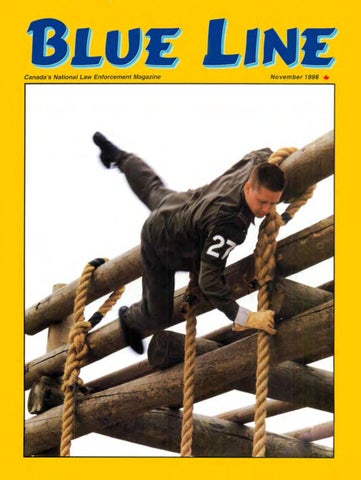
Dave Brown of "The Firing Line" in Winnipeg took our cover picture this month of a Military Police officer participating in the Military Police Thunderbird Challenge '96. Dave wrote - "The competition attracts the top MP's in Canada with each unit sending a four member team. They compete in a combat rifle course, a combat obstacle course and ... of course... a combat pistol course which we were proud to host." Dave volunteered as Match Director this year for the pistol competition and designed the course-of-fire which was described by many as being both "challenging and fun." Dave reports that there appears to be a debate currently whether the Military Police should be Military first or Police first. That is to say "a capital M or a capital P." Tum to page 18 in this edition and you be thejudge. We would be happy to hear your comments. A sense of tearn spirit is foremost in the minds of 18 members of the Ontario Provincial Police as well. On page 12 of this issue Bill Currie, the Greater Toronto Area Regional Commander, writes about traffic issues and motivation. This motivation includes both motorists and the officers who influence their actions every day. In response to a growing concern about driving conditions on the world's largest freeway system the OPP initiated the "Highway Rangers" concept oftearn policing. This initiative has seen a major reduction in collisions and injuries along the region's 400 series highways but more importantly has taught 18 officers a new focus and concept of law enforcement. On page 8 you will find an article which introduces a new police service in Canada. The Lessor Slave Lake Regional Police Service is one of a new type of police service first pioneered by the Anishinabek Police Service in Ontario. (See cover story for October 1994). This native police agency is spread over an 8 detachment area which contracts with First Nations communities from Alberta's Lesser Slave Lake to the B,C, border. Blue Line would like to congratulate and welcome Chief Ed Want and his 12 new members.
NoVember.1996 __________________________~~~-------------------------------8-L~!g~!~~
Painting, Helicopters, Dreams and Reality by Gary Miller
York Regional Police Chief B ryan Cousineau accepts a painting from artist David Hart (centre) as David Barnes of the R egional A ir Support Program (right) looks on. For information on the R.A.S. Program call 905 707-5592 and on the PAAC call 416 421-8018. York Regional Police Chief Bryan Cousineau accepts a painting from artist David Hart (centre) as David Barnes of the Regional Air upport Program (right) looks on. I was recently invited to attend an unveiling of a painting at the York Regional Police Headquarters building. The topic had me fascinated. My natural curiosity compelled me to attend when I found out the painting was of a police helicopter that, as of yet, did not exist. I was challenged to come witness paintings, helicopters, dreams and reality. The event was to take place on Thursday, eptember 19, 1996 and I made sure my calendar was circled. Dutifully 1 attended at the York Regional Police Headquarters' amazing structure recently completed on Yonge Street in Newmarket. I was greeted by Constable Wayne Snooks who allowed me my first chance for a close-up look at the full size painting. Being right at the scene of the painting's subject matter, I could see it was an accurate and stylish rendering of the building and surroundings. Bruce Powley, York Regional Police media relations noted that the fine painting was to be hung in a prominent place in the new York Regional Police Headquarters building. I then met with David Barnes of the Regional Air Support Program. David is promoting the use of helicopters by all police forces in the Greater Toronto Area and is aggressively seeking private sector funding to assist in this initiative. In spite of severe province-wide
cutbacks in polica.financing, he senses that the area is inching ever closer to realizing the savings and efficiency that can be achieved in helicopter use for police patrol. With an extensive background as an aviation accident investigator for Transport Canada, David certainly knows of which he speaks and promotes. I was then introduced to the fabled David Hart, a name I had long associated with police art. I was struck by the relative youth of Mr. Hart to be so accomplished in the art world. David is the director of the Police Artists Association of Canada (PAAC) who have joined with the Regional Air Support Program in presenting the original painting. David acknowledged that the helicopter ideas was still on the drawing boards but could be seen as a practical necessity for the area. The Police Artists Association printed a limited edition of the work which is being used as a fund raising tool. As people donate to the Regional Air Support Program, a print is issued by the PAAC as a thank you to the donor. A small fee will be given over to the Police Artists Association, who presently number 75 artists across Canada. These proceeds will go toward printing other PAAC members' works in creating prints to assist police related charities across the country. Blue Line Magazine had a hand in creating the Police Artists Association of Canada and the response from many police artists has been gratifying. There are no dues or special requirements for being a member other than working at
one's art. It is not necessary to be a police officer but a close association with the policing field is certainly an asset. Chief Bryan Cousineau was present at this event and was obviously honoured to receive the painting on behalf of the York Regional Police. The Chiefwas very gracious in his remarks and supportive of both the police art and the concept of area helicopters for policing. He indicated his awareness of the private sector's interest to assist in helicopter acquisitions. The Chiefforesees a joint venture with area police forces, ideally having one helicopter for every force in the GTA and with close jurisdictional and support staffsharing. I remembered having previously interviewed Chief David Boothby of the Metro Toronto Police who echoed the same logic. When I asked Chief Cousineau about his feelings about starting the helicopter program he advised that he has spoken with helicopter firms and the initial acquisition of a helicopter could be as low as $40,000 per year on a lease arrangement. He pointed out that this is not much more than purchasing a patrol car, and depending on its usage it may cost around $3 ,000 per week for pilot time and fuel. Chief Cousineau quickly pointed out that the helicopter depicted in the imaginati ve painting of David Hart's is a much bigger machine and although it would carry a maximum of 8 people it would cost around $150,000 per year to lease. "It would free up three or four patrol cars on the street for other tasks," Cousineau concluded. "I think it would be cost effective." "We have to look at dollars and cents," Chief Cousineau stated. "The helicopter would free up three or four cars on the road, the people, the training, the time off, whereas a machine such as this can move around, search for drugs, just general patrol... I can see it used during evening hours for break-ins, and in factory areas. I can definitely see great potential here." It was pointed out that in addition to patrol benefits, helicopters would be beneficial in special events or occurrences where people would have to be moved in rapid response to or from a venue. The Police Artists Association of Canada is currently seeking support for the Regional Air Support Program and other worthwhile initiatives. In addition police artists have a bright future in gaining national and international exposure for their outstanding works. This was a wonderful event to witness. I could frnally see what the two "Daves" were talking about when they invited me to witness "paintings, helicopters, dreams and reality" at one event.
BLU£ L'N_£__________________________~r;t,--------------------------NoVember. 1996 Magazine V-
UP's - Protecting the boss or getting help? by M orley Lymburner In our June edition we ran an article regarding the state of health of the employee assistance programs across Canada. Although the survey was far from exhaustive it met our intentions. We wanted it to be a simple barometer to the state of readiness of such assistance. The writer of this piece, my editorial assistant Blair McQuillan, reported back to me that the overall picture was grim indeed. He found numerous inefficiencies and many, many screwups as he went along. We did not go to any surreptitious ends to find this information. Any one we spoke with was advised at the outset that it was Blue Line Magazine calling and a scenario was given and the person surveyed simply asked ifthey were faced with this situation what would they do to assist the member. The persons in the survey certainly had ample opportunity to give us either the true state of affairs within their agency or ''the company line". Many did not know the "Company line" so they told us simply and honestly what they knew. We did not take down names of those interviewed and they were selected at random. As our writer pointed out to me - doing this survey was depressing! We received numerous calls about this survey but most would not reduce this to print. If any agency approaches EAP with an attitude that it is a great way to protect their ass then their motivation is com pletely wrong. It must be only
for the health of the individual. Blue Line is not a sensationalist publication. We have no political axes to grind. All we want is for some agencies to look at themselves a little closer. That said I would like to supply you with the response from the Vancouver Police Department in a spirit of fairness but not necessarily for the sake of editorial accuracy. This letter is a response to the article in your magazine relating to Employee Assistance Programs. In particular, we are concerned about the comments relating to our Psychological Services Plan where the issue of client confidentiality (page 11) was brought into question. I have no knowledge of any circumstances that correspond to the manner in which they are described in the article. As well, if such an incident did occur as described then I should also be very concerned about the integrity ofthe Plan. From the additional information you were able to provide to me, I am fairly certain who the member is and if! am correct the circumstances are not as reported. There are occasions when the Department may have some serious concerns about the performance, behaviour or conduct of a member. In these cases, the member may be directed or the member may be willing to attend for a psychological assessment which is not a part of our Psychological Services Plan. These assess-
ments are paid for by the Department and we receive the report directly from the psychologist. The Department usually provides a copy of the report to the member. Even though the details in your article relating to confidentiality are, in our opinion, inaccurate, they are worthy of additional comment. In my review ofyour article I subsequently spoke to a couple of psychologists with who we have a fair amount of dialogue. They both advised me that the rules for release of information without the consent of the patient are very strict and in brief, there are only three occasions where information can be released without consent. (1) Where the patient indicates that he is an immediate danger either to himself or another person. The Psychologist must notify the intended victim; (2) Where the patient indicates that helshe is abusing a child (Child Protection Act); (3) Where the patient is suffering from a medical condition to the point that the person should not be operating a motor vehicle (reported to Superintendent of Motor Vehicles). As you can see from these rules, the release of information, without the consent of the patient, is not an easy task and the psychologist is directly accountable for breaching any code of confidentiality. In closing, I wish to restate that we are very concerned about how Psychological Services Plan was portrayed in your article.
Gary Bateman, Inspector i/c Employee Services Section Vancouver Police Dept.
WORLD CLASS PROTECTION AND COMFORT The toughest protection standards (we meet them). A complete armour line (we pioneered them). Unlimited accessory and custom options (we offer them). As important as these features are, protective apparel in the real world demands one other critical component ... comfort. That's why at Barrday, our engineers and designers place a special emphasis on material selection and fabric weaves so that our products meet your most demanding standards of protection and durability and are comfortable to wear. Day in and day out. Real world comfort that makes Barrday a world class body armour supplier to national and international police and peace keeping forces.
TOP: Barrday Advanced Tactical Armoured Vests fA TA \I} offer maximum flexibility and protection for police and military tactical applications. LEFT: Barrday offers a variety of external carriers for soft body armour including our functional and popular CLEAN FRONT carrier.
Barrdal__ ADVANCED TEXTILE SOLUTIONS Barrday, Inc., P.O. Box 790, 75 Moorefield Street, Cambridge, ON, Canada N1R 5W6 Tel: 519-62 1-3620 Fax: 519-621-41 23
IiIiDid you see that!?" Ethics in policing have always been a concern and a valid one. However since the Rodney King "perception altering incident" of 1991, ethical judgments related to the use offorce have taken a dangerous and too often prejudiced
by Joel Johnston Survival Tactics Editor
During a recent conversation with a police colleague I was reminded of a growing problem in policing today. Young police recruits are encouraged and instructed to report fellow officers whose conduct falls outside their perception of the realm of 'acceptable behaviour'. Veteran officers are threatened with disciplinary action for failing to report such ' unacceptable behaviour'. The courts have created case law holding supervisors and fellow officers criminally accountable for the behaviour of other officers. Even more disturbing is the existence of some police officers looking to advance their own careers on the backs of other police officers. Some feel that turning in a fellow officer, rightly, wrongly or not even surely, is such a way. In the truest sense this is not altogether a 'bad thing'. lfwe have officers among us who are operating outside of the law that they are sworn to uphold, whether it be stealing, doing drugs, extorting favours, or bullying people then these crooks and cowards should be rooted out at all costs. For they do nothing more than weaken the profession and tarnish the reputation of the vast majority of good officers out there doing a difficult job with honour and commitment. However, let's get back to that conversation with my colleague. He works on patrol in a midized Ontario police department and he had been di patched to a bar fight that had spilled
out onto the street. This particular bar is well known to the police as a problem area where violence is commonplace. Upon arrival, this officer who has vast police experience, a solid training background and certification from the FBI as a Defensive Tactics Instructor, observed several parties fighting and a significant crowd gathering. From a distance and behind the cover of his squad car he shouted: "Police - break it up!", in an effort to quell the fight and get people moving along. At that point one of the combatants who appeared intoxicated, violent and goal-oriented, ran over to the officer, kicked off his shoes and jumped into a martial arts stance while verbally threatening the officer. With no opportunity to safely disengage, the officer deployed his expandible baton and struck a hard blow to the individual's thigh. The subject dropped to the ground, and the crowd began to disperse. A second officer attending the scene, who arrived more than half way through the first officer's experience, later stated "I didn't think that he (the officer) had to do that (strike the individual), because the guy wasn't really doing anything." The point here is twofold, not only is that second officer completely wrong, he had no business making this comment in the first place. This officer could not possibly have seen the incident through the eyes of the first officer on scene. He would have missed many of the preincident cues, and the obvious preclusion of officer presence and communication among other things. This officer- is analogous to the
motor vehicle accident 'witness' who heard screeching tires and smashing glass, turned and saw the accident scene, and believes he witnessed the accident. He did not. These type of 'witnesses' are more damaging to the analysis of a use of force incident than they are in the case ofa motor vehicle incident because there is usually more at stake, and because of the compelling nature ofa fellow officer's statement to make an incident appear tainted. In spite of common Police Academy and inservice training, police officers have different backgrounds, different life experiences, different training experiences, different policing experiences and therefore different perceptions of similar situations. Tho e with very little police experience whose involvement with the use of force has occurred primarily in the dry, sterile training environment will see things differently, usually in a naive, theoretical and sometimes critical way. Those with vast experience and a high level of training will see things again in a different way. They may believe thatthey could have achieved control ' in that situation' much more easily, The point is neither one should be secondguessing, armchair quarter-backing, or judging the perceptual experience of another unless they lived the exact same experience at the exact same time from the exact same position with the exact same skill set. And if you weren' t there at all, this should be further underscored. Now let's return to that incident. A wild bar fight spills onto the street. 1be officer shows up in a marked squad car in full uniform and identifies
8LU£L'N _£__________________________~\6l~.--------------------------Nove~r, 1996 M a g azin e V
himself He then makes a lawful request to ' break it up! '. This is ignored by all except one of the fighters. Apparently intoxicated and clearly violent, he aggressively runs toward the officer, kicks off his shoes and adopts a martial arts fighting stance, all the while verbally threatening the officer. The officer, who can' t disengage safely, strikes the subject across the outside of his thigh in the properly prescribed manner, dropping him to the ground. Was this ajustified use of force? This shouldn't even be a question. Anyone failing to recognize this as such is placing themselves at risk every day! The Criminal Code of Canada gives everyone the authority to use force to protect themselves from assault. The same statutes give peace officers the authority to use force in the legal execution of their duty. Nowhere in these statutes does it say that anyone has to allow themselves to be assaulted before taking preemptive measures. In short, if you believe that you are about to be assaulted and you can not disengage in complete safety, you are authorized to ' hit back first'. From a use of force analysis perspective experts can only comment on levels of resistance or violence exhibited by the subject and the levels of control that were employed by the officer to effectively deal with the behaviour. To that end : was it lawful?; was it appropriate according to policy and procedure?; was it consistent with Departmental training? In this case the subj ect exhibited psychological intimidation, verbal noncompliance and assaultive behaviour. His body language and his words screamed "I'm about to attack you!" The officers employed presence and communication in an effort to gain voluntary compliance. These were ignored. Disengagement, as is often the case, was not possible under the circumstances - and therefore precluded. The officer employed a striking technique with his impact weapon to arecognized, primary striking target, which has a low potential for causing injury, to control the subject. Perceptions aside, from a purely theoretical perspective, legally, policywise and training-wise, this was clearly ajustified use of force. Gaining control of an assaultive or violently resistive subject is not a 50 - 50 proposition. It should be 100% control for the officer and zero % control for the subject. Ideally it should look completely one-sided in favour of the officer. Usually it isn' t pretty or graceful, because it is not a carefully choreographed screen play. And if it is completely one-sided until control is achieved there is nothing wrong with that picture. It is not an officer beating a suspect. It is use offorce in its basest reality. We must remember that subjects choose to resist, and they can make the choice to comply at any time. Generally accepted Use of Force standards allow you to apply the ' One Plus One Theory' , that is you have the right to escalate force to a level higher than that which you face. In other words you as a police officer have the right to control violent behaviour considering your safety first. To reiterate, ifyou are a bully and you enjoy beating people up under the cloak ofyour police badge, you are a coward. You should get out of
policing immediately, and if you don' t we all hope you get caught and charged. But the reality is most cops don't want to use force, rather they are put in a position to have to use force. In these circumstances you have the right to use force decisively, and as the term suggests, forcefully. Once you have gained complete control, force must be de-escalated and follow-up care must be provided. But those sitting on the sidelines, watching from their cars, coming on scene half way through an incident, seeing things from a different perspective, or not even being there at all, had better be very careful about any comment that they make with respect to the use offorce of another officer. You must recognize your many
limitations on accurately assessing another' s experience and be careful not to j udge, because there but for the grace of God go you.
Joel Johnston is a graduate of Simon Fraser University and the Control Tactics Coordinator for the Vancouver Police Department. He is also the Defensive Tactics Editor for Blue Line Magazine. Please send any correspondence to the author at fax (604) 469-8945 .
The Sure Sign of Safer Streets This Community has PacketCluster on patrol
Public safety, as well as the safety of those who ensure it, is a growing concern in communities of all sizes. Which is why PacketCluster Patro!'" has become one of the most valuable tools you can provide to your officers. An innovative, wireless mobile information system, PacketCluster Patrol keeps officers on patrol in touch with headquarters while providing them with mission-critical information from law enforcement data files. Affordable, dep endable and performance-proven, PacketCluster Patrol puts the word out that your community is Cerulean" committed to keeping streets safe.
a
PacketClusterJitfVt WIRELESS
MOBILE
INFORMATION SOFTWARE
Cerulean Technology, inc., 2 Mount Royal Avenue, Marlborough, Massachusetts 01752-1935 Tel: (508) 460-4000 !OJ Fax: (508) 460-4099 !OJ http:/ / www.cerulean.com
0 1 - - - - - - -- - - - -8111£
LIN£
November, 1 996 ________________________________~- 7 ~_-------------------------------------- ~.g.z;ne
New Regional Police Service developing slowly and carefully
Lessor Slave Lake Regional Police are responsible for policing eight First Nation Territories from Lessor Slave Lake to the B.G. border.
ChlefofPoliceEd Want accompanies Frank Halcrow, Grand ChiefofKapawe'no FirstNalion, on an Inspection of the members of the Lesser Slave Lake Regional Police Service. by Joe McWilliams Ed Want is a police officer who in his first 17 years with the RCMP had more interesting assignments than any dozen of his colleagues. Posted to a sleepy rural detachment in northern Alberta two years ago, he had no reason to expect anything as remarkable as war crimes, motorcycle gangs or special investigationjobs come his way again soon, maybe ever. But he was wrong. No sooner had he got ettled into regular detachment work in the farming community 00,000 near Lesser Slave Lake, than he was asked ifhe wanted to become the first police chief of a fledgling regional aboriginal police service, then being developed. That was in the spring of 1995. A little over a year later, Want was on hand to see his 12 recruits undergo their first official inspection at a ceremony in Slave Lake marking the official launch of the Lesser Slave Lake Regional Police ervice, Alberta's first. He even got to make a speech to a couple hundred people. "The Lesser lave Lake Regional Police ervice will deliver its service through partnership with all of the people on each reserve," Want said, stressing the community policing model the new service is striving to follow. He told the recruits and other assembled guests, including representatives of local, provincial and federal governments, "our vision is to build a police service that other police services will want to have and copy. The Lesser Slave Lake
Regional Police Officers have committed themselves to breaking the cycle of crime, violence and restoring self-esteem, customs, traditional values and justice back into the communities." It's hard to imagine that happening, given the time, effort and dedication of the three levels of government and many individuals that went into the creation of the police service. All were represented at the June 6 ceremony, where the tripartite agreement between the federal and provincial governments, along with the Lesser Slave Lake Indian Regional Council, was signed. Representing the Federal Department of Justice was Nick Discepola, Parliamentary Secretary to the Minister, Herb Gray. Brian Evans, Alberta's Minister of Justice was there, as were the eight chiefs of the member bands of the Regional Council. The RCMP's "K" Division was represented by Superintendent Ed Spans, whose joint commitment to the success of the new police service was acknowledged at the ceremony. The RCMP commitment includes paying Want's salary for three years as Chiefofthe new police service, in addition to providing field training for the recruits. As ofJune of this year, the recruits were in RCMP detachments near the reserves, where they will eventually be responsible for police services. That transition, like the whole process of developing an alternative police service, will be slow, careful and very methodical. It follows a detailed plan that leaves virtually nothing to chance, because its main architects knew that when they started it had to be that way in order to succeed. They are Shel Kelly and Stan Pixley, Police Consultants to the Lesser Slave Lake Indian Regional Council, both former RCMP officers. "The ditches are full of Native and small
OUIE L ' N E - - - - - - - - - - - - I ( ; l a
town police forces (that haven 't worked)," Kelly said back in August of 1992, seven months after he took the job. "That's why this is slow and methodical." It took two years of details before the first group of future police officers was actually recruited, and a further year before any celebrating could be done. Regional Council justice portfolio holder Chief (and Senator) Walter Twinn of the Sawridge First Nation and Regional Council's Grand Chief, James Badger, in addition to the other Chiefs of the Regional Council, have given full support toward the policing program. The support has never wavered, despite potentially disruptive changes ofleadership on some reserves. The Regional Police officers spent four months at the Alberta Justice Staff College in Edmonton learning the basics of policing. Eight are just finishing their six-month recruit field training at RCMP detachments near the reserves they'll end up living and working on. The other four have several months of recruit field training to complete. The ten men and two female officers that make up the Regional Police Service have demonstrated their abilities to be role models for others interested in pursuing policing careers. Once in place on the reserves, the regional police officers will begin what might be called a probationary period, during which they'll handle only minor criminal code matters. They'll still be under the supervision of the nearest RCMP, and will be sharing the workload of onreserve policing with them. The road ahead ·11 be long and sometimes difficult for the new police service. However, by its presence it acknowledges that success is the only option. The Regional Police will have to prove that they are capable of providing a service that is competent and necessary. Overseeing the day to day training and operations of his 12-member force is Ed Want, who never expected to be an NCO in 1996, much less a Police Chief. So far, so good, as the RCMP detachments have lots of good things to say about the work of the young officers. Want, himself: has no doubt they are the right people for the job. "They're young, intelligent, hard working. They want to be police officers. They've got tremendous heart. "
Lesser Slave Lake Regional Police Service PO Box 1740, High Prairie, AB TOG 1EO Ph: 403 523-4401 - Fax: 403 523-4406
~.Q.zin.--------------------------------------~~r----------------------------------- NOVenlber, 1996
Regiona' Po'ice Service teams up with Coast Guard to patrol waterways by Michael McDonnell
A small inflatable boat skims across the waters of Lake Erie off the beach at Port Dover, Ontario. The two occupants wave to other boaters before pulling alongside a boat with several people aboard. These are not two pleasure boaters visiting friends but rather it is a new Marine Unit comprised of a member of the HaldimandNorfolk Regional Police and a member of the Coast Guard from the Search and Rescue Unit stationed at Port Dover. The boaters are checked to ensure the required safety equipment is aboard and that there is no violation of the Liquor Licence Act. This unique partnership is an initiative of the Canadian Coast Guard which enables their members to assist local police services patrol waterways. The promotion of boating safety is the primary aim of the Coast Guard. The Haldimand-Norfolk Regional Police will focus on the enforcement of liquor laws, impaired operation of vessels, boating regulations pertaining to proper equipment and speeding, as well as any other criminal violations on the water including drug related offences. The Regional Municipality of Hal dim andNorfolk is situated on the north shore of Lake Erie. The shoreline of the region runs from east of the Grand River to west of Long Point, taking in Long Point Bay, a popular fishing and water fowl hunting area Since 1974 the Regional Police have provided policing services in the seven major population centres. The Ontario Provincial Police service the rural areas. In the past, the Haldimand-Norfolk Regional Police, lacking the financial resources to launch a solely police operated marine patrol, were unable to provide enforcement for the boating community. This joint venture allows for such enforcement with no cost to the police service. The cost of operating the Hurricane 472 Zodiac is incurred by the Coast Guard. With all public sector agencies facing funding cutbacks, "we're doing more with less and it helps to share resources," says the officer in charge of the Port Dover Coast Guard Unit, Mark Coultis. The program was initiated by the Coast Guard who contacted police agencies from both municipal and provincial levels. "If they have the manpower, we share resources and public awareness and enforcement duties," said Captain Coultis. Currently Coast Guard members are unable to lay charges, although some of their members are undergoing training for enforcement duties. They concentrate their efforts on search and rescue and education. Partnership with the police enables both agencies to efficiently and affordably address the issues of both enforcement and safety. The program began in the summer of 1996 with four members of the Haldimand-Norfolk
Regional Police trained' to patrol with the Coast Guard. All four members were experienced boaters who had previously completed the Canadian Power Squadron training course. Each member received additional training from the Coast Guard. According to Staff Sergeant Bob Knipf of the Haldimand-Norfolk Regional Police, the marine unit will not decrease the number of police officers on the str~et. "The marine patrols are scheduled to conform to the needs of both the police service and the Coast Guard," he said. "Other than the man hours, there is no cost to the service." In addition to patrolling the waters of Lake Erie adjacent to the Port Dover beach, the unit will also patrol the marinas along the lake shore and the Lynn River which flows through the town and is the main channel for boaters. Port Dover has several marinas with hundreds of boats docking for the season. Boaters routinely
make the two hour journey across the lake to Erie, Pennsylvania. In addition thousands ofcottagers and campers populate the area each summer. Port Dover is also a very popular day-trip destination for people from the Hamilton and Brantford areas. The possibility of patrolling the Grand River in the Dunnville and Caledonia areas is being studied for the future. How did the boating public respond to the sudden attention paid by the police and the Coast Guard? During the initial weekend the patrol operated, "I found everyone we stopped cooperative, even those caught in obvious violation," said Constable Rick Goodyear, a member of the unit. "For the most part the soft approach to enforcement through warning the violators should ease our entry into this domain." Indeed, that is the approach used by the patrol throughout the summer. Warnings were given for a variety of offences including excessive speed, insufficient flotation devices and liquor violations. In addition to becoming familiar with boating regulations the police members of the unit must be, according to Constable Goodyear, "prepared to get wet. Sun screen is a must." It is anticipated that in the future the unit will operate from the long weekend in May through to the Thanksgiving weekend. "The Coast Guard are in the safety and rescue business and the police are in the enforcement end ofit. It is a benefit for both agencies and for the public," says Chief of Police Larry Hembruff. "The public has been very understanding, We've had nothing but positive comments."
Computer hardware supplier Jor Blue Line Magazine
Two Year Parts and Labour Guarantee
Hardware Software Ac cessories T raining
Before you purchase any computer hardware check with us for price, service and quality. Phone: 416 543·1127 Fax: 905 430· 7779
-lrgl<-______________ BU'£ L.N£ V Magazine
November, 1996 _ _ _ _ _ _ _ _ _ _ _ _
Determination brings Canada a checkered flag
by Christy Spicer Canadian Police Road Racing Team member Kevin Cisaroski took the chequered flag at the World Police Championship's Race ofNations last August and showed the world some good old Canadian determination while doing it. But the Challenges were many for the intrepid anadian Team who went to England's Donington Raceway. In spite of the showing by Kevin in the Race of Nation event the 1996 World Police Champion Motorcycle racers are the Italians- they are the "hands-down" fastest cops in the world. They completely dominated the field in 2 out of 3 race events, winning both the individual and the Team Race from August 9 to 11 . The three top Canadian entrants were Lance Campbell, the top Canadian racer, and Kevin, Cisaro ki and cott picer. They came in 18th, 30th and 33rd respectively out of a race card which included almost 100 racers. Friday, August 9th was the first day of practice and the brave spectators who withstood the rain saw a spectacle that looked more like T 's motorcycle bloopers. No less than 18 spills took place before the sun started to shine around 2:00 p.m. and of course our Canadian boys did not account for any of the spills. Practice continued into the afternoon and saw all three Canadians qualify to move on to the next level of racing. aturday morning again showed wet conditions which caused the Canadian Race Team manager, Dave tewart, to pull his riders out from their timed qualifying session so as not to risk crashing. He realized that even one injury would disqualify them from the team event. Unfortunately many countries did not make the same wise decision and found themselves without the required minimum numbers to enter. un hine finally dried the track by mid afternoon and permitted many riders to get in orne well needed practice time. With their race times the Canadians qualified for 6th position on the grid for the "Team Race" to be held the following day. Only the top seven countries raced in the final team event held on August 11 tho They included Italy, France, England, Belgium, Austria, witzerland and Canada. The race track at Donington is simply awe
inspiring. Michael Mercier of the F.A.S.T. Riding School was quoted as saying "it is one of his favourite tracks to race on," and it is not only one of the fastest Grand Prix tracks in the world but it is also one of the most accessible. Spectators can actually drive or walk under the front straightaway and watch the races from the back straight as well as from the challenging Esses chicane, McLeans and the deceiving Coppice comers, Melbome hairpin, and the gruelling fast, downhill, off cambered craner curves!! This track was definitely one ofthe biggest challenges faced by the Canadian team and supplied them with many days of exciting racing. Lance, Kevin and Scott turned out a great performance even climbing a spot to fmish in 5th place just in front of the Austrians and the Swiss. It was so exciting to see that our Canadian riders, who only get out racing a few times a year at best, could do so well against the semipro's of Italy and France. They race and practice nearly every weekend and finished in the top two positions. This included the home country favourites, England, who finished third. lustwhen we thought the Team Race would be our top showing, Kevin Cisaroski cranked out a fast and fabulous ride to come I st in the "Race o/N atiolls. "This race was comprised of just one rider from each country, and what a race it was. Kevin started out in the front grid in the 4th position, but by the second lap he had over taken the top three racers to move into the lead position.
Mati Parr
Peel Regional Police
Kevin Clsarosl<i Winnipeg Police
Due to a severe crash on the 3rd lap of the race everyone was "red flagged" and sentto the starting line straight away, where they anxiously awaited further instructions. After what seemed like an eternity track officials set up the racers for the restart in the last positions they held before the "red flag". The race was back on but Kevin suffered a poor start and found he had to work his way up through the pack once again. He tracked down one rider after another with determination and showed the English spectators and the rest of the world that Canada is a winner at least in the one-on-one "Race of Nations." Members of the Canadian Road Racing Team and Blue Line Magazine were deeply saddened by the news that Matt Parr died in a motor vehicle accident on October 28th. In a tragic irony the man arrested on drinking driving charges has three previous convictions for the same offence. Matt was a strong supporter of the Road Racing Team' s efforts to reduce the drinking and driving plague that haunts our society. Mere words can not xpress the loss. Our sincerest sympathy is extended to Matt's family, friends and colleagues.
Mike Jenkins
Mob"o TorenlD Police
Scott Spicer Meuo Toronto Police
Lance C;rnpbel RCMP ToronlD
Bu,£ L'N£ - - - - - - - - - - - - - - I G ( j ? November, 1996 M agazin e Vl--------------------
SUICIDE IS GREATER DANGER TO COPS THAN HOMICIDE, STUDY SHOWS
Go AHEAD ... MAKE YOUR DAY WITH
Police officers are eight times more likely to die by their own hand than by homicide, a study by University at Buffalo (UB) epidemiologists has shown. They also take their own lives at a much higher rate than other municipal employees, the findings indicated. The study is one ofthe few empirical analyses of police officers' risk of suicide, homicide and accidental death, and the only study to compare their risk to that in other occupations. "We are hoping this study will make the police community aware that suicide is a problem, not a myth, not something that should be shrugged aside," said JohnM. Violanti,PhD., UB assistant clinical professor of social and preventive medicine, a 23-year veteran of the New York State Police and lead author on the study. And while the study was based on data from the Buffalo Police Department, Violanti said the Buffalo statistics mirror those of police departments around the country. "We looked at five other cities, and all five departments were higher in suicide than other occupations. I thi!lk this is a pretty good indicator of what' s going on out there." Violanti and colleagues from the UB Department of Social and Preventive Medicine analyzed mortality data for Buffalo police officers and other municipal workers who died between 1950 and 1990 of external causes (causes not related to disease). A panel of medical examiners verified each cause of death and ended up reclassifying the demise offour police officers and one municipal worker from " undetermined" to suicide. Police suicides are often misclassified for a variety of reasons, Violanti said, which leads to an underestimation ofthe risk. The 138 people in the study, all white males, consisted of 39 police officers and 89 municipal workers. Analysis of cause of death determined that: o Among the 39 police officers, 25 deaths were classified as suicide, 3 as homicide, 6 as accidental and 4 as undetermined. o Among the 89 municipal workers, 13 deaths were suicide, 4 were homicide, 67 were accidents, and 5 remained undetermined. o Police officers' risk of dying from suicide was eight times greater than from homicide and three times greater than from accidents. Possible reasons for the high risk of suicide among police officers are many, according to the study. They included: continuous exposure to human misery, an overbearing police bureaucracy, shift work, social strain, marital difficulties , inconsistencies ofthe criminal justice system, alcohol problems, physical illness, impending retirement, lack of control over work and personal lives. Violanti said he thinks the biggest reason police officers die by suicide at high rates is because they have nowhere to go for confidential help when personal problems or job stress overwhelms them.
"If you look at the data, most people who commit suicide have never gone for help," he said . "Police officers are even more hesitant than the average citizen to get help for emotional problems. Because oftheir role and their job, they mistrust many things, and they especially mistrust mental health professionals. The other half of the problem is, confidential help isn ' t always readily available. "Departments should include some sort of suicide awareness training in their stress management program," Violanti added. " The New York City Police Department has such a program and suicides went down after it was instituted. The Buffalo department now also has a program in place. " Compounding the situation is the ready availability of a weapon, he said . Suicide often is an impulsive act, and the suicide method of choice by males in American society - the handgun - is literally at a police officer' s side and is guaranteed to be lethal in the hands of an experienced shooter. Volanti also is on the criminal justice fac41ty at Rochester Institute ofT echnology. Other researchers on the project were John E . Vena, Ph.D., of the UB Department of Social and Preventive Medicine and James Marshall, Ph.D., formerly of that department. Further details phone Lois Baker 716-6452626 .
Distributors of confrontational simulations equipment for all law enforcement defensive tactics training. Knowledgable staff, com petitive prices,
No P.S.T.
For m ore details call or write:
PADS FITNESS SUPPLIES 9624-74th Street, Edmonton, Alberta Phooe/Fax: (403) 490-0144 Dale Kliparchuk - Director / Instructor
GET OUT OF THE DARK~~tmt AND INTO THE FUTURE WITH
COMPU-CAPTURE ®
A COM PLETE V I DEO IMAG ING SOLUT ION
-J BOOK AND ID FASTER THAN EVER
-J BUILD ALINE-UPIN SECONDS
-J ElIMINATE WASTED FILM AND TIME -J EASILY MlKEID BADGES AND WRISTBANDS
Don't forget to ask about:
COMPU-SKETCH ®
COMPU-SCENE ®
Create com posites for suspect idenftcation.
Drawing program f(>r crime and accident Scenes.
products by
DDSI
CALL OR FAX TODAY FOR MORE INFORMATION B.R. (Bev) Graham, R.R. #1 (Jakobi Road), Castleton , Ontario KOK 1MO
Telephone: 905-344-5906
Fax: 905-344-1103
G1l1--------- - - -Bu'£
LIN£ November, 1 996 _ _ _ _ _ _ _ _ _ _ __ _ _ _ _ _-IUf_ _______ _ _ _ _ _ __ _ _ _ __ _ M a gazine
Elite traffic enforcement team targets bad habit drivers A new traffic enforcement initiative started by the Ontario ProvinciaiPolice last year has proven both its effectiveness and popularity with motorists in the Greater Toronto A rea. The officers p atrol a beat which includes the largestfreeways in the world, with sections up to 16 lanes wide, that requires some of the m ost innovative enforcement p rograms available. In the OPP's experience th e best innovation comes from the enthusiastic p atrol officers themselves.
99% of applicants get their driver's license. To compound the issue, many receive their licenses in test areas foreign to the areas where they will be spending their time behind the wheel of a vehicle. Maybe it is time for simulated testing similar to airplane pilots. In this way the vast majority of driving conditions can be experienced.
4. Environmental Concerns With an increase in speed comes an increase in gasoline cons u~ption and the corresponding environmental impacts such as low level pollution and carbon dioxide emissions.
5. Voluntary Complla ce Is it true that 85% of drivers average 117 km/ h on our 400 series highways, because that is the speed with which they feel comfortable? One could just as easy argue that 117 km/h is the speed at which the odds of being caught are very high. In the photo radar debate we heard a lot abouttolerance levels. Was it really a ploy on the part ofthe motoring public to see how much they could get away with? We are a society that readily attempts to bend the rules on everything from cable and phone outlets to all forms of taxation. It is only when our lives are at stake, ie. running a long-standing red light that we voluntarily comply. In everything we do we cannot escape the issue again of moral values and voluntary compliance as an individual moral issue.
One of the nine-member Ontario Provincial Police teams of "Rangers". (L-R) Kathy Carter, Team Leader Ted Litner, Wes Erskine, Rohan Thompson, Te" ence Reefer, Doug Fenske, Kyle Power, Bruce Keefe and Peggy Gamble. by Bill Cu" ie Toronto R egional Commander Ontario Provincial Police The management of traffic safety programs is a very complicated process demanding the professional coordination of all relevant agencies. While one agency may have the lead no agency on its own can effect positive change in driving behaviour and the resulting reduction in the number of traffic victims. In addition to Government agencies, our partnership must extend to the private ector. In terms of the private sector, it is the doers, whether volunteer or professional, that should be involved in the partnership. It is understood that the corporate sector is involved in traffic safety. Police agencies in particular should ensure that they are not compromised and that the public' s perception is one of corporate program support but unrelated to the operationalization of these programs. We are in a very market, advertising driven society. Our profession is very public, very repected and therefore the ideal vehicle to deliver a product. Funding pressures should not impact on our value system. Gandhi once said, "service must b conducted within the bounds of moral values". Therefore, to the whole area of corporate ponsorship, we should exercise caution, ensuring that our decisions fall within our moral values and objectives. Our very existence de-
pends upon our credibility and trustworthiness. Now, to enter briefly, the current debate on appropriate speed limits from the perspective of a regional commander responsible for traffic enforcement on one of the world's busiest highways. There are at least six factors which should be taken into consideration. Some are obvious, while others appear secondary, have significant implications.
1. Hlgbway Engineering It is generally accepted that Ontario has well engineered highways, particularly the 400 series. Part of a well engineered highway is the effective signing ofsame. It is our experience that many drivers have difficulty negotiating their way through the maze of collector and expressway options across Metropolitan Toronto. In some instances, the right hand driving lane comes to an end, other times it is the left hand passing lane. Sometimes the right lane exits, other times the left lane exits. Ramp speeds reading 30km\h make it difficult to enter traffic at 1OOkm\h. To successfully negotiate our major expressways requires being familiar with the area, possessing excellent eyesight, reflexes and good driving skills.
2. Trame Volume There is obviously not a consistency in traffic volume, yet our limits apply day or night 24 hours a day, 365 days a year. In some cases, it makes sense to drive 120 kilometres an hour, in others it is absolutely dangerous.
3. Driller Capacity One official once was quoted as saying that
8Ll1£ L'N£--------------\G2! M
g azina
6. Technology Attimes our technology runs ahead of what society finds as acceptable standards. There are cases in medicine, computers, nuclear weapons and many others that demonstrate our difficulty in coping as a society with technological advances. We have cars that can easily reach 160 km/h yet we have no speed limits over 100 Ian h. This obvious conflict causes drivers to question the seriousness of speed limits; after all, if you are not supposed to exceed the speed limit, why are cars not regulated to the maximum limit? Maybe future technology will automatically regulate the maximum speed of your vehicle as you travel through various speed zones. Each of the above six factors can be addressed. To do so means extensive consultation and realignment of societal values. It just may be, that in spite of all the risks, the notion of individual freedom and self consequence may out point those in the " safety first" lobby. How safe is safe? To hear some safety experts, it would mean no guns, no cars, no snowmobiles and everyone should wear helmets 24 hours a day. At the moment, we are polarised in our view . We need a forum beyond just the elected officials, policy makers and the interest groups to arrive at standards that the majority can live with and abide by. In many ways if not spoken consciously, but a least lurking in the subconscious, all of the complex issues just discussed were part of the photo radar debate. The outcome of the photo radar debate gave birth to the Ontario Provincial Police's Highway Rangers. The photo radar pilot project brought to the forefront the public's concern with driver behaviour, particularly in the Greater Toronto Area (G.T.A.). What we heard the public saying became the objectives of the Highway Ranger program.
VJ--------------------
November, 1996
Those being, proper lane management on multilane highways, appropriate driving habits and speed too fast for conditions. It was during the debate, and prior to the present government pledge to remove photo radar, that we in the Greater Toronto Area of the O.P.P . developed the concept oftraffic teams designated to changing driver behaviour. We questioned our fixation on speeders and tried to delve as deep as we could into the reasons for motor vehicle collisions. Our philosophy was based on the pro-active positive approach . We knew drivers were still going to drive too fast for conditions; we knew risks would be taken and we knew that substandard drivers would be on our highways. Through focus groups and discussions with proven experts in driving skills we came to the conclusion that the major cause of collisions is the untrained driver. Thus our enforcement program was designed around the skills required to be a professional driver. To tackle this project, 16 of the best committed traffic officers in the O .P .P .' s GTA were recruited. To lead these teams, two sergeant team leaders with excellent interpersonal skills and a commitment to traffic enforcement were also recruited. Before the two teams of nine officers were put into action, an initial training session was put in place. It is vitally important to have your entire team on the same wavelength. At the beginning oftraining they were on 18 different wavelengths. Through discussions, exposure to dynamic experts in the driving field and an awareness of the public's concern, a common, strong wavelength was created. One team is stationed in the east end of the region and the other on the west end. Plans were developed for enforcement activity with our ten detachment commanders, command staff and team members. We agreed upon statistical gathering mechanisms and measurements that would reflect the objectives of the program. While on duty, the teams are available to respond to any occurrence that cannot be covered by regular patrols. When in different detachment areas, the teams were to invite officers of those detachments to participate in their activities. There is one hard and fast rule. The ninemember teams are to patrol together. Yes, nine patrol vehicles in he same area. This procedure results in outstanding visibility and ensures a team effort. These Highway Rangers are fully equipped with the latest technology available in radar devices through to in-car videos. Each officer has their own vehicle. It is set up as their office. When going off duty the vehicles are left at the closest detachment to their residence. While each team has an office, it is rarely used . Meetings take place in public view. Whether at roadside parks or major service centres on the 400 series highways. As with every project, there are intended and unintended results. The intended results have far exceeded our expectations. The teams, in just eight months, have stopped over 42,000 vehicles. Each stop is mandated to be a learning experience. Approximately one half of the drivers were stopped due to their poor driving
habits, ie. drinking coffee, on the cell phone, reading a book, playing the drums, shaving, eating cereal, leg out the window, hoods over the face, reading maps, talking and looking at their passengers and putting on make-up. It was their objective to initially address those habits most easily corrected. Due to the short time the program has been in place, and the subsequent reliability of the data, makes it difficult to measure what our impact has been on collisions. As we chart our enforcement activities and keep a common focus, eventually results will begin to show. Where will these results show? If driver behaviour is adjusted in one jurisdiction, then one could expect, when that driver goes on vacation or travels away from the area where the "schooling" took place, that they will contribute to a reduction in the accident rate anywhere they drive . The unintended results begin with the tremendous acceptance within the Region of the teams. The teams' success has been contagious. They are setting new standards, bringing new ways of looking at issues; all this and actually having fun at the same time. Complaints against the team members have been nil. Justthink, 42,000 contacts and not one complaint. We believe having the members work together with a positive program to sell, minimizes the conflicts at the side of the road . Our officers will act professional as they are working in front oftheir peers and the motorists will be polite as there are eight other officers working close by. This positive relationship is carried over
Coopers &Lybrand
into the legal system. The team loses very few court case as the defendant sees the team together again in the courtroom . That, coupled with professional and collaborated evidence turns the court into a now of guilty pleas. The Highway Rangers are well known. This is not by accident. We asked the media to help us promote the objectives of our program. What good is a program if no one knows about it? Our relationship with the media is a win-win situation. We are completely accessible to the media. We never turn down a request for a ridealong or a staged 20-second media clip. We provide statistics and stories weekly. We profile our officers at every opportunity. Through focus groups we meet with the media to discuss both of our objectives. In closing, it is appropriate to mention that in the G. T.A. there are three other teams in operation . Our commercial vehicle enforcement unit (truck troopers with nine members) is a highly sophisticated team of inspectors and enforcement specialists . We have a dedicated R.I.D.E. unit (nine members) who work every week, every month of the year. This team will remove over 2,000 drinking drivers this year from highway 401 across Metropolitan Toronto. In Caledon, we have teams dedicated to addressing the high incidence offatal collisions (182 died in the past eight years) in this high growth, high traffic volume area northwest of Metropolitan Toronto. Team and " problem focus" patrols are in. Zone patrols are out. Each officer, each shift needs to have a focus, an objective and the satisfaction of making a difference.
Solutions for Business'"
Coopers & Lybrand, Ottawa, Ontario, Canada is pleased to announce that Leida Commercial Crime Consultants Inc. (Leida ccq has joined Coopers & Lybrand. Leida CCC is a Canadian Corporation and Licensed Investigative Agency, headquartered in Ottawa. Leida CCC will provide specialized services to the Forensic and Investigative Services practice of Coopers & Lybrand. WE (Walt) Ldgh
Lcida CCC specializes in commerciaVeconomic crime investigations, with parricular emphasis on corporate/insurance frauds, thefts (incemaVextemal) and other illegal activities. The Principals of Leida CCC are WE (Walt) Leigh and R.C. (Bob) Stone. All are retired members of the Royal Canadian Mounced Police, each having many years experience in the commercial crime and intelligence areas, with proven track records of success.
R.C. (Bob) s~
NOVember,1996 ____________________________
The Coopers & Lybrand OTganization is one of the world's leading providers of professional services including auditing and accounting, tax and consulting. The organization comprises national and international practice entities which are members of Coopers & Lybrand International, a limited liability association incorporated in Switzerland, and which serves clients on a globally integrated basis in more than 120 countries.
Enquiries should be made to: Coopers & Lybrand Leida Commercial Crime Consultants Inc. 55 Metcalfe Street, Ottawa, Ontario KIP 6L5 Telephone: (613)237-3702 Fax: (613)237-3963
~~r--------------------------------B--L~!g!!~!
Compiled by Blair Mcquillan
Winnipeg Police Force
Illustrated by Stefon Sepa
This series was comp~led by Blue Line MagazJne and is intended to tell the stories ofpolice officers killed in the line of duty. The initial articles will involve the first officers killed in the line of duty from each of the major police forces across Canada. by Jack Templeman John Verne joined the small St. Boniface Police Force (subsequently amalgamated with Winnipeg Police) as a constable on August 20th, 1920. His hard work had earned him the rank of ergeant in 1922 and he became well known throughout the city as" ergeant John" by children and adults alike. John Verne was a tough old-style cop who did not back down to anyone and could take on the toughest with his bare hands. In 1928 he had wrestled with three criminals and one man hoved a revolver into his side and twice tried to fire it. Verne overpowered the man and he never got the chance for a third try at the trigger. All three men received penitentiary terms as well as the I h. On July 24th, 1934, the St. Boniface Police Force consisted of 10 men and their station was in the basement of the City Hall on Provencher Avenue. hiefJo eph Beaudry was on leave so gt. Verne was both the Acting Chief Constable and the ergeant in charge. One constable was on beat patrol during the day and a detective reported for duty at 10:00 a.m. The other officers were assigned to the evening and night shifts and weekly leave. The cruiser car was parked at the tation for use of the detective during the day or by the sergeant in case of emergency. If an emergency occurred and the sergeant left the station he would notify the frrehall directly behind the station on Dumoulin Avenue and a fireman would come and take over the phone. The ergeant would normally pick up the beatrnan and then proceed to the call. On that Tue day morning about 08: 15 am. gt. Verne received a phone call reporting a hold-up at the Norbridge Pharmacy located at II t. Mary's Road. He jotted the address on a notepad and then called the firehall and had Fireman Art Humphries come to take over the de k. The re on will never be known why Sgt. yerne left the station without his gun. Possibly It was over-confidence or maybe he was just in a hurry to respond but whatever the reason, it was to cost him his life. The hold-up at the Norbridge Pharmacy was committed by a man who could easily be described as a "born loser". George D. Jayhan, alias hea or Zaha, was 34 years old. He had been born in Ridgeville, Manitoba and moved about considerably. Little is known about him but he did serve sentences in at least six institutions in the U. . before being deported back to
Canada at Windsor, Ontario in 1932. While in Windsor he was arrested for Possess Stolen Property but only received a fine. He then moved west to Vancouver and it was probably there that he became a heroin addict. Jayhan came to Winnipeg early in 1934 and the city started to experience a rash of drug store robberies in which the culprit wanted drugs as well as cash. The suspect was always armed and always took the time to tie up the proprietors. He was reportedly very nervous probably due to the drugs or lack of them and this caused concern with the police that he might become violent. That violence exploded on July 24th, 1934 and resulted in the death of Sergeant Verne. The gun that was used was stolen during a break-in at McBurney Drugs, 890 Sargent Avenue in May of that year. The holdup at the Norbridge Pharmacy ~ou.ld best be described as a comedy of errors if It did not have such a tragic ending. It seems Jayhan could do nothing right except possibly prepare for the robbery by stealing a car the day before. He stole a DeSoto Sedan from Fort Rouge which he drove to the drug store the next morning. That was the last correct thing he did that day. About 08:10 a.m. that Tuesday, Jayhan parked the stolen car in the lane behind the drug store facing south. He entered the store and found that only the pharmacist, Frank Wade was there. Jayhan forced the druggist at gun point to show him where the drugs were kept and then took him into a back room and tied him up as was the usual routine. Jayhan then gathered up the drugs and placed them in a carton and then emptied the cash register. Next he started to gather up all the packages of cigarettes and put them into another carton when things started to go wrong. At this time the delivery boy, William Rodger, arrived for work and walked in on Jayhan. The boy was then forced into the back room at gun point and tied up beside the druggist. Jayhan hardly returned to the front of the store when the first customer of the day, Raymond Jackson walked in. Once again Jayhan had to take the time to herd this latest visitor into the back room at gun point and tie him up with the others.
Before anyone else arrived to interrupt him Jayhan carried the box of cigarettes out to th~ stolen car in the lane. He then returned to the store to get the box of drugs and must have been surprised to find the druggist Frank: Wade and the customer Raymond Jackson had freed themselves. Jayhan tied them up again and quickly left the store forgetting the box of drugs which was the main reason he was robbing the store. Jayhan did not know that Raymond Jackson had managed to phone the S1. Boniface Police while he was free and this call was received by Sergeant Verne. Even if Jackson had not managed to phone the police Jayhan' s bad luck would have continued because he was seen inside the store committing the robbery by a young boy, Jackie Dick who was passing by and looked in the window. The boy ran to the service station then located at Marion Street and St. Mary's Road and told the station operator who also called the police. The Dick boy was joined by four other youths who had been at the service station and they all went outside to watch the drug store. They saw Jayhan leave the store after tying up the druggist and customer for the second time and when he got into the stolen car they ran to the front of the store and entered. Jayhan had not moved the stolen car when he must have realized that in all the confusion he had once again forgotten the box of drugs so he went back into the drug store and this time found the five young boys inside. Frank: Wade, the druggist had untied himself again and was able to hide when Jayhan returned. This time Jayhanjust herded the boys into the back room and told them to stay there without tying them up. This time he remembered to take the box of drugs as he fled. Bad luck continued to plague Jayhan as he started the stolen car and drove out of the lane to Horace Street. When he crossed the wooden sidewalk he blew out a tire on the car so abandoned it and fled on foot running east on Horace towards Tache Avenue. This time he did remember to take the box of drugs. Right after Jayhan fled the store, two more customers, J .M . Reid and E. McKinnon came in and met druggist Wade who quickly told them of the holdup and they all went outside. They saw Jayhan abandon the car and run east on Horace so they got into Reid ' s car and drove to Marion Street and turned east to parallel him. As Jayhan ran towards Tache Avenue he must have realized that downtown Winnipeg was the other direction so he turned around and ran back to St. Mary' s Road. The men in the Reid car saw this and also turned about on Marion Street which was then a two-way street and they headed for the Norwood Bridge. Jayhan got to St. Mary's Road and flagged down a passing car driven by William Corrnode who was accompanied by his son Campbell. At gun point Corrnode was ordered to drive over the orwood and Main Street Bridges and head north. Just before Broadway he was ordered to turn right beside the C. .R. station and drive into the freight yard which is now known as The Forks. The road behind the station would eventually lead to Water Avenue. The original customer in the drug store managed to free himself in time to go out of the
DLU£L'N£ --------------------~~ 14 ~---------------------=--~--- ~agazine ------------------------------------~~r-----------------------------------Novernber, 1996
store and see Jayhan flag down the Cormode car and head for the Norwood Bridge. He got the license number of the car and supplied this to Sergeant Verne who arrived at the drug store before the commandeered car got out of sight. Verne gave chase and was followed by the men in the Reid car and then by the customer Jackson in his car. Verne was able to follow the Cormode car into the freight yards and overtake it and force it to a stop. Jayhan got out of the car and moved to the back of it as Verne got out ofthe cruiser and also went to the back ofit. The witnesses in the other cars saw the unarmed officer approach Jayhan and when they were 6 to 8 feet apart Jayhan fired his Colt .455 revolver twice with both bullets hitting Verne in the stomach. Jayhan got back into the Cormode vehicle and forced them to continue driving him north to Water Avenue and then along the back streets on the east side of Main Street. Druggist Wade helped Reid load the wounded officer into his car while McKinnon got into the cruiser and followed as they raced to Water Avenue and over the Provencher Bridge and down Tache to the St. Boniface Hospital. The customer Jackson tried to follow the Cormode vehicle but lost sight of it. He did spot a Winnipeg Police beat constable and quickly told him what happened and supplied the license number of the fleeing vehicle. The officer immediately relayed the information via a call box to the police radio room. A message was broadcast to the Winnipeg Police cruiser cars. It should be pointed out that the police radio system was in its infancy at this time and Winnipeg had become the first Canadian city to equip cruisers with receiver sets in 1930. The sets could only receive messages which would have to be acknowledged later by phone. Only three cruisers patrolled the city centre at this time. Unfortunately for Jayhanhis bad luckprobably helped set a record for his arrest in this shooting as he had only reached Bannatyne Avenue and was crossing Main Street when the message was broadcast and one of the police cars equipped with a radio happened to be at the same intersection on Main Street. Constables F. Gibson #23A and G.W. Rockey #96A did not even have time to acknowledge the message with the Operator-Dispatcher as they swung the cruiser behind the Cormode car. Const. Gibson fired one warning shot at the car and the driver Cormode threw it out of gear and slammed on the brakes at Albert Street and Bannatyne Avenue. Jayhan did not resist and the occupants of the car all found themselves in handcuffs until things were sorted out. The box of drugs and the gun with four expended cartridges were recovered in the car. No time was wasted in those days and St. Boniface Police were notified at 08 :50 a.m. that an arrest had been made, less than an hour after it all began. By 09:45 a.m. Jayhan was booked into the jail after he had given a voluntary statement. In the statement Jayhan claimed the officer had his gun out and he thought the officer was going to shoot so he fired at the officer. This statement was an obvious lie as Verne's gun was later removed from his locker
along with his personal belongings. Sergeant Verne remained conscious when he was driven to the hospital and insisted on walking in although he had to be assisted by Mr. Wade. His condition was critical from the beginning as he had lost a lot of blood. At 3:35 p.m. Verne was on the operating table being given a direct blood transfusion from Constable Bill Russell (later Chief Constable ) when he succumbed to the wounds. A Coroner's inquest was called and took place on the 26th. The civilian witness testified and then Det. Sgt. James Melville ofthe Winnipeg Police Force read out the voluntary statementofGeorgeJayhan'in which he admitted the robbery and the shooting of the police officer. The newspaper report of the inquest stated that the Crown did not feel it was prudent to have Jayahn there in person. Naturally thejury ruled that Sergeant Verne was killed in the performance of his duty and they named Jayhan as the slayer. The jury also made two recommendations, that the St. Boniface Police Force be increased in size and that in future two armed officers should respond to holdup alarms. Since the murder had actually taken place in Winnipeg Jayhan remained locked up in the Rupert Avenue Station until his preliminary trial at which time he was committed to the high court and transferred to the provincial jail. While in the city lockup, according to the old records, he was visited daily by the city doctor who administered a shot of morphine to control his drug addiction. "Sergeant John" was so respected by the
people of st. Boniface that all flags in the city were flown at half-mast and many businesses closed so that people could attend the funeral. The Basilica was overflowing with citizens as well as police from Winnipeg and all local municipalities, the RC.M.P. and both railway police forces. The trial of Jayhan took place in November of that year. Once again Jayhan showed his 'born loser' qualities when he tried to commit suicide by slashing his wrists just before the trial ended on the 13th. All this got him was a one hour delay in the trial while he was treated and then he was returned to court. The next day, November 14th, thejuryfoundhim 'guilty' and he was sentenced to hang in the new year. On another Tuesday, February 12th, 1935, at 07:44 a.m., little more than six months after he murdered a police officer in cold blood, George Jayhan paid the supreme price on the gallows at Headingly Jail. SergeantJohn Verne was 39 years old when he died. There was no provision at that time for a pension from the City of St. Boniface but the Police Commission did approve a payment of $400.00 to Mrs. Verne and the City assumed the funeral costs. The city also provided the services of the City Solicitor to assist Mrs. Verne at a hearing of the Workman's Compensation Board in August. The Compensation Board would usually pay a pension of approximately $40.00 a month to a widow of any man killed in the course of his employment. A very small amount was also paid for each child under 16 years of age.
Trainin g
w. are holding classes to certify security Ind police officers for, variety of courses;
> Expandable Baton Users Course > Handcuffing I Restraining Techniques
> Pressure Point Control
•
MAG-LIT E P~OT ECT IVE
OPTICS, INC.
8lkhmayr ZAK TOOL CO. HATCH
G_____________________ 5 ? r - - - - - - - - - - - B L tMagazina 'E LINE November, 1996 _ _ _ _ __ _ __ _ _ _ _ _ _ _ _--IVr
Wednesday ,
October 9, 1996
Mob involvement in government gaming played down TORONTO (CP) - Organized crime isn't about to seize control of government-run lotteries and casinos in Canada, police and lottery corporation officials insisted Wednesday. "The system cannot be manipulated, will not be manipulated and has not been manipulated," stressed Ontario Lottery Corp. spokesman Don Pister. Pister played down a secret report from an Ontario police a~ency suggesting the mob is poised to hom m on lucrative casinos and electronically cheat on lotteries. But others supp'0rted another of the report's conclusions - that Illegal gambling, completely outside the ~overnment-run gaming system, is burgeoning m the province. And the tiny provincial police unit that oversees the area can't cope, said the unit's head, Det. taff- gt. Larry Moodie. "Yes, more resources are needed," he said in an interview. When you have four guys for the whole province, you have to pick your spots .. .. Four i not enough." lllegal gambling encompasses everything fr~m an estimated 2~,OOO video gambling machmes to book-making, Internet gambling and foreign lotteries, Moodie said. The Criminal Intelligence Service Ontario report was leaked to the media this week. According to one published report, it suggests that even ports elect, an Ontario Lottery Corp. game for betting on professional sports, is vulnerable to or~anized crime. The on-hne system's database could be corrupted to produce improper odds on games or place winning bets after the game is over, the report is quoted as saying. But Pister said the computer system has many "checks and balances" to prevent that. And RCMP intelligence suggests organized crime does not pose amajornational threat to legal casinos, said Sgt. Andre Guertin, an' RCMP spokesman. Ontario police already have intelligence units set up at Casino Windsor and Casino Rama near Orillia to track organized crime, said Det. -Insp. Dave Crane, intelligence section head. "We try to monitor and prevent," said Crane. "We don' t want to sit around and wait for something to haPl?en." Opposition cntics said the report is another reason the government should back away from its plan to legalize video gambling machines. The Conservatives say legalized video terminals will destroy the market for ille~al ones. But the report said legalized machmes may actually expand the illicit market. olicitor General Bob Runciman said he disagrees and pledged the government would beef up enforcement of illegal gambling.
Husband and wife team tackle robber EDMONTON (CP) - A retired police officer and his day-care worker wife foiled an attempted bank robbery Thursday by tackling a knife-wielding thief. Paul and Jeannie Cetinski were in the manager's office when they heard yelling out in the area of the tellers. Ac~ng on !nstinct, 51-year-old Paul swiftly moved m behmd a man who was demanding money from a teller at the bank in northeast Edmonton. "I don't think he saw me, I blind-sided hir.n," Paul recalled. "I gave him a forearm shiver (a football-style hit). I got him into ahead lock. Ijust said, 'I'm a citizen, arresting you for bank robbery. '" Two other people moved in to hold the man while Jeannie recovered a 30-centimetre serrated kitchen knife the culprit had dropped. "l'mjustglad it wasn' t a gun," said Jeannie, who never feared for her husband because he "knew what he was doing." Paul retired from the police force in 1994 after 25 years. Matthew John Wells, 29, was charged with robbery, being masked while committing an indictable offence and possession of an offensive weapon.
Thursday October 10, 1996
Senior officer suspended, facing OPP probe OTTAWA (CP) - A senior regional police officer has been suspended from the force while the Ontario Provincial Police continues an inquiry into his conduct. Since April, the OPP has been investigating Staff Insp. Murray Gordon, whose career spans 25 years with the Ottawa, Nepean, and OttawaCarleton forces. He is suspended with pay. Brian Ford, Ottawa-Carleton police chief: said Wednesday in a statement he had requested the assistance of the OPP "as a result of information he had received." Ford refused further comment on the case and did not explain why Gordon's suspension came months after the investigation began. ~e ~so put a gag order on the entire force, forblddmg officers from even discussing the case among themselves. The OPP were asked to investigate to give it a "sense of independence" from the local police, said OPP Det.-Supt. Larry Edgar who said he hoped to complete it by the new year. "The chiefhas asked us to investigate cases of alleged criminal and non-criminal conduct," says Edgar, who is based in Orillia. Edgar said the non-criminal allegations would deal with possible violations of the Police Services Act. He would not discuss the nature of the criminal allegations.
Police to get new look BELLEVILLE, Ont. (CP) - Police in Ontario will be looking more like Texas Rangers soon. A committee considering the concept of one .~iform for all forces - provincial and municipal - has agreed on wide-brimmed hats. "With the high UV levels now it's important the hat offer some protection," said Insp. Doug Shearer of provincial police. "That proposal has gone forward and OPP ... should have them next spring." While the wide-brimmed hat is the first change, other proposals are being discussed. "There are a growing number of concerns about police clothing. The situation has become quite diverse, with some services having widebrimmed hats and others with ball caps." The move to new uniforms would have to be phased in to meet the budgets oflocal forces Shearer said. ' The committee includes rel?resentatives from the Ontario Police Association, the OPP Association, Metro Toronto Police Association, Ontario Association of Chiefs of Police the Senior Officers Association of Ontario and the Ontario Police Services Board.
Some with death wish 'provoke police' VANCOUVER (CP) - A unique criminology study shows that in recent years, almost half the 58 people in British Columbia who provoked police officers to use deadly lethal force against them wanted to be shot. Many of them were. On Monday, a city police officer shot and killed a mentally disturbed man who had aimed a loaded .32-calibre semi-automatic pistol at officers and cocked the weapon. "The hardest part for the suicidal person in these cases is to make a decision," said Richard Parent, a 17-year member of the suburban Delta police force who has written a master's thesis on the phenomenon. "They aren't able to walk to the bridge and jump. And they see police as a faceless force of the government -just a mechanism to take them out." Parent's study shows how, in the past 15 years, B.C. police officers killed 28 of the 58 peo'ple involved in cases where suspects placed polIce in a legal position to use deadly force. He used interviews with dozens of officers police reports and investigations by coroners.' The Phenomenon of Victim-Precipitated Homicide suggests many distraught victims have picked up images from the entertainment industry that itis somehow heroic to be killed by the polIce "dark force." Parent's interviews with 18 B.C. police officers who fatally shot people reveal that after the incident, many quit the force, divorced, abused drugs or alcohol, struggled to keep u.p a fake tough image or found themselves crymg uncontrollably. He recommends more peer counselling for officers who kill in the line of duty.
8LVEL'NE --------------------~~16~------------------~~~--~· ~agazina ------------------------------------__4~r-----------------------------------Novernber, 1996
He also recommends that Canadian police place far greater emphasis on emerging techniques and tools that may help them avoid being forced to shoot to kill. Parent, 38, a married father oftwo, has been seconded from the Delta force to teach at the B.C. Justice Institute. He decided to study police officers who kill after a 1990 high-speed chase in which he ended up disarming a jail escaper who was carrying a shotgun. "It was the only time in my life when I thought I was going to die, or I was going to kill somebody." Hollywood movies have given the public the mistaken impression it is easy, or even possible, for police to shoot to maim or disarm, Parent said. In reality, when police are under emotional and physiological stress and their lives or bystanders' lives are at risk, it takes great selfcontrol just to be able to aim for a suspect's central body mass, he said. He said B.C. municipal police forces and the RCMP should continue to {llace greater emphasis on tactical communicatIOn.
Friday October 11, 1996
Ontario expanding program to help victims of crime ST. CATHARINES, Ont. (CP)-Aprogram to help victims of crime face the mystifying and sometimes hostile world of the courts is being expanded to 13 new communities in Ontario. Attorney General Charles Hamick said Friday the court system has for years taken victims for granted and it's time that changed. "The justice system is not just for criminals. Victims deserve justice too," Hamick said at a news conference in a St. Catharines courtroom. The province will spend $160,000 a year operating an office in the courthouse with three employees and trained volunteers. The workers will give emotional support to
victims - many of them women and children during their testimony, explain how the courts work and what to expect at a trial, as well as helping victims complete impact statements. The program already operates in 13 Ontario municipalities, including Toronto, Hamilton, London and Windsor. Over the next two years it will be expanded to St. Catharines, Barrie, Belleville, and suburban North York. Nine other new sites have yet to be announced. Durin~ Paul Bernardo's murder trial, the victim assistance program, along with police and the Crown attorney, let the victim's family know what evidence would be presented in court each day. Hamick said the government wants the program eventually to be available across the province.
Crime wave receding, Moncton police say MONCTON, N.B. (CP) - Moncton police figures show a steady decline in crimes of violence since 1994 despite the attention a recent wave of crime in the city has received. The figures show 691 crimes of violence in 1994,641 in 1995 and 417 so far this yearnumbers indicating Moncton could be in for a comparatively tame year. Another set of fi~ures suggests there have been 439 crimes of vIOlence so far in 1996.
Two officers sue own police force TORONTO (CP) - Two police officers who claim they were targets of "malicious prosecution" have filed a lawsuit against the police force and a deputy chief. In a statement of claim disclosed Thursday, constables Mark Hannah and David Smith allege the force was "high-handed and vindictive" during its investigation of misconduct and racial bias charges levelled by CITY-TV journalist Dwight Drummond in 1993. Drummond complained after Hannah and Smith mistakenly arrested him and a friend during a late-night takedown. Although an internal investigation cleared the officers ofwrongdoing, Deputy ChiefRobert Kerr ordered them charged under the Police Services Act in what the suit alleges was a politically motivated "personal agenda." Both officers were exonerated after ahighly publicized hearing. An appeal of that decision IS still before the courts. The officers are also suing for breach of statutory duty, intentional infliction of mental suffering and injury to reputation. A police spokesman, acting Insp. Mike Sale, said both Kerr and the force will fight the suit.
52 issues per year Mai.-$i50 FaJC-$300
Call 905 640·3048 Fax 1·800·563·1792
Accident Reconstruction Software
•
Complete package reconstructs and simulates possible accident scenarios.
• Accurately determines vehicle path, speed and avoidability.
ON TARGET WITH THE NEW FXBLUE MARKING CARTRIDGES!
Use them with FX Red Marking cartridges to stage more true-to-life team scenarios!
Prepare your personnel for the real-life situations they are likely to encounter. Developed with law enforcement and military professionals, the FX system is buili around non-Ieth(ll marking cartridges. It includes easy-to-install conversion kits, safety-ring inserts and protective gear.
iii Exclusive Ontario & Western Canada Distributor . . Tetragon-Tasse
Phone 1-800-38POLICE
November,1996 ____________________________
Fax 905-828-6390
•
Only software validated by actual collision data.
•
Quickly create scaled accident sites, or use built-in sites & shapes. For more information Contact;
@C ~
ENGINEERING DYNAMICS CORPORATION
8625 S.W. Cascade Blvd. Ste.200 Beaverton, OR 97005-7100 USA (503) 644-4500 FAX (503) 526·0905
~~~--------------------------------B--L~~9~!~~
Capital 'M' Capital 'P' Canada's police force to the world comes to Winnipeg for Thunderbird Challenge 6961
LeadingSeamanDaveJJoyd of15 Wing, M oose Jaw, grabs f or the next bar on th e "Tan an " obstacle during the Fitness Competition Military Police CpL Patricia Kostiew from 4 Wing, Cold Lake, A lberta, pauses for a rare breath while crawling through the "Belly Crawl" obstacle at the 1996 Thunderbird Challenge Military Police Competition in Winnipeg at the end of June. Blue Line j ournalist, Dave Brown, was invited to view the proceedings and he files this report. by Dave Brown These people are tough! Feet planted safely and firmly on the ground, I had to strain upward just to see the top of the structure. Towering over 10 meters off the ground, each Military Police team member had to cramble up a cargo net, climb a short ladder and leap acro s a high log platform. They then had to de cend a rope to the ground and scale a log fence to complete the first obstacle known as "The Tough One." No kidding! This ultimate test ofagility was only one of twenty-one various obstacles spread out over two kilometers of the t. Charles Rifle Range in Winnipeg. All ten " Wings" of the Canadian Forces Air Command ecurity and Military Police ( AMP) were represented by teams here at the end of June in an intensive display of physical fitness, combat rifle shooting, and combat pistol proficiency called the Thunderbird hallenge Competition. There will always exist a debate among the law enforcement personnel of Air Command about whether they should be viewed as "capital M" military primarily, with the "small p" police secondary, or if their function is more correctly "small m" second and "capital P" police first. Watching the physical fitness phase of the 1996 Thunderbird competition, I was convinced that Military Police personnel could all be described without exception as "Capital M, Capital P."
The Fitness Competition The first full day of competition opened June 24 with light rain showers that soon gave
way to typical Manitoba sunshine. The morning began with the fitness competition. And we are not talking about fitness as in "I worked out with my Ab-roller while watching the Olympics on TV." We are talking about an extreme test of physical ability. Each of four team members completed a winding course of twenty-one obstacles, racing against the clock. Starting with the infamous "Tough One," one team member at a time negotiated each obstacle, which can be as low as a crawl under kneehigh barbed wire to as high as a climb over a vertical 13 meter ladder. Winnipeg has been designated as the permanent home of the Thunderbird Challenge and the Canadian Forces spent over $100,000 in the construction of the obstacle course. It definitely shows in the challenge and variety of the structures. High scramble walls and rolling balancing logs all added to the "fun" and competitors had to use feet, knees, bellys, arms, and hands to make it safely to the end. Just to be sure nobody had the slightest bit of energy left, a final one kilometer lap of the perimeter finished the day. Upper and lower body strength, as well as agility and endurance were all required to complete the course in a winning time. The team from 17 Wing, Winnipeg, finished first in the overall fitness competition, and Master Corporal Murphy from Winnipeg demonstrated his mastery of the course by finishing first individually. Captain Delaney of Moose Jaw finished a close second. Upon completion of the fitness test, competitors now had the rest efthe day to recover,
BLUE L'NE - -- - - - - - - - - - - - I Q ~agaz;ne
but there were interesting surprises in store for them on day two.
Combat Rifle The second day of the competition combined the Combat Rifle competition at the St. Charles Rifle Range with the Combat Handgun competition at The Firing Line indoor pistol range. The Combat Rifle course offire began with an Airfield Security Force (ASF) scenario in which teams responded to a simulated assistance call from an observation point on the perimeter of an airfield. To reach the initial jump-off point, each team had to effectively integrate map navigation skills, team movement tactics, and radio and hand signal communications. Once at the j ump-off point at the 500 meter line of the rifle range, they moved downrange to engage 15 targets from 200 meters. The targets began appearing from various positions in the butts at scheduled intervals and each team member had a total of 15 rounds to engage the targets with one shot each. A command of "Gas! Gas! Gas!" then signified a simulated gas attack and the team donned masks. Once secured, they moved as a squad to the 100 meter line and engaged one target each with 15 rounds. An "All clear!" announcement signalled the end to the gas attack and the team moved uprange to 300 meters, and finally 400 meters, where they engaged further targets with one magazine each. Most teams managed to complete the firing portion with few problems and the issue Colt-designed C-7 (M - 16) rifle worked reliably. Somewhat less reliable was team communications-where some teams were almost caught with their pants down as targets appeared on a fixed schedule--and team navigation skills. One experi nced officer even man-
~~_----------------------------------
November, 1996
I
aged to lead his team into a minefield when he read the compass upside down. 22 Wing from North Bay Ontario managed to edge out 17 Wing in this year's Combat Rifle competition, which has seen some tough battles in the past from these two traditionally adversaries. Many team members had experienced the Fitness competition and the Combat Rifle course before, but no one had yetto even see the Combat Pistol course. If they had known what was in store for them, some may not have been so eager to finish the Thunderbird Challenge. A few would have, at least, left their sunglasses at home!
Combat PlslDl In 1996, the Thunderbird Challenge Combat Pistol competition was held for the first time indoors. The Firing Line in Winnipeg was honoured to have been chosen to host the pistol competition and we tried to design a shoot that would be challenging, educational and fun . As each team arrived, they were issued 64 rounds of9mm ammunition and briefed on the three phases of the pistol competition. Phase I was the simplest layout and yet one of the toughest stages from a marksmanship perspective. Two racks held five 8 inch-diameter knockdown plates each, spaced lO meters and 20 meters from the shooting position. Using their issue Browning service pistols, competitors had to draw and shoot down all ten plates in a time limit of 45 seconds, using only three 8-round magazines. If there was time and ammunition remaining, shooters could then fire at a20 meter
til -
bonus target. 45 seconds is not a long time to fire that many accurate shots, especially when one includes the time to draw, chamber a round, and reload as required. This stage of the competition really separated the pistol shooters from the "spray-and-pray" crowd. Phase II was a type of "Kick-in-the-doorand save-the-hostages" scenario that may never happen for real, but is fun and challenging to shoot. The entire backside of a building, complete with alleyway, window, and door, was reconstructed on the range. After a short briefing, each competitor had 45 seconds and three 8-round magazines to shoot at eight silhouette targets. This phase rewarded the fast and instinctive shooter as targets were as close as 2 meters. Targets could be engaged as they came into view but competitors were encouraged to use cover to their advantage. Two far targets were visible as the shooter started down the alley, but the next three could be seen only through a window downrange. Simulated "hostages" invoked severe penalty points for hits, and the final targets were visible only after the competitor moved sideways to open a door. Immediately behind the door were the last three targets and, of course, more hostages; one of whom had apparently "panicked" and was standing in full view of the competitor, neatly covering over half the entire target behind it. While most competitors finished Phase II cleanly, several chose to properly sacrifice a little time in order to use good tactics; "pieslicing" around corners, and entering deliber-
ately through the doorway while maintaining cover. Phase III will be the stage most remembered by competitors. Set up as a full surprise scenario, each competitor received only a minimum briefing before they entered the closed range, one person at a time. Each shooter was only told there were 8 targets, with possible "bystanders." The competitor was immediately confronted by an unexpectedly dark range, lit only by the flashing blue and red lights from an "appropriated" lightbar. Competitors had 45 seconds and two 8-round magazines to find and identify the targets, all of which seemed to be everywhere. Competitors had to keep moving to find them all. Some were in the shadows of fences or telephone poles and one was only partially visible behind a bush. Targets were resealable plastic "pepper-popper" targets with IPSC silhouettes taped to the front so that only a center "vital area" hit would knock them down. Simulated "bystanders" added an extra measure of tension to the scene and the lack of light made getting a proper sight picture virtually impossible. Most competitors walked off the range smiling, but there were a few grumblings, especially from the ones wearing tinted sunglasses. All the shooters agreed that this stage was about as realistic as possible in a competitive environment. The near-twilight lighting created problems in sight acquisition but these are exactly the type of conditions encountered daily on duty. Everyone walked away with anew-found (Continued. ..)
The Leaders in Law Enforcement Supplies - Since 1980 .
ALPHA DOrM
<l1~ The Alpha DotTM system allows law enforcement agencies to apply tiny encoded dots, no larger than a grain of sand to almost any surface. Ideal for police use in ActualSiu marking contraband goods during Sting operations.
\fl
Alpha DotTM can be coded with various numbers or wording for identification purposes. The dots are also available with a UV coating.
WRAPAROUND BODY ARMOUR
Our Level II wraparound body armour is manufactured in Canada. These high quality Vests are available with a variety of different covers and are constructed from Kevlar
129. For more information call the R. Nicholls office nearest you.
Magnifitd for Idmtification
MODEL 0138-LEK
Available in all sizes.
MODEL 0568-CBA22
THE WIDEST SELECTION OF POLICE PRODUCTS IN CANADA
ftll ~ ..
Rj .• •. ... ICHO. DISTRIBUTORS ItIC•..l ls
LONGUEUlL, QUEBEC
O'ITAWA SALliS, ONTARIO MISSrsSAUG/I., ONTARIO
toMONrON, AI!. FREDERICTON, N.B.
GOULDS, Nl'tD. TRURO, NOVA SCOTIA
r.;;-;
11>1..: (514) 442-9215 lllL.: (613) 737-0261 TEL.: (905) 629-9171 TEL.: (4(}3) 973-3999 TEL.: (506) 385·2484 TEL: (709) 368-()999 TEL.: (902) 893·3288
FAX: (514) 442-9581 FAX: (613) 737-0261 FAX: (905) 629-9184 FAX: (403) 973-3291 FAX: (506) 385-2499 FAX: (709) 368-0991 FAX: (902) 893-3227
BLUE LINE
Nove~r, 1996------__________________________-4~r--------------------------------------~a9az;na
It takes precise balance and agility to swing across and then stop directly on the mark on the "Swing, Stop and Jump" obstacle. respect for dim light shooting, and a vow to practice this type of scenario more often. It was 8 Wing from Trenton, Ontario that snatched the pistol competition away with some very heads-up shooting, and Second Lieutenant Bell of 4 Wing, Cold Lake squadron was named the match "Top Gun" with the highest combined pistol and rifle scores in the competition.
On to PEACEKEEPER Besides a chance to test and demonstrate their skills against their peers, the Thunderbird Challenge has another purpose. The "best ofthe best" at Thunderbird '96 will go on to represent
Cpl. T.M. Ultonfrom 22 Wing, North Bay, Ontario, tries not to look down as he prepares to descend the "Tough One" obstacle at the 1996 Thunderbird Challenge Military Police Competition in Winnipeg. Cpl. Ulton was one of the successful candidates to go on to the PEACEKEEPER Games in New Mexico on September 16th. Canada at the international PEACEKEEPER Challenge held at Kirtland Air Force Base in New Mexico. The Thunderbird Challenge is used as a vehide to select the team for this similar competition for Military Police personnel around the world. PEACEKEEPER attracts some ofthe best military law enforcement personnel from NATO countries and the competition is intense.
CustomilNYCanadian Manufacturer TilS.{ ... ilNY SI~ilSON
Extensive line of outerwear Including Jackets, Parkas, Insulated Pants, Bicycle Foul Weath~ Suits &Shorts Full range of fabrics to choose from Waterproof breathables, Leathers
Zip-In Zip-Out Insulations made with Thinsulate
1·800·667 ·6831
Canada is relatively new to PEACEKEEPER competition, but a recent high point must be the unprecedented second-place finish in 1994. The low point for the team was 1995 when one of the Canadian officers tragically suffered a heart attack and died on the fitness course. The eyes ofthe world were really on Canada in 1996 to see if they could re-focus after such a tragedy. The 1996 Thunderbird Challenge awards presentation saw an all-time high of 15 people invited to try out for the 1996 Canadian team. Selection was based on many factors besides their performance during Thunderbird, including leadership ability and team building skills. After the selection process Canada sent a 9member team to New Mexico in September. The Canadian team was led by Captain R. Delaney and Cpl. A. Piprell, of 15 Wing, Moose Jaw. Alberta team members included 2nd Lt. R. Bell and Cpl. R. Smithman of 4 Wing in Cold Lake. Cpl. T. Dwyer from 22 Wing North Bay represented Ontario, and 17 Wing in Winnipeg sent Sgt. B. Ramsey, M/Cpl D. Murphy, Cpl. R. Flowers and Cpl. J. Vtton. The 1996 PEACEKEEPER opened on September 16 in New Mexico with the closest and most intense competitions ever. Canada was well represented by its most consistent overall showing. The pistol competition was the most noteworthy, as Canada was headed for a strong first place finish until two errant rounds resulted in enough penalty points to knock them back to fifth out of 13 teams. The team finished in seventh place in both the rifle and machine
BLU£ LIN£ Q __________________________________ Novernber, 1996 ~agaz;ne ____________________________________~~~
"Stress" should be the real name ofthe game as can be seen in the face ofSgt. J.L. Bakelaar as he descends the "Tough One" obstacle. over 10,000 eligible personnel. Whether they got an opportunity to represent Canada or not, those who -successfully completed the Thunderbird Challenge-in spite of some twists and surprises-are the elite of a small but professional group. All Canadians stand to benefit greatly from the ability of these Military Police officers.
The Changing Role of the Military Police
It looks awesome even from the safety of ground leveL The "Tough One" was thefirst obstacle in the fitness competition. gun events and eight in physical fitness competition. The consistent mid-pack finish is an accomplishment when one considers that Canada has just over 200 Military Police officers to draw their team from while the U.S. has over 20,000. In addition they competed head to head with the U.S. Air Combat Command with
In the proud tradition of the original Royal Canadian Air Force, the duties of the Military Police extend around the globe. With the whole world as their jurisdiction, they must be prepared to tackle any assignment of any magnitude, with capability and professionalism. They follow Air Command units wherever they may go, and the recent deployment of Military Police units to the tiny country of Haiti has even proven their versatility as United Nations peacekeepers on their own. The Military Police in Canada are moving away from the more traditional law enforcement duties patrolling airbases and are now
SPEEDFEE~ 11/ Tactical Magazine Tube stock Set Atter 2 years of research. development. and prototyplng. Speed feed has produced the SPEEDFEEO" III Tactical Stock Set best tactical shotgun stock 0250 Remington 870 12 gauge everl The pistol grip design gives true on-hand control. 0252 Remington 1187 12 gauge Combined with our magazine 0254 Remington 1100 12 gauge stOCk. the SPEEDFEED 11/ Mossberg 500 12 gauge I Stock Is the most versatile stock on the market today. The set includes forend and recoil pad.
.f/1~
IV Tactical stock Set Is for agencies and Individuals who want our unique pistol grip design with a conventional solid stock. The set c omes with our recoil reducing sport pad and forend .
SPEEDFEE~ IV-s
0260 Remington 870 12 gauge 0262 Remington 1187 12 gauge 0264 Remington 1100 12 gauge
n '" !Jtr
A special model with shortened pulled (13') includes all the features of the SPEEDFEED IVSolid Stock. Perfect for small frame shooters ond tactical law enforcement requirements.
SPEEDFEEa» 11/-5 Tactical Stack Set 0280 Remington 870 12 gauge 0282 Remington 1187 12 gauge 0284 Remington 1100 12 gauge
- Dedicated to the memory of Captain Cletus Cheng, who gave everything he had for his country during PEACEKEEPER 1995.
Blue Line Magazine contributing writer Dave Brown is the Chief Firearms Instructor at The Firing Line in Winnipeg and designed the indoor Combat Pistol competition for the 1996 Thunderbird Challenge. For further information you may contact Dave at 204 488-0714.
-------------------~-------'I From the bang of the Gun to the j ,
bang of the Gavel...
1 ~~~e~a~!~~!'" 1 1 'I Management computer program of choice in Southern Ontario,
Now being marketed internationally, CASE FILE! has been shown to improve accuracy, while saving hundreds of detective hours in major crime Case Management and Court Preparation.
, SPEEDFEEO" IV Tactical Stock Set
concentrating more on their function of the future in mobile airfield security. Personnel that were once handing out speeding tickets around airforce bases in Canada are just as prepared to deal with volatile situations happening anywhere in the world. Acting as a deployable force in Airfield Security Force Squadrons, the Military Police are tasked with the mission to defend Air Command assets wherever they may happen to be; all the way from a single aircraft to an entire Wing. The personnel of Air Command are justifiably excited about this expanded role, and it means that they will truly be Canada's police force to the world. The skills they demonstrate at Thunderbird Challenge are the same skills that they may require for real someday, somewhere in the world. They are truly the "capital M, capital P' of police forces.
1 'I ,
1 1
.,
~ ~
~
j
CASE FILE! is an investigator's product! . , Using a Windows GUI interface, CASE FILE! ~ minimizes the drudgery of paperwork, while organizing the facts on people, evidence and activities from the moment the crime is first reported, right through to court. .,
j
Download a demo from our WEB site, or call us.
~
Microset Systems Inc. 1335 Morningside Ave .• Unit 7. Scarborough, ON, Canada, M1B 5M4, PH 416-283-4949 FAX 416-283-5650 Web Sites http://www.casefi/e.com and http://www.msi.net email:pmittler@msi.net
~
... networldng people with compute~
( 2_____________________ 1 ) 1 - - - - - - - - - - - - - B L VMsgszins E LINE November, 1996 _________________---1Ur
By Keith M erith -
Grappling is two or more persons involved in a combat situation where they are involved in physical contact with each other. Usually aform ofgrappling or locking on with the intention ofobtaining a superior position.
The obj ect of grappling is that at some point you want to gain a controlling position over your opponent. This superior position could include a hold down or a variation of leg, wrist, arm or shoulder locks and or chokes. Submission is the ultimate goal but if this is not sufficient then one may have to resort to disabling their opponent. Creating Space
The object of entanglement (grappling) is to gain the upper hand against your opponent through techniques, strength and/or opportunity. Usually the grappling ends up on the ground with the edge going to the person on top. If an officer were to fmd him/her self in a position of grappling on their feet with an assailant and at some point the officer loses hislher footing, he/she must respond by creating space between him/her self and the assailant to ensure maximum striking opportunities. The ideal time to implement this strategy is at the time of going down. One of the easiest and most natural ways of creating space between yourself and the assailant is by planting one or both knees in between yourself and the subject. While falling or immediately upon impactto the ground, the knee or knees should be drawn into the assailants chest creating a wedge. At this point, due to the additional space created, the officer can employ a variety ofstrikes, kicks etc. in a manner which affords maximum impact in order to remove the assailant. What you do not wantto happen is for the assailant to end up on top ofyour chest and with both of your legs on the outside.
BLUE L'NE- - - - - - - - -----I\22? Magazine
V~_---------------- November, 1996
New micro dot AFIS pioneer system can help opens technology validate property to industry
Printrak International Inc. announced in August it would reveal certain trade secrets relating to automated fingerprint identification as an essential first step to achieving inter-operability of equipment from multiple vendors. At a July conference of the International Association ofIdentification (1Al) attended by law enforcement officals from throughout the world, Printrak Vice President Dave McNeff urged industry to simplify the methods by which fingerprints captured by one agency can be compared to databases operated by other agencies, regardless of the automated fingerprint identification system (AFIS) vendor. Because of the unprecedented nature of Printrak's proposal, the company is making a unilateral offer direct to AFIS users, who may specify inter-operability in future RFPs, or upgrade their existing system internally or through third party vendors. Printrak's offer includes three levels of cooperation: A written set of rules to identify minutiae points at no charge; Commercial sale of Printrak's FP2000 fingerprint processor board as a SCSI peripheral, in which extraction rules are implemented in hardware; An offer to its customers to host other vendor's rules on Printrak systems. When other AFIS vendors follow Printrak's lead it will ultimately lead to the elimination of dependence on anyone vendor's rules. For further details contact Paula Bordigon at 714453-8080 .
Today, the law enforcement and security industry can take advantage of technology's ability to reduce coded information into smaller and smaller forms. The new Alpha Dot system allows law ' - - - - - -- - ...... enforcement to apply tiny, encoded dots, no bigger than a grain of sand to nearly any surface. Each Alpha Dot Container is encoded with a unique series of numbers, registered with Alpha Dot Systems, LLC, and accessible only to the owner of the dots and law enforcement authorities. Alpha Dots are practically invisible to the naked eye, yet can be easily found and identified by the authorities. Half of all the Alpha Dots made are visible under ultraviolet light, which makes protected items easily identifiable from a distance. The other half remain hidden thus nearly impossible to find and remove. Once dots are located and examined through magnification, their unique numbers identified and cross referenced with Alpha Dot's registration system, then law enforcement can act accordingly. The possibilities are endless for Police agencies. Police agencies can use the dots to mark contraband or cash for sting operations or to look for stolen goods at pawn shops. For more information on the Alpha Dot system of encoding, contact R. Nicholls Distributors Inc. (See advertisement on page 19.)
LaserMax now available for Berettas
LaserMax, Inc., has recently released a brand new line of guide rod laser sights for the Beretta 92F, 96F and Centurian model pistols in both standard and high bright models. The much awaited release ofthe Beretta product line will complement the existing line of Glock, Smith & Wesson and SigArms sights. The LaserMax LMS-I000 laser sighting device allows the police officer to effectively target the assailant in low light conditions or from a compromised position. It has been proven to reduce collateral injury from stray bullets by improving accuracy and confidence. The LaserMax LMS-l 000 has been cited in numerous police agency reports as extremely intimidating. Criminals are not psychologically prepared for this red, laser dot technology and immediately drop their weapons, thus reducing the agency's liability in many situations. The LaserMax is completely integrated into the officers regular duty weapon without permanent modification and can be carried safely in an existing duty holster. For more information contact Amy Embury at 716-272-5420 or fax 716 272-5427.
o
o
o
... because you shouldn't have to search for the news you need!
52 issues per year Call 905 640·3048 ~3I - - - - - - - - - -- - -BLU£ LIN£
November, 1996 ________________________________~~~--------------------------------------- ~agazine
Affordable software for law enforcement Reviewed by Morley Lymburner
II'
AFIS Suppatt
S.I.N.
~
IE!
Aucloimage
Case PJopeIty
11
Photo Service
Inventocy
Control
~ sam
~~
·Ii
O.ocument Eyidence
Oine Scene
111
.. p.nFdet
PlenOr<Wl'ing
~
Unit Repolt
o!flcerTralnlng Record
Case Property Management :.:.:::.:::-:::,:,:,:.:,::,,::.:~.:, This software allows personnel to ~t::~:::::t::f"OL'i" store and retrieve information re:~m@5tj.£ a. lating to property collected dur, ing criminal investigations and
:;~~tr~:::::J;;: [~ ~!~s~~;;~p~~~~ c~~~~e;;~
"Everything should be made as simple as possible, but not simpler." This saying is attributed to Albert Einstein and while its message can apply to the many aspects of policing, computerization and computer software is one area where it definitely should apply. Using computer software to capture, store and retrieve factual information translates into lower labour costs, increased officer availability, reduced administrative overhead, a higher work load, and enhanced management capability. The information stored in databases can also assist with the preparation andjustification of budget requests. 1 recently had' the opportunity to look at some software programs which have been designed specifically for law enforcement agencies. These software programs are available only for Windows Version 3.1 or greater environments. For those law enforcement agencies using Microsoft Windows, these software programs may provide an automated high-speed answer to some time consuming operational responsibilities. Omni Support Services Limited is a new company formed by a retired police officer whose police career included extensive forensic and computer system management experience. Ornni Support Services Limited, in conjunction with MicroCustom Software, will begin marketing a range of proprietary copyrighted software programs this month geared primarily for agencies involved in law enforcement. The Law Enforcement Support Software programs are meantto provide law enforcement agencies with a range oflow-cost generic software packages that can be acquired individually or in a modular fashion based on needs and budgets. These products may provide smaller police organizations with an opportunity to acquire police orientated software at an affordable price over a period oftime as funding becomes available.
training or public relations in scope. The Audio Image Library package contains a continuity control feature which tracks the dates and times an employee removes or returns a particular media item. It will al 0 automatically generate an "Authorization ReleaselReturn Form" with signature lines to document the continuity of media items and provides full database statistics on items in your audio or video library.
While the majority of these software programs are designed to meet the needs offorensic and investigative officers, some software programs also apply to the uniform role. Some ofthe software has been developed to improve day to day operational efficiency by automating crime scene data input, streamlining forensic case management and reducing court preparation time. Other software programs are geared to handle officer training, storage and retrieval of information for audio and video tapes, photo service requests, and inventory assignment and controL Single screen data input is used where possible and many of the data entry fields are also data search field. Some of the typical software features include data search by partial word (name) or number; automatic generation of supplementary reports and statements; label generation; monitoring; continuity features; password restriction; daily/weekly/annual personnel work load; and multi-category searching. I liked the look of these software packages with data input fields based upon direct police experience. I will take this opportunity to briefly describe some of the software packages I was introduced to.
Audio Image Library o,. ,4t
~
This software program can be used to store and retrieve information l;f • relating to video-tapes, audio-cas.~ settes, slides or photographs whether the subject matter is crime scenes; intelligence-surveillance projects; educational;
l'~~ : ~.,
~
ence property to an address, a victim, accused, or officers in charge of the case. The Case Property Management package contains features which allows users to assign property disposition status, court dates and sentence information as well as individual user case notes. Stored information can be searched for at any time.
Document Evidence r=-~" This software program is designed
~ to store information relating to ;;: document used in crime such as: ==~~~ hold-up notes; fraudulent cheques; , counterfeit money; hate literature .W~ and threatening letters. The DocumentEvidence Module contains continuity features and tracks the involvement of personnel involved in the handling of documents and the various treatments used by date of treatment. It contains features such as automated report and statement generation and retains information relating to criminal identifications that have been achieved. Stored information can be searched for at any time. oWm
Forensic Crime Scene Evidence
r~
This software program has been developed for forensic specialists. It possesses data entry and search features geared to forenoj sic evidence collected at crime ;$ scene suchasfingerprints,footwear, photographs, trace evidence, and related property material. The Forensic Crime Scene Evidence software program generates automated fingerprint comparison / identification reports; automated statements and a printout for the assistance of crown attorneys in court. This product tracks personnel names; victim name; person identified; offence; or by remarks assigned to each scene file. The Forensic Crime Scene Evidence software is a very comprehensive software package for forensic crime scene personneL
I
8LO£ LIN_£__________________________~~r.--------------------------NoVember,1996 Magazine V
InllllnIDry Control ThiS software programisa pragmatic way of monitoring assets and equipment and it also tracks , when equipment is assigned to ~, . - . individual personnel, when it is returned or transferred, as well as repair cost histories. Users can determine the total inventory cost at the "push of a button" and list all inventory in separate files or in a line-by-line format.
Q
PhotD Slimes Tracldng This software program is geared for units with daily photographic reproduction demands. This software tracks photo-negative development and photo-print requests from various units, along with the requester's name .and date of request. This product monitors the number of photographs and rolls of film processed and provides statistics on personnel film use and unit requests.
OmCllr Training Reaml This software program allows users to create a database of reference information designed to monitor the various types of training police officers receive and the use offorce equipment that is issued to them. This program generates hardcopy reports outlining officer's academic and use-of-force training achievements and permits training personnel the opportunity to add their own re-
S.I.N.s to test their validity and status and location or origination. The program will also advise if the number is held by a refugee, immigrant, naturalized citizen or Canadian. Users simply enter the number into an onscreen box and get an immediate response. All of these software programs are proprietary in design and function using a "mouse" or keyboard with colour displays. The copyrighted programs possess original software architecture and make no use of other vendor development engines. They make use of multi-year relational databases which allows for the "backloading" offiles and records. Database files can be listed in a line-by line format on-screen or as a hardcopy printout.
marks. The software has password restrictions, a confidential memo feature and training information can be retrieved using names, equipment, serial number, courses or memo notes as search parameters.
soco cass Managllr .....
This product is ideal for law enforcement agencies using uniform officers or other per: ' sonnel to perform limited fingerprint duties at crime scenes. This software program allows one trained forensic specialist to prepare court cases for SOCO officers and monitor the names and numbers of SOCO officers, their scene locations, results, identifications achieved and court dates. It automatically generates supplementary reports, statements and fingerprint chart summary labels. Full automated database searches can retrieve information using officer name, victim name, address, vehicle information, scene dates, persons identified, reference numbers and individual memo notes.
~ ... ' ... ;
Omini Support Services Programs can be used in a stand-alone configuration or with (IBM compatible) network application that supports MS-Windows. A "3 86" or greater Central Processing Unit (CPU) and 4 megs of memory is recommended for these software programs. For those police agencies that want software designed to cope with their own specific needs, Omni Support Services Limited will provide free cost estimates on a feature-byfeature basis for added software functions. The quotations provided are "fixed-price" quotes you will not be paying for someone else's development time. Other software products are available and if you wish further information you are welcome to contact Omni Support Services Limited 905 305-8460 or Fax 905 305-8461.
S.I.II. C8SII Manager This product - with its playon-words title - is a Canadian Social Insurance Number verification software program. This software has been designed to perform the simple task of determining whether a Canadian Social Insurance Number is a valid number or not. It makes use ofthe same mathematical formula used to create
New Edition! Increase Your Confidence Level on the Job The Police Officer's Manual 1997 by Gary P. Rodrigues
Th e
WARTH Call today for information!
This new edition systematically leads you through all the current Criminal Code and related federal offences. Each offence is broken down to provide the criminal intent that is required , a listing of included offences, the punishment involved, how the accused may be released initially, and any election the accused is permitted as to the mode of trial. You get invaluable Forms of Charges for all of the major offences under the Criminal Code, Food and Drugs Act, and Narcotic Control Act. PLUS, you get ... over 650 words and phrases encountered in police work are clearly defined the examination of over 450 Criminal Code and drug offences the proper wording to be used in an information a full explanation of warrants for arrest and of committal that are available and the circumstances where they can be issued Whether you 're making an arrest, writing up a warrant or attending court, you can be confident that you have the most reliable and up-to-date information you need to be the best at what you do. Order#9553151-3t1
softcover
$34.95 0-459-55315-1
Shipping and handling art afro. Price sub/«I to changt without notice and sub/«I to applicable taxcs.
"*'*'*"*"
TO ORDER. CALL TOLL FREE
ATLANTIC POllCE & SECURIIY SUPPLY LTD. FULL LINE DISTRIBUTOR
EASTERN OFFI CI 99 Rocky Lake Rd., Unit # II , Bedford N .S. B4A 21'3
WIST•• N OfFICI
IN Q UIBIC Pl. . . . call;
15 Sunharbour Rd. SE. Ca1g~ Alberta TIX 3A5
2090 Mo:;~I.I~n~~l'Ou~~~HI W 2M3
(902' 835· 1819
(403,256-8807
(514) 527·9333
Fax (902) 835-2470
Fax (403) 256·8807
Fax (5 14) 52 1·5942
Please Quote Order # 9553151-311
1-800-387-5164 Order electronically at our World Wide Web home page:
http://www.carswelf.com
In Toronto 41 6-609·3800
e· mail: orders@carswel•.com
30-day, risk- fr ee examin ati on ! 10/ 96
Fax 4 16-298·5082
Or write to CARSWELL, One Corporate Plaza 2075 Kennedy Rd. , Scarborough, Ontario M1 T 3V4
Novem~.1996 _______________________~~~ ___________________________D __LU£ L'N£ ~ M a gazine
heft? by Bill Rus ell Any hope 1 had for an uneventful Monday ended with the first report 1 read. An employee returning from a long weekend had arrived to find a computer in herdepartrnentmissing. There was no sign of forced entry. Perhaps some service personnel had taken the machine? Not in this case. This employee was also the head of the department, and had authorized no such activity. It was her phone call that was to turn my thus far uneventflul day into a major challenge. ew people would identify hospitals as pIa e of viol nce, theft, or acts of vandalism. For the mo t part, ho pitals have through the year maintained an aura of peaceful decorum; pia e ofre tand recovery. For the vast majority oftime lhi i till the case. In other di turbing c e, it i not. 110 PltalS are both publiC mstltuttons and people places, and as such present unique security challenges different, say, from places where entry and circulation can be controlled. The challenges faced here are not unlike those also encountered in large multi tenanted office building . Ilospital , however, represent the extreme. Open 24 hours a day, they are designed to allow easy public access. Every element of society doctor , employees, families, and homeless pe pie - can wander the halls at will, carrying suitcases and equipment; pushing laundry carts and utility wagons. Both hospitals and large office buildings are cities in microcosm; places where hundreds or thousands of anonymous individuals pur ue both legitimate and criminal activities unfettered and unchallenged. And so, one element of society does just that. Thieves walk boldly into patient's rooms and take valuables from bedside tables, often while patients are sleeping or are out of the room. They will enter unattended offices and teal employee valuables or office equipment. Nur ing stations left unattended suffer a similar fate. The very nature and business ofhospitals make them one of society's prime targets for thieves and criminals who take full advantage of their vulnerability. Patient have the expectation they will be treat d courteou Iy and given the be t treatment, including protection. Employees expect to work in a afe and ecure environment. Yet, implementing the u ual ecurity measures is not an option. Motion detectors, for instance, aren't a olution in a place where the business hours are 24 hour a day. ard control door have limited application as well. The public expects to have access with ut hindrance and annoyance, and rightly o. -mployee re ent,re istandignoreintrusive har ment and procedures which interrupt or 10\ their work, particularly when that work i oft n delivering time critical patient care. 110 pital ,which vary in complexity depending upon their ize, geographical location, and specialitie , have always had many common
security needs: critical response procedures, for instance, for fire, evacuation, hvacfailure, power failure, bomb threat, chemical spills, hostage incidents, mass casualty, missing patient, medical emergency, and violent incidents all have focused and coordinated response plans for each and every one. But both random and organized theft taking place in hospitals is an immediate and growing threat to the free flow of people and activity so critical to patient recovery. It is also becoming a source of increasing business disruption to tenants operating outofoffice locations to which the public generally has access. Most thefts go unwitnessed, becoming simply a statistic in the security office for further follow up. In rare instances there is a description ofthe suspect, and once in great while, an arrest is made. There are several routes a security director can take to attack this type of problem in an open environment: vlTrained security personnel can reduce many liabilities, including theft. Often risks aren' t readily apparent. Trained and experienced individuals can spot and correct these situations in advance. Even simple common strategies such as encouraging employees never to leave offices unlocked and unattended for even brief periods can be of great value. In any case, professionals respect other professionals. For this reason, and for the benefit of the knowledge that can be brought to bear, I require that security officers be, at minimum, graduates ofa community college law enforcement progr&m. vlPicket fence defense - a number of small impediments to criminal activity. Each challenge by itself may pose only a weak deterrence. Collectively, however, they impose significant drag on wrongful actions without hindering legitimate activity. Such examples include vigorously promoting property identification, watch programs, arid employee identification. 1 insist that any individual, be it a doctor or custodian, who is in any type of uniform, or who might be transporting any type of equipment, should be displaying visible, authorized photo identification. vi Closed circuit recorded video surveillance, once deemed a Iuxury and severely restricted by budget impediments, has now become a necessity. At the same time, advances in technology have made it more affordable. vlEliminate the attractions for thieves. This is the most effective theft deterrent, prevention always being better than a cure. It seems obvious: hospitals have for years warned patients not to bring valuables with them, and we have consistently warned visitors to take the precautions they would normally take with their valuables in a public place. But as the episode I related earlier suggests,
hospitals now have one asset far more enticing for the professional thi ves: computers. The issue of computer theft merits further discussion as this has become a significant criminal activity in hospitals, as well as in public facilities and commercial office towers. In a hospital, a stolen patient wallet is a stolen wallet. A stolen hospital computer is a disabled multimillion dollar piece of equipment, an impaired lab, or a crippled support area Oritcould be missing confidential records. The thieves see computers simply as money; something that the insurance company will recover (allowing them, perhaps, to revisit). Unfortunately, too many hospitals, and businesses for that matter, often think: the same way. As I was quoted in the last is ue of Blue Line Magazine, send those people to me. Ifthey haven 't yet experienced a computer theft and its frill implications, just wait, they oon will. Hundreds, often thousands of late model high end personal computers, each worth thousands of dollars, now lie strewn throughout the premises of the average hospital. Faced with this wealth, organized criminals have left theft of patient valuables to the amateurs. Removing this temptation is key to making the whole environment more secure. We proved that computer theft can be stopped cold. We couldn't put general motion detectors and alarms throughout the hospital of course. But if we could shrink down a burglar alarm's protection zone to just the computer itselfwe could effectively protect these devices day and night. One product called Micro GUARD, which got considerable notice in Blue Line Magazine, enabled us to do just that. It wasn't the only computer alarm on the market, just the one that met all our needs. Other measures contributed. At the expensive end, rekeying locks and increasing video surveillance. But simpler measures were also effective; reminding and cajoling employees always to close and lock office doors for any length of time an office is left unattended. In three months, theft of computers from hardened areas dropped to virtually zero. Theft overall in the hospital has declined dramatically. Twenty years ago the operators of hospitals and other edifices used by the public worked in an era when there was both greater respect for the law, and less temptation for criminal activity. Today's situation is more complex, and sometimes we wish for the return of the old order. But times and circumstances such as these present a professional opportunity. Law enforcement and security officers today require a level of professional training, sophistication in human relations, and a calibre of individual never before demanded. The growing need for sophisticated security services holds out openings and career challenges for today' security professionals simply unparalleled with the past. Bill Russell - Manager, Security Services, Sunnybrook Health Science Centre, Toronto and Chairman, Loss Prevention Management Advisory Committee, Sir Stamford Fleming College, Peterborough, Ontario.
BLU£LIN _£_____________~~ I--------------~~~~1996 M a g a zina ~
Canadian cop ca r collectibles c ontribute to cause Want to buy a cruiser from Charlottetown? How about a scout car from IIC:-:--:-__.L":.;;" St John or a vehicle ~5~~~~ from Victoria? You'll ' soon be able to collect them all thanks to a new initiative by Innovative Police Products (lPP) to raise money for Canadian Special Olympics. "Our plan is to produce a collectors series of die cast metal, scale model police cars, motorcycles and helicopters with the markings of about 20 different police agencies from across Canada," says Mike Dunning of IPP. "These models are highly detailed and feature authentic markings, opening doors and trunk and our unique pull back and go action." First in the series will be a 1143 scale (about 5 inches long) Ontario Provincial Police Chevrolet Caprice which is scheduled for release in December. Some of the others that will gradually follow include Victoria, Vancouver, Hamilton Wentworth Regional, Edmonton, Regina, Halton Regional, Windsor, Sudbury Regional, Niagara Regional, Peel Regional, Durham Regional, Ottawa-Carleton Regional, St John (N.B.), Charlottetown and Halifax Regional police services to name a few.
"
A portion of the proceeds from each sale will support the Canadian Special Olympics National Games scheduled to be held in Sudbury in the summer of'98. As a special incentive to get your collection started, Innovative Police Products is offering the next model in the collection for half price when you purchase the OPP car at the retail price of only $7.95 but you must order on or before November 29,1995 to take advantage of the offer. As an added incentive, consider that in the US, one such similar model, featuring a US police department, which is particularly rare is now trading for upwards of$1 00. That is not to imply that these models will necessarily appreciate in price but you never know. Sales associates are now being sought across the country. To get further information or to place an order please contact Michael T Dunning, c/o Innovative Police Products, 7 Gordon Crt, Barrie, ON, L4N 7A4. Phone 705 3341802 or fax 705 734-0396.
Miami conference on community relations to be held in '97 The Metro Dade Department of community Affairs will present the First National Conference on March 12 to 15, 1997 in Downtown Miami. The conference will take place at the Crowne Plaza Hotel with a variety of social events throughout Dade County. Organizers of the FirstNational Conference on Community Relations (NCCR) advise they will examine the factors influencing community relations in an effort to search for ways that foster greater mutual respect and understanding of cultural and ethnic diversity. Organizers announced top political figures, law enforcement and military commanders, corporate leaders, media executives, educators, leaders of religious and human rights organizations will participate in seminars and workshops to examine how key institutions impact community relations. Attendees will include other top-ranking individuals in government, law enforcement, business, education and other fields in the public and private sectors. For further information contact the National Conference on Community Relations at (305) 448-7450.
Dalhousie University
Year End? It's a few months away, but will you be prepared?How can you better manage your budget for next year? Budgeting and Financial Management for Police Services, will help you to prepare, defend, and administer a budget. It is one of five distance education courses offered January 13 - May 2, 1997: ./Legal Issues in Policing ./Budgeting and Financial Management for Police Services ./Community-Based Policing ./ Communkation Skillsfor Police Personnel ./Police Leadership and Management Development
Investigative Case Management & Forensic Accounting
The
The Certificate in Police Leadership is a unique program essential to all police personnel who have, or hope to have, supervisory or middle management responsibilities. To obtain a Registration Form or a detailed brochure please call (902)49~930, fax (902)494-2598, or write Cara Lynn Garvock at: Henson College, Dalhousie University 6100 University Avenue Halifax, NS B3H 3J5 Cara.Lynn.Garvock@Dal.Ca
HENSON COLLEGE
learning Solutions
Phone: 416 574-0443
for a Changing World
Q
Fax: 905 827-3690 BLU£ LIN£
November, 1996 ______________________________--4~~------------------------------------- ~agaz;ne
This is a ~ service to law enforcement agencies and related personnel support groups. Other persons or organizations may place their notices in this section at a price of $40.00 per insertion up to 25 words. (paid subscribers pay $30.00) Pre-payment by Visa, MasterCard or Cheque only please. Send to:-
ovember 12 - 15, 1996 Metro. Toronto Police Hold Up nnu al R o bbery q uad 9 th l nve tigator eminar Toronto - Ontar io Held at the Toronto Hilton Hotel, the eminar will cover topics including new case law relating to robbery investigations, statement analys is, new surveillance techniques and interviewing and interrogation techniques. For further information please contact Detective Greig Foord, or Detective teve Proulx at (416) 808-7350, or fax (416) 808-7352. ovember 17 - 19, 1996 2nd Annual risis egotiators Training eminar al ary - Alberta The 1995 edition of this seminar was very well received and we are pie ed to announce we will be conducting an all new edition for 1996. Primarily case studies of recenthostage/barricade situations in anada and the U.S. and some in truction on recent developments in the field. This is an opportunity to learn by other's successes and mistakes. ontactDet. Greg Harris at the algary Police Service Robbery Unit, at (403) 268-8748, or fax (403) 232-6040. January 26 - 31, 1997 a nadian Police Alpine Games Ke lowna - Briti h Columbia The anadian Organization ofPolice kiers is the hostfor the 11 th anadian Police Alpine Games. This event is designed for law
enforcement personnel from around the world. The week long event is designed to be a fun race for all levels of skiers. For further information contact Jerome Malysh at 604 264-2371 Fax 604 264-2971. M arch 3 - 7, 1997 exual Assault Investigators eminar Toronto- Ontario The Metro Toronto Police, Sexual Assault Squad is hosting this seminar at the Colony Hotel in Toronto. The 5 day seminar will deal with many aspects of sexual assault investigation and focus on victim management and interviewing techniques, giving the investigative practitioner invaluable knowledge which will enhance their investigative skills. For further details and a complete program contact Ruth Schueller or Marie Drummond at 416-808-7474 or Internet Email at MTPsas@ interlog.com. April 22-23, 1997 Blue Line Magazine presents Response 97 M arkham - Ontario . Canada' s first independent trade show directed specifically at those involved in law enforcement. This is an opportunity to check out the latest products and services available in an atmosphere designed to encourage both understanding and acquisition of the goods and services law enforcement practitioners require. For further information contact Blue Line Magazine at 905 640-3048 or Fax 905640-7547 for a media kit
Ask-A-Cop Opportunity Alternative service delivery concept solving problems on a fee-for-servlce basis utilizing skills and experience of ex-police through 1-900-4S1-COPS. Earn extra $$$ advertising Ask-A-Cop in your area. For information contact us at
Ask-A-Cop Information Services, Inc. #1 Highway East, P.O. Box 306, Regina, SK , S4P 2N3 Attn: Michael M cPherson, President Fax 306 789-2109 or Email <mcphm@Sk.sympatico.ca>
June 27 - July 4, 1997 The World Police & Fire Games Calgary, Alberta Calgary is the site for this prestigious international event in 1997. Organizers anticipate from 8 to 10,000 athletes from police and fire departments from around the world will register fortrus event. In addition to the games a health and fitness conference will take place along with a trade show. Other events and social activities are also planned through the course of the events. Events are open to any employed or retired police officer or firefighter and they may register by writing to 270 144-4 Avenue SW, Calgary, AB or through the Intemaet at www.WPFGCaigary97.ucalgary.ca June 23 - 25, 1997 Ontario Association of Chiefs of Police Conference & Trade Show London - Ontario The London Police will be hosting this year's annual conference of the OACP. For further details Ph: 519 661-5670 or Fax 519645-1908.
CORRECTION In the October edition of Blue Line Magazine on page 14, in an advertisement for Atlantic Police & Security Supply td., the price of ''The Warthog" was incorrect. It should have read $24.95. Atlantic Police & Security Supply and Blue Line Magazi ne regret any inconvenience caused by this error.
Bachelor's and/or Master' Degrees in Criminal Justice If you want to learn and earn your undergraduate! graduate degree by self-paced horne study ... Call or write Dr. Sheldrick at:
Southwest University 2200 Veterans Blvd. Kenner, LA 70062 1-800-433-5923 (Credit for Specialized Training and Fie d Experience)
Attention Police Chiefs lit False Alarm Response lit Applicant inquiries lit Crime Stoppers call forwarding
900 Number technology is a cost effective way to introduce user fees and improve service delivery.
Forinformation about complete tum-key operations write to:
Ask-A-Cop Information Services, Inc. #1 Highway East, P.O. Box 306, Regina, SK , S4P 2N3 Attn : Michael McPherson, President Fax 306 789-2109 or Email <mcphm@Sk.sympatico.ca>
811'£ L'N_£_____________---1G 8'L____________ November, 1996 Magazine ~
Enterprising additions to Blue Line
Magazine's staff Blue Line Magazine is pleased to announce the appointment of Tricia Rudy as its new Exhibition and Trade Show coordinator and Don Disher as its Major Accounts Representative. Tricia comes with an extensive knowledge of the vendor side of the law enforcement community in Canada and will be putting this expertise to work organizing Blue Line' s first annual Exhibition and Trade Show, "Response 97", scheduled for next April. "I have gained a lot of experience in marketing to the law enforcement community," Tricia advises. "My primary interestis in personal body armour for the law enforcement profession but I expectto be acquiring other complimentary lines primarily in the garment industry." "Other law enforcement trade shows in Canada are placed as a secondary add-on to an existing annual conference," Tricia explains. "For years Blue Line Magazine has recognized a need for a truly national trade show that places a higher emphasis on encouraging a better understanding ofthe goods and services available to the law enforcement community. We felt the time was right for such an event and I am confident we can produce a Trade Show which is quite unique in its style and presentation." "Tricia brings to Blue Line a clear understanding ofthe needs ofthe private sector when dealing with the law enforcement community," said Morley Lymburner, Publisher and President of Blue Line Magazine. "Her talents will help Blue Line present a vendor driven trade show which focuses exclusively on better understanding and acquisition of the goods and services required by the law enforcement practitioners of today." For further information feel free to call Tricia at 905 833-4654 or Fax her at 905 8338385. Blue Line Magazine is also proud to announce the appointment of Don Disher as its Major Accounts Representative. Don ' s area of responsibility will include organizing and coordinating marketing strategies for larger corporations requiring a more diverse understanding in promoting their goods and services to the law enforcement community
in Canada. Don comes to Blue Line with a long history of business consulting experience. He has previously gained extensive knowledge in the communications and financial industries. "Don will bring an expertise to Blue Line that we recognized as being necessary several years back," Lymbumer said. " There are many larger corporations today who are expanding and diversifying their markets into areas they have never been in before. Although Blue Line has been long recognized for its insight into law enforcement it was lacking in understanding the needs of the private sector as it relates to this field . We decided that there was a distinct need to have an expert on staff who could identify the needs of the corporate side and assist them in planning marketing strategies that would guide them into the law enforcement field with a minimum of difficulty." Anyone wishing to consult with Don are encouraged to call him at 416 536-3644 or Fax him at416 536-3710.
"rl'N'I'I~I)! Retiring Constables
Crime in Ontario's cottage country is increasing at an alarming rate. Statistics show that instances of "B&E' s" have become a common fact oflife. Lifestyle Securities is a new company developed specifically to combat this growing problem . We wish to employ retiring energetic constables with a desire to relocate to Ontario's cottage country, offering security to families and their property.
o Work independently, o Create your own hours and clientele o Subsidize your pension o Possible tax benefits Applicants must have an interest in an "outdoor lifestyle" all year round.
call: 4 16330·7655
Your Body Armour Can Save Your Neck on the .§mICICT
THIS CAN SAVE YOUR NECK ON THE '§T~INIJD) THE "DAYPLANNERICASEMANAGER" GET IT NOW! & GET ORGANIZED! Tabbed Registers For:
• • • • • •
Features:
File Control Case Management Notebook Master To Do Overtime Phone Directory Court Expenses
• •
• •
A Complete Dayplanner & a Casemanagement System To Order with Visa Call 1-800-281-7129 or Send Cheque OR Money Order to Justice Publications 829 Norwest Road, Suite 729, Kingston, Ontario K7P 2N3
Criminal Code Quick Reference Search Law Quick Reference Quality Zippered Binder Holds 48 Bus. Cards 24 hr Time Format Page Finder ArrestlRelease Flowchart Planning year begins month of order date
"Just Another Tool of The Trade"
"PRIDE IN SERVICE" LINE OF SERVICE RINGS 10K Ladies .........................$240 10K Mens .........................$298 10K X-Large Mens ............ $485 - Plus applicable taxes and shipping
• Available to all forces in Canada regardless of size.
Call today for your FREE brochure
Manufacturer Direct Highwood's Unconventional Warranty - - -
Rings • Inquire about Highwood's premium retirement ring packages and unique solid walnut presentation cases for high level recognition
~
HIGHWOOD M A N U F A C T- U R I N G
Toil-Free 1 -800-535 - 9735
NOVember, 1996 ____________________________~~~-------------------------------DL~!g~!~!
Your life and health depends on a proper shift schedule I was very disappointed to see your article referring to the 3 plus 2 schedule of the OPP as an enhancement. The main body of the article talks about circadian rhythms an'd jet lag. The most important line in the whole article is, " One of the worst things that a worker can do is to change shifts frequently on a regular basis." The 3 plus 2 shift schedule is the worst 12 hour schedule to work and violates all of the good points in the article. In 1992, the Detachment Planning Committe at Walkerton OPP Detachment prepared a business case to retain the 2 plus 2 schedule instead of adopting the 3 plus2 . As amemberof that committee, I researched the effects of 12 hour shift scheduling. The Occupational Health and Safety Centre in Hamilton, Ontario provided me with a number of studies on these schedules. The studies all concluded that the healthiest schedule for the people working 12 hour shins is one that has the minimum number of night shifts with the maximum number of day off afterwards. The 3 plus 2 shift has several problems that are very bad for worker' s health . Although it looks like one has a lot of time off after the three night shifts, the reality is much different. After working a Friday-Saturday-Sunday night shift, you actually get offat7 :00 a.m. on the Monday morning. Wednesday morning, 48 hours later, you are back in to work. If you recall the line I quoted that the worst thing one could do was change shifts frequently, then the 3 plus 2 is guilty. The problem is that after three night shifts, your circadian cycle is six hours out of phase. On the Monday you will sleep during the day for a while, get up, then get your regular night's sleep Monday night.ln order to make up your sleep debt, you must sleep twelve to fourt n hours Tuesday night. This means one should go to bed at 6 :00 p.m. Tuesday because you have to be up the Wednesday morning at 6 :00 a.m. The demands offamily and life in general usually prevent this from happening. Last Wednesday morning at 7:00 a.m., my shift sat there yawning and complaining about being tired. The OPP' s psychologist, who did his own
independent study, concluded the 2 plus 2 shift was much healthier for the members than the 3 plus 2 . I found this point buried in the report by management. The Hanover Hospital had its nurses working the 3 plus 2. The local ambulance service also worked the same schedule. Due to increases in sick time and a large potential for sleep debt related mistakes, the hospital and ambulance changed the schedule to two weeks of days and two weeks of nights to avoid the frequent shift changes. There are OPP detachments that were on the frequent change 3 plus 2 schedule and have reverted back to the 2 plus 2 . In the 2 plus 2 schedule, one works two days, has twenty four hours off, then works two night shifts with four days off afterwards. This schedule follows the recommendation of the O.H.& S.C. studies of minimizing the night shifts and maximizing the days off afterwards. After two night shifts, your circadian cycle is only two hours out of phase. Management is challenged with the two opposing problems of administering an acceptable level of service to the public and keeping its employees healthy enough to meet its service commitments. Every manager should read Stanley Coren's latest book, "Sleep Thieves." He points out the cold and expensive facts about sleep debt related problems. The third mate on the Exxon Valdez fell asleep at the helm, the managing engineers at NASA, in the eighteenth hour of deliberation on launching the Challenger, misinterpreted the report warning about the " O-rings." The worst case scenario in the medical profession happened in New York City where two doctors, in their thirtieth hour of their thirty-six hour emergency shift, both misdiagnosed the same woman and gave her a drug that killed her. One may have reservations about flying when you read about the three pilots in a jumbo jet returning to L.A. on the last part of a cross country round trip. All three pilots fell asleep at the controls and were 110 miles out over the Pacific Ocean before the air traffic controller's screaming over the radio woke one of the pilots up. An interesting statistic that
>inchlJ
doors & trunk I back & go action Satisfaction guaranteed
A PORTION OF PROCEEDS SUPPORT CANADIAN SPECIAL OL YMPICS Call now to Inquire about our SPECIAL 1/2 PRICE OFFER (expires Nov. 29, 1996)
INNOVATIVE POLICE PRODUCTS
705 734·1802
S aw rep inquiries welcom e
affects law enforcement is that motor vehicle accidents increase 7 percent for the day we lose an hours sleep with daylight savings time and they drop 7 percent for the day when we go back to standard time where we gain that extra hour of sleep. Even one hour of sleep debt can affect performance. In the law enforcement field, the potential for sleep-debt induced errors should be avoided at all costs. Our mistakes can cost lives and a lot of money in the ensuing civil suits. My personal experience with the sleep debt caused by the 3 plus 2 shift cost the OPP a number of sick days and overtime to replace me. I had been building up my sleep debt and compensating for it by drinking a lot of caffeine. My heart started to beat irregularly and I ended up in the cardiac care unit at the Hanover Hospital. The cardiologist I saw told me to cut out the caffeine totally and get off the 3 plus 2 shift. Apparently my complaint was a common one and I found out I wasn' t the first police officer the cardiologist had seen that was on the 3 plus 2 shift. Every second wee end off may be nice, but as your article states, "The average male lives to 73 years of age. Their badge carrying counterparts live to the average of 53 . Why these health problems occur is largely due to stress and circadian rhythms." I know anum ber of officers who consistently use sleeping pills in order to get enough sleep. Having worked the 2 plus 2, the 3 plus 2 frequent shift change and the 3 plus 2-two weeks nights-two weeks days, there is no doubt in my mind that the service to the public and the health ofthe members are compromised severely by the 3 plus 2 .. I fail to see how the 3 plus 2 saves stress and money when officers are calling in sick because they are too tired to work and are not fit for duty. I may have just in vited the wrath of management upon myself but I feel strongly about this subject. Please print my letter but befoie you reply to it, please read Dr. Coren 's book. leep Thieves: An Eye-Opening Exploration into the cience and Mysteries of Sleep By Stanley Coren, Free Press, 304 pp., $32.50.
Jolin H. Twelve, B.Se. Hanover, Ontario Editor's Response There is no doubt that the most hazardous part ofpolice work is still the shifts officers are required to endure. Several years back] spoke with a doctor who advised that while working night shift] should go home in the morning and have a good breakfast then go about the normal tasks of the day, have a normal lunch and then "hit the hay " at around 1:30 to 2:00 p .m. He suggested] set the alarm clock because] would sleep like a baby. 1 tried it and found he was right. ] went to work on nights after that and could actually stay awake all night and never feel tired. But then there was shift change ... Read Coren 's book!
11996 Edition 1 Milligan's Correlated Criminal Code & Selected
Federal Statutes
BEACON HILL BOOK UIIIITED 11M
$19.95 Tactl"a( Commnn1ca&nc
Both of the above 18 X 24 inch prints are from original colour David Hart. The painting on the right depicts a police dog the Metropolitan Toronto Police Marine Unit with a "Then and
SJ.,UE LINE
theme.
These numbered edition prints are available ata price of$69.95 each. Also available in abeautiful mahogony frame, double matt and protective glass at a price of $230.00. Organizations wishing to purchase volumes ofthese limited editions for fund raising purposes may contact Mary at Blue Line Magazine for special bulk rates.
.i
QUANTITIES ARE LIMITED
r __ Jil~utffl~han~or~rfo~~ndsen~ymailo~av~~~~mm~~~___ I
o (~~ I 0 o Cheque Enclosed (Make cheques payable to Blue Line Magazine)
I
Place Credit Card Account Number Here
I I Name _ _ _ _ _ _ _ _ _ _ _ _ _ _ _ _ _ _ _ _ _ _ __ book) I Address _ _ _ _ _ _ _ _ _ _ _ _ _ _ _ _ _ _ _ _ ____ I '"~ ~~~~------------~---- I I City _ _ _ _ _ _ _ _ _ _ _ _ __ Province _ _ _ __ " ~~~~~---------------+-----~ I 7% G.S.T. Phone _ _ _ _ _ _ _ _ _ __ 8 Postal Code _ _ _ _ _ __ I Sub Total I Customer Signature X_ _ _ _ _ _ _ _ _ _ _ _ _ _ _ _ __ Total subscriptions as indicated above (Tax Incl.) I CARDHOLDER WILL PAY TO THE ISSUER OF THE CHARGE CARD PRESENTED HEREWITH THE AMOUNT STATED HEREON IN ACCORDANCE WITH THE ISSUER'S AGREETotal I L~~~~~~~--------------------------------~ ~
12A - 4981 Hwy. 7 East, Ste.254, Markham, Ont. L3R 1N1 Phone: 905640-3048
24 Hour Toll Free FAX 1-800-563-1 792
Being oue of couch with your people in the field is like being in a "black hole. " Messages don't get through and you aren 'e in control. That can mean wasted time and money.. . and can even compromise afety. EDAC ,. (Enhanced
Ene n Communications Canada 5255 telll .. Dnve Mi i sau8a, Ontario lAW-5E3 Canada 905-629-6700 EDA is. regIStered trademark of Encsson Inc. 0 1996 Enc son Inc.
Digieal Access Communication yseem) from Ericsson provides the reliable digital voice and daea communications you need. Call coday and find out how co virtually eliminate the "black holes" in your communications.
ERICSSON