PC
COPS A COMMUNITY ORGANIZATIONAL PREVENTION SYSTEM In t alled Ba e Since 1986: Waterloo R gional Police The Ottawa Poli e 8 r e The Regina Police Force Th Thund r Bay Police Force York Regional Police Dist. 4 Halton Regional Police Force M tro Toronto Police Div. 21 The Brandon Police Forc Metro Toronto Police Div. 53 R. .M.P. Headquart r
ounty Poli oquitlam urrey
R.C.M .P. Maple Ridge epean Polic Force O.P.P. Kanata Glou t r Polic Forc R. .M.P. Princ G org Metro Toronto PoLice Div. 23 Metr Tor nto P lice Div. 41 Metro Tor nto PoLice Div. 42 Barri Poli For e York R gional Police Di t. 1
The I.M.P.A.C.T. Group Inc. 19 Yorkville Avenue West Suite 300 Toronto, Ontario M4W ILl Call, Fax or Write, J. Christoph r Raymond, Pre id nt (416) 924-3777 FAX (416) 924-1480 r
tors o f PC
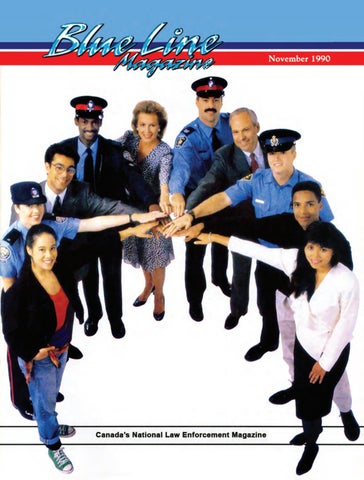
November 1990 Editor's Notes
I
IN THIS ISSUE FEATURES:
Editor's Notes
3
Letters to the Editor
4
Computers and Community Based Policing
5
People Power Preventing Crime - Lucy Becker
6
The Colour of Pity - Robert Hotston
8
The Wit and Wisdon of Tacky Burns
11
A Personal View - Part 2 - Chris Braiden
12
Information Sharing With "OMPPAC"
14
Blue Line Alert
16
Tiptoeing Through Life - Murray Milligan
18
Preventing Police Burnout - Part 1 - Ron Hoath
20
Rock Video Big Hit With Canadian Cops
22
Blue Line Alert
24
The R.LD.E. Team - Tony MacKinnon
25 26
True Crime - Geoff Cates Book Review - Drug Abuse and Your Family
27
Product News
28
Blue Line Alert
29
Blue Line Word Search
30
NEWS:
Director AppOinted to Investigations Unit
16
Video Pirate Gets Nine Months
16
Hollywood Chase Was For Real
16
Ontario Celebrates Crime Prevention Week
17
10 - 20
17
Four Texas Lawyers Charged
17
CASE LAW:
Prostitution Laws Survive Supreme Court Scrutiny
10
Police Must Take Care Where They Buy Drugs
10
Supreme Court Eases Hearsay Rules
13
Murder More Tightly Defined
21
Long Distance Calls for Lawyers
24
November 1990
3
t has been said that a cops real job is to work his way out of work. This statement can be easily misinterpreted but the true meaning is that if every citizen was truly certain that they would be apprehended when they broke the law there would be no need for cops. However the reality is that not every citizen believes this and the true miracle is that there are so many good citizens out there in spite of what they know. (You will probably have to read this paragraph over a few times before you get my drift.) There are many programs designed to get the police and the community together. These programs drive home to the citizens that crime is not a police problem but everyone's problem . This month we have stories about Ontario's Crime Prevention Week and an Ontario initiative in crime prevention . These stories are enhanced by a profile on PC CO PS, the computer program that is designed to bring people and the police together. This issue we bring yo u three of our semi-regular columnists. Geoff Cates with his True Crime, Chris Braiden's Personal View and Robert Hotston returns with a chilling lesson . Our guest writer this month is Chief Ron Hoath of the Port Hope, Ontario, Police Force with a profile on preventing police burnout. Finally we bring you a profile on two products that would be of particular interest to police managers. The first is a fully automated occurrence system that is growing rapidly in Ontario and the second is a computer system designed to track and record citizen com plaints against police. (I think I can hear some complaints already) We have enough here to keep you going but here is a tho ught to keep you thinking; 'If you fin d a good solution and become attached to it, the solution may become your next problem.'
Letters to the Editor THANKS FOR THE HELP AT EDCON '90 On the 14th and 15th of August, 1990, the Joint Forces Association of Explosive Disposal Units hosted an International Conference. Over 100 Police and Military Explosives experts from across Canada and the United tates came to Brampton and attended what was described as a very informative, worthwhile conference. Blue line Magazine's support was greatly appreciated and contributed to the success of this conference which will now become a biannual event. R. Shering Peel Region Police Force ecretary Treasurer Joint Forces Association Explosive Disposal Units
ERROR IN STORY Please be advised that there is an error in your September 1990 article regarding the Model 1000 Security Holster. The Policing Services Division of the Ontario Ministry of the Solicitor General has NOT approved this particular holster for use in On tario. By separate letter, we have notified Shieldcorp that this information is erroneous and requested that they refrain from misrepresenting the situation . Carl R. Johnston Assistant Deputy Minister, Policing Services Division
Shieldcorp had told me (in June) that they were presently seeking approval from the Policing Services Division and were expecting a decision shortly. I wrote the review in June shortly after trying the holster and made a note for a followup inquiry before press time. Therefore it was my mistake and not the company. For that mistake I would wish to apologise for any emabarrasment caused to the Policing Services Division or Shieldcorp. I still stand by my belief that they got a good product. If there are differing opinions I would be glad to hear about them.
•••
GOOD WORK Please keep up the good work. I enjoy your magazine and can't wait until I receive the next issue. As a reader of some American police publications it is nice to see a Canadian magazine that can be just as ••• good . Editor's Notes: Shieldcorp did not misrepresent Peter Garvey this fact to us. It was MY mistake. Upon checking my notes on this matter I found that Brampton , Ontario
4
November 1990
Vol. 2 No.9 · November 1990 • EDlroR / PUBLISHER . Mo rley Lym burn e r
. EDlroRIAL ADVISORS · Da vid H . Tsubo u ch i, LL.B. Edward Gunraj (P.o.A. C o n sulta nt) Ma ry Lymburne r B.A. M.Ed. G e ra ld A . O xman I.C.I.A . Jaan S ch aer B.A. (Metro Police E.A.P.) To m Dykes (H a lton Region Po lice) Ro be rt H o tston B.A. M.Crim . Rick Pa trick (La mbton C o lle ge) The Editorial Advisors are persons from whom this publication seeks out advice and gUidance. The use of their names is merely for recognition of their assistance and ongoing support.
· ADVERTISING · Allan W. S tiver . CONTRIBUTING WRITERS · Lucy Becker • Lou ise Dueck AI Porter • Rich a rd Duplain • Daffydd H e rm a n n • C raig Mc Milla n • T. Rich a rd C o lledge • Murray E. Milligan • Rock Dueck • G eoff Ca tes • Robert Ho tston
• ILLUSTRATION · To n y MacKinnon • Be tte C la rk Dave S ills
• D ESIGN AND PRODUCTION · Jim Kelly Camelot Graphic Design 97 Sir Lancelot Drive Markham, OntariO L3P 2J3 Business Office: (416) 294-4773 Editorial: (416) 293-2631 Fax: (416) 293-0526 Advertising : (416) 294-5502 Fax: (416) 294-8952 Production: (416) 471-0303 Fax: (416) 471-0305 Blue line Magazine is published monthly, ten times per year by Blue line Magazine Incorporated with head office at 118 Main Street North , Markham , Ontario Canada, L3P lYl. Editorial and copy is conSidered to be completely separate from advertising sales. No committment for editorial coverage can form any part of a sale agreement. All articles are protected by copyright. No part of this publication may be reproduced or transmitted in any form or by any means, electron ic or mechanical. inclu ding photocopying and recording. or by any information storage or retrieval system without permiSSion from the publisher. The authors, advisors and publisher accept no liability whatsoever for any injuries to person or propert y resulting from the application or adoption of any of the procedures, tactics or considerations presented in this magazine. Readers are cautioned and advised that articles presented herein are edited and supplied for your personal awareness and should not be referred to for furthe r action until appropriate advice and guidance is received from a supervising officer or the advice of a Crown Attorney. Blue line Magazine is an independant publication deSigned to educate and upgrade the skills of those involved in the law enforcement profession . It has no direct control from a law enforcement agency and its opinions and articles do not neccessarily reflect the opinions of any government agency or police force. Blue line Magazine is Printed in Canada by Johanns Graphics. The sole authorized distributor of Blue line Magazine is Green Gables Book Shop, Markham , Ontario.
l(!l 81 ·
A ssociate member, National
Associalionof Police Planners
~ M ember. Periodica l ~ Publishers Exchange
ISSN 110847 8538 S econd class m a il re gistratio n No. 8242
No ve mbe r 1990
Computers and Community Based Polici n9 The Winning Combination
C
hristopher Raymond , the adventurous president of the I.M .P.A.C.T. Group announced last month that the PC COPS network was expanding like an invisible net throughout the country and in many areas already had sufficient coverage to seriously deter criminals . "Successful apprehensions must be spreading the word ," he said from his office in Toronto. In Ottawa, PC COPS recently helped police serve a Canada-wide warrant after determining where the suspect was by calling all the hotels in the area . In Sudbury, a suspected rapist was apprehended after a voice blast through a neighbourhood . "The success of the PC COPS program is built on the ingenuity of the crime prevention officers," said Mr. Raymond . "The IMPACT Group is dedicated to this program and is currently revamping the data base and
putting the finishing touches on the FAX option _The success of the police working with the people is about to be further magnified ," he said after bench testing the new equipment. The dissemination of information useful in the prevention of crime is one of the most difficult and time consuming aspects of police work. PC COPS takes the job on with a casual effectiveness. Able to make over 400 calls an hour wh en necessary the system frees the police from the repetitive telephone work and lets them concentrate on strategy. Each police department tailor makes their system to suit the needs of the community. Drug stores and body shops are a common feature on their call lists so that they can quickly investigate thefts and hit and runs. Maple Ridge RCMP have had success using the machine as an investigative tool. They recently traced an uniden tified corpse throuqh dental records Continued on page 9
YES! I want to subscribe to 8~ Nrune: _____________________________________________________ Addr~s:
__________________________________________________
___________________ Postal Code: ___________ Province: ___________
o Enter my subscription for the next 10 issues of Blue Line Magazine ($20 .00) o I want a bulk subscription of ___ copies sent each month (5 - 49 copies $15.00 each; 50 or more copies call for price)
o Bill me with my first issue (Your subscription begins with the next issue) o Blue Line Magazine will gladly charge your subscription to your .. ... . MasterCard
0 or VISA. 0
Signature: _________________________ _ _ __ _ _ _ (Omen Gablco BooIc Shop i. the oole di,trioolcr of Blue Line Magazine)
5
Exp. _ /__
Chief and CPO Co-Chairman Larry Hardy. "We have a good cross section of individuals involved in crime preven tion and we expect this to help us in dealing with the changing nature of crime in our neighbourhoods ," describes Chief Hardy. " Crime Prevention Ontario is - Lucy Becker another example of the police co-operating with the community in an organized manner to ensure the safety and security of all." Chief Hardy was among a "grass oan Leffler, the City of London specific programs and areas," explains roots" group of police officers across Ontario's Crime Prevention Co- Leffler. She further explains that many pro- Ontario who in 1989 developed the ordinator, believes that a working partnership between the police and blems faced by individuals working in basic theory for the creation of a the community it serves is an impor- crime prevention training, time and province -wide crime prevention tant element in preventing crime. "It's expertise, and a poor understanding resource / sharing organization . Several meetings, which included the community which sees crime in of crime prevention . members from the public, were held action and reports it if they are produring the year and a formal proposal perly trained ," says Joan Leffler. was taken to the Ministry of the Leffler is also the Co-Chair of Solicitor General , the Ontario Crime Prevention Ontario (CPO) Association of Chiefs of Police and the which was created last spring as a Police Authorities. The Municipal working group of community and green light was given . Now, the police members dedicated to prevenorganization is in the process of ting crime. Its goal is to foster resource and hopes to becoming incorporated sharing, co-ordination and marketing soon receive its charitable status. of programs and revitalization of crime Although the organization still has prevention endeavors. Other benefits to creating such an organization in much to accomplish , Chief Hardy clude cost effectiveness, in-service says "We believe Crime Prevention educational packages, and a support Ontario has come a long way in a mechanism for a wider sphere of inshort time." When describing all the fluence with government agencies. work accomplished by the group thus Most police forces in Ontario have far, he calls the achievements "landofficers working in crime prevention , mark steps forward in crime preven wh ether it is directly in a crime tion in Ontario." Chief of Fblice Larry D. Hardy prevention or community relations "Hospital Watch", which consists of unit. Most also have Crime CPO has approximately 300 a crime prevention binder, video and Prevention programs such as members across Ontario and its steer- training program is among these Neighbourhood Watch , Block ing committee consists of represen- steps, and something which had been Parents, drug education and bicycle tatives from various municipal police the focus of discussion for some time. safety. What we in Crime Prevention services, the Ontario Provincial Police Hospital Watch is based on a program Ontario do is share our resources. We and community crime prevention in- developed by a group of hospitals and are asking our members to share their dividuals . An executive committee the police (a committee) in the Region resources such as program videos, has been established and consists of of Hamilton -Wentworth , which literature and other materials, to help police officers and civilians "working received a Crime Prevention Award cut down the cost of duplication . The diligently to provide Ontario with the from the Ministry in 1989 . It is a money saved could therefore, be us- best in crime prevention and network strategy aimed at reducing crime, ed so officers can concentrate on sharing," explains Smiths Falls Police improving safety and heightening loss
People Power Preventing Crime
J
6
November 1990
----
prevention awareness within the hospital environment. With assistance from the Ministry of the Solicitor General, a lesson plan binder has been developed and distributed to all police forces in Ontario. Training packages, which include the video, have also been produced and distributed to all police as well as all hospitals in Ontario. In addition , Chief Hardy cites the future development of newsletters as an important step for the oganization. These newsletters will further help CPO in its goal of resource -sharing. These newsletters, as with other resource materials, will be distributed to all nine designated zones whose representatives will be expected to further distribute to those working in crime prevention in their geographical regions. These zones include: Kenora, Thunder Bay, Cochrane/ Timmins, Sault Ste.Marie/ Sudbury, North Bay, Eastern OntariO, Central OntariO, Halton / Hamilton / Niagara, Western OntariO and Southwestern Ontario. Some meetings are held as deemed necessary. The Ontario Ministry of the Solictor General provided a $21 ,000 start-up grant for Crime Prevention Ontario. This funding has been used to pay expenses to bring the zone representatives from across Ontario to an executive meeting. The Ministry also footed the bill for the cost of operating the organization during its first two years, as well as for the production of the Hospital Watch video. Chief Hardy also points out that the group is currently seeking corporate sponsorship to help fund initiatives such as Hospital Watch. He believes it is important to involve the private sector, just as it is to involve the community in crime prevention . He credits CPO with what it has done to date, to the "dedication of the community members and police officers who work and belong to this organization ." He also recognizes the support and
November 1990
funding provided by the Ministry of the Solicitor General and the assistance the group has received from the policing community at large. Two elected representatives from each zone are delegated to serve on the executive. Although it is not necessary, it is preferred to have one police officer and one civilian from each zone. Joan Leffler explains that it is important to have represenatives from the community "working as a liaison between the citizens of their municipality and their local crime prevention police." Joan Leffler was hired by the City of London to work on crime preven tion programs. Although she works with the crime prevention officer of the local police , she remains
from other countries, it can be frightening to go to a police station , whereas it is much easier to go to the crime prevention office at city hall . Chief Hardy also recognized the importance of establishing a partnership between the co mmunity and the police. In fact , he points out that when discussing community-based policing, crime prevention and drug education , "We tend to see them as separate identities. Yet there is a great deal of overlap. Drug ed ucation becomes crime prevention through social development. Community policing is based along the same lines." It is the comm un ity and the police working togeth er that makes Crime Prevention Ontario accomplish its base. "I believe that when you analyze
autonomous in her location at City Hall. "You become the people's person working out of the people's building," she says. Joan Leffler believes it is important to be physically removed from the police station and says it helps with ensuring communication between the police and the public. She says that for many people, especially those
what we've done, one of the important factors is community involvement. The community deserves a lot of credit. The majority of these people work at other jobs an d donate their time and efforts." Anyone wishing furth er information about CPO can contact Chief Hardy at (613) 283-4142 or Joan Leffler at (519) 661-4533 .
David Rob on
7
Handling and Transporting Prisoners
The Colour Of Pity - Robert Hotston -
O
n November 13, 1989, murder suspect, Stoney Harrison , 25, being driven on a busy highway to a New York City jail, pulled out a gun and fired from the back seat at two New York City Police detectives, kill ing th e m both . The detectives had driven Harrison from jail to the District Attorn ey's office to discuss a plea bargain and were returning him when th e incident occurred . The supervision and control of prisoners is a regular police task which should never be considered or treated as routine. The fact that such activity is treated as "routine" creates an urgent problem in policing. Transporting prisoners presents untold dangers to all officers involved as well as to suspects. In short, NO prisoner should ever be left unsupervised until he or sh is secure in the cell. The solution to incidents like that involving the two New York City detectives lies in better training designed to regularize and habitualize the pre-transportation search of prisoners. Moreover, written procedures regarding searches and prisoner transport should be produced and made mandatory reading for all officers, both during and following recruit training. Training which covers the techniques of apprehending, searching and transporting prisoners should be on going and deal with current and proper procedures for approaching, handcuffing and transporting prisoners. The training should be precise and detailed . Officers must be taught to closely scrutinize items, which to most people, are harmless, normal items. Such possessions as a belt buckle, "rat-tail" comb or ball point pen could disguise or themselves become a potentially dangerous weapon . The RCMP,
Canada Customs and other law enforcement agencies regularly disseminate information about the latest in covert weaponry. Blue Line Magazine regularly places these items in its weapons "ALERT!" section . Officers should be aware that a belt buckle might be the handle of a knife, such as the "Constant Companion" that has a blade hidden by the belt. The comb or pen could be used as a stabbing instrument.
ourte y oj' MTPF Photo Unit
Ideally, the hands of each prisoner should be restrained so that any attempt to assault a transporting officer would be unusually awkward , if not impossible. In addition , the transporting officer, if he or she did not conduct the initial search , should routinely re -search the prisoner. Stoney Harrison had not been searched by the two detectives when they escorted him from the jail nor from the District Attorney's office. Both officers paid for this mistake with their lives . Handcuffs , and where necessary, other restraining devices, 8
should be used according to prescribed standards. Never think that a handcuffed prisoner is harmless! Some prisoners can slip handcuffs. I can personally attest to that! Department policy may specify the circumstances which call for hand cuffs, but the final decision is up to the arresting officer. The decision should be based upon the officer's perception and assessment of the situation and his responsibility to protect himself, other officers, the public and the prisoner. A pr isoner may be cooperative or docile at the time ot the arrest, but that is no guarantee that there will not be a concerted attempt to assault the officer or escape if an opportunity presents itself. Many prisoners appear docile or nonviolent. However, once in the police vehicle and enroute to the station , they may react violently. Therefore an officer should never try to second guess the prisoner's nature and on that basis decide not to restrain him . Finally, once having booked in and secured the prisoner in a cell, the transporting officer should check the vehicle for contraband , such as weapons, the prisoner may have hidden there. The proper handling and transporting of prisoners requires menta l discipline. You have to concentrate on what you're doing. Suspects may try to "con" you by attempting to make you look foolish or by playing on your sympathies. Under no circumstances should you permit a prisoner to move out of your immediate control, even if denying him a request seems harsh . There's not a lot that we can learn about safe and proper police work from television shows and movies. But Clint Eastwood , in his role as tough cop "Dirty Harry" did have a pertinent piece of dialogue in one of his films . Commenting on a fellow officer who'd been killed because he relaxed his alertness toward a prisoner out of sympathy, Eastwood said, "The colour of pity is red - blood red ." It's a line worth remembering when you're trying to maintain firm control over someone who may have the will and means to harm you . -November - - - 1990
ContinuedJrom page 5
using the system after a five hour phone inquiry had come up with nothing. The system alerted 50 people in forty minutes and came up with the dental records. An unfriendly reporter in Ottawa published an article critical of the police for failing to inform the public of the movements of a band of gypsies who were pulling off numerous scams in the area. The police had in fact used PC COPS to notify the public to be on their guard for these people and printed out a list of the thousands of calls the system had made. This was enough for the editor of the paper to promptly print an apology. PC COPS is the brain child of the IMPACT Group and depends on its data base for its effectiveness. The police enter data received from individuals in the community who wish to be informed when they can help. This data is then accessible by street or neighbourhood so that a particular program can begin . A new data base is in development which will allow further coding of the data base to include specifications particular to the needs of different areas. One example would be to include bicycle serial numbers in the file and then search the data base in the event a bike is found . This could also be used for personal property marked with the owner's social insurance number. Further enhancements include the implementation of an inbound extension of the system. Working in conjunction with PC COPS this added system could answer the crime prevention line 24 hours a day and take messages for the officers. In the event of an urgent message the system could be set to call the officer at home. Each mailbox would be individually coded and could relieve the central switchboard of all personal calls. In addition this system is able to dispense information to the caller through an application called Audiotex. This is a voice bulletin
board that the caller can search through using his phone to guide him. This system could be loaded with crime prevention tips, the PC COPS messages as well as other data appropriate to the education of the public. Many forces are anxiously awaiting the new FAX application as well. This new feature of PC COPS will enhance the business watch system and make it possible to send documentation and pictures to different business locations in a matter of minutes. Examples of bad cheques or pictures of suspects will reach the business community in time to make a difference. All the FAX numbers will be loaded into the system and then a document will be scanned or sent directly from Word Perfect through a FAX board out to the desired FAX machines. The history of PC COPS runs parallel with the history of crime prevention in Canada. One of the unique features of the system is that in almost all cases the money used to buy the equipment has been raised from the public by neighbourhood watch groups. PC COPS is then given as a gift from the people to the police. This initial gesture is symbolic of the whole program and may in many ways be part of its success.
• Olmstead County - Minnesota (February 1988) • Windsor Police Force (May 1988) • Oxnard County Police - California (June 1988) • RCMP Coquitlam (August 1988) • RCMP Surrey (September 1988) • Waterloo Region Police (December 1988) • Ottawa Police Force (December 1988) • Regina Police Services (April 1989) • Thunder Bay Police Force (June 1989) • York Region Police Force Vaughan (June 1989) • Halton Region Police Force (October 1989) • Metro Toronto Police - 21 Division (January 1990) • Brandon Police Force (January 1990) • Metro Toronto Police - 53 Division (January 1990) • RCMP Headquarters Div. "P\' (January 1990) • RCMP Maple Ridge (March 1990) • Nepean Police Force (May 1990) • o.pp Kanata (May 1990) • Gloucester Police Force (May 1990) • RCMP Prince George (June 1990) • Metro Toronto Police - 23 Division (June 1990) • Metro Toronto Police - 41 Division (July 1990) • Metro Toronto Police - 42 Division (July 1990) A Proven Track Record • Barrie Police Force (September PC COPS (an acronym for PC 1990) Community Organizational and • York Region Police Force Prevention System) has produced an Thornhill (September 1990) impressive clientelle within the Canadian and American Police community since 1986. It is presently used in the following police programs and departments; • Sudbury Regional Police (October 1986) Can you afford to miss • Metropolitan Toronto Police 22 Division (December 1986) even one issue? • Sun Youth/Operation Tandem Subscribe Now! Montreal (May 1987) Use your Visa IMasterCard • London Police Force (September Phone (416)294-4773 1987) • St.Thomas Police Force (January Fax (416)293-0526 1988)
November 1990~_ _ _ _ _ _ _ _ _ _ _ _ _ _:z..9_ _ _ _ _ _ _ _ _ _ _ _ _ _/4~~u;.u< __
CASE LAW: Ruling
Prostitution laws survive Supreme Court scrutiny Reference re CC ss. 193 & 195 (1010-015 38 Pages) (1010-016 19 Pages) (1010-017 138 Pages) A six judge ruling from the Supreme Court of Canada ruled in May that Canada's prostitution laws are a justifiable limit on a citizen's Charter Rights. In a unanimous decision it was determined that the law that prohibits the keeping of a common bawdy house or being an inmate found in one, does not violate the Charter right to liberty and freedom of expression. In another section of the same series of rulings the Supreme Court ruled that communicating or attempting to communicate in public for the purposes of buying or selling sexual services did infringe on a persons right to freedom of expression but that this law was a reasonable limitation on that right. The majority ruling indicated that
the law was justifiable because it was preventing the nuisances caused by the public purchase and sale of sex . In his ruling Chief Justice Dickson said that the law was drafted to eradicate the various forms of social nuisance, particularly in urban neighborhoods , arising from the public display of the sale of sex, including street congestion and noise, as well as its effect on non -participants and children . The ruling stated that the law was "taking solicitation for the purposes of prostitution off the streets and out of public view." The ruling also added that this form of communication does not even come close to the guarantee of freedom of expression . The rulings stated that there was also a rational connection between
the prohibition of street solicitation and the prevention of the aggravations caused by the public display of the sale of sex. One of the defence arguments was that the criminal code does not criminalize sex for sale but instead it criminalizes all activities by which it can be obtained . The argument was that this was contrary to the principles of fundamental justice. Chief Justice Dickson rejected this argument by stating that the fact that the sale of sex for money is not a criminal act does not mean that Parliament must refrain from using the law to express society's dislike for street solicitation or endure the nuisance of the activity on law abiding citizens.
CASE LAW: .. ~.
Ruling
',',' .... ,,','
: ....y..:,:~,~ ....
Police must take care where they buy drugs Regina Vs. Schieman (1018-021 10 Pages) In a September ruling from an Ottawa area court it was determined that if drug squad officers are going to make random buys of drugs they have to be prepared to explain why to the courts in order to get a conviction. The ruling further stated that the area had better not be too wide an area. In the case ruled upon the court heard evidence that a man had been walking down a Vanier, Ontario, street when he was approached by undercover drug squad officers and asked where they might buy some drugs. The man was picked out at random and the officers had no previous contact or leads. The suspect took the officers to a residence where he entered and then returned with 4.6 grams of hashish . The officers purchased the drugs and later charged
the man with trafficking. At trial the court was told by one officer that the area was well known to police for drug trafficking. The arresting officer advised the court that she had made two other purchases in the area and that about 12 search warrants had been executed under the Narcotic Control Act in the vicinity. The defence was that of entrapment and that the officers had been testing the virtue of the citizens in the area. The judge agreed with this by stating the officers had been rather vague in their testimony about the type of on-going investigations they had been doing in the area . The previous drug buys were not explained in sufficient detail and there was no evidence as to whether the search 10
warrants executed in the area produced drugs. "A distinction ," stated Judge Fontana, "must be drawn between certain specific areas which are capable of very precise definition such as a particular shopping centre, a particular arcade, a particular park in a city or a particular location in a city. But the net is cast in this case far too Widely and it is far too ill-defined . Before an entire neighbourhood of the city is characterized as falling within the purview of the 'Mack' decision , some fairly detailed , cogent evidence must be presented ." In the Regina Vs. Mack case the Supreme Court ruled that it is not a proper use of police power to simply go out and test the virtue of people on a random basis. November 1990
The Wit and Wisdom of Tacky Burns Nok, Nok, Who's There? - Terry Barker Telling the next of kin that their dearly beloved has departed isn't a five minute job. It can take an hour or more. But it's the first five minutes of the interview that count. I remember one time when a call came in that a Wilhelm Adolf Holtz had been killed in an MVA in a neighbouring jurisdiction. I was detailed to inform his only daughter, Wilhelmina . In those days I hadn't learned to spend enough time in checking things out. I just assumed that the member who gave me the information was on the bit. So off I go to Wilhelmina's place. She's having a party. I knock at her door and she looks blearily at me and says, "Ossifer, are we making too much noise?" And I say "Are you Wilhelmina Holts?" "Yup," she says. "That's me, little Willy." "May I talk to you?" I say. She takes me through the living room into the kitchen . There I tell her gently that her father has died in an auto accident. She laughs! "Not my dad," she says. "You got the wrong party. My dad's been dead for five years." So I ask to use her phone. I call the dummy who gave me the information in the first place, and he says, "Oh, sorry about that. Did I say father? I meant brother." Since then I always ask a lot of questions, and check back to make sure I got it all straight. There are eight steps in doing a professional NOK: 1. RESEARCH . Make sure you got all the facts , and that you got them straight. How did the person die? Where? When? Be ready to answer their natural questions. And find out if there's any close friend or pastor who can come with you and stay with the bereaved after you've gone.
2. ALLIES. If the close friend or pastor is known to you, and 100% responsible, you can delegate the task. Let them do it instead of you . But at least see who you can get to go with you. 3. GET INSIDE . Don't try to talk on the porch or through a screen door. Above all, don't do it on the phone ("Hello, is this the Widow Brown?" Yes, but I'm not a widow." "You are now!") How do you get in? Simple. Just ask. Say, "Mrs. Brown , I'm Constable Sympathy. I have an important matter to discuss with you , May I come in?" 4. SIT DOWN. Don't loom over the poor soul. You're six foot seven and she's five foot two. Get on the same eye-level to reduce your impact. 5. TELL THEM. You have to figure the other person out to see what's the best way of spilling the bad news. If they ask you outright to give it to them, do it. "Mrs. Brown , I'm sorry to have to tell you that your husband, John , was fatally injured in an auto accident." But if they want to beat around the bush, respect their wish . Let them lead the conversation till they ask you why you're there.
6. BE PREPARED. People are un predictable under the stress of high emotions. I've had people run out into the night, try to shoot themselves, put their hands over their ears so as not to hear what I have to say, and even offer to beat me up. It's the old story of the king's messenger - if you don't like his message, off with his head . Be ready for anything. And C.Y.A. 7. ADVISE . They may ask you what they should do next. You should be able to tell them. 8. EXIT. Don't leave till the situation is under control. Make sure that friends or neighbours are there to support the bereaved person . The fact is that there are hardly any cases where people have complained about us for doing an insensitive job on an NOK. But that doesn't mean that we should be careless about it. I mean , after all, we do have to sleep nights ... right? THE FIVE MINUTE POLICEMAN $12.95 - Available from: Green Gables Book Shop 118 Main St. North, Markham, Ont. (416) 294-4773
Full Line Distributors of Law Inforcement Uniforms and Supplies
•
Suppliers of Police, Fire and Emergency Resp onse Equipment Distributors of: • Smith & Wesson® Handguns • Point Blank Body Armor® • Thctical Equipment • Code 3 & Force 4® Public Safety Equipment • General Sporting Equipment • G & G® Leather Products Dealer Enquiries Invited Paul R. Gibbons - General Manager Office/Admin./Sales (902) 835-1717 Fax (902) 835-2470 ShowroornlWarehouse: 62 Bluewater Rd . Unit A Bedford, Nova Scotia B4B IG7
••••
-----. . . ... -.
.-..
~
~
.-. r...-:
.-. r...-:
-. ~
ATLANTIC POllCE & PROTECTION SUPPLY DIVISION OF HORNER AND MOORE HOLDINGS CORPORATION LlMfTED
___N ~o ~v~ em ~ be~r~1~ 99~0________________________________ 1 1_ ________________________ ~____~~~~~~--
Part 2
I can always remember as I walked the streets as a constable when I went to complaints, the first things that I banged into my head , is this a criminal matter or is this a civil matPolice Professionalism ter? If I could convince myself it was a civil matter, which often meant I - Chris Braiden didn't know, a little thing would turn off in my head and I would decide, this is just a very basic little report or as long as I've been involved shouldn't massage people. Because fill in two or three lines, names, in policing, the word profes- if those people ever find out why address, telephone number - and sionalism has always been there. It's they're stroking or massaging them , get the hell out of there. I really wasn't been in the reports, it's been talked they're in trouble. interested in what went on because about, and I never fully understood Common wisdom is that managers only criminal matters concerned me. what it meant. I still don't fully under- need to motivate others. This is Another measuring stick that I stand what professionalism means. nonsense. People bring their own used subconsciously was, is it a police I'm not sure whether it means that if motivation . That door is locked from . issue or is it a family issue? If it was I go into a particular job I become a the inside. What management needs a family issue then I wasn't that terprofessional by my bringing certain to do is liberate that talent and motiva- ribly interested in it. The reason that talents to it. tion . Our past record in police I share these things with you is not My belief is that policing is a 'call- management shows that we have because I read them in some report, ing'. Wherever that fits between a pro- suppressed and stultified it. because I didn't. I lived them in my Management has striven so hard in first ten years in policing. I didn't see fession and an occupation, I don't know, but when I think of the good policing to become a profession and anything wrong with them, although cops that I know, they're first and to find a nitch for themselves equal there'd be some little niggly questions foremost fundamentally first class to the other professions that I think at the back of my head all the time. human beings. If you look into their at times they have passed over a nar- What purpose am I serving. What am families, if you look into their row little line that becomes elitism . I achieving here? Consequently I backgrounds, if you look into their Elitism seems to bring with it self- found myself looking for easy private lives, they're givers. They end praise, arrogance, aloofness and isola- answers. up as hockey coaches or soccer tion . It's a very indefinite line. But I I always think back to a little situacoaches, but they end up as givers . think management can strive so hard tion I had in 1968, when I was a Doing things for other people. to become professional and take on constable. I got a call to a shoplifter Now if you or I were to suggest to all of the trappings of professionalism in one of the large department stores them that they are akin to a priest or that perhaps they have passed over in Edmonton. And it was a clear-cut a minister they would laugh at us that line and becomes a profession of shoplifting case, no question . It was because they're so busy giving to form rather than substance; they have around Christmas time and a woman others and looking outside of become process oriented rather than with two little kids, single parent, had themselves that they don't sit down task oriented and they have lost touch stolen a bunch of stuff. She was in the and pat themselves on the back. I with the people who produce the pro- manager's office. It should have been wonder if maybe that's the sort of duct, the constable, and the people a perfunctory thing - open and shut. And I didn't know at the time why I thing that management should be do- who consume it, the citizens. Policing was a very undefined job handled it the way I did . I know now, ing a little more of. Words that I heard over the last to start with but we cleaned the edges I think, but I didn't know then . couple of years which I strongly so as to make it measurable and in the I asked a few questions and I found dislike, are 'stroking' and 'massaging', process, squeezed many of the juices out, of course, she's a single parent, so as to motivate people. I know what out of it. Everything was measured by on welfare, didn't have much money, they mean but they're condescending a criminal or civil, police or family the kids are watching television , see and they 're wrong . Supervisors stick. Only the former were con - these toys on television, she's in the shouldn't stroke people. They sidered police work. store shopping for other things, the
A Personal View
F
12
November 1990
kids see these toys in the store and they want the toys. The mother hasn't got the money to give them the toys an so she looks around and swipes them and was caught. However, what was very important to me was she didn't steal for herself, she stole for the kids. She had no other criminal record. I spend an hour with the manager of the store, who had his own problems, a huge problem of shoplifting. I spend an hour talking him out of charging her with shoplifting, and I wasn't even sure of what in the hell I was doing. Maybe it was to get out of the paperwork because if I charged her I'd have to
write more reports, if I didn't I'd have to write a short report. I remember agonizing after because I though , what happens of this fellow phone tin to complain . This is the fontline entrepreneurship that George Kelling talked about but often it must be exercised covertly and one must bunch the system to do it. The constables of to day experience that same fear, because the policy manual emphasizes the process and not the end product. So these are the agonizing things that I went through that I presume many of the constables that are working the streets today are going through
as well. We haven't given them much fundamental gUidance on these things, that it is alright not to charge somebody with a crime where a de facto crime exists, so long as you're doing it for the right reasons. Our management style has been one of restraint rather than inspiration . It has rewarded conformity rather than creativity. The manual is the bible. And you innovate at your peril.
NEXT MONTH: Apathy At The Front End Of Policing - A Personal View By Chris Braiden
CASE LAW: Ruling
Supreme Court eases hearsay rules Regina Vs. Khan (1022-023 27 Pages) The Supreme Court of Canada, in a September ruling, has supported a stand to be more flexible with a previously inflexible hearsay rule. In the case spoken to a five member panel declared that hearsay statements by child victims should be admitted in criminal prosecutions provided the statements meet tests of "necessity" and "reliability." In her summation Supreme Court Justice Beverley McLachlin ruled that a child victim's hearsay statement given to her mother should be admitted in a sexual assault prosecution , even though the statement would be inadmissible under the normal hearsay rules. The case involved a three-year-old child who was taken to a doctor for a routine immunization needle. The mother left the child with the doctor. About a half hour after the visit the girl told her mother that the doctor had asked her if she wanted some candy and then put his penis in her mouth. Later examination of the child's clothing showed it consisted of a mixture of semen and saliva. At the original trial the judge invoked the hearsay rule and would not November 1990
permit the mother to give the evidence of what her daughter had said to her and that the girl was not competent to give unsworn evidence. The court went further and stated the evidence could not be admissible under the spontaneous declaration exception of the rule because it wasn't made soon enough after the alleged offence. He concluded that regardless of how suspicious he was of the accused he could not register a conviction . The Supreme Court of Canada determined that the judge had properly considered the law but that the traditional hearsay rule, with its set categories of exceptions, has "proved unduly inflexible in dealing with new situations and new needs in the law." "The first question", stated Justice McLachlin, "should be whether reception of the hearsay statement is necessary. Necessity for these purposes must be interpreted as 'reasonably necessary.' The inadmissibility of the child's evidence might be one basis for a finding of necessity. "But sound evidence based on psychological assessments that 13
testimony in court might be traumatic ... might also serve. "The next question should be whether the evidence is reliable. Many considerations such as timing, demeanor, the personality of the child, the intelligence and understanding of the child , and the absence of any reason to expect fabrication in the statement may be relevant on the issue of reliability." In the case at hand the Justice determined that the statements were necessary because the trial judge had ruled the child could not give oral evidence. Secondly the statement was reliable because the child had no motive to falSify her story, the fact she couldn't be expected to have knowledge of the sexual act she described, and the statement was corroborated by physical evidence. On a second motion the Justice was asked to determine if the original trial judge erred by not permitting the child to give evidence. The court ruled that the child was competent to give unsworn testimony. As a result the court granted the appeal -by the Crown and ordered a new trial.
Information Sharing With "OM PPAC" How Inter-Police Force Cooperation Managed to Slay the High Cost of Technology.
T
he sharing of information among police agencies has long been recognized as vital to effective policing . In a world where criminal activities often span across jurisdictional boundaries, police agencies cannot operate in isolation . Effective communications can provide improved safety measures for the public and police officers on duty as well as increase the efficiency of criminal investigations. In Ontario there are 118 municipal police forces and 187 detachments of the Ontario Provincial Police. The members of these forces and detachments protect a province of over 9 million people over an area of almost 1 million square kilometers. It is clear to see that information sharing among all police agencies is a necessity in crime fighting . It is easy to see that an integrated police information and records management system could help make a significant difference. The OMPPAC System
Between September 1987 and April 19 , six Ontario municipal police forces and two OPP detachments were participants in the pilot implementation of a new system developed under a joint venture with the Ontario Ministry of the Solicitor General. The system was named the Ontario Municipal and Provincial Police Automation Cooperative. (OMPPAC)
As of April 1990, the system was fully operational in 23 municipal police forces and 82 OPP detachments. Implementation is progressing on schedule at a rapid pace, and the expectation is that it will be installed at over 200 police facilities in the next two years. With the OMPPAC system , each user location runs on a local area network of personal computers (PCs) which are linked via data communication lines to a centralized database on a "Tandem" mainframe computer in Toronto. According to Brian Chan , Executive Director, Information Technology Division , this system architecture is ideal for effective information sharing. "With information centralized in one location , a single query request will provide a consolidated response across all participating jurisdictions within seconds. If the information were distributed and stored across individual jurisdictions, it would require a separate request to each location in the network to collect all the information required for the response. Even with very high speed communication lines, it would be impossible to provide a con solidated response within seconds. "OMPPAC is not the only system designed this way," says Chan. "The Canadian Police Information Center (CPIC) system developed by the RCMP has a Canada-wide information network that has been operating
14
for many years. What we are doing is extending the scope of information sharing beyond what is provided by the CPIC system under the RCMP's mandate." "What an information sharing system such as OMPPAC does is provide a more efficient means for the criminal investigators to gather information for a case," says Chan . "The time the officers save from not having to make numerous phone calls to request information from other police agencies can be used to focus on analyzing the information retrieved and in solving a crime." The system is unique in its application, offering a viable and costeffective alternative to standalone systems. As a cooperative venture, police forces can realize significant cost savings in almost all areas of operations by the economies of scale and collective purchasing power achieved via the size of the cooperative, as well as sharing operating expenditures among the participating police agencies . For example, the OMPPAC system is centrally operated by data processing profeSSionals 24 hours a day, seven days a week. Chan points out that if each of the participating agencies were to install its own standalone system , the software licensing fees incurred collectively would be a lot more that the Ministry's total investment in developing the software. Chan advises that another benefit is that the OMPPAC participants do not have to worry about the cost of employing a team of data processing professionals to maintain and enhance the system. As an example Chan points out that a police force operating a standalone system would have to employ at least eight computer operators at a cost of $280,000 in salaries alone. More savings are realized because the Ontario Ministry of the Solicitor
November 1990
essential tools in managing a police operation . The OMPPAC system also provides a wide range of management reports, such as crime statistics, call for service analysis, etc. It is also connected to A Full Range of Function the RCMP's CPIC system. The elecAs a fully integrated system , the tronic messaging function also OMPPAC system has over 1,000 improves communications within the functions in support of operational police force as well as between police policing. Major components include: forces . • The Incident Capture and Computer-aided Dispatch (CAD) A System For Growth component which allows calls for service to be recorded from any police The system is currently running on a location including extended service complex of eight Tandem VLX prooffices. The recorded calls for service cessors. The system hardware is fully can then be prioritized and dispatched; expandable for future growth . "This • The Occurrence Reporting and incremental growth feature ," Chan Records Management component explains, "is crucial in maintaining the that records and manages the large performance and responsiveness that volume of information generated by a police information system such as occurrence reports and police OMPPAC demands." investigations; and "Because of the individual sizes of • The Assignment Tracking and Case the police agencies we serve, there is Management component that keeps a somewhat misled perception that track of investigation assignments, the OMPPAC system is built for allows reports to be reviewed and ap- smaller police forces only," Chan proved, and provides activity logs and adds. "In fact , with a user communicase load analysis reports that are ty of over 8 ,600 police personnel and General absorbs the cost of initial training and implementation support when the system is installed at a police station in the province.
Photo by: A .R. Lunau Sm i th
November 1990
15
the extensive geographical area these police agencies are serving, the magnitude of this system is conSiderably bigger than a lot of police information syste ms in North America . The OMPPAC system has been designed to handle that capacity and much more." Chan points out that the reason the system is so successful is that it is a truly "user-driven" system . Front line police personn e l p rovide the knowledge of police operations necessary for the designing of the system and ensure th at it will meet their needs. The systems develop ment maximizes user participation through out the developmental stages from requirements defin ition to user acceptance testing. In other words the system does not de mand the officers be remolded into the computer programmer's way of th inking . The users also determine the priority in which enhancements to the system are developed . A committee of user representatives meets regularly to address such issues. Chief Rick Zanibbi of the Sudbury Regional Police fi nds it difficult to contain his enthusiasm for the system. "The nicest feature for us is that OMPPAC will allow us to share databases and that information is readily available in a timely fashion . That's very important from an investigative and crime prevention standpoint. We now have the ability to analyze incidents in a more detailed fashion much more qUickly. It's especially helpful for a community-based policing concept such as ours where we have seven satellite stations." "Acceptance of the system ," adds Chief Zanibbi, "has been phenominal. In fact , the interest has grown to the extent that we underestimated our need for terminals. People have been so receptive to the system , that they're wanting more and more access to the information. I think that's indicative of the success we've had with OMPPAC." Further information may be obtained from Brian Chan at (416) 965-5127 .
... news beat ... news beat ... news beat ... news beat ... Director Appointed To New Special Investigations Unit
might take, initiate criminal charges against police officers and refer them to the Crown Attorney for prosecution .
The Honourable John Harty Osler has been named Director of the newly-created Special Investigations Unit (SIU) under the Ontario Police Services Act, the Ministry of the Solicitor General announced last September. The appointment will be for a one year period . Mr. Osler is a former Justice of the Supreme Court of Ontario. The Toronto resident is a graduate of Osgoode Hall and practiced labour relations and trade union law prior to his appointment to the bench . The SIU is permanently established under the provisions of Part VII of the Police Services Act, which received Royal Assent on June 28th . This portion was the only part of the new act that was proclaimed before the demise of the Liberal Party in the September election . The remaining portions of the Act are un proclaimed and the new NDP Premier, Bob Rae, has announced his intentions to make some changes to the Act before proclaiming the rest. The SIU will investigate incidents involving the police in which serious injury or death has occurred . The legislation dictates that the Director of the SIU cannot be a current or former police officer. A team of investigators, who cannot be serving police officers, will be appointed under the "Public Service Act" in the near future. Under the provisions of the legislation , investigators may not participate in an investigation which relates to members of a police force of which they were former members. The Director can, when reasonable grounds exist, and independently of any other actions the Solicitor General
Video Pirate Gets Nine Months In Jail Hollywood Chase Last September a Toronto area man Was For Real received a nine month jail term for distributing illegal copies of videocassettes. The man had plead guilty on three counts of fraud over $1 ,000 , forgery of trademarks and possession of obscene material. Mr. Victor Serpa was charged after police executed a search warrant on his residence and turned up 680 videotapes and five interconnected recorders. In addition to the nine month jail term , Mr. Serpa was placed on a two year probation with con ditions that he not be in possession of video tapes for either sale or rent. This was the latest in a long series of arrests and convictions across the country involving the illegal copying and distribution of tapes . Most charges are investigated by the RCMP with the assistance of the Film/ Video Security Office (F/ VSO) of the Canadian Motion Picture Distributors Association. Since the F/ VSO was established in 1983 about 135,000 illegal tapes have been seized in Canada. Some
of the biggest seizures have occurred over this past year. One of the biggest being the seizure of 1,350 tapes from four Bandito Video stores in the Windsor, Ontario, area .
Ocie McClure will never forget the day his criminal act ended in a show down with a cab driver with an act of his own . The ill-fated McClure saw a woman walking down the street and decided to make his fortune by kicking her in the stomach and running away with her purse. Enter our hero, cab-driver Charles Hollom , who observes the dirty deed taking place. Driving his cab after the hoodlum , Hollom followed the thief for several blocks and radioed for the police. Then he mounted the sidewalk and used the bumper of his cab to pin the suspect to a wall until police arrived . McClure sustained a broken leg out of the incident and later found out that his pursuer was a professional pursuer. Charles Hollom is a stunt driver and has performed his automotive gymnastics in such movies as "Bullitt" and "The Blues Brothers."
~~----------------------~
ALERT! TIRE PRESSURE GAUGE GUN This tire pressure gauge has been modified to fire a .22 caliber long rifle or standard cartridge. The gauge, when placed inside a shirt pocket or in a tool box, would appear to be a normal tire pressure gauge. The weapon is fired by cocking and releaSing the pin on the side of the gauge.
~--------------r----------------~'I 16
November 1990
... news beat ... news beat ... news beat ... news beat ...
************ Ontario Celebrates Crime Prevention Week "You Don't Need a Uniform to Join Our Team" is the theme of this year's Crime Prevention Week, which will be celebrated across Ontario from November 4 to 10. Each year, the Ontario Ministry of the Solicitor General presents awards during Crime Prevention Week to citizens or groups who have made outstanding contributions to crime prevention programs. "These people are the backbone of our crime prevention efforts in Ontario:' says S.K. Lal, Ontario Deputy Solicitor General. "They represent the hundreds of volunteers in municipalities across the province who help make our communities safer and more secure." "Crime Prevention Week allows us the opportunity to recognize and pay tribute to members of the community - everyone from private citizens to police officers striving towards a common goal," stated Mr. La!. "We all can become partners for a better community, after all, you don't need to wear a uniform to be a part of our team ." During Crime Prevention Week, the Ministry, together with local municipal police services and Ontario Provincial Police detachments, sponsors a two-part seminar and awards ceremony on community participation and crime prevention programs in various Ontario communities. This year, seminars are being held in Kemptville, Guelph and Sault Ste. Marie to kick off a year-long crime prevention awareness campaign . Further seminars and awards presentations will be conducted throughout the year in different locations. Topics November 1990
of discussion during these seminars vary from substance abuse to perseverance in community programming. "Crime prevention is a priority for the Ontario Ministry of the Solicitor General ," says John Bell , the Ministry's Crime Prevention Project Manager. "Although we recognize its importance in a formal way only once a year, the benefits and effects of crime prevention continue all year long. The individuals and groups we recognize during Crime Prevention Week are representative of the many thousands who volunteer their time and efforts to making our communities better places to live all year long." "There are other benefits," states Mr. Bell, "The links these individuals, organizations and corporations establish between the police and the community are vital to attaining our goal of a partnership between the two groups." This year, the Ministry is working closely with Crime Prevention Ontario (CPO) , a newly-created provincial working group of community and police members dedicated to preventing crime. Its goal is to foster resource sharing, coordination and marketing of programs and revitalization of crime prevention endeavours. The Ministry of the Solicitor General provided a $21,000 start-up grant to the organization and is continuing its support with additional funds and resources during its first two years of operation. Crime Prevention Week has been celebrated both nationally and provincially since 1984. 17
10-20 Blue Line Magazine would like to put out an APB for the following persons who have gone AWOL from our mailing list. If your name appears here please notify us of your new address so we can send any back issues you have missed . Peter RIEMENSCHNEI - Mississauga, Ontario John STEVENS - Toronto, Ontario Brian PRESTON - Toronto, Ontario Joyce McLORN - Tweed, Ontario John WATKINSON - Craik, Saskatchewan Thomas WATT - Burlington , Ontario Dino COSTELLO - Winnipeg, Manitoba
Four Texas Lawyers Charged While most lawyers try to avoid the ambulance-chasing image, several Texans are doing their best to keep the stereotype alive. Four lawyers and a legal secretary were recently charged with "Barratry" (stirring up lawsuits) for their overzealous efforts to solicit business among the relatives of 20 car-crash victims . The lawyers are accused of sending agents to the scene of an accident involving a delivery truck and a school bus to pick up clients. One of the lawyers was charged after attempting to convince the families of the dead victims to join him in a suit against the soft drink company that owned the truck that hit the bus. The County District Attorney said his office has received numerous complaints from relatives of those killed in the accident who say they are being harassed by lawyers. He added that more indictments were possible.
~~
.--~~~~~--------------------------~ --------------------------~~~~~~-
Are You Tiptoeing Through Life To Make It Safely To Death? - Murray Milligan Manitoba Correspondent
A
h! .. . The dog days of Summer! As I write this, my first of many articles, I am sitting over looking the banks of the Assiniboine River in Winnipeg. The August sun is hazy and warm and makes me feel that I now understand why cats like laying in the sun so much . And since you are probably reading this in the chilly Autumn you will probably understand more about magazine deadlines . This month , I'd like to share with you some of my experiences. I do this because I want to lay the ground work for a series of articles that I have been chomping at the bit to write about. My experiences in Winnipeg have been checkered to say the least. It is from these experiences, my education both formal and informal , and interviews with experts in the field that I will draw my material for my articles. Presently, I am a school liaison officer with the Winnipeg Police Community Relations Unit. In my position, along with two other very capable fellow officers, we visit over 42 ,000 students in over ISO junior and senior high schools in the Winnipeg area annually. We speak to the students about a wide range of topics that are not only timely but necessary for today's young people. Topics such as theft and shoplifting, the YOA, drug abuse, sexual assault and date rape are just an example of the varied subjects discussed . Since becoming a member of the unit, 18 months ago, I started on a trek to investigate something that at first I didn't realize I was consciously understanding. In the course of my
research , my curiosity became increasingly aroused . As in any investigation, the more clues I uncovered the more I wanted to dig further and understand more. The two topics I am referring to are domestic violence and child abuse. These two subjects are as enmeshed with each other as we, the police, are enmeshed with them . As well drug abuse is so inter-woven with these matters that a thorough examination of the subject is warranted . This brings me to my modus operandi for this month's article. I want to share with our readers some of the things I have unearthed in my own personal quest for knowledge. I do not wish to overwhelm you with details, but one of the most important things I have learned , both on and off the job, is that the subject of abuse, sexual, physical and emotional , plays such an integral part of our lives that the more information we have at our disposal, the better our decisions can be. In speaking with thousands of students and their parents, in my observations and experiences both on and off the job, there seems to be a thread of commonality that works its way through the lives of almost all of us. In my quest to learn and understand what this common thread was, I uncovered and learned a lot about myself. In doing so, I was able to also realize that I have an opportunity to assist my brothers and sisters in blue. Over the next several months, I shall be writing a series of articles dealing with topics of dysfunctional families , alcoholism , sexual infidelity
18
and other compulsive disorders . I make no apologies if I cause some of the readers to become upset or make them feel uncomfortable. If that is happening to you, then consider it to be a good sign . Perhaps we will be approaching a core issue in your life. I hope this will motivate you to start your own personal trek out of the dark into the light. I shall also be reporting on the findings of the Manitoba Aboriginal Justice Inquiry and their ramifications on our profession. I would like to leave you with this parting quote from Helen Keller. "life is an adventure, or it is nothing at all!" Think about it!
Our Manitoba Correspondent Murray Milligan brings with him 18 years of experience in law enforcement. He is currently employed by the Winnipeg Police Department in the Police Community Relations Unit and is currently studying journalism and public relations at the University of Winnipeg. He has been featured on television and radio programs dealing with drug abuse and other related topics. Murray will be writing regular feature articles for Blue line Magazine and will be our Manitoba correspondent. Our Manitoba readers may pass along newsworthy items to Murray by writing him at Box 3074, Winnipeg, Manitoba, R3C 4ES. If your news is of a more urgent nature feel free to call Blue line's Editorial line at (416) 293-2631 or FAX 293-0S26 .
November 1990
ADVANCING A NEW ERA IN LAW ENFORCEMENT
GET IT?
DocuCam™ Law Enforcement System
It's yours for the asking: a magazine, free of charge to peace officers. The PEACEMAKER is published quarterly by the Canadian Fellowship of Christian Peace Officers (CFCPO), a federal non-profit corporation which encourages peace officers locally, nationally and internationally to join in fellowship. The express purpose is to reach out to officers and their fammilies with the power of the Gospel of Life. If you would like to be placed ON OUR MAILING LIST or would like to receive INFORMATION ABOUT THE CFCPO, MEMBERSHIP APPLICATION , or " PEACE OFFICER SURVIVAL KIT," please send your request with your NAME, ADDRESS (including postal code) , TELEPHONE NUMBER AND OCCUPATION to: CANADIAN FCPO PEACEMAKER, P.O.BOX 520, STATION "A", SCARBOROUGH, ONTARIO CANADA M1K 5C3 SHARING THE WAY AND THE TRUTH AND THE LIFE: OUR LORD AND SAVIOR JESUS CHRIST
The DocuCam In-Car Camera and Recording System distributed by Triangle Technologies enables patrol officers to videotape violations on the roadways. The DocuCam system provides a true-life, real-time account of traffic violations, impaired offenses, felony arrests, and drug interdictions. The DocuCam also functions as a video-based training system . With hundreds of systems installed , the DocuCam In-Car Camera and Recording System has contributed to increased convictions when video tapes recorded with the DocuCam system were submitted as evidence in court. FEATURES: ·Automatic or Manual Activation • Auto Iris, Focus, White Balance Colour Camera • Choice of Camera Size • Wireless Aud io - up to 1000 feet • VHS Format • Black & White Mini-Mon itor • Time, Date and I.D. Generator • Shock Resistant Trunk Enclosure • Portabi lity Available • 1-5 Year Leasing Packages available at competitive rates • Full One Year Parts & Labour Warranty • Serviced in Canada • 30 Day Evaluation Available Gall Triangle Technologies today for more information
~TR
oN r aGDoLCUCEBm dem o tape IA
~ECHNOLOGIES
24 Can ning Court,
Markham , Ontari o L3P 4J3 Telephone : (416) 479-7543
Ir--------------------------------------~ Case Law Order Form : : Name: Agency: I :
Address:
I I I I L
Phone/Fax #
City:
Province:
Postal Code:
FAX Number - (416) 293-0526 Telephone Orders Accepted For Subscribers ONLY - (416) 293-2631 (Please quote Subscriber Number)
:
I I I I •
---------------------------------------.1 Blue Line Magazine I Please Send Case Law by: I
The full text of any Case Law articles in may be ordered at a cost of $1.00 per page with a minimum charge of $10.00 per I order. You may have your judgements sent via Fax at a cost of $2.00 per page I with a minimum order of $20.00. Please enclose a cheque or Credit Card I Number with your order. I Only Subscribers may order case law by invoice I
Case Law Number
Number of Pages
DODD-DOD DODD-DOD
0
Mail to Address Above
0
Fax Direct To My Attention
I I I
10 _ _ _ _ _ _ _ _ _ _ _ _ _ _ _ _ _ _ _ _ _ _ _ .............
November 1990
19
Visa / MasterCard
I I I I I I I I
reports that will have to stand up in ' - - - - - - - - - - - - court months or even years later under the severe cross examination of Part 1 a top defence lawyer all the while ensuring that the accused is given his full rights under the Charter of Rights and Freedoms . If the officer is to continue to perform under these pressures and remain productive until retirement we - Ron Hoath must make sure that the officer Chief of Police Port Hope Police Service receives the proper support. One of the first support programs that I feel an officer should have available is stress counseling. ot long ago, I attended a police officer on a daily basis; these There is a strong consensus that graduation ceremony at the negative forces continue each and counseling should be made manOntario Police College and watched every shift of an officers career until datory in order to overcome negative several hundred recruits about to em- retirement, resignation, or death, and peer pressure that can result when an bark on a career in law enforcement. can over time, erode an officers' officer goes for counseling. Many of The recruits all had an obvious desire effectiveness . the older officers will consider the The results of burnout can be officer weak if he attends counseling to get out into the real world after ten weeks of classes. Their mothers and devastating with both the officer and on his own . Experts in the area of critical incifathers were proud of their sons and the police agency suffering the consequences. The officer may resort to dent stress have found that if the daughters, but while talking with number of things once burnout any entire group receives counseling them, you could sense a certain apprehension about the dangers that has set in ; one of the most common shortly after a traumatic incident, the would lie in the path of their loved effects is that the officer simply just result can be very effective. It has also ones . My mind drifted back to my stops working. They usually continue been discovered that many persons own graduation over twenty years ago to pick up their pay cheque, but go who have undergone a traumatic and to the thoughts of entering the out of their way to avoid taking radio experience need only a brief period calls, turn a blind eye to offences, take of counseling. world of policing. The new recruits and myself alike longer and longer to clear from a call The early recruit training period of believed that the most dangerous part and in general, become ineffective. In our police career is very important of policing would be the potential of the worst cases the officer will resort and proper training must be available being shot while answering a bank to alcohol abuse, drug abuse, or even if we are to dispel the myth that police holdup call or of having your throat suicide. officers can handle any incident In spite of the dismal picture I have without help. Experience has proven slit by a drug-crazed addict. Although these fears are very real, many of the just painted , there are a number of to us that this concept has resulted in recruits will become victims of another things that both the officer and his many police officers becoming burnt danger, burnout. I believe that police force can do to prevent burnout out who otherwise might have gone burnout, which is caused by an ac- from occurring. on to productive careers. If you are One of the first factors that leads to saying to yourself that available cumulation of negative stressors, is one of the greatest problems facing burnout occurs shortly after we join counseling is just too expensive, comthe force . At the police academy and pare the cost of a few hours of the police community today. During a tour of duty, an officer will among our peers the concept of the counseling to the cost of placing an typically give out traffic and parking "hard shell stainless steel" officer is the officer on disability and recruiting tickets, be subject to verbal abuse, norm. We are expected to investigate another to take his place. handle sudden death as a routine call, the drowning of a young child or the Community policing was the only try to sooth victims of crime and pro- shooting of an elderly variety store way that we performed the function cess what at times comes to be seen clerk and do it without outward signs of law enforcement up until the early as a parade of one criminal after of emotion. We must be the one who sixties when the pressures to become another. There are very few profes- remains cool and calm when mobile and to provide faster response sions in which the forces of negativism everyone else becomes hysterical. We to calls for service took officers away are as strong as those that face the are the ones who must prepare the from the citizens and placed them in
Preventing Police Burnout
Chipping Away The Hard Shell
N
20
November 1990
patrol cars responding to call after call. The "cop on the beat" who was seen as a friend in most neighbourhoods was replaced by a nameless uniform who only came to us when there was trouble. Today, progressive police agencies realize that we must return to community policing and the concept of providing a service to our citizens. We must use "area foot patrol" and "sector policing" which is viewed as a plus by both the citizen and the officer. The officer gets to know the shopkeepers and area children by their first names and will have numerous positive interactions long before a crises develops. When a traumatic incident does occur, the previous positive con-
tact will significantly lower the negative stressors for both the officer and the citizen .
NEXT MONTH: Part 2 - High Stress ASSignments
Featured Writer Ron Hoath is presently Chief of Police of the Port Hope, Ontario, Police Service. He began his police career in 1968 with the Metropolitan Toronto Police and was later appointed Chief of Police of the Harriston Police Force in 1983. Chief Hoath is a graduate of the Ontario and Canadian Police Colleges and the Law Enforcement Program at Seneca College, North York, Ontario. Chief Ron Hoath
Photo by: David Robson
CASE LAW: Ruling
Murder more tightly defined (1022-001 75 Pages) (1022-002 28 Pages) (1022-003 18 Pages) (1022-004 40 Pages) (1022-005 32 Pages) The Supreme Court of Canada came down with significant changes in the offence of homicide last September. In a group of five separate rulings the Supreme Court re-classified unintentional killings and redefined criminal intent. In the rulings the top court stated that an unintended murder could not be classified as homicide. The court ruled that only a pre-meditated murder could be defined as homicide. For instance if a death resulted while another criminal act was being committed then another charge, such as manslaughter, would have to be considered . It was made clear that if a homicide conviction was to stand then it was up to the Crown to prove beyond a reasonable doubt that death was planned or that due to the type of harm that was planned that death could likely result. In his summation Supreme Court Justice Antonio Lamer stated , "Murder has long been recognized as
November 1990
the worst and most heinous of peacetime crimes. It is, therefore, essential that to satisfy the principles of fundamental justice, the stigma and punishment attached to a murder conviction must be reserved for those who either intend to cause death or who intend to cause bodily harm that they know will likely cause death." The court also pOinted out that the classification of murder was merely for the purposes of sentencing. "The distinction," stated Mr. Justice Lamer, "between first and second degree murder only comes into play when it has first been proven beyond a reasonable doubt that the offender is guilty of murder." In response to another defence argument the top court of the land rejected the idea that a mandatory 25-year sentence for first degree murder was not cruel and unusual punishment. "These sections," stated Lamer, "provide for punishment of the most serious crime in our criminal law, that of first degree murder. This
21
is a crime that carries with it the most serious level of mora l blame worthiness , namely s u bjective foresight of death . The penalty is severe and deservedly so." Madam Justice Claire ~Heureux Dube was the sole dissenting Justice. In a stinging rebuttal to the majority she stated that the Supreme Court must stop short of creating its own legislation . She concluded that the majority decision comes dangerously close to doing just that. She stated that the rights of the collectivity must take some priority over the Charter's protection of individual rights . Justice ~Heureaux - Dube stated that Mr. Justice Lamer's concern about the social stigma attached to a murder conviction was completely inappropriate. "The concern that these offenders not end ure the Mark of Cain is, in my view, an (extremely flagrant) example of misplaced compassion ," she stated .
Rock Video Big Hit With Canadian Cops
I
n the June issue of Blue Line • Take a victim survivor or relative of operation of motor vehicles, but it has Magazine we presented a story a fatally injured person to follow up been very effective in the Metro entitled "Rock Video Packs Big Punch in an "after the fact" discussion of how Toronto region . We are pleased to be For Students." (See Volume 2 No.6 a drunk driver has seriously altered able to share it with other officers Page 12) We advised at the end of the their lives. across the country." article that any inquiries regarding the • The group most responsive to this Officers considering obtaining a Rock Video "Missing You" could be approach are Senior High School copy of the video are asked to first made to Inspector Hutt of the students. A showing on Prom day or check with their respective police Metropolitan Toronto Police Force. a similar social event works very well. agency to determine if a copy has This Inspector now has writers cramp, Constable Kealey points out that already been obtained. If one is not a numb left ear from the telephone "Missing You" is only one attempt at available one may be obtained by and a healthier respect for the power combatting the problem of drinking contacting Eric Conroy of Mark Plan of the press in general and Blue Line and driving. "This video," Kealey Inc., 643 Queen Street East, Toronto, Magazine in particular. states, "is not THE answer in making Ontario M4M 1G4 or phone (416) The response was so large that young people aware of the tragedies 778-8727. Devin Kealey, the police officer who resulting from mixing alcohol and the helped produce the rock video, made further contacts with Billy Joel , Kenny Loggins, Kim Mitchell and Chris DeBurgh to see if they would consider waiving royalties to the music used in the Video for distribution to all police forces in the country. All the entertainers and their agents quickly granted permission. The one stipulation being that no profit be made from the distribution or use of the videos. Kealey received the support of his own Chief of Police , William McCormack, and then gained the support of the Canadian Association of Chiefs of Police in August at their annual convention held in St.John's Newfoundland . The c.A.c.P. passed a motion to financially underwrite the cost of reproducing the Video for distribution nationally. In the brochure to be distributed with the video Kealey points out that when the video is shown there are three simple rules that should be followed for the best impact possible. • As it is a rock video, play it at top volume so there can be no conversation during the showing and use the best quality video equipment you can fnsp. Dan HuU (l) and Cst. Devin Kealey (c) present Bi lly Joel with a plaque of appreciation find . (Th!,! bigger the picture the bet- f rom Metro 1bronto [t)lice and the P.R.f .D.E. organizationfor his support in producing the rock video "Missing You': ter the impact)
22
Nove mber 1990
Beat the GST Buy a two year subscription now and save on the January subscription increase.
Subscribe Now! (Use your Visa/MasterCard)
Phone: (416) 294-4773 Fax: (416) 293-0526 EVERYTHIN~S QUIET ON THE RESERVATION SARG.
Two of the most important books ever written for those involved in law enforcement STREET SURVIVAL Tactic. lor Armed Encounters Positive tactics designed to master real~ife situations. 403 pages of photos, diagrams, and the hard lessons of real experience.
$44.95
THE TACTICAL EDGE Surviving High RIsk Patrol Advanced material ideal for academy and departmental training programs and all law enforcement professionals. 544 pages with over 750 photos and drawings.
$56.95
(416) 294·4773
Available in Canada from GREEN GABLES BOOK SHOP
VISA - MasterCard American Express Accepted
· 118 Main Street North. Markham Ont
November 1990
23
CASE LAW:
.•..-.;.:'-, :~: .....-•. ••~~ •. !:.
,,,,, ,,' .•••••~.
Right to Counsel
Long distance calls for lawyers (Regina Vs. David) 1010·001
6 Pages
Police are duty bound to permit a person to make a long distance call to contact a lawyer. The person so making the call is duty bound to pay for the call unless he can't afford to. This was the ruling of British Columbia County Court Judge Michael Catliff in the first recent ruling on the matter. The accused , Mr. Daniel David , was arrested by officers from the Gibsons Detachment of the RCMP with driving while his ability was impaired . The officers read him his rights and took him to the detachment for a breathalyzer test. When they arrived the accused was offered the use of the telephone to contact a lawyer. The accused indicated he wished to speak to his lawyer in Vancouver. It was pOinted out that the accused could do so but would have to reverse the charges, bill the call to his own telephone, or speak to a local lawyer. The accused indicated that he did not wish to avail himself of any of these options but that he still wanted to speak to his lawyer in Vancouver. The officers pOinted out a policy that forbade the use of the phone by prisoners to make long distance calls unless it was paid for by the accused . The accused argued at trial that his Section 10 (b) right to counsel had been denied by the officers refusal. The trial judge convicted the accused but the accused appealed to the County Court. Judge Catliff determined that the police had no right to advise the accused that he should reverse the charge to his lawyer as this would place the accused's rights in the hands of a third party's willingness to grant him the right by accepting or deny ing the long distance fees .
The remammg arguments dealt with speaking to local counsel, billing the call to the accused,s home phone or the police accepting the bill. The judge stated in his findings that the refusal by police to permit the long distance call was reasonable because the accused made no indication why he could not pay for the call himself. "If an accused detained at Gibsons is prevented from speaking to his lawyer in Vancouver by telephone because of his inability to charge his own number with the cost of the call or to place it collect then his section lO(b) rights will have been infringed," Judge Catliff stated. "But there was no evidence in this case," the judge continued , "that the accused was unable to charge his own number. He simply declined to do so or attempt to do so." The appeal was dismissed and the conviction confirmed in this case. This ruling would suggest, however, that police forces should review their
policies with regard to long distance phone calls by prisoners. An accused stating to court that he could not afford a phone call, or perhaps that he did not have a phone number to charge the call to, could mean the dismissal of the case. The ruling did not state exactly when or what type of argument the accused must present upon arrest to get a free phone call. However police would be duty bound to accept almost any excuse or else jeopardize the case to the higher courts. Given this ruling it would be suggested that a proper policy should include the suggestion of billing the calls to an accused home phone number but never suggest billing reverse charges to lawyers. If an accused refuses to accept these conditions then the policy should permit the reasonable use of the phone paid for by the police unit.
~~ ----------------------~
ALERT! MONEY CLIP KNIFE The money clip knife could be overlooked in a hasty personal search.
24
November 1990
B~~~------------------~ ~
THE R.I.D.E. TEAM by Tony MacKinnon
"Great news! 1 see they've got YOU slated on this for the next six weeks!"
"Somebody forgot to order batteries."
"I think you'd better stop laughing at their licence photos!"
"First of all, you little twerp, I'm not your Baby!"
"Apparently last evening just as he was passing a R.I.D.E. checkpoint, the Mayor's car was struck with several snowballs!"
"Somebody seemed to think it would be soothi ng, in case we had an impaired youthful offender. ... 1 think I need a drink!"
November 1990
25
~£~
~ The Shepherd of the Moors - Geoff Cates -
D
artmoor was known as being the most formidable and depressing of the prisons in Britain. This situation was even more pronounced during the period between the two world wars, where the amenities of prison life were even fewer than today. Set in the moor country of so uthern England , Dartmoor prison was a desolate place. Many days the fog would come rolling in off the ocean and engulf the whole countryside. On these days visibility would be cut to just a few feet and the dampness would add a chilling effect. To compound this atmosphere, there was the not talking rule in effect in Dartmoor. This was why many of the ex-cons, when released from prison , would still talk out of the side of their mouths just from habit of sneaking some conversation while in prison . The days were long, the work was hard and the food monotonous . All this combined with the iron diScipline, were hardly conducive to anyone wanting to serve a day longer than necessary. However, even as today, there were always those convicts that had become "institutionalized". They were so used to prison surroundings, they could not adapt to life on the outside. Such a one was George Davies, known as the "Shepherd of the Moors." He wished for nothing more than to spend his days in Dartmoor prison and worked industriously towards this end each time he was released . Davies was a Welshman , raised on a farm and who knew all about raising sheep. In his younger days he was a poor man, and once in desperate circumstances, having
nothing to eat, broke into a church poor box and stole the money. Now it may seem paradoxical that a man should be sentenced to prison for stealing from a source placed there explicitly for the purpose of providing for the needs of the poor, but in the eyes of the law, theft was theft. There was little flexibility in the law then . Probation was rarely used and there were some judges who did not hesitate to mete out severe penalties for, what today, would be relatively minor infractions . Thus George Davies was sent to Dartmoor to serve the first of many sentences. His talents for working with sheep were soon discovered and put to good use. He went out every morning at 6 :00 A.M . with the farm party to work on the prison estate. He became a model prisoner and after a time was left to his own devices . He never abused his privileges and his main concern was the tending and raising of the sheep on the prison farm . The inevitable occurred as it does with all sentences. George served his time and was released . There was little to look forward to in the outside world . Pay for farm labourers was poor, the work hard and the treatment could be very pedestrian indeed . George soon resorted to a tried and true method to improve his lot in life. He again broke into the local poor box and took great pains to ensure that his arrest was, as they say in the Police vernacular, "imminent." He plead guilty the first chance and was soon returned to Dartmoor. After a number of these convictions and sentences, he would be greeted like an old friend
26
TRUE CRIME by the warders. In a day when iron discipline and utmost respect was demanded and got, he was called by his Christian name and was on a first name basis with many of the warders . As time went on Davies time in penal servitude amounted to almost 30 years . He was always a curious and weird old man , understood better by sheep and a few warders than his fellow companions. It was often said the best thing for him was to give him a small cottage on the prison estate and leave him to care for the sheep, rather than have him gain entrance to the prison through the courts. However, this never materialized , There was on memorable day when the prison was visited by two very distinguished members of the government, Winston Churchill and Lloyd George. On their visit they heard of the old "Shepherd" and asked to talk with him . Davies was greatly honoured and was especially thrilled to meet a fellow countryman in Lloyd George. They took pity on the old man because of the amount of time he had spent in prison and it was arranged later that Davies was given a release on compassionate grounds. No doubt their intentions were good , but it was devastating to old George as he was now separated from his beloved sheep. Once out he wasted no time getting caught for a theft and was soon back home in Dartmoor. Now to many it may be seen as ingratitude on the part of George Davies after the consideration shown to him by two esteemed leaders. The truth of the matter was that Dartmoor was now his home and when out he became home-sick. Davies attitude towards his fellow prisoners was a curious one. He was never condescending, but he viewed himself in a different category. He could never understand why they
November 1990
should want to steal and commit all manner of crimes when there was plenty of work to do on the farm. It may be said by many that George Davies was incorrigible criminal who, even after being shown kindness of an early release, could not make it on the outside doing honest work. There may be much truth to this. It is not possible to dissect someones mind to find out why there is a twist in his character in what was otherwise a
rational outlook on life. The ending was a sad on for George. Some months before his death, the prison doctors ruled he was unfit to stand the rigours of prison life as found in Dartmoor. He was subsequently transferred to Parkhurst prison . It broke the old man's heart being away from the sheep and the work he loved so much . He died away from his sheep. An enigma to most, but a gently and trustworthy soul. ,
I
Geoffrey Cates - Books Out of Print and Law and Rare True Crime 1268 Cedar Street Oshawa, Ontario LlJ 3S2 (416) 432-1866
BOOK REVIEW
Drug Abuse And Your Family - Norman Panzica Toronto Sun Publishing Corp. Ltd . Reviewed by: Ai Armstrong Don't allow the simple cover of this book fool you. At first glance I wondered what Norman Panzica was up to, but quickly discovered the book is a well written , very comprehensive guide on drug abuse for parents and children . The book is divided into three main sections: Section 1, The Drug Abuser; Section 2 , An Ounce of Prevention ; and Section 3 , Drug Crisis in Your Home. The Drug Abuser (Section 1) explains in detail symptoms and expected responses parents should be aware of when the parent suspects there may be a drug problem in the family. Some of the language Panzica uses in this section is somewhat intimidating, however in most cases
November 1990
the author recovers well by explaining in lay terms the main points he is attempting to make for the reader. An Ounce of Prevention (Section 2) leads the. reader into drug abuse and some of parenting issues which are bound to erupt as a result. Panzica suggests ways the concerned parent can cajole teenagers towards a better life and provides much food for thought in the process. Police personnel will appreciate the theories presented as arguments in parenting which re-enforce the family as a unit and hold the law in high regard . You will learn things you probably didn't want to know about yourself and your teenagers, all of which are very helpful. The author finally leads the reader
27
through Section 3 - The Drug Crisis in Your Home. Section 3 gives the unsuspecting parent many ap proaches to the drug abuser in crises while at home. Panzica relies heavily on the family as a unit to support the abuser and shies away for the im mediate approach to therapy, even though he is a therapist by profession . The glossary at the rear of the book is worth the $4.95 price tag to the police reader. Police personnel will enjoy the book's concepts on drug abuse and find it an excellent resource for lecture material. Even the cop on the street will appreciate a read between the covers when he or she finds himself/ herself explaining to an overwrought parent the hows and whys of drug abuse.
p R o D u c T • N E w A Computer Program That Tracks Complaints The "Public Complaints System" was designed by Dartek Systems Inc. with the co-operation of the Ontario Office of the Public Complaints Commissioner and the Metropolitan Toronto Police Force. Dartek is the first company to attempt automating the public complaints system and comes at a time when this field is growing at a rapid pace. The result is a shining example of what can be accomplish ed when public agencies co-operate with private industry. Dartek states the purpose of the "Public Complaints System" is to support the management and in vestigation of complaints made against police officers by tracking the investigation process on computers and to provide the appropriate information for statistics and routine operational reporting . Dartek claims it has created a powerful user interface that meets the requirements of a broad range of users from novice to expert. Being easy to use, they state it accepts one of only four types of input and , moving from field to field on the displayed form , the user fills in the blanks. In most cases using only a single key. Help is widely available throughout the system and more general help is available at any time by simply depressing the "F1" key. Available in "Stand Alone" (single user) and "Networked" (multi-user) versions it is claimed that the system supports both " Desk Top" and "Laptop" computers. Development has been accomplished using a high level 4th generation programming
language and relational data base system . The system is said to run under a variety of industry standard computer systems including DOS and UNIX . All transactions are date, time, and user Id stamped and a complete history and audit trail is maintained. The minimum hardware required to run the system is an "AT" or 100% compatible desktop or laptop computer running MS-DOS version 3 .0 or higher along with 2MB of RAM (1MB standard and 1MB extended) , 40MB hard disk, a 3.5 inch micro diskette. 1.44 MB capacity, a Monochrome (or VGA) monitor, and an industry standard printer. In case you think that Dartek is taking sides with the public complaints people you should also be aware that they also created a computer program designed for on-site incident reporting that front line officers can use on laptop computers in their police cars . They claim the system was designed with a high level of input from street cops and uses conventional standard police language. (Now there's a real challenge!) For more information contact: Dartek Systems Inc., 25 Valleywood Drive, Ste. 18, Markham , Ontario, L3R 5L9 or Phone (416) 474-9592 .
" RAIN-X " Back In Canada RAIN -X, "The invisible windshield wiper", is now back in Canada. This product is an ultra-thin, absolutely invisible non -stick coating that can be easily and quickly applied to windshields, windows, lights and mirrors just like poljsh to make them water, soil , and stain repellant. The distributers claim that it keeps
28
water from filming and dirt from sticking. It makes rain , sleet, and snow "bead" and roll off (almost like mercury) . They claim it also prevents the adhesion and build-up of bugs, mud dust and road grime - for improved visibility, safety, and driving comfort. RAIN -X is used in the world of motorsport racing, and is also in the trucking industry. For product or dealer information contact the Canadian distributer, Plate Partners Inc., PO. Box 1195, 17 Wellington St. , St.Catherines, Ontario, L2R 7 A 7 or phone (416) 684-7762, or FAX (416) 688-9907 .
Laptop With Built-In Mouse GRiD Systems Canada has recently intoduced the GRiDCASE 1550sx, the first PC-compatible laptop computer to incorporate a built-in pointing device. The "Isopoint" pointing device enables mobile users to take full advantage of Microsoft Windows 3 .0 and other productivityenhancing graphical software without compromising portability. In addition the company claims the new laptop features the fastest hard disk drives ever used in a laptop and its microprocessor is 25 percent faster than comparable processors using the same 386sx technology. The computer comes standard with Microsoft Windows version 3 .0 and a 60 megabyte hard drive built in. This hard drive is expandable to a 120 megabyte drive giving it the largest storage capacity of any laptop com puter. The computer also comes standard with a rugged magnesium casing that is claimed to make them the most durable commercial laptops on the market.
--------
Nove mber 1990
p R o D u CT • NE w Another enhancement to the unit is an uninteruptable power source that permits the battery to be replaced without interupting the current work on the screen . Very useful on those days when one forgets when the battery was last recharged . For you computer "techys" here is some of the statistics as given by the company; The dual -drive, 12-pound laptop, comes standard with a 20 MHz 386 processor, Isopoint control bar, 2MB or RAM , 60MB hard disk drive, 3 .5 inch 1.44MB floppy diskette drive, ATcompatible keyboard , VGA backlit LCD screen , and Microsoft Windows version 3.0. Basic selling price $8,813 Canadian . The unit can be enhanced with a 2400 baud internal modem . Thats a lot of power in one laptop. For further information contact; Toronto (416) 445-1555, Vancouver (604) 683 -1330, Calgary (403) 262-8755, Ottawa (613) 7252521 , Montreal (514) 844-4743. or FAX (416) 446-6136.
ALERT! POCKET COMB WEAPON The pocket comb weapon resembles an ice pick . The needle portion of the weapon , which measures 10 cm (4"), is released by pushing a button which protrudes from the opposite end of the comb. When the button is pushed , the needle is released through the force of gravity. Marketed commercially as "The Defenser", this weapon comes in a red or black case.
STEEL SHAFT
• ~e> "' ~rrhfJ7.., ~ l~
----,-,...---::-::-::------------,...-------Nove mber 1990
29
- ,,: '~ii,;;- . . . .
.,'111,', ",
-Track witnesses -Archive statements
..
-File exhibits -Find memos -Store correspondence
Case Designed by Investigators for Investigators, this program combines the ease of word processing* with the power of a sophisticated database to help you easily track witnesses, statements, exhibits, memos and correspondence. Completely user friendly and menu driven - requires minimum training. Runs on all IBM® or compatible computers with a minimum of 640 kilobytes of memory. May be customized to your agency's needs. Introduce the future to your investigative office.
~roduct o~
72 Orchard Park Blvd., Toronto, Ontario M4L 3E2
lJaderlan Incorporated (416) 699-4369 - BBS 698-3466
*Requires WordPerfect® 4.2
Blue Line Magazine - Word Search
Words That Are Used In Law V
I
M E C N A A I Y V E E B R A E L
C W E W
N 0 K Q R T E M U E N P E W V I Y B C T
C
U P X
0
N P K E
Q L J B W T R N C
J
N A L
R Y M V
U R E A
C T
0 R
I
B E Y
R P
U U S M 0 0 E
S
0
I
T R U Z F E V N U A
S
I
0
S
I
L
G
S H 0
M U E
E
0
L H M 0 R A J 0 R T I E V X S J G I E V 0 P 0 0 T U V
N A E T
I K N A F A R T M P
0 E
T
0
S
0
N
P
S 0
K I R L Y N
A T R M A
F T A Y J T E W M G T E C I C E
S E 0
H N
F
X
0
0
V
R
0
C N
T
I
U C P R R
30
R Y
F
0
R R U Z M H U S 0 R N E
S
0
Z N T B M E M
I
E
0 H 0 A A Y C P V T 0 R E
INSTRUCTIONS: Words will share letters. Words will appear horizontally, vertically , diagonally and backwards. Words showing spaces on list will appear in Word Search without spaces. ABEYANCE ADDENDUM BIGAMY BONA FIDE CANON CONTRAVENTION CORPUS DELICTI DISCLAIMER EVIDENTIARY FORUM HYPOTHESIS INDICTMENT PAYER RECOURSE REMISE SEVERANCE SLANDER TORT VENUE WAIVER
November 1990
The answer to multi-mission versatility is staring you right in the face. T
oday, you're flying a wider variety of public service missions. To meet these demands, you need an aircraft with the versatility to match your expanding mission profile. You're looking at the answer. The versatile MBBBKl17. It has the highest power-to-weight ratio of any comparably priced twin engine helicopter, providing excellent in and out of ground effect hover performance and superior one engine inoperative (OEI) operation. All of which means the BK 117 can easily perform even your most demanding missions. The BK 117 offers you a cabin with 200 cubic feet of unobstructed space, the most of any helicopter in its
class. Combined with unique rear entry clamshell doors, it means increased versatility to meet your mission requirements. And mission versatility is further enhanced with the availability of a wide variety of optional equipment. In the air, MBB's unique hingeless rotor system provides excellent maneuverability and the aircraft's compact exterior dimensions offer superior confined area operation . So, if you need a cost-efficient hel icopter that gives you true multi-mission versatility, look no further. Just call or write MBBtoday.
Innovations at work.
II --
MBB Helicopter corporation, 900 Airport Road, P.o. Box 2349, West Chester, PA 19380, USA. (215) 43 1-4 150
MBB Helicopter Canada li mited, I 100 Gilmo re Road, P.o. Box 250, Fort Erie, Onrario L2A 5M9, Canada , (41 6) 87 1-7772 Messerschmln-Bolkow-Blohm GmbH, He licopter and Mil itary Aircraft Group, p.o. Box 80 I I 60, 8000 Munich 80, West Germany
BMW SPELLS SAFETY ON THE JOB IN·JUST THREE LmERS: ABS Most motorcycle manufacturers put their engineering skill to work getting you going . At BMW we put our best minds to work getting you stopped. Safely. Anti -lock braking systems (ABS) have been used for years on aircraft and high performance cars . Now, BMW has integrated this state of the art technology into our motorcycles , including the K1 DOLT Police model.
HOW IT WORKS The ABS system uses an on board computer to monitor front and rear wheel brakes. When ABS senses the brakes are about to lock, it reduces pressure in the wheel brake cylinder up to 7 times a second, and continues to do so until the risk of lock-up has been eliminated.
The BMW K100LT: The police motorcycle incorporates the ABS system designed to give the officer more control in any road conditions, from dry pavement to rain , sleet, sand or oil patches.
Front and rear toothed sensors are constantly monitored by an electronic con trol unit to determine when intervention by ABS is necessary.
From the officer's perspective, the only change in sensation is an incredible increase in straight line stopping ability. Even applying full brakes in an emergency straight line stop, full control of the motorcycle can be maintained. BMW motorcycles are in active use by police departments in 100 countries around the world . We know what you ' re facing on the streets in congested traffic areas , and what unexpected demands are put on you and your machine. On rain-slick city streets, BMW can provide that additional edge. And in normal traffic conditions, ABS will give you the confidence to stop consistently in the shortest possible distance.
The outrigger-equipped motorcycle, without ABS, has locked up the wheels and lost stabilit}! during hard braking on wet pavement (right). The ABS-equipped bike remains upright and controllable under the same conditions (left) .
WE HAVE WHAT YOU NEED TO GET HOME SAFELY BMW Police motorcycles and equipment are designed to meet the challenges you face on the job. The BMW System Helmet II has been positively accepted by major Canadian police forces . BMW protective suits , cold weather and rainwear all meet the toughest on the job challenges. Your job is tough enough . BMW wants to help you make it a bit safer.
I
BMW's System Helmet II : a unique frontopening design ideal for police use.
Cont a c t Tony Fl et cher at BMW Canada Inc., 920 Champlain Court, Whitby Onta r io L 1 N 6K9 or call (416) 683-1200.
RESPONSIBILITY MEANS NO COMPROMISE