www.BlueLine.ca NOVEMBER/DECEMBER 2022
COVER STORY
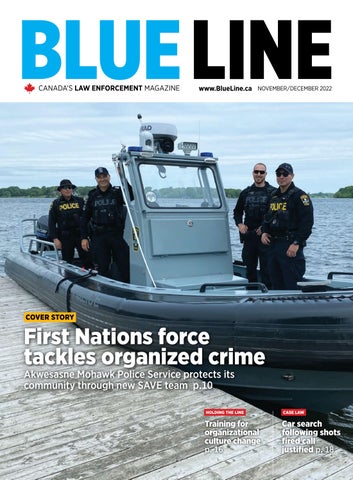
First Nations force tackles organized crime Akwesasne Mohawk Police Service protects its community through new SAVE team p.10
HOLDING THE LINE
CASE LAW
Training for organizational culture change p. 16
Car search following shots fired call justified p. 18
BUMPER-TO-BUMPER
PURSUIT VEHICLE SOLUTIONS
PUSH BUMPERS
CONSOLE BOXES AND KITS
VEHICLE PARTITIONS
WINDOW GUARDS
ALL NEW ALSO SEE • CRADLES & DOCKS • MOTION ATTACHMENTS
TOUGHBOOK 40 DOCKING STATION
RUGGED. RELIABLE. RESPONSIVE.
@gamberjohnson #gamberjohnson #ruggedreliableresponsive
Looking for consoles, partitions, window guards, trunk storage, and other vehicle equipment for a new fleet build? GamberJohnson is your all-in-one manufacturer for a total BUMPERTO-BUMPER vehicle solution. Gamber-Johnson will increase productivity while reducing replacement costs with in-vehicle mounting solutions to customize any mobile workspace, rugged device mounts, and motion attachments. Explore our complete vehicle solution at
WWW.GAMBERJOHNSON.COM
Contents
10 November/December 2022 Volume 34 Number7
Features Akwesasne Mohawk Police Service protects community through new SAVE team. By Brittani Schroeder.
14 Training for red dot sights
The future of police sidearms in Canada. By Dave Brown.
22 Digital investigations
Digital forensic backlogs and the use of automation. By Ryan Duquette.
26 The new RCMP sidearm
Is this your next pistol? By Dave Brown.
34 Officers and substance abuse
COVER PHOTO CREDIT: BRITTANI SCHROEDER
The hidden epidemic. By Dr. Jayasudha Gude.
14 @Blue_LineMag
4 8 16 18 24 38
Editor’s Commentary Q&A Holding the Line Case Law Technology Back of the Book
Departments
COVER STORY
10 First Nations force tackles organized crime
Columns
5 5 6 7 36 37 38
News By the numbers Dispatches Calendar Product Showcase Marketplace Blue Links
30 OACP & Blue Line Expo Canadian law enforcement experts come together to discuss hot topics and discover new products. By Brittani Schroeder.
34 30 November/December 2022 | BLUE LINE
3
EDITOR’S COMMENTARY BY BRITTANI SCHROEDER
www.BlueLine.ca
Another year comes to an end
I
t’s hard to believe that another year the uniform. has passed, and soon the snow will In 2022, First Nations police services be falling, the holiday season will be took on more responsibility and territory, upon us and we’ll be ringing in 2023. like the Tsuut’ina Police Nation Police This year has been busy for both Blue Line Service in Alberta. Similarly, the Siksika and the Canadian law enforcement com- Nation signed a memorandum of undermunity. standing with the province of Alberta with For many police organizations across the intention to establish a new IndigenCanada, the beginning of 2022 was focused ous police service. Blue Line had the on the “Freedom Convoy” in Ottawa and pleasure of visiting the Akwesasne Moother similar protests in many provinces. hawk Police Service in and meeting severPolice worked in tandem with forces al members of the SAVE team. While I was across the country to end the anti-govern- there, I got to see the Akwesasne communment demonstrations that immobilized ity, and learn about the successes and the nation’s capital and border crossings challenges of this First Nations police in January and February. force. You can read about my full visit on The public proceedings of the feder- page 10. al-provincial inquiry into the 2020 mass For Blue Line, 2022 was marked by our shooting in Nova Scotia, called brand new partnership with the Mass Casualty Commission, This year has the Ontario Association of ran for several months. The in- been busy for Chiefs of Police on the very quiry was tasked with determin- both Blue Line successful OACP & Blue Line ing the circumstances surround- and the Expo. We also hosted our ing the April 2020 killings, Canadian law second annual Blue Line Expo including the police response enforcement International virtual event in (RCMP and municipal police community. April, and the Security • Police forces), the role of intimate-part• Fire Career Expo in May. We ner violence, access to firearms also had the opportunity to and the killer’s prior interactions with the host two webinars for the law enforcement police and social services. community: the first on illicit fentanyl in The year also saw officers on the front June, and the second on multi-agency line wounded while serving and protecting interoperability and mass casualty events, their communities. In September, the in partnership with Fire Fighting in Canada, tragic news of two officers, one of the in September. Toronto Police Service and one of the York When putting this all together, Blue Line Regional Police Service, were killed in aimed to share the most pertinent and separate incidents within three days of timely topics and information to law eneach other. In October, in more tragic forcement. I truly hope you enjoyed your news was released. Two South Simcoe 2022 editions of Blue Line and that they Police officers were killed when respond- helped inform and foster your connection ing to a disturbance call in Innisfil, Ont. with the law enforcement community. One week later, Cst. Shaelyn Yang of the As always, if there is something you’ve RCMP was killed in a stabbing in Burnaby, encountered over the last few years that B.C. Several members of the Victoria Po- you think fellow officers could benefit and lice Department and the Saanich Police learn from, or a topic you think we should Department were also wounded in a be talking about, please reach out to me at gunfight outside a bank in B.C. in July. It’s any time at bschroeder@annexbusiensstimes like these that we remember the media.com. sacrifice officers make every day, and the Until next time, happy reading, happy bravery of each member when they put on holidays and be well.
CONNECT WITH BLUE LINE
www.BlueLine.ca 4
@Blue_LineMag
BLUE LINE | November/December 2022
www.facebook.com/BlueLineMagazine
Reader Service Print and digital subscription inquiries or changes, please contact customer service Angelita Potal Tel: 416-510-5113 Fax: (416) 510-6875 email: apotal@annexbusinessmedia.com Mail: 111 Gordon Baker Rd., Suite 400 Toronto, ON M2H 3R1 GROUP PUBLISHER | PAUL GROSSINGER pgrossinger@annexbusinessmedia.com PUBLISHER | ADAM SZPAKOWSKI aszpakowski@annexbusinessmedia.com EDITOR | BRITTANI SCHROEDER bschroeder@annexbusinessmedia.com EDITORIAL DIRECTOR EMERGENCY SERVICES GROUP | LAURA AIKEN laiken@annexbusinessmedia.com ACCOUNT MANAGER | JANICE EATON jeaton@annexbusinessmedia.com MEDIA DESIGNER | LISA ZAMBRI lzambri@annexbusinessmedia.com ACCOUNT COORDINATOR | KATHRYN NYENHUIS knyenhuis@annexbusinessmedia.com AUDIENCE DEVELOPMENT MANAGER BEATA OLECHNOWICZ | (416) 510-5182 bolechnowicz@annexbusinessmedia.com COO | SCOTT JAMIESON sjamieson@annexbusinessmedia.com ANNEX BUSINESS MEDIA 111 Gordon Baker Road, Suite 400 Toronto, ON M2H 3R1 Tel. 416-442-5600 • Fax 416-442-2191 Publication Mail Agreement No. 40065710 ISSN 0847-8538 Printed in Canada SUBSCRIPTION RATES Canada — 1 Year $31.50; 2 Year $52.50 plus tax USA — 1 Year $136.50 CAD Occasionally, Blue Line will mail information on behalf of industry-related groups whose products and services we believe may be of interest to you. If you prefer not to receive this information, please contact our circulation department in any of the four ways listed above. Annex Privacy Officer Privacy@annexbusinessmedia.com; Tel: 800-668-2374 © 2022 Annex Business Media. All rights reserved. Printed in Canada. No part of the editorial content of this publication may be reprinted without the publisher’s written permission. Opinions expressed in this magazine are not necessarily those of the editor or the publisher. No liability is assumed for errors or omissions. Readers are cautioned and advised that articles presented herein are edited and supplied for your personal awareness and should not be used for further action until appropriate guidance is received from a supervisor, Crown Attorney or other persons in authority. All advertising is subject to the publisher’s approval. Such approval does not imply any endorsement of the products or services advertised. The publisher reserves the right to refuse advertising that does not meet the standards of this publication.
PHOTO CREDIT: © BRO VECTOR / ADOBE STOCK
NEWS “Adding a Psychological Medical Director and an Occupational Health Nurse and officially launching VicPD’s Peer Support team – who are already doing excellent work – are all part of an ongoing effort to better support every member of the VicPD family.” ALBERTA
BRITISH COLUMBIA
Victoria Police Department launches peer support team
The Victoria Police Department (VicPD) has launched their Peer Support (P2P) Team. Comprised of sworn and civilian VicPD members, the team is trained to support peers across the department and assist in connecting those in need to professional services. Part of the work the P2P team does is in conjunction with the CISM team to provide two-stage peer support for critical incidents across VicPD. While CISM provides support in the hours, days and weeks immediately following a critical incident, P2P provides longer-term support. The P2P team also provides support which does not need to be related to a specific stress-related event or specific injury. The P2P team has grown, in part, from the recognition at VicPD that building and maintaining relationships with peers can reduce the likelihood of developing a stress injury. Each team member has received trauma resiliency training through Wounded Warriors Canada, as well as certification through the International Critical Incident Stress Foundation (ICISF) for assisting individuals in crisis. The 11-person team provides VicPD officers and staff with connection, as well as assistance with a wide range of circumstances, from peer support,
to assisting with meals for members in need, to helping members navigate connection with professional supports. While the VicPD P2P team officially launched this month, members of the team who had completed their training immediately stepped into action following an incident in Saanich in which six officers with the Greater Victoria Emergency Response Team (GVERT), three of whom are VicPD officers, were shot while responding to a call for two armed men at a bank. “Taking care of our people, whether they be sworn officers or civilians, is vital to maintaining our ability to serve the communities of Victoria and Esquimalt,” Victoria Police Department Chief Del Manak said.
Newest police graduates reflect city’s changing communities
The latest Edmonton Police Service recruit training class has graduated and is bringing a wide range of skills, experiences and diversity to the police service that is more reflective of the city’s communities. The members of Recruit Training Class (RTC) 154 came from across Canada, Brazil, China, India, Switzerland and the Philippines, and are fluent in languages such as Arabic, French, German, Hindi, Mandarin, Portuguese, Punjabi and Tagalog. They also brought a range of experiences and skills not only from law enforcement, corrections and the military, but from the fields of social services, education, business, medicine and the arts and sciences.
PHOTO CREDIT: EDMONTON POLICE SERVICE
BY THE NUMBERS In May 2022, Statistics Canada released recent data on the trends in firearm-related violent crime in Canada, 2009 to 2020. For more information, please visit www150.statcan.gc.ca.
277
In 2020, police reported a total of 743 homicide victims in Canada. For 277 of these victims, a firearm was used to commit the homicide.
@Blue_LineMag
2.8 % Firearm-related violent crime represents a small proportion of police-reported violent crime in Canada, accounting for 2.8 per cent of all victims of violent crime reported by police in 2020.
8,344
In 2020, there were 8,344 victims of police-reported violent crime where a firearm was present during the commission of the offence, or a rate of 29 per 100,000 population.
34 % Between 2019 and 2020, notable increases in rates of firearm-related violent crime were reported in southern rural British Columbia.
November/December 2022 | BLUE LINE
5
NEWS While these demographics fluctuate with each class, EPS is seeing an overall increase in diversity in recent classes. Self-identified diversity in the classes has increased from 57 per cent in 2018 to 70 per cent in 2022. For RTC 154, 18 individuals identify as racialized, two as Indigenous, 11 as women, and two as 2SLGBTQ+ members. The standards for officers haven’t changed and the most qualified applicants continue to be hired. EPS has made significant changes to its recruiting and training programs to strengthen its connection to the community. These changes include the launch of a recruitment campaign, targeted outreach to diverse communities, and the Recruit Mentoring Academy (RMA) to help improve an applicant’s skills and reduce the barriers often experienced by under-represented communities.
EPS is also helping recruits better understand diverse communities. Training is increasingly focused on building cultural competency, learning about the impacts of bias and trauma, and providing practicum placements at social agencies where recruits can build relationships with the community. “The community is changing and so is policing,” said Deputy Chief Alan Murphy. “We recently established a new integrated Training, Development and Recruiting Division to grow the talents of individuals wherever they are in their policing careers. This new process is helping more individuals succeed and achieve their dreams of becoming police officers.” With RTC 154’s academy training complete, the new constables now move into field development with the EPS Community Policing Bureau. Afterwards, they will return
PHOTO CREDIT: HALTON REGIONAL POLICE SERVICE
for some additional assessment and training to maximize their potential further. ONTARIO
Disobeying stop signs is the most common charge for 2022 Project Safe Start
The Halton Regional Police Service (HRPS) Traffic Services Unit has compiled statistics
DISPATCHES The past few months have been incredibly hard for the law enforcement community, with the deaths of five officers. This dispatches section is dedicated to them. It is with profound sadness that Chief James Ramer announced the death of Toronto Police Service Constable Andrew Hong of Traffic Services. The 22-year veteran with the Toronto force worked with a highly specialized motorcycle unit that provides security escorts for dignitaries like prime ministers and presidents and was training other officers when he was gunned down in an ambush. Friends and colleagues remembered Hong on Tuesday as an extraordinary officer and person who made time for anyone who needed it. Constable Hong is survived by his wife, two children and his parents. With profound sadness, Chief Jim MacSween announced York Regional Police officer, Constable Travis Gillespie was tragically killed in a fatal collision in the City of Markham. Cst. Gillespie was sworn in as a police constable on April 29, 2020 and was assigned to #2 District Uniform Patrol. Prior to joining YRP, he worked as a Metrolinx/Go Transit special constable and had volunteered his time to Community Living and Primal MMA Academy. “This is devastating news for all members of our organization,” said Chief MacSween. “I offer my deepest condolences to Travis’ family, friends and colleagues. It’s never easy to lose a member and to have lost Travis so unexpectedly is very difficult.” The South Simcoe Police Service is devastated to announce the death of two of their officers. On Oct. 11, two officers were shot inside a home in Innisfil, Ont. Constable Devon Northrup was 33-years-old and a
6
BLUE LINE | November/December 2022
6-year member of the service currently assigned to the Community Mobilization and Engagement Unit. Constable Northrup is survived by his partner, his parents and his many close friends. He also served as a member of our mental health Crisis Outreach and Support Team and the Emergency Response Unit. Constable Morgan Russell, was aged 54 and a 33-year veteran of the service. He was assigned to uniform patrol and was a trained crisis negotiator. He is survived by his wife and two adult children. “This is a heartbreaking time for our police service, the families impacted, our emergency services personnel and our communities. Our immediate focus is to support our members and their grieving families. I wish to thank our local first responder partners who rushed to the scene, and to everyone offering their condolences and support to our police service on this sad day,” said Acting Chief John Van Dyke. It is with a deep and profound sadness that Deputy Commissioner Dwayne McDonald has advised the public of the homicide of Burnaby RCMP Cst. Shaelyn Yang that occurred in the line of duty. Cst. Yang lived in Richmond and was an active volunteer. She started her career volunteering part time with the Richmond RCMP’s Victim Services unit later as a full-time volunteer. In 2019, she decided to become a police officer and entered training at Depot in June of that same year. Cst. Yang graduated in December as a member of Troop 8 and was posted to Burnaby Detachment. She was a loving wife, sister and daughter. Those she worked with before joining the RCMP and her police colleagues today, describe Cst. Yang as a kind and compassionate person, which makes her death even more difficult to accept. The loss of Shaelyn will be felt by so many. Her death impacts her family, friends, the wider RCMP family, and the vulnerable community she so passionately served. Her loss is immeasurable.
www.BlueLine.ca
from the 2022 Project Safe Start road safety initiative and failing to stop at a stop sign was the most common offence observed by officers across the Halton region. The Project Safe Start campaign ran from Aug. 29 to Sept. 9, and focused on education, awareness and high-visibility enforcement of traffic laws throughout the region. Over the course of the two-week initiative the top traffic offences were: disobey stop sign – fail to stop (655 charges laid and warnings issued); speeding (605 charges laid and warnings issued); speeding – community safety zone (112 charges laid). HRPS officers issued a total of 1,718 charges laid and 1,274 warnings issued during this year’s project. Project Safe Start has run for 15 years and has served as a highly visible reminder for those who use the roads to follow speed limits, remain alert for pedestrians and cyclists and to heed extra caution around school zones. This year, HRPS officers committed nearly 1,500 hours to Safe Start education and enforcement. The HRPS also implemented a comprehensive social media campaign as part of this road safety initiative which comprised of targeted messages, reminding the community that pedestrians, cyclists, motorists and police all play an active role in road safety. These daily messages had a collective reach of 626,987.
CALENDAR DEMCON 2022: Disaster and Emergency Management Conference Date: Nov. 16 – 17, 2022 Location: Toronto, Ont. crtdemcon.ca/demcon CACP Information and Technology Summit Date: Dec. 4 – 7, 2022 Location: Vancouver, B.C. www.cacp.ca Canadian Policing Wellness Check Conference Date: Mar. 6 – 8, 2023 Location: Ottawa, Ont. www.cacp.ca CACP/MACP National Police Leadership Conference Date: Apr. 24 – 26, 2023 Location: Manitoba www.cacp.ca Find more calendar events online at blueline.ca/events.
NOVA SCOTIA
Nova Scotians celebrate 40th annual Fallen Peace Officers’ Memorial Service
Sunday, Oct. 16 marked the 40th annual Peace Officers’ Memorial, which is held each year at Grand Parade in downtown Halifax. The event honours peace officers based in Nova Scotia who died in the line of duty, and is a humbling reminder of the selflessness and dedication of those who lost their lives while serving their communities. This year, RCMP officer, Cst. Heidi Stevenson’s name was added to the Fallen Peace Officer Monument in Grand Parade. Cst. Stevenson was killed in the line of duty on April 19, 2020, while protecting others during an active shooter incident. “This annual event brings people together to honour the service and ultimate sacrifice of peace officers in Nova Scotia who died while in the line of duty,” said Dan Kinsella, Chief of Halifax Regional Police, and Chair of the Nova Scotia Fallen Peace Officers’ Memorial Service Organizing Committee. “This [month], we lost two officers in the line of duty in Ontario – Csts. Morgan Russell and Devon Northrup of the South Simcoe Police Service – who were killed when responding to a call for service. As we honour those who lost their lives in the line of duty here in Nova Scotia, we salute peace officers everywhere who work courageously and selflessly in the service of their communities.” Peace officers, first responders, civilian employees, military personnel and volunteers marched from Police Headquarters on Gottingen Street to Grand Parade prior to the service. Participants from across the province then assembled at the Nova Scotia Fallen Peace Officers’ Monument for a brief ceremony where dignitaries brought remarks and laid wreaths along with peace officers and family members in memory of those who have given the ultimate sacrifice.
Visit www.BlueLine.ca for the latest news, stories, products, videos, photo galleries and industry events.
November/December 2022 | BLUE LINE
@Blue_LineMag BL_Wilfred Laurier_NovDec22_CSA.indd 1
7
2022-10-19 1:56 PM
Q&A Recently, editor Brittani Schroeder spoke with Daniel Bilodeau, Director of Public Sector Canada at Genetec, to talk about privacy protection, including surveillance, analytics and data collection.
The main thing that we’re learning is that privacy laws surrounding public surveillance don’t exist at a federal level, or at a provincial level. You have to look locally in order to find anything and in a lot of cases they don’t exist yet when it comes to surveillance. Recently we saw the first federally tabled the bill surrounding the responsible use of artificial intelligence (AI), and individuals’ privacy in Canada and how our information is used. We also know provincially, in Quebec, they are debating something called Law 64. In a nutshell, when it comes to cameras, look local for your jurisdictions and your bylaws; when it comes to artificial intelligence or data sovereignty, look provincially and federally.
Q: So in surveillance and local jurisdictions, what are you seeing there?
When it comes to security and surveillance, we’re seeing that it’s the local bylaws that govern an idea such as public surveillance. You can look at Vancouver for a great example. In April, Vancouver voted down a motion to install video cameras for the police to use during public events, and the idea behind that was to prevent violent crime. It was voted down eight to one and came with a statement saying that it’s a slippery slope that undermines the protection of an individual’s privacy. Yet, if you jump across Vancouver har8
bour, just one jurisdiction away to North Vancouver, you see really interesting and proactive steps already taken by the RCMP to enable technology tools such as surveillance. Melissa Digenova, the counselor who voted “yes” in Vancouver for using cameras, wanted the police to benefit from the efficiency that the tools provide for solving crimes. She pointed out an example where video surveillance caught a suspect at a hardware store during a high profile case. But her seven other colleagues were not convinced that cameras would reduce crime effectively, and they worried about the implications for personal privacy.
Q: What do you believe are some of the things that are going to come to Canadian local bylaws?
Well, it’s conceivable that at least two things will be needed if you wish to have the police use cameras that don’t necessarily belong to them as an analytical tool for dealing with the public. So in that scenario, the number one thing is that you must ask permission, and they’ll have to ask twice. Since the surveillance cameras don’t belong to the requester—the police being the requester— then the permission will likely be needed in a formal MOU (memorandum of understanding), such as the North Vancouver RCMP have done with their public already. They’ll also need to ask permission again at the time of the ‘event’, so a second request will need to be made with some parameters and limitations of use of that camera at the time that
BLUE LINE | November/December 2022
you actually need it. Number two, when it comes to local bylaws, you will likely need a redaction of the suspects face or the object. So we call this “redaction dynamic masking” or “pixelation”. It’s a type of video analytic, and what it achieves is the blurring of the face in the live video and in the recorded video. So the investigator can still follow the action and the event as well, however, at the same time protecting the individual suspect’s identity.
Q: You mentioned North Vancouver is already doing this, but are there any other jurisdictions where you know this is happening now?
I know of some, but I likely don’t even know the half of them yet. Recently, there was a TV news broadcast section highlighting a program that the Edmonton Police Service are developing. I happen to work with the Edmonton Police as well. The news video clip mentioned a few other areas like Red Deer, Alberta also doing this. As I mentioned before, this is a new and growing concept for us in Canada, but luckily, there are precedents already
in other parts of the world that are set up. In fact, the new federal bill that was introduced pointed out something very key: it said there was an intention to align Canadian regulations with international standards. So we don’t want to reinvent the wheel on this.
Q: How significant is this new federal bill that’s being debated?
Bill C27 introduces new rules for AI, and it basically spells out that the protection of personal privacy interests is essential to individual autonomy and dignity, and to the full enjoyment of our fundamental rights and freedoms. It includes a requirement that companies obtain the consent of the individual whose information they are seeking, using plain language, so that the person would reasonably be able to understand what they’re reading before they consent. This new bill is something to follow and watch for, for sure. Editor’s Note: This interview has been condensed and edited for clarity. To listen to the full episode, visit blueline.ca/podcasts. This episode of Blue Line, The Podcast was sponsored by Genetec.
www.BlueLine.ca
PHOTO CREDIT: © DENISISMAGILOV / ADOBE STOCK
Q: On the topic of privacy protection and the security and surveillance world, what laws do we currently have in place in Canada?
THE MOST ADVANCED MODULAR COMBINATION UNIT RESPIRATOR (CUR) The Avon CS-PAPR™ is the newest generation of CBRN Powered Air Purifying Respirator (PAPR) designed for use in Combination Unit Respirators.
Avon Protection is recognized as a world leader in respiratory and ballistic protection, delivering life critical solutions for Militaries and First Responders worldwide. As an innovative capability provider, we understand the unique requirements of the modern warfighter and tactical operator. This depth of specialization and understanding has ensured products are designed to protect our users in the most extreme of environments. We have been supplying protection solutions to the UK Ministry of Defence and other allies since the 1920’s and are a primary supplier of integrated protective equipment to NATO, Canadian Armed Forces and the United States Department of Defense Army, Navy, Marines, Air Force and Special Operations Forces.
PORTABLE CRIME SCENE SHELTERS
The capability to change levels of protection dependent on the threat, now provides the wearer with increased duration on target and safer operation. Utilizing the Avon MP-PAPR module along with the patented combination hose module, the wearer can seamlessly switch between APR, PAPR and SCBA modes of protection. The single air hose connection for all modes allows the wearer to retain a clear mask cheeks for optimum weapon sighting. The low profile shape of the Avon CS-PAPR delivers best in class integration with SCBA systems, benefiting the wearer with reduced weight and size compared to traditional systems. Modular Methodology allows the user to either add the Avon CS-PAPR to existing fielded systems such as the FM53/4 APR and ST53 SCBA, use as a regular PAPR (Avon MP-PAPR) or revert back to the Avon EZAir configuration.
NEW UNDERWATER DRONE FOR SEARCH AND RECOVERY
PORTABLE, NON METALLIC, NO LOOSE PARTS AND FITS IN PATROL CAR TRUNK
6X SONY ZOOM CAMERA f1.4 DUAL HI INTENSITY LED LIGHTS 4 THRUSTERS FULL VIDEO TRANSMISSION CAN DIVE UP TO 328’ DEEP 9.3 LBS 16” x 12” x 5” 3-5 HOURS OPERATION ON 4 HOUR CHARGE TEMPERATURE AND DEPTH INDICATION 1.5 M/SEC TOP SPEED WIFI OUTPUT WIFI SENDS TO SMART PHONE OR NOTEBOOK
Eflare Beacons are intensely bright Can be seen from over 1 kilometer away without the night vision, point fixation and distance judgement problems associated with strobe and incandescent lights. Eflare Beacons are infinitely versatile Available in a variety of one or two colour light combinations, steady-on or flashing, and in three light intensities. Easily attaches to clothing, vehicles, cones and bollards. Be seen and safe in almost any situation you can think of. Eflare Beacons are portable and simple to use The largest model is 22 cm tall and weighs only 460gm including batteries, making it easy to carry or stow anywhere, and quick and simple to deploy in any situation. Just twist the lens to turn on or off, and place one or more units around to provide a highly visible warning and safety zone around a person, work area, hazard or accident. Eflare Beacons double the safety Eflares provide safety by ensuring EFLARES First maximum visibility, but unlike pyrotechnic flares Responder Kits are there is no risk of fire or explosion, and there are found in Police cars no toxic fumes or residue. across Canada. Eflare Beacons are extremely robust Eflares are waterproof, dustproof and will survive a drop from a one metre height onto a concrete surface. Eflare Beacons are HAZMAT accredited Eflare Beacons are HAZMAT accredited for use in Class 1, Division 2 / Zone 2 hazardous areas.
The Tactical ResQmax™ is the line thrower specifically designed for the tactical world of line-throwing. As with all the ResQmax™ line throwers, the Tactical ResQmax™ is modular and can be used with a variety of accessories for horizontal or vertical line deployment. When equipped with a grappling hook, a climbing line can be deployed to vertical distances up to 110 ft / 34 m, and a tactical ascending ladder can be deployed to vertical distances up to 50 ft / 15 m. Entry points which would otherwise be inaccessible can be breached with ease for method of entry and ship-boarding operations in both land-based and maritime environments.
4’ 6’ 8’ 10’ 12’
COVER STORY
First Nations force tackles organized crime Akwesasne Mohawk Police Service protects its community through new SAVE team By Brittani Schroeder
A
long the shores of the St. Lawrence River, the Akwesasne Mohawk Police Service (AMPS) is hard at work guarding their waterways from increasingly crafty foe: members of organized crime. The AMPS is a First Nations police service located on the reservation of Akwesasne (pronounced ACK-weh-SASS-nee) near Cornwall, Ont. There are about 16,000 members in the Haudenosaunee (pronounced hoh-DEEnoh-SHoh-nee) and Mohawk community. The Akwesasne territory straddles three borders — Ontario, Quebec and the U.S. — on both banks of the St. Lawrence River. There are two separate police forces that cover this territory: AMPS in Canada and the Saint Regis Mohawk Tribal Police in the U.S. The AMPS
recently celebrated their 50th anniversary and have a team of around 50 members, sworn and civilian. Although this territory is divided by many borders, the residents consider themselves to be one community. In early June, Blue Line had the opportunity to visit the Akwesasne community to learn about their territory and the police service’s new Snowmobile – ATV – Vessel Enforcement team, known as SAVE.
The SAVE team
The SAVE team was developed three years ago through provincial and federal funding to combat crime on the waterways that run through the reservation. In 2017, a proposal was made to create a full-time marine unit to police the St. Lawrence River and surrounding waterways. The river
2017
a proposal was made to create a full-time marine unit to police the St. Lawrence River and surrounding waterways.
“The SAVE team is a huge piece of the puzzle that hadn’t been here for law enforcement for so long.” – Cst. Christian Zimmer. 10
BLUE LINE | November/December 2022
often serves as a highway for smuggling and other crime. “There’s always been the RCMP, OPP and the U.S. Border Patrol on the water, but we’d never had an Akwesasne police presence out there,” said First Nations Sgt. David “Eddie” Thompson, leader of the SAVE team. The Akwesasne chief and deputy chiefs pitched the problem to the government. With the rising smuggling numbers that the RCMP was reporting, along with more organized crime groups coming in from the Toronto and Montreal metropolitan areas, Akwesasne needed to be out on the water patrolling their jurisdiction. In 2018, a two-year pilot project was initiated, and the SAVE team was formed. The first year was full of figuring out logistics, like what the team would need, and doing the groundwork to get the team up and running. Plans for a boathouse were developed and the team worked from one small vessel. The SAVE team was taught by the RCMP on how to patrol the area as a new www.BlueLine.ca
PHOTO CREDIT: BRITTANI SCHROEDER
marine unit, and soon the team started being “more proactive and took over the jurisdiction with regular patrolling,” said Sgt. Thompson, who was brought onto the team as a constable before being promoted to sergeant in 2020. Cst. Christian Zimmer has been working alongside Sgt. Thompson on the SAVE team since the fall of 2019. He said, “The SAVE team is a huge piece of the puzzle that hadn’t been here for law enforcement for so long. With the political turmoil and the exploitation of the community of Akwesasne by criminal organizations because of its geographical location and uncontrolled land borders, as well as having the St. Lawrence River, it has been overrun for decades with organized crime.” The team’s mandate is to combat organized crime and smuggling activities in the Akwesasne territory. Since its inception, the SAVE team has grown in the number of AMPS members and the number of vessels they have access to. “We seize all kinds of contraband @Blue_LineMag
Above: First Nations Sgt. David “Eddie” Thompson and Cst. Vaughan Starblanket.
$15 million
From 2021 to 2022, the SAVE team is looking at seized contraband numbers totalling over $15 million.
that come across our waterways,” said Sgt. Thompson. “The biggest seizures we’ve made have included cannabis, which is trafficked across the river and headed for the U.S. It’s our job to intercept it before it crosses that international border. We’re talking about hundreds of pounds of cannabis each week, sometimes that number is up in the thousands.”
A wealth of team successes
The SAVE team recently secured a multi-million-dollar transfer agreement from both the Quebec and Ontario governments for the next six years to keep the team going thanks to their achievements over the last three years. In terms of success, Sgt. Thompson looks at the major cooperation between the AMPS SAVE team and outside agencies, both in Canada and the U.S. “We partner with so many agencies, like the RCMP, the Canadian Border Services Agency, known as CBSA, the OPP, our onroad patrol members of the AMPS, U.S. Border Patrol and Customs,
Homeland Security, the Saint Regis Mohawk Tribal Police and more,” said Sgt. Thompson. “They are a big part of what makes us successful.” Along with the partnerships with other agencies comes a strong sense of trust and communication between members. “Before the SAVE team, I didn’t know many people in the other agencies. Now we’re at the point where we’re communicating with these agencies daily and we’re gathering and sharing intel, and they’re sharing their intel with us. We’re building on our success and together we’re identifying targets and those involved in criminal organizations,” said First Nations Cst. Corey Thomas, who joined the team during the spring of 2020. For First Nations Cst. Vaughan Starblanket, who joined the team in summer 2019, the success of the team comes from their proactive policing. “This is what most cops want to do in their career; they see a crime committed and they take down the bad guys. We get to be proactive, rather than reactive out
November/December 2022 | BLUE LINE
11
on the boats.” In 2021, the SAVE team seized over $5 million worth of contraband, which included cannabis, tobacco, cocaine and fentanyl, among other items. This was a combined effort between the SAVE team, the on-road patrol members of the AMPS, the RCMP, the CBSA and the Saint Regis Mohawk Tribal Police. They’re also seeing a large influx of illegal immigrants coming across the river. From 2021 to 2022, the SAVE team is looking at seized contraband numbers totalling over $15 million.
Top photo: Editor Brittani Schroeder at the helm of the SAVE team vessel, led by Cst. Zimmer. Bottom photo: Running a training exercise on the waters of the St. Lawrence River.
Challenges along the way
Like every new project, the SAVE team has run into challenges during their first few years of operation. One of the biggest is policing a very tight knit community. “We’re dealing with people we know, sometimes it could even be family members that we’re stopping on the water. No matter what, we need to do our job, and for the most part the community understands that. As long as we’re being respectful while on the job, we don’t get a lot of push-back,” Sgt. Thompson said. Organized crime has been run12
BLUE LINE | November/December 2022
ning those waterways for so long that for some, they don’t see the act of smuggling as criminal. “They don’t see the damage it causes. It’s just a way of life for some people here, and it’s how they make a living. Sometimes we’re seen as the ‘traitors’ or the ‘bad guys’ for putting a stop to it, just because they don’t realize they’re helping the criminal organizations hurt other people and other communities,” said Cst. Starblanket. Another challenge is the geography the SAVE team covers. Between dealing with the international border and coordinating with other agencies, the team can come up against a lot of barriers. “Manpower can be a real issue, as I’m sure other agencies across Canada can attest to. When smugglers cross the international border line out in the river, I’m already on the phone with the U.S. agencies to coordinate with them so they can intercept the boat as it comes to their shores. But since they might be short on manpower too, it’s hard for them to manage it all sometimes. It’s always frustrating when we see them get away, but we’re limited to staying on our side of the border when we’re out in the water,” said Cst. Thomas. Intercepting the smugglers across the river can feel like a game of cat and mouse, said Cst. Zimmer. Before the SAVE team was created, the waterways were described as the “wild west” because multiple crime groups were making smuggling runs every night, like the river was just a highway. “When we first started out, we were catching smugglers every single night. Now, they know we might be out there and they’re starting to think of different ways to get the contraband across the border. It makes our job harder because we need to adapt to keep up with their new tactics, but it’s a challenge we welcome,” he said.
Looking ahead
Of the SAVE team members that Blue Line spoke to, it was unanimous that they’d like to expand their team further. “You can never have enough people for a team like this. I want to
expand the team and make sure this is a permanent unit for the AMPS and the Akwesasne territory. That’s how we’ll continue making an impact,” said Sgt. Thompson. He also said he’s hoping to find a successor who will take over leadership of the team when he retires in a few years. Another hope for the future includes a closer working relationship with the Saint Regis Mohawk Tribal Police and other U.S. agencies. They’d love to see a joint task force where Canadian members can be in the U.S. boats, and vice versa. “If we could do that, we would be able to catch even more smugglers than we are now,” said Cst. Thomas. Cst. Starblanket and Cst. Zimmer both echoed these sentiments. “This river is huge, so the more people involved, the easier it will be on all of us. Until that happens, this area will continue to be exploited,” said Cst. Starblanket. Cst. Zimmer also hopes that the SAVE team and AMPS can help educate other larger police agencies on the success of their team, and how they can implement something similar within their own departments. As the team looks to recruit more members, Cst. Thomas said, “If you want the best job in policing, come to AMPS and the SAVE team.” This was reiterated by all those present. In the hopes of sharing some advice to potential future policing recruits, Cst. Zimmer said, “Don’t shy away from the places people consider having a lot of crime or could be a rough area, because that’s where you’re going to learn the most and be exposed to the widest variety of things. Every day we see something new here; in just one day you can go from speaking to a kindergarten class, to executing a CDSA drug warrant, to seizing up to million dollars in contraband on the water. You have to wear a lot of different hats here.” “This is community policing at its best,” said Sgt. Thompson. “We are a small community, but we deal with big city crimes. It’s the best job in the world.” Editor’s note: Cst. Christian Zimmer moved on to the OPP as of October 11, 2022.
www.BlueLine.ca
PHOTO CREDIT: BRITTANI SCHROEDER
COVER STORY
HUDSONSUPPLIES.COM
HUDSON4SUPPLIES.COM
THE BUCKLE WE HEADQUARTERS HANG ON TO YOU!
BUCKLE REPAIR KITS HUDSON SUPPLIES is proud to be a partner with Soldier On _ Sans limites. For each purchase of HudsonTM products at participating stores, we will make a donation to Soldier On _ Sans limites.
FASTMAG®
For more informations, please visit:
NORTH AMERICACanex.ca HQ SHOTSHOW BOOTH CF-75727
soldieron.ca
FIREARMS TRAINING
Training for red dot sights The future of police sidearms in Canada
W
e have come a long way since red dot sights were first popularized by competitive handgun shooters in the mid-1980s. Sights such as Aimpoint and Tasco ProPoint began to dominate action shooting and the unlimited classes of practical pistol shooting, when top competitors immediately saw the advantages of a fast sight picture, increased accuracy in multiple-shot scenarios and better situational awareness. Early red dot sights were heavy and bulky, and battery life was measured in hours instead of years. In those days, we carried almost as many spare batteries in our range bag as we did spare magazines. Today, with the increased usage of the patrol carbine by most armed agencies in Canada, officers are more familiar with the red dot sight and how well it works. The latest technology in micro red dot sights (MRDS) has now brought the electronic sight back home to the pistol where it first started decades ago. Within a few years, nearly every agency in North America may be equipping their duty sidearm with a MRDS, with all the benefits of
greater accuracy and less hazard to the public.
Advantages of red dot sights
In a life-threatening situation where a pistol must be utilized, officers equipped with traditional sights use the same techniques today that were perfected over a century ago as shooters began to realize that shooting cowboy-style from the hip might win fast draw contests or look good in those new-fangled moving pictures, but made little sense in real life encounters where there’s no trophy for second place. Firstly, the pistol must be presented toward the threat. If shooting is justified and the decision is made to fire, the officer must instantly reframe their focus off the threat and onto the front sight, align front and rear sight with each other and finally establish a steady sight picture on the target. Achieving an accurate shot uses a combination of grip, stance, sight picture and trigger control, developed through many hours of training and many more hours of dry-fire practice, to create what is often called ‘muscle memory.’ Well, muscles don’t have
“Today, with the increased usage of the patrol carbine by most armed agencies in Canada, officers are more familiar with the red dot sight and how well it works.” 14
BLUE LINE | November/December 2022
memory. Muscle memory is another term for practicing basic techniques such as grip, stance, sight picture, trigger control, draw and reload, so that these actions become smooth and unconscious. It’s in this constant practice of the basics that takes the student of the pistol from the point where they are unconsciously untrained, through becoming consciously trained, finally culminating into the stage of unconsciously competent. It is these automatic reactions of the human body that can save lives. So-called muscle memory comes from the head; it is skills imprinted into the subconscious through constant repetition of the basics. Initial training with red dots is no different than training with iron sights. The first few times, beginners will have trouble finding the dot and one can see their pistol track sideways and up and down as they hunt for the dot. Once they start to relax their early death grip on the pistol and learn the importance of a good support-hand grip, students adapt rapidly. With live-fire training, broken up by extensive dry-fire practice, their presentation is more consistent, and the dot will be centered every time. In transitional training with experienced officers, red dots have a steeper learning curve than traditional sights. With traditional sights, when the sight picture is off, officers can
look at the sights and see which direction to move the handgun to align properly. With red dots, it’s hard to know where the dot is if it’s not visible. Therefore, transitional pistol training concentrates back to the basics of grip, stance, sight picture and trigger control; all while using the major advantage of red dots—one’s eyes stay focused on the threat the entire time instead of shifting to the front sight. This is why a traditional presentation style of draw from the holster up-and-out is combined with a focus that never leaves the threat. For this reason, officers adapt quicker if they watch the target first and then bring the dot to www.BlueLine.ca
PHOTO CREDIT: DAVE BROWN
By Dave Brown
They all survived without a scratch. Not surprisingly, when mounted back on a pistol, they also held their zero perfectly. Battery life has also evolved tremendously. With commonly-found button cells, the sight can stay on constantly and simply replaced every year during qualifications.
founded on a good base, developed from good training right from day one. Officers will also learn some of the mechanics of the red dot sight system, from mounting and zeroing to tracking the dot while moving and how well they work even if the sight is totally occluded.
Astigmatism issues
Transitioning to the future
An issue that will arise, especially with older officers, is astigmatism. This creates what is referred to as a ‘cluster of grapes’ effect. Instead of seeing a single dot in the sight window, some officers will see multiple dots. This is not a flaw in the sight. As the eye ages, it loses some of its perfectly round shape, and bright points of light can be viewed more like multiple points. Blue Line investigated the issue of astigmatism and red dots sights in 2016, and while irritating, it’ll have little effect on accuracy with the pistol.
Transitional training programs
the target instead of trying to track it like they would a front sight through the last two stages of the draw sequence. By maintaining target focus, the red dot also becomes easier to track under recoil, especially in dynamic situations where both shooter and target may be moving.
How fragile are electronic sights?
Due to the minimal parallax error of good red dot sights, the dot itself does not need to be centered in the sight window. In fact, tests have shown that the sight window can be almost completely shattered but if there is still a bit of glass remaining, it can be used ac@Blue_LineMag
curately. With a proper target focus with both eyes open, the front of the window can also be completely blocked and the dot can still be used. In an impressive display of the strength of the modern pistol-mounted red dot sight, Blue Line subjected samples of typical sights as provided by Vortex Optics Canada, through a round of torture tests. Sights were left in water for a week, dropped 10 times onto a concrete floor from a height of three meters and then, in a final round of tests designed to exceed anything that a sight might be expected to do, were used to pound nails through a board and finally driven over by a patrol SUV.
Target shooting is a perishable skill. Because it relies so much on the imprinting of the basic techniques into the subconscious mind, it must be practiced to become perfect. This is where transitional training programs will first bring even the most experienced officers back to relearn the basics through a combination of livefire and dry-fire exercises. The draw and presentation from the holster will be familiar. What will change is the need to center the eye behind the sight box and the need for a consistent presentation, especially during draws and reloads. Shooting from unusual positions, dynamic shooting scenarios and one-hand exercises will build confidence, but all these skills need to be
Micro red dot sights are not a magic solution to every deadly force encounter. They cannot think and they cannot evaluate dynamic situations for possible de-escalation alternatives. They may become commonplace on police duty sidearms in the next 10 years in Canada, but red dot sights do not replace good training that emphasizes practicing technical skills until they become automatic actions, allowing the officer to better see, think and evaluate in high stress situations. We use the technology of red dot sights to expand the limitations of humans, but we still need humans to make up for the limitations of technology. Pistol-mounted red dot sights have clear advantages for both officers and bystanders. They are fast to acquire; can be tracked easier, especially on moving targets; and the officer’s focus remains on the threat instead of on the front sight. For some officers, they are not that much faster to acquire than traditional sights – in fact, for the average beginner they may be fractions slower. But speed comes from the basics, mastered. To paraphrase martial arts legend Bruce Lee, one should not fear the person who has practiced a thousand techniques once as much as one should fear the person who has practiced one technique a thousand times.
Dave Brown is Blue Line’s firearms and police vehicle contributor, as well as a Best Dressed Police Vehicle Awards judge. He is a tactical firearms trainer and consultant based in Winnipeg. He can be reached at Dave.Brown@northwestlaw.ca.
November/December 2022 | BLUE LINE
15
HOLDING THE LINE BY MICHELLE VINCENT
Training for organizational culture change
16
BLUE LINE | November/December 2022
organization themselves, it does not preclude the relational habits we have created and the resulting outcome/liability that this dysfunction creates in its people. The next area of interest is training and our approach to how we enact the intended change and mitigate collateral damage within organizations. If we look at how our annual requalification unfolds, in defensive tactics, firearms training and various other scenarios, experiential situations are presented to which police officers are required to respond to. A debrief follows in order to explore the reaction of the trainee in the scenario, thoughts explored, and in the end, there is no right or wrong. Choices are made and then discussed. It would be interesting if we could include interactive organizational cultural scenarios as part of one’s training. For example, a scenario with two cruisers, door to door, where we have our officers role playing with a script involving a colleague who called in sick. One of the training officers plays the part of instigator of a potential toxic interaction, and the officer(s) in the scenario are asked to engage in some way in this discussion. Perhaps having a quick review on opportunities for success in these types of situations can be presented beforehand. In scenarios that involve potential violence in firearms or defensive tactics, the trainers will often make it somewhat difficult in order to initiate challenges and in-depth thought.
The same could be done with these scenarios. Trainers could even add a Hartlab monitor to gauge physiological reactions to the responses, providing further discussion on the physical effects of toxic organizational culture. Having our leadership participate in such training/workshops and wearing monitors might provide some hands-on experience on how it feels to engage in toxic behaviour. Coupling this work with positive organizational change may provide leaders a deeper understanding of the effects of mental health issues relating to organizational culture, bullying and harassment when approached by a sworn or civilian member. These trainings may also provide powerful solutions when conflict arises within their leaders be it sergeants, supervisors or coach officers in various units/platoons. We research, we train and we discuss. Now it’s time to put it into practice.
References
Kingshott, B. F., Bailey, K. & Wolfe, S. E. (2004) Police Culture, Ethics and Entitlement Theory, Criminal Justice Studies, 17:2, 187-202, DOI: 10.1080/0888431042000235020
Michelle Vincent PhD/MACP is a retired officer and the founder of The Haven, Ontario’s first non-profit, inpatient treatment centre exclusive to first responders and uniform personnel. Contact her at michelle.vincent@thehaven.cloud.
www.BlueLine.ca
PHOTO CREDIT: © DOLORES HARVEY / ADOBE STOCK
W
e are all too aware of organizational stressors and their impact on the mental health of our sworn and civilian members. Organizational stressors contribute significantly to organizational culture, its toxicity and liability. A toxic organizational culture may elicit bullying and other forms of harassment, and whether intentional or unintentional, the impact of this toxicity may lead to mental health issues and, worst case, suicide. Understanding how to implement cultural change is key. It may be most effective from the top down—beginning with the leadership team—to ensure the message is loud and clear that cultural toxicity and its components are unacceptable organization-wide. While we may have this vision and stance, we must also consider the depth in people and habit in which these ways of relating and operating exist. Cultural toxicity does not only exist in the first responder community. In fact, it exists in many dysfunctional environments. When we explore some family dynamics, for example, we can see a sibling throwing another sibling under the bus, so to speak, as a result of their insecurity in an attempt to gain status with a parent. This is no different than what occurs within a toxic organizational culture. We inadvertently encourage competition rather than cooperation within our promotional processes. What if, instead, we were compensated for discovering talents within our colleagues that made them a great fit for a position? What if we truly were open to seeing the incredible contribution they might make to a unit? Entitlement theory suggests that the traumatic incidents we attend and are not properly processed, as well as under-entitled relationships, may contribute to the impairment of empathy in the officer’s ability to empathize and/or behave in mutually respectful ways (Kingshott, Bailey and Wolfe, 2004). This theory also extends police training, early beliefs in self and others, as well as early attachment experiences that may contribute to relational issues. While there are a multitude of factors that may impact organizational culture, from the individual to the unit(s)/
COMMISSIONAIRES VALUES LAW ENFORCEMENT EXPERIENCE Join Commissionaires and put your skills and experience to work to ensure the safety and security of people and property in a wide variety of environments.
COMMERCIAL
EDUCATION
HEALTHCARE
CONDOMINIUMS
MINING SITES
GOVERNMENT
CONSTRUCTION
PORTS
commissionaires.ca
CASE LAW
BY MIKE NOVAKOWSKI
Car search following shots fired call justified
O
18
BLUE LINE | November/December 2022
charged with firearm offences. At trial in the Ontario Superior Court of Justice, the two men argued that the gun should be excluded as evidence because the police breached their Charter rights. But the trial judge found the investigative detention and protective pat-down searches lawful. However, the trial judge concluded that the police breached s. 8 when the officer stuck his head into the car in the area where Yusuf had been seated because there was no evidence for why the officer did this. The officer who found the gun did not testify and the judge could not determine the grounds that informed the police decision to search the rear of the car. The judge admitted the gun under s. 24(2) and Ahmed and Yusuf were convicted of weapons offences. Ahmed and Yusuf then challenged their convictions to the Ontario Court of Appeal arguing, in part, that the trial judge was wrong to conclude their detentions and the pat-down searches were lawful, and in admitting the gun as evidence.
The detentions
Ontario’s top court agreed with the trial judge that the detention of the Charger occupants was lawful. “The requirements for a justifiable investigative detention are twofold,” said Justice Coroza for the Court of Appeal. “(1) Police officers must have reasonable grounds to suspect that the specific person is implicated in the criminal activity under investigation; and (2) the decision to detain must be reasonable on an overall assessment of all circumstances.” In this case, the trial judge took a common-sense and practical approach to the issue. The Charger matched the description of the vehicle that was seen speeding away from the approximate location of the gunshots. This supported a reasonable suspicion that the occupants had knowledge of what occurred and provided the requisite reasonable grounds to detain the three males to investigate their potential involvement in the reported gunfire.
The pat-downs
The Appeal Court also upheld the trial judge’s ruling that the protectwww.BlueLine.ca
PHOTO CREDIT: © TOMASZ ZAJDA / ADOBE STOCK
ntario’s highest court has found that the stop and search of a vehicle matching the description of one seen in the area of a shots fired call did not violate the Charter, and the gun found as a result was admissible at trial. In R. v. Ahmed & Yusuf, 2022 ONCA 640, the police received two 911 calls reporting the sound of gunshots near an apartment building. The calls identified a dark-coloured car, possibly a Charger, which was speeding away after the shots had been heard. About 12 minutes after the 911 calls, officers saw a black Dodge Charger pull into the driveway and park in front of the apartment building. The driver (Ahmed) got out of the Charger and walked toward the apartment building while talking on his cell phone. An officer called out to Ahmed, walked towards him and told him about the reports of gunfire. Backup officers also arrived and approached the passenger side of the Charger. The two other occupants in the Charger, including Yusuf, who was seated in the right rear passenger seat, were told about the possible involvement of a Charger in the reported shooting. These men appeared nervous to police. They became argumentative, questioned the stop and interrupted the officers. They were instructed to exit the Charger and all occupants were patted down, but nothing was found. An officer then stuck his head through the open rear door of the charger and looked into the rear portion of the vehicle using a flashlight. He saw a firearm in plain view on the floor protruding from under the front passenger seat, immediately in front of the where Yusuf was seated. The men were arrested, advised of their s. 10 (b) right to counsel and the Charger was sealed. A search warrant was subsequently obtained, which resulted in the seizure of a loaded restricted firearm with an extended magazine. Both Ahmed and Yusuf were each
ive pat-downs were lawful. “The law is clear that the police have the power to briefly detain individuals for investigative purposes and to conduct a limited pat-down or safety search incident to that detention,” said Coroza. “When an officer has reasonable grounds to believe that their safety or that of others is at risk, the officer may engage in a protective pat-down search of the detained individual.” Here, the circumstances established reasonable grounds to believe that a potential imminent threat to safety existed and that a pat-down search of the Charger’s occupants was reasonably necessary. Moreover, the searches were brief, non-intrusive and did not go beyond what was appropriate in the circumstances.
The car search
Unlike the trial judge, the Court of Appeal ruled that the police didn’t
violate s. 8 when the officer stuck his head through the open rear passenger door. “A pat-down alone would be pointless if the occupants could simply return to the car and arm themselves with a gun left in easy reach. The 911 calls and the circumstances of how the occupants and the Charger came to be investigated provided specific, articulable and reasonable justification for [the officer] to look in the area where Yusuf had been sitting for safety,” said Coroza. “Although the officers did not find anything from the pat-down search, given the nature of the call, the fact the call had been made only shortly before the occupants were detained, and the possibility that one of the occupants of the vehicle was armed with a firearm, the officers could not eliminate the possibility that there was a gun to be accounted for.” Only about three minutes had elapsed between the time the occupants of the Charger
“The law is clear that the police have the power to briefly detain individuals for investigative purposes.” – Justice Coroza for the Court of Appeal were detained and the discovery of the gun. Based on the totality of the circumstances, looking in the car was a modest extension of the patdown search in this case and was reasonable because specific safety concerns called for it. The gun was properly admitted as evidence, but the accuseds’ conviction appeal was allowed on other grounds. Mike Novakowski is Blue Line’s case law columnist.
+1 867-668-5609 publisher@canadianguns.com www.canadianguns.com
CANADIAN ACCESS TO FIREARMS
The only Canadian buy-and-sell firearms newspaper distributed across Canada! WHY ADVERTISE WITH CATF? Our paper is distributed monthly by subscription and at gun shows, gun trades, gun clubs and select stores across Canada. We shall put you in touch with the active, committed core of Canada’s firearm community!
@Blue_LineMag BL_CATF_JanFeb20.indd 1
November/December 20222019-12-03 | BLUE LINE 19 11:03 AM
ADVERTORIAL
HAVE YOU HEARD? PSPNET Families Wellbeing Hub is on its way!
ENGLISH The PSPNET Families Wellbeing Hub, funded by the Public Health Agency of Canada, will offer trauma-informed mental health promotion resources and supports, to serve the families of public safety personnel (PSP). The PSPNET Families Wellbeing Hub complements PSPNET, a federally-funded online platform that offers Internet-delivered Cognitive Behaviour Therapy (ICBT) for PSP. Available right now is a Wellbeing Course for Spouses or Significant Others of public safety personnel (PSP). This course helps the spouse or significant other of PSP with education and guidance on simple techniques for managing various mental health concerns, spanning from low mood, depression, worry, anxiety to posttraumatic stress disorder. The course is free of charge, self-guided and confidential, and it takes into account the unique experiences of Spouses or Significant Others of PSP.
To sign up for this course, register for our newsletter, or explore the other resources PSPNET has available, contact us at pspnetfamilies@uregina.ca. More information can also be found on the PSPNET Families website: www.pspnetfamilies.ca
ENGLISH Public Safety Personnel (PSP) are often more vulnerable to experience challenges related to depression, anxiety and posttraumatic stress due to the nature of their jobs. PSPNET can help with free, confidential, online cognitive behaviour therapy tailored to PSP, including border services officers, public safety communications officials, correctional workers, firefighters, Indigenous emergency managers, operational intelligence personnel, paramedics, police and search and rescue personnel. The services provided by PSPNET are beneficial to those seeking tools to aid in staying healthy and being proactive in their mental health and wellbeing. Some of the free courses available include the PSP Wellbeing course, which provides therapist-guidance through secure email exchanges or phone calls to manage the thoughts, behaviours, and physical symptoms that are impacting their wellbeing, and the PSP PTSD course which provides therapist-guidance on effective techniques to help manage symptoms of PTSD. Available to PSP in Saskatchewan, Quebec, New Brunswick, Nova Scotia, and Prince Edward Island. PSPNET also provides a free self-guided version of the PSP Wellbeing Course to PSP across Canada.
To sign up for this, register for our newsletter, or explore the other resources PSPNET has available, contact us at pspnet@uregina.ca.
FRENCH
And don’t forget to follow us on social media: @PSPNETCANADA
@PSPNETCANADA
@PSPNET
@PSPNETCANADA
INVESTIGATION
Digital investigations Digital forensic backlogs and the use of automation
L
eaps in technology over the last 20 years have created some true benefits to society; real-time collaboration, cheap and reliable digital storage, the ability to perform complex processing in a matter of seconds – all things designed to simplify and speed up our lives. As technology has evolved it allowed us to complete tasks more efficiently and cost effectively. While this benefits most individuals and businesses, one area where this evolution is having an adverse effect is in the digital forensic space, especially within the realm of law enforcement. A survey of policing agencies across North America revealed that the average backlog for cases, involving digital evidence, was six to seven months. Obviously, that’s very concerning, but what’s more concerning is that the survey was performed in 2004. Nowadays, it’s not uncommon for law enforcement digital forensic bureaus to have backlogs of one to two years. Even with advancements in the technologies and tools which are available, the sheer volume of data and the move to a more digital age is becoming painful. For example, in March 2015, Canadian police uncovered a child pornography sharing database. It was approximately 1.2 petabytes in size which, to provide some context, is the equivalent of over 20 million four drawer filing cabinets filled with text documents, or around 13 years’ worth of HDTV. In short, here we have a situation
22
where one case is, essentially, going to break the system. While this size of case is still rare, we must remember that, on average, many Canadian police technological crimes teams have to analyze thousands of digital devices per year and the size and complexity of those devices is ever growing. The backlog is continually increasing. Why does this matter, you ask? Simple – it’s the potential for the withdrawal of court cases due to unreasonable time delays. Large forensic backlogs in the late 1980’s was one of the reasons for the withdrawal of almost 50,000 criminal charges in part due to the court’s ruling in the Canadian case R. v Askov (1990); one where a multiyear delay resulted in its dismissal. While this isn’t yet commonplace, individual cases have
BLUE LINE | November/December 2022
been withdrawn due to delays in the digital forensic analysis being conducted.
External factors
Increased storage size In the 80s, the average hard drive size was approximately five megabytes (MB). As of 2022, an individual can easily purchase an 18 terabyte (TB) drive on Amazon for roughly $500. That’s an increase of approximately 360,000,000 per cent in storage capacity over the past 40 years. More digital devices involved in cases There has also been a similar upward trend in the number of digital devices in general use. Mobile device use has seen a dramatic increase, and over the past 10 years there has been an explosion of new devices that are internet enabled, com-
monly termed the ‘Internet of Things’, or ‘IoT’. Estimates are that in 2020, there were close to 200 billion devices globally that had internet connectivity (or over 20 devices per person on the planet). The volume of data being generated Increased use of digital devices has led to an increase in the amount of data we all generate. Our daily communication has moved from phone calls and letters, to emails, texts, chats and tweets, and has resulted in user generated data accounting for over 25 per cent of all digital data created. This number will continue to rise as more IoT devices are used. Increased digital investigation time The amount of storage capacity, number of devices and more user generated data are all resulting in more time being needed to investigate each criminal case. Long gone are the days where an investigator only needed to conduct an analysis on a phone or a computer to gather evidence. Today’s cases can call for investigation into a varied array of digital artifacts, e.g., multiple systems, mobile devices, USB drives, servers and ISP log files. It’s not uncommon for a digital forensic examiner to have to analyze many terabytes of data for a single case.
Internal factors
Staffing and retention To counteract backlogs, many agencies have taken the traditional route of hiring more www.BlueLine.ca
PHOTO CREDIT: © ALPHASPIRIT / ADOBE STOCK
By Ryan Duquette
staff. Many have doubled or even quadrupled their capability yet still find it difficult to keep up with the demand. Some law enforcement agencies have resorted to hiring civilians (as opposed to sworn officers) to staff these positions. It’s a sensible approach, however retention is likely to become a problem. Aside from the general skills shortage issues normally associated with specialist roles, the demand in the private sector for the same resources, in combination with considerably higher remuneration, is currently resulting in some real challenges for law enforcement to retain skilled practitioners and will be a growing problem in the next few years. Training and budgets The field of digital forensics is constantly evolving and those investigating digital cases need to stay up to speed to be effective. The increased number and type of devices available with differing operating systems, and the speed in which new ones are being released, results in a need for ongoing specialized training which is costly and time consuming. Time away from conducting cases is often a contributor to increased case backlogs, and budgets are often stretched at the best of times. For example, $50,000 is the average cost for the hardware, software and training costs to properly equip an examiner, and this number doesn’t consider salary costs, ongoing training or technology upgrades.
Is increased automation a solution?
There has been a lot of criticism aimed at the growing trend of “push button” forensics and at digital forensic tools that automate various aspects of digital investigations. While there may be some merit to the fact that relying solely on the use of these types of automated tools during an investigation may not be the best solution, there are @Blue_LineMag
many benefits to automating certain aspects of one’s digital forensic workflow. At its basics, the workflow steps on most digital forensic investigations are: gathering evidence (usually imaging devices); processing evidence (this is where most digital forensic tools employ some aspects of automation); analyzing the evidence; and reporting on the findings. Many digital forensic software tools automate various processing aspects of digital evidence. This may include the rebuilding of deleted content, extracting evidence from unallocated areas of the device, extracting evidence from compressed files and more. This
case work. More effective use of resources One of the main advantages to the increased automation within digital forensic tools is being able to utilize non-digital forensic personnel to conduct the initial steps to image and process evidence. Utilizing tools to conduct the initial imaging and processing of evidence does not require an examiner to have advanced digital forensic capabilities and training, as the steps required are often repeatable for every case. Many agencies (both public and private) employ junior members that start their career “learning the ropes” by imaging and processing evidence before moving on to conducting a
Even with advancements in the technologies and tools which are available, the sheer volume of data and the move to a more digital age is becoming painful. automation allows an investigator to quickly determine what evidence is relevant to their case and move into the analysis of that evidence (often figuring out the who, what, when, why, and how).
The benefits of using automation within digital forensic cases
Faster turnaround time As is often the case in many digital investigations, there is a flurry of activity involved in investigating a situation within the first few days or weeks. Investigative resources are scarce and other investigations can often spread those resources very thin. In law enforcement, minor cases go untouched for months, if not years, while the major cases are continually being worked on. Automating certain aspects of the digital forensic workflow would allow those cases sitting in a backlog to be dealt with quicker, while still allowing a focus for major
deeper analysis on cases. This in turn allows more seasoned or senior examiners to focus on cases that require a “deep dive” into the evidence. Reduced number of cases that go to trial A study showed that more than 90 per cent of criminal cases do not make it to trial, as the defendant will usually enter a plea bargain, and almost 70 per cent of those pleas are entered into within the first six months of the offence date. This rate drops to approximately 30 per cent between 12-18 months after the offence date. It’s possible that many defendants don’t initially plea to their charges within the first six months because they think that the police won’t find evidence of a crime contained on their device. It’s more likely that the device(s) in question were not even analyzed during that initial six months. Finding evidence faster leads to higher plea rates and less
cases that go to trial. Automation within digital forensic tools allows law enforcement agencies to quickly view the evidence involved in the case, make informed decisions as to any further direction of the investigation, and to present those findings. Backlog reduction Police agencies want to be proactive when dealing with criminal matters; they don’t want to just react to crimes that have taken place. Large case backlogs typically result in many of the proactive measures being shelved while cases are being investigated. The increased use of automation would reduce backlogs to a manageable level and allow agencies to get back to their core values of community safety.
In summary
The tough decisions that agencies make about prioritizing technology-based investigations are ever present, and with society’s dependency on digital systems, devices and services continually growing, choosing what to act upon first will become more a challenge. The balancing act between clearing back logs vs. investigating fresh crimes vs. managing budgets and resources will become more difficult as time moves on. The good news is that there are options. The use of automation within digital forensic tools to tackle various aspects of cases can ease the burden, reduce the cost, and time scale and ultimately allow law enforcement agencies to get on with the business of putting criminals behind bars. Ryan Duquette is the Canadian lead for RSM Canada’s Security and Privacy Risk Consulting practice. Duquette focuses on litigation support, cyber incident response, privacy and cyber technology risks, digital forensics and cyber fraud matters. Duquette has been an investigator for over 20 years and was previously a police officer focusing on cybercrime and fraud cases.
November/December 2022 | BLUE LINE
23
TECHNOLOGY
BY BRITTANI SCHROEDER
Mission critical technology to aid first responders
work. If the network experiences congestion, MCPTX users are given first access to connect to the network before all others. “Samsung’s MCPTX solution also offers pre-emption, which allows the network provider to remove regular users from the network to re-allocate resources to first responder teams. In addition, we offer QoS (Quality of Service) which gives a guaranteed bit-rate and latency specifically for MCPTX-related traffic,” said Wiktorski.
Working with LMR technology
Developing a new technology
The MCPTX technology was in development for many years and is part of the international standards body 3GPP, which is responsible for developing all wireless standards. “Any interested party is able to 24
BLUE LINE | November/December 2022
contribute to the standard and help evolve it. This is a huge advantage over older, proprietary types of push-to-talk (PTT) technology which were closed and limited in scope and interoperability,” said Wiktorski. Wiktorski said that several catastrophic emergencies occurred around the world that exposed the limitations of traditional PTT technology and forced a need for a more advanced communication service for first responders. It was then that Samsung began their work with standards bodies and service providers to develop MCPTX services that would support seamless, prioritized communications with advanced features on a prioritized network.
A catastrophic event, like a terrorist attack or natural disaster, requires a coordinated approach for all first responders. When catastrophe strikes
A catastrophic event, like a terrorist attack or natural disaster, requires a coordinated approach for all first responders. MCPTX allows for the priority of first responder communications by putting them first in line to connect to the net-
Assisting law enforcement
Police officers encounter a variety of scenarios that might be improved with the aid of MCPTX technology. “For example, an officer might be apprehending a suspect and suddenly require back-up. Currently, they would only be able to call for help within their LMR network’s coverage area. With MCPTX, video from a body-worn camera could be pushed immediately anywhere within the LTE network to help dispatch a coordinated response,” said Wiktorski. A map of the officer’s location could also be shared with other police officers on the ground or in their cars, to help improve the likelihood of a successful arrest while ensuring the officer’s safety. www.BlueLine.ca
PHOTO CREDIT: © DANIEL / ADOBE STOCK
I
n emergency situations, Canada’s first responders need information delivered accurately and quickly. In 2022, Samsung Networks and TELUS deployed next-generation Mission Critical Push-to-X (MCPTX) services. What does this mean? First responders will be able to receive the data they need to improve responsiveness and operational efficiency and drive better public safety outcomes. It is designed to enhance multimedia communications with features such as video, geographic information system (GIS), geo-fencing, remote database access and more. Smart city solutions are a series of data-driven, intelligent and integrated solutions delivered by TELUS to enhance public safety, promote sustainability, and optimize operations. “Samsung is committed to delivering innovative MCPTX solutions, which will ultimately support TELUS with bringing their smart cities vision to life, as the technology helps to increase emergency response times and secure public spaces,” said Stephen Wiktorski, vice president and head of networks at Samsung Canada.
The MCPTX technology can work alongside Land Mobile Radio (LMR) technology to augment its limited capabilities by allowing first responders to transmit and receive pictures and video, while also being able to send data such as location and texts to emergency dispatchers at a greater distance, said Wiktorski. First responders can also use the technology to connect to IOT devices, which could allow for vital patient health information to be transmitted during dangerous situations. “This is done over the LTE network where data is given priority over non-critical traffic.” Samsung has also taken an additional step and has developed technology to allow for MCPTX devices to interwork with LMR systems, enabling calls between MCPTX and LMR devices. Due to MCPTX being an open standard, it allows for interoperability between different systems. This means it is possible for first responders in Canada and the U.S. to be placed within the same group to deal with emergency situations occurring at the border.
INVISIO
Tactical Communication and Hearing Protection Systems
INVISIO X5 In-the-Ear Headset
INVISIO V20 Single Com Control Unit
360°
Preventing Hearing Damage Intelligent hearing protection
Enhancing Situational Awareness INVISIO 360° hear-thru
Read more at www.invisio.com
Reduced Size and Weight
Reducing the burden on the soldier
Submersible to 20 Meters
Modular and Scalable
Resistant to water, dirt and sand
INVISIO IntelliCable® adapts to all scenarios
FIREARMS
New RCMP sidearm
A
good sidearm should last the career of a law enforcement officer. If you were with the RCMP for 30 years or fewer, that pistol is likely the Smith & Wesson Model 5946 semi-automatic. Now, after years of rumours, the RCMP is poised to select their next duty pistol. The Smith & Wesson 5946 semi-automatic performed yeoman service. Although heavy, it was reliable, equipped with clear sights and had a smooth doubleaction-only trigger that nearly duplicated the pull weight and trigger stroke of the previous Smith & Wesson revolver. But replacement was inevitable. The last batch of Smith & Wesson’s generation 3 pistols came off the assembly line in 2013 as market desire plunged for heavy, allmetal, hammer-fired duty pistols. The RCMP has released a “Letter of Interest” with the complete specifications of their desired new pistol. There are some interesting requirements and some surprising elements that may vault the RCMP ahead of nearly every other law enforcement agency in Canada. It was no surprise that the RCMP would be seeking out a new all-matte-black pistol
26
BLUE LINE | November/December 2022
with a corrosion-resistant barrel and slide, polymer frame and a grip design that can accommodate various hand grip sizes. What is surprising is that the RCMP will also be equipping all duty pistols with a combat-tested micro red dot sight system (MRDS) as well as the traditional iron sights. Even more surprising is that the RCMP is finally doing away with the questionable design “feature” of a magazine disconnect. Here is a short summary of the technical requirements for their new pistol, as specified in the Letter of Interest: • Maximum length of 190.5 mm and a maximum overall height of 140 mm with the magazine and any MRDS removed • Capable of firing the 9mm Luger calibre ammunition in current service • A non-reflective, black matte finish on all exposed surfaces • Slide must be manufactured from corrosion resistant steel such as stainless steel • Frame must be manufactured of polymer • Grip must provide for various hand sizing options • Ambidextrous slide stop that can be
activated with either hand • Magazine release configurable for either right-hand or left-hand operation • A striker fired trigger with a pull weight between 5 and 6 pounds of force • No external manual safety levers • Capable of discharging a cartridge with the magazine removed • Internal firing pin safety preventing the forward movement of the firing pin unless the trigger is pulled to the rear • Mechanical safety to prevent firing when slide not in battery • Safety incorporated into the trigger shoe to prevent rearward movement without physical pressure on the trigger • Visual or tactile loaded chamber indicator • High definition night sights • Pistol slide configured to accept a MRDS Striker-fired pistols are a variation on the double-action-only trigger function, in that every shot requires the same trigger pull. The pistol has the basic simplicity of a good revolver, with point-and-shoot capability, as well as an absence of levers, switches, buttons or decocking devices that serve to get in the way during dynamic life-threatening situations. All three www.BlueLine.ca
PH0TO CREDIT: WALTHER ARMS INC.
Is this your next pistol? By Dave Brown
ADVERTORIAL
THE NEXT EVOLUTION OF LAW ENFORCEMENT PISTOLS The benefits that police are seeing by adapting miniature red dot sights Miniature Red Dot sights (MRDS) on pistols are quickly being adapted by forward-thinking law enforcement agencies who are discovering the range of benefits offered by adding an optic to a duty pistol. As more data is published, mounting evidence clearly shows that MRDS enhance the safety and accuracy of law enforcement pistols, improve situational awareness and are more effective when used in high stress situations. MRDS like the Aimpoint Acro P-2 have been used by special operations forces, tactical teams, and in competitive shooting sports for years. Now with further advancements in durability, battery life, duty holster compatibility and OEM duty pistol compatibility (GLOCK MOS), MRDS have quickly become a viable option for general duty use. As more agencies begin to adopt MRDS optics , the true benefits to usability and police user safety are becoming very apparent. When the human body is subject to stress, the Sympathetic Nervous System (SNS) initiates a variety of responses that prime the body to defend itself or escape danger. One of the first activations by SNS is to the eyes: our field of vision is increased to its maximum, pupils are dilated to intake more visual information, and the Ciliary muscles (the ring of muscles that surround the lens of the eye) contract, which thickens the lens for better distant focus. This reaction has served a critical role in mankind’s survival throughout history, but when operating a firearm, it can make it extremely difficult to find your sights and acquire sight picture under extreme stress or spontaneous threat1. When using an MRDS, your eyes are able to remain in a more natural and open state, which allows for less reliance on ‘fine’ focus, ultimately better compensating for these involuntary physiological changes. The wider and clearer target picture allows for a much easier sight to acquire under stress. Predictably, the human brain also has its own reaction to a stress response triggered by our SNS. Under extreme stress our brain modifies the way it takes in information. Specifically, it prioritizes the volume of information taken in over the accuracy of the information taken in2. Under high stress, our brains cannot process as much detail in the visual data it takes in, which can cause the mind to make presumptive leaps, or ‘fill in the blanks’3. This is especially true in low-light scenarios4. The human brain can incorrectly complete a pattern or misinterpret an object, like mistaking a floor lamp for a person, or a cellphone for a pistol. This
can present an extremely dangerous scenario where police users can make a ‘mistake-of-fact-shooting’, where the police user makes an honest mistake where they believed that use of lethal force was justified. MRDS with their wider focal plane and bright powered red dot allows the police user to greatly increase the amount of information they are able to take in about their surroundings while retaining sight picture. This additional situational awareness can mitigate some of the presumptive thinking our brains are prone to under extreme stress. In moments where quick decisions need to be made, having additional visual data available to the police user can help make better, more informed decisions and improve both situational awareness and accuracy under stress. These are just some of the ways MRDS can help police better protect the public with technology. As more and more agencies adopt MRDS, and as more data is released, the benefits of an MRDS for both public and police user safety are becoming common knowledge. Their improvements to accuracy, benefits to situational awareness, and better compensation to our physiological responses to stress present a clear advantage over traditional pistol iron sights. MRDS have already been adopted by many agencies across Canada and the United States to great effect. Similarly, agencies are also converting to MOS Pistols in the event they choose to adopt MRDS in the future. QUICK FACTS : WHY YOUR AGENCY SHOULD CONSIDER MRDS FOR GENERAL DUTY POLICING: • Faster, and more accurate target acquisition • Improved usability under stress • Improved situational awareness while on target • More accurate follow up shots • More accurate shots on moving targets • Improved low light accuracy • Greater accuracy for ageing police users or those with vision issues
The Aimpoint Acro P-2 MRDS is available to law enforcement in Canada exclusively from Rampart. For pricing or an in-person demonstration contact us today at www.rampartcorp.com
safeties are redundant and internal to the design. So, who are the leading contenders? Glock will obviously be considered, with 65 per cent of the police market in Canada and FBI and Ontario Provincial Police both recently adopting the Glock 17M. Smith & Wesson makes a version of their highly-regarded M&P pistol with provision for a red dot sight. Walther Arms has the new Performance Duty Pistol (PDP) and Fabrique Nationale has the FN 509 pistol; both of which coincidentally match the desired requirements of the RCMP almost exactly. Sig Sauer will unfortunately be out of the running with their P320 pistol because it curiously lacks the built-in trigger safety of other striker-fired pistols on the market. It is good to see the RCMP acknowledging that most striker-fired
28
pistols must be disassembled by first relaxing tension on the trigger mechanism by pulling the trigger on an empty chamber. Simply teaching every officer the PROVE safety checking procedure will make this a non-issue. Another non-issue will be the magazine disconnect of the 5946. Not only would it prevent a single round from being fired if the magazine is broken or drops out in the
BLUE LINE | November/December 2022 BL_PushBar_JuneJuly22.indd 1
middle of a gunfight, but it also complicated any dry-fire exercises. Dry-fire is an essential component in transitioning to micro red dot sights, and the RCMP has seen the future. If they can fast-track their testing and selection process, they have a chance to leap ahead with the latest technology in police duty sidearms for the 21st century. So which pistol are we predicting that RCMP officers will be carrying on their hip a few short years from now? Well, let’s just say that the late Ian Fleming would likely approve of Q-Branch of the British Secret Service replacing his fictional James Bond character’s much beloved Walther PPK with the new Walther PDP. Dave Brown is Blue Line’s firearms and police vehicle contributor, as well as a Best Dressed Police Vehicle Awards judge. He is a tactical firearms trainer and consultant based in Winnipeg. He can be reached at Dave. Brown@northwestlaw.ca.
www.BlueLine.ca 2022-05-12 9:14 AM
PH0TO CREDIT: WALTHER ARMS INC.
FIREARMS
T3x TACT A1 THE GAME CHANGER Best-in-class value for every shooter. The T3x TACT A1 is the ultimate tool for long range accuracy. 10-round steel magazine Full lenght 0-MOA Picatinny rail Interchangeable fore-end interface 13.5” M-Lok fore-end Modular chassis built to meet MIL\LE specifications Soft recoil pad, height adjustable
TIKKACANADA.CA @TIKKACANADA
FOR L.E. PRICING, PLEASE CONTACT DMACDONALD@STOEGERCANADA.CA
EVENT
OACP & Blue Line Expo 2022
Canadian law enforcement experts come together to discuss hot topics and discover new products By Brittani Schroeder
30
BLUE LINE | November/December 2022
ordinating a multi-agency major incident response.
The economics of the postCOVID-19 era
In our first session of the day, Lindsey Gray and Richa Kharbanda from PwC Canada spoke about how police services, other first responders and public service organizations will not be immune from consequences of the immediate economic outlook for the province of Ontario and Canada. They analyzed how pressures on the public sector are bound to increase as we emerge from the COVID-19 pandemic. The questions asked to the audience included, “Is a financial reckoning on the horizon?” and “Are police leaders and their organizations ready?” Gray and Kharbanda leveraged data-driven insights to align and plan for the future. Beginning with a look at the impacts to policing in Canada—including the changing nature of crime, demographic changes, the changing attitudes towards police and other social movements—the
two speakers then translated strategy into practical solutions. These solutions included mental health and wellness, racebased data collection projects, and hate crime predictive insights.
Recruit to lead
The recruit to lead panel was led by Dennis Matthews, president of Creative Currency, and two retired officers turned professors, Dr. Frank Trovato and Dr. Scott Blandford. Dennis Matthews kicked off the session by looking at how recruitment is a marketing and branding feature. “Recruitment is a war for talent,” he stated. Police departments themselves are a brand, and therefore they need to put their “best foot forward” to attract the best candidates. Organizations need to interact with potential candidates where they spend their time, and this includes social media and the community in face-to-face interactions. Dr. Frank Trovato spoke next, touching on how best to support the constable selection process and the importance of www.BlueLine.ca
PHOTO CREDIT: BRITTANI SCHOREDER
O
n Oct. 21, Blue Line and the Ontario Association of Chiefs of Police (OACP) welcomed attendees to the OACP & Blue Line Expo at the Paramount EventSpace in Vaughan, Ont. Over 65 vendors set up shop to show off the latest in technology, services and products from the law enforcement, corrections and security industries. This included police pistols, law enforcement vehicles, clothing and boots, drones, surveillance systems, first responder defibrillator systems, tactical gear, graphics for clothing and vehicles and so much more. The event’s sponsors were Blackberry, Triton Police Innovations, OMVIC Enforcement, Seneca, Commissionaires, Axon, and Artcal Graphics & Printing. On the conference side, visitors attended five sessions on some of the industry’s hottest topics: the economics of the postCOVID-19 era, recruiting to lead, mental health literacy, the importance of court considerations for law enforcement officers, and effective communication in co-
YOU BRING MORE THAN THE AVERAGE POLICE OFFICER WE BRING MORE THAN THE AVERAGE POLICE AGENCY FULL WELLNESS SUPPORT CONSISTENT STAFFING LEVELS STATE-OF-THE-ART TRAINING SPECIALTY UNIT OPPORTUNITIES
NOW HIRING EXPERIENCED OFFICERS surreypolice.ca
EVENT
The importance of court considerations for officers
Top: Blue Line Rookie of the Year Cst. Kelly Mariani (middle) with her team. From left to right, Det. Todd Chapman, Nora Gautreau, Acting S/Sgt. Mark Mazzocato and Chief Nishan Duraiappah. Middle: Conference attendees Bottom: Chris Ullah, Blackberry
understanding the local needs in all communities. The best recruitment strategy is for police organizations to learn about their issues and then discuss and implement changes to improve, making a better employment space for all. As a reminder to the audience, Dr. Trovato said “You need to stay positive and keep looking for new people. Most importantly, look for them face-to-face.” Dr. Scott Blandford finished the panel by speaking about the expectations of current day officers, and the difference between professionalism and professionalization for police. “Police professionalism classically refers to the ways in which individual police officers carry out their duties. Professionalization refers to the policing system,” said Dr. Blandford. He stated that the 32
occupation of policing has yet to evolve into a formal profession. He concluded by suggesting that the expectation of police should be the same across the country, including lengths of education and levels of training.
Mental health literacy
The first afternoon session focused on mental health, and was delivered by Nick Halmasy, a registered psychotherapist who spent a decade in the fire service. He is also the founder of After the Call, a free-to-use online resource for mental health information. When it comes to mental health, Halmasy believes we are missing so much of the story, so much of the impact, and so much opportunity to engage and, potentially, divert mental health towards wellness in-
BLUE LINE | November/December 2022
In Sgt.-Special Constable Brian Lass’s session, he spoke about the “less exciting” part of the law enforcement profession: court. As he described it, an officer’s job is only just beginning at the time a respective charge is laid. The world of court is an integral and mandatory component of any officer’s tenure. Lass used an acronym (ROAD) to describe the goal of a conviction against a defendant: making the defendant take Responsibility for their actions, Ownership of their actions, assuming Accountability for their actions and, finally, using the charge as a Deterrence of their actions. The “commencement of proceeding” is just the beginning of the process, and everything surrounding it is of the utmost importance. Officers must remember this as they begin their investigations.
The critical importance of effective communication in coordinating a multiagency major incident response
The day’s final session was focused on interoperability and was led by the event’s platinum sponsor, Blackberry. Chris Ullah, who is a recently retired Police Superintendent from Greater Manchester Police,
lead the group through a discussion focused on communicating in major incidents, and how response times can be drastically reduced. “Why, with all this technology, can we not communicate effectively?” he asked. During those crucial first moments of a crisis, clear efficient communication across all responders is essential. Indeed, it can mean the difference between life and death.
Rookie of the Year award presentation
The annual Blue Line Rookie of the Year award recognizes and encourages a standard of excellence that exemplifies leadership as an activity not a position, and pride in service to the public. Its goal is to highlight promising new officers who are effectively paving the way for the policing of today and tomorrow, and creating positive waves among their peers, agencies, communities and beyond. This year’s winner was announced in the June/July edition of Blue Line, but the award was presented at OACP & Blue Line Expo. Cst. Kelly Mariani of Peel Regional Police (PRP) came up to the stage to accept her award with her superiors Det. Todd Chapman and Acting S/Sgt. Mark Mazzocato. When Cst. Mariani’s superiors nominated her for this award, they emphasized how she has shown a genuine connection in dealing with the public since beginning her career at PRP. Cst. Mariani was an ideal candidate for this award. We extend our congratulations once again to Cst. Kelly Mariani and Peel Regional Police. Editor’s Note: A special thank you to all our attendees, sponsors, exhibitors and presenters at this year’s conference and expo. Remember to check out the hashtag #OACPBlueLineExpo2022 for more photos of the event. We can’t wait to see you again in 2023!
www.BlueLine.ca
PHOTO CREDIT: BRITTANI SCHROEDER
stead of towards despair. Not having mental health literacy means that we are constantly questioning, swayed by and implementing programs and tools that may not work. The session aimed to improve the audience’s critical thinking on topics of mental health while challenging some of their beliefs. As Halmasy explained, “Literacy is understanding that symptoms by themselves are not necessarily bad. Literacy is simply understanding that things can change.”
INTERESTED IN JOINING TREATY THREE POLICE SERVICE? CIVILIAN & OFFICER OPPORTUNTIES
PENSION & BENEFIT COVERAGE
COMPETITIVE SALARIES
ROOM FOR ADVANCEMENT
SCAN THE QR CODE OR VISIT www.T3PS.CA FOR MORE INFORMATION & APPLICATIONS
We are a self-administered Policing entity under the First Nations Policing Program in Canada including approximately 20,000 residents across 23 First Nation Communities.
GIZHAADIGEZIWANG OKO WIIJI'IJIWINAN POLICING FOR THE PEOPLE BY THE PEOPLE
MENTAL HEALTH
Officers and substance abuse B The hidden epidemic By Dr. Jayasudha Gude
What could lead to substance abuse in law enforcement officers?
People who deal with emergencies and catastrophic situations usually don’t walk away unscathed. Witnessing injury, death and suicide takes a toll and creates physical, emotional and mental complications. There is no training that can fully prepare our emergency response officers for the daily stress and heartbreaking circumstances that arise. The tragedy of 9/11 is a prime example. About 51 per cent of rescue and recovery workers who responded to the event required a mental health evaluation and 20 per cent experienced PTSD symptoms.1 Unfortunately, police officers face hatred and distrust from the community in many areas. On top of that, the job involves life-or-death choices that must be made in an instant 34
919 suicides among law enforcement and security officers.5
What can be done?
and could result in legal and personal liabilities if handled incorrectly. In addition, the shift work common to law enforcement officers means there is little time for friends and family. Days and nights get mixed up and long hours equate to unclear thinking and depression. Missing holidays and birthdays can create discord within the family unit.
CDC statistics
This substance abuse is seen in law enforcement officers across the globe. The Center for Disease Control (CDC) in the U.S. recently cited2 several common components of law enforcement, military, and firefighters who commit suicide: job-related challenges, PTSD due to job exposures, intimacy inconsistencies with loved ones, mental health counseling, and alcohol and substance abuse.3
Prevalence of substance abuse in law enforcement officers
Suffering job-related injuries is
BLUE LINE | November/December 2022
part of being a cop. According to the U.S. Department of Labor, in 2014, law enforcement ranked sixth among occupations with the highest risk for injury.4 With this comes the realization that about 65 to 85 per cent of the claims come with a prescription for opioid pain relievers. This type of drug is extremely easy to become addicted to, especially when a patient is experiencing pain and their prescription use isn’t closely monitored. Opioids aren’t the only culprit; alcoholism is a frequent concern. According to 2010-14 NSDUH data, 30.3 per cent of law enforcement officers binge drink. Binge drinking for a man is defined as drinking five or more drinks and, for a woman, four or more in one evening or day. Suicides are on the rise as well. Between Jan. 1, 2016, and Dec. 31, 2020, Blue Help noted
It’s a travesty that the numbers for substance abuse and suicide are so high within the industry. That is why, in 2020, a legislation entitled Public Law 116143, S. 2746, Law Enforcement Suicide Data Collection Act (LESDCA) was enacted. This new law provides resources to track data about suicide. With more knowledge, suicidal ideation in law enforcement at the federal, state, tribal and local level, 911 operators and corrections officers, can be better understood and prevented. The National Officer Safety Initiative published a list of preventative measures.2 These include: • Family and friend support • Coping skills • Managerial changes • Exposure to mental and wellness services • Flexible scheduling • Department social connections
In conclusion
The hidden epidemic of substance abuse among law enforcement officers needs to come to the surface. Police departments must remove stigmas about mental health and ensure that officers feel comfortable seeking help.
For a full list of references, please visit https://www.blueline.ca/Law-enforcement-officers-and-substance-abuse/ Dr. Jayasudha Gude MD, graduated from NTR University of Health Sciences in 2010 in India. In 2012, she moved to the U.S. and worked as a research scholar at Stanford University. Currently she is working as a research volunteer and actively involved in crisis counseling.
www.BlueLine.ca
PHOTO CREDIT: © MONTICELLLLO / ADOBE STOCK
eing a law enforcement officer comes with a variety of risks. The world is changing and the escalating anger and violence provide an environment that is often difficult to navigate. Depression, post-traumatic stress disorder (PTSD), trauma and a myriad of other existing or forgotten mental health conditions can surface when a person is exhausted and overworked. Traditionally, police officers don’t seek counseling or admit to substance abuse problems because of stigmas that still surround those issues. This fear can lead to a host of mental health issues.
POLICE INNOVATIONS ONLINE SOLUTION FOR RECORD CHECKS 100% Canadian Owned and Operated
PIPEDA compliant
SOC2 Type II compliant
GDPR compliant
Use Triton to complete your criminal record checks quickly and efficiently at no cost to you. Applicants can complete requests from the comfort of their home
Triton offers Electronic Identification Verification, thus eliminating the need for a front counter
Electronic results sent directly to the applicant with the click of a button!
Secure online accounts with 24/7 access
Reduce clerk processing time by 80%
Strong commitment to customer service
Easy to use system
Customizable forms
Built in Record Management System
Book a strategy session with a team member today!
TRITONCANADA.CA 1-844-874-8667
PRODUCT SHOWCASE
Find more product info at www.BlueLine.ca/products
Retractable outboard seat belts
Stealth messenger bags
2023
The LA Police Gear Terrain Stealth Messenger Bag is a tactical take on a standard travel bag. The top zipper provides quick access to what an officer needs, whether it be an extra magazine, first aid kit or office supplies. The main area of the inner bag has a designated laptop compartment that can hold laptops up to 15” in size, as well as a tablet pocket. The LAPG Terrain Stealth Messenger Bag is made of high quality, durable, lightweight polyester, and has an ergonomic shape, as well as an extra wide shoulder strap. Total dimensions are 12.75” tall, 18.5” wide, and 6.5 in diameter. Learn more at: lapolicegear.com
Pro-gard Products’ Retractable Outboard seatbelts eliminate the need for an officer to reach across the prisoner and restrain them into the vehicle. The Center Pull Retractable Outboard seatbelts are designed with the retractors mounted behind the transport seat. This allows for a smooth top surface of the transport seat, reducing the risk for shoulder and head injuries. The Retractable Outboard Seat Belts include two female buckles that are mounted on the exterior side of the prisoner compartment, eliminating the need for the officer to reach across the prisoner while restraining. The stored position is located high on the outside of the prisoner transport partition while the seat is unoccupied. This keeps the belt out of the way for loading/unloading prisoners. In the secured position, the belt attaches to the female buckle at lap level for securing the prisoner for transport. Learn more at pro-gard.com.
4SYS Radial Footwear Collection
International Brands Group has launched the 4SYS Radial Footwear Collection. The collection is built on a brand exclusive Michelin Technical Outsole with offers slip and abrasion resistance. The collection is waterproof and Blood Bourne Pathogen resistant thanks to the use of the Sympatex Waterproof lining. The collection was also built to be environmentally considered, Learn more at 4sysfootwear.com.
SECURITY • POLICE • FIRE
CAREER EXPO
RECRUIT, HIRE AND TRAIN YOUR FUTURE LEADERS
ASK US ABOUT OUR EARLY BIRD RATES!
JOIN US IN-PERSON • MARCH 9, 2023 The International Centre Mississauga, ON
SPONSORSHIP & EXHIBITOR OPPORTUNITIES Contact Janice@blueline.ca | 416-527-0191
36
BLUE LINE | November/December 2022
BL_SECURITYEXPO23_Oct22_MLD.indd 1
www.BlueLine.ca
2022-10-11 3:47 PM
MARKETPLACE
Check it out at BLUE | LINKS • www.BlueLine.ca/referrals THE 808 TORONTO POLICE GIFT SHOP 40 COLLEGE STREET www.torontopolicegiftshop.ca 416-808-7024
SORE FEET, BACK, HIP OR KNEE PAIN? WE CAN HELP…
Marathon Podiatry/Chiropody & Orthotic Clinic
NO REFERRAL NEEDED 506 Days Road, Kingston ON K7M 5R4 Email: marathonorthotics@gmail.com Phone: 613-546-3126 marathon-podiatry-orthotic-clinic.business.site/
Custom rings and gifts, handcrafted in Canada since 1993 for police officers and police organizations across the country
PRIDEINSERVICE.COM 1-800-535-9735 sales@prideinservice.com
ARE YOU RECEIVING
BL_MARATHON_MARKETPLACEAD_APRIL_BAS.indd 1 2022-04-14 3:23 PM Pride in service.indd 1
TORONTO POLICE MUSEUM museum@torontopolice.on.ca
BL_Nov_Dec_TPM_2.25x2.25_GWJ.indd 1 2018-07-12 2:12 PM
2021-11-10 3:22 PM
News Week?
Subscribe today! www.blueline.ca
MARTIN’S ANNUAL CRIMINAL CODE, 2023 EDITION Martin’s Annual Criminal Code 2023 discusses recent case law and amendments to the Criminal Code and other legislation.
GUIDE TO MARTIN’S ANNUAL CRIMINAL CODE, 3RD ED. An Ideal resource for law enforcement, this guide equips readers with the comprehension and research skills needed to effectively navigate Martin’s Annual Criminal Code. Using simple language, screenshots, and excerpts from Martin’s, it demonstrates how to locate and use special features of Martin’s.
Scan code to buy this book
$190.00 Item# 1668702680
Scan code to buy this book
$35.00 Item# 1772557411
Educational Resources for Industry Professionals | 877-267-3473 | annexbookstore.com
@Blue_LineMag
BL_BOOKSTORE_Nov_22_GWJ.indd 1
November/December 2022 | BLUE LINE
37
2022-10-20 9:34 AM
BACK OF THE BOOK
BY LINE CORNEAU CHAMBERLAND
Finding true passion from time in the force
I
signed up for the RCMP in 1991. In Becoming a full time forensic artist took 2007, I was assigned to international me back full circle to my original passion. investigations which took me to While composite sketching is an investiIndia and then Pakistan. After com- gative tool rather than art, I was glad to ing back from my last deployment in 2008, take out my pencils and blank sheet of I decided to stop working internationally, paper to work with the victims and witas the last experience was traumatic for nesses of crimes. A composite sketch is me. Unbeknownst to me, I returned home hard work: it takes an average of four with PTSD. I wasn’t doing well despite hours of interviewing to draw a face you immersing myself with work. Nobody have never seen. I feel that working with suspected there was anything wrong with victims in the last five years of my career me, except for my husband. I was a skilled prepared me for retirement. Meeting with actor. After talking to a colleague about my victims helped me to “re-socialize” before experience abroad, I was asked if I had going into the “real world” again. I’d found PTSD. In retrospect, this decepthat working with criminals tively simple question saved me. PTSD is part of for many years gave me a disI worked in a variety of fields the risk of the torted view of people, as police with the RCMP, thriving on vari- job. It is not a officers only deal with the ous assignment duties: customs death minority of the population and excise, federal enforcement sentence. One that commits crimes. Working in counterfeit products, training can rebound with victims showed me that by the marine unit to work on the from it. there is much goodness in this zodiac/seadoos, and training on world. the ATV. I also worked on the marijuana Working as a forensic artist marked 30 eradication program before legalization, years since I had touched my paint brush. flying in the RCMP helicopter almost However, when PTSD got the best of me, weekly seeking outdoor grow ops. I was put on medical leave. My husband I studied fine art in school before joining was deployed to Africa for six months the RCMP. My brother once sarcastically during that time and I found myself falling said: “So you studied fine art to end up into a dark hole. One day while shopping, working with the RCMP. That was useful.” my son fell in love with a painting of a My last assignment before retiring from crow. I was going to buy it for him. My son, the RCMP was as a full time forensic artist who wasn’t even born when I first started in B.C. There were only two full time art- painting, suggested, “You used to paint, ists in the RCMP. I was on the west coast right? Why don’t you make me an original and the other one was in the Maritimes. instead?” It had been ages since I held a When I got my job as a forensic artist I paint brush. This experience re-ignited my reminded my brother of his joke and said: passion to put brush to canvas. If it weren’t “So who’s laughing now?” for my son and my being on medical leave My forensic artist training involved due to PTSD, I doubt I would have picked several weeks with the FBI in Quantico, up my paint brush again. Pushing through VA, in composite drawing. Other training it gave me new life. It was not the end of included: forensic interviewing by the the road, but rather a new road. Even RCMP, age progression on Photoshop to though my mind was not always in the find missing people with The National right place when needed, painting became Center for Missing and Exploited Children my way of pushing through the darkness. in Miami, FL, and 2D facial reconstruction These days I like to paint animals and in Scottsdale, AZ. The 2D facial recon- nature’s beauty as it never fails to mesmerstruction is used when human remains are ize me. I drew the faces of criminals for a found but all other avenues of identifica- long time. tion have failed. A photo of the skull is PTSD forced me to take a step back from used to rebuild what the person may have my career. Forensic art re-ignited my love looked like by drawing over the skull image for art. If it weren’t for PTSD, I would still using specific scientific measurements. be a forensic artist, but I wouldn’t be a 38
BLUE LINE | November/December 2022
BLUE LINKS Advertisers Directory
Discover more about these law enforcement suppliers at www.BlueLine.ca/referrals Annex Bookstore
37
Blue Line Magazine
36
Calgary Police Service
39
Canadian Safety Equipment Inc.
9
CATF
19
Commissionaires Canada
17
Gamber-Johnson & PMT
2
Hi-Tec Intervention Inc.
40
Hudson Supplies
13
INVISIO
25
Kaiser & Partners
20,21
Marathon Podiatry & Orthotic Clinic
37
Pride in Service
37
Push Bar Solutions LTD
28
Rampart International Corp.
27
Stoeger Canada
29
Surrey Police Service
31
Toronto Police Museum & Gift Shop
37
Treaty Three Police Services
33
Triton Canada
35
Wilfrid Laurier University-Centre for Public Safety and Well-Being
7
Interested in advertising with Blue Line?
Reach the law enforcement community across Canada with an ad in Blue Line and/or in Blue Line News Week, our weekly eNewsletter. Contact our advertising account manager to book your space today: Janice Eaton: 416-527-0191 jeaton@blueline.ca
painter. One does not exist without the other. All in all, I have no regrets. I am not defined by PTSD. I am defined by my art, which has been influenced by my condition in a positive way. As I always find, one person’s story often inspires another person to reach out and share their art and story. Line Corneau Chamberland served 25 years in the RCMP, ending her career in British Columbia as a forensic artist. Line is happily retired with her husband in Ontario. To see more of Line’s artwork: https://www.facebook.com/lavieenart/
www.BlueLine.ca
DRAGON SKIN
®
The most comfor table 4 ERGONOMIC advantages over duty belt in the world any other duty belt in the world:
1 •No rubbing on upper hip bones 2 •No pulling on lower back 3 •No pinching the sciatic nerve 4 •No squeezing off blood flow to lower legs Sold only in sets ie: (INNER AND OUTER BELT)
100% ERGONOMIC STRETCH
Made in Canada
www.hi-tec.qc.ca
1-(888)-709-4400
service@hi-tec.qc.ca