BLUE LINE CANADA’S LAW ENFORCEMENT MAGAZINE
www.BlueLine.ca
MAY 2019
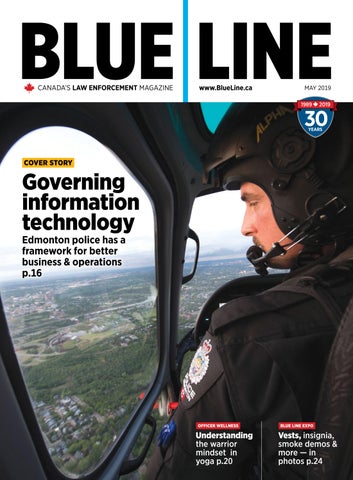
COVER STORY
Governing information technology Edmonton police has a framework for better business & operations p.16
OFFICER WELLNESS
BLUE LINE EXPO
Understanding the warrior mindset in yoga p.20
Vests, insignia, smoke demos & more — in photos p.24
WORKING TOGETHER WORKS BETTER In an emergency*, an OnStar® Emergency-Certified Advisor is available to help first responders 24 hours a day. Certified by the International Academies of Emergency Dispatch, these Advisors can provide certain types of critical assistance to OnStar Members until they arrive. LEARN MORE AT: onstar.ca
*OnStar acts as a link to existing emergency service providers. Available if customer has an active Safety & Security plan. ©2019 General Motors of Canada Company. All rights reserved.
Contents
24 May 2019 Volume 31 Number 5
Features
Columns 4 10 12 13 14 25 26 30
Editor’s commentary Q&A Health & wellness Holding the line Behavioural sciences Case Law Technology Back of the book
COVER STORY
16 Governing information technology in 2019: a roadmap The Informatics team at Edmonton Police Service has adopted a globally accepted governance framework as a way to guide its business development and continuous improvement activities. By David Schneider
20 Mindset of a warrior
In order for yoga to be successful in the culture of law enforcement, there needs to be a re-education on what traditional yoga is. By Olivia Mead
22 Forensic mechanics
Departments 5 5 8 8 27 28 29 30
By the numbers News Calendar Dispatches Off the shelf Product showcase Marketplace Blue Links
A set of best-practices used to fully and scientifically evaluate the state of a vehicle at a collision has changed officer reporting and testifying. By Peggy Staruch
24 Blue Line Expo 2019 in review
COVER PHOTO: EDMONTON POLICE SERVICE
Check out the photos from Canada’s premier event for law enforcement.
10 @Blue_LineMag
20
22 May 2019 | BLUE LINE
3
EDITOR’S COMMENTARY BY RENÉE FRANCOEUR
BLUE LINE www.BlueLine.ca
If you had to pick a crime drama...
U
p until this spring, I had never structures ranks, following a federal corwatched a single episode of ruption case. The Wire. From what I had Given that The Wire was co-created by a heard, starting the American Baltimore homicide detective, Ed Burns, crime drama series would be a pretty big I’m even more anxious now to start concommitment. According to The Telegraph, necting dots and get a start on season two. this wasn’t something you could throw on In more local waters, I see the Canadian in the background while cooking dinner. drama The Murders has aired. Shot and set This was Russian novel-like — deep con- in Vancouver, it follows a female protagtent full of long character development, onist whose negligence is the cause of a plot twists and sudden, shattering revela- fellow officer’s death. I’m curious to see tions. You had to pay attention. It wasn’t what uniquely 2019 lens it adds to the “cop going to come easy. show” genre and if The Wire inMoreover, I wonder if my pre- Shot and set fluenced it at all. Were actual Blue Line self would have appre- in Vancouver, police consulted on plotlines? ciated the show. After a couple The Murders How real does it get? years of speaking with so many follows a Speaking of real, sure, is The of you and hearing about the female Wire depressing? Yes. Still relchallenges, the shrinking silos, protagonist evant and necessary? Yes, bethe surge in data — as well as whose cause of what it reveals about some of the impressive training negligence is perpetuated poverty (not my updates, research and other vic- the cause of term), the palpable struggle tories in modern-day Canadian a fellow against the system from a plethpolicing — I feel deeply yoked to officer’s ora of perspectives and histories, those who risk their lives to death. and overall survival. These issues protect the public. I think it’s a did not and do not exist in a connection that has me more alert, more vacuum; they exist nationally, as Simon critical and more mindful of the nuances said, and they still exist internationally. of the show. The advancements in police work are I only just finished season one, but I’m worth noting, considering the presence of hooked. And if you’ve been a long-time payphone wiretapping on the show and the Wire devotee, you know it’s the gritty, real difficulty discovered there in securing the portrayal of life in the layers of post-indus- buy-in for such a project. How things have trial Baltimore, Md. that beguiles you into changed for policing and technology since binge watching. As the show’s creator 2002, when the first episode aired... Now, David Simon was reported saying, The I’m elbow deep in studies on facial recogWire is so much more than a cop show, it’s nition software for smart cities, and guna story about “the triumph of capitalism shot detection technology, as we discuss over human value;” and as a chronicle of on page 26. We’re talking artificial intelli“the decline of the American empire.” gence to triage evidence, tower dumps and Baltimore law enforcement made an inconspicuously nodding, when the need appearance in the eNewsletters I subscribe arises, to IMSI (International Mobile to again recently — Baltimore Police Subscriber Identity) catcher technology, Comm. Michael Harrison was hired in which “pretends to be a cellphone tower January, sworn in this spring and wel- to attract nearby cell signals so it can comed his first batch of new graduates, intercept the unique ID number associatincluding three school police officers, in ed with the phone.” April. He told the Baltimore Sun, the police I wonder what tech we will see in The department is one “the country is watch- Murders and what The Wire’s Det. Jimmy ing,” as it implements reforms and re- McNulty would make of all that.
CONNECT WITH BLUE LINE
www.BlueLine.ca 4
@Blue_LineMag
BLUE LINE | May 2019
www.facebook.com/BlueLineMagazine
GROUP PUBLISHER | MARTIN MCANULTY mmcanulty@annexbusinessmedia.com EDITOR | RENÉE FRANCOEUR rfrancoeur@annexbusinessmedia.com ACCOUNT MANAGER | JANICE EATON janice@blueline.ca MEDIA DESIGNER | SVETLANA AVRUTIN savrutin@annexbusinessmedia.com ACCOUNT COORDINATOR | TRISH RAMSAY tramsay@annexbusinessmedia.com CIRCULATION MANAGER | BEATA OLECHNOWICZ bolechnowicz@annexbusinessmedia.com Tel: 416-442-5600 ext. 3543 COO | SCOTT JAMIESON sjamieson@annexbusinessmedia.com PRESIDENT & CEO | MIKE FREDERICKS ANNEX BUSINESS MEDIA 111 Gordon Baker Road, Suite 400 Toronto, ON M2H 3R1 Tel. 416-442-5600 • Fax 416-442-2191
Publication Mail Agreement No. 40065710 ISSN 0847-8538 Printed in Canada SUBSCRIPTION RATES Canada — 1 Year $31.50; 2 Year $52.50 plus tax USA — 1 Year $105.00 USD CIRCULATION email: asingh@annexbusinessmedia.com Tel: 416-442-5600 ext 3553; Fax: 416-510-6875 or 416-442-2191 Mail: 111 Gordon Baker Road, Suite 400, Toronto, ON M2H 3R1 Occasionally, Blue Line will mail information on behalf of industry-related groups whose products and services we believe may be of interest to you. If you prefer not to receive this information, please contact our circulation department in any of the four ways listed above. Annex Privacy Officer Privacy@annexbusinessmedia.com; Tel: 800-668-2374 © 2019 Annex Publishing & Printing Inc. All rights reserved. Printed in Canada. No part of the editorial content of this publication may be reprinted without the publisher’s written permission. Opinions expressed in this magazine are not necessarily those of the editor or the publisher. No liability is assumed for errors or omissions. Readers are cautioned and advised that articles presented herein are edited and supplied for your personal awareness and should not be used for further action until appropriate guidance is received from a supervisor, Crown Attorney or other persons in authority. All advertising is subject to the publisher’s approval. Such approval does not imply any endorsement of the products or services advertised. The publisher reserves the right to refuse advertising that does not meet the standards of this publication.
NEWS
PHOTO: HOMEWOOD HEALTH
VANCOUVER ISLAND
Homewood Ravensview mental health centre opening this May
Homewood Ravensview, part of Homewood Health, is set to begin providing inpatient treatment for mental health, addiction and concurrent conditions on May 22, 2019, on Vancouver Island’s Saanich Peninsula in British Columbia. “When we open the doors in May,” said Homewood Health president and CEO Jagoda Pike, “Homewood Ravensview will immediately become the most comprehensive private mental health and addiction treatment centre in Western Canada. We’ve recruited an experienced and highly credentialed team to oversee treatment programs based on 135-years of Homewood excellence combined with the latest in evidence-based innovation.” Homewood Ravensview, with 75 beds and set to employ more than 80 full-time staff, is located on 28-acres of forested hillside and focuses on creating individualized client experiences. It features forest and ocean views from private and semi-private bedrooms, suites and welcoming common areas. Dr. Lyn MacBeath, the founding medical director at Homewood Ravensview, said, “Our programs are truly unique in Canada. Our Guardians program for first responders and
members of the military – both active duty and veterans – is designed specifically for the challenges these real-life heroes face.” Ravensview accepts referrals from medical or healthcare professionals, but a referral is not necessary for treatment. Anyone interested in learning more about Ravensview programs or self-admission should visit ravensview.com or call 1-866-203-1793. A formal opening ceremony will take place in June. CANADA
Government of Canada launches action plan on Post-Traumatic Stress Injuries The Minister of Public Safety and Emergency Preparedness, Ralph Goodale, and the Minister of Health, Ginette Petitpas Taylor, have announced the release of Supporting Canada’s Public Safety Personnel: An Action Plan on Post-Traumatic Stress Injuries. The Action Plan will “support research, prevention, early intervention, stigma-reduction, care and treatment for all types of public safety personnel, all across the country.” Public safety personnel is a term that broadly encompasses frontline personnel
who ensure the safety and security of Canadians across all jurisdictions. Examples can include: Tri-Services (police – including the Royal Canadian Mounted Police, firefighters, and paramedics), correctional employees, border services personnel, operational and intelligence personnel, search and rescue personnel, Indigenous emergency managers, and dispatch personnel. “In addition to the general workplace stressors that affect everyone, police personnel are exposed to a unique and difficult set of job-related hazards. It is essential to change how we think, prevent, treat and respond to mental health and wellness concerns within policing and the broader first responder community,” said Chief Const. Adam Palmer, president of the Canadian Association of Chiefs of Police (CACP). The Canadian government says it is investing $20 million over five years to support a new National Research Consortium on PTSI among public safety personnel between the Canadian Institutes of Health Research (CIHR) and the Canadian Institute for Public Safety Research and Treatment (CIPSRT), of which $11 million in grant funding has already been announced. The government says it is also investing $10 million over five years, starting in 2018-19, for an Internet-based Cognitive Behavioural Therapy pilot to provide greater access to care and treatment for public safety personnel, especially in rural and remote areas. Another $10 million is to go toward a longitudinal study of the mental health of new RCMP recruits. This study will help develop appropriate mental wellness and remedial strategies for the force and other emergency response organizations, the feds announced. Read the full action plan at bit.ly/2I9kxkb.
BY THE NUMBERS
Statistics Canada found an increase in the average number of charges per court case in 2016/2017. It released more data at the end of January 2019 on the number of cases and charges completed in adult criminal and youth courts in Canada for 2016/17. View the charts at bit.ly/2UxYSb3.
124
days is the median length of time taken to complete a charge in adult criminal court, rising 10 per cent compared to 2015/16
@Blue_LineMag
106
days is the median length of time taken to complete a charge in youth court, rising seven per cent compared to 2015/16
1.2 29,000
million charges from 358,000 cases were completed in adult criminal court in Canada in 2016/17
youth court cases, involving in excess of 110,000 charges, were completed in in 2016/17
May 2019 | BLUE LINE
5
NEWS BRANDON
More than two dozen students begin First Nations Safety Officer program at Assiniboine
More than 24 students from 14 First Nations communities, one-third of them female and some from more than 1,000 km north of Brandon, Man., began training on April 1 in the First Nations Safety Officer (FNSO) program at Assiniboine Community College. Many of the students said they wanted to give back to their communities by helping to make them safer. Being from the community will help increase respect for the law, many agreed. Drew Courchene was raised in Winnipeg, but Sagkeeng First Nation is his home community. “In a way, I want to get back in touch with my traditional ways, through this job. The program is perfect, because I think communities feel more comfortable with actual members from the community that they know enforcing the laws and keeping them safe,” he said. Assiniboine began offering provincially-approved mandatory training for First Nations and community safety officers in January 2016. More than 220 students have successfully completed this training since then. Once their three-week training program is complete, officers are responsible for crime prevention, enforcing band bylaws and some specific provincial laws. Jack Ewatski, former chief of the Winnipeg Police Service, facilitates the program. Last year, Ewatski received an award for his work on the program from the Westman Chapter of the Interprovincial Association on Native Employment. “The First Nations Safety Officer program has proven to be an effective addition to
Drew Courchene (left) of Sagkeeng First Nation, Bishop Ray Bighetty of Nelson House, and Kenneth Courchene, also of Sagkeeng First Nation, have enrolled in the First Nations Safety Officer program. PHOTO: ASSINIBOINE COMMUNITY COLLEGE
6
BLUE LINE | May 2019
Laurier students Harmeet Chauhan and Rahul Malhotra, Laurier business graduate Baltej Sandhu and University of Waterloo student Dastiger Khan, launched Guard-Ex in 2017. PHOTO: GUARD-EX
public safety services in First Nations communities throughout the province,” Ewatski said. “The training we provide gives the officers the knowledge and skills to perform their roles in assisting the police in their jurisdiction in creating and maintaining peace in the community.” WATERLOO
Laurier LaunchPad startup raises $1M for road-safety technology
Waterloo-based Guard-Ex, an impairment screening device startup company founded by participants in the Schlegel Centre for Entrepreneurship and Social Innovation’s LaunchPad incubator at Wilfrid Laurier University, has raised a $1 million CAD seed round. The four founders, Laurier students Harmeet Chauhan and Rahul Malhotra, Laurier business graduate Baltej Sandhu and University of Waterloo student Dastiger Khan, launched Guard-Ex in 2017 to address the need for an “accurate and unbiased roadside impairment screening device” for law enforcement. As opposed to traditional impairment screening methods, Guard-Ex takes an innovative approach by using physiological indicators such as eye movement and body temperature, rather than measuring chemicals from saliva or breath. Guard-Ex has developed a universal impairment screening device with the help of machine learning to screen for real-time impairment. Guard-Ex automates the manual process that is conducted by law enforcement officers today. According to Guard-Ex, every year nearly $30 million tax payer dollars are spent by the
Canadian government on people contesting impaired driving charges due to lack of evidence. With the legalization of cannabis, this situation is expected to increase. “We are excited to close our seed round... allowing us to intensively speed up our product development and research to hit the market sooner than projected,” said Khan, CEO of Guard-Ex. The Guard-Ex founders are looking to complete their prototyping and commercialization process within the next year. They are working with the Laurier Centre for Cognitive Neuroscience and University of Waterloo’s School of Optometry and Vision Science. They have also presented their prototype to the Ontario Association of Chiefs of Police and are working on getting signed MOUs to conduct a pilot program to test their device roadside. WOODSTOCK
Woodstock Police Service mourns loss of constable to ALS
After a brave two-year battle against the degenerative neurological disease ALS, also known as Lou Gehrig’s disease, Woodstock Police Const. Jason Geerts was laid to rest in March. Jason Geerts PHOTO: WOODSTOCK “Jason was one of POLICE SERVICE those unique individuals, so full of life and spirit,” said Woodstock Police Chief Bill Renton. “He had the most infectious, loud laugh and persona. You certainly knew when he was in the building.” Geerts’ upbeat and positive attitude was evident in every aspect of his life. He will be remembered for the passion and dedication www.BlueLine.ca
NEWS he had towards his job in policing and serving his community. More importantly, he will be remembered as a husband to his wife of nine years, Brandie, and as a father to his two sons, Ethan and Brody, ages seven and six. Geerts was surrounded by his closest friends and family when he passed away, according to Guelph Police Service, which was the service where his career started. He was also a member of the Canadian Forces Naval Reserve for 12 years before retiring in 2014. He was promoted to detective in 2016, just before receiving his ALS diagnosis. Hundreds of police officers and community members attended his funeral to share their memories and to pay their condolences. “He’s going to be missed by many,” Renton continued. “Just the [funeral] service alone is a true testament to the depth of the love and respect he had from so many people.” - Landen Kruger
“The addition of the UAV will be of great assistance to our members and improve investigation outcomes,” said Fredericton Police Chief Leanne Fitch, right. PHOTO: FPF The drone is expected to be operational in June. CANADA
All engines go: Memorial Grant Program for First Responders formally accepting applications
awarded the contract to administer the grant. Trained specialists are available to guide applicants through the process, and applications can be submitted either online or in person at service locations across Canada. More on this program here: memorialgrant.ca.
FREDERICTON
DELTA
Police receive donation of Unmanned Aerial Vehicle
Delta Police moving to Gen 5 Glock pistols
The Fredericton Police Force (FPF) now has a new tool to assist with investigations thanks to the generous donation of a citizen. Stephen Costello, an entrepreneur originally of Fredericton, donated one of his company’s Aeryon Unmanned Aerial Vehicles (UAVs) to the FPF because of his connection to his hometown. His engineering company, Costello Associates Inc., uses UAVs for utility inspections. “The system being donated was under-utilized at Costello,” Costello said. “I had high-level discussions with Fredericton Police to see if there was interest in having a system donated.” In addition to the used UAV, Costello is donating the cost of training on the UAV by its manufacturer Aeryon. The new FPF UAV will assist with searches for missing persons, river rescue and collision scene imagery and analysis. The force noted it had been planning to acquire a UAV for several years. Six FPF members will be trained as UAV pilots and undertake the necessary Transport Canada testing and examinations. A UAV usage policy will also be developed respecting Transport Canada regulations and all laws. The FPF also ensured existing policies around gifts were met before accepting the donation. @Blue_LineMag
After months of delays, the Government of Canada’s Memorial Grant Program for First Responders, first established last year, is now fully operational online and formally accepting applications. At his opening remarks at the Canadian Police Association’s 2019 Legislative Conference, the Minister of Public Safety and Emergency Preparedness, Ralph Goodale, highlighted the new federal grant program that recognizes the service and sacrifice of first responders who die as a direct result of carrying out their duties. Since the launch on April 1, 2018, tax-free Memorial Grants have been given to the families of 19 first responders who died as a result of their duties. A further 53 applications are in process. “As you know, this program provides a one-time, tax-free payment of $300,000 to the family of an eligible first responder who dies as a result of his/her duties,” Goodale said. “That includes deaths resulting from occupational illness or psychological impairment, as well as catastrophic incidents.” Raymond Chabot Grant Thornton was
A local newspaper in Delta, B.C. broke news of the Delta Police Department’s new handguns this year after the approval came from city council at the end of January. “City council approved the purchase of 120 Generation 5 Glock 9-mm handguns for the Delta Police Department, awarding the contract of $86,567 to Rampart International,” the article reads. Deputy Chief Norm Lipinski confirmed to Blue Line that “this spring Delta Police is moving to the Gen 5 9mm caliber Glock pistol, replacing its Glock Model 22, Gen 3, which is about 14 years old on average.” He said, “the 9mm offers many advantages, including that it fits our existing holsters and magazine pouches, and uses many of the same replacement parts we currently have in our inventory.” In addition, he said the 9mm platform has “less recoil and allows for better accuracy. That means our police department can spend less time on remedial training and more time on tactics at the range.” The North Delta Reporter also reported the Rampart contract includes the addition of Trijicon night sights for the Glocks.
Visit www.BlueLine.ca for the latest news, stories, products, videos, photo galleries and industry events.
May 2019 | BLUE LINE
7
NEWS DISPATCHES London Police Chief John Pare is retiring this June after 33 years in law enforcement. He was sworn in as London’s 19th police chief in May 2015 and spent 29 years with the service plus three with LaSalle Police Service. He also served as a past vice-president of the Ontario Association of Chiefs of Police. Roland Morrison has been appointed chief of Nishnawbe Aski Police Service. Morrison was the acting chief of police since September 2018, following the retirement announcement of former Chief of Police Terry Armstrong. Morrison was born and raised in Moose Factory, Ont., and is a proud member of the Chapleau Cree First Nation. He attended post-secondary education at Sir Sanford Fleming College in Peterborough, Ont. before joining the Nishnawbe Aski Police Service. Prior to his current appointment, he spent six years as the deputy chief of police in charge of operations. Niagara Regional Police Staff Sgt. Sandy Staniforth has received the Canadian Critical Incident Stress Foundation Award of Excellence for her work in leading Niagara Police Service’s Member Support Unit. Ottawa Police Service has promoted Debbie Miller to the role of inspector. Miller joined the Ottawa Police Service in 1994 to become one of the first five black women police officers hired. In 2003, she was assigned to develop a policy position on the issue of media violence and its impact on youth and children. Her proposal was accepted, marking the first time in Canada a police organization was publicly addressing the issue of media violence. In 2008, while she was seconded to the RCMP, she also collaborated with the International Youth Advisory Congress on a national strategy which focused on Online Safety and Security for youth. Toronto Police Insp. Sonia Thomas, who made history in 2010 by becoming the service’s first Black female senior officer, has retired. She joined the Toronto force in 1986, starting at 13 Division in the Primary Response Unit. Thomas worked at headquar8
BLUE LINE | May 2019
CALENDAR ters in the recruitment office and at 54 Division before being promoted to sergeant in 2001 and staff sergeant six years later. She was the recipient of a Lifetime Achievement Award at the International Women Achievers Awards (IWAA) ceremony in 2018. With Thomas retired, Stacy Clarke – who was promoted to inspector in January – is the service’s only Black female senior officer. Insp. Darryl Brown was promoted to the rank of deputy chief at Kentville Police Service in Nova Scotia. He has been with KPS for 31 years.
Deputy chief Scott Tod (photo) is North Bay’s new police chief, replacing Shawn Devine, who is resigning after nearly four years in the role to take on a position as the executive director of the Ontario Police Technology Information Co-operative (OPTIC). Devine began his policing career with the North Bay Police Service as a constable in 1988. In 2009, Devine was seconded to the Royal Canadian Mounted Police’s Integrated Security Unit for the G8/G20 Summits and the Governor General recognized him in 2016 as a Member of the Order of Merit of the Police Forces. Tod has been deputy chief since January 2016. He left the OPP after 33 years of service, lastly as deputy commissioner of the Organized Crime and Investigations Command. Maj. Lisa Clark was the head Canadian military police officer (Provost Marshall) serving in Hawaii during the Rim of the Pacific (RIMPAC) Exercise 2018, which is known as the world’s largest international maritime warfare exercise. During RIMPAC 2018, Clark received her Canadian Forces’ Decoration (CD) from the command team of the National Command and Support Element. The Canadian Armed Forces award a CD to members who have completed 12 years of good and loyal service. Born in Woodstock, Ont., Clark is the commanding officer for both the Military Police Unit at Canadian Forces Base Esquimalt and the Canadian Forces Maritime Experimental and Test Ranges.
Canadian Police Canine Association’s National Handler Development Seminar May 27-30, 2019 Halifax, N.S. www.canadianpolicecanine.com 27th Forensic Training Conference May 28-31, 2019 Toronto, Ont. www.torontopolice.on.ca/seminars/ forensic Ontario Association of Crime Stoppers Annual Training Conference May 30-June 2, 2019 Windsor, Ont. ontariocrimestoppers.ca International Association of Crime Analysts Symposium June 3-5, 2019 Calgary, Alta. iaca.net CAPE Annual Conference June 4-6, 2019 Quebec City, Que. cape-educators.ca Crisis Communications Conference June 6-7, 2019 Ottawa, Ont. bit.ly/2XofnVW World Maritime Rescue Congress 2019 June 15-18, 2019 Vancouver, B.C. www.wmrc2019.com 2nd World LGBTQ Conference for Criminal Justice Professionals June 19-21, 2019 Toronto, Ont. www.proudtobeyourfriend.org LEOSH 2019 Conference June 19-21, 2019 Niagara-On-The-Lake, Ont. www.leosh.org/conference-2019 Leading Complex Systems Retreat June 24-28, 2019 Halifax, N.S. secure.royalroads.ca/cscourses
www.BlueLine.ca
NEW E-COMMERCE WEBSITE AT WWW.DISTRIBUTIONELITECANADA.COM
DOWNLOAD OUR LATEST 400+ PAGES CATALOG HERE !
FEATURED PRODUCT
FN 509
®
1 MILLION ROUNDS OF TESTING IS
NOW AVAILABLE IN CANADA
Experience the intuitive grip angle, enhanced grip texture, and incredible recoil control. The handgun always points naturally and stays on target for fast, accurate follow-up shots. It’s the handgun you’d expect to come from the makers of the world’s most battle-proven firearms.
Loaded chamber indicator
Interchangeable backstraps
Restricted 4.25" barrel & tactical models available through our Elite Personal Purchase Program* !
Fixed 3-dot luminescent sight or night sight Ambidextrous slide stop lever & magazine release
Other FN 509 models also available :
Trigger Reset *FN 509 4.25" Barrel
*FN 509 Tactical BLK
*FN 509 Tactical FDE
CONTACT US FOR AGENCY TRIAL !
FN 509 Midsize
FN 509 Training Pistol
FN 509 Simmunition
74, rue Goodfellow, bur 110, Delson (QC) J5B 1V4 T 450 874-0917 T 1 888 674-5113 info@distributionelitecanada.com www.distributionELITEcanada.com
Q&A
BY LANDEN KRUGER
The Wikwemikong Tribal Police Service (WTPS) is a unique Indigenous policing service, serving Canada’s only officially recognized Unceded Territory — Wiikwemkoong on Manitoulin Island in Ontario. Terry McCaffrey was appointed chief of police for WTPS last summer. He recently signed a new protocol with the local health centre and tells Blue Line the future is looking bright. Q: You have more than 20 years of policing experience across Canada in various First Nations communities. What lessons have you have learned along the way?
It’s a large subdivision; we were looking after about 40-50 officers plus support staff. I had a lot of different positions there, such as the Information Technology division supervisor, the Officer in Charge of Records Management, as well as overseeing professional standards, the Crime Unit and Drug Unit operations. Having all those different roles and responsibilities really honed my skills in various areas and gave me the ability to move on and run the organization. There was also a lot of mentorship provided to me. Not only by the senior command staff, but also the officers at every level and the civilians at every level. Every person in the organization is someone you can derive knowledge from. Even though traditionally, police services have a ranked structure, it’s so important when we are working together that we are all on the same level.
I’m in my 23rd year of policing now. I’ve had family members and mentors that have led me down this road of providing safety and security for First Nations communities. When I first started, it was a very different time in First Nations policing. We did not have wage parity and the working conditions were not the same as other partners in the RCMP and Ontario Provincial Police (OPP), but we made do and looked after each other. What I have found in my career is that it does not matter which First Nations community you go to; everyone is different. Everyone is unique. You have to go into everything with an open mind and you can’t treat every situation the same.
There is a lot of training that goes into becoming a crisis negotiator. You need to build off of past experiences and work with your team. You can’t just go in alone and try to talk a person out of a crazy situation. In some cases, a tactical response is needed, but in most cases we’re able to use our behavioural procedures to bring that person out of the crisis in their mind and back to thinking 10
BLUE LINE | May 2019
Q: How has your first year as police chief progressed? logically, having them surrender in a peaceful way. Seeing all the different elements of policing and crisis response come together and work as one in a relatively seamless way is one of the most powerful things I was able to take away.
Q: Before your appointment to chief of police, you were the detachment commander for the North Subdivision of Treaty Three Police Service. How did that prepare you for your current role?
Visit wikwemikongpolice.ca for more on the service’s history.
Wiikwemkoong is one of the most vibrant, welcoming, caring communities I’ve had the privilege to work for. My family and I have been welcomed into the community with open arms. I firmly believe in principles in policing; you know the police are people and people are the police. It’s important that no matter where I go in policing, that the community I’m in becomes my community. And everyone knows that is my philosophy.
Q: What have been some of the biggest obstacles? www.BlueLine.ca
PHOTO: WIKWEMIKONG TRIBAL POLICE SERVICE
Q: You worked closely with the OPP regional team for more than 10 years — as a detective constable, frontline officer and as a crisis negotiator. What were those experiences like?
The biggest obstacle, and it’s been the same throughout my career, is First Nations policing in general is viewed as a policing program. Policing should not be a program. Policing needs to be an essential service the community needs to provide safety and security for their people. It should be no different from the need for policing in the City of Toronto or another small municipality. So, because First Nations policing is viewed as a program, there are differences in funding and how that funding is released, and it’s at a lower level than what a non-First Nations police service would receive.
Q: How has the approach to First Nations policing evolved since you began your career?
We have come a long way; from always working alone in very substandard, sometimes dangerous conditions, to now having, in Ontario, wage-parity — soon to be legislated through the new comprehensive Police Services Act. In my belief, and in many First Nations police chiefs’ beliefs, this will take us to the next level in providing safety and security for our communities.
Q: Where is there still room for improvement?
It really comes down to human resources and funding. When you look at the stats from First Nations com-
Policing should not be a program. Policing needs to be an essential service that the community needs to provide safety and security for their people. munities, which are provided to Stats Canada, we are over-represented when it comes to cases with a high crime severity index, high levels of violence and higher than normal levels of crime. You would think that we would be able to focus more resources on that, but because we are set up as a program, it’s not the same. As someone who has not only been working in First Nations policing for his entire career, but who is also an Indigenous man and grew up in an Indigenous community in northern Manitoba, it’s alarming for me. It’s time First Nations communities are provided the same kind of safety and security as every other Canadian community.
Q: A new protocol was signed with the local health centre in Wiikwemkoong in response to a mental health crisis. Why was this important?
It was very noticeable that we were spending a lot of time dealing with mental health crisis calls. We know this protocol model works. It works in cities, towns and in First Nations communities. We are able to partner with mental health crisis teams to ensure people get the help they need.
Snapshot of the Wikwemikong Tribal Police Service
Ontario Provincial Police takes over the responsibility for overseeing policing
They don’t need a police officer. They require the care that only a mental health specialist can offer. There’s a lot of training that goes into teaching our officers how to deal with mental health, but they can never be experts. By signing this protocol, we are already starting to see a decrease in instances where officers are needing to be at a hospital or spending time transporting individuals to the hospital. So, we are tackling the root of the problem as opposed to putting a band-aid on it.
1994
Q: What are your future plans with the WTPS?
1940s
Formal policing by Wikwemikong constables starts
1960s
The Wikwemikong Tribal Police Service (WTPS) sign a Stand Alone Policing Agreement
2001
WTPS is incorporated and is represented by the Wikwemikong Police Service Board Corp.
I must say, the future is looking bright. I would like to see us having more human resources, to be able to provide 24-hour policing to our community, which is much needed considering we are one of Canada’s highest crime severity indexes. I would like to partner with the Ministry of the Attorney General’s office to arrange proper court facilities so we can deal with our cases in a safe and effective environment. We don’t want to see more of our people displaced in detention centres two hours away. I also want a formalized wellness plan created and implemented for our police service that includes our culture, language and traditions. This will include having elders on staff with emotional and spiritual needs of our officers and staff.
Are you receiving
News Week? Subscribe today! www.blueline.ca
@Blue_LineMag
May 2019 | BLUE LINE
11
HEALTH & WELLNESS BY ISABELLE SAUVE
Psychological triggers: awareness and impact
R
esearch suggests approximately one in 10 Canadians will develop Post Traumatic Stress Disorder (PTSD) at some point in their lives. If the term PTSD is commonly used to define a psychological condition triggered by one or repeated stressful, traumatic, or terrifying events; the term Occupational Stress Injury (OSI) defines persistent psychological difficulty resulting specifically from operational duties within emergency first response as well as combat and military operations. The heightened risk of developing OSI for first responders has been recognized and brought to the forefront of media and government attention. According to the Canadian Journal of Psychiatry, nearly 45 per cent of police, 911 operators, paramedics and firefighters screened positive for clinically significant symptom clusters with one or more mental disorders. No one is immune and PTSD expresses itself in various ways and degrees for everyone affected. Understanding how PTSD and OSI develop and manifest themselves is key to supporting fellow officers who may be affected. Overall, PTSD is a complex condition which can be prompted by a single traumatic event or over the course of a number of reoccurring traumatic events. There is no single pathway to developing PTSD symptoms. In fact, it can develop at any age and despite the absence of directly experiencing trauma. It can even appear years post incident. Trauma leaves a deep imprint on the brain, even more significantly than positive experiences. The brain stores sensory information during traumatic events as a means of self-preservation and protection. It attempts to keep from experiencing trauma to ensure survival. It stores memories to be better prepared to confront repeated threat or exposure to trauma. Consequently, those previously exposed to trauma can become hypervigilant. The human brain naturally chan12
BLUE LINE | May 2019
ges over time but is also affected by experiences and environment. When becoming a law enforcement officer, the interpretation of the world is altered. It requires and results in a change in the mental action or process of acquiring knowledge and understanding through thought, experience and the senses, also known as cognitive functions. First responders are exposed to extreme, abnormal and difficult situations. In addition to the outside world, many also face frustration with internal politics that can be harmful. All these stressors can become so overwhelming, officers lose their passion for the career they once loved. Change in affect or behaviour can be the initial and strongest signs of dysfunctional coping mechanism. It should be noted, however, some negative changes can be subtle and gradual. They often go unnoticed by those affected for a substantial period of time. Bringing up observations of change can assist coworkers in addressing potential problems as early as possible. The earlier an issue is addressed, the less likely it is to develop into a longterm or chronic issue. In addition to paying attention to potential changes, being aware of the impact of psychological triggers is essential. A trauma trigger is a stimulus that prompts recall of a previous traumatic experience, which causes one to feel strong
First responder culture must become one where it is acceptable to have normal reactions to abnormal situations...
negative emotions. The stimulus itself often is not dangerous or frightening in nature but can be overwhelming and harmful to the person affected. Triggers can be unpredictable, extremely powerful and incapacitating. Groups who share common trauma can also share common triggers. This is demonstrated in its most severe form by serial suicides where the suicide of one person creates a chain reaction. Triggers can cause a person to “relive” a certain traumatic event or period of time through flashbacks, nightmares and the replaying of memories. They can also cause strong emotional reactions such as anxiety, sadness, anger, numbness, guilt or shame. Unfortunately, it is common for those who experience traumatic events to avoid confronting the issue or facing related triggers. Research has shown avoidance of these triggers increases the likelihood of developing PTSD. Triggers resembling those of a stressful event can cause a strong emotional reaction similar to what was previously experienced. Some triggers are obvious, such as witnessing a death or serious collision, but some are not so obvious — viewing news coverage or a documentary, for example. In fact, a simple conversation alone can be a trigger. First responder culture must become one where it is acceptable to have normal reactions to abnormal situations and where each member is armed with the knowledge to help support others. Understanding how triggers can cause a great deal of damage and keeping an eye out for changes in coworkers can help keep one another safe and well. Isabelle Sauve is a 12-year veteran with the OPP, currently with the Lanark County Detachment. She has a MA in psychology and is a PhD candidate. She is also an ultramarathon/ endurance athlete and the Racing the Planet/4 Deserts 2018 Series winner as well as a Guinness World record holder.
www.BlueLine.ca
HOLDING THE LINE BY MICHELLE VINCENT
Non-profit resources for officers: no need to reinvent the wheel
I
n the world of policing, the stress our members experience is unlike that of any other profession. As such, mental health is a prominent aspect we all have to consider in this line of work. I am not sure what other profession out there expects their members to protect their communities, in the worst of scenarios, by taking a life in order to save other lives, and then expects that same police officer to then again save the life (on another level) that was intended to be taken. It takes a very special person to manage a riot and follow that up by providing mediation and mental health support in the next moment, all the while in uniform. Whether the officer has been exposed to extremes in a specific unit, or simply in the day-to-day of frontline and investigative activity involving many horrors most of us would never even consider dealing with, the fact remains the likelihood of mental health issues in this profession from sworn to civilian members is high. With the alarming rising number of police officers dying by suicide, there is a lot of pressure to relieve and reduce those numbers through mental health resources and solutions. While discussing personal experiences can be valuable in that it allows others not to feel alone, especially those with stories containing a positive outcome, seeking and developing effective resources for our members will come when we focus on the solution, not the problem. Mental health resources for first responders and civilian members are discussed repeatedly from a preventative and reactive perspective, and yet palpably implementing these resources is where we need to be going. There appear to be two foundational options when exploring these mental health resources. We have private and non-profit organizations, and each serve an essential piece in our wellbeing. Generally speaking, the private sector has one goal: to provide excellent service that will support its customers while profiting. When an organization has this approach, the overall focus is in the area of profit and not in the area of programming. While these kinds of organizations are an excellent option for those who have
the financial resources, there remains a gap in providing services to everyone. I would like to suggest that reinventing the wheel is not necessary here; we simply need to explore those more cost-efficient resources, for example: non-profits. Perhaps we need to redirect our focus on the existing non-profits that are working diligently already, often with active and/or retired police members as leaders. These are leaders who have walked in the very same shoes of those their organizations are seeking to assist: first responders in desperate need of mental health support. Let’s identify existing models that have demonstrated their effectiveness for first responders’ mental health and fund them to grow, as well as provide support for those who research effective methods. If we provided funding to these existing non-profits in the ways funding is provided
to researchers of the same vein, our members would have more immediate resources on hand for them. These non-profits would further demonstrate their commitment to first responder wellness with action because they are already in the business of providing care. They have the space, they’re open, they understand urgency — let’s give existing models and non-profits an opportunity to become more occupational-specific and better serve first responders. Michelle Vincent is a 17-year York Regional Police officer with a master of arts in counselling psychology and a background in equine-assisted therapy, workplace reintegration after a critical incident and long-term leave, as well as teaching. She is in the process of implementing the first non-profit treatment centre that will be occupationally specific for first responders and is working towards her PhD in Forensic Psychology/Crisis Response. She can be contacted at: michelle@vincent.net
May 2019 | BLUE LINE
@Blue_LineMag BL_Jan_Spirito.indd 1
13
2018-12-14 3:06 PM
BEHAVIOURAL SCIENCES BY PETER COLLINS
Incel: How an online subculture has led to violence against women
T
he term sexual celibate has been around for eons. Some people choose to be celibate for various reasons. Others are involuntarily celibate. Donnelly et al (2001) explored the development and maintenance of involuntary celibacy – persons desiring to have sex but unable to find partners.1 The social concept of involuntary celibacy started when a university student from Toronto established a website in 1993 called Alana’s Involuntary Celibacy Project. Her stated purpose was to discuss her sexual inactivity with others. The site was intended to foster an all-inclusive community to help people struggling to form relationships but was later co-opted by the current “incel” movement. Why should we be concerned about incels? The Southern Poverty Law Center (SPLC), a non-government not-for-profit organization that tracks all forms of hate groups in the United States, started to track male supremacy forums in 2012. It recognized how essential male supremacist ideas were associated with the rise of the so-called “alt-right” and formally added male supremacist groups to their “hate map” in 2017. These groups range from those utilizing websites on “how to pick up women” to incel forums. But it’s not just about sex. It’s about the women supposedly withholding it. According to the SPLC, the incel’s underlying belief is that women owe men sex; women exist purely for their reproductive and sexual capabilities; and men should dominate women.2 Men are entitled to sex as a basic human right. Incels perceive involuntary celibacy as an injustice and blame women for cruelty, superficiality and fickleness. The “Incel Rebellion,” also called the “Beta Uprising,” refers to incels’ hoped-for vengeance against society, in particular those who are having sex.
14
BLUE LINE | May 2019
The incel subculture
Not unlike other subcultures, incels have their own language: femoid is a general term for females; a stacy or roasty refers to an attractive, sexually active female; a becky is a less attractive female; chads or tyrones are the sexually active alpha males. Incels believe that over the past number of decades women have become highly promiscuous and that the fewer-in-number handsome and attractive chads have all the stacies. They also believe that social media helps the chads with appearance-focused dating sites and apps.
Incel hatred and violence
A review of incel website postings indicates that as well as being misogynistic, the postings are also racist and homophobic.3 The dehumanization of women and the incitement of violence towards women is a common topic. A number of violent incidents, in North America, have been perpetrated by self-identified incels. In 2014, in the small college community of Isla Vista, Calif., a 22-year-old by the name of Eliot Rodger stabbed or shot to death six college students and wounded 14 others. He left a 137-page autobiographical “manifesto” and social media posts detailing his involuntary celibacy and
hatred of women who he wanted to punish for rejecting him.4 He had been a member of PUAHate, an involuntary celibacy community short for “pick-up artist hate.” Rodger videotaped himself stating, “tomorrow is the day of retribution... a day of which I will have my revenge against all of humanity... I will slaughter every single spoiled stuck-up blonde slut... You will finally see I’m the superior one. The true alpha male.” In the years before he entered a yoga studio in Tallahassee, Fla., Scott Beierle was posting YouTube videos calling women “whores” and “sluts.” The rise of He killed two women and wounded the incel five others in that November 2018 community is incident. Beierle also mentioned another Eliot Rodger in his postings. example of Prior to the horrific vehicle attack online in Toronto, Ont., it is alleged 25-yearradicalization old Alek Minassian paid homage on and social media to Eliot Rodger shortly extremism. before driving down a busy sidewalk, killing 10 and wounding many others. Minassian posted that “the incel rebellion has already begun. We will overthrow the Chads and Stacys! All hail the Supreme Gentleman Eliott (sic) Rodger,” before the attack. Rodger continues to be a hero on incel forums, as does Minassian. Rodger is a “hERo” and Minassian an “AMazing hERo” — emphasizing www.BlueLine.ca
INTRODUCING
THE SAINT
TM
their initials and continuing to inspire others to attack chads and stacies. The anniversary of his crimes is also referred to as St. Elliot Day. Overall, alt-right hate groups pose far greater threat than radical Islamic terrorism in North America. Diagnostically, these perpetrators have been said to have likely met the criteria for depression and/ or narcissist personality disorder. Many of them are said to be on the autism spectrum. Given the planning and deliberation of their violent acts, they are likely not candidates for a not criminally responsible defence. The rise of the incel community is another example of online radicalization and extremism. According to an online law enforcement forum that recently examined the increased threat of the incel community, the tracking of these online activities “comes with all of the same challenges as monitoring and investigatWWW.OFFTHEX.CA ing any radical ideology or criminal element on the web – the vastness of the SALES@OFFTHEX.CA internet and the impermanence of con877-751-5953 tent posted on sites like 4chan makes it © 2019 MADE IN CANADA hard to thwart attacks or differentiate real violence from fantasy.”5 Tech companies’ efforts to curtail this BL_May_OffTheX.indd 1 2019-04-16 10:07 AM type of online behaviour vary depending DALHOUSIE’S CERTIFICATE IN POLICE LEADERSHIP on the platform, as does their level of co-operation with law enforcement. I Become the leader you know you can be expect we will see more violence in the name of incel.
Remotely Operable Automated Breacher The future of breaching technology
References
1 Jaki, S., De Smedt, T., Gwóźdź, M., Panchal, R., Rosaa, A., & De Pauw, G. (2018) Online hatred of women in the incels.me forum: linguistic analysis and automatic detection (2018) organisms.be/downloads/ incels.pdf 2 www.splcenter.org/news/2018/05/04/weekendread-incels-its-not-about-sex-its-about-women 3 Jaki, S., De Smedt, T., Gwóźdź, M., Panchal, R., Rosaa, A., & De Pauw, G. (2018) Online hatred of women in the incels.me forum: linguistic analysis and automatic detection (2018) organisms.be/downloads/ incels.pdf 4 White, S. (2017) Case Study: The Isla Vista Campus Community Mass Murder. Journal of Threat Assessment & Management. Vol. 4, No. 1 pp. 20-47. 5 PoliceOne.com (November 27, 2018) www. policeone.com/mass-casualty/articles/482200006-5things-to-know-about-incels/
Dr. Peter Collins is the Operational Forensic Psychiatrist with the Ontario Provincial Police’s Criminal Behaviour Analysis Unit. He is also a member of the crisis/hostage negotiation team of the Toronto Police Service. His opinions are his own and not necessarily the opinion of the OPP, CAMH, University of Toronto or his mother.
@Blue_LineMag
Built for modern policing, our online courses, designed and delivered by industry leaders and experts, give you the knowledge and skills to advance in your profession. Learn from the innovator in quality police education for over 25 years. DAL.CA/POLICELEADERSHIP Fall Term starts September 5
CCE
College of Continuing Education
COVER STORY
Governing information technology in 2019: a roadmap Edmonton Police Service shares its framework for making effective IT investment decisions By David Schneider ogy change will actually improve the effectiveness of an organization? How do we differentiate between changes that are truly necessary or simply “nice” to have? To address these questions, the Edmonton Police Service’s (EPS) Informatics team has adopted a globally accepted governance framework as a way to guide its business development and continuous improvement activities. After two and a half years of planning and
2,600
plus police officers & civilian support employees at EPS
“IT governance is essential for any large organization that has multiple teams and multiple priorities. The word itself gives a connotation of rules, but it’s actually guidance — a set of principles and processes that enables the mitigation of risk while maximizing the quality and enhancing the delivery of IT services.” - Vivianna Botticelli, Edmonton Police Commission 16
BLUE LINE | May 2019
implementation, their effort and success has been recognized by one of the top audit firms in the world, and the impact has been felt throughout the organization. What exactly is an “IT governance framework?” The Edmonton Police Commission’s (EPC) chief internal auditor, Vivianna Botticelli, states: “IT governance is essential for any large organization that has multiple teams and multiple priorities. The word itself gives a connotation of rules, but it’s actually guidance — a set of principles and processes that enables the mitigation of risk while maximizing the quality and enhancing the delivery of IT services.”
The business of policing
With over 2,600 police officers and civilian support employees, the EPS’s mission is “to increase public safety through excellence in the prevention, intervention and suppression of crime and disorder.” Within the EPS, the Informatics Division is responsible for technolwww.BlueLine.ca
PHOTOS: EDMONTON POLICE SERVICE
T
he world is changing and nowhere is this more evident than in the field of information technology. Hardware and software advances are forcing organizations to rethink how to operate, advance and take advantage of their information technology (IT) services to meet the evolving demands of their client base. But is all of this change necessary? How do we determine if a technol-
“Continuous modernization of technology, systems and security are critical to our effectiveness as police officers,” says EPS Chief Dale McFee.
ogy, information, evidence and security. As these key areas continue to change and grow, the division is focused on harnessing technology, connectivity and data to: • Anticipate trends within federal and regional policing • Leverage smart, connected hardware and systems to give officers the tools they need to make riskbased, real-time decisions • Assess and continuously improve business processes to provide effective and efficient collaboration within the EPS and the Canadian network of law enforcement agencies • Maintain the highest level of cyber security to protect and ensure continuity of operations to citizens and officers With the rapid changes and advancements in policing technology and information management, EPS Informatics has the daunting task of recognizing and anticipating the needs of the EPS, while providing @Blue_LineMag
transparency in how they manage investments in new technology, security and information management.
Applying a fresh perspective
In the spring of 2012, the EPC requested a risk assessment on the EPS Informatics Division. One of the key observations in the review was the lack of functional and fundamental IT governance processes. The results of the review described Informatics as a “reactive workforce,” which was limiting their ability effectively address the needs of the broader organization. Recognizing that changes were required, the chief of police at the time retained Brock Kahanyshyn, the EPS’s first civilian chief information officer. The necessary technical background and experience to lead Informatics in developing and implementing an industry-leading IT governance framework was key. “In the past, IT was seen as a department that creates and imposes rules relating to technology and information systems,” Kahanyshyn
2012 EPC requests a risk assessment on the EPS Informatics Division
says. “But now, technology and IT infrastructure is one of the most important investments an organization can make. It is an enabling platform for employees to amplify their efforts and ideas. Governance gives us guiding principles to make effective IT investment decisions. It ensures that our investments align with business priorities, and that as we implement these, we are adhering to industry best practices or identifying gaps. This starts to build a culture of continuous self-assessment, analysis and improvement.” Ongoing executive support from the chief’s office was a key imperative to the success of this initiative, as well as ownership from key departments. Managed by Michael Smith, a governance consultant, the team also included Shawn Rehill, director of IT Architecture; Tim Jenkins, director of IT; Peter Clissold, director of Cyber & Physical Security; and Bernard Loughlin, the inspector in charge of the Information Management Branch. May 2019 | BLUE LINE
17
EPS has adopted COBIT 5, which is a globally accepted business framework for Enterprise IT governance and management.
A better chance of success
After evaluating several potential governance frameworks, EPS adopted COBIT 5, which is a globally accepted business framework for Enterprise IT governance and management. COBIT 5 bridges the gap between technical issues, business risks and control requirements, with a framework that covers the critical areas of: • Governance principles, policies, practices and activities • Governance processes and organizational structures
• Information and technology risk, security and assurance principles COBIT 5 is recognized across the world to ensure that the quality, control and reliability of information systems — and therefore the overall integrity of technology and information — are addressed. It takes a holistic approach to business decision making, as it relates to IT and technology and reduces the risk of IT implementations. In today’s modern business environment, and especially one like the EPS, this is of paramount importance. “In looking at the different types of governance frameworks, we decided to use COBIT 5 because of its expansive nature, and because it is built to align operational and business teams,” Smith comments. “By establishing consistent methods for
1
st
civilian chief information officer is hired in 2013
“In the last several years, we have seen continuous improvements in EPS’s cybersecurity infrastructure and practices. This has positioned them as a leader in Canadian law enforcement.” - Digital Boundary Group, 2018 review 18
BLUE LINE | May 2019
allocating and measuring operational and project resource costs and tracking risk, it gives the organization a baseline for future strategic planning.” Successful implementation of a governance framework requires a strategic focus, with a clear and concise idea of what an organization is trying to achieve. It is critical to have the right team with representation from IT, data management and key business teams, and to socialize the framework so that it gets widely adopted across the business. Though this may seem challenging to initially implement, it can quickly lead to significant benefits in an organization. These benefits can be long lasting and can have a positive shift on the organization’s entire planning and performance evaluation framework. For police organizations, key gains of a well-adopted IT governance framework include: • Dramatically less downtime of IT services to the business. This is particularly important to critical services such as patrol officer radios and the 911 call centres. • Increased success in rolling out large scale infrastructure and service level projects, with a clearer understanding of how to www.BlueLine.ca
PHOTOS: EDMONTON POLICE SERVICE
Since IT and technology investment decisions impact everyone in the organization, the team wanted to make sure this important initiative was rolled out with active engagement across the entire EPS organization.
ensure business intent and objectives are met. • More robust performance measurement and assurance analysis to manage continued improvement and feedback. • Better alignment to the business priorities through business planning for long term IT investments and prioritization. • Clarity of roles and responsibilities required to achieve the “informatics governance objectives.” In addition to these, one of the most important benefits of adopting a governance framework is the ability to build a practice of continuous change, one that encourages best practices to be adopted and allows for a consistent audit practice through self-assessment and formal audits. By using best practices and thirdparty audits, organizations have a defined and objective model to implement and measure against. They can know with certainty their investments are being operationalized, that they are making the right decisions and that their governance is effective. Once the governance framework was implemented, Ernst & Young, as directed by the EPC, conducted two significant audits to measure its effectiveness: a governance audit in 2017 and a control audit in 2018. “Informatics has made significant progress in applying international governance frameworks in a relatively short period of time,” the 2018 Ernst & Young review found. “The EPS is more strongly positioned to better manage the business decisions of the future.” Digital Boundary Group, a provider of cyber security and physical security auditing services for Canadian police services, and as EPS’s primary cyber and physical security auditor, has also noted in its 2018 review that “in the last several years, we have seen continuous improvements in EPS’s cybersecurity infrastructure and practices. This has positioned them as a leader in Canadian law enforcement.” The results of the audits have given the EPS (as well as the EPC) @Blue_LineMag
A well-adopted IT governance framework can increase the success in rolling out large scale infrastructure and service level projects, among other benefits.
leadership, confidence their IT investments and operations will be successful as they continue towards building safer communities. Kahanyshyn agrees governance is about more than accountability and rules; it is a way to align teams and priorities to business objectives. “We are a publicly funded organization with a mandate that has real consequences on every person who lives in Edmonton,” he says. “That is a huge responsibility. We are accountable to the citizens of Edmonton on a daily basis, in more than one way. It is time for us as a business and a public safety organization to be confident in the way we invest in our IT infrastructure, and to know that our decisions are being made at the right time, with the right results.”
2017 Ernst & Young conduct governance audit
2018 Ernst & Young conduct control audit
“Information Technology has shifted from being a corporate support function to a strategic business partner that enables our performance,” says EPS Chief of Police Dale McFee. “As crime and our methods of preventing and managing it all change, we rely even more on technology and IT than we ever have before... Continuous modernization of technology, systems and security are critical to our effectiveness as police officers. With a well-implemented governance framework, we can now all speak the same language around our IT investments as a business priority.” David Schneider is the director of media relations with the Edmonton Police Service.
May 2019 | BLUE LINE
19
OFFICER WELLNESS
Mindset of a warrior
Practicing yoga in the culture of law enforcement By Olivia Mead To effectively communicate the points in this article without semantics getting in the way, it is important to address a new hot topic being taught to the law enforcement officer who perceives him/herself as “guardian” versus “warrior.” It is the hope that the “guardian” perception will enhance community relations and perhaps lessen excessive use of force. The dictionary defines guardian as “defender, protector, and keeper.” I prefer “warrior” because those elements of guardian are encompassed in the traditional yoga definition of warrior, along with the elements of composure, self-control, vigour, courage and clarity of purpose. A “guardian” must be an internal warrior. Many Indigenous tribes use “warrior” by the same definition and promote peace and compassion before war. Understanding that, to be fully open to the information in this article, if you wish to replace warrior with guardian when reading, please feel free to do so.
T
actical combat breathing, body mechanics, proprioception, elimination of micro movements, front site, awareness of yourself and your surroundings: These concepts have probably been a part of your vocabulary and training dictionary as long as you have been in law enforcement. When I attended my first defensive tactics class, I was pleased to find that the language used for basic protocols included the same cues and instruction I was giving the recruits during the yoga module. This crossover of training language occurred again during their firearms training. However, when the pressure was on to perform basic firearms drills in front of their instructors, the challenges commonly displayed by the recruits were:
statistics of burnout and mental and physical injuries — I was invited to participate in the academy to get a better understanding of the other skills being taught. That valuable understanding gave me the realization there is a crucial educational gap in training that yoga could fill: the warrior mindset. At another academy where I taught and participated in classes, we watched videos from body and dashboard cameras of two different fights, one having been resolved the way we would hope; the other having gone terribly and tragically wrong. The difference in the outcome, the teacher noted, was that one officer had the warrior mindset, and the other did not.
The recruits left class without any additional information on the “warrior mindset,” its definition, or how to achieve it. I did further research on training in defensive tactics and firearms, including watching training videos by Travis Haley and Pat McNamara and speaking to other experts as I traveled across the country to teach “Yoga For First Responders.” When I pointed out the elements of yoga that I was teaching to police recruits, it was the academy instructors who noticed immediately that I was speaking the same language they were using to teach accuracy, neuromuscular efficiency and timing, as well as quick and accurate judgment calls in tactical performance.
It became clear to me that the physical and mental demands for police officer training can be comprehensively addressed and met by the traditional yoga methods I have been utilizing for many years. The traditional discipline of yoga provides proactive training for recruits in psycho-physiological resilience, in order to perform a protocol of techniques reliably and predictably, especially in high stress situations. During my time teaching yoga to Des Moines Police Academy in Iowa — for purposes of regulating the nervous system after action in order to lessen the high 20
BLUE LINE | May 2019
Yoga provides proactive training for recruits in psycho-physiological resilience.
www.BlueLine.ca
PHOTOS: LUCY DEBISSCHOP
• loss of voice command authority (higher pitched) • loss of dexterity in removing holstered weapons • loss of controlled balance (lack of grounded presence in space)
“Yoga For First Responders: Optimizing Combat Performance” focuses on accessing “Flow,” performing under pressure and enhancing techniques for tactical skills... If you are a tactical athlete, you may unknowingly already be practicing yoga’s elements.
But there was also an agreement that no matter how skilled one is on a tactical and physical level, if the mental training isn’t there, the entire drill will fall apart under pressure. (Solving this problem is what many Navy SEALs attribute to the success of surviving “Hell Week.” For more on this, listen to TED Talks by Cpt. Tom Chaby and Kevin Williams.) Sports psychologists have also recognized the power of the mind to make or break a high stakes situation, and if trained correctly, the higher the stakes, the better one often performs. This is the concept of “Flow” or being “in the zone.” Most of us have experienced it at one time or another, whether the high stakes were physical, environmental or emotional: We were completely present, with an activated and heightened awareness giving us sharp-as-a-tack gut instinct to guide our next move. What most people don’t realize is that the ability to achieve “Flow” can be obtained through the mindfulness training techniques in traditional yoga. Traditional yoga training embodies all the principles of the warrior mindset including patience, respect for others, and self-awareness. Specifically, it comprises the disciplines of tactical breath work for optimal functioning of the nervous system, physical drills for strong stabilizing muscles and mobility, and built-in recovery methods to withstand the stress and trauma of life. It asks you to be still, quiet @Blue_LineMag
There is a crucial educational gap in training that yoga could fill: the warrior mindset. and perform radical self-study and observation, even in the most difficult and uncomfortable tasks. For many who love only physical challenges, the required stillness may be the one thing you “hate to do.” But it is that very thing that leads to mental and physical triumph. David Goggins, an ultra-marathon runner and retired Navy SEAL and United States Air Force Tactical Control Party member, says, “It’s so easy to be great nowadays, because everyone else is weak. If you have any mental toughness, if you have any fraction of self-discipline; the ability to not want to do it, but still do it; If you can get through to doing things that you hate to do: on the other side is greatness.” In order for yoga to be successful in the culture of law enforcement, there needs to be a re-education on what traditional yoga is, as well as an understanding of the misconceptions of yoga in the west; misconceptions brought about and perpetuated by commercial marketing and branding that equates success with some unobtainable physical ideal.
To the contrary, when the “subtle bodies” — such as the nervous system and mental capacity — are out of shape, the physical body will suffer. The body does what the mind and nervous system command of it, whether it is awe-inspiring feats, or crumbling failures. In essence, the health of the commander must be the priority in order for the goal to be achieved. Such re-education must then be followed by a structured delivery system that formalizes the overlap of law enforcement training and traditional yoga training. “Yoga For First Responders: Optimizing Combat Performance” (youtu.be/0L-6ls2Rrgc) focuses on accessing “Flow,” performing under pressure and enhancing techniques for tactical skills. The most intriguing revelation this training may offer is that if you are a tactical athlete, you may unknowingly already be practicing yoga’s elements. Yet if you want those elements to lead to more effective results on the range and in the field, you will need to recognize and understand those skills, and be able to summon them with purpose, and with solid control. You will need to develop an internal warrior mindset. Olivia Mead is the founder and CEO of Yoga For First Responders. She is also a member of the International Law Enforcement Educators and Trainers Association. Find out more at yogaforfirstresponders.org.
May 2019 | BLUE LINE
21
FORENSICS
Forensic mechanics
M
embers of the Ontario Provincial Police (OPP) travel countless kilometres, every day, across roads and highways that bend and wind through the small towns and cities dotting the province. During the course of those long patrols, one of the most difficult calls for service is responding to a fatal car accident. Arriving on scene as a first responder can sometimes be chaotic, where minutes count; the goal is to save lives and prevent further loss. Understanding how the accident happened is equally important, which is critical to both identifying elements of the crash that are avoidable, but also to providing an accurate accountability for court testimony. By 1992, OPP Const. Brian McLaughlin had already dealt with multiple car accidents on the roads he patrolled near
22
BLUE LINE | May 2019
“We are producing a much better report and our officers are now better prepared to testify in court.” - Sgt. Cameron Graham, Ottawa Police
Orillia, Ont. He had noticed that for nonfatal collisions, vehicles were often quickly examined then released. There was no process for fully evaluating the state of the vehicle, no proof that the car was still safe to drive. As a result, a lot of defence cases would rely on that lack of verification and point to a vehicle defect as the reason for the collision.
“Police had nothing to counter this and people would get off,” McLaughlin said. “In the early 1990s there were no provincial standards set for examining a vehicle at a collision.” It got him thinking. With his background as a mechanic, he started to formulate a set of best practices that could be used to fully and scientifically evaluate the state of a vehicle at a collision: Forensic mechanics. “We all went through mechanic’s school and were taught if it was broken, how do you repair it?” McLaughlin explained. “Forensic mechanics looks at trying to figure out why it broke in the first place.” McLaughlin’s Forensic Mechanics program is still relatively new, but it is gaining the attention of other police services. With the help of Sgt. Mark Wright, provincial co-ordinator for the OPP’s Technical Collision and Reconstruction Program, it has become stanwww.BlueLine.ca
PHOTOS: ONTARIO PROVINCIAL POLICE
The science of processing collision scenes By Peggy Staruch
dard practice for processing any collision scene for the OPP. It uses a series of established procedures that scientifically evaluate the condition of a vehicle after a collision. The program trains sworn officers in the principles of forensics, but with the lens of a mechanic. Coupled with a robust reconstruction process, it benefits from the unique perspective and training of a sworn officer, with a critical eye to court testimony. “We’re not just looking at whether a car would pass safety standards,” said Wright. “We’re looking specifically for the cause of the crash.” Police services across the country have relied on third-party mechanics to assess vehicles after a collision. While these external mechanics are certified and competent to follow a standard checklist, they typically do not have any formal police training, which can be important for court processes. “We’ve always used sworn officers at the OPP (for collision investigations),” Wright said. “Our mechanics are technical mechanics, or reconstructionists. They understand how to give testimony.” Most recently, the Ottawa Police Service (OPS) signed up five of its sworn members for training with Wright. “The form we used before was more of a checklist,” said OPS Collision Investigator Sgt. Cameron Graham. “We had a couple of high-profile collisions where we had OPP mechanics trained in forensic mechanics assist and we realized that their process was much more detailed.” More details in the investigation process provides a more reliable foundation for testimony in court. By providing an extensive and scientific analysis of both the collision scene and the vehicles involved, it can create a solid case that is rooted in indisputable facts. The 16-page commercial vehicle inspection field notes checklist, for example, includes specific details about trailers, wheels, load and even tire pressure. Separate forensic investigation forms for motorcycles, boats and ATVs also include a series of checklists to fully document all details of an involved vehicle. “We know that it will be the same quality of examination across the board,” explained Wright about the Forensic Mechanics program’s standards and processes. “We have introduced more focused training so that our officers know what to look for to identify issues.” @Blue_LineMag
“Our mechanics are technical mechanics, or reconstructionists. They understand how to give testimony.” - Sgt. Mark Wright, OPP
“It’s great because we know that our officers will carry out a thorough investigation,” McLaughlin added. “You don’t want to see a family devastated by a collision, and not be able to prove what happened.” In a typical year, OPP officers respond to about 700 collisions on Ontario’s roads and highways. By having a standard set of processes, there is a consistency in approach that will ensure that each investigation will yield reliable data. And the program, while growing, still has a few issues to overcome. “It can be hard to find sworn officers who are dedicated mechanics, and some don’t want to spend their career pulling wrenches and working on greasy cars,” McLaughlin noted. “We try to engage them through the collision reconstruction program and show them they can use those skills as part of an investigation.” Wright agreed, saying it can be hard to identify the right people and “get them the technical training they need.” But word-ofmouth on how well the program is doing, and how it’s helping cases, has encouraged engagement, he said. Graham has been impressed with the training and said OPS officers are now using it to process incidents. And he’s already noticed a big difference in the quality of the work the collision investigations team is providing. “We are producing a much better report and our officers are now better prepared to testify in court,” Graham said. To date the OPS has leveraged the new skillset for eight collisions; two involving Major Crime cases. “We are hoping this new education and the documents we are providing will become established as standard, and the court system will be happy with our investigations into motor vehicle accidents,” said Graham. The program goes beyond just police investigations. A partnership with Trans-
Forensic Mechanics, developed by the Ontario Provincial Police, is an intensive and scientific method of assessing collisions on our roads and highways.
Each trained officer who arrives on scene brings a scientific evaluation form that looks at the most minute of details of a vehicle involved in a collision. This data helps to create a foundation for testimony later in court.
The Ottawa Police Service recently became the first police service outside of the Ontario Provincial Police to receive this training. OPS officers are already employing these newfound skills and laud the program.
port Canada allows OPP and OPS to share some of the data they collect to help in defect analysis for vehicles. That data further increases road safety nation-wide as problem vehicles are flagged and identified for recall. If you are interested in learning more about the Forensic Mechanics program, email: Mark.D.Wright@opp.ca. Peggy Staruch is a corporate communications specialist for the Ottawa Police Service.
May 2019 | BLUE LINE
23
E
lectronic notetaking and a growing public safety broad band, suicide by cop case studies, realigning hormonal pathways for better functioning as a shift worker, and a look at partners who are data mining to help law enforcement bring down traffickers — all this and more was covered at Blue Line Expo 2019 on April 16 in Mississauga, Ont. Nearly 300 attendees perused through the 50 vendor booths set up to show off the latest in technology, services and products from the law enforcement, corrections and security industries. Leading Edge Tactical Solutions captured attention with their cool blue smoke demo in the parking lot and for those with an eye for collecting, the Canadian Police Insignia Collectors Association was on 24
BLUE LINE | May 2019
hand with a slew of gorgeous badges and some fascinating historical memorabilia. Over on the conference side of things, Halton Regional Police Deputy Chief Nishan Duraiappah discussed bringing data to the frontline via the service’s public safety broad band network with Motorola and plans for its growth. Dr. Peter Collins, the Operational Forensic Psychiatrist with the Ontario Provincial Police, described more about those “looking for the macho way to die” and cited some suicide by cop case studies. Ontario’s solicitor general, Sylvia Jones, honoured Blue Line with a quick tour and announced an update to the Mandatory Blood Testing Act in regards to timelines and an increase in penalties for non-compliance. She also gave a nod to the Com-
prehensive Ontario Police Services Act, 2019, and mentioned the importance of mental health resources for law enforcement officers. Life coach Andi Clark presented physical ways to tackle burnout, including taking a look at environmental stressors, and Toronto Police Det.-Sgt. Nunzio Tramontozzi and Michael Burgess of BMO Financial Group, discussed how police/ private sector partnerships are working to take down trafficking. “And if you don’t think organ trafficking is happening here in Canada, it is,” Tramontozzi said. In fact, according to the analytics, a rise in this market is predicted, he noted. Find additional PHOTOS and a VIDEO from the event at bit.ly/2DtXLjb and on blueline.ca.
www.BlueLine.ca
PHOTOS: LANDEN KRUGER, R. FRANCOEUR & CABINET OFFICE • GOVERNMENT OF ONTARIO
Patch trading, a look at suicide by cop & so much more at Blue Line Expo 2019
CASE LAW
BY MIKE NOVAKOWSKI
Aggravated assault: what is a wound? a “wound” required more than minor
minor. In B.C., some courts have held that
B
ritish Columbia’s top court has determined how serious an injury must be before it rises to the level of a “wound” for the purposes of aggravated assault under the Criminal Code. In R. v. Pootlass, 2019 BCCA 96, a man heard his door open while he lay in his bed. The accused, Pootlass, who the man knew, entered the room. The man thought Pootlass was going to ask for a cigarette. Instead, however, Pootlass began punching the man repeatedly in the head and continued to do so for about 30-40 seconds. After the attack, the man was found bleeding in the lobby and an ambulance was called. The man had two cuts, one on his forehead and one on the back of his head. The forehead cut required five or six stitches, and the other required five or six staples. Pootlass was charged with aggravated assault under s. 268 of the Criminal Code. At trial in B.C. Provincial Court, Pootlass was found not guilty of aggravated assault. The judge found the victim’s injuries did not amount to a wound. He said, “a wound contemplates a tissue injury that results in permanent damage or long-standing dysfunction, including injuries that result in serious internal or external bleeding or other serious internal tissue damage.” Since the injuries did not fall within this meaning, the judge acquitted Pootlass of aggravated assault, but convicted him of the lesser included offence of assault causing bodily harm instead. The Crown appealed Pootlass’ acquittal of aggravated assault to B.C.’s highest court, arguing the trial judge erred by finding that a wound under s. 268 required “permanent damage or long-standing dysfunction.” The Crown submitted that the word “wound” required no more than a breaking of the skin that bleeds and something that amounted to more than minor bodily harm. Pootlass, on the other hand, contended that the trial judge did not err in holding that the victim’s injuries were not sufficiently serious to be an aggravated assault.
Aggravated assault
Section 268(1) of the Criminal Code creates the offence of aggravated assault. It reads: “Every one commits an aggravated assault who wounds, maims, disfigures or endangers the life of the complainant.” @Blue_LineMag
“[T]he definition of ‘wound’ contemplated by the aggravated assault provision is a break in the continuity of both the epidermal and dermal layers of the skin that constitutes serious bodily harm.” - Justice Bennett “Wound,” however, is not defined. In determining whether an injury rises to the level of a “wound” in s. 268(1), Justice Bennett, authoring the unanimous Court of Appeal decision, examined the legislative history of the word “wound” as it appeared in United Kingdom offences and Canadian criminal statutes. She also noted, the Criminal Code utilizes a three-tier scheme for assaults of increasing seriousness: (1) assault simpliciter, (2) assault causing bodily harm and (3) aggravated assault. “Bodily harm” is defined in s. 2 as “any hurt or injury to a person that interferes with the health or comfort of the person and that is more than merely transient or trifling in nature.” As for bodily harm, Bennett found it “is defined in terms of both the significance of the injury and its persistence through time—bodily harm can be either trifling or transient as long as it is not both.” Bennett held that “aggravated assault is a more serious offence than assault causing bodily harm” and therefore requires something more. She also noted that courts in Alberta have required a “wound” to result in permanent or long-lasting damage while courts in Ontario have required the injury to be more than merely trifling, fleeting or
bodily harm. Since aggravated assault by wounding is more serious than assault causing bodily harm in both penalty and the fact assault causing bodily harm is a lesser and included offence of aggravated assault, Bennett decided that the definition of a “wound” must include a more serious consequence. In defining the word “wound” in s. 268(1), Bennett rejected a requirement that the injury be permanent or long-lasting, nor would any injury that meets or marginally exceeds “bodily harm” as long as it bleeds suffice. Rather, wounding will require a consequence sufficiently more severe than mere bodily harm. Bennett concluded that the wounding requires “serious bodily harm.” She stated: [T]he definition of ‘wound’ contemplated by the aggravated assault provision is a break in the continuity of both the epidermal and dermal layers of the skin that constitutes serious bodily harm. [para. 3] And further: [A] wound, as the word is used in s. 268(1) of the Code, is a break in the continuity of the whole skin that constitutes serious bodily harm. Serious bodily harm is any hurt or injury that interferes in a substantial way with the integrity, health or well-being of the complainant. [para. 113]
In this case, the injuries to the victim amounted to wounding. They were breaks in the continuity of the skin (they bled) that constituted a substantial interference with the physical integrity or well-being of the victim. “[The victim’s] bleeding is decisive evidence of a break in the continuity of his whole skin,” Bennett said. “A cut that requires five stitches or staples is a substantial interference with someone’s physical integrity.” The Crown’s appeal was allowed, Pootlass’ conviction for assault causing bodily harm was set aside, and a conviction for aggravated assault was substituted. Pootlass’ sentence, however, was not changed.
Mike Novakowski is Blue Line’s case law columnist. He can be contacted at caselaw@blueline.ca.
May 2019 | BLUE LINE
25
TECHNOLOGY
BY WILL MAZGAY
Finding the shooter Speed and accuracy of data are essential when there are lives on the line
A
Shooter Detection System’s indoor Guardian sensor mounted in a glass entry way.
shooter is, then the data is fused to create a single report. “The multiple sensor approach is what allows us to get good localization and it also eliminates false detection,” Griggs notes. ShotPoint can be adapted for both indoor and outdoor use, but another firm has developed two separate technologies to meet the challenges of detecting gunfire in indoor and outdoor spaces. Shooter Detection Systems LLC (SDS), a Massachusetts-based firm, provides both an outdoor system, Boomerang, and an indoor, Guardian. Boomerang is an audio system centered on miced-up sensors that calculate a shooter’s location based on the shockwave of a bullet and a gunshot’s muzzle blast energy. Sensors can either be placed on fixed structures or go mobile, either affixed to vehicles or attached to a person. Christian Connors, CEO of SDS, says the Boomerang is typically used to monitor electrical substations and critical infrastructure, targets vulnerable to terrorist attack or sabotage. Conversely, the indoor Guardian sensors use a combination of microphones to pick up acoustics and infrared camera sensors to detect the muzzle flash from a gun, something more easily seen in the close confines of an indoor space. “We validate the acoustics with the infrared,” Connors says.
Getting it right, fast
Boomerang is an audio system centered on miced-up sensors that calculate a shooter’s location based on the shockwave of a bullet and a gunshot’s muzzle blast energy. 26
BLUE LINE | May 2019
Guardian and Boomerang sensors can be used together to protect premises that have indoor and outdoor space, such as sports stadiums and concert venues, and the challenge of walls (which impede acoustics), can be overcome with strategic placement of sensors. “It’s not cheap to put these sensors everywhere, so we cover where the shootings
happen, which is hallways, common areas, entrance ways, and any large gathering areas…where the likelihood of an active shooter event is to happen,” Connors says. Large event spaces are also challenging because of noise, and this can be addressed, as well as in other loud locations like factories, with lighting alerts to go along with PA announcements. A blue light signaling an active shooter is easy to understand, even in loud and chaotic circumstances. Connors continues, “Things like the Vegas incident, god forbid, any location where there’s a large gathering of people, you set up a couple of these sensors and report the location of the shooter in about a second and a half.” Connors says his system is not only fast, but reliable, with the Guardian system boasting a 100 per cent detection rate and zero false alerts. Surprisingly, Connors does not attribute this to machine learning, but old-fashioned experience and testing. “You learn a lot over time looking at log files and data,” he says. “We have been doing this for so long we don’t have a lot to learn about what gun shots are and what they’re not. I know some other folks using AI, that implies that there is learning going on. We have the learnings finished.” Griggs agrees: “What we have behind our system is a decade of test data. So, whether we call it experience or however we categorize both the event and the environment, and how we know what works, there’s no substitute for actual live testing. So, I would say this is a problem space that we just know really well.”
Born in combat
Both firms have garnered extensive test data and experience not just from their work in civilian spaces but through their military roots. www.BlueLine.ca
PHOTOS: SHOOTER DETECTION SYSTEMS
s the spectre of the active shooter looms large, firms are working to develop and hone technologies to help mitigate and even stop the damage these attacks can inflict — by finding shooters quickly and getting that information to the relevant parties. Gunshot detection systems use audio and visual sensors to pick up the sound and sight of gunfire and pinpoint where exactly it is coming from. These systems can also communicate with video management systems (VMS) to capture images and video clips of the shooter. Once all of the relevant information is collected — where the shot was fired, when it was fired, and who fired it — it is sent to first responders, security teams and affected civilians, through email, text or notification apps. For Kathleen Griggs, president and founder of Virginia-based Databouy, which provides gunshot detection through a system called ShotPoint, VMSes are particularly helpful in identifying shooters. “We want to make sure that we get not only the best picture of the shooter but we want to get it as close to the moment as the shot has actually occurred so we have the best evidence and so you can positively identify who the shooter is. That’s the information you need to close down the shooter, mitigate the event, and make sure everything is completely safe and clear for EMS to arrive,” Griggs says. ShotPoint uses acoustic sensors to pick up the sound of gunfire, each of which has four microphones that can work together in an array to find the exact spot where a shot is fired. Individual sensors can also communicate other sensors in the area to further pinpoint and verify where the
OFF THE SHELF
“In all likelihood, you’re going to have a sensor that’s put out there, that’s going to sit out there for 20 years that may never hear a shot. But it’s going to hear a lot of other things, that sending an alert would help for public safety reasons.”
- Kathleen Griggs, Databouy
The Guardian system cut its teeth in Iraq and Afghanistan, starting in 2003, detecting sniper fire while affixed to soldiers, transport trucks, helicopters — in the latter cases, at high speeds. The system was an initiative of The Defense Advanced Research Projects Agency (DARPA), a research and development agency within the United States Department of Defense (DOD). Boomerang is still distributed to military customers through an SDS sister company. As for Databouy, Griggs is a former navy engineer and technical agent for DARPA, and secured a US$18.5 million contract from the DOD. “We have 10 years of DOD research behind our systems,” Griggs says. Both firms moved into the private sector and commercialized in the last few years, and are now on the frontlines of a different fight, keeping workers, students and people in general safe from violence, be it organized terrorism, a lone wolf shooting or street crime. “We’re in everything from airports to Fortune 500 companies, universities, schools, aquariums, city halls, governor’s mansions,” Connors says. Griggs says her ShotPoint system is used in hospitality, industry, corporate spaces and schools as well.
Safe cities
Municipalities are also interested in these systems to monitor and prevent violent street crime and other incidents. “Cities are looking at trying to target areas where there’s a lot of high crime and a lot of shooting,” Griggs says. Outdoor shot detection technology has already been adopted by a large number of cities across the world. Last summer, Toronto’s mayor touted California-based ShotSpotter Inc.’s audio surveillance tool as one possible way for the city to target gun violence, following a mass shooting in the city’s Greek Town. However, Toronto Police conducted its research and announced this February it would not be proceeding with plans for that system over concerns it could violate Charter rights. @Blue_LineMag
For her part, Griggs is hoping to get involved in this market. “We’re set up to go on street lights We’re definitely hoping that cities start thinking about including our system when they’re putting in new streetlights.” Connors, on the other hand, is setting his sights on adapting indoor sensors on a massive urban scale. “Hopefully what we’ll be able to announce here in the first quarter is one of the largest cities in the U.S. doing something that no one’s ever done, all about indoor active shooter detection,” Connors says. Despite his optimism on this new initiative, he is still preaching patience. “City outdoor gunshot detection has become somewhat of a standard. We’re not there yet for indoor, but it’s growing at a pretty fast clip.” Databouy is even looking beyond just detecting gunshots, to tracking falling objects or car crashes. “These are things that happen in a busy environment that cameras don’t necessarily pick up very well, that actually do enhance public safety,” Griggs says. “In all likelihood, you’re going to have a sensor that’s put out there, that’s going to sit out there for 20 years that may never hear a shot. But it’s going to hear a lot of other things, that sending an alert would help for public safety reasons.” As for the future of shooter detection technology, Connors is predicting growth: “You’ll see it get more widespread. We’re always looking at larger coverage areas, lower costs, easier installations, and for us a lot of it is focused on the market itself. It’s still a very small market, compared to the overall security industry.” This story appeared in the January/February 2019 edition of SP&T News Magazine. Find it here: www.sptnews.ca/digital. Will Mazgay is the associate editor of Canadian Manufacturing.com, Cleantech Canada, Canadian Security Magazine and SP&T News Magazine. He provides a fresh voice on all things related to business, trade, manufacturing, environmental innovation, security services and security technology.
Career Suicide Is Overrated By Brian Knowler; 2018, 116 pages ISBN: 978-1387748938
Brian Knowler’s book, Career Suicide Is Overrated, is a follow up to his first book, On The Other Side Of Broken-One Cop’s Battle With The Demons Of PTSD (find the review here: bit. ly/2WJmNlj), which was released in 2014. Filled with advice on how to be a leader, this book takes the reader on a personal journey through Brian’s PTS (post-traumatic stress) recovery and how he has reached the post-traumatic growth phase. Each chapter encourages the reader to look at their own path to becoming a leader who is brimming with integrity, while maintaining mental wellness. Chapters like, “Get In Front of Mistakes, Admit Them, and Control the Damage,” highlight how important integrity is when it comes to leadership and promotes “living out loud.” I especially enjoyed the chapter, “Anger Quite Often Isn’t Anger,” because it addresses our difficulties with identifying emotions, and emphasizes how important it is to do so in order to be a leader who fosters productive conversations with others. In this book, Brian shares his personal story of recovery from PTS as a police officer, but his words reach beyond just the first responder world and grasp the minds of anyone who wants to learn to communicate more effectively in any career, and in any life setting. Brian is a leader in many ways, and this book shines a bright light on this fact. Being a good leader is not easy; thankfully this book highlights ways to be such, and encourages the implementation of new techniques to foster positive direction and management It was a pleasure to read. - NATALIE HARRIS, BHSC, AEMCA, ACP, BARRIE CITY COUNCILLOR, FOUNDER OF WINGS OF CHANGE PEER SUPPORT, AND AUTHOR OF ‘SAVE MY LIFE SCHOOL’ Brian Knowler has been a police officer for 20 years, serving across Ontario in both urban and rural areas. He holds a Juris Doctorate and is retired from the practice of law. He has spoken to thousands of public safety and frontline service personnel on issues surrounding mental health and trauma. His new book is currently available on Lulu.com, Amazon, Barnes and Noble, Indigo, in both print and e-book formats, as well as through independent bookstores.
May 2019 | BLUE LINE
27
PRODUCT SHOWCASE
Find more product info at www.BlueLine.ca/products
Metrasens launches Proscreen 900 Plus threat detection solution
QALO’s silicone wedding rings expand to Canadian retail QALO, the brand behind the silicone wedding ring worn by celebrities such as Dale Earnhardt Jr. and Steph Curry, announced expanded retail points in Canada in late 2018. QALO rings are “temperature tolerant, non-conductive, durable and comfortable and retail for $29.99.” Retail portals include Atmosphere, Home Depot, Mark’s Work Wearhouse and Sport Chek. qalo.com
Rosslare’s UHF-SMART BLE-ID & UHF Integrated Readers
Rosslare Enterprises Ltd., a provider of security solutions, has been awarded CE (RED) 2017 Edition, and FCC (CFR 47 – Part 15.B) certification on its new AY-U920BT and AY-H915BT UHF SMART BLE-ID and Long-Range UHF Readers. The main benefits of this UHF-RFID passive tag technology, featuring EPC-Gen 2 tag, include the ability to read multiple tags within the read range (up to 70 tags) and the ability to achieve a read range of up to 12 metres (U920) and six metres (U915), where standard RFID and NFC are between six to 70 cm. The readers also support Rosslare BLE-ID credentials that are based on smartphone apps (available for Android and iOS). The BLE-ID Bluetooth credential feature allows for driver and vehicle authentication by systems that have a vehicle with several drivers. The system can log which driver is with which vehicle and request dual authentication. www.rosslaresecurity.com
28
BLUE LINE | May 2019
Metrasens’ Proscreen 900 Plus is an immediately available ferromagnetic detection solution. Proscreen 900 Plus can screen 50-60 individuals per minute, according to the company, making it perfect for arenas, large venues, stadiums, hospitality and anywhere else where large numbers of people gather. Proscreen 900 Plus extends the security perimeter and detects threats before they can reach traditional security chokepoints. www.metrasens.com
MobileDemand tablet mounting systems
MobileDemand has various mounts or docks for tablets — for vehicles, walls, boats and more. From small footprint holders to powered, robust expansion docks, MobileDemand tablet experts can help guide you in selecting the ideal setup for your specific application. If a dock or mount is not on your radar, consider equipping the rugged tablet with either a two-point or four-point shoulder strap for safe and easy carrying of the device.www.ruggedtabletpc.com
SAM Medical’s new bleeding control kits
SAM Medical’s SAM bleeding control kits are now available. They are designed to empower more bystanders to take an active role in stopping massive bleeding caused by everyday traumatic emergencies, natural disasters and man-made disasters. Featuring its award-winning SAM XT Extremity Tourniquet, the easy “click, twist and secure” tourniquet, each kit is outfitted with the “most essential and easy to use supplies to stop life threatening bleeding injuries during those critical first few minutes before emergency medical personnel arrive.” The company has also opened its new online store. For the first time ever, the general public is now able to purchase its entire SAM Medical product line, including the new kits, the SAM Splint, SAM XT Extremity Tourniquet, SAM chest seals and more. www.sammedical.store
Agile Interoperable Solutions unveils CORE CommsKit and CORE Patrol
Agile Interoperable Solutions (AIS), a provider of interoperable, unified command and control communications solutions, has introduced two new products. The CORE CommsKit is targeted for situations requiring ruggedized yet easy-relocation of equipment and CORE Patrol is a backpack-individualized field unit. CORE Patrol is a lightweight, scalable and military grade backpack containing a Mobile CORE. Mobile CORE is a small, ruggedized device that integrates bonded multi-channel cellular LTE, WI-FI, GPS and optional Land Mobile Radio extension capabilities (CORE Patrol LMR). CORE CommsKit provides the same functionality as CORE Patrol and is built into a hardened case yet small enough to be easily transferred from one location to another or from one vehicle to another. From squad cars to Hazmat, fire and other emergency vehicles and situations, CORE CommsKit is a solution for mobile flexibility under any circumstances. aisinterop.com
www.BlueLine.ca
MARKETPLACE
Check it out at BLUE | LINKS • www.BlueLine.ca/referrals
Stainless Steel Long Shank Spurs TORONTO POLICE MUSEUM AND GIFT SHOP
Wayne Harris (306) 529-2642
Custom rings and gifts, handcrafted in Canada since 1993 for police officers and police organizations across the country
PRIDEINSERVICE.COM 1-800-535-9735 sales@prideinservice.com
Are you receiving
Pride in service.indd 1
Shop on line after Jan 15, 2018 at
info@royalspurs.com
www.royalspurs.com
BlueLine_ROYAL 2018-07-12 2:12 PMSPURS_2018.indd 1
www.torontopolice.on.ca
or in person at 40 College St., Toronto Mon-Fri 9:30am-4pm (416) 808-7020
NEW BL_MK_Toronto Police Museum ad.indd 1 2018-03-21 9:23 AM LOOK
2017-10-12 12:48 PM
News Week? Subscribe today! www.blueline.ca
forums.blueline.ca
WE HAVE YOU COVERED!
Subscribe Today to Canada’s #1 Law Enforcement Magazine blueline.ca/opinion/ Visit BlueLine.ca to subscribe for FREE corrections-corner @Blue_LineMag
May 2019 | BLUE LINE
29
BACK OF THE BOOK
BY TODD HATALEY AND CHRISTIAN LEUPRECHT
Taking a chance on civilian management
P
olice culture is notoriously livery cannot abound in uniformed memaverse to civilian management. bers. Rather, it’s about the assumption When Bill Elliott was appointed they only abound in uniformed members, commissioner of the Royal Can- or that the nature of uniformed experience adian Mounted Police in 2007, much of the necessarily trumps that of civilian is funRCMP’s membership took exception to a damentally flawed. civilian leader with no prior experience in It’s like putting a golfer in charge of the uniform. So visceral was the reaction that golf course: need you be a championship several senior members of the RCMP golfer to run a successful golf course? The chose to leave the force, rather than serve core expertise of police officers is… policing. under Elliott’s leadership. The claim that police operations should be While the choice of Elliott, his suitabil- run by uniformed members is uncontroverity for the position and his temperament sial. The claim that those operations are may be controversial, the precedall-encompassing is controversial. ent was set: police services can be Uniformed However, it does not follow that managed by a senior officer members do someone with an operational (which Elliott became under the not have a background is necessarily better RCMP Act by virtue of his ap- monopoly placed to manage a span of control pointment) who hasn’t spent on making that includes HR, budgets and years working his/her way up the communities policy. Is someone with a business safer, more uniformed ranks. background ill-suited to manage To police forces, civilian predictable that same span of control? management is not new: HR, fi- and more Police leaders need to innovate nance and technical services are liveable. their business model, “do more frequently managed by civilians with less,” respond to calls for already – but subservient to an all-mighty ever-increasing accountability and transuniformed chief. And the general sense parency to communities, tax payers and among uniformed members, let alone of- elected leaders, and enhance prevention ficers, is that is the way it should be for by fostering the horizontal and vertical many reasons, including self-interest in integration of service delivery to enhanced that they, too, would one day like to com- community safety and well-being. mand that position, authority and salary. Uniformed members do not have a Senior leadership in any organization monopoly on making communities safer, calls for certain attributes, usually a com- more predictable and more liveable. Much bination of education, training and experi- of the controversy about policing in this ence that allows them to command trust. country ultimately harkens back to the Uniforms deem wearing a uniform a ne- hubris they do. cessary, but wearing a uniform is hardly a Whether uniforms standing down on sufficient condition. staking their claim on the full spectrum of Law enforcement benefits from top police management and focusing solely on management that tends to share certain operations will actually lead to better comcharacteristics: leadership, foresight, vi- munities remains to be seen; but it will go sion, integrity and decisiveness – to name some distance to deflecting from myriad a few. In a world of shrinking public re- criticisms being levied at law enforcement sources, yet greater complexity and ac- by deflating the pretension that posits the countability, fewer police per capita, in- uniform as a necessary and sufficient concreasing civilianization and privatization dition to run a police organization. of policing services, and new delivery models that integrate police services Todd Hataley is a retired member of the RCMP, a across not only first responder services professor in the School of Justice and Community but also social or community services, the Development at Fleming College and adjunct boss needs to bring a diverse set of skills associate professor at the Royal Military College. Christian Leuprecht is Class of 1965 Professor in and have a vision for the future. Leadership at the Royal Military College and Queen’s This isn’t to say the skills needed to University, and Munk Senior Fellow in Security and meet the challenges of future service de- Defence at the Macdonald-Laurier Institute.
30
BLUE LINE | May 2019
BLUE LINKS Advertisers Directory
Discover more about these law enforcement suppliers at www.BlueLine.ca/referrals
Central Square Technologies Dalhousie University Distribution Elite FCA Canada Inc. GM Fleet Off the X Inc. Pride in Service Royal Spurs Spirito Toronto Police Museum & Gift Shop
32 15 9 31 2 15 29 29 13 29
Interested in advertising with Blue Line?
Reach the law enforcement community across Canada with an ad in Blue Line and/or in Blue Line News Week, our weekly eNewsletter. Contact our advertising account manager to book your space today: Janice Eaton: janice@blueline.ca 416-527-0191
Visit blueline.ca for the latest news, stories, products, videos, photo galleries and industry events
www.BlueLine.ca