BLUE LINE CANADA’S LAW ENFORCEMENT MAGAZINE
www.BlueLine.ca
MAY 2018
2018
BLUE LINE POLICE LEADERSHIP AWARD RECIPIENT
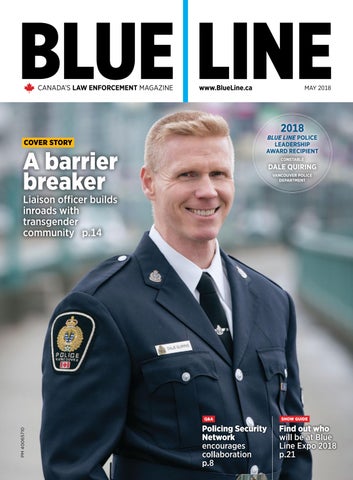
COVER STORY
A barrier breaker
CONSTABLE
DALE QUIRING VANCOUVER POLICE DEPARTMENT
PM 40065710
Liaison officer builds inroads with transgender community p.14
Q&A
SHOW GUIDE
Policing Security Network encourages collaboration p.8
Find out who will be at Blue Line Expo 2018 p.21
tel: 514-527-9333
fax: 514-521-5942
Sales@WilliamScully.ca
Contents
21 May 2018
Columns
Volume 30 Number 5
4 8 10 11 12 28 30 34
Features COVER STORY
14 A barrier breaker & builder of empathy
Vancouver Police Department’s first full-time LGBTQ2S liaison officer, Dale Quiring, is the recipient of Blue Line’s 2018 Police Leadership Award. By Renée Francoeur
20 Transit officer wins new Law Enforcement Award
A new Blue Line award is coming to Blue Line Expo and Special Const. Selwyn Jones of York Region Transit will be the first to take it home. By Renée Francoeur
21 Blue Line Expo 2018 Show Guide
Editor’s commentary Q&A Deep blue Holding the line Health & wellness Technology Case law Back of the book
Departments 5 5 7 7 32 33 34
By the numbers News Dispatches Calendar Product showcase Marketplace Blue Links
From the conference sessions to the show floor, Canada’s premier event for the law enforcement community brings together the best of the best.
26 Taking on the fraud wars and data
COVER PHOTO: VANCOUVER POLICE DEPARTMENT
With the emergence of Blockchain and crypto currencies, fraud preparedness will require greater partnerships, imagination and ingenuity. By Cameron Field
26 @Blue_LineMag
8
20 May 2018 | BLUE LINE
3
EDITOR’S COMMENTARY BY RENÉE FRANCOEUR
BLUE LINE www.BlueLine.ca
Building resiliency & more at Blue Line Expo 2018
I
am proud to bring you our annual director of the Health Adaptation ReBlue Line Expo Show Guide in this search on Trauma (HART) Lab at the month’s issue. On May 3, we have University of Toronto, iPREP “enhances a jam-packed day planned for the situational awareness leading to improved Canadian law enforcement community, critical decision making” through “effectincluding an exclusive new workshop on ive, evidence-based resilience training.” building resiliency with Dr. Stephanie The Peel Regional Police, the Toronto Conn of First Responder Psychology. Police Emergency Task Force, the Illinois Resiliency is such a hot topic in State Police and the Finnish the workplace right now. It’s all Expo is an National Police have all utiabout living the healthiest life exciting time lized iPREP (proresilience. you can and, for susceptible first of the year for org), which was designed to responders especially, proactive- Blue Line integrate into existing training ly protecting yourself from toxic staff, readers programs (annual use-of-force and clients stress. recertification, for example), “We think about stuff all day alike. Not only according to Andersen. In fact, long and that affects how we do we have the methodology is now being feel,” Conn says. “We might as over 50 taught as standard police vendors lined training at the Police Univerwell be intentional about it!” Her tagline for the workshop up to bring sity College of Finland. asks: “Do you ‘should’ on your- you the latest Resilience in policing, as we selves about calls? Do you love in technology, can see, is vital in a world feeling guilty for what you products and where shootings snag headshould’ve done or should be do- services lines on a regular basis. As Blue ing? It doesn’t have to be that — emergency Line columnist Michelle Vinway. Learn to reduce guilt and response cent wrote in a previous coldrones, police umn, it acts as a type of armour build resilience.” Conn’s presentation addresses pistols, Narcan — armour we can no longer the oftentimes unconscious and Kit and so afford to leave home without. maladaptive manners of thinking much more (According to a recent Univerand feeling that undermine our — but we also sity of Phoenix survey, 85 per resilience. These thoughts may have a buzzing cent of first responders face a be related to critical incidents agenda. mental health challenge.) such as inappropriate trauma-reExpo is an exciting time of lated guilt. the year for Blue Line staff, readers and At Expo, her workshop attendees will clients alike. Not only do we have more learn to identify thinking and language than 50 vendors lined up to bring you the patterns that hinder resilience, as well as latest in technology, products and services how to identify more adaptive, resil- — emergency response drones, police ience-promoting manners of thinking. pistols, Narcan Kits and so much more — Over the past two years, the team of but we also have a buzzing agenda. researchers with The International PerforSit in on an engaging panel on the body mance Resilience and Efficiency Program worn camera debate or hear how the smart (iPREP) have also been training various city engine is driving changes for policing... Canadian use-of-force trainers and first That’s only the tip of the iceberg for what’s responders on methods that improve in store. mental and physical readiness in highCome find me May 3 at the International stress situations. Centre in Mississauga. I look forward to Created and led by Judith Andersen, the seeing you.
CONNECT WITH BLUE LINE
www.BlueLine.ca 4
@Blue_LineMag
BLUE LINE | May 2018
www.facebook.com/BlueLineMagazine
GROUP PUBLISHER | PAUL GROSSINGER pgrossinger@annexbusinessmedia.com EDITOR | RENÉE FRANCOEUR rfrancoeur@annexbusinessmedia.com ACCOUNT MANAGER | JANICE EATON janice@blueline.ca ART DIRECTOR | SVETLANA AVRUTIN savrutin@annexbusinessmedia.com ACCOUNT COORDINATOR | TRISH RAMSAY tramsay@annexbusinessmedia.com CIRCULATION MANAGER | BEATA OLECHNOWICZ bolechnowicz@annexbusinessmedia.com Tel: 416-442-5600 ext. 3543 COO | TED MARKLE tmarkle@annexbusinessmedia.com PRESIDENT & CEO | MIKE FREDERICKS ANNEX BUSINESS MEDIA 111 Gordon Baker Road, Suite 400 Toronto, ON M2H 3R1 Tel. 416-442-5600 • Fax 416-442-2191
Publication Mail Agreement No. 40065710 ISSN 0847-8538 Printed in Canada SUBSCRIPTION RATES Canada — 1 Year $31.00; 2 Year $51.50 plus tax USA — 1 Year $103.00 USD CIRCULATION email: asingh@annexbusinessmedia.com Tel: 416-442-5600 ext 3553; Fax: 416-510-6875 or 416-442-2191 Mail: 111 Gordon Baker Road, Suite 400, Toronto, ON M2H 3R1 Occasionally, Blue Line will mail information on behalf of industry-related groups whose products and services we believe may be of interest to you. If you prefer not to receive this information, please contact our circulation department in any of the four ways listed above. Annex Privacy Officer Privacy@annexbusinessmedia.com; Tel: 800-668-2374 © 2018 Annex Publishing & Printing Inc. All rights reserved. Printed in Canada. No part of the editorial content of this publication may be reprinted without the publisher’s written permission. Opinions expressed in this magazine are not necessarily those of the editor or the publisher. No liability is assumed for errors or omissions. Readers are cautioned and advised that articles presented herein are edited and supplied for your personal awareness and should not be used for further action until appropriate guidance is received from a supervisor, Crown Attorney or other persons in authority. All advertising is subject to the publisher’s approval. Such approval does not imply any endorsement of the products or services advertised. The publisher reserves the right to refuse advertising that does not meet the standards of this publication.
NEWS
Last year, more than 120 first responder cowboys and cowgirls participated in the Calgary Police Rodeo. PHOTO: MIKE CAVILLA CALGARY
ALBERTA
36th Police Rodeo sets sights on matching $12K charity donation
Judge wants changes to how peace officers handle unstable people
Organizers of the Calgary Police Rodeo are calling for cowboys and cowgirls in the police, fire and EMS communities to saddle up for a good cause this summer. The 36th annual rodeo takes place at the Cochrane rodeo grounds on August 11 in Cochrane, Alta. Money from the event, as well as a co-locating children’s carnival and exhibition, followed by an “electric barn dance” that evening will all go to the Missing Children Society of Canada (MCSC) and the John Petropoulos Memorial Fund (JPMF), a non-profit “striving to eliminate preventable workplace fatalities and injuries to emergency responders.” A cheque for $10,000 was presented to MCSC last year, with $2,000 going to the JPMF. Mike Cavilla, president of the Calgary Police Rodeo Association, says they are hoping to match this contribution in 2018. In 2017, over 120 first responder cowboys and cowgirls from all over western Canada participated in the rodeo. Visit www.calgarypolicerodeo.com for more information.
A judge is recommending changes to how well peace officers are armed and how they deal with mentally unstable people after the death of an Alberta officer in 2012. Judge Bruce Fraser oversaw a fatality inquiry into the death of Rod Lazenby, 62, a peace officer for the Municipal District of Foothills who was attacked while responding to a call about dogs on a rural property south of Calgary. An autopsy found Lazenby was strangled and had 56 cuts and bruises to his face, head, neck, body and back. He also suffered numerous internal injuries. Trevor Kloschinsky told officers he had apprehended a dog thief. He was charged with first-degree murder, but was found not criminally responsible because a mental disorder meant he didn’t understand that what he was doing was wrong. “It would appear (Lazenby) was unaware Kloschinsky was lying in wait for him and was prepared to attack him,” Fraser wrote in his report released on March 21, 2018.
“It is unknown if he was aware that Kloschinsky was mentally unstable, but having dealt with him previously he should have been. “Undoubtedly he thought he could handle him alone. He was wrong and paid with his life.” Fraser said more caution is needed when peace officers deal with unpredictable individuals. “No (peace officer) should attend for enforcement, a place where there is a known threat from a specific person or a known mentally unstable person or a known person prone to violence, on his own as officer Lazenby did.” Fraser recommended municipalities require peace officers to inform dispatchers of their whereabouts and the purpose of their visits. He said there should also be a list of “flagged places” that could present a risk. He said all officers should receive weapons and officer safety training. They should also be allowed to wear body armour and carry weapons including batons, pepper spray and handcuffs, he said. Lazenby’s only weapon was a baton since he wasn’t designated a Level 1 officer who could carry more protection. “Any officer dealing with public enforcement, in my view, should be properly trained for officer safety and weapons training as well as defensive tactics,” Fraser wrote. Jamie Ericksen, who was vice-president of the Alberta Association of Community Peace Officers when Lazenby was killed, said the officer safety recommendation is key. “I think we should all have access to the same training and the same tools to protect ourselves,” Ericksen said. “The Level 2s should be mandated to take their defensive tactics, which is basically their self defence.” Dawn Rault from the Department of Economics, Justice and Policy Studies at
BY THE NUMBERS
The Cannabis Economic Accounts are a set of provisional estimates from Statistics Canada. The agency says as it “develops new data sources and improves its methods in 2018, these accounts will be updated to provide a more precise measure of the Canadian cannabis industry and market.” The numbers below were released in January 2018.
4.9
million Canadians, age 15-64, spent an estimated 5.7 billion on cannabis for medical and non-medical purposes.
@Blue_LineMag
Over
90% 6%
of the household spending on cannabis was for non-medical purposes in 2017.
rise in spending on cannabis per year from 1961 to 2017.
4.6
$
billion in 2017 accounted for the illegal production of cannabis for non-medical purposes.
May 2018 | BLUE LINE
5
NEWS Mount Royal University is glad mental health concerns were raised, but suggested the report didn’t deal with a core problem. “One of the concerns from the inquiry is you don’t know who the person is that you’re interacting with. Because they don’t have access to (the Canadian Police Information Centre), they go up to the residence and they interact with the person, not knowing if they have a past record, if they’re dangerous or if they have weapons in the house,” she said. A spokesman for Alberta Justice said the recommendations will be reviewed closely. - The Canadian Press Enterprises Inc., 2018 ONTARIO
Legislation proposed to transform adult correctional system The Ontario government says it is transforming its adult correctional system by introducing legislation that would apply an evidence-based approach to rehabilitation, among other things. If passed, Ontario says the new bill will:
• Set rules around (and clearly define) segregation by aligning with international standards and phasing in time limits and prohibitions on segregation for vulnerable inmates. • Improve conditions of confinement by requiring minimum standards. • Increase transparency and accountability by establishing an Inspector General to ensure compliance with the new legislation and all policies. Independent review panels will review segregation cases and ensure that inmates are held in the least restrictive conditions possible. Disciplinary hearings officers will make decisions about sanctions for serious acts of misconduct by inmates. • Clearly define in legislation the health care services that incarcerated individuals should have access to. • Better support rehabilitation and reintegration through individualized, evidence-based assessments that will be completed for every new admission as part of an evidence-based approach. There will also be new facilities built in Thunder Bay and Ottawa as part of this bill and, among other things, an advisory committee with the Ministry of the Attorney General, Anti-Racism Directorate, and the Ministry of Children and Youth Services will be established to address the over-rep6
BLUE LINE | May 2018
Jamie Ericksen, who was VP of the Alberta Association of Community Peace Officers when peace officer Rod Lazenby was killed, said the officer safety recommendation from Judge Bruce Fraser is key. PHOTO: ALBERTA ASSOCIATION OF COMMUNITY PEACE OFFICERS resentation of Black inmates in corrections and support their reintegration. The proposed legislation would replace the Ministry of Correctional Services Act.
The officer was later released from hospital and the service reports he is continuing his recovery from home, surrounded by family. TORONTO
CALGARY
Calgary Police officer seriously wounded during robbery
A five-year Calgary Police Service officer was seriously injured on March 27 after the suspect in a morning convenience store robbery tried to carjack a woman outside a home and then attempted a break-in of a nearby residence. “As officers entered the backyard, the suspect began firing shots at our officers,” said Chief Roger Chaffin during a press conference. “It is our understanding that members of our service returned fire. One officer was shot and taken to hospital.” The tactical unit arrived and contained the garage, which they noticed then became engulfed in flame. After the Calgary Fire Department extinguished the fire, one man was discovered dead inside the garage, according to the chief. An EMS employee is dispatched with the tactical team, which made a significant difference for the wounded officer, Chaffin added. “As far as I’m concerned, our members acted with incredible courage in a situation that escalated in a matter of seconds,” he said. “To say I’m proud of our officers and grateful that they’re recovering is an understatement.” He added that the frequency of weapons and shootings encountered in the community “makes policing very difficult right now” and it continues to be a top-of-mind conversation.
Sky Guys to develop drone for Ont. highway monitoring
The Sky Guys have been awarded $750,000 from Ontario Centres of Excellence (OCE), as part of the Small Business Innovation Challenge (SBIC), after teaming up with NVIDIA, IBM and the University of Toronto. The group will work closely with the Ministry of Transportation of Ontario (MTO) to develop an artificial intelligence-enabled drone solution to monitor Ontario’s 400-series highways in response to the Vehicle Occupancy Detection Problem Statement. The application, titled “LongRange AI-Enabled Unmanned Aerial System for Highway Traffic Enforcement with Future Road Applications,” was selected and funding will be administered by OCE on behalf of the Ontario government over the next two years. The project will test the drones for highway enforcement and management, beginning with the High-Occupancy Vehicle/High-Occupancy Toll (HOV/HOT) lanes. “The Sky Guys are leveraging the latest advances in aircraft controls, AI and Cloud security to offer a safe, privacy-protected, and reliable package for billing and enforcing HOV/HOT lanes,” said Angela Schoellig, a professor at the University of Toronto Institute for Aerospace Studies. “And this is just the beginning. In the future, our system will evolve to address additional challenges, from tracking road defects to correlating highway contractor choice to the quality of roads they maintain,” added Jeremy Wang, CTO of The Sky Guys. www.BlueLine.ca
NEWS DISPATCHES The Orangeville Police Service is proud to announce a new deputy chief, Leah Gilfoy. A provincially accredited criminal investigator, Gilfoy comes to Orangeville from the Toronto Police Service where she has worked in a number of areas, including Uniform Operations, Drugs, Criminal Investigations, Major Crime, Risk Management and Administrative Organizational Development. Deputy Chief Gilfoy is the recipient of the F.B.I. LEEDA Trilogy Award and Central Field Command Achievement Award for Outstanding Service. She has also received the Peace Officer Exemplary Police Service Medal from the office of the Governor General and two Firearm Achievement Awards. Toronto Police Insp. Sonia Thomas was the recipient of a Lifetime Achievement Award at the International Women Achievers Awards (IWAA) ceremony in North York on March 9. Thomas joined Canada’s largest municipal police service in 1986 after responding to a subway advertisement for officers. “When I joined, there was only one other black woman (retired officer Terry James),” Thomas said. “A few small steps have been made, recently, with the promotion of black women to senior ranks, but we still have a long way to go.” Insp. Larry Cope is retiring from the Vancouver Police Department after 31 years.
RCMP Staff Sgt. Vishal Mathura has been promoted to inspector and regional duty officer for Lower Mainland E Division in British Columbia. He was previously the detachment commander of the Sunshine Coast RCMP. Sgt. Mike Hacker will serve as acting detachment commander until the vacancy is filled. Mathura has over 17 years of experience as a member of the RCMP.
CALENDAR Chris Haskett has been promoted to sergeant at Strathroy-Caradoc Police Service.
Donna Remy, a communications operator at Toronto Police Service, is retiring after 31 years. She was presented recently with the service’s St. Michael Award, which “recognizes a member for their contributions to the community through humanitarian acts of kindness, both on and off duty.” She started the Communications Centre Food Bank Donation Drive and many annual fundraisers to help those in need.
International Police Association Canada AGM May 24-29, 2018 Vancouver, B.C. www.ipacanada.ca National Crime Stoppers Conference May 31-June 3, 2018 Hamilton, Ont. www.canadiancrimestoppers.org Toronto True Crime Film Festival June 8-9, 2018 Toronto, Ont. www.torontotruecrimefilmfestival.com Canada 911 Ride - Atlantic June 9-10, 2018 Saint John, N.B. www.canadas911ride.com OACP Annual Meeting June 10-13, 2018 Huntsville, Ont. www.oacpconference.on.ca
Husband and wife team, Sgt. Tom Warren and Sgt. Sharon Warren, have been promoted to Insp. and Insp. Warren at the Royal Newfoundland Constabulary. Tom will be commanding the Labrador West Division and Sharon will be heading Property & Economic Crimes Division of CID (criminal investigation department). The Barrie Police Services Board approved the extension of Barrie Police Chief Kimberley Greenwood’s contract until March 2021. “The board’s decision to extend the chief’s contract is evidence of its confidence in the leadership she has demonstrated to ensure the members of the Barrie Police Service are positioned to provide professional, accountable and sustainable policing services within the community,” said Chair Angela Lockridge. Greenwood was first appointed chief in 2013.
National Law Enforcement Occupational Safety and Health Conference June 20-22, 2018 Halifax, N.S. www.leosh.org Canadian Association of Police Educators Conference June 25-29, 2018 Chilliwack, B.C. cape-educators.ca First Nations Chiefs of Police Association Conference July 4-5, 2018 Calgary, Alta. www.fncpa.ca FBI NNA July 21-24, 2018 Quebec City, Que. www.fbinaa2018.com Canadian Association of Police Governance Conference Aug. 8-11, 2018 Winnipeg, Man. capgconference.ca
PROMOTIONS, RETIREMENTS, RECOGNITION • If you have an officer in your agency recently promoted or retiring or an individual you wish to have recognized (major award or recently deceased) you can let Blue Line magazine know by email to: dispatches@blueline.ca.
@Blue_LineMag
May 2018 | BLUE LINE
7
Q&A The Ontario Provincial Police’s (OPP) Security Assessment Unit (SAU) began organizing the Policing Security Network (PSN) by partnering with several other police services for more collaboration on physical security threats. SAU’s Patrick Ogilvie, a security consultant, and OPP Sgt. Laura Meyers, along with OPP section manager and Acting Insp. Rob Fournier, share more on why this group is so ground breaking. Q: Why was PSN created?
Rob: The OPP’s SAU, under the Security Bureau, was established in 2007 to provide physical security threat risk assessments for all OPP facilities. We recognized that, as commonly practiced in the private sector, we did not have a network of security representatives from Ontario police services collaborating on security threats, vulnerabilities and practiced solutions. This group seeks to fill that void. It’s been an open forum with Patrick and Laura driving it. We’re legislated to ensure the safety of our employees and the purpose of the group is to expand on ways to do this.
Q: What is PSN’s mandate?
Q: What has PSN accomplished so far?
Patrick: In May 2017, we hosted our first meeting to create a direction. The OPP, York, Durham, Peel and Niagara police services attended. Quite a few action items came out of that meeting, for example: the RCMP has a security zone standard we’re looking at incorporating (more on this at goo.gl/ditYuz). Here’s a standard that exists for policing, yet is not being utilized widely. The second meeting in November selected an official name and outlined the mandate. 8
BLUE LINE | May 2018
Left to right: OPP Sgt. Laura Meyers, Patrick Ogilvie and Acting Insp. Rob Fournier.
Q: What were some of the changes between the meetings?
Laura: Halton and Waterloo regional police services came on board for the November meeting. Other police services are also considering joining. We’re in the process of providing more information to them. Rob: In the short term, the membership in the group is driving the focus of the meetings. We ask, “What are the issues?” Across all services, we hear concerns regarding Ministry of Labour issues, insider threats and challenges with security clearances.
Q: What other topics of interest came up?
Patrick: We introduced the SANS Institute report on insider threats in
The CERT Insider Threat Centre found:
53%
of organizations have experienced an insider incident
33%
of organizations have no formal response plan
54%
of IT professionals believe an insider threat is harder to detect today
law enforcement, (goo.gl/vR8FWh) and we touched on updates to security clearance.
Q: How has Patrick’s background in private security helped?
Rob: For years, we’ve had police officers who are also ASIS International (American Society for Industrial Security) accredited professionals in the SAU. Laura then brought forth the idea to go outside the police agency and look for security professionals because they are the experts in security. We did just that. We brought Patrick in specifically to assess the SAU’s provincial physical security threat risk assessment program due to his knowledge base and his corporate security experience. He is wrapping that up now. www.BlueLine.ca
PHOTO: R. FRANCOEUR
Patrick: It’s about our police services coming together to collaborate on how to proactively protect all assets from security threats and vulnerabilities. The objective is to act in an advisory capacity to the members’ senior command for their security planning.
During that project, Patrick saw some gaps in what we were doing, such as our lack of conversation with some of the other police services about other physical security challenges. Patrick: I reached out to a colleague at York Regional Police and we came up with this idea of having all interested police services at one table to talk about different risks and challenges. I come from the private sector and whether you’re in security management for a sports arena or a hospital, we all do the same thing so we put aside competitive differences and everyone sits down to share war stories, what works and what doesn’t, for the betterment of the industry.
Q: Is anyone else doing something like this?
Laura: As far as we know there are no other groups like this in Canada — other than within the Royal Canadian Mounted Police. They conduct ad hoc meetings here and there, but as far as a group dedicated to police physical security and striving to be the voice of change, we haven’t come across anything similar.
Q: What does security currently look like for many police agencies? Who handles it?
Rob: The OPP has had a dedicated team looking at physical security for some time. The SAU’s Justice Officials Protection & Investigations Section (JOPIS) focuses on threats to justice officials. We’re now starting to see agencies such as Peel and Ottawa that have dedicated members for physical security, but not a team.
one advises of a significant security breach or incident, there is a record of it and the data is tracked.
function that is a top priority as opposed to being the responsibility of facilities or the building caretaker.
Patrick: An action item from the group is to report back any stats or figures so we can incorporate those into our next meeting.
Rob: Within the OPP, our Security Bureau command members meet regularly with the Commissioner’s Committee. We’re hoping for a voice outside of the OPP. I’d like to see this group get to the point where we have a voice at the OACP (Ontario Association for Chiefs of Police); where we can present common themes, trends and threats across the province. We need the OACP, the FNCPA (First Nations Chiefs of Police Association) and the like on board.
Q: What is next for PSN?
Patrick: We will meet again later this year and propose selecting chairs and cochairs. It’s so fresh right now. We need to continue to leverage our partners to get the word out, as with growth comes more ideas, better ideas. Why restrict this to Ontario? From Newfoundland to B.C., this is for the greater good of Canadian police and serves to ensure the protection of the policing function. Eventually, I could see this turning into a daylong conference with breakout sessions.
Q: What is an ideal outcome from PSN?
Patrick: We want a standard within all other agencies and to create a security
At the end of the day, if nothing else happened out of this group other than every service has a dedicated security professional, then that’s a success. The OPP’s Security Bureau falls under the Traffic Safety and Operational Support division, overseen by deputy commissioner and provincial commander Brad Blair. More at goo.gl/dUUUxw.
DALHOUSIE’S CERTIFICATE IN POLICE LEADERSHIP
Skills for now Better career tomorrow
Patrick: Yes, Ottawa Police Service has hired a full-time security manager and Peel Regional Police has a staff sergeant dedicated to anything physical security related, also full time. The others are still using their facilities departments for security.
Q: What kind of data do we have right now on physical security in law enforcement?
Rob: Specific security data was difficult to extract from the existing databases, but Laura was able to put a process in place to have security incidents directly reported to our unit. It’s too early in the game for any actual numbers from PSN, but it’s one of the reasons we’re sitting at the table. If some-
Built for modern policing, our online courses, designed and delivered by industry leaders and experts, give you the knowledge and skills to advance in your profession. Learn from the innovator in quality police education for over 25 years. REGISTER AT:
DAL.CA/POLICELEADERSHIP Fall Term starts September 5
May 2018 | BLUE LINE
@Blue_LineMag BL_April_Dalhousie.indd 1
9
2018-03-05 11:43 AM
DEEP BLUE
BY DOROTHY COTTON
A hotbed of original thought: making the time to be distracted and/or relaxed
I
was having a shower this morning and suddenly the solution to a problem I had been wrestling with for a few days came to me. It was an “ah-ha” moment. I have often said if I ever stopped showering, I would never again have another original thought. (I suspect I would also never again have any friends.) Why it is that I do my best thinking in the shower? I decided to actually see if this is a “thing” or if it is just me. Turns out it is a thing. One article I found suggested that 72 per cent of people say they have their best creative/original thoughts and ideas in the shower. Huh. (They might have made that statistic up, however; I tired doing a search in the peer reviewed professional journals around problem-solving/creativity/ showering and I have to say there is not much literature in this area.) So why is it that showering seems to route to pure genius? Some say we have our best (meaning most original or creative) thoughts when there is a lot of dopamine kicking around. Dopamine is a neurotransmitter, a chemical that connects your brain cells to each other. Frankly, dopamine seems to do a gazillion things so it is not surprising that it is also involved in good thinking. Activities that stimulate production of dopamine may indeed contribute to creative thought. This means exercise, listening to music and, yes, warm showers lead to good thoughts. We also tend to have more creative thoughts when we are relaxed. That’s why the problem you slave over at work when you are not relaxed seems unsolvable, but an obvious solution comes to you in the shower. Strangely enough, distraction is also a good thing. You can focus up a storm and labour (unsuccessfully) to find an answer, only to have it come to you when you are doing
10
BLUE LINE | May 2018
something else. Many creative writers and artists admit to being highly distractible people in general. Showering also allows you uninterrupted thinking time. There is white noise to block out external stimuli and others do not usually interrupt you when you are in the shower. There is generally little expected of you when you are in the shower so you can allow your mind to wander. The things you do have to do in the shower also generally do not requite a great deal of thought or concentration. (I also found one article that said we have our best thoughts in the shower because a shower reminded us of an incubator, but frankly I think that is malarkey.) Taken all together, it seems we have our best thoughts when we are not trying to have profound thoughts. (I wonder if that means the slackers amongst us have the best thoughts? If this is true, it is a management nightmare!) So what does all this have to do with policing? I do like to point out now and then that even if you are a police person, you are a person. The stuff that holds for other people also holds for you. I know for a fact that police are at times faced with novel and difficult
It seems we have our best thoughts when we are not trying to have profound thoughts.
(and sometimes seemingly unsolvable) problems alike, as well as with the need to develop ways to address new and difficult problems. But police persons also are often very goal directed, driven, focussed, action oriented, sociable and team oriented. That means you might not have a whole lot of downtime, alone time, relaxed time or time to be distracted. Does this mean police are doomed to be rigid, in-the-box, uncreative problem solvers? Nah... I know lots of creative police people. But it might mean organizations have to be mindful that there does need to be time to be creative built into the day somehow... obviously easier said than done. You might think that on the surface, there is not a great deal of need for your average first responder to be creative. They just need to do their jobs. However, according to my sources, we do not yet have definitive solutions to a number of different public safety issues. In my opinion, a great many subjects relevant to policing would benefit from some original thought. Dr. Dorothy Cotton is Blue Line’s psychology columnist. She can be contacted at: deepblue@ blueline.ca.
www.BlueLine.ca
HOLDING THE LINE BY MICHELLE VINCENT
Teamwork in critical calls of service
A
routine call is rareWe complete our firearms ly “routine.” Every qualification and learn new call we attend as moves in defensive tactics — we police officers has even review Immediate Rapid us fully engaged. When the call Deployment and the diamond is intense, we can be so im- formation when dealing with mersed at times our physio- active shooters. All of these are logical responses could cause essential skillsets required as we us to lose vital information return to our platoons and inthat might help us successfully vestigative units. However, as for looking out for navigate the call. one another, we talk We have all heard of I may have about that after we auditory exclusion, been the tunnel vision and the team lead in have attended a other physiological re- an incident, critical incident, like the one illustrated actions when engaged however if above. Let’s try to in fight-or-flight situa- my partner tions, such as a shoot- notices I am notice if our partner is showing signs of ing. We all know of, or wearing withdrawing or any have even personally thin, I sure unusual behaviour experienced, a challen- hope he or during the event. ging moment where she offers Typically, we don’t one’s life was potential- to step in ly put at risk as a result and help me expect to come on out in this the scene to find our of another’s actions. partner in full active As police officers, we intense duty, executing a have it grilled into us situation. task that is fraught that we must never be complacent in any incident. with intense emotional energy, This is because the most sim- such as holding a person at ple of incidents can become gunpoint. Attending a call such that type of critical one we as this should inspire us to act dread. For example: we receive as our partner’s keeper and to the “routine” call whereby evaluate both the scene they someone is reporting a stolen are dealing with as well as the wallet and upon attending, we manner in which they are dealdiscover it is a suicide-by-cop ing with it. I am not suggesting moment — anything but rou- we take over the call and do it tine. We are advised to play out our way. I am suggesting we let such scenarios in our minds as our partner know we are here and, if necessary, that we are we attend each call. Have we thought of what we available to take over in a might do if we find our partner non-intrusive manner should in a stressful situation? Have we they need a break. Let’s think about some histhought about what happens if, while attending as their backup, torical incidents covered by we notice they are not manag- media where we have seen an ing the call as well as they might officer who may have been under normal circumstances? stuck in the moment, doing the Perhaps they are yelling out best they can with what they commands repeatedly in agita- have at the time. Now think tion or have lost the profession- about how having a partner alism you know they generally reach out and say, “Hey man, let me take over from here,” always maintain.
may have changed the outcome of that scenario for everyone involved. Again, the message in this article is not to second-guess what has already transpired with those officers in those situations, but to think of a different approach with a fresh set of eyes on-scene. What resonated with me the most and the message I received during the discussion on this topic was the opportunity I have, as a partner, to work as an essential member of a team, changing up the positions to support as we see fit in order to have the ultimate outcome. I may have been the
team lead in an incident, however if my partner notices I am wearing thin, I sure hope he or she offers to step in and help me out in this intense situation. Likewise, I hope I would notice and do the same for them. We are a team. Let’s remember that in every moment. Michelle Vincent is a 16-year York Regional police officer with a Masters Degree in Arts in Counselling Psychology and a background in equine assisted therapy, workplace reintegration and teaching. She has a practice supervised by a psychologist and is working towards her PhD in Forensic Psychology/Crisis Response. She can be contacted at: michelle@smith.net.
May 2018 | BLUE LINE
@Blue_LineMag BL_Mary_Cambli.indd 1
11
2018-04-11 9:14 AM
HEALTH & WELLNESS BY ISABELLE SAUVE
Pay attention to your “Sam Browne”
G
eneral Sir Samuel James Brown is credited with inventing the duty belt for tactical advantage after an unfortunate incident left him with one arm. Facing this physical disadvantage as a cavalry officer, he designed a belt with an additional leather strap to which he attached his weapons. This innovative concept — still referred to as the “Sam Browne” today — spread widely and made its way into police forces worldwide. Duty belts today continue to offer readily available equipment while leaving the officer’s hands free. They can be considered officers’ safety “toolbox.” Unfortunately, duty belts simultaneously increase the risk of developing injuries related to progressive degeneration and cumulative trauma. With a weight of 15-20 pounds fully loaded, duty belts continuously place strain on the joints, especially to the lower extremities such as the lower back, hips, knees, and ankles. A recent study showed 86 per cent of officers wearing duty belts have had or are currently experiencing lower back pain. Additionally, police officers employed the longest experienced the highest levels of lower back pain — many of which never experienced lower back pain prior to joining the force. Leading-edge ergonomics in policing is not an expendable luxury but a necessity. Joint pain substantially costs police agencies through the loss of productivity and increased use of sick leave. As a strategy, employers should promote and support individual efforts towards injury prevention. Police agencies must supply quality equipment and educate officers in order to reduce work related injuries. Law enforcement officers must also be proactive and mindful of the impact of wearing a fully loaded duty belt. Repetitive movements cause gradual wear on the joints and the consequences are amplified. Therefore, steps to reduce any 12
BLUE LINE | May 2018
creasingly prone to injury. Research indicates sitting in a vehicle for four or more hours increases the likelihood of experiencing back pain by 200 per cent. When confined to a vehicle for extended periods of time, changing the position of the seat even slightly is important. When possible, breaking up the drive by getting out and walking around can provide some relief. Other tips include:
negative consequences on the body must be taken. For example, the positioning of equipment on the belt must not only be tactically sound but also strategically placed to best evenly distribute the overall weight. Officers should also be cognizant of the biomechanical effects and restrictions of motion caused by equipment placement. Any pressure points, discomfort, or excessive friction should be avoided. Overly tight duty belts lead to blood flow restriction with multiple ripple health effects. Overly loose belts can also become an issue particularly during foot chases as the gun belt bounces uncontrollably and awkwardly. Rather than work in unison with the body, the belt “follows” the officer’s movements, delayed by gravity. This caterpillar effect is also at play while walking. Moving some equipment into a molle-style (Modular Lightweight Load-carrying Equipment) vest can disperse some of the weight from the hips onto the shoulders. Wearing a duty belt affects posture and causes pelvic imbalances correlated to back pain. Prolonged exposure to sitting or standing leads to postural fatigue, and therefore it is important to frequently change positions and pay attention to posture. Sitting for extended periods of time causes the lower back muscles to weaken and hips to tighten, making the lower back more vulnerable to injury. When the gluteal muscles become inactive, the lower back can be forced to work and becomes in-
• Gel-filled cushions can be used to diminish vibrational magnitude. • Avoid placing equipment at the rear of the belt. • Pay attention to vehicle ingress and egress and use the grip handle to reduce some of the abruptness and awkwardness caused by the heavy equipment. If discomfort or pain can be directly attributed to a repetitive motion performed, modify that motion. It is crucial to address nagging Repetitive injuries as they typically worsen movements over time and risk becoming chroncause gradual ic, especially when left untreated. wear on the Duty belt wearers can also signifijoints and the cantly reduce injury by maintaining consequences good overall physical fitness. A are amplified strong core offers some protection, while wearing particularly the lower back. A a duty belt. stretching routine also keeps the ligaments and muscles around the joints more nimble and supple, greatly reducing the likelihood of injury. Engaging in five-minute breaks for stretching throughout the day is extremely beneficial. Taking proper steps toward injury prevention goes a long way in terms of remaining healthy and pain free. The steps are simple and easily implementable, making them achievable for all law enforcement personnel. Isabelle Sauve is a 10-year OPP veteran currently with the Emergency Response Team (ERT) at the Almaguin Highlands Detachment in Burks Falls, about 300 km north of Toronto. She can be contacted at: isabelle.sauve@hotmail.com.
www.BlueLine.ca
®
THE WORLD’S MOST BATTLE-PROVEN FIREARMS.
Over 128 years of heritage. Over one million rounds of testing. Now ready for the real world. Experience the intuitive grip angle, enhanced grip texture, and incredible recoil control. The handgun always points naturally and stays on target for fast, accurate follow-up shots. It’s the handgun you’d expect to come from the makers of the world’s most battle-proven firearms.® Learn more at FNAMERICA.com or visit your local dealer.
NOW AVAILABLE IN CANADA.
1 MILLION ROUNDS OF TESTING IS
THEMIOUS COVER STORY DIPSOTK
A barrier breaker & builder of empathy Vancouver Police Department’s first full-time LGBTQ2S liaison officer is making some serious inroads By Renée Francoeur
W
hen Velvet Steele, a well-known transgender and human rights activist, first met Vancouver Police Const. Dale Quiring, she was cautious. “You could almost say it was like two cats in a room; one on one side and one on the other, backs against the wall,” she says with a laugh. That didn’t last long, however. Three years later, the two talk almost weekly and have travelled the country together, working to improve the relationships between police officers and the LGBTQ2S (lesbian, gay, bisexual, transgender, transsexual, queer, questioning, and two-spirit) community. “Dale has really stepped up to the plate,” Steele says of Vancouver Police Department’s (VPD) first full-time LGBTQ2S liaison officer. “And not only as a compassionate individual, but also as someone who really wants to learn and takes the time to learn. It’s all been a very positive experience.” Quiring has been selected as the 2018 recipient of Blue Line’s Police Leadership Award, which honours
14
BLUE LINE | May 2018
those with outstanding leadership skills, tireless dedication and who encourage others to develop similar pacesetting abilities. He has been credited for making major inroads with vulnerable and marginalized groups, especially the transgender community, and designing sensitivity training for fellow law enforcement officers.
Pioneering job
He is not only the first LGBTQ2S liaison officer in the VPD, but also in the entire province of British Columbia — as far as Blue Line could confirm. The pioneering job has taken him to various other police services, such as the Royal Newfoundland Constabulary, to pass on what he’s learned regarding LGBTQ2S issues in policing and how to work more collaboratively. That’s the thing about Quiring, says Supt. Marcie Flamand, who was previously the inspector in charge of VPD’s Diversity and Indigenous Relations Section — he doesn’t limit things to Vancouver. He takes calls from outside the jurisdiction and is happy to help other police agencies rebuild relationships, whether that
July 2016
VPD Safe Place initiative is launched
370+ businesses signed up for VPD Safe Place
is through new policy creation or training updates. “When I first went into that section, he was a hate crime investigator and I tasked him with making a transgender training video,” Flamand says. “It wasn’t in his job description but he took it on with such enthusiasm.” It was that video — which been viewed almost 60,000 times on YouTube at the time of writing this —that would eventually fuel Quiring’s calling as an officially designated liaison officer.
Delivering on recommendations
After volunteering with the VPD victim services unit, Quiring was hired as an officer in 2001 and spent 12 years on the frontline before becoming a hate crimes detective in 2013. Sgt. Jeremy Johnson writes in Quiring’s leadership award nomination form that once he joined the Diversity and Aboriginal Policing Section, he wasted no time in forming new connections in communities prone to bias, prejudice and hate incidents. www.BlueLine.ca
PHOTO: VANCOUVER POLICE DEPARTMENT
Const. Quiring strikes a pose at Vancouver Pride 2016.
In 2015, one of the subcommittees from the City of Vancouver’s LGBTQ2S Advisory Committee came to meet Quiring’s section after the B.C. Human Rights Tribunal ruled Vancouver police officers discriminated against a transgender woman. The tribunal found officers had used male pronouns to describe her in a police report and failed to provide her with proper post-surgery care while in custody. “After we met with them my inspector asked me to help fulfill those recommendations,” Quiring says, noting he immediately started researching the suggestions that surfaced from the VPD’s 2008 Aaron Webster report (Webster was a gay man brutally beaten to death in Vancouver’s Stanley Park in 2001). These suggestions were based on previous community forums and centred on raising the bar in police basic training. From there the “Walk with Me” video idea emerged as a platform to educate officers on transgender perspectives and issues. Quiring rounded up participants (which included Steele), scripted it and @Blue_LineMag
March 2017 washroom signage in Vancouver City Hall changes to state, “Trans People Welcome”
spent countless hours after shifts and on weekends to get the filming done. The 17-minute video was shown to all VPD officers as a resource on how to better interact with a transgender person in a respectful manner, and it has since garnered international interest, according to VPD. “This video acted as a final catalyst,” Johnson goes on to say in the nomination package. “Const. Quiring was soon considered not only a credible and trusted contact within the involved communities, but also
a subject matter expert within the law enforcement community.”
Passion and understanding
Quiring was five years-old when he decided law enforcement was the career for him. This came after watching a uniformed police officer hot in pursuit, scaling the wall of a house near his childhood home in Kitchener, Ont. But as to what prompted him to carve out his own niche position and serve the LGBTQ2S community, it was two things.
“As a constable, he’s making big changes. He was instrumental in helping create new policies and he was wise about it, consulting the people it will directly impact, getting the language right. He’s a man with a lot of emotion and he takes things to heart.”
- Supt. Marcie Flamand May 2018 | BLUE LINE
15
COVER STORY
Const. Quiring taking one for the team during Vancouver Pride. PHOTO: VANCOUVER POLICE DEPARTMENT
“One was the Pulse Nightclub shooting in Orlando. I remember where I was when it happened and it truly broke my heart,” he says, referencing the horrific attack that saw 49 people gunned down at a gay club in Florida in 2016. “As I was growing this liaison position, I started corresponding via social media with some of the police officers in Florida and
it only increased my drive and passion to work in the community. Two: it was through working on the ‘Walk with Me’ video and meeting as many trans folks as I did, especially Velvet Steele, and understanding their lives and what they go through, combined with a lot of the hate crime investigation I did. I don’t think people truly understand what they face on
A look back at the Blue Line Police Leadership Award
T
he Police Leadership Award was first bestowed in 1999 by the Canadian Police Leadership Forum (PLF). With support from Blue Line, the PLF presented the award annually until 2005 when the organization ceased to exist. Encouraging leadership as an activity encourages leadership as a position. Drawing forth those with recognized leadership abilities at levels beneath senior management encourages the availability of a talent pool for the future of policing. The Blue Line Police Leadership Award exists to highlight the importance of recognizing those with leadership abilities and en-
16
BLUE LINE | May 2018
couraging other officers to develop their own leadership skills. It is open to active Canadian police officers below the rank of senior officer, who have demonstrated exemplary leadership and commitment to service through deeds resulting in a measurable benefit to their peers, police service and community. In February 2011, Blue Line took up the challenge of a cross-Canada search for suitable candidates. Blue Line’s appointed judges have so far selected numerous worthy recipients including this year’s recipient, Dale Quiring, from the Vancouver Police Department. Another officer from VPD also won last year.
Sept. 2017
VPD creates its first full-time LGBTQ2S liaison officer position
THE 2018 JUDGES PANEL
a daily basis, so it just pushed me to do more.” At the same time, he says it’s important to recognize VPD has a chief who supports his passion and the community. Chief Adam Palmer “gets it,” and without that buy-in from the top, Quiring doubts he’d be able to do what he has so far. After “Walk with Me” was launched in June 2016, Quiring formed the LGBTQ advisory committee for the Vancouver Police and things kept growing from there, he says, such as police policy reviews in tow with community consultation. Inspired by a Seattle Police Department initiative, Quiring was also the main force driving the Canadian rendition of “Safe Place,” a program that provides a safe, easily identifiable and accessible location for LGBTQ2S members to go to if they are feeling unsafe or need assistance. Participating schools, businesses and other institutions can take part by displaying a rainbow-coloured decal in a visible place, such as a street-front window. They must also sign a pledge indicating their support and acknowledge their willingness to help. Safe Place rolled out in Vancouver in July 2016 — the first of its kind Frank Beazley is the retired Chief of the Halifax Regional Police Service in Nova Scotia. Beazley began his 42-year career with the Halifax Police Department in 1970 and became chief of the new HRPS in July 2003. He is a graduate of the Canadian Police College Executive Development program, Queen’s University executive program and numerous certificate studies concentrating in the area of business, law and human resources. He is a past and life member of the Nova Scotia Chiefs of Police Association and Canadian Association of Chiefs of Police. He is a past vice-president of the CACP and served on its board of directors. Beazley has received the distinction of Officer of the Order of Merit for the Police Forces and is a recipient of the PESM with two bars, both the Queen’s Gold and Diamond Jubilee Medals and the Province of Nova Scotia Long Service Medal and bar.
www.BlueLine.ca
in Canada — and currently more than 370 businesses proudly feature the decal, according to Quiring. “The RCMP in B.C. have picked up Safe Place, too, and other municipal agencies across the country are starting the process to implement it,” he adds. “It’s continuing to grow. ” Quiring strongly believes that sensitivity schooling and community consultation go handin-hand with Safe Place, so he then developed a training package, specifically for frontline police officers, on how to be more empathetic towards the LGBTQ2S community. In it, he specifically points to transgender issues. “I present that now to many different forces in the lower mainland and was invited to Newfoundland to present it,” he says. “It has resonated quite well.” This was all happening while he was a hate crimes detective fulltime — working as this impromptu liaison officer on the side. “He did so much in that role, upside of his desk as a hate
crimes investigator, and so he wrote a proposal to get a whole new separate position up and running. This was to be solely dedicated to the LGBTQ2S liaison duties,” Flamand says. “It started to consume a lot of my time and I knew it needed my full attention,” Quiring adds. And so VPD’s first full-time LGBTQ2S liaison officer position was born in September 2017. For Steele, that move truly put VPD in the driver’s seat. “I hope it continues and that it is a long-term position,” she says. “I really believe the VPD is leading by example. They are getting out there in a community and we do see efforts to change; it’s slow but it’s there... I see the police as a child and the community as a parent. And a parent never gives up on the child.”
Peter German is a former Deputy Commissioner with both the Royal Canadian Mounted Police and Correctional Service Canada. He currently practices law, is a consultant on criminal justice and leadership matters, and is president of the International Centre for Criminal Law Reform at the University of British Columbia. Prior to retiring from the RCMP, he was the Deputy Commissioner for Western and Northern Canada. He holds a doctorate in law from the University of London, and is the author of a legal text, Proceeds of Crime and Money Laundering. German was awarded both the Queen’s Gold and Diamond Jubilee medals, is an Officer of the Order of Merit of Police, and was awarded his Queen’s Counsel designation in 2018.
Armand La Barge is the retired Chief of Police of York Regional Police in Ontario. La Barge began his career there in 1973 and retired in December 2010 after serving as chief for his final eight years. La Barge is the past president of the Ontario Association of Chiefs of Police and the Ontario Director of the Canadian Association of Chiefs of Police. He is a graduate of the FBI National Academy and the past chair of Special Olympics Ontario. He is also the immediate past chair of St. John Ambulance Ontario and a member of the board of governors of Trent University and Sacred Heart Catholic College. La Barge was awarded the PESM with one bar, both the Queen’s Gold and Diamond Jubilee Medals, is an Officer of the Order of Merit of the Police Forces and a Commander in the Order of St. John.
changer, and every week he receives private messages from different people all over the country. “What I tweet is very authentic. It’s my account. It’s all me and who I am. I’ve had many people tell me they’ve read my profile, watched my posts and can tell I’m someone they’d be comfortable speaking with. So that’s a very powerful medium, because they don’t know who they will get if they call the station. It’s a door opened for them.” Controlling his own social media means he can get creative, which helps with relationship building. “Trans people do not trust the police,” he explains. “As long as it’s not an emergency situation, many contact me through Twitter to engage and
to meet up and from there more police support can be offered. They wont come to the police station but I can meet them at a coffee shop, for example. I do that quite often.” And while he will be at that coffee shop out of uniform, he wants to be clear: he’s proud of his career. “I’m very proud of my uniform and I love wearing it. We’re just going through a culture shift. These are issues that have been around for many, many years and the voices are finally being heard. We can’t push that back... These are hard topics and you’ve got to remember that a lot of these individuals have been marginalized and struggling for 25 years or more, so to have someone that they know is consistent and someone who cares, that’s the key.
Beyond the uniform
The role has called for some innovative tactics to reach an audience with an unfavourable history of police interaction, Quiring says. Using Twitter, for example, has been a game
May 2018 | BLUE LINE
@Blue_LineMag BL_May_TriStar.indd 1
17
2018-03-27 1:30 PM
COVER STORY
Activist Velvet Steele, right, has been a valuable influence and resource for Const. Quiring’s work with the LGBTQ2S community. PHOTO: VANCOUVER POLICE DEPARTMENT
That’s when the trust starts to build and they see beyond the uniform.” According to Steele, the police uniform can be triggering for many but she wants to work on getting people past that. “Is the firefighter or EMS uniform triggering, too? Too many people want to hold onto negative experiences. People are reticent to deal with law enforcement but I ask: why aren’t you talking to them like you would a friend or a mother? There’s a person underneath that uniform.” The uniform isn’t the only thing circulating in some backlash Quiring has received. The first thing out of the critics’ mouths is: “Well, he’s not gay,” Steele says. “I really hate when people bash him. It’s about having allies and we need allies outside of our own communities. He’s such an easy guy to deal with. He’s certainly someone who engages in great active listening and his articulation comes across as very sensitive as well, a skill many people don’t have.” Quiring knows many in the community are cautious because he is male.
“They do break through in oneon-ones... They keep me in check and that’s what we want. I fall back on my training and I just keep working and listening,” he says. “A lot of people asked can a straight white male do this job?” echoes Flamand. “He’s proven that he good at it. As a constable, he’s making big changes. He was instrumental in helping create new policies and he was wise about it, consulting the people it will directly impact, getting the language right. He’s a man with a lot of emotion and he takes things to heart.”
Culture shift
Quiring hopes to continue working to break the barrier of bias and prejudice that some people feel towards the police. He notes the culture at VPD has evolved in many ways over the past few years and it’s something Steele has also witnessed. “I’ll be honest I didn’t know what was going on with VPD until Dale showed me more of what the diversity unit was trying to do,” she admits. “The outreach they’re doing to sen-
The City of Vancouver says it is home to the largest lesbian, gay, bisexual, trans, gender diverse, queer, and two-spirit (LGBTQ2S) community in Western Canada. 18
BLUE LINE | May 2018
49% of Canadian trans-youth report being sexually assaulted as a result of their gender expression in a 2011 report
Watch VPD’s “Walk with Me” video at youtu.be/ qtwBgm8HEpM.
ior groups, youth groups, ethnic groups, religious groups — it’s mind-blowing. And I think most people think that, as a police officer, all you do is walk the beat or drive a car and go and arrest people. That’s not the case. They’re out there actually serving and protecting, so let’s figure that out more together. Let’s change the perception.” Meanwhile internally, a healthy dialogue is unfurrowing in inclusive ways, and the agency is asking the right questions. “It’s also not just about what’s outside in the community. It’s about what’s inside the police organizations, too,” Quiring explains. “We have gay officers, we have officers expressing differently. Officers may come out as transgender in the future. How are we prepared for that? How does that work? What supports do you have in place? Bathrooms, shower rooms, change rooms... So it’s opened up a wider conversation.” The visibility of a fulltime LGBTQ2S liaison officer and the ensuing conversation has also promoted hiring practices, according to Quiring, and helped strengthen preparation for handling missing persons cases due to increased sensitivity. “People want to work for an organization where the culture have shifted and that is the kind of culture we want to continue to foster.” It doesn’t stop at Safe Place and sensitivity training. Quiring is currently involved in seeing “Walk With Me” translated into Chinese and Punjabi and he has a new campaign coming out this fall. He’s tight-lipped about what it will entail but does provide a clue: sports are involved and there will be a hashtag. As for one of Quiring’s most memorable moments so far? It’s handing the 2016 Chief Constable’s Commendation he won over to Steele, who he says has been such a big influence, without a second thought. “She proudly displays it in her home and for me, to see that happen with someone who did not trust the police for many years, for her to be at the ceremony with me... it was emotional and it created a bond between us,” he says. “That’s what it’s about.” www.BlueLine.ca
THE AVERAGE TRUCK NEVER COMES WITH THIS MUCH STORAGE.
BUT THEN THIS ISN’T YOUR AVERAGE TRUCK. The 2018 Ram 1500 Special Service is no ordinary truck, starting with its legendary 5.7L HEMI® V8 engine featuring the fuel-efficient Multi-Displacement System (MDS) Fuel Saver Technology. Variable Valve Timing (VVT) delivers impressive engine performance, while its Class-Exclusive Multilink Coil Spring Rear Suspension* ensures lateral stiffness and superior vehicle control. An available RamBox® Cargo Management System* means you’ll never run out of room – whatever you bring to the job. The Ram 1500 Special Service. With so many great features, no wonder they call it Special.
CLASS-EXCLUSIVE RAMBOX CARGO MANAGEMENT SYSTEM ®
WITH BED DIVIDER*
CLASS-EXCLUSIVE MULTILINK COIL SPRING REAR SUSPENSION*
fleet.fcacanada.ca
1 800 463-3600
*Based on Automotive News Full-size Pickup segmentation. Excludes other vehicles designed and manufactured by FCA US LLC.
SPECIAL CONSTABULARY
Transit officer wins new Law Enforcement Award
A
new award has been born at Blue Line, which will be making its debut at Blue Line Expo 2018. The inaugural Lifetime Law Enforcement Achievement Award seeks to recognize a leader in law enforcement who has made a difference in their communities through exceptional dedication and compassion. Like the Police Leadership Award, it is open to all law enforcement officers who are below the rank of senior official, but it specifically targets those working for organizations that are not police agencies (such as Canada Border Services Agency,
20
BLUE LINE | May 2018
Selwyn Jones is a special constable with York Region Transit.
Correctional Service of Canada, etc.) and who have over 15 years of experience. The winner for 2018, Special Const. Selwyn Jones, has been involved in transit law enforcement since 1990, working as a special constable with Go Transit in Toronto and later with York Region Transit (YRT), where he is currently employed. “Selwyn is a quiet leader who leads through example,” says Jason Shulist, shift supervisor, Transit Enforcement and Security for YRT. “His presence and awareness have a profound influence on co-workers and members of the public — cool, calm and collected.” Jones has been a training officer for YRT’s new recruits since 2006 and coached Shulist, too. “I learned from Selwyn the importance of situational awareness, deportment and communication — apart from an arm’s length list of other skills,” Shulist says. “I like to pass on knowledge,” Jones says. “What’s the good in having knowledge and keeping it all to yourself?” He goes on to say he was humbled when a fellow YRT officer recently mentioned how Jones gave him some advice about patrol, which he follows to this day. “I always say to members, ‘Leave your window rolled down a crack.’ Our job is to look out for the community and be engaged... With the window down a bit, you can hear things you might otherwise miss.” He began his career in the security industry, serving in loss prevention for major retail companies. That was a stepping stone into private investigative work. He
also worked for the provincial government alongside the Ontario Provincial Police, among other roles, before testing out the transit special constable title. Shulist notes his ability to conduct and manage investigations has been an asset for YRT. Team building has been a long-time focus for Jones, who says he enjoys bringing people together and learning from various perspectives. Jones is well known for hosting events and entertaining team outings that help foster comradery and relationship building. He appreciates the importance of a healthy team dynamic and is active on this front, Shulist adds. “Selwyn is the proverbial ‘canary in a coal mine’ with respect to work culture,” he says. “He can be counted on not only to identify potential issues but also rectify them or provide suggestions on a resolve.” An energetic CUPE union member, a representative on the local Joint Health and Safety Committee and the face of YRT at ABLE functions (Association of Black Law Enforcers), Jones has had a major influence with staff who are visible minorities. “These officers face challenges at times over and above the typical job stressors for law enforcement officers, based on their visible minority,” Shulist says. “Selwyn can be credited with providing support and guidance to these staff members — a large majority who have transitioned upward in their career trajectories.” The nature of a transit special constable is unique, according to Shulist, as the officer must be a balance of customer service ambassador and officer enforcing laws/ legislation where appropriate. “Selwyn, I am confident in saying, is a shining example of striking that perfect balance.” The inaugural Lifetime Law Enforcement Achievement Award and annual Police Leadership Award will be handed out during a ceremony at Blue Line Expo on May 3 along with the 2018 Best Dressed Police Vehicle Award. www.BlueLine.ca
PHOTOS: YORK REGION TRANSIT
By Renée Francoeur
May 3, 2018
The International Centre Mississauga, ON EXHIBITOR
THE PREMIER EVENT FOR CANADA’S LAW ENFORCEMENT COMMUNITY
SHOW GUIDE
BLUE LINE EXPO 2018 FLOOR PLAN 50 49
48 47 46
Stage
5
6
15
16
25
26 35
4
7
14
17
24
27 34
8
13
18
23
28 33
36
41
45
9
12
19
22
29 32
37 40
44
10
11
20
21
30
31
38 39
43
3 2
42
1 ENTRANCE REGISTRATION
@Blue_LineMag
51
52 53 54 55 56 57
58 59 60
RETAIL CONCESSION
Booth #
Spirito 1 Axon 2 On Duty Equipment Ltd. 3 Distribution Elite 4 Integrys Limited 5 Meggitt 6 Smith & Wesson 7 TICO 8 Panasonic Canada 9 Stoeger Canada 10 Artcal 11 Emergency Response Portal 12 FLIR Systems Canada 13 Many Wain Enterprises 14 U of Guelph-Humber 15 Narcan Kit 16 Moneysworth & Best 17 Rampart/Glock 18 Patriot One Technologies Inc. 19 911 Supply 20 OmniView Tech 21 Trauma Tech 23 Humber College 22 Trauma Tech 23 Logistik 24 Nagashi 25 FCA Chrysler Canada Fleet 26, 35 Canadian Decon Solutions 27 Georgian College 28 Cambli 29 Commissionaires 30 Goodyear 31 International Police Mountain Bike Association 32 KeyNorth Group 33 EhEye Inc. 34 Royal Roads University 36 IndigoVision 37 Draeger Safety Canada 38 TriStar 39, 44 Canada Ammo 40 Colt Canada 41 Thomson Reuters 42 Titan Securite 43 Outlaw Eagle Manufacturing 45 Word Systems Inc. - iRecord 46 Millbrook Tactical 47, 48 Kle Distributors 49 Habtech 50 Annex Bookstore 51 International Police Association 52 FBI National Academy Associates 53 Association of Black Law Enforcers 54 Z-Medica 55
May 2018 | BLUE LINE
21
BLUE LINE EXPO 2018 SHOW GUIDE
EXHIBITOR LISTINGS 911 Supply • Booth # 20 Founded in 1995 by a Calgary Police Service officer, 911 Supply’s selection of quality uniforms and equipment for Police, EMS, Firefighters, Military, and Security has brought them to the forefront of the Canadian market. 911 Supply continues to operate as a family business keeping customer and community service first. www.911supply.ca Artcal • Booth # 11 Artcal has been a supplier of Policing graphics across Canada for over 40 years. We have the expertise in design, production and installation to provide you with high visibility graphics for your fleet. Artcal uses 3M products to ensure the highest quality vehicle graphics and our 3M certified installers are experts in graphic installations. Our commitment is to meet the demands of the Policing industry and to provide a level of service that meets or exceeds the expectations of our customers. www.artcal.com ABLE • Booth # 54 The Association of Black Law Enforcers (A.B.L.E.) is a non-profit organization formed in 1992 to address the needs and concerns of Black and other racial minorities in law enforcement. The membership includes Police Officers, Correctional Officers, Probation and Parole Officers, Immigration Officers, Customs Officers, Court Services Officers, By-law Enforcement Officers, Sheriff’s Officers, Special Constables and more. ableorg.ca Axon • Booth # 2 Axon’s technologies give the Public Safety Community the confidence, focus & time they need to keep their communities safe. Our connected body cameras and cloud-based evidencemanagement software allow members to work effectively and transparently, and our TASER conducted electrical weapons protect life without taking it. ca.axon.com Cambli Group • Booth # 29 Cambli Group is a family-owned business that has been involved in the design and manufacturing of armored trucks for more than 50 years. Cambli Group is also the largest armored truck manufacturer in North America. www.cambli.com Canada Ammo • Booth # 40 We have been Canada’s source for firearms, commercial ammunition and mil-spec ammunition since 2006. We offer a large selection of quality duty and training ammunition with
22
BLUE LINE | May 2018
competitive prices. We stock a growing collection of firearms accessories and tactical supplies. www.canadaammo.com Canadian Decon Solutions • Booth # 27 Provides CBRN detection and decontamination solutions; specializing in synthetic opioid (Fentanyl and analogues) response and remediation services. We are a Canadian company providing Laboratory to life saving technologies for First Responders across the country. canadiandeconsolutions.com Colt Canada • Booth # 41 Colt weapons have been battle tested and proven through extreme battlefield conditions worldwide. As Colt Cnada we listen to our customers that make up some of the most elite warfighting units and police services in the world. That, along with our attention to emerging technologies, ensures that our products continue to advance in operational functionality as well as popularity. coltcanada.com
Commissionaires • Booth # 31 • Delegate Bag Sponsor Commissionaires booth # 31 is Canada’s premiere security provider offering comprehensive and cost effective non-core police services that help police officers get back on the streets With over 90 years of experience, Commissionaires supports police departments across the country by taking on non-core duties including admin, process serving and traffic control. commissionaires.ca/en/ national/service/business/ non-core-police-services Distribution Elite Canada • Booth # 4 Distribution Elite Canada specializes in the representation, distribution and sales of military, law enforcement, custom, correctional, fire, ambulance and security products. www.distributionelitecanada.com Dräger • Booth # 38 Dräger is a global manufacturer, established since 1889, whose portfolio includes stationary and personal gas detection monitors, respiratory protection equipment, refuge shelters, thermal imaging cameras and alcohol and drug detection units. Whether in industrial safety applications, oil & gas, mining or fire services, Dräger products protect, support and save lives. www.draeger.com/en-us_us/AlcoholAnd-Drug-Detection
EhEye • Booth # 34 According to Public Safety Canada, robbery costs our communities an average of $32K per incident. EhEye Inc. is a Canadian technology company that protects people by automating video surveillance. Robbery Overwatch is a portable robbery detection system designed to reduce crime through tactical deployment, real-time weapon alerting, and public awareness. www.eheye.com ERP (Emergency Response Portal) • Booth # 12 ERP is the link first responders have been waiting for – the ability to be prepared to act immediately on arrival. Get live eyes on scene, see floor plans, notify building occupants and their neighbours on the fly. No more guessing – it is the continuum of public safety. www.emergencyresponseportal.org FBI National Academy Associates • Booth # 53 A Premier Training Invitation — open to all law enforcement! Join 1,500+ law enforcement professionals at the FBINAA Annual National Training Conference July 21-24, 2018, in Quebec City, Canada. Features: 7 keynote sessions, 30+ breakout sessions, professional development seminars, and more than 100 exhibitors showcasing the latest in law enforcement. Register at www.fbinaa2018.com. FCA Chrysler • Booth # 26, 35 Fiat Chrysler Automobiles (FCA) Canada has approximately 440 dealers and markets Chrysler, Jeep®, Dodge, Ram, FIAT and SRT models and distributes Alfa Romeo and Mopar products. The company has two Canadian assembly facilities which produce the Chrysler Pacifica, Dodge Grand Caravan (Windsor), Chrysler 300, Dodge Charger and Dodge Challenger (Brampton) as well as an aluminum casting plant (Etobicoke), a research and development center (Windsor) and has sales and parts distribution centers throughout the country. fleet.fcacanada.ca FLIR Systems Inc. / Raymarine • Booth # 13 Raymarine is a division of FLIR Systems, a world leader in thermal imaging. FLIR designs, develops, manufactures, markets, and distributes technologies that enhance perception and awareness. We bring innovative sensing solutions into daily life through our thermal imaging systems, visible-light imaging systems, locator systems, measurement and diagnostic systems, and advanced threat detection systems. Our products improve the way people interact with the world around them, enhance public safety and well-being, increase
energy efficiency, and enable healthy and entertained communities. www.flir.ca & raymarine.com
Goodyear Tires • Booth # 31 • Silver Sponsor At Goodyear, innovation isn’t just what we do — it’s who we are. Learn about what drives us and where we’re headed next at corporate. goodyear.com/en-US/about.html Georgian College • Booth # 28 Already work in the field? Georgian College offers a fully ONLINE Honours Bachelor of Police Studies Degree. Qualified applicants may be eligible to receive advanced standing of up to 75 per cent of the program. Find out more today. GeorgianCollege.ca/ policestudies Habtech • Booth # 50 Habtech integrates door control, alarms, CCTV surveillance, lighting control, guard tour and intercom into a management system with flexible architecture that can mould to any high-security facility’s specifications. After 20 years in the North American correctional market, Habtech has the necessary resources and experience to perform installations and retrofits of high-security detention systems and police stations that comply with strict security requirements habtech.ca
Humber College • Booth # 22 • Silver Sponsor The school of Social and Community Services provides pathways for students to pursue a career and make a difference in their community. Outstanding student services, state-of-the-art facilities and practical work placements, along with expert faculty made for a rewarding student experience. We are dedicated to delivering more than an education — we are changing lives! www.communityservices.humber.ca IndigoVision • Booth # 37 IndigoVision has over 23 years’ experience developing innovative, end to end security surveillance solutions. From IP cameras and NVR’s, to security management software and hardware; coupled with intelligent video analytics and cyber-security products. IndigoVision is trusted and proven globally, across multiple markets, in the highest profile sites and harshest environments. www.indigovision.com
www.BlueLine.ca
Integrys • Booth # 5 Integrys Public Safety and Security (IPS&S) provides market-leading technology solutions to police forces and other public safety areas. IPS&S focuses on all aspects video and image processing and the management of that information for evidential purposes and decision-making purposes. This includes digital recording in interview rooms, body-worn cameras, license plate reading systems, in-car video systems, surveillance solutions and digital evidence management software systems and video and management systems for control and dispatch facilities. www.aca.ca IPA • Booth # 52 The International Police Association (IPA) is a social organization. This fraternal body is dedicated to unite, in service and friendship, all active and retired sworn law enforcement practitioners.The IPA strives to enhance policing in its 63 member countries, and to facilitate international cooperation through friendship between its 430,000 member law enforcement agents. www.ipacanada.ca & www.ipacanadaregion2.com IPMBA • Booth # 32 The International Police Mountain Bike Association promotes the use of bikes for public safety, provides resources and networking opportunities, and offers the best, most complete training for public safety cyclists. www.ipmba.org KeyNorth Group • Booth # 33 The KeyNorth Group is a premiere OSINT training provider for the law enforcement, regulatory and public safety community. Our training is hands-on and immediately actionable; and it can be tailored your organization’s specific needs. For more information visit our website where you can also sign-up for our monthly OSINT newsletter. www.keynorthgroup.com KLE Distributors Inc. • Booth # 49 KLE Distributors Inc. is a national full-line supplier of innovative uniform and equipment solutions innovative uniform and equipment solutions to Canada’s Law Enforcement and Public Safety community. Featuring Survival Armour, Flying Cross uniforms, 5.11 Tactical, Stop Stick, Sabre OC Spray, Origian Swat, ASP, Pelican, Streamlight and much more. kledistributors.com Logistik Unicorp • Booth # 24 Logistik is a Canadian-based global business that specializes in Managed Clothing uniform programs. Since 1993, Logistik has been the leader in the prime vendor approach and our
@Blue_LineMag
solutions encompass the entire spectrum of garment supply chain; from design to individual distribution. We dress more than 309,000 end-users throughout Canada alone each year. www.logistikunicorp.com Many Wain • Booth # 14 Since 1985, Many Wain booth has been providing high quality lighting fixtures to RV (recreational Vehicles,) Marine and Warning light industries. At Many Wain, it is our solo purpose to provide our customer highest quality of lights that fit their needs. To assure the quality of our products, throughout the years, Many Wain has continuously upgraded its production facilities and expanded its R&D expertise. We are aggressively growing our design staff and know-how so we can offer you creative in-house ODM design solutions. Further our warehouse has met the standard and received certification for ISO-9001 in 1998 and ISO/TS 16949 in 2009. We value these certificates as rewards for our commitment to quality. www.manywain.com.tw Meggitt Training Systems • Booth # 6 Meggitt is a supplier of integrated live fire ranges, simulated weapons and armoured fighting vehicle training systems supporting military, law enforcement and security forces globally. Our legacy companies of Caswell International and Firearms Training Systems (FATS®) make us the oldest provider of live and virtual training solutions in North America. www.meggitttrainingsystems.com Milbrook Tactical • Booth # 47, 48 Millbrook was established to give security stakeholders the advantage they need in critical situations. Millbrook excels at integrating equipment solutions, life cycle management and SOF centric training solutions by leveraging the collective expertise of highly experienced former Canadian Special Operations members, as well as specialist in fields such as logistics, electro optics repairs to name a few. Those who serve, deserve! www.millbrookcanada.ca Moneysworth & Best Quality Shoe Care • Booth # 17 Moneysworth develops, produces, distributes and markets over 750 shoe and foot care products to distributors and retailers worldwide. Our products are made of the finest quality materials sourced and used from aroundthe world. Moneysworth & Best productsare initially tested and marketed in Moneysworth & Best’s own retailrepair shops before being launched into the marketplace. www.moneysworth-best.com
Nagashi • Booth # 25 Nagashi is a distributor of multi-threat protection products consisting of training equipment, crowd control suits and other accessories. Our high-end products come from human factors engineering, biomimetic and impact management. Our protective equipment has been developed and designed to reproduce mechanisms and movements inspired by nature. www.nagashi.ca Narcan Kit • Booth # 16 Narcan Kit is the only carry solution on the market, developed for and endorsed by First Responders and Law Enforcement. A proven tool in the fight against fentanyl. Insulated, rugged nylon exterior, available with Velcro or molle back. Hand protection for officers is another important concern. We carry the only glove on market lab tested and proven to protect from exposure to fentanyl. www.narcankit.ca OmniView Tech • Booth # 21 OmniView is Canada’s largest and most reputable DJI Authorized Dealer and Service Centre. They provide end-to-end solutions for the UAV industry from consulting and technical sales, through to after-sales support and maintenance of UAV equipment. Improve your operations, efficiency, and safety of your personnel with the use of advanced unmanned aerial vehicle systems. www.OmniViewTech.ca On Duty Equipment Ltd. • Booth # 3 On Duty was created out of a need to supply quality products to police services. With over 30 years of experience as a police officer, its founder has relied on his experience to produce great products under the Duty Apparel label. Introduced in 2014, our Hi Vis MOLLE LBV continues to be a leader in the industry. www.dutyapparel.com Outlaw Eagle Manufacturing • Booth # 45 Outlaw Eagle is Canada’s premier aluminum boat manufacturer for over 30 years. Law enforcement and Emergencies can require operations in variable water conditions. We understand the requirements, and engineer custom boats to meet the demands and perform in any condition, whether it be large water based missions or shallow patrolling. www.outlaweagle.com Panasonic Canada • Booth # 9 Panasonic is the leader for rugged Toughbook laptops and Toughpad tablets, supports the Public Safety market by offering a full range of solutions including the Arbitrator 360
HD in-car video system, Facial Search and Recognition Software, Integrated Video Surveillance Systems, Evidence Management Collection Software and Data Archiver Storage Solutions www.panasonic.ca Patriot One Technologies • Booth # 19 Patriot One Technologies is the developer of the award-winning PATSCAN CMR™ — a first-of-its-kind concealed weapons detection system, designed to combat active shooter threats before they occur. Built for cost-effective deployment in private and public buildings, the software and related hardware can be installed in hallways and doorways to covertly identify weapons and to alert security of an active threat entering the premises. www.patriot1tech.com Rampart/Glock • Booth # 18 Rampart’s business was founded on our commitment to provide the best possible solutions to your operational needs with timely and efficient service. With access to over 500 industry-leading brands and hundreds of thousands of products, Rampart has the most diverse offering of equipment and kitting solutions in Canada. Bring us your mission. www.rampartcorp.com Royal Roads University • Booth # 36 Royal Roads is an extraordinary place of higher learning. Here, full-time students, professionals and lifelong learners can transform their education without putting their lives or careers on pause. All our programs are thoughtfully designed to balance both intellectual and personal growth that extends well beyond the classroom www.royalroads.ca
Smith & Wesson • Booth #7 • Silver Sponsor Since 1852, Smith & Wesson is known for producing dependable and reliable firearms for professional and military markets. M&P firearms are in service throughout the US and Canada in high profile departments and operations. Please visit our website or contact any of our Canada Law Enforcement distributors for additional information. www.smith-wesson.com Spirito • Booth # 1 Building on 30+ years of experience, Spirito aims to provide quality, uniform and work wear apparel to law enforcement. We commit to provide the best value and quality for our customers through domestic and global sourcing. www.spirito.com/bodyguard-navylaw-enforcement.shtml
May 2018 | BLUE LINE
23
BLUE LINE EXPO 2018 SHOW GUIDE Stoeger Canada • Booth # 10 Beretta Defence Technologies, distributed by Stoeger Canada (1990) Ltd., is a Beretta Group Company serving as the exclusive Canadian distributor for Beretta, Benelli, Sako, Tikka, Victrix Armaments, Steiner, Burris, Centanex and Ase Utra Oy. Beretta the world’s oldest firearms manufacturer offers dedicated solutions to meet the requirements of today’s Armed and Police Forces worldwide. www.stoegerindustries.com Thomson Reuters/Triform • Booth # 42 Since 1981, Triform has been a leading provider of investigative record keeping solutions for law-enforcement and police professionals like you. Exclusively published by Thomson Reuters, our products include evidence notebooks and investigation record notebooks as well as carrying cases. We can customize any swen notebooks with custom content and cover to meet your organization’s need. You can request a free sample notebook by going to triform.com/products. www.Triform.com TICO • Booth # 9 The Travel Industry Council of Ontario (TICO) is an organization mandated by
the Ontario government to administer the Ontario Travel Industry Act, 2002 and Ontario Regulation 26/05 which governs all of the approximately 2,400 travel retailers and travel wholesalers registered in Ontario. In addition, TICO administers an industry-financed Travel Compensation Fund. www.tico.ca Titan Securite • Booth # 43 Titan Securite is the exclusive distributor for anti truck-ram barrier in Canada. The barrier is a unique and mobile solution against ramming attacks, fully portable and movable for the priority vehicles and stops the passage of vehicles, even in a hostile situation. The solution is quick and easy to assemble as it requires no tools. titansecurite.com/en/anti-truck-ram Trauma-Tech • Booth # 23 Trauma-Tech is registered with Daniels Sharp Smart Canada and Stericycle for the removal of biomedical waste. We specialize in crime and trauma scene clean-up, hoarding, odour remediation and more. www.trauma-tech.ca
Tri-Star Industries • Booth # 44
• Lanyard Sponsor Tri-Star Industries booth # 39 Limited designs and builds a full line up of highly customized specialty vehicles including aluminum body ambulances, specialized trailers, mobile command units, and secure prisoner transporters. The company is based in Yarmouth, Nova Scotia and has delivered its products to customers across Canada and to over 46 countries worldwide, since 1973. www.tri-star.ca University of Guelph-Humber • Booth # 15 Advance your career. Earn your Bachelor of Applied Arts in Justice Studies part-time at the University of Guelph-Humber, while you work: 70% online study and 30% on-campus weekend classes. Receive credit for work experience and postsecondary study. Open up opportunities for your future: 416.798.1331 ext. 6389, info@ guelphhumber.ca. guelphhumber.ca/jpsdc
Whelen • Registration Sponsor Whelen designs and manufactures vehicular visual an audible warning equipment including Super-LED light
bars, LED and Strobe beacons, siren control centers, speakers and secondary lighting products. Whelen also produces a line of white Super-LED illumination lighting in a wide range of voltages. www.whelen.com World System Inc. - iRecord • Booth # 46 iRecord is a high definition digital audio and video recording solution for law enforcement interviews and child advocacy forensic interviews. iRecord is a “one-touch” IP solution that creates secure non-proprietary recordings playable on any PC and DVD player. For more information, please contact WILMAC out of Toronto at wilmacco.com.
Z-Medica • Booth # 55 Z-Medica is a medical device company that develops fast-acting, easy-to-use hemostatic products that stop bleeding wherever it occurs. Used by municipalities across the United States, QuikClot® hemostatic devices put life-saving technology into the hands of trained law enforcement officials. quikclot.com/QuikClot/Solutionsfor-Every-Situation/LawEnforcement
BE A LEADER IN YOUR EMERGENCY SERVICES FIELD Advance your career with Fanshawe’s Public Safety Leadership post-graduate program. Put yourself in position to be promoted to the next level by enhancing your leadership skills. Blended online delivery with brief end of semester in-class residency Earn your credential in just 12 months Designed and delivered by senior leaders in public safety Articulation agreement with Royal Roads University – online Masters of Leadership
Take command of your career. Apply now for January 2019!
fanshawec.ca/PSL1
24
BLUE LINE | May 2018
BL_May_Fanshawe.indd 1
www.BlueLine.ca
2018-04-10 10:09 AM
CONFERENCE AGENDA MAY 3, 2018 9:00 a.m. Registration Opens Blue Line Expo Trade Show & Conference Opens 9:30 a.m. Smart Policing in Smart Cities SPEAKER: Peter Sloly, Deloitte Canada, former deputy chief of Toronto Police Service Smart Safe Cities & Communities, at a minimum, must be able to produce modernized, optimized and increasingly digitized police and justice agencies providing effective, economical and ethical services. Trends in smart mobility — such as autonomous vehicles and more interconnectedness and ease across different modes of travel — will have an impact on road user safety, the privacy and security of user data, and the need to develop new ways of protecting the new infrastructure. Now, more than ever, consideration to protecting cities and communities from the advances that come with the Smart City and its technology need to be openly discussed. 11 a.m. Utilizing Drones in Police Work SPEAKERS: Colin Giles, OPP Staff Sgt. Craig Young, Toronto Police Service
1:30 p.m. From Policy to Pilots: A Panel on Body Worn Cameras
3:00 p.m. Law Enforcement & the Legalization of Marijuana
PANELLISTS: Amherstburg Police Chief Timothy Berthiaume; Jason Laplante, Public Safety and Enforcement Supervisor, Russell Township; Insp. Michael Barsky, Toronto Police Service; Sgt. Jason Bagg, Durham Regional Police Service
SPEAKER: Supt. Chris Gilpin, OPP
This panel will delve into the hot topic of Body Worn Cameras (BWCs) for law enforcement, touching on costs, privacy guidelines, interoperability, chain of custody issues, storage and more. It will visit various policies and how BWCs are being implemented or/and piloted at various agencies, from a small force to a municipality to the largest police service in Canada.
The implementation of the legalization of marijuana legsilation will be challenging, as we all know. The senior commander in charge of the implementation of the OPP’s Marijuana Strategy explores these challenges and discusses how the OPP is preparing for roadside drug testing policies, equipment and more. 4:30 p.m. Trade Show Closes Visit www.BlueLine.ca for the latest news, stories, products, videos, photo galleries and industry events.
Are you receiving
News Week?
Subscribe today! www.blueline.ca
BODYGUARD
What are some of the most important changes Unmanned Aerial Systems (UAS) have brought to policing? This session will explore the capabilities and benefits of using a UAS in collision reconstruction as well as search and rescue. The technology has been instrumental in assisting the Ontario Provincial Police in meeting its rapid clearance strategy for highway collisions as well as locating multiple missing persons. The OPP UAS program continues to evolve as the technology changes and concerns faced by public safety agencies as they expand into the UAS space will also be addressed in this session. 1:00 p.m. Awards Presentation • Best Dressed Police Vehicle Awards, presented by Blue Line account manager Janice Eaton • Police Leadership Award, presented by Blue Line editor Renée Francoeur • NEW* Lifetime Law Enforcement Achievement Award, presented by Blue Line publisher Paul Grossinger
TM
Apparel
● Cost Effective Uniform Solutions ● Great Quality ● In-Stock Items ● Quick Turn-Around 905.565.7576 1.800.996.9499 sales@spirito.com
www.spirito.com May 2018 | BLUE LINE
@Blue_LineMag BlueLine_Feb_Spirito.indd 1
25
2018-01-24 12:13 PM
FRAUD
Taking on the fraud wars and data Enhanced police/private sector partnerships for “data preparedness” By Cameron Field
W
hen addressing police /private sector partnerships, one must always assess the battlefield in which they are engaging the enemy as the context, battleground and rules of war are constantly changing. Furthermore, the nexus of any discussion on the 21st century fraud wars must always centre on data. Data is king and data rules. It is generally accepted that whoever has the best grasp of data, access to data and, more importantly, whoever knows how to leverage it will win the day. Note here I say, “the day” and not “all days.” The fraud wars are about daily, monthly and yearly battles where there are good days, great days and a lot of bad days. Data breaches, sector attacks and large-scale subversion of sales/fraud prevention efforts will be the norm from here on in. These partnerships must combine fraud, money laundering and intelligence investigations now more than ever because the modern day cybercriminal already does all 26
BLUE LINE | May 2018
this. With the emergence of Blockchain and crypto currencies, fraud preparedness will require greater partnerships, imagination and ingenuity to deal with the emerging consequences of progress. When facing the fraud wars, any success will always come down to realistic perspectives and expectations of what constitutes success and failure. If we devote too much battle prep to being “unbreachable” or “strong,” we may be losing ground on a very agile and extremely well equipped adversary who has simply moved on. By being adaptable and constantly probing our own weaknesses, as well as those of our opponents, we are one step closer to being formidable. Taking all this into account, the fraud wars require as much ammunition, manpower, genius and collaboration from the private sector as it does from the police. The great benefit of private sector/police partnerships — which are not new — is that the required roles are all met. Private sector partners are generally the victims in this group and have reported
fraud to the police. The police are the catalyst to move against the offending party with all the powers of search and seizure that constitutional law grants. However, the modern-day police/private sector partnership must transcend these traditional roles. The battle against fraudsters is creating natural as well as strange bedfellows who will leverage anything they can to right a wrong. Competing private sector companies are teaming up and working with police to fight a common enemy. One of the strongest tools the private sector has is access to consortium data. These data pools are found within internal silos and shared consortium data with other companies who are usually aligned within specific industries. Detecting and chasing fraud schemes involves leveraging this data and doing painstaking linkage analysis with real time and reliable values attached. Law enforcement agencies, by and large, do not have access to this data and has been relying on “one-off” sharing of this information and leveraging their own “criminal law protected” databases. These law enforcement databases are powerful tools and can help connect dots, but they can also be woefully inadequate without the unique and deep insights private sector consortium data linkages provide at earlier stages of investigations. The key is to share this information sooner and more often. Twenty-first century dynamic and multimillion-dollar fraud investigations now include elite police fraud teams, government regulatory officers, financial institution corporate investigations teams, and umbrella groups who represent these industries. It is not uncommon to see bank investigators embedded in police offices, helping police fraud teams navigate their way through thousands of transactions and account data. Additionally, it is also not uncommon to see these teams work on various cases throughout a two- to three-year cycle. Even though these partnerships are more common and enduring, there is still a lack of comparative data practices and data capture between police and private companies, and in some cases, even between the private sector companies themselves. Bringing private consortium data closer to police officers presents concerns in terms of privacy and due process for search and seizure requirements. Private companies cannot just hand over data to police without a warrant or production order. Giving law enforcement data and www.BlueLine.ca
linkages from private sector consortium data must still require a legal process to ensure due process. Police investigations must not only be constitutionally sound but they must also be reasonable, give-all circumstances. Police and the private sector need to view consortium data in similar ways, with an eye to data quality, linkage analysis, predictive analytics and the increased sharing of data. Through a rigorous process of data anonymization and set processes for legal orders for the production of complete data, these partnerships can exchange data much faster than before and still meet the requirements of the law. Such practices would almost certainly enhance the efficiency of scarce police resources in meeting the challenge of the diversification of fraud schemes. Additionally, private sector companies in the financial services industry, telecommunications, credit reporting agencies and other Fintechs could have a better barometer for what police agencies would prefer in terms of data and other consortium data
@Blue_LineMag
BL_May_Whelen.indd 1
clues (links and values to the objects found in these silos). Private sector companies can manage police expectations when it comes to what data can be captured and shared. Additionally, police teams need to know that to work with them requires significant resources and employee hours, which are costs borne by the company. One thing that private sector partners need to take into consideration when collaborating with the police in Canada is the immense and unique downward pressure of the justice system. Police officers are remarkably resilient given their scarce resources and countless oversight regimes. With the recent Supreme Court of Canada decisions, the police and Crown have exceedingly high demands placed on them. The Jordan decision now requires that the police and Crown have cases ready for court with lightning speed. In the Spencer decision, the police were criticized for asking for too much information in relation to a robbery investigation. This ruling requires them to now write search requests
with greater precision amidst more complicated cases. Given the amount of data police may get from their private sector partners, the necessity of “data preparedness” has never been greater. More working groups focused in on consortium data, linkage analysis, etc. would go a long way in the fight against fraud. A clearer eye on best practices would greatly enhance efforts. Plus, a greater consensus on more aspects of data (and linkage analysis) will ensure the communities the police protect — and the customers the private companies provide services to — are both better served. The police and private sector are in an Olympic-calibre race and all things “data” must lead the way. Cameron Field is the manager of strategic initiatives with the Enterprise AML Team at BMO Financial Group. He served 32 years with the Toronto Police Service, five of which were spent managing the Corporate Crimes Team. He is also the chair of the Cyber Fraud Research Working Group of the Canadian Society of Evidenced Based Policing.
May 2018 | BLUE LINE
27
2018-04-13 9:59 AM
TECHNOLOGY
BY TRACY CAUGHELL
Digital records management can give police forces an edge
F
ew officers relish the opportunity to complete paperwork and administrative duties. It’s not the most glamorous function of law enforcement, but proper documentation and recording of information is critical to prove the authenticity of evidence and integrity of investigations. By digitizing records, taking some of the “paper” out of paperwork, information becomes more searchable, auditable and reliable, while reducing the administrative burden on officers. Digital records can also generate massive efficiencies and insights — but first we must be assured that a trustworthy record keeping system is in place.
Steps to securing trust in digital records
Chain of custody and proper evidence collection is well understood for physical evidence, and we need to establish a similar regime for digital evidence. This can be done by a solid system design that includes policies and procedures, automation and welltrained personnel. Officers need to have confidence when they submit notes or records that the system will work as it should, protecting and preserving the integrity of the information. When evidence is digital, the way in which this evidence is captured and stored is a matter of concern to courts. It is crucial that the right policies, procedures and auditing are in place to demonstrate accuracy and reliability of the digital record keeping system. Documentation and clarity of the process is critical to establishing trustworthiness of electronic evidence to the courts. There have been Canadian cases where expert records management witnesses were called on to explain these processes. Courts have questioned the fidelity of images, the process for storing digital breathalyzer results, and the accuracy of maintenance records for police equipment. Historical access records, audit trails and proper identity and authorization regimes can make digital records more secure than their paper-based counterparts. It can lead to an undesired outcome when an improperly followed procedure negatively impacts a case. 28
BLUE LINE | May 2018
Enhanced tracking of digital records can also proactively facilitate compliance with the rules of evidence. Administrators can create permissions based on each user’s needs, privileges and role. They can track who has looked at what information and how it was accessed (for example, if the file was downloaded, edited or simply viewed). From an information security perspective, these details are critical and can assist internal investigations and deter information leaks.
Prepping for a world opportunity with analytics and open data
Organizations that have successfully implemented digital records management reap the benefits of more searchable, accessible, secure and shareable information. The Sedona Canada principles lay out the established guidelines for data collection and storage. Federal, provincial and municipal privacy laws guide the use of personal information with special provisions for law related aspects, and the Canadian Government Standards Board has just released a new edition of CAN/CGSB-72.34 Electronic Records as Documentary Evidence which provides guidance on how organizations can maximize the probability of admissibility and strengthen the credibility given to its digital electronic records and documents as evidence. A properly designed and implemented digital records system can care for these aspects automatically, minimizing complex manual processes.
Compliance and security by design
Organizations that have successfully implemented digital records management reap the benefits of more searchable, accessible, secure and shareable information. Digital information is significantly more accessible than physical records, which are difficult to store and share, and often more difficult to track and demonstrate chain of custody.
Digitization creates new opportunities to derive insight from information. What may have previously been a static archive can now be a new source for investigative insight, correlating data in ways that cannot be done with physical reports. Digital records help facilitate the flow of information from different police services, helping to improve success rates for investigations. Finding patterns and trends from historic data can help shed new light on the social or community indicators of criminality, helping officers and administrators better understand their communities. As governments work to open more and more data to the public, police forces can help the communities they serve understand law enforcement activity within their jurisdictions. Open data initiatives like those in Vancouver, Edmonton, Toronto, or globally in the U.K. can help open dialogue, increase transparency and engage the community. Data can be a powerful tool in building new links between civil society, vulnerable communities, police forces and other government services or policy makers. A trusted digital records management regime is the first step in generating insight from police data. With digitization of records and digital evidence becoming more widely accepted, law enforcement agencies that adopt the practice will begin to see benefits of making information more searchable, accessible, reliable and secure. With the right mix of technology, policy and procedure, digital records management can bring significant advantages to policing. Tracy Caughell is the director of product management at OpenText.
www.BlueLine.ca
CASE LAW
BY MIKE NOVAKOWSKI
Charter s. 10(b): Officer informs, detainee asserts
S
askatchewan’s highest court has ruled that s. 10(b) of the Charter does not impose an obligation on a police officer to ask a detainee whether they want to speak to a lawyer. In R. v. Knoblauch, 2018 SKCA 15, a police officer on patrol stopped the accused for a possible seatbelt violation. The officer noted the driver, Knoblauch, had a mouthful of sunflower seeds and an odour of alcohol emanating from the vehicle. Knoblauch also admitted to consuming “a couple” of drinks, meaning two or three beers. He had a staggered walk and glassy and droopy eyes. As a result, the officer made an approved screening device (ASD) demand and Knoblauch registered a fail. He was arrested for impaired driving, advised of his s. 10(b) Charter right to counsel and asked if he understood. Knoblauch said, “Yep, yes.”
However, the officer never asked Knoblauch if he wanted to speak to a lawyer. The officer made a breath demand and gave a police warning, which Knoblauch indicated he understood. After attending to other duties at the scene, the officer transported Knoblauch back to the detachment where he provided two breath samples well over the legal limit. He was charged with impaired driving and over 80 milligrams of alcohol in 100 millilitres of blood.
Relying on the officer’s testimony and patrol car video, a Saskatchewan Provincial Court judge found that the officer never asked Knoblauch if he wanted to call a lawyer. Nevertheless, the judge held that Knoblauch had been properly informed of his right to counsel under s. 10(b). Knoblauch was informed that legal advice was immediately available, including free legal advice through a toll-free number. The judge concluded that Knoblauch understood his right to counsel but did not assert it. There was no s. 10(b) breach and the certificate of analysis was admitted as evidence. Knoblauch was convicted of driving a motor vehicle while over the legal limit. Knoblauch’s conviction was overturned on appeal to the Saskatchewan Court of Queen’s Bench. The appeal judge found Knoblauch’s s. 10(b) right had been violated. In his view, a police officer is obligated to
Make a Difference
Fire Services Diploma
communityservices.humber.ca w for o n y l App er
mb Septe 8 201
30
BLUE LINE | May 2018
BL_May_Humber.indd 1
www.BlueLine.ca
2018-04-16 3:00 PM
Several courts, including the Supreme Court of Canada, have consistently found the failure of the police to not ask a detainee if they wished to call a lawyer did not breach s. 10(b). inquire whether a detainee wants to exercise their right to counsel. “The prospect of the implementational duty being triggered obliges the state authority to ascertain the detainee’s wishes about retaining counsel,” said the appeal judge. “The requirement of immediacy obliges the state authority to do so in as timely a way as possible.” The best way for police to ascertain whether a detainee wants to invoke their right to counsel is for a police officer to ask a detainee the question, “Do you want to speak to a lawyer?” The certificate of analysis was excluded and, without the certificate, there was no evidence of Knoblauch’s blood alcohol level. He was acquitted. The Crown then appealed to the Saskatchewan Court of Appeal arguing, in part, that the Saskatchewan Court of Queen’s Bench judge erred in concluding that a police officer complying with the informational component of s. 10(b) has a duty to ask a detainee whether they want to consult with a lawyer. Justice Ryan-Froslie, writing the Court of Appeal judgment, agreed. She found no such duty existed. She noted that s. 10(b) imposes three duties on police officers when arresting or detaining individuals: • First, the police must inform a detainee, without delay, of their right to retain and instruct counsel including the existence and availability of legal aid and duty counsel (Informational). • Second, if a detainee has indicated a desire for counsel, the police must provide the detainee with a reasonable opportunity to exercise the right — except in urgent and dangerous circumstances. (Implementational). • Third, the police must refrain from questioning or otherwise attempting to elicit evidence from a detainee until they have had a reasonable opportunity to consult and retain counsel — except in urgent and dangerous circumstances. (Implementational). The second and third duties, however, are not triggered unless and until a detain-
ee indicates a desire to exercise their right to counsel. In this case, Ryan-Froslie found the appeal judge erred in imposing a duty on the police officer to ask Knoblauch whether he wished to exercise his right to counsel for the following reasons: • The purpose or wording of s. 10(b) does not mandate an officer to ascertain whether a detainee wishes to exercise their right to counsel. Rather, a police officer’s obligation is to impart knowledge of the right; • Following the fulfilment of the informational duty, a police officer has no further obligation unless and until the detainee asserts the right to counsel; and • Several courts, including the Supreme Court of Canada, have consistently found the failure of the police to not ask a detainee if they wished to call a lawyer did not breach s. 10(b). The Court of Appeal concluded that a police officer does not have a duty under s. 10(b) to ascertain whether a detainee wishes to invoke their right to counsel. Thus s. 10(b) is not breached by a police officer who, after properly informing the detainee of their right to counsel, fails to ask whether they wish to consult with a lawyer. The Court of Queen’s Bench judge, in concluding a detainee must unequivocally waive their right to counsel before the police can elicit evidence from them, erred. While Knoblauch’s silence did not amount to a waiver of his s. 10(b) right to counsel, it also did not equate to an assertion of that right. In this case, the officer properly fulfilled his informational duty by informing Knoblauch of his right to counsel and no further duties were imposed on the officer unless and until Knoblauch invoked that right. Since he did not invoke it, his s. 10(b) right was not infringed and since there was no Charter breach, s. 24(2) was not engaged. The Crown’s appeal was allowed, Knoblauch’s acquittal was set aside and his conviction was restored. Mike Novakowski is Blue Line’s case law columnist. He can be contacted at caselaw@blueline.ca.
Two exceptional tools in the fight against Fentanyl contamination. Purpose built, tested and endorsed by and for law enforcement. The only insulated carry solution, multiple sizes and deployment options. Consider the importance of proper hand protection.
Exceptional puncture resistance and superior break strength Patented Diamond Grip technology ensures a non-slip grip
For more information and to order, visit www.narcankit.ca May 2018 | BLUE LINE
@Blue_LineMag BL_May_Alden.indd 1
31
2018-04-16 11:38 AM
PRODUCT SHOWCASE
Find more product info at www.BlueLine.ca/products
Security Alert Messaging from iSign Media
Narcan Kit
Purpose-built carry solution for Narcan Nasal Spray, the Narcan Kit is the “only first responder endorsed carrying solution in the market,” according to the company. It boasts a rugged nylon exterior, interior poly insulation and pull-tab access for glove-friendly accessibility. It holds one or two doses, nitrile gloves and a breathing barrier. It also easily deploys on utility belt, vests and “molle” (modular lightweight load-carrying equipment) systems. www.narcankit.ca
Code 3 Micro Reflex mini bar
Code 3 Inc., a manufacturer and developer of light and sound emergency products, has launched its new, low-profile Micro Reflex mini bar. The Micro Reflex mini bar is a “compact, powerful, warning solution that offers the flexibility of either permanent or vacuum-magnet mounting.” Available in single colour and multi-colour options, models use four reflective LED modules, each containing 12 LEDs to provide a high-intensity 360-degree light output. The Micro Reflex allows users to select flash patterns, via trigger wire, on permanent mount models or via a cigarette plug switch on vacuum-magnet models. All models are syncable with other 5550 Micro Reflex bars as well as with Code 3’s Chase, MR6, Mega Thin, XTP, and M180 directional lights. The Code 3 Lighthead programmer can also be used with this mini bar. www.code3pse.com
32
BLUE LINE | May 2018
The Security Alert Messaging (“SAM”) solution from iSign Media Solutions Inc., a Toronto-based provider of interactive mobile advertising solutions, alerts students and faculty to a wide range of emergency situations such as an active shooter, intruder on the premises, or a natural event. It also gives “clear instructions on the quickest and safest method of avoiding the threat,” iSign said, and can alert police, EMT services, fire departments and other first responders, depending on the nature of the emergency. The solution can be integrated with existing alarms and other security measures, and utilized for day-to-day interactions with teachers and students. www.isignmedia.com
Weatherby’s first rifle with carbon-fiber barrel technology
Weatherby has combined their venerable, 9-lug magnum action with a carbon-fiber barrel to make the Mark V CarbonMark. Proof Research custom built the barrels chambered in .257 Wby Mag, 6.5-300 Wby Mag and .300 Wby Mag. The aerospace-grade carbon fiber in the barrel has a specific strength up to 30 times stronger than stainless steel, Weatherby says, and a specific stiffness up to seven times stiffer. Carbon-fiber technology also improves heat dissipation for cooler, more consistent performance; reduced point-of-impact shift during high-volume fire; and diminished harmonic barrel vibration, according to the company. The 26-inch, No. 4 contour barrel has a cut-rifled, hand-lapped 416R grade stainless steel core with a flush thread cap and 5/8-24 muzzle threads. It’s finished in tactical grey Cerakote. www.weatherby.com
XC2 handgun light and laser sight
The XC2 is SureFire’s smallest, most lightweight handgun light with an integrated laser. It features a recoil-proof LED that’s focused by a multi-faceted reflector to create the company’s 300-lumen MaxVision Beam. The XC2’s 635nm red laser is highly visible and, once zeroed, rarely needs re-zeroing thanks to adjustment screws that won’t back out from the effects of recoil, according to SureFire. Measuring less than 2.5 inches long and weighing two ounces, the XC2 won’t weigh down your handgun. Its compact body is constructed of lightweight aerospace aluminum with a Mil-Spec hard-anodized finish. Ambidextrous switching provides both momentary- and constant-on activation for precision control. www.surefire.com
Blowback Laser Trainer
The Blowback Laser Trainer has the weight, feel, look and size of a real firearm to help with your target practice. Its ejectable magazine simulates actual reloading and there is actual recoil when fired. Its manufacturer, Rustbelt Industries, says it’s also easy to refill the CO2 magazine. An entire Blowback Laser Trainer system consists of the laser trainer target as well as the carrying case, charter and magazine. www.blowbacklasertrainer.com
www.BlueLine.ca
MARKETPLACE
Blue Line AD R3.pdf
1
2017-09-05
3:49 P
Check it out at BLUE | LINKS • www.BlueLine.ca/referrals
C
M
Y
CM
WE HAVE YOU
MY
COVERED!
CY
CMY
K
Subscribe Today to Canada’s #1 Law Enforcement Magazine
DO YOU WEAR A UNIFORM?
BlueLine_Moneysworth_Oct.indd 1 2016-10-20 10:45 AM
BlueLine_FisherSpace_Nov.indd 1
2017-09-06 9:55 AM
THE GLOCK IOP PROGRAM OFFERS QUALIFIED MILITARY AND LAW ENFORCEMENT PERSONNEL EXCLUSIVE DISCOUNTS ON THE LATEST GLOCK PRODUCTS Custom rings and gifts, handcrafted in Canada since 1993 for police officers and police organizations across the country
PRIDEINSERVICE.COM 1-800-535-9735 Pride in service.indd 1
EXCLUSIVELY AVAILABLE THROUGH WE EQUIP YOUR MISSION
2017-10-02 9:47 AM BlueLine_Jan_Rampart.indd 1
SHIELD
RAMPARTCORP.COM/SHIELD
2017-11-15 9:41 AM
Stainless Steel Long Shank Spurs Wayne Harris (306) 529-2642
info@royalspurs.com
Visit BlueLine.ca to subscribe for FREE
www.royalspurs.com BlueLine_ROYAL SPURS_2018.indd 1
2018-03-21 9:23 AM BlueLine_Summit_Nov.indd 1
2016-10-13 9:57 AM
TORONTO POLICE MUSEUM AND GIFT SHOP Shop on line after Jan 15, 2018 at
www.torontopolice.on.ca
or in person at 40 College St., Toronto Mon-Fri 9:30am-4pm (416) 808-7020 May 2018 | BLUE LINE
@Blue_LineMag BL_MK_Toronto Police Museum ad.indd 1
2017-10-12 12:48 PM BlueLine_Scully_Nov.indd 1
33
2016-10-21 9:34 AM
BACK OF THE BOOK TONY PALLOTTA
Melding training methods for effective K9 communication
A
police dog and his or her offi- actually rep resents a psychological obcer need to function as one. stacle and conquering an obstacle increasThis cannot happen without es the cohesion within the K9 team. effective communication. If the dog refuses the obstacle then the The newest and most popular method dog decides he’s not going to follow orof communicating with your K9 partner is ders. The ramifications of this behaviour referred to as “Marker Training.” This are possibly disastrous during any type of method (and variations of it) has proven deployment. These obstacles initially to elicit phenomenal results. create confu sion, anxiety and escalate A second technique, referred to as stress level s, which typically results in T.R.O.T, revolves around the development handlers losing control of their K9 partof a symbiotic team relationship. ners. At this point we start to see resistance The melding of these two types of and refusal. As the team develops mutual communication techniques greatly in- trust, respect and obligation for one ancreases the overall cohesion other, these obstacles become of the team and it allows for The dogs learn conquerable — conquerable to ongoing development — to take direction the point, i n fact, where the improving deployment suc- from the robot’s concept of refusal is eliminatcommunication ed from the K9’s mind comcess and reliability. The “Marker Training” prin- system and use pletely. ciple can be best described the robot itself The T.R.O.T. system — along using a simple analogy of the to guide them... with the progressive use of the child’s game: “Hot and Cold.” reinforcement I mentioned This game uses the words “hot” and “cold” briefly earlier — can greatly enhance the to direct a person to a preselected item or teams’ effectiveness in the field. Here is a task. The K9 training concept uses the breakdown: same idea to dictate behaviour tasks to a dog. It can be further developed into small • Trust is the initial key element in the subsets of partial behaviours to allow for successful implementation of long-term more intricate tasks to be performed. trainability and team cohesiveness. We could assist our dogs by simply • Respect builds on the trust component making positive and negative associations and allows the team to solidify itself into to the words of our choice. Most handlers a working unit. use the words “Yes” and “No.” Once the • Obligation is the third building block dogs learn that “Yes” means the behaviour and serves to cement the authoritative is correct and a reward is forthcoming — relationship in the ongoing task developand “No” means the behaviour is incorrect ment process. and a reward is not forthcoming — we can • Teamwork is the final result of a sucbegin to clearly and progressively com- cessful implementation. municate with our K9 partners. We can also raise the bar of difficulty and In the past, there could be limitations expectations for new learned behaviours. placed on a team’s performance based on An example of this is working with K9s at older-style training techniques. The use of great distances from the handlers with a both the training strategies outlined here, SWAT robot. The dogs learn to take direc- used in combination, provides a sound tion from the robot’s communication foundation. Teams develop into strong system and use the robot itself to guide units, capable of not only managing but them down hallways, into specific rooms also adapting to changing workplace conor to navigate stairs. This allows handlers ditions. to remain safely back from harm’s way, while observing through the robot’s reTony Pallotta started training dogs in mote camera system. 1993 and has worked with Renzo Zolli in “Complete obstacle” or agility-type Italy and Erik Huft in the Netherlands. He exercises have a long history in K9 trainis the head trainer at Working K9. Reach ing. Here’s the twist: The physical obstacle him at workingk9@hotmail.com. 34
BLUE LINE | May 2018
BLUE LINKS Advertisers Directory
Discover more about these law enforcement suppliers at www.BlueLine.ca/referrals Alden Dimensional Media 31 Cambli International 11 Dalhousie University 9 Eheye Inc 29 Fanshawe College 24 FCA Canada Inc. 19 Fisher Space Pen 33 FN America 13 Ford Fleet Canada 36 Humber School of Social & Community Services 30 Moneysworth and Best Quality Shoe Care 33 Pride in Service 33 Rampart International Corp. 33 Royal Spurs 33 Smith & Wesson 35 Spirito 25 Summit Canada Distributors 33 Toronto Police Museum & Gift Shop 33 Tri-Star Industries Ltd. 17 Whelen Engineering Company Inc. 27 William Scully Ltd. 2, 33
Interested in advertising with Blue Line?
Reach the law enforcement community across Canada with an ad in Blue Line and/or in Blue Line News Week, our weekly eNewsletter. Contact our advertising account manager to book your space today: Janice Eaton: janice@blueline.ca 416-510-5238
Visit blueline.ca for the latest news, stories, products, videos, photo galleries and industry events
www.BlueLine.ca
SMITH & WESSON
M&P®9 M2.0
TM
SKU: 11761 • 10 ROUNDS • 9 MM
10 Round - 9mm SKU: 194420000 UPC Code: 022188127928
Total of four interchangeable palmswell grip inserts.
SPECIFICATIONS Model: SKU: Frame Size: Caliber: Action: Capacity: Barrel Length: Front Sight: Rear Sight: Frame Width: Overall Height: Overall Length:
M&P®9 M2.0™ 11761 Full 9mm Striker Fire 10+1 Rounds 4.25” (10.8 cm) Steel - White Dot Steel - White Two Dot 1.3” (3.3 cm) 5.5” (12.7 cm) 7.4” (18.8 cm)
OTHER FEATURES Sight Radius: 6.5” (16.5 cm) Grip: Polymer Weight: 27.6 oz. (782.0 g) Weight Empty Mag: 2.8 oz. (80.3 g) 10 Round Magazine Barrel Material: Stainless Steel Armornite® Finish Slide Material: Stainless Steel Armornite® Finish Frame Material: Polymer Finish: Black UPC Code: 022188870640
• High grip to barrel bore axis makes the M&P pistol more comfortable to shoot reducing muzzle rise and allowing for faster aim recovery. • Proven optimal 18-degree grip angle for natural point of aim. • Four interchangeable palmswell grip inserts for optimal hand fit and trigger reach - S, M, ML, L. • Aggressive grip texture for enhanced control. • New M&P M2.0 crisp trigger with lighter trigger pull. • Tactile and audible trigger reset. • Accurate 1 in 10” twist M&P M2.0 barrel. • Extended rigid embedded stainless steel chassis to reduce flex and torque when firing. • Armornite® durable corrosion resistant finish.
1-800-331-0852 MADE IN USA
www.smith-wesson.com NASDAQ: AOBC
REV010517
EQUIPPED WITH PURSUIT-RATED TOUGHNE SS
When it comes to your fleet, Ford delivers on your needs like no other. We put power into the 2018 F-150 Responder: the first-ever* pursuit-rated pickup truck to market, with the highest horsepower and greatest torque of any pursuit-rated police vehicle^. Always ready to provide you with the vehicles you want when you want them, offering the solutions, tools, technology, dedicated service and expertise to make running your fleet easier than ever. Expect no less with Ford Fleet.
EXPERIENCE THE E’S OF EXPERTISE AT FLEET.FORD.CA.
Based on Michigan State Police Vehicle Evaluations for model years 2010–2017. When properly equipped. Maximum horsepower of 375 hp and maximum torque of 470 lb.-ft., based on Michigan State Police Vehicle Evaluation Report on model year 2017 pursuit-rated police vehicles in-market. ©2018 Ford Motor Company of Canada, Limited. All rights reserved.
* ^