MAY 2012
2
BLUE LINE MAGAZINE
May 2012 Volume 24 Number 5
Features 6
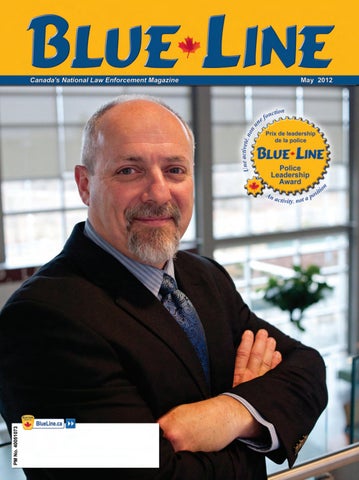
A leader among us
Det/Sgt. Duncan MacIntyre: 2011 Blue Line Police Leadership Award Recipient
6
10 Real World Ratings of Police Motorcycles Seven bikes put to the test
14 Borderless Policing
Covering the interoperability gap through integrated partnerships
22 Law Enforcement West of the Rockies Part 1
26
What Motivates a Serial Killer
Departments 10
38 29, 32
Advertisers Index Book Review
• Cold North Killers • Parting Shots
20 Deep Blue People with mental illness rate police
26
37 Dispatches 36, 37 Market Place 35 Product Show Case 5 Publisher’s Commentary The crippling police tackling violent crime act
30 Technology Mobile cellular picks up speed
Case Law 33 34 34
Cover Photo: Photography by Kat for Blue Line Magazine
BLUE LINE MAGAZINE
3
Drug investigation differs from entrapment opportunity Warrant plus facts justifies warrantless arrest Drug dealer must prove entrapment
MAY 2012
JOIN THE
CONVERSATION with Canada’s law enforcement information specialists
Blue Line Magazine Inc Blue Line Magazine Blue Line News Week Blue Line Trade Show & Training Blue Line Police Leadership Award Blue Line Forum
www.blueline.ca MAY 2012
Join online or phone 905.640.3048 BLUE LINE 4
MAGAZINE
Blue Line
PUBLISHER’S COMMENTARY by Morley Lymburner
Magazine Inc. PUBLISHER Morley S. Lymburner - publisher@blueline.ca GENERAL MANAGER Mary K. Lymburner - mary@blueline.ca SENIOR EDITOR Mark Reesor - editor@blueline.ca CREATIVE DIRECTOR E. Jolene Lymburner - jolene@blueline.ca CONTRIBUTING WRITERS Mike Novakowski Mark Giles Robert Lunney James Clark Dorothy Cotton Dave Brown Tom Rataj AFFILIATIONS International Association of Law Enforcement Planners Canadian Advertising Rates Data International Police Association The Canadian Press Newswire Access Copyright SUBSCRIPTIONS $30 per year; $50 for 2yrs; US & Foreign: $100 ADVERTISING 888-640-3048 advertising@blueline.ca
www.blueline.ca 12A-4981 Hwy7 East, Ste 254, Markham, ON L3R 1N1 Canada P: 905 640 3048 F: 905 640 7547 blueline@blueline.ca
PRINTED IN CANADA ISSN# 08478538 Blue Line Magazine was established in 1988 as an independent publication to inform, entertain, connect and educate those involved in the law enforcement profession. With no direct control from an enforcement agency, its opinions do not necessarily reflect those of any government or law enforcement agency. The authors, advisors, and publisher accept no liability whatsoever for any injuries to person(s) or property resulting from application of adoption of anything presented in this magazine. Readers are cautioned and advised that articles presented herein are edited and supplied for your personal awerness and should not be used for further actions until appropriate guidance is received from a supervisor, Crown Attorney or other persons in authority. All material submitted for publication becomes property of Blue Line Magazine Inc. unless arrangements have been made with the publisher prior to publishing. © 2011 All articles are protected by copyright. No part of this publication may be repoduced or transmitted in any form or means, electronic or mechanical, (including photocopying and recording or by any information storage or retrieval system), without prior permission. Permission to reprint may be obtained in advance from Access Copyright 1-800-893-5777.
BLUE LINE MAGAZINE
The “Crippling Police Tackling Violent Crime Act” Since the Conservative government has now decreed police do not need to track rifles and shotguns, how are officers to proceed? It is one thing to curry the favour of law abiding gun owners but if they become victims what are the police going to do? The thoughtless killing of the long gun registry has gone a long way toward hindering police and little or no thought has been given to patching up the long list of orphaned legislation and legal loop-holes that now exist in the Criminal Code. Gone are the Halcyon Days of investigating incidents like Mayerthorpe by using the firearms registry as a starting point. Few people realize the registry’s importance in tracking down Shawn Hennessey and Dennis Cheeseman, the two accomplices of James Rosko – or that some of the many weapons Rosko used were actually registered by him. All of this is water under the bridge. We must move forward, but where? These types of incidents will continue. Bad guys and good guys will still obtain rifles and shotguns and somehow the country is suppose to be a better place because police will not be able to use a serial number to trace anything other than what the gun factory knows and is willing to share. The country is, somehow, a better place if a citizen’s guns are stolen without a means to trace them. There is certainly no information forthcoming if the victim did not safely secure them from theft. Why tell and get charged yourself? An analysis of Bill C-19’s impact on the police ability to enforce Part III of the Criminal Code of Canada is presently in a startling state of disarray. The “Firearms and Other Weapons” sections have left considerable housecleaning to do but the housekeeper is yet to be hired. Incidents involving stolen, lost, misplaced, destroyed or criminally used long guns are going to be tougher to investigate. Experts refer to each individual firearm as having a pedigree. When a large number of the same make and model are manufactured (or created), it’s the serial number stamped on each at the point of origin that makes it unique. Police now have no other way of tracking long gun transfers. Prior to the long gun registry, transfers were regulated through “Firearms Acquisition Certificates.” Some records of serial numbers were required, but they didn’t easily allow police (or anyone else) to know who possessed which gun. The FAC system was scrapped when the long gun registry began. Now, with Bill C-19 a fait accompli, what will happen as police try to track criminally used, stolen, lost, misplaced or destroyed long guns? The orphaned legislation list under Part III Firearms and Other Weapons (s.84 to s.117) is long and includes: 5
• Three firearm use offences; • 11 possession offences (s. 97 not in force); • Two trafficking offences; • One assembling offence; • Two export and import offences; • Four offences related to lost, destroyed or defaced weapons; • Seven prohibition orders; and • One search and seizure order. Also consider: s. 91 Unauthorized Possession of Firearm Generally this means the accused was found in possession of a firearm without a valid license. How, with the long gun registry gone, will police determine how and from whom the unlicensed individual acquired a long gun? s. 98 Breaking and Entering to Steal a Firearm and s. 99 Robbery of a Firearm Pre Bill C-19 a licensed owner would call police to report their registered long gun had been stolen. Police had the serial number of the stolen gun on their data base. If they found someone possessing it, there would seem to be a good chance for conviction under s.98 or s.99. Now, if a long gun owner calls police to report a stolen weapon and they no longer have a bill of sale and don’t know the serial number, what do police do next? What will the report look like? What about enforcing court ordered weapons prohibitions? Previously if a licensed gun owner was convicted of a crime and ordered not to possess weapons, police knew from their registry data base how many long guns they possessed. Those days are gone. Now what? Police can go around to the house but... on what grounds would they obtain a search warrant? Voluntary search? How about pleading and reasoning with the criminal? s. 117 Search and Seizure How do police search for or seize a long gun if they don’t know the serial number? These are thoughts to ponder in these “new” times. To politicians it is simply a political and academic debate. To the cops on the street and the citizens they toil to protect, it is reality. A majority of the 23 firearms offences described in the Criminal Code will be more difficult to investigate. Bill C-19 will impair police in their ability to do their jobs, which is very troubling. Perhaps some of the high profile former law enforcement people currently involved in the law making arena can answer these many questions. I await patiently... as I must.
MAY 2012
A LEADER
AMONG US by Tracy Mackay-Stewart, and Blair McQuillan
Det/Sgt. Duncan MacIntyre: 2011 Blue Line Police Leadership Award Recipient MAY 2012
For most cops, being feared by criminals, respected by their peers and recognized as a living legend in the law enforcement community is a distant dream. For York Regional Police (YRP) Det/Sgt. Duncan MacIntyre, it’s a reality. During the course of his career, MacIntyre has gained a reputation as a dedicated officer who leads by example. He is known as a manager who promotes continued education and takes an active role in mentoring those under his command. With these attributes to his credit, it is only fitting that MacIntyre is the recipient of the 2011 Blue Line Magazine Police Leadership Award, which recognizes officers who view leadership as an activity, not a position and take pride in serving the public. “It’s an honour to be viewed as a leader in the police community,” said MacIntyre, who is currently assigned to the intelligence unit. “I’ve been very fortunate during my career, as I work for a great organization and have always worked with a great group of people.” A native of Brockville, Ontario, MacIntyre joined YRP in 1987. Initially, he worked uniform patrol based out of #1 District Headquarters, located in Newmarket. In 1994, he 6
transferred to #2 District Headquarters in Richmond Hill and by 1996 he worked in the district’s criminal investigations bureau (CIB). In December 1997, MacIntyre, who has nine letters of recognition and three chief of police awards to his credit, took the lead in a joint-forces operation into an organized crime ring responsible for a series of break enters in the Greater Toronto Area. Dubbed Project Moustache, the operation was one of the first such initiatives YRP launched, according to Insp. Kevin Torrie. “He convinced senior management of the merits of an investigation into these suspects and the benefits that would be realized by a collective joint-forces approach,” said Torrie, who was MacIntyre’s co-worker at the time. “Duncan planned and executed numerous techniques during the investigation, ultimately leading the team to identify an entire crime group, not only responsible for break and enters, but for robberies, stolen and revinned vehicles, debit and credit card fraud and boiler rooms.” Project Moustache concluded in February 1998 with 29 arrests and more than 200 charges laid. It was clear that much of the project’s success could be credited to MacIntyre’s tenacity. “Duncan worked countless hours BLUE LINE MAGAZINE
co-ordinating a group of individuals who had never worked together and who certainly never realized how busy and involved the suspects were,” Torrie said. “His work ethic and dedication to the team’s goals and objectives was the motivation for everyone involved to go above and beyond normal expectations.” In the months following the project, MacIntyre began work with the YRP Intelligence Unit. Eventually, he joined the provincial Biker Enforcement Unit (BEU) and began work on a career-defining initiative known as Project Shirlea. “While still at the rank of constable, he was able to cultivate an agent within the realm of the Hells Angels,” said YRP Cst. Pete Casey. “Duncan undertook the leadership role of agent handler and co-lead investigator … typically a supervisor’s role.” Casey notes that even during this busy time MacIntyre would introduce any willing informants to newer officers. As a result, they gained valuable skills to assist them in their policing career. In a 2005 letter of recognition, S/Sgt. Don Patrick of the Durham Regional Police Service acknowledged the positive impact that MacIntyre had on his career when he was a constable in the BEU. “In August of 2001, I became a part of the investigative team for Project Shirlea,” he wrote. “At the onset of the investigation, I had concerns about my experience, knowledge and abilities and addressed these concerns with Duncan and other members of the team. Duncan instilled in me the confidence that he had in my abilities and mentored me throughout the investigation.” YRP Cst. Tyrone Shaw, who also worked on Project Shirlea, echoed Patrick’s statements. “Prior to my working with the biker enforcement unit, I had heard of the legend that is Duncan MacIntyre, so needless to say I was intimidated to work for him,” Shaw recalled. “Dunc was very welcoming and approachable whenever I had a question or problem. I worked with him for four years, the best of my career. His work ethic can only be admired and not copied as he works harder than any officer I’ve met.” However, Casey points out that it’s not just co-workers who hold MacIntyre in high regard. “Duncan is such a professional and great leader that even organized crime members respect him,” Casey said. “If asked to write a letter for this award, some would.” By the time the project wrapped by in 2003, a total of 46 people were arrested, more than 240 drug, weapons and proceeds of crime charges were laid and 54 warrants executed in Ontario and Québec. Of those arrested, 16 were members of five Ontario Hells Angels chapters. Police also seized 10 handguns, 70 long guns and $500,000 worth of cocaine, marijuana and prescription medication. BLUE LINE MAGAZINE
Photos: Kathryn Lymburner
MacIntyre, who had been promoted to the rank of sergeant prior to the completion of the initiative, said the project was one of the greatest achievements of his career. “This was my first large multi-jurisdictional investigation,” he said. “We were dealing with a number of police agencies throughout the province and in Quebec and British Columbia as well. It truly showed what police agencies can accomplish when we work together.” MacIntyre also said the project helped him learn about the intricacies of leading large-scale investigations and the challenges that come with them. “I realize as a manager now, how much that experience taught me,” he said. “I worked with a lot of great people, but you have a number of different personalities to deal with, there were different styles of policing to deal with and then there were organizational and operational procedures to be aware of. In the end, it provided me with valuable management tools, but it was a time consuming project.” While time is always a precious commodity, Casey notes that MacIntyre is always willing to set his work aside at a moment’s notice to offer assistance. “Over the past 10 years I would call Dunc on his cell for advice or information and start off with, ‘Hey Dunc, have you got a few minutes?’” Casey said. “He would always answer, ‘Sure, what have you got?’ Afterwards, I realized that his entire day was taken up with people making those calls to him.” MacIntyre’s role as a leader within YRP has also paid dividends for the organization itself. Supt. Mark Tatz was one of MacIntyre’s supervisors when he worked as a property crimes detective from 2005 to 2007. Tatz noticed that MacIntyre worked closely 7
with every member of the unit, especially the six-month trainees. “It’s interesting to note that many of the trainees he worked with gravitated to special units, largely due to the influence and training they received from Duncan,” he said. For his part, MacIntyre said he is a “hands-on” manager who likes to stay up-todate on everything that is happening within his unit. He said he doesn’t have any particular style that he follows, but instead utilizes leadership qualities he learned from both supervisors and senior constables throughout his career. An advocate of continued education, MacIntyre said he has taken a number of leadership courses during his career, including a new YRP initiative. “Last year, I was part of the first Leadership in Action course for mid-level managers,” he said. “That was a three-week course that really opened my eyes to the various styles of leadership that are available to supervisors. I also recognized that our organization is working to ensure that middle managers have the skills and abilities required to take our organization forward in the years to come.” As for his own future, the 25-year veteran isn’t sure what’s in store. He acknowledges that there are goals he hopes to reach before he leaves his current role and he is open to new challenges that may come his way. “There’s always life after intelligence,” he said with a smile. “I’m looking forward to whatever new assignment I get.” Tracy Mackay-Stewart is a 34 year civilian member and Cst. Blair McQuillan is an eight-year member of York Regional Police. Both are currently assigned to corporate communications.
MAY 2012
Legacy of leadership The Police Leadership Award was initiated and first bestowed in 1999 by the Canadian Police Leadership Forum (PLF). With continual sponsorship from Blue Line Magazine, the PLF presented the award annually until 2005 when the organization ceased to exist. Blue Line has long recognized the simpatico between the precepts of the award and the magazine’s founding principles. Leadership ability is not a virtue one is born with or delegated to perform but rather something that is acquired through a learning experience and nurtured through a willing spirit. Encouraging leadership as an activity encourages leadership as a position. Drawing forth those with recognized leadership abilities at levels beneath senior management ensures the availability of a talent pool for the future of policing. The Blue Line Police Leadership Award exists to highlight the importance of recognizing those with leadership abilities and encouraging other officers to develop leadership skills. It is open to active Canadian police officers below the rank of senior officer who have demonstrated exemplary leadership and commitment to service through deeds resulting in a measurable benefit to their peers, police service and community. In February 2011 Blue Line Magazine took up the challenge of a cross-Canada search for suitable candidates for recognition. 2011 Judges Robert Lunney - Lunney is the Panel Co-ordinator. He has
MAY 2012
been a writer, columnist and advisor in police management issues for Blue Line Magazine since 1998. He is the former Chief of Peel Regional Police (1990-1997) , Commissioner of Protection , Parks and Culture, Winnipeg (1987-1990) , Chief of Police, City of Edmonton (197 4-1987) and a retired Superintendent with the RCMP. He is a Past President of Canadian Association of Chiefs of Police, a Life Member of the IACP and a member of the Washington D.C. based Police Executive Research Forum. Since 1997 he has been self-employed as a consultant on assignments in Canada, the United States, Israel, Jamaica and Northern Ireland. Armand La Barge - began his career with York Regional Police in 1973. In 2002, he was appointed as Chief of Police, a position he held until his retirement in December 2010. Chief La Barge is the Past President of the Ontario Association of Chiefs of Police and the Board of Directors for the Canadian Association of Chiefs of Police and he is a member of the First Nations Chiefs of Police Association . He holds a Bachelor of Arts Honours degree from York University. Armand is a graduate of the FBI National Academy, the Queen’s University Executive Programme, the Schulich School of Business Masters Certificate in Municipal Management and Le Centre Linguistique at Jonquiere, Quebec. Chief La Barge was invested as an Officer of the Order of Merit by Her Excellency Governor General Michaelle Jean on May 19, 2006, in Ottawa.
8
John Harris - is a Sergeant with the Hamilton Police Service and a Police Leadership Award Recipient for 2010. His policing career spans over 30 years. He has worked extensively with not only members of his own agency but also with Crown Attorneys, the US Federal Bureau of Investigation and the Secret Service. A former professional football player with the Hamilton Tiger cats set the stage for his ability to work with and encourage a team environment in policing. Proof of his effectiveness is reflected in those who have worked with him. Many of the officers who have been on his squads have been promoted through the ranks. Beverley Busson - Former Commissioner of the Royal Canadian Mounted Police and a Commander of the Order of Merit of the Police Forces. She has had a long and distinguished career at all levels of police work. She was among the first troop of female officers to join the RCMP in 1974. Her important contributions have included work with Aboriginal communities, the establishment of Canada’s first undergraduate degree in Criminal Investigation at the University College of the Fraser Valley and the establishment of BC’s Organized Crime Agency. She assumed the position of the 21st Commissioner of the RCMP in December 2006 and retired from active police work in 2008.
BLUE LINE MAGAZINE
Paying tribute
to local heroes York Regional Police guide their veterans home by Blair McQuillan There has always been a special bond between those in uniform, including a strong relationship between police and military personnel. York Regional Police (YRP) is committed to strengthening that bond by honouring military veterans and current Canadian Forces (CF) members. Welcome Home The Welcome Home Initiative was created and spearheaded by Insp. Gary Miner. Officers, firefighters and paramedics gather to welcome local soldiers returning home from Afghanistan. The war veterans are escorted from the airport to their front door, where they are greeted by a group of first responders, family, friends and members of the public. The most recent veteran to be welcomed home was Major Steve Kiss, who returned in March. Kiss, a member of the 32nd Brigade and a volunteer firefighter, served 10 months overseas as an advisor to the Afghan National Army in Kandahar. The initiative has taken on special meaning for several YRP members in recent years as they have welcomed their children home from Afghanistan. Insp. Rick McCabe and customer service supervisor Deb McCabe were proud to greet daughter Gunner Jennifer McCabe when she returned from her tour of duty in Dec. 2010. Kathy Sparks of the technical support unit was reunited with son Cpl. Mike Sparks as part of an emotion-filled homecoming. Tribute in stone YRP proudly unveiled the Recognition Stone, a massive tribute to CF personnel both past and present, last November. More than 200 veterans, peacekeepers, current military personnel, police, fire and EMS members, as well as local citizens, attended the unveiling at #3 District Headquarters in the Town of Georgina. CF members, their families, friends, loved ones and members of the general public are encouraged to stop by anytime to pay tribute to those who fought or are fighting for our freedom. The project was led by Sergeant Gary Phillips of the corporate communications bureau and BLUE LINE MAGAZINE
a committee of eight dedicated YRP members. “Our hope was to honour our local war heroes by creating a permanent site to recognize them each and every day of the year and we have succeeded,” Phillips said. The impressive granite structure is eightfeet long, five-feet high, 10-inches thick and weighs 7,500 pounds. It has been registered in the National Inventory of Canada Military Memorials so Canadians can learn about the significance of this special site. 9
Remembrance YRP launched the Remembrance Project in 2009, an initiative to honour local veterans. More than a dozen veterans were interviewed and their written legacies posted on the YRP web site. The project continues to expand as more veterans from past and current conflicts share memories from their time in the military. Cst. Blair McQuillan is an eight-year member of York Regional Police assigned to corporate communications.
MAY 2012
Real world rating of police
MOTORCYCLES Seven bikes put to the test by Morley Lymburner Los Angeles area police agencies evaluated the largest crop of police motorcycles ever last fall, analyzing performance, safety and comfort. Deputies and officers with the driver training divisions of the Los Angeles sheriff and police departments evaluated the BMW R1200 RT-P, Harley-Davidson Electra Glide, and Road King, Honda ST1300-PA, Kawasaki Concourse 14 ABS and Victory Motorcycles’ Commander I and Victory Vision. Four officers drove each motorcycle through a loop covering 33 miles of city streets, 75 miles of freeways, 20 miles of coastal highway and 29 miles of mountain canyons. Riders also performed a minimum of 10 simulated traffic stops on city streets. This is an aggregate of their comments and some statistics discovered about each (all figures are US). MAY 2012
Acceleration 0-100 km/h = 4.85 Seconds Fuel average consumption = 40.0 MPG Brakes – Activation was quick and consistent. Excellent feedback through the controls. ABS operation appropriate and predictable. Cornering/handling – Lean angle through corners was excellent. Great ground clearance, stable through all the corners with minimal wheel slippage. Transmission (shift points) – Smooth shifts with no missed gears. Well matched to the engine. Engine – Strong and pulled very well throughout the RPM range. 10
250 KM ride comments The seat padding and width was sufficient to provide all day comfort. Adjustable with a “lean forward” position. Foot pegs, toe shifter and brake lever well positioned and easy to use. Riding posture comfortable for a full shift of riding. The instrument panel is easy to read with analog and digital displays. The digital readouts for fuel, temperature and speed are user friendly but become hard to read or not visible depending on the light and protective eyewear. The windscreen provided good wind and debris protection with a wide range of height adjustments. There was little to no “bifocal effect” noted on the top edge of the windscreen. The handlebar width is wide with a high rise angle, offering good leverage when rotating handlebars side to side. Switches are within easy reach and marked with universal symbols. Shift lever and brake pedal are well positioned. Front brake and clutch levers are adjustable for reach and provide excellent feedback. The foot pegs are comfortably positioned to offer good control and support long riding days. They are inward and do not interfere BLUE LINE MAGAZINE
with mount/dismount.The trunk is noticeably high in relation to the rider, requiring a high leg swing to get on /off. The length of the side stand provided adequate motorcycle lean angle when parked. The ride quality and comfort was exceptionally smooth. Damping and rebound characteristics of the suspension smoothed out all but the roughest roadway conditions. Rear shock absorber rebound and preload are rider adjustable. The motorcycle offers the combination of long distance comfort and remarkable handling capabilities to the modern day enforcement officer.
Acceleration 0-100 km/h = 5.58 Seconds Fuel average consumption = 33.9 MPG 250 KM ride comments The seat is firm but not hard. Seat contains an air bladder adjustable for rider comfort. Position is upright and bent forward at the
BLUE LINE MAGAZINE
hip. The floorboards are placed to support an upright riding position and the foot controls are well placed. The instrument panel is configured with large dials for speedo and tach but only a small display for fuel, turn signals and high beams indicators. The lighted display was dim and hard to read in the bright sunlight. Visibility is good due to the small windshield. It is very easy to look over the top and around the side. Mirror location is good but they are small and do not provide the rider with much for a field of view. Convex mirror would be better. The mirrors vibrated on the freeway and at idle, distorting the view. The windscreen is rounded at the top and hard mounted to the fairing. The combination provided adequate protection at freeway speeds. All controls and switches are user friendly, well positioned and easily accessible. The clutch lever pull is rather heavy but the brake and shift levers are smooth and decisive. The handlebars are positioned forward, resulting in a “stretched arm” feel while the rider sits centered on the motorcycle, consequently negatively affecting posture. The heel toe shifter was in a good location and very easy to use. The rear brake pedal is mounted forward of the floorboard. When using it, riders had to pick up their whole foot from the floorboard rather than being able to just pivot on the heel. It is very easy to mount or dismount from either side. Footboards were comfortable and provided plenty of room to adjust foot posi-
11
tion. Side stand length provided a good lean angle to securely park the motorcycle. The overall ride was comfortable for long distances. Small bumps are absorbed well but larger ones cause the rider to bounce out of the seat when traveling at freeway speeds. There is not much adjustability for different size riders. Handlebars have little adjustment room and the seat height is only adjustable by running less air in the bladder or rear shocks. The soft seat seems to mask much of the stiff suspension.
Acceleration 0-100 km/h = 5.48 Seconds Fuel average consumption = 40.2 MPG 250 KM ride comments The seat is comfortable, especially with the added air cushion feature making it adjustable to rider preference. The position, although comfortable on extended rides with minimal shifting or braking, makes the rider feel stretched both in legs and arms. The foot-
MAY 2012
boards and foot controls are extended forward with a slight angle back. Position felt awkward at slower speeds. Floorboards are close to the ground with minimal road clearance when lean angles are input in the handlebars. The control switches are accessible while holding on to the handlebars and clearly displayed and visible. The tank mounted dials (speedometer and gas gauge) would be better suited if mounted higher so the rider doesn’t have to look down to monitor speed or gauge fuel consumption. The instrument indicators are legible but small and hard to see in the bright sunlight. Mirrors are extended from the handlebars and provide good visibility of rear traffic, especially while operating on freeway conditions with minimal vibration; however vibration is more prominent in normal stop and go traffic and causes considerable distortion. Visibility is good due to the small windshield, which offers minimal wind protection, especially on the freeway. Protection is adequate for warmer days. Lots of buffeting at higher speeds and plenty of wind noise. The handlebar and footboard position causes the rider to sit astride the motor with arms and legs stretched forward, resulting in a less than comfortable posture especially on the lower back. Floorboards and foot controls would be better suited if positioned back, putting less strain on hips and lower back and taking up less footboard space. The front brake and clutch lever were of good size and easy to use. The clutch pull was firm. This test bike did not come equipped with a top box thus boarding the motor was effortless. The motor has a low centre of gravity, limiting lean angle inputs before the boards drag. The side stand was easily accessible by the rider. The motorcycle’s quality of ride was comfortable in the saddle due to the bike’s air ride assisted suspension, with minimal road irregularities transferred to the rider. The suspension offered a very firm quality of ride.
Acceleration 0-100 km/h = 4.42 Seconds Fuel average consumption = 36.7 MPG 250 KM ride comments The seat is shaped well, has sufficient padding and three height adjustment settings. It’s firm, provided good support and did not become objectionable. Riding position lean angle is slightly forward, putting the handlebars within easy reach. Access to the toe shifter and rear brake control felt natural and was easy to operate. MAY 2012
The instrument panel is configured on the fairing, well within proximity of the rider’s view, making it easy to refer to at a glance. The digital display is centrally located on the instrument cluster. Having a gear indicator display would be a nice feature. Although the motorcycle’s mirrors are positioned low, causing a rider to lower their head and eyes to view, they provide a clear and wide reflection with no noticeable vibration distorting the image reflecting. The mirrors are easily adjustable. The windscreen is electrically operated, quickly adjustable to changing riding conditions and deflects the wind with no turbulence or buffeting. Very good clarity with no visual distortion. The rider is well protected from the wind and roadway debris. The handlebars were adjusted with bar risers and extended high enough to be comfortable on long rides, yet forward enough to maintain good riding position. The foot shifter is mounted low in relationship to the left foot peg. Switches are within quick reach and clearly labeled. Both the clutch and front brake levers are adjustable with the standard rotary knob. Brakes have smooth application with good feedback. Trunk height wasn’t objectionable. There was ample leg swing room while mounting and dismounting from either side. The foot pegs did not interfere at all. Side stand length was adequate to safely support the motorcycle at a proper lean angle. The overall ride quality is good, although the suspension is moderately stiff but still provides good roadway feedback. Motorcycle was easy to mount and sat at a nice height. Very agile and maneuverable, felt comfortable to ride. Adjustments to the suspension to smooth out roadway imperfections and top opening saddlebags designed to better handle patrol gear would be welcome improvements.
rider looking up to achieve a high horizontal field of view. Access to the foot pegs, shifter and brake lever was good. The gauges were easy to read, although minor glare with changing light conditions made reading them more difficult. All switches were easy to reach. The fairing mounted, fold away convex mirrors provided a clear, wide angle view of traffic. The tops of the saddlebags were visible in the bottom of each mirror. The mirrors were vibration free with no visible distortions. The windscreen is narrow and adjustable via a thumb switch. The screen is low, even in the full up position, causing slight helmet buffeting and turbulence at freeway speeds. The handlebars are spaced shoulder width apart and positioned well forward over the front of the gas tank. This forces the rider into a bent over position, placing a lot of downward pressure on the arms and hands. Gear shift lever is placed in a natural position, providing plenty of room for both up and down shifting. Switches are big enough to allow quick manipulation. Both the clutch and front brake levers were mounted in close proximity to the grips and provide a wide range of adjustment. The trunk is noticeably high in relation to the rider, requiring a high leg swing to get on and off. Foot pegs are wide and positioned well. The side stand is positioned just behind the left foot peg and difficult to deploy quickly. The length of the side stand provided adequate lean angle. The front and rear suspensions are adjustable. Even in the softest setting the bike had a firm ride. The motorcycle has great acceleration and braking performance but a surprisingly heavy bar feel when imputing counter steer. The motorcycle is really wide and a lot of work to maneuver in and around heavy traffic on city streets. Difficult to split lanes. Adding a taller windshield, making some suspension improvements and moving the handlebars back towards the rider would be very welcome improvements.
Acceleration 0-100 km/h = 4.33 Seconds Fuel average consumption = 30.9 MPG 250 KM ride comments The “Corbin” seat is frame mounted, not adjustable and has very little padding, resulting in uncomfortable extended rides. Riding position is centre on the motorcycle with the upper body leaned forward over the gas tank. Arms are extended forward and down with the 12
Acceleration 0-100 km/h = 6.48 Seconds Fuel average consumption = 37.5 MPG 250 KM ride comments The seat is well padded, mounted to the frame with no adjustment and equipped with a lower back support. Rider has plenty of room BLUE LINE MAGAZINE
to move and adjust foot position. Seating position was slightly leaned back against the back support with legs extended forward, feet flat on the floorboards. The instrument panel was nicely configured into the large fairing with large dials for the speedometer and tachometer and a digital display with information about everything from air temperature to gear selection and fuel mileage. Panel was clearly visible with very little reflection. The mirrors are mounted up and out of the way. They are very easy to refer to at a glance and provide a good view to both sides. Little to no vibration and they hold position well. The windscreen is slightly higher than eye level, rounded at the top and hard mounted to the handlebar fairing. It provides good protection from wind and debris at all speeds. Some helmet buffeting was experienced at higher highway speeds. The handlebars are positioned up and back slightly, keeping the rider in an upright position. Handlebars have good leverage with average side to side movement. The foot controls are mounted well within reach and use of the upright seated position. The hand controls are solid and provide the rider with good feedback. The leg swing over the mounted top box wasn’t extreme and did not require exerted effort to mount. Side stand length provided a good lean angle to securely park the motorcycle. The ride was comfortable and smooth at all speeds. The motorcycle was easy to control even when riding over more severe riding conditions. It was smooth and predictable during the day’s ride and comfort was very good.
bars, positioned above each handgrip, are adjustable and provide an adequate view to the side and rear. Little to no vibration. The windscreen is adjustable through an easy to reach electric switch. The fairing and windshield combination provide excellent wind and debris protection. The handlebars are long and swept back. The position is good for cruising but can be challenging when negotiating tight maneuvers in city and urban environments. The foot controls are mounted well within reach in the upright seating position. The front brake and clutch levers are within easy reach and provide good feedback. The handlebar switches are well marked and easy to operate.
Getting on and off in enforcement mode is difficult due to the high top box. The floorboards were comfortable and provided plenty of room to adjust foot position. Side stand length provided a good lean angle. The motorcycle was very easy to control even while riding over more severe road conditions. The suspension was solid and predictable in the corners. Although the Vision is physically very large and heavy it is surprisingly nimble for its size and weight. Visit http://www.lasdhq.org/sites/motorcycle-test/2011.pdf to learn more test details.
Acceleration 0-100 km/h = 6.03 Seconds Fuel average consumption = 36.7 MPG 250 KM ride comments The seat is well padded, mounted to the frame with no adjustment and equipped with a lower back support. Rider has plenty of room to move and adjust foot position. Seating position was slightly leaned back against the back support with legs extended forward, feet flat on the floorboards. The instrument panel was nicely configured into the large fairing with large dials for the speedometer and tachometer. Panel was clearly visible with very little reflection. The mirrors are mounted on the handleBLUE LINE MAGAZINE
13
MAY 2012
by Chris D. McBryan The most challenging part of policing more than 5,200 miles of border – more difficult than the remoteness, lack of infrastructure and sheer size of the task – is the line of demarcation drawn on the map. Long a barricade to effective co-operation, it establishes two distinct countries, governments, sets of laws and myriad bureaucratic and legal encumbrances that hinder each country’s ability to effectively enforce its respective customs and border enforcement mandates. The Canada-US border often enables criminal enterprise by affecting the supply and demand paradigm. Smugglers can charge high prices for moving goods a few feet across the border but law enforcement is prevented from crossing to disrupt them. Border enforcement agencies extend their reach through partnerships such as the Integrated Border Enforcement Team (IBET). The numerous interoperability projects that it undertakes are essential in providing an effective mechanism for enforcing both countries’ laws against illegal border crossings and smuggling. In fact, integrated policing is impossible without interoperability. History The first IBETs – intelligence-led law enforcement teams designed to enhance border integrity – were deployed in 2002. They bring together core Canadian and US federal partners to identify, investigate and interdict persons and organizations that threaten either country’s national security or are involved in organized crime between ports of entry. IBETs now operate in 24 strategic locations along the border. The core partner agencies are the RCMP, CBSA, US Customs and Border Protection MAY 2012
(CBP), US Coast Guard (USCG) and Homeland Security Investigations (US Immigration and Customs Enforcement). IBET objectives are achieved through domestic and international partnerships; collecting, analysing and disseminating intelligence; prevention and awareness initiatives; and the application of special police investigative techniques and advanced technologies. To this end, IBETs are at the forefront of technological advancements aimed at enhancing the ability to conduct cross-border operations. This includes radio interoperability, geo-spatial intelligence and sensor systems. SAFECOM is a communications program of the Department of Homeland Security’s Office for Interoperability and Compatibility. The SAFECOM Interoperability Continuum not only provides a framework for defining interoperability but is also an excellent tool for establishing levels of integration. Interoperability and integration are very much aligned and interconnected. Although the SAFECOM model focuses on technology, with a few operational interpretations it also nicely defines operational integration and allows for operational requirements and capability gaps to drive functional technological developments and interoperability. IBET has a solid governance model that establishes roles and responsibilities for participants and allows local agencies to help enhance border security. The IBET model is fully supported by a charter that provides a common vision and mission for partners governed by joint management teams, both at the operational and administrative levels. This approach permits the joint delivery of the program and joint prioritisation of operational priorities in the regions. 14
On the interoperability continuum, IBET would achieve the highest level with regional committees or joint management teams working binationally to prioritise and plan operations and administrative requirements. Technological goals IBET strives to enhance technology by developing common operating pictures, which more succinctly characterize the environment for decision makers and users alike. Recent examples include the marine operations common operating pictures deployed by IBET in Lake Ontario during the G20 in Toronto and the vessel tracking system used on the US and Canadian West Coasts. The Lake Ontario system used a variety of integrated sensors to monitor all traffic between the US and Toronto. By sharing the information, the RCMP, Toronto Police Service (TPS) and other participating agencies were able to develop common operating pictures. “For the first time, all agencies concerned with the marine environment had a common language that we could speak,” said Sgt. Eric Goodwin, TPS Marine Unit. This gave senior managers a complete view of the situation on the lake during the security event and assisted them in planning and co-ordinating resources and responses. The RCMP is now hoping to extend this common language to its US partners and has started to explore the complete integration of both country’s marine sensors into one common operating picture. The Great Lakes Marine Security Operations Center (GL MSOC) will be the regional focal point for the collection, analysis and sharing of information on marine and transborder traffic. It would allow key multidisciplinary staff to collaborate on a regular basis and integrate operations for a more effective maritime border response. BLUE LINE MAGAZINE
There are different levels of integration in IBET in standard operating procedures (SOPs). Interestingly, while technology is often a driver in creating them, with IBETs, it is more often the need to communicate and share intelligence that drives them. One of the most valuable SOP tools developed by IBET is the information sharing matrix. This tool was developed by investigators and a team of legal experts from both countries and all five core agencies. The matrix identifies common examples of circumstances and conditions under which one agency will be asked to share information or intelligence with another. The matrix identifies the procedures and rules of sharing, including the applicable legal authorities and the methods for request. This tool has proven invaluable, permitting law enforcement officers to confidentially share information for investigative purposes. IBETs continue to develop further SOPs and run integrated training and exercises with a focus on integrated operations. The Canada-US Shiprider is an initiative allowing specially trained and designated personnel from the RCMP and US Coast Guard to ride fully armed on each other’s vessels and to cross the border to enforce anti smuggling laws. Radio communications The main issue of concern with interoperability and integration is interoperable radio communications. Since land mobile radio systems are the backbone of any policing organization, it is essential that agents and officers have portable radios with which all partners can communicate. They are the links to communications centres and, most importantly, to backup. Consider a typical scenario in which a border patrol agent responds to a sensor alarm and sees signs that a group of people have illegally crossed the border into Canada. While the agent could initiate a series of communications steps, such as e-mails and phone calls between BLUE LINE MAGAZINE
countries, it would clearly be more efficient and effective to communicate directly with the RCMP to advise of the situation. Regionally, the RCMP and CBP have undertaken a variety of measures to solve this problem, most often simply swapping radios during operations. As usual, police officers will make do to get the job done but what about operations involving multiple agencies? How many radios can an agent carry? One solution would be a common radio system covering both countries but the cost would be very high. The RCMP has a piecemeal system of 16 different radio systems made by various manufacturers and more than 1,300 radio towers, making wholesale removal untenable. The CBP uses one radio manufacturer but has different systems deployed along the border. There’s also the troublesome matter of spectrum co-ordination. The border is governed by three radio frequency spectrum management agencies: Industry Canada, the Federal Communications Commission and the National Telecommunications and Information Administration. They co-ordinate spectrum in the US and Canada, assigning frequencies to emergency services and many commercial users. While theoretically possible, co-ordinating frequencies so that US and Canadian law enforcement agencies use the same frequency is impractical. Since it is a violation of the governing acts to use a radio system broadcasting on an unauthorized frequency in either country, the task of communication is made extremely difficult. Finally, using different technologies, from UHF or VHF to P25, adds further barriers to communication between the two countries. Through an analysis of the difficulties with radio traffic across the border, it became clear that radio spectrum and new systems were not the answer. Internet protocol offers a proven solution to address the barriers to international interoperability. The RCMP uses similar technology. The application server converts fully en15
crypted audio from its base format to a H.323 Internet protocol – ideal for transmitting calls – and then sends it to another agency on one of any number of mediums. Anything from a twisted-pair, high-signal integrity cable, in the case of a joint building, to dedicated T1 fiberoptic line or a multi protocol label switching circuit could be used. The power of this technology is that the application server will convert any four-pin radio format, UHF, VHF and P25, to Internet protocol packets, which can be sent fully encrypted to any designated partner, then unencrypted and broadcast over the partner’s radio system, irrespective of encryption or format. In a national security environment, this means international agencies do not share encryption or have to manage each other’s encryption keys. Connections north to south, east to west US President George Bush and Prime Minister Stephen Harper committed in 2007 to explore radio interoperability. This was followed up with Security and Prosperity Partnership of North America funding to conduct pilot projects. A pilot began in June 2008 in the Rocky Mountain IBET to connect RCMP officers and the US Border Patrol using radio over Internet protocol (RoIP) through the RCMP Red Deer County, Alberta, dispatch. A systems acceptance test achieved its objectives. An RCMP IBET user in Canada, using his own encrypted radio, was able to be connected and speak with a border patrol agent in Montana using his encrypted portable radio. As a bonus deliverable, an IBET member in Ottawa was able to monitor and speak to those same Canadian and US IBET officers from a phone in his office. The RCMP and CBP team that built this system has since learned numerous lessons on the performance of RoIP and ways to make the system more robust, secure and reliable. MAY 2012
Combining the lessons learned from the project and the capabilities of RoIP, Canada and the US can create a standards-based system of systems. This enterprise-grade gateway solution for cross-border communications capabilities would establish a secure tunnel over multi protocol label switching circuits. Rather than a complete overhaul, this is an overarching interoperability system, which allows existing disparate systems to communicate with each other. The radio interoperability system would establish a secure north-south connection between Ottawa and a northern US border hub. From these two hubs, the RoIP management server would control and co-ordinate the communications of the various sectors and divisions. This approach would establish binational radio interoperability for border enforcement agencies along the entire US-Canadian border. In addition, on the Canadian side, east-west operability would exist between IBET teams. The RoIP solution is a cost-effective methodology for solving the binational interoperability problem. A recent cost analysis of installing new radio gear on existing towers for a traditional MAY 2012
radio solution along the Canadian border was estimated to cost several hundred million dollars. Of course, this doesn’t include the spectrum management and purchase costs. It would take approximately 10 years to deploy this method and co-ordinate the spectrum required. In contrast, the equipment, leased lines and personnel required for the RoIP solution would cost Canada several million dollars for the entire country and could be deployed in two years. Solution deployment The RCMP Border Integrity Program and the Mobile Communications Unit have started construction on the Canadian side of this enterprise-grade system-of-systems solution. When fully deployed, it would allow IBET and RCMP users to speak to each other from coast to coast. It would also provide the framework for interoperability between the RCMP and other border area emergency services. Once the link is made to the US, it would also allow the RCMP, CBSA, CBP and USCG to communicate on their existing radio systems. In addition, further binational co-ordination can be developed, since this 16
same network would be made available to other public service agencies along the border to enable communication between themselves and their US- Canadian counterparts. In support of pilot projects and in anticipation of the national deployment of the solution, the IBET has used its own governance systems, such as joint management teams, and has written a radio interoperability governance model and a set of SOPs. These are living documents which will no doubt change as agencies come on board the IBET radio network. However, they will serve all well in achieving a high level of interoperability on the SAFECOM continuum. Once fully deployed, the IBET radio system of systems would see both national and regional committees working on a binational radio interoperability plan along with state and provincial agencies. Regional communications SOPs would be established, which would see daily use throughout the two nations. Integration and effective partnerships require communications interoperability. Effective communication establishes standards that guide and enable all levels of policing. Without this capability, the IBET partners would continue to operate in silos, independent of one another. The IBET program is striving to enhance its partnerships through integrated policing initiatives such as Shiprider and radio interoperability is essential to their success. The communications challenges inherent within the border environment can now finally be put to rest. With clear standards and procedures for sharing information and a methodology for both tactically and operationally communicating, the IBET program is taking the shared responsibility of securing the common border to the next level of efficiency and effectiveness. RCMP Sgt. Chris D. McBryan works with IBET. This is an edited version of an article first published in the June 2011 edition of the IACP’s The Police Chief magazine, available at www.policechiefmagazine.org
BLUE LINE MAGAZINE
Smart cars, phones...
and now cities by Nancy Colagiacomo Smart cities integrate information from different resources and use it to function more efficiently, improving public services and safety. Cities are seeing change as an opportunity and acting on the possibilities, not just reacting to the problem. Smart policing began with New York City Police Commissioner Raymond Kelly’s vision to fight crime in real time and belief that technology could help police resolve crimes faster and more efficiently. The result, Real Time Crime Center (RTCC), became a reality in 2005. The database has enabled access to information that otherwise took days and week of manual analysis. The system brings information together from several silos such as patrol reports, traffic and investigations. The search engine is vast and officers can quickly access critical information, permitting them to identify patterns, suspects and modus operandi. The RTCC is also capable of sending and receiving pictures from handheld devices and sending them directly to patrol cars. Investigations and patrol work are not only more effective but officer safety has been improved since information on offenders is now readily available. Through innovation and technology the New York Police Department (NYPD) has made its city safer; it has been recognized as the safest large US city for the past five years. With the help of federal funding, the Boston Police Department followed the NYPD example, implementing its own RTCC in 2010. Boston strategically installed street cameras and uses satellite imaging sent to the 911 centre, which then relays it in real time to officers. The system has the same components as the NYPD but is customized to Boston’s needs. The Delta Police Department uses intelligence led policing to collect and identify problems in a given sector in an effort to prevent crime. Using this information permits police to be more proactive in the ongoing fight against crime. Looking to the big picture enables management to implement better policies and procedures and deploy resources where they are most needed. Memphis Police faced the dual challenge of being more cost effective and combating an increase in crime which put the city above the national average in 2005. In an effort to innovate, it turned to smart policing. Hours of sifting through police reports and statistics have become a thing of the past; the department’s new system identifies patterns by analysing statistics and makes this information readily available to front line officers and investigators, thus assigning resources accordingly. Smart cities are also adapting this information to other areas. With an ongoing concern for its’ aging population, the city of Bolzano, BLUE LINE MAGAZINE
Italy wanted to prioritize elderly safety. It put together a sensor system that monitors household temperature, water leaks and so forth of seniors living alone. If a problem is detected a family member or nearby neighbour is alerted. Energy usage can also be monitored through a smart grid, allowing utilities to react when there is a problem, decreasing the duration of power outages or even preventing them all together.
17
Transportation is another aspect that needs to get smarter. Commuters in the US alone spend an estimated 4.2 billions hours annually in traffic jams. The one billion vehicles on the road today will double by 2020. Smarter transportation will mean better public transit, railways and even emergency response time. Some may be reluctant to join the Smart City phenomenon, questioning how the information collected will be used and citing privacy concerns. What if it falls into the wrong hands? Although the concept is relatively new, it’s clear crime fighting has made a tremendous leap. Organisations will need to be open to change and finding a clever way to be better at what they do. The NYPD is already studying the possibility of creating a more sophisticated database of repeat offenders, complete with known addresses, associates and other pertinent information, which will be made easily accessible to officers. Maybe it’s time to Get Smart. Nancy Colagiacomo is Blue Line Magazine’s Québec correspondent. Anyone with stories of interest on Québec policing may contact her at: nancy@blueline.ca.
MAY 2012
Getting away from the underground Moose Jaw Police tackle the over prescription of drugs by Lucas Habib When it comes to law and order, the small city of Moose Jaw, Saskatchewan has a history as colourful as its name. At the turn of the century, city buildings were mostly heated by steam. To service the boilers without enduring the frigid prairie winters, engineers constructed an elaborate network of tunnels beneath the downtown. During American prohibition, the Soo Line railway ran straight from Moose Jaw to Chicago; consequently, vice-based businesses began opening up shop in the tunnels and “The Jaw” became a hub for bootleg liquor distribution to the Windy City and across the US. Moose Jaw became known as ‘Little Chicago’ and Al Capone is rumoured to have visited numerous times (although no proof actually exists). Nearly a century later, Moose Jaw’s biggest law enforcement problem isn’t bootlegging – it’s prescription drug abuse. Whether in big cities, rural areas or remote First Nations reserves, prescription drugs are a growing crisis across Canada. Law enforcement agencies are battling the problem with some success, yet the problem continues to intensify. Prescription opioids have been the leading cause of accidental overdoses in the US and Canada since 2001 and property crime has increased in many areas to feed these addictions. According to the International Narcotics Control Board, as of 2008, Canada had the highest per capita consumption rate of oxycodone in the world. In Moose Jaw, oxycodone and morphine are the two main problems. In 2009, Cst. Taylor Mickleborough of the Moose Jaw Police Service was getting tired of dealing with drug-related property crime. His creative thinking skills led to his finding a way to help the Jaw’s opioid addicts while simultaneously reducing crime. From his confidential informants, he discovered that the city was well-known throughout Saskatchewan as a place where opioids were the drug of choice. “We also learned that Moose Jaw had a few doctors with inappropriate boundaries in their prescribing habits,” recalls Mickleborough. “We had drugs that had originated from a few local doctors that were being discovered during investigations in other jurisdictions. We were also told that users from other areas were coming to Moose Jaw to obtain prescriptions from those few doctors.” Mickleborough and his team approached the doctors but had mixed results. Clearly, traditional approaches weren’t improving the situation – it was time for something new. They came up with a “pretty simple idea,” says Mickleborough. The College of Physicians and Surgeons of Saskatchewan has one pharmacist on staff, Doug Spitzig, whose job MAY 2012
Moose Jaw Police Cst. Taylor Mickleborough with Saskatchewan College of Physicians and Surgeons Pharmacist Investigator Doug Spitzig. is to monitor misprescription and overprescription of drugs, but he was missing a critical piece of information – street-level intel. “All we did,” says Mickleborough, “was reach out to him.” Police collected a list of about 50 high-risk users and dealers from their proven-reliable sources. After some crossreferencing and fact checking, they handed the list to Spitzig, who in turn drafted letters to the doctors in question, asking them to justify their prescriptions to the suspected abusers and traffickers. With this approach, the doctors said they were pleased that drug misusers had been identified and agreed to help. To date, Mickleborough and Spitzig have been very happy with the physicians’ response. Despite this initial success, Mickleborough and Spitzig recognize the problems might recur. Now that the college is involved there are options for regulatory discipline of wayward physicians, including hearings, loss of prescribing license, competency assessments and investigations into non-professional conduct. So far, it hasn’t come to that. “We’ve already seen both quantitative and qualitative results,” states Mickleborough. Forty-two percent of the identified misusers on his master list either had their prescriptions ended or dose-tapered – but Mickleborough emphasizes that cutting off drugs an addict may need is not the solution to a drug abuse problem. Dose-tapering can be helpful, though. Since the program started, Moose Jaw’s support services have seen a corresponding increase in detox participants. Significantly, prescription drug addicts who have had their allotment reduced as a result of this initiative have been supportive. “Many of the 18
street-level users know they need help – they see doctors as the source of their problem,” Mickleborough emphasizes. “It’s important to express that we’ve never talked to a single prescription drug addict who doesn’t hate their addiction – it stops them from leading a normal life.” Mickleborough stresses that the program is still in its infancy. “This is the beginning of what we see as a long process of education, enforcement and support for both local users and traffickers.” He also hopes that other jurisdictions adopt a similar strategy. He and Spitzig have been invited to present at conferences in Saskatoon and Ottawa – to police, doctors and representatives from the Canadian Centre for Substance Abuse. They presented their strategy to a very enthusiastic board of doctors from the local health region in March. Dr. Brad Thorpe, president of a regional medical association, says physicians “knew that the problem was out there but were ignorant to the extent of it.” The presentation was such an “incredibly positive learning experience” they’ve requested additional seminars for other doctors, he noted. “There isn’t a lot of discussion between police, doctors, mental health and addiction professionals and drug addicts,” says Mickleborough. This program is one way of opening those tunnels of communication. Mickleborough, Spitzig and the Moose Jaw Police Service hope to bring those people who need help up from the underground and towards the light. Moose Jaw Police Cst. Taylor Mickleborough may be reached by phone at 306 694-7600 or by email to tmickleborough@mjpolice.ca. Lucas Habib is a freelance writer for Blue Line Magazine.
BLUE LINE MAGAZINE
Cops and coffee cut crime by Danette Dooley Halifax Regional Police Supt. Don Spicer knew he could make himself the target of numerous cops and coffee jokes when he decided to partner with Coburg Coffee to spread crime prevention messages. “We said we are going to fight crime, one coffee at a time,” the public safety officer says. “I expected the jokes to come but they didn’t. If you can get people talking about your messages then what you’re doing is a success.” The coffee shop partnership stems from HRP’s determination to find new and innovative ways of reaching the public. If printing messages on coffee cup sleeves would work, Spicer said, he and his colleagues wanted to try it. Spicer hopes that getting the same message out in a different way will get people thinking about what’s printed on the sleeves and remind them to be proactive about keeping themselves and their property safe. It may cut down on the number of crime victims in the area, he said. “We are at a point where you can put brochures out but they are part of the background now. People don’t really see them or read them and quite often they end up in the trash can.” Spicer doesn’t take credit for coming up with the idea. He’d heard about a police agency in Eugene, Oregon that undertook a partnership similar to the one recently formed between HRP, the coffee company and Dalhousie University. He took the idea to HRP Chief Frank Beazley, who agreed it was a worthwhile venture. The university also plays an important role in the partnership, Spicer said. There are many students living in the area who don’t bother locking their windows or doors, he notes. Spicer hopes that will change since one of the messages is a reminder to do just that. “We were seeing a lot of break ins with people going in and stealing laptops and things like that so we thought that particular message would be a good reminder to all the community but particularly to the people around the university.” Coburg Coffee is in the heart of the residential area around the university. The coffee shop’s owner was quick to come onboard with the project, Spicer said. More than 25,000 coffee sleeves have been printed. The messages starting with “Did You Know…” are also focused on thefts from vehicles and liquor-related issues such as binge drinking and drinking and driving. “We want people to get their coffee and look at the sleeve and say, ‘I wonder what my message is today?’” Spicer said. Since the project was launched earlier this year, other businesses, including another coffee shop owner, have contacted Spicer about using the sleeves. He’s also heard from other police agencies interested in implementing a similar project in their area. Spicer says public safety is everyone’s responsibility. “The more we can do together the more BLUE LINE MAGAZINE
crime prevention is going to be a success,” he says. The Halifax Regional Municipality created a public safety office in March 2009 in response to the Mayor’s Roundtable on Violence Report. The office falls within the purview of HRP and also includes the department’s community relations/crime prevention section, community response team, mobile mental health unit, traffic unit, school response officers, victim services and volunteer programs. The public safety office is responsible for
19
strengthening existing partnerships and fostering new ones with the various levels of government, social agencies, educational institutions, business associations and community/citizens’ groups. The goal is to ensure a coordinated and holistic approach to address the root causes of crime and enhance public safety. In keeping up with social media, HRP also get its messages out on busses and through Facebook and Twitter. Spicer also blogs about activities undertaken by the public safety office, including other community partnerships. Ironically, he even received a request for information about the coffee sleeve initiative from a police department in Oregon – the state where he borrowed the idea from in the first place. “They thought our idea was great and asked if we could share our communication plan so that they can do it, too.” Contact Supt. Don Spicer at hrmpublicsafety@halifax.ca to learn more about the partnership. You can also check out HRP’s crime prevention and public safety initiatives at halifax.ca, facebook.com/HalifaxRegionalPolice, Twitter@ HfxRegPolice and youtube.com/HfxRegPolice . Visit spotlightonpublicsafety.wordpress.com to read Spicer’s blog. Danette Dooley is Blue Line’s East Coast correspondent. She can be reached at dooley@blueline.ca
MAY 2012
DEEP BLUE by Dorothy Cotton
People with mental illness rate police “LISTEN TO ME” is a phrase that just about everyone uses at one time or another. It’s a favourite for everyone from little kids, spouses and teachers to bosses, workers and politicians. I suspect your chief says it to you – and that you would LOVE to say it to your chief if you thought you could get away with it. Each of us has an inherent need to be heard because we are, in reality, an authority on our own situation. The problem is that sometimes we feel we know another person’s situation better than they do. The boss may not feel he/she has anything to learn from underlings. Teenagers certainly feel their parents have little to teach them and doctors feel they know more than their patients. There is, of course, an element of truth to these contentions, but you can always learn. A couple of years ago I wrote a column about a BC study which asked people with mental illnesses what they thought about their interactions with police. Did they feel incidents were handled well and the outcomes were appropriate? How comfortable were they with police in general? Did they view officers any differently than most people do? The study wrapped up a while back – you might have seen press coverage (some of it horribly misleading, with isolated bits taken out of context... that’s the press for you!). To make a long story short, you can read the study report at http://www.mentalhealthcommission.ca/english/pages/default.aspx (click on A Study of How People with Mental Illness Perceive and Interact with the Police). If you’re not convinced you want to read the whole thing, let me share a few key bits. I’ll start by reminding you that the study involved more than 200 people in BC with lived experience of mental illness and was the first in Canada to examine perceptions and experiences related to their interactions with police. While much research has looked at what police think about people with mental illnesses, there has been almost no work done looking at what people with mental illnesses think about police. The study was led by BC Mental Health and Addiction Services in partnership with Simon Fraser University, the University of British Columbia and the Canadian Mental Health Association – BC Division. The research team included some people with a mental illness. Their involvement ranged from informing the design of materials to collecting data, interpreting findings and developing recommendations – an approach referred to as community-based participatory action research. There was a written survey and also some in depth interviews. The people who chose to participate were fairly familiar with police. For example, 21 per cent of survey participants and 37 per cent of interview participants reported MAY 2012
more than 25 interactions with police during their lifetime. These contacts include a diverse range of situations and circumstances, including: • Being transported to hospital; • Other interactions involving a mental health crisis; • I nteractions related to alleged criminal behaviour; • Interactions in which the person was a victim; • Casual or informal contacts. The study findings paint a balanced and encouraging picture of how police interact with people who have a mental illness. Not surprisingly, it found a ‘diversity of attitudes and perceptions,’ neither uniformly positive nor negative about police. On the one hand, people with mental illnesses are more positive than negative about these interactions. Survey participants generally tended to indicate that they were satisfied, rather than dissatisfied, with the way police handled previous situations, especially those that did not involve suspected criminal activity (e.g., mental health crises). The slight majority of interview participants rated their previous contacts with police as a positive experience overall. The majority, including those who were experiencing a mental health crisis, perceived that they were treated in a procedurally fair manner by the police officer(s) involved in their most recent interaction. For example: • 85 per cent indicated that they were treated with respect; • 76 per cent were satisfied with the way in which the officer(s) handled the particular situation. The majority of interview participants were also satisfied with the way police handled their most recent interaction and 80 per cent indicating they felt the officer did a good job dealing with the situation – but there is definite room for improvement. One-third perceived their previous police interactions as a negative life experience. The survey results suggest people with mental illness tend to hold more negative attitudes, in comparison to the general public, toward police. Survey participants were more likely to rate police performance across several domains as ‘poor’ and less likely to rate it as ‘good’ in comparison to the general BC population. Use of force was an issue; more than three-quarters of interview participants had been handcuffed or physically restrained by police. A quarter of interview participants were involved in interactions with police resulting in minor injury to the participant (not requiring medical attention), whereas 12 per cent reported suffering serious injury (requiring medical attention). What’s the take home message on this? It is probably easiest if I just quote the report here: 20
• Most interview participants thought it would be helpful for a police officer to have access to background information about a person with mental illness prior to arriving on scene – especially if the officer was trained in how to use the information appropriately (although it is worth adding that is a pretty controversial area and many people quite vehemently disagree with this). • 90 per cent of interview participants felt that it was ‘very’ or ‘extremely’ important to train police officers to handle situations involving people with mental illness. • Participants recommended the following elements for a training program that teaches police how to handle situations involving people with mental illness: (a) effective communication skills, (b) understanding mental illness and its effects, (c) treating people with compassion and respect and (d) non-violent conflict resolution skills. • Additional strategies suggested for improving how people with mental illness perceive and interact with the police included: (a) building stronger linkages between police and the mental health community, (b) recognizing and rewarding positive police practices, (c) selecting and supporting police officers, (d) creating positive role models among police officers, (e) increasing accountability and oversight of police and; (f) ensuring that health professionals are involved in responding to mental health-related police calls. In case you are wondering, all this input is being used to help develop the TEMPO model for police officer education and training in this area. You will likely be hearing more about it as it rolls out in the next year or so but meanwhile you can have a look by visiting: http:// www.mentalhealthcommission.ca/English/ Pages/ThePoliceProject.aspx My favorite part of the BC study report is the quotes at the end, some of which really say all there is to be said. My favourite: “I’ve got some really negative ones (experiences with the police) and I’ve got some quite positive ones so, you know, averaging out, it’s right in the middle... because I’ve met a lot of good police people who have been kind and knowledgeable and they really helped me when I was really low or high as the case may be. “There are some good ones out there and I think they really want to do a good job, and sometimes they want to do a good job and they just don’t know how. They’re just good people, with not the right skills... and sometimes they’re jerks” (Brink, J., Livingston, J. D. Desmarais, S., Greaves, C., Maxwell, V., Michalak, E., et al., 2011, p. 69). Dr. Dorothy Cotton is Blue Line’s psychology columnist, she can be reached at deepblue@blueline.ca
BLUE LINE MAGAZINE
Racing against drugs As winter melts into spring young people everywhere begin to think about hitting the roads on a wide variety of vehicles, including blades, boards and bikes, but the allure of a motorcycle is both enticing and endangering. Cst. Cory Adams of the Durham Regional Police Service (DRPS) combined his love of motorcycle racing with an RCMP-designed educational concept aimed at youth and teens in his area. There are many programs aiming to discourage Grade 6 and up students from taking drugs but few for the younger crowd. Durham Region is an exception. Fifth graders have their own program, Racing Against Drugs. Canadian children experiment with drugs at an early age, according to studies by public health and the Centre for Addiction and Mental Health. The need to provide them with clear cut information is evident. Volunteers arrive at a school to set up ‘pit stops’ for students to visit. One features motorcycle safety and draws many students who want to check out Adams’ ride. The kids enjoy seeing a racing motorcycle detailed with DRPS insignia. While he has their attention Adams not only showcases his motorcycle but also stresses the importance of being alcohol and drug free in order to safely ride it. At the end of each “pit stop” day the kids have acquired information on how to keep safe and make healthy choices.
those who would not normally speak with a police officer. The major focus of Ride Safe is education. In addition to speaking to students, Adams hosts track days to provide a safe and controlled environment for those who ride sport bikes and
attends community events such as motorcycle cruise nights and major trade shows. Contact Cst. Cory Adams at cadams@drps.ca or 905 579-1520 for more information.
Ride Safe program In addition to Racing Against Drugs, Adams and Team Cops Racing have embarked on a new community education program which speaks to both those who ride motorcycles and drive automobiles. The program is designed to raise awareness about motorcycle collisions and educate everyone, including teens, about the dangers of impaired driving, illegal street racing, drugs and the need to stay in school. It’s also designed to project a positive image of police and show today’s youth that they have similar interests. The stated goals are to: • Create a positive image of law enforcement with those who may have encountered officers in a negative way; • Educate the public and today’s youth on the dangers of impaired driving and street racing.; • Deter substance abuse; and • Stress the importance and benefits of education. The visual allure of a racing motorcycle along with up close and personal contact captivates youth and allows them to relate to police officers in a positive manner. As with any demonstration the motorcycle is the highlight and key to starting conversations with BLUE LINE MAGAZINE
21
MAY 2012
Law enforcement
west of the Rockies by Andrew Maksymchuk My first encounter with a police officer was in the spring of 1948. A strange vehicle slowly approached up our family farm’s long and muddy driveway, distracting me from my play. Dad emerged from the barn as the car stopped near our old log cabin in Grindrod, British Columbia. The driver was smartly but curiously attired, sporting a long, tailored khaki jacket with dark green epaulets, brass badges and buttons, khaki shirt, dark green tie and ridingstyle khaki breeches. His trousers had a dark green stripe down the outer leg. Brown riding boots rose to mid-calf over the breeches. A Stetson hat sat atop his head and the green lanyard around his neck disappeared into a cross-draw holster on his hip, held there by a brown belt with cross strap. He asked dad for directions to a nearby farmer’s residence. For the first time in my five years of life I was seeing a police officer. An aura of importance that begged respect surrounded the man, a member of the then 90-year-old British Columbia Provincial Police (BCPP). Members helped shape the course of BC’s development, from its beginning as a colony in 1858 and then as Canada’s sixth province in 1871. The newly-formed territorial police force had to explain the white man’s laws to natives and British justice to the American gold seekers rushing north to the Fraser River and Cariboo country. Over the years, a steady stream of humanity flooded BC to take advantage of its plentiful bounty. Fishermen, pirates, bootleggers, entrepreneurs, sourdough and chechako miners, loggers, cowboy ranchers and immigrant Chinese labourers for railway construction soon tested police innovation and effectiveness to its limits. The Provincials met the MAY 2012
- Part one -
challenges, policing through two world wars, the Depression, strikes and riots, establishing a sophisticated crime lab, state-of-the-art communication equipment and highway, sea and air sections. The BCPP was the first police force to acquire an aircraft for law enforcement and even managed to unofficially get two submarines for its marine division at the outbreak of World War I; the federal government took them over a few days later. During World War II, machine guns were mounted on the force’s larger police boats as marine unit members watched for Japanese aircraft and submarines while patrolling BC’s Pacific shore. BCPP Cst. William Fernie, who gained fame as an expert tracker serving in the Boer War, helped locate and capture the notorious American train robber, Bill Miner, subject of the movie, The Grey Fox, when Miner dared to venture across the US border and rob the railroad in BC. As settlers moved in and towns sprang up, the Provincials, hired from within BC communities as per policy dictated by first leader Chartres Brew, shed their territorial policing style to become one with the community. 22
Officers marched in the May Day parade and talked to school children about safety. If a constable’s detachment/residence happened to be within a native settlement, he usually policed cooperatively with the local elders and partook in social functions including, as historical rumour has it, the banned Potlatch. Rivalry begins The BCPP’s first jealous clash with its federal counterpart occurred when construction of the Canadian Pacific Railway (CPR) reached BC’s Rocky Mountain border at Kicking Horse Pass in late 1884. The province conveyed a 20 (later 40) mile belt on each side of the proposed route to Port Moody to the Dominion of Canada. Unfortunately, there was no agreement as to who would police this land. The Dominion government and CPR assigned the task to the North West Mounted Police (NWMP) – forerunner of the RCMP. The BC government believed it retained this responsibility under the British North America Act of 1867 (now called The Constitution Act, 1867), which at the time gave the provinces the responsibility of administering justice. It all came to a head in 1885, in Keystone Kop fashion, at the twin towns of Farwell-Revelstoke, not too far from Craigellachie, the location of the CPR’s Last Spike. The CPR forbid liquor along the railway belt, especially within its construction camps and the NWMP strictly enforced this rule. The cash-strapped BC government wasn’t about to let a revenue bonanza potential from well-paid workers slip through its hands. It readily issued liquor licences to anyone with any type of structure, including tents, that could be deemed taverns. The conflicting regulations muddied legalities. The NWMP immediately arrested a man found bringing a pack train of liquor into the BLUE LINE MAGAZINE
belt and took him before a magistrate. The man successfully argued he was acting within provincial law so the magistrate issued a warrant to arrest the NWMP officer for making an illegal arrest. The BCPP member sent to make the arrest was himself arrested, immediately tried and sentenced to jail for interfering with the duties of a federal constable. A second constable was sent and also arrested. The BCPP swore in a posse of 20 special constables and managed to capture three federal officers before the remaining NWMP members barricaded themselves within their detachment and began preparing a defence against attack. Eventually cooler heads prevailed and the short standoff ended. In the days that followed, the BCPP firmly held its policing ground while most of the NWMP discreetly drifted away. A federal-provincial hearing concluded that the NWMP was at fault in arresting the BCPP officers. It was decided the NWMP would enforce the law along the railway belt within Revelstoke and eastward to Kicking Horse Pass, while the BCPP would handle Farwell and points west. When the railroad was complete, fulfilling the federal government’s obligation to BC for entering Confederation, the NWMP withdrew from the province. Two years after the Revelstoke Police War, this time at the BC government’s request, the NWMP established its first post (albeit temporary) west of the Rockies. Working out of a BCPP detachment located within the small community of Galbraith’s Ferry (later renamed Fort Steele), PC Henry (Harry) Anderson was the only law for the 100 whites, 80 Chinese and nearly 600 natives in the Kootenay Region of southeastern BC. Land grants (many questionable) to settlers and remittance men, gold claims to miners and the lack of a treaty continued to reduce the size of the reserve land allotted to the band of Kutenai natives, led by Chief Isadore. There were many land disputes between natives and whites but the most serious was between Isadore and Colonel James Baker, a major landowner of questionable integrity and member of the provincial legislature. Tensions peaked when a perhaps somewhat over-zealous Anderson arrested Kapula, one of Isadore’s band members, on suspicion of the three-year-old murders of two American miners. Isadore rallied some 25 armed men, stormed the local lockup, released Kapula and put the run on Anderson, who could do little. Volunteers were afraid to help and backup was non-existent. I can personally relate to Anderson’s predicament. I was run off of Fort Hope (now Eabametoong), a remote flyin First Nations settlement in Northwestern Ontario, back in the mid ‘70s. A large group of onlookers saw me struggle with a violentlyresisting break, enter and theft suspect and decided to prevent me flying him off to jail in Central Patricia (now Pickle Lake) detachment. As my handcuffed suspect and I stumbled as quickly as I could push him toward my waiting chartered float plane, the grumbling crowd closed in behind. The quick-thinking pilot spotted our mud- and blood-covered BLUE LINE MAGAZINE
approach, quickly untied the aircraft, fired it up and drifted slowly away from the dock as I pushed my charge onto a float and leapt aboard behind him. I probably just missed a good thrashing, or worse, since back-up was hundreds of kilometres away. Federal help My matter ended as soon as we took to the air but the Anderson case quickly escalated. Fearing an “Indian uprising,” the greatlyoutnumbered settlers called for the province
23
to intervene. Since the entire BCPP had only 44 members, Premier William Smithe telegraphed Prime Minister John A. Macdonald for assistance under the Articles of Confederation, which made Indian affairs a federal responsibility. After some financial bartering, NWMP Major Sam Steele was directed to bring a contingent of Mounties into the Kootenay area from Ft. McLeod in the North West Territories (now Alberta). Soon after Steele and 75 troops arrived, Isadore was persuaded to surrender Kapula for trial on the double homicide. Steele, in his capacity as magistrate, presided over a brief court session and released the accused for lack of evidence. He later convinced Isadore that he had already lost his land dispute with MLA Baker; any armed struggle would be futile and the chief would be replaced if he didn’t acquiesce. The NWMP spent a year at the Kootenay Post, almost doubling the size of the community. With practically no law enforcement requirements, members made local improvements, building log barracks, stables, a kitchen, school and officer quarters. They turned them all over to the provincial government when they left in 1888 and the post was renamed Fort Steele. BCPP Cst. Dennis, replacing Anderson, settled comfortably into his new detachment – the officer quarters! Steele returned to Fort Macleod with 14 fewer members – four died of typhoid and ten deserted. By 1896, when the need for frontier policing was rapidly decreasing, Prime Minister
MAY 2012
Wilfrid Laurier toyed with the idea of reducing and eventually disbanding the NWMP. The force was saved by the Klondike Gold Rush in the Yukon. Steele, commanding almost 300 men within the Yukon, secured Canadian sovereignty, enforced the law, collected duties and manned border posts at the White and Chilcoot Pass summits. The Mounties did not share the subsequent glory of their legendary performance with the BCPP, whose members did the same job along the hundreds of kilometres of the disputed Alaskan Panhandle-BC border. The BCPP spread just 11 men throughout seven detachments over a 120,000 square kilometre district. As towns would boom, then bust, it shuffled detachments along with the shifting population. Duties included monitoring miners and supplies and ensuring the US wasn’t getting any expansion ideas along the still-unsurveyed border. In 1917, Alberta and Saskatchewan – Canada’s newest provincial entries – formed their own police forces. Many officers were former (now) Royal NWMP members who had been stationed there. This sudden loss of manpower, along with members who hadn’t yet returned from volunteer service in World War I, reduced the RNWMP numbers to only 303. With responsibilities and size seriously reduced, rumours of disbandment abounded. Prime Minister Robert Borden, who had a vision of establishing a strong federal force which would eventually include provincial policing across Canada, had other ideas. In January, 1919, the federal government announced the RNWMP would immediately expand to 1,200 men, begin enforcing all federal laws in the four western provinces and continue policing the north. This also meant members would replace the small number of Dominion Police (DP) in the west – a federal force whose 150 members policed mostly east of Manitoba. (Many Canadians incorrectly believe the RCMP is Canada’s first and only national police force. The DP began in May, 1868, five years before the NWMP was formed, partly over fears of raids from the US by the revolutionary secret society of the Fenian Brotherhood. The DP performed most duties in civilian attire but could also be seen in their dark blue uniforms and spiked helmets, similar to the British police, on guard outside the Parliament Buildings. Members were the
pathfinders in developing federal law enforcement, investigating counterfeiting, white slave traffic and crimes against the postal service, controlling enemy aliens during WWI and territorial disputes with the US, to name just a few federal matters, over 52 years of service. The force pioneered fingerprint identification through the creation of the National Criminal Identification Bureau. The first commissioner, Gilbert McMicken, set up a secret information-gathering system against the Fenians, was Canada’s first spymaster and could be considered the grandfather of the Canadian Security Intelligence Service (CSIS). Five years after the DP was formed, it became necessary to establish law and order in the former Hudson’s Bay Company lands (present day Saskatchewan and Alberta) to assert sovereignty and establish friendly relations with the Indians. The need for a military-style, territorial police force was identified and the NWMP was formed). Federal influx Within two months of Borden’s announcement, the number of RNWMP officers in BC grew from 20 to 250. Detachments sprang up throughout the province, begging the question “why?” – especially in those areas where there were relatively few federal infractions. Even
the president of the Privy Council and the federal minister responsible for the RNWMP queried Commissioner Perry as to why so many members were being transferred into BC. He justified his actions by outlining the amount of work and manpower required to enforce the Inland Revenue Act, Indian Affairs, immigration regulations and patrolling the international boundary. The influx continued. RNWMP members soon took over enforcement of federal statutes previously handled by the BCPP. BC’s plain-speaking premier, “Honest John” Oliver, objected, flatly refusing when they offered to take over all general duties in four communities within the east Kootenays. He sensed a move toward a provincial policing takeover, a step that would negate some of the provincial independence built into Confederation. The RNWMP responded by establishing even more detachments and sending in more men. The RNWMP policing style, shaped by military tradition and procedures, was the flip side of the BCPP. The small number (sometimes only one) of BCPP members at detachments were expected to decide how best to enforce law and maintain order in their specific area. The RNWMP, on the other hand, working within their chain of command, were more rigid and less autonomous. Sometimes the differing styles would create animosity when members of the two forces worked, or attempted to work, together. The rival forces also differed in their approach to possible riots and strikes. In 1919, BC was suspected of having the most passionate union members and the largest number of revolutionary radicals in Canada. Political unrest, rumours of a major strike and the possibility of radicals using strikes for political change had the provincial and federal governments preparing for confrontations in Vancouver that appeared inevitable. If a major strike occurred, the RNWMP assumed it would be on the front line and in charge. Oliver, however, made it quite clear that Vancouver municipal police would be in charge, backed up by the BCPP. The RNWMP would be called in – as an aid to the civil power – only if necessary, suggesting it was more of a military than police force. After rebutting that insinuation, the RNWMP recommended it be used in a show of force display to discourage possible strikers. Oliver disagreed, relying on experience gained in handling massive strikes a few years earlier and refused to react to speculation. BCPP undercover officers eventually determined that most workers disagreed with the radicals. The crisis passed and the predicted riots never occurred. Such wasn’t the case, however, the following month in Manitoba. Winnipeg strike Upwards of 30,000 strikers and supporters took to the streets of Winnipeg in June 1919, staging the largest strike in Canadian history. It had brewed for years before negotiations broke down. Fearing the strike might lead to similar acts across Canada during a time of labour unrest, Borden’s government decided to intervene. The federal labour and justice ministers met
MAY 2012
24
BLUE LINE MAGAZINE
with the citizens’ committee (management and city officials who had fired the entire city police force) but refused to meet with strikers. Under orders from Ottawa, the RNWMP hired 2,000 “specials” to assist in dispersing the crowd. Two protestors were killed when the club-wielding mounted police fired their revolvers into the throng during a military-style charge recorded in history as Bloody Saturday. A few months later questions were again asked in parliament about why Canada maintained two federal police forces. It was decided to merge the forces. The opposition favoured keeping the DP’s plainclothes style while Borden opted for the highly profiled RNWMP, which had already become somewhat of a Canadian icon. He believed in a well-trained, highly-disciplined, armed and mounted, paramilitary force, saying it had proven its worth by “successfully controlling” the Winnipeg strike. In early 1920 the DP was assimilated into the RNWMP, which was renamed the Royal Canadian Mounted Police (RCMP). The Great Depression (1929-1939) was a major boost in the RCMP’s bid to fulfil Borden’s vision of one federal police force from coast to coast enforcing both federal and provincial laws. By 1932 six financiallystrapped provinces could no longer support a provincial police force. Saskatchewan, Alberta, Manitoba, New Brunswick, Nova Scotia and even Prince Edward Island, with its oneyear-old force, opted to cut costs and sign a contract with the RCMP. Quebec and Ontario, ever vigilant to a decrease of independence, wouldn’t even consider turning over policing responsibilities to the feds. BC managed to weather the fiscal storm and retain the BCPP. Perhaps it was the RCMP’s continuing violent and biased manner in handling strikes during the 1930s that began to tarnish its image. Some concerned Canadians began looking at it as an outdated 19th Century frontier force rather than one for a 20th Century industrializing nation. In contrast, by 1938, beginning its ninth decade of service, the BCPP was recognized as one of the most highly modernized law enforcement organizations in North America. Proud of its contributions to the province, residents bestowed specific honours on a deserving few. For example, Mount Brew in the Lillooet Range was named after first superintendent Chartres Brew and Gardom Lake honours the first BCPP officer to serve that area of the Okanagan Valley. The BCPP managed the challenges of strained resources and an increased workload during World War Two. Many members enlisted in the military and those who remained were challenged with additional duties, such as training thousands of air raid protection volunteers, registering Italian and German aliens, policing an ever-increasing population, maintaining increased vigilance along the BC coast and the shameful internment of Japanese people. The sudden end Five years after the war ended and two years after my first childhood encounter with the BCPP, it was suddenly and inexplicably BLUE LINE MAGAZINE
DISPATCHES
absorbed by the RCMP. With a stroke of his pen, Attorney General Gordon Wismer of BC’s Liberal-Conservative coalition government tossed aside the province’s modern, innovative, unique and community-minded style of policing, developed over the years by working together with the people of the province – replacing it with the out-dated militaristic and frontier method of the RCMP. It set policing back by years. Within a decade however, many of my generation would no longer remember that the BCPP had ever existed, incorrectly believing, like many of BC’s citizens today, that the RCMP was the original force to police their province. With little municipal policing experience, the Mounties now faced serving Surrey, Coquitlam, Burnaby, North Vancouver. Fortunately almost all of the more than 500 provincial police were “wanded” into the RCMP and guided their new supervisors in the ways of urban policing – but that may have been the only good point about this oil and water mixture of personnel, which didn’t occur without animosity and friction. The conduct of both factions clashed, both on and off duty. The former BCPP members were not as regimented as their federal counterparts and therefore more approachable to the community. The RCMP members, on the other hand, were not about to change the historical discipline, deportment and Force loyalty instilled into them at Depot, which tended to produce a “we versus they” attitude with the public and a “defend the reputation of the force at all costs” mentality. RCMP members unflatteringly labelled the former BCPP members “Jock Straps,” taken from the title of the BCPP magazine The Shoulder Strap. In a form of retaliation, former BCPP members excluded RCMP members from their informal meetings. This risky behaviour apparently continued for years and was only resolved through attrition. Next month – It’s time to recall the BCPP back to duty.
25
RCMP Assistant Commissioner Fraser MacRae announced his retirement after 35 years with the RCMP and the last eight as commander of the Surrey Detachment, known as the largest in Canada. Since June 2004 he has led the 661 officers and over 250 support staff. In 2010, Fraser received Order of Merit from the Governor General of Canada. MacRae will assist in the selection process for the new Officer in Charge of the Surrey RCMP. His last day as Officer in Charge will be June 1. •••• Peel Regional Police Deputy Chief Paul Tetzlaff was named acting chief of police In April to replace retiring Chief Mike Metcalf. Tetzlaff has been a Peel police officer for 37 years. He was appointed deputy chief in 2006, and added the duties of chief administrative officer a year later. Meanwhile, the Peel Police Services Board will consider how to go about searching for a permanent replacement for Metcalf. •••• Robert Herman, Thunder Bay’s former police chief, will be putting on a uniform once again. Herman will serve as the new deputy chief for the Nishnawbe-Aski police service. Herman, who retired less than one year ago, will serve at his new post for one year. NAPS Chief Claude Chum said Herman will assist in the succession planning and the growth development of the service. He will also be an asset in dealing with the impact of across-the-board federal funding cuts, according to Chum, who added there is no doubt cuts will affect First Nations policing. •••• Jeffrey De Ruyter has been appointed Deputy Chief of the Guelph Police Service effective April 1, 2012. De Ruyter commenced his policing career as a Police Constable with the Guelph Police Service (GPS) in 1984. In the rank of Inspector he has been responsible for providing senior leadership to the operational divisions of the Police Service including front-line response, investigative services, traffic, tactical and canine services. De Ruyter is actively involved as a community volunteer with service to the Guelph Minor Soccer Club, Woodland Christian High School, past Board member of the Citizens Concerned with Crimes Against Children, and strong supporter of Canadian Blood Services and Special Olympics Torch Run. •••• Gary Conn has been selected as the Deputy Chief for the Chatham Kent Police Service after a Province-wide search for candidates. He has replaced retired Deputy Chief Clare Wiersma. Conn was born and raised in London, Ontario, where he graduated from the University of Western Ontario with a Bachelor of Arts Degree in Sociology in 1992. He subsequently enrolled in the Canadian Army and was commissioned as a Second Lieutenant. In 1995 he was hired by the London Police Service and in 1998 he joined the newly-amalgamated Chatham-Kent Police Service. In 2002 he was seconded to the Ontario Police College. Conn is a certified Level III Municipal Manager with the Ontario Municipal Management Institute.
MAY 2012
What motivates
A SERIAL KILLER?
by Antoon A. Leenaars, Anupuma Raina, & T. D. Dogra Serial killers have always fascinated and deeply terrified society. Despite increased media and Hollywood attention, only recently has there been empirical study. This is regrettable because sensational and gory discussion, often of myths, is common. We have strived to better understand a serial killer’s passion, including what drives them to kill and kill again, never stopping until he or she (there are few female serial killers) is caught. Police need to know their motives. Canadian Air Force pilot Colonel Russell Williams killed two women in 2010. He sexually assaulted and broke into women’s bedrooms to steal their underwear, even breaking into little girls’ rooms and taking pictures of himself with their underwear on his head. We need to know what motivated him but regrettably, court imposed publication bans. Personal autonomy is highly regarded. Thus, our knowledge of Williams and other Canadian serial killers is limited. A core belief: Once we know the serial killer’s mind and his/ her intent, we can better control and prevent the act – the aim of policing and science. Serial murder “What is homicide?” is an age-old question (World Health Organization (WHO), 2002, World Report on Violence and Health). Death is superordinate to homicide. Homicide is one category of the four universally recognized modes of death (NASH): natural, accident, suicide and homicide. Homicide is violence, often directed. A homicide can be unintentional. Defined by intention, it is murder – the intentional use of physical force or power, threatened or actual, against MAY 2012
another person or community, that results in death (WHO, 2002). Intentionality is central. This type of homicide is chosen on purpose. Although there is a problem in clear definition, Leenaars (2010) in the book, Suicide and Homicide-Suicide Among Police, defined intentional homicide as follows: “Currently, at least in the Western world, homicide is a conscious act of other-induced annihilation, best understood as a multi-dimensional event in a needful individual who defines an issue for which homicide is perceived as the best solution” (p.58). To understand the serial killer, a person who defines an issue for which infinite homicide is perceived as the best solution, it is first necessary to know some information about numbers of homicide in general. An estimated 530,000 homicides occur each year around the world (WHO, 2002). There were 514 homicides in Canada in 2004, with a rate of 1.61 per 100,000 population. Like Canada, India’s incidence and rate of murder are low. In 2006, there were 32,481, with a rate of 2.9. There are no clear estimates of serial killers, partly because no accurate records are kept, since many serial killers go unrecognized and, when recognized, many remain at large and unidentified. Several typologies of serial murderers have been proposed. For example, Holmes and De Burger (1988, Contemporary Perspectives on Serial Murder) proposed: (1) the visionary type responding to delusional voices to kill certain types of people, (2) mission-oriented type, in which the murderer targets certain groups of “evil” individuals, such as prostitutes or a particular ethnic group, (3) hedonistic type, in which the murderer seeks pleasure or thrills in the killing, (4) the control type, who want to have power over the victims and (5) the 26
predator type, who resemble the hunter of animals and engages in killing as a recreational activity. White, Lester, Gentile and Jespersen (2010, American J. of Forensic Psychiatry) proposed a more detailed typology: sexual, paraphilic, sadistic, delusional, hate-oriented, thrill, attentionseekers, cult-oriented and instrumental. The motives and behaviour of the serial killer differ in these nine types and often the crime scene provides clues to which type is operating. For example, White and his co-authors noted that the paraphilic serial killer kills with sexual motives and engages in deviant sexual behaviour. There is typically no sadistic treatment of the victims, no evidence the killer is psychotic and they do not leave any writing or symbols at the crime scene. The victim is usually a stranger who they strangle and the killer sometimes, but not always, takes a souvenir or trophy from them. Of course, all typologies have limitations; one could develop an array of different groupings. Despite problems in typologies (such as profiling), a serial killer is typically defined as a perpetrator who murders three or more people over a period of time, however the term has been applied to cases with two victims, such as Williams. Most reported cases come from the United States and Canada, with a few from European countries. There are very few reported cases in India. We presented, to the best of our knowledge, the first Indian case in the literature – a 28-year-old man, Surinder Koli, from a Nithari village, adjacent to India’s capital Delhi, who committed serial murder (Dogra, Leenaars, Chadha, et al, 2012, Omega). The case A female in Nithari village (Noida) was reported missing to police in December 2006. Her father suspected a man in the village was BLUE LINE MAGAZINE
responsible for her disappearance, as she used to visit his residence quite often. A few skull/ skull portions were recovered from the backyard. A detailed search by a team of forensic experts turned up 627 (small and long) bones, including 19 skulls/skull portions and 51 tissue samples. They were all highly contaminated and degraded. There were two suspects, the owner of the house, Norrinder Singh Pandher, and a servant, Surinder Koli. Forensically, we are of the opinion Koli committed the killings and Pandher wasn’t involved. All information presented is in the public domain and a proper waiver was received to present the case publicly. The police investigation was handled by India’s Central Bureau of Investigation (similar to the FBI). Our team at the All India Institute of Medical Sciences handled the forensic study of the case. The Department of Forensic Medicine & Toxicology, AIIMS, is engaged in carrying out medico-legal work, including post-mortem examinations in the south zone of Delhi area. Koli was born in 1975 in a distant village in the Indian hill state of Uttrakhand, with no history of any birth complications or early illnesses. He had about 6-7 years of education and migrated to Delhi at age 18 to look for a job. He was accused of murdering a number of children and women and having sex with the dead bodies during the years 2005-2007. DNA analysis Like fingerprinting decades ago, DNA analysis has been revolutionary in forensic investigation and has applicability to serial murder. Identifying human remains is of paramount importance and difficult in investigations where both medico-legal experts and investigating agencies have to prove the identity of individuals in court and for the relatives of the victims (claimants). In this case (Raina, Dogra, Leenaars et al., 2010, Medicine, Science, & the Law), the exhibits (bones, skulls and mutilated tissues) brought to the laboratory were degraded and highly contaminated, thus of very poor quality. The major problem was assembling the skeletal remains and skull/skull portions and identifying these body parts. The skeletal remains (627 pieces), including skull/ skull portions (19), were recovered from the nearby sewer drain, sump and the backyard of Koli’s house. Soft tissues (51) were also recovered from the sewer drain. The victims were killed over a two-year period. Nineteen sets were prepared by radiology/anatomical examination from the exhibits recovered. DNA profiling confirmed the correctness of these sets and STR typing of nuclear DNA successfully identified eight individuals. Both DNA fingerprinting and radiography/anatomical examination played an important role in solving this complicated case. Amplification of DNA from aged or degraded skeletal remains is challenging, in part due to naturally occurring inhibitors of the polymerase chain reaction. It does not matter how carefully the samples are handled in a laboratory, the testing results depend on BLUE LINE MAGAZINE
the pre-laboratory condition of the samples. The case posed difficulties in identification, which were eventually tackled by systematic forensic methods. However, due to the poor sample quality, it wasn’t possible to identify all the bodies. An interdisciplinary approach (with forensic specialists from such disciplines as police, medicine, psychology, anthropology and odontology) to identify extremely fragmented human remains, such as is done in mass disasters, may prove more effective. The killings Koli, 32, reported the following; caution is in order as psychological interviews raise questions about credibility. One day in January or February 2005 Koli called a young girl of 13-14 years old into the drawing room of his employer’s house when he was alone. He wasn’t able to recall events and next found her lying dead with a chunni (long scarf) tied around her neck. Realizing he might have strangled her and also had sex with the dead body he became anxious, cut her into pieces and also ate her flesh. He placed the body parts in small polythene bags and threw them in a drain outside the house during the night. He killed many girls and two boys in the same way, cooking and eating flesh from the breasts and arms. He did not have any remorse. Koli is Hindu, was married and had three children. A loner, he had no close friends since childhood and did not abuse drugs or alcohol. His sexual history, understandably, is important. A person in his 20s sexually abused
27
him once at age 10-11 in a village on pretext of some favour, which wasn’t given. He experienced acute anxiety and subsequently recurrent and intrusive fantasies and memories. He started masturbation at age 14-15 and continued almost daily, even after marrying, while fantasizing about killing girls, having sex with their bodies and cutting them. He reported getting into automatic reveries, thinking, “should eat someone or bite someone and eat.” There were enormous thought and logic distortions. Koli acted out his fantasies (much like Williams). When killing, having sex with the body and eating, he was in a hyper-charged mind and after, was very calm. He masturbated once a day while in custody, with similar fantasies and memories as in the past. The memories of the sexual killings and eating were ego-syntonic and reinforcing. He suffered erectile dysfunction and premature ejaculation. He reported no previous history of having sex with children in the past, however we question this statement. There is no legal history. Koli was aware of the criminal charges he was being investigated for, was fully conscious at the time of the alleged commission of crime and also aware of the consequences of the act. He expressed ignorance but was aware he had committed a serious crime. Psychological investigation Koli outwardly appeared to be co-operative but was guarded and took a very long time to respond. In many situations he said ‘I do not know’ or ‘I cannot think.’ He has average intellectual functioning. Based on behaviour,
MAY 2012
caution was deemed in order about his selfreports and test results. Koli was deemed to be unco-operative. There were credibility issues. He avoided questions and was vague and inconsistent. There was intentional production of false facts and omissions. He kept his feelings inside. Overall, he was veiled and guarded. Individuals who respond like Koli are known to live secret lives and do not communicate their true intentions. This is dissembling – concealing one’s motives to disguise or hide intentions – and that can even be about serial homicide intent. People like Koli wear “masks.” There is deception. In 1941, Henry Cleckey (1988) published a seminal work on the psychopath, The Mask of Sanity. The title itself includes the word mask. Masking or deception is an enduring characteristic. Outwards, the psychopath may appear to be human – but there is a howling beast inside. Imagine – if you can – behaving like Koli or Williams! Motives Koli has an enduring pattern of inner experience and behaviour that deviates markedly from his cultural/societal norm. He has aggressive tendencies and presents a risk for serial homicide. There is an enduring characteristic of avoidance, dissembling, deception and defensiveness. He presents deep sexual dysfunctions and hostility toward females and we would predict an ongoing risk for serial murder. Overall Koli appears to have a personality disorder, most consistent with
Antisocial Personality Disorder. His overall level of functioning would be with some impairment in reality testing and communication, with persistent danger of hurting others. From the evidence available, Koli would fit best into the hedonistic type (Holmes & DeBurger, 1988) and the paraphilic type, described by White and his team (2010), since the necrophilia with young females (an
obvious sexual deviation) is the primary feature of this case. Is this type true for Williams? Holmes and De Burger hypothesized that the most common psychiatric problems among serial killers is what is labeled as an “anti-social personality,” “psychopath” or “sociopath.” Koli is a case of serial killings by a psychopath. Some salient features were lack of remorse, no known emotional disturbance during or after the act of murder, sexual intercourse with the bodies (necrophilia) and the cooking and eating of flesh (necrophagia). He dissected the bodies in the bathroom and put the parts in bags to dispose of them. He attended his employer and guests normally, using the same knife for making dinner which he used to dissect the bodies. After the guests had gone, he would go back to complete the dissection of the bodies lying in the bathroom. His actions were well planned. His memory was intact and excellent, as he identified many skeletal remains by identifying very small objects like style of hair, hair clip, bangle, red thread in the arm, etc. Serial killers are complex. No single theory can explain the factors and motives. On the basis of history, DNA analysis, police investigations, psychological investigation, EEG and MRI, we concluded that Koli suffers from an Antisocial Personality Disorder, Necrophilia and Necrophagia. We believe that social and cultural factors are as relevant as individual traits in understanding Koli’s and Williams’ motives. Do not assume a serial killer is a serial killer! Police around the world need to understand serial killers better, to better predict and prevent the all too many needless deaths. Dr. Antoon A. Leenaars is a mental health, public health and forensic psychologist. He has served as an expert investigator/ witness on wrongful death, suicide, homicide and homicide-suicide cases for police services and justice systems. He may be contacted by email to draalee@sympatico.ca.
MAY 2012
28
BLUE LINE MAGAZINE
The Speedy State Trooper
BOOK REVIEW
Profiling serial killings in Canada Title: Cold North Killers Canadian Serial Murder Author: Lee Mellor Publisher: Dundurn Price: $26.99 Reviewed by: Morley Lymburner
In most of the United States there is a policy of checking on any stalled vehicle on the highway when temperatures drop to single digits or below. About 3a.m. one very cold morning, Montana State Trooper Allan Nixon #658 responded to a call that there was a car off the shoulder of the road outside Great Falls, Montana. He located the car, stuck in deep snow and with the engine still running. Pulling in behind the car with his emergency lights on, the trooper walked to the driver’s door to find an older man passed out behind the wheel with a nearly empty vodka bottle on the seat beside him. The driver came awake when the trooper tapped on the window. Seeing the rotating lights in his rear-view mirror, and the state trooper standing next to his car, the man panicked. He jerked the gear shift into ‘Drive’ and hit the gas. The car’s speedometer was showing 20-30-40 and then 50 MPH, but it was still stuck in the snow, wheels spinning. Trooper Nixon, having a sense of humour, began running in place next to the speeding (but stationary) car. The driver was totally freaked, thinking the trooper was actually keeping up with him. This goes on for about 30 seconds, then the trooper yelled, “PULL OVER!” The man nodded, turned his wheel and stopped the engine. Needless to say, the man from North Dakota was arrested and is probably still shaking his head over the state trooper in Montana who could run at 50 miles per hour. Who says troopers don’t have a sense of humour?
As if you haven’t experienced enough in your day to day work I have found a book that will help fill the gaps between speeding tickets and domestic squabbles. Cold North Killers is an extensive review and backgrounder on some of Canada’s worst serial killers. We can all think of names like Bernardo, Olsen, Pickton and more recently Williams but names like Jesperson, Nelson, Achambault and Crawford are listed in this book as cumulatively murdering in excess of 43 people. The rest of the 60 stories list a staggering number of victims and other chapters talk dismayingly about the many lives lost to yet unknown serial killers. The author, Lee Mellor, hasn’t only accumulated a large list of victims and suspects but has gone into their backgrounds with amazing clarity. For many he describes serious flaws in their upbringing and/or undiagnosed or treated mental ailments that (then) had no known cure other than the end of a rope. The author points out that the reason we know so little about these cases is simply because no one has ever compiled them in a
single concise work. This book could very well be a wake-up call that Canada is not the land of politeness and peace we all believe it to be. We have a long history of mad killers and are certainly not exempt from the worst incidents of multiple murders. The 18 chapters are broken into four categories: Introducing Canadian serial killers; Taxonomy of the Canadian serial killers; Catching serial killers in Canada; and Outrage and controversy. This book does not just tell the sordid details but takes the reader on an educational journey. For instance you can find a chart in the fifth chapter which studies the habits of the organized versus the disorganized murderer. It profiles the state of mind and leanings of different kinds of murderers. Two other charts outline the victims of the yet to be solved multiple murders in Edmonton and on what has become known as the Highway of Tears in northern British Columbia. Mellor has authored a fabulous compendium of serial killers in Canada. It would make great reading for criminologists, law enforcement officers and true crime story lovers. The book makes for riveting reading but certainly not something one should consume in one sitting. Take a break; you might need it.
Source: The Scarlet Force Collectors News Letter - Spring 2012 (http://www.thesfc.mezoka.com/)
BLUE LINE MAGAZINE
29
MAY 2012
TECHNOLOGY by Tom Rataj
Mobile cellular picks up speed We were reminiscing around the office the other day about the introduction of the first cellular phone – a lunch-bag sized kit with a desktop type handset and curly cord, weighing in at 10+ pounds and costing thousands of dollars. Fast forward 30 some years and the cell phone companies are giving away pocket sized phones for free when customers sign-up for a two or three year service term. The phones are now essentially pocketsized computers with cameras and phone capabilities, commonly known as “Smartphones.” The first generation cell phones were good at only one thing – making and receiving telephone calls. Call quality was often mediocre, conversations often ended abruptly and outside major metropolitan areas there was little or no coverage. The first generation phones were fairly simple devices that communicated on analogue cellular radio networks and were fairly decent at one task – making phone calls. Second generation “digital” phones only came along a few years later, solving many of the call quality, connection and coverage issues and introducing other features like text messaging. Analogue vs digital The difference between analogue and digital cell phones is in many ways similar to the differences between vinyl records and compact discs. A dirty, scratched record results in playback with lots of noise, mostly caused by the physical interaction and friction between all the moving parts. Compact discs, on the other hand, are digital, eliminating all the physical interaction and friction between the media and playback mechanism, thus introducing no noise into the process. In the same way, analogue cell phones were directly subject to environmental factors that introduced noise (and signal loss). They also had virtually no security because the analogue signals could readily be intercepted by anyone with a scanner working on the same frequency. It’s like standing on the street corner, eavesdropping on a conversation being had by two people in English – you could hear the entire conversation, other than some interruptions from environmental factors. Digital cell phones use a lot of technology to overcome all but the most severe environmental factors and provide a clean, stable communications process. Because the entire communications process is digital, call security also increased substantially. Using the street-corner analogy again, it’s like eavesdropping on two people conversing in a language completely foreign to you – you can tell a conversation is taking place, but you MAY 2012
can’t understand a word being said. Digital technology also makes it possible to transmit a lot more information within the same radio frequencies, effectively adding more capacity to the network without adding more equipment. Also, because the information being transmitted is digital, the amount of power needed both at the antenna sites and more importantly, on the ever shrinking phones, was reduced substantially, allowing for increases in talk-time. Digital technology also made it possible to transmit data. By the late 1990s mobile data began to arrive on phones. Hampered by extremely slow speeds, tiny low-grade monochrome displays and a cell telephone keypad, mobile data was a frustrating novelty adopted by only the most deep-pocketed enthusiasts. Networks Behind the scenes, there are substantial differences in the types of technology which make cell phone systems work – and several different incompatible standards, both in North America and around the world. The leading digital cellular standard (about 80 per cent market share) is Global System for Mobile Communications (GSM). Most major providers (now including Bell and Telus), use or are in the process of switching to GSM from their older CDMA networks, which will eventually make the older phones obsolete. Complicating matters are the six different major frequency groups around the world on which cell phones work. Some manufacturers, including Blackberry, offer “world-phones” capable of working on all GSM frequencies. Most phones however, work on just two or four frequency groups so their compatibility is limited when away from home. 2G The first time the letter “G” was used in cell phone lingo was during the introduction of digital cell phones. Analogue phones
30
suddenly became 1G and the newer digital phones 2G. Although some 2G phones offered data capability, the transmission speeds were dreadfully slow, often barely beating dial-up Internet access. There were many small incremental improvements to 2G phones over the years to improve speeds. Most 2G phones have long since been replaced with newer models and many networks no longer support them. 3G Third generation cellular was introduced in 2001 when GSM cell operators introduced the Universal Mobile Telecommunications System (UTMS). As with the jump to 2G, numerous improvements in signal processing and efficiencies were introduced, significantly improving download and upload speeds, making for a slow but reasonably acceptable Internet surfing experience. As with 2G, there are a wide variety of incremental improvements on 3G technology, namely 3.5, 3.75 and 3.9. Each brought with it small improvements and fine-tuning, particularly on the data side. The highest speed 3G data speed is BLUE LINE MAGAZINE
currently HSPA+ with “data-doubling” technology, rated at 42 Mb/s download. Actual, real-world download speed is typically only half of that. Rated speeds can typically only be reached in laboratory conditions. In the real world, data speeds are affected by numerous conditions, including weather, network traffic, the user’s physical location in relation to the cell site, whether the user is moving or standing still and the actual capabilities of the phone. 4G Until last year 4G was the darling of the cellular industry. Much of the hype could be classified as stretching the truth or even misleading advertising. The governing bodies for cellular technologies didn’t help anything when they relaxed some of the rules on what is 3G and what is 4G. In practical terms, everything advertised as 4G is actually just 3-point-something G. It was all faster than just basic 3G, but not really 4G. LTE The latest buzz in the mobile industry is Long Term Evolution (LTE), a true highspeed mobile data-only technology that allows compatible smartphones to surf the Internet at speeds more-or-less equivalent to wired broadband at home and work. Currently only the data side of a smartphone actually uses LTE while the voice side of the system still functions on the regular
BLUE LINE MAGAZINE
digital cell network. Because of this, the phone (and network) actually uses two different digital radios to transmit the voice and data. This impacts battery life, which is why many current generation LTE smartphones run out of juice so quickly. Second generation LTE chipsets and phones are expected to improve this situation significantly by, among other things, moving the voice services over to the LTE radio and using Internet type technologies to handle the voice calls. All the major cellular service providers in Canada are in the process of completing the roll-out of their LTE networks country-wide. LTE’s theoretical maximum speeds are 100 Mb/s download and 70 Mb/s upload, but again, speeds in the range of 12 to 25 Mb/s download are typical, still substantially faster than 3G or 4G phones. Field trials of “LTE Advanced,” the next generation and what can truly be called 4G, are already underway. The theoretical download speed is 1 Gb/s, 10 times as fast as the current rated speed of the first generation LTE devices. Despite some power consumption issues, shopping for a smartphone should be primarily focused on an LTE capable phone, bypassing anything labelled 3G or 4G. Tom Rataj is Blue Line’s Technology columnist and can be reached at technews@blueline.ca .
31
MAY 2012
BOOK REVIEW
A passion for policing – an apt title Title: Parting Shots - My Passion for Policing Author/Publisher: Robert F. Lunney Price: $24.95 Reviewed by: Morley Lymburner I have waited a long time to see Robert Lunney write a book about his life, exploits, endeavours and accomplishments and was delighted when he personally delivered a copy of Parting Shots - My passion for Policing to my desk. I devoured the book in a few short days and found it to be insightful and remarkably informative. It should be read and re-read by anyone serious about policing and how it should be approached and elevated. The 320 page book is broken down into five chapters and begins with Lunney’s early years growing up in Winnipeg, then quickly moves on into his decision to join the RCMP. He describes his recruit training in an era when the fabled force insisted that mucking out horse barns was good training for police work. He soon discovered the real meaning of the moniker RCMP; Rub, Clean, Mop and Polish. Five years of celibacy was also believed crucial to making a good cop. To the delight of other police services, the irresistible allure of the opposite sex made for easy pickings to fill their ranks with well-trained and experienced, albeit non celibate recruits. In March 1997 Blue Line Magazine selected Lunney as “Chief of the Year.” In the accompanying cover story he was quoted in the first paragraph. “I have a friend who claims all administrators can be divided into three classes – architects, builders and maintenance men. During my career, I have tried to be a bit of an architect, but mostly I am, I hope, a builder. There is a real satisfaction in working with others to improve the quality of police service for the betterment of society.” The comments were made at another recognition he received that same year – the Leadership Award presented by the US-based Police Executive Research Forum. Lunney first took notice of the organization upon becoming chief of the Edmonton Police Service. He continued to be a member and a close liaison through his many transitions. Upon retirement, Lunney discovered, as have many others, that there is little time for retiring. Blue Line benefited greatly from his wisdom and our readers have been illuminated through his many columns over the past 15 years. Lunney has been, and still is, a positive role model to police officers across Canada MAY 2012
and internationally. This role model reflects well upon all Canadians and he has proven to be an ambassador for the Canadian people. For the benefit of the uninitiated a brief resume is probably in order. Lunney concluded a 44 year career in police and protective services in March 1997. His many achievements include: • Chief of Peel Regional Police (1990-1997); • C ommissioner of Protection Parks and Culture, City of Winnipeg (1987-1990); • C hief of the Edmonton Police Service (1974-1987); • RCMP member, retiring at the rank of superintendent after 21 years service; • Past president of the Canadian Association of Chiefs of Police (1984-1985); • International member of PERF since 1982; • R ecognized by PERF in 1995 with a leadership award for progressive policing practices; • Recipient of the Police Exemplary Service Medal; • Recipient of an RCMP Long Service Medal. Lunney is regarded as an authority on community based policing systems. He is also a notable proponent of police accreditation, personally initiating the process by the Commission on Accreditation for Law Enforcement Agencies (CALEA) in three Canadian police agencies. From 1996 through to his retirement, he served as the Canadian representative on the executive committee of the International Association of Chiefs of Police (IACP). Lunney 32
is currently self-employed as a consultant in Canada and the United States. Project work includes advisory roles with the auditor general, CACP Police Futures Group, Canadian Firearms Centre and assisting the Edmonton Police Commission on governance issues. From September 1998 to October 2005 and again in May 2007 he was contracted to PERF as a consultant and project leader, including a two year residency in Washington DC. Projects included organizational reviews and problem solving for law enforcement agencies across the US. Lunney co-authored the PERF publication Racially Biased Policing, released in August 2001, and widely distributed in the US. His foreign experience includes a lecture series at the Naïf Security Academy, Riyadh, Saudi Arabia, an information technology project with Hong Kong police and a relationship building project involving the Israeli National and Palestinian Authority police. From May 2004 to August 2005 he led a team of consultants working with the Jamaican Constabulary to install community policing and intelligence-led policing methods for a model police station in a high crime neighbourhood in Kingston. In September 2000 he began a consulting relationship with the Office of the Oversight Commissioner for Policing Reform in Northern Ireland, monitoring policing with the community. The commissioners mandate concluded in May 2007. In the aftermath of this work, Lunney was engaged by the Northern Ireland Policing Board to develop a framework for monitoring policing with the community. The foregoing only lightly touches on Lunney’s many accomplishments. My own personal experiences include the privilege of using his services as a consultant to our magazine since 1997. Toward this end he has contributed many articles and commentaries on policing and programs of interest, writing about a wide variety of police and security topics. The fact that he has been recognized world-wide for his dedication to the police profession is a testament to both the man and his efforts. This book tells it all and all would do well to read and heed the lessons learned in Parting Shots. As for the man known as Bob Lunney, “A passion for policing” is so understated. Robert Lunney’s book may be obtained through the Blue Line Store at www.blueline.ca.
BLUE LINE MAGAZINE
CASE LAW by Mike Novakowski
Drug investigation differs from entrapment opportunity BC’s highest court has narrowed the interpretation of what constitutes an opportunity to commit a crime, differentiating it from legitimate investigation. In R. v. Olazo & Storteboom, 2012 BCCA 59, a police officer stopped a motorist for a traffic infraction but agreed not to issue a ticket in exchange for information about a local dial-a-dope business. The motorist gave a phone number, saying it was an active area drug line which operated 24/7, and the names “Dave” and “Chris,” who he said worked the line on different shifts. One was either Chinese or Hispanic and they used a Chevy Cavalier and a gold Ford Explorer, he said. The following day the officer asked a female colleague to call the number and see if she could arrange a drug purchase. She called at about 2 am and agreed to meet both the accused at a Home Depot to buy two rocks of crack cocaine for $70. Police went to the meeting place but no one appeared. The officer again called the number and the male explained that he saw police cars in the area and would not stop. They then agreed to meet in a different place but no one showed up there either. Later, another officer made several calls to the number, arranged a meeting in a parking lot and an undercover officer bought cocaine. At trial in British Columbia Provincial Court both suspects pled guilty to trafficking cocaine, possessing cocaine for the purpose of trafficking and possessing heroin for the purpose of trafficking but raised the defence of entrapment. The judge found the officer didn’t know the motorist so his reliability as an informant was uncertain. He didn’t ask how the motorist knew the information he provided so its reliability was also uncertain. The driver was obviously motivated by a personal benefit to provide it and none of the details were ever confirmed, corroborated or investigated to check out their reliability prior to the drug solicitation. By making direct telephone contact without first verifying any of the information police operated on mere suspicion rather than the reasonable suspicion standard required to justify providing an opportunity to commit an offence, the judge found. The entrapment defence succeeded and
BLUE LINE MAGAZINE
stays of conviction were entered. The Crown appealed, arguing the trial judge failed to appreciate the nature and effect of the first telephone call. Rather than an opportunity to commit an offence, the Crown argued the call was a step in the investigation, leading to reasonable suspicion. Entrapment There are two ways in which the defence of entrapment becomes available: • Authorities provide a person with an opportunity to commit an offence without acting on a reasonable suspicion that they’re already engaged in criminal activity or pursuant to a bona fide inquiry; or • Although having a reasonable suspicion or course of bona fide inquiry, they go beyond providing an opportunity and induce the commission of an offence. The key issue was whether police had a reasonable suspicion before providing the accused with an opportunity to commit an offence. Justice Donald wrote the opinion of the appeal court. Reasonable suspicion has been defined by what it is not – something more than mere suspicion and less than reasonable and probable grounds – and it has been likened to “articulable cause”... From what I have gleaned from the cases, a tip from an informant of unknown reliability will create a reasonable suspicion when some “objective” or “extrinsic” piece of information in the tip is confirmed. Confirmation of the tip must precede the offer. Were it otherwise, determining reasonable suspicion would be a bootstrapping exercise and ex post facto reasoning would allow the opportunity made on mere suspicion, if taken up, to raise the level to the requisite standard. Entrapment law distinguishes investigation from opportunity. Steps taken to investigate the reliability of a tip, falling short of providing an opportunity to commit an offence, will not give rise to the defence (references omitted, paras. 16-19). In determining whether police activity was merely investigation or the presentation of an opportunity to commit a crime (which requires a
33
reasonable suspicion), a narrower interpretation of opportunity than just making a phone call and pretending to be a buyer was endorsed. “Police can achieve a level of reasonable suspicion by engaging in the preliminaries of a drug transaction without risking entrapment,” Donald noted. In this case, the officer’s initial questions designed to set up a deal, if the recipient of the call were willing, could be seen as investigative steps rather than opportunity. The two of them fairly quickly came to terms and arranged a meeting, but by that time, the tip had been confirmed in two important ways: someone answered at 2 am (a 24-hour line) and the male responded positively to the opening query expressed in terms familiar to drug traffickers and otherwise obscure to ordinary persons (it was a dial-a-dope line). At this stage, the officer acquired a reasonable suspicion that she was speaking to a person engaged in trafficking and could go on to provide the opportunity for a transaction. The court rejected the defendants’ accusation that police set out to make a drug deal and their motive in making the call wasn’t to investigate the reliability of the tip but to conclude a transaction. The police motive in placing the call was irrelevant, Donald found. “The authorities make it clear that reasonable suspicion is an objective standard,” he said. “For the purposes of entrapment, the pertinent question is whether, objectively speaking, the police had a reasonable suspicion that the suspect was engaged in the drug trade when they presented an opportunity to traffic.” Although the tip itself may not have been enough to “arouse reasonable suspicion, the tip was sufficiently detailed and specific to justify placing a call as the next step in the investigation.” Police were not conducting a random investigation by making cold calls to phone numbers with virtually nothing to go on. The trial judge erred in excluding the first call police placed in deciding whether an opportunity based on reasonable suspicion was provided. The call confirmed the tip and police then acted on reasonable suspicion. There was no entrapment. The Crown’s appeal was allowed, the entrapment ruling set aside and both convictions restored.
MAY 2012
CASE LAW by Mike Novakowski
Warrant plus facts justifies warrantless arrest Extra-jurisidctional warrant and briefing details provided reasonable grounds for a warrantless arrest under the Criminal Code. In R. v. Charles, 2012 SKCA 34 an Ontario Justice of the Peace issued a warrant commanding Ontario peace officers to arrest the accused on two counts of attempted murder and one count of conspiracy to commit murder, and take him before an Ontario judge. Charles was in Saskatchewan so two OPP officers went there and asked police to assist in executing the warrant. They showed police the warrant, said it was “Canada-wide” (even though it hadn’t been endorsed by a Saskatchewan justice) and briefed them for an hour about the circumstances of the charges. Saskatchewan police subsequently spotted Charles in the driver’s seat of a parked vehicle. As they approached, he leaned over to the passenger side and looked back at them. They arrested him and searched the vehicle, finding a loaded semi-automatic handgun with a defaced serial number under the passenger floor mat. They charged Charles with being an occupant of a vehicle in which he knew there was an unlicensed firearm, possession of a prohibited weapon and possession of a firearm knowing that the serial number had been removed. At trial in Saskatchewan Provincial Court the officers testified they intended to arrest Charles on the basis of the warrant, but also argued that it, plus the briefing they received outlining its circumstances, provided them with reasonable and probable grounds for the arrest. The trial judge found the arrest unlawful because the warrant the officers used had not been issued by a superior court, nor was it endorsed in Saskatchewan; therefore it could only be executed in Ontario. In the judge’s view, the arrest was made on the strength of the warrant, not on the basis of reasonable and probable grounds. Since the arrest was unlawful, the judge concluded Charles’ s. 8 (unreasonable search and seizure) and 9 (arbitrary detention) rights were breached. The evidence of the gun was excluded and he was acquitted of all charges. The Crown appealed to the province’s top court arguing the arrest was actually warrantless, effected under s. 495(1) of the Criminal Code, with police relying on the fact of the warrant and briefing information to provide reasonable and probable grounds Charles had committed the offences detailed in it. The Crown submitted that the phrase “Canada-wide warrant” (which is not found in the Criminal Code) wasn’t used to indicate that the warrant could be executed anywhere in Canada, but rather that the issuing province was willing to pay the transportation expenses to have Charles brought back to their juridiction. MAY 2012
Charles would then be taken before a judge in the arresting jurisdiction to await formal endorsement of the warrant, permitting his return to the issuing jurisdiction. Justice Smith, delivering the court’s decision, found it was unnecessary to decide whether the existence of a warrant for an indictable offence was sufficient to extra-jurisdictionally constitute reasonable and probable grounds for an arrest. Police had considerable information about the circumstances of the offences which went well beyond the mere existence of the extra-jurisdictional warrant. They were briefed by the OPP and knew all the facts relied upon by Ontario police to obtain the warrant. “These facts, especially when coupled with the existence of the arrest warrant based on these facts, clearly provided objectively reasonable and probable grounds for the arresting officers to believe that the [accused] had committed indictable offences,” said Smith. “Moreover, both arresting officers, in their testimony, made it clear that they held a subjective belief that they had reasonable and probable grounds for the arrest.” Thus, even though the warrant wasn’t endorsed in Saskatchewan and the arresting officers were mistaken about the Ontario warrant being effective there, the warrantless arrest was valid under s. 495(1). Once an arrest is made under that section on reasonable grounds, the Criminal Code has a procedure (s. 503(3)) for executing the warrant after the person named on it is arrested, provided it is presented for endorsement at that stage. The trial judge erred by assuming that knowledge of the circumstances relating to the charges in Ontario could not meet the objective test for reasonable and probable grounds because this information was secondhand, or hearsay. “The police are entitled to rely on hearsay information to provide reasonable and probable grounds for arrest, so long as that information is reasonably reliable,” said Smith. “Information provided to the Saskatchewan officers by the Ontario police was clearly from a reliable source. In addition, the existence of the warrant for arrest based on that information enhanced its credibility.” Further, the trial judge mistakenly concluded Saskatchewan police did not subjectively believe they had reasonable and probable grounds for Charles’ arrest within the meaning of s. 495(1) because they said they would not have arrested him without the warrant. Both officers actually testified they believed they had reasonable grounds the accused had committed the offences detailed. The arrest was valid under s. 495(1); both officers subjectively believed they had 34
reasonable grounds Charles had committed the indictable offences detailed based on the Ontario officers’ briefing, supplemented by the warrant, and their belief was objectively reasonable. There was no s. 9 Charter breach. Since the arrest was lawful, searching the vehicle was reasonable as an incident to arrest and no s. 8 breach arose. The Crown’s appeal was allowed, the evidence was admissible, Charles’ acquittals were set aside and a new trial was ordered.
Drug dealer must prove entrapment The onus lies with the accused to prove entrapment, not on the Crown to disprove it. In R. v. Stoyko, 2012 ABCA 90, two undercover officers went to the accused’s residence to buy marijuana, saying someone at a bar told them he sold it. Stoyko invited the officers inside, asked a few questions about who had referred them and then sold them a half ounce for $180. Stoyko also gave them his cell phone number when he was asked if they could buy the drug again. Twelve days later the officers returned, bought another half ounce, then obtained a search warrant for Stoyko’s home and seized a small amount of marijuana. At trial in Alberta Provincial Court Stoyko admitted he sold the marijuana but argued he was entrapped by the officer’s aggressive and intimidating conduct during their unexpected visit. The trial judge rejected this argument and convicted Stoyko for trafficking. He appealed to the Alberta Court of Appeal, broadening the scope of the entrapment argument by claiming police conduct in soliciting from him amounted to random virtue testing. In his view, police had no basis to target him for the purchase of marijuana. There was no evidence to support this claim, the court found. Justice Martin, speaking for the court, noted that the officers were never asked to explain why they chose to target Stoyko and testified that the officer in charge of the investigation directed them to him. Since Stoyko did not call or elicit evidence in advancing an entrapment defence, he failed to meet the burden of proof which rested on him, not the Crown. Since there was no evidence, it had no air of reality to it. Stoyko’s appeal was dismissed.
Visit www.blueline.ca/resources/caselaw for complete cases. You can email Mike Novakowski at caselaw@ blueline.ca
BLUE LINE MAGAZINE
PRODUCT NEWS
Mobile Training Structures Mobile Police Training Structures (MPTS) patented training structures are assisting police services and professional security firms in a variety of simulated training exercises including: In Service Training; Judgmental Scenarios; Immediate Rapid Deployment Training (Response to Active Killer); and Tactical Training.
Rearview Mirror Technology NEWLM Technology Development Limited features the latest in rearview mirror and entertainment systems; with a built in GPS navigation, Bluetooth hands free kit, TF card reader and a FM transmitter for surround sound. It has a slick and compact 5-inch capacitance touch screen display designed to remain completely hidden when switched off. Auto start up on Ignition On. Optional are the reverse camera input and dialogue command operation.
Yamaha 2012 Touring Bike The 2012 Yamaha FJR 1300 is a supersport touring bike with a lightweight aluminum frame, sportbike running gear and standard hard sidebags. It has excellent ergonomics, a stylish weather beating fairing and the peace of mind ABS. Features an electrically adjustable windshield, for air management to keep things cool and sporty handling. Heated grips are standard equipment.
Original S.W.A.T. Footwear Original Shoe Co Ltd features the all Original S.W.A.T. footwear which has one common root; they are all made on the same boot last. The last is the “form” around which the boot is constructed and gives shape and structure. It contributes significantly to the fit and comfort of the boot. The last was developed using the most modern computeraided-design technology.
Cooling Vest Canadian Safety Equipment features the cooling vest which cools the body similar to natural temperature regulation through evaporative cooling. It has a soft, smooth high-tech microfiber for wearing comfort. The wide hook and loop closure gives a perfect fit. No wetness or drop formation, keeps the body and clothing dry It is simply activated with water in seconds.
Dental Sleep Therapy Dentistry in Oak Ridges provides oral appliances which are worn during sleep to prevent the collapse of the tongue and soft tissues in the back of the throat and keep the airways open. The appliances promote adequate air intake and help to provide normal sleep in people who snore and have a medical condition known as sleep apnea. Oral appliances can be used alone or in conjunction with therapy.
2012 Tactical Series Fieldline has unveiled its new-for-2012 Fieldline Tactical series. Operators can now protect their valuable firearms with one of 12 unique Fieldline tactical gun cases. Each case is loaded with features to safely secure rifles or shotguns including a padded, soft synthetic liner and full-length double slider zippers. Select Fieldline tactical gun cases also provide additional storage for other critical gear such as tri-pods, spotting scopes and hearing protection.
Gamber-Johnson Introduces Docking Station for Panasonic Toughbook 53 Gamber-Johnson announces a docking station for the Panasonic Toughbook 53, designed to maximize the space available inside the vehicle by using a small docking station footprint. Using rugged aluminum the docking station weighs 6.5 lbs without a power supply and 7.5 lbs with an internal power supply. On the front of the dock a LED power switch has been incorporated to hot dock the computer without having to power down the computer.
Forensic Inspection Kit Spectronics Corporation introduces the OFK-450 LED Forensic Inspection Kit. It’s perfect for crime scene investigation, gathering potential evidence and laboratory work. The inspection kit comes complete with the OPTIMAX 450 cordless blue light LED flashlight, a detachable diffusing filter, smart AC and DC chargers, as well as orange contrasting spectacles and a belt holster. All components are conveniently packed in a padded carrying case.
BLUE LINE MAGAZINE
35
MAY 2012
MARKET PLACE
MAY 2012
36
BLUE LINE MAGAZINE
MARKET PLACE
BLUE LINE MAGAZINE
37
MAY 2012
Trust is power Trayvon Martin and modern policing by Tom Wetzel No matter how the Trayvon Martin tragedy shakes out, it is clear that too many blacks view police with suspicion and mistrust. Despite so much progress, it seems like a small crack of a possible action or inaction from a single police officer or agency can quickly burst onto the national scene, causing a torrent of anger and frustration. Law enforcement should use the Martin case to pause and reflect on our current mission and how we can better serve those historically subject to discrimination and bias. The police model has changed and advanced throughout its history and now is a good time to establish a deeper connection between the “server” and the “served.” A four prong approach that brings more officers in the classroom, regularly re-evaluates drug policy, looks for new patrol strategies and provides more transparency may help establish the right elements for a transformation model built on trust. This will keep officers safer and better protect the community. Cops as teachers Encouraging officer participation in more educational opportunities can build trust with young people at an early age. Cops already help teach children to look both ways before they cross the street through safety villages and warn them of the dangers of drugs in DARE programs. I attended my son’s DARE graduation this year and it was obvious that every child knew “Officer Bubba” (Ptl. Tim Kerzisnik). He and other DARE officers make tremendous in-roads building young people’s confidence in how to address peer pressure and handle a variety of challenges. Expanding these efforts to include teaching more children about Internet risks and instructing teenagers on the dangers of drunk driving and the consequences of social media can strengthen the special relationship cops have with kids. Also, the value of school resource officers is vital, as they can grow from protectors to friends. Question our drug policy This is not intended to argue for drug legalization but it is time to evaluate just how successful the drug control effort has been and how resources should be further spent to eradicate this problem. Cops have been on the front line of the drug war and many have been killed bravely battling this scourge. More insight can help develop a strategy that evaluates when treatment takes precedence over incarceration and what can be done to decrease demand. MAY 2012
New patrol strategies New and unique patrol strategies which put officers where they’re most needed require deeper consideration. One approach saturates neighborhoods where crime is out of control. Unfortunately, some residents resent this special attention, comparing it to a police state, but plenty of those trapped in neighbourhoods literally controlled by gangs may not. Cockroaches run when the lights are turned on and thugs who prey on people may react the same way under the blue glare of trained police officers. Adding cops can mean added costs poorer municipalities may not be able to afford but those who do have money should be willing to share an officer or two for short periods of time. This is not as difficult as it seems because many communities already have mutual aid contracts allowing them to assist each other when necessary. Also, officers from a variety of agencies are assigned to task forces where they serve a larger audience. Richer communities must recognize that this is a good return on their tax dollar because criminals are already spilling over into their neighbourhoods from crime ridden areas. Control nearby bad guys and you may see less of them. More foot and bike patrols can go a long way in helping officers connect with those they protect and serve. Both styles of patrol can be effective in stopping certain types of crime and increasing field intelligence. Trying to find new and more effective patrol strategies should be a regular effort and police agencies should solicit the views of those they serve when doing so. Transparency Whether it involves complaints against officers or the status of investigations, more transparency from police leadership could really make a difference in building citizens’ confidence without compromising investigations. Quick answers are not always available but police can have a good idea about what happened and provide information about progress in a case. People know that they can’t get everything right away but if they’re constantly told a matter is under investigation, some may begin to feel something is being covered up. For cops, trust is power – both the foundation and framework of a successful mission of service. With it, officers can prevent more crime and better protect people. Trust can enhance the symbiotic relationship between the server and the served, making it the most important tool on any officer’s duty belt. Tom Wetzel is a suburban northeast Ohio police lieutenant, trainer, SWAT officer and certified law enforcement executive. Contact him at wetzel@blueline.ca with your comments or for more information.
38
Advertisers Directory Learn more about these Canadian Law Enforcement suppliers at
www.BlueLine.ca
911Gear 33 Accident Support Services Int’l Insert Action Meals 36 American Military University 17 36 Badge and Wallet Blue Line Magazine Inc 4 Blue Line Store 39 Carswell, a Thomson Reuters Business 21 CashTech Currency Products 36 Chrysler Canada 40 Conerstone Mediation 36 Constable Cigar Co 37 Cummins Alison 31 Dalhousie University 27 DAVTECH Analytical Services Insert Dentistry in Oak Ridges 29 Enjoy the Music 37 Ergocentric Seating 37 Fisher Space Pen 36 Henry’s Photo-Video-Digital Insert Integral Tactical 37 Investigation Counsel Network 31 lnvestors Group 37 International Police Association 33 Jaycan Developments 37 John E. Reid & Associates 19 Maple Publications 36 Motorola 2 MPT Structures 36 Pride In Service 37 Royal Canadian Legion 23 SEALS Action Gear 24 Sonic Science 36 Stokes International 37 The Patchman 37 Toronto Blue Jays 13 Toronto Police Gift Shop 36 Trackers Edge 37 Triform 28 Underwater Kinetics Canada 31 36 Vancouver Tactical Supplies Wolverine World Wide (Bates) Insert York Regional Police 11
BLUE LINE MAGAZINE
BLUE LINE MAGAZINE
39
MAY 2012
MAY 2012
40
BLUE LINE MAGAZINE