May 2011
2
Blue Line Magazine
May 2011 Volume 23 Number 5
6
Features 6 A demonstration of leadership
Sgt. John Harris: 2010 Blue Line Police Leadership Award recipient
10 The FIDO philosophy
Lack of motorcycle enforcement is costing lives.
14 The Cassandra effect
Translating police “blood lessons” to the public
26 Creating the benchmark
Ontario Provincial Police Behavioural Science Unit sets the standard
28 VIP for a day
Part 3: Protected by the Mounties
10
Departments 38 16 23 38 36, 37 35 5 24
Blue Links Advertisers Index Deep Blue Dispatches Letters Market Place Product News Publisher’s Commentary Technology
Case Law 33 Purposive approach favoured restrictive one in cartridge magazine interpretation 34
28 Blue Line Magazine
Information from multiple sources justifies arrest
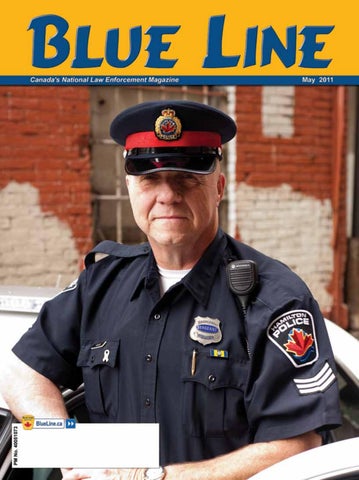
Cover: Sgt. John Harris, Hamilton Police Service, recipient of the 2010 Blue Line Police Leadership Award. Cover photo by Kathryn Lymburner 3
may 2011
May 2011
4
Blue Line Magazine
Blue Line Magazine Inc. PUBLISHER Morley S. Lymburner - publisher@blueline.ca General Manager Mary K. Lymburner - mary@blueline.ca SENIOR EDITOR Mark Reesor - editor@blueline.ca CREATIVE DIRECTOR E. Jolene Lymburner - jolene@blueline.ca Contributing Writers Mike Novakowski Mark Giles Robert Lunney James Clark Dorothy Cotton Dave Brown Tom Rataj Affiliations International Association of Law Enforcement Planners Canadian Advertising Rates Data International Police Association The Canadian Press Newswire Access Copyright Subscriptions $30 per year; $50 for 2yrs; US & Foreign: $100 Advertising 888-640-3048 advertising@blueline.ca
www.blueline.ca 12A-4981 Hwy7 East, Ste 254, Markham, ON L3R 1N1 Canada P: 905 640 3048 F: 905 640 7547 blueline@blueline.ca
PRINTED IN CANADA ISSN# 08478538 Blue Line Magazine was established in 1988 as an independent publication to inform, entertain, connect and educate those involved in the law enforcement profession. With no direct control from an enforcement agency, its opinions do not necessarily reflect those of any government or law enforcement agency. The authors, advisors, and publisher accept no liability whatsoever for any injuries to person(s) or property resulting from application of adoption of anything presented in this magazine. Readers are cautioned and advised that articles presented herein are edited and supplied for your personal awerness and should not be used for further actions until appropriate guidance is received from a supervisor, Crown Attorney or other persons in authority. All material submitted for publication becomes property of Blue Line Magazine Inc. unless arrangements have been made with the publisher prior to publishing. © 2011 All articles are protected by copyright. No part of this publication may be repoduced or transmitted in any form or means, electronic or mechanical, (including photocopying and recording or by any information storage or retrieval system), without prior permission. Permission to reprint may be obtained in advance from Access Copyright 1-800-893-5777.
Blue Line Magazine
Publisher’s Commentary by Morley Lymburner
Responsible gun ownership not an election issue It is rare for a monthly publication to make a commentary that may be fresh on the trail of an election. As timely as it may seem, however, the impact of this comment will be small because its subject has become political in nature and no one wants to say out loud what they would prefer to whisper. The Conservatives are wooing the urban vote and the Liberals are wooing the western vote and only passing lip service is given to the gun registry debate. The gun registry debate has pitted east against west, rural against urban, rich against poor and police against public. It has framed liberal and conservative politics ruled by people only too happy to take many down murky roads of understanding where white and black are not easily identified. My opinion (mine alone) is that the firearms registry has rarely worked as a tool for police nor as a method to reduce crime and violence. Neither has it been a tool of taxation, an attempt to disarm the citizenry or a police power grab to create a sinister dark oligarchy. If people take off the various dark and rosy glasses of political hacks and self-interest groups, the reality becomes a little more clear. The registry is about responsible ownership. Gun owners who say they are law abiding citizens yet break the law by not registering them are trying to suck and blow at the same time. A responsible owner surely wants to demonstrate that responsibility, not for the sake of police or politicians but for family, neighbours and community. If I live next door to a person who enjoys his firearms collection yet rails against laws designed to make him responsible for possessing them, what does that tell me about the security of my household? A neighbour who can convince me that he is abiding by proper rules of safety and laws regarding firearm ownership and storage has my confidence. This is exemplified through Blue Line Magazine’s firearms editor, Dave Brown, who states that he enjoys firearms and collecting so much he has no problem taking the extra effort to register them and abide by all the laws that go along with that. Most of us similarly enjoy cars and have no problem with far more extensive rules – testing, regulations, licensing, and higher fees than the firearms registry. Going through these processes indicates responsible ownership and demonstrates this to our neighbours and communities. We are all aware of individuals who cut corners, failing to get insurance, registering change of ownership, letting their vehicles become unsafe and drinking and driving. Every responsible citizen would look upon this as being irresponsible. 5
Firearm lobby groups and some politicians demand no registration for rifles and shotguns. They have no issue with owners being licensed to possess a firearm, nor being screened and tested by police to purchase them – but want to keep private the models, number of guns and serial numbers that they own. It defeats my understanding of what’s rational. Police chiefs say their officers often access the firearms registry and that it has made them safer and, in some ways, saved lives. They have somehow confused the purpose of the registry and seem to think evidence of extensive use is a good thing. In most police training officers are encouraged to use their authority with discretion and restraint. The old adage, “if you abuse it, you lose it,” sums this up quite well. Applying this to the firearms registry, we find an attitude of wholesale usage of information for legitimate or spurious motives. Introducing a police tool with no protocols is asking for trouble. An officer investigating a bicycle theft has no reason to check the registry, yet this happens at many agencies, artificially inflating usage and, by suggestion, validating its existence. The most potentially dangerous scenario is that an officer lets down his guard after finding there are no firearms registered to an address. The firearms registry went through a considerable crucible of fire. Originally a simple process, it very quickly became a nightmare for registrants and a boondoggle for statisticians wanting information and politicians looking for advantage. Lost in all the ensuing hoopla was the idea of demonstrating responsible gun ownership and encouraging acceptance by keeping to the basics. Name, make, calibre, serial number and address. The money to build the registry has, rightly or wrongly, already been blown and we must salvage what we can, discarding portions if need be but not the whole thing. That would not be responsible management of money spent. If a house is extravagantly built the wrong way we don’t put it in the dumpster. Even if the structure is unsafe, there is something that can be salvaged. If it is too expensive to maintain then reset it so it will be more economical. We should at least be able to salvage the values of responsible gun ownership, identify political rhetoric for what it is and look beyond political opportunists.
may 2011
photo: Kathryn Lymburner, Blue Line Magazine
A demonstration of
leadership
Sgt. John Harris: 2010 Blue Line Police Leadership Award Recipient by Morley Lymburner Facing challenge and adversity with courage and tenacity, Hamilton Police Service Sgt. John Harris has, above all, maintained his humanity and compassion for fellow workers, developing into a true leader over his 38 years of service – and a worthy recipient of the Blue Line Police Leadership Award. The award recognizes and encourages pride in service to the public and a standard of excellence that exemplifies “Leadership as an activity, not a position.” Its goal is to increase the effectiveness, influence and quality of Canadian police situational leadership from both an organizational and community perspective. May 2011
6
Blue Line Magazine’s five judge panel concluded that Harris epitomized the best qualities of leadership in police work. He has overcome physical adversity with an admirable tenacity and demonstrates exemplary leadership qualities to his co-workers and community. “Sgt. John Harris is without equal as a supervisor,” wrote HPS Chief Glenn De Caire in nominating him. “He is equally a mentor, sympathetic listener, task-master and supporter.... his squad members consider him a co-worker... and he is the quintessential ‘cops’ cop.” For a decade, Harris took on some of the toughest police jobs, working as a motorcycle gang investigator joining with police experts from across the province. He became so Blue Line Magazine
knowledgeable Crown attorneys often called on him as an expert witness and he was asked to work with the FBI and Secret Service. A former defensive end with the Hamilton Tiger Cats, Harris’ law enforcement career began after a bone crunching ankle break ended his athletic career. It was a disappointment but eventually led him to the Hamilton Police Service. His police career was challenging enough but he came face to face with another reality in 2004 – the need to have his leg amputated below the knee. This setback was well documented by Hamilton Spectator writer Susan Clairmont who pointed out that she found his “willingness to speak about the loss of his leg is remarkable because he has spent years not drawing attention to it. Officers on his shift don’t speak of it. Not even in a joking way.” While on a holiday in Australia in 1991 Harris walked to a store from a beach area. The day was hot and he received severe burns on the soles of his feet. He was suffering from diabetes and did not know it at the time. The effect of the condition caused his feet to become numb. For over ten years he struggled with on-going problems to the point that all toes on one foot where amputated followed up a short time later with the removal of a leg below the knee. With such a gruelling story Harris simply shrugs it off by saying it sounds dramatic enough but he keeps it to himself. But how can a guy with one leg be a uniform patrol sergeant? Has it been done before? Anywhere? There are officers with missing limbs who do desk jobs, sure. But out there with the bad guys? With everyone’s safety riding on them? Harris did six weeks of physio in five. Received an athletic prosthesis that he can run on. Passed his use of force tests, showing he could still control and handcuff someone, and re qualified with his firearm. Next he passed a retest for his driver’s licence and then re qualified for the police force vehicle testing... and no one has talked about his leg since. As a patrol supervisor, John Harris is on the front-lines of policing and is without equal. He is a mentor, sympathetic listener, task-master and supporter of his people. His squad members Blue Line Magazine
7
may 2011
consider him a “co-worker”, notwithstanding that he is responsible for supervising them, and ensuring that all objectives and goals are ultimately and always reached. Proof of his effectiveness is reflected in his people. Harris’ squad is consistently the top-rated squad for RIDE lanes and traffic enforcement. This is a significant accomplishment in front-line policing, especially considering that the squads were merely average performers before being managed by Sergeant Harris. Many of the officers who have been on his squads have been promoted through the ranks. Service John leads by example. In over three decades of policing, his reputation is one of leader and mentor. If the schedule allows that he is off on Christmas Day, he routinely comes in to work to ensure an officer with young children can be home with his/her family. He has done the same when a squad member has an important family engagement to attend, and, due to staffing requirements the officer
wouldn’t otherwise be able to get the day off. When Sergeant Harris has booked vacation and he knows his squad will be below staffing requirements, he won’t ask his officers to come back on a call-in, he reports for duty, and never requests the time back. Sgt. John Harris marches in every Police Memorial Parade and consistently has the highest squad representation at these important policing events. Legacy of leadership The Police Leadership Award was initiated and first bestowed in 1999 by the Canadian Police Leadership Forum (PLF). With continual sponsorship from Blue Line Magazine, the PLF presented the award annually until 2005 when the organization ceased to exist. Blue Line has long recognized the simpatico between the precepts of the award and the magazine’s founding principles. Leadership ability is not a virtue one is born with or delegated to perform but rather something that is acquired through a learning experience and
nurtured through a willing spirit. Encouraging leadership as an activity encourages leadership as a position. Drawing forth those with recognized leadership abilities at levels beneath senior management ensures the availability of a talent pool for the future of policing. The Blue Line Police Leadership Award exists to highlight the importance of recognizing those with leadership abilities and encouraging other officers to develop leadership skills. It is open to active Canadian police officers below the rank of senior officer who have demonstrated exemplary leadership and commitment to service through deeds resulting in a measurable benefit to their peers, police service and community. In February Blue Line Magazine took up the challenge of the PLF with a cross-Canada search for a suitable candidate for recognition. Six nominations were presented to the judges at the beginning of March and through their discerning efforts the 2010 recipient was selected by consensus. Congratulations Sgt. John Harris!
Cops count’
‘
Chief stays connected with the frontline, while leading the HPS to new heights by Mark Giles While waiting to interview the chief at the headquarters of the Hamilton Police Service (HPS), I noticed – through the glass windows of the community relations room – a uniformed officer providing a briefing to a small group of reporters. Thinking it to be a member of the HPS’ media-relations unit, I noted his easy-going approach and obvious rapport with the local media. The briefing – on the 2010 police services budget – ended and a few minutes later I was escorted into the chief’s office, where I realized that he and that media-relations officer were one and the same. Chief of the Hamilton Police Service (HPS) since December 2009 and a former staff superintendant with the Toronto Police Service, Glenn De Caire hasn’t let it go to his head. He cares about and makes time for those on the frontlines – whether it’s local reporters looking for details on the police budget or, most importantly, his frontline officers who, arguably, are doing the bulk of the work in keeping the public and communities safe. “He often uses the phrase ‘Cops Count’”, said S/Sgt. Steven Hahn, the chief’s executive officer. “It’s his way of communicating the positive difference members are making in the communities they serve every day.” For Chief De Caire, face-to-face communications are a core part of the business strategy.
May 2011
Although a lot of police leaders insist that their frontline officers are their top priority – far fewer follow up their words with actions. But Hamilton’s chief has built it into his weekly schedule – visiting with street officers on parade every Wednesday morning. In an ongoing three-month rotation, the earlymorning visits allow the chief to stay connected with his officers – providing them an opportunity to be heard several times a year. His efforts to connect seem to be paying off. Talk on the street is positive – and even the police association has good things to say. “Chief De Caire has brought a leadership style that is appreciated by the front line,” says Hamilton Police Association President Mike Thomas. “He assists at RIDE lanes, shows up at crime scenes and appears to legitimately show concern for all his members. Having worked with Chief De Caire for the past 15 months I notice he is consistently looking beyond where we are today – he knows where he would like to take the organization and uses that vision to move the Service forward. The Association has shown support for Chief De Caire and we continue to strive to ensure that we both keep the consultation process open and positive and continue to let our working relationship grow.” The feelings are mutual – when asked about the HPS’ best asset, the chief responded quickly and without hesitation. “The commitment and dedication of our people,” he said. Policing priorities Having established a solid base for communicating internally, the chief is also focused on providing high-quality police services to the City of Hamilton and its
8
communities. His goals for the next three years include re-structuring the organization, recruiting quality candidates and the ongoing development of the neighbourhood safety project, which is being enhanced by HPS’ new ACTION (Addressing Crime Trends in Our Neighbourhoods) program – restoring order to those communities with high crime, so they have less dependency on the police. In supporting the commitment and dedication of his sworn and civilian personnel, the chief realizes that he must have the right people in the right positions to do the job. Leading the development and implementation of a re-structured staffing model, approved in August 2010 and now in place, the HPS has established six new positions for 2011 – four staff sergeants and two civilians with the human resources branch. Hiring quality new officers is also a high priority – and a big challenge – with the HPS competing with other agencies for the best candidates. “We must reach out to get a diverse group of quality recruits,” he said, noting that of the new officers recruited in 2010, 21 percent were female and 19 percent from diverse communities. After a 30-year career with the Toronto Police Service, you might think he’d be ready to retire and move on, but he’s still passionate about what he does and making a difference while doing it. And in providing quality police services to the citizens of Hamilton, he realizes that he must communicate with those on the frontline – and particularly his street officers – showing that he cares and that “Cops Count.” “These are words he lives by,” said Hahn.
Blue Line Magazine
Blue Line Magazine
9
may 2011
The FIDO philosophy
Lack of motorcycle enforcement is costing lives
by Dave Stewart Police officers must reisist the new age catch phrase FIDO – (Forget it ... Drive On) why save a life? Yes, enforcement can be problematic. Very few police officers use their skills to promote road safety for motorcycle riders, whether it be enforcing laws pertaining to bikes or ticketing car drivers who follow too close or make improper lane changes. A car driver turning left into the path of my motorcycle put my police career on hold for nearly two years. It gave me plenty of time to think about safety. Recovered from my injuries, I spent the next 20 years of my Toronto Police Service career working to improve motorcycle safety. I have ridden motorcycles for pleasure since my teen years but studying crash statistics in Ontario and across the country gave me a new appreciation for the challenges motorcyclists face. I wrote reports, taught new riders and organized a motorcycle racing team for police officers that took them to race tracks here and abroad. To promote road safety to all riders we produced several TV shows. The police racers portrayed the fact that safety was foremost, speed was to be left for the track and drinking far away from motorcycles. Key components such as learning to avoid other drivers and observation/ anticipation techniques – skills well known to all police officers – were passed on to street riders. My interest in developing a safer environment for motorcyclists was fundamental to several years of involvement with the Canadian Motorcycle Association (CMA) and the Fédération Internationale de Motocyclisme (FIM), the international sport motorcycle organization that also has a world-wide safety component. May 2011
Rider statistics Canadian motorcycle death rates have been increasing since the beginning of the millennium, partly influenced by greater affluence and resultant increased sales to older men and women returning to motorcycling in middle age. Despite perceived expectations that they would behave more responsibly than younger riders, the reverse was true and fatalities rose proportionally. The latest national figures show a total of 2,419 lives lost on our roads in 2008. Motorcycle deaths have climbed from 173 in 2000 to a high of 233 in 2005. Keep in mind that the number of registered motorcycles have increased from 443,0000 in 2005 to 567,000 in 2008. That is 23 per cent in three years. Rider deaths have always been over-represented due to the exposed design of motorcycles and their equipment (nine per cent of all road fatalities – nearly double the rate since 2000). These statistics are all the more remarkable when you consider that motorcycles represent only two per cent of all motor vehicles on our roads and are used only during the warmer months. The number of older riders doubled between 1995 and 2005. Despite their maturity, they often travel at excessive speed and, surprisingly, are not always alcohol free. This phenomenon is replicated in a recent Traffic Injury Research Foundation (TIRF) report which showed the number of riders aged 45 to 54 killed in speedrelated crashes more than doubled between 1996-2001 and 2002-2004. This doesn’t mean younger riders do not speed to the same extent they have always done but rather that older riders have overtaken them numerically. In the four major jurisdictions (British Columbia, Alberta, Ontario and Quebec) speed is clearly the pre-eminent cause of rider deaths. 10
This is particularly so in the case of single vehicle collisions. Moreover the percentage increases dramatically when alcohol use is factored in. Alcohol alters function Recent alcohol use figures released by TIRF state that, of all fatally injured road users, motorcyclists account for 5.5 per cent of deaths. While this may be a much lower figure compared to the 1990s, it is still shocking that with the education and media exposure riders drink when riding a vehicle which demands, above all, the skills of balance, coordination and judgment. This all starts by maintaining balance with zero alcohol use. Statistics show most riders drinking to excess are killed within a few kilometers of where they started. Alcohol severely impairs the frontal portion of the brain, which controls the motor skills required for balance and coordination necessary for riding and handling a bike. The resultant poor judgment also leads to excessive speed and increased potential for a crash. Safety advancements Braking Recent improvements in safety technology for new motor vehicles (especially cars) and improved highway design have contributed greatly to reducing deaths – but development of new technology for motorcycles has been more limited. Manufacturers are gradually introducing integrated braking systems (ABS), including on race bikes with the support of the FIM. Some governments, including the US and European Union, have called for integrated braking systems to be installed on all road bikes. I believe this will happen within the next ten years, causing fewer ‘loss of control’ crashes. Blue Line Magazine
Speeding Speed and the sensation of speed are the reasons many riders ride. Debate continues to rage about whether the need for enforcement leads to dangerous chases as officers endeavour to identify the motorcycle or its rider. An interesting experiment in some European countries could help to reduce open road speeding. Riders are given access to local racetracks where they learn to ride safely, at speed, under supervision. They are taught that riding faster requires smooth operation of the bike, which translates into safer operation. Riders also encounter traffic officers who can teach them many more facets of road safety in a setting more conducive to practicing and perfecting driving techniques. Several police officers have tried this type of education in Ontario since 1986, however a proactive program has failed to materialize due to lack of industry or government support. In recent years a Durham Region police officer attempted to promote responsible use of motorcycle speed at local racetracks but was unable to attract funding. Another approach is Ontario’s recently implemented “stunt driving” law. This has taken hundreds of high-risk drivers and riders off the road by suspending their licenses and impounding their vehicles for a month, at the owner’s expense. There’s also a fee to reinstate licenses. Although this new law was well publicized, together with “zero tolerance” enforcement by police, hundreds of vehicles were impounded. This seems to indicate that there is a minority of high-risk road users whose attitude to driving may not change until it is too late. Recent research tends to support a theory that this high-risk population should undergo psychological testing before their driving privileges are reinstated. Licenses First and foremost, every motorcyclist should have one. There are no national figures collected for unlicensed riders. In Ontario, which accounts for about 25 per cent of all national figures, the number of unlicensed riders has dropped from 22 per cent in 1989 to a low of 4.2 per cent in 2007. More jurisdictions are implementing the graduated license for motorcycle riders. Police officers can ensure that riders are compliant, especially in rural areas where many novice riders try out their new bikes. Equipment Careful inspection of the motorcycle (and the operator) is crucial for safe operation. Tires: Knowledge of provincial laws is required. The rider relies on only two wheels so it is critical that the tires comply with legislated regulations. Tires contribute greatly to the braking and cornering demands of the bike – two of the major factors in crashes. Brakes: Checking the brakes can be as simple as just making sure they will hold the wheel when the bike is rolled forward. Helmets: Checking for fully certified motorcycle helmets has been made easier across all jurisdictions since a joint provincial traffic safety committee in 2010 decided to recommend standardized helmet criteria. Noise: Within the past year the same traffic committee recommended the use of equipment that measures noise from exhaust pipes based on Blue Line Magazine
USA standards. Although not everyone agrees with the procedures being used it is at least a start that takes away the subjective views of an individual officer. Convincing enough jurisdictions to spend the money to buy the equipment will be problematic. One small tranquil community in Ontario has already passed by-laws requiring these newer standards for bikes. It previously attracted numerous bikes with straight through pipes having little or no noise muffling system. Lighting: In multi vehicle crashes the characteristic “left turn” syndrome remains a major hazard for motorcyclists. Car drivers still ignore the narrow image of the motorcycle rider as they change direction. Major international studies have looked at improving the exposure profile of motorcycles through repositioning and adding headlamps, changing bulb colours and intensity, etc. The only profile that showed any promise was two headlights placed so they were approximately the same distance apart as on a car – totally impractical. Enforcement I am not advocating that a mass of officers suddenly start enforcing traffic laws they are unfamiliar with, which would surely trigger a negative reaction from many riders. After officers gain a comfortable knowledge of the major laws that effect road safety, enforcement can have a positive outcome for the motorcycling public. You can maintain your professionalism, even with most members of a “1 per cent” club, by learning the laws pertaining to motorcycles and using respectful common sense in talking with riders you stop. The only confrontation I had with a ‘striker’ was soon settled when I quoted the exact section number of the act for noncompliance. Utilizing the proper professional attitude, I was able to finish an inspection that resulted in removing the plates from an unsafe bike. A mutual ‘respect’ was born from that encounter and the striker began keeping his bike in better working order to avoid being stopped – at least for an equipment check. Dealing with “1 per centers” means earning respect that will stay with you for many years as the brotherhood learns that you know your laws. Comrades on special investigative services may call on your knowledge if they need your skills in stopping and searching other motor vehicles, whether for highway or criminal law. Speed enforcement I have seen many officers use the FIDO philosophy in motorcycle enforcement, yet they were the first to fill their ticket books with cheap and nasty speeding tickets using “fishing holes.” It was encouraging to see them being given traffic training and learning the proper use of highway traffic laws to effectively promote safety and better use criminal investigation tools. Most speeders don’t see officers until they are within about 60 meters – and they are the ones you really want to stop, as they are not using their powers of observation! The media seldom covers motorcycles unless in the context of biker wars or a rider who died after failing to stop for police. I quickly learned that a motorcycle was no contest for a police car; either the rider was so good that you had no chance of keeping up or their lack of skills would cause death for them and much grief for you. The 11
media loves to cover police chases but shows little interest in the good work police and many riders undertake for their local communities. Their road safety efforts educate both riders and car drivers. Don’t underestimate these two groups because they consistently contribute to safety education. Training Canada is known worldwide for its excellent national motorcycle training program but there is a growing recognition of the real need for retraining/refresher courses. Some argue they should be made compulsory but even if that happens, very few riders are likely to upgrade their skills, forgetting that ‘if you don’t use it, you lose it!’ Safety programs Successful national campaigns have focused on speeding and drinking and driving for motorists and in some areas, heavy truck enforcement. Motorcycling hasn’t received the same degree of attention. Do police services have a “blind spot” for riders? Could individual officers be more at home driving a car than a motorbike, preferring a reactive rather than a proactive approach? Motorcycles are designated as ‘vulnerable vehicles’ for good reason, therefore it is appropriate for police to check their road worthiness – lights, brakes, tires and protective equipment such as helmets. In the light of all the information available now, both enforcement and education should be a part of all police traffic safety programs for motorcyclists. The motorcycling season in Canada lasts from May through to the end of September. Many organizations publicize a safety awareness program, “MAY – Motorcycles and you,” to remind motorists that bikes are back on the road. This program has run for decades and, in support of it, many local governments declare May as motorcycle safety month and encourage media to publicize events put on by the groups. Canada is now closing the chapters of its current national traffic program “Road Safety Vision 2010.” The federal government is preparing a strategy to improve road safety throughout the country for the next five years. Together with pedestrians and cyclists, motorcycle riders have been identified as “vulnerable road users,” not only here but in most worldwide road safety strategies. The five year Vision program was somewhat of a failure compared to most other international efforts, so the aim for the next five years is simply to lower road deaths. No national goal has been set but each provincial and local jurisdiction can set individual goals. Enable change Street officers have a role in encouraging safe motorcycle use. Don’t leave it to government to take the pro-active lead; you can make a real difference. Encourage your senior officers to construct a community based education and enforcement program designed to counteract the causes of road deaths in your area. Motorcycling is meant to be a happy pastime on the open road. Help make it so. Dave Stewart is a former police motorcycle trainer with the Toronto Police Service and a founder of the Police Motorcycle Race Team. He may be contacted by email to dstewart@sympatico.ca.
may 2011
Motorcycle safety with
a chemical twist
by Shannon Walton In 1965, Stephanie Louise Kwolek, an American chemist who originally wanted to become a fashion designer, discovered something that later became world famous under the brand name Kevlar: a golden yellow organic synthetic fibre made of polyamides. Characterized by an extreme tear-resistance, the fibre was highly resistant to heat, fire and acids. The very promising discovery went on to become an incredibly important turning point for a Swiss company called Schoeller Textil AG. Hans-Jürgen Hübner became marketing head of Schoeller in 1982 and was tasked with “developing visionary strategies.” The effects of the oil crisis were still palpable. Production was being transferred increasingly to Eastern Europe and Asia. Textile operations with “metoo” products were being forced to close down. Schoeller needed an “inspired idea” if it was to retain production in Switzerland. Inspiration hit while he was motorcycling over the St. Gotthard to the Nufenen and Furka passes. ‘We’ll replicate leather. We’ll make an elastic, waterproof and windproof fabric for motorcycle wear that protects the wearer just as well as leather but is breathable, more
May 2011
fashionable, more comfortable and easier to care for.’ No sooner said than done. That very same year, development work began in close cooperation with the technical university in Darmstadt. The main focus was on motorcycle racing, in keeping with the motto “If it’s right for the professionals, the amateur enthusiasts will buy it too.” Schoeller became the first company to integrate the high-tensile Kevlar-fibre into elastic textiles. These fibres had already proven themselves in the tire industry, shipbuilding and for sports equipment. With a similar weight, Kevlar is five times stronger than steel and solves one problem in particular: if a motorcyclist takes a tumble at 100 km/h, for example, the heat friction can rise above 200°C. At this temperature, many fibres simply burn. Kevlar, by contrast, can withstand up to 450°C and is therefore more durable. To make the fibres UV- resistant, the company covered it in a special weaving process to produce the fabric ke(vlar)pro(tection) tec(hnik). Such world champions as the legendary sidecar racing team Biland/ Waltisperg or Carlos Lavado and Martin Wimmer took on the practical testing under race conditions.
12
The product became available commercially in 1985. In Schoeller’s own simulator, falls from the motorbike are still being simulated, replicating such factors as road conditions, acceleration and braking distance. Measurements are taken to determine what would happen to the motorcyclist wearing this “leather-like” clothing. The “inspired idea” has become a successful brand. People in many other industries now benefit from this protective fabric, which is used in more than 30 countries for clothing, trims, shoes, gloves and luggage. The original fall-proof, comfortable and easy-care “motor cyclekeprotec” has given rise to many variants, with qualities such as refractability, stretch, reflection, cut-proofing, light weight, antistatic and soft-shell. Since 1993, in parallel to the top fabric line keprotec, the company has offered an alternative without Kevlar, the Schoeller-dynatec line. It offers similar protective functions but is less heat-proof and more visually versatile. Shannon Walton is the PR manager for Schoeller Textil and Schoeller Technologies USA. Contact her at pmclafferty@cse-limited.com for more information.
Blue Line Magazine
The long footprint of the law Greening police more important than ever
by Rob Williams Canadian police departments have yet to join the green bandwagon. They continue using mountains of paper, vehicles which burn fossil fuels, chemical road flares, inefficient light bulbs and other non-sustainable practices. Green initiatives are becoming an increasingly pressing matter at all levels and consequently will begin to shape law enforcement. Police services have a social responsibility not only to protect life and property but reduce their environmental footprint. The top five reasons for police agencies to improve their environmental footprint are: 1. Saving money – lower heating and cooling costs, reduced fuel consumption and reduced paper usage. 2. Stay competitive – make the community proud of their police service. 3. Get efficient – being efficient saves money, reducing fuel, energy, materials and waste. 4. Retain employees – people want to work for a company with a heart. 5. Be the cutting edge leader – environmental constraints will only get tighter; services that stay ahead of the curb will benefit. Some police agencies have reduced paper usage by 33 per cent simply by programming all printers and photocopiers to default to double sided printing, while others use scanners and electronically send documents. Traditional road flares are fuelled by harmful chemicals which find their way into sewer systems after they’re used. Some greener departments have replaced them with environmentally friendly battery operated brands. The rising cost of fuel and subsequent harmful motor vehicle emissions are forcing agencies to realize the value of hybrid cars and alternative fuelled vehicles as environmentally friendly and cost effective alternatives for the future. Until they can be implemented other initiatives, used with existing vehicles, can save fuel and decrease emissions. Using GPS systems to monitor patrol efficiency and two-person vehicles have little or no adverse effect on crime rate. Increasing the number of bicycle officers can be an effective fuel cutting measure, while also encouraging more direct interactions with the public. Research on police green initiatives is sparse at best, however a web search can yield thousands of ideas from other organizations. Many sites offer tips and real time advice to improve your over all green efficiency and effectiveness. Although policing initiatives are still in their infancy, many ideas employed by private companies can be used by services to the same standard. Short term approaches and policies will Blue Line Magazine
photo: Wayne Hebert
The new Kingston Police headquaters building expresses a commitment to environment stewardship seldom seen in Canadian policing. The structure was built from the ground up to be compliant with the international code known as L.E.E.D (Leadershio in Energy and Environmental Design.) Former Chief Bill Closs advised it was a simple matter of wanting to be a good neighbour.
not decrease your carbon footprint. A culture of sustainability must be accepted to make positive ongoing changes to your environmental impact. It is not sufficient to only recycle products; they must also be reduced and reused. Companies are beginning to ban plastic water bottles, a product well known for populating landfills, and are creating health and wellness programs where employees trade fresh garden grown fruit and vegetables. Car pooling programs and incentives for public transit use are becoming more popular. Services can encourage competitions between buildings and divisions to reduce hydro costs by shutting off lights and reducing fuel consumption. Environmental impact on our planet is a hot media topic. Many organizations have noted an enhanced public attitude after beginning green initiatives, assisting recruiting and retaining efforts. Young officers form the base of a police force. Their thoughts and ideas will mould its future and need to include forward thinking to attract community minded employees, many who already purchase green products. Companies that switch to green cleaners, toilet paper, recycled paper and other sustainable products will notice little difference in purchase price. A strong environmental organizational policy has been proven by private companies to lead to reduced labour cost by cutting the cost of illness, absenteeism, recruitment and sick time. These changes have also been shown to create an atmosphere where employees have excellent buy-in and become ambassadors for their service. There is an effective system for organizations to measure their improvement towards reducing their environmental impact. ISO 14000 was designed for companies to become 13
certified with policies to: 1) Minimize how operations negatively affect the environment and community. 2) Comply with federal, provincial and municipal laws and regulations. 3) Continue to improve their footprint and services. ISO 14000 is designed to set the framework to reduce costs of waste management, save money in consumption of energy and materials, improve corporate image with stakeholders, communities and employees and create a services framework and policy for the future of environmental sustainability. This needs to be the minimum measuring rod for a service’s environmental impact policy. These initiatives can only help strengthen community ties by showing that police are committed to a sustainable environment. Senior managers need to create a culture within their organizations that will continue sustainability efforts and incorporate ever new technologies as they become available. These policies show the public that service decision makers take the environment seriously. Old style conventional wisdom has created the idea that reducing environmental impact will increase costs and be an overwhelming burden on the service, however closer study has proved this incorrect. Services that embrace an environmentally friendly policing can be leaders and earn positive publicity while also reducing operational costs. Robert (Rob) Williams is a Peel Regional Police Service member with degrees in Sociology, Anthropology, Applied Criminology and a diploma in Disaster and Emergency Management. He has received four bravery commendations and recognition for his investigative skills and is currently working on a Masters in Disaster and Emergency Management through Royal Roads University. Contact him at robert.williams2@peelpolice.ca
may 2011
The Cassandra Effect
Translating “blood lessons” to the public by Brad Fawcett In Greek mythology Cassandra, the beautiful daughter of King Priam of Troy, was given the gift of prophesy. When she spurned Apollo’s love, she was cursed to have no one believe her. University of Maryland economist Julian Simon (1932-1998) identified the “reverseCassandra effect.” He is perhaps most famous for his wager with Paul Ehrlich in 1980. Ehrlich, author of The population bomb, made a number of dire predictions regarding mans impact on the environment. Simon doubted the validity of the data underpinning Ehrlich’s work and famously bet him that his predictions would not come to pass. Needless to say, Simon won the bet. Countering Ehrlich’s position with facts, he was bemused that they and winning the bet failed to counter the influence of Ehrlich’s position on public opinion: People were inclined to believe the very worst about anything and everything; they were immune to contrary evidence just as if they’d been medically vaccinated against the force of fact. Furthermore, there seemed to be a bizarre reverse-Cassandra effect operating in the universe: whereas the mythical Cassandra spoke the awful truth and wasn’t believed, these days “experts” spoke awful falsehoods and they were believed. This “reverse-Cassandra effect” seems to operate in a similar fashion in policing. Continued purveyors of police malfeasance appear to have captured the minds of the public regardless of what the science, research, inquiry or jury finds when analyzing a use of force incident. Some authors have opined that the low rate of convictions for police officers alleged to have used unnecessary and/ or excessive force is due to some nefarious relationship between the police and those prosecuting them. If the defence used expert witnesses to explain why an officer failed to hear, see or do something they are castigated as unethical sympathizers of the police. Explaining use of force by police using facts supported by research is akin to saying anything contrary to former Vice President Al Gore’s Academy Award winning film An Inconvenient Truth (2006). If you question the science underpinning the film you may find yourself maligned as a global warming denier. Many readers will be familiar with the work of Dr. Daniel Simons and his colleagues at the University of Illinois regarding cognition. Their studies of inattentional blindness and change blindness (1999) have helped to explain why police officers (or anyone else) failed to perceive things clearly in their visual field. Reaction time studies have been a favourite subject of experimental psychologists since the mid-nineteenth century and the May 2011
implications have been incorporated into police training through the work of Bruce Siddle and PPCT Management Systems. Lt. Col. Dave Grossman, Pulitzer Prize nominated author of On killing: The psychological costs of learning to kill in war and society (1996), provided police trainers with insights into combat performance and arousal states. Sport psychology contributed aspects of mental imagery applicable to law enforcement. Dr. Bill Lewinski, a tenured full professor at Minnesota State University, Mankato, has conducted studies directly related to use of force by police. Dr. Joan Vickers of the University of Calgary whose specialty includes cognition, vision and gaze control, motor learning, motor control, decision-making and decision-training, has also conducted research that has applications for training law enforcement and assists in understanding use of force incidents. Dr. Christine Hall, MD has conducted research into the phenomenon of excited delirium, which has direct implications for law enforcement. Despite the objective, scientifically sound research of these and others the reverse14
Cassandra effective abounds. For example, notwithstanding the documented descriptions of excited delirium in research dating back to the 1800s, some assert that the syndrome is a police fabrication to cover up their abuses. Another example can be seen in the debate over hazards associated with prone restraint, originally postulated in the late 1980s, which gained significant traction. Police agencies and manufactures scrambled to find techniques and technologies designed to avoid prone restraint while still controlling a violently resisting subject. Later research cast significant doubt on the validity of the original study and many consider the hypothesis “debunked.” The reverse-Cassandra call assails research that contradicts the original study as biased and not applicable to “realworld” incidents involving prone restraint. Credible police trainers stay current with research in a variety of fields to ensure their officers and the public they serve receive the best training possible: training that is medically, legally and tactically sound. In many cases police trainers have been well in front of issues. In British Columbia, for example, the Use of Force Working Group chaired by Vancouver Police Department S/ Sgt. Joel Johnston made a number of recommendations on conducted energy weapons. The report predated the events at Vancouver International Airport (YVR) investigated by the Braidwood Inquiry but sadly wasn’t acted upon until the commission adopted a number of the recommendations years later. Police trainers have informed themselves of evolving case law and threat trends and have incorporated those lessons into the training they provide. Police agencies routinely provide instruction in ground fighting, edged weapons and multiple assailants, having identified the need by analyzing assaults on police officers and the public in general. Police trainers have been actively seeking out new technologies and techniques intended to prevent injuries to everyone, not just police officers. In order to mitigate some of the barriers to performance identified by the various researches described earlier, many police agencies have incorporated stress inoculation training, using simulated munitions, role players and simulated environments. Many researchers whose work has buttressed police training have not had a horse in the race. Much of the research was conducted without law enforcement in mind and simply sought to understand the limits of human performance regardless of one’s profession. Those who criticize the police and their training appear to have forgotten, if they ever knew, that law enforcement personnel learn blood lessons. Someone – an officer, suspect, Blue Line Magazine
or member of the public – was injured or killed, causing us to reflect on the appropriateness of the techniques, tactics or technologies involved. Police agencies typically do not stand idle after a tragedy but actively seek out methods to prevent its repetition. This proactive approach has been criticized as being too rash and failing to exercise due diligence in adopting new techniques, tactics or technologies. The same cycle of criticism followed the incorporation of oleoresin capsicum spray, conducted energy weapons and maximum restraint technologies, to name but a few. The spectre of bias is routinely raised regarding the research and field tests conducted prior to implementation. The reverse-Cassandra cry demands more research (one wonders when there will ever be enough research done to satisfy the critics) and in so doing risks officer and public safety in the interval. Police academies do not churn out automatons seeking an opportunity to visit violence upon someone at the slightest provocation. Rather, they turn out members of the community who love it so much that they are willing to don a uniform and put their own safety on the line to protect residents from those who would prey upon them. The reverse-Cassandra call criticizes the facts and scientific research upon which modern police training is based primarily on emotion and, perhaps, it is that emotional appeal that makes the call so resilient. George Orwell warned of the intolerance of emotion over the preference of law: In a society in which there is no law and
Blue Line Magazine
in theory no compulsion, the only arbiter of behaviour is public opinion. But public opinion, because of the tremendous urge to conformity in gregarious animals, is less tolerant than any system of law. The Canadian law enforcement experience has been similar to that of Simon: facts developed through rigorous scientific research fail to counter the influence of those who assume the worst when it comes to police use of force. One can ignore the science, research and blood lessons upon which modern police training is founded but the inconvenient truth is the judge or jury, devoid of emotional second guessing,
15
when presented with the facts regarding the limitations of human performance under stress, tend to get it right. The officers involved typically acted reasonably when examined through a lens informed with an understanding of the limitations of human performance under stress. Sgt. Brad Fawcett is a 20 year veteran officer and courtqualified use of force expert who is currently seconded as a police academy use of force, physical training and drill instructor. Contract Brad, a former Blue Line contributor, at bfawcett@jibc.ca for more information.
may 2011
Deep Blue by Dorothy Cotton
Turning a blind eye Every now and then you read about how a whole bunch of people did something dreadful and no one seemed to notice. In the police world, this might mean officers were on the take, abusing their position of authority, being unduly physically aggressive or pilfering from the evidence locker. In the Real World, it might be a business executive who somehow managed not to notice that his company was insolvent or the books didn’t add up, or maybe a physician who abused patients and no one knew. There is always that moment of “OMG, I had no idea!!!” Sometimes this is true. Some people are downright sneaky and very good at hiding their actions, or incredibly adept at deceiving people – and sometimes, we have our heads in the sand and shoulda/coulda known. In retrospect, we feel a little sheepish because the evidence was there and we sort of had a feeling. Other times we deliberately turn a blind eye because we’d just rather not know. Maybe we should have wondered about that co-worker who seemed to be living at a much grander scale than a constable’s wages permit. Maybe the person with a lot of unexplained absences is our boss, or the guy with the repeated complaints bailed us out once when we screwed up and we owe him so we pretend not to see… I am reading a book called Willful blindness: Why we ignore the obvious at our peril by Margaret Heffernan. Her premise is that we all filter information, generally according to preconceived notions, beliefs and ideals. We also interpret the stuff we filter out according to our preconceived notions, beliefs and ideals. If I believe in UFOs, I am more likely to notice a streak in the sky. If I believe in UFOs and notice a streak in the sky, I am more likely to conclude that it IS a UFO. Closer to home, if an officer I think highly of has a big fat bruise, I am likely to conclude a bad guy hit him. If I think of him as a thug, I probably figure he started a fight – and if the last person who suggested someone was a thug is ostracized, then I might not even notice the bruise. I don’t mean PRETEND not to notice – I may make a
point of not tuning into those kinds of things and keep my eyes down in the locker room. Willful blindness can take other forms. We all know what sleep deprivation does to our ability to think, reason and problem solve but we still allow people to work many consecutive shifts, including overtime, if we need them and they want to do so. We are willfully blind to the risks. We all know that officers (and other human beings) really cannot effectively drive, work the computer and listen to the radio – but we pretend they can. “We are trained,” we claim – when we know that all the training in the world does not rewire the human brain. Margaret Heffernan has done a good job of conjuring up a useful term – “Willful blindness” – but it is not a new concept. From the psychological point of view, it can be attributed to different kinds of normal psychological processes. For example: • Selective attention – a human being’s attention is finite and propaganda about multitasking notwithstanding, we all have to pick and choose what we focus on. We pay attention only to things that we think are relevant, support our own points of view and are familiar. We ignore things that make us uncomfortable, offend us and are difficult to understand. • Cognitive dissonance – we all have trouble holding two competing beliefs. You will get pretty
uncomfortable if you think Joe is a really good guy – and also racist. One of those beliefs has to go or you’re going feel anxious or stressed. • Deliberate indifference – occurs when you know there is a possible risk and take no action to avoid or deal with it. Organizations that should be aware of significant risks but fail to take action have been accused of deliberate indifference. You see the phrase “reasonably ought to have known” in lawsuits. • Rationalization – it’s easy to concoct all sorts of really good reasons to justify doing something you know you ought not to do; “everyone is doing it; there is no harm; it was just this once; it was a silly rule anyhow; no one got hurt…”). • Denial – tanning beds are not harmful or they would be illegal – and lots of people smoke and never get lung cancer. • Group pressure/conformity – people will do almost anything – and think it is okay – if everyone else is doing it. • Obedience to authority – people will do almost anything if Someone Important says to – think My Lai, Abu Ghraib. The tendency for people to “not see” things is nothing new. History is replete with examples, varying from the trivial (pilfering stuff from the work lunch room) to catastrophic (think about the early days of World War II and what people thought Germany was up to). The hitch with the concept of willful blindness is that some of the factors most important in making us successful, both as individuals and a profession, also make us vulnerable. In policing, there is a high premium put on the professional identity. Police see themselves as somehow special and different from the rest of society, developing their own set of cultural standards. Many choose to socialize almost exclusively with other officers. The residual effects of a quasi-militaristic hierarchy still suggest some degree of obedience to superiors. Training encourages focus on potential danger – to the exclusion of other factors. Suppression of feelings is necessary to get the job done. In fact, many of these factors are necessary to get the job done. This can also make us turn a blind eye. It IS a problem to drive and talk on the radio and use the computer. It DOES make us biased to pay attention only to danger and not to the possible consequences of ignoring the flip side. It IS harmful to see yourself as a member of a “cult,” different from other people. If you don’t think YOU are selective in your attention to things, check this out. http://www.youtube.com/watch?v=vJG698 U2Mvo&feature=related Meanwhile, keeping an eye open for the obvious is a good idea. Dr. Dorothy Cotton is Blue Line’s psychology columnist, she can be reached at deepblue@blueline.ca.
May 2011
16
Blue Line Magazine
Implications for AL-Qaeda inspired homegrown terrorism by Cyril Sweetville Introduction: The Aug. 2010 arrests Canada has been a target of Islamist terrorists, including the thwarted attacks in Toronto (Toronto 18), Ahmed Ressam (Millenium Bomber) and the Aug. 25, 2010 arrests in Ottawa and London, Ontario. The latter arrests express a serious concern that governments have with Islamist terrorism and radicalization and its negative effect on the Islamic community; including the concern for innocent Muslims, as some negative incidents have often brought backlash to their community.1 The impact of Islamist radicalization in Canada, specifically the ideology of Al-Qaeda and global Islamism, has raised questions about homegrown terrorism. This paper will briefly analyze the Aug. 25 arrests of the three Canadian Islamists and assess the future implications for Canada covering (1) radicalization in Canada, (2) the impact on Canadian overseas contributions and (3) the impact for innocent Canadian Muslims. Canada is not immune to terrorism, as the nature of terrorist acts and offences in this nation have brought to light Al-Qaeda’s view of Canada as the fifth Christian target on its list;2 as indicated by Osama Bin Laden. Background and analysis: The arrests and players The three men arrested Aug. 25 – Misbahuddin Ahmed, 26 and Hiva Alizadeh, 30, both of Ottawa and Khurram Sher, 28, of London – were charged with conspiracy to knowingly facilitate a terrorist activity3 and other terrorism related charges. Accused of planning a terrorist attack on Canadian soil, they are influenced by their convictions and ideology which resides in the fundamental Islamist thought of Al Qaeda.4 The RCMP acknowledged a link to an unidentified group overseas,5 though it is strongly inferred that this group is Al Qaeda. Alizadeh, Ahmed and Sher are young educated adults involved in their community. Unfortunately they took on their ideology with violent intent; known as being a “revert.”6 For many, being a committed Muslim provides a sense of belonging and a stable religious practise. Granted, those taking on the Al-Qaeda ideology choose a path of violence and terrorism; producing a security concern for the host culture which grants such individuals resident status. Hiva Alizadeh, 30, “immigrated to Canada from Iran about nine years ago, living in Winnipeg for much of that time.”7 He married an aboriginal woman from Winnipeg and the couple was seen as average citizens, though a sharp contrast occurred one day after a visit to Toronto. Alizadeh’s wife began wearing traditional Islamic clothing and less casual type of Muslim head coverings,8 which can be seen as showing a greater devotion Blue Line Magazine
to their faith in a positive or negative manner; in this case the latter. Misbahuddin Ahmed did not come across to any anyone as a terrorist.9 He took time off work at one point and returned “sporting a full beard,”10 which can also be seen as expression of faith in a positive or negative light (again the latter). Khurram Sher, a graduate of the McGill University Medical School,11 was observed to have a good work ethic and took up charity projects overseas. Nobody in his circle of friends or co-workers ever thought he would be a terrorist.12 Sher’s expression of faith came in the form of charitable giving which was, if anything, a very positive contribution towards the Islamic community and therefore his radicalized mind was probably less noticeable. The change in the external expression of faith and association in an extremist ideology brought about a confirmed concern, as observed in a CBC quote stating that the RCMP seized 50 circuit boards during his arrest in Ottawa: They said the electronics could be used as remote-control triggers for bombs. A state source in Pakistan and a source in Canada familiar with the investigation told CBC News that police believe Alizadeh travelled to Pakistan seeking terrorist training.13 These arrests highlight that Canada is not immune from terrorist violence, influence or acts14 as the impact of Islamist thought contributes to radicalizing many Canadian Muslims, in addition to those who are converts from other ways of life. Definition: What is Islamism and Islamists? The trend of people becoming radicalized through an extreme version of Islam has grown over the years. Many are driven by Islamism, which has influenced an extreme ideology as an 17
alternative to democracy. Islamism is defined by Mozaffari (professor in Islamic Studies at the University of Arrhus) as “a religious ideology with a holistic interpretation of Islam whose final aim is the conquest of the world by all means.”15 Part of this ideology is that the West has encroached into Muslims lands and must be removed by force.16 “Islamists, who were created within this context, seek a political order in which Islam is that master signifier;”17 meaning Islam becomes the main governing structure in a nation state that also includes the enforcement of Sharia law. Many Muslims view Canada’s role abroad as a positive endeavour, though the majority of Islamists see it as an attack on the Ummah, the worldwide Islamic community. 18 Assessment: Future implications for Canada Homegrown radicalization: The ideology to which Al-Qaeda aligns itself is that of Islamism, which is intertwined with a strict brand of Islam rooted in the Salifist ideology that desires to return to a pure version of Islamic nationhood.19 Osama Bin Laden, the figurehead and leader, brought Salafism and militant jihad together to combat Western influence, sanctioning a fatwa against the United States and its allies.20 Islamists hold to this ideology and believe Canada should not be present in Islamic lands, therefore providing justification to be in conflict due to our involvement in the UN, NATO and other institutions. Islamism is a vehicle Al-Qaeda uses to influence the radicalization process of Canadian Islamists to garner support for a radical ideology.21 The goal of Islamism is to eventually become a political force strong enough to ensure sympathetic responses to the Islamic world (including Canada removing itself from the Islamic theatre). Dawah (missionary work and Islamic evangelism) aims to may 2011
convince Canadians to convert or embrace Islamism by influencing Islamic ideals through political dialogue; the timeline is indefinite. Alizadeh, Ahmed and Sher were radicalized by an extremist ideology which threatens Canada due to Islamism influence; expressing similar convictions about the ideology and supporting Al-Qaeda. All had some influence within their local Ummah and one of them even trained to learn how to build a bomb.22 These are outward expressions of the inner extremist ideology. Impact of Canadian initiatives in Islamic lands Canadian attempts to stem homegrown radicalization have been advanced with good intent, though they have not dealt with the issue as a whole. For example, Canadians supporting the war on terror also favour the Canadian Forces (CF) being present in Afghanistan. Many Canadian Muslims (and those of other backgrounds and religions) do not support military involvement in Afghanistan and express this in non-violent means. Alizadeh, Ahmed and Sher chose to respond with violence. The impact of their arrests will affect public support of the CF contribution and Canadian patriotism due to the divided loyalties of Islamists, who are both Canadian citizens and yet loyal to their ideology and so will not support the Afghanistan involvement. One avenue to stem attacks from Al-Qaeda is to remove Canadian Forces from conflict zones in Muslim nations, ensuring Canada’s foreign policy does not tread on the Ummah. This only furthers
the terrorist’s objective, which is furthered by Garrison who states “the terrorist chooses targets that have symbolic or economic value (such as the World Trade Centre), or targets that have public values (busses, restaurants, etc.) in order to get the society’s attention and cause governments to change policies.”23 If Canada changes its policy to exit Muslim nations and break its co-operation with allies such as the US, it will be giving into the pressures of terrorists. This type of decision will only provide credence for Islamists to continue their influence of the hearts and minds of a new generation in Canada. On the other hand, Muslims in favor of CF strategies in Afghanistan continue to support the creation of an ethical government, which will include advocating the eradication of the Taliban. This will come in the form of verbal, monetary and political support for the government to continue working in the Islamic theatre.24 For example, the Muslim Canadian Congress (MCC) web site states “MCC grieves the loss of our sons and daughters in Afghanistan, who died serving Canada in the line of duty. We offer our condolences to the families of the dead soldiers and hope to see all our troops back home safely.” 25 This support counters the Islamist and expresses the voice of innocent Canadian Muslims who want to live side by side with fellow Canadians,26 regardless of their background and religious identity. Islamists feel Canada should exit Afghanistan and will express this by violent means, which is the message that Alizadeh, Ahmed and Sher
were attempting to send to Ottawa.27 Giving in only furthers the goals of Al-Qaeda’s ideology and allows influence of political dialogue to be a strategy working in favour of Islamism. Islamic community existence in Canada Canadian Muslims have felt the need to justify their existence in Canada since their culture hasn’t always been welcome due to various incidents, including terrorism, culture and language. One issue that surfaces in multicultural societies is the incorporation of competing ideologies that oppose the host country’s values. In Canada, the Ummah is allowed to flourish and encouraged to build community and institutions with that of Hindu, Buddhist, Jewish, Eastern Christians and so forth; this being a positive goal in helping develop understanding and tolerance with all faith groups. Unfortunately, the push for incorporating Sharia Law for family matters in Ontario,28 Islamism supporting attacks on Canadian interests overseas and anti-Western sentiments exhibit the ideological challenges present in Canadian society. The Ummah feeling alienation provides Islamists an opportunity to influence and radicalize some of those in the community. Gendron further supports this, stating “genuine grievances and resentments exist as immigrants struggle to obtain citizenship and are faced with racism and unemployment; such preconditions for radicalism are not new; what is new is that they are now being used by extremists to recruit recent immigrants for confrontation with the West.”29 Some members of the Ummah attempting to attack Canadian interests and institutions shows a lack of social integration coupled with Islamism; factors in the development of homegrown radicalization. The arrests of Alizadeh, Ahmed and Sher remind Canada that Al-Qaeda will continue to wage its fight using tools of radicalisation to its advantage. The politics of Islamism express desire to be in conflict with Canada and its allies until they are removed (by force or voluntarily) from Muslim lands. This will be done through various acts of violence ranging from wars to the lone wolf terrorist. There is also a greater Ummah that has the goal of ensuring religious purity in the Islamic world and, for some, the Islamificiation of the West, which will be achieved through physical violence, conversion and political discourse. Combating terrorism in an ideologically diverse nation The nature of terrorism today has no boundaries due to radicalization. Al-Qaeda’s principles are passed on through the hearts and minds of people and continues despite rational attempts by nations to stem the problem. The Canadian theatre is a unique challenge since it is a nation of immigrants from England to China and Ukraine to Africa, bringing multicultural challenges to the surface. Homegrown Islamist terrorism has been evident through various incidents, stemming from Islamism preaching attacks on Canada due to involvement with the US, Israel, the UN and western foreign policy objectives in the Middle East. Bin Laden has appealed to his followers to continue attacking Western interests and
May 2011
18
Blue Line Magazine
individuals. Canada’s continued involvement in Muslim lands will further Islamists goals of attacking us and our interests. Therefore, if the hearts and minds of young Canadian Muslims (and converts to Islam) continue to empathize with the doctrine of Islamism and the message of Al-Qaeda, homegrown terrorism will continue to threaten the nation unless we deal with this head on. These arrests highlight Canada’s vulnerability to terrorism and associated radicalization, as a multicultural country with an unobstructed forum for people to express their beliefs and emotions without fear of persecution. Simultaneously, this also provides for the freedom of radicalization to grow without fear of persecution. Maintaining a multicultural balance is a delicate process that can be derailed by those who have a sinister agenda. The arrests proclaim to Canada that it is still an Al-Qaeda target by virtue of being a nonMuslim nation that co-operates with its Western neighbours. In addition, our foundations of being a Western Judeo-Christian nation ensure continued conflict with Islamists on a primal theological level. If Canada submitted to Islamism and AlQaeda’s desires, it may decrease homegrown terrorism at the expense of the nation’s values and way of life. Canada standing up for its values and way of life will only encourage terrorism in and against it. The choice is in the hands of Canadians to sympathize, accept or reject Islamism’s influence or risk continuing to live in a state of constant struggle with competing ideologies where loyalties are divided.
Blue Line Magazine
1 CBC, Ottawa Muslims concerned about backlash 2 Macleans.ca, Al-Qaeda 2010? Documents show military is guarding against terrorist attack at Vancouver Olympics 2007 3 CBC, Terrorism accusations and arrests 2010 4 Newsweek, Canadian terror suspects may have been targeting government buildings, 2010 5 BBC News, Canadian police charge three in suspected terror plot, 2010 6 Gendron, A, Militant Jihadism: Radicalization, Conversion, Recruitment, ITAC: Trends in Terrorism Series, Vol. 2006-4, 2006, pp. 13. 7 CBC Profile: Hiva Alizadeh, 2010 8 ibid. 9 CBC Profile: Misbahuddin Ahmed, 2010 10 ibid. 11 CBC Profile: Khurram Sher 12 ibid. 13 ibid. 14 National Post, Three Ontario men face terror conspiracy charges, 2010, 15 Mozaffarhi, M, ‘What is Islamism? History and definition of a concept’, Totalitarian Movements and Political
19
Religions, Vol. 8, No. 1, 2001, pp.17–33. 16 BBC News, Timeline: Al-Qaeda, 2008. 17 Sayyid, B, A fundamental fear: Eurocentrism and the emergence of Islamism, I-Epistemology, 2003. 18 Esposito, J, Islam the Straight Path, 3rd edn, Oxford University Press, Oxford, 1998, pp. 28-30. 19 Ward, B, Osama’s wake: The second generation of Al-Qaeda, 2005 20 Blanchard, C, Al Qaeda: Statements and evolving ideology, Federation Of American Scientists, 2007 21 Zimmermann, D & Rosenau, W, The radicalization of diasporas and terrorism, No. 80, ETH Swiss Federal institute of Technology Zurich, 2009, 22 October 2010 22 National Post, Three Ontario men face terror conspiracy charges, 2010 23 Garrison, H, Terrorism: The nature of its history, Criminal Justice Studies, Vol 16, No 1, 2003, pp. 41. 24 Muslim Canadian Congress, The MCC Mission, Year not listed 25 Muslim Canadian Congress, The MCC Mission, Year not listed 26 Canadian Muslim Union, The charter, Year not listed 27 CTV, Parliament Hill said to be target of terrorism attack, 2010 28 Boyd, M, Dispute resolution in family law: Protecting choice, promoting inclusion, Simon Fraser University, 2005 29 Gendron, A, Militant Jihadism: Radicalization, conversion, recruitment, ITAC: Trends in terrorism series, Vol. 2006-4, 2006, pp. 11. Cst. Cyril Sweetville is with the RCMP E Division Border Integrity Program. He has been a police officer for two and a half years and previously worked for many years with the RCMP in a civilian capacity. He has published freelance articles on counter-terrorism related topics and has undergraduate degrees in Religious and Political Studies with a minor in History. He is presently pursuing an MA in Policing, Intelligence and Counter-Terrorism Studies. Contact him at cyril.sweetville@rcmp-grc.gc.ca.
may 2011
Copper theft a national problem by Nancy Colagiacomo Copper thefts continue to rise due to the metal’s surging price. A pound of copper sold for $4.35 a pound in early April, up from $1.35 in 2008. Whether committed by petty thieves or highly organized ones, thefts are a major expense; the cost of replacement material and labour is astounding. The threat of electrocution is also high as thieves pull wires from high-voltage areas, stealing anything they can sell to scrap metal dealers for a profit. Abandoned buildings, light poles, air conditioners, church steeple bells and chimes are all likely targets. The most popular are street light poles; the junction box, often at the base of the pole, is broken and stripped of its copper content. The box is often broken beforehand, with felons returning the next day to complete the theft. Hydro Québec plants are another popular target, with losses totalling over a million dollars in one year alone. The utility recently began replacing copper wire with steel wire. At a plant in Repentigny last September thieves made off with 150 metres of copper wire. Eight people were arrested in the past year in the Rouyn-Noranda region in connection with wire theft and in Saint Jerome two individuals were arrested and held after police found two trucks loaded with the metal. Police in Québec City arrested a man driving an obviously overloaded minivan filled with copper; the front of the van was practically scraping the concrete. A Hydro Québec employee caught a Three Rivers man in the act and followed him in his own vehicle while on the phone with police. The suspect was arrested and faces theft charges. Although police make continuous arrests, there is no shortage of new culprits thanks to the attraction of ample easy money and relatively low risk. Unfortunately the cost is more than just monetary. May 2011
Security guard Roland Hardy, 51, was killed after a copper theft gone bad. The incident took place in July approximately 120 kilometres south of Québec City in a small community in the ChaudièreAppalaches region. Hardy, a father and grandfather, had been working as a security guard for two years when he was posted to protect an abandoned mine. He came upon two wire thieves and was savagely beaten to death and later found bleeding next to his vehicle. No arrests have been made. As with other crimes, prevention may be the way to go to fight this problem. Better laws are needed to force recyclers to keep records of purchases along with their seller identification, making it easier for police to trace suspicious products. Preventing copper theft from streetlights may be as simple as leaving them on all the time. This will significantly increase electricity costs but will be much cheaper than repairing and replacing stolen wires. Equipping new cables with GPS chips is another possible solution. Business owners are encouraged to install cameras on their premises and, when possible, replace copper wires with aluminum ones. Police forces are focusing on sharing information between jurisdictions on areas they are targeting and photos of possible suspects, in the hopes of establishing links leading to arrests. Officers are being trained to recognize potential copper thefts and are patrolling more rigorously points of interest 20
with marked and unmarked vehicles. If a theft should occur crime scene investigators are called in to gather evidence ranging from tires prints to DNA. Police agencies are also considering a multi-agency task force along with other partners such as Hydro Québec. An investigation team may also be dedicated to combat the problem full time. Nancy Colagiacomo is Blue Line Magazine’s Québec correspondent. Anyone with stories of interest on Québec policing may contact her at: nancy@blueline.ca.
Blue Line Magazine
Officer down
Defibs may sometimes be the only answer by Michael Weaver Your friend and 20-year patrol partner clutches his chest and falls in a heap on the third floor of a building you’re searching. It’s one of a labyrinth of low income apartment buildings accounting for many of the city’s 9-1-1 calls. Another domestic violence call gone from bad to worse is the cause of tonight’s excitement. From the reports, a fight between a husband and wife led to a shooting. Now a young woman with a gunshot wound clings to life two floors down and the alleged shooter is somewhere near the roof. Every officer in town is here at the complex, unfortunately almost every firefighter and paramedic is at a two alarm fire at a similar apartment complex across town. As you key the mic to announce ‘officer down’ you wonder how on earth you’re going to save the man your children call ‘Uncle Joe’ – and tell his wife the “man of her dreams” isn’t coming home. Recent tragedies involving line of duty deaths have increased public awareness of the challenges police face. While high speed chases and violent conflict receive the most attention from the media and public, an overlooked killer and the third leading cause (roughly 7.5 per cent) of on duty deaths is cardiac arrest secondary to heart attack. As a firefighter/paramedic, I have personally witnessed the miracle of immediate cardiopulmonary resuscitation (CPR) followed with early defibrillation using an automated external defibrillator (AED). My success at bringing back a return of spontaneous circulation (ROSC) and delivering the individual to hospital with a pulse and blood pressure is in direct proportion to efforts made at the scene. If individuals implement proper CPR and use an AED early, the outcome is much more favorable than waiting for fire/EMS to arrive and begin these life saving measures. The Braidwood Inquiry recommendations stipulate that patrol cars having a CEW should also have an AED. This can not only save the life of police officers but also benefit the citizens they serve. An AED in every patrol car dramatically increases the chance of survival and leaving the hospital without neurologic deficits, a result of brain injury due to a lack of oxygenated blood going to the brain over an extended period of time. The longer it takes to begin the proper steps of CPR and AED use, the more extensive the damage. Cerebral blood flow during resuscitation is the true indicator of quality of life post cardiac arrest. Early defibrillation with ROSC guarantees blood flow to the brain, as does CPR, but unfortunately not all rescuers perform it correctly. Studies show that even professional health care providers have trouble. I have witnessed this at medical clinics, emergency rooms and even among my peers in the fire service. This only Blue Line Magazine
solidifies the need for access to early defibrillation. Science has determined that deeper compressions along with fewer interruptions while maintaining a rate of 100 beats per minute for two minutes per set will yield better results. Rotating new rescuers into compressions at the end of every two minute cycle has also proven beneficial. This is reflective of training and a strong case can be made to either make CPR instruction a yearly requirement or possibly arrange joint training with fire/EMS. First aid, CPR and AED training is a mandatory requirement for most law enforcement agencies. This obligates the officer to be part of “the chain of survival” if they are at the scene of a cardiac arrest. In a large percentage of events they are the true first responder.
21
I have heard the grumblings that this is above and beyond what should be expected of police. Please consider this – due to the current economic state, many of us are, or will be, working past traditional retirement age. Along with genetics, increased stress and less than ideal diet and exercise regimens, we are much more prone to the risks of heart attack as we age. If your administrations’ only plan is to call fire/EMS if an officer goes into cardiac arrest, remember that the same budget issues of layoffs, brownouts and downsizing that plague law enforcement also impact them. Will they be able to immediately respond to an “officer down” call? Proper CPR and early access to an AED significantly increases the chances of surviving cardiac arrest so be sure that this is available to you. Michael Weaver is a 15 year veteran of the Everett Fire Department as a Firefighter/Paramedic. He is an author, instructor and advocate for the safety of all first responders. A U.S. Army Veteran, Michael volunteered for 2nd ranger battalion and successfully completed the U.S. Army Ranger School. “http://community.fireengineering. com/profile/MichaelWWeaver”
may 2011
Canadian cop receives international award The International Association of Chiefs of Police names Dell Mercey as “Trooper of the Year” Alexandria, VA – The International Association of Chiefs of Police (IACP) named Constable Dell Mercey of the Ontario Provincial Police as the IACP/Motorola Solutions 2011 Trooper of the Year. Constable Mercey was chosen from four finalists among state and provincial agencies of the United States and Canada for this honour. “Police chiefs have a unique responsibility to ensure that our nation’s law enforcement officers are recognized for their selfless service. The IACP is pleased to honour those law enforcement officers who tirelessly serve their communities, sometimes at great risk to themselves.” said Mark A. Marshall, Chief of the Smithfield, Virginia Police Department and President of the IACP. “I applaud Constable Mercey for his heroic actions and appreciate the sacrifices he and the other finalists made to make their communities safer places. All too often the selfless courage, dedication and professionalism like what these four nominees showed goes unnoticed but is displayed daily by all law enforcement officers.” “Motorola Solutions understands the risks that troopers encounter every day to protect their citizens,” said Kelly Kirwan, Motorola Solutions corporate vice president. “This award provides us the opportunity to say thank you to all the troopers that serve as members of state and provincial police agencies and acknowledge their service.” Provincial Constable Dell Mercey and his partner Provincial Constable Vu Pham were dispatched to a residence in Sundridge, Ontario following a report of a domestic dispute. Finding the property empty, the two left in opposite directions in their respective vehicles searching for the suspect and vehicle in question. Constable Pham soon located, followed, and ultimately stopped the vehicle, with Mercey arriving to provide backup.
Ontario Provincial Police Cst. Dell Mercey shown with family of fallen officer Cst. Vu Pham.
Upon being pulled over, the suspect emerged from the vehicle with a Browning .270 caliber rifle and immediately pursued Pham who was forced to take cover behind his cruiser. The two exchanged rounds which resulted in Pham being struck in the head. Constable Mercey, after radioing “officer down,” took cover behind his police Tahoe and continued to engage the advancing suspect. The two exchanged fire, and despite the suspect being struck a number of times, he continued to advance on Mercey’s position of cover, eventually forcing him to cross the
road and find new cover. The exchange continued until the suspect sustained more shots from Mercey and went down. The subject was struck a total of six times; Constable Mercey sustained no injuries. Unfortunately, despite the remarkable efforts of Constable Mercey, responding officers, civilian communications members, and EMS personnel, Constable Pham had been mortally wounded. Yet ultimately they never gave up hope and performed their respective duties with perfection under the most trying of circumstances. The other finalists for the honour were Officer Rafael Rivera of the California Highway Patrol; Trooper Jason E. Whitman of the Pennsylvania State Police and Trooper Jose Mena of the Texas Department of Public Safety. The International Association of Chiefs of Police is the world’s oldest and largest association of law enforcement executives. Founded in 1893, the IACP has more than 21,000 members in 100 countries. This article was excerpted from Blue Line News Week. This weekly service is available by email every Thursday. To subscribe to this service go to www.BlueLine.ca/store or phone 905 640-3048.
May 2011
22
Blue Line Magazine
“Even old St.Nick can let his enthusiasm for the season get carried away with him. It is at this time of year its important to have some good old fashion traffic enforcement around to make people a little more aware of their driving habits. Tavistock, Ontario, Police Chief Alex Balazs is shown here giving Santa his one and only caution for failure to have sufficient sleigh bells on his reindeer. While he was at it the Chief also checked him out for alcohol consumption and was happy to report the jolly old gent was simply high on the season.” - Blue Line Magazine, December 1994 Former Tavistock ON Chief of Police Alex Balazs sent Blue Line Magazine a group of photos he staged in good humour for our December 1994 edition. Alex passed away in March at the age of 66. He was a well respected and much loved person in his area and served 23 years as Tavistock’s Chief of Police. His smiling face and good humour will be sadly missed.
Blue Line Magazine
23
may 2011
technology by Tom Rataj
Eliminating data gobbledygook* Communication is sometimes a fine art that requires using language and terminology everyone else clearly understands. Not doing so often results in a failure to communicate fully – at the very least. The same holds true for sharing computerized data. I’m sure many of us have experienced the frustration of trying to open or use a file someone has sent us, only to discover that the file format is not compatible with any of the software on our computer. This challenges happen on a daily basis in the public safety sector, where one agency’s data is often not compatible with another’s system. Instead of sending an electronic copy of a report, staff often revert to their trusty old fax machine. Besides the poor quality and lack of colour, the once electronic data becomes a plain document that needs to be re-entered at the receiver’s end to make it fully useable. With the rapid drive to computerize information, agencies have developed or purchased a variety of data and computer systems that often don’t or even can’t communicate with one another. Different data collection standards and requirements further confuse this process, resulting in widely divergent data types, qualities and quantities. These problems often rear their ugly heads only during emergencies when information has to be rapidly shared. Non-electronic data is, of course, an even bigger problem. In a best case scenario, sharing data should not be done on a self-serve basis. Neighbouring police agencies should have full access to another’s core data systems so that information is readily available to any authorized user on either side of the jurisdictional fence. The infamous Paul Bernardo case exposed major interagency and interjurisdictional problems. All the information needed to crack the cases was stored in different locations, often in a format that couldn’t readily be shared or searched. Unfortunately this also included paper notes and documents. May 2011
Canada (EMSCC), with assistance from the Canadian Police Research Centre (CPRC). The initiative is overseen by the Canadian Interoperability Technology Interest Group (CITIG). It furthers the definition and establishment of interoperability standards by bringing together representatives from public-safety agencies, industry, academia and governmental and nongovernmental organisations.
The same held true for 9/11, where numerous law enforcement and intelligence agencies had mounds of data that could have prevented the attacks, but again it was carefully squirrelled away in a variety of formats and databases, many of which were not shareable even if the agencies were prepared to do so. New model Fortunately, after 9/11 this communication shortfall finally got the attention it deserved, starting with the establishment in 2005 of the National Information Exchange Model (NIEM) by the US Department of Justice and the then relatively new Department of Homeland Security. Making federal funding contingent on NIEM compliance quickly accelerated adoption, resulting in it being very pervasive at the federal, state and local levels. Internationally, NIEM is used by EUROJUST, the European Union’s agency for judicial co-operation. This is helping to solidify it as the international model for public safety and emergency management. The push towards a Canadian NIEM (C-NIEM) standard is also well underway, with extensive leadership by Public Safety Canada and the CACP, the Canadian Association of Fire Chiefs (CAFC) and the Emergency Medical Services Chiefs of 24
Interoperability Interoperability is the ability to exchange data (and voice communication) in real-time, ondemand, when needed and when appropriately authorized. The information needs to be complete, accurate, valid, current, consistent and understandable between all users. With well over 115,000 paid personnel in the primary public safety fields and almost as many again providing volunteer fire and EMS response in smaller communities across Canada, interoperability standards will make a profound difference in quality, efficiency and effectiveness. Much but not all of the data and communications capacity and capability used by these agencies also needs to be shared with federal law enforcement and federal/ provincial/territorial emergency management agencies and transportation/public utility companies. Responding appropriately in emergency situations requires that they be part of the emergency response to major incidents. Implementing the new standards will result in greater efficiencies, effectiveness and return on investment (ROI) on software and equipment. They will also reduce development risks for software and system designers and vendors because many of the core decisions about database design and content types and formats will already have been made. Business requirements As part of this process, PSC analyzed 13 current data exchange standards in law enforcement and emergency management Blue Line Magazine
agencies across North America, comparing them with each other and against baseline business requirements to identify a model of choice. A Canada-specific standard based on NIEM must be bilingual. The ability to identify the language (“en-CA” and “frCA”) is included and all the tools, training, documentation and support must in both official languages. Organizing any kind of data also requires common semantics and concepts such as persons, places and things. Since not every user of a NIEM based system necessarily needs to use all the types of data, user specific lexicons must also be supported. Technical stuff Much of modern database and software design, including developmental tools, rely on reusing templates or models of information so that every single line of code or design element doesn’t have to be created from scratch. The C-NEIM standard will use this principle to enable rapid and consistent product development. NIEM is also compliant with eXtensible Markup Language (XML), a set of rules for encoding documents into a machine-readable text format with an emphasis on simplicity, generality and usability over the Internet, again aiding in the data’s share-ability.
Blue Line Magazine
NIEM standard databases will use ‘metadata’ to identify and classify information and data elements so that certain types of information can be restricted to or from particular users or classes. Metadata is ‘data about data’ and is typically used in electronic files such as digital photographs, where it contains information about the image, make and model of camera, data and time the photo was taken, etc. The need to efficiently and effectively share electronic data between publicsafety agencies and emergency management organisation in Canada and around the world has never been greater. The push toward adopting NIEM standards will clearly bring us closer to that goal, and will also allow us to work more closely with our international partners in maintaining peace and security both here and abroad. * Definition of Gobbledygook (Wikipedia): Gobbledygook… is any text containing jargon or especially convoluted English that results in it being excessively hard to understand or even incomprehensible. Tom Rataj is Blue Line’s Technology columnist and can be reached at technews@blueline.ca .
25
may 2011
Creating the benchmark Ontario Provincial Police Behavioural Science Unit sets the standard
by Wayne van der Laan & Gord MacKinnon The Russell Williams interview tape highlighted the skill of Det/Sgt. Jim Smyth, the investigator who obtained the confession. The outcome resulted from the efforts of many members of a skilled investigative team, however the interview was a study in the best of what investigative interviewing has to offer. More importantly, it shed some light on the Ontario Provincial Police Behavioural Sciences and Analysis Services (BSAS), which has been quietly growing in both skill and capability over the last 15 years. BSAS includes the Child Sexual Exploitation Section, Provincial ViCLAS (Violent Crime Linkage Analysis System) Centre, Ontario Sex Offender Registry (OSOR) and the Criminal Behaviour Analysis Section (CBAS). CBAS, where Smyth is assigned, has four units – criminal profiling, polygraph, forensic psychiatry and threat assessment. It began in 1990 when D/Sgt. Kate Lines, along with RCMP officer Ron McKay, trained with the FBI to become the first criminal profilers in Canada. Polygraph and threat assessment units were added several years later and then forensic psychiatry, using the services of Dr. Peter Collins on a contract basis. Today CBAS has 14 members – four polygraph examiners, seven threat assessors and three criminal profilers. CBAS head S/Sgt. Debra Heaton is quick to point out that criminal profilers are nothing like what is seen on television shows such as “Criminal Minds” and spend only a fraction of their time working on the “Unsub” (Unknown Subject) profiles that TV has made famous. Heaton’s first order of business is getting the message out about what the unit has to offer. Section members teach various courses and seminars, including major case manMay 2011
agement, domestic violence, sexual assault investigation and interviewing seminars. She also relies heavily on word of mouth referrals, which places a special emphasis on the unit to perform and impress. CBAS is strictly a support service, Heaton says, and doesn’t carry its own cases. In some instances when an offence is very recent, a BSAS coordinated response occurs. When an inquiry is made for assistance, Heaton reviews the case to see if other units should also be consulted. She then refers the case, assembles a report outlining the findings of all units involved and forwards it to the requesting agency. This ensures that the case is handled in a consistent and comprehensive manner and also takes full advantage of what BSAS has to offer. “Everybody mixes their skills to provide the best product out there,” explains Heaton. “I manage the co-ordinated response for behavioural sciences. If an officer has an abduction or an attempt abduction of a child or sexual assault with an unknown offender, they may initially call the sex offender registry. That call would come to me and I would make sure that VICLAS has done some queries, see if child sexual exploitation can help with something, or something in criminal profiling or forensic psychiatry. They would get a co-ordinated response back. “We will do the work for them. They wouldn’t necessarily identify that all these services are available. They would just call the one person they know. They might just call ViCLAS. We would make sure that all the databases that were available were utilized before we gave a response back. It’s a much more co-ordinated effort between everything that exists in here as opposed to making them hunt and peck for it.” Heaton’s pride in CBAS and its work is obvious. As a 14 year veteran, she has developed a keen sense of how to fit the capabilities 26
of the section into the cases it works on. When seeking out new members, she looks for officers with a wide range of experience. “I need someone in all of these units with a background in crimes against persons especially. You offer knowledge – in that as sexual assault investigators, homicide investigators, or in those types of major crimes, you bring that history of what you have seen. You gain credibility with investigators because of your experience. Primarily in this job you are offering advice and observations based on the training and experience that you have and what you hear from your colleagues that are in the same field, you can share with investigators to help them focus an investigation.” Unit caseloads vary. The polygraph unit generally deals with 250 cases per year, profilers around 200 and threat assessors 300 to 400. The polygraph team has a particularly daunting job as they tend to travel extensively throughout Ontario. Officers don’t just administer tests, they also assist in key interviews during major incidents. Det/Sgt. Darren Miller has been with the polygraph unit for four years. To describe him as passionate about the art of interviewing would be a gross understatement. Here is a person created to be an interviewer. His interest was stoked early in his career as an OPP constable in Northern Ontario. Miller learned early on that the lifeblood of any investigation is information and the best source is people, including those other officers didn’t bother with. “If someone was caught for some minor offence in a parking lot, for example, they just figured they caught him red handed and everything is good. I’d go in and talk to them. I just want to know what’s going on. I’m motivated to communicate with people. I think everyone deserves to give their side of the story, good or bad.” Miller had opportunities early in his career to do investigations and developed his interBlue Line Magazine
view skills to the point where he wanted to do nothing else. Being a polygraph examiner was a “dream job” and he spent five years qualifying himself for the position. Even then, it took two attempts before he was finally accepted. After an intense 12 week training program at the Canadian Police College he began a two week internship with a certified polygraph examiner, who watched and critiqued each test he performed. Miller was then assigned to CBAS and required to complete 25 more polygraph examinations, several of which were reviewed, before being certified. One of the key theories of interviewing to which Miller subscribes is to always be prepared. He finds that proper preparation is a key element to achieving a successful outcome, be it a confession or information from a witness. Most of his interviews are not done during the polygraph examination so he spends considerable time reviewing a case file before sitting down with a potential witness, victim, person of interest, suspect or accused. There are many skilled interviewers throughout Ontario so the polygraph unit will sometimes defer to officers it knows possess similar skills when it’s called upon to assist in an investigation. It also helps in training and updating this pool of experienced interviewers so when operational or situational factors prevent the unit from helping, it can recommend other officers. Aside from being another resource, it’s also somewhat self serving since it gives the CBAS access to a large group of trained interviewers to choose from when it needs to add or replace members.
Blue Line Magazine
One of the keys to being a strong interviewer is the ability to think on your feet and switch gears when the interview begins to bog down, says Miller. Interviewers must train their minds to see opportunities and know what is starting to click with the subject. He sees this as an extension of the interview preparation in that the interviewer must plan the initial steps and know what avenues to explore when the subject shuts down a line of questioning. “Personally I don’t feel that they spend enough time in the beginning stages of policing focusing on something that we do every day of our career,” notes Miller. “There are a lot of hours and manpower spent training on a lot of different things. Compare how much training in interviewing and interrogation is done with how often you use those tools in a 30-year career. It’s the foundation of every investigation, whether it’s a traffic stop or a murderer you’re interviewing. I think it’s something that should have all the time in the world spent on. I’m biased, of course.” It’s a valid point. Developing interviewing skills is one of the most important tasks a new police officer can learn, yet relatively little training is dedicated to the subject. The most opportune time for an officer to focus specifically on interviewing skills is after they have some exposure to being on the road, Miller says. That way they can better appreciate and understand the reasons for the techniques and the potential benefits. Miller initially takes a non-confrontational, non-accusatory approach to an interview. After obtaining the initial information, he steps
27
out and reviews all facts to determine what role the subject might have played in the matter under investigation. If he feels the subject was involved, he tells them he’s “not buying” certain parts of their story, usually by confronting them with evidence or certain parts of their account which doesn’t make sense. Miller feels that it is important to show confidence in your beliefs at this stage but to not be overly aggressive. In this way, the subject is sent the clear message that the “jig is up.” It’s important not to limit yourself to just one interviewing technique, says Miller. His experience is that every interview should be judged on its own merits and certain aspects of any technique should be used where appropriate, as long as it falls within the parameters set by the Supreme Court of Canada. Suggesting that one technique is always the best is impossible and limiting, he says, since interviews are much too “fluid.” This is an interesting perspective from someone passionate about what he does, but it certainly confirms something we have stressed in the “nonaccusatory interview technique” over the years. The OPP BSAS sets a high standard in the interviewing field and, in many ways, creates the benchmark for what constitutes good police interviewing practices in any jurisdiction. The good news is, they are willing to share. Wayne van der Laan & Gord MacKinnon are instructors and authors on a variety of investigative techniques. They have published articles in Blue Line Magazine and been guest lecturers at Blue Line Training sessions for over 15 years.
may 2011
VIP for a day Protected by the Mounties by Tony Palermo Part 3 Despite my early arrival, the briefing room at the RCMP’s Technical and Protective Operations Facility (TPOF) in Ottawa’s east end is already buzzing with activity. It’s practical exam day, the final big one for the 32 students taking the National VIP Course, and many last minute preparations and introductions are taking place. “What you’re about to see on the road today is exactly what a VIP should see,” says Cpl. Bill Demeau, the national training coordinator for protective services. “Everyone should be pleasant and professional, but they’re not there to be your friend. They’re there to keep you safe and to deal with any threats that might come up.” Demeau smiles when I ask him what threats to expect. “You’ll see soon enough,” he says. He turns to leave and then briefly looks back over his shoulder. “I hope you like surprises.” The 12 day National VIP Course is divided into three main modules which form May 2011
the foundation of VIP protection: operational planning and site security, motorcading and bodyguarding. It usually runs two or three times a year and each course averages about 32 students. More than 6,000 RCMP members request the course but there’s space for only 64 to 96 students a year so it’s extremely difficult to earn a spot. In the first component, candidates learn what goes into an operational plan and how to properly survey a site to implement a site security plan for a VIP visit. During the practical part of this module, the students go to actual sites around the city and deal with real people to prepare for their final mock VIP visit exam. Motorcade driving forms the next part of the course. Here, students build on the skills they already learned on the advanced VIP driver training course, a prerequisite to taking the national VIP course, learning how to tactically drive in various motorcade formations. The final component teaches the many aspects of bodyguarding such as basic formations, barricade and crowd control, tactical turns and evacuations and self-defence tactics. Once students have been through the theory and practical exercises, they move on to Simunition FX scenario-based training. They are also exposed to actual public venues, such as shopping malls, where they can practice the different bodyguard formations in crowds and see first-hand how real people react in different situations. 28
Today’s mock VIP visit final exam will see us spending the day touring several public locations throughout Ottawa, just as a visiting dignitary would do. It’s a huge undertaking and the students have put in a lot of studying, practice and leg-work over the last 12 days to reach this point. For today’s scenarios, the primary VIP is ‘Europa’ Prime Minister Micheline Sanduchie, played by Micheline Lavoie, the director of strategic policing policy and events at Public Safety Canada. My role is her husband. Several other people have been brought in to help out with the mock visit. Officers from other areas are here to either participate in the scenarios or to act as observers. Law and security students from various local colleges were recruited to play the crowds – both happy and hostile – with a few students selected for special ‘surprise’ roles. The officer playing the role of our foreign security officer (FSO) is Insp. Pierre Soumis, a 31-year RCMP veteran. Soumis currently works as the officer-in-charge of the Parliament Hill and Supreme Court of Canada detachment and has spent most of his career working in various VIP protection roles. As Europa’s FSO, Soumis is responsible for making sure the RCMP delivers a superior level of service to protect us. That’s his official position anyway. The reality is that this jovial but very experienced officer is here to help evaluate the students and see how they Blue Line Magazine
respond to his curveballs. A lot of today will be in the details, Soumis points out; the little things that the candidates might not be thinking about. I quickly see what he means as we exit TPOF and walk with full entourage towards the limo. I instinctively start walking towards the right side, leaving the closest left side door for my ‘wife.’ A suit to my immediate left rear shoulder speaks up. “I’m sorry sir but you’re sitting on this side of the vehicle,” he says while motioning for me to move to the left. Soumis later notes that this was a good call on the officer’s part, explaining that the safest seat in the limo is the rear seat on the right-hand side and therefore goes to the primary VIP. “Notice how while driving, the limo hugs the right shoulder tight to the curb?” asks Soumis. “Well, this effectively seals off the right side of the vehicle. So, chances are the attack will come from a different direction.” During one scenario we visit the Canadian War Museum. Before we exit the limo, Soumis (aka student antagonizer) leans in close and whispers that we’re going to shake things up a bit and splits the group up. So, rather than take the tour, Soumis instructs me to tell my suit that I want to go to the gift shop instead. He tells me to shop a little and then later on, to make it difficult for my suit by asking lots of questions – “and have a little fun with it,”
Blue Line Magazine
he instructs with a smile. Exiting we make our way to the museum lobby. Just as the tour is about to start, I inform my suit that I’d rather go to the gift shop instead. He doesn’t miss a beat. “Absolutely, sir. The gift shop is straight to our left.” I start walking toward it. Behind me, I hear my suit update our change of plans to the others over the radio. I walk faster and try to lose him, but looking over my shoulder I can see that he just keeps pace, maintaining a specific distance that no doubt makes sense to him. I decide to try something else. “I need to go pee,” I say and start to do the pee-pee dance. Unfazed, my suit says “No problem, sir. It’s just around the corner,” and points toward the washroom. I head there but another suit checks it first. A few seconds later, he exits and gives me the all clear. I wonder if my suit is going to follow me in but he doesn’t, remaining just outside the door. After killing some time, I exit and walk towards the gift shop. My suit follows without saying a word. Four teenagers come around the corner on the opposite end of a very wide corridor. I put myself directly in their path, pretending to look at a picture on the wall. Again, my suit is unfazed. Moving quickly, he takes up a position between me and them, making it
29
very obvious by physical presence alone that the teens should alter their course. They do exactly that. Determined to shake things up, I keep throwing more at him but he keeps responding in his pleasant demeanour. I duck behind an aisle, he adjusts his position and watches me from a distance. Someone approaches, he intercepts; I demand to know where my wife is, he knows exactly where she is and offers to take me to her; I try to bait him in a conversation about women being late all of the time but he doesn’t bite. I smile. “Someone’s been studying,” I tell him. “You win.” My suit grins and nods his head. “Why, thank you sir.” At another scenario, we are met by a large group of Europa supporters. The prime minister walks along the edge of the crowd, shaking hands and engaging the people. All of a sudden, way off to our far left where we have already passed, someone in the crowd yells “Die bitch!” Distracted, I immediately look to my left and a split-second later, someone yells “knife” to our immediate right. It was all a blur as suits jumped in front of the missus and me, while others guide us towards the limo. With my peripheral vision, I saw a suit in a position of control over one of the protesters. A second later, a whistle blew with orders to stand-down. The suit immediately moved to the side of the student and
may 2011
asked if he was OK. The student replied with words to the effect of “Hell ya! That was cool.” Everything happened in a matter of seconds. The distraction had worked on me but not the suits. We were safe; and yes, that’s very cool. Despite a full day of intense scenarios, I noticed only a few hiccups. One worth mentioning (for the benefit of future students reading this article) occurred when an overzealous suit closed the armoured limo door on my leg. His eyes widened when he realized what he had done. He apologized and went to say more but I shushed him, mouthing “it’s OK,” not wanting to draw attention to him. Still mortified, he again mouthed “sorry” back to me. It was a lesson-learned that I am sure he will remember on future VIP visits. Demeau says an average of four to eight candidates usually fail the course. When candidates fail a module, they may be allowed to come back and redo it but it’s not guaranteed. “This is a tough job and it isn’t for everyone,” says Demeau. “We’re telling them to go against everything they know, not only as cops but as humans. Rather than taking cover, we’re teaching them to jump between the threat and the VIP. If they don’t cut it, it doesn’t mean that they aren’t great cops. It just means being a bodyguard isn’t for them. A lot of people, including cops, think this is taxi driving for the elite but it’s far from that.” He pauses then adds, “We really need the best of the best. Once we pass the candidates, the next day they may be called on to protect
May 2011
the prime minister, the governor general or any other world leader – and, as instructors, we need to be sure that they’re capable of doing so.”
Tony Palermo is Blue Line’s correspondent for the Eastern Ontario & Western Québec region. A freelance writer and former federal corrections officer, he welcomes all e-mails and stories of interest at tony@blueline.ca .
Hong Kong Police
check out RCMP VIP protection
On the latest RCMP National VIP Course, C/ Insp. Marty Lee of the Hong Kong Police Force’s VIP Protection Unit (HKPF-VIPPU) was invited to participate as an international observer. A 20 year veteran of the force, with the last six years dedicated to VIP protection, Lee was kind enough to discuss some of the similarities and differences in VIP protection between the two police services. Blue Line: What are some of the similarities between the two agencies? Marty Lee: The working principles and the levels of protective coverage offered by the RCMP to internationally protected persons are almost the same as us, with the exception that we call our levels ‘categories.’ So, your level five is the equivalent to our category one, your level four is our category two and so on. BL: How about a difference?
30
ML: There are a lot of differences in basic individual tactics and drive movement between the RCMP and the HKPF-VIPPU. The main difference is the formation and positioning of the different vehicles within a VIP motorcade, though the driving environments between Canada and Hong Kong are totally different. BL: What knowledge did you take away from the course? ML: I think there are a lot of good practices from the advanced driver training course, which I think I should share with my VIPPU drivers. BL: Is there anything that surprised you? Can you give me an example of something that was an eye-opener? ML: From my unit’s perspective, we put a lot of effort in selecting the right candidates before offering them our 10-week dignitary protection course. We test all potential candidates with an initial three day, two night non-stop selection exercise. All of the potential candidates will face a lot of tests and challenges, be it physically, psychologically or intellectually. Forgive me for not being able to elaborate.
Blue Line Magazine
by Peter Bishop As a use of force instructor, I often hear officers complain that they don’t get enough training time. Administrators counter by stating that their police service is maxed out and there’s no room in the budget to pay for more. Each argument has its merits, but there is a solution – self-directed training. Not all training needs to be structured or conducted in scheduled blocks of time. If training is important to you (and I hope that it is), you can develop skills on your own time or, with minimal disruption, at work. Firearms We load our issued firearm at the start of each shift and unload it at the end. Use that time standing in front of the proving station to dry-fire. Firearms training doesn’t have to consist solely of putting rounds downrange into paper. One of the best firearms instructor, shooter and all around police officer I know uses dry firing to account for almost 50 per cent of his trigger time. Every officer can dry fire at the proving station before loading their pistol (and only after you have proven it safe and have it in a safe direction or are on the range) – and you can repeat this training after unloading it (again, after it’s proven safe and in a safe direction. I hate to be redundant but can not stress safe handling enough). You can even print a small target and tape it to the wall above the proving station to work on your sight picture. Also practice unholstering, drawing, fundamentals and threat scanning. Use of force and defensive tactics Work on physical control techniques and empty hand or baton strikes at the gym Blue Line Magazine
and shadow or mirror box at home. This is a great way to check out and self-critique your technique. If you want to replicate some combat stress, do this after your cardio or weight workout when your heart rate is elevated. This is just about as close as you can get to replicating the stress and physiological challenges of combat stress. If you don’t do cardio or weights, start doing them! Physical conditioning is an essential part of training! Other skills Utilize that building you just cleared on an alarm call or empty offices at the police station (after hours) to work on immediate rapid deployment (IRD) or building search techniques. Your K9 and tactical teams do this all the time at these places. Practice both techniques often and switch it up as there are huge differences between IRD and building searches. Academics Print copies of your service’s policies and procedures and read books and police magazines – case law too! For some cops, case law is about as appealing as bobbing for apples in a sewer but, as a great investigator once told me, the difference between a good cop and a great cop is understanding and knowledge of case law. He’s right. Almost anybody can understand the Criminal Code or Trespass to Property Act, but the great cop 31
understands the court’s opinions, interpretations and binding decisions on statutes. Even if you don’t like judges and lawyers, you should know your enemy! Don’t just read the summary of case law in the bulletins – in fact, read it last. Read the facts at issue, the judge’s decision, then write your own summary and compare it to the summary in the bulletin. The more cases you compare, the more accurate your interpretations will likely be. There is no shortage of ways to train on your own initiative! Most of it can be done during work hours without committing timefraud or sacrificing coffee time! I’m a great advocate of self-directed training but only if it is in accordance with your service’s SOP’s and policies – and as long as it is a supplement, not a replacement, for in-service and service-approved training. Stay sharp and stay safe! Cst. Pete Bishop is a use of force and conducted energy weapon instructor with the Halton Regional Police Service. Contact him at Peter.Bishop@haltonpolice.ca for more information.
may 2011
Rovers, RNC, doctors
combine to save life by Danette Dooley A tiny piece of orange tape tied to a tree branch reminds Jackie Kavanagh just how close she came to dying. Members of the Rovers search and rescue team in the Northeast Avalon area of Newfoundland used numerous pieces of tape to mark the area where they searched for Kavanagh when she went missing from her home in Seal Cove, Conception Bay South, Newfoundland a year ago. Kavanagh and husband Pete Bartlett live on a quiet road running parallel to the ocean – a common scene in many rural Newfoundland communities. Kavanagh said she doesn’t remember much about what happened on March 1, 2010 other than walking along the beach about mid-afternoon. She became disoriented, she said, due to a reaction to medication. Bartlett’s son visited the home at about 5 pm and called his father when he found the door unlocked and Kavanagh not home. Bartlett figured his wife had gone for a walk but began worrying when he returned home an hour later and she had still not returned, especially since she hadn’t taken her car keys and cell phone. “I didn’t know if she’d been kidnapped or if she went out and fell off a bridge into the ocean or if she went for a walk further than she normally goes. I didn’t know if she was out there injured but everything goes through your head,” he said. Bartlett and his son searched the area for about an hour, with no luck. Kavanagh’s four bothers and other relatives from both sides of their family soon came to their home. With darkness approaching and still no sign of the missing woman, the family called the Royal Newfoundland Constabulary (RNC). Officers arrived quickly and began to question Bartlett about his wife’s disappearance. He understands why that was necessary, he said. “They had to determine if there was any foul play. They did a thorough investigation and thank God they believed what I told them and that she was out there somewhere.” A search soon began, with help from the RNC canine unit. The dogs didn’t pick up his wife’s scent, Bartlett said, likely because of the cold, wet weather. Just after midnight, the RNC contacted the Rovers.
May 2011
Jackie Kavanagh and husband Pete Bartlett in the area where Kavanagh was found – less than 700 ft. from their home in Conception Bay South, Newfoundland. Photo by Danette Dooley The team of volunteers arrived on the scene before 1 am, set up their command truck in the family’s driveway and began their search. It took them less than three hours to find Kavanagh – lying in the brush – less than 700 ft. from her home. By that time, she’d been outside for about 14 hours and was going into severe hypothermia. “She was barely alive. They called the ambulance and took her to the Health Sciences (St. John’s largest health facility),” Bartlett recalls. Kavanagh spent the next three weeks there, the first two in intensive care. Shortly after arriving at the hospital, her heart stopped – on two occasions. The family was told there was little hope for her survival. “But about half an hour later they told us that Jackie was in recovery. For some reason she just pulled through, thank God,” says Bartlett. Kavanagh sits quietly next to her husband, listening to him tell her story. It still seems surreal to her, she says. The couple is looking forward to sharing their future with family and friends and, some day, grandchildren. “I just think to myself every other day
32
that I’m lucky to be alive. Life is truly a gift. I can actually say that now and really mean it,” Kavanagh said. Kavanagh credits her life to the Rovers, the RNC and the health care professionals. One of 27 teams with the Newfoundland and Labrador Search and Rescue Association (NLSARA) the Rovers are responsible for searches on the province’s Northeast Avalon. Harry Blackmore heads the Northeast Avalon team. He is also president of both the NLSARA and the Search and Rescue Volunteer Association of Canada (SARVAC). The team’s cooperation with the RNC is one of the better relationships a search and rescue team has with a police force right across the country, Blackmore said. It’s stories like Kavanagh’s, he said, that make their volunteer efforts so rewarding. “This is what we are in it for. This woman would have definitely died by the next morning if we hadn’t found her.” Danette Dooley is Blue Line’s East Coast correspondent. She can be reached at dooley@blueline.ca
Blue Line Magazine
Case Law by Mike Novakowski
Purposive approach favoured over restrictive one in cartridge magazine interpretation In R. v. Cancade, 2011 BCCA 105 the accused ordered seven magazine casings from a U.S. mail order supplier for delivery to a Canadian mailing adress. When he attempted to pick them up he was arrested. The magazine casings, sometimes referred to as shells or containers, had a 30-round capacity but did not have an internal spring, a bottom plate, or a follower plate, all parts that would be needed to be installed in order to make the casings functional as magazines. Cancade, knowledgeable in weapons, intended to make alterations to the casings so they would comply with Canadian law, which required a casing to have a maximum five (5) round capacity. At trial in British Columbia Provincial Court Cancade argued the casings were only components which could become either prohibited or lawful devices. Since the casings were simply the outside of a magazine, the objects seized were not operable and did not fall within the definition of a cartridge magazine. The Crown, on the other hand, submitted that the items as imported met the definition of a prohibited device, were capable with the addition of readily available parts of becoming operable, and had not been altered before importation to
Blue Line Magazine
comply with the regulations. The trial judge ruled that the imported items fell within the definition of cartridge magazine contained in s.84 of the Criminal Code. In her view, the definition of cartridge magazine included the shell, or container, though not completely assembled into a functional magazine. “The fact that these casings were not immediately capable of feeding ammunition into a firing chamber without the addition of several parts is immaterial,” she said. “The modification required to make these shells functional was, by all accounts, simply the addition of three readily available and easily installed parts.” Cancade was convicted of importing and possessing a prohibited device. He then appealed, again submitting that the casings were not prohibited under s.84. Cancade took a strict interpretive approach. In his view, an object which has the future capacity, with alternation, but no present capacity to feed ammunition into the firing chamber of a firearm was not a “cartridge magazine” in law. He submitted that by comparing the French and English versions of the relevant weapons legislation it was clear that the verb used in the French version was present tense, meaning the magazine needed
33
present capacity. He suggested the trial judge erred when she found the word “may” in the English version spoke not only to a present capacity but also a future capacity. The Crown, however, contended that the French version of the definition could encompass a future ability of the device to be rendered easily serviceable to feed bullets into a firearm. In the Crown’s view, a purposive approach to construing the legislation was needed, taking into account the intent of Parliament to keep dangerous high capacity weapons out of public circulation. Justice Hall, writing for the unanimous British Columbia Court of Appeal, rejected Cancade’s interpretive approach supportive of the rule of strict construction of the relevant provisions. Instead, he adopted a purposive approach to this legislative provision. “In construing this legislation having regard to the intention of Parliament to severely restrict the availability of high capacity weapons and their appurtenances,” said Hall. The trial judge did not err in finding Cancade in possession of a prohibited cartridge magazine and guilty of ss.91(2), 92(2) and 104(1)(a) offences under the Criminal Code. Cancade’s appeal was dismissed.
may 2011
Case Law by Mike Novakowski
Information from multiple sources justifies arrest A firearms arrest was lawful because police acted on more than a mere hunch or educated guess, Ontario’s highest court has ruled. In R. v. McKenzie, 2011 ONCA 42 police launched a short investigation after a reliable confidential informant told them “Dave” was trafficking and smuggling guns. They could not confirm the information. Several months later another confidential informant of unknown reliability gave them more information. Dave was entrenched in the gun subculture in the region, smuggling firearms from the US and trafficking 30 to 40 per month. One of the guns had been used in a fatal shooting. The informant has an address, which was the same as the accused. The provincial weapons enforcement unit began an intensive investigation. Police obtained dial number recorder (DNR) warrants for the accused’s various telephones and put him under intermittent surveillance. The information gathered from the warrants showed a significant volume of telephone traffic, demonstrating that McKenzie had frequent contact with a number of people charged with and, in some cases, convicted of firearms offences. The information also showed that McKenzie frequently talked to Roger Peddie, who lived in the region and frequently stayed with his girlfriend in Kitchener. Police obtained a tracking warrant for McKenzie’s vehicle. A third confidential informant told them McKenzie would travel to Kitchener to pick up firearms from Roger in a day or two. Police were able to verify that McKenzie travelled to Kitchener and that Peddie crossed the border with a woman who wasn’t his girlfriend. Officers also watched McKenzie meet with two men; one had a firearms offence on his record and frequently talked to McKenzie. The other man appeared to be carrying a concealed firearm. In addition, the woman who had crossed the border with Peddie returned alone to Canada. A cursory check of the car did not turn up firearms or contraband. The next day McKenzie’s vehicle was tracked to the area of Peddie’s girlfriend’s home in Kitchener. May 2011
Believing they had reasonable grounds that McKenzie now unlawfully possessed firearms, officers followed his vehicle. He engaged in counter-surveillance, making sudden lane changes, unexpected turns and taking a circuitous route. He was stopped in a “high-risk takedown” and arrested at gunpoint. Officers searched his car and found a small amount of drugs and various firearms (a fully automatic machine pistol with three overcapacity magazines and a silencer, two pistols and a revolver) in the door panels. McKenzie was convicted on eight counts (numerous firearms offences and illegal possession of drugs) in the Ontario Superior Court of Justice. The judge found that police had reasonable grounds to arrest him and the search that followed did not breach his Charter rights. Even if it did, the judge would not have excluded the evidence under s. 24(2). Taking into account pre-sentence custody, he imposed six years imprisonment. McKenzie challenged his conviction to the Ontario Court of Appeal. Arrest and search The court dismissed McKenzie arguments. Not only did police have the requisite subjective belief that he was in unlawful possession of firearms, the requisite objective grounds were also established on the totality of the evidence: By the time of the arrest, the police had information from three independent sources that the (accused) was engaged in unlawful trafficking in firearms. As predicted by the second informer, the (accused) was shown to be involved in the gun subculture in the Durham Region. The activities in early June 2007 suggested that the person believed to be the source of the (accused’s) firearms was travelling to the United States after meeting with the (accused). Then, Peddie’s companion returned alone to Canada the day before the (accused) went to Peddie’s girlfriend’s neighbourhood. 34
Finally, the counter-surveillance observed by the police confirmed that the (accused) was probably in possession of contraband shortly after going to a residence associated with Peddie in Kitchener. This constellation of objectively discernable facts showed that the police had reasonable grounds to believe that the (accused) was in unlawful possession of firearms when he was arrested and his vehicle searched. The careful and lengthy investigation provided information that passed the threshold from a mere hunch or educated guess to reasonable and probable grounds (paras. 7-8). Evidence admissibility The court also agreed that, even if McKenzie’s Charter rights were violated, the evidence should not be excluded under s.24(2). As to the seriousness of the Charterinfringing conduct, if the police fell short of reasonable grounds, it was only to a minor degree. Any violation of the (accused’s) rights tends to fall on the less serious end of the continuum... The good faith of the police is demonstrated by the frequent resort to lawful means of investigation, including judicially authorized DNR and tracking warrants. The actual arrest was conducted quickly and professionally. As to the impact on the (accused’s) protected interests, admittedly there was a significant intrusion into the (accused’s) liberty interest given his arrest in public at gunpoint. The intrusion into his privacy rights was less significant. The search of a motor vehicle on a public street is less of an intrusion into privacy interests than other intrusions, such as search of a private dwelling. Finally, as to the societal interest in an adjudication on the merits... the seriousness of the charged offences must not take on disproportionate significance. However, given the reliability of the evidence that was critical to the successful prosecution of these very serious offences, there was a strong societal interest in an adjudication on the merits. Although the impact on McKenzie’s Charter-protected interests tended to favour exclusion, the seriousness of the Charterinfringing conduct and the societal interest in an adjudication on the merits favoured admissibility. On balance, the court noted, the evidence was properly admitted and McKenzie’s appeal was dismissed. Visit www.blueline.ca/resources/caselaw for complete cases. You can email Mike Novakowski at caselaw@ blueline.ca
Blue Line Magazine
product news
Dodge Charger Console Box
Shotgun Light Mounts
XS Big Dot Sight
Gamber-Johnson introduces a low profile, no-drill full console box designed specifically for the 2011 Dodge Charger Police Package. The moulded dash filler panels blend in with the car’s aesthetics. The top mounting platform allows a computer to be centre mounted or offset. The console ships fully assembled.
CDM Gear manufactures some of the lightest and strongest shotgun light mounts on the market. Their BMT clamp adds a three-slot rail to the side of a shotgun, and the MOD-C clamp pictured here fits popular Surefire and other high-intensity one-inch tactical flashlights.
XS Sight Systems manufactures factoryinstalled and aftermarket low-light Tritium sights for handguns, rifles and shotguns. Their XS Big Dot pictured here is designed to be installed directly over top of the existing shotgun bead sight, whether vent-rib, plain barrel or pedestal model.
Spike Strip Deployment System
No-Jam Magazine Follower
Spike Strip Deployment System provides a safer way to stop vehicles under pursuit. It’s secured within a locking, weatherproof and tamper-proof, horizontal cylindrical casing mounted on the rear bumper. When released by the remote-control or cabin-mounted switch it opens downward, letting the spike strip fall to the roadway.
S&J Hardware is a Canadian-based manufacturer and distributor of unique firearms accessories. The latest version of their no-jam shotgun magazine follower is machined from a solid block of safety green DuPont Delrin® for better visibility and long service life.
Patrol Rifle Optic (PRO)
Sidesaddle Shell Carrier
Aimpoint’s sight is designed to get an officer on target as fast as possible, can be used with a variety of firearms and with all generations of night vision devices. A two Minute of Angle red dot allows maximum accuracy at all distances and environmental conditions.
Mesa Tactical manufactures high-quality tactical accessories for shotguns, including 4-, 6-, and 8-shell receiver-mount shotshell carriers. Made from machined aluminium and fastened with threaded steel pins through the frame of a shotgun, they will retain the shells through almost any use.
Blue Line Magazine
35
Tactical Light The Streamlight TLR-1s is an intensely bright, and virtually indestructible tactical light with a blinding 160 lumens output. Powered by two CR123A lithium batteries for 2.5 hours of run time, it is dust-proof and waterproof to one meter, and mounts directly to any Weaver or Picatinny rail.
Contactless Finger Scanner NEC Corporation has launched a device to simultaneously acquire fingerprint and finger vein characteristics without physical contact. This makes it particularly difficult for impostors to deceive the authentication system. It also has exceptional accuracy against the characteristics of fingers that are exceedingly dry or moist. may 2011
Market Place
May 2011
36
Blue Line Magazine
Market Place
Pat Severyn retires Nelson Police Department Deputy Chief, Henry Paivarinta, holds up a framed copy of Blue Line Magazine that shows Sgt. Pat Severyn at the 2010 Olympics. Severyn was surprised by members of the Department who arrived at the beginning of his afternoon shift on April 6th to bid him farewell on his retirement. The picture taken by Blue Line’s west coast correspondent, Elvin Klassen, caught Severyn giving some courteous directions to a lost attendee at the Vancouver Olympics in February 2010. Following speeches honouring his 29 years of service Sgt. Pat Severyn went back to work, seeing out his last shift, set to end at 1 a.m. that night.
Blue Line Magazine
37
may 2011
LETTERS
You are with the the Heroes or the Hennessy The Gun Registry is an invaluable tool for police I believe, beyond doubt, the long gun registry was indispensible in the murder investigations of four national heroes, Brock Myrol, Peter Schiemann, Leo Johnston and Tony Gordon. The RCMP, on sworn duty, peace keepers, who went into a quonset hut in Mayerthrope and never came out alive. Ambushed and fatally consumed in a hideously one-sided firefight with an agent of the devil. I believe anyone who thinks the long gun registry is useless or that “criminals don’t register their firearm(s)” haven’t informed themselves sufficiently as to the facts surrounding the Mayerthorpe tragedy. I have been informed that a Mr. John Hennessey registered his Winchester model 70 XTR Sportster Magnum 300 Calibre weapon with the national non-restricted firearm registry, November 30, 2002. I was also informed the Royal Canadian Mounted Police believe that rifle entered Canada in 1983, with serial #G1597531. I received this information from Crown attorney Alan Miekle. I am informed by Glen Jensen, of Winchester Browning Repeating Arms – their historian, that particular model 70 was made in New Haven Connecticut in 1981. I have been informed by John Hennessey (and his wife) that they purchased the Winchester at a yard sale in Calgary from a retired Calgary police officer in the early 1990s. My conclusions, therefore, indicate that on March 3, 2005, investigators of the Mayerthorpe tragedy ran this firearm’s registration number through the federal CPIC system and were given the identity of the registered owner, as being one of three guns found in possession of the murderer. The police knew the murderer and Shawn Hennessey had spoken a number of times from cell phone records. They also had statements from Rosco’s mother who advised the police Shawn was involved in her son’s marijuanna grow operation. But at the preliminary hearing of Hennessy and Cheeseman the mother of Rosco under oath denied any knowledge of even knowing Shawn. How would that serial number on the Winchester have been matched with anyone without the registry records? Would the investigators have been able to locate an alleged retired Calgary police officer who had a yard May 2011
sale 20 years prior the the murders. Even if they could find him would he even remember the names of the couple from north Edmonton who allegedly purchased that rifle? Since he was known to be retired by the Hennesey’s would the Calgary officer even be alive 20 years later? I believe the Fallen Four’s murder investigaiton would have been extrememly compromised or doubt that arrests would ever have been made if it were not for the firearms registry. Arrests were made because the rifle was found at the crime scene and the registry lead police to an owner who was supposed to be responsible for the good care and security of that weapon. The Conservative Party of Canada in my opinion promote fiction by saying the long gun registry costs taxpayers over one billion dollars. They continue by saying that criminals don’t register their guns. This, in my mind and heart, is a dishonour to the memory of the four Canadian heroes so tragically cut down that fateful day. This borders on a national disgrace, when the so-called responsible governing party and prime minister are trying to eliminate a tool that demonstrated invaluable utility in the murder invesigations that followed at Mayerthorpe. In the names alone of Tony Gordon, Leo Johnston, Peter Schiemann and Brock Myrol this federal election message needs to be spread. My question is what would have happened if John Hennessey had not complied with the gun registry laws? Stats Canada has been accumulating data over the past 20 years on the numbers of long guns stolen. The data clearly shows that since the firearms registry came into effect the number of stolen firearms have dropped significantly. The drop in numbers are so dramatic and over such a short time that it is a clear the existance of the registry has made gun owners more responsible. The theft of these firearms is harder and less appealing to the criminal element since registration became news. Taken into perspective what would the police now do if all of the 6.5 million firearms currently in the registry where deleted tomorrow? I will make efforts to talk personally to Julian Fantino, Shelly Glover, Rick Norlock, Gary Brietcruicz, Dennis Young, Rob Merrifield, Candice Hoepner, Rona Ambrose, Vic Toews, Calgary Police Chief Rick Hanson, and every one who supported Bill C391. Shame on you. You are either with the heroes or the Hennessey’s. Geoff Currie Toronto ON, 416-203-8574 38
Advertisers Directory Learn more about these Canadian Law Enforcement suppliers at
www.BlueLine.ca Accident Support Services Int’l Insert Aimpoint
2
Automotive Technology Group
36
Badge and Wallet
36
Baywood Publishing Company
36
Blazing Lumens
37
Blue Line News Week
29
CashTech Currency Products
36
Chrysler Canada
40
Code Zero Licensing Int’l
36
Constable Cigar Co
36
CSE Ltd
33
D & R Electronics
30
Dalhousie University
25
DAVTECH Analytical Services
27
DuPont
4
FCPO
22
Fisher Space Pen Government of Alberta
36 Insert
Hatashita International
9
HeartZap Services
37
Henry’s Photo-Video-Digital
Insert
IALEP
29
In the Line of Fire
18
Integral Tactical
37
Investors Group
36
John E Reid
21
M D Charlton Co Ltd
25
Medtronic Emergency Service
19
Mr Pin Man
37
Ontario Cottage Coppers
36
Photography By Kat
37
Prairie Geomatics
36
Pride in Service
36
SEALS Action Gear
16
Stokes International
37
The Canadian Institute
33
The Patchman
36
UK Products Canada
9
Wolverine World Wide (Bates) Insert York Regional Police
15
Zoll
23 Blue Line Magazine
Blue Line Magazine
39
may 2011
May 2011
40
Blue Line Magazine