May 2010
2
Blue Line Magazine
May 2010
Volume 22 Number 5
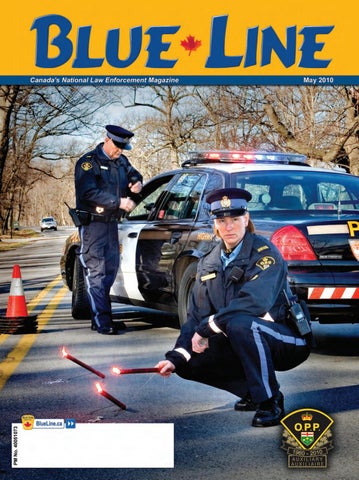
This year marks the 50th Anniversary of the Auxiliary section of the Ontario Provincial Police. Transitioned in 1960 from the former Emergency Measures Organization the Auxiliary officers became more closely tied toward a policing function. Since that time the dedicated men and women of this organization have volunteered many thousands of hours backing up the regular members of the Ontario Provincial Police. The cover photo, taken by Vince Gircys, shows Aux S/Sgt. Brian Cosby and Aux Sgt. Kathleen Twocock of the Niagara Detachment closing off a roadway and relieving regular members to attend an active police crime scene. Read more beginning on page 6.
Features 6 Lending a hand for 50 years
20
The Ontario Provincial Police Auxiliary celebrate 50 years of back-up
8
Swimming pool chemicals
24 Anatomy of a school shooting Dissecting some common precursors
Sticking it to fraudsters
28 The dark side of social networking
10 Mending a broken trust A toxic culture in need of repair
Departments
Case Law
38 18 32 37 36 22 5 16 17
30 33 34
Blue Links Ad Directory Deep Blue Dispatches Letters Market Place Media & Public Affairs Publisher’s Commentary Technology Weird Crimes
Blue Blue Line Line Magazine Magazine
35
33
Aerial observation didn’t breach privacy rights Vehicle search lawful as incidental to arrest Warrant refusal doesn’t preclude reasonable grounds belief Evidence admitted despite police exceeding powers
May May 2010 2010
May 2010
4
Blue Line Magazine
Publisher’s Commentary by Morley Lymburner
A contentious effort Dealing with a national readership of police and other law enforcement professionals comes with a lot of unique challenges. In many instances the people I deal with work in a regionally insular environment. Some of this cocooning is naturally self generated, while on occasion I see it as imposed from the top down. It’s much the same as the three blind men trying to identify the shape of an elephant by touch and each only “seeing” a little part. Many top managers are more comfortable with keeping individuals in the dark and not giving them the big picture. Of course this leads me to our national icon, the Royal Canadian Mounted Police, and in particular the people in charge of change. The Brown Report was released on June 15, 2007. It was created by the Prime Minister to examine certain questions and make recommendations relating to how the RCMP handled reports of mismanagement or irregularities in the administration of its pension and insurance plans. Brown did, however, recognize that many of the problems with the pension plan abuse and investigation came from a much broader problem; a lack of trust and confidence in RCMP management. Since we are nearing the third anniversary of the release, I attempted to find out what changes have occurred. Once again communication with Ottawa has been sketchy, with a few rays of hope in the form of people who say they will talk to me at a future date. Pressed for some form of story before the anniversary, our western correspondent, Ann Harvey, began beating the bushes. I sat on her submission for two months while patiently awaiting other sources to come forth. None has so you can read her findings in a two part series commencing this month. Troubled by this apparent lack of progress, I decided to pose the “change” question to our readership and received many frustrated responses. The bottom line appears to be that
Blue Line Magazine
the only acceptable overtime in most provinces is the voluntary kind. Officers must finish their work before they leave or it’s assigned to the next shift to complete. This is an old form of particularly nasty peer pressure some negatively motivated supervisors invoke to keep underlings under control. When pressed for positive news of changes, the only consistent response has been that they no longer have to wear ties. That ruling came down just after Brown’s report was released. I attempted to communicate with the last known person I heard was in charge of the “Change Committee” and discovered he had been moved out over a year ago. As of this writing I still do not know who is in charge. Last year I saw a training video about the RCMP academy and was struck by a drill sergeant’s comment. “We are not the police, we are the RCMP.” Once again I came face to face with the reality that RCMP traditions do not encourage a view of the broader field of police collegiality. They are not trained with other officers and, by subtle design, are encouraged to keep to themselves. They have an opportunity to look over the fence but jumping is frowned upon. I have my own vision of where the RCMP should go and others have agreed with my assessment: • It must have an association to bargain working agreements and represent the membership. Every other Canadian police service has one and there is no reason it can not work for RCMP members. It is the one factor that would take away at least 90 per cent of the problems associated with change. • The RCMP must control its own budget. The elusive, unresponsive and unreachable treasury board has been the phantom scapegoat for a senior management too tight fisted to admit it likes shoe string budgets. • The RCMP must give up some of its omnificence.
5
It can not be all things to all people and solve every problem. Move out of municipal and, where feasible, provincial policing. • Retain territorial policing functions. • E liminate duplication. If a government agency has an enforcement and investigative branch, there is no need to duplicate that effort. • Adopt best practice training, internal police investigations, police service accreditation and take on cross border organized crime. • Retain police forensics where feasible and national computer databases. • Retain VIP and embassy protection services. • Instill a management attitude and culture which encourages the brightest and best in the ranks. The problems facing RCMP management are challenging and it’s not easy to change old war horses. In the analogy of horse training, change will only occur after considerable pressure is applied to each and every desired manoeuvre. Long held beliefs, customs and tradition are deeply entrenched. It will take an entirely new generation of management people to blaze a new path – a path that every other police service has long established and embraced. A path that the RCMP could smooth over and expand upon greatly. In an April 1 Ottawa Citizen article, RCMP Commissioner William Elliott was quoted as saying, “We are making a contentious effort to try and be more engaging and forthcoming with the media than we have been in the past.” I dearly hope that the word “contentious” wasn’t a Freudian slip and eagerly await the better communication.
May 2010
by Terri McCormack The dawn of a new decade conjures up much thought among police services about what the future holds in this rapidly changing world. While this also holds true for the Ontario Provincial Police, the year 2010 also has the force reflecting on another important milestone. With members still catching their breath after the highly successful 100th anniversary celebrations in 2009, the organization is recognizing yet another significant occasion this month – the 50th anniversary of the OPP Auxiliary. The volunteer program has seen its fair share of transformation and growth since its early days. It was originally recognized as the Emergency Measures Organization (EMO), a body trained to control crowds and offer first aid in the event of a nuclear attack from Russia during the Cold War era. May 2010
The EMO subsequently transferred over to the OPP and became known as the OPP Auxiliary Program on April 1, 1960. Its formation came just a few years before the provincial force entered a new era of rapid growth and modernization, including a new command structure to support what was then 17 police districts. Perhaps the most significant turning point in the program’s evolution was in the late 1980s and early 90s, when a number of recommendations were implemented following a 1988 audit. One of the biggest changes saw the auxiliary program become self-directed. Then Commissioner Thomas 6
B. O’Grady subsequently appointed Aux/ Chief Supt. Terry Harkins as Executive Director, Provincial Commander of the OPP Auxiliary. The auxiliary evolved to include ranks, positions and promotional processes that more closely aligned it with the structure of regular OPP officers. Today, with 52 units and more than 850 strong, the OPP has the largest provincial auxiliary police program in the country and is recognized nationally Blue Line Magazine
and internationally as a leading example of police volunteers. Its size is not all that surprising when you consider the 165 OPP detachment and satellite locations spanning Canada’s second largest province, from Moosonee in the north to as far south as Pelee Island. The program includes an extremely diverse volunteer group which, not unlike the rest of the organization, is largely attributable to the people who serve. Common to this line of work, most members are employed full-time with jobs and careers that virtually cover the gamut of civilian occupations. The various skill sets and backgrounds they bring to the table adds a strong “from all walks of life” element to the organization. Ask any detachment commander or regular OPP officer and they will not hesitate to tell you that the assistance and support these unpaid volunteer officers provide is an invaluable component to the field operations command structure. OPP Commissioner Julian Fantino in particular is cognizant of the value auxiliary members bring to the organization. “The first five years of my policing career were spent serving as an auxiliary officer in Toronto. This was a life-changing experience that was pivotal in my decision to become a regular, full-time police officer,” he noted. Blue Line Magazine
“As one of North America’s most diverse police services, the list of duties our auxiliaries carry out is endless. I hold them in the highest regard for the outstanding work they do when they volunteer unpaid time to assist our regular officers in serving communities throughout Ontario,” he added. The OPP is the only Canadian police agency that requires its auxiliary officers to attend a full-time recruit course conducted near its regular training facility in Orillia. This is followed by ongoing training at the detachments. The program is actively involved in the OPP’s First Nations (FN) partnerships, providing training to FN police services with their own auxiliaries, including NishnawbeAski, Lac Seul, Oneida, Walpole Island, Georgina Island and Chippewa of the Thames. The auxiliary program has proven to be an excellent recruiting resource, with approximately 25 per cent of members going on to become regular full-time OPP officers. A careful selection process and attentive eye on their progress gives regular members a prime opportunity to see who might fill future vacancies. Auxiliary members also have the benefit of “trying on” the job to see if they fit into the challenges of police work. Not all members feel the need to check 7
out the permanent ranks. Many see themselves as simply giving back to the community. Others feel it’s an opportunity to spice up their lives by challenging themselves with new tasks. Some members contribute skills and talents – those with military training, medical experience or even a pilot’s licence have contributed greatly to special projects. One member with an extensive carpentry background helped repair some damage created by an over exuberant “customer” at a police facility. Another member is a correctional officer who simply wanted to see law enforcement at the “intake” level, and a paramedic appreciated the cross training challenges which enhances his day to day job. Once the motivation for auxiliary work is clearly understood by all concerned, there is a balanced relationship which favours both the parent police service and the member. Keeping the task at hand in mind on each shift ensures a reliable back-up is ready and willing to help. Terri McCormack works in the Media Relations Section of the OPP Corporate Communications Bureau. Photos supplied by Vincent Gircys, who can be reached at vincent.gircys@gmail.com
May 2010
Sticking it to fraudsters
by Nancy Colagiacomo Renowned for its world-class sporting and cultural events, the city of Mont-Tremblant’s population of about 10,000 easily triples during the peak winter and summer seasons. Posh boutiques and downtown village shops attract many shoppers – and unfortunately, also debit and credit card fraudsters. The convenient plastic cards have become a way of life for many Canadians. There are more than 21 million debit and credit card users in the country, the most users per capita in the world. Hundreds of billions of dollars are spent every year using the cards and millions more are lost due to fraud. Culprits use a separate card reader to skim information from the magnetic stripe but need the PIN code to begin using the card. They usually obtain the four digit number through over the shoulder observation or installing a tiny camera above or on the side of the keypad where the pin is entered. This is done by removing the point of sale terminal (PST) and replacing it with a clone, installing a chip to record the card information and then returning it to its original location. “We deal with organized networks that commit their crimes throughout Québec,” says Jérome Gagnon of Mont-Tremblant Police. “Since 2006 we have noted numerous incidents in which devices that allow cards to be cloned have been installed in many PST’s. In spite of arrests made, the situation has gotten worse.” The Mont-Tremblant chamber of comMay 2010
merce, resort association and police published alerts and prevention tips in the local newspaper reminding people to be vigilant, but it wasn’t enough. “Most incidents occur on weekends when perpetrators come here for brief periods to use cloned cards and rapidly purchase goods until the account is empty or the credit limit is reached,” Gagnon adds. Disturbed by the incidents and their effect on the tourism industry, city and police officials made it a priority to combat the problem. Police looked at what was being done elsewhere and were inspired by Longueuil’s ‘Project Terminal.’ Developed in 2002 by Lt. Det. Germain Lebeau of the Longueuil Police economic crime unit, it proved to be quite successful, especially with the Celtic police investigation. That operation, a joint team effort with Longueuil Police, Sureté du Québec and the RCMP in collaboration with the US Secret Service, countered a group stealing and cloning PSTs and manufacturing counterfeit debit cards. A major sweep in June 2008 by 150 police officers resulting in eight arrests, 18 searches of homes and the seizure of several vehicles, including luxury models. Equipment such as blank plastic cards with magnetic stripes, PSTs, chips, computers and cell phones were confiscated. A short DVD stemming from Project Terminal is now being distributed throughout high schools to prevent fraud among teenagers. Mount-Tremblant’s version, Project Clonage, was born from this and introduced last year. 8
The first stage was to develop a community approach by recruiting partners, including the chamber of commerce and storekeepers committee. A highly visible seal with the police logo and a warning printed on it was created and placed on each PST. Each sticker has its own serial number linked to a corresponding business, thus complicating any duplication attempt. Placing the sticker as a seal on the joints makes it impossible to open the PST without damaging it and employees can easily notice signs of tampering. Roughly 300 businesses were visited by police, who identified more than 425 terminals and provided business owners with a Bank of Canada folder containing a host of information on counterfeit money and various frauds. The Casino de Mont-Tremblant is also an active partner and Loto-Québec is currently studying the possibility of adopting the program in all of its casinos. Follow up visits are done by police cadets at the start of the summer season and police officers on patrol regularly drop in. Visiting with merchants has reinforced relations with police and enabled an exchange of information, which works well with the community policing approach. There is a heightened interest in the program and MontTremblant police have received several requests from other businesses wanting to take part in the project. Nancy Colagiacomo is Blue Line Magazine’s Québec correspondent. Anyone with information of interest about Québec policing may contact her, Nancy@BlueLine.ca.
Blue Line Magazine
Mentoring Afghan Police
Creating strategic planning and policy development processes by Colonel R.M. (Rod) Lander Developing the Afghan National Police (ANP) into a professional organization is key to both the national security of the country and Canada’s efforts to assist in developing a democratic, stable and self-supporting national government in Afghanistan. Vital to that effort is to create and refine a strategic planning and policy development capability within the Afghan Ministry of Interior (MoI), headquartered in Kabul. The MoI Deputy Ministry for Strategy and Policy was only six months old when I arrived and faced challenges, including filling their positions with appropriately trained and qualified personnel. Together with the military members and contractors from the Combined Security Transition Command-Afghanistan (CSTC-A) and the civilian police members of the European Police Mission (EUPOL), we have been able to significantly improve their strategic planning capability, English language and computer skills and their acceptance within the MoI. CSTC-A, EUPOL and many other bilateral and multilateral agreements and agencies all contribute to the MoI’s development. This is where a well-functioning strategic planning capability is essential for the ANP to move forward in a co-ordinated fashion, and it must be Afghan led or it simply will not be sustainable. Bridging the gap between the NATO strategic planning process being taught by CSTC-A and the civilian policing approach to operational planning is where my background as a military police officer is most beneficial. As an Army, CF Command, CF Staff, and Canadian Police College graduate, I have been able to ‘translate’ what the two approaches are trying to say, often finding that they compliment each other well, even if initially they seemed to be incompatible. So, instead of forcing the Afghans to choose between differing approaches to any issue, we find we can successfully blend the advice offered and create strategies and plans that are more complete and comprehensive. In Kabul, I work within the Canadian Governance Support Organization (CGSO), which is a government supported agency that functions as a non-governmental organization in Kabul, with a goal of furthering development. CGSO provides logistic support for civilian technical advisors to various Afghan Government ministries. Being in Kabul is not without its share of danger. I was sitting with my back to the window in the MoI on the morning of October 8, 2009 when, less than 50 metres away, a massive vehicle-borne IED exploded on the road outside. Virtually all the windows and doors in every ministry building were blown in and dozens of people were killed and injured. Despite being closest to the blast, my deputy ministry came off quite well, in that we suffered only minor injuries. As a testament to their dedication, every single person was back at work the next day once most of the damage was cleared up and repairs under way. Blue Line Magazine
My year long mission in Kabul working at the strategic level is simply one example of how the military police have contributed to the security of Afghanistan since the beginning of the CF mission there. As Canada’s frontline police service, military police are uniquely suited to training and developing indigenous police capabilities in
9
failed and failing states. Being both CF members – capable of living and fighting anywhere and in any state of conflict – and qualified peace officers – trained and used to working in the criminal justice system – we can bridge the gap between what civilian police and the CF as a whole can provide.
May 2010
RCMP change delayed again and again Part 1 of 2 by Ann Harvey Long a Canadian symbol of morality and valour, the RCMP has become the football everyone wants to kick – or so media reports and surveys heralding diminishing public confidence suggest. A majority of citizens who comment in news stories still support and express confidence in the Mounties. There is no doubt that the RCMP is troubled and needs corrective changes, but will they come quickly enough? Morale has been torpedoed by a constant barrage of news stories which allege officer misbehaviours which include inappropriate use of force, lawbreaking, improprieties and plain bad judgment. That erodes morale as the public tends to blame anyone wearing the uniform for the actions of fellow officers, creating more stress for all members in their daily work. Statistics show the number of officers diagnosed with post traumatic stress disorder has spiked in the last 10 years. Officers say more negative publicity is inevitable unless the factors which cause it change. Stressed, over-tasked and discouraged, officers are serving in detachments which now have a high proportion of junior members – a recipe for more bad judgment and mistakes. The positive feedback loop that has been created is generating a downward spiral that must be addressed quickly. Some say it can no longer be reversed. The situation has been studied extensively. All reports have concluded that the RCMP is underfunded, under resourced and badly managed, but there seems to be little political will to address the problems quickly – possibly because recommended solutions will be expensive. Throughout the nation, police services struggle to balance demand for service and the May 2010
reluctance of politicians and the public to pay for it. Now, with baby boomers retiring and recruitment and training of new members underway, all police officers are working more overtime. RCMP sources say that for them the problem has been exacerbated by provincial contracts which allow detachments to be undermanned compared to rural areas served by Sûreté du Québec and the OPP or regions with municipal police services. Municipal government staff report good relations with the RCMP, noted Linda Duxbury in her 2007 report on workplace issues in the force, but she also cited officer concerns and poor management and said the situation has deteriorated since her 2003 report. A task force headed by Toronto lawyer John Brown – the third such report in the past 12 years – interviewed 2,000 RCMP officers across Canada over five months. It garnered evidence of the litany of woes they identified – understaffing, chronic fatigue, equipment shortages and a management system that has been broken for years. Its 2007 recommendations included totally separating the RCMP from government, transferring its management from the Treasury Board to a civilian body, setting up change management teams and establishing an independent oversight commission to scrutinize response to complaints. All the government has done is replace the commissioner and set up change management teams, although the new budget does provide $8 million over two years to set up a civilian review agency. Officers have acted; the Ontario and BC mounted police associations have won the right to form a union via an Ontario Superior Court decision. The RCMP was given until October to establish a new body which will have collective bargaining rights but cannot strike. That change remains in limbo though, says Brian Roach, the Staff Relations Representative (SRR) program national president, due to a court challenge which awaits a precedent-setting decision. 10
The federal government appealed to the Ontario Court of Appeal, which is awaiting a Supreme Court of Canada decision in a similar case involving Ontario farm workers who want to unionize. If the Ontario court decision is upheld, the RCMP will have to ask its members what they want. The SRR has responded to the Brown Task Force Report recommendation that SRRs should not sit as observers on an employers’ committee. “Since then we don’t sit at that senior executive’s table anymore,” says Roach. That was among the little that has been done in response to the reports. Meanwhile the clock is ticking as negotiations to renew a contract to provide RCMP service to provinces and territories continue. The current 20-year contract ends in 2012. A group which included retired assistant commissioner Robert Head, university professors and lawyers urged the Alberta government in February to replace the RCMP with a provincial police force. Their letter to Alberta Premier Ed Stelmach was published by the Calgary Herald. Alberta is the second-largest contract province and the RCMP now serves 22 per cent of Albertans. “The point of the letter to the premier was to not have him sign another long-term agreement,” Head said, “because that closes the door to any thought of any other style of policing. We just wanted to stir some interest and get some debate flowing.” Head, who now resides in Alberta, said he supports this initiative because he believes the RCMP can no longer effectively manage both federal and provincial policing. He’s proud of the RCMP and wants to strengthen, not weaken, its core focus of federal policing so that it is able to maintain its tradition. The RCMP has grown too much from the 4,500 members it had when he joined in 1953, Head said. “I think it’s now too large to be properly managed from a central location in Ottawa. I now believe, actually more so than ever, that Blue Line Magazine
provincial policing should be left to the provinces as it is in Ontario and Quebec.” He suggested a regional approach to policing, a system already being used in Lethbridge, would provide better coverage. “Why do we fragment the policing? The criminal organizations, the gangs, are all centrally located in large cities.” “We have no objection to having Alberta provincial police,” said Bob Walsh, president of the Alberta Federation of Police, which is comprised of police services of Edmonton, Camrose, Lacombe, Lethbridge and Taber. “We’re not dissatisfied with the RCMP,” he added. “The surrounding communities are all manned by RCMP members. We don’t really have much contact with them.” The federation would want to be assured that Alberta will not create a two-tiered system, with some police being less qualified. “We are all in agreement as long as it is standardized,” but Walsh cautioned that “It’s difficult to do recruiting these days. Police are all fishing in the same pond for recruits.” Head disagreed, arguing that recruiting provincial police should not be a problem. “I’ve had estimates given to me by serving RCMP members in Alberta who say that probably 75 per cent of them would swing over to a provincial police force because they like Alberta.” Walsh noted that it is unlikely the government will accept the proposal as Stelmach is a strong RCMP supporter. “We are committed to having the RCMP as
Blue Line Magazine
our provincial police force,” confirmed Christine Nardella, a spokesperson for the Alberta solicitor general’s office. Negotiations by the provinces and territories with Public Safety Canada are occurring and should be completed by the end of 2011. Public concern expressed in Red Deer was part of the budget process. Citizens were reminded of the high cost of policing at the level Canadians expect and the city has initiated a study of the effectiveness of its contract with the RCMP. “RCMP members come and go,” said Colleen Jensen, director of community services. “They only stay for three to five years. People are saying if we had a municipal force they’d be here for their whole term. Then they’d be invested in the community. It’s very subjective and based on nothing. “The council says that they want to have a look to determine whether a municipal police force is a better option for the city. We are the only one (city) of our size in Alberta that doesn’t have its own municipal force. We’re just going to be in that process. We did a look at it about five years ago in a very superficial way. The finding at that point in time was that there wasn’t a strong enough case. This will be done in a much more in depth way.” A stand alone force is unlikely to save money, Jensen noted. “I’m pretty sure that the cost will be more significant to go with the municipal force compared with the RCMP. If we have our own force than we have to have the responsibility for communications (dispatch), training, vehicles, liability (insurance) – which
11
is no small thing. When we contract with the RCMP our contract covers all that and more.” The study in no way reflects dissatisfaction with the RCMP’s service, Jensen added. As overseer of police service for Red Deer, she said she has an excellent relationship with the RCMP and is notified immediately of any high profile incident. Halifax recently considered dropping the Mounties. Its board of police commissioners recommended expanding Halifax Regional Police to cover the entire municipality, replacing about 200 RCMP officers who police the city. Residents were upset by the proposal, said regional councillor Peter Lund. “The people are totally against having Halifax Regional Police out here,” he said in February. “They think that the RCMP should stick to the rural areas. That’s where they’ve been policing since their inception and they’re very good at it.” Lund added that he wasn’t convinced the move would save money, noting that the region would have to buy new equipment and new vehicles. His argument carried the day. “Council was presented with detailed, comprehensive information on which to base its decision,” said Mayor Peter Kelly. “After careful consideration, council endorsed the status quo.” Another group has identified the urgency of resolving RCMP problems. Six Liberal senators – members of the previous Parliament’s disbanded security and defence committee – took the unusual step of releasing a
May 2010
position paper in late February entitled Toward a Red Serge Revival. It recommended rebuilding the national police service. The senators said current reform efforts aren’t working and there will be more “horror stories,” as “a national treasure” deteriorates. Their paper urged that Commissioner William Elliott, a bureaucrat brought in from outside in July 2007 to overhaul the 24,000 member service, be replaced with someone from the ranks. It also called for more women and minorities to be recruited and more money and resources for the Mounties. Renewal of the RCMP is “too important for the government to stall it any longer,” said Sen. Colin Kennedy, who served as chair for the committee. Elliott announced changes in February which included having outside experts investigate more serious complaints and changes to the Taser policy. That’s not good enough, the senators said, arguing the RCMP needs to be transformed and time is running out. Former public Safety Minister Peter Van Loan said the government wants to consider yet another report – this one from Justice John Major – before considering the Brown Report recommendations. More delay – and more discouragement for fatigued officers as an unchanged RCMP elicits more negative news stories. Ann Harvey is Blue Line Magazine’s western correspondent based in Alberta. Contact her at AHarvey@BlueLine.ca
Significant quotes from “The Brown Report” 7.6 What We Observed Two structural issues within the RCMP became very clear during the course of my investigations. Although they have each been described in previous sections, it is worth summarizing them here as a prelude to my recommendations on the way forward. The first of these is the tension caused within this paramilitary organization by attempting to superimpose on the chain of command structure imposed by the RCMP Act, a more traditional management process built on collaboration and challenge. I accept that policing is traditionally conducted under a chain of command structure. However, the complexities of running the business side of the RCMP demand that ways be found to marry that with a structure more suited to responsible business management. The unquestioned obedience to lawful orders cannot provide the necessary collaboration, challenge and stewardship. The second of these structural issues is the conflict between the principles of a robust workplace disclosure policy and the process for reporting possible breaches of the Code of Conduct that is hard-wired into the RCMP Regulations. The Code of Conduct process has been part of RCMP culture for some time and members are well aware of their responsibilities and of the sequence of steps when a breach of the Code is suspected. But the Code procedure contains none of the nuances of a workplace disclosure policy, and in particular, none of the protections for the whistle blower. I have also observed that the Code of Conduct procedures can even be used as a weapon in the war of personalities, as was evident when C/Supt Macaulay and Mr. Ewanovich launched mutual Code of Conduct complaints against one another over allegations surrounding the latter’s management practices. Thus, a mechanism must be found to override the Code process when legitimate workplace disclosure matters are brought forward by an employee or member to whom protection is owed. I believe that there is ample evidence that structural changes are required. The relationships between a chain of command structure and effective management must be sorted out. A proper management and oversight structure must be considered. Further analysis of these issues is urgently needed so that appropriate changes can be formulated and implemented. The recommendations in Chapter 8 are designed to achieve this end. Chapter 8: Rebuilding The Trust Provide a recommendation as to whether or not a review is needed with respect to the overall management structure of the RCMP. 8.1 Task Force on Governance and Cultural Change in the RCMP
May 2010
12
8.1.1 Establishing the Task Force There is a great deal of work to be done to develop an appropriate governance structure and create an appropriate culture at the RCMP. I have made some suggestions in Chapter 7, but the importance of the issue deserves far more time than has been available to me. It also requires input from key stakeholders. I am therefore recommending the establishment of a Task Force to examine the issues and provide recommendations to the Minister of Public Safety and the President of the Treasury Board by December 14, 2007. The members of the Task Force would be drawn from the RCMP and from the Public Service and would also include outside experts in relevant areas such as policing and governance. The Chair of the Task Force should be independent of the RCMP and of the public service. The Task Force should deliberate privately in order to encourage full frank discussion. However, the recommendations of the Task Force should be publicly available. 8.1.2 Mandate of the Task Force The mandate of the Task Force should be to develop solutions to the governance and cultural problems that this investigation has exposed. It may well be that in order to accomplish these objectives, the Task Force will need to consider recommending amendments to the RCMP Act. The mandate of the Task Force should include (but not necessarily be limited to): • examining the management structure of the RCMP including the committees and branches and determining whether they are properly mandated and resourced; • examining how a challenge and oversight function can be introduced into the management of the RCMP, including how such functions can be superimposed on a paramilitary-style policing organization; • determining how to ensure appropriate accountability is imposed on senior management; • designing a process that will ensure that the Commissioner and senior management establish and maintain an appropriate ethical structure based on the RCMP’s Mission, Vision and Values; • ensuring that the RCMP’s workplace disclosure policy is appropriate and that mechanisms are in place with adequate resources to ensure protection from reprisal and a commitment to clear and decisive corrective measures; • ensuring compatibility between an effective workplace disclosure policy and the process for reporting possible breaches of the Code of Conduct; • considering ways of fostering a constructive partnership between civilian and public service employees and regular members at the executive level of the Force. Blue Line Magazine
Firearms use in robberies down while home invasions rise
by Stephen Thorne
OTTAWA - Robbers are using fewer firearms while committing their crimes, according to Statistics Canada. Firearms were used in 14% of robberies in 2008, compared with 20% a decade earlier, the federal agency reported Thursday. Statistics Canada says the kinds of robberies has evolved as well with commercial robberies declining while home invasions have increased. Police reported about 32,000 robberies in 2008, accounting for seven per cent of all violent crimes but, overall, the number of robberies was diminishing. “Robbery’’ is defined as a theft that involves violence or the threat of violence. Statistics have consistently shown that general crime numbers have been on the decline for years. In its latest report, Statistics Canada says the policereported robbery rate had dropped 10% from 1999, with most of the decline between 1999 and 2002. Statistics Canada says the downward trend began before the Canadian Firearms Registry legislation was instituted in 1995 and has levelled off in recent years. “Between 1977 and 2002, the rate of robberies committed with a firearm declined steadily,’’ the agency says. “Since then, the rate has remained stable.’’ The registry’s effectiveness is still debated among law enforcement officials. The Canadian Firearms Centre says police consult the system more than 13,000 times a week, while 92% of police officers told a survey it conducted that they use it, often in domestic violence situations in which they want to establish whether firearms are in the home.
Blue Line Magazine
Ontario Provincial Police Commissioner Julian Fantino has criticized the registry, however, saying it is “long on philosophy and short on practical results.’’ Edgar MacLeod, president of the Canadian Association of Chiefs of Police, has defended it, saying it “works and provides a valuable service,’’ despite embarrassing cost overruns almost a decade ago tallying in the hundreds of millions of dollars. The StatsCan study says robberies committed with weapons other than firearms - most commonly knives accounted for 29% of all incidents in 2008. No weapon was involved in the remaining 57 per cent. Police-reported residential robberies, often referred to as “home invasions,’’ increased 38% between 1999 and 2005, and have stabilized since. There is no Criminal Code offence of home invasion, the study notes, but it is generally defined as a residential robbery in which force was used to gain entry and the accused was aware that someone was home. Police reported 2,700 home invasions in 2008. The vast majority of robberies were committed by young men - almost nine in 10 suspects in 2008 were male and nearly two thirds were between the ages of 12 and 24. Money was the most common item reported stolen (37% of all robberies), followed by personal accessories such as jewellery (18) and electronic devices like computers, cell phones and personal music devices (15). The report says three provinces - Quebec, British Columbia and Manitoba - have driven the overall decline in the rate of police-reported robbery over the past decade. Between 1999 and 2008, the rate fell 30% in Quebec, 22% in British Columbia and 20% in Manitoba.
13
Robberies increased in all of the remaining provinces, with the largest increase reported in Newfoundland and Labrador, where they more than doubled while remaining well below the national average. Despite the declines, Western Canada, particularly Manitoba, recorded the highest rates of police-reported robbery in the country, similar to the pattern for overall violent crime rates. The highest city rates were all in the west: Winnipeg, Regina, Saskatoon, Vancouver and Edmonton. The only cities in Central and Eastern Canada with above-average robbery rates were Montreal, Toronto, Thunder Bay, Halifax and Hamilton. Some other facts: • About half of all robberies were committed on the street or in outdoor public locations such as parking lots or public transit facilities in 2008. 39%took place in commercial establishments like convenience stores or banks. Remaining 10% were residential robberies. • The overall decline in robberies since 1999 resulted from a decrease in the rate of commercial robberies. In particular, bank robberies fell 38%, while robberies of gas stations and convenience stores were down 32. • Robberies occurring in public transit facilities have doubled since 1999, although at four per cent they continue to account for a relatively low proportion of all incidents. The highest rates of public transit robberies were reported in Edmonton and Montreal. This article was excerpted from Blue Line News Week, a weekly executive reading service emailed every Thursday. To subscribe go to www.BlueLine.ca or phone 905 640-3048.
May 2010
Do a better job of media relations by Jerry Amernic I’m not into science fiction, but imagine for a moment that you live on Mars and the only thing you know about the police is what you read in the press. Assuming that Mars has the Internet, you go online and what do you see? Ex-police officer faces child porn, luring charges. Toronto cops face charges in growop raids. Policeman accused of intimidating witness. Not to mention what has become an almost daily barrage in the media about how police Taser innocent people everywhere. All right, forget Mars. Let’s say you’re new to Canada, maybe from Somalia or Pakistan. You’ve had no interaction with the police, but are wary about them because you know how they operate back home and, based on what you read in the papers and watch on TV, feel they’re up to no good. If the media is all you have to go on, why would you think otherwise? I worked closely with Julian Fantino on his memoir DUTY – The life of a Cop. We included a section in that book about the media and how it has changed over the years. Here’s what Fantino had to say: “Any police chief has to deal with the media and I have seen a change in how the media does its business since I first joined the police in 1969. Today everything is about the immediacy of stories, which is made possible with modern technology and it’s very competitive. But I think an evolution has taken place. What used to be reporting the news, which is what the oldtimers did, has now boiled down to the quick fix, the sound bite and the screaming headline. And along with this comes inaccuracies galore. “In the old days, you had seasoned people sitting on editorial boards. Meet with editorial boards now and it’s not unusual to see young people with very little experience in life writing opinion pieces that rip their subjects apart. They may know little about the ways of the world and yet they write about policing issues as if they are seasoned police officers who know everything about the job. Some people who try to destroy a police chief haven’t walked a minute in the chief’s shoes and haven’t taken the time to learn exactly what the chief does or how they do it. “I think it was better when you had long-tenured, experienced, tried-and-true, police beat reporters who really knew their business. A good example is Gwynn “Jocko” Thomas, who for the longest time was the police reporter for the Toronto Star. This guy was a legend. He had contacts and developed a reputation for being trustworthy because he had intimate knowledge of how policing is done. People like that were on the street and had ways of checking and validating what they were reporting.” Today many segments of the media – newspapers especially – are fighting for their lives because of the economic realities of May 2010
online communications. While many dailies can no longer afford the luxury of full-time, police reporters, Fantino’s comment about the immediacy of reporting is well taken. In the fall of 2008, the Ombudsman of Ontario held a news conference and claimed that the SIU was a “toothless tiger,” the impression being that cops under investigation by the SIU didn’t have to worry because they would get off. The next day, the headlines were flying. “TOOTHLESS’ SIU BLASTED,” screamed the Toronto Sun’s front page. “SIU ‘bias’ blasted,” blared the Toronto Star. Even the staid and conservative Globe and Mail, which didn’t have the story on page 1 but did devote a half-page on the inside, went with: “Police watchdog ‘toothless,’ Ombudsman says.” On TV, it was more of the same. I have known a few cops over the years. I even play hockey with current and retired police officers. To be sure, they constitute a community – a subculture – but I’ve never wavered from the belief that a huge majority of police do yeoman’s work and very often, thanklessly. Considering what they do and the dangers involved, they aren’t particularly well paid. They work hours most people wouldn’t consider, they often have to mix with the riff-raff of society and then they get stuck by the media. After the Ombudsman’s news conference, I spoke to lawyers who are close to the SIU. I learned that the Ombudsman himself was once its director; during a tumultuous, nine-year stretch from 1990-1998, the organization had nine different directors! I was told by several sources that during this period the SIU had a strong, anti-police bias, so I wrote a piece for The National Post, which said that such criticism of the SIU wasn’t objective. Still, the day after the news conference, the media did its thing and the police got tarred. Many years ago when I was a reporter, I did a story that hinted of alleged anti-Semitism in the Catholic Church. The powers-that-be in the Church didn’t want anything to do with this reporter. No comment. I have since found that the police can also be gun-shy (perhaps a poor choice of words) when it comes to the media. On one hand, I don’t blame them. Police are vilified so much they probably think the less 14
they have to do with the media, the better. On the other hand, I believe that they can do a better job of media relations. So here are some tips: 1. Make a list of good stories for the media. I’m not only talking about the detective who successfully closes a homicide file, but the local cop whose influence turns a tough street kid into a scholarship candidate at college. In the police scheme of things, these stories always exist, but sometimes you have to find them. 2. Include such stories in a media-relations program that is proactive, not reactive. It identifies positive news stories and then markets them to the media. A story is often offered as an exclusive to a specific media contact. 3. Police officers should not write news releases, or any media communications for that matter. News releases are far more effective when prepared by professionals. The purpose of a news release is not only to inform, but to generate coverage. Too often, the police – like many organizations – think the purpose of a news release ... is to issue a news release. 4. Develop a strategic approach that promotes positive media coverage. One way to do this is to prepare a target list of media you want to be in – a wish list – and along with that a ‘calendar’ that includes upcoming newspaper special reports, theme issues of key magazines and trade journals, etc. This way you can approach those publications with stories and story ideas long before they appear. 5. All media spokespersons should be mediatrained. Learning to prepare key messages before the interview, along with the art of sound bites, how to avoid unnecessary police jargon and how to turn a negative question into a positive answer are valuable tools in dealing with the media. And no one is ever too good at them. Jerry Amernic is a writer and media relations consultant. He collaborated with Julian Fantino on DUTY – the Life of a Cop, and assisted the Hon. Patrick J. LeSage, former Chief Justice of the Superior Court of Ontario, in the 2005 Ontario Police Complaints Review. He has also consulted for the Ontario Ministry of Public Safety and Correctional Services and Solicitor General.
Blue Line Magazine
Cheaper training with better results Part 3 by Tom Wetzel
Emergency vehicle operation
Although the current recession may reduce funding for police, management still has an obligation to ensure that officer skills stay sharp. By thinking outside of the box and looking into innovative yet inexpensive training opportunities, it may be able to provide members with useful training while working within a limited budget. The dangers and stress from the emergency operation of police vehicles is an important matter for both agencies and the public. Because officers may have to rush to emergencies or crimes in progress, they are required to drive in all types of weather conditions and must do so in a safe manner, including during pursuits, which can be particularly dangerous as the officer is multi-tasking in a big way. Watching the subject vehicle, operating the cruiser, trying to radio information and, in many cases, determine nearly continually whether the pursuit should continue can be stressful. Sending officers to driving schools where they actually operate vehicles, use simulators or train with an agency driving instructor are good opportunities to maintain skills but may not occur because of the cost. It is still important for agencies to find inexpensive but useful training because of the risks involved
Blue Line Magazine
with emergency driving. Consider using videos of officers in pursuits and following cars on city streets from your in-car cameras. An officer sits at a table watching the video on a large screen television and uses an old radio microphone to speak to a dispatcher sitting near by, who also has a microphone and out of service telephone. A supervisor acts as the trainer and presents different scenario situations for the officer to use, which could include everything from a vehicle not stopping for a minor traffic infraction to one involved in a violent crime.
15
The officer relates what they see in the video, including locations, descriptions and reasons for attempting to stop the vehicle. The dispatcher responds and practices phoning other agencies to advise them of the pursuit. Of particular importance is the officer’s decision on whether to begin the pursuit or when to stop based on the circumstances. The dangers from pursuits, especially to the public, are of vital concern today, as they should be. The officer would be evaluated on his or her decision making, along with compliance with policy. The training could be done while officers are on duty and staffing is strong or could be conducted with limited overtime, but overall, officers and dispatchers would receive some level of stress training without taxing the budget. Training on the “cheap” doesn’t have to mean poor results. In fact, the benefits may actually be better because the training will have an agency flavor that addresses local realities and culture. By using available resources and imagination, police services can weather tighter budgets while still keeping skills sharp. Tom Wetzel is a northeast Ohio suburban police lieutenant, SWAT officer, trainer and certified law enforcement executive. Contact him at wetzelfamily05@sbcglobal.net for more information.
May 2010
TECHNOLOGY by Tom Rataj
Police video goes electronic Court rulings and recommendations from coroner’s inquests have firmly established video as the gold standard for police recordings of prisoner management and interviews of victims, witnesses and accused persons. In the early days, VHS video tape was the primary technology used to record original material and share copies. When the price of DVD technology dropped significantly enough to make the switch affordable, it quickly began to replace VHS. The much smaller form-factor was a welcome relief to the storage challenges presented by the relatively large VHS tapes and the overall quality of recordings improved appreciably. Continuity and security of the original recorded media did create some management issues. The preparation and delivery of investigative copies for officers and disclosure copies for crowns and defence counsel makes managing videos a labour-intensive and timeconsuming chore, requiring numerous personnel just to keep everything running in a timely and orderly fashion. Fortunately, the next generation of police video management recently got underway at the Toronto Police Service (TPS). It significantly improves all aspects of video handling, while significantly reducing the number of DVD’s used in the process. With about 54,000 videos handled annually, this is a huge step forward. DVAMS The Digital Video Asset Management System (DVAMS) became operational in late 2009 and is now up and running in the homicide and fraud squads and sex crimes and traffic services units. It is also used in three suburban uniform divisions, chosen because they also house breath testing equipment and prisoner holding facilities which serve several neighbouring divisions. DVAMS replaces all the local DVD recorders with a computer-controlled, networked video system that records all videos electronically onto computer hard-drives in local servers at each unit. The completed videos are later electronically transferred to the main DVAMS server, located downtown at the Video Services Unit (VSU). Once there, they are available for viewing by virtually any officer through the TPS network. The video files are transmitted to VSU over a secure fibre-optic cable system that is also needed to manage the large amounts of “data” created by the audiovisual capture process. May 2010
The actual video recording uses the common MPEG4 format and is stored on large harddrives that are part of the main DVAMS server. The system automatically manages all aspects of the process, including the authentication and continuity of each video to satisfy the best evidence rule. It uses an MD Hash validation process to prove that the transmitted file is 100 per cent identical to the original recording. The system is backed-up on a continual basis, ensuring that not a single video is ever lost due to a system or hard-drive failure. Investigative copies for officers are more-or-less redundant since any video can be viewed on-line at any time. Officers simply launch the DVAMS application on any workstation, search for the video they wish to view and play it. This eliminates substantial labour and management time and delays and most human error type problems that would typically cause difficulties with a tape or disc based system. Disclosure copies for crown and defence are still produced on DVD, although obtaining them is also simplified through an on-line ordering process that is also part of DVAMS. A fully automatic audit process is built into the system to log access to every video. For extraordinarily sensitive investigations, access to individual videos can be restricted by the case manager. 16
Touch-screen Each DVAMS installation uses a StealthTouch M5 15” LCD display unit which is actually a complete computer running Microsoft Windows XP Pro for embedded systems. Manufactured by Pioneer POS Inc., it is about twice as thick as a typical LCD monitor because the computer motherboard and other components are integrated into the back. There are three distinct user-interfaces, each tailored to the specific task done at a location – booking, breath-test rooms and interview rooms. Starting a recording is as easy as signing on to a computer and touching a few virtual onscreen buttons. Finishing a recording is almost as easy, although the user does need to enter a few details about the video using a virtual on-screen keyboard. A mechanical keyboard and mouse is also attached to each unit. To further simplify and automate the video creation process, several TPS database systems automatically feed data to DVAMS. Video copies When it comes time for disclosure or to produce an investigative copy for off-site uses, officers again simply launch the DVAMS application and order the video, which is placed into the production queue at VSU and eventually burned to a DVD along with a playback Blue Line Magazine
menu. The Rimage Professional Series DVD duplicating machines also label each disc with basic case information and colour code them to show their eventual use. Once production is complete, clerical staff at VSU unload the completed discs and ship them as required. DVDs destined for the crown and defence are placed in a secure bin to be delivered to the appropriate court locations. Investigative copies, if needed, are distributed through the internal mail system. VSU staff makes a notation in the case management system indicating when the video copies have shipped. Investigative From an investigative perspective, DVAMS is also a powerful tool because any officer can view any video over the network, making it very simple to help identify suspects or witnesses. A suspect booked at the other end of the city can be viewed elsewhere within minutes, eliminating wait times that would ordinarily have stretched into days. Seized or otherwise surrendered videos typically received from corporate and retail security systems are also uploaded into DVAMS and instantly made available across the network, again creating huge investigative efficiencies. When received at field units, seized videos are deposited in a secure bin and taken to the VSU by TPS couriers. Clerical staff at
Blue Line Magazine
VSU then manually upload the videos onto DVAMS and enter case related information in the database. The original tape or disc is filed in the appropriate rack, available should it ever be needed to prove continuity. Disclosure of these videos is also handled electronically through DVAMS, just like any other video created directly in the system. While building and implementing such a complex city-wide solution certainly doesn’t come cheaply, the astounding efficiencies and savings of soft-dollar costs alone should offer a fairly quick return on investment. From an investigative perspective, the DVAMS system offers a wide variety of advantages because all the videos stored in the system are readily available to all investigators within minutes. Imagine the possibilities! The DVAMS network is a highly customized version of a product created by MediaSolv Solutions of Herndon, Virginia. The TPS system has been in the building stages for the past two years and may eventually be implemented at all uniform and investigative units. The creation of DVD’s for disclosure may eventually be more-or-less eliminated when the courts are connected to the DVAMS system. Tom Rataj is Blue Line’s Technology columnist and can be reached at technews@blueline.ca .
17
weird crimes BEDRIDDEN
Police in Ferrol, Spain, charged Antonio Navarro with driving while intoxicated on a highway. He was only going 12 mph, and he wasn’t driving a car. Navarro is a quadriplegic, and police busted him driving his motorized bed on the freeway. Where did he need to go in such a hurry? Navarro was on his way to a local brothel.
IF CONVICTED, HE WILL A-PEEL
In 2007 a man walked into a 7-Eleven in Monrovia, Maryland, just past midnight and attempted a holdup. The unidentified man didn’t have a gun or any kind of weapon at all-he merely demanded that the clerk give him money. The clerk refused, so the man started picking up items off the counter to use as weapons. After repeatedly hitting the clerk with a banana, the attacker fled (empty-handed) before police arrived.
KIDNEY REMOVAL
In 2007 the Seattle Museum hosted “Bodies ...The Exhibition,” an educational display of preserved corpses and internal organs. One of the display kidneys was stolen. Police are still searching for the culprit, but do not fear the kidney will turn up on the black market, because even though the kidney is real, it’s not “usable,” as it’s been filled and covered with plastic resin.
May 2010
Deep Blue by Dorothy Cotton
Being found NCR doesn’t mean going free Last month, I owned up to the fact that I have defective frontal lobes. Since I seem to be in a confessionary mood, this month I am going to acknowledge that I also have problems with attention and a lousy memory. Right now (at least “right now” when I am writing this) I am sitting at a session that is part of the Osgoode Law School’s certificate program in mental health law. It is a very good program, by the way. There is only one police officer here (there were a whole bunch last year) and he says he thinks there should be many more. I agree – but I digress. I am actually teaching in this program and have sat through this session before so I am not really paying attention. I am not very good at sitting for long periods of time and paying attention. The present speaker is talking about Criminal Code Provisions for taking mental disorder into account when a person appears to have committed a crime. However, I did pay attention long enough to suddenly remember that in the summer of 2008 I wrote a column about how people with mental illnesses might get to be declared “unfit” by the courts. In that column, I said: In the current Criminal Code of Canada, there are two provisions for taking “mental disorder” into account. The Code talks of the possibility that one might be “not criminally responsible” or NCR – a concept similar to what is often colloquially referred to “not guilty by reason of insanity. However, the Criminal Code also speaks of the need for an individual to be “fit” to stand trial (I’ll talk about the NCR designation in a future column – but for now, I will confine myself to discussing fitness). I lied. I never did write that column. I forgot. So here it is. Consider that you are involved in a case where a man known to have schizophrenia attempts to kill his neighbour. There are really no doubts about the facts; there are witnesses, the evidence is clear, the accused does not deny making the threats and did break into the house intending to kill his neighbour. However, the accused says he HAD to do something, as the neighbor was actually a spy sent by an unfriendly foreign government and the neighbour was going to blow up the whole city unless he did something to stop him. Furthermore, the accused tells you the Canadian government chose him to carry out the assassination and sent him messages through the television – and, for the sake of argument, let’s say this is all untrue. The neighbour is not a spy and the government did not hire him. His beliefs are delusions which have arisen out of his illness. Do we send this guy to prison? We can May 2010
and sometimes do – but there is another option and it falls under Part XX.1 of the Criminal Code (note this is not Mental Health Act stuff so it’s not provincial. This is THE Criminal Code of Canada). Part XX.1 tells us that, “no person is criminally responsible for an act committed or an omission made while suffering from a mental disorder that rendered the person incapable of appreciating the nature and quality of the act or omission or of knowing that it was wrong.” Thus, if either of these conditions are met, the person might be, “not criminally responsible” or “NCR.” This does not mean that everyone who has a mental illness is not criminally responsible. If I have a major mental illness, am living on a very small income and steal food rather than buying it, I am not NCR. In the case of our gentleman above though, one can make a case that he was unable to appreciate that doing away with the neighbour was wrong because, if the circumstances were REALLY what he thought they were, his actions would not have been considered wrong. You might also have a situation in which a person was so thought disordered or otherwise mentally impaired that they really had no idea what they were doing – and thus did not appreciate the nature of their actions. Consider, for example, a young woman in a manic state who thinks she had to get to a certain location right away in order to save the world. She is driving at the speed of light when police stop her. She had no idea how fast she was going, does not understand why she was 18
stopped or arrested – and felt there was no danger of her hurting anyone because she has magical powers. She was completely oblivious to the fact that she was weaving in and out of traffic and posing extreme danger to other people on the road. In other words, she does not really appreciate the nature and quality of what she was doing. Like the gentleman above, she may be an appropriate candidate for an NCR finding. Much as the public seems to think that a person found to be NCR gets off scot-free, this is not the case. What it does mean is that rather than being sent to a correctional facility, they go to a forensic hospital or forensic unit within a hospital. Basically, they stay there until a review board decides they are no longer a danger. That might be soon – but often it is not. Lawyers sometimes stay away from using an NCR defense because a person often ends up staying in hospital far longer than they would be kept in prison. It’s a long and complex process, the whole NCR thing, both before and after a finding. Nevertheless, there are definitely times when the NCR disposition is the best for all parties involved – including both the accused and public. In many ways, it does present the best balance between looking after the rights of the individual and also heeding community safety. Seems to me that can be a win-win scenario. Dr. Dorothy Cotton is Blue Line’s psychology columnist, she can be reached at deepblue@blueline.ca
Blue Line Magazine
Ergo” software has all the answers
“
For those needing hazardous goods information at their fingertips, Transport Canada has new downloadable software called “Ergo” with a complete searchable version of the most current CANUTEC Emergency Response Guidebook. CANUTEC (Canadian Transport Emergency Centre) assists first responders in handling dangerous goods emergencies. This national bilingual advisory centre was established in 1979. It’s part of the Transportation of Dangerous Goods Directorate and is one of the major programs instituted by Transport Canada to promote public safety during movement of people and goods. Over the past 30 years CANUTEC has set up a scientific data bank on chemicals manufactured, stored and transported in Canada and is staffed by professional scientists specialized in emergency response and experienced in interpreting technical information and providing advice. Ergo is a quick reference to assist field personnel and the public who need immediate advice on a rapidly developing situation. Designed as an invaluable tool for any business that handles, transports or responds to hazardous materials calls, this software loads quickly and has an easily understood interface suitable for even novice users. Ergo’s opening screen shows a chart presenting the international Hazmat ID number Blue Line Magazine
and an alphabetical list of chemicals. Three other columns show the toxic inhalation hazard and whether the material is water reactive or a chemical warfare agent. The best part of the software is the search function. By placing a word or number in the search field you can quickly direct it to move along to more specific categories, including required placarding and recommendations for first responders to the scene of accidents and spills. Ergo enhances the capabilities of CANUTEC and encourages a knowledgeable public. The centre deals with some 30,000 telephone calls per year, with approximately 1,000 of these requiring an emergency report. It provides advice and information by telephone and, in some instances, can send printed copies of standard information and data to the enquirer to complement staff member’s verbal advice and recommendations. CANUTEC can also provide links to the appropriate industry, government or medical specialists. Shippers of dangerous goods can be linked to the site to deal with instructions on cleanup, disposal and/or recovery. Should on-site assistance be required, CANUTEC can assist in activating industry emergency response plans. First responders dealing with emergencies involving dangerous goods are urged to call CANUTEC at 613-9966666 or *666 on a cell phone. A quick search for “CANUTEC Ergo” will give you the directions to the download site for the software, which is available to dispatchers, individual officers or simply concerned citizens who feel a need for such information. 19
May 2010
Swimming pool chemicals by Jacques Savard, Ph.D. Chemist First responders receive dozens of calls every summer from individuals needing help with pool chemicals, usually because they mixed the contents of old and new containers, producing an acrid gas. On most occasions, the premise have to be evacuated and Transport Canada’s CANUTEC called for advice. Most swimming pools recirculate their water in a closed loop. New water is added from time to time but refilling is unusual. A subtle balance must be obtained between many different chemical processes to maintain water quality and required health standards. Several biological and chemical phenomena will occur and must be controlled by adding different chemicals. Algae may readily form from airborne spores and may be controlled with an algaecide. Bacteria, brought in by the swimmers themselves, may prosper and is controlled by adding “chlorine” to the water. The pH should also be adjusted for the swimmers comfort and the effectiveness of the chlorinated agents. The required chemicals often belong to very different and non-compatible families: quaternary ammonium salts (algaecides), inorganic salts, acids or bases (pH adjusters), oxidizers, etc. To destroy bacteria (microbes), chlorine and chlorine derivatives are the most widely used biocides in commercial or public water treatment facilities and they are often involved in dangerous materials incidents. For private pools and spas, solid derivatives susceptible to yield “chlorine” are used. As solids, they are easier to handle and store than gases and liquids. Unfortunately, they are probably the most hazardous chemicals to be found in your backyard when improperly handled and are most often involved in CANUTEC’s summer avalanche of pool chemical incidents. Two types of chlorinating agents There are “organic” and “inorganic” chlo-
May 2010
rinators. The inorganic group contains mainly one chemical product: Calcium hypochlorite, also called “cal hypo” for short. It is shipped under two forms: anhydrous (less than 5.5 per cent water) or hydrated (5.5 per cent to 10 per cent water). A very closely related product, lithium hypochlorite, can also be found on the shelves and should be handled with the same precautions. These products belong to the same chemical family as bleach (sodium hypochlorite solution). All chlorinators show the same chemical behaviour and are classified as oxidizers. Class 5.1 by the TDG Regulations (bleach is Class 8 (9.2)). Hazards Non-compatibility: Organic and inorganic “chlorine” (isos and cal hypo) are totally noncompatible with each other. Many incidents occur when they are mixed, intentionally or not, by using the same scoop or when adding one product after the other in a pail or the pool chlorinator.
20
Heat: Pool chlorinating agents (both organic and inorganic) are not combustible but may be decomposed by warming. Calcium hypochlorite decomposition is self-sustaining. Getting rid of the source of heating will not stop the formation of fumes and the reaction will proceed until the material is no longer available. Dichlor decomposition not only will generate enough heat to sustain a thermal decomposition but may ignite easily combustible material such as wood, paper or oily rags. Trichlor ceases decomposition when the heat source is removed. The decomposition products may include oxygen and/or chlorine gas. Here are some examples of hot spots likely to trigger the decomposition process: • Lighted cigarettes or matches; • Any flames (e.g., portable gas stove); and • Welding rods or molten particle from welding operations. Contamination: Organic pool chemicals are also strong oxidizers. Sodium dichloroisocyanurate dihydrated is rated 1 by the National Fire Protection Association. Trichloroisocyanuric acid is rated 2 and potassium (or sodium) dichloroisocyanurate, anhydrous, is rated 3. As oxidizers, they are incompatible with most materials and all should be kept away from any type of chemical, including pool algaecides, sweeping compounds, alcohol’s, petroleum products, solvents, paints, etc. They strongly react with all of these, releasing much heat along with dangerous and choking fumes. Contamination may cause a spontaneous combustion at room temperature. Consequently, spilled material should never be put back in its original container since it may be contaminated by dirt, grass, grease, etc. Remember that anhydrous materials are more sensitive to decomposition by contamination Blue Line Magazine
than hydrated ones. Dispose of the spilled material and keep it away from any reactive product. Keep an eye on it since it may start reacting later when you believe it is safe. Special care should be taken to store them away from any type of chemical. Pool chlorinating agents should be protected from water since a powerful reaction may occur, releasing chlorine and oxygen gas (don’t drop a cup of coffee in your pail!). Too often someone will bring back a wet scoop to the pail and trigger a reaction. Keep them away from any moisture sources. Never store liquids above any oxidizer. The only exception to using water is for fire fighting.
with lukewarm water for 15 minutes. A short two to three minute washing is not enough, particularly for eye contact. Remove any contaminated clothing and make sure they are carefully washed before reuse. Immediately move any victim who has inhaled dust or fumes to fresh air, apply artificial respiration if they are not breathing and obtain immediate medical attention. Household chemicals are unfortunately often mishandled because we are not aware of their real chemical potency. It is easy to respect things we don’t use frequently, however familiarity breeds contempt. Over time we tend to forget and start to believe that there
is no real hazard. CANUTEC often answers questions on such situations. There is no such thing as a 100 per cent safe household chemical. Pool chemicals are also used in industrial processes where health and safety regulations have been implemented to protect the employees and the same safety rules should apply at home. Swimming pool chlorinating agents may become some of the most unstable and hazardous materials when mishandled. They would not be so efficient if they were not so active. Jacques Savard, Ph.D. Chemist, is a former Emergency Response Advisor with CANUTEC.
Emergency actions Fire: Do not use dry chemical extinguishers or foams, only water. Call the fire department even if the area has a sprinkler system. For large fires, the area should be flooded from a distance. Do not get water inside the containers. Be careful, runoff may contain enough material to make it react with combustibles. It should be kept for later disposal. When runoff mixes with other chemicals, it may release chlorine and oxygen in some cases. Self-contained breathing apparatus should be worn at all times. Spill: Any spill larger than 50kg should be handled as an emergency and the fire department called in. Immediately instruct everyone to clear the area over at least 15 to 25m, depending on the size of the spill. If contamination occurs or is suspected, or when fumes are released, the site should be cleared from 100 to 250 m and the fire department called in immediately. Ventilate indoor areas. Keep any combustible or flammable material away from the spilled product and prevent any moisture or liquid from coming into contact with it. Cover small spills using plastic sheets to protect against rain. Since pool chlorinating agents may be sold as solid materials or powders, be aware of dust. Gas/dust cartridge respirators can be worn but remember they will not provide any skin protection (front, neck). For that purpose, goggles, gloves and coveralls should be used. CANUTEC may help in recommending the best protective gear. Deal with any spill immediately. Make sure there is no contamination by water or any combustibles. If there is none, you may transfer the spilled product to a clean poly-ethylene-lined container using a clean shovel. If a drum is leaking, it too should be transferred into an overpack drum. Do not seal the container; a pressure build-up could start a reaction. If there is any sign of reaction, contact the fire department. Disposal: The spilled material is a waste and should be disposed of according to local/ provincial regulations. Waste management companies are aware of all regulations, so using their services is an effective way to ensure a spill is handled safely, in full compliance with all regulatory requirements. First Aid: Pool chlorinators are skin and eye irritants. When contamination occurs, flush Blue Line Magazine
21
May 2010
MEDIA & PUBLIC AFFAIRS by Mark Giles
Communication, cover and credibility After trying for almost a week, using e-mail, to set up a simple lunch date with three friends, I finally sent a message suggesting a phone call to resolve the issue. Back-and-forth e-mails – with one party sometimes responding a day or two later each time, occasionally asking questions that had been answered days before – clearly demonstrated the need for direct engagement. Don’t get me wrong, I’m a regular user of e-mail, the Internet and social media, and am aware of the benefits of easily reaching a specific group of people with these means, but using electronic communications exclusively – eclipsing at times other, more suitable and effective tools – doesn’t make a lot of sense. In early February, the building staff at a police facility in the Vancouver area sent out a mass e-mail – to several hundred law enforcement and other personnel – advising those with locks on lockers in the change rooms to remove them to allow a pending security sweep. The request made sense, but the sole means of communication did not. An e-mail was fine, but as it would likely blend into the dozens of others going out daily, why not also communicate the old-fashioned way – by posting signs on the doors of the men’s and women’s change rooms? This would have a far better chance of reaching the intended audience – those who use the change rooms on a regular basis. Interestingly, this reliance on e-mail alone was clearly a case where the users realized in advance they were unlikely to reach a significant number of their intended audience. This became apparent when, after cutting off 12 locks in the men’s locker room and a few on the women’s side, those doing the sweep posted hard copies of the e-mail message – taping one to each locker forcibly opened – to make sure the users knew why the locks had been cut off. Deep down they know If they had been confident that their original e-mail – sent out a few days earlier – had reached the target audience, they wouldn’t have felt the need to post hard copies. The hard-copy e-mail was posted as a “CYA” to point out that a notification had indeed been sent out, and they’re sorry you missed it. It was a clear example of efficient, but ineffective communications – in this case, a reliance on e-mail when it should May 2010
have been very evident that signage on the change room doors should also have been part of the plan. It wasn’t a huge issue and, therefore, didn’t have a major negative impact, but it did make a few people wonder why the effort hadn’t been made to communicate properly. It wasn’t always this way. In the early days of e-mail – before its use exploded and became a primary form of communication – other, more effective, means were also used. Now that e-mail is used for just about everything – with many message titles not even reflecting the actual subject matter within, making if more difficult to filter those with relevance – most of us are deluged with e-mails, some relevant and many not, and more likely to miss important information. Maybe it makes us feel better to have pressed “send,” but deep down most of us realize when we’re not really reaching our intended audience. We often rely solely on e-mail nonetheless – without other supplementary tactics – because we have a record that proves we’ve “communicated.” The reality, of course, is that we haven’t and it doesn’t seem to matter to some people. A police officer at the Vancouver facility captured it well after the locker search. “E-mail is for the sender, not the receiver,” he said. 22
Saying nothing at all Compounding the problem in recent years is the introduction of social media, which – although a very efficient and sometime effective means of communication – has become a haven for users communicating information with little to no value. This empty information further clogs up our various in-boxes and our minds, making it all the more difficult, yet important, to cut through the fog when trying to reach a target audience. Whether it’s announcing to one’s Facebook “friends” that it’s time for bed, or asking contacts on LinkedIn for their favourite quote, the amount of trivial and essentially useless information circulating electronically has spiralled. A recent tweet, by a social-media advocate, is one example of some of the nonsense now plugging up Twitter and other social media in-boxes: “WestJet flite attendant just sang a capella landing song to the tune of At the Copa – very funny… A well deserved round of applause.” The reaction of one publicrelations professional to this tweet was harsh, but well deserved: “He must realize this is the equivalent of saying ‘I had English muffins with jam this morning’ – that would earn anyone a ‘so’?” Twitter, like other social media and email, can serve a purpose, but when used like this undermines the credibility of the sender, and to a lesser extent, the means of communication. It’s like the person that sends you a constant barrage of jokes via email. They clutter up your in-box and most of us don’t have time to read them. When that same person does send you something that matters, you’re far less likely to pay attention because they’ve already lost some credibility as a sender of useful information. Make it count Law enforcement organizations are increasingly using electronic and social media – such as Facebook, Twitter and YouTube – to reach target audiences for recruiting, public safety, fraud alerts, and investigative purposes. Successfully cutting through the deluge of electronic clutter, however, requires effective use of these new technologies – using quality products and messages, and sometimes using other forms of communication as well – to successfully reach internal and external audiences. The Facebook pages of police organizaBlue Line Magazine
tions I’ve seen contain, for the most part, valuable and relevant information. In some cases, however, there’s so much information – valuable or not – that it’s easy for the user to drown in the mass of text and links. As with e-mail, police organizations should be careful to ensure Facebook and other social media aren’t used as a dumping ground to quickly distribute information, but rather as a means to send out what really matters – in many cases, as a supplement to other forms of more traditional communication. Electronic communications are here to stay, but users must realize that efficient distribution doesn’t necessarily mean effective delivery. A well-written, substantive e-mail or other electronic communication via social media can reach target audiences quickly and efficiently. But if it doesn’t at least reach the majority of those it was intended for, it becomes like the many empty messages now consuming much of the space on e-mail and social media accounts – empty and devoid of any real purpose. And empty messages – or even substantive ones that don’t reach their intended audience – impact operations, and the credibility of the individuals and organizations that send them. Mark Giles is Blue Line’s public and media-relations editor. He is also a senior communications advisor with the Privy Council Office in Ottawa, currently seconded to Public Safety Canada.
Blue Line Magazine
Manitoba introduces body armour restrictions law WINNIPEG - The Manitoba government introduced a bill in March meant to stop criminals from sporting body armour or fortifying their vehicles. Winnipeg police Chief Keith McCaskill and RCMP Assistant Commissioner Bill Robinson both said that they support the measures, which were promised in the government’s throne speech last fall. “I think it’s a very positive step forward for Manitoba,’’ said Robinson, the commanding officer of the RCMP’s Manitoba division. Justice Minister Andrew Swan said police have told him they’ve encountered street gang members as young as 15 wearing bullet-resistant vests. “We don’t want people walking around the streets wearing body armour when they don’t have a valid reason for doing so,’’ he said. The bill, similar to one tabled in Alberta in February, would require anyone wishing to get body armour to apply for a permit and be subject to a background check. Anyone caught wearing a vest without a permit would be charged. Swan said some people do wear the armour for legitimate reasons, including corrections officers, emergency officials,
23
military personnel or even women who might fear extreme domestic abuse. As for fortified vehicles, Swan said he just wants to get out ahead of the problem. Robinson said armoured vehicles have not yet been seen in Manitoba, but said “if it’s working in other provinces, look out ‘cause it’s coming our way.’’ Armoured vehicles have been in B.C. since at least 2007. Police found vehicles in that province that included secret, locked compartments to hide items, presumably guns and drugs. Those vehicles also included a BMW with bulletresistant glass, a Cadillac Escalade with an armoured plate interior and a weapon storage area. In other cases, police have found vehicles armed with viewing screens for cameras mounted onto rear bumpers and some with lights and sirens. Alberta imposed a ban on such vehicles last July. (Winnipeg Sun)
This article was excerpted from Blue Line News Week, a weekly executive reading service emailed every Thursday. To subscribe go to www.BlueLine.ca or phone 905 640-3048.
May 2010
Blue Line Journal
Anatomy of a school shooting Dissecting some common precursors
by Stephen G. Metelsky Previous research on video game violence has revealed a significant relationship between exposure and aggressive behaviour (1) (“Violent video games desensitize youth,” Blue Line, June/ July 2008) as it pertained to the Columbine shooting in 1999. There also seem to be common underlying precursors amongst the school shooters at Columbine, Taber, Alberta and Dawson College in Montréal. All three incidents involved perpetrators who had been bullied at school, were immersed in the violent video game culture and showed signs of susceptibility to the contagion effect (copy cat phenomenon) stemming from some form of violent media. The shooting at Columbine on April 20, 1999 involved two shooters who killed 13 students and wounded 24. Eric Harris and Dylan Klebold were addicted to violent video games,
May 2010
particularly ‘Doom,’ which was licensed by the United States Army to train soldiers to effectively kill.2 Harris and Klebold modified the game by superimposing faces of students and teachers who had wronged them in the past onto the faces of victims depicted in the game while obliterating the abilities of the characters to return fire. They played it to the point of intense obsession, constantly rehearsing shooting their victims. Some researchers argue that this repeated exposure to depictions of graphic violence can contribute to desensitization.2 Essentially, real life violence becomes a callous extension of violence that is repeatedly rehearsed within the confines of a violent video game. Behavioural scientists argue that repeat exposure to violent media can lead to a process of desensitization, whereby children develop normative beliefs that aggression is appropriate. There are currently more than 1,000 studies that point overwhelmingly to a causal connection
24
between media violence and aggressive behaviour in some children, six professional/medical organizations noted in a 2000 joint statement.3 Following the tragic shooting at Columbine, information surfaced regarding the climate of bullying that was occurring at Columbine High School. It was learned before the shooting that Harris and Klebold were subjected to an atmosphere of intimidation and bullying by the jocks at Columbine that was allegedly allowed to continue in a condoned, yet festering atmosphere. The future killers were jointly subjected to homophobic comments by other students with no action taken by school administrators, thus allowing the resentment to linger unabated. The Ontario Ministry of Education is addressing the issues of bullying and other inappropriate behaviours at schools with Bill 157, which came to fruition on Feb.1, 2010. It puts the onus on teachers and other school staff to be responsible and more diligent with inappropriate
Blue Line Magazine
behaviours. This is a positive step in a proactive direction. However, it is unfathomable to calculate the number of bullying incidents that went unreported and/or by the wayside in Canada and the US between any specified time frame. Overall, the focus has predominantly centered around the violence and aggression the bullies exhibit, with little attention paid to the long-term effects on the bullied students and their pent up anger and frustration. The addiction to violent video games in conjunction with the simultaneous school victimization became ensconced in a vicious cycle that eventually spiralled out of control for the two Columbine killers. Momentary relief from the hostile environment was achieved by violently re-enacting the shooting of various students and teachers repeatedly in the context of a violent bloody video game. Researchers have subsequently argued that individuals high in hostility are more likely to become aggressive when exposed to violent video games, as opposed to persons low in hostility.4 The Columbine killers were fascinated with many other types of violent media. They were fanatical about the Oliver Stone movie Natural born killers, which portrayed and somewhat glorified a killing spree by two people. They used the films acronym ‘NBK’ as the code in their journals and home videos. Specific acts and/or scenes may have caused them to become susceptible to the contagion (copycat) effect, but this is mere speculation. From their journals, it was later revealed that they equipped themselves with various explosives, in an attempt to rival the work of Oklahoma City bomber Timothy McVie. A speculative connection, albeit there’s no actual proof the killers viewed the film, also dealt with the 1995 film, the “Basketball Diaries.” One particular scene involves the main character wearing a black trench coat while shooting six students in a classroom. The immersion into violent forms of desensitizing media definitely played a persuasive role in the violent outcomes of the Columbine killers. The historical significance may also have played a role with the contagion/copycat effect as well. The Columbine shootings occurred on April 20th, also coinciding with the birthday of Hitler. The killers had referenced terrorist bomber McVie, responsible for the April 19 Oklahoma City bombings, coincidentally the same date as the FBI standoff in Waco, Texas.
thus refuting their claim. A particular violent video game or movie will not simultaneously create a collective impulse for all viewers to become violent. Researchers have argued that violent youths have been predisposed to violence and desensitization. It is staggering to learn that the average adolescent has viewed approximately 15,000 simulated homicides in various forms of media.5 In 2005, the American Psychological Association issued a statement regarding violent video games, stating that perpetrators in games go unpunished in 73 per cent of all violent scenes, thus reinforcing and teaching that violence is an effective method to resolve conflict.6 To garner additional support that the Columbine coverage created a triggering effect with the Taber shooting, trauma psychologist Doctor Butterworth suggests: You take a youngster who has that predisposition. You put them in an environment where the media shows these things (violence) and its like a triggering effect. The media doesn’t create, it triggers these people with the disposition.5 The extensive media coverage of Columbine clearly had a propelling effect on the violent behaviour exhibited with the Taber shooting. Clearly, there must have been some extenuating circumstances predating the news coverage of the Columbine incident. A common link between the Columbine shooters and the shooter from Alberta involved the issue of being bullied at school. W.R. Myers students indicated the shooter wasn’t overwhelmingly popular and had been bullied,
including teasing and name calling. The shooter’s mother attested to the fact that her son had been routinely bullied and suffered from depression just prior to the shooting.7 According to court documents, Smith had been severely bullied at school, including one particular incident when he was doused with lighter fluid and threatened with being lit on fire. One can only speculate the levels of anger, resentment and frustration pent up inside him. The Alberta shooter is a rare exception amongst the study of past school shootings in that he did not commit suicide post-incident; rather, the youth was arrested and subjected to the criminal justice system, albeit as a juvenile, to the chagrin of the Crown attorney prosecuting the case, who argued he should be tried as an adult. The rare exception of a perpetrator surviving such an incident allowed a post-shooting psychological examination. Prior to Smith being released in 2003, a psychologist assessed his rehabilitative progress. Dr. J. Satterberg concluded that Smith still suffered from delusions and was obsessed with violence, primarily with movies and video games. He also concluded that he exhibited no signs of remorse and had a high probability of re-offending.7 Although it is difficult to determine what particular games/movies Smith was obsessed with, one can infer that the commonality between Smith and the Columbine shooters was violent forms of media. This represented an escape from school bullying as a viable forum to realistically vent their anger and revenge vicariously through violent game characters. They channelled this
Taber A mere eight days after Columbine, another school shooting occurred at W.R. Myers high school in Taber, Alberta on April 28, 1999. During this incident, 14 year old student Todd Smith strolled into his school and began firing at students in the hallway, killing one and wounding another with a .22 calibre rifle amongst several rounds of ammunition. Given the mere proximity to the Columbine incident, the Taber shooting was in fact a copycat event. The family of the gunman indicated that their 14 year old had ‘snapped’ after watching media coverage of the Columbine massacre. Critics have always suggested that there is only a causal connection between violent media and violent behaviour(s), yet there is an overwhelming amount of clear and convincing behavioural evidence supporting this causal connection and Blue Line Magazine
25
May 2010
pent up anger by incessantly playing the games to obsession and eventual desensitization to real-world violence while ensconced in a virtual fantasy sequence that involved revenge and retaliation against the bullies responsible for their frustrated dispositions in the real world. Dawson College A crazed gunman entered Dawson College in Montréal on Sept. 13, 2006 equipped with an assault rifle and long dark trench coat. Kimveer Gill began to shoot at students, killing one and injuring 19 in an incident unique from any other school shooting, as it intermingles the contagion effect and violent video games. The cliché of art imitating life and vice-versa is apparent. First, the killer was deeply obsessed with death and violence that seemed to possibly resonate from being bullied and victimized at school. Prior to the shooting, he had created an online posting under the tag name ‘fatality 666.’ One of the postings captured the following rant: I am not a people person. I have met a handful of people in my life who are decent but I find the majority to be worthless. It’s not only the bullies fault, but the principal’s fault for turning a blind eye. It’s also the fault of the police. Anger and hatred simmers within me.9 The killer admits in his own words that he is angry at the people who bullied him and hates officials who failed to act and intervene. There may have been other extenuating circumstances that led to these levels of anger and hate, but this quote speaks volumes about bullying and the catalytic effect it had on the killer’s disposition and outlook on society. Aside from the online passages, the killer also posted photographs of himself with various weapons, such as knives and firearms, eerily similar to the Virginia Tech shooter who killed 32 students on April 16 2007. Like the Montréal killer, he had a rant filled manifesto accompanied by various photos of him posing with his armoury of handguns. The aspects pertaining to the contagion effect and an obsession to addictive violent video games
May 2010
are intertwined and somewhat convoluted with the Montréal shooter. After the Dawson shooting authorities located a letter in which the killer praised the two Columbine shooters. Further, it was revealed that he had a deep obsession with violent video games, particularly ‘Postal 2’ and ‘Super Columbine Massacre,’ a game created in April 2005, amid much deserved controversy. It allows the game player to assume the roles of the two gunmen while recreating the Columbine shooting, following them on a fictional adventure in perdition after they commit suicide. Glorifying Columbine in a realistic video game, enabling countless youths to realistically recreate the actions of the two killers’, is difficult to fathom. Nonetheless, the game was released in 2005. Therefore, not only was the Montréal shooter obsessing and repeatedly re-enacting the Columbine shooting in a virtual world, the lines between virtual world and reality became blurred when he went on his shooting rampage. The contagion/copy cat effect was present on two levels, the actual Columbine shooting and the video game version of the incident. The killer was obsessed with Columbine prior to the game’s release. One can only speculate that the vicious cycle began to spiral out of control in conjunction with the killers’ vicarious and empathetic view towards the Columbine killers after the game was released. The research has shown that repeated exposure to depictions of graphic violence can contribute to desensitization.2 The bulk of the research has been based on fictional violence as it pertains to video games. The Montréal killer may have been subjected to heightened levels of desensitization based on his repeated exposure to a violent video game rooted in realism. This hypothesis is again supported by the online words of the killer, who wrote: “Work sucks, school sucks, life sucks, what else can I say? Life is a video game, you’ve got to die sometime.”10 Three psychosocial theories help explain the behaviour(s) exhibited by the shooters in all three incidents. The first is reactive aggression. Connor
26
et al. (2004) define this as an angry defensive response to a particular threat or frustration specifically entailing an act of revenge against someone that has done you wrong.11 This theory applies to all of the shooters, primarily due to subsequent aggressive responses stemming from being bullied at school. Similarly, the next psychosocial approach details the inverse relationship between frustration and aggression, lending credence to explanations for the shooters’ behaviour(s). According to the frustration-aggression hypothesis, Dollard et al. (1939) proposed: “People who are frustrated, thwarted, annoyed or threatened will behave aggressively, since aggression is a natural, almost automatic response to frustrating circumstances. Moreover, people who exhibit aggressive behaviour are frustrated, thwarted, annoyed or threatened.”12 All of the perpetrators were subjected to varying levels of bullying at school, causing them to feel frustrated, threatened and likely annoyed. The aggression and response to the bullying wasn’t instantaneous. All had an outlet to unleash their pent up anger and frustration – violent video games. Even in a virtual world, it is likely they found some solace within a game that involved alleviating stress by realistically killing people. The Columbine killers even modified their game to incorporate actual students and teachers. The vicious cycle of bullying in conjunction with venting pent up anger/frustration in a video game resulted in tragic circumstances for these perpetrators, along with countless innocent victims. The third psychosocial theory involves displaced aggression, proposed by Denson et al. (2006). The crux of this theory occurs when a person is somehow provoked but unwilling (or unable) to act against the person who initiated the provocation. Essentially, the initial aggression involves retaliating against innocent bystanders who had absolutely no involvement with the source of the conflict, hence acts of aggression that are displaced onto unsuspecting people. This applies to all of the perpetrators discussed in this article. The Columbine and Taber shootings involved victims who were not even the source of the initial provocations for the killers and who did not bully the perpetrators. Displaced anger was more apparent in the case of the Montréal shooter. The bullying and anger the perpetrator was subjected to were unleashed onto innocent victims in a school the shooter was never a part of, victims with absolutely no connection to the initial sources of conflict. There is no plausible explanation for this displacement of anger. The three common precursors linking the three incidents are not a generalized template for predicting a school shooting. This is a comprehensive examination of the underlying common denominators that were a precursor to each of the three shootings. Other youths may have likely been exposed to a similar set of circumstances involving the three common denominators: bullying, enjoying violent video games and being exposed to other violent media. When these three factors are present it is not an automatic precursor to an outburst of violence. However, the empirical evidence does overwhelmingly suggest a causal connection exists between exposure to violent video games and higher levels Blue Line Magazine
of desensitization, thereby leading to a greater tendency for aggression. The limited research in this area tends to omit other mitigating factors that likely contribute to the vicious cycle of virtual and real world violence, being the issue of bullying in conjunction with the contagion effect. Albeit limited, the existing research is definitely qualitative in nature. Given the extenuating circumstances of a rapidly advancing society, resulting in greater technology and increased violence in mass media, the quantitative research must continue. The video game market doesn’t show any signs of slowing down. The game ‘Call of Duty: Modern Warfare 2’ was released in Nov. 2009 and has already surpassed the $1 billion mark. The technological quality of the graphics continues to improve. The American military still uses video game technology to teach new soldiers how to effectively shoot and kill in a virtual world. The games are referred to as ‘murder simulators’ in some military circles The concerning factor pertains to the same technology being accessible to youths in the form of marketable video games, regardless of the allocated rating system for parental warnings. There have been several shootings in the United States involving youths who have never fired a weapon but were all avid violent video game addicts. The accuracy of fire was more indicative of a seasoned shooter than a youth who had only been exposed to firing weapons inside a virtual video game. An additional component of concern encroaches into the ethical dilemma associated with video games such as Super Columbine Massacre, Grand Theft Auto and 25 to Life. In ‘25 to Life’ players have more than 40 weapons available to them and assume the role of a gang member pursuing police officers to kill them. The condoned message reinforces that killing a police officer is justified. Similarly, in the ‘Grand Theft Auto’ series, offences such as car jacking, armed robbery, homicide, drug use and prostitution are not only condoned; they reinforce that this is normative behaviour in the virtual world. When a youth becomes desensitized to real world violence due to over exposure from incessantly playing violent video games, distinguishing between virtual world and reality becomes a blurred distinction, sometimes with aberrant ramifications. The US Secret Service published a report in 2002 that examined 37 US school shootings. Here are three relevant findings from the report: First, all of the attackers exhibited various behaviours prior to the shooting that caused other people concern. Second, most of the attackers felt bullied and/or persecuted prior to the attack. Lastly, most of the attackers had access to weapons that were used during the attack on their respective school.14 All three findings are consistent with the three incidents discussed, particularly the two Canadian shootings. The particular finding involving the behaviours of the perpetrators prior to the shooting is vital. The focal point of preventative measures has to involve parents being acutely aware of their child’s environment and social surroundings. Limiting children’s exposure to violent media, combined with positive family exposure, can be a preventative measure against negative media influences. Overall, a joint effort is required from Blue Line Magazine
various facets, including but not limited to health care professionals, social services, police and school officials. References
1: Anderson, C.A. & Bushman, B.J. (2001). “Effects of violent video games on aggressive behaviour, aggressive cognition, aggressive affect, physiological arousal and prosocial behaviour: A meta-analytic review of the scientific literature. Psychological Science, Vol 12(5): 353-359. 2: Anderson, C.A. & Dill, K.E. (2000). “Video games and aggressive thoughts, feelings and behaviour in the laboratory and in life.” Journal of Personality and Social Psychology, Vol 78(4): 772-790. 3: Joint Statement on the Impact of Entertainment Violence on Children (American Psychological Association, US Academy of Pediatrics, American Academy of Family Physicians, American Academy of Child, Adolescent Psychiatry and the American Medical Association), Congressional Public Health Summit, July 26, 2000. From web site: http://www.aap.org/advocacy/ releases/jstmtevc.htm 4:Gentile, D.A., Lynch, P.J., Linder, J.R., & Walsh, D.A. (2004). The effects of violent video game habits on adolescent hostility, aggressive behaviours and school performance. Journal of Adolescence, 27, 5-22. 5: Investigative Reports (1999). Arts & Entertainment Television Network: “Copy-Cat Crimes.” (Video Documentary) February 1, 1999. 6: Olson, C.K. (2008) “Violence and Video Games,” Toronto Star, 28 April. From web site: www.torontostar.ca 7: “Tragedy in Taber,” CBC News online, 27 April 2004. From web site: http:// www.cbc.ca/news/background/taber/ 8: Bartol, C.R.(1999). Criminal Behaviour: a Psychosocial Approach. Prentice-Hall: New Jersey. 9: Gombu, P. (2006). “Killer loved guns, hated people,” Toronto Star, 14 September. From web site: www.torontostar.ca 10: Dimanno, R. (2006). “Montreal gunman identified,” Toronto Star, 14 September. From web site: www.torontostar.ca 11: Connor, D.F., Steingard, R.J., Cunningham, J.A. Anderson, J.J., & Melloni, R.H. (2004) Proactive and reactive aggression in referred children and adolescents. American Journal of Orthopsychiatry, 74, 129-136. 12: Dollard, J., Doob, L.W., Miller, N.E., Mowrer, O.H. & Sears, R.R. (1939). Frustration and Aggression. New Haven: Yale University Press. 13: Denson, T.F., Pederson, W.C., & Miller, N. (2006). “The displaced aggression questionnaire.” Journal of Personality and Social Psychology, Vol 90(6): 1032-1051. 14: “The final report and findings of the safe school initiative: Implications for the prevention of school attacks in the United States.” United States Secret Service and United States Department of Education, Washington D.C., May 2002. From web site: http://www.secretservice.gov/ntac/ssi_final_report.pdf
27
Other references American Psychological Association Commission on Violence and Youth (1993). “Violence and Youth: Psychology’s Response.” Report of the American Psychological Association Commission on Violence and Youth, Vol 1, Washington, D.C. Anderson, C.A. & Bushman, B.J. (2001). “Media violence and the American public: scientific facts versus media misinformation.” American Psychologist, Vol 56 (617): 477-489. Anderson, C.A. & Bushman, B.J. (2002). “Human aggression.” Annual Review of Psychology, Vol 53: 27-51. Anderson, C.A. & Bushman, B.J. (2001). “Is it time to pull the plug on the hostile versus instrumental aggression dichotomy?” Psychological Review, Vol 108: 273-279. Bushman, B.J., & Huesmann, L.R. (2006). “Short-term and long-term effects of violent media on aggression in children and adults.” Pediatric and Adolescent Medicine, Vol 160, 348-352 Couvrette, P. (2006). “Columbine game was gunman’s favourite.” The Associated Press. From web site: http://www.chron.com/disp/story.mpl/ap/ world/4186275.html Funk, J.B. & Buchman, D.D. (1996). “Playing violent video games and adolescent self-concept.” Journal of Communication, Vol 46, 19-32 Gilligan, J. (2001). How to create less violent societies. Preventing Violence. London: Thames and Hudson, pp. 80-106. Joireman, J. anderson, J., & Strathman, A. (2003). “The aggression paradox: Understanding links among aggression, sensation seeking and the consideration of future consequences.” Journal of Personality and Social Psychology, Vol 84(6): 1287-1302. Kutner, L & Olson, C.K. (2008). Grand Theft Childhood: the surprising truth about violent video games and what parents can do. New York: Simon and Schuster. Reichhardt, T. (2003). “Playing with fire?” Nature, Vol 424 (6947): 367-368. Thompson, K.M., Tepichin, K., & Haninger, K. (2006). “Content and ratings of mature-rated video games.” Archives of Pediatrics and Adolescent Medicine, Vol 160(4): 402-410. Vastag, B. (2004). “Does video game violence sow aggression? Studies probe effects of virtual violence on children.” JAMA, Vol 291(15): 1822-1824. Villani, S. (2001). “Impact of media on children and adolescents: a 10-year review of the research.” Journal of the American Academy of Child and Adolescent Psychiatry, Vol 40(4): 392-401. Warmington, J. (2006). “What lurks beneath,” Toronto Sun, 15 September. From web site: www.torontosun.ca
Detective Steve Metelsky, M.A., is a criminal investigator with the Halton Regional Police Service. Contact him at Steve.Metelsky@haltonpolice.on.ca for more information.
May 2010
The dark side of
social networking
by Danette Dooley Krista Chatman Li of Bonavista Bay, Newfoundland was stunned when a friend in India e-mailed her, desperately seeking money to return to her home in New Brunswick. At first she was worried about her friend – a senior citizen originally from India who she’d met while volunteering with the Asian Heritage Society. “I wondered what if she was sick or something and needed money for hospitalization,” says Chatman Li, a graduate student pursuing a Master’s degree who now lives in Edmonton. While she knew her friend really was in India, she says the plea for help didn’t come across as legitimate. “This lady is very wealthy and her family in India is extremely wealthy. So, after some common sense thinking, I knew that there was no way she would ask me, a graduate student, for money.” Chatman Li got in touch with another of the woman’s friends and discovered he had received a similar e-mail. “We contacted her family and found out that she was just fine in India and that her e-mail had been compro-
May 2010
mised,” she explains. Cpl. Russell Allan of the RCMP’s Atlantic Region Integrated Technological Crime Unit says the e-mail scenario of a stranded, sick friend or relative looking for money isn’t new
28
to police. “We’ve had reports in Newfoundland of people being out thousands of dollars.” If a person is requesting cash be wired to them, that should be a red flag that something isn’t quite right, he says.
Blue Line Magazine
“It would be a lot easier for someone to book a plane ticket rather than to send cash overseas.” Another scenario known to police sees people receiving an e-mail from a friend stating that they have been robbed while on vacation and everything was taken, including their passports. The individual asks that money be wired to them, oftentimes to a post-office box address. Such hoaxes target people’s emotions, Allan says. “Pretty much any scenario where a person may end up stranded, the culprits will take that scenario and take it to extremes.” It’s not unusual for people to report to police that their Facebook or e-mail account has been hacked, says Allen, but adds that “social engineering” is a better way to describe what has happened. It’s often easy to access someone’s Facebook or other social network account, as many people use family and pet names and addresses to create passwords. Guessing them doesn’t take a genius. “The more information the bad guy has, the easier it will be for them to social engineer that information to guess at your password.” It’s a good idea, he says, to make sure you have different passwords – with a combination of letters and numbers – for every account. People should also remember to make sure their password isn’t saved when logging off various social networking sites, particularly if they are using a public computer. “If their password is saved, even if they log
Blue Line Magazine
out, the next person sitting at that computer can access their accounts quite easily.” A decade ago people worried most about sharing credit card information online; today’s computer user needs to be aware that too much information shared on social networking sites can also attract fraudsters. “A lot of people have an open profile so it’s easy to go in and create a persona of that person by looking at all their information,” Allan says. People who use such sites should ensure that they’ve been set up in such a way that only people they know have access to their personal information. If such security features are not in place, Allan says, fraudsters can create bogus accounts which look real and send messages to all their friends.
29
“We get calls from the general public telling us that they have a new scenario but quite often it’s already come across our desk,” Allan says. Any type of information that can be used to steal a person’s identity – name, address, birth date – are stepping stones to gathering more data about a person, to be used to the crook’s advantage. Allan believes that many more people than police know about have fallen victim to such crimes. “We guess that there are a lot of people that have been duped that just don’t bother to call the police. They’re embarrassed by it, but when they do call us we let them know that they’re not the first person this has happened to.” Because many of the fraudsters operate in foreign countries, getting someone’s money back is almost impossible, Allan says. “You’d have to be out an extremely large sum of money for any police force to justify such an investigation.” Whether chatting with friends, updating Facebook status or surfing other social network sites, the important thing to keep in mind when sitting at the computer is – hold your personal information close to your chest. “It goes beyond credit cards and banking information,” Allan says. Danette Dooley is Blue Line’s East Coast correspondent. She can be reached at dooley@blueline.ca
May 2010
Case Law by Mike Novakowski
Aerial observation didn’t breach privacy rights photographs. They prepared an information to obtain a search warrant for the house, outbuildings and property using the aerial surveillance, police databases and other information and successfully obtained a telewarrant. While executing it, officers approached the clearing with the greenhouses and could see marijuana plants and Kwiatkowski holding a garden hose. Police entered with their guns drawn, identified themselves and told him they had a search warrant. They ordered Kwiatkowski to the ground and arrested him for producing marijuana. Another man was also arrested at gunpoint. The residence was cleared and the property searched. Officers seized about 3,000 marijuana plants from the five greenhouses, capable of producing 381 pounds of marijuana valued at $573,000, with a potential for three crops per year. During the search and inventory of the greenhouses, police cut open the plastic side walls to allow ventilation. Equipment suitable for use in an indoor grow operation and 89 marijuana clone plants were seized from the
garage and identification in Kwiatkowski’s name – along with 772 grams of dried marijuana, scales, plastic baggies and a heat-sealing machine – was found in the residence. At trial in British Columbia Provincial Court the judge ruled that the aerial observation and photographs taken using a zoom lens wasn’t, “any different than the use of binoculars or, to return to the highway patrol analogy, police use of radar on a public highway. At no time was the notional airspace of the subject property intruded upon by the police... There is no privacy interest that the defendants can claim in relation to a neighbour’s airspace.” Since Kwiatkowski had no standing to advance a s.8 Charter claim, there was no search. The judge also ruled that the manner in which the warrant was executed wasn’t unreasonable. “There is no authority for the requirement that an announcement be made as soon as police set foot on a property,” he said. It is the unchallenged practice of police who are executing a search warrant to set up members at various exits to a residence prior to knocking and demanding entry. Rationale
October 24-26, 2010 Toronto, Ontario
Now expanded to include police, fire & rescue divers. May 2010
30
w w w. u n d e r w a t e r c o n f e r e n c e . c a
Using a helicopter and taking pictures of greenhouses with a zoom lens equipped camera did not violate the Charter’s search and seizure section. In R. v. Kwiatkowski, 2010 BCCA 124, police in a helicopter spotted a property with greenhouses situated in a suspiciously remote location. They were conducting a routine search for outdoor marijuana grow operations at an altitude of more than 1,000 feet (the minimum for aircraft flying over “built-up” areas). The property was a large rural acreage, with a residence and several other outbuildings situated near the front and greenhouses at the rear in a clearing sheltered and partially obscured by a stand of trees. The helicopter flew around the property but not over it at a radius of half a mile. Using a zoom lens available from a retail outlet, police could see plants with a distinctive green colour through the translucent walls of the greenhouses and observed a plant thought to be marijuana through an open door. The next day and again five days later, police flew around the property to take more
Blue Line Magazine
behind the ‘knock and announce’ rule is to announce to the householder the arrival of police and give him or her an opportunity to open the door voluntarily. It is difficult to envision what sort of knock police would be required to make when entering a rural acreage. Perhaps defence is suggesting a form of ‘hallooing’ to alert those on the property that the police are on the way. Not only has this procedure not been mandated by any court, but there are the disadvantages of giving accused persons an opportunity to flee, to dispose of evidence or to set up an ambush. As for the damage, cutting the plastic greenhouse walls was incidental to the search and seizure and wasn’t gratuitous or spiteful. Kwiatkowski was convicted of unlawfully producing and possessing a controlled substance (cannabis) for the purpose of trafficking. He appealed to the BC Court of Appeal arguing, among other grounds, that police were required to obtain a search warrant under s.487.01 of the Criminal Code before conducting the aerial surveillance and that the manner in which the search was executed (no-knock, weapons drawn and unnecessary damage in cutting the walls) was unreasonable. The aerial “search” Kwiatkowski’s submission that he had an expectation of privacy over the property he was occupying and that the technology police used – which permitted them to observe and photograph his fields and greenhouses from a height of 1,000 feet – violated s.8 of the
Blue Line Magazine
Charter, was rejected. Using the totality of the circumstances approach, Justice Kirkpatrick, delivering the opinion of the court, found Kwiatkowski did not have a reasonable expectation of privacy. Aerial surveillance subject matter: The target was the greenhouses, not the house, and they were constructed with opaque or translucent plastic walls which permitted limited viewing of the interior. The photographs were taken from adjacent airspace at an altitude of at least 1,000 feet, the minimum height for aircraft flying over built-up areas, even though fly-overs at 500 feet are permitted in rural areas. The photographs and visual surveillance permitted police to observe the lay-out of the property and buildings and observe the distinctive green colour of the plants seen in the greenhouses. Accused’s interest in surveillance subject matter: The Crown conceded that Kwiatkowski had a direct interest in the subject matter of the surveillance, in that he occupied the private property on which the greenhouses were located. Subjective expectation of privacy: Kwiatkowski did not testify and gave no evidence that he had a subjective expectation of privacy in the greenhouses. Although “information about what happens inside the home is regarded by the occupants as private,” this wasn’t a person’s home, which has long been held to be a place protected from state intrusion, but translucent, non-residential structures located a long distance from the residence, with no actual road leading to them.
31
Reasonable expectation of privacy: Police did not enter Kwiatkowski’s private property or even fly over it. His home was not the focus of their surveillance and revealed nothing about the home other than its location on the property. Public view: The greenhouses were visible from the air and visible to any person in an aircraft. Anyone using binoculars would have seen what officers saw and the zoom lens they employed is readily available. It is not advanced or unique technology and did not permit them to determine what activities were taking place inside the greenhouses that were not otherwise observable given the translucent walls of the structures. Additionally, police were able to see a marijuana plant through a greenhouse door left open. Obviously, the plant was thus in public view. Was the information already possessed by third parties?: No, although it could have easily been by anyone flying over the property with binoculars or a camera. Was the police technique intrusive in relation to the privacy interest?: Aerial surveillance of the greenhouses from neighbouring airspace could not be considered intrusive. Was the use of surveillance technology itself objectively unreasonable?: The camera with zoom lens capability wasn’t extraordinarily powerful or technologically advanced or any more sophisticated than binoculars. It wasn’t capable of seeing “through” walls except to the extent that greenhouses must admit light and therefore have increased visibility. There wasn’t anything objectively unreason-
May 2010
able in police using this technology. Did the surveillance technology expose any intimate details of the appellant’s lifestyle or part of his core biographical data?: It was the material used to construct the greenhouses which permitted police to see the activity occurring inside, and the technology used wasn’t particularly advanced or intrusive. It did not reveal the kind of private activities that the courts are concerned to protect from observation in dwelling houses or other private structures. Justice Kirkpatrick noted: The aerial surveillance in this case cannot realistically be likened to a warrantless perimeter search or a trespass. In my opinion, the surveillance did not intrude on the (accused’s) reasonable expectation of privacy and it is not necessary to consider whether it was violated by police conduct. Furthermore, since s.8 is not engaged, the police were not obliged to obtain a warrant to conduct an aerial “search.” Therefore, the search did not infringe his s.8 Charter rights. (para. 41). “No knock” Kwiatkowski also unsuccessfully contended that the search was unreasonable because police failed to comply with the “knock-notice” rule and the officers’ drew their weapons when making the arrests. In citing previous case law, the appeal court stated the “knock-notice” rule as follows: Except in exigent circumstances, the police officers must make an announcement prior to entry. There are compelling considerations for this. An unexpected intrusion of a man’s property can give rise to violent incidents. It is in the interests of the personal safety of the householder and the police, as well as respect for the privacy of the individual, that the law requires, prior to entrance for search or arrest, that a police officer identify himself and request admittance. This rule, the appeal court noted, derives from the privacy interests “that a person’s home is protected from the forces of the Crown.” The emphasis has always been on the sanctity of the home or dwelling house and the police duty to announce their presence and purpose before forcing entry into a dwelling house. But here, the privacy interests protected by the knock-notice rule did not extend to the entry of the greenhouses. Although the court did not rule out a
May 2010
defence suggestion that it might be a feasible alternative in another case for the police to first present themselves and the warrant at the dwelling house on the property, secure it and then move to secure and search the remaining buildings on the property, the failure of the police to knock and announce their presence before entering the greenhouse did not render the search unreasonable. (I)n this case the object of the police search were greenhouses on a large rural property a long distance from the dwelling house. A related object was, of course, the arrest of persons tending the grow operation. The police did not force entry into the greenhouse. (The officer) walked through the open door and announced his presence. To require the police to first alert persons working in or around the greenhouses was... impractical and an invitation to those present to flee, destroy evidence or set up an ambush. (para. 58). Drawing firearms Kwiatkowski’s contention that police acted unreasonably in drawing their firearms in the absence of any specific concerns of officer safety and no evidence that anyone associated with the property had a history of violence or was likely to be armed, was also rejected. “The police were executing a warrant at a large marijuana grow operation in a rural area with an unknown number of persons tending or protecting the operation,” said Kirkpatrick. To ignore the modern realities of the dangers associated with sophisticated illicit operations such as this one would, in my opinion, be extremely naive. The police arrest of the (accused) and his co-accused using drawn weapons wasn’t, in these circumstances, unreasonable. Damaging the greenhouses Police cutting the plastic walls to ventilate the greenhouses was neither gratuitous nor spiteful. “The execution of search warrants, particularly of marijuana grow operations, will inevitably result in some damage,” the court noted. Their actions did not render the warrant execution unreasonable. Since there were no Charter breaches it was unnecessary to consider s.24(2). Kwiatkowski’s appeal was dismissed.
32
Millions of cops opened fire at Jesse Oldshein over the years - and all it did was make him smile. The retired NYPD lieutenant was the real-life inspiration for a paper target used in firearms training. Oldshein died last January at his Florida home. He was 92 but it was less than two years ago that Oldshein was unmasked as “The Thug” whose visage was supposed to inspire cops to shoot straight. For years, there was debate in police circles about the identity of the snarling, pugnosed gunman with all the charm of a kick in the teeth. When the NYPD said in November 2008 it was replacing “The Thug” with two targets - a “Mr. Clean” look-alike and a faceless alien - retired Detective Harold Schiffer came forward and said Oldshein was the mystery man. Oldshein said he showed up for target practice one day in the early 1960s and was asked to pose for a picture in a boxing stance. “Next thing I know, my face is on the target.” Police Commissioner Raymond Kelly sent Oldshein a thank-you letter that said, “Yours is the face that launched a million careers.” •••• Leo McGuigan, the man who was criticized for his “tunnel vision’’ in prosecuting Morin in the murder of 9-year-old Christine Jessop died on March 16 of Alzheimer’s at age 76. Outside court, the Crown attorney had a gentle demeanour. But once the robes were on, his opponents had little room for error. When McGuigan and his prosecution team came under fire for their role in the 1992 wrongful conviction of Guy Paul Morin, he did what came naturally. He fought back. “Every tragedy does not have a villain,’’ McGuigan said at the 1997 inquiry into Morin’s conviction. McGuigan was called to the Ontario bar in 1960. McGuigan didn’t seek notoriety, but was often in the spotlight. The Demeter trial attracted global attention for its strange portrayal of the Hungarian underworld. McGuigan also played a role in the creation of Ontario’s sex offender registry, through his work on the Christopher Stephenson case and pegged as one of the best criminal trial lawyers in the province. McGuigan leaves his wife, Dorothy, children Paul, Maureen and Joanna, and two grandchildren. •••• Peel Regional Police Chief Michael Metcalf has agreed to a two-year extension to his contract that will keep him at the helm of the third largest municipal police service in Canada. until early 2013. “This is excellent news for the members of the Peel Regional Police and for the entire Peel Community”, says Emil Kolb, chair of the Peel Police Services Board. “Chief Metcalf is a respected police leader and has brought about significant positive change during his tenure.” Metcalf was appointed Jan. 1 2006 and is the fifth chief of PRP, which is the second largest municipal police service in Ontario, with a total complement of 2,702.
Blue Line Magazine
Case Law by Mike Novakowski
Vehicle search lawful as incidental to arrest The search of a driver and his vehicle was lawful as incident to arrest after he was arrested for possessing marijuana, Saskatchewan’s highest court has ruled. In R. v. Tosczak, 2010 SKCA 10 a police officer approached the open driver’s window after routinely stopping a vehicle and smelled raw marijuana and the strong odour of body spray, which he believed was used to mask the odour. He obtained Tosczak’s driver’s licence and registration and ran the usual checks, found nothing untoward and returned to the driver. Leaning on the edge of the window, he smelled a strong odour of raw marijuana and saw a can of spray deodorant on the floor. Believing he had reasonable grounds to arrest Tosczak for possessing marijuana, he asked him if he had anything illegal in the vehicle or on his person. Tosczak handed him a roach and was arrested for possession of marijuana. The officer conducted a pat-down search and located a package of marijuana in Tosczak’s jacket; he was then placed in the police car and informed of his right to counsel. A search of the vehicle’s interior turned up a wooden stash container, a joint, another small roach and a notebook the officer suspected contained entries of drug transactions. Opening the trunk, he unzipped a duffle bag which smelled strongly of raw marijuana and found several bags of the drug and a set of scales. He informed Tosczak that he was now under arrest for possession of marijuana for the purpose of trafficking and again told him of his right to counsel. At trial in Saskatchewan Provincial Court, Tosczak was convicted of possession for the purpose of trafficking and sentenced to two years less a day, to be served in the community. His vehicle was forfeited and he was prohibited from possessing firearms for a period of ten years. Tosczak appealed to the Saskatchewan Court of Appeal, alleging the trial judge should have found that the officer violated his rights under ss.8 and 10(b) of the Charter.
to both discovering additional evidence and protecting evidence from destruction. Those were his purposes, and he believed that one or the other of them would be served by the search, a belief that was reasonable in the circumstances. In short, he was attempting to achieve a valid purpose connected to the arrest and had a reasonable basis for doing so (para. 10). Right to counsel Tosczak also submitted that his initial detention under and for the purposes of Saskatchewan’s Traffic Safety Act turned into a drug-related investigative detention and, at that point, the officer was required to inform him immediately of the reason for the detention and of his right to consult counsel. When the officer returned to Tosczak’s vehicle following the registration check, he believed he had reasonable grounds to arrest Tosczak. Therefore the detention turned into a drugrelated investigative detention and the officer was under a duty to comply with section 10(b) of the Charter before asking Tosczak whether he had anything illegal in the vehicle. Even assuming, but not deciding, that the officer was required to advise Tosczak of his
right to counsel as suggested by the defence, the court would not have set aside the conviction. The evidence the officer discovered in searching the vehicle was nevertheless admissible under s.24(2) of the Charter. First, it wasn’t “obtained in a manner” that infringed Tosczak’s s.10 rights, for it was “difficult to see any meaningful nexus between such breach as may have occurred and the discovery of this evidence.” Second, having regard for the revised approach to s.24(2), the evidence should not be excluded because its admission would not bring the administration of justice into disrepute. “When this case arose, the case law was uncertain about what constitutes detention, was in a state of flux about whether the police had to comply with section 10 on investigative detentions and was inaccurate about whether the police had to comply with section 10 immediately or only after an appropriate interlude,” said Cameron. “We also observe that the police officer in this case in fact complied with section 10 and did so in a manner he thought was consistent – and indeed was consistent – with the law as it stood at that time.” Tosczak’s appeal was dismissed.
Search Justice Cameron, authoring the court’s unanimous opinion, found the pat-down search following Tosczak’s arrest outside the vehicle amounted to a reasonable search. It was conducted lawfully and reasonably as a search incidental to a lawful arrest, as was the subsequent search of the vehicle. “The search of the vehicle, although conducted without warrant, wasn’t unreasonable,” said Cameron. This search was ‘truly incidental’ to the lawful arrest of the (accused) for possession of marijuana.... We say that because the police officer searched the vehicle almost immediately after the arrest and did so with a view Blue Line Magazine
33
May 2010
Case Law by Mike Novakowski
Warrant refusal doesn’t preclude reasonable grounds belief A court’s refusal to issue a search warrant is not a binding pronouncement restricting a police officer from believing that there are grounds to authorize an arrest, BC’s top court has found. In R. v. Bacon,Cheng, & Burton, 2010 BCCA 135, police conducted surveillance after receiving complaints by neighbours of frequent short visits to a townhouse involving vehicles coming and going at all hours. A police surveillance team observed Bacon and Cheng transferring packages between vehicles and driving to a meeting point. This was similar to about 15 other transactions observed over the previous week which police suspected were drug related. The transactions took place at and from a townhouse occupied by Bacon and Burton. Satisfied that the residence was being used as a drug transfer house, police applied for a warrant to search the premises. A Judicial Justice of the Peace (JJP) refused the warrant, indicating that the materials fell “short of supporting reasonable grounds to believe that the items to be searched for will be at the requested location.” While revising his material for a further application, the lead investigator received a call from his team, who reported seeing a transaction between Bacon and Cheng. He instructed them to arrest them – they were in Cheng’s vehicle. The officers searched the vehicle and seized half a pound of marihuana, 92 methamphetamine pills, 15 ecstasy pills, four packages of cocaine, $2,600 cash, a score sheet, cell phones and a Blackberry. Shortly after the arrest, Burton quickly drove away from the townhouse. Police arrested her and seized $88,000 from her vehicle. A subsequent search warrant application, supported by the seizures incidental to arrest, was successful. A search of the townhouse turned up 24 pounds of pre-packaged marihuana, score sheets, cash, four firearms (two automatic and two semiautomatic), illegal ammunition, silencers, body armour, a police uniform and a police scanner. All the accused were acquitted at trial in
British Columbia Provincial Court on a 15 count information charging drugs and weapons offences. The judge found the arrests to be unlawful and excluded the evidence seized incidental to the arrest. The lead investigator did not have the requisite subjective belief that there were reasonable and probable grounds that Bacon and Cheng had committed an offence, he concluded, excluding the evidence taken incidental to the arrest under s.24(2) as a remedy for breaches of ss. 8 and 9 of the Charter. He also found the search warrant to be invalid, having excised the evidence obtained at the arrest, and excluded the evidence gathered pursuant to the search warrant. The Crown challenged the rulings to the BC Court of Appeal, arguing the rejection of the prior search warrant application wasn’t binding on police to render the arrest unlawful. The Crown also submitted that the trial judge took the wrong approach in reviewing the validity of the warrant. The accused, on the other hand, contended that the judge found an absence of subjective grounds as a result of finding the lead investigator’s belief to be incredible, rather than on the history of the warrant process. Writing the court’s opinion, Justice Donald agreed with the Crown. “If the arrest of Bacon and Cheng was lawful, the product of the incidental search unquestionably provided an adequate basis for a valid search warrant of the townhouse,” he said. The trial judge held that the lead investigator could not have held an honest belief in reasonable grounds because the first warrant application failed. Since the JJP did not find the 15 prior transactions sufficient, one more of the same kind of thing (the Bacon/Cheng exchange) wasn’t going to make any difference. The judge treated the JJP’s warrant refusal as a binding pronouncement such that it wasn’t open to the lead investigator to believe that he had grounds to authorize an arrest. The trial judge
erred either by finding the officer could not form a belief contrary to the JJP’s refusal, despite his actual state of mind, or by conflating the analysis of subjective grounds with objective grounds. The lead investigator testified that he believed he had grounds to arrest. “In the absence of an adverse credibility finding, it must be taken that (the lead investigator) genuinely held the belief,” said Donald: The JJP’s decision disposed of a discrete application but it did not bind anyone. The police could have applied again on the same material to a provincial court judge, who would have been free to make a de novo (fresh) decision without regard for the JJP’s view of the material. It follows that the refusal could not have disqualified the officer’s belief in the grounds of arrest. The officer wasn’t obliged to alter his belief to conform with the JJP’s opinion. The validity of the arrest had to be judged according to... the presence of a subjective belief and objectively reasonable grounds. (references omitted, paras. 19-20). The Appeal Court ordered a new trial so it did not closely analyze the objective grounds justifying an arrest. However, “there is a body of evidence upon which a reasonable finding of objective grounds could be made,” Donald said. The trial judge also erred in setting aside the search warrant. Rather than invalidating it because of certain objectionable features, he was required “to strip away the objectionable features and examine the sufficiency of what remained.” Although there may be a residual discretion to strike down a warrant for abuse of process, the alleged mistakes in this case were a long way from that. The Crown’s appeal was allowed, the acquittals set aside and a new trial was ordered. Visit www.blueline.ca/resources/caselaw for complete cases. You can email Mike Novakowski at caselaw@blueline.ca
Cornwall smuggling task force re-started CORNWALL - A long dormant task force aimed at putting a stop to the sale and trade of contraband tobacco, drugs and firearms across the border has resurfaced in the Cornwall area. At the new headquarters of the Cornwall RCMP, the Mounties, the Ontario Provincial Police, the Cornwall Community Police Service and the Ontario Ministry of Revenue announced the rebirth of the Cornwall Regional Task Force, an anti-smuggling unit made up of officers from all of those law enforcement agencies. RCMP Assistant Commissioner Mike McDonell said in an April press conference that the value of
May 2010
contraband cigarettes, which has tripled in recent years, has made smugglers “more brazen” in their criminal activity. “There have been several incidents in which residents have been confronted by smugglers,” McDonell said. “These kind of incidents make us very concerned for the safety of the area’s citizens.” McDonell explained that the task force would often be augmented by deploying officers from the RCMP and other agencies to the Cornwall area on a temporary basis to crackdown on smugglers. “Smugglers are becoming more aggressive in their approach, so we’re becoming more aggressive
34
in our approach,” he said. OPP Deputy Commissioner Chris Lewis welcomed a renewal of the “great work” done by the task force, “now back in full swing.” Lewis was the head of the original task force in its infancy from 1993 to 1995. “Smugglers have been using residents’ private docks and taking all kinds of risks,” Lewis said. Lewis cited an incident last year in which a smuggler with thousands of cartons of cigarettes onboard a boat was stranded by a storm. Officers rescued him and seized a rifle as well. “These smugglers pose a great risk to our officers as well and we won’t tolerate it,” Lewis said. The original Cornwall Regional Task Force existed from 1993 to 2000 to combat the height of the contraband tobacco trade. (Standard Freeholder)
Blue Line Magazine
Case Law by Mike Novakowski
Evidence admitted despite police exceeding powers Canada’s highest court has reinstated the conviction of a man after police illegally found a handgun while installing a listening device in his vehicle. In R. v. Beaulieu, 2010 SCC 7 police obtained an authorization to intercept the accused’s private conversations as part of an extensive drug trafficking investigation. While installing listening devices in his car, officers discovered hidden electrical switches underneath the dashboard. They followed the wires to the centre of the console, dismantled it and found a hidden compartment containing a leather case. They stopped the installation, opened the case and found a loaded firearm. So as not to jeopardize the ongoing investigation, police had the firearm rendered unusable and placed it back in the car. A year later, Beaulieu was charged with possessing a loaded prohibited firearm, contrary to s.95 of the Criminal Code. The firearm, however, was never recovered. At trial in the Court of Quebec, the accused challenged the admissibility of the testimony relating to the discovery of the firearm. The judge found that the search wasn’t performed for the purpose of installing the device, ensuring (police) safety or protecting their investigative technique. Instead, surprised by the discovery of the wires and hidden compartment, they had abandoned their plan to install listening devices. As a result, the search exceeded the scope of the judicial authorization and violated s.8 of the Charter. The judicial authorization did not give police carte blanche to search the vehicle in a manner or for a purpose that exceeded the terms of the judicial order. The judge, however, admitted the evidence pursuant to s.24(2), primarily on the basis that the officers did not believe they were exceeding the powers granted to them by the authorization and had not evidenced a flagrant disregard of Beaulieu’s Charter rights. A majority of the Quebec Court of Appeal (2:1) reversed the trial judge’s decision to admit the evidence, ruling the evidence was inadmissible under s.24(2), setting aside Beaulieu’s conviction and entering an acquittal. The Crown appealed to the Supreme Court of Canada, which agreed that the appeal court erred in interfering with the trial judge’s weighing of the factors in the s.24(2) analysis. “’Considerable deference’ is owed to a trial judge’s s.24(2) assessment of what would bring the administration of justice into disrepute, having regard to all the circumstances,” said Justice Charron for the unanimous court. “In this case, the trial judge considered proper factors and made no unreasonable findings.” Even using the revised three-part inquiry for determining whether admitting the evidence would bring the administration of Blue Line Magazine
justice into disrepute – the seriousness of the Charter-infringing state conduct, the impact of the breach on the accused’s Charter-protected interests and society’s interest in adjudicating the case on its merits – the outcome would not have been affected. The Charter breach was at the less serious end of the spectrum. As for the impact of the breach, Beaulieu
35
had a reduced privacy interest in his car and the scope and invasiveness of the search was limited. Finally, with regard to society’s interest in an adjudication on the merits, the evidence was crucial to the Crown’s case and a gun was reliable evidence. The Crown’s appeal was allowed and Beaulieu’s conviction restored.
May 2010
Market Place
May 2010
36
Blue Line Magazine
Market Place
letters I want you to know that the RCMP has made none of the changes that have been recommended in the Brown report. We are still understaffed, required to do voluntary overtime, terrible kit and getting OT out of the force is more complicated than doing an investigational file. The only noticable change that has been made is that we dont have to wear ties anymore. We get force wide e-mails every other week from the commissioner praising the change management team and the work they are doing. Maybe in Ottawa, where these guys work, some changes have been made but where it matters on the frontlines of the RCMP nothing has changed. I look at my colleagues from Edmonton Police and Calgary Police and all the things that we have to buy – duty bag, metal ticket holder and cold weather gear, for example – are all issued to them. It makes me furious when I see that. The point of this message is please don’t let them lie to you and tell you they have done a lot of great things. Where it matters they have done nothing. The force is still run like a kingdom where everything is expected of the general duty constable and very little is given in return. Thanks again for the great magazine Name withheld ••• The March 18 article in the Globe and Mail, “Mounties’ top tier all near retirement,” was timely. The old guard is moving on. It’s an excellent time to ‘recalibrate’ policing in Canada. The present system was satisfactory for the 19th and 20th centuries but not for the 21st. At present the provinces of Quebec and Ontario have their own provincial police service. The other provinces and territories have contracts with the RCMP. In early 1900, many of the provinces Blue Line Magazine
had their own provincial police services but during the ‘dirty thirties’ when they were strapped for cash, the RCMP offered their services to some at a price they couldn’t refuse. Alberta had its own provincial police service from 1917 to 1932 when the RCMP took over. The price must have been right then or the province would not have signed on. The current price also looks good. Recent annual policing costs for the province totaled $285,505,000, of which Ottawa picked up 30 per cent ($83,819,000). The policing contracts for Alberta and British Columbia will be up for renewal in a couple of years but Ottawa may not be as generous as it has been in the past. The Feds have financial problems. Policing costs are escalating. The RCMP took over policing the Moncton, N.B. area in 1999 and the Moncton council recently asked for a review of the policing costs and may return to a city police service. In the Senate report titled “Toward a Red Serge Revival,” a position paper on the current state of the Royal Canadian Mounted Police (February 22, 2010), the following appears in the preamble under “Focal Points:” “Contract policing (some have suggested that the RCMP should focus on federal policing and withdraw from contract policing in provinces and municipalities, but most analysts believe that contract policing is vital to giving Mounties street experience, providing management with strategic flexibility and in providing the service with cross-jurisdictional intelligence). While we do not focus on these issues in this paper, they are all important. We hope that the Senate Committee on National Security and Defence will consider these issues when the next Parliament sits.” While the Senate committee decided not to address the question of contract policing, 37
it did pose the following questions: “Should the RCMP shrink itself? Stay the same? Expand?” I believe the answer should be to “shrink itself.” In the past the RCMP had difficulty saying “No.” As a result it finds itself in the present untenable position and is trying to figure a way out. It has taken on too many diverse responsibilities and is spread too thinly. It must get out of provincial and municipal policing and return to its original status as a federal police service, perhaps similar to the FBI. The FBI as a federal US police service would never attempt to do what the RCMP is trying to do. Each state, city and town has its own police service. The RCMP has provincial, municipal and territorial contracts. The rural population in Canada is decreasing; the urban population is increasing. Crime will be concentrated in the urban areas. RCMP Commissioner William Elliott must now come to a decision. Should he shrink the RCMP, stay the same or expand? Some of the urban populations the RCMP now polices will number a million people or more in the next thirty or forty years. Can the force continue to staff, train and finance these operations? It would seem logical that the commissioner should shrink the organization and go back to a federal police service with a well defined mandate. The prodigious amount of criminal and national security work at the federal level would indicate that is where the RCMP should concentrate its expertise. Since policing is a provincial responsibility the governments must act now to establish well trained provincial/municipal police services in Canada. J.R.Kenny, RCMP (Retired)
May 2010
Running for the fallen Advertisers Directory Learn more about these Canadian Law Enforcement suppliers at
www.BlueLine.ca
All too often RCMP members deal with the general public only when something bad happens, but an event last summer in Saskatchewan brought the two worlds together and created something magical. More than 200 Mounties participated – either by running or volunteering – in the first annual Fallen 4 Marathon, which started in Mayerthorpe and finished in Whitecourt. Whitecourt’s crime prevention coordinator, Tina Prodaniuk, came up with the idea when she realized that the two communities, which were greatly impacted by the tragic murders of four RCMP officers, were exactly 42.2 kilometres apart. That just happens to be the exact distance of a marathon. “Plans started to be made but the reality was that I knew nothing about planning an event such as this – where to start and, well, where to finish,” says Prodaniuk. Others quickly saw the potential in the event, including Running Room Canada, and volunteered to help, giving the organizing committee the guidance it needed to pull off the event. After a year of planning, the June marathon attracted 1,000 people to Mayerthorpe and Whitecourt to participate in four different events. Prodaniuk’s job is to integrate officers within the community. It wasn’t enough to just plan a marathon largely aimed to seasoned runners. Prodaniuk wanted to cater to people of all ages and running levels. “Running has taken on many causes over the years and now we can officially add crime prevention to that lengthy list,” she says. The weekend began with the Kids Marathon on Saturday. Months prior, Prodaniuk approached local schools and told them how students could sign up to run a “marathon.” Over the months leading up to the event, every time a child walked or ran they would record the distance until they reached 40 kilometres. A two-kilometre course was set up in Whitecourt, complete with RCMP officers volunteering to guide the youngsters along the course. As each finished the final two kilometres of their marathon journey, a medal of accomplishment May 2010
was hung around their necks. None of the nearly 300 children who participated crossed the finish line without a smile. Whitecourt’s annual fun run then kicked off. This event has been held in the town for 11 years as a way for the public to meet local RCMP officers. This year, the five-kilometre fun run was integrated into the marathon weekend and opened to walkers, joggers and runners alike. It gave non-competitive runners a way to participate in the inaugural event. Sunday’s events were the main attraction. Under a heavy rain and even some small hail, hundreds of people gathered at the Fallen Four Park in Mayerthorpe to start the marathon. The 42.2 kilometres could be run in its entirety or teams of four people could do a relay. With the statues of constables Peter Schiemann, Leo Johnston, Anthony Gordon and Brock Myrol – all killed on a farm near Mayerthorpe on March 3, 2005, captivating the hearts of people across the entire country – standing in the background, the marathon began. The committee had hoped for 20 relay teams and 20 single marathoners to sign up when they began planning the event. It wasn’t long before they realized just how much people from across Canada and even around the world supported the cause. In the end, there were 180 relay teams of four people and 71 single marathons – a total of 791 runners. Some of the runners came from as far away as Australia and Britain. “As people started to sign up to run our little race we soon realized that the support behind this event took on a mind of its own,” said Prodaniuk. More than 200 volunteers were required to man the route. “To plan the inaugural Fallen 4 Marathon was an inspiring and amazing journey,” says Prodaniuk. “I was privileged to be part of a very special group of dedicated runners and volunteers.” Planning is already underway for the 2010 marathon, scheduled for June 5 and 6. Visit www. fallen4marathon.com for more information. This is an edited version of an article from the Jan/Feb issue of Running Room Magazine. 38
Accident Support Services Int. INSERT ACF Communications 11 Aero Supplies Safety Products 36 AIRVAC 2 Artcal Graphics 36 Badge & Wallet 36 Bates Footwear 33 Blue Line Library 39 12 Bosik Call Centre Products 36 Cdn. Centre for Unmanned Vehicle System 26 Constable Cigar 36 CP Gear Tactical 32 Dalhousie University 25 Diver Certification Board of Canada 30 DuPont Canada 40 FCPO 37 General Dynamics Itronix 35 Henry’s Photo-Video-Digital INSERT, 13 HomeFront 13 In the Line of Fire 9 Integral Tactical 36 IAPE 17 International Police Association 24 ITS Canada 36 Justice Institute of British Columbia 30 29 Lacombe Police Service Leupold 28 Matte Industries 36 MediaSolv Corp. 15 Mega Tech 31 Mr. Pin Man Inc 37 OPC Tuck Shop 36 Prairie Geomatics 36 Pride in Service 36 Realestate4heroes.com 37 SEALS Action Gear 20 SkyTerra Communications 21 Strath Craft Ltd 23 SureFire,LLC 4 The Patchman 24 The Shooting Edge INSERT, 29 Thomson Carswell 19 TravelOnly 36 Triform 27 Underwater Kinetics Canada 17 Blue Line Magazine
Blue Line Magazine
39
May 2010
May 2010
40
Blue Line Magazine