May 2009
2
Blue Line Magazine
May 2009 Volume 21 Number 5
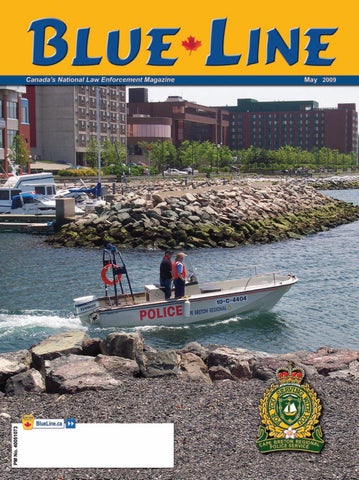
Cover: Cape Breton Regional Police Service (CBRPS) officers patrolling the waters of Sydney Harbour. Left: CBRPS Chief Myles Burke with youth officer constables Darren MacDonald and Kalolin Francis at headquarters. For more on Cape Breton Regional Police Service see page 6.
Features 6 Looking forward, reaching new heights
19 RNC Constable was struck down in his prime
10 Taking on crime one challenge at a time
22 Trouble in border country
14 OPP – 100 years
26 Shift work and cancer
24
Labour unrest defines an era
Blackhawk SERPA holster system Getting a daily dose of “dark” can improve your health
Departments
Case Law
38 38 16, 30 28 25 20 37 37 26 21 36 5
32 34 35
Back of Book BlueLinks Advertisers Directory Blue Line Journal Deep Blue Dispatches Forensic Science Letters Market Place News Week Odditorials Product Profile Publisher’s Commentary
Blue Blue Line Line Magazine Magazine
33
Higher crime area doesn’t justify detention Detention powers are not mutually exclusive Multiple reasons do not make stop arbitrary
May May 2009 2009
May 2009
4
Blue Line Magazine
Publisher ’s Commentary by Morley Lymburner
Ordinary people doing extraordinary things Simple rules to a successful police/citizen encounter: 1. Never get mad. 2. Keep your hands to yourself. 3. Always intend to get and keep control. 4. Don’t scare me. This advice, given to me by a well seasoned police detective, has saved me through many situations in both my life and career as a cop. It all came back when I saw those four officers from Vancouver approach Robert Dziekanski at the airport. They all passed the test and, thanks to that detective’s advice, I had no difficulty understanding why. The first thing I saw in that video were four officers walking, not running, toward their suspect. They were sizing up the scene and understood that what they see at that moment may not be what will greet them. There had been numerous calls of a large violent man out of control, who may harm himself or others, and that was verified by the broken furniture strewn about. The second point I noted was the officers attempting to speak to their suspect. His hands were down and the officer’s hands were at the ready – as they should be. The suspect did not stop moving about and began looking around furtively. It was clear that, by picking up the stapler, his intent wasn’t to staple papers. His action was a red-flag indicator that the stapler is not the only device he would use if he could get access to it. Some pre-emptive action was necessary to at least get the potential weapon out of his hands. The fact he was or wasn’t waving it around was irrelevant. My third point – I saw no officer raise his hand and strike the suspect with a blunt instrument or even their hands. They clearly wanted a quick resolution to the problem and only to get a violent man under control, not to do him further harm or torture him.
Blue Line Magazine
Finally, and most importantly, I saw no officer display anger. My old mentor’s voice rang in my ears. You never, ever, hit someone in anger. Keeping control of fear is the first rule and the second is controlling anger. These officers did so admirably. Police officers have a lot of responsibility to protect the public but are just ordinary people expected to do extraordinary things. Not only are they extraordinary, but they can never count on anyone else succeeding if they fail. The rule of thumb is simple. An approaching citizen can do anything in front of you, but they can’t scare you. If you become scared, you are authorized to do some extraordinary things to prevent this person from continuing to do so – and the longer you are a police officer, the more it takes to scare you. That’s called experience. Now we come to the “B” word. Brutality! How quickly the Polish people forget. Even when they see with their own eyes the reality of Canadian policing in action on that airport video, they forget their past. Their leap to judge the Canadian officers should be an embarrassment to their proud heritage and the courage of their ancestors who understood what brutality really is. They should understand from whence they have courageously come and once again better appreciate the lives they live today. I wince a little when I hear the Polish media interviewing people on the streets of Warsaw who use the word ‘brutality’ when describing the Vancouver video. The Nazis showed them what brutality is, and the Russians, who were supposedly their saviours, showed them police brutality. Poland lived under a tyranny and brutality for more than 40 years that the average Canadian can not even imagine, yet its people call what they saw at the airport “brutality.” What they did see was a very large man, scared, out of control, violent and unable to
5
communicate either by language or mental incapacity. Other people had attempted to intercede to help him but with no success. Airport security personnel arrived, realized it was beyond their capability to do what needed to be done and called the police. There is no level of appeal beyond them... and each officer knew that. If they can do nothing to help this person and stop his rampage, who can? In 1994, Poland marked the 50th anniversary of the Warsaw Uprising, intended to rid the country of the tyranny of the Nazi regime. In that uprising the Soviet Union stood by and watched 200,000 brave Poles lose their lives, knowing full well that their own takeover afterward would be made much easier. It was to be a bitter remembrance but the then President, Lech Walesa, invited representatives from both Russia and Germany to be guests at the remembrance ceremonies. When asked why he was inviting these former adversaries, he quietly pointed out that “We cannot live just by vengeance and hatred.” Those four officers approached Mr. Dziekanski with no intent to do him harm. They may have approached him with a lot of confusion about the tool they used. Their judgment under stress could be challenged. Their training and the follow up investigations can (and were) brought under scrutiny, but their main intent can not be misunderstood. They were present to simply protect the public and Mr. Dziekanski from further harm. My challenge to the lawyers and media at that inquiry (and in Poland) is to prove otherwise. The evidence of brutality simply is not there.
May 2009
Looking forward reaching new heights
by Crystal Aboud-Mahar and Jane Connell Although only a small Island, Cape Breton’s beauty, hospitality and culture has made it one of the top vacation destinations worldwide. In the centre of this tourism masterpiece is the Cape Breton Regional Police Service (CBRPS), with more than 200 officers serving and protecting the regional municipality’s more than 105,000 people and 2,400 square kilometres. Its record of success also deserves accolades. Under the leadership of newly appointed chief Myles Burke, M.o.M., the CBRPS is one of Canada’s most progressive police services, priding itself on a community-based policing philosophy which it instills in all officers. “It is an honour and privilege to be the chief of the CBRPS and work with the great team of officers and the community to reach our goals,” says Burke, who serves on the CACP National Drug Committee and is the Nova May 2009
Scotia national board member. The service is working to “balance enforcement and prevention in all that we do, serving with the community for the community,” he notes. “Our police service has seen great success and, with building momentum, we are looking forward with the goal of continuing to improve and reach new heights.” Formed in 1995, the service is relatively small in comparison to other major cities but has faced its fair share of challenges. Police are one of the central pillars of the community on the island and the service has used that strong community support to successfully expand and enhance its services. Membertou First Nation The CBRPS was chosen to police the Membertou First Nation, located within the Cape Breton Regional Municipality (CBRM), in 2007. The Membertou insisted on a collaborative, interactive policing approach, focusing on the needs of the community. The CBRPS responded and implemented this philosophy, which is vital to the success that has been 6
achieved in just two short years. A desire to learn the best way for officers to do their jobs is crucial, according to Sgt. Barry Gordon, who leads the Membertou division. Building trust with the community by learning about the Mi’kmaq culture and getting to know the people officers work with is also very important, he says. “The people of Membertou demanded good service, quick response times and most of all a presence in the community,” says Gordon. “We are committed to doing a great job in Membertou. In fact, we have officers learning the Mi’kmaq language and culture from community elders and volunteering in the community to get to know as many people as we can.... “We have some of the fastest response times in the country because an officer is always on duty in the community. What this does is builds the trust that is so vital to our success. If the police are strangers, people won’t help.” The CBRPS and Membertou are working on a healing video that focuses on Indian ResiBlue Line Magazine
proach, focusing on one community at a time. Bylaw officers have issued property clean up orders, drug houses have been shut down and a community office was opened to benefit organizations and youth in the first community – all indicators of accomplishment. The association is now moving on to a second area. “Partnerships with the community are a key to the success,” says Sgt. Tom Ripley, executive director of the association.
Above: CBRPS officers that are CBU alumni or current students: (L-R) Chief Myles Burke, Cst. Geoff MacLeod, Sgt. Robert Walsh, Cst. Bill Turner and father and son Sgt. Doug Lawrence and Cst. Ryan Lawrence. Opposite: CBRPS ERT officers at the scene of a dive along the shores of Cape Breton.
dential Schools. It takes stories from students who were abused and shows children that, with healing and forgiveness, they can lead a healthy life. The community has seen an increase in youth programs, a sense of ownership among citizens and a dedication to continuing partnerships. “The support we have received from the community has been fantastic,” notes Gordon. “Through partnerships we now have Neighbourhood Watch and Block Parent programs and a Police Boys and Girls Club, and we’re excited for what else is to come.” Parents and youth gave the CBRPS top marks for its work at a recent community forum. Enforcement and intelligence The CBRPS drug team has been very successful at combating drug trafficking over the past 15 months. It has seized more than $5.3 million (estimated street value) of drugs during this period, the most in the service’s history. Insp. Tom Hastie credits intelligence gathering techniques, technology which allows better communication between police units and supportive government policies as critical factors in this outcome. Time invested developing informants and wireless access to CPIC via the Onpatrol Blackberry is also proving helpful. Officers conducting surveillance on drug investigations can use intelligence information gathering in real time. Another benefit is additional funding to hire more police officers through the Nova Scotia Crime Prevention and Reduction Strategy. The Safer Communities and Neighbourhoods Act is also making a great impact. It gives police the authority needed to deal with drug issues by targeting and shutting down residential and commercial buildings and land regularly used for illegal activity, including drug production, Blue Line Magazine
sales or use. Increased media attention to high profile drug seizures and arrests have increased calls to Crime Stoppers, adds Hastie. “Changing a culture, the public sees police success and they want to help. They see that the police are having an impact and are therefore empowered to do more.” Port security The CBRPS established a Ports Security Intelligence Section in April which is responsible for community based policing and offering security, intelligence, policing initiatives and safety measures to all CBRM transportation infrastructure and marine ports, in conjunction with regular routine patrol. The primary role is gathering intelligence and networking with other police units and security agencies, including customs, immigration, port authorities, harbour masters and the RCMP. “Illegal drug activity can originate from outside the CBRM so drugs are moved into the area using one mode of transportation or another,” says Hastie. Major ports have improved their security since 9-11 to address terrorist concerns, making them unavailable to the drug trade. That has made smaller ports, such as those on Cape Breton, more appealing to traffickers. A community approach to safety Leaders from more than 30 sectors and agencies met in 2007 to form the Association for Safer Cape Breton Communities, a coalition to address community safety and crime prevention. Their goal is to develop and implement a comprehensive community safety strategy for the region through effectively deploying human, financial and knowledge resources to realize the vision of a safe and crime-free community. The association uses a multi-faceted ap7
Partnering in education Education and training are of the utmost importance to the future of the CBRPS. Recognizing the challenges facing police officers today, the service signed a formal memorandum of understanding with Cape Breton University (CBU). The goal is to provide opportunities for advanced academic standing and increase professionalism, ensuring officers are better equipped for the leadership challenges that lie ahead. More than 20 CBRPS members are already CBU alumni. CBU also shares an agreement with the Atlantic Police Academy (APA), which allows officers to receive academic credit in the Bachelor of Arts Community Studies (BACS) degree program. “The dynamic partnership between the Atlantic Police Academy and CBU continues to provide a very powerful learning experience for our current and past graduates,” says APA Executive Director Edgar MacLeod. “The foundation of this partnership is our success at bridging academic knowledge with the skills based police training received while at the academy. As a result, this is an important combination for the communities served by our graduates.” Burke took full advantage of this agreement, graduating from CBU in 2003 with a BACS degree. While it was challenging to juggle pursuing a university degree and the demands of police work, the experience helped his career. “Without a doubt the courses have been extremely beneficial for me in my day-to-day operations and it is for this reason I have encouraged other police officers from around the country to look at CBU as the place to secure training.” In addition to his CBU education, Burke is also a graduate of the FBI National Academy and the FBI LEEDS Program. The agreement with CBU also focuses on officer applicants. Students interested in policing often volunteer with the CBRPS. A police preparatory course was developed to enhance the BACS degree by preparing students for entry into a police training program. Officers are instructors in this course, which covers a multitude of policing topics. “The policing field requires many skills such as communication, critical thinking and problem solving, which are all components of the BACS program,” says CBRPS Cst. and BACS graduate Raymond Aikens. Burke concurs. “Being a CBU grad and working with the institution for the past number of years, I know that what is being learned in the classroom can May 2009
Chief Myles Burke with firearms and drugs retrieved from a CBRPS seizure. translate directly to the field.” The agreement is an important tool in promoting policing as a viable career option and to recruit CBRPS officers to satisfy the increasing demand. Both institutions agree that they have a responsibility to work together to better the community. Key role for mental health officer Those living with mental illness are often misunderstood as people do not always recognize the signs and symptoms associated with
May 2009
their illness. This results in multiple complaints to police about people with untreated or inadequately treated mental illness, and they are likely to become involved (or more frequently involved) with the criminal justice system. The CBRPS has worked with the district health authority to address this issue by having a full-time officer work in collaboration with health officials and the community to develop a more co-ordinated response to mental illness. The goal is to decrease criminalization and engage individuals to seek the help and resources available to help them live manageable lives. “The goal of
8
this partnership is to educate those with mental illness, the community and other stakeholders,” says Delton MacDonald, mental health liaison officer. “Most importantly, my role is to educate and share the information and training I receive to all CBRPS officers. “With a collaborative approach to building awareness and spreading the word about the services available to help those with mental illness, it will create a network of knowledge, providing resources, advocacy and community outreach services to enhance the services we provide.” Partnering with the police “is something we have been working toward for a long time,” says Brian Oram, district health authority manager of emergency and acute outpatient mental health services. “This collaboration is beneficial in educating all parties involved on how to deal with persons suffering from mental illness. “We are extremely pleased with the work of Cst. MacDonald and the CBRPS and are already seeing the benefits of the partnership.” With today’s tightening budgets, it can be difficult to see the good happening right before our eyes and, as with any other police service, challenge is inevitable. Taking note of the good work being done can help make the case for increasing resources and expanding into new territory. The CBRPS is not resting on its laurels and looks forward to the challenges and opportunities the future holds, including meeting with colleagues across the country to establish best practices that can be put to use in every community. “To be progressive and proactive, partnerships are necessary and keep the CBRPS at the top of our game,” says Burke. “By showing leadership to our citizens and continuing to work together, we are proving that challenge will not make us back down, rather make us fight harder.” Crystal Aboud-Mahar has public relations, business and community studies degrees and works in the development department at CBU. Dr. Jane Connell holds a PhD and is a professor in the community studies department at CBU. Both are strong community supporters of the CBRPS. You can reach Crystal at 902 563-1232 or crystal_aboudmahar@cbu.ca. Jane can be reached at 902 563-1222 or jane_connell@cbu.ca.
Blue Line Magazine
Blue Line Magazine
9
May 2009
Taking one onchallenge crime at a time by Jocelyne Mui A gun, a few knives and some gang paraphernalia are clearly laid out on display at the front of an Edmonton college classroom. A group of about 20 young students stare in amazement at the various weapons, which are real. “These weapons were confiscated from actual gang unit drug busts,” warns Cst. Clarke Clarke of the Edmonton Police Service (EPS) Gang Unit. “Please do not touch them.” The students of the Correctional Services Program ‘Cultural Influences’ comply without protest, retreating to their seats and staring from a distance, peeking over each other’s heads to sneak a few more glimpses. Eventually, they shift their attention to the man sitting in front of them. “I’m here to talk to you today about gangs, gang-related crime and drug trafficking. There are four myths about gangs: protection, belonging, wealth and respect.... Gangs are a huge, serious problem, but still exist because of these myths.” May 2009
Fighting for justice has been Clarke’s passion since first joining the police force in 1998. He was determined to work his way up in the ranks and has seen more than his fair share of criminal activity. “The greatest reward is seeing that victims of crime receive justice,” he stresses. “Part of that reward is seeing that criminals are put behind bars.” Clarke’s desire to work in law enforcement did not waiver after becoming a quadriplegic at the C5/6 level in a 2001 diving accident. If anything, it made him more determined and creative in finding ways to fight crime. Although the injury had a major impact on his life plans, he never lost control of his life. His hope and desire to stick with the EPS was undiminished. Today, Clarke has more direction than ever and is doing unprecedented things for his force that he never thought he’d be able to do. Being one of the few quadriplegic police officers in North America has pushed him to take his work even more seriously. Clarke’s work hasn’t always been gang 10
related. He was working on the break and enter team at the time of his accident and gradually returned to work over two years ago, eventually realizing his goal of resuming his career full time. “I knew I always wanted to return to work, it was just a matter of when I was healthy enough to do it.” Fighting his way back was no easy task and began with regaining his health, which proved to be harder than anticipated. Clarke achieved it through plenty of exercise, particularly adapted physical activity, rather than rehabilitation per se. He became a regular at the University of Alberta’s Steadward Centre, and still is today. He is currently pursuing the opportunity to become a part of FES (Functional Electrical Stimulation) assisted rowing. “I strongly believe that one day with the hope of research, I will be up walking and again have a more hands-on approach directly arresting criminals and putting them behind bars.” Outside of regaining his physical fitness, Clarke worked on establishing a stable life at Blue Line Magazine
home. He and common-law wife Sandy are proud parents to her sons Tanner, 11, and Tyler, 14. “Returning would not have been successful without a stable and reliable environment at home. My family has been invaluable to my return to work; I couldn’t have done it without them.” His fellow officers also greatly aided him in his return to the EPS. “My brothers from the police service offered me their undying support. People I had worked with and even people I had never met before helped me realize that I still had a place with the Edmonton Police Service. They were willing to accept me no matter what, found a place for me and stood by me.” Today, Clarke’s presence is stronger than ever. With the help of voice activated software, a modified workspace and various other computer supports, Clarke is at the front and centre of the EPS Gang Unit, gathering intelligence and compiling gang-related information for the rest of the force. His investigations range from assault to homicide, and he works with all three unit squads and liaises with officers from the EPS and RCMP. His job is to make sure officers in the field have access to gang-related information when needed – and they often require it immediately – with the goal of disrupting gang activity, both within Edmonton and in surrounding areas. Not surprisingly, Clarke’s days are never dull, or short, since gang-related violence and drug trafficking is always high security and never at a standstill. Clarke’s work also expands beyond the walls of the police station, taking him to places like
Blue Line Magazine
Grant MacEwan College. One of his most influential roles as an officer today is as a community liaison. He regularly lectures to different community groups, students and other police agencies about gang activities and drug trafficking. Despite not having any previous public speaking experience, his passion and commitment to the job has made public speaking seem incredibly natural and easier than he expected. He certainly didn’t have any trouble getting the attention of the young MacEwan students, who hung on his every word. Off the job, Clarke is a strong advocate for people with disabilities. He has honed his public speaking skills by speaking about working with
11
a disability to patients and other groups. Clarke is a living example that having a disability does not stop life and that it’s still possible to do everything you want to do. “Don’t let your disability get you down. Don’t let it limit your capabilities. People should see that even with a disability, everyone can do what they want.” One of Clarke’s biggest concerns is that people with disabilities don’t recognize what they are actually capable of doing. He encourages people to look into support programs such as Alberta’s Disability Related Employment Supports (DRES) to learn more about available opportunities. Clarke’s future aspirations and long term plans are not unlike any other EPS constable: to get promoted to sergeant or detective and live a long, happy, successful life. “I want to always be productive and continue to contribute to society. I don’t want to let anyone down.” Clarke’s tremendous impact on the community is a testament to his resolve to never stop contributing, his undying committment and continued presence on the force. It’s clear that he will never let any of his fellow officers or citizens of Edmonton down. Jocelyne Mui is a freelance writer. This article, which was originally published in the Canadian Paraplegic Association magazine, has been adapted and edited for Blue Line. Cst. Bryce Clarke may be reached at Bryce.Clarke@ edmontonpolice.ca or 780 421-2046.
May 2009
Modified work does not mean modified attitude Steve Jones grew up in a small northern Ontario town, associating with many local OPP officers and their children, and wanted to be a police officer from a young age. Instead he ended up working for Ontario Hydro right out of high school but was laid off four years later when the economy worsened. The following Monday he began a new career as a correctional officer but realized at age 28 that he still wanted to be a police officer. With much encouragement from local officers, he applied to the OPP and was accepted. Working as a Det/Cst in the Cochrane Crime Unit, he was returning home from a meeting in Toronto July 21, 2005 when, just 20 minutes from home, he struck a large moose. The roof of his car collapsed, breaking his neck at the C4/C5 level and leaving him a quadriplegic. He was paralyzed from the chest down, with limited use in both arms. Jones spent nine months in hospitals and rehab before returning home to northern Ontario. Jones spoke to new recruits at the OPP Academy in 2006, telling them about his career, struggle to survive and the connection to the experience and training he received at the academy. He has spoken to each new recruit class since, unless weather prevents him from making the trip. Jones returned to work in May, 2008 on modified duty, working Tuesday and Thursday afternoons. He now works out of the South Porcupine Detachment Crime Unit, using a voice recognition computer. The OPP has done extensive modifications to the detachment so that he can use a swipe card to access several areas of the building, and making it handicapped-accessible. Jones cannot say enough about the support from the OPP and his fellow officers. His duties have included completing DNA warrants, approving occurrences and
May 2009
reports and assisting with other database information duties. The best part of returning to work is associating with the tight-knit policing family and people that you worked with previously, he notes. Jones, his wife and two daughters live only a few blocks from the detachment so he can actually drive his power wheelchair to work and back home when weather permits. He has a new accessible home, complete with home automation systems allowing him to use TVs, lights and doors manually or with voice commands. Though Jone’s abilities are now limited, he still plans on making a difference by being a positive influence at the OPP Academy and doing what he can to assist his fellow officers at detachment.
12
Catching bad guys and making a difference
Crime Analyst Ann Stevens and Cst. Cy Villa - Brantford Police Service For as long as Cyrus Villa can remember, he wanted to be a police officer. Cy envisioned fighting crime – catching “bad guys” – but essentially, he wanted to make a difference. That’s what Constable Villa was doing on July 24, 2003, shortly after 1:00 a.m. On his last shift before vacation, Cy – a three-year veteran of the Brantford Police Service – was pursuing a suspect on foot near the Grand River when he fell approximately eight feet from an embankment onto a concrete slab, injuring his spinal cord. Cy is a quadriplegic, paralyzed from the chest down, with movement in both arms, right wrist, with limited movement in his left. Returning to duty was Cy’s goal from the outset. After months of physiotherapy he resumed his career on February 7, 2005, on modified duty. It was important to Cy to know that if he couldn’t make it to work, someone else wouldn’t have to “pick up the slack”. This is where a warrant database, developed by Ann Stevens, the Service’s Crime Analyst, came into play. Cy maintains the database, adding new and updating old warrants. Once a week he distributes a current list - along with mug shots - to patrol officers. Cy said circulating the list gives officers “first crack” at executing warrants. Ann Stevens confirms that the results of this team effort have been tremendous. Cy reports for duty Monday and Wednesday afternoons, in a manual wheelchair, which he is determined to keep. He drives in from the Village of Mt. Pleasant where he lives with his wife, Candace, and their nine-year old daughter, Malory. The Villas moved into their home, built by the community, in 2004. Described as a typical family, the Villas have a dog, enjoy backyard barbecues with neighbours and make good use of a pool installed last year. Cy is a hands-on dad who takes Malory to her dance lessons and attends events at her school. Since Malory attends french immersion, Cy confesses his inability to help with homework. The Villas are actively involved in the local hospice and Cy is the ambassador for the annual “Hike for the Hospice” charity event. Candice, an esthetician, volunteers her time giving manicures and pedicures to hospice patients. Though his method of fighting crime has changed from when Cy first put on his uniform, he still has a hand in catching “bad guys” – he makes a difference.
Blue Line Magazine
Serial killers may have long-haul trucker connections
WASHINGTON – The FBI suspects that serial killers working as long-haul truckers are responsible for the slayings of hundreds of prostitutes, hitchhikers and stranded motorists whose bodies have been dumped near highways over the last three decades. Federal authorities first made the connection about five years ago while helping police link a trucker to a string of unsolved killings along Interstate 40 in Oklahoma and several other states. After that, the FBI launched the Highway Serial Killings Initiative to track suspicious slayings and suspect truckers. A computer database maintained by the FBI has grown to include information on more than 500 female crime victims, most of whom were killed and their bodies discarded at truck stops, motels and other locations along popular trucking routes crisscrossing the U.S. The database also has information on scores of truckers who’ve been charged with killings or rapes committed near highways or who are suspects in such crimes, officials said. Authorities said they do not have statistics on whether driving trucks ranks high on the list of occupations of known serial killers. But the pattern in roadside body dumps and other evidence has prompted many investigators to speculate that the mobility, lack of supervision and access to potential victims that come with the job make it a good cover for someone inclined to kill. “You’ve got a mobile crime scene,” one investigator said. “You can pick a girl up on the East Coast, kill her two states away and then dump her three states after that.” Although some local police agencies have been briefed on the program, the FBI had not publicized its existence outside law enforcement until earlier this year, when officials agreed to show The Times the inner workings of the operation and share details of some of their cases. Housed in a non descript brick building on the outskirts of Washington, D.C., FBI analysts pore over reports and computer entries looking for patterns in slayings from California to Connecticut. Since the program began, more than two dozen killings have been solved, authorities said. Michael Harrigan, who oversees the Highway Serial Killings Initiative, said the Blue Line Magazine
program helps local police “connect the dots” to slayings outside their jurisdictions. He said most of the victims led high-risk lifestyles that left them particularly vulnerable. The program’s success depends largely on local police departments’ voluntarily providing data on seemingly random killings, sexual assaults and other violent crimes to the FBI, where it is stored in a massive computer database. FBI analysts can query the computer to spot patterns that might otherwise go unnoticed. Hanging in a cubicle in the FBI office near Quantico, Va., is a map of the United States. It’s covered in red dots representing some of the 500-plus cases in the Highway Serial Killings Initiative database. For all the crimes they represent, FBI supervisory agent John Molnar said he thinks the number of such offenses has been “grossly underreported.”
13
Molnar said he hopes that will change in the wake of a decision last year to make the database available to law enforcement officials online, allowing police with a password to submit case information and make their own queries. Though many of the dots on the map now appear connected to one another by similarities – such as the killers’ modes of operation – the vast majority are not connected to any known suspect. They are potential serial slayings waiting to be solved, the FBI says. (LA Times)
This article was excerpted from Blue Line News Week. This weekly executive reading service is available for email delivery every Thursday. To subscribe to this service go to www.BlueLine.ca or phone 905 640-3048.
May 2009
Labourdefines unrest an era by PC (ret) R.D. (Bob) Cooke When constabulary duty’s to be done, to be done, a policeman’s lot is not a happy one, happy one – from Gilbert & Sullivan’s Pirates of Penzance. Most cops don’t like strike duty. Over its 100 years of existence, the Ontario Provincial Police has been called upon time and time again to keep order and enforce the law. After all, that’s the basic foundation of the oath taken by every police officer. While the job of policing comes with its own rewards, such as the satisfaction of taking a drug dealer off the streets or rescuing a child from a swollen creek, there is little fulfillment in facing an angry crowd of strikers who see you as the enemy. Police often feel caught in the middle. Ontario was still in the grip of the Great Depression in 1935. Jobs were few, and Crowland Township, just outside of Welland, was no exception. Against a multi-faceted backdrop of unfairness, prejudice and draconian decisions by local politicians, Crowland found itself faced with a strike by relief workers whose only way of providing for their families was through welfare, aka “relief.” For that, they did work for the township. When council instituted a new program requiring all welfare recipients to work longer hours for the same amount of relief, unemployed workers rebelled and, in April, laid down their tools. Violence flared and on one occasion local police, who had locked themselves inside the municipal building, used clubs to beat back intruders trying to enter and lobbed tear gas bombs into the crowd from atop the roof. The strike continued for about six weeks, during which (then) Premier Mitchell Hepburn became personally involved, dispatching OPP officers and, later, meeting with strike leaders. When some of the unemployed workers expressed a desire to return to work, the Ontario government took over local policing and sent an additional 20 OPP officers into Crowland to augMay 2009
ment the 15 already there, with orders to protect returning workers. A letter to the local newspaper castigated police. “The police have caused the only disorder during the strike and their persistent efforts to break up the strikers and their families has been futile.” In an editorial, the newspaper praised OPP officers, writing that, “These men, trained to the stern business of law enforcement, won the goodwill and confidence of the people.” Once again, police were in the middle. The strike ended in mid-May and, after two weeks of deployed duty, the OPP contingent was withdrawn. Three years later, on Oct. 25, 1938, a sixweek strike in Port Colborne at the Humberstone Shoe Company resulted in some 100 non-striking workers, accompanied by OPP officers, battling their way into the factory held by strikers. The strike was finally broken when employees entered the building through a back door without police assistance. The OPP was dispatched again to labour unrest, this time in May 1946, to protect employees crossing a picket line of striking seamen. The passenger ship Noronic, anchored in the Welland canal at Thorold, was pelted with stones and sticks before attempting to continue its voyage with a non-union crew, who also received a pelting. Old photos show officers running full tilt toward the vessel and scuffling with striking sailors. Once again it was Inspector C.F. Airey of Niagara Falls District Headquarters who led the OPP deployment. He had been in charge of the OPP presence at Crowland 11 years prior. Alas, the ship never completed its cruise as strikers blocked her way with the freighter Goderich. As a side note, the Noronic was destroyed by fire while tied up in Toronto harbour on the evening of Sept. 16, 1949, with the loss of 118 to 139 lives. The exact number was never determined. Labour unrest continued to challenge the force through the years. 14
During the 1979 Boise-Cascade strike by tree harvesters in Ontario’s northwest, officers were sent in rotation to Kenora and Fort Frances to protect non-striking paper mill employees, by now a familiar OPP role. For the most part, this was a relatively non-violent event, albeit a long one. Initially, officers had to be males of at least six feet, a requirement that was changed when a 5-foot, 11-inch officer complained. The gender requisite remained the same, as local hotel rooms were shared. One night, a bored constable from southwestern Ontario, sent to Fort Frances for 30 continuous days of 12-hour shifts close to Christmas, penned this ditty, sung to the tune of “Christmas in Killarney.” Oh, the dogs are here and the TRU team’s here. And they’ve even guys dressed in riot gear. It’s Christmas in Fort Frances. And none of the cops are home. Oh, the lumber jacks got angry and they started in to fight. The OPP reacted and they sent in all their might. They had to be six-footers so they’d be an awesome sight. And they tucked them all in the Voyager Inn each night… Oh, the dogs are here and the TRU team’s here. And they’ve even dressed guys in riot gear. It’s Christmas in Fort Frances. And none of the cops are home. It’s Christmas in Fort Frances. And none of the cops are home.
Sometimes a policeman’s lot can be at least a little inspiring, if not a little bit happy. Photos – Left: Welland Canal strike duty officers, number Two District. Right: The arrival of 185 provincial police officers for strike duty at Kirkland Lake, November 24, 1941. Photos Courtesy Ontario Provincial Police Museum In recognition of the OPP’s 100th anniversary, Blue Line Magazine has been presenting a series of articles as both a testament to its past and encouragement to other police agencies as they move into the future.
Blue Line Magazine
News Clips TORONTO - Saskatoon is the most dangerous city in Canada and Caledon, Ont., is the safest, according to the latest survey by Maclean’s magazine. This is the second year the magazine has put out the lists and the second year in a row Caledon, northwest of Toronto, has topped the safest areas list. Saskatoon is followed on the most dangerous list by Winnipeg, Regina, Prince George, B.C., and Edmonton. Caledon is followed by Oromocto, N.B., Levis, Que., Maskoutains MRC, Que., which includes Saint-Hyacinthe, and Halton Region west of Toronto. As for Canada’s two largest cities, Toronto ranked 29th out of 100 cities, compared to 26th last year, and Montreal ranked 24th compared to 19th on the high crime list. Maclean’s says it based its rankings on 2007 per-capita crime rates, the most recent available from the Canadian Centre for Justice Statistics. ••• TORONTO - Ontario has passed legislation that will allow people to say sorry without fear of having it turned against them in court. Under the new rules, apologies can’t be used as an admission of fault or liability and won’t affect someone’s insurance coverage. The governing Liberals say fewer people apologize because they’re afraid it could come back to haunt them if they are sued. British Columbia, Saskatchewan and Manitoba have similar apology laws, and 35 U.S. states have some form of apology legislation. The Ontario government says the bill will help speed up healing and reconciliation by allowing people to acknowledge when they’ve harmed someone. ••• WINNIPEG - It hasn’t happened in a long time – the so-called car-theft capital of Canada has had its first theft-free day. Manitoba Public Insurance says no vehi-
Blue Line Magazine
cles were reported stolen in Winnipeg for 24 hours on March 3. Insurance CEO Marilyn McLaren says that’s the first time in decades that has happened. She says it’s a sign that Manitoba’s war on auto theft is working. The government says car thefts were cut in half in 2008 and most of the cars in Winnipeg will have immobilizers this year. Last year was the 11th year in a row that Winnipeg earned the dubious distinction as the country’s car-theft capital. ••• THUNDER BAY, Ont. - Canada’s first secure custody facility for Aboriginal youth was officially opened Monday in Northwestern Ontario. The $13.2-million Ge-Da-Gi-Binez Youth Centre in Fort Frances, near the Manitoba border, will help Aboriginal youth in conflict with the law through culturally appropriate programs and services. “Aboriginal youth in conflict with the law will no longer share a facility with adult offenders,’’ said Children and Youth Services Minister Deb Mathews, who was prevented from joining the centre’s opening due to freezing rain conditions. “Aboriginal young people face unique challenges,’’ she said. While they’re taking responsibility for their actions, Mathews said, they’ll now have access to culturally appropriate youth programming that will significantly reduce their risk of reoffending. Operated by Pwi-Di-Goo-Zing Ne-YaaZhing Advisory Services, the new facility serves up to 12 Aboriginal youth, aged 12 to 17, who require secure custody and detention in the region. The new facility offers traditional teachings, Aboriginal history, cultural ceremonies, as well as education, anger management and life skills programs. It also has a ceremonial space so young people can practice Aboriginal traditions.
15
Ontario is moving youth out of units in adult correctional facilities and into separate youth custody facilities to provide young people with more effective programs and more opportunity for rehabilitation. The province has opened a new youth centre in Sault Ste. Marie, a newly-expanded facility in Ottawa and is completing construction on new youth centres in Thunder Bay and Brampton. (Thunder Bay Chronicle-Journal)
••• SHEDIAC, N.B. - Shediac will be the location of a new jail to serve southeastern New Brunswick. The $40-million correctional centre will include three units with 30 cells each. Tenders for site preprepation and construction will go out this fall and the jail is expected to be completed within two years. It will replace the Moncton Detention Centre. (CJMO)
••• VANCOUVER - British Columbia says it will spend $1.8 million to put video systems in 320 more police cars, tripling the number of cars outfitted with the equipment. Solicitor General John Van Dongen says the cameras will provide irrefutable evidence about incidents such as drunk driving, saving police paperwork and court time, and leading to more guilty pleas and convictions. The province earlier announced new cameras in bait cars capable of giving dispatchers live images of people stealing cars and new red light cameras at 140 B.C. intersections with high crash rates. And Vancouver city officials have said they’re hoping to use provincial funding to increase camera surveillance in the city during the 2010 Winter Olympics. These articles are excerpts from Blue Line News Week. This weekly executive reading service is available for email delivery every Thursday. To subscribe to this service go to www.BlueLine.ca or phone 905 640-3048.
May 2009
Blue Line Journal
The Taser, excited delirium and media reports A balanced perspective by Mike Massine Much debate continues to swirl in the media around the use of conducted energy weapons (CEW), specifically Taser technology, by law enforcement. There have been quotes and misquotes, opinions (some credible, many not) and a lot of talk about police limitations in classifying subject behaviour prior to use of force – specifically Excited Delirium Syndrome (EDS) or acutely agitated individuals. The media has been supplied with many facts about CEWs and EDS which, for the sake of sensationalized coverage, have gone largely unreported. Municipal police officers in British Columbia are guided by the national use of force framework, which details five escalating levels of subject behaviour: 1. Co-operative; 2. Passive resistance; 3. Active resistance; 4. Assaultive; 5. Grievous bodily harm or death. CEWs are classified as intermediate weapons in accordance with the principles of the national use of force framework, to be used when subjects display a minimum level of active resistance behaviour. This is, admittedly, a low level of force that can be classified as defensive physical attempts by the subject to hinder police from controlling and ultimately arresting them. However, one must keep in mind that often when active resistance is not controlled, behaviour can escalate and sometimes injuries and/or death to subjects, officers and the public occur as a result of their escalating actions. Every interaction with an actively resistant subject has a definite potential for violence and officers who use force are held to a high level of accountability. All force-related incidents require thorough documentation of behaviour displayed by the subject and careful articulation and justification of the officer’s use of force. Officers who fail to articulate the use of any level of force are subject to internal discipline, civil lawsuits and/or criminal charges. Many media reports and even testimony by some politicians have given the public the impression that the Taser was added to the police arsenal as an alternative to lethal force, specifically firearms. I have been involved with police Tasers since they were first used in Canada in 1998 and have never seen any documentation stating that they were intended to replace firearms. In force-related incidents involving armed subjects, the Taser should be used as a force option only if lethal force is present, never as a stand alone option, period! In force-related incidents involving unMay 2009
armed subjects, the Taser should be used as a force option in concert with other suitable force options, including presence and dialogue. Much debate focuses on the terms associated with EDS, acute agitation and cocaine psychosis. All describe one thing: a person in need of quick control, restraint and most importantly, medical treatment. Critics argue that police officers are not medical doctors and should not make a medical diagnosis based on subject behaviour. I agree that we are not qualified to make a diagnosis, but we are not doing so; rather we are searching for a cluster of observable symptoms that will help the attending officers decide a proper course of action: keeping the best interests of all parties in mind. The Merriam-Webster online dictionary defines symptom as: 1 a: subjective evidence of disease or physical disturbance; broadly: something that indicates the presence of bodily disorder; b: an evident reaction by a plant to a pathogen. 2 a: something that indicates the existence of something else symptoms of an inner turmoil; b: a slight indication.1 Surely one does not need to be a doctor to apply the definition of symptom when assessing subject behaviour of an acutely agitated individual. When dealing with subjects suspected of being in a state of EDS, members should look for a cluster of symptoms, including: • Clothing removal; • Hot to touch / profuse sweating; • Hot to touch / no sweat (bone dry); • Lid lift; • Uncontrolled shaking; • Self inflicted injuries; • Extreme aggression towards objects, glass, mirrors; • Vigorous resistance; • Flight behaviour (typical); • Unintelligible speech / animal sounds; • Irrational physical behaviour; • Undistracted by any type of pain. 16
If attending officers recognize a cluster of symptoms, their thoughts should transition to the subject experiencing medical distress. They should alter their approach accordingly by calling for paramedics (preferably advanced life support) and stand by while the subject is apprehended, physically and mechanically restrained and turned over to medical personnel to take them to the hospital. As stated earlier, much of the debate on this subject has been around the qualifications of police officers to make a “medical diagnosis” when it comes to the issue of EDS. Officers are not making a diagnosis, rather they are simply observing behaviours they recognize from their training and, keeping their number one priority in mind (preservation of life), treating the incident as a medical emergency, as they should. The media is quick to publish stories of subjects who die proximal to CEW use. Generally, however, they fail to publish the Blue Line Magazine
frequency of officer/offender contacts that are resolved without injury. Some perspective on arrest-related deaths can be found from statistics published by the US Bureau of Justice Statistics and the FBI for the years 2003 – 2005: • US law enforcement agencies report making over 41.6 million arrests (FBI). 2 • Of the total arrests, 2,002 subjects died while in police custody from various causes.3 • Of these deaths, 36 involved CEW use of some form.4 I researched 4,599 Taser usages for the 2004-05 BC Office of the Police Complaint Commissioner TASER study, cataloguing medical complications and deaths proximal to Taser use. There were 49 medical complications and four deaths reported (Figure 1). According to the BC Policing Jurisdiction Crime Trends Report, published by the police services division5, BC police investigated more than 1.5 million criminal allegations between 2003 and 2005. Actual arrest rates could not be found, however it is not unreasonable to assume that the arrest rates for this amount of criminal activity is at least double that of allegations. Between 1996 and 2005, assaults on BC police rose 35 per cent and illegal weapons possession were up 100 per cent (Figure 2).6 One final point of clarification lies with the issue of medical safety testing. A recent study conducted by the UK Defense Science and Technical Laboratory (DSTL) of the effect of CEWs on human and animal hearts suggests that these weapons are unlikely to harm a human heart. The safety ratios quoted in the study found a safety margin of 70:1 for the Advanced Taser M26 (older technology) and 240:1 for the Taser X26 (newer technology), which is significantly higher safety margins than for many over-the-counter headache medicines, some of which are as low as 15:1.7 More recently a three-year review of all Taser uses against criminal suspects at six US law enforcement agencies found only three significant injuries out of 1,201 criminal suspects subdued by CEWs. It was reported that 99.75 per cent of criminal suspects shocked by a Taser were not hurt or received only minor injuries such as scrapes and bruises. The study is published online in the Annals of Emergency Medicine.8 “These weapons appear to be very safe, especially when compared to other options police have for subduing violent or combative suspects,” said study author William P. Bozeman, MD, of Wake Forest University in Winston Salem, North Carolina. “That is not to say that injuries and deaths are impossible. Police and medical personnel need to be aware of the potential for serious injury and look for evidence that a person subdued by a Taser has been hurt.” The findings represent the first large, independent and multi-centre study of CEW injuries. Of the 1,201 criminal suspects, 492 suffered mild injuries, mostly superficial puncture wounds (83 per cent). Of the three subjects who sustained significant injuries, two suffered from head injuries related to falls – the third suffered rhabdomyolysis, or a rapid breakdown of muscle tissue. Ninety-four per cent of the suspects were male and alcohol or Blue Line Magazine
intoxication was documented in almost half of the cases (49.5 per cent). “While injuries from Taser are uncommon, they are not unheard of,” said Bozeman. “Subjects exposed to a CEW discharge should be assessed for injuries and appropriate medical evaluation should be provided when non-trivial injuries are apparent or suspected. Existing medical and/or psychiatric conditions in the suspect may cause or contribute to the behaviour that leads police to use Taser to subdue suspects. These underlying conditions may require medical assessment and treatment, independent of Taser exposure.” Chris Butler and Dr. Christine Hall of the Canadian Police Research Centre concluded a two-year study with the Calgary Police Service (CPS), examining 827,000 police-public interactions resulting in 562 use-of-force events during arrests of resistant subjects.9 The study examined five force options (empty hand control tactics, CEWs (Taser X26), OC Spray, batons and lateral vascular neck restraints) for their frequency of use and most importantly, injuries to subjects resulting from use. The CPS study ranked the safety rates (highest to lowest) to subjects associated with the five force options as follows: 1. OC Spray (80 per cent); 2. Lateral vascular neck restraints (53 per cent); 3. CEW (45 per cent); 4. Baton (39 per cent); 5. Empty hand control tactics (33 per cent). Hall recently published an editorial in a prominent medical journal where she aptly described what the police position on risk
17
management concerning CEWs should be. Despite the controversy surrounding Taser use in North America, the question surrounding Taser use should not be “Is it safe?” but rather, “Is it as safe as, or safer than, the alternatives?” 10 She adds: Gaining control of a violent or disoriented individual is a challenging scenario in which the unpredictable risk is affected by numerous factors involving the individual, the environment and the intervention. Adverse outcomes, including death, are possible. In any dynamic, unstable scenario, the risk must be weighed against the need to gain physical control, prevent injury to others and limit the destruction of property. Even the risk of death can remain acceptable in the context of other immediate and measurable dangers. Considering this also requires knowledge of the risks of other modalities, including the use of batons, impact weapons and firearms. This raises the still partially unanswered question, “What are the risks of CEW use by police?” and the more important question, “Is it as safe as, or safer than, the alternatives?” If only the negative outcomes of any single restraint method are published, then the popular media and even our medical journals, may distort the risk of adverse outcomes with the use of force. Without a careful analysis of all use of CEWs and force, the perceived level of risk can be overblown. This is the current phenomenon we are seeing with the rash of media stories that have reported only the negative outcomes associated
May 2009
with CEW use. We rarely see the mainstream media report the positive outcomes because this simply is not what sells. Historically, subjects sometimes die after police take them into custody. Traditionally, there has been a ‘blame game’ of sorts when the media portrays stories of those who die after being arrested. A historical perspective of the blame game is as follows: • Choke holds: 1970s; • Restraint methods: 1980s; • Pepper spray: 1990s; • CEWs: 21st century; • NEXT?? Hall corroborates the blame game theory as follows: Previously, deaths have been reported from the use of physical restraint (e.g., neck restraint, hog-tying, multiple officer restraint) and even pepper spray; deaths following police use of force are not necessarily Taser-specific. The current calls for suspension of Taser use completely disregard the findings of a very low actual risk associated with Taser use in the field. Even the deaths that have occurred following Taser application cannot be considered outside a broader context. We still do not fully understand the role of the controversial concept of excited delirium and the causal role (if any) that CEWs or other force options play in deaths involving restraint. Hall concludes her editorial by noting that “the Taser is a weapon and all weapons have risks, but in trained hands, it’s also a tool and emergency physicians are familiar with tools that have risks.”
May 2009
Every force-related contact in policing comes with a potential for risk to the subject(s), the officer(s) involved and the general public. With the proper “tools” and training, the risks for all involved parties can be minimized, but never eliminated. On a side note, the mainstream media hasn’t reported the fact that the inventor of the Taser, John H. “Jack” Cover, passed away due to pneumonia on February 7, 2009 at age 88. Cover was a physicist who in the 1960s read about President Lyndon Johnson’s blue ribbon crime commission report urging that non-lethal weapons be developed to combat airplane hijacking, riots and civil unrest. Cover, chief scientist for NASA’s Apollo Moon Landing program while at North American Aerospace, also read a Los Angeles Times story of a hiker who survived after several hours “frozen” to a fence connected to a downed high-voltage power line. These two incidents set Cover on an incredibly long and arduous journey of developing an effective less lethal weapon. In his research, he began testing pulsed high-voltage but low-power current upon himself and was able to create the first Taser device, which used electrical impulses as a deterrent. He eventually named his invention after Tom Swift, his favourite childhood fictional character, which was written by Victor Appleton. Jack created an acronym from the book entitled “Tom (A.) Swift and his Electric Rifle” creating the word Taser as we know it today. Visit http:// tinyurl.com/dc74lg to make a donation in his memory to the Alzheimer’s Association.
18
http://www.merriam-webster.com/dictionary/symptom, retrieved February 21, 2009 2 http://www.fbi.gov/ucr/ucr.htm#nibrs – arrests 2003, 2004, 2005, retrieved February 17, 2009 3 http://www.ojp.usdoj.gov/bjs/pub/pdf/ardus05.pdf, page 1, retrieved February 17, 2009 4 http://www.ojp.usdoj.gov/bjs/pub/pdf/ardus05.pdf, page 4, retrieved February 17, 2009 5 http://www.pssg.gov.bc.ca/police_services/publications/statistics/1997-2006-jurisdictionalcrimetrends.pdf, retrieved February 17, 2009 6 http://www.jibc.bc.ca/police/main/10_8_newsletter/10_8_publications/volume per cent207 per cent20per cent202007/issue per cent201 per cent20- per cent20january_february_2007.pdf, page 14, retrieved February 17, 2009 7 http://www.iop.org/EJ/abstract/0031-9155/52/24/001/, retrieved February 17, 2009 8 Bozeman, W., et al, (2008), Safety and Injury Profile of Conducted Electrical Weapons Used By Law Enforcement Officers Against Criminal Suspects, Annals of Emergency Medicine, American College of Emergency Physicians 9 Hall, C. and Butler C.,(2008), Public-Police Interaction and Its Relation to Arrest and Use of Force by Police and Resulting Injuries to Subjects and Officers; a Description of Risk in One Major Canadian Urban City, Force Science Research Centre, MN, USA, retrieved February 17, 2009, from http://www.forcescience.org/fsnews/archive 10 Hall, C. (2009), Public risk from tasers: Unacceptably high or low enough to accept, Canadian Journal of Emergency Medicine, January 2009; (11) 1: 84-6 1
A provincially certified police control tactics/use of force instructor-trainer, Victoria Police Department A/Sgt. Mike Massine developed BC’s training standards for CEWs, excited delirium syndrome and modified restraint training (physical/mechanical restraint of violent/resistant subjects). He has presented on these topics and certified instructors across North America and the United Kingdom and is a court recognized expert/opinion evidence on the topics of use of force/control tactics and CEWs.
Blue Line Magazine
RNC constable
was struck down in his prime by Danette Dooley Newfoundlanders and Labradorians remember Cst. William Moss as the police officer killed during the International Woodworkers Association (IWA) strike. Those closer to the young Newfoundland constabulary rookie remember him as a jovial young man with a promising future. Moss was a likeable street patrol officer, recalls former Royal Newfoundland Constabulatory (RNC) officer and now Placentia mayor Bill Hogan, who was also called to Central Newfoundland to help keep the peace during the strike. “We were driven there (to Badger) in a truck. Moss was up in the front singing ‘Down on the Labrador, My Boys, Down on the Labrador.’ Some fellows were saying, ‘For Christ sake Moss, shut up. You can’t sing, but he kept it up all the way up to Badger. Then, apart from seeing him bloody and battered, being put in the back of a car, I never saw him after,” Hogan says. A blow to the head with a piece of pulpwood took Moss’s life half-a-century ago, leading to the end of what has gone down in history as one of Newfoundland’s most politically and emotionally-charged labour disputes. The loggers were fighting not only for more money but also for better working conditions in the camps. Hundreds had been off the job for about six weeks when the Badger riot broke out March 10, 1959. “When Moss got hit, if there was any violence in the air at all, it all stopped suddenly when he was knocked down,” Hogan recalls. Many of the RNC and RCMP officers called to help with the strike were housed in an armoury in Grand Falls, Newfoundland Hogan Blue Line Magazine
says. However, because the facility was full when Hogan and his comrades arrived, many of them were billeted with local families. Hogan had been working in Badger that day but had returned to Grand Falls when he was called back. He arrived just as the riot erupted. It was during that fight that Moss was injured. “He was bleeding profusely from the head and face,” recalls Hogan. Moss was taken to hospital in Grand Falls, where he died from his injuries two days’ later. A logger was arrested and charged with murder, but later acquitted. Hogan says while there are people who continue to say that there was much animosity between the constabulary and the people of Badger, that wasn’t the case. “It wasn’t long after Confederation and the RCMP, wrongfully so, were seen as the Canadian policemen and we were looked on as the local boys and were probably given a bigger welcome because of that.” The people respected the RNC members and did what they could to make them feel welcome, Hogan adds. “There were a whole slew of us patrolling the roads that day. We were about 75 to 100 feet apart, two of us together. We passed people on the side of the roads who’d stop and talk. They’d come out of their house and ask you if you wanted a glass of milk or something to eat – and it was the same in Grand Falls.” Like Hogan, Don O’Neill was also working in the force’s CID when he was dispatched to Grand Falls. “It was a Sunday morning and we thought it was unusual for the chief of police (Edgar Pittman) to be in his office... ‘We’re going to send you two fellows and more out to Badger because they’re expecting some problems with the strike,’ (he told us). “He said, ‘Get home and get ready. You’re 19
going out on the train around suppertime,’” O’Neill recalls. “We figured something was going to happen so we radioed in to Grand Falls for the rest of the boys to come out,” he says. O’Neill recalls the moments leading up to Moss’s injury. “We marched through them (the crowds of strikers) and when we turned around to come back to disburse them again they came to us and up it went.” At that point, O’Neill says, the police officers formed a circle. “We did the best we could to keep them back that way. There were about 300 of these men and there were only about 75 of us.” O’Neill estimates he was about 10 or 15 feet away from Moss when the constable received the deadly blow to his head. Just 24 years old, Moss had only been with the constabulary about two years. He was “a hell of a fine fellow who was engaged to be married,” O’Neill recalls. Remembering those who lost their lives while serving others is extremely important, says RNC Chief Joe Browne. 2009 marks the 29th anniversary of the week-long Const. William Moss Memorial minor softball tournament for youth. Moss is one of the officers named on the Newfoundland and Labrador Police and Peace Officers’ Memorial on the grounds of the Confederation Building. His name also appears on the Canadian Police and Peace Officers’ Memorial in Ottawa. “Bill Moss was a very young man. Who knows what he would have been. He was Cst. Moss back then. Perhaps he would have been Sgt. Moss, or Chief Moss. We’ll never know,” Browne says. Danette Dooley is Blue Line’s East Coast correspondent. She can be reached at dooley@blueline.ca
May 2009
Forensic Science by Brian Ward
From lantern to laser An overview of the advances in laser forensics by Brian Ward When any two objects come into contact, there is always a transference of material from each object onto another – French physician Dr. Edmond Locard, 1928. Locard’s transfer theory gave birth to the techniques forensic law enforcement specialists use to this day. Locard pioneered the field of trace evidence while working out of a tiny little attic office located above the Lyon, France police department. He stripped a criminal’s clothing of dust and particles and was able to match it to crime scenes, using science to physically put a perpetrator at a crime scene – but Locard’s science relied on simple tools such as the human eye, artificial lantern light and an elementary medical microscope. Technology triumphs Jump forward 32 years to the first working prototype of a device which produced light amplification by stimulated emission of radiation. Better known as the laser, it has revolutionized our lives ever since. Lasers are used in many applications, from CD and DVD players, surgery, scientific research to weapons of the future. Law enforcement interest in using lasers to hunt trace evidence began more than two decades ago. Forensic investigators realized that trace evidence, ranging from body fluids to hair, fibres and fingerprints, glows or fluoresces when exposed to certain wave lengths of light, but the high cost, lack of portability and the laser’s huge demand for energy limited its application. Alternatives Special light sources have a long history in forensic work. The intent is to reveal evidence not visible to the naked eye under ambient illumination. The same light source may be used to photograph the evidence or just to indicate its location for physical retrieval, such as print lifting or recovering hairs and fibers. Such evidence may be “invisible” for several reasons – there may be only a trace amount, such as a very small drop of blood or a single hair, for example. The material may be colorless, such as a semen stain or trace of fire accelerant. Other difficult examples include prints on reflective surfaces such as aluminum foil. The first forensic light source for fluorescent sweeping was the so-called “blue light,” which passed light from a bulb through a filter that allowed only ultraviolet (e.g. black light) and violet light to reach the scene. Then came the alternative light source (ALS), which was basically a white light source emitting through the near-ultraviolet and visible spectrums. It was supplied with filters (up to eight are now available) and viewing filters. These catapulted fluorescence detection into the mainstream and virtually every law enforceMay 2009
ment department used it to sweep crime scenes. These lamp-based systems are now being challenged by second-generation ALS systems based on LEDs (light emitting diodes). Each LED in these systems can be turned on or off as needed and emits over a specific colour band. Potential to miss Unfortunately, all these single colour sweeps could miss trace evidence with very low fluorescence, such as hairs and fibres unless. This required an operator, as an absolute minimum, to follow up with a white light sweep of the scene without using a viewing filter. Forensic investigation professionals have long known that the ultimate light source for fluorescent detection is the laser. Other light sources emit a broad range of colours, but all the laser’s intensity is produced at a single colour. Its super bright, single color illumination makes it possible to spot even very weakly fluorescent materials and objects in the same sweep used to look for fluids. A single laser sweep will retrieve the same or more evidence than multiple filter and white light sweeps with an ALS system. For example, a laser can readily spot a red hair on a red carpet, which would otherwise be virtually impossible to see. Since fluorescence detection is based on colour selectivity, the end result is that just a few watts of laser power can give much better results than a kilowatt of lamp power. In faint or particularly difficult situations, such as prints on crumpled aluminum foil, a laser can reveal undeveloped prints that an ALS simply cannot deliver. Until recently however, lasers were too large, heavy, expensive and complex for widespread use in forensics. They also required line power and often a source of cooling water. Portable lasers Fortunately, a third generation of portable forensic laser systems have now eliminated the cost, weight, size and power requirement drawbacks of previous technologies. Self-contained and using the latest OPS (optically pumped semiconductor) laser, they produce green light at 532 nm. Entirely solid-state, they are based on high20
reliability semiconductors with no exotic laser crystal or expensive plasma tube. Originally pioneered for long-life telecommunications and military applications, OPS lasers are also widely used in FDA-approved biomedical equipment. The lower cost makes these lasers attractive for forensic work. The semiconductor laser components are highly mature and readily mass-produced. The OPS laser is also simpler to assemble, align and test than ion and DPSS lasers. A five watt forensic laser system now sells for a price comparable to a top of the line ALS system, allowing smaller police departments and crime labs to choose their technology based solely on performance. Moreover, five watts of power provides the sensitivity to find evidence and prints under the most adverse conditions, such as on porous materials like paper and stone, or old latent prints – easily missed using a lamp or a lower power ion laser. The alternatives Advances are also being made in alternate light source detection. Either tool is a welcome addition to the arsenal of evidence detection and recovery weapons available today. Portable lasers are available from US based Coherent Inc. and Spectra-Physics and Laser Innovations of Great Britain. Special thanks and acknowledgements to Myriam Nafte and Rosemarie Smith-Wood and Dr. Marcus Noble of Coherent, Inc. Brian Ward can be contacted at forensics@blueline.ca
Duncan Macpherson update by Brian Ward Late last fall, this column featured a story on 23-year-old Duncan MacPherson, a Canadian hockey player and coach who disappeared from the face of the earth in August 1989 while snowboarding at a popular ski resort in Austria. Two years ago, his mother Lynda MacPherson, finalized an application to the European Court of Human Rights in Strasbourg-Cedex, France, claiming violation of Article Two, (right to life). The court includes with this article the victim’s right to an effective official investigation of death which occurs under suspicious circumstances in a regulated setting. She has also enlisted the help of Peter Pilz, a member of the Austrian Parliament, for help in examining the investigation, and the family’s appeal to the Ministry of Justice that was initially rejected. Pilz sits on an Austrian parliamentary committee that is tasked with investigating corruption, wrongdoings and political interference in the Austrian justice system. To date, no answers have been forthcoming but the MacPherson family continues its fight.
Blue Line Magazine
OdditoRials CALGARY - Spitting on a Calgary sidewalk proved to be a very big mistake for a man wanted for murder in Edmonton. Two Calgary beat cops approached a man after seeing him spit on the ground. Staff Sgt. Nina Vaughan says they were going to let him go with a simple warning, but when he began acting nervous and gave evasive answers, they dug deeper. They asked for ID and discovered the man was wanted for the murder of 22-year-old Quentin L’Hirondelle. L’Hirondelle was stabbed to death at an Edmonton house party last November. Edmonton homicide detectives were notified and headed to Calgary to interview the man. Sgt. Vaughan says 23-year old Joseph Sunchild Lagrelle is now in back in jail charged with second-degree murder. Two other men are also charged in L’Hirondelle’s death. (The Canadian Press, Edmonton Sun, CTV Calgary)
••• VANCOUVER - A cocaine mule who lost his shipment and called customs officials for help has been handed a 14-year prison term in by a U.S. District Court judge in Seattle. Leroy Carr, of Federal Way, Wash., was convicted of intent to distribute drugs after being arrested near the Sumas border crossing leading into B.C. Trial records show Carr called U.S. Immigration and Customs Enforcement in August 2007, claiming he had stashed 31 kilograms of cocaine near the border, but when he returned he couldn’t find the back packs. The U.S. Attorney’s Office says he asked customs officers to put out a press release saying the government had seized the drugs so that the organized crime group he was working for in B.C. wouldn’t retaliate against him. Two weeks later, a Boy Scout Ranger called officials to say he had found the drugs. During his trial Carr claimed he never possessed the drugs, even though he drew a map for customs officials.
and soon discovered a 500-plant marijuana grow operation. The father was charged with production of a controlled substance and mischief. ••• CHICAGO - A 14-year-old boy who wants to become a policeman saw his dream come true when he fooled Chicago officers into believing he was one of them and was sent out in a patrol car. The boy, identified as Vincent Richardson, was charged as a juvenile with impersonating a police officer after “reporting for duty” at a police station. He was wearing full uniform including standard police-issue trousers, shirt, a jersey and cap. Richardson allegedly told the officers at the Grand Crossing District station that he had been assigned by another district. He signed out a police radio and ticket book and was sent out in a patrol car with another officer. The boy and his police partner spent five hours on patrol making traffic stops before returning to the station. His partner failed to realize the boy was an imposter until they returned to the police station, where a senior officer became suspicious. When challenged, the boy was unable to produce a police badge. A search found his holster was empty and a newspaper stuffed into the bag where he was meant to carry his body armour. The incident caused major embarrassment
for the Chicago police force, one of America’s largest. Spokesmen struggled to explain how the boy had been allowed out onto the beat. Police insisted he did not write any traffic tickets and was never behind the wheel of the patrol car. Vincent’s mother, however, said he told her he went on 10 calls, including one involving domestic violence. Victoria Brock said this was the third time her son had run foul of the law for impersonating a policeman. He took part last year in a local “police explorer” programme for youths who are interested in becoming police, which is where he may have learned about police procedures. “Ever since he was five-years-old, he’s wanted to be a police officer. I don’t know why. But his whole life, his favourite show has been ‘Cops,’” she said. She said mental health evaluations have shown that her son is healthy. “He’s about 5ft 5in, 150 pounds - he looks like a little man,” his mother said. Chicago police acknowledged the boy had uncovered a major security loophole and launched an internal investigation. These articles are excerpts from Blue Line News Week. This weekly executive reading service is available for email delivery every Thursday. To subscribe to this service go to www.BlueLine.ca or phone 905 640-3048.
••• WHITE ROCK, B.C. - A BC man is probably wishing he gave his 11-month-old son a set of keys to play with instead of a phone. This, after the infant accidentally dialled 911 and brought police to dad’s marijuana grow operation. Mounties say a 911 call came in from a White Rock, BC residence but whoever was on the other end of the line hung up. Officers arrived at the home and White Rock RCMP Constable Janelle Canning says the 29-year-old man inside, startled by the sudden sight of police, insisted he hadn’t made the call. When it was suggested a child might have dialled, the father said his son was far too young. That’s when police spotted the baby playing with a cordless phone. Canning says the baby was pressing all the buttons, so evidently he was the one who called 911. Officers then began inspecting the residence Blue Line Magazine
21
May 2009
Trouble in border country by Brenton Harding The men and women on both sides of North America’s borders are demoralized. Sources on the front lines at Canada Border Services Agency say morale among the nation’s close to 5,000 customs officers is lower than the false bottom of a suitcase. Things across the 49th parallel are little better. US Customs officers are reported to be dispirited by demands to do more to protect their country with resources that remain the same as those available prior to 9-11. The demand for secure borders should have signalled good news for Canada’s border services. Officers and news reports indicate the opposite is true. Customs inspectors are demoralized by governments, Conservative and Liberal, which seem determined to all but eliminate their function. Unlike traditional law enforcement, customs is a head-game. A police officer knows a crime has been committed; there is a victim, evidence and usually witnesses. Their role is to bring evidence together to identify and convict the perpetrator. Customs is the opposite. Is the person standing before an inspector innocent or a perpetrator? Making the fundamental decision to find out takes all the learned skills and natural instincts an inspector has. Are there reasonable and probable grounds to believe the subject has violated one or more of the 150 statutes and regulations Canada Border Services enforces? A perpetrator only needs to be right once and May 2009
they walk away from the examination without the inspector ever knowing. Was the person just admitted to the country a felon? Were the goods just cleared legal or concealing contraband? If the officer’s skills and instincts have served them and their country, then a perpetrator is stopped and the law takes its course. Customs is more than in the trenches; inspectors are out in no-mans land. Name a security issue and they are involved: drugs, terrorism, blood diamonds, illegal immigration, currency and product counterfeiting, Internet fraud, organized crime and child porn. This list keeps getting longer, with the federal government adding new mandates like food inspection. Primary is the sharp point of customs, when it first meets an inbound traveller or cargo. The process actually begins before officer and inbound meet; it is either a cargo or passengers manifest submitted prior to arrival at the Canadian port. Officers at primary make that first assessment – release for entry or send for further examination. Regardless of the function, protecting the country from terrorists and smugglers or collecting government revenues, primary is that crucial first step at land crossings, airports, ship docks or inland warehouses. Primary is usually staffed by experienced and seasoned officers but increasingly, during peak travel times, you will find students who may hope to pursue careers in law enforcement or even customs. 22
How secure are borders staffed by students? What message is sent to full-time customs officers, let alone potential smugglers and terrorists, when a key function is performed by inexperienced and relatively untrained summer students? (To become full-time customs officers, recruits complete four weeks of at-home training followed by nine weeks at CBSA’s Rigaud, Quebec training facility (Club Fed), west of Montreal. Summer students at the point of customs during its busiest time, receive three weeks of training and on-the-job shadowing/coaching to protect our nation’s borders.) What is the likelihood that these eager young bucks will want careers at Canada Border Services? As a customs source points out, why customs indeed when they can earn about 25 per cent more as an RCMP or provincial/municipal police officer? Do students have the same skills, experience and gut instincts of seasoned inspectors? Do they have what it takes to spot a drug mule or potential terrorist? Unlike a police officer, a customs inspector has two jobs; detect illegal behaviour and collect federal and provincial revenues (duties and taxes). Duties are simple enough; just look up the item in the eight-inch-thick tariff book, then figure out which one of the many product definitions is applicable. A kiss may be a kiss but when it comes to duty and taxes, there are many different definitions of a kiss. Then there is the matter of the country of Blue Line Magazine
origin, which determines the applicable tariff – MFN, NAFTA, GATT, Commonwealth Tariff, or any of a number of other provisions. Getting all this right makes a difference to both the importer and the government. Next question: is the declared value the real value? Real value, or officially fair market value, hasn’t anything to do with what is on the receipt or the amount that was actually paid. It is the value the item would fetch in the market place. A customs source offers the example of a used Harley Davidson motorcycle sitting at the air cargo sheds; it was a beauty. New it was at least a $20,000 toy. Used, in the shape it was in, it would probably fetch around $15,000 and the importer was declaring its value at $7,000. GST was due – $490 at the time, or $1,050 if the value was actually $15,000. The sharp-eyed inspector handling the admission, working on personal experience and gut instinct, balked at the declared value and offered the importer three choices. The bike could be seized and appraised, the importer could revise his value to something closer to fair market value – a value the inspector could believe, or the bike could be seized for a false declaration and sold at auction. Fortunately for the bike’s owner, the inspector was in a benevolent mood. The importer was already in trouble, having made a false declaration. Seizure would mean selling the bike at auction with the proceeds going to Her Majesty, leaving nothing for the importer. After some resistance he eventually sucked it up, grudgingly declared a more realistic value and ponyed up the GST. Basically the inspector paid his own salary that week. Back to morale. Under normal circumstances money issues barely make it into the top five reasons a person stays at a job, but the federal government has managed to make money a significant issue while insulting customs inspectors at the same time. After nearly a year of leisurely collective bargaining – their contract expired in June, 2007 – customs officers are still waiting for a new collective agreement. Until recent years governments had resisted the idea that customs inspectors were law enforcement officers and should be paid on a scale equal to that of their law enforcement brethren, the RCMP. There was a change of heart several years ago and pay equivalent to the RCMP became policy, but then things changed again. The government decided customs inspectors should be considered equivalent to building security officers or armoured car guards. Sources on CBSA’s front line say that with morale at an all-time low there is talk of job action to shut down Canada’s ports. For full-time border services officers, money is an issue. Looking at what human resources professionals say are the top five reasons for satisfied employees, recognition builds and maintains individual morale; employees have a sense of worth. Unfortunately, that type of recognition is missing at the border services agency. For example, CBSA recognized the inspector handling the motorcycle importation mentioned earlier by doing nothing. Inspectors responsible for large drug seizures also go unrecognized. Specially trained officers who tear apart commercial aircraft in search of drugs and other contraband receive zero recognition when the hard work of crawling through an airliner yields Blue Line Magazine
a find. In fact, as one officer comments, there is an almost complete absence of individual recognition for customs officers or customs itself. Significant investigations and substantial contraband seizures by customs are more often credited to the RCMP. Customs officers point to treatment at the hands of successive federal governments as another major source of their subterranean morale. After years of pressure the government reluctantly agreed to provide some body armour to be shared among officers. This was an unworkable option so when American police officers tendered better-than-nothing used vests the government was shamed into doing what it should have done in the first place. Next to be dragged out of the government were handcuffs and batons. Nasty people travel into Canada. It may be the lady who decides her diamond engagement ring is exempt from duty and taxes because that big palooka proposed when they were on vacation. Then there is the drug mule with a few grand worth of cocaine. Either of these individuals can become more than just disagreeable and have other ideas than being detained by customs. There are only a very limited number of cases where fast talking is going to prevent injury to an officer doing their duty enforcing Canada’s laws. For some reason though, fasttalking seemed better than batons and restraints. Weaponry is often a case of expectations. Perhaps it is charmingly naive that for so long Canada sent unarmed customs inspectors out to primary. Both bad guys and U.S. counterparts, have carried firearms for years. The govern-
23
ment’s initial response to the suggestion of arming customs officers: in an armed situation, call the RCMP. In fact, at all too many ports, local police are too far away to be useful in anything but after-the-fact investigation. Following several border incidents, the Conservatives pledged to arm customs inspectors. As always, the devil being in the details, their promise became arming some inspectors over a period of years. Big issues do grind away at morale but so do the little things. For instance, whatever happened to the term customs inspectors? Now, even the Minister of Public Safety refers to “border guards.” One wag suggested the new term is part of a government strategy to rebrand customs inspectors by using a term that kindles images of the shoot-to-kill, East German Vopos, the guards at the Berlin Wall. “Stick close Mildred, I’ve heard the border guards are killers!” For most, likely including most policymakers, customs is viewed as an inconvenience. This is a pitifully sad reality when compared with the expectations of Canadians who want someone to keep our country safe from international terrorists, drugs, contaminated food and many other evils. Who is entrusted with this responsibility? Summer students and building security guards! Calgary journalist Brent Harding has written on a wide number of issues. He is currently working with a group of law enforcement and business professionals to develop a centre to combat cyber crime. Contact him at hardingb@ telusplanet.net or call 403 205-2968.
May 2009
Blackhawk SERPA holster system
by Paul Gibbons An Dec 2008 Blue Line article compared several duty holsters and identified, in the writer’s opinion, some serious design flaws in the Blackhawk SERPA. The points made are training issues, not holster design flaws. This is the easiest and safest duty holster I have ever seen. I highly disagree with the design flaw philosophy – and so do the many Canadian agencies who have purchased and transitioned over to it. There are other good quality holsters on the market and they all offer something unique. Examples include the Safariland 070, Raptor and newer ALS, Bianchi Accumold Elite, Gould & Goodrich’s Quantum Level 3 and Uncle Mike’s new EVO Modular – but the SERPA is the safest, easiest to use and most durable Level 3 holster available. It is the latest in technology and currently leads the pack in innovation and functionality. Most Canadian police agencies transitioned to semi-automatic pistols in the mid 1990s and insisted on holsters that offered enhanced retention. In most cases, Level 3 became synonymous with duty holsters. The 070 holster offered this technology in a quality package. Its retention was effective and it dominated the North American market. As with all law enforcement equipment and uniforms, advancements over time tend to ramp up products to be safer, easier to use and more durable; on and off duty holsters are no exception. The 070 offered excellent technology at the time of the transition; 15 years later, Blackhawk incorporated officer concerns and feedback into the fastest and safest duty holster on the market – the SERPA. Introduced in 2004 after more than three years of extensive research and development, it is here to stay. Wanting to use a lighter weight and more durable material than other manufacturers, Blackhawk opted for an injection molded, high performance carbon-fibre composite. This is the same material used in aerospace and automotive products, including Comanche and Blackhawk helicopter blades, race car bodies and highly technical medical instruments. The lightweight, long-lasting carbon-fibre and impact-modified nylon blend far surpasses basic leather and synthetics. It has been tested in below zero temperatures in Canada to extreme heat in the Middle East with the US Military. It works – and has been proven to function beyond any expectations. The real beauty of the SERPA lies in its clever, simple draw that is by far the fastest of any Level 3 holster available today. That’s because it uses the natural draw motion of the officer – and draws the firearm in your hand without forcing you to manipulate it in various configurations. May 2009
When an officer needs to draw: 1) A natural grip is attained on the firearm. While gripping, the thumb releases the Pivot Guard, which protects the rear of the slide. 2) The index finger simultaneously activates the SERPA lock, releasing the firearm from the holster. While doing so, the index finger naturally aligns along the frame of the pistol, straight and flat as trainers have been teaching for decades, so that it winds up exactly where the finger is to be placed when the firearm is removed – along the frame and off the trigger, with no change in hand placement. 3) The pistol is quickly removed – fast! This draw is so natural, simple and fast that training time is very quick. Even officers accustomed to training on a different holster system transition very quickly. The three levels on the holster include the Pivot Guard, SERPA trigger guard lock and a passive, tension-adjustable retention device. The firearm can be re-holstered without the officer taking their eyes off an adversary. The SERPA offers instant retention with the ingenious SERPA lock without using two hands. The Pivot Guard will not close and prevent one hand re-holstering when the firearm is removed. Instant one-hand retention adds heavily to the product’s safety. Many agencies have done their own retention and durability tests to ensure the SERPA’s integrity. I have heard that San Diego Police actually suspended the weight of 50 different officers on the Pivot Guard of one holster alone with NO breakage or wear and tear. I have spoken to Canadian agencies that threw the SERPA in a freezer, then dropped it from 24
over six feet on pavement with no negative effect on retention and usage. Another Canadian agency actually had one of their beefier training officers literally throw officers around their training room – grabbing only the holstered firearm to see if it would break free. The pistol didn’t budge – and the holster continued to work like it was meant to right out of the box. The SERPA addresses another major concern in today’s holsters. Not only are many cumbersome to operate and require hours and hours of training – many exhibit signs of wear very early in their life cycle. Noticeable breaks, or even more concerning – small micro tears in the material not visible to the eye – can cause the holster to start breaking away from the belt loop. Typically these failures occur in the hinge area of the belt loop – and in some cases the holster actually broke away from the belt completely. I’m not aware of this happening on the street, but I definitely have heard of instances happening in training on the range. Blackhawk holsters are as tough as nails and have never had this happen. To thoroughly train officers on holster retention, departments need scenarios where they can physically work through someone trying to get at their firearm. Many holster manufacturers will not warranty their products beyond one pull of the holster during a retention exercise. Blackhawk stands behind its holsters and WILL warranty them after multiple officer training exercises. If your department uses any other holster and offers officers hands on retention exercises, I strongly suggest you contact the manufacturer to ensure the warranty is still intact. You may be very surprised at the answer. Another huge concern for Canadian law enforcement agencies is training consistency. Not only does Blackhawk offer its duty holsters with the SERPA system, it also offers SERPA configurations for plain clothes officers and concealment, drop leg tactical holsters, Molle attachable versions for load bearing vests and models that accept firearms with attached lights. The Blackhawk Xiphos light works great with Level 3 SERPA holsters. This means the entire department can use the same draw configuration for all holsters. Training can be substantially reduced. With the CQC plain clothes holster, the belt loops can adjust to any width belts and be angled to fit any officer. They also come with both an adjustable belt and paddle loop. SERPA holsters cost about 40 per cent less than the other common duty holsters, making them a package that really should be looked at. Paul Gibbons is the marketing manager of Pacific Safety Products and can be reached at paulgibbons8@gmail. com or 902 826-9506.
Blue Line Magazine
William G. Reid was appointed Chief of the Saint John Police Force on December 19, 2008. Reid, a 30 year veteran of the Force, has an extensive background in criminal investigations and brings a wealth of operational knowledge and experience to his new position. He has lectured at the Atlantic Police Academy, Canadian Police College and other training institutions on police related topics. Reid is very active in the policing community and has served on a number of local, provincial and national committees; he is currently a member of the CACP Law Amendments Committee. •••• Paul Kennedy, chair of the Commission for Public Complaints Against the RCMP, told a Commons committee in March he can provide no assurances the government has enacted the Arar inquiry’s recommendations. The federal inquiry led by Justice Dennis O’Connor called for an overhaul of the RCMP complaints commission that would give it new powers to keep an eye on the Mounties’ intelligence activities. Kennedy said without the new authority he’s in the dark as to whether the RCMP has cleaned up its act. •••• Louis Pasquin is believed to be the first lawyer in Canada to be convicted of gangsterism. The conviction was registered in a Montreal court in March. Pasquin, 49, has been a lawyer for more than 20 years and has also represented members of the Montreal Mafia. Judge Carol St-Cyr said Pasquin’s explanations during testimony didn’t hold water. Evidence at Pasquin’s trial suggested he acted as a liaison between the leader of the drug ring and a pilot who allegedly made cocaine runs. Prosecutor said the evidence in the case consisted of many little elements, primarily in wiretapped testimony. •••• In her latest report Canada’s Auditor General, Sheila Fraser, cites suspicious characters, some with links to organized crime, are working in secure areas at airports because of poor co-operation between Transport Canada and the RCMP. Fraser said part of the problem may be fallout from the Maher Arar inquiry, which chastised the Mounties for sharing information, some of it questionable, with American authorities. In turn, Transport Canada is wary of sharing some personal information about applicants with the RCMP because of concerns about privacy. “There is a gap in the system,’’ she said. “I think Canadians expect more than that.’’ The two agencies said they are working on a new information-sharing agreement. •••• Fred Kaustinen has been appointed as executive director of the Ontario Association of Police Services Boards (OAPSB). Kaustinen served as executive director of the Durham Police Services Board for seven years and an associate professor in Humber College’s Police Leadership Foundations program for the past two years. A former army officer, he was decorated for leadership and courage leading international rescue operations in Kuwait in 1991. He has been a risk management and business resilience consultant since 2000.
Blue Line Magazine 1
25
May 2009
Shift work
&
cancer
Getting a daily dose of “dark” can improve your health LONDON – The graveyard shift might increase your cancer risk. In April the International Agency for Research on Cancer, the cancer arm of the World Health Organization, will classify shift work as a “probable” carcinogen. That will put shift work in the same category as cancer-causing agents like anabolic steroids, ultraviolet radiation and diesel engine exhaust. If the shift work theory proves correct, millions of people worldwide could be affected. Experts estimate that nearly 20 per cent of the working population in developed countries work night shifts. It is a surprising twist for an idea that scientists first described as “wacky,” said Richard Stevens, a cancer epidemiologist and professor at the University of Connecticut Health Center. In 1987, Stevens published a paper suggesting a link between light at night and breast cancer.
May 2009
Back then, he was trying to figure out why breast cancer incidence suddenly shot up starting in the 1930s in industrialized societies, where nighttime work was considered a hallmark of progress. Most scientists were bewildered by his proposal. But in recent years, several studies have
26
found that women working at night for many years are indeed more prone to breast cancer, and that animals who have their light-dark schedules switched grow more cancerous tumours and die quicker. Some research has also shown that men working at night may have a higher rate of prostate cancer. Because these studies have been done mainly in nurses and airline crews, bigger studies in different populations are needed to confirm or disprove the findings. The idea that shift work might increase your cancer risk is still viewed with skepticism by some, but many doubters will likely be won over when IARC publishes the results of its analysis, the result of an expert panel convened in October, in the December issue of The Lancet Oncology. The American Cancer Society said it would most likely add shift work to its list of “known and probable carcinogens” when the IARC makes its reclassification. Up to now, the society has labelled it an “uncertain, controversial or unproven effect.” Experts acknowledge the evidence is limited, but the “probable” tag means that a link between shift work and cancer is plausible. “The indications are positive,” said Vincent Cogliano, director of the Monographs program at IARC, which decides on carcinogen classifications. “There was enough of a pattern in people who do shift work to recognize that there’s an increase in cancer, but we can’t rule out the possibility of other factors.” The research suggests a correlation between people who work at night and increased cancer rates. But the cause of the cancer might still be something else that people who work at night do that is unaccounted for in the research. Scientists suspect that shift work is dangerous because it disrupts the circadian rhythm, the body’s biological clock. The Blue Line Magazine
hormone melatonin, which can suppress tumour development, is normally produced at night. Light shuts down melatonin production, so people working in artificial light at night may have lower melatonin levels, which scientists think can raise their chances of developing cancer. Sleep deprivation may also be a factor. People who work at night are not usually able to completely reverse their day and night cycles. “Night shift people tend to be day shift people who are trying to stay awake at night,” said Mark Rea, director of the Light Research Center at Rensselaer Polytechnic Institute in New York, who is not connected to IARC or its expert panel. Not getting enough sleep makes your immune system vulnerable to attack, and less able to fight off potentially cancerous cells. Confusing your body’s natural rhythm can also lead to a breakdown of other essential tasks. “Timing is very important,” Rea said. Certain processes like cell division and DNA repair happen at regular times. But if the body needs to do something at an unusual time – like produce insulin in the middle of the night to help digest food – that can set off a chain reaction of biological mistakes. Even worse than working the night shift would be to frequently flip between day and night shifts. “The problem is resetting your body’s clock,” said Aaron Blair of the United States’ National Cancer Institute, who chaired IARC’s recent meeting on shift work. “If you worked
at night and stayed on it, that would be less disruptive than constantly changing shifts.” Anyone whose light and dark schedule was frequently disrupted – including frequent longhaul travellers or insomniacs – could theoretically face the same increased cancer risks, Stephens said. Scientists are now trying to figure out what might be possible to reduce shift workers’ risk of developing cancer. Melatonin can be taken as a supplement, but experts don’t recommend taking it long term, since that could ruin the body’s ability to produce it naturally. Some companies are also experimenting with different types of light, hoping to create one that doesn’t affect melatonin production. So far, the colour that seems to have the least impact on melatonin is one that few people would enjoy working under: red. With no answers at the moment, experts say it’s best to avoid shift work in the long term. But if that is impossible, there may be a simpler solution. “The balance between light and dark is very important for your body,” Stevens said, advising workers to make sure they sleep in a darkened room when they get back from work. “Just get a dark night’s sleep,” he said. (AP)
This article was excerpted from Blue Line News Week. This weekly executive reading service is available for email delivery every Thursday. To subscribe to this service go to www.BlueLine.ca or phone 905 640-3048.
Police learn from Google LONDON - Police are taking a leaf out of Google’s book with their latest weapon in the war on motorists. They are using cars with spy cameras on a mast. Drivers talking on their mobile phones, eating, applying make-up or otherwise driving illegally will be pictured. And as the telescopic cameras can zoom in from some distance, the first inkling that they have been snapped could be when a $120 fine lands on the doorstep. Police say the new cars – similar to those used by Google to map town and city streets – will help reduce road deaths. But motorists say the Big Brother vehicles will merely be another cash cow for the Government and a further ‘tax’ on hard-pressed motorists. The Treasury already rakes in more than $200 million in fines each year from speed cameras and driving-offence fixed penalties. Two Smart cars are pioneering the scheme in Greater Manchester, where distracted motorists are said to have caused more than 400 accidents in the past two years, killing or seriously injuring 25 victims. Greater Manchester has an estimated population of five million people. Drivers who are caught using their mo-
Blue Line Magazine
biles will be sent a $120 fine and will have three penalty points on their licence. Those caught on camera without a seatbelt or driving erratically while eating will be fined $65. Anyone who refuses to accept a fine – which will go into Treasury coffers – could be hauled before the courts.
27
May 2009
Deep Blue by Dorothy Cotton
Journal articles not just pie in the sky There is no denying it; I am a nerd. Even if I try, my offspring are happy to confirm this fact and often remind me of my nerd status – sometimes playfully and other times with great exasperation. “You know, Mom, you are not like the other mothers,” my daughter told me when she was 10. I was never sure if this was an insult or compliment, and wisely decided not to ask. You know you’re a nerd when you find yourself online cruising through the new journals at the university library on a Sunday morning – in your jammies and sipping coffee. This is my idea of a good time. You learn all sorts of good things – like that there is still a ton of research coming out at regular intervals about the problems of eye witness identification and how certain kinds of people are quite prone to false confessions. I found a whole journal issue devoted to issues of resiliency in police officers – but alas it is not available online and my local library does not subscribe. I am working on getting it – stay tuned. There are some pretty decent police research and practice journals out there, like Police Quarterly, Policing and Society, Police Practice and Research, Journal of Police and Criminal Psychology, Policing: An International Journal of Police Strategies & Management – and several entitled (cleverly) Police Journal. There are also a herd of journals on law and criminal behaviour, psychology and sociology... the list goes on but they all have stuff of interest to police. The frustrating thing about all this is that I am not sure how any of this knowledge gets to the people on the front line – and by front line, I mean everyone working at a police service on any level, not just the folks piloting the patrol cars. I am guessing few people reading this column spend their Sunday mornings doing online lit searches. Many of you probably have access to clipping services that report some information of importance, but not research. Few of us subscribe to these journals either – I only get one; they are very expensive and generally oriented toward academic audiences. I’m also guessing that at least some of you consider a lot of the research to be pie in the sky and not relevant to your work – and you’re likely partly right. Some of it is a little removed from life in the trenches, but other stuff seems important. Last month’s column on the effects of bicycle seats on officer nether regions seemed like something many of you might like to know. That column came from one of my random meanderings through the journals – and believe me, I did not set out to find articles about bicycle seats. In the last few years, universities have May 2009
seemed to clue in a little about getting the news out. There is much discussion of an area of practice called “knowledge transfer” – actually telling someone when you do some interesting research. I’m not sure how far they have gotten with this, as it seems largely to mean that people go to conferences and talk to other academics rather than those of us out here in the real world. In the interest of knowledge transfer (and to somehow justify my odd reading habits), here are three brief summaries of stuff I ran into as I cruised the academic net recently: * Toch, Hans (March, 2008) “Police officers as change agents in police reform.” Policing and Society,18(1) pp 60-71. Hans Toch is a well known name in police research and his books include a volume on policing and stress, so I tend to listen to him. His premise in this article is that it is hard to create change in police agencies because they tend to be rather top-down organizations. This makes the people at the bottom of the heap grumpy, so they dig in their heels and resist change because they were not consulted. In an effort to reduce the use of excessive force, one police service began at the bottom by talking with patrol officers, including those who were actually the problem. Toch writes in a very appealing and readable way, including sections in the paper entitled “Playing cops and robbers with cops” and “The infamous cup of coffee.” It’s a good paper about change and how it does not happen easily or necessarily last the way you’d like it to. * Alain, Marc, & Gregoire, Martin (June, 2008), “Can ethics survive the shock of the job? Quebec’s police recruits confront reality.” Policing and Society, 18 (2), pp 169-189. It’s always nice to see Canadian research. Previous studies – and our own experience – shows that what you learn in school doesn’t always extend to how you do your job. These authors followed 316 police recruits in Quebec through their third year in the profession. New 28
or coach officers or anyone involved in recruiting, hiring, education or training really MUST read this article. It is very sobering. There is far too much information to even begin to summarize here – and Quebec’s training scheme is different from that of other provinces, of course – but this research addresses some very fundamental questions around how officers (and potential officers) change and evolve from their early training and the difficulties of flat hierarchies. Police training and coach officers often have barely more experience that the recruits. The authors look at the flaws in the system that perpetuate problems, examine changes in the basic ethics of new officers. They also look at how new officers can become disillusioned, often because they were misled about what the profession is all about. (The first author’s e-mail is marc.alain@uqtr.ca) * Murphy, Kristina, Hinds, Lyn, & Fleming, Jenny (June 2008) “Encouraging public cooperation and support for police.” Policing and Society, 18(2) pp 136-155. It’s all well and good to talk about community policing but if the public is not on your side, you are stuck. These authors (from Tasmania, Australia) tested and supported the general assumption that public attitudes influence how people co-operate with the police. People who view officers as legitimate are more likely to assist with controlling crime. Procedural justice seems to be the key. Anyhow, that was my morning reading. It is likely just coincidence that these three studies came from the same journal. If you’d like to read the whole article, contact your local public or university library and see what they can do (or e-mail the author for the second study). If you’re stuck, send me a note and I’ll see what I can do for you. Dr. Dorothy Cotton is Blue Line’s psychology columnist, she can be reached at deepblue@blueline.ca
Blue Line Magazine
Students bag
anti-drink reminders
by Elvin Klassen Langley residents shopping at two local liquor stores over the Christmas season received a special reminder to not drink before driving. Their bottles were put in bags with special messages. “You can kill yourself if you drink and drive,” one warned. “You can kill kids and adults if you drink and drive,” read another. These and other reminders were prepared in words and pictures by students in six local elementary schools. Customers responded positively to the colourful and creatively designed reminders, says organizer and Langley RCMP Cst. Jackie Remple, who enlisted students to create the one of a kind decorated paper bags. “I asked them to express themselves,” Remple said. The bags had holiday themes and wished the recipients a Merry Christmas or Happy Holidays along with the warning. “I had over a thousand bags that were decorated,” continued Remple, “and the program was voluntary. The kids were really excited when I went to pick up the bags after they had been decorated.” Remple ran the program as part of her
Blue Line Magazine
on the job training – she began with Langley RCMP in December and developing a community project was one of her duties as a new member. She identified a local problem and took steps to address it in conjunction with members of the community. The program is called CAPRA (Clients, Acquire & Analyze Partnerships, Response and Assessment). In her assessment of the project, Remple will review accident and drunk driving statistics and compare them to
29
other years to gauge how effective the children’s messages were. Sixteen people were killed on Langley’s roads last year and police say alcohol, speed and failure to wear seat belts played a part in most of these incidents. Impaired driving is the number one cause of motor vehicle fatalities in British Columbia, notes Remple. Contact Cst. Jackie Remple at jackie.remple@rcmp-grc. gc.ca or 604-532-3200 for more information.
May 2009
Blue Line Journal
The glass ceiling in police management by Nancy Colagiacomo Women have definitely come a long way in the police service, but the same does not hold true in the police hierarchy. The scarcity of women working in managerial positions is undeniable and the number of policewomen serving is insufficient to seriously influence the police organization. My research goal was essentially to study the glass ceiling phenomenon, determine the factors liable to influence the underrepresentation of women at higher levels of management and suggest ways to improve the situation and increase women’s exposure. The phenomenon of the glass ceiling has been the object of several studies and research since women have entered the workplace. This ever-present barrier refers to unofficial procedures that prevent women from moving up the career ladder, thus causing their underrepresentation in higher management. “Some research findings confirm that many of the women who are rejected for upper management positions are just as qualified and meet the same criteria for advancement than men. Therefore, these studies seem to suggest that glass ceilings, rather than a lack of qualifications, limit women’s chances for career advancement in upper levels of management” (Lemons 2003, p. 248). A few statistics:
Distribution of managerial personnel Men (%)
Women (%)
Longueuil Police
92.70
7.30
Montreal Police
92.80
7.20
Sûreté du Québec
98.20
1.80
Responsible factors • Organizational culture: Personality, values and norms that determines members’ standard of conduct. • R ole segregation: The roles traditionally attributed to women have changed as they make a significant entrance into the workplace, yet one role will never change – motherhood. Maternity leave for a female police officer is a reality and is likely to mean up to two years off work. This long interlude is penalizing and alters their career path. “Women who traditionally ‘succeeded’ as managers in the company were usually single women or non-mothers,” Laufer states (1999, p. 81). “Although the outcome is uncertain, choosing between career and family is a constant dilemma.” May 2009
barriers associated to women. Her studies applied the Bem Sex Role Inventory measurement (BSRI), which identifies 20 male, 20 female and 20 neutral characteristics. She has used this measurement scale in several studies (1997, 1990, 1993) to establish the roles of each characteristic and how they influence men and women in the society. The results were always similar. A good manager is perceived as having the qualities, attitudes and behaviours generally attributed to men. Research hypothesis Middle and upper managers are regarded as having the characteristics, attitudes and skills mostly associated to men rather than women. These stereotypes interfere with women’s career advancement, which would explain the scarcity of women at higher levels of management.
(L-R) Cory McMullan, Beverly Busson, Kate Lines, Susan O’Sullivan • Informal networks: These play a major role in the screening process and appointment of managers. It is estimated that more than 50 per cent of promotions are directly linked to informal networks (Lemons, 2003). • L ack of sponsoring/mentoring: This refers to a privileged relationship between an experienced employee and a usually younger coworker. The mentor serves as a guide and greatly influences the trainee’s career progression by their conduct and interventions. The employee benefits from their mentor’s expertise and competence. However, this privileged relationship sometimes becomes more complicated and often causes jealousy when it is between a man and a woman (Gagnon, 1997), therefore few men volunteer to sponsor a female coworker. • Stereotypes and preconceptions: American psychologist and management professor Virginia E. Schein has carried out many studies on stereotypes and preconceptions associated to good managers (1989, 1995 and 2001). Her findings show that stereotypes act as a serious psychological barrier to women’s advancement. “If the management position is perceived as a male job, all else being equal, a man seems more qualified for the position than a woman,” she concludes (Schein 2001, p. 675). Professor, psychologist and American author Sandra Ruth Lipsitz Bem also contributed in the research of stereotypes and 30
Methodology • S ample and procedure: The instrument chosen for verifying this hypothesis is the Schein questionnaire (the Schein Descriptive Index (SDI)), which was given to middle and upper managers of the targeted police service. Participants were asked to classify, according to their perception, the 40 characteristics they associate with a good manager. The objective is to examine the stereotypes and preconceptions associated to good managers using the BSRI. • Results: Conclusive with the hypothesis and correlated with the studies formerly carried out by Schein in 1989, 1995, 2001 and those by Powell in 1990 and 2003. Middle and upper managers abide by stereotypes traditionally associated with male managers. This raises the following questions: • Is it possible that women feel more compelled to adopt male characteristics to get promoted into higher managerial positions? • Do typical female characteristics hinder women during the screening process? • Is the managerial selection system represented by male stereotypes? • Are professional growth and educational background considered for managerial positions? Human resources needs to promote an organizational culture that respects employee’s family responsibilities and provides a stimulating and gratifying administration for employees on maternity or parental leave. It needs to review procedures and offer new maternity leave policies since they have serious consequences on police women’s career advancement. Subsequent studies should verify the fairness of screening processes towards male Blue Line Magazine
and female police candidates to assure it is not biased. Finally, future studies should look at other susceptible variables that would influence women’s advancement, such as organizational culture and societies’ role segregation. Conclusion Some believe the situation will resolve itself with time since more women are gaining experience and will apply for higher positions. According to Rinfret’s study (1991) on the impact of the numerical force of women working as managers, attitudes toward women become more favorable when their proportion reaches between 35 and 50 per cent. However, in the police forces cited, female officers represent 7.3 per cent of the overall personnel and only 1.8 per cent of middle and upper managers. Consequently, it is safe to say that the actual situation is not favorable to their advancement. Stereotypes associated to good managers continue to persist even though women are advancing in every field. When they show male characteristics instead of female, their management style seems less efficient than men’s. Would female managers be more inclined to be themselves without complying by the male approach if their numbers in the organization increased? While being conscious of these realities, women will have to remain true to themselves and not put their own identity and values
Blue Line Magazine
aside. They should accept, in the meantime, that they will have to work harder to lead a fervent professional life to advance amongst the ranks. Female managers must take action in operational situations as well as administrative ones. As for police organizations, those holding decisive power must truly believe in women’s potential and respect their desire to pursue a fulfilling police career and an equally successful family life. Bibliography Bem, L. Sandra (1974). “BEM sex role inventory. The measurement of psychological androgyny.” Journal Of Consulting And Clinical Psychology (vol. 42, p. 155-162). Gagnon, Yves Chantal (1997). “Les facteurs qui influencent l’accès des femmes aux emplois supérieurs,” Revue Gestion (vol. 22, nº4, p. 40). Kottke, L. Janet (2005). “Understanding the processes that facilitate and hinder efforts to advance women in organizations,” Career Development International (vol.10, nº 3, p.190-202). Laufer, H. Jacqueline (1999). op. cit., p.81. dans publications Québec. Laufer, Jacqueline Huppert (2004). Femmes et carrières: la question du plafond de verre. Revue Française De Gestion (vol. 30, n°151, p. 117-128). Lemons, A. Mary (2003). “Contextual and cognitive determinants of procedural justice in promotion barriers for women.” Sex Roles
31
(vol. 5/6, p. 248, p. 252). Powell, N. Gary (1990). “One more time: do female and male managers differ?” Academy Of Management Executive (vol.4, n°3, p. 68-73). Powell, N. Gary (2002). “Gender and managerial stereotypes: have times changed?” Journal Of Management (vol.28, n° 2, p. 177-193). Rinfret, Nathalie (1991). “L’impact de la force numérique des femmes cadres sur le changement des attitudes à leur endroit,” thèse de doctorat, Ottawa, École des études supérieures de l’Université d’Ottawa (p.161). Schein, E. Virginia (2001). “A global look at the psychological barriers to women’s progress in management.” Journal Of Social Issues (vol. 57, nº 4, p. 675). SPVL (2004). “Statistiques sur l’activité policière,” Service de police de la Ville de Longueuil, service des ressources humaines and Service de police de la Ville de Montréal, Description de poste policier non syndiqué et syndiqué. SPVM (2006). Politique famille/travail. Service de police de la Ville de Montréal, service des ressources humaines. SÛRETÉ DU QUÉBEC (1999). “Statistiques sur les effectifs policiers à la Sûreté du Québec.” Nancy Colagiacomo is a Longueuil Police Service officer. Contact her at nancy.colagiacomo@ville.longueuil.qc.ca for more information.
May 2009
Case Law
by Mike Novakowski
High crime area doesn’t justify detention Finding a person in a high crime area is not enough to justify detaining them, Alberta’s highest court has held. In R. v. N.O., 2009 ABCA 75, a police officer patrolling in an unmarked car just after midnight saw the accused exit his car and enter two glass doors into an apartment building. Another male, who had been sitting on the stairs inside the second door, reached his hand through to N.O.’s hand and a brief exchange occurred. The male disappeared into the building and N.O. returned to his car. As he was closing his door, the officer approached and ordered him out. The officer told N.O. that he was being detained for a drug investigation and almost immediately handcuffed him and did a pat down. This surface search revealed a hard object in N.O.’s front pants pocket. A subsequent search of the pocket revealed car keys (the hard object), $800 cash and a sandwich bag containing 14 individually wrapped pieces of crack cocaine. A cell phone on the driver’s seat rang and the officer answered it. The caller wished to buy drugs. N.O. was arrested for possessing drugs for the purpose of trafficking and possessing proceeds of crime and was advised of his Charter rights. At trial in Alberta Provincial Courts N.O. argued his rights under s.8 (search or seizure) and 9 (arbitrary detention) of the Charter were breached and the $800 cash and crack cocaine were inadmissible under s.24(2). The officer testified he was familiar with the area and had received complaints from residents about drug transactions occurring in the neighbourhood. He described his experience as a drug undercover officer and familiarity with similar hand-to-hand drug exchanges. He concluded that – with his knowledge of the neighbourhood, the time of night and the reports of drug transactions in lobbies of surrounding buildings – what he had observed was very similar to his experience with drug transactions. He said he handcuffed N.O. because of concerns for his safety – it was late at night, he was working alone, he knew drug trafficking could be violent and involve weapons and no one else was in the area. The trial judge ruled there had been no Charter infringements. The officer had extensive experience in drug-related investigations and residents had complained of similar modes of trafficking. She concluded that the events observed gave the officer cause to detain N.O. for investigative purposes. Furthermore, handcuffing N.O. was justified and it was prudent for the officer to conduct a pat-down search because even a May 2009
handcuffed person in possession of a weapon could pose a danger. The cash, cellular telephone and crack cocaine were admitted and N.O. was convicted of simple possession. N.O. appealed to the Alberta Court of Appeal, arguing the trial judge misapprehended and misapplied the law respecting arbitrary detentions and searches incidental to investigative detentions. The Crown conceded that N.O. was detained, but denied that it was arbitrary or the search improper. The unanimous Appeal Court noted there was a delicate balance to be struck between adequately protecting an individuals liberty (the right to walk the streets free from state interference) and legitimate police functions (the necessary role of the police in criminal investigation). “Police officers must be empowered to respond quickly, effectively and flexibly to the diversity of encounters experienced daily on the front lines of policing,” said the court. “Police conduct must be reasonably necessary or justified in the specific circumstances, in the context of the nature of the liberty interfered with and the importance of the public purpose served.” Reasonable grounds to detain has both objective and subjective aspects. In citing the Supreme Court of Canada’s judgment in Mann, the court noted the detention must be viewed as reasonably necessary on an objective view of the totality of the circumstances, informing the officer’s suspicion that there is a clear nexus between the individual to be detained and a recent or on-going criminal offence. Reasonable grounds figures at the frontend of such an assessment, underlying the officer’s reasonable suspicion that the particular individual is implicated in the criminal activity under investigation. The overall reasonableness of the decision to detain, however, must further be assessed against all 32
of the circumstances, most notably the extent to which the interference with individual liberty is necessary to perform the officer’s duty, the liberty interfered with and the nature and extent of that interference. In Mann, the Supreme Court also observed that, “(t)he presence of an individual in a so-called high crime area is relevant only so far as it reflects his or her proximity to a particular crime. The high crime nature of a neighbourhood is not by itself a basis for detaining individuals.” The court found the trial judge erred in law in applying the test for arbitrary detention. While the officer undoubtedly believed he had grounds to detain (N.O.), in our view the circumstances do not satisfy the objective requirement of reasonable cause for investigative detention... The trial judge noted that the events transpired “in the middle of the night.” It was shortly after midnight. Since not all lawabiding citizens are home before midnight, it is difficult to see how the time of night could form part of the necessary constellation of circumstances objectively justifying detention. The officer did not know the individual he detained or the building he entered. He was aware that apartment blocks “in this area” were plagued with drug transactions in their lobbies, citing citizen complaints as well as his own experience in cases that had led to drug arrests in lobbies “in this area.” He relied on the fact that there was a handto-hand exchange between the (accused) and someone waiting inside the building, with no conversation between them. He did not see what was exchanged. He had experienced other hand-to-hand exchanges that turned out to be drug transactions. The officer’s evidence about the location and type of building where such events ocBlue Line Magazine
curred was too vague to contribute to reasonable grounds to detain. He did not specify the size of the “area” or the types or numbers of apartment blocks in it. With such specificity, there may be other facts when a detention could be justified. But on these facts, such a general approach gives rise to a grave risk of police interference with lawful activities… (T)he high crime nature of a neighbourhood, alone, is not enough. Even though some apartment buildings in a neighbourhood may be known to the police as havens of drug activity, that does not mean that anyone who enters any apartment building in an ill-defined area or neighbourhood can objectively be suspected of criminal activity. The Crown points to the hand-to-hand exchange which, in the officer’s experience, was typical of drug transactions. But in many innocent circumstances one person may hand a small object (such as a key or an earring) to another. Without information about the individuals or the building, the fact of a hand-to-hand exchange shortly after midnight does not elevate the circumstances to the objectively reasonable level necessary to justify detention. The trial judge appears to have placed some weight on the fact that there was no conversation as the exchange took place. But a quick innocent exchange of, say, a key might have been preceded by an earlier telephone conversation; a jilted boyfriend might hand over an apartment key or a ring to his former
Blue Line Magazine
partner without conversation. The trial judge also emphasized that the exchange did not take place in a park or other public place. She did not explain why an exchange in an apartment lobby is more suspicious than one in a park or other public place. Added to the dearth of objective factors is the fact that, according to the officer, the (accused) was co-operative when asked to step out of his car. Since there was virtually no conversation between the two leading up to the detention, the (accused’s) demeanour could hardly have aroused an objective suspicion that he was engaged in crime (paras. 38-44) N.O.’s s.9 rights were breached and, since the investigative detention was unlawful, the search and subsequent arrest that followed were also unlawful. Had the court found the detention lawful, it would not have interfered with the trial judge’s conclusions about the handcuffing, pat-down search that revealed a hard object and the examination of it. The officer’s safety concerns had been accepted by the trial judge, which would have provided the necessary justification for the pat down and examination of the hard object. Under the s.24(2) analysis, the appeal court recognized the evidence was real (such as the cocaine and cash) and would not affect trial fairness – it existed independently of the violation. There wasn’t anything to suggest a lack of good faith of the officer’s part – the
33
breaches stemmed from his subjective view that he was entitled to detain and his safety concerns for the handcuffing and search were accepted. However, “the rapidity with which the events unfolded demonstrate that he neglected to take advantage of other available investigative techniques,” the court held. He initiated no preliminary conversation with the (accused) to inquire about what he was doing. Instead, he immediately yelled at him to get out of the car. He did not run a check on the vehicle licence plate to see if its owner had a criminal record. He did not call for back-up. Both the resulting hand-cuffing and the search of the (accused’s) pants pocket (in which there was a strong privacy interest) were serious breaches of his Charter right under section 8.” In excluding the evidence, the court further observed: The public has a strong interest in the detection of drug traffickers. On the other hand, it also has a deep interest in the right of citizens to come and go as they please, free from police interference. Without the unlawful detention and search, the evidence implicating the (accused) would not have been discovered. On all the facts of this case, it is our view that admission of the evidence would bring the administration of justice into disrepute, therefore the evidence should be excluded (para. 50). N.O.’s appeal was allowed, the cash and cocaine excluded and he was acquitted.
May 2009
Case Law
by Mike Novakowski
Detention powers are not mutually exclusive Simply having more than one legitimate purpose for stopping a vehicle does not render detention arbitrary, Alberta’s highest court has held. In R. v. Dhuna, 2009 ABCA 103, an auto theft unit officer driving an unmarked car was looking for a stolen SUV that had been reported in a residential area. Around 1:30 am his attention was drawn to a different vehicle driven by the accused. As a marked police vehicle drove by, the driver braked and quickly turned onto a side street. The vehicle made a similar evasive manoeuvre when another marked police vehicle drove by, prompting the officer to run the licence plate and discover that the vehicle had not been reported stolen. However, in light of the driver’s apparent efforts to avoid police contact, he suspected it may have been recently stolen but not yet reported – a fairly regular occurrence. The officer called for back-up to make a traffic stop, but the vehicle pulled over to the curb before he could pull it over. Dhuna got out and approached the front door of a residence. The officer exited, identified himself and directed the accused to stop and move
May 2009
towards him. Dhuna was seen throwing something away in the snow, a clear plastic item which turned out to be a bag of crack cocaine. He was arrested and officers searching the vehicle incidental to the arrest found more drugs and weapons. An Alberta Provincial Court judge found Dhuna was stopped to check for vehicle registration, which was related to the suspicious driving activity police observed. He had been detained to determine if he was the registered owner and to dispel the officer’s concern that the vehicle may have been recently stolen but wasn’t yet reported. The judge noted that police have a wide constitutional power to randomly stop motorists to check for licence, registration, insurance, mechanical fitness and sobriety. These stops are generally prescribed by provincial statute and justified under s.1 of the Charter. In Alberta, such stops are authorized by ss. 166 and 167 of the Traffic Safety Act (TSA). The judge found that the officer, a member of the auto theft unit, had the lawful authority to detain Dhuna to determine if he was the registered owner of the vehicle. The detention wasn’t arbitrary and the officer was lawfully executing his duty, so there was no s.9 Charter violation. Dhuna was convicted of possessing drugs for the purpose of trafficking and weapons possession. Dhuna appealed to the Alberta Court of Appeal, arguing the judge erred in finding the detention lawful and not a breach of his Charter right not to be arbitrarily detained. The trial judge found that the purpose of the stop, checking the vehicle registration, was authorized under the TSA, but Dhuna submitted that because there was also another distinct purpose for the stolen vehicle investigation outside the TSA, the act’s stop power was unavailable. He also suggested that the officer could only rely on his common law power of detention – that of reasonable cause – but chose not to. The unanimous Alberta Court of Appeal rejected Dhuna’s appeal. Provincial traffic act and the common law powers to detain are not mutually exclusive. The Court stated: Police officers are empowered to stop vehicles at random (i.e. arbitrarily), even outside organized stop check programs, so long as they do so for “legal reasons” related to driving a car, such as checking a driver’s licence and insurance, sobriety and mechanical fitness of the car. Provided the officer is acting lawfully within the scope of the statute, such random stops are justifiable under the Charter. Random stops are justifiable under the Charter because of the importance of highway safety; the public danger of impaired driving 34
and motor vehicle accidents; and the relative importance of enforcing motor vehicle offences, which cannot generally be detected by observation of the driving (such as possession of a valid licence and insurance, mechanical fitness of the vehicle and the sobriety of the driver). It is accepted that the offence of impaired driving involves driving activity and also engages the purpose of the TSA to achieve safety on the highways. The mandate of the TSA includes administration and enforcement of registration. The purpose of stopping someone to check registration includes checking that the vehicle is properly in the possession of the driver. This falls within the broader purpose of traffic safety, as well as within the realm of “legal reasons” (references omitted, paras. 16-17). And further: We see no reason to draw a bright line here between traffic safety concerns and an investigation of a possible stolen vehicle. More importantly, there is no sound reason to do so from a policy perspective. Why should police be allowed to arbitrarily stop someone under the TSA but not to selectively stop a driver in the face of reasonable concern that the driver should not be driving the vehicle for any number of possible highway safety reasons - e.g. the vehicle is being operated poorly or erratically, the driver appears to be impaired, the driver is unlicensed to drive, or is not in lawful possession of the vehicle (para. 19). The officer’s purpose in detaining Dhuna was to check his registration. The fact that he also had a related legitimate purpose does not invalidate that detention. “In our view, the officer in the present case was acting under dual authority when he detained the (accused) – under the TSA to check for registration and ownership of the vehicle and under his duty to enforce the Criminal Code provisions against theft of a motor vehicle,” the court found. The trial judge made no error in concluding that Dhuna was being stopped under the TSA to check vehicle registration on the basis of suspicious and evasive driving activity. The detention was lawful and not arbitrary. Additionally, the officer had reasonable grounds to detain Dhuna under the common law power of investigative detention. “The officer had a reasonable and specific concern that the vehicle may have been recently stolen,” stated the court. “That, coupled with the evasive driving which seemed aimed at avoiding the police and the officer’s general mandate as a member of the (auto theft unit) to search for stolen vehicles, provided sufficient reasonable grounds for the detention.” Dhuna’s appeal was dismissed.
Blue Line Magazine
Case Law
by Mike Novakowski
Multiple reasons do not make stop arbitrary A lawful and reasonable stop of a motor vehicle is not transformed into an arbitrary detention because there are additional reasons for conducting it, British Columbia’s highest court has held. In R. v. Kaddoura, 2009 BCCA 113, a police officer arranged, as part of an undercover operation, to meet with an individual to buy cocaine in a park parking lot. The transaction took place with the front passenger of the vehicle. Kaddoura was the driver. Following the purchase, the officer watched the car leave and radioed its description and licence plate number to other officers in the area, asking them to stop it to identify the occupants. An officer on general patrol spotted the vehicle and assumed it was to be stopped in relation to a drug investigation, but wasn’t given any information justifying a stop. However, the officer noticed that the left taillight was damaged – the lens was cracked and white light was visible when it braked – a violation of s. 4.17(3)(a) of the BC Motor Vehicle Act Regulations (MVAR). He pulled over the vehicle because of the problem. The officer asked the driver to step to the rear of the vehicle, where he pointed out the damage to the brake light and warned him that it was unlawful to drive it in that condition. He then asked for the vehicle registration and his driver’s licence – the officer’s invariable practice for a stop. The driver’s name and birth date were recorded – he wasn’t the owner. The officer also requested the two other occupants provide ID. After identifying them all, the officer allowed the vehicle to depart, making no arrests and issuing no violation notices. At trial the officer testified he would not have pulled the vehicle over if he had not noticed the defect. He said he didn’t feel comfortable with the request and would have asked for more information about the reason for the stop. The trial judge found the officer’s motivation for stopping the car was to identify the occupants, even though he felt he could stop it for the broken light. Since his aim or purpose was to identify its occupants, the stop was an arbitrary detention and resulted in a s.9 Charter violation. In obtaining Kaddoura’s identification, the officer obtained “conscriptive” evidence, the admission of which would render the trial unfair. The evidence identifying Kaddoura as the driver and therefore as a person possibly involved in the earlier drug transaction, was obtained through the arbitrary vehicle stop and was excluded pursuant to s. 24(2) of the Charter. Kaddoura was acquitted of unlawfully trafficking in cocaine. The Crown appealed to the BC Court of Appeal, arguing the trial judge erred in holding Blue Line Magazine
the vehicle stop a s.9 breach. Kaddoura, on the other hand, contended that the “dual purpose” in this case spoiled the stop and thus constituted an arbitrary detention. In other words, he suggested that the legitimate purpose (traffic safety) was tainted by the ulterior purpose (a criminal drug investigation). Justice Groberman, authoring the unanimous decision, agreed with the Crown, finding the officer had proper grounds for stopping the vehicle because he had observed a MVAR violation. “He was fully entitled to stop the vehicle under that statute and to request that the driver produce his licence and vehicle registration documents,” said Groberman. “The fact that the officer had other reasons to want to identify the driver does not transform a lawful stop into an unlawful one.” He continued: The accused’s constitutional right is a right not to be arbitrarily detained. A roadside stop of a vehicle with a defective taillight is not an arbitrary detention. The accused did not have a Charter right not to be identified by the police – in requesting his driver’s licence and recording the details of it, the police acted under statutory authority and committed no unlawful act (para. 13). There was no improper search nor inappropriate questioning which followed the stop, as has been a concern in other cases where evidence obtained in vehicle stops was ruled inadmissible.
35
Nor was it a case where police were relying on a check-stop program authorizing arbitrary detentions, where there was a prima facie infringement of s.9 justifiable under s.1. In arbitrary stop cases the s.1 analysis is altered when a random check-stop is used to conduct criminal investigations as well as motor vehicle checks – the stop becomes a more invasive one and the pressing and substantial objective of promoting traffic safety is diluted. In this case, the stop wasn’t arbitrary because an MVAR violation was observed. It did not constitute a prima facie infringement of s.9 and therefore there was no need to consider the affect of other motivations for the stop on a s.1 analysis. Whatever concurrent motivations the officer may have had for the stop, one such purpose was to deal with a MVAR violation. Where a police officer has a lawful and reasonable basis to stop a motor vehicle, the presence of additional reasons to effect a stop does not transform it into an arbitrary detention: In summary, (the officer’s) decision to stop the accused’s vehicle wasn’t an arbitrary one; he had witnessed a violation of the Motor Vehicle Act and was entitled to stop the vehicle and obtain the driver’s identification. The fact that he also wished to know who was driving for the purposes of a drug investigation did not transform the lawful detention into an arbitrary one. There is no suggestion that (the officer) performed an unlawful search or otherwise violated (the accused’s) Charter rights after stopping him (para. 24). The trial judge erred in finding that evidence identifying Kaddoura as the driver of the vehicle was obtained in violation of his rights under the Charter. The Crown’s appeal was allowed and a new trial ordered. Visit www.blueline.ca/resources/caselaw for complete cases. You can email Mike Novakowski at caselaw@ blueline.ca
May 2009
Product News Superior Optic Performance for Professionals ATN’s new 7x50 daytime Omega class binocular is built to withstand rugged handling and environments while providing a sharp, stable image with excellent low-light performance. The field of view is 394 feet at 1000 yards or 132 metres at 1000 metres.
American Technologies Network, www.atncorp.com
••• ChemBio Teams Can Respond Faster
With this easily donned, single-piece coverall for CBRN incidents, law enforcement professionals can respond more quickly and remain deployed for up to eight hours. This ensemble provides protection against NFPA identified hazards plus additional toxic industrial chemicals (TICs) and chemical warfare agents (CWAs). Blauer Manufacturing Company, www.blauer.com
•••
New Optics Line
Designed by Pride-Fowler, the new line of Safariland optics is designed to be efficient and easy to operate. Users simply line up the numbers in the scope and fire. The new line includes optics which are optimal for several ammunition types. Safariland Optics, www.holsters.com
••• Wireless Push-To-Talk Radio Accessory
This waterproof (IP67), wireless finger/sniper PTT (push-to-talk) can be fastened around your finger, or the forward post or barrel of a rifle, using one of two varied length Velcro straps. This allows PTT activation to be covert, without coming off the gun and breaking the firing position. Xacore, www.xacore.com
Keeps Guns and Gear in Top Performance
The Armorer’s Kit contains Smooth-Kote, BP2000 Powder, Hi-Slip Grease and Tuf-Cloth to treat 30 or more firearms or loads of sporting gear, plus applicators, gloves, instructions and more. This technology enhances ballistic performance of firearms as it cleans and protects.
Sentry Solutions, www.sentrysolutions.com
•••
•••
Concealable Body Armour Style That’s Right for You
Comfortable, concealable body armour designed to fit your mission. Available in four styles, all of PPI’s concealable vests come standard with a choice between a 5” x 8” steel trauma plate or a 5” x 8” soft trauma pack. An exterior zipper opens for easy ballistic panel removal. Protective Products International, www.body-armor.com
May 2009
Notebook Takes “Rugged” to the Next Level
The new GD8000 notebook boots cold, runs fast and hits the dirt without losing performance or data. Available for first responders who require high-performance computing while working in extreme temperatures, humidity, dust and rain-soaked environments. General Dynamics Itronix, www.gd.com
36
Crime Scene Evidence Revealed
The OFK-450 LED Forensic Inspection Kit for crime scene investigation easily reveals bodily fluids, biological stains and latent fingerprints, as well as bruises, bite marks, pattern wounds, hair and fibers. The unit’s detachable diffusing filter provides a uniform light source, enabling accurate photography of forensic materials. Spectronics Corporation, www.spectroline.com
Blue Line Magazine
Market Place
Letters In December, 2008, I received a copy of the Anniversary edition of Blue Line Magazine, and as usual, enjoyed reading it cover to cover. For 20 years now, you and your staff have created and published one of Canada’s premier law enforcement magazines, providing access to important and timely information on issues relevant to the policing community. On behalf of the members of the St.Thomas Police Service, I want to take this opportunity to congratulate Blue Line Magazine for reaching this significant milestone and may you continue to offer this professional publication for many years to come. Bill Lynch Chief of Police St.Thomas Police Service. ••• Bravo for your message in the April issue. But as a Toronto police officer for 29 years, I think that the issue is a bit more complex than just officers not wanting to be seen as the “bad guy.” The courts bear a lot of the blame for the way policing has evolved. Beginning with Trudeau’s gift to defence lawyers everywhere in 1982, the Charter of Criminal’s Rights has resulted in court cases being prolonged to the point where administrators feel compelled to take drastic action – but not the kind that costs money in the form of expanding the numbers of courtrooms, Crowns and judges. Instead, they look for ways to speed up the process without tackling the root cause of the delays: defence lawyers and paralegals exploiting the laws to the advantage of their clients and themselves. So they offer increasingly sweet deals to accused in order to get a guilty plea to anything,
Blue Line Magazine
with little regard for the lack of deterrent effect. Minor drug possession nets a discharge or trivial fine. A repeat offender is offered a plea to something that will keep him out of jail or from doing penitentiary time. It is only when the crimes are sufficiently shocking that the media follows the trial that the case is given a proper trial and the criminal is likely to get a decent sentence. So the effect on officers is that if the courts are not going to support their enforcement efforts, then they may as well just write “quantity, not quality” tickets to keep the bosses happy and avoid criminal charges that are just going to be a waste of time. Keep fighting the good fight, Morley. Val Erway Toronto ON ••• I am not a police officer. I am a physician. I have seen aggressive, psychotic individuals unable to be subdued by three or four burly, strong men, both in and out of hospital. I have seen unstable individuals deprived of alcohol, nicotine, friends and in isolation (airplane), with an inability to communicate, in a confined space, turn into an aggressive psychotic individuals, unable to be subdued by four strong males. The police did not have the luxury of medicines at hand as is the case in hospitals. They had only the choice of being unable to subdue Robert Dziekanski or using the tools that were issued to them for just such an incident. Their choice was correct. Unfortunately, his aggression continued despite 37
several Taser stuns, and he eventually died, but not from the Taser, according to the autopsy report. I support the police in their actions, in this case. Dr. Peter Richardson Saanich, BC (Submitted to the Victoria Times Colonist Dec 10, 2008) ••• Another great editorial. “Apologetic policing can cost lives.” At least the police officers you refer to actually stopped someone for speeding although I agree with your assessment of their inadequate actions. I have found for some years an aversion of police officers to even stopping someone for traffic violations for much the same reasons you shared. This disturbs me not only because it reflects in negative road safety consequences but research I have read out of the US, in particular, suggests quite strongly that “traffic enforcement” has several very useful collateral effects. For example, the research tells us that criminal activity is reduced by high profile traffic stops and enforcement. This should be no surprise given that a ne’er do well bent on criminal activity in a community with highly visible traffic enforcement will conclude the “cops are everywhere” and will decide: “I’m outa here, I’ll go somewhere else.” Many police officers seem to have a difficult time equating such relationships. If we truly are about evidence based policing we must pay more attention not only to research but to common sense. Again great commentary. Keep up the great work. Terry Coleman Chief of Police (retd.) May 2009
Back of Book
What are policemen made of? Paul Harvey Aurandt died on February 28, 2009, at the age of 90. Better known as Paul Harvey, he was an American radio broadcaster for the ABC Radio Network. He broadcast news and comment on weekday mornings and mid-days, and at noon on Saturdays, as well as his famous “The Rest of the Story” segments. His listening audience was estimated at 22 million people a week. In 1921, when Harvey was three years old, his father, a Tulsa police officer, was murdered. He and a friend—a Tulsa police detective—were rabbit hunting while off-duty when approached by four armed men who attempted to rob them. Patrolman Aurandt was shot and two days later died of his wounds. The four robbers were identified by the surviving detective, and arrested the day after Aurandt died. A lynch mob of 1,500 people formed at the jail, but all four were smuggled out, tried, convicted, and received life terms. One of Paul Harvey’s more memorable radio commentaries, “The Policeman” is copied here. Written sometime in the 1970s or early 1980s, many attribute it to him but he always said it was just something he picked up along the way. “Don’t credit me with the mongrel prose,” he said. “It has many parents - at least 420,000 of them: Policemen.” Blue Line felt it was appropriate to run this piece in recognition of Paul Harvey’s long career and to honour all police officers in the month which celebrates Police Week. The policeman – A policeman is a composite of what all men are I guess – a mingling of saint and sinner – dust and deity. Culled statistics wave the fan over the stinkers – underscore instances of dishonesty and brutality because they are news. What that really means is they are exceptional, they are unusual, they are not commonplace. Buried under the froth is this fact – and the fact is that less than one half of one percent of policemen misfit that uniform. And that’s a better average than among clergymen. What is a policeman? He of all men is at one the most needed and the most unwanted – a strangely nameless creature who is “sir” to his face – and “pig” or worse behind his back. He must be such a diplomat that he can settle differences between individuals – so that each will think he won. But – if a policeman is neat he is conceited, if he’s not he is a bum. If he is pleasant, he’s a flirt. If he’s not, he’s a grouch. In an instant he must make decisions which require months for a lawyer. But – if he hurries, he’s careless. If he’s deliberate, he’s lazy. He must be first to an accident – infal-
lible with a diagnosis – he must be able to start breathing, stop bleeding, tie splints and above all be sure the victim goes home without a limp – or expect to be sued. The police officer must know every gun – draw on the run – and hit where it doesn’t hurt. He must be able to whip two men twice his size and half his age – without damaging his uniform
and without being brutal. If you hit him, he’s a coward. If he hits you, he’s a bully. A policeman must know everything and not tell. He must know where all the sin is and not partake. The policeman must, from a single human hair, be able to describe the crime, the weapon and the criminal – and tell you where the criminal is hiding. But – if he catches the criminal he’s lucky – if he doesn’t he’s a dunce. If he gets promoted he has political pull. If he doesn’t he’s a dullard. The policeman must chase bum leads to a dead end and stake out ten nights to tag one witness who saw it happen, but refuses to remember. He runs files and writes reports until his eyes ache to build a case against some felon who will get dealed out by a shameless shamus or an “honorable” who isn’t. The policeman must be a minister... a social worker – a diplomat – a tough guy – and a gentleman. And of course he will have to be a genius – for he will have to feed a family on a policeman’s salary.
BlueLinks Advertisers Directory www.BlueLine.ca Accident Support Services ACF Communications Atlantic Police Academy Best Glove Bosik Technologies CRAFM Dalhousie University DavTech Analytical Services EPI Emergency Products Int’l General Dynamics – Itronix International Police Association Investigative Solutions Network John E. Reid Mawashi
May 2009
insert 11 15 25 34 insert 23 insert 12 4 15 31 13 9
Medicine Hat Police Service Mega Tech Meggitt Training Systems MSA Canada Remington SEALS Action Gear Seneca College Tetragon Tasse Thomson Carswell Triform Underwater Kinetics Canada Victoria Police Service Work Authority
38
31 18 2 40 17, insert 35 29 insert 27, insert 26 33 33 21
Blue Line Magazine
Blue Line Magazine
39
May 2009
May 2009
40
Blue Line Magazine