Blue Line Magazine
2
MAY 2007
May 2007 Volume 19 Number 5
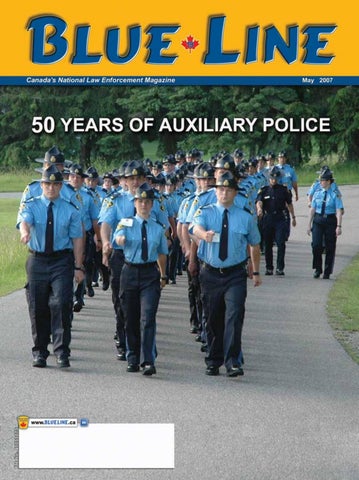
This month’s cover features a recruit class of Auxiliary officers with the Ontario Provincial Police. For just over 50 years Auxiliary Police officers have been supplying many hours of volunteer work so that regular members can get on with their daily efforts of protecting the community. Aux. Cst. Susan Stetham is seen here working crowd control at one of many annual special events in Toronto. Read more on page 7.
6
Policing for the love of it
12
Celebrating 50 years of Auxiliary Policing
9
Hands in their pockets Getting your hands on criminal assets
New protocol for foreign investigations
16
Blue lightning Police pursuits or fun and games?
10
Nurturing relationships
20
Chief Barry King leaves a legacy of policing initiatives
38 29 38 33 15 37 31 32 5 34
Advertiser Index A Matter of Faith Back of the Book Deep Blue Dispatches Market Place Odditorials Perspective Publisher’s Commentary Technology
Blue Blue Line Line Magazine Magazine
22 22 23 24 25
The sound of silence When the calls go down - police attention goes up
Grounds for detention less than arrest Mr. Big did not violate Charter Lawyer should speak to client first Police questioning not necessarily detention Realistic opportunity to consult counsel key
33
MAY 2007 2007
Blue Line Magazine
4
MAY 2007
An honour removed by parentheses by Morley Lymburner I have had many concerns over the Canadian Police and Peace Officer’s Memorial in the past. When it was first planned I questioned the location of the memorial and challenged the criteria used for selecting the location. I have since objected to the placing of the memorial in the back of Parliament. During one of my visits a garbage truck was picking up Parliament’s dumpster. It came perilously close to backing into the name plaques embedded in dirt. I still feel the only place for this memorial is on the expansive front lawn of the Supreme Court of Canada. A necessary reminder of the cost of maintaining a justice system which, far too often, ignores the hard work and sacrifices made to keep the people of this country safe each day. And not to mention the recognition of those responsible for feeding the engine that permit all those comfortable careers as lawyers and judges. But recognition is the real reason I am writing this piece. I now have one more reason to question the Canadian Police Officer’s Memorial. It has turned into a photo op for the media, a political tool of gamesmanship, and a labour relations platform whose true value has outstripped any true recognition of the officers who gave their lives. If one has reason to doubt what I have just said they only need to read the number one criteria for being included on the memorial itself. 1. The deceased must have been a sworn paid, full time peace officer in Canada serving as a regular member or employee of a federal, provincial, municipal law enforcement agency or service and died as a result of an external influence. (For greater clarity, this criteria does not include private agencies, auxiliary personnel or other volunteers.) This is a disgraceful, twisted, politically correct testament to the living and does nothing to honour fallen officers. Why does a description of a police officer
Blue Line Magazine
need so many caveats unless it is designed to appease special interests? I thought we were to remember their loss and sacrifice not the working agreements which existed when they died. For instance, given the criteria supplied, police officers of the Canadian National Railways and the Canadian Pacific Railway should be excluded. There are five names on the memorial from these two private companies. One person is listed as a “Guard.” Others are entered without any knowledge as to how they died. Who determined if they met the criteria of dying by “external influence?” Harold B. Thompson is listed as an “Officer” with the Saskatchewan Natural Resources. Notes attached state the circumstances surrounding his death are unknown and it begs anyone with information to supply it. How did this name get on the memorial? Right after that one is J. Leslie Greer “Forest Ranger” from New Brunswick with the same message. Similar anomalies abound. An Assistant Forest Ranger. What is that? Where does it fit in the criteria of section one? There are two more anomalies. A “Forest Warden” and a “Forest Ranger.” Both from New Brunswick and both died within a day of each other in 1980. Once again the circumstances surrounding their deaths are unknown. Also included in this list are two “Living Unit” officers. What is that? The two I am particularly interested in are these officers: • Auxiliary Constable Frederick A. Abel 22 years old R.C.M.P., Alberta Date of Death: April 4, 1986 Killed in a police vehicle collision. •
Auxiliary Constable J.E. Sam Balmer 25 years old R.C.M.P., British Columbia Date of Death: August 29, 1992 Killed in a police vehicle collision.
5
Someone, at sometime, on the Board of the Police Officer Memorial has determined these two officers warrant a place on the memorial. This in spite of a rambling, heavily edited section one with caveats and parentheses. Now, fast forward to Auxiliary Constable Glen Evely, who died last year under the same circumstances. Inclusion denied! His sacrifice means no recognition on a glass panel. The only reason given for the denial... the parentheses. Why are they there and who put them there? Not only did Glen Evely become a sworn member of the RCMP, he animated that oath by giving his life in an attempt to protect the public. He did so willingly by putting on the same uniform as every police officer in this country. He did so even though he was not given the extra privileges of others he worked with. Things like a gun or pay were denied him by policy. He took more risks than a regular member each day he donned that uniform. He risked his own livelihood and the support of his family. He felt strongly enough about serving the community that he was willing to make those sacrifices. Well you know what? Glen made that supreme sacrifice. He made it in the place of a regular duty police officer. For this his memory is insulted by a group of people who appear not to understand what sacrifice is. This magazine is open to anyone who was part of the decision to deny this officer a place of honour, to explain why. There will be no comment from me in rebuttal. Lets see who has the courage to respond. Each month there is silence I will place a reminder of it here. Parentheses can always be added. (They can also be honourably and silently taken away with no further remarks at all.)
Your comments are expected. Publisher@BlueLine.ca
MAY 2007
Celebrating 50 years of Auxiliary Policing by Tom Farrar and Matt Collison
In the wake of the devastation caused by Hurricane Hazel in 1954, Toronto quickly realized that there was a pressing need for considerably more resources to handle future disasters. Toronto Civil Defence, a group of volunteers trained to respond to emergencies, was born. The seven area police forces within the Blue Line Magazine
boundaries of what is now known as the City of Toronto were merged into the Metropolitan Toronto Police Force in 1957 and the civil defence unit became the core of the newly formed Metropolitan Toronto Auxiliary Force. The auxiliary service is celebrating its 50th Anniversary this year. The success it has enjoyed 6
over the years has encouraged police services across Canada to institute similar branches. There are many individual stories of the men and women that became members of the auxiliary. Officers brought along a multitude of skills, including a multi-cultural/multi- language capability that wasn’t present in the force MAY 2007
Aux. Cst. Ed Haywood and son Mark in the 1950’s and 60’s. It wasn’t unusual for a female auxiliary officer to be asked to assist when a regular officer wasn’t available to interview a female subject, or for an auxiliary with language skills to translate during an investigation. Many lifelong friendships were established from this teamwork. Over the years auxiliary officers have also been accepted as full time members in Toronto and other police services throughout the Greater Toronto Area. Ed Hayward has been a member since the beginning. Members back then were not only taught how to deal with natural disasters but also trained to respond should the Cold War heat up, learning first aid, rescue and how to use Geiger counters and help evacuate the city. Hayward was among the first 340 members when the auxiliary police service was formed. Training expanded to include motorcycles and police policies and procedures and he became an instructor, teaching auxiliary officers to ride motorcycles and control traffic and crowds. The motorcycle unit was active during parades, sporting events and other large gatherings, controlling intersections and providing escorts. Hayward had achieved the rank of aux s/ sgt when he was selected in 1986 to head up the newly formed auxiliary marine unit. An avid boater, he was a natural choice. Unit members undertook the same vigorous training as their Toronto police partners and assisted in boat safety inspections, patrolling the harbour and search and rescue. Marine units have proven to be the most efficient mode of transportation for police during Toronto’s annual Caribana parade, which brings hundreds of thousand of celebrants to the waterfront. Hayward’s ‘official’ retirement as an auxiliary staff inspector occurred in 1997 but that wasn’t the end of his active involvement with police services. As a member of AUXO (retired auxiliary officers that provide support Blue Line Magazine
units), he is the designated driver of the yellow ’57 Chevy used in parades and police promotional activity throughout the city. He is also a regular uniformed presence at the Toronto Police Museum. The strength of Hayward’s commitment to the Toronto Police Service is exemplary. He encouraged his son Mark to join the service in 1981 (he currently serves as a motorcycle sergeant working out of 52 Division). Both father and son received medals at a ceremony in 2001 – Ed for 45 years of service and Mark for 20 years of service. One of the elder Hayward’s proudest memories while on duty was rescuing two people from their sinking sailboat in Lake Ontario during a storm. Hayward has volunteered more than 25,000 hours over his 50 years of service, and that’s a conservative estimate. “When you don’t have to do something you like, you really can enjoy doing it,” Hayward replied when asked why he dedicated so much time. Ontario Provincial Police Auxiliary The OPP Auxiliary also evolved from a disaster relief agency, the Ontario Emergency Measures Organization (similar to Toronto Civil Defence), in 1960. On its web site, the OPP notes an auxiliary officer’s duties are “endless but include traffic control, ground security at major events, doing surveys, seat belt clinics, assisting on RIDE initiatives, bicycle inspections and rodeos, assisting at safety displays and presentations, foot and road patrols with regular members, accompanying regular members on marine and snow vehicle patrol, victim assistance, tagging evidence, ceremonial duties, search and rescue (to name a few).” The force has moved toward making the 7
auxiliary an integral part of its total policing strategy for the province, and the unit is a model both in Canada and internationally. A ‘statement of intent’ details the mandate of auxiliaries, ensuring they are not used inappropriately in a way which may be perceived as replacing regular officers. The only one of its kind in North America, the statement was jointly signed by the OPP commissioner, association and commissioned officers association. It documents a clear understanding of expectations and creates the foundation for a good working relationship between regular and auxiliary members. OPP auxiliary officers are entitled to many of the same benefits available to full time officers. Insurance coverage, although limited to when they are actually on duty and under the direction of a regular member, is very comprehensive. If an auxiliary officer is injured on the job, for example, and cannot return to their regular employment, they may qualify for workers compensation at the salary level of a first class constable. Officers also have full access to the OPP employee assistance program, life insurance and indemnification from civil lawsuit. The association provides legal representation should auxiliaries face investigation, though to date no auxiliary member has required that service. The OPP is frequently thought of as the ‘highway patrol’ and while this is certainly part of its mandate, it also serves many small and medium sized communities through its 165 detachments throughout the province. In addition to regular officers, each detachment is augmented by an authorized auxiliary compliment of nearly 800 members; they contributed more than 204,000 hours of service in 2006 alone. The value of this partnership is exemplified by the more than 600 letters regular OPP members write annually recognizing and commending their auxiliary counterparts. MAY 2007
Royal Canadian Mounted Police Auxiliary Corporal Tom Clark has coordinated the RCMP’s auxiliary program for more than seven years, helping to bring the program back from near extinction. The number of auxiliary volunteers in EDivision (British Columbia) in 1999/2000 was down to about 250 so the program was restructured. Auxiliaries could now perform tasks on
their own, without the supervision of a regular member, and would no longer be armed. Prior to this, all BC auxiliaries were armed, unlike their counterparts in the rest of the country. More aggressive recruiting strategies were also implemented and the number of volunteers soon skyrocketed to more than 1,200, just over half of the Mounties’ total national auxiliary force. Despite this huge increase Clark intends to keep working at recruiting and has set a goal of having 1,500 members in BC by 2010 and 1,800 by 2012. He expects the total number of auxiliary officers nationally to reach around 3,000. Allowing auxiliaries to work on their own was the best thing that ever happened to the program, Clark notes, since they can now be a total support team and do whatever jobs need to be filled. Officers have a larger role today than they have since the program’s inception in 1952; their role back then was to help out in case of emergency during the Cold War. “From community policing duties to bike patrols (and) foot patrols, they are also tactical observers in the helicopter and a host of other duties as well,” Clark said. “Right now
we’re using them extensively in both community policing roles, service delivery and other duties such as DARE (Drug Abuse Resistance Education).” Auxiliaries are only required to log about 160 hours per year, Clark explains, but many exceed that greatly. Some log 500 or 1,000 hours and one officer volunteered more than 1,700 hours. “We refer to the auxiliaries as the ultimate volunteer,” Clark said, adding he has his own theory why so many people are willing to give so much of their time. “Once they get involved with it, it becomes very addictive,” he explains. “They fall in love with the policing organization and the family aspect of it. They realize they do make a difference.” Keeping auxiliaries happy is an important part of his job. The BC division has set up its’ own advisory committee, made up of 10 usually veteran volunteers, giving volunteer officers a chance to make suggestions and air any grievances. “Their level of satisfaction is paramount to the program,” notes Clark.
Auxiliary police line of duty deaths Auxiliary Constable Frederick A. Abel, 22 Royal Canadian Mounted Police End of Watch: Friday, April 4, 1986 Incident Details Cause of Death: Automobile accident Date of Incident: Friday, April 4, 1986 Incident Location: Alberta Weapon Used: Not available Suspect Info: Not available Auxiliary Constable Frederick Abel and Corporal Bud Johanson were working at Lethbridge Detachment in Alberta at the time of their death. They were working together when they received a call of a suspected impaired driver, driving a pick up truck East bound in the West bound lanes of Highway 3. The highway is a divided four lane highway that travels through Lethbridge. They were on their way to investigate the complaint and were driving West bound on highway 3. About 7 km West of Lethbridge, their police car collided with the pick up truck travelling on the wrong side of the road. The resulting head on collision killed the officers and the occupants of the pick up truck. *** Auxiliary Constable J. E. Sam Balmer Royal Canadian Mounted Police End of Watch: Saturday, August 29, 1992 Incident Details Cause of Death: Automobile accident Date of Incident: Saturday, August 29, 1992 Incident Location: British Columbia Weapon Used: Not available Suspect Info: Not available Auxiliary Constable Balmer was stationed in British Columbia at the time of his death. Auxiliary Constable Balmer and his regular member partner were responding to report of a domestic assault at a residence in a neighbouring community. Members had attended this residence in the past. While responding to this complaint his partner attempted to pass a vehicle which resulted in a collision with a vehicle approaching from the opposite direction. Auxiliary Constable Balmer was killed in the collision.
Blue Line Magazine
Auxiliary Constable Glen Evely, 39 Royal Canadian Mounted Police End of Watch: Saturday, November 13, 2004 Incident Details Cause of Death: Vehicular assault Date of Incident: Saturday, November 13, 2004 Incident Location: British Columbia Weapon Used: Automobile Suspect Info: Apprehended Auxiliary Constable Evely was killed when his patrol car was struck by a stolen pickup truck following a police pursuit in Vernon, British Columbia. Other officers had initiated the pursuit at approximately 0215 hours after receiving reports of a drunk driver. When they located the vehicle they determined that it had been stolen the night before. When the officers attempted to stop the truck the driver sped away. The pursuing officers broke off the chase shortly after it began as a result of the suspect’s reckless driving. Even though the chase had been terminated the driver continued to flee. At the intersection of 29th Street and 30th Avenue, in Vernon, the driver ran a red light and struck the patrol car Auxiliary Constable Evely was riding in. Auxiliary Constable Evely was pronounced dead at the scene. His partner was transported to a local hospital in serious condition. Both suspects in the stolen vehicle were also taken into custody. Auxiliary Constable Evely and his partner were aware of the earlier pursuit but had not been involved with it and were not attempting to locate the vehicle at the time the incident occurred. He is survived by his wife and two children. *** Auxiliary Police Officer Nicholas T. Pekearo, 28 New York City PD - Auxiliary Police Section End of Watch: Wednesday, March 14, 2007 Incident Details Cause of Death: Gunfire Date of Incident: Wednesday, March 14, 2007 Weapon Used: Handgun Suspect Info: Shot and killed
8
Auxiliary Police Officer Yevgeniy (Eugene) Marshalik, 19 New York City PD - Auxiliary Police Section End of Watch: Wednesday, March 14, 2007 Incident Details Cause of Death: Gunfire Date of Incident: Wednesday, March 14, 2007 Weapon Used: Handgun Suspect Info: Shot and killed Auxiliary Officers Yevgeniy Marshalik and Pekearo were shot and killed while following a killer who had just murdered a pizza shop employee in Greenwich Village. The killer had entered the shop, asked for a menu, and then shot the employee in the back fifteen times after the man turned around. Auxiliary Officers Pekearo and Marshalik, both of whom were unarmed and on foot patrol in the area of the shooting, heard the description of the assailant that had been transmitted over the radio. They spotted him on the corner of Sullivan and Bleeker Streets. Both officers ordered the killer to drop a bag he was holding. The killer complied, but then punched Officer Marshalik in the face, knocking him to the ground. The killer fled on foot, with both officers in pursuit. The killer then drew a second firearm, and opened fire on the officers, who were on the opposite side of Sullivan Street. Officer Pekearo took cover behind a parked car, but the killer ran up behind him and shot him six times, killing him. The killer then fled again on foot, where he observed Officer Marshalik attempted to take cover. The killer approached Officer Marshalik and shot him once in the head, killing him. Responding Officers from the 6th Precinct opened fire on the killer, who again fled on foot into a store. He then exited the store and opened fire. He was shot and killed in the ensuing gun battle. The killer was found to be carrying two handguns and over 100 rounds of ammunition. Auxiliary Officer Marshalik had served with the New York City Police Department - Auxiliary Police Section for thirteen months and was assigned to the 6th Precinct Auxiliary Police Unit.
MAY 2007
New protocol governs foreign investigations by Kathryn Lymburner The growing ease of international travel and communication has fuelled an increase in transnational crime, making investigations in Canada by foreign law enforcement agencies more common. The federal government, in conjunction with the RCMP, has developed a new protocol to make it easier for Canadian police agencies to accommodate these requests. The protocol ensures that Canadian security, sovereignty and the public interest are safeguarded while Canadian police assist in the investigations — an excellent way to ensure Canadian rule of law is followed and the rights of all are protected. The protocol states that foreign investigators wanting to pursue criminal investigations in Canada must forward, at least two weeks before their arrival in Canada, their requests to the Department of Foreign Affairs and International Trade (DFAIT) through their home foreign ministry and diplomatic channels. For the scope of this protocol, “foreign criminal investigators” include: police and other law enforcement officers, Crown attorneys, attorneys or agents of foreign states conducting questioning, interviewing or statement taking from witnesses, suspects or accused persons which may lead to criminal proceedings in a foreign jurisdiction. Foreign investigators will need to identify who will conduct the investigation, their
Blue Line Magazine
agency, when they are arriving and departing Canada, where they will be investigating and the nature of the investigation to be conducted. Because foreign investigators are not recognized as peace officers in Canada and don’t have jurisdiction here, they must be assisted by an agency that does have jurisdiction. This ensures that foreign investigators follow Canadian law and adhere to the Charter. Once DFAIT has received the information, it logs the requests for entry and forwards them to the RCMP for co-ordination. After the RCMP has determined if the request can be supported and DFAIT has conducted its own assessment of the situation, the department will notify the foreign mission if the proposed activities are acceptable. The RCMP Interpol Office, once advised by DFAIT, will also review and determine what type of action or assistance is needed. This can include deciding: • if the RCMP can directly assist in the investigation; • if the RCMP has information to share regarding the investigation; • if the foreign investigation will impact a current RCMP investigation. The office will also inform federal, provincial or municipal services of requests to pursue an investigation in their jurisdiction, advise DFAIT if Canada should support the investigation and allow all foreign criminal investigators’ activities within RCMP jurisdiction.
9
If a foreign agency makes a direct investigation request, the receiving agency must communicate Canada’s protocol and advise RCMP headquarters of it. The RCMP will then advise DFAIT of the request, who will work through diplomatic channels to accommodate it. Once a Canadian agency is informed of these requests, it must: • review it to determine if the foreign investigation will impact other criminal investigations in its jurisdiction; • notify the RCMP if a request can be supported; • determine conditions pertaining to the request; • assist the foreign investigators in its jurisdiction, ensuring they comply with legal and Charter requirements. This new protocol is not unique to Canada and is consistent with approaches taken by other countries. Despite this, there are exceptions. The protocol does not apply to: • foreign investigators attending conferences, training, courses, informal information exchanges or secondment; • visits arranged by Interpol or administered by the International Assistance Group of the Department of Justice; • visits pursuant to bilateral or multilateral treaty agreements; • investigations governed by the Visiting Forces Act; • joint investigations conducted by Canadian law enforcement authorities.
MAY 2007
by Morley Lymburner It was the day after Christmas, 1971, when then Cst Barry King of the Mississauga Police Department first came into the national spotlight. He attracted the attention for his handling of Canada’s first hijacking in the same matterof-fact style he maintained throughout his 46 year career. The plane was on a routine “milk-run” from Thunder Bay to Toronto when a passenger, American fugitive Patrick Critton, announced he had a gun and hand grenade and ordered the plane to head to Cuba. As it touched down at the Toronto airport for extra fuel, King, the police officer on patrol in the area, was notified to attend. He was ushered out on the tarmac and given a headset so he could talk to the nervous hijacker, who demanded the plane be refuelled and then take off for Cuba. King asked him to first let the passengers off and the hijacker agreed. There wasn’t anything else to do, as far as King was concerned, so he ordered that the plane be refuelled and the hijacker and crew took off for their extended flight. As the constable who patrolled the area, he was the only decision maker available. There were no other alternatives; no highly trained tactical units or skilled hostage negotiators who practice regularly on how to end such situations. King took the only option he saw available. There were Blue Line Magazine
no heroics or fanfare, no shootouts or spectacular breaches of the plane. It was just another call and King handled it like he would any other call for service. Having already accumulated 10 years of policing experience when he was called to the airport that day – and less than a quarter of the way through his long career. Born with policing in his blood, King followed his father and grandfather for two years with the Canadian Forces Military Police. Upon leaving he immediately joined the Ontario Provincial Police and was stationed for five years in Brockville before transferring to the Mississauga Police, which transitioned into the current Peel Regional Police Service in 1974. In November, 1979, King was once again catapulted into the spotlight with the Mississauga train derailment. Canada’s worst train disaster forced the evacuation of 200,000 people from their homes for more than 22 days. Despite the scale of the disaster, there was no loss of life. King received the Ontario Medal for Police Bravery for his courageous conduct at the scene of the accident and his skillful handling of the mass evacuation during the derailment and fire. Serving 18 years with the Peel Regional Police, King reached the rank of superintendent, before moving to Sault Ste. Marie to be10
come the city’s new police chief. He spent eight years there before coming full circle by taking on the top job with the Brockville Police Service. It was this agency that benefited the most from his experience, creativity and energy. King credits former Peel Regional Police Chief Doug Burrows and Deputy Chief Bill Teggart for helping prepare him for leadership. Burrows in particular was a firm believer in education and sent officers on training courses at every opportunity. King was sent to the FBI National Academy, where he completed the executive development course. King recalled a valuable lesson he gained in the rough-and-tumble world of politics in an article published in the Brockville Recorder and Times. Witnessing the backroom talks and lobbying, he took one key lesson into his life as a police administrator. “Don’t ever lie. Be straight up and give (politicians) the information because they are the ones who have to make the decisions.” King takes pride in increasing the Brockville Police Service’s training budget to $80,000 from $20,000, and contends the city has been well served by both the training and experience its officers have gained. No stranger to the Canadian police community, King has received considerable recognition and awards for his efforts from a MAY 2007
King is an honours graduate of the 128th session of the FBI National Academy, FBI LEEDA Executive Program, Canadian and Ontario Police Colleges and Humber College. He has studied at Northwestern and Wilfrid Laurier Universities, the Queen’s University community policing management program and Queen’s School of Business Executive Development Centre “Queen’s fundamentals of governance” program. He was awarded the St. Lawrence College Board of Governors honorary diploma in 2002 and inducted as the Humber Institute of Technology and Advanced Learning 2006 “Alumnus of Distinction.”
King has clearly earned an opportunity for a long and rewarding retirement, which he plans to begin in September. He and his wife Pat have three children – Michael, Deborah and Kevin – and six grandchildren. His youngest son Kevin, is a detective constable with the Guelph Police Service, continuing the family tradition for a fourth generation. Chief King mentions the possibility of doing some consulting as a possible post-retirement pursuit, pointing out his wife, Pat has insisted he “better find something to do for 20 or 30 hours a week.” Someone as active and accomplished as Barry will have no difficulty meeting that requirement.
wide array of organizations. The Addiction Research Foundation Ontario (CAM-H) presented him with its community achievement award, which recognizes outstanding leadership in the development of youth drug and alcohol educational programs. He also received Canadian and Ontario Association of Chiefs of Police service awards for his outstanding contribution to the advancement of law enforcement. King was decorated with the ‘Order of the Grand Master’ medal in 2001 by the ambassador of the Republic of Belarus for his leadership in assisting to establish a safe community partnership. He was specifically recognized for his assistance in mentoring their city’s police and fire services, in partnership with Canadian Aid for Chernobyl. He is also a recipient of the YMCA-YWCA 2001 Canada Peace Medal and Ontario’s Crime Control Commission 2002 award of excellence. In 2003, King was appointed as an ‘Officer in the Order of Merit of the Police Forces’ by the Governor General and also awarded the Queen’s Golden Jubilee Medal. Blue Line Magazine
11
MAY 2007
by Kathryn Lymburner Seizing assets from criminals is not a new policing concept but the revisions introduced in Bill C-24 have given police more room to go after repeat offenders. The bill gave police the powers to target proceeds of crime and related property by changing the definition of offence-related property under s2 of the Criminal Code and portions of the Controlled Drugs and Substances Act (CDSA), . “Basically anything that is used in the commission of the offence or in connection with the offence is subject to seizure and forfeiture,” explains York Regional Police (YRP) detective Darrin Leitch, a member of Ontario’s Asset Forfeiture Unit (AFU). Offence-related property is now defined as any property, within or outside of Canada, used in the commission of an indictable offence under the act. Section 2b further defines it as property used, or intended for use, in any manner or connection with a commission of an indictable offence under the act. In Ontario, this new measure is being applied in a wide range of situations, including impaired driving, grow houses, child pornogBlue Line Magazine
12
MAY 2007
Project Provider, a combined Biker Enforcement Unit, Illegal Gambling Unit, Royal Canadain Mounted Police, Windsor Police Service, OPP - Intelligence Bureau, investigation focusing on Hell Angels cocaine in the city of Windsor and a bookmaking operation. The vehicles pictured were seized by the Asset Forfeiture Unit, as offence related property and proceeds of crime.
raphy, street racing, break and enter and weapons related offences. “It has to be an indictable offence or a dual procedure offence where the Crown proceeds by indictment, so a first or second impaired (driving conviction) wouldn’t apply because the Crown would proceed summarily,” notes Leitch. “That’s when we could potentially seize the vehicle.” Ontario’s AFU is led by the OPP, with approximately 30-40 members across the province working within their home agency. Headed by OPP Detective Staff/Sergeant Tom Murphy, the unit targets proceeds of crime and offence related property and, in some cases, uses civil Blue Line Magazine
forfeiture. Prior to the 2002 change in legislation, the AFU had to show to the court that a grow-op property, for example, had been significantly modified. “It sounds easy enough,” remarks Murphy. “From a layman’s perspective you’d simply look at all the alterations that were done to these (homes), but the courts weren’t accepting or understanding our definitions of significant modification.” Much money was spent on expert witnesses such as electricians or building inspectors to make a case to the courts. “As a result, there just wasn’t the interest in these types of prosecutions because we just weren’t supported in 13
MAY 2007
the courts,” says Murphy. Bill C-24 made it no longer necessary to prove that a property has been significantly modified, allowing more room for interpretation of the law. Now agencies such as the YRP are seeing huge results in combating grow houses; one officer alone has over a million dollars in forfeitures. After the change in legislation AFU went to the Criminal Intelligence Services of Ontario (CISO) for a grant to set up the infrastructure for Project ORP (Offence Related Property) which would allow the unit to seize and store motor vehicles going through the court system as offence related property. “Any police officer in Ontario can call us up and we will walk them through the program,” explains Murphy. “If we believe it to be a viable case then we’ll accept the cost of the vehicle storage while the matter is before the courts.” This type of investigation is no longer just for the specialized police unit and the AFU is working hard to educate officers about these legislative changes. Unit members teamed up with CISO in 2006 to conduct four training sessions across Ontario, raising awareness from Thunder Bay to Brockville. Members are also working to train Crown attorneys. “Darrin was invited to do a presentation in front of the York Crown’s office,” notes Murphy. “From that they started to do a review of their on-going impaireds that were already in the system and came up with a list of cases where asset forfeiture can be used. “It’s a pretty powerful tool when you look at all that we can do,” he says. “We do a lot of training and I’m still amazed at how engaged people get once they find out about this legislation and what has been and can be done with it. “We’re finding there’s a lot of interest from the front-line because all of a sudden officers can get involved and they’re finding that, in the past, they were so disappointed with the sentences in court,” says Murphy. “It’s quite gratifying for a police officer to be able to remove these assets.” The response from the broader legal community has also been favourable. “We’ve had judges and even defence lawyers comment that, as a citizen, they like this being done,” notes Leitch, “but as defence lawyers they dislike it, because obviously it causes more aggravation for them.” “They also get frustrated with the leniency of the courts and they see this as a potentially very effective tool,” Murphy adds. There has been significant community impact with seizures. As Leitch explains, “if you’ve got a drug dealer driving around town in his flashy car and everybody knows he’s the drug dealer, when he finally gets that car taken away from him, he’s not the big shooter any more and it causes him some embarrassment. There’s no real downside to any of this.” The AFU seized almost $25.5 million worth of assets last year, $5.5 million of which have been forfeited. Once seized assets go to the Crown they’re liquidated and placed into four different Ontario grant programs. Police services can then apply to receive these grants. Leitch and Murphy both agree the new legislation is changing how police across Canada can tackle crime. Blue Line Magazine
“If you’re investigating something you deem to be serious,” urges Murphy, “consider the viability of the asset forfeiture by examining the particular house, structure, vehicle or whatever it is that allowed the offence to take place, as there is a good chance there will be an asset forfeiture application.” Leitch recommends contacting the AFU
member in your agency, the OPP or the RCMP’s IPOC unit for assistance, stressing “we’re all here to help.” For further information or assistance with asset forfeiture or Project ORP contact Detective Staff Sgt Tom Murphy, the OPP’s Asset Forfeiture Unit Commander, by e-mail: Tom.Murphy@ontario.ca .
Biker raids leave Angels down but not out TORONTO (CP) — The ongoing battle between the law and outlaw motorcycle clubs erupted once again Wednesday with a series of cross-country raids against the Hells Angels and affiliate gangs that netted 30 suspects in Ontario alone. The dramatic pre-dawn operation that targeted clubhouses in Ontario, New Brunswick and British Columbia has left the biker organization “reeling,” said one expert, but he also cautioned that the war isn’t over. “They are not down, they are not laying flat on the mat, they haven’t thrown in the gauntlet, but they are angry and, I dare say, a bit worried,” said Julian Sher, co-author of “Angels of Death.” “For the first time in the last couple of years, the Hells Angels have been reeling.” While police were tight-lipped about the nature of the charges or the identities of the suspects, saying more information would be made public Thursday, officials were willingly to confirm some details. In Ontario, a co-ordinated effort saw some 32 raids carried out - at least a dozen in Toronto alone. Clubhouses in Niagara Falls, Waterloo, Barrie, London, Hamilton, as well as Durham, Peel and York regions were also raided, police said. Toronto police said 30 arrests were made in the province, and Ontario Provincial Police Sgt. Bob Paterson said he expected police to continue laying charges through Wednesday night. In British Columbia and New Brunswick, RCMP spokesmen confirmed that outlaw motorcycle organizations, including the Hells Angels and the Bacchus Motorcycle Club, had been targeted as part of an ongoing investigation, but deferred questions until Thursday’s scheduled news conference. The arrests follow a number of significant moves against biker clubs by authorities in Ontario over the past year. A series of simultaneous raids launched by provincial police in September 2006 saw 500 officers involved in arresting 15 members of the Hells Angels.
14
In January 2006, police made a series of arrests focused in Thunder Bay, Ont., in which a total of 27 Hell Angels and hangers-on were charged. One of the most significant impacts of Wednesday’s police efforts would be the damage done to the image of the Hells Angels, Sher said. “These kinds of raids do tremendous damage to the Hells Angels’ PR campaign to try to present themselves as just good old boys on bikes,” Sher said. The seizure of a Toronto Hells Angels clubhouse, just outside the downtown core, represented a substantial blow, he noted. “That was the showcase clubhouse in the province. It’s the most flashy. ... In many ways it’s the nerve centre of the Hells Angels in the province.” Staff Insp. Joe Tomei of Toronto police said the seizure of that clubhouse “should send a very clear message to those who choose criminal lifestyles, as well as bring relief to the (surrounding) community.” It was “the largest clubhouse for the Hells Angels anywhere in Canada,” Tomei added. According to the Ontario branch of the Criminal Intelligence Service Canada, of the estimated 460 fullpatch Hells Angels members nationwide, about 175 more than one-third - operate in Ontario. “You’ve got 34 chapters in Canada and 16 of them in Ontario,” said Eric Dupree, a national intelligence officer with the service and resident expert in Canadian outlaw motorcycle gangs. “You do the math. ... Proportionately, Ontario ... is a big player.” There are seven chapters in British Columbia, three in Alberta, two in Saskatchewan, one in Manitoba and five in Quebec, Dupree added. The cross-Canada arrests Wednesday came nearly one year to the day that police found eight bodies of rival Bandidos gang members in a farmer’s field in Shedden, Ont., just south of London, Ont. Eight people, including a former police officer from Winnipeg, were later charged in relation to the Shedden deaths.
MAY 2007
After six years as deputy commissioner of the RCMP’s Pacific region - B.C. and Yukon - Beverley Busson has formally transferred her command to Gary Bass. Busson, who also commanded B.C.’s ‘E’ Division, was appointed interim commissioner of the RCMP in December. Winnipeg police Chief Jack Ewatski said he wasn’t surprised to learn members of the local Hells Angels infiltrated his department and came into possession of classified documents. Ewatski said it’s no secret organized crime groups such as the Hells Angels conduct intelligence gathering and counter-surveillance on police and justice officials. The chief promised “swift and harsh” action against any police employees found to be working in conjunction with bikers to supply information. Public Safety Minister Stockwell Day and B.C. Attorney General Wally Oppal announced the four-year $1.9 million project to prevent youth gang violence in the province. The money is earmarked for the victim services division of B.C.’s Public Safety Ministry. Potential programs include after-school recreation programs, public forums and cultural camps, especially for aboriginal youth. Calgary’s police Chief Jack Beaton, says he was blindsided by the crimefighting Guardian Angels hitting the city’s streets before sharing details of their operations with him. He would have preferred it if the group had arranged to work with police and said until that’s done, they won’t get his backing. Beaton said he wants to be assured the group works within local laws and by-laws. Former B.C. Supreme Court judge, William Davies, has been appointed to conduct a public inquiry into the death of, Frank Paul, a native man who was left in a Vancouver alley by police. Paul had been arrested for being drunk and jailed in December 1998, but was later pulled out of his cell and dumped in a lane, where he died of exposure. The inquiry is expected to begin with a few months. Former provincial solicitor general Heather Forsyth will lead an Alberta study group that will consult the public to find the best methods for reducing crime. The nine-member crime reduction task force also includes Edmonton police chief Mike Boyd and the mother of a Calgary boy who died in a street brawl in 2002. The task force will hold 14 public meetings and a broader symposium in late June to discuss the recommendations it heard.
New RCMP Heritage Centre nears completion REGINA (CP) — As far as Vic Huard is concerned, if you’re trying to tell the story of Canada’s police force, there’s no better place to do it than the complex where every single officer is trained. “This is where the story begins, and so this is where the story should be told,” the president and CEO of the new RCMP Heritage Centre says as he watches cadets stream by the building on one of their many fitness runs. “That authenticity of the space is something that we feel is going to be very important to the visitor experience here.” Preparations at the $40-million facility on the edge of the RCMP training depot in Regina have shifted into high gear as workers rush to get ready for the grand opening at the end of May. The old RCMP museum - a 30-year-old unassuming, red-brick building with about 1,000 square metres of display space - was already one of the most popular tourist attractions in Regina, drawing between 50,000 and 60,000 visitors annually. The new 6,500-square-metre heritage centre - Huard is careful not to use the word museum - is a huge step up with nearly twice the amount of exhibit area and a whole host of added features. The building itself is something to behold. Designed by acclaimed Canadian architect Arthur Erickson, the swooping mass of glass, steel and Tyndall stone is truly unique in the Regina cityscape. “Those are the fun ones to build - when they are not easy,” said Ryan Schmidt, project manager for PCL construction, the company that built the facility. “It pretty much touched on every building trade.” Inside, the exhibits are anchored by a 30- metre long “March of the Mounties” display that runs the entire length of the main hall. It uses various full-size police vehicles to illustrate the history of the force, from one of the original horse-drawn canons the Mounties brought west with them to the modern police cruiser they use today.
From “March of the Mounties,” five different exhibit galleries branch out: “Maintaining Law and Order in the West;” “Protecting the North;” “Serving All of Canada;” “Cracking the Case;” and “Call of Duty.” The call of duty room shows visitors what it takes to pass the RCMP training program, and cracking the case is an interactive exhibit that appeals to the CSI buff with the forensics of modern policing. “It’s going to be real forensics,” Huard says. “It’s tough, hard work and it takes a long time and a lot of resources. It’s not as easy to solve a crime in an hour as it might look like on TV.” The centre also has a 125-seat, state-of theart theatre where the history of the RCMP will be told through video as well as physical displays that rise up from the floor and drop from the ceiling. The narrator of the show is projected through a lifelike technology known as Pepper’s Ghost. “In essence people will see a virtual narrator,” Huard said. “It’s in three dimensions. She speaks. She moves. It’s the kind of technology that people who have been to Disney World for example would be familiar with, but no one has really seen it here.” The new centre has a 180-square-metre space for travelling exhibits and an area that can be booked for private functions. Storage space for the RCMP’s vast collection of artifacts not on display was in short supply at the old museum. The new facility has double the storage area and a lab for historians to work in. With some unfinished ceilings, loose wires and blank walls during a mid-March tour, the centre appeared very much like a construction site, but Huard insists things will be ready on time and on budget. Officials are already planning for phase two of the heritage centre which is to include exhibits entitled “Stories From the RCMP,” “The RCMP in Popular Culture” and “The Musical Ride.” Funding for that part is expected to be in place in 2008. On the web: www.rcmpheritagecentre.com
A Fredericton raised police officer killed in a March shooting in South Carolina is being remembered as a diligent, determined man who always cared for others. Cpl. Marcus Stiles, 26, died a day after he was shot while responding to a call. He was one of two officers with the Moncks Corner, S.C., police department killed in the incident. He was promoted to corporal within a year of graduating from the police academy, supervising officers with more age and experience. Annemarie Erika Bonkalo took over as chief justice of the Ontario court of justice May 4. Bonkalo earned her law degree from Queen’s and also holds a Masters in criminology from the University of Toronto. She was called to the bar in 1978 and joined the Ministry of the Attorney General as an assistant Crown attorney. She became a judge in 1990, holding progressively senior positions. Bonkalo takes over from Brian Lennox, who completed his eight-year term as chief justice of the Ontario court on May 3.
Blue Line Magazine
15
MAY 2007
by John Burchill
adrenaline fuelled ‘blue lightning’ police culture, rarely do these action-packed pursuits show the tragedy that often accompanies them in real life. For example, during the past two decades there have been roughly 7,500 fatalities – an average of 325 people killed every year as a direct result of pursuits in North America. Traditionally, out of deference to the maintenance of law and order and a desire to see offenders caught and punished, our society has tolerated the dangers associated with police pursuits. However, in recent years there has been increased public scrutiny and concern that the benefits do not always outweigh the risks to public safety. Occasionally officers have even been criminally charged following pursuits.
Fleeing offenders provide the action and excitement that some officers expect from their work – the chance to use their crime-fighting abilities to restore respect and order in their community. The theory of deterrence suggests that swift and sure apprehension and punishment reduces the probability that a motorist will attempt to flee. The fact that the vast majority comply with an officer’s signal to stop suggests that the theory is correct; flight “only becomes a good business decision” when the punishment for fleeing is believed to be less serious than the underlying offence. However, while Hollywood has long glamorized the high-speed chase, contributing to the development of an Blue Blue Line Line Magazine Magazine
16
MAY MAY 2007 2007
Studies show that the majority of pursued drivers are males in their early 20s. Many are impaired by drugs or alcohol and they often have no licence or are prohibited from driving. Some have just committed crimes, including stealing the vehicle they are driving. Often they have a criminal record, are on charge for various offences or have previously attempted to outrun the police. It is this previous criminal activity that generally helps to explain why the pursued driver is reluctant to stop. While this data suggests that the driver’s reason for not stopping is for reasons much more compelling than those that brought them to the officer’s attention in the first place, the seriousness of the original offence must be given due consideration when initiating or continuing a pursuit. Whatever the driver’s reason for not stopping, based on the number of deaths and serious injuries that have occurred from police chases, public safety is the paramount consideration in any decision to initiate, continue or discontinue a pursuit. Public safety represents a balance that may change rapidly and must continually be assessed based on a number of factors, including: • the seriousness of the offence; • road conditions; • volume of traffic; • weather and visibility; • capabilities of the officer and the vehicles involved; • the number of occupants in the pursued vehicle. Failure to assess or consider any of these factors may have serious implications for both
Blue Line Magazine
the officer and his or her department should the pursuit end tragically. Although provincial legislation commonly authorizes police to disregard particular traffic laws under certain situations, negligently exposing the public to unnecessary danger (even that caused by the pursued driver) may result in criminal or civil action against the officer and the department. For example, in Blaz v. Dickinson (1996), Mr. Justice Cumming stated: The duty of a police officer to act reasonably in protecting the public from unreasonable risk of injury or damages includes a duty to take reasonable steps to protect against the misconduct of the criminal himself/herself. The misconduct of the criminal seeking to escape the police in pursuit is the immediate, operative cause of harm to third persons when an accident results. The criminal bears prime responsibility for such accident. However, given the foreseeable risk to the public endemic to the pursuit situation, the police officer must consider as one factor whether or not the discontinuance of the pursuit is the reasonable
17
course of action in the circumstances. Failure to discontinue a pursuit may constitute negligence. The fact that it is the vehicle of the pursued criminal, not the police vehicle, that is in collision with the victim does not absolve the police officer of his/her negligence. Nevertheless, as long as officers use their emergency equipment, proceed with due regard and safety to other persons using the highway (including the person being pursued) and continually assess the factors listed above, liability will generally not be attached to officers involved in a pursuit. In fact, by attempting to evade the police, the pursued motorist creates and puts into motion a chain of circumstances that usually leaves the suspect solely responsible for any injury or damages caused in the chase. As noted by Justice O’Leary in Crew v. Nicholson (1987): Any motorist who attempts to evade the police by speeding away from them and thereby causes a high speed chase knows that by so doing, he is creating a substantial risk that such chase will end in serious injury or damage to property of either the police or members of the public lawfully using the highway. It is of no consequence that such motorist cannot foresee the exact way or mechanics by which his conduct in running from the police may result in injury or damage to the property of others, nor is it any defence for such motorist that the police officer could have prevented damage or injury if the police officer had used reasonable care during the chase. By attempting to evade the police, the motorist creates and puts into motion a chain of
MAY 2007
circumstances that leaves him responsible for any injury or damage caused in the chase. Police officers have a duty to enforce the law by stopping motorists and others they find breaking the law. This means they must at times follow and, if necessary, chase those who attempt to evade them. The fact that in the excitement of such a chase a police officer fails to exercise the care required of him does not excuse the motorist that created the chase. Indeed by running from the police the motorist precipitates the very circumstances that lead the police to take chances that at times they ought not to take. However, in Crew a police officer was held 25 per cent responsible for an accident that killed a fellow officer. The member will also have to deal with the emotional fall-out that no doubt followed. In that case the suspect fled from a Goderich police officer, causing a pursuit. During the chase, which reached very high speeds, the original officer lost site of the vehicle as it travelled along a hilly, unpaved road. Members of the OPP, who heard a broadcast of the chase, eventually intercepted the vehicle on the downward slope of a hill. While this information was broadcast back to the original officer, he did not hear the message and came overtop of the hill, ramming into the OPP cruiser car, striking constable Crew, who had stepped out of his patrol car to speak with the occupants. He was killed instantly. While Justice O’Leary accepted that there may be circumstances where the harm to society likely to result from someone escaping apprehension would be justified in a high speed chase, the circumstances that existed in this case did not justify it. He subsequently found the original officer negligent for not exercising proper care during the chase (although he found the escaping motorist 85 per cent responsible for causing the chase in the first place). In R. v. Hundal (1993), the Supreme Court considered the test for dangerous driving when reviewing the circumstances surrounding a truck driver convicted of killing another motorist after his vehicle went through a red light. The truck driver, thinking it wasn’t possible to stop in time, blew his horn and continued into the intersection, where he struck the deceased’s vehicle. The court found that the truck driver’s actions represented a gross departure from the standard of care expected of a reasonable, prudent driver and upheld his conviction. Some of the factors considered by the court were: • time of day (mid-afternoon); • location of accident (busy Vancouver neighbourhood); • volume of traffic (“heavy”); • condition of road (wet); • type of vehicle he was driving (dump truck); • condition of truck (overloaded – exceeded GVW by 1160 kgs – which was a contributing factor in his not being able to stop); • disregard for traffic control devices (entered intersection on red light); • previous actions (had gone through a red light at a previous intersection); • licensed driver (implies knowledge as to the rules of the road). The cumulative factors in Hundal were obvious. In fact, the Supreme Court stated that negligent driving can be thought of as a conBlue Line Magazine
tinuum that progresses through a number of steps from a momentary lack of attention, giving rise to civil responsibility through careless driving under provincial legislation, to dangerous driving under the Criminal Code. In referring to the decision in Hundal, Justice McLachlin of the Supreme Court later added that where individuals engage in activities for which they lack sufficient knowledge, experience or ability, they may be found at fault for their decision to attempt the activity – “the law expects people to ask questions or seek help before they venture beyond their depth.” As such it should not surprise us that all of the factors found in Hundal can be found in various police pursuit policies across the country. However, officers will often be held to a higher standard because they have a higher level of knowledge and vehicle training than the average licensed driver. For this reason, failure by either the officer or his or her supervisors to assess or consider any of these factors may be viewed as an unreasonable exercise of their duty and could have serious implications for both the officer and the service should a pursuit end tragically. While a mere breach of police regulations does not automatically impose liability, compliance with the policy is a very important factor to consider in determining whether the standard of care has been met. For example, in Doern v. Phillps Estate (1994), the British Columbia Court of Appeal upheld a decision finding members of the Vancouver Police Department, including supervisors and dispatchers, negligent for their handling of a high-speed pursuit that ended in the death of the chasee. The chasee ran a red light and also struck another vehicle, seriously injuring the occupants. As the Vancouver Police had a policy requiring that a pursuit be terminated where there is a “clear danger” to the public or pursuing members, the failure by all involved to terminate the chase in question contributed to the accident. As a result, the city was held 25 per cent liable for their negligence. Although most provincial police acts make the municipality, region or minister, as the case may be, vicariously liable for the tortuous (wrongful) actions of police officers they appoint, a law suit or criminal charges may still be brought against them personally if their behaviour is shown to have been grossly negligent, malicious or showed wilful misconduct. 18
For example R. v. Blackwell (1994) and R. v. Markovic (1998) are cases where police officers were charged and convicted of dangerous driving. While such cases are rare, it is important to understand that even though each officer was found to be engaged in the lawful execution of his duties at the time, they were still found guilty. In Blackwell a London police officer was speeding to the aid of a fellow officer at the other end of the city when he crashed into and killed an oncoming motorist. The call was a “Code 3,” meaning a serious, life-threatening event. Although the court found that the officer had been engaged in the lawful execution of his duty at the time, considering all the circumstances his driving was dangerous and it resulted in the death of an innocent person. The officer’s sentence of 60-days in jail was subsequently upheld by the Ontario Court of Appeal. Markovic was a Montreal police officer who, like Blackwell, was on an emergency call when he entered an intersection against a red light at high speed and killed a pedestrian. Although he had activated his siren and roof lights just before entering the intersection, his visibility had been restricted at the time by the presence of buses in that area. The court found that his driving represented a marked departure from that of a reasonable police officer. Initially sentenced to jail, the Quebec Court of Appeal substituted a conditional sentence of 45 days, including community service. While both cases directly involved police vehicles, there have been several instances where officers were charged where it was the pursued suspect’s vehicle that killed someone. One recent example is R. v. Baker (2001), in which a Thunder Bay police officer was charged with dangerous driving causing death and dangerous driving causing bodily harm as a result of a pursuit related accident. The officer had attempted to stop a youth who had not paid for gasoline (he was also on charge for numerous offences). The vehicle, a Suburban, also turned out to have been stolen the day before in Winnipeg. When the youth refused to stop, a pursuit ensued that lasted approximately three minutes, during which the youth drove into oncoming traffic and struck another vehicle head-on, killing the occupant (a 34-year old mother of two young children) and injuring another. The charges against the officer were dismissed at the preliminary inquiry after expert evidence showed he had followed police policy; the accident was the sole fault of the youth; and there was no direct connection between the actions of the youth driving into oncoming traffic and those of the police officer pursuing him. In upholding the dismissal on review, Justice Kozak found that: Constable Baker was a police officer whose duties at common law and under the police act are to preserve the peace, prevent crime and the protection of life and property. Accordingly, it is recognized that the law must operate in a manner that provides the police with the opportunity to effectively protect society by arresting persons suspected of committing crimes. The question to be answered is, how far should the police be allowed to go in effecting the arrest of a fleeing felon who is suspected of committing the crime of theft? In this MAY 2007
regarding s. 25(1) of the Code authorizes a police officer to use as much force as is reasonably necessary in the enforcement of the law and that s. 128(13)(b) of the Highway Traffic Act exempts a police officer who is lawfully engaged in his duties from laws relating to speed limits. Notwithstanding the charges against Baker, the driver of the stolen Suburban pled guilty immediately after the collision to criminal negligence causing death, criminal negligence causing bodily harm and possession of a stolen vehicle. At his sentencing it was found that he had deliberately driven into oncoming traffic hoping the police officer would back off the pursuit so that he could escape. The accused was sentenced to nine years in prison and prohibited from driving a motor vehicle anywhere in Canada for 15 years. More recently, in Burbank v. Badyal (2005), the RCMP was held partially responsible for negligently engaging in a high-speed chase of a drug-impaired 15-year old driver through a residential neighbourhood. The pursuit resulted in the death of an innocent 11year-old girl and injured four other occupants in an unrelated vehicle. While the pursued driver took full responsibility for the accident the Insurance Corporation of BC argued that the attorney general, as insurer of the RCMP, should still bear some of the responsibility. The court agreed and found the RCMP 15 per cent responsible for the accident due to its officer’s negligence. The court found that the officer breached the provincial regulations regarding high-speed pursuits by pursuing a vehicle she knew, or ought to have known, would not stop in response to a pursuit; pursuing a suspected impaired driver through a residential area where it was expected there would be a large amount of traffic and pedestrian flow; and abandoning the pursuit when it was too late to prevent a collision. Police officers make many difficult and crucial decisions during the course of their law enforcement careers and while most law enforcement administrators, officers and trainers do not equate the decision to pursue with lethal force, there are some parallels. For example, the decision to engage is made in a matter of seconds; it often results in injuries or death; and they both result in public scrutiny of police practices and procedures. While s. 25 of the Criminal Code does offer protection from liability resulting from the lawful use of force by the police, one of the considerations is the nature of the offence and whether flight could have been prevented by other reasonable means in a less violent manner. Policy also requires officers consider the seriousness of the offence when initiating or continuing a pursuit. However, it is silent on what constitutes a serious offence – leaving it to the individual officer and his or her immediate supervisor to make that determination. To me, this is the most difficult part of the decision making process – is it possible that the driver poses a greater risk to the public if Blue Line Magazine
not pursued and apprehended? Is it likely that the driver will kill or maim an 11 year-old girl, a seven year-old boy, a 34 year-old mother of two or another police officer, if you don’t take any action? Considering the number of accidents, injuries and deaths that can arise from pursuits, perhaps the seriousness of the offence could be defined as one, considering all the surrounding circumstances, in which you are prepared to use lethal force. Sergeant John Burchill is the Winnipeg Police Services’ Major Crime Analyst and Hate Crimes Unit Coordinator. Contact him at jburchill@winnipeg.ca for further details and footnotes.
Chase suspect good at video games Tyrone McMillan was taken into custody last year after leading police on a car chase when officers attempted to pull him over for a parole violation. After slamming into two cars, McMillan told police he thought he could outrun them because he played (video) games, apparently thinking his gaming skills translated to the real world. His experience navigating the fictional streets of San Andreas and Vice City with a PlayStation 2 controller led to a 55-minute real-life car chase. His girlfriend’s 11year-old daughter and her 10-year-old cousin were in the backseat for part of the pursuit.
19
Judge rules on biker encounter with Mounties A judge has ruled a Mountie punched by a Hells Angel during a parking lot brawl was acting within the law, while an officer who pepper sprayed and punched another biker was not. In a complex ruling at the end of a threeday trial, B.C. Supreme Court Justice Janet Sinclair- Prowse convicted biker Lawrence Bergstrom of punching Cst. Dean Maynard. Hells Angels member Patrick Henry who tried to calm his people down during the July 2005 dispute, was acquitted of charges of assaulting Cst. Jeff Pelley. Sinclair-Prowse ruled Thursday that Cst. Pelley had no reasonable grounds to arrest Henry, who by all accounts acted as a peacemaker throughout most of the 10minute scuffle. She said Henry complied with RCMP instructions to dump his booze and told others in his group to be quiet or back off. It wasn’t until Cst. Pelley told Henry and others they could face arrest for causing a disturbance that Henry lost his patience. While Pelley testified he believed Henry was about to punch him, the officer still did not have the right to make an arrest, the judge ruled. Sinclair-Prowse said Henry no doubt did get angry and tell the RCMP to leave the group alone, but that is not a criminal offence. Henry was pepper sprayed, punched in the head at least three times and Tasered before he was arrested.
MAY 2007
by Matt Collison The Hamilton Police Service’s(HPS) Neighbourhood Safety Project (NSP) is quickly building an impressive list of successes. Officers helped improve rocky relations between McMaster University students and nearby residents and businesses, dramatically reduced gang activity and recently staged the largest ever marijuana grow-up bust in the city’s history – and the program is barely into its second year. NSP embraces beat ownership and community involvement in problem solving. Teams of patrol officers, not community specialists, are now responsible for community policing. The program is based on trust and communication between residents, police and municipal government, whose role is to enact bylaws to aid the situation. NSP was born out of COPP 2000 (Challenging Our Patrol Priorities), which compared police tactics and techniques in San Diego, Washington, DC, England and other areas. Communication with the community was seen as crucial, says chair Supt John Petz of the HPS Investigative Services Division, but to be really effective, police also need to communicate with each other. This and other lessons learned were incorporated into NSP, which began in January, 2006. “It’s a combination of problem oriented policing (POP) that was done in San Diego and geographic policing that was done in England,” Petz says. Blue Line Magazine
The NSP was the key element in resolving both the university and gang problems, even though it was implemented in vastly different ways due to the different social climates of the two neighbourhoods. Police were regularly called to the McMaster campus neighbourhood to deal with noise, graffiti and public intoxication complaints. One of the first steps in dealing with the problem was convincing all parties involved to attend a planning meeting to discuss problems. The city, neighbourhood association, university, student union and business improvement association all sent representatives to meet with police. Residents had consistently complained over the years about parties, public drinking/ intoxication and noise, primarily around student residences. Vandalism and disorderly calls in the area had increased by 37 per cent between 2002 and 2005, a study by S/Sgt Scott 20
Rastin found. Further analysis showed calls were 300 per cent higher on Friday and Saturday nights, so two special patrol cars were deployed between 11 PM and 4 AM specifically to deal with student related calls. The school and student union split the $50,000 bill. Other community programs, including a neighbourhood clean up day and ‘adopt a mailbox’ program (aimed at reducing graffiti in the area) were also begun. The area now flourishes and the extra patrols have reduced average police response times by almost 15 minutes on weekends. All parties involved accepted responsibility for the area’s problems and worked together to solve them. The gang problem was a totally different situation. Riverdale is a high density, low income area with a large population of recent immigrants, many who cannot speak English. A local gang had terrorized the area for 10 MAY 2007
years; Sgt Duncan McCulloch and Cst Mike Fleming were charged with helping to put an end to the problem. “Within 120 days we had removed 20 active gang members from the neighbourhood and closed four crack houses,” says McCulloch. Ending such a well-established crime problem so quickly helped to build a healthy level of trust between police and residents in an area where people aren’t always happy to see officers. “That’s when the community started to talk to us; started to believe that we were there and we will be there to solve their problems,” says McCulloch. “They knew that there was someone they could turn to.” The crime rate dropped dramatically after the renewed police presence and exodus of the area’s major criminals. Robberies went down 60 per cent, B&Es dropped 45 per cent and there were 40 per cent fewer car thefts. Calls for service over all were reduced by 30 per cent. McCulloch and Fleming stayed vigilant and began to notice a few things that were most uncharacteristic to their beat. The most telling and alarming development was that crime unrelated to gang activity was also dropping. For the NSP to be effective, officers usually rely on what they hear from the community, but in this case it was the silence that was significant. “The first trend we saw was that we weren’t hearing things. We weren’t getting the same amount of calls for police service as we had expected and (was) usually warranted,” says McCulloch. “There was some suggestion from our sources in the area that there was some-
Blue Line Magazine
thing going on that police didn’t know about.” Slowly information began to trickle in about what was causing this crime ‘hiatus.’ “The only reason people came forward was because they knew us, they knew our faces and knew they could trust us,” says McCulloch. “This wasn’t an area in which they felt very comfortable with the police before.” Police obtained warrants to search six apartments and discovered grow-ops. Officers noticed similarities between these units and other apartments in the same and neighbouring buildings. “There were some commonalities from the outside looking in,” says Det/Sgt David Calvert of the vice and drug unit. “There were things
21
in the windows as well as information from the property manager. “Once we were confident that there were grows in there it became an emergency situation and we had concerns for the health and safety of the residents.” The property manager was very co-operative, allowing police into other apartments and buildings. The investigation went on to net more than 11,000 marijuana plants, with an estimated street value of more than $11.8 million, in 49 apartments spread over three buildings. For information on Hamilton Police NSP contact Catherine Martin at: cmartin@hamiltonpolice.on.ca.
MAY 2007
Grounds for detention less than arrest by Mike Novakowski The threshold to justify a detention is less demanding than that required for making an arrest. In R. v. Aslam, 2006 BCCA 551, two officers driving a marked police car did a routine check of the licence plate of a van travelling in the opposite direction. It was registered to a person with an Asian name living out of town, but the driver appeared to be East Indian. The officers decided to do a licence and registration check, activated their emergency lights and made a U-turn. The van made an erratic move to the curb and parked; the two occupants got out and walked away toward a lane. The officers cut
them off, identified themselves as police and asked Aslam who owned the vehicle. He said he wanted to talk to his lawyer and appeared nervous and sweaty. Aslam and his companion were detained while police further investigated to determine whether the van was stolen. The following reasons were cited for the detention: • They were not Asian; • They refused to identify the owner; • The manner they parked the vehicle; • They were breathing heavy and sweating. One of the officers went to the van, which was locked, and looked inside. He saw the passenger door handle and ignition cylinder were damaged and formed the suspicion it was stolen. Both men were then arrested for possessing stolen property and patted down. Police found a key in Aslam’s pocket, which they decided to use to open the door and look in the glove box for information about the registered owner. The officer opened the door, immediately
Mr. Big did not violate Charter by Mike Novakowski A Mr. Big scenario undertaken by Ontario police did not violate s.7 of the Charter, the province’s highest court has held. In R. v. Osmar, 2007 ONCA 50, the accused became a suspect following the murder of two men about one month apart. He was under surveillance for several months but police were unable to obtain any incriminating evidence, so they subsequently planned an undercover operation. An undercover officer befriended Osmar at a drug treatment centre, had contact with him several more times over a five month period and introduced him to his “boss,” also an undercover officer. Osmar eventually told the boss he had killed the two men, an admission that was surreptitiously recorded. Osmar was arrested, charged with two counts of first degree murder and convicted at trial in the Ontario Superior Court of Justice. He appealed to the Ontario Court of Appeal arguing, in part, that his statements to the undercover police officers should not have been admitted because his right against selfincrimination, protected by s.7 of the Charter, had been violated. Section 7 is implicated whenever the state seeks to use self-incriminating evidence by coercive means, he submitted. The trickery police used in this case, combined with elicitation, can amount to coercion. An accused does not have to be detained in order to trigger s.7, he contended. Justice Rosenberg, authoring the unanimous decision, rejected Osmar’s appeal, ruling s.7 is not infringed by undercover police operations where the suspect is not detained. First, the common law confessions rule, which also serves the principle against self incrimination, requires the Crown to prove that a Blue Line Magazine
statement is voluntary beyond a reasonable doubt. However, this rule only applies to statements made by an accused to a person they believe to be a person in authority, such as a police officer. Concerns about the reliability of confessions to private individuals can be addressed by appropriate jury instructions warning that such statements might be untrue or unreliable, and should be given little weight. Second, the Canadian Supreme Court’s judgment involving the use of statements made under statutory compulsion in response to provincial traffic legislation did not assist Osmar. In that case, the court examined four contextual factors in deciding whether the statement was admissible: • coercion; • adversarial relationship; • the real possibility of an unreliable confession to a person in authority; • abuse of power. Even if these criteria were applied to this case, there was no violation of the principles of fundamental justice. There was little, if any coercion. Osmar wasn’t under pronounced psychological and emotional pressure and there was no abuse of power. He wasn’t threatened or intimidated, but rather presented with an opportunity to obtain employment in a criminal organization. Finally, Osmar’s right to silence wasn’t violated. Section 7 does not apply to undercover operations prior to detention. He wasn’t in circumstances that could be considered the functional equivalent of a detention. He chose to speak to the undercover officers and “wasn’t under the control of the state, nor was the context such as to require that he be protected from the greater power of the state.” Osmar’s appeal was dismissed and his convictions upheld. 22
detecting an overwhelming odour of marijuana, and concluded there was a large quantity of it in the van. He saw a duffle bag between the driver and passenger seats and opened it, finding packages of marijuana. The men were re-arrested for possessing marijuana for the purpose of trafficking and given their Charter warning. Aslam again asked for a lawyer and did not give a statement. Police returned to the van, opened the rear hatch and found five more duffle bags of marijuana. A total of 202 lbs. was seized from the van. Aslam was subsequently convicted in British Columbia Supreme Court of possessing marijuana for the purpose of trafficking. He appealed his conviction to the BC Court of Appeal, arguing the detention, arrest and search were unlawful because they lacked sufficient factual foundation. The court was unanimous in dismissing the appeal. Justice Mackenzie first noted the test for investigative detention: An investigated detention requires reasonable grounds to suspect that a detainee is criminally implicated in the activity under investigation. The threshold is lower than the reasonable and probable grounds required for an arrest. The grounds for detention must be a reasonable suspicion determined objectively from the circumstances (para. 6). Here, the trial judge did not err in concluding the officers had reasonable grounds for an investigative detention. Further, once the officer saw the damaged door handle and ignition cylinder he had “reasonable and probable cause” to conclude the van was stolen, thereby justifying arrest. The pat down search that followed was “reasonable incident of that arrest.” The warrantless search of the van using the key was also lawful. “Here the intended search of the glove compartment was for the purpose of locating documents that would assist in determining ownership of the vehicle and relevant to the theft for which the (accused) was originally arrested,” said Justice Mackenzie. He continued: Once the door was opened the officer testified that the smell of marijuana was overwhelming, consistent with the large quantity found by the subsequent search. At that point there were reasonable and probable grounds to arrest the (accused) for a drug offence and it wasn’t necessary to formally arrest the (accused) for that offence in the circumstances before making the search (references omitted, para 11). The court also rejected Aslam’s assertion that the officers’ grounds for arrest dissipated once the vehicle key was found in his pocket. The officer testified that car thieves use master or filed keys to steal vehicles and finding the key did not cause him to reconsider the arrest. The trial judge’s conclusion that the officers’ continued to have reasonable and probable grounds for arrest from the time of initial arrest until the opening of the van door to determine ownership was sound. Aslam’s appeal was dismissed. MAY 2007
Lawyer should speak to client first by Mike Novakowski There was no need for a breathalyser operator to speak to a lawyer before allowing a suspect to do so, Ontario’s highest court has held. In R. v. Fitzsimmons, (2006) Docket:C44435 (OntCA), the accused was arrested for impaired driving after failing a roadside screening device, read his Charter rights, cautioned and given the breath demand. Fitzsimmons was handed over to a qualified breathalyser operator at the police station, who again reiterated his right to counsel. Fitzsimmons requested counsel and the operator contacted a lawyer for him, who questioned the operator about the incident, including asking why Fitzsimmons had been stopped and whether there was an accident. The operator refused to talk about the investigation, telling the lawyer he wasn’t the arresting officer. The lawyer then told the operator he could not give proper legal advice without knowing the reasons and grounds for the stop. The operator again refused to answer and Fitzsimmons then spoke to the lawyer in private. At trial in the Ontario Court of Justice, Fitzsimmons argued his rights under the Charter were breached because, in part, police deprived him of his right to retain and instruct counsel by not assisting his lawyer. The lawyer testified that the advice he gave was based on information provided by Fitzsimmons, rather than information he wanted to get about what was in the mind of the officer. The time of the incident was important to the advice he had to give, the lawyer said. Fitzsimmons stated he did not feel he received complete advice about whether he had to give a breath sample. The application to exclude the evidence was dismissed and Fitzsimmons was convicted of over 80mg%. He successfully appealed to the Ontario Superior Court of Justice. The appeal court judge ruled that the answers sought from the technician by the law-
Blue Line Magazine
yer were not an onerous burden and the failure to provide this information unduly limited Fitzsimmons’ right to counsel. In her view, the evidence did not establish that he knew enough to permit the lawyer to assess whether police had the required reasonable and probable grounds to demand a breath sample. A new trial was ordered. The Crown appealed to the Ontario Court of Appeal. Justice Weiler, authoring the unanimous decision, found the burden was on Fitzsimmons to prove on a balance of probabilities that he wasn’t able to exercise his s.10(b) rights in a meaningful way. The burden wasn’t on the Crown to prove Fitzsimmons had all the information required by legal counsel to provide him with the necessary advice. In this case, Fitzsimmons’ right to counsel wasn’t breached when the breathalyser operator refused to speak to counsel before the lawyer spoke to his client: Upon arrest the police have an obligation to provide the detainee with the reason for his arrest, advise him of the right to counsel and to provide him with an opportunity to exercise that right. In this case, instead of consulting with his client, counsel for the detainee insisted on speaking to the breathalyser technician first, and the technician’s refusal to answer counsel’s questions formed the basis of the alleged infringement of (the accused’s) Charter rights. Further, although counsel claimed that he
23
needed the information from the breathalyser technician in order to properly advise his client, he did not seek to obtain this same information from his client. Counsel’s obligation was to first consult with his client, the detainee, and to ask him what he needed to know in order to advise him. This he did not do (paras. 17-18). And further: The fundamental purpose of s. 10(b) is to ensure that detainees are sufficiently informed of their jeopardy and their right to counsel and are given a reasonable opportunity to exercise that right. (The breathalyser operator) was under no obligation to answer (the lawyer’s) questions before (the lawyer) spoke to Fitzsimmons. Indeed to place such an obligation on a breathalyser operator is impractical and could seriously interfere with the officer’s ability to carry out his duties, not only with respect to this detainee but others as well. We are not satisfied that there was any information necessary to the giving of legal advice that counsel could not have obtained by other means, such as by asking his client (para. 24). Weiler noted however that she wasn’t addressing the question of whether police have an obligation to provide a lawyer with information they cannot obtain from the detainee. The Crown’s appeal was allowed, the order of a new trial set aside and the conviction of over 80mg% restored.
MAY 2007
Police questioning not necessarily detention by Mike Novakowski The Nova Scotia Court of Appeal has again confirmed that initial police questioning of a suspect does not necessarily mean a detention has occurred. In R. v. Lewis, 2007 NSCA 2, the accused was the last person to get off a Via Rail sleeper car and was seen by plainclothes members of a jetway unit, a police criminal interdiction team that monitors passengers at airports, train stations and bus depots, mainly to intercept illegal contraband such as drugs. After spotting travellers exhibiting nervous or avoiding behaviour, officers approach, identify themselves and enter into conversation. The traveller is arrested if proper grounds are formed and a search is conducted. A police dog trained in narcotic detection may be used to sniff the traveller’s baggage. A dog handler, who was waiting in a reception area, was signalled to approach with his drug sniffing dog, a yellow Labrador. As the officer followed the suspect, his dog, which was on a leash, sniffed Lewis’ backpack; the suspect pulled it away but the dog pursued and then sat, indicating he had detected a narcotic. Another officer then approached Lewis, identified himself and asked if he would mind speaking to him, adding he had done nothing wrong and wasn’t under arrest. Lewis identified himself and answered a few questions, during which it was learned he had a prior drug related record with a notation of violence. The officer then arrested him for possession of narcotics and advised of his Charter rights; Lewis said he wanted to speak to a lawyer. A search of his backpack revealed cocaine
and a set of electronic scales. He was then rearrested for possession for the purpose of trafficking, again advised of his right to counsel and asked if he wanted to talk to a lawyer. There was no way to give him privacy at the railway station, Lewis was told, but he could have privacy at the police station, which was only a few minutes away. At trial in Nova Scotia Supreme Court on charges of possessing cocaine for the purpose of trafficking and trafficking in cocaine, Lewis argued he had been arbitrarily detained (s.9 Charter), denied his right to counsel (s.10(b) Charter) and subjected to an unreasonable search (s.8 Charter). The trial judge ruled that he had not been arbitrarily detained prior to his arrest, which was based on reasonable grounds, the ensuing search was justified as an incident to arrest and his right to counsel had not been violated. He was convicted of possession for the purpose of trafficking and appealed to the Nova Scotia Court of Appeal. Detention The trial judge concluded Lewis had not been detained prior to his arrest because he wasn’t physically constrained, nor was he given a direction or demand that may have had legal consequences. Furthermore, there was no evidence Lewis had a reasonable perception, he had no choice but to comply with police. Rather, the officer wasn’t threatening in any objective sense. Justice Fichaud, authoring the unanimous judgement, found the trial judge did not err in holding there was no physical constraint, demand,
Report points to contributing factors in Mayerthorpe ambush A leaked federal report into the ambushmurder of four Alberta Mounties has confirmed the worst - the officers died where they stood after being shot multiple times by a man who posed a threat that was not only unique, it was off the charts. The four were killed by James Roszko, a man with a lengthy criminal record who was known to harbour a hatred of police. Roszko used an assault rifle to fire multiple .308 rounds at the RCMP victims, striking each victim a multiple number of times. All four RCMP members in the Quonset hut were killed instantly. Constables Brock Myrol, Peter Schiemann, Anthony Gordon and Leo Johnston died in the attack. The report itself points to a number of factors that contributed to the tragedy at Roszko’s farm, located near Mayerthorpe northwest of Edmonton, on March 3, 2005. But it still doesn’t answer the key question: how did Roszko, last seen driving away from his farm the afternoon prior, manage to get back into the hut during the night despite it being under police guard? Blue Line Magazine
Mounties had sealed the hut while they investigated reports Roszko was running an automobile chop-shop and marijuana growoperation inside. “He was very familiar with the natural terrain and structures in the area,” said the report. “It is not known how many police resources may have been required to prevent such a covert approach.” The next day, when the four officers walked into the hut around 10 a.m., Roszko, said the report, was hiding in the corner behind a 1,000-gallon plastic container. Along the way he had acquired firearms, a bedsheet, heavy gloves, heavy socks to cover his boots, a pillow case, binoculars, a water bottle and bear spray. Once (the officers) had passed his location, it is believed that he opened fire, ambushing the unsuspecting members. Only Johnston managed to return fire. While it is not mentioned in the report, police sources said they believed Roszko used the sheet to camouflage himself against the snow while he snuck back to the hut. 24
direction or reasonable perception of compulsion. The accused did not testify as to how he perceived the situation. Even though a court can infer a detention from the circumstances without an accused’s testimony, there is no legal presumption that a detention occurs simply because a police officer conducts an interview. Access to counsel The trial judge held that it was impractical to give Lewis access to counsel on a public pay phone at the railway station because it would not provide privacy. He was instead transported almost immediately to the police station, allowed to use the phone, and wasn’t subject to any form of interrogation between the time of arrest and his lawyer call. Fichaud again concluded the trial judge did not err in finding Lewis’ right to a reasonable opportunity to consult counsel without delay was respected. Lewis also argued that police should not have searched him after his arrest until he had the opportunity to consult counsel. He submitted this violated his right to counsel in that police have a duty to suspend obtaining incriminating evidence until the detainee has a chance to consult counsel. Justice Fichaud disagreed. Although a suspect must be informed of their right to retain and instruct counsel without delay on arrest, police do not have to suspend their search incident to arrest until the detainee has a chance to retain counsel. The search Lewis argued the search of his backpack wasn’t incidental to arrest, but rather incidental to his detention and part of a strategy to develop grounds for the arrest and search of a jetway targeted individual. In rejecting this submission, Fichaud held: Mr. Lewis was arrested for possession of a narcotic. The search was for the purpose of locating the narcotic – ie. discovery of evidence that may be used at Mr. Lewis’ trial. This was a search incidental to arrest… It wasn’t a search for an unrelated purpose(references omitted, para. 39). Finally, Lewis contended that his arrest was illegal because the grounds used to support it included information about his drug record obtained during police questioning, before he was advised of his right to counsel. Although a search incident to an illegal arrest is itself illegal, Lewis’ arrest in this case was lawful. It was based on reasonable grounds – the detection by a drug dog of a narcotic in the backpack of someone with a drug record. Lewis wasn’t under detention when he identified himself to police during the conversation and police were entitled to use the identification to check his record. Since there was no detention, there was no requirement that police inform Lewis of his right to counsel under s.10(b). His appeal was dismissed. MAY 2007
Realistic opportunity to consult counsel key by Mike Novakowski Ontario’s top court has cautioned that an opportunity to call should not be confused with actually being able to consult with a lawyer during a roadside stop. In R. v. Torsney, 2007 ONCA 67, police stopped the accused after he drove through a stop sign. Officers did not have an approved screening device (ASD) with them so requested one be brought to their location. In the three minutes after they made the ASD demand and the device arrived, Torsney asked if he “should call his lawyer” on his cell phone. “That won’t be necessary.” the officer replied. Torsney failed the test and was arrested for driving over 80mg%. He subsequently provided breathalyser readings over the legal limit. At trial in the Ontario Court of Justice Torsney argued, among other things, that his right to counsel under s.10(b) had been violated because police didn’t give him the opportunity to call counsel while they waited for the ASD. The trial judge found there was a reasonable opportunity for him to call a lawyer on his cell phone, ruling his rights under s.10(b) had been breached. The breathalyzer readings were excluded and Torsney was acquitted. The Crown appealed to the Ontario Superior Court of Justice, which ordered a new trial. Although the appeal judge agreed the officer breached Torsney’s rights under s.10(b) when he didn’t allow an opportunity to call counsel, he admitted the breathalyser results because their exclusion would bring the administration of justice into disrepute. Torsney appealed to the Ontario Court of Appeal. It ruled that “the courts below erred in failing to consider all the relevant circumstances when determining whether the roadside breath test had been administered forthwith, and in equating the concept of a “realistic opportunity to consult with counsel” with the mere chance to place a call to a lawyer.” The court continued: The breath demand was made at 2:32 a.m. and the ASD arrived approximately three minutes later, at 2:35 a.m. According to the (accused), the testing began a few minutes later. Hence, the elapsed time in this case between the demand and the (accused’s) first attempt to provide a breath sample was, at most, six or seven minutes, not ten minutes as found by the trial judge. Regardless of the precise time, the first attempt was well within the periods of time that have been said to comply with the legislation. See e.g. R. v. Singh, (2005) O.J. No. 4787 (C.A.), eleven minutes from demand to the arrival of the ASD and a further six minutes to testing; R. v. Pilon, (2006) O.J. No. 701 (S.C.J.), five minutes to the arrival of the ASD and a further two minutes to testing; and in R. v. Latour, ((1997), 116 C.C.C. (3d) 279 (Ont.C.A.)), eight minutes from demand to the arrival of the ASD and a further four minutes to testing. (T)he question to be asked is whether, in the circumstances, the police officer was in a Blue Line Magazine
position to require that a breath sample be provided “forthwith,” that is, before there was any realistic opportunity for the (accused) to consult counsel. The answer, in our view, is “yes.” The machine was at the scene and ready for use within six or seven minutes of the demand. The demand was made at 2:35 a.m. On the record in this case, any attempt by the appellant to contact and consult counsel within the space of six or seven minutes, at that time in the morning, would have been futile. The proof of that lies in the (accused’s) attempt to contact a lawyer after he had been arrested at 2:43 a.m. and taken to the station pursuant to a breathalyser demand. According to the evidence, at the station, it took the (accused) “a lot of effort to get his phone call to his lawyer” and “he phoned more than one number to try to get through.” Nothing on this record leads us to believe that the situation would have been different had the (accused) attempted to contact and consult with counsel at the roadside. In coming to this conclusion, we consider it important to draw a distinction between a detainee having “a chance to call counsel” and a detainee being able to “consult with” counsel. The trial judge was under the impression that in deciding whether, in the circumstances, there was a realistic opportunity for the appel-
25
lant to consult counsel, all that was required was that he be able to “call” counsel in the few minutes it took for the ASD to arrive and be readied for use. With respect, we think that the trial judge erred in that regard. The question he should have asked is whether, in all the circumstances, there was a realistic opportunity for the (accused), in the space of six or seven minutes, to contact, seek and receive advice from counsel. Had the trial judge framed the issue that way, he would, in our view, have decided the s.10(b) issue differently. In sum, we are satisfied that the demand made by the police officer was a valid demand under s.254(2) of the Criminal Code and the breath sample was provided forthwith, i.e. before there was any realistic opportunity for the (accused) to consult counsel. Contrary to the position taken by the courts below, there were no Charter violations here (paras. 10-14). Torsney’s appeal was dismissed. Mike Novakowski is Blue Line Magazine’s Case Law Editor. If you have a legal question regarding some aspect of case law, or your powers or authority you may submit your question to the publisher of Blue Line Magazine at Publisher@BlueLine.ca. If you wish to contact Mike directly he is available by email at Caselaw@BlueLine.ca.
MAY 2007
CTV says a made-for-television movie about the 2005 shooting deaths of four Alberta RCMP officers is in production. The two-hour production, with the working title of “To Serve and Protect: Tragedy at Mayerthorpe,” will star Henry Czerny. The movie is being made with the co-operation of the surviving families of the officers and will be produced in Calgary, as well as the southern Alberta towns of Irricana and Cochrane. *** The Canadian Association of Chiefs of Police says, the fight against criminals won’t be won with more police officers and bigger jails, but with social programs that prevent criminal behaviour in the first place. The association and its national Coalition on Community Safety wants to put social development at the top of the public agenda. The coalition’s focus is to push governments at the local, provincial and national levels and community groups to tackle crime through social development. *** A federal report into the slaying of four Alberta RCMP officers is recommending that beefier body armour be issued to members across the province. The report from Human Resources and Skills Development Canada also recommends officers working at night be issued night-vision goggles and have better radio communications. The heavier armour is ceramic and weighs about 18 pounds, which is considerably heavier than the lighter armoured vests that officers currently have and would protect officers from long gun fire. Each vest would cost between $400 and $600. The report had only made the issuing of the armour mandatory in Mayerthorpe. The RCMP also said night-vision goggles are already in use in some detachments. *** A New Brunswick man has successfully appealed a pair of traffic violations after arguing the police officer didn’t offer to speak to him in either English or French. The RCMP officer only spoke to Ken McGraw in French as he issued him the tickets. And the motorist, who is fluently bilingual, understood every word the Mountie said. But after being found guilty of the traffic violations in provincial court, the man had the convictions overturned under the Official Languages Act. Chief Justice Ernest Drapeau of New Brunswick’s Court of Appeal wrote that the officer did not inform McGraw of his right to receive service in the official language of his choice. Section 31 of the Official Languages Act states that you have the right to be served in the language of your choice and you must be informed of that right. *** Winnipeg police are outraged a man they say tried to stab an officer in the head with a large knife was given a one day jail sentence Blue Line Magazine
and $750 fine. The Crown dropped the most serious charges of assaulting a police officer and possessing a dangerous weapon and said it was accepting what the knife-wielding man said happened over the police version of events. Elvis Turtle, 23, told court he was simply trying to surrender his knife to police and never attempted to attack the officer. He pleaded guilty to reduced charges of carrying a concealed weapon and resisting arrest. Police said he fled the scene after he attempted to stab the officer and then threw the knife in a snowbank. Officers had stopped to investigate after a crying woman, who appeared to be having an argument with Turtle, flagged them down. “There is some dispute about what happened. (The officer) has described it as a lunging towards him with the knife that he had to dodge out of the way of,” prosecutor Ramona Jozsa said. “I’m accepting (the defence lawyer) and the accused’s version.” Police Chief Jack Ewatski said he was stunned by the sentence. Provincial Court Judge Charles Newcombe said he didn’t want to keep the young man behind bars any longer after hearing he’s trying to upgrade his education and has no prior criminal record. Newcombe also didn’t impose any probation. *** Alberta’s top court has ruled that if you help somebody buy drugs, you can be convicted of trafficking. In a recent decision, the Court of Appeal overturned a provincial court ruling acquitting an Edmonton man of cocaine trafficking. At Christopher Wood’s original trial, the court was told two undercover police officers approached him as he was panhandling during the 2004 Fringe theatre festival. They asked about buying a gram of crack cocaine and Wood called a contact who drove over to the area. Wood got money from one of the officers, gave it to the driver and then returned to the officers with the drugs. The trial judge had ruled Wood only gave incidental assistance and had not intended to traffic. But Appeal Court Justice Jean Cote said Wood did what he did despite knowing it was illegal to do so. Cote also said there is a misconception by some in the legal world that there is a defence when the accused doesn’t actually sell the drugs. He said the legal definition of trafficking includes: selling, giving, transferring, sending, delivering or offering to do any of the above. *** The number of youths sentenced for crimes in Canada fell for the second straight year since the Youth Criminal Justice Act was adopted in April, 2003. This decline in sentencing of youths aged 12 to 17 to remand, custody and probation coincides with decreases in both the youth crime rate and the youth incarceration rate. There 26
were about 39,000 admissions to youth custody and community correctional services in eight reporting jurisdictions during 2004-05. Statistics Canada reports probation accounted for 41 per cent of total admissions in 2004-05, followed by remand (36 per cent), sentenced custody (14), the community portion of custody and community supervision orders (six), and deferred custody and supervision (three). On the other hand, admissions to the community portion of a custody and supervision order have increased 12 per cent, while admissions to deferred custody were up 27 per cent. *** Alberta is turning the spotlight on those who have sworn to serve and protect. The provincial government tabled changes to its Police Act that will create a permanent arm’s-length panel to investigate serious and sensitive matters involving police. The panel will be able to recommend charges to a Crown prosecutor and investigate both municipal forces and the RCMP, said Solicitor General Fred Lindsay. No one case or allegation of police malfeasance spurred the legislation. The panel would investigate when someone is seriously hurt or killed as the result of the direct action by a police officer. Lindsay’s department will be working with the Alberta Association of Chiefs of Police and others to formulate the panel’s membership and specific mandate. The bill will also give the province the option of having correctional officers and sheriffs take over as jail guards from time to time to free up police resources. *** A study of inmates at Stony Mountain penitentiary in Manitoba has found they have 10 times the incidence of fetal alcohol syndrome as the rest of the population. The study of 91 inmates under the age of 30 at the prison found 10 per cent have some form of the disorder. Some studies in the U.S. indicate that only about one per cent of the general population has it. The Correctional Service of Canada’s addictions research centre says the findings could lead to changes in prisoner rehabilitation. Current substance abuse treatment is based on cognitive skills - which are typically a problem for people with the disorder. *** The Toronto Police Services Board has given the green light to police Chief Bill Blair to begin implementing a new “Don’t Ask” policy that will allow people without “legal status” to report crimes without fear of deportation. The policy prevents police officers from asking people about their citizenship status, unless there are “bona fide” reasons to do so. It is intended to entice people without status who have been victims of or witnesses to a crime to come forward without worrying that they may be deported. MAY 2007
Do politics run your organization? by Lindsy Richardson Many police think the toughest aspect of being an officer is dealing with organizational politics – a phenomenon that occurs when some members attempt to influence others to achieve personal or group goals. In a 2003, journal article, researchers ChiChieh Jason Chuang, Hao-Chieh Lin and Huang stated political influence is achieved by unsanctioned direct or indirect means and do not follow normal organizational procedures. Actions such as sabotaging special projects and groups of officers booking off sick at the same time are behaviours Stephen Robbins categorized as illegitimate political behaviour in his 2003 textbook on organizational behaviour. Illegitimate political behaviour can have a severe affect on an organization’s membership, and on specific members if they are singled out. Political behaviours do not always take an illegitimate form. Robbins stated behaviours such as following a company’s rules to the letter to slow down process or employees forming a group to obtain a specific goal are two forms of legitimate political behaviours commonly used to cause organizational change. Robbins stated one contributor to the development of political behaviour is related to scarce organizational resources, which causes individuals, groups and departments
Blue Line Magazine
to compete. For example, think back to the last time there was an internal competition for a promotion; political action was probably quite intense. In a competitive work environment it is only natural for this type of behaviour to develop. According to Michael Aamodt of Radford University, behaviours associated with legitimate political behaviour can act as an outlet for employees to relieve stress. For example, rumours and gossip can relieve stress because it allows employees to act out towards an organization in a nonaggressive manner. On the other hand, Aamodt stated politics like withholding important information and backstabbing result in lower organizational performance, job satisfaction and higher turnover rates. In addition, research by Chi-Chieh Jason Chuang, Hao-Chieh Lin and Huang demonstrated that stress and emotional exhaustion from organizational politics can increase employees’ intentions to quit. Organizational politics experts Kenneth Harris and Michele Kacmar found in their 2005 study on the politics-strain relationship that there were several ways managers could reduce the strain. First, managers need to gauge their influence on relationships with subordinates and determine how they can use relationships to deter political behaviour. Police supervisors need to be cognizant of
27
relationships with subordinates and how they affect their work group. For example, supervisors who associate with only a few subordinates outside of work are in a position to build strong relationships with only a select few. They need to be careful about developing ingroups and out-groups, because this can lead to strain caused by politics. Second, managers can reduce the appearance of a political organization by talking with their employees about impending decisions. Why not discuss the upcoming selection criteria for a position like ‘traffic co-ordinator’ instead of just announcing the decision once it has been made? Finally, managers should discuss acceptable job performance with their employees. This should begin on the first day for a new officer. Discuss with them what is expected and how it will be measured. Also consider reminding subordinates during the early morning parade what is expected of them. Please do not wait until your whole platoon is at war with each other! Lindsy James Richardson, a high school liaison officer with the Durham Regional Police Service, has a Masters of Science in industrial/organizational psychology and is a member of the Canadian Society for Industrial and Organizational Psychology. He can be contacted at lr@organizationalconsulting.net .
MAY 2007
Supporting child sexual exploitation investigators by Michelle Rose Imagine spending day after day watching horrific images of children being sexually abused. That’s the world of officers investigating Internet-enabled child sexual exploitation. Repeated exposure to these images has the potential to significantly affect those who choose to work in this very demanding and important aspect of policing. “There is no question that investigators are affected by seeing children being sexually abused and tortured,” said Supt Earla-Kim McColl, OIC of the National Child Exploitation Coordination Centre (NCECC). “It is impossible for an investigator to not be affected by seeing these images. Fifty per cent of the files that come through our office involve children under the age of nine and 80 per cent depict sexual penetration.” As Canada’s national centre, the NCECC helps develop policy and provides many levels of support to investigators dealing with child sexual exploitation. It is part of the RCMP’s National Police Services. The reality Research suggests images of child sexual abuse feature younger and younger children and depict an increased level of violence. The impact of seeing thousands of these images are not yet clear and is likely to differ from one investigator to another. All want to rescue the children they see and some may identify with the victims and their own children. Effects include hopelessness, frustration, anxiety, anger, sadness and stress. While these reactions may be mild in nature, it is imperative that strate-
Canadians train Cambodian sexual abuse investigators A team of Canadian police officers is aiming to train authorities in Cambodia to investigate cases of child sexual abuse by men who flock to that country from around the world. Ted Price, a retired superintendent with the Toronto Police Service and director of the Canadian Police Chiefs International Service Agency, says he has assembled a team to train Cambodian police in taking statements from young survivors of sexual abuse, doing searches of homes and computers and managing cases. Cambodian authorities asked for the training during Price’s three recent trips to that country, where too many kids fall prey to men who travel there from developed countries without fear of the law. Price has done humanitarian work in several countries including Thailand, Lithuania, Myanmar and Albania.
Blue Line Magazine
ience, to build strategies to assist in coping with the type of medium we work with on a daily basis.” The SQ has a psychologist assistance service, comprised of professionals with extensive knowledge of the police environment and culture. Working with both the cybercrime and integrated child exploitation (ICE) units, the service provides psychological evaluation and psychotherapy, as well as immediate assistance if required. “Having a psychologist readily available to work with the investigators allows them to develop trusting relationships,” says Lt Frédérick Gaudreau, supervisor of the Criminal Intelligence Service Cybersurveillance and Monitoring Division at the SQ. “This helps to ensure that investigators seek assistance when they feel challenged by the unique stresses of their work.” gies are developed to assist these specialized and vulnerable investigators. More research is needed to further explore the impacts of this area of work and the most effective ways to mitigate its effects. FBI research suggests that 40 per cent of investigators report feeling changed in some way after investigating child sexual exploitation. It also suggests that those who have worked in this field for a number of years are more likely to report an impact from such work. Building on existing best practices The NCECC has worked with the RCMP, OPP, Toronto Police Service (TPS) and Sûreté du Québec (SQ) on an initiative to develop national health and wellness standards for investigators who work in this field. Existing provincial and municipal initiatives have been reviewed and drawn upon to develop a comprehensive national framework that police agencies across Canada will be encouraged to adopt. The OPP is developing a multi-modal plan comprised of pre-screening, manager and unit training, employee self-awareness, regular evaluation and departure interviews. The program is currently in practice, although some aspects are still under development. “One of the pivotal components of our program is resilience,” says Det/Insp Angie Howe, Manager, Child Pornography Section Investigation Bureau, OPP Project P. “Resilience is the process of adapting well in the face of adversity, trauma, tragedy and significant sources of stress.” “Resilience is not a trait that people either have or don’t have,” the American Psychological Association’s Road to Resilience brochure points out. “It involves behaviours, thoughts and actions that can be learned and developed in anyone.” “Through the OPP psychologist,” Howe adds, “we work with members to build resil28
Pulling it together into a national program The national health and wellness standards framework draws on the OPP and SQ initiatives, incorporating a pre-screening process, regular interviews and ongoing access to assistance, information and training. Two key additions are a departure interview and post-assignment access to assistance. These acknowledge that many of the impacts of this type of work can be realized after the investigator is removed from the particular work environment. The national framework is a priority for the NCECC, given the increasing number of investigators working on these cases and the heightened depravity they must view. Although the program is still under development, the RCMP has an interim policy in place for its members. Further, NCECC National Steering Committee members were recently invited to comment on the proposed national standards as the next step in finalizing the framework. Protecting investigators now Immediate steps to protect investigators can include: • ensuring that assignments are voluntary; • providing a team environment so that investigators do not work in isolation; • providing peer support and access to employee assistance programs; • confidential access to mental health professionals. A national health and wellness framework will serve as a long-term benefit to those working to combat child sexual exploitation spread through the Internet. The NCECC is working diligently to ensure that investigators don’t become the next victims of these crimes. Michelle Rose is a communications strategist with the RCMP Public Affairs and Communication Services Directorate. For more information, please contact:
MAY 2007
Finding balance in the face of evil by Liz Brasier-Ackerman Ask a person about good and evil and they will likely tell you they believe there is great evil in the world, but express doubt about an ultimate good. I have often pondered this, wondering why we so readily believe in an ultimate force of evil but are less likely to accept the possibility of a higher power. Perhaps it is because the reality of evil touches our lives, affecting – and wounding – us in ways that leave profound and permanent scars. Most police officers would likely say they see a lot more bad than good from day to day, but if they didn’t believe there was the hope of good in this world, would they keep on doing what they do? There would be no point; they might as well give up – and some days, that may seem like the best option. Police are probably the most realistic people in the world about the reality of evil. One need only open the newspaper to see evil. It is everywhere – in wars, on our streets, even in our homes. Yes, even at home – turn on the television and there it is. It’s getting harder and harder to flip through the channels and find a drama or action show that does not centre on some heinous and unimaginable crime. The Internet is also a doorway to virtually any kind of evil one could imagine. As a columnist, pastor, chaplain and novelist, I am keenly aware that evil exists but don’t understand why we feel the need to create it for our entertainment. Film and television writers continually try to outdo each other by increasing the grotesqueness and shock value of their work. Why do moviegoers pay to watch people being slaughtered? People come home from a long day at work and watch one television show after another centred on sexual crimes and murder, or reality shows which give them a front row seat to watch families implode and destroy each other.
I can only assume people somehow feel they have a handle on evil. Perhaps walking out of the theatre after watching it, or seeing it dealt with tidily on their favourite TV show gives them a sense of control. This fictitious evil allows us to fool ourselves into believing that it is only ‘others’ who are capable of such things. Unfortunately, we are all capable of evil; it is human nature. Some have more of a propensity toward it than others. Most of us would never even consider doing acts that would greatly harm others and be considered ‘evil.’ Nevertheless, extreme circumstances can lead us to do surprising things and sometimes evil is disguised – rewrapped and labelled as necessary, unavoidable or tragic. I remain optimistic, believing that this is a world of checks and balances. History has proven that humankind is capable of terrible things, but we are also capable of great good. Examples include ending apartheid, tearing down the Berlin wall and the massive efforts to help the hungry and combat AIDS. We all carry within ourselves the desire and capability to do good, life-enriching and possibly life-changing things for others. We do great good for both ourselves and our spirits when we act upon these desires. This is especially important for police to remember, since it’s crucial to find balance when working in a field where the worst aspects of society and the hu-
man condition regularly present themselves. There has to be checks and balances in one’s life, just as there are in the world. It’s important to take steps to prevent burn out, or the evil officers witness can become so overwhelming that it obliterates all that is good in life. Look for ways to lighten the psychological, spiritual and/or emotional burden. Talk to peers. They will understand what you’re going through. Counselling — spiritual or otherwise — can also help. Don’t overlook simply taking time each day to remember that there is good in this world and in each of our lives. I’m not suggesting you keep flowery ‘thankfulness journals’ but it can help to take a moment at the end of an especially bad day to remember something you are thankful for. Hold on to that thought for a while. I speak from experience. Some days as a student chaplain left me drained, jaded or praying for the faith to go on. Remembering the good things in my life brought me back to earth and helped me face the next day. Evil exists, but we shouldn’t let it hold sway in the world. Goodness, decency, kindness and joy are more potent and powerful than evil will ever be. Where there is the tiniest sliver of light, there cannot be darkness. Contact Liz Brasier-Ackerman at Liz@BlueLine.ca .
Police concerned about salvia divinorum use by teenagers Police are becoming increasingly worried about teenagers taking a legal hallucinogen called salvia divinorum. The effects of the drug are immediate and last only a few minutes, but can potentially incapacitate users, distort their perception of space and time, cause hallucinations and impair their critical judgment. Salvia is a sage-like psychoactive plant belonging to the mint family. High doses of the drug, which has no known medical use, can cause potentially serious health effects, such as unconsciousness and short-term memory loss. Salvia is not yet at the forefront of the drug scene in Canadian communities, but once the drug becomes more prominent, the legality of the substance could be challenged by lawmakers. At this time, there isn’t much police can do about the drug, other than dealing with offences potentially linked to its use, such as driving under the influence.
Blue Line Magazine
29
MAY 2007
Listening crucial in sex abuse cases by Danette Dooley It’s been over a decade since former NHL player Sheldon Kennedy charged his minor hockey coach, Graham James, with sexual assault. The abuse, which occurred more than 300 times, robbed Kennedy of his teenaged years. His story not only rocked the hockey world but put a human face on sexual abuse. “If the last 25 years of court cases have taught us anything, it’s that sexual abusers are often trusted members of the community who are in positions of authority over children,” Kennedy writes in his recently released book Why I didn’t say anything. Although touted as a hero for his courage in coming forward, life after Graham James has been difficult for Kennedy. His book details the demons that followed him for many years, including his addiction to alcohol and drugs. After going public with his story, Kennedy skated across the country on in-line skates to raise awareness of sexual abuse and more than a million dollars for education projects. He donated the money to the Canadian Red Cross RespectED program, which educate youth and adults about sexual abuse and abuse and harassment in sport. Kennedy was in St. John’s recently as a guest of the Red Cross and shared his experience with numerous groups, including young police officers. One out of every four women and one out of every six men will be sexually abused by age 18, according to some estimates. Although
many people have trouble understanding how that can happen, the victims Kennedy met on his skate do not, he says, noting 10 to 15 people a day disclosed their stories of abuse to him. “What I’m trying to capture is not the physical stuff but what you’re left with: the feelings, the shame and the guilt,” he notes.
Kennedy says that when he contacted the Calgary police with his allegations, he was convinced he would not be believed. “It took a few meetings to get the whole story out of me. It was hard talking about the abuse to strangers but Brian was patient and respectful,” he says of Det. Brian Bell. Abuse victims have been robbed of many things, including their ability to trust. “We kind of took baby steps through the whole thing,” Kennedy says of the police interviewing process. The investigator not only gained his trust but was “a huge step towards my recovery and where I am today,” he says. James pled guilty to abusing Kennedy but spent less than two years in jail. Kennedy continues to work in partnership with the Red Cross and is head coach with ‘Respect in Sport’ (www.respectinsport.com), online abuse prevention and risk management training aimed at coaches, parents and officials. Cst. Tim Hogan, a 25-year Royal Newfoundland Constabulary veteran who spent more than six years on the sex offence unit, is not surprised that it took an adult Kennedy more than one interview to give a full account of the abuse he’d suffered for years. There are times, he says, especially during the first contact between investigator and the complainant, when listening can be more important than note-taking. “As police officers, the first thing you tend to do is put your head down, put pen to paper and start writing… but then there’s no communication because you’re too busy writing down the facts.” Hogan says when the abuse has taken place over a lengthy period, it’s also not uncommon for the investigating officer to develop a rapport with the complainant’s family. Often in sexual abuse cases, they too have trusted the person accused of the crime. While gaining a complainant’s trust is important, Hogan says the individual must also realize the seriousness of the allegations and be prepared for the judicial process. “We’re there from an evidentiary point of view,” he says, “and a lot of people that I’ve dealt with appreciated the fact that you listened, and they appreciated the fact that you were frank and up front with them.” You can reach Danette Dooley at dooley@blueline.ca The RespectED C.A.R.E. (Challenge Abuse through Respect Education) Kit introduces personal safety information to children aged five to nine. Programs such as ‘It’s not your fault’ and ‘Beyond the hurt’ provide direct, credible information that young people may not get anywhere else on issues of violence, abuse, bullying and harassment. Adults have an opportunity to attend workshops such as ‘It’s more than just a game’, which focus on building respectful environments in the unique context of sport and recreation, and ‘A Shared responsibility: Preventing child sexual abuse through protection, intervention and Canada’s laws (developed in partnership with Justice Canada). In-depth training is also available for those who wish to become prevention educators and deliver RespectED programs. RespectED training programs, including ‘Respect in sport,’ are available on-line (www.redcross.ca).
Blue Line Magazine
30
MAY 2007
It might have been one of the easiest drug busts in the history of the South Carolina Highway Patrol: A car with 20 kilograms of marijuana in the trunk crashed into a trooper’s cruiser. The easy bust happened after two patrolmen parked their cars in each lane of northbound Interstate 95 near Santee. A Chevrolet Malibu going about 113 km/ h hit one of the cruisers, causing minor injuries to the trooper behind the wheel. Officers found two large duffel bags in the trunk with 20 kilograms of marijuana in plastic bags, worth more than US$150,000. The 54-year-old driver was charged with driving under the influence, possession of cocaine and trafficking marijuana. *** If only all criminals were this helpful. A 24-year-old Stevens Point, Wisconsin man called police to tell them he was trying to break into a church but he wasn’t having much luck. Police said they found the man waiting at St. Paul’s Lutheran church. The man told them he had hoped to be married in the church and was trying to use a metal shovel to break through the doors. He told them he figured they could help. Officers searched the man and found marijuana. He then invited them to his home, where he told them they would find more drugs. They did. He showed them his stash of marijuana and stolen prescription drugs. The man was arrested on charges of criminal damage to property, possession of drugs and paraphernalia. “There aren’t many arrests like that,” Police Chief Jeff Morris said. *** Inmates in South Carolina could soon find that a kidney is worth 180 days. Legislation is being considered that would let prisoners donate organs or bone marrow in exchange for time off their sentences. A state Senate panel has endorsed creating an organ-and-tissue donation program for inmates. But legislators postponed debate on a measure to reduce the sentences of participating prisoners, citing concern that federal law may not allow it. The proposal approved by the Senate Corrections and Penology Subcommittee would set up a volunteer donor program in prisons to teach inmates about the need for donors. The legislation would shave up to 180 days off a prison sentence for inmates who donate. South Carolina advocates for organ donations say the incentive policy would be the first of its kind in the US. *** A smalltown spat that began when the mayor of a rural Newfoundland community Blue Line Magazine
barred firefighters from drinking on the job has erupted into fierce protests from locals demanding his resignation. Nearly a year after putting an end to the decades-old practice, Port Leamington Mayor Robert Elliott has become persona non grata in this community of 600. For more than 30 years, Point Leamington’s fire station doubled as a speakeasy. Volunteer firefighters routinely sold and drank beer at the fire hall until officials confiscated the booze last spring. The move came after Elliott issued several warnings about drinking on the premises. The fire chief subsequently resigned. Then, on Dec. 28, 15 of the department’s remaining 17 members quit en masse, citing “a lack of respect” in a letter to the town’s council. Since then, Elliott has endured much of the community’s wrath. “We had motorcades go through town here in protest,” Elliott said. “I’ve had them in front of my door here for over 20 minutes, the horns blowing, about a month ago. I don’t know where the townsfolk are coming from.” In another clash, Elliott said some residents prevented him from leaving his office. “They barricaded my truck in,” he said. “I waited and I waited and I threatened to call the RCMP. Anyway, later on that night they finally decided to let me go.” Former fire chief Kevin Stuckless said Elliott has lost the town’s support, arguing the mayor’s stand against alcohol in the fire hall is unfair. “Why not have it there?” Stuckless asked. “What’s wrong with it?” Elliott has said his stance was based on cases in the past where firefighters responded to calls drunk. But Stuckless, a volunteer on the force for 18 years, said the department always had some members at the station designated not to drink, downplaying concerns of drunken firefighters as overblown. New firefighters have recently been trained. Elliott has also secured a restricted liquor licence for the fire hall, allowing them to drink at the station three times a week. “I would prefer a fire hall without alcohol in there at all,” said Elliott. “But when you’re boxed into a corner, whether you’re gonna have a fire department or not, you try to compromise.” *** Four teens in West Vancouver may want to think again before they choose to do a drug deal in a busy family restaurant. On the table. At suppertime. The four were arrested at the Park Royal White Spot when they were easily spotted at a table dividing up marijuana in plain view. It’s not clear who spotted the three 16-year olds and 17-year-old doing the deal - it was 6:15 p.m. in the busy restaurant - but someone 31
in the eatery called police. The investigation was exceptionally brief. The youths were asked to step outside, where they were arrested and searched and relieved of 65 grams of pot. *** Sometimes, crimes are solved by sharp police work. Other times, suspects tip their hands in ways they may not have thought of. Then there’s just plain dumb. Sometime on Sunday evening in March, someone broke into five recreational vehicles and two buildings owned by the City of Troutdale. Equipment worth about $6,000, including six Motorola two-way radios, was taken, but the crooks left behind plenty of evidence: blood, footprints and fingerprints. At around 9:30 p.m., police listening to the city’s radio network were astonished to hear two men laughing and joking about the “trailer” they had just broken into. Hee-hee, they said, let’s meet at the Plaid Pantry and get some beer. Rather than tip their hand by parking patrol cars at the convenience store, two officers walked there from police headquarters. A short time later, two transients walked in, each wearing one of the radios on his belt, police said. When asked about them, they replied “These radios?” We bought these from this guy.” The suspects were promptly arrested. Police recovered another radio and several other missing items, but three radios are still missing. And police are still listening. *** A $25,000 dollar diamond was found stuck in a shower drain at a California prison housing the man accused of stealing it two-years-ago. Bret Allen Langford allegedly asked the owner of a jewellery store to show him a two carat colourless diamond in 2005. Police say Langford then grabbed the diamond and sped away. They say Langford was arrested shortly after but police did not retrieve the diamond. He was charged with commercial burglary and, after several transfers, ended up at Theo Lacy Branch Jail in Orange, where he awaited trial. This week, an investigator representing Langford told jail officials to search the jailhouse drains if they wanted to find the diamond. Officials discovered the rock wedged in a screen beneath one of the facility’s shower stalls. *** Philippine police have issued a warning to gay officers not to sway their hips or display other suggestive “lustful” behaviour while on duty. Otherwise, they could risk losing their jobs. An official says the police department does not discriminate against homosexuals, but adds it will not hesitate to fire those who misbehave. MAY 2007
The lone Jihadist
A new dimension in terrorism by John Thompson Nightmares are made of this: A teenager opens fire with a shotgun at a shopping mall; a gunman begins shooting at a daycare centre; an SUV driver deliberately runs over pedestrians. All of these events have happened recently in the United States. What’s worse is that they were not acts of lone psychotics but apparently done by individual Muslims who may have been inspired by the Jihad. The daycare centre shooting occurred in Seattle in July, 2006, at a Jewish communityrun centre. The Muslim American suspect shot six women, one fatally. The SUV incident occurred in San Francisco in August, 2006; 14 people were deliberately run over and the driver – a 29 year old Muslim – may have also intentionally killed a motorcyclist. The Bosnian Muslim teenager in the February 2007 Salt Lake City incident shouted ‘Allahu Akbar’ as he fatally shot five people with a shotgun. Since the early 1960s, hardly a year goes by without at least one incident of an attempted massacre in an American mall, school or workplace with a gun or some other weapon. We have our own sad litany of similar incidents in Canada. The literature of criminology is rich with studies on the perpetrators, usually citing some variation on a craving for self-esteem among maladapted individuals as the motive. Many others may have contemplated (however briefly) doing the same sort of thing, but internal and external factors combine to keep
these violent urges safely suppressed. We’ve probably all met someone – at least once – who we were instinctively wary of, lest the day come when they just might show up with a shotgun. Muslims, by and large, are just as law-abiding and stable as anyone else. My own experience with neighbours and those I’ve met socially is certainly not alarming. It is hard to reconcile personal experiences of these ordinary people with knowledge of the existence of the international terrorist Jihad; the fact remains that the violence is quite real. Many Muslims who have become Canadians fled their birthplaces to escape this violence, but the potential for it has followed them here.
Change of focus needed for improved border security A new report says border crossings between Canada and the United States have placed far too much focus on collecting customs revenues and not nearly enough on keeping dangerous people and goods out of the country. In its third national security report in less than a week, the Senate security and defence committee says successive federal governments have missed opportunities to buy Canadians more security for the sake of what amounts to “small change in the world of taxation.” The senators note that customs tariffs accounted for about three-quarters of federal government revenues before income taxes were introduced in 1917, but they accounted for only 0.147 per cent of national revenues by 2004. “If the federal government really needs that 0.147 per cent, it has a multitude of other ways of raising the money, which would allow border guards to guard our borders,” said the all-party committee. It says border guards also need better equipment and “better thinking from politicians and bureaucrats about the proper use of border crossings as tools to counter criminality in Blue Line Magazine
general and terrorism in particular.” The panel recommends raising the personal exemptions of people re-entering Canada to $2,000 a trip from between $200 and $400, improving electronic identification of people and vehicles crossing the border, accelerating efforts to arm border guards from their “painfully slow” 10-year timetable, and negotiating “property swaps” with the Americans so border officers can pre-clear persons and vehicles before they cross vulnerable bridges or enter tunnels. Other recommendations in the 144-page report, which comes on the heels of damning analyses of lax security at airport and seaports: • Adopt measures to prevent border running at Canada’s 10 busiest border crossings by the end of 2008, and all crossings by 2010. • Increase staffing at border crossings over the current average of 54 new officers a year over five years, which the committee warns will likely result in a critical shortage of border guards. • Stop hiring part-time staff, usually students, and giving them “responsibilities commensurate with full-time staff, despite the fact they have no experience and little training.”
32
The Canadian existence of the Khadr Family, Ahmed Ressam and his associates, et al is undeniable and the nightmare plans apparently contemplated by 18 would-be Jihadists in Toronto would have been brutal if translated into action. Canada’s police and intelligence agencies (though apparently not many of our judges and politicians) have learned to cope with the reality of the international Jihad and its ability to recruit young male Muslims inside our society. What we may not be ready for is an emerging phenomenon of ‘do-it yourself,’ fully autonomous lone Jihadists. It appears that web sites and videos offered by militant Islam may have been a contributing factor in US public shootings, attempted vehicular homicides and an abortive suicide bombing in a sports stadium (seemingly the explosive went off prematurely). What is going on? First, the Jihad movement – with its Wahhabi, Salafist and Khomeinist flavours – is the new ‘power’ ideology that attracts the same sort of people who might otherwise have gravitated to extreme right or left groups in the past. Also, as an ideology, it is far more violent and much less structured than the old ‘revolutionary’ Marxism that gave us our first major experience with modern terrorism in the 1960s and 70s. Many of the perennially angry or rootless, who might otherwise act on their own, are attracted to the Jihad. So far, between 10 and 15 per cent of those arrested in Western Europe and Australia for belonging to Jihadist groups have actually been converts. In the United States and, to a lesser extent, Canada, our police have normally stayed on top of emerging Jihadist cells, preventing them from inflicting serious harm since the 9/11 attacks of 2001. Much of the credit should also go to the many North American Muslims who have provided valuable early warning of Jihadist candidates on many occasions. One result seems to be the emergence of lone Jihadists inside the United States. Motivated by Islamic web sites and videos but unable to actually connect with a functioning cell, individuals who might be attracted to the idea of ‘going postal’ with a gun in a public place are learning to act on their own. Moreover, Jihadist material encourages this, fuelling their anger, suggesting methods of ‘expressing’ themselves and giving them a seemingly religious authorization to act. Individuals who might, without exposure to Jihadist materials and ideology, never have acted out their violent fantasies are now being encouraged to do so. You can expect more of this in the future. John Thompson is president of the Mackenzie Institute, which studies organized violence and political instability. He can be reached at mackenzieinstitute@bellnet.ca
MAY 2007
Lack of sleep wreaks havoc Ouch. My brain hurts. Guess it was getting up at 3 am that did it, but whatever the reason, my prefrontal cortex is definitely not up to snuff today – and my guess is that was caused by lack of sleep. The prefrontal cortex is the part of the brain right behind your forehead. It is in charge of complex stuff like controlling emotions, planning and organizing behaviour, anticipating the consequences of your actions, inhibiting inappropriate behaviours, dealing with frustration… that sort of thing. You probably deal with many people every day in your job who have not-so-good prefrontal cortexes. They can get into trouble by acting out without thinking, reacting more strongly than is appropriate (or legal). However, even in otherwise normal healthy people, the prefrontal cortex can be affected by things like alcohol or drugs, or even more mundane things like hunger or caffeine. Recent research has also indicated that sleep deprivation – a topic near and dear to the hearts of all shift-workers, especially when shifts end up lasting for days on end – can also affect our prefrontal cortex. It’s not exactly news that sleep deprivation wreaks havoc on a person. It’s well known that lack of shuteye leads to a whole variety of very bad things, affecting our ability to solve problems, memory, motor co-ordination, attention – pretty much all aspects of cognitive function. The more complex the task, the more it seems to be affected by sleep deprivation. We have
increasing difficulty multi-tasking when we are overtired and keeping track of more than one thing at a time gets harder and harder, as does solving complex problems. Then there is the mood problem. If you have ever lived or worked with anyone who has a sleep problem, I don’t have to tell you that sleep deprived people are grumpy and irritable. Just in case all this wasn’t enough bad news, recent research has suggested that a sleep deprived person also tends to respond to frustration quite differently – and when there’s frustration, there’s aggression. Being aggressive when it is not warranted is a really good way for police officers to get themselves in trouble and is one thing police services worry about. There are many reasons why people – police or anyone else – become aggressive, of course. One of the oldest theories in the book is called the frustration-aggression hypothesis. Quite simply, it states that when you have a thwarted drive or are engaging in a goal-directed behaviour that is frustrated, there is a tendency to become aggressive. This is mediated and modified by all sorts of other things, of course, or we’d all be aggressive an awful lot of the time. To a large extent it’s the prefrontal cortex’s job to run interference here so we don’t become aggressive every time something frustrates us. It helps us to anticipate consequences, think up alternative behaviours, analyze a situation and exercise control – as opposed to just reacting. Things start looking a little different when a person is sleep deprived. You begin to see a real difference in the way sleepy and rested
Our Canada Border Services Agency (CBSA) officers are peace officers, just like police officers, and are expected to perform a vital function in our country. Yes, they were once little more than tax collectors, whose job was “protection of revenue” at the border. This is why Canada Customs once fell under the pervue of Revenue Canada, with powers and authority coming from the Customs and Excise Act. Slowly their job became more law enforcement related. In today’s post-911 world, the CBSA falls under the control of the federal Ministery of Public Safety and Emergency Preparedness. Now more than ever our customs officers are our first line of defence against threats, both foreign and domestic, and they should be equipped properly. This includes giving them sidearms like other peace officers. Some people say that if customs officers have any problems, they should just call the police. That is living in an ideal world. The average customs officer sitting in a booth at a lonely rural border crossing doesn’t have the luxury of the quick response available at more populated crossings. This depends on the local police agency having an free officer nearby to respond to a call for service. With increasing demands, the wait times can sometimes fall into
the dangerously unaccepable category. So why not place a police officer at all border crossings? This is where the argument that customs officers don’t need guns completely falls apart. Those who subscribe to this option are admitting that an armed law enforcement presence is needed at border crossings! Why not take the officers that we already have at the border, the ones who know their turf better that anyone else and give them sidearms. Bottom line, we as a country have to ask ourselves what kind of protection we want at the border. Do we want a bonafide law enforcement agency guarding our border? If so, we should treat them no differently than police agencies by equipping, training and paying them properly. If we are happy with a “security guard” type of protection, then let’s send out tenders to security companies. With this option, we wouldn’t need high education and training standards. We also wouldn’t need to pay them a lot, which may be reason enough for some to choose this option. Just don’t be surprised if a $10 an hour security guard walks off the job when an armed criminal approaches the border. Bruce Forsyth Barrie, Ontario
by Dorothy Cotton
Blue Line Magazine
33
people react to ambiguous but frustrating situations, for example. When the situation is not crystal clear, the sleep deprived are more likely to blame others for what is going on rather than accepting responsibility themselves. They are also more likely to be hostile toward others and display outward signs of aggression and less likely to try to make amends or offer restitution for something that has gone wrong. They are more apt to do things that are simply odd – not normal responses given the situation. Basically, in the face of frustration, the sleep deprived person becomes antagonistic, self serving and unco-operative – all because the glucose metabolism in the front part of the brain is off kilter. Who’d a thunk? The take home message in all this? I suspect you can (or already have) figured that out. The obvious answer is to get some sleep and make sure your partner is also well rested – and if you have a favour to ask or a misdeed to confess, first make sure your direct supervisor had a good night’s sleep. The problem, of course, is that this is not always possible. Sometimes you are going to miss a lot of sleep and the trick in that case is to know your vulnerabilities. Perhaps you need to think twice before acting or ask for a second opinion. It’s not a bad idea, because you might not be thinking quite as clearly as you think! You can reach Dr. Dorothy Cotton, Blue Line’s psychology columnist at deepblue@blueline.ca, by fax at (613) 530-3141 or mail at: Dorothy Cotton RTC(O) PO Box 22 Kingston, Ontario K7L 4V7.
Michael Chettleburgh’s newest book Young Thugs: Inside the Dangerous World of Canadian Street Gangs, is a comprehensive portrait of the emerging Canadian street-gang problem. His government commissioned national survey of approximately 350 Canadian police executives, found that there are an estimated 434 active youth gangs with more than 7,000 members under the age of twenty-one. Armed with this important information, he submitted his final report to the Solicitor General’s office in December, 2003 only to be told a few months later that the political agenda in Ottawa had changed and there was no longer an interest in this topic. The 10 Chapter, 288 page book, gives an in depth examination of the Canadian gang situation, covering everything from popular culture’s glamorization of gangs and street-gang economics to gangs and the Canadian penal system. Young Thugs is both descriptive (highlighting the extent of the Canadian street gang problem) and prescriptive (setting out an approach to be embraced by all to help curb this growing problem), and is a passionate analysis of this truly Canadian problem. As neither a cop, academic nor government policymaker, Chettleburgh’s work and research has taken him to all of these domains, and his diverse experience is reflected throughout the pages of Young Thugs. Young Thugs by Michael Chettleburgh is now available for purchase through the Blue Line Magazine Reading Library online at: www.blueline.ca/store. MAY 2007
Office 2007 delivers big changes by Tom Rataj Microsoft released the long awaited new version of its market leading Office software suite when it introduced Vista at the end of January. Office 2007, unlike many earlier version upgrades, offers compelling benefits, including a substantial interface overhaul and numerous security, file format and program structure improvements. The new office is available in five versions, starting with Home and Student ($189) through to the top-of-the-line Ultimate edition ($890). Upgrade versions are between $80 and $200 cheaper. The most noticeable change is the ‘fluent’ user interface, which dispenses with the traditional menu and tool bars and was developed after extensive customer research and usability studies. The four major design goals of Office Fluent were to make applications easier to use, reduce visual clutter and make it easier for users to find controls and create great looking documents. The ribbon The centrepiece of the interface change is the new ‘ribbon,’ which groups common items or tasks together into galleries. This approach is said to make it easier, particularly for new users, to find controls. Experienced users, myself included, are initially flummoxed and will need to spend some time learning where many of the controls have been repositioned. The ribbon interface is included in Word, Excel, PowerPoint, Access and the task creation and work screens of the various Outlook components. It starts with the round Microsoft
Chemicals used in Meth labs not being properly controlled The mayor of a southwestern Ontario town plagued by methamphetamine labs is slamming Health Canada for what he calls a ‘hideous record’ in keeping track of the chemicals used to make the addictive drug. Stratford Mayor Dan Mathieson says there are only four inspectors in Canada assigned to keep tabs on manufactured chemicals to make sure that they don’t fall into the wrong hands. But he says that’s far from enough to ensure the chemicals don’t end up being used in clandestine meth labs in apartment buildings and even in trucks. Ontario has the second-highest concentration of meth labs behind British Columbia. The RCMP says 40 meth labs were dismantled in Ontario in 2006. Of the 19 dismantled in the province in 2005, 12 were in Perth County, which encompasses Stratford.
Blue Line Magazine
Office button in the top left corner of each program window, which replaces the old ‘File’ menu. It features controls such as new, open, close, save, save as and print, along with a list of the most recently used documents. A nice addition to the recently used file list is the ability to keep particular files permanently ‘pinned’ to the list so they won’t be automatically bumped to the bottom. The most frequently used formatting controls are grouped into a set of multi-level, iconbased tool galleries just below the menu-bar items, which now only provides access to the tool galleries. The galleries are also context sensitive, so commands not relevant to selected text, graphics or images are not available. The ‘Live Preview’ feature makes it considerably faster to change the formatting of selected text, cells or graphics. The user simply moves the cursor over the formatting controls in the galleries on the ribbon and the results are displayed in the actual document. Click on the appropriate icon and the changes are applied. The more complex tool gallery icons are labelled but the simple ones are not. Park the cursor over any icon for a second or so and an explanatory screen-tip appears which includes the corresponding keyboard shortcut (such as Ctrl+B for bolding text). ‘Mini toolbars’ are another useful new feature. Once text, cells or graphics are selected within a document, a ghost image of a context-sensitive toolbar appears beside them. Move the cursor over the mini toolbar and it fades-in completely, activating the controls; unfortunately, they do not include live preview. Although useful, the ribbon consumes a fair amount of screen real-estate; it’s easily the height of three toolbars in previous versions of Office. This shouldn’t be much of a problem though, since most new computers now ship with a 19" or larger monitor. Those still using smaller monitors, or who don’t want to see the ribbon when they’re not using it, can set it to auto-hide. File formats The battle of document and file formats has raged since the dawn of desktop word-processing and spreadsheets. Each company developed its own proprietary format, which usually didn’t work well with competing products, creating endless grief in the real world when users couldn’t open a file created by another application. This problem often occurred even with different versions of the same software; users of old versions couldn’t open files created by newer versions. 34
This is also somewhat the case with the newest versions of Office. The familiar and proprietary Microsoft Office file formats are gone, replaced with the new and more universal ‘Extensible Markup Language’ (XML) based format, which is rooted in Internet page structure and design. Not only is this more of an industry standard, it also allows Internet applications to more readily use the now smaller Office files. In what might be a concession to reality, Microsoft has produced and made available a file format compatibility tool, which allows older versions of all Office applications to read, use and save the new file formats – .docx for Word, .xlsx for Excel and .pptx for PowerPoint. However, perhaps as a nudge to upgrade, users are warned that features which don’t exist in their older software have been removed and “layout and the ability to edit certain features have changed.” Perhaps the biggest benefit of the XML file format is the substantial decrease in file sizes. My review of Windows Vista (April 2007 Blue Line), saved in the new format, was a slim 35KB, less than half the 83KB size when saved in Word 2003. Word Creating professional looking documents in Word is now easier than ever, thanks to a selection of preformatted styles available in the styles group on the home ribbon, coupled with the advantages of live preview. Word now includes a live word-count display in the lower left corner of the status bar instead of hiding it in a menu, a plus for writers, editors and students who need to track word count. New standard fonts Constantia and Candara replace Times New Roman, Arial and other old standbys. They’re designed to be more legible and are specifically optimized for use with flat-panel monitors. Predefined themes have been added for professional colour-coordinated documents. They can be quickly and easily applied to an entire document without manually setting each individual element. Themes include coordinated colour groups, fonts and graphic effects bundled together into 20 predefined choices. Behind the scenes file sharing and collaboration has also been substantially improved, allowing work groups to operate together more efficiently and effectively. Excel The ribbon also highlights changes to Excel. The default or home ribbon includes galMAY 2007
leries for the clipboard, font, alignment, number (formatting), styles, cells and editing. The styles gallery includes a neat conditional formatting tool that greatly simplifies the process of highlighting particular values of cells within a range to make the data more meaningful. The largest gallery within the formulas ribbon is dedicated to the function library, which groups together autoSum, recently used, financial, logical, text, date & time, lookup & reference, math & trig and other frequently used functions. The recently used formulas button is very useful for repeated chores. PowerPoint As with Word and Excel, PowerPoint gets the complete ribbon overhaul. Since it is primarily a tool to create visual presentations, it benefits the most from the new graphical interface. The new SmartArt graphics, which are also available in other Office programs, simplifies the process of creating professional looking graphics to illustrate lists, processes, cycles, hierarchies, relationships, matrixes and pyramid structures. As in Word and Excel, pre designed colour themes make presentations and SmartArt graphics very easy to produce, with a professional coordinated look. Graphics can also be customized in several ways to give them a 3D look and feel, complete with subtle shadows and other professional effects. Unfortunately, much of the cheesy clip-art and some of the bland themes from previous versions have been held over. Outlook This widely used mail client, calendar, contact database, task organizer and allround business (and life) organizing tool appears much the same as in 2003. The main screen still retains the old file menu and toolbar layout, although all the ‘new’ function windows have been given the complete ribbon make-over. Behind the scenes, many productivity, sharing and collaboration tools and processes have been given a complete overhaul. Junk, bulk and spam e-mail control and management have been improved and an RSS news reader feature added. Extras Microsoft also introduced its new XPS file format, designed to compete with Adobe’s industry standard PDF format, and a PDF conversion utility which allows Office documents to be saved as PDFs. Both tools are available as a free download from the Microsoft web site. Conclusions All-in-all, this upgrade delivers substantial and beneficial changes (more-or-less) throughout the entire suite. The new ribbon interface presents a challenge to experienced users but should help new users learn their way around without being (too) intimidated. Tom Rataj is Blue Line Magazine’s technology editor and can be reached at technews@blueline.ca Blue Line Magazine
OPP snipers prove skill at competition
by Matt Collison A highly anticipated annual event, the Canadian Forces Sniper Concentration gives Canadians a chance to match their skills against the best shooters in the country. The OPP Tactics and Rescue Unit (TRU) was invited to compete at last year’s event, hosted by the Infantry School at the Combat Training Centre, CFB Gagetown. The team of Cst Brad Sakalo (sniper) and Cst Eugene Laarman (sniper observer) from the Western TRU put on an impressive display of skill as they went toe to toe with some of the best shooters in the country. They were the first non-military competitors at the event. Sakalo captured gold medals in the 300 metre and 600 metre precision fire events and, teamed with Laarman, won gold in the 400 metre night vision counter sniper stress shoot. Each team competed in events ranging from 300 to 900 metres, held day and night, during the three day, 10 event competition. The OPP was paired with two snipers from the RCR (Royal Canadian Regiment) to compete in the four-man events; that team captured the Sniper Supremacy Trophy for the highest overall score and earned a silver medal in the 600 metre discriminate/rapid decision shoot. Sakalo also won a silver medal for coming in second in the individual total firing 205/210, losing first place by only one point. The sniper is the eyes and ears of a tactical team deploying at an incident location. Teams take up concealed positions around the target location and immediately begin gathering intelligence, reporting back to the command post and providing over watch protection for the rest 35
of the team. “The sniper competiton and concentration allowed us to test every skill we have learned and even heard about, over the two weeks in Gagetown,” said Sakalo. The team was very pleased with their results and used the event as a warm up to the Canadian International Sniper Concentration, which began the following day. The pair advanced their skills by applying lessons learned previously to their training program. In order to be competitive on the world stage, one has to to apply basic marksmanship skills to any situation. Whether firing at 100 metres or 1000 metres, lying prone or standing leaning against a tree, the fundamentals are the same. This concentration allows the sniper teams to push their skills to the limit. The entire event is 100 per cent team oriented. Success depends on how well teams work together. Sakalo is quick to defer the accolades, however, crediting his observer with standing up under the heat of the competition. “We (Gene and I) worked last summer at preparing to go to Gagetown,” said Sakalo. “The distances we were required to shoot at this event far exceeded the distances we had ever trained at, so we had to take a new perspective at sniping and precision shooting. “Gene was extremely cool under the pressure and didn’t let it get to him in making the important decisions. He far exceeded my expectations of him during the concentration and acted as one extremely professional individual.” Sakalo and Laarman finished the competition in second place, trailing only the US Army Rangers from Fort Benning, Georgia. “We recognized that this was a world class event with world class competitors and we worked as hard as we could to achieve what we did,” Sakalo said. MAY 2007
Patrol bag
Electronic padlock
Deterrence system
5.11 Tactical’s 3-in-1 patrol bag uses a lightcoloured interior for greater visibility. Made of 600-denier textured polyester, the bag measures 19” x 13.5” x 6.25” with space for daily essentials in the exterior pockets and a large, diagonal slash to secure the bag to your front passenger seat.
CyberLock introduces key control technology and an audit trail of every padlock opening. Built with stainless steel components, these padlocks perform well in the harshest environments. CyberLocks cannot be lock-picked by conventional methods and keys cannot be duplicated.
ICx Digital Infrared Imaging’s deterrence system uses a low-light CCD camera with a high-power spotlight. Available in both a 7.5 and 12 million-candlepower option, to disorient individuals within a one-mile radius in and can be outfitted for covert near-IR capability.
VOx imaging
Thermal imaging
The Perceptor designed by Night Vision Systems integrates Vanadium Oxide (VOx) thermal imaging, in either 640 x 480 or 320 x 240 resolution. Available with secondary sensors for daytime or low lux viewing and offered in both ruggidized fixed and pan/tilt configurations.
FLIR Systems’ HRC 40x480, a longrange, large format thermal imaging system for ground-based applications with a continuous-zoom optical telescope in a beyond MIL-spec rugged design. The only system in its class with greater than 20Km range capability.
TOA Canada Corporation is expanding their wireless microphones with the new 5000 Series and 200/300 Series systems operating in the 692-722 Mhz band. Systems are powered by a single AA battery for ten hours of continuous operation.
Solar power signs
Mobile digital video
Card printer
Precision Solar Controls’ (PSC), line of solar powered speed awareness products providie long life, low operating costs and minimal maintenance, the solar panel array recovers one day’s power in just 2-1/2 hours.
Panasonic’s Toughbook Arbitrator CP, a rugged and durable mobile digital video system, for use with or without a Toughbook laptop offers video capture, storage and transfer, and can work with back-end software for video management, including archival and retrieval.
Zebra Technologies introduces the Zebra P430i desktop plastic card printer/encoder. The full-color P430i is feature-rich and meets the needs of a wide variety of mission-critical applications in corporations, government agencies, educational institutions and retail environments.
Blue Line Magazine
36
Wireless microphone
MAY 2007
Blue Line Magazine
37
MAY 2007
The congenital disease of public service by Chris Braiden “Every monopoly and all exclusive privileges are granted at the expense of the public, which ought to receive a fair equivalent,” US President Andrew Jackson observed 160 years ago. Governments were much smaller than, but the public is still not getting its fair equivalent from public monopolies. Canadian policing is a public monopoly, albeit out of necessity; in monopolies loyalty becomes addicted to the servant at the expense of the served. “Loyalty is a fine quality, but in excess it fills political graves,” noted one British politician. Blind loyalty to the RCMP triggered the torture of Maher Arar in a foreign prison and brought down Commissioner Zaccardelli. In monopoly workplaces, the servant becomes the served and the served becomes the servant. Loyalty shifts from the cause to the cloth. The federal Adscam public service disgrace revealed that reality. Monopolies are notorious for changing what they do to suit themselves, and so it has come to pass with Canadian policing. Call something by a name for long enough and it will become what we call it. Policing, created to “prevent crime and disorder in the interests of community welfare and existence,” has shrunk into a mindless law enforcement function of its total objective. The Criminal Code of Canada defines the office of police officer as “a person employed for the preservation and maintenance of the public peace.” Making and maintaining public peace is a cause; law enforcement is a single function in pursuit of that cause, and only one of many legal tools available to police in their daily pursuit of that cause. The former federal justice minister and RCMP commissioner, current police chiefs, commissioners and solicitors general have all recently used the term “law enforcement” in reference to policing. Many officers believe that the terms police officer and law enforcement officer are synonymous. Wrong! Call a home-
5.11 Tactical Accident Support Services APS Distributors Blue Line Archive CD Blue Line News Week Blue Line Reading Library Cartel Communications Dalhousie University Dataradio davTECH Analytical Services Henry’s Camera
Blue Line Magazine
2 Insert 17 30 4 39 27 11 25 Insert Insert
maker a housemaid and you’ll get my drift. The Criminal Code defines the office of “peace officer,” which includes police officer, but does not even mention ‘law enforcement officer.’ Efficiency (doing things right) in monopolistic workplaces often ends up dominating effectiveness (doing the right things). In the process, means end up dictating ends instead of vice versa. The Edmonton overtime incident illustrates this. If the officers had lived up to their oath of office – which requires them “to perform their duties diligently, faithfully and according to law” – it would not have got started, because all police officers are required by law to disobey an unlawful order. Too often police wants dominate public needs. The age old practice of police groups selling their collective public office for private gain is an example of such reversal of objectives. The CACP sells corporate sponsorships to their annual convention, for example, and the ‘Faded Blues’ hockey team uses telemarketing to sell tickets for its annual game against the ‘NHL Old Boys’. Several years ago in Colorado an association of combined police, fire and paramedics hired a private company to raise money. Contributors were told it would go to families of members killed in the line of duty. An exposé revealed the private company was
IPA 27 John E Reid & Associates 19 Mega-Tech 9 Panasonic Canada 40 Pointts Advisory 21 SEALS Action Gear 15 Seneca College 23 Thomson Carswell 13, Insert Triform 29 Underwater Kinetics Canada 27
38
paid 83 cents of each dollar collected, the unions 9 cents – and the families of deceased members eight cents. Another product of the policing monopoly is the promotion system. The best way to advance is to get off the street as soon as possible, flit from one specialized position to another and, in the process, flesh out your resume. Maslow’s hierarchy of human needs being what it is, this self-serving practice has led to the continual shrinking of the ranks of front-end, uniformed, generalist officers and the fattening of office-bound generalists. That’s why most uniformed generalists want out as soon as possible and can’t wait to become specialists. The current norm in large municipal services sees about 40 per cent of officers respond to 100 per cent of calls for service, which make up about 90 per cent of the total workload. Most specialists don’t work evening or weekends, when crime is at its highest, leading to increased overtime costs for specialist call-ins. Little wonder that the success rate in solving murder, rape, robbery and aggravated assault have dropped an average of 22.5 per cent between 1961 & 1991 (US police chiefs’ association, 1993). A service-wide workload analysis conducted within the Edmonton Police Service revealed the senselessness of such illogical assignment of resources. In 1990, 34 per cent of officers responded to all 172,000 dispatched calls for service and made 85 per cent of all arrests, even though the norm is that street level patrol officers are generally the most junior. Monopolies rot from within but the sickness goes unnoticed until a catalytic event occurs. The U2 rock concert at the Berlin Wall in 1989, for example, began the collapse of communism — the back-up band, by the way, was The Police! Public policing will always have a monopoly, so police officers must bring higher levels of integrity and ethics to their profession than their peers in the private sector. That’s because public monopolies can reward the absence of integrity and ethics, as so many public service corruption revelations over the years have shown. That’s what makes the office of police officer unique. Quality coppers won’t degrade themselves or take handouts. Monopolies fixate on the status quo, which leads to obsolescence. Conventional ‘law enforcement’ is obsolete; the Arar case and 9/11 proved that. It’s time to gut conventional policing and rebuild it around it’s true reason for being – to prevent crime and disorder in the interests of community welfare and existence. I describe community policing as “peace in the ‘hood – all ‘hoods.” We have been there before and we can return. Chris Braiden is a retired superintendent from the Edmonton Police Service and now consults, speaks and writes on a broad range of policing topics. He can be reached at 403 458-5513 or cbraiden@interbaun.com.
MAY 2007
Blue Line Magazine
39
MAY 2007
Blue Line Magazine
40
MAY 2007