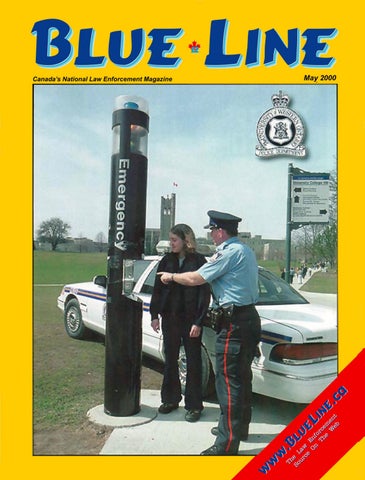
Volume 12 Number 5 May 2000 Blue Line Magazine 12A-4981 Hwy 7 East Suite 254 Markham, ON L3R 1N1
Phn: (905) 640-3048 Fax: (905) 640-7547 - Publisher Morley S. Lymburner E-mail: blueline@blueline.ca
Inside This Edition Publisher’s Commentary There’s a real gun problem in Canada
4
Correspondence Letters to the publisher
6
Just being there is what counts University of Western Ontario Police
7
Opportunities and Partnerships Deputy Chief Bob Kerr selected as Police Leader of the Year
11
- General Manager Mary Lymburner, M.Ed. E-mail: bluelinesales@home.com
Eliminating fear and myths 14 The Ontario Special Investigations Unit helps bring credibility and accountability
- Editor-In-Chief Blair McQuillan E-mail: bluelineeditor@home.com
Technology Lookout Windows — here comes Linux
18
Protect the keys to your digital castle Are passwords and encryption enough?
20
Most police news conferences aren’t very good by John Muldoon
24
Park wardens call for firearms Federal wardens say sidearms are needed to carry out day-to-day duties
28
Devotion to youngsters brings recognition to officer by Rob Mayea
30
Rage Cover - A low tech solution Use of force trainers are challenged to make training real and affordable
31
Blue Line Classified
32
Cyber cop catches criminals in real life and in fiction by Floyd Cowan
34
Van to put brakes on drunk drivers RIDE van presented to local police
37
The Back Of The Book Policing and politics - A bad mix by Robert Stevens
38
- Advertising Mary Lymburner Rhonda Shuker Bob Murray - Pre-press Production Del Wall - Staff Writer Les Linder - Contributing Editors Communication Skills Terry Barker Tactical Firearms Dave Brown Technology Tom Rataj Case Law Gino Arcaro Police Leadership Robert Lunney Blue Line Magazine is published monthly, September to June, by Blue Line Magazine Incorporated with a mailing address of: 12A - 4981 Hwy. 7 East, Ste. 254, Markham, Ontario, L3R 1N1. Individual magazines are $3.50 each. Subscriptions are $25.00 per year or $40.00 for 2 years. (US/Foreign - $50.00) All articles are protected by copyright. No part of this publication may be reproduced or transmitted in any form or by any means, electronic or mechanical, including photocopying and recording or by any information storage or retrieval system without permission from the publisher. Internet activity is monitored and use of material on the Internet is restricted. All material submitted for publication becomes the property of Blue Line Magazine unless other arrangements have been made with the publisher. The authors, advisors and Publisher accept no liability whatsoever for any injuries to persons or property resulting from the application or adoption of any of the procedures, tactics or considerations presented in this magazine. Readers are cautioned and advised that articles presented herein are edited and supplied for your personal awareness and should not be used for further action until appropriate advice and guidance is received from a supervisor, Crown Attorney or other person in authority. Established in 1988, Blue Line Magazine is an independent publication designed to inform, entertain, educate and upgrade the skills of those involved in the law enforcement profession. It has no direct control from a law enforcement agency and its opinions and articles do not necessarily reflect the opinions of any government, police, or law enforcement agency. Blue Line Magazine is a private venture and as such is not funded by any level of government agency, union or association. Printed in Canada by Garson Graphic Services Inc.
- AffiliationsInternational Association of Law Enforcement Planners Canadian Advertising Rates & Data International Police Association The Police Leadership Forum The Canadian Press Newswire Periodical Publishers Exchange
ISSN #0847 8538 Canada Post - Canadian Publications Mail Product Sales Agreement No. 176796 May 2000
The officers who serve with University of Western Ontario Police Department patrol a very unique beat. In this issue, Publisher Morley Lymburner has supplied a detailed article outlining their model of policing, their strong ties to the students they are sworn to protect and their innovative ideas in regards to police service delivery. Federal park wardens have been struggling with Parks Canada over the issue of sidearms. The wardens say they need them to perform their duties effectively. Parks Canada says they are not a necessity. Read the submission in this issue from Editor Blair McQuillan and decide for yourself. Can you imagine what it would be like to develop a software system that could help police agencies worldwide find serial criminals? Well wonder no more. Floyd Cowan provides us with a look inside the life of Det. Insp. Kim Rossmo, the officer who developed Geographic Profiling. When you’ve finished reading all of our regular news and features you will reach “The Back Of The Book”, a new regular column written by Robert Stevens. His opinions should ignite some debate around the coffee maker.
List of Advertisers Bell Mobility Blue Line Reading Library Canadian Body Armour Canadian Health Care Canadian Police College Can-Thai Consulting Cases Unlimited Constable Cigar Co Constable Todd Gray Crisis Prevention Institute Dalhousie University DavTech Analytical Services Federal Auction Service Gordon Contract Sales Henry’s Intelligent Detection System Identicator Laerdal Medical 3
15 39 17 29 21 26 30 32 18 37 19 25 11 22 32 7 10 33
Laser Labs Mega Tech Micro Video Pads Fitness & Supply Panasonic Canada Pearson Peacekeeping Centre Pelican Products PK Van Bodies Police Ordnance Rocky Shoes & Boots Safe Restraints Second Chance Body Armor Sirche Laboratories Stratagem Financial Services Tetragon Tasse Triform Business Systems Ltd Westervelt College XTE Custom Designed Outerwear Blue Line Magazine
15 8 31 31 5 27 2 28 13 40 34 6 35 36 13 23 16 21
There’s a real gun problem in Canada by Morley Lymburner We have a real problem in Canada and it is a gun problem. I am not talking about the gun registration thing or the issue of permitting more liberalized gun regulations. I have a problem with government agencies paranoia about giving peace officers firearms. If the argument goes that we have a safer country because of our strict gun controls then common sense will tell you that there should be no hesitation at all in permitting peace officers of all stripes the opportunity to carry firearms if they feel it is necessary. I, for one, would feel much better knowing that all peace officers can carry guns. In this edition the concept of Parks Canada wardens carrying sidearms is looked into by our Editor-in-Chief Blair McQuillan. The result of his investigation reveals a branch of government that refuses to see the true concerns. Is it another case of wilful blindness that reflects badly on the government’s concern for the safety of their own employees? Although the wardens are issued rifles they are not for self defence or apprehension of criminals. I can only assume that if a Park Warden feels too intimidated to approach a group of hunters armed with long-range, high powered, scoped rifles he should not do so. He should sim-
ply back-off and call the local police to go in first. It is only because of the unbelievable courage of these wardens that police agencies are not inundated with calls for assistance. This is a similar concern for transport inspectors who know only too well the problems they have and could have encountered in their day-to-day activities. Court sheriffs are routinely asked to go out and confront some of Canada’s most dangerous people on a daily basis. Some of these people would go to great lengths to stay away from court. Many municipal enforcement officers across the country are called upon to do things that would make the most hardened police officer have a serious second thought. This is complicated by the fact that they don’t even know what the criminal background is of the people they meet. Judges and Justices of the Peace sitting in courtrooms have recently had concerns about the lack of security in their courts. One Justice of the Peace told me that he had to take a person into custody himself for contempt and take him to an empty courthouse police office. He called to have a scout car attend and then found out there was an outstanding robbery warrant for the person.
Even Canada Customs has seen the absurdity of having their officers stare across the border at colleagues who carry firearms to protect themselves against Canadian visitors when they must face Americans coming into Canada unarmed. There should be one basic rule when it comes to arming peace officers in Canada. If they want it they get it. By default no peace officer in this country should have to justify why they need to carry a firearm. The onus should be completely on the government side to present a convincing argument why they should not. Even then it should be brought to a vote by the concerned officers and if the majority say yes - then guns they should get. If government agencies have concerns about the officer’s ability to carry a firearm then they have a problem that they must solve. Train them or get rid of them. In a country that values the lack of firearms in the hands of citizens there should be at least the expectation that any officer with authority to protect its citizens be given all the tools necessary to handle any situation. No peace officer should have to have any doubts about their training or equipment. If they do then they simply can not do their job as intended. It’s simple reality folks. Get with the program.
How come no police memorial announcements? As a police officer receiving Blue Line Magazine and reviewing your classified ads regarding important events, I am really surprised at what is missing. The Police Memorial Service for all officers across Canada has been recognized by the government and if you open a normal calendar, you will find the date highlighted. I have yet to see the event highlighted in Blue Line, which is available to all officers! The province of Ontario is gathering police officers across Ontario for a dedication of a police monument in Toronto on May 07th, 2000. No mention of that important event in the April edition. This message is more from curiosity of why a police centered medium is not promoting the purest of police events. I am presuming someone on staff knows that the Memorial Service exists! Pat Hayes Ottawa, Ontario Publisher’s Response You are the first person in 12 years of publishing who has ever asked this question. I have remained silent all these years waiting to see if anyone ever would. In response to your questions there is a certain element of tact that I should use. I guess the simplest answer would be to say May 2000
that if no one tells us about it we won’t be able to tell you about it. In other words, on an official level at least, we could say that we can’t read minds. The reality of this situation is sensitive in that, frankly, the organizers really don’t want our help. The essence of your letter is the main concern of ours and that is the phrase “the purest of police events.” Both the Ontario memorial and the National Memorial in Ottawa has been advised for many years now that if they want our assistance it will be given without cost, without hesitation, and with no strings attached. They have never asked for our help and by their silence we have taken the simple message to “butt-out”. Inspite of this it does not reduce our wish to help. The true answer to your question lays with the CACP, PAO and CPA. You can call them and ask them why Blue Line has never been asked to help. I am sure they each have a very rational and convincing statement that will satisfy you completely. It should be pointed out that these memorials are built for the living, not the dead. They are there to remind the living about the sacrifices of these officers and that sacrifices are continually being made for their benefit. Unfortunately they are also seen as a high profile lobby pressure tactic to gain advantages for the living. They get the sympathy of politicians and 4
the public toward causes of the police. On one hand this is good because it gets things changed that need to be changed. On another level it can be used to promote the image of leaders and organizations for their personal or organizational advantage. Regardless of all of the politics between Union and Management lobby groups we decided to stay out of the fray and let them have their limelight. When we made the offer to do whatever we could it was not for any recognition at all. We did not want to be placed on a pedestal or use it to further the name of Blue Line Magazine. We would simply be satisfied to place the promotional material in the book and leave it at that. We simply feel it would be our mandate to assist. While we are on the subject I might as well tell you a few other things we feel should happen. We still think the national monument should be on the front lawn of the Supreme Court of Canada and not in the back ally of parliament. On a personal level I sincerely believe that if any monument is true to its intent it will be erected without any organizational logos of any kind. It detracts from the true purpose of the monument. Unfortunately the dead are too often captive to the whims of the living. Enough said! Blue Line Magazine
I am a 25 year old daughter of a recently retired OPP detective. His name is Norm Brown. He has retired at the age of 53. I’ve never been more proud of anybody as I am of my father. Growing up with a father who was so well respected made me realize the importance of togetherness and brotherhood. I would like to submit something to your magazine, so I can let everyone know how much I love him and his family loves him. All the sacrifices he made for our family and himself to get where he is today have impacted me so much. I think that my dad would be very touched and surprised to find something written about him. He’s been through a lot and he’s seen even more. My father has been involved in the OPP from all levels. He started in uniform and only went up from there. He was involved in drugs, bikers, undercover, special projects etc. The list just goes on and on. Not to mention all the training courses he went on in Canada and the U.S. I just need to know if you can help me. My dad retired on December 31st, 1999 and his official retirement party was on March 26th, in Barrie, Ont. Is there is any way that I can voice my opinion on the man who not only gave me life but pointed me in the direction to go down the right path? I just want everyone to know what kind of man he is and all the accomplishments he’s made. Jody L. Cornelisse Publisher’s Response In responding to this letter I can at least fulfil a part of your wish by letting your letter be read by our readers. If it were only up to me and my heart I would welcome all requests such as yours. What I must consider when I read your material is what kind of precedent I am setting. There are a huge number of officers in this country who deserve recognition and I try my darndest to give it to them when the opportunity arises and if space permits. Unfortunately my limitations, as is the same for many aspects of life, are set by a balance of economics and opportunity. I think you have a very blessed father even without reading your story. He has the love and dedication of his family and there is no greater accomplishment in life than this. That, in itself, is something that will endure many generations and sustain your family long after the paper in all my magazines have been long forgotten and turned to dust. I take my greatest pride and pleasure in the love and respect of my wife and children. Your father has accomplished a great deal because he has the love and respect of not only his family but also, as witnessed by his retirement party, his co-workers . Thanks for thinking of Blue Line. May 2000
6
Blue Line Magazine
Just being there is what counts Officers of University of Western Ontario Police work in an environment of quiet confidence by Morley Lymburner “An exercise in herding kittens” would be a phrase not lost upon the members of the University of Western Ontario Police. Their serious work begins in September with the sudden influx of more than 30,000 students and for the next eight months the total focus of the 21-member force is to keep this large mass of energetic and enthusiastic young adults safe from harm. When first viewed the police station, housed in an ivy covered Neo-Gothic style stone building, is impressive and blends well with the image and community in which it is situated. Other than a simple back lit “Police” sign one would think it was just another facility of higher learning. And indeed behind its stoic walls one could say that it is precisely that. Every one who enters this structure comes out a little wiser. Whether it be legal advice or geographic directions, the lesson is learned. This is a serious police service with a clearly defined and sincere job to do. A View From The Ranks “I feel a great sense of fulfilment in the job I am doing here,” says Cst. Dan Maloney, a two year member and recently elected president of the police association. “I worked with the London Police Service for over 10 years and got to the point where I felt I was not quite achieving what I joined the department to do.” I met Maloney on the front step of the police station. Much like many police officers I have met, he stated he really had a need to help people on a one-to-one basis and to feel that he could really make a difference. “I really think we can fulfil true community-based policing principles in this environment and instill a positive attitude toward policing that will be mutually beneficial in the future.” It’s not that everything is perfect though. Maloney points out there a severe lack of personnel and a need for a significant wage increase from the top level of just over $40,000. Despite these shortcomings however, Maloney quickly adds that this campus is a wonderful environment to practice policing principles and even experiment with newer and more innovative methods of policing. “I feel our true function is to act as a buffer between the larger community of London and these students as well as a buffer between the university administration and the students. A lot of what we do here is simply providing a communication conduit between all these different levels. Knowing I can provide this service gives me a great feeling of accomplishment.” May 2000
MEET AND GREET: A Western University officer and student talk on campus grounds. A View From The Top Accomplishment is also something felt by Insp. Bob Earle, the university’s top cop. As the manager of police services and a member of the force for more than 16 years, he has come a long way in his personal journey to protect the interests of everyone attending the university. Earle is the first manager of the department that has come through the ranks to take on the
7
top job. A graduate of Fanshawe College’s Law and Security program, he got his first opportunity through an acquaintance while serving in the Military Reserve. His friend was the director of the former University Security and Traffic Services, and he offered Earle a job with the department. “I originally thought it was a humble beginning for an aspiring police officer but it was a job related to my training so I was happy to take the challenge.” Earle said he was initially unimpressed with the duties and found himself surrounded by much older co-workers with a custodial attitude. “Over the years, I discovered that we’re really performing two functions. “We had the security function, which dealt with perimeter controls and property protection, and we had the policing function which deals primarily with people protection and personal assistance. “Although there is some crossover in duties and responsibilities, the basic approach to these two forms of protection are best addressed by people who specialize in these respective areas.” Earle says the change in designation which occurred in 1985 resulted in a change in priority from property protection to personal safety. In 1985 the University Security Service was re-aligned to a “police service”. This change was further formalized in 1991 with a policing agreement between the University’s Board of Governors and the London Police Services Board. Its members are sworn in as special constables with police authority under Section 53.3 Continued on page 9
Blue Line Magazine
of the Ontario Police Services Act and operate under the authority of the London Police Services Board. The department is responsible to the London chief and police services board on all policing matters on the campus. Although this section of the legislation deals with the authority of the officers it does little else with regard to setting standards or discipline issues. These issues are dealt with through university policy and through London Police Service policy and procedure. The special constable status gives each officer all the powers, responsibilities and privileges of a police officer with regard to the people and properties of the university while citizen powers of arrest exist outside the university grounds. The officers presently carry lower level force options, but no firearms. There is a very close affiliation with the London Police Service. The reporting, documenting and investigation of incidents requires a partnership which includes not only administrative support, but also operational planning, training and even the sharing of intelligence through the London Police Strategic Intelligence Advisory Committee, which includes members of the university police. “This partnership has proven beneficial to both the London police and the university as it has developed and grown over the years. I feel we have the greatest of support from the London police from the patrol level right up to the chief’s office,” Earle remarked. An incident occurred several years back which encouraged the issuance of concealed body armour. An officer on patrol at night observed a car driving erratically. The vehicle was pulled over and the female driver acknowledged her inattention due to a dispute she was having with the male passenger. The motorist was cautioned and let go. Several hours later the officer found the male passenger face down on the side of the road with five bullet holes in his head. The woman was arrested sometime later in another part of the city by London police.
WESTERN’S TOP COP: Insp. Bob Earle
The campus police soon began evaluating their personal safety. Most felt that body armour would be a good compromise to carrying firearms and the university agreed to supply them. Earle agrees with Maloney that his officers are of at least the same calibre as any police service and the pay should reflect this. He also feels the need to have an increase in strength. “Due to shortages of personnel we are quite often deprived of the ability to send officers away for training and upgrading skills. If an officer reports off sick we sometimes find ourselves hard-pressed to fill the gap,” Earle explains. Acquiring officers is complicated by the fact that they cannot always afford the financial cost and downtime to send new officers off to police college so higher wages are necessary to attract already trained applicants. “It’s quite a circle of supply and demand,” Earl states. Two issues that are of particular concern to police are the 2001 Canada Summer Games which will be hosted at the University of Western Ontario and the expected 25 per cent increase in students around the year 2003. Ontario secondary schools are undergoing the elimination of the fifth year, known as grade 13 or OAC. As a result, 2003 will see two graduating classes. Universities across the province are gearing up for the challenge and campus police are trying to sell the idea that they too will need proportional increases. “It’s difficult to sell this idea to the top levels BUILDING BRIDGES: Police officers work hard to develop a of universities though,” positive rapport with the students they are sworn to protect. says Earle. “We gauge our May 2000
9
success by the lack of problems. In this respect we are constantly disadvantaged by a position of statistical weakness. “We are competing with other administrative units on campus who are also in need of augmentation and priorities are determined by the administration. People have a hard time relating lower crime levels with good levels of police coverage.” Thankfully, coverage is not an issue with the radio system. The police communications system is a good one with each of the two scout cars and foot patrol officers capable of on-campus communication and live patch-in capabilities with the London Police Service and London Fire Department in emergencies. They also have 24-hour dispatchers available to assist in coordinating response to emergencies. Earle points out that this form of policing is not for everyone. “We aren’t looking for cowboy sherrifs or two-fisted crime fighters. We need officers with a professional attitude that can come across with a good level of communication. After all, we must deal on a daily basis with an intellectual community and some officers simply cannot cope with this style,” Earle concludes. If there was ever a place where tolerance and discretion was an important part of police work it is most certainly here. When speaking to many officers this message comes across quite clearly. Each officer understands that indiscretions committed by a very few students should not mark their entire lives and futures. Earle points out that an unyielding, enforcement oriented police officer would not last long in this environment. “We need mature thinking officers who understand young people and the circumstances they find themselves in when they come here,” Earle concludes. “When we hire a new officer it takes quite a bit of time for them to adjust. Respect is something that is never automatically given. It is definitely earned on this department.” Students are also introduced to the idea of becoming volunteers in the 800-member Western Foot Patrol Program or as part of Event Security and Student Parking Enforcement teams that watch over fellow students and campus activities by providing peer influence to keep order. “Having this opportunity open to them also introduces responsibilities that carry over into the students future lifestyle in the outside communities to which they will later be moving,” Earle said. “It is an aspect of police work that almost turns each of our officers into teachers.” Prevention, Education and Peer Influences Theft on campus is one of the bigger problems the police service deals with. The police make a concerted effort each fall to give lectures and classes to incoming students on proContinued on page 10 Blue Line Magazine
tecting themselves and their property. The training sessions also create an atmosphere of formal introduction to the campus police. “I am sensitive to the fact that we have a student population that is very vulnerable,” states Cst. Wendy McGowan, a 12 year career officer. “Most are away from home for the first time in their lives. They are out of the reach and sight of their parents and they all react a little differently to this new environment. In many ways we act as surrogate parents.” One popular university police prevention program that responds to the concerns shared by most universities and colleges is the Responsible Drinking program offered to over 5,800 students in the on-campus residences. McGowan states, “A number of students over the years have commented that they feel they are being responsible because they don’t drive when they drink even though their drinking practices are risky.” McGowan teams up with a counsellor from Alcohol and Drug Services of Thames Valley
to present this interaccorner of the police tive program that station to see an ofidentifies the risks, ficer assisting a studemonstrates how dent by putting air in similar amounts of althe tires of her bicycohol affect people cle. The student apdifferently based on peared very young their body size and and had no idea how gender as well as proto do it. vide strategies to enThere was sudcourage lower risk denly no question of drinking. KEEPING PACE: A solid dispatch system the sincerity of what I As I left the front allows cops to keep up with calls for service. had heard. Lessons door of the police staare really being taught tion a fleeting thought here. A special rapport about the sincerity of what I had heard came to has obviously been developed between the stumind. They seem to have the right words and dents and police officers on this campus. concepts. As I raised my camera to take a picture the I had spoken to the union leader, the po- officer raised her hand and objected. lice leader and two rank-and-file officers. They “No way!” she smiled. “I’m just doing my are either well rehearsed or sincere in their job. I don’t want any pictures in any magazine.” mission. How does one really know for sure? I lowered my camera... but this instantly As I walked toward my car I looked to the removed all doubts about sincerity.
Confidence in security creates a positive environment for learning by Kathryn Lymburner Due to the large numbers of people who attend them and the concentrated area in which they live, universities are the prime target for all types of criminal activity. Since many of these students come from small or rural communities, they often treat the school situation like their small, honest and trusting community back home, making themselves easy prey for professional criminals. The University of Western Ontario has identified this problem and taken measures to ensure the continued safety of their students. Two of these measures are the student volunteer run Foot Patrol or Walk Home program and the Student Emergency Response Teams (SERT). Since January 1989, the university community has been served by student volunteer
May 2000
THE PLAN: Volunteers help with events. foot patrols which help ensure that the campus is safe for all. They do this by providing the existing university police department with highly-visible patrols of the university and its affiliated Colleges, as well as providing safe
10
escorts from any university or affiliated College campus location. Since the start of this program in 1989, crime rates have dropped 40 per cent and more than 30,000 safe escorts have been provided. The average waiting time for a co-ed patrol team to meet a caller at their location, is six to eight minutes. They will wait with the caller until their bus has arrived, or their car has started, to ensure the caller’s total safety. This volunteer organization is trained each year on campus crime, technicalities concerning response to criminal incidents, situational judgment, and sexual assault. Each volunteer is carefully screened, trained, and equipped with a two-way radio that gives direct contact with the police. The University of Western Ontario is also equipped with 13 Campus Emergency Phones located throughout the main campus. This hands free direct line allows for anyone on campus to receive emergency help. These posts are equipped with blue strobe lights that are activated when the call button is pressed, allowing Emergency Personnel in the area to quickly identify the caller’s location. The post/phone also sends a location signal to the Campus Emergency Centre to aid personnel in locating the call. If the caller is unable to identify themselves, or the situation, a police officer is dispatched to the location of the call. This service also allows for direct connection to university operators. There are also a number of exterior cameras that monitor and zoom into areas of concern. The Student Emergency Response Team was founded in 1989 by Robert Garland, a Western University student. SERT provides their services during homecoming, football events, orientation week, convocation, Special Olympics and many other charity events that take place on campus. SERT also provides a free mass CPR training session, the first of its kind. This initiative, known as Project Aware, takes place every March and certifies approximately 400 people. Blue Line Magazine
Opportunities and Partnerships
ADVERTISEMENT
Deputy Chief Bob Kerr selected as Police Leader of the Year by Jon Schmidt Over the last 34 years, through his vision and determination, Deputy Chief Robert Kerr has identified and actively pursued the implementation of positive change. His support for community policing, both professionally and personally, has not faltered. Kerr changed the course of the deteriorating Jane and Finch community by implementing community policing between 1985 and 1988. He has partnered with colleges and universities, sat on advisory boards and lectured on the principles of community policing throughout Canada and abroad. This commitment has helped to mould the principles of community policing as it is practiced today. With a police career spanning over three decades, Kerr has witnessed many changes to policing. He has recognized that as an institution, policing is often resistant to change. However, he personally cultivated a visionary approach to meeting the changing needs of Toronto. Within the organization, Kerr A TRUE LEADER: Deputy Chief Kerr has worked practiced community policing before to develop strong ties with the city’s communities. it was formally given a name. He has always believed that people deserved consideration and that consideration extends must be accountable. He appreciates the need beyond responding to the radio and taking an for independent review and has demonstrated occurrence. He has always believed in follow- his commitment through his ongoing support ing up with his victims and ensuring their needs for the Special Investigations Unit (SIU). The SIU is a civilian body charged with the responwere attended to. Kerr used his experience and influence to sibility of investigating injury or death resultfurther develop how services were delivered ing from police action. The SIU published Kerr’s expectations of and directed initiatives that led to a total reSIU investigators. These 13 points now serve structuring of the Toronto Police Service. He realized community members had to be as a constant reminder of the standards that more involved with their police and that they members of the SIU seek to achieve. Early in his career, Kerr knew that an indicould find strategies to deal with their probvidual could not change an entire Service’s lems by getting involved. His ultimate goal was perspective or position on how to best deliver to reduce crime and the fear of crime. In 1985, Kerr took over as Unit Com- services. He realized that changes had to be mander of 31 Division and was responsible for made to the police infrastructure to ensure that policing the Jane and Finch area of Toronto. community policing was successful. In 1983, This area was both ethnically diverse and Kerr chaired the Promotional Task Team, which plagued with violent crime. Kerr created a com- reviewed and revamped the entire promotional mittee comprised of community members and process. Kerr wanted to ensure that officers were the police. He developed partnerships in the community and enhanced the trust between the given the opportunity to expand their experiences. He went on to pursue the implementapolice and residents. In a study conducted at 31 Division, Kerr tion of a process to ensure that both new and was credited with getting community officers seasoned officers had the opportunity to expemore involved in their communities and en- rience different aspects of police work. There were two entry levels: level one for hancing rapport between the police and the community. Residents reported that foot patrol those entering the program for training purofficers were more visible and were seen to be poses and level two for more experienced oftaking action to remedy their problems. Local ficers. Level one of the program trained officers merchants were quoted as saying the area had to interact with members of the public and perimproved 1,000 per cent. Kerr has always believed that in order to Continued on page 12 maintain the respect of the public, the police May 2000
11
Blue Line Magazine
form investigative assignments. This experience better prepared officers for front-line duties and gave them experience needed to pursue long-term commitments. Over the years, Kerr addressed infrastructure issues within the Toronto Police Service to further the advancement of community policing. However, in 1994, he faced his biggest challenge; he led the Toronto Police Service’s restructuring initiative. The outcome of the initiative was a detailed report that provided the Service with a blueprint for the organizational change necessary to realize its vision of community policing. Findings were based on a wide range of research, consultations, and general analyses made by Kerr and members of his team. The report included recommendations for changes to the Service’s priorities, organization structure, service delivery, and support systems. This report was to bring the organization closer to Kerr’s vision of community policing. Although difficult, Kerr marketed and supported the new ideas and processes whenever he had the opportunity. The result was that the report and all 122 recommendations were accepted by the Police Service and by the police services board. As was indicated earlier, Kerr volunteered to lead the Service’s restructuring initiative. His mandate was specific: to pursue recommendations to better position the police service to deliver community policing; but, the task was far reaching. It involved the need to identify and recommend full scale organizational change that impacted on issues affecting public accountability, span of control, organizational and divisional structures, service delivery and technology. To accomplish his goals of better positioning the Service to deliver community policing, Kerr had to put together a team with diverse
experience and responsibilities. He had to work with his team, the public, the police association and members of the service. He ensured that several different communication media were used to keep people informed of what was happening. This initiative resulted in the acceptance of new organizational and divisional structures. It formalized and included community police liaison committees at the command and divisional levels. His restructuring initiative resulted in 40 per cent fewer senior officer positions and more officers dedicated to community response.
cilities will always be nearby; and community organizations want to ensure that their neighborhoods are kept intact. The purpose for redrawing police divisional boundaries is to enhance service and to ensure that communities are policed by one division. In order to help gain community buy-in and unit commander support for the redrawing of police divisional boundaries, Kerr implemented the most extensive consultation process ever undertaken by the Toronto Police Service. The new divisional boundaries were accepted by the service and were received by members of the Police Services Board at their meeting in December 1999. Members of the public will have one last opportunity to comment on the changes before the final proposal is submitted for implementation. Kerr is currently the Deputy Chief of Area Field Command. This command encompasses a total of nine divisions. He provides leadership, guidance and direction for the policing of the different neighborhoods that make up Area Field Command. Kerr has created a number of initiatives with a view towards improving communication, consultation, and input from stakeholders to improve service delivery within his command. The most important asset to any society is its young people; therefore, their security and development must be assured. Area Field Command has become a partner in the Scarborough Children’s Safety Village project. The village is aimed at educating school children on safety issues. This project involves bringing together segments of the community to provide guidance and direction. Kerr is also coordinating plans to develop a similar village at a second location within Area Field Command. Recognizing the personnel constraints placed upon the Toronto Police Service in recent years, Kerr set out to define standard guidelines for primary response units within each of his nine divisions. These guidelines were used by each division to create a divisional baseline standards policy. The new policy defines the suggested number of officers assigned to work emergency response on each shift at each division. The baseline standards policies were created with input from all ranks, as well as from the community. In November 1999, Kerr created the Command’s First Crime Conference, held at B’Nai Brith Canada. The conference was designed to bring together a cross-section of members from across the command in a forum to discuss crime and quality of life issues. Participants came away from the conference with a better understanding of how other divisions within Area Field Command were dealing with crime related issues.
“Kerr has always believed that in order to maintain the respect of the public, the police must be accountable.” Kerr was able to identify trends and keep everyone informed of the changes necessary to address them. He was able to effect change and gain the support of those affected by that change. Kerr then assumed responsibility for the implementation of the restructuring recommendations. Kerr is also leading the Service’s initiative to redraw police divisional boundaries to make community policing more effective. This is a difficult undertaking. Police boundaries were drawn in Toronto in 1963. With the exception of one or two minor amendments, they have not changed. Changing policing boundaries is difficult because there are many different organizations that interact with the police for different reasons and their interests are not always similar. Politicians would like police boundaries to mirror political boundaries; business organizations want up-front guarantees that police fa-
Deal struck in academy lawsuit Prince Edward Island and the Atlantic Police Academy dropped a lawsuit in March against Nova Scotia for breaking a deal to train the province’s police cadets. Documents filed in Nova Scotia Supreme Court indicated both parties had reached an agreement in the suit, which also named the Halifax Regional Municipality and Robert Barss, the province’s former executive director of police and public safety. The lawsuit was filed by P.E.I and Holland College in August 1998. The plaintiffs alleged the defendants breached an agreement between the Atlantic provinces to train cadets at the police academy in Charlottetown. The Halifax Regional Municipality claimed it was not under any legal obligaMay 2000
tion to send cadets to the academy. The lawsuit also alleged Barss made false statements to the media which undermined the academy’s reputation and business. Both Barss and the province denied those allegations. In 1972, the academy was set up to train recruits and police officers from Nova Scotia, P.E.I and New Brunswick. Newfoundland joined the group in 1983. Nova Scotia ended the tradition of sending recruits to the academy about two years ago. The former provincial government planned to establish a permanent academy, but the decision was put on hold pending the outcome of the lawsuit. 12
Blue Line Magazine
Kerr makes a point of attending platoon College, C.O. Bick College, and by coach ofmeetings and communicating his high stand- ficers at the divisions. ards to ensure all members understand his manThe evaluation included agement style and philosophies. anonymous surveys, interviews, Kerr was concerned with the data collection, and a review of way discipline matters were hanrecruit records. The surveys indidled in his command. Among memcated some dissatisfaction with the bers, there had also been a perceptraining being received at all levtion of unfairness, inequity, and a els. lack of standardization in matters There were also some concerns of discipline at the divisional and about the quality of coach officers service level. who were being assigned to train Kerr set out to resolve this isour recruits. sue. He met with his senior officKerr is committed to improvers and a cross section of person- AT WORK: Kerr ing the level of training being renel from the command and outlined takes part in recent ceived by recruits and has exhis concerns and the need for a police board meeting at headquarters. panded the evaluation to compile standardized policy. appropriate recommendations. Standardization was required These recommendations will to ensure trust in the discipline system and to be shared with the two police colleges and the provide a documented standard for the comunit commanders in Area Field Command. mand. Community policing is all about having As a result, he developed a policy ensuring that discipline was applied in a fair, equita- people and their communities working together ble, and consistent manner. The development with police to achieve a safe and comfortable of the policy was well received and did not meet place to live. It takes a true leader to make community policing, growth, and development in with any implementation obstacles. In 1984, Kerr established a partnership with policing a reality. Ryerson Polytechnical Institute. The purpose of the partnership was to develop a certificate For information regarding nominations for program and an advanced certificate program the Police Leader of the year or for memin management. The partnership created an bership in the Police Leadership Forum call: opportunity for Kerr and for members of the 613 998-0793 or Fax: 613 990-9738. university to share experiences and learn from one another. He appreciated this interaction and wanted to do more. In 1990, he partnered with Humber College to join their advisory board for the Faculty of Law and Security. This again was an opportunity for Kerr to become involved in an exercise that would allow organizations to exchange ideas. Kerr then passed on this learning opportunity and partnership to other officers. He has traveled as far as Sao Paulo, Brazil to deliver his message and discuss community policing. Under Kerr’s direction, in September 1998, an audit of the restructuring recommendations was submitted to the police services board. It indicated that about 72 per cent of the 348 recommendations were implemented and that many others were in the process of being implemented. To date, approximately 80 per cent of the recommendations are implemented and many of the longer-term recommendations are still being pursued. The audit report said many of the recommendations dictated better use of policing resources. Many recommendations were also made to address increased training for all members and how to utilize each member to their full potential. By identifying community expectations of the police, the service can begin to help develop the skills needed to address what the community needs. Kerr directed that an evaluation be conducted to determine the quality of training being received by recruits at the Ontario Police May 2000
13
Blue Line Magazine
Eliminating fears and myths The Ontario Special Investigations Unit helps bring credibility and accountability to policing It is 3:30 a.m. in an Ontario town. A man lies unconscious on the street beside the open door of his vehicle. Blood seeps from a gunshot wound in his abdomen. He has been shot by a police officer during a high-risk take-down following a pursuit through downtown streets. Three police cruisers have boxed his vehicle inside a tight triangle. As the man is placed into a waiting ambulance, the three officers from the municipal police service who were involved in the pursuit are sitting in separate marked police cruisers. A senior commander is being briefed by one of the senior officers at the scene. In his capacity as the police service’s Special Investigations Unit (SIU) liaison, the commander will be the first to contact one of the SIU’s Investigative Supervisors to report the incident and provide the details. A similar sequence of events will be repeated dozens of times across Ontario throughout the year. As set out in Ontario Regulation 673/98 enacted under the Police Services Act, the SIU must be notified immediately by the police service if a police-related incident results in death or serious injury. Incidents range from firearm, vehicular and custody injuries or deaths to allegations of sexual assault. Ontario is the only Canadian province with an independent civilian agency possessing full powers and authority to investigate and, where the evidence warrants, charge police officers with a criminal offence. However, the results in the majority of SIU investigations serve to assure the community that the conduct of the police has been carefully scrutinized and that there was no evidence of criminal activity on
May 2000
ON THE SCENE: SIU investigators get down to work at a crash site following a pursuit. the part of the officers involved. The SIU’s jurisdiction extends to all 72 municipal police services and the Ontario Provincial Police (OPP) totalling approximately 30,000 sworn police officers. During the ten years of the SIU’s existence there has been much debate and controversy surrounding the operations of the Unit. Prior to its formation, incidents in which members of the public were killed or seriously injured in circumstances involving police officers were investigated internally by the involved police service or by members of an outside police service brought in to conduct the investigation. Alarmed by several high profile police shootings during the 1980’s, some members of the public questioned the integrity and credibility of a process in which the police investigated themselves. Ontario residents expressed
14
a strong belief that such internal investigations lacked the necessary objectivity required for fair and impartial scrutiny of police conduct. This public perception and the Ontario Government’s reaction in putting in place an oversight mechanism is clearly part of a world wide trend; for example, approximately 125 organizations from other jurisdictions around the world are represented in the International Association for Civilian Oversight of Law Enforcement (IACOLE). The Canadian Association for Civilian Oversight of Law Enforcement (CACOLE) has over 35 member organizations. Ontario’s SIU was born out of a recommendation to the government from the Task Force on Race Relations and Policing in 1988 following province-wide hearings. The Task Force recommended the government create an investigative body that would independently investigate police shootings throughout the province and that, where warranted, would have the authority to lay criminal charges. In August, 1990, section 113 Part VII of the Police Services Act, which established the SIU and defined its jurisdiction, was proclaimed in force. The Unit began operations in September, 1990. Originally reporting to the Solicitor General, in 1993 the Unit was made an arms-length agency reporting to the Attorney General. While some members of the policing community welcome the opportunity to have investigations conducted by an independent outside body, there remains in some circles an innate distrust of “outsiders” questioning the actions of police officers. This area of contention, particularly in the early years of the SIU, was further exacerbated by inadequate funding and the lack of a definition for the “duty to cooperate” imposed on members of police services by the enacting legislation. On January 1, 1999 after several turbulent Blue Line Magazine
years that saw the appointment of nine SIU diMedia Releases rectors (five of them in an “acting” capacity), By the very nature of its mandate an SIU the Ontario government appointed the Unit’s investigation generates a great deal of media tenth director, Peter A. Tinsley, a defence coun- attention. The incidents which fall under the sel and a retired military lawyer. For the first SIU’s jurisdiction often attract sensational metime in the SIU’s history a director would have dia coverage, community concern and controa five-year tenure. Armed with new legal rules versy. A police service whose officers are unin the form of Regulation 673/98 which de- der scrutiny is anxious to make some public fined, among other things, the “duty to coop- comment regarding the incident. erate,” and a substanSection 12 of tially increased budget Regulation 673/98 “There remains in some of $5.1 million, the SIU states that no informawas now equipped to circles an innate distrust of tion concerning the input in place long- ‘outsiders’ questioning the cident can be disclosed needed assets including the police service actions of police officers.” by more investigators, a while the SIU investihighly-equipped forengation is ongoing. sic identification facility, as well as other inOn the SIU side of this issue, section 13 of vestigative equipment and continual profes- the Regulation also imposes the same restricsional development training. tions on the Unit. The SIU cannot disclose any Regulation 673/98 was based on the com- information to the public unless the statement prehensive recommendations provided by the is aimed at preserving the integrity of the inHon. George Adams in his 1998 report to On- vestigation. tario’s Attorney General and Solicitor General Sections 12 and 13 of Regulation 673/98 following an exhaustive 18-month consultation reflect some concerns expressed during the process with communities province-wide, polic- Adams Consultation of outspoken partisanship ing groups and the SIU. A well-respected expert in the media. Clearly, the integrity of the inin mediation and a former superior court judge, vestigative process should not be compromised the Hon. George Adams was charged by the pro- by public statements which could be perceived vincial government with finding consensus on as biased. Moreover, such activities by public some of the most troublesome issues between the agencies detract from public perception and police and the SIU during investigations. At the confidence. Consequently, the described limconclusion of his consultative process he authored its were put into the Regulation in sections 12 25 recommendations most of which were put into and 13. Continued on page 16 law under Regulation 673/98.
May 2000
15
Blue Line Magazine
In an effort to address some police chiefs’ concerns at being unable to publicly voice support for their officers, Director Tinsley issued a letter in June 1999 addressed to all Ontario Chiefs of Police and the OPP Commissioner. In it he reasoned that in order to satisfy the public’s right to know and relieve the pressure from the media, a police service (if it so desires) could issue a brief, neutral statement providing sufficient information concerning the incident to identify it and to allow the public to understand why the SIU was called in. Thereafter, any further statements concerning the investigation would come from the Unit. This approach he believed, would not be in breach of Regulation 673/98. Duty To Co-operate In the past, a hotly debated issue was the police officers’ duty to cooperate during an SIU investigation. Driven by misinformation that the Unit was on a crusade to persecute police officers, it was not uncommon for some officers to delay, and in some cases, refuse to provide a statement to investigators. On at least one occasion a media frenzy erupted when officers disobeyed a direct order from their Chief to provide statements to SIU investigators. Regulation 673/98 largely succeeded in silencing this protracted debate by setting down in law the obligations and duties of police officers during SIU investigations. All police officers involved in an SIU investigation and designated either as a “subject officer” or a “witness officer” are entitled to
THE WORK: Police and SIU investigators. legal counsel. Regulation 673/98 defines “subject” officers as officers whose conduct appears to have caused the death or injury under investigation. These officers do not have to submit to an interview, nor, do they have to provide their notes to the SIU. The “witness officers” defined as officers who are involved in the incident but who were not directly responsible for the injury or death under investigation - are required to answer all questions by the SIU and have their notes completed and turned over to the SIU within 24 hours after a request has been made. By virtue of Regulation 673/98, and a companion Ministerial Directive issued to Crown Attorneys in the province by the Attorney General, “witness officers” are accorded substantial protections in respect of the statements they provide the SIU. Essentially, these statements cannot be used to incriminate them in any future proceedings related to the investigation.
Westervelt College Excellence in Education Since 1885
WESTERVELT Now Call nrol To E
Police Foundations Training delivered in an intense one-year “Police Academy” environment Advanced status available to those with: • 1 or 2 years Law and Security • 1 or more years University • Career related experience Westervelt College 1060 Wellington Road London Ontario N6E 3W5 1-877-668-2001 (519) 668-2000
Teaching tomorrow’s professionals, today!
Toll Free May 2000
16
Qualified Investigators The SIU has often been criticized regarding the quality of its investigators. During the renewal of the SIU, which commenced in 1999, hiring practices for SIU employees have evolved into a highly competitive and demanding procedure. During the most recent hiring process, the Unit received over 1,800 applications for available investigator positions. Of that number, 20 individuals passed the rigorous selection process and were sworn in on January 21, 2000. The current composition of the Unit’s investigative arm is comprised of former police officers including highly respected criminal investigators, traffic reconstructionists and forensic identification officers from many municipal services, the OPP and the RCMP. Safeguarding the Unit’s requirements of excellence, the Unit also employs individuals with a non-policing background who bring to the Unit unique academic qualifications as well as investigative experience in fields such as Labour, Corrections and Immigration. They provide a necessary balance in keeping with the public’s demand for impartiality. A Training Coordinator ensures investigator training is ongoing and current through both in-house indoctrination and external professional development courses at institutions including the Canadian Police College and the Ontario Police College. Given the focus and specific nature of SIUmandated incidents, investigators’ interview-
Quebec police avoid charges Provincial police officers will not face criminal charges in connection with a protest during a Parti Quebecois political rally last fall. About 200 officers took part in a protest on Sept. 25 in Drummondville, Que. The officers were angry over stalled contract talks with the government. Five uniformed and armed officers joined the protest after removing their badges. The protest fell apart when Quebec’s Justice Minister arrived and her bodyguard was pinned against her limousine. Crown counsel Eric Simard said a judge would be unable to identify the officers beyond a reasonable doubt. “If they had kept their badges on, it would certainly have caught the eye of witnesses,” Simard was quoted as saying. Capt. Michel Martin, a provincial police spokesman, said officers are required to wear their badges when on duty. The officers may face disciplinary action. Four days following the protest, provincial police were prohibited from taking part in any public demonstration while armed and wearing uniforms. Blue Line Magazine
ing and analytical skills are effectively better honed than most. Positive changes In spite of the positive changes and improvements, there are those who continue to wage a battle on issues that have become irrelevant and outdated. Although the SIU’s commitment in finding common ground to establish better communication and discussion of contentious issues with policing and community groups continues, it remains a source of frustration to hear the Unit accused of being “anti-police.” There is never an assumption on the part of any member of the Unit at the start of an investigation that a criminal offence has been committed. Such an irresponsible attitude would not survive the intense scrutiny SIU in-
vestigations generate from the media and the police. If charges are laid at the conclusion of an investigation it is based solely on the evidence. With charges averaging less than three per cent per year, the Unit can hardly be described as on a campaign to persecute police officers. It is far more constructive to regard the work of the SIU for what it is really meant to be - reinforcing good policing and enhancing community confidence in the police. In a global climate that demands increased accountability from their police officers, jurisdictions across Canada and other countries are closely observing Ontario’s Special Investigation Unit model. In the past year both Brazil and Britain have made specific enquires concerning the structure and operation of the Unit. In November 1999, Director Tinsley was invited by
the Brazilian government to attend the First International Brazil-Canada Police Oversight Conference. Civilian oversight of police is not a fad nor is it a whim of special interest groups. It is the right of any democratic society to have confidence in the work and decisions of their police service on whom they place an immeasurable responsibility. The Hon. George Adams captured this reality best when he described the SIU as “a bulwark of democracy.” Gail Scala is the communications officer for the Ontario Special Investigations Unit. She may be contacted at 1-800 7878529 or 416 314-2915 or via email at enq@siu.on.ca. You can also check out their web page at www.siu.on.ca.
Words to live by In an address to the new investigators for the Special Investigations Unit, Deputy Chief Bob Kerr presented thirteen points of expectations he had for each of them. • I expect you to have the investigative skills to conduct a thorough and comprehensive investigation. • I expect you to follow the established rules and regulations and internal policies. • I expect you to set aside your personal biases and conduct an impartial and independent investigation. • I expect you to treat involved officers with respect. • When possible I ask that you explain to the involved officers why you are doing what you are doing. • I expect you to be sensitive to the fact that the involved officers have just experienced a very traumatic experience. • I expect you to conduct a speedy investigation whenever possible. • I expect you to treat the involved officers the way you would expect to be treated. • I expect you to do your job to the best of your abilities. • I expect you to do everything possible to improve the working relationship between your Agency and the Police Services of Ontario. • I expect you to challenge police agencies who are not co-operating to do so. • I expect you to report to the respective Police Services Board those Chiefs of Police that are not making the effort to ensure their members are complying with the Police Services Act; or any other agreement. SIU Director Peter Tinsley was so impressed with these points he put them into the training material for all investigators. May 2000
17
Blue Line Magazine
Lookout Windows — here comes Linux by Tom Rataj
The release of Corel’s distribution of the Linux operating system marks a major milestone
Despite Microsoft’s apparent unbeatable domination of the desktop personal computer operating system and office suites market, this real competitor has quietly been building momentum. First created shortly after the initial version of Windows itself, the Linux operating system has until the past two years or so, remained a curiosity and a high-tech play-thing for computer programmers and hobbyists worldwide. First developed in the spring of 1991, the foundation of the Linux operating system is the product of then 21-year-old Helsinki University student Linus Torvalds. It was the result of his computer studies into the UNIX operating system, a commercial computer operating system often used in university and corporate environments. In September 1991, he released version 0.01 of the Linux kernel (the core of the operating system) into the public domain, where other computer programmers were encouraged
LIMITED EDITION PRINTS RCMP “A” Div. ERT
Limited edition prints in pencil done for the “A” Division RCMP Emergency Response Team by artist Todd Gray $20.00 (includes shipping handling & taxes) Send cheque or money order and quantity to: Todd Gray 1426 St. Joseph Blvd. Gloucester, ON K1A 0R2 May 2000
to experiment with it. Linus Torvalds then became the driving force and contact person behind the development of this completely free operating system. What most notably sets Linux apart from Microsoft Windows and various other operating systems is the fact that it is totally free. Not only is the source-code (the human readable computer coding) freely available, but the final product is also free. This allows programmers to see how Linux is built, and allows them to make changes and improvements to it. What really makes this unique, is that the source-code for most programs is normally a closely guarded corporate secret. In addition to Linux itself, major applications such as WordPerfect and Netscape are also available for free over the Internet or at a nominal cost for a CD-ROM copy. While not available in the same quantity and variety as Windows software, there are Linux programs available to do just about everything. Linux has always been freely available over the Internet through numerous sites. In the past few years a few small but dedicated companies have also assembled distributions of it and sold them at the retail level for around $50. These distributions often included simplified installation programs, various utilities and a variety of “Windows-like” front ends that made it easier to use. Corel Takes The Lead In a bold business move, Canada’s own Corel Corporation ventured forth into the Linux market by developing and releasing its own distribution, making it the first big corporation to do so. Corel apparently decided that the Linux market presented a viable future business proposition. Initially it tested the Linux waters 18
with a free downloadable Linux version of WordPerfect 8, which proved to be a huge success. Serious work then began on Corel’s own distribution of Linux. Shortly after its November 1999 release, the Corel distribution of Linux was selected by CNET as the best Linux distribution available, just ahead of the previous leaders, Red Hat 6.1 Deluxe and Caldera OpenLinux 2.3. Corel Linux was praised for its ease of use, strong support, superior documentation and easy installation. By mid-December 1999, over 86,000 copies of Corel Linux were downloaded from the CNET download site (download.com) alone, followed closely by tens of thousands of downloads of WordPerfect 8 for Linux Personal Edition. A free downloadable version of Corel Linux OS is available directly through www.corel.com and several other sites. The full retail versions are available in a standard edition ($49.99) and a deluxe edition ($99.99). Until June 30, 2000 there is a $10 cash-back offer on both retail packages. Corel recently released both standard and deluxe versions of WordPerfect Office 2000 for Linux, thereby making Linux a legitimate contender in the office environment. Since the initial release of Corel Linux, Corel has moved forward with updated software components, preliminary USB support, new hardware and software drivers, and improved support during the installation process. Not to hide from the reality of the size of the Windows market, they have also improved connectivity to Windows systems and files in Linux File Manager. Hardware and Performance Another one of Linux’s major benefits is that it can be effectively run on relatively modest hardware. Corel lists the minimum hardware requirements as a Pentium or Pentium-compatible processor, 24 MB RAM (64 MB RAM recommended) 500 MB of hard disk space, CDROM drive, 2 MB VGA PCI video card and a mouse. Other distributions of Linux have slightly more modest hardware requirements. Linux includes computer networking support that is considered to be superior to many commercially available operating systems, and because it is free, organizations can build print, file or Web servers for nothing more than the cost of the necessary hardware. Commercial server software is generally expensive, often costing more than the hardware on which it runs. Because of this, Linux has begun to capture a share of the Web-server market. Blue Line Magazine
I installed Corel Linux on a Pentium II-350 with 128MB of system memory and 1.3GB of free disk space. The complete installation, which included WordPerfect 8, Netscape Communicator, Adobe Acrobat Reader, Gimp (a graphics program), various utilities, and 10 games, consumed just fewer than 550MB of disk space. Excluding pre-installation preparations (such as backing-up crucial files and settings on the Windows 98 side of my machine) the complete installation process took about one hour, and proceeded without any major glitches. It requires nothing more than intermediate computer skills and was surprisingly easy to complete. Other than the setup of the sound card and modem, Corel’s installation utility automatically detected and correctly installed all hardware devices including a ZIP-drive. After installation was complete, I re-booted my machine and was greeted with a simple utility that allowed me to choose between using Linux or Windows. The standard user interface used by Corel Linux is KDE, which is a Windows-like graphical user interface that generally works the same as Windows (right down to the task-bar and cascading menus). Overall performance is as fast and in some cases faster than Windows 98. I wrote and edited this article using WordPerfect 8 for Linux, and found that it worked the same as the Windows version, and appeared to include the same feature-set.
mention of Linux and/or created a Linux section or column. Corel has been busy establishing various business relationships with Linux specialty companies and entering licensing agreements for use of their applications. The most interesting application to be included in a future version of Corel Linux is GraphOn Corporation’s Bridges software, which will allow users to access server-based Windows applications from their Linux machine.
The Future Corel was the first major software company to embrace Linux wholeheartedly. It was followed closely by IBM, which announced in early January 2000, that all its servers would be designed to be compliant with Linux. It has also been busy porting some of its major applications such as DB2 and Lotus Domino over to Linux. With the support of market leaders such as Corel and IBM, Linux is most certainly destined to move quickly from its fringe role to the mainstream market. Virtually every major hardware and software vendor has embraced Linux in the past several months. Retail store shelves have started to feature Linux software and hardware and every computer publication I have read in the past few months has made
Police chiefs want computer network Ontario police chiefs are calling for a $30 million province-wide computer network to link police records. The recommendation was made in March during a meeting of the Ontario Association of Chiefs of Police. The chiefs say the system will increase safety for citizens and police officers. This interactive system has recently undergone steps for implementation. Ken Robertson, president of the OACP and chief of the HamiltonWentworth regional police, expressed concern about the costs involved in establishing a network. “What hasn’t been discussed is who is going to pay for the cost of all this linking of computer systems across networks,” Robertson was quoted as saying. “We believe it’s not an issue that should be downloaded onto the municipalities, but funded by the provincial government.”
Dalhousie University Certificate in Police Leadership “Police officers are only trained in criminal law. Legal Issues in Policing shows that civil and case law affect the way in which they perform their duties. It is unfortunate that more emphasis is not placed on this area of the law in police training.” Courses in this unique distance education program include: • Police Leadership and Management Development • Communication Skills for Police Personnel • Problem-Oriented Policing • Community-Based Policing • Police Human Resource Management • Budgeting and Financial Management • Legal Issues in Policing • Policing and the Law of Human Rights • Advanced Police Leadership • Managing Police Performance: Coaching Skills *
Cst. David Lepper Amherst Police Department Nova Scotia, Canada (includes a 3-day workshop)
Register for the Fall term prior to July 7, 2000 and receive $50 off your tuition. To obtain a brochure or Registration Form, call our Information By Fax line at 1-800-932-0338 or locally at 481-2408 and request Document #0211. For information on our Certificate Program, call Sherry Carmont-MacBean, Program Manager at (902) 494-6930 or write to Sherry via e-mail at CPL@Dal.Ca or to the address below: Henson
College,
Dalhousie
University
Learning Solutions for a Changing World
6100 University Avenue Halifax NS B3H 3J5
May 2000
Conclusion While there is an incredible amount of hype surrounding Linux, there is also a genuine feeling in the industry that Linux is here to stay. Whether it can or will unseat Microsoft Windows remains to be seen. Corel’s distribution of Linux certainly lends a large degree of credibility to the entire Linux market, effectively bringing it closer to the mainstream. Corel has produced a slick, professional distribution of Linux, backing it up with its extensive experience in producing documentation and providing support. Linux is considerably more stable and reliable than Windows in either the desktop or server role. In a corporate server environment, Linux certainly seems to have merit, while in a desktop role it probably still has a way to go. For more information about Corel Linux, check out: www.linux.corel.com
19
Blue Line Magazine
Protect the keys to your digital castle by Pat Lymburner The keys to your modern castle are likely to be the computer passwords and encryption systems you use to restrict access to your systems. The question is are they secured enough? Recent headlines would suggest that they are not. There are many issues surrounding the use of computers but security and privacy are two of the largest. As a user, you would like to believe that what you put into the box is secure and private. In fact, it is. If you lock your computer in a vault, allow no one else near it, and have no telephone lines or other communication protocol attached to it. Of course, the janitor, relative, friend, associate, or casual passerby, could access your information if you were not there to prevent it. So you put a password into the system and it gives you comfort. That is until you do a search on the Internet for “password hacks” and discover that over 16,000 hits are returned. Although this doesn’t mean that your information is compromised, it does mean that it is at risk. Does someone commit a crime if they “unlock the box?” The answer would appear to be a resounding “maybe.” The RCMP say that computer crime “is any illegal act which involves a computer system whether the computer is an object of crime, an instrument used to commit a crime, or a repository of evidence related to a crime.” Many telecommunications systems themselves are computers and therefore, in some instances, offences against a telecommunication system can also be considered a computer crime.” The problem comes when we plug into the Internet and start transacting in foreign jurisdictions that may have different definitions and standards. What may be a fraud in Canada might be an accepted practice somewhere else. Who is the suspect of a computer crime? Is it the owner of the box? Is it the user? How do we identify that person? What tools do we have at our disposal to try and locate that person? Are they effective? Do we yet know who “Mafia Boy” is? This is by no means a criticism of any police or investigative service. In fact, it is laudable that in the instance of the recent denial of service attacks, they were able to coordinate as quickly as they did. The speed with which a criminal act can be perpetrated in the computer environment requires even faster response times from enforcement and security communities. Even though we call it the “information highway,” there are no police checking to see if you have a seat-belt on. Hacking, pornography, and fraud are just some of the things associated to on-line crime. The most likely cause of computer crimes at companies and corporations, is from those May 2000
HACKED: Who’s accessing your computer? who work for the corporation. This is not surprising when one considers that these are the people who need to be given the keys to the castle in order to do their jobs. If you take a measure of greed, add a splash of opportunity mixed with need, take away the risk of exposure and rationalize it all, you have a recipe for Fraud. The same theory could be applied to the profile of the computer criminal. In the computer world, greed may be the urge to break into an allegedly secure web site and then leave a token for the world to see that they were there. The opportunity is there for anyone who has a computer, modem, and access to the Internet. The need could be for self esteem, but could also be for profit. The risk of exposure has to be considered. At this point in time, it’s almost negligible. Now all they have to do is rationalize their act and it’s a goner. More recently, a person tried to rationalize going into someone else’s computer and forwarding e-mail messages to their own e-mail address. This person tried to call it an “ethical hack” because their intent was to simply show how it could be done. Of course, they feared that if they asked for permission, it would be refused. The phrase “ethical hack” is an oxymoron. From an ethical standpoint, it is tantamount to being in someone’s office and asking to use their phone to make a personal call. The host or hostess, out of a sense of decency, vacates the room to allow you some privacy, and you take advantage of the situation by searching through their files and reading them. The solution to security and privacy in the on-line world is very dependent upon the type of access, systems, business and personnel involved. 20
At the very heart of the solution sits the computer security policy and procedure document. It should outline to all what is expected of them in relation to their activities on-line. It is surprising to see that some very mature companies have policies and procedures manuals that were written in the 1980’s. Recently, the former director of the CIA, John M. Deutch, was criticized for placing classified documents on his personal computer at home. He has apologized for his oversight and it has been declared that there was no risk to security as a result. Security starts with good policy and procedures (P&P). It needs to be communicated to all staff and they need to be re-educated regularly. These P&P need to be revisited on a regular basis to determine their relevancy and then changed where required. In the crime arena, we can transfer large sums quickly, and utilizing off-shore “safe” havens and their accompanying shell companies, facilitate money laundering on a massive scale. On a simpler scale, credit cards can be used to launder large sums, as was evidenced by a recent U.S. case where organized crime was using various merchant accounts to launder the receipts of their prostitution activity. Project “Outcall” took seven years to complete and it is alleged that over $20 million was laundered. There needs to be a strategy in place to meet the challenges posed by the threat of terrorism and organized crime. The only method to provide such a service on short notice would entail a cooperative effort between public enforcement agencies and private enterprise. There also needs to be some careful consideration given to the roles that would be played by each of the participants on the investigative team and steps taken to remove any bias, prejudice, or conflict of interest. The Toronto Police Service has been instrumental in attempting to develop a chapter of the High Tech Crime Investigators Association. Initial support for the concept has been high and they are hopeful that it will develop further. However, it will not fulfil all the requirements of the international community. That requires the federal governments of all nations to start a dialogue. For the moment, the problem of on line crime is one of “Who ya gonna call”. In fact, it may be a decision not to call anyone at all. The damage that it could do to public confidence may outweigh the need to catch anyone. Simply patch it up and press on. Look to your own house and make sure that you have what you need in place to protect yourself from the hacker, spy, or disgruntled employee. Pat Lymburner is the president of Gaderian Inc., an Oakville, Ont., based private investigation and forensic accounting firm. Phn. (905) 469-3172 Blue Line Magazine
Symposium centres on biker gangs Biker gangs and the problems associated with them was the predominant issue at a national symposium on organized crime in Montreal. RCMP Deputy Commissioner, Giuliano Zaccardelli, said organized biker gangs are a serious problem and a top priority for law enforcement across the country. “What we’ll be talking about is how we can improve partnerships and make sure we involve the total community,” Zaccardelli was quoted as saying. Solicitor General Lawrence MacAulay, said new resources to battle organized crime will come from the $584 million in funding CRACKDOWN: RCMP Deputy Commissioner says promised to the RCMP in Febru- biker gangs are a top priority for all police services. ary’s federal budget. Lectures at the symposium were An investigation by the RCMP in 1995 off-limits to the media. However, Staff Sgt. Jean-Pierre Levesque, an expert on biker gangs indicated the Hells Angels penetrated governwith Criminal Intelligence Service Canada, said ment offices, customs, and the RCMP, he would speak about the growing influence Levesque said. A recent analysis showed that 85 per cent of the Hells Angels in Canada. Levesque called the Hells Angels “oppor- of biker gang members in Canada had crimitunistic scavengers” who prey on the weak and nal records. The analysis also concluded that that their influence was the most “in-your-face” every member of the Hells Angels in Quebec had been convicted of drug-related offences. type of organized crime in the country. CISC believes about 95 per cent of the CISC estimates the Hells Angels have connections that nearly blanket all outlaw motor- 1,200 outlaw motorcycle gang members have an affiliation with the Hells Angels. cycle gangs in Canada.
May 2000
21
• MUNICIPAL POLICE • SECURITY • • RCMP • BIKE PATROL UNITS •
XTE CUSTOM OUTERWEAR INC.
All weather outdoor technical clothing custom designed to meet your specific needs and desires! SERVING THE INDUSTRY SINCE 1991
100% DELIVERY GUARANTEE #1, 5510-3rd. St. S.E. / Calgary, AB T2H 1J9
1-800-214-6861
Blue Line Magazine
Software puts a new ‘face’ on crime fighting “Mary” was talking on the phone when the stranger came in. At first, she thought he might have been a construction worker who was lost. He had that look. Dirty jeans. Old sweatshirt. Grungy gym shoes. And a knit hat pulled up over his eyes. They still hadn’t finished building the new subdivision where Mary worked as a real estate agent. From her vantagepoint at the sub’s model home, she saw lots of workers dressed like that every day. She thought it unusual to see one of them coming in to where she worked. The stranger wasn’t there to ask directions. After walking around the interior and asking Mary a few questions about the house, the man attacked, dragging her into a walk-in closet where he brutally beat and raped her. When it was over and the man had left, Mary somehow managed to make it to her car and drive to the Canton Michigan Police Department. After giving the initial report to detectives it was time to sit down and try to do a composite of the attacker. Mary did the best she could using an obsolete suspect composite program that the Canton detectives were employing. “It looked like a cartoon,” Mary said. “There weren’t many options. It was just like A, B or C. It was just like a round head, and it wasn’t very specific at all. And I never dealt with police before, so I didn’t know what it was suppose to look like.” The composite was released to the media and circulated around real estate companies, but there were few tips and few leads. After two months and no suspects in the case, Canton detectives received a call from a local TV news producer wanting to feature the
case on a segment called, “Michigan’s Most Wanted”. After getting the OK from cops to feature the case, the producer pushed a little more. Someone had sent the TV station a copy of some new suspect composite program as a promotion. The producer wanted to incorporate the software, called “FACES”, into the segment…if cops were willing. As it turned out, the Canton Police never had a high degree of confidence in the original composite that had been released, so they were willing to give “FACES” a try. Mary sat down with cops again. At first, she watched as a detective worked the “FACES” program, trying out different facial features as she directed him. After a short time, Mary became frustrated, and the detective sensed it. He asked Mary if she wanted to use the program herself. She did. Within 45 minutes, Mary herself created the new composite of her attacker. The program was that easy to use. A couple of days later the TV station aired the “Michigan’s Most Wanted” segment, and the tips started pouring in. Armed with a new composite and fresh leads, Canton police had good reason for renewed optimism in the case. Two weeks later, that optimism proved justified. Another real estate agent in another model home in another subdivision recognized a sus-
Lightweight Police Oxford
STYLE 1610 Available in 3-14E, 2E, 3E 552 QUEEN ST. W. TORONTO, ON TEL: 416 504-5503 FAX: 416 504-6818
20 BERMONDSEY RD SCARBOROUGH, ON TEL: 416 757-6214
288 WILLIAM AVE. WINNIPEG, MB TEL: 204 989-2146 FAX: 204 989-2106
e-mail: gordoncontract@netcom.ca THREE LOCATIONS TO SERVE YOU BETTER May 2000
22
picious-looking man as resembling the new composite that was shown on TV. Within days Mitchell Dean Sproessig was taken into custody and charged with rape of Mary. He’s now serving life in a Michigan prison. “FACES” utilizes a technology that no other suspect composite program can offer: the morphing together of actual photographs. Interquest, Inc., the developer of the program, went out to public areas and literally took photographs of people’s faces, enticing them with the offer of a free gift. Those photographs were then digitized and broken up into 16 different facial feature categories and entered into a database. Eventually, the database grew to about 4000 photos. Efficiently categorized, the photos are linked together by an extremely userfriendly interface, so that even someone with little or no computer literacy can easily manipulate them. The user simply chooses the different features, and the program automatically pastes them together. The end result is an image that looks as good as any photograph. Launched in the fall of 1998, it didn’t take long for “FACES” to make an impact. At that time, several police agencies in Miami area were hunting for someone who had committed at least a dozen rapes of young school girls. After releasing two composites of the “South Florida Rapist” – one an actual artist’s rendering - police were no closer to finding him. They decided to give “FACES” a try. Police teamed up with the TV show “America’s Most Wanted”, and the new “FACES” composite was broadcast nationwide. The suspect’s own mother recognized the composite and called police. When the alleged rapist was apprehended police were astounded at the resemblance. The suspect is now awaiting trial. Several other advantages “FACES” has is that at $50 per program even small law enforcement agencies can afford it. “FACES” can also be loaded on laptops and taken out into the field where officers can work with victims at the scene of a crime when their memories are still fresh, instead of having to wait for a forensic artist or having to use a much more difficult program. For more information on the FACES software contact Interquest, Inc., at 1-888-824-3223. Blue Line Magazine
Blue Line ushers in new era Are These X-rays Too Revealing? A new X-ray machine called BodySearch is being deployed in six major U.S. airports to search for contraband, but the technology is coming under fire from privacy advocates. Critics say that the problem is that a suspect who is scanned by the machine, created by American Science & Engineering, appears totally naked in the image viewed by the customs inspector. U.S. customs officials say that they give the suspect the choice between undergoing a traditional body “pat down” or stepping in front of the machine. Inspectors have to receive a signed consent form from the suspect, and the person operating the X-ray machine must be the same sex as the suspect. Officials also note that images are instantly deleted unless contraband is found. However, critics argue that unscrupulous operators may keep the images of the naked suspects, or download the images onto the Internet, while others contend that the technology amounts to an “electronic strip search.” Regardless, customs statistics show that only about one person among 2,000 international travelers are asked to be searched by customs officials, and five per cent of these choose the BodySearch. Customs officials say that roughly five per cent of those who undergo X-ray scanning are carrying drugs. The machines are now in operation at JFK, Miami International, Chicago O’Hare, Atlanta Hartsfield, Houston Intercontinental, and Los Angeles International. Wall Street Journal (03/02/00)
Blair McQuillan, News One of Blair’s first Editor for Blue Line Magatasks can be seen in this zine, has been promoted to edition of the magazine the position of Editor-Inwith regard to some new Chief. formats. Blue Line Publisher, “Blair is a very unique Morley Lymburner, adperson in a very unique vised that Blair’s talents publication,” stated Morley have been long recognized Lymburner, Publisher and since first beginning with founder of Blue Line the publication in 1996. Magazine. “He came to He received further Blue Line with little knowlrecognition in 1998, from SWEPT UP: Publisher Morley edge of policing and a keen the Southern Ontario News Lymburner passes “The Gauntlet” interest in writing. Paper Guild when he re- to new Editor Blair McQuillan. “He has cut his profesceived an award for his sional teeth on cops and has writing skills. a keen interest in writing A graduate of Durham College’s about them and their environment. He School of Journalism, Blair has develhas certainly earned his place on this oped a considerable background in news publication as well as my trust and adediting and feature writing. miration.” In 1998, he was promoted to News New staff writer Les Linder will Editor where he was responsible for take over many of the duties previously Les Linder gathering all news related to law enfilled by Blair. forcement. He was responsible for disLes is a graduate of Durham Colseminating this news to select readers lege’s School of Journalism. on a weekly basis through a mail and fax-out He has gained considerable experience digest called Blue Line News Week. in feature writing and news gathering as well Over the years, Blair has been responsible as computer layout and design and photogfor several pieces on some of Canada’s top law raphy. enforcement leaders and high profile programs. Les’s new duties with Blue Line will inHe has also recently gained experience and clude news editing, feature writing and web training in webpage layout and design. page maintenance.
Zarc International Releases Report Law enforcement agencies can do more to stop aggressive behavior with non-lethal means, according to Zarc International, the inventor of Cap-Stun Pepper Spray and other non-lethal weapons. Zarc believes more education about the different types of pepper sprays on the market will allow more law enforcement agencies to use it during training. The “Dateline” TV news program reported that some pepper sprays contain hazardous chemicals that are toxic or cause cancer to the user; however, Cap-Stun uses safe ingredients in its pepper spray products, and Cap-Stun is the only pepper spray approved by law enforcement agencies for use against violent suspects by law officers. The company has plans to design and test a new product this year to be used by the general public, but Zarc wants to effectively test the spray for safety before marketing it to the public. PRNewswire (02/29/00) May 2000
23
Blue Line Magazine
Most police news conferences aren’t very good by John Muldoon In the communication toolbox used by police departments across North America, the staging of news conferences are either positive image-building experiences or are dismal failures. Whether it’s a success or a failure is usually attributed to the following: • really nothing to say - no news value. • delivering the wrong message. • lack of planning. • the wrong person delivering the message. • lack of attention to physical details. There are some crucial questions to ask before you consider ever holding a news conference: • What is my news story or angle? • Do I need a news conference to communicate this item? Or, would it be better to communicate through a news release, or staging one-on-one interviews? • How time-sensitive is the issue that I need to communicate? These questions can help decide what format you should take. You should consider that holding a news conference means everyone gets the “news” at the same time. Otherwise, the pressure will be on the lead case officer or the media relations spokesperson to handle the increased media calls, which means taking them away from other duties. Regardless, if you don’t provide the media with the information that they expect, they will go out and find their own sources and put their own story together. Police news conferences are broken down into three categories: • Investigative • Public information • Marketing / Promotional The investigative news conference is selfexplanatory. You have a major high-profile crime or crisis. You need to report on the investigation. It may not be just once but continuously throughout the course of the investigation. Regular updates help you control the information flow and ensure you are the official source. You may also need a news conference to issue a plea for witnesses, publicize composite sketches of suspects, or even show evidence. In these cases, you might also use this opportunity to challenge the culprit(s) to “turn themselves in.” This type of public communication helps to instill public confidence. The public information news conference is staged to educate and provide background information on ongoing community concerns and bring some calm to a community. For example, your community is experiencing a series of night-time assaults in underground parking lots. You would use the news conference to briefly update the community on the case, but more importantly, provide crime prevention safety tips or information on how to react in such a situation. You’ll want to use experts wherever possible to provide the most credible information available. May 2000
BE PREPARED: Make sure you have a strong message to deliver during your conference. The marketing/promotional news conference is usually staged to announce a major arrest, a drug or property seizure, a new police initiative, the appointment of a new deputy or chief, or give details on a community collaboration. You have now decided you need a news conference. You’re ready, right? Wrong. There are more questions that need to be answered before you can proceed: • Is everyone connected to the investigation clear as to the objective of the news conference? • What is your core message or messages? What is the news angle, and how many of the five W’s can you answer? • Who will be the official spokesperson? Who are the resource people, if needed and are they prepared to provide appropriate information? • Are you prepared to deal with the negatives? • How much are you willing and able to say without jeopardizing the investigation? • What are the freedom of information (FOI) concerns? • What are your “risk” factors? (i.e, will the release of this information cause community fear, or how much damage will it do to the reputation of your police service, etc.)? • Are you prepared to answer questions one-on-one following the formal statement? • How much time do you have to put this together? Details, Details, Details. . . Once you’ve reviewed and answered these questions, and are satisfied you want to proceed, the next consideration is the physical details. Again, questions you ask yourself are: • Where are you going to hold the news conference? Is there enough room for cameras, reporters, etc.? Or is it more appropriate to hold it at the crime scene? • Does the room have entrances and exits for the media and speakers? • Is the room quiet enough for electronic media or, for example, is it beside the shotgun training facility? 24
• What kind of backdrop will you use a plain wall or curtains with your department’s crest, or display panels with the appropriate name and logo? In most cases, it is best to have a neutral background (unless it’s at the crime scene). Remember, your focus is on your speaker. Try not to have a media conference around a boardroom table. It can “trap” the speaker and in most cases, the speaker looks lost. It is preferable to have a podium with a small table to one side or a podium with a table on each side, depending on the number of resource persons. Or, you may want to have all of your speakers standing on either side of the podium. This creates a sense of immediacy and can, in some instances, increase the credibility. If your speakers are at a table, have them come up to the podium or make sure they have a microphone in front of them. If the room is large, consider putting your podium, backdrop and tables, etc., on a raised platform. This often creates a better focal point and makes for a better camera angle. Camerapersons appreciate it if platforms are placed in the middle of the room to allow for clear shots over the other people in attendance. Do you need a sound system? If you have an important message to deliver, it is worth the extra effort to raise the spokesperson’s voice above the din in the room. Two microphones on a podium provide a better, fuller sound, are a safeguard in case one of the microphones fails, and provides a space so the speaker doesn’t appear to be “swallowing” the microphone. To eliminate the normal mass of microphones that the media clip to a podium, purchase or rent a pool feed box where all audio feeds can be plugged into. A word of caution: some media don’t like using a pool feed because they’re not sure it’s going to work. If you’re going to use one, make sure it is in perfect working order. If your police service has a video unit or people in your forensic identification unit who use video, you may want to ask them to provide pool lighting to your staging area. In this way, outside media won’t have to worry about adequate light. It’s also a good idea to have your news conferences taped from start to finish, including questions afterwards. This proBlue Line Magazine
Accessible Statements vides a visual record of what was said Often, it is easier to have a presenter and by whom. read a statement to ensure the whole story Should you have refreshments for gets delivered. It is your option if you the media? The media are attending want to hand that statement out before it your news conference to get informais read or after the conference. The metion, not to socialize or be entertained. dia appreciate if it is handed out before But with tight deadlines and distances as they can follow along. But there is no travelled, media do appreciate light restrict rule. Let common sense dictate your freshments. You may consider having actions. coffee, tea, juices, water and/or soft drinks, plus muffins and even donuts. What to Wear It doesn’t have to be fancy, it’s the Wearing your police uniform at a thought that counts. news conference sends a strong message In planning the news conference to the community. Not only does it idenlogistics, consider the location of the restrooms. Are they in a public or a LOOK SHARP: Wearing a uniform during a conference tify your police service, but it sublimisecure area? Do you need escorts in helps identify your service and sends a strong message. nally says you are doing your job as protector of your community. the secure area? It is amazing what a If, on the other hand, you are in an investiYour Spokespersons and Presenters reporter can stumble onto while wandering Always try to isolate your spokespersons gative role and are assigned to wearing plain around a secure area. Another control mechanism is the sign-in and presenters away from the news conference clothes, that also is acceptable but just underbook. Have the media sign in prior to entering room about 30 minutes before you intend to stand visually it doesn’t have the same impact. your news conference room. It is also a good begin. This may mean getting them out of their This is where your backdrop with the police idea to have someone at this area to make sure offices, away from telephones and into a quiet services logo becomes an important detail. Try that their names and numbers are legible! This place. This is a crucial step because your speak- to have a uniformed presence of other officers provides you with a good record of who at- ers need this time to mentally prepare them- during the course of the news conference. These are just a few of the “tools” in the selves to meet the media. tended and what media they are representing. Once the news conference begins, you communication toolbox that you can use in Be visual. Always remember you are dealing with three different media - print and still should have a master of ceremonies (usually a planning a news conference. Each conference photography, radio, and television. Plan your media relations officer) to brief the media about is unique. Some may need all of these, some news conference to have objects that are visual what is to take place, and to state the ground may not. You be the judge. Remember to plan and have a clear idea of what you want this rules for conduct. and, if possible, provide movement. If questions are to be accepted from the news conference to do. Even if your subject has no visuals at all, News conferences are opportunities for provide something visual outside for pictures floor, media should be asked to state their name your police service to communicate an issue or stand-up reports by the television reporters. and who they represent. The master of ceremonies will control the or program in a professional manner. Your atFor example, have a cruiser, a motorcycle, access to the cells, the radio room or something timing of the speakers, who will speak, when tention to the small details, your attentiveness that simply says, “this is our police service.” If they will speak, and when the news conference to what is being said by the media, and your sense of timing reinforce the image of your appropriate, show evidence (drugs or recovered is over. Just as important, if they are only reading a police service. property) at your news conference. Don’t just prepared statement with limited additional intalk about it, show it. Have enough staff available to help you formation and are not prepared to answer quesJohn Muldoon, APR, is President and stage this event properly. Assign everyone a spe- tions, you may want to get your presenters out Senior Public Relations Counsel for Bedcific job. Make sure each person understands quickly. After reading their statement, they ford Communications International, what the news conference is about, and that they should be walked out of the room to another area and was the former Director, Public Afare not there to discuss the content or give their of the building where the media do not have fairs for Peel Regional Police. He can be own opinions. They are there as ambassadors access. Also, if you have a presenter leaving the contacted at (905) 849-8279 or e-mail: of your police service. They should be friendly building, ensure that they make it to their autobedford@cgocable.net mobile without interference from the media. and cooperative as much as possible.
May 2000
25
Blue Line Magazine
IAWP has a strong sense of history and tradition by Lisa Hodgins Although women had been involved in police work since the late 1800’s it wasn’t until 1915 that the International Association of Women Police (IAWP) was formed. As early as 1888 the first police matron, Mrs. A Whiddon, was appointed to the Toronto Police Department. Matrons earned a salary of $500 per year with applications being accepted for eligible women between 25 and 30 years of age with a good education. The matron was responsible for searching and caring for female prisoners. On June 2, 1939 the first two police women were attached to the Toronto Police Department. Their appointment was credited in part to the work of Alice Stebbins Wells who became the first American police woman in 1910. Wells, a graduate theological student and social worker, was appointed as a police woman only after she presented a petition with numerous prominent signatures to the mayor of Los Angeles. Wells visited major cities in Canada and the United States between 1912 and 1914, encouraging the employment of women in policing. Following her appointment, Wells pioneered prevention and protection principles related to youth. Her duties were later extended to include enforcing laws in places such as
Software Solutions Incorporated We provide CUSTOM software solutions for Police/Security Departments. From our suite of four programs we provide complete customized solutions without the associated high costs. THE AUTOMATED RECORDS MANAGEMENT SUITE (ARMS) The Automated: • Reporting System • Shift Scheduler • Dispatch Log System • Photo Lineup System For a FREE DEMO CD and/or more information contact us at: Tel: 1-705-527-7994 Toronto Tel: 1-416-820-8114 Web: http://www.canthaisoftware.com E-mail: software@canthaisoftware.com 778 William Street, Midland, ON L4R 4R8 May 2000
dance halls, skating rinks, penny arcades, movie theatres, and other places of recreation frequented by women and children. Early police women were limited to typically feminine jobs that reflected the social image of women. Women were considered gentle, patient and morally good. Their jobs were restricted to areas directly related to women or tasks that needed a “woman’s touch”. The International Association of Women Police was first organized as the International Policewomen’s Association in 1915. Unfortunately, in 1932 the IAWP became a “depression casualty”. However, its programs and ideals were only temporarily dormant. Wells lived to see the re-birth of the organization in 1956 at a meeting of the Women Peace Officers of California, in San Diego. The name changed several years later to the International Association of Women Police. Under the direction of Dr. Lois Higgins, the newly elected president, the IAWP began to grow and change. Dr. Higgins, a 30-year member of the Chicago Police Department, held the position of IAWP president for eight years and then served 12 more years as the executive director. Speaking at the first bi-annual meeting of the IAWP in 1957 held at Purdue University in Illinois, Higgins commented, “The advent of women into the [police] departments brought into existence the crime prevention and juvenile bureau…These women brought a “social viewpoint” into police work.” The IAWP, through its constitution and activities, promoted separate women’s bureaus. Many women felt this was their only opportunity for advancement within the department. Before 1969, these women were never assigned to patrol, and many did not even own a uniform. Their duties were still restricted to those performed by Wells in the early 1900’s. Even though IAWP membership remained small through the 1960’s, the IAWP began to hold annual three-day conferences in 1963. Attendance at the seminars was minimal. In 1973, by general membership vote, the clause […to encourage] “the establishment of 26
women’s bureau in police departments…” was deleted from the constitution. The IAWP started working towards promoting assignment of women officers into other areas of law enforcement within the police departments. In more recent years, as the membership has grown, the IAWP’s annual training conferences have become forums for research conducted by universities and other professional organizations. The conference has expanded to include experts from all fields of criminal justice coming together to share information and expertise. Women and men from around the world assemble to broaden their knowledge through workshops and lectures. The informal exchange of information and ideas is often as enlightening as the formal sessions. While originally established primarily for women, the IAWP recognized that cohesiveness, professionalism, and communication must exist between men and women in all aspects of the criminal justice system. Therefore, in 1976, IAWP began accepting male officers to join as active IAWP members. Since 1963, the IAWP has held training conferences on a yearly basis. The conferences are generally held in American cities. However, Toronto and Vancouver have both hosted conferences. The first IAWP conference to be held outside North America was in Birmingham, England in 1996. Toronto is proud to be hosting the first IAWP conference of this century. Jointly hosted by the Toronto Police Service and the Ontario Provincial Police in conjunction with IAWP affiliate Ontario Women in Law Enforcement, the conference committee is planning for the largest IAWP conference ever. The conference slogan “Rise to the Top,” was developed to encourage delegates to be the best they can by taking full advantage of the wide range of speakers and opportunities being offered at the conference. The professional development program for IAWP 2000 is divided into four areas. Each area will provide a wealth of qualified professionals giving delegates many choices and alternatives over the two and one half days of learning. Here is a sample of the confirmed topics and speakers for IAWP 2000 – Rise to the Top. Investigation and Technology Reid Interview Technique – Joe Buckley, President, Reid & Associates Surviving Cross Examination – D/Sgt. Bob Montrose, Toronto Police Service Crime Scene Protection – Sgt. James Goodwin – Durham Regional Police Sexual Deviance – Dr. Peter Collins – Ontario Provincial Police Identifying Counterfeit Merchandise – Lorne Lipkus LL.B. Community & Front-Line Policing Violence in the Workplace – Carol & Duane Frederickson Characteristics of an Armed Person – Det. Don McCallum - Toronto Police Service Child Pornography – Sgt. Frank Goldschmidt – Project P Elder Abuse – Cst. Joanne Verbeek Blue Line Magazine
Toronto Police Service Graffiti – Derek Tatler – Toronto Transit Commission. Leadership & Management Mentoring – Insp. Linda Martell – Royal Canadian Mounted Police, Police Ethics – Tina Taviano – Training & Development Consultants Gender & Leadership: The Differences – Insp. Connie Snow – Royal Newfoundland Constabulary Motivational Leadership – Al Malinchak, FBI Incident Management System – W. Leonard & Cst. J. McLean- Toronto Police Service. Personal & Professional Development Impact of Police Work on Families – Vali Stone Stress & The Justice Practitioner – Dr. Marilyn Hadad – Ryerson Polytechnic University Eyewitness Testimony – Dr. John Turtle Ryerson Polytechnic University Relationship Terrorism – S/Sgt. Dave Franklin – Royal Canadian Mounted Police When the Batterer Wears a Badge – Dottie Davis – Training & Development Consultants In addition to the education and learning opportunities, IAWP 2000 will have a fullschedule of networking opportunities for the delegates from the grand opening ceremony to the final banquet. Visit the IAWP 2000 web site at www.torontopolice.on.ca/iawp or contact the conference office in Toronto at (416) 808-2000 for more information.
Police services board recommends methods of improving youth relations work,” he said. “It needs to be The Toronto Police Serva collaborative effort.” ices Board presented Chief The recommendations inJulian Fantino in March with clude: recommendations outlining • creating youth liaison commethods of curbing youth viomittees to give youth a chance lence and bridging the gap beto voice concerns over comtween the city’s youth and pomunity issues. lice. • establishing new criteria in The 17 recommendations the police promotional process were the result of a six-month that would recognize an officinitiative spearheaded by poer’s ongoing contribution to lice services board member youth in the city. Sandy Adelson and Toronto • pairing police officers with Youth Cabinet member Ryan ADDRESSED: Sandy youths as part of mentoring Teschner. “Students overwhelmingly Adelson explains the program. told us that they want more po- services board’s pro- • producing a television series lice officers in schools,” posed youth initiative. directed at young children outlining a day in the life of a poAdelson said. lice officer. “They want more interaction with offic“Now more than ever, Toronto’s youth ers. They want to hear what police officers do everyday. They want to see where they and police must work together to develop a more positive relationship,” Adelson said. work.” Teschner said both police and young “It is as partners that they can best work people feel the need to work together to cre- towards keeping our communities and our city safe.” ate solutions. Fantino is currently reviewing the rec“We cannot expect any longer that police on their own, or young people on their ommendations. He is expected to submit a own, can come up with solutions that will report to the board in June.
Regional municipality to stay with local cops The Cape Breton Regional Municipality has stuck by its decision to replace the RCMP with the existing municipal police service. Mayor David Muise said council reached the decision during a six-hour meeting in March with a provincial facilitator. The facilitator had been sent by the Nova Scotia government to review the policing issue and public criticism it generated among some residents who want to keep both the RCMP and regional force. “We had to answer a number of questions,” Muise was quoted as saying. “Did we have sufficient and proper information before us? Is the public outcry sufficient to reopen the issue? Was the proper process followed? “We answered those questions and came up with a decision to stay with... Cape Breton regional police.” Muise said the next step will be to inform the provincial justice minister of the decision and have him inform the federal solicitor general. The municipality hopes to implement the new policing transition by Sept. 1. May 2000
27
Blue Line Magazine
Park wardens call for firearms by Blair McQuillan Parks Canada is denying the country’s more than 400 federal park wardens of some of the basic tools they need to perform their job effectively, according to a union representative. “We’re continually told that we have a three-pronged approach with national parks,” says Doug Martin, an assistant vice-president with the Public Service Alliance of Canada, which represents the federal park wardens. “We do public safety, we do law enforcement and we do resource management.” Martin says that while Parks Canada has supported wardens in the areas of public safety and resource management, they are not as supportive when it comes to law enforcement. “Those other two programs are very professional yet many managers do not want us to be as professional in the law enforcement area,” said Martin, who has been a park warden for 26 years. The main rift between park wardens and their employer, Parks Canada, is the issue of sidearms. The wardens say they need them to carry out their duties and ensure personal safety. Parks Canada disagrees. “There’s no hard evidence to suggest that park visitors are more violent today than they were in the past,” said Gabby Fortin, Parks Canada’s acting director general for the western region. “There haven’t been that many violent incidents in any of the national parks.” While statistics of violent incidents are not readily available, Martin said at least two studies have shown that violence in national parks is on the rise. “The violence that (wardens) are experiencing in national parks... is the same violence that is occurring in all police jurisdictions in Canada,” he said. “The two studies that were undertaken... stated that the violence was increasing.” Park wardens are considered peace officers and are tasked with enforcing the National Parks Act, which was created to protect the ecological integrity of the parks. They are responsible for patrolling 244,540 square kilo-
May 2000
SAFETY ISSUE: Federal wardens claim they need sidearms to carry out their daily duties. metres, or about 2.2 per cent of Canada’s land Fortin acknowledged that while Parks mass. Canada is concerned about having unarmed On average, wardens lay more than 16,600 park wardens enforcing laws that carry stiff charges under the Highway penalties, it is not enough to Traffic Act and National warrant a change in policy. “The violence that Parks Act each year. “There is no question The maximum penalty that it is a concern, but we (wardens) are imposed on those convicted don’t think it is enough to experiencing in under the National Parks justify the issuance of Act is a $150,000 fine and/ for park wardens national parks... is sidearms or six months in prison. A as part of their day-to-day the same violence duty,” he said. recommendation currently before the House of Com- that is occurring in While wardens are demons would result in the fined as peace officers, all jurisdictions.” Parks Canada policy dicmaximum prison term being increased to five years if it tates that they are to act as is passed. first responders to Criminal Martin said that the severity of the penal- Code and other matters, before turning them ties is a reflection of how serious the govern- over to the RCMP or local police service. ment is about crimes committed under the NaMartin says without firearms wardens are tional Parks Act. left vulnerable when responding to these types of calls. “When you fill up a large camp ground in a national park, it turns into a small city,” he said. “We deal with drug and alcohol abuse, domestic abuse, speeding, narcotics. “Criminals are also on vacation. Criminals are travelling through these parks.” Parks Canada maintains the wardens, who are issued pepper spray, batons and body amour, have been given the appropriate tools and training for the job. “There’s always training in violent encounters as to the use of other equipment like pepper spray or batons,” Fortin said. As for the policy of contacting local police to deal with Criminal Code matters, Fortin said Parks Canada feels the policy is an effective 28
Blue Line Magazine
one as an officer can respond to a call within The recommendation was later scrapped by an hour depending on where an incident oc- the agency. curs. Parks Canada is simply not convinced that “It varies depending on the park and loca- wardens need to be armed and Fortin says the tion,” he said. “This is not unusual.” department will do everything they can, short Fortin said park wardens do face a risk of of issuing sidearms, to ensure warden safety violence when respondthrough the developing to Criminal Code ment of a law enforce“There’s no hard calls, but they are trained ment plan. to deal with those inciA national working evidence to suggest dents. group comprised of that park visitors are wardens and managers “There’s always risk in any kind of law en- more violent today than has been established to forcement activity that all the parks in they were in the past.” assist we undertake,” he said. producing this plan. “We are training the Fortin said the work wardens to take appropriate action when they should be completed sometime within the next get involved in those situations.” few months. While firearms are not an option, Parks “Park wardens have received law enforceCanada does issue rifles to wardens, but not ment training and they will continue to receive for law enforcement purposes. law enforcement training in dealing with any “The rifles are for resource management situation that may arise in any of the parks,” purposes,” Martin said. “However, if you hap- he said. “Plus, a risk assessment through law pen (to be) in a situation you could utilize what enforcement planning as to what kind of situany citizen could utilize, and use as much force ations can develop in each of the national as is necessary to defend yourself.” parks where officer safety can be comproMartin also noted that using a rifle during mised. an encounter with a suspect does present some “In all of this, officer safety in dealing with problems. those situations remains our primary concern “Try and handcuff somebody with a rifle and we will be looking at options (as to) how by yourself. What do you do? Put the rifle down these situations can be mitigated.” and then as soon as you get one cuff on you Martin, who is part of the 18-member workget into a scramble. He’s got as much chance ing group, says he doesn’t know what it will of getting the rifle as you do.” take for Parks Canada to be swayed on the isSince 1993, there have been four studies sue. recommending wardens be issued firearms in “I don’t know whether somebody has to order to carry out their duties. be shot, killed, beat up,” he said. “Does someLast September, a group of union repre- one have to be lying on the ground dead?” sentatives and Parks Canada managers examFor the time being at least, the two sides ined the idea of developing an arming policy. have taken a firm stance and remain divided They agreed to a protocol that would result in on the issue. about 60 per cent of the wardens being issued Just what it will take to bring them a confirearms. sensus is still unknown.
Provincial law would oust convicted cops Police officers convicted of criminal offences will be automatically fired under legislation proposed by the Quebec government. The power of police and their unions became a topic of heated debate in March after two Montreal police officers convicted in the fatal beating of a cab driver won the right to return to work. “The law has to be changed,” Justice Minister Serge Menard was quoted as saying. The law, which also covers other aspects of police conduct and training, is expected to be passed in the spring. Csts. Pierre Bergeron and Louis Samson were convicted of assault causing bodily harm and ordered fired for using excessive force on Richard Barnabe. Barnabe died in 1996 after spending 29 months in a coma. A Quebec judge cited a technicality in overturning a ruling by a provincial police ethics committee and reimposed suspensions of 300 days for Bergeron and 240 days for Samson. Both officers also spent three months in prison. Bergeron, a 17-year police veteran and Samson, who has three years of service, could still face internal discipline. Menard said there’s nothing he can do to prevent the two officers from returning to work after they serve their suspensions.
Ottawa passes tough new chase legislation The federal government is getting tough with suspects who flee police. Under a new bill introduced by Ontario MP Dan McTeague, attempting to evade police is now a separate offence under the Criminal Code. The bill was passed in March by the Senate. Under the new law, drivers who flee police could get up to five years behind bars. Those who cause injury face a maximum penalty of 14 years. Those who kill will face life imprisonment. The Senate decision to adopt the legislation marks the first time that a private member’s bill successfully amended the Criminal Code. May 2000
CUSTOMIZED MANUALS FOR CHANGING TIMES by Paula Cryderman CHA Press Ottawa, ON
Book provides instruction on how to develop, revise, maintain and improve your policy and procedures manuals. For further information please contact: Customer Service Canadian Healthcare Association 17 York Street, Ottawa, ON K1N 9J6 Tel.: (613) 241-8005, ext. 253; Fax: (613) 241-9481 E-mail: custserv@canadian-healthcare.org 29
Blue Line Magazine
Devotion to youngsters brings recognition to officer Wendy’s “dedication to local young people is unquestionable and our entire community reaps the benefit of her devotion Cst. Wendy Walker, a 20 year member to establishing a good rapport with our of the Orangeville Police Service, was reyoung citizens.” cently selected as the 1999 recipient of the The Committee of Youth Officers for Bud Knight Award for her long-time efforts the Province of Ontario has existed for over on behalf of local youth. two decades. It was initially established by Walker was appointed to the a collection of youth officers for networkOrangeville Police Service in 1980 after ing and specialized youth law enforcement serving two years with the Sussex Contraining. stabulary in England. She is presently asSince 1994, the Committee has organsigned to community service/crime prevenized an annual provincial youth conference. tion duties where she is actively establishThese conferences involve youth serving ing partnerships and building a rapport with agencies, most notably, Phase 1 and Phase her community and specifically youth. 2 probation services and educators as delHer popularity with the citizens of egates. A second but, no less important funcOrangeville is a testament to her success. tion of the Committee is to present the Bud Walker has demonstrated her commitment Knight Award for outstanding service to to youth in her community through personal youth. involvement. The Bud Knight Award, first presented She has been a Big Sister and is a Big HONOURED: Sgt. Michael Knight presents the Bud Brother / Big Sister Board of Directors. She Knight Award to Orangeville Cst. Wendy Walker. in 1990, was created in honour of Herbert R. (Bud) Knight for his commitment and was the first Big Sister to a little brother dedication to the youth officer’s training and a past Big Sister’s Board of Director. She was also a board member for Child and and is a past “range officer” for the Lorne Scots courses at the Ontario Police College. Cadet Corp. Bud Knight, now retired, was not only the Family Services. She is also facilitator for the local “Toys originator of youth training courses at the ColShe also supports youth theatre by directing, producing and acting in pantomime for for Tots” campaign and for a young girl’s con- lege but was also instrumental in establishing young people and is the founder and organizer ference at the Hockley Valley Inn. She partici- the Committee of Youth Officers for the Provfor the Young Dufferin Theatre Guild. She par- pates in weekend retreats for grade nine girls ince of Ontario. The Award recognizes police officers in ticipates in theatre workshops for young peo- and is a big supporter of the local high school Ontario for their commitment to youth within ple, auditions, acts and is Master of Ceremo- co-op program. In addition to all of this, Walker is a mem- their community both on and off the job. nies for youth variety shows. Walker is a baseball coach for 11 to 13 year- ber of the Orangeville and District High School old girls, chaperone for public school dance-a- Parents Council. She is often a panelist for caSgt. Rob Mayea is a member of the thons, participant in school “fun days” and a reer days, conducts babysitting courses, runs Hamilton-Wentworth Regional Police local bike rodeos and ensures all Dufferin Special Olympians swimming coach. and a committee member of Youth OfShe is a volunteer and organizer for the County elementary students have the opportuficers for the Province of Ontario. For local Torch Run in support of the Special Ol- nity to attend the Peel Regional Safety Village. further details call 905 546-4963 or Chief Rod Freeman of the Orangeville ympics. She attends meetings of Sparks, Fax 905 546-4720. Brownies, Cubs, Beavers, Scouts and Guides Police Service wrote in his nomination that by Rob Mayea
670 Progress Ave #8 Scarborough, ON M1H 3A4 Tel: 416 289-8340 Fax: 416 289-8715
BLACK DUTY DUFFLE $99.00 Personalized embroidered name on bags: Add $10.00 Stitch your mailed in crest onto bags: Add $5.00
May 2000
Cops hindered in fight against child sex trade Saskatoon police officers says lax laws are hindering their ability to combat the child sex trade. “It is really saddening seeing a young girl on the corner and there is nothing you can do,” Sgt. Len Watkins was quoted as saying. Watkins was speaking during the final day of a special legislative committee hearing on the abuse and exploitation of children in the sex trade. The committee will hold more hearings in the fall. Children “don’t trust the police and we don’t have any power to get them off the street,” Watkins, a member of Saskatoon’s vice-squad, was quoted as saying. “How do we get them to go to the safe house or somewhere else?” Several representatives at the hearing said the province is unofficially known as the child prostitution capital of Canada. 30
Hearing members were told more children have been drawn into the sex trade due to the proximity of strolls to residential areas. Members also heard johns cruising homes and schools frequently draw kids into their cars with cash. Watkins said efforts to apprehend pimps and johns haven’t been encouraging. Undercover sting operations have been unsuccessful because officers posing as johns are too old and prostitutes won’t take the bait, he said. Those who are apprehended and go to court are usually fined a few hundred dollars and avoid serving time in jail. Watkins said one method of taking children off the street is to charge them with solicitation. However, he added in these cases the child who is the victim of sexual abuse becomes the criminal. Blue Line Magazine
Range Cover - A low tech solution by Tim Grenier In this day of high-tech electronics, sometimes it’s better to get back to basics when it comes to learning in the shooting range. Use of force trainers are constantly challenged to provide training that is as real to life as possible, however, it’s sometimes a difficult task. Staffing, budgets, available facilities and other factors can cause roadblocks. However, easy to use range cover is one area where the objective can be met. And the bottom line is that front-line officers get what they need: training that is new, dynamic and realistic. Building more realistic pieces of cover for use in a range is not a new idea. Plywood cutouts simulating different parts of a car were used by the Toronto Police Service Firearms Training Section at the Use of Force Training Conference in 1997. Exposure to this alternate form of range cover planted the seed for the idea to construct pieces of portable cover that looked as real as possible. The standard cover used in most ranges consists of a narrow board which swings out from either side of the stall. However, this is not very realistic and, psychologically, could give the shooter the mistaken impression that anything six inches wide is good cover. Other forms of cover currently in use are large cardboard or plywood stands. These are certainly wide enough for the average officer to get behind, but they still lack realism. And that’s what the front line officer wants training that is as life-like as the instructors can make it.
CREATIVE: A use of force trainer uses a model fire hydrant as a form of range cover. With more and more services doing scenario based training, it’s important to keep livefire training as real as possible and maintain a high level of safety at the same time . With accuracy being the focus, measurements were taken of typical areas that officers use for cover in the real world. In this case, the front fender and trunk area of a Ford Crown Victoria, and a standard fire hydrant were used as models. However, any number of other items could be copied, for example, a brick wall, a
Bevan to take over for Ford Ottawa-Carleton regional police will soon be under the command of the officer that helped put Paul Bernardo behind bars. Deputy Chief Vince Bevan will become the region’s top cop in June when Chief Brian Ford retires.
telephone pole or a tree. These measurements were then used to make cardboard templates which in turn were used to make life-sized, accurate plywood cutouts. With a little thought, some hinges and 2x4’s, the cutouts were made to be free-standing and easily folded for storage. The finishing touch was a paint job which reflected the colours and design of the actual model. The end result was several very accurate and realistic cover props that could be used in any range. All that is required is three or four sheets of plywood and some other building materials. These cover props can be used in any rangelarge or small, indoor or outdoor. They give officers the chance to use in the closed, controlled environment of a training situation the same types of cover they will find on the street. They allow the firearms instructor the ability to transform the range from a static, in-thestall shooting drill, to a dynamic, live-fire situation where the officer is able to move from cover to cover. These props are very portable, weigh little and are easy to store, making setup and takedown a quick and efficient process. With some wood filler and paint, they are easily repaired should they become damaged. Tim Grenier has been a Police Officer with the York Regional Police for 13 years and a Use of Force Instructor for three years teaching both Firearms and Defensive Tactics. Always looking to share ideas to improve training, Tim can be reached at (905) 773-1221 ext. 7465.
Former Mountie to head OCA
Bevan spent 23 years with Niagara Regional Police before he moved to Ottawa in 1998. Bevan led the Niagara police investigation into the killings of Kristen French and Leslie Mahaffy that helped put Bernardo in prison
A new boss was appointed in March to oversee British Columbia’s Organized Crime Agency. RCMP Chief Superintendent David Douglas was selected to succeed Beverly Busson.
Doulgas was the RCMP’s national organized crime officer for B.C. and the Yukon. The agency was created a year ago to take over from the Co-ordinated Law Enforcement Unit.
PADS FITNESS SUPPLIES Confrontational Simulations Equipment Defensive Tactics Training Products Knowledgable Staff Competitive Prices 9624-74th Street, Edmonton, Alberta Phone/Fax: (780) 490-0144 Dale Kliparchuk - Director / Instructor May 2000
31
Blue Line Magazine
Blue Line’s Classified advertisements are a free service to law enforcement agencies and related personnel support groups. Other persons or organizations may place their notices in this section at a price of $50 per insertion up to 25 words. Pre-payment by Visa, MasterCard or Cheque only please. Send information and pre-payment to: 12A-4981 Hwy. 7 East, Ste. 254, Markham, ON. L3R 1N1 or Fax (800) 563-1792 or E-mail to bluelinesales@home.com
Up-Coming Events May 1 - 12, 2000 Level One Coxswains Course Toronto - Ontario This course is an introductory level program designed for officers who are currently assigned or will be assigned to marine unit duties. Contact Sgt. Stephen Henkel at (416) 808-5800. May 8 - 9, 2000 Basic Critical Incident Stress Debriefing Training London - Ontario This is a two-day workshop open to any professionals who wish to know more about crisis intervention strategies. Contact Lisa Heslop at (519) 661-5636. May 11 - 13, 2000 15th Annual Ontario Police Basketball Championships Sudbury - Ontario This tournament is held each year to support various charities. Contact Rob Thirkill at (705) 6759171, voice mail 76672.
May 22 - 26, 2000 IACP Law Enforcement Information Management Section Training Conference This training integrates law enforcement agencies with representatives from the leading technology providers and presents training and discussion opportunities on a range of law enforcement technology and information management issues. Contact Juanita Ward at (800) 843-4227, ext. 220. May 28 - 30, 2000 Police & Information Technology: Understanding, Sharing & Succeeding Cornwall - Ontario This conference, hosted by the Canadian Police College, will focus on the impact of information technology, public security and integrated justice, system standardization and organized crime and the use of information technology. Contact Sgt. Jean-Pierre Huard at (613) 998-9253.
May 15 - 18, 2000 28th Annual Auto Theft Investigator Training Seminar Markham - Ontario Hosted by three police services and the Insurance Crime Prevention Bureau. Call Det. Cst. Doug Cousens at (705) 329-6454.
May 29 - 30, 2000 Incident Commanders/Crisis Negotiators/Tactical Members Seminars Sydney - Nova Scotia The Canadian Critical Incident Association, in conjunction with the Cape Breton Regional Police Service, will host this three day seminar which will include case studies and presentations. Contact Insp. Bob McLean (902) 794-5695.
May 22 - 26 18th Advanced Homicide Investigators Seminar Toronto - Ontario This seminar will be hosted by the Toronto Police Service. For information call (416) 808-7400.
May 29 - 31, 2000 27th Annual Canadian Association of Police Educators Conference Sudbury - Ontario The Sudbury Regional Police Service and the Ontario Associa-
tion of Police Educators will host this year’s conference. The theme of the conference is “Personal Growth and Career Development”. Contact Sgt. Dave West at (705) 983-9509. May 30 - June 3, 2000 2000 Canadian Law Enforcement Games Ottawa - Ontario For more information on the games phone (613) 226-2815. May 31 - June 2, 2000 Reid Interview & Interrogation Technique Oakville - Ontario The Halton Regional Police Service is hosting this course. Contact the training bureau at (905) 8785511, ext. 5105. June 1 - 3, 2000 The First Nations Chief of Police Association Annual General Meeting Sault Ste. Marie - Ontario For more information regarding the general meeting please contact Chief Glen Bannon at (705) 9462539. June 13, 2000 Sixth Annual Drive Straight Golf Tournament Brampton - Ontario The Ontario Community Council on Impaired Driving is hosting this fundraising initiative for the “Arrive Alive - Drive Sober” campaign. Call (416) 485-4411. June 23 - 25, 2000 Rick McDonald Memorial Mixed Slow Pitch Tournament Azilda - Ontario Proceeds from this tournament will go to the Sgt. Rick McDonald Bur-
sary Fund. Contact Dan McDonald at (705) 983-1621. June 25 - 28, 2000 49th Annual Ontario Association of Chiefs of Police Conference Peterborough - Ontario The annual conference will be hosted by the Peterborough Lakefield Community Police Service. Contact Deputy Chief Ken Jackman at (705) 876-1122, ext. 222. June 26 - 29, 2000 Canadian Identification Society Conference 2000 Delta - British Columbia Identification specialists from the Pacific Region RCMP and the Delta Police Department will be hosting this conference and training seminar. Contact David Winberg at (604) 946-4411, ext. 5116. July 7 - 8, 2000 Police Horse Competition Kingston - Ontario Hosted by the Kingston Police Mounted Horse Unit, this competition will consist of an obstacle course and working uniform and track. Contact Cst. Brad Wicklam at (613) 549-4660, ext. 6082.
For Sale F.A.T.S. Judgemental Shooting Instruction System - Unit was purchased in Sept. 1992. Comes complete and operational. Price negotiable. To arrange demonstration contact Laurie McGinn at (905) 825-4888.
CIGARS Quality cigars for professionals For a complete line of cigars or humidors call...
CONSTABLE CIGAR COMPANY Toll Free 1-877-2 BY A CGR (1-877-229-2247)
www.policepride.com May 2000
32
Blue Line Magazine
Cyber cop catches criminals in life and fiction by Floyd Cowan Vancouver “Cyber Cop” Det. Insp. Kim Rossmo, the developer of Geographic Profiling, a highly sophisticated computer program for tracking down serial criminals, is one busy police officer. If he isn’t using his innovative computer program to track down serial murderers, rapists and robbers eluding today’s police forces, Rossmo can be found reaching into the past to see if he can shed light on some older high profile cases such as the Whitechapel murders of Jack the Ripper. The serial killer is one of the most difficult cases for police to crack and it disturbs the community as few other crimes do. The serial murder is unlike the murder of passion where a motive can be found and a list of family, friends, co-workers and associates can be established as probable suspects. It is the randomness of the serial murders that makes it so difficult for investigators. But are these actions really as random as they seem to be? Psychologists have long established patterns of killers and developed profiles of who they might be, but Rossmo of the City of Vancouver Police Department took another tact. Most people live in a community and they have certain anchors such as a home and workplace. The average citizen interacts with the community around him, radiating out from these anchors based on the services and amenities available. We form habits and patterns based on what we know, and what we are familiar and comfortable with. Do serial criminals behave in the same way? Rossmo believes they do and his work has resulted in a new kind of criminal profiling, one not based on personality, but on geography.
THE PROFILER: Det. Insp. Kim Rossmo is the inventor of Georgraphic Profiling, which can help to determine a suspect’s location. An old police truism states, “When all else fails, return to the scene,” writes Rossmo at the end of his in-depth paper on Geographic Profiling. This detective doesn’t wait until everything fails before returning to the scene of the crime, he starts there. Rossmo, who has his PhD in Criminology, does a thorough analysis of the information it provides and with the help of a computer and a sophisticated software program, narrows down the likelihood of where the perpetrator lives. Rossmo is able to deduce a highly probable area of where the criminal might live, often to within two per cent of the area being searched. Not so elementary, my dear Watson, it required study and research at the highest levels of our educational system.
Geographic Profiling is the brain child of the 19-year veteran who, having completed his Master’s Degree, studying the migration patterns of criminal fugitives, was looking for a topic for his doctorate. Rossmo’s Senior Supervisors at Simon Fraser University were the husband and wife team of Paul and Patricia Brantingham. The Brantinghams had studied where crimes were likely to occur based on the residences of known offenders, where they worked and where they played. “I inverted that model,” says Rossmo. “I wanted to know if we could find the offender’s residence based on where the crimes were committed.” It would take five years of study, a brain wave while riding the high speed Japanese Shinkansen train and the development of a new computer program before he could begin determining where offenders lived. The brain wave on the bullet train was the mathematical formula Rossmo required to plot the information gathered from crime scenes into a probability of where the criminal lived. What was less exciting was the revelation that the extensive calculations required were simply too much for an individual to do. What was required was a computer program - the likes of which did not exist. While working night patrol as a constable in Vancouver’s violent skid row, Rossmo began writing the program that would become known as Criminal Geographic Profiling. This software links geographic crime information and the hunting behaviour of serial criminals in their selection of victims. The computer takes any point in the hunting area and determines the probability of the offender living there. It then goes on to the next point and continues that process for the entire hunting area. Once done it produces a graph that shows the most likely area for the offender to live. The more points the computer has to work from the smaller the area becomes where the criminal is likely to live. Testing the theory was relatively easy in that there are numerous cases of serial murders that have been solved. Rossmo used cases such as the Clifford Olson child murders in British Columbia, the Yorkshire Ripper and the Boston Strangler to see if his theory would work. In the case of Clifford Olson he entered all the relevant data such as where the victims were last seen and where their bodies were found, one being 26 km from Olson’s home. The program narrowed the likelihood of where the murderer would live to a four-block area around his home. ViCLAS, another system developed in British Columbia, which links crimes, was another important aspect in the development of Geographic Profiling. Being able to readily plot all the known crimes committed by one offender assists in crime scene analysis and gives Continued on page 36
May 2000
34
Blue Line Magazine
the program more information on which to narrow the probability of where the criminal lives. In a sixth floor office overlooking downtown Vancouver the detective inspector demonstrates how the program produces information he can use. On his computer Rossmo pulls up a street map of Vancouver. Several red dots on it indicate where a series of connected crimes took place. These dots fall inside a grid with isoplethic lines weaving over it. The area where the computer believes the criminal is most likely to live is coloured dark orange going through several colours and shades from yellow, green, blue to purple where it is believed the offender is least likely to live. To produce this map the profiler had to input the geographic co-ordinates of the crimes and any relevant information he has and would take into account other details such as suspect lists, sex offenders, police records, calls for service and motor vehicle records. One of the subjective elements about Geographic Profiling is the investigator’s determination of what are significant factors which he believes should be part of the data base. It works, but why? Are what we call random acts of violence really so random? Apparently not as random as the perpetrator would like to think. Rossmo says that 75 per cent of serial killers hunt in their own neighbourhoods. Paul Brantingham would have us look at our own behaviour to get a glimpse of how the offender might act.
Are you getting the best value out of your pension? Through a Personal Pension Plan (PPP), you can receive 3 Tax-free conversion from your group pension plan 3 Tax-free investment growth 3 Tax-free income during your retirement 3 Tax-free estate distribution to your spouse and family
You own it... ...You control it. Richard Brandl Financial Advisor 1-877-892-4916 or 705 329-2200
STRATAGEM FINANCIAL SERVICES LTD.
1-64 Mississauga St. West. Orillia,ON, L3V 3A8 Ph: 705 329-2200
May 2000
Fax: 705-329-0799
“When you go out for a quart of milk you go to the store closest to you. You don’t drive across town, passing a number of stores on the way, where you could buy it.” Criminals will go a number of blocks from their home before committing a crime so they are not noticed by their neighbours, but the further they go, the less likely they are to commit an offense.
THE GRID: Geographic confidence intervals. Geographic Profiling will not work in all cases, such as those committed by people who wander across the country committing crimes and have no fixed address. Once Rossmo had received his Doctorate and published his findings under the title, Geographic Profiling: Target Patterns of Serial Murders, he began putting his theory into practice on cases where the offender was not yet known. The value to the investigation became immediately apparent. He was closing in on Paul Bernardo when DNA testing identified him as the killer they were looking for. He has travelled to the United States where he assisted on, among others, the Southside Rapist investigation, with a suspect being located earlier this year. About 30 per cent of his work is done in the U.S. and another 25 per cent of his time is spent in the UK where they were quick to see the usefulness of this new approach. Geographic Profiling does not work in isolation, but with other tools, such as ViCLAS and psychological profiling. What Geographic Profiling can do is narrow the search, deprioritizing people who are unlikely to have committed the crimes and focusing on areas where the criminal is much likelier to live. Fewer doors to knock on, fewer people to interview. Having developed Geographic Profiling, Dr. Rossmo, the only working cop in Canada with a PhD in Criminology, was, for a time, the only police officer that knew what it was all about and how to use it. He remains the only officer in Vancouver’s Geographic Profiling Section. Soon after receiving his PhD in October 1995, from Simon Fraser University, he began giving lectures and visiting other jurisdictions 36
to introduce the program to other police agencies. He has trained Det. Sgt. Brad Moore of the Ontario Provincial Police, Cpl. Scot Filer of the RCMP and Det. Sgt. Neil Trainor, of Britain’s National Crime Faculty. The NCF was established in 1995 to provide a totally integrated approach to crime investigation in the UK. Trainor joined the 25 person squad as a field liaison officer, travelling from murder scene to murder scene providing support in the widest possible sense. “We would identify which profiler was best for a particular job and bring in experts from outside the police service to help with an investigation, provide operational support where needed, and do analysis and research,” he states. When the NCF became aware of what Rossmo was doing they studied his methods and decided Geographic Profiling was a tool they could use. Trainor was sent to Canada to study under Rossmo. Trainor believes that there will be little difficulty having British police accept the new program. Geographic Profiling has captured not only the imagination of police forces around the world but the fiction writer, Michael Slade, who sees in it a great new criminal catching device upon which to base a novel. In Burnt Bones, the most recent offering by “Canada’s Master of the Psycho Thriller” Rossmo plays himself, using Geographic Profiling to help locate the villain. Slade writes that Rossmo, a prairie boy from Saskatoon, “wrote his Grade 12 final exam in algebra after one week of classes. He recorded a perfect score.” It sounds like something out of fiction, but it is true. Just as true as the fact that Rossmo needs only five points on his map to shrink the activity area of the offender to less than 10 per cent. Burnt Bones is a well-researched book, but Slade has poetic license that isn’t available to writers in other genres. “Though Rossmo was younger than De Celrcq,” Slade writes in Burnt Bones, “each man had the haunted aspect of someone who had seen too much and found violence truly offensive. Cops who helped you sleep better because you knew they were on guard.” Perhaps it is a little over the top, part of the fun of being a fiction writer, but when reading Rossmo’s conclusion to his paper on Geographic Profiling you realize Slade isn’t all that far from the truth. “We simply do not expect to encounter seemingly random violence during the course of our daily lives,” Rossmo writes. “Even the offenders themselves may not understand why they do what they do. “Albert DeSalvo, the Boston Strangler, could not explain his hunting process to interviewers. “But while we may not understand them, it is imperative that we know how to catch them,” Rossmo concludes. Det. Insp. Kim Rossmo has given police forces around the world one more tool with which to hunt down people who commit crimes, so maybe we can all sleep just a little easier. Blue Line Magazine
Mounties must make changes: report The RCMP must make fundamental changes to the way it operates if it hopes to maintain a minimum level of service and throwing more money at the problem won’t necessarily fix it, according to a report prepared for the federal government. The report, obtained by a Vancouver newspaper under access to information legislation, says the police service is plagued by a confusing leadership structure and is so poorly trained at accounting procedures, it is unable to properly forecast expenditures. “Contract partners and central agencies have lost confidence in the RCMP as an effective steward of funds,” the report stated. “There is a perception that the RCMP does not have a good understanding of its costs and cost structure.” The report said civilians should replace officers in virtually all finance and human resource positions. The report was ordered by the federal government last year following increasing criticism that it was failing to provide proper funds to the Mounties. In order to maintain an acceptable level of resources to deliver programs and services, the report suggests the RCMP requires an extra $644 million between the 1999-2000 and 20032004 fiscal years. Solicitor General Lawrence MacAulay said
May 2000
the government will give the force $584 million over the next three years and train 1,200 officers over the next year. The report also said RCMP operations won’t improve unless the force takes immediate action to resolve its accounting problems. Moving civilians into virtually all positions in departments such as finance and human resources would allow the force to put officers into policing duties, the report said. The force’s current leadership structure was also examined. “No one has overall leadership responsibility for federal policing services,” the report said. “There is no one who can establish a national vision and priorities, lead the development of its business plan... and be held accountable for its results.” The report also found: • The current policy offering an unlimited amount of sick days is inefficient because it fails to identify staff who should go on long-term disability. • Concern over whether two computer systems being implemented to deal with finances and human resources will meet the needs of the force. Cst. Michelle Paradis, a national spokeswoman for the RCMP said the force has acted on a number of the recommendations.
37
Van to put brakes on drunk drivers by Les Linder Drunk drivers in the Kingston, Ont., area have a new adversary to worry about as a new mobile RIDE unit is launched. A new RIDE van was presented to local police in April by the Greater Kingston Area Safe and Sober Community Alliance. The mobile unit will be used in the Kingston area to make spot checks. Sandra Newton, coordinator for the Alliance, said the arrival of the new unit will increase the effectiveness of the existing RIDE program. “We need to be able to do at least 200 spot checks each year,” Newton said. “Right now we’re only doing about 65.” OPP Cst. Dennis Wolf, said the program is unique because it will be used for RIDE operations exclusively; unlike other cities that may use such a vehicle as a command centre. Wolf said the problem with the current program is that the RIDE program is left underpowered when officers have to take a drunk driver down to the station. The mobile unit will also be used as a teaching tool for responsible driving, at special events, and in rural areas that are far from a police station.
Blue Line Magazine
Policing and politics - A poor mix by Robert Stevens For decades, Toronto’s police operated at arm’s length from local government. When Toronto’s many police departments were unified in the 50’s under one metropolitan umbrella, the government of the day wanted the new police agency to be free of any parochial influence from the old municipalities. The new metropolitan police “force” was a law enforcement unit under the Metropolitan Toronto Board of Commissioners of Police. The Commission chairman was to be an appointed judge, not a politician. The optics, perception and the reality was that the force was an independent law agency. This immediately lifted police oversight above the grubby politics of the day. Around the mid to late 80’s, the Ontario government decided it was entitled to have more say in police objectives and the day-to-day running of the force. Henceforth, the chair of the police commission would not be a judge, but rather an appointed partisan politician. It was a sad day for the police as events unfolded. The tainted hand of politics was never a comfortable fit to guide the blindfolded “Lady Justice.” Is it any wonder that present day politicians can’t stand the implicit politics of Toronto Police Association president, Craig Bromell? He is, in a sense, a creature of their own making. The politicians’ ham-handed political interference in daily police business has created a monster who is fighting back. Whinging (it’s a word, look it up) municipal politicians have nobody to blame but themselves for Craig Bromell. Since Canada has a Charter of Rights, it must apply to police officers too. The Toronto City Police, whose bible was the Criminal Code, were told that protecting citizens from crime was no longer the priority. The emphasis was now to be on touchy-feely community relations, not crime fighting. Citizenpolice group love-ins, barbecues, and breakfasts are far cheaper and easier for the police to administer and control than costly, confrontational, law enforcement. Someone will always turn up for a free meal. Meanwhile, wink at everyday crime then brag about lower crime statistics. Former Toronto councillor, Judy Sgro, made few friends during her recent tenure as a police board member. The lowest point of her antagonistic, anti-police posture was her outrageous remarks to the media about police chases following a tragic fatal accident in Toronto’s east end. She provoked the charging of the two hapless pursuit officers with dangerous driving. A bit of a stretch, you may say, since neither of the constables’ patrol cars had been directly or indirectly involved in the fatal crash. Bromell pointedly defended his Toronto Police Association members against the policeMay 2000
baiting Sgro, and actually criticized her. She labelled Bromell a bully and aimed more insulting characterizations at Toronto’s finest. Sgro, by the way, is now enchanting the Ottawa Liberal elite. Lucky them. As a footnote, the jury, appropriately, found the two constables not guilty in March. Blazing the trail in the effort to makeover the police to her own standard was the unloved Police Board Chair Susan Eng. Though gone from the Police Board these many months, her handiwork lives on. She ordered the police hierarchy to be gutted to impose “restructuring” and a flattening of the police command. The larger Toronto community and the impartial application of the rule of law paid dearly. Historically, the senior command allowed the front lines to focus solely on their real job bringing criminals to justice, ensuring public safety, and protecting lives and property (all fundamental reasons for policing) by taking the heat from local politicians and special interest spokespersons. This insulated the troops from the corrupting influence exerted by strident special interests and politicians. That insulation is now gone. Much of the middle police management has been stripped away. A year-long hiring freeze has meant they cannot be replaced. There is a serious deficit in the pool of experienced officers available. Fewer police enforcers mean less police enforcement. Citizens who used to routinely report crimes occurring in their neighbourhoods, gave up doing so when no one came. Statistics plunged. Politicians boasted that crime was dropping, and therefore justified further cuts to police. What was actually dropping, like a rock, was the reporting of crime and overall police involvement. Meanwhile, crown diversionary programs sucked thousands of criminal cases out of the criminal justice system. What didn’t decrease was violent crime. The broken window syndrome in action. The abandonment of downtown Toronto as a shopping and entertainment mecca began with a vengeance in 1992 with the Yonge Street riots (in which police were ordered to keep such a low profile that they completely lost control of the crowd, and a looting and wrecking mob raged unchecked for five hours). Each violent criminal occurrence drove more citizens away from downtown. 38
As a result, downtown nightlife is dying. Teen violence is epidemic. Drugs are abound. Random stabbings and shootings are the order of the day. The recent gratuitous sidewalk murder in posh Yorkville will likely empty the streets there. However, such talk is dismissed as fear-mongering. All of this is contradicted by the distribution of those amazing shrinking crime statistics. The city is so enamored of the pro-active community policing model, that it actually believes annual expenditures can be anticipated almost to the penny. Treat the police department as just another branch of city government with a bottom line. The New York City miracle of zero-tolerance of crime, plus huge new funding for the criminal justice system, it seems, is not to be repeated in Toronto any time soon. Police commanders under orders to cut, cut, cut, have been ruthless at trimming costs. Streets are deserted of patrols during weekdays as on-duty officers are forced to spend their day shifts sitting in court. Their supervisors are under orders to prevent off duty daytime court appearances, thereby eliminating paying court time to officers. Detectives watch their criminal cases effectively sabotaged by their supervisors under orders to eliminate crown witnesses. This to “streamline” the caseload, but more often to destroy the case at trial. And still those police-sponsored, cosy breakfasts, and barbecues proceed. However, there are encouraging signs, all emanating from the new Toronto Chief of Police, Julian Fantino. One senses that a new day is dawning. A man exactly suited to his time, he arrives with sterling credentials. He arrives also with considerable executive experience and an intimate knowledge of Toronto’s policing problems. He is an outsider who is an insider. Sheer force of character should keep him above the political skirmishes. Thankfully, the present Police Board Chair, Norm Gardner, and new police board member, Mayor Mel Lastman, seem to be in perfect sync with the new chief’s aims and ideas anyway. One senses that the new chief is better at leading than at taking orders. If ever a police leader were needed, it is now. Can Fantino help Toronto’s finest rediscover their backbone? We can only hope. Blue Line Magazine
IMPAIRED DRIVING Forming Reasonable Grounds
R THI
DE
DIT
ION
GINO ARCARO
1
$46.00
Described as a “Paper Police College”, this unique and comprehensive Canadian text book is designed to instruct you in the workings of the Criminal Code of Canada in a logical, easy to read fashion.
3
4
$58.95
Advanced material ideal for academy and departmental training programs and for all law enforcement officers. This very real-life book will not only teach you about the “Tactical Edge” it will help keep you on it.
5
$48.95
Tactics for armed encounters. Positive tactics designed to master real-life situations. This book deals with tactics police officers can employ on the street to effectively use their own firearms to defeat those of assailants.
6
$14.70
“The ability to deal with the public in all its forms, moods and temperament with a ‘System’ allows even experienced officers to feel a new confidence.” Give Terry Barker’s “System” a try, it will prove to be a valued tool.
$17.95
Written by the author of The Five Minute Police Officer, this book is a must read for anyone looking toward a managerial level career. This book has been evaluated by college training staff and psychologists around the world.
12
19
$21.00
This book is a comprehensive study of Canada’s drinking driver laws. Excellent resource for police officers, prosecutors or anyone interested in the administration of laws toward drinking drivers.
$58.95
The main concepts of Tactics for Criminal Patrol states that “vehicle stops are golden opportunities for unique field investigations which ... can lead to major felony arrests.” For officers who want to stop smugglers in transit.
The North West Mounted Police Police Mounted Their First Decade
23
$29.95
Police officers are seekers of truth and facts. This book will help officers to interview people with the ultimate goal being to identify the guilty party in an effective manner, consistent with the requirements of any tribunal or court.
24
25
$24.95
This book covers the first decade in the history of the North West Mounted Police, 1873-1883, a decisive period in the history of Western Canada. The book examines the beginning of the force and the difficulties it faced.
26
$27.95
William McCormack, a former Toronto police chief, relates some of the city’s most famous murder cases. The reader is taken directly into the inner circle of each investigation, where the murderer’s steps are traced.
$16.95
From the author of the Court Jesters series comes a hilarious collection of real-life tales from those who battle crime. Stupid crooks, cops with a sense of humour, incidents gone wrong - this book has it all.
27
$24.95
The sequel to A Double Duty, this book covers the 1885 North-West Rebellion. The role of the Mounties has been down-played by historians, but this doesn’t do justice to the officers who battled at Duke Lake, Loon Lake and more.
l From legendary Sam Steele to Nelson Eddy in Rose Marie. From the Great March West to the Musical Ride, the Mountie shines as an image of strength, courage and the Canadian way. A must read for RCMP members of those interested in the force.
28
$24.95
k This book effectively bridges both the theoretical and practical aspects of police work. It surveys current research and policy to examine the structure, operation and issues facing policing in the 1990s and the approaching millennium.
30
31
$14.95
$45.00
This book, reviewed in the Jan. 2000 issue, responds to the need for a comprehensive leadership development model for the education and training of police, justice and public safety supervisors, managers and front line officers.
This book takes you along for the ride as a 12-year veteran of the Vancouver Police Department describes some of his most interesting calls. The stories will help you understand what it’s like to work Vancouver’s high-crime areas.
l Filled with up-to-date, detailed news from coast-to-coast, Blue Line News Week is a must for all law enforcement agencies who want to stay informed. All 52 weekly issues can be delivered to you by fax or mail.
29
$200 Faxed OR $100 Mailed
$45.00
T
k Blue Line Magazine has been the officer’s choice for law enforcement news, features and information for more than 10 years. The magazine’s 10 annual issues cover topics including firearms, private policing, communications, training, computer technology, and forensics.
$ 25.00 Tax Included
B
FILL OUT THIS ORDER FORM AND SEND BY MAIL OR FAX. ORDERS MAY ALSO BE SUBMITTED VIA BLUE LINE’S WEBSITE.
ORDER FORM
Catalogue Selection Number
Amount
( + 5.00 Shipping for first book)
Name:
( + 2.00 Shipping each additional book)
City:
Province:
Postal Code:
Phone:
May 2000
Address:
7% G.S.T. Sub Total
Signature: X
Subscription to Blue Line Magazine (Tax Incl.)
Total
CARDHOLDER WILL PAY TO THE ISSUER OF THE CHARGE CARD PRESENTED HEREWITH THE AMOUNT STATED HEREON IN ACCORDANCE WITH THE ISSUER’S AGREEMENT WITH THE CARDHOLDER
Fill out and Fax to 1-800-563-1792. You can also order by phone at (905) 640-3048, on the Internet at www.Blueline.ca, or mail your order to: 12A-4981 Hwy. 7 East, Suite 254, Markham ON L3R 1N1 May 2000
q
39
q
Credit Card Number
q Cheque
Enclosed
Make cheques payable to Blue Line Magazine
Expiry Date
Blue Line Magazine