Flying Cross Command® uniform garments are woven with a breathable polyester fabric that resists .talns, IS machine washable, and never needs ironing Command~ Shirt Imodel 85R7886Z1 is farm-fiNed and has military dress style detailing with a 7·buNon placket front, permanent collar stays, and double-stitched shoulder straps and pocket flaps.
Coordinated 100% Dacron® Polyester Trousers (model 3900) are available In a wide variety of colors and weaves to suit your specifications and climate. Each pair IS made with a BanRol® waistband and rubberized Snug-TeX® strips to prevent shirt pull out.
For a free catalogue of all the quality Flying Cross by Fechheimer garments, just call Tricia Rudy Enterprises, Inc., Kettleby, Ontario at 905-726-4404 or Fechheimer at 1-800-543-1939. Visit our web site at www.fechheimer.com
FLYING CROSS Wear It With Pride.
r---- - - -- - - - - - - - - -- - -- -- - - - - - -- - - - - - - - - - - - - - - - - - - - - - - - - - - - - - - - -----------
Volume 11
Number 5 ~iiJllII.~
May 1999 - Ed itor I Publisher
Morley S . Lymburner Phone (905) 640·3048 • Fax (905) 640·7547
E-mail bluellne@blueline .ca Web Page. www.blueline .ca
Inside This Issue Publisher 's Commentary
4
Commentary - by Julian Fantino
5
Managing priorities and change
6
Victoria:5 Chief Constable Doug Richardson
- News Editor -
refires.
Blair McQuillan General Manager
Mary K, Lymburner, M.Ed . - Advertis i ng -
Mary Lymburner (Director) Phone (905) 640-3048 Fax (905) 640-7547 Bob Murray Phone (905) 640-6506 Fax (905) 642-0900 - lIIustration -
A 150 year patrol with pride
~,,~,tt?~
.
,
~
8
The Saint John Police Force celehrates its 150th anniversary, establishinf? itself as one of the oldest continuing Police Forces in Canada,
Tony MacKinnon Steffon Sepa - Pre-press Produ c tion -
DelWall
Blair McQuillan
- Mechanical Specifications Gary Welch Phone (905) 466-5039 - Contributing Editors -
Ballistics & Firearms Pierre Descotes Dave Brown Tactical Firearms Robert Lunney Police Leadership Joel Johnston Survival Tactics Gino Arcaro Case Law Tom Rataj Computers & Technology - Con tributing Wri t ers Keith Copeland Floyd Cowan Donna Schofi eld Mike Hargreaves Reid Go ld sboroug h Hal Cunningh am Scott Fuller Julian Fantin o Terry Ba rker Tracy Ford Blue Line MagaZine is published monthly, September to June, by Blue line MagaZine Incorporated wllh a mailing address of 12A • 4981 Hwy. 7 East, Ste. 254, Markham, Ontario, L3R lNI . Individual magazines are 53.50 each. Subscriptions are S25.00 per year or $40.00 for 2 years. (Overseas , S50,00) All articles are protected by copyright. No part of thiS publication may be reproduced or transmitted In any form or by any means, electronic or mechanical. including photocopying and recording or by any Inform allan storage or retrieval system Without permission from the publisher Internet activity is monitored and use of material on the Internet is restricted, All material submitted for publication becomes the property of Blue Line MagaZine unless other arrangements have been made with the publisher The authors, adVisors and publisher accept no liability whatsoever for any inluries to persons or property resuiling from the applicallon or adopllon of any of the procedures, tacliCS or conslderallons presented In thiS magazine, Readers are caulloned and advised that articles presented herein are edited and supplied for your personal awareness and should not be used for further acllon unlll appropnate advice and guidance is received from a SUpeIVISor, Crown Attorney or other person in authonty Established In 1988, Blue Line MagaZine is an Independent publicallon designed to Inform, entertain, educate and upgrade the skills ofthose Involved in the law enforcement profession, It has no
Enhancing Police Response
9
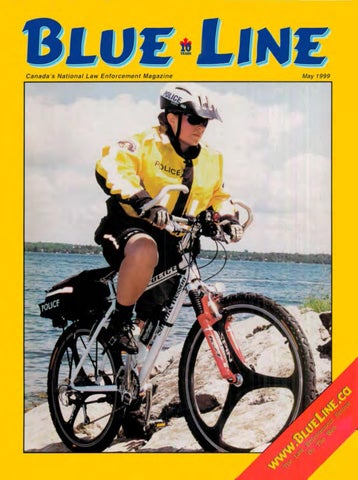
Brockville Police Service first in Canada using new Smith and Wesson Public Salety bicycle. Maximum force ... limited options
10
World's police divers symposium
12
Shannon 's internet friend
14
Letters to the ef/itor
15
1999 Torch Run
16
Psychics - Walking in two worlds
18
Blue Talk - by Teny Barker
19
The future together
22
CSIS Seminar and Trade SholV Case Law - by Gino Arcaro
24
Surveillance - by Hal Cunningham
25
Technology - by Tom Rata}
26
Personal ComjJuting by Reid Goldsborough
27
tatisical report on police pursuits in Ontario
28
Product News
30
Classified
32
Ten-Seven News
33
Criminally FUI/ny
38
direct control from a law enforcement agency and Its opinions and
articles do not necessarily reflect the opinions of any govemment, police, or law enforcement agency, Blue line Magazine is a private venture and as such is not funded by any level of government agency, union or association, Blue Line Magazine is printed in Canada by Garson Graphic Services Inc .
- Affilhltio llSInternational Association of Law Enforcement Planners Canadian Advertising Rates & Data ~ International Police Association , , The Canadian Press Newswire Periodical Publishers Exchange
ISSN #0847 8538 Canada Post Canadian Publications Mail Product Sales Ag reement No. 176796
YEARS
May, 1999 _
icky Henri of the Brockville Police Service, is shown on our cover as she patrols the park and shores of the St.Lawrence Ri ver, The bicycle she uses for patrol is manufactured by Smith & Wesson. Brockv ille i the first police agency in Canada to utilize this specially built police bike, When David Sergeant of Smith & Wesson was contacted about the bike he advised that it certainly turns a lot of head when the public realizes that a company, primarily known asa gun manufacturer, actually makes bicycles. It al 0 turns a few heads at anada Customs when the box it is shipped in tries to clear the border. "We haven't shipped one acro the border yet that hasn't been opened for inspection," Dave said. Regardless of the cross border problems icky and her fellow officers are looking forward to wann weather patrols on bicycle duty You can read more about this on page 9 in this ed ition, This issue is full ofa wide variety of material sure to interest all Blue Line readers. pecial attention should be brought to the Torch Run's that are about to commence this month, On page 16 you will find information on how you can participate in this law enforcement initiative in your own area, On page 22 you will find details regarding the Trade how ofthe Canadian Society ofln du trial ecurity being held in Ottawa this year. It i also the beginning of celebrations for many police service in Canada and this month we commence the parade with the St. John Police ervice on page 8,
List of Advertisers Blue Line News Week Bulterworths Canada Dalhousie University Flying Cross by Fechheimer Fred Fowler Ilenry's Intemational Pol ice Association Joe Drouin nterprises Laerdal Laser Labs Most Wanted
34 7 19 2 32 32 II 13
4 II
36
Pads Fitne s & Supply Panasonic Canada R, Nicholl Di tributors Rocky hoes & Boots pecial lectronics & Design Tactical nterprises Int' I Inc. Tetragon Tas e Triform Bu iness ystems Valley As ociates Virtual Depot Westervelt College
35 20,2 1 15
40
35 23 27
29 13
37 25
_ _ _ _ _ _ _ _ _ _- - - - - \ G ! I - - - - -- - - - -- - BUIE LINE V l - - - - - - - - - - - - - - - - - - - - - - - - Magazine
"FIDO" is alive and well... and even legal in Ontario by Morley Lyll/burner nyone who needs more elaboration on FIDO shou ld understand that for cops it mean "Forget It... Drive n!"(orsimilarwordsto that effect). The ntario olicitor General' office is now uggesting a law that wi ll entrench thi concept within the police community. It is indeed a dangerou concept and one that is nawed in many way with little or no though t to it future implicati ns. Just in time ~ r a provincial election the ntario olicitor eneral has released some new pursuit procedures that are de igned to save the lives orevery person in the province. At least if y u listen to the popular media thi is what this new legislation will do. In their ha te to placate thc media the Government ha imply re-spun the same old procedures that are designed to take the heat away fr m them by doing little or nothing II rthe policeorthe public. In their haste, however, they may have blundered into a dangerous precedent with the one and on ly change from previou policic . The suggested e tion reads as follows: "A police officer does not breach the code of conduct if he or she does not initiate or does not continue a pursuit if the police officer believes that the risk to public safety resulting Fom the pursllit outweighs the risk of not apprehending the suspect. " They have intr duced legi lation that directs that wh ich common en e ha dictated in the pa t. It legitimize the officer doing nothing to
protect the public from a potentially dangerous offender. This new section can now be legitimately called the "FIOO" law. The implications of the FIOO law, if taken too far, cou ld ee it as a remedy to any situation that requires police officer to make unpopu lar or dangerous decisions. There is no doubt about the fact that it is designed to make the offIcer feel more comfortable with the idea that slhe does not have to chase someone. It does not consider the neglectful or lazy officer who is looking for a ready excuse. I wou ld defy any supervisor to successfu lly prosecute an officer with th is FIDO law on the books. I wou ld defy any supervi or to not prosecute an officer that refu ed to chase someone who later ki ll s everal citizens on a sidewalk. The supervisor is between a rock and a hard place. I sti ll say that it is safer for citizens to have a mad-dog motorist with lots of lights and sirens around him. At least there i a warning of some kind. II' a bad guy in a car decides to run the cops the adrenaline is flowing and he won't come down as fast as the switch to the police car's rooflights. It is this lag-time between the stopped police car and the bad guy's adrenaline rush I am concerned with. There just ain't no law that can fix this. There are a lot of good th ing about the suggested regu lation. The first being that omeone in the olicitor General's office read pages 321 to 33 1 of the new book "Canadian Police Work" and learned something. The second is that there is fina lly a wi lli ngness to force all police agencies to actually have a pursuit proce-
dure. (The down side is that each agency can still write their own.) The third i that Ontario is finally seeing the benefits of helicopter patrols even ifthey will only call them "study projects" and leave the test municipalities high and dry after it is over. There i an old axiom that states when citizens feel they are losing control of a problem in ociety they will reach out and control that which they can. The citizens and po liticians are looking desperately for some control ofthe prob lem and have found the police. We must look harder at the values we instill in the public's mind before we begin to comp lain about the police actions that attempt to control misbehaviour. In the case of police chases pre sure should be brought to bear on: • car manufacturers who build car that are easy to steal; • car manufacturers who build cars capable of great destruction in the wrong hands; • television and movie producers who glamorize vehicle pur uits; • narrow minded political pundits with quick-fix suggestions; • court officials with no backbone to bring proper sentencing; • legislator who don 't have the courage to suggest all the legislative tools presently in place; • police managers who have been far too slow at instituting police helicopter patrols in built up areas. We don't need political rhetoric. We need a little courage and a lot ofaction.
The Ultimate Tactical Target
TP-1500
TP-5000
Mid Size
Large Size
The Target ProTM is an anatomically accurate target manikin. For range practice, life-threatening scenarios or self-defence training , this life-like adversary can take your training program to the next level.
• • • • • • • • •
Anatomical reproduction of upper torso Lifelike look and feel of torso improves accuracy Lifelike reflex to hits Safely allows skills evaluation with a lifelike adversary Excellent for knife and baton drills Anatomically accurate strike zones High-impact materials Portable for easy transport Base and pole included
~MPL Call1-888-LAERDAL ~ Laerd~1
--'-
Tel: (416) 298-9600 ' Fax: (416) 298-801 6' (800) 567-9987 (P.Q.)
email: savelives@laerdal.ca
The bad guys aren't paper targets and punching bags... they're real! BLVE L'NE- - - - - - - - - - - - - I G ! M agazine 0 1 - - - - - - - - - - - - - - - - - - - Ma y, 1999 YEARS
In the business of preventing crime by Jlllian Fallfino
Chief of Police Yo rk Regional Police
Mo tofus are engaged in nothing Ie than rethinking the police function in everything that we do. Progressive police admini lrators have, for more than a decade, been working hard to implement a form of policing that better meets the extraordinary demands placed on the police in contemporary times. Unquestionably, the policing oftoday's society is a complex task, particularl y in urban areas where the diversity ofpeopie and the pressures of communal living abound. We need to use this opportunity to move closer to partnerships - partnerships that work and sati fy both the private and public interest; interests that are common to everyonc: safety, security and quality oflife. We now know that traditional tactic such as random patrol and investigation aller the fact do not have any significant effect on crime or police workload. We also know that the changing police role includes new tactics such as: • Pennanent assignment of police officers to one area; Giving owner hip to individual police officers (ownersh ip of sma ll gcographical areas and the recurring problems within these areas), • Providing them with freedom to make decisions on their own, and most importantly, • Forming partnerships with communities to solve problems. The e are the four basic components of community policing; component that result in lasting, meaningful change. In the past, many of the mo t troublesome aspects of policing stem from the pressure that has been exerted on the pol ice to appear as if they have unlimited power - and control, to do more than thcy are authorized, trained or equipped to do. In the 1990's we are redefining thc police function. We are trying to make the job more achievable by applying di fferent tactics including: • becoming aware that community safety is a shared responsibility, • realigning what we do (man)' of us are reorganizing), • giving higher priority to some task and less priority to others, • reducing public expectations and levelling with the public about our real capacity, • engaging the public in taking steps to help themelves, and • connecting with other public agencies and the private sector far more than ever before. Unquestionably we must replace this aloof authority with practical, workable ties with the community. In the past, traditional policing has had a strong "it's our business" attitude. We were the ones who promoted ourselves by making people believe we cou ld be all things to all people all the time. Thcre was no room for outside involvement, sharing ofinfonnation, sharing of talent or responsibi Iities. ll1at's changing and wi II continue to drastically change in the future. umerous issues are driving this change. As YEARS
I have said, in some ca es the public police do not have the time, expertise or resources to cope with new crime trends, or the pres ures brought on by the econom ic reality of the day. ome examp les in clud e comp licated commercial frauds, credit card counterfeiting and abuse, internal thefts and fraud, telecommunication scams and frauds and computer crime. These and other matters are nece sitating private interests to take ownership of their own concerns because of the reality that the public police are unable or ill-equipped to do so. The public police pulling back from primary responsibilities for some of these crime types will have positive crime prevention benefits. Many commercia l enterprises have sacrificed crime prevention in the interest of profit. I find it difficult to agrce with thc concept that we should accept losses incurred through crime as the cost of doing business. In the past, the private and corporate sectors could always rely on the police to recover lost property or money, investigate and prosecute offenders. As these business interest find they have to fund private police entities for these services, they should begin to take a real interest in crime prevention; the most effective and worthwhile way to go. I'm talking speci fically about cheque frauds, automatic teller frauds, commercial frauds, credit card offences, shoplifting, robberies, thefts ad many others. We cannot be al l thing to all people. Trying to do everything results in not doing a very good job across the board. In order to expand the problem-solving approach to policing, the public police have to let go of many functions we have traditionally dominated. There is a growing need to dedicate resources to violent crime, community concerns and a vast array of other social conflict issues.
Th is does not mean we turn our backs or ignore private policing interests; rather our role will be more focused in fonning strategic "results" driven partner hip. The bencfits of shared information, idcas, resources and initiatives are cndlcss. Wc can accomplish a great deal more to help each other in order to achicve mutual objectives. Our work is not that di similar. [n fact the mi sion, goals and objectivcs are common indeed. We are all in the business of providing services that are intended to protect us from crime. When we talk about community-based policing we need to talk about community involvement in it broadest concept. This certain ly includes private industry. I see great promise for pub Iic policing with increased cooperation and partnerships with the private sector interest. ome examples of this cooperation are happening now. Many police agencie regularly work on complex files with private investigative firms. These firms are hired by the victimi zed company and provide expertise and resources that the police can't provide. A good example of this is in the area of such things as forensic accounting. Most police departments already have active participation with organizations such as the Canadian Bankers' Association and the Insurance Crime Prevention Bureau to deal with frauds, thells, robberies and other crimes. Cooperation between public police and the private sector is essential. I just don't mean cooperation at management levels. The people doing the work must look for ways to increase cooperation; including the sharing of inform ation to the extent deemed necessary and appropriate. Through liaison and the sharing of in formation, we will all benefit, but more importantly, the communities and the people we serve will also benefit.
TEN-TVVENTV'-NINE Home Invasions ofthe Elderly in Vancouver Between 98-11-21 and 99-02-02, there have been 13 home invasion-style robberies of the elderly in Vancouver. These crimes were very similar in M.O. to approximately 30 previous home inva ion of the elderly in Vancouver and Burnaby since 1995, leading investigators to believe the same suspects are responsible. In almost every incident, the suspects kicked down the front door ofa house - usually somewhat rundown - overpowered an elderly person (average age, 83.5), and bound them with items found in the home. Both suspects wear gloves and balaclavas 0 their race and age is not known. The suspects rarely take anything but small amounts of money, but have on two occa ions taken old cameras. The suspects usually spend considerable time in the house, sometimes over an hour. One suspect stays with the victim,
while the other one ransacks the house. When there has been any resistance, the suspects have beaten the victims, and have also used sexual violence. The incidents have always taken place in the evening hour, after dark. The primary motivating factor in these despicable crimes has been to terrorize the elderly victims, not profit. The suspects have left firearms, drugs with street value, and valuables. There is a cyclical pattern to the crimes, and they have never occurred in the summer months. The Vancouver Police Department Ilome Invasion Task Force is requesting that any other police agency that might have had similar offences contact task Force members directly by CPIC or; 604-717-3402 e-mail doug_lepard@city.vancouver.bc.ca.
\sl~----------- BLUE LINE May, 1999 - - - - - - - - - - - - - - - - - - - \ V l - - - - - - - - - - -- - - -- - -- - - - - Magazine
Managing priorities and change Victoria's Chief Constable Doug Richardson retires By Floyd
0111(111
The e'\tent to our which society has changed in the past 30 years is renected in the career of ictoria's hief onstable Doug Richardson . Policing has had to adapt to a fast paced world and the men and women v\ho do the job arc 'vel) di fferent today than v\hat they were in the mid 60's when Richardson embarked on a profession that he enjoyed with a passion . s he prepares to retire on May 11 he states that the people v\ho come aner him v'vill have to be highly talented and vvell trained prolesslonals \\orking III a v"orld of comple'\ Im\s and social conditions with nev technologies that may make their v"ork ea ier but vvill also racilitate the commission of crime. !though he gre\\ up in Victoria Doug began his policing career in the R MP manning rourdilTerent rural postings in southern Alberta. ncr less than two years on the job he rcturned to Victoria on leave and ran into a friend, Vict ria Police 'onstable Mike Pearce, whosugge ted that he consider working in Victoria. lIe wa introduced to then Deputy hiefConstable Ray altland \vho took an intere t in him . "I had no burning desire to leave the R ' MP," Chief Richardson states. But when a vacancy came up \vhen a Vict ria police officer \'vas shot and seriously wounded he decided to make the move and in June 1967 he returned to the CIty . "I soon learned that policing here was very dirterent than in the R MI'. My fir t R MP case was \vhere a tractor battery worth 25 .00 had been stolen. I inter iewed the farmer, his neighbours and a highway maintenance crew that happened to be in the area. The inve tigalton took considerable time. II' that same a e had happened in Victoria I might make a note of the dctlllls of the battery but I wouldn't spend an) tIme investigating it. The changc from the R ' MP to the city police was so significant it \\as "almost a culture hock." I quickly learned that priorities in Victoria were very different than what they had been in the R MP." Many of the senior Victoria policemen had a 'very distinct way of ding their job that di ffers greatly from policing today. "Many ofthem wcre \\ at veterans, and they were, in my estimation, very good cops. TIle solved a lotofcrime over the phone. They had a network of informant and they v\ere ery clo e to the people they had to lIl'vesltgate. They were immer ed in that environment, they \vent to the eedier bar , they knew the people and for that reason they were very successful." I\s times have changed so have the people who do the job. "Those officcrs I worked with
then, as good as they were, could not survive in today's world," the Chief believes. "Many officers have university degree and in the future 100% of them will have degree. The rapid changes and the complexitie of the law are a real challenge for them. The crimes are much more sophisticated than what they used to be and the officers have to be equal to the challenge." In his first year Richardson did patrols and traffic then moved into the detective division . "For seven years, from 1974 - 81, I worked in the major crimes divi ion, which I greatly enjoyed. I worked on many major file and I really found it interesting. I got a great deal of elfsati faction and pre tige in pursuing the investigations." In 1975 Richard on joined Victoria's first emergency response team . " I was very action orientated. Policing wa fun and I always enjoyed coming to work. I was really committed to my work and I enjoyed preserving the image of Victoria a being a safe and beautiful place." In 1981 Richard on wa promoted to taff ergeant in charge of one offour platoons. When Richardson's predecessor, Bill Snowdon, arrived changes began to occur in the Victoria police department that had an impact on Richard on 's career. "Chief nowdon restnlctured the whole department creating two bureaus. One for operations, one for upport and each with a superintendent in charge, ba ically they were Deputy hiefs in function. The Inspectors were invited to compete for the po ition which had opened up even more with the retirement of Deputy hief Jim Smith. It was a very rigorous competition with p ychological and written exams and two formal interview . It was very thorough. The in pectors decided not to get into the formal competition and so it wa decided to open it up to taff ergeants. I was one of the succe ful candidates so in 1982 I became uperintendent, having kipped the rank of Inspector." TIle days oflooking forward to going to work
came to a udden end and the job became very stress fu I for Richard on. " I missed operational policing," he says. "I guess I wa too ambitious and I left active policing before I was ready to." In addition he was now commanding personnel he had worked under. "With a troke ofa pen I wa now in chargeofpeopIe who had been giving me orders. TIley were very accommodating, but I put too much sIre on my elf. TI10 e two years were the worst time of my career." But he acclimatized and he did it well. In 1991 hief nowden retired and Richardson competed for, and won, the position. Policing priorities have gone through continual changes throughout hiefRichard on' career. In the 1960' the emphasis wa on solving crimes, while now pre ention and community v\ork are given a greater share of the resources. Thinking back on the 32 year with the Victoria PD give him a lot to reflect on . "When I joined Victoria in 1967 there were three patrol districts with 96 police officers and of those only one woman. There were seven to eight support stafT, one switchboard operator and one di patcher. There wa a very heavy emphasis on patrols and solving crimes. We had a patrol wagon that al 0 served as an ambulance - which wa a very intere ting situation, to say the least. Fortunately that didn't last very long." There are now I 6 officers and 60 civilian support staff, including 21 with the 911 service. The popUlation of ictoria has more than doubled and the entire area ha grown to 3"0,000 people. "One of my goals when I became the hief onstable," Richard on states, "was to get a new building. The old ne had been bui lt in 19 17, was only 3 ,000 square feet and the jail was a hazard . Engineer told us that in the event of an earthquake our 911 centre would be buried, and the building would be far too costly to renovate or add on to. new facility was needed." A state of the art building and equipment that V\ ill meet policing needs for many year to come wa achieved through the highly profesional work of the architects and the staffwho co-operated with the planners in expressing their views on what wa required in a new facility. The taff al 0 worked hard at selling the need for the building to the public who subsequently voted for it in a referendum. "It was a real challenge becau e wc not only had to meet the needs of the day but for 20 - 30 years to come. When it opened in Augu t of 1996 it was a real boost for the morale of the entire personnel." The 911 centre nov has earthquake integrity and the jail facilitie are much safer. The method of patrolling Victoria street have changed under Chief Richardson. Mounted patrol are not only u ed in the parks but right in the downtown and bike patrols are employed in the downtown area where they often have more
BLU£ L'N£- - - - - - - - - - - - - I ( 6 l M a gazine
V I - - - -- - - - - - - - - - - - - - - - -
May, 1999 YEARS
speed and mobili ty than patro l ca rs. " We were th e first in B to do bike patro ls and I was urprised th at it turned out to be a very popular assignm ent," th e hi e f states. One o f th e on-go ing challenge th at Chi e f Ri chard son faced th roughout his eight years as Victoria's top law o ffi cer was to prov ide the same or enhanced levels o f services when crime rates were increa ing and public fundin g wasn' t. The Chi e f studi ed ways in whi ch revenues could be realized and by contracting out services, charging for reports from po lice o ffi cers to law firm s and insurance companies, coll ecting th e fund s raised from special occasion liquor permi ts and oth er similar innovati ons th e department now generates a million dollars a yea r in revenue. C hi ef Ri chardso n does not be li eve th at all th e chan ges th at have impacted po li c ing over hi s career ca n be co nsidered improve ments. The ba il re form act changed th e onus fro m being on th e ind iv idual to prove th at he was worth y o f be ing re leased to be ing that o f the state's to kee p th em. "Thi s resulted in tac ks o f warrants be ing iss ued for people who didn ' t honour th e tenn s of the ir ba il or fa iled to appea r in the first instance," Richardson points out. "Even if we picked th em up in Vi ctori a often we wouldn ' t send th em back to th e jurisdi ction th ey were charged in beca use th e co t was more than what th ey fe lt was warranted in punishing th e person. 0 many peopl e esca ped th e consequences o f their acti on because of the change in th e law." hiefRi chardson feels that the second most signi fi cant impact on policing was the Charter of Ri ghts o f 1982. " It set policing back on its heels," he believes. " Wh at it did was make th e courts
supreme in Canada, and not our law makers. Judges can now determine what are good laws and bad laws, and they are not elected officials. One blatant ca e was the recent acquitta l of an individual for th e possession o f child phonography. Though our law makers had deemed this to be a good law ajudge said, ' I don't care, I don't think it is.' Wh at ha happened i that what used to be a search fo r the truth has become a search for proces. ociety has suffered and it has only erved to fatten the wa llets of a lot o f lawyers. Individual rights have become paramount to the detriment of society's rights." The Young Offenders Act, currentl y und er go ing signifi cant changes and the Freedom of Informati on Act have a lso had negati ve impact on po licing according to Ri chardson. The Freedom of Informati on Act has re ulted in costly, arduous and time consuming work on behalf of the department and Ri chardson feels that po lice departments hould have been made exempt from the Bill. " I have no immedi ate plans to embark on anoth er career," the outgo ing hi ef states. " I would like to enjoy four or fi ve months of being retired so I ca n g ive more time to my fam il y." Doug has three children and four grandchildren and he would li ke to do some trave lling wi th his wife, Marl ene . " I' m 55 year old now and I' m looking forward to a new and challeng ing career, but what exactl y that w ill be I can' t say at this tim e." Chi e f Ri chard on had long set his goa l as reti ring at 55 and th e death o f his c lose friend, Esquim alt Po li ce C hi e f Graham Brown, had a " pro found impact" on him . Brown was on ly 48 yea rs old wh en he di ed o f cance r last year. " We
had plans that we were making together, and we always thought that we wou ld retire at 55. It seemed very unfair to me that Brown ie never reali zed th ose plans." Chief Richard on retires fro m acti ve duty on May 3 1, 1999 and his last official act will be to present Graham's son, Colin, w ith hi police badge when he graduates from the po lice academy on May 7th. --
~
~ -
..r--
-
~
,')
~
A r-- i ..r,....J___ ~J~
The City of Victoria, with a population of 77,000 people, is located in the Province of British Columbia and on the south shore of Vancouver Island and is the capital city of the province. The Victoria Police Service consists of 180 police officers (155 male and 24 female) and 55 civilian and support staff for a total of 235 members. The police to population ratio is 428 citizens for each officer. The police budget for 1997 was around $20 million. This figure breaks down to a per capita cost of $249. The Victoria police reported that on average each officer on the department investigates 93 criminal code incidents each year. The total number of criminal code offences recorded with the police service was 16,618 during the year 1997. The police service reported a 23 per cent clearance rate on property crimes and an 65 per cent clearance rate on crimes of violence . Overall there was a 5 per cent increase in crime over the previous year of 1996.
THE ANNOTATED F I R EARMS ACT AND RELATED LEG ISLATIO N Jonathan Keene Brunet
•
This annual work provides you with an annotated version of the Firearms Ad and the related sections of the Criminal Code, Nalicnal Dqfence Ad and the Young Offenders Ad. You'll find the full text of the Act and its regulations. relevant Criminal Code regulations. related Orders-in-Council and sample forms. The author, Jonathan Brunet, is a practicing Crown Attorney. A particularly useful feature of this work is the charts and diagrams of various weapons and ammwlition taken from the Canadian Firearms Safety program. .... User~Friendly Format,
ummarics at the beginning of the section of the
Act, cross-references to related portions of the Firearms Ad, the Criminal
$70 + GST • 0 433 40890-1 • approx. 648 pages May 1999 • Softco .... e r
Code and regulations, applicable case law and a comprehensive index. .... Up--to..Date. Contains the latest case law relating to firearms - primarily from the Courts of superior jurisdiction. Courts of Appeal and the Supreme Court of Canada.
.... Glossary of firearms terminology (from the Canadian Firearms Safety Course) that helps users understand the topi~pocific terminology. (Price & other deILJils subjec//o change without notice.
If payment accompanies order, WI! pay the shipping & handling.)
~~ BuHerworths
75 Clegg Road, Markham, Ontario L6G 1A1 • Tel. (905) 479-2665· Fax (905) 479-2826
\1lJ-- - - - - - - - - - - BLU£ LIN£
TEARS
May I 1999 - - - - - - - - - - - - - - - - - - - - 1V
r- - - - - - - - - - - - - - - - - - - - - Magazin e
A 150 year patrol with pride In 1999, the Saint John Police Force celebrates its 150th Anniversary, establishing itself as one of the oldest continuing Police Forces in Canada. by K. I . (Keith)
ope/am/
The city of aint John, New Brunsv\id., v"as first settled in 17 ~ ""ith the landingofa group of Loyalists at what i nov\ J..nov"n as MarJ..et lip. With its natural harbour and location, it quicJ..ly grew as ettlers branched out, establishing communities along the 'amt John and Kennebecasi River. There would be no formal law enforcement in aint John for quite some time. In I 26 at the ydney treet courthouse, there was a call far night watchmen. Their function was to watch vcr the city during the darkened hours. I'ire \Vas a constant worry in the city with 1'0\\ upon roV\ of poorly built houses in narrow streets. Indeed, in 1877, there was a massive lire that de troyed much of the pre ent upto\Vn and south end oflhe city. Initially, there was a 'aptain in charge ,,,ith four watchmen. There ,\ ere no day patrols. When, in I 41, the citizens of aint John rioted at a circus on Wellington Row, the aldennen of the day wished for a Police Force. Finally, in I 49, aner a period of acrimonious conflict between 'atholics and Pr testant , the aint John Police Force was establi hed by an order of the Legislative ssembly of the Province of ew Bruns\\icJ... There '"ere 26 Police onstable . worn in to uphold the laws of the day. Initially controlled by a Police Magi trate, the first hier fPollee was s\\orn in after being appointed, not locall but by the Govemor in ouncil in 1856. By the I !l90's, the Force had grown to a complementofftmy-six men including the chief. It patrolled the ten square mile and over fifty miles of streets that comprised the city limits. There were two di isions, a northern and a southern with each broken up into beats, some of which still e,isttoday. A etoflockupswa established throughout the city where beatmen could bring those arrested, prior to transferring them to the central police tation v\hich was located on Kmg :treet La t. Although this was less than satisfactory, it was es ential to a Police I orce without any form of motorized transport. The introduction of the streetcar during this period enabled the police to patrol the city more effectively. Today, 150 years after its creation, the aint John Police I'orce numbers 174. It patrols over 500 J..ilometres of street within the city boundaries 01'210 sq. J..m. The city is divided int four districts, orth, outh, Fast and West with the central station housed in city hall just a tone thnm from ",here the Loyali t landed at Mar"et '-iIII'. The eastern and western station are Jomt facilities combined with the fire department. The orth end station is a free tanding structure established seven years ago. Talks are underway to secure a freestanding central tation that will carry the force into the ne>.t cen-
The restored 1964 Beetle Police Cruiser tury with all facilities under one roof. Policing in ainUohn today is much the same as in other cities. The force ha a patrol division and Major Crimes Unit. pecial quad include the Family Protection Unit, anine, Ident, Street rime, Polygraph, Traffic - nforcement, Fraud and Public afety nit. Emphasis is placed on ommunity Policing with eight officer assigned full time to this ta k. They dovetail their effort with Patrol Officers from the various district. Officers patrol the streets using the more conventional police cruiser as opposed to the treetcars o I' yesterday. The mountain bike unit perform a valuable function during more easonable weather and regular foot patrols in the central business district are al 0 a boon to community relation . To celebrate the I 50th anniversary, the aint John Police Force struck a committee la t year to plan and implement activities that will last throughout the year. Empha i ha been placed on activities that put the force into the public eye in a positive sense, inviting public involvement. One of the fir t activities will be Trooping the Colours and rai ing the new colours at the flagpole in front of city hall on April 14th, 1999, 150 years to the day that the force came into e>.i tence. This will be the highlight ofa number of related activities that week. This will also be the inaugural appearance of a special project that has taken month of planning and work. Back in 1964, the aint John Police Force made hi tory when it felt that Volkswagen Bug would make an effective patrol car. Car 117 rolled onto the streets a a tram enforcement unit, followed by another Bug the next year. A sugge tion was made that an intere ting anniversary project would be to locate, restore and put back into service a 1964 Beetle. Valiant efforts located a 64 Bug and it has been faithfully restored to its original condition complete with authentic light, siren, radio and license plate ! Major sponsor for this project has been Tim Ilortons (of course!). The antique patrol car will be utilized in parades and community function. On May 1st, the Annual Policeman's Ball will be held at the Trade & Convention Centre. This Gala event will feature the p lice forces own Country Blues Band opening for Johnny
BLU£ L'N£ -----------~Q M
g a zina
Favourite. The end of May will see a police combat shoot. The Royce I enor Memorial shoot will be held at the police range during the weekend of May 29th and 30th. On June 13th, over 200 runners are expected to compete for prizes in a 5 and 10k road race. Participant \\ill be Police Officers as \\ell as many civilian following a demanding racecourse over the hilly city treet . The \\eekend of August 12th, 13th and 14th will bring antique police car from all over eastern anada and the A to aint John for a how and hine competition. This is also the weekend that the police mu eum opens at the Aitken Bi entennial entre. To commemorate this important milestone in our history, a special anniver ary patch has been issued. Depicting three lamps over a background of blue water with the words aint John Police Force, 150 year, 1849 - 1999. The three lamps repre ent a well-known landmark to aint Johnners kno\\n as The Three isters. ituatcd ncar the harbour mouth, these lamps were lit each night to guide mariner in from the sea to the refuge of the port. The blue background is of course the ocean. Thi logo has been adopted and incorporated in commemorative pins, patches, decals and tiebar . It was de igned by C t. John rady who also de igned the Force's new colour . Authors William Higgins, Gerald Wallace and Peter McGahan have conducted an extensive history of the Force. It has been chronicled in a series of books entitled The Saint John Police Story. This book, along with other commemorative memorabilia, can be purchased by contacting the Saint John Police Force at 506 648-3200.
.....---
I - .....-- :1,
;;'} r-- .....
.....:..; _ ...r_ .....:..; '-'- oJ ...r_ 1....../ _ .....::..; The City of Saint John, with a population of 75,000 people, is located in the Province of New Brunswick at the mouth of the St. John River. The Saint John Police Service consists of 175 police officers (167 male and 8 female) and 34 civilian and support staff for a total of 209 members. The police to population ratio is 428 citizens for each officer. The police budget for 1997 was around $14.2 million. This figure breaks down to a per capita cost of $190 The Saint John police reported that on average each officer on the department investigates 36 criminal code incidents each year. The total number of criminal code offences recorded with the police service was 6,296 during the year 1997. The police service reported a 26 per cent clearance rate on property crimes and an 48 per cent clearance rate on crimes of violence. Overall there was a 17 per cent decrease in crime over the previous year of 1996.
V I - - - - - - - - - - - - - - - - - - - - May, 1999 YEARS
Enhancing police response by Morley L),lIlbllrner
In 1998, the Brockville Police Service was the first in Canada to acquire th e new mith and We on Public Safety bicycle which has been developed exclusively from the ground up for poIice services and other public sa fety agencies. This acq uisiti on brought the Brockville police ervice's patrol strength up to three bicycles. The Brockvi lle Chamber of Commerce donated the fir t bike, which is an Aquila - Metro style, in 1996. Unlike recreational bikes, the carbon fibre wheel s of the mith & Wesson patrol bicycle has been durably designed to meet the vigorous demands of police duty bikes and also includes a "heads-up" handle bar to ensure the rider maintains optimal visibility. This ha proven to be an excellent bike for the Brockville Police ervice's use. "Overall , the Smith and Wesson police patrol bike turns heads," say Brockville Chi ef Barry King. "Officers comment that they have never received so much attention from just the appearance of this bike and the fact that it has been made by mith and Wesson. Officers report that it adds to citizen inquiries and convcrsations and enhances interaction from the more curious people on the street. The name ' mith and Wesson' makes people stop and say ' hey, I thought they onl y made guns!'" Other benefits of the new bicycle is the easilyadju ted stand-over height and saddle po ition. This public safety bicycle offers up to 24 gears and allow quick-shift on the fly. One pecial feature is the suspension system designed to ab orb hocks and improve handling. The Brockville bike co-ordinator operates full time for six months of the year and each patrol platoon supplements his activities with an add itional bike patrol officer. The officers have collectively advised that the most important features they apprcciate are the rapid fire shifters, the high tread onJoffroad tires and the new sp in rims as being a design that respond to the usual complaints from bicycle patrol officers. As well, the si ngle touch button controlling the fla hing front and rear red/white strobe lights and siren i an enhanced safety feature. One Brockville bike patrol officer, who previously was a bike officer with the Vancouver Pol ice, notes that the added front suspension has bcen a positive feature in reducing the tres on his knees as well as reduced shock to his elbow over his 12-hour shifts. lie points to this being the primary factor that assists in minimizing prolonged fatigue and injury. li e also notes that the sing le head lamp on the mith and Wesson bike illuminates far better than the previous dual headlight assemblies on the two other bikes also used by the force . hief King beams with pride as he describes hi s officcrs on bikes. "A lthough we are a small community of around 22,000, bicycle patrols have clearly demonstrated that citizens find the officTEARS
Brockville Police downtown C.O. P.. office (Community Oriented Police Storefront) and the officers attend there and work directly from that location. There is also an unmarked bicycle which is u ed as an old clothes patrol. This is particularl y helpful in areas where there is vandalism, mi chief or break and enters. While ome officers prefer not to trade the comforts ofa Crown Victoria patrol car the two wheeled, 24-geared public safety bicycle with it' full complement of police accessories can enhance the police response time in any downtown core - particularly during heavy traffic. For further information call Brockville Police at 6 13-342-0 127 or Dave Sargeant of Smith & Wesson Bicycle ection at 4 13-747-3644.
ers much more approachable," he states. "This certainly optimizes interaction with our citizens as well as visitors to our community. Our bike officers have been ab le to ride up to suspects unnoticed and are an effective tool in our downtown core, city walkway system and waterfront boardwalk areas." The bike contains refl ective decals as do the unifornl pant (shorts) and the extremely and highly visible yellow police bicycle/motorcycle Gore-Tex patrol jackets by ascade for wet, cold or windy conditions. "Our officer look professional and complement the new Smith and Wes on police patrol bike. I am certai n thi s bicycle will give us years of dependable and reliable use," concludes Chief King. During summer, the bikes are stored in the "'--
~
I
-
"'-
' "1
,- I I
r--
"'-
~_ ~ ~ f ~_\.J ~ The city of Brockville, with a population of 22,600 people , is located in the Province of Ontario and on the north shore of the SI. Lawrence River almost directly south of Ottawa. The Brockville Police Service consists of 38 police officers (34 male and 4 female) and 30 civilian and support staff for a total of 68 members. The police to population ratio is 595 citizens for each officer. The police budget for 1997 was around $3.8 million . This figure breaks down to a per capita cost of $168. The Brockville police reported that on average each officer on the department investigates 97 criminal code incidents each year. The total number of criminal code offences recorded with the police service was 3,698 during the year 1997. The police service reported a 34 per cent clearance rate on property crimes and an 83 per cent clearance rate on crimes of violence. Overall there was a 3 per cent increase in crime over the previous year of 1996.
Barry King is a 37-year career police officer \\hich includes eight years as the Chic( of ihe Sault Ste.Marie Police Service and the past four years as Chief of the Brod.ville Police Service. lie had previously been a member of the Pcel Regional Police, Ontario Provincial Po~ce and Canadian Military Police. ChiefKmg is the recipient orthe Ontario Medal l'or Pol icc Bravery, thc Ontario Association orChicls of Police Service A\\ard allli the Comlllunil) Achievcment Award l'or outstanding leadership in the developmcnt of youth drug and alcohol educational programs.
BROCK VI LLE, ant. (CP) - Sometimes good police work can be as easy as watching the evening new. City pol ice Con t. Dawn Tutecky found that out recently while watching a Crime toppers segment broadcast from Edmonton. A man pictured in the segment - caught on a store surveillance camera carrying offa 4,500 portable computer, looked just like a man arre ted in Brockville 16 months ago for theft. I remembered he really stood out because he was so well dressed and he was older - about 45," Tutecky aid. "We don't normally get many criminals of that description doing that sort of stuff." Tutecky sent Edmonton police a photo and file on the man, which resulted in an arrest warrant being issued for Mohammed Sead, 45, of no fixed address. taff gt. Ed Richards of Edmonton police said Tutecky's infonnation was important in the case because they had no clues about the man . While Tutecky has the appreciation of the Edmonton force, she doesn 't have the Crime Stoppers reward money - a police officer isn't eligible to collect.
--I01-_________________B_L~!g~!~!
May, 1999 _ _ _ _ _ _ _ _ _ _ _ _ _ _ _
Maximum
••• limife
• p Ion
An inside look at private sector firearm training for the high risk security industry by Mike lIargreaves
The average police officer, when a ked ab ut thc private indu trie that carry a side arm, might well re p nd with, "They do?" It might help in future meeting of the e men and women I' the private ector, if the rule governing the carrying of the e firearnl ,and the training taken t permit them to carry, was more fully undertood.
Carrying Conditions Fir t, thc conditions on the Ontario permit: the authorit to carry, tate that the firearm hall be a. pccial,6 hot revolver with a 4" Barrei, in nearly every ca e thi turn out to be a mith We on Model 10 or64 K frame . This i thc firearm ntario police at one time carried but now i deemed not appropriate for police! Thc revolver mu t be carried while wearing a unif< rm, vi ible in a ecure hoi ter, with the trigger hidden from iew. It may not be conealed un Ie under an overcoat in extreme weather ndition. The ammuniti n hall be factory .3 peial, 15 g .W. . lead projectile +P velocity, as again was the original tandard priorto elfloading pi t I being issued to police. The semi wad utter ( . W. .) will not reliably feed in the emi-auto pi tol, therefore, was discontinued for p lice. ( xpanding bullet for the mo t part do not e it the t r o. Thi i one of the rea on they are n w is ued). s an a ide, at thi time, the majority of poIi c in ntario u e the .40 calibre pi tol with a bullct.40 in h, or I Omm in diarneter. ome are i sucd with the 9mm or approx .355 inch (in my opini n thc be t pistol calibre in the world, for do/ens frea on ... right... who a ked me!) The spccial wa never .38 inch, (our merican ousin tend to exaggerate) but rather is .357 inch . s m tin tructors will tell you, the design ofthc bullet and where the bullet strikes the b dy is far m re important in the stopping of a violent attacker than the calibre of handgun delivering thi strike. Training Any pr gram that i taught on ajob related ub.lC t, the c ntent and rationale of the training hould bc taught in the actual job area and condItions that the work i completed in. To go tnt thc training that a p Ii e fficer i requlrcd to take is not my intent. I will stick to thc private industry'S training and any police officer reading thi can draw on their own ex periencc/mcm ry as a com pari on. s the training mu t be refreshed once a year, the riginal pr gram, as common ense dictates, must be such that the very narrow u e of forcc parameters the private industry operates under, an be both remembered and articulated if the need ari e in a Court of Law. I orcc can only be u ed, again t an attacker that b the violence of such an attack can be plain I seen by any reasonable per on, would be liablc to cau e dcath or grievous injury to the per n being attacked, or a fellow employee, and any uch for e u ed to stop thi attack must be rca onable.
ow, as no pepper pray is allowed, and no baton is normally carried, the use of force continuum is somewhat imple - talk, avoid, or shoot i ba ically the only option available. As the tatistics clearly show, over the past twenty years that I have been involved in this training, use of a firearm is most normally in the carry and not in the shoot mode, actually by both the public and private ector here in anada. I licks law has a way o I' infringing on training with firearms and or any weapon deployment against a fellow human, in a most negative way. imply stated, ifmore than one olution is taught for the same problem, the selection process the brain goes through to decide on the best one of these solutions to use in a violent, adrenaline charged confrontation, can be up to 58% longer than if only one solution be made available! ot withstanding the above tatement, sometime no attempt to do anything i the result of this indecision! A condition known as "hyper vigilance" or freezing on the spot i the end result... this is not good! The K.1. .S. principle (keep it imple tupid) is credited to various weapon trainers in the U. . Due to the non-u e of force of any nature that typifies the carry offirearms by the private industry in Canada, it might be concluded that the average criminal i deterred sufficiently by the sight of two smartly uniformed people, vis-
ibly arnled, tran porting valuable than the same pair, not armed, transporting valuables! RegardIe s tati tic how that attack again t the armed private ector are very infrequent, measured against the total hours worked. In fact it is infinite imal. ow that we knov the job area, and somewhat the threat level , we set about training the security officer, automatic teller, or armoured car employee to deploy hi her revolver in a realistic setting, whilst carrying it loaded, all the time.
BLUE L'NE-----------~Q M gazin e Ur----- - - - - - - - - - - - - - - May, 1999 YEARS
Th e Challenge: Draw, aim, DO OT SI IOOT! Loud shout: "DON'T MOV E"! But do not fire. These drills are repeated, over and over. 0, bottom line, what can the private guys ot do with these o ld fashioned revo lvers? much, but what they can do, they can do well, and quick, first time all the time. What they do not do a lot of is unintentional discharges! Why? Think about it, all that is taught is, draw and fire two shots, fi nger off, lower to ready (3 inches below line of sight) and ho lster, simple yes? And a Il ot Range: guns are worn loaded all the time. (gun are on ly un loaded after test and prior to c leaning) So what do you do a a police officer when you next see an armed private sector person? Smile, nod, and say "I ii!" ow, that wasn't hard was it? And a smi le makes everybody feel good! Keep Safe. Two tota lly diametrically opposite scenarios to train for: I. You walk into a bank ATM enclosure, meet armed robber (two) who point guns in your face and say "don't move!" S oilltiol/: you don't bloody well move! (Now that training didn't take long eh?!) 2. After ervicing an ATM you walk out of a bank at I :30 a.m., into an apparently empty parking lot, the door clicks shut behind you, and a chemically fortified, illegal and untrained in its use owner of a .32 auto steps into view, fires a round at you from 6 yards away (18 fl.) a round that does not do the plate glas door three feet to your right any good at all! Solution: your revolver jwnps into your hand, (or seems to), two hands on the butt punch it forward and with your two eyes wide open, you deliver a controlled pair of 158g . w.C' at around 950 F.P.S into the center of the upper ha lf of a dirty T-shirt! ow let's back up. Back to the training that dictated a hoot olution to problem #2. First, negotiations were out! You had been shot at! econd, as nearly always happens when you are attacked, a opposed to attending at a location where you can use availab le cover to approach, here you have no cover, and no where to go! The O.P.P. and R.C.M.P. at one time taught "double tap" (like in a sinkor bath) but now teach "controlled pairs." I also teach "two shot" or fire twice, each time you have the legal right to use this kind offorce. (remember K.I.S .. ?) Buthow do we teach this skill in a way that will be not only effective but court room defensible? It i really quite simple! The double action revolver, unlike the majority of doub le action only semi-auto pistols, can be dry-fired twice per draw, or from the ready position, by just pressing the trigger. Let's chalk one up for this 19th century technology! 0, we do lots of dry firing! First and fina l grip in holster, punch draw, front sight, pre s twice, over and over again. And it's free! No ammo costs. If you are the person balancing the books you got to love it... and it works.
The Shoot Drills Draw and FIRE twice, and back to sight line - walk, draw and fire - twice, turn s, lefl, right, back to target, in each instance fire twice. Good light, poor light. Distances 10 -7 - 5 yards. (7ft to 8 fl. head shots) - fire twice, (a ll re loads are speed loads) YEARS
M ike Hargreaves has 20 years experience as a full time Use of Force Fireanns Instructor. He is a current Board member of IALEFI , a post he ha~ held since 1986. lie is an accredited expelt witness in the Supreme COUlt of Canada. In 1987 he taught the first Police Transitional Instruct;r level Glocl- Course in the World, to the Fircanns Instructors of the QPF Intervention Group. Mil-e trains approximatel) 500 students per year. 111 both the public and private sectors. You ma) contact Mike by Cell Phone at 416587-1136.
Members ofRegion Two are pleased to invite you to the
International Police nssoclatlon Iggg nnnual Gener.al meeting may 21 to 30.1999
[four mays of 2l0spitality and entertainment For further information on becoming a member or to register to attend contact:
LP.A., AGM- CAN/AM Robert Engel 74 Citation Drive Willowdale, Ontario, Canada M2K 158 Phone: (416) 221-2520 Fax: (416) 221 -5825 email -472cr2@interlog.com
Q~----------- BLU£ LIN£ May, 1999 - - - - - - - - - - - - - - - - - - - - - \ D r - - - - - - - - - - - - - - - - - - - - - Magazine
World's police divers to meet at symposium hy cott Fllller
lIundreds 0 r underwater earch, re cuc, recovery and marine speciali ts rrom all over the world will c nvene in lI amilton, Ontario, anada rrom the 17th to the 19th or eptember 1999. They will take part in the th Internati nal P lice liver , ymposium, a prore sional development event conducted only once every two years. The Internati nal P lice Diver ymposium has allracted thou and or underwater and marine proressionals to date and is recognized by I 'TERPOL as the most unique type or law enforcement special event conducted worldwide. 11'1. 1999promi estobethelargestandmo t e:\tensivc to date, so attendees are strollgly advised to register early! These internationa l delegates will glean "Ie ons-Iearned" rrom a wealth of invited spcakers on subjccts as diverse as the 11'1• • . 11R recovery, homicide investigation, cave rescue, marine counter-terrorist operations, narcotics interdi tion, high-tech search equipment, public sarety divertraining, divercritical incident stress management, evidence recovery. Illst water recue and multi-agency marine disaster inter-operability. ptional training eminars and workshops arc orrered on the 16th or cptcmbcr ror which prior registration i mandatory. The IPD. is a re tricted attendancc event
M agazine _ _ _ _ _ _ _ _ _ _ _ _ _ _ _ _ _ _ _ _--\
and isopen only to accredited police,SA R, EMF, fire, public sa fety, military, coast guard and other lawen forcement d ivers/d ive teams, marine un its and related commercial diving industry. Disaster and cmergency planners are also eligible to attend. While not a trade show, a considerable number of static equipment exhibits and in-water "get-wet" type demonstrations are provided. Attendecs will trade techniques and ideas, share common problems, sugge t solutions and to meet and mingle with their underwater peers during social events including the now-famous aturday cvening gala appreciation dinner. Featured speaker for the 8th IPDS include; • US av)' Salvage Engineer - James Ruth • Southwest Texas University - Professor Ronald Beckel; • DCIEM Experimental Diving Unit Lieutenant (Navy) David Holland, • cotland Yard Inspector Michael Burke, • Oslo Fire Department Fire Fighters Magne Overrein and Roy Larsen, • Maritime Rescue intemational - Managing Director Ilamish MacDonald, • Knox Count)' Sheriffs Detective Ed }ollng, • Maritime Operations Director Lieutenant Steven Bronson, • Ne lv York Specia l Operations Group Director Michael Emmerman, • irish (An Garda Siochana) Garda Ciaran Doyle and Garda David Mulhall, • Quebec Provincial Police Chief Diver Ilarold Sheppard,
• Specialized Tactical Training Unit Specialist Mark Lonsdale, • Calgary Police Service Constable Gene Newcombe, and • Detroit Police Department Sergeant John Ronan and Police Officer William Robinette. IPDS Master of eremonies taffSergeant Randy Hancock (retd), formerly the upervisor of the Ontario Provincial Police Underwater Search and Recovery Unit, will co-ordinate the speakers presentations. The lntemational Police Diver ymposium is conducted as a not-for-profit event and has no commercial ownership while acknowledging its corporate sponsors, donors and supporters. Among those are the lIamilton-Wentworth Regional Police Services Board, Molsons Breweries and Blue Line Magazine. For IPD 1999 infomlation and registration, go to website http: Iwww.deeptech.comlipdsl or contact IPDS by emai l ipds@Jlinterlynx. net orTELIFAX at (905) 574-6817.
The author is the Technical Alh Isor to th e IPDS . li e is a memher of the r,mergency Sef\ iccs Div IIlgAssociation. the Canadian Naval Di\ers Association, the Combat Divers Association of Canada and the Historical Diving Society USA. r k is a past President of NAUI Canada and is a cUiTently serving officer of the Canadian Forces.
Authorized framed replica display of your
Exemplary Service M edal
Framed full-size replica medal with recip ients fu ll name inscribed. 12"
x 16' (30 em x 40 em)
$125. 00 (plus Tax S&H) Available exclusively from:
Joe Drouin Enterprises Ltd
PO Box 53059, Ottawa, ON K1N 1C5 Ph.: 819669-0756 Fax : 819669-1074 E:Mail : joe@j oedrouin.comwww.joedrouin.com
Ballistic Protection
Valley Associates provides superior tactical tools, state of the art protective gear and technical training to response
Less Lethal and Tactical Ammunition
authorities around the world. People putting their lives on the line for the safety of others rely on the best that our global
Complete Line of Scopes and Sights Tactical Helmets and
network of suppliers can deliver.
Valley represents the highest standard of excellence in product safety, strength and performance. We are proud to present
Explosives and Explosive Accessories
you with the best the world has to offer. For more info rmation please call us toll free at (877)226-2219.
____________________________~~r------------------------------B-L~!g~!~~
h ollrte.,y: TOllr of Dllty Magazine Toronto Police Assoc.
, hannon could hearthe rootsteps behind her as she wa lked toward home. The thought orbeing ro llowed made her heart beat ra ter. "You're being sill ," she told herselr, "no one is rollowing you ." To be are, he began to walk ra ter, but the rootsteps kept up with her pace. he was arraid to look back and he was glad he wa almo. t home. hannon said a quick prayer, " Jod please get me home are." he saw the porch light burning and ran the rest fthe way to her hou e. Once inside, she leaned against the door ror a moment, re lieved to be in the sarety orher home. , he glanced out the window to sec iranyone wa there. The sidcwalk was empty. Iler to sing her books on the ora, she decided to grab a snack and get on-line. ' hc logged on under her screen namc BI' Illgel213. he checked her Buddy LIst and aw GoTol23 was on. Shc scnt him an instant message. ByAllgel213: Ii i I'm glad you arc on! I thought someone was rollowing me h me t day. It wa really weird! GoTo123: L L You watch too much TV. Why would somcone be rollowing you? Don't you live In a safc neighbourhood? BJ'1Ilp,eI213. or course I do. L L I gue s it was my Imagination CUL' I didn't see anybody whcn I lookcd out. Go To 123 nle s you gave your name out online. You haven't done that have you? By ngcl2 1 : rcour e not. I'm n t tupid y u kn w. GoTo123: Did you ha e a ollball game aller school toda ? 81'11lge1213: Yes and we won!! GoTcJI23' That' great! Who did you play? 8yAIlgel213 We played the lIornet. LOL. 111clr ulllfollTIS are 0 gros ! They look like bees. LOL GuTc)123: What i y ur team called? 8.1" IIlp,el213: We arc the anton at . We have tiger paws on ourunirollllS. They arc really kewl. GoTo123: Did you pitch? 8yAllge1213: 0 I play econd ba e. I got to go. My homework has to be done berore my parents get h me. I don't want them mad at me. Bye! Go To 123: atch you later. Bye. Mcanwhile ...... GoTol23 went to the membcr menu and began to earch ror her profile. When It camc up, he highlighted it and printed it out. li e took out a pen and began to write down what he knew ab ut Angel 0 rar. Il er nome: hannon; Birthday: Jan. 3, 1985;
Age : 13; tate where she lived: orth arolina; I lobbies: sollball, chorus, skating and going to the mall. Be ides this inrormation, he knew she lived in Canton because he had just told him . He knew she tayed by her elruntil6:30 p.m. every allernoon until her parents came home rrom work. l ie knew she played sollball on Thursday allernoon on the school team, and the tearn wa named the Canton Cats. Il er ravourite number "7" was printed on her jersey. l ie knew he was in the seventh grade at the Canton Junior High chool. he had told him all this in the conversations they had on-line. l ie had enough inrornlation to find her now. hannon didn't tell her parents about the incident on the way home fr m the ball park that day. he didn't want them to make a cene and stop her rrom walking home rrom the sollball games. Parents were alway overreacting and her's were the worst. It made her wi h he was not an only child. Maybe irshe had brothers and isters, her parents wouldn't be 0 overprotective. By Thur day, hannon had rorgotten about the foot teps rollowing her. Il er game was in full swing when sudden ly she reltsomeone taring at her. It was then that the memory came back. She glanced up from her second base position to see a man watching her clo ely. l ie was leaning against the fence behind first base and he smiled when she looked athim. lle didn't look scary and he quickly dismi ed the rear he had relt. Aller the game, he sat on a bleacher while she talked to the coach. he noticed his smile once again as she wa lked pa t him. li e nodded and she miled back. l ie noticed her name on the back or her shirt. l ie knew he had found
her. Quietly, he walked a afe di tance behind her. It wa only a rew blocks to hannon's home, and once he saw where he lived he quickly returned to the park to get his car. ow he had to wait. li e decided to get a bite to eat until the time came to go to han non ' house. lie drove to a ra t rood re taurant and at there until time to make his move. hannon was in her room later that evening when he heard voice in the living room. " hannon, come here," her father called. li e ounded upset and she cou ldn't imagine why. he went into the room to ee the man from the ballpark sitting on the ora. " it down," her rather began, "this man hasjust told u a mo t interesting tory about you." han non moved cautiously to a chair acro rrom the man . Ilow could he tell her parents anything? he had never seen him berore today! "Do you know who I am hannon?" the man asked." 0," hannon answered. " I am a pol ice officer and your on-line rriend, GoToI23." hannon was stunned. "That' impossible! GoTo is a kid my age! lie's 14 and he lives in Michigan!" The man miled. " I know I told you all that, but it wasn't true. You ee hannon there are people on-line who pretend to be kids; I wa one orthem. But while others do it to find kids and hurt them, I belong to a group or parents who do it to protect kid rrom predators. I came here to find you to teach you how dangerous it is to give out too much inrormation to people online. You told me enough about yourselrto make it easy ror me to find you. Your name, the school you went to, the name oryour ball team and the position you played. The number and name on your jer ey just made finding you a breeze." han non was tunned. "You mean you don't live in Michigan?" He laughed. " 0, Ilive in Raleigh. It made you feel sare to think I was so rar away, didn't it?" he nodded. "I had a friend who e daughter wa like you. Only she wasn't a lucky. The guy round her and murdered her while she was home alone. Kids are taught not to tell anyone when they are alone, yet they do it all the time on-line. The wrong people trick you into giving out inrormation a little here and there on-line. Before you know it, you have told them enough ror them to find you without even realizing you have done it. I hope you've learned a les on from this and won't do it again." " I won't," hannon promised olemnly. "Will you tell other about this so they will be sare too?" " It' a promi e!" That night hannon and her dad and Mom all knelt down together and prayed. 111ey thanked God ror protecting hannon from what could have been a tragic ituation.
BLU£ L'N£- - - - - - - - - - - - - - I Q M agazin e
U-I--------------------
May, 1999 YEARS
In your February issue you ran a piece sent to you by the Canadian Firearms Centre on "The Firearms Act: Public Agents Perspective". I would just like to say thank you for that insertion. When ever I hear peop le talking about the responsibi li ties and new duties surrounding the section governing public agents, I never hear anyone talking about the training being upgraded for the officers or public agents who will be doing all the handling of these gun. In my twenty-five years as a police officer my training received from the police departments involved three fireaml . I have more training that I have obtained on my own and am presently a master instructor in both the non-restricted and restricted courses in Saskatchewan. I also worked on the student and instructor manual, along with your writer Dave Brown, for the Canadian Restricted Fireamls our e in Ottawa last year. Thanks again for your article and hope to see more. Dick Leier Regina, Saskalchewan Editor 's Note I know of which you speak. Many years ago there was afirearms amnesty and an elderly lady came inlo my station and presented me with her deceased husband's Iwo "keepsakes ". One was a loaded German Luger and the other a Browning 44. We were all perplexed because no one in Ihe slation knew how to unload Ihe guns or render Ihem safe. I was slalion-duty al Ihe time and had circa
1970 Iraining in a (meaning one Iype oj) shotgun and a (meaning one type oj) revolver. 1 had about fifteen years on the job and never handled a semi-aulomatic. 1 looked around the station with about 10 people working inside al the time and could find no one who knew how to unload the weapons. Just in time my afternoon relief came into the station and he was, much to my real relief, a gun collectOl: He stated he could unload the weapons for us but the Staff Sergeant had already called the Tactical Unit to attend to unload the firearms. He ordered the officer not to touch them. We both looked at each other and simply laughed, shrugged our shoulders and answered the phones. We have come a long way.. . 1 hope!!! <><><><><><><><><><><><><><><>
You are probab ly wondering why the Drayton Festival Theatre is writing to you. Our theatres include three unique locations across Ontario. From beautiful shores of Georgian Bay to the heart of Mennonite Country, our festival theatres continue its tradition of offering quality productions of music and mirth at historic theatres in unique Ontario communities. You can therefore probably appreciate our curiosity when our King's Wharf Theatre, located at picturesque Penetangui hene, began receiving numerous calls with enquiries for the Police. Our staff was indeed honoured to be described in reality that which we have on ly mirrored in minor sketches ofa very few of our
plays. We at first thought it was April Fools but the date wa not correct. We then thought the numerous calls were due to a particularly accurate portrayal by any number of our illustrious and talented actors but could not think of a police officer being scripted recently. After so many calls were received we asked further where the callers had received our number and found that it was none other than your own magazine. Apparently the callers thought, due to an error in your February issue, they were calling the North Bay City Police. The number of calls received by our staff certain ly attests to the obvious impact your publication makes with your readers. I fyou include this letter in your next i sue with the corrected number perhaps it can prove to be equally effective at gaining us some patrons. Alex Mustakas The Drayton Festival Group of Theatres Editors Note We must apologize for the inconvenience to the King's Wharf Theatre. In our arlicle on Ontario Police restructuring we inadvertently placed their phone number in place of the North Bay Police. 1 can personally attest to the fine talents of both organizations in Iheir respective professions. (1 have seen both al work) Therefore 1 can only suggest that if you are lookingfor comedy call King's Wharf Theatre for tickets at 705 549-5555 and if you are faced with Iragedy call the North Bay Police number at 705 497-5555.
CONCEALABLE WRAPAROUND B ODY ARMOUR Our Canadian made concealable body armour is made of Dupont Kevlar 129™ which oilers unsurpased protection and wearability.
is our own line of clothing that has been specifically deSigned for Law Enforcement , Fire and Security Professionals. This collection of clothing will meet all of your needs from warm summer days to our harsh Canadian winters . Many of these items incorporate tried and tested designs with modern innovations , that have been suggested or recommended by users like you . It's time for you to try T RADITIONS- 4 yourself and find the quality, comfort and style that you deserve and require .
When soft body armour is struck by a handgun bullet the fibers absorb and disperse the impact energy from the struck libers to other libers in the weave . The result is no penetration and a decrease in blunt trauma as the impact is distributed across the fabric. Our Level II vest featu res 22 layers of flexible Kevlar 129™ material designed to provide excellent wrap around coverage to the law enforcement professional. Six adjustable Velcro· straps allow for a custom fit which provides added comfo rt. Also available in Level IIA and Level IlIA. CBA22 Men 's Leve l II Vest FMBA22 Women's Level II vest
r - - - - - - - - - - - - - - - - - - - Magazine
The flame burns brighter because you care
IIdbllry Regiollal Police Chief A Ie.l: Me aI/ley is passed the Calladiall Special Olympics Toreh by ergeallt Peter Mcl/flfg, alladiall Coordillator, at the Fillal Leg ceremollies held ill IIdbllry Ifl lt Mlmmer. by Tra cy Ford, .1.\'i.\l(lIIt Direc/or, Oil/a rio Lmv Ellfo rcem en/ Tore" Rlln
The continued dedicated upp rt oflaw enforcement per onnel as Guardian ofthe Flrune of I lope i directly related to the tremendous growth in anadian pecialOlympic programs ruld the swelling of athlete number to 20,000. Toreh Run efl- rts in rulada have also been acclaimed amongst their peer on a grand scale, with the following presentations at the tU1nual lntemati nal Law Enlorcement Torch Run Conference held in Anchorage, Alaska: • Ontario Law Enforcement Torch Run i the Top lrossing Fundrai ing program in the world for the eighth year in a row. • Internationally, the Top Per apita Fundraising programs arc; first place - ev. foundlandl Labrador at 21 c per capita, second place Ontario at I e per capita and third place :askatche\'\ an at 15c per capita. • onstable Lorne Gelowitt, a katoon Police was inducted into the Internationai l iall ofFrune - one oflive individuals selected fr m around the world. • 'onstable Mike urrie, hatham-Kent Police (Ontario) received the John arion "Unsung Ilcro" Mem rial ward. Thi award was creatcd t recognize out tanding individual \\ ho have contributed to the uccess of the Um !'nforeement Torch Run on a local, tate or community level. The award was also created to honor the memory of ergeant John Carion (Sterling Ilcights, Michigan Police Department) and his many contributions to the
Torch Run and Special Olympics. TheAnnuallntemational Law Enforcement Torch Run onference attracts representatives of Torch Run programs and pecialOlympics progrruns from around the world. The International Law Enforcement Torch Run Council is responsible for overseeing the effective mrulagement, direction and mi ion of the Law Enforcement Torch Run organizations, pecial Iympic International and the International Association of Chief: fPolice. The Torch Run has grown to include 75 runs in 23 countries with over 60,000 law enforcement personnel supporting community based programming for athlete with a mental hruldicap. The anadirul Association of Chiefs of Police (CACP) continue to UPPOlt the Torch Run through the provincial associations of hic[s of Police. [n Crulada, the Torch Run has attracted over 12,000 law enforcement peronnel who carried the Flrulle ofliope. In 1998 Canada rai ed over 3 million. Ca na dian Spec ial Olympics 30th Anni versary Law Enforcement Torch Run
Thi year the Canadian pecial Olympics celebrates it 30th Anniversary. This mile tone recognizes thirty years of growth and prosperity since the first ational Grunes were held in Toronto in June of 1969. anadian pecialOlympics, ince that date, has effectively developed sport training and competitive opportlmities for athletes with a mental disability in all ten provin es and the two Terri-
torie. urrently pecial Olympics sport programs reach 20,000 athlete nationally. Thi growth and development could not have been possible without a number o I' corporate partners, and impressive community support. anadian pecial Olympics would like to take this opporruntty to specifically thank the many officer who are involved in the numerous Law nforcemcnt Torch RWl Programs acro thi country fortheirenduring upport. The focus for thi year will be on Team anada a they prepare to attend the 1999 World wnmer ame in orth arolina. anadian pecial Iympics will send a ational Team 01'80 athlete and coache to compete alongside participants from 140 other countries. anadian pecial Iympics would also like to congratulate ergeant Peter Mcl larg (I lamilton/Wentworth Police Service) and onstableAlan Richard on (Timmins Police ervice) on their election as runners for the International Law Enforcement Torch Run into the opening ceremonies orthe 1999 World ummer rune. The e repre entatives will be part of the Final Leg of the Law Enforcement Torch Run from June 17th to June 26th, 1999. Canadian Special Olympic 2000 Win t er Games TIle ational apital Region will host the 2000 Winter Grunes from Tuesday, January 25 to unday, January 30, 2000. The Games wi ll be integrated into the ttawa 2000 Millenium celebrations and be the first major multi-sport event of the ne, milleniWTI. pproximately 600 athletes, 250 coaches and mis ion taff from the ten provinces and two territorie will participate in the Games. Expected to attend are about 600 parents and frunily supporters. Approximately 1200 volunteers will be nece sary to organize and manage the events. ports ruld special event venues will include the Ottawa ivic Centre, the Ottawa Curling Club, and amp Fortune. The e Games wi II mark Ottawa's second opportunity to ho t the national event. Ottawa ho ted the ational WTImer Games in 1981. TIle 2000 Winter ames will be the qualifying competition for ruladian athletes to move forward to the 200 I pecial Olympic World Wmter Game which will take place in Anchorage, Alaska. The anadian pecial Olympics 2000 Winter Game will feature competition in alpine skiing, figure kating, floor hockey, nordic skiing, snow hoeing, and peed skating. Curling will be included as a demonstration sport.
BLU£ L'N£- - - - - - - - - - - - - I ( j 6 ? M agazin e
VI--------------------
May, 1999 YEARS
1999 Provincial Torch Runs British Columbia Phil Crosby-Jones, Justice 1nsti...... tute of BC at 604-528-5779. It i the 10th Anniversary for the Torch RWl with a eries of events in 50 communities throughout the province of British Columbia. The main event will involve a four day Torch Run through 141TIlmicipalities ofthe lower mainland and Fra er Valley scheduled for the end of Jlme. The provincial sponsor is Lion's Club and the fundraisinggoal is $400,000. Alberta Jodie Yaremchuk, RCMP "K" Division at 780-412-5353. The Provincial Torch Run conference was held in conjunction with the Provincial Winter Game on February 26th in Calgary. Lawenforcement personnel participated in the opening ceremonies and medal presentations. The high light of the Alberta Torch Run will be the Gary Aull Ride Across Canada. Asend o [fceremony has been scheduled for May 20 in Edmonton. From there, he will travel to Victoria, B.C. and cycle to t. John's, ewfOLmdland. Saskatchewan Sergeant Clark McClelland, Estevan Police Service at 306-634-4767. The Torch Run week in Saskatchewan has been proclaimed for June 7-12, 1999. Runners will cover over 1,500 kilometers throughout the province and converge on the city of orth Ballleford. The fundraising goal for 1999 will be 100,000. ince the inaugural Torch Run in 19 , $725,000.00 has been raised for askatchewan pecial Olympics. One hundred law enforcement officers will participate in the Final Leg, carrying the torch into the opening ceremonies of the askatchewan Special Olympics ociety Summer ports Festival. Manitoba Inspector Al Caron, Winnipeg Police Service at 204-986-6203. anitoba Torch Run started the 1999 fu ndraising campaign last fall with the production ofa 15month calendar (included gift certificates valued at 300). The gift certificates were donated and the calendars sold at $19.99. A local bu ine ,Media cene, marketed, distributed and sold the calendars and to date, a profit of 30,000.00 has been generated. The Torch Run f(jck-olf onference was held on April I6th and Final Leg scheduled for June II th at the Winnipeg Forks Fe tival Site, during the Annual Children's Festival. tudents involved in Track & Field lubs from Junior High and Middle Schools willjoin law enforcement personnel in the run. Fundrai inggoal is $65,000. Ontario Constable LOlVe White, Toronto Police Service at 416-200-0846 Website: 11'1V\1l.0ntario. torchrun.org. From May 25 to June 11,1999, law enforcement runners will take up the torch in a cross- province relay which begins in every corner of Ontario and continues until its conclusion with the Final Leg at the Opening Ceremonies of the 5th Ontario Law Enforcement Sports Day in Peterborough. The official KickYEARS
off was held in Timmins as part of the 1999 Ontario pecial Olympics Provincial Winter Games hosted by Timmins Police ervice. At the direction of the OnlatioAssociation ofChiefs of Police 13th Annual "Torch Run", over 8,000 kilometers will be covered by over 7,000 law enforcement per onnel representing Ontario Provincial Police, RCMP, Corrections, Municipal Police Services, Military Police, Railway Police, Customs, Ministry ofNatural Resources and other justice field agencies. Fundraising goal is to urpass last year's total of$2.5 million. Since 1987, over 9 million has been donated to Ontario Special Olympics.
1111 Quebec
_ _ .. _
L1. Michel Lariviere, Montreal Urban Community Police at 514-280-0064. The Torch Run wi II take place in Montreal from September 20-26, 1999. The event will consist of law enforcement officers running a relay uniting 49 neighbourhood Police Stations and four Operational Centres. The Canadian National Railroad (C R) Police participate in the Quebec territory. The fundraising goal for 1999 is 50,000.
New Brunswick Constable Mark Gallagher, RCMP at 506-857-2466. The 1999 Torch Run wi II be structured into five separate runs throughout the province. The runs wi II take place weekend of October 2nd and 3rd. Fundraising goal - surpass 1998.
I' Nova Scotia
Helen Burns, RCM? at 902-426-2619. I?urlllg Pol ice Week (May 9-15), the ova Scolla Torch RWl wi II launch a new fundraising activity, "The Law Enforcement Foot Patrol" for pecial Olympics. This will entail a 10 community walk on Wednesday May 12th at noon. The walk will include foot patrol officers, Special Olympians and community members.
/
\.i77
Pledges will be collected. On June II th, the Torch Run will pass through the streets of! falifax and finish at aint Mary's Field to officially open the 1999 Atlantic Summer Games. Fundrai ing goal is $20,000. Newfoundl a n d and Labrador Bernadel1e Sobol, Office ofthe High Sheriff at 709- 754-0980. ~p 1999 marks the 10thAnniver,;.j = ary for (he Torch Run in New~t:::::::.. found land. The Torch Run ha been scheduled for June 4-11. Representing 10 di fferent law enforcement agencie , there are 500 runners expected to participate. The run will include Port ux Basques to t. John's and part of Labrador covering 1200 ki lometers. ewfoundland and Labrador were honoured with first place for Top Per apita Fundraising Program in the ~orld - for the s~cond time. Fundraising goal IS to surpass their 1998 total. Prince Edward Isla nd Don Smith, RCM? at 902-566-7157. The 1999 Torch Run will be I held Friday August 27. The Final - - - Leg to be held in Montague on August 28 to officially open the P.E.I. Special Olympics Track & Field Competition. Flmdrai ing goal is to surpass their 1998 total. Northwes t Territo ries Phil Johnson, Community Policing, RCMP "G " Division at 867-669-5275. Over 8,000 was raised in 1998 with 1999 fundraising goals to surpass that amount. The Torch Run will take place in late June.
I I
As of press time no word had been received from the TelTitories of Yukon or Nunavut.
BLU£ LIN£
May, 1999 - - - - - - - - - - - - - - - - - - I U r - - - - - - - - - - - - - - - - - - - M a gazine
by D Olllla Schofield
In th is day and age it takes everyth ingyou have to catch a criminal. There are tried and true methods, but there is one method that still is not used to its fu ll capacity. This i the u e of psychics to pry open that ne break a tough case really need to come to a successful conclusion. Even today most law enforcement agencies hesitate t call on a psychic. This is understandable becau e they use methods not normally used by law enforcement. Law enforcement orficers u e tried and true methods that have worked fI r them in the past, investigating a crime eenc and then going fi·omthere. They deal with facts and clues. This is not how a psychic works. Psychics are usually brought into a case when ever there i no place el e to turn, when every source is used and sti II there is no suspect. Most p ych ics understand th is and are accepting of it. II' and when the time comes to ask the he lp ofa psychic, make sure she or he can give you names and number of agencies thcy have worked with in the past. Ask for names of law enforcement orlicer they have worked with. If they are good thcy can give you these at the beginning. Get in touch with other departments that y u know have had success using psychics. Ask what they can do to help, and ask iftllis is something they feel they can do. Ifnot ask someone el e. Not all psychics have tlle same abilities. Some may be stronger in one field then another. There are psychics who have di ffe rent abi lities they can u e to do thcjob. For instance I usua lly need on ly a picture oftlle missing person ortlle victim. With this I pick up image in my mind ofthe victim or thc ki ller. I can usua ll y tell what the victim did the day of the murder. With missing persons I can pick up what is around them at the time and know irthey are okay or not. ome psychics ask to go to the scene ofthe crime because this is where the most energy exi t . This being because at time of death , the victim put off what I call an energy fie ld. This trace I' energy len behind after death can be fe lt by a psychic. This is also where they pick off the best vis ions (pictures) in their mi nd. I describe it like putting in a video and watch ing it play. ther times all the psychic receives is sti ll shots. Psychics have learned to pick up detai ls a thcy see these images, to be able to give the ma lle t detai l of what they see. Any psychics who have even worked with law enforcement know that the least little detail could be a break in a case. P ychic deal in the unknown, they walk in two worlds. This is hard to understand if you are not psychic. To most people this is someth ing you hear about on television, not something you deal with in everyday life. This is what makes it hard for law enforcement officers to understand. Most law enforcement officers be li eve that iI' you can 'ttouch it or see it then it does not ex i t. That is why a good psych ic wi ll tell you what they are do ing as they go along. They wi ll keep you in formed of everything no matter how
small an image they pick up. Psychics wi ll go into a case not knowing anything about it. This way they know that what tlley are picking up isn't something you have told them. A good psych ic can te ll you - not the other way around. This is not to say that they may need he lp in understanding what they see. Not knowing the victim orthe fam il ies makes it hard to know who the images ofthe people are they see in their mind. They may have to descri be the person they are seeing and ask if anyone knows who tll is person is. Psychics may be ab le
From "Sixth Sense" to IIPsychic Interpretation" by Mo rley Lymbumer
The first police case Donna Schofield vvorkcd on was while she and her husband lived near Butzbach. Gennany in the late 1980's. A story of a missing woman who lived outside Butlbach was told to her by their landlord who happened to be a German police officer investigating the incident. Donna, somewhat reluctantly, told him about being a psychic and offered her assistance. In predictable fashion the ollicer did not say much but listened intently to her about psychic phenomenon. About two weeks later, aflcr finding no clues at all, tlle officer approached her and asked if she could help. She agreed and ,·vas given a photograph of the missing woman. " I could tell she was dead because there was no warm energy coming fi'om the picture," Donna concluded. " \ could see that part of her was under what looked to me like a car that had been burned up by a river and next to a bridge. I could also see a factory not far lI'om whcre she was. 1 told the officer it wasn't in Butzbach because [didn 't feel a closeness." German police found her a week later in Frankfurt Germany by a river and under a bridge. Iler body was beside a BMW car assembly plant. In another case a chi ld went mi ss ing from a park in Donna's town ofl lopkinsville, Kentucky. The young girl apparently just walked away from the park. " I went to the park where she had last been seen," Donna states. " ~ I knew she was al ive and okay and also knew that they wou ld find her soon. I cou ld see what kind of clothes she had on and what was around her at the time. I told them to look in the middle oftown because that was where she had gone. That atlernoon she was found in a candy store in town." Everyone was relieved she had not been harmed . The Federal Bureau of Investigation was working on a case of a miss ing woman they had suspected of killing her husband. The woman had come through Hopkinsville and
8LU£ L'N£- - - - - - - - - - - - - - - \Q M agazin e
to give details such as tattoos or scars, and where they are located on the person. A psychic has good days and bad as everyone else. Sometime they may not be able to help you, lllen other days they pick up more then they really want to. Psychics have famil ies and lives the same as nonnal everyday people. They just try to put aside their problems in order to help you. It is hoped that in the future you keep an open mind toward psychics and remember they are there to help, if asked. Even though they do not go about the job the same as you do, they may be able to fill in tlle gaps in an investigation. There are some things in this world that can not be explained. This is where a psychic comes in. They deal with the unexp lained everyday. Remember that psych ics see a great deal of the same tllings you see whi le working a case. They just see it differently then you do.
was tll0ught to still be there. When asked about the case Donna told them tlle woman had been there but she had moved fi'om her Kentucky communi!") into Clarksville, Tenneesee. The FBI picked her up a week later - in Clarksvilie. Donna's vision was not restricted to geography hm,vever. "I told them she hadn 't killed her husband, but that a m,m had killed him," Donna says. "I told them that it was someone the husband worked with ." Content with the simple knowledge tllat she did what she cou ld Donna has never found out nor even asked about the accuracy of the infonnation she supplied. "I don't know what happened after that because that was alJ the help they asked for," she concludes. Donna was asked about her talent and abi lities and she explained that she is \\ hat is called a natural bom psychic. "This means lllat I was bom witll these abilities. My experiences have been dated back to age live. There are those who say they are tauglltthi s later in lifc. I don 't kn ow if thi s is true or not." Donna is presently attending college and working toward a degree in Law Enforccmcnt. "The reason for this," she states, "is not because I want to be a law enforcement orficer, but because I want to be able to see a case from botll sides. I feel this way J can add more to a case, and be able to know what is needed that I wouldn' t n0!111all y think about." Donna concludes that a good psychic knows that tlleirabilities were given to them to help others. She feel s her life is being drawn into the area offorensic psychic phenomenon . As most cops know seeing isn't always recognizing and Donna wants to incorporate her ability for psychic vision with tlle trained observation style of a cop. There are man y things in this world that can not be explained by tlle ofticially recognized li ve senses and Donna's "sixth" sense may not be all that unusual to cops. Donna Schofield can be reached by writing to 311 e. 16th, l lopkinsville, KY 42240 or by phone 502 886-5207.
V~--------------------
M ay, 1999 YEARS
by Terry Barker
Blue Talk is a regular column of advice on the topic of police communication problems. Terry Barker is the creator and teacher of Dalhousie 's Communication Skills for Police Personnel course, and is the author of Boss Talk and the Five Minute Police Officer. He taught communication skills for the RCMp, the Justice Institute of B.C. and the Canadian Police College for over 20 years, and is recognized in Canadian police circles as an expert on the subject of how members can talk to each other better. Send your questions, anonvmous if you wish, to Blue Line at Fax 905 640-7547 or email blueline@blueline.ca
"J jllst got pinned to the locker by another officer last night. His complaint was that J write too many tickets and this is making the rest of the guys look bad. I'm new around here (actually I'm new to this job as J have never worked traffic duties before this). J was shocked to hear that there was an underground negative quota system. J'm not working very hardfor the tickets J am getting and since they are in school zones J really think they are worthy of what J am doing. This is also a contrGlY message to what Jam getting from my boss who seems to like the numbers J generate. Now what do I do ?" The first thing you have to ask yourselfis if this guy is for real. Maybe there isn 't any underground negative quota system at all. Maybe this guy just had a bad day and was looking for a handy victim. [ would suggest you quietly check around with the other officers and find out for yourself. Ifyou discover that he wasjustjerking your cha in, you can either ignore it or deal with it. If you decide to deal with it, buy him a cup of coffee tomorrow and ask him up front what's going on: "Bill, remember what you told me in the locker room yesterday? Well, I asked around, and none of the other guys are using any negative quota system. What gives?" If there really is such a system, you have five options. I. Do as he says. You may have problems living with yourself, but it gets you off the hookfor now. Mind you, the boss wi ll call you in at the end of the month and ask why your stats have fallen off. This option may give you nightmares. 2. Talk to your boss. "Sarge, one of the guys pulled me aside and told me to cool my jets. He says I' m making everybody look bad because of my stats. What do you want me to do?" But before you take this road, you'd bet-
ter find out which your boss va lues most production or team loyalty. If his priority is team loyalty he might see you as a fink. 3. Ask for the officer's cooperation. " Do you really have a negative quota system here? Bill, I' d have a hard time with that. I know I' m new, but I want to be a good oflicer. Ilow can I be a good officer when I let people get away with speeding through school zones? Help me out with this, will you?" 4. Ta[k to the other oflicers. "Mary, they tell me there 's a negative quota system here. Is that true? I was talking to AI, and he said he feels uncomfortable when he lets speeders go. How do you feel about it? What do you think we could do about this?" 5. Do the right thing. I asked Cst. Dan Koughan ofRCMP Gibsons BC Detachment his opin-
ion. He said, " Ifyou've checked around and there really is a negative quota system, and you've talked with them about it but they want to keep it that way, then you have to ask yourselfwhat's right. You're between a rock and a hard place, but you have to look at yourself in the mirror each moming. Whateverthe cost, do the right thing." There's no easy quick answer to this hoary old problem. Your choice of options depends on the nature of the people involved and the group dynamics that are at work there. If you know your boss really well, for example, and you can trust him/her not to finger you, you could take a chance on the second option. The boss probably should know about this issue, and may choose to deal with it as a group problem. But how can you be sure that after slhe has criticized the team, you won't be the target? It seems to me that the safest and most productive options would be either 3 or 4. [n both cases you are keeping the problem in-house and building conununication links with your colleagues. You can present yourself as the young eager member who really wants to succeed, and they' ll find it hard to fault you for that. And ifall else fails - you have option 5. It's nice to have backup!
Only through continuous leaming can you prepare yourself for the challenges that face police personnel in the new millennium. Contribute to positive change by improving your management and leadership skills using the convenience and value of distance learning.
The Certificate in Police Leadership has provided hundreds of police officers with the ability to make a difference as leaders in police organizations.
Fall Session: September I-December 17. 1999 Police Le{(dership {(nd M{(n{(gement Development COllllllunic{(tions Skills for Police Personnel ,I Problem-Oriented Policing Register before June 30 and ,I Leg{(1 Issues in Policing receive $50 off your tuition ,I Budgeting {(nd Financi{(1 Man{(gement ,I COlllmunity-B{(sed Policing ,I Adv(tncecl Police Le{(dership {(nd M{(n{(gement (must meet eligib ility requirements) ,I Co{(ching Skills for Police (this course includes {( 3-d{(y workshop. Ple{(se C{(11 for lIlore inform{(tion) To receive our new brochure containing details oftms unique distance-education program, contact Sherry Cam10nt-MacBean at (902) 494-6930, fax (902) 494-2598 or e-mail CPL@DaI.Ca. You can also use ow' Information By Fax line by dialing locally 481-2408 or toll free at 1-800-932-0338 and requesting document # 0211 . ,I ,I
In last months article about new body armour for dogs the phone number for Jim Slater was inadvertently omitted. Anyone wishing to find out more about Jim's "Storm K9 Body Armour" can call him at 204-669-8199.
YEARS
Henson College, Dalhousie University 6 100 University Avenue Halifax, S B3H 3J5 Web site: http://www.dal.caJ- henson/cert-pl.hlml
HENSON COLLEGE
Learning Solutions for a Changing World
91------------ Bl.u£ L.N£
May, 1999 - - - - - - - - - - - - - - - - - - - - - \ Vr- - - - - - - - - - - - - - - - - - - - Magazine
Panasonic• First we gave it a built-in antenna - simply add the integrated wireless modem to access the CDPD, ARDIS and MOBITEX networks from the field. Then we gave it a fully sealed keyboard, a gel -cushioned HD and a bright, anti-glare colour display that's readable in sunlight. Finally, we wrapped it all up in a magnesium alloy housing that's 20 times stronger than plastic and can withstand a fall
of three feet onto solid concrete.
It's the CF -27 TOUCHBOOK from Panasonic . Because if you can take it, you can take it with you. www.panasonic.ca/toughbook 1-800- 265 -0616 All brand names/logos are trademarks or registered trademarks of their respective holders.
&&The future together!l!l______ Annual CSIS Seminar and Trade Show Ottawa Congress Centre f. June 5 - 7, 1999
.JI
CSIS·SCSI
Thc anadian ociety or Industrial ecurit) , Inc. is holding its 1999 ational eminarand Tradc how in ttawa from June 5 to 7,1999 at the Otta\~a ongrcs entre.
Se ssion Summaries Seminar 1
Crime Prevention Through Environmental / Physical Design Ilelll'i Bel'ube ', Peel Regional Police, ,polIsol'ed by ollitl'ol This prcscntati n will examine the crime of burglal') from a burglar' p int of view. The planning stagcs as vvcll as the commission of the crime itsell\"ill bc disscctcd in rder to identify the effectiveness or ccrtain c unter measure applications. Misscd preventi n pportunities will be discussed as v~cll as leveraging countenneasures and threat asse. smenL~. Parti ipants will also see various mcthods ofentl') u ed in indu trial and commercilli break-ins in outhem Ontario. Seminar 2 Behavioural Interviewing for Security Personnel Johll Galiallo.I·, Galianos Polygraphe Expert Illc. Don't underestimate people's ability to lie. Leam the usc of proper que tioning method and behavioural analysis to as ist in your interviewII1g technIques.
Seminar 3 Quality Management and the Security Industry, An Elusive Ideal or a Realistic Goal? PUllel discussioll The arrival of the new millennium is providing the industrial vvorld with an opportunity to rcllect upon past achievcments and to strive for ncw and higher gals. It' with optimism that security prole sionals throughout anada are seeking ncYV and innovative ways to enhance theIr professionalism and indeed thcir prosperIt\. Quallt management, or the way we deal \\'Ith our most important a et, our cl ients, is one of these IIlnovatlons. rganization, including secllllt} institutions, acros anada are increasIIlgl} embracing I 09000 Quality tandard a a gUIde for quality assurance. Viewed through the eyes ofe:-.perienced ecurity and quality practitioncrs, a panel di cu ion will explore how certification and accreditation can help turn an elusive ideal into a realistic goal. Seminar 4 Digital Video Surveillance, the Law, and More! 1.lliol1 Goldsleill, B.A., LL. B. Tim session \ViII cover: video urveillance - dIgital v. analogue; surveillance target- area or person; ' anadian Criminal code provi ions; proIIlcwl pma '} legislation; thc security officer a prosecution \\ itne 's; to charge or to ue: that I thc qucstion!
Seminar 5 Cultural Sensitivity Issues Rod McKendrick The workplace today i full ormany pitrail and peaks, with regulations, rules and law. Then why would you, as managers and owners set yourselr up to take a tumble becau e or something you aid or did, which was inappropriate? Ilow can you protect yourselrrrom stepping on some orthe inappropriate landmine ? Ilow can you ensure that your taff is aware or the outcomes or what they say and do? We will take ome time to use our eyes, our ears and our mouth, a weapons against such inappropriate behaviour, whether that inappropriate behaviour wa done knowingly or by mi take. It' your choice. Seminar 6 Problem Solving for Security Managers Syd Gravel, OllalVa- ar/eton Police Thi presentation on problem olving within the ecurity field will parallel i sues that police services are encountering in today's society. Demands upon police ervices to become more co-active (pro-active & re-active) in their approach to delivering a service efrectively are coming not only rrom citizens throughout orth America but al 0 rrom within the ranks orthe e police er ices. In ummary, the employee can ee that they are accomplishing results, the manager can see that the employees are producing at maximum effectiveness and the client can see where they are spending their money. This presentation will give ecurity managers rood for thought in moving to the future. Seminar 7 Security System Integration in the New Millenium David Trudel, Vice President, Sales, Marcomm Fibre Optics inc. ponsored by Marcollll11 Fibre Optics Inc. The total integration of security systems and products is now available through the use o I' sophisticated oftware. Gone are the days of technology dictating what you could achieve from your hardware and ollware. ow YOU dictate exactly what you require your system to provide whether it be ror a new insta llation or simply breathing life into your present y tem. Extreme ly large co t saving can also be achieved with the simp le in tall ation of to day's highly ophi ticated Integration ystem ollware in tead of replacing pricey hardware and the asociated labour that would accompany its installation. Envision replacing your Video Control Keyboard, Intercom Ma tel' tation, Alarm Reporting Terminal, Card Access Tenninal, Paging Ma ter Con ole, Door ontrol Bullons, Fire lann econdary Annunciation Panel etc. with one Touch creen Monitor. ome and learn how not be lell behind in the ever-evolving world of True y tems Integration.
Seminar 8 Corporate Liability vs Need for Security David Ray, B.A., LL. B., Principal, orporate Security Consulting inc. Pro iding security ror any organization is a constant balancing act between the need to protect the organization from liability and the need to en ure an appropriate level of security. Recent development in anadian law have helped to define corporate responsibilities for issues such as discrimination, hiring practice and intema! inve tigations. Participants will be provided with an overview of recent developments in civil and criminal law with comment on the effect for the ecurity manager. Seminar 9 Y2K and Security Panel Discussion The Royal anadian Mounted Police has initiated Project olstice, a multi-agency effort in co-operation with the Department of ational Defence, anadian ecurity Intelligence ervice, Criminal Intelligence ervice anada, anadian lawen forcement and DOM U ecurity Division LG roup Inc. The objective of Project 01 tice i to prevent, detect and re pond to eriou criminal activity that may target anadian infrastructure during the Year 2000 transition. This national law enforcement effort will complement the Year 2000 undertakings of Canadian federal govemment departments and law enfi rcement agencies. To become Year 2000 compliant, corporati ns and agencie face inten e pres ure due to carce resources and impending, non-negotiable deadlines. Together, we must be pro-active and a sess the potential for criminals to take advantage of this trained environment. Seminar 10 Wireless Telecommunication Fraud Elias Zaydan, Ph.D. Dr. Zaydan works a a con ultant to the R MP, P and other police forces. lie will talk conceming thi growing problem and infonn u in way to counter or take defensive mean again tthi type of crime. Seminar 11 Abagnale on Fraud Frank W A bagnale, A bagnale and As ociates, Sponsored by Canada Post In this eminar, Mr. Abagnale will provide the latest in fonnation to protect your institution/corporation from forgel') and cheque fraud. lie will discu the late tophi ticated forgery technique made easy by technology, as well as your in titution' corporation' potentia! liability under the new Unifonn Commercial Code. Mr. Abagnale will also de cribe ways to guard against cheque fraud. They will al 0 learn ways to curb liability and protectdocument from forgery in today' world or high tech. forgery and fraud .
~~~~z~~N_£______________________________~~~_____________________________ May, 1999
YEARS
Registered Exhibitors Abloy Canada Access Direct Marketing ADT Allnet Best Access Systems Blue Line Magazine Canadian Security Magazine Cardkey Carswell La Cite Collegial Corps of Commissionaires FACES Group Nine Distribution Le Groupe Securite Garda Hewlett Packard Identicam ILCO Unican Ltd Innovative Securities ISA ITS KMVideo Make Your Mark MARCOMM Fibre Optics Merrill Lynch Mosler Museum of Civilization Panasonic Pathminder Inc Paystation PLG Securities Inc PPM 2000 PSI Pyromark R Nicholls Distri butors Securmax Silent Witness Sonitrol Stop Oxygen University of Ottawa
Shown here is Admiral "Dusty" Miller, Commandillg Officer Maritime Atlal1tic Forces, as he draws the willlling ticket for a glass encased wooden model of the famous LUllnenburg Schooner "Bluenose" last October in Halifax. For the past ten years the Formation Military Police Ii a lifax Detachment has conducted an annual event "The Fight for Sight Run " in order to raise money for the charity "The Military Poli ce Fund for Blind Chi ldren". All Military Police Detachments conduct fund raising events throughout th e year to support this charity. The MPFFBC is the only registered charity in the anadian Forces and has been in existence sin ce 1957 when it was ini tiated by Col. (Ret.) James tone, whi le he was the Canadian ArnlY Provo t Mar hal. Over the years the Military Police have rased over $2,000,000. These monies are used to support the vario us Ch ildren ' Blind Schoo ls across the
The ship wa encased in an oak and glass display, constructed and donated by the master carpenters of the Construction Engineering Shop in lIalifax. The draw was held live on a Ii ali fax Television station with Admiral Miller, ava l Provost Marshal LCdr Mark Cullum, and organizer of the event Cpl. Edward King in attendance. The winner of the model was Mr. John Kril of Churchill, Ontario.
COWl try.
226 227
114
224 225
113
416
322 323
222 223
112
414
320 321
220 221
412
318 319
218 219
316 317
216 217
314 315
214 215
~ ~
The Great Mac Attack! by TOllY MIICKi/ll101I
312 313
212 213
310 311
210 211
105
404
308 309
208 209
104
402
306 307
206 207
103
400
304 305
204 205
102
202 203
101
200 201
100
-
YEARS
Between July and mid October last year, th e Formati on Military Police Ii alifax Detachment conducted a raffle for the g lass encased Bluenose schooner. The model was built and donated by Mr. Terry Little over a period of severalmonth . Mr. Little used copie of the original blueprints obtai ned from the Maritime Mueum of the At lantic. The model is rigged for the 1931 In ternational Fisherman's Trophy Races.
91-- - - - - - - - - - -
BUJ£ LIN£ May, 1999 ------------------\V~~------------------- Magazine
Disconnected 911 calljustifies warrantless entry Supreme Court of Canada R. v. Godoy (1999) file no. 26078 are a police ojficer on patrol. YOll ren'l\'e a radio broadcast to attend at house regarding a "Sill-unknown problem " call. L pOll )'Ollr arril'ltl, a 111011 ails IVers the doOl~ illjimlls 1'011 that there is no problem inside, alld rejilSl's to alloll' you to enter to illspect Ihe illlerior This silllalion presenls obvious lIIajor proh/em.l' All injured person may be imide The person II'ho ansl\'ered Ihe door 11111\' he the (11/ende/: a consenl is given 10 el1/cr The cOlllellls of Ihe radio broadcasl are I'lIglle alld h(l\'e nol specifically illforllled you a/JolIl II'helher (In ofjence ha been COllllllilIcc/ COlIseqllelllly, reasollable groullds 10 lIIake (1/1 arresl canna I be formed all Ihe basis ()llhis type (11 radio broadcasl. )011
o statutory authority e.\.ists that justifies forcible entry into the hou e to search for injured persons, under thcsc circumstance . The ' riminal ode amcndmcnt made in re pon e to the leene) case do not appl) to di onnected 911 phone calls. Instead, the Feeney provision authori/e ent!') into a hou e for the specific purpose ofmaJ..ing an arrest. In order for the Feeney prmisionstoappl),reas nableground mu texist before the entr), to maJ..e the arrest. In R.I'. Godoy (1999), the upreme ourt of 'anada established an authority that allows pol icc officers to enter a house under these circumstances to invcstigatc the extent of a 911 call. Thc circumstanccs arc as follows: Offcncc. : assaulting a peace officer with intent to resist arrest, and, a sault. CirC um \ lan cc~:
mccrs recei ed a radio broadcast of an "unJ..nO\\n problem" at an apartment, originating from a 911 call wherc the phone \\as disconnected bcfore the caller spoJ..c. Thi t) pe of call represents thc sccond highest priorIt) to the police, second onl) to a call of an "oflieer down". Four officers re pondcd to the apartmcnt. They listcncd at the door before J..nocJ..ing and heard nothing. Afler knocking on the door, oflicers waited a fcw minute until the dlxlr\\aS partlall) opencd b) a person, latcr idenldied as thl: accused, \\ho a ked, "What d you \\ ant'?" n oflicer asked, " omething ha occurrl:d hl:rl:. Is e'l:r)thing all right?" The accusl:d rl:spontkd," url:, there is no problem." n oflicl:r stated, "Wcll perhaps there i a probkm hl:re, and \\l:'d liJ..e to find out for ourselves Ifthl:rl: is a problcm inside the apartment." The accusl:d tricd to close the d or. An oflicer prevented the closing of the door with hi foot and entered, followed by the other fficers. Onl: ollicl:r heard a woman obbing. The woman \\as found in a bedroom. Iler lefl eye wa wolil:n and beginning to close from the swelling. he inlormed the ollicer that the accu ed had hit her. The accused \\as arrcsted on the ba i of the cOlllplalllant's infomlation and the officer's obscnatlon Oflhl: IIlJUry. The accused resi ted the arrl:st and a struggll: l:llsucd. During the truggil:, thc accusl:d bl:nt an officer' finger and bmJ..e it. The accuscd was chargcd with assaulting the woman and assaulting the offi er with intent to rl:sist arre t.
Trial- The trial judge acquitted the accu ed of both charges. The reasons were: i) the accused testi fied that the victim had lipped and fallen against ome furniture, and ii) the officer' entry into the apartment was unauthorized, which rendered all sub equent police action illegal. The trial judge ruled that a mere 911 call and a denial of entry did not contitute reasonable ground to enter without a warrant, as required by ca e law. Oddly, the judge tated, " I have no doubt that the police officers in this case were acting in what they thought were the best intere t of (the complainant) and the question of what would have been sufficient to allow them to enter is difficult to an wer, but based on the facts ofthi case when the accused denied entry to the police officer, which I find as a fact, the police officers were not acting lawfully at the time of the arrest of the accu ed and therefore cannot be aid to have been in the execution of their duty." The rown appealed this decision to a ummary onviction Appeal C01ll1. umma ry Conviction Appeal ourt: The appeal was allowed. The 911 call and denial to enter did con titute reasonable grounds to enter. The appealjudge stated, "One can only peculate as to what the response would have been had the police taken "no" for an answer only to have it reported later that a homicide had taken place." The accu ed appealed to the Ontario Court ofAppeal. Ontario Co urt of Appeal: The court unanimou Iy dismissed the accu ed's appeal for the following reason : i) the police had no intention of arresting anyone when they entered the apartment ii) the rea on they entered wa to determine the origin and rea on for a properly interpreted di tre s call, and they considered it their duty to respond. ection 42( I) of the Police ervices Act of Ontario exp lains the duties ofa police officer to be: • pre erving the peace, preventing crimes and other offences and providing as i tance and encouragement to other persons in their prevention • as isting crime victims - sec. 42(3) tate that a police officer has the powers and dutie ascribed to a con table at common law. upreme ourt of Ca nada : The accu ed peron ' appeal to the SCC was dismissed and a new trial was ordered in Provincial Court. The ruled that the Ontario .A. had correctly conc luded that the warrantless entry into the hou e, in this ca e, was a ju ti fiable u e of police powers. The following rea ons and explanations which were given e tabli h procedural guidelines relating to 91 1call : • the police clearly have the authority to investigate 911 calls, which justifies their presence on the person's property out ide the house. Whether forcible warrantle s entry into the hou e can be made depends on the circumstances of the 9 1I call. • a di connected 911 call, re ulting in an "un-
known problem" call, extends the police duty to ascertain the reason for the call, and constitutes reasonable ground to believe that "the caller is in orne di tre and require immediate a i lance", which equates to exigent circumstance . • when the accu ed told the police that there was "no problem", the police had common law authority to enter the house to veri ty that there wa in fact no emergency. Accepting the accused' tatement that there was "no problem" would have been in ufficient to atisfy their common law and tatutory duty to protectlife and afety. • the accused' attempt to close the door on the police provided additional justification for forcible entry without a warrant. • the privacy of the accused person at the door i secondary to the interest of any person inside the hou e. • afler the police entered the house, hearing the wife' cryingjustified the earch of the hou e to find her. • the Feeney ca e and relevant c.c. provisions do not apply to thi case because the Feeney procedure apply to entry into a hou e for the specific purpose of making an arre t. • the wife's condition combined with her statement con tituted rea onable ground to arre t the accused. uthor's co mment: In summary, this ca e establi hes the following procedural guidelines: I. a di connected 911 call, or a radio broadcast tating "91 I-unknown problem"ju tifie : • pre ence on the property • wan-antle , forcible entry into a hou e • search for injured persons 2. a per on who an wer the door, and informs the police that there i no problem inside, cannot prevent entry into the house. Taking the word of the person who an wers the door that there is "no problem" in ide, and not entering the hou e to inve tigate further, con titutes a neglect of duty. 3. a di cOllllected 911 call authorizes warrantle s entry into a house to search for injured persons who may then provide information to fonn rea onable grounds to make an arrest. 4. a disconnected 911 call forms rea onable ground to believe that the caller is in orne distress and requires immediate as i tance. This con titute exigent circumstance which wouldjustity a forcible warrantIes entry without making a prior announcement. In addilion to bl:lI1g Blue Line's Lega l l:di tor Gino Arcaro is thl: author-of Crill/inal Illr e lligatioll - Forlllillg ReaWf)llhle Groullds , Basic Policc Procedures and Impaired Dri~'iIlK Forming Rl'a.l onaML' Grounds. /\11 three tl:,..ts contain l:llfrent (1')9'))
matl:rial. Addltionali). he pr()\ Ilks consultation to la\\ l:nl'Jrcement ollicl:rs throu!.!h this column. Please f()I'\\ ard an] question \ia cmai l to garcarolll nlagaral:.on .ca.
B LU£ L'N£ -------------------------4~r------------------------------M a gazine - - - - -------------------10 May, 1999 TEARS
WI G~ !~\Ii=_II-~-r;, I rCi=
ObtaInIng that surveillance Inte r view and career
by Hal CUllllillgham
Law enforcement officer reach a point in their career where they need further experiences and challenges. Surveillance offers that unique opportunity only experienced by a fcw fortunate individuals. Preparing yourself for thc surveillance unit takes planning and some preparation. Firstly, as in any highly demanding profesion, surveillance is not for everyone. Try and decide ifit ounds like it is right for you and be ~lature enough to acknowledge the fact, at any tlllle, that you might not be suited for this type of work. You must be an above average driver with aggressive driving skills and in total control of your vehicle at all times. Exceptional powers of observation and being able to be a team player are a must. This is not the place for an individual who i u ed to doing everything him/herscl f and not able to trust others. Teamwork is tile predominant requirement for a successful surveillance unit. Most experienced police officer that are trying to enter a surveillance unit have proven themselves as aggressive above average performers in all areas, responsible and possess a higher than average level of interpretative skills. nsure that your sick and driving records are free of any unfavourable occurrences becau e they will be examined closely. Ifyou have the opportunity to enter a structured surveillance training program you will have a bigjump over all other candidate. This will give you more time to adjust and practice the new techniques you will learn. A structured program howing mobile and foot techniques, COW1ter urveillance techniques, communication skills, clothing and equipment needs, and the rule of surveillance will ensure you have acquired the basic knowledge to talk the talk. You must accept that you are lacking the experiencc to apply this newly acquired knowledge and willing to admit that you still have a lot to learn and more than willing to accept the surveillance unit's way ofperfonlling surveillance and adapt to their style. I havc alway fOWld that calling the officer in charge (OIC) personally and requesting an interview is the be t way to have your possible new boss meet you and put a face to the name. s in any interview, this is your opporlWlity to ell yoursel f and ask questions as what i to be expected of you and for you to express what you can offer the surveillance unit. Be careful to express that you have limited knowledge and experience in urveillance and can be taught their methods and more than willing to learn. It is extremely impressive to be able to discuss the need for shade, tile eye and paralleling techniques. Thi hould be done without trying to show offbut convey that you understand the need for professionalism in the way these techniques are to be performed. As the ole he would much rather prefer a non experienced student that his staff can train and mould rather than try and re-train an experienced operative with some poor habits. If I had it to do all over again at the interview stage, I'd offer the opportunity for the Officer in harge to escort me for a 20 minute drive. This
would give me the chance to show my aggressive and confident driving skills and carry on a rolling dialogue di cussing hade, di tance, light timing and lane choices all whi Ie following a moving target. Again, be humble and show your acquired knowledge and the nced for more experience on the road with the surveillance unit. Hopefully you have prepared yourselfand impressed the ole that you are the type of person that they need in their office to complement their staff. Ifyou are successful in obtaining your transfer, the work has only begun for you. It is a difficult transition to be the big man on the block back at your old unit where you may have "run circle" around most others and won the praise of your supervisors to now being a trainee. Let's face it, that's why you got where you are. Now you havc gone from " Victor Veteran" back to "Roger Rookie." I'd strongly suggest you close your mouth and open your ears. It does take 6 full months to learn surveillance techniques and practice it daily until yo u are showing a retum. Look, listen and learn and wait the 6 months before you offer your opinion or make suggestions for change. Too many officers can not handle this transition and come across extremely poorly with an attitude. You do not want your team members to shut you out if they suspect you have a know-it-all attitude. Be a TEAM player and trust your other mates without being the weak link.
A expre sed earlier, if you continually make mi take and feel uncomfortable admit that surveillance is not right for you. This is not a personal reflection on you but rather an admi ion that your best kills remain elsewhere. Go back to your previous job function where you excclled and felt more comfortable. I aw one colleague suffer for two years until the right supervisor made him happy and returned him to his original unit. Now is the time to show the ole that you are a !?ood investment and practice all the proper techlllques you were taught. As stated in previous articles, do not settle for average but look for the bettcr con to play or the better eye to get and show how you as a person can apply your acquired knowledge like no one else ever has. While till being a team player you can excel as an indivi?ual with your footwork, driving ability, communication skills and powers of observation. With proper training, planning and preparation you increase your chances of success.
I would like to thank those of you that have called me with comments on this series of articles and wish yo u the best of success. If I can continue to be of any assistance please feel free to call me. Hal Cunningham Surveillance Consultants (416) 716-3107.
Westervelt College Excellence in Education Since 1885
Police Foundations Tr aining delivered in a n intense one-year " Police Academy" environment Adva nced statu available to those with: • 1 or 2 years Law and Securi ty • 1 or more years University • Career related experience We tervelt CoUege
Teaching tomorrow's prof essionals, today!
1060 Wellington Road London Ontario
Toll Free 1-877-668-2001
N6E3W5 (519) 668-2000
~-
....
~ M~,lm _ _ __ _ _ _ _ _ _ _ _ _ _~G~---------------B~~~
TECHNOLOGY
New processor raises privacy issues by TOIII RlItllj Tlt e Februllry IlIlIlICIt oJtlte new PentiulII III processo r ItllS reti ed IIIlIlIy iss li es lIbolit tlt e II e lIml lIblise oj cOIIIPuter teclll/ol og)\
The launch of a new product is suppo ed to be a celebration, with plenty of media-hype and glowing forecast ofbri kale . Unfortunatel for Intel orp., the February 28th launch of the ne, Pentium II I c mputer processor was lind of·'rained-out". They certainly got a fair bit of media-hype, but I'm sure it \\ asn 't quite what they had envisioned. Serial Number Please With no apparent malicious intent, Intel equipped the ne, Pentium II I line of processors \~tlh an electronic erial number. According to Intel, the Pr ce or erial umber (P ) wa a feature requested b large corporate u ers to allow them t manage and correctly inventory all their deslt p computers and network ervers. Through the networl, the administrators could easily identify each computer by its P and implement vari us legitimate busines and security processes. With the eventual relea e of mobile version of the Pentium III , this rationale gains morc credibility considering the high rates ofthefl am ng laptop computcr u ers. The sec ndary purp se for the inclusion of the p, in the new pr cessor wa to provide 1I1ereased se urity f'or sh pping on the Internet. In ad lition to various other electronic commerce securit} chemes, the P could provide a background verification ofa hopper's true identity, efle ti el} foiling various fraud chemes now be1l1g conducted over the Internet. No Privacy I:ven before Intel officially released the new processor line, the Fleetr ni Priva y Infonnation entre and the merican ivil Liberties nion, made a big fu . over the p tential invasion ofpriva y impli ated by the inclu ion of the PS . Quite corre tly, they p inted out that any computer user conducting any kind of business on the Internet would be susceptible to being tracled b} the I'. in their proce sor. They went on to provide vari us, and at times far-fetched, schemes by which aggres ive or maliciou individuals and c rporation could reek all kinds of havo ' by taking advantage of the unique identilication provided by the serial number. Turn It Off mid the upr ar ofthe inclu ion of the P , Intel nip-nopped and ffered to provide a utility b} \~hich the u er cou ld effectively di able the PS ,thereb returning the pr tection of anon) mit) . This of cour:e wasn't go d enough for the privacy I bby groups, who insisted that the feature be removed from all future pro e ors manufactured by Intel. And if that wasn't good
enough, they even wanted Intel to recall and replace all the proce or already shipped. Intel eventually provided a utility to enable or di able the proce or, and immediately began hipping all the new proces ors with the feature defau lted to the "ofT" position. Undone Time and again people have proven that anything that can be done, can also be undone. ot to let that concept remain unsupported for too long, Montrea l based Internet privacy oflware developer Zero Knowledge y tem , promptly announced that it had developed a program that could ea ily by-pass Intel's PS control oflware. ne of their programmers designed a small ActiveX program that could bypass the Intel control uti lity and place the serial number into a cookie file. The cookie file could then be retrieved or sent over the Internet without the u er' knowledge. (In plain ngli h: an ActiveX program is a special type of program used primarily on the Internet to provide multimedia features from Web sites. ookie files are also Internet-related, and are e entially small files sent across the Internet to track and tore information about variou things, but u ually u er information.) In addition to giving users the ability to turn the P on or ofTat will, the Intel's uti lity is also de igned to alert the u er that the P has been turned back on, ifit had previously been set to the ofT position by the user. Zero-Knowledge y tems' little program apparently defeats this part of the Intel utility, allow the P to be copied and ent without setting ofT any kind of alarm. Investigations An additionaljustification used by Intel for the inclu ion of the P was to assist in the tracking of stolen and re-clocked proces ors. ertain ly the P N cou ld become an as et in any investigation of a stolen processor, or a whole y tem for that matter. The law enforcement potential of the P i quite obvious. Throughout the world, there have been numerou ca es of entire shipments of computer components being stolen whi le in
storage or transit. Armed robberie oftractor-trailer hipments of mostly expen ive component, such a processors, are quite frequent. The thieves intercept the truck in an isolated location and relieve the driver of hi tractor and trailer, making offwith mi llions of dollars worth of parts. With the proper inventory control during the hipping process, the P could potentially a i tin the recovery of tolen proces or , and potentially tho e involved in the thell. With the correct technology and the appropriate judicial authorization, a computer equipped with a Pentium III could al 0 potentially provide valuable evidence during a criminal inve tigation. Using a utility like that created by Zero-Knowledge ystems, an inve tigation into the di tribution of child pornography over the Internet could al 0 p tentially benefit from the P , in the same way a D A evidence benefits various other inve tigation and pro ecutions. Conclusions Despite the apparent legitimate purpo e behind the inclu ion of the P , the potential for abu e by unscrupulous individual and corporations may eventually force Intel to eliminate the feature or limit it to a certain type or clas of proce ors. All the privacy i ues created by the P have unfortunately overshadowed the variou technical improvements included in the Pentium II I. The first two proce or in the new line ffer the market a choice between speed of 450 and 500M liz. Performance improvements, in certain situations such as peech recognition and video compre ion, coupled with 2-D image editing and 3-D processing, make the e processors potentially fa ter than Pentium II processors of the same speed. There are 70 new instructions embedded in the proce or, aimed pecifically at improving the e types ofproce e. Many of the e improvements will remain unfulfilled until new oflware is written to take advantage of them. omparison testing done by the various computer publications showed that performance differences between 450 Ml lz Pentium II and Pentium II I system were marginal. The additional 50 MHz of peed in the 500 Mllz Pentium III ga e it a clearer perfornlance boost over the top of the line Pentium II that only runs at 450 Mliz. As with anything el e in the computer industry, a bit of patience translates into substantial savings or substantial improvements in performance for the same money. After all, it was only a year and a half ago, that Intel introduced the "all new" Pentium II. Later this year, Intel plan to relea e an even faster Pentium III , while IBM has demonstrated a proce sor in their lab that run at I Gllz, ~ ice the speed of the current top end Pentium III . Amazing, ince my first computer, which I purchased in the spring of 1990 ran, ah, walked, at a rather lei urely 16 Ml iz!
BLU£ L'N£----------------4G;7 M agazin e - - - - - - - - - - - - - - - - - - - - \ U-r-------------------
May, 1999 TEARS
PERSONAL COMPUTING
Exterminating computer bugs SearCh
By Reid Goldsborough According to popular mythology, the term "computer bug" came about when a moth flew into aU . . Navy comp uter in 1945 , jamm ing a relay. In reality, " bug" was used as far back as Thomas Edison's time to signify a g litch in a mechanical system. Whatever the origin of the name, bugs have a way of raising their ugly faces at the worst possible times - when you're rushing to finish a project or when you're learning new features, making you feel you're doing something wrong. Computer bugs, in short, can really bug you, and unfortunately they're a pervasive, destructive, and inexcusable infestation. The most wide ly talked about bug today is the Year 2000 problem, caused when software eng ineers didn ' t anticipate that their programs wou ld sti ll be in use when the new millennium ro lls around, and expected to cause at least temporary disruptions worldwide in the electric power, financial, transportation, and other indu tries. Bugs in large computer systems in the past have led to failed space missions, airp lane crashes, and the death of hospital patients. In the personal computer world, bugs in Norton Utilities 3.0 caused a huge number of problem , including corrupting vital system files that rendered computers inoperable. Many people who upgraded to Microsoft Windows 98 found that some of their programs or hardware periphera ls no longer worked. Some people with Iomega Zip disks today are experiencing the "click of death" in which drive heads become misaligned over time, causing a clicking sound and data loss. Most PC bugs are caused by insufficient product development cycles. Companies often feel compelled to re lease new versions every year or sooner to keep up with the competition and maximize quarterly earn ings figures. Product testing is sacrificed. To be fair, many "bugs" aren ' t software or hardware glitches at all but instead are malfunctions caused by user error. Computer ind ustry insiders have a crusty acronym for what to do about this - RTFM , which spelled out decorously stands for Read The Friend ly Manual. Also, many bugs are inevitable, particularly those affecting WinTelmachines. The popularity and open architecture of PCs running Microsoft Windows and based on an Intel or equivalent microprocessor has led to the development of hundreds of thousands of different software and hardware products, and tracking the many millions of possible combinations is virtua lly impossible. Conflicts are the unavoidab le result. Nonetheless, the computer industry is largely responsible. Too many companies feel it 's YEARS
rAQ
Repon-A-Bug
Order Iliff'
Net ** Database Alerts
Bug
www bugnet.com
* Analysis
~Jb
17ft! WDrld 's LIIQdJng SuppUeT oJpc BUR FIxes
Fh Flodt'-
H~"'··_tJfftwUftl"fHlfl' • • ••'k&.
,.u.flIr-,.,....,.,....,nwjl<U ..,l' kl.
pJun""...rfJOf/llltt/ll'll" , __ .. CflU
ALERTS . Su ac
Are Fi ~t A id
('1.'.!IIt': f'('(lUIjl" ,., ••lJ. Jt'. \.!!lILI" ... t.KlMkc!!l
and \ VinDoctor An
• 1.4'lh ll.l P" .. t-r\ 1.t G,' I... n .. ~1I"1'I·1I .,ln.
J':\'olutionarv
• Mk .." • .rf R,!&, n' .Inur ; O nl' S"nlrju Jl!!!,. o.,. l n,,·,On .. hMtllnl,;"''''J
Dead End ?·
rnfOny!lIllhIHI}:
cheaper to release buggy products and fix them on ly when there's an uproar. That's why for years savvy users not in urgent need of the latest features have waited unti l the maintenance release or service pack became available before upgrading their software. Another long-standing word of wisdom is to make sure you look at the read-me file that usually comes with a program . That's where the software deve loper warns you about incompatibi liti es and other " issues" it has uncovered since finalizin g the program and printing the manual. It's also a good idea to keep up to date with the latest bug fixes for your important programs and with the latest software drivers for your video card and other peripherals. You can do this manua lly by periodically visiting the Web sites of the respective manufacturers. Some programs include within them automatic up-
date routines. There are a lso third-party uti lity programs, such as Symantec 's LiveUpdate Pro at http:// www.nortonweb.comltool lu.shtm l, that are designed to automatically update your programs and drivers, but the number of products included in their databases is far from comprehensive. I f a product's bugs prevent you from getting important work done, and phoning or e-mailing the manufacturer's technica l support staff doesn ' t solve th e problem, try to return it for a refund or credit. With some bugs, the best approach is to develop work-arounds. I frequently save e-mai l and Usenet messages to my hard disk for future reference. Sometimes the save-as function works. When it doesn' t, I simply copy the text, paste it into my word processor, and save it from there. Perhaps the ultimate solution to bugs is to refuse to buy in the future from manufacturers who ' ve put out seriously buggy products in the past. They' ll li sten if you hit them where it hurts: the ir wa llets. Accordin g to a recent survey of readers by PC World magazine, In tuit, Adobe, and Ottawa-based Corel are among the companies that do the best job of squashing bugs, while Microsoft and Symantec are among the worst.
You can learn more about any specific bugs atTecl ing your software or hardware and bugs in general at the to\lowing Web sites: BugNct at http:!t\."w\.\.bugnet.com and ZDNet's Bugs! at http :// wW\\.ldnct.comi nlhe\p/fi Iters/bugs.
TRAINING FOR REAL WORLD
ON TARGET WITH THE NEW FXBLUE MARKING CARTRIDGES!
Use them with FX Red Marking cartridges to stage more true-to-life team scenarios!
g
On the street... in the field ... in a crisis! Prepare your personnel for the real-life situations they are likely to encounter. Developed with law enforcement and military professionals, the FX system is built around non-lethal marking cartridges. It includes easy-tcrinstall conversion kits, safety-ring inserts and protective gear.
Exclusive Ontario & Western Canada Distributor
. . Tetragon- Tasse Phone 1-800-38POLICE
Fax 905-828-6390
----40r________________BL~!g~!~~
May, 1999 _ _ _ _ _ _ _ _ _ _ _ _ _ _
Statistical report on police pursuits in Ontario Prepared b : tatistical ervice, orrectional ervices Division , Ontario Ministry ofthe olicitor General & Pursuit data are collected frolll all lIIullicipal police services alld the Olltario Provincial Police by the Millistry of the Solicitor Gel/eral al/d orrectiollal Services. Data are ubmitted to Statistical ervices by th e police sen /ices usillg th e Vehicle Pursuit Report (OP 038). Th e data presented here are f or th e sevel/ year period from Jalluary I, 199 1 to December 31, 1997. During this period, there were a total of 10,42 I pursuits reported in the Province of Ontario. With the exception of 1996, where the number of pur uits reported dropped to I, I68, the number of pur uits has remained relatively stable, ranging from a high of 1,665 in 1995 to a low of I,505 in 199 . During this period, the percentage of pursued vehic les that are stopped has fluctuated between 65. 00 down to 60.3% in 1997. Overall,64.4% fpursued vehicles have becn stoppcd.
of pursuits. In each of the even years, over 60% of pur uits were initiated as a resu lt of Criminal Code violations, or a combination of II ighway Traffic Act/Criminal Code violations. During the period from 199 I to 1994, there was a steady dec line in the number of pursuits initiated as a resu lt of l lighway Traffic Act violations from 3 I. 1% of pursuit in 199 I to 23.8% of pursuits in 1994. In I 995 this number began to increase again, and in 1997 Highway Traffic Act violations led to the initiation of29.8% of all pursuit. The number of pursuits initiated for a I Iighway Traffic Act violation involving a stolen vehicle has tripled in the last three years, from 9.I%in 1995t031.7%in 1997.
orrectional ervices
robbery ( erious violent) account for 10.4% of all pursuits. In cases where the vehicle was stopped, 35.8% of pursuit have resu lted in charges of theft/possession being laid as the most erious offence. It is speculated that the largest number ofthefl/po e ion charges relate to the thell of a vehicle a almo t one-half of all vehic les stopped are identified as stolen.
fI •• IlIt.of Veh icle PII'. lIh.
''''101''1
........
-
I-
I
i-
Pursuits occur more frequen tl y during thc pcriod from June to ctober than they do at other times of the ycar. Overall, 46.5% of pursuits occun'cd during thi five month period . The months of De cmbcr, January and February are typically low months for pursuits (20.4°0 of pursuits). This is lit...c ly due to a number of extemal factors such as weather and road conditions. Thc mnjority of driver (54.7%) involvcd in pursuits nre young males under the age of 25 enrs. Stolen vehiclc data collected since 1995 ind icnte thnt over 75% of identified stolen vehicles are driven by this group of drivers. The number of ofTendcrs is split almost even ly bctween those undcr thc nge of 18 year (37 .7%) nnd those nged 18 to 25 ycars (39. I%). Officcrs invo lved in pursuits have an average of 10 years experience (m 8). In pursuits that are terminated by the pursuing officcr, the avcrage length of service is lightly higher than the average ( I 1.5 years; m 9). Officers involved in pursuits that are di continued by a supervisor have a slightly lower length ofservice (9.3 years). In.,..,,",
R...on,fOf p"rtu. lMlI01"'
1 The reasons for initiating pursuits have changcd on ly slight ly over the years. riminal Codc offcnccs continue to bc the primary cause
Since 1992 the percentage of pursuits that have been discontinued, either by the pursuing officer or a supervis ing officer has increased from 18.6% of all pursu its to 30. I% of all puruits. The average number of charges laid as a resultofapur uitha increa edslightlyoverthe seven year period from 4.7 charges to 5.4 charges. Criminal Code offences account for the majority of charges laid as a result of a pursuit. During the period from 199 I to 1997, the proportion of Criminal Code charges laid grew each year from 59.2% to 65.8% of all charges. During the seven year period from 199 I to 1997, the number of Crimina l Code charges laid ranged from a low of2,576 in 1996 to a high of3,337 in 1995. During the same period the proportion of charges laid as a resu lt of I Iighway Traffic Act offences decreased. The proportion of charges laid under other statute has remained relatively constant over the years. Firearms were discharged in a total of 50 incidents over the seven years (0.5%). It is not known whether the firearms were discharged by the po lice officer(s) or the driver(s)/ occupant(s) of the pursued veh icle. ince 199 I , spike belt have been used in 197 pursuits, less than 1.9% of all pur uits initiated. What is not known is whether or not the use of the be lt was effective in term inating the pur uit. Over the past seven years, most pursuits have involved the use of marked police vehicles (over 90% annually). In add ition, emergency lights were deployed in over 95% of pursuits during the same period. The use ofemergency sirens has increased substantially, from 67.9% in 1991 to 77.8% in 1997. The distribution of most serious offences for the combined period from 199 I to 1997 for puruit where the vehic le was stopped has remained relatively constant over the seven year pcriod. erious offences such as break/enter and
Since 199 I, the econd-Iargest cohort of pursuits where charges were laid were for Criminal ode traffic violations such as dangerous driving (32.4%). Impaired driving charges accounted for an additional 8.5% of the most serious offences. By making the general presllll1ption that any pursuit re ulting in property damage to either the pursued vehicle, a police vehicle or a third party has ended in some form of a collision or accident, it is estimated that the numberofpur uits that re ult in a colli ion or accident is higherlhan 30 percent of all pursuits initiated. The majority of pur uit that ended with some form of property damage were initiated for Criminal Code offences. During the seven year period from 199 I to 1997, the percentage of pursuits resulting in property damage ranged between 28% and 32%. These pursuits typically take place in a combination of area (37.2% to 47.4%) or in a residential area (27.8% to 34.5%). Over 70% of pursuits resulting in property damage take place at night. Pur uits that take place at night account for from 7 I. I% to 75.5% of all pursuits involving property damage. It is intere ting to note that, while pursuits were initiated for riminal Code offences from 42.8% to 64.0% of the time, these pursuits resulted in property damage 54.6% to 78.2% of the time. ince 1995, the percentage of riminal Code pursuits that have ended with property damage ha ri en almost 17%. During the same period, property damage during I ITA pursuits have risenjust 4%. For pur uits involving tolen vehicles, property damage occurs over 60% of the time. Since 199 I there have been 2,4 I 5 peop le injured and 33 people killed as a result of pursuits. Of those injured, approximately 60% are occupants of the vehicles being pursued. The occurrence of collision in combination with the use of emergency lights and sirens is consistent with all other pursuits. In keeping with the general profile, the majority of pursuits involving injuries occurred primarily at night. Typically injuries occurred during pursuits through a combination of areas or through residential areas. The majority of pursuits that resulted in an injury or fata lity were in itiated for Criminal Code reasons (from 70% to 83%).
~~~~z~~N_£______________________________~~~_____________________________ May, 1999
YEARS
Less than one-quarter of all pursu its take place during daylight hour ; the majority of pursuits (over 70%) take place at night. Just over one-halfofall pursuit take place between the hours of II :00 pm and 5:00 am. In addition, most pursuits (over 75%) take place on dry roads in clear weather (90%).
Inlurle • ••• R•• ulloIV.hlcl.Pur.ulll 1"1101"7
............ lm u m.P<"doIPur.u.dV.hlc .. 'Ml 10 1"1
" ",.y. ,. Our' llonol ..
"",,,,it,
1Itlll loll'7
r:
I,
t
lUI 1".
)",
The largest number oflhose killed during a pursuit were occupants of the pursued vehicle. During the seven year period from 1991 to 1997 there were 26 fatalities involving occupant of pursucd vchicles. In 14 (53.8%) fatalities emergency siren were deployed. In all but one case, emergency lights were deployed (96.2%). ,.".Uti . . . . . A .. ultolll.hlc l.Pur.ul •• 11 1 1101117
I
I . , .. ,..... '1.".... 0 "U"" . PO • Or ..." " " ,
During the same period there were 6 third party fatalities and I police officer fatality. In four of the third party fata lities (66.6%) the emergency siren and emergency lights were deployed. The police officer fatality occurred in a pursuit where neither the emergency lights nor emergency siren were deployed. Pursuits involving fatalities generally occur at night. Of the 33 pursuits involving fatalitie ,6 occurred during daylight condition. Intere tingly, two of the third party victims (33.3%) were killed during daylight pursuits. Occupants of pursued vehicles were primarily killed in rural area at night, although 4 fatalities did occur in re identia l areas at night. Third party fatalities genera lly occurred when pursuits pas ed through a combination of areas at night. ......... , . Oltllnu T..... . I..d
lnl1o,H1
t'''
• .....
~I
. ..
Other figures detail length, maximum speed and duration of pursuits over the seven year period. The average maximum speed of the pursued vehicle has changed only slightly, ranging from a low of 113.0 km/ h in 1996 to a high of 117.6 km/ h in 1993. The median speed of the pursued vehicle was 110 kmIh. The average distance traveled during a pursuit has increased to just over lOki lometres; the median pursuit length has also increased marginally to 4.0 kilometres. Pursuits ofstolen vehicles involving property damagelinjury/ fatality traveled an average of 12.0 km before being stopped. The average duration of pursuits has declined since 1992 when the average was 12.7 minutes to 5.5 minutes in 1997. The median pursuit
length, however has remained unchanged at 3.0 minute. Pursuits involving stolen vehicles last slightly longer than the average (6.0 minutes). As expected, some variables remained constant, regardle s of the outcome of the pursuit. These variables included the area of pursuit, road and light conditions. ome variables, such as the officers' length of service were subject to minor Ouctuations between the three conditions, but not enough to be co nsidered a mitigating factor.
For further information or details on how to obtain a copy of the detailed , ,."" r,.W' 'i s" study you may call the Communications Branch of the O ntario Ministry of the Solicitor General & Correctional Services at 416 326-5005.
leading in IIII note-taking solutions li:.-:.corm • MEMO BOOKS· NOTEBOOKS· DUTY BOOKS 200 Writing pages numbered 1 to 200, sewn construction , over 33 stock books - Immediate Delivery Group 1 3-1/4" x 4-7/S" Group 2 3-1/2" x 5" Group 3 3-1/2" x 5-3/S" Group 4 3-1/S" x 5-1/2"
• RECORD BOOKS· TRB10 150 Writing pages, numbered 1 to 150, sewn construction, can be punched for 3-Ring Binders Immediate Delivery Widely used across Canada for Criminal Investigations. (Black Genuine Leather Case, T111C). Group 6 11" x S-1/4"
• RECORD BOOKS· TRB24 144 Writing pages, numbered 1 to 144, sewn construction - Immediate Delivery Group 5 7-1/4" x 4-1/4" Books for British Columbia, Prairie Canada, Ontario, Atlantic Canada & General Purpose
I'
• NOTEBOOK CONTROL OVER (1) Issuing (2) Returni ng (3) St oring (4) Retrieval Your Notebooks & Record Books can be imprinted with the name of your Police Service and each book serially numbered. There is a Index Control Card for each such imprinted & serially numbered book to record the history of the notebook. Special File Units, for control purposes, supplied free with these orders.
I'
t.
• CARRYING CASES for the Notebooks and Record Books 5 different materials, Open Book Style or Locking Clasp Style - 2S different cases - Immediate Delivery NEW for Groups 1 to 4, Black Nylon Cordura, Book Style Cases with business card pocket NEW for Group 6, Black Genuine Leather Cases (TL 11 C) & Black Nylon Zipper 3-Ring Binders (TN11 C)
As shown in table eight, over 30% of puruits take place through a combination of area types. The largest proportion of pur uit that were identified as taking place in one type of area were those that occurred in either re idential (from 25.6% to 30.5% of pursuits) or rural (from 17.5% to 23.1 % of pursuits) areas. Resi dential and rural pursuits combined typically account for between 45% and 50% of all pursuits.
YEARS
• GOLD STAMPING of Carrying Cases Cases for Groups 1 to 5 can be stamped in Gold, White or Silver with your Service Name and Crest.
• TICKET HOLDERS (Triform & Saunders)
FORMS HOLDERS (Saunders)
All Aluminum construction or Fabric with metal parts, available in many sizes - Immediate Delivery
Telephone: (416) 226-6000 • Fax Toll Free: 1-S00-563-1666 (Canada & USA) Please contact us for product information. Visit: www.triform.com
Triform Business Systems Limited
Serving you since 1958.
9~----------- 8UJ£ LIN£ May, 1999 --------------------\Vl-~-------------------- Magazine
New security badge leads a double life By JO/llll1ulcllim OIl
The day are numbered for carele s vi itors who stray into no-go areas of ecurity-sensitive bui lding or premi es. For a British invention ensure that anyone in unauthori ed zone can be identified almost immediately by security staff watching televi i n (TV) monitor - even in the most crowded environments. The breakthrough come in the simple hape of a standard ecurity badge, which i mounted on the wearer' lapel r on a neck-chain. Thi new badge, outwardly imilar to million in use ar und the ""orld, c mbine the u ual name-tag identificati n with internal clew nic that cau e it to emit a Oa hing ignal which i picked up by watching clo ed-cir uit TV ( TV) cameras and appear ' on se urity screens as an instantly-recognisable Oashing light. This clew ni ignal i totally invi ible directi t the human eye but is seen dearly by TV cameras in the icinity. It mean visit rs in ensitive locations can be track.ed, accurately and easily, through the m st crowded and busy surrounding. In locations where unauth rised intruders rather than visitor ' are the main e urity threat, the new badge can be given to all genuine personnel instantly reveal ing anyone not howing the characteristi Oashing ignal relayed to monitors by watching TV camera . The inventi n, Vi iscan 2900, is et to make
the ta k of ecurity taffwatching CCTV creen enonnou Iy easier and more effective. At pre ent, keeping track of particular individual in crowded areas on a continuou basis can be very difficult, calling for a high level of concentration. Another advantage of the new badge is its ability to be "seen" by even the simple t and most basic CCTV systems, even when the wearer is moving rapidly. The signal's very wide
beam angle also mean it can be picked up by a CCTV ystem ""hen the wearer is po itioned almo t ideways to the direction of the camera's len. "the particularly clever aspect of the new badge is the fact it looks just like any normal lapel badge, with no ign of its double role," points out Paul Bennett, it co-inventor. " It is also very Oexible. For in lance, we have de igned a way to programme individual badges to make them emit ignals with various pre-arranged intervals or rapidities. This mean an organisation can give different badge to certain people to ensure they can be differentiated by ecurity personnel, perhap to identify different levels of management or different grades of security clearance." The microelectronics that operate the badge' infrared nash are relatively simple, adds Mr Bennett. The ecret to its uccess i the way in which the ignal i created and emitted. Robu t and completely tamper-proof; the badge operate for at least 24 hours before needing to be recharged - a duration that covers the maximum working hill pattern of virtually all wearer. Recharging continues while the badge is in place in its storage unit. For further information contact Visiscan Technology Ltd. , CardiffBusine Technology Centre, Phone +44 1222388831 . Fax +44 122 3 8 57.
Underwater viewing made easier Staynor, ntario company has developed an underwater 01 UT camera that can be used by police units in a variety of underwater earch and recovery project with more case than wa previou Iy po sible. The ' trike Vision underwater camera system, de eloped by Walker [ tmnngger, is unique in the indu try because of its Patented trike View power video tethering eable which allows the unit to incorporate a 12-volt retrieval unit in the system. II other underwater cameras use a coa" t pe cable that is not very hydrod namic and \"ill n t troll easily thr ugh the water. They must be attached to ome sort of tethering cable for lowering to depth and the do not have retrieval systems that are anything more than an apparatus to manuall wrap the cable around for retrieval and storage purposes. The key feature of the ear hand Reco ery ( &R) application of Walker Downriggers' underwater video camera ystem lI1elude: o 'olour video camera. The latest in 0 technology is used in producing these camera units. The colour camera is available in two different lens siLes, .6 mm and 6.0 mm . (One has a wider angle of view than the other.)
on tant video. The trike Vision consists of an electrical contact system that allows for a con tant video feed while the camera is being raised and lowered. Thi is important when scanning the bottom of a body of water where the depth is incon istent or when underwater obstacles are encountered. o Remote control. The operator can raise and
o
8LU£ L'N£- - - - - - - - - - - - - - - \ Q Maga z ine
lower the camera via remote control while viewing the monitor. hould the depth change or an ob tacle be encountered the operator need only press a switch up or down to release or retrieve cable and adjust the depth of the camera. o Front viewing camera. The &R camera housing allow the u er to point the camera forward for scanning purposes. Ital 0 has a number of different attachmen! points 0 that the operator can adjust the attitude of the camera. The tike Vi ion ystem comes complete with the following: o 12-volt retrieval unit with constant video output. o 100' of3 0 lb. tensile strength stainless steel power/video cable. 04' boom in I' sections. o Deck mounting plate. o wi el base. o Colour camera. o Remote control. o 12' of R A video cable. o Emergency retrieval handle. o Carrying storage ca e. For further information conta arl Eichenberger at 1-800-663-0359.
U-I-~-------------------
May, 1999 YEARS
Youth justice legislation introduced The federal government's long-awaited Youth Criminal JusticeAct was unveiled in the Hou e of Commons in March by the minister of justice. " anadians want a youth justice system that protects society and instills values such as accountability, responsibility and re pect," Anne McLellan said in a press release. "They want governments to help prevent youth crime in the first place and make sure there are meaningful consequences when it occur. The new Youth Criminal Justice Act is designed to help achieve these goals." The federal government hopes the new legislation, which would replace the Young OffendersAct, will: better distinguish between violent and non-violent II crime and provide appropriate mea ures to deal with both; strengthen efforts to rehabilitate young people who commit crimes; and encourin the community to upport safe and effective age the u e of effective, meaningful alternatives reintegration; Permit tougher penalties for adults to cu tody for non-violent youth. who wilfully fail to comply with an undertakThe Youth Criminal Justice Act includes provisions that: ing made to the court to properly supervise youth who have been denied bail and placed in • Allow an adult sentence for any youth 14 years old or more who is convicted of an their care; offence punishable by more than two years in • Permit the provinces to require young jail, if the Crown applies and the court finds it people or their parent to pay for their legal appropriate in the circumstances; counsel in cases where they are fully capable of paying; • Expand the offences for which a young person convicted of an offence would • Allow for and encourage the use of a be presumed to receive an adult sentence from full range of community-based sentences and murder, attempted murder, manslaughter and effective alternatives to the justice system for aggravated sexual assault to include a new youth who commit non-violent offences. category of a pattern of serious violent ofThe proposed Youth Criminal Justice Act fence; was developed aller con ultation with provincial and territorial officials, front-line workers, • Lower the age for youth who are prepolice, legal profe sionals, judges, academics sumed to rece ive an adult sentence for the above offences to include 14- and 15-year-olds; and non-governmental organizations. • Permit the publication of name of all The strategy is also linked to other federal, youth who receive an adult sentence. Publicaprovincial and territorial initiatives, including tion of the names of 14- to 17-year-olds who the ational Strategy on Community afety receive a youth sentence for murder, attempted and Crime Prevention and the ational Chilmurder, manslaughter, aggravated exual a sault dren's Agenda, that address the broader factors linked to youth crime. or repeat erious violent offences will al 0 be permitted; The John I IowaI'd Society gave the pro• A 1I0w the Crown greater discretion in posed act mixed reviews. seeking adult sentences and publication of ofSpokeswoman Sue Morse says she is fender ' names; pleased to see the new act offers young offenders rehabilitation as opposed to pulling them • Create a special sentence for serious violent offenders who suffer from mental illinjail, but is concerned about other parts of the ness, psychological disorder or emotional di legislation. turbance that will include an individualized plan entencing a 14-year-old in adult court will do little to deter them from returning to crime and for cu todial treatment and intensive control publishing the names of young offenders won't and upervision; Give the courts more discretion to rehave much of an effect because some offenders ceive as evidence voluntary statement by may see it as a status symbol, Morse says. youth to police; Among the provinces, A Iberta and Ontario were the most critical of the Youth Criminal • Require all periods of custody to be followed by a period of controlled supervision Justice Act.
Both provinces wanted the legislation to transfer all offenders aged 16 and older to adult court with the same parole eligibility as adult offenders. They also wanted restrictions on access to free legal counsel and a method of dealing with offenders under 12 years of age. "When you take a look at this, cosmetically it' all very nice, but in reality at the end of the day, nothing changes," Ontario Attorney General Charles Harnick was quoted as aying. "They didn't do anything here for victims and they've really perpetuated the same kind of regime for criminals." Alberta Justice Minister John Havelock agreed. "There are many changes which we have argued for that have been entirely ignored by the federal government," Havelock was quoted as saying. "We don't feel they ' ve gone far enough." But McLellan says the government is more concerned with rehabilitation than lengthy jail terms. "Changes to the law are important, but we need to look at the big picture," McLellan said. "Are our children being taught the skills and values they need to succeed? Can we help families and communities do more to support young people or address early behaviour problems? The government of Canada is working on these important issues with its provincial and territorial partners in order to find effective, sustainable solutions." Ottawa and the provinces will work together to implement the new youth justice trategy. A total of$206 million will be allocated over the next three years to support provincial and territorial efforts to meet the objectives of the new legislation and to provide greater stability and equity in federal funding.
Youth crime stats • Approximately 110,000 cases heard in youth court in 1996-1997. Between 1991 and 1997, the charge rate for young people dropped /i'om 643 to 495 per 10,000 youth in thc population. In 1997, 82°0 of charges laid against youth were for non-violent crime. • In 1997,onl) 25°'0 of yo ling ofTenders in Canada were dealt \\ ith through processcs outside the formal justice system. This is 10\\ compared to the United States (53%), Great Britain (57%) and e\\ Zealand (61%).
G1lr-----------
~ BLUE LINE YEARS May, 1998 ___________________-\Df-~_ _ _ _ _ _ _ _ _ _ _ _ _ _ _ _ _ _ _ _ M a gazine
Blue Line's Classified advertisements is a FREE service to law enforcement agencies and related personnel support groups. Other persons or organizations may place their notices in this section at a price of $50.00 per insertion up to 25 words. Pre-payment by Visa, MasterCard or Cheque only please. Send information and pre-payment to: ~I-Jl ..~~8' r"f \r{~r, (
I'gn"ii,t.i3iH{- I Ma) 15 - 16, 1999 Ba ic rilical In cident trcss Managcmcnt orth Ba - Ontario The orth Bay and District C I Team Inc., arc hosting thi two-day event. For more information call Jaequie Devolin at (70S) 472-8837. May 15 - 20,1999 ,' culal VictimiLation of hildrcn Rcg ina - , askatchcwan Ilosted b} the R MP, the con feren e will f cu on the i sue of the se'\ual victimi/3tion of children. This conference will fo ter an e'\change between attendee and lecturers, which wil l further deve lop profess ional networks to help protect chi ldren. For more conlcrence information ca ll Cpl. Doug 'o leman at (306) 7 0-5574.
i=p-r::f: Sf:., ?-,r;~r r\f!-;r'frfiBfil:
rr, r-~ '":
,ff,
J[' fp-}r
pub lic sa fety and transportation officials and highlight technologies that can be used by first responders to mitigate the dangers po ed by act of terrorism. For details call Michelle Ilealy at (30 I) 64 1-6908.
and identify strategies that law enforcement officers and their famiIies can use to address issues that they face. For details call Dr. Robert Delprino at (716) 8786669.
May 26 - 29,1999 1st anadian Conference on hakcn Baby Syndrom c askatoon - askatchewan Those interested in attending are asked to con tact the a katchewan In titute on Prevention of Il andicaps at (306) 655-25 12.
June 27 - 30, 1999 48th Annual Ontario Association of Chiefs of Police Co nference Thunder Bay - Ontario The Thunder Bay Police are hosting this year's conference. The theme for the four-day event will be " Yesterday, Today, Tomorrow, Policing in Ontario". For further conference details contact Staff gt. Terry Walls at (807) 6841217.
May31-Junc4, 1999 17th Annual Toronto Police 1I0micide cminar Toronto - Ontado This year's seminar will cover a number of homicide-related topic . For more information con tact the Toronto Il omi c ide Squad at (4 16) 808-7400.
iay 17 - 21,1999 cntral anadian uto Theft I nvcs tigator our e \ innipcg - Manitoba This certificate course will cover ad anced investi ga tive concepts and techniques in thc idcntification of vehicles. Fordctai lscall Eve lynn Richards at (204) 9 5-8 0 I.
Jun c 13, 1999 Runn crs by thc Sea aint John - ew Brunswick The aint John Police Force is hostin g thi event which has running categories for participants from all age groups in addition to categories for police departments and running c lubs. For more information call st.Joe Oliver at (888) 446-9977.
l\1ay 25 - 28, 1999 Tcchnologics & Tools for Public Sa fct ) in th e 21st c ntury Orlando - Florida This conlcrencc wil l bring together
Junc 24 - 25, 1999 Work & Well-Being in Policing & Public Safcty Buffalo - ew York The purpose of this con ference is to rai e awarenes , offer support
r; 1 J} r,:;~r-,7 ~?
June 28 - July 1, 1999 Canadian Identification ociety's 22 nd An nu al Conference and Training Se minar Fredericton - New Brunswick This conference is open to law enforcement officers as we ll a members of the armed forces, security, ho pital and government agencies. The conference is being organized by forensic identification technicians from the Fredericton City Police Department and the Royal Canadian Mounted Police. For more information ca ll Bert Hudon at (506) 452-3495. July 12 - 16, 1999 Crime Analysis Training Ottawa - Ontario Thi hands on app lications course
is limited to 35 participants and will cost 495. For more information contact Graydon Patterson at (613) 236-1222, ext. 2285. August 8 - 12, 1999 65th Annua l APCO Conference & Ex hibition Minneapolis - Minnesota The Association of Public afety ommunications Officials is hostin g this event. Educationa l se ions include tracts on management, technology, information systems, telecommunicator training and 911 practices. There will also be a trade show with 200 companies represented . For more conference and exhibition detail contact Chri topher Cain at (904) 3222500, ext. 281. August 22 - 25, 1999 94th Annual Ca nadian Association of Chiefs of Police Confere nce Hamilton - Ontario This year's event will be ho ted by the lIamilton- Wentworth Regiona l Police ervice. For further information contact taff gt. Paul Morrison at (905) 540-5200.
Forensic Occultology Unbiased identification and evaluation of occult-related situations, material, individuals, group: B.l1. Harris Consulting and Re earch, 140 King t. w., Gananoque, 0 , K7G 2G4, (613) 382-3629.
QUIET LEEP IM DO YOU OR
OMEONE YOU KNOW NORE?
Q lET LE P IM I A ATURAL& SAFE PROD
T TIIAT C REDU E TilE 0 D OF ORI G UP TO 80% ITEM #04052, ABO 'I' 30.00 / 120 ml
FRED FOWLER 1.0.# 121435 416-244-1919 I AX 416-242-7269
IVDEPEVDENT DISTRIBUTOR FOR NUTRITION FOR LIFE
Photographic and Video Specialists Our indu trial department tand ready to help with your imaging need
aBi! I'::""AO~ .
, . ~.
visit us at www.henrys.com
TO ORDER CA LL 1-888-688-6354
BLU£ L'N£- - - - - - - - - - - - - I§32 I-_ _ _ _ _ _ _ _ _ _ _ _ _ _ _ _ _ _ May, 1998 iQ M agazine YEARS
New police pursuit regulations formed Police officers across Ontario will have to follow new pursuit regulation introduced by the solicitor general in April. "We are taking this action regarding uspect apprehension pursuits to increase public and police officer safety," Bob Runciman said in a news release. "Recognizing the need for clear and consistent procedures across the province, we will be putting in place a regulation which will addre s the risk to the public while allowing the police to apprehend people uspected of breaking the law." Under the new regulations outlined in the Police Services Act officers must determine if a crime has or is about to be committed, if there are alternatives to initiating a pursuit and if the need to apprehend the suspect through a puruit outweighs public safety. Officers and supervisors must constantly assess the ri k to public safety during a pursuit
CPIC system in need of upgrade: L' Abbe The Canadian Police Infonnation Centre's data network is outdated and puts lives in danger, according to an RCMP assistant commi sioner. "We're really scavenging to keep these things going," John L'Abbe was quoted as saying in reference to the computer programs which date back to 1972. Police officers rely on CP IC for critical information, but the system has been known to crash. It was out of service for 20 hours in Briti h Columbia on Dec. 26. "To me, that's very dangerous because we put the police officer in danger - and the public," L'Abbe was quoted as saying. A three-year, $100 million system upgrade i expected and supported by Solicitor General Lawrence MacAulay, the assistant commissioner said. L'Abbe hopes the upgrade is under way before the federal government's new gun registry data has to be entered onto the system. Dan Brien, a communications assistant in MacAulay 's office, said the solicitor general is dedicated to updating the system and wants to begin the process soon. "It's one of the things he's working on," Brien said. PI sends details to 14,000 police, correction and immigration agencies acros anada. The system was originally designed to handle 60 million queries a year, but that number has increased to 117 million. It is Y2K compliant.
and call it offi fthe ri k to citizens outweigh the need to catch the suspect. All pursuits for non-criminal offences will be called off once a licence number has been obtained or if the suspect is identi fied. A police vehicle can only come in contact with a fleeing vehicle if there is an immediate need to end a chase and only if the officer has proper pursuit training. Unmarked police vehicles cannot be used during a pursuit unless there are no other vehicles available and officers cannot fire their weapons at a vehicle in an attempt to end a chase. The new regulations also state that: • A police officer cannot be disciplined for choosing not to pursue a uspect if they feel the risk to the public i too great. • Every police service must have written procedures outlining the re ponsibilities of
"We are t aking this action
regarding suspect apprehe nsion pursuits to increase public and police office r safety. " - Bob Runciman all per onnel involved in pursuits in addition to written policie on pursuit alternatives. • All police ervices mu t ensure that officers, dispatchers and communication and road supervisors receive proper pursuit training. The new regulations were created following public outcry over the number of people who have been killed or injured during highspeed chases in the province. Thirty-six people have died and 2,400 have been injured in less than a decade.
The Great Mac Attack By Timy M acKinllon
. . . POL ICE ~i!iI ' F'ooT L.ONG '
DOGS
"GEEZ, I CAN REMEMBER WHEN THE ONLY DOG HANDLER WE HAD WAS A GUY WITH A GERMAN SHEPHERD!
a May, 1998 _________________----\dr r:;::; ___________________ BLU£ LIN£
YEARS
M a gazine
Former Mountie to head B.C.'s new anti-organized crime unit .'as"atchcwan's top Mountie is rorward and have ome uccess right hcading to 8. '. to lead the province's away," she wa quoted as ay ing. ncwcst poliec agency. The agency will et enrorcement Bcvcrly Ann Busson, a 25-year priorities and carry out joint forces R ' M P vcteran, was named as the operati ons against organi zed crime chicrol'lhc Organi7cd rime Agency with loca l law enrorcement agenor B. ' . III March . cies. Thc ncw agency, which i exBu on, who ha a law degree, pcctcd to bc opcrati nal by the rail, wa selected rrom 3 I other candiv\-III rcplace the o-ordinated Law date who applied ror the job. Il er I nlerccmcnt nil. LEU wa disnew position make her British 0Busson bandcd by llorncy eneral Ujjal lumbia's first remale police chier. Dosanjh last October rollowing reThe new agency will have an anports of dis cnsion, poor support and inerrecnual budget or about $ 15. 1 million, but that tivc scrvice. number cou ld increa e ir the need ari ses, Busson, who worked in B. . ror 15 years Dosanjh said. as an R ' M P officer, is pr mising positive re"We shall wait to ee some re ults," the su lts in thc rorcc' inrancy. attorney general was quoted a aying. " If, at "( nc r my first challenge i to get the the end orthe day, more money is required, it bcst.. . pcoplc in position so that we can move will be provided."
Man pleads guilty in officer's death n Ibcrta man pleaded guilty aller bale orhay rell rrom hi natbed in Apri l to drunk driving in a hightruck. umming had parked his police crui er aero s one of the lane to way crash that "i lied an R M P orliccr an I a farmhand. direct traffic around the scattered cargo. Twcnty-cight-year-old Darren Buc"lcy was scntcnced to two year The two were sitting in the and cight month. injail in addition to cruiser when it was truck by a semitrailer driven by Buckley. thc 16 months hc has already spent Both men were killed. bchind bars. RCMP pI. Graeme umming, Buckley pleaded gui lty to two Cummine charges or impaired driving causing 37, and Danicl I nl/ 22, were killed on ug . 12 ncar Kipp, west or death. li e was to race additiona l charges but they Lcthbridge. were dropped as part or a plea bargain. I.nl/ had stoppcd on a four-lane highway
A Weekly Digest of News for the Law Enforcement Community
If you need current news information on any of the following topics you need to subscribe to Blue Line News Week Police Procedure Forensic Evidence Community Based Policing Court Rulings Legislation Awards
Criminal Code Charter of Rights Special Investigations Unit Amendments Helicopters Firearms
Major Arrests Solicitor General Correctional Service Technology Police Act Inquests
To order a subscription call 905 640-3048 52 Weekly Issues by Mail $100per year B IU£ L ' N£- - - --
52 Weekly Issues by Fax $200 per year
- - - - - - - - 1Q34
Cross-border link to improve officer safety For the lirst time, police and customs officers on both sides of the border \\ iII have direct access to US and Canadian Criminal data such as, criminal records, stolen vehicles, propcrty and pcrsons re lated infernlation. The Royal Canadian Mounted Police and the U.S. f-ederal Bureau oflnvestigation havc agreed to develop a direct link bet\\een the RCMP's Canadian Police Inrormation Center and the .. BI's National Crime Information Center. "This ne\\ communications link will expedite the ell.ehange of infornlation bct,>\Cen the two countries' la\\ enforcemcnt agencies," RCMP Assistant Commissioner John L' Abbe said. "The slgnlllg of thiS agreement \\ ill enable our respective countries to provide morc reliablc and efficient telecommUnications in v\hich to share Criminal justice data," Jim De sarno, the assistant director of the 1 8 1 added. Prior to this ne\\ system, the R MP and the I 81 had to go through the "i Department of Justice and the ational Central Burcau of!ntcrpolloeated III OttaY\-a and Washlllbr[on \\hen cxchanging laY\enfercement data. Under thc 25-ycar-old systcm, requests fer crimillal information movcd through a total of fivc laY\- cnforccment agcncics and a response could take up to halfaday . The delays mcant that criminals crossing the border could pass through undetected . "That happcned to me a lot," ReMP Cst. Eric ~"nard, \\ ho \\ as stationed III Manitoba ror SIX years, \\as quoted as saying. "Often you couldn't get the ansv\cr quic"ly , so you'd have to let them go. You \\-ould just go on and assume hopefu ll y this is a nice eitilcn." The ncY\- computcr lin" is bClllg developed in phase~ and should be completed in early Jul) . The $100,000 cost \\ill be shared by both countries. "\I v"asn ' t that ell.pensive to develop but II v\as a technical challenge that \\c had to put a tcam together to dcvclop," Desarno \\as quoted as say IIlg. The nced for a neY\- system Y\-as decmcd a top priorlt) at a cross-bordcr crimc forum last May.
~
~agaz;ne ____________________________________~~~----------------------------------- A1ay,1998 lU~
Police forces prepared to launch helicopter projects Five new po li ce he licopters could be ny ing over Ontari o c itie thi s summ er as part of a pil ot project by the provinci al government. Under the agreement, the government will use almost Imillion from its proceeds of crime account to cover part of the cost oflaun ching helicopter pilot proj ects in Toronto, London, Peel Region, I lamilton-Wentworth , Iialton Region, York Region and Durham Reg ion. The Toronto Po li ce Serv ice will use the $2 50 ,000 th ey will rece ive from th e government to help cover th e I milli on lease on two he li copters, whi ch should pro v ide ae ri a l ass istance for 16 hours a day. The prov ince w ill give London 2 17,000 for its police helicopter. The chopper sho uld be patro lling th e city by the beginnin g o f Jul y. Il a mi Iton- We ntwo rth , Pee l Regional and Halton Regional Police will share a helicopter and th e 250,000 prov ided by the government. The three police forces plan to have the he licopter in the air six days a week and w ill split the nying tim e evenl y. Durham and York Region police will a lso share $250,000 and one he licopter. The police forces are hoping to have th e chopper in th e air by Jun e I and would like to have it patrolling th e regions for about 42 hours a week. Kevin McA lpine, chi ef o fth e Durham po lice, said he feels the proj ect is long overdue. "The (G reater Toronto Area) is ort o f the last major urban area
Six Ontario police services plan to h ave helicopters patrolling their j urisdictions by the beginning ofthe summer. in all o f North America not to have a ir support," he said. "That's bee n an issue in the police business for some tim e." The he licopter pilot proj ects w ill last between fi ve months and one yea r depending on th e police service. 1\ fter th e proj ect have end ed th ey will be assesscd individua ll y and it will be le ft up to th e po li ce forces and local po liticians to determin e if the he licopter w ill become a pennanent policing too l. The new he licopters will j oin Calga ry's IlAWC I as th e onl y muni cipal po lice patrol chopper in th e country. T he IIAWC I has bee n patro ll ing Ca lga ry for almost four years. In 1997, th e he licopter was in th e air for close to 1,000 hours, respond ed to 4,083 compl aints and was responsible for 834 arrests. It wa the first vehicl e to arri ve on the scene in more th an half o f th e compl aints it responded to .
Communicate with confidence... "" Rescom Systems - Confined space two-way communication With rope - Intrinsically safe In all areas Fox and FoxXtra - Electronl c Hean ng protector and enhancer for Tactical, Swat Teams and Target Practice - 1m pact nOise reduction SH Covert Surveillance Kit -' SH ' Covert Surveillance KIt plus adaptor to your own radi and a selectim frOOlfour sty1es of cmcealed earpiece Ulti-Mate - Voce actIVated or push to talk headsets for use With handheld radiOS for 70 to 120dB s
Manitoba police chiefs to form association Manitoba police policing issues and chicfs are moving public safety issues ahead with plans to in Manitoba." form their own assoFwatski has ciation. asked other chiefs "We're one of the associations to suppi) the rcsearch few provinces that doesn't have a chiefs committee with their association," said by-Iav.s and regulaWinnipeg police tion so the Manitoba Ewatski Chief Jack Ewatski, police chiefs have who is pal1 of a three-mcmber something to model thcir organization aftcr. committee looking into the feasibility of forming an associa" Obviou s ly, we don ' t tion. want to re-invent the wheel," "We're moving more and he said . more into the area of working The chiefs plan to have the with the different agencie s association established by the within the province itself and fall. The organization v.ould we feel that it's vital that all the represent 2,600 police officers chiefs, as \~ell as the assistant from 10 municipal forces and commissioner for the RCMP, mcmbers of the RCMP in the speak with one voice relative to province.
Training depot reopens after six-month hiatus A fter a temporary six-month closure due to budget restraints th e RCMP tra ining academy opened its doors to a new class o f troops in pri\' " Ju t a all parts of the federal government have had to grapple with restraint, so too has the RC MP," Solic itor General Lawrence MacAulay sa id in a press release. "The resumpti on of cadet training means th at th e RC MP has turn ed a page. It's a signal that the force's e fforts are help ing to restore its fin ancia l stability and its ability to prepare for the future."
A troop of about 24 cadets began training at the Reg ina depot on Apri l 6 and at least four troop are schedu led to be tra ined at the academy during the 1999-2000 fiscal year. As part of a new RCMP pilot project, cadets wi ll now be tra ined over 22 weeks instead of26, Comm iss ioner Ph i l ip Murray a nnoun ced. "This wi ll pernli t us to turn out we ll-qualified police o ffi cers in a more efficient way, without compromising the qua li ty o f th e training program," he sa id.
PADS FITNESS SU PPLIES Confron tational Simulations Equipment
Defensive Tactics Training Products Knowledgable Staff Competitive Prices 9624-74th Street, Edmonton, Alberta Phone/Fax: (403) 490-0144 Dale Kliparcllllk - Director / Instructor
~ N1a~1998 ____________________________~~r______________________________B_L~!g~!~!
Guelph race committee recognized police committee dedicated to has parti cipa ted in loca l cultural promotll1g mu lt icu ltura lism was reculJELP/i events, helped increase police-imm iogn i/ed in Marc h by the Ilu ma n grant relations through personal presRight s and Race Relati on Centre. entati on and upported ac ti viti es The cent re awarded a gold medal with students who are new to Canada. to the Guelph Poli ce Race Relations Th e committee i compri ed of 'ommittee for its v\or\" in the commutwo police officer and 10 communi ty nit over the past th ree year . members. " It's nice to get the recogni tion because Exce llence in race relations awards v\e've been pretty pro-active in the commuwe re also given to Judy gro, the vice chair of ni ty," said Jue lph police gl. Rod urran . the Toronto Police ervices Board, and gl. The cOlllm illee's mandate is to promote Ray mond Hendry and sl. Di anne Il end ry of the Ii alton Regional Police ervice. eq uity, fairness, community service and police accou nto bility and to improve relati onships Established in 1989, the Iluman Rights and between police and the pub lic. Race Relations Centre is dedi cated to promotSince 1996, the race relations comm ittee ing ethnic di versity and protecting human rights.
*
POLICE
Jail guards fired after illegal strike More th an 0 Quebec prov in cia l ja il guards \, ere fi red fo llov\ ing an illega l stri ke In March. Bail ilTnotified the 32 guards of their dismissa l three da s after the wa l\..out. The stri \..e at Montrea l's Riviere-des- Prairiesjail was held to protest changes in the guards' wor\.. sc hed ules. /\ total of 79 guards partic ipated in th e
HEIGHT: 5'6" (1 68 em)
WEIGHT: 143 Ibs . (65 kg )
March 13 walkout. The Quebec Essential erv ices Council orde red the guards to put an end to all pressure tactics hortl y after their demon tration began. The guards are concerned about possible downsizing at 18 provincial correctional centres. They are worried that the proposa l could result in taff hortage which wou ld make their job more dangerous.
HAIR: Black
EYES: Brown
DETAILS OF ALLEGED OFFENCE During the night of 22nd April 1995, SAMUELS and an accomplice entered a hall in rue Notre-Dame , Montreal (Quebec), where a birthday party was being held . They followed two people who were heading for the exit and SAMU ELS blocked the door and fired at them , wounding a third person in the knee and hand . SAMUELS and the accomplice then followed the two people who had left the hall and once again fired at them . One of the victims died from his wounds , the other was left paralysed . SUBJECT IS CONSIDERED ARMED AND EXTREMELY DANGEROUS.
Police officers to be awarded bravery medals /\ former Moose Ja\\ police officer and five of his colleagues v,ill be awarded Canada's Medal of Bra'vel) for attempting to sa've a man from a burnlllg vHec\.. twO) ears ago. Mark Savage, a 14-year veteran ,,,th the Moose Jaw Police Service. \Vas v\orking a des\.. Job during the last fev\ days before IllS retirement 111 May 1997. Savage, a constable, was at a diner \\ ith the other ollicers v\hen two tractor tmi lers collided on the Trans-Canada I Iigll\\ay. " We saw a semi-trai ler had just crashed into the bac\.. of another semi," avage. \\ ho nO\\ Ii\es in Lethblidge./\ Ita., v'vas quoted as say ing. "There was a 100foot trail of flame ." " a'vage and the live ollicers rushed to the scene \\ here diesel fuel kept the bla/e burning and hot asphalt spilled from one of the trucks. With the driver plllned behind the \\ heel of the truc\.., Sa'vage and his paltner quic\..ly located and rescued an injured man from the 'vehicle's sleepll1g compartment. The) then began to exhaust numerous fire e"tll1guishers in an attempt to keep the fire back from the trapped dri'ver. The SIX police officers. along \\ Ith three firefi ghters and three civilians. began to fight the bla/e, \.. hich had advanccd to the truck 's \\ hcels. <.;ome people soa\..ed the trapped man and tricd to \..ecp the fire back \\ ith e\.tinguishers and \Vater "hi ll' others hoo\..ed a chain from a pa) loader to the truck and attempted to pull It av>ay from the bluing trailer. Rescuers \\ ere e'ventually able to use the Jaws of LIf'c to open the driver's door and free the man . /\ massi,e fireball ~""ept o,er the area seconds alier the man \\as carried from the vHeck . Despite all efforts, the driver dicd seH:n day s later. In recognition of their heroic efTorts the 1'0110\\ II1g oflicers ",ill recel>e Meda ls of Braver) : Cst. Mar\.. Sa'v age (retired) Csl. Rand) /\rmitage Cst. Todd Booth • (pI. Marc Girard • (st. orman Rem, ick • l st. /\nthon) Tirebuck The medals Will be presented to the officers. along \\ Ith the thrce firefi ghters and three Civilians during a ceremony this fall.
----IUf--__________________ M a y, 1998 ~
8LO£ L'N£- - - - - - - - - - - - - IG6l M a g azin e _ _ _ _ _ _ _ _ _ _ _ _ _ _ _ _ _ _ _
YEARS
.-- - - - - - - - - - - - - - - - - - - - - - - - - - -- - - - - -- - - - - -- ----------------
Youth court cases, sexual assaults decline, Statistics Canada says The number of youths before the courts and the sexual assault rate have both de-
~
-
courts. In terms ofviolent crime cases, about hal f involved ... _ common assault
-
:~!illl~!~ bal ranging fTom verthreats to
clined in recent years, Statistics Canada reported in March. ~ A tota I of I 10,883 cases were handled by youth courts in 1997 -98, a four per cent drop from 1992-93. The rate of 453 cases per 10,000 youths during 1997-98 was nine per cent lower than the rate five years earl ier. Half of all youth cases were related to property crime, but even the rate of those cases dec lined by 25 per cent from 1992-93 to 1997-98. While the rate for drug cases, 19 for every 10,000 youths, remained constant over the five years the actual number of cases has increased to 4,549 in 1997-98 from 2,331 in 1992-93. Cannabis was involved in 60 per cent of all drug cases. Theft under $5,000 and breaking and entering were the most common cases before the
slaps and punches. Murder ~ and manslaughter represented less than one per cent of youth court cases. In most instances, youth court cases ended with guilty verdicts and probation sentences. Statistics Canada also reported a decline in the rate of sex offences for the fourth straight year. A total of 30,000 sex offences were report in 1997, for a rate of86 per 100,000 people. When new sex offence legislation was passed in 1983, the number of reported incidents began to rise. It peaked in 1993, but has declined steadily over the past four years. In 1997, sex offences accounted for 10 per cent of all violent crimes reported to police, down from 13 per cent in 1993.
Sex trade dwindles in Alberta as fear of child prostitution law grows lice and social workA lberta's new ers the power to apanti-ch il d prostituprehend child prostion laws are having a profound impact on titutes and hold them in a safehouse for up Edmonton's sex trade to 72 hours. industry, police say. Initially, there "The word is getwas some concern ting out and there is that the new law some fear amongst might drive the sex the sex trade consumers that if they are tfade underground, but that doesn't apcaught with a young pear to be happening, girl the repercussions Chief John Lindsay are far more serious," said. Det. Guy Pilon was Instead, vice ofquoted as saying. ficers have advised "It's helping our batthe chief that a tle to end child prostitution." Young prostitutes are number of children Authorities say seeking help under have come forward that some johns are new provincial laws seeking protection so worried about beintroduced this year. under the act. Police are taking ing convicted under an average of one teen hooker into the province's Protection of Chi 1custody every two days. dren Involved in Child Prostitution Act, that they are asking hookA total of29 children had been taken into custody by March 17, ers to provide identi fication to said Irene Kerr-Fitzsimmons, exprove their age. ecutive director of the Inner City The act, which came into efYouth I lousing Project. fect on Feb. I, classi fies prostitutes under the age of 18 to be vicKerr-Fitzsimmons said five of tims of sexual abuse and increases the city's 35 known child prostitutes have sought support servfines for pimps and johns to ices offered to them in an effort to 25,000 from $2,000. get off the street. The legislation also gives po-
Mounties launch national hotline The RCMP launched a new national hotline in March in an effort to gain infonllation about outlaw motorcycle gangs. The force hopes the toll-free line will encourage the public to provide information which could be used in the national strategy to combat biker gangs. "We need the eyes and ears of the public to help us target this visible organized crime group," the media quoted Richard Philippe, the director ofCriminallntelligence Service Canada, as saying. The new hotline will not replace an existing Quebec hotline which was established to fight outlaw motorcycle gangs in that provIIlce. The RCMP's new toll-free number is 1877-660-4321.
Virtual Depot is in the business of finding buyers and sellers of your surplus law enforcement equipment. If your agency has excess equipment, goods or supplies or not quite enough simply give us a call we'll do the rest!
Phone 905 726-4404 - Fax 905 726-4405 A Division of Tricia Rudy Ente rprises
"YEARS M ay, 1998 _________________---\0J-~------------------Q BLU£ LIN£ Ma gazine
CaIMINtA!! y FUNNV Humorous tales of laughable oddities from both sides of the thin blue line
More of the worst things you could ever say to a cop I)
I pay your salary.
2)
So, uh, you on the tai-e, or what?
3)
Didn't I ee you get your butt kici-ed on 'Cops'?
4)
Can you give me one of those full cavity earche?
5)
li e, is that a 9mm? That's nothing compared to thi A4magnum.
6)
Do you i-nO\~ why you pulled me over? Oi-ay, just so one of us does.
7)
Jee,
X)
Whal do you mean, "Il ave I been drinking?" You're the trained specialist.
9)
I \\ as Iry ing 10 keep up wilh tramc. Yes, I know there is no other car around - that' ho\\ far ahead of me they arc.
Attendant tries to bring the dead back from grave Reprinted: From The Cop Shop
fliccr. That' terrific. The la t omcer only gave me a warning too!
10) When I reached down to pick up my bag of crack, my gun fell off of my lap and got lodged between the brake pedal and the ga pedal, forcing me to speed out of control.
Sfeffoll
epa
Laughter sometime erupt in extremely sad situations, even a death. Just ask Kenneth A. MacKenzie, of Ii a tings, Victoria, Australia. Ken, a sen ior detective in the Criminal lnvestigation Bureau of the Victoria state police, has encountered this sort of phenomenon numerous times in hi thirty years as a cop. lie particularly recollect a tearplashed meeting that s,vifily degenerated into slap tick. The division van crew received word to attend a code 33 (dead body) in a blo k of flats and were informed that the "ambo" (ambulance men) were also on their way. n arrival, police found the deceased in a first-floor flat. Il e'd been dead for ome time. One officer went out onto the second-floor landing to wait for the ambos. When they arrived, one of the ambo, employing sign language, asked the officer about the state of the man's health. li e extended his right arm with thumb pointing upwards (meaning, " I he alive?") and then with thumb pointing down-wards (" Is he dead?"). The officer, not comp letely conver ant with this type of communication, replied by extending his right arm with thumb p inting upward (which to him meant, " li e's up here on the first flo r.") The ambos leapt into action, grabbing their many thou and of dollars' worth of lifesaving equipment from the truck and rushing to the dead man's assistance. nfortunately the ambo carrying mo t of the equipment da hed acro s the front yard, where, failing to see the neatly pruned rose bush, he \\ound up pread-eagled among t the bush and his lifesaving equ ipment. Aller much swearing about his injured knee (poking through a large hole in his trousers), he gathered up hi equipment and ran to the decea ed's aid. At thi point he completely lost the plot a he pent a great deal of time and energy trying to revive the dead man, much to the mirth of hi offsider and the van crew. The ambo was not seen at work (certainly not at the police tation) for the next three days due to a" ickie" ( ick days owed and claimed). It i till being debated whether he needed the time off to (a) allow his injured knee to mend, (b) mend his torn trousers, or (c) mend the huge dent in hi pride.
BLUE L'NE- - - - - - - - - - - - - - 19 ~ ~agaz;nB ~~_------------------------------------A1ay,1998 y~
'The Blue Line Beadil1lg Library MPAIRED DRIVING
Forming Reasonable Grounds
,\:\O~ ~\) £,\)\
s£,CO
GINO ARCARO
CD $39.95
CD $58.95
CD $48.95
CD $14.70
Described as a "Paper Police College", this unique and comprehensive Canadian text book is designed to instruct you in the workings of the Criminal Code of Canada in a logical, easy to read fashion.
Advanced material ideal for academy and depart-
Tactics for armed encounters. Positive tactics dcsigned 10 master real-life situations. This book deals with tactics police officers can employ on the street to effectively usc their own fireanns to defeat those of assailants.
'"The ability to deal with the public in all its forms, moods and temperament with a 'Sys tem ' allows even experienced ofTicers to feel a new confidence." Give Terry Barker's "System"" a lIy, it will prove to be a valued lOoi.
mental training programs and for all law enforcement oflicers. This very
real-life book will not only teach YOll about the " Tac-
tical Edge" it will help keep you all it.
CD $17.95
®
Written by the author of
This book is a comprehen-
The Five Minute Police Officer. this book is a must
sive study of Canada's
®
$20.00
read for anyone looking
drinking driver laws. Excellent resource for police
toward a managerial level
officers, prosecutors or
career. This book has been evaluated by college train~ ing starr and psychologists around the world.
anyone interested in the administration of laws toward drinking drivers.
$58.95
The main concepts ofTactics for Criminal Patrol states that "vehicle stops are golden opportunities for unique field investigations which ... can lead to major felony aITCSlS." For officers who want to stop smugglers in transit.
Tact:h!al Conlmll.nlcatlons
®
@$35.00
® $29.95
Comlllunication is a powerfu l tool. Learn about and improve your skills in this area and recognize how you feel in order to control si tuation s for your purpose. This book will help you understand in a new way.
Police officers are seekers o[truth and facts.l1lis book will hclp officers to interview people with the ultimate goal being to idcntify the guilty party in an effective manner, consistent with the requirements of any tribunal or court.
This book covers the first decade in the history of the North West Mounted Police, 1873-1883, a decisive period in the history of Western Canada. The book examines the beginning of the force and the difficulties it faced.
---<. From legendalY Sam Steele to Nelson Eddy in Rose Marie. From the Great March West to the Musical Ride, the Mountie shines as an image of strength. courage and the Canadian way. A must read for RCMP members of those interested ill thc force.
William McCormack, a former Torollto police chief, relates some of the city's 1110st famous murder cases. The rcader is taken directly into the inner circle of each investigation, where the murderer's steps are traced.
Canadian.
POLICE WORK
@
$24.95
From the author of the
The scquel to A Double Dilly, this book covers thc 1885 North-West Rebellion. The role of the Mounties has been down-played by historians. but this doesn't do justice to the officers who battled at Duke Lake. Loon Lake and more.
COllrt Jesters series comes
a hilariou s collection of real-life tales from those who battlc crimc. Stupid crooks, cops with a sense of humour, incidcnts gone wrong - this book has it all.
This book takes you along for thc ridc as a l2-year veteran of the Vancouver Police Department describes some of his most interesting calls. TIle storics will help YOll undcrstand what it's like to \\Iork Vancouver's high-crime areas.
---<. Filled with up-to-date, detailed news from coast-to-coast, Blue Line News Week is a must for all law enforcement agencies who want to stay informcd. All 52 weekly issues call be delivered to you by fax or mail.
>- Blue Line Magazine has been
>- This book effcctively bridges both the theoretical and practical aspects of police work. It surveys current research and policy to exam inc the structure. operation and issues facing policing in the 1990s and the approaching millennilllll.
$27.95
®
$45.00
the onicer's choice for law enforcement news, features and information for more than 10 years. The magazine's 10 allllUal issues cove r topics including firearms, private policing, communications, training, computer techJlology, and forensics.
FILL OUT THIS ORDER FORM AND SEND BY MAIL OR FAX. ORDERS MAY ALSO BE SUBM ITT ED VIA BLUE LINE'S WEBSITE.
r--------------------------------------~ II1II£.] .. ~ .] =t .... ~.] .. ~ ~,~ ~ Name:
( + 2.00 Shipping each additional book)
Address: City:
Province:
Postal Code:
Phone:
Signature: X
~.-~--~~--------------------------------------+-----------~ i;' 7% G.S.T. ~.-------------------------------------------_+----------_t
Sub Total
Subscription to Blue Line Magazine (Tax Incl.)
Total
CARDHOLDER WILL PAY TO THE ISSUER OF THE CHARGE CARD PRESENTED HEREWITH THE AMOUNT STATED HEREON IN ACCORDANCE WITH THE ISSUER'S AGREEMENT WITH THE CARDHOLDER
Fill out and Fax to 1-800-563-1792. You can also order by phone at (905) 640-3048, on the Internet at www.Blueline.ca. or mail your order to: 12A-4981 Hwy. 7 East, Suite 254, Markham ON L3R 1N1
o Cheque
Enclosed
Credit Card Number
Make cheques payable to Blue Line Magazine
Expiry Date
~--------------------------------------~
$19.95 vACu,
W hen critical decisions need to be made, you can be confident that ROCKY· AlphaForce~ boots react with the highest level of performance. Tough full-grain leather and 1,200 denier nylon offer durability and protection during the most intense situations. A cushioned midsole and rubber outsole provide the traction and responsiveness of an athletic shoe. Inner comfort is achieved through a moisture wicking lining. All of this at a price you won't second guess. Call 800-421-5151 for the ROC
dealer nearest you.
ROCKY Shoes and Boots, Inc . • 39 East Canal Street · Nelsonville, OH 45764 O1_Rocky . . . . 'aoo.lrc