www.BlueLine.ca
MAY/JUNE 2024
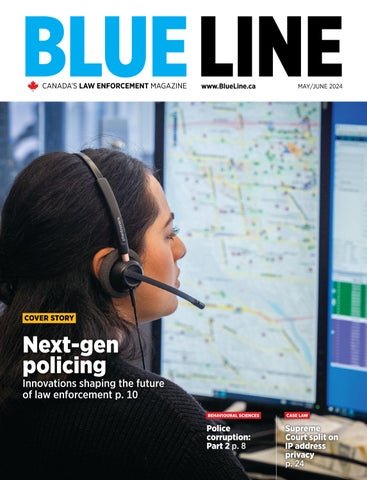
COVER STORY
Next-gen policing
Innovations shaping the future of law enforcement p. 10 BEHAVIOURAL SCIENCES
CASE LAW
Police corruption: Part 2 p. 8
Supreme Court split on IP address privacy p. 24
Live Translate
Note Assist
Nightography Zoom
Speak foreign languages on the spot with Live Translate.1
Focus on capturing your notes and spend less time perfecting them.2
Nightography Zoom captures highresolution detail, even in the dark.
Download the Try Galaxy for Work app.
samsung.com 1
Samsung account log-in required. Calls must be made using the native Samsung dialer. Live Translate requires a network connection. Languages require language pack download, language availability will vary. Service availability may vary by language. Accuracy of results is not guaranteed.
2
For text in Samsung Notes only (200-4,000 characters). Requires Samsung account log-in and internet connection. Service availability may vary by language. Accuracy of results is not guaranteed.
Contents
10 May/June 2024
Columns
Volume 36 Number 3
4 8 24 30
Features
Editor’s Commentary Behavioural Sciences Case Law Back of the Book
Departments 5 5 6 7 9 29
COVER STORY
10 Next-gen policing
Innovations shaping the future of law enforcement. By Brittani Schroeder.
12 Beyond expectations
News By the numbers Dispatches Calendar Off the Shelf Marketplace
A surprising approach to modernizing patrol operations. By Ryan Prox.
18 Redefining success
Strategies for continuous improvement in DT instruction. By Chris Mandigma.
20 Balancing urgency and importance
Rethinking policing in the digital era. By Andrew Critchley.
22 Hidden dangers
Prone restraint and positional asphyxia in custody deaths. By Geoffrey Desmoulin.
26 Ground penetrating radar and geoforensics for criminal investigations
COVER PHOTO: PEEL REGIONAL POLICE
The value of collaboration between law enforcement and academia. By Grant Wach, Trevor Kelly, Lauren Morris, Kristie McVicar and Don Stienburg.
18 @Blue_LineMag
12 26 May/June 2024 | BLUE LINE
3
EDITOR’S COMMENTARY BY BRITTANI SCHROEDER
www.BlueLine.ca
Embracing technology for public safety
P
olicing is a dynamic field that form of their planned Operational Support continually evolves to meet the Facility, which will accommodate vital needs of society. Over the years, infrastructure and technologies such as the traditional methods of law enNG9-1-1 centre, IT services, records serviforcement have been refined and innovaces, community and emergency operations tive approaches have emerged to enhance centre, and more. The new PRP facility is community engagement and safety. As the being constructed to meet net-zero carbon editor of Blue Line, I have seen the transstandards, making it one of the first police formation within Canadian law facilities in Canada to do so. enforcement over the last few This ongoing Additionally, Division 41 of the years, from the adoption of cut- evolution Toronto Police Service has reting-edge technologies to the reflects a cently revealed plans to conimplementation of commun- commitment to struct a net-zero station. ity-oriented policing strategies. serving I had the opportunity to disThis ongoing evolution reflects communities cuss this innovative project with a commitment to serving com- effectively key members, including PRP’s munities effectively while adapt- while adapting Deputy Chief Anthony Odoardi ing to the shifting landscape of to the shifting – Innovation and Technology, landscape of public safety challenges. Executive Advisor Robert ShearIn this month’s cover story, I public safety er, Director Shawn Fauvelle – asked Peel Regional Police (PRP) challenges. Facilities Management, and AnChief Nishan Duraiappah which thony Fieldman – partner at new technologies have made the DIALOG Design. biggest impact on policing operations over To conclude our conversation, Duraiapthe last few years. pah shared his belief that there is a better, Duraiappah has been PRP’s Chief since more efficient way for vendors and police October 2019 but has been a member of leaders to connect and create new solulaw enforcement since 1995. Now having tions for use in Canadian communities, served for almost three decades, he has and you can find his full remarks on page seen police services progress from having 10. only one computer that could send emails, As always, please reach out to me at any to having the ability to track where each time if you believe that there is a topic that officer is at any given time throughout you think we should be talking about, a new their shift. During our conversation, Duprogram that your police service has startraiappah shared what he thinks have been ed, or an officer you think should be highsome of the most valuable pieces of techlighted. I can be reached at bschroeder@ nology brought into law enforcement over annexbusienssmedia.com. the last few years that he has served as Until next time, happy reading and be chief, which included Next Generation well. 9-1-1, body-worn cameras, licence plate readers and artificial intelligence, among others. When looking at advancements in policing, Duraiappah and his team have focused on enhancing support for their members. This effort materializes in the
CONNECT WITH BLUE LINE
www.BlueLine.ca
4
@Blue_LineMag
BLUE LINE | May/June 2024
www.facebook.com/BlueLineMagazine
Reader Service Print and digital subscription inquiries or changes, please contact customer service Angelita Potal Tel: 416-510-5113 Fax: (416) 510-6875 email: apotal@annexbusinessmedia.com Mail: 111 Gordon Baker Rd., Suite 400 Toronto, ON M2H 3R1 GROUP PUBLISHER | PAUL GROSSINGER pgrossinger@annexbusinessmedia.com PUBLISHER | ADAM SZPAKOWSKI aszpakowski@annexbusinessmedia.com EDITOR | BRITTANI SCHROEDER bschroeder@annexbusinessmedia.com EDITORIAL DIRECTOR PUBLIC SAFETY GROUP | LAURA AIKEN laiken@annexbusinessmedia.com ACCOUNT MANAGER | JANICE EATON jeaton@annexbusinessmedia.com MEDIA DESIGNER | LISA ZAMBRI lzambri@annexbusinessmedia.com ACCOUNT COORDINATOR | KATHRYN NYENHUIS knyenhuis@annexbusinessmedia.com AUDIENCE DEVELOPMENT MANAGER BEATA OLECHNOWICZ | (416) 510-5182 bolechnowicz@annexbusinessmedia.com CEO | SCOTT JAMIESON sjamieson@annexbusinessmedia.com ANNEX BUSINESS MEDIA 111 Gordon Baker Road, Suite 400 Toronto, ON M2H 3R1 Tel. 416-442-5600 • Fax 416-442-2191 Publication Mail Agreement No. 40065710 ISSN 0847-8538 Printed in Canada SUBSCRIPTION RATES Canada — 1 Year $32.13; 2 Year $53.55 plus tax USA — 1 Year $139.23 CAD Occasionally, Blue Line will mail information on behalf of industry-related groups whose products and services we believe may be of interest to you. If you prefer not to receive this information, please contact our circulation department in any of the four ways listed above. Annex Privacy Officer Privacy@annexbusinessmedia.com; Tel: 800-668-2374 © 2024 Annex Business Media. All rights reserved. Printed in Canada. No part of the editorial content of this publication may be reprinted without the publisher’s written permission. Opinions expressed in this magazine are not necessarily those of the editor or the publisher. No liability is assumed for errors or omissions. Readers are cautioned and advised that articles presented herein are edited and supplied for your personal awareness and should not be used for further action until appropriate guidance is received from a supervisor, Crown Attorney or other persons in authority. All advertising is subject to the publisher’s approval. Such approval does not imply any endorsement of the products or services advertised. The publisher reserves the right to refuse advertising that does not meet the standards of this publication.
NEWS
From left to right: RCMP Deputy Commissioner Bryan Larkin, Executive Director of the OACP Jeff McGuire, Editor Brittani Schroeder, Chief Jim MacSween - York Regional Police, President of the OACP.
Exploring the highlights: OACP & Blue Line Expo 2024 On March 26th, the Ottawa Conference and Event Centre buzzed with activity as Blue Line and the Ontario Association of Chiefs of Police (OACP) united to host the OACP & Blue Line Expo, drawing a crowd of over 140 attendees. This marks the third consecutive year of our successful collaboration. The expo boasted a diverse array of over 60 vendors showcasing cutting-edge technology, services and products spanning the law enforcement, corrections and security sectors. Attendees had the opportunity to explore everything from apparel and footwear to virtual reality training systems, law enforcement vehicles, drones, surveillance systems, police firearms, tactical equipment and custom graphics for clothing and vehicles.
RCMP Deputy Commissioner Bryan Larkin provides keynote address.
The event garnered sponsorship from esteemed names in the industry, including Triton Police Innovations, GeoWarehouse, Wilfrid Laurier University, GardaWorld, Commissionaires, DAVTECH, and Trimtag Trading Inc. In addition to the exhibition, visitors were treated to engaging conference sessions featuring a special keynote address and an awards ceremony held throughout the day.
Keynote: Bryan Larkin, RCMP Deputy Commissioner, Specialized Policing Services
This year’s special keynote address was delivered by Bryan Larkin, RCMP Deputy Commissioner, Specialized Policing Services. In his speech, he touched on what he has seen over his many years in policing, from his time on the front lines to his time in leadership roles. He encouraged all in attendance to think back to their first day on the job and to do it frequently. He also challenged police leadership to strive for cohesion. “Our communities and neighbourhoods have never been so divided. Within our own police services, we have division. Our role as leaders is to unify. Our role is to connect people, be peacekeepers, and we are often acting as the neutral party that can bring differing opinions together to make a stronger community. As we look to
the future, looking at bringing that unity, let’s start the conversation within our own profession because we’re stronger as a united service,” he shared. He also thanked Blue Line and the OACP for the work being done for Canada’s police officers. Before and after his session, Deputy Commissioner Larkin visited many booths on the expo floor and connected with exhibitors.
Editor Brittani Schroeder and Cst. Veronica Fast.
Rookie of the Year award presentation
The Blue Line Rookie of the Year award celebrates emerging officers who exemplify excellence in modern policing, influencing their peers, agencies and communities positively. At this year’s OACP & Blue Line Expo, Cst. Veronica Fast of the Hamilton Police Service was honoured with this prestigious award. Congratulations to Cst. Fast on this well-deserved recognition! Editor’s note: A special thank you to all our attendees, sponsors, exhibitors and presenters at this year’s conference and expo. Remember to check out the hashtag #OACPBLExpo for more photos of the event. We can’t wait to see you again in 2025!
PHOTO CREDIT: BRITTANI SCHROEDER
BY THE NUMBERS
In March 2024, Statistics Canada released recent data on police personnel and expenditures in Canada, 2023. For more information, please visit www150.statcan.gc.ca.
71,472 police officers in Canada, as of May 15, 2023. This is 892 more than in 2022.
@Blue_LineMag
23% of police officers were women. This is 411 more women police officers than in 2022.
$19.7 billion was the reported operating expenditures in 2022/2023, up 6 per cent from 2021/2022.
8%
of police officers were racialized, and 4 per cent of police officers were Indigenous.
May/June 2024 | BLUE LINE
5
NEWS DISPATCHES Treena MacSween is London’s third deputy chief. MacSween joined the London Police Service with over 26 years of policing experience, including with Peel Regional Police Service and Hamilton Police Service, in progressive leadership roles. The appointment of Deputy Chief MacSween marks a historic moment for the London Police Service, as she will be the first woman of colour to join the command team cadre. Upon the appointment taking effect, she will notably become the highest-ranking black female police officer in Canada. Oak Bay Deputy Chief Julie Chanin will be appointed as the new Chief Constable effective June 1. Chanin, the first female Deputy Chief Constable in Greater Victoria, was appointed to her current role in April 2022. Deputy Chanin has over 24 years of policing experience, including 13 years with Oak Bay Police, and previously worked for the RCMP. The North Bay Police Service has named Daryl Longworth as its new chief of police. Longworth spent 26 years with the Woodstock Police Service, before becoming the deputy chief of the London Police Service. He returned to Woodstock Police in 2019, where he served as chief until 2022. Sydney Lecky has been appointed as the next Timmins Police Service chief. He has over 29 years of policing experience and has held various leadership roles with the RCMP. Previously, Lecky was the chief superintendent and commanding officer of the Northwest Territories RCMP. Dale Cox retired as the chief of the Lakeshore Regional Police Service on March 31, after more than 45 years of policing experience. Cox joined the RCMP in 1979, and later joined the Lakeshore Regional Police Service as their first Chief in 2009.
6
BLUE LINE | May/June 2024
CALENDAR Insp. Jeff Lawson of the Victoria Police Department has recently been appointed to Officer in Charge of Patrol Division. Lawson started his policing career with Blood Tribe Police Service in 2006 and joined VicPD in 2006 and has focused in the areas of organized crime and national security. Lawson recently led Project Lifter, a retail theft operation which resulted in more than 100 arrests and more than $29,000 in shoplifted goods recovered. Todd Waselovich and Luigi Greco have both been appointed to Deputy Chief of Police for the Niagara Regional Police Service. Waselovich is a 25-year-member of the Niagara Regional Police Service and has extensive leadership experience in both Operational Services and Operational Support. Throughout his career, he has served in several positions, including Uniform Frontline Patrol, Detective Services, Special Investigative Services, Emergency Services, Labour Relations, Professional Development, and, most recently as the Superintendent of Emergency and Investigative Services. Greco is a 25-year-member of the Niagara Regional Police Service. Throughout his career, he has served in a variety of areas, including Uniform Frontline Patrol, Detective Services, Criminal Investigations, Special Investigative Services, Communications, Major Crime, Professional Standards, Professional Development (Labour Relations, Training, Recruiting, Member Support, Equity, Diversity, and Inclusion), and, most recently, as the Superintendent of Executive Services. Kevin Maher has been appointed to the role of Deputy Chief for Halton Regional Police Service. Maher began his policing career in 1987 as a Cadet with the Toronto Police Service before joining the Halton Regional Police Service in 1990. Over the years, he has served in a number of front-line, specialized investigative unit, and senior executive leadership positions.
New Police Paradigm: Real-time Situational Awareness and Geotargeting • WEBINAR Date: May 30, 2024 Location: Online www.blueline.ca/events Ontario Association of Chiefs of Police 2024 Annual Conference Date: June 9 – 12, 2024 Location: London, Ont. www.oacp.ca IDALLOGY QTRMaster – RFID Equipment Tracking • WEBINAR Date: June 18, 2024 Location: Online www.blueline.ca/events Security • Police • Fire Career Expo – Edmonton Date: Oct. 29, 2024 Location: Edmonton, Alta. www.emergencyservicesexpo.ca Find more calendar events online at blueline.ca/events.
Windsor Police Service has appointed Jill Lawrence to Superintendent for Patrol Operations. Lawrence has been a member of the Windsor Police for over 25 years. In that time, she has served the community in a variety of roles, including with the patrol, marine, drugs and guns, and property crime units. Sgt. Jason McFarlane has been sworn in as the seventh officer in Grande Prairie Police Service’s ranks. Sgt. McFarlane’s career started with the Edmonton Police Service in fall 2002, lasting until fall 2004 when he joined the RCMP in Elk Point. Since then, he has spent time as a frontline officer and supervisor in General Duty, Traffic, and Community Engagement units. Brandon Police Service was saddened to announce the passing of Cst. Lucien Ethier in February. He was driving his personal vehicle, off-duty, when he experienced a medical issue. Cst. Ethier served 20 years with the Brandon Police Service.
www.BlueLine.ca
STANDING SHOULDER TO SHOULDER WITH YOU Your trusted source for uniform insignia
trimtag.com • contact@trimtag.com • 905-763-7300 @Blue_LineMag
May/June 2024 | BLUE LINE
7
BEHAVIOURAL SCIENCES
BY PETER COLLINS AND DARREN BALSOM
Police corruption: Part 2
T
he word corruption comes from such as drugs, prostitution rings, sex the Latin word ‘corruptus’, trafficking, illegal gambling, etc. which means ‘to break.’ Al- • Fixing – undermining investigations at though corruption is a complex the behest of criminals. concept to define, its most broad definition • Direct criminal activities – engaging in is the “exercise of official powers without a crime against individual(s). regard for the public interest”. • Internal payoffs – when promotions, Corruption occurs when a police officer annual leave, are “bought”. loses integrity in their professional actions • Adding or planting evidence. and accepts benefits or rewards in exchange for violating their mandated responsibilSome researchers believe that it is diffiities. Police criminality occurs when police cult to separate integrity violations from officials engage in direct acts of crime corruption. These violations can include whether they are on-duty or off-duty. Cor- moonlighting (non-declared secondary ruption occurs on a continuum that ranges employment), misusing information, infrom serious crimes to attending a confer- timidating citizens and colleagues, the ence, in Las Vegas, using public misuse of power for a perceived money and never showing up at When police justified good, and abusing and the event after registering on- engage in wasting resources. corrupt site. Police corruption can overlap practices, they Case study In 2021, Darren Balsom was enwith other forms of police devi- betray the ance and misconduct. Several trust placed in gaged in a sensitive internal corruption file involving a forstudies on police misconduct them by mer member of a large police have found that profit-driven society. service. This operation spanned crime is the main type of police many months and involved malfeasance. One theory is that low pay can lead to the acceptance of bribes interviews with multiple vulnerable perand the risk of extortion, especially with sons. As this file progressed, more alarming living costs skyrocketing. Some disagree, behaviours were uncovered. While the asstating that even well-paid officers will sessment of this former member had been engage in profit-driven activities due to completed and was being updated as new greed. Even if police officers are well-salar- concerns came forward, Balsom noted that, ied, they may believe that they are not re- seemingly, after each new piece of evidence munerated to match their responsibilities and additional vulnerable women were and thus may still engage in corrupt prac- discovered, investigators learned of more who were impacted. tices. At the end of this operation, the member Nine types of police corruption are noted resigned, and the provincial department of in academic literature: • Corruption of authority – attaining justice decided not to proceed with prosperks without contravening the law, such ecution. This decision had to be communias receiving free meals, beverages and cated to the women who came forward. This was not an easy task and they reservices. • Kickbacks – goods, services or money sponded as one would expect. This took a toll on the entire team. They obtained for business referrals promotwere all seasoned investigators – however, ing a company or individual. • Opportunistic theft – stealing from they all felt this was different. This was a people who have been arrested, engaged “fellow officer” who abused the role and in accidents, or from victims or deceased exploited women. Balsom suggested the team consider attending a formal psychoindividuals. • Turning a blind eye – bribes undertaken logical debrief. This was a foreign concept to many on the team, but they were open for ignoring criminal activity. • Protection of illegal activities – pro- to innovative ideas. As a group, they agreed tecting criminal enterprises and organ- on a clinician and they let the boss know. ized crime engaged in illegal activities The day was set. 8
BLUE LINE | May/June 2024
This debrief occurred at an off-site location and spanned an entire afternoon. As the doctor walked the team through this incident, they expressed their anger, celebrated successes, and placed responsibility for various aspects on other sections of the justice system. After a few tears, some laughs and a lot of personal and professional support, the team left there feeling like a weight had been lifted. They were a little more at peace with the outcome of this file and better prepared to face the next file.
Conclusion
When police engage in corrupt practices, they betray the trust placed in them by society. Corruption within the police also undermines the principles of justice and fairness upon which the legal system is structured. In the past, corruption has led to wrongful convictions. When cases of police corruption come to light, it erodes public confidence in the service, making citizens less likely to cooperate with law enforcement or report crimes, which can ultimately weaken the effectiveness of policing efforts. In addition, corruption has a major impact on community relations by exacerbating tensions between police services in the communities they serve, particularly marginalized or minority communities. Corruption within the police service can have detrimental effects on the morale and professionalism of law enforcement officers. It tarnishes the reputation of all officers, including those who uphold their duty with integrity, and undermines efforts to maintain high standards of conduct and accountability within the profession.
Peter Collins is the operational forensic psychiatrist with the Ontario Provincial Police’s Criminal Behaviour Analysis Section. He is also a member of the crisis/ hostage negotiation team of the Toronto Police Service Emergency Task Force. Dr. Collins’ opinions are his own. Contact him at peter.collins@utoronto.ca. Darren Balsom is a Certified Threat Management Specialist and Criminal Profiling Understudy assigned to the Calgary Police Service Behavioural Sciences Team. Darren is the former President of the Canadian Association of Threat Assessment Professionals (CATAP) and has trained staff and worked with all levels of the criminal justice system.
www.BlueLine.ca
OFF THE SHELF Diversity and Indigenous Peoples in Canada, Fifth Edition By Darion Boyington ISBN: 978-1772555936
The newly updated edition of Diversity and Indigenous Peoples in Canada by Darion Boyington, a former police officer and now a professor at Mohawk College, transforms the discussion of diversity in Canada. It’s a journey from our past tragedies and successes to our current challenges and opportunities, with an optimistic view of the future of Canada’s multicultural mosaic. In its pages, secondary and post-secondary students and community safety professionals travel from theories of diversity to the practical application of diversity principles. Importantly, case studies reflect perspectives from coast to coast to coast. The book starts with an introduction to the language of diversity, creating a solid
BL_DRElectronics_MayJune24.indd 1 @Blue_LineMag
foundation for further exploration. The examples are ripped from current headlines. Specifically, readers are presented with a case study entitled “The Freedom Convoy and the Charter,” which examines the Report of the Public Inquiry into the 2022 Public Order Emergency. By reviewing a summary of the Report, readers reflect upon the impacts following the Canadian government’s decision to invoke the Emergencies Act in Feb. 2022. Relationships are fundamental to Indigenous peoples in Canada, and the detailed discussions surrounding the relationships among language, land, and cultures are important given the resurgence of Indigenous languages. Readers explore the development of the relationship between Indigenous peoples and other people in Canada. Further, readers explore the evolving relationship between Indigenous peoples, and municipal, provincial and federal governments and law enforcement. This book includes a plethora of resources for learners, teachers, professionals, and
libraries. For ease of learning, key terms are highlighted throughout the book and are defined in the margins. Chapter summaries and review questions help affirm readers’ knowledge, and discussion questions and references encourage learners to further explore diversity in Canada. As a professor myself in a college community safety program, I highly recommend Diversity and Indigenous Peoples in Canada. Readers progress from examining various fundamental questions surrounding diversity to probing pressing issues in our multicultural society and asking deeper questions about the future of diversity in Canada. Special emphasis is placed on the importance of developing “diversity competency” for community safety professionals and students. Ultimately, readers are encouraged to share their culture with others to create a country that sees the importance of equity, diversity, inclusion, and belonging. – Lance Triskle, LLB, LLM is Anishinabe of Red Rock Indian Band and is a professor at Georgian College. Author of Guide to Martins’ Annual Criminal Code, 3rd Edition.
9:46 AM9 May/June 2024 2024-04-24 | BLUE LINE
COVER STORY
Next-gen policing
Innovations shaping the future of law enforcement By Brittani Schroeder
A look back
Since Duraiappah’s first days on the job in 1996, he has seen many changes in how police perform their daily duties. Still, he’d say the biggest change came with regard to communication abilities and being able to send and receive data over cellular and wireless networks. “When I started at Halton Regional Police, the only way to send an email was from one particular computer. You couldn’t send messages from your vehicles,” he said.
When looking at the last four years that he’s been chief of police, Duraiappah shared that some of the biggest advancements for his team were bodyworn cameras, licence plate reader technology, NG9-1-1, a public safety broadband network and artificial intelligence (AI). Body-worn cameras are not new, but Duraiappah recognizes that the science behind them is always evolving. Now, the cameras can stream directly into PRP’s Community Operations Centre (otherwise known as a Real Time Operations Centre) where the interaction can be viewed live. “Now, a third-party mental health provider can watch the live feed, provide feedback and direction, and even assist with referrals to community resources.” Licence plate reader technology is another tool that may not be new to the market but has made a real difference to officers. Duraiappah explained that this tool assists greatly with detecting crimes and cutting down time at traffic stops. Peel Regional Police reached a milestone in Feb. 2024 by becoming the first major 9-1-1 communications centre in Canada to launch Next Generation 9-1-1 (NG9-1-1) services. “We have a large urban com-
Chief Nishan Duraiappah and Melinda Morley, call taker at Communications.
munication centre and the 9-1-1 wait times have been the bane of our community’s existence for a long time,” he said. NG9-1-1 can identify misuse calls and pocket redials, which will help to discern which calls need a human’s attention and response. The creation of a public safety broadband network has helped PRP to achieve network resiliency, cybersecurity and reliability. This is PRP’s internal data network, and as Duraiappah shared, it helps avoid paying fees to a telecom company. PRP has been able to deploy this broadband network to peak incidents that require ample first responders and public safety personnel, such as the annual Grey Cup, and have had ongoing discussions to utilize events like the recent solar eclipse mass gatherings as an opportunity to partner with other police agencies. Peel Regional Police is undergoing lengthy conversations with community members to understand the impacts of future technologies and how they can help. An example of AI technology is facial recognition software, or being able to quickly dispatch fire and paramedics, and other services like tow trucks. Duraiappah believes AI
“It all comes down to the art of possibility.” – Chief Duraiappah 10
BLUE LINE | May/June 2024
can also help police understand the community’s needs better. When thinking about all the technology available to police today, Duraiappah shared that “it all comes down to the art of possibility. The opportunities are endless.”
A look at safety
When Duraiappah considers the safety of his team and police officers across Canada, one of the biggest advancements in this area is the ability to track them at any given point. “Having vehicle logistics and knowing where our people are is a gamechanger,” he said. “Even 20 years ago, if an officer wasn’t using their radio, you wouldn’t have any idea where they were.” Drone first responders are also a plus on the safety side. “We’re able to send in a mini drone to get video coverage before we send an officer into a building. Drones can get into places where officers may not physically be able to. We’re finding those who may be in crisis while also protecting our people.” Unfortunately, this procedure doesn’t work in every situation, but Duraiappah shared that it’s utilized if and when it can be.
A look at support
Advances in policing must also be applied to supporting faciliwww.BlueLine.ca
PHOTO: PEEL REGIONAL POLICE
I
n an era where technology evolves at a breakneck pace, law enforcement agencies worldwide are in a constant race to adapt. Over the last two decades, numerous advancements have transformed the landscape for officers on the front lines. Looking ahead, the trajectory of technological innovation promises even more profound impacts on policing practices and community dynamics. In a discussion with Blue Line, Chief Nishan Duraiappah of Peel Regional Police (PRP), delved into the transformative potential of technology and its implications for policing strategies and community engagement in an ever-evolving society.
ties. In Oct. 2023, PRP broke ground on a new Operational Support Facility that will house critical infrastructure and technologies, including the NG9-1-1 centre, IT services, records services, community and emergency operations centre, and more. It is set to be completed in 2028. “This building will be a flagship building, state-of-the-art for innovation in policing,” stated Executive Advisor Robert Shearer, who has been with PRP for 36 years—35 as a sworn officer. Duraiappah shared that PRP spends a lot of time on their people because they know it’s important to invest in them. “We must think of the tools they need, and that includes tech.” The new building is being built to net zero carbon standards and is one of the first police facilities in Canada to do so. “Mass timber construction will be a hallmark feature, providing a building material that is natural, renewable, sustainable and built to last,” said Shearer. As Anthony Fieldman, partner at DIALOG Design – the architectural firm contracted for this build – said, the first principle of environmental stewardship is to reduce the amount of materials needed, and that has been the goal for this project. The next principle is to put energy sources where they function most efficiently. For the PRP project, this included using under-floor air delivery, rather than overhead ducts blowing cold air past hot air. A third principle takes a look at material health and sustainable material use. For this project, mass timber is being used for the structure, which is a more renewable source than concrete or steel. The building will sit on a 7.2acre lot, which sits adjacent to the local fire service and paramedic buildings. The building itself will take as small a portion of the land as possible, and the site will be designed with ‘green @Blue_LineMag
features’ with porosity for stormwater management.
Innovations for members
As the design work for the building began, Fieldman and his team held interviews with the many PRP departments that would be housed in this new building to discover the priorities and ‘big picture goals’ of all those involved. “We needed to work beyond just fulfilling the functional requirements. We needed to engender physical and mental health amongst the officers and personnel who would be working inside the building,” he said. A favourite saying of Duraiappah’s is, “We want to be the most progressive, innovative and inclusive police service in the galaxy. That’s not a competitive thing—it’s aspirational.” For both PRP and DIALOG Design, it was paramount to design a facility that catered to the mental health of its occupants. Inside the new facility, there will be a series of indoor and outdoor gardens, a community room, and even rooms that can be booked by community groups external to PRP. The locker rooms, cafeteria and fitness centre will all be located on the third floor, as this presents equal access to personnel working on any of the five stories. “This project needed to happen immediately because our support facilities are crucial to community safety. It needed to be innovative and progressive, and it had to be an inclusive environment,” said Duraiappah. The team, including Deputy Chief Anthony Odoardi – Innovation and Technology, Robert Shearer, and Director Shawn Fauvelle – Facilities Management, got to work right away. “Collaboration spaces have been purposely designed to make a connection to nature with an abundance of natural light, which will enhance the employee-centric look and feel
of the workplace and make this an inviting work environment for our people,” said Fauvelle. “The OSF will enable PRP to enhance our ability to modernize and innovate, in a structure that affirms our pledge to be sustainability leaders who are charting the course for future generations on the importance of preserving the well-being of both employees and the surrounding community,” said Odoardi.
A look ahead
Duraiappah does not find it surprising that technology runs faster than the speed of policing. He believes in order for policing to stay abreast of new technology, two things are needed. First, vendors need to engage with police services much earlier in the product development process. “Often, vendors will fully produce a piece of tech and then leave it to the police chiefs to explain its legitimacy to their police board and the community,” he said. “We need the vendors to come to us, work alongside us—the ones who serve public safety, who understand what the community needs—and build the technology with us involved.” The second piece of the puzzle is for the police to engage with the community far earlier. “Such bright minds are creating these new solutions, and law enforcement sees the value of
this new tech, but it’s often piloted without asking the community first.” Duraiappah knows the community wants to contribute to how officers utilize tech. There is always the worry that the community will say to not use the technology, but Duraiappah believes if they were involved from the beginning and understood the potential pros and cons, alternatively, they could become supporters of the products. Knowing that he and his team only get to steward PRP for a little while before passing it on, Duraiappah hopes that the advancements in technology that he has seen ushered in will only continue to increase. “A rising tide floats all boats. Across our sector, there is a greater willingness today to bring each other along. Because of this, it’s not all about one police service or agency; it’s about everyone,” he said. “I always say to Anthony [Odoardi] and Tony [Ventura, director of information technology services] that everything we do is for the greater good. We know urban pressures and crime will change, and you can see that now with auto thefts, international geopolitical issues, etc. There’s no template for it, but if you’re flexible and you’re able to push into the art of possibility, I think there’s a lot of optimism for not just policing in Peel, but across the country.”
May/June 2024 | BLUE LINE
11
INNOVATION
Beyond expectations A surprising approach to modernizing patrol operations
minimal officer training and ultimately contribute to improving public safety. It became apparent to the VDP project team that a system containing a wide range of information and narrowly focused enough to be relevant would be extremely difficult to build. Any solution needed to be scannable within seconds to develop a plan of action and support officer-initiated problem-solving.
By Ryan Prox
I
n 2023, Vancouver Police Department (VPD) embarked on a mission to modernize its patrol operations, aiming for a more intelligence-led approach. While similar projects often focus on management oversight initiatives and high-tech Operations Command Centers (OCC), VPD recognized an essential yet often overlooked aspect: empowering front-line patrol officers. These officers serve as the initial point of contact with the community, handling emerging situations with limited resources and time. VPD set out to equip patrol officers with the technological tools necessary to enhance their core capabilities. The challenge lay in implementing a system that could bridge information gaps and provide real-time intelligence without overwhelming the officers. Patrol officer feedback provided valuable information and perspective that suggested a traditional top-down approach would add to existing bureaucracy. Key themes surfaced, indicating some of the driving forces behind competing stimuli for the officer’s attention. 12
BLUE LINE | May/June 2024
Essential tools such as smart radios, cell phones, records management systems and computer-aided dispatch systems require substantial training and often dominate an officer’s time dealing with the required record keeping—a by-product of modern policing. The addition of yet another system must be designed to provide information that is easily digestible, but also relevant to the circumstances and limited to mission critical details concerning the officer’s current location.
The objective
The same solution had to meet the needs of management and address the requirements necessary to support an OCC. From a management perspective, the goal was to improve the coordination of police resources at a city-wide level and to create an infrastructure able to respond to evolving situations in real time. Management’s range of uses and requirements somehow had to fit within the framework of a system designed for patrol officers. A new system would need to address a wide range of scenarios with
GIS
The existing VPD GeoDASH system offered a visual representation of crime incidents, along with analytical tools that were once exclusive to analysts trained in advanced geographic information systems
An OCC’s specific function is to provide centralized operational control and to improve the efficiency and function of limited patrol resources. Systems used by administrators responsible for fiscal accountability and officer performance metrics and oversight don’t always coincide with the technology needed to support officers. The dichotomy between the complexities of managing patrol and the need to provide timely intelligence to officers became primary considerations. Examining other police service’s OCC and literature, there appeared to be two streams which influenced the technology implemented to support each model. One approach relied on GIS technology to provide real-time situational awareness and, in turn, assisted the command staff’s ability to reallocate resources for serious incidents and provide tactical assistance to patrol units. The second focused on metrics and efficiency. Both examined response times to priority calls, call load comparison, distribution of incidents by policing boundaries and resource allocation. Neither offered technology and resources accessible by front-line patrol officers. The focus was on the front lines, but not for the front lines.
Leveraging technology
Based on this information, the project team incorporated features required by both stakeholder groups to improve officer situational awarewww.BlueLine.ca
PHOTO: VANCOUVER POLICE DEPARTMENT
Paradoxes
“BE SEEN, BE SAFE” in any hazardous location.
Since 1996, Eflare has been the world leader in LED Safety beacons for EMERGENCY SERVICES, RAIL, UTILITIES, MINING, AVIATION, MILITARY, TRANSPORT, LOGISTICS and INDUSTRIAL applications supplying robust, reliable and cost effective warning beacons. Eflare has the accreditations to operate in hazardous environments with a wide range of models and features to suit your requirements and accessories for any application. After more than 20 years and 700,000 beacons sold world-wide, Eflare understands our users’ unique requirements and with our range of colours, flash patterns, size and accessories has the perfect product to keep your team safe.
DISTRIBUTOR ENQUIRIES ARE WELCOME.
INNOVATION left unattended, would then flash red. This
VPD prioritized patrol officers as the new method of designating and monitoring PPZ provides a real-time assessment tool, primary client, requiring the use of whereby the OCC can ensure that ‘at risk’ mobile technology in vehicles as a project areas of the community are receiving sufficient police attention. prerequisite. ness and organizational resource efficiency, which typically operate in siloed systems. An integrated approach with interoperability hardcoded into system served to empower front-line officers’ decision-making and engagement and addressed command staff objectives. The project team explored ways to leverage the existing infrastructure within the organization, and the GeoDASH system seemed to be a perfect fit. Utilizing its user interface would not only cut overall project costs but also facilitate technology adoption by minimizing training efforts and enhancing user acceptance. The existing VPD GeoDASH system offered a visual representation of crime incidents, along with analytical tools that were once exclusive to analysts trained in advanced geographic information systems (GIS). This capability has been extended to officers through a user-friendly interface. Adapting this existing technology and infrastructure would help close capacity gaps in patrol, providing a mechanism to introduce real-time situational awareness. The same system served a multipurpose, where officers can access crime forecasts (predictive mode) on their MDTs (mobile data terminal) and display residential and commercial break-and-enters, as well as theft from autos and theft of autos at twohour intervals throughout the day. The VDP project team examined ways to adapt the existing GeoDASH system to ingest real-time computer-aided dispatch (CAD) data. The consideration of frontline patrol officers as the primary ‘client’ involved a system design that mitigates information overload, distilling mission-critical information into manageable segments relevant to the moment, and displaying it on laptops mounted in police vehicles. The OCC, being the secondary client, needed the same information, but had the additional need for unit availability, tactical resources and specialty units or negotiators to manage serious incidents in a coordinated approach. The concept of an ‘operations awareness mode’, utilizing the GPS/mobile network to determine the officer’s current location and displaying only the most pertinent 14
BLUE LINE | May/June 2024
information associated with the immediate vicinity of the patrol vehicle, was explored. When an officer activates Ops Awareness, the map automatically centers on the officer’s vehicle and displays the number of recent crime incidents within a 300-metre proximity. These incidents are highlighted with a bright label identifying the type of incident, and a yellow header at the top of the screen summarizes the occurrences as the vehicle travels into active areas. By simply tapping the displayed icons, officers can read CAD incident summaries and occurrence synopsis text without having to switch to another system. Nearby patrol units and active calls are displayed in real time. Cover units are visible. This provides frontline officers with an overview of 911 calls and the level of activity impacting calls for service. Patrol officers also reiterated the need for detailed information on a range of subjects. The system was enhanced with instant access to floor plans for bars, restaurants, shopping centers, transit stations, sports arenas, schools and other public places where there existed a potential for a critical incident. Officer safety was improved with the inclusion of real-time gang activity and enforcement actions, to better inform patrol officers about areas of concern requiring additional attention. The VPD Bar and Restaurant Watch program was also incorporated into the system, supporting enforcement actions against gang members who pose a risk to public safety. The system is constantly updated with new information, driven exclusively by requests from patrol officers.
Priority Patrol Zones (PPZ)
A Priority Patrol Zones (PPZ) feature was designed with the OCC in mind and was a unique solution for district commanders to designate specific areas for high-intensity patrols in response to emerging issues. For example, clusters of distraction thefts in a specific area could be designated as a PPZ with requirements for the area to be intensely patrolled at predetermined intervals. If the patrol threshold wasn’t met, the zone would turn yellow on the map and if
OpsDASH
In tandem with the development of the enhanced GeoDASH system, an Operations Dashboard (OpsDASH) was created exclusively to support the OCC by providing real-time metrics on call load, response times and resource availability. OpsDASH is an interactive system where OCC staff can select a patrol district and priority level to determine current resource implications, forecasted call load for the day and current response times compared to expected norms. OCC staff can monitor the number of priority calls, queued calls, and availability of specialty resources such as emergency response teams, dog squads and crisis negotiator teams. Instant access to this information is critically important when managing a serious incident when lives are at risk. To facilitate critical incident management, OpsDASH was designed with interoperability with GeoDASH to enable the overlay of operational details in combination with location features.
A shift in thinking
The successful development of cutting-edge technology employed a unique process that combined both a bottom-up and top-down approach. This effectively addressed the needs of front-line officers, while meeting the core requirements of the OCC and VPD management. The shift in thinking and deeper understanding of patrol officers’ operational needs played a crucial role in shaping and operationalizing these concepts into an actionable plan. By adopting a more inclusive and holistic approach, VPD not only enhanced the effectiveness of patrol officers but also contributed to a safer community and a more responsive, evidence-based policing model. Dr. Ryan Prox, O.O.M. is the Officer in Charge of the Crime Analytics Advisory & Development Unit (CAADU) at Vancouver Police Department and Adjunct Professor, Visiting Faculty Member at the School of Criminology, Simon Fraser University. Prox was invested as an Officer of Order of Merit of the Police Forces (OOM) by the Governor General of Canada in 2022, and in Aug. 2022, he was awarded the Police Exemplary Service Medal.
www.BlueLine.ca
Effectively Serve with Axon Axon has partnered with public safety agencies in Canada for over a decade. The Axon Ecosystem is a suite of connected hardware, software and partner products that allow your officers to serve communities more efficiently and effectively. The Axon Ecosystem. Helping you better serve communities.
Learn more at axon.com
TRAINING
Redefining success Strategies for continuous improvement in DT instruction By Chris Mandigma
18
BLUE LINE | May/June 2024
waiting for approval for time off and checking to see if it’s in the training budget, all add up. I’ve seen it happen enough times where DT instructors ask to be placed on a course, get denied repeatedly and, subsequently, the instructor stops asking and further contribution in that labour of love turns into frustration. Things can change though. It’s easy to say, if it’s work-related, the service should pay for it. It’s not wrong, however, the only way we get better is to control our situation and our personal development. I know a large handful of instructors that end up paying for courses out of their pocket and use their vacation leave, myself included, because we want to invest in our development and at some point, it pays off big dividends.
Let’s plan it
I know most training branches plan out their calendars well in advance, and if your unit isn’t, you should be. This not only helps with preventing instructor burnout, but it also helps with developing a training plan to submit for approval. Whether it’s for yourself or the training cadre, it would be beneficial to sit down and collectively discuss who is interested in what course,
and when. For the most part, some of the larger recognized institutions have their training calendar also laid out well in advance. This helps us plan when we can get into these courses in between teaching our own courses. Considerations should also be made for training conferences, because these multi-day events offer seminars and workshops on varying subject matters and a lot can be learned in within the short time. Attending in-person training is a great opportunity to network, share ideas and collaborate with other agencies both for integration and mistakes to avoid.
Keep asking questions
Assuming the training branch has multiple instructors, there will usually be varying training backgrounds. Take advantage of this opportunity to pick each other’s brains. Explore. Don’t be scared to make mistakes. You might not have a deep Brazilian Jiujitsu background, but you might have someone on the cadre who is. Isolate that full mount escape so you not only know how to explain it but also fully understand why you are explaining all the details that you are. Develop a depth of understanding www.BlueLine.ca
PH0TO: CHRIS MANDIGMA
D
efensive Tactics (DT) instructors are often caught between a lot of rocks and hard places. Many DT instructors are so passionate about what they do that it often turns into a labour of love. A DT instructor is part of the evaluation process in a recruit’s onboarding, and we must write emails with recommendations to supervisors for officers who need to undergo remedial training before we can sign off during recertifications. We always want better for the officers because we care about their safety but are often constrained due to the limitations of how a DT program must be delivered. Once an officer transitions to the training unit, there is a perception that we get to train all the time and do fun courses. In reality, it’s Groundhog Day – doing the same thing repeatedly, especially during DT recertifications. DT instructors are inundated with staying up-to-date on training best practices, integrating training updates, updating records, and catching up on administrative duties that can’t be done while we’re teaching. As much as we want to learn new things and attend courses for instructor development, there are challenges. Things like requesting to attend a course,
RESPONSE
Balancing urgency and importance Rethinking policing in the digital era By Andrew Critchley
20
BLUE LINE | May/June 2024
Navigating the multifaceted demands of policing requires an acknowledgment of its inherent complexity.
propriate resources, ensuring a rapid response to emergencies. While acknowledging the system’s significance, and delivering safety and security, uncertainties cast shadows over its effectiveness. We are going to explore the nuanced structure of emergency response protocols, to permit the disentanglement of the concepts of call sensitivity and call importance. The limitations of the existing high and low priority system shall be discussed, and a more comprehensive approach, that recognizes the unique demands of each emergency call, will be proposed. By unveiling and explaining psychological biases that exist beneath the surface of a system that manages resource allocation and response times, the way we view and interpret police decision-making processes within graded response protocols may change. Knowing that biases undermine the efficiencies these protocols aim to achieve, it’s important to conduct a thorough examination of their influence on policing practices. This challenge, along with the complexities of technological advancements, emphasizes the need for a nuanced understanding of emergency re-
sponse beyond mere categorizations, aligning with the evolving needs of our communities. In each of the following psychological concepts, example of how each concept may influence a decision-maker/police officer’s actions are provided.
The Anchoring Effect: Distorted perceptions and dismissed urgency
The anchoring effect was first conceptualized by Tversky & Kahneman (1974) and can be evidenced when a specific priority level is attributed to a call (usually by a dispatcher). Once a call is categorized as either a priority 1, 2 or 3, officers unconsciously anchor their perceptions to this initial information. This fixation can cause them to disregard crucial details, especially in lower-priority calls, blinding them to the potential severity of situations that don’t align with their assigned urgency; either a call is a priority, or it isn’t. While there are opportunities to challenge the assigned priority status, the likelihood of doing so will be influenced by several factors, including individual personality differences and traits, the organizational culture, the context of the situation, and www.BlueLine.ca
PHOTO: © BPAWESOME / ADOBE STOCK
I
t’s difficult to deny the impact associated with the rise and reliance of technological tools within policing; a dependence unlikely to diminish. Emergent technologies range from body-worn cameras and in-car digital videos to streamlined record management systems, biometric identification tools, digital evidence management, predictive policing software and drones; all of which have helped reshape the landscape of law enforcement (Grewal et al., 2020). However, notwithstanding the benefits associated with such advancements, shadows loom; each innovative tool, while offering tremendous opportunities, should not be viewed in isolation as a panacea. Greater scrutiny reveals ethical complexities concerning privacy and data security (Quach, 2022). Despite the abundance of technological advancements designed to support police operations, having enhanced and influenced how police services interact with their communities, the emergency 911 call system stands alone. The operator, having evaluated the caller’s needs, dispatches the appropriate emergency services, and initiates a series of coordinated actions that connect individuals in distress with the ap-
one’s level of confidence. The psychological literature on authority and obedience (Milgram, 1963) suggests that individuals, irrespective of their status, tend to defer to authority figures, especially in structured and hierarchical environments.
Confirmation bias: Reinforcing misjudgments
Many psychologists have proposed that human reasoning is subject to positive confirmation bias, tendency, when testing an existing belief, to search for evidence which could confirm that belief, rather than for evidence which could disconfirm it (Kappes et al., 2019). This bias is akin to Shakespeare’s Othello, where the antagonistic Lago manipulates Othello’s mind, causing him to misinterpret innocent situations as confirmations of his false beliefs. In the context of graded response protocols, once a police officer forms the habit of accepting the initial grading, their assessment or any subsequent assessment is prone to an evaluative criteria that validates their former assessment, rather than seeking information that may challenge this belief. Such an approach reinforces a dismissive stance toward lower-priority calls while prioritizing those they consider “important” higher-priority incidents.
Availability heuristic: Amplifying disparities
The availability heuristic (Tversky & Kahneman, 1973) refers to the mental shortcut where people rely on readily available information or examples that come to mind when making decisions about a specific topic or situation. In the context of police work, the availability heuristic can lead officers to overemphasize certain incidents based on their accessibility in memory, which can influence their perceptions of the urgency of different calls. In Principles of Police Interrogation (Van Meter, 1973), the qualities of a good interrogator are described, which include such constructs as integrity, self respect and professional attitude. In the grading of calls under a response protocol, the availability
heuristic can lead to disparities if officers’ perceptions of the urgency of a call are influenced by readily available, high-profile incidents, rather than a comprehensive assessment of the situation. Van Meter emphasized the importance of leaving individual prejudices outside of the interrogation room, highlighting the importance of impartiality. Police officer’s experiences with particular types of calls, whether protracted, complex or those perceived as trivial, all influence officers’ perceptions of urgency; all of which leads to an overemphasis on certain tasks, neglecting potentially graver situations that lack public visibility (Dror, 2020).
Urgency bias: Distorting prioritization and resource allocation
Urgency bias manifests after a police officer determines a particular call to be urgent; thereafter, experiencing a sense of heightened pressure to resolve the situation quickly. This sense of urgency can distort outcomes for both categories of high, and low priority calls, as an officer’s desire to resolve the situation expeditiously could compromise the quality of the investigation. Cognitive associations with high priority calls include those that possess heightened risk factors or emotional intensity. When officers respond to a high-priority call, the adrenaline rush and pressure to respond can influence their subsequent interactions, even when dealing with less urgent incidents. This bias prompts rapid responses to “urgent” situations, sometimes at the expense of thorough investigations of lower-priority calls. This bias not only affects response times but also contributes to resource allocation disparities, impacting the level of service delivery.
Moving forward
Navigating the multifaceted demands of policing requires an acknowledgment of its inherent complexity. Despite its ability to serve as an evaluative tool, identifying and categorizing the urgency of police responses, beyond the surface of the graded
By unveiling and explaining psychological biases that exist beneath the surface of a system that manages resources allocation and response times, the way we view and interpret police decision-making processes within graded response protocols may change. @Blue_LineMag
response system lies a complex interplay of biases and ethical dilemmas. One promising solution could be the implementation of a robust secondary review process. By subjecting lower-priority incidents to a process of thorough review, and ensuring resources are allocated judiciously, we pave the way for an emergency response system that is not only efficient but inherently fair. Such a change represents more than a procedural shift; it minimizes risk through the mitigation of future complaints and embodies a commitment to equity. It challenges conventional wisdom surrounding the term “high priority”, which conflates true urgency and mere time sensitivity. Urgency, often dictated by factors like the presence of offenders or the potential for violence, should no longer be conflated with the term “priority”. The divorcing of temporal imperatives from rigid categorizations forms the cornerstone of a more compassionate and adaptable emergency response system. Our imperative lies in liberating ourselves from the confines of conventional thinking. As Albert Einstein wisely said, “The mind that opens to a new idea never returns to its original size.” Recognizing that urgency doesn’t inherently signify importance, we must disentangle temporal constraints from priority concepts. This paradigm shift not only challenges entrenched perspectives but also fosters a culture where every call, regardless of its time sensitivity, undergoes rigorous evaluation. Confronting biases head-on, embracing evidence-driven reforms, and cultivating a nuanced understanding of the multifaceted investigative needs of diverse communities are not just important steps, they are moral imperatives. Such lofty goals will not only uphold public trust but shall also pave the way for a policing model that is adaptive, compassionate, and attuned to the unique needs of every community it serves (Taylor et al., 2020), and organizational goals of many police services. For a full list of refrences, please vist www.blueline. ca/balancing-urgency-and-importance-rethinking-policing-in-the-digital-era/ Andrew Critchley is a serving police officer with 24 years of experience, currently working as a detective in the robbery unit. He is an advocate for professionalizing the investigation process, is passionate about leveraging public private partnerships (P3) and supports meaningful collaborative community engagement initiatives. He holds a BGS in Psychology and Criminology, and is finishing a MSc in Psychology.
May/June 2024 | BLUE LINE
21
PROCEDURE
Hidden dangers Prone restraint and positional asphyxia in custody deaths
I
n custody deaths of subjects restrained in the prone position are coming under increased scrutiny. Unlike the well-publicized George Floyd case where breathing was restricted due to pressure applied to the neck (described by Dr. Martin Tobin at the Chauvin trial), deaths have resulted when subjects are placed in handcuffs in the prone pos-
1 2024 22 BL_Niche_MayJune24.indd BLUE LINE | May/June
ition with weight applied to the back. In the past, such deaths have often been ascribed to “excited delirium”, a now-debunked classification of death.1 Rather, it has been recognized that these deaths have resulted from restricted breathing and are, more correctly, designated as positional asphyxia. While the duty to restrain a combative assailant may remain a priority, law
enforcement must recognize the signs of positional asphyxia to take timely countermeasures to ensure the safety of detainees. Although some studies2 have suggested that subjects handcuffed in the prone position can breathe adequately, these studies have been conducted on healthy, fit subjects and fail to account for the effect of the subject’s physique, physical exertion,
2024-05-02 1:46 PM www.BlueLine.ca
PHOTO: GEOFFREY DESMOULIN
By Geoffrey Desmoulin
or emotional state, on respiration. Respiration consists of two phases: inspiration, during which atmospheric air enters the lungs, and expiration, during which air from the lungs is returned to the atmosphere. Gas exchange in the lungs allows O2 to enter the blood and CO2 to be removed from the blood. The removal of CO2 is equally, if not more, important to the entry of O2. Too little O2 in the blood can lead to a state of hypoxia and loss of consciousness, whereas too much CO2 in the blood can lead to a state of hypercapnia, metabolic acidosis and cardiac arrest. The prone position by itself, without restraint, significantly increases the work that muscles must perform during inspiration. Inspiration required 70 per cent more work while resting prone in water compared to sitting in air.3 Breathing, while prone on a hard surface, requires that the inspiratory muscles raise the mass of the torso, as well as any load on the back, in order to expand the chest. The greater the body weight and the greater the weight pushing down, the more work that they must perform. The more work, the more
BL_GTDScientific_MayJune24.indd 1 @Blue_LineMag
CO2 the muscles produce and the higher the concentration of CO2 in the blood. Furthermore, in the prone position, the amount of air that can move in and out of the lungs is reduced because body weight and weight on the back compress the chest, reducing the volume of the thoracic cavity.4 Obesity can contribute to increased accumulation of CO2 in the blood. The abdomen is compressed in the prone position which means that the diaphragm must do even more work during inspiration to overcome increased intra-abdominal pressure than in a standing or seated position. Emotional distress and physical struggle will increase heart rate and blood pressure, both of which increase metabolism, requiring more O2 and producing more CO2. Furthermore, struggling increases O2 demand and CO2 production in the same way as exercise. What may not be obvious is that struggling is frequently a sign that the subject is trying to move the body into a position where breathing is less difficult as CO2 concentration in the blood increases to the point of metabolic acidosis as opposed to an attempt to escape custody. This
increase in struggle may be interpreted by police as increased resistance to being restrained and in turn police may increase restraining effort, exacerbating the issue. Substance use can also contribute to the accumulation of CO2 in the blood. Opioids can depress respiration, reducing the volume of air moving in and out of the lungs.5 Methamphetamine increases heart rate and reduces the capacity of the cardiovascular system to appropriately respond to increased levels of CO2 in the blood.6 Even two minutes in the prone position, while restrained, can compromise breathing to the point of positional asphyxia. The only sure way to reduce the risk is to move the subject from the prone position to a position where the chest is no longer compressed as quickly as possible after restraints have been successfully applied. For a full list of refrences, please vist www.blueline. ca/Hidden-dangers-prone-restraint-and-positional-asphyxia-in-custody-deaths/. Geoffrey T. Desmoulin, PhD., RKin., PLEng., is the Principal of GTD Scientific Inc. in North Vancouver. He can be reached at gtdesmoulin@gtdscientific.com.
9:45 AM May/June 2024 2024-04-23 | BLUE LINE 23
CASE LAW
BY MIKE NOVAKOWSKI
Supreme Court split on IP address privacy
B
y a narrow margin, Canada’s highest court has held that a person retains a reasonable expectation of privacy in their IP address such that judicial authorization is required by police to obtain it from a third party. In R. v. Bykovets, 2024 SCC 6, police were investigating the use of unauthorized credit card data to purchase liquor store gift cards. The defrauded company’s third-party payment processor – Moneris – voluntarily provided the police two IP addresses used to purchase the gift cards online. The police then obtained a production order compelling Telus to disclose subscriber information for the IP addresses, which turned out to be the accused – Andrei Bykovets – and his father. With this information, the police obtained warrants to search the two residences associated with the IP addresses, seizing instruments of forgery, fraudulent identification documents, credit card data
24 BL_PeelRegional_MayJune24.indd BLUE LINE | May/June 20241
of innocent victims and firearms. As a result, Bykovets was charged with 33 Criminal Code offences associated with the possession and use of the credit card data, personal identification documents and firearms. At his trial in the Alberta Court of Queen’s Bench (now King’s Bench), the judge concluded that Bykovets did not have a reasonable expectation of privacy in his IP address and, therefore, the police request to Moneris was not a search under s. 8 of the Charter. Bykovets was convicted of 14 offences including using unauthorized credit card data and possessing material related to credit card fraud. Bykovets appealed the Queen’s Bench ruling to the Alberta Court of Appeal. Two
“IP addresses are not just meaningless numbers,” said Justice Karakatsanis.
judges would have upheld the trial judge’s ruling, agreeing Bykovets did not have a reasonable expectation of privacy in his IP address because the address, by itself, revealed nothing about a person’s lifestyle or core biological information. One appeal judge, however, disagreed and she would have found a reasonable expectation of privacy did attach to an IP address and police required a warrant to obtain it. This judge would have found a s. 8 Charter breach and ordered a new trial. But, by a 2:1 margin, Bykovets’ appeal was dismissed, and his convictions were upheld. Bykovets then appealed to Canada’s top court.
Does an IP address itself attract a reasonable expectation of privacy?
A majority – five Supreme Court judges – described an IP address as follows: An IP address is a unique identification number. IP addresses identify Internet-con-
2024-04-26 9:48 AM www.BlueLine.ca
nected activity and enable the transfer of information from one source to another. They are necessary to access the Internet. An IP address identifies the source of every online activity and connects that activity (through a modem) to a specific location. The majority found an IP address does attract a reasonable expectation of privacy. “IP addresses are not just meaningless numbers,” said Justice Karakatsanis, speaking for herself and four other judges. “Rather, as the link that connects Internet activity to a specific location, IP addresses may betray deeply personal information — including the identity of the device’s user — without ever triggering a warrant requirement. The specific online activity associated with the state’s search can itself tend to reveal highly private information.” The majority described a person’s IP address as the first “digital breadcrumb” – “the key to unlocking an Internet user’s online activity” – which “may establish an Internet user’s entire daily, weekly or even monthly online activity, leading to an electronic roadmap of the user’s cybernetic peregrin-
ations.” By extending s. 8’s protection to an IP address, the first “digital breadcrumb” is protected from governmental intrusion. Since there is a reasonable expectation of privacy in an IP address, a request by the police to Moneris for the IP addresses was a search which required prior authorization, such as a production order to trace specified communication under s. 487.015(1) of the Criminal Code. This provision requires reasonable grounds to suspect an offence has been or will be committed. “Judicial oversight in respect of an IP address is the way to accomplish s. 8’s goal of preventing infringements on privacy,” said Karakatsanis. “Privacy, once breached, cannot be restored.” The majority ordered a new trial.
A different view
The remaining four judges would have dismissed the appeal. In their view, IP addresses revealed limited information. “I find that the [accused] did not have a reasonable expectation of privacy in the IP addresses on the credit card processor’s
servers and the ISP they revealed,” said Justice Côté, speaking for the minority. “The police did not need judicial authorization before asking the processor for the IP addresses in order to determine the ISP associated with them.” Recognizing that both technology and the ways in which crimes are committed evolve, Côté said, “The result reached by my colleague that not only some, but all, IP addresses attract a reasonable expectation of privacy would seriously thwart the police’s ability to investigate such serious offences against children,” she said. “Given this evolution of online crime, requiring that police seek authorization to obtain an IP address in every case would also exacerbate the existing challenges faced by the criminal justice system.” Consequently, in a 5:4 split, Bykovets’ appeal was allowed, his convictions were set aside, and a new trial was ordered.
Mike Novakowski is Blue Line’s case law columnist.
Celebrating our Champions of 35 Years The Law Enforcement Torch Run® (LETR) is the largest public awareness vehicle and grassroots fundraiser for Special Olympics in Canada - and around the world. Canada's LETR began in 1987 and has since raised more than $80 million in support of Special Olympics while championing acceptance and inclusion for Canadians with an intellectual disability. Thank you for 35 years of friendship and support. Together, we are transforming lives through sport in communities across the country every day.
@specialocanada | specialolympics.ca
BL_SpecialOlympics_MayJune24.indd 1 @Blue_LineMag
9:41 AM May/June 2024 2024-05-07 | BLUE LINE 25
EQUIPMENT
Ground penetrating radar for criminal investigations The value of collaboration between law enforcement and academia
By Grant Wach, Trevor Kelly, Lauren Morris, Kristie McVicar and Don Stienburg
G
round-penetrating radar (GPR) has become well-known to the public because of its usage on the popular TV show CSI, and
the very sobering former residential school sites where unmarked graves have been detected. GPR is a valuable tool for law enforcement officers (LEOs) to collect
TRACKER Scan for DEMO
evidence in criminal investigations, yet many are not trained in the use of the technology. In academia, GPR is often used for archeological and geological research. While the objectives may differ between law enforcement and academia, the science behind the method remains the same and opportunities exist for collaboration. GPR is a non-destructive, non-penetrative geophysical tool for imaging the shallow subsurface with a variety of practical applications. These include forensic; military; mining and quarrying; infrastructure; utility locating; archaeology and paleontology; geotechnical and environmental; and agricultural and forestry. GPR uses pulsed radio waves to detect changes in the velocity of materials, effectively imaging the contrast between objects and layers in the subsurface. GPR can provide detailed imaging of the shallow subsurface (< 10m) through the transmission and reflection of electromagnetic pulses. Four basic principles determine the capabilities and limitations (Table 1) of GPR systems: velocity, dielectric permittivity, reflectivity and attenuation.
GPR in investigations
NOW AVAILABLE: 24/7 NONCONTACT BIOMETRICS MONITORING
Contact CIMS Today to Learn More!
1 2024 26 BL_CIMS_MayJune24.indd BLUE LINE | May/June
2024-04-26 10:28 AM
Clandestine graves: The search for buried remains is perhaps the most common use of GPR in law enforcement investigations. It can perform remarkably well because the remains, particularly if not severely composed or desiccated, will have a much different conductivity than the surrounding soil. GPR can be effective in identifying remains wrapped in plastics or fabric layers, as the surface of these wraps tend to improve the reflection of the GPR waves and reduce decomposition. Hidden stockpiles: GPR is also effective in detecting buried caches, including weapons or other munition stockpiles. While metal detectors are only useful for detecting metallic objects, GPR can reveal metallic and non-metallic items, such as stashes of drugs and money, as well as soil disturbances caused by burial. www.BlueLine.ca
Capabilities
Limitations
1. Detect large targets at depth
1. Difficulty detecting small targets at depth
2. Identify contrasts in subsurface materials
2. Materials with similar velocities cannot be distinguished apart
3. Achieve great depth of imagery through ice
3. Salt water prohibits imaging altogether
4. Reach deeper depths with lower frequency antennae
4. Tradeoff between resolution and antennae frequency
5. Gather 3D imagery through a grid system
5. A single line cannot produce 3D imagery
6. Identify presence of a target with a single line
6. A single line cannot define a target’s shape
PHOTO: MORRIS, 2022 & 2021.
Table 1. The capabilities and limitations of GPR.
Underground cavities and structures: Discovering underground structures, such as a criminal refuge or underground passageway, is also a task that complements itself well to GPR. Using a GPR system, LEOs can promptly scan an area of interest to reveal any subsurface structures in the soil created by voids without the need for any type of excavation. This greatly reduces the time required to identify these targets and lessens costs. Items concealed in walls: Specific configurations of GPR can be em-
GPR can be used as a first pass to help pinpoint areas that will necessitate further investigation.
ployed for identifying objects hidden in wall cavities and other structural features of buildings. This is especially useful in criminal investigations where there is the possibility of damaging these concealed objects while attempting to retrieve them.
Excavations are costly, damaging and too slow
WE RE HIRING!
An alternative towable GPR setup for rougher terrain.
’
Excavating clandestine graves and areas comprising possible buried evidence, whether through heavy machinery or by hand, increases the likelihood of site contamination and
WE’RE HIR
S ICEveR F F O nti
* nce CED N 00 I E 0 , I $ 0 PER a 3
ING EXOffering
(terms and conditions apply)
EQUIPMENT disturbance. To mitigate damage, the excavation process is generally undertaken at a very slow pace, which usually means more money spent on equipment rentals and operator wages. GPR is a typical go-to solution because it can be pushed or towed along the ground surface without producing any subsurface disturbance and can normally be accomplished quickly and efficiently. GPR can be used as a first pass to help pinpoint areas that will necessitate further investigation, thereby eliminating the speculation from excavating locations based on little to no evidence. It can also differentiate regions that have seen recent disturbances or have non-original soils present. A GPR technician ordinarily requires a day or less to survey a 1-acre area while being able to provide specific locations of importance in real-time to focus resources on. This tightens the search area and substantially reduces the time spent searching for evidence, thereby saving money in the process.
Collaboration with law enforcement
Researchers at the DU-BRL have assisted with criminal investigations on several occasions employing geoforensic techniques. The details of these investigations are strictly confidential; however, the type of work can be described as 1) site analysis for homicide and missing persons cases and 2) site investigations and searches for buried objects. Aiding in criminal investigations is mutually beneficial for LEOs and researchers: LEOs gain insight into the crime scene that may not have been possible without visualizing the subsurface through geoforensic methods, and researchers are able to practically apply research, deploy equipment in a range conditions and identify areas where their workflows can improve. Publication of results of non-criminal investigations provide peer-reviewed corroboration of methodology to establish the scientific validity of geoforensic techniques such as GPR, to be entered as sound evidence in a court of law or inquiry.
Concluding thoughts
The use of GPR and interpretation techniques can be taught relatively easily. A recommendation would be for police forces to have individuals trained in this technology, much like there are police divers, dog handlers and forensic specialists. This would provide rapid access to the technology for investigations and an inhouse technical specialist that could decide what equipment is best suited and warranted for investigations. GPR does not produce the fantasy results depicted on some TV shows, but it can offer valuable insight into subsurface site investigations and benefit both academic and law enforcement communities. For a full list of refrences, please vist www.blueline. ca/ground-penetrating-radar-and-geoforensics-for-criminal-investigations/ Grant Wach, Trevor Kelly, Lauren Morris and Kristie McVicar are all members of the Dalhousie University Basin and Reservoir Lab in Halifax, N.S. Don Stienburg (Staff Sgt. Retired) is formally with the Halifax Regional Police – Investigations.
3 SHOWS IN 2024
BRINGING JOB SEEKERS AND EMPLOYERS TOGETHER
MARCH 27 TORONTO
MAY 16 VANCOUVER
OCTOBER 29 EDMONTON
REGISTER AT EMERGENCYSERVICESEXPO.CA 28
BLUE LINE | May/June 2024
www.BlueLine.ca
MARKETPLACE
Check it out at BLUE LINKS • www.BlueLine.ca/referrals
LAW ENFORCEMENT INFLUENCERS IN COMPELLING CONVERSATION
PARTNER WITH BLUE LINE TO ELEVATE YOUR SUCCESS! Come grow with us as we celebrate 35 years in business.
Brought to you by
blueline.ca
ARE YOU RECEIVING
BL_TorontoPolice_MayJune23.indd 1
BL_PODCAST_AD_MayJune2023_SVA.indd 1 2023-05-09 2:08 PM
News Week? Subscribe today!
CONTACT JANICE EATON Janice@blueline.ca
2023-05-10 BL_MARKETPLACE_FILLER_MARCH24_BAS.indd 4:13 PM 1
2024-03-14 1:48 PM
www.blueline.ca
BL_NewsWeek_Oct23.indd 1
2023-09-14 4:17 PM
+1 867-668-5609 publisher@canadianguns.com www.canadianguns.com
The only Canadian buy-and-sell firearms newspaper distributed across Canada!
WHY ADVERTISE WITH CATF? Our paper is distributed monthly by subscription and at gun shows, gun trades, gun clubs, and select stores across Canada. We shall put you in touch with the active, committed core of Canada’s firearm community!
BL_CATF_JanFeb24.indd 1 @Blue_LineMag
$50
2:00 PM May/June 2024 2023-12-21 | BLUE LINE 29
BACK OF THE BOOK BY STEPHEN METELSKY
B
“
ingo gave his life for me. He saved my life, and he did it without hesitation,” said Sgt. Brandon Smith, a canine handler with Toronto Police Service (TPS). “Bingo was doing his job. If it wasn’t for him, it would have been me that got shot.” The emotion in the officer’s voice was evident. Toronto Police suffered a tremendous loss when K9 officer Bingo was shot while pursuing a suspect who was wanted for second-degree murder in the summer of 2023. For Smith, a 25-year policing veteran, it was a devastating professional and personal loss for him and his family. “Bingo wasn’t just a pet; he was my partner. It’s like losing a family member.” While they tracked the scent trail of the In July 2022, Bingo arrived at TPS and was immediately paired with Smith. They were suspects, Bingo “indicated on some hidden subjected to 16 weeks of intensive training property,” Smith recalled. That hidden where Bingo was trained as a “general property was a Glock 27 with a fully loaded purpose” K9 who received specialized extended 30-round magazine. “We never would have found that gun if training on the “tracking of fresh human it weren’t for Bingo. That gun would have scent.” Bingo successfully passed the K9 course been recovered later by one of the suspects. and graduated in Dec. 2022. He was im- It was an important find,” Smith said. “That mediately embraced as a member of TPS. type of gun with an extended magazine is incredibly dangerous. It was one They presently have 33 K9 officers more gun taken off the streets of and 22 police handlers. The K9 of- “There is a ficers specialize in search and unique bond Toronto.” Bingo also made an important rescue, drug and weapon detec- between a tion, explosives and cadaver dog handler arrest in an incident involving a and their “break-and-enter in progress”. searches. “Most break-and-enters involve “In policing, we recognize police dog,” said dogs as officers, just as we are,” Chief Myron no one being inside,” Smith recalled, but this call was different. Smith said. “Bingo was out there Demkiw. The suspect was still inside the protecting the people of Toronto. Bingo was an officer like anybody else. He home and Bingo immediately “indicated had a job to do, and he loved his job. Bingo that people were there.” “It is safer to have the dog go inside. If was a better partner than some human someone is hiding and waiting for you it is partners I’ve had.” After graduation, Bingo hit the ground incredibly dangerous,” Smith said. “By running with his new partner. They were using their scent skills, they can tell if someinseparable and together 24/7. They had one is there without seeing them.” Bingo located the suspect hiding in a some immediate successes on the streets of bedroom, and he was arrested without inToronto. One of Bingo’s first calls involved a car- cident. On the fateful evening of July 25, 2023, jacking that occurred at Square One Mall in Mississauga. When the suspects were pur- Smith and Bingo were dispatched near sued into Toronto, Smith and Bingo were Dixon and Kipling Road. Officers had precalled out after the stolen vehicle had been viously been in a foot pursuit with a murder suspect and had lost him. The suspect was abandoned.
30
BLUE LINE | May/June 2024
hiding and lying low somewhere. Once a large perimeter had been set up, Smith and Bingo were called to attend. Once the emergency task force (ETF) was present, Smith and Bingo started their track. “We tracked the suspect through a yard and over a fence into a second backyard,” Smith recalled. “Bingo tracked the suspect along the fence into a dark corner that was covered with brush. We couldn’t see that the suspect was there.” Bingo was deployed into the dark corner as Smith focused on his K9 partner. It was at that moment Smith saw the suspect. “I saw the suspect and he started shooting. He shot Bingo and he tried to shoot me,” Smith said. Bingo saved Sgt. Smith’s life, but the K9 officer tragically lost his life when he valiantly pursued the armed suspect that evening. “If it hadn’t been for Bingo that night, it would have been me or someone else,” said Smith. Smith took time off after the tragic event. The support he and his family received was overwhelming. When Smith returned to work, he had the option to leave the K9 unit – but he wanted to stay. He started training his new partner Jimmy, who has since passed his training and is presently working the streets of Toronto. “Jimmy will never replace Bingo, but he fills the gap after Bingo got shot,” Smith said. In a statement, TPS Chief Myron Demkiw said Bingo’s death was “senseless and tragic.” “There is a unique bond between a dog handler and their dog,” said Demkiw. “They work together for many weeks during their training and the dogs become part of the officers’ immediate families.” To permanently commemorate Bingo’s memory and his ultimate sacrifice, Smith got a tattoo of his K9 partner on his back. “Bingo had my back that day and he will always have my back now,” he said. Bingo: A hero in life – not death. Stephen Metelsky, M.A., is an author, professor and (ret.) sergeant. Follow him on Twitter @StephenMetelsky.
www.BlueLine.ca
PH0TO: TORONTO POLICE SERVICE
The ultimate sacrifice: Sgt. Brandon Smith’s journey with K9 Officer Bingo
DRAGON SKIN
The most comfor table duty belt in the world
®
4 ERGONOMIC advantages over any other duty belt in the world:
1 •No rubbing on upper hip bones 2 •No pulling on lower back 3 •No pinching the sciatic nerve 4 •No squeezing off blood flow to lower legs Sold only in sets ie: (INNER AND OUTER BELT)
100% ERGONOMIC STRETCH
TENTED PA
PATENTED PA
/hitecintervention
www.hi-tec.qc.ca @Blue_LineMag
Hi-Tec Intervention
1-(888)-709-4400
TENTED
Made in Canada
service@hi-tec.qc.ca May/June 2024 | BLUE LINE
31
SMARTER SECURITY.
STRONGER COMMUNITIES. There are 4,000 commissionaires supporting law enforcement across the country so sworn officers can focus on the job only they can do. commissionaires.ca