Thérèse-De Blainville Intermunicipal Police Board wins gold. By Brittani Schroeder.
13 Police pickups, EVs and SUVs speed into 2026
Results from the Michigan State Police 2026 vehicle trials. By Dave Brown.
22 When the state hides its face
Lessons from ICE for policing in Canada. By Neil Dubord and Cal Corley.
24 Understanding Indigenous culture for better practice
A new pathway for Canadian police to repair trust. By Ian MacDonald and Mélanie Ritchot.
EDITOR’S COMMENTARY
How can we support Canadian officers as they navigate complex times?
Afew weeks ago, as we neared the end of February, I attended the Police Association of Ontario’s 35th Annual Employment Conference. Over the two-day event, through the conversations attendees engaged in and the panel discussions by guest speakers, it was clear to me that, regardless of which “side” people were on—whether the members themselves or the chiefs, employers or municipalities—everyone was there to learn better ways to serve their people. This echoed the sentiments shared and matched the overall feelings I experienced when I attended the Western Wage Conference in Edmonton in October 2025. (If you haven’t read that story yet, visit BlueLine.ca to check it out.)
When reflecting on the employment conference, I started thinking about all the events I have the opportunity to attend each year and the events I have the privilege of hosting.
Everything we do aims to ensure you can be a successful member of the Canadian public safety community to which you belong.
When you break these events down to their core, we are all looking for ways to better support the public safety community. This might involve reviewing collective bargaining agreements, securing improved access to mental health resources for members, offering informative panels during conference sessions, having exhibitors on trade show floors showcase new solutions for on-the-job use, and hosting career expos to discover the bright and talented officers of tomorrow. This motivation also extends to what I share with you daily: the articles, podcasts, and other news stories that appear in Blue Line Magazine. Everything we do aims to ensure you can be a successful member of the Canadian public safety community to which you belong. With that in mind, and with the help of Paul Pedersen and Joe Couto, I have assembled several respected leaders to speak at this year’s OACP & Blue Line Expo and Professional Development Day. Three
panels will address key policing topics for 2026 and beyond. First, Chief Jim MacSween (York Regional Police) and Chief Peter Moreira (Durham Regional Police Service) will discuss cultivating adaptive leadership and culture in complex times. Next, there will be a discussion on policing priorities in partnership with the government, led by OACP President Chief Mark Campbell (Strathroy-Caradoc Police Service) and Chief Nishan Duraiappah (Peel Regional Police). To conclude the morning sessions, we will hear from Deputy Chief Scott Gee (Kingston Police Service), Chief Communications Officer Meaghan Gray (Toronto Police Association) and Corporate Communications and Public Affairs Manager Jackie Penman (Hamilton Police Service) on the importance of maintaining trust even under extreme pressure, focusing on crisis leadership, internal alignment and public communication.
We are living in complex times, both domestically and internationally, and my hope is that our Canadian police officers, from constables to senior leaders, will learn valuable lessons from the experts we’ve assembled for our event on April 29.
And as always, I encourage you to reach out to me at any time, as your input is invaluable in helping Blue Line address the issues that matter most to this community. If there’s a topic you believe deserves attention, an officer you think should be featured, or a new initiative your police service has launched, please connect with me. I can be reached at bschroeder@annexbusinessmedia.com.
Until next time, happy reading and be well.
Reader Service
Print and digital subscription inquiries or changes, please contact customer service
Angelita Potal
Tel: 416-510-5113
Fax: (416) 510-6875
email: apotal@annexbusinessmedia.com
Mail: 111 Gordon Baker Rd., Suite 400 Toronto, ON M2H 3R1
GROUP PUBLISHER | ADAM SZPAKOWSKI aszpakowski@annexbusinessmedia.com
AUDIENCE DEVELOPMENT MANAGER BEATA OLECHNOWICZ | (416) 510-5182 bolechnowicz@annexbusinessmedia.com
CEO | SCOTT JAMIESON sjamieson@annexbusinessmedia.com
Occasionally, Blue Line will mail information on behalf of industry-related groups whose products and services we believe may be of interest to you. If you prefer not to receive this information, please contact our circulation department in any of the four ways listed above.
Inspector General launches province-wide inspection into police integrity and anticorruption
Ontario’s Inspector General of Policing, Ryan Teschner, has initiated a province-wide inspection to evaluate integrity and anti-corruption practices across the province’s policing sector. The inspection will assess the effectiveness of police services, police service boards and the Ontario Provincial Police in preventing, detecting and responding to corruption within their organizations. Inspector General Teschner emphasized that maintaining high standards of integrity is foundational to preserving public confidence and officer safety.
The decision to conduct a sector-wide review followed a request from the Toronto Police Service and its board, but the Inspector General determined the scope should expand to cover five critical operational areas. These include supervision and span of control, screening and vetting of officers both at recruitment and on an ongoing basis, and controls over access to police databases and information systems. Additionally, the inspection will scrutinize evidence and property management practices, as well as protocols regarding substance abuse and fitness for duty.
Under the Community Safety and Policing Act, the inspector general has the statutory
BY THE NUMBERS
authority to obtain records and data relevant to the inspection. If non-compliance is identified, the inspector general has the legal power to issue binding directions to police services, chiefs and boards to ensure public safety and improve performance. To ensure the process is timely and independent, an external lead inspector will be appointed to conduct the review and submit a findings report. Teschner noted that independent oversight should be welcomed as an essential tool for sustaining professional standards in modern policing.
BRITISH COLUMBIA
B.C. expands forensic firearms lab to combat surge in extortion violence
The British Columbia government is investing more than $600,000 to expand the capacity of the Provincial Forensic Firearms Lab to better support law enforcement in tackling extortion-related shootings and gang activity.
The funding, provided through the federal Guns and Gangs Violence Action fund, is intended to improve efficiency and provide timely forensic testing results for B.C. police agencies. Beyond physical expansion, the investment will cover overtime costs specifically for extortion-related investigative files.
Minister of Public Safety and Solicitor General Nina Krieger stated the expansion will allow investigators to prioritize weapons
testing in critical files, which is expected to accelerate charge approvals for violent crimes.
“We’re ensuring police have the tools, resources and intelligence support they need to hold offenders accountable,” Krieger said.
The lab has seen a significant increase in demand since its inception in 2021. In 2024, the facility processed nearly 870 exhibit submissions, an increase from 625 in 2023.
This initiative builds on the ongoing work of the B.C. Extortion Task Force, a multi-jurisdictional unit led by the B.C. RCMP and supported by municipal departments in Delta, Abbotsford, Surrey and Vancouver.
MANITOBA
Province
establishes
multi-
agency task force to disrupt organized crime and drug supply
The Manitoba government has announced the creation of the Manitoba Organized Crime and Drug Trafficking Task Force, a multi-jurisdictional initiative designed to strengthen the operational response to the trafficking of methamphetamine, fentanyl and cocaine.
The task force integrates senior leadership from across the public safety spectrum, including Manitoba Justice, the RCMP, the Canada Border Services Agency and the Manitoba Criminal Intelligence Centre. Local frontline perspective will be provided by members from the Winnipeg, Brandon and Manitoba First Nations police services, alongside municipal services from Altona, Winkler and Morden.
Beyond direct enforcement, the task force will explore specialized legislative and investigative tools to destabilize criminal networks, such as enhanced information-sharing protocols. Reporting directly to the justice minister, the group will provide advice on coordination priorities to ensure joint operations are aligned with broader provincial efforts in social supports and community well-being.
In December 2025, Statistics Canada released recent data on Accused persons living in rural areas and their subsequent contacts with police, 2014 to 2023. For more information, please visit www150.statcan.gc.ca.
436,915 individuals living in the Canadian provinces were accused of a crime by police in 2014.
59% were living in a rural area at the time of their first contact with police.
67%
of accused persons living in a rural area had at least one subsequent contact with police for a violent, property of other Criminal Code offence, from 2014 to 2023.
59%
of accused persons had more than five subsequent contacts with police within a year of their first contact.
PHOTO: ALEKSANDARGEORGIEV / E+ / GETTY IMAGES
DISPATCHES
Lorilee Davies is the new chief for the Regina Police Service and comes with 30 years of experience. She was the first woman in the role of deputy chief and is now the first female chief of police for RPS. She is also the first female chief of police in the province’s history.
Cape Breton Regional Police Service Chief Robert Walsh officially retired on Jan. 1, 2026. Walsh had 35 years of policing experience and 16 years of senior leadership experience, serving the last four as chief and president of the Nova Scotia Chiefs of Police Association.
Chief Paul VandeGraaf has announced his intention to retire in June 2026. VandeGraaf began his policing career in 1991 with the Belleville Police Service. In 2014, he joined the Cobourg Police Service as deputy chief. In 2019, he was sworn in as the 13th Cobourg chief of police.
The Cornwall Police Service has appointed Chad Maxwell, a 22-year veteran of the service, as its newest deputy chief. After serving in the role in an acting capacity since March 2025, the appointment was made official in early December.
After 34 years of policing, Chief Dean LaGrange of the Camrose Police Service will retire in July 2026. LaGrange spent over 25 years with the Calgary Police Service before retiring in 2017. He joined the RCMP in 2018 for 18 months, then spent the last seven years as the chief in Camrose.
The Waterloo Regional Police Service appointed John Goodman as the new deputy chief of community policing. Goodman brings 31 years of dedicated service to this role, with extensive experience in various frontline, investigative and leadership positions across the organization.
The Sault Ste. Marie Police Service Board has promoted William Freeman to deputy chief of police. Freeman joined the service in 1998 and has served in a variety of leadership roles. Freeman assumed his new duties in November 2025.
Kenneth Cribley has been appointed as acting deputy chief of operations of the Windsor Police Service. Cribley brings more than 31 years of service and experience across frontline operations, investigations and professional standards to the role.
PROMOTIONS, RETIREMENTS, RECOGNITION • If you have an officer in your agency recently promoted or retiring or an individual you wish to have recognized (major award or recently deceased) you can let Blue Line magazine know by emailing: bschroeder@annexbusinessmedia.com
Congratulations to all the winners of Blue Line’s 2026 Best Dressed Vehicle Awards. We want to thank our platinum sponsor, Setina Manufacturing, and our silver sponsor, D&R Electronics Company, for helping us showcase innovative, sustainable and effective designs nationwide. We look for clear identification, graphic designs that enhance visibility, elements that show the directionality of travel and effective integration of equipment and controls. “Green” vehicles are also taken into consideration. Thank you to all agencies that submitted their vehicles. Stay tuned to blueline.ca for our 2027 call for submissions later this year.
1st PLACE
Thérèse-De Blainville Intermunicipal Police Board
2025 FORD EXPLORER POLICE INTERCEPTOR – AWD
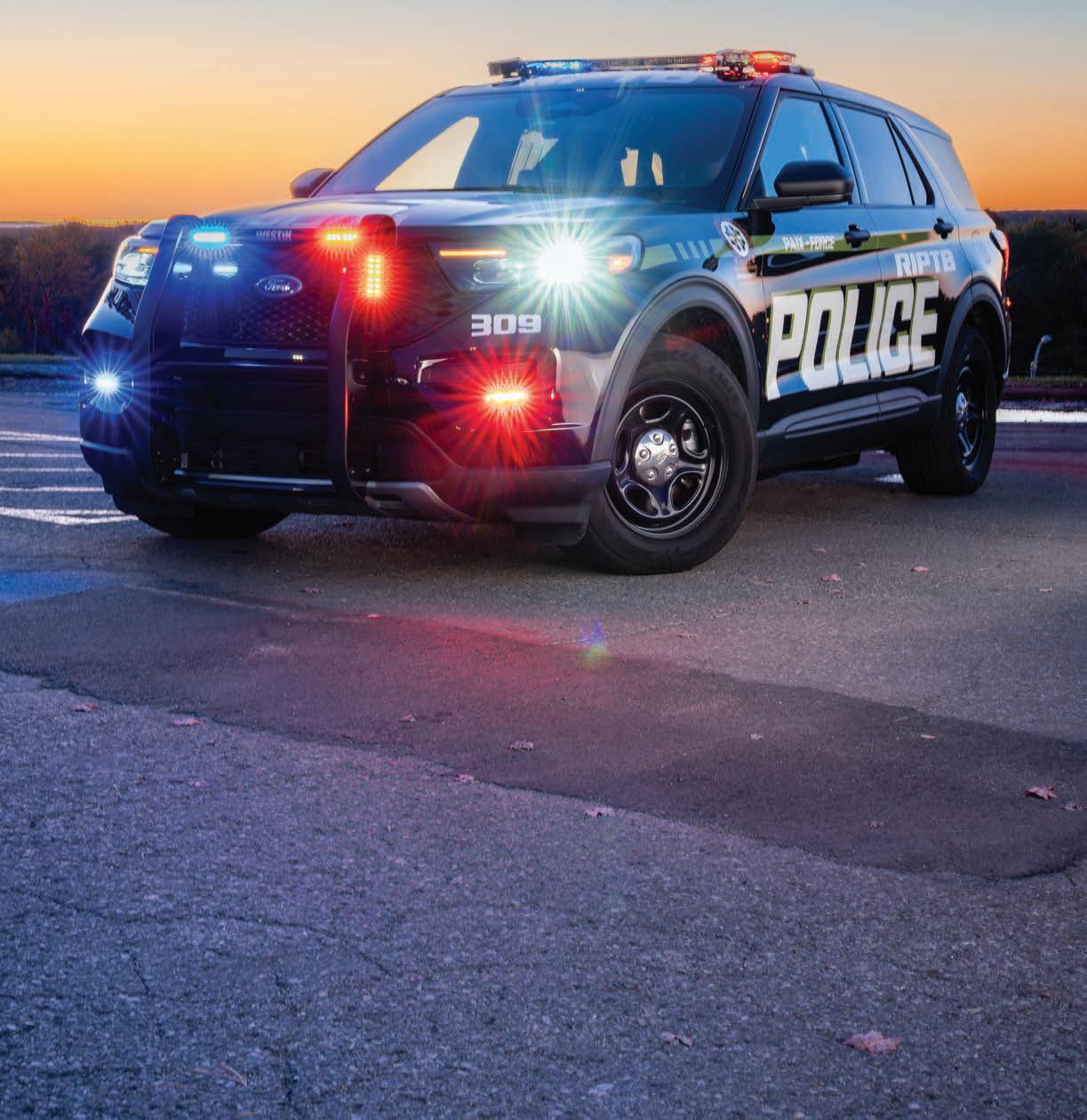
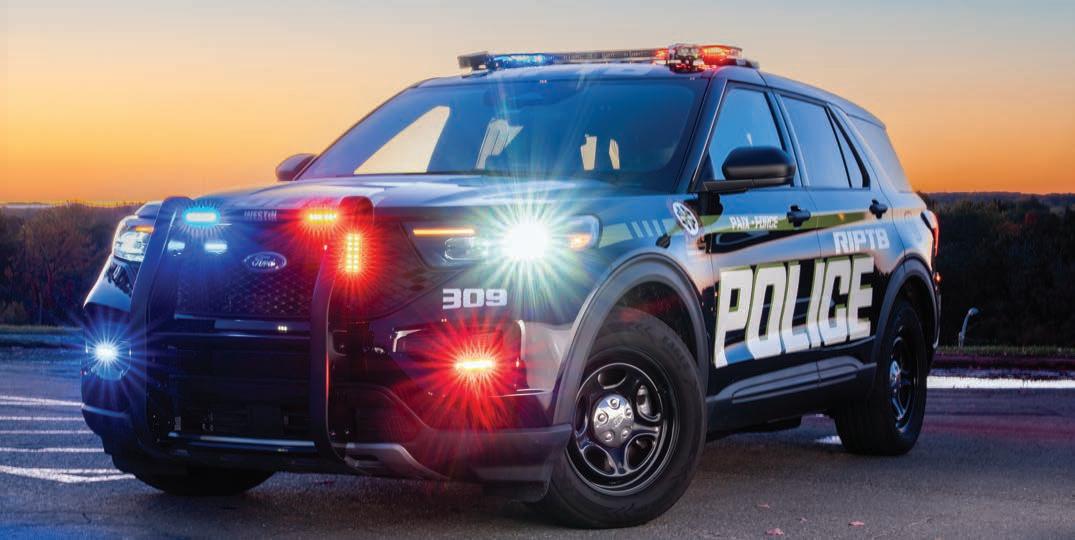
Following decades of tradition, two constables from the ThérèseDe Blainville Intermunicipal Police Board (Régie intermunicipale de police Thérèse-De Blainville – RIPTB) dedicated over 100 hours of personal time to develop four prototypes that could shape the service’s future visual identity. After a survey of all members, a winner was chosen. Little did they know that their design would soon be named Canada’s Best Dressed Police Vehicle.
“Being recognized as Canada’s number one police vehicle is a tremendous honour that validates the vision and hard work of our officers, and reflects positively on the community we serve,” shared Director Luc Laroque. “As chief, witnessing the commitment and enthusiasm behind this project convinced me of its potential. The quality of the final product and the teamwork it inspired deserved to be showcased to Canadians from coast to coast.”
The new visuals feature the service’s updated crest and the words of its core principles: Paix, Force, Partenaire, Accessibilité
(Peace, Force, Partnership, Accessibility).
For contest judge Dave Brown, the design’s unique directionality was particularly eye-catching. “It is unusual in that the directionality is not just front-to-rear, but also side-to-side, with a different colour stripe on each side.”
“We have the impression that this new patrol vehicle has increased our patrol officers’ sense of engagement and belonging. It’s as if they have rediscovered a sense of excitement, like going back to childhood and seeing a police vehicle,” shared both Cst. Nicolas Cromp and Cst. Jérémy Primeau, the creators of the design. “Several colleagues have also told us that they’ve felt closer to citizens, as the new design has sparked conversations and exchanges about police work. Their approval and satisfaction were already a victory for both of us, but winning this contest so unexpectedly is truly the crowning achievement!”
For Laroque, hearing about the design’s first-place win was an overwhelming moment of pride and recognition for his entire team. He shared, “Knowing that the committee selected our design among many high-quality submissions makes this achievement even more meaningful.”
Sponsor of Blue Line’s 2026 Best Dressed Police Vehicle Awards
2nd PLACE
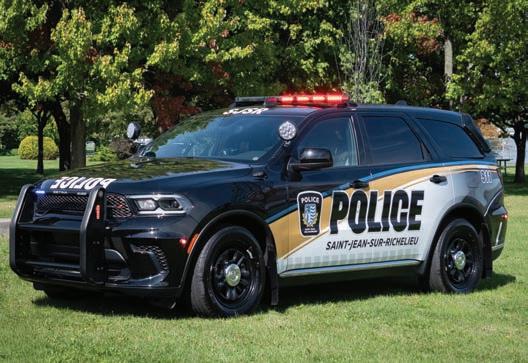
Saint-Jean-sur-Richelieu Police
2025 DODGE DURANGO – AWD
Approximately a one-hour drive down the road in Quebec, this year’s second-place winner, Saint-Jean-sur-Richelieu Police, was also hard at work redesigning their fleet. A committee of patrol officers collaborated for many hours and through countless meetings to produce a final project rich in symbolism for their community.
“We put a great deal of effort into creating a unique design while still respecting key priorities such as safety and an accurate representation of our city,” shared Martin Lalonde, Administrative Lieutenant, Patrol and Territorial Surveillance Division. This manifested in a distinct colour scheme, in which blue represents the city’s official colour and gold symbolizes authority, surveillance and the protection of the population.
Contest judges Dave Brown and Laura Aiken similarly commended the directionality of this design. “Citizens should be able to tell at a glance which way the vehicle is facing. This directionality is not just effective, but the sweeping curves of the triple colour striping also serve to tone down any potentially aggressive features of a police vehicle,” said Brown.
“My team and I are passionate about police vehicles and having the privilege to completely redesign the fleet was a true honour for us,” said Lalonde. “My team and I were very proud of our second-place result, especially considering the high number of submissions received. Redesigning the vehicle entirely required a tremendous amount of work, and thanks to Blue Line, our efforts were able to receive meaningful recognition.”
3rd PLACE
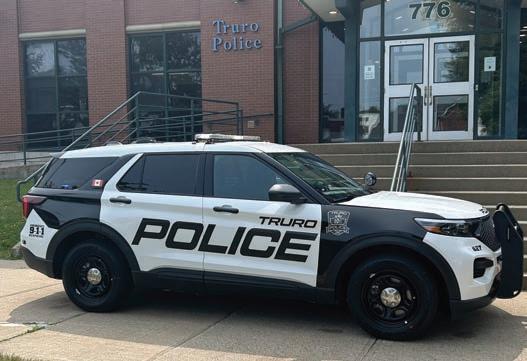
Truro Police Service
2025
FORD EXPLORER POLICE INTERCEPTOR – AWD
It was time to update the Truro Police Service’s fleet, which included adding hybrid police vehicles. These new vehicles deserved a fresh design, and soon the creative process began, with ideas contributed by a local graphics company, Conway Customz. The goals were clear: the design had to be clean, easily identifiable and reflective for safety. An additional benefit would be a professional appearance for their service. The winning design was selected by officers, civilian staff and Truro Police Board members.
“This was our first police vehicle update since the early 2000s, at which time we were awarded second place by Blue Line. We thought we would enter our latest design,” said Chief David MacNeil. “The Truro Police Service is honoured and proud to have been selected for this recognition.”
COMMUNITY RELATIONS
1st PLACE
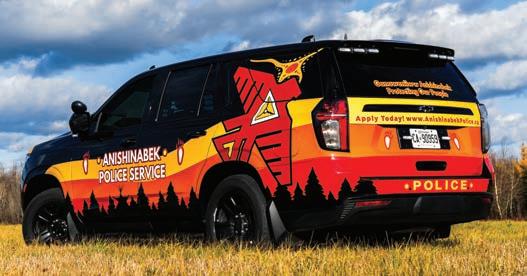
Anishinabek Police Service
2024 CHEVY TAHOE
When the Anishinabek Police Service (APS) was creating its new recruitment-focused vehicle, it wanted to do so with purpose and accessibility in mind. The new vehicle wrap is not meant to be admired from a distance but to be engaged with, as it includes hidden objects and cultural elements and invites conversation. APS considers the vehicle their version of Where’s Waldo that may also inspire future generations to view policing as a place where they belong.
“Police vehicles can be tools for connection, education and approachability, not just enforcement,” shared Sgt. Chantal Larocque. She and Kiera Lassard of Gateway Signs in North Bay, Ont., created the new design and brought it to life.
Dave Brown believes Community Relations vehicles should be original and eye-catching, without being cartoonish. He continued, “Anishinabek Police Service is a perfect example of how bright and professional graphics can help convey their outstanding pride in both their community and their organization.”
The service’s goal in sharing the design with the Canadian pub-
2nd place: Saint-Jean-sur-Richelieu Police
3rd place: Truro Police Service
Community Relations 1st place: Anishinabek Police Service
lic safety community this year was to seize an opportunity to demonstrate that a different approach to policing, one that prioritizes trust, visibility and relationship-building.
Larocque shared that she and the APS team were “incredibly proud and genuinely humbled” when they’d been awarded first place in this category. “The win felt especially meaningful because it recognized far more than a vehicle wrap; it acknowledged the intent, collaboration and community relationships behind it. It reinforced that putting time and care into how we connect with people matters.”
2nd PLACE
Vancouver Police Department
2024 FORD F-150 LIGHTNING – 4WD
Creating a new recruitment vehicle wrap for Vancouver Police Department (VPD) provided an opportunity to showcase big-city policing at its finest, while still hinting at the Canadian West Coast lifestyle enjoyed by their communities. For S/Sgt. Jason Howell, the design reflected the VPD’s commitment to innovation, thinking outside the box while remaining grounded in their rich history and traditions.
During the initial planning phases, the recruiting unit drew inspiration from professional sports team designs. With those in mind, they created a final product that they believe highlights how VPD prepares, trains and operates as a professional team. The chosen colour scheme of blue, silver and grey was selected for its bold yet subtle duality. “It’s confident but not arrogant or flashy. Like an ideal police officer,” said Howell. An electric vehicle was also selected to represent the service’s commitment to innovation and ongoing development.
Howell shared, “We are still excited by this design. It’s a very challenging time for police recruiters across the country. This win represents, in many ways, the incredible pride and efforts that our team has put into recruiting.”
3rd PLACE
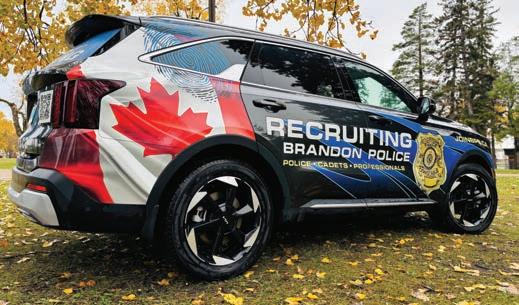
Brandon Police Service
2025 KIA SORENTO HEV EX – AWD
While Brandon, Man., may be a city of only roughly 51,000 people, the community has immense spirit and strong connections. The
entry of Brandon Police Service’s (BPS) first-ever recruitment vehicle design in this contest was, in part, to ensure that Brandon is not overlooked, and to honour the team who live and serve there.
The vehicle’s design evolved throughout the process to strike a balance between visibility, authority and modern aesthetics. The graphics fade as they approach the front fenders for a dynamic, motion-inspired effect.
Dave Brown stated, “Part of recruiting is getting potential officers excited about the job and interested in the many different aspects of police work. The large fingerprint graphic within the unique design of Brandon’s entry attracts the eye, and the three-dimensional imagery of the flag indicates solid pride in both the city they work in and the country they reside in.”
Janet Reichert, BPS’s recruitment and communications specialist, shared that the team was proud and humbled as they received the results of this year’s design contest. “This recognition affirmed the passion and care our team pours into their work.”
SPECIAL SERVICE
1st PLACE
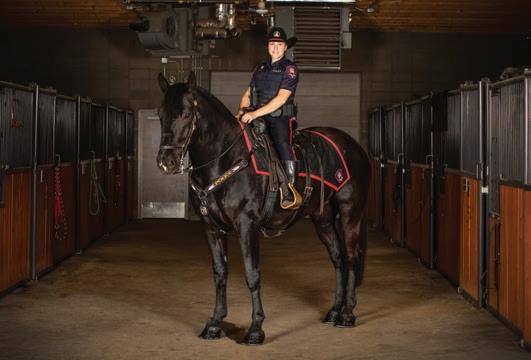
Calgary Police Service POLICE SERVICE HORSE
Calgary Police Service’s mounted unit has evolved over more than a century and serves as an important, living link between the service and the community. Each police horse wears distinct attire for each task they undertake, including search operations, crowd management, ceremonial events and routine patrols, all overseen by a CPS civilian who specializes in equine training and care.
The service saw this contest as an opportunity to ensure police
Community Relations 3rd place: Anishinabek Police Service
Special Service 1st place: Calgary Police Service
Community Relations 2nd place: Vancouver Police Department
service horses and their distinctive contributions to the community are recognized and preserved. “Each horse and its assigned officer strive to maintain a high standard of dress and deportment every day. This recognition affirms that we are meeting those expectations within our service and in the communities we serve,” said Robin Koltusky, the Mounted Patrol Team lead.
LAW ENFORCEMENT
1st PLACE
Regional Municipality of Hanover
2024 CHEVY TAHOE – 4WD
The Regional Municipality of Hanover Community Safety Officer (CSO) program had one goal for its vehicle redesign: to show that it is approachable while still maintaining an enforcement presence on the roads and in the communities. The lighter colours were selected for a more “inviting” look, and although the original designs featured a blue-and-yellow colour scheme, the final product ended up in a blue-and-gold combination, closely resembling the Winnipeg Blue Bombers’ colours. This has created a positive conversation piece with community members.
Community Safety Officer Trevor Schellenberg, who was essential to the creation and implementation of this new design, along
with local decal company RT Signs, was “shocked” when he learned his vehicle won first place in this category. His goal with the submission was to highlight the Manitoba CSO program as an important contributor to public safety in the province, but he hadn’t expected to win. He hadn’t told anyone he was entering the contest, which made the surprise announcement in December even more special. “Considering the reach of Blue Line, it is truly an honour to be chosen as a winner.”
Editor’s note: Please visit blueline.ca to see additional images.
Law Enforcement 1st place: Regional Municipality of Hanover
Police pickups, EVs and SUVs speed into 2026
Results from the Michigan State Police 2026 vehicle trials By
Dave Brown
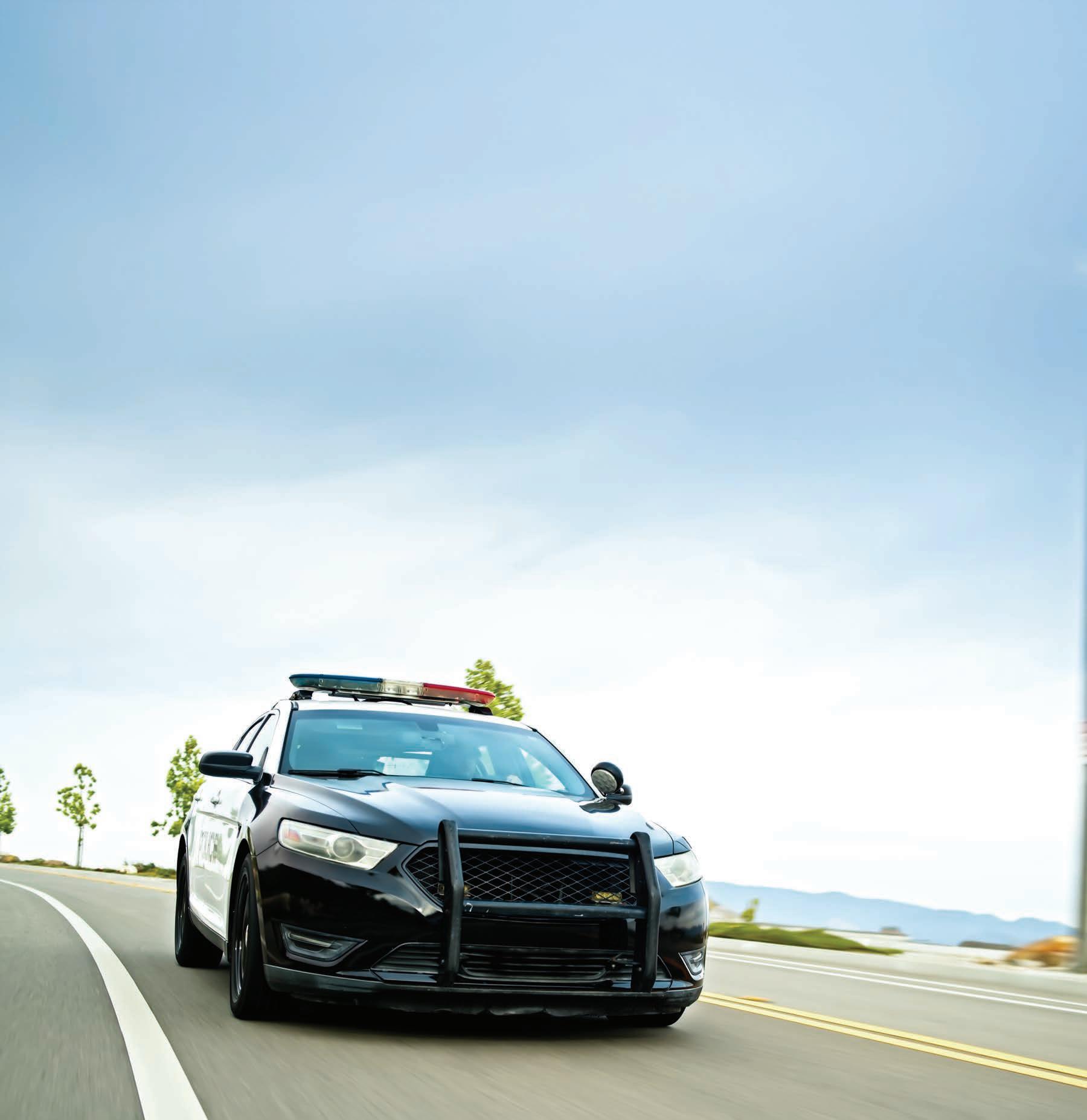
Every fall, the Michigan State Police, in conjunction with the U.S. National Institute of Justice (NIJ), tests the handling and performance of every new police vehicle on the market for the coming year in back-to-back acceleration, braking and lap time tests. These eagerly anticipated tests are seen as the most comprehensive analysis of police vehicles in North America.
While agencies such as the Michigan State Police and the Los Angeles County Sheriff’s Department document and test every model offered for sale in North America, there is no strict definition of the term “pursuit-rated.” However, they agree that a pursuit-rated police vehicle must be able to handle higher stresses than normal and perform better at high speeds than its civilian counterparts.
The Michigan State Police’s annual vehicle test for the 2026 model year will mark the 28th year that Blue Line has been compiling and reporting the results of the tests for pursuit-rated police vehicles. The 2024 model year tests were the first in history to drop all police sedans from the lineup. The 2025 tests continued the trend toward SUVs and trucks only, and for 2026, Ram entered their four-door 2500 6.4L 4WD pickup truck for the first time. Ford
also reintroduced the Mustang Mach-E electric as a police category vehicle to compete with the Chevrolet Blazer EV in the full-electric category.
While acceleration and top speed of EVs are impressive, there are still very few full-electric vehicles in day-to-day service as regular patrol vehicles, with most agencies using them primarily in supervisory or community-relations roles.
Vehicles
The Michigan State Police Precision Driving Unit evaluates police vehicles in two categories: police category vehicles and special service vehicles. Police category vehicles are designed for the full spectrum of general police activities, including highspeed pursuit. Special service vehicles are designed only for specialized duties such as canine units or adverse weather conditions and are not intended for pursuits.
Thirteen vehicles were submitted to the NIJ in the Police Category for the 2026 model year:
• 2026 Chevrolet Tahoe PPV 5.3L RWD
• 2026 Chevrolet Tahoe PPV 5.3L 4WD
• 2026 Chevrolet Silverado Z7X 5.3L 4WD 2-inch lift package
• 2026 Chevrolet Silverado Z71 5.3L 4WD
• 2026 Chevrolet Police Blazer EV AWD
• 2026 Dodge Durango Pursuit 5.7L AWD
• 2026 Dodge Durango Pursuit 3.6L AWD
• 2026 Ram 2500 6.4L 4WD
• 2026 Ford Police Interceptor Utility 3.0L EcoBoost AWD
• 2026 Ford Police Interceptor Utility 3.3L Hybrid AWD
• 2026 Ford Police Interceptor Utility 3.3L AWD
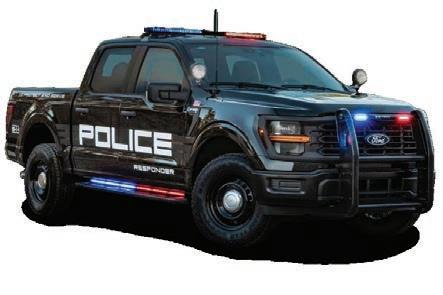
• 2026 Ford F-150 Police Responder 3.5L EcoBoost 4WD
• 2026 Ford Mustang Mach-E GT eAWD
The tests
Michigan State Police Precision Driving Unit and the NIJ’s Justice Technology Information Center (JTIC) test all the vehicles together over a three-day period at the Chrysler Proving Grounds and the Grattan Raceway. Each vehicle is tested without rooftop lights, spotlights, sirens or radio antennas in place. Tires are original equipment rubber provided by the manufacturer.
Acceleration, braking and top speed tests are performed at the Chrysler Proving Grounds and vehicle dynamics tests are done using the two-mile road course at the Grattan Raceway. (All dimensions and measurements are given in U.S. numbers.)
Continued on page 16
2026 Ford F-150 Police Responder from Ford Motor Company
2026 Ram 2500 from Fiat Chrysler Automobiles
2026 Chevrolet Tahoe PPV from General Motors
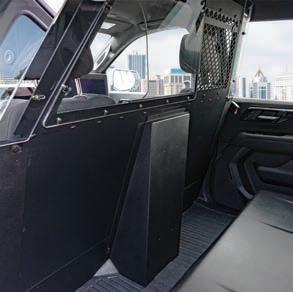
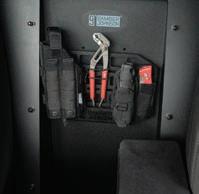
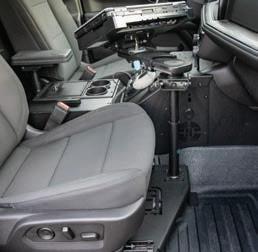
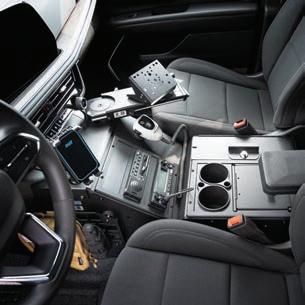
SUVs. Built from aircraft-grade aluminum with durable black powder-coat fi nish, console features an easy, no-drill mounting system for seamless installation. Designed for ergonomic comfort, it includes a swivel armrest and duty-belt recess for all-day support and control access. Compatible with keyboards, laptop mounts, and major manufacturers faceplates.
Standard dual cup holders, with optional USB ports, power outlets, magnetic mic, map lights, speakers and a secure small-arms box. Fits Ford, Chevrolet, and Dodge vehicles.
Setina Command Console
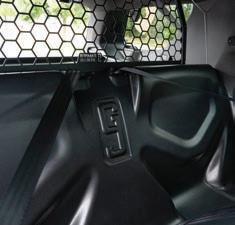
Partitions & Seating with Smart Belt
Continued from page 13
THE RESULTS
Vehicle dynamics testing
The objective of the vehicle dynamics testing is to determine the high-speed pursuit handling characteristics. Except for the absence of traffic, the two-mile road course simulates actual pursuit conditions. It evaluates the blend of suspension components and acceleration and braking ability. Four different drivers test each vehicle over an eight-lap road course, with the five fastest laps counting toward each driver’s average lap time. Final score is the combined average of all four drivers for each vehicle.
Electric-powered vehicle dynamics testing
Due to the unique nature of battery EVs, it was felt that a fair assessment of their capabilities would involve fast-charging the battery pack between runs. This would be typical of an EV hitting the road near the start of every shift. In discussions with all three manufacturers, the MSP Precision Driving Unit settled on a charge time of 40 minutes on a 47 Kw Level 3 charger between runs.
The chart shows the beginning state of charge, the ending state of charge after eight laps and the average of the best five laps.
Acceleration and top speed
The objectives of the acceleration and top speed tests are to determine the ability of each vehicle to accelerate from a standing start to 60 mph, 80 mph and 100 mph, and to record the top speed achieved within a distance of 14 miles from a standing start. Each vehicle is driven through four acceleration sequences, two in each direction to allow for wind. Acceleration score is the average of the four tests. Following the fourth acceleration sequence, each vehicle continues to accelerate to its highest attainable speed within 14 miles of the standing start point.
Braking
The objective of the braking test is to determine the deceleration rate attained by each vehicle on twenty 60-0 mph full stops to the point of full ABS. Each vehicle is scored on the average deceleration rate it attains.
Each test vehicle makes five measured 60-0 mph stops to full ABS engagement in one direction, and then five measured 60-0 mph stops to full ABS engagement in the opposite direction. After ten stops, each vehicle completes one lap around the test oval to cool the brakes, and the test is repeated. The resulting score is the average of all 20 stops. Stopping distance from 60 mph is calculated by interpolation of results.
Communications and ergonomics
The objectives of the communications and ergonomics tests are to rate a vehicle’s ability to provide a suitable environment for patrol officers to perform their job, to accommodate required communication and emergency warning equipment and to assess the relative difficulty in installing this equipment. A minimum of four officers independently evaluate ergonomic factors, and Michigan State Police Communications Division personnel then evaluate each vehicle on the ease of equipment installation. A score of one represents “totally unacceptable” and a score of 10 represents “superior” ergonomic or communication installation factors.
Twenty-seven ergonomic factors are evaluated on a scale of one to 10 and averaged among all the testers. The final score is the overall average of all 27 factors, such as seat design, padding, ease
of entry, head room, instrument placement, HVAC control placement, visibility and ease of entry and exit.
A total of three communications factors are evaluated on a scale of one to ten and averaged among all the testers. The final score is the overall average of all three factors, including dashboard, trunk and engine compartment accessibility.
Fuel economy
While not an indicator of actual mileage that may be experienced, the EPA mileage figures serve as a good comparison of mileage potential from vehicle to vehicle. Vehicle figures are based on data published by the vehicle manufacturers and certified by the U.S. Environmental Protection Agency. Mileage figures are given in U.S. miles per gallon.
Editor’s note: For results in communications and ergonomics, and fuel economy, please visit blueline.ca/ police-pickups-evs-and-suvs-speed-into-2026
Dave Brown is a contributor on firearms and police vehicles. He is a retired tactical firearms trainer and consultant based in Winnipeg.
SPONSORED CONTENT
The Michigan State Police’s annual vehicle test for the 2026 model year will mark the 28th year that Blue Line has been compiling and reporting the results of the tests for pursuit-rated police vehicles.
All in a Day’s Work… Or Is It?
The radio chatter is getting louder. The call comes through as a relay—communications repeating what the caller is saying in real time.
Two men fighting. In the kitchen.
Now rolling on the floor.
One man bleeding from the eye.
I announce my call sign and confirm my ETA—five minutes. My backup unit responds. Forty minutes away.
I keep rolling.
When I arrive, a woman is standing on the porch with her phone in hand, still speaking to communications.
“You sent a woman alone?” she says as I walk past.
Inside the house, I pause in the doorway to assess the scene. An older man sits on the floor, leaning against the wall, blood pouring from his face. The trauma is severe; his eye socket appears
broken.
Across the kitchen stands a younger man with bumps already rising across his shaved head.
There is blood everywhere— on the floor, the counter, even the walls. The two men have clearly rolled across the kitchen, smashing into everything in their path.
My backup unit radios their ETA again. Still forty minutes.
I request an ambulance.
Later at the station, the report is completed quickly. Attempts to take statements fail. The two men—father and son—refuse to cooperate and do not want charges laid.
Before you have time to process what you just witnessed, the radio crackles again.
Your call sign.
Another domestic call. Another emergency.
Off you go.
For emergency responders, this is often described as “all in a
day’s work.” But for the human body and mind, it is anything but ordinary.
Each emergency call triggers a powerful stress response. Adrenaline and cortisol surge through the body, preparing responders to react quickly and decisively. This response is essential in the moment, but repeated exposure to traumatic situations can take a toll over time.
In an average 32.5-year career, how many incidents like this does a responder witness? How often do those scenes replay in their mind long after the shift is
over?
The body can react to those memories as if the emergency is happening again.
Understanding how trauma, stress hormones, nutrition, and mental health interact can help change that outcome.
As a retired police constable, Registered Social Worker, and Certified Functional Nutrition Practitioner, I work with individuals to support both the psychological and physical recovery from chronic stress and trauma.
If this story feels familiar, you don’t have to carry it alone.
Let’s talk.
Debbie Knight Retired Police Constable | Registered Social Worker (RSW) | Certified Functional Nutrition Practitioner (CFNP), BA, MBA, Practitioner with MindHealthConnect.ca, Author of Whole Wisdom: Trusting the Connection Between Mind and Body.
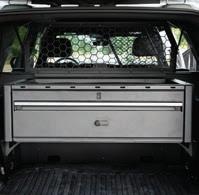
Trunk
MOLLE Mount
BEHAVIOURAL SCIENCES
BY PETER COLLINS
Property & Evidence
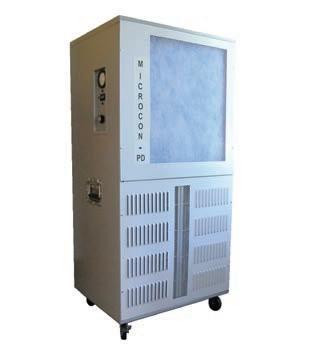
• Controls marijuana odors in storage area.
• Eliminates airborne virus & bacteria from contaminated evidence.
• Reduces airborne pollen.
Communications Room
• Eliminates the electronic odor
• Provides clean air for enclosed areas.
• Reduces the spread of viruses and bacteria among employees.
• Reduces the sick building syndrome known as “SBS”.
• Eliminates the stale air.
Booking Room
• Protects from the airborne and physical contaminants of suspects.
• Reduces exposure from contaminated evidence.
Alco-Test
• Cleans room air of contamination.
• Positive pressure can prevent air entry from other areas.
• Eliminates “tainted” test results.
764, Maniac Murder Cult and Terrorgram Collective
In December 2025, the Honourable Gary Anandasangaree, Minister of Public Safety, announced the designation of 764, Maniac Murder Cult and the Terrorgram Collective as terrorist entities. The purpose is to counter radicalization, terrorism and violent extremism against youth online. Canada is the first country to designate the groups as terrorist entities. Who are these groups and why are they a threat? They are Ideologically Motivated Violent Extremists (IMVE) with nihilism, accelerationism, neo-Nazism, satanism and sexual exploitation added to the mix. Their MO is to blackmail, extort and manipulate their targets into producing, sharing and live-streaming acts of animal cruelty, sexually explicit acts and self-harm. The psychological manipulation is framed as an “initiation” process or “tests”. Through continued manipulation, the victims are forced into providing more explicit and violent material, including committing suicide.
764
764 is a loosely connected online extremist network that operates on social media, mobile applications and gaming platforms such as Discord, Telegram, TikTok, Instagram and niche forums. Potential targets are individuals who post about their mental health, loneliness and identity confusion. Victims are groomed by a gradual desensitization to harm through exposure to increasingly violent images or extreme language framed as humour. Cruelty is normalized, and an active interest in suffering is encouraged. Later, threats are made to expose conversation texts and sexual images that the victim provided, along with claims of omnipresence and gaslighting. Victims often feel escape is impossible, and trusted adults are portrayed as enemies.
The 764 actors will develop a trusting and/or romantic relationship before coercing into engaging in harmful behaviour.
764 is a brand or signal, not a single unified group. It goes by many names: Harm Nation, No Lives Matter, Slit Town, Extorters V4, 555, 545 and 6996. 764 is also said to have ties with the Order of Nine Angles (O9A), which is a decentralized satanic and neo-Nazi belief system.
Maniac Murder Cult
Maniac Murder Cult (MMC) is an ideologically motivated violent extremist group founded in 2018. While primarily based in Russia and Ukraine, its membership is worldwide. MMC adheres to a nihilistic national socialist, militant accelerationist and neo-Nazi ideology, believing in the necessity of violent actions to promote fear and chaos, to further the perceived collapse of Western society. They recruit online and encourage followers to commit violent acts against ethnic minorities, the Jewish community, individuals experiencing homelessness and/ or mental illness and other groups it deems as “undesirables”. They are also known as Maniacs: Cult of Killing; Manyaki; Kult Ubiystva, MKY; M.K.Y. and MKU.
According to Public Safety Canada, a primary objective of MMC “is for its adherents to be viewed as the most sadistic threat actors, and share instructional material on a variety of
tactics, including how to attack prospective victims and avoid detection.”1
Michail Chkhikvishvili, the self-described leader of MMC, refers to himself as “Commander Butcher.” He is a 23-year-old Georgian neo-Nazi who was in U.S. federal court in 2025 to plead guilty to charges of soliciting bombings, school shootings and other acts of hate-motivated violence across the U.S.
In Nov. 2023, Chkhikvishvili encouraged individuals to dress up as Santa and hand out poison-laced candy to racial minorities, and directed an undercover FBI agent to target Jewish children and schools in Brooklyn. He wanted the attack to be “a bigger action than Breivik,”2 a reference to Anders Behring Breivik, the Norwegian neo-Nazi who killed 77 people in 2011.
Chkhikvishvili sent out manuals on how to create and mix lethal poisons and gases, including a “Haters Handbook” that outlined strategies for carrying out mass violence, including school shootings and “ethnic cleansing.” That manual, together with what the government calls “solicitations of violence”, is said to have inspired a livestreamed shooting at Antioch High School in Nashville, TN, in January 2025 that left one student dead and another injured.
The Terrorgram Collective
Public Safety Canada describes the Terrorgram Collective as a network of channels, group chats and users promoting white supremacist ideology on the digital communication platform Telegram. Members are encouraged to commit terrorist attacks against politicians, government officials and buildings, infrastructure and groups seen as “enemies of the white race”. Terrorgram publishes terrorist guides and white supremacist propaganda dedicated to motivating mass killings. Terrorgram influencers are credited with inspiring and facilitating terrorist actions. On Oct. 12, 2022, a 19-year-old individual frequently active in Terrorgram channels, shot three people at a gay bar in Bratislava, Slovakia, killing two people and himself. His manifesto thanked the Terrorgram Collective for guiding him, and key Terrorgram figures claimed credit following the attack.
Indicators of victimization by IMVE groups
• Increasingly using social media or gaming platforms without parental knowledge.
• An increased interest in extreme online conspiracy theories, anti-government rhetoric and racist material.
• Increase in suicidal ideation.
• Fresh cuts, bruises, bite marks, burns or wounds.
• A newfound interest in school shootings, serial killers, etc.
We are living in interesting times. Vulnerable individuals are being groomed and influenced to commit violent acts in the name of extremist ideological entities. Be safe out there.
For a list of references, visit www.blueline.ca/764-maniac-murder-cult-and-terrorgram-collective
Dr. Peter Collins was the operational forensic psychiatrist with the Ontario Provincial Police from 1995 to 2025. As of November 2025, he is the operational forensic psychiatrist with the Toronto Police Service. His opinions are his own. He can be reached at peter.collins@utoronto.ca.
When the state hides its face
Lessons from ICE for policing in Canada
By Neil Dubord and Cal Corley
On a cold weekday morning, commuters moved through a downtown plaza on their way to work. Three officers approached a man near the transit entrance. They were calm, methodical, efficient. But something was missing. There were no visible names, no badge numbers. Their faces were partially covered. Bystanders hesitated. One person reached for a phone, unsure whether they were witnessing a lawful arrest or something else. No one intervened or asked questions. The moment passed, but uncertainty lingered. Later that day, a conversation unfolded in a nearby office: Were they police? If something went wrong, who was accountable? Nothing unlawful had occurred. No excessive force was used. And yet, something essential had been lost – not authority, but
legitimacy. This is the danger that emerges when the state hides its face.
We’ll be examining the recent activities of U.S. Immigration and Customs Enforcement (ICE) and Customs and Border Protection, not to sensationalize isolated incidents, but to understand what happens when transparency, identification and accountability are treated as negotiable in democratic policing systems. The experience of ICE offers critical warnings for policing and law enforcement institutions, particularly in Canada, about how quickly legitimacy can erode when fear, political pressure and emergency logic displace foundational democratic norms.
ICE and its internal culture
The available evidence depicts an agency experiencing a profound crisis of internal
trust and leadership legitimacy. Survey data reveal that within ICE:
• 9.1 per cent of ICE employees believe their political leaders maintain high standards of integrity
• 17.9 per cent feel confident they can report violations of law or policy without fear of retaliation (Wehle, 2026, and Our Public Service, 2026)
• ICE and Border Patrol agents have allegedly committed crimes at a per capita rate that is greater than the crime rate for people who immigrated to the U.S. illegally (Graff, 2026)
These figures are not merely indicators of dissatisfaction. They signal a deeply dysfunctional organizational culture. Within such an environment, rules become flexible, accountability weakens and
ethical decision-making is subordinated to perceived operational urgency. Managers may feel empowered, or pressured, to disregard legal and ethical constraints, particularly when enforcement outcomes are politically rewarded while procedural and legal compliance is treated as expendable. The noble cause, whether accurate or not, becomes the tool to do whatever is necessary to achieve the mission.
This dysfunction produces a dangerous paradox. Externally, ICE projects the image of uncompromising enforcement. Internally, agents report fear not only of public protest, but also of leadership rhetoric that escalates risk without adequate operational support. Senior officials have privately acknowledged that inflammatory political messaging has made officers’ jobs more dangerous, while career personnel express concern that de-escalation and restraint are increasingly marginalized within the agency (Aleaziz, 2026; White House, 2025).
When leadership is perceived as detached from the workforce, fear flows downward and force flows outward.
Abhorrent behaviours
The consequences of this cultural breakdown manifest in operational practices that undermine civil liberties and public safety. Masking and anonymity
ICE agents have increasingly conducted arrests in plain clothes, wearing masks and declining to provide identification. Leadership frames this as necessary to prevent doxing and protect families. However, anonymity fundamentally alters the relationship between state authority and the public. When officers cannot be identified, the rule of law is undermined, misconduct becomes difficult to investigate, patterns of abuse remain hidden, and accountability shifts from individual responsibility to institutional defensiveness (Sainato, 2025; Human Rights Watch, 2025).
More troublingly, this ambiguity has enabled criminals to impersonate law enforcement, committing robbery, kidnapping and sexual assault under the guise of immigration enforcement. When the public cannot distinguish legitimate authority from criminal imitation, both safety and trust collapse (Gordon, et al., 2025; Solis & Vives, 2025) Concealed identities obstruct detainees’ ability to verify the legitimacy of arrests or pursue legal remedies. Due process isn’t merely a formality; it’s a visibility mechanism that allows power to be challenged. When identity is obscured, due process becomes theoretical rather than real.
Escalation of force
Data indicates an increase in aggressive arrest tactics, including vehicle window smashing, which rose from fewer than 10 cases over a decade to more than 50 in a year (ProPublica, 2025). There is also documentation of fatal encounters involving U.S. citizens shot by immigration agents. These are not anomalies; they reflect a broader normalization of coercive tactics justified by emergency framing (NPR, 2025).
Closed detention systems
Detention environments only serve to amplify these power asymmetries. The documented sexual abuse of a detainee by a contract detention officer, coupled with efforts to restrict congressional oversight through procedural barriers, illustrates how closed systems facilitate abuse while shielding institutions from scrutiny.
These behaviours reveal a system where transparency has been replaced by control, and accountability by justification.
“In most of history, societies have not been free. It’s a very rare society that is free. The default condition of human societies is tyranny.” – Michael Novak (1933-2017)
Lessons for Canadian policing
Canada does not face the same immigration enforcement regime as the United States. However, the structural risks illuminated by the ICE experience are highly relevant to Canadian police agencies, particularly in an era of political polarization, heightened officer safety concerns and expanding public-order mandates.
Transparency must be the default
When governments pre-emptively frame incidents as “self-defence” or “public safety operations” without providing evidence, accountability is functionally nullified. Democratic policing depends on narrowing the gap between official narratives and verifiable facts through timely disclosure, documentation and independent review.
Durable transparency infrastructures, such as body-worn cameras, open access-to-information systems, together with well-resourced governance boards and oversight bodies are far more effective than ad-hoc transparency gestures.
Identification is legitimacy
Routine masking or anonymization of of-
ficers performing public-facing duties undermines legitimacy. Identification allows the public to distinguish lawful authority from abuse, enables post-incident accountability and reinforces the principle that police act as identifiable agents of the state, not anonymous enforcers. In Canada, any erosion of clear identification should be treated as an institutional risk.
Oversight must be preserved
Democratic erosion often occurs through procedural attrition rather than overt policy change. Restrictions on inspections, narrowed investigative mandates or decisions not to examine lethal force cumulatively hollow out accountability. Oversight must remain accessible, independent and appropriately resourced, especially during periods framed as crises or emergencies.
Emergency logic requires guardrails
Appeals to crisis can justify extraordinary measures, but without explicit limits, they normalize coercion. Canadian legislators, policymakers and police leaders must ensure emergency authorities are time-limited, reviewed and publicly justified. War-time language, accelerated recruitment and expanded enforcement authorities and capacities demand heightened scrutiny.
Internal dissent is a safety mechanism ICE’s internal survey data demonstrates the danger of suppressing dissent. When employees fear retaliation, ethical failures surface only after public harm occurs. Canadian agencies should strengthen internal confidential reporting mechanisms and treat internal critique as early-warning intelligence rather than disloyalty.
A key takeaway
Democratic policing does not collapse through a singular scandal. It erodes when transparency becomes optional, accountability becomes procedural and fear replaces trust, both internally and externally.
For Canada, the lesson is clear: when police hide their faces, they don’t merely endanger the public. They corrode the very democratic foundations that make our policing legitimate in the first place.
For a full list of references, please visit www.blueline. ca/when-the-state-hides-its-face
Neil Dubord is an accomplished law enforcement professional and thought leader with over 30 years of experience in policing and public safety.
Cal Corley, MBA, is a former Assistant Commissioner of the RCMP, where he was head of the Canadian Police College and served as the RCMP Senior Envoy to Mexico and the Americas. Now, he is the CEO of the Community Safety Knowledge Alliance (CKSA), a Canadian non-profit that supports police.
Understanding Indigenous culture for better practice
A new pathway for Canadian police to repair trust
By Ian MacDonald and Mélanie Ritchot
Police officers across the country have been challenged to examine their biases and to deepen their understanding of how colonial violence still impacts policing today, through an Indigenous-led cultural competency course.
The course, “Understanding Indigenous Culture for Better Professional Practice”, aims to address a history of mistrust between Indigenous communities and the justice system and to make communities safer for everyone through a renewed approach and building relationships.
“We know there have been challenges between Indigenous communities and police over the decades, but when we work together and have the same goal—safer, stronger communities—that’s when change happens,” said BC First Nations Justice Council (BCFNJC) Chair Kory Wilson.
Over 585 police officers have registered for the course since it launched on the Canadian Police Knowledge Network in Spring 2025.
Co-created by BCFNJC and the Surrey Police Service (SPS), the course gives police officers the knowledge, teachings, stories and concepts needed to advance their journeys toward Indigenous cultural competency.
“Education is a powerful tool because when we know better, we can do better,” said Wilson.
This new resource encourages officers to reflect on their own identities and relationships to settler-colonialism, using that reflection to address the power dynamics present in their interactions. It asserts that the level of safety in an interaction is determined by the person accessing police servi-
ces, rather than by an interaction being “culturally competent” in and of itself.
This will not automatically make officers culturally competent, but it aims to provide the core building blocks of cultural competency. This includes the humility, compassion and awareness to become a safer person for Indigenous people in the community and to repair the trust that was broken in the past. It also covers how to develop positive relationships with Indigenous communities, foundational language related to Indigenous Peoples, Indigenous worldviews, the link between colonization and incarceration, and related topics.
Over-incarceration in B.C.
The BC First Nations Justice Strategy, which serves as a pathway to tackle the over-incarceration of Indigenous peoples, motivated the course’s creation.
In British Columbia, 35 per cent of individuals in provincial custody in 2022-2023 self-identified as Indigenous, according to BC Corrections data, despite Indigenous people making up approximately 6 per cent of B.C.’s adult population. This over-representation has been steadily growing in the province.
The program advances Strategy 20, which calls for the development of cultural competency standards and training for all those who interact with Indigenous people in the justice system, including police. The Strategy states that, “Due to the historical and ongoing role police have played in colonization, including conducting harmful patterns of biased policing and surveillance, Indigenous people often experience distrust, fear, and trauma in their interactions with police.”
on page 26
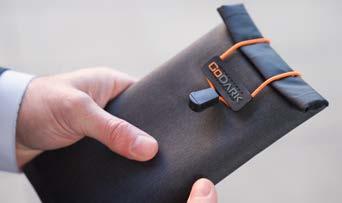
As Digital Evidence Threats Grow, RCMP Formalizes National Supply Agreement with GoDark Faraday Bags
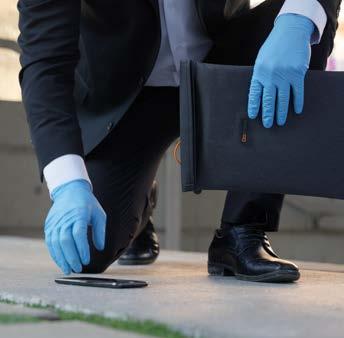
In February 2026, Vancouver-based GoDark Technologies Inc. was awarded a four-year standing offer with the Royal Canadian Mounted Police (RCMP) to supply signal-blocking Faraday bags nationwide.
As digital evidence continues to play a central role in modern policing, secure device isolation has become a standard step in evidence handling and operational security. This standing offer enables RCMP detachments and units across Canada to access approved Faraday solutions to support digital evidence collection and investigative work.
“We are honoured to support the RCMP with reliable, lab-tested Faraday technology,” said Todd Ariss, CEO and Founder of GoDark Technologies Inc. “This standing offer reflects our focus on providing signal isolation solutions that meet the operational requirements of Canadian law enforcement.”
Why Immediate Device Isolation Matters in Today’s Investigations
Wireless-enabled devices—including smartphones, tablets, and laptops—can transmit and receive signals even when not actively in use. Without proper isolation, seized devices may be vulnerable to remote wiping or unauthorized access.
Faraday bags are used to immediately isolate devices at the point of seizure by blocking cellular, Wi-Fi, Bluetooth, GPS, and other radio frequency (RF) signals. This helps preserve evidentiary integrity from collection through forensic analysis and reduces the risk of external interference during sensitive investigations.
Improving Operational Security for Sensitive Operations
In addition to protecting seized evidence, Faraday bags are a critical OPSEC tool. Mobile devices can be targeted for location tracking, signal interception, and sophisticated spyware such as Pegasus. In sensitive or covert operations, isolating devices from cellular, Wi-Fi, Bluetooth, and GPS signals helps reduce the risk of tracking, interception, or remote compromise.
For this reason, GoDark Faraday bags are used by law enforcement, military personnel, government employees, political officials, and journalists operating in high-risk environments.
Meeting Verified Shielding Standards
GoDark’s Faraday bags are manufactured using
proprietary RF shielding material that has been independently lab-tested. The shielding meets recognized professional standards, including MIL-STD-188-125-2 and IEEE 299-2006 (1–40 GHz), which are widely used to measure electromagnetic shielding effectiveness.
For law enforcement agencies, validated shielding performance supports operational reliability and evidentiary defensibility.
Beyond Lab Certification: Durability in Operational Use
Many premium Faraday bags use shielding materials that meet recognized laboratory standards. Certification confirms signal attenuation at the time of testing, but long-term performance depends on how that shielding is built into and protected within the bag.
Shielding layers are still textiles subject to wear. When devices sit directly against exposed shielding, repeated handling and friction can degrade conductive layers and reduce effectiveness over time.
About GoDark Technologies Inc.
GoDark incorporates a protective inner liner that separates devices from the shielding material, reducing abrasion during routine handling, storage, and transport, extending the life of the bag.
For agencies procuring Faraday equipment, durability over the service life of the bag provides added assurance that shielding performance will hold up under routine operational use, supporting reliability and confidence in the field.
What the Standing Offer Means for Procurement
The RCMP standing offer streamlines procurement by allowing approved procurement departments across the country to access standardized Faraday solutions as needed. This structure supports consistent equipment use while maintaining flexibility for different operational environments.
Invitation to Federal, Provincial, and Municipal Agencies
In addition to fulfilling the RCMP standing offer, GoDark Technologies maintains ongoing bulk production of forensic Faraday bags to support national demand. As a result, GoDark is offering volume-based pricing to other Canadian law enforcement and government agencies through its law enforcement program.
Agencies interested in participating in the program and accessing preferred pricing can contact sales@godarkbags.com for further information.
GoDark Technologies Inc. designs and manufactures Faraday bags and signal-blocking solutions for digital evidence handling and operational security applications. Headquartered in Vancouver, British Columbia, the company supplies law enforcement, government, and military organizations in more than 40 countries.
GoDark equipment is used by agencies including the RCMP, Canadian Armed Forces, FBI, U.S. Department of Defense, and other federal, provincial, and international agencies.
The company was founded by Canadian physicist Todd Ariss. Its product line includes Faraday bags in sizes ranging from phone and tablet enclosures to laptop sleeves, duffel-style transport bags, and larger shielding solutions designed for drones, tower computers, generators, and other electronic equipment. For inquiries including preferred pricing and volume orders, please contact sales@godarkbags.com.
According to a 2019 survey by the Department of Justice, Indigenous people were also less likely to say they had a great deal of confidence in the police compared with non-Indigenous people.
Over and under-policed Indigenous people are both over-policed and under-policed, explained Dr. Judith Sayers, BCFNJC’s lead Council member on Policing, Oversight and Accountability.
“Biases cause Indigenous people to be overly surveilled and targeted by police, and as a result, they are more represented at all stages of the criminal justice system,” she said. “But those same biases also result in Indigenous victims of crimes being seen as less worthy or believable when they seek support.”
To address this, Sayers said all justice and policing agents need more education on cultural safety, their role in reconciliation and how to support Indigenous wellbeing. She believed the course is just one of many steps needed to improve training for law enforcement, and that another could be
community-specific training for officers.
“Officers who interact with Indigenous communities need to be familiar with their leaders, resources, protocols and their priorities, as a foundation for a positive and trusting relationship, and that will vary community-to-community,” she said.
While no single actor can solve the over-representation of Indigenous people in the criminal justice system—the solutions span justice, policing, health, housing and other areas—police officers are often a person’s first point of contact with the criminal justice system, so they are well positioned to be drivers of change.
Repairing together
Noticing that culturally appropriate training for police was limited, a group of SPS officers, including Sgt. Mike Grandia and Cst. Steve Hanuse, recognized an opportunity. They viewed a potential partnership with Indigenous communities as a way to collaborate and create something together, rather than a challenge, and reached out to the BCFNJC to do so.
The group worked with BCFNJC to craft a curriculum that combined recommendations for culturally safe interactions with their own experiences in policing.
“The Council’s involvement was instrumental in ensuring the training was grounded in Indigenous perspectives, avoiding the common pitfall of being ‘about us, without us,’” said Hanuse.
Grandia said his hope is that this training will give insight into how the police can effectively support First Nations people in a safe and healthy manner.
National reach
Once the training was developed and the group recognized the course’s value for SPS members, they knew it would appeal to a wider audience.
As is the case in British Columbia, First Nations, Metis and Inuit individuals are over-represented in the criminal justice system Canada-wide.
Indigenous adults accounted for 33 per cent of admissions to federal custody in
Continued on page 29
The unsolved 1998 homicide of Sean Anderson
It was the last day of 1998. New Year’s Eve was mere hours away. While people were gearing up for an evening of celebration, the discovery that morning in Milton, Ont., was anything but joyful. At a desolate farmhouse on Trafalgar Road, someone related to the property’s owner discovered a frozen body in an unused field. It was 10:30 a.m. when authorities were notified.
When police arrived, the circumstances of the person’s death and the location of the body in the field led to the death being classified as suspicious. Responding officers requested assistance and homicide detectives were called in. The area was cordoned off, and it was now being treated as a crime scene until the cause of death could be established.
Police requested a forensic post-mortem, suspecting the individual had been met by
foul play. However, the examination to identify the victim was delayed due to the body’s frozen state.
On Jan. 3, 1999, the examination confirmed the victim’s cause of death was a gunshot to the head. How many times the victim was shot and by what type of firearm was withheld from the public. Only the killer would know the specifics surrounding this information—a pivotal piece to solving this case if the killer were to be identified.
The investigation identified the victim as Sean Conrado Anderson. What happened to Anderson, and how did he end up dead on the rural Milton property? Police worked backwards to trace the final moments leading up to Sean’s murder.
When Anderson’s name was queried on the Canadian Police Information Centre (CPIC), investigators found that he had been entered as a missing person. In early
December 1998, an official report surrounding his disappearance had been filed with the police in Toronto.
Anderson was last seen alive on Dec. 4, 1998, leaving Exotica, which was an adult entertainment establishment in Toronto. Twenty-seven days later, his body was found frozen in Milton, an area just over 30 kilometres away from where he had last been seen.
“Sometimes missing people can meet with foul play, and this is exacerbated by involvement in gentlemen’s clubs or other establishments that can foster members of the criminal element,” said D/Sgt. Steve Smith of Toronto Police Service’s cold case unit.
However, there are more unanswered questions than answers in this unsolved homicide, such as whether his death was tied to the adult club. Where and why was he shot? And, most importantly, who murdered Anderson? At this stage, theories about what happened to Anderson are just that.
Anderson may have gone missing in To-
ronto, but his unsolved murder is an open case in the region of Halton. It is one of the cold cases posted on the official Halton police website.
“All these cold cases and homicide files, they never die. They never close until they are solved,” said then D/Sgt. Trevor Bradley in 2022, when he managed the Halton Regional Police homicide unit.
“Anderson’s death illustrates the importance of missing persons investigations.”
Someone or somebody has intimate knowledge about this murder, due to their direct involvement or indirectly learning about it from the killer(s). Twenty-eight years after Anderson was found murdered, this may be the most crucial key to solving this cold case.
These types of crimes and the perpetrators responsible for these murders tend to be transient in nature. This means there is more than one crime scene and perhaps several other police jurisdictions. The Anderson case highlights the mobility of the unknown killer(s), which makes it more incumbent on police to communicate.
“The death of Mr. Anderson highlights how all police services in Ontario and beyond need to communicate and work together as missing person [cases] have the ability to travel over large geographical areas,” said Smith. “Anderson’s death illustrates the importance of missing persons investigations. They can be complex in nature, as there are many reasons why people go missing.”
In this case, Sean Anderson’s disappearance was due to a set of ominous circumstances that occurred on or about Dec. 4, 1998, somewhere between the city of Toronto and a Milton farm property.
If you have a tip or information about the Anderson murder, call the Halton Police Homicide Tip Line at 905-825-4776. Tipsters can also provide information anonymously to Crime Stoppers at 1-800-222-TIPS (8477)
CULTURAL COMPETENCY
Continued from page 26
2022/2023, according to the Department of Justice. The percentage of Indigenous women, specifically, in federal custody has been increasing over the years. For the first time, in April 2022, exactly half of the federally incarcerated women were Indigenous. With the Canadian Police Knowledge Network’s mission to provide education that meets the evolving needs of Canadian and First Nations policing, the course was a clear fit. The course now lives on the CPKN platform, where police officers across the country can access it online.
Individuals interested in accessing the training can search for it by its title: Understanding Indigenous Culture for Better Professional Practice – Canadian Police Knowledge Network.
Ian MacDonald is now entering his fifth year with Surrey Police Service as their media liaison. He previously worked for the Abbotsford Police Department for 22 years.
Mélanie Ritchot is a journalist and storyteller with Métis-settler ancestry. She is the Senior Writer for the BC First Nations Justice Council.
Tech That Streamlines Property Research
GeoWarehouse gives you direct access to property data from Ontario’s official land registry, helping you solve property crime investigations.
• Explore GeoWarehouse’s database for detailed asset information, including name‑based searches.
• Access ownership records, residency status, and sales history to flag irregularities that may signal fraudulent behaviour.
• Leverage aerial imagery to virtually view the premises and spot any outbuildings.
Stephen Metelsky, M.A., is an author, professor and (ret.) sergeant. Follow him on LinkedIn at Stephen G. Metelsky.
What your nervous system is saying before you ever speak
In policing, you learn how to read a room. You notice posture before tone. You feel tension before voices rise. You sense when a call is about to shift. That kind of awareness isn’t accidental; it’s built through experience, repetition and survival in a profession where the stakes are high, and hesitation can cost lives.
What we don’t often talk about is: the same nervous system that protects you on the street also shapes every interaction you have, long before you say a word. People respond to it, whether you realize it or not.
We tend to think that leadership and professionalism lie in what we say or do, but physiology tells a deeper story. According to trauma and nervous system expert Dr. Aimie Apigian, the nervous system is always asking one primary question: Am I safe right now? That question is answered not through logic, but through sensation, posture, breath, tone and energy, and is
referred to as neuroception. This is the body’s automatic ability to detect safety, danger or threat without conscious thought, and it happens faster than language, intention and training.
Your nervous system speaks before you do. The human body is not only chemical; it is electrical and magnetic. The heart generates a measurable electromagnetic field that extends roughly six to eight feet beyond the body. Research associated with HeartMath and related neuroscience indicates that this field carries emotional and physiological information. In practical terms, how regulated or stressed you are doesn’t stay contained inside you.
system doing what it was designed to do.
Policing conditions the nervous system for vigilance. As Apigian explains, a nervous system trained for survival doesn’t automatically return to baseline just because the shift ends. The body keeps score, and the patterns that protect you on the street can follow you home.
Nervous systems are social and contagious.
That’s why our partners and friends often know you had a rough shift the moment you walk in the door. This isn’t intuition or oversensitivity. It’s the nervous
Nervous systems are social and contagious. When one becomes activated, others nearby often respond. This process is how teams synchronize under pressure, but it’s also how stress and toxicity spread. Under chronic exposure, our electromagnetic fields can quietly become stress contagion. Understanding our power in co-regulating others around us is key, as is understanding how others’ nervous systems can affect our own. We see this at work when tension ripples through a briefing or when minor
issues escalate quickly. It’s not a block in communication, professionalism or character. It’s our physiology doing its job. The wonderful part of this is that calm spreads the same way stress does. A regulated nervous system can de-escalate a situation before tactics or words are required. Apigian emphasizes that regulation is not a mindset, it’s a body state. You can’t think your way out of fight-or-flight in our teams and with the people we deal with every day. Regulation happens from the bottom up, through breath, posture, rhythm and sensation. Presence matters more than we’ve been taught to acknowledge, which is one reason equine-assisted work has been so impactful for officers. Horses generate an electromagnetic field that can extend up to two hundred feet. Horses don’t respond to rank or good intentions. They respond to what’s actually happening in your body. What often surprises officers is realizing that this same process happens between people every day. If you’ve ever felt a room calm when a person entered, you understand this.
We often frame emotional regulation as a personal wellness issue. In reality, it’s a leadership skill. Your nervous system sets the tone for your platoon, your family and the people you interact with on calls. Stephen Covey wrote that trust is built through consistency. Simon Sinek speaks about the Circle of Safety. Both point to the same conclusion: people trust those whose presence feels steady.
A dysregulated leader isn’t a bad leader. More often, it’s a nervous system that’s been carrying too much for too long without opportunity to recover.
One of the most practical shifts for public safety teams and families is understanding that regulation comes before resolution. If your body is in fight-or-flight (or shutdown), no communication strategy will land well. When your nervous system feels safer, conversations flow more easily.
This doesn’t require therapy sessions or emotional unloading. It starts with small actions: slowing your breath and heartbeat before walking into your home, grounding after a call instead of pushing through,
pausing before responding in a heated moment, or decompressing with peers rather than carrying the load alone. These aren’t soft skills. They are recovery skills. Policing culture values endurance and reliability. That strength becomes costly when it turns into constant override. Burnout, emotional withdrawal and compassion fatigue are not personal failures; they are healthy and natural signals from a nervous system that hasn’t had a safe place to land. So, let’s remember that one regulated person can shift a room. One pause can prevent escalation.
Your nervous system isn’t just along for the ride. It’s one of your most powerful tools. Presence speaks before words. Holding the line isn’t only about tactics or resilience under pressure. It’s about how you show up in your body—on shift and off.
Michelle Vincent PhD/MACP is a retired officer and the founder of The Haven, a non-profit, inpatient treatment centre exclusive to first responders. Contact her at michelle.vincent@thehaven.cloud.
Tightrope: Balancing Duty with Courage and Conviction
By Jennifer Hyland
ISBN:
978-1038340825
I read Tightrope in about 36 hours — I was hooked from the very beginning. Jennifer Hyland guides the reader through the experiences of her nearly 30-year policing career, and what struck me most was the profound sense of not being alone. I’ve also completed an almost 30-year career in policing, and the parallels Jennifer shares throughout this remarkable book made me feel truly understood.
Her stories were relatable, not just because of the calls she attended, but because of the internal stress and pressure that come with a range of leadership roles. That’s where she really captured me. She was telling my story, her story and the story of so many other female leaders in this profession. Often unheard or unseen, she carved her own path and invites the reader to walk alongside her as she explains how she worked to maintain her health and sanity... until she couldn’t.
The raw vulnerability and honesty in this book offer readers a genuine look at how rewarding and how challenging policing can be. It highlights not only the extraordinary things officers witness that most people never will, but also the internal dynamics of police organizations, where politics, ego and pride can hinder progress. I needed this book. It arrived at exactly the right time, offering validation, connection and the reminder that I wasn’t alone in my experience
– Retired Deputy Chief Constable Michelle Davey, Delta Police Department
This book provides comprehensive coverage of community policing, the philosophy and organizational strategy that expands the traditional police mandate of fighting crime to include forming partnerships with citizenry that endorse mutual support and participation. The first textbook of its kind, CommunityPolicing delineates this progressive approach, combining the accrued wisdom and experience of its established authors with the latest researchbased insights to help students apply what is on the page to the world beyond.
BY ANDREW QUIBELL
Navigating the transition from active duty to retirement
EOn the last day of 2025, I completed my final shift as a City of Barrie provincial offences officer, specializing in the processing of Automated Speed Enforcement violations. The program was discontinued, and each member is now left to regroup and find new, meaningful employment in 2026. Our team mainly consisted of retired officers from York Regional Police, Toronto Police, Calgary Police and Ontario Provincial Police. We were a close-knit group with many positive memories over our 15 months working together.
New Year’s Eve and New Year’s Day were an ideal time to reflect on the past while looking forward with anticipation. I was an officer with York Regional Police (YRP) for over 33 years. It is a progressive police service with nationally recognized training and technology, and support from the community and the police services board have helped keep YRP at the forefront of policing in Canada. I am admittedly biased, but I have had direct exposure to many police services, and I believe there are none better.
and a few regrettable missteps, I consider myself to be wiser because of the experiences I had. And now, I’d like to share some of that wisdom with you.
For current officers, I offer the following:
• P ut forth your best effort throughout every shift, then go home to your family. Working extra hours for free doesn’t help in the big picture.
• Be aware of hypervigilance. This state of being over time can be unhealthy and damaging. I did not clearly recognize this in myself, but learned more about it through Dr. Kevin Gilmartin’s expertise.
Maintain the honour and civility you began with on day one, throughout your career and into retirement.
Policing in a large municipal service presented me with a lot of opportunities, with the potential of changing roles every few years after reaching the rank of first class constable and demonstrating a strong work ethic. I had many highs, which included a couple of Police Officer of the Year awards for outstanding investigations and outstanding service to the community stemming from my volunteer efforts. I had many opportunities throughout the years to mentor officers and protect our community.
I spent my final three years as a patrol supervisor in Georgina, Ont. I saw this as the perfect full-circle experience and the best way to end my journey in policing. Through daily interactions, I gained a clear understanding of the impact of mental health and addictions and how they can influence people’s lives.
Now, with an opportunity to reflect on my career, with its many remarkable highs
• Understand that your career— what you may consider your calling—is just a job to someone else and others may not engage. Your passion might not be shared or appreciated. Don’t allow your duties to take priority over other members. We aren’t all created equal, and your standards might far exceed what the police service determines is acceptable. Check yourself regularly.
• Make an effort to eat healthy foods and stay active.
• Keep looking forward. You can learn from the past without repeating it. Don’t return to units that you’ve left, unless specific circumstances exist, such as being promoted to a supervisory position.
• Plan ahead and prioritize your life goals. For some, this might include vacations and for others, it may be a child’s education and owning your home. I’ll share that I took the second path.
• Pay it forward. Share your strengths and expertise to help the greater good.
For retirees and those who are approaching retirement, I offer this:
• You will know when it’s time to trust others in your absence. Leave with your head held high and in good health.
• Fate may have other plans, but aim to match your retirement years with your years of service.
• Take a breath and give yourself time to get through the transition period. It might take weeks, months, or longer.
• Understand that the job security that comes with policing is rare, and employment conditions may change. Ask yourself what you have always wanted to do? For me, it was to play shinny hockey, and I finally returned to the ice on January 5.
• Prioritize yourself, your family and your community.
• Be a good neighbour. Shovel snow, donate blood, or whatever else that might mean to you.
• Make a difference through community volunteer efforts. For example, I’m a member of the Legion. I am very involved with the annual poppy campaign, I bartend weekly, and I will now be attending the monthly “First Responders Coffee and Chat”. It’s important to keep some social activities in your calendar.
• Understand that your role has changed and allow others to do their jobs. I recently observed a teenager pocket a gift card at one of our local grocery stores. As an officer, I would’ve intervened, but in my new role, the appropriate action was to notify staff of the incident, the individual’s location and their descriptors. My job was done.
• Stay active by going on nature hikes and neighbourhood strolls, set routines, avoid stress, eat fruits and vegetables and get plenty of sleep. Your body will thank you.
Looking back, I see how important it is to maintain the honour and civility you began with on day one, throughout your career and into retirement. We should be proud of our service and focus on the many positives that far outweigh any missteps along the way. We are human, and mental health affects us all. In the end, we should be judged based on our overall contributions to society, not just the few who choose to shame us.
Andrew Quibell is a 53-year-old retiree who served York Regional Police and the citizens of York Region from 1990 to 2023. His career included uniform patrol, community policing and several investigative roles. He held active roles in Newmarket Community Action Committee, COYO, CPTED, retail fraud prevention groups, and he prioritized fraud presentations for seniors.
Modernizing Police Services Nationwide
Trusted Across Canada
Transform your service with Triton Police Innovations
FOR BETTER SPEED, ACCURACY, AND EFFICIENCY
Virtual Front Counter
Transform service delivery with an intelligent platform that simplifies the intake of screening requests.
» Virtual assisted forms
» Flexible ID verification
» Automatic jurisdiction check
Recruitment Screening
Speed up hiring with smarter, faster recruiting decisions powered by advanced screening technology.
» 48-hour turnaround
» High-volume processing
» Cost-effective pricing
Ready to transform your service?
Online Public Safety Reporting
Capture non-emergency reports and evidence online through a single, secure, user-friendly system.
» Virtual response
» Template builder
» Location intelligence
Scan the QR code to discover how Triton can help modernize your operations and strengthen community engagement.
Canada’s full-service security partner
Freeing police officers to focus on the work only they can do
BY-LAW ENFORCEMENT
NON-CORE POLICING
PRISONER MONITORING/ ESCORT/TRANSPORT
DETENTION GUARDS
ADMIN SUPPORT
PHOTO RADAR
FINGERPRINTING SOLUTIONS
ONLINE CRIMINAL RECORD CHECK SOLUTIONS
… AND MORE
YOUR
Le par tenaire canadien en sécurité à ser vices complets
Permettre aux services policiers de se concentrer sur les rôles que seuls eux peuvent remplir
APPLICATION DES RÈGLEMENTS MUNICIPAUX
SERVICES COMPLÉMENTAIRES AUX CORPS POLICIERS
SURVEILLANCE DE DÉTENUS /ESCORTE ET TRANSPORT
AGENTS DE DÉTENTION
SOUTIEN ADMINISTRATIF
RADARS PHOTO
SOLUTIONS DE PRISE D’EMPREINTES DIGITALES
SOLUTIONS DE VÉRIFICATION DE CASIER JUDICIAIRE EN LIGNE