BLUE LINE CANADA’S LAW ENFORCEMENT MAGAZINE
www.BlueLine.ca
MARCH 2018
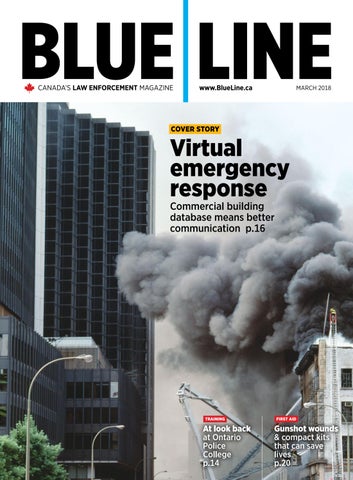
COVER STORY
Virtual emergency response
PM 40065710
Commercial building database means better communication p.16
TRAINING
FIRST AID
At look back at Ontario Police College p.14
Gunshot wounds & compact kits that can save lives p.20
EQUIPPED WITH PURSUIT-RATED TOUGHNE SS
When it comes to your fleet, Ford delivers on your needs like no other. We put power into the 2018 F-150 Responder: the first-ever* pursuit-rated pickup truck to market, with the highest horsepower and greatest torque of any pursuit-rated police vehicle^. Always ready to provide you with the vehicles you want when you want them, offering the solutions, tools, technology, dedicated service and expertise to make running your fleet easier than ever. Expect no less with Ford Fleet.
EXPERIENCE THE E’S OF EXPERTISE AT FLEET.FORD.CA.
Based on Michigan State Police Vehicle Evaluations for model years 2010–2017. When properly equipped. Maximum horsepower of 375 hp and maximum torque of 470 lb.-ft., based on Michigan State Police Vehicle Evaluation Report on model year 2017 pursuit-rated police vehicles in-market. ©2018 Ford Motor Company of Canada, Limited. All rights reserved.
* ^
Contents
13 March 2018
Columns
Volume 30 Number 3
4 10 11 12 26 27 30
Features COVER STORY
16 Emergency information at your fingertips
Emergency Response Portal contains vital information about commercial buildings and is accessible by police during a crisis. By A.J. Warr
13 Licence plate tech opens doors
Given the need for investigative tools for patrol officers, one Canadian university is now using Automated Licence Plate Recognition cameras. By Brittany Basten
14 Ontario Police College: Then and now
Former recruits reflect on the role the Ontario Police College had on their careers, as well as the training changes it weathered throughout the years. By Tony Palermo
Editor’s commentary Deep blue Holding the line Health & wellness Technology Case law Back of the book
Departments 5 5 9 9 26 28 29 30
By the numbers News Dispatches Calendar Off the shelf Product showcase Marketplace Blue Links
18 Policing and mothering
A new study reveals how police mothers’ home lives figure into their day-to-day lived experience. By Debra Langan, Carrie Sanders and Julie Gouweloos
20 Why every officer needs an individual first aid kit
COVER PHOTO: GETTY IMAGE
An individual first aid kit is not primarily designed to help others; it is for you, or for others around you, to help you. By Dave Brown
5 @Blue_LineMag
14
20 March 2018 | BLUE LINE
3
EDITOR’S COMMENTARY BY RENÉE FRANCOEUR
Intelligent, synergistic emergency strategies for better response
A
s I sit down to write this, a security department. We chatted about the flood warning for my home- city’s surveillance cameras and sharing town (St. Marys, Ont.) has just footage with local law enforcement. been lifted and the residents of “There is a unique piece and that is the Brantford, Ont., who were evacuated due ability for Calgary Police to see live video to the mid-February inundation, have from the public safety network if they been allowed to return home. My person- need to at their real-time operation cenal social media feeds have been teeming tre,” von Hollen told me. with videos and photos showing the danThis ability also applies to Calgary gerously high Thames River. Emergency Management Agency as well Additionally, OPP were looking for a as the Calgary fire departments. three year-old at the time of writing this, “So in the 2013 flood, the emergency who was swept away from his operations centre had access to “In the 2013 all of our public safety network mother near Orangeville, Ont. It brings me back to June 2013, flood, the cameras as well as our mobile and watching the devastating TV emergency trailer units,” von Hollen said. coverage of the Alberta floods. Up operations I can imagine this cohesiveuntil the Fort McMurray wildfire, centre had ness had quite the impact in a the Insurance Bureau of Canada access to all quicker response and the overall found those floods to be the costli- of our public management of such a constantsafety est disaster in Canadian history. ly shifting calamity. “Five lives were lost and as network It is something we need to much as $6 billion in financial cameras as look more closely at, especially losses and property damage was well as our in Ontario where emergency sustained across southern Alber- mobile management plans and prota,” the City of Calgary reported. trailer grams have not been updated in The city went on to state 1,000 units.” years, as the Auditor General kilometres of road was swept - Don von Hollen, found in her 2017 Annual Report. City of Calgary downtown in 24 hours, more than The report also revealed the 1,600 people registered at comprovince has no co-ordinated munity support centres on the first day of information technology (IT) system in the emergency, and upwards of 100,000 place for emergency management and key calls were received at 311. We know all the initiatives in step one of Ontario’s new first responders were working themselves Emergency Management Action Plan ragged around the clock. (announced in December 2017) talk about The Calgary Police Service was “front governance and evaluation frameworks, and centre on social media” during the among other things, but fail to mention chaos, according to a CBC article, and was any IT specifics. later recognized with an award for social All the government has said is it will media event management. “support municipalities in accessing Efficient emergency management re- critical supplies and resources in an emerquires total collaboration and effective gency by improving the supply chain and communications between all community logistics program, and enhance informapartners, including, of course, law en- tion and resource sharing among municiforcement. palities and the province by deploying While working for Canadian Security and emergency management software.” SP&T News last year — fellow Annex BusiWith the advent of Next Generation 911 ness Media publications — I interviewed on the very near horizon, the lack of details Don von Hollen with Calgary’s corporate here is quite the concern.
CONNECT WITH BLUE LINE
www.BlueLine.ca 4
@Blue_LineMag
BLUE LINE | March 2018
www.facebook.com/BlueLineMagazine
BLUE LINE www.BlueLine.ca
GROUP PUBLISHER | PAUL GROSSINGER pgrossinger@annexbusinessmedia.com EDITOR | RENÉE FRANCOEUR rfrancoeur@annexbusinessmedia.com ACCOUNT MANAGER | JANICE EATON janice@blueline.ca ART DIRECTOR | SVETLANA AVRUTIN savrutin@annexbusinessmedia.com ACCOUNT COORDINATOR | TRISH RAMSAY tramsay@annexbusinessmedia.com CIRCULATION MANAGER | BEATA OLECHNOWICZ bolechnowicz@annexbusinessmedia.com Tel: 416-442-5600 ext. 3543 COO | TED MARKLE tmarkle@annexbusinessmedia.com PRESIDENT & CEO | MIKE FREDERICKS ANNEX BUSINESS MEDIA 111 Gordon Baker Road, Suite 400 Toronto, ON M2H 3R1 Tel. 416-442-5600 • Fax 416-442-2191
Publication Mail Agreement No. 40065710 ISSN 0847-8538 Printed in Canada SUBSCRIPTION RATES Canada — 1 Year $31.00; 2 Year $51.50 plus tax USA — 1 Year $103.00 USD CIRCULATION email: asingh@annexbusinessmedia.com Tel: 416-442-5600 ext 3553; Fax: 416-510-6875 or 416-442-2191 Mail: 111 Gordon Baker Road, Suite 400, Toronto, ON M2H 3R1 Occasionally, Blue Line will mail information on behalf of industry-related groups whose products and services we believe may be of interest to you. If you prefer not to receive this information, please contact our circulation department in any of the four ways listed above. Annex Privacy Officer Privacy@annexbusinessmedia.com; Tel: 800-668-2374 © 2018 Annex Publishing & Printing Inc. All rights reserved. Printed in Canada. No part of the editorial content of this publication may be reprinted without the publisher’s written permission. Opinions expressed in this magazine are not necessarily those of the editor or the publisher. No liability is assumed for errors or omissions. Readers are cautioned and advised that articles presented herein are edited and supplied for your personal awareness and should not be used for further action until appropriate guidance is received from a supervisor, Crown Attorney or other persons in authority. All advertising is subject to the publisher’s approval. Such approval does not imply any endorsement of the products or services advertised. The publisher reserves the right to refuse advertising that does not meet the standards of this publication.
NEWS distribution centres: 66 per cent comfortable compared to 24 per cent who are not.
Panasonic’s first Smart City Public Safety Summit revealed new solutions that cater to law enforcement and municipal government needs alike. PHOTO: R. FRANCOEUR TORONTO
Panasonic talks innovation and intelligent solutions at first Smart City Public Safety Summit Panasonic hosted its first Smart City Public Safety Summit earlier this year in Toronto, revealing a handful of new solutions, including vehicle search and tracking, pedestrian safety, body worn camera action detection and the next generation of facial recognition. Soo Wong, the member of provincial parliament for Scarborough-Agincourt in Ontario, stopped by to speak about the importance of collaboration and what the Safer Ontario Act (announced in November 2017 — more at goo.gl/DTh7b8) means for innovation in law enforcement. The luncheon roundtable opened up the discussion, asking attendees about visions for the police car of the future, streamlining mobile applications, joint ventures between government and private industries and Cloud storage. How to dialogue with privacy commissioners as body worn cameras gain traction and the way information is shared was also discussed. Stay tuned to blueline.ca for videos from the event.
CANADA
Security firms can support police with cannabis change GardaWorld mandated Ipsos Public Affairs1
to conduct a scientific survey on the use of security firms to support police forces to ensure the safety of Canadians regarding the legalization of cannabis. The findings reveal Canadians “strongly support a secure environment regarding the upcoming changes,” according to GardaWorld. “For the past few years, GardaWorld and the private security industry have clearly expressed that they are ready to play a greater role in supporting police forces. The private security industry can fulfill the duties for which its guards have been duly trained and regulated,” the company stated in a news release. “Elected municipal officials across the country express concern about the costs of implementing cannabis legalization. However, the security industry offers safer, less expensive solutions that are supported by the public,” GardaWorld continued. Ipsos asked 1,007 respondents for their level of comfort relating to the involvement of private firms in support of police officers for: • Surveillance of areas surrounding cannabis production sites: 70 per cent are comfortable compared to 21 per cent who are not. • Monitoring of warehousing and distribution centres for cannabis products: 69 per cent are comfortable compared to 21 per cent who are not. • Surveillance of cannabis production sites: 69 per cent are comfortable compared to 21 per cent who are not. • Secure transport of cannabis products from production sites to warehousing and
“These results demonstrate that Canadians want to have a secure environment in the wake of the legalization of cannabis, and that in this regard, they are very comfortable with the prospect of having serious security companies play a greater role in supporting police officers,” said Christian Paradis, senior vice-president of GardaWorld. BRITISH COLUMBIA
More than 1,422 people died of overdoses in 2017
Illicit drug overdoses claimed 1,422 lives in British Columbia last year, setting a new threshold for the crisis that has been fuelled by the powerful opioid fentanyl. The B.C. Coroners Service said last year’s death toll is 43 per cent higher than 2016 when 993 overdose deaths were recorded. Fentanyl remains the main cause of most fatalities and was detected in about 81 per cent of deaths last year, chief coroner Lisa Lapointe said. More than half of the 2017 deaths involved those between the ages of 30 and 49, and the coroner said four out of five of those who died were male. The coroner also noted there appears to be more overdose deaths in the five days after income assistance payments are issued, with the average of six deaths per day. The overdose-reversing drug naloxone has been reported to have been administered more than 14,000 times since the province began distributing kits containing the life-saving drug, said Dr. Patricia Daly, executive director and clinical lead for the B.C. Overdose Emergency Response Centre. The province has said nearly 30,000 naloxone kits were handed out in 2017. - from The Canadian Press
BY THE NUMBERS
For Canadians, winter storms are the most commonly perceived weather-related hazard, as determined by Statistics Canada’s Survey of Emergency Preparedness and Resilience from 2014. As such, nearly half of us (48 per cent) have an alternative source of heat. Below are more findings from the survey.
74% 42% 58% 33%
of Canadians feel confident they would know what to do if confronted with an emergency situation.
@Blue_LineMag
live in a home with a smoke detector, carbon monoxide detector and a fire extinguisher.
have a wind-up or battery-operated radio as a safety precaution.
have a designated meeting place for household members as part of their emergency planning activities.
March 2018 | BLUE LINE
5
NEWS TORONTO
ABLE wraps up 25th anniversary with annual career fair
There were jokes, fidget spinners and plenty of options presented as career avenues to the curious student body at the 15th annual justice career fair, hosted in partnership by the Association of Black Law Enforcers (ABLE) and the University of Guelph-Humber. ABLE estimates a couple hundred students perused the fair held in north Toronto at the beginning of the year, seeking information from one or more of the 24 exhibitors, which included police departments, government and other law enforcement agencies as well as fire and ambulance services. “We are very proud of our relationships with the University of Guelph-Humber and the various justice-based organizations in the community,” said ABLE president, Kenton Chance. “Bringing our partners and students together in a collective forum generates awareness for the industry and enables employers and students to have constructive conversations about the overall workforce and opportunities within it.” ABLE is a non-profit organization that addresses the needs and concerns of Black and other racial minorities in law enforcement and the community. For more photos and a video from the event, visit goo.gl/fv7NwS. SASKATOON
Saskatoon Search and Rescue launches Project Lifesaver
Saskatoon Search and Rescue (SSAR), with financial assistance from the Saskatoon
University of Guelph-Humber students stop by the Ontario Ministry of Community Safety and Correctional Services’ booth during the 15th annual justice career fair, co-hosted by the Association of Black Law Enforcers (ABLE) on campus. PHOTO: R. FRANCOEUR
Police Service Foundation and support from the Saskatoon Police Service, is launching Project Lifesaver Saskatoon, which they hope will assist in increasing safety for people who are at risk to wander. For many years SSAR has used volunteers to provide search and rescue efforts and assistance to organizations such as the local police, the Saskatoon Emergency Measures Organization and the RCMP. Over the past four years, almost 75 per cent of their activations have involved individuals suffering from Alzheimer’s, dementia, autism or other cognitive disorders that are known to cause wandering. Project Lifesaver is a program that may help to reduce those numbers, SSAR says. A participant in the Project Lifesaver program wears a wristband that emits an individualized radio-frequency signal. In the event that a participant wanders, SSAR members who are trained as Electronic Search Specialists enter the frequency into a receiver and can use the signal to search for — and locate — the missing person.
Left to right: Saskatoon Search and Rescue members Rick Barsky, Shelly Ottley and Henry Eng test out the PLI 5000 tracking receiver . PHOTO: SASKATOON SEARCH AND RESCUE 6
BLUE LINE | March 2018
CANADA
RCMP overhauls auxiliary program
PHOTO: RCMP VETERANS’ ASSOCIATION
The RCMP says it is implementing a new auxiliary model, following consultations, that includes three tiers. Provinces and territories will be able to choose one or a combination of the tiers based on their needs. Tier One provides RCMP auxiliaries an opportunity to participate in community policing services, such as watch programs, public education initiatives, non-enforcement support to operations, community fundraising events and participation in parades and public ceremonies. Tier One auxiliaries will perform these activities under the general supervision of an RCMP employee and will not be given peace officer status. Tier Two includes all of the activities listed in Tier One with the addition of community presence via foot and bicycle, access and traffic control, and disaster assistance. Tier Two auxiliaries will have peace officer status. Tier Three expands activities to general duty patrol, attending calls, check stops, scene security and searches of persons. Mandatory national training standards have been developed for all three tiers and new changes to the uniform will make auxiliaries more identifiable. www.BlueLine.ca
ONTARIO
Emergency planning in Ontario “needs update”
“There are weaknesses in emergency management planning and programs across Ontario that could impact the timeliness and effectiveness of a provincial response to a large-scale emergency,” Auditor General Bonnie Lysyk says in her 2017 Annual Report. “It is essential in a province the size of Ontario that the government be ready to act in the event of an emergency,” Lysyk said after her report was tabled. “But plans have not been updated in years and practicing for emergencies through simulations are not frequently done.” Overall responsibility and the co-ordination of the province’s emergency management program rests with the Provincial Emergency Management Office (EMO), a branch within the Office of the Fire Marshal and Emergency Management division of the Ministry of Community Safety and Correctional Services (MCSCS).
Issues the audit found include: • Oversight of emergency management in Ontario is the responsibility of the Cabinet Committee on Emergency Management— which has not met for several years. • The last overall provincial risk assessment was done in 2012. This was based on emergencies experienced up to 2009. As a result, the program has not considered emergencies that occurred after 2009, or the latest information on the effects of climate change, cyberattacks and terrorism.
• The two provincial emergency response plans prepared by EMO have not been updated since 2008 and 2009. • The province has no co-ordinated information technology system in place for emergency management. Marie-France Lalonde, MCSCS’s minister, says Ontario’s new Emergency Management Action Plan, revealed to the public in December 2017, outlines a number of key initiatives to combat issues highlighted in the report.
PART OF YOUR TEAM We do our job so you can do yours. Our proven non-core police services allow law enforcement officers to do the jobs they trained to do.
commissionaires.ca @Blue_LineMag
BL_March_Commissionaires.indd 1
March 2018 | BLUE LINE
7
2018-02-09 12:57 PM
NEWS NEW YORK
RCMP wins Security Award for fentanyl dog training
The RCMP’s Police Dog Service Training Centre (PDSTC) was honoured at the 2017 Homeland Security Awards ceremony in New York for its innovation in the fight against illicit fentanyl. Recognized for developing a technique that safely trains dogs to detect the powerful opioid, the PDSTC earned a platinum award. The ceremony was organized by American Security Today, a digital publication that profiled the technique after the RCMP announced it would train all of its 139 narcotics-profile dogs across Canada. RCMP specialists transform pure fentanyl into a diluted liquid form, which allows the dogs to train with the scent of real fentanyl without risk of inhaling it, rendering the “technique safe and efficient and making the dogs extremely productive in the field.” During police operations, the dogs can
Fentanyl is an opioid about 100 times more toxic than morphine. RCMP specialists transform it into a diluted liquid form for safe K9 scent imprint training. PHOTO: RCMP detect fentanyl from a safe distance and dog handlers are trained to administer an antidote to canines who may inadvertently come into contact with the drug. “Illegal opioids are a major concern around the world as a public safety issue. In 2016, in Canada alone, law enforcement seized about 18 kilograms of fentanyl, which is significant considering just a few grains can cause an overdose,” said Insp. Akrum Ghadban, the
officer in charge of the RCMP Police Dog Service Training Centre. “I’m very proud of our work as a team in developing this training program and sharing it with other law enforcement partners. It is an honour to accept this award on behalf of the Royal Canadian Mounted Police.” More from Blue Line’s exclusive story on the training at goo.gl/uXBM1P.
We always welcome your insights and feedback. Email rfrancoeur@annexbusinessmedia.com or comment directly on the items you see at blueline.ca (N.B. letters to the editor may be edited for clarity and brevity.)
Move forward in your career. Bachelor of Applied Arts Justice & Public Safety
Toronto, ON
> Degree completion for professionals
Talk to us! Information Night: May 3, 2018 Webinar: May 17, 2018 > Build on your credentials and open up opportunities for career advancement. > Credit for previous postsecondary education, training and work experience. > Part-time study. A mix of 70% online study and 30% on-campus weekend class time in Toronto. > New entrance scholarship!
>>> guelphhumber.ca/jpsdc 8
BLUE LINE | March 2018
BLueLine_Mar_UofGuelph.indd 1
www.BlueLine.ca
2018-02-21 10:37 AM
NEWS DISPATCHES Toronto Police Staff Sgt. Adrianne Johnstone is leaving for the private sector after 25 years of policing. First hired with the Ontario Provincial Police in 1995, she then moved to the Toronto Police Service (TPS) in 2001 where she helped design and implement a new standard by combining the major crime unit with the community response unit (now known as the Neighbourhood Safety Team). Her last tenure with TPS was running both the operational and administrative side of the marine unit. Insp. Paula M. Walsh has retired from the Royal Newfoundland Constabulary after 33 and a half years of service. She has been appointed Assistant Deputy Minister of Public Safety and Enforcement, Newfoundland and Labrador. Insp. Vanessa Leslie has been promoted to detachment commander of the OPP’s Highway Safety Division (HSD) - Toronto Detachment. The move makes her the first Black female inspector in the OPP. She has been a member of the OPP since 1994. Insp. Zvonko Horvat has been named chief of police for Aylmer Police Service. He has been in policing for 32 years, starting at Haldimand Norfolk Regional Police. In 2008 he became inspector detachment commander for Norfolk OPP. Brockville Police Service Deputy Chief Lee MacArthur (photo) has announced his retirement, with Det.-Const. Mark Noonan being promoted as his replacement. Const. Rob Ferguson is also retiring from the agency as well as support services co-ordinator Deena Shaw.
CALENDAR The Lieutenant Governor of Ontario, Elizabeth Dowdeswell, has presented Niagara Regional Police Service (NRPS) Chaplain Gary Page with the Ontario Medal of Good Citizenship. This medal recognizes Page’s years of dedication to his community including his role as an NRPS chaplain, a volunteer with Victim Services Niagara, a member of the NRPS auxiliary unit, his work with assisting refugees relocating to Niagara, and his work with local youth. Blue Line columnist and OPP emergency response team member Isabelle Sauve completed a Guinness World Record at the 2018 Louisiana Marathon in Baton Rouge for the fastest handcuffed marathoners (mixed pair). Sauve and her Australian running partner, Bruno, beat the existing record by 13 minutes. Watch a video from Sauve’s time in Louisiana at goo.gl/vYuuux.
Norm Hansen (photo) is the new chief for Sarnia Police Service, taking over for outgoing Chief Phil Nelson. Owen Lockhart will be the new deputy chief, taking over for Bob Farlow. Don Head has retired as the Commissioner of Corrections for the Correctional Service of Canada after 10 years in the role. He started as a correctional officer in 1978. After 11 years with the University of Guelph Campus Community Police, manager of operations Pat Martin has officially retired. Prior to this role, he served for 35 years with Guelph Police Service, climbing to the rank of staff sergeant.
PROMOTIONS, RETIREMENTS, RECOGNITION • If you have an officer in your agency recently promoted or retiring or an individual you wish to have recognized (major award or recently deceased) you can let Blue Line magazine know by email to: dispatches@blueline.ca.
@Blue_LineMag
International Human Trafficking Conference March 19-21, 2018 Toronto, Ont. tps-human-trafficking-conference-2018. eventbrite.ca ILEETA 2018 March 19-24, 2018 St. Louis, Mo. www.ileeta.org/ileeta-conference-expo Gangs, Drugs & Murder Conference March 26-29, 2018 Vancouver, B.C. cacp.ca/gangs-drugs-murder.html Hardeep Kang Memorial Hockey Tournament Apr. 19-20, 2018 Brampton, Ont. www.hkmemorial.com Canadian Critical Incident Stress Congress Apr. 24-27, 2018 Niagara Falls, Ont. www.hkmemorial.com LEVA Level 1: Forensic Video Analysis & The Law Apr. 30, 2018 Calgary, Alta. leva.org Blue Line Expo May 3, 2018 Mississauga, Ont. www.bluelineexpo.ca The Anti-Graffiti Symposium (TAGS) May 8-9, 2018 Moncton, N.B. www.tagsconference.ca 4th International Police Expo May 17-18, 2018 New Delhi, India internationalpoliceexpo.com International Police Association Canada AGM May 24-29, 2018 Vancouver, B.C. www.ipacanada.ca
March 2018 | BLUE LINE
9
DEEP BLUE
BY DOROTHY COTTON
Moral licensing: Good people doing bad things
I
am in the midst of another round of assessments for police wannabes. As usual, almost all the candidates are lovely young people, with much cleaner personal histories than mine, who appear virtuous (to the point of being nauseating), and who generally want to save the world. As I interview all these squeaky clean candidates, I am always mindful of the fact that without a doubt, some of them are going to end up doing something bad during their careers. Most will not do seriously bad things (although a few will). And my guess is that the proportion of police officers that end up doing bad things is not any higher than the percentage of psychologists or physicians or social workers or building inspectors or politicians who do bad things. What all these professions have in common is that people in them start out intending to do something for the good of the masses. They are all, in some way or other, “helping” professions. Why is it that people who clearly see themselves as the good guys end up doing no-so-good things? There are of course a zillion reasons: a single bad day or lapse of judgment due to sleep deprivation; the temptation of money when finances are tight; hanging around with the wrong people; repeated
failures on the part of their employers or organizations to reward/punish behaviour appropriately; seeing too many other people getting away with stuff... the list goes on. Oddly enough, one of the reasons people sometimes do bad stuff is precisely because they see themselves as good people who do good things. Perversely, this can give people permission to do something not so good. This is called moral licensing — sometimes also called self-licensing. The idea of moral licensing theory is that the prior good deed provides a “license” that allows one to perform morally questionable behaviour later on. Once one establishes oneself as a moral person, then the pressure to prove one is moral — either to oneself or to someone else — kind of fades. I used to go out after work with coworkers for a drink on Friday afternoons. Almost all the women would order a light beer or a diet soda — then devour a bowl of Cheezies or chips. By ordering the lighter drink, we demonstrated that we were concerned about eating properly — or at least watching calories. That having been established, we apparently felt we had “license” to eat the junk food. What’s the mechanism here? It appears that once people have established themselves as “moral,”
Oddly enough, one of the reasons people sometimes do bad stuff is precisely because they see themselves as good people who do good things.
and their self-concept as a good and moral person becomes secure, they tend to worry less about behaviours that might be considered by others as immoral or less virtuous. It’s like saying, “Obviously since I voted for Obama, I can’t possibly be racist. So let me tell you what I really think about race issues.” In other words, if I have to prove to myself or to you that I am a good person, I am going to do all the good stuff I can to demonstrate this. But once I have proven it, and I accept myself as “good,” then I don’t need to worry so much about it and I can let the little things go. Another study showed that if a person shops at a store that advertises itself as eco-friendly, and identifies as environmentally conscious, they are more likely to steal or cheat in other financial transactions. People who do volunteer work for a charity are subsequently more likely to (oops) forget to report certain things on their income tax returns. When one delves down a bit further, I think one comes to the realization that much of our bad behaviour comes from our ability to distort our cognitions. When we do some good stuff, we feel like we have a “bank” or goodness stashed away, against which the occasional bad thing seems justifiable. We may even feel entitled to do something bad because we have done so much good. Indeed, it is surprisingly easy to convince ourselves that little transgressions don’t matter, that we even deserve a little bonus now and then (in the form of junk food, petty theft, bias, outrageous behaviour, etc.) precisely because we are so good otherwise. Newsflash: not so. Don’t kid yourself. Dr. Dorothy Cotton is Blue Line’s psychology columnist. She can be contacted at: deepblue@ blueline.ca.
10
BLUE LINE | March 2018
www.BlueLine.ca
HOLDING THE LINE BY MICHELLE VINCENT
Strengthening our “resiliency armour”
T
he word resilience has been a buzzword in the world of policing for several years now and its essential role in our successful mental health and wellbeing also makes it known as a top-notch performer. Resilience is infused in our training programs, such as Road 2 Mental Readiness, and is heavily promoted as our recruits begin their journey as first responders. What exactly is resilience and how does it look as a first responder? Who has it and who doesn’t? Is it something that can be learned? These are all questions we may ask ourselves as this buzzword continues to float around our organizations. Resilience is defined in the dictionary in two ways, both applicable to us as police officers. The first is: “the capacity to recover from difficult situations.” The second is: “the ability of a substance to spring back into shape; elasticity.” If we apply these concepts to ourselves how do we fare on our resilient report card and how can we improve? Dr. Stephanie Conn has written a book called Increasing Resilience in Police and Emergency Personnel: Strengthening Your Mental Armor, and although I have not had the opportunity to read it (it hasn’t been released at the time of writing this), I have spoken in depth with Stephanie about the meat and potatoes of it. There are many great reads out there for us, but what I appreciate most in Stephanie’s approach is her exploration in debunking the myths of how we are not being resilient when we are struggling with our mental health issues (depression, anxiety, PTSD and/or addictions). She approaches resilience through a solution-focused lens, identifying non-operational triggers that affect our “resiliency armour” and thoroughly explores a regime for strengthening this “armour.” Resiliency may be one of the most important tools in our tool belt and yet, for many of us, it is possibly a skill we need to develop — like a muscle we focus on at the gym. What do those mental health workouts look like from a resilience perspective? It depends on what level you are entering at, no different than beginning a workout regime at the gym! If you are reading this
and are experiencing significant trauma or mental health issues at this time in your life, discussing improving resiliency with your mental health professional would be a great start. Another piece I have found useful is finding the good in situations, which I call “fine tuning our perceptual lens.” We have a choice to see what is good in a situation or what is bad. We have a tendency to focus on what is negative, as we feel like we are protecting ourselves from letting any more bad in. The challenge with that is we get more of what we are thinking. If you can find even one small positive in a situation, hone in on it and flesh it out. The reverberation of that positivity will go on for a long time. When we practice this at every chance we get, we become more proficient at it, which can literally change the way we experience life.
For example, what is even just a small benefit to being part of challenging call at work? Maybe we were able to bring resources to a subject, as a result of an arrest, through their attendance in court. There are two sides to every situation and resilience is the ability to focus on what went well. Conn’s book is due to be released April 8, 2018, and is currently available for pre-order on Amazon. Michelle Vincent is a 16-year York Regional police officer with a Masters Degree in Arts in Counselling Psychology and a background in equine assisted therapy, workplace reintegration and teaching. She has a practice supervised by a psychologist and is working towards her PhD in Forensic Psychology/Crisis Response. She can be contacted at: michelle@smith.net.
Make a Difference JUSTICE STUDIES FOR WORKING FRONTLINE OFFICERS
At Humber, we teach the professional and practical skills you need to move up and make a difference in your community and in your career. Further your education one course at a time or work towards a certificate, diploma or degree. Advanced standing is available to those in the Justice Services industry.
communityservices.humber.ca /justiceprofessionals
March 2018 | BLUE LINE
@Blue_LineMag BlueLine_Feb_Humber.indd 1
11
2018-01-29 10:15 AM
HEALTH & WELLNESS BY ISABELLE SAUVE
Job satisfaction checkup: unravelling the status quo
I
n my last column I explored the importance of adopting the right attitude towards work through the topic of epigenetics. The truth is that a great deal of our time is spent at work and that has repercussions on our health. Law enforcement duties often encourage officers to work beyond the typical 40-hour week with overtime, paid duties, court, etc. Consequently, it is important for law enforcement officers to be fulfilled, appropriately challenged and engaged by their work. Over the course of time, many experience a gradual decline in job satisfaction and motivation. A study conducted by Gallup, a global “performance and management” company, found that merely 13 per cent of employees across 142 countries surveyed were engaged at work. Police officers are not exempt from this statistic. In fact, they tend to identify so strongly with their career that it often forms part of their identity. This makes them increasingly sensitive — and more susceptible — to being negatively impacted by work issues. Therefore, it is crucial to remain satisfied and engaged. Policing is a career where members have an opportunity to make a significant difference in the lives of the people they serve. Unfortunately, it is often the case that a number of issues, such as poor morale, internal politics, stress, etc., lead to an erosion of job satisfaction and motivation. Many describe this feeling as being bored or “stuck.” Autonomy, skill variety, task identity, task significance and task feedback are essential components of employee motivation, according to Hackman and Oldham’s Job Characteristics Model, a theory developed in 1976 and refined again in 1980. Being engaged at work is a product of: the degree to which the 12
BLUE LINE | March 2018
job requires the use of different skills and abilities, affects the lives of others, is linked to a larger project, offers freedom and independence to carry out the job, and provides clear feedback. In terms of intrinsic means of maintaining job motivation and satisfaction there are a number of things one can do. Reflecting on what one really loves and enjoys can bring some of the spark back. Though the act of reflection, things that had been taken for granted may resurface. The simple process of practicing gratitude helps maintain positivity. Try starting the day by identifying one thing to be thankful for. In some cases, taking frequent breaks or an impromptu vacation can reset the interest in one’s work. Making a career change can keep the brain active by being mentally and socially stimulating. While it is not always feasible to change employment or to relocate, seeking new opportunities or a new role within an organization can also offer a healthy level of challenge and engagement.
In some cases, taking frequent breaks or an impromptu vacation can reset the interest in one’s work. Making a career change can keep the brain active by being mentally and socially stimulating.
There are a number of other ways to unravel status quo, such as learning something new in or outside one’s organization. For instance, learning a new language to improve communication with a community you serve. Another option is to discover alternate ways to perform the same job. Technology is perpetually changing the landscape in law enforcement. Staying up to date with those drastic changes improves work performance while making it interesting. Teaming up with someone to perform a task or take on a new project promotes a high level of engagement and intellectual challenge. Entering into a mentorship role by teaching or coaching others can also be a reminder of the excitement and energy that once existed. It can allow a reconnection with individual strengths while promoting a connection with a new generation of officers. A diverse workforce promotes a culturally rich and interesting environment. Linking up with a mentor who exhibits true leadership — or a certain skill one aspires to develop — opens doors to new opportunities. Officers who are supported feel empowered and are more likely to set and work towards career goals. Taking action and responsibility for fulfillment and happiness can reverse a negative outlook on work. Job satisfaction is an important contributor to wellness and has an impact on every aspect of one’s life. Happiness at work spills onto other aspects of life and so it must be nurtured.
Isabelle Sauve is a 10-year OPP veteran currently with the Emergency Response Team (ERT) at the Almaguin Highlands Detachment in Burks Falls, about 300 km north of Toronto. She can be contacted at: isabelle.sauve@hotmail.com.
www.BlueLine.ca
CAMPUS SAFETY
now automatically scan to identify illegal parked vehicles and flag them. To date, three campus parking garages are equipped with ALPR cameras for real-time reports of occupancy and non-payment. “The ALPR software employed in the parking garages is analytic. It provides a proactive report to parking enforcement officers, which allows them to plan their patrols based on priority instead of just patrolling blindly,” says Chris Moy, DUS assistant director. “They can engage in strategic parking enforcement. As a result, it has been a great return on investment.”
What does this mean for advances in investigations?
A special constable at Carleton analyzes Automated Licence Plate Recognition data.
Licence plate tech opens doors for campus police
By Brittany Basten
PHOTO: CARLETON UNIVERSITY
I
n June 2011, a robbery occurred at Carleton University in Ottawa, Ont., resulting in the loss of thousands of dollars. Department of University Safety (DUS) officers used closed caption television video (CCTV) to locate and follow the suspect vehicle as it left campus. However, they were unable to obtain a clear licence plate, so they couldn’t identify the car or the driver. Follow-up investigation led to the identification, arrest and subsequent convictions of the suspects — but not until a month later. Simply having a licence plate number would have saved a lot of time and effort. This incident resulted in a review of Carleton’s CCTV deployment strategies. Given the evolving need for investigative tools for patrol officers and parking enforcement, Carleton is now using Automated Licence Plate Recognition (ALPR) cameras to augment its 1,000-camera CCTV system. ALPR cameras have been installed across campus in key locations and, later this year, at the entrances to campus. This will help officers quickly and accurately identify and record the date, @Blue_LineMag
“The ALPR software employed in the parking garages is analytic. It provides a proactive report to parking enforcement officers, which allows them to plan their patrols based on priority instead of just patrolling blindly.” - Chris Moy, Department of University Safety time and licence plate of every vehicle entering and exiting campus. Campus parking lots are managed using licence plate recognition software (Pay by Plate) where the licence plate is the parking permit. This has simplified a complicated parking system, which no longer requires physical permits or displayed receipts. With the addition of ALPR camera systems on our parking and patrol vehicles, officers can
If an incident occurs on campus involving a vehicle and a make, model, direction of travel, or partial plate is provided, the investigator can access the ALPR data with the information they have and obtain the associated plate number. This data can be also used to identify the owner through a CPIC (Canadian Police Information Centre) check with the Ottawa Police Service (OPS) or, alternatively, for the OPS to then follow up. In addition, DUS will have the capacity to provide additional assistance to OPS investigations by running or flagging plates of interest through this system upon request.PHOTO: CARL JONES II. DUS has the authority to ban individuals and vehicles under the Trespass to Property Act. With the data provided from ALPR cameras, officers can enter a list of banned vehicles into the system so DUS is immediately notified whenever a vehicle trespasses. This strengthens officers’ situational awareness of known threats coming onto campus and will decrease response times. From a traffic management perspective, this new technology will allow the department to measure the traffic flow and assess data to determine peak times by calculating how many vehicles are on campus at any given time and the occupancy of the parking garages. “ALPR opens the doors for us to manage traffic, parking and investigations based on real-time data,” Moy says. “All patrol and response efforts can be focused, co-ordinated and strategic.” Sgt. Brittany Basten is the community liaison officer with the Department of University Safety at Carleton University. Email university_safety@carleton.ca for more information.
March 2018 | BLUE LINE
13
TRAINING
The Dynamic Simulation Area was built in the 2000s and practical scenarios could then involve the use of professional actors in life-like settings, such as a bank. PHOTO: A+LINK ARCHITECTURE
Ontario Police College: Then and now By Tony Palermo
P
olice officers in Ontario first start their careers by attending Ontario Police College (OPC) in Aylmer, a post-hire training facility that first opened in 1963 and is regarded as a leader in policing education. In fact, OPC is one of the largest police training facilities in North America, with over 8,000 recruits, police officers and civilian personnel attending the college each year. OPC came about after a group from the Chief Constables’ Association (which later became the Ontario Association of Chiefs of Police)
developed a plan in the early 1950s to establish a centralized police training college in the province. Aylmer’s decommissioned Royal Canadian Air Force (RCAF) station was selected as the site. The military influence remained strong at OPC in those early formative years. Rules and regulations were very similar to what existed at the former RCAF station, since a lot of the initial OPC instructors were ex-military and like-minded police officers. The recruit sleeping quarters were the old wooden military H-Huts, so named because of their design. Each
1963 OPC first opened
Claude Brett, in the second row, was among the OPC recruits from 1974. PHOTO: CLAUDE BRETT 14
BLUE LINE | March 2018
of the two long, narrow buildings crammed in about 40 recruits, and then the two huts were joined by a common entryway and shared washroom through the middle. “The rows of single beds were all lined up, maybe five feet apart, just like you would see for military boot camp on the old TV shows,” says Claude Brett, who graduated from OPC in 1974 and retired in 2009 as chief of the former Perth Police Service. “You had a small, upright locker to put your stuff in and that’s about it. And, there were no luxuries like air conditioning.” Women had their own separate H-Hut — the first female recruits came through OPC in 1969. Regardless, privacy was still hard to come by, even though their numbers were low and they had more space to themselves. Training days started at 6 a.m. with a morning PT class or run, followed by packed days of mainly classroom instruction. There was some range time and classes on defensive tactics, but things like scenario-based training or driver training weren’t introduced at OPC until several years later. With the military influence strong, inspections — both of the recruits and of their living space — were the norm. It wouldn’t be uncommon for recruits returning from class to find their beds tossed or kits thrown about if things weren’t completed to the instructors’ standards. Jim Berney, protocol officer at OPC, says those exacting standards even carried over to the cafeteria. “A strict dress code was in place to even gain access to the former military mess hall,” Berney says, adding that separate buildings existed for recruits and staff until the new OPC facility opened in 1975. Berney says in speaking with former instructors from those early years, the feedback was that the food was good — coming off the steam line with at least two hot choices available at every meal. He describes the atmosphere as being very similar to any large institutional kitchen: simple, hot and of a decent quality. www.BlueLine.ca
OPC presents the class of 1986. PHOTO: NORM PAYEUR
A sign of the times, smoking in the buildings was allowed but alcohol was strictly forbidden. If a recruit wanted a drink, they had to go offsite — in theory anyways. Brett says in his group, at least, booze was easy to come by. “The ceilings in the H-Huts were absolutely laden with booze,” Brett says with a chuckle. “It was a heavy tile drop-ceiling of sorts, not like you would have nowadays in your basement, but a wooden drop-ceiling that was almost collapsing from the weight of the bottles.” Curfew and lights out was at 11 p.m. Night duty officers did regular checks to ensure compliance and infractions of any sort were dealt with swiftly. “If you did something wrong, you generally had to stand at attention outside at a certain time of the night for a week straight,” Brett explains. “That was one form of detention. And it generally wasn’t punishment for one; it was punishment for all.” After the duty officer finished his rounds, internal discipline amongst the recruits themselves was always dealt with at night, too, according to Brett. He says a recruit who needed to be taught a lesson might find himself sleeping out in the middle of a field somewhere. Once the updated facility opened in 1975, it marked the start of a new direction for OPC that would usher in major changes, including where the recruits slept. It incorporated three new residences with 520 single rooms, styled much like college and university dorms, consisting of a bed, bedside table, desk and closet. The new rooms were a step up @Blue_LineMag
from the former H-Hut configuration, and brought with it something recruits craved in those early years: privacy. As the 1980s came around, the slow shift away from the heavy military influence continued. Most of the old RCAF instructors had retired, specific fitness instructors were hired and wellness classes were added as part of the physical fitness component. Even the permanently staffed, on-site duty officer was replaced with a student. By the late 1980s, more practical components such as driver training and scenarios were being introduced. Average class sizes varied from 20 to 40 students and, although there were more female recruits, they still made up well under 10 per cent of the total student population. Cost recovery was introduced in the 1990s with recruits being charged tuition. Use of force standards were introduced along with training in the use of other tools, such as OC spray. Practical scenarios were further developed and reflected the newer realities of policing. Shooting standards were also refined significantly and driver training was enhanced to ensure officers could drive in police circumstances. The wellness trend continued and special dietary requirements were made available to the students, including more variety and choice of offerings. The use of after-hours student duty officers was also discontinued and the 11 p.m. curfew was lifted, replaced with a more relaxed form of “quiet time.” Inspections were also reduced to duty gear only — room and uniform inspection were discontinued.
Once the updated facility opened in 1975, it marked the start of a new direction for OPC. PHOTO: CDN GUNWORX
8,000
future officers attend OPC annually
1969 First female recruits came through
1975 New OPC facility opened
The reprieve from inspections was short-lived and resumed by the 2000s. But the biggest change continued to be how recruits were taught. The Dynamic Simulation Area was constructed and practical scenarios now involved the use of professional actors in life-like settings such as a bank, restaurant, apartment, etc. A research unit was started at the college to help develop the curriculum. Evidence-based training was introduced and civilian instructors were brought in to cover the specialty areas best not conducted by police officers. Berney says recruits are generally older nowadays and their education level has consistently gone up over the years as well, but nonetheless OPC has been at the forefront of policing education, making heavy use of advanced teaching methods and technology. The friendships are one of the first things that come to mind for Smiths Falls police officer Tyler Brett when he thinks of OPC. “Yes, the rooms were small and the beds were hard, but at that point in my life I could have cared less about that,” says Brett, who attended OPC in early 2009. “The friendships I made at OPC and the experiences we had and accomplished together are what I remember the most. Whether platoon mates or pod mates, and even though some of us haven’t talked much since, we all remember who we went there with.” Tony Palermo is a freelance journalist and is currently working on a book about sex trafficking in Canada. Reach him at tony@ tonypalermo.ca or on Twitter @TCPalermo. Visit www.tonypalermo.ca for more.
March 2018 | BLUE LINE
15
THEMIOUS COVER STORY DIPSOTK
Emergency information at your fingertips By A.J. Warr
2013
Mark Macy begins developing ERP full time
To address privacy concerns, the system instantly notifies the owners and managers of the property whenever their information is accessed by emergency services.
T
im Henry was the manager for an 18-storey multi-tenant commercial high-rise that caught fire after business hours in downtown Ottawa, Ont. Firefighters arrived to black smoke billowing from the lobby. They knew little about the building, where the fire had originated or what was the safest way in. Henry, who was home at the time, had a brainwave. He logged into his company’s closed-circuit camera system and could see the area engulfed in flames and a safe route into the building. He could view the building’s electrical vault and see that it wasn’t at risk. He called his on-scene building operator, who relayed the information to the fire captain. Within minutes, the fire-
fighters had safely entered the premises, extinguished the flames and saved the building. Henry relayed his story of near-catastrophe to his friend Mark Macy, a veteran of commercial security, who was transfixed. Macy knew when firefighters show up at the scene of an emergency they are effectively blind. And the people who know most — the property managers and the building owners — usually aren’t in contact with first responders. In the time it takes to assess the situation, lives are often lost, buildings destroyed and millions of dollars may evaporate. The same problems exist for paramedics and police. In an era where emergencies such as school shootings and terrorist attacks are increasingly commonplace, the need for an
The Toronto Police Service, which is operational with ERP, hosts a related exercise at its Major Incident Command Centre. PHOTO: MIKE FABBRO, ERP 16
BLUE LINE | March 2018
intelligent, informed response is more urgent than ever. Macy knew that his friend’s happy ending was an anomaly. What if Henry had been on vacation or otherwise unavailable? What if he hadn’t had the presence of mind to log into his closed-circuit camera network? Macy wanted to provide a way for first responders to access a building’s video camera feed directly before arriving on scene. He created a multi-pronged solution: a secure database containing vital information about commercial buildings, accessible by police and other first responders in the event of an emergency. It allows police to tap client video cameras in the vicinity of an emergency and has a secure broadcast channel, enabling police to communicate pertinent information directly to properties during an emergency. The entire suite acts as a “virtual command centre” and is accessible on any device: iPhone, Android, tablet, desktop or in-car computer. It’s called the Emergency Response Portal, or ERP. In 2013, when Macy devoted himself full time to developing ERP, police chiefs, security experts and first responders told him his concept was vital. He learned that both the Toronto and Montreal police services had tried to develop such a syswww.BlueLine.ca
tem but had failed. There was simply too much data to collect and keep current and their approach conflicted with some privacy regulations. Macy’s solution was a “distributed managed database.” ERP would securely host the data on behalf of the property, who would own and be responsible for keeping the information current. To address privacy concerns, the system instantly notifies the owners and managers of the property whenever their information was accessed by emergency services. ERP leverages ONVIF, the inter-operable standard platform upon which all video cameras now run. As a result, it can tap into the feed of any camera, regardless of manufacture, but not archived data. Initially, executives at major
international property management companies had concerns about security. “If you think we’re going to give you access to our cameras, you’re out of your mind,” one executive reportedly said. “There’s no way we’re going to make it easier for a hacker to put our surveillance footage on YouTube!” To address the issue, Macy drew inspiration from a bank machine. His system would work like an ATM, where users would connect to his company’s data centre in the same safe, secure way that an ATM connects to a bank — directly, not through the Internet. In 2016, Macy and his team presented their concept to privacy officials, who determined that the product presented no issues to Canadians’ privacy. He toured North
2016
Toronto Police Service becomes a user of ERP
911 Emergency Services is connected to gatekeepers & property-specific data with ERP
Municipal and provincial police services, the RCMP and the Canadian Forces attend a Toronto Police exercise to evaluate the ERP system. PHOTO: MIKE FABBRO, ERP @Blue_LineMag
America, meeting with first responders and absorbed their feedback, tweaking the system as he went. In 2016, the Toronto Police Service came on board as a user of ERP in their central operations centre, later followed by Ottawa Police, Halton Regional Police, Niagara Regional Police and the Ontario Provincial Police. The system’s benefits proved themselves quickly. When a fire broke out in the onsite daycare facility of a government building in Toronto, a staff member called 911. The building was an ERP client, so the dispatcher accessed the building’s data and saw that a small OPP detachment was located in the same building. The dispatcher notified the detachment, which was unaware of the situation but was able to respond to the call, long before the firefighters arrived on scene. In those crucial minutes, the daycare was evacuated, the fire was extinguished and no one was hurt. ERP’s broadcast function proved to be a valuable tool as well. Responding to a mother’s frantic 911 call that her car had been stolen with her daughter in the back seat, the police used ERP’s broadcast function to alert clients in the area of the situation. Well in advance of the official Amber Alert, the police communicated a custom message, indicating the make and year of the car and the nature of the situation. Within minutes, the news was trending on Twitter and was picked up by news agencies. A few hours later, the car was found abandoned in a parking lot, the child safe. ERP is fully operational and is now expanding. Macy notes he has an accomplished team and expanding roster of clients with a diverse mix of facilities, including government buildings, schools, sports complexes, places of worship, hightech office towers and more. A. J. (Tony) Warr, a retired Toronto Police Service deputy chief, worked in policing and public safety for 46 years. He was appointed an Officer of the Order of Merit of the Police Forces (OOM) in 2007 and is also the recipient of the Police Exemplary Service medal as well as the Toronto Police Service Medal of Merit.
March 2018 | BLUE LINE
17
CULTURE
Policing and mothering The combined challenges of work and home By Debra Langan, Carrie Sanders and Julie Gouweloos
T
o say that police officers who are mothers have “a lot on their plate” is to put it mildly. Our research on the experiences of these women — who we have come to call “police mothers” — speaks to the systemic disadvantage that these women face. Past academic research on the experiences of police women, much of it from the U.S. and the U.K., has focused on the challenges they face at work. We wondered: What is the experience of Canadian police women? Further, how do police mothers’ home lives figure into their day-to-day lived experience? Through exploratory in-depth interviews with 16 police mothers in Ontario, and later with an additional 52 Canadian police mothers, we learned about the unique challenges that these women experience at work and at home. On the job, they described having to do twice the work to get half the recognition their male colleagues received. They felt pressure to work harder to prove that they could be successful in the ‘policeman’s world’, a pressure that made many of them feel like second-class citizens. They experienced a police culture that scripted different expectations for male and female officers, a situation that was amplified
18
BLUE LINE | March 2018
through the strong “boys’ club” culture within their services. Proving themselves was necessary in two realms — by showing physical strength and by suppressing emotions. Becoming mothers highlighted the importance of separating work and family within the police culture — police mothers felt that pregnancy is seen as a liability. They did more than carefully plan when they would get pregnant; they also thoughtfully planned the announcement of the pregnancy because of the differential treatment they received upon disclosing. They resented the assignment to stigmatized light duties that made them feel like they were on the disability list. During maternity leave they were sometimes called upon to fulfill duties that were unpaid and stressful, like attending court and not being able to take a nursing newborn. Upon returning to work, some women were demoted and felt they had to reprove themselves, a situation that had serious implications for promotion possibilities. Even when family-friendly policies were in place within services, many police mothers would not take advantage of these when their kids were sick — again, because of the negative consequences that would result if they were to do so.
Women cannot be brought into a service and then encounter policies and practices that are inattentive to gender; there must be more than token efforts to include women.
By also questioning their experiences at home, we came to understand how the challenges of work combine with the challenges at home to create very intense, stressful situations for police mothers. It is often assumed nowadays that women and men, generally speaking, share the majority of household work. But our research revealed that, even when they are married to other police officers, police mothers do a “double day” in that they are responsiwww.BlueLine.ca
ble for the “lion’s share” of domestic labour. Their “to do” list is overwhelming! They do the overall management of the household, cooking, cleaning, finances, childcare (and/or the responsibility to ensure child care) as well as scheduling and oversight of the details of day-to-day family life, a task that is also now done remotely by smartphone, making it inescapable. Our study also revealed how police mothers’ very real upclose-and-personal experiences with dangerous and abhorrent situations foster how they parent. We termed this “danger protection mothering practices.” They take precautions (for example, “No boy babysitters, no sleep overs”) and they draw on their experiences in the field to construct stories for their children’s consumption, trying to prevent the victimization of their children and to prevent them from becoming offenders. In this way they differ from other mothers who are often operating only on assessments of risk — police mothers know the score, many of them became cynical because of their evidence-based experiences. They also use their training as police officers to interrogate their children about things like what happened at school (what one mother called “inquest on bathroom time at public school”).
So, why do these findings matter? For both male and female officers, stress (and the traumatic results that can stem from it) can often be attributed to mental illness and/ or PTSD that has resulted from the operational contexts of emergency-response work. Our study is important because it provides a sociological analysis of police mothers’ experiences that attends not only to the operational context, but also to the organizational structure and the occupational culture of policing, and the home lives in which police mothers parent and perform domestic labour. In this way, we provide a multi-faceted understanding of how stresses combine, and impinge upon, police mothers. We urge police services to be receptive to studies like ours which foreground the voices of police mothers and the challenges they face. Our research underscores the importance of changing the culture within services — the norms, beliefs, values and attitudes — to better support police mothers. Our findings speak to the important role that senior officers play in leading changes to the culture within a police service. The next phase in our research explores the impact of specific services’ occupational cultures and organizational policies and procedures on female police officers’ experiences with recruitment, reten-
We urge police services to be receptive to studies like ours which foreground the voices of police mothers and the challenges they face. Our research underscores the importance of changing the culture within services — the norms, beliefs, values and attitudes — to better support police mothers.
Also, see Blue Line columnist Isabelle Sauve’s “Rest to perform” piece from our October 2017 issue at www.blueline.ca/archive for more on the preconceptions of sick leave in policing.
tion and promotion. Our preliminary findings reveal that services need to recognize that gender matters. Women cannot be brought into a service and then encounter policies and practices that are inattentive to gender; there must be more than token efforts to include women. Current policies that are purported to be gender-neutral do, in fact, benefit men, by reproducing the dominance, albeit unspoken, of the male officer. For example, as previously described, because motherhood often results in a lack of opportunities to acquire the competencies needed to be successful in the promotional process, it is important to create policies that ensure women will have access to a range of work experiences so that they can be eligible for promotion. For access to the two publications on this research to date (Canadian Police Mothers and the Boys’ Club: Pregnancy, Maternity Leave and Returning to Work; and Police Mothers at Home: Police Work and Danger-Protection Parenting Practices), please email dlangan@ wlu.ca. Debra Langan, PhD, and Carrie Sanders, PhD, are award-winning associate professors of criminology at Wilfrid Laurier University in Brantford, Ont. Julie Gouweloos, PhD candidate, is a research associate in criminology at Wilfrid Laurier University, also at the Brantford campus.
Blue Line Expo presents a special new WORKSHOP on RESILIENCE with former police officer Dr. Stephanie M. Conn, First Responder Psychology
May 3, 2018
The International Centre Mississauga, ON
@Blue_LineMag
REGISTER today at bluelineexpo.ca March 2018 | BLUE LINE
19
FIRST AID
“You only have minutes...” Why every officer needs an individual first aid kit By Dave Brown
I
t’s hard to remember exactly what happened. There was a bright flash followed by a loud bang and somehow you ended up on the ground. You reach for the source of pain and are surprised to find blood seeping through your uniform. Thankfully, backup is right behind you, EMS is ten minutes away and the nearest fully equipped trauma room is 30 minutes down the road. Unfortunately, if bleeding from a serious gunshot wound is not controlled right away, you could be dead in half that time. These are the next few minutes of your life. What you did to prepare for this moment is going to dictate whether or not these are the last few minutes of your life. Everyone who carries a firearm for a living or spends any amount of time on training ranges should seriously consider carrying an
individual first aid kit (IFAK) in an easily accessible place on their person. An IFAK is not a general first aid kit, nor is it primarily designed to help others; it is for you, or for others around you, to help you. The goal of a good IFAK should not be “how much can I stuff in there,” but rather, “what is the minimum amount of gear I need to keep me alive for those first few minutes.” An IFAK is a minimal, singular-purpose kit designed to stop uncontrolled bleeding from a penetrating gunshot or stab wound. (This is why they are sometimes termed blow-out kits.) The philosophy of a compact IFAK that is carried with you at all times is simple — the most well-equipped first aid kit in your vehicle may be too far away when you need it the most. During active shooter situations, people who can help may surround you, but if
Dave Brown says he spends a lot of time on shooting ranges so he carries a second larger kit (above) in his vehicle, in addition to an IFAK on his person. PHOTO: DAVE BROWN 20
BLUE LINE | March 2018
there is no tactical medic on your team, EMS may be forced to stay back until shooters have been neutralized and the zone cleared. Consider yourself on your own for the next few minutes. Not every IFAK is going to be a perfect setup for everyone. As always, let your mission dictate your gear. The science of combat first aid has improved significantly in the past few years and officers can take advantage of this. A few carefully selected items can now be stored in a kit smaller than the size of a double AR magazine pouch.
What works
Tourniquets save lives. This lesson has been reinforced from decades of conflict in Iraq and Afghanistan to the streets of Boston, Las Vegas and even here in Canada. Lives have been saved by the quick application of a tourniquet to an extremity wound that would have otherwise resulted in the loss of consciousness within seconds, and death within minutes. If there is one item in an IFAK that could be said to have advanced more than any other through the study of combat medicine and the science of casualty care, it would be the modern combat tourniquet. Once considered a necessary part of every soldier’s kit, it was almost forgotten about for decades until the 1990s when a United States Special Operations medical research project was undertaken with the goal of improving trauma outcomes. Their research resulted in an article titled ‘‘Tactical Combat Casualty Care in Special Operations,’’ pubwww.BlueLine.ca
lished as a supplement to the August 1996 issue of Military Medicine. The project’s core principles for Tactical Combat Casualty Care (TCCC) are to avoid preventable deaths with effective gear, better training and good tactics. Their guidelines were customized primarily for use on the battlefield and concentrated on the three most common causes of preventable death in combat: • extremity hemorrhage (60 per cent of deaths), • tension pneumothorax (33 per cent of deaths), and • airway obstruction (6 per cent of deaths). The U.S. military began to equip every soldier on the ground with a compact first aid kit designed to address these three problems specifically. Those kits were designated as the “Improved First Aid Kit” in the U.S. Army, and the “Individual First Aid Kit” in the U.S. Air Force and U.S. Marines. Those kits contained a variety of items depending on the issuing branch, designed for self-aid first and buddy-aid second. In other words, when carried in a place easily accessible to either hand, you would first use the kit on yourself, and if that were not possible, another soldier could use your kit on you. In subsequent years, percentages of death due to tension pneumothorax have fallen significantly due to advances in body armour. The same applies to police officers. Consider today that extremity hemorrhage will likely be your biggest concern. While combat soldiers may have to deal with hospital care that is hours away, police officers have sometimes been suddenly thrust onto streets that look more like combat zones and had to deal with situations where help is not always blocks away. This is why the lessons learned from combat are also important on the streets. Equipment does not replace tactics and stopping the threat will always have first priority. The best medicine is superior firepower. That means winning the fight as quickly and efficiently as possible. After that, it’s time to look after the fallen.
What to carry
If you are selecting your own kit or in charge of outfitting others, you should have a good understanding of what works, and — almost as important — what you don’t need. @Blue_LineMag
A basic IFAK: tan gloves, 4-inch Israeli pressure bandage, SAM XT tourniquet, Celox Rapid Z-fold combat gauze, Fox chest seals. PHOTO: DAVE BROWN
It may seem counter-intuitive, but experienced medics know what works and what to leave out. Unless your job is tactical or emergency medicine, they feel that one shouldn’t carry more than one can pack in one or two small pouches, and one shouldn’t carry anything that they are not trained to apply. This greatly simplifies our selection process. Based on the fact that hemorrhage bleeding is the number one cause of preventable combat deaths, there are three main possibilities in those first few minutes: a gunshot wound to an extremity; a gunshot wound to the chest; or a gunshot wound that pierces an artery. So while tension pneumothorax (a buildup of air from a sucking chest wound) is the next preventable cause of death on the battlefield, it probably won’t kill you in the first 30 minutes as much as uncontrolled bleeding will in two to three minutes. This is why most police officers in Canada can generally leave pneumothorax for EMS and worry primarily about stopping the rapid bleeding or sealing off a hole in the chest. A minimal kit can therefore be as few as five basic items: • nitrile gloves, • tourniquet, • pressure bandage, • hemostatic gauze, and • adhesive chest seal.
Add a means of cutting away clothing and maybe a pen to write down the time of application on the tourniquet, and you have your basic IFAK.
Gloves
Nitrile gloves are a necessity. Even if dealing with your own injuries, they will help pack gauze deep into a bullet wound. Tan or blue-coloured gloves are better than black because they show the presence of blood more clearly during a rapid body survey.
Tourniquets
A tourniquet should be the first thing you see when you open your IFAK. Applying direct or indirect pressure is the traditional first line of defence for a gunshot wound, but it may not always be practical to keep applying pressure to yourself or others if still under fire. Plus, if bleeding is serious you can lose consciousness quickly. If you are not sure, apply it. High and tight are the keywords. They should be applied two finger widths proximal (toward the centre of the body) to the wound. If the tourniquet will be around a joint, apply it above the joint. It should be tight enough to stop the bleeding and when applied properly, you should not be able to stick three fingers under the strap. The modern combat tourniquet is quick to apply, effective enough to stop the
The philosophy of a compact IFAK that is carried with you at all times is simple — the most well-equipped first aid kit in your vehicle may be too far away when you need it the most. March 2018 | BLUE LINE
21
FIRST AID
Blue Line writer Dave Brown discovers even a two-ton floor jack could not break the SAM XT tourniquet. PHOTO: DAVE BROWN
bleeding and wide enough to minimize the possibility of permanent damage — even if left on for hours. They also require minimal training. Tourniquets will cause pain when applied, and even more pain when released but this is where proper training is important. Pain is not an indication it is on too tight or that nerve damage is occurring. Plus, a little pain is better than a lot dead. Tourniquets should be left on until professional help arrives. They should not be loosened on a regular basis to restore circulation. Every time they are loosened, there is a risk of restarting bleeding — especially if it’s arterial — and that may not be stopped as easily the second time. If a second tourniquet is needed, apply it above the first one. Leave both on. In my research, I have found three different levels of pre-hospital tourniquets: • High quality combat-tested tourniquets such as Composite Resources Combat Applications Tourniquet (C-A-T), the Special Operations Forces Tactical Tourniquet Wide (SOF-TT W) and the SAM Extremity Tourniquet (SAM XT.) The C-A-T is slightly smaller and lighter, thanks to its composite rod versus the aluminum rod of the SOF-TT W. The SAM XT has a unique ratchet system that automatically locks when the correct tension is reached, and is very fast and simple to apply. All three are extremely well made. The C-A-T is now standard issue for Canadian troops. • No-name knock off (or what I call “white label”) brands that copy the C-A-T design and are manufactured by medical supply houses in China. Primarily sold in volume by tender, there is no evidence that they may fail to work as designed. 22
BLUE LINE | March 2018
• Imitation C-A-Ts designed for kids playing airsoft games. They are designed only for the look and should never be used in a real first aid kit.
Combat bandages
Pressure or “combat” bandages are designed to wrap tightly around a wound and apply the needed pressure to stop bleeding. They can be applied where a tourniquet is not appropriate. Stored in a highly-compressed state, they usually come in 4-inch and 6-inch widths. The best ones are the Israeli bandages (most of which are still made in Israel) and the modular Olaes bandage. One 4-inch Israeli (commonly called an “Izzy”) or 4-inch flat-packed Olaes fits very nicely into my compact IFAK. Pressure bandages are not designed to soak up blood for a serious or arterial wound; they are designed to apply pressure over top of tightly packed gauze in the wound. If a pressure bandage soaks through quickly, it is an indication that the wound was not packed tight enough and it should be removed and new gauze applied. When you use gauze to pack a wound and a pressure bandage over top, keep the empty packet from the gauze and wrap it underneath the last two layers of the bandage so emergency room physicians know what you used.
Hemostatic gauze
Hemostatic products speed up the clotting of blood and this is where significant improvements have been made the past few years. Original products came in a powder or crystal form that was sprinkled over the wound and then sealed or packed with gauze. The problem was that the early versions could cause severe burns through a chemical reaction.
Hemostatic agents have now been removed from most military IFAKs and replaced by the much better hemostatic-impregnated gauze. QuikClot Combat Gauze and Celox Rapid z-fold gauze are among the most well known products currently on the market. QuikClot Combat Gauze is impregnated with kaolin, an inorganic mineral that accelerates the body’s natural clotting ability and produces no exothermic reaction. It works on contact with blood within seconds. Celox uses a natural material called chitosan, a byproduct of shellfish. When chitosan contacts blood, it quickly swells and sticks together to form a gel seal. It does not generate heat, and any leftover material is easily absorbed by the body. Celox has also been extensively tested on people, many with shellfish allergies, with no ill effects ever reported. Hemostatic gauze must be packed tight to the wound and must make contact with blood. If a wound must be repacked, it should be removed completely and new hemostatic gauze applied. If more gauze is needed to increase the pressure in the wound cavity, regular gauze may be packed over top of hemostatic gauze.
Chest seals
One place you do not need any holes — as if there were any place on your body that you do — is the chest. This includes from the belly-button area to the clavicle, on all four sides. A bullet hole here creates an opening where air being sucked in is just as likely to kill you as the bleeding. (This is why they are often referred to as a “sucking” wound.) A chest seal is an adhesive plastic disk designed to stick to the skin and quickly seal up bullet holes. The best ones come in pairs, because if there is one hole in your chest, there is likely another. They use a very high adhesive seal that will effectively stick to hair, blood and wet skin. They must be licensed by Health Canada as a Class Two medical device. The two most popular ones are the Halo chest seal and the Fox seal, which is from the same maker as Celox. The only downside to the seals is the awkward packaging sometimes means folding them before they fit in an IFAK.
What you don’t need
Many of the experts I talked to have seen valuable space in an officer’s IFAK taken up with unnecessary gear — everything www.BlueLine.ca
BODYGUARD TM
from nasopharyngeal airways, chest decompression needles, and even scalpels. Understand that you are not surrounded by combat soldiers who have all been trained in emergency first aid. You may be by yourself, or you may be surrounded by people with minimal or no training. For example, before anyone decides to put a chest needle into their kit, I always suggest they look around at the other people on the shooting range and decide for themselves if they want any of these folks jabbing long sharp instruments close to their heart. Chest needles and airways are two items that are difficult for even the experts to apply and they usually aren’t something that needs to be done in the first few minutes, especially if you quickly occlude a chest wound with chest seals.
Vehicle kit
I spend a lot of time on shooting ranges, so I carry a second larger kit in my vehicle with more of the same items (plus others that are important but not necessarily critical):
Apparel
● Cost Effective Uniform Solutions ● Great Quality ● In-Stock Items ● Quick Turn-Around 905.565.7576 1.800.996.9499 sales@spirito.com
www.spirito.com
• Five more pairs of nitrile gloves, • Additional C-A-T tourniquet, BlueLine_Feb_Spirito.indd 1 DALHOUSIE’S CERTIFICATE IN POLICE LEADERSHIP • Four-inch Olaes modular bandage, • Six-inch Israeli compression bandage, • QuikClot Combat Gauze, • Two packs H&H compressed gauze, • EMS shears, • CPR mask, • Twelve 4x4 gauze pads, • Two cleansing and sanitizing towels, • Two packs Water-Jel burn dressing, • All-weather space blanket, • Head-mounted LED light, • Reflective traffic vest.
Skills for now Better career tomorrow
I am not a medic or a first aid expert. I trained in officer-down first aid and researched the top-quality products on the market today but what works for me isn’t going to work for everyone. The science of combat medicine is constantly evolving and new products are being introduced almost daily. I hope this gets you thinking about your IFAK and what you might need to save your life when you only have minutes after a gunshot wound. Dave Brown is Blue Line’s firearms and police vehicle contributor. He is a tactical firearms trainer and consultant based in Winnipeg, Man. He can be reached at davebrown@blueline.ca.
@Blue_LineMag
Built for modern policing, our online courses, designed and delivered by industry leaders and experts, give you the knowledge and skills to advance in your profession. Learn from the innovator in quality police education for over 25 years. REGISTER AT:
DAL.CA/POLICELEADERSHIP Fall Term starts September 5
2018-01-24 12:13 PM
THE PREMIER EVENT FOR CANADA’S LAW ENFORCEMENT COMMUNITY
May 3, 2018
The International Centre Mississauga, ON Agenda includes: Smart Policing in Smart Cities A Panel on Body Worn Cameras Drones in Police Work And much more
REGISTER TODAY
PRESENTED BY
at bluelineexpo.ca
THANK YOU TO OUR GENEROUS SPONSORS Silver Sponsors
Registration Sponsor
Delegate Bag Sponsor
What is Expo?
Blue Line Expo brings together the best of law enforcement for a day of learning, networking and review of the latest technology, services and products shaping the market. Besides an extensive and action-packed trade show floor that showcases the latest products and services in the law enforcement, corrections and security industries, Blue Line Expo also features an education conference that boasts national speakers and industry experts as well as an exclusive new workshop on resiliency for officer wellness.
Who is it for?
Police chiefs Police service procurement staff Customs officers Military, local, municipal, provincial and aboriginal police Federal and provincial corrections officers RCMP Security professionals Fire chiefs and other fire department personnel
What will you take away?
Learn from leading law enforcement experts about topics such as utilizing drones, smart city technology and hear from all sides of the body worn cam debate Network with fellow law enforcement professionals Purchase the latest technology, products and services
FREE TO ATTEND SPEAKERS INCLUDE: Colin Giles
The UAS (Unmanned Aerial Systems) program co-ordinator, Aviation Services with the Ontario Provincial Police.
Tim Berthiaume
The Chief of Police of the Amherstburg Police Service in Ontario.
Peter Sloly
Former deputy chief of Toronto Police Service, partner and national security & justice lead at Deloitte Canada.
PLUS MORE!
CANADA’S
BEST DRESSED POLICE VEHICLE
AWARD TO BE PRESENTED DURING LUNCHEON!
TECHNOLOGY
OFF THE SHELF
When video lies
Mental Health Awareness: Practical Skills for First Responders
BY COLIN BODBYL
Artificial Intelligence, editing techniques are changing perceptions of what ‘genuine’ video looks like
O
ver the last year, we have seen innovations in the surveillance space create more accurate analytics, higher resolution cameras, and better video compression. By all measures 2017 was a successful year for innovation in the surveillance industry. We have improved the intelligence of our systems and are able to record more detail in every image while using less storage space than ever before. Artificial Intelligence (AI) became one of the biggest innovation buzzwords in 2017 and towards the end of the year, we saw AI technology with the ability to alter video footage in ways that we could only have imagined before. Several videos were released that demonstrated AI’s ability to change a video recorded in a winter scene into summer, a sunny scene into rainy, and a day scene into night. The results were so incredible that it was impossible for viewers to identify which one was artificial. While this type of editing has been possible for a long time, it is ground breaking in that not only is this taking place on a video (versus a still image), but that the editing is taking place automatically through AI and not a Hollywood editing studio. In a similar innovation, computer scientists at the University of Washington developed machine-learning technology that could lip-sync a video to match any pre-recorded audio file. Combined with existing technology that can mimic any person’s voice, this AI would allow users to take a video clip of a person speaking and change the words that are spoken to whatever they choose. The final video would have artificial lip-syncing and artificial voice simulation so realistic no human could tell it was fake (imagine AI generated videos of innocent
26
BLUE LINE | March 2018
people confessing to crimes they did not commit). Of course Hollywood has been using special effects and editing recorded video for a long time, but in those cases millions of dollars were spent on people manually manipulating video which ultimately still resulted in less than convincing results. The above examples were completed using AI and machine learning where computer algorithms completed the editing process and where the process could eventually become as simple as the click of a button. For the justice world, this brings added concerns around the type of video submitted to court. Current video surveillance systems are able to watermark or otherwise encode video in proprietary formats that prove to courts the video has not been tampered with or edited. Despite the existence of this technology, the vast majority of footage submitted to courts (including cell phone footage) are in open formats like AVI or MP4 that could easily be edited without anyone knowing. It varies greatly by location but in many cases the courts will accept a testimony from the person who captured the video as sufficient proof of its authenticity. The impacts of AI video editing technology will result in VMS manufacturers being held more accountable for creating methods that allow users, such as police, to crop and export video without converting it out of proprietary formats. Similarly, integrators will be held to a higher standard of only exporting proprietary or otherwise un-editable video to be used as evidence in court. The courts themselves will face the greatest challenge as the volume of cell phone video and other user produced footage continues to expand at astounding rates. Photographs were once the gold standard of evidence. Photoshop quickly changed that and today it’s hard to believe any image we see in a magazine advertisement is real. Video is still treated with a certain amount of respect and trust, but the evolution of AI will change that. Colin Bodbyl is the chief technology officer for UCIT Online and a columnist for fellow Annex Business Media publication SP&T News (www.sptnews.ca).
By Stephanie Miloknay and Marc Laferriere; 2017, 302 pages ISBN: 978-1-77255-255-3
I have had the privilege of serving as a police officer for just over 35 years, spending the last 16 as Chief of Police in Belleville, Kingston and, more recently, back home in Halton Region. Prior to that I worked in the frontlines and investigative units, where I experienced first-hand the complex world of policing and its intersection with mental health and addictions. There is no doubt in my mind this complexity impacts all frontline emergency service agencies as well as health and social service providers. There is no doubt that mental health is front and centre in so much of what our staff now do, and it is incumbent on us, at all levels within our agencies, to ensure adequate training and support. When I was asked to review Mental Health Awareness: Practical Skills for First Responders I was unsure of what to expect. I found a text that was complete and concise, that covered so many aspects of mental health, and that looked at addictions and dependencies — plus the societal issues that impact frontline service providers — from all perspectives. This book could not have been written by anyone except individuals with a strong background in emergency services, policing and mental health. Stephanie Miloknay and Mark Laferriere clearly have this expertise. This book not only details the variety of mental health issues that a frontline emergency service worker will encounter and need to understand, it also provides numerous practical examples of the varied issues. These examples will lead to meaningful discussion and reflection, and ultimately maximize the learning experience. I was thoroughly impressed by the content and layout of this text. I would strongly urge frontline emergency training academies and all police services to consider using this text to inform or instruct all staff. - CHIEF STEPHEN J. TANNER, HALTON REGIONAL POLICE SERVICE
www.BlueLine.ca
CASE LAW
BY MIKE NOVAKOWSKI
Fleeing from accident to avoid theft charge is still a hit & run
L
eaving the scene of an accident to avoid criminal liability for possessing a stolen vehicle still fits the main component for a Criminal Code hit and run charge, as we see in R. v. Seipp, 2018 SCC 01. In this case, someone stole a car and other items during a break-in. The victim of the break-in drove around the neighbourhood in search of the stolen car. He saw Seipp driving it, caught up to the car and tried to overtake it in a roundabout. The two vehicles collided and Seipp fled the scene without providing either his name or address. Along with several offences related to the break-in, Seipp was charged with failure to stop and provide his name and address at the scene of an accident under s. 252 of the Criminal Code. At trial in British Columbia Provincial Court, Seipp denied breaking into the home. Although he admitted to driving the car, he claimed that a friend of his unexpectedly stopped by his house and invited him to drive around in a car she had. He said he dropped his friend off and continued joyriding until the accident. He also testified that he fled from the collision because he suspected the car was stolen and therefore did not want to be present when the police arrived. Seipp was nevertheless convicted on the hit and run charge despite the judge finding he did not cause the accident. He was also convicted of possessing a stolen vehicle, fraud and using a stolen debit card. Seipp appealed only his hit and run conviction to B.C.’s highest court on the basis that an essential element of the hit and run charge under s. 252(1) of the Criminal Code required proof of “intent to escape criminal or civil liability.” In his view, the proper interpretation of “escape civil or criminal liability” is that the intent must relate to avoiding liability in connection with the cause of an accident, rather than any liability arising from the general operation of a motor vehicle. Seipp testified he fled because he did not want to be found with a stolen vehicle and, since the trial judge concluded that his driving was not the cause of the accident, he did not leave the scene to escape civil or criminal liability in relation to the accident. @Blue_LineMag
The Crown submitted that the intention to escape civil or criminal liability must be related to or substantially connected to the accident. In the Crown’s opinion, Seipp fled the scene to evade liability for driving a stolen car at the time of the accident. Although his manner of driving did not cause the accident, such that he could be held liable for the passenger’s injuries, his use of the stolen car was a factual cause of the accident. This, the Crown contended, was a sufficient link between the liability he sought to avoid and the collision to establish the mens rea for a hit and run offence. The Court of Appeal found flight to avoid criminal liability for driving a vehicle (knowing it was stolen) also fit into the scale of liability connected to the accident. “The object of the Code offence is to provide a penal incentive for a driver who is involved in an accident, regardless of whether they are at fault, to remain at the scene, provide their name and address, and offer assistance if another person appears to be injured or in need of assistance,” Justice Bennett said. “The liability a driver seeks to evade is not narrowly construed as solely arising from the consequences of the accident itself, but must also encompass offences connected to the driving, such as impaired driving, driving while suspended, criminal negligence, and dangerous driving.” Seipp “did not want to be identified as the driver of the car, as he was knowingly in possession of a stolen automobile, and was driving it at the time he was involved in the accident,” Bennett continued. “His flight from the scene was to avoid criminal liability in connection with a vehicle he was driving at the time of the accident.”
So, even if Seipp’s explanation that he fled the scene to avoid being found in a stolen vehicle was accepted, the presumption of intent would not have been rebutted. Seipp’s appeal was dismissed and the B.C. Court of Appeal upheld his conviction. Seipp again appealed, this time to Canada’s top court. But a nine-member panel of the Supreme Court rejected his argument. In a short oral judgement, Chief Justice Wagner, speaking for the full court, stated: Mr. Seipp had control of a vehicle involved in an accident. He fled the scene without providing his name or address. In the absence of evidence to the contrary, this was proof of the requisite intent for the offence. The evidence on which Mr. Seipp relies is that he fled the scene to avoid criminal liability for possession of a stolen vehicle. This is not evidence to the contrary. Rather, it is evidence that Mr. Seipp intended to avoid criminal or civil liability from his care, charge, or control of the vehicle involved in the accident. Such an intent falls within the ambit of the mens rea established by the expression “intent to escape civil or criminal liability” in s. 252(1). Seipp’s appeal was dismissed. * Editor’s note: Additional facts taken from R. v. Seipp, 2015 BCCA 54.
Mike Novakowski is Blue Line’s case law columnist. He can be contacted at caselaw@blueline.ca.
March 2018 | BLUE LINE
27
PRODUCT SHOWCASE
Find more product info at www.BlueLine.ca/products
Dahlgren decontamination solution
HBI-120 handheld X-ray imager Heuresis’ HBI-120 is a rugged, ergonomic, handheld backscatter X-ray instrument that enables users to find concealed explosives, narcotics and other contraband, even through 12-gauge (over 2 mm thick) steel — more than twice the thickness of typical motor-vehicle body panels, according to the company. The HBI-120 weighs 6.6 lbs. (3.0 kg) and uses a miniaturized, internal 120 keV X-ray generator to make a raster-scanning pencil beam of X-rays. As the HBI-120 is moved over the object, a 2D backscatter X-ray image of the object is displayed in real-time on the product’s LCD touchscreen and saved in its memory. www.heuresistech.com
Vigilant Solutions’ BallisticSearch
Genetec’s public safety decision support system
GPS Police adds driver behaviour monitoring to fleet management services
Genetec Inc. has launched its public safety decision support system, Citigraf, for citywide law enforcement and public safety agencies. Citigraf features a correlation and analytics engine that detects and displays information from disparate systems for inter-agency collaboration. With an interface built on Genetec Security Center, Citigraf collects and manages information provided by integrated CAD (Computer Aided Dispatch) systems, CCTV footage, ALPR data, RMS (Record Management Systems) and more, to immediately identify and display the exact location of an event using icons on a map from a built-in geographical information system (GIS). Thanks to integration with gunshot detection technology, response teams can be notified with a gun icon, a map location and nearby cameras when a gunshot has been detected. www.genetec.com
28
First Line Technology says it received new lab results confirming that Dahlgren Decon neutralizes 100 per cent of carfentanil in under five minutes. The data shows Dahlgren Decon yields a greater than 99.9 per cent neutralization of carfentanil in under two minutes and 100 per cent neutralization of carfentanil in under five minutes. Dahlgren Decon, manufactured by First Line Technology through an exclusive licensing agreement with the Naval Surface Warfare Center Dahlgren Division (NSWCDD), is a three-part solution that decontaminates chemical and biological warfare agents. The complete decontamination kit includes FiberTect wipes, Dahlgren Decon solution and the Victory MG200 electrostatic sprayer. www.firstlinetech.com
BLUE LINE | March 2018
Vigilant Solutions says its new BallisticSearch product provides law enforcement agencies with “faster and more efficient cartridge case analysis.” BallisticSearch includes portable image capture hardware, cartridge case capture software and ballistics comparison technology. The solution enables agencies to compare evidence from crime scenes to help “generate more investigative leads, and potentially identify more suspects and the firearms they use,” according to Vigilant Solutions. BallisticSearch is being introduced as part of the Learn 6.0 investigative platform, which includes Vigilant’s license plate recognition and analytics, now branded as PlateSearch, and Vigilant’s facial recognition and analytics, now branded as FaceSearch. www.vigilantsolutions.com
ERM Advanced Telematics, a manufacturer of vehicle tracking and security devices, has announced Canadian-based fleet management services provider, GPS Police, has expanded its offerings with the company’s eSafe driver behaviour monitoring. GPS Police says it has been using ERM’s telematics solutions to enable its base vehicle tracking service for the past three years and recently expanded its relationship with ERM, beginning with a driving behaviour monitoring and black box solution based on the ERM’s eSafe accessory. ERM says its eSafe contains predefined profiles for over 35 vehicle types and includes the definitions for 22 driving activities and maneuverer sets according to each vehicle type, including advanced combinations of accelerating, braking and turning in different driving situation, such as over speed bumps, on traffic circles, on off-road conditions and more. It also contains black box capabilities for recreating the driving scenarios that led to accidents. For more, visit blueline.ca/news/gps-police-adds-driver-behaviour-monitoring-to-fleet-management-services-4799. www.ermtelematics.com
Visit www.BlueLine.ca for the latest news, stories, products, videos, photo galleries and industry events.
www.BlueLine.ca
MARKETPLACE
Blue Line AD R3.pdf
1
2017-09-05
3:49 PM
Check it out at BLUE | LINKS • www.BlueLine.ca/referrals
C
M
Y
CM
MY
CY
DO YOU WEAR A UNIFORM?
BlueLine_FisherSpace_Nov.indd 1
CMY
Custom rings and gifts, handcrafted in Canada since 1993 for police officers and police organizations across the country
K
PRIDEINSERVICE.COM 1-800-535-9735
2016-10-20 10:45 AM BlueLine_Moneysworth_Oct.indd 1
Shop on line after Jan 15, 2018 at
EXCLUSIVELY AVAILABLE THROUGH
BlueLine_Jan_Rampart.indd 1
2017-10-02 9:47 AM
TORONTO POLICE MUSEUM AND GIFT SHOP
THE GLOCK IOP PROGRAM OFFERS QUALIFIED MILITARY AND LAW ENFORCEMENT PERSONNEL EXCLUSIVE DISCOUNTS ON THE LATEST GLOCK PRODUCTS
WE EQUIP YOUR MISSION
Pride in service.indd 1 2017-09-06 9:55 AM
www.torontopolice.on.ca
SHIELD
or in person at 40 College St., Toronto Mon-Fri 9:30am-4pm (416) 808-7020
RAMPARTCORP.COM/SHIELD
BlueLine_Summit_Nov.indd 1 2017-11-15 9:41 AM
2016-10-13 9:57 AM BL_MK_Toronto Police Museum ad.indd 1
2017-10-12 12:48 PM
WE HAVE YOU COVERED!
Subscribe Today to Canada’s #1 Law Enforcement Magazine Visit BlueLine.ca to subscribe for FREE @Blue_LineMag
March 2018 | BLUE LINE
29
BACK OF THE BOOK ELINA FEYGINBERG
Use biopsychosocial approach for disciplinary matters
I
n my previous life, I was directly in- decision? In fact, as a society, I think we volved with Ontario corrections, first should all ask ourselves these very same as an officer and then as a frontline questions prior to passing a judgement on operational manager. I left the field the decision a law enforcement officer had to further my education and I have just to make within a split second. recently completed my master’s degree. My My primary research involved intermaster’s research honed in on administra- viewing past correctional officers who, at tive and investigative processes in correc- one point, were subject to suspensions tions in Canada as well as across the world. and, in some instances, even dismissals. Working as a correctional officer presents In all instances the subjects were negaa number of challenges, including: manag- tively affected by these suspensions/dising difficult and often dangerous clients in missals, with respect to their mental and a less than favourable environment — plus physical health. Additionally, all subjects lengthy hours and rotating shifts. have been negatively impacted in This is very trying when it comes I think we terms of their economic stability to maintaining a healthy work/life should all and have had to access some form ask balance. of government assistance as a My research hypothesis, which ourselves result. All subjects confirmed was based on both academic re- these very their job satisfaction and their search and my previous work ex- same trust and respect for their emquestions perience, was the following: ployer had significantly deteriorprior to ated. In turn, this has a negative There is an ongoing labour re- passing a impact on our economy as a lations crisis in corrections, judgement whole. mainly as a result of ineffective on the Individuals who once earned a and inappropriate disciplinary decision a good wage, which allowed them and administrative processes. police to provide support for their This crisis has a major impact officer or a families and contribute positivenot only on correctional em- correctional ly to the overall economy, have ployees, but also on our society officer had now become reliant on a number to make and economy as a whole. of social services, such as unwithin a employment insurance. Unfortunately my hypothesis split second. There is one other issue that proved to be true. impacts our economy as a whole: I make several recommendations to the enormous amounts of taxpayers’ address the current — and clearly faulty funds that are being spent on legal pro— disciplinary and administrative pro- ceedings and settlements in order to keep cesses. Most importantly, I propose the these correctional officers unemployed. use of the biopsychosocial approach when Grievance proceedings, legal proceedings having to deal with a disciplinary or an and lengthy suspensions-pending-investiinvestigative matter. A biopsychosocial gation processes are all extremely expenapproach systemically considers biologic- sive processes to the tax-paying public. al, psychological and social factors that led These proceeding usually result in finanto the decision making in question. cial settlements, which again place a strain When administering a suspension or a on the public and the economy. These dismissal to a correctional worker, factors funds would be more responsibly spent on such as the officer’s training and experi- a return-to-work plan for the workers in ence should be taken into account, as well question. as the officer’s mental and physical state at the time of the incident. The most im- Elina Feyginberg worked for Ontario Corrections portant question that should be asked is: between 2003 and 2012. She is currently working as executive at an insurance firm and owns a How much time did the officer have to an corporate health and safety training company as well review the policies and procedures, weigh as a non-profit that promotes education for PTSD the options at hand and make the best among correctional officers and first responders. 30
BLUE LINE | March 2018
BLUE LINKS Advertisers Directory
Discover more about these law enforcement suppliers at www.BlueLine.ca/referrals Blue Line Expo
24-25
Commissionaires
7
Dalhousie University
23
FCA Canada Inc.
32
Fisher Space Pen
29
Ford Fleet Canada
2
Humber College
11
Moneysworth and Best Quality Shoe Care
29
Pride in Service
29
Rampart International
29
Smith & Wesson
31
Spirito
23
Summit Canada
29
Toronto Police Museum
29
University of Guelph-Humber
8
Interested in advertising with Blue Line?
Reach the law enforcement community across Canada with an ad in Blue Line and/or in Blue Line News Week, our weekly eNewsletter. Contact our advertising account manager to book your space today: Janice Eaton: janice@blueline.ca 416-510-5238
Visit blueline.ca for the latest news, stories, products, videos, photo galleries and industry events
www.BlueLine.ca
M&P® 15 SPORT . AN EXPERIENCE YOU HAVE TO FEEL TO BELIEVE. TM
FEEL PERFORMANCE BACKED BY OUR LEADERSHIP IN MODERN SPORTING RIFLES. PLUS A LIFETIME SERVICE POLICY THAT LETS YOU SET YOUR SIGHTS ON JUST ONE THING – MORE ADRENALINE. * TARGET EFFECT DRAMATIZED
#EXPERIENCE #MANDP AT SMITH-WESSON.COM/MPPISTOLS
M&P®15 SPORTTM
TWO ENGINE CHOICES. ONE CAR. ZERO COMPROMISE. The 2018 Dodge Charger Enforcer gives you robust power, great handling and security, all without compromising efficiency. Choose either the efficiently powerful 292-horsepower 3.6L PentastarTM VVT or the 370-horsepower 5.7L HEMI® VVT V8 equipped with FuelSaver MDS Technology. Available with All-Wheel Drive featuring front-axle disconnect, and a 5-year/160,000 km Powertrain Extended Service Plan,* Charger Enforcer is the best way to give your police officers more, and the gas pump less.•
fleet.fcacanada.ca
1 800 463-3600
•Based on 2018 EnerGuide fuel consumption ratings. Government of Canada test methods used. 13.7 L/100 km city and 9 L/100 km highway on 2018 Dodge Charger Enforcer 3.6L RWD engine. Your actual fuel consumption will vary based on driving habits and other factors. Ask your dealer for EnerGuide information. *5-year/160,000 km (whichever comes first) Powertrain Extended Service Plan on new 2018 Charger Police vehicles only. Some conditions apply. Contact your Fleet Representative for complete details.