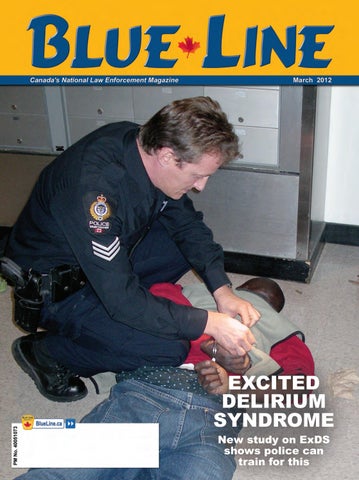
EXCITED DELIRIUM SYNDROME New study on ExDS shows police can train for this
MARCH 2012
2
BLUE LINE MAGAZINE
March 2012 Volume 24 Number 3
Features 6
Stop the Madness Excited Delirium Syndrome does exist
12 Building social capital After 50 years of policing, Clif Chapman is still
6
looking for what’s next
14
Manhattan, the day before
16
Everyone deserves to be identified
18
Simulation training
24
An opportunity to serve Ottawa police chief moves to Senate
28 Secret Compartments Beat vehicle “trappers” at their own game
Departments
12
38 Advertisers Index 30 Deep Blue – Mentoring the middle is critical 32 Dispatches 36, 37 Market Place 35 Product News 5 Publisher’s Commentary – A wise wielder of the judicial sword 35 Representative Profiles 22 Technology – Computer hard-drives stop spinning
24
Case Law 31 All known information used to assess reasonable grounds 33
Cover & Lead Story Photos Courtesy of Odd Squad Productions - Toby Hinton
BLUE LINE MAGAZINE
3
Handcuffing and confinement not an arrest MARCH 2012
MARCH 2012
4
BLUE LINE MAGAZINE
Blue Line
PUBLISHER’S COMMENTARY by Morley Lymburner
Magazine Inc. PUBLISHER Morley S. Lymburner - publisher@blueline.ca
A wise wielder of
GENERAL MANAGER Mary K. Lymburner - mary@blueline.ca
the judicial sword
SENIOR EDITOR Mark Reesor - editor@blueline.ca CREATIVE DIRECTOR E. Jolene Lymburner - jolene@blueline.ca CONTRIBUTING WRITERS Mike Novakowski Mark Giles Robert Lunney James Clark Dorothy Cotton Dave Brown Tom Rataj AFFILIATIONS International Association of Law Enforcement Planners Canadian Advertising Rates Data International Police Association The Canadian Press Newswire Access Copyright SUBSCRIPTIONS $30 per year; $50 for 2yrs; US & Foreign: $100 ADVERTISING 888-640-3048 advertising@blueline.ca
www.blueline.ca 12A-4981 Hwy7 East, Ste 254, Markham, ON L3R 1N1 Canada P: 905 640 3048 F: 905 640 7547 blueline@blueline.ca
PRINTED IN CANADA ISSN# 08478538 Blue Line Magazine was established in 1988 as an independent publication to inform, entertain, connect and educate those involved in the law enforcement profession. With no direct control from an enforcement agency, its opinions do not necessarily reflect those of any government or law enforcement agency. The authors, advisors, and publisher accept no liability whatsoever for any injuries to person(s) or property resulting from application of adoption of anything presented in this magazine. Readers are cautioned and advised that articles presented herein are edited and supplied for your personal awerness and should not be used for further actions until appropriate guidance is received from a supervisor, Crown Attorney or other persons in authority. All material submitted for publication becomes property of Blue Line Magazine Inc. unless arrangements have been made with the publisher prior to publishing. © 2011 All articles are protected by copyright. No part of this publication may be repoduced or transmitted in any form or means, electronic or mechanical, (including photocopying and recording or by any information storage or retrieval system), without prior permission. Permission to reprint may be obtained in advance from Access Copyright 1-800-893-5777.
BLUE LINE MAGAZINE
The theatre house lights went up and a couple two rows away stood and put on their coats. As the man turned one glimpse of his face took me on a sudden trip down memory lane. It was “Judge Charlie” (an affectionate nickname never used in his presence) who I gave evidence before for some 20 years. I introduced myself in the hallway and we began renewing our acquaintanceship after two decades of separation. Charlie, now retired, was well-respected, viewed as fair and a shining example of everything a judge should be. During my tenure as a cop I admired him from afar and so relished this chance meeting. Charlie was lauded because he consistently gave his decisions in a fair manner. No matter what the verdict, he always had a reasoned response. If a case went south there was simply no chance Charlie’s judgements could be the issue. I still recall preparing my cases for court and thinking, “How is this evidence going to look to Judge Charlie?” That was enough to send me back to review everything he would see or hear. Late one cold night I saw a young man on an unlicensed motorcycle wobbling down a residential back street. I activated the scout car’s “rabbit gear” and the young man accelerated rapidly. As I grabbed my radio to call it in he made a sudden turn into a community park and promptly dumped the bike on the damp grass. I made a football tackle the “Blue Bombers” would be proud of and my quarry came crashing down. Any thoughts of simply cuffing the young lad vanished with a fist to my face. I was surprised by the young man’s shear strength and, deciding a night stick was in order, I found it was knotted into the lining of my winter jacket. After a brief one-handed battle I managed to get it free and struck the youth once on the shins. Suddenly the fight was gone and the tears began. I laid a series of charges, including assaulting a police officer. Before trial the prosecutor and defense attorney pointed out the lack of a criminal record, good parents, great school marks and a seemingly good work ethic as reasons enough to take a plea to common assault. I generally agreed with joint proposals and felt this was probably a good suggestion. The accused was brought before Judge Charlie and he was told the culprit “did commit a common assault on one Morley Lymburner.” The judge suddenly cocked his eyebrows and 5
quietly asked the prosecutor if this “Morley Lymburner” was a police officer. The prosecutor’s voice suddenly rose two octaves. Yes indeed, he replied, but the Crown wasn’t alleging any connection between the victim’s occupation and the assault in question. Judge Charlie quietly looked down and continued to scribble notes in his journal. The accused plead guilty to the offence and the basic evidence was read by the now nervous prosecutor. The defence attorney was asked if he had anything further to say and, upon his statements of past good behaviour, Judge Charlie simply asked what the victim did that brought on the assault. Both lawyers, seeing a plea bargain going sideways, jumped up and began talking at once. After many attempts to disentangle the assault from the fact that it was incident to an arrest, they finally stopped talking and stared into the baleful, doubting eyes of the judge. The courtroom fell silent. Judge Charlie put down his pen, turned to the accused and simply asked if he had come to court with his toothbrush. Red-faced and clearly shaken, he replied that he had not. I will paraphrase what Charlie said next: “I’m sorry son but you must go to jail. Regardless of the attempts here to minimize your actions in this case it is still clear to me that you knew it was a police officer who wanted to arrest you and you still lashed out in an attempt to escape. This is intolerable in this society and our community. Police officers have a difficult task to perform and this court will not tolerate anyone who does not assist or comply with their efforts. “I am sorry but you must serve 14 days in jail. I view this as the absolute minimum for such an offence and if I had an idea this was committed by a person of lesser character than yourself the sentence would indeed by far greater. I will allow you two days to get your affairs in order before you commence your sentence.” To be fair and a wise wielder of the judicial sword, a judge must first be an understanding citizen. Such a person commands the respect of everyone. Judge Charlie was such a person.
MARCH 2012
STOP THE MADNESS Excited Delirium Syndrome does exist by Joel A. Johnston In 2011, I was involved with an International Special Panel Review of Excited Delirium Syndrome (ExDS) for the US-based National Institute of Justice (NIJ). The panel included a diverse group of law enforcement personnel, medical practioners, and researchers participating as panel members to examine ExDS. What has become clear is that there are tangible steps we can take and protocols we can implement as an emergency response community to reduce the risk of unintended outcomes when these rare circumstances present themselves. Ever since the Braidwood Commission of Inquiry on Conducted Energy Weapon Use, many politicians, their ministries and law enforcement governing bodies have taken the official position that ‘Excited Delirium Syndrome’ does not exist. As a result, it is not (and in some cases cannot) be addressed in training – nor is it captured in standardized use of force response reporting. Some of the Braidwood findings were constructive but others contradicted the body of knowledge on this subject at that time and have been the catalyst for emotionally charged debate across Canada and beyond. This article is an MARCH 2012
effort to help the reader navigate these muddy waters so as to do your own fact-checking and perhaps better discern between reality and the “mud” of conspiracy theories and media bias. Braidwood found: Based on the presentations of psychiatrists, other mental health professionals and emergency medicine physicians, I concluded that: •P olice officers are called upon, with increasing regularity, to deal with emotionally disturbed people who display extreme behaviours, including violence, imperviousness to pain, superhuman strength and endurance, hyperthermia, sweating and perceptual disturbances. • Such emotionally disturbed people are often at an impaired level of consciousness; may not know who they are or where they are; may be delusional, anxious, or frightened; and may be unable to process or comply with an officer’s commands. •T his cluster of behaviours is not a medical condition or a diagnosis. They are symptoms of underlying medical conditions that, in extreme cases, may constitute a medical emergency. •T he officer’s challenge is not to make a medical diagnosis but to decide how to deal with 6
the observable behaviours, whatever the underlying cause. • I t is not helpful to blame resulting deaths on “Excited Delirium Syndrome,” since this conveniently avoids having to examine the underlying medical condition or conditions that actually caused death, let alone examining whether use of the conducted energy weapon and/or subsequent measures to physically restrain the subject contributed to those causes of death. • The unanimous view of mental health presenters was that the best practice is to de-escalate the agitation, which can best be achieved through the application of recognized crisis intervention techniques. Conversely, the worst possible response is to aggravate or escalate the crisis, such as by deploying a conducted energy weapon and/or using force to physically restrain the subject. It is accepted that there may be some extreme circumstances, however rare, when crisis intervention techniques will not be effective in de-escalating the crisis, but even then there are steps that officers can take to mitigate the risk of deployment. Although Braidwood influenced a significant number of inquiries, it wasn’t the final word on this critical medical issue – nor was BLUE LINE MAGAZINE
as those in The Globe & Mail (Jan. 4 2012) and the Calgary Herald (Jan. 6 2012), have the capacity to do even more damage in placing already at-risk subjects at even greater risk. They do so by advocating a position of denial, based on ignorance and/or motivated by political expedience. This position – that Excited Delirium Syndrome is a term made up by law enforcement to “distract from the true cause of death and to justify police use of force,” is neither credible nor defensible. Unfortunately, it continues to be perpetuated by those with a variety of other agendas. The situation would be laughable if there wasn’t so much at stake. Why, in the interest of enabling a safer and more effective approach to dealing with these difficult situations, is it so difficult to consider the notion that this may, in fact, be a “dynamic” in certain law enforcement encounters with the public? Instead the Globe and Herald criticize Alberta Provincial Court Judge Heather Lamoureux for recommending that emergency responders be trained to more capably recognize and readily implement a collaborative response in an effort to promote the best possible outcome: saving lives. Editorial: Delirious over delirium (Copyright The Globe & Mail)
it intended to be. In fact, the commissioner affirmed that further research was required to shed light on many unclear issues – including Excited Delirium Syndrome. Nonetheless, the inquiry report has profoundly affected public policy and public opinion. While it is clearly a misunderstood issue, dismissing its existence is not only problematic but both dangerous and negligent. It is particularly troublesome because of the immense influence that the media appears to have had on public perception. Folks who rely on the news media for information seem to robotically align with the misinformed or inclined media position on the subject. The failure of the public, politicians and law enforcement governance bodies to recognize Excited Delirium Syndrome as a real syndrome puts people at risk every day – and relegates these situations to criminal or public safety issues to be dealt with by police, rather than as the medical crises which they are. While this is understandable with regard to the public to some extent, it is inexcusable for our elected officials and administrators. Ignoring the problem has significant costs: continued loss of life; personal toll on the deceased’s family and involved law enforcement officers; extensive and costly investigations into what may be preventable death; years of expensive litigation and diminished public confidence in law enforcement – leading to an unhealthy divide between law enforcement and the public they serve. Sadly, recent editorial commentaries, such BLUE LINE MAGAZINE
Canada does not need a national delirium over “excited delirium.” This supposed cause of many deaths in police custody, including those involving the use of Tasers, was laid to rest after the exhaustive Braidwood inquiry following the 2007 death of the Polish immigrant Robert Dziekanski. Why then has an Alberta judge ruled that Gordon Bowe, tasered and restrained by several officers, died from “excited delirium syndrome”? Why is Judge Heather Lamoureux of Alberta Provincial Court proposing everything from the training of police dispatchers in diagnosing “excited delirium” to the creation of a countrywide “excited delirium” database? “Excited delirium” (overheating and wild behaviour) is a blind alley, not a recognized medical condition. It is a convenient way to avoid tough scrutiny of police practices that may contribute to death. Mr. Braidwood, a retired appeal court judge, spent two years and oversaw two inquiries, one on the overall safety concerns around the Taser and one on Mr. Dziekanski’s brutal death after being Tasered five times by the RCMP at the Vancouver International Airport. He spoke to experts in emergency medicine, cardiology, electrophysiology, pathology, epidemiology, psychology and psychiatry. Judge Lamoureux did not refer in her seven-page ruling to Mr. Braidwood’s 1,000-plus page reports. Mr. Braidwood concluded that “excited delirium” is not a medical condition. By contrast, delirium is a recognized cognitive and brain dysfunction that is a symptom of an underlying medical condition. This is not just semantics; it points to the real problem – dealing with a sick individual without killing him. “It is not helpful to blame resulting deaths on ‘excited delirium,’ since this conveniently avoids having to examine the underlying 7
medical condition or conditions that actually caused death, let alone examining whether use of the conducted energy weapon and/or subsequent measures to physically restrain the subject contributed to those causes of death.” Mr. Bowe was on cocaine and acting wildly in a dark house. The Tasering and heavyhanded restraint by Calgary police may or may not have been justified – though the judge should have questioned “kicks to the side of Mr. Bowe’s body.” Any policy built around “excited delirium” would be an irrational response to such a death. Judges and policy-makers should read Mr. Braidwood’s reports. Editorial: Delirious fatality report (Copyright Calgary Herald)
The fatality report into the death of Gordon Bowe adds ammunition to the argument that public inquiries too often become a waste of time and money. Provincial Court Judge Heather Lamoureux’s recommendations are curious, in that they are almost entirely built around the theory that excited delirium is a legitimate medical condition, an assertion that’s controversial and widely disputed. She concluded Bowe, 40, died as a result of excited delirium syndrome, which she says was brought on by cocaine use and not from the deployment of a Taser gun, used by Calgary police trying to subdue him. Her nine recommendations in the sevenpage report almost all deal with developing protocols around excited delirium, treating it as a legitimate condition without reference to the controversy or debate in the medical community. She calls for mandatory training of emergency response workers, police and dispatchers in identifying excited delirium and wants a national database established, where police chiefs across Canada would “record and share information relating to death associated with excited delirium.” There’s another school of thought that warns the controversial diagnosis of excited delirium is a distraction from the true cause of the medical condition that caused the death and is used to justify use of force by police. The exhaustive Braidwood inquiry into the Taser death of Polish immigrant Robert Dziekanski heard overwhelming evidence that, while delirium is real, excited delirium is “NOT a valid medical or psychiatric diagnosis.” Moreover, it “provides a convenient post-mortem explanation for in-custody deaths where physical and mechanical restraints and conducted energy weapons were employed.” Just a year ago, another provincial court judge in Halifax, who presided over an 11-month inquiry and wrote a far more comprehensive 460-page report, to Lamoureux’s seven pages, reached conclusions similar to Braidwood’s. Provincial Court Judge Anne Derrick rejected excited delirium as the cause of death of a man Tasered repeatedly by police. She warned: “This case should sound a loud alarm that resorting to ‘excited delirium’ as an explanation for a person’s behaviour and/or their death may be entirely misguided.” MARCH 2012
Excited delirium is not listed in the Diagnostic and Statistical Manual of Mental Disorders, the medical community’s bible for diagnosing psychiatric illness. Even an independent report commissioned by the RCMP criticized the term and concluded it is sometimes used as an excuse to justify using a Taser. All that aside, asking police officers to diagnose the mental state of an agitated suspect in the midst of a crime scene places too much responsibility on those who are not trained psychiatrists. John Dooks, president of the Calgary Police Association union, offers another perspective. Dooks supports any tools that can help better educate and train officers, so that they are able to identify the symptoms described as excited delirium, regardless of whether or not Excited Delirium Syndrome is a legitimate medical condition. We agree there are physical attributes that are common in all of these cases that police would do well to understand and recognize. When these symptoms present themselves, police should refrain from using stun guns on the suspects and call for medical help immediately. A public inquiry isn’t needed to reach that conclusion. Here is a sampling of troubling comments from Canadians responding to the above editorials: • ”Police brutality” and “excessive force” are not recognized medical conditions either, but unlike “excited delirium” they do exist and can be fatal. MARCH 2012
• “Excited Delirium Syndrome“ as a cause of death?! What a load of politically correct but evasive tripe! A drunk ran you over – and you die – “from excessive bleeding.” Your fault – don’t bleed so much next time a drunk driver smashes you into the pavement. I give up! • How else would the government, police, prosecutors, lawyers and judges keep an avenue open for themselves of getting out of trouble when they did something wrong? The NEW mental state is required to keep the system from accounting for itself! • Excited delirium sounds like something taken out of an 18th century medical text. Right up there with vapours from the swamps causing disease or prescribing ‘blistering’ for what ails you. • This is not untypical of Alberta judges, some of whom think they have the knowledge to extemporaneously decide what is a medical condition based on junk science. Keep in mind Alberta is the “no Charter zone” of Canadian legal systems. • So, if Excited Delirium Syndrome is an actual medical condition, why do people – well, men actually (95% of cases) and black men the majority at that – only die from this condition following an encounter with authorities where force was used? In addressing the media position and the baseless and uninformed comments it inspires, it’s important to dispel a number of myths associated with the issue of ExDS and law enforcement: 8
Myth One Excited Delirium Syndrome is not a recognized medical term In the interest of validation, they continue to repeat that it isn’t in the standard medical or psychiatric reference texts such as the Diagnostic and Statistical Manual of Mental Disorders – Fourth Edition (DSM-IV) or the World Health Organization’s International Classification of Diseases (ICD-9). While technically that remains a correct statement, what is inaccurate is the claim that it is still not a medically recognized term. It has gained acceptance in the medical community in recent years. Both the American College of Emergency Physicians (ACEP) and, perhaps as important, the National Association of Medical Examiners (NAME) have recognized it – the very physicians most likely to encounter this phenomenon during, pre-mortem and post-mortem. Additionally, the DSM has always had multiple references to delirium and agitation. Similarly, the ICD-9 contains the following codes which match the signs and symptoms of ExDS: • 296.00S Manic Excitement • 293.1J Delirium of Mixed Origin • 292.81Q Delirium, drug induced • 292.81R Delirium, induced by drug • 307.9AD Agitation • 780.09E Delirium • 799.2AM Psychomotor Excitement • 799.2V Psychomotor Agitation • 799.2X Abnormal Excitement BLUE LINE MAGAZINE
Myth Two Excited Delirium Syndrome is a term made up by law enforcement or Taser International Excited Delirium Syndrome has consistently been related to deaths from events that never involved the police – many psychiatric in nature. In fact, restraint related deaths of mentally ill patients can be traced back to 16501, more than 100 years before the birth of Sir Robert Peel, the man credited with creating modern policing. The ExDS phenomenon was further documented in the 1800s by Dr. Luther Bell, primary psychiatrist at the McLean Asylum for the Insane in Massachusetts, as it was observed in the psychiatric setting where people with mental illness and extreme behavioural problems were institutionalized. By the 1950s these observed problems and behaviours seemed to decline drastically due to the discovery and use of anti-psychotic pharmaceutical therapy. However, with the decline of “mental institutions” in the 1980s these problems began to manifest in the real world, as psychiatric out-patients ceased to selfmedicate. This was exacerbated by the dramatic increase in stimulant drug use. This was when police first began encountering ExDS. The term ‘excited delirium’ was coined in 1985 by Dr. C.V. Wetli and Dr. D.A. Fishbain in their publication, “Cocaine-induced psychosis and sudden death in recreational cocaine users.” Myth Three Excited Delirium Syndrome is always fatal North American law enforcement personnel have many years of experience of dealing with ExDS subjects. They come to our attention most frequently because of the violent, agitated, destructive, unpredictable, behaviour that they display. In many cases emergency medical services are able to respond and sedate the subject once they have been restrained. In other cases they respond and successfully treat victims of ExDS-related cardiac arrest. These out-of-hospital subjects would normally be transported into custody or to hospital and have survived. Some flee before law enforcement or emergency medical responders even arrive on scene – some survive and others do not. Other subjects suffer fatal cardiac arrest with law enforcement and emergency medical responders on scene. Police are sometimes called to hospitals to assist medical staff unable to control subjects exhibiting signs of ExDS so they can be treated – as there can be no treatment without first gaining control. The syndrome has become of increasing concern to emergency physicians and other primary health care professionals, who believe that earlier recognition, intervention and proactive management may result in fewer ExDS-related deaths.
of a condition. It is important to again note that law enforcement use of the term ‘excited delirium’ is not intended to convey a diagnosis. Police and other pre-hospital personnel have no ability to differentiate between the underlying processes. However they have a critical need to be able to recognize this type of presentation as being different from a goaloriented, coherent yet violent individual since one requires urgent medical intervention and the other does not. The medical community most affected by ExDS and the interested researchers have recognized the condition, now we as law enforcement and the public need to accept that the phenomenon exists so that we can respond to it appropriately and more effectively. Period. Myth Five First responders can de-escalate every situation with words The notion that first responders (who always operate in non-clinical settings) are capable of achieving “the unanimous view of mental health presenters (at the Braidwood Inquiry) – to de-escalate the agitation through the application of recognized crisis intervention techniques” is naïve and unrealistic. It appears that recent research has identified a lack of empirical evidence or relevant research into the effectiveness of de-escalation strategies and crisis intervention techniques2. The current rush to implement them in training in some Canadian law enforcement circles seems to be being done with the same lack of caution with which police have been accused of doing when
Myth Four Law enforcement should not be attempting to diagnose a medical condition There is a distinct difference between an underlying diagnosis and discerning indicators BLUE LINE MAGAZINE
9
MARCH 2012
responses. The first response has become a multi-disciplinary effort, not just law enforcement. Some communities have protocols enabling co-ordinated response training with dispatchers, emergency medical personnel (EMS & fire), law enforcement and emergency department medical staff.
adopting recent force response options. This is where recognizing the syndrome is most critical. Incoherent, irrational people in the midst of a medical crisis that, left unabated, may kill them need to be controlled so that they can be treated as quickly as possible. They are not usually receptive to the communication process. Windows of opportunity for control must be exploited when they first appear – because they may never present again. Police understand the value of crisis intervention techniques and tactics – but understanding when and where to apply them is equally as important as how to apply them.
were recognized after much debate – in the interest of saving lives.
Myth Six It is all about police covering up There is no appetite to define Excited Delirium Syndrome for the purpose of “blaming in-custody deaths on it.” The sooner this argument against moving forward is put to rest, the sooner all emergency responders will be able to more safely and effectively deal with the problem. Jurisdictions that have it right on the ExDS issue have made documented saves of people in its throes – situations that may have otherwise resulted in in-custody deaths. Instead of burying our heads in the sand on this issue, let us move forward and recognize the existence of the state of eExds, much the way sudden infant death syndrome (SIDS) and acquired immune deficiency syndrome (AIDS)
The first step is recognition Without protocols, unintended outcomes cannot improve. Recognition is the first step. There are a number of North American jurisdictions who have taken a proactive approach to dealing with ExDS. The NIJ panel recognized that perhaps the most important aspect of these early and pilot protocols is the cooperative nature of the response and training required to ensure such a response capability exists. First and foremost, these situations need to be treated as a medical crisis, not a criminal situation. ExDS is a medical problem masquerading as a police call – this changed thinking in some communities has led to the development of innovative cooperative
A preliminary protocol The common protocol steps the panel recognized – identify ExDS, rapidly control, sedate and transport to a medical facility – generally adhere to the American College of Emergency Physicians (ACEP) Excited Delirium Task Force white paper report. While the panel acknowledged response protocols will continue to evolve and improve with experience and research, its consensus is that overall, these response protocols are appropriate. In the long run, they may prove to be insufficient but will likely do no harm. Some jurisdictions have also established documentation practices for these protocols, not described in the white paper, but which the NIJ panel also recommends: • Clear identification of ExDS cases based on common signs and symptoms (indicators) of the syndrome; • Rapid control of the individual with adequate law enforcement personnel; • Sedation by emergency medical personnel immediately after the subject comes under police control; • Transport of the subject to a medical facility for follow-up treatment and evaluation; and documenting the case. While the panel report has provided some clarity on ExDS, research continues into the syndrome, underlying causes and responses. In conjunction, data being collected by some agencies will help provide even more clarity to the syndrome and improve our collective response so that we can save lives as we continue to protect the public we serve. First and foremost we need to formally recognize the existence of Excited Delirium Syndrome and establish clear protocols for dealing with it. We need to engage in a multidisciplinary, comprehensive training effort to ensure that a competent, collaborative response to these rare situations is achievable. Best practices have been identified. The choice is ours. References
1: Dewhurst, K., Willis’ Oxford Casebook. 1981, Oxford: Sandford Publications. 199. 2: Review of the medical theories and research relating to restraint related deaths – University of Central Lancashire (UK) – 2011. Joel A. Johnston is a 27-year veteran senior operational police sergeant working in Vancouver’s Downtown Eastside and BC’s former provincial use of force & ERT coordinator. An ERT and crowd control unit veteran, he was a member of the RCMP National Working Group and US NIJ International Panel of Experts on ExDS. A Simon Fraser University graduate, a Sandan in traditional Shotokan karate and a court-certified use of force subject matter expert, he has contributed to Blue Line for the past 17 years. The opinions in this article are solely his own and do not represent any official position of offices held.
MARCH 2012
10
BLUE LINE MAGAZINE
THE
ROCK S TOP COPS ’
by Danette Dooley A veteran Royal Newfoundland Constabulary (RNC) officer and an RCMP member who joined the force in 2006 were named Newfoundland and Labrador’s 2011 Police Officers of the Year recently during an event hosted by Crime Stoppers. Jason Sheppard is a sergeant in the RNC’s major crime unit and has been with the force over 27 years. Cst. Darryl MacMullin policed in Springdale, Newfoundland for three years before moving to Natuashish, Labrador in 2010. He has been recognized for everything from helping seniors and coaching youth baseball to confiscating alcohol, entering a burning home to rescue an unconscious man and having his police car hit with a bullet. MacMullin became emotional when thanking those who have helped him in his career, including colleagues and girlfriend Amber Aucoin. “Thanks for all your patience and support. It makes my job a lot easier,” he told her. “I did what any officer would have done,” MacMullin said when a reporter asked him about his efforts in helping save the man’s life. Sheppard joined the RNC in 1984. He was recognized as an experienced investigator, particularly for his leading role in an intensive sting dubbed Operation Roadrunner. During the investigation, police officers in Newfoundland and Labrador seized about 50 lbs. of marijuana, 19 lbs. of cocaine, $300,000 cash and vehicles, weapons and laptop computers. Québec police were also involved, confiscating $170,000 and four houses. Some of the people arrested had direct links to Québec organized crime groups. Sheppard thanked his co-workers, saying they work with him as part of a team. He also acknowledged RNC management for its confidence in his abilities and thanked BLUE LINE MAGAZINE
Above: RCMP Const. Darryl MacMullin and RNC Sgt. Jason Sheppard were named 2011 Police Officers of the Year for Newfoundland and Labrador.
wife Bev and their two children for support through the years. Sheppard said he accepted the award on behalf of his entire family. “For police officers across this province all you see is a uniform in a police car but behind each man and woman of the badge, there’s a family that supports us and allows us to go and do what we do,” he said. Service NL Minister Paul Davis, a former RNC officer of the year, said the awards ceremony is a time to recognize all police officers. “We can boast that we live in the safest province in Canada and we can attribute that feeling to the hardworking police officers in Newfoundland and Labrador,” he said. The province’s Crime Stoppers received more than 2,500 tips, made 62 arrests and recovered more than $400,000 in property and $1 million in drugs in 2011, RCMP C/ Supt. Rick Noble noted. Since its inception in 1992, approximately
11
$7 million worth of drugs and property has been recovered in Newfoundland and Labrador, he said. RNC Deputy Chief Bill Janes congratulated the nominees and award winners and their families. “Your support of your father, spouse, partner or son has been instrumental in bringing them here today and in the positive impact that they have had with their police service,” he told family members. Cpl. Darren Stevens of the Bell Island detachment and Cpl. Sheldon Hynes of the Harbour Breton, Newfoundland detachment were RCMP runners-up. Constables Perry Priddle of the Churchill Falls, Labrador detachment and John Turpin of North East Avalon Region were the RNC runners-up. Danette Dooley is Blue Line’s East Coast correspondent. She can be reached at dooley@blueline.ca
MARCH 2012
After 50 years of policing, Clif Chapman is still looking for what’s next by Lucas Habib No one knows Edmonton quite like S/Sgt (Ret.) Clif Chapman. From post-war northern burg to down-on-its-heels metropolis, from City of Champions to resurgent oil boomtown, Chapman has been on the front lines of policing the city for the last half-century. You could say he’s grown up with Edmonton and now he’s telling its tales from his unique perspective. I met Chapman at Edmonton Police Service (EPS) headquarters on a chilly January morning to hear about his long history with the service. Over coffee he pointed out how pampered police can be today. “One time in the late 1960s, I was doing a funeral escort on a motorcycle… in -47 wind chill! My buffalo fur coat had so much frost on it I looked like the Abominable Snowman!” I pulled my steaming mug closer. Police operations were very different when Chapman began his career. “I started walking the beat in 1960, in the days before we carried portable radios,” he explained. MARCH 2012
“We had call boxes a half-hour’s walk apart in the downtown area. You’d walk into some of the all-night restaurants like ‘The Night and Day’ or ‘The Phoenix’ and you could expect any kind of trouble – and nobody knew where you were!” It’s a quaint anecdote of days gone by but seems slightly foolhardy in this era of 24-hour dispatch and patrol car GPS tracking. Alone on the street, it became essential to use common sense, down-to-earth policing to avoid trouble. “You had to be fair and just in your neighbourhood if you wanted to get help from the public in a fight.” Chapman kept referring to Sir Robert Peel’s Principles of Policing as we chatted, especially number seven (“the people are the police and the police are the people.”) “When I used to do school visits,” he reminisced, “I would tell kids ‘if it wasn’t for the police, your mom and dad would have to take their turns spending the night patrolling the town – so instead they just pay a bit of tax to have me do it!’” Chapman clearly served as a model officer (literally – he modelled for advertising 12
photo shoots in his spare time to earn extra cash, much to the amusement of fellow officers). He spun tales about a civilian saving him during a bar fight and treating the worst offenders with the utmost respect. That kind of policing builds social capital, something Chapman cashed in on many occasions. After a few years in traffic, communications and the downtown division, Chapman was assigned to the brand-new EPS tactical unit in 1973. Soon after, he led the virgin, under-equipped team down to Montana for a tactical competition with the FBI. Fearing a severe whipping, he made sure to add some “Canadian secret weapons” to their arsenal – strong Alberta rye and 12 per cent alcohol Molson Stock Ale. With their judicious use the night before the competition – “it probably hampered their abilities a little bit” – he was able to pilot the EPS squad to nearcomplete domination over the FBI. Returning home from the conquest, Chapman soon found himself on the pointy end of one of Edmonton’s scariest police calls to date – man with gun and hostage; police hostage. BLUE LINE MAGAZINE
“It was New Years Eve, 1973,” he began. “One of my men was being held hostage by a completely unglued guy with a shotgun. The suspect was calling for me by name, so I went into the apartment. He wanted me to hand him my shotgun. I told him, ‘I don’t hand it over to anybody, but I’ll go back outside and give it to my men.’” Chapman paused, recalling a night that has ruined every New Year’s Eve for him since. “I turned and walked out – the longest few steps I’ve ever taken. I fully expected that he might fire. The vest I was wearing felt like a postage stamp on my back.” Lawrence Welk was playing on the radio as an announcer counted down to midnight, he recalled. Emptying out his reservoir of courage, Chapman returned to the apartment to protect his partner. At various points throughout that long evening the suspect jammed the shotgun barrel into Chapman’s neck and threatened to blow his head off. With two police officers hostage, the gunman was certainly in control. Chapman realized that he was bound to lose the waiting game once (IF?) something set this guy off. “After a while, he sat down in a chair and started rocking. I noticed there was a pattern – rock, rock, rock, look down at the floor. I signalled to the other member and the next time he looked down, I was off across the room. He looked up as I grabbed the barrel and we were fighting for our lives. I managed to block the trigger and pump the three rounds out of his shotgun. The other hostage took his back. It was over and we had survived.” Chapman finally retired in 1989, with the New Year’s Eve ‘party’ standing as his scariest career moment. After taking just one year off, he returned to the EPS as part of a pilot project which had retired members answer 911 calls. Chapman was one of the initial four, but the test run was so successful that more than 50 retired members now fill this role. “We used to have sworn officers answering all 911 calls as well as dispatching police, but it was too difficult to fill the increasing demand,” confirmed Sgt. Merle Doherty of the EPS 911 Police Dispatch Section. “We still have sworn members doing the dispatching but all of our 911 call evaluators are now retired members. We’re the only service in Canada doing this.” Chapman loves the efficiency of this system – after 17 years as a 911 evaluator, he still hasn’t retired (for a second time) and now does quality control for the dispatch centre. “Having that police knowledge really helps separate the wheat from the chaff,” he declared. “As retired cops, we know the hot spots in the city and we can see things from an officer’s point of view.” On a few occasions, Chapman said he even ended up acting as an impromptu negotiator! After more than 50 years with the service, Chapman says he has no idea when he might re-retire. He’s collected about 160 stories from his career and hopes to publish them in BLUE LINE MAGAZINE
Above: Chapman at the beginning of his uniform days and at the end. a book someday. Soon, Edmontonians may see him on stage at a suddenly-trendy live storytelling event, unspooling tales of his EPS days. After spending a couple of hours with him, I can vouch for both his natural storytelling abilities and great material. Although
13
he’ll eventually move on from the EPS, the city will keep growing – a little safer and a little more human – thanks to people like Clif Chapman. Lucas Habib is a freelance writer in Alberta.
MARCH 2012
Manhattan, the day before by Angelo M. Marino There are times when we realize that, no matter how bad a day we thought we had – luck, God, universal alignment or whatever we choose to call it – was on our side. Protection specialists learn to appreciate these moments because, although it’s our responsibility to prevent negative incidents and plan for all eventualities, sometimes things are decided for us. Both the principle and I were reminded of this concept after a very interesting yet exhausting six week protection mission in Bangkok. Escorting Denis, a successful Canadian businessman, was a relatively straight forward security detail but this story confirms that sometimes we really do not know what the future holds. Denis’ company specialized in managing large scale construction projects. An endeavour in Thailand encountered legal problems. When negotiations to rectify disputes with local government agencies became less than friendly, Denis hired me and, after several weeks of living within the mysterious city, duty lead us to the busy streets of downtown Manhattan. I have the reputation of being a stickler
for detail and make it my business to control every aspect of the principle’s environment but circumstances are often far from perfect, especially when our efficiency depends at least in part on the performance of that less than qualified third person. This particular adventure began with the joys of commercial air travel and the wonders of not one but two flight cancellations from Montréal to New York’s JFK airport. When Denis and I finally became airborne, the several hour preventative buffer we had arranged for had unfortunately dissipated. We now had a 45 minute window to disembark and make it to a 2:45 PM meeting on the 21st floor of Building 7 of the World Trade Center.
It only takes one visit to the chaotic realities of a business day afternoon in New York City to know that our time was running short. The corporate insurance lawyers with whom Denis was to find a solution to the Thailand dilemmas would not wait long before proceeding to their next appointment. Faced with an hourly rate of $12,000 US, not to mention travel and logistics expenses, it was urgent that we make the appointment on time. I had originally planned to rent a car but there wasn’t time to worry about finding parking. I opted for a private limo rather than one of the famous yellow cabs for security reasons. A driver entrusted with the responsibility of a recent model Mercedes sedan usually undergoes a more severe hiring process than most run of the mill cabbies. Of course, logic sometimes has no bearing on the outcome of one’s day. Approximately one and a half blocks away from the main entrance of Building 7, our driver Omar accidentally rear ended the vehicle ahead of ours. It was now 2:40 PM, five minutes to game time. Without a single minute to spare, we paid Omar and Denis and I proceeded down the boulevard at a jogging pace. Clearing security in the lobby before entering the elevators was somewhat of a hurdle but respect for a cousin’s badge sometimes goes a long way. At 2:50 PM, admittedly slightly late, Denis was sitting with the legal committee and ready to strike a deal. One hour and fifteen minutes later it was all over. Denis had succeeded in justifying his case and discrediting all claims of his company’s wrongdoing but the adventure was not quite over. A protector knows the importance of keeping the principle happy but when Denis suggested we celebrate by having dinner at a non-traditional restaurant on the infamous Prince Street, I should have questioned his proposal further. This being said, my Queen Stew, a large bowl of New York style chili, was delicious – even when, half way through, I was told the minced meat, which appeared to have miniscule limbs, was top grade red queen ants. With a little more bread and a bottle of Perrier, it went down just fine. It was time for a yellow cab and our sprint back to JFK for the return flight home to Montréal. A relatively uneventful journey, we landed at 11:58 PM on Sept. 10, 2001. I arranged for secure ground transport and escorted Denis to his residence, then proceeded towards my own. Needless to say, I awoke to a severely disturbing reality at approximately 8:45 AM the next morning. Where were you on the morning of September 11th? I was at home, giving thanks for the awesome day I had been through the day before. Angelo M. Marino and Canadian Tactical Training Academy are leading the course “RISK DT Intro (Rapid Integrated Survival Kombat – Defensive Tactics)” with Blue Line Training, April 24 & 25. Visit blueline.ca/ tradeshow for details.
MARCH 2012
14
BLUE LINE MAGAZINE
Hurry! Hurry hard! by Ted McIntyre The Canadian Police Curling Association (CPCA) will soon mark the end of its 57th season. It was founded by the Canadian Association of Chiefs of Police in 1955 to encourage fellowship and liaison among Canadian police officers and to promote the game. The first “National Police Bonspiel” was organized and held at the Granite Curling Club in Winnipeg. The one day, four event bonspiel attracted eight teams and was won by the Moose Jaw police. An OPP squad from Kenora were runners up and a Canadian National Railway team took third place honours. The awards they took home – the N.R. Crump, L.H. Nicholson and CACP trophies – have long since disappeared (the association would be delighted to hear from anyone who knows their whereabouts). The annual Bonspiel was soon expanded to 16 teams, representing each province and territory and Canada’s four major police agencies – the RCMP, OPP, CPR and CNR Police – and was held in cities across Canada. Although sponsored by the CACP, competitors paid most of their own expenses. Due to the costs involved, not all provinces or police forces always sent a team so local rinks also competed. Nevertheless, the event proved to be very popular among police and became more competitive over the years, generating plenty of friendly rivalry among forces and officers. The first truly national championship, thanks to the help of a major sponsor, was held in Hamilton in 1972. Teams from every province and territory competed in a round robin format. National sponsorship ended in 1990. Provincial associations began holding fundraisers to send the provincial champion to the national event and raise money for charity. More than $300,000 has been donated to charities across the country. The CPCA championship format follows along the lines of the Brier. During the weeklong event, 10 to 12 teams compete, including the previous year’s champions. The opening and closing ceremonies have all the pomp and pageantry of any major sporting event, with the teams marching on to the ice with pipe bands and police and civilian volunteers. Various functions are held during the week including a formal awards banquet. Officers attend the dinner in formal dress uniform. The event is unique as rarely do so many different forces gather in dress uniform socially, much to the delight of invited guests and the local community. A team must first win at the provincial play downs to compete at the nationals. Membership BLUE LINE MAGAZINE
used to be limited to sworn police officers but, due to a decrease in CPCA membership, we are actively trying to attract the attention of younger curlers to keep our association strong. For a two year trial period, we have loosened our eligibility requirements and invite all peace officers to participate. Visit www.policecurling.ca for complete eligibility guidelines. The CPCA continues with the ideals of fostering goodwill and camaraderie among police officers across the country by gathering at various locations and experiencing the various cultures and heritage of this great country.
15
If you are interested in becoming a “police curler” and joining our great association, visit the web site and check out everything from our history to past champions and full details of this year’s national championship in Montréal, Québec. Click on your provincial/territorial link for contact information and provincial/ territorial play down dates. Ted McIntyre is a York Regional Police detective. Contact him at 481@yrp.ca for more information.
MARCH 2012
Everyone deserves
to be identified
by Diana Trepkov The skull was discovered by a hiker near the entrance to the Darlington Nuclear Plant, east of Toronto, in Oct. 2006. Police had no idea who the person was or how long the skull had been there – and still don’t. A Durham Regional Police Service detective asked me to help create a two dimensional facial reconstruction on the Jane Doe. The process took about 2.5 weeks to complete. The first step was to examine and prepare the skull. Skulls do not lie and dictate almost every step for a forensic facial reconstruction. Forensic art is very mathematical – 75 per cent science and 25 per cent art. It’s important to show the teeth, as they are the only original part of the skull in the reconstruction and cannot be altered in any way. As a certified forensic artist, I use anthropological or craniometrical landmarks on the skull with accurate placement tissue depth markers glued in 21 pre-determined locations. I then photograph it in the Frankfort Horizontal Plane in profile and frontal view. It’s important to have the correct placement of the eyeballs and other features, including the correct shape of nasal apertures according to the nose type. The last step is the artistic phase. The hardest part for any artist is to not overwork the face as this can throw investigators off by altering the features. Slowly the face will appear. We all have unique faces and skulls – no two are completely alike. They may look similar but are not the same. The skull is the entire framework of the head. This skull was complete, found lying with the teeth up. It was sun bleached and had green stains from moss and algae. The initial examination, completed by a well known forensic anthropologist, suggested that it was that of an adult Caucasian female between 18 and 30 years old. The report said it could have been there for MARCH 2012
between two and 10 years, possibly longer. The deceased had nice teeth, well spaced with little wear or disease. There were visible white fillings on her front teeth and smaller silver fillings in the back teeth. She had a well healed nasal fracture which was set, either from treatment or possibly through plastic surgery. I used this information when drawing the side profile. A ladies Omni digital watch with stainless steel strap, sold through Consumers Distributing in the early 1980s, was found with the remains. As long as this Jane Doe is not identified, whoever did this to her is walking the streets free. For every unidentified body, there is someone who cared about that person in life and still wonders what happened to them. 16
Forensic art is rapidly becoming as essential tool for law enforcement agencies because everyone deserves to be identified. Diana can be reached at dianatrepkov@rogers.com and www.forensicsbydiana.com
BLUE LINE MAGAZINE
Firearm stopping power varies by Pierre Descotes There was a time when the .38Special or .357 Magnum revolver were the standard police duty weapon and very few agencies had pistols. Times have changed and now, pistols have largely replaced revolvers. Although there are a variety of calibres available, two have taken the vast majority of the police pistol market – the 9mm Luger and .40 S&W. I have seen some 10mm pistols and heard of a few agencies using .45ACP but these are rare exceptions. Let’s talk about the energy these calibres deliver, which vary greatly depending on barrel length. I will mention only briefly about recoil. It is impossible to give a number as there are too many factors involved in this calculation. Recoil depends on the weight of the firearm and bullet, bullet speed and barrel length. The very same bullet will deliver different recoils when used in different guns. The type of frame – steel, aluminum or polymer – also play a great part in this calculation. One easy point to remember: the lighter the firearm, the heavier the recoil. That’s simple physics. .38 Special: Just about the worst service bullet ever used, excluding the old .38 S&W it replaced. In test barrels, this calibre reached energy ranging from approximately 170 ft/lbs to 280 ft/lbs. Less than 300 ft/lbs energy may not be able to stop an individual due to lack of energy transfer. On top of that, energy was lost as handguns had either a four or even a two inch barrel, thus greatly reducing the bullet’s speed compared to the usual six inch test barrel manufacturers used. For a real count of energy, we would have to use a chronograph! No matter, this would definitely be a very weak result, unacceptable as a service round. .357 Magnum: This calibre is an improvement over the .38 Special. The bullets are the same diameter and weight but the casing is exactly 1/10 of an inch longer, allowing a higher powder charge. The 357 has an average of 410 ft/lbs to 560 ft/lbs of energy. That last number is exactly double the .38 SPL. Again, the barrel length will modify these numbers but you begin with something that can accept some loss of energy. 9mm Luger: This bullet was designed for military use. In wars, wounding the enemy is sometimes more important than killing them as they will then need assistance, transport and care. All these factors take people away from the front who would otherwise be fighting you and as a result cost the other side money and resources. Police ammunition must work differently. Although officers do not shoot to kill, they are shooting to defend their lives and those of innocent people. With the drugs found on the street these days, especially PCP, and their traffickers more desperate than ever, the police duty bullet must deliver enough energy BLUE LINE MAGAZINE
to assailants to make a large temporary cavity, causing a sudden loss of blood pressure and knocking the person down. The 9mm Luger bullets will deliver, on average, between 320 to 385 ft/lbs energy, again with the test barrel. Any barrel shorter than 6 inch (152mm) will reduce that energy and in
17
some cases, fall below that 300 ft/lbs preferred energy. It might be a good idea to test pistols using a barrel shorter than 120mm to see if it will still deliver good energy. Some short barrels may deliver the same energy as the old .38 Special regardless of their current configurations. Something to think about. .40 S&W: Introduced in 1988, this calibre was designed specifically for police use. Delivering between 390 to 500 ft/lbs energy with test barrels, enough energy remains with even a shorter barrel to do a good job. A flat nose or hollow point bullet will both create a vast enough temporary cavity to stop anyone and with very little possibility for ricochet – much less than the 9mm Luger. As with any other handgun, the recoil will depend on the type of metal used for the frame. Shooters are often impressed by the flash and bang a pistol makes. Let’s not forget that the flash is only powder burning outside the barrel and the “bang” can also be reduced with a longer barrel, as less powder burns outside. Pierre Descotes is the instructor of “Revolvers, Pistols and Long Guns” for Blue Line Training April 24 & 25. For details on this training course, visit blueline.ca/tradeshow.
MARCH 2012
Simulation Training Preparation for Real Life by Chantal Poirier-Saykaly When it comes to law enforcement and private security, there are many aspects to the job, all of which require training. Over the years, standard methods of training have been developed, such as skid pads for driving, use of force for firearms, and tabletop exercises for incident command. However, as technology advances, other methods of training have emerged and have proven to be excellent tools. Simulation is one of those
technologies and can supplement existing methods to create more comprehensive training. Simulation maximizes learner retention by creating an engaging learning environment and duplicating situations that cannot be easily, or safely, practiced in-vehicle. By using a simulator, departments and companies can provide a standardized training environment, observe behaviours, and provide immediate feedback. Driving simulator Driving is a large part of law enforcement and private security and while skid pads and in-vehicle training are essential, there are limitations to that type of training. A driving simulator focuses on building situational awareness and cognitive decision making,
which are major skills needed to reduce risk. The scenarios on a simulator can be custom-made to target any driver training need and can range from basic to advanced. During simulation training, participants are able to drive in different environments (city, country, freeway) and in different weather conditions. Typically, participants begin by reviewing basic defensive driving techniques, such as looking ahead, scanning for hazards, checking mirrors regularly, scanning intersections upon approach, covering their brake and horn proactively, and adjusting their speed and space to conditions. Once participants have practiced their defensive driving skills, they will use them in emergency response scenarios. The driving simulator is fully-equipped with lights, sirens and radio so participants can become fully immersed in the training. The scenarios test decision-making skills in a variety of environments and situations and include hazards similar to those in real life. Similar to aviation simulators, driving simulators allow participants to practice difficult manoeuvres that cannot be safely replicated in a real vehicle, such as responding to a call in adverse weather or pursuing a suspect through a busy city. As participants respond and watch others respond to emergencies on the simulator, they learn proper procedures and develop muscle memory for when they encounter the same situations on the job. This is why the military has used simulation for years. Adverse Weather An advantage of the driving simulator over in-vehicle training is the ability to create varying levels of adverse weather on command. Participants can train in rain, snow, ice, fog, whichever weather is relevant to their own climate. They are taught useful driving techniques, such as matching their speed to conditions, and experience the consequences of failing to use them; they are the same as in real life.
MARCH 2012
18
BLUE LINE MAGAZINE
Emergency Manoeuvres The driving simulator can also be used to practice emergency manoeuvres and respond to vehicle malfunctions, skills that can be difficult to train. On a driving simulator, there can be quick repetition of emergency braking, evasive steering, head-on collision avoidance, tire blowouts and other emergencies that cannot be practiced in a real vehicle. Driving with Lights and Sirens Response scenarios target a wide range of training objectives and participants gain experience in driving with lights and sirens. While a driving simulator does not feel exactly like a real vehicle –G-forces cannot be felt during acceleration and braking – there are studies that show that driving a simulator with lights and sirens on can create the same adrenaline rush and elevated stress levels as responding to a call in the real world. Incident Command Simulator Getting to an incident safely is critical, but knowing what to do when you arrive at the scene of an incident is equally important. With a scene control and incident command simulator, all levels of law enforcement and private security can improve their cognitive ability and decision-making skills. Using a joystick to navigate through a 3D scene, each participant has the opportunity to be Incident Commander and practice scene control and incident command procedures in high risk, high stress situations. A group critique
BLUE LINE MAGAZINE
and discussion completes each scenario so participants can learn from each other’s experiences – the participant who was on the joystick can share their thought-process and reasoning, while those who were watching can share their perspective and offer alternative strategies. The scene control and incident command simulation system helps develop and improve risk assessment, prioritization, perimeter security and strategic operations from the safety of a controlled environment. The system is an interactive alternative to existing tabletop exercises and allows departments to design their own training scenarios within a 3D environment. The simulator includes many scenarios and environments, such as convoy and VIP security, crowd control, motor vehicle collisions, confronting suspects, active shooters and tactical entries in residential and commercial buildings. The system also allows for inter agency training, where police, fire and EMS can train simultaneously in one scenario. Whether the goal is to teach operational procedures, increase open communication, or train in tactical planning, a scene control and incident command simulator can help ensure all personnel have the knowledge and prioritization skills they need to correctly assess and control minor to severe incidents. Putting it all together The different simulators can also be linked with one another to create a full emergency response. A scenario could begin with a participant driving to the scene of the incident in the driving simulator
19
and continue with the incident command simulator once the destination is reached. Linking the simulators allows for even more complete and advanced training. Linked together, used separately, or integrated into current methods of training, simulation is a great tool for standardized, controlled training that is specific to the participants’ needs. Whether it is used to teach new procedures, reduce collision rates, or improve decision-making, simulators can increase both physical and cognitive skills and prepare all law enforcement and private security for the job they need to do on a daily basis. Chantal Poirier-Saykaly is a training developer at DriveWise, a learning solutions and mobile training company headquartered in Barrie, Ontario. DriveWise will be conducting a training course for law enforcement and private security at the BlueLine Trade Show and Training April 24 and 25, 2012. Visit www. blueline.ca for more information. Course Description: The DriveWise Law Enforcement and Private Security Certificate Course is six hours long and is a combination of classroom and simulation training. The classroom content includes: the Highway Traffic Act, as it pertains to law enforcement, behavioural factors contributing to collisions, the DriveWise 6 Star Approach to Defensive Driving, driving in adverse conditions, emergency manoeuvres, and driving while on response. The simulation training puts the classroom theory into practice and focuses on defensive driving, emergency manoeuvres, and driving while on response. Participants are evaluated and given immediate feedback for improvement.
MARCH 2012
2012 Trade Show & Training Blue Line
CANADA’S PREMIERE LAW ENFORCEMENT EVENT April 24 & 25, LeParc Conference Centre, Markham ON
THEY WERE READY FOR ME www.BlueLine.ca MARCH 2012
20
BLUE LINE MAGAZINE
Proudly sponsored by
Exclusive Vehicle Sponsor
Info & FREE trade show registration online Training registration & details available online
Blue Line Training Courses: RISK DT Intro (Rapid Integrated Survival Kombat – Defensive Tactics) Instructor: CTTA Canadian Tactical Training Academy
Terrorism; Understand, Investigate and Interdict Instructor: Steven Rocke
Revolvers, Pistols and Long Guns Instructor: Pierre Descotes
Detecting and Defusing Deception Instructor: A/Sgt Wayne Vanderlaan (retired)
Practical Interviewing Instructor: S/Sgt Gordon MacKinnon (retired)
Introduction to Concealment Instructor: Antonio Colabelli
DriveWise Law Enforcement and Private Security Certificate Course Instructor: DriveWise
ARE YOUR READY? – www.BlueLine.ca
BLUE LINE MAGAZINE
21
MARCH 2012
TECHNOLOGY by Tom Rataj
Computer hard-drives stop
spinning
The computer hard disk drive (HDD) is the foundation of information storage in the modern world, capable of permanently storing any type of digitized information. They are incredibly complex, precision manufactured electromechanical devices that typically offer many years of reliable service. Fortunately, prices have never been lower so storing all that digital stuff we generate every day is cheaper than ever before.
rotating at only 5,400 rpm, although faster 7,200 rpm drives are available on higher end laptops. Because the disks are smaller their capacities are more limited, so some higher end laptops have more than one drive. To record data, the write head changes the magnetic orientation of the ferromagnetic material on the disk surface. It uses binary code: the numbers “0” and “1.” The read heads are, of course, able to read this information and send it on its way.
History and technology First introduced back in 1956 by IBM, the HDD now consists of one or more rigid aluminum alloy, glass or ceramic disks (also called platters) coated with a ferromagnetic material onto which data is “written” using an extremely precise magnetic head. Modern drives consist of a stack of several double-sided disks on a single spindle accessed by a combination read/write head fitted to the end of “actuator” arms that float the heads a few millionths of an inch away from the face of the disks. The typical desktop HDD has 3.5” disks rotating at 7,200 rpm. Some high-performance models run at 10,000 or even 15,000 rpm, which increases their read and write speeds. The typical laptop HDD has 2.5” disks
Problems Because HDD’s are largely mechanical devices, with rotating disks and moving actuator arms all working at extremely fine tolerances, they are subject to damage from sudden and strong physical shocks, such as being dropped. This is not a significant problem in desktop computers but really comes into play in laptops. Many mobile HDDs are mounted in shock-absorbing gel mounts. Most also feature accelerometers that detect when the laptop is falling and automatically park the actuator arms off to the side of the disks so they don’t crash into them from the force of the impact, permanently and fatally damaging both. As with all mechanical devices, HDDs are subject to eventual failure, usually when one of the small electric motors that spin the
MARCH 2012
22
disks or move the actuator arm stop working. Most modern HDDs have mean time between failure (MTBF) ratings around 500,000 hours (or 57+ years), although they are very unlikely to actually last that long. HDDs can also suffer the deteriorative effects of heat, much of which they produce themselves, but also from other components. For higher performance drives, extra cooling fans can be mounted nearby to draw cooling air across the case. Static electricity and poor-quality power can also permanently damage HDDs, so they need to be handled carefully, particularly when outside a computer case. Solid-state Anyone who has purchased a USB thumb drive or camera memory card recently has surely noticed that the price of these solid-state memory devices has plummeted in the last year or two. They generally use NAND type memory modules – non-volatile chips which require no power to retain data. The modules are also now assembled into solid-state drives (SSD’s), with the intent of replacing traditional electromechanical hard drives within a few years. Because they have no moving parts, they are considerably more BLUE LINE MAGAZINE
robust and reliable and much faster at accessing, reading and writing data. They use considerably less power, are virtually silent, generate much less heat and are typically about one-quarter the size of a regular HDD. Their MTBF rates is often up to two million hours (or 228 years), roughly four times that of standard HDD. While the current cost per megabyte (MB) of data storage on a SSD still considerably higher than a HDD, their numerous advantages make them an excellent choice for laptops and high performance computers. (A 250GB HDD currently retails around $75 while a 256GB SSD sells for around $400.) They are inherently faster because data can almost instantaneously be read from them and transferred to the computer’s memory and processor in much larger quantities than a traditional HDD. Writing data is also much faster for the same reasons. SSD’s really shine when a computer is booted because they almost instantaneously retrieve the necessary data while a HDD needs to spin-up from zero to 7,200 RPM, move the actuator arms, locate the start-up files, read them and send them to the computer. Most SSD’s for desktops are contained in a housing smaller than a deck of playing cards. They usually ship with an adapter bracket so they can be mounted in a standard 3.5” HDD rack and frequently include software to clone an existing HDD to them. Connections Because SSD’s can deliver massive quantities of data every second, they also generally require the latest generation Serial Advanced Technology Attachment (SATA) interface, which can transmit all that data without creating any delays. Early personal computers used an IDE interface that could handle a mere 33.3 MBper-second (MB/s) of data, compared to a whopping 750MB/s of data with the latest SATA 3 interface. SATA 3 SSD’s can read and send data at around 500MB/s, while SSD’s meeting SATA 2 specification can read and send data at around 270MB/s, so it’s important to ensure that both the drive, computer and cables are the correct type to get maximum performance. Some specialty SSD’s consist of a small circuit board full of memory chips and are plugged directly into a PCI-e slot on the motherboard. Some can deliver data at rates exceeding 1,000 MB/s so they are currently the speed champions. Despite the substantial current price premium, the SSD is poised to replace the HDD within a few years because of superior reliability, amazing speed, low power consumption, smaller dimensions and robust nature. For mobile computing applications in particular (such as in police vehicles), they offer a substantial number of advantages. Fortunately, prices have already begun falling nicely so the price premium will quickly diminish.
New York City cops diagnosed with cancer on the rise since 9/11 NEW YORK CITY - A startling number of healthy, young New York City cops who responded to the 9/11 terror attacks have since been diagnosed with cancer, according to data obtained by the New York Post. The statistics, which show nearly a tripling in the number of officers applying for cancerrelated disability pensions post-9/11, are the first of their kind to become public and confirm the fears of at least 12,000 police officers who toiled amid the rubble at the toxic World Trade Center site. There are 297 officers who were diagnosed with cancer after working at Ground Zero - and the average age was a shocking 44 at the time of diagnosis, according to the data from the Patrolmen’s Benevolent Association (PBA). The cancers range from lung cancer - which is the most prevalent, with 19 cases - to rarer cancers that affect the bile duct, tongue and nasal passages, according to the data obtained from a random sampling of retired officerts. Since Sept. 11, 2001, 56 officers have died from cancer, the PBA said, adding that an average of 16 apply annually for cancer-related disabilities since the terror attacks, compared with about six a year before 9/11. The New York Police Department would not give its data to the Mount Sinai School of Medicine, which treats first responders and repeatedly
requested the data for its own study on whether working at Ground Zero contributed to cancer. “It is our sincere opinion that the City of New York has done nothing to facilitate any cancer study and has been actively working to prevent a comprehensive examination of the issue,” PBA research director Frank Tramontano said. The fight reached a fever pitch, with city council members and union officials accusing the administration of withholding vital data to protect the city from liability. The city’s health department is doing its own study, which will be completed by March, according to Mayor Michael Bloomberg’s spokeswoman, Samantha Levine. “Not only was the city a staunch advocate for passing the federal Zadroga Act, we published the first-ever study on 9/11 and cancer, and we have a second on its way. Our commitment to the health of first responders is demonstrated beyond question,” Levine said. (NewsCore)
EXCERPT FROM
Tom Rataj is Blue Line’s Technology columnist and can be reached at technews@blueline.ca.
BLUE LINE MAGAZINE
23
MARCH 2012
AN OPPORTUNITY TO SERVE
Ottawa’s police chief moves to the Senate
by Tony Palermo Less than two months after losing out to Bob Paulson for the RCMP commissioner job, Ottawa Police Chief Vern White is now Senator Vern White. Sitting down with Blue Line Magazine, White reflects on his policing career, offers his thoughts about Paulson and the RCMP and faces critics who say he doesn’t deserve the praise he has received. Blue Line: Let’s start at the very beginning and step through your policing career. As a little boy growing up in Cape Breton, was it your dream to become a cop? Vern White: Oh no, absolutely not. I grew up in a pretty rough neighbourhood. My dad was a coal miner for 38 years; started when he was 14, so it’s not something I ever gave consideration to and to be fair, people in my neighbourhood didn’t really give much thought to being a police officer. In fact, I had dealings with the police a couple of times as a youth: drinking and on one occasion for drinking and fighting, so it wasn’t something I gave any thought to. BL: What changed? VW: When I was 20 years old, I was at Cape Breton College doing a business diploma and working part-time as a bartender at a small pub where a lot of officers used to come in. A couple of the guys there asked me if I had ever considered doing a ride-along. I told them I had done a ride-along before and that it wasn’t very positive. These guys, one was an RCMP MARCH 2012
officer and the other was a city police officer, they thought it was pretty funny. So, the RCMP officer convinced me to go out on a ride-along. I did a couple and fell in love with what I saw as an opportunity to impact immediately on a community. It took me a couple of years to get in to the RCMP and I was hired on when I was 22 years old. BL: You spent most of your RCMP career up North? VW: Nineteen years in northern communities. My first position was on the west coast of Newfoundland for two years and then after that, I was predominantly north for 19 years. I went to a small Inuit community in Labrador in ‘84, after that to Inuvik in ‘86. So, from 1984 until 2003 I primarily stayed in Northern Canada. I went up as a constable and when I left I was the commanding officer Nunavut. From there, I went to Ottawa. BL: Spending so much time up north, was that by choice? VW: The first three years were an opportunity to go work in the Arctic, to get experience and different selection opportunities. I stayed by choice, for sure. I fell in love with the north. As you can tell by my office – a polar bear skin on the wall, a Narwhal tusk, Inuit art, northern photographs – my love of the north is, some would say, extreme. I think it’s something very few Canadians experience and more should. I tell everyone the geographic centre of Canada is Baker Lake, Nunavut and you have to at least get to the centre of this country at some point. My love for the north is absolutely overwhelm24
ing. I think they’re great people. They have their challenges, but with those challenges come real opportunities to make a difference. So, I loved every day of it and I miss it every day. BL: If you think back over your RCMP career and your time up north, can you think of any highlights that helped form any impressions of how you approach police work? VW: You know, my work in Main Labrador. Back in 1985, they came out with the opportunity to have restorative justice programs for young people in Canada. That had a real impact on me in understanding the root causes of criminal behaviour. In my first four years of policing, I was focussed on “how many bad people can I put in jail today?” The restorative justice programs made me think differently. A lot of people have a lot of things going against them, things that for many years put them in that position. So, that changed my life from a policing perspective. BL: Anything else come to mind? VW: Really, every place I’ve worked – Inuvik, Yellowknife, Iqaluit, Whitehorse and all of the others – every one of those locations changed me and who I was. I would argue that for many people in the north, it’s such a difficult life. The stark realities of living in extreme isolation certainly showed me the resilience of an historic people. Growing up in Cape Breton, I didn’t have very much experience with Aboriginal communities. So, my experience with Aboriginal Canada certainly changed my understanding and the way I think about their difficulties. BLUE LINE MAGAZINE
BL: In 2005 you become the chief of the Durham Regional Police Service. Why did you leave the RCMP? VW: Well, in 2005 I felt I wasn’t making very much of a difference. I was in a very technical section of the RCMP. When you work in the north, you really become the “goto” person; you can really make a difference. I didn’t feel that way working for the RCMP in Ottawa and I really wanted to see if I could make a difference in a large, municipal environment. So, my choices were to either go to British Columbia with the RCMP or look for a municipal opportunity here in Ontario. When I met with a head-hunter about possible opportunities, both Edmonton and Durham came up. I interviewed for both, Durham offered me a job and I accepted.
also been others who have said the accolades are unwarranted, that a lot of negative has happened on your watch: Stacey Bonds, tales of heavy-handed cops. Is that fair? VW: I don’t know if it’s ever about fairness, you know? We have upwards of four million contacts with the public every year. Bad things are going to happen. That’s the reality of police work. There’s controversy. There are challenges, difficulties, mistakes and errors and there are times when people do the wrong thing. I think it comes with the job of being a police officer and, in my case, it comes with the job of being chief. I asked somebody one time, “would you accept if we were 99 per cent perfect?” They said yes they would. So, I replied that based on our calls for service, we’ll have 4,000 imperfect
files. I certainly wouldn’t accept 4,000, right? Yet they would accept 99 per cent perfection. There are no perfect people in the world and there are no perfect police officers in the world. We will all make mistakes, myself included, so I never worry about the fairness piece if they understand the reality piece: and that is we all make mistakes. The number of split decisions made by police officers in the community is astronomical. I would challenge any organization in this country to be expected to make the right decision, every time, as often as police officers are expected to. BL: Up until the very end, you were considered a leading contender for the RCMP commissioner position. As it turns out, Bob
BL: Shortly after, you found yourself in Ottawa. VW: I have to say, I left Durham with mixed emotions. I really loved the people of Durham and the service. The membership was spectacular but Ottawa was an opportunity I couldn’t pass up: it was a city I enjoyed living in previously, it was an opportunity to serve a large city, my daughter was coming here to school and there were other personal reasons. I couldn’t pass it up, as difficult as it might have been to leave Durham in 2007. BL: Since coming to Ottawa, the police service has been credited with influencing a lot of positive change in some of the higherneeds neighbourhoods? Obviously, there’s the enforcement side, but what else? VW: It’s much bigger than that. With enforcement alone, it’s almost impossible to succeed. If I look at Vanier, it’s probably the perfect example of a community that was ready to be embraced. The minute you gave them a little bit of love, they turned that into a whole lot of action. I remember them saying they wanted to clean the streets and I said “Okay, that’s what I want to focus on too.” So, they invited me to a street sweeping day. Everybody had a broom and just from that action, showing that we’ll do whatever it takes, it influenced positive change. We also kept telling them “no call too small.” In other words, if you see an issue in your community, call and tell us. A year and a half ago, as an example, someone called and told us about a person who was dealing heroin in Vanier. Someone calling like that isn’t a typical occurrence. Our street crime unit went down, bought heroin off the guy and we turned it into one of the largest busts in Eastern Ontario with, I think, 13 keys of coke, a few keys of heroin and a key of methamphetamine. From a “no call too small” perspective, that little message to them saying that we will react to their concerns had tremendous results. Crime has continued to drop every year in those communities. All of that is nice, but the real impact it’s had is the people in those communities feel they’re more valued. Empowered. For me, that’s the real success story right there. BL: Since it was announced that you were leaving for the Senate, praise from Ottawa city council and various community members has poured in, thanking you for a job well done. On the flip side, there have BLUE LINE MAGAZINE
25
MARCH 2012
Paulson was offered the job. Tell me what your priorities would have been had you been made commissioner. VW: First and foremost, it was to reinstate confidence in the RCMP, both with the membership and the public. Recently, some major complaints have come to light. Addressing those serious complaints has to be the priority now. Bob Paulson is doing the right things. He’s facing the issues and he has my complete confidence and support. He will introduce the necessary changes. You know, the RCMP patrols about 800 communities. It has around 30,000 employees, of which the vast majority do a tremendous job every single day. We all go through rough patches but you have to show the public that you will do everything to earn their trust. Bob Paulson is a hard worker and he will deliver. BL: You’re leaving the Ottawa Police Service to become a member of the Senate. How did that come about? VW: Well, I received an initial call from the Prime Minister’s Office asking if the position was something I’d be interested in. Later on, I spoke with them and we discussed what is occurring in the form of legislation. There was an offer and I was honoured to accept. BL: What do you see your role in the Senate being? VW: I’m going to apply all of my experience to the various issues across Canada and the legislation that comes forward – things like aboriginal issues, crime, restorative justice, addiction and mental health.
MARCH 2012
Vern’s favourite Arctic Char recipe It’s no secret Vern White really loves Canada’s North. Because he thinks it’s unfortunate many Canadians haven’t experienced this great part of Canada, White brings the north to you and shares his favourite (and simple) Arctic Char recipe. Ingredients: 2 Arctic Char fillets, 2 cloves of garlic, ½ cup good quality maple syrup, Salt and pepper.
BL: Final thoughts? VW: I have always felt that the opportunity to serve as a police officer is the greatest honour a person can have. Having done this for 30 plus years and having had the opportunity to serve the membership in three police agencies has only added to that honour. I will miss policing but this new opportunity will give me a chance to make a difference at a different level. Tony Palermo is Blue Line Magazine’s correspondent for the Eastern Ontario & Western Québec region. A freelance writer and former federal corrections officer, he is working on his first book about the 2009 murder of Ottawa Police Cst. Eric Czapnik. Contact Tony at tony@blueline.ca or online at www.tonypalermo.ca.
26
Steps: 1. Preheat oven to 375F. 2. In a deep oven pan, pour the maple syrup and add the garlic. 3. Place the Arctic Char fillets in the pan, turning once to evenly coat them with the syrup. 4. Salt and pepper the fillets to taste. 5. Bake the fillets at 375F for approximately 30 minutes. You know the fish is done it flakes easily and still has moisture.
Three things you didn’t know about “Big V” Favourite NHL team: Ottawa Senators (almost seems obvious now!) Guilty pleasure: Salmiakki, in candy or liquor form. It’s a spectacular salt licorice. Something most people don’t know about me: I hate wearing shoes and socks! I’ve been found more often than I like walking around my office in uniform with bare feet.
BLUE LINE MAGAZINE
New training better prepares police recruits by Chad Orydzuk The Edmonton Police Service has revamped its recruit training program to make it more relevant, realistic and results-oriented, focusing more on experiential learning and less on classroom theory. “Police work changes minute by minute and we need officers to be practical and be able to solve complex problems to be effective,” says EPS Recruit Training Sgt. Kathie Foote. “We set up our graduates for success, not surprise.” With the goal of training excellence: • The EPS partnered with post-secondary educational institutions to develop a new program tailored to adults and experiential learning, including on and off-site realistic training simulations using volunteers and police training officers as role players. • The program was aligned with best practices and benchmarks in police education across North America. There is increased integration and overlap of training curriculum areas to help recruits transition more effectively from the classroom to the streets.
BLUE LINE MAGAZINE
• Recruits graduate from the academy foundations portion of training, move into the PTO program for field development and then return at approximately the 12 and 16 month time frames for post foundational assessment and strategic training. • R ecruits receive personal attention and support through mentorship and continual evaluation. A new electronic performance management system monitors their progress.
27
• The training has a greater emphasis on realistic police protocols and customer service and sensitivity – to help build respectful relationships, whether dealing with other members or the public. • Recruits are required to develop individual action plans and participate in a community problem solving project. • Recruit classes are smaller to create an improved studentcentered learning environment. “Our recruiting standards haven’t changed but the way we teach has,” says Foote. “We need to be able to focus on each recruit, teaching to their level and help them to maximize strengths and overcome weaknesses.” Four classes have gone through the new program. The EPS is committed to policing excellence and is working to give candidates the best training possible. Chad Orydzuk is an EPS communications advisor. Visit www.joineps.ca for more information.
MARCH 2012
Secret Compartments Beat vehicle ‘trappers’ at their own game by Jason Robles I’m growing impatient waiting for the corrections officer to bring up the violent home invader who, I’m sure, will talk about how innocent he is. The elevator door opens and I’m not surprised to see the culprit doesn’t look like much; kind of typical and not much to speak of. He sports the obligatory gang tattoos, skin fade and slow stroll, standard issue for every
MARCH 2012
drug dealing, stash spot robbing home invader. I walk him across the street to the special narcotics prosecutor’s office. After he signs his “Queen for a day” his lawyer immediately begins to minimize his client’s role in every violent act of torture participated in while involved in his “compania” robbing drug dealers. He chronicles the methodology they used to locate, identify and rob dealers for money, drugs and guns. Taking notes I am always surprised to see
28
how calmly and nonchalantly they recant these gruesomely violent acts of terror and torture. Even though he wasn’t much to look at, I was wrong. He is beast, a cold blooded calculating predator. My partner and I are going to have to verify and run down all of these leads and find these victims who don’t want to be found. A daunting and arduous task at best. Saying he’s done, the client pauses and says there is one more thing. He recalls a “job” they did where he acted as the surveillance/ security car, waiting outside for his crew members while they hit a stash spot. They posed as police officers and stole several kilograms of cocaine from a local dealer. Uniformed NYPD officers stopped the crew and he watched them arrest the members and impound their car. Searching the court records later, he discovered they were only charged for narcotics possession but not weapons possession for the guns they had. Standing up to get cuffed, he says “the guns are in a stash.” I’m excited because, in my experience, 90 per cent of police officers are not trained to look or search for a stash, clavo, trap or any other word used to described an aftermarket concealed compartment. I figured the guns BLUE LINE MAGAZINE
were still in the vehicle. We find the case, which happened about three years earlier. A records check reveals the vehicle was impounded and, once the case was adjudicated, was never claimed by the registered owner. Not surprising. This was a good indication the firearms were still in the vehicle. A year later the vehicle is sold to a civilian at a NYPD auction. The purchaser sold the vehicle a year later on ebay to the current owner, who lived in Brooklyn. We went there and rang the doorbell. A sweet elderly woman answered. I identify myself and ask if I can look at her vehicle. She kindly offers to show us where it is and walks us to it. I unlock the passenger door and look for any abnormalities and inconsistencies – something that doesn’t seem right. I know that hidden compartments in this particular vehicle are often constructed where the airbag should be. I drop the glove box and look behind it up under the dashboard. The airbag is intact. With the owner’s consent, I take my upholstery tool and pry off the plastic trim around the radio but there is nothing behind it. I don’t see relays, carpeting, insulation, spray glue, aftermarket switches, trunk locks or linear actuators – the usual indicators of a concealed compartment. Moving onto the passenger side floor, I peel back the rug from front to back and there it is – aftermarket speaker wire. I know it’s a trap because of several reasons. The location of the wire, running down the centre of vehicle, is not common and the copper and nickel wire is used by every sound shop along Jerome Avenue in the Bronx, the motherland of trap builders. Many use this wire because it is cheap and readily accessible. It runs to a seat that is not powered or heated and has no stock electronics. The next step is to power the wire and see what happens. I cut each wire individually and strip the ends. Using a Sequence Bypass Tool (SBT) hooked to the vehicle’s battery, I tell the sergeant to stand back. Booby traps are rare but possible. Touching the alligator clips of the SBT to the exposed wire I hear that sweet sound – the low hum of a linear actuator opening, which tells me the sequence the installer devised was successfully bypassed. The bottom of the passenger seat has opened, revealing a hinged trap door covering a void under the cushion. Inside is my prize; several loaded handguns used in the home invasion robbery three years earlier. This is a typical “urban” trap. Similar ones have been discovered or have traveled through virtually every village, hamlet, town, city and province in the Americas. There are two basic types of concealed vehicle compartments, referred to as “urban” and “transport” traps. Urban traps are smaller and usually constructed inside, within the drivers’ immediate reach. They hold smaller amounts of narcotics, currency and handguns and are very commonly used by street/mid level dealers, gang members and outlaw motorcycle gangs. The compartments usually employ a locking device such as an electronic trunk latch, BLUE LINE MAGAZINE
window motor or linear actuator, which is mistakenly referred to as being hydraulic. They are usually opened and closed using a sequence of standard switches such as the rear defrost, cruise control and passenger window through a series of relays. Many are reverse polarity motors, allowing the operator to just reverse the switch to close the trap. Transportation traps are usually constructed in large vehicles and are often referred to as cross border traps. Large vehicles are used to transport larger quantities of illicit contraband. They provide a more comfortable ride and have large voids to construct large compartments. Unlike urban traps, many of these vehicles need to be taken inside a garage or
29
warehouse to access the compartment because it may have been sealed in with fresh body work or undercoating. Many are constructed into the sub floors, wheel wells or roofs of passenger vehicles such as pick-up trucks, minivans and SUVs. These vehicles can also have urban traps. Palestra Group International will offer a one day introduction to concealment seminar at the 2012 Blue Line Trade Show. It will cover roadside interviews, deciphering verbal and non verbal clues, visual pat downs, compartment indicators, sequence by pass tool operation, compartment breeching and residential concealed compartments. Visit www.blueline.ca for more.
MARCH 2012
DEEP BLUE by Dorothy Cotton
Mentoring the middle is critical
One day, when I have some free time, I am going to sneak around the country with a bucket of nails – or perhaps some two sided carpet tape – and try to pin down all the police management people I know. Literally. Seems to me that by the time I learn to spell a person’s name, they have either moved on or are gone altogether. I’m not the only one to notice this. There are all kinds of scary statistics about how 105 per cent of senior police managers will retire in the next five minutes, the average constable has a week and a half experience and officers are being promoted before they learn to tie their shoes. Perhaps I exaggerate a titch but I was just trying to contact a police manager person I had been working with on a project, only to find that he had suddenly retired and his replacement is – well – rather junior. There is a lot of discussion about succession planning going on in the police world. That’s one reason that a recent article in the Journal of Police and Criminal Psychology (1) jumped out at me. This article’s first author is affiliated with the large police service in the Centre of the Universe and the co-authors are well known researchers in police psychology – so I am inclined to pay some attention to their observations (see previous footnote). The article is entitled “The challenges of moving into middle management; responses from police officers,” so they are specifically talking about police middle managers – generally sergeant and staff sergeant level. They spoke to several hundred officers at all levels in an attempt to determine what makes for a good middle manager, what their role is and where they go amok. This is a very readable paper, so rather than try to regurgitate it here, I am simply going to say that it is worth finding if you aspire to be a middle manager or help select middle managers. However I do want to comment on one thing that really struck a chord with me – the need for mentoring middle managers. In this study, which included folks from 22 different police agencies across the country, only about one in five had any kind of mentoring for new managers. There are many ways to get a new manager up to speed but I have always been a big fan of MARCH 2012
mentoring. Maybe that’s because back in the formative years of my career, I was fortunate enough to have a couple of mentors who really made a difference in my professional life. Now that I am a Golden Oldie, I derive a great deal of satisfaction from mentoring new psychologists – and even not so one ones who take on new responsibilities. My own experience – for what it is worth – says that mentoring is critically important in career development. However, as a psychologist, I am not supposed to let my own opinions override scientific knowledge so before becoming too big an advocate, I thought I’d see what the research says. Fortunately, some researchers at the University of South Florida had a look at this issue and saved me from reading a zillion papers on the topic. (2) First, it might be helpful to define what we mean when we talk about mentoring. (3) Typically, the term refers to some kind of developmental relationship in which an older and wiser person imparts knowledge, skills and information to a younger or newer person, with the goal of fostering their career growth. It is not the same as supervision or on-the-job friendship but has elements of both, as well as unique elements. The author’s first observation was that typically, informal mentoring is more effective than formal programs. Hmmm. This presents a bit of a dilemma for people who want to establish formal programs (because you really can’t exactly “establish” an informal program. If you did, it would be a formal program). Leaving that little detail aside, they found: • The matching process is key: both the mentor and person being mentored (for the sake of ease, we will use these authors’ term “protégé” for these folks) need to have input into the “match.” • It actually does not seem to make too much different if the protégé’s participation is voluntary. It seems to work equally well when their participation is compulsory. • Training helps: people don’t necessarily just “know” how to be a mentor or to be mentored. Training especially helps everyone know what the goals of the relationship are. If you know the goals, it is easier to meet them. • The mentors need to be committed: It made 30
a big difference to how protégés saw things if they felt their mentor was really committed to the process and not just going through the motions. So basically, the match needs to be good and people need to know what they are doing. Sounds kind of obvious actually but it can be tricky. You probably don’t want mentors and protégés to be too much alike, or to be too different. On what characteristics should mentors and protégés be similar and when should they not be similar? My guess is that this may vary depending on the people involved. Some people need more skills training; others might need more social support. In any case, a fundamental point from the “Challenges” article remains. Middle management is critical. Let’s make sure people have the skills they need to succeed. Footnotes
Hogan, James, Bennell, Craig & Taylor, Alyssa (2011). The challenges of moving into middle management; responses from police officers. Journal of Police and Criminal Psychology, 26:100-111. (2) Allen, Tammy D., Eby, Lillian T., & Lentz, Elizabeth (2006). The relationship between formal mentoring program characteristics and perceived program effectiveness. Personnel Psychology, 59:125-153. (3) For the purists in the crowd, I will add that Wikipedia provides the following information about where the term Mentor came from: In Greek mythology, Mentor was the son of Alcimus or Anchialus. In his old age Mentor was a friend of Odysseus who placed Mentor and Odysseus’ foster-brother Eumaeus in charge of his son Telemachus, and of Odysseus’ palace, when Odysseus left for the Trojan War. When Athena visited Telemachus she took the disguise of Mentor to hide herself from the suitors of Telemachus’ mother Penelope. As Mentor, the goddess encouraged Telemachus to stand up against the suitors and go abroad to find out what happened to his father. When Odysseus returned to Ithaca, Athena appeared briefly in the form of Mentor again at Odysseus’ palace. Because of Mentor’s relationship with Telemachus, and the disguised Athena’s encouragement and practical plans for dealing with personal dilemmas, the personal name Mentor has been adopted in English as a term meaning someone who imparts wisdom to and shares knowledge with a less experienced colleague. (1)
Dr. Dorothy Cotton is Blue Line’s psychology columnist, she can be reached at deepblue@blueline.ca
BLUE LINE MAGAZINE
CASE LAW by Mike Novakowski
All known information used to assess reasonable grounds The information contained in an Information To Obtain (ITO), amplification evidence at trial and the results of police surveillance are all considered in deciding whether police have the requisite grounds to enter and search. In R. v. Darby, 2012 ABCA 27, police caught a car prowler, a prolific and crack addicted vagrant, breaking into the accused’s SUV. He was sitting in the vehicle and admitted to stealing valuables. While looking for documents with the owner’s current contact information, police found keys draped over a loaded, unregistered handgun in the centre console. It’s serial number had been removed. Officers arrested the vagrant and found a Blackberry in his backpack they believed was taken from the SUV. They turned it on to identify its owner. They noted numerous text messages related to criminal activity – including weapons possession, drug trafficking and kidnapping. They contacted the gang unit and Darby became the target of more intensive investigation, including surveillance. His actions, including meets with various individuals, were suspicious. Police learned he had rented two apartments. The manager made a lawful entry at one of them and found a stolen, sawed off shotgun. The apartment was otherwise empty and seemed to be uninhabited. Officers believed this was a stash pad, used to store illicit drugs, cash, firearms and other contraband. Forming the belief that Darby was a drug and firearm trafficker, police obtained a general warrant, signed by a Provincial Court judge, to make covert entries into the apartments to look for evidence of illicit activities. The warrant did not describe the investigative technique or procedure it authorized, list the items to be searched for or conditions of any search or seizure; instead, it referred to the attached ITO, which spoke to these issues. The warrant further authorized entries if police had “reasonable grounds to believe that any controlled drugs or substances or the proceeds of crime from the sale of controlled drugs or substances or firearms will be found at the location.” Officers also executed a separate general warrant at an apartment Darby vacated and found a secret access panel in a bedroom closet, likely used to store drugs and weapons. Police now believed he was using his primary apartment to store his drugs and/or firearms. Darby was arrested about two months after the SUV break-in and a month after the warrant was issued. He was carrying $855, a Blackberry and two additional cellphones. Eight kilograms of cocaine, $150,000 cash, body armour and a handgun were found in BLUE LINE MAGAZINE
his primary apartment. He was charged with numerous drug and weapons offences. At trial in the Alberta Court of Queen’s Bench, Darby challenged the validity of the warrant. He argued, among other grounds, that the evidence in the ITO was insufficient and that the grounds police relied upon to execute it were inadequate. The trial judge concluded the officer had reasonable grounds to believe Darby was involved in drug and weapons trafficking when the general warrant was obtained and when they entered the apartment to search it. Darby’s Charter rights had not been breached and, even if they were, the evidence was admissible under s. 24(2). He was convicted on most of the charges. Darby appealed to the Alberta Court of
31
Appeal submitting, in part, that police lacked reasonable grounds to execute the warrant when they searched his residence. In his view, the ITO did not provide reasonable grounds that drugs would be found in his apartment a month after it was prepared. Furthermore, he suggested police surveillance failed to provide anything more than a suspicion that he was involved in drug trafficking. Thus, he contended, police just got lucky entering his apartment because they lacked reasonable grounds to believe they would find drugs there. The court disagreed. In assessing whether police had the requisite reasonable grounds when searching his apartment, all of the information known to the investigators at that time must be considered. This not only includes the information contained in the ITO but also the “amplification” information procured during the voire dire and the evidence derived from surveillance, which “solidified and reinforced their view, or, in other words, their ‘reasonable grounds to believe.’” The court noted: • After Darby gave up his second apartment, police found a secret “access paneling” likely used to store drugs or weapons. That led them to believe that Darby was using his primary apartment to store his drugs and/or firearms. • Darby was seen using a rental car, even though he had two other vehicles at his disposal. He also transferred his Jeep’s registration to another vehicle, although he
MARCH 2012
continued to use the Jeep. These practices were consistent with established drug trafficking practices as testified to by police. • When arrested prior to the execution of the warrant on his apartment, Darby had $855 in cash and three phones. In sum, the court ruled that the trial judge did not err in finding police had the requisite reasonable belief when they executed the general warrant and searched Darby’s apartment. Furthermore, the fact the general warrant did not list the authorized device, investigative technique or procedure, nor set out the terms and conditions, render it a nullity. It referred to the “attached ITO” which addressed those
MARCH 2012
issues. Although this may not have been a good practice, it did not impact Darby’s privacy interests. Incorporating portions of the ITO by reference did not detract from the underlying objectives and interests that the authorizing provisions were designed to protect. The warrant was immediately sealed to preserve the ongoing investigation and Darby was aware when arrested that his place was searched based on it. He also ultimately received disclosure of all relevant information. Furthermore, incorporating the ITO by reference did not mislead the authorizing judge or reviewing court and the investigating officers were well acquainted with the terms of the warrant. Darby’s appeal was dismissed.
32
BLUE LINE MAGAZINE
CASE LAW by Mike Novakowski
Handcuffing and confinement not always an arrest Handcuffing a detainee and confining them in a locked police wagon does not necessarily amount to an arrest, British Columbia’s top court has ruled. In R. v. Chaif-Gust, 2011 BCCA 528, police obtained a s. 11 Controlled Drugs and Substances Act warrant to search for a marijuana grow operation at a residence believed to be uninhabited. The premises was rundown, it’s windows all covered by drapes or sheets, there were no items in the yard, the lawn was brown and surveillance had revealed no activity in or around it. Police used a PA to announce their presence before entry, advising occupants that they had a search warrant and asking them to “come to the front door now.” Within a minute, ChaifGust was seen leaving by the back door with another man. They were ordered to the ground, handcuffed and locked in the police wagon. The detaining officer returned to his containment duties while others searched the house, finding the premises almost entirely dedicated to a marijuana grow operation and the front door barricaded shut from the inside. Once the residence was cleared, the detaining officer arrested Chaif-Gust for producing marijuana and possession for the purpose of trafficking. Some 42 minutes had elapsed between the initial detention and arrest. The officer obtained Chaif-Gust’s name, birth date and address and told him he had a right to counsel. He indicated he wanted to speak to a lawyer and was searched incidental to arrest; a key in his pocket opened the only door allowing access to the house. He was taken to the police station, booked into jail, photographed and fingerprinted but wasn’t allowed to contact a lawyer until some five and a half hours after he was arrested. Police found four grow rooms in the basement, two on the main floor and a grow room and stolen generator in the attic. The estimated value of the crop was between $276,000 and $696,000 per year.
BLUE LINE MAGAZINE
At trial in BC Provincial Court the detaining officer testified that he was instructed at the pre-search briefing that anyone coming out of the house would be taken into custody and then arrested once police had confirmed the existence of an offence. The judge concluded that Chaif-Gust’s detention was lawful, stating: i. The police had reasonable grounds to believe that a marijuana grow-op was inside the residence. This was established by the issuance of a search warrant to search the residence for this purpose. ii. The presence of the accused inside this residence and his departure from the residence via the rear door of the residence in apparent defiance of the police direction that the occupants come to the front door gave rise to a reasonable suspicion that the accused might have been implicated in the illegal grow-op inside the residence. I note here that, at the time of the accused’s detention, neither (the lead investigator) nor (the detaining officer) were aware of the fact that the front door was barricaded shut, such that the accused could only come out of the rear door. She further found the investigative detention wasn’t a de facto arrest. It was justified in the circumstances, even though the nature and extent of the interference with Chaif-Gust’s liberty were significant. The officer needed to safely control the men while he resumed containment duties. Handcuffing and locking them in the police wagon was a necessary and reasonable step. Officers never intended to arrest them or attempted to interrogate or search them. Even the 42 minute delay did not convert the detention into a de facto arrest. As for the arrest, police believed the residence was used solely to grow marijuana and it was reasonable to believe that anyone there was likely tending it. In the judge’s view, Chaif-Gust was lawfully arrested after the grow operation was found. However, she found police breached his rights under s. 10 by not informing him why he was being
33
detained, advising him of his rights to counsel and permitting access to a lawyer until hours after his arrest. Although these breaches were serious and flagrant, the key to the access door and photograph used to identify Chaif-Gust in court were admitted under s. 24(2). Chaif-Gust was convicted of producing marijuana and possession for the purpose of trafficking but appealed to the BC Court of Appeal, arguing his detention was arbitrary, amounting to a de facto arrest and breaching his s. 9 Charter rights. Furthermore, since his formal arrest was unlawful for lack of reasonable grounds he was associated to the grow operation, the search incidental to arrest was unreasonable under s. 8 of the Charter. As a result of the breaches, he suggested that the key and photograph should have been excluded. Detention Chief Justice Finch first addressed the police power to detain for investigation: (A) police officer has the authority to detain a person for investigative purposes provided that two conditions are met. First, the detention must be “viewed as reasonably necessary on an objective view of the totality of the circumstances, informing the officer’s suspicion that there is a clear nexus between the individual to be detained and a recent or on-going criminal offence.” Second, the decision to detain must pass a test of “overall reasonableness” with respect to “all of the circumstances, most notably the extent to which the interference with individual liberty is necessary to perform the officer’s duty, the liberty interfered with and the nature and extent of that interference” (para. 34). Not only did the trial judge use the correct legal test in determining the lawfulness of the detention, Finch concluded, she also properly applied the test to the facts. In his view, there was ample evidence to find the requirements for a lawful detention were satisfied: With respect to the initial lawfulness of
MARCH 2012
the detention, the trial judge found that the police had an objectively reasonable suspicion that the (accused) might be implicated in a marijuana grow operation at the moment they detained him. They had a reasonable basis to believe that there was a grow operation inside the house, as a result of prior observations. These same observations had led the police to believe, on reasonable grounds, that the house wasn’t used as a residence, enabling them to make the further inference that anyone present in the building was there for the purpose of tending the grow operation. The fact that the [accused] and his coaccused left the house through the back door, when the police had ordered them out through the front, provided additional grounds for reasonable suspicion that the two men were implicated in the production of marijuana – reasonable, because the police were not yet aware and had no reason to suppose that it wasn’t possible to leave through the front door (para. 39). Finch also ruled that the detention remained lawful and non-arbitrary for its duration.The trial judge determined that police experienced difficulty in searching the interior of the house. There were many grow rooms and the search was more time consuming than it may otherwise have been due to its cluttered condition. “The police had to satisfy themselves that there were no other persons in the building so that it could be secured,” said Finch. While the court agreed that “the time required to search an entire residence will usually justify a longer detention of the building’s occupants
MARCH 2012
than would a simple street check, the length of the detention cannot be disproportionate to the requirements of the investigation involved.” Chaif-Gust’s contention that police understaffing and insufficient resourcing should not have been considered in determining whether the detention was justified was rejected. Although a staff shortage or operational convenience cannot justify a disproportionate period of dentention, “it will not always be possible to foresee the conditions to be encountered during a search, nor to make an accurate estimate of the manpower necessary to complete it in a timely fashion.” As for the detention being a de facto arrest by the manner it was carried out – confined in a locked wagon while handcuffed – Finch found there was no evidence that police intended from the outset to arrest anyone who came to the door of the house they were searching. “The use of handcuffs or a police wagon do not, in and of themselves, render an otherwise reasonable detention a de facto arrest,” he said. The arrest The police power to arrest without a warrant is found in s. 495(1) of the Criminal Code: “A peace officer may arrest without warrant (a) a person who has committed an indictable offence or who, on reasonable grounds, he believes has committed or is about to commit an indictable offence.” Reasonable grounds requires both a subjective belief that must be justifiable from an objective point of view. Police need not demonstrate anything more than reasonable grounds.
34
Once the grow operation was located, police established the existence of an indictable offence. However, the only link between the offence and Chaif-Gust was his presence on the property. This was enough to constitute subjective and objective reasonable grounds for arrest, the court held. The investigating officer had concluded that the house wasn’t being used as a residence. Since police had reasonable grounds to believe its only apparent purpose was a grow operation, it was reasonable to infer that anyone present was there to tend to the grow operation. ChaifGust’s arrest and search was lawful. S. 10 Charter Police did not respect the requirements of ss. 10(a) and (b) when Chaif-Gust was detained and arrested. He wasn’t informed of the reason for his detention when first ordered to the ground and handcuffed nor told of his right to counsel at this time. Althoughtold the reason for his arrest and right to counsel when formally arrested, he wasn’t permitted to contact counsel for a further five and one half hours. Despite these breaches, the evidence of the key taken from Chaif-Gust’s pocket and his photograph taken at booking were admitted. Chaif-Gust’s appeal was dismissed and his conviction upheld. Visit www.blueline.ca/resources/caselaw for complete cases. You can email Mike Novakowski at caselaw@ blueline.ca
BLUE LINE MAGAZINE
PRODUCT SHOWCASE Verus One The Versus One from Datrend provides law enforcement agencies with a convenient means of confirming specific models of ECD/CEW’s manufactured by Taser International are operating according to their specifications. Verus One is unique in the industry, in that it allows law enforcement officers, with no technical training in electronics, to evaluate the complex electrical output of the ECD/CEW in less than one minute.
High Definition Optics Oakley’s High Definition Optics (HDO) lets you see clearer, sharper and without the magnification of ordinary lenses that act like prescription optics. You see everything exactly where it is, not shifted like the view from inferior lenses. You get the unrivalled impact protection and 100% UV filtering of the purest lens material on earth.
Nikon Nikon’s newest digital SLR, the flagship D4, offers speed and accuracy with a 16.2 MP FX-format CMOS sensor, next generation EXPEED3 processor, 10 fps continuos shooting, a 91,000-Pixel RGB sensor and Advanced SRS, improved 51 point autofocus system, ISO expanded to 204,800 and 1080p video at 30p with stereo sound.
Home Suspension Training The TRX Home Suspension Training Bundle builds strength, increases flexibility and develops core stability and power anytime you want, anywhere you want. All you need is a door, a tree branch, or any number of easy anchor points. It comes with real-time workout DVDs, exercise guides and everything you need to get started. It’s all you really need for a home gym.
REPRESENTATIVE PROFILE Charles Richer
Diana P. Trepkov – Author
Charles Richer recently left the RCMP, where he was posted in Hudson Bay SK, and was appointed branch manager for the Mississauga office of PES Canada. Charles has an extensive history in the field of manufacturer’s representation in Canada. PES Canada is the exclusive Code 3 distribu tor in Ontario and carries many other related product lines.
Trepkov is a certified forensic artist and a Toronto Police Auxiliary officer. Currently is serving on the Forensic Art Subcommittee Board for the IAI and has completed 140 law enforcement cold cases. Recently was live on NANCY GRACE CNN Headline News discussing the “severed human head” found in Hollywood Hills, Los Angeles. She is the author of two books: Faceless, Voiceless and I’m Daisy the Safety Chihuahua.
PES Canada
IAI Certified Forensic Artist
Charles can be reached at 877-671-8168, c.richer@pescanada.com
Contact: www.forensicsbydiana.com or dianatrepkov@rogers.com
Erin Oliver
Rinaldo Darolfi
Erin has been with Blue Line Magazine since 2008. She brings with her a background in arts and communication which lends itself well to the many roles she takes on. A regular Girl Friday, Erin works as an advertising sales representative and oversees the planning of the Blue Line Trade Show. Contact Erin today: 905-640-3048 or erin@blueline.ca.
D&R Electronics is a design and manufacturer of Emergency light, siren and mounting solutions since 1976. We currently staff 85 employees from our 36000 sq ft facility. We specialize in automotive, industrial equipment products to provide our customers with a safe and unique line of products for their vehicle requirements. 905-951-9997 www.dandrelectronics.com
Blue Line Magazine
BLUE LINE MAGAZINE
D&R Electronics
35
MARCH 2012
MARKET PLACE
MARCH 2012
36
BLUE LINE MAGAZINE
MARKET PLACE
BLUE LINE MAGAZINE
37
MARCH 2012
Something’s going on
by Robert Lunney Something is going on and its not the latest pop song. To even the most casual observer of world events, from the Arab Uprising to the Occupy Movement, it is clear there is a desire for transformative change among ordinary people everywhere. In the countries of the Middle East, the impetus is for political and economic change, acted out through rebellion and revolution. In the West, the source of unrest is a stalled economy and growing dissatisfaction with the distribution of opportunity and rewards. When confidence and hope begin to ebb, trouble begins. This mood of discontent was vented through the Occupy demonstrations of 2011. As usual, the forces for order were in the middle. Spin-offs of the Occupy Wall Street movement proved contagious in cities across the United States and Canada, with linkages to the G20 demonstrations in Toronto and elsewhere. The rallying message was poorly articulated. As a group they were unimpressive. There was no recognizable leadership, perhaps an intentional strategy. Despite this, the protests were assessed by media observers as having some sense of credibility, a sentiment duly noted by authorities responsible for keeping the peace. When middle-class citizens become sympathetically engaged, the situation is far more complex and sensitive. The roots of disquiet must be assessed and dealt with by the body politic, but the symptoms are issues for the police. The cause is new to our experience and the crowd behaviour and tactics of protesters present challenges differing from the past. The ubiquity of social media offers agitators new techniques to control crowd behaviour, testing police mobility and timing. The challenge is to protect lives and property, while respecting the democratic right to freedom of assembly and free speech. New coping strategies and tactics will be needed. The tenets of democratic policing are based on the principles of Sir Robert Peel and those beliefs are relevant to every aspect of police response. To paraphrase: • The basic mission of the police is to prevent crime and disorder. • The ability of the police to perform their duties is dependent upon public approval of police actions. • The police must secure the willing co-operation of the public in voluntary observance of the law to be able to secure and maintain the respect of the public. MARCH 2012
• The degree of co-operation of the public diminishes proportionately to the necessity of the use of physical force. The foundation for success is public confidence in the police and a store of social capital accumulated through effective outreach and performance. The public and the demonstrators must be engaged at multiple levels, with police approaching these tests with a responsible attitude towards accountability. The most effective strategies require assembling all relevant facts, objective analysis of the situation and documented plans and policies. Effective preventive strategies take time to develop and install. Despite the accumulated experience of Canadian police and some roundtable sharing there is no central repository of knowledge and wisdom to respond to the challenge to public order that seems certain to occur. In the U.K. there were public inquiries in the aftermath of demonstrations during the 2009 G20 meeting and the five days of inter-city rioting in 2011. The findings and recommendations provided a documented record of the underlying causes. In the United States the Homeland Security Department developed a National Incident Management plan (NIM) suitable for adoption by any city or state faced with a major event. NIM is a platform to manage everything from the Occupy demonstrations to natural disasters. It includes a model command structure and a template for integrating national, state, local and private sector resources. At the height of the Occupy demonstrations, the Police Executive Research Forum (PERF), a U.S. based membership organization, offered its services to provide a conferencing opportunity for senior police executives to share experiences in a dynamic situation. PERF also published a handbook, ‘Managing Major Events: Best Practices from the Field.’ While each locality has its unique character, challenges and environment, a basic playbook of strategies and tactics would be helpful to all. The U.K. and American experience suggests that while government leadership and resources are helpful in facilitating the formulation of best practice strategies and tactics, much may be accomplished through collaboration among police agencies. If our cities are indeed on the threshold of an increase in public disorder arising from deepening societal divides and if this protest movement has more traction with the general public than the disorderly events of the past, then it is imperative that the forces for order make astute preparations. Batons, pepper spray and mass arrests are a last resort. If “something’s going on,” then new approaches are called for. Robert Lunney is a consultant in police policy and Blue Line Magazine’s police senior management advisor. He is a former RCMP superintendent and chief of the Edmonton and Peel Regional Police Services, as well as former director of Public Safety for the city of Winnipeg. He may be reached by email to Lunney@BlueLine.ca .
38
Advertisers Directory Learn more about these Canadian Law Enforcement suppliers at
www.BlueLine.ca
911 Gear 33 American Military University 15 Badge and Wallet 37 Blue Line Trade Show 2012 20, 21 C.R.A.F.M. 11 Carswell, a Thomson Reuters Business 13 CashTech Currency Products 37 Chatham kent Police Service 26 Chrysler Canada 39 Constable Cigar Co 36 Cornerstone-Mediation 37 Dalhousie University 10 Dentistry in Oak Ridges 31 Divetech 36 Edmonton Police Service 2 Enjoy the Music 36 Ergocentric Seating 36 Fisher Space Pen 37 George Brown College 4 Halton Regional Police Service 32 HBI College 9 Henrys Photo-Video-Digital 26 Humber School of Community Servic17 Integral Tactical 36 Int’l Assoc. for Property & Evidence 27 International Police Association 29 Investigation Counsel Network 34 Investors Group 36 John E. Reid & Associates 23 Motorola 40 NCIC Inmate Phone Service 37 Photography by Kat 36 Pride In Service 37 Royal Canadian Legion 9 SEALS Action Gear 28 Shooters Finest 37 Sonic Science 37 Stokes International 36 The Patchman 36 TLC Laser Eye Centres 18 Toronto Police Gift Shop 37 Trackers Edge 36 Triform 34 Underwater Kinetics Canada 27 Vancouver Tactical Supplies 37 Whitecourt 14 Wolverine World Wide (Bates) 25 York Regional Police 19 BLUE LINE MAGAZINE
BLUE LINE MAGAZINE
39
MARCH 2012
MARCH 2012
40
BLUE LINE MAGAZINE