march 2009
2
Blue Line Magazine
March 2009 Volume 21 Number 3
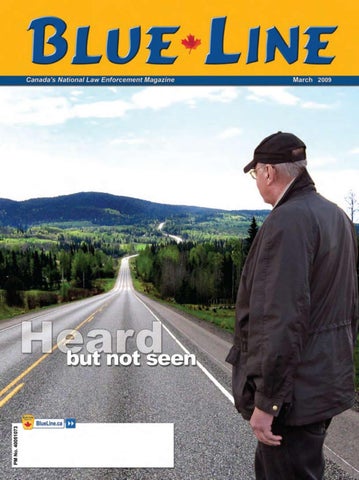
As beautiful as it is fatal. The British Columbia Yellowhead route, also known as Highway 16, has developed an infamous reputation for the number of women found murdered or gone missing. Find out what one man is doing about it on page 6 in this issue.
Features 6 Heard but not seen
16 A silent malevolence
Private investigator is moved by Highway of Tears
Alberta men who helped Mountie killer sentenced
28 Surveillance
10 Recruiting in a new age
Techniques of vehicle surveillance
14 OPP – 100 years The “Orphan-like” illegal gambling unit evolves
Departments
Case Law
38 38 32 26 35 21 37 5 36
34
Flight important in assessing grounds
35
Inventory search not limited to visible contents
Advertisers Index Back of the Book Blue Line Journal Deep Blue Dispatches Forensic Science Market Place Publisher’s Commentary Representative Profiles
Blue Line Line Magazine Magazine Blue
33
March 2009 2009 March
Dodge Charger – with the optional 5.7L HEMI® V8 engine – is the most powerful production police vehicle available. It’s the only police vehicle that offers Best-In-Class performance(1) in four key pursuit categories: • Best-In-Class available power – 355 hp and 395 lb-ft of torque • Best-In-Class acceleration – 0-160 km/h (0 to 100 mph) in 15.19 seconds • Best-In-Class top speed – over 238 km/h (148 mph) • Best-In-Class vehicle dynamics – average lap time of 01:37.77 To learn more about the Dodge Charger Police Vehicle, visit www.fleet.chrysler.ca or call 1-800-463-3600.
2008 Dodge Charger Police Vehicle measured against 2008 Ford Crown Victoria Police Interceptor and Chevrolet Impala Police Vehicle. 2009 model-year results were not available at time of printing. Chrysler, Dodge and HEMI are registered trademarks of Chrysler Canada Inc., a wholly owned subsidiary of Chrysler LLC. Fleet Operations is a division of Chrysler Motors LLC.
(1)
march 2009
4
Blue Line Magazine
Publisher ’s Commentary by Morley Lymburner
The difference between a good cop and just another cop When I was taken off regular beat patrol and assigned a scout car I felt like I had been promoted. As was the practice then, I was partnered with a senior officer – and because of my uber zeal approach to policing, I was paired with old Tony. He was a late-middle aged copper who didn’t miss a thing going on around him. Police work was always as much a part of his day as any other detail that needed to be done, domestic or otherwise. He walked and talked slowly and was an anchor to me. He had a keen eye for factory castoffs and would sometimes ponder an item found at a factory’s back door for the longest time before finally saying “Oh well, let’s throw it in the trunk and I will think of a use for it later.” Tony had a backyard that looked like a scene from the movie Wall-E. He had little tact and no charisma but knew who to talk to, and how to approach them, when he needed information. He knew every restaurant, bartender and store keeper and the names of their kids. They are the people who know the heartbeat of the city, he would often tell me. They hear all and know all, and if they happen to be familiar with a free bottle of Scotch – bonus. Realizing we would be partners for some time and that compromises would have to be made... I shut up and paid attention. I noticed that when a hot call came over the radio, he started driving toward the incident, regardless of its location. He had clearly attuned his hearing to the radio. In some cases he would be talking and simply turn the scout car around in mid-sentence. I would be surprised because I had not heard nor seen anything unusual. Invariably we were often very close to the officer assist call. Tony would advise the dispatcher, in his calm steady voice, that we were almost on scene and to cancel the other units.
Blue Line Magazine
“Almost on-scene – then why the heck are we not at least going faster than the speed limit?” I would wonder. I eventually learned that Tony controlled the car, his surroundings and even the dispatcher. We always made the call safely and in time, and managed to get and keep control of the most horrific scenes the Jane Finch neighbourhood could throw at us. I experienced my first car chase with Tony. Speed wasn’t an issue because our car could never keep up anyway. Hampered by a slant six police car with no roof lights or siren, I knew most of the challenges which lay ahead. The motor would wheeze like a cat coughing up a hair ball if you hit the gas pedal too hard. The advantage of a chase was that at least the alternator would create enough power for the radio to work properly. On this particular day Tony suddenly told me to make a U-turn and “follow that car.” I complied and the suspect car accelerated. My adrenaline kicked in as I hit the gas pedal. “Take it easy now son,” Tony said sooth-
5
ingly. “We don’t want the engine to kack on us.” I eased off and saw the errant vehicle make a sudden right turn down a side street. I made a hard right at the corner and gunned the engine in an attempt to keep my speed up. I failed to notice that there were no vehicles on the street. Tony told me to stop the car. “Stop? This is a chase – we aren’t going to catch him by stopping!” I complained. “Pull over to the curb here,” he said in a curt and firm voice. I did as told but fumed at the prospect of the guy getting away. Tony rolled down his window and calmly asked a man standing in front of a shop if he had seen a red Ford that seemed a bit in a hurry. “Yes I did,” he said. “He pulled down that alley way over there.” Red faced, I headed to the alley and watched as Tony got out and arrested the driver. I suddenly had a renewed respect for “my anchor.” He understood I was a keener but also that in my eagerness to do my job I had missed the nuances that make the difference between a good cop and just another cop. A good cop realizes the public is the gatekeeper of the knowledge they need. Cops don’t own that knowledge, they only borrow it in order to keep their community safe. There are two kinds of witnesses; traffic lights and road signs. The first intends to stop an offence and the second simply wants to give directions to where it is happening. The day we stop asking for a citizen’s help is the day when every cop will need thicker armour and bigger guns. They will be digging trenches instead of building bridges.
March 2009
Heard but not seen Private investigator is moved by Highway of Tears by Larissa Ardis Most people are valued by employers and clients for how competent they are seen to be at their jobs. But some people’s workplace value is gauged by the degree to which they are NOT seen to be working. Ray Michalko is one of the latter. With a sturdy six-foot-two, 240 pound frame, and the bearing of a cop, he’s anything but invisible. Nor is he any slouch: at 60, he still works most days of the week. Hours after most of us have booked off for the day, Michalko can be found at his computer, wrestling with details that have been gathering dust for decades. Michalko’s stock-in-trade is in NOT being noticed at work. Meet the private investigator who’s made it his personal mission to find the killer or killers responsible for the disappearances and deaths of more than 30 women along the 742-kilometre stretch of Highway 16 between Prince George and Prince Rupert—the “Highway of Tears”—
march 2009
since at least 1974. Speaking from his office in Surrey, he remembers how he became involved. “I’d been following this for more than a year, and I was ranting to my wife about it,” he relates. “My wife said, ‘Why don’t you quit talking and actually do something about it?’” Idealist becomes investigator Her words piqued the idealist within him— the one that inspired him from boyhood to join the RCMP as soon as he was old enough. “When I became a cop, I would’ve done it for room and board,” he recalls. That idealist streak ultimately drove him from the RCMP ranks after nine years of service in Manitoba and BC. As his policing career progressed, he felt crime-fighting was increasingly hindered by burgeoning middle and upper management, careerism and politics. “When I joined the RCMP, I had them up on such a high pedestal,” he admits. “It’s impossible for anyone to live up to that.” After leaving the RCMP in 1987, he worked in bank management and then real estate, eventually managing 110 employees for a Lower Mainland firm. But eight years ago, that changed. A private investigation firm wooed Michalko away for a job that put his policing skills back to work.
6
Three years later, he hung out his own shingle as Valley Pacific Investigations—and has been doing a brisk business, albeit low-profile, ever since. Private eye talents With virtually all of Michalko’s work coming from referrals, he doesn’t advertise. Apart from some “missing persons stuff,” about 90 percent of his work is for ICBC. Was that rubber-duck import business really pulling in $500K a year when it burned down? Was your cousin really unable to work after that fence had a run-in with his car? Using surveillance, hidden cameras, public records and a demeanour which encourages bystanders to spill their information, people like Michalko work for ICBC to find out what is really going on. “People would be surprised at the number of private investigators poking about,” he observes. “What bothers me as a citizen is that it’s so easy to find information about people… if I can find things out about you, you could probably find them out about me.” Generally, he turns away divorce-related and “cheating spouse” cases. “I’ve done a few of these. But usually I meet with these people and ask, ‘If I find out this is true, what’s your next step?’” According to Michalko, many people go away to think about that, and don’t come back. Blue Line Magazine
After almost two decades of scrutinizing the details of people’s darker moments, Michalko says his view of human nature is a little warped—but he’s still surprised by how trusting people are of strangers. “It’s amazing what you can do by just fitting in,” he observes. This depends on the area, of course: in some areas of Vancouver, he says, he can stand on a street videotaping action several blocks away without raising an eyebrow from passersby. An ability to blend in is just one quality that makes a good PI. He suggests others: being comfortable with working independently (many consider themselves loners), inquisitive to the point of being nosy, the ability to talk to a wide range of people and a knack for winning people’s trust. “I’ve always had this; my daughter does too. People tell us things we don’t need to know.” This is something he actively cultivates, by studying interview and rapport-building techniques of criminologists like Don Rabon. Some seem ridiculously simple. “One of the best times to interview people is just after their newspaper is delivered. I’ll pick it up, go to their door and offer it to them,’” says Michalko. “When you do someone an insignificant favour, they feel obligated to do one back… so when I start asking about someone else, they’ll often start talking.” After delivering the desired information goods, Michalko rarely concerns himself with outcomes. Not surprisingly, he says PI work “isn’t making me a lot of friends”—which is why he won’t tell you where he and his wife live in the Fraser Valley, or allow his photograph to be reproduced alongside articles about him or his work. Travelling the Highway of Tears When Michalko first became seized by the Highway of Tears case in the winter of 2006, he generated theories and an action plan that included about 350 people to talk to. In February 2006, Michalko placed an ad in northern community newspapers, inviting anyone with information on the Highway of Tears murders to contact him. And the phone started to ring: in fact, about 50 tipsters got in touch — arguably more new action than the RCMP have generated in years. These days, Michalko spends about 40 hours a month on this case. He has reviewed past media coverage, assessed the landscape and identified more than 760 places between Prince George and Prince Rupert where a body could have easily been disposed of, blanketed the area with information flyers. He has conducted several trips to northern BC to interview tipsters and “persons of interest;” these conversations have led to contacts with federal prison inmates. Michalko believes more than one killer is responsible, and says he is currently following leads on Ramona Wilson, whose body was found in 1995 near the Smithers Airport, and Tamara Chipman and Nicole Hoar, who vanished from Highway 16 in 2005 and 2002 respectively. So far, no cigar. But his investigation Blue Line Magazine
has generated a wave of media attention and renewed public and police interest in these cases. It has also triggered a bit of a turf-war with the RCMP. Who’s in charge? In a “Black Press” media report, a police communications officer indicated that, should Michalko identify people of interest, “we certainly want to know who they are and we’ll take it from there.” In a letter to the editor, Michalko shot back that it took seven months for the RCMP to establish a working relationship with him, and questioned why the RCMP, with all of its high-powered resources, have yet to solve even one of these crimes. “Publicly, they’re quite polite,” Michalko said. “But… if I solve one of these, it won’t make them look good… The police do not like non-police poking in what they say is their business… I was the same [when I was] a cop.” Michalko acknowledges that police resources are stretched at any given time, but decries the fact that there is still no RCMP task force solely dedicated to the Highway of 7
Tears cases. “One year later, I still hear stories from people about how they tried to talk to police but ended up being told to call elsewhere or were passed off to answering machines, their messages never returned,” he says. But Michalko doesn’t pretend to have an edge over the RCMP. “As far as the Highway of Tears case goes, my dream would be to be left overnight in a room with access to [the computers of] the RCMP, ICBC and social services. I can’t do that… I have to do it the hard way: talking to people.” View from the outside Until last August, when an anonymous Vancouver women’s group offered to help cover a small portion of his costs, Michalko had been doing all of this at his own expense. Each of his three or four annual trips northward cost about $1,500—without even factoring in the cost of lost income. So why, at significant personal cost, is Michalko so fixated on this complex, highprofile case? “I’ve been asked that question a million March 2009
times,” he says. “I just felt someone had to do something. I have all the skills to try.” What’s in it for him, he says, is feeling good about being able to help. He avoids opining about the conditions that may have made these murders possible, and unsolved to this day. But Michalko’s remarks suggest he is quite conscious of factors like racism, poverty and hopelessly inadequate public transport in BC’s vast, sparsely populated north. He paraphrases Mattie Wilson, mother of murdered Ramona Wilson, who wondered what type of police investigation would have followed had her daughter been blue-eyed and blonde rather than First Nations. “Her question is certainly troubling and worthy of consideration,” says Michalko. As a cop, Michalko has witnessed outrageous legal outcomes of crimes against native women. He recalls one which took place in 1969 in Manitoba: he received a call that five men had just raped a First Nations girl. On his way to the girl’s address, he encountered five young white men walking down the road. Suspicious, he ordered them into his vehicle, and drove them to her house. She identified them immediately. The trial outcome set a precedent in Canadian law. The rape was perpetrated on the girl’s 13th birthday, spawning arguments between lawyers about whether she should have been considered 12 or 13. Rape of a child under 13 was considered a more serious crime. The courts determined that people advance to their new age at 12 midnight— which meant the girl was 12 at the time of the rape. “The guys were convicted, but none of them got jail time,” remembers Michalko. “Their lawyers argued that they’d been good ever since, had made a mistake, and now had families.” He talks about the bumper-sticker campaign which advises young women not to hitchhike. “In theory, it’s a good campaign. But… it’s not practical. A lot of these women have to get from A to B, and have no other choices. This isn’t Vancouver where you can just hop on a bus... It doesn’t address the real reasons people are hitchhiking.” Thousands of hours and dollars later, Michalko believes he is making progress… but agrees that the proof will be in the pudding. Meanwhile, every time an article appears, more people call him. “It keeps it fresh in people’s minds,” he says. “Maybe it will force the government and authorities to do something more aggressive.” Unless you’ve got information for Michalko, don’t expect to actually see him anytime soon. He declines requests for oncamera interviews, photographs or appearances in documentaries. “I have to be able to go places without people knowing who I am. My clients expect this.” Got a tip for Ray Michalko? Call him at (604)831-5585 or 1-866-962-5585. For more information on the Highway of Tears disappearances, visit www.highwayoftears.ca .
march 2009
As an indication of what can result form unsolved crimes it is interesting to go to Travel.MSN.com and look up Peter Greenberg’s “Don’t Go There” guide to must-miss places of the world. His opinion on the second most dangerous place to travel in the world? Yes indeed! It is listed as the same 742-kilometre stretch of Highway 16, “The Highway of Tears.”
An update from Blue Line Magazine
Michalko is more convinced than ever that there are people out there who know something about these cases. They call him preferring not to talk directly to police or because they have talked to police but have received no follow up and feel nothing is being done. He realizes this can’t be done without help, and makes it clear to people that the only thing of interest to him is information regarding the Highway of Tears. It doesn’t matter if the source of that information comes from psychics, people who dislike or distrust the police, career criminals or individuals involved in the sex or drug trade. Michalko arranged for posters to be put up in the offices of over 100 Aboriginal organization’s between Prince Rupert and 100 Mile House as well as in B.C Provincial and Federal Corrections facilities. As a result he has been able to gather and pass along what valuable information he has to the RCMP’s investigation. In a candid comment Michalko pointed out, since Larissa’s story was first published, it was fairly well known in northern BC that he and the RCMP have had more than their share of public differences. “Although they don’t believe that they need my help,” says Michalko, “I need theirs and they’re stuck with me. The good news is that for the time being we’ve finally reached an un-negotiated truce which is better for everyone.”
8
To further the private investigation in January of this year Michalko set up a toll free number (1-866-962-5585) for people living along Highway 16 who cannot afford to make long distance calls to pass along their information. On January 22, 2009 the RCMP announced publicly that since their investigative review team was formed in 2005, $2.1 million has been spent and the budget for 2008/09 is $3.6 million.
An update from Ray Michalko
As an up date to Larissa’s story I have since invested in a computer program called Case Map from Lexis Nexis. Case Map is a case analysis tool that among other things can be used to search for similarities in the data entered in the program. I have been told there are smaller US police departments that make use of this program which I laughingly refer to as a “poor cops” version of ViCLAS. To date I have over 500 entries in the program including contacts to tipsters & persons of interest and have received information from as far away as Atlanta, Georgia; Ontario; Alberta; the Northwest Territories and the Yukon.
Blue Line Magazine
Blue Line Magazine
9
March 2009
Recruiting in a new age Recruiting has become a challenge for many Canadian police agencies. They can no longer fill vacancies through word of mouth and reputation but must turn to proactive recruiting strategies. Interest in policing has dropped across North America over the past decade and agencies have to quickly adapt to remain competitive in the marketplace. Since it is critical to the integrity of law enforcement to draw high quality candidates and retain them for years to come, agencies must become creative. Blue Line Magazine invited several agencies to submit a brief overview of their recruiting initiatives.
Hamilton Police offer “endless opportunities” by Catherine Martin
on continuous learning. Its education bursary fund reimburses, on average, 85 per cent of tuition fees for approved courses, including direct and indirect policing studies. With McMaster University, one of Canada’s top research schools and Mohawk College both located in Hamilton, taking courses is simplified. Community involvement is an integral part of Hamilton policing. Officers participate in over 100 different community groups, volunteering a whopping 40,000 hours each year. Holding food and clothing drives, reading to elementary school students, serving on community service boards of directors and coaching numerous sports teams are just some of the officers’ involvements, which improves quality of life in the city. Hamilton police are important contributors to the community they protect.
“One career... endless opportunities” is not just a Hamilton Police Service (HPS) slogan – it describes the agency to potential applicants and the key to success that awaits them. “We challenge people to consider the Hamilton Police Service, where every day is a new opportunity to make life safer and better for the community they serve,” explains Deputy Chief Eric Girt. HPS serves more than half a million residents, responding to more than 80,000 calls for service and making thousands of arrests last year, Girt points out. Driven by their relentless pursuit of offenders, officers make their city safer every time they report for duty, which is why “the crime rate in the city has declined consistently since 2004,” states Girt. Hamilton officers come from a variety of disciplines: chemistry, psychology, social sciences, commerce, engineering and humanities, to name but a few. Career development Hamilton policing’s commitment to career development – the opportunity for officers to develop their skills by taking on different roles in the organization – is what makes it so unique. “Police applicants are interested in challenge and variety,” says Girt. “We want them to know that at Hamilton Police they have endless opportunities in their policing career.” All new recruits start their careers as patrol officers but it’s a very dynamic position at the HPS. Officers respond to break and enters, robberies, neighbourhood disturbances and collisions, assist victims and conduct preliminary investigations. What they do and where they go from patrol depends on the individual officer. They are encouraged to fulfill their own personal expectations and pursue areas of interest while broadening career options. march 2009
There are dozens of career development positions – from foot patrol to forensics, canine to crowd management, detective to divisional youth officer. With active mentoring, officers are assisted in getting to where they want to be. For example, there are 82 detective constable positions available in a wide range of branches and units. They train under the tutelage of experienced detectives on assignments that last a maximum of three to five years. When the assignment is completed, the officer takes the skills and knowledge acquired to their next position, creating an opportunity for another officer. “When you are first on the job, you may very well have an idea of what units you want to join,” says Cst Bruce Farquhar, recruiter. “More often than not, once officers increase their experience, they expand their horizons.” The service also places a high emphasis 10
Hiring now Like many police services, the HPS faces a number of retirements and is actively recruiting to replace these officers. Over the last three years, it has hired 146 recruits and plans on hiring 100 more within the next two years. “We are a growing service,” says Girt. “In the last ten years we have had a 21 per cent increase in the numbers of officers at our service.” HPS has one of the lowest employee turnover rates in the country, Girt says. He attributes this to highly competitive wages, benefits and a proven pension plan; 12-hour ‘continental’ shifts; active job sharing program; three stations, all located within 20 km of each other and each with a workout room; and a wellness and fitness program which includes hockey and baseball house leagues. Hamilton Police Service Hamilton, ON Size: 804 officers Constable pay: $45,644 to $78,355 Blue Line Magazine
a career noWhere near ordInary JoIn the rcmP
une carrIÈre hors de l’ordInaIre devenez membre de la grc
ioNal Security crimiNal iNveStigatioNS _crimiNal iNtelligeNce _iNterNatioNal PeacekeePiNg miSSioNS _iNformatioN & ideNtificatioN ServiceS _NatioNal child exPloitatioN coordiNatioN ceNtre _commuNity, coNtract aNd aborigiNal PoliciNg _fed d iNterNatioNal oPeratioNS _Protective PoliciNg _crimiNal iNtelligeNce _techNical oPeratioNS _ProceedS of crime _techNological crime _air ServiceS _behavioural ScieNceS _techNical Security _iNtegrated border eNforcemeNt teamS _commer me _fiNaNcial crime _orgaNized crime _border iNtegrity _drug eNforcemeNt _drugS aNd orgaNized crime _mariNe aNd PortS braNch _immigratioN aNd PaSSPort _cuStomS aNd exciSe _federal eNforcemeNt _ iNtegrated market eNforcemeNt te
Interested In a challengIng and excItIng future? Want to make a dIfference In your communIty and your country?
une carrIÈre stImulante et PassIonnante vous Intéresse ? vous désIrez faIre une dIfférence dans votre communauté et votre Pays ?
www.rcmp.ca
www.grc.ca
The RCMP offers meaningful work, vast opportunities, the chance to serve across Canada and a career like no other.
Blue Line Magazine
La GRC vous offre un travail valorisant, de vastes possibilités, la chance de servir partout au pays et une carrière sans pareille.
11
March 2009
Victoria Police rebranding for generational appeal by John Craig The Victoria Police Department has recently undertaken a rebranding exercise, resulting in a new and widely recognizable corporate identity. The branding imagery has been incorporated into a wide range of marketing and collateral materials, including brochures, postcards, banners and display boards. Using the revitalized “VicPD” brand, the department allocated more funds for proactive recruiting strategies, increasing the candidates entering the hiring process in the current competitive employment market. VicPD has been very active in seeking out new ideas on how to attract candidates, looking for feedback from within and outside the organization. This process has resulted in an aggressive, widely based recruiting drive that moves away from traditional advertizing methods such as newspapers to a more targeted approach. This includes advertizing in professional association and trade publications for teachers, police and military personnel, who have skills and attributes that typically transition well into policing. Victoria has also begun a strategy of including recruiting material in packages provided to participants in a wide variety of athletic events. As an example, the department recently gained exposure to thousands of participants at the Vancouver International Marathon and Royal Victoria Marathon using this strategy. VicPD also advertizes on billboards and large screens on main traffic arteries and sports facilities in the Victoria and Vancouver area to highlight its recruiting needs. It now advertizes on the web and is considering possibilities on social networking sites. It has also completely
revamped its website to provide detailed information to potential candidates about the department and its recruiting process. VicPD prides itself on being accessible to people looking for a policing career. It holds several information sessions per year at a variety of locations, providing an interactive, two-way exchange of information and clearly setting out expectations and standards. This helps candidates achieve success in the recruiting process. It has also re-established relationships with students in high school, local colleges and universities, ensuring youth are aware of the opportunities VicPD offers. The department is
working with students and giving them tips on how they can become better candidates through work or volunteer experiences. Upon submission of an initial resume, VicPD recruiting staff phones the applicant and provides regular, timely feedback throughout the hiring process. This personal touch gives the department a distinct advantage over other police agencies that are unwilling or unable to give this level of service. Building lasting relationships in this way and through reserve and volunteer programs, has led to many people joining the department, putting down roots in Victoria and displaying loyalty to VicPD. Lastly, VicPD has taken advantage of its memberships’ networks and contacts to ensure that every member becomes an active recruiter. Many successful candidates are recommended by current employees. They are in an excellent position to evaluate people they come in contact with and positively represent their department. They are provided with recruiting materials and postcards to send to prospective candidates that provide information on the department and how to begin the recruiting process. VicPD has long been a progressive employer and is continuing that tradition in its recruiting strategies, adapting to a very competitive job market and the changing expectations of prospective employees. Its re-branding and implementation of proactive, targeted recruiting strategies has resulted in a large increase in applications, allowing it to meet recruiting needs even as its authorized strength increases. Victoria Police Department Victoria, British Columbia. Size: 241 officers Constable pay: $53,776.32 to $76,822.72
Halton police looking for young, tech savvy recruits by Val Taylor
school students. Participants work closely with service members over an 11-week period of in-class sessions and realistic scenarios designed to improve their cultural proficiency, communication and leadership skills, while enhancing their knowledge of and interest in policing as a career. A similar 12-week program, Citizen Police Academy, is offered to residents over 18 years old. Policing issues, policies and programs are emphasized, with a tie-in to human resources and recruiting. Many participants are in their 20s and 30s and considering a career change to policing, or parents of youth who are still determining their future career path. Not only do HRPS courses dispel misconceptions and promote understanding between the service and the people it serves, they help individuals see policing as a viable and rewarding career option where they can make a positive difference in their community.
Traditional recruiting methods are no longer enough in today’s competitive labour market. That’s why the Halton Regional Police Service (HRPS) is working to help today’s young, tech-savvy candidates prepare for success in a policing career. Early exposure key For today’s youth, the concept of ‘what do you want to do when you grow up’ starts long before they hit the job market and increasingly, policing doesn’t even register on their radar screens. To change that, HRPS created two educational programs to help youth and adults better understand the broad opportunities and exciting challenges that policing offers. The Police Ethnic And Cultural Education (PEACE) youth leadership program is an indepth course offered twice yearly to area high march 2009
12
Blue Line Magazine
Expanding horizons To address the increasingly important role new immigrants play in today’s job market and to help promote diversity, the HRPS, in partnership with the Halton Multicultural Council, established an Enhanced Language Training (ELT) program in 2008. It provides more than 250 hours of employment-specific language training and mentorship opportunities to new Canadians with backgrounds in law enforcement and security who may be interested in pursuing similar careers. ELT students work with officers and recruiters to build the knowledge and skills necessary for the Canadian labour market, with a specific focus on policing and security. Its success has already been demonstrated; a participant from the inaugural course applied to the service and is currently going through the recruiting process.
Victims ’ rights advocate dies Ever the optimist, victims’ rights advocate Gary Rosenfeldt passed away on February 8 at the age of 67. There is little doubt he passed away in peace knowing his son’s death at the hands of notorious child killer Clifford Olson was not in vain. The horrific sex slaying of his 16-year-old son, Daryn, in 1981 prompted Rosenfeldt and his wife Sharon to work tirelessly to ensure victims of violent crime have a place within the criminal justice system. When Daryn disappeared in April 1981 from a British Columbia mall while on an errand for his mother
there were few organizations that existed for families struggling to cope with such a situation. At the time, police paid them little attention and brushed Daryn off as a runaway. The family learned from a newspaper article that he’d been sexually assaulted by his killer and there was no role for them to play during the court proceedings. They were taken aback to realize the offender had more rights than they did. Through their organization Victims of Violence, the Rosenfeldts lobbied successfully for things like police protocols for notifying next of kin, victim impact statements in court proceedings, financial assistance programs for victims and tougher parole legislation. Gary passed away in his Montreal home after a long battle with lung cancer.
Prepping potential candidates While today’s students can access a network of family, friends and teachers to help them apply for post-secondary education, not as many are familiar with the police officer application process. To help counter fear of the unknown, HRPS offers recruitment information nights, informal open houses and prep mentoring sessions to guide applicants through the process and increase their success rate. Information nights are held several times throughout the year and attract large audiences. One session last year was targeted specifically to police foundations college students and directly resulted in hiring three new officers. Held once a month at various police locations throughout Halton, the two-hour open houses give potential applicants a chance to meet one-on-one with recruiters in an informal setting to learn more about the process and get tips on how to submit a strong application. They are often the first opportunity candidates have to speak with recruiters. The goal is to make them feel they can approach any recruiter to get their questions answered. The physical testing component can often be a sticking point for many otherwise qualified candidates. To help them overcome this hurdle, the service has partnered with a local educational institution, Mohawk College, to offer prep mentoring sessions that help candidates ensure their fitness level will meet requirements. The final pillar of the Halton Regional Police Service’s recruitment strategy – the launch of an online applicant tracking system – was completed in late 2008. A new online applicant tracking system in the “Join Us” section of the service’s website is designed to appeal to today’s tech-savvy new recruits, who are fast disposing of hard-copy resumes and cover letters. Sworn and civilian candidates can apply online, following a series of step-by-step instructions. Adapting to the changing needs of the community is an essential part of policing and police recruiting is no exception. HRPS will continue to explore innovative ways to identify and attract potential recruits early in their career development. Halton Regional Police Service Oakville, Ontario Size: 563 officers Constable pay: $44,000 to $76,060 Blue Line Magazine
13
March 2009
The
orphan-like
“
”
illegal gambling unit evolves
by PC (ret) R.D. (Bob) Cooke Gambling den operator Manny Feder received an unexpected and unpleasant surprise that June evening in 1938 when he returned to his suite at the Royal York hotel in Toronto. Described as being “well known in sports circles,” Feder was met by two Toronto City Police officers who, acting on a warrant provided by the OPP, arrested him on a charge of keeping a common gaming house. As that arrest was taking place, 22 OPP officers were battering their way through a steel-reinforced oak door at the Brown Derby on Toronto’s Lakeshore Road. In those days, the Derby was known to be a gathering spot for fans of horse racing and gambling. The raid was the result of weeks of planning, instigated on the direct orders of then-Premier Mitchell Hepburn and carried out by OPP officers brought in from the western and northern parts of the province. The Ontario government had indicated it would give “no quarter” in its efforts against Toronto gamblers and racketeers who, it was believed, were bank-rolled by criminal elements in the United States. Once inside, police found felt-covered tables, dice cages, betting chips and, perhaps not surprising given the era, a room right out of the Newman/Redford movie The Sting, including huge boards for displaying horse race results from all over North America, lists of jockeys, track conditions and odds. As was the case in that movie, the well organized operation used telegraph and telephone lines to receive racerelated information. Back at the Royal York, while being escorted into a waiting police car, Feder was seen to drop a key down a storm sewer. The key was subsequently retrieved and, acting only on the strength of flashing their badges to the hotel manager, police used it to open a strong box, resulting in the seizure of over $6,800 and other evidence related to illegal gaming. That was 70 years ago. During the ensuing years, OPP illegal gambling enforcement has evolved, first forming as a squad in 1942, disbanding in 1981 and re-forming four years later. Orphan-like, it has operated under various names and within different branches, bureaus and sections of the OPP. Retired Det/Insp Larry Moodie entered the illegal gambling section as a staff sergeant in the late 1990s, when legalized gambling, such as casinos, was introduced. In 1996 he presented a business case to the provincial government, resulting in $7 march 2009
Under court order, video machines and related gambling equipment seized during Project Triple Nickel were dumped into a northern Ontario landfill site. The seized items were then bulldozed. Photo supplied by OPP Det/Sgt. Paul Chafe.
million in funding to combat illegal gambling, an achievement Moodie calls “the highlight of my career.” Subsequently, a total of six teams were set up in Toronto, the GTA and Ottawa, staffed by 26 OPP and 14 municipal officers. So many gambling machines were seized that two warehouses had to be rented, one each in Toronto and Ottawa. “It was organized crime-based,” Moodie asserts. Illegal gambling enterprises were raided in the GTA, Ottawa, Peel Region, Hawkesbury, northern Ontario and even a machine manufacturing facility in Quebec, with the co-operation of local police. In Hawkesbury, “people were so into gambling they were buying empty Tim Horton’s cups for the price of a coffee” to participate in the restaurant’s Roll-up the Rim to Win promotion, Moodie recalls. Today, from an initial complement of three officers, the Illegal Gambling Unit is part of the OPP’s Organized Crime Enforcement Bureau and includes municipal forces from Hamilton, London, Ottawa, Peel Region, Windsor and York Region, as well as the Ontario Racing Commission. Another retired unit member is Det S/ Sgt Andy Durno, who participated in illegal gambling enforcement for a total of 18 years between 1975 and 2003 as an OPP officer and civilian gaming specialist consultant. “Prior to the seventies, betting on horse races was the only legal type of wagering allowed in Canada,” says Durno. 14
“Changing societal attitudes and more government involvement in gambling as a source of revenue has drastically changed the gambling landscape,” he adds. Investigations of horse racing-related issues began in 1979 and continue to this day. In 1989 the Gaming Control Section was formed for investigations related to legalized gaming and is presently part of the Alcohol and Gaming Commission. Card houses have caught the OPP unit’s attention, with the current “Texas hold’em” craze replacing poker as the game of choice. Durno says book-making has seen the biggest change of all the illegal gambling enterprises. With the introduction of off-track betting, the unit stepped up enforcement, assisted by new legislation. Enforcement continues to evolve. Other gambling activities are being targeted; those which often benefit organized crime, including video gambling machines and card dens. There are still unrestricted areas of gambling, one being the plethora of Internet gambling websites which, Durno says, “is surpassed only by the number of pornography sites.” Some countries control on-line gambling but Canada has no legislation specifically addressing the issue. Moodie shares Durno’s views, expressing “regret we were never able to go after Internet gambling.” Perhaps some day that might be another challenge for the OPP.
Blue Line Magazine
Blue Line Magazine
15
March 2009
A silent malevolence
Alberta men who helped Mountie killer sentenced
EDMONTON - Short of drawing up the plan and pulling the trigger, Shawn Hennessey couldn’t have been more help to Mountiemurderer James Roszko, and for that he must serve more than 10 years in jail, a judge has ruled. Justice Eric Macklin also found that while Dennis Cheeseman was a virtual tag-a-long, he knew he was placing Mounties in mortal danger and therefore must serve more than seven years behind bars. “They let themselves down, and their families,’’ Macklin told a packed Court of Queen’s Bench courtroom as Hennessey and Cheeseman looked on, by turns blinking back or wiping away tears. “They let down four RCMP constables who put their lives at risk. “They let down the families of Cst. Anthony Gordon, Cst. Peter Schiemann, Cst. (Leo) Johnston and Cst. Brock Myrol. “They let down the communities where the officers lived, worked and served. “They let down the country the officers unselfishly agreed to serve, and where the offenders are privileged to live under the rule of law.’’ When police officers are murdered, he said, society starts to break down. “In imposing sentence, it is appropriate to reflect society’s revulsion. “These four men were Canadian heroes and will be forever remembered as such.’’ Hennessey, 29, stared back impassively as the sentence was imposed while Cheeseman, 25, hung his head. The two men had been scheduled for trial on four counts of first-degree murder but instead pleaded guilty Jan. 19 to four counts of the lesser offence of manslaughter. After admitting guilt, Hennessey stood and tearfully apologized to the families of the victims, saying he didn’t know his actions would lead to murder. Outside court Schiemann’s father, Don, said it was a poignant moment. “Was he sorry that he got caught or sorry that he did it?’’ said Schiemann, a Lutheran
march 2009
minister, his voice breaking as he talked. “I can’t look into his heart. I take his sorrow at face value and I forgive him.’’ When asked if he forgives Cheeseman, who didn’t address the families in court, Schiemann said: “I haven’t heard anything from him yet.’’ Myrol’s father, Keith, told reporters he hopes the pair get help while behind bars. “We want them to come out better than they went in,’’ he said. “We want them to learn and come out, so they don’t have to attach to someone like Roszko in the future, so they can come out and stand on their own and be good citizens.’’ Hennessey’s aunt, Chriss, said the men had to consider the plight of Hennessey’s wife Christine and his two young daughters the night a gun-toting Roszko came to their home demanding help.
16
“Shawn and Dennis feared for the lives of Christine and those girls – end of story,’’ she said. “I don’t consider that letting them down.’’ The sentencing now sets the stage for a fatality inquiry into how the four officers were ambushed. The sentence came close to what Crown prosecutor David Labrenz had asked the judge to impose. It is in the higher end of sentencing for manslaughter, which in this case carried a minimum prison term of four years and a maximum sentence of life because a firearm was involved. Hennessey was sentenced to 15 years, less credit for his guilty plea and the time he spent in custody. In the end, his sentence totals just over 10 years. Cheeseman was given 12 years, less the same credit, to arrive at just over seven years. The men had been arrested in July 2007 after confessing their involvement to undercover police in a sting operation. The four Mounties were murdered by Roszko on the morning of March 3, 2005 while they investigated a Quonset hut on Roszko’s farm near Mayerthorpe, northwest of Edmonton. A day earlier, they had discovered stolen car parts and a marijuana grow operation in the Quonset while they were helping bailiff’s repossess Roszko’s pickup truck. Roszko fled in the truck before police arrived and was nowhere to be found as they carried out their investigation. Roszko was the town menace, a 5-foot-6, Blue Line Magazine
Blue Line Magazine
17
March 2009
150-pound stick of hate who harassed police, stalked their wives, damaged property, threatened people and had served jail time for sexually abusing a young man. It was known that the 46-year-old had weapons and the standing order at the RCMP detachment was to never approach him alone. He had so alienated himself from local townsfolk that he went looking down the road, to the nearby town of Barrhead, for companionship. There he hooked up with Hennessey – a former oil-rig worker and amateur boxing champ who was now helping run a tire store. They became partners in Roszko’s 280-plant marijuana grow operation. Roszko was the grower and Hennessey the pusher, selling bits of weed to family and friends. And so it was Hennessey, court heard, whom Roszko turned to in the desperate hours of March 2 as the police he so despised began taking apart the contents of his Quonset and shipping his life out on a truck. Hennessey and Cheeseman, their lawyers argued, had no choice but to help when a man known as a violent sociopath showed up at their door with a Luger pistol in his belt. Macklin disagreed. When Roszko first called for help that day, Hennessey refused him, Macklin noted, indicating Hennessey was willing to stand up for himself. Later that night, court heard, Hennessey and Cheeseman acquiesced. They gave Roszko a .300 Winchester Magnum rifle and drove him under the cloak of night to the field across from where police
were working on the Quonset. As they rode over, Roszko vented his spleen against the police and vowed to “get even.’’ “Both Mr. Hennessey and Mr. Cheeseman knew that armed confrontation with the police was a real possibility and that the situation was clearly trouble,’’ said Macklin. They dropped Roszko off before 3 a.m. Seven hours later, Roszko managed to get his hands on a third gun – a semi-automatic .308 Heckler and Koch assault rifle – and it was that weapon he used to kill the officers in the hut before police descended and he shot himself in the heart. Court heard Cheeseman was a lost soul, a high school dropout who looked up to Hennessey, who was married to Cheeseman’s sister. When Hennessey needed moral support that night, Cheeseman was there, even helping Roszko wrap the Winchester in a pillow
case, said Macklin. But Hennessey’s actions, he said, “were all directed at distancing himself from anything that could link him to Roszko and the marijuana grow op. “It is my view that Mr. Hennessey reaches the highest rung possible for party to murder who did not participate in formulating a plan to murder, was not present and was not the shooter.’’ Macklin focused on the tense moments after the pair sat in Hennessey’s car in the predawn hours in the field across from the Quonset after having just dropped off Roszko. Maybe we should call police? Cheeseman is recounted to have said. No, no, replied Hennessey; Roszko might then come after us. That doesn’t square, said Macklin. A simple phone call would not necessarily have been traced back to the pair and, at the very least, would have given police a chance to defend themselves. Instead, court heard, James Roszko wrapped socks over his boots to muffle sound, grabbed the rifle and marched away over the snow toward the dome lights of the police cruisers winking in the distance. Shawn Hennessey, meanwhile, sat at the wheel of his Dodge Neon, weighed the value of 280 pot plants against the fate of four Mounties, tapped the accelerator and drove away.
The investigation took time and cunning EDMONTON - With four of their fellow officers dead, and convinced that two smalltown Alberta men had helped their killer, RCMP set up an elaborate sting operation that included a damsel in distress, a fictitious crime boss and other seedy characters played to the hilt by undercover Mounties. Their job: lure one of the suspects into a fake criminal organization and coax him into giving up the goods. Details of the complex ruse were revealed at a preliminary hearing last May for Shawn Hennessey and Dennis Cheeseman, who were charged with first-degree murder in the deaths of the four officers near Mayerthorpe, AB., in March, 2005. The details were kept under wraps by court order until Hennessey, now 29, and Cheeseman, 25, pleaded guilty in an Edmonton courtroom to the lesser charge of manslaughter. RCMP investigators had launched a twopronged attack on the brothers-in-law from Barrhead, AB. One undercover Mountie posed as a tradesman and attempted to befriend Hennessey by taking him snowmobiling and quadding – two activities Hennessey loved. But the preliminary hearing heard that side of the scheme didn’t gain much traction. The operation to coax Cheeseman into a criminal gang was much more successful. It began with an undercover female RCMP officer pretending to have car trouble in front of Cheeseman’s workplace. The car she was driving had been equipped with a kill switch so the motor would give out at just the right time.
march 2009
18
Blue Line Magazine
Cheeseman came to help, but the car wouldn’t start. He gave the woman a ride to a burger restaurant, where the two exchanged numbers. She offered a story about how she had just broken up with an abusive boyfriend in Calgary. Their relationship seemed to blossom. Police needed to get Cheeseman out of the home he shared with Hennessey so that an RCMP team could install bugs, so the woman invited Cheeseman to be her date at an office Christmas party. RCMP organized the fake celebration at an Edmonton hotel with undercover Mounties acting as the woman’s co-workers. One Mountie even dressed up as Santa Claus and distributed gifts. The woman and Cheeseman got so chummy that her colleagues worried the relationship might take a sexual turn. Operation handlers quickly wove in a storyline about how the woman’s grandfather had died and she needed to go to Manitoba right away to be with her family. The woman stayed in touch with Cheeseman, however, and eventually introduced him to another undercover operative, who mentioned he was in a criminal gang. He invited Cheeseman along to steal a mini-loader from someone who owed the gang money. More missions followed. Cheeseman was invited to watch “gang members’’ steal a boat. Then he took part in the sale of stolen cigarettes. The following month, he watched the gang pick up crates of automatic weapons from a plane that had landed at an airport in nearby Edson, AB.
Blue Line Magazine
Cheeseman started seeing some cash for his work – $300 for helping to steal equipment from people who owed the gang money; $700 for helping in the cigarette caper; $500 for helping with the gun shipment. On each occasion, Cheeseman was told he didn’t have to take part in any of the simulated criminal activity. But at the same time he was told that the group operated under a strict code of honesty, loyalty, integrity and trust. Members had to lay it on the line with each other. “We don’t want stories – we want to hear the truth,’’ one officer testified. Cheeseman stayed in touch with the woman as he was drawn deeper and deeper into the fake criminal front. She asked him to go to Calgary to help move her things from a home she shared with the abusive boyfriend. RCMP used makeup experts to make her appear badly beaten. Soon the gang’s leader started inquiring about Cheeseman’s good work. That’s when undercover RCMP took the opportunity to subtly turn discussions toward Mayerthorpe. Gang members told him he had a bright future, but said if he had any connection to the Mountie shootings, he could draw unwanted heat to the group’s operations. Cheeseman was then lured to Kelowna, B.C., for a meeting with the big crime boss. He was told the gang had links inside a satellite company in the United States that constantly took detailed pictures of the Prairies. Should any photos exist showing Cheeseman driving killer James Roszko back to the farm on the night before the officers were killed, the gang might be able to make the pictures “go away.’’
19
On the way back to Barrhead, Cheeseman spilled the beans about Mayerthorpe to a highlevel gang member, another RCMP operative. He took the undercover officer on a step-bystep re-enactment of the route he and Hennessey had driven with Roszko the night before the four Mounties were gunned down. Efforts to befriend Hennessey had gone nowhere. Undercover officers found him suspicious of them. The RCMP partnered a female undercover officer with the tradesman to see if they could get close to Hennessey and his wife as a couple, but with no success. The Mounties got their break when the fake gang lured both Cheeseman and Hennessey to the airport in Barrhead for another meeting with the crime boss. He had a job with a promise of a big payday in Vancouver. During the meeting, Hennessey, who was leery of being recorded while talking in vehicles, walked along the runway and spoke with the crime boss. RCMP recorded their conversation with hidden microphones. After the meeting, another senior gang member stayed in Barrhead with Hennessey. The preliminary inquiry heard that it was at this time that Hennessey finally admitted to driving Roszko to the farm on the night before the officers were murdered. The Mounties had what they needed. Within days, Hennessey and Cheeseman were arrested and charged with first-degree murder. Excerpt from Blue Line News Week, Vol 14 No 6 Subscriptions: blueline.ca (905)640-3048
March 2009
The eyes have it...
or do they
by Gordon MacKinnon Diagnosing deception through body language is a hot subject in the investigative interviewing field. There are many theories, and just as many disagreements, amongst so-called “experts” as to how accurate a person’s body movements are when coupled with speech patterns and answers during an interview. Many people feel that ‘eye contact’ is a good indicator of truth-telling or evasiveness. The eyes have been called the “windows of the soul” and many believe you can tell a lot about a person’s character and truthfulness simply by how they look you in the eye. In much of the western world, a person who looks you in the eye is judged as truthful or believable; conversely, someone who can’t do so is looked upon as ‘shifty’ or deceptive. This is often taken as a given and most of us have, at one time or another, bought into or agreed with this hypothesis. I know I have. How many parents questioning a son or daughter have said “Hey, look at me, I’m talking to you!” While it may be true that a deceptive child (or suspect) looks away, what does it really mean? If you, the questioner, are looking at them with a withering gaze, they are quite likely just seeking refuge from your own overbearing ap-
pearance. No one likes to be ‘stared down.’ Is eye contact an accurate yardstick of deception or should we be careful when using it to diagnose truth-telling? One of the basic steps in the ‘Non-Accusatory Interview Technique’ is what we call “getting to know you time.” This is when the interviewer spends at least 10 minutes – more if needed – at the beginning of the interview process engaging the subject in an innocuous conversation, staying well away from any
investigative matter that might be the subject of the interview. While doing this the interviewer has the opportunity to observe the person in their ‘normal’ conversational state and can learn specific speech and body habits and hand or eye gestures. The theory is that if a person deviates from their normal speech/body patterns later in the interview and particularly at a critical phase, then this – coupled with their type of verbal response – may be indicative of deception. The lack of eye contact – averting their eyes or continually looking away – may simply be a sign of shyness. It may also be cultural. In some Eastern cultures, for example, it is a sign of respect to look away, particularly if you are dealing with an authority figure, so one has to be careful. On the other hand, a person who made good eye contact during the getting to know you time (60 to 65 per cent of the time on average, they say) but who suddenly looks away, covers their eyes or closes them tight when asked a contentious question may well be under stress – but again, we must be careful. I remember when the term body language first came into vogue and was touted by many as the new way of detecting deception. Although a lot of research was done, much writing was based on word of mouth and conjecture. In the ensuing years we have learned that, while body language is a helpful diagnostic tool to the investigator, it must be used with caution. Most experts agree that you will need at least two or three different body movements (called a ‘cluster’) before you can make any kind of judgement. The most recent research has identified at least two areas of body language that are felt to be accurate indicators of deception – and eye contact is not one of them. We will be discussing this and much more at my seminar at the Blue Line Trade Show. See you there. Gordon MacKinnon will present his one-day Investigative Interviewing seminar at the 2009 Blue Line Trade Show, April 28 and 29 in Markham. Visit blueline.ca to register or for more information.
march 2009
20
Blue Line Magazine
Forensic Science
New
by Brian Ward
forensic training facility approved
by Brian Ward Humber College has announced it’s building a 6,200 square foot crime simulation classroom and forensic demonstration laboratory at its Lakeshore Blvd. (Toronto) campus. The new facility has been designed to accommodate the needs of police foundations and social and community services program students, explains Gina Antonacci, associate dean of the college’s School of Social and Community Services. “We have launched a Centre of Excellence in Justice Leadership and I expect this facility to be the focal point of the centre,” Antonacci says. Completion is targeted for late summer. Gow Hastings Architects designed the project, coming up with a fully equipped forensic identification laboratory adjacent to a classroom set up as a crime scene simulation apartment. It features full video recording throughout and the latest in latent fingerprint examination equipment, including a laser, and
Blue Line Magazine
moveable waist level walls in the apartment to allow configuration changes. PFP students will learn how to search, manage, and process a crime scene and perform basic latent evidence discovery techniques. Social services students, aided by Humber’s theatre arts students, will use the apartment in recreating dynamic client scenarios.
21
Future plans include building partnerships with surrounding police agencies for joint access to the facility. Also being examined is a one year post graduate certificate program in forensic identification, similar to North Bay’s Canadore College. Brian Ward can be contacted at forensics@blueline.ca
March 2009
Investigative Interviewing April 28 or 29, Fee: $225 + GST This one day course, offered both days of the Blue Line Trade Show examines how to detect a liar every time by analysing their verbal responses. Liars are frequently caught through their own verbal mistakes. You will learn: Five key words that liars use in their speech; three words that tell you a liar has left something out; One thing liars always do on paper or in person, and how to turn it around on them; How to look at a statement and know deception is taking place; Two key phrases that signal a liar is skipping over critical or sensitive information. Instructor: S/Sgt Gord MacKinnon (retired) with thirty years in law enforcement, has experience in a multitude of areas including criminal investigation, underwater search and recovery, fraud investigation and , Intelligence. Gord is an acclaimed lecturer in the techniques of investigative interviewing and is author of the book Investigative Interviewing. Instructor: A/Sgt Wayne van der Laan (retired) has 20 years experience in law enforcement that includes service in Criminal Investigation Unit, Public Order Unit, Break and Enter Unit and Auto Squad. Wayne holds a Bachelor of Commerce and a Masters Degree from the University of Guelph.
Frontline Policing: Case Law April 28 or 29, Fee: $225 + GST A unique one-day course designed specifically for front-line officers will use scenario-based self-directed-learning and reality-based group case study discussion focusing on rapid decision-making, critical thinking, and problem-solving. Topics include: 911/Distress calls and related entry and search authorities; “Common-law exigent circumstances” (CLEC) warrantless entry into houses; “Feeney” entry into houses with and without warrant; Investigative Detention; Common law search incident to arrest; Admissibility of front-line statements from suspects; Breach of the peace; 495 CC decision-making model; The sec 24(2) Charter pendulum swing. Instructor: Gino Arcaro B. Sc., M. Ed. Niagara College Coordinator - Police Foundations Program, and Law & Security Administration Program. His unique 33-year professional career has included 15 years in policing in addition to those of college program coordinator and professor, published writer, and football and strength training coach. His books are available through the Blue Line Library.
Terrorism and Canadian Law Enforcement
April 29, Fee: $225 + GST
This full-day course for law enforcement is a must take for officers working in the post-9/11 era. Topics covered will include: the war on terrorism vs information and intelligence sharing, how terrorism is affecting the Canadian and US economy, the evolution of domestic and international terrorism, the suicide bomber of the 21st century, drastic changes in the structure and behaviour of terrorism, lessons learned since September 11, 2001 and an examination of Canadian immigration and privacy laws. Instructor: Marc Sand, CEO of V.I.P. Protection has a B.A. degree in Law and PhD. in Psychology. He has training in a wide array of commando, martial arts and other special operations disciplines. He is a guest lecturer on terrorism at St. Clair College in Chatham, Mohawk College campuses in Brantford and Hamilton. He has been a guest lecturer with several police services in Canada as well as the American Society of Industrial Security. march 2009
22
Blue Line Magazine
April 28 & 29 , 2009 , 9am - 4pm
LeParc Conference Centre , 8432 Leslie St , Markham , ON
Pre-register at BlueLine.ca or 905•640•3048 Training registration includes free admission to the Blue Line Trade Show and a one-year subscription to Blue Line Magazine.
Covert Assignment Training April 28, Fee: $225 + GST During this one day course Hal will discuss techniques of mobile and foot surveillance, proper clothing and vehicle choices, communication techniques, video techniques and surveillance during special circumstances. Guest Speaker Wally Podzyhun is a former Toronto Police Officer and now licensed Private Investigator actively involved in the training of investigators and more specifically performing one man surveillance projects almost daily. He will address this issue in detail. Jayson McQueen is the Manager of Investigations with a large corporate retail branch and will address the complexities of team surveillance and their successes during their projects. Instructor: Hal Cunningham retired from The Toronto Police Service after 30 years of service as a Staff Sergeant and former member of their elite surveillance unit. He was declared a Surveillance Expert in the High Court. For over 15 years he has been teaching techniques to Police, Corporate and Private Investigators.
Street Drug Awareness April 29, Fee: $225 + GST This course is unique in its scope providing important and relevant information concerning the world of street drugs to field level law enforcement officers. In this one-day course you will learn clandestine laboratory safety, recognition, and investigation, current drug trends, and how to recognize drug use and handle users. Instructor: Det. Steve Walton (retired) worked 10 of his 25 year policing career with a drug unit. He has investigated more than 300 grow operations and supervised an undercover street team involved in 120 undercover drug operations. He is a qualified drug expert and actively instructs in the area of drug education and investigative techniques. Steve is the author of The First Responder Guide to Street Drugs series.
Ethical Decision Making for Police Leaders April 28, Fee: $225 + GST Unethical behaviours frequently conflict with organizational values and their negative impacts on police services erode public confidence and trust. These same behaviours, no matter how isolated tend to taint the public’s opinion of the policing profession as a whole. This interactive program provides opportunities for police leaders (sworn and civilian) to learn about and discuss contemporary challenges facing police leaders and develop strategies to effectively manage ethical dilemmas in their organizations. Instructor: Chief John Middleton-Hope (ret’d), DEC, BA, MCE has more than 26 years policing service and has published research and presented to colleges, universities, police services and the corporate sector in Canada, the USA and Europe in the areas of police ethics, leadership and conduct management. He currently sits on the IACP Police Image and Ethics Committee, the CACP Ethics Committee and the Plano, Texas based Institute for Law Enforcement Administration’s (ILEA) Center for Ethics. Instructor: D/Chief Peter Davison (ret’d) is an FBI National Academy graduate and retired from policing after 27 years. Peter lead research, development and delivery of EDM programs for law enforcement agencies and was instrumental in the development of the Provincial Ethics Council and chaired both the Council and the Calgary Police Service’s Ethics Committee. He is a distinguished presenter in EDM programs to various levels of law enforcement in Canada and the US. Blue Line Magazine
23
March 2009
“Photo courtesy of The Telegram”
by Danette Dooley June Layden has held every rank possible in the Royal Newfoundland Constabulary (RNC) Street Patrol Division, including constable, media relations officer and platoon commander. One of the RNC’s first female recruits when she joined on Dec. 15, 1980, Layden made history again in December by becoming the force’s first female superintendent. She has seen many changes over her almost 30-year career. “I remember going on a call with one of my constables... he was doing his call and I was standing back taking notes. I was in full uniform, with sergeant stripes on my sleeve. The older gentleman that was making the complaint looked at the young officer and said, ‘So, you brought the woman along to take notes for you.’ I got quite a chuckle out of it. He just said, ‘No sir, she’s my supervisor.’” Layden has earned her stripes. Now in her 29th year with the force, she has spent the bulk of her time in street patrol, particularly as a supervisor. The division she heads is the largest in the force, with more than 150 staff. Approximately 80 per cent of all calls to the RNC come through Layden’s section. “My first love has always been patrol,” she said. “I’m now the voice of the executive management team to the membership and I advocate on behalf of our members to allow them to get the resources they need.” Working in policing is like being ‘a kid caught in a candy store for 28 years,’ says Layden. She admits it’s been far from sugarcoated though, adding that “there are certain cases that steal a piece of your soul.” An only child, Layden grew up in rural Newfoundland in the small community of Gambo where her parents, Sidney and Irene, ran a general store. They were trend-setters, too. march 2009
RNC appoints
first female superintendent “We were the first in the area to have a custard cone machine back in the late 1960s,” Layden recalls. “For those who came to get one, it was a thrill. For me, who found myself perched on a stool all too often, pouring custard cone after custard cone, it wasn’t all that exciting,” she says with a laugh. One of the biggest lessons she’s learned in life occurred during her teenage years. “I was rushing through the store and this salesman came in. He stopped to speak to me but I kept going, at which time he very quickly brought me up solid and told me that’s not the way you behave, that you speak to people and you recognize people. A lesson well learned,” she says. Her parents were surprised when informed she was giving up studying physical education at university to join the police force, but didn’t discourage her choice of career. “I think it was a quiet worry. They likely had their apprehensions but never expressed them to me,” she says, smiling as she thinks back to her early years with the force. Some officers’ wives weren’t happy to see female police officers, she recalls. “Some of them were very vocal that they didn’t want their husbands working with women, particularly night shifts, out in cars.” Some officers weren’t happy about welcoming women into the force either, Layden notes, but others were quite supportive and several became her mentors. “Pat Ledwell was known as a policeman’s policeman. S/Sgt. Larry Payton, who is retired, was very encouraging and still is to this day,” she says, adding that retired deputy chief Gary Browne was also a mentor. Layden credits the current management team, particularly Chief Joe Browne, with 24
encouraging women to join the force. The RNC currently has about 500 female officers and civilian employees and only a couple of dozen members who haven’t worked with female officers. While she’s done well in job competitions, Layden describes herself as a “reluctant manager, initially... “If there was a rank that I aspired to it was staff sergeant, because it is the highest rank within the rank-and-file where you are still pretty active in frontline duties,” she says. Layden has certificates from the Canadian Police College and Dalhousie University and is one course shy of a police studies degree from Memorial University. The RNC has gone through some turbulent times as an organization but has weathered the storm, Layden says. “When an organization that you care so very much about is going through some pretty dark times, it’s difficult for everyone... but there is strength in an organization in how you deal with challenges, and I think we’ve dealt with them very well.” While Layden has no plans to retire anytime soon, there are only two ranks higher than superintendent: deputy chief and chief. These positions are held by competent people, she says, who will likely remain where they are for several more years. She doesn’t rule out seeking another promotion if one of these jobs become available, “but that’s not where my sights are set right now,” she says. “I love what I do and I wouldn’t change it for anything.” Danette Dooley is Blue Line’s East Coast correspondent. She can be reached at dooley@blueline.ca
Blue Line Magazine
Join the revolution in virtual training. Meggitt Training Systems, the law enforcement training leader in Canada, welcomes you to experience their new user-friendly, fully immersive virtual training system; the XVT. After years of development, and recently unveiled at the IACP show in October 2008, the XVT is now recognized as the leader in the industry. The XVT features the greatest number of improvements in virtual training since we first introduced our Fats trainers to the law enforcement community over a decade ago. So, if your goal is to train your team with the most advanced and most cost effective training solution available today, XVT is your answer!
SIMPLIFIED USER INTERFACES SUPPORTS DVORAK WEAPONS PORTABLE ENHANCED DISPLAY SYSTEM SIMPLIFIED LANES AUTHORING WIRELESS INSTRUCTOR INTERFACE For specific details on the new XVT system, please contact Jean-Roch Garneau at (613) 271-8439. We service our customers from our offices in Medicine Hat and Montreal with service reps in Victoria, Edmonton, Ottawa, Gagetown and Halifax. Meggitt Training Systems Canada #3-1735 Brier Park Road NW Medicine Hat, AB T1C 1V5 email: MTSCanada@meggitt.com Blue Line Magazine
25
meggitttrainingsystems.com March 2009
Deep Blue by Dorothy Cotton
The boredom threatens to drive me berserk. I am stuck in a mandatory training session that is completely inappropriate. The person sitting beside me has been a psychologist for about an hour and the session seems just fine for her – but I am about 30 years past this stage of professional development. I am bored, bored, bored. Generally, I get up to no good when I’m bored. They must have had me in mind when they coined the adage “an idle mind is the devil’s workshop.” When I am trapped in a meeting and I am bored, my general repertoire includes: • Annoying the people beside me; • Asking stupid questions and generally harassing the speaker; • Annoying the people beside me; • Coming and going frequently, causing everyone else to move to let me in and out; • Sending notes to people on the far side of the room; • Annoying the people beside me;
march 2009
• R efining the art of paper airplane construction. I’m the first to admit that these are probably not the best strategies for dealing with boredom, but dull events are a problem for people who like to be busy and have a lot of energy – like most police officers, for example. Most police officers have a higher than average energy level and like challenges, variability and continuous activity. In other words, you are people who tend to stir things up and make trouble when bored. So what are you supposed to do during the down times? It is Sunday morning and -30 outside and you are the only car on the road. There is nothing to do. No calls. How does one resist the temptation to engage in the police equivalent of the things I described above? Boredom management strategies seem to generally fall into six categories:
26
1. Embrace the moment: There is actually something to be said for having down time. Most of us have precious little of it in our lives – and rather than getting into a snit about it, we might just want to realize that having a little time to refresh, relax and not be engaged in goal directed behaviour is actually okay.
Blue Line Magazine
It’s a matter of reframing. It is fine to have brief periods of not doing anything. 2. Preplanned back up activities: This is probably the best solution. Most of us know that there are going to be periods of boredom and inactivity in our lives. When you go to work on a cold Sunday morning, you can probably make an educated guess that things might be a little slow. When I come to a training session like this, I know I am going to be bored to tears. As a result, I come with a list of things that I can do. Today, for example, my list includes: • Writing a Blue Line column; • Making a packing list for an upcoming trip; • Scoring some psychological tests I recently administered; • Begin drafting a research proposal for an idea I had recently. If you are out driving around on a quiet Sunday morning, your list might include: • Familiarizing yourself with the streets in a rarely visited area of town; • Deciding on the quickest route between two locations that you often visit; • Dropping in at the community mental health centre and building some connections; • Figuring out a feature of the new radio that you can never get to work. These things may seem obvious on the surface – but it helps if you actually sit and formulate a list. It can be hard to think of these things on the fly. Many of us have terrific ideas about things to do when we don’t have time to do them, but can’t think of anything to do when we have time. Keep a back-up-plan list. 3. Get organized: We all talk about proactive policing but much of what we actually do is still reactive. The down times give us a good opportunity to really sit and think about what our bigger goals are. Beyond getting through the shift, what do we hope to accomplish this week, month or year? What are the strategies we can use to achieve these goals? What are the first steps? Figuring out first steps is a good idea because... see #4. 4. Large project initiation: If you have a spare 10 minutes, what do you do with that time? Maybe your to-do list contains three items that each take five minutes and one item that takes ten hours. If you’re like most people, when you have ten minutes you’ll do two of the five minute activities. The hitch with this is that typically, the five minute activities are not very important and the ten hour project IS very important. The trouble is that you never have ten free hours so the big important activity never gets done – and a zillion little unimportant five minute activities are done over the course of several weeks. One solution to this problem is to break down the 10 hour activity into little itsy bitsy five minute steps. With any luck, you did that as part of #3 above, so now when you have a few minutes to spare, you can do one little bit of the big project. Again though, you need to do your homework ahead of time. Spend your first period of boredom doing some serious thinking about what’s important Blue Line Magazine
and breaking things down into steps. 5. Creative thought: The best ideas are generally formulated in bed, the bathtub or driving mindlessly around. Since it is unlikely that you are going to be allowed to sleep or have a bath while on duty, that only leaves driving around. While it goes without saying that one needs to remain vigilant and alert to what is going on around you, it is possible to let your mind wander and just percolate away over some of the bigger problems in life. Do you have a situation with no ready answer? This just might be the time to allow yourself to have all kinds of ridiculous and silly thoughts about the problem, in the hope that something original and a little “out of the box” just might spring to mind. 6.Time killing: This is when you start
27
counting trees, figuring out the average number of garage doors per block and estimating the average distance between coffee shops of your preferred brand. Mindless and meaningless – but it passes the time. You can count just about anything. Pure time-killing activities are not my first choice of ways to pass time – but if you are dozing off behind the wheel or starting to think of ways to stir up trouble, you just might want to consider distracting yourself. Time is a funny thing. You never have it when you want it – but sometimes there is far too much if it. Go figure. Dr. Dorothy Cotton is Blue Line’s psychology columnist, she can be reached at deepblue@blueline.ca
March 2009
Surveillance
Techniques of vehicle surveillance
by Hal Cunningham Part 6 All proper surveillance involving vehicles dictates that there be between four and seven cars to prevent detection. Anything less can increase the possibility of an accident. Extreme caution should be taken to ensure the safety of personnel. If things get too involved, it is better to follow another day then take a “burn” or have an accident. One or two person surveillance can be done with properly trained personnel that are competent and work within the guidelines of common sense. There are two methods of team surveillance; caravan and parallel. Caravan surveillance Caravan is the most common method and is utilized when only one and two person surveillance is done. Caravan is basically following behind the subject using private vehicles as cover or “shade.” The # 1 surveillance car should have one or two pieces of shade behind the target vehicle. The # 2 vehicle should have
march 2009
one or two pieces of shade behind the # 1 car. A common mistake is for the # 2 vehicle to get too close to the # 1 surveillance car. This crowds the # 1 car, who is more concerned with what is in front of him than another team player not giving him the room he needs to work. In addition, the #2 car is over exposing himself to the target. If the #2 car can also see the target then vision is two ways and the target can also see the # 2 car. If you are working with 3rd and 4th team cars then they should stay well back and only come up
28
when needed to take over. These additional cars should not get too close to the play and remain back. Should the target suddenly stop and park, then # 1 and # 2 might have to pass by and # 3 or # 4 should set up observations and take over the eye. A designated road boss should ensure that the crew is spread out properly at all times. Frequent change-ups ensure a variety of exposure to the target’s eye. The concept of the caravan method is a team following the target and properly blending with
Blue Line Magazine
other shade vehicles. If you are ever on the target without shade, or “bare,” get off immediately. One man surveillance should also get off and return with shade vehicles. Only an untrained operative would ride the target bare for any length of time without taking corrective action. There is some benefit from the # 1 car taking the eye ahead of the target vehicle. In dense city traffic a lead surveillance car, with one or two pieces of shade ahead of the target, can assist the team that is following the target. Should the target make it through a traffic light, ahead of the team that is following, then the lead car can call the movement. The remainder of the team can catch up after the light changes. I would even utilize this method for a two man surveillance team in downtown Toronto. This is a popular method to combat the excess in traffic lights and possibility of not making it through the light with the target vehicle. The lead eye ahead of the target is also advantageous on quiet or county roads. This gives open space behind the target vehicle and the appearance that there is not always a car behind him. The remainder of the team can stay well back out of sight and only move up when requested by this lead car.
vehicle would be responsible to pick up the observations. The previous # 1 vehicle does not make the initial turn but picks up a parallel route. This method is rather complex and detailed instruction requires a chalk board and plenty of practice. The “box technique” is when the parallel method is used in conjunction with a lead surveillance car. A two person team can use a rear surveillance car and one parallel vehicle, but it can be risky to the project. Special consideration should be made when setting up observations from the vehicle near the residence of the target. Many operatives take this eye far too close. If they back up the block some considerable distance and use binoculars they can achieve the same result with a lot less risk. There is more opportunity to take “heat” or a “burn” in his neighbourhood than anywhere else! When the target has been misplaced, the immediate area of the loss is usually where you will locate the subject. Search this area thoroughly. In a team situation communicate to the other members what you are doing. With teamwork, communication, and dedication I’ve seen the play resume again within minutes.
Parallel surveillance The parallel method of vehicle surveillance can only be used under two or more car situations. Here there is a # 1 car behind the target, with shade and other team members taking up a left and right parallel route approximately one block behind the target vehicle. Should the # 1 car call a right or left turn by the target, then he would let the target go alone to the next block where that paralleling
Hal Cunningham is a surveillance consultant and trainer who teaches techniques to police officers and private investigators. After 30 years with the Toronto Police Service he retired as a Staff Sergeant and was a member of the elite surveillance unit within the Intelligence Bureau. He has been declared an expert in surveillance and counter surveillance by the courts. Hal will be presenting the classroom portion of his three-day course at the Blue Line Training sessions in April. Register at blueline.ca.
Blue Line Magazine
29
March 2009
Her silent screams
were finally heard by Diana Trepkov Melinda Harder’s children never stop wondering what happened to their mother. She disappeared near her St. Petersburg, Florida home while walking to her boyfriend’s house. Twenty eight years later, her remains have been identified. Nikki Harder and her two siblings can finally have some closure about why their mom didn’t come home that night in 1980. She couldn’t because she had been murdered and buried in Maximo Park. The unidentified remains were found in a shallow grave in 1989. A facial reconstruction was completed but unfortunately the race was misdiagnosed as African rather than Caucasian. Identification in such cases is usually done by an anthropologist. The mistake prolonged the mystery of Harder’s disappearance by some 19 years. In 2007 I was asked to do an age progression by Monica Caison, president of North Carolina based Cue Center for Missing Persons.
march 2009
I age progressed Harder to 48 years old, which would have been her age if she had survived. A missing person poster was produced using the photo, and Caison and Harder’s family distributed it to various places, including a small local gas station. That’s where Brenda Stevenson, a civilian homicide investigator with the St. Petersburg police department who works with cold cases, noticed a flyer announcing a community vigil for Harder on a bulletin board. What stood out was the jaw line, and she had a hunch Harder was the unidentified Jane Doe from 1989. Stevenson contacted the FBI lab and submitted DNA from Harder’s family. The results were returned a year later and a positive match was confirmed. The unidentified remains were now identified. If it wasn’t for Caison (who was recently on Larry King Live) making the case current, my forensic art age progression, the sharp eyed investigator, the original facial reconstruction (which got the jaw line correct) and the FBI’s DNA results, these remains would still be unidentified. Police believe someone
30
abducted and murdered Harder and then dumped her body. St. Petersburg Police ask anyone with information on Harder’s death to contact them. For more, visit forensicsbydiana.com or contact Trepkov at diana@forensicsbydiana.com or 905 686-9660.
Blue Line Magazine
Blue Line Magazine
31
March 2009
Blue Line Journal
The glass ceiling in police management by Nancy Colagiacomo Women have definitely come a long way in the police service, but the same does not hold true in the police hierarchy. The scarcity of women working in managerial positions is undeniable and the number of policewomen serving is insufficient to seriously influence the police organization. My research goal was essentially to study the glass ceiling phenomenon, determine the factors liable to influence the under-representation of women at higher levels of management and suggest ways to improve the situation and increase women’s exposure. The phenomenon of the glass ceiling has been the object of several studies and research since women have entered the workplace. This ever present barrier refers to unofficial procedures that prevent women from moving up the career ladder, thus causing their under-representation in higher management. “Some research findings confirm that many of the women who are rejected for upper management positions are just as qualified and meet the same criteria for advancement than men. Therefore, these studies seem to suggest that glass ceilings, rather than a lack of qualifications, limit women’s chances for career advancement in upper levels of management” (Lemons 2003, p. 248). A few statistics: Distribution of Managerial Personnel
Men (%)
Women (%)
Longueuil Police Service
92.70
7.30
Montreal Police Service
92.80
7.20
Sûreté du Québec
98.20
1.80
Responsible factors • Organizational culture: Personality, values and norms that determine members’ standard of conduct. • Role segregation: The roles traditionally attributed to women have changed as they make a significant entrance into the workplace, yet one role will never change – motherhood. Maternity leave for a female police officer is a reality and is likely to mean up to two years off work. This long interlude is penalizing and alters their career path. march 2009
“Women who traditionally ‘succeeded’ as managers in the company were usually single women or non-mothers,” Laufer states (1999, p. 81). “Although the outcome is uncertain, choosing between career and family is a constant dilemma.” • Informal networks: These play a major role in the screening process and appointment of managers. It is estimated that more than 50 per cent of promotions are directly linked to informal networks (Lemons, 2003). • Lack of sponsoring/mentoring: This refers to a privileged relationship between an experienced employee and a usually younger coworker. The mentor serves as a guide and greatly influences the trainee’s career progression by their conduct and interventions. The employee benefits from their mentor’s expertise and competence. However, this privileged relationship sometimes becomes more complicated and often causes jealousy when it is between a man and a woman (Gagnon, 1997), therefore few men volunteer to sponsor a female coworker. • Stereotypes and preconceptions: American psychologist and management professor Virginia E. Schein has carried out many studies on stereotypes and preconceptions associated with good managers (1989, 1995 and 2001). Her findings show that stereotypes act as a serious psychological barrier to women’s advancement. “If the management position is perceived as a male job, all else being equal, a man seems more qualified for the position than a woman,” she concludes (Schein 2001, p. 675). Professor, psychologist and American author Sandra Ruth Lipsitz Bem also contributed in the research of stereotypes and barriers associated to women. Her studies applied the Bem Sex Role Inventory measurement (BSRI), which identifies 20 male, 20 female and 20 neutral characteristics. She has used this measurement scale in several studies (1997, 1990, 1993) to establish the roles of each characteristic and how they influence men and women in the society. The results were always similar. A good manager is perceived as having the qualities, attitudes and behaviours generally attributed to men. Research hypothesis Middle and upper managers are regarded as having the characteristics, attitudes and skills mostly associated with men rather than women. These stereotypes interfere with women’s career advancement, which would explain the scarcity of women at higher levels of management. 32
Methodology • Sample and procedure: The instrument chosen for verifying this hypothesis is the Schein questionnaire (the Schein Descriptive Index (SDI)), which was given to middle and upper managers of the targeted police service. Participants were asked to classify, according to their perception, the 40 characteristics they associate with a good manager. The objective is to examine the stereotypes and preconceptions associated with good managers using the BSRI. • Results: Conclusive with the hypothesis and correlate with the studies formerly carried out by Schein in 1989, 1995, 2001 and those by Powell in 1990 and 2003. Middle and upper managers abide by stereotypes traditionally associated with male managers. This raises the following questions: • Is it possible that women feel more compelled to adopt male characteristics to get promoted into higher managerial positions? • Do typical female characteristics hinder women during the screening process? • Is the managerial selection system represented by male stereotypes? • Are professional growth and educational background considered for managerial positions? Human resources needs to promote an organizational culture that respects employees family responsibilities and provides a stimulating and gratifying administration for employees on maternity or parental leave. It needs to review procedures and offer new maternity leave policies since they have serious consequences on police women’s career advancement. Subsequent studies should verify the fairness of screening processes towards male and female police candidates to assure it is not biased. Finally, future studies should look at other susceptible variables that would influence women’s advancement, such as organizational culture and societies’ role segregation. Conclusion Some believe the situation will resolve itself with time since more women are gaining experience and will apply for higher positions. According to Rinfret’s study (1991) on the impact of the numerical force of women working as managers, attitudes toward women become more favourable when their proportion reaches between 35 and 50 per cent. However, in the police forces cited, female officers represent 7.3 per cent of the overall Blue Line Magazine
personnel and only 1.8 per cent of middle and upper managers. Consequently, it is safe to say that the actual situation is not favourable to their advancement. Stereotypes associated with good managers continue to persist even though women are advancing in every field. When they show male characteristics instead of female, their management style seems less efficient than men’s. Would female managers be more inclined to be themselves without complying by the male approach if their numbers in the organization increased? While being conscious of these realities, women will have to remain true to themselves and not put their own identity and values aside. They should accept, in the meantime, that they will have to work harder to lead a fervent professional life to advance amongst the ranks. Female managers must take action in operational situations as well as administrative ones. As for police organizations, those holding decisive power must truly believe in women’s potential and respect their desire to pursue a fulfilling police career and an equally successful family life. Bibliography
Bem, L. Sandra (1974). “BEM sex role inventory. The measurement of psychological androgyny.” Journal of consulting and clinical psychology (vol. 42, p. 155-162). Gagnon, Yves Chantal (1997). “Les facteurs qui influencent l’accès des femmes aux emplois supérieurs,” Revue Gestion (vol. 22, nº4, p. 40).
Blue Line Magazine
Kottke, L. Janet (2005). “Understanding the processes that facilitate and hinder efforts to advance women in organizations,” Career development international (vol.10, nº 3, p.190-202). Laufer, H. Jacqueline (1999). op. cit., p.81. dans publications Québec. Laufer, Jacqueline Huppert (2004). Femmes et carrières: la question du plafond de verre. Revue française de gestion (vol. 30, n°151, p. 117-128). Lemons, A. Mary (2003). “Contextual and cognitive determinants of procedural justice in promotion barriers for women.” Sex roles (vol. 5/6, p. 248, p. 252). Powell, N. Gary (1990). “One more time: do female and male managers differ?” Academy of management executive (vol.4, n°3, p. 68-73). Powell, N. Gary (2002). “Gender and managerial stereotypes: have times changed?” Journal of management (vol.28, n° 2, p. 177-193). Rinfret, Nathalie (1991). “L’impact de la force numérique des femmes cadres sur le changement des attitudes à leur endroit,” thèse de doctorat, Ottawa, École des études supérieures de l’Université d’Ottawa (p.161). Schein, E. Virginia (2001). “A global look at the psychological barriers to women’s progress in management.” Journal of social issues (vol. 57, nº 4, p. 675). SPVL (2004). “Statistiques sur l’activité policière,” Service de police de la Ville de Longueuil, service des ressources humaines and Service de police de la Ville de Montréal, Description de poste policier non syndiqué et syndiqué. SPVM (2006). Politique famille/travail. Service de police de la Ville de Montréal, service des ressources humaines. SÛRETÉ DU QUÉBEC (1999). “Statistiques sur les effectifs policiers à la Sûreté du Québec.” Nancy Colagiacomo is an officer with the Longueuil Police Service. Contact her at nancy.colagiacomo@ville. longueuil.qc.ca for more information.
33
March 2009
Case Law by Mike Novakowski
Flight important in assessing grounds The totality of the circumstances determines objective grounds to arrest, despite a descriptive discrepancy, Ontario’s top court has ruled. In R. v. Williams, 2009 ONCA 35, a police officer on patrol received a radio call of a robbery in progress at a gas station just around the corner. The officer responded with lights and sirens while receiving a description of the robber from dispatch. Arriving on scene, the officer saw the accused, who shared most of the robber’s distinguishing traits, running away. There was nobody else on the street and the officer believed he had found the robber. After a short pursuit, Williams was arrested. A search turned up 34 grams of crack cocaine in his pocket. An Ontario Superior Court of Justice trial judge excluded the crack under s.24(2) of the Charter after finding the officer breached Williams’ s.8 and 9 Charter rights. She ruled the officer lacked the objective grounds for the detention and search. In her view, the descriptive factors were generic and applied to thousands of people and, because there was a weight discrepancy between the suspect description and Williams, the officer should have entered the station to confirm that the
robber was no longer there. Admitting the drugs would bring the administration of justice into disrepute, she decided, acquitting Williams of possessing cocaine for the purpose of trafficking. The Crown appealed to the Ontario Court of Appeal, arguing the trial judge erred in finding Charter breaches when she concluded the officer’s grounds to arrest Williams were not objectively reasonable. In the Crown’s opinion, there were ample grounds to justify William’s arrest and the search that followed was incidental thereto. The Ontario Court of Appeal agreed, holding the totality of circumstances test will form the basis for the objective assessment of the grounds proffered for the arrest: In this case, the totality of the circumstances strongly supports the officer’s decision to detain and arrest the (accused). The officer was told that there was a robbery in progress at the gas station. Within about a minute, he was at the site and saw a person running away from the station. When the officer first observed the runner, he was about 20-25 metres from the station. The description he had been given was: male, black, wearing a blue hat and blue jeans, 39-40 years old, 5’ 7” tall and 240 pounds. The person he spotted running away from the gas station was: male, black, wearing a black baseball cap, blue jeans and a black leather jacket, 38 years old, 5’ 9” tall and 160 pounds. Of these six factors, five are either identical or
very similar and one (weight) is spectacularly different. In our view, in “the totality of the circumstances,” including a robbery scenario, a man running from the scene and elapsed time of about a minute, the single significant difference between the radioed description of the potential robber and the description of the man (the officer) saw running from the scene is not enough to render the detention and arrest objectively unreasonable... It is true that the five identical or similar factors are generic in the sense that they apply to many people. However, in this case the potential application of these factors is hugely reduced – to be precise, to one – by the singular fact that there was only one person the officer saw when he arrived at the scene and that person was running away from an alleged robbery site. Nor do we think that the weight discrepancy required (the officer) to stop his chase and enter the gas station to ascertain if the robber was still there. In light of the timing (about a minute) and the situation (a man running from the scene), the officer was entitled to continue the chase of the suspect he saw in front of him. The determination of whether the officer had reasonable grounds must be made in the context of the circumstances presented to the officer. In this case, the circumstances included a fleeing suspect (paras. 5-8). The Crown’s appeal was allowed and a new trial ordered.
Coming Events April 28 & 29, 2009 Blue Line Training Courses Markham ON Enhance your professional skills and knowledge by taking training courses at the Blue Line Trade Show. Day 1, Choose From: Investigative Interviewing Frontline Policing: Case Law Covert Assignment Training Ethical Decision Making Day 2, Choose From: Investigative Interviewing Frontline Policing: Case Law Terrorism Street Drug Awareness
march 2009
34
Course registration and information is available at www.blueline.ca or 905-640-3048. •••
April 28 & 29, 2009 Blue Line Trade Show Markham ON The 13th annual trade show for law enforcement personnel from across Canada to view and purchase a wide spectrum of products and services in the law enforcement industry. Pre-register for free admission at www.blueline.ca. Registration at the door is $10.
Blue Line Magazine
Case Law by Mike Novakowski
Visit blueline.ca/resources/caselaw for complete cases. You can email Mike Novakowski at caselaw@blueline.ca
RCMP Commissioner William Elliott advised members of the Kelowna Chamber of Commerce that the Taser may be controversial but they are here to stay. At the January luncheon he stated that “They are an appropriate and useful tool when used by trained officers in appropriate situations.’’ He said the force’s new policy limits the number of shocks during an encounter. “We continue testing (Tasers) and the policy is now clear that its use is restricted to cases in which there is a threat to public or officer safety,’’ Elliott said. ••• OPP Commissioner Julian Fantino recently presented former Commissioner Robert Archie Ferguson with a special distinction of Commissioner Emeritus, an honorary office reserved for retired commissioners who have and continue to demonstrate outstanding achievement in public safety and policing. Ferguson joined the OPP in 1951, following in the footsteps of both his father and grandfather before him. The ninth commissioner, he was appointed in 1983 and retired in 1988 following a distinguished 37 year career in policing. Ferguson is one of only two retired commissioners to be honoured with the distinction. Eric Hamilton Silk, commissioner from 1963 to 1973, is the only other recipient. ••• Tom Atkinson has been appointed the new director of enforcement for the Ontario Securities Commission . Atkinson was the founding president and CEO of Market Regulation Services Inc., which handled market surveillance activities previously done by the Toronto Stock Exchange. A lawyer by training, Atkinson was an assistant Crown attorney in Ontario from 1993 to 1996 before he moved to the TSX to handle its enforcement activities. He succeeds Michael Watson, who left the OSC position in September to become advisor to the RCMP’s Integrated Market Enforcement Taskforce. ••• Basil Parasiris, acquitted last year of killing Cst. Daniel Tessier, has been sentenced to 20 months in prison for possessing and storing illegal firearms. The sentence is what the Crown and defence lawyers had jointly recommended. With time already served, Parasiris has 16 months left in the sentence. Parasiris claimed he acted in self defence and that he believed he was fighting off home invaders when he fired. ••• Greater Sudbury Police Chief Ian Davidson has been appointed to the position of Ontario Commissioner of Community Safety. In a February 9th press release it states that in his new role, Chief Davidson will report directly to the Deputy Minister of Community Safety. He will assume overall accountability for public safety strategies, emergency preparedness, fire protection services, policing support and security services, and forensic science services. Chief Davidson also serves as President of the Ontario Association of Chiefs of Police and is on the Governing Body of the Criminal Intelligence Service of Ontario.
35
1
Inventory search not limited to visible contents Police may go beyond itemizing a visible bag and look into it to determine the contents when conducting an inventory search of a car. In R. v. Wint, 2009 ONCA 52, the accused was stopped for “stunt driving” after nearly sideswiping an unmarked police vehicle and then driving 170 km/h for eight kilometres along a highway. Stunting is an offence under s.172(1) of Ontario’s Highway Traffic Act (HTA) and one for which the vehicle may be impounded. While radioing for assistance the officer saw Wint place a number of music CDs into a small black drawstring bag in the back seat. Two backup officers soon arrived, placed Wint in a cruiser and conducted an inventory search of his vehicle. They opened a black bag found on the floor behind the passenger seat and saw a small black nylon CD case inside it. The case felt heavy and, based on information received from the dispatcher, the officer was concerned that it might contain a gun. Instead he found an ounce of crack cocaine, about two ounces of marijuana, three cell phones, a Blackberry and a digital weigh scale. Possessing cocaine and possessing marijuana for the purpose of trafficking were added to Wint’s stunt driving charge. An Ontario Court of Justice judge concluded that police did not breach Wint’s s.8 rights because they were entitled under s.172 of the HTA to do an inventory search of the car. The black bag was plainly visible and they were conducting a lawful inventory search when they found it. The trial judge also ruled that even if Wint’s s.8 Charter rights were breached, the evidence was nonetheless admissible under s.24(2). The evidence was real, the breach technical and the officers were acting in good faith. Wint was convicted of simple marijuana possession and possessing cocaine for the purpose of trafficking but appealed to the Ontario Court of Appeal, arguing the trial judge erred in his analysis both factually and legally. Factually, he submitted that the trial judge should have rejected police evidence that they were doing an inventory search when they were really searching for a gun. Legally, he contended that police must limit their inventory search to itemizing only visible property of apparent value – opening the bag could not be justified and police could do no more than note its presence. Thus, in Wint’s view, police were not entitled to search the black bag and CD case and the Blue Line Magazine
fruits of their search should have been excluded under s.24(2) of the Charter. The Ontario Court of Appeal rejected both of Wint’s arguments. First, the trial judge found police were in fact conducting an inventory search. The search wasn’t a sham nor conducted for an improper or ulterior purpose. Just because they may have also been looking for a gun did not render the inventory search unlawful. Second, inventorying visible property is not restricted to itemizing objects found in a car, but can include itemizing an object’s contents. The rationale for an inventory search – documenting contents of apparent value – serves the interests of any person with an interest in the property by safeguarding it while it is in police custody. In this case, the Court stated: Given the underlying rationale of inventory searches, to proceed (by only itemizing objects found in a car, but not their contents) would render these searches virtually meaningless. Thus, if the police found a purse and could not look inside it, they would have no way of knowing whether it contained pennies or thousands of dollars and if the latter, what steps should be taken to safeguard the large sum of money. That, in our view, would defeat the purpose of the exercise. In short, if inventory searches are to be meaningful and serve the purpose for which they are intended, the police cannot be hobbled as the (accused) would suggest. They must be able to search and itemize the contents of objects such as purses, wallets and bags like the one observed in this case, to determine their contents. Of course, any inventory search must be executed in a reasonable manner and, as is the case with other warrantless searches, reasonableness of police conduct will be judged against the totality of the circumstances revealed in each case. The search of the black bag and its contents, as well as the search of the CD case and its contents, was entirely reasonable and justified. Indeed, the police would have been derelict in their duties had they not carried out the searches (para. 15-16). Thus, the search of the back and CD case was lawful and did not breach Wint’s s.8 rights. Furthermore, the court saw no error with the trial judge’s s.24(2) analysis. The evidence was admissible and Wint’s appeal was dismissed.
March 2009
Representative Profile Diana Trepkov Forensic Artist
Canada Law Book Peter Roberts
Trepkov is a Certified Forensic Artist and a Toronto Police Auxiliary officer. She is the only Certified Forensic Artist in Canada (IAI) and 1 of 26 internationally. She has been involved in 101 Law Enforcement cold cases through out Canada and the USA which involved her forensic artwork techniques. Trepkov has recently helped to solve 3 High Profile cases in 2008. Her latest project was of President Barack Obama which now hangs in the White House.
As our dedicated Account Manager, Police Services, Peter Roberts has more than 40 years experience in the legal publishing business. Canada Law Book has established itself as an industry leader as one of Canada’s foremost legal publisher for over 150 years, publishing some of the finest legal resources available such as Martin’s Annual Criminal Code and Police Legal Access System on CD-ROM. proberts@canadalawbook.ca
diana@forensicsbydiana.com
Awakening Wave Koreen Kimakowich
Digital Alley Jeff Oost
Introducing innovative training that provides a new lens through which to create sustained respectful workplaces. Participants become response-able in their responsibility to be respectful in the workplace. Respectful workplaces are created one human resource at a time, not by the human resource that leads them.
Jeff Oost has been named International Sales Manager for Digital Ally, Inc., manufacturer of Portable and In-Car Digital Video Systems. Jeff has been with Digital Ally, Inc. since 2006 as a sales agent, but has extensive experience in International Sales. He will be expanding Digital Ally, Inc. coverage in Canada and working directly with Canadian Law Enforcement agencies to demonstrate the advantages of the Digital Ally, Inc. solid state Digital Video systems.
koreen@awakeningwave.ca
jeff.oost@digitalallyinc.com
Orchid Cellmark DNA Jennifer Clay
SEALS Action Gear Amanda Gheran
Jennifer has been with Orchid Cellmark, and its predecessor company, Helix Biotech, since 1989. Orchid Cellmark offers routine forensic DNA testing with results in 2-4 weeks as well as specialized forensic DNA technologies (Y-STR, mtDNA) which can be used when the evidence is present in small quantities or is degraded. Jennifer is available for consultation regarding any aspect of forensic DNA testing.
Amanda has been with the company for over six years and as sales manager ensures that all orders are processed in the most efficient manner. An avid shooter, PPCT Instructor and holder of a black belt in Ninjitsu, Amanda is one of the pillars of the SEALS Action Gear team. info@sealsactiongear.com
jclay@orchid.com
Investigative Solutions Network Dave Perry
Triform Rica Dimaano A free spirit with a wealth of knowledge, Rica has proven herself invaluable to Triform due to her commitment to delivering excellent customer service. Whatever your note-taking needs may be, Rica is there to walk you through the product offerings, answer your questions, and ensure you have the best experience possible.
Investigative Solutions Network is pleased to announce the launch of their Investigative Interviewing System. Designed and delivered by Dave Perry (Retired TPS Homicide), Jim Van Allen (Criminal Profiler) and Peter Collins (Forensic Psychiatrist). This course is a must have for those engaged in the public and private policing sectors. For more info visit www.investigativesolutions.ca
rica.dimaano@thomsonreuters.com
dave@investigativesolutions.ca
march 2009
36
Blue Line Magazine
Market Place
Pre-register at BlueLine.ca or 905•640•3048
April 28 & 29, 2009 9am - 4pm LeParc Conference Centre,
Blue Line Magazine
37
March 2009
Back of Book
Head smashed in by Ian T. Parsons Peer at the cliff where millions of buffalo plunged to their deaths at Alberta’s HeadSmashed-In Buffalo Jump and it’s easier to understand how a massive animal – one who dominated the prairies for centuries – was reduced to today’s smattering in a few protected areas. The buffalo might have survived had it not been for the European influx – white buffalo hunters and pioneers hungry for large tracts of farmland. The Indians killed more than they needed. Approaching on foot and herding many buffalo toward the edge – stampeding them at the last moment so their momentum carried them to their deaths – wasn’t exactly considered a conservation maneuver, but was very efficient. As I mused, I thought of another western icon: the Royal Canadian Mounted Police. This worthy and durable organization has been a fundamental building block of my personal being. My father joined in 1930 and policed all parts of Canada for 35 years. I followed in his footsteps in 1961, serving 33 years from coast to coast. My son recently completed training and is embarking on his own career. It was presumed that his future in the force was assured. The buffalo analogy is ominous. Once they began running, nothing could stop their great momentum and prevent their rush over the precipice. A similar fate may be in store for the RCMP. Momentum is building and they soon may be ‘over the edge;’ this is particularly ironic
5.11 Tactical 2 Blue Line Trade Show 22,23,37,40 C.R.A.F.M. 33 Chrysler 4 Dalhousie University 18 Digital Ally 19 EADS 15 General Dynamics - Itronix 17 Halton Regional Police Service 13 Henry’s Photo-Video-Digital 21 Investigative Solutions Network 21 John E. Reid 27 Mega Tech 26
as the plains buffalo is an RCMP symbol. Canada’s increased population and complexity has overwhelmed our frontier police force, which originally, accepted and discharged all facets of policing in the west. No matter what the request from Ottawa, members accepted the task and usually carried it out successfully. “Never say No!” was the philosophy. The job was undertaken without question and every effort was made to meet the challenges, no matter the burden. Such was the case when the RCMP expanded from small prairie communities to large cities, beginning with Burnaby in the early 1950s. The staffing logistics were extremely taxing, sapping the force in many other areas. ‘Robbing Peter to pay Paul’ became policy. Many operations ran shorthanded in an effort to “feed the monster” in southern British Columbia. Loathe to lobby government for more, administrators attempted to deal with inadequate resource internally. Amazingly, overtime pay wasn’t a factor until the late 1970s; members worked extra hours for free, often toiling alongside municipal police who were paid overtime. As Canada began transitioning to a multicultural society, exacerbated by population growth, more cracks and fissures appeared. The RCMP’s basic para-military infrastructure did not change and it continued to be responsible for all levels of policing from coast to coast. Provincial and growing municipal contracts were demanding more resources. Our frontier police force was attempting to be all things to all people in what was becoming a very diversified country. Trying to balance all this while also handling Canada’s national security caused serious shortcomings during the 1960s. The government acted on the McDonald Commission’s recommendation and removed security services from the RCMP purview, but the force did not
Meggitt Training Systems Mount Royal College MSA Canada RCMP Recruiting SEALS Action Gear Seneca College Telus Tetragon Tasse Thomson Carswell Triform Underwater Kinetics Canada Victoria Police Service York Regional Police Service
25 34 31 11 16 33 9 20 29 29 28 28 30
relinquish this responsibility voluntarily. It had to be arbitrarily taken away. Today, even after the Brown study recommended internal changes, few upper echelon RCMP executives or politicians focus on the essential problem – multijurisdictional saturation. Management makes lofty policy statements about elevating professionalism, improving the management environment and urging members to “meet the challenge.” Detachments operate under strength daily. Morale doesn’t improve and members feel under siege, both inwardly and outwardly. Sadly, the force seems headed for the cliff. Like the emperor without clothes, the problem of ‘mandate overload’ is massive and should be obvious, yet not a single voice speaks up. The time has come to admit that the RCMP can no longer attempt to be all things to all people. The RCMP has so many diversified and complex tasks, at so many levels, that the appearance of success is becoming more and more elusive. Immediate action must be taken to bring it into the 21st century. It must be extricated from municipal and provincial contracts – provincial contracts are up for renewal in 2012 – and transition to an exclusively federal focus. The Force must concentrate its considerable expertise on federal responsibilities. It could be deployed in an ASSISTANCE capacity when asked to provincial and municipal agencies involving serious and/or interprovincial crime. Rather than being distracted by a myriad of assorted demands, the force could target national maladies such as biker gangs, terrorism, corporate and economic crime and other national criminal maladies. Through mandate transition, there may still be time to prevent this noble “herd” from plunging over the cliff. It will be a psychological debilitating national trauma if the ‘RCMP herd’ is not turned around and saved from destruction. Our leaders have a responsibility to ensure this national treasure, a Canadian icon etched indelibly into our psyche, is preserved. The RCMP is still admired worldwide and Canada will be a smaller country without it. Turning the herd will not be easy. There will be resistance at all levels. The logistics are difficult and complex. Resistance to change will be rampant. It will take great political courage and dynamic leadership. If current leaders do not display courage and stamina and move on these initiatives, the RCMP will continue to be deluged with a complexity of problems from the multi-levels of jurisdiction it now futilely wrestles with. The disasters will continue. It will sadly be swallowed up by a barrage of criticism and find itself broken and dying at the bottom of the cliff. RCMP Inspector Ian T. Parsons (ret) can be reached at parsonsposse@shaw.ca or 250 334-8151.
march 2009
38
Blue Line Magazine
Blue Line Magazine
39
March 2009
13th
Annual
Canada’S PREMIERe LAW ENFORCEMENT EVENT
Pre-register at BlueLine.ca or 905•640•3048 April 28 & 29, 2009 9am - 4pm LeParc Conference Centre, 8432 Leslie St, Markham, ON
march 2009
40
Blue Line Magazine