Discover New Ideas, New Technology and New Solutions More Exhibitors ••• More Denlonstrations ••• More Response! General Admission $10.00 ... FREE to Pre-Registered Guests. Copy, Fill Out and Send In This Form Today!
r -
--------------------------- - --------,
~
~.A~
Name:
Where are you currently assigned?
~o
Agency:
o Managerial
o.n~
v
W"CD
~~. •• 0
~~
~1
Position
Do you hold a position in :
o Use of Force
U Financial Services
t.J Policy, Planning & Research t.J Association/Union Executive
o
Other - Specify:
Health & Safety Committee Clothing & Equipment Committee
t.J Private Police
t.J By·Law enforcement
o Clerical
Financial Civilian Support Dispatch
Auxiliary Enforcement Marked Patrol Special Response
Training Investigation Other-Specify
o
Which areas are of the most interest to you? (Check al/ that apply) Products & Services Visiting eXisting suppliers Clothing & Footwear Meet new suppliers/products Computers & Electronics Educational seminars Safety equipment Training demonstrations Training Aids Other - Specify Transportation Insurance & Legal Services Recreation/ Leisure
o
o
o o
In which sector are you employed?
-1 Public Police
Administrative
o Other Government enforcement o Other - Specify:
For FREE Admission by mail send to:
t.J Correctional Services u. 12A-4981 Hwy 7 East Ste. 254 Markham ON L3R 1N1 ------------------------------------ ~
PARTIAL LIST OF COMPANIES AND PRODUCTS FEATURED Alcom EnterprIses AClantlc Police Supply Barrday Body Armour Blauer Blue LIne MagazIne Blue Max LIghtIng Boell Optronlcs Caliber Press CanadIan Body Armour Caps Inc Casco Batons Clearnet Custom SpecIalties Damascus Gloves Eblll Sales Inc Elbeco Uniform Apparel FIsher Pen Flex·o-llte Framed Police Concepts
Geomatlcs InternatIonal Gordon Contract Sales Hatch Gloves HI-Tec Boots Horace Small Apparel Hulsson AvIatIon Huccon CommunIcatIons IBM Canada Imagls Cascade TechnologIes Integral DesIgns InternatIonal Police Assn. K & K MotlvaClonal Posters LaserMax Inc Leatherman Lloyd Llblle Police Sales Mag LIte Mancom Inc MaCCe IndustrIes MD CharlCon
Explore and collect new information Discover new suppliers
NIne One One Outerwear Old Village Press OntarIo DrIve & Gear Outdoor Outfits PacifIc Body Armour PaIsley Systems Inc Panasonlc Canada Panda Management Systems Perfect Defence PolaroId Canada PrecIsIon CartrIdge Co. PrIde In ServIce ProtectIve OptIcs Roelly Shoes & Boots Uncle MIlle's Safarlland Products Saunders Securesearch Securltrlm
Compare options Improve your operations
April 21 , 1998 - 11 :00 to 20:00 hours April 22, 1998 - 10:00 to 17:00 hours
LeParc Conference Centre 8432 Leslie Street Markham, Ontario Canada
Shurlllen DIstrIbutors Slrchle FIngerprInt Supplies SmIth & Wesson SpecIal ElectronIcs & DesIgn Spenco MedIcal Spyderco KnIves SteIner Optlll Streetqulp Streamllght Strong Leather & Nylon Gear Surefire LIghts TactIcal Control The Current CorporatIon The Kop Shop Tomar ElectronIcs Tough Treads Trlcla Rudy EnterprIses VehIcle Management Systems Volvo Canada Wood n Toys & ThIngs
See live demonstrations Negotiate our best deals
Volume 10
Number 3
March 1998 - Editor I Publisher-
Loyalty to Truth Duty and Honour
Morley S. Lymburner
Toronto Chief Boothby examines
Phone (905) 640-3048 - Fax (905) 640-7547 E-MAIL: BlueLineMagazine@CompuServe.Com
loyalty as applied to policing
- News Editor Blair McQuillan - Contributing Editors Ballistics & Firearms Survival Tactics Case Law Computers & Technology
Manfred Benton Joel Johnston GI110 Arcaro Tom Rataj
- Advertisin Mary Lymburne r (Director) Phone (905) 640-3048 Fax (905) 640-7547 Don Disher Phone (416) 604-8793 Fax (416) 604-8497
- Illustration Tony MacKinnon Stefan Sepa - Production Del Wall Blair McQuillan General MaM.9lll Mary K. Lymburner. M.Ed. - Contributing WriterS Dave Hart DaVid Boothby Blair McQuillan Bruce Koffler Charlie Goodman Dee Kramer Geoffrey Cates Lowell McClenny Blue Lme Magazme IS published monthly, September to June, by Blue Line MagaZine Incorporated With a mailing address of 12A - 4981 Hwy. 7 East. Ste.254, Markham. Ontario. L3R 1N1 . Individual magazines are $3.50 each. Subscriptions are S25.oo per year or $40.00 for 2 years. (U.S. & Foreign - S50.ool All artICles are protected by copyr Ight No part of thiS publICation may be reproduced or transmiHed In any form or by any means, electronIC or mechanical. Including photOCOPYing and recording or by any Information storage or retneval system WithOut permission from the publisher. Internet actIVIty IS monitored and use of matenal IS restncted on the Internet. All matenal submlHed for publication becomes the property of Blue Lme Magazme unless other arrangemenls have been made With the publisher. The authors, adVisors and publisher accept no habllity whatsoever for any inJuries to persons or property resulting from the applicahon or adophon of any of the procedures, tactics or conslderahons presented In this magazine. Readers are cautioned and advised that articles presented herein are edited and supplied for your personal awareness and shOuld not be used for further action unlil appropriate advICe and gu dance IS received from a SUperviSOr. Crown Attorney or other person In authOnty Established In 1988 Blue line MagaZine IS an Independent publICatIOn designed to Inform. entertain, educate and upgrade the skills of thOse Involved In the law enforcement profession. It has no direct control from a law enforcement agency and ils opinIOnS and artICles do not necessanly reflect the opinions of any government, polICe, or law enforcement agency Blue Line M.g.zme is • private venture and as such is not funded by any level of government agency. union or association.
Blue Line Magazine is printed in Canada by Garson Graphic Services Inc.
- AjjiliatiotlsInternational Association of Law Enforcement Planners Canadian Police Information Network (CPINET.ORG) Canadian Advertising Rates & Data ~ International Police Association " The Canadian Press Newswire Periodical Publishers Exchange
ISSN #0847 8538 Canada Post Canadian Publications Mail Product Sales Agreement No. 176796
4
Letters to the Editor
4
Publisher's Commelltary
5
Fingerprinting in Canada
6
T he latent fingerprint
8
Igniting artistic fires
10
A pride in people and places
12
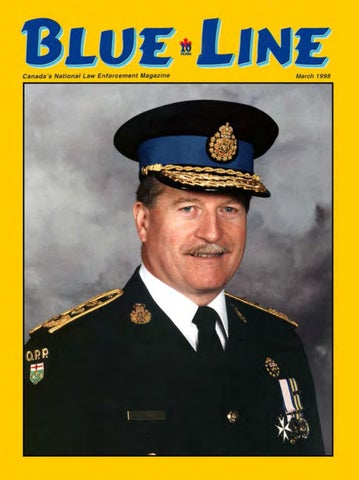
OPP Commissioner O'Grady reflects 011
42 years of police work
Prohibited ammunition in Canada
14
Identifying this sl!Iff is not that easy
16
Megatario
The next wave ... may be private policing
18
Techllology Toronto Police Information System does all the paperwork Just make it go away Getting away with murder
26 28
Biker gangs control as much as half of the organized crime in Canada and their grip is tightning. Book Review
27
Product News
30
The Clipboard
31
Classified
32
Tell-Sevell News
33
Criminally FUllny
38
List of Advertisers 5 Barrday Inc. 13 CAPS Inc. 30 Carswell Publishing 7 Dalhousie University 23 Executive Security Services International 15 Huisson Aviation 15 Laser Labs 24 Matte Industries 37 Nishnawbe-Aski Police Service 17 Northern Plains Leather 17 Ontario Drive & Gear 35 Pads Fitness Supplies 20.21 Panasonic 23,25,27 Pro Carry Systems 19 Pumpuii Energy Products II R. icholls Distributors 40 Rocky Shoes & Boots 27 Special Electronics & Design 16 Tetragon Tasse 30 Tsewultun Police Services Board 32 Wolverine Supplies
0
"I can sure tell you guys that when I saw that article in your magazine about how we were doing something wrong it got me upset. But then I started to look into it and found out you were right and changes were needed. We have made those changes and we are very proud of what we have accomplished. But you guys sure got us moving on it." Those were the words of Commissioner Tom O'Grady when interviewed for this issue by Blue Line's News Editor, Blair McQuillan. When asked about his impressions of the retiring Commissioner of the Ontario Provincial Police, Blair stated that he was surprised at O'Grady's forthright manner. His answers to questions were not only forthright and honest but most of all s1I1cere. You can read more ab ut Tom O'Grady on page 12 of this edition. There is always more than one way to catch a crook and sometimes the crook can actually catch himself with what he leaves behind. If you have ever had occasion to see a crime scene fingerprinted you may have been curious to know more about how this science came to be. Well your curiosity will be satisfied on page 6 in this issue. This article was first researched and written by the Publisher in 1988 and after ten years we felt it was worth revisiting. You may be surprised at how far the technology has come and will have no doubt about how highly specialized this science has become. Does your curiosity about fingerprinting go so far as to understand some of the technical aspects? Turn to page 8 and find out the chemicals and techniques used along with information on what materials prints can be lifted from. Who knows. Your simple curiosity in this subject could even lead to a redirection of your career. You will alsc find a variety of articles of interest in this edition including another contribution on our on-going efforts to keep you informed on the workings of biker-gangs. We have now engaged the support of one of Canada's top biker experts for future material. Why? Because putting information within the reach of our readers is our only business.
1 - - - - - - - - - - - - BLUE LINE b:i March, 1998 __________________---1_ 3 1-_ _ _ _ _ _ _ _ _ _ _ _ _ _ _ _ _ _ _ _ Magazine
III r... YEARS
COMMENTARY
Loyalty to truth duty and honour by Dal'itl Boothby, hieJ of Police To ronto Police ervice !;;;:::.ii.~IIiii::-" DUring the past few years
the topic of loyalty continues to surfacc. I have heard many refercnccs to " loyalty" and how it relates to an individua l or partner. What concerns me is that some members believe that _ ....~.&o..--''"'-... It stops there. Lo)alty in a police . citing must inc lude th' "Oath of Office " \\e to k \"hen we became pollee otlicers. Included In that Oath are the c( ncepts of truth, dut) and h nour traits that I believe, re the essence of loya lty. Onl members \\ho carry out their various roles in thL manner, and encourage others to do so, an trul be I yal to each other. ou arc right to e"l.tend upport, understanding or sympathy to a fell \ member in
need, but I am asking you not to do so blindly. Unc nditional loyalty can be misplaced and contradict the high ideal of policing that we strive for. By virtue of our office, all member must share in the respon ibility of working within those ideal . I am mo t concerned when I hear criticism directed at those, who, in their duties, find themselves inve tigating other members. It is not an easy task when called on to question a fellow member and I do not know anyone who takes pleasure in doing so. Ho\."ever, policing our 'elves with integrity is an e sential part of instilling public trust and confidence and every member of the police service has an obligati n to protect the integrity of policing. Member who inve tigate internal matters have my fu ll support and the upport of my ommand Officers. More importantly, they deserve your under tanding and support. The
reason i sImple - it reaffirms loyalty to our \."orn dut . I believe there are consequences for everything we do, and if members conduct themselves inappropriately, they do 0 at the risk of losing re pect from their peer. But, we as a Police ervice mu t never jeopardize the support and loyalty of the citizen we are sworn to serve and protect. I am aying to you that without doubt, loyalty create strength and strength allows us to move forward together. Il owever, this only \\orks when loyalty to our Oath of Office takes precedence. We will ucceed by encouraging member to be loyal to those who are al 0 loyal to their oath of office. Tho e \."ho embrace this concept are future leaders of policing regardle of rank and will help ensure that policing maintains the highest level of respect in our ociety.
Editor's Comment
l am writing you today to point out what I feel is tactically irreponsible adverti ing in your ma 'aline. (sec page of January 199 Issue.) Blue Line is a magazine that I look for\\ard to reading for Its up to date information on 'ase Law and P lice Tactic, 0 \"hen I sa\ the recent ad ertisement for Pacific Body nnour I was very dIsappointed. In t\\O of the ph t 's it hows offi ers holding pIstols up to theIr fa e but what is worse, in the top photo the offi er has hi finger on the trigger l While this ma . seem trivial to ome, as a lormer t,lelles Instruct r I feel it is important to proJect proper tactIcs at all times. I realize this is onl an ad and you are not respon ible for the taklllg of the photographs but as the -ditor' Publl~her y u arc uillmately respon ible for ever)thlllg that goes Into your magazine. D Oli
picer ol'a cotia
/I ali/ax,
lour comments have been passed along to Pacific Body Armour. Thanks Jar the input. Although the models may be depicted incorrectly I do not know if I 1V0uld go so Jar as to lahel Pacific Body Armour irresponsible. They are in the very responsible business ofsupplying hullet resistent body armour and they do that part very well indeed. Any picture in a magazine is simply aJreezeji-ame ofa moment in time. It is hoped that individuals would not accept this medium as the basis Jor a well Jounded procedure any more than they would not wear a hat because television cops don L Did I just blow away my own argument? In any event we have taken serious note ofyour comments and the Jolks a/ Pacific say they will be changing the illustrations.
ongratulation on your tenth year of publi hing. I am proud to ay that I wa one of your fir t ub cribers and I have kept every copy in binders on my library shelf. I can not begin to count the number of times I have referred to the e volume over the year. The contribution that Blue Line ha made to anadian law enforcement is immeasurable. I remember how it use to be before you came along. You ure have made a di fTerence. Keep it up. Bill Spellce Mississauga, Olltario
8LU£ L'N£- - - - - - - - - - ---\r;? ~ M 9 zin V r - - - - - - - - - - - - - - - - - - - Marcil, 1998:ws
PUBLISHER'S COMMENTARY
Road rage? Blame poor road enforcement! by Morley Lymbumer Local media have picked up a ne~traffic enforcement strategies. buzzword from the police. Its called~_ -- ~'~ The city of Toronto is the home "Road Rage" . All of a sudden there is a of - or Mecca to - over 4 \ r;;iJ million people. It covers an nurry of news stories reporting such i n - , cidents and television commentators I 1 _ area of 630 square km and kills .~!:. around 90 of its citizens each are scrambling to find experts on the subject. Well I might as well be an 'P---~...cd.. year. But the real picture does . not become clear until we expert too. If police services are talking to thei!: local media about .. ~. \ ':;:, talk ~b?ut th~ 25,000 citi"Road Rage they had better· . -;- ~ '. .' _p :. zens Injured In 75,000 col?~' .J . ~ ." lisions each year. And now think again ... there is no other ' .' ri' K --.: ~ 1.\.~::'1l we are talking only about tactful way to putthis other than to the hits ... not the near misses that bring on the say it is the fault of the police service if it true road rage. exists in large amounts. If the motoring public is getting upset to While all this is happening someone, somewhere in the deep recesses of Toronto Police the poinl of violence with other motorists it must be due to a high incidence of driving vioheadquarters, gets the brilliant idea that traffic enforcement should be fragmented into 17 lations. There simply is no other explanation. And this renects badly on the police service smaller pieces. That somehow the citizens can with regard to good old fashioned enforcement. be better served if the traffic cop is turned into We are living in an age when everyone a non-threatening, smiling icon who would expects to see, and some police agencies ennever stoop so low as to write a ticket. courage, "cuddly cops." There is the idea out Community-based policing is doing for the community what is necessary to make life safe there that good "community policing" means cops don't do bad things like enforce laws and comfortable for its citizens. For different against citizens. The result is that few citizens communities it means different things. A good see motorists being stopped for violations that police force must be aware of the needs of the are becoming far to common. community to ensure this level of comfort and The Toronto Police Service is a case in safety is maintained. In some communities it point. I will not be delicate about this. They might be a reduction in fights in front of bars . In others it would be a reduction in drug trafare completely wrong about their approach to
r!
fickers or hookers on the street comer. Regardless of what it means it is the duty of the police to identify the needs - and then do something about it. At times, as police officers, it is necessary to sacrifice your own popularity to ensure the greater good of the community. This may mean a hard-nosed attitude, for instance, toward those not wearing seat belts if the injury picture gets too high or knocking off speeders in school zones as low as 10 km over the limit if required. Yes we know that most of them could be good guys, but unfortunately in "accidents" it's good guys who kill good guys. And every cop knows that no one dies with dignity in a traffic coli ision. Road rage! I understand road rage. It is caused by too many people seeing too many other people breaking the rules of the road and getting away with it. And this is caused by a lack of officers who understand the basic concepts of traffic enforcement. Proper enforcement strategies include such things as firmness and consistency accompanied by planning and innovation. All this must be performed with continuity in both time and space. Instead of advising the public that road rage will not be tolerated it would be far better to say that the things that cause road rage will not be tolerated.
Your Commellts are expected.
WORLD CLASS PROTECTION AND COMFORT The toughest protection standards (we meet them). A complete armour line (we pioneered them). Unlimited accessory and custom options (we offer them). As important as these features are, protective apparel in the real world demands one other critical component ... comfort. That's why at Barrday, our engineers and designers place a special emphasis on material selection and fabric weaves so that our products meet your most demanding standards of protection and durability and are comfortable to wear. Day in and day out. Real world comfort that makes Barrday a world class body armour supplier to national and international police and peace keeping forces.
TOP: Barrday Advanced Tactical Armoured Vests (A TAV) offer maximum flexibility and protection for police and military tactical applications. LEFT: Barrday offers a variety of external carriers for soft body armour including our functional and popular CLEAN FRONT carrier.
Barrdal_ _ ADVANCED TEXTILE SOLUTIONS Barrday, Inc., P.O. Box 790, 75 Moorefield Street, Cambridge, ON, Canada 1 R 5W6 Tel : 519-621 -3620 Fax: 519-621-4123
Fingerprinting in Canada
hy 1/orl£'y I.J'mburner Oil J)e('('mber 2611t, 1987, ill
ew Or/e-
1111\ , ",ltile [lflrl. ed (II (I lal. e fro lll, fl 2J-year-
oldll'Ollltlll II'(I.~ ,ltol (II/(I kil/e(l (Illrillg all (11tl'mpled robbery lIml rupe. Jler bo}irielld was \ criom~1" injllred. Two fillKcrprillls were lifted of/ lite b(fd willdow of tlte I'eltiele in w/~icIt Iltel' I/lld bel'li . ·illillg. Tlt ey were entered 11110 Ilu; police cleplfrtmelll'\ alllomaled fingerprilll illelltificalioll 'yMem ( FI '). Tlt e .\J'\lem , del'eloped by PrinlNlI. IIIC., ,earchell the file of0111' million p rints (tml selecled eigltt clImlidllles. Tlte fillgerprinl examiller Ilt ell compared Ilt o~e c(flldidllies wilh lite 11111.11011'11 p rilll\ (tlltl m llde a posilil'e idelllificatioll. Tlte tolal p roceu look millllies. Tlt e ell' Or/eam Police arre.\led lite suspect amI c1U1 rged ltim willt .\ el'ellmllrders, eigltl rapes amI m ore Iltall Iwenly armed robberies tltal occllrre(l ol'er a period of Iltree mOllllts. Ihe technology that captured this man O\ves a lot to hlstoT) and the dogged detenninallon 01" a detllcated breed of people. Who these people arc and vvhat . clence they. ullli~e to the oenetit of S lety \vill be e"plall1ed 111 this article.
PC T R W RD FO T R ThIS year marks the 7th anniver.s~T) of tingerpnntll1g 111 anada. The recognItIon of the e. pertlse of the late R M~ Insp. Edward I oster, as the founder of anadlan fingerpnntin " IS ,111 Important part of this anniver ary. \tran 'ely enough Foster' fir t case, where he gave eVIdence, was n t in anada but in hlca '0 111 1911 . ome five year later he e taolished the anadl3n entral Bureau in ttaw a t()r the Idenllfi at ion of riminals. This case surrounded a man by the name of Thomas Jennings \vho \vas charged with murder. With the exceptIon oftingerprint ,the case agaillst him was quite sllln. There was littic doubt that if the fingerprints were not ad-
missib lc, the ca 'e \vas lost. The Chicago Police dec ided that they reqUI red some of the vvorld' greatest expert. to prove their case. Among others called they 111cluded Inspector Fo ter. The In pector pre en ted the ca e in favour orthe scientific reliability of fingerprint. Under cro s examination the defence lawyer attempted to discredit the evidence. lIe began by asking the Inspector if the local ident officer could raise fingerprints from the rough urface of the de k he had his hand on. lIe advised the ourt that he could not. Flu hed by tIll ucces h then a ked if print could be raised !Tom a piece of paper. lIe was ad\0 i. cd that they cou ld. On a challenge from the defence attorney the Inspector produced the powder and du ted the piece of paper. The prints of the lawyer were produced. The JUT) app ared quite impressed. . 0 Impre ed that the defence attorney pilled \\oater over the paper to de tro the demonstration . It was to no effect. The judge ruled the fingerprint admissible. The accu ed was found guilty and hung on December 22nd, 1911 .
THE EAR LY HI TO RY Fingerprint have been u ed sporadically throughout civilization' history to eal c.ontract. The earlie t known u e of fingerprint can be traced to a umerian cuneiform cylinder outlining a trade contract about 2000 B.C. One of the earlie t known European publication of fingerprint ob ervation wa offered in 16 4 by Dr. Nehemiah rew of England. Dr. Irew made an inten e tudy of the kll1 and minutely described the pore and ridges. Tvvo years later, in 16 6, another scientific paper appeared under the name of Marcello Malpighi of Italy. The re earch work of this man was of such out tanding importance that one of the layers of human kin now bear hi name. In the year of 1788, a German doctor by the name of Mayer was the fir t to make the statement that fingerprint are not duplicated by nature. The next major step was made by a erman University tudent by the name of hangelist Purkinje who classified nine major group of fingerprint . THE R OAD TO JUDiCiAL OTICE It was not until I 5 that Sir William Iler chel, an assistant employed by the Old East India Company of Bengal, used the fingerprint impression to eal a r?ad sU:faci.ng contract with a " Ilindoo" man 111 the II1tenor of Bengal. The ignature of the man appeared to be 0 contrived that he decided to have the contract signed with both their palm prints. lIe reported this to the Royal ociety and ir Francis Galton. ir Franci Galton wa a big supporter of Ilerschel's theory that a person's fingerprint do not change their pattern through out a lifetime. They proved this using their own prints over a period of ome 31 years. Another col-
lection wa started to prove a theory of peri tency betvveen the year 185 and 1913. During this time the theory was well accepted by the public but not by the judiciary. The efforts ofller chel provided the foundation upon which Francis Galton ba ed ~is inve tigations around 18 O. He began to build a cIa ificati n ystem which he wrote about in his book "Fingerprints" published in I 93 . Thi book was read with great interest by ir Edv"ard Ilenry, Inspector-General of the lower provinces oflndla. He found ome flaws in the categorilation of fingerprints as written and set about to refine the system with great efficiency. The "Ilenry" system was then immortalized and i universally accepted.
BER TILLO VS. FI GER PRi T. Fingerprints had a real problem. They had to compete with the "Berti lIon" system that had been in u e and m re readily accepted by police forces vvorld wide ince 1879. This y tem vvas based on anthropometric measurements of the adult body. An arre ted person vvas measured in certain areas and certain note taken and placed on a file card. The sy tem required the mea uring oft~e head, the bodies height, the length of the mIddle finger of the lell hand and lell foot, and the elbow t elbow measurement of cro ed arms. The system had many drawbacks. Many cards were misfiled, mea urements taken in a shoddy manner, and the differences that would occur as people grew older. Another factor pelled the doom of Bertillon' system. There vvere many ca es of convictions bell1g made and innocent persons spending many year in jail only to have the guilty per on come forth after everal years. Invariably they found the measurements to be quite close. . . . The Bertillon method ofldentlficatlOn was only useful in case where the court wi.shed t.o prove a previous record. It had no realll1vesllgative value as did fingerprints. In 189 ~he anadian Parliament passed the Identification of riminal Act that provided that all persons charged with an indIctable offence be subjected to the Bertillon method . The y tem ne.er got off the ground because there were ample rumours that the system wa~ fast being outdIstanced by the fingerprint system. In 190 the Id act was replaced and the fingerprint system and photograph was instituted.
BLU£L'N£-------------~~f------------Mare~ 1~8~ M 9 z ine - - - - - - - - - - - - - - - - - - - - U
THE CANADIAN EXPERIE CE In the year 190 I, fingerprints were first introduced in Scotland Yard. In 1904 cotland Yard sent John Ferrier to the St.Louis World's Fair to guard the Crown Jewels. While there he interested onstable Edward Foster, of the Canadian Dominion Police, in the cience of fingerprints. There are probably two other people who bear ome influence on this part of Canadian history. One was Mrs. M.E. Iioliand, wife of the ed itor of the publication "The Detective"; the other was the Commissioner of Police for Canada, ir Percy Sherwood. Mrs. Holland, a detective in her own right, was attending the t.Louis convention of the I.A.C.P. with her husband. he too became fa cinated with fingerprinting at the same time, whi le he and Ferrier were stationed at the Fair, and in fact arranged a meeting for Foster with the EngIi h policeman. onstable Foster's experience convinced him that a similar organization in Canada wou ld do much to encourage national interest and cooperation in fingerprinting. It would also help to bond all police forces together with a common technology. lie discussed this subject with ir Percy herwood and found in him a source of knowledge and encouragement. THE TORONTO POLICE CONNECTION ir Percy belicved that the Deputy Chief onstab le of Toronto, Mr. tark, would be an ideal man to interest in the project and subsequently told Fo ter that he had received an enthusia tic re ponse from the Toronto officer. An organizational meeting of the newly proposed group was held on eptember 6th, 1905, at Toronto and one year later came the first positive action toward the founding of a national fingerprint bureau for Canada. Opposition which stall ed Foster's plans wou ld have discouraged a less dedicated man, but he was in truth a "man with a mission". With the support of his Chief, the project was kept before the government. On July 21 st, 1908, an Order in Counci l was passed sanctioning the u e of the fingerprint system and making the provi ion of the Identification of Criminals Act applicable to it. The fir t Toronto Police Identification Bureau wa formed in 1867, at which time records were kept by name and physical description only. In 1894 the records were augmented by
.....
to perfect a system, but by 1971 the Metropolitan Toronto Police Identification Bureau had its system in full operation. Their method of searching was the subject of study by other identification bureaus within Canada, the United States, cotland Yard, and New Zealand. The e search principles were adopted in whole or in part by many and the modern computer technology owes much to the labour of this branch. The identification of a fingerprint, regardless of new and modem technology, still depend on the personal viewing of the fingerprint by someone who has received extensive training and experience in this specialized work. Technology has made great strides in eliminating the tedious ta k of earching and classifying of fingerprints. The experts today can spend more valuable time in searching and screening through larger and larger numbers of print in search for the true cu lprits. The R. .M.P. were the flfst in Canada to obtain this technology and the Metropolitan Toronto Police Force took delivery of an identical system late in 1988. Both systems will be connected this year and the Toronto based unit can be linked to other forces in Southern Ontario who purchase work station compatible with their new system. Many thou ands of positive identifications have been made with this new technology as ident officers scan their old case files. It is hard to believe that it all started in the mid nineteenth century with a British company executive's distrust of a local contractor' ignature.
the introduction of the criminal photograph. Sergeant Duncan, a self taught fingerprint expert, started the Toronto collection in 1906 with the accumulation of88 set. In 1911 the Toronto Force handed over their entire collection to the Dominion Police (later to become the RCMP). The first conviction in an ada, solely on fingerprint evidence wa recorded on April 25th, 1932. The testimony was given by Mr. O.E. Borland who later became the ChiefJdentification Officer within the Toronto Police Department from 1943 to 1960. THE COMPUTER AGE The age of "computers" started a study in 1965 to devise a system to search fingerprints utilizing the speed of the new equipment. Many agencies throughout the world had attempted
Dalhousie University Certificate in Police Leadership 'Tve found the courses offered at Henson College to be velY applicable to the new problem-solving function in policing. They provide the "big-picture" by encouraging you to gather information from your own workplace, not just from textbook examples. Henson's correspondence courses offer great flexibility, much more so tllan some courses I've taken atotller universities. TUlle constraints at work can often mean conflicts with schedules, but Witll tllese courses you create your own schedule. I'm currently taking my sixth course with the College I highly recommend them! " Cpt. Alex Mills
Royal Canadian Mounted Police Willdsol; Ontario
HENSON W.I . . . . . .
learning Solutions for a Changing World
0
•
Police Leadership and Management Development
•
Communication Skills for Police Personnel
•
Community-Based Policing
•
Problem-Oriented PoliCing
•
Legal issues in PoliCing
•
Policing and the Law of Human Rights
•
Budgeting and Financial \1anagement for Police Services
How to contact us for more information: Send e-mail toCPL@Dal.Ca
if Call Cara Lynn Garvock, Program Manager, at (902) 494-6930 if Call our "Information By Fax" line: Toll free 1-800-932-033 ; or 481-2408 within the Metro Halifax area. Document #0211
/ - - - - - - - - - - - - BLUE LINE "ftJ March, 1998 _________________--\_ 7 /-___________________ Magazine YEARS
The latent fingerprint Afrontline officer'S primer of crime scene fingerprint lore by ir hie Finger Pri"t Laboratorie
as protein ,carbohydrate and cholesterol. In a general ense, latent print may Inorganics Organics ucce sfully developing a latent print be th ught of a. those prints lell at the require choo ingan agentthat reacts with crime scene. , u h prinl~ mayor may not ,..--------+--------l some combination of these components, be visible. Vi ible latent are those h wchlondes, m lallons, ami10 acids, urea. IacUc but not with the surface on which the print Eccrine ammonia, sulfates and acid, choline, "rIC aClo ing recognizable ridge detail made by finphosphatos creatin ne ard sugar< exists. Ilowever, ju t which components gers c ntaminated with ub tance uch as 1---------t-------+---------1 exist in a fingerprint and in what concentration are subject to change. Factors such blood, 1l1k., grea e r dirt, and \vhich naturail} display a c ntra t \\ith their back.Sebaceous as age, exp ure to the environment and ground; r re m de \\hen fingerprint are the urface on which they re ide have propressed into pia. tl (deformable) urfa e' found effects. Water and alcohol are of such as putty, t, r" dheslve-coated urfaces, Apocrine i()(Os like sodium. prololns, cal:JOhyarates the first components lost from a print. potass urn and Iron and cho,esterol wa\ and chee e. Truly latent ("hidden") Thu ,agent that react primarily with prll1ts arc not visible to the naked eye, and water will become less effective with the substllfltially consist of nly the natural ecretions For the mo t part, three type of gland are passage oftime, whereas agents that rely on reacof human sk.in . u h print require treatment to responsible: the eccrine gland, the ebaceous tions with fatty con tituents may be more succes cause them t bec me visible. This treatment i glands and the apocrine gland. ful. Of course, the urface on which the print is called "latent print development." The eccrine glands ecrete largely water with placed may act to ab orb or diffuse the fatty comboth inorganic and organic contaminants. Inorponents, leaving no di cemible ridge detail. [ eve I ping the latent require the technician to utilize some chemical or physical proces ganic components of this type of weat include It may be neces ary for the latent technician chloride, metal ion, ammonia, ulfates, and phosto attempt a number of developers in equence. \\here the rca tion with the skin ecretion will phates. Organic components include metabolic byIlowever, many development reaction are deause the latent to . tand out against its back.ground. products uch as anlino acid, urea, lactic acid, tructi e in that they change the chemical nature hosing the right development tool is a choline, uric a id, creatinine and ugars. of the fingerprint constituent with which they major componcnt of the Job of the latent techniebaceou glands are secretors of fatty or react. When thi de truction occur, the chemiclan. To begll1 to understand how to chao e the grea y ub tances. The e include organic comcal is no longer available within the print to be n 'ht tool, it is neces ary to have ome underpounds uch as fatty acids and glycerides, as well detected. It is essential that the technician lInderstandll1g of the chemical mak.eup of the fingeras alcohols and hydrocarbons. tand the accepted equence of u e of developprint. Apocrine glands ecrete cytoplasm and nument product. Most natural fingerprint con i t of se reclear materials, including inorganic compounds lions of the skin's glands. uch as ionic iron, and organic compounds such
Overview of chemical tools and methods of teclmician. Lift developed prints by photography or conventional method .
FLUORESCENT POWDERS Powder made of nuore cent materia ls offer Ole advantages to the limitations of conventional powders. Apply as with conventional powders. Lift can be made photographically or by conventional mean . Fluorescent powders are e pecially u eful on confu ed background. An ultraviolet or foren ic light ource is required. IODINE
POWDERS Po\\ders adhere to both water and fatty depoSits TIlese arc generally u eful on ne\\er prints onl. h )Qse a po\\d'r t c ntrast with the back'round. They arc useful on any dry, relatively sm()Qth, non-adheSive urfa es. U e afler laser flllores en e. May be u. ed before ninhydrin and aflcr yan a rylate. Results may vary with kill
Iodine fume react with oi I and fatty depo it to produce a temporary yellowbrown reaction product. Iodine is u eful on fre h prints on porous and non-porou , non-metallic surfaces. Developed prints must be fixed or photographed immediately becau e reaction will rapidly fade. Use iodine before ninhydrin and il er nitrate. DFO DFO, I, Diazafluoren-9-one, is a nuore cing ninhydrin analog found to develop up to two and a half more print than ninhydrin it elf. It is u eful on porous surface, especially paper. Development may be accelerated
through the application of controlled heat. Use it before ninhydrin. DFO also is u eful to develop 'Weak blood tain . It require a pecialized U light source. NINHYDRIN inhydrin react with amino acid to produce a purple reaction product ca lled "Rhuemann Purp le". It is u eful on porous surface -e peciall paper. De elopment time i up to 10 days, but may be accelerated through the application of heat and humidity. U e ninhydrin aller iodine and before ilver nitrate. inhydrin is not useful on item which have been expo ed to water. SILVER NITRATE ilver nitrate reacts with the chloride in skin secretion to form ilver chloride, a material which turns gray when exposed to light. Developed prints must be photographed immediately because the reaction will eventua lly (and permanentl ) fill the background. It is u eful on paper, cardboard, pia tic and un ami hed, light-colored woods. Use it after ninhydrin and iodine. It i not useful on item which have been expo ed to water. PHYSICAL DEVEWPER Physical developer i another ilver-based developer which reacts to form a dark gray re-
;a
BLU£ L'N£- - - - - - - - - - ----1rB! M 9 zin e V I - - - - - - - - - - - - - - - - -- - - M arch, 1998 YWS
action product. It is usefu l on paper, cardboard and unvarnished, light-colored woods. Use phy ical developer after ninhydrin and iodine. It is very ucce sful on items exposed to water. SMALL PARTICLE REAGENT ma ll particle reagent is a suspension of fine molybdenum disulfide particles. It adheres to the fatty components of skin secretions to form a gray deposit. Developed prints must be photographed immediately because the reaction product i very fragi le. Developed prints may be carefu ll y lifted using conventiona l methods. ma ll particle reagent is useful on re lative ly smooth, non-porous surfaces, including wet one. It may be used in place of, or afler physical deve loper. CYANOACRYLATE (GLUE FUMING) yanoacry late fumes react (polymerize) with water and other possible fingerprint con-
colored or transparent tapes, including duct tape, masi-.ing tape, plastic surgical tape, foam tape, clear and reinforced packing tapes and label . Thi process involves wetting tape. FLUOROCHROMES Prints may be treated with special dye called fluorochromes which easily are made to fluore ce and bond with the print deposits. They are useful with inexpensive forensic lights. DFO is a fluorescing ninhydrin analog found to develop up to two and a half times more prints than ninhydrin itsel r. It is usefu l on porou urfaces. Development may be accelerated through the application of controlled heat. A specialized light source such as Sirchie's BLU "MAXX is required. Basic yellow, ardrox and rhodamine are dye especia lly useful in conjunction wi th cyanoacrylate. They require an ultraviolet light source.
A Quick Guide To Surfaces
[I 1
4
5
8
1. SMOOTH, NON-POROUS: Th is category includes g lass, hard plastic mou lding (bare meta ls are not included) and urfaces treated with paint or varnish. Powders, iodine, small partic le reagent and cyanoacrylate / fluore cent dyes may be used on the e surfaces. 2. ROUGH, NON-POROUS Rough or textured surfaces and grained plastic mou ldings are included in this category. Powder are u ually unsuitab le on these surface . Use sma ll particle reagent or cyanoacry late / fl uorescent dyes. 3. PAPER AND CARDBOARD These surfaces include paper and cardboard (inc luding plaster board) that have not been waxed or pia tic-coated. Treat with iodine, ninhydrin, DFO, silver nitrate or physical deve loper. Il owever, powders are generally insensitive to o lder fingerprints. 4 . PLASTIC PACKAGlNG MATERIAL Thi category inc ludes polyethylene, polypropy lene, cell ulose acetate and laminated
..I "-
stituents to form a hard, whitish deposit. It is useful on mo t non-porous and some porous surfaces. Cyanoacrylate produces excellent results on styrofoam and plastic bags. Developed prints may be dusted with powders or treated with fluorescing dyes, such as ardrox and basic yellow to enhance. AMIDOBLACK Amido black reacts with the proteins found in blood to form a black reaction product. Amido black is useful only on blood-contaminated prints. It is highly sen itive. It is useful on non-porous and some slightly porous surfaces. It sometimes offers successful deve lopment of blood prints on dead human skin. ADHESIVE SIDE POWDER Adhesive side powder attaches itself to plastic print impressions on the adhesive side of tapes. It produces excellent results on light-
paper surfaces. Use iodine, small particle reagent, cyanoacrylatelfluorescent dyes and powders. Cyanoacrylate is especially useful on styrofoam. 5. SOFT VINYL (PVC), RUBBER AND LEATHER These surfaces include simulated leather and cling film. Use iodine, small particle reagent, cyanoacrylate and powders. 6. METAL (UNTREATED) These surfaces include untreated, bare metal surfaces, not metal surfaces that have been painted or lacquered. Use small particle reagent, powder, cyanoacrylatelfluorescent dyes and powders. 7. UNFlNISHED WOOD This category includes unfinished wood surfaces, that have not been painted or treated. Treat with ninhydrin. Use powders on smooth wood and silver nitrate or physical developer on light woods. 8. WAX AND WAXED SURFACES This category includes items made of wax
I]
(such as candles) and wax-coated paper, cardboard and wood surfaces. Treat with nonmetallic powders and cyanoacrylatel fluorescent dyes. 9 . ADHESIVE-COATE D SURFACES (NOT PICTURED) Thi category includes tapes and similar surfaces that are not likely to dissolve in water. Use adhesive side powders. John Carrington has been the President and CEO of Sirchie Fingerprint Labs for over40 years. The orth Carolina based Laboratories is thc largest suppl ier of forensic crimc scene and fingerprint recording products. For over 50 years this company has prided itself at setting the standard for high-quality product. For further information or a complete product catalogue you may call Mark Leath at 800 356-73 II Ext. 246 or Fax 800 899-8181 . -mail sirchie@ nando.net
\01/ - - - - - - - - - - - - BLU£ LIN£
9 _ _ _ _ _ _ _ _ _ _ _ _ _ _ _ _ _ _ _ _ _ Magazine ~ M arcil, 1998 _________________---\01-
Igniting Artistic Fires by D(II'e I/flrt Th e Police rtisls SSOciflliol1 otewuu/fl
On Remembran e Day 1997, I attended a school in Marl·,ham Ontario and did an" rtist in Sch 01" project. ur missIon was to sketch a stuffed brush wolf in as many different angles and positions as \\e could. Thc students were aware that the artIst teaching that day wa an employce or the Y rk Regional Police. Displayed tn the room \'vere a large number of police related painting and Limited I dltlon polIce prints by myself and other members oCThe Poli e rti t ssociation of anada. The students wanted to know \\hy I had done so many p lice related paintings. I e:o..plained that aller ome 30 years as an artist, the police related art had dra""n more attentIon to my talents than any other subjects I hnd painted. I al. 0 explained that many or the police related Limited Editions have been used for fund-raising purposes such as: canine dog for the outh ' Imcoe Police, Baby lmma fund, Mount ~1I1t1l Ilospltal, anadian ancer ociety, I aster Seals and more. Paintings and Limited I dttlons \\ere also created for spccific units in vnrtous police departments such as: Metro Toronto, Ilamiiton Went\\orth, London and York Regional Police Forces. A painting is currently being created for the Windsor Police as a feature of the 199 Ontario hie~ of PolIce ' on ferencc. The students con firmed through dISCUSSIon that art can be more than art \\hen \\e apply ourselves to such projects, and that using prints to as i. t a a fund-raising tool for charity \';as a great idea. 0\\ the students \\ere keen to draw and learn. The} \\anted to know how the} cou ld perfect their abilities. My advice wa similar to \,;hat one of my teachers, world renowned \\t1dltl"c artIst Glen Loates, use to say to me: "When you want to perfect your ability, you have to make 50,000 mIstakes, so get started!" ma/lngl}, in one da}, these youngsters identified that if they could learn to draw well, they could learn to patnt \\ell too. ome expressed an interest 111 Icarnlllg about reproducing their \\orks and uSll1g the reproductions for mething useful in the ommunity. The artistic fire \\ere ignIted! The. e children produced s me heautlful rendering. of the wolf. The letter sent to our (hlcf~ Peter .. COll, from Principal Ted BrO:ldstock of James Robinson chool, explall1ed that the students expressed how they \\ere motivated and inspired to do something great \\Ith theIr art. The students included their vi iting arti t in thell Rememhrance Day As embly. I presented to the school, on behalf of The Police rtists SSOCI:ltlon, a number of Police related 1.IInited I dltion prints as \\ell as an original pen dra\\ 111 ' or a World War II R. .A.F. Officer. rhere IS a magIc that takes place when an artIst of an} age "turns on." Ilaving a ensc of purpose for your \\ork is the key to " Igniting the rtlstic FIres".
This is just one of the really positive aspects that The Police Artists As ociation has to offer. You can be part of a bigger picture once your talent is applied to community causes. Il aving sat on the Board of Directors of Toronto and Regional Crime toppers for a few year I cou ld see occasions where art prints could be used as a thank you gesture for donations to the program or simply as a promotional tool for the program. We actually u ed art prints as part of a Crime Stoppers "talking vending machine project." The machines gave a Crime topper tip and their telephone number every time a person put their money in the machine. ome Crime Stoppers capsules said" ee the cash ier as you have won a Limited Edition print." Along the bOllom of the print the Crime toppers phone number wa printed to educate the youths with the TIP number. The machines did two of the three functions of a board member: they raised fund and they promoted the program. We couldn't find a vending machine to approve the payout to the anonymou tipsters! There is a project waiting for all of us, if we have the vision. Projects we can work on as team. It's a great example and demonstration, especially for young peop le, to see Police personnel with a cool band or creating cool art. These examples we display show young pcople you don't need to be twisted or do drugs to achieve something great. Il aving spent the last six years in a recording studio, recording and producing an album of my original songs was another example for the students that day. I showed them my D, with artwork done by my elf. The tudents reque ted to hear the D and liked it. The title of the CD is "Easy Chair for the World" and speaks for itself. I still think Police work is much more spontaneou and difficu lt than any project I have undertaken. RCMP taff gt. Ed lI ill, who recently was
featured in Blue Line Magazine (Dec, 1997) with the "Vision Quest" project wa one of the first members of The Police Artists Association of Canada and really repre ents, by his work and projects, what the original concept of the need for an Arti ts A sociation was all about. Ed ha been setting a great example for all of us to follow, and he can still use more assistance from all of us. Vi ion que t i a much needed and worthwhile project. II' you \\ould like more infonnation on this worthwhile project why not check out their Web ite at "\\ww.thevqnet.org". One of the really positive aspect of The PoliceArti t Association is that you have the resource of the other members in the Association and their achievements. In this way you can do a similar project in your community and communicate with other members for ways in which to make your project successful. It's the formula behind these type of projects that is at our disposal. The Police Artists Association has been busy over the last year. We have donated Police related art prints to many charities and our involvement ha been recognized very positively. Our main attended event over the last few years has been the Ontario hiefs of Police Conference, with a featured persona li7ed painting for the host force each year. We created a ""ork for Metropolitan Toronto Police in 1996, London Police in 1997 and have been invited to create a ""ork for the Windsor Police for the 1998 O.A. .P. onference. howing works of our artists at the O.A.C.P. Conferences has been very well accepted. These \\ork came from coast to coast across Canada and show what Police personnel do to unwind from the tress of the job or what we do for pure pleasure. There is till much progress to be made with many "anistic fires to be ignited". We require a larger membership with representatives from each province to take charge. We need to look at an agenda of events to be involved in annually. A full committee of directors from each Province should be created and a President elected or appointed. The e positions are all open and open for discussion. II' you are interested in becoming involved please contact David Ilan, Director P.A .A.C. on the Internet at paac~ roger .wave.ca or call 90S 8987471. We are currently working on a web ite which could be a great advantage for exposing your works. Finally, a look to the future. One of the projects taff gt. Ed Hill and I had discussed when the Association was formed was a travelling show of tile Association members ""orks. A show of this nature \\ould take a lot of work and organi7ing but once again we would be able to demonstrate how Police personnel can apply their talents that they have to the many walks of life.
~L~~z~~N_£_-_-_-_-_-_-_-_-_-_-_-_-_-_-_-_-_-~_-_-_-_-_-_-~_-_-_-_------',--->Gr--------------- March, 1998 g
Auto students slice, dice cop cruiser in arresting project pair and refinishing program cut the vehicle in half and pulled ofrthe body panels. Then those pieces were cut up jigsaw PULzle-like so the students could reassemble them inside the museum, where the car's front end is mounted to a wall. About 20 students and six instructors put in roughly I00 hours on the project, which was worth about $5,000 in labour. "Thi was no easy job," says Gordon mith, the BCIT collision repair instructor who oversaw the project. "It was a challenge trying to figure out how to cut it up so it could easily go back togethe r again. Our students really learned a lot from the exerci e." Fully rewired and repainted in police regalia, the car is a hit with visiting school kids who don't hesitate to set the lights nashing. ""elping build a museum display isn't something you come across often in the auto repair industry," says Smith. "But it really gave the students valuable experience - and it's nicc to "-now kid are enjoying our work."
5th Annual Major Crime Seminar
. (l) BURNABY, B.C. - It's hard to take a blowtorch to a police car and stay out oftrouble. But automotive students at the British olumbia Institute of Technology were on the right side of the law when they cut a cop cruiser
This one-day seminar will familiarize Major Crime Investigators with the roles of the Special Investigations Unit, the witness • protection program, and the Media. • - Seminar attendees will be invited to ~~ participate in panel discurssion With ~ members of these groups.
in half for a display at the Vancouver Police Centennial Museum. Auto mechanics students stripped the mechanical components out of the 1979 Chevrolet Caprice, then students in the auto collision re-
For further information and to reserve seating call Del. Greg Heasman or Del. Tom Whiteway at:
905 579-1 520 Ext. 5220
R.NICHOllS
CC/a
DISTRIBUTORS Inc.
Lead Free Clean-Fire Ammunition If airborne lead is a concern at your Indoor range it is time to look at the CCI line of clean-fire ammunition. Affordable high quality training ammunition which contains no lead. barium, or other tOXiC metals. Now you can have the same performance as standard ammunition without the dangers associated with lead vapour ingestion
Safariland Level III Holsters afariland 070 and 0705 Holsters have set the highest standard In police holsters for years. Three levels of retention provide you with incomparable protection against unwanted firearm snatches. The thermal-molded Safari-Laminate design ensures that these holster will last for years to come. Make the move to Safariland level III Protection.
Visit our web Site at www.rnicholls.com Ontario Quebec Alta., Sask., Man. British Columbia ewfoundland Nova Scotia. PEl New Brunswick
Tel: Tel: Tel: Tel: Tel: Tel: Tel·
(905) 629-9171 (514) 442· 9215 1 (800) 561-3246 (604) 669·5170 (709) 368-0999 (902) 455·4858 (506) 832 06-5
Fax: (905) 629·9184 Fax: (514) 442-9581 Fax: (403) 973-3291 Fax: (604) 669-5179 Fax' (709) 368-0991 Fax: (902) 455·4859 Fax. (506) 832·0681
The Leaders in Law Enforcement Supplies - Since 1980 ..1:...
00/ - - - - - - - - - - - - BLU£ LIN£ ___________________ Magazine
11 ~ March, 1998 ________________----\DI-~
A pride in people and places Police COlnlnissioner TOln O'Grady reflects on 42 years of dedicated police work by Bluir McQuillulI
The Ontario Provllleial Police headquarters is a remarkable sight. AOee1I0nately called "the tar c.;hip I nterprise", the 580,000 square-foot glass, brick and steel structure, completed III ugust 1995, sits com~ mandingly atop a hill o\erlooklll ,the city of nlha. cst led at the helm IS a man \\ho loves It as dearly as ifhe had built it v"ith IllS 0\\<11 hands. "I am really as proud of this bulldlllg as the people \\ho work in it and arc managed by it," .·ays 'ommissionerThomas 0' rady as he sits in a high-back armchair in his pacious oflice. The ch(lIr, located in front of a round \\ooden co nee table \\ith seating for four, IS ofr to one side of the room. Behind the commissioner IS a large desk \\Ith a computer monitor Ilanked by a picture of 0' rady and his \\ife on one side and pictures of his two grandchildrcn on the othcr. The pictures, \\ood furnlshlll '5 and neutral colours help make the comlllissioner's guests fecI at homc. "I think our pcople arc proud of the fact that \\c ha\e a nc\, hcadquarters. It's a visible reminder or our efforts both today and in the future" ()'(,rady said the completion ofthc mammoth headquartcrs and thc subsequent move to Orillia from Toronto, IS hiS grcatest achievcmcnt as cOlllmisslOncr. Ilo\\cvcr, in a rcvealIll' glimpse of" hi .. personality, he IS reluctant to take too much credit for Its creation. " I don't take complete credit for it becausc thcre \\crc a lot of people involved," he says thou 'htfu lly as he looks out a window that faces thc dorms \"hcrc OPP recruits arc housed dUring traIII IIlg. "T\\o commissioncrs before mc \\ere mO"lIlg in this dircction. It was undel stud} and planning 10 years before I arri\cd on the scenc. I cannot claim to have begun the planning, but I \\a5 onc hundred pcr cent ochllld the mo\e out hcre." O'(irad}, \\ho IS set to retirc sometime on or oelorc the end of May, IS no tranger to thc idea oJ"pullin' up stakes and seeking ncw hori/ons. In 19<;6, at the agc of 18, the obourg, Ont , native one day \\ent fr m being a recent high school graduate to a mcmber of the eountries lapest poli e forcc. "rhe ReMP had a three man detachment III COOOUl', one corporal and two constab les," ()'(,rad} said. "One parti ular day I was just gOllw dll\\ n the street and I decided to inquirc aoout .Ioinin '. "'1 hc," must have had a difficult timc recruitin ' ;t that timc oecause \\hcn I went in to inquire the ne\t thin' I kne\\ the} werc handIIlg mc an application, I \\as iii ling it out and I \\as on my \\(IY." O'(.nld)- said he ch se a carecr in law en-
DUring the nc\.tthree year O'Grady forcement becau e he had grown up worked a a constable with the I I around police officer and felt com fortmember AJa\. force, located one able in their presence. "My father had a small eon- -IfiMll~~M4llP>kq&. hour cast of Toronto. Il owever, hiS stay with the department was cut struction company, so he would short when the OPP offered him a deal with the police on the highway po Ition. and hc knew a number of OP P 01'"In 1961 the OP P was incrcasficcrs. My brother, who was threc IIlg in size and I guess they 10 ked at year older than me, al 0 had a couple thc pcople they had alrcady proce 'sed," of fricnds who were OPP officer. hc said. "They didn't actually know \\here I "We had a mall place, about 20 acre, and was. They called my homc and my dad or mom quitc oftcn the cruiser would comc in and they'd called me and said the OPP i looking for you. spend 20 minutes or so talking with my brother " I had origlllall)- II1tended to go to the OPP and my dad. 0 I was familiar with the police." and so \",hen this came along, we looked at the Oncc he had finished hi RCMP training options and I thought '\\ell maybc th iS is a in RockcliffPark, O'Grady was postcd at "A" good idea'." Division in Ottawa. Allcr a short stay there, he It wa definitcly a good idea. On cptcmwas tran ferred to "B" Divi ion in Corner ber 20, 1961, 0' rady became a mcmber or Brook, FLD. the same force he had 0 much interaction with But O'Grady soon decidcd that the RCMP as a child. lI e spent the next II years in Fie ld didn't fit into his future plan. The force had a peratlons With detachments 111 Bradford, poli y which restricted officers from gelling tayner and Il untsvi lie. marricd during the first five years or ervice, In 1972, he \\as tran ferred to the investiand thc young officer decided hc ju t couldn't gations bran h \\here he managed cases 111wait that long. "I purchased my discharge after vol ing fraud, counterfeiting, homicide and thrcc ycars," he said. " I had mct my future wife organizcd crime. During this time hc moved in obourg." up through the rank and finished his time as a ftcr moving back to Ontario, O'Grady apChief uperintendent, and Commander of Inplicd to the provincial forcc and marricd Betty, vestigative upport Division. whom he has been with for over 39 years. DurIn Decembcr 19 7, he was promoted to ing the days that fo llowed, the fu ture commisDeputy ommissioner and by February 1988, sioner waited cagerly to find out ifhe wou ld be he attained the rank of ommissioner. hired by the OPP. But life at thc top hasn't alway bccn casy " I got replies that I had passed this stage for 0' rady. Ilc i a man \",ho carc deeply and that stage," he said. "The finalleller I got for the men and \\omcn of the provincial forcc wa that there were 100 peop le processed, but and takc any 'ct backs the} may facc directly the government had only authorized hiring 50 to heart. and clearly I \Va n't number one." Thc most major incident thc commissioner But O'Grady wasn 'tdiscouraged. lIe quickly ha endurcd came in eptember 1995 during hit the local newspapers in search ofajob. the tandoff at Ipperwash Provincial Park. " ince I needed employment I began lookThe Ipperwash tandoff began at the cnd ing at the want ads. There was a po ·ting for a ofthe Labour Day \\eekcnd \\hcn an estimatcd constable in Ajax, so I applied and wcnt there."
BLU£ L IN£----------------------~0 12 _r----------------------~~~~~~ M 9 zin _ Marcil, 1998 N T lIS
20 to 30 First Nations people moved into the park which they cla imed was on a sacred burial ground. The occupation reached its climax on ept. 6, 1995, when the protester Dudley George was shot and fatally wounded in a confrontation with OPP tactical squad officers outside the gates of the park. Act ing Sgt. Kenneth Deane was conv icted of crimina l negligence causing death in Apri l 1997. li e wa give n a two-year conditiona l sentence, which is currently under appeal. " I think the most unfortunate occurrence we had has been the Ipperwash occurrence," O'Grady said. "To me it was the most di couraging on two counts. First, because somebody died and that's something that you just don't have happen if you can avoid it. And econdly, becau e it had a tremendous impact on our relationship (between the OPP and First Nation people). The intense trauma in such incidents is shared by all of us." Despite the adversity O'Grady has faced during his policing career, there have been a number of occasions where he has enjoyed great uccess. 0 many in fact that he can't name one particular incident above the others. "The most satisfying work hat I've had as a police omcer was as a constable," he said. " I was a constab le with the RCM P, with Ajax and with the OPP for a total of 15 years. That was the most satisfying work I ever had s imp ly because you saw th e impact of your work. If you arrested someone and the court had found this indi vidua l guil ty, there was feedback right there that you had done something useful. "You also got it from the victim that you dealt with . You were there, you saw the dimcultie they had, it was your face they knew and it was you they wou ld turn to afterwards and say thanks very much. We have awards, we have medals and we have commendations th at we give people and they're all really worth whi le. But I wou ld not put it above the feedback you get from an individual that you've been ab le to help." As the 60-year-o ld officer reflects on policing in the past, he is also looking ahead to the future. O'Grady knows that there has to be another individual to take the OPP into the new millennium. Of course O'Grady more than anyone, know what qualities the new commissioner will require to enjoy a successfu l term as the force's top cop. "You want to have a lot of energy," O'Grady said. "I think it needs to be somebody who is very astute with respect to technology. They wi ll need to be somebody with a vis ion as to where things are going. "My preference wou ld be omebody with a solid police background. I think that's a tremendous advantage. It g ives a feeling of comfort to the individuals on the front line who are going to put their lives at risk to think 'the boss isn't perfect put he or she has got an under tanding of what I'm doing out here. ", O'Grady feels that he was the type of Commissioner who understands the triumph and pit fa lls that his officers face and would li ke to be remembered as such after he has left the force.
* YEARS
" I'd like to be seen as somebody that did try to support my people," he said. "You might as we ll stick a sword through my heart if you say 'you didn't give a damn. I was in trouble and nobody cared.'" The commissioner also hopes the members of the provincial force will think of him as a fair man, who could make people laugh. "I like to think I have a sense of humour," he said with a smile. "I wa talking to a group of new recruits the other day and I said I think you'll find very few veteran police officers that don't have a sense of humour." Of course O'Grady has another quality that most veteran officers need - an optimi tic out look on life and the transition that everyone has to face. "I am a believer that throughout your ca-
There are approximately 4,750 officers in the Ontario Provincial Police and they worked a total of 3,757,840 hours in 1996. The OPP have a total number of2,695 vehicles inc luding 1,759 cars. There is a lso 109 marine vehicle, and 2 helicopters. In total their land veh icles covered over 90,000,000 km. in 1996 alone. There were 433,496 charges laid by the
reer if something new comes in you grasp that and then there's something else and you grasp that. But as you age eventually your window moves and you have a more difficult time grasping those new things. That's when you should realize you're window is closing and you would be better to leave and go enjoy your retirement." As the commissioner prepares to clo e the window on his stellar 42-year career, he is looking ahead to spendi ng time with his wife, three children and two grandchildren. "I think there isn't a police officer alive that doesn't say he or she would like to spend some more time with their family or friends. One of the downsides of policing is that you have to address problems as they arise and you're not the one setting the schedule as to when they're going to arise, so you find you have to take yourself away from things of a personal nature." Of course O'Grady also know that when one window is closed, others wi ll open, but he plans to take in the view for a whi le before choosing a new one. "I have been so busy lately that I wou ldn 't mind a period of time to give some sober second thought to the things that I want to do. Right at the moment I'm keeping my options (or windows) open."
OPP in 1996 under the Criminal Code and Provincial tatutes. In 1996 the OPP launched the mobile Crime Lab. It covered over 7,000 km in on ly six months of operations. This portab le crime lab is the first of its kind in th e wor ld , providing a complete state-of-the-art lab to any crime scene accessible by road.
Ontario Provincial Police Nlission S'Ia'lenJen'l The mission of the Ontario Provincial Police is to provide a sensitive, community-oriented and accountable service that promotes an environment in Ontario in which all people will be secure in their pursuit and enjoyment of all law flll activities. To achieve this mission, in consultation \\ ith the communities we serve, we shall provide police services that: • promote public peace, well-being and security; • prevent motor vehicle collisions and promote trallic management; • promote safe and efficient movement of people and vessels on Ontario waterways; • promote the prevention and detection of crime; • respond appropriately to victims of crime and motor vehicle collisions; • ensure appropriate enlorcement of the lay\!; • provide timely and accurate information on Ollr services and actions to the people we serve; and • promote an organizational climate that values and encourages continual examination of our philosophies, strategies, plans and methods.
Q ___________________ BLUE LINE ---1-\S-r
March, 1998 ________________
Magazine
Prohibited all1l11unition In Canada Identifying this stuff is not that easy
by Bruce KojJ1er
(n ctober I, 1992, a riminal ode Regulation short-titled Prohibited Weapons order o. 10, came into effect. This Pr hibiti n Order bans rour type or ammunition : I. n cartridge that i. capable or being dischargcd from a c mm nlyavailable emi-automatlc handgun r rev Iver and that i manufllctured or as:embled \\ith a projectile that IS deSigned or manura tured or altered 0 as to b capable of penetrating b dy armour composed of aramid fibre or imilar rabric. 2. n projectile designed, manura tured or altered to ignite upon impact, where the projectde is designed f, rue in r in conjunctI n \\Ith a artridge and doe not exceed 15 mm In diameter. 1 n projectile designed, manufactured or altered to e:-.pl de on IInpa t, where the proJectile IS designed ror u e in or in conjunctlOn \\Ith a cartridge and doe not e:-.ceed 15 mm In diameter. 4. n cartridge that is capable or being discharged fr mash tgun and that c ntain prOJectiles known as "nechette " or any Similar proje tile. While the prohibiti n eem to be clear n first reading. each ection mu t be carefully re\ le\\ed f, r Its clements. which when ta\..en together. compn. can om:nce ir uch ammunit Ion IS possessed. here IS in. umclent room to do 0 in thi article. but If 'ou want to do further reading on thiS matter you rna} refer to a 41 page article \Hltten b m selr in the anadian oeiely ol Forensic, cienee Journal, Vol. 2, 0 , 1 (Harch, 1995) Severalamnestie were offered ver the pa t fe\\ years. which all \\ed person with uch ammunition to surrender for di p sal. The Federal Department or Ju. lice al 0 publi hed a pamphlet available free to the public. which ha the same \\ordmg about prohibited ammuniti n as that \\hlch is stated above. me person might stili have su h ammul1ltlOn in their po e ion becalls' the do not io.now it is banned. ther may have It lIn\..nowingly, because they cannot properly identif it. and it is mi'\ed in with other ammunition that they may legally own.
BLU£ LIN£ M 9 zin e
Ilow does the average police omcer identify prohibited ammunition? Unrortunately, it is seldom easy to do so. There are no standard marking on ammunition or ammunition box label and there are combinations or military and civilian marking in u e. This ha been the ca e almo t ince the metallic "sarety cartridge" wa introduced in the mid-I OO's. A a re ult, there are hundreds or books on technical a pect or ammunition identification. There are al 0 new letter, technical reports, computer programme, libraries full of manuracturer's advertising literature, and ammunition collector ocietie in orth America, Europe, Australia, and other countrie devoted to identifying ammunition. ince the sarety cartridge wa fir t introduced, there have been many thou ands or manufacturers of all types or ammunition. orne companies have been involved only in wartime, either being division or other metalwork or chemical companie , or e tablished in wartime ror the ole purpose or ammunition manuracture . As a result, production record ror many types or ammunition are \..etchy or non-exi tent. There is ammunition sti ll in u e today that was made over 90 years ago, and it i still hootable although not reliable. There is ammunition in collections that date as rar back as 150 years. orne or it is unique and rare or extremely valuable - ranging in price rrom everal hundred to several thousand dollars per cartridge. Many types of ammunition were experimental and i sued on a limited ba is ror testing only. Identification markings tamped on ammunition are limited by the space available on the base of the cartridge ca e (the headstamp around the primer). orne type or ammunition may also be identified by the colour code using lacquer around the primer, diagonally on the head of the cartridge, as rings around the cartridge case, or bands or coloured tips on the projectile it elr. Furthermore, the projectile and the cartridge ca e may have hole, groo es (cannelure), knurling or indent that have some specia l meaning. The cartridge ca e or bullet may have a chemical tain intentionally applied to differentiate it a a special load. And finally the box
or bandoleer In which the ammunition is packed may have special markings to de ignate the loading, either in plain nglish, in orne other language, in alpha-numeric code or in ymbol . To further complicate matters, variou countries have changed colour coding or symbols more than once in e the early 1900's. Without detailed technical manuals, you would lind it impo ible to correctly identify the cartridge. For in lance, many colour codes u ed on ammunition during the second world war were changed in the 1960's. You would thu have to know the date or the ammunition (commonly tamped on military cartridge cases) and when the colour code changes were made. British ommonwealth mall calibre ammunition most commonly u ed a letter code rather than a colour code, to identify pecialloadings. llowever, incendiary ammunition was often identified by a blue-tipped projectile. Tracers \vere frequently identified by white, red and orange bullet tip. Over the years many or the colour markings wore or, raded with age and may now be only fragmentary or even non-existent. 0 where doe this leave the constable, who e only exposure to ammunition i in handling what goes into his or her own handgun? You have the ch i e or eizing uspect ammunition on the gut reeling of whether or not it fall into one orthe pr cribed categorie . Irthe ammuniti n is part or a cache eized rrom a per on committing other crimes, you would have good reason to seize it. Alternatively, irit is a case oryou searching a vehicle or doing a home in pection (as ror an FA interview) you could ask for a sample and tum it over to the ammunition officer expert to detennine whether it i what you think it i . That expert is mo t likely a fireann expert in a rorensic lab. The e. aminer will have acces to many technical manual that can as ist in narrowing dOV"l1 the identification, but do not expect to alway get a positive identification. There is much ammunition that i imply undocumented. Going back to the rour prohibited categorie we have: I. ertain handgun ammunition with projectiles de igned and capable or penetrating aramid fibre body armour;
8-r--------------------------------------
----------------------------------------~-
14
~M. March, 1998 'ta YUU
2, Incend iary projectiles; 3. Explosive projectiles; 4. Flechettes loaded shotshells. Category I is the body armour penetrating projectile. These projectiles are in very limited supply. A few types have been recent ly sold for police and military use, specifically to defeat body armour worn by enemy soldiers and criminals. Body armour is manufactured to defeat different types of projectiles, of different calibres, trave lling at different ve locities. Each category i a threat level , and encompasses severa l different ca libres. There are common ly four level , although a few manufacturers produce armour at five or six levels. The highest level number will defeat the greatest variety of projectiles. In general, it can be said that projectiles th at will not defeat the higher or hi ghest levels, can defeat th e body arm ours rated for lower threat levels. To prove that particular handgun amm uniti on yo u have eized was designed, manufactured or altered to be capable of penetrating aramid fabric, or similar body armour materi al, somebody must be ab le to positively identify the ammun ition and link it back to a. manufacturer's design drawings b. manufacturer's test date c. product sales literature d. other published reports e. packaging labe ls, f. and sa les invoices that positively describe the type of projectile and its design for that capacity.
The ammunition may have been originally made with ordinary projectile , and somebody purchased them and altered them to make them capable of penetrating aramid fibre fab ri c used in ordinary body armour. Alteration is one of the factors in this section of the regulation. There are two easy ways of doing this. The first is by alteri ng the projectile with metal inserts and the second is to replace the projectile with one machined to fit. The result is a projecti le that wi ll pierce more than just body armour. Next month we wi ll continue on this subject. Until then remember... be careful out there.
Bruce Koffler is the resident of Securscarch. Inc. III Scarhorough. Ontario. \I is compan} specIall/cs in producing training aids for h8/ardolls device recognition. includmg c>..ploslves and ammunition. Bruce IS an F.A.C. safet} traming course mstructor. has been an Ontario IllIlHer Safcty Lducation instructor since I ()68. and was a Deput) Conservation Offiecr \\ ith the Ontario Ministry of atural Resources. He is a member of se\·eral association in Canada. the L.S. and Furope which speciali/e in the Identtlication of" ammunition, and is also a member orthe Canadian Society of ForenSIc Science. For rurther information you Illay call Bruce at 416 492-5349. You may also speak to him directly at RI·.SPONSI· ()8.
CRACK/DOWN ON WINDOW TINT
Window Tint Testers LAB TESTED FOR ACCURACY EASY TO OPERATE TENS OF THOUSANDS IN USE THIS DEVICE WILL SEND A MESSAGE TO ILLEGAL TINTERS!
# I Tint Meter
M
Shouldn't You Be Using The Same Meters Other Cops Are Using?
CO"IIF 80Q.452.2344
Q. Where can I go for straight answers on starting up an aviation unit?
A. The one company in Canada that has years of experience servicing the unique requirements of police agencies - Huisson Aviation. For over 25 years Huisson Aviation and our associated companies have operated a diverse fleet of over 47 helicopters, across Canada, the United States and Internationa lly. Our fleet is made up of all tI,e major helicopter types in service today; Bell, Eurocopter, Sikorsky, Robinson and Schweizer. Huisson Aviation has tI,e experience of operating helicopters in the law enforcement role in one of the most operationally challellgil1g areas in North America. For over 15 years Helicopter Transport Services has provided opera tional support to the Ba ltimore PD aviatiollltnit. As a result ollr persollnel',ave the operational expertise to get your aviation unit up and nmning with a minimum of lead time, in a professional manner, and on budget! At tlte present time we provide a complete range of aviation services to the police community illcludingfu lly equipped aircraft, experienced crews, flight training, maintenance, hangars / offices, and management on a contract or dedicated standing offer basis. Huisson Aviation has the in-house abilitrJ to provide your police service with the model of Jzelicopter you l1eed whether it is a single engine piston or turbine powered helicopter or a medium twill eIlgille turbine helicopter, we have them all. Let us show you how your department can have a fully equipped and operational aviation unitfor thousands of dollars less than you ever thought possible. Call today and we will have our professionals attend at your HQ, analyse your operational requiremellts and submit a detailed presentation custom designed to fit your specific demographics and operational realities.
HUISSON AVIATION For more information or to schedule a no obligation review of your requirements please contact:
Dan Melanson Director of Marketing Phone 613-839-5868 Fax 613-839-2976
I/J,.,
QI-- - - - - - - - - - BLUE LINE ---1VI_ ___________________ Magazine
~ Marcil, 1998 ________________
The next wave in policing may be private policing by Dee Krall/er Intelligarde International Inc. is more than a security finn. It i a private security force available for hire. This is not a group of watchman, concierge, or the low-profile blazer and slack guys that walk the hopping malls. Intelligarde ee themselves as the new wave of private law enforcement - as the new wave of policing. They are definitely becomIIlg a more vi ible pre ence in the equation that is pre ently dominated by the OPP and municipal police forces . Their "market" is expanding rapidly. They arc already a dominant presence in Toronto and carborough, with contracts to provide security to a number of developer and contractors, the Toronto I Iarbour ommission (a real coup of a contract), and many of the high-ri e apartment and commercial buildings that make up the centre core ofthe downtown area. They also have contracts with the Parking Authority, the Toronto Economic Development orporation, and public housing owned by the Toronto Ilou ing orporation. They have a propo al that is being considered by Metro Toronto to provide econd tier policing for the ity. But they are now expanding beyond the urban to the rural area of Ontario, and have become a player in the municipal restructuring of Ontario policing. Intelligarde sees their future market in 575 municipalities scattered around rural Ontario who e policing is up for grabs. From January I, under Bill 105, the e rural municipalities can decide whether they want to create their own police force, or be policed by the OPP or a neighboring municipal police force . Under ection 5 of the Bill,
TRAINING FOR REAL WORLD
ON TARGET WITH THE NEW FX BLUE MARKING CARTRIDGESI
U e them WIth FX Red Marking cartndges to stage more true-te-ilfe team scenarios I
On the street... in the field ... in a crisisl Prepare your personnel for the rea~life situations they are likely to encounter Developed WIth law enforcement and military professionals, the FX system is bUilt around non-lethal marking cartndges. It includes easy-te-Install conversIOn kits, safety-nng inserts and protective gear.
iii Exclusive Ontario & Western Canada Distributor . . Tetragon- Tasse 8uI£ LIN£ M
9
z in
Phone 1-S00-3SPOLICE
Fax 905-S2S -6390
Q
municipal council can al so "adopt a difTeren t method of providing police service." Thi opens the door for private law enforcement organizations, like Intelligarde, to be a player. Ro ss Alan McLeod, pre ident and founder o f the 15-year old , 6-million-a-year organintion, sees no problem with thi witch from urban to rura l policing. Break and entries, domestic disputes, routine patrolling, is the M cLeod same whether in urban or rural areas, says McLeod - the people are ju t "strung out" a bit more, and you have to u e more patrol car to get around . It i "feel good" policing; it is the I-ind of policing that makes people feel ecure In their homes. McLeod, 111 hi previous life, was a Profe sorof ociology at the University of Regina. Ilis Ma ters is in religiou tudies. Il is ofli e is covered in wall-to-wall books that show his eclectic interests in religion, sociology an d criminology - a well as his pas ion for Rotweiler dogs. McLeod already has ix bids into rura l municipalitie and a few more presentations are cheduled. The first major rural contract that Intelligarde may sign will be with the ne\~ city ofQuinte We t. Quinte West includes thc city of Trenton , Murray township, idne} town hip and the village of Frankford . Intelligarde has been asked to give qu tes for: "re ponse to non-crimes in progre of30 mlllutes or less" and " provide footlbicycle patrols to the village of Frankford for 20 hours per week." Intelligarde' proposal will co t the city ofQuinte West I million, (while saving them I million, ay McLeod). Intell igarde's untmposing headquarter ' are on a couple of barren isolated acre in the reclaimed land that mal-es up the more seedy pa rt of Toronto's dockland . They need the land for their neet of bla k-and-yellow cruiser, pa k of 50 attack-trained dogs, and one hor e. The guards wear a law enforcement uni form (black with yellov,,-and-black checks which the PP is challenging their right to), external body armor, and gun hoI ter that are usually empty. Guns are worn for cash tran fer , art auctions and event lil-e charity casinos. A majority o f the 225 guards (67 percent) are graduates o f the two year Law and ecurity Diploma offered at Ontano's community college. Thi is a "youth culture" ays McLeod . Many of the guards are in their vel"} early 20s. They are \~hite males with the exception o f five women and a few people from visible minorities. There is a high turnover (a stay of two to three year is the nonn). Although quite high
".ll'lr
_ _ _ _ _ _ _ _ _ _ _ __ _ _ _ _ _--\~j------------------ March, 1998 ~
compared to most security organizations, the pay at Intelligarde is significantly lower than for police officers and the work is highly monitored. McLeod says there is no way that his private company could compete with public salaries. His guards are paid from $10 to $14.50 an hour. (This compares to an OPP constable's wage of $14.37 to $25.62 per hour). After a couple of years with Intelligarde, many go on to work for municipal police forces or the Housing Authority, Custom and Excise, or Correction Services. Intell igarde covers what they call "secondtier" policing - non-emergency policing. A typical Friday night on the beat with lntelligarde is spent walking up and down a lot of high-rise staircases looking for signs of illicit sex, drug use or loitering. It includes checking out underground parking lots for condoms, crack pipes, piles of ash, and pairs of matches used to vaporize crack, switching off fire alarms, checking emergency fire hose boxes for hidden drugs and secret messages, "booking" four 14-year old boys found "chilling out" with a small butterfly and an X-Acto knife, negotiating a tenant's dispute, "hanging" for a while in a lobby chatting with some elderly residents, keeping an eye out for soliciting prostitutes, and generally making your presence felt. Their authority over the tenants and visitors to their properties as a "true para-police company" (which is how they bill themselves), comes fi'om the Private Investigators and Security Guard Act, the Trespass to Property Act of 1980, and the authority of a citizen's arrest. When they "book" a trespasser, the Lntelligarde officer takes a polaroid of the person and issues them with a "banning" order. This is a "Notice Prohibiting Entry". If someone breaks their " banning" order - or "s hunning" as Ross McLeod calls it, thinking back to how the Amish and Native Indians used to socially ostracize their members who misbehaved - and re-enters the designated buildings, they can be convicted and fined up to a maximum of $1 ,000. These photos were once pasted on the wall, as a "wall of shame", but now, to be more "politically correct", says one of the guards, they are kept in binders in the small offices which Intelligarde has in most of their contracted buildings. Their accountability is also multi-layered, if non-traditional. Individual security guards are checked and licensed by the Solicitor General's Department. Their "productivity" is also closely monitored. As guards patrol their beat, they have to swipe electronic check points (bar codes) strategically placed throughout the patrol area. A read out of when and where they were is generated each day. These readouts are kept tab of by Darrell Hayward, the Quality Control Manager (or Staff Sergeant in a more traditional organization), whose other major responsibility is training of new recruits. The organization is also answerable to the Solicitor General through the OPP Registrar and to the local police department. Since they are bonded, they are also responsible to the insurance industry, and finally, they are answerable to their clients who are paying for their service. If they do not provide adequate _~omer service, they will not be rehired.
These layers of accountability are not always seen as adequate, and Intelligarde has incurred the wrath of Ontario CoalitionAgainst Poverty which has taken them to court twiceand lost. But McLeod is not fazed by this. For that concern, he is quite flattered. "We are now attacked as much as the police. We are seen as thugs advancing the corporate agenda. It is a compliment. We have become an institution . We intervene, maintain and restore order. We solve problems of disorder."
Northern Plains Leather Company 616- 4 th Ave East Regina, Sask.,CANAOA-S4N 4Z5 Tel: 306 545 1028- Fax 306 569 3321
MANUFACTURER OF
* Shoulder lIol sters * Concealment Holsters * Magazine Cases * Duty Belts * Garrison Belts * Belt Keepers * llandcuff Cases * Flashlight Cases * Key I folders * Mace Cases
Second-tier Response • Events not requiring immediate police presence; • There is no potential of imminent danger or escalating violence; • A victim does not require immediate or primary support;
* Expandable Baton Cases * Pager Cases
• The event is not a "domestic", nor does it involve the mentally ill;
* Cell Phone Cases * Badge Wallets
* 8adge/lD Cases * Competition Holsters
• Primary and detailed investigation is unnecessaty;
* Competition Accessories * HandcufTKeys
• Response can be scheduled at a later time;
* LEATHERMAN
• The call can be referred to alternate internal and external service providers.
Super Tool
For Catalogue call Dee Kramer is a Toronto, Ontario freelance writer. Her assignment . 'm't ..... , over the past six months has been the future of policing in Ontario. Next month she will present the last of her six-part series.
1·800·340·0296 www.northemplainsleather.com
The Ultimate Off-Road Machine Discover the all-terrain amphibious ARGO. When you're pushed to the limit, count on Conquest to power you through. ARGO Conquest offers the features professionals rely on, even when adverse conditions bring other vehicles to a halt
ARGO Conquest· because only the best will do. Come see us a t RESPONS E 98
Call 1-800-561-9508 for free information or see us on the web at: www.agroatv.com
~MaITh,1~8 _ _ _ _ _ _ _ _ _ _ _ _ _~~~r~~~~~~~~~~~~~~~~~~~~~~-BLv£L.N£ DM a gazine YEARS
TECHNOLOGY
Toronto Police Information System does all the paperwork A rev olutionary new program that practically do es the paperwork for you by To m Ralaj
•
Th' days of pounding ut a crown hrief on a manualtypcwritcr arc all but gon' In Tomnto, thanl.s to a homegrown compute riled case preparation program Intnxluced In 1997. The riminallnformati on I rocessing ystcm ( IP ), is an exc 'II 'nt cxamplc of the I.inds of custom-huilt applicati ns that are needed to ,UPPOll front line officer... ReplaCing a systcm of half manual, hall computeri7cd case preparation, WIth a system thal pra tically does the papcrworl. for you, has pr ven to be a godsend for any officer faccd with thc laS!.. of preparing a complcte and professional lool.ing crown bricf. III T RY In th' mid 19 O's, the advcnt of the desl.top computers hrought thou ,hIS of a beLler way to get the job of prepanng a crown hrief done. ome ingenIOUS officers decldcd to tal.e thclr budding interest and I.nowledge of the revolutionary Apple MaCintosh, and crcatc a case preparation "system" that mimicl.ed the manual paperworl., to produce a bettcr crown hrief. ot only was a better crown brief the result, hut there was computeriled case trac!..ing too. ['nllre cascs could be completed on the Mac, simply hy fllllllg in all the appropriate forms; complcte \\lth canned CrIminal informations that just need 'd editlllg. When everything was done, the enllr' ca,c was prtlllcd and scnt off to court. nfortunately, lil.e many good things, there \\cn: nc\crcnough Mac\ to go around, and othcr than _ or .'machin's networl.cd together in each unit, all th ' machines weren't nctwor!..ed together city· wId' ThIS mcant that the systcm saw limItcd u,' and gettlllg casc status and dispositi n Informallon from another unit, meant phoning thc unIt anti having someone look it up. And like many carly attcmpts at computerizing paperha,cd ,ystcm" the software just movcd the manual 'y,tem to thc computer, without taking complete advantage of th' ability of the computer. This railed to re. olve many of the shortcom-
CIPS ICase PfCp.,aUon Al:cuvedl
ings of the old system and in many ways ju t provided a fancy high-tech (and expensive) way of producing the same old paperwork. The early 1990's saw the implementation of a P based network that linked every unit together into a Wide Area etwork (WA ). Micro 'oft Windows 3. 1 and Microsoft Office became the corporate desktop standard. The number of computers that became avai lable, sky-rocketed from a handful of Mac's and BurroughslUnisys machines at each unit, to dozens of IBM PCs. The advantages of the Mac based case preparation system were obvious, as were some of its shortcomings. Before embarl.ing on a PC based version of the system, a thorough examination of the process was conducted. This resulted in a complete re-engineering of the process, so that it wasn't just an expensive computerized copy of the manual system. The whole paperwork paradigm was put aside and the focus was shifted to collecting the information needed to complete the crown brief. By arranging the collection of information into a logical proce s. IP lets the computer do much of the worl. and eliminates most of the repetitive retyping of essential facts.
See the products you are only reading about
April 21 · 22, 1998 Discover New Ideas, New Technology and New Solutions MORE E XH IB ITORS ... MORE DEMONSTRATIONS ... MORE R ESPONSE! LeParc Conference Centre 8432 Leslie Street, Markham, Ontario Canada
For further information call 905640-3048 or Fax 905 640-7547
BLUE LINE M
g azin
Q
a FOCU 0
INFORMATIO Preparing a crown brief is essentially a pr ess of collecting all the required information and pUlling it onto paper in an orderly fashion. Every cr wn brief needs to have a large number of the same informational items in common with every other brief. Much of the information is procedural, and only required by the agency generating it, although ';ome of this procedural infomlation c mes into play in court. The entire focus ofCIP is to gather all the information required by all the different users of the crown brief, in a logical and ordered manner, that ensures quality control and thoroughness. Quite interestingly, this seems to be where some novice CIP users have a tendency to stumble. Many experienced detectives, who have pounded out thou and, of crown briefs on the old OliveLli or Underwood, are stucl. on the old paperwork paradigm, and have difficulty adapting to IP solely because its approach is on an infonnation-centric paradigm. Giving credit to the development team, which consisted of IBM and in-house programmers, CIP was designed in a very clean tabbedscreen tyle that step. users through the process in an obvious and ordered manner. ew prisoners are bool.ed into the station on the CIP sy.,tem, where their basic information is recorded and their bo king is assigned an arrest number. Once the prisoner is taken to be inve tigated and processed on charges, the officer or detectives retrieve the bool.ing information in IP and use it to create a case file. Multiple accused can be booked and either processed separately or joined together to produce one or several crown envelopes dependent on whether they arej intly or individually charged. From that point forward, most of the remainder of the processing is a straight forward, selfexplanatory data entry process, with a number of pick-n-choose and edit creens that make it virtually foolproof. A number of fields are classed as mandatory, and must contain information, while some fields automatically generate other non-cr wn brief reports, and validate information such as social in urance numbers. Quality control also comes into play here, by providing standard descriptors for physical and other features. Arrest, release, charges, victims, witnesses, and evidence tabs arrange the collection of information into logical groupings. The final tab, Crown Envelope, tics the entire mass of information together by connecting everything previously entered, and organising it so that it will be printed in the right place on the right form. The crown envelope tab is also where IP figures out how many crown briefs to produce, based on the types of charge and number of accused. This creen is al 0 where the user pens the charge synopsis, and edits the criminal information forms of charges.
;u
_ _ _ _ _ _ _ _ _ _ _ _ _ _ _ _ _ _----\ ~/------------------ March, 1998 :tARS
All the standard forms of charges wordings are centrally maintained in crps, and presented to the user in a dialogue box. Charge synopsis are also being added to simplify processing on common charges like theft under (for shoplifters), and impaired driving. Clearly the advantage here, is that instead of having to type a synopsis for a theft under or impaired driving charge from scratch, the user can simply select from a choice of standard synopsis, and edit them to renect the unique facts of the individual case. Detention and release information is also added so that crps can automatically create release forms, such as a Form 10 Promise to Appear. Court date and location information is also automatically transferred to all the appropriate fields once it is entered the first time. AUTOMATIO crps draws on a number of corporate databa es in addition to an assortment of tables maintained in CIPS itself. Not only does this provide accurate information, but it also saves additional typing and the usual assortment of typos. A good example of this is court information. The courtroom number only needs to be entered once, after which CIPS inserts it in every field where it is required, and adds the name and street address of the court building in which the courtroom is located. As mentioned earlier, various fields also automatically verify user-entered information, ensuring that it is both complete and accurate. Entering a date of birth in the various dates of birth fields automatically calculates the current age in years and inserts it in the "age" field. Social insurance numbers are mathematically proofed and the province of issue is produced and entered in the correct field. Because CIPS is a fully networked product, it is physically possible for a number of officers to work on the same case, at the same time, from different locations in the city. CASE TRACKING Currently, each CIPS case is tracked at the unit level, where an officer or clerk assigned to the task, enters all the up to date case status information . Future plans call for access to crps at the court level, so that disposition information can be entered in a live environment and be instantly available to all users. The case-tracking module al 0 allows for a wide variety of searches, keyed to numerous search criteria. Because crps is networked, it allows officers from any units to determine the case status of individual cases, at any time of the day or night, without assistance from anyone else. Complete cases can also be viewed, which turns CIPS into a valuable investigative aid as well. USER SATIFACTION After the initial resistance to change on the part of some users, and adjusting to the paradigm shift away from paperwork to entering informations, CIPS has begun to enjoy high levels of user satisfaction. The final trial and initial release versions, like computer programs are wont to do, suffered from a number of maladies and other annoying and sometimes frustrating bugs. User feedback was very actively received and acted upon, resulting in numerous minor bug fixes, and several upgrades. A minor interface
~s.
tune up was done after the first 9 months of implementation, resulting in a streamlining of various sections. Like most such things, experienced users find the most satisfaction with the program, while novice and inexperienced users seem to be having a more difficult time of it. Crown attorneys have also expressed positive opinions about the quality of the paperwork they receive from cases prepared in CIPS. Gone are all the typos, whiteouts, bad carbon copies, and other assaults on quality that the manual case preparation system rendered. THE TECHNICAL STUFF For those interested in the technical side of things, the CIPS front end or user-interface was written in Microsoft Visual Basic. The CIPS system works on a three-tiered DCE Encina based environment and uses Oracle 7.2 as the primary database. It is certified to run under Windows 3.1, and is fully Year 2000 compliant. A portion of the program is resident on each PC, and at the time of loading, it references a number of database files at the main CIPS server so frequently changed information is always available in its most up to date version. Cases are printed using networked Lexmark laser printers, with duplexing modules, and 500 sheet paper trays. IN CO CLUSION As a fine example of applications design and implementation, CIPS is the type of application that needs to be developed and implemented to assist front-line officers with the ever-burgeoning mountain of paperwork. The development team should be given a collective pat on the back for a job well done.
Judgment Training
Train with your service weapon and live ammunition in the range or with plastic projectiles in the classroom on a low-cost, Canadian-made CAPS Simulator. Contract training and custom scenario production available. Systems in use with : The Montreal Urban Community Police and Smith & Wesson Academy
CAPsr+! CANADIAN ACADEMY OF PRACTICAL SHOOTING INC. C P 312 Roxboro. Quebec, Canada H8Y 3K4
Contact: Dave Young
Tel : (514) 696-8591
Fax: (514) 696-2348
www.caps-inc.com
YOUR HEALTH & FITNESS IS OUR BUSINESS
GET SERIO S. ... our CREATINE speaks for itself • 100% Guaranteed • Affordable and highly effective nutritional supplement • Canadian Product, Canadian Company and Canadian Standards Toll Free 1-800-665-0802 Fax (807) 346-1244 email: pumpuii@tbaytel.net
LAW ENFORCEMENT DISCOUNT· 15%
r;;:;~---------- 8LU£ LIN£ MIs March, 1998_________________--\~f---------------Magazine
A
N
o
~
..... ~
-.."'" ~..
. .-.. ..
.
-., ~
....
.
WITH THE [ Introducing the steel-toed notebOOk.]
The Panasonic CF-25 ruggedized notebook's full magnesium
alloy casing protects a 166 MHz Intel Pentium Processor with MMX, up to 2GB hard disk drive, and either 16 MB or 32 MB of standard RAM (expandable to 96 MB). You also get a shock mounted anti-glare 10.4" or 12.1 " colour TFT display. And for law enforcement applications, the CF-25 has cold temperature capability, touchscreen option, and available integrated wireless communications and vehicle mounting kits. For the full story, contact us at www.panasonic.ca. or call 1-800-265-0616 to visit the dealer nearest you.
Panasonic®
MTS Mobility Signs Major Fleet Contract With RCMP With th' signing f a major (Ontract between MT Mobility, th - Provillce of Manitoba and the R MP, Manitoba is entering a n 'W 'ra of dispatch radio communi 'ali ons. nder the terms of the 10year, 60 million c nlract - the larg'st single contract in the histor of MT Mobility - the compan will provide the R MP wi th provi nce· wide Fleet et service. r leet et is an enhanced, trunl-ed radiO dispatch network with more leawr's and fl 'xlbility than eXlstIn' pri ate radio networks. MT Mobility wi ll be investing about 3'i million over the next two years in network infraslruCture to build a province-wide network, expanding from 43 to 125 sites. MT. Mobility wi ll use Motorola'.., TR trunked twowa radio technology thr ughoutthe provinceWide syslem. .. ur us' of leet et will greatly improve (lur ability l() communicate with operational n-Id peNlilnel; th' improved communications will facilitate both police and public safety, augment our re"'ponse capability, and allow the R P to enhance 11\ ervice to Manitobans,"
says John Moodie, Assistant ommissioner 0 Division for the RCMP. Flee et was the main communications tool for coordi nati ng emergency operations during the Manitoba fl ood earlier this year. MT Mobility distributed over 350 radio units to the military, the provincial government, the R MP, and other emergency responders. ReeINet's ef-
ABDUCTED T his i a monthly column upplied by the Royal a nadia n Moun ted Police Missing hildren' Registry in cooperation with Blue Line Magazine. All material supplied is copyright free and may be distributed to local media.
Readers who feel they know the whereabouts of this child are asked to call :
(613) 993-1525 or Fax (613) 993-5430 National Center for Missing and Exploited Children
1-800-843-5678 Name of Child:
Female
Andrea Lena HUTH
~e:
Date of Birth:
91 -09-12 HelQhl
WelQhl
Unknown Unknown
Part Asian
HaJr
Eye.
Brown
Brown
MISSING FROM Vancouver, British columbia, Canada. Child is in the company of her falher. Child has a medical problem known a. Milochondrial Order, a form of Cerebral Palsey. Child may be found in hospital. or medical centres. Child has dual nationality (Canadian and
Known Abducter
Norbert Huth (father) is presently 57 years old (41-09-21). He is male, white, 175 cm (5'9"),80 Kg (177 Ibs.) with brown eyes and brown hair. Suspect is a con man . He defrauded $35 ,000 from welfare. In September 1996, he came to visit his house in Vanderloof, BC. The next day, the house was burned down. Suspect has dual nationality (Canadian and German). Father may be found in Children's Hospitals due to the child's grave medical problems. Occupation is unknown.
r::::t ~ ----------------------\01------------------- March, 1998 ;EARS
BLUE L INE M a g azin
fective use during the flood has been the catalyst for ~ignificant growth in 1997. 'This announcement places us in the forefront of dispatch radio comm uni cations services in Canada," says James Fitzgerald, President & COO of MT Mobility. "We're equipping the R MP with ne of the most advanced public safety systems in the world. It's an investment in Manitoba, because we will be able to a commodate the communications needs of public organizations and commercial operators across the province. "Fleet et is also the selected emergency dispatch service for Enhanced 9 1I service, and wi th this con tract signing, we wi ll be able to accommodate more quickly and more COSt effectively those towns and municipalities opting for -911," adds Fitzgerald. Fleet et has many advanlages over other radio dispatch networks. ustomers have the ability to talk to large groups or one-on-one with the push of a bUllon. Like a cell phone, they also have access to the local and long distance network to make and receive telephone call s. ustomers will also be able to transmit data, and send and receive pager messages. " ntil now, many northern communities have had limited wireless options. With our commitment to building a province-wide Flee et system, they will soon have an affordable and efficient dispatch solution," notes Filtgerald. MT Mobility launched Fleet et in 1995, and its customer base includes the Province of Manitoba, entra Gas, the City of Brandon, and Trans- anada Pipelines. MT Mobi lity, a member of Mobi lity Canada, is Manitoba \ leading provider of cellular, paging, and fleeted services. Headquartered in Winnipeg, the company provides wireless services to more than 95 percent of Manitoba's popUlation. Through the affiliation with Mobility Canada and Mobilink, MT Mobility also delivers cellular and paging services across Canada, the Mexic and the aribbean Islands. MT Mobility is a subsidiary of Manitoba Telecom ervices (MT ), Manitoba's onl y fullservice provider of local, long di lance, wireless, directory and multimedia telecommunications services. MT opcmtes a world class, fibre optics based, all digital, province-wide network. The MT Mobility second phase installation schedule projects that fleeted service will be available for all the venues of the 1999 Pan American Games in Manitoba. The ne\ MT Mobility system is one of Motorola's most recent anadian awards. Other customers include the City of algary, the ity of Windsor, the Region of Il ami itonWentworth and Region of Peel.
Safe Transport of Firearms Under the Firearms Act Canadian Firearms Centre - Bulletin #13 he
~
req u ireme nts for safely tra nsporting firearms wi ll c ha nge only slightly after October 1st, 1998. All firearms must be transported unloaded at all times except for muzzle-loading firearms. You can transport loaded muzzle-loading firearms between hunting sites if the firing cap or flint is removed. When leaving your nonrestricted firearm in your unattended vehic le, lock it in the trunk or similar compartment.lf there is no trunk or similar compartment, leave the fireaml out of sight and the vehicle locked. You can transport your nonrestricted firearm on your snowmobile, boat, or ATV as long as it is unloaded. You can leave it unattended only if you are in a remote wilderness area, the firearm is out of sight, and you have attached a suitable, secure locking device (i.e. trigger lock, cable lock) to it so it cannot be fired. You do not need to attach a locking device if the firearm is for predator control. When transporting a restricted or prohibited firearm you must have an Authorization to Transport (see below). As well, attach a suitab le, secure locking device (i.e. trigger lock, cable lock) to it so it cannot be fired, and keep it in a securely locked, non- ee-through container that cannot be easily broken into or accidentally opened during transport. When transporting an automatic firearm , remove the bolt or bolt-carrier (if it is removab le). When leaving your restricted or prohibited firearm in your unattended vehicle, keep the container in the locked trunk or simi lar compartment. If the vehic le does not have a trunk or similar compartment, leave the container out of sight and the vehicle locked. (Please note: provincial/territorial Acts may also apply).
How the Law Applies to You: Authorization to Transport You don't need an authorization to transport your nonrestricted firearm. When transporting your restricted or prohibited firearm between two or more specific places you will need an Authorization to Transport. It will replace the existing "Permit to Transport", a "Permit to Convey", and the "Permit to Carry for target shooters and collectors." It also wi II be avai lable to you free of charge. The Authorization to Transport may be valid for up to three years, and may be renewab le by telephone. To obtain an Authorization to Transport you need to contact a firearms officer. You will need to provide the following information: a description of the restricted and/or prohibited firearm being transported, the time that the firearm wi ll be transported, the places, to and from, that you will transport the firearm (by a reasonably direct route) and the reason for transporting the firearm. (Please note: provincial/territorial policies may also apply).
Like More Information? If you would like more information, want to be added to our distribution list for CFC publications, or if you have any questions about the Firearms Act and its regulations, call the tollfree number, 1-800-731-4000, send an e-mail atcanadian.firearms@justice.x400.gc.ca, fax at 613-941-1991 , or write to The Communications Group, Canadian Firearms Centre, 284 Wellington Street, Ottawa, Ontario, KIA OH8. Information also is available on a website at http://canada.justice.gc.ca. The next bulletin will be about buying a nonreslrictedjirearm at a retail business under the Firearms Ac/. The bulletin is designed as a general informatioll/ool only. For legal references, please use the actual legislative provisions.
HIGH-RISK V.I.P. PROTECTION AND BAIL RECOVERY AGENT TRAINING Advance BG shooting techniques Motorcade and routes study Countersniper orientation Terrorislfcriminal proflles Protective formations Mental conditioning Electronic security
Vehicle escort and search techniques Foreign operations and extractions Surveillance/counter-surveillance Tactics in lethal confrontations Arrest procedures Child recovery and much more
During the week of April 27 to May 2, 1998 and June 22 to 27, 1998, Executive Security Services International will be conducting an intensive High Risk v.I.P. Protection and Bail Recovery agent training program. This dynamic action packed week of training will include classroom and practical instruction. This training program is aimed at: corporate security departments, law enforcement, military and private security personnel involved in close protection and high-risk recovery operations. Our lecturers and instructors are internationally known authorities with extensive experience in their distinctive disciplines. Regretfully, due to the demanding requirements of this course, enrolment for the training program is limited. For further details call 705 788-1957 or Fax 705 788-1958
EXECUTIVE SECURITY SERVICES INTERNATIONAL International Consultancy for V.I.P. Protection, Special Operations & Training
* YURS
M arch, 1998
9
BLU£ L.N£
---------------------\U-f-~--------------------- Magazine
Ontario Association of Police Choruses makes its debut performance in Ottawa
by Lowell M e lellllY
er the pa .. t dade, there has been an II1tr'aslI1g interest fr m members of p lice ser I es thr ughout ntario regarding the formation of musi al gr ups, in particular polic choruses. ne of the main reasons for this appears to b> that police f r es have turned their att 'ntlon to "community based policing" init,,\llves and in doing 0 have been I oking at \! ays to work. \! ith their community fr m a different p r~p>ctlve . ot only are police services I king t get more Involved with their communities, but a large percentage of citizen appear to want to b'come more involved with their poll's rvice.
ome police choruses were formed long bef re the past decade. In talking with members of choru e who have been in existence for twenty five to thirty years it has been learned that the reasons for their formation varied. The general c nsensus was that police officers who enjoyed singing found that there were others who had that same interest. This common intere t eventually led to the formation of police choru es. The e choruses, with the support of their re pective police service, eventually became a popular entity within their community. Recently police choruses have been formed by York Regional Police, iagara Regional Police and Pictou ounty, ova cotia. These choruses have joined police
~111\/""" who 11 .\ ,'5 a GalTycn CCln '1f~preclLltc tile smootll
ue ':Fa c-a8c toor d:il' lI,rcl 6G., a tlO~1 if tlils 'TIl,' key to tlte rdlaGi{lty and wntinq 1','1]<'1 mt1l1le "f the 'FL Iler -'Y aa 'Pen 1 L 11l1ll1
tll"ll :;,'alcd 'Pre.l Sllrlzc! 'ln~ Illid Sp"(ILl{ ']n~.
m1TI(~JC
if
lV,' lillV< a WId".: varrety S}'LlLC 'Pen Llll! 'RefiCCs Yan8ill8 from a few !o((ars an! 19" 'PI(tllr,'d her,' II the compact 'Bu((Ct 'Pen. We aCso yrovide Ctlstom 'lnryJrintin8'
'if :It'll are III need if a nI[lged. Iltcrctfi6fy refia6(e an! trufy (0118 (asti1l8 writi1l8 1I~\tlllllll'lIt that wla work ullder tile most acfvcl'sc tllan tIL" 'FIShel :PLlCC 'Pell.
0/ conditions, you necd (oo~ no fu rtlle
I'
Local : (416) 696-9696 Fax: (416) 696-0236 rem @inforamp.net
Industrial/Corporate Distributors for the Fisher Space Pen line of Products
choruses from Toronto, Ottawa Carleton, Waterloo and Halton Regions and the ymphonie Vocale de la Fraternite des policiers et policiere de la ommunaute Urbaine de Montreal to perform in Ottawa on the last weekend in eptember each year at the Police and orrectional Officers memorial on Parliament Hill. Due to the in olvement and interest of all of the police choru. es who have worked together during the past year, performing together at various fundraising or memorial events, interest was shown in forming a provincial chorus association. The seed was planted in Ottawa last eptember. On ovember ,1997, York Regional Police Male horus hosted a meeting in ewmarket to further look into the formation of an ass iation. Representatives from the following police choruses were in attendance; Toronto, Ottawa Carleton, Halton, iagara and York. Region . Discussion took place amongst those in attendance and it was decided that it would be extremely beneficial to form a provincial a s ciation. The title of "Ontario Ass ciation of Police Choruses" was decided upon and Lowell Mc lenny, a member f the York Regional Police Male horus was elected as the association's first President. It was decided by those in attendance that the ass ciation would work on behalf of all member choruses to pr mote the image of police officers and police choruses in general, share their knowledge of music and idea, promote and improve their involvement in the Police and orrectional Officers Memorial ervice in Ottawa each year, and promote fellowship amongst the members of all police choru es within the Province of Ontario and anada. Any police chorus interested in becoming a member of the Ontario Association of Police horuses or wishes to learn m re about the association is encouraged to contact Superintendent Lowell Mc lenny at 905 830-0303, extension 7910. Lowell M lenny is a Police uperintendent with the York Regional Police and the President of the Ontario Association of Poli e horuses.
~~~~'N£--------------~~~_____________~Man~1~8~
The Demon in the Bottle by Geoffrey Cates What is the make-up of a person who would deliberately take his own YEARS children out for a walk, knowing neither of them will return? What sequence of events goes through his mind and what has brought him to this stage? On a June afternoon in the year 1913 near Linlithgow in Scotland the bodies of two people were seen floating in a water-filled quarry by two men out for a walk. The quarry itself was in a secl uded place, and it was by mere chance someone would happen by to discover the bodies. Their bodies had been tied together with cord. They were pulled from the quarry and the police were called. An autopsy determined the bodies were those of two young boys, one aged 6 or 7 and the other 4. They had been dead for one and a hal f to two years and their bodies badly decomposed. This would put the time of death around 1911. After examining the bodies, the clothes were then carefull y checked. Other than the fact that the c lothes were of poor quality, little was g leaned by the examinati on until a close look at one of the shirts revealed a stamp of a poorhouse in the town of Dysart in the county of Fife. The police made inquiries in that area and came up with severa l important facts. In November, 1911 , two boys had disappeared from th at area, never to be seen again. Their ages were seven and four and the names of the boys were John and William Higgins. Both boys were born into a poor family. Their mother died in 1910 and the care for the two boys was entrusted to the father, Patrick Higgins. Higgins was hardly a model parent. He was a heavy drinker and had neglected his family even before the death of hi s wife. After the death of his wife, Higgins continued his habit of spending most of his pay on booze. He had served as a soldier for some years, most of his service being in India. Upon being discharged he returned to Winchburch in the county of Fife and had obtained employment in the local brickworks. At his best he was a poor provider and on a number of occasions his two boys had to receive assistance from the local poor works to sustain them. Higgins had been warned a number of times about non-payment and lack of support and had even been jailed for a short period of time for this. However his passion for drink overrode his duty, if he felt any, for his chi ldren. A local woman was now looking alter his chi ldren while he was at work. Higgins made no effort to pay this woman and there was a strong possibility of the county laying a second charge against him with an even longer prison term . It was shortly after this threat that Higgins was seen leaving the town and walking towards
* YEARS
the countryside with the two boys. Higgins returned alone. The two boys were never seen ali ve again. Higgins was asked by his friends on different occasions as to the whereabouts of the children. He gave di fferent answers. To one he stated they had gone to relatives in Canada. To another he told him he had met two ladies from Edinburgh and that, taking a liking to the boys, had offered to take them with them. He said he had agreed and the boys were now living with these two mysterious ladies in Edinburgh. From the evidence of the autopsy and the suspicious nature of the story offered by Higgins regarding his boys, Higgins was arrested and charged with murder. His trial was held at Edinburgh. As a result of the publicity surrounding the case, the court room was packed. The defence entered a plea of not guilty. Now whether or notthey felt their case was not particularly strong (which it was not) or were merely hedging their bets, a plea of insanity at the time was also put forward. The defence alleged Higgins was rather weakminded and suffered from epileptic fits. They gave these reasons for his discharge from the army. As is usual today, was usual even then in a court of law. The prosecution had its experts testify Higgins was sane at the time and the defence brought forth rebuttal witnesses who said it was their opinion he suffered from some mild form of insanity due to epi lepsy and was not of sound mind when the tragedy occurred. It was up to the jury to decide sanity or insanity and these were the instructions from the bench. However the supporting evidence from the autopsy and the different stories Higgins had concocted about what had happened to the boys proved too overwhelming for the defence. A unanimous verdict of guilty was brought in with a recommendation for mercy. The trial judge, however, disregarded the recommendation and pronounced a sentence of death by hanging. So Patrick Higgins was to pay with his life for his actions that fateful day in November when he led his two young boys out of town to the deserted quarry, tied them up and pushed them into a watery grave. There was no reprieve for Higgins and on the I st of October 1913, he was hanged. We do get some insight as to how Higgins could reach such a tragic end. Directly alter his death, the press were told Higgins did not dispute the sentence passed upon him and that excessive drink had been the cause of his moral decay. He told the attending priest just before his hanging that, "Drink and, through drink, neglect of religion have brought me down." While in prison he was repentant of his deeds and thanked the warders for their kindness towards him . He accepted, without flinching, his execution.
Qr----- -- -- - - - BLUE LINE Ma g azin e
March, 1998 --------------------\U-
Just when we thought we saw the last of them ... REVOL VERS ARE STILL OUT THERE! by M orley Ly mbllrner Just Ii!..e a bad movie sequel, the story of th' d,lngers of the .3 revolver keeps coming up. Th lollowing message was recently received by Blue Line Magaline via -mai l;
PLEA E HELP US !!!! / (1111 II Deput)' heriff w;th the Br;t;sh 0IlIlIIbill Shl'riff en'ice. We are employed by the I1rit;lh oillmbia Millistno of the AllamI'\' Cellem/. Our duties are: cOllrt security (all h'I'e/I), )111\' 1II1l11l18elllellt, prisoller escorts (10 lIlId from cOllrts alld illHitutiollS), documellt le/'l'ict', orollers ollrt, cell blocks. We (Ire peace officers Ulldl'r tile rimillal ode of lIlIada, alld the B. . IIeriffs Act. WI' (11'(' the ollly peace officers ill British 0IlIlIIhia to still use the .38 re\'Olver. I am illl'ol\,l'd lI'itil 0111' Unioll 10 switch 10 tile safer '1'IIIi · litO.
/lIl1llersllllld that ilia rio started tile trelld 10 (,Olll'nt 10 ('1111 LIfO.\'. ~*,s tllis due 10 a \(/fl't\' i\\II1' ') /f .w, whicll olle? If there was a r/'/w/I d01l1' h\' 1II1VOlle 10 substalltiate a claim (If dallgl'r ill usillg the 1'1'1'011'1'1; holl' do / 017taill a cop\'? Right 11011 ', our emplover (B. . GOI'e m 1111'111) do('.1 1I0t /JI'I1(,I'e that tllere is a safety is.IIII'. / (/III tnoillg 10 sa)' tllere is. /t j Ilot jliII "grt'lIt/'rjl/'('pOWt'I''', it:, tlllltthe semiaLlfo i.1 {/ lafn lIl'lIf10/l. 0 011(' will listell u/lless we hal'/' thl' tlctlltll articles or documents. WI \'(11/ ht'lp lilt' ? /)1'/11111' 'hl'riff' Johll R. lIIith SlIn/'\, B. . In Blue LII1 \ January 1994 edition it was r 'fX111 'd that the ntarlo olicitor eneral and Mlnl\ter 01 orrcctlonal ervices received two 'c upatlonal I lealth and afety ct orders on O 'tober l'i, 1993. These directives eventually mad' dra\tic changes regarding issue firearms and had a rippl' effect right a ross the country. Th' nrder\ were issued following a MinI\try of l abour II1vestigation which reviewed th' health and safety aspects, or lac!.. there of, regarding the issued .3 calibre revolvers. The ( ntario MlI1lster of Labour at that tim\: e plall1 'd that hiS ministry had "a fun damental t:oncern for public safety, including the safety of polIce officers." li e continued b \tatll1!:' that he and his Ministry were "c mmllted to ma!..in~ the appropriate police equipment and training available to ensure the highe\t de!:,r 'e of safety for everyone in Ontario." Ih' Mlni\try of Labour began to examine polIee Ilr 'arms under the provisions f the Ontario Ilealth and afety ct foil wing a complaint, lrom Ontario Provincial Police officer am ooley, that the standard issued .3 calibre revolver prOVided a less than adequate I 'vel of \afety 111 the performan e of his job. The Investigation did in fact reveal that there were wor!..place safety concerns surrounding the us of the .38 calibre revolver. s a result the Ministry f the licitor 'neral and orrecti nal ervices, in consu l-
tation with the Ontario Provincial Police Association, were instructed to prepare a compliance plan to develop sol uti ns to this issue. The specific problems identified included the ease and time involved in reloading and the occasional and involuntary cocking and a cidental discharge of the revolvers. The plan to provide changes to addre s these problems were filed with the Ministry of Labour by January 15, 1994. imuhaneous memos were sent out by bOlh the Ontario Provincial Police Association and to all senior command officers by O.P.P. ommissioner Tom O'Grady. An edited copy of the memo read as foil ws; " The employer of the Ontario Provincial Police has been ordered by the Health and Safety Division of the Ministry of Labour. to provide appropriate and adequate side arms to Ontario Provincial Police Officers to better protect the officers alld the public . .. This was not a nas h-in-the-pan decision. The investigation began on ovember 19, 1991 when the Ministry of Labour investigation team went into an exhaustive study that lasted almost three years. They verified the officer' complaint that the.3 calibre revolver had consistent flaws such as involuntary cocking, accidental discharge and problems encountered whi le re loading the weapon. The latter pr blem was under-scored by the execution tyle murder of a udbury police officer who was trying to re-Ioad his revolver while confronted by two assai lants armed with semiautomatics. The Occupational Health and Safety order specifically directed the Ministry of the olicitor Genera l and orrectional Services, as the employer of the Ontario Provincial Police, t "provide protective equipment appropriate to comply (with the order) and any requirements for transitional training." The repercussions of this order had far reaching affects across the country and indeed across orth America. This is the first time in anada or the United tates that a wide ly used
weapon had been declared legally unsafe. The order, if ignored, placed every organization that armed their members at risk of civil and prosecutorial repercussions if they did not show reasonable diligence at removing the weapon from use. In the case of Ontario it was determined that a five -year phase-in period would be appropriate given the impact of such an order and the finan ial and training pressures it would bring up n agencies. To the credit f the Ontario police community the transition was accomplished within two years. But as predicted the order had a far reaching effect right acro s the country. The order was precedent selling and in instances where accidental discharge or incapacity to reload resulted in a death or injury the host agency could find themselves on the defen sive both civilly and criminally. Within ntario they would have to explain why they had not complied with the actual law. Outside Ontario the agency would be confronted with the spirit of the law and the weighty responsI bility of disproving the Ontario study. The purchase of the weapons themselves was the least of the problems . Along with such concern as supplying new holsters and train ing of individual officers, was the big problem of disposing of a weapon declared unsafe. How could an agency absolve itself of vicarious liability if they supplied the weap ns to another agency? Most agencies could see no other way out of this problem other than to order the revolvers destroyed. As one police inspector put it, "it's time to get innovative real fast. " Innovation IS the name of the game indeed and a quick survey of the main fireanm manufacturers in the . . and their Canadian distributors revealed they were ready for the challenge. In a survey performed by Blue Line Magazine, and reported in the January 1996 edition, it was revealed that over 180 agencies had purchased 43,272 emi-automati firearms in the previous two years. At that time they were knee-deep, or almo t finished with, transitional trJining - a full three years ahead fthe Ontario schedule of five year. It was clear that police agencies welcomed the challenge and obviously took the pr blem seriously. The seriousness of this problem appears not to have made the same impa t with private and n n-police agencies however. In many cases police agencies looking for a place to get rid of their revolvers determined that any sell-off was better than nothing. They found them elves delivering their cast-off firearms to custodial and related public and private law enforcement rganizations. The net effect of this type of action is tantamount to a ticking time-bomb that could consume the donating agency as much as the agency accepting the benevolence. The old revolver keeps resurfacing and it would appear that a convenient lapse of memory can keep s me organizations blissfully ignorant and fiscally unchallenged . Blue Lille Maga z;ne is always happy to be there to rem ove blissful ig llorallce.
~L~£z~'N_£________________________________~~r______________________________ A1arCh,l998~
BOOK REVIEW
A Double Duty
foul and Sir John A. quickly stroked out the word "Rifles" and quickly scribbled the word "Police". The book also explains the reaThere is a problem when myths or soning behind the hiring of the First legends are created. It makes for Commissioner of the North West equally good reading later on when Mounted Police. He was an apparent someone sets out to demystify them. -............... English dandy by the name of French This is why A Double Duty, written and seemed to be a perfect fit. Comby Jim Wallace of Winnipeg, is the ing from the British army with expeperfect book to make some members rience in the Royal Irish Constabuof the Royal Canadian Mounted Po- A D ou],]c Duiy lary he was the one and only person lice take a double look. The book's the Prime Minister could see as fitabi lity to be brutally honest may not ting the top position. In those days if be looked upon kindly by RCMP myth preservyou were Canadian bom you were automaticall y ers in this 125th anniversary of the formation of inferior to the British no maller what your abilithe RCMP (or its forerunner the Northwest ties or qualifications. This was the first of a seMounted Police.) ries of mistakes that saw a very unnecessary difThere have been several rumblings about this ficu lt birth of a police agency. book from some quarters within the RCMP who The original 150 recruits received cavalry see it, and its inevitable sequels, as focusing on training in Toronto and sent off, by way of the the negative aspects of the times. Some also have United States, to North Dakota where they disvoiced their opinions that the book takes away embarked and rode to Winnipeg. The horses were from the image of the RCMP's important role of good cavalry horses but not accl imatized to praiopening the west and bringing law and order to a rie grass and did double duty as draught horses new frontier. I disagree completely. to pull wagons. eedless to say the life expectWallace's book only demystifies the surancy of a large number of these animals was serounding politics and style of the formation of riously curtailed. the WMP. It reveals some little known facts that On the march west the author points out the severely hampered the growth of the RCMP and absurdity of going it alone. In spite of the fact that some aspects of its development which has there was ajoint boundary commission surveying haunted it right down to the present day. the Canada U.S. border that was well stocked with One of the biggest problems which hampered everything, Commissioner French decided his ofthe origination of the RCMP wou ld appear to be ficers could make their own way west on an inSir John A. Macdonald himself. Although he must land route. The book outlines the hardships the be credited for moving ahead with its creation he officers endured in this long march. has to be faulted on his selection of a leader and Far from denigrating the RCMP I found this his tight fisted ness. He also suffered from a short book caused me to admire the individual officers range vision as to the direction in which the who displayed great courage and strength of purNWMP was to grow. pose. They managed to bring law and order to a Although the existence of "Fort Whoop-up", wild untamed country with little resources and in which dared to fl y an American flag, was the spite of incompetence and the outright obstrucclarion by wh ich the force was finally started, tionist attitudes of their political masters. the need for such a force was long recognized by This book is simply too good not to read. It the new Dominion of Canada. The promise of a should be in every library, private or public, in the rail link to British Columbia made the necessity country. We should all read it and remember the for a legal presence in the lands between them of old adage that "pride always goes before a great the utmost importance. The problem was that fall." I am looking forward to its sequel. Canada did not wish to introduce a formal army that might alarm the Americans. When word of Blue Line has added this title to its Reading the bill that was to create the agency called it the Library and further details can be found on orth West Mounted Rifles the Americans yelled page 39 on how to order it.
Author: Jim Wallace Reviewed by: Morley Lymbumer
f!l"\\~
IntrodUCing BESCOn2 Video & Voice together provide the ultimate in Rescue/Communications for Bomb Squads, Hostage and Emergency Rescue Situations Can be adapted to RESCOMs Classic . Different Kits are available - ask us vvhich kit suits your application Call today for your demonstration of
..... r:;;; BLUE LINE ~ hfarch, 1998__________________________________~~~--------------------------------------- ~agaZine
BIKER GANGS -
Getting Away With Murder
They control as much as half the organized crime in Canada and their grip is tightening. Their depravity stains us all. How much more are we prepared to take? by R lIssell Wilkills (C) J9971'1,c Reader's Digest Associatioll (Canada) LJd. Reprillted by permifis;oll from Ihe November J997 issue of Rellder's Digest.
As the police tactical squad searched the area, residents of the Montreal suburb of Verdun milled anxiously in the sun lastluly 9, braced ~ I' another bomb blast. Tn January dozens of local families had been forced into the streets when a bomb destroyed a bar with ties to the notorious Hells Angels motorcycle gang. And it was less than a year since two members of the Rock Machine gang were shot down in a nearby restaurant. "We can't go down our streets because they're always blocked off," one woman told reporters . he feared for the children. In August 1995, II -year-old Daniel Desrochers was "illed by a biker bomb in east end Montreal. inee the Angels began a push in 1994 to take over the drug and prostitution trade in Quebec, at least 60 people have died. Residents of Ontario will likely be next to come under siege. Ontario is the last populous region of the country without an official Ilells Angels presence. Metro Toronto is the nation's largest market for drugs, guns, strippers, prostitutes, tax -free cigarettes and booze and the ngels want it all. They arc pitted against Ontario's longestestablished motorcycle gangs, 12 of them, totalling some 500 members. " It will start quietly, but it could escalate to a blood-bath," says Niagara Regional Police Detective Reg Smith, familiar with Ontario 's powerful Outlaws gang. "The Hells Angels do not lose," says nthony Tait, the only FBT operative to successfully work his way into the heart of the Ilells ngels leadership. "The bombing will stop when the Angels win. Period!" Biker violence has become commonplace on Quebec streets. But Canadians in the rest of the country are virtually unaware of the size and scale of the outlaw motorcycle gang ( MO) problem. ome authoritie estimate that OMO members may comprise 50 or even 60 percent of those involved in organized crime in the country. The biggest of the OMOs is the Hells Angels Motorcycle Corporation, one of the most sophisticated organized crime rings in the world, with 112 chapters in 20 countries. And its dealings touch us all. "What the Mob was doing in the '50s and '60s, the lI ells Angel are doing today. In anada they arc moving into money laundering and acquiring legitimate businesses at the same time," says Lieut. Terry Katz of Maryland State Police intelligence division, president of the International Outlaw Motorcycle ang Investigators Association. In British olumbia alone, individual members of the Hells Angels own legitimate businesses including travel agencies, mobilehome parks, nightclubs, limousine services,
BLU£ i.N£ MagaZine-
motorcycle repair shops, trucking companies, grocery stores and personal protection agencies. RCMP officers believe these businesses are used to launder ill-gotten cash. According to Detective Sgt. Bob Lines of the Ontario Provincial Police, "One of the Hells Angels' chief difficulties is laundering their illicit cash. They simply have too much." The Angels' chief source of income is drugs. In Canada they are the major players in the cocaine market, importing and distributing the drug on behalf of South American and Italian crime syndicates; Vancouver is one of the leading North American ports of entry for cocaine. They control an important share of cannabis production chiefly grown hydroponically in British Columbi a. They now also deal the designer drug "ecstasy." Behind the dealer selling drugs in our schools is the shadow of the biker waiting for his profits. The cost to you and me? According to a recent report from the Canadian Centre on Substance Abuse, illicit drug use alone costs Canadian taxpayers an annual $1.37 billion at least, "about $48 for each Canadian citizen" in lost productivity, law enforcement, correctional institutions and court-related costs. The Hells Angels have already established 14 chapters in this country; five in British Columbia, one in Nova Scotia, two in Alberta and six in Quebec. In Manitoba, organized crime including the OMG population is firmly under Hells Angels control, and last July 23 in Saskatchewan, the Saskatoon-based Rebels became a "prospect" club for the Angels, working under their control. Canada harbours the world's wealthiest Hells Angels, in British Columbia, and the
8-
----------------------\~
world's deadliest, in Quebec. According to a recent report by the Criminal Intelligence Service Canada (CISC), there are 40 OMGs in Canada. Full members of these gangs total some 1,200, and under each one there are at least ten underlings. That's 12,000 hard-core criminals - a formidable army among us. Terror is the favourite weapon of OMGs, as Toronto resident Becky Dennison discovered. It was about dinner time when she answered a knock on her apartment door. Three bikers loomed in the doorway. "Where's your boyfriend?" one of them demanded. "Tom's not here," the pretty 32 year-old stammered. " Tell him we'll be back to collect the $46,000 he owes." As Becky later learned, Tom owed $33,000 to his ex-girlfriend/partner in his fai led bar business . The woman had gone to D.D.C. Asset Retrievals, a collection agency owned by three of the most vicious members of the Satan's Choice, one of Ontario's oldest OMGs. They added $13,000 extortion money to the debt. Two months later two members of the Satan's Choice showed up again, but by now Tom was in hiding. Then at 2 a.m. one morning, there was a knock at Becky 's door. A man forced his way into the apartment. He struck Becky in the face. "I have a message for Tom. Where is he?" "I don ' t know!" the terrified woman cried as she was shoved roughly into her bedroom. The man ripped the belt from her housecoat and tied her hand and foot. Becky lay helpless as he pulled a knife from his pocket and lifted her nightie. He cut her and sodomized her.
•
28 1 - - - - - - - - - - - - - - - - - - - - - March, 1998 YEARS
Becky passed out. She awoke gagging to find she'd been urinated on. She struggled out of her bonds and phoned 9-1-1. But terrified of reprisals, she didn't mention the Satan's Choice. A few months later, as Becky fumbled for her keys at the back door, she was grabbed from behind by two men, one her former attacker. Tn her apartment they raped her. This time Becky told the police everything. Four members of the Satan's Choice were subsequently arrested and charged with confinement, forcible seizure, sexual assault and sodomy. Not one was convicted. Other club members swore in court that the defendants were elsewhere at the time of the assaults. intimidation of witnesses repeatedly thwarts the justice system's efforts to prosecute bikers. Members of OMOs call themselves onepercenters, for being the one percent of motorcycle enthusiasts who are criminal by definition. A recruit, or prospect, has to prove himself by breaking the law. Murder, drug trafficking and assault are popular proofs. Once accepted, a prospect is presented his colours, or patch, an insignia worn on the back of a jacket or vest. Next down in the hierarchy are associates, petty criminals who do gang dirty work, then come hang-a-rounds. The layers of blame protect members from prosecution. The centre of OMO activity is the chapter clubhouse where "church" (the weekly meeting) is held. The most lavish belong to the Hells Angels. Valued at nearly $1 million, their Sherbrooke, Que., chapter clubhouse is a rambling estate with a swimming pool, a helicopter pad, sumptuous accommodations and sophisticated surveillance systems. The Hells Angels intelligence gathering expertise is such that they have successfully recruited associates in telephone, credit card and insurance companies, banks, Canada Customs and, in a few cases, even in law enforcement agencies. Angels are refining their image with an expensive public-relations campaign. They publicly donate money to charitable organizations. They produce slick promotional videos and magazines, and even have a web site called the Big Red Machine Support Club, where one can purchase Hells Angels sanctioned T-shirts and caps. Women who hang around OMOs are known within the gang as "mammas" or "scooter trash." They are shared by all members for sexual gratification. Detective Pete Willetts of Peel Regional Police Intelligence Services recalls with a shudder receiving reports of three 17-year-old girls servicing some 300 bikers at an outdoor party thrown by Ontario's Outlaws and Red Devils OMOs. Petra Smith, a 36-year-old mother of three, spent nearly 15 years as the "01' lady" of a Canadian OMO member. Free of them now for two years, she is under police protection. She says fiercely: "I want girls who think onepercenters are cool to understand what they're getti ng into. 'The first time I ever went to their clubhouse, some hang-around got out of line. The boys dragged him downstairs to the basement,
~
YUAS
six or eight of them, and beat him with baseball bats for at least hal f an hour. Then they threw him out back, all bloody, to the rottwei lers." She doesn't know if the victim survived. On a later occasion the gang rented the penthouse suite of a U.S. hotel. They lured up a "citizen" their name for people like you and me, got him drunk, then put a pillow over his face and shot him in the head. Petra and another mamma had to clean up the blood and brains. For six months I rode with a number of Canadian OMO intelligence police officers across the country some of the hardest-working and bravest men I've ever met. Outlaw motorcyclegang members do not hesitate to attack law enforcement officers if they think they can get away with it. Says Const. Bruce MacDonald, RCMP Halifax: ''I'd certainly d1ink twice about messing with a Hells Angels' colours. It's their credo to attack police, and touching their patch provides a perfect excuse." At one point I joined an enormous detail of intelligence officers charged with keeping tabs on one-percenters who showed up at a major Canadian motorcycle run. Most officers had volunteered their own time to ensure enough manpower. For almost 12 hours they worked through the thousands of motorcycles, checking for the tell tale OMO colours. Recently, an ex-president of the Canadian Hells Angels has been seen just about everywhere across the country, consorting with lesser gangs from every province. Some suspect that he is still de facto president, out on a recruiting binge. Law enforcement has won some battles in the war with OMOs. In May, Quebec City police arrested six men in raids against the Rock Machine. On July 2, investigations by RCMP, Surete' de Quebec and Quebec City police culminated in a series of raids in which police arrested Marc "Tom" Pelletier, head of the Angels Quebec City chapter, on charges of drug trafficking. But prosecutions are hard to mount. The sheer paperwork necessary to convince ajudge to grant permission for wiretaps, search warrants, bugs and other means of surveillance,
.
'
means that cops are stuck behind their desks. Law enforcement agencies country wide are strapped for funding. "Trying to curb OMO activity is a yearly budgeting headache," says a top Alberta criminal intelligence officer. "Your planning is restricted by the fiscal budget and manpower shortages. We might have an important operation in mind, but it just has to be shelved." Edmonton Liberal MLA Sue Olsen, a 13year police force veteran, shares his concern. "We are the richest province in Canada," says Olsen, "and yet the provincial government cut the criminal justice budget by half and allocated just $500,000 of it to fight organized crime in Alberta. That's not nearly enough especially now that we have 23 new Angels." [n British Columbia the lack of money and administrative support for law enforcement are most obvious. Kelowna RCMP Cpl. Neil Skippon notes, "While we get exceptional support from our district headquarters, we (Kelowna law enforcement) are representative of this province as a whole. We are overburdened, under resourced and without any clear long-term strategy for dealing with Hells Angels." Thanks to recent efforts by the ClSC and the Canadian Association of Chiefs of Police (CACP), the essential infrastructure for a national co-ordinated strategy is in place. Now the provinces are looking to the federal government to match funds. London, Ont., Chief of Police Julian Fantino was one of the chief architects of a May 1996 statement by CISC and CACP expressing the chiefs' concerns about OM Os. "We've been talking about the biker problem since I began policing and that includes 23 years wi th Metro Toronto Pol ice," says Fantino. 'Time and again when we say we need funding, the politicians think we are feathering our own nests. "Our politicians have to be held accountable, and only public outrage will do that. The people have to send a mandate to the government." How much more are we as a nation prepared to take?
t;l!"
Q
BLUE L.NE
March, 1998_________________--I~1--------------------- Magazine
Clever call1era can spot friend or foe
Lmil/OIl Prt'.\'S Sl'rl';ce
Police and <,ecurity agencies around the world will be among the fiN to benefit from the d'vclopmcnt in Britain of a new 'intclli -
gent' camera that can te ll the difference between a poten tia l lawbreaker and somebody who is not. The camera, which has just been put on the market by its British inventors, contains a miniaturised computer that enables it to ana lyse events and to decide whether the record-ed images are predictably routine or potentially crim inal. The picture shows the camera in a typical app lication. It is helping to prevent car crime by a lerting security staff automatica ll y to an unexpected event - in this case an unrecognised person, a wou ld-be thief, tampering with a vehicle. This security version of the intelligent camera can be programmed to detect an event automatically, to record the video images in its memory and log and report the event when required. Its big advantage over conventional cameras is its ability to keep the everyday, unimportant images in security locations - to itself, while supplying its operator with the impor-
tant image~ that contain security-related action. Output from the camera can be limited to 'intelligent' interpretations and actions only, such as noting the name of a recognised person, the registration number of an observed vehicle, or raising an alarm to signal a detected intruder. Other versions of the camera have many different uses; industrial and scientific users benefit by a version designed for robotics, inspection, biomedical or image processing applications. Existing vision systems can be linked to the camera to apply its 'intelligence' to control conventional security cameras, an important feature that is one reason for the high level of demand and interest the system is creating in its two main initial markets, Europe and the United tates. m ore Informdtlllll c ont a.:t Ann c Imaging (U K) ltd, HaltOrl H()u~.: , Varl\\ all BlI'.,inc~~ Pa rk, \lald.:nh.:ad , Bcrbhirc L!nit.:d KlI1 gdoJll , SL64 B. 'I'd : +44 162X 415444. I ax : +44 162X 415400 1'0 1'
Career Opportunity Chief Constable
OTATED ONTARIO
AT
TSEwulrun
By Mr. justtC( john F. Hamilton and Brue( R. ShiLton
pOLIn S [~Vln With pert Commentary On The Bill 105 Amendments, And More!
BOARD
J11e 1998 edlllon of tlu manual clearly sets out the new operating parameters for Ontario pol ice officer, police departments and Staff. Featuring:
Serving Hala~. Lyackson and Penelakuf
The IP.S.B. is looking for a dynamic and energetic individual to lead the ~ewultun Police Service as Chief Constable.
The IP.S. IS a First Nation's administered Police Service that serves four Aboriginal communrties on Vancouver Island, British Columbia.
• Full tat of the Pouu Strlliw Aetas amended by Bill 105, plus regulations and the tatutory Powm Proctdurt Act pert commenury on the new eaions and other key provisions writt n by a Judge and an experienced practitioner cUon·by- cOon ummari of the deci ions of Hearing Officers dt the Tribuna/level. the board of inquiry, the Ontario Civilian COIllIll" ion on Police ServiCes, and the COUItS, including the latest on the interpretation of "misconduct"
The successful candidate will have demonstrated exceptional leadership and communication skills and the ability to manage a police service in a community based environment. Of primary importance is that the candidate have the vision to recognize the cultural imperatives of the Coast Salish people and be willing to employ Aboriginal solutions to Aboriginal problems.
• Hard-Io-find information e.g. the "Code of Conduct" for officers . .. the 'IU candard Operating Procedures ... and the Board of Inquiry's Rul of Practice and Procedure
At present the IP,S. has a total complement of five officers and one civilian staff with new headquarters and separate zone patrol office. The department operates four vehicles and a vessel and further expansion is expected as other neighouring First Nations have expressed interest.
0-Day Ri k-Free Examination Offer Order Today! Call Toll Free: 1-800-387-5164
Preference will be given to an Aboriginal person or any person of any heritage who has had positive Aboriginal policing expenence or is willing to leam and practice cultural sensitivity among First Nation's peoples.
Order # 9238884-961
$39
For the position of Chief Constable, apply In wntlng by March 31 , 1998 to:
Softcn"er 1 March 19981268 pages 1IH59-23888-41 MU~lple copy discounts available. Sh p
and hln ng ar, 'rua Pnci sub,eet to ching. without nQUc. and subject to applicable taxes
"
02/98
Ollt Corporo't PI,.., 20 '5 Ktnntdy Road,
BLUE L'NE-
rborough, On"no MJT 3V4 Www.(ItfJw</I(lm
- - - - - - - - - - - - I r : ; ; :30)
The Chair ~ewultun Police Services Board
P.O. Box 1335 Chemainus, BC VOR 1KO Ph, 250-246-9969 Fax 250-246-3715
"-
M a g azine - -- - - - - - - - - - - - - - - - - - - I V r - - - - - - - - - - - - - - - - - - - March, 1998 ~ARS
Blue Line's Classified advertisements is a FREE service to law enforcement agencies and related personnel support groups. Other persons or organizations may place their notices in this section at a price of $40.00 per insertion up to 25 words. (paid subscribers pay $30.00) Pre-payment by Visa, MasterCard or Cheque only please. Send to:-r. r 1R iPi il-I...~~~ ~i r-rwy. 71=?l3f~ r:r:.. ?-~~ r\fjp.r·r'-r-i?m~ ~-------------------
April IS - 18, 1998 Leadership '98 Conference Vancouver - British Columbia Brochures for the conference were mailed out to all police agencies in eptember. If you have not received a brochure, or would like more information about the conference contact Chief Constable Peter Young at (604) 525-5411. April 20 - 24, 1998 Rappel Instructor Course Toronto - Ontario The rappel instructor course, hosted by Toronto's ETF, is designed to give candidates the required skills and knowledge to safely and competently instruct students in the methods or rappelling and managing a rappel training site. For more information contact Sgt. John Howell at (4 16) 808-3800 or 3819. April 21 - 22, 1998 BWE LINE MAGAZINE
Response '98 Markham - Ontario Blue Line's second annual trade show is directed specifically at those involved in law enforcement. This is an opportunity to check out the latest products and services available in an atmosphere designed to encourage both understanding and acquisition of the goods and services law enforcement practitioners require. For more information contact Blue Line Magazine at (905) 640-3048 or fax (905) 640-7547.
April 24 - 26, 1998 37th Annual Toronto Police Inter-Denominational Retreat Pickering· Ontario This is a time for personal growth and renewed hope. A pause in the hectic routine of daily life, a chance to be alone, to relax and to reflect, a time for yourself. For further details contact Det. Sgt. Larry Sinclair at (416) 08-7738.
May 4 . May 29, 1998 Basic Orientation Course Toro nto - Ontario Hosted by Toronto's ETF this course is designed to give the candidates the basic entry level knowledge and skills required to become a member of a tactical team . For addi ti onal information contact Sgt. John Howell at (416) 808-3800 or 3819.
May 2 - 6, 1998 Canadian Traumatic Stress Network 1998 Forum Toronto - Ontario The theme for the second forum for CTS is "Traumatic Stress: Let's Get Practical". Conference session topics will include accountability in the trauma industry, burnout in CISM teams, cross cultural issues in trauma, line of duty death, suicide, and workp lace trauma programs. For more information contact the Canadian Training Institute by phone at (4 16) 665-3889.
May 12 - 14, 1998 EDCON'98 Ottawa - Ontario Members from the Ottawa-Carleton Regional Police, OPP and RCMP will be hosting the Canadian Explosive Technicians Conference. The latest in techniques and equipment in rendering safe explosives will be presented. For more details contact Jim Montgomery or Dan Delaney at (613) 236-1222, ext. 5224.
May 4 • 8, 1998 Sudden Death Investigation for Police and Medical Investigators Edmonton· Alberta The Edmonton Police Service Homicide Section and the Office of the Chief Medical Examiner for the province of Alberta are hosting this seminar specifically designed for those who are on the front line of sudden death investigations. A variety of topics will be presented in one hour lectures. For further information regarding the conference contact Det. Doug Fisher or Det. Keith Kilshaw at (403) 424-7248.
Wolverine Supplies are the exclusive Canadian distributor for Accuracy International. Please send your inquiries to:
WOLVERINE SUPPLIES For brochure and Special PolICe Dept. pnclng Send Inquines on Departmentalle"er head Video available upon request. Demonstration nfle available for department tnals.
John & Pat Hipwell Box 729, Virden, Manitoba Canada ROM 2CO Ph: 204748·2454 Fax: 204748-1805
May 14, 1998 Smith and Wesson IDENTIKIT Composite Training Course Waterloo· Ontario Open to all law enforcement officials and civilians wanting to be certified in the IDE TIKIT composite system. For more information contact Const. Tom Mavin at (519) 6508525. May 2S - 28, 1998 CPO Training Program and Awards Banquet Timmi ns· Ontario Crime Prevention Ontario Zone I Aorth is hosting this national training symposium and provincial awards banquet. To register call (705) 264-4276. Ma) 2S - 29, 1998 16th Annual Toronto Police Homicide Seminar Toronto· Ontario This year's seminar will be held at the Toronto Skydome Hotel. For further information contact the Homicide Squad at (416) 808-7400. June 14 - 17, 1998 8th World Conference on Disaster Management Hamilton - Ontario The Canadian Centre for Emergency Preparedness will be hosting this year's conference. For more information or to register by calling (905) 546-3911.
June 22 - 23, 1998 Ontario Association of Chiefs of Police Trade Show Windsor - Ontario The Windsor Police Service will be the host of this years Conference Trade Show at the Cleary Intematinal Centre. The show will be open to all persons involved in law enforcement. For further information contact Gerry Pocock at 519 255-6674. June 26 - July 1, 1998 Disaster Forum '98 Edmonton - Alberta Local authorities, individuals and organizations who plan for, respond to and recover from disasters should plan to attend this year's conference. For more information regarding registration fax 403 422-1549. June 29 - July 2, 1998 21st Annual Conference on Forensic Identification Kitchener - Ontario COllc,toga College is hosting the conference, assisted by members of the Waterloo Regional Police Service, Guelph Police Service and Brantford Police Service. Contact Donald Taylor, clo Canadian Identification Society 92 Culham Dr. Cambridge, 0 IS 2G9.
Forensic Occultology Unbiased identification and evaluation of occult-related situations, material. individuals, groups: B.H. Harris Consulting and Research , 140 King St. w., Gananoque, 0 , K7G 2G4, (613) 382-3629.
Police Motorcycle Owners & Operators Do you own or ride a Kawasaki, Harley, Honda, Police M/C? If yes, we would like to hear from you. The Police Motorcycle Historical Association is looking for Motor Officers and Collectors who are interested in an International Police Motorcycle Organization. For further information please fax us at (888) 227-2827 or send us an e-mail message at: PMHA@bc.sympatico.ca
o March, 1998_________________ Q31 ~----------- BLUE L.NE yUltS
--\Vf-~_ _ _ _ _ _ _ _ _ _ _ _ _ _ _ _ _ _ _ Magazine
THE CLIPBOARD Arrested: Th
BI arrested 44 police officers, \herirf'\ deputies and prison guards In the leveland area in early January. The la\~ enforcement officials \ver' a 'cused of tal\lI1g payoffs to protect cocaine dealer\. Th'd 'al 'r\ were really undercover f'BI a 'enlS conducting a \ung op'rauon. he olTicer\ were charged v Ilh C(ln\plrilcy to dl\tribute cocaine and could face life in prison. Th' officer\ were paid up to :\,700 to provide security for the "dealers" while they made deals, an a 'ent in charge of the FBI's level and office said. Bureau olTiciab said undercovcr agenh staged a total of 16 drug deals between ovember 1996 and January 1997.
Cleared: Two Toronto police officers were cleared of wrongdoll1g by Ontano\ pecial Inve\tlglltions nit 111 January. The unit was investigating a case In which a 17-year-old youth fell from the balcony of an apartment comple while the oflicers were tl)lI1£ to iIIJ"\t him. The youth suffered brol-en bones and internal injuries. The, I ruled there wasn't enough eVidence to support a theory that the suspect was Illl,hed off the balcony by the ottlcer\ .
Fines: Ontario drivers who have their licence suspended now have to pay 100 to get them bad, Th' n '\v I'ce, which came II1to l'Ikct on Jan . 26, will be charged to dnvers who lose their licences for !'Iminal ode and I hghway hattlc ct Violations. Motori,t\ who have their drivIn I pr"ll-i1eges yanl-ed because thc)"vc lost LOO many demerit poinh or don't have auto insur.lIKe \v ill a!'oo have to pay. Th' Icc al\o hilS dnver\ sus p 'nded for failing to pay provincial fine" Judgements and family \UPpOI1 Ofd'rs.
Bloodhound : An Ottawa officer
~
collared a sus• •~I pect after he followed a trail of blood for .....~.. eight city blocks. The officer, whose name wasn't released, was investigating a smashed window at a pharmacy In January when blood was discovered on some of the glass. Two officers remained at the cnme scene while the officer fol lowed the trail of blood . After 15 minutes of travelling through alleyways, private properties and parking lots, the officer located a man, who was hiding in a bedroom closet inside an apartment complex. The suspect had two towels wrapped around his right arm, which was bleeding heavily. The man was charged with breal- and enter, mischief and possession.
r
Charged: The former head of the
-
=
Toronto police firearms unit had nine additional charges brought against him in January for illegally selling guns that were to be destroyed or turned over to the police museum . The charges, involving the sale of two handguns and the illegal possession of a third , were added to the list of offences Paul Mullin faces. The retired Toronto officer had bcen in charge of the gun registration unit until last spring. Mullin and three others face dOlens of charges including, falsifying federal firearm paperwork, mishandling weapons and, in some cases, selling guns for profit.
Denied: A civilian review panel upheld the firing of an Ontario Provincial Police officer who failed to stop his vehicle after running over and I-illing a teenage boy in ugust 1994. In a written ruling the threemember board said in late January that the firing of OPP Det. onst. erge Loranger was appropnate and not unduly harsh . The quasi -j udicial board acts on com-
plaints about officers, or appeals by police members arising from matters of internal discipline . Loranger slammed into 16 year-old hayne orris of Kanata, near Ottawa, as he was cycl i ng home along a street. Loranger, who was off-duty at the time, claimed he didn 't stop because he thought he had struck a deer. The former undercover officer was acquitted on a charge of failing to remain at the scene of an accident. An impaired driving charge had to be withdrawn because it took too long for a breathalyser test to be conducted . The OPP disciplinary panel that heard the case in 1996 concluded that Loranger lied about what took place and found him guilty on two counts of discreditable conduct. lie appealed the decision , but that appeal was denied by the civilian board of inquiry. The board concluded that there were no errors in the way the original disciplinary hearing was held and that its findings were made appropriately.
No Charges: An off-duty Ontario Provincial Police officer who fired her ri'C~~"'~~h... revolver at a man who broke into her home in January will not face criminal charges. "We've satisfied ourselves that it was a proper use of force," Peel Regional Police Del. Sgl. Dave Townsend was quoted as saying. However, the unidentified officer could face disciplinary action from the OPP if she had the gun at home without reason. The four-yea r veteran was al ne in her home on the afternoon of Jan . 29, when she heard a basement window break, police said. The officer took her gun, went to the broken window and saw a man drop into the house from it, p lice said. Townsend sa id the officer yelled at the man, who was carrying a crowbar and had a gun
tucl-ed into his bell. The officer fired two shots, both of which missed the assailant, who quickly ned through the Window. Officers with tracking d gs failed to find the man.
Suspended: The deputy chief of
r----....--,....., Prince
dward I sland's ummerside police service - - - - - - " was suspended in early February for disobeying an order. Deputy Police Chief David Gri ffin claims he was suspended after the director of policing services stopped his investigation into a complaint filed against an officer. "I want this maller cleaned up and I want the f.lct\ and the truth to come out and that will be done," Mayor Basil tewart was quoted as saying. " We know there has been a long internal squabble over this situation." Further details have not been released.
Appointed:
oun. orm Gardner was voted i.n as the .• •. • chairman of . ~~ • Toronto's po• lice service ~ board. Gardner won the position from incumbent Marueen Prinsloo in a 4-3 vote by board members. Despite his popularity among officers on the front-line, the eight-year board member says he doesn't plan to stand behll1d police on every maller brought before him . "I've been critical of police on issues from time to time," he was quoted as saying. Gardner is probably best known for shooting an assailant who allempted to rob his bal-ery shop in 1992. When asked if he sti II has the firearms permit that allowed him to carry a concealed gun, Gardner said he no longer carnes a weapon. ''I'm unarmed," Gardner was quoted as saying as he raised his arms jokingly.
BLU£1'N£----------------------~~ 32 r--------------------~=-~~~ M agazine - - - - - - - - - - - - - - - - - - - - - - \ V f - - - - - - - - - - - - - - - - - - - - - March, 199 YU
Hundreds honour memory of former chief Canuel will be remembered as a great leader who never wanted to be at the top Ray Canuel, former chief of the Vancouver police service, died of complications caused by li ver cancer on Jan. 14. Canuel , 60, served as chi ef constable for four years before retiring last June. He was diagnosed with cancer just weeks after leaving th e force. He lapsed into a coma on Jan. II , police spokeswoman Const. Anne Drennan said. Hundreds of police officers from Canada and the U.S. attended a memorial service on Jan. 20. A number of officers also took part in a procession through downtown streets after the service.
Archbishop Adam Exner described Canuel as a family man , whose fa ith gave him his integrity and direction . He said those qualities allowed Canuel to serve his fellow citizens for more than 30 years. Aside from acting as head of the Vancouver service, Canuel was also the president of the Briti sh Columbia Municipal Chiefs Association and a member of the British Columbia Association of Chiefs of Po lice. He became chief constable after Bill Marshall left the force for an early retirement in 1993.
Minister wants answers for courtroom demonstration Pierre Belanger. Quebec's Public Security Minister, demanded answers in late January after Quebec City police officers showed up at the municipal coul1 house in a display of'support for a colleague accused of beating a teenage boy. Cons!. Jean Beaudoin is facing charges after allegedly using his nashlightlast July to beat a youth suspected of stealing a bicycle. About 30 of Beaudoin \ fully armed colleagues created a commotion at the court house on Jan. 29, when they showed up unexpectedly to allend his trial. They turned up in a convoy of police cars that they parked in a zone reserved for fire trucks and emergency vehicles after leaving their posts in mid-shift without permission. The officers then entered the courtroom where Beaudoin's trial was being held and sat down in the lirsttwo rows in full view of the boy's family and the judge. Belanger said he was not going to take the matter Iightl). He told the Quebec Cit) daily Le Solei I that he was so disturbed by the incident that
* YEW
he has requested a full report. He also didn't rule out the possibility of holding a public inquiry. Guy Bertrand, the boy's lawyer, said the reputation of Quebec City police force has been sullied in recent years by numerous allegations of brutality and a public inquiry is needed to get to the heart of the matter. Bertrand was quoted as describing the courtroom demonstration as an example of " insubordination, intimidation and conspiracy." Police union president Andre Durocher denied any official involvement in the incident, but said he did approve of the action. "I am very proud of my members," he was quoted as saying. "In some situations, you have to stick together." Quebec City mayor Jean-Paul L'AlIier said he is against the idea of holding a public inquiry, but wants the officers who took part in the demonstration to be punished. Police Chief Richard Renaud has launched an internal inquiry and officially apologized to the youth's family.
r:;;;
''It is important to know that this was a man who never wanted to be chief," Drenna n was quoted as sayi ng. "He was an intensely private man who was quiet and shy and th e idea of being top cop just didn't appeal to him at all." Canuel, born in New Westminster, B.C. in 1937 , joined the Vancouver police force in June 1966. During the co urse of his career he worked in almost every department within the service. Canuel wa responsible for expa ndin g community policing programs and e liminating everal rank to improve the department's chain of command. He and his wife Marcia were married for 39 years. They had four children and seven grandch iIdren .
opp lay charges against regional police chief The Ontario Provincial Police today charged Bryan Couseneau , the suspended chief of the York Regional Pol ice Service , with five counts of breach of trust following an 11-month investigaCouseneau tion. The OPP Criminal Investigation Bureau, Major Cases Section, began an investigation in March 1997, at the request of the Ministry of the Solicitor General and Correctional Services, Policing Services Division, into the possible misuse of public funds for personal use. As a result of that investigation Couseneau, 49, of Newmarket, has been charged . He resigned from the York Region Police Service prior to surrendering himself to the Ontario Provincial Police earlier today and is scheduled to appear in Newmarket court March 2, 1998. The York Regional Police is presently lead by interim Chief Peter Scott.
BLU£ LIN£ ~arch, 1998 ________________________________--4 ~~_____________________________________ nnagaZi na
NB Solicitor General calls for inquiry after ex-cop convicted l'\\ BrtIllS\\ILk ""OllLihH ('l'Ill'1 al .Jalle Ban) ordered an 11l\l'stig,uioll 111 late Jalluar} Illtp ho\\ the Caraquet police IIl\e,tl 'ated " Sl' ual a,sault l"ISl' ill\ohill' olle oil\'. o\\n plIlCl'1 , I mlllel police offlcel t\lldre Iloueher \\ a' ,entellcl'd to j() Illonths in jail in carl) .I.IIlU'II} for,c uall) <1''aultill~ t\\O tcenage hoy, 0\ l'r Ill'riol!.. het \\ eCIl ILJX I ,lIld ILJl)() , 111,11 l'\ idl'lll'l' IIldlcated that (hid uhlll Ihert \"" \\ "riled "h(lut llouLiler eight ycars before he \\ ,I' ch,1I gl'd ill Il)LJ6. III ILJXl-I, ,I psych(llogi,t \\ith the DepartIlll'nt 01 <;ol' lal Scn iCl" told Albert and R( ;"11' S't , I ell Doucct that Bouchcr had ,Ihusl'd (llll' of hCI clicnh , I hl\\e\ n, the \ IC lIlll dldll ' t \\,1111 tocollle fomard and make ,\11 olllclall·olllplallll. ,\lhl'lt s,lId he couldn't la) charges he -
cause the vIctIm wa,n't \~ill ing to come forward. Boucher kept on ahusing another ho) lor t \H) )ears after the p'y cholog"t complained to the police . The fi rst \ ict 1111 agreed to come fom ard III f996, after the ,econd \ ictill1 laId formal charges, The In\estigation conducted hy police was the suh· .iect of inten,e media scrutiny in early January. Albert said he wanted to clear the air and recom mendcd that the Caraquet council ask for an inquiry. HIS requcst \\as grantcd by the couned on Jan. 12. Barry saId the request has been 1'01'\\arded to the ew Bruns\\ Ick Police Comnll'"ion lor IOvestigation . Clem Bolduc, executive director of the conlllli'Slon saId he didn't kno\\ ho\\ long the inn!stigatlon w(luld las\.
Q o .· Glo
~
, . ...a
Cop sends letters from Bosnia via the Internet Durham Regional Police taff gl. Tom Cameron may be half a world away from the life he once knew, but he is keeping in touch with th se he left behind. Cameron, currently on a six-month tour of duty with the United ati ons in Bosnia-Hel7egovina, has been sending news letters thr ugh the Internet to the regional poli ce web site. The 42-year-o ld officer plans to wri te home weekly from his post in Velika Kl adusa to keep readers updated on his experiences, du ties and way of life. In his first letter home on Dec. 24, ameron reported a frightening incident in which he intervened in a dispute between two locals. One of them was holding a 9-mm pistol that he refused to tum over to Cameron. " He kept his hand on it in his pocket until anadian troops with a number of armored vehicles happened along and, at my request, surrounded him," ameron wrote. " lie has been arrested and charged by local police. It is quite an odd feeling to be approaching an armed person with your hands in the air and a blue beret as your on ly protection." But amer n hasn't only witnessed the harsh realities oflife 10 Bo. nia while on the job. Hi s day off on hristmas was also eventful. "We had three grenade incidents in our area on hristmas Day," ameron wrote in a letter on Dec 29. "One explosion rattled the wi ndows in the house I was in, but no one was injured." "There is sporadic gunfire going on outside as I write this but the shooting is not directed at anyone. J have heard several bursts of machine gun fire 10 the last 10 minutes. Apparently this shootlOg stuff is much more prevalent as the new year approaches." But despite the gunfire, the 18-year police veteran and former anadian Army corporal said he doesn't fear for his life. "We are never the target and I am not aware of any people being shot except in a few isolated murder cases involving locals th at may or may not be ethnicall y motivated." " one of these murder incidents occurred anywhere ncar where I have been." Cameron left for his six-month tour on ov. 21. While in Bosnia-Herzegovina he is performing nited ations civilian police duties. Durham Regional Pol ice / gt. Don Arscott, 54, is al 0 currently serving with the force. Cameron 's letters can be found on th e Durh am Regional Police web si te at www.police.durham.on.ca under the heading Worlds Apart, Bosnia n-Line.
BLU£L'N _____________~V ~J_------------- ~~~1~8 ~y-M sgszin _£ ~
Johns could lose their vehicles under proposed legislation have their vehicles returned temporarily pendIndividuals who purchase sex from prosing trial , simi lar to app lying for bail. titutes in Manitoba cou ld find themselves withA trial judge wou ld later decide if the car out a ride under legislation proposed by the Filmon government. ,...--- - - - - - - - - - - - - - - - , should be impounded further or even seized The government is "I/there's a possibility that a permanently, Toews proposing changes to said. the Hi ghway Traffic judge call take somebody's car The proposed legAct that would allow away permanently, I think it will islation indicates the police to seize vehiConservative governcles, even taxis, from have a broad effect." ment wants to follow anyone involved in the through with its 1995 solicitation of prosti- Vic Toews election campaign tutes. " If there 's a possi- L _ _ _ __ _ _ promi se to seize cars from johns who purbi lity that a judge can chase sex from minors. take somebody's car away permanently, J think The proposal was broadened beyond child it will have a broad effect," Justice Minister prostitution to combat the larger problem of Vic Toews was quoted as saying. street prostitution, Toews said. Under the proposed law, which could be He admitted the law is contentious and he introduced by next spring, any vehicle used to expects it to be subjected to legal challenges, solicit prostitutes could be seized by police on but added that the proposal wouldn't be necthe spot. essary if the federal government was tougher "We have the jurisdiction to control the use on prostitution. of motor vehicles in the province," Toews was "We're just not satisfied that the federal quoted as saying. "We' re not interfering with government is moving quickly enough to adthe criminal law." dress this issue," Toews was quoted as saying. Toews said johns cou ld app ly to court to
-====-___----'
Veteran Mountie to head Ontario division A career RCMP veteran was appointed to head the force's I ,300-member Ontario division in late January. AI Hutchinson , 50, spoke of the challenges facing the RCMP in battling crime and further deve loping its community policing initiative. Hutchinson said that the best way for the force to stay on the leading edge is to empower staff and capitali ze on their talent in the face of budget cutbacks. Taking up a post in London, Ont., is a home-coming of sorts Hutchinson said. He will be heading up the division where he started his career 31 years ago. Hutchinson is hoping that the Mounties can
work out a pay raise for the rank-and-file officers, who are among the lowest paid in the country. The criminal areas the force would most like to focus in the near future are drug trafficking, white-collar crime, smuggling, illegal immigration and organized crime. But Hutchinson noted that all these areas are tougher to police due to the advanced technology criminals now have access to. "When you think of the evolution of crime, beyond the problems that face mo t people on the streets and think of the high-tech crimes where we have child pornography travelling on the Internet now, police forces have to be equipped to deal with that," he was quoted as saying of the challenge ahead. His predecessor, Giuliano Zaccerdelli, has been appointed Deputy Commi sioner in Ottawa.
Attorney General appeals joy-riding law Attorney General Charles Harnick is appealing ajudge's January ruling which deemed the federal government'sjoy-riding law unconstitutional. Ontario Court Judge Sheri II Rogers struck down the law on Jan. 5, in a case involving a 17-year-old youth who was charged under the law for being a pas enger in a car, police found was being driven without the owner's consent. Jill!""
The law would have allowed the judge to convict the youth and incarcerate him for up to six months - unless he could prove he tried to get out of the vehicle when he realized the driver didn ' t have the owner's consent. But Rogers ruled that the law casts a wide net that could catch innocent people who unknowingly accept rides in vehicles taken without consent.
8
Ontario opens truck jails Toronto opened North America's first "truckjail" in early February. Any truck or hus in need of a combination of major repairs lI1\ol\ing the frame. steering. wheels. rim. tires. brakes or suspension will be sci ted and impounueu for a minimum of 15 days at a privatel} operated compound. If the same vehicle is caught a second time withll1 two years it will be sentenced to 30 days. If offences continue to occur 60-da} seilllres will be imposed. Truck jails were among the 79 recommendations mauc by ajoint provincial government and trucking industry safety task force which released its report a year ago. The opening of the impoundment centre followed the third anniversary of the death of31-year-old Angela Worona. whose cm' roof was torn off by a tlYll1g wheel on Hwy. 40 I in Whitby on Jan. 31, 1995. Impound faCilIties will also be opened in Whitby. London. Cornwall. North Bay, anu Grimsb} this month.
Go AHEAD ... MAKE YOUR DAY WITH
ITNESS SUPPLIES Dist ributors of confrontational simulations equipment for all law en f orcement defensive tactics training. Knowledgable staff, competitive prices, No P.S.T. For more details call or write:
PADS FITNESS SUPPLIES 9624-74th Street, Edmonton, Alberta PhonelFax: (403) 490-0144 Dale Kliparchuk - Director / Illstructor
/ - - - - - - - - - - - - BLUE LINE
lA3 A1arch,1998 _________________________________~-35 ,-L - - - - - - - -_____________________________ ~agazine YEAIIS
Victims of violence to get free cell phones for emergency calls Women will be a ingle button away from assistance Ilundreds of vicLim. of stalking and d The phones will be programmed so that the women can call 911 by pressing a sinm ~tic vi len e in ntario benefited from th launch of a cell ph ne pr gram in late gle button. January. The chairman of Barrie's victims' asThe program, launched by Rogers sistance service, John Campbell, said the antel Inc., Ericsson ommunicaphones hould give women who tions In ., and three seni r cabi~:::;~~;;~ are harassed by ex-spouses or other men more freen tminbters, is being billed as a first for anada. dom. total of 00 How e v e r, w men will be Eileen Morrow of quipped with free m the Ontario Assobile ph n s so they can ciation of Interval have faster ac es to and Transi tion th I I cmergency Houses wa~ s eptinumb r and can leave cal about the iniLiatheir h mes with a tive. s 'ns of security. She aid the dv atcs for batphones may help a few women, but they'll won't be tered women applauded th' II1ll1ative, which is exof use to the majority of vicpected to COq each company an Lims. !o.tlmated 75,000. Mo t women don't call police because Il owever, they say that the program they d n't trust them to handle their comwon't hclp the numerous victims who plaints sensitively or for other reasons, refu,' to call the p lice and it d esn't Morrow said. come c10s t the milli ns cut from proFunding cu tbacks of 9 million a year vll1cial funding f r abused w men's shelto emergency shelter and second-stage t'rs . shelters where abuse victims stay until they Th' program will be subjected to an 18find new accommodaLions have also cau ed adver e effect, he aid. month pilot project in Ottawa and Barrie, art r which it may be laun hed acr ss the The minister respon ible for women, provin' . Dianne unningham, said the government "We would all like to live in a world is committed to battling the problem, but is fr of domestic vi len e, free f sexual using different approaches than in the past. assault, free f stalking," ricss n cxecu"There is a war against violence against women," she was quoted as saying. tiv Brian Barry wa quoted as saying.
Cops are doing a good job policing ports, Stark says A report that members of the I [ells Angels are working at the city' container p rt didn't alarm the president of the Vancouver Port orp. " [n terms of security and policing, I believe the people there are doing a good job," orman hark was quoted as saying. A January news report cited RCMP documents that members of the biker gang were working at the port, which authorities have declared as a major entry point for illegal drugs. Jean-Pierre Levesque, a drug expert with the Canadian ecurity Intelligence ervice, said gangs like the Hells Angels control those deliveries. The R MP has requested increased funding to help combat the inliltration at Vancouver and East oast port. like Halifax . The anada Ports police force was disbanded by the federal government last year. In Vancouver, the responsibility for poliCing has since been divided among the local force, private security, the R MP and anada ustoms. Stark said the Mounties and anada ustoms have always topped the list of those responsible r r fighting the drug trade. The port corporation isn't directly in volved with the drug-trafficking problem, Stark said. " It i a policing issue," he was quoted as aying. "Any briefing that we've had has been very general. We have never had detail." jjal Dosanjh, the province's attorney general, said the rep rt was first brought to his attenti n when the ports police was disbanded . The Vancouver police have taken over since the change and a special criminal intelligence unit will so n begin operation.
Seniorbusters gets boost froll1 feds national telemarketing fraud prevention program got a I , hot in the arm in Dec mb r. 'niorbusters, a c mmunity-based initiative that ducates seni rs on how to avoid being victimi/ed by fraudulent telemarkcters, re 'eived th c ntribuLi n from the federal go vernm'nt. "Telemarketing fraud can have a devastatIng Impa t on seniors who have worked a lifclim' to save s that they can enj y their retirem nt," olicitor eneral ndy c tt said. "By wnrkll1g together, we can playa r Ie in educal 111 , th potential victims and take the pr fit out of t I marketing fraud." 'niorbuqers was devel ped based n the success of Project Phonebusters, a national
telemarketing fraud task force established by the Ontario Provincial Police in 1993. eniorbusters links seniors from across the country through telephone contact, educaLionai material and speaking engagements. " [t's basically seniors he lping seniors," OPP Det. gt. Barry Elliot said. According to Project Phonebuter , over 2,700 anadians were vicLims of telemarketing fraud in 1996, ace unLing for a total 10 of more than 7.5 million, or an average loss of more than 2,700 per person. It is estimated that eniors are victimized in 40 per cent of all telemarketing fraud in Canada. The government's contribution will be used to cover phone expenses, postage, office supplies and wages.
B LU£ L IN£ Q ..JJiII. M 9 z in - - - - - - - - - - - - - - - - - - - I e - I - - - - - - - - - - - - - - - - - March, 1998 ~
Mounties conduct predawn raids on Hells Angels Police officers in the Halifax area were able to arrest a Hells Angels kingpin and two of his associates in late January thanks to a mole who is now in a witness protection program. A total of 76 Mounties and local police oflicers raided homes and businesses before da\\ n. A busload of media members were also on hand. There were no reports of resistance in the latest in a series of raids aimed at crippling outlaw motorcycle gangs across Canada. We've dented their armour:' RCMP Insp. Jefr Geddes was quoted as saying. " We've compromised their method of operation. "Any time you compromise organized crime's method of operation, you ' ve achieved a great deal. It's conceivable you could have the chapter eliminated." Three suspects, all targeted during the IO-month multimillion-dollar undercover probe. were to be charged with trafficking. Police only managed to seile small amounts or drugs, liquor and illegal gaming machines. But Geddes said the purpose of the operation wasn't to find drugs. He said the malll evidence came in the form of documents and proceeds of cri me. The police targets were high- level biker club members who were responsible for making decisions, Geddes said. Police used the raids, dubbed Operation Hearse, to remind all levels of government that they need to give authorities more money to tackle organized criminal gangs. " It is imperative for all levels of government and the public to be cognizant of the fact that outlaw motorcycle gangs operate without the confines of budgets and limited resources." Geddes was quoted as saying. " If we want to continue to be efrecti ve .. . the government and the public must realile that there are additional resources and changes I n legislation that are re quired." Halifax Po lice Chief Vince MacDonald said the province and its rugged shorelllle are attractive to organizations like the Hells Angels, who move their merchandise out of ova Scotia on vessels. trucks and trains . "They are using this province .. . as a plateau to the world," he was quoted as saying.
12
Vancouver is a major entry point for drugs United States police agencies cited Vancouver as a major entry point for heroin coming into North Ameri ca fro m Asia. The FBI and U.S. Drug Enforce ment Agency said almost all of their major As ian heroin investigati ons lead to Canada and Van couver in parti cul ar. The info rmati on was re lated to law enforcement offi cials attending an in ternati onal sy mposium on the world heroin trade he ld in Washing-
ton, D .C. , in December. Officers from both As ian and No rth Ameri ca were at the meeting. RCMP dru g inte lli gence office r Roy Bergerm an said crimi nal organi zations are well co-ordin ated and well funded. Po lice agencies have to work together in order to combat them, he said. The symposium also foc used on the need for police agencies to speed up the intelligence sharing process.
EMPLOYMENT OPPORTUNITY DIVISION COMMANDER NISHNAWBE-ASKI POLICE SERVICE The Nishnawbe-Aski Police Service (NAPS) is a recently empowered First Nation Police Service for the Nishnawbe-Aski Nation. The primary goal of NAPS is to provide effective, efficient and culturally appropriate policing to its people in the Nishnawbe-Aski area under the direction and control of First Nations people. Phase II of the Nishnawbe-Aski Police Services Agreement commences on April 1, 1998. NAPS will take over the service responsibility for twenty-four First Nations in Northwestern Ontario. The Division "8" Commander will be responsible for supervising forty-three community officers, six divisional support personnel and secretarial staff. The Division "8 " Commander will oversee all operational , investigative and administrative matters in his/her catchment area. The Headquarters will be located in Sioux Lookout, Ontario. Qual if ications • supervisory experience in police operations; • experience in field operations; • experience in the management of policing programs; • experience in a First Nation Community; • experience in Community Policing. Lang uage • a knowledge of the English language is essential for this position; • the ability to communicate in one of the Nishnawbe-Aski Nation languages would be an asset. Nishnawbe-Aski Police Service provides an excellent benefits and pension package . Salary for this position is commensurate with experience and qualifications. Applications for this position may be made by forwarding a resume (mail or fax) to the Chief of Police at the following address: Nishnawbe-Aski Police Service Admin istrative Headquarters 61 Queen Street, Box 1239 Sioux Lookout, ON P8T IB8 Fax: 807737-4093 Deadline for Applications is March 13, 1998. The Nishnawbe-Aski Police Service appreciates the interest of all applicants, however, only those who are selected for an interview will be contacted by March 20, 1998.
-----\§I-________________B_L~!g~!~!
March, 1998 _ _ _ __ _ _ _ __ __ _ _
J!. J!. Y Fu
Humorous tales of laughable oddities from both sides of the thin blue line
Suspect leads police on slow-speed backhoe chase Toronto man led police on a ,1m 'PC 'd cha,e in January when he tned to nee In a bad.hoc. Th' cha\ , which lasted for 20 minute" ,panned just one kllometr ' . "Trying to flee on the bacl..tlo' wa\n't a ,mart choice. II' wa\n't going to get very far," tall Sgt. Illaunts was quoted a, ,aylng. Police said a man was isiting his common law ""ire ""hen an argument broke out ccording to authorities, the man bit the woman on lh' check and urinated in her hall way alter ,he a,ked him to leave. Th' man then left the scene on his backhoe which wa, parked outside. The W(lman then called police, who follow 'u th ' man for 20 minutes until he decided to pull over.
Haunt. said the man swerved in hi lane and sometimes into oncoming trartic. Police chose to follow the backhoe because they were afraid an accident would occur if they used a more aggressive approach, he said. When police tried to arrest the driver, he assaulted one orticer and threatened to damage police vehicle, authorities said. Haunts said one orticer was kicked in the leg several times while allempting to apprehend the suspect. The man had a licence to operate a backhoe. The suspect was charged with offences including assault with intent to resist arrest and impaired driving.
The Great Mac Attack! Life viewed from behind the badge and imagination of Tony MacKinnon
1)
-0 ')
.
0
<>
D
,
;:;-
0
"
~
c
J
\0
(
,I
0
f7
"f\
?
/
-------D '
.
,,(/
.,.
"
~
0>
/ v "
/" <7
oJ
.:>
Cut-up Cases Baiting the crook Police in the Florida Keys ended an ocean chase in December by using a phoney shark slOry as bait. Officers were dispatched to the Ocean Key House marina after receiving complaints about a 17-metre cruiser that was smashing into other boats. When a man emerged onto the bridge of the cruiser, he saw police and immediately dove into the water. Instead of chasing after the suspect, police yelled" harks!" Fearing for his life, the man made a quick swim for shore. 34-year-old suspect was arrested upon reaching the beach. He was booked on charges of grand theft and burglary, the Miami Herald reported.
Vandal leaves ID at crime scene Talk about leaving a calling card. A vandal who accidentally dropped his identification at a crime scene, was given a year of probation and a su,pended sentence in late ovember. The case began on cpt. 19, when police in Timmins, Ont., were called to orthern ollege after all of the windows in a bus shelter were broken . The officers discovered a plastic case containing identificati n while sifting through the broken shards of glass. When police confronted the man he admitted to breaking the windows with a baseball bat while on his way home from a baseball lOurnament in Kirkland Lake. The man was also ordered to pay the college aim st 1,500 in restitution.
And into the fire
\;
---
HEY, I FOUND WALDO ... AND I HAVE A PRETTY GOOD IDEA WHERE HE'S BEEN! ... BRING ME THE SCREENING DEVICE! \I
A Fredencton man who managed to escape a rooming-house fire in January wasn't able to escape the long arm of the law. " It wasn't his lucky day," pI. Dave Moore was quoted as saying. M re said that police discovered the man was wanted on an oUbtanding warrant when they made a r utine check after evacuating the building. Moore said it was a minor warrant, but it was executed nonetheless.
~~~~IN_£________________~~~_______________ M~~1~8g
3
58.95 TaC1:l l!al
Communlca1:lon s •c
: ..:. ....1.... ,..
",.' ,
... ~ ,: ....
Tired of wrestling for the office copy?
fl- $24.95)
Don't hesitate! Order your very own subscription today! Are you tired of planning how to steal the office copy of BWE LINE every month? Do you find that you get frustrated when
someone has dog eared all the pages before YOU have a chance to? Why not reduce the stress in your life by filling out the order form below so you can receive your very own copy next month?
Fill out this handy order form and send by mail or save time by using a fax.
r-------- - - ---- - ------------------------ I o r~ • I Place Credit Card Account Number Here
Cheque Enclosed (Make cheques payable to Blue Line Magazine) Name Address _ _ _ _ _ _ _ _ _ _ _ _ _ __ __ __ City _ _ _ _ _ _ _ _ _ _ _ _ _ Province _ _ __
to
g:
~
( + 5.00 Shipping for first book)
( + 2.00 Shippin g each additi onal book)
~
z= !!
~~----------------------------~r-------~
Postal Code _ _ _ _ _ _ _ Phone _ _ __ __ _ __
7% G.S.T. - -+-- - - - 4
Sub T o t a l Customer Signature X,_ _ _ _ _ _ _ _ __ __ _ __
Subscription to Blue Line Magazine (Tax Incl.)
CARDHOLDER WILL PAY TO THE ISSUER OF THE CHARGE CARD PRESENTED HEREWITH THE AMOUNT STATED HEREON IN ACCORDANCE WITH THE ISSUER'S AGREEMENT WITH L THE _ CARDHOLDER _ _ __ ___ _ _ ____ _ ________________ __ ______
Total
12A - 4981 Hwy. 7 East, Ste.254, Markham, Ont. L3R 1N1 Phone: 905 640-3048
24 Hour Toll Free FAX 1-800- 563-1 7 92
~