March 1991 EDITOR 'S NOTES
O
IN THIS ISSUE FEATURES:
Editor's Notes
3
Letters to the Editor
4
Editorial - Report of the Rationalization Study Team
5
Finger Printing in Canada - Morley Lymburner
6
Police Agencies Communicate - Patrick J. McManus
10
Profile Ontario Police Differ - Thomas Vares
22 23
Police or Political Control - Part 1 - Connie Boyden
24
Up-Coming Events
27
Product News
28
Rap With Rock
30
Blue Line Word Search
30
NEWS:
Officer Cleared in "Off-Duty" Shooting Incident
16
Police Rapped for Copying Films
16 .
Father Charged with Daughter's Death
17
CASE LAW:
Waitress Victim of Entrapment
15
Court Rules Prostitute was Entrapped
15
Officers Should Amend Blood Sample Demand
18
Taking Photo of Accused was Charter Breach
18
March 1991
3
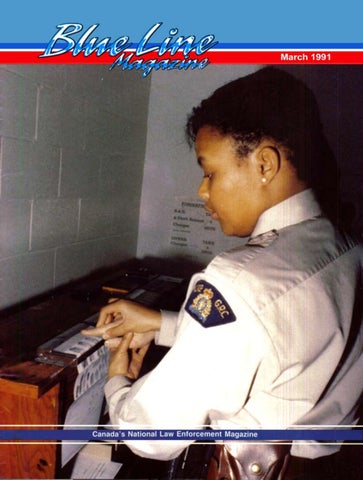
ne of the lead stories this month focuses on the history of fingerprinting in Canada. This story is an updated reprint of a feature from Blue Line's March 1989 Issue (Vol.1 No.3) . It has been 80 years since RCMP Inspector Edward Foster first took the stand in a Chicago murder trial that saw the birth of a technology that revolutionized the law enforcement profession. Eighty years later we find the task of sorting and claSSifying fingerprints has been made less tedious by technology. The next step, scanning fingerprints , will take away the messy inks that all too often smudge and smear. Modern technological applications to traditional police tasks is once again revolutionizing law enforcement. In other stories this month we profile the Halifax Police Department's radical break from past strategies of policing. A second story zeros in on a new multi-faceted communications system that supports the cities of Halifax, Dartmouth and Bedford police departments. An excellent example of inter-force co-operation . Over the next several months you will be reading several submissions regarding the Ontario Police Services Act. It is an important piece of legislation for the future of policing in this country and is seen by many as a framework for policing in Canada. Some people feel, however, that portions of this act pose a real danger to the fut ure style and delivery of police services. Where we have come from , where we stand today and where we are going ... read about it here in Blue Line Magazine.
of golfing cartoons as well. We may
BETTER THAN EXCELLENT Letters to the Editor After perhaps get a few when the season 10 years with the Metro Toron-
draws nigh. Tony assures me that the
A LUCKY FIND Luck was with me a couple of days ago. I discovered your magazine. I had arrived much too early for a meeting of Police Service Boards which was to take place at a Durham Regional Police Station . While I was wandering around I happened upon an Oct. '90 copy of your magazine. The article "A Personal View" by Chris Braiden simply astounded me in the way he thought, because I think the same way. You see, though I am now a member of a Police Services Board (Police Commission) it was only a few short years ago that I was a police constable. And yes, like Mr. Braiden I used to, and still do wonder why the police do and act the way they do. I can remember shivering on foot patrol wearing a short sleeve shirt because someone decided that it would be the dress of the day. Promotions: 100 people try for 5 positions, the result is, 5 very happy p ople but 95 very unhappy people. Mr Braiden mentions the very real fact about the tendency to look at a man's shoulder or arms for the sign of intelligence instead of looking at the man's brains. In most police forces there are enough Rules and Regula tions, tanding Orders and Notices to choke a herd of elephants. Then the brass wants to know why there insn't more personal initiative! Over ten y ars ago I took a police management course and found it to be the best course I had ever taken and I have yet to see many, if any, of the ideas implemented . Something has to change soon . I used to thing I was the only one out there that thought like that but after reading the article and talking to Mr. Braiden on the phone I realize I'm not alone and with luck there are a lot more of us out there. You seem to have an excellent magazine which has been needed for a long time. You really made my day when I found your magazine. Roger Gadd Alliston, Ontario
to Police Force, I am now enjoying letters of compliment I receive about police work in the Maritimes. Your his talents are not his relatives. magazine is excellent in keeping us ••• current with the different issues that READ COVER TO COVER affect law enforcement across the country. I am looking forward to I am writing to have you change my future issues. address so I do not miss a single issue The R.I.D.E. Team is better than of your magazine. Keep up the good excellent. Was Tony MacKinnon a work. Yours is probably the only Traffic Man?? magazine I read .... cover to cover! Chris Morris Dale Whitham Saint John , N.B. Winnipeg, Manitoba
•••
• ••
Editor's Notes: Just about every one, way down deep, would like to be a Traffic Officer. Tony, however, had to settle for second best. He is a Sergeant. Tony had his modest beginnings in a police force that had to be disbanded because no one could spell or pronounce the name. How would you like to say you 're are a member of the Chinguacoosy Township Police Force? Peel Region Police took pity on this group and amalgamated them in 1972. Tony, wanting to live life in the fast lane, moved to the City of Belleville were he has been sentenced to stay with their police force until pension time with no hope for parole. Tony's talents do not stop at law enforcement. He has a good collection
Editor's Notes: I would suppose that this is an appropriate time to remind our subscribers to notify us of any address changes. We need at least 30 days notice to ensure your subscription doesn 't develop hiccups in delivery.
••• AVID READER As an avid reader and subscriber to Blue line Magazine, as well as a law enforcement officer with the City of Winnipeg Police Department, I would like to congratulate you on your excellent periodical. I find many of the articles both informative and useful to the law enforcement field . Marc Rogers (B.A.) Winnipeg, Manitoba
FLASlms by T OllY MacKinnon
''A pparently he's temporarily in charge of issuing equipment whi le everyone else is on holiday!"
4
March 1991
Vo l. 3 No.3 · March 199 1
EDITORIAL
- EDITOR/ PUBLISHER -
Morley Lymburner - EDITORIAL ADVISORS -
David H. Tsubouchi, LL. B. Edward Gunraj (PoO.A. Consultant) Mary Lymburn er B.A. M.Ed. Gerald A. Oxman LC.LA. Jaan Schaer B.A. (Metro Police E. A.P.) Tom Dykes Robert Hotston B.A. M.Crim. Rick Patrick (Lambton College)
Less Study and More Action Required Report of the Regionalization Study Team Chris Offer -
The Editorial Advisors are persons from whom this publication seeks out advice and guidance. The use of their names is merely for recognition of their assistance and ongoing support.
- ADVERTISING Allan W. Stiver - CONTRIBUTING WRITERS -
Lucy Becker • Louise Dueck AI Porter • Richard Duplain • Daffydd Hermann • Craig McMillan • T. Richard Colledge • Murray E. Milligan • Rock Dueck • Geoff Cates • Robert Hotston - ILLUSTRATION -
Tony MacKinnon • Bette Clark Dave Sills - DESIGN AND PRODUCTION Jim Kelly Ca melot Graphic Design 97 Sir La ncelot Drive Ma rkha m, O ntario L3P 2J3
Business Office: (416) 294-4773 Editorial: (416) 293-2631 Fax: (416) 293-0526 Advertising: (416) 294-5502 Fax: (416) 294-8952 Production: (416) 471-0303 Fax: (41 6) 471-0305 Blue line Magazi ne is published mon thly. ten times per year by Blue line Magazine Incorporated with head office a t 11 8 Main S treet North . Markham. Ontario Canada. L3P IY!. Editorial and copy is con sidered to be completely separate from advertising sales. No committment for editorial coverage can form any part of a sale agreement. All articles are protected by copyright. No part of this publication may be reproduced or transmitted in any form or by any means, electro nic or mechanical. including photocopying and recording. or by any information sto rage or re trieval system withou t permission from the p ublisher. T he a uthors. advisors a nd publisher accept no liability whatsoever for any injuries to person or property resulting from the application or adoptio n of a ny of the proced ures. tactics or consider~tions presented in this magazine. Readers are cautIOned and advised that articles presented he rein are edited a nd supp lied for your personal awareness and should not be referred to for further action until appropria te advice and guidance is received from a supervising officer or the advice of a Crown Attorney Blue line Magazi ne is an in dependant publication designed to educate a nd upgrade the skills of those involved in the law enforcement profession . It has no direct control from a law enforcement agency and its opinions a nd articles do not neccessarily reflect the op inions of a ny government age ncy or police force. Blue line Magazi ne is Printed in C"nada by Jo ha nns Graphics. The sole a uthori zed distributor of Blue line Magazine is Green Ga bles Book S h op, Markham , Ontario. Associate member, National
Association of Police Planners ~ Member, Periodical
~ Publishers Exchange
ISSN #0847 8538 Second class mail registration No. 8242
SISgt. Chris Offer, Vancouver PD.
T
he release in August of the report on regional policing from the British Columbia Ministry of Solicitor General, Police Services Branch , stimulated considerable discussion on the advantages of Van couver and Victoria regionalizing police departments and speculation as to when the new agencies will be formed . For anyone who has worked the justice system in B.c. for any length of time this is far from a new idea . This is the latest in a long list of re p orts , studies and pa pers on regional policing. The previous report was produced in 1988, by the Greater Vancouver Regional District. That report led to the current study in the ongoing analysis of regional policing dating back to the 1920s_ In 1929, the municipalities of Point Grey and South Vancouver and their
po lice d e p a rtm en ts were amalgamated into the City of Vanco uver. At that time a provincial review of the police in greater Vanc ouv e r rec om m en ded furt h er amalgamation of police departments by integrating the New Westminster and Burnaby police into the Vancouver Department to form one department with improved effectiveness. Since that study the idea surfaces about every 10 years, and results in a report, a brief debate and is then relegated to the stacks in the provincial archives. The current study was conducted by personnel from the Ministry of Solicitor General and police representatives _ A literature review was co mpleted , visits and interviews were conducted with leaders from police agencies and from the three levels of government. There are many examples of regionalization in Ontario Quebec and England . These were examined as part of the study_Not surprisingly the study found that there is strong sup port for regional policing from all levels of th e police community. The police in B.c. have possibly the highest level of co-operation between age ncies anywhere in Canada and certain ly higher than any examples found in the United States. Cooperation , as pOinted out in the study, can only accomplish a certain level of efficiency and effectiveness. Combined drug squads, joint forces operations, regional 9-1-1 emergency services, shared dog squads, identification services and emergency response teams have cultivated this significant level of collaboration . Continued on page 9
March 1991
5
Fingerprinting In Canada - Morley Lymburner -
O
n December 26th , 1987 , in New Orleans, while parked at a lake front , a 21-year-old woman was shot and killed during an attempted robbery and rape. Her boyfriend was seriously injured . Two fingerprints were lifted from the back window of the vehicle in which they had been sitting . They were entered into the police department's automated fingerprint identification system (AFIS) . The system , developed by De LaRue Printrak Inc., searched the file of one million prints and selected eight candidates. The fingerprint examiner then compared those can didates with the unknown prints and made a positive identification . The total process took minutes. The New Orleans Police arrested the suspect and charged him with seven murders, eight rapes and more than twenty armed robberies that occurred over a period of three months. The technology that captured this man owes a lot to history and the dogged determination of a dedicated breed of people. Who these people are and what science they utilize to the benefit of society will be explained in this article.
Canada but in Chicago in 1911 . Some five years later he established the Canadian Central Bureau in Ottawa for the Identification of Criminals. This case surrounded a man by the name of Thomas Jennings who was charged with murder. With the exception of fingerprints, the case against him was quite slim . There was little doubt that if the fingerprints were not admissible, the case was lost. The Chicago Police decided that they required some of the world's greatest experts to prove their case. Among many others called was Inspector Foster.
Inspector Edward Foster This year marks the 80th anniversary of fingerprinting in Canada. The re Fingerprint Pioneer cognition of the expertise of the late Re MP Inspector Edward Fbster RCMP Insp. Edward Foster, as the founder of Canadian fingerprinting , is The Inspector presented the case an important part of this anniversary. in favour of the scientific reliability of Strangely enough Foster's first case, fingerprints. Under cross examination where he gave evidence, was not in the defence lawyer attempted to
6
discredit the evidence. He began by asking the Inspector if the local ident officer could raise fingerprints from the rough surface of the desk he had his hands on. He advised the court that he could not. Flushed by this success he then asked if prints could be raised off of a piece of paper. He was advised that they could. On a challenge from the defence attorney the Inspector produced the powder and dusted the piece of paper. The prints of the lawyer were produced . The jury appeared quite impressed . So impressed that the defense attorney spilled water over the paper to destroy the demonstration . It was to no effect. The judge ruled the fingerprint evidence admissible. The accused was found guilty and hung on December 22nd , 1911.
The Early History Fingerprints have been used sporadically throughout civilization's history to seal contracts. The earliest known use of fingerprints can be traced to a Sumerian cuneiform cylinder outlining a trade contract about 2000 B.C. One of the earliest known European publications of fingerprint observation was offered in 1684 by Dr. Nehemiah Grew of England . Dr. Grew made an intense study of the skin and minutely described the pores and ridges. Two years later, in 1686, another scientific paper appeared under the name of Marcello Malpighi of Italy. The research work of this man was of such outstanding importance that one of the layers of human skin now bears his name. In the year of 1788, a German Doctor by the name of Mayer was the first to make the statement that fingerprints are not duplicated by nature. The next major step was made by a German University student by the name of Evangelist Purkinje who classified nine major groups of fingerprints .
March 1991
The Road To Judicial Notice
body. An arrested person was measured in certain areas and certain notes taken and placed on a file card. The system required the measuring of the head , the body's height, the length of the middle finger of the left hand and left foot , and the elbow to elbow measurement of crossed arms. The system had many drawbacks. Many cards were misfiled , measurements taken in a shoddy manner, and the differences that would occur as people grew older. Another factor spelled the doom of Bertillon's system . There were many cases of convictions being made and innocent persons spending many years in jail only to have the guilty person come forth after several years. Invariably they found the measurements to be quite close. The Bertillon method of identification was only useful in cases where the court wished to prove a previous record . It had no real investigative value as did fingerprints . In 1898 the Canadian Parliament passed the Identification of Criminals Act that provided that all persons charged with an indictable offence be subjected to the Bertillon method . The system never got off the ground because there were ample rumours that the system was fast being outdistanced by the fingerprint system . In 1908 the old act was replaced and the fingerprint system and photograph were instituted .
It was not until 1858 that Sir William Herschel, an assistant employed by the Old East India Company of Bengal, used the fingerprint impression to seal a road surfacing contract with a "Hindoo" man in the interior of Bengal. The signature of the man appeared to be so contrived that he decided to have the contract signed with both their palm prints. He reported this to the Royal SOciety and Sir Francis Galton . Sir Francis Galton was a big supporter of Herschel's theory that a person's fingerprints do not change their pattern through out a lifetime. They proved this by using their own prints over a period of some 31 years. Another collection was started to prove a theory of persistency between the years 1858 and 1913. During this time the theory was well accepted by the public but not by the judiciary. The efforts of Herschel proVided the foundation upon which Francis Galton based his investigations around 1880. He began to build a classification system which he wrote about in his book "Fingerprints" published in 1893. This book was read with great interest by Sir Edward Henry, Inspector-General of the lower provinces of India. He found some flaws in the categorization of fingerprints as written and set about to refine the system with great efficien cy. The "Henry" system was then immortalized and is universally The Canadian Experience accepted . In the year 1901, fingerprints were first introduced in Scotland Yard. In 1904 Bertillon vs. Fingerprints Scotland Yard sent John Ferrier to the Fingerprints had a real problem . They St.Louis World's Fair to guard the had to compete with the "Bertillon" Crown Jewels. While there he insystem that had been in use and more terested Constable Edward Foster, of readily accepted by police forces the Canadian Dominion Police, in the science of fingerprints . world wide since 1879. This system was based on anthroThere are probably two other peopometric measurements of the adult ple who bear some influence on this
March 1991
7
part of Canadian History. One was Mrs. M.E. Holland , wife of the editor of the publication "The Detective"; the other was the Commissioner of Police for Canada, Sir Percy Sherwood. Mrs. Holland , a detective in her own right, was attending the St.Louis convention of the I.A.c.p with her husband. She too became fascinated with fingerprinting at the same time, while he and Ferrier were stationed at the Fair, and in fact arranged a meeting for Foster with the English policeman. Constable Foster's experience convinced him that a similar organization in Canada would do much to encourage national interest and cooperation in fingerprinting . It would also help to bond all police forces together with a common technology. He discussed this subject with Sir Percy Sherwood and found in him a source of knowledge and encouragement.
The Toronto Police Connection Sir Percy believed that the Deputy Chief Constable of Toronto, Mr. Stark, would be an ideal man to interest in the project and subsequently told Foster that he had received an en thusiastic response from the Toronto officer. An organizational meeting of the newly proposed group was held on September 6th, 1905, at Toronto and one year later came the first positive action toward the founding of a national fingerprint bureau for Canada. Opposition which stalled Foster's plans would have discouraged a less dedicated man , but he was in truth a "man with a mission". With the support of his Chief, the project was kept before the government. On July 21st, 1908, an Order in Council was passed sanctioning the use of the fingerprint system and making the provisions of the Identification of Criminals Act applicable to it.
The first Toronto Police Identification Bureau was formed in 1867, at which time records were kept by name and physical description only. In 1 94 the records were augmented by the introduction of the criminal photograph . ergeant Duncan , a self taught fingerprint expert, started the Toron to collection in 1906 with the accumulation of sets. In 1911 the Toronto Force handed over their entire collection to the Dominion Police (later to become the RCMP) . The first conviction in Canada, solely on fingerprint evidence was recorded on April 25th , 1932. The testimony was given by Mr. O.E. Borland who later became the Chief Id entification Officer within the Toronto Police Department from 1943 to 1960.
The Computer Age With the advent of the "computer age" a study was started in 1965 to devise a system to search fingerprints utilizing the speed of the new equipment. Many agencies throughout the
world had attempted to perfect a system , but by 1971 the Metropolitan Toronto Police Identification Bureau had its system in full operation . Their method of searching was the subject of study by other identification bureaus within Canada, the United States, Scotland Yard , and New Zealand. These search principles were adopted in whole or in part by many and the modern computer technology owes much to the labours of this branch . The identification of a fingerprint , regardless of new and modern technology, still depends on the personal viewing of the fingerprint by someone who has received extensive training and experience in this specialized work. Technology has made great strides in eliminating the tedious task of searching and classifying of fingerprints . The experts today can spend more valuable time in searching and screening through larger and larger numbers of prints in search for the true culprits. The R.C.M .P were the first in Canada to obtain this technology and
the Metropolitan Toronto Police Force took delivery of an identical system late in 1988. Both systems are currently connected and the Toronto based unit can be linked to other forces in Southern Ontario who purchase work stations compatible with their new system . The York Regional Police Force was the first to link up in this fashion late in 1990.
Presently the De LaRue system is installed in Vancouver, Ottawa, York Region , Peel Region and Metro Toronto. A similar system built by NEC Corporation has been installed and functioning in Calgary, Edmon ton and Winnipeg. All of these agen cies benefit from extensive inter-force co-operation . Many positive identifications have been made with this new technology as ident officers scan their case files to clear off many old cases. With this new technology in hand many companies are now turning to digitized mug shots and computerized photo enhancing to further aid law enforcement. It is hard to believe that it all started in the mid nineteenth century with a British company executive's distrust of a local contractor's signature.
He ource in/ormation and photographsfor this article courtesy of The R 'MP Gazette, the Metropoli tan Thronto Police Force Identification Bureau, D.P. P. and De LaRue Printrak Incorporated of Anaheim aliJornia.
8
March 1991
Continued from page 5
The police community desires the next logical step, regional policing. Police members differ only on the form of regional policing rather than on the notion that the idea is sound . This latest report found that regional police departments in Ontario, "on average, ... are as equal or even more effective at similar or lower cost than independent municipal forces ." Advantages of regional forces include; specialization of tasks, long range planning, less vulnerable to local political influence, greater career possibilities, economies of scale and reduction in management ratios. The arguments against regional policing focus on the loss of local control and arguments that understanding of community problems is better with a small department. The latest B.C. reports reject a number of research papers published in the early 1970s by Elinor Ostrom from the University of Indiana. In these papers she argued that small departments in the U.S. were more effective than larger departments. The B.c. study team concluded that recent Canadian data repudiates the assertions made by Ostrom and her colleagues . This most recent study reached the same conclusion as most other studies; there should be regional policing in Vancouver and Victoria. After coming to this conclusion the study team then pondered a dozen different forms that the amalgamation should take. Suggestions included three or four regional forces in Greater Vancouver, one provincial force, multi tiered policing, amalgamation of police and fire services and several combinations and permutations of each of these. After examining all these possible options the study failed to reach a conclusion as to which alternative should be selected. This of course leaves open the opportunity for another regional policing study in a year or two.
March 1991
The report attempts to give an option suitable to every taste. The failure to vie support to one model of regional policing will ensure that this study joins the others on the dusty archive shelves. Regional policing should be of in terest to all who have an interest in the Criminal Justice System in B.C. The current fragmentation of policing has a detrimental bearing on courts, corrections, probation and community agencies. Each department sets its own policy and interprets provincial policy in a variety of ways. Clearly it is advantageous for the whole system to see regional policing in Victoria and Vancouver. The study examined the amalgamation of the B.C. Provincial Police and the R.c.M .P. in 1950, and inferred that this transfer of policing duties worked well, therefore, the same will occur 40 years later. B.C. has changed considerably in the past 40 years. The study team could have obtained better direction by examining the transfer of courts from municipalities and formation of the Sheriff Service in the early 1970's, than what occurred in 1950. The report states, "There is complete agreement that nothing will happen to improve police effectiveness through consolidation of functions unless the Ministry provides strong leadership." This is clearly the bottom line for the future of regional policing in Victoria , Vancouver and British Columbia. Local governments will not set aside their federal policing subsidies or the perception of the need for local control unless nudged along a bit. This nudging is a fair exchange for proficient regional policing. Without direction and leadership from the provincial government policing in B.c. will remain balkanized. The next step required is a provincial policy statement in support of regional policing as well as a task force with a mandate to implement regional policing in Vancouver and Victoria . We do not need another study.
9
"COOPERATION IN PUBLIC SAFETY RESPONSE" MILWAUKEE, WISCONSIN May 26-31, 1991 If your job or business is involv-
ed in anyway with combatting terrorism, explosive disposal, investigation, or violence, you need to be i n Milwaukee , Wisconsin . THE INTERNATIONAL ASSOC. OF BOMB TECHNICIANS AND INVESTIGATORS (I.A.B.T.I.)
International In-Service Training will be attended by professional and special operations personnel from around the world. From large cities to rural outposts ... federal agencies to local departments, military, law enforcement , corrections, security and ot her professionals involved in explosives will convene in Milwaukee. 40 HOURS OF TRAINING:
Anti-terrorism, Counter-terrorism , Initial Response Pro cedures, Security, Management, Research and EqUipment , Violent Group Counteraction, Bomb Detection and Disposal, Special Weapons and Equipment, Education and Planning, and much, much more will be presented. For information, contact: Glenn E. Wilt I.A.B.T.I. P.O. Box 6609 Colorado Springs, CO 80934 Tel.: (719) 636-2596 Fax: (719) 633-3723
Police Agencies Communicate and Assist Each Other - Patrick J. McManus -
T
he call flashes across the police cruiser's computer screen , telling the officers to respond to a domestic dispute in their zone. Then , as the orange letters race across the monitor, an ominous warning is added : the occupant is known to be violent when drunk and owns several weapons . The one comfort Halifax Police can take when answering such a call is that the machine sending them to the location - the "RAPID" system - is also like a third partner in the car. Once on the scene, if they find more trouble then they can handle, pun ching one letter on the keyboard calls up immediate reinforcements. Even more comforting is the knowledge that in a major disturbance, like a full scale riot, RAPID will also send for help from two nearby police departments, something unique for all of Canada. RAPID - standing for Regionally Applied Information Delivery-is the electronic tie which binds three Nova cotia police departments: Halifax, its sister city Dartmouth , and the town of Bedford. The computer-radio network is a high-tech dispatcher and electronic bulletin board for the three law enforcement agencies. With just one button, police can not only call for assistance across municipal boundaries but literally keep abreast of what their counterparts are dOing, swap information on items like investigations or even the licence plates on stolen cars. RAPID's inception came about in 19 5 when Halifax was laying the groundwork for its community-based policing . With demise of the old divi sion system , planners realized the new zone concept also needed new technology to make it work smoothly.
MDT car system f01" RAPID
The five -year plan recommended overhauling the department's communications and record storage capacity. Bids were sent in , 10 proposals studied , and in the end the contract was awarded to San Francisco -based PRC (Planning Research Corporation). Although PRe's program was proven internationally, first being test run nearly a decade before by the Los Angeles Police Dept., civic leaders balked at its $4.1 million price tag. As Insp. Larry Clare, head of the HPD's support operations division, which oversees RAPID, recalls; "There were a lot of rolling of eyeballs over the cost." A political solution though was found . To defray costs, Dartmouth and Bedford were invited to join the program with their police departments. After some negotiation, a costsharing agreement was signed in late 1986. The system came on line in December 1987 with the MDT's in -
10
stalled in 51 police cruisers in May 1990. For most big city police the technology is familiar. PRC's VAX-8350 mini-computers, the heart of RAPID, and the MOl 9100-10 Mobile Display Terminals in the cars, are in use in departments from Montreal to Calgary. RAPID's ComputerAssisted Dispatch (CAD) keeps track of vehicles on duty, and sends them on calls after deciding availability and workload . The Records Management System (RMS) - with access to 17 databanks, including CPIC, does an immediate cross-reference on calls. If it spots an address with a history of trouble, it sends a friendly heads-up warning. The case of training-requiring onIy four hours in class for the average constable to master-led to the quick adoption of the equipment. But in Halifax, the system quickly proved its value. Three stolen cars were recovered in RAPID's first week of
March 1991
ledges the municipality couldn't afford RAPID on its own . "It greatly reduces our paperwork and let's us know what the two bigger departments are doing." A high level of inter-departmental co-operation is maintained through two committees- a management one chaired by Clare, and an advisory committee headed by MacDougall,
with full representation from all three departments. Meeting once a month , both committees look at how to improve the system, such as transferring one of the VAX computers to Dartmouth as an added security measure against damage or disaster. As a credit to the co-operative spirit, Clare reports, "We have had very few problems we've had to work out."
ENHANCED VISIBILITY PATROL DETAIL Cst. teve au n ders with MIYI' car system j or RAPID.
operation by officers practicing on the system with random checks of licence plates as they drove by. But RAPID has meant an un precedented degree of co-operation for the three police forces in the greater Metropolitan area . Separated only by a harbour, Halifax, Dartmouth and Bedford collectively have a population of over 250,000. Like in community-based policing, the authorities know criminals don't recognize boundaries , especially municipal ones. With RAPID, the collective knowledge of the three departments is increased . For instance, if a Dartmouth detective is working on a fraud case he can do a computer name-search through Halifax files for a likely suspect. The process can take a matter of minutes. Before the in vestigator could spend the whole day making phone calls back and forth , often with little result. On that basis alone, says Glenn MacDougall, HPD's computer systems manager, RAPID p.ays for itself "on the amount of time it saves on phone calls, leaving more time for investigations." Bedford Police Sergeant Greg Murray says RAPID is like an extra set of helping hands for his 20-man force. Although his department is well equipped-the town of 9 ,000 on the shores of Bedford Basin is one of the most affluent in Canada for upper income residents- Murray acknow-
March 1991
For the past two years the Calgary City Police and Tech Bicycles have headed the Enhanced Visibity Patrol Detail. The patrol's operations include general policing , anti-drug, violence and jay walking watches.
Cycletech Canada has a bicycle program for your area and a track record to go with it. For more information call 1-800-661 -1662 or write Cycletech Canada, #123-3016-1Oth Ave. N.E. , Calgary, Alberta T2A 6A3
11
PROFILE
New Team Tackles New Job - Thomas Vares "Change starts at the point of new faces arriving on the scene. The first thing to do is to evaluate exactly what the current situation is and to iden tify whether and how change is required. However, we can't just change things for the sake of change." Mike Farnan , Ontario's olicitor General
L
ast September Ontario voters swept in the New Democratic Party to power for the first time. The party has promised to take a new direction in provincial affairs - one which is more open , fairer and ad dresses the needs of all citizens. And one of the biggest challenges facing the new Solicitor General and his Parliamentary Assistant is the new Police Services Act. "The former Liberal government has left us an important new piece of legislation , the new Police Services Act, and we must be prepared to allow its practical application," says the Solicitor General, acknowledging that a new Act must be legislated to replace the old Act. " I sincerely congratulate my pr decessors and Ministry staff for taking the initiative to replace the old Police Act of 1946" states the Solicitor General. "The new Act was drawn up as a result of extensive consultations with police organizations and com munity groups. As such, I respect their opinion and I am prepared to give the legislation a chance. It is im portant to give the Act a chance to mature in real life." However, he cautions, "We intend to monitor the practical application of the Act closely and
we will make future amendments, if required ." Bill 107, the new Police Services Act, which provides the "legislative framework " for policing in OntariO, received Royal Assent on June 28, 1990. The entire Act was proclaimed on December 31, 1990. The Act recognizes: the need for close working relations between the police and community; safety and security of all persons; sensitivity to the multicultural characteristics of OntariO; respect and sensitivity for victims of crime; and the provision of policing services consistent with the spirit of the Charter of Rights and Freedoms and the Ontario Human Rights Code. The Act also provides for man datory employment equity, the creation of a Special Investigations Unit (SIU) to inquire into circumstances of serious injuries and death that may have resulted from alleged criminal offenses committed by police officers (which was the only section of the Act to be proclaimed last August) , and the establishment of police services boards in all municipalities responsible for providing police services. Parliamentary Assistant Gordon Mills supports Mr. Farnan in his roles as Solicitor General. He served in the Canadian Military Police as a police officer and patrol sergeant from 1958 to 1970. He was first elected to the Legislature last September by the NDP sweep of the Ontario electorate. "Gordon's police background is a valued contribution to our combination ," says Solicitor General Farnan , "His front line experience helps to put
12
many of the policing issues we deal with into a practical perspective." Farnan adds that he too has some exposure to police matters as a former New Democratic Critic for Correctional Services. "Coming to the job from the outside allows me to look at things in a new and objective manner." Solicitor General Farnan adds, "I have a good comfort level with my new responsibilities, because I know I can seek the advice of competent Ministry staff, and that I can continue to count on these talented men and women who have been on the front lines of police service delivery." He refers to a favourite baseball analogy to describe his situation as Solicitor General. "At a baseball game the fans , often in the heat of the mo ment, like to second ~uess a close call by the umpire. However, after a while, the emotional outburst is replaced by the rational awareness that the um pire is closest to the plate and in the best position to make the call. As such, I feel that the people who are on the front lines of police service delivery deserve to be listened to closely. And I most certainly will seek their advice and input." The Solicitor General emphasizes that community policing is of vital importance to his Ministry and reflects the NDP policy of working in partnership with the community. Community policing is also a concept which has been practised by police profeSSionals for many years in many forms. "We are just recognizing, in law, something that our officers have been doing on a daily basis for generations. We are affirming that this is a valuable tradition . Its principle of involving the police in the community and in the daily lives of its people, should be recognized ," stresses the Solicitor General.
March 1991
Parliamentary Assistant Gordon Mills (leJt) supports Mike Farnan (right) as the new Solicitor General oj Ontario. Both men share a background in community commitment and Public Service. Farnan was aJormer AldermanJrom Cambridge, Ontario, while Mills is aJormer Military Police OJJicer.
Another area of concern to both men is the establishment of a provincial public complaints system under the Police Services Act, similar to the one currently in place in Metro Toronto, to respond to public complaints. "This recognizes the importance of the issue of police public accountability," emp hasizes Mr. Farnan . The Solicitor General also displays an investigative sense when underlining the importance of increasing crime prevention measures and community participation in the process . He uses another analogy to describe what he means, "In a community, when bodies are found down the river, it's only a matter of time before you have to go up the river to discover what is the cause. Then, and only then , do you not only solve the crime; but you can learn from the experience and develop measures to prevent future
March 1991
occurrences. Prevention is the crux of what we want to work on in the immediate future and we have already begun with initiatives such as Crime Prevention Ontario (CPO, an um -
brella group established to share comm unity resources to fight crime)." In addition to the Solicitor General's portfolio, Mr. Farnan also carries the Minister of Correctional Services as well as the Minister Responsible for the Anti-Drug Strategy. "The linkage of the Anti-Drug Secretariat to these two ministries takes us one more step closer to a total package approach to the justice system. It is naive to think that justice can be effected without brining together these major partners," he explains. The new Parliamentary Assistant, Gordon Mills, sees employment equity as an especially important mechanism in reinforcing the concept of community policing. "We can hardly expect to serve new ethnic communities if we do not have any representation among our rank and file. Having police officers who reflect the communities they serve, will provide us with a bridge to them." Solicitor General Farnan and Parliamentary Assista nt Mills , however, emphasize that, "We are all responsible for the safety and security of every citizen in Ontario. The police are full time crime prevention professionals. However, they can't do it alone, without the support and participation of the people they serve. Crime prevention must be a cooperative effort to be effective.'
IJ
~~~~----------------------------------~
FLASHES by Tony MacKinnon
"Back off boys. I caught the puck fair and square!"
Part 6
A Personal View The King's New Suit Of Clothes - Chris Braiden -
I
remember so well the little story I used to read to my two sons when they were small. Perhaps you read the same one to your kids. It was about a king who had a huge ego. He already had the finest wardrobe in the kingdom (I think he was related to Imelda Marcos) but like all ego-maniacs, he was never satisfied . Two shysters knew about the king's flaw and proceeded to sell him a very special new suit of clothes. The catch was that only brilliant people could see the material. Of course, the king saw the 'material' as did his advisors, generals and ministers. When the new suit was finally delivered (I still remember the picture of a lion with nothing on but a crown and red long-johns) the entourage fawned over the king and his in telligent choice of material. The king's ego was so huge he decided to have a parade through the kingdom to let the lesser sort share in his good fortune. Of course the word had gone out about the uniqueness of the cloth and not wanting to be labeled a dum my, of course everyone 'saw' the new suit. Everything was hunkey-dorey as the king rode along to the chorus of cheers of such an intelligent audience until he encountered a little six-year old girl who said, in brilliant innocence, "The king has no clothes on". A hush fell over the parade. The child's mother, with reddened face, turned to her friend and said , "She's right, the old bugger (my words) is naked". Of course then the cat was out of the bag.
Policing, as I see it today, is in great need of a few six-year olds who will blow the whistle on some of the senseless things we do. All of us, at every level of the organization, do things that are patently senseless yet we continue to do them . I don't want to get into examples here because it would take up the entire issue, but surely no one can still believe that driving around in a police car for six or seven hours a day serves any useful purpose. Surely no police manager still believes that policies and procedures can give you quality work.
system has anything but an in finitesimal influence on the overall crime picture. I have a few things on my office wall. One is a quote from Peter Drucker, the guru of management thinking these past thirty years. It says, "Nothing is so useless as doing efficiently that which need not be done at all". I believe policing is mired in the common disease of all monopolistic bureaucracies on the public dollar; we are obsessed with efficiency, at the expense of effectiveness . Efficiency is doing things right, effectiveness is doing the right things. Unfortunately, no amount of the former can replace the smallest amount of the latter. Let us learn something from this little girl. It's time for people through out policing to have the courage of their convictions. Learn from the words of President Harry Truman who said , "Do what you can, where you are, with what you have". Let us do our own bit. Too many of us presume we are not part of the problem , or the solution . The truth is we are probably part of both . All of us have control over someone and something; ourselves and our work. I have tried to follow Truman's advice and it has simplified things greatly for me.
NEXT MONTH: A Personal View - Part 7 A Bureaucratic Garage Sale
Chris Brai den
You cannot order up entbusiasm, imagination or creativity. Surely no one still believes that crime is a separate entity from such things as poverty, illiteracy, human misery or that we can continue with the old line, "Don't make a family problem a police problem". Surely no one can believe that the entire criminal justice
14
~~ Can you afford to miss even one issue? Subscribe Now! Use your Visa !MasterCard
Phone (416)294-4773 Fax (416)293-0526 March 1991
----
Regina Vs. Dusang 1027-011 (13 pages)
Waitress Victim of Entrapment A Thunder Bay, Ontario, waitress has had her charge of trafficking in Cocaine dropped in a District Court ruling that stated the accused was a victim of entrapment. District Court Justice L.c. Kozak ruled that the investigating officer was not engaged in a bona fide investigation of the accused or the restaurant when he purchased a quantity of cocaine from her. The court ruled that in effect the officer was on a "fishing expedition" that included every bar and grill in the city of Thunder Bay. Evidence revealed that the under cover officer was working on a project that was investigating stolen property and drug trafficking related to it in the Thunder Bay area. This project was code named "Operation Pilfer." The officer stated that he had spoken to the accused on four or five occasions and on one of those occasions asked her where he could get some "blow". The accused told the officer to wait and returned about five
minutes later and said that the drugs would cost $140.00 per gram . The officer asked for two grams and paid the accused $280.00 . She returned a short time later with two packets that were later found to be cocaine. In staying the charges the Justice stated that the Crown had proven its case beyond a reasonable doubt but that the accused should have the charges stayed due to police entrapment. Citing case law Mr. Justice Kozak stated "In this case there was no evidence to suggest that the accused was engaged in any criminal activity (before this incident) and in particular the sale of drugs. She was not a targeted person who was under reasonable suspicion as being a drug trafficker." The justice continued by saying, "Where the police are engaged in a bona fide investigation of a particular location or area where it is reasonably suspected that certain criminal activity is occurring, the police are permitted
to provide opportunities to people associated with the location to commit offences even if these people are not themselves under suspicion ." The justice stated that the under cover officers activities did not fall under this criteria. The justice stated for the investigation to be bona fide the investigation would have to be commenced "in good faith and implies that it is an investigation with defined parameters based upon reliable information in which a ... connection is established between drug sales and the individual or location being investigated." In conclusion the Justice found that the investigation of the waitress was not as the result of a defined investigation but the location and the accused were picked out at random. Much recent case law has supported this ruling. All cases reveal that the police should not expect convictions while going on a "fishing expedition" or by testing the virtues of citizens at random.
Regina Vs. Dubois 1033-017 (12 Pages)
Court rules prostitute was entrapped A Calgary Provincial Court Judge recently ruled that a prostitute was a victim of police entrapment and has tossed out the soliciting charge she faced. In the November decision the judge stated that the investigating officer presented himself as a willing and enthusiastic customer. The judge added that "When one reviews the actions and the conversation, it becomes clear that it was the detective who set the scene, and did most of the action in the little drama."
March 1991
In the operation the detective, dressed in plain clothes and driving an unmarked truck, approached a suspected prostitute in a known red light district of Calgary. The officer offered the prostitute $80.00 for sex and when she agreed he promptly arrested her. The judge ruled that although the prostitute was guilty of soliciting she was entitled to a stay of proceedings because "the average person" would have been induced by the actions of the officer. The court added that if the
15
officer had been an average citizen he could have been arrested . "Indeed ," the judge added, "that which the detective did forms the basis of many charges laid against males who Similarly speak to female undercover officers involved in sting operations to apprehend customers of prostitutes." The judge stated this was "a clear case in which the police were involved not in the detection of the crime but rather its manufacture."
... news beat ... news beat ... news beat ... Officer Cleared in "Off-Duty' , Shooting Incident A Metropolitan Toronto Police officer has been cleared of any criminal wrong-doing by the Ontario Special Investigations Unit after he shot a Break and Enter suspect who threatened the officer with a knife. Last December Constable Gunnar Kloetzig was in the vicinity of an attempted break in and observed a citizen chaSing the suspect into a laneway. The officer went to the citizen's assistance and the suspect turned on the two men and attacked them with a knife. Constable Kloetzig drew a non issu 25 colt revolver and warned the suspect to come no closer. The susp ct continued to attack the officer and the officer shot the suspect 5 times. The suspect underwent surgery and was released 10 days later from hospital. The Special Investigation Unit concluded that there were no reasonable grounds for criminal charges to be laid against Constable Kloetzig but Mr. John Osler, Director of the unit, strongly recommended that a police internal investigation be commenced regarding possible Police Services Act breaches regarding the use of the non -issue revolver.
Police Rapped For Copying Films The York Regional Police Force has settled out of court for a reported $100,000 for illegally copying 16mm films over to video tape. In addition the Chief of Police was required to write a letter to every Chief of Police in the Province explaining the necessi-
ty for all police forces to have a copyright policy. The civil action was commenced by Omega Films and Canadian Learning Company qf Scarborough and Marlin Motion Pictures of Mississauga. The films were community based films on such subjects as crime prevention and safety. The Department had purchased these films several years ago and another company had convinced them that the films could be transferred to video tape and they would therefore be easier to present. The president of Omega Films stated to a reporter that he had been visiting a film lab when it was brought to his attention that they were copying his films , sold to York Regional Police, over to video tape. The copies were being made inspite of the fact that the label clearly indicated that this type of activity was not legal. Under the terms of the reported settlement, brought down at the end of January, the police were to return all the duplicated copies to the companies for destroying and purchase new ones . Although the Educational
Media Producers and Distributors Association of Canada released a statement that the settlement included $100,000 in punitive damages this was denied by the York Region Police Chief. The three firms commenced the action in spite of the fact that the Chief had apologized and had offered to buy all the films back. The companies declined the offer and decided to sue the Board of Commissioners instead. Part of the letter sent out to all Chiefs of Police stated that the York Region Chief now "recognizes the need for this department to have specific policies in place to protect both our officers and copyright holders from any copyright infringement." The letter went on to say, "The force has therefore adopted specific measures in order to prevent copying of this nature from occurring again ." The Chief stressed the importance of obtaining permission to copy tapes and films even if the purpose of the production is for non -profit, non commercial or educational purposes.
FLASHES by Tony MacKinnon
" Don't look now, but J think we're about to be DELEGATED on."
16
March 1991
... news beat ... news beat ... news beat ... front passenger seat. Mr. Rodriguez made a left turn across the path of a car going the opposite direction and in the collision that ensued his daughter received fatal head injuries from striking the dash board and A Florida man has been charged with pillar. vehicular homicide after his daughter The prosecutors office stated that died from head injuries sustained the charge was intended to send a from not wearing a seat belt in a message that drivers should be held motor vehicle collision . responsible for the safety of children Florida is one of 36 American who ride in their cars. Although this is only the second States that have mandatory seat bel1 legislation . The Dade County State'~ time in the U.S. a person has been Attorney stated that operating a cal charged under these circumstances involves more than driving, and tha1 prosecutor Kathleen Hoague stated , failing to yield to oncoming traffic i~ "It's not that this is the first instance one violation while failure to ensure in which a child has died or been a child wears a seat belt compounds seriously injured in a car accident. But the violation far more. given what we know about seat belts, Last August Ramiro Rodriguez was in this day and age it should be driving his car while his 3 -year-old criminal for a parent not to take daughter sat in his wife's lap in the advantage of them ."
Father Charged With Daughter's Death
What's News? Keep Canada's law enforcement community inform e d . If you have something happening in your area that you feel should be shared with the law enforcement community across the country, or in your province, let Blue Line Magazine know about it. If you have a local newspaper clipping, a recent controversial topic or wish to write on a topic of your own chOice, feel free to send it to us. We are also interested in significant changes in provincial statutes . You may mail material to us at 118 Main Street North , Markham , On tario, L3P 1Y1 or use our 24 hour Editorial Fax Line at (416) 293-0526. Keeping us informed is keeping you informed!
p------------------------------------. The 1991
Canadian Police Officers Motorcycle Championships
CANADA CUP Held in conjunction with FAST Motorcycle Training School, Shannon ville
June 27th, 28th, 29th Shannonville Motorsport Park Shannonville, Ontario CORPORATE SPONSORS BLU E LINE MAGAZIN E YAMAHA MOTORCYCLE AIR CANADA DUNLOP TIR ES LOVE TO TRAVEL FAS.T. TRAININ G SCHOOL
For details write to: Executive Committee Canadian Police Officers Motorcycle Championships 733 Leaside Street, Pickering, Ontario LIW 2X2 or Call (416) 831-2013
~------------------------------------. March 1991
17
Regina Vs. Green 1032-006 (12 Pages)
....;;..
Officers should amend blood sample demand A Nova Scotia Court of Appeal decision last Nove mber determined that wh en officers are demanding blood th ey must further advise the person from who it is demanded of the methods to be employed and the reasons that it is necessary. This case involved a man who had b en involved in a single vehicle accident near Antigonish . The police officer investigating the incident a ttend ed at the hospital and was ad vised by th e driver that he had , a mong other injuries, a sore jaw. The officer determined that due to the jaw injury the driver would not be able to demand breath . He then read a de mand for blood from a card and the accused refused . The case revolved around whether
the officer should have added to his blood demand that the samples would only be taken if a qualified medical doctor had said it could be done at no risk to the person . Mr. Justice Matthews stated in his submissions, "A person hearing the demand given could not know of the assurances set out in Sub. (4) . A demand made in that form could lead the person to believe that he or she would be placed in the hands of a technician to have blood withdrawn from his or her body in such quantity 'to determine the concentration , if any, of alcohol' in the blood without the safeguards of subsection (4) ." He continued , "I do not agree with the Crown's argument that the clause under consideration is simply descrip-
tive of th e manner in which blood samples demanded under the subsection must be obtained and therefore a demand without reference to the clause is sufficient. As there was no mention made of the conditions referred to in subsection (4) , the demand was deficient." With that the case was dismissed . A more suitable wording for a demand for blood would be as follows ; "I demand that you permit the taking of samples of your blood for the purposes of determining the concentration , if any, of alcohol in your blood . Such samples will only be taken if a medical practitioner is satisfied that the taking of those samples will not endanger your life or health ."
Taking photo of accused was charter breach In a recent ruling an Alberta Provincial Court Judge has dismissed charges because police took the accused's photograph after his arrest without permission on a summary conviction offence. In the ruling Judge Allan Fradsham ruled that the accused's section 7 Charter Right not to be deprived of life, liberty, and security of the person was breached by the officers. The officers had arrested the accused after he struck up a conversation with an undercover female police officer for the purposes of obtaining sexual services. After placing the accused under arrest on the Summary Conviction offence one officer produced a camera
and took a picture of the accused while he was still in the police car and before being released . Evidence revealed that the officers took the picture so that the accused could be later identified for court docket purposes. At trial the Crown produced the photograph and attempted to tender it into evidence to show that the accused was the person they had arrested and released . Upon rejecting the evidence Judge Fradsham stated, "since common law does not permit fingerprinting of those accused of summary conviction offences (and I take photographing to be equivalent for these purposes to fingerprinting) , I conclude that taking ... photographs of those accused of summary convic-
18
tion offences & without their permission violates a principle of fundamental justice ..." The court determined that the picture was not taken for the purposes of the Identification of Criminals Act but rather simply to identify the accused in the docket. Since the photograph was not used to depict a crime taking place they were not admissible for the purposes of iden tification of a person after arrest on a summary conviction offence. The judge concluded by adding, "There are many methods of identification open to the Crown identification need not justify a violation of the Charter."
March 1991
GET UP CLOSE
TO THE EVIDENCE
DocuCam™ Gets i t a ll! The In-Car Camera System that Enables Officers to Video Tape Violations
A New Er a i n Law Enforcement
Polaroid LESTER A. DINE INSTANT CLOS&UPPHOTOGRAPHYSYSTEM • • • • •
Call the Henry's Industrial Team
(418) 888-0872
Ideal for recording evidence at the scene. Light & compact for easy portability. Easy to use with built-in flash . Instant colour prints provide on-the-spot viewing. With special hard carrying case for the camera, plus an assortment of close-up lenses.
•L L-I~L·iJ,.~~1 ___ ~.Id
119 Church St., Toronto, Ont. M5C 2G5 Henry's is a division of Cranbrook Glen Enterprises Limited
Case Law Order Form arne:
Agency :_ _ _ _ _ _ __
Address:
Phone/Fax# _ _ _ __ _ _
City:
Postal Code: _ _ _ _ _ __ FAX Number (416) 293-0526 Tele phone orders acce pted fo r Subscribers onl y - (4 16) 293-2631 (Please quote Subscriber um ber)
The full text of a ny Case Law articles in Blue L ine Magazine may be ord ered at a cost of $1.00 pe r page with a minimum charge of $10.00 per ord er. You may have your judge ments sent via Fax at a cost of $2.00 pe r page with a minimum order of $20 .00. Please enclose a cheque or credit card number with your order. Onl y ubscribe rs may order Case Law by invoice
Please send Case Law by:
D Mail to Address Above
D Fax Direct to my Attention
G.S.T. #R1 224 18643
Case Law Number
Number of Pages
VISA I MASTERCARD
• contributes to increased convictions • for real-time accounts of traffic violations • impaired offences • felony arrests • surveillance and drug interdictions
Call Today for a FREE 30 day Trial!
~TRIANGLE
gECHNOLOGIES 24 Canning Court Markham , Ontario L3P 4J3 Telephone: (416) 479-7543
DODD - DOD DODD - DOD M arch 1991
umber
A Complete In-Car Camera Recording System to Enhance your Law Enforcement Requirements
NEW LOWER PRICED SYSTEM AVAILABLE!
19
The Birth of Community-Based POlicing In Halifax
A Time For Change - Patrick J. McManus -
F
or some, community -based policing (CBP) conjures up images of the friendly beat cop walking down a tree -lined street. For Inspector AI Boudreau of the Halifax Police Department it's meant answering his own phone. From his office in a former west end school, the zone commander jokes that now he even has to make his own coffee. Just a year before, as senior officer in his department's Criminal Investigation Division , he had two secretaries to handle the paperwork. Yet on one morning alone in his new office, he fields three calls about Neighbourhood Watch and two queries at the front door about an upcoming bicycle rodeo. But Bourdreau isn't complaining. In fact , he likes his new work. "This is what communitybased policing is all about- more in volvement with the community."
The chief proposed to scrap the old diviSions, 11 for the whole city, covered by four police platoons. Instead, the jurisdiction would be cut into three parallel zones. More than just a re -drawing of the map, each zone would have four permanently assign ed squads, each with between six to 25 men , and headed by a Sergeant and Corporal. Zone Commanders of Inspector rank would exert overall control. Differences were also instituted on the street, in the daily work of con stables. Assigned to squads, the constables would be generalists . The sharpest change came in the area of investigation . In the past, a constable would only become involved in a case if it was thrown back to the division
by CID, which meant it was con sidered "garbage". Under the new CBP, the first on the scene, usually a zone constable, would become an investigator, except in major cases like homicide and armed robbery. To en sure CID was still up to date on street intelligence, the division would meet with the zone Corporal , the squad's chief investigator, once a mon th.
Research and Resentment With an enthusiastic nod from the city's Board of Police Commissioners, an internal task group traveled the country to look at how other jurisdictions attempted CBP. For the most part, they found it was usually piecemeal. Departments like Edmonton had experimented with precinct
Re-Drawing and Re-Thinking ix years ago the Halifax Police Department, the largest agency in Atlantic Canada outside of the RCMP, set about to change the very way it does its job. In December 1984, in coming Police Chief Blair Jackson put forward a plan to re -organize his department. It was, as one veteran put it, "nothing short of drastic." Jackson wanted to take policing back to the community while at the same time address concerns for the average member who felt their job lacked proper challenge.
20
March 1991
models , where officers were moved to parts of town separate from headquarters , in makeshift offices. Generally, what Halifax was proposing had never been done on a wide scale before. Not surprisingly, the plan initially met with skepticism and mild resentment. Police are normally a conservative group, never really happy with change. What Jackson intended to do was radical. Some felt CBP was piein-the-sky. Others, less generously, hinted the chief may have sold civic politicians the plan to ensure his promotion . But still others who knew Jackson in his 27 years on the force said he'd carried the CBP plan around long before he even thought of becoming chief. And like most in the department, he knew the time for change was long overdue. In a study by Dalhousie University sociologist Donald Clairmont, many in the ranks complained the old HPD was more "military than the military." The perceived image of the department was of a foreboding , red brick "fortress on the hill", alluding to the main police station which sits in the shadow of the 19th century Citadel Hill fort , a prominent Halifax landmark. Clairmont, through interviews, collected stories of petty discipline meted out for such minor infractions as walking into the station without a cap on. Plummeting morale was a mitigating factor in the 1982 strike which lasted 54 days, a Canadian record . Implementation Despite grumblings, the CBP plan , when finally unveiled in 1985 found an overwhelming number of supporters. The first phase of the plan , Halifax mainland was designated the first zone, Alpha . The recruit call for the zone was overwhelming. For 52 positions available, more than 80 personnel applied , from a force of 265. The constables went through four weeks of training at a local univers ity - brushing up on in vestigative techniques and learning
March 1991
Dartmouth Fblice Station
community relations. NCOs received an additional week for training in management practices . After a year in operation , Alpha was rated an unqualified success. Constables expressed greater satisfaction with their jobs. And the public: were pleased with the heightened visibility of police on the streets. As Alpha's first and still serving zone commander, Insp. Don Boudreau remains enthusiastic about CBP. "They allowed us to attack the problem at the grassroots level and I think it's working ." From his office in the Spryfield Community Center, Boudreau meets people who "wouldn't dare walk in to the police station downtown ." Children come in with stories of problems at home, often alluding to them in the third person . "Here we're ap proachable ," said Boudreau , estimating more than a hundred people a month stop by the office, often just to chat. For Alpha's community relations officer, Cst. Gary Martin , the reward is in meeting people and winning trust. "They like it when they can put a name to the face, " says Martin , who sits on the board of 17 community associations. And for the rank and file,
--~~~~--------------------------------
21
there is the added satisfaction of being a part of the process. From Planning to Implementation Rotating on fo ur over -lapping 12-hour shifts,-the squads start their day at the main station for a general briefing. After that, squad members meet on their own to draft work schedules. Martin says this could take
Cst. Martin Coyte (teft) and Cst. Bob Sm all outside Charlie Zone's storefront headquarters on Gottigen St., bringing policing closer to the community.
place "at three o'clock in the morning over a cup of coffee in a motel lobby." Workloads are divided evenly so the burden is spread out. For instance, if one constable wanted to stake out a certain neighbourhood because of a rash of break-ins, other members could cover for him . But despite the early successes with Alpha, CBP still had to be sold to the whole department. The real test of CBP, observers maintained, would be when zoning came to the more troublesome downtown area.
Expanding the Program During 19 6 and 1987 Halifax was split down the middle into two zones - Bravo and Charlie. The d marcation line was Robie Street, which runs down the center of the peninsula . Charlie, the last on line in April 19 7, was considered the toughest case. Situated along the harbourfront, Charlie is home to some of Halifax's poorest neighbourhoods. Its U~iake quare, just seven blocks west of the police station , is the scene of the city's growing drug problem . As well, the downtown core, with its high concentration of popular bars, brings in a large number of liquor related offences , especially on Friday and Saturday nights . Charlie Zone averages 45 to 50 per cent of all calls for service received by the department. This fact is reflected in its level of manpower. On its roster, Charlie has 95 personnel, compared to 45 for Alpha and 38 for Bravo. Charlie Zone Commander Insp. Gordie Legge, who grew up in the area, said introducing "uptown" to CBP was at first met with strong misgivings. Local reSidents, especially Halifax's black community, didn't always see the police in a favourable light. But setting up a storefront office on Gottigen t., across from a corner where dealers once sold drugs openly, has had an ameliorating effect.
The Real Pay-Off Although crime is down marginally, Legge feels it was "displaced more than reduced" by the visible police presence. The zone commander thinks CBP's pay-off in Charlie is an improved rapport with the communi-
ty. "Most of the people here used to only see the police with our lights flashing , like when we came to break up a fight." Now police are in the schools, at the community centers, and walking the beat. "We're the o nly zone that does foot patrol," said Legge. And given the range of crimes (the commander prefers to think of it as "diversity"), "this is the place for the rookie constable to get seasoned ." Chief Vince MacDonald, Jackson's successor who was promoted to the post last December, counts himself as among the early supporters of the plan . He notes that it still has another four years before implementation is considered completed. "And I plan to be here until then , .. .. and I plan to see it work."
t. Bob mall (left) and Cst. Marti n oy le w alk the beat in Char lie Zone along Gotti ngen t. Beat duty returns to city with commu n i ty-based pol icing.
Native Self-Policing Initiatives Supported Ontario's Solicitor General stated in a January visit to the Grassy Narrows First Nations Territory that he fully supports self-poliCing by First Nations peoples. Residents were told that the issue was an important aspect of aboriginal self-government. Ontario Solicitor General Mike Farnan met with Acting Chief of Police John Fobister and shared policing concerns of the area. The Ministry of the Solicitor General, in conjunction with the federal government, is also negotiating with the Nishnawbe-Aski Nation to establish a Police Commission and police service. "As one of the 76 communities to participate in the Ontario First Nations Policing Agreement," said Mr. Farnan, "the Ministry of the Solicitor General is encouraged by the leaders of Grassy
22
Narrows First Nation Territory that a police governing authority will be established to determine the policing objectives and to assign law enforcement responsibilities in their community." While in Grassy Narrows, the Solicitor General also took advantage of the opportunity to meet with members of the Crisis Intervention Unit who provide assistance when traditional health and community and social services may not be able to respond to requests to help during the night. Program teams deal with alcohol , drug and solvent abuse, depressed youth and adults; medical emergencies; abandoned or lost children ; and vandalism and other destructive behaviour.
March 1991
-----
Ontario Police Differ on Application of New Act - Thomas Vares -
O
ntario's new Municipal Freedom of Information and Protection of Privacy Act took effect January 1, 1991 and changed the way some police release crime reports. In a controversial move Toronto area media became incensed with the Metro Toronto Police when they began the year by refusing to give the media the names of any victims or the location of the incidents in the city. Police were concerned that the location could give away the victim's identity if the media began asking questions of area residents. When questioned the Chief of Police stated that he was not happy with the rule but stated that he would have to abide by the guidelines. As a result Ontario-wide media has been rife with reports about some police forces refusing to release the names and personal information of crime victims, respecting the privacy provision. Other police agencies have indicated they will continue to release information as usual. Ontario's Freedom of Information and Protection of Privacy Act was enacted in 1987 by the Peterson Liberal Government. Its application at the municipal level, affecting the way municipalities and local boards, commissions and utilities do business, has not been tested . However, its recent interpretation by police in the new year has stirred controversy. The legislation guarantees public access to information held by government institutions-including policeand protects the privacy of citizens by restricting access to certain information , upon which the release may infringe on a person's right to privacy. Metro Toronto Police have in dicated they will treat each case on its individual merits. In the greater Toronto area, Halton Region Police
March 1991
are on public record for "business as usual", York Region Police have initially stopped releasing victims names, while the Ontario Provincial Police are continuing to release information. In December, 1990, the Policing Services Division , Ministry of the Solicitor General distributed to Ontario police, guidelines for releasing personal information, on behalf of the Ontario Association of Chiefs of Police. These gUidelines were developed by a committee including represen tatives from the Ontario Association of Chiefs of Police, the ministries of the Solicitor General and Attorney General, Management Board of Cabinet and the Privacy Commissioner's Office. These guidelines recommend "there is a strong privacy interest in personal information about a victim so that generally this information should not be released ." "The guidelines are just that (guidelines) , and are not determinative of the question of release in any particular case. The general intent of the gUidelines (and of the legislation) is to balance the need to protect the privacy of the individual against the public's right to gain access to information held by government institutions." For the Ontario Provincial Police, little has changed with the act becoming law. Since January 1, 1988, the OPP had already been operating under the provisions of the Act without any significant problems. In a news release issued January 4th , the OPP stated , "While the policy of the OPP in this area, as in other areas, is under constant review, it is the current intention of the OPP to continue to release timely and relevant information in the same manner as it has
23
since the inception of the Provincial Act." In the release of such information , the OPP indicated that case by case decisions have been and will continue to be made so "both the privacy of individuals and the public's legitimate right to information may be respected ." Interpretation of the act continues to change daily and from municipality to municipality. However, Ontario Solicitor General Mike Farnan has indicated his office is monitoring the situation closely and is prepared to work with police in its initial application .
"HEADS-UP-TICKETING"
• Forces officers to keep head up while writing tickets • Raises officers field of vision • Keep violators documents in plain view • Great reminder to return documents • Keep notes in view " Not only enhances my personal safety, but keeps me aware of the environment around me." -
Cam Woolley, Ontario Provincial Police
" Should be In all police cars, great tool." - Joe Quirk, Traffic Sgt., York Regional Police
H.U.T. "HEADS-UP TICKETING" "Less Expensive than a Headlight"
'.1.
PendII'lQ
P.E.L.T.
INDUSTRIES INC. (613) 726·9230
(800) 735·8462 FAX (613) 745·8188
tfJ ,
Part 1
Police or Political Control - Connie Boyden This critique was prepared in August last y ar by Connie Boyden for the Toronto based gro up "Concerned Citizens for Order, Peace and Security (C.c.o.PS.) It highlights potential problem s with Bill 107: the Ontario Police Services Act. This i the first of a two part series on the topic. Oppo ing opinions are welcom e.
A
fter some 40 years, the old Ontario Police Act has been replaced to take into account current social realities. One purpose of this critique is to consider potential proble ms that could arise in future years if extreme political/social attitudes volved and individuals aspire to gain total political power. Another purpose is to consider problem areas of a psychological nature which will likely influ nce th e implementation of successful employee equity programs and / or hurt the standards of police service and protection now taken for granted . Finally, the critique outlines concerns related to the expanded Public Complaint Commission and th e n e wly formed Special In vestigative Unit. Although the cost of analysis to implement certain aspects of this Act will obviously be important to the taxpaying public, it will not be discussed herein as programs have not yet been clarified by the regulations outlined by ectio n 135 of Bill 107 . Dollar value has only been mention as related to th e Public Complaints Commission which has been operating exclusively in th e Toronto area , but will now pply province-wide.
Concerns About Expanded Regualtion-Making Powers An overriding concern about Bill 107 is "th e regulation -making powers of the lieutenant Governor in Council are expanded to cover such subjects as standards of police services, the administration and operation of police
forces , police pursuits and political laws; police enforce the laws based on their discretionary powers; and the activities." Some of the other areas covered, courts determine innocence, or guilt, in addition to those mentioned above, with corresponding sentences hand are employment equity, use of force , ed down for criminal activities. A conall aspects of training and promotion cern with the new Police Services Act procedures, oaths of office, and a is that it has a built-in potential for proreview of police conduct by virtue of ducing a police state some time in the the Public Complaints Commission , future where unethical political leaders or Special Investigative Unit. In reali- use the police to further their own ty this means that the Premier and the ends. Cabin~t Ministers, by virtue of the Order in Council, make all regulations Concerns About for the police outlined by Section 135, Employment Equity without necessarily consulting other A more specific concern is about the members of the legislature or police manner in which employment equity is handled by the Act. Employment agencies. While the Order in Council has equity and racial representation are been used in the prior Police Act to indeed desirable objectives for police establish such things as the Code of forces to strive to achieve because Offences to deal with misconduct and they are the fair and just way to deal use of firearms , the broad , sweeping with people in general. However, uspowers now given to such a small ing the Order in Council to produce group of elected officials is not ad - regulations (Section 135 (10) & (11) ) visable and even potentially which prescribe "groups of persons for the purpose of subsection 48(1) dangerous in years to come. First of all , in our multi-cultural , (employment equity plans)" and diverse society it is difficult to repre - "matters to be contained in the sent the wide variety of public opinion employment equity plans" is threatenon such sensitive and emotional ing. This is especially true when comtopics as " making society fair bined with section 23(2) "sanctions for regardless of race, creed or sex", failure to comply with requirements "balancing the rights of criminals vs. respecting employment equity plans". It is psychologically threatening victims", or "proving who can the average citizen trust - the police of- because some of the explicit and im plicit expectations made of the Chiefs ficer or the politician?". Secondly, lobby groups (some with of Police and the Police Commissions narrow, self-serving agendas) are a by the new Police Services Act are not political reality. Therefore, if the within the power of these people to "squeaky wheel gets the grease" control. Consequently, they should theory has merit, it should be a con- not be held accountable for meeting cern to everyone that the police may certain objectives and timetables that become agencies of political expe- Bill 107 necessitates. This type of diency, instead of agencies of impar- management has damaging effects on tial action . employees at any level of responsibiliIt is a scenario that is a far cry from ty. Therefore, management by objecthe concept which has checks and tives (MBO) would not use this balances built in where politicians, as strategy to achieve desired results. representatives of the people, make To explain further, it is reasonable.
24
March 1991
. - - - - - - - - - - - - -- - - - - - -- --
to demand the Chief of Police and the Board of Commissioners meet the requirements of section 48 relating to the "elimination of systemic barriers" for the recruiting and promoting procedures used in police forces (i.e. by establishing specific goals and timetables). It is within their power to make the system fair for all individuals aspiring to have a police career. Furthermore, they must vigorously attempt to recruit members of target groups to make police forces more representative of their community by means of advertising, educating target groups, and working with the community at large to improve the police image. Those groups desiring representation must also share the responsibility for achieving this desirable end . However, it is not the responsibility of the Chief of Police nor the Board of Commissioners to develop a "quality applicant." This responsibility belongs to the individual and the group of which he/ she is a member. It is also the community at large who must assume some responsibility for making the police career less than attractive. Unsavory demands and conflicting expectations placed on police officers cause parents to shudder when a son or daughter announces the intention to become a police officer. Fear tactics are not the best way to achieve behaviour change or to manage people. Furthermore, good managers do not sanction (unless looking for a scapegoat) someone for failing to meet objectives that are not within the control of that person to produce results . The Police Services Act incorporates a defence against suspension of the Chief of Police or Board of Commission members (section 23(4) ) which put the onus on these individuals to prove they have "made reasonable efforts" to meet regulation requirements for recruitment and promotion of target groups. Most lawyers would probably agree that this
March 1991
- - _ _..
defence is only as good as the ability pressure put upon them to perform of those listening to the defence to just to prove that advancement is bassuspend personal beliefs, biases and ed on ability, not some other factor. prejudices, then to decide just what Unless it is made very clear that any is reasonable and under what cir- competition for promotion is on the cumstances (i.e. budgetary restraints, basis of abilities that anyone can acstaff turnover, etc.). quire, and not on race, creed or sex, It should be understandable, true respect of self and respect of therefore, that with this much pressure others will not necessarily follow a to meet hiring and promoting re- "fast tracker's" career path . quirements, the implicit message Unfortunately, the well intended becomes "MEET QUOTAS... OR employment equity section, with the ELSE". corresponding regulations may create Obviously with this mindset , bigger problems than the ones they borderline individuals from target are trying to solve. The attempt in the groups may move into the police Police Services Act to socially organization and eventually take com- engineer police organizations is mand positions, while competent, potentially very destructive to an exnon -targeted persons are prematurely tremely important element of social plateaued. The effect of the implicit order. Therefore, wording which sugmessage on police morale would gests favoritism , and gives rise to the naturally be devastating. In addition , perception of reverse discrimination, it should be obvious that this practice should be amended to take into will cause the deterioration of police account the psychological issues service to the public. The experiences raised herein . • of the American police forces trying to achieve employment equity should be duly noted. To ensure our experience does not mirror their failings , NEXT MONTH: responsibility needs to be properly Part 2 - Under The Microscope allocated, which is not the case with Concerns about scrutinizing police actions Bill 107. From the standpOint of the competent individual from target groups who genuinely wants a rewarding police career, it ought to be considered an Guest Writer insult to get promotions because of race, creed or sex instead of ability Connie Boyden completed a Master's and competence. The Chief of Police program in Counseling-Applied must "level the playing field", so to Psychology, at the Ontario Institute for speak, by eliminating systemic barriers Studies in Education (University of to advancement, but the individual Toronto) . Her areas of interest are needs to do the rest to experience the family counseling and substance personal satisfaction competence abuse, particularly related to the police community. She has written brings. There are two negative aspects of major research studies and papers on fast tracking that seem to be overlook- police officer's distress. She has also ed. First, good managers must have written articles on "The Police Famithe respect of those they supervise. ly", and "Policewomen" as well as field Subordinates need to believe their research on the major sources of superiors are qualified and ap- stress in the police occupation. Her proachable. Second, groups who are Master's research focused on the at"singled out" by politicians for special titudes, perceptions and experience of status will likely have much more police officers related to current issues.
25
Over 25 Years Experience in Law Enforcement
The Industry
Leader Providing:
PRe Public
• Computer Aided Dispatching ysterns • Records Management ystems • Message witching ystems
Management Systems 450 The West Mall Suite 700 Etobicoke, Ontario M9C 5J 1 (4 16) 622-1591
PRe
The American Embassy? Two blocks down on the ri ght. 15'()3OIIr.;ol~J 12· 18·90
Why you need The Five Minute PolieelDan:
THE FIVE MINUTE POLICEMA
Terry Barker has made common sense something that can actually be grasped and identified . You 'll not only learn a new system , and see how and why it works , but you 'll be able to identify how and why some of your own methods have worked in the past. Terry gives you The System - the tools with which you can achieve results by deSign. Even experienced policemen feel a new confidence, and we all know that confidence coupled with experience and ability means a polished and professional job
By Terry Barker with the assistance of Sgt. Ed Hill and the members of the Gibsons. B.C. Detachment. RCMP
The Five Minute Policeman - $12.95 Available from
(416) 294-4773
Green Gables Book Shop 11
VISA - MasterCard - American Expre Accepted
treet North , Markham , Ontario L3P I YI
26
March 1991
1991 CALENDAR OF UP-COMING EVENTS May 1-3, 1991 "The Qualified Applicant The 90's Challenge" Calgary, Alberta The Calgary Police Service will host the Canadian Recruiter's Conference in Calgary, Alberta. Topics of discussion will include employment equity recruiting, setting standards for recruiting, and removing the bias from the selection procedures. Organizers will be accepting further proposals for the seminar up to March 1st, 1991. For further information and details contact S/Sgt. S. lieskovsky at (403) 268-8481 or FAX (403) 268-4515. May 6-9, 1991 "Sexual Abuse Development Dynamics & Profiles" Prince Albert, Saskatchewan The Prince Albert City Police Department will be sponsoring a four day seminar on "Sexual Abuse Development Dynamics & Profiles." This four day seminar will involve several speakers including consultants Peter M. Welsh and Brent W. Warberg. Topics will include understanding the development of juvenile sexual offenders and the issues in treating both the offender and the victim. Registration is $175.00 for three days or $50.00 for a single day. This seminar is limited to 200 persons. For further information contact: Chief of Police, Prince Albert City Police Department, 45-15th Street West, Prince Albert, Saskatchewan S6V ' 3P4. Phone (306) 922-4441. May 12, 1991 Criminal Incident Communication Seminar Brandon, Manitoba The Brandon City Police will host a one day seminar on Critical Incident Communication. This seminar is about communications and how its effective use can enhance officer safety. It will be of benefit to both officers and dispatchers. For further information contact: Constable Marc Alain at (204) 725-2340 J une 10-14, 1991 Uniformed Safety Education Officer Workshop Mississauga, Ontario The annual Uniformed Safety Education Officer Workshop will be held at the Stage West Hotel in Mississauga and sponsored by the Ontario Provincial Police. For further information and details contact Sgt. Tim Cooper (416) 965-4400.
March 1991
June 17-21, 1991 Ontario Association Of Chiefs Of Police Sudbury, Ontario The Sudbury Regional Police Force will be host to the Ontario Association of Chiefs of Police annual convention. For further details contact Sgt. O'Brian at (705) 675-9171 Ex.284 or 285. June 24-27, 1991 Violence & Aggression Saskatoon, Saskatchewan Correctional Service Canada and the University of Saskatchewan will be presenting the third annual symposium on Violence & Aggression. For further information contact (306) 966-5539 . June 27-29, 1991 Canada Cup Race Series Shannonville, Ontario The Canadian Police Officers Motorcycle Championships will be holding their annual Canada Cup Motorcycle Races at the Shannonville Raceway, just east of Belleville, Ontario. This annual event is held in conjunction with FAST Motorcycle Training School. For further information about the race and lodgings contact Dave Stewart at (416) 831-2013 or John Fournier at (416) 831-8208. August 25-30, 1991 Canadian Association Of Chiefs Of Police London, Ontario The London Police Force will host the Canadian Association of Chiefs of Police 86th annual convention. For further details call Supt. Elgin Austin at (519) 661-5677 or FAX (519) 438-7230.
tions. The symposium gathers representatives from around the world and includes demonstrations, seminars and a trade show. Further details will be given in future issues. Contact: Rick Rozoski at (416) 575-1434. September 23-26, 1991 Profile 2000 Toronto, Ontario The Metropolitan Toronto Police Sexual Assault Squad will present a four day sex crimes seminar. The seminar will be held at the Metropolitan Toronto Police Headquarters Auditorium. Several key-note speakers and international experts in the field are to be featured . Further information to be announced in upcoming issues. For further details and registration information , contact Det. Wendy Leaver at (416) 324-6060 or FAX (416) 324-0697. September 25-30, 1991 1991 World Championship Police Motorsport Paris, France The Canadian Police Officers Motorcycle Team will be sending a 20 member delegation to this international event. Other officers may attend at their own expense if they wish to have a memorable vacation. This can also include some practice races with the Canadian Team at Circuit Carole near Paris . The official carrier for the event is Air Canada and the Canadian participants will be leaving from Toronto on September 22nd. For further information contact John Fournier (416) 831-8208 or Dave Stewart at (416) 831-2013. October 21-23, 1991 Institute For The Prevention Of Child Abuse Toronto, Ontario The 9th Annual Conference of the Institute for the Prevention of Child Abuse will be held in Toronto, Ontario. Further details to be announced in upcoming issues.
August 30 - September I, 1991 Canadian National Police Combat Championships Winnipeg, Manitoba The Winnipeg Police Revolver Club will be host to this annual event that will be held at the Winnipeg Police Firearms Training Facility. This event will have over $15,000 worth of prizes. This event is limited to 300 pre-registered entrants only. For further information contact: Barry Chikowski, 71 Manorview Close, Winnipeg, Manitobe, R2P OB4 or phone (204) 633-3504.
November 25-28, 1991 Canadian Organization Of Victim Assistance Victoria, British Columbia The Victoria Police Service will be presenting the Canadian Organization of Victim Assistance seminar. For further details contact the Victoria Police Service.
September 12-13, 1991 International Police Diver Symposium Burlington, Ontario This event will be held at the Canada Cen tre for Inland Waters in Burlington . The event is presented annually and is supported by several local police agencies and associa-
The "Calendar of Up-coming Events" is a free service to the law enforcement community. For inclusion in this column we must have at least two months advance notice. It may be faster to FAX so feel free to use our 24 hour Editorial FAX line (416) 293-0526.
27
p R o D u c T • NE w Carry Protective Gloves On Your Belt Glovpac Industries manufactures and distributes a belt clip container that houses protective vinyl gloves . Glovpac now has two models of plastic glove containers available. The original disposable model that is sealed and tamper-proof, and the new Glovpac II reload able for professionals with a high frequency of glove use. Designed for Law Enforcement and Corrections personnel that need immediate access to the protection that gloves can provide. Glovpac may be clipped to any size of belt or with the clips removed , carried in a pocket. The rugged container provides essential protection of the gloves ensuring that they are always ready and un damaged when needed . Several types of reloads are available including one with gloves, a germicidal wipe and a sealable plastic bag for cleanup after use. Contact Glovpac Industries at PO. Box 129, Cultus Lake, B.C. , VOX 1HO or call (604) 858-7856 or Fax (604) 5 -7 57 .
Secure Your Fax Transmission The same technology that makes facsimile possible also makes fax intercept possible. Increasingly, information is improperly obtained, shared and exploited every day. Some information is too important to risk exposure to wire tap and fax intercept equipment. Ricoh Canada Ltd . recently an -
nounced that it has commenced a joint marketing venture with TRW Electronic Products from San Luis Obispo, California for the distribution in Canada of a FAX Encryptor that scrambles facsimile traffic. With the TRW Fax Encryptor, it is reported that users can protect sen sitive text and image, fax traffic. The unit is compatible with all Group 3 facsimile machines. Ricoh reports that there is no need to purchase additional interface circuits or specialized fax machines. Installation is reported
28
to be simple and only takes a minute because it connects onto existing telephone module jacks. The TRW Fax Encryptor is design ed to be user friendly and once the ID list has been programmed into the Fax Encryptor, the unit is transparent to the user. The suggested retail price of the unit is $2,995. For further information contact John Wenek at (613) 739-9900 or FAX (613) 739-3540 . Ricoh Canada Ltd., 2245 St.Laurent Blvd ., Ottawa, OntariO, K1G 4K3 .
March 1991
p R o D u c T • N E w HIGH-TECH SECURITY FOR COMPUTERS The addition of a hardware add -on from Britain enables users of MSDOS type computers (IBM PC, PS/ 2, etc.) to protect their machines against unauthorized use or tampering. The PC Guardian , from Nighthawk Electronics, can be configured to permit different degrees of access appropriate to individual users. The device includes a magneticcard reader which is attached to the keyboard and shares the computer's serial port. Other equipment using the serial port is not affected in any way. Five credit-card-style cards are supplied which , when fed through the card reader, control access to the computer. Optionally, as a further security precaution , users may be required to enter a personal identity code. The system can also restrict use of the floppy -disk drives to the holder of
the manager card . By ensuring that only identified disks are accessed , the computer system is kept free from viruses. This also ensures that users do not waste time playing games brought into the office on floppy disks. The company is presently seeking
a Canadian distributor of this product. Enquiries may be made to; Nighthawk Electronics Ltd ., po. Box 44, Saffron Walden , Essex, England , CBll 3ND. Contact person is Ms. Valerie Langmaid . Phone +44 799 40881 or FAX +44 799 41713.
face and constructed ot stainless steel. The device is attached to the heel of the jackknife with an allen head set screw. It is fully adjustable, offering complete freedom in selecting the mounting location , that gives the best combination of opening speed ,
leverage and comfort. The attachment retails at $4.95 plus $2 .00 for shipping and handling. For further information contact A.J. Prugar Enterprises, 20 Ferncrest St. , Dollard Des Ormeaux, Quebec, H9H 1Z8 or phone 626-6078.
Company Introduces A One Arm Opener A.J. Prugar Enterprises of Quebec recently announced a device that attaches to the blade of any lock-back knife that permits the blade to be opened with one hand . Everybody has experienced the difficulty of opening a lockback knife. Broken fingernails and wounded fingers are some of the final results. When this "One Arm Opener" is placed on your knife the company states that you can open it using only one finger. The new attachment is deep knurled to provide a positive gripping sur-
March 1991
29
Du Pont Has a Pretty Wearing Personal NEWKEVLAR
Thin Argument for Body Armor••• 129
More Comfort ••• Same Protection
We've heard your argu men ts: " Body Armor is heavy," " It 's hot ," " It's stiff," "It's bulky." Now h e ar ours: New KEVLAR"129 is a major breakthrough in body armor comfort. Vests can now be made 15 to 25 % thinner and 10 to 20 % lighter. KEVLAR"129 is also softer and more flexible , allowing body armor to bend and twist more freely. It moves with you. What's more, there is NO loss in ballistic protection. KEVLAR"129 is 15 % stronger than KEVLAR"29 - a 65 ,000 p .s.i. increase in tensile strength. This means that a lighter, thinner vest of KEVLAR"129 can offer the same level of protection as its heavier, bulkier KEVLAR"29 predecessor. The big difference is that you stay comfortable. We both know that body armor can save lives . We think it's worth a little argumen t to save yours . New KEVLAR"129 is available right now. To get more information about this major breakthrough in body armor comfort, call Du Pont at : 416-8 21-5601. New KEVLAR"129 ...Today's most ad vanced technology for personal body armor. Accept no sub stitutes. KEVLAR is a Du Po nt registe red trademark fo r its acamid fiber. Du Po nt does nOl make ballistic fab rics o r garments .
Uncommon Problems. Uncommon Solutions. KEVLAR from Du Pont.
<®P08» CANA DA
BMW SPELLS SAFETY ON THE JOB IN JUST THREE LmERS: ABS Most motorcycle manufacturers put their engineering skill to work getting you going . At BMW we put our best minds to work getting you stopped. Safely. Anti -lock braking systems (ABS) have been used for years on aircraft and high performance cars . Now, BMW has integrated this state of the art technology into our motorcycles, including the K100LT Police model.
HOW IT WORKS The ABS system uses an on board computer to monitor front and rear wheel brakes. When ABS senses the brakes are about to lock, it reduces pressure in the wheel brake cylinder up to 7 times a second, and continues to do so until the risk of lock-up has been eliminated.
The BMW K100LT: The police motorcycle incorporates the ABS system designed to give the officer more control in any road conditions, from dry pavement to rain , sleet, sand or oil patches.
Front and rear toothed sensors are constantly monitored by an electronic control unit to determ ine when intervention by ABS is necessary.
From the officer's perspective, the only change in sensation is an incredible increase in straight line stopping ability. Even applying full brakes in an emergency straight line stop, full control of the motorcycle can be maintained. BMW motorcycles are in active use by police departments in 100 countries around the world. We know what you ' re facing on the streets in congested traffic areas, and what unexpected demands are put on you and your machine. On rain-slick city streets, BMW can provide that additional edge. And in normal traffic conditions, ABS will give you the confidence to stop consistently in the shortest possible distance.
I
The outrigger-equipped motorcycle, without ABS , has locked up the wheels and lost stability during hard braking on wet pavement (right) . The ABS-equipped Dike remains upright and controllable under the same conditions (left) .
WE HAVE WHAT YOU NEED TO GET HOME SAFELY BMW Police mo torcycles and equipment are designed to meet the challenges you face on the job. The BMW System Helmet II has been positively accepted by major Canadian police forces. BMW protective suits, cold weather and rainwear all meet the toughest on the job challenges. Your job is tough enough. BMW wants to help you make it a bit safer.
BMW's System Helmet II : a unique frontopening design ideal for police use.
Contact Tony Fletcher at BMW Canada Inc., 920 Champlain Court, Whitby Ontario L 1 N 6K9 or call (416) 683-1200.
RESPONSIBILITY MEANS NO COMPROMISE