www.BlueLine.ca
MARCH/APRIL 2025
2025
BLUE LINE ROOKIE OF THE YEAR AWARD Sponsor of Blue Line’s 2025 Best Dressed Police Vehicle Awards
BLUE LINE LIFETIME IN LAW ENFORCEMENT ACHIEVEMENT AWARD
COVER STORY
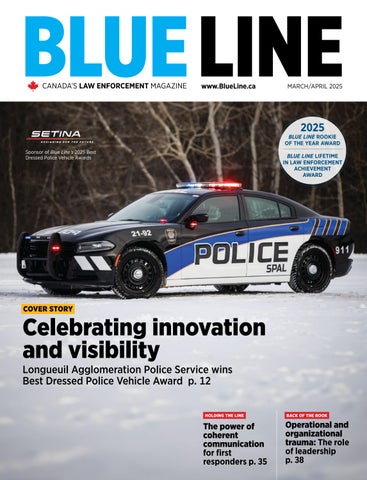
Celebrating innovation and visibility Longueuil Agglomeration Police Service wins Best Dressed Police Vehicle Award p. 12
HOLDING THE LINE
BACK OF THE BOOK
The power of coherent communication for first responders p. 35
Operational and organizational trauma: The role of leadership p. 38
POLICE INNOVATIONS
Learn how Triton can make your recruiting & online process more efficient. TRITON’S AUTOMATION AND CUSTOMER SERVICE CREATES A USER-FRIENDLY ENVIRONMENT CUSTOMIZED TO YOUR NEEDS ONLINE AUTOMATION FOR RECORD CHECKS Triton works with police services across Canada to create a custom criminal record check platform for each agency’s needs.
RECRUITMENT SCREENING TRITON is a national pre-employment screening agency providing secure and easy-to-use online background checks. With over a decade of experience in the industry, we’ve made it our goal to help agencies of all sizes streamline their hiring process to make data-driven choices that foster long lasting relationships with their most important assets – their members. CRIMINAL BACKGROUND CHECK - 15 minutes
HOW CAN TRITON HELP? Live, Canadian Based, Customer Service - We manage all applicant calls We continuously innovate to modernize and automate processes Our Guided Entry makes completing an application as easy as ordering a pizza online Triton’s adherence to security and regulatory compliance are at the highest global standards
Custom platform built directly from your website. EMPLOYMENT & EDUCATION - 48 hours
Our experienced agents verify candidate information. REFERENCE CHECK VERIFICATION - 48 hours
Fully customized per your request.
CREDIT CHECK VERIFICATION - 120 minutes
Using Trans-Union to find any red flags concernting credit. DRIVING RECORD ABSTRACT - varies by province
Data from the Ministry of Transportation
SOCIAL MEDIA BACKGROUND CHECK - 48 hours
Full scan of candidates online presence
We work with you team to develop process to meet your service’s specific needs CONTACT US
ROB STEWART (416) 606-6016 rob.stewart@tritonverify.com tritoncanada.ca
WANT TO GET STARTED? Let’s talk about how we can create a custom solution for you.
Contents
12 March/April 2025 Volume 37 Number 2
Features
Columns 4 8 35 38
Editor’s Commentary Q&A Holding the Line Back of the Book
Departments
COVER STORY
12 Celebrating innovation and visibility
Longueuil Agglomeration Police Service wins Best Dressed Police Vehicle Award. By Brittani Schroeder.
5 5 6 6 37
News By the numbers Dispatches Calendar Marketplace
16 Accelerating innovation
Outcomes of Michigan State Police’s 2025 Vehicle Trials. By Dave Brown.
22 From idea to reality
How Lac Seul Police created Ontario’s first Indigenous-led canine unit. By Brittani Schroeder.
25 Community safety and well-being
A transformative shift for Canadian policing. By Neil Dubord and Cal Corley.
28 A commitment to saving lives
COVER PHOTO: LONGUEUIL AGGLOMERATION POLICE SERVICE
Cst. Daniel Hemmerling named Lifetime in Law Enforcement Achievement Award winner. By Brittani Schroeder.
32 “Living the dream”
How Toronto Police Constable David Um became Rookie of the Year. By Brittani Schroeder.
22 @Blue_LineMag
28 32 March/April 2025 | BLUE LINE
3
EDITOR’S COMMENTARY BY BRITTANI SCHROEDER
www.BlueLine.ca
Sharing the stories of this year’s award winners
T
he March/April issue of Blue and view the winning designs on page 12. Line is my favourite issue to Our 2025 Rookie of the Year hails from work on and publish each year. Toronto Police Service: Cst. David Um, I have the honour and privilege who is currently assigned to 51 Division. of serving on the judging panels for our The nomination package submitted for Um three annual awards programs—Canada’s clearly demonstrated that, despite having Best Dressed Police Vehicle, Lifetime in just under three years of experience, he is Law Enforcement Achievement Award, thriving in his role and will only continue and Rookie of the Year—alongside numto improve. Many officers expressed their erous industry leaders and experts. thoughts on his remarkable work ethic, his The reason this is my favourite capacity to engage with communedition of the magazine is the For the 2025 ity members, and his team-oristories I can explore with each edition of ented mentality. You can find the award nominee. As you might Canada’s full story on page 32. have already guessed, given the Best Dressed To round out our 2025 winners, nature of my work, I am a lover of Police we have chosen Cst. Daniel storytelling. Therefore, being able Vehicle, we Hemmerling of the Winnipeg Poto discover the stories behind received lice Service as our Lifetime in Law each vehicle design, understand over 35 Enforcement Achievement Award why the rookies chose policing nomination winner. Hemmerling has been in and learn how they are already packages policing for over 23 years, during making an impact in their com- and were which time he has created a medmunities, and hear about the in- pleased to ical training program to better credible journeys of those who recognize educate his fellow officers and first have dedicated a lifetime to this five winners responders and greatly assist the in this career is truly remarkable. community when they need help You’re all aware that this is not magazine. the most. You can find out more always an easy profession, yet you about his journey on page 28. are here because you love what you do. Did you know that in 2023, there were You’ve chosen to put others’ needs before 71,472 police officers in Canada?1 Think of your own, and that deserves recognition. that in terms of all the stories yet to be told. For the 2025 edition of Canada’s Best Of course, I do my best to share as many as Dressed Police Vehicle, we received over I can through Blue Line, but there’s so much 35 nomination packages and were pleased more than one person can cover. to recognize five winners in this magazine. So, as always, I encourage you to reach I want to extend a hearty congratulations out to me if there’s an officer you think to Longueuil Agglomeration Police Service should be featured, a topic you believe for taking first place in our Frontline Padeserves attention, or a new initiative your trol category, followed closely by Deep police service has launched. Your input is River Police Service and Tsúùt’ínà Nation invaluable in helping us cover the issues Police Service. Sarnia Police Service took that matter most to the law enforcement first place in our Community Relations community. You can contact me at category, following their third-place bschroeder@annexbusinessmedia.com. achievement in the Frontline Patrol catUntil next time, congratulations once egory in 2024. This year, we were also more to our 2025 award winners, happy delighted to acknowledge a winner in the reading and be well. Special Service category, awarding first place to the Hamilton Police Service. You can read more about this year’s winners CONNECT WITH BLUE LINE
www.BlueLine.ca
4
@Blue_LineMag
BLUE LINE | March/April 2025
www.facebook.com/BlueLineMagazine
Reader Service Print and digital subscription inquiries or changes, please contact customer service Angelita Potal Tel: 416-510-5113 Fax: (416) 510-6875 email: apotal@annexbusinessmedia.com Mail: 111 Gordon Baker Rd., Suite 400 Toronto, ON M2H 3R1 GROUP PUBLISHER | PAUL GROSSINGER pgrossinger@annexbusinessmedia.com PUBLISHER | ADAM SZPAKOWSKI aszpakowski@annexbusinessmedia.com EDITOR | BRITTANI SCHROEDER bschroeder@annexbusinessmedia.com EDITORIAL DIRECTOR PUBLIC SAFETY GROUP | LAURA AIKEN laiken@annexbusinessmedia.com ACCOUNT MANAGER | JANICE EATON jeaton@annexbusinessmedia.com MEDIA DESIGNER | SVETLANA AVRUTIN savrutin@annexbusinessmedia.com ACCOUNT COORDINATOR | KATHRYN NYENHUIS knyenhuis@annexbusinessmedia.com AUDIENCE DEVELOPMENT MANAGER BEATA OLECHNOWICZ | (416) 510-5182 bolechnowicz@annexbusinessmedia.com CEO | SCOTT JAMIESON sjamieson@annexbusinessmedia.com ANNEX BUSINESS MEDIA 111 Gordon Baker Road, Suite 400 Toronto, ON M2H 3R1 Tel. 416-442-5600 • Fax 416-442-2191 Publication Mail Agreement No. 40065710 ISSN 0847-8538 Printed in Canada SUBSCRIPTION RATES Canada — 1 Year $32.13; 2 Year $53.55 plus tax USA — 1 Year $139.23 CAD Occasionally, Blue Line will mail information on behalf of industry-related groups whose products and services we believe may be of interest to you. If you prefer not to receive this information, please contact our circulation department in any of the four ways listed above. Annex Privacy Officer Privacy@annexbusinessmedia.com; Tel: 800-668-2374 © 2025 Annex Business Media. All rights reserved. Printed in Canada. No part of the editorial content of this publication may be reprinted without the publisher’s written permission. Opinions expressed in this magazine are not necessarily those of the editor or the publisher. No liability is assumed for errors or omissions. Readers are cautioned and advised that articles presented herein are edited and supplied for your personal awareness and should not be used for further action until appropriate guidance is received from a supervisor, Crown Attorney or other persons in authority. All advertising is subject to the publisher’s approval. Such approval does not imply any endorsement of the products or services advertised. The publisher reserves the right to refuse advertising that does not meet the standards of this publication.
PHOTO CREDIT: BRITTANI SCHROEDER
NEWS
ONTARIO
OACP & Blue Line Expo team announces star-studded panel session for April 29 event
Blue Line and the Ontario Association of Chiefs of Police (OACP) are proud to celebrate their fourth successful year of partnership with the highly anticipated OACP & Blue Line Expo. This year’s event will take place on April 29 at the International Centre in Mississauga, Ont., offering a dynamic platform for police professionals to come together and explore critical issues affecting public safety. One of the key highlights of the event will be a thought-provoking panel discussion on bail reform and recidivism. The session will bring together a distinguished group of police leaders who will delve into the complexities surrounding bail reform, repeat offenders and the strain these issues place on both police operations and public safety. The panel will feature: • Thomas Carrique, Commissioner of the Ontario Provincial Police and President of the Canadian Association of Chiefs of Police (CACP) • Jodi Empey, Chief of Smiths Falls Police Service • Sydney Lecky, Chief of Timmins Police Service • Peter Moreira, Chief of Durham Regional Police Service • Roger Wilkie, Deputy Chief of Halton Regional Police Service and President of the OACP
• Mark Baxter, President of the Police Association of Ontario (PAO) • Moderated by: Paul Pedersen, Executive Director of the OACP This session offers a unique opportunity for attendees to hear directly from top law enforcement leaders about the real-world challenges being faced today. It is essential for those committed to learning from and improving modern-day policing. Register for free at bluelineexpo.com. ALBERTA
GPPS graduates first class of locally trained recruits
The Grande Prairie Police Service (GPPS) recently celebrated the graduation of its first class of recruit police officers. A ceremony took place on Feb. 21 to honour the achievements of the 12 graduates and to commemorate this historic moment. This milestone in the development of the municipal police service follows the successful completion of a comprehensive six-month training program conducted at various locations across the Grande Prairie area. In addition to benefiting from the expertise of local professionals, the recruits also participated in Lethbridge Polytechnic’s Police Cadet Training program, earning a certificate in Police Cadet Training upon graduation. The graduating officers bring a wide range of diverse backgrounds and experiences to the Grande Prairie Police Service. Of the 12
recruits, eight are from the Peace Country, two hail from other parts of Alberta, and two are from British Columbia. These officers were selected for the GPPS’ inaugural recruit class through a highly competitive process that attracted nearly 200 applicants. The newly graduated officers will now undergo field training with experienced officers to further develop the skills and knowledge they acquired during their classroom training. Six of the officers will be immediately deployed to the Grande Prairie RCMP Detachment, where they will receive mentorship from seasoned GPPS officers. This phase of training is expected to last up to four months. The remaining six officers will be assigned to other duties until additional field training officers become available. “This momentous graduation is a testament not only to the dedication and hard work of our recruits over the past several months, but also to the tireless efforts of our transition, recruiting, and training teams,” says Chief Dwayne Lakusta. “I am grateful for the collaboration of numerous law enforcement and community partners, whose contributions have been invaluable in ensuring our team possesses the experience, skills, resources, and innovative solutions necessary to enhance safety in our city.” GPPS begins training its second recruit class at the end of March 2025, with the third scheduled to start in the fall.
PHOTO CREDIT: GRANDE PRAIRIE POLICE SERVICE
BY THE NUMBERS In December 2024, Statistics Canada released recent data on Homicide in Canada, 2023. For more information, please visit www150.statcan.gc.ca.
778
homicides were reported by police in 2023.
@Blue_LineMag
26 % of homicide victims were identified as Indigenous.
173
gang-related homicides continued to represent approximately one-quarter of all homicides.
73 % of victims were women, though the number of intimate partner homicides decreased.
March/April 2025 | BLUE LINE
5
NEWS DISPATCHES Deputy Chief Paul Cook retired in Sep. 2024 after 35 years of exemplary service with the Calgary Police Service. Cook had a decorated career rising through the ranks, including accepting the position of interim chief of police in 2015, leading the service through a significant surge in gun violence and a challenging budget process. Cook received a CPS Distinguished Service Award, 30-year Police Exemplary Service Medal, the 30-year Alberta Long Service Medal, and the Queen’s Platinum Jubilee Medal for distinguished community service and his work on external partnerships. Cory Dayley of the Calgary Police Service was promoted from superintendent to deputy chief effective Oct. 28, 2024. Dayley is a 23-year member of the service and has worked in many areas, leading many significant initiatives. Dayley now leads the Bureau of Service and Community Support. In Dec. 2024, Brigadier-General Vanessa Hanrahan was officially recognized as the new Canadian Forces Provost Marshal and assumed command of the Canadian Forces Military Police Group from Major-General Simon Trudeau. Hanrahan most recently served as the Deputy Canadian Forces Provost Marshal. Hanrahan brings 30 years of service, and a wide breadth of experience as a Military Police officer to their new role. Assistant Commissioner Matco Sirotic has been named as the new Commanding Officer of the New Brunswick RCMP. Starting his RCMP career in 2004, Sirotic was promoted to Corporal in 2012 and served as the detachment commander for Minto, N.B. Progressing through the ranks, he moved to Nunavut, followed by Nova Scotia and New Brunswick. Previously, he was the Officer in Charge of Specialized Policing and Operational Support Services in New Brunswick.
6
BLUE LINE | March/April 2025
CALENDAR Surrey Police Service has appointed Michael Procyk as the new deputy chief constable of the investigative services bureau. With over 27 years of policing experience, Procyk has established a reputation as a highly dedicated, knowledgeable and ethical leader within the investigative policing community in Canada and internationally. Procyk served with the RCMP for 24 years in a variety of roles and capacities. He joined SPS in early 2021 as the first superintendent of the Investigative Services Bureau. He has worked with the rest of the leadership team to build the Bureau from the ground up to operationalize SPS’ investigative capacity. Jeremy Pearson has been welcomed to the executive team of the Thunder Bay Police Service as the deputy chief of administration. Chief Darcy Fleury said, “The skills, knowledge and ability that he has developed have served him well in his career and will continue to assist him as he takes on this senior leadership role. I have seen the work that Jeremy has done, his commitment to providing superior service to the community, and his ability to communicate with compassion.” The Thunder Bay Police Service Board also announced the reappointment of Ryan Hughes as deputy chief for two years. “In the past 18 months, I have seen Ryan’s commitment to the police service and community. He is a valued member of the TBPS and is a respected senior police leader in the province of Ontario,” said Fleury. Jeremy Mighton is the new deputy chief for the Saugeen Shores Police Service. He has had an extensive 21-year career in law enforcement, which began with the Guelph Police Service and continued with five years of service as a Hanover Police constable before he joined the Saugeen Shores Police Service in 2011. Within the SSPS, Mighton rose through the ranks while progressively expanding his involvement in investigative activity, supervision, operational manage-
Security · Police · Fire Career Expo – Toronto Date: Mar. 27, 2025 Location: Toronto, Ont. www.emergencyservicesexpo.ca Police Religious Literacy Program Date: Apr. 8 – 10, 2025 Location: Mississauga, Ont. worldreligions.ca/police-discoveryprogram CACP/MACP National Police Leadership Conference Date: Apr. 28 – 30, 2025 Location: Winnipeg, Man. cacp.ca OACP & Blue Line Expo 2025 Date: Apr. 29, 2025 Location: Mississauga, Ont. bluelineexpo.com 2025 Homicide Conference Date: May 5 – 9, 2025 Location: Niagara Falls, Ont. oacp.ca CIPSRT Conference 2025 Date: May 7 - 8, 2025 Location: Regina, Sask. event.fourwaves.com Find more calendar events online at blueline.ca/events.
ment and human resources aspects of policing as he was promoted to Sergeant in 2016 and to Inspector in 2021. Lindsay Ellis has been appointed as the commanding officer of the Yukon RCMP, now holding the rank of chief superintendent. With over 12 years of policing experience in Yukon, Ellis was promoted to superintendent in 2022, serving as the criminal operations officer of M Division. She has built strong relationships with Yukon First Nations and diverse communities while fostering collaboration, inclusion and communication across various sectors. PROMOTIONS, RETIREMENTS, RECOGNITION • If you have an officer in your agency recently promoted or retiring or an individual you wish to have recognized (major award or recently deceased) you can let Blue Line magazine know by emailing: bschroeder@ annexbusinessmedia.com.
www.BlueLine.ca
STANDING SHOULDER TO SHOULDER WITH YOU Your trusted source for uniform insignia
trimtag.com • contact@trimtag.com • 905-763-7300
Q&A: The hidden value of mounted units Recently, editor Brittani Schroeder spoke with Sgt. Denise Leonard of the Hamilton Police Service (HPS), about the value of mounted units within a policing organization. I started policing in 1991, and I’ve held a variety of roles in various units, including front line patrol, plainclothes, undercover plays, special projects, bail court, break and enter, robbery, public order and secondments in child abuse, sexual assault and the detective office. I was the third female canine handler in Canada, after female handlers at Vancouver Police Department and Toronto Police Service. In 2003, I competed in the North American Police K-9 trials in Oakville, Ont., placing top three in both the PD 1 and PD 2 tracking events, while nine months pregnant. I was Police Officer of the Year in 1994 and was nominated for the Ontario Medal for Police Bravery. In 2009, the idea of a mounted unit was floated in a meeting. When I first began in policing, an older sergeant handed me a proposal for a mounted unit that never got off the ground in the 80s. Since I grew up with horses, he thought I might be able to get the unit going. I brought that proposal back out when they approached me nearly two decades later. When I was seven years old, I told everyone that I would be a police officer who rode horses. Other members officially started the unit in 2010, but I was approached in 2014 to join. I came in as a rider, and the following year, I was promoted to unit supervisor.
Q: What does the mounted unit do?
The unit began as a pilot project with four horses for three years. When the three years were up, it was pitched as a full-time unit and was approved. There are five full-time members, myself as the sergeant and four patrol officers. Though I do still 8
BLUE LINE | March/April 2025
get out on the road, I mainly train Hamilton Police the horses and riders. The unit Service’s works day shifts Tuesday to Friday, mounted unit. and afternoon shifts Wednesday to Saturday. We also have a retired horse who is helping to launch our equine therapy program. We can do calls for service and attend domestics, robberies, vehicle accidents, search and rescue, and assist with mental health situations—which is something we excel at because these animals can change people. We give out tickets and can arrest people, but that’s not the bulk of what we do. Some core functions are search and rescue, high visibility patrols, protests and crowd management. We also do a lot of community outreach, ceremonies, and other events. Community engagement is one of the most valuable uses of mounted officers. We can connect with individuals and communities through the shared admiration of the horse, and it breaks down any barriers or previous biases.
During the pandemic, we would stand outside the hospital, and people would see us as they passed by. One day, I took a horse—MacNab—to the Juravinski Cancer Centre, and a lady came running outside. Her son-in-law was undergoing treatment, but he’d seen us from the window and wanted to come visit. So, she brought him down in a wheelchair, and he took a few photos with us as he petted the horse. I gave the woman my cell number, and a few weeks later, she texted me to let me know he had passed away. She shared that in the last three weeks of his life, all he talked about was MacNab. A year later, I was riding down the street, and a car pulled over. A woman jumped out of the car—it was the woman from the hospital. The man who was with her was her grandson, who knew about MacNab’s visit during his father’s last weeks in hospital. We took more photos before parting ways. Fast www.BlueLine.ca
PHOTO CREDIT: HAMILTON POLICE SERVICE
Q: Can you describe your time in policing?
HAIR TRANSPLANT | PRP | HAIR LASER
SCAN ME
www.torontohairtransplantclinic.com
647-351-0061
Q&A: The hidden value of mounted units forward to two months ago. An older woman was pushing a stroller down the sidewalk, and she asked for a photo with McNabb. It was the same woman, and she was now with her great-granddaughter. There is no time in policing that I have had that kind of lasting impact on someone. It proves how significant community outreach is for us. We connect with people on a level that other officers might not be able to.
Q: What resources do you need for the mounted unit?
We ride heavy horses, which are twice the size of regular horses. We have four horse trailers because you need a special restricted licence when more than two horses are inside a trailer. Officers must also be trained to drive with the trailer and obtain a commercial driver’s
The mounted units touch on things often overlooked but are extremely important in our ability to police our communities.
COOL GUARD
Cut Resistant and Cooling Long Sleeve T-Shirt
license. We must perform specific checks on our trucks, just like a commercial driver would. As for equipment, we have custom-made pommel bags for the horses, and our notebooks, pens and flashlights are attached to Velcro because we always have the reins in our hands. We also have oversized raincoats that resemble large dresses because we go out in any weather. Some of us also have heated gloves and jackets.
Q: Mounted units are often targeted when budgets need to be reallocated. What are your thoughts on this?
I feel confident in saying that it’s because mounted units are not provincially mandated, so we’re looked at as “extra”. When a police service is a specific size, it’s mandated that there is a canine unit. When
you have a large body of water, it’s mandated that you have a marine unit. Those of us outside large metro areas like Toronto and Vancouver, who have smaller teams and fewer protests, are always under the microscope. The service decides on a mounted unit based on its needs. Hamilton has a big enough entertainment district, protests, and search and rescue operations, so we decided it was needed. You also must consider what else the horses can help you do, which is where the community outreach comes in.
Q: What do you believe other officers can learn from the mounted units?
I don’t think everyone understands what we do. If you’re not working in the downtown core or in the entertainment district or seeing us at a
Cool Guard long-sleeve T-Shirt is manufactured in Canada, and specifically engineered with the safety of first responders as a top priority. Every day, these dedicated professionals face hazardous situations, and with the increasing prevalence of incidents involving sharp-edged weapons, enhanced protection has become essential. Cool Guard combines cutting-edge technology with superior comfort to meet the demanding needs of those who protect and serve. Designed for breathability, Cool Guard T-Shirts are tailored to be worn seamlessly under issued service uniforms, offering both safety and practicality for the wearer. Cut-Resistant Sleeves Cool Guard T-Shirt sleeves are crafted from ISEA-certified (International Safety Equipment Association) materials, ensuring they meet the highest standards for cut resistance. The advanced fabric, also features a unique blend of fibers that wick moisture away and dissipate heat from the skin, providing exceptional comfort and reliable protection. Cooling Body Fabric - F R E E Z E T E C H The body of the Cool Guard T-Shirt is made from a specialized material that actively absorbs moisture. Its endothermic properties lower the fabric’s temperature, creating a cooling sensation that enhances comfort during extended use. This innovative design ensures first responders stay cool, dry, and protected, even in the most challenging conditions.
info@cimaltci.com (514) 596 - 0327 by CIMA
10 BL_CIMA BLUE LTCI LINE_MarApr25_CSA.indd | March/April 20251
1625 Chabanel Street West, Suite 800 Montreal, Qc, Canada H4N 2S7
2025-03-05 2025-03-06 3:38 PM 3:22 PM www.BlueLine.ca
protest or search, you might not even see us working. But we’re there to take whatever workload we can off the frontline members. We answer calls and we swing by to respond to the community and their needs. We give face-to-face contact so that our community feels like they are being heard. The animals also get people talking, and we gain valuable intel or witnesses while on the road. We also have a return-to-work program where officers can enter our unit before returning to full duties. Being in the barn, brushing the horses, smelling them—it’s therapeutic. Police services are always looking for stats and hard numbers, something tangible, but mounted units provide connection, support and validation for community members in a way that’s not always measurable.
BL_870 Tactical_MarApr25_CSA.indd 1 @Blue_LineMag
There is no time in policing that I have had that kind of lasting impact on someone.
We know that other units are essential, and they do complex work that hits the core of policing, but other aspects go into policing as well. The mounted units touch on things often overlooked but are extremely important in our ability to police our communities.
Q: What do you hope for the future?
I hope that we can provide a better understanding to members of law enforcement about what we do and what you get from the investment in a mounted unit. I’ve been in policing for a long time, and I’ve been through numerous pairs of boots. These horses are purchased between the ages of five and eight and work on the road for 15 years. After they retire, they can still serve in the mental health program, and they might finish their
lifetime with us. There isn’t another piece of “equipment” that lasts as long in policing. I’d like to see policing embrace mounted units. I’m not saying everyone should run to start new units, but recognize the value these horses bring. As individuals, we come into policing because we want to do it and want to help people. You can get pretty beat up in here, mentally and physically, and then you end your career by leaving. I look at the animals and want them to be honoured like I want to be honoured as a police officer. We’ve all impacted our services, and I want the horses to be looked at similarly. And remember, they didn’t choose this career like we did. When I advocate for the mounted units, it’s for the horses, the riders and all units across Canada who are trying it out or are currently active.
2:26 PM11 March/April 2025 2025-03-13 | BLUE LINE
Sponsor of Blue Line’s 2025 Best Dressed Police Vehicle Awards
COVER STORY
1st place: Longueuil Agglomeration Police Service
Celebrating innovation and visibility Longueuil Agglomeration Police Service wins Best Dressed Police Vehicle Award By Brittani Schroeder Congratulations to all the winners of Blue Line’s 2025 Best Dressed Vehicle Awards. We want to thank our platinum sponsor, Setina Manufacturing, and our silver sponsor, D&R Electronics Company, for helping us showcase innovative, sustainable and effective designs nationwide. Thank you to all agencies who submitted their vehicles. Stay tuned to blueline.ca for our 2026 call for submissions later this year.
Longueuil Agglomeration Police Service (SPAL) 2023 DODGE CHARGER PURSUIT – AWD
For the first time in over a decade, SPAL’s fleet of motorized vehicles— ranging from command posts and motorcycles to vans, cars, pickups, trailers and ski-doos—has undergone a complete visual overhaul. This redesign was a passion project spearheaded by a dedicated team of 10 employees from diverse departments within the organization. Their goal was to mark the next 10 years with a refreshed identity while honouring the legacy of the original colour scheme. In their spare time, the team conducted extensive research, creating over 75 prototypes before finalizing a sleek, bold design in both black and white. “A marked police car should be very visible, and SPAL uses a two-colour graphic to its best advantage,” explained Dave Brown, a judge in the contest. “The hash marks on the front bumper and across the rear fender are simple but effective, and they add to the directionality of the design—an important point when citizens might need to see the direction a police vehicle is going with just a glance.” The project’s primary objective was to modernize the fleet’s visual presence, reinforcing the SPAL brand while boosting visibility across the five cities of the Longueuil agglomeration. The new look is designed to project an image of innovation, appeal to younger officers, and foster stronger community relations. “The design exemplifies the avant-garde modernity and innovation that SPAL was striving for,” said contest judge Laura Aiken. Insp. Gino Iannone expressed the team’s excitement upon hearing of their win in this year’s competition: “It is a source of pride for us to have the privilege of being awarded first place.” 12
BLUE LINE | March/April 2025
Chief M. Patrick Bélanger concluded by saying, “Our entire organization is reflected positively by this honour, and SPAL officers would like to thank the selection committee for recognizing our vehicles as this year’s Best Dressed patrol vehicles in Canada.”
2nd PLACE Deep River Police Service 2023 FORD EXPLORER INTERCEPTOR – AWD
As one of the smallest police services in Ontario, with just nine sworn officers, the opportunity to purchase a new cruiser is a rare event. When the chance finally came in 2024, the team approached the design process with great care, aiming to create a vehicle that truly represents the community they serve. The design was inspired by the region’s natural landscape. The blue was chosen to symbolize the Ottawa River, while the yellow accents around the lettering were selected to evoke the warmth of the sun shining down on the town. “We wanted the vehicle to feel warm and welcoming. With only three vehicles in our fleet, it’s important that both our officers and the community take pride in them,” shared Cst. Michael Slattery. The design team, which included members of the Deep River Police Service and a representative from the town council, found the process particularly meaningful, as officers had the opportunity to influence the look of their own vehicles. “Deep River Police has created a design that reinforces their strong community ties. The clean and thoughtful aesthetic immediately caught our attention,” noted Brown. www.BlueLine.ca
PHOTO: LONGUEUIL AGGLOMERATION POLICE SERVICE
1st PLACE
NEW!
2nd place: Deep River Police Service
The Deep River team was thrilled to learn of their second-place finish in this year’s contest. Slattery stated, “It was rewarding not only to have our vehicle showcased nationally, but also to highlight the community we serve.”
PHOTOS: (TOP) DEEP RIVER POLICE SERVICE; (BOTTOM) TSÚÙT’ÍNÀ NATION POLICE SERVICE
3rd PLACE Tsúùt’ínà Nation Police Service 2021 CHEVY SILVERADO – 4WD
For members of the Tsúùt’ína�Nation Police Service, preserving and celebrating their rich cultural heritage is just as essential as ensuring community safety. When the time came in 2024 to redesign their fleet, they partnered with Elder Anita Bigplume, a local Indigenous artist, to bring their vision to life. The goal was for all the police vehicles to honour Tsúùt’ína� culture, foster mutual respect and reflect the community’s identity. Four animals were chosen to feature prominently in the designs, each symbolizing strength and significance. “The bear represents medicine; the eagle is the messenger to the Creator; the buffalo provides for the people; and the horse symbolizes the balance and harmony of the Tsúùt’ína�culture,” said Insp. Dawn-Lyn Blake. “This redesigned fleet isn’t just a visual treat—it’s a statement of our commitment to innovation, grounded in respect for tradition.” The initiative is part of a broader effort by the service to deepen its connection with the community, ensuring the continued support and trust necessary for its mission to drive positive change in policing. “Tsúùt’ína�Nation Police gave us one of the most unique and artistic designs we have ever seen in the contest,” said Brown. Blake emphasized that Tsúùt’ína�Nation is a proud, forward-thinking Indigenous community dedicated to collaboration and meaningful consultation at every step of its evolution. “Sharing the story behind our vehicles and their design journey was an invaluable opportunity to strengthen connections and understanding,” she said. “Learning that we placed third was a thrilling moment for our entire team.”
OUR NEWEST ALL SEASON BOOT
TROOPER GTX
SIDE ZIP
Durable comfort with
GORETEX THERMIUM Technology
scan for details
www.haixca.com 3rd place: Tsúùt’ínà Nation Police Service
@Blue_LineMag
BL_Haix_MarApr25_CSA.indd 1
March/April 2025 | BLUE LINE
13
2025-02-12 9:07 AM
COVER STORY
Special Service 1st place: Hamilton Police Service
COMMUNITY RELATIONS
SPECIAL SERVICE
1st PLACE
1st PLACE
Sarnia Police Service 2020 CHEVY SILVERADO – 4WD
Hamilton Police Service 2023 FREIGHTLINER MT-55 – RWD
The Sarnia Police Service (SPS) is one of just two municipal police forces in Ontario tasked with policing a First Nations community. The Aamjiwnaang Heritage Cruiser is the result of a community-driven initiative, co-created by Chief Derek Davis and Julie Craddock, former deputy chief of SPS. Both the Aamjiwnaang First Nation Chief and Council played a key role in selecting the design, which was crafted by Aamjiwnaang member Aaron Plain. Titled “The Keeper”, Plain described the design as an evolution that started as a dream and developed into a story. “The warrior on the left side of the truck symbolizes someone who sacrifices for others, while the woman on the right side represents the strength, spirit and life-giving power of women,” said Plain. “A community relations vehicle is one place where designers can run wild. Sarnia uses bold colours and designs that differ from side to side to significant effect here,” said Brown. Exclusively driven by the Aamjiwnaang Community Officer, the vehicle serves as a culturally sensitive resource for the Aamjiwnaang First Nation, helping to foster a harmonious, healthy community. Aiken praised the design for embodying the community’s vital caretaking role, which also aligns with the core mission of the police service. “It’s beautiful, a true representation of the values both the community and the service uphold.” Chief Davis emphasized SPS’s deep respect for the Aamjiwnaang community, noting, “We acknowledge the privilege of serving Aamjiwnaang First Nation and value them as partners in public safety. Recognizing and meeting the unique needs of the Aamjiwnaang people is a central goal of our service.” After securing third place in the 2024 Best Dressed Frontline Patrol category, Davis expressed that winning the 2025 Community Relations category was “beyond expectations”. “As a medium-sized agency with fewer resources than larger forces, this recognition is especially meaningful. It reflects on the quality of our people and their innovations, along with our ability to implement new projects and programs, despite our constraints,” said Davis. 14
BLUE LINE | March/April 2025
Hamilton Police Service’s (HPS) incident command vehicle plays a vital role in enhancing communication and coordination during emergencies by providing a mobile, fully-equipped workstation. It is considered a cornerstone of both officer and public safety. When designing the vehicle, it was essential that it be highly visible and align with the existing patrol fleet. Deputy Chief Paul Hamilton collaborated closely with the Director of Fleet Facilities and Procurement, the Community Safety Division, the Graphics Branch and the Fleet Supervisor to bring the concept to fruition. “HPS understands when a community is in trouble, the last thing they want to see is clown cars or colourful designs that look more like ransom notes. They want to see professionals who are there to help them. Hamilton resisted the all-black design and instead went for a clean two-tone black and white that speaks ‘We’re here to help’ during critical incidents,” said Brown. The timeless design ensures longevity throughout the vehicle’s lifecycle, requiring no updates to the graphics, making it a sustainable and efficient choice. “Hamilton’s unit strikes the perfect balance of sleek functionality, utilizing bold yet simple design elements to great effect,” said Aiken. HPS was thrilled to learn of their victory in this year’s contest. “This win means so much to our team. It reinforces the importance of teamwork and creativity in achieving goals that benefit both our officers and the people we serve,” said Deputy Chief Hamilton. “This design reflects our commitment to progress and innovation, and we’re proud to contribute to the broader conversation about modern policing.” Thank you to Blue Line’s 2025 Best Dressed Police Vehicle judges for their expertise and dedication to this contest. Dave Brown is a contributor on firearms and police vehicles. He is a retired tactical firearms trainer and consultant based in Winnipeg. Reach him at dave@bulletproofset.ca. Laura Aiken is the Public Safety Group editorial director at Annex Business Media.
www.BlueLine.ca
PHOTOS: (LEFT) SARNIA POLICE SERVICE; (RIGHT) HAMILTON POLICE SERVICE
Community Relations 1st place: Sarnia Police Service
VEHICLES
Accelerating innovation Outcomes of Michigan State Police’s 2025 Vehicle Trials By Dave Brown
2025 Ford Police Interceptor Utility from Ford Motor Company PHOTO: FORD MOTOR COMPANY
E
2025 Chevrolet Silverado from General Motors PHOTO: GENERAL MOTORS
very fall, the Michigan State Police, in conjunction with the U.S. National Institute of Justice (NIJ), conducts back-to-back acceleration, braking and lap time tests to evaluate the handling and performance of every new police vehicle on the market for the coming year. These eagerly anticipated tests are seen as the most comprehensive analysis of police vehicles in North America. While agencies such as the Michigan State Police and the Los Angeles County Sheriff ’s Department document and test every model offered for sale in North America, there is no strict definition of the term “pursuit-rated.” However, they agree that a pursuit-rated police vehicle must be able to handle higher stresses than normal and perform better at high speeds than its civilian counterparts. It will be up to individual agencies to determine if a particular vehicle is suitable for their mission. The Michigan State Police’s annual vehicle test for the 2025 model year will mark the 27th year that Blue Line has been compiling and reporting the results of the tests for pursuit-rated police vehicles. The 2024 model year tests were the first in history to eliminate all police sedans from the lineup, and the 2025 tests continue the trend towards SUVs and trucks only. In 2023, Ford introduced the Mustang Mach E as a Police Category vehicle. However, the Mach E has been dropped from the lineup for 2025, leaving the Chevrolet Blazer EV as the only plug-in electric vehicle tested for general police duties. While the acceleration and top speed of fully electric vehicles are impressive, very few are used in day-to-day service as regular patrol vehicles. Agencies that have purchased electric vehicles use them primarily in supervisory or community-relations roles, so they don’t stray too far from the charging grid. Range is one of the biggest challenges to overcome for an agency transitioning to an all-electric fleet, as vast areas of Canada are hundreds of kilometres from any reliable charging solutions. The yearly tests conducted by the Michigan State Police also reveal how significantly range diminishes when driven at higher speeds. For instance, among the most capable electric vehicles tested, the Chevrolet Blazer EV shows a loss of nearly 30 per cent of its state 16
BLUE LINE | March/April 2025
2025 Dodge Durango Pursuit from Fiat Chrysler Automobiles PHOTO: FIAT CHRYSLER AUTOMOBILES
of charge after just eight laps of high-speed driving, covering a distance of just under 26 kilometres.
Vehicles
The Michigan State Police Precision Driving Unit evaluates police vehicles in two categories: police category vehicles and special service vehicles. Police category vehicles are designed for the full spectrum of general police activities, including high-speed pursuit. Special service vehicles are designed only for specialized duties such as canine units or adverse weather conditions and are not intended or recommended for pursuits. Eleven vehicles were submitted to the NIJ in the Police Category for the 2025 model year: • 2025 Chevrolet Tahoe PPV 5.3L RWD • 2025 Chevrolet Tahoe PPV 5.3L 4WD • 2025 Chevrolet Silverado Z7X 5.3L 4WD 2-inch lift package • 2025 Chevrolet Silverado Z71 5.3L 4WD • 2025 Chevrolet Police Blazer EV AWD • 2025 Dodge Durango Pursuit 5.7L AWD • 2025 Dodge Durango Pursuit 3.6L AWD • 2025 Ford Police Interceptor Utility 3.0L EcoBoost AWD • 2025 Ford Police Interceptor Utility 3.3L Hybrid AWD • 2025 Ford Police Interceptor Utility 3.3L AWD • 2025 Ford F-150 Police Responder 3.5L EcoBoost 4WD
The tests
Michigan State Police Precision Driving Unit and the NIJ’s Justice Technology Information Center (JTIC) test all the vehicles together over a three-day period at the Chrysler Proving Grounds and the Grattan Raceway. Each vehicle is tested without rooftop lights, spotlights, sirens or radio antennas in place. Tires are original equipment rubber provided by the manufacturer. Acceleration, braking and top speed tests are performed at the Chrysler Proving Grounds and vehicle dynamics tests are done using the two-mile road course at the Grattan Raceway. (All dimensions and measurements are given in U.S. numbers.) www.BlueLine.ca
REPORTING FOR DUTY Our purpose-built, pursuit-ready vehicles are designed to keep up with the demands of fast-paced police work.
Visit your Chevrolet dealer to learn more. GM vehicles shown throughout with third-party equipment and alterations installed by an independent supplier/upfitter. 2025 Tahoe PPV, 2025 Blazer EV PPV, 2025 Silverado PPV models shown.
VEHICLES THE RESULTS Vehicle dynamics testing
The objective of the vehicle dynamics testing is to determine the high-speed pursuit handling characteristics. Except for the absence of traffic, the two-mile road course simulates actual pursuit conditions. It evaluates the blend of suspension components and acceleration and braking ability. Four different drivers test each vehicle over an eight-lap road course, with the five fastest laps counting toward each driver’s average lap time. Final score is the combined average of all four drivers for each vehicle.
Lap Times
Chevrolet Tahoe 5.3-litre V8 RWD
Chevrolet Tahoe 5.3-litre V8 4WD
Chevrolet Silverado Z7X 5.3-litre V8 4WD
Chevrolet Silverado Z71 5.3-litre V8 4WD
Overall average lap times
1:39.02
1:39.77
1:42.03
1:40.92
Lap Times
Chevrolet Police Blazer EV AWD
Dodge Durango 5.7-litre V8 AWD
Dodge Durango 3.6-litre V6 AWD
Ford PI Utility 3.0-litre V6 EcoBoost AWD
Overall average lap times
1:39.95
1:39.20
1:41.90
1:35.97
Electric-powered vehicle dynamics testing
Because of the unique nature of battery electric vehicles, it was felt that a fair assessment of their capabilities would involve fast-charging the battery pack between runs. This would be more typical of an electric vehicle hitting the road near the start of every shift. In discussions with all three manufacturers, the MSP Precision Driving Unit settled on a charge time of 40 minutes on a 47 Kw Level 3 charger between runs.
Lap Times
Ford PI Utility 3.3-litre Hybrid AWD
Ford PI Utility 3.3-litre V6 AWD
Ford Police Responder F150 3.5-litre V6 EcoBoost 4WD
Overall average lap times
1:40.03
1:40.25
1:40.00
Vehicle
Acceleration and top speed
The objectives of the acceleration and top speed tests are to determine the ability of each vehicle to accelerate from a standing start to 60 mph, 80 mph and 100 mph, and to record the top speed achieved within a distance of 14 miles from a standing start. Each vehicle is driven through four acceleration sequences, two in each direction to allow for wind. Acceleration score is the average of the four tests. Following the fourth acceleration sequence, each vehicle continues to accelerate to its highest attainable speed within 14 miles of the standing start point.
Braking
The objective of the braking test is to determine the deceleration rate attained by each vehicle on twenty 60-0 mph full stops to the point of full ABS. Each vehicle is scored on the average deceleration rate it attains. Each test vehicle makes five measured 60-0 mph stops to full ABS engagement in one direction, and then five measured 60-0 mph stops to full ABS engagement in the opposite direction. After ten stops, each vehicle completes one lap around the test oval to cool the brakes, and the test is repeated. The resulting score is the average of all 20 stops. Stopping distance from 60 mph is calculated by interpolation of results.
Communications and ergonomics
The objectives of the communications and ergonomics tests are to rate a vehicle’s ability to provide a suitable environment for patrol officers to perform their job, to accommodate required communication and emergency warning equipment and to assess the relative difficulty in installing this equipment. A minimum of four officers independently evaluate ergonomic factors, and Michigan State Police Communications Division personnel then evaluate each vehicle on the ease of equipment installation. A score of one represents “totally unacceptable” and a score of 10 represents “superior” ergonomic or communication installation factors. Twenty-seven ergonomic factors are evaluated on a scale of one to 10 and averaged among all the testers. The final score is the overall average of all 27 factors, such as seat design, padding, ease 18
BLUE LINE | March/April 2025
Beginning state of charge
Ending state of charge after 8 laps
Average of Best 5 laps
97%
65%
1:39.68
97%
67%
1:39.83
97%
66%
1:40.27
97%
66%
1:40.03
Chevrolet Police Blazer EV
Acceleration
Chevrolet Tahoe 5.3-litre V8 RWD
Chevrolet Tahoe 5.3-litre V8 4WD
Chevrolet Silverado Z7X 5.3-litre V8 4WD
Chevrolet Silverado Z71 5.3-litre V8 4WD
0 – 60 mph
7.52
7.85
7.52
7.28
0 – 80 mph
12.18
12.70
12.12
11.85
0 – 100 mph
19.28
20.14
19.36
18.73
Top Speed (mph)
130
124
112
112
Acceleration
Chevrolet Police Blazer EV AWD
Dodge Durango 5.7-litre V8 AWD
Dodge Durango 3.6-litre V6 AWD
Ford PI Utility 3.0-litre V6 EcoBoost AWD
0 – 60 mph
5.08
7.30
9.03
6.17
0 – 80 mph
7.59
11.86
15.14
9.44
0 – 100 mph
11.23
18.89
25.14
14.03
Top Speed (mph)
130
130
127
148
Acceleration
Ford PI Utility 3.3-litre Hybrid AWD
Ford PI Utility 3.3-litre V6 AWD
Ford Police Responder F150 3.5-litre V6 EcoBoost 4WD
0 – 60 mph
7.76
8.77
5.95
0 – 80 mph
12.02
13.63
9.44
0 – 100 mph
17.93
20.86
14.81
Top Speed (mph)
136
136
121
www.BlueLine.ca
of entry, head room, instrument placement, HVAC control placement, visibility and ease of entry and exit. A total of three communications factors are evaluated on a scale of one to ten and averaged among all the testers. The final score is the overall average of all three factors, including dashboard, trunk and engine compartment accessibility.
Fuel economy
While not an indicator of actual mileage that may be experienced, the EPA mileage figures serve as a good comparison of mileage potential from vehicle to vehicle. Vehicle figures are based on data published by the vehicle manufacturers and certified by the U.S. Environmental Protection Agency. Mileage figures are given in U.S. miles per gallon. Electric vehicle equivalent EPA Mileage (miles per U.S. gallon)
Chevrolet Police Blazer EV electric AWD
City
89 (estimated)
Braking
Chevrolet Tahoe 5.3-litre V8 RWD
Chevrolet Tahoe 5.3-litre V8 4WD
Chevrolet Silverado Z7X 5.3-litre V8 4WD
Chevrolet Silverado Z71 5.3-litre V8 4WD
Average deceleration rate (feet/sec2)
29.83
28.94
26.42
27.62
Projected stopping distance from 60 mph (feet)
129.83
133.81
146.55
140.17
Braking
Chevrolet Police Blazer EV AWD
Dodge Durango 5.7-litre V8 AWD
Dodge Durango 3.6-litre V6 AWD
Ford PI Utility 3.0-litre V6 EcoBoost AWD
Average deceleration rate (feet/sec2)
30.21
27.68
27.33
28.27
Projected stopping distance from 60 mph (feet)
128.16
139.90
141.66
136.99
Ford PI Utility 3.3-litre Hybrid AWD
Ford PI Utility 3.3-litre V6 AWD
Ford Police Responder F150 3.5-litre V6 EcoBoost 4WD
Highway
74 (estimated)
Braking
Range
297 miles (estimated) (478 km)
Average deceleration rate (feet/sec2)
28.62
27.98
25.50
Projected stopping distance from 60 mph (feet)
135.29
138.40
151.83
Dave Brown is a contributor on firearms and police vehicles. He is a retired tactical firearms trainer and consultant based in Winnipeg. Reach him at dave@bulletproofset.ca.
@Blue_LineMag
BL_Georgian College_MarApr25_CSA.indd 1
2025-03-12 8:04 AM BL_Lethbridge Polytechnic_MarApr25_CSA.indd 1
March/April 2025 | BLUE LINE
19
2025-03-03 9:53 AM
SPECIALTY UNITS
former member of Brandon Police Service. Palmer shared the name of a Belgian Malinois breeder in California who carried one of the top five bloodlines of the breed in the world. A six-week-old puppy was available; LSPS purchased her and named her Kona. Cst. Tyler Gordon was selected to be Kona’s handler.
Canine training
Lac Seul Police creates Ontario’s first Indigenous-led canine unit By Brittani Schroeder
I
n the remote communities of Lac Seul First Nation, located in Northern Ontario’s Treaty #3 Territory, the Lac Seul Police Service (LSPS) has long been a vital force in providing safety and support across its vast, challenging landscape. Bruno Rossi, who had spent his entire career in Indigenous policing in Manitoba and Alberta, joined LSPS in April 2022. As chief, one of his first tasks was to sit down with the community’s Indigenous Chief and Board Chair to discuss their vision for the community moving forward. A goal was clearly identified, and that was to create a canine unit for LSPS. Rossi had worked with canine units with Manitoba First Nations Police Service and had connections that allowed him to get the ball rolling for LSPS. He first connected with Jay Palmer, head trainer with Manitoba’s Office of the Fire Commissioner and a 22
BLUE LINE | March/April 2025
Trials and triumphs
In the months since being fully certified and becoming an active canine unit, Kona has already been successful in locating several individuals and assisting in drug investigations. In one instance, Gordon and Kona were asked to work alongside Nishnawbe Aski Police Service (NAPS) on a drug warrant being served. Within minutes of entering the residence, Kona made her indication. Thinking she might have been confused, Gordon “broke” Kona, led her out of the residence and redeployed her. She repeated her actions in the same spot. “I remembered what Jay told me: trust your dog. We found a hidden compartment in the boxspring, and she had located a substantial amount of CDSA and cash. I felt like I had just scored the OT winning goal as I walked out of that house with Kona. I hadn’t felt that good about policing in years,” shared Gordon. The pair have also successfully attended traffic stops and confiscated illegal substances and weapons. But not everything has been simple. Lac Seul Police Service, like most First Nations police services in Ontario, is not classified as an essential service. As a non-essential service, LSPS is not supposed to have specialty units, like canine or criminal investigation units, so they needed to go outside their typical funding to create the units. Once the canine unit was operational, the federal government inquired about LSPS’s needs and provided a vehicle. www.BlueLine.ca
PHOTO: LAC SEUL POLICE SERVICE
From idea to reality
After Kona arrived in Canada at eight weeks old, Gordon spent two months with her, providing basic dog training and time to bond. Following this, Kona went to Manitoba to be trained by Palmer, while Gordon attended a use of force course at Ontario’s Police College. After its completion, Gordon joined Palmer and Kona and spent most of the fall season in Manitoba. The training was unlike anything Gordon had experienced before. It was hands-on, without much bookwork. “This was physical because I was always running with Kona, but also mental because I had to be patient with her. I also needed to keep a positive demeanour because dogs feed off your energy,” he said. Once Kona was trained fully by Palmer, she and Gordon were required to complete further training and be certified by the Ontario Provincial Police (OPP) as a police canine. Now that the training has been completed, Kona can assist OPP operations. “Kona’s claim to fame is that she was fully validated within seven months of birth, which is almost unheard of,” said Gordon. Kona is validated in apprehension, identifying six drugs and tracking levels one, two and three. It was essential to Rossi and LSPS that Kona be certified to work with the OPP, as the nearest canine unit would be more than a three-hour drive away. “We have a lot of missing people up in the north, and having Kona here supports LSPS operations as well as OPP operations,” stated Rossi.
SPECIALTY UNITS
Gordon started proposing the creation of a canine unit nearly 10 years ago and sees the newly formed unit as a step in the right direction. “It’s nice to see that the government is starting to recognize First Nations policing as more of a viable policing option and allowing these specialty services that we’ve been denied for so many years.” Rossi considered himself and LSPS lucky to have a prior connection with Jay Palmer. This allowed for a highly discounted fee for canine training, whereas most services would typically need to pay upwards of $100,000. “Jay works for the fire commissioner. They’re not in the business of making money. They’re in the business of helping people and keeping communities safe. That’s what’s most important,” said Rossi. As a specific challenge for Kona, Gordon shared that a large number of stray dogs are common in First Nations communities. This causes a safety hazard for the pair, especially in the winter when the strays form a pack for survival. “Thankfully, she doesn’t really engage with the other dogs. She wants to do her job,” he shared. As they receive more calls for service, Gordon expects they’ll become better with more experience. In a tracking incident, Gordon didn’t understand that Kona pausing meant she was gathering the suspect’s “fear scent”. Instead, he urged her onwards, and they missed a shed sitting 30 feet away where the suspect was hiding. “That was definitely a learning moment for me. She was doing what she was trained to do, and because I was impatient, we missed him. But now I know for the next time.”
Future successes for all
As the first Indigenous police service in Ontario to have a canine unit, Rossi feels it’s important to share with fellow chiefs—through the Indigenous Police Chiefs of Ontario (IPCO)—the process LSPS went through and how other services might be able to do something similar. Since the creation of the LSPS canine unit, UCCM Anishnaabe Police has been able to hire a canine officer and purchase a dog, and Six Nations Police Service has purchased a dog that was trained in the U.S. “I believe every service should have a canine unit because if you can save even one life, it’s worth the cost,” said Rossi. As more First Nations police services create space for canine units within their teams, Gordon’s advice for those considering becoming a handler is to evaluate the commitment and dedication first. “I always wanted to do this and am so glad I did. But what people need to remember is that the job doesn’t stop when you clock out. The dog may be the property of the police service, but you’re essentially married to it,” shared Gordon. Kona lives with Gordon’s family, including the new son they recently welcomed and their two other dogs—a German Shorthair and an Aussie Doodle. When the family goes out of town, a qualified person must watch her, as she can’t be put in a regular kennel. “Just be aware of what this role entails, and you’ll be set up for success,” Gordon concluded.
Study Online Part-Time
Bachelor of Applied Arts
Justice & Public Safety Complete in 2 to 2½ years
Go back to class to move forward in your career
uofgh.ca/jps of Guelph_MarApr25_CSA.indd 1 24 BL_University BLUE LINE | March/April 2025
2025-03-11 8:30 AM www.BlueLine.ca
COMMUNITY POLICING
Community safety and well-being
A transformative shift for Canadian policing By Neil Dubord and Cal Corley
T
he traditional policing model in Canada, with its focus on patrol, rapid response to service calls, and investigations, cast the police as the community’s professional defence against crime and disorder. At the same time, citizens are seen as “relatively passive recipients” of these services, as criminologist George Kelling put it in his 1988 paper, “Police and Communities: The Quiet Revolution”. This model was characterized by top-down hierarchical management structures supported by command-and-control systems, policies and procedures. This created a noticeable gap between the police service and the communities they served. This traditional form of policing was known as the professional model.
The field of policing and community safety is indeed at the cusp of a significant transformation towards a new era. In response to increasing dissatisfaction with traditional policing methods, community policing emerged in the 1970s as a groundbreaking approach prioritizing collaboration between the police and local communities to address safety concerns effectively. Complementary strategies, including problem-oriented policing, intelli-
gence-led policing and evidence-based policing, also support this overarching collaborative philosophy. Since the 1970s, most police agencies incorporated elements of community policing (e.g., bike patrols, school resource officers, community advisory groups, etc.) into their practices. However, very few fully embraced community policing as an organizing philosophy. As such, most internal systems, policies, processes and procedures, such as recruiting, career development, promotions and rewards, remained primarily rooted in the traditional professional model. In Canada, a significant portion of daily policing concerns social issues rather than crime. These issues are often
Becoming the Leader You Want To Serve Leading today is about building relationships,
understanding your people and caring for your community.
The DeGroote School of Business and its
Law Enforcement Leadership Program will
develop you into the leader your team needs. You will become more strategic. You will learn how to be a better communicator and how to influence
change. This is leadership beyond the workplace.
execed.degroote.mcmaster.ca
BL_McMaster Univ_MarApr25_CSA.indd 1 @Blue_LineMag
10:14 AM March/April 20252025-03-05 | BLUE LINE 25
26
BLUE LINE | March/April 2025
in Policing, during such a significant transition from one era of policing to another, there is a need for experimentation and a willingness to challenge traditional methods. Forward-thinking police and other human services leaders are already pushing boundaries and collaborating across disciplines and sectors to enhance community safety and well-being, laying the groundwork for future reforms. For example: In Ontario, the mandated implementation of local Community Safety and Well-Being (CSWB) plans has significantly enhanced public safety measures. These plans embody a comprehensive strategy that moves away from traditional policing practices towards proactive engagement with community partners to tackle the underlying issues leading to crime and social unrest. By redefining the role of policing, CSWB plans may well pave the way for sustainable safety, health, and overall well-being in communities nationwide. Across Canada, we are seeing many examples of multi-agency partnerships taking root in addressing complex social issues, from mental health and addictions to homelessness, antisocial behaviour and youth crime prevention, among others. But many challenges remain. The first concerns police culture, which tends to emphasize law enforcement and investigative functions more than proactive community engagement and crime prevention activities. It is not a matter of one or the other but rather a balance of the two. One in which the ‘guardian’ culture is valued as much as the ‘warrior’ aspects of policing. Secondly, our work on sustainable, effective, multi-disciplinary partnerships suggests there is much to be done to set community safety partnerships up for
For a full list of references, please visit https:// www.blueline.ca/community-safety-and-wellbeing-a-transformative-shift-for-canadian-policing/.
Neil Dubord is an accomplished law enforcement professional with over 30 years of experience in policing and public safety. Career highlights include leadership roles as the chief of the Delta Police Department, the chief of the Metro Vancouver Transit Police, and the deputy chief of the Edmonton Police Service. Cal Corley, MBA, is a former Assistant Commissioner of the RCMP, where he was head of the Canadian Police College and served as the RCMP Senior Envoy to Mexico and the Americas. Now, Cal is the CEO of the Community Safety Knowledge Alliance (CKSA), a Canadian non-profit that supports police, public health and social sector leaders.
www.BlueLine.ca
IMAGE: KALI9 /E+ /GETTY IMAGES
complex and intersect with the mandates of multiple human service agencies—they cannot be solved by one organization alone. Simply put, traditional structures often do not address the urgent issues affecting vulnerable individuals, families and communities. There is an increasing recognition that integrated, multidisciplinary perspectives and responses are necessary to make real progress on improving community safety and well-being. In its 2014 report, Policing Canada in the 21st Century: New Policing for New Challenges, the Council of Canadian Academies expert panel emphasized this very point and encouraged police organizations to fully embrace this evolving ‘safety and security web’ in order to address community safety and security issues effectively. The expert panel also highlighted the need for police to continue adapting to this changing landscape, making such organizational and operational changes as may be necessary. Additionally, the panel recognized the importance of police agencies developing specialist skills for managing cross-sectoral partnerships, noting the need for police to engage in partnerships where they may not necessarily be the leaders. The field of policing and community safety is indeed at the cusp of a significant transformation towards a new era, which many refer to as the era of community safety and well-being. In this emerging paradigm, the police are no longer the central focus of the public safety model but remain a crucial player alongside public health and other human services agencies in co-producing community well-being. As Dr. Michael Kempa observed in his 2014 report, Understanding the Historical Relationship Between Economics and Change
sustainable success. Third, the history of democratic policing has seen several significant shifts from one era to another. The current transition from community policing—in which the police are still central to the public safety model—to community safety and well-being will not happen overnight. As with other transformations, we will have the pioneers and visionaries who lead the way, embracing new ideas and taking risks. They will be followed by those who, seeing the way, choose to adapt and implement similar changes. The rest are those who may resist change or struggle to adapt. By understanding and supporting each group, organizations can successfully navigate the challenges, seize opportunities and thrive in times of change. In conclusion, the shift towards community safety and well-being represents a pivotal moment in Canadian policing, urging a re-imagining of roles and relationships within communities. As we progress, police and public health agencies must embrace a holistic approach, prioritizing collaboration and shared responsibility among all community stakeholders. The challenges ahead are significant, yet the potential is equally profound. By fostering a culture that values both proactive engagement and the critical enforcement functions of policing and by establishing sustainable partnerships across sectors, we can create more resilient communities. As pioneers and visionaries lead this transformation, it is essential for all voices to be heard and to work together towards a future where safety, health and well-being are not just goals but the foundation of our society.
Manufacturer of Police Fleet Vehicle Equipment
Proudly manufacturing products & serving Canadian Fleets since 1976
New dealers & upfitters, please inquire at
www.dandrelectronics.com
LEADERSHIP
A commitment to saving lives
C
st. Growing up, Daniel Hemmerling was no stranger to first responders. During his childhood in Winnipeg, he saw members of the Winnipeg Police Service at his school leading the School Safety Patrol program, in which he participated. The shiny patrol cars and pristine uniforms left Hemmerling in awe. But his appreciation for first responders ran deeper than that. Hemmerling comes from a long line of emergency service members. His father was a paramedic, his mother served as an emergency room nurse, and his grandfather and great-grandfather were police officers in Winnipeg. “My brother, who is now a police officer, and I grew up hearing the kinds of stories that those in emergency services would share around the dinner table. But more importantly, we were taught to respect police and all emergency services workers for their dedication and sacrifices to the community.” He had no doubt about what he wanted to be when he grew up. While studying justice and law enforcement at the University of Winnipeg, Hemmerling came across an advertisement for the RCMP Summer Student Program. He was selected and appointed as a Supernumerary Special Constable (Summer Student) for the Gimli, Man., detachment. This experience initially sparked his interest in joining the RCMP. His new ambition was to be assigned to a large municipal detachment in the lower mainland of British Columbia. After completing Depot in March 2003, Hemmerling felt a 28
BLUE LINE | March/April 2025
bit disappointed to be posted not only back to Manitoba but also to Gimli. His dreams of policing in a major urban area lingered, but they would have to wait until 2011, when he successfully applied to the Winnipeg Police Service (WPS) through an experienced officer/lateral entry program.
A passion for tactical medicine
While working in rural Manitoba, where there were very few ambulances and paramedics, Hemmerling’s interest in basic emergency and tactical medicine began to develop. He noticed that the paramedics had little to no exposure to traumatic injuries such as stabbings or gunshots, not due to any fault of their own—it simply didn’t occur frequently in those areas. While working alone in a patrol car, he soon realized that police officers almost always arrive first at scenes where individuals have been traumatically
harmed by violence or other means, and he would need to provide basic emergency medical care until other emergency medical services arrived. “I had witnessed too many people die, and I felt helpless to do anything because of the gap in my training. At the time, that training consisted of only a basic first aid course and a first aid kit that had likely been sitting in the trunk of my patrol car for many years. I was not okay with this.” In late 2003, Hemmerling joined the newly formed RCMP Emergency Medical Response Team (EMRT). The goal of the specialized unit was to provide emergency medical care until traditional EMS arrived or until the scene was safe for their arrival. The coordinator for D (Manitoba) Division’s team was Cpl. Rob Hill, who is now a deputy commissioner of the RCMP and the commanding officer of K (Alberta) Division. Hemmerling credited Hill for taking a chance on a junior
constable with no prior medical training, which changed the direction of his career. “I could see Dan’s ability to adapt and willingness to learn new skills as soon as I had him on the team. It is great to see that he took those skills forward and carved a path for himself,” said Hill. “After the tragic homicides of Constables Peter Schiemann, Leo Johnston, Brock Myrol and Anthony Gordon at Mayerthorpe, it was evident that additional medical skills were necessary for the kinds of situations we were now facing in policing. Dan got to be a part of an initiative that increased the RCMP’s abilities in operations and certainly saved lives along the way. I’m proud that he continued to share that knowledge and help another law enforcement agency to benefit from what we learned through tragedy.” When Hemmerling joined WPS, he was required to complete a patrol officer casualty care course taught by a private EMS agency. After finishing, he felt this training was not adequate enough to prepare WPS members to provide emergency medical care when necessary. At that point, Hemmerling began researching best practices in law enforcement related to medical care and the available training options. His research spanned across Canada and the United States. Hemmerling dedicated over eight years to this project, developing a WPS-specific emergency medical training program designed to equip members with the knowledge and confidence to provide emergency medical care to injured individuals. www.BlueLine.ca
PHOTO: CANADIAN POLICE ASSOCIATION, DANIEL HEMMERLING
Cst. Daniel Hemmerling named Lifetime in Law Enforcement Achievement Award winner By Brittani Schroeder
www.sovereignmale.ca
TORONTO’S WELLNESS KINGDOM Male Enhancement | Testosterone Replacement Therapy Cosmetic Procedures | Snoring | Excessive Sweating Erectile Dysfunction Treatment Scan to know more about us
647-340-0061 hello@sovereignmale.ca
LEADERSHIP
“Dan Hemmerling transformed emergency medical training in the Winnipeg Police Service. He set out to give members the training, equipment, ability and confidence to act when it matters most. Last year alone, WPS officers applied chest seals and tourniquets more than 150 times. It is a testament to the exceptional efforts and leadership of Cst. Hemmerling. He is well-deserving of this award.” – Interim Chief Arthur Stannard By 2020, when Hemmerling was reassigned to Downtown Division General Patrol after completing a three-year assignment in the street crime unit, he found that police were more often in situations where emergency medical care was required. He seized every opportunity to provide medical care and mentor other WPS members to do the same. He even hosted several informal seminars to help members enhance their knowledge and confidence in delivering this care. He believes that police are the “first and essential link in the chain of survival for those who are traumatically injured by violence or in uncontrolled situations.” With this understanding, he recognizes that law enforcement should be able to provide critical life-extending emergency medical care and ensure a smooth transition of care to paramedics. The program, developed by Hemmerling, was officially named Tactical Trauma Care – Basic (TTC-B) and implemented in 2020. It focused on straightforward, lifesaving skills to treat violent, traumatic injuries using the MARCH framework: Massive hemorrhage, Airway, Respirations, Circulation and Hypothermia. The WPS was very receptive to Hemmerling’s idea for new training, and the front-line members acknowledged that this training would address a gap and fulfill a need. Real-world examples demonstrate that the program is highly effective: After 30
BLUE LINE | March/April 2025
its implementation, a police unit applied tourniquets to potentially life-threatening wounds in three separate incidents, all within one week. At the time of this article, Hemmerling had certified over 600 WPS members and trained 35 instructors. The training is now mandatory for all 1,500 WPS officers, ensuring that every member possesses the necessary skills to provide critical care in emergency situations. “The impact of Hemmerling’s work extends beyond Winnipeg. His contributions to tactical trauma care have the potential to save lives nationally as law enforcement agencies continue to face complex and dynamic threats. The importance of advanced medical training cannot be overstated,” said Cst. Trevor Bragnalo, WPS. During the program’s creation, Hemmerling sought advice and guidance from Ron Keelan, district chief of paramedic operations and tactical EMS coordinator for the Winnipeg Fire Paramedic Service (WFPS), as well as Dr. Rob Grierson, medical director for WFPS, and the Manitoba Shared Health Director of Emergency Response Services. Hemmerling considered all essential in refining the medical aspects of the program. Keelan still praises the program, stating that police interventions are “literally saving lives almost on a daily basis.” Doctors at the Health Sciences Centre have also credited Hemmerling’s actions and those
of fellow officers with preventing a higher homicide rate in Winnipeg. The collaboration among the emergency services was ultimately crucial to Hemmerling’s planning. “We may wear different uniforms, but we are one team with a single goal: the preservation of life.” “Dan’s passion for Tac Med is palpable, as demonstrated through the course he developed,” said Matt Henderson, a member of the tactical emergency medical support unit at WFPS. “I have witnessed positive outcomes many times since the course’s inception, resulting in lives saved every year.”
The best and worst aspects
Hemmerling appreciates being able to catch the “bad guys,” which is a big part of his job; however, he finds the most joy in saving lives and knowing that his actions or those of someone he has trained have helped to save a human life. “I have done many types of policing throughout my career, but none have given me as much satisfaction as actually making a difference, like saving a life or teaching others to do so. I like knowing that I have played at least some small part in the chain of survival.” It’s clear, then, that the most challenging aspects of the job for Hemmerling arise when he cannot help someone in their time of need. “Watching someone who was a victim of something they had no control over lose their life, and being unable
to do anything to stop it, is the hardest part of my job.” Throughout his time with the RCMP and WPS, Hemmerling has never viewed himself as a mentor; however, he will admit to assisting his fellow officers in avoiding pitfalls he faced when he was a much younger officer— both in age and experience. “I have learned many lessons along the way, most of them the hard way; if I can help fellow officers avoid the negative aspects of policing, I will.” When Hemmerling joined policing 23 years ago, he believed he would be protecting the public and his fellow officers from dangerous and violent situations. He didn’t realize that safeguarding his coworkers entailed much more than that. If he could share one piece of vital information with both junior and senior officers, it would be never to compromise your values and “don’t negotiate your honour for anyone or anything.”
Doing his best, always
Throughout his over two decades in policing, his favourite memories arise from the relationships he has built with fellow officers. He views the bonds he’s forged with his brothers and sisters in blue—through the chaos, through the moments when you laugh and cry until you can no longer stand—as the best memories he will carry with him when he one day retires. Another memory he will cherish is winning Blue Line’s Lifetime in Law Enforcement Achievement Award in 2025. Although he was surprised by the nomination and a bit nervous upon learning of his win, he felt grateful for the recognition. “I’m not someone who particularly enjoys the spotlight, and I prefer to avoid receiving compliments. However, I recognize that today, I am a person I can be proud of, and overall, I just try to do my best while wearing the uniform.” www.BlueLine.ca
ONE CLICK. EVERY ANSWER. 2025 FORD POLICE INTERCEPTOR® UTILITY Top-Of-Dash Mount
Single Cell Partition
Electronic Storage Box
Push Bumper Console System
Scan here to view all of our Ford PIU Solutions
Power Supply & Mount
GAMBERJOHNSON.COM MOUNT IT. POWER IT. CARRY IT. @gamberjohnson #GamberJohnson #RuggedReliableResponsive
Elevate your Ford Police Interceptor® Utility efficiency and safety with top-of-the-line equipment from Gamber-Johnson. Our products are engineered to meet the rigorous demands of law enforcement, ensuring rugged durability and functionality in every situation. Deploy your fleet faster with Gamber-Johnson’s bumper-to-bumper options to minimize part numbers, order entry and lead times!
LEADERSHIP
“Living the dream” How Toronto Police Constable David Um became Rookie of the Year
D
avid Um was born in South Korea and moved to the Greater Toronto Area with his family at age five. At that time, he had a positive interaction with a York Regional Police (YRP) member during a community open house. Though he didn’t speak much English then, Um remembers his utter fascination with the flashing police lights on a motorcycle. The officer noticed Um, came over for a conversation and even let him sit on the bike. “He tried to connect with me as best he could despite the language barrier. This act of kindness left an impression and shaped my early perceptions of police in Canada. It sparked my interest in community policing,” he shared. By age 16, that spark hadn’t gone out. When a co-op program gave him the opportunity to do a work/study term, he did two terms in hotel security. The experience he gained there opened his eyes to the issues of intimate partner violence and
human/sex trafficking. This helped him realize that he wanted to be a part of the policing profession.
An exceptional addition to the team
Since beginning his career at Toronto Police Service, Um has been lauded for his exceptional critical thinking skills. He’s also described as someone who often develops innovative solutions during investigations and operational planning. Det. James Turnbull explained that Um’s reports are consistent “perfection,” demonstrating impressive attention to detail. Um was also described as committed to his fellow officers. He mentors new recruits and serves as a “tech ambassador” to veteran officers. He believes this willingness to help comes from his own experiences of being helped and inspired by others. He finds it incredibly rewarding to help someone else navigate the complexities of the job and watch them grow and succeed. He
“Cst. Um’s thoughtful, professional approach to policing has earned him the trust and admiration of his peers and community members. We are proud of him for earning Rookie of the Year and for representing the very best of TPS.” – Chief Myron Demkiw 32
BLUE LINE | March/April 2025
wants them to feel valued and supported, as he did when he started. It is an attitude that rubs off on everyone around him, as Sgt. Katharine Foley remarked, “Everyone wants to work with PC Um. He makes the shift fun and exciting. He has a calm demeanour, but he’s the loudest with his actions.” Like any new career, there are inevitable learning curves, and each shift on the front lines presents new challenges and lessons. For Um, however, the greatest hurdle has been managing expectations. In addition, he acknowledged the significant physical, mental and emotional demands of the job. As Um navigates the various challenges of his role, he’s realized the importance of anticipating needs. He’s earned a reputation within his platoon for always being prepared, with extra supplies to share during his shifts. “Um clearly demonstrates strong leadership skills. He is organized and professional—someone who can think on their feet,” said Armand LaBarge, contest judge.
Skill and compassion in the field
Beyond his connection to his team, Um is noted for his exceptional communication skills with people from diverse backgrounds; his de-escalation abilities and www.BlueLine.ca
PHOTO: TORONTO POLICE SERVICE
By Brittani Schroeder
knack for building rapport are viewed as invaluable assets to the community. Um has been involved in numerous incidents that showcase his skill set and versatility as a police officer. He’s provided medical assistance at various scenes. He’s been able to connect with individuals in distress, such as a suicidal college student, offering support and connecting them with resources. He’s also demonstrated his ability to effectively manage crime scenes, gather information from witnesses and collect evidence. One call has particularly stayed with Um. It took place in May 2023 when he and his
team received a radio call about a man threatening suicide on a bridge over the Don River. Um and two teammates arrived on the scene to find the man holding onto the railing with a noose around his neck and a 12-foot drop below him. The team initiated negotiations with the man while Um began preparations for the possibility of him stepping off the ledge, as it would take the Marine unit at least 10 minutes to arrive. “We knew that if the man went over the railing, the noose around his neck would cause the greatest harm. We determined that the most risk-effective course of action would be to cut the rope and transition to a water
rescue.” It was decided that Um would jump into the water to support the man’s airway while another teammate, who was able to commandeer a small boat from a nearby construction crew, would help transport him to the shore where paramedics were waiting. Fortunately, these plans did not have to be implemented. The team was able to keep him talking and eventually grabbed him and pulled him to safety. Um regarded this as the most memorable call he’s attended for three distinct reasons. First, it marked his first experience dealing with a complex rescue scenario while coordinating with other support units within
Are you an active or retired police officer? We have opportunities for you. Apply now
alberta.rcmp.ca/careers
BL_RCMP_MarApr25_CSA.indd 1 @Blue_LineMag
7:08 AM March/April 2025 2025-03-14 | BLUE LINE 33
LEADERSHIP TPS. Second, it was an early demonstration of the teamwork and creativity that he has come to know and expect from his teammates. “And third, this call exemplified what policing means to me in its simplest terms—that we’re just a group of individuals working together to keep others safe.” “I think Um would not have been able to manage the circumstances in which he has found himself in were it not for his passion for serving others,” stated Christine Silverberg, contest judge.
Just the beginning
So, what’s next for Um in his career? “I’d like to be chief someday… Just kidding.” He values the opportunities that come from a large municipal police service, especially the chance to explore specialized units. In the short term, he’s focused on gaining more experience and training to become a coach officer. A few years down the road, he hopes to expand on his SOCO training by working in Forensic Identification Services to see where that takes him. It’s clear that, even after just under three
years in this role, Um has demonstrated remarkable leadership, a strong commitment to his colleagues, and a deep sense of responsibility to the community. “His impact on the team at 51 Division and the people of Toronto goes beyond the standard expectations of a rookie officer,” said Det. Jeffrey Gough. When Um learned that he had been named Blue Line’s 2025 Rookie of the Year, he was “incredibly honoured and humbled.” However, he was quick to share the recognition with his team. “The nomination that was submitted might have made me sound like a super cop, but all of the examples given were the direct result of amazing teamwork. So this is as much to my platoon’s credit as mine,” he explained. “When you ask police officers how they’re doing, they’ll often reply with ‘Living the dream.’ For me, it really is. Becoming a police officer was the culmination of my work and life experience. I see it as my calling, and I’ve told my friends and family that I can’t see myself doing anything else. I see policing as my final career.”
THANK YOU TO THE 2025 PANEL OF JUDGES Christine Silverberg served as Chief of the Calgary Police Service from 1995 to 2000. Christine then became a lawyer, representing diverse clients in civil, administrative and high-conflict family law. Throughout her careers in policing and law, Christine has received multiple awards, honours and distinctions. Peter German was a member of the RCMP for 31 years, serving as Deputy Commissioner West and later as Regional Deputy Commissioner (Pacific) for Correctional Service Canada. He currently practices law, is a consultant, and is president of the International Centre for Criminal Law Reform at UBC. Armand La Barge is the retired Chief of YRP and the past chair of Trent Unviersity. He is the past president of the OACP, Ontario Director of the CACP, and he was an associate member of the First Nation Chiefs of Police Association.
+1 867-668-5609 publisher@canadianguns.com www.canadianguns.com
The only Canadian buy-and-sell firearms newspaper distributed across Canada!
WHY ADVERTISE WITH CATF? Our paper is distributed monthly by subscription and at gun shows, gun trades, gun clubs, and select stores across Canada. We shall put you in touch with the active, committed core of Canada’s firearm community!
34 BL_CATF_JanFeb24.indd BLUE LINE | March/April 2025 1
$50
www.BlueLine.ca 2023-12-21 2:00 PM
HOLDING THE LINE BY MICHELLE VINCENT
The power of coherent communication for first responders
PHOTO: © DMITRYDESIGNER / ADOBE STOCK
Y
ou’re sitting in your cruiser, wolfing down a sandwich before dispatch sends you off to your next call. Here it comes—that call. A person is brandishing a knife against another person’s throat, barricaded. Your heart drops into your stomach as you go into automatic drive, responding over the air with a high-pitched, agitated tone. You arrive to find that the first on the scene is the new guy, the rookie, clearly in panic mode. An energy of sheer confused mayhem fills the air with lives on the line. If you weren’t panicking yet, you might be now. Now, consider this same scenario. As that call comes in, you take 30 seconds of heart-focused breathing—an exercise you recently learned in a sentient communication course—and you enter a state of coherence while driving to the address. Your mind is clear, and the alert part of your
BL_TeranetGeoWarehouse_JanFeb25_CSA.indd 1 @Blue_LineMag
When we achieve coherence, we resemble a rowing team moving in unison, with all systems operating at their best, most efficient, and energy-renewing. sympathetic nervous system is activated, rather than the fight or flight response. You communicate over the air with calmness and clarity, exuding competence to the rest of your platoon. You type a message to a colleague who will likely be first on scene, reminding them to practice heart-focused
breathing on their way. Upon arriving at the address, you can feel the calm yet alert energy and the clarity with which the team communicates. Regardless of the uncertainty faced by those involved in the call, the emergency services team projects safety and competence. Which platoon/team would you prefer to be with when attending this call? The word “sentient” is derived from the Latin term meaning “to feel” and is described in modern terms as “characterized by sensation and consciousness”; “marked by comprehension, cognizance, and perception” in beings; and “capable of receiving and responding to external stimuli.”1 We are taught that only 10 per cent of communication is verbal. What about the rest? To add some evidence-based aspects to sentient communication, nonprofit organizations like the HeartMath Institute explain
7:56 AM March/April 2025 2025-01-06 | BLUE LINE 35
HOLDING THE LINE BY MICHELLE VINCENT
that every time our heart beats, it emits an electrical current that creates an electromagnetic field, similar to a web. Within this web, the emotions that arise are interconnected. Heart-focused breathing can promote systemic coherence. Essentially, it ensures that the brain, heart, immune and hormonal systems are all working in harmony—aligned. When we are coherent in this manner, our nervous system feels safe, which significantly enhances our ability to make crucial, split-second decisions and think creatively. When we achieve coherence, we resemble a rowing team moving in unison, with all systems operating at their best, most efficient, and energy-renewing. Another analogy for the electromagnetic field is that of our cellphones sending messages, even when we are in elevators, continuously transmitting and receiving in our environments. An interesting fact is that our hearts contain many more neural systems than our brains do. While our brain is excellent for protecting us, it can undercut us at times from its limbic position. Remarkably,
our heart transmits more messages to our brain than our brain sends to our heart. As humans, with our electromagnetic fields communicating with those around us, we have the opportunity to bring either calm or chaos to a situation. For example, if I maintain coherence through heart-focused breathing and enter a room of people who are not coherent, my nervous system can help calm those around me. This illustrates the power of sentient communication. Conversely, I can also escalate a situation if I am not coherent. Attending calls while in a well-practiced coherent state enhances my resilience when I am with others who are not in coherence. Now, circling back to the original call our officer was attending, can you imagine the clarity and strength they might possess in navigating the complexities of a person brandishing a knife against another’s throat, along with the potential and creative opportunities that would be available to them? The chance to calm those around them, to truly hear what is being said amid the surrounding
chaos. To operate in harmony, simply through coherence. To support more junior officers and officers who may have experienced prior trauma related to this type of call. As officers, we are trained in defensive tactics, firearms, federal, provincial, and municipal statutes, and maybe even some wellness training. Wouldn’t it be beneficial to have training and resources that support the regulation of our nervous systems? We need to ensure that we are calm and coherent when we attend, dispatch or take calls. We owe it to ourselves, our teammates and the community we serve.
Reference
1. Kohanov, Linda. “The Power of the Herd: A Nonpredatory Approach to Social Intelligence, Leadership, and Innovation.” Novato, California, New World Library, 2013. Michelle Vincent PhD/MACP is a retired officer and the founder of The Haven, Ontario’s first non-profit, inpatient treatment centre exclusive to first responders and uniform personnel. Contact her at michelle. vincent@thehaven.cloud.
In partnership with the Ontario Association of Chiefs of Police
REGISTER HERE
EXHIBIT HERE
APRIL 29, 2025 THE INTERNATIONAL CENTRE MISSISSAUGA, ON
Platinum
36 BL_OACP25_MARCHAPRL25_BAS.indd BLUE LINE | March/April 2025 1
Gold
Silver
Delegate Bag
Lanyard
Training
2025-03-12 12:05 PM www.BlueLine.ca
MARKETPLACE
Check it out at BLUE LINKS www.BlueLine.ca/referrals
LAW ENFORCEMENT INFLUENCERS IN COMPELLING CONVERSATION
PARTNER WITH BLUE LINE TO ELEVATE YOUR SUCCESS! Come grow with us as we celebrate 35 years in business.
Brought to you by
CONTACT JANICE EATON Janice@blueline.ca
ARE YOU RECEIVING
BL_MARKETPLACE_FILLER_MARCH24_BAS.indd 1
News Week? Subscribe today!
blueline.ca
2024-03-14 BL_PODCAST_AD_MayJune2023_SVA.indd 1:48 PM 1
2023-05-10 4:13 PM
www.blueline.ca
BL_NewsWeek_Oct23.indd 1
2023-09-14 4:17 PM
EVIDENCE AND INVESTIGATION: FROM THE CRIME SCENE TO THE COURTROOM, 3RD EDITION Scan code to buy this book
Modern-day investigations are increasingly complex, but this all-in-one resource will provide evidence-based training and education that is essential to careers in Canadian law enforcement and private investigation.
Evidence and Investigation, 3rd Edition is an up-to-date guide to the technical and practical aspects of effectively managing evidence from the crime scene to the courtroom. Our authors draw on their decades of experience in criminal investigations, forensic science, and digital evidence to provide a comprehensive overview of the different types of evidence, crime scene management, and the latest research in forensics. $109.00 | Item #1774624678
Educational Resources for Industry Professionals | 877-267-3473 | annexbookstore.com
BL_BOOKSTORE_MARCHAPRIL25_BAS.indd 1 @Blue_LineMag
9:49 AM March/April 2025 2025-03-06 | BLUE LINE 37
BACK OF THE BOOK BY CHRIS D. LEWIS
I
n the context of policing, there has been considerable discussion and research over the past 20 years regarding the effects of traumatic events during police operations on officers and civilian personnel. This can involve a single incident, multiple events, or the cumulative impact of many years dealing with stressful situations. Nonetheless, it is evident that many personnel have experienced varying degrees of mental health challenges. Police personnel face many horrific incidents around the clock throughout their careers. Some of these involve grisly deaths, significant exposure to danger, and, at times, threats to their lives. For police officers, experiencing assaults and attempts on their lives, as well as having to make decisions regarding the use of deadly force, are not uncommon occurrences. Fortunately, successful programs and appropriate resources are now largely in place within police services to support police personnel. Much effort has been made to reduce the stigma that still exists to some extent, which leads to employees being hesitant to self-disclose any symptoms of an Operational Stress Injury. It’s important to note that, unfortunately, having all the effective programs imaginable will not convince some employees to disclose the trauma they have faced. Issues of “stigma” continue to persist as a reality. But what occurs when the trauma employees endure is not linked to operations, but rather to individuals, groups, or cultures within the organization itself? Additionally, in some cases, after experiencing an operational stress injury, an individual may face ‘sanctuary trauma’ from the very organization they expect to protect them, only to encounter even greater trauma and stress from unsupportive colleagues or cumbersome HR processes. Organizational stressors in policing are described as: … limited resources, interpersonal conflict, discrimination, and, significantly, ineffective leadership impact the mental health of police officers, much like operational stressors, which include traumatic incidents, risk of physical injury, and high consequence of error (Simmons-Beauchamp, Sharp, 2022).1 38
BLUE LINE | March/April 2025
Effective leadership is essential for cultivating committed employees. Some of these organizational issues may be individual perceptions by some employees, and I acknowledge that not everyone can be pleased. However, where there is smoke, there is fire. Leadership is key at all levels, and it must be consistent, fair, communicative, and accountable to mitigate as many of these concerns as possible. ‘Sanctuary trauma’ is explained by author Lisa Williams in her 2023 article titled “Adding Insult to Injury: Sanctuary Trauma and Moral Injury” as: … the experience of trauma within a supposed safe or trusted environment. It occurs when individuals experience violations of trust perpetrated by members of their institution, or when an institution causes harm to an individual who trusts or depends on that institution.2 I propose that even in the policing realm, some of those negative ‘sanctuary’ experiences can have an even greater impact on the mental health of those on the receiving end than exposure to severe acts of violence and threats to their lives. From a ‘career-risk’ perspective, disclosing such environments or seeking help because of their effects can become even more threatening to individuals who are struggling. I firmly believe that effective leadership is essential for cultivating committed employees, fostering strong and united teams, building productive and trusting relationships, maintaining high morale, achieving elevated levels of productivity and profes-
sionalism, and, most importantly, inspiring individuals to excel and reach their fullest potential. Administrative, bureaucratic and cultural challenges that employees face, leading to organizational stress, can be identified by leaders who genuinely know, understand and listen to their employees. Good leaders demonstrate caring, supportive and communicative leadership for all supervisors and managers while monitoring and mitigating unfair or oppressive actions among them. They strive to improve working conditions for the benefit of the team when specific failures become evident. Unfortunately, these issues do not always reach an executive level due to fear of disclosure by the affected individual(s) or those in leadership positions above them suppressing the concerns because of a lack of personal support or the fear that reporting these issues might jeopardize their own career aspirations. Law enforcement leaders cannot prevent members from seeing, feeling, hearing and experiencing the worst situations society has to offer. Traumatic operational events will happen. Leaders can and must provide the finest programs and support to help employees deal with such tragedies when they do occur. However, I believe that organizational and sanctuary trauma can be prevented through best-in-class leadership. It requires the provision of exceptional leadership, offering the best in training and equipment and listening to employees’ suggestions on how to lessen the internal stress of these occurrences and their impacts. Law enforcement employees need and deserve nothing less.
References
1. Simmons-Beauchamp, Bonnie and Sharp, Hillary. “The Moral Injury of Ineffective Police Leadership: A Perspective.” Frontiers in Psychology, April 15, 2022. 2. Williams, Lisa. “Adding Insult to Injury: Sanctuary Trauma and Moral Injury.” Fit Responder, 2023.
Chris D. Lewis served across Ontario in the OPP, retiring as Commissioner in 2014. He continues to lecture and write on leadership and policing issues, and is the author of the book Never Stop on a Hill. He is also the Public Safety Analyst for the CTV Television Network.
www.BlueLine.ca
IMAGE: YUTTHANA GAETGEAW /ISTOCK/GETTY IMAGES PLUS/GETTY IMAGES
Operational and organizational trauma: The role of leadership
A CENTURY OF SERVICE TO CANADA
UN SIÈCLE DE SERVICE AU CANADA