www.BlueLine.ca
2024
BLUE LINE ROOKIE OF THE YEAR AWARD BLUE LINE LIFETIME IN LAW ENFORCEMENT ACHIEVEMENT AWARD
MARCH/APRIL 2024
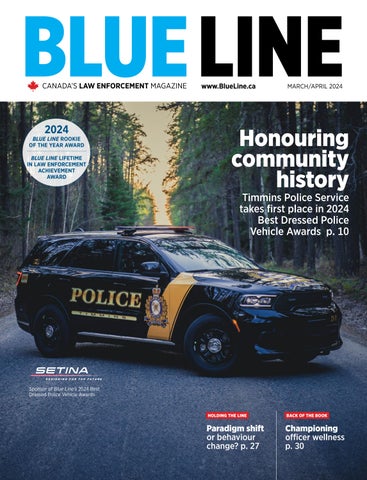
Honouring community history Timmins Police Service takes first place in 2024 Best Dressed Police Vehicle Awards p. 10
Sponsor of Blue Line’s 2024 Best Dressed Police Vehicle Awards
HOLDING THE LINE
BACK OF THE BOOK
Paradigm shift or behaviour change? p. 27
Championing officer wellness p. 30
SINGLE SKU POLICE CAR BUNDLE INCLUDES:
2020+ Ford Police Interceptor® Utility
CONSOLE BOX WINDOW BARS CARGO PARTITION PASSENGER PARTITION TRUNK TRAY GUN MOUNT PUSH BUMPER & MORE SCAN HERE TO LEARN MORE
@gamberjohnson #GamberJohnson
WWW.GAMBERJOHNSON.COM
Gamber-Johnson is proud to now offer you a comprehensive and convenient vehicle solution in one single sku. The Single Sku Police Car bundle reduces product lead times by eliminating the need for multiple orders making it easier than ever to acquire all equipment needed to complete a large install.
10
PHOTO: DAVID AINSWORTH PHOTOGRAPHY
Contents
March/April 2024 Volume 36 Number 2
Features
Columns 4 8 28 30
Editor’s Commentary Q&A Holding the Line Back of the Book
Departments
COVER STORY
10 Honouring community history
Timmins Police Service takes first place in 2024 Best Dressed Police Vehicle Award. By Brittani Schroeder.
5 5 6 6 29
News By the numbers Dispatches Calendar Marketplace
14 Policing with passion
Cst. Veronica Fast, Blue Line’s 2024 Rookie of the Year. By Brittani Schroeder.
18 Dedication beyond duty
Cst. Chris Nguyen named 2024 Lifetime in Law Enforcement Achievement Award winner. By Brittani Schroeder.
20 Unmasking the danger
Understanding and countering ambush-style attacks on law enforcement. By Rino Belcamino.
22 Police vehicle designs
Public perceptions and policing implications. By Rylan Simpson.
24 Revving up excellence COVER PHOTO: DAVID AINSWORTH PHOTOGRAPHY
Unveiling the results of Michigan State Police’s 2024 Vehicle Trials. By Dave Brown.
14 @Blue_LineMag
24 28 March/April 2024 | BLUE LINE
3
EDITOR’S COMMENTARY BY BRITTANI SCHROEDER
www.BlueLine.ca
Celebrating Canadian police officers
P
olice officers have an incredibly Our second award focuses on those who difficult job to perform every day. have spent their whole career in law enThough law enforcement is a reforcement, continuously making a differwarding career path, there are ence in the communities they have served. often negative effects that the profession The Lifetime in Law Enforcement Achievecan have on a person. ment Award is presented to an individual At Blue Line, we want to celebrate you as who has shown exceptional leadership, officers, and this is why we created three dedication and passion toward their work annual awards programs. You’ve in law enforcement for more than chosen a life of serving and pro- You’ve 15 years. This year’s award was given tecting others and we thank you. chosen a to Cst. Christopher Nguyen of the With that, I am happy to bring you life of Taber Police Service in Alberta. You serving this year’s awards edition. can read the conversation I had Canada’s Best Dressed Police and with him on page 18. Vehicle Awards celebrate an aspect protecting Our final award of the year is of policing that officers must rely others dedicated to the rookies of Canon every day. It is broken down into and we adian law enforcement. The Rookie different categories that focus on thank you. of the Year award recognizes and front line patrol vehicles, communencourages a standard of excellence ity relations vehicles, law enforcement that exemplifies leadership as an activity, and special service vehicles. The awards not a position, and pride in service to the aim to showcase innovative, sustainable public. Its goal is to highlight promising and effective designs. A team of judges new officers who are effectively paving the looks at criteria such as clear identificaway for the policing of today and tomortion, graphic designs that enhance visibilrow, and creating positive waves among ity, elements that show the directionality their peers, agencies, communities and of travel and effective integration of beyond. This year’s Rookie of the Year is equipment and controls. In 2024, the Cst. Veronica Fast of the Hamilton Police awards program was sponsored by Setina. Service in Ontario. You can read about her Timmins Police Service drove home in time as a rookie so far on page 14. first place for our front line patrol vehicle As always, please reach out to me at any category with their 2021 Dodge Durango, time if you believe that there is a topic that with Police Essipit’s Ford F150 Police Reyou think we should be talking about, a new sponder coming in second place and Sarprogram that your police service has startnia Police Service’s 2022 Chevy Tahoe ed, or an officer you think should be highcoming in third. All three vehicles showlighted. I can be reached at bschroeder@ cased strong community identities and annexbusinessmedia.com. pride in their services. Gesgapegiag Police Until next time, happy reading and be Department, a First Nations Police Service well. from Quebec, took home first place in the community relations category, followed by Peel Regional Police in second. The full story can be found on page 10.
CONNECT WITH BLUE LINE
www.BlueLine.ca
4
@Blue_LineMag
BLUE LINE | March/April 2024
www.facebook.com/BlueLineMagazine
Reader Service Print and digital subscription inquiries or changes, please contact customer service Angelita Potal Tel: 416-510-5113 Fax: (416) 510-6875 email: apotal@annexbusinessmedia.com Mail: 111 Gordon Baker Rd., Suite 400 Toronto, ON M2H 3R1 GROUP PUBLISHER | PAUL GROSSINGER pgrossinger@annexbusinessmedia.com PUBLISHER | ADAM SZPAKOWSKI aszpakowski@annexbusinessmedia.com EDITOR | BRITTANI SCHROEDER bschroeder@annexbusinessmedia.com EDITORIAL DIRECTOR PUBLIC SAFETY GROUP | LAURA AIKEN laiken@annexbusinessmedia.com ACCOUNT MANAGER | JANICE EATON jeaton@annexbusinessmedia.com MEDIA DESIGNER | SVETLANA AVRUTIN savrutin@annexbusinessmedia.com ACCOUNT COORDINATOR | KATHRYN NYENHUIS knyenhuis@annexbusinessmedia.com AUDIENCE DEVELOPMENT MANAGER BEATA OLECHNOWICZ | (416) 510-5182 bolechnowicz@annexbusinessmedia.com PRESIDENT/COO | SCOTT JAMIESON sjamieson@annexbusinessmedia.com ANNEX BUSINESS MEDIA 111 Gordon Baker Road, Suite 400 Toronto, ON M2H 3R1 Tel. 416-442-5600 • Fax 416-442-2191 Publication Mail Agreement No. 40065710 ISSN 0847-8538 Printed in Canada SUBSCRIPTION RATES Canada — 1 Year $32.13; 2 Year $53.55 plus tax USA — 1 Year $139.23 CAD Occasionally, Blue Line will mail information on behalf of industry-related groups whose products and services we believe may be of interest to you. If you prefer not to receive this information, please contact our circulation department in any of the four ways listed above. Annex Privacy Officer Privacy@annexbusinessmedia.com; Tel: 800-668-2374 © 2024 Annex Business Media. All rights reserved. Printed in Canada. No part of the editorial content of this publication may be reprinted without the publisher’s written permission. Opinions expressed in this magazine are not necessarily those of the editor or the publisher. No liability is assumed for errors or omissions. Readers are cautioned and advised that articles presented herein are edited and supplied for your personal awareness and should not be used for further action until appropriate guidance is received from a supervisor, Crown Attorney or other persons in authority. All advertising is subject to the publisher’s approval. Such approval does not imply any endorsement of the products or services advertised. The publisher reserves the right to refuse advertising that does not meet the standards of this publication.
NEWS
partnerships are crucial to law enforcement’s effective response to this kind of crime,” said NRPS Chief Bill Fordy.
interacting with a member of the public. There are also times when, due to heightened privacy concerns, officers may use discretion and not activate a camera. “We live in complicated times, and it’s important that we do everything we can to keep your neighbourhoods safe, to protect your rights, and to ensure Vancouver remains a first-class city,” said Deputy Chief Howard Chow, VPD Operations Division. “This is about trust, confidence and continuing to deliver the best service.”
BRITISH COLUMBIA
ALBERTA
Vancouver Police begin bodyworn camera trial
Edmonton Police Service notes decrease in January shootings year-over-year
PHOTO: ARTAS/ISTOCK / GETTY IMAGES PLUS / GETTY IMAGES.
ONTARIO
NRPS Human Trafficking Project leads to 13 arrests
In February 2024, the Niagara Regional Police Service (NRPS) Human Trafficking Unit developed a project to target persons using the Internet to communicate and meet with young persons believed to be offering sexual services for money. Between Jan. 31 and Feb. 3, NRPS detectives from the Human Trafficking Unit, ICE Unit, Child Abuse Unit and Domestic Violence Unit, in conjunction with the Ontario Provincial Police (OPP) Anti-Human Trafficking Intelligence Led Joint Force Strategy and with the assistance of multiple police and law enforcement agencies arrested 13 persons. All 13 males have been charged with the Criminal Code offences of: Luring a Child for the Purpose of Obtaining Sexual Services; Obtaining Sexual Services for Consideration from a Person Under 18 Years; and Invite/ Counsel, Sexual Exploitation of a Young Person. “These arrests showcase the dedication of our members in ensuring some of the most vulnerable members of our community are protected, sending a strong message that the predatory behaviours associated with human trafficking will not be tolerated in Niagara. We are committed to fighting human trafficking through intelligence-gathering and working cooperatively with law enforcement and community partners. Integrated resources, the sharing of information, a victim-centred approach and community
Vancouver Police Department (VPD) officers began deploying with body-worn cameras earlier this year. This pilot project aims at enhancing trust and confidence through improved technology. Eighty-five VPD officers will participate in the six-month pilot. Officers from VPD’s Traffic Section, the downtown core and East Vancouver will patrol with chest-mounted cameras that record their interactions with members of the public. Results from the trial are expected to guide VPD through the development of a broader body-worn-camera policy for all officers. VPD’s body-cam pilot project comes after months of consultation with community groups, B.C.’s Privacy Commissioner, health authorities, the Independent Investigations Office, the Office of the Police Complaint Commissioner, the Vancouver Police Union, service providers in the Downtown Eastside, and Indigenous community members. That consultation process was used to develop a detailed policy that outlines how and when cameras will be used during the pilot. Officers are not required to have their cameras continuously turned on if they are not responding to a specific incident or
The Edmonton Police Service (EPS) recently reported a 53 per cent decrease in shootings in January 2024 compared to 2023. “As we continue to implement our Guns and Gangs Strategy, we are pleased to see the shooting numbers trending downward,” says A/Insp. Eric Stewart of the Organized Crime Branch. “Thanks to the continuous and sustained efforts of our Guns and Gangs Section, including the addition of new Gang Suppression and Firearms Investigation teams, we’re hopeful this trend will continue.” In January, there were a total of nine reported shooting occurrences. Of the nine occurrences, eight are believed to be targeted and six resulted in injuries. Public safety risk continued to be a concern in January, with seven of the nine shootings having the potential for innocent bystanders to be harmed. In total, 75 firearms were seized last month. Over the past four months, there has been a downward trend of shooting occurrences compared to the previous year: October: 13 in 2024, 16 in 2023 November: 11 in 2024, 12 in 2023 December: 17 in 2024, 21 in 2023 January: nine in 2024, 19 in 2023
BY THE NUMBERS In January 2024, Statistics Canada released recent data on firearms and violent crime in Canada, 2022. For more information, please visit www150.statcan.gc.ca.
14,000 incidents of firearm-related violent crime in 2022, roughly 1,400 more than the previous year.
@Blue_LineMag
1.7 %
of victims of violent crimes who sustained injuries were injured by a firearm.
8 in 10 victims injured by firearms were men.
4.3 %
of firearm-related violent crime was attributed to organized crime or gang-related crime.
March/April 2024 | BLUE LINE
5
NEWS DISPATCHES Bill Fordy has been selected as the new Chief of the Niagara Regional Police Service (NRPS) and officially began in the role on Feb. 1. He was previously the Deputy Chief, Support Services, with the NRPS. Chief Fordy is a 35-year policing veteran and acted as Deputy Chief with NRPS for six years. Prior to joining NRPS, he served as the RCMP Assistant Commissioner overseeing all operational and administrative matters of policing in the Lower Mainland District (LMD) of British Columbia and five Integrated Units. Scott Fraser has been permanently appointed chief of Kingston Police Service. Fraser joined Kingston Police in Oct. 2021 as Deputy Chief, and was appointed Acting Chief on Jan. 1, 2023. Fraser began his career in policing in Vancouver in 1991 and joined the Brockville Police in 1998. In his 23 years there, Fraser served as breathalyzer technician, mountain bike officer, intelligence/drug officer, sergeant in charge of Criminal Investigations and inspector in charge of Operations and Support Services, before becoming Chief of Police. Daniel Foy has retired as chief of the Timmins Police Service. Foy was appointed in late 2021 and began his time as chief in Feb. 2022. He became chief after 27 years of working at and overseeing various Ontario Provincial Police detachments. “Chief Foy has been a steadfast and dedicated leader, committed to the safety and well-being of the Timmins community,” the Timmins Police Board said in a news release. “The board extends its deepest appreciation for his service and wishes him a fulfilling retirement.” After more than 30 years of service to the City of New Westminster, Chief Dave Jansen has announced his retirement effective June 28, 2024. Chief Jansen assumed the role in June 2020. During his four years as Chief, the police department prioritized staff wellness, setting the bar for officer safety during the COVID-19 pandemic with a ground-breaking deployment model.
6
BLUE LINE | March/April 2024
CALENDAR Additionally, Chief Jansen oversaw the department joining new integrated teams and the creation of the NWPD Communications Operations Centre. The Durham Regional Police Services Board has announced that Toronto Police Service Supt. Chris Kirkpatrick and former Acting Deputy Chief Kim Yeandle have been selected as the next Deputy Chiefs of the Durham Regional Police Service, effective Jan. 9. “They bring over six decades of policing experience, and we know that that their knowledge and skills will help the DRPS address crime and safety issues and promote a positive, productive and inclusive workplace,” said Chair of the Board, Shaun Collier. The Peterborough Police Service has selected Jamie Hartnett as the next Deputy Chief, effective Jan. 9. Hartnett joined the Peterborough Police Service in 2001 and brings 23 years of policing to the role. He was previously the Acting Staff Inspector. “I have had the opportunity to work closely with Hartnett this past year and we will continue to work closely to support the men and women of the Peterborough Police Service as well as the community,” said Chief Stu Betts. Brent Duguay will be the next Deputy Chief of Police for the Sault Ste. Marie Police Service. With nearly 30 years of experience with the Sault Ste. Marie Police Service, Duguay has worked extensively on major investigations, including Joint Forces Operations involving drugs and organized crime with other police agencies across the province. After 35 years in policing, Barrie Police Service Deputy Chief R. Wyllie Allan has announced his upcoming retirement. Deputy Chief Allan’s policing career began with the Toronto Police Service in 1989 before joining the Barrie Police Service in May 2000. In Barrie, Deputy Chief Allan worked in various roles, including courts,
2024 Canadian Hazmat & CBRNE Summit Date: Apr. 8 – 10, 2024 Location: Kitchener, Ont. ohmra.ca/summit Police Tech Conference & Expo Date: Apr. 30 – May 1, 2024 Location: Mississauga, Ont. canadianinstitute.com 26th Annual Toronto Crime Stoppers Chief of Police Dinner Date: May 2, 2024 Location: Toronto, Ont. chiefofpolicedinner.com Northeast IAATI & CASIU 51st Annual Vehicle Crimes Conference Date: May 6 – 9, 2024 Location: Mississauga, Ont. vehiclecrimesconference.com Security • Police • Fire Career Expo – Vancouver Date: May 16, 2024 Location: Vancouver, B.C. emergencyservicesexpo.ca Find more calendar events online at blueline.ca/events.
media, the downtown High Enforcement Action Team – HEAT, communications, corporate support, professional standards, and executive services. Greg Redl has been officially sworn in as the second Superintendent of the Grande Prairie Police Service (GPPS). Supt. Redl joined GPPS following a 21-year career with the RCMP, finishing in the City of Grande Prairie as an Inspector. He will oversee the Service & Community Support Brand, including recruiting, training, Community Police Officers, detachment municipal employees, IT, fleet, uniforms, equipment and the policing portion of the future integrated dispatch centre. PROMOTIONS, RETIREMENTS, RECOGNITION • If you have an officer in your agency recently promoted or retiring or an individual you wish to have recognized (major award or recently deceased) you can let Blue Line magazine know by emailing: bschroeder@ annexbusinessmedia.com.
www.BlueLine.ca
STANDING SHOULDER TO SHOULDER WITH YOU Your trusted source for uniform insignia
trimtag.com • contact@trimtag.com • 905-763-7300
Q&A Editor Brittani Schroeder spoke with Judith Andersen, an Associate Professor at the University of Toronto Mississauga, about her studies of the psychophysiology of performance and health among individuals in high-risk occupations.
I maintain a research program as the Director of the Health, Adaptation, Research on Trauma (HART) lab. For the past decade, I’ve teamed up with academics and police agencies in North America and Europe to conduct a variety of studies. What we quickly realized during these studies is that stress not only impacts health over time, but it really can influence the application of skills, including de-escalation, the use-of-force and lethal force decision-making during critical incidents. Of course, these findings have strong implications for police and public safety.
Q: Can you tell us about your study?
Our study examined police lethal force errors and stress physiology during simulated evaluation scenarios that were presented in video and live formats. In a sample of 187 police officers, we examined the rate of use-of-force errors during video and live scenarios, and we measured their heart rates in real time as a reflection of stress response activation. Although there were low error rates overall, it’s important to note that any errors made during an evaluation may have direct professional consequences for the officer (e.g., loss of authorities). Thus, it’s very important to make sure that error rates are not caused by the design or delivery of the scenarios, but rather reflect the officer’s skills. These simulations reflected realistic calls for service in a large, representative police agency in Canada. The research 8
BLUE LINE | March/April 2024
Judith Andersen
was an observational field study of current police practices, not a lab-based experiment.
Q: What were the results of the study?
We noticed that there were significantly fewer lethal use-offorce errors in live versus video scenarios. While there may be multiple factors that impact errors, we believe the data indicates two likely reasons: 1. The officers were more engaged during the live scenarios, as evidenced by greater physiological reactivity— change in Heart Rate (HR) from rest—compared to the video scenarios. 2. Neuroscientific research indicates that two-dimensional video encounters, similar to the video scenarios used by the police agency in this study, are processed by different brain networks than live interactions, which may impact the person’s sensory awareness and subsequent responses to a virtual versus live encounter.
For the first factor, when a person faces a challenging situation with potential threat (as is the case in police encounters), the brain sends signals to the body to prepare to meet the demands of the situation, whatever they may be. This means that the stress response system is activated. Not all activation is bad – in fact, a moderate amount of activation increases cognitive and sensory awareness, attention and vigilance, and is advantageous to meeting the demands of the situation. Medical science research on real-time HR, in combination with direct observation of a person’s actions, show that about a 10-point increase in HR in the absence of significant physical movement indicates psychological and physiological engagement of the stress response system. While overactivation of this system (known as ‘flight or flight’) is helpful when survival is on the line, it can interfere with social and verbal skills when activation is excessive or prolonged. In both the video and live scenario conditions, we observed a significant increase in stress response engagement; not overactivation, but instead, a sign that officers were paying attention and in a state of ready to perform their skills. However, we did observe a higher amount of reactivity in the live condition that indicates even more engagement compared to the officers’ own HR in the video condition. For the second factor, neuroscientific research shows that subtle facial muscle expressions, movements and speech patterns are processed more effectively during live versus virtual interactions. The human brain is
finely tuned to detect visual information like direction and speed. When this information doesn’t match with other senses like sound, or doesn’t match the direction and speed of an officer’s own movement, virtual simulation environments may feel ‘unnatural’ or even induce negative effects like cybersickness. This lack of realism may account for the relatively higher errors observed in our study, as officers may have been more cautious in their behaviours towards a ‘real’ person standing before them.
Q: What can police agencies take away from this study?
Many virtual simulation configurations used by police agencies are relatively ‘basic’ compared to advanced VR and AR systems and may influence performance outcomes by presenting physical and perceptual limitations that do not exist in live simulations or real-world interactions. Therefore, agencies must be mindful of whether learning or evaluation goals could be influenced by the way scenarios are delivered, especially if virtual equipment is incompatible with officers’ duty equipment. In line with international police researchers, my team and I would recommend that scenarios are delivered in a format (either virtual or live) that: a) most accurately represents the context in which the skill or competency of interest will be demonstrated in the field, and b) leverages agency resources to be most efficient. Prioritizing the latter does not prioritize officer learning, evaluation or operational safety. www.BlueLine.ca
PHOTO: UTM MEDIA DEPT, 2016
Q: How did you come to research policing and use-of-force?
Sponsor of Blue Line’s 2024 Best Dressed Police Vehicle Awards
COVER STORY
1st place: Timmins Police Service
Honouring community history Timmins Police Service takes first place in 2024 Best Dressed Police Vehicle Awards By Brittani Schroeder
1st PLACE Timmins Police Service 2021 DODGE DURANGO – RWD
To mark over 100 years of dedicated service to their community, the Timmins Police Service (TPS) tasked a committee with creating a new image for all cruisers going forward. The committee, composed of Sgt. Marty Delich, Cst. Michael Davidson, Cst. Luc Lamarche and Cst. Tom Buczkowski readily accepted this public image mission and gave hours of their time to designing and debating many options. The team knew they needed to create a design that was progressive and marked a departure from existing concepts. The lettering on the vehicle needed to be simple yet bold; it needed to stand out while providing a visible contrast to the vehicle’s 10
BLUE LINE | March/April 2024
base colour. In total, the committee looked at over 1,000 design concepts and consulted with TPS members as well as people within the community. Cst. Davidson, a local artist in Timmins, was called upon due to his artistic talent with free-hand drawing and scaled graphic design. When he learned of its first-place win, Cst. Davidson said the vehicle redesign remains one of the highlights of his entire career. Cst. Buczkowski (ret.) is proud every time he sees a cruiser on patrol, knowing that he had something to do with the distinguished finished product. “The opinion formed by the public about policing in general, as well as its local police service, is quite often the result of the images they take in daily. We knew it was important to reflect the rich mining history
unique to Timmins on our ‘workhorse’ and in our crest, to show our community who we serve,” said Cst. Lamarche. For contest judge Dave Brown, the vehicle stood out as a clear winner. “This vehicle features a unique design, with a lot of directionality. There is a clear, readable font choice and a gradient feature that doesn’t take away from the visibility.” In accepting this year’s Best Dressed award, Marc Depatie, Corporate Communications Coordinator, added, “We are proud and yet humbled at the same time, as the men and women of the Timmins Police Service graciously accept this award. We are thankful to Blue Line for the choice that the judges have made regarding our cruiser as best dressed for 2024. To quote Clint Eastwood ‘You’ve made our day’.” www.BlueLine.ca
PHOTO: DAVID AINSWORTH PHOTOGRAPHY
Congratulations to all the winners of Blue Line’s 2024 Best Dressed Vehicle Awards, sponsored by Setina. The awards showcase innovative, sustainable and effective designs. We look for clear identification, graphic designs that enhance visibility, elements that show the directionality of travel and effective integration of equipment and controls. “Green” vehicles are also taken into consideration. Thank you to all agencies who submitted their vehicles. Stay tuned to blueline.ca for our 2025 call for submissions later this year.
2nd PLACE
PHOTOS: (TOP) POLICE ESSIPIT; (BOTTOM) SARNIA POLICE SERVICE
Police Essipit FORD F150 POLICE RESPONDER – 4WD
When starting the redesign process for their vehicles, Police Essipit debated for a long time about what they wanted to showcase. The goal was a modern and visible design with a yellow colour to match their police emblem. “The featured logo is the symbol of the Essipit First Nation Innus Council. ‘Essipit’ means ‘river with shells’, and we believe it’s one of the most beautiful places on the North coast of Quebec,” said Director Dave Launière, who created the design alongside the patrol officers who would utilize the vehicles. Police Essipit is a small organization of only seven police officers, and it was important for everyone to have a voice throughout the planning stages. The design evolved to prioritize visibility, recognition and pride. This included the selection of bold, high-contrast colours for increased safety and quick identification while representing the service’s identity of fostering recognition, trust and a sense of cultural pride within the law enforcement community. “Police Essipit, like Timmins Police, has a very directional design, with a great use of the font. It is very clear that this is a police vehicle and people know where to turn to when they need to,” said Dave Brown. When Director Launière learned of Police Essipit’s second-place win in this year’s Best Dressed contest, he was initially very surprised because he recognized that there are many “stunning police vehicles” in Canada. “There are 22 Indigenous Police organizations in Quebec, and we all have distinct designs for our vehicles. Being recognized in this way means so much to us, and we are thrilled to share our pride in working for the Essipit community with the Canadian law enforcement community.”
3rd PLACE Sarnia Police Service 2022 CHEVY TAHOE – 4WD
The Sarnia Police Service (SPS) has been on a mission to modernize its fleet. With the introduction of new vehicles, equipment and technologies, a corresponding new visual design was needed. In May of 2022, the Sarnia Police Service appointed Derek Davis to be their new Chief of Police. As part of the initial information gathering from the community and @Blue_LineMag
2nd place: Police Essipit
3rd place: Sarnia Police Service
SPS members, it became apparent that the fleet needed immediate attention. The members needed modern technologies and wanted a cutting-edge vehicle design that they could be proud of. Through a collaborative effort between the SPS senior leadership team and the uniform and equipment committee, SPS developed a design that they saw as a visual representation of the new direction of their service. During the design process, the team agreed that the red and blue striping on a black vehicle had been done before, and something new needed to be created while remaining professional. “There is a quote attributed to Vincent van Gogh that says, ‘How difficult is it to be simple?’, and that was very true with our design process. The result is an elegant yet
simple design that reflects our organization and professionally represents the community we serve,” said Jason Dale, Manager of Planning, Policy, Fleet and Facilities. A challenge that SPS has faced in the past was the non-uniformity in manufacturer paint colours. By transitioning to a black vehicle, SPS ensures that all vehicles will look uniform and professional. The design has also been tested out on different types of vehicles, from cars and SUVs to pickup trucks and non-patrol vehicles. SPS was very pleased to receive this national recognition, as a medium-sized police service up against larger police services with more resources. “This award is even more significant given that the design was created by and for our front line officers,” said Chief Davis. March/April 2024 | BLUE LINE
11
COVER STORY
Community Relations 1st place: Gesgapegiag Police Department
COMMUNITY RELATIONS 1st PLACE Gesgapegiag Police Department 2022 JEEP GLADIATOR OVERLAND – 4WD
PHOTO: GESGAPEGIAG POLICE DEPARTMENT
When creating a new design for their community relations vehicle, the Gesgapegiag Police Department (GPD) recognized the importance of continuing their
work towards a safer community, while also putting focus on two significant topics: Every Child Matters and the Murdered and Missing Indigenous Women and Girls (MMIWG). Members of GPD consistently aim to better their community through youth activities and education initiatives, and this vehicle design reminds them of why they work so hard. “Ultimately, this vehicle was designed to strengthen the ties between our department
and the community of Gesgapegiag,” said Director Marven Condo, chief of police. Director Condo and the police officers of the department considered examples from police services throughout the country and brainstormed ideas as a foundational premise before settling on a final design. The materials used in the design were created and installed by a local shop in the community. Director Condo also emphasized the importance of the patterns on the vehicle, as they are representative of the Mi’gmaq culture. “This is something we celebrate, not only as a police department but as an Indigenous community.” “I like that this is different from the regular patrol vehicle. This is an international message of hope, and the colours are consistent with the universality of that message,” said Dave Brown. The Gesgapegiag Police Department was “excited and grateful” to have won first place in this category. “It means a lot for the department. To us, it really goes to show that even a smaller department like ours can make large ripples in the policing domain.”
12 BL_GardaSecurity_Expo24.indd BLUE LINE | March/April 12024
2024-02-08 1:26 PM www.BlueLine.ca
Community Relations 2nd place: Peel Regional Police
2nd PLACE Peel Regional Police 2014 DODGE CARAVAN – FWD
PHOTO: PEEL REGIONAL POLICE
Peel Regional Police’s (PRP) latest Community Relations vehicle was designed to attract potential recruitment candidates. The campaign was launched in 2021, during a period marked by global challenges, social justice protests, and heightened scrutiny of law enforcement agencies. In response, PRP took a positive approach and extended an invitation to potential recruits to join the evolving landscape of policing. “Sharing our design in this year’s contest allowed us to showcase our ability to successfully navigate the challenges that often accompany creative projects. We also wanted to highlight the enduring impact of our design, emphasizing the positive relationship between the police and the community,” said Recruiting Inspector Andrew Cooper. The PRP Recruiting and Creative Service team collaborated on the design to bring it to fruition. The team was “thrilled” upon receiving the news of their second-place win. To Nadine Fletcher, Acting Manager of Corporate Communications at PRP and supervisor of the design project, it was a “moment of celebration and affirmation of our commitment to excellence”. This vehicle was designed to foster a deeper connection with the community by presenting a relatable and humanized image of PRP officers. The call to action, “#BeTheChange”, encourages individuals to consider a career with the service and sends a clear message that PRP is actively seeking recruits who want to be a part of the cultural shift in policing. The door sections can also easily be updated with new faces, which ensures the longevity of the vehicle wrap. “I found this submission to be quite appealing. It features both thoughtful messaging and a nice graphical design,” said Rylan Simpson. “I am proud of our team’s best-dressed vehicle award. This award highlights Peel Regional Police as best-in-class innovators in this sector and the design’s core focus exemplifies our visionary goal of being the most progressive, innovative and inclusive police service,” said Chief Nishan Duraiappah. Thank you to Blue Line’s Best Dressed Police Vehicle judges, for their expertise and dedication to this content. For this year’s contest, please note that Rylan Simpson recused himself from judging the Best Dressed front line patrol category, as he had a conflict of interest with one of the entrants. Find an article on his recent research on police vehicles on page 22.
BLACK EAGLE® TACTICAL 2.0 GTX HIGH SIDE ZIP
> Perfect blend of Comfort & Durability > Lightweight, Anti-Slip, Waterproof
scan for details
Dave Brown is a Blue Line contributor on firearms and police vehicles, as well as a Best Dressed Police Vehicle Awards judge. He is a tactical firearms trainer and consultant based in Winnipeg. He can be reached at dave@bulletproofset.ca.
www.haixca.com
Rylan Simpson, Ph.D. is an assistant professor in the School of Criminology at Simon Fraser University. He is an expert in police perception research and has studied the effects of police vehicle aesthetics on public perceptions of police.
@Blue_LineMag
BL_Haix_MarApr24_CSA.indd 1
March/April 2024 | BLUE LINE
13
2024-02-16 12:25 PM
LEADERSHIP
2024
BLUE LINE ROOKIE OF THE YEAR AWARD
Policing with passion Cst. Veronica Fast, Blue Line’s 2024 Rookie of the Year By Brittani Schroeder
T
o those who knew Cst. Veronica Fast growing up, it was no surprise when she chose a career in law enforcement. From an early age, Fast was driven by the desire to have a career that provided a sense of purpose and pride, where she could make a meaningful impact and assist those in need. She was also drawn to the teamwork and social dynamics inherent in the policing profession, as well as the opportunities for personal growth and development.
Attending to the needs of others
As a member of the Hamilton Police Service (HPS), Fast actively engages in “Park and Walks” as part of their proactive policing approach to ensure public safety while fostering positive community connections. During a Park and Walk patrol in June 2023, Fast and her partner encountered a distressed woman stranded in her disabled electric wheelchair. Her wheelchair had unexpectedly stopped working, leaving her stationary for over two hours with nighttime quickly approaching. Without hesitation, the two officers sprang into action and assisted the woman by manually pushing her home and fixing the wheelchair charger to prevent future incidents. 14
BLUE LINE | March/April 2024
“This wasn’t a typical call for service, but it showed our commitment to supporting community members in times of need. I was grateful for the opportunity to provide assistance and make a positive impact beyond the scope of our regular duties.” Over the last two years as an officer, Fast has learned that when it comes to serving those in need, interactions and the treatment of victims are some of the most important aspects of the job. “It is easy to feel rushed when going from call to call, but victims are calling us on their worst day. We must give them the time, compassion and effort that they deserve and to support them in any way that we can.” During an October 2023 response to a domestic in progress involving a firearm, Fast was among the first into the residence. What made this call unique were the victims: a mother, who spoke little English, and three young children who were terrified and traumatized. “Cst. Fast did many things right that day. Above all, she was able to tend to the victims and provide support throughout the investigation. She was able to sit with the children while the mother was interviewed, watching cartoons and colouring, and demonstrating what it means to be a police officer,” says Sgt. Chelsea Knowles.
In addition to her on-duty role in the community, Fast spends countless hours of her time supporting fundraising initiatives. Cops N’ Rodders is a vehicle show organized annually by the Law Enforcement Torch Run Committee in Hamilton that supports Special Olympics Ontario. In 2023, when Fast learned about the event’s need for extra help, she jumped at the chance to contribute, even on her day off. Having previously volunteered with Big Brothers Big Sisters for five years, she knew that if she could lend a hand, she would. At the event, Fast assisted with vehicle registration and explained to participants how their fees would benefit individuals with intellectual disabilities by funding sports programs. “Witnessing the generosity of participants, who often donated beyond the registration fee, was heartening.” “This day is extremely busy, can be challenging dealing with many personalities, and very long given the sun and heat. Cst. Fast met the task with unmatched energy and a smile,” said Sgt. Knowles. Also in attendance at the Cops N’ Rodders event was Parker Gerdingh, a local Special Olympian. After Parker was seen admiring the “Venom” Mustang showcased, the owner of the car offered to chauffeur Parker to his Grade 12 Prom in style. Parker is highly interested in law enforcement, so to ensure Parker had a prom night he wouldn’t forget, a female officer was sought out to accompany him to the event. This is where Fast came in. Together with her colleague, Fast surprised Parker during his pre-prom photoshoot with HPS’s new camera car. “I had the privilege of walking arm-in-arm with Parker into his prom, where he celebrated with his friends and classmates. Being part of such a significant milestone for Parker was immensely rewarding, and it’s a memory I’ll cherish indefinitely.”
Committing to personal and communal goals
To meet a personal fitness goal while still serving others, Fast joined the “Squad Health Challenge Fundraiser” with her colleagues. This challenge began as a personal health challenge between two coworkers: if one achieved their health goal, the other would donate $500 to their chosen charity. This challenge quickly evolved into a squadwide initiative, fostering inclusivity and collective motivation. www.BlueLine.ca
PHOTO: HAMILTON POLICE SERVICE PUBLIC AFFAIRS UNIT
Supporting local Special Olympians
Personal goals were set, with a measurable target to accomplish by a specific date. Those who didn’t meet their goals contributed $100 to a communal pot. Toques were also sold to help fundraise for charity, which culminated in a total of $2,000 raised, which was donated to Special Olympics Ontario. “Participating in this challenge reminded us of the importance of camaraderie and collective effort in achieving both personal and communal goals, and I’ll carry this with me throughout my career as an officer.”
Recognizing fallen officers
Fast’s dedication to serving others applies to her fellow officers as much as it does to her community. In Sep. 2023, she took part in the annual National Peace Officer Memorial Run, a solemn event that spans three days and covers a relay-style distance of 460 km, from the Ontario Police Memorial site in Toronto to the National Memorial on Parliament Hill in Ottawa. “This run serves as a poignant reminder of the sacrifices made by brave officers in service to their communities.” Fast also recognizes that this event is a chance to support the families who are left behind. “Through the collective efforts of my family, friends and colleagues, I had the privilege of selling 70 shirts, raising $1,400 in funds. The experience of participating in the run was profoundly moving and left an indelible mark on me.” Fast described the journey as “filled with emotional intensity”, as she witnessed the names engraved on the Memorial Wall and heard the stories of each fallen officer. She encourages all peace officers to seize the opportunity to participate in this event.
“The Hamilton Police Service is extremely proud of the efforts and actions of Cst. Fast, and she has proven to be an excellent ambassador for our organization and for policing as a profession,” says Insp. Doerr. Fast has learned much in her short time as a police officer. The most vital lesson she’s gleaned to date is the importance of maintaining the same level of passion that propelled her into this career initially. “It’s undeniable that a strong passion is a prerequisite for navigating the rigorous hiring and training processes. Sustaining that passion is what facilitates natural engagement with the community, going above and beyond, and exhibiting compassion in every interaction.” While she acknowledges that maintaining this fervour can be challenging, she recognizes it’s crucial to remind oneself of the initial motivation for choosing this career path. She works alongside a team of passionate police officers and knows that they have been instrumental in her ability to continue learning, growing and finding genuine fulfillment in her work.
THANK YOU TO THE 2024 PANEL OF JUDGES Christine Silverberg served as Chief of the Calgary Police Service from 1995 to 2000. Christine then became a lawyer. Throughout her careers, Christine has received many awards, honours and distinctions. Christine holds a B.A., M.A., and LL.B., holds numerous certifications and is a Qualified Arbitrator. Peter German was a member of the RCMP for 31 years, serving as Deputy Commissioner West and later as Regional Deputy Commissioner (Pacific) for Correctional Service Canada. He currently practices law, is a consultant on criminal justice and leadership matters, and is president of the International Centre for Criminal Law Reform at UBC. Armand La Barge is the retired Chief of YRP and the Past Chair of Trent University. He is the past president of the OACP, Ontario Director of the CACP, and he was an associate member of the First Nation Chiefs of Police Association.
Rookie of the Year and beyond
Fast was notified in January that she’d been selected as this year’s Rookie of the Year, and she felt a “mixture of shock and honour”. She couldn’t help but acknowledge the support and guidance that she has received from her squad members, coaches and supervisors. “Their influence has been instrumental in shaping my journey and providing me with invaluable opportunities. I firmly believe that the environment in which one works plays a significant role in determining their trajectory, and I am immensely grateful to be part of a team filled with passionate individuals.” @Blue_LineMag
BL_CIMS_MarApr24_CSA.indd 1
9:05 AM March/April 2024 2024-03-01 | BLUE LINE 15
LEADERSHIP
Dedication beyond duty Cst. Chris Nguyen named 2024 Lifetime in Law Enforcement Achievement Award winner By Brittani Schroeder Blue Line is proud to present the 2024 Lifetime in Law Enforcement Achievement Award to Cst. Chris Nguyen of the Taber Police Service. The award is presented to an individual who has shown exceptional leadership, dedication and passion towards their work in law enforcement for more than 15 years.
F
18
BLUE LINE | March/April 2024
“My time serving the communities of Canada’s largest First Nation Reservation was an incredible experience,” he shares. “The kind-hearted people, the complexities of rural landscapes, the richness of the Blackfoot traditions and culture; it a great opportunity for me to learn how important it is to make every effort to connect with all people in a sincere, heartfelt and respectful way. It made me become a strong communicator and reminded me to remain empathetic and humble.” Eventually, Nguyen sought out new career opportunities elsewhere for the sake of his growing family. In Aug. 2010, Nguyen was successful in his application with the Taber Police Service (TPS) and was sworn in as an experienced member.
The good and the bad
To this day, Nguyen’s favourite thing about being a police officer is the diversity of experiences he’s had. For him, there has never been any other job that has been “as challenging, mundane, heartbreaking, rewarding and so vastly different from one moment to the next.” He wakes up every day with enthusiasm for whatever adventures lay ahead, and the desire to somehow
find a way to make a positive impact or a difference in someone’s life that day. With the joys also come the challenges. For Nguyen, the most difficult aspect of his career has been finding a healthy work-life balance between his duties and responsibilities to his community and his responsibilities as a husband and father. “No one can achieve any level of success on their own, and were it not for the love and support of my family, I wouldn’t have been able to contribute to my community in the ways that I have.”
A mentor to all
Nguyen and all other members of TPS reside within the Town of Taber, which ensures a strong connection to the community and its partners. Nguyen recognizes that the service’s administration and senior leadership encouragement and support have played a pivotal role in the officers’ active involvement in contributing to the well-being of the Taber community. As a School Resource Officer (SRO), Nguyen looks after 11 schools within the community of Taber. He’s described by his peers as having a special ability to connect to children and role model values of compassion and empathy while excelling at www.BlueLine.ca
PHOTO: TABER POLICE SERVICE
rom a young age, Chris Nguyen knew of the hardships that marked his family’s history in Vietnam, spanning both the wartime period and the challenging aftermath under oppressive communist governance. Bearing witness to the sacrifices made by his father and grandfather, who served in the South Vietnamese Army, he learned of their struggles. Faced with the difficulties of their circumstances, Nguyen’s father committed to securing a better future for his family, recognizing the need to escape the conditions they found themselves in. Shortly before Nguyen was born, his father, mother and sister hired smugglers to get them out of Vietnam. After a challenging journey, they were brought to Kowloon (Hong Kong), China, where he was born. Canada was the first country to respond to the family’s application for permanent residency, and on Nov. 14, 1978, the Nguyen family became the first Vietnamese people to move to Lethbridge, Alta. “My family has a long history of military service, and it was these factors that influenced me towards a life of serving others.” Understanding that it could be difficult to become a police officer, Nguyen completed a post-secondary education that qualified him as an Emergency Medical Responder (EMR) and an Emergency Medical Technician (EMT-A). Shortly after graduating, in May 2000, he was accepted by the Blood Tribe Police Service (BTPS) and was sworn in. Formal training came from the Royal Canadian Mounted Police – Depot Training Academy in Saskatchewan in 2001 before he returned to serve the people of Kainai.
providing policing guidance and leadership to school administrators and students alike. “The trust and relationships that Chris has built with our youth have contributed positively to his professional requirements. He continually uplifts the students with his positive approach to life,” says Dr. Graham Abela, Chief of Police.
Nguyen has been an SRO for nearly two terms, and he “adores” the work. He attends most after-school events and hosts his own SRO webpage to keep the community updated. Nguyen attends every violent school threat assessment (VITRA) meeting and ensures school safety daily. “To be able to encourage, mentor and develop in youth positive attributes that will help them to become future leaders in our town and beyond is my absolute passion,” he says. “Interacting with youth and sharing and encouraging their successes shows them that we are fully invested in their well-being, their mental health and their lives.” Nguyen doesn’t just serve as a source of inspiration for the local youth; he is also a mentor for individuals within TPS. Nguyen sees policing as an incredibly great responsibility that must come with a significant level of compassion, patience, commitment and servitude. He has always tried to impart to junior members the importance of living these qualities every day. “I have always been committed to maintaining a positive and optimistic attitude because I am fearful of becoming the stereotypically tired, jaded and crusty old member.” When asked if he saw himself as a mentor to junior members, Nguyen shares that he never wants to assume anything; he just hopes that his actions, conduct and attitude are worthy of his teammates’ respect.
det Squadron to continue his involvement with the cadet movement. In 2010, Nguyen was attested into the Canadian Armed Forces and later received his Commission as an Officer of the Canadian Armed Forces after completing the Basic Officer Training course in 2011. Since then, Nguyen worked his way from his initial position as the squadron’s training officer to second lieutenant and the squadron’s Commanding Officer. In 2016, he transitioned into the administrative officer’s role and remained actively involved until 2022 when he was placed on a reduced capacity list due to his numerous work and community commitments. “I credit Chris for building a program that almost folded into one in which there are over 20 youth in our community actively engaged in their Air Cadet program,” says Abela.
Nguyen is now going through the process of release from the Canadian Armed Forces as he draws closer to retirement from policing.
@Blue_LineMag
There isn’t one single memory that stands out for Chris Nguyen—it’s all the little things that are his favourite. “The smiles and faces of the children that light up when you enter the room. The willingness of everyone around you to stop what they’re doing to help a neighbour in need.” These are the moments that last for Nguyen; these are the memories that he’ll hold onto because he hopes he contributed to that way of life in the community.
An honoured officer
Chris Nguyen is not the person to seek out adulation, gratitude or rewards for the work he has done for his service or his community. “I am sincerely grateful to the people whom I wholeheartedly respect to have nominated me for such an honour, and to Blue Line Magazine for considering me as a candidate worthy of this wonderful recognition. I dedicate this award to my wife, Doreen, and my children, Caitlyn and Caleb.”
MARTIN’S ANNUAL CRIMINAL CODE 2024 EDITION
Widely used and regularly cited in courtrooms, Martins Annual Criminal Code 2024 is fully annotated by four of Canada’s most respected criminal law experts.
Martin’s Annual Criminal Code 2024 continues to deliver excellent value with the highestquality content discussing recent case law, as well as amendments to the Criminal Code and other legislation since its 2023 edition. Also available in a convenient pocket edition.
A dedication to volunteering
In addition to his role as an officer, Nguyen devotes countless hours of his personal time to several volunteer positions. In his younger years, Nguyen served as a cadet. Now, as an adult, he recognizes the significance of community programs such as this. Nguyen first became a civilian volunteer with the 2384 Royal Canadian Army Cadet Corps while in Stand Off, Alta., with the BTPS, so that he could help mentor and support the youth in the community. He remained with the unit until he moved to Taber, where he immediately requested a transfer to the 225 Royal Canadian Air Ca-
Fond memories
$206.00 | Item# 1668714799 Scan code to buy this book
Educational Resources for Industry Professionals | 877-267-3473 | annexbookstore.com
BL_Bookstore_SQ_MarApr24_CWM.indd 1
11:34 AM March/April 2024 2024-03-13 | BLUE LINE 19
TRAINING cer’s movement (kill zone) and delivers flanking fire. The short side of the criminal element is at the end of the route of movement and at a right angle to the kill zone. This delivers frontal fire that interlocks with the long parallel side establishing an overwhelming effective ambuscade.
Employing contact drill to an ambush
Understanding and countering ambush-style attacks on law enforcement By Rino Belcamino
L
aw enforcement officials in today’s environment face an ever-increasing malevolent threat in the form of ambush-style attacks. These attacks may take the form of a “luring/entrapment” ambush or an “opportunistic” ambush. A luring attack is typically described as a premeditated attack in which a subject lures law enforcement to a particular fixed location to execute an attack. An opportunistic/spontaneous ambush is an unprovoked attack without any longterm planning. This is typically a crime of opportunity and the subject decides to act as the officer moves into their area or where an officer may be preoccupied. Countering an ambush takes a combined/ actioned skill set on the part of the law enforcement officer. They need to be proficient in weapon skills, possess situational awareness, direct effective fire while in various positions, and be competent in reading and recognizing appropriate terrain that provides effective cover. Let’s examine a tactic that has been employed in SWAT operations against an 20
BLUE LINE | March/April 2024
armed criminal threat and apply it to various hostile critical incidents against a determined threat. This immediate action tactic is referred to as a “contact drill”. This offensive tactic is employed to fight through a surprise ambush. It’s important to first understand basic ambush formations to be able to counter them. The idea is to flip and apply the speed, surprise and violence of action strategy against the attacker to penetrate their OODA (Observe, Orient, Decide, Act) Loop process—creating an unstable decision-making arc for them. Producing this chaos may delay their decision-making while allowing the officer to take an action advantage.
Line and L-shape formations
In line formation, the criminal subject engages the ambush against the officer parallel to their route of movement. This parallel movement provides a direct killing zone (box) with supreme arcs of flanking fire to an unsuspecting target. The L-shape formation typically involves more than one criminal subject. The long side of the ambush is parallel to the offi-
Step #1
Upon the initiation of the ambush, the officer should make themself “small” and seek cover. This is why it’s important to maintain situational awareness and hard wire cover, as well as emergency ingress and egress in your environment at all times. An important note about cover is to understand that it will only be adequate if the criminal subject is stationary, and the nature of the cover is not prone to rubblization from repeated ballistic contacts. If the subject is mobile, this fixed cover position must be changed to adapt and not compromise the benefits of the position. Your adaptive movement has a second tactic of confusing your enemy where your fixed position is situated and returning fire.
Step #2
On contact, call out and identify the location of the ambush. Usually, if you are moving forward and contact is in front, this will be designated as 12 o’clock. If in a group, spreading out will allow for superior angles of fire on the threat and will help to avoid natural obstacles and barriers to visual identification of the threat (i.e., trees, barriers, ground formation). The longer officers remain in a killing zone, the higher the probability of injury or death.
Step #3
Position your manpower in a line or parallel fashion. The immediate action then involves the integrated movement of your members towards the threat to overwhelm them. The actions should be in the form of a “leapfrog” configuration and the communications/actions may be as follows: www.BlueLine.ca
PHOTO: KALI9/E+/GETTY IMAGES
Unmasking the danger
The application of this immediate action drill is to reverse the subject’s advantage. Here, you will attempt to infiltrate their OODA Loop and stifle their decision-making process. The contact drill involves the swift reaction of the officer to a visual and/ or physical contact of an armed, criminal ambush element. This tactic is typically used for a “near” ambush.
1. Call out “moving”. Do not move until you hear confirmation from your number two. 2. Partner yells out “covering”. You should move only when the cover fire is initiated at the armed threat. 3. Move to your next position. If another piece of available cover is near, move to it. If not, consider moving a shorter distance, using the three-second rule, and take up the same sequence. 4. Officers must consider movement in reaction to the required distance covered, terrain configuration and supply of ammunition. Consider select fire discipline, if possible.
5. Attempt to conduct flanking on the criminal element. This reverses the ambush to provide arrest or neutralization of the threat (i.e., Active Killer scenario).
Evacuation and reconciling position
An immediate action contact drill may be employed in reverse if the threat is at a “far contact” distance and the officer’s position is vulnerable. The steps would be the same in a reverse bounding order.
Appropriate use
These tactics blend well into an urban setting application, especially with an active
killer scenario. The main difference would be the descriptive environmental forms. Officers must determine when to appropriately deploy the contact drill. This assessment and determination will be based on a whole host of probabilities and could include, but are not limited to, the type of critical incident, terrain and the ultimate decision-making factor: the scale of the priorities of life. Sgt. Rino Belcamino is a 27-year veteran of the Thunder Bay Police Service. He spent 20 years as the Tactical Commander of the hostage rescue/SWAT team, as well as being the chief instructor. Currently, he is the NCO of the Training and Special Operations section.
ARE YOU A POLICE OFFICER LOOKING FOR YOUR NEXT ADVENTURE?
THE ALBERTA RCMP IS ACTIVELY RECRUITING EXPERIENCED POLICE OFFICERS WITH A MINIMUM OF TWO YEARS OF EXPERIENCE POLICING IN CANADA. Experienced police officers with the Alberta RCMP will receive compe��ve benefits and pensions, a rate of pay and benefits based on current employment, and endless career opportuni�es. The applica�on process is quick, easy, and discreet.
rcmpcareers.ca To read all the details and apply, visit www.rcmp-grc.gc.ca/ab/careers-carrieres/epop-prpe/benefits-avantages-eng.htm
BL_RCMP_JanFeb24_CSA.indd 1 @Blue_LineMag
3:55 PM March/April 2024 2024-01-11 | BLUE LINE 21
RESEARCH
Police vehicle designs
Public perceptions and policing implications By Rylan Simpson
Results
Methodology
Police vehicles are ubiquitous in modern policing. Most public observations of police occur while officers are occupying police vehicles. The results from our Canadian-based study add to the scholarly understanding of police vehicle designs and their relevance for policing outcomes. Our results also exhibit important implications for policing practice. At an abstract level, our results provide further evidence in support of the power of police vehicle designs for public perceptions. For example, participants overwhelmingly indicated their preference for the use of marked as opposed to non-marked police vehicles. At a more nuanced level, participants consistently argued that marked police vehicles should be highly identifiable and
Working with Barrie Police Service – Chief Rich Johnston, Madison Charman and Viktoria Tumilowicz – we assessed public perceptions of, and preferences toward, police vehicle designs. Using an online survey, we asked >3,000 Canadians to indicate their preferences for various pictured police vehicle designs along seven different outcomes: aggressiveness, approachability, fairness, friendliness, predatoriness, trustworthiness and visibility. Next, we asked participants to describe what they believed to be the most important components of a police vehicle design. We examined participants’ responses across these different question modalities to identify patterns and themes in the data. 22
BLUE LINE | March/April 2024
Participants’ close-ended responses revealed a preference for the now-former dark blue design of the Barrie Police Service followed by a predominately white design and an all-yellow design. Participants’ open-ended responses revealed a strong preference for police vehicle designs that are highly visible and identifiable. Participants often explained the importance of these components with respect to vehicle equipment and presentation, including colour. Participants pointed to the benefit of bright and reflective colours, including yellow. Participants also referenced the image of the police vehicle, emphasising the need for police vehicles to appear approachable and friendly – not militarised.
Discussion
Evidence to action
In light of the findings from our study and related studies, the Barrie Police Service recently adopted a new Battenburg vehicle design to be implemented on their police vehicles moving forward. The Barrie Police Service crafted all elements of their new design, which includes lime-yellow and blue checkered blocks on a white vehicle base, with consideration of research. The agency’s hope in implementing this new design is to increase the identifiability and visibility of their officers as well as enhance public perceptions of police – all of which were identified as key priorities among study participants. To our knowledge, this is the first fleet roll-out of a Battenburg police vehicle design in North America. RELATED READING: Please vist www.blueline.ca/police-vehicle-designs-public-perceptions-and-policing-implications/. Rylan Simpson, Ph.D. is an assistant professor in the School of Criminology at Simon Fraser University. He is an expert in police perception research and has studied the effects of police vehicle aesthetics on public perceptions of police. He has received numerous awards for his policing scholarship and engagement with policing officials. He has recently published his work in Criminology & Public Policy, PLoS ONE, Journal of Experimental Criminology, Journal of Criminal Justice, Crime Science, and Crime & Delinquency.
www.BlueLine.ca
PHOTO: BARRIE POLICE SERVICE
P
olice vehicles are symbols of pride for many police agencies. They are also fundamental to the pursuit of modern policing. As the conduit by which most patrol is conducted, police vehicles provide essential transportation and storage for officers. Not all police vehicles, however, look the same. Some police vehicles are visibly marked via police decaling, whereas other police vehicles are not marked. Some police vehicles are a solid colour, whereas other police vehicles are multi-coloured. Police vehicle designs can impact key police performance measures, such as public detection, public recognition, and public perceptions of police. Empirically examining police vehicles and the perceptual effects of their designs is thus important.
visible, including in all kinds of environments and conditions, and elicit positive messaging where possible. Police agencies wishing to implement the principles of evidence-based policing should be mindful of the appearance of their police vehicles. By maximising the identifiability and visibility of their police vehicles, especially those used for patrol purposes, police agencies may enhance public perceptions of police. By adopting a vehicle design that adheres to these criteria, police agencies may also enhance the safety of occupying officers by reducing the risk of traffic collisions and enhance public compliance by reducing potential concerns about police impersonation. From this perspective, one could argue that the standardisation of a police vehicle design that adheres to these criteria would further bolster the utility of police vehicles.
Serve on the front lines in the Maritimes. Halifax is hiring experienced police officers.
halifax.ca/police-out-east
VEHICLES
Revving up excellence
Unveiling the results of Michigan State Police’s 2024 Vehicle Trials
2024 Chevrolet Police Blazer EV from General Motors PHOTO: GENERAL MOTORS
While there is no strict definition of the term “pursuit-rated,” agencies such as Michigan State Police and Los Angeles County Sheriff’s Department document and test every model offered for sale in North America. They agree that pursuit-rated police vehicles must be able to handle higher stresses, plus perform better at high speeds than their civilian counterparts. It is up to individual agencies to determine if a vehicle is suitable for their mission. The Michigan State Police yearly vehicle test for the 2024 model year will mark the 26th year that Blue Line has been compiling and reporting the results of the tests. The 2024 model year tests are unique, however, with several firsts. With Dodge dropping the Charger for 2024—hinting it may return in 2025—this year is the first year in testing history with no sedans in the lineup. The 2023 tests saw the introduction of the Ford Mustang Mach E, and for 2024 there is further competition in the plug-in electric lineup with the introduction of GM’s Chevrolet Blazer EV. While acceleration and top speed of full-electric vehicles are impressive, there are still few full-electric vehicles in day-to-day service as regular patrol vehicles. Time will tell if they are suited for the daily grind of police work.
Vehicles
2024 Ford F-150 Police Responder from Ford Motor Company PHOTO: FORD MOTOR COMPANY
2024 Dodge Durango Pursuit from Fiat Chrysler Automobiles PHOTO: FIAT CHRYSLER AUTOMOBILES
By Dave Brown
E
very fall the Michigan State Police, in conjunction with the U.S. National Institute of Justice (NIJ), test the performance of all new police vehicles on the market for the coming year in back-to-back acceleration, braking and lap time tests. These anticipated tests are seen as the most comprehensive analysis of police vehicles in North America.
24
BLUE LINE | March/April 2024
The Michigan State Police Precision Driving Unit evaluates police vehicles in two categories: police category vehicles and special service vehicles. Police category vehicles are designed for the full spectrum of general police activities including high-speed pursuit. Special service vehicles are designed only for specialized duties such as canine units or adverse weather conditions and are not intended or recommended for pursuits. Twelve vehicles were submitted to the NIJ in the Police Category for the 2024 model year: • 2024 Chevrolet Tahoe PPV 5.3L RWD • 2024 Chevrolet Tahoe PPV 5.3L 4WD • 2024 Chevrolet Silverado Z7X 5.3L 4WD 2-inch lift package • 2024 Chevrolet Silverado Z71 5.3L 4WD • 2024 Chevrolet Police Blazer EV AWD • 2024 Dodge Durango Pursuit 5.7L AWD • 2024 Dodge Durango Pursuit 3.6L AWD • 2024 Ford Police Interceptor Utility 3.0L EcoBoost AWD • 2024 Ford Police Interceptor Utility Hybrid AWD • 2024 Ford Police Interceptor Utility 3.3L AWD • 2024 Ford F-150 Police Responder 3.5L EcoBoost 4WD • 2024 Ford Mustang Mach-E electric AWD
The tests
Michigan State Police Precision Driving Unit and the NIJ’s Justice Technology Information Center (JTIC) test all the vehicles together over a three-day period at the Chrysler Proving Grounds and the Grattan Raceway. Each vehicle is tested without rooftop lights, spotlights, sirens or radio antennas in place. Acceleration, braking and top speed tests are performed at the Chrysler Proving Grounds and vehicle dynamics tests are done using the two-mile road course at the Grattan Raceway. (All dimensions and measurements are given in U.S. numbers.) www.BlueLine.ca
Lap Times
Chevrolet Tahoe 5.3-litre V8 RWD
Chevrolet Tahoe 5.3-litre V8 4WD
Chevrolet Silverado Z7X 5.3-litre V8 4WD
Chevrolet Silverado Z71 5.3-litre V8 4WD
Overall average lap times
1:38.53
1:38.88
1:41.50
1:40.14
Lap Times
Chevrolet Police Blazer EV AWD
Dodge Durango 5.7-litre V8 AWD
Dodge Durango 3.6-litre V6 AWD
Ford PI Utility 3.0-litre V6 EcoBoost AWD
Overall average lap times
1:39.78
1:38.08
1:40.75
1:35.17
Lap Times
Ford PI Utility 3.3-litre Hybrid AWD
Ford PI Utility 3.3-litre V6 AWD
Ford Police Responder F150 3.5-litre V6 EcoBoost 4WD
Ford Mustang Mach-E electric AWD
Overall average lap times
1:38.60
1:38.18
1:38.99
1:39.42
THE RESULTS Vehicle dynamics testing
The objective of the vehicle dynamics testing is to determine the high-speed pursuit handling characteristics. Except for the absence of traffic, the two-mile road course simulates actual pursuit conditions. It evaluates the blend of suspension components and acceleration and braking ability. Four different drivers test each vehicle over an eight-lap road course, with the five fastest laps counting toward each driver’s average lap time. Final score is the combined average of all four drivers for each vehicle.
Electric-powered vehicle dynamics testing
Because of the unique nature of battery electric vehicles, it was felt that a fair assessment of their capabilities would involve fast-charging the battery pack between runs. This would be more typical of an electric vehicle hitting the road near the start of every shift. In discussions with all three manufacturers, the MSP Precision Driving Unit settled on a charge time of 40 minutes on a 47 Kw Level 3 charger between runs.
Acceleration and top speed
The objectives of the acceleration and top speed tests are to determine the ability of each vehicle to accelerate from a standing start to 60 mph, 80 mph and 100 mph, and to record the top speed achieved within a distance of 14 miles from a standing start. Each vehicle is driven through four acceleration sequences, two in each
Vehicle
Chevrolet Police Blazer EV
Ford Mustang Mach-E
Beginning state of charge
Ending state of charge after 5 laps/3.2km
Average of 5 laps
100%
49%
1:40.39
100%
62%
1:38.22
100%
60%
1:39.63
90%
58%
1:39.45
89%
67%
1:39.37
95%
71%
1:40.75
91%
70%
1:38.94
93%
61%
1:40.07
Fully Online Program
Bachelor of Applied Arts Justice & Public Safety Complete in 2 to 2½ years Apply by June 1
Choose the DEGREE that will move your career forward
guelphhumber.ca/futurestudents/jps BL_UofGuelph_MarApril24.indd 1 @Blue_LineMag
8:53 AM March/April 2024 2024-03-05 | BLUE LINE 25
VEHICLES
Chevrolet Tahoe 5.3-litre V8 RWD
Chevrolet Tahoe 5.3-litre V8 4WD
Chevrolet Silverado Z7X 5.3-litre V8 4WD
Chevrolet Silverado Z71 5.3-litre V8 4WD
0 – 60 mph
Tahoe
7.94
7.24
7.39
0 – 80 mph
5.3-litre V8 RWD
Chevrolet
11.62
11.79
0 – 100 mph
Tahoe
20.05
18.28
18.28
The objective of the braking test is to determine the deceleration rate attained by each vehicle on twenty 60-0 mph full stops to the point of full ABS. Each test vehicle makes five measured 60-0 mph stops to full ABS engagement in one direction, and then five measured 60-0 mph stops to full ABS engagement in the opposite direction. After ten stops, each vehicle completes one lap around the test oval to cool the brakes, and the test is repeated. The resulting score is the average of all 20 stops. Stopping distance from 60 mph is calculated by interpolation of results.
Top Speed (mph)
5.3-litre V8 4WD
Chevrolet Silverado Z7X 5.3-litre V8 4WD
Chevrolet Silverado Z71 5.3-litre V8 4WD
112
Acceleration
Chevrolet Police Blazer EV AWD
Dodge Durango 5.7-litre V8 AWD
Dodge Durango 3.6-litre V6 AWD
Ford PI Utility 3.0-litre V6 EcoBoost AWD
0 – 60 mph
5.17
6.67
8.25
5.81
0 – 80 mph
7.62
11.03
13.99
9.83
0 – 100 mph
11.08
17.70
23.06
15.13
Communications and ergonomics
Top Speed (mph)
130
130
125
148
Acceleration
Ford PI Utility 3.3-litre Hybrid AWD
Ford PI Utility 3.3-litre V6 AWD
Ford Police Responder F150 3.5-litre V6 EcoBoost 4WD
Ford Mustang Mach-E electric AWD
0 – 60 mph
6.99
7.64
5.69
4.07
0 – 80 mph
11.15
12.33
9.06
6.50
0 – 100 mph
17.00
19.13
14.40
10.87
Top Speed (mph)
136
136
120
124
Braking
Chevrolet Tahoe 5.3-litre V8 RWD
Chevrolet Tahoe 5.3-litre V8 4WD
Chevrolet Silverado Z7X 5.3-litre V8 4WD
Chevrolet Silverado Z71 5.3-litre V8 4WD
Average deceleration rate (feet/sec2)
Tahoe
29.34
26.84
26.72
Projected stopping distance from 60 mph (feet)
5.3-litre V8 RWD
Chevrolet
144.2
144.9
Braking
Chevrolet Police Blazer EV AWD
Dodge Durango 5.7-litre V8 AWD
Dodge Durango 3.6-litre V6 AWD
Ford PI Utility 3.0-litre V6 EcoBoost AWD
Average deceleration rate (feet/sec2)
28.64
28.46
28.21
29.93
Projected stopping distance from 60 mph (feet)
135.2
136.1
137.3
129.4
Braking
Ford PI Utility 3.3-litre Hybrid AWD
Ford PI Utility 3.3-litre V6 AWD
Ford Police Responder F150 3.5-litre V6 EcoBoost 4WD
Ford Mustang Mach-E electric AWD
Average deceleration rate (feet/sec2)
29.40
29.54
24.25
29.88
Projected stopping distance from 60 mph (feet)
131.7
131.1
159.6
129.6
Acceleration
direction to allow for wind. Acceleration score is the average of the four tests. Following the fourth acceleration sequence, each vehicle continues to accelerate to its highest attainable speed within 14 miles of the standing start point.
Braking
The objectives of the communications and ergonomics tests are to rate a vehicle’s ability to provide a suitable environment for patrol officers to perform their job, to accommodate required communication and emergency warning equipment and to assess the relative difficulty in installing this equipment. A minimum of four officers independently evaluate ergonomic factors, and Michigan State Police Communications Division personnel then evaluate each vehicle on the ease of equipment installation. A score of one represents “totally unacceptable” and a score of 10 represents “superior” ergonomic or communication installation factors. Twenty-seven ergonomic factors are evaluated on a scale of one to 10 and averaged among all the testers. The final score is the overall average of all 27 factors, such as seat design, padding, ease of entry, head room, instrument placement, HVAC control placement, visibility and ease of entry and exit. A total of three communications factors are evaluated on a scale of one to ten and averaged among all the testers. The final score is the overall average of all three factors, including dashboard, trunk and engine compartment accessibility.
Fuel economy
While not an indicator of actual mileage that may be experienced, EPA mileage figures serve as a good comparison of mileage potential. Vehicle figures are based on data published by the vehicle manufacturers and certified by the U.S. Environmental Protection Agency. Mileage figures are given in U.S. miles per gallon. Electric vehicle equivalent EPA Mileage (miles per U.S. gallon)
Chevrolet Police Blazer EV electric AWD
Ford Mustang Mach-E electric AWD
City
103 (estimated)
96
Highway
88 (estimated)
84
Range
294 miles (estimated) (473 km)
270 miles (435 km)
For results on communications, ergonomics and fuel economy, please visit www.blueline.ca/Revving-up-excellence/ Dave Brown is a contributor on firearms and police vehicles. He is a tactical firearms trainer and consultant based in Winnipeg. Reach him at dave@bulletproofset.ca.
26
BLUE LINE | March/April 2024
www.BlueLine.ca
HOLDING THE LINE BY MICHELLE VINCENT
Paradigm shift or behaviour change? Making the right choice for long-lasting mental wellness
I
n the world of policing, we have some understanding of the importance of mental health wellness. There are so many resources and opportunities available to choose from for both preventative and restorative purposes. When considering the best fit for a therapist, it might feel a lot like dating. We might go online, search through various profiles, perhaps hear an amazing recommendation and dive in. We might be directed through our organizations or associations to various therapist resources. Regardless of where the resources come from, if possible, we support the therapeutic process
best when we connect with that therapist when we’re at our base level, rather than in an urgent situation. I have discussed this idea and its importance in prior articles; it’s the same importance as
knowing our local tradespeople so that when our toilet backs up or our electrical system fails, we can ensure those urgencies are looked after by a professional, and we already know the quality and cost of their work. In an
urgent moment, when our mental or physical health needs immediate attention, it’s difficult to stay clear-minded in our search for that professional, and even more difficult to resonate with an appropriate connection. When exploring various therapists, it dawned on me that perhaps rather than looking to “fix” the mental health issue, as clients we might be more inclined to empower ourselves by developing a skillset through various tools that will support working through our issues. This may seem obvious to those who have a relationship with a therapist already, however, have we considered whether we intend to seek the services of a
+1 867-668-5609 publisher@canadianguns.com www.canadianguns.com
PHOTO: NICKYLLOYD / E+ / GETTY IMAGES
The only Canadian buy-and-sell firearms newspaper distributed across Canada!
WHY ADVERTISE WITH CATF? Our paper is distributed monthly by subscription and at gun shows, gun trades, gun clubs, and select stores across Canada. We shall put you in touch with the active, committed core of Canada’s firearm community!
BL_CATF_JanFeb24.indd 1 @Blue_LineMag
$50
2:00 PM March/April 2024 2023-12-21 | BLUE LINE 27
HOLDING THE LINE BY MICHELLE VINCENT
clinician or consultant? Maybe both at once? The terms “clinician” and “consultant” are very different and yet could be considered and experienced simultaneously. A clinician diagnoses and treats patients directly. A consultant provides professional advice. Perhaps neither of these terms would define the support or resources we are truly seeking from our mental health professionals. To further define where we might want to access our services, perhaps we should explore what we are genuinely looking for, if possible. Personally, when I consider what I want most from my practitioner, it’s the tools and support that will help me shift the lens through which I am experiencing my mental health issue so that I might be empowered to make the necessary changes to initiate mental
We need to decide if we are looking for temporary or more permanent changes in our deep-seated habits. wellness. This is where we can decide if we are looking for temporary or more permanent changes in our deep-seated habits. Such aspects are referred to as behavioural changes, which tend to be short-term and seemingly quicker fixes, as well as paradigm shifts, which tend to be longer-lasting and take more time to achieve (Covey, S. R. and Covey, S., 2021). If we are looking for a more simplistic change in behaviour – perhaps needing a quick fix for momentary relief – we might choose specific resources or provide this information to our mental health provider so they can support the exploration of
best approaches. If we are looking to make some great changes so that we do not revert to this same mental state, we may consider a paradigm shift, thus changing the lens through which we are experiencing our challenges. The reason it may be important to put some thought into this task is that, especially if you are approaching mental health care from a preventative perspective, you want to ensure the practitioner you choose is onboard and supports the self-efficacy of a paradigm shift. They must have the tools to support a paradigm shift rather than just simpler behaviour changes. That being said, there is a time and place for both. Having this information can make for a rich, constructive collaboration with your mental health provider and may support reasonable expectations for both parties.
The choice and selection of a mental health provider can be key in the synergetic relationship that is developed when we are dealing with the most challenging times in our lives. In the world of policing, we are especially vulnerable to mental health challenges from both our professional and personal worlds. Having insight into what we want from a mental health professional, as well as any anticipated outcomes, may support an effective pathway to achieving these goals. With the proper information, you will have the ability to articulate what you want and need.
Auto Theft & Auto Vehicle Theft & Crimes Auto Theft &
Michelle Vincent PhD/MACP is a retired officer and the founder of The Haven, Ontario’s first non-profit, inpatient treatment centre exclusive to first responders and uniform personnel. Contact her at michelle.vincent@thehaven.cloud.
INSTRUCTED BY CORY RODRIGUEZ Vehicle Crimes Auto Theft Vehicle Crimes HOSTED BY PEEL REGIONAL POLICE &
INSTRUCTED BYINSTRUCTED CORY RODRIGUEZ BY CORY RODRIGUEZ HOSTED BY PEEL REGIONAL POLICE HOSTED BY PEEL REGIONAL POLICE Instructed by Cory RodriguezBY CORY RODRIGUEZ INSTRUCTED MAY 6, 2024 9:00am – 4:00pm Hosted by Peel Regional Police
Auto Theft & Vehicle Crimes Vehicle CrimesHOSTED BY PEEL REGIONAL POLICE 6, 2024 9:00am – 4:00pm MAY 6, 2024 BYMAY 9:00am – 4:00pm INSTRUCTED CORY RODRIGUEZ
May 6, POLICE 2024 9:00 am - 4:00pm HOSTED BY PEEL REGIONAL
MAY 6, 2024 CLASS TOPICS CLASS TOPICS
9:00am – 4:00pm
CLASS IdentifyTOPICS vehicles with altered VINs
Identify vehicles with altered VINs MAY vehicles 6, 2024 9:00am – 4:00pm Identify withRecognize altered VINs thetheroles/responsibilities within auto theft trafficking organizations beyond the tag temp tag GoGo beyond temp
CLASS TOPICS
Go beyond the temp Identify tag Learnvehicles what happens to altered vehicles they’re stolen with VINs Learn what happens to after vehicles after they’re stolen Learn what happens to vehicles afterthe they’re stolen Recognize roles/responsibilities within auto theftwith trafficking Identify vehicles alteredorganizations VINs Go beyond the temp tag Recognize roles/responsibilities within auto theft trafficking organizations CERTIFICATE PROVIDED Recognize the roles/responsibilities withinthe auto theft trafficking organizations Go beyond the temp tag
Learn what happens to vehiclesLearn after they’re CLASS TOPICS what happensstolen to vehicles after they’re stolen
Recognize the roles/responsibilities within auto theft trafficking organizations Identify theft trends Identify vehicles with altered VINs signs of common vehicle Go beyond the temp tag Learn what happens to vehicles after they’re stolen Recognize the roles/responsibilities within auto theft trafficking organizations
EMIL V. KOLB CENTRE
180CENTRE DERRY RD. E EMIL V. KOLB MISSISSAUGA, EMIL V. KOLB ONTARIO CENTRE
EMIL V. KOLB CENTRE EMIL V. KOLB CENTRE
180 DERRY RD. E 180 DERRY RD. E, vehiclecrimesconference.com MISSISSAUGA, ONTARIO MISSISSAUGA, ONTARIO 180 DERRY RD. E180 DERRY RD. E
REGISTER AT vehiclecrimesconference.com MISSISSAUGA, ONTARIO
EMIL V.vehiclecrimesconference.com KOLB CENTREMISSISSAUGA, ONTARIO vehiclecrimesconference.com 180 DERRY RD. E MISSISSAUGA, ONTARIO
1 2024 28 BL_PeelPolice_April24.indd BLUE LINE | March/April
vehiclecrimesconference.com
vehiclecrimesconference.com
2024-03-13 8:58 AM www.BlueLine.ca
MARKETPLACE
Check it out at BLUE LINKS www.BlueLine.ca/referrals
LAW ENFORCEMENT INFLUENCERS IN COMPELLING CONVERSATION
PARTNER WITH BLUE LINE TO ELEVATE YOUR SUCCESS! Come grow with us as we celebrate 35 years in business.
Brought to you by
CONTACT JANICE EATON Janice@blueline.ca
blueline.ca
ARE YOU RECEIVING
BL_PODCAST_AD_MayJune2023_SVA.indd 1
2023-05-10 4:13 PM BL_MARKETPLACE_FILLER_MARCH24_BAS.indd 1
News Week? Subscribe today!
BL_TorontoPolice_MarchApril23.indd 1 2024-03-14 1:48 PM
2023-03-13 11:30 AM
www.blueline.ca
BL_NewsWeek_Oct23.indd 1
BRINGING JOB SEEKERS AND EMPLOYERS TOGETHER
2023-09-14 4:17 PM
3 SHOWS IN 2024
MARCH 27 TORONTO
MAY 16 VANCOUVER
OCTOBER 29 EDMONTON
REGISTER AT EMERGENCYSERVICESEXPO.CA @Blue_LineMag
March/April 2024 | BLUE LINE
29
BACK OF THE BOOK LUCIE TREMBLAY
Championing officer wellness: Lessons from 40 years of public service
I
was born and raised in Trois-Rivières, wellbeing must be central to the vision, Que., where I had my first opportun- mission and strategic plan. Promoting a ity to serve my community in pro- culture of wellness requires a collective grams that would shape my future. I effort through law enforcement collaborajoined the Royal Canadian Sea Cadets and tion at all levels. Education and awareness volunteered to help develop a suicide pre- need to be integrated into every developvention program at my high school. These mental period in an officer’s career path two endeavours provided foundational and delivered just in time, from the acadtraining I would use throughout my career. emy to operational environments and the It was 1985, the year proclaimed by the promotional process. Police leaders are best positioned to proUnited Nations as the International Youth Year. At the time, my newly acquired skills mote positive change, set the tone and in suicide prevention helped kids at school communicate organizational commitment and were equally applicable to adults. Even toward health and wellness. A culture of then, prevention and early intervention wellness will be most effective if driven by leaders willing to speak up in support of were central to the discussion. their program and share their Little did I know 40 years ago vision. Successful leaders will be that I would pursue a career in To develop a proactive and will avoid reacting military and law enforcement solid police to crises by implementing temwhere operational stress is wellness porary fixes. At the top of the prevalent and where officer program and physical and mental health has address the full chain, executives carry their bag of experiences and may have grown to become a major con- spectrum of been impacted by post-traumatcern. Reflecting on my journey, health ic stress injury. Such leaders can I discovered how my career path challenges, be authentic storytellers and will has taken a direction where organizations understanding common mental should look for undoubtedly project significant health challenges is critical. Self- help from local, impact in their communications. Personal experiences allow for care and the health of those provincial or an increased appreciation of toaround me are core values, and national day’s evidence-based advanceI have done my best over the specialized ments in the field and recognize years to be an example while groups and positive impacts on officers and promoting officer psychological committees that can the entire organization. All and physical safety. Concrete action toward first provide advice. management levels need to give equal amounts of attention to responder wellness has made incredible progress over the last decade. well-being strategies and be fully aligned. While turning pages of various police Failure to achieve such an alignment will publications, the theme is ubiquitous and likely lead to declining morale, mistrust there is a growing interest for focused re- between leadership and front-line, misallosearch and treatment. It is no coincidence cation of program resources and officers not that the Canadian Association of Chiefs of receiving the care they require. Moral injury Police’s strategic direction emphasizes is a real risk and can lead to increased absensupport for building capacity and resiliency teeism, and long-term physical and mental when it comes to the physical and mental health impacts, up to and including suicide. Our first responders deserve the best, but health of police in Canada. Current and future policing challenges not every police service is equally resourced require evergreen tools and services that to establish a good program without negwill be there for personnel when they need lecting important operational and administhem. This means taking a strategic view trative functions. While not every organizand making sustainable investments in ation can hire psychologists or contract programs that can be added to the officer professional services, developing a network toolbox. No matter the organization’s size, of resources and maximizing partnerships 30
BLUE LINE | March/April 2024
will be key to helping small and mediumsized services in identifying best practices, free or low-cost services and education. This will contribute to elevating the state of standardization of wellness support across jurisdictions and help build resilience industry-wide. To develop a solid police wellness program and address the full spectrum of health challenges, organizations should look for help from local, provincial or national specialized groups and committees that can provide advice. There has been a concerted effort in recent years to inventory best practices, services and learning tools that bring value when looking for help without a large investment. To avoid reinventing the wheel, police associations and your own networks are good places to start looking for guidance. In conclusion, all managers – from front line supervisors to chiefs of police – must keep in mind the complex ramifications of personnel wellness such as the impact on peers, teams and families. Remember that not all mental distress is work-related but will equally affect different facets of life. In the end, the state of well-being will impact the officer’s ability to perform, serve their community and meet public expectations. Today, services available to public safety personnel are more specialized and diversified than ever. Help is offered by experts specifically trained to help first responders. A few trends are emerging. Services are now being made available throughout an entire career, up to and including during the transition to civilian life and after retirement. To support the management of wellness programs, technology with affordable software solutions now exists for identifying personnel experiencing stress. This is an innovative step toward prevention that will increase your return on investment. And, looking at the topic more globally, it is comforting to see increasing care being extended to families of public safety personnel who accompany them on their road to recovery after years of work in high-stress environments. Lucie Tremblay is the retired deputy chief of Via Rail Canada and retired Senior Officer of the Canadian Armed Forces.
www.BlueLine.ca
DRAGON SKIN
The most comfor table duty belt in the world
®
4 ERGONOMIC advantages over any other duty belt in the world:
1 •No rubbing on upper hip bones 2 •No pulling on lower back 3 •No pinching the sciatic nerve 4 •No squeezing off blood flow to lower legs Sold only in sets ie: (INNER AND OUTER BELT)
100% ERGONOMIC STRETCH
TENTED PA
PATENTED PA
/hitecintervention
www.hi-tec.qc.ca
Hi-Tec Intervention
1-(888)-709-4400
TENTED
Made in Canada
service@hi-tec.qc.ca
SMARTER SECURITY.
STRONGER COMMUNITIES. There are 4,000 commissionaires supporting law enforcement across the country so sworn officers can focus on the job only they can do. commissionaires.ca