www.BlueLine.ca
2023
MARCH/APRIL 2023
sponsor of Blue Line’s Best Dressed Police Vehicle Awards
BLUE LINE ROOKIE OF THE YEAR AWARD BLUE LINE LIFETIME IN LAW ENFORCEMENT ACHIEVEMENT AWARD
COVER STORY
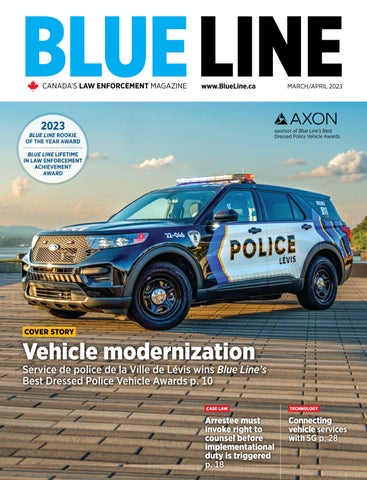
Vehicle modernization
Service de police de la Ville de Lévis wins Blue Line’s Best Dressed Police Vehicle Awards p. 10 CASE LAW
TECHNOLOGY
Arrestee must invoke right to counsel before implementational duty is triggered p. 18
Connecting vehicle services with 5G p. 28
SMARTER SECURITY.
STRONGER COMMUNITIES. There are 4,000 commissionaires supporting law enforcement across the country so sworn officers can focus on the job only they can do. commissionaires.ca
10
Contents
March/April 2023 Volume 35 Number 2
Features
Columns 4 18 26 28 30
Editor’s Commentary Case Law Behavioural Sciences Technology Back of the Book
Departments
COVER STORY
10 Vehicle modernization
Service de police de la Ville de Lévis wins Blue Line’s 2023 Best Dressed Police Vehicle Award. By Brittani Schroeder.
5 5 6 6 29
News By the numbers Dispatches Calendar Marketplace
13 Vehicle testing
Results from the Michigan State Police 2023 vehicle trials. By Dave Brown.
20 Strengthening relationships with a diverse community Cst. Anik Dennie awarded Blue Line’s 2023 Rookie of the Year title. By Brittani Schroeder.
COVER PHOTO: SERVICE DE POLICE DE LA VILLE DE LÉVIS
24 A lasting impact on the community
PC Dwight Lundgren named Blue Line’s 2023 Lifetime in Law Enforcement Achievement Award winner. By Brittani Schroeder.
13 @Blue_LineMag
20
24 March/April 2023 | BLUE LINE
3
EDITOR’S COMMENTARY BY BRITTANI SCHROEDER
The awards edition
D
id you know that every year, recognizes and encourages a standard of Blue Line runs three awards excellence that exemplifies leadership as programs to showcase differan activity not a position, and pride in ent aspects of the law enforceservice to the public. Its goal is to highlight ment industry? promising new officers who are effectively The first award focuses on a part of the paving the way for the policing of today and law enforcement industry that officers tomorrow, and creating positive waves must rely on daily: their vehicles. Canada’s among their peers, agencies, communities Best Dressed Police Vehicle award, sponand beyond. This year’s high quality pool sored by Axon, is broken down into mulof nominees was considerable, but the tiple categories that focus on judges were able to make a tough frontline patrol vehicles, commun- Blue Line is but unanimous decision as to who ity relations vehicles, law enforce- proud to the winner should be. The 2023 ment and special service vehicles. serve as a Rookie of the Year award was The awards showcase innovative, platform for given to Cst. Anik Dennie of the sustainable and effective designs. recognition Greater Sudbury Police Service. A team of judges look for clear for your You can read about her journey as identification, graphic designs that officers. a rookie on page 20. enhance visibility, elements that I would like to thank our esshow directionality of travel and effective teemed judges, Dave Brown, Rylan Simpintegration of equipment and controls. son, Christine Silverberg, Peter German “Green” vehicles are also taken into conand Armand La Barge, for their time and sideration. This year, the Service de police expertise. These awards programs wouldn’t de la Ville de Lévis (SPVL) took home the be possible without you. Reading the subtop spot with their 2021 Ford Police Intermission packages from police leadership ceptor Utility vehicle, with Canada’s Milacross the country, and learning about itary Police coming in second and Anishiwhat their officers have done for their nabek Police Service coming in third. In communities over the past year, is truly an our community relations category, Peel honour felt by the whole Blue Line team. Regional Police came in first place with This is the first year in which all three their 2022 Ford Mustang Mach-E. You can awards have been featured in one magazine read the full story on page 10. edition, and I want to dedicate it to all For our second award, we focus on those members of law enforcement. Blue Line is who have spent their whole career in law proud to serve as a platform for recognition enforcement, making a difference in the for your officers. communities they have served. Blue Line’s As always, if there is something you’ve Lifetime in Law Enforcement Achieveencountered over the last few years that ment Award is presented to an individual you think fellow officers could benefit and who has shown exceptional leadership, learn from, a topic you think we should be dedication and passion towards their work talking about, or a person you believe dein law enforcement for more than 15 years. serves recognition, please reach out to me This year’s award was given to Provincial at any time (bschroeder@annexbusienssConstable Dwight Lundgren of the Onmedia.com). tario Provincial Police. The full story on Until next time, happy reading and be PC Lundgren can be found on page 24. well. The third award of the year is dedicated to the rookies of Canadian law enforcement. Blue Line’s Rookie of the Year award
www.BlueLine.ca Reader Service Print and digital subscription inquiries or changes, please contact customer service Angelita Potal Tel: 416-510-5113 Fax: (416) 510-6875 email: apotal@annexbusinessmedia.com Mail: 111 Gordon Baker Rd., Suite 400 Toronto, ON M2H 3R1 GROUP PUBLISHER | PAUL GROSSINGER pgrossinger@annexbusinessmedia.com PUBLISHER | ADAM SZPAKOWSKI aszpakowski@annexbusinessmedia.com EDITOR | BRITTANI SCHROEDER bschroeder@annexbusinessmedia.com EDITORIAL DIRECTOR EMERGENCY SERVICES GROUP | LAURA AIKEN laiken@annexbusinessmedia.com ACCOUNT MANAGER | JANICE EATON jeaton@annexbusinessmedia.com MEDIA DESIGNER | SVETLANA AVRUTIN savrutin@annexbusinessmedia.com ACCOUNT COORDINATOR | KATHRYN NYENHUIS knyenhuis@annexbusinessmedia.com AUDIENCE DEVELOPMENT MANAGER BEATA OLECHNOWICZ | (416) 510-5182 bolechnowicz@annexbusinessmedia.com PRESIDENT/COO | SCOTT JAMIESON sjamieson@annexbusinessmedia.com ANNEX BUSINESS MEDIA 111 Gordon Baker Road, Suite 400 Toronto, ON M2H 3R1 Tel. 416-442-5600 • Fax 416-442-2191 Publication Mail Agreement No. 40065710 ISSN 0847-8538 Printed in Canada SUBSCRIPTION RATES Canada — 1 Year $31.50; 2 Year $52.50 plus tax USA — 1 Year $136.50 CAD Occasionally, Blue Line will mail information on behalf of industry-related groups whose products and services we believe may be of interest to you. If you prefer not to receive this information, please contact our circulation department in any of the four ways listed above. Annex Privacy Officer Privacy@annexbusinessmedia.com; Tel: 800-668-2374 © 2023 Annex Business Media. All rights reserved. Printed in Canada. No part of the editorial content of this publication may be reprinted without the publisher’s written permission. Opinions expressed in this magazine are not necessarily those of the editor or the publisher. No liability is assumed for errors or omissions. Readers are cautioned and advised that articles presented herein are edited and supplied for your personal awareness and should not be used for further action until appropriate guidance is received from a supervisor, Crown Attorney or other persons in authority. All advertising is subject to the publisher’s approval. Such approval does not imply any endorsement of the products or services advertised. The publisher reserves the right to refuse advertising that does not meet the standards of this publication.
CONNECT WITH BLUE LINE
www.BlueLine.ca
4
@Blue_LineMag
BLUE LINE | March/April 2023
www.facebook.com/BlueLineMagazine
www.BlueLine.ca
NEWS across the City of Victoria and Township of Esquimalt, and they are a clear example of citizens and police creating a safer community together.” – Courtesy of Victoria Police Department ALBERTA
Edmonton police uncover firearm trafficking operation
PHOTO CREDIT: VICTORIA POLICE DEPARTMENT
ONTARIO
Peel Police advocate for bail reform
Peel Police Services Board Chair Ron Chatha and Peel Regional Police (PRP) Chief Nishan Duraiappah have written to Prime Minister Justin Trudeau and provided a submission to Ontario’s Standing Committee on Justice Policy calling for changes to bail and judicial interim release decisions for violent and chronic offenders. Together, Chatha and Duraiappah have requested an immediate re-evaluation of the bail system’s public safety considerations. Over the years, Peel Region has seen high-risk, violent offenders released back into the community, who then await their trials for extended periods due to backlogs in the criminal justice system. The Police Services Board and PRP have stated that they support amendments to the Criminal Code that expand reverse onus offences to address chronic, violent offenders. They have also called on Ontario’s Ministry of the Attorney General to work closely with federal counterparts to ensure policies, guidelines and directives are appropriately coordinated to reflect legislative changes. It is PRP’s belief that greater weight must be provided to public safety considerations on the assessment of whether to consent to or oppose bail.
This is an ongoing, complex issue, and the Peel Police Services Board and PRP have stated that they are committed to working with Federal and Provincial criminal justice stakeholders to develop legislative, policy and resourcing solutions that protect victims and strengthen the safety of our communities. – Courtesy of Peel Regional Police BRITISH COLUMBIA
VicPD volunteers contribute over 4,500 hours to community programs in 2022 In February, Victoria Police Department (VicPD) welcomed 16 new members to their volunteer program. VicPD has almost 70 volunteers that support community safety though a variety of programs including foot and bike patrols, Speed Watch and Lock Out Auto Crime. Volunteers also connect with the residents of Victoria and Esquimalt at community events and during special community projects. Last year, volunteers contributed more than 4,500 hours to enhancing public safety and adding to the vibrancy of the communities. “Our volunteers are an essential part of our community engagement efforts to support community safety,” says VicPD’s Chief Del Manak. “They are out in the community seven days a week. The impact of their work is felt
Officers from the Edmonton Police Service Crime Suppression Branch have identified a firearm trafficking operation, resulting in several arrests and the recovery of firearms, ammunition and drugs. In July 2022, it was reported that over 200 firearms (registered, restricted, prohibited and antique style) and ammunition were stolen from a residence. The occupant of the home, a valid firearms Possession and Acquisition License (PAL) holder, was not present at the time of the break-in. Investigators subsequently initiated a firearm trafficking investigation pertaining to the stolen firearms. Working closely with officers from the Edmonton Police Firearms Investigation Unit (FIU), a complex and exhaustive investigation began, which resulted in the recovery of 23 firearms, thousands of rounds of ammunition, gun powder and quantities of fentanyl/ methamphetamine with an approximate street value over $10,000. On Jan. 18, 2023, police arrested and charged three people with firearms trafficking. These suspects were not known to the homeowner and had no ties to the residence. “We are pleased to have identified those responsible and recovered a portion of what could have posed a risk to the public at some point,” said Acting Staff Sergeant Terence Mak of the Edmonton Police Crime Suppression Branch. “We do, however, have lots of work to do with recovering the remaining stolen firearms.”
BY THE NUMBERS In February 2023, Statistics Canada released recent data on the trends in police-reported crime in rural and urban areas, 2021. For more information, please visit www150.statcan.gc.ca.
2x Intimate partner violence is almost twice as prevalent in rural areas as it is in urban areas.
@Blue_LineMag
30 %
Rural areas make up 15 per cent of a province’s population, but 30 per cent of the traffic offences.
16,929 In rural areas, there were 16,929 reported crimes per 100,000 population in the north, in comparison to the 5,205 reported crimes in the south.
24 %
Rural areas account for 24 per cent of the violent crimes in a province.
March/April 2023 | BLUE LINE
5
NEWS DISPATCHES Stuart Betts has been appointed as the new Chief of the Peterborough Police Service. Chief Betts is in his 26th year of policing. He previously served as Deputy Chief of Operations for the London Police Service and prior to that was the Deputy Chief of Administration. Over his career, he has served in virtually all areas of policing ranging from frontline patrol to executive services, as well as support services and administrative departments. “I am thrilled and honoured to have been selected to be Peterborough’s next Chief of Police. As Chief, I will be dedicated to ensuring we excel in our commitment to professionalism and excellence in support of safety for the community and to one another. Peterborough is to be my home, and I am invested in ensuring it is a safe place for my family and yours.” Chief Betts officially assumed his new role on Jan. 9. Fady Dagher has officially been named head of Montreal’s police department and was sworn in with a ceremony at Marché Bonsecours. Dagher was sworn in as the 42nd Montreal police chief on Jan. 19. He was most recently the police chief in Longueuil, and is succeeding Sophie Roy, who became the interim chief after Sylvain Caron retired in 2022. Dagher said his first challenge is to recruit new officers and retain the ones already in uniform. He was a police officer for 25 years in Montreal, working with marginalized and minority communities, and as chief in Longueuil, he introduced an innovative program in that city in which unarmed officers spent time with numerous minority communities as a rapprochement initiative. The Windsor Police Services Board has appointed Jason Bellaire as the new Chief of the Windsor Police Service (WPS). Chief Bellaire is a 27-year veteran of the WPS. He has served as the Acting Chief of Police for the past eight months. Previously, he served as Deputy Chief of Police – Operations for two years, where he oversaw all operational strategies. Prior to this, he served as an Inspector – Patrol Response, where he was the first point of contact for community groups
@Blue_LineMag
CALENDAR and organizations in Windsor and Amherstburg. “I am committed to the integrity and success of the Windsor Police Service. As your Chief, I look forward to working with the Board, our communities and our Windsor Police Service members to continue to provide the most effective and innovative policing service to our residents,” said Chief Bellaire. Chief Steve Williams has announced his retirement from the London Police Service, effective May 1. Chief Williams is in his 31st year of policing with the London Police Service and his fourth year as Chief. Due to the accrued time from his years of service, Williams’ last day in office will be earlier than May 1, on a date yet to be determined. “It has been my privilege and honour to serve our community as a police officer for over 30 years,” says Chief Williams. “I have profound respect and admiration for each and every member of this service, as they consistently demonstrate professionalism and perseverance despite the enormous demands and expectations placed upon them, particularly over the last several years. I commend them for their sacrifice and service to the citizens of London.” Julie Craddock has been selected as the newest Deputy Chief for the Sarnia Police Service. She is the first woman to serve in this position in Sarnia. Craddock started her policing career in 1994 as a member of the Ontario Provincial Police and transferred to Halton Regional Police Service in 1995. Craddock took over for Interim Deputy Chief Inspector Peter Murphy on March 6. The Ontario Association of Chiefs of Police (OACP) are saddened to report that former Halton Regional Police Deputy Chief (Ret.) Carol (Crowe) Wheeldon passed away. Carol fought cancer bravely for the past seven years. During her distinguished policing career, she served on the OACP Board of Directors The Durham Regional Police Services Board has announced that Toronto Police Service
CACP/MACP National Police Leadership Conference Date: Apr. 24 – 26, 2023 Location: Manitoba cacp.ca 14th Annual Law of Policing Conference, Eastern Edition Date: May 3 – 4, 2023 Location: Toronto, Ont. canadianinstitute.com/law-of-policing-east 25th Annual Chief of Police Dinner Date: May 4, 2023 Location: Toronto, Ont. chiefofpolicedinner.com OACP & Blue Line Expo 2023 Date: May 9, 2023 Location: Mississauga, Ont. bluelineexpo.com Rampart Range Day & Expo 2023 Date: May 30, 2023 Location: Ottawa, Ont. rampartcorp.com/rampart-range-day 2023 World Police & Fire Games Date: July 28 – Aug. 6, 2023 Location: Winnipeg, Man. www.wpfg2023.com Find more calendar events online at blueline.ca/events.
Staff Superintendent Peter Moreira has been selected as the next Chief of the Durham Regional Police Service, and he assumed his new role March 24. Chief Moreira has over three decades of service with the Toronto Police Service; he began his policing journey as a police cadet in 1991 and received his training from the Ontario Police College in 1993. “I appreciate the importance of the role I am privileged to assume, and I embrace the challenge with humility and eagerness. I am especially committed to working with all members of the DRPS to make sure that they feel proud to come to work, knowing that they are providing policing services to our community that are the best in the Province and the country,” stated Chief Moreira.
March/April 2023 | BLUE LINE
7
COVER STORY
sponsor of Blue Line’s Best Dressed Police Vehicle Awards
1st place: Service de police de la Ville de Lévis
Vehicle modernization
Service de police de la Ville de Lévis wins Blue Line’s 2023 Best Dressed Police Vehicle Award By Brittani Schroeder
1st PLACE Service de police de la Ville de Lévis 2021 FORD POLICE INTERCEPTOR UTILITY – AWD
The Service de police de la Ville de Lévis (SPVL) felt a great sense of pride when they learned that they had won first place in this year’s Best Dressed Vehicle contest, shares Director of Police François Dubé. “For an organization like ours, a project of this magnitude of vehicle changeover relies on the commitment and heart of the employees. To win an award like this means, to me, that our team can do remarkable things. This award will certainly be an added incentive to continue to surpass ourselves as a team.” The new patrol vehicle design for the SPVL was the first step in a major change towards their modernized police operations. For the police officers, the new vehicle means the deployment of a safe work environment with the ergonomic 10
BLUE LINE | March/April 2023
concern that has been thought out in the layout of the cockpit, modern and adapted to the digital evolution. It was important to the SPVL that the new visual be created by and for police officers so that the feeling of belonging to this new visual identity would be strong. Officer Alexandre Tremblay, whose project was selected, was able to integrate the representative aspects that identify both the SPVL and the City of Lévis. The four blue and gold chevrons on the vehicle are linked to the chevrons found on the city’s coat of arms. The direction of the chevrons is meant to illustrate the motto “Toujours à l’avant-garde” (always ahead of the curve), which is inscribed in the coat of arms to emphasize the city’s innovative character. It also refers to the current of the river. The black and white bodywork finds its meaning in the significance that the City of Lévis attributes to these colours. Black is a symbol of firmness and vigilance, while
white signifies unity and balance. As it blends with all colours, white also reflects the open-mindedness necessary for cooperation to take place in all spheres of the community. For police officers and for the community, cooperation is one of the service’s core values. “This vehicle, which represents a unique twist on an otherwise more standard design, exhibits an aesthetically pleasing, complementary colour scheme. It has clear lines and strong directionality. It’s highly visible, with adequate emergency lighting and reflective markings, and boldly identifies as a police vehicle,” says contest judge Rylan Simpson. Safety was also a primary consideration in the development of the new design. That’s why meticulous attention was paid to the vehicle’s visibility, both by day and by night. Finally, on the back of the vehicle, the words “Integrity, Pride, Courage” are present to remind the public of the SPVL’s commitment to them. www.BlueLine.ca
PHOTO: SERVICE DE POLICE DE LA VILLE DE LÉVIS
Congratulations to all the winners of Blue Line’s 2023 Best Dressed Vehicle Awards, sponsored by Axon. The awards showcase innovative, sustainable and effective designs. We look for clear identification, graphic designs that enhance visibility, elements that show directionality of travel and effective integration of equipment and controls. “Green” vehicles are also taken into consideration. Thank you to all agencies who submitted their vehicles. Stay tuned to blueline.ca for 2024’s call for submissions later this year.
3rd PLACE Anishinabek Police Service 2021 FORD F150 – 4WD
2nd place: Canada’s Military Police
3rd place: Anishinabek Police Service
2nd PLACE
PHOTOS: (TOP) CANADA’S MILITARY POLICE; (BOTTOM) ANISHINABEK POLICE SERVICE
Canada’s Military Police 2020 FORD POLICE INTERCEPTOR UTILITY – AWD
The new Canadian Military Police vehicle design is the result of an extensive consultation process involving input from patrol members at the tactical level and guardhouses in various regions across Canada, expert consultations with the logistics section staff, and input at the strategic level by experienced Military Police officers. “I am extremely proud that our new Military Police vehicle design took second place in the Blue Line Best Dressed Police Vehicle competition. It is an honour to be recognized alongside our police partners who we regularly work with across Canada,” says Brigadier General Simon Trudeau, Canadian Forces Provost Marshal and Commander of the Canadian Forces Military Police Group. This modernized design moves away from using a military crest as the only identifier on patrol vehicles. The colours featured on the Interceptor are in line with the traditional Canadian Military Police colours of red with black and white tones, which date back to World War One. @Blue_LineMag
“The process of designing and procuring vehicles in the Military is extensive, which adds to the satisfaction that our team was recognized at this level with the final product,” says Brigadier General Trudeau. The new graphic also brings Canada’s Military Police in line with other law enforcement partners with a common look and feel, in terms of enhancing the word “police” and 911 as the official emergency service number to reach. The new modernized look is also functional and accessible for all by being bilingual. The Military Police team put great effort into selecting a vinyl wrap that included 3M reflective accents to bring out the key information of “police” and 911, day or night. “What a step forward in vehicle design,” says contest judge Dave Brown. “There is an old argument whether Military Police should be capital “M” and small “p”, or small “m” and capital “P”. To me, they’re capital “M” and capital “P”, because they’re both military and police, and they do both jobs extremely well. This award highlights their dedication, and I’m happy it’s being awarded to some of the most motivated members I have ever met.”
This new design for the Anishinabek Police Service (APS), created by the service’s own Sgt. Chantal Larocque and Natasha Castilloux of Gateway Signs in North Bay, Ont., was created to show pride in the Indigenous culture. The design on the vehicle features all the elements in their members’ shoulder flash, and elements from the crest of the APS. In the crest, the central symbol is the thunderbird, which reflects the Union of Ontario Indians. It also represents power, strength, pride, integrity and goodness. Inside the thunderbird is a triangle, which signifies the Creator at the centre of all things. In the background sits the top of the teepee or wigwam, which signifies safety and shelter. The significance of the forests and water are also represented on the vehicle. “Our team was excited to enter, let alone win third place in the Best Dressed Vehicle contest. Indigenous policing has had its challenges and to be recognized, nationwide, with a winning design is very rewarding,” says Sgt. Larocque. “Our design is not typical, and that cultural flare give us and those we serve a sense of pride.” The truck is a symbol of the APS’ great strides as a police service and ability to showcase their culture. This is highlighted by the use of the Indigenous word “mino-bimaadiziwin” that is featured on the vehicle—it means “the good life”. “In our culture we all strive for the good life, and as peacekeepers we have to remember that everyone needs help getting there,” says Sgt. Larocque. Sgt. Larocque drives the truck to and from the 17 communities the APS polices province wide, stretching from Sarnia to north of Thunder Bay. The reaction and comments she’s received from community members have been overwhelmingly positive. “I also enjoy the shoutouts in cities, especially when Indigenous people point, give the thumbs up, and smile with what I see as pride. The look on their faces says, ‘That’s our police, that’s our people, and that’s an awesome truck’.” March/April 2023 | BLUE LINE
11
COVER STORY
Community Relations 1st place: Peel Regional Police
COMMUNITY RELATIONS WINNER Peel Regional Police 2022 FORD MUSTANG MACH-E – AWD
> New 6” side zip > Step into comfort: Lightweight, All Day Comfort, Waterproof
HAIX® North America Inc. 2320 Fortune Drive, Suite 120 Lexington KY 40509 Toll free 866-344-HAIX (4249)
www.haixca.com
12
BLUE LINE | March/April 2023
BL_HaixBlue_April23.indd 1
* Honourable mention goes to Brock University in the law enforcement category. You can see a photo of their vehicle at blueline.ca. Thank you our Best Dressed Police Vehicle judges: Dave Brown is a Blue Line contributor on firearms and police vehicles, as well as a Best Dressed Police Vehicle Awards judge. He is a tactical firearms trainer and consultant based in Winnipeg. He can be reached at Dave.Brown@northwestlaw.ca. Rylan Simpson, Ph.D., is an assistant professor in the School of Criminology at Simon Fraser University. He is an expert in police perception research and has studied the effects of police vehicle aesthetics on public perceptions of police. He has recently published his work in Criminology & Public Policy, PLoS ONE, Journal of Experimental Criminology, Justice Evaluation Journal, and Policing: A Journal of Policy and Practice.
2023-03-14 9:36 AM
www.BlueLine.ca
PHOTO: PEEL REGIONAL POLICE
BLACK EAGLE® TACTICAL 2.0 GTX MID SZ
Peel Regional Police (PRP) had an objective to create a wrap for their vehicle that stands as their commitment to supporting all identities within their community. “Peel Regional Police is honoured to be selected as the winner in this category, which received so many creative and deserving entries,” says Mark Figueiredo, director of materials management at PRP. “We aspire to be the most progressive, innovative and inclusive police service in Canada. This design tells the story of our leading-edge police culture serving the most diverse community in Canada.” Many 2SLGBTQ+ individuals still struggle and feel out of place in today’s society based on number of factors. Members of PRP are committed to breaking down the barriers and supporting the 2SLGBTQ+ community. “Overall, the tone of the vehicle is proud, direct and inclusive. Like the billowing flags on the vehicle, we are not static.” The new Pride vehicle has been well received throughout Peel Region and allows PRP to connect with the community, open conversations and demonstrate PRP’s commitment to supporting and serving the most diverse community in Canada. “Our vehicle is moving billboard that communicates our values and encourages positive engagement. Importantly, the #SafePlace call-to-action provides public awareness of our proactivity against hate motivated crimes,” says Figueiredo. The design was created by Cathy Miron, PRP’s graphic designer. ArtCal produced the decals and installation was coordinated by PRP’s Fleet Services Department.
VEHICLES
2023 Chevrolet Tahoe PPV
2023 Dodge Durango Pursuit
2023 Ford Police Interceptor Utility
PHOTO: GENERAL MOTORS
PHOTO: FIAT CHRYSLER AUTOMOBILES
PHOTO: FORD MOTOR COMPANY
Vehicle testing Results from the Michigan State Police 2023 vehicle trials By Dave Brown
E
very fall, the Michigan State Police, in conjunction with the U.S. National Institute of Justice (NIJ), tests the handling and performance of every new police vehicle on the market in back-to-back acceleration, braking and lap time tests. The tests are a comprehensive analysis of police vehicles. The Michigan State Police yearly vehicle test for the 2023 model year will mark the 25th year that Blue Line has been compiling and reporting the results of the tests for pursuit-rated police category vehicles. While there is no strict definition of the term “pursuit-rated,” agencies such as Michigan State Police and Los Angeles County Sheriff’s Department agree that a pursuit-rated police vehicle must be able to handle higher stresses than normal, plus perform better at high speeds than their civilian counterparts.
Acceleration, braking and top speed tests are performed at the Chrysler Proving Grounds and vehicle dynamics tests are done using the two-mile road course at the Grattan Raceway. (All dimensions and measurements are given in U.S. numbers.)
THE RESULTS Vehicle dynamics testing
The objective of the vehicle dynamics testing is to determine the high-speed pursuit handling characteristics. Except for the absence of traffic, the two-mile road course simulates actual pursuit conditions. Four different drivers test each vehicle over an eight-lap road course, with the five fastest laps counting toward each driver’s average lap time. Final score is the combined average of all four drivers. Lap Times
Chevrolet Tahoe 5.3-litre V8 RWD
Chevrolet Tahoe 5.3-litre V8 4WD
Chevrolet Silverado Z7X 5.3-litre V8 4WD
Chevrolet Silverado Z71 5.3-litre V8 4WD
Overall average lap times
1:38.30
1:38.62
1:41.27
1:40.53
Lap Times
Dodge Charger 5.7-litre V8 RWD
Dodge Charger 3.6-litre V6 AWD
Dodge Durango 5.7-litre V8 AWD
Dodge Durango 3.6-litre V6 AWD
Overall average lap times
1:36.33
1:37.80
1:38.68
1:41.03
Vehicles
The Michigan State Police Precision Driving Unit evaluates police vehicles in two categories: police category vehicles and special service vehicles. Police category vehicles are designed for the full spectrum of general police activities including high-speed pursuit. Special service vehicles are designed only for specialized duties, such as canine units, and are not intended or recommended for pursuits. Thirteen vehicles were submitted to the NIJ in the police category for 2023: • 2023 Chevrolet Tahoe PPV 5.3L RWD • 2023 Chevrolet Tahoe PPV 5.3L 4WD • 2023 Chevrolet Silverado Z7X 5.3L 4WD 2-inch lift package • 2023 Chevrolet Silverado Z71 5.3L 4WD • 2023 Dodge Charger Pursuit 5.7L RWD • 2023 Dodge Charger Pursuit 3.6L AWD • 2023 Dodge Durango Pursuit 5.7L AWD • 2023 Dodge Durango Pursuit 3.6L AWD • 2023 Ford Police Interceptor Utility 3.0L EcoBoost AWD • 2023 Ford Police Interceptor Utility Hybrid AWD • 2023 Ford Police Interceptor Utility 3.3L AWD • 2023 Ford F-150 Police Responder 3.5L EcoBoost 4WD • 2023 Ford Mustang Mach-E electric AWD
Lap Times
Ford PI Utility 3.0-litre V6 EcoBoost AWD
Ford PI Utility 3.3-litre Hybrid AWD
Ford PI Utility 3.3-litre V6 AWD
Ford Police Responder F150 3.5-litre V6 EcoBoost 4WD
Ford Mustang Mach-E electric AWD
Overall average lap times
1:35.42
1:38.99
1:38.20
1:38.65
1:41.63
Electric-powered vehicle dynamics testing
Because of the unique nature of battery electric vehicles, it was felt that a fair assessment of their capabilities would involve fast-charging the battery pack between runs. This would be more typical of an electric vehicle hitting the road near the start of every shift. In discussions with all three manufacturers, the MSP Precision Driving Unit settled on a charge time of 40 minutes on a 47 Kw Level 3 charger between runs. Vehicle
The tests
Michigan State Police Precision Driving Unit and the NIJ’s Justice Technology Information Center (JTIC) test all the vehicles together over a three-day period at the Chrysler Proving Grounds and the Grattan Raceway. @Blue_LineMag
Ford Mustang Mach-E
Beginning state of charge
Ending state of charge after 5 laps/3.2km
Average of 5 laps
100%
69%
1:41.67
80%
49%
1:42.55
79%
51%
1:40.99
86%
55%
1:41.30
March/April 2023 | BLUE LINE
13
VEHICLES Acceleration
Chevrolet Tahoe 5.3-litre V8 RWD
Chevrolet Tahoe 5.3-litre V8 4WD
Chevrolet Silverado Z7X 5.3-litre V8 4WD
Chevrolet Silverado Z71 5.3-litre V8 4WD
0 – 60 mph
7.38
8.03
7.43
7.59
0 – 80 mph
11.92
12.94
11.95
12.04
0 – 100 mph
18.70
20.32
18.87
18.70
Top Speed (mph)
130
124
112
112
Acceleration
Dodge Charger 5.7-litre V8 RWD
Dodge Charger 3.6-litre V6 AWD
Dodge Durango 5.7-litre V8 AW
Dodge Durango 3.6-litre V6 AWD
0 – 60 mph
6.01
7.57
7.27
8.65
0 – 80 mph
9.43
12.19
12.08
14.67
0 – 100 mph
14.10
19.06
19.26
24.11
Top Speed (mph)
140
140
130
128
Acceleration
Ford PI Utility 3.0-litre V6 EcoBoost AWD
Ford PI Utility 3.3-litre Hybrid AWD
Ford PI Utility 3.3-litre V6 AWD
Ford Police Responder F150 3.5-litre V6 EcoBoost 4WD
Ford Mustang Mach-E electric AWD
0 – 60 mph
5.68
7.28
7.95
5.72
3.93
0 – 80 mph
9.49
11.62
12.65
9.12
6.37
0 – 100 mph
14.74
17.67
19.73
14.16
12.23
Top Speed (mph)
148
136
136
120
122
Braking
Chevrolet Tahoe 5.3-litre V8 RWD
Chevrolet Tahoe 5.3-litre V8 4WD
Chevrolet Silverado Z7X 5.3-litre V8 4WD
Chevrolet Silverado Z71 5.3-litre V8 4WD
Average deceleration rate (feet/sec2)
30.32
29.76
27.63
27.58
Projected stopping distance from 60 mph (feet)
127.7
130.1
140.2
140.4
Braking
Dodge Charger 5.7-litre V8 RWD
Dodge Charger 3.6-litre V6 AWD
Dodge Durango 5.7-litre V8 AW
Dodge Durango 3.6-litre V6 AWD
Average deceleration rate (feet/sec2)
29.89
29.85
28.12
28.62
Projected stopping distance from 60 mph (feet)
129.6
129.7
137.7
135.3
Braking
Ford PI Utility 3.3-litre Hybrid AWD
Ford PI Utility 3.3-litre V6 AWD
Ford Police Responder F150 3.5-litre V6 EcoBoost 4WD
Ford Mustang Mach-E electric AWD
For results on communications, ergonomics and fuel economy, please visit www.blueline.ca/vehicle-testing-results-from-the-michigan-state-police2023-vehicle-trials/
Ford PI Utility 3.0-litre V6 EcoBoost AWD
Average deceleration rate (feet/sec2)
29.44
29.23
29.40
23.87
31.54
Dave Brown is a Blue Line contributor on firearms and police vehicles, as well as a Best Dressed Police Vehicle Awards judge. He is a tactical firearms trainer and consultant based in Winnipeg. He can be reached at Dave.Brown@northwestlaw.ca.
Projected stopping distance from 60 mph (feet)
131.5
132.5
131.7
162.2
122.8
Acceleration and top speed
The objectives of the acceleration and top speed tests are to determine the ability of each vehicle to accelerate from a standing start to 60 mph, 80 mph and 100 mph, and to record the top speed achieved within a distance of 14 miles from a standing start. Each vehicle is driven through four acceleration sequences, two in each direction to allow for wind. Acceleration score is the average of the four tests.
Braking
The objective of the braking test is to determine the deceleration rate attained by each vehicle on twenty 60-0 mph full stops to the point of full ABS. Each vehicle is scored on the average deceleration rate it attains. Each test vehicle makes five measured 60-0 mph stops to full ABS engagement in one direction, and then five measured 60-0 mph stops to full ABS engagement in the opposite direction. After ten stops, each vehicle completes one lap around the test oval to cool the brakes, and the test is repeated. The resulting score is the average of all 20 stops. Stopping distance from 60 mph is calculated by interpolation of results.
Communications and ergonomics
The objectives of the communications and ergonomics tests are to rate a vehicle’s ability to provide a suitable environment for patrol officers to perform their job, to accommodate required communication and emergency warning equipment and to assess the relative difficulty in installing this equipment. A minimum of four officers independently evaluate ergonomic factors, and Michigan State Police Communications Division personnel then evaluate each vehicle on the ease of equipment installation. A score of one represents “totally unacceptable” and a score of 10 represents “superior” ergonomic or communication installation factors. Twenty-seven ergonomic factors are evaluated on a scale of one to 10 and averaged among all the testers. The final score is the overall average of all 27 factors. A total of three communications factors are evaluated on a scale of one to ten and averaged among all the testers. The final score is the overall average of all three factors.
Fuel economy
While not an indicator of actual mileage that may be experienced, the EPA mileage figures serve as a good comparison of mileage potential from vehicle to vehicle. Vehicle figures are based on data published by the vehicle manufacturers and certified by the U.S. Environmental Protection Agency. Mileage figures are given in U.S. miles per gallon.
14
Electric vehicle equivalent EPA Mileage (miles per U.S. gallon)
Ford Mustang Mach-E electric AWD
Combined MPGe
84
BLUE LINE | March/April 2023
www.BlueLine.ca
Scan to start
PUTTING THE
WHEELS IN MOTION Axon’s Fleet 3 System Can Level Up Your Patrol Vehicles. Fleet 3 is Axon’s latest in-car camera system, featuring a dual-view 4K camera with automatic license plate reader (ALPR) technology. Fleet 3’s ALPR camera can scan license plates across 3 lanes of traffic at speeds of up to 140 mph, resulting in 8x as many plate scans as traditional ALPR systems. ALPR
LIVE STREAMING AND LOCATION
WIRELESS MIC
VIDEO RECALL
Integrated 4K ALPR covering three traffic lanes
Alerts, live maps of vehicle location and live streaming
Clear audio up to 1,000 feet away from the vehicle
The last 24 hours of video, available for remote retrieval
Learn more at axon.com/fleet3
CASE LAW
BY MIKE NOVAKOWSKI
Arrestee must invoke right to counsel before implementational duty is triggered
18
BLUE LINE | March/April 2023
point”. The duty on police to implement contact between a detainee and a lawyer arises only if the detainee expresses a desire to contact counsel. The trial judge did not err in concluding that Simpson’s response did not qualify as an invocation of the right to counsel, and his appeal was dismissed. In R. v. Lambert & Bailey, 2023 NSCA 8, the accused, Lambert, was arrested for conspiracy to import and possessing cocaine for the purpose of trafficking. He was advised of his right to counsel and cautioned, and was asked if he wished to speak to a lawyer. Lambert indicated he understood his rights and said, “No man, we don’t have any cocaine”. The police later found 157 kilograms of cocaine stowed in the hull a commercial cargo vessel which led to charges against Lambert and others. A Nova Scotia Provincial Court judge concluded the police complied with their informational obligation under s. 10(b) by advising Lambert of his right to contact counsel. But, because he did not make a request for access to a lawyer, the implementational duty to provide a reasonable opportunity to contact counsel imposed under s. 10(b) did not arise. When Lambert said “No man, we don’t have any cocaine”, he was not making a request to contact a lawyer. Lambert was convicted of conspiracy to import cocaine, conspiracy to traffic cocaine, attempting to traffic cocaine, and attempting to possess cocaine for the purpose of trafficking.
Lambert appealed his convictions to the Nova Scotia Court of Appeal submitting, among other things, that the trial judge erred in finding no s. 10(b) Charter breach. He suggested that the “No” in his reply, “No man, we don’t have any cocaine”, was made in response to the s. 10(a) reasons for arrest right and not the inquiry about whether he wanted to contact a lawyer. The Appeal Court rejected this argument, finding the trial judge was entitled to conclude that Lambert understood why he was being arrested, that he had the right to speak to counsel, and that he was being asked if he wanted to do so. His reply was a direct response to the question about whether he wanted to contact counsel and was not related to the police officers advising him that the arrest was for offences involving cocaine. Lambert was informed of his right to speak to a lawyer but chose not to exercise it. “An explicit, firm refusal is not required before police are relieved of their implementational obligation,” said the Court of Appeal. “Unless a person who has been detained or arrested invokes their right to consult with a lawyer, no duty lies on the police to implement contact.” This ground of appeal was dismissed and Lambert’s convictions were upheld.
Mike Novakowski is Blue Line’s case law columnist.
www.BlueLine.ca
PHOTO: © SECONDSIDE / ADOBE STOCK
I
n two recent drug cases, appeal courts in Ontario and Nova Scotia were tasked with deciding whether a trial judge erred in finding an arrestee’s response to a s. 10(b) Charter advisement did not require the police to facilitate contact with a lawyer. In R. v. Simpson, 2023 ONCA 23, the accused – who was under surveillance for a drug investigation – was detained by police after they saw him exit a store. An officer advised Simpson of his right to counsel from memory. Simpson was told he had the right to retain and instruct counsel without delay, phone any lawyer he wanted, and contact a Legal Aid lawyer. When asked if he understood, Simpson replied, “Yes”. When asked if he wanted to speak to a lawyer at that time, he replied, “I will at some point”. Simpson was then cautioned about providing a statement and, when asked if he understood, replied “Yes”. He was subsequently questioned by police and he admitted that there were drugs in his car and home. The police conducted searches and found drugs leading to charges against him. A judge of the Ontario Superior Court of Justice found Simpson’s s. 10(b) Charter right had been respected. In the judge’s view, Simpson’s reply in response to the officer’s question about speaking to a lawyer – “I will at some point” – did not amount to Simpson expressing a desire to contact counsel. He was convicted on two counts of possessing cocaine for the purpose of trafficking, possessing MDMA, and possessing proceeds of crime. Simpson appealed his convictions to the Ontario Court of Appeal claiming the police breached his s. 10(b) right to counsel because they did not facilitate contact with a lawyer. He wanted all of the evidence excluded under s. 24(2) and acquittals on all charges to follow. In a short judgement, a three-judge panel of Ontario’s top court upheld the trial judge’s ruling. The officer had immediately provided a proper s. 10(b) advisement when Simpson was detained, and he gave an unequivocal answer that he understood what he had just heard. Then, in response to the question about whether he wanted to speak to a lawyer he said, “I will at some
BlackBerry AtHoc ®
®
A MASS NOTIFICATION AND SAFETY COMMUNICATION SYSTEM
KEEPING YOUR PEOPLE CONNECTED, INFORMED, AND SAFE. Learn more at blackberry.com/athoc
LEADERSHIP
2023
BLUE LINE ROOKIE OF THE YEAR AWARD
GSPS. She started out as a special constable in the courts and was later hired on as a police constable. Dennie has been a member of the police service since January 2020.
Strengthening relationships with a diverse community Cst. Anik Dennie awarded Blue Line’s 2023 Rookie of the Year title By Brittani Schroeder
A
nik Dennie didn’t always know she wanted to be a police officer. In fact, when she left high school, she followed the path of academia, first earning her bachelor’s degree in health promotion, then her master’s in human kinetics, where she learned a lot about the preventative aspects of health. Near the end of her undergraduate studies, Dennie started volunteering with the Greater Sudbury Police Service’s (GSPS) diversity and inclusion committee as a community member. “I had never really thought about a career in policing before this,” she says. 20
BLUE LINE | March/April 2023
Dennie went on a ride along with an officer as she continued her work with the diversity and inclusion committee at GSPS. This is where she first learned of the problems in the Greater Sudbury community and the over-representation of Indigenous people in the justice system. She also discovered the multiple options and units that exist for a police officer, and “got excited at the idea of joining the team.” Still, she decided to complete her masters first, then worked as a health promoter for a while before realizing she wasn’t making the kind of impact in her community that she wanted to. Dennie took the leap and applied to
Dennie is Métis, as are her parents, and her partner is an Anishnaabe kwe. “As sad as it is to say, racism is alive and well in the Greater Sudbury area. Because of the colour of my skin, I present as white, and therefore I haven’t had to deal with racism aimed at me. However, once I learned of the racism that my partner has faced – and still faces – I grew very upset. Soon after this realization, the first 215 children were found at the site of the former residential school in Kamloops, B.C., and my feelings intensified,” she says. Dennie spoke with her colleagues about the residential schools, and she found that many didn’t know much on the topic. “This made me sad, because Indigenous people represent about 13 per cent of the population in Greater Sudbury.” Dennie learned quickly that her anger, her sadness, didn’t get her anywhere. She instead wanted to raise awareness within the GSPS of the differences they could make in their community when it came to truth and reconciliation. “I initially wanted to make a provincial-wide challenge for all police services in Ontario, but it was quickly brought to my attention that you can’t eat an elephant in one sitting. In other words, I needed to downsize the idea to our police service for a trial run.” This is where Dennie created, developed and implemented the first annual Truth and Reconciliation Relay for the GSPS. The goal of the relay was to collectively reach 10,000 kilometers, which represented one kilometer per child that never returned home from Canadian residential schools. Participating GSPS members also completed a one-hour training course on Truth and Reconciliation through the Canadian Police Knowledge Network (CPKN). After completing the training, each participant reviewed the 97 recommendations from the Truth and Reconciliation: Calls to Action Report. The participant would then select one recommendation that spoke to them and reflect on how they could implement the action in their daily lives. Each participant committed to a kilometer target that they would strive to achieve through walking, running or cycling from Sept. 1 to 30, 2022. Each week during the month of September, Dennie sent out more educational www.BlueLine.ca
PHOTO: GREATER SUDBURY POLICE SERVICE
An Indigenous past, present and future
LEADERSHIP material on Canadian Residential Schools, and planned and facilitated group walks to locate various geocached rocks painted with the seven grandfather teachings. The participants were encouraged to share their successes of participation through selfies with the rocks and to post their weekly milestones of kilometers reached. “In a way, I needed to organize this for myself, to find a way to get through the anger. I wanted to ensure that when a call comes in to the station and involves other Indigenous people, my colleagues understand the effects of intergenerational trauma on people, and bring that understanding – rather than judgement – to the call,” says Dennie. In total, the Truth and Reconciliation Relay had 112 participants logging 12,331 kms. “Cst. Dennie’s professionalism and compassion, her commitment to teamwork, her influence on improving relationships with Indigenous people and diverse communities, and her extraordinary impact both inside and outside the service are a role model for others,” says contest judge Christine Silverberg.
“Dennie has made a tremendous impact on all those she works with as well as the community she polices.”
– Chief Paul Pedersen, Greater Sudbury Police Service
Volunteering in a range of programs
In addition to her time spent on the Truth and Reconciliation Relay, Dennie spends time volunteering in a variety of programs within the GSPS and the Greater Sudbury community. Mooz Atkinoonmaaget Maa Aki is a pilot project and a collaboration between the GSPS, Niijaansinaanik Child and Family Services, Nogdawindamin Family and Community Services, Kina Gbehzgomi Child and Family Services, and the Ministry of Natural Resources and Forestry. It was spearheaded by Cst. Darryl Rivers, the Indigenous Liaison Officer for the GSPS. The goal is to share culture around the moose hunt and the
seven grandfather teachings, and to build and rebuild relationships with kids in care. “Most of these kids have had negative experiences with police; they see us as the ones that took them away from their families. So the goal of the program is for the children to see us as people, not just uniforms; to build meaningful relationships with the children so that they know that if they need the police, they can turn to us,” says Dennie. She shared that one particular youth started the program and her most common phrase was “I can’t do it”. By the end of the summer, it changed to, “I did it, did you see?” “I am so proud of all these kids. Some of them started by being very apprehensive around us, and by the end, one of the kids said that he wanted to become a police officer. I also feel like I learned just as much as the kids, though. Sitting through the seven grandfather teachings and the teachings out on the land. To reconnect with nature. Learn about harvesting a moose. I didn’t grow up learning any of the Métis teachings of culture, so I feel like I also did a lot of growing this summer with the kids.”
Fully Online Program
Bachelor of Applied Arts Justice & Public Safety Complete in 2 to 2½ years
Choose the DEGREE that will move your career forward
guelphhumber.ca/futurestudents/jps 1 22 BL_GuelphHumber_March23.indd BLUE LINE | March/April 2023
2023-02-22 10:31 AM www.BlueLine.ca
“You can see just how dedicated, passionate and caring she is as an officer and a person,” says contest judge Armand La Barge. Dennie has participated in the GSPS Intercultural Ride Along program, where GSPS officers are partnered up with international students who mostly come from areas where police corruption is rampant. The student Dennie was paired up with was from Africa, and they did two ride alongs together, each lasting just under 12 hours. “I forget how exciting this job can be—even the mundane calls. But to this student, everything was so fascinating,” she says. “I’ve had the privilege of never having to know what corruption is inside the police service, so listening to her stories, it made a lot of sense. It opened my eyes to why there is a fear of the police, and it’s helped me greatly during my time on the force so far. So, we both taught each other something.” Dennie is also a committed member of Greater Sudbury Police women’s hockey team. This community sport initiative has a focus on youth engagement through the par-
BL_ForensicPractice_April23.indd 1 @Blue_LineMag
ticipation of playing hockey games with various youth organizations and high schools. “Cst. Dennie has demonstrated a dedication to her community, and to driving change within the community in a manner that brings credit to her police service and will continue to produce tangible results for many years. Her leadership, her drive and her professionalism make her an outstanding Rookie of the Year winner,” says contest judge Peter German.
It’s all about teamwork
Cst. Dennie had no idea that she’d been nominated for the Blue Line Rookie of the Year award, and when she found out that she’d been nominated and won, at first, she felt “weird.” “Since becoming an officer, everything I do is with a team. We’re a family. It’s very different from academia, where you’re in it for yourself. Being an officer is a teamwork thing, and I really enjoy that. So, of course, it’s amazing to be winning this award and it’s incredibly humbling, but I also want to highlight just how amazing the team I work with is.”
THANK YOU TO THE 2023 PANEL OF JUDGES Christine Silverberg served as Chief of the Calgary Police Service from 1995 to 2000. Christine then became a lawyer. In 2021, Christine was awarded an Honorary Doctor of Laws (LL.D.) in honour of her outstanding contributions. Peter German was a member of the RCMP for 31 years, serving as Deputy Commissioner West and later as Regional Deputy Commissioner (Pacific) for Correctional Service Canada. He currently practices law, and is president of the International Centre for Criminal Law Reform at the University of British Columbia. Armand La Barge is the retired Chief of York Regional Police in Ontario. He is the past president of the OACP, the Ontario director of the CACP, and he was an associate member of the First Nation Chiefs of Police Association.
11:52 AM March/April 20232023-03-16 | BLUE LINE 23
LEADERSHIP
A lasting impact on the community PC Dwight Lundgren named Blue Line’s 2023 Lifetime in Law Enforcement Achievement Award winner By Brittani Schroeder Blue Line is proud to present the 2023 Lifetime in Law Enforcement Achievement Award to Provincial Constable Dwight Lundgren of the Ontario Provincial Police. The award is presented to an individual who has shown exceptional leadership, dedication and passion towards their work in law enforcement for more than 15 years.
P
rovincial Constable (PC) Dwight Lundgren grew up in Rainy River, Ont., which is a town of less than 900 people. His first job was at the marina, where he met a variety of individuals. This is where he discovered that he had a passion for helping people. A family friend of the Lundgren’s – Brian Majors – was a police officer who became a role model to Dwight. He played a large part in Lundgren applying to be an officer. “When I applied to the OPP at 19 years old, they told me I was too young and I needed more life experience. Brian was a First Nations officer, so that’s the road I went down instead,” he says. Lundgren got hired on at the Pikangikum Police Service, where he was a First
24
BLUE LINE | March/April 2023
Nations constable for two and a half years before transferring to Terrace Bay Police Service. In 1999, after seven and a half years with the Terrace Bay Police, he applied and got hired at the Kenora Police Service. In 2007, the Kenora Police Service was amalgamated into the OPP, at which point Lundgren became a provincial constable. “I was finally able to make a lateral transfer with an officer in Rainy River in 2011. He was originally from Kenora, so we swapped places so we could each go home.”
A department role model
PC Lundgren is in his 34th year of policing, and he still loves his job as much as he did in the beginning. “I’m one of the oldest
A deep connection with the community
After more than three decades of being an officer, being out in the community and helping people is still Lundgren’s favourite part of the job. He’s seen a lot of situations over the years, good and bad, and knowing that he can help – even if only in some small way – is reassuring, giving Lundgren a sense of satisfaction. “Just seeing someone smile for helping them out goes a long way. Sometimes they even give me a hug. Those small things supersede the bad stuff that we must deal with on a regular basis.” www.BlueLine.ca
PHOTO: REGAN ROTMARK
2023
BLUE LINE LIFETIME IN LAW ENFORCEMENT ACHIEVEMENT AWARD
guys on the road for this OPP detachment,” he says. Lundgren is a role model to the junior members of the team, happily taking them under his wing and showing them the ropes. He strives to give them a different experience than what he was given when he first became an officer. He describes his time as a junior officer as a ‘speak only when spoken to’ kind of understanding with the older members. “Now that I’m the older officer working with the new recruits, I try to help them and be a resource they can learn from. I encourage questions. If I don’t agree with something they’re doing on a call, I’ll pull them aside afterwards to talk about it, rather than embarrassing them in front of others. I want to treat them better than I was treated, and hopefully they’ll in turn treat others better when it’s their turn to teach,” he explains. For Lundgren, he feels the role modelling goes both ways. “I learn a lot from the younger officers, so it’s nice to know we’re all educating each other.” One of the biggest challenges Lundgren faces on the job is keeping up with all the new technologies being implemented, for example, the computers in the vehicles and the body cameras that will be rolled out in the near future. “Being older, it’s sometimes harder to adapt to the changes. The younger officers tend to know more about computers than I do, so I rely on their help from time to time.” In 2016, Lundgren learned just how important being officer was to him, and how much he’d do to be able to help others. He had a slip and fall that resulted in a bad concussion and left him close to speechless for three months. “I was told I would probably never go back to work. I tried to rush my recovery, and I reinjured the concussion, but I knew work was where I needed to be. Now here I am! I’m back at work, and I’m so glad to be back where I belong.”
“Not only has PC Lundgren demonstrated excellent community policing, but he also constantly embodies this approach as he works collaboratively with the public and improves police-public relationships,” says Staff Sgt. Dereck McLean, who is Lundgren’s OPP Detachment Manager. Lundgren is known as an officer who spends countless hours of his personal time helping those who need it most. He has purchased and delivered groceries for individuals who were unable to financially support themselves—a small act that can change a person’s perception of the police and turn around a negative point in their life. During one well-being check of elderly siblings at a residence, Lundgren noted they had no access to snow removal and no working bathroom. He re-attended on his day off and completed the snow removal and ensured repairs were made. PC Lundgren remained a strong advocate in their lives until they were required to move into assisted living. “One of the siblings later passed away. After that happened, my wife – who is also an officer – and I would go and check on the remaining
“He demonstrates care and concern for the most vulnerable people by providing regular check-ins on the elderly or home-bound individuals after initial calls for service to ensure they are safe and have appropriate support.” – Staff Sgt. Dereck McLean. sibling to see if she needed anything. During one visit, I noticed she had some large wounds on her legs, and after looking at them, I called an ambulance right away because they were badly infected. In fact, they ended up being septic,” he shares. Lundgren convinced her to seek additional medical treatment, which prevented further illness and saved her life. While off-duty, Lundgren regularly takes calls from citizens seeking to report a crime or to provide intelligence regarding criminal activity. He’s even made himself available to speak to them about their personal challenges and struggles. Lundgren’s supervisor has stated he is impressed by the genuine interest and the care that Lundgren exhibits towards people in need. “His generosity and naturally supportive disposition
exemplify the OPP values of interacting with respect, compassion and fairness. By maintaining a high level of professionalism, he has earned the respect and the trust of those within his community,” says Staff Sgt. McLean.
A shocking recognition
When Blue Line reached out to notify Lundgren that he’d be selected as the winner of this year’s Lifetime in Law Enforcement Achievement Award, he was shocked. “I was even shocked to be nominated in the first place. But to win? That was something I just couldn’t believe,” he says. “I had teachers in high school tell me that I would never amount to everything, and now here I am. Look at everything I’ve done.”
Prepare to Serve and Protect SENECA OFFERS PROGRAMS IN: • Police Foundations • 911 & Emergency Services Communications • Advanced Investigations & Enforcement • Crime & Intelligence Analysis Enhance your diploma or professional experience through credit transfer to gain another law enforcement credential. Start making a difference in communities across Canada. LEARN MORE AND APPLY TODAY senecacollege.ca
BEHAVIOURAL SCIENCES BY PETER COLLINS
Memory, recovered memory and false memory in sexual assault and homicide investigations: Part 2
I
n the last edition of Blue Line, we discussed the topic of false memories. Memory is malleable; details can be distorted, and wholly false memories can be implanted. Just because a memory report is detailed, confidently expressed and emotional, does not mean that it reflects a true experience. Research has shown that certain individuals may be more susceptible to false memories, and they can be produced in a laboratory setting.1 The factors that make people more susceptible to imagination inflation are memory problems, difficulties with reality monitoring and the ability to produce vivid imagery. Individuals who are susceptible to false memories may have a “source monitoring deficit” – incorrect judgements about the origin or source of information. A false memory is highly dependent on the individual being able to create or retrieve misinformation.
Case one
Patricia, and her older sister, were sexually assaulted by a friend of the family when they were in elementary school. As an adult, she went to the police to report the abuse. The abuse consisted of several episodes of the family friend rubbing her vagina. On one occasion he allegedly placed her hand on his exposed erect penis. Independently, her older sister confirmed that this same friend of the family, who was now deceased, abused her in a similar manner. Patricia decided to seek out counselling to address her victimization and entered therapy with a counsellor who was said to be an expert in sexual “ritual” abuse. With the assistance of this “therapist”, Patricia started to recover memories of being a victim of ritual abuse and that her parents were members of a cult. The ritual abuse was said to take place at the cottage of her perpetrator. Patricia started to remember that, in addition to being sexually abused, she was forced to kill same aged friends – and classmates – with a knife, ordered to disembowel animals and was “programmed” to kill herself if she disclosed information about the cult. She stated that these recollections were a result of body memories from before the age of three. When Patricia returned to the police with 26
BLUE LINE | March/April 2023
this newly remembered information, she truly believed that 21 of her schoolmates and neighbourhood friends had been murdered by the satanic cult involving her parents. During the police investigation, Patricia could only remember the name of one of the 21 victims: Rosemary. Her older sister, who denied any knowledge of a satanic cult, recalled a family trip through the United States, with a visit to their former neighbours—and Rosemary was alive and well. In their thorough investigation, the police could not substantiate any of Patricia’s allegations.
Case two
In the early 1980s, a teen girl was last seen getting into an older model car. She had been hitchhiking. Three days later her body was discovered in an adjacent jurisdiction, sexually assaulted and murdered. Three decades later, Eddie came forward to the police because he began to recall that not only was he a backseat passenger of the car that picked up the hitchhiker, but he also witnessed her sexual assault and murder. Eddie was six years old at the time and his four-year-old brother was also in the vehicle. Eddie admitted that he had been a problem drinker and these memories started to return after he became sober, and after seeing a former neighbour who, by coincidence, had a previous conviction for sexual assault. Aided by researching the case – which remains unsolved and an open investigation – and by seeing a religious counsellor, he presented these “facts” to the police who spent 16 months investigating these claims. Eddie even named the perpetrator: his former neighbour. His account was inconsistent with the crime scene findings and the hold-back evidence. Eddie would remember more and more details as time went on. When informed that his claims were unsubstantiated, he went to the local media who eagerly championed his claims and then retained a local psychiatrist who said Eddie was the “real deal”. A Facebook page was created to support his claims and to criticize the investigation. In May 2016, the police announced that through resubmitting the original DNA from the scene, due to the advancements of the science, the murder was committed by a still unknown male subject, but it was not
the individual who Eddie insisted was responsible. The case remains unsolved and still is an active investigation.
Conclusion
Individuals who suddenly remember previously forgotten or “repressed” memories may come to believe these memories to be true. They may be confusing an internally generated thought with a genuine memory. This subtle interaction between intrinsic source monitoring difficulties and suggestive therapeutic techniques can result in the development of false memory. Every case of a violent crime must be investigated on its own merit but in some cases, just because a memory report is detailed, confidently and emotionally expressed, it does not mean that it reflects a true experience. Details can be distorted and wholly false memories can be implanted. Many abuse survivors claim that they forgot their abuse for a time, but this does not mean that they repressed their memory of it. Many abuse survivors will not mention their abuse when asked, but this is not proof of repression. In the Netherlands, many cases involving potential false memories don’t make their way to court. Instead, they are frequently evaluated by the Netherlands Expert Committee for Equivocal Sexual Abuse Allegations. This committee consists of different experts (e.g., investigative psychologists, cognitive psychologists and clinical psychologists) who evaluate potential false memory cases and provide advice to the public prosecutor about whether an investigation should be continued in these cases. Recent data from this committee revealed between 2008 and 2020, 17 per cent (n = 88) of the evaluated cases involved possible false recovered memories. Coming up in the May/June 2023 column: hoarding behaviour. For references, visit www.blueline.ca/memoryrecovered-memory-and-false-memory-part-2/ Peter Collins is the operational forensic psychiatrist with the Ontario Provincial Police’s Criminal Behaviour Analysis Section. He is also a member of the crisis/ hostage negotiation team of the Toronto Police Service Emergency Task Force. Dr. Collins’ opinions are his own. Contact him at peter.collins@utoronto.ca.
www.BlueLine.ca
TECHNOLOGY
BY JASON FALOVO
Connecting vehicle services with 5G
T
here’s been a lot of hype recently surrounding 5G, and that attention continues to grow as 5G rolls out across the country. But why should emergency service agencies be paying attention? Police and other emergency services rely on stable and secure access to mission-critical information to do their jobs. Consider data transfer from connected vehicles and drones, including video cameras, licence plate readers and other applications that are much more effective when sent to the cloud for processing for immediate situational awareness. Add on top of that what officers now wear on their person, including body cameras and sensors. Any interruption in connectivity that delays vital information from getting where it’s needed can put first responders, the public and property at risk.
Unfortunately, North American emergency services don’t always experience the reliable connections they need. According to a survey by Cradlepoint of North American police, emergency medical services, fire and rescue and local government agencies, 53 per cent reported losing critical connectivity or having poor vehicle network connections (in the three months prior to being surveyed).
The vehicle connection
One of the most promising developments is in 5G connected vehicles. Organizations
IN PARTNERSHIP WITH THE OACP SAVE THE DATE!
JOIN US MAY 9, 2023 The International Centre • Mississauga, ON
WHY
WHO
• Police chiefs • Police service procurement staff • Customs officers • Police officers: military, local, municipal, provincial and Indigenous • Federal and provincial corrections officers • RCMP • Security professionals
• Learn from leading law enforcement experts • Network with fellow law enforcement professionals • Learn about and purchase the latest technology, products and services
should I attend?
While 5G has made headlines in the context of consumer applications, it will really be a transformational technology for first responder and smart city applications. In fact, when it comes to speed, low latency, reliability and agility, 5G surpasses any wired or wireless area network (WAN) option. 5G bandwidth is now fibre-fast and the mobility of cellular connectivity will enable it to touch most operational points of a business — from immersive applications to vehicles to Internet of Things (IoT). With so many devices requiring a wireless connection, emergency services could be an industry that benefits most from 5G connectivity supporting all their applications.
should attend?
The Blue Line team is excited to be partnering with the Ontario Association of Chiefs of Police on the second annual OACP & Blue Line Expo
Platinum Sponsor
Gold Sponsor
POLICE INNOVATIONS
REGISTER NOW BlueLineExpo.com
1 28 BL_OACP_Half_March23_MLD.indd BLUE LINE | March/April 2023
CONNECT WITH JANICE@BLUELINE.CA TO SECURE YOUR BOOTH OR TO SPONSOR 416-527-0191
2023-03-17 11:52 AM www.BlueLine.ca
PHOTO: © DIGITALGENETICS / ADOBE STOCK
Important considerations for making your fleet connections faster and more reliable
MARKETPLACE
Check it out at BLUE LINKS • www.BlueLine.ca/referrals SORE FEET, BACK, HIP OR KNEE PAIN? WE CAN HELP…
Marathon Podiatry/Chiropody & Orthotic Clinic
NO REFERRAL NEEDED 506 Days Road, Kingston ON K7M 5R4 Email: marathonorthotics@gmail.com Phone: 613-546-3126 marathon-podiatry-orthotic-clinic.business.site/
– including emergency services – are con-
Custom rings and gifts, handcrafted in Canada since 1993 for police officers and police organizations across the country
PRIDEINSERVICE.COM 1-800-535-9735 sales@prideinservice.com
Police organizations investing in locations, as a single link can fail, leaving connected technology need toBL_TorontoPolice_MarchApril23.indd the 2018-07-12 2:12 PM network without 1 a viable connection. 2023-03-13 11:30 AM think long-term. This is a fundamental premise of SD-WAN.
necting vehicles via cellular broadband. BL_MARATHON_MARKETPLACEAD_APRIL_BAS.indd 1 2022-04-14 3:23 PM Pride in service.indd 1 Wireless WAN connectivity provides the ability to connect video cameras and onboard IoT devices to vital applications and the cloud, from anywhere. Additionally, vehicles equipped with Wireless WAN carry around a fast, reliable Wi-Fi connection which allows them to a have a virtual office at all times. However, vehicle connectivity is not without its challenges. Connecting a fast-moving car can complicate the process of getting a 5G signal. With that in mind, it’s important to understand some of the basic principles of 5G connectivity before making any decisions about upgrading fleet vehicles to the latest connectivity. As 5G becomes more of a reality and invehicle networks continue to grow, here are five things to consider before investing in 5G for fleets. Performance – Although antennae are a factor to consider when looking at the performance of a vehicle router, fast performance is one of the most distinguishing features of 5G. The coverage and capacity layer spectrum promise better performance than typical 4G networks. Even when entering areas that are not currently covered by 5G, devices are able to switch over to 4G LTE CAT20 – the fastest version of 4G – to continue to provide fast performance. When moving to 5G, it’s important to have a solution that will support the performance of a full range of 5G spectrum both now and in the future. Fleet managers shouldn’t accept sub-par performance by using a product that wasn’t built for 5G. Experience – As 5G is a new technology, it’s impossible to overstate the importance of experience. 5G is a very different technology to 4G, and it’s therefore crucial to @Blue_LineMag
make sure any commissioned vendors have not only worked with 4G LTE but also with 5G. By working with an experienced vendor, fleet managers can ensure their vehicles aren’t being used as a testing site for implementing first-generation technology. Size – As fleet vehicles become packed with new technology, it’s essential the 5G router leaves room for all the other equipment. Emergency services or agencies may consider new form factors, such as an innovative router-on-the-roof that integrates the modem, antennas, and router into a single casing on the roof, rather than the trunk. At the same time, fleet managers should ensure they’re not compromising on functionality elsewhere – features such as high-speed ethernet ports, Wi-Fi radios, Bluetooth, and a full security stack (see below) – should still be included in the routers. Security – With the amount of technology in vehicles, security breaches are an ever-growing concern. A major benefit of using a 5G or LTE-enabled router over USB modems or hotspots is the security layer the router adds, which limits the risk of malicious actors accessing Internet of Things (IoT) devices in vehicles and of data such as location information being accessed. As more and more devices are added to an organization’s network, the potential for cyberattack increases. It is critical to be able to detect and isolate threats and manage their connected devices, disrupting cybercriminals efforts to compromise systems or corrupt, delete, or hold critical data hostage. Dual-modem connectivity – Using diverse network links is important in fixed
And with vehicles moving around, the risk of a failure is compounded by the possibility of moving out of a single carrier’s coverage area. Having dual modems allows a fleet to connect to two different cellular networks, enabling seamless network failover to ensure connectivity at all times.
Investing for the future
Police organizations investing in connected technology need to think long-term. Without a reliable and secure LTE and 5G network, the ROI associated with connected technologies will never be realized. As 5G adoption rates continue to rise, IDC predicts that globally by 2024, “wireless first” will be mainstream for wide area connectivity, accelerating 65 per cent of enterprise, industrial and public sector organization investments to “untether” their operations. Police organizations should be aware of this trend and look for ways 5G connectivity can support the connected technologies they use now and will need in the future. Beyond mobile applications, it’s an excellent solution for stations, offices and other permanent locations that need a reliable, always-on connection.
References
• “Trend Report: The Value of Cellular Broadband for Mission-Critical Communication.” Cradlepoint. January 2021. Accessed at https://resources.cradlepoint.com/ white-papers/the-value-of-cellular-broadband-formission-critical-communication. • “State of Wireless WAN 2022 Report.” Cradlepoint. April 2022. Accessed at https://resources.cradlepoint. com/wireless-wan/state-of-wireless-wan-2022-report. Jason Falovo is Vice President and General Manager, Canada at Cradlepoint, a leader in cloud-delivered LTE and 5G wireless network edge solutions.
March/April 2023 | BLUE LINE
29
BACK OF THE BOOK
BY MORLEY LYMBURNER
A tip in appreciation
30
BLUE LINE | March/April 2023
If we truly believe in policing by consent, perhaps it is time to give back to the community something tangible that will be appreciated and evoke enormous good will.
In today’s environment of “Walmart policing”, how much extra should we pay for more control? The public appears to be very accepting of “just-in-time policing”, as long as the bill is kept as low as possible. Does cheaper policing mean we must surrender policing by consent? These communities really only see bottom-line policing as something akin to garbage disposal and sewage waste. They want it to work but don’t want to know the details. If we truly believe in policing by consent, perhaps it is time to give back to the community something tangible that will be appreciated and evoke enormous good will. I suggest using proceeds of crime money to do good in the community. Giving police committees or PSBs some authority over how to spend this money to help the community would go a long way toward giving residents a closer affinity with police. Since 1976, Crime Stoppers has helped recover many hundreds of millions of dollars’ worth of stolen property, and helped to capture wanted individuals and shut down drug and human trafficking operations. A considerable amount of the money recovered through proceeds of crime is at least partially thanks to this organization’s efforts. An all-volunteer organization, Crime Stoppers volunteers spend countless hours looking for corporate sponsorship to help fund the operations and rewards. A percentage of funds from police agencies, which
they receive through Proceeds of Crime legislation, would augment the fundraising efforts of countless volunteers and give many of these organizations a more stable funding base to build upon—especially in lean years, as recently experienced through the effects of COVID-19. Instituting efforts such as this by police would be a confidence-building exercise worthy of much public appreciation. The RCMP alone has raked in more than $243 million from the Proceeds of Crime revenue over the last 15 years. Most provinces have a similar process – in Ontario it’s called “provincial civil seizures” and brings in around $30 million a year. Much of this money goes into general revenues, with some retained to buy equipment and pay for the programs of sponsoring agencies. A good portion of this revenue stream is attributable to the Crime Stoppers programs across Canada. As one person put it to me, “When I get good, or even fair, service in a restaurant I always give the server a 15 per cent tip. Why should Crime Stoppers not be shown the same appreciation for their service?” In an age that appears to be distancing itself from the early concepts of policing by public consent, it may be time for police to show a closer affiliation with the public and a much closer understanding of the public need. Morley Lymburner, U.E., M.S.M., is a retired police officer and the former creator and publisher of Blue Line. You may contact him at Morley.S.Lymburner@gmail.com.
www.BlueLine.ca
PHOTO: © FRESHIDEA / ADOBE STOCK
E
ugene Francois Vidocq, one of the founders of French policing, encouraged and espoused a police service devoid of military affiliation. Later, Sir Robert Peel agreed. Both men argued that the establishment and maintenance of policing must be by public consent. How does policing today measure up to their standards? The recent spate of demands to defund the police in the last few years has certainly put the pressure on for agencies to take a second look at how they can better fulfill their mandate. Things can be done, however, to increase the public’s confidence that local police still seek and appreciate their approval. My position is that an entity like Crime Stoppers fits the bill quite nicely. In most independent municipal police services, the public’s consent is more closely established by police services boards (PSB) and their reports to municipal politicians and, through them, directly to the public. With wider jurisdictional policing, this closer bond is sacrificed to a more remote nexus with the provinces or federal government through more distant and less accessible representatives. To be fair, some municipal contract police allow for a “police committee” to give some suggestions over the manner in which community police function. The attendance to, or acknowledgement of, these committees, however, has the appearance of being completely optional. The prevailing attitude is that police will hear the committee out but not necessarily do what it suggests. This all depends on the approval of a higher, more ephemeral ranking individual or group. Cops were once hired by size and poverty level and the public didn’t exactly hold them in high esteem. Policing was seen as a job that “had to be done by someone”. Boston, MA, once even considered instituting a draft for police officers. This is quite a contrast with policing by consent and Peel’s principles.
IN-VEHICLE MOUNTING SOLUTIONS
DOCKING STATION REPLICATES YOUR COMPUTER’S PORTS FOR FULL ACCESS VEHICLE SPECIFIC CONSOLE BOX FOR A CUSTOMIZED FIT
MOTION ATTACHMENT FOR EFFORTLESS POSITIONING
PANASONIC TOUGHBOOK 40 DOCKING STATION
NOW SHIPPING!
WWW.GAMBERJOHNSON.COM @gamberjohnson #GamberJohnson #RuggedReliableResponsive
RUGGED. RELIABLE. RESPONSIVE.
DRAGON SKIN
The most comfor table duty belt in the world
®
4 ERGONOMIC advantages over any other duty belt in the world:
1 •No rubbing on upper hip bones 2 •No pulling on lower back 3 •No pinching the sciatic nerve 4 •No squeezing off blood flow to lower legs Sold only in sets ie: (INNER AND OUTER BELT)
100% ERGONOMIC STRETCH
TENTED PA
PATENTED PA
/hitecintervention
www.hi-tec.qc.ca
Hi-Tec Intervention
1-(888)-709-4400
TENTED
Made in Canada
service@hi-tec.qc.ca