Important Titles in Law Enforcement trom
Carswell P II E INTERROGAT ION by ettmas Woods Examines the law and practice relating to interrogation of an accu ed by police officers. The author covers all aspects of the interrogation process to help police officers avoid various I gal pitfalls. Contents include: • An overveiw of police interrogation tactics. Includes examination of the "good cop - bad cop" approach and appea ling to the ego of the suspect. • urveyof anadian interrogation law from a police perspective. Outline matter of law that playa major role during an interrogation: right to counsel; privilege agai nst sel f-incrimination, right to remain silent; confesion rule. • Examination of the impact of the Charter of Rights and Freedom on the right of an accused - detailed for compliance purposes. • Oi cus ion of the kind of person most likely to confess, ba d on research of sociologica l and psychological writing. IA59-3 921 276 pp. January 1990 oft over $24.00
EYEWITNE IDENTIFICATION A y tern Handbook by Gary L Wells ncrete procedures to ensure your evidence stands up to the clo e t court crutiny, meeting every legal and scientific tandard. In veryday language Wells explains the techniques and afeguards needed to ensure evidence is fully accurate nd dependable. Coverage includes: the initial interview of eyewitn sses . the use of sketch artists and identi-kits • mug hot identification procedures . photo-spreads . lineup • hypno i • identification of voices and objects by eyewitne es. Include specific procedural recommendations for police ba ed on the latest scientific data. Plus an appendix listing every procedure in numbered sentences and a glossary to define every technica l term. IA59-32021 1989 486 pp. softcover 32.50
THE ANNOTATED TREMEEAR'S CRIMINAL CODE 1990 by Justice David Watt and Michelle Fuerst "Police officers who rely on this text will find it a work of cogent scholarship, considerable depth, and comprehensive scope." Paul McKenna, Ontario Provincial Police Academy Carswell's POllCE NEWS, March-April 1990 Tremeear's 1990 is the only ingle volume, annotated Criminal Code with commentary. The commentary explai ns each and every provision of the Code in everyday language. Tremeear's features an intelligent, practica l organization that makes it easy to use. Tremeear's 1990 is annotated by David Watt -Justice of the Supreme Court of Ontario and a former Senior Crown Counsel (Criminal Law) in Ontario - and experienced Toronto defence counsel Michelle Fuerst of the law firm of Gold & Fuerst. It comes in a portable format especially suited to the needs of law enforcement professionals. 1459-33151 November 1989 1200 pp. 55.00 hardcover
THE COMPLETE GUIDE TO POllCE WRITING by Karen Jakob This guide is designed to help police officers write policerelated documents effectively. It also shows how to solve the problems involved in writing. Part I instructs in the effective and correct use of English, demonstrating how to: choose the right words, improve pelling, use punCtuation effectively, remedy problems with sentence structure, strengthen writing sryle. Part II provides thorough guidance on police documents including reports, memorandum books, business letters, memos and news releases. Part III explains the process of writing essays - the planning, organization, writing and documenting - to assist officers in training courses. L459-36570 1984 190 pp. softcover 12.95
Carswell's police titles are available for a 30-day risk-free examination. To order simply call, write or FAX to:
CARSWEll
Tororlto • Calgary • Vancouver • Ottawa • Montreal
Ordering Address: 2330 Midland Avenue, Agincourt, Ontario MIS IP7 Order by FAX: (416) 291-3426 (24 hours) Call TOLL FREE: 1-800-387-5164 (Toronto Business Hours only) In Toronto: (416) 291-8421 Prices subject co change without notice.
6/90
Summer 1990
Cover Story
IN THIS ISSUE FEATURES:
Letters to the Editor
4
Book Review - Sexual Homicide
5
Police Animations - Morley Lymburner
6
The Wit and Wisdom of Tacky Burns
8
The Judges Rules
9
Up-Coming Events
10
Book Review - Young Offenders Law
11
Rock Video Packs Big Punch - Morley Lymburner
12
B.C. Welcomes New Police Department - Daffydd Hermann
20
Psychological Profiling - w.J. Stubbs
22
Blue Line Alert
22
Rap With Rock
23
RCMP Complaints Commission
24
Blue Line Alert
26
Product News
28 30
10-8 At The PNE NEWS:
Morality in Iraq
16
Truck Crashes and Drugs
16
High Speed and Radar Detectors
16
Woman Run Over Twice
17
CASE LAW:
Court Gives Province Time to Rectify Delays
18
Statement Admissable Without Warning
19
Exclusion of Evidence Not Mandatory
21
No Need to Warn About Risk in Waiving Rights
23
Drug Evidence Excluded by Supreme Court
26
Summer 1990
3
S
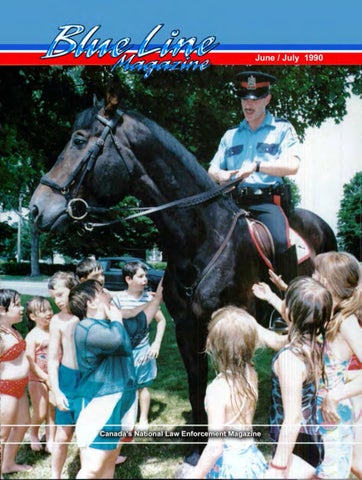
ummer fun means fun for everyone. Including Mounted Constable Mike Richard of the Fredericton Police Force. It is difficult to think of a public relations program that has more appeal than the officer on horseback. The tradition of mounted police officers in this country goes back for over 100 years. Today many police forces maintain a mounted section for patrolling public parks and green belts. Now that we have shown you the technology of the past let us show you the technology of today and th e future. This issue of Blue Line Magazine has numerous articles on new products of specific interest to the law enforcement community. We have received numerous requests to put in some product news and reviews . We are slowly developing a network that will keep us informed on t h is important aspect of t h e profession . If any readers locate a company or an individual who has a product that can be of assistance to the profession have them drop us a line and we would be glad to put their information in the magazine.
Letters to the Editor SURPRISED AT ONE SIDED COVERAGE I recently read the article written by Robert Hotston titled "Dispatchers and officer safety." (January 1990 Vo1.2 No.1) I have been a Telecoms Operator with the R.C.M.P. for the last five years. I am very proud of the part that I play in law enforcement. I always enjoy reading your magazine, but was surprised to see this kind of one sided coverage by your magazine. Your magazine's articles have been well written and present both sides of any story. Mr. Hotston acknowledges in the last paragraph of his article that dispatchers occupy a pivotal role in officer safety, but he pays lip service to dispatchers throughout the rest of the article. I feel the article would have been bett r if he had recognized that often times dispatchers are talking to peopi who are upset and often times all the information you would like to pass on to the members responding to the call is not available, ie: the caller hangs up, the suspect forces the victim to hang up the phone etc. I completely agree with his com ments that all dispatchers should spend some time on patrol , as there is no better way to learn what information they require to do there job. But the reverse is also true, patrol officers should spend some time in the communications centre. If we both spend some time learn ing about each others jobs, everyone will benefit. Dispatchers will feel that they are part of the force , officers will understand why some of the information they might need is not available and the public will always benefit from a more efficient police force . Stuart Attwood Thompson , Manitoba
•••
CASE LAW TRANSLATION MAKES JOB EASIER I look forward each month to receiving my copy of Blue Line Magazine and trust you will continue to put out a quality product. The manner in which you take court decisions and translate them into "English" is exceptional and makes my job easier in the long run . Keep up with the fine work you have been doing. I would like to order back issues prior to my 1989 subscription. I would also be interested in seeing a reprint of the Judge's Rules. Kevin Davidson London , Ontario
••• Editor's Note: Back issues are in short supply but the Judge's rules are not. We will continue to publish these rules along with many other little tidbits on a continuous basis. However, since you asked, we have included the full set in this issue.
••• MORE DETAIL IN CASE LAW The magazine is very informative, however, I would like to see more detail when you are quoting case law. I! would be very helpful if you completed the case with the year and date it is recorded not just Regina Vs. whomever. Kent Withycombe Whitbourne; Newfoundland
• ••
anyone take action on what they have read until they receive further guidance from a superior or a lawyer. The danger is that some case law does not fit into all parts of the coun try with the exception of the Supreme Court of Canada . For this reason we state at the beginning of each article from which province the case law applies and the month it came out. We are working on a system that will permit those who wish more details to order the full text of the case law. We will keep you briefed as this develops.
• ••
So Long For The Summer This "Summer" issue of Blue Line Magazine will have to last you until September. Last year we received a flurry (cooling thought isn't it?) of inquiries from our loyal readers wanting to know what happened to their July and August issues. We found it necessary to make several remarks in our "Letters to the Editor" section that we only issue TEN (10) (DIX) monthly issues each year. July and August is when my wife children, and I become reacquainted again and I charge my batteries for another year of publishing. Just to get your appetite going for the next ten issues I would like to tell you about a new series beginning in September. We have a new columnist coming on stream who will give you the benefit of five years of research into the police profession . Much of what you read will amaze you. A few will not like what they read but many more will agree with it. One thing will be for certain the research is real and well grounded. This column will tell it like it is because we would have it no other way.
Editor's Note: Your suggestion is a good one and one that we have been working on. The case law you read in this magazine are un -reported cases. In other words they are too new to be published in any texts or journals. It should be familiar to most lawyers and Crown Attorneys if they have time to keep up to date. The rulings are abbreviated conSiderably to inform you of the substance of the rulWe here at Blue Line Magazine ing and give you the "bottom line." would like to wish you all a very The intention is to help you better happy and safe summer. You will see understand the current status of a parus in the Fall . ticular law. We do not recommend 4
Summer 1990
Vol. 2 No.6 . Summer 1990 • EDITOR/PUBLISHER· Morley Lymburner . EDITORIAL ADVISORS· David H. Tsubo uchi, LL. B. Edward Gunraj (P.o.A. Consultant) Mary Lymburner B.A. M.Ed . Gera ld A. Oxman I.e I. A. Jaan Schaer B.A. (Metro Police E.A.P.) Tom Dykes (Halton Region Police) Robert Hotston B.A. M.Crim. Rick Patrick (Lambton College) The Editorial Advisors are persons from whom this publication seeks o ut advice and guidance. The use of their names is merely for recognition of their assistance and o ngoing support.
• ADVERTISING· Allan W. Stiver (416) 294 -5502 Fax: 294-8952 . ASSIGNMENT WRITERS· Lucy Becker • Louise Dueck AI Porter • Rick Patrick • CORRESPONDENTS· Richard Duplain • Daffydd Hermann Craig McMillan • T. Richard Colledge Murray E. Milligan • Rock Dueck • COLUMNISTS· Geoff Cates • Robert Hotston ·PHOJOGRAPHY· Jo hn Loftus • Morley Lymburner . ILLUSTRATION· Tony MacKinnon • Bette Clark Dave Sills • DESIGN AND PRODUCTION · Jim Kelly Camelot Graphic Design 97 Sir Lancelot Drive Markham , Ontario L3P 2J3 (416) 471·0303 Fax : (416) 471·0305 Blue line Magazine is published monthly, ten times per yea r by Blue Line Magazine Incorporated with head office at 118 Main Street North , Markham , Ontario Canada, L3P IVl. Editorial and copy is con· sidered to be completely separate from advertising sales. No committment for editorial coverage can form any part of a sale agreement. Advertising enq uiries should be made at 294-4773 or Fax Number 294·8952 (area code 4 16) or to the adver· tisi ng personnel listed . All articles are protected by copyright. No part of this publication may be reprod uced or transmitted in any form or by any means, electronic or mechanical, including photoco· pying and recordi ng, or by any informatio n storage o r retrieval system without permission from the publisher. The authors, advisors and publisher accept no liability whatsoever for any injuries to person or pro· perty res ulting from the application or adoption of any of the procedures, tactics or considerations presented in this magazine. Readers are cautioned and advised that articles presented herein are edited and supplied for yo ur personal awa reness and sho uld not be referred to for further action un til appropriate advice and guida nce is received from a supervisi ng offi cer or the advice of a Crown Attorney. Blue Line Magazine is an independant publication designed to educate and upgrade the skills of those involved in the law enforcement profession. It has no direct control from a law enforcement age ncy and its opinions and articles do not neccessarily reflect the opinions of any govern ment age ncy or po lice force. Blu e Line Magazine is Printed in Canada by J o hanns Graphics. The sole authorized distributor of Blue Line Magazine is Green Gables Book Shop, Markham , Ontario.
Iii). elAssociation of Police Planners Associate member, National
J.]t'J"!1 Member, Periodical ~ Publishers Exchange
ISSN #0847 8538 Second class mail registration No . 8242
Book Review
Sexual Homicide D.C. Heath & Company Reviewed by: S .J.J. Raybo uld, DeUnsp. (Retired) Criminal Investigation Branch Ontario Provincial Police This book is about sexual killers many of whom have repetitiously continued their carnage on unsuspecting and innocent victims. Co-authors Robert K Ressler, John E. Douglas, Special Agents of the Federal Bureau of Investigation and Ann W. Burgess, Professor of Psychiatric Mental Health Nursing at the University of Penn sylvania, have combined their expertise in presenting to the reader an informative and well qualified study of sexual murder. The contents have been compiled from one of the largest samples of sexual killers interviewed for research purposes to date. Thirty-six convicted and incarcerated sexual murderers were interviewed by specially trained agents. The offenders recollections of the event, rationale, inner feelings and reactions have been included in numerous case examples. The authors have provided the reader with understandable insight into the profile characteristics of some of the most infamous serial sexual killers. Their prolific involvement and personal experience in researching and gathering of statistical information and facts supports the motivational model for sexual homicide. Chapters in the book outline the Psychological, SOciological and Legal view of sexual homiCide, Growing up to Murder; Patterned Responses, Antecedent Behaviours and the Act of Murder, After Murder, A Motivational Model for Sexual Homicide, The National Center for the Analysis
of Violent Crime, Crime Scene and Profile Characteristics of Organized and Disorganized Murderers, Criminal Profiling from Crime Scene Analysis, The Role of the Forensic Pathology in Criminal Profiling , Interviewing Convicted Murderers, The Police Artist and Composite Drawings, The Victim's Family and the response to Trauma . An indepth look is provided into the Federal Bureau of Investigation Behavioral Science Services, National Center for the Analysis of Violent Crime. Special Agents of the Bureau have developed expertise in analyzing all crime scene data pertinent to the investigation and arriving at a most probable criminal profile. This very important investigative aid must be considered in any serious crime. I found this book to be stimulating and informative. It is written in clear concise language with an essential amount of statistical data that is not cumbersom e but relevant to the background of acts described . As a Homicide Investigator I am conscious that clues are often elusive and deceptive and that their discovery presents the greatest single challenge to the investigator and speCialist alike. The complexity of a sexual murder may be better understood now by the law enforcement investigator so that he may have a much better perspective on how to chan nel his efforts . I feel that this book is suitable for the Forensic Scientist and to those other disciplines invo lved in the Criminal Justice S ystem so that it might be an a d dition to their repertoire .~
----------------------5------------~~~,rr~ S ummer 1990
Animation Is Serious Business For Traffic Cop - Morley Lymburner -
T
he southbound car was in the right lane of the four lane street and approaching a pedestrian crosswalk. The car's speed was well above the posted 60 km / h limit. There were no obstructions to hinder the driver's view and it was a clear sunny day. Suddenly the driver observes a pedestrian crossing from right to left. The driver realizes he is much too close and steers into the passing lane and applies his brakes hard . The evasive action is to no avail and the pedestrian is struck, killed instantly and thrown a considerable distance south of the crosswalk and into the northbound lanes of traffic. The attending investigators set to work to determine the pre-scene series of events. On the face of the vidence it would appear it was a simple matter of a pedestrian not looking before walking into the roadway.
But the investigator feels there must be more. The skid marks indicate a high speed. The witnesses are few and the evidence they give is sketchy and contradictory. The scene is reconstructed , scale diagrams drawn,
II:]
~
calculations are made from long mathematical fo rmulas. The evidence clearly shows negligence on the part of the car driver. The evidence is clear, although very technical, and one of the toughest jobs the police and Crown Prosecutor has is to make the evidence come to life for the court, not only to recreate the series of events but to make the recreation as understandable and real as possible. Roy Buchanan of the Metropolitan Toronto Police Force has the perfect solution . Show the court a cartoon! To say it more accurately an animation of the event reconstructed from all the technical evidence found at the scene. In fact making animations of accident scenes is what Roy has been doing since 1987 . Constable Buchanan realized, while attending a technical accident
-F-
Q
II:]-
Cll
Cll
Danforth Ave
,lllkMOUn Ave
lL]-
... N
Danforth Ave \ aJ.'
0
5
~o
~5
Ave
20
~ ~
1< HO un
.... N
0
5
~o
~5
20
~ ~
7.0
6
7.6
Summer 1990
investigation course, that all the formulas and diagrams could be put into a computer program that makes animations and the sequence of events replayed over and over again so that police, prosecutors, and judgescould clearly see what happened at the accident scene. The officer, a graduate of Computer Law courses from two colleges, began working on the problem at home with his home computer. He shopped around and found the best computer and softwear program for computer animation that would still fit his budget. He settled on the Amiga computer because of its price and ability to display graphics and design in a program called BASIC. Buchanan had gained considerable experience in writing programs with BASIC and has produced over 200 programs. However none of his previous programs were to challenge him as much as this project. After much research and struggling he found that this language was too limiting in its ability to properly animate the motion of spinning autos. Last year his search came to an end when he found a commercial program that had many of the features he required . He quickly produced animations of three accident scenes from the technical data given to him by the accident reconstructionists . The animations on the computer were then transferred to video tape
and the sequences were presented with various scenarios as described by witnesses, accused and then from the technical data supplied by the investigator. The scenarios were slowed down and the scenes freezeframed and appropriate labels added to verify the accuracy of the diagram. Constable Buchanan then presented his work to senior members of the Metro Toronto Police Traffic section and was received with a positive response. He then received authorization to continue his research in the area and to work more closely with the reconstructionists of the Traffic branch . Buchanan has had his animations admitted into evidence at one Coroner's inquest and another animation accepted at County Court on a Dangerous Cause Death charge. The presiding justices in both incidents had high praise for the animations and Buchanan's abilities. Several other animations have been developed by Constable Buchanan in preparation for future court cases along with one which is being developed for instructional purposes. The latter case involves the recreation of a tractortrailer combination going into several types of jackknife situations. Constable Buchanan's reputation has now spread to other forces who have requested his talents for cases they are presently working on . The
INSIGNIA PRODUCTS Carlo Dalgas Ltd . specializes in custom made Lapel pins, Police and Military Badges, Leather 1.0. cases, Embroidered Crests, Medallions, and Souvenir spoons. High quality inSignia products at very affordable prices are available now. For more information contact: Carlo Dalgas Ltd ., 1885 Briarcrook Cres., Mississauga, Ont. L4X 1X3 (416) 625-8061 Fax: (416) 625-4911.
officer has had an extensive and rounded experience. He has worked many years in one of the city's busiest Districts and has gained experience in morality, C.I.B. and Youth Bureau before moving into traffic accident reconstruction . This is a good example of how dedication to the profession can go far beyond the regular work day and into one's own hobby interests . After some 18 years of police experience under his belt Constable Roy Buchanan has found the perfect use for his off-duty talents .
Da nfol'th Ave -(
.ll'kMOUn
Ave
... N
.ll'kMOUn
0
~~ Summer 1990
Ave
5 10 15 20
... N
0
5 10 15 20
~~
7.9
7
9. 1
The Wit and Wisdom of Tacky Burns by Terry Barker (excerpt from " The Five Minute Policeman" ) Police officers play two different kinds of parent roles to the public. Sometimes we nurture and save; and sometimes we punish and hurt. When we rescue trapped people or look after lost kids we're like a nurturing parent. But when we give people tickets for traffic violations we're the punishing parent. It's a lot like the noisy party proble m: if we catch people doing something wrong, they start behaving like children . If they act like obedient children , we don't have a problem . We just issue the ticket, they accept it, and that's all there is to it. But sometimes they go into the rebellious child state, and that's when we need "The System ."
sounds something like this: "Hey buddy, you were speeding, you did a rolling stop and your aren't wearing your seat belt. But you look like a responsible citizen . I tell you what, I'll give your a break; I'll just issue a ticket on the speeding. But if you cause any trouble around here in the next few days, I'll give the other two. What do you say?" The driver thanks him for the ticket. Politicians use this trick all the time, and we always fall for it. If they want to raise the cost of medicare premiums, for example, they an nounce that they're going to raise it by 40 %. If the public screams, they say that they're "listening to the people" and bring it down to 20% which is what they intended all along. And the people thank them for it! What a crock!
he can improve his driving skills . Or maybe you should take a few minutes and gUide him through some scenarios so that when he goes home he'll have a half-decent chance of actually communicating with his wife.
And STEP FIVE is what you do when the other steps have failed . Tell him that if he gives you any more trouble in your territory you'll stuff his car so full of blue paper it'll be blowing out the windows. Tell him that if he can't keep a civil tongue in his mouth , you 'll tell every officer in the area to be on the lookout for his red Ford . Tell him he'd better get his brakes fixed - and his tail light, his horn , and every other part of his car. Tell him you 're not going to charge STEP ONE - controlling your own him for all these defects this time but feelings - can be hard to do when if he draws himself to your attention some guy calls you a useless pig who one more time - ka-boom! ought to be out doing real police work STEP THREE - empathize. There's What the hell, you might as well instead of harassing honest citizens nothing wrong with letting a guy have a little fun . like etc. etc. etc. know that you understand how he H your having a hard day, and you feels . I always try to find out why he feel like you're going to blow your top did the violation in the first place, and at the next guy who badmouths you, I say something like, "Yeah , I know have a little chat with yourself before how it feels . It's no fun being bagged you leave your Pc. for something like this. Still, now that To maintain at all times a relationship Remember, the person you 're you've got it, you might as well learn with the public that gives reality to the historic tradition that the police are the about to nail is your bread and but- something from it, eh?" and that the public are the public ter. The worse he is, the more con Letting the other guy blow off trol you 're going to need . If you give some steam could save somebody's police ; the police being only members in to your natural impulses and pop life. If he's speeding because he's mad of the public who are paid to give full him a good one, he'll see you in court. and you make him even madder, time attention to duties which are incumbent on every citizen , in the And who's the winner then? after you've left he just might drive STEP TWO is to listen . I know a away like he's on the Indy. But if you interests of community welfare and couple of officers who do this in listen to his story, and let him know existence . interesting ways: that you understand his feelings , he'll Cst. Ed Mills always says, "Well, I likely calm down and even accept the l'I've got just guess you know why I stopped you ticket with gratitude. three words for eh?" And the answers range from He'll think to himself, "Well, at least astonishment that Family Court in the cop was a decent guy. And I did you, Officer ... " Ontario has tracked them down to an deserve the ticket." adm ission that they're carrying conI mean , what's wrong with a little traband in the trunk. basic PR? Cst. Pat Murphy, on the other hand, tries to get more than one violaSTEP FOUR is to involve him . tion on the burner. His approach Maybe he needs to think about ways
Peel's Seventh
Principle of PoliCing
8
- - - Summer 1990
----
- - - - - - - - - - - - - - - - --
THE JUDGES' RULES These Rules do not affect the principles: (a) That citizens have a duty to help a police officer to discover and apprehend offenders; (b) That police officers, otherwise than by arrest, cannot compel any person against his will to come to or remain in any police station ; (c)That every person at any stage of an investigation should be able to communicate and to consult privately with a solicitor. This is so even if he is in custody provided that in such a case no unreasonable delay or hinderance is caused to the processes of investigation or the administration of justice by his doing so; (d) That when a police officer who is making enquiries of any person about an offene has enough evidence to prefer a charge against that person for the offence, he should without delay cause that person to be charged or informed that he may be prosecuted for the offence ; (e) That it is a fundamental condition of the admissibility in evidence against any person , equally of any oral answer given by that person to a question put by a police officer and of any statement made by that person, that it shall have been voluntary, in the sense that it has not been obtained from him by fear or prejudice or hope of advantage, exercised or held out by a person in authority, or by oppression . The principle set out in paragraph (e) above is overriding and applicable in all cases. Within that principle the following Rules are put forward as a guide to police officers conducting investigations. Non-conformity with these Rules may render answers and statements liable to be excluded from evidence in subsequent criminal proceedings . Summer 1990
Ru le Number 1 "When a police officer is trying to discover whether, or by who, an offence has been committed he is entitled to question any person, whether suspected or not, from who he thinks that useful information may be obtained." This is so whether or not the person in question has been taken into custody so long as he has not been charged with the offence or informed that he may be prosecuted for it. Rule Number 2 "Whenever a police officer has made up his mind to charge a person with a crime, he should first caution such person before asking him any questions, or futher questions, as the case may be." This generally means that when an officer concludes that a person is to be charged with an offence then he is required to advise the person that he has the right to remain silent etc. If the officer ignores the giving of the caution he is open to judicial review as to when he should have made the caution . Ru le Number 3 "Persons in custody should not be questioned without the usual caution being first administered ." No questions should be put to a person after his arrest until he has been given his caution . With this common law rule we now have to add the Charter of Rights and Freedoms. As well as cautioning a person in custody it is incumbent upon each officer to further advise the person they have a right to council and that if they cannot afford a lawyer one can be provided free of charge. A further duty is placed on the officer in that he is 9
- - - - - -- - - - - - ----.
required to assist the accused in obtaining counsel if the accused so wishes to have one.
Rule Number 4 "If a prisoner wishes to volunteer any statement, the usual caution should be administered. It is desirable that the caution end with the words, "be given in evidence". If a person were to approach you and state that he had just murdered someone you would be required to caution him immediately before he continued on . If he had been previously interviewed by another officer you would have to give the secondary caution. Blue line Magazine - Flash Cards Rule Number 5 The caution to be given should be in the following form ; "Do you wish to say anything in answer to the charge? You are not obliged to say anything unless you wish to do so, but whatever you say may be given in evidence." Blue Line Magazine - Flash Cards Rule Number 6 "A statement made by a person before there is time to caution him is not rendered inadmissible in evidence merely by reason of no caution having been given , but in such a case, he should be cautioned as soon as is possible." In other words a statement blurted before there is time to caution (spontaneous utterance) is admissible, but the caution should be given as soon as possible, or reasonable effort made to caution him .
Rule Number 7 "A prisoner making a voluntary statement must not be cross-examined and no question should be put to him about it except for the purpose of removing ambigUity in what he actually said. For instance, if he mentioned an hour without indicating the date, or a day and date which do not agree, or has not made it clear to what
individ ual or what place he intend ed to refer in some part of his statement, he may be questioned sufficiently to clear the point."
Rule Number 8 "Wh en two or more are charged with the same offence and statements are taken separately from the persons
UP-COMING EVENTS June 18-20 Belleville, Ontario Ontario Chiefs of Police Conference. Belleville, Ontario June 12-17 Albany, New York New York State Law Enforcement Olympics Members of Canadian Law Enforcement Agencies are invited to attend . This year the event will be held in Albany, New York. Contact: New York Law Enforcement Olympic Association , po. Box 10540 Rochester, New York, U.S.A. 14610 June 19-23 Ottawa , Ontario Ontario Law Enforcement Olympics will be held in Ottawa . Members of all law enforcement agencies are invited to participate. Contact: Blair Gemmell at (613) 521-7010 or (613) 236-0311 Ex.212 June 26-28 Atlantic City, New Jersey. Police Security Expo '90. Once a year, law enforcment and security profeSSionals meet to discuss and view the goods, services, and latest technological advances necessary to win the fight against crime. Expo '90 is open free of charge to the profession with exhibits, seminars etc. at the Atlantic City Convention Center. Sponsored by the New Jersey State Association of Chiefs of Police. For further information contact Sitework Associates Inc. (609) 466-2111.
charged, the police should not read Rule Number 9 these statements to the other persons charged , but each of such persons "Any statement made in accordance should be furnished by the police with with the 'Judges' Rules' should, a copy of such statements and whenever possible, be taken down in nothing should be said or done by the writing and signed by the person makpolice to invite a reply. If the person ing it after it has been read to him charge desires to make a statement andor by him and he has been invited in reply, the usual caution should be to make any corrections he may wish ." administered ."
July 15-20 Edmonton , Alberta International Association of Bomb Technicians and Investigators will hold a total of 40 hours of seminars and training. Among the many sessions scheduled will be courses and lectures on anti-terrorism , counterterrorism and bomb detection. Contact: Glenn E. Wilt (719) 636-2596 or FAX (719) 633-3723. July 29-August 4 Edmonton , Alberta. The International Law Enforcement Olympics will be held in Edmonton , Alberta . This event is expected to attract over 10,000 competitors from Law Enforcement Agencies all over the world . Each year it is held in a different country. Contact: 1990 International Law Enforcement Games Foundation , p.o. Box 1990, Edmonton , Alberta T5J 2P4 or Phone 1-800-661-1990 August 14-15 Brampton , Ontario Joint Forces Association of Explosive Ordinance Disposal/Explosives disposal Units will be hosting their annual conference in Brampton , Ontario. The conference will be held at the Peel Region Police Association Building in Brampton . Total cost of the conference is $100 .00 . This includes some meals . Contact person; Fred Lemieux or Bob Shering Peel Region Police Force Explosives Disposal Unit, 7750 Hurontario Street Brampton, Ontario L6V 3W6 (416) 453-3311 Ex.347
10
August 25-September 1 Muskoka, Ontario. Annual National Meeting of the Canadian Fellowship of Christian Peace Officers will be held on the shores of Mary Lake and the Muskoka River, 7 miles from Huntsville, Ontario. Campground and resort facilities available by calling (705) 789-4031. For further information contact Canadian FCPO, P.o. Box 520, Station "N', Scarborough Ontario, M1K 5C3. October 28-November 2 Corpus Christi, Texas The first joint conference of National Association of Police Plann ers (NAPP) and Association of Police Planning and Research Officers (APPRO) will be held in Corpus Christi, Texas. Topics will range from technological assistance, use of consultants, and futuristics to motivational humour in the workplace. Contact: Pat Eldridge (512)886-2696.
EDITOR'S NOTE: We will be happy to include your Up-coming event in this column free of charge. Please supply us with full details about your event, along with the main contact person and phone number. We may also print a full story on what your event is all about both before or after the event if you send us the details . Send photographs if you wish but under normal circumstances it is difficult for us to return them. Events should be of interest to the Law Enforcement Community and the Publisher reserves the right to edit copy and limit the number of insertions.
Summer 1990
~~B-O-O-k-R-eView -
K
.
Young Offenders Law In Canada Priscilla Platt Butterworths Publishing
Reviewed by " The Advocate" (Hamilton Law Association Magazine) Ms. Platt has produced an excellent p iece of work . It is a well organized , extremely detailed and well researched text of some 320 pages. The author has had an opportunity as an employee of the Ministry of the Attorney General (Ontario) to work with the act on a daily basis since its inception . The most pop ular material in this
area up to now has been the various "Bala" and "lilies" publications. Ms. Platt is listed as co-editor of the Bala and lilies Young Offenders Service and has authored at least one other book on this subject. T h e table of contents with subheadings in every chapter permits people to foc us on issues of law and practice relatively quickly. If you have ever perused the index of Martin's Annual Criminal Code, trying to find the section which permits proof of
Why you need The Five Minute Policeman:
service of a document by affidavit evidence (it's section 4 (6}), you quickly learn to appreciate a descriptive table of contents. The table of contents also directs you to issues you may not be aware of, such as the "Fifteen Day Hold" (an administrative bump up from open custody to secure custody for up to fifteen days if the young person attempts to escape or is a danger to self or others.) Given the author's present employment and the fact that she candidly acknowledges that several chapters are taken directly from papers published in the Crown's Newsletter, both Crown counsel and defence counsel may find information useful in their practices. Ms. Platt's book is a handy guide for practitioners who are seeking quick answers to questions relating to young offender law and practice.
THE
FIVE MINUTE POLICEMAN
Terry Barker has made common sense something that can actually be grasped and identified . You 'll not only learn a new system , and see how and why it works , but you 'll be able to identify how and why some of your own methods have worked in the past. Terry gives you The System - the tools with which you can ach ieve results by design . Even experienced policemen feel a new confidence, and we all know that confidence coupled with experience and ability means a polished and professional job
By Terry Barker with the assistance of Sgt. Ed Hill and the members of the Gibsons. B.C. Detachment. RCMP
The Five Minute Policeman - $12.95 Avai lable from
(416) 294-4773
Green Gables Book Shop
VISA - MasterCard - American Express Accepted
118 Main Street North , Markham , Ontario L3P lYl
Summer 1990
11
Rock Video Packs Big Punch For Students - Morley Lymburner -
T
he gymnasium lights went out and the video screen illuminated the faces of the students . The heavy rhythmic beat of the rock star Kenny Loggins boomed the hit record "Danger Zone" out of the speakers. For the next 15 minutes 450 City of North York High School students were introduced to a rock video that
taught them the real meaning of drinking and driving. A series of colour still photographs of the scenes of traffic fatalities fade in and out before their eyes. Many students are introduced to the stark reality of motor vehicle deaths for the first time as scenes fade from wrecked cars to children's shoes standing
12
by a largepool of coagulated blood . The first song fades away and the sounds of Billy Joel singing "I Go to Extremes" continues to carry the message as the photographs continue to keep time with the music. Still fading from one scene to the next, with a constant hard hitting impact, the audience seems to be consumed by the presentation . Finally the beat changes dramatically as Chris DeBurgh's "Missing You" accompanies family pictures of now deceased or permanently maimed victims of drinking drivers. As this song fades away a final photograph of a 3 month old baby in a white coffin comes into view. The child's mother explains the pain her family experienced after the loss of her child to a drinking driver. Finally
Summer 1990
the credits appear accompanied by Kim Mitchell singing a song called "Go For A Soda". The lights go up and the youths, male and female , are seen dabbing their eyes. Some, weeping openly, are comforted by friends. The message has been given and understood . And with a minimum of talk by Constable Devin Kealey of the Metropolitan Toronto Police Force, the officer who created and presented the show.
No Lectures "My whole idea with this show," says Constable Kealey, "is not to lecture. The idea is to show it and leave it up to the viewer." The officer's approach is non -judgemental. No heavy statements like "I think you guys are too immature to drive," or "They
Summer 1990
should raise the drinking age to 21 ." The purpose is to reach the students and let them feel the anguish . Experience the way it really is and maybe even put themselves in the picture. "If you turn them off your message," Kealey points out, "then you may be contributing to their death if they get involved in one of these accidents." Constable Kealey knows what he is talking about. The seven year member has seen more death than the average police officer. He is one of a team of police Traffic Officers that attend over 300 scenes of serious traffic accidents every year and take photographs for investigating officers. The shots selected for use in the video are relatively "clean" pictures with the
13
bodies removed , but the impact remains, both on the screen and in the minds of the young adults.
Not Just A Christmas Incident "We are trying to get the High School crowd ," says Kealey. "The whole idea of the program being presented now is the coming summer vacations. The brunt of our attention up to now has been around Christmas time. But the statistics show that most of the deaths occur in the warm summer months. And the teenagers are all too often the victims and perpetrators of these offences." Kealey also points out that drinking around cottage country is particularly heavy during those lazy, hazy, crazy days of summer. The message brought by this video can be carried
over the summer and perhaps even bolster some efforts by teenagers to reduce the drinking and driving by their peers.
The Making Of A 'Rock Video' The making of the music video took many months of research and development. Kealey made contact with a local chapter of PRIDE (an acronym for People Reducing Impaired Driving Everywhere) and sought their assistance in locating the families of victims who would be willing to supply photographs of the family members involved . Helen Collum , Vice President of a local chapter, became intrigued by the officer's concept and set to work assisting in many ways. The officer then attended the Toronto studio of
radio station CKFM and asked them if they would donate some studio time for the copying and mixing of the records. They agreed and assisted in picking the songs most suited to the message and the type of audience Kealey wanted to reach. Many hundreds of photographs were donated and the selection process begun. The next step was completed by sending each person who submitted a photograph a letter of acknowledgement and a token royalty payment for the use of the photograph . Many families , upon recelvmg the letter and the token payment immediately sent back a donation to assist in the video's production . The response produced over $500 .00 from across Ontario.
14
The Recording Industry The most difficult part of the project was seeking permission from the recording companies and the artists to have their music reproduced in the video. "The golden rule," says Kealey, "is to go shopping for your music first then go to the radio stations and get it done up. I was new at this and never knew all the hastles involved in getting permission for using this materiaL" In his quest for permission Kealey learned a great deal about the recording industry. "The majority of these companies were really good . But some of these companies would tell me straight out that 'look we are here to make money and if you don't have the money then don't waste our time.'
Summer 1990
dramatically and the solution to the constant setting up was to produce the presentation in a video format. To this end Mclean Hunter Broadcasting donated a great deal of assistance, technical advice and studio help in polishing the final product. Constable Kealey discovered many corporations were willing to help and were encouraged by simply placing their credits at the end of the tape. Kealey advises that the experience also helped him to understand how An Eager Community eager the community is when it In spite of the difficulties encountered comes to producing something such the final product was worth the effort. as this. The original production utilized two slide projectors synchronized with the The Future sound tracks. It was found that the A broadcasting company is interested demand for showings increased in doing a background story on how One company talked to me for about 10 seconds . I explained to them my story and they said 'look we got lots of good causes.' They then told me that the going rate for their record was $1000.00 per minute and it is 3 minutes long . If we are a non-profit organization they would let us use it for $300.00 per minute. The fact that we did not have that kind of money made no difference nor did the cause."
the video was prepared. There have been several inquiries about making the video into an advertisement and a great deal of interest from Cable Television . Presently, however, permission has been granted to produce only 100 copies of the tape and it is to be shown only to selected groups in the Metropolitan Toronto area. Other regions or groups interested in getting copies of the tape will have to enter into negotiations with the recording studios. Further information may be obtained by contacting: Inspector Dan Hutt of the Metropolitan Toronto Police Force at (416)324-6125.
Get Canada's National Law Enforcement Magazine delivered to you every month! YES! I want to subscribe to
~~
Name: ____________________________________________________________________________ Address: --------------------------------------------------------------------City:
Province:
Postal Code: Enter my subscription right now for the next
D 10 issues of Blue Line Magazine (10 issues: $20.00; US and foreign $50.00) a bulk subscription of copies D (5I want - 49 copies $15.00 each; 50 or more call for price) PAYMENT METHOD
0 My payment is enclosed
o Bill me with my first issue (Your subscription begins with the next issue) o Visa Blue Line Magazine will gladly charge your subscription to your MasterCard , or American Express account. Do not enter your account number on this card. Call our authorized retail representatives at Green Gables Book Shop (416) 294-4773 for immediate processing of your order.
Mail coupon to: Blue Line Magazine, 118 Main Street North, Markham, Ontario L3P 1 V1 L ______________________________________ ~ Blue line is an independent magazine produced by and for the law enforcement community.
Summer 1990
15
... news beat ... news beat ... news beat ... news beat ... No Problem With Morality In Iraq The government in Iraq has come up with a solution to the problem of adultery. This new law will also solve any problems that may have existed with back-logged divorce courts. The Revolutionary Command Council recently endorsed a decree allowing Iraqi men to kill any female relative who commits adultery. A man is permitted to kill his unfaithful wife, daughter, mother, sister, aunt, niece or cousin on his father 's side without being prosecuted. He may also kill the woman's lover if the incident occurred in her own home. If the affair is played out anywhere else then the man must serve a prison term . The purpose of the new law is to promote "virtue and morality."
Onboard Recording Devices Urged For Trucks (Courtesy of IIHS Status Report) Thirty-three percent of the truck drivers killed in motor vehicle crashes test positive for alcohol and other drugs in a recent study conducted by the US. based National Transportation Safety Board. (NTSB) Driver fatigue was the most frequently cited reason for the heavy truck crashes. Researchers say the second most frequent cause of these crashes was alcohol or other drug abuse by the driver. Based on the study findings , NTSB has recommended "that the federal government require tamper-proof onboard recording devices to monitor
driver hours of service violations" because of their concern about the use of multiple and fraudulent logbooks. Researchers found that truck drivers who tested positive for alcohol (Courtesy IIHS Status Report) or other drugs were more likely to have a history of alcohol or drug Speeds were reduced and the abuse, were more likely to have a number of fatal crashes, fatalities , and suspended or revoked license, and to serious injures declined during a have violated federal hours of service special comprehensive six-month proregulations. gram to enforce New York State's 55 The most widely used drugs by mph speed limit on major highways, drivers were marijuana, alcohol, co- says a recent report prepared for the caine, over the counter stimulants, US. Department of Transportation . and amphetamines . Drivers aged At the same time, additional in 20-29 had the highest percentage novative and traditional speed en testing positive for drugs, with use forcement strategies were im declining with increasing age. plemented on four Interstate highway The NTSB investigation included segments in northern New York State. 182 fatal crashes of 186 trucks In the upstate project, 4,428 speeding weighing more than 10,000 pounds . tickets were issued to drivers travelThe crashes occurred between Oct.1 , ing at an average speed of 72 .8 mph . 1987 and Sept. 30, 1988, in Califor- Analysis of data gathered during the nia, Colorado, Georgia, Maryland , program showed that 26 percent of North Carolina, New Jersey, Ten- ticketed drivers (defined as high speed nessee, and Wisconsin . drivers) were going 75 mph or more Crash reports were examined in and 2 percent were apprehended at detail and toxicological samples for speeds of 85 mph or higher. 168 fatally injured truck drivers were The ticketed drivers tended to be analyzed to help assess their relative male and under 35 years of age, and nearly one-half were licensed by a contribution to the crash . In response to the study, the jurisdiction other than New York Department of Transportation says it State. High speed drivers, especially will look "into the feasibility of testing those termed "professional speeders" for alcohol abuse," and that under using radar detectors and/ or CB DOT's current rules "any detectable radiOS, were targeted during the blood alcohol level will automatically project. put a driver out of service for 24 "The results of the project confirmhours . ed that the drivers traveling at the For copies of "Fatigue, Alcohol , highest speeds are also the drivers Other Drugs and Medical Factors in likely to have radar detectors," say the Fatal to Driver Heavy Truck Crashes, authors. High speed drivers were Vol.1 ," write : National Technical In almost twice as likely as other ticketed formation Service, 5285 Port Royal drivers to have radar detectors in their Road, Springfield, VA. 22161. Cite vehicles. S ixteen percent of the No.NTSB-ss-90-01 , PB 90-917002 , ticketed drivers had radar detectors, and Vol.2 Cite No. NTSB-SS-90-02 , 2 percent had CB radios, and another PB 90-917003 . 2 percent had both . Men were more likely than women to have radar detectors and / or CB
High Speed Drivers Most Likely To Have Detectors
16
Summer 1990
... news beat ... news beat ... news beat ... news beat ... radios . The speeders in the 16 to 25 The report also found that the age group were most likely to have number of fatal crashes, fatalities , and radar detectors but least likely to have serious injuries declined on the four CB radios. More than 20 percent of roadway sections studied as well as on drivers in the youngest age group had upstate Interstates overall. "On radar detectors. Nearly three-quarters upstate Interstates in general, the of the tractor-trailers had either a CB number of fatal crashes and the or radar detector and almost one-half number of fatalities decreased by had both ; 24 percent of other trucks about 22 percent, while on other and 19 percent of passenger vehicles upstate 55 mph roadways the number apprehended for speeding had a CB of fatal crashes remained constant or radar detector. and the number of fatalities declined Drivers from Canada and drivers by less than 3 percent," said the from states with 65 mph speed limits report. were nearly three times as likely as During the program speeds declin drivers from New York or other states ed, especially the highest speeds. The with 55 mph speed limits to have both percentage of vehicles exceeding 70 radar detectors and CB radios in their mph declined by about 25 percent. "The results of the project indicate vehicles. The study reported that, among that the state police were successful those ticketed, the largest proportion in targeting professional speeders and of high -speed drivers were ap - that this success was reflected in prehended using routine enforce- decreasing numbers of drivers travelment, aerial enforcement, and en- ing at the highest rates of speed , and forcement using a concealed identity ultimately in reduction in the number vehicle. For apprehending high-speed of fatal crashes, fatalities, and serious drivers who were using radar detec - injuries," the report concluded . "Evaluation of the New York State tors , aerial enforcement plus VAS CAR and aerial enforcement Police 55 mph Speed Enforcement were the most effective; for vehicle Project," was prepared by the Institute equipped with a CB, using unconven - for Traffic Safety Management and tional vehicles such as vans and Research for the U.S. Department of pickups and aerial enforcement were Transportation , National Highway Traffic Safety Administration . most effective.
Speed Detectors Among High-Speed Ticketed Drivers
Woman Run Over Twice In Ten Minutes In a bizarre accident, a Unadilla, New York, woman was run over twice by impaired drivers - one being her own husband . The unfortunate series of events began one morning when Rosalie and Gary Searles were arguing in their car near their home. At one point Rosalie advised her husband she had had enough and she opened the car door and advised hubby she was going to walk the rest of the way home. As Rosalie was getting out of her car she tripped and fell at the same time as her husband hit the accelerator. The back wheels ran over her ankles . Mrs. Searles began yelling and screaming and police were called to attend . As the first officer arrived he radioed for an ambulance and tried to comfort the injured woman . While awaiting the ambulance to arrive volunteer fireman Eric Barnes roared up to save the day. He whipped around the police cars and ran right over Rosalie's legs . State Troopers on the scene quickly determined that both Mr. Barnes and Mr. Searles were driving while impaired . Both were arrested and charged . Luckily Mrs. Searles only suffered cuts and bruises to the leg.
New York State Enforcement Program
Peel's Eighth PrinCiple of Policing
35 30 25 -
20 w
15 -
(,)
a: ::::J
10 -
o(/)
50• 75 MPH
_
Summer 1990
75 - 84 MPH
85 + MPH
Radar Detectors ~ CB Rad io Only
CJ CB & Radar Det. 17
To recognize always the need for strict adherence to police executive func tions, and to refrain from even'seeming to usurp the powers of the judiciary or avenging individuals or the state , and of authoritatively judging guilt and punishing the guilty .
CASE LAW: Unreasonable delay
Court gives Province time to rectify delays (Reg ina Vs. Morin) In a decision brought down by the Ontario Court of Appeal in April, the Province of Ontario has been given some time to straighten out its court delays . The time limit was not stated but the ruling gives notice that the Courts will want to see some action and progress in the area of speeding up trials for accused as laid out by the Charter of Rights. The court was asked to determine if an Impaired Driving charge that took 14 months to come to trial was a reasonable delay in view of the Charter of Rights Section 11 (b). This section states that "Any person charged with an offence has the right.. to
be tried within a reasonable time." The court ruled that although the delay was due to an administrative back-log, the back-log was due to the introd uction of the Charter of Rights itself. The five judge panel said , "The Charter, along with obliging government to provide a trial within a reasonable time, has burdened the courts with complex and time consuming litigation , placing immeasurable strain on their resources." In summation the court said that in all cases of delay challenges the presiding judge must consider the four points set out in the S upreme Court of Canada in Regina Vs. Smith. (1)
The length of the delay; (2) The reason for the delay including limits on institutional resources and the in herent time requirements of the case; (3) The waiver of time periods ; (4) The prejudice to the accused in the delay. The Ontario Court of Appeal then determined that given the reason for the delays in the case at hand it was not unreasonable to wait 14 months. It determined that both the Crown and the Defence were ready a long time before the court system was ready to handle them . It decided that the accused's case was not prejudiced in any way by the delay.
Two of the most important books ever written for those involved in law enforcement STREET SURVIVAL Tactics lor Armed Encounters Positive tactics designed to master reaHife situations. 403 pages of photos, diagrams, and the hard lessons of real experience. $44.95
THE TACTICAL EDGE Surviving High Risk Patrol Advanced material ideal for academy and departmental training programs and all law enforcement professionals. 544 pages with over 750 photos and drawings. $56.95
Available in Canada from
(416) 294-4773
GREEN GABLES BOOK SHOP
VISA - MasterCard American Express
118 Main Street North, Markham Ont
Accepted
18
Summer 1990
CASE LAW: Statements
Statement admissible without warning (Regina Vs. Yorke) In a unanimous decision by the
me?" The detective then asked him Ontario Court of Appeal a state- bluntly if he had beaten the boy. The ment given to police unexpectedly is accused said "Yes I did. You know I admissible even without a charter did." The officers then advised the warning. The court determined the accused he was under arrest for atstatement was proper even though tempted murder and gave him his the accused firmly believed the Charter lO(b) rights. officers knew he was the culprit and At trial the defence argued that the that he was not free to leave the police were required to give the acpolice station . cused his charter rights at the time The unusual circumstances began they interviewed him . The argument in March 1988 when the accused went on to say that the accused was took a teenage boy, who was disabl- in a state of mind that the police ed with cerebral palsy and restricted suspected him right from the start and to a wheel chair, to a local park. While that if he had tried to leave the staat the park the accused savagely beat tion he would have been arrested . the youth about the head until he was The trial judge disagreed and conunconscious and then threw him victed the accused and sentenced him into a nearby creek. The accused ran to 15 years. The defence appealed and again from the park when a man walking his dog approached. This man retriev- the higher court disagreed with ed the boy from the creek and called defence in this argument. The court for assistance. The boy survived the held that the police had interviewed assault after treatment in hospital. the accused as a natural part of their The police, armed only with a investigation and that being the description of a hefty man in a boyfriend of the victim's mother it maroon van attended at the accused's would be natural for the police to address because the boy was the son want to speak with him . of his girl friend. The officers invited Mr. Justice D.G . Blair, in his subthe accused to attend the police station to give a statement regarding who the suspect might be. The court agreed with the Crown that the police FLASHES by Tony MacKinnon had no grounds to believe the accused was the perpetrator at this point. The investigating officer invited the accused to come with them to an interview room . They explained the circumstances of the case to the accused and then asked him some "Look, I'm sorry. questions about his relationship with I di dn't know the the victim. Several minutes later one mike w as open when you were detective mentioned to the accused telli ng that j oke that he met the description of the about the chief!" perpetrator they wanted and that he was a "prime suspect." After a short pause the accused asked , "What is going to happen to
.
1
Summer 1990
missions stated , "it should be noted that the courts have recognized the necessity and deSirability of giving the police ample scope in the conduct of their investigations to question possible witnesses." The court concluded that it would not be realistic for the police to arrest and caution every witness they wished to speak to about a case. Justice Blair indicated that there were three reasons he felt that the accused had not been detained . The manner in which the accused was asked to attend the station was such that it did not ind icate to the accused he was a suspect; the accused didn't have reason to believe he was detained ; and the police had not arrived at the point where they had considered him a suspect. The appeal court, however, reduced the sentence from 15 years to 8 years in prison . The court determined that the case lacked the degree of intent and pre-meditation that would bring it into the realm of a serious attempt murder.
B.C. Welcomes A New Police Department - Oaffydd F. Hermann West Coast Correspondent
O
ver the past couple of years the Greater Vancouver area has watched the forming of its newest Police Department. The British Columbia Transit Police started out as a Corporate Security service a number of years ago, to become a fully accredited police department today.
Problems Of Securing A Transit System In 19 1 the administration of Greater Vancouver's Transit System identified an increasing lack of ability of local Municipal Police Forces to respond to the needs of a growing transit system . The lack of available police service was due in part to the growing de mands on the local police to respond to higher priority calls. As many large corporations had done in the past, they formed their own security service to bridge the gap. Under the direction of Mr. Ralph Yeomans, B.c. Transit Security worked in uniform and plainclothes, in mu ch the same manner as a typical private security firm would work. They apprehended vandals and other offe nders through on view incidents as well as through investigation and intelligence gathering . Files were created on graffiti trademarks, linking some apprehended violators to sometimes thousands of dollars in damage, and clearing numerous files . Photos were circulated to drivers warning them of persons who may be dangerous to them and of those restricted from using the transit system .
Through the first few years Transit Security identified many smaller problems . Drivers were reluctant to attend court resulting in few convictions when charges were laid . Since drivers worked the same routes every day, they were subjected to threats and assaults from these charged persons while awaiting disposition . The role of Transit Security personnel now included a liaison with police and the courts . Witnesses, including drivers, were accompanied to court as well as provided with transportation and compensation for lost wages. Although the recovery of damages was not often successful in court, the word was now out that if you committed offences against the Transit System , or it's employees, you would be aggresivly prosecuted . Rewards were offered for information on offenders . The informant did not always have to attend court. In many cases the files were complete with the exception of locating and identifying the offender. This is where an ac quaintence of a violator could make a few dollars and "not get involved". Employees of the transit system were educated by security staff on aspects of investigations, including description recording, giving court evidence and reporting to police. The B.C. Transit Security Service established strong ties and a good reputation among a wide range of local Police Forces. They worked alongside Municipal Police Departments as well as the RCMP, gaining credibility through their investigative abilities . 20
" Public Trust " Enforcement A "Public Trust" system of fare collection was established in 1986 . Automated fare machines became a part of the transit system , mainly at Sky Train stations. As most of us know, the public trust, (honesty system) needs to be checked from time to time. A hand ful of Special Constables were sworn in to, among many duties, perform a routine check of the "Public Trust" system and ensure that it ran smoothly. The news media had taken surveys as to how many people actually paid a fare when they were not forced to. The negative results shocked transit officials. Transit's Special Constables went to work on this and special prosecutions were publicized and the word was out again . The average "law abiding citizen" was being brought before a Provincial Court Judge to face charges. Most transit system users were back to being honest law abiding, as well as fare paying citizens, in a very short period of time.
Criminals And The Transit System There is something about a transit system on rails that attracts the criminal element. When SkyTrain was up and running, it didn't take long for the drug traffickers and other criminals to establish their presence at the boarding stations. The special Constables were now dealing with criminals with lengthy records and some with the tendencies toward violence. Recognition that these Special Constables had the powers of arrest was a problem . Numerous incidents resulted in the assault of one 0)' more of these Constables. Gang membership has become popular in recent years. At one point these youths also chose the SkyTrain stations to hang out. With the gangs establishing their "turf" in SkyTrain stations, armed fights would break out. Knives and Summer 1990
other manual weapons were most common . When shootings did occur they became another focal point of the media . On August 14, 1989, Inspector Ron Foyle from the Vancouver Police was chosen to run Transit Security. This highly respected individual brought with him 33 years of policing experience. (Foyle was instrumental in the organization as the Chairman of the Police/ Fire World games, held in Vancouver in 1989.) As the newly appointed Director of B.c. Transit Security, Ron Foyle moved quickly to improve what was already a well directed organization . Application was made to the Police Services Branch to become a fully accredited Police Department. On January 1, 1990 that application was granted. Qualifications to become a member of the B.c. Transit Police are now
similar to that of most police departments in B.c. In the past six months Transit has hired numerous officers from other Police Departments in an attempt to fill vacancies and to increase membership. The current duties of the B.c. Transit Police include preventive patrols, internal fare audits, and service of tickets to violators and other offenders . They initiate Criminal Code investigations, and participate in drug enforcement projects with other Police Departments. A very recent drug operation netted 50 arrests in just under two months . These arrests related to Trafficking offences at one of the SkyTrain stations.
future. A study is now being conducted to determine what role this Department will take.
Since the force is a 24 hour per day operation application has been made to the RCMP for full connectivity to the Canadain Police Information Computer (CPIC) in Ottawa. The current strength of this Department is 33 sworn peace officers who have Provincial Jurisdiction . At present they only operate in the two GVRD's (Greater Vancouver and Greater Victoria Regional Districts). The sworn members are part of a larger policing team which also include Audit, Security and "Combat Vandalism" personnel. The Future With the high quality of recruited A new uniform is expected . Public members to date, and the expert recognition as police officers should leadership of Ron Foyle, the B.c. make the job they do a lot easier. Ron Transit Police will no doubt play an Foyle is hesitant to predict what direc- important role in policing our comtion his department will take in the munity in the future. ~
CASE LAW: Rights
Exclusion of evidence not mandatory (Regina Vs. Olak) The Ontario Court of Appeal recently ruled that Breathalyzer readings should not automatically be excluded after a Charter Breach by the officer. The ruling states that judges must interpret each case on its own merits. The case being considered began when an officer arrived at the scene of a traffic fatality near the city of Gloucester, Ontario, in July 1985. The investigating officer noted the usual symptoms of impairment in the driver of the car involved and placed him under arrest, advised him of his Section 10(b) Charter rights and then demanded he accompany her for the purpose of supplying samples of his breath for analysis. The accused was taken to a police station and seated in an office and given a telephone to call for counsel. At that time the officer remained in Summer 1990
the room with the accused . The accused did not ask for privacy and the officer busied herself with paper work and advised the court that she didn't pay attention to what the accused was saying on the phone. In addition the officer stated she stayed in the room to protect equipment and the accused from items that may injure him in the room. The readings indicated very high alcohol levels in the accused's blood and he was accordingly charged. The defence argument was that the officer was required to afford the accused privacy while he called counsel as outlined by the Supreme Court ruling that this was an understood extension of the right to retain and instruct counsel. After hearing this argument the lower court disagreed with defence, entered the evidence against the accused and registered 21
a conviction . The defence appealed the ruling to the Ontario Court of Appeal and Justice John Brooke stated that the lower court was correct in admitting the evidence. The judge stated that the court must balance the question of disrepute. Not only does the court have to consider if the evidence will bring the administration of justice in to disrepute if the evidence is admitted but also if the administration of justice would be brought into disrepute if the evidence was thrown out. In other words which would be worse. The Ontario Court of Appeal Judge determined that given the slight nature of the breach , the lack of bad faith on the part of the officer, and the nature and consequences of the offence, the evidence must be admitted .
Psychological Profiling Of Criminal Suspects - W.J. Stubbs Chief of Pol ice Pri nce Albert City Police Dept .
T
he members of the Prince Albert Police Department are happy to announce that they will be sponsoring a four day Law Enforcement seminar to be held September 4 ,5 ,6 , and 7 , 1990 at the Marlboro Inn in Prince Albert , Saskatchewan . In conjunction with the International Protection of Assets Consultants (OPAC) of Salt Lake City , Utah we are proud to sponsor an outstanding professional seminar on Psychological Profiling of Criminal Suspect. The seminar is approached from the standpoint of the law enforcement offic er working the street , with emphasis on interpretation of behaviour rath er than on psychological theory. This is a working officer's seminar designed to help attendees learn how
to capitalize on clues that criminals inadvertently leave behind . This indepth seminar comes to our Police Department highly recommended from several Police Training Academies and Police Departments across the United States and Canada . The instructor fo the seminar is well-known international consultant William T. "Bill" Peters is a former FBI Special Agent , who served with Behavioral Science Unit of the FBI and he was also an Adjunct Professor at the UniverSity of Virginia School of Continuing Education , where he taught courses in the sociological and psychological fields of deviant behavior . Efforts have been made to keep the cost of this seminar to a minimum ,
gee(Jl(rI C/z,al(ee
Explosive Cigarette Lighter A clgarett lighter can be used as another booby trap explo Ive The device consists of a lighter from which most of the wad · ding h be n removed and replaced with an xploslve filler Part of the original wadding has been Inserted at the bottom so the lighter will have a normal pp arance Th wick has been remov ed and replaced with a fuse . When the Oint striker Is operated, the fuse is Ignited and th explosive Is detonated The only noticeabl dillerence between this lighter and an authentic cigarette lighter Is the fuse that takes the place of the WIck
enabling Law Enforcement personnel to attend that may not be sent by their respective agencies . Registration fee for the four day seminar is $100 .00 . Seminar attendees will be responsible for their lodging and meals . There is limited registration for this seminar, to the first two hundred law enforcement applications . We have advertised quite extensively across Canada and into the United States , and feel this seminar will fill qUickly . For those that attend this training seminar, a profiler's resource manual will be provided for note taking . Upon completion of the course , certificates will be provided to attendees . Mr. Peters also encourages attendees to bring their unsolved cases to the seminar , so they can be reviewed using the techniques taught at this seminar . Anyone wanting further information regarding this seminar, please contact Cpl. Norm Bergen or Cst. Garry Ryhorchuk at (306) 922-4441 or (306) 922-5380. As we have mentioned , we are proud to sponsor this training seminar and we look forward to seeing you there .
SOFT BODY ARMOUR The Industry Leader (sold only to law enforcement officers) For fu rth er details, please write and ask about the new Prison Guard Series Distri buted by :
Karon Distributors Ltd. ORIGiNAl
Box 180, Birdshill , Man ROE aHa ' Phone (204) 661-4868
WADOING
22 _ _ _ _ _ _ __
Summer 1990
CASE LAW: Right to Counsel
No need to warn about risk in waiving rights (Regina Vs. Wicklund) A British Columbia County Court recently ruled that police in that province are not obliged to advise an accused of the risks involved in waiving his right to counsel. The court determined that the officer need only ensure the accused understands that heshe has that right. In this case a man was arrested near Creston B.C. with driving while his ability was impaired . The officer, after arresting the accused, giving him his Charter Rights and making the appropriate demand, transported the accused to the police station . The officer placed the man into a room with a telephone after he made it clear he wished to speak to a lawyer. The officer returned a short time later to find the accused crying by the telephone. The accused advised the officer that he had not been able to get through to his lawyer. The officer
then asked the accused if there was anyone else he wished to call and the accused said no. The officer then took the man before the Qualified Breathalyzer Technician who subsequently determined that the man was over 80mgs. The accused was subsequently charged with this added offence. At trial the defence argued that pursuant to a Supreme Court of Canada ruling (Karponay Vs . A.G . Canada) the officer was required to ensure that the accused understood the ramifications of not contacting a lawyer for advice. The original trial judge agreed with the defence and dismissed the charges against the accused . On appeal to County Court Judge Thomas Melnick it was decided that the original trial judge erred in interpreting the Supreme Court ruling.
Rap With Rock - Rock Dueck -
"I 'm
an Albertan!" I usually affirm this statement with some degree of pride; however, there are times when it seems that my dear province lives in a world of its' own . A particular occasion that confirms this theory was in January, 1989. One of my fellow Albertans contested a law successfully which , freely translated , stated "Alberta drivers and their passengers should live long, healthy lives ." True translation refers to mandatory seatbelt legislation which had only come into effect months before it was struck down . The court, in its' "infinite wisdom", decided that this regulation was "unconstitutional". This decision came notwithstanding that most other Summer 1990
Canadian provinces have had similar legislation for some time and that seatbelts have been proven to save lives and reduce injury. 23
The ruling means that the officer has to merely ensure that the accused understands his right to counsel as they are read to him . If the accused is not clear, when the officer asks him if he understands, then the accused should ask for the officer to explain. In his ruling Judge Melnick stated , "To suggest that the police constable should then have gone further to stress the importance of having counsel in this situation crosses the line, in my view, from the responsibility of the police to ensure a detainee appreciates his or her right to counsel and has an opportunity to exercise it to the responsibility of the detainee to determine whether or not he or she will contact counsel." The ruling stated that the trial judge erred in concluding the accused had not waived his right to counsel and a new trial was ordered . In the months that followed , the once again unsecured projectiles called "drivers" and "passengers" proved once again that it is constitutionally correct to be incorrect. After several months of people being splattered on the inside of windshields like bugs on the outside, I am relieved to report that the regulation was reinstated by the Alberta Court of Appeal in December, 1989. Unfortunately, there are still a few people who feel that they are entitled to propel themselves and / or their passengers out of the vehicle on impact. The majority of us have accepted reality and abide by the law. With the majority on my side, I can once again proudly state, "I am an Albertan!". Because really, most of us want to live and continue to have all of our body parts intact; for at least as long as the other residents in Canada!
RCMP Complaints Commission Can Investigate Older Complaints
It was reported that the new Commission has received over 1,000 complaints since its inception . It has been pOinted out that British Columbia seems to be the biggest area for complaints . This Province has over 25 % of the established strength of the force but generates over 50 % of the complaints. An appeal is being considered by the Department of Justice in Ottawa .
Peel's Ninth PrinCiple of PoliCing The Federal Court of Appeal ruled in April that the RCMP Public Complaints Commission can investigate complaints made about officers prior to the establishment of the Commission . Mr. Justice Andrew McKay said that he is aware there is a presumption against laws being applied to in cidents occurring before the institution of the Acts . However he feels that there is an exception where the dominant purpose of the legislation is to protect the public interest, rather than to punish individuals. In his ruling Justice McKay stated that Parts VI and VII of the Royal Canadian Mounted Police Act " were enacted with the primary objective of protecting the public and the RCMP itself from the risk of ... bias in deal ing with complaints about police conduct." He continued , "Prior to these am e ndments, the RCMP itself was functioning as the sole arbiter of complaints made against it. The opportunity for independent and open review by this commission of RCMP complaints can only enhance the confid e nce of the general public in the forc e and its effectiveness." The court ruling did not place any time limit on how far back a complaint can go. The commission was started in 19 6 and came into force in September 19 Under provisions in the Act the RCMP has the first chance at in vestigating a complaint lodged against its members. If the complainant is not
satisfied then they may refer the investigation to the Complaints Commission . As of January 1989 the Commission has refused to investigate 62 complaints due to a lack of direction regarding their terms of reference regarding the date of implementation and the authority to investigate. Up to this point it has been the position of the RCMP that complaints received prior to the commencement of the C omplaints C ommission should be handled solely by the HCMP internal complaints procedure. Under the new procedures a member or employee of the RC MP could be subjected to public exposure if there was a hearing by the new Commission or to punishment as a result of recommendations made by the Commission.
To recognize always that the test of police efficiency is the absence of crime and disorder , and not the visible evidence of police action in dealing with them .
What you need to I<now every day is in Blue Line every month.
Have you sent in your subscription yet?
FLASHES by Tony MacKmnon
" Ok yea, the complai nan t would r eally appreciate if we di dn't scare her pet raU "
24
Summer 1990
B~£ir~---------,
p.c. C.O.p.S,.TM Personal Computer Community Organization and Prevention System
Effectively used by Police Forces including: Brandon Police Force County of Olmstead Division "A" R.C.M.P. Headquarters Halton Regional Police Force London Police Force Metro Toronto Police Division 21 Metro Toronto Police Division 22 Metro Toronto Police Division 53 Ottawa Police Force Oxnard County Police Department R.C.M.P. Coquitlam R.C.M.P. Surrey Regina Police Service St. Thomas Police Force Sudbury Regional Police Sun Youth/Operation Tamdem Thunder Bay Police Force Windsor Police Force York Regional Force For more information call: the I.M.P.A.C.T. group inc. Suite 300, 19 Yorkville Ave., Toronto, Ontario M4W 1L1 Tel : (416) 924-3777 Fax: (416) 924-1480
ALERT! Car Door Shotgun Reportedly designed to kill law enforcement officers . the car door shotgun has been found in vehicles in the New York State area . As illustrated . a modified shotgun is shortened and placed inside the door of the vehicle . One end of a wire is attached to th e dashboard of the vehicle . This enables the driver of the vehicle to open the door and fire the weapon without moving from the vehicle or turning around . On vehicles equipped with side mirrors. the side mirrors could be used to aim the weapon . Officers shou ld be cautious if they observe an outside mirror out of alignment when closed or if the driver starts to adjust its position when opening the door.
--- --...,
d~ TRIP WIRE ATTACHED TO DASHBOARD
TRIP WIRE ATTAC HED TO SHOTGUN TRIGGER
The system works - contact our users!
-Track witnesses -Archive statements
-File exhibits -Find memos -Store correspondence
Designed by Investigators for Investigators, this program combines the ease of word processing* with the power of a sophisticated database to help you easily track witnesses, statements, exhibits, memos and correspondence. Comp letely user friendly and menu driven - requires minimum training. Runs on all IBM ® or compatible computers with a minimum of 640 kilobytes of memory. May be customi zed to your agency's needs. Introduce the future to your investigative office. A product of
72 Orchard Park Blvd., Toronto, Ontario M4L 3E2
Gaderian Incorporated (4 16) 699-4369 - BBS 698-3466
*Requi res WordPerfect® 4.2
CASE LAW: Evidence
Drug evidence excluded by Supreme Court (Regina Vs. Greffe) The Supreme Court of Canada recently dismissed the admissibility of $250,000 worth of Heroin against a Calgary man saying the admission of the evidence would bring the ad ministration of justice into disrepute. In this case a man returning from Amsterdam to the Calgary Airport in 19 4 was arrested on outstanding traffic violations. The Customs Officers were advised by RCMP that the man would be carrying a quantity of Heroin . Officers searched the accused's luggage with no results. He was then taken for a strip search . At the time of his arrest no one informed the accused of his right to counsel. There was a poster on the wall indicating the accused's rights but it was not seen by the accused. When no drugs were found two RCMP officers arrested the accused for importing Heroin . The two officers' notes did not correspond in that one officer wrote that the arrest was for traffic violations outstanding while the other had not made a note about the offence for which the accused was being arrested . It was at this point that the accused was advised of his right to counsel and he was advised that he would be subjected to a body search by a doctor at a hospital. The accused co-operated with the search and the officer made a note in his memo book of the charge of im porting narcotics after the doctor had located the plastic bag some 8 inches into the accused's rectal tract. The Supreme Court of Canada ruled in a 4 to 3 decision that this evidence should be barred from ad mission . The majority decision stated that the evidence was admitted at the initial trial with very minimal evidence. Police witnesses simply stated that information was received from a con-
fidential source and conducted a background investigation of the accused . Given the court's evidence the Supreme court determined that there was no reasonable grounds to believe the accused had drugs in his possession and that the search was performed incidental to an arrest on traffic violation warrants. The court affirmed that the accused's Charter Rights were disregarded from the very beginning. Mr. Justice Antonio Lamer stated , "It is imperative that the court, having regard for the long term consequences of admitting evidence obtained in these circumstances, dissociate itself from the conduct of the police in this case ..." The Justice continued, "surely the detention of the accused in order to facilitate the recovery of the drugs through the normal course of nature would have been reasonable." Three judges, however, disagreed with the ruling by the majority. Chief Justice Dickson , in his ruling, stated that although the arrest was "stupid" and the officers displayed some level of incompetence, they were not acting in bad faith . He stated that "the manifest culpability of the appellant weighs heavily in favour of the admission of the real evidence. I believe that the reasonable person would be shocked and appalled to learn that an accused , unquestionably guilty of importing a sizable amount of heroin , was acquitted of all charges because of what amounted to a slip of the tongue by a police officer when the accused was arrested ..." The majority, however, stated "To adopt this position would, in my view, be an abdication of the proper judicial function to the police, and would be dangerously regressive especially in 26
this case where what is at issue is a highly invasive rectal search ." The decision throwing out the evidence also stated that the court dismissed the evidence reluctantly, in the face of the accused's "manifest culpability for a heinous crime." The majority concluded that "the integrity of our criminal justice system , and the respect owed our Charter, are more important than the conviction of this offender."
~------------~
FLASHES by T ony MacKinnon
~__
- . .....
_c'
" M e and HIM, that 's w ho! "
Summer 1990
DOESN'T YOURJOB COMEWITH ENOUGH RISKS?
Y ou're sworn to serve and protect. And sometimes, keeping that oath means you have to take risks. Especially in situations involving confrontation or emergencies. B ut that doesn't mean you have to accept all the risks that come with these situations. And neither do your family, friends, or fellow officers. T he risk to police officers of hepatitis B infection is growing every day. It's a serious and potentially fatal viral disease that affects the liver, and one whose consequences can last a lifetime. H epatitis B is spread through contact with contaminated body fluids, like blood, sweat, saliva, or even tears. Fluids that are common to almost every kind of accident, emergency, or confrontational situation. O ne problem with hepatitis B is that you can't tell on sight who has it, or who is a carrier and might infect you. Another is that the disease can't be cured. And, until hepatitis B runs its course, which might take the rest of your life, you could be a risk to everyone around you! E ven though hepatitis B can't be cured, there is protection. It comes in the form of a simple series of three or four vaccinations. Later, a booster injection every 5 years or so will protect you and those around you for the rest of your life. R emember, though you work to serve and protect, you need to extend that protection beyond the public to your family, your loved ones, and your fellow officers. It only takes a few minutes to call your doctor, and to arrange for protection against hepatitis B, so why not do it right now? After all, doesn't thejob come with enough risks already? For more information. call 1416' 821-2200
A
PUBLIC
SERVICE
MESSAGE
TO THE POLICE OFFICERS OF CANADA FRO M
SMITH KLINE &f=RENCH CANADA LTD.
p R o D u c T •
N E w
Keeping Credit Cards Safe This ingenious device prevents credit cards being used in the event of their los or theft. The "CAROSAFE" is a small , strong, lightweight holder which can be carried in the pocket, handbag or briefcase. It is fit ted with a combination lock, and any one of 4096 combinations can be selected . It can accommodate up to six cards. Once closed and locked , only the correct combination will open the holder. If either the lock or the case is tampered with , the cards inside are dyed and glued together, rendering them useless. This British Company is presently looking for a Canadian distributor; Cardsafe Ltd ., PO Box 407, Bedford , Bedforshire, England , MK41 9RW. Contact Mr. P. Briggs, Phone +44 234 52133.
Door Viewer without eyepiece A British company has developed a door-mounting security viewer which eliminates the need for the use of a conventional eyepiece. The 'Cyclops' from NKB International Limited incorporates a screen which shows a picture of whoever is at the door. It can be viewed from a distance, which is of particular benefit to the elderly or infirmed or children , who can be reluctant to use a conventional eyepiece if they suspect that there is
an unwelcome caller. Another advan tage is that with the 'Cyclops' it is im possible for a caller to see inside the building. The image on the screen measures 35 mm x 35 mm . Because it is generated by a lens system , it is in full colour and there are no batteries to need periodic replacement. The viewer can be installed in about 15 minutes - the biggest part of the
28
installation job is boring a hole through the door. The co mpany is still looking for a Canadian distributor. For further information contact; NKB International Ltd ., 4 Holstock Road , liford , Essex , England , IGI lLF. Phone + 44 1 478-7960 - Mr. N.K. Bhat.
Summer 1990
p R o D u c T • NE w New book on Robbery released
Access control made easy SmartLock I is a self-contained programmable card reader that is claimed to provide a simple and reliable means of selectively restricting access to sensitive areas of a facility while automatically auditing all access and alarm activity. SmartLock I consists of an attractive high quality anodized aluminum face plate and an insertion type reader cartridge with integrated microprocessor, non-volatile memory, battery backedup clock and power supply. Summer 1990
The two colour LED and son alert provide both visual and audible signals when access is either granted or denied . Minimum installation is required as only four wires need connecting for SmartLock I to be fully operational. Voiding and validating access cards is accomplished simply and quickly by using dedicated functions Cards right at the Reader, or from a PC utilizing Cansec's PassMaster Softwear. Further information Contact: Cansec Systems Ltd. , 2 Robert Speck Parkway, Suite 570, Mississauga, Ontario L4Z 1W8. Phone (416) 897-1762, Fax (416) 897-5588 29
The Carswell Company recently announced the release of Crown Counsel Rick Libman's new book about the offence of Robbery. Entitled Law of Robbery , this new book is claimed to give defence and crown attornies a thorough analysis of the wording of the robbery section of the Criminal Code along with a discussion of key cases. Carswell claims it provides "new insight into all aspects of robbery including how to scrutinize the wordings of robbery informations and indictments to find defects that can nullify a robbery charge or restrict or amplify the prosecution's case." The book is also said to include explanations for various defences presented to the courts including "colour of right" and "duress". The book is also said to explore how the courts have interpreted the wording of section 343 through specific cases, and how to use this to establish a case for or against the accused. Another feature of this book is the examination of the evolution of the robbery provisions in Canada by comparing similar legislation in Britain , Australia, New Zealand, and the United States. The book sells for $60.00 and is a hardbound text of 400 pages . For further information contact Carswell Publications at 1-800-387-5164.
p R o D u c T • NE w High Security Document Disintegrators Paymaster (Canada) Limited an nounced that they are now the Canadain distributers of the high security National Disintegrator Systems. These systems include twelve models of high speed document shreaders that range in capacity up to 3000 pounds of paper per hour. The units can take material for disintegrating up to 50 inches wide and all products come with sound reduction packages . These products are invaluable for areas were it is necessary to destroy small , medium or large quantities of documents . Heavy volumes of paper may be fed at one time into the disintegrators and they are ideally suited for such places as data processing facilities , com munications rooms and records storage sections of larger organizations. For further information contact; Paymaster, 301-2898 Baycrest Drive, Ottawa , Ontario, KIV OH2 , Phone (613) 521-4537 .
10-8 At The PNE The Pacific National Exhibition (PNE) runs for 15 days from about the 20th of August to Labour Day every year. During this time about two dozen members of the Van couver Police enjoy an assignment to work the PNE fair grounds. From front to rear is 3200 lb. "Sam", Cst. Rob Fa oro, Cst. Jim English , and Blue Line's own Daffydd Hermann . This assign ment includes some Criminal and Provincial Statute enforcement, a lot of public relations, and a whole lot of.. .well dare we say .. . bull?
30
Summer 1990
MBB HELICOPTER CANADA LIMITED To put more power to work for you , call or write: MBB Helicopter Canada Limited, 60 Queen Street, Suite 1202, Ottawa, Ontario, Canada K1 P 5Y7 Telephone: (613) 232-1557, Telex: 053-4109, Telefax: (613) 232-5454
B WSPELLS SAFETY 0 THE JOB IN JUST THREE LmERS: ABS Most motorcycle manufacturers put their engineering skill to work getting you going. At BMW we put our best minds to work getting you stopped. Safely. Anti -lock braking systems (ABS) have been used for years on aircraft and high performance cars. Now, BMW has integrated this state of the art technology into our motorcycles, including the K1 OOLT Police model.
HOW IT WORKS The ABS system uses an on board computer to monitor front and rear wheel brakes. When ABS senses the brakes are about to lock, it reduces pressure in the wheel brake cylinder up to 7 times a second, and continues to do so until the risk of lock-up has been eliminated.
The BMW K100LT: The police motorcycle incorporates the ABS system designed to give the officer more control in any road conditions, from dry pavement to rain, sleet, sand or oil patches.
Front and rear toothed sensors are constantly monitored by an electronic control unit to determine when intervention by ABS is necessary.
From the officer's perspective, the only change in sensation is an incredible increase in straight line stopping ability. Even applying full brakes in an emergency straight line stop, full control of the motorcycle can be maintained. BMW motorcycles are in active use by police departments in 100 countries around the world . We know what you ' re facing on the streets in congested traffic areas, and what unexpected demands are put on you and your machine. On rain-slick city streets, BMW can provide that additional edge. And in normal traffic conditions, ABS will give you the confidence to stop consistently in the shortest possible distance.
The outrigger-equipped motorcycle , without ABS , has locked up the wheels and lost stability during hard braking on wet pavement (right) . The ABS-equipped bike remains upright and controllable under the same conditions (left) .
WE HAVE WHAT YOU NEED TO GET HOME SAFELY BMW Police motorcycles and equipment are designed to meet the challenges you face on the job . The BMW System Helmet II has been positively accepted by major Canadian police forces . BMW protective suits, cold weather and rainwear all meet the toughest on the job challenges. Your job is tough enough. BMW wants to help you make it a bit safer.
BMW's System Helmet II : a unique frontopening design ideal for police use.
Contact Tony Fletcher at BMW Canada Inc., 920 Champlain Court, Whitby Ontari o L 1 N 6K9 or call (416) 683-1200.
RESPONSIBILITY MEANS NO COMPROMISE