June/july 2013
2
Blue Line Magazine
June/July 2013 Volume 25 number 6
6
Features 6 10
14
The new police challenge
Keeping the community in community police
looking back and moving forward
Part 3
14
Rank and leadership
18
Police visibility important in busy season
20
Blue line eXPO in print
Moving away from the rankcentric model of management
Departments 38 38 32 33 28 26 36, 37 5 22
20
24
Case Law
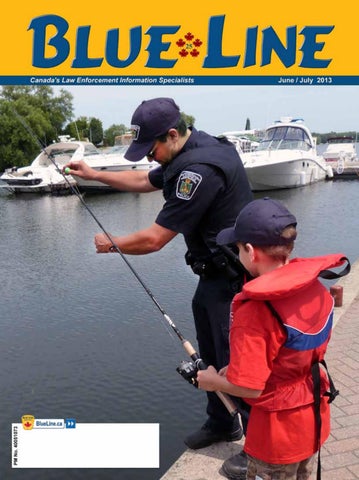
Cover: Peterborough Lakefield Community Police Constable James Arcand volunteers his time at the annual Bob Izumi’s Kids, Cops and Canadian Tire Fishing Days event. The days pairs police officers with children from Big Brothers and Big Sisters to learn the joys of fishing, make new friends and help children to see police as a positive role models. Blue line Magazine
Back of the Book – Assholes are a fact of life Blue Links Advertisers Directory Book News – The Steal: A cultural history of shoplifting Book Review – No Easy Ride Deep Blue – It’s all a matter of (social) perspective Holding The Line – Wish I knew this when I started Market Place Publisher’s Commentary – Vehicle inspections have come a long way Science Beat – How to identify future leaders Technology – Improvised explosive devises
34 3
Cell phone search incident to arrest okay June/July 2013
June/july 2013
4
Blue Line Magazine
Blue Line Magazine Inc. PUBLISHER Morley S. Lymburner – publisher@blueline.ca General Manager Mary K. Lymburner – mary@blueline.ca SENIOR EDITOR Mark Reesor – editor@blueline.ca NEWS EDITOR Kathryn Lymburner – kathryn@blueline.ca CREATIVE DIRECTOR E. Jolene Dreja – jolene@blueline.ca Marketing Manager April Lensen – april@blueline.ca Contributing Writers Robert Lunney Dave Brown Mike Novakowski Nancy Colagiacomo Tony Palermo Stephanie Conn Tom Rataj Dorothy Cotton Brent Snook Mark Giles Affiliations International Association of Law Enforcement Planners Canadian Advertising Rates Data International Police Association The Canadian Press Newswire Access Copyright Subscriptions $30 per year; $50 for 2yrs; US & Foreign: $100 Advertising 888-640-3048 advertising@blueline.ca
www.blueline.ca 12A-4981 Hwy7 East, Ste 254, Markham, ON L3R 1N1 Canada P: 905-640-3048 F: 905-640-7547 blueline@blueline.ca
PRINTED IN CANADA
ISSN# 08478538 Blue Line Magazine was established in 1988 as an independent publication to inform, entertain, connect and educate those involved in the law enforcement profession. With no direct control from an enforcement agency, its opinions do not necessarily reflect those of any government or law enforcement agency. The authors, advisors, and publisher accept no liability whatsoever for any injuries to person(s) or property resulting from application or adoption of anything presented in this magazine. Readers are cautioned and advised that articles presented herein are edited and supplied for your personal awareness and should not be used for further action until appropriate guidance is received from a supervisor, Crown Attorney or other persons in authority. All material submitted for publication becomes property of Blue Line Magazine Inc. unless arrangements have been made with the publisher prior to publication. © 2013 All articles are protected by copyright. No part of this publication may be reproduced or transmitted in any form or means, electronic or mechanical, (including photocopying and recording or by any information storage or retrieval system), without prior permission. Permission to reprint may be obtained in advance from Access Copyright 1-800-893-5777.
Blue Line Magazine
Publisher’s Commentary by Morley Lymburner
Vehicle inspections have come a long way
Finding something interesting to do has always been an enjoyable challenge. After years specializing in traffic and looking for new ways to challenge myself, I realized one day that no one on my 6,000 member police service was assigned to inspect trucks. Now there was, I decided – a squad of one. The interesting question was where to begin. I decided the best way to start would be to learn from the drivers themselves. Truck driving was one of the jobs I had a “cup of coffee” doing before police work turned my head. That experience was helpful when talking to truckers I stopped. After making it clear I would only charge the owners there was no shortage of truckers eager to show me the ropes. I was shown how to conduct a standard circle check for defects, including air leak locations, slack adjusters, drag wheels, bogies, clearance lights and what a RGW meant. The best phrase I was told about was the “glad hands.” I liked that descriptor because that was what was happening. Drivers were glad to give me a hand because they didn’t like the junk they were forced to drive. They had to put bread on the table and when the boss says its “the highway or no way” objections tended to melt away. My boss called me in after a few weeks to note the great job I was doing and assigned me to inspect trucks full-time. He asked me to put together a list of items I would need to do the job properly. I wrote out what seemed a modest request for a jump suit (so I would not mess up my regular uniform), tire tread depth gauge, work gloves, crowbar and helmet. I was called back a few days later and informed that my ‘exorbitant’ list had been rejected. Shirts and trousers were issued anyway, as were winter gloves, which would be fine for this work. A crowbar could be borrowed from the departmental garage and a helmet was only issued to motorcycle officers. I thanked him for looking so diligently into this on my behalf and, in the usual fashion BBS’d (bought, borrowed or scrounged) the materials I thought I might need. Hey... it all works. Several more weeks passed and my reputation in the field grew among the truckers. My biggest concern was the number of drivers showing up at my spot checks with a dozen donuts and coffee. One visiting supervisor found the dash of my scout car full of cups of cold coffee and the passenger seat loaded with four boxes of doughnuts. 5
‘Are the drivers trying to bribe you?,’ he asked. I raised my pen from the ticket book long enough to gesture at the stash of 15 sets of license plates on the rear seat, the line of disconnected trailer units behind me and two tire installation trucks busily working on tractors and their trailers. “These guys swamp my location every day. They are just a little too overjoyed with me taking the plates off their trucks. Many simply take them off themselves, bring them over and give me a list of what is wrong. Boss, I don’t have enough time to negotiate bribes.” Fast forward 20 years and I am invited to attend an interforce truck inspection location at a large parking lot near Toronto’s busy Highway 400. It was an amazing sight. Transport ministry inspectors were joined by officers from Toronto and York, Waterloo, Halton and Peel regions, along with all their toys. More than 80 officers inspected heavy trucks wrangled from the surrounding highways by outrider police vehicles. Officers climbed over, under and through the trucks looking for mechanical defects and a range of paper work violations which didn’t exist when I began. Equipment carried in specialized trucks ranged from weigh scales and Geiger counters to devices I couldn’t even identify. Even fuel was being tested to ensure it was sourced from the proper side of the tax shelters. “There is a new philosophy of breakdown maintenance happening out there today,” said Toronto Cst. Dal Gill. “That is why we started this association of truck inspectors a few years back. We all work together and check the shoulder patches at the gate. Our job is to keep truck enforcement high and road collisions low. “It is this level of co-operation that is needed because the vehicles we stop don’t recognize boundaries, just the bottom line. If they don’t comply,” he added with a smile, “we raise the value of that bottom line considerably.” It is good to see progress. I’m sure my old bosses would be proud.
June/July 2013
The new police
challenge by Lauren Gilchrist You would expect to find Peterborough Drug Strategy (PDS) co-ordinator Kerri Kightley’s office in one of the charming old brick buildings that line the streets of the city’s historic downtown. Or perhaps in the health unit, or maybe the hospital. Instead, she is located smack dab inside the Peterborough Lakefield Community Police Service (PLCPS) station. More specifically, right in the criminal investigations unit. Her office location has nothing to do with who is footing the bill – the strategy, comprised of numerous community partners, is funded through a variety of sources including grants. To put it simply, her office is located there because she was invited into the station. “It’s the only place in Ontario that it’s happening,” says Kightley. “It’s a fairly big deal to invite a community member in and put them in a detective office and say “go for it, what do you need?” she explains. She notes that other Ontario police services are contributing to strategies and initiatives to tackle the growing issue of substance use but only PLCPS valued the project so highly that it opened its doors to her. “People call me all the time and say “What are you doing? How did you get your police partners to engage?” Her reply? “I didn’t do anything,” she explains. “They volunteered.” For Kightley, her office is much more than a place to work each day. Instead, it represents the service’s commitment to working alongside community partners to identify, analyze and come up with solutions and strategies to June/july 2013
common problems. It represents the breaking down of barriers and silos amongst agencies. It gets at the heart of community based policing. ‘Pure’ community policing PLCPS Chief Murray Rodd describes community policing as a concept of operation that brings to life Sir Robert Peel’s principle that, “The police are the public and the public are the police.” Then Insp. Gordon Dawson implemented the strategy in 1978. Faced with a 16.9 per cent increase in reported crime from the previous year, there was a need to re-direct the focus to better serve the community. Borrowing from American and British experiments in community policing, one of the first successful Canadian community policing programs was designed. Based on the “generalist” concept, where an officer provides almost all police services to the public, the Peterborough “Preventive Policing Program” was targeted at the service acting in a preventive and proactive rather than reactive role. “Organization-wide every member was considered a front-line crime prevention officer and problem solver. That concept has remained as a cornerstone of our generalist constable concept to this day,” Rodd explains. The launch was such a success that calls for service year over year were driven down for the next decade, a trend PLCPS is still experiencing more than three decades later. “We have been able to contain calls for service. Despite the number of challenges we are facing around drugs and violence, we have very effectively addressed a number of categories of crime,” Rodd explains. 6
Inspections and audits done in the ‘80s and ‘90s found the service was practicing the purest form of community based policing in Ontario. “That was a badge of honour,” Rodd says. “The service really took that to heart and we have attempted to hang onto that accolade and perpetuate it.” He says that the 2010 Ontario’s Mobilization and Engagement Model of Community Policing is something PLCPS has been following for decades. He notes the model provides a fresh approach to formalizing, in a very intuitive model, the degree to which police and the community need to engage with one another and defines whose turn it is to lead and whose to follow. “I think even sometimes front line officers don’t realize how connected they are to community based policing because here, it is part of people’s mentality about how they do their job,” adds S/Sgt. Lynne Buehler. Team policing advisor Sgt. Todd Blewett describes community based policing as “police in partnership with the community involved in problem solving... “Instead of just taking a call for service they have an opportunity to be involved in something bigger then just a call for service. They can be leaders tackling significant problems,” he explains. All about partnerships PLCPS members belong to 101 organizations, providing community leadership on and off duty. “We are at the tables where the conversations are happening around not just matters of crime but matters of social development, issues of drug culture, youth issues, issues of Blue Line Magazine
functioning families, education, opportunity and inclusion. We are there,” says Rodd. Blewett notes the partnerships with the PDS and the Canadian Mental Health Association’s local Integrated Outreach Program are both excellent examples of community based policing. The partnerships allow the service to use the expertise of outside agencies to improve and better service the community. Formed in 2008, the unique and awardwining PDS is based on the four pillars of prevention, harm reduction, treatment and enforcement. The strategy brings together community partners, including the PLCPS and the Four Counties Addiction Service Team (FourCAST), to work together to reduce duplication of services and to take a collaborative approach to tackling substance use. “It’s all about the partnerships,” explains Kerri Kightley, drug strategy co-ordinator. “Substance use affects the whole population. If we can get more partners to the table to talk about collaborative initiatives, then the more people are going to be affected by these positive public health initiatives.” The strategy was nominated for an OACP Policing Award the year after it was launched. “I think the reason we were recognized is because it is a really unique partnership in the sense that police weren’t just invited into this relationship, they really did initiate and pushed the importance of the collaborative relationship and partnership,” she explains. “Inspector Tim Farquharson and I have spoken across the province about this partnership and how advantageous it has been for our community.” Through the strategy, Kightley says there is less duplication of services and agencies are better connected. “If you come into contact with police they are better connected with the appropriate services, whether it be treatment, prevention or family supports. We are starting to identify gaps and develop programs to fill those gaps,” she explains. For Kightley, there are huge benefits to having her office within the station and it just furthers the collaboration and partnership Blue Line Magazine
between police and their community partners in tackling substance use. “The conversation is always about prevention around here (the police station). When you talk to the chief about main messages, he talks about a functioning family and engaging the community and inclusivity and education. He’s not talking about kicking down doors and putting bad guys in jail. He’s talking about “okay, how do we invest in community and in strength, resiliency, protective factors... That’s a great model,” she explains. She says PLCPS is at the table advocating for overdose prevention initiatives and supporting the work the strategy is doing around preventing overdoses and youth drug use. “They are really leading the way because they are saying “okay, we may not agree but let’s have the conversation. That’s unique.” The PLCPS has also partnered with the CMHA and Peterborough Regional Health Centre on the CMHA Integrated Outreach Program. Launched in 2011 and funded at no direct cost to the police or hospital, one goal is to reduce emergency department wait times by assessing mental health clients. Officers call Graham Harvey when they suspect a person has mental health issues. He is qualified to do an assessment at the scene to determine if there is a psychiatric component and whether the person needs hospitalization. If that isn’t appropriate he can see that they receive the appropriate resources in the community. Before the program, Harvey says police really only had two options – do their best to assess and resource a person with mental health issues at the scene or take them to hospital. He notes a hospital trip often meant two officers spending hours in the emergency department until the person was assessed and admitted or discharged. Harvey says he can do the initial assessment along with follow-up and make the right connections outside of the hospital, freeing up officers, reducing emergency wait times and benefiting clients. On follow ups, he can monitor a person more closely and provide the right resources so they are not calling 9-1-1 when they reach a crisis point. “The feedback seems to be positive and it 7
has been well received from the different levels within the police force, everyone from the dispatchers right up to the chief,” says Mr. Harvey. While not unique to Peterborough, Blewett says this three-way partnership is another excellent example of community based policing. A need was identified, namely the rise in calls for mental health services, analyzed and a plan developed to tackle the issue. He says it’s impossible to make every officer a mental health expert but the service can liaise with experts willing to help address a community based problem. Buehler’s community services unit gets at the very core of community based policing. “Our work in the schools is not about being reactive, it’s about being proactive. It’s about giving people the tools before the problems emerge to prevent the problems from occurring at a later time,” she explains. The unit uses the four pillar approach of education, opportunity, inclusion and functioning family. She notes that many precursors for crime come out of these areas. If people don’t have a functioning family, are socially excluded or have a poor education, they are more at risk for substance use. The unit hosts three proactive and highly successful events annually which identify a specific demographic and proactively talk to it about issues that will prevent crime. “All three events – Family Week, Drug Awareness Week and Crime Prevention Week, have all brought attention from other police services about modeling our programs in their communities,” says Buehler. Officers play hockey against a team of area high school students during Drug Awareness Week. Drug awareness messaging, information booths and games are showcased in the lobby of the arena and on the screen throughout the event. Some 3,000 high school students attend, a cost effective way to deliver a message to thousands of people all at once. “Our events are big. We thought big. We dreamed big,” explains Buehler. Another unique made-in-Peterborough program that highlights community based policing is Project TACTIC (Teens and Cops Tackling June/July 2013
Internet Crime). In 2012 PLCPS partnered with area school boards and a local college. Funding was provided through a grant that allowed 32 high school students to create videos about safe online behaviour that are now being shown to their peers in elementary school. “We’re trying to use some of the best practices around peer to peer messaging and involving people in developing the messaging,” says Buehler. “It was really innovative. It’s being used across the province.” Buehler says there isn’t a perfect recipe for their success. “A lot of the things we’re able to accomplish are based on those solid community relationships that we have – and those just grow over time based on the investment you make,” she explains. “If you don’t make the investment you don’t get the returns on the investment.” Cyclical model Community based policing is not without its challenges. While not a new concept amongst his officers, Rodd says it needs to be constantly nurtured and fed through ongoing education. That’s been the role of Blewett since 2011. He teaches officers about community policing and problem solving. The area PLCPS serves is divided into five different areas or zones. Each year officers must come up with a project that identifies a real problem in their area, then examining solutions to either mitigate or solve it. Blewett implemented the SARA (Scanning, Analysis, Response and Assessment) model last year to encourage this process. Using the problem solving model, officers identify a community problem, then analyze it to decide whether police should fix it or if it’s best dealt with by another organization or agency. The final step, assessment, asks officers to evaluate their results and determine if the plan was effective. If it was not, they go June/july 2013
right back into the model because it is cyclical, not linear. “Problem solving is a good management tool to involve all officers in. It’s very cost effective and we rely on all our community partners to resolve the problem. Everybody has a stake in the problem.” Blewett says the key to the model is identifying a real community problem. Officers can’t rely solely on stats, which only paint part of the picture. Instead, they need to get out and talk to people to really be able to identify and pinpoint a problem. He says there are always improvements to be made and he is continually working on teaching the service how to use the model for greater effect. “It’s all about community and delivering better service,” he notes. “If we can resolve the underlining issues to a problem we are not going to get a call back.” Education key Rodd says community policing faces challenges, especially budget pressures. “(As) people are analyzing what is the role of a police officer, it would be very easy to say school programs, neighbourhood and quality of life issues and mental health issues aren’t really the primary concern of the police,” he explains. “I think that many of our informed community partners understand our unique space and our ability to act as a catalyst for an action and to call meetings, bring attention to issues through the media, bring people together. We have that effect and that is our value often at times in the whole social development aspect.” He also notes that despite an enlightened workforce, officers sometimes do not understand why community based policing should be their job. “It’s not the sexy part of policing,” he says. Buehler adds that one of the hard parts about community based policing is the lack of hard data. “We can count the tickets. We can count 8
the arrests. We can count the crimes. It’s really hard to measure the prevention, what we’ve prevented,” she notes. She says there can be the perception that if a police service is short officers it should draw from community services. She notes that all five community services officers are able to take calls at anytime, but it would be a great loss if the unit was ever disbanded. “Would we be the same quality service? Would we accomplish the same things without this unit? Not in my view. I think it would be a tremendous loss. I really see the value in spades,” she explains. “The chief understands, he’s always been a big proponent of community policing. He has always been an innovative thinker around ways to engage the community and have people interact and to build those partnerships and send those ambassadors out.” She notes while PLCPS is doing its part to engage with the community it is a twoway relationship. “We can’t be responsible entirely for societal safety. We can’t do it all,” she notes. “We need every person in the community to play their own role on some level. We need the people and we need the relationships to do that.” Rodd points to a 2009 community satisfaction survey as evidence connections with the public are working. It showed a 98 per cent satisfaction rate in Lakefield with the service and a 97 per cent satisfaction rate in Peterborough. “That is based on our formal and informal interactions,” he explains. “I think we truly demonstrate, individually and collectively, that a safe and healthy community leaves no person behind and values everybody’s voice and contribution.” Lauren Gilchrist is a former journalist and now PLCPS Media Relations and Communications Co-ordinator.
Blue Line Magazine
Blue Line Magazine
9
June/July 2013
Looking back and moving forward by Joel A. Johnston Part 3 Vancouver Police Department (VPD) officer Joel Johnston has been Blue Line’s defensive tactics editor since 1994 and a consultant and researcher to both police and government agencies. He is recognized for his no-nonsense approach to use of force in the Canadian context. In the final of this three part series he reflects upon the evolution of use of force standards and equipment in Canadian policing. Watershed use of force moments Rodney King video: The March 1991 “beating of Los Angeles motorist” Rodney King was captured on a personal camcorder and delivered to the media. George Holliday videotaped the incident from his apartment in the Lake View Terrace neighbourhood of Los Angeles, contacted police about it a couple of days later and then took the tape directly to KTLA TV, which broadcast it in its entirety. The video created instant media uproar. Selected portions were aired repeatedly, turning what would otherwise have been a run-of-the-mill, violent, soon-to-be-forgotten encounter between LAPD members and an aggressive, resistive criminal suspect into perhaps the most widely viewed and talkedabout incident of its kind. The tape was subsequently broadcast globally and the incident sparked the greatest riots in the history of Southern California. It was the dawn of the pending “YouTube era”. Trainers had been alert to this emerging trend but it wasn’t until this incident that the June/july 2013
message was really driven home. Now if any incident makes it to video, it almost certainly is shown on TV news and the Internet. The community immediately judges it, largely based upon how it is presented to them – and the presentation is frequently by agenda-wielding reporters absent all of the facts. The 2007 Vancouver “YVR Taser incident” is a clear case in point and may represent Canada’s own “Rodney King moment.” North Hollywood bank robbery & shootout: Two heavy-armed, drugged and armoured bank robbers entered the North Hollywood Bank of America in February 10
1997 and committed a violent robbery, then engaged police in a protracted gun battle. Eleven officers and seven civilians were injured, there was massive property damage and the firing of more than 2,000 rounds of armour-piercing ammunition at police and anyone who got in their way. Police were stuck returning fire with handguns whose rounds could not pierce the body armour the suspects were wearing, even if they could hit them. Officers actually seconded weapons from local gun stores in an effort to level the playing field with these criminals. Eventually the robbers were killed, Blue Line Magazine
but at great expense. This incident spawned the patrol carbine movement across North America, allowing police to get on an equal footing with the criminal element. Columbine High School massacre: Two male students of a suburban Colorado high school went on a well-planned rampage of their school in April 1999, killing 12 students and one teacher and injuring another 21 students before following through on their suicide pact. Law enforcement applied its traditional response to this situation – contain the school and wait for SWAT teams to arrive. This took too long and the situation was over long before SWAT was able to enter. The flawed response was seen for what it was. Active killer situations demand an immediate response by the closest, fastest responding officers – but they need training and weapon systems capable of ending these violent incidents as soon as possible. Despite the fact school shootings had been occurring for years prior to this incident – including several notable Canadian incidents (Centennial High School, Brampton, 1975; Ecole Polytechniqe, Montreal, 1989; Concordia University, Montreal, 1992; etc.) Columbine represents the genesis of the “Active Shooter” response training program across North America. Mumbai massacre: This violent terrorist attack against Mumbai citizens and visitors began Nov. 26, 2008 and lasted for three days. Teams of heavily-armed, trained, well-prepared young men – members of Lashkar-eTaiba, a Pakistan-based militant organization – set out to kill people in targeted locations with assault weapons and bombs. The final toll was 164 people killed and 308 injured. One terrorist was captured and interrogated, telling officials much of what they learned about the mission and who was behind it. He was subsequently hanged in 2012. This attack strategy presented yet another problem that the traditional police response was ill-equipped to handle. It spawned the Multiple Assailant Counter-Attack Tactics (MAC-TAC) programs across North America that prepares quick response, heavily-armed teams to move to hotspots immediately to neutralize active killers. All of these incidents (and others like them) occurring around the globe continue to shape the policing response, as they should – but we ought to really be looking to get “ahead of the curve” rather than continually playing catch-up post-facto. We have a vast complement of talented, educated, driven trainers across Canada with the ability to get in front of trending issues in law enforcement. Policing will be increasingly challenged with growing public (dis)order problems. As economies struggle, the unyielding problems of extreme violence, mental illness and substance abuse will continue to produce bizarre, difficultto-control manifestations – think of the “bath salts” behaviour that we are now witnessing. The policing “profession” must strive for excellence – and shun past status quo Blue Line Magazine
benchmarks. The likes of Dr. William Lewinski and the cadre of resources at the Force Science Research Institute at Minnesota State University are revealing relevant information and valuable research. Police can use it to predict and prepare for emerging trends and issues. It is up to each and every Canadian police agency to leverage the scientific and human resource advantages under their noses to elevate policing to the profession of excellence that it can be – if not in the areas of public safety and officer safety, then where? The policing model will change dramatically over the next couple of decades. This will be driven principally by economics. Government budgets will not bear the state
11
of affairs that currently exists. We will see a tremendous growth in “tiered policing” and the security industry. The success of these changes will largely depend upon training. Proper, innovative, ahead-of-the-curve, science-based training will make the difference. The pieces of the puzzle are scattered about out there – they simply need to be assembled by astute leaders. Joel Johnston is a 28-year police veteran of the Vancouver Police Department. The co-principal of the Defensive Tactics Institute and continues to progressively train law enforcement professionals.He is a contributor and defensive tactics editor for Blue Line Magazine. He can be reached at joel@dtidefensivetactics.com
June/July 2013
SWEEP!
Canadian Police Curling Championships held in Saskatoon
by Ted McIntyre
The call heard around the curling rink during the Canadian Police Curling Championships (CPCC). This past year’s 58th annual championship was held at the Natana Curling Club in Saskatoon. The eight day event kicked off on Saturday March 23rd and wrapped up with the closing stone banquet on Saturday March 30th, 2012. The Championship was held with only 11 teams. Absent from the competition were teams from Alberta, Yukon/NWT and PEI. That did not lesson the competitiveness of the Championship. There was lots of excellent curling during the eight day event. Team Canada (Saskatchewan) shone through with the best week in recent memory going 9-1 record during round robin play. They went on to beat Manitoba in tight match in the final to capture back to back championships. Winnipeg, Manitoba will be the host site for the 2014 Championship. The 59th annual championship will run from March, 15-22, 2014 at the St. Vital Curling Club in Winnipeg. Not only was the curling a great success.
Team Canada (Saskatchewan): Skip, Jason Jacobson; Vice, Jeremy Tipper; Second, Gerry Schneider; Lead, Al Dymytryshyn. The CPCA charity of choice is the Tourette Syndrome Foundation of Canada. Over 2,000 dollars was raised for the Tourette Syndrome Foundation of Canada during the 2013 championships. Throughout the year the CPCA raised more than 13,500.00 toward Tourette.
The Canadian Police Curling Association Curling (CPCA) also would like to announce that we have expanded our Association to invite all “Peace Officers” to join us in our curling fraternity. Any person who is designated a Peace Officer in good standing within any Provincial or Territorial Association in which they reside is eligible. This may include but is not restricted to Canadian Border Services Agency (CBSA), Customs Officers, Correctional Officers, and Conservation and Fisheries Officers. These are to be determined by the National Executive on a case by case submission. Retired Peace Officer with a minimum of 15 years’ service in the employ of their agency is also eligible. On behalf of the National Executive I would like to thank the organizing committee of the 58th Canadian Police Curling Championship, the participants, volunteers and sponsors for making this event a huge success on and off the ice. We would also like to congratulate Team Canada (Saskatchewan) for a victory well deserved. We also wish the 2014 Winnipeg organizing committee best of luck organizing the 2014 Championship. The next event will be hosted by Winnipeg Police and held in March 2014. For further information go to www. policecurling.ca
June/july 2013
12
Blue Line Magazine
Officer job swap opens eyes
RCMP and Fredericton police choose collaboration by Sigrid Forberg Fredericton Police Force (FPF) Insp. Dan Goodwin was a little apprehensive when RCMP Supt. Guy Rook, J Division Federal Policing Officer, asked him to participate in the first year-long officer exchange. Acting as the OIC of the FPF Criminal Investigations Division, Goodwin was concerned he might have to manage expectations as he waded into unfamiliar municipal territory. That fear soon faded as Rook quickly found common ground with the FPF members reporting to him. “We’re not that different at all – maybe in size – but we’re looking at the same crime and trying to do the best for the citizens in our communities,” says Goodwin. “That was apparent and I was able to rely on the good people there to work hard and help me.” Goodwin’s exchange partner, RCMP Insp. Gary Forward, was also apprehensive. Moving outside his comfort zone, his major concern was that he would represent his organization well. Within a week, both officers felt welcomed and respected by their new teams. “I looked at this as a developmental opportunity to see how things were being done from a federal perspective and get exposure and experience that I never would be able to get through the municipal policing world,” says Forward. Professional growth Rook found Goodwin and Forward’s concerns unfounded, saying the idea for the exchange, which he credits to commanding officer Asst. Comm. Wayne Lang, was wellthought out and forward-thinking. “The friendships between the agencies are really strong here,” says Rook. “The CO wanted to pave the road for the kind of relationships we have now for our future leaders.” Rook adds that Goodwin and Forward were chosen for their excellent people skills, in addition to their other qualifications. He says neither senior management team was worried that either would have a hard time integrating with their new teams. “Somebody was going to come here that never went to Depot and someone was going to go there that hadn’t spent their career in the municipal force,” says Rook. “You had to choose people that were going to walk in and have the team under their full command.” Throughout the job swap, Goodwin and Forward kept in close touch and that close communication is something both hope will continue. “On my way out someone said, ‘Inspector, you’ve been there for how many years and we do the same work and I’ve never met you Blue Line Magazine
before’,” says Goodwin. “They’re absolutely right. I’d like to think I left them knowing it’s that easy to break down those barriers.” Strong impressions Forward hopes his leadership style influences local RCMP members. In an organization where police officers spend their entire careers in the same place, human resource and communications issues that bubble up need to be dealt with swiftly. Forward opts for a mandate of being positive, professional and people-oriented as a leader. “I just knew right from the get-go that I wasn’t the least bit interested in letting them down – especially after everything they’d done to support me,” says Forward. “I hoped to improve things where opportunities presented
13
themselves and to do so in a respectful and helpful manner.” When both inspectors went back to their respective organizations at the end of September, the RCMP held a ceremony to present Forward with an award of distinction for excellence in human resource management. Both organizations hope to have future opportunities like the exchange. Forward says he’ll use his experience with the RCMP to further develop other personal and professional goals. “It helps us make decisions. We have those connections now that when something happens in the city, we know we can just pick up the phone,” says Goodwin. “It certainly opened my eyes. At all levels, there’s so much we can do for each other.” Senior management was happy too. It’s an initiative Rook says they’d like to continue in the future at various levels – possibly even middle management. “You have a good thing but if you want to keep it good or make it better, you have to invest in the future,” says Rook. “It’s not about turf and or responsibility – the public expects the very best and so we have to challenge our policies, systems and our people to be more collaborative.” Sigrid Forberg is a communications specialist with the RCMP National Communications Services branch. Contact her at 613 843-4540 for more information.
June/July 2013
Moving away from the rankcentric model of management by Maurice Brodeur It is very important to recognize the role of rank and leadership in policing but leaders also need to recognize that agencies hire some very smart people. It is always a mistake to not recognize and access the skills and intelligence of the people that surround us. Leaders who refuse to reconsider decisions despite evidence from juniors that they are wrong are Rankcentric. They lack confidence and cannot accept credible information that calls their decision into question because they fear this would make them look weak. I came up with the term Rankcentric for a retirement speech for my watch commander, who had confidence in himself as a leader and did not let rank get in the way. I could talk to him man to man on issues and not worry about miscommunication. I don’t mince words and can be passionate about issues – and he let me be me. I valued this tremendously as I did not have to be afraid of venting. He wasn’t Rankcentric in that he was confident of his own standing as the “Boss” and therefore never threatened by my strong personality. He was also very adept at working with persons of higher rank and always said what needed to be said. He was a true leader who just happened to be a staff sergeant.
Being able to accept and use the skills and intelligence of the people around you makes you a more credible leader in their eyes. If you ask for their input and can allow yourself to justifiably change a decision based on it, the strength and confidence you exhibit will be noticed. Do not let your rank prevent you from making good decisions and limit your leadership in the eyes of your people! It can be very hard to limit the natural tendency to try to be the expert in all things. Leaders feel that once promoted, we are automatically transformed by the magic wand of rank into an omniscient person. Unfortunately, this sets us up for failure. It is impossible to know everything and the smart people around us will know if we try to fool them. We then become the fool. Another failure of the Rankcentric person is to not apologize to someone of lower rank when clearly an apology is needed. As a sergeant I have always thought that if I erred in my dealings with a subordinate, it is incumbent on me to apologize. We cannot use our rank as an excuse to not do the right thing when we make a mistake as it weakens our standing in front of our people. On the flip side of that coin, if we recognize our error and provide a heartfelt apology when it is needed, we become a better person and stronger leader in the eyes of our people.
Another Rankcentric trait is the lack of courtesy in responding back to emails or voicemails on contentious issues. Higher ranks often use this as a ploy to blow people off. Many subordinates, not wanting to rock the boat, will simply accept this as a non-approval and back down. Several years ago I emailed the chief’s office about an invite from the mayor’s office to discuss and support a homeless initiative. No one responded and, realizing this was a ploy to hold me off, I went anyway and reported back on the meeting. Amazingly enough, an infuriated inspector emailed back noting that they had not given me permission to attend. I replied respectfully that I had asked for permission and when they did not respond, I took this as an indication they didn’t care if I attended. Please do not ignore your people; this is highly disrespectful regardless of your rank. If you are Rankcentric with the Millennial Generation, who are quickly becoming the backbone of our police services, you will certainly fail. This generation will question authority if they feel it is warranted and we, as leaders, need to listen and not take this personally. Millennials are team-oriented – they grew up with play groups, team sports and other group activities. They are loyal, committed and want to be included and involved. One can see the benefits of these values and how a Rankcentric person who does not invite some open management in their leadership style will not be as effective as they could be. At the end of the day, the decisions to be made on policing will always be done by the person with the highest rank. However, leadership fails when it does not take into account the ideas and opinions of subordinate officers. Leadership need not be deaf and blind to their contributions. Utilizing all the experience and intelligence around us will not only allow us to make better and fuller decisions, it will permit us to do things as a team and make everyone a part of the experience. Maurice Brodeur is a sergeant with the Edmonton Police Service and can be contacted at Maurice.Brodeur@ edmontonpolice.ca .
June/july 2013
14
Blue Line Magazine
RCMP dismantles operational silos CALGARY - RCMP investigators in Alberta and across the country are part of a nationwide revamp of the force’s federal policing operations. The changes are happening behind the scenes, but a senior officer said they will allow the RCMP to better respond to organized and serious crime. “We’re doing it to be a little more nimble,” said Supt. Roger Miller from RCMP’s K Division headquarters in Edmonton. Although uniformed Mounties are a common sight in rural Canada, those officers work under contracts to provide local policing to provinces, territories and municipalities. Less visible is the RCMP’s federal policing component, made up of specialized, usually plainclothes members investigating areas such as drug trafficking, financial crimes, national security and protection for Canadian VIPs and foreign dignitaries visiting Canada. In Alberta, about 325 RCMP members work in federal policing, based mainly in Calgary and Edmonton. Until now, they were organized in specialized units tasked with investigating a particular area: commercial
Blue Line Magazine
crime, drugs, proceeds of crime, financial market integrity. However, the RCMP decided the model was too rigid and didn’t allow them to change and respond if crime trends changed. “The silos were inefficient,” Miller said. At the beginning of April, the RCMP began dismantling those specialized units. Instead, it is grouping together officers in multidisciplinary teams capable of investigating any kind of case under the RCMP’s federal policing mandate. “It’ll be in and around what the intelligence tells us. In the past, it has been around a commodity,” Miller said. “It’s a better way to address the higher priorities of the nation.” Miller estimated it will take up to 18 months to fully implement the plan. Although it’s an internal move, the RCMP redeployment affects other law enforcement agencies that have officers assigned to joint units that will disappear under the new plan. The Integrated Proceeds of Crime Unit based in Calgary, for example, had municipal
15
police members, as well as a Canada Revenue Agency employee and an assigned Crown prosecutor. Although the RCMP has decided to change its internal workings, Miller said investigators from other agencies will remain in the new federal policing teams. “As professionals we agree an integrated model is the way to go. Those positions are there, the doors are open,” he said. The Calgary Police Service confirmed officers assigned to RCMP federal policing functions are staying put. In 2004, the Calgary police undertook a reorganization similar to the RCMP, combining several specialty units in to larger squads: the homicide and robbery units became a unified “violent crime” team. Calgary police returned to a model closer to the original one after four years, reinstating the homicide unit and other specialty teams. However, Supt. Guy Slater said the experiment gave Calgary police more flexibility and said city police will support the RCMP’s move. “From our perspective, we want to do everything we can to make their new model work as much as they do,” he said, The Canadian Press – Blue Line News Week
June/July 2013
In honour of family and for the love of the game by Blair McQuillan A police officer will probably never experience anything more devastating during their career than the line of duty death of a friend and colleague. York Regional Police (YRP) Cst. Jon Carson faced such a reality on the morning of Tuesday, June 28, 2011, when Cst. Garrett Styles was killed while conducting a traffic stop in East Gwillimbury, Ontario. News of the tragedy hit the 1,900 sworn and civilian members of the police service hard as the 2007 line of duty death of Det/Cst. Rob Plunkett was still fresh in their minds. “It was a tough time for all of us,” Carson said. “Garrett’s life reflected the lives of most of us in some very significant ways. He was a young officer who was dedicated to his craft. He had a great sense of duty and was a leader on his platoon. Beyond that, he was a family man with a wife, Melissa and two small children. His death reminded all of us how precious each day is.” In addition to their frequent conversations about family and policing, Carson and Styles often talked about baseball. Red Sox and Blue Jay fans respectively, the two uniform officers would frequently exchange views on all things related to the sport during locker room conversations at 1 District Headquarters in Newmarket where they worked. “Following his death, I knew I wanted to do something that would honour Garrett,” Carson said. “I wanted an event that his children, Meredith and Nolan, would recognize as part of their father’s legacy. “Baseball is a sport that embodies team work, dedication and creates lasting bonds between people. I thought a tournament would be a good way to remember him and create lasting memories for those of us who participated on June/july 2013
the field and in the bleachers.” Just two months following Garrett’s death, on Wednesday, August 17, 2011, the 1st Annual Garrett Styles Memorial Baseball Tournament was held in Newmarket on the same field where he had played as a youth. With assistance from Garrett’s father, YRP S/ Sgt. (ret.) Garry Styles and his sister, CPIC/ Transcription Operator Meghan Styles, the tournament raised more than $5,000. Garry said the tournament has helped with the healing process and reminded him of Garrett’s youth. “We spent many summers touring around Southern Ontario as a family attending baseball tournaments,” he recalled. “Garrett was a talented pitcher and great team player. I remember spending many days sitting in the stands with my wife and our two sons and daughter. I think of those days fondly.” For Carson, the tournament proved to be more work than he expected and the learning curve for planning such events proved to be steep. However, at the conclusion of the first tournament, he immediately looked ahead to 2012. “Once word about the tournament spread, we had the New York Police Department Finest, New York State Courts Blue Sox and Nepean Brewers all sign on,” Carson said. “In addition, the Newmarket Hawks, a local team which Garrett had played for when he was younger, joined the tournament.” In a testament to the effort put forth by the teams involved, the final game of the 2012 tournament came down to a walk-off double in the bottom of the seventh inning. With a final score of 4 to 3, the Finest beat out the Hawks to win the tournament. The tournament raised money for the Canadian Tire Jumpstart program which helps kids participate in sports and recreational activities. Carson said that through generous donations, 16
including $5,000 from the Royal Canadian Legion, the tournament raised approximately $20,000. “All of the money raised remains in York Region,” Carson said. “It’s great to think that through partnerships with the teams, local businesses and the Jumpstart program we are able to help kids and ultimately our community, in this way.” With the third annual tournament set to take place from September 20 to 22, 2013, Carson is again looking to enhance the event. Additional organizers have joined in to assist, including Garrett’s wife Melissa and Jon’s wife, YRP Cst. Kim Carson. “We will host 12 teams this year,” he said. “There are still some spots available. We’ve had interest from teams in California, Australia and Ireland, which is exciting. “We’ll be hosting a day of baseball for kids from the Jumpstart program in conjunction with the tournament. We’re also hosting an excursion for tournament players and their families to the Roger’s Centre in Toronto for a game between the Blue Jays and Yankees.” As the tournament continues to evolve, Carson hopes people remember it is all about making connections. “I know Garrett made the lives he touched – both on and off the job – better,” he said. “At the end of the day we are all judged on how well we treat people. It’s important to remember that.”
Contact Cst. Jon Carson at coordinator@1405baseball. com or visit www.1405baseball. com for more information on the Garrett Styles Memorial Baseball Tournament. Follow it on Twitter at @1405baseball .
Blue Line Magazine
Blue Line Magazine
17
June/July 2013
Police visibility important in busy season
by Olivia Schneider The boardwalk in Halifax stretches three kilometres across the city’s historic harbour and is home to museums, restaurants and retail shops. It’s open year-round and always accessible to the public but really comes to life during the warm months. Some 1.2 million people visited Halifax between July and September 2011, according to Destination Halifax, with the boardwalk one of the city’s most visited spots. Its wooden path fills with tourists and locals, who are busy shopping, eating, drinking, snapping photos and checking out the attractions. The historic Pier 21 is popular; a museum there commemorates the most famous entry point for generations of people immigrating to Canada. Mingling with the crowd is Cst. Shawn Currie, riding his bicycle along the boardwalk. Currie has been a police officer in the Halifax Regional Municipality (HRM) for more than 20 years and spends about half his time patrolling the waterfront in the summer. As the capital of Nova Scotia – described on licence plates as “Canada’s Ocean Playground” – and the largest Canadian city east of Montréal, it’s no surprise Halifax draws a lot of tourists; they love the city’s mix of historic sites and modern fun.
One sight visitors don’t expect to see is a police officer cycling along the boardwalk, Currie says. Tourists – and even local residents – frequently ask why he’s on a bicycle. “It’s part of my job,” he replies. “I can get places and easily stop and talk to people. Plus, the health benefits are great, too.” Currie is one of many HRM police officers contributing to an increased summer presence in Halifax’s high traffic areas – mainly the downtown area and the waterfront. “There are so many more people in the city,” Currie says. For example, every summer day last year “there were 2,500 people coming off the cruise ships alone.” Downtown Halifax is a magnet for people all year round, not just in the summer. The
population has two dynamics. With three major universities and various colleges there’s an abundance of students from September to May. The tourists arrive when the the students leave. The city’s vibrant restaurant and bar culture – concentrated in the downtown area – led to the creation of the Downtown Safety Strategy, established in 2012. It adds an increased police presence between midnight and 5 AM in the downtown core every Thursday to Saturday, plus Sundays on long weekends. It runs from June to October, catching the September return of students. Charges laid during the strategy’s patrol are primarily for assault and public intoxication. The congestion of downtown revellers may not be unique to the summer but certainly increases during the warm weather. Starting the first week of May, patios bloom outside many restaurants and bars. Last summer there were more than 30 open. Some downtown routes, like Argyle Street, are home to many spots to eat and drink, most with patios. Currie says the patio proliferation increases the number of charges laid, which he attributes not to the patios but the increased number of people they attract. If a key part of the strategy is having more officers patrolling the streets, it’s equally important for police to communicate constantly with citizens as they walk – or cycle – their beat. “It’s interactive,” Currie says. Many local businesses, especially bars, employ their own security and it’s important to keep the lines of communication open with police. The Downtown Strategy also encourages police officers to patrol the interior of bars. Patrolling officers are obviously there to deal with incidents in progress, but also keep an eye out for potential instigators or victims. “We’re essentially preventing crimes before they actually happen,” says Currie. This proactive approach to policing is working. Since its launch last year, Currie says there have been 2,000 fewer calls for service. Currie believes Halifax’s increased police presence and summer visibility, whether on foot or bicycle, helps to prevent many problems and reassure visitors and locals alike. “It’s important to see we’re there,” he says. “We’re not only responding to people’s calls.” Olivia Schneider is Blue Line Magazine’s Maritime correspondent, and can be reached at olivia@blueline.ca.
June/july 2013
18
Blue Line Magazine
Blue Line Magazine
19
June/July 2013
2013 IN PRINT
Check out these highlights from the 17th annual Blue Line EXPO, held on April 23rd & 24th. The show provided a forum for Canadian and American companies to show case their products and services to law enforcement professionals from municipal, provincial and federal police services, security companies and more. Attending government agencies, included Parks Canada, Department of National Defense, Canadan Border Services Agency, as well as Correctional Services Canada among others. The Blue Line EXPO staff would like to thank everyone for making the show a success!
June/july 2013
20
Blue Line Magazine
2013 IN PRINT Draw Prize
Winners Heather D. Hodgson Schleich
Book Suit of Blue D/Chief Cindy Armstrong, Medstar First Aid Services
Brooks Delectable Chocolates www.brookschocolates.com
Chocolates Wayne Edward, Respond Search and Rescue
Ford canada.fleet.ford.com
Prizes for this annual draw are donated by exhibiotrs.* Check them out on Blue Links at www.blueline.ca
Altman International www.altimategear.com
Leather Gloves Matt Sheehy, Jetana Security- Director
Police Ordnance Co www.policeordnance.com
GLOCK Gift Card PC Dal Gill, Toronto Police Service
Kevin Byrnes
Gift Pack Cst Damon DeBrusk, Waterloo Regional Police
Book Truth Focused Interviewing Doug Wiebe, Security
LTAS Technologies Inc www.harmari.com
Airstar Canada www.airstarcanada.com
10 Free Web Identity Search Tool Matches • Cst Barry Ravenek, Niagara Regional Police • PC Matt Cunnington, Halton Regional Police
Colt Canada www.coltcanada.com
T Shirt and Gift Pack Ian Lawrance, Firearms Supervisor, Ontario Provincial Police
American Military University www.amu.apus.edu
Sony E-Reader and Hat Nick McConnell, Halton Regional Police – Retired
Investigation Counsel Professional Corporation www.investigationcounsel.com Book Canadian Law & Private Investigations Steve Long, Halton Regional Police – Traffic Services
Hard Chargers www.hardchargersmotorcycleclub.com
Hand Carved Wood Barrel Bullet Pen Sgt Jason McLoughlin, Ontario Power Generation
Sportmeds www.sportmeds.ca
Flexall Ointment Gordon Pease, Waterloo Regional Police – Volunteer
Original SWAT www.originalswat.com
Boots Cst Hezekiah Tai, Durham Regional Police
Yamaha www.yamaha-motor.ca
Gift Card Andrew Smith, Coast Guard Training Officer
Cst. Randy Wood, Halifax Regional Police, Winner of the Blue Line Police Leadership Award, 2012 shown with Kathryn Lymburner of Blue Line Magazine, and Chief Jean-Michel Blais.
Sunglasses PC J Patel , Toronto Police Service
DAVTech Analytical Services www.davtech.ca
Camping Chair • Stuart Rinaldo , Toronto Police Service – Retired • Det Suzanne Byrnes, York Regional Police
iRun & Rock United By Trauma www.irunandrock.ca
Gift Basket Michelle Chu, Centre of Forensic Sciences – Technologist
D. Chief Rioux and Chief Berger of Ontario’s West Grey Police Service accepting the award for Canada’s Best Dressed Police Vehicle 2013, shown with Morley Lymburner, Publisher of Blue Line Magazine.
Panasonic www.panasonic.ca
Lumix Waterproof Digital Camera A/Sgt Jim Bennett, Blood Tribe Police Service
Otterbox Cases www.otterbox.com
Otterbox Cases • D/Cst Kevin Baker, Durham Regional Police • Marc Gince, Dispatch Connexions, Chief • D/Chief Sinclair Walker, Summerside Police Service • David Brooks, Correctional Officer • Ron Jaworski, Commissionaires • Larry Rocha, York Regional Police Auxiliary • Cst Craig Coleman, Toronto Police Service • Kevin Gray, St John Ambulance Unit Chief • Al Penrose, Ontario Provincial Police – TRU Sgt • Sgt Mark Ruffolo, York Regional Police • Sean Ryan, Canada Border Services – BSO • William Howitt, Respond Search and Rescue
S/Sgt Melting Tallow and Cst. Bennett of Alberta’s Blood Tribe Police Service accepting the 2nd place award for Best Dressed First Nations Vehicle. Luc Lanthier, National Fleet Manager, of Canada Border Services Agency accepting the award for Best Dressed Law Enforcement Vehicle.
* Every Draw Prize entrant receives a free one year subscription to Blue Line Magazine!
D.Chief Walker of PEI’s Summerside Police Service accepts the third place award for Canada’s Best Dressed Police Vehicle.
many thanks to the Sponsors of the 2013 Blue LIne EXPO
Blue Line Magazine
Awards Dinner
21
June/July 2013
Science beat
How to identify future leaders by Brent Snook Like other professionals, police officers differ in career goals, aspirations and desire to help their organization succeed. Some are happy to remain at the rank of constable whereas others strive from day one to become chief. I was surprised to learn that there hasn’t been much scientific research aimed at identifying the differences between officers with contrasting career ambitions. A recent study published in Criminal Justice and Behavior provides some awareness of these differences and offers suggestions on how police executives can encourage officers to strive for higher ranks. The authors of the article “Looking up: Explaining police promotional aspirations” argue that members motivated to achieve promotions will work harder and expend maximum effort – but what types of individuals are self-motivated to get promoted? Does gender, educational attainment, years of police experience, stress and/or job satisfaction influence career aspirations? To answer some of these questions, Jacinta Gau, William Terrill and Eugene Paoline III collected data, including officer characteristics – gender, ethnicity, level of education obtained, years of police experience, presence of military experience and marital status – on
2,109 police officers from eight US agencies. They asked each to rate aspects of their work environment – stress, satisfaction, clarity on their job roles and responsibilities, attitudes towards top management, views about doing work unrelated to the crime-fighting stereotype about police work, views about how much police should do to maintain public order and attitudes about how much police should engage in community policing. Gau and her colleagues also collected data on organizational characteristics – size and percentage of women and non-whites. Participating officers were also asked to state how important upward mobility was to them – a term they called “promotion valence” – and to indicate their “expected rank at retirement.” The answers to these two questions allowed the researchers to gauge each officer’s promotional aspirations. The researchers then used the 16 variables they collected to identify the factors most associated with promotional aspirations. Specifically, they used a regression analysis – a type of statistical procedure which identifies the variables that can forecast those who desire upward mobility and expect higher ranks at the end of their career. The results showed that organizational and officer characteristics were most related to
promotion valence. In particular, officers working in mid-sized agencies attached more significance to promotion than those in large agencies. The desire to get promoted was also greater for non-whites, men and those who had at least a bachelor’s degree. A similar pattern emerged with respect to expected rank at retirement. The variables most associated with expectations of having a higher rank upon retirement were nonwhite, men and those with at least a bachelor’s degree or some college education. Such findings give police executives food for thought on the type of officers they need to motivate more. However, such an analysis does not reveal anything about the underlying reasons why the different characteristics matter. A regression analysis can show, for instance, that women were less interested than men in being promoted but not why they feel less inclined. Before any definitive actions can be taken to increase promotional aspirations, a study of why certain factors relate to differences in career aspirations is required. So, how can police executives in Canada benefit from this research? It should lead upperlevel police managers to think more about the sort of people in their organization that need more motivation (and ways to motivate them) – or to ensure those who are motivated are being groomed for promotion. The methodology used in the study provides a way to identify the types of people who may need motivation to attain professional achievements. Of course, the reported findings need to be replicated in Canadian contexts before being acted upon. This sort of research also shows that discussions about the consequences of having every officer striving for promotions in an organization with a pyramid structure may be needed, along with discussions about the most effective way to structure police organizations. Brent Snook, B.A., M.Sc., Ph.D., is an Associate Professor in the Psychology branch of Memorial University in St. Johns, Newfoundland. Contact him at bsnook@mun. ca or 709 864-3101 for more information.
June/july 2013
22
Blue Line Magazine
Students learn value of
blood donations
by Sandra McQuade High school student Ricardo DaSilva understands the value of donating blood. His cousin has cancer and has to undergo frequent blood transfusions. When the Grade 12 student learned last year that the Toronto Police Service (TPS) and Canadian Blood Services (CBS) were reaching out to students for donations, he was first in line. “I certainly think that this is a good cause because it helps save lives,” said DaSilva, who joined several of his Archbishop Romero Catholic Secondary School classmates and students from other neighbouring police divisions at a donor clinic on April 8. “When I heard they were doing it again, I asked students to sign up.” The students made the donation at a mobile clinic in the parking lot of Toronto Police 12 Division. The CBS mobile clinic is a climate-controlled tractor trailer that can be set up in a parking lot or curbside. Patrick Arruda has similar reasons for giving blood. “I know friends who need blood transfusions and am happy that students are being given an opportunity to donate blood.” Regardless of the motivation, CBS community development co-ordinator Roop Sidhu welcomed the students’ participation. “A lot of our donors are between the ages of 40 to 60,” he said. “As our donor base gets older, we are always looking for new donors. Our goal each year is to get 80,000 to 90,000 new donors across Canada.” Each donation is just under a pint of blood. “That’s a safe amount,” Sidhu added, “but before we draw their blood, we make sure they are the right size and weight to make a successful donation.” Organizers were happy with the turnout. “It was an amazing day and we reached our target,” one commented. Blue Line Magazine
The 30 units of blood collected from the students participation translates to 90 lives saved in a day. In the past two years, 172 students have participated in five clinics – three at 12 Division and two at 42 Division. Of that total, 135 have donated blood that translates up to 405 lives saved. “These are some amazing stats and illus-
23
trate the great work that the TPS has done to make lives possible for many,” Sidhu said. Sandra McQuade is an Administrative Co-ordinator with the Toronto Police Service and currently working with Number 12 Division. For further details she may be reached at Sandra.Mcquade@torontopolice.ca. or 416-808-1218.
June/July 2013
technology by Tom Rataj
Improvised explosive devices
In the wake of the Boston Marathon bombings, new light is being shed on “improvised explosive devices” (IEDs) and how even a small low-tech device, cobbled together from readily available non-military materials and equipment, can have a devastating effect. The term “IED” dates back to the 1970s when the IRA built bombs out of agricultural fertilizer and Semtex (a commercial explosive) to further their goals, although IEDs have left a long and gruesome trail of death and destruction through many years of our history. Most of us are probably more familiar with the term from news stories about attacks on soldiers and civilians in politically unstable places such as Iraq, Afghanistan and Pakistan. In many of those locales, looted military munitions are assembled into a single bomb. It is not uncommon to see them triggered by radio-controlled remotes when the target vehicle passes by. IEDs are generally very simple and designed to produce a large explosion capable of killing nearby people and destroying
June/july 2013
vehicles and buildings. Those intended for killing and injuring people are generally packed inside a payload of some type of shrapnel, such as nails and ball-bearings, that cause serious injuries and death when propelled by the blast. Those designed to destroy vehicles and buildings need to be much larger to create the necessary explosive energy. Components An IED typically consists of some type of explosive substance, container, fuse, power source and activator device. Many of the components can be purchased or scavenged from everyday items. The activator can be made from a wide variety of devices. For manual control, radio receivers – including cellular phones, pagers, garage door openers or radio remotes for toys – can be employed. Timed or time delayed controllers such as mechanical or electronic timers (from washing machines or lamps, for example) set off explosions automatically. The container in which the explosives are packed is a critical design feature. The
24
stronger it is, the larger and more powerful the explosion, even with fairly small amounts of explosive material. Pipe-bombs, assembled from steel water pipe and caps, are typically very small but produce a massive blast because the bursting point of the pipe is very high. The pressure cooker pots used in the recent Boston Marathon bombings were also quite effective because they are designed to contain high pressures. Additional components added to IEDs can increase their collateral damage. In addition to the usual shrapnel, liquid chlorine and other chemical, biological and incendiary materials are used. Liquid chlorine creates a cloud of deadly chlorine vapour in the blast area. Chemical or biological agents can contaminate the area and victims, while incendiary materials will add a fuelled fire to the aftermath. Larger IEDs used in car or truck bombs can deliver massive amounts of explosive power to a target site, as seen in the Oklahoma City bombing in 1995 and various other locales. Pressure cookers Boston introduced pressure cooker bombs into the popular consciousness, although they have been used extensively around the world for many years. They are a simple and effective type of IED because all the materials are readily available and can be sourced without arousing suspicion. A pressure cooker pot, typically found in kitchens, is filled with an explosive charge and surrounded by shrapnel, then completed with a fuse and trigger mechanism. The bomb can be triggered remotely by radio controlled devices or by a timer. Seven pressure cooker bombs exploded on suburban railway cars in Mumbai, India in July 2006 over an 11-minute period, killing 209 people and injuring over 700. The Islamist Lashkar-e-Qahhar group claimed Blue Line Magazine
responsibility, saying it was in retaliation for the Indian government’s alleged repression of Muslim minorities. The two Boston Marathon bombs were also apparently fashioned from a home-grade pressure-cooker pot, nails and ball-bearings for shrapnel, gun-powder extracted from fireworks and a garage-door opener remote control as the trigger mechanism. The two brothers accused were allegedly motivated by extremist religious views. Fertilizer bombs Ammonium-nitrate agricultural fertilizer is at the core of this increasingly common IED. In recent years it was most famously used in the April 1995 Oklahoma City bombing. Timothy McVeigh and Terry Nicols used an ammonium-nitrate truck-bomb to destroy the Alfred P. Murray Federal Building in downtown Oklahoma City. The explosion destroyed a third of the building and substantially damaged another 324 buildings within a 16-block radius, killing 168 people and injuring more than 680. The bomb consisted of about 2,200 kg (4,800 lbs) of ammonium-nitrate fertilizer, nitromethane (commonly used in Top Fuel drag racing cars), stolen Tovex (an industrial explosive), electric blasting caps, diesel fuel, a timer and an assortment of wiring and tubing to connect all the components together into one bomb. The entire device cost less than $5,000 to construct and deliver to the site. Closer to home, “The Toronto 18” case made national and international headlines in 2006. A group of radical Islamists were arrested during a series of raids prior to implementing their plan. The investigation showed that they intended to assemble and detonate a number of fertilizer bombs in attacks on the Canadian Parliament, CSIS headquarters and other public targets.
For persons closest to an explosion, the most common injuries are to the ears, lungs and hollow organs such as in the gastrointestinal tract. If the victim does not receive external injuries from shrapnel or other objects propelled by the explosion, or from being propelled into or against objects, they may exhibit no apparent symptoms (other than hearing loss) until hours or days later. Internal bleeding often manifests itself many hours, days or even months after the blast. Hidden brain damage and “blast-induced neurotrauma” (BINT) can cause many long term health problems. Threats to police In many politically unstable parts of the world, police are often targets of radical groups because they are the most visible representatives of the government. While the situation in Canada is substantially different than elsewhere in the world, it is not inconceivable that we could also be targeted by radical groups or individuals. IED survivability is largely a factor of distance from the blast, so creating very large perimeters while investigating suspected IEDs is very important. Tom Rataj is Blue Line’s Technology columnist and can be reached at technews@blueline.ca.
Blast pressure The shockwave created by an explosion is often underestimated. Even if the bomb or other explosive material, (such as the recent fertilizer plant explosion in Texas), is not designed or intended to injure, the shockwave is often enough to kill or seriously injure people and damage or destroy buildings, often at a substantial distance from the epicentre. The primary cause of injuries from explosions is the “overpressure” the shockwave creates, which consists of atmospheric pressures substantially higher than normal. They can cause many serious internal injuries. Blue Line Magazine
25
June/July 2013
holding the line by Stephanie Conn
Wish I knew this when I started Readers often say they wish someone had told them about the issues I discuss when they began policing. “I wish someone had warned me about maintaining work-life balance,” “I wish the department had offered us training on stress and relationships,” or “If only I had known to start planning for the psychological aspect of retirement like I planned for the financial aspect.” Whatever form it takes, the key point is that police officers feel they are not getting the information they need to be proactive in managing their lives. Unfortunately, many organizations tend to take a reactive stance toward problems in the workplace. Funding is limited and it is hard to justify spending money on preventative efforts for problems people don’t yet have. This is a misguided plan with serious consequences. Failing to brush your teeth leads to cavities and tooth loss. Failing to prepare officers for the psychological impact of policing has led to failed marriages, separation from policing, health and behavioural problems and even suicide. These costs are too high to ignore. We can’t go back in time to give senior officers the
June/july 2013
training they needed 20 years ago but we can start right now by giving officers the training and support they need and deserve. It starts at the hiring process, extends through the academy and continues throughout years of service with ongoing training. Giving people entering policing information about the psychological aspects of the job helps them to develop appropriate expectations. When they are horrified at seeing a dead child they
26
will know that their horror is a normal human response to this event. When officers’ responses are normalized, they feel less isolated and different and freer to talk to others about their reactions. Officers have told me that they hid their feelings – sadness, disgust, anger, or feeling sickened – because they felt having these feelings meant that they had “lost it.” They felt as though these normal human reactions meant that they were not cut out for the job and that if others found out, they would be considered weak. Yet, other officers feel the same way but nobody is talking about it, so it never changes. Education and training that focuses on officers’ expectations will help to normalize several aspects of the job. However, this is just the beginning. It isn’t enough to know that sometimes the job is emotionally draining. Officers need strategies for dealing with this. Most people do not intuitively know how to cope with the constant stream of negative events that officers are exposed to every day. In the absence of proper training on adaptive coping, officers may resort to maladaptive coping strategies such as abusing substances, overeating, overspending and retreating from family and friends. Not knowing what to do leads people to feel powerless to change their circumstances so they do their best to retreat. Knowledge restores their power. Training and education should also be extended to police families. When they have realistic expectations about the job they are better able to support their officers and reinforce adaptive coping responses. Many officers have complained about how difficult it is to talk to their partners and families about the job because they “just don’t understand.” I realize that an 8-hour family day won’t give them the same level of understanding as the officer, but it is definitely a start in the right direction. Police families are also impacted by the job and could benefit from knowing how Blue Line Magazine
the work will impact them and how they can cope more effectively. Providing information to officers and their families can take many forms. It could be formal training courses offered in the academy and annual in-service training. Another option is providing helpful articles or links on the department’s website or in employee newsletters. Information could also be placed in general areas in the workplace such as break or briefing rooms for officers to read at their leisure. There are several books written specifically for officers and their families. Kevin Gilmartin’s Emotional survival for law enforcement: A guide for officers and their families is an excellent resource for police and police families. Ellen Kirschman’s I love a cop is also a good book. John Violanti has written several informative books and articles on various mental and physical health issues affecting police. Departments may wish to furnish these books to officers or at least make them aware of them. I hope this column also proves to be a resource for normalizing the psychological impact of the job and provides you with some strategies for healthy coping. I welcome your thoughts and encourage you to pass along to me future topic suggestions. Stephanie Conn is a registered clinical counsellor and former communications dispatcher and police officer. To find out more visit www.conncounsellingandconsulting. com or email her at stephanie@blueline.ca .
Blue Line Magazine
27
June/July 2013
Deep Blue by Dorothy Cotton
It’s all a matter of (social) perspective So there I was having my toes painted, this time in Florida. I am carrying out an international social psychological study of toe-painting (also referred to as “having a pedicure”) and have managed to include Bermuda, San Juan and Florida among my study participants this year alone. I note that the assortment of available polish colours is more limited in Bermuda – and they really seem to like sparkles in Florida. Also, people who do pedicures almost always seem to come from “somewhere else.” Regardless of where you are, the pedicurists are generally from Not There. The Florida pedicurist was no exception. She almost expressed condolences when I told her I was from Canada, saying she could not imagine living anywhere other than the place she had come from (a curious observation as she was clearly no longer living there.) She extolled the many virtues of Not There and spoke glowingly about how wonderful it was. She plans to return when she saves enough money from her work in Florida. I was getting a little fed up with her diatribe about Not There and commented that I thought most people regarded their own country as the best
June/july 2013
place to live. She was aghast. It had clearly never occurred to her to consider that the perspective of others might be different from her own. This would have made sense if she was five but as an adult, she really should have been aware that not everyone sees everything the same way. The ability to perceive that other people see situations differently is called “perspective
28
taking.” When it comes to perceiving interactions and social situations differently, it is called (cleverly) “social perspective taking.” The ability to take the viewpoint of others and see things from where they sit is an important factor in determining a person’s level of social skill and takes time to learn. As infants, we are not even aware that there is an “us” and a “them;” we do not perceive ourselves as separate from the people around us. At some point, we clue in that we are ourselves and soon realize that other people do not always agree with is. Generally, we are not too happy about this and the “terrible twos” ensue. We know people do not always agree with us – but we are not sure why. It is only in the realm of age 5-9 that we start figuring out that other people don’t agree because they actually have other points of view, but we have no idea what that might be. By around age 7-12, kids reach the point where they can start making a guess at what others might be thinking and doing. Once you start figuring out the thoughts of others and how they see things, you can start using this information in interactions. Teenagers can do this; I think that is why they can successfully manipulate their parents! At the highest level, which generally does not emerge until late adolescence, people can anticipate, analyze and integrate information about the perspectives of a variety of people in the same situation and draw conclusions reflecting a variety of perspectives. They realize that people can react differently to the same situation. They develop the ability to analyze the perspectives of several people involved in a situation from the viewpoint of an objective bystander and can even imagine how different cultural or social values would influence the bystander’s perceptions. It is handy to be able to put yourself in the shoes of others. Classroom teachers use this skill in trying to guess the topics and perspectives that will engage their students. Teachers also find that assisting students to take the perspective of others can make for more effective learning. They might ask them to imagine what it would be like for a Native Canadian, for example, to lay eyes on a European for the first time (assuming they had not Googled them first). Perhaps they might ask students to imagine what it must have felt like to be stepping off the boat in North American for the first time as an immigrant. Shop keepers use this skill to figure out what will engage people as they enter their store. Many of us used this skill when first dating – what might I appear to be to that cute guy/girl over there? If I put myself in their shoes, what kind of person do I seem like? The ability to take another’s perspective is, of course, also an integral part of police work. In a hostage situation, for example, you need to Blue Line Magazine
figure out the motivation and perspective of the hostage-taker. It helps to understand where a person is coming from in an interrogation (e.g. their perspective). If you are trying to hunt someone down, putting yourself in their shoes may well tell you where they might have gone and what they’re up to. Simply put, putting yourself in another’s shoes helps you figure out why a person is doing something, whether it be your kid, spouse, partner or neighbour. People see things differently depending on their gender, age, job, race, education… A great deal of research has looked at the ability to put yourself in someone else’s shoes and criminal behaviour. Alas, there is no straightforward relationship. Sometimes, teaching a young offender (for example) to see someone else’s point of view is helpful and leads to cessation of crime. Consider the effectiveness of restorative justice, for example. Other times it does not help. Some offenders use this ability against others (“Aha! I know those people will try to help me if I appear to be injured – then I can rob them. Suckers!!”). Other offenders are well aware of the effect they have on others – but lack the self control to offset their evil urges. Taking someone else’s perspective is not the same thing as empathy. Knowing someone is sad, upset or angry, for example, might lead to sympathy, cautiousness or other helpful emotions, but it is not the same thing as understanding what sadness might feel like to that person, or why they feel the way they do. Not everyone is actually able to take the perspective of others. Some people with
Blue Line Magazine
disorders such as autism or Asperger’s may struggle with this, as may some with limited intellectual ability overall or those who are extremely narcissistic and self centred. Some people’s shoes are harder to fit into than others. I might be able to understand a colleague who is habitually late for work – even if I do not approve – whereas it can be trickier to take the viewpoint of a child molester. The person whose cultural values are very different from our own can be a challenge. Being able to take the perspective of other people is an essential part of human social relationships. In policing, it probably affects every interaction you have with the public. You have to anticipate how seeing a police officer approach might make a person feel. A parent answering the door at 2 AM will look at the situation differently than a person hearing a siren as they speed to work because they’re late. A petty criminal and veteran of many police encounters will react differently than an immigrant from a country where the police are not your friend. Imagine being a lost child, a person with a mental illness and an elaborate delusions system or a proud parent of a police officer… in each case, things look a little different. It probably helps if you are one step ahead in perceiving perceptions. Most of us can do this. The hard part is remembering to do it! Dr. Dorothy Cotton is Blue Line’s psychology columnist, she can be reached at deepblue@blueline.ca
29
June/July 2013
RCMP looking to reach a million by Danette Dooley Talk to anyone at RCMP “B” Division in Newfoundland and Labrador and you’ re likely hear that 2014 is going to be a million dollar year for the force! Whether its a civilian, rank-and-file or management employee, all say they are intent on surpassing the $1 million mark in next year’s annual Klondike Night charity event. Started as a social get-together among a handful of RCMP officers some 30 years ago, Klondike Night has grown into a yearly fundraiser that has raised more than $914,000 for 42 charities throughout the province. This year’s event was held on March 1 at RCMP Headquarters in the White Hills in St.
John’s. It’s the one night of the year when the building overlooking historic Quidi Vidi Lake is transformed into a Klondike casino. Guests often dress as cowboys and cowgirls as they get ready to boot, scoot and boogie to the live bands throughout the evening. Whether it’s a feed of moose burgers, cod fish, baked beans, pea soup or numerous other traditional Newfoundland foods, RCMP veterans busy themselves in the kitchen to make sure no one leaves hungry. After (or before if they prefer) their scoff and scuff, guests head to one of the 17 blackjack tables, two crown and anchor tables, prize wheels, silent auction area or numerous other chances to win. Prizes include everything from artwork donated by some of the province’s
most gifted artists to the grand prize of a Caribbean cruise for two. The wheel spins throughout the evening are made possible by local restaurants, hotels and other businesses, said Helen Escott, senior communications strategist with “B” Division. Escott serves as co-chair and has been helping with and attending the event for the past 16 years. She attributes Klondike’s success to the RCMP employees who turn out not only on the fun night but also sell tickets, collect more than 300 door prizes and volunteer in numerous other roles during the six months leading up to the event. “It is a huge undertaking. It’s one of the biggest charities in the province,” Escott said. Escott says it’s not unusual for families of RCMP members serving in other areas of the country to come out and show their support. It makes them feel closer to their loved one by being part of the evening, she said. People whose lives have been touched by the RCMP also make the event an annual one, she added. “We have one man who comes every year who was in a car accident many years ago. He hit a moose on the highway. An RCMP member showed up at the scene and saved his life. That man comes every year just to say thank-you.” Another yearly attendee was a victim of domestic violence. A female member of the force helped her move on with her life. “That woman comes every year just to say thank-you.” People with no connection to the force also come out to show their support, Escott noted. Early years When Klondike kicked off in 1983, the initial idea was to hold a get-together to help pass the long winter months. The officers choose Klondike as the theme as it was symbolic of the early history of the RCMP; the force’s intervention enabled the peaceful settlement of the Yukon Territory. When planning their first Klondike Night, the officers identified a charity to receive profits from the food, fun and fundraising. When the event turned out to be a huge success, raising $3,700, the officers decided to hold it every year. By 2002 it had grown so much that
June/july 2013
30
Blue Line Magazine
organizers decided to split the funds between two charities. They become involved in the planning and help ensure the event’s success. This year ’s Klondike Night raised $56,888.26. The money was split between the Citizens’ Crime Prevention Association (CCPA) of Newfoundland and Labrador and Mothers Against Drunk Driving (MADD) Newfoundland and Labrador. The CCPA will use the funds to run the Rachel Project – an anti-bullying program that focuses on promoting positive behaviour and a kind act toward others – and to promote crime prevention throughout the province. MADD NL will use the money to create awareness campaigns and help take impaired drivers off the roads. Avalon chapter president Wayne Power is thankful the RCMP selected his organization. “Our volunteers enjoyed working with the committee in preparing for the evening and in assisting with the many volunteer roles on Klondike Night. It certainly was a very fun evening. The results were overwhelming.” Power said MADD NL not only benefited financially by participating in the project but also had the opportunity to raise awareness about the impact impaired driving has on society. Programs funded through the proceeds of Klondike Night will include public awareness campaigns, projects directed toward youth and services to assist victims. “Each chapter will use the funds for various projects that will enable us to deliver programs to our communities that will help us in our mission to stop impaired driving and to support victims of this violent crime.” Power said the partnership between MADD NL and the RCMP and Royal Newfoundland Constabulary has been strong. “Many of our chapters are very fortunate to have close working relationships with the police forces, including the involvement of officers on chapter boards. The police forces are a great resource and their support to our programs is very much appreciated. They assist in many of our awareness campaigns and their involvement helps raise the profile of our activities.” Escott said it’s because of the dedication of employees at all levels that the force will be able to surpass the $1 million dollar mark in 2014. “We all serve on committees and we make this work every year. It’s a labour of love for all of us and it shows what happens when the RCMP comes together to support great causes,” Escott said. Danette Dooley is Blue Line’s East Coast correspondent. She can be reached at dooley@blueline.ca
Correction to Screaming Sirens, April 2013 Blue Line The “B” Division Memorial Hockey Tournament is played in Gander, NL, not Corner Brook, and is organized by members of the Gander RCMP detachment. Blue Line Magazine
31
June/July 2013
book news
The steal: A cultural history of shoplifting by Rachel Shteir Submitted by Terri Schlichenmeyer Your mother said you should be ashamed of yourself – and you were. Call it a rite of passage. Call it a dare, peer pressure, wanting to seem cool or just being a dumb kid but when you wrapped your fingers around that first shiny item, palmed it and walked away, the heart-pounding thrill of stealing from a store was incredibly powerful. So was the embarrassment of getting caught. Fortunately, you gave up your life of crime long ago but that abashed memory still stings. Good thing, too: shame is one way to deal with shoplifters, as you’ll see in The steal. “Shoplifting today is understudied…” says Shteir. “In fact, what we don’t know about shoplifting does hurt us.” We do know this: a 2008 study indicates that shoplifting happens a million times a year in the U.S. and accounts for 35 per cent of all shrink (a retail term for “goods lost to theft and error”). That’s almost $12 billion worth of merchandise lost to the “five-finger discount” annually. Guess who pays for that… Theft is, of course, as old as humanity.
June/july 2013
Greek and Roman mythology says several gods were lightfingered. Plato believed that society and the individual were both to blame for theft. When stores and shops were first outfitted with glass windows in the late 1500s, shoplifters were usually “roving bands of men” who outwitted store clerks by asking to see more and more merchandise while robbing the unfortunate shop owner blind. Later, prostitution and shoplifting were believed to go handin-hand, though some surprisingly well-connected and genteel ladies were known to nick their share of goods. Predictably, Freud had a few things to say about those “lifters” but, surprisingly, today’s men shoplift more than women. If you’re a store owner, there’s good news. You can take steps to lessen theft. Design your shop like a big-box store, with cash-wrap close to the exit. Make sure your LP team is properly trained. Pay attention to the body language of your customers and use
32
electronic devices with impunity. Above all, Shteir says the acknowledgment of one major point will go a long way toward eliminating retail theft: your biggest problem isn’t organized gangs or professional boosters. Your biggest problem is the ordinary shopper. Feeling pinched by the recession? Yep, that’s one of the predictors of widespread shoplifting, as you’ll see in this lively and unique book. Starting with Greece and Rome and moving forward to modern malls and Shoplifters Anonymous meetings, Shteir is refreshingly nonjudgmental in presenting information. She doesn’t miss a part of pilfering, though: she writes about heisting in Hollywood, why no one agrees on treatment for kleptomania, how those plastic antitheft devices came to be and why store detectives are looking at your shoes as you browse. Shoppers will enjoy this book for its subtle history of retail but shop owners will get much more. There’s a lot to take away here.
Blue Line Magazine
Book review
No Easy Ride AUTHOR: Ian Parsons REVIEWER: Morley Lymburner I eagerly awaited the arrival of No Easy Ride, by retired RCMP Insp. Ian Parsons and his book did not disappoint. It’s a walk down RCMP memory lane and Parsons’ clarity of writing and skill in story telling impresses. The book held me in rapt attention as I related to both the differences and similarities of police work to my own. Certainly the training process Parson went through was quite unique and in many ways unrelated to the rest of his career. Parsons pulls no punches when describing the unique form of training the RCMP made recruits endure in the early years. Much of it included cruelty, mean spirited sarcasm and bullying. Some instructors saw such tactics as character building but in Parson’s troop of 33 it meant the loss of nine members over a six-week period. Considerable efforts were made to dispose of members seen as not having a suitable physical appearance. I was reminded of an applicant once told by an RCMP recruiter that he was too ugly to be considered. Accepting this subjective comment he applied to the Halifax Police and was accepted. Years later he became the chief. Being a second generation Mountie Parsons found himself admiring both his father and the force. It was, therefore, a natural inclination to join the RCMP and now write a book with far more experiences than he alone could share. As a child he was weaned on RCMP culture which, as the book points out, bridges a total of 64 consecutive years. Although the book is a form of historical narrative of one man’s experiences, it also displays rare insights into the RCMP personality and how it has evolved over the years. As Parson’s explains in his preface, “The RCMP evolved from a small band of men in 1873 into a viable police organization during the early part of the 20th century. “Initial frontier police duties demanded little sophistication, but the Force acquired expertise as it grew and assumed responsibility for almost all policing functions in the dominion of Canada. As demands on the RCMP increased, it was unable to stay abreast of this astounding growth, largely due to its high recruiting standards and limited training facilities. “The philosophy of the RCMP has always been ‘never say no.’ This inability to decline a request is at the root of many of the organization’s problems. I strongly believe that the Force must shed some of its numerous and varied burdens if it hopes to Blue Line Magazine
survive as the charismatic institution beloved by so many Canadians.” This attitude of “never say no” became abundantly clear to me some years back when an arbitrator indicated duties in federal parks were hazardous enough that some form of armed enforcement had to be present. Instead of issuing sidearms to park wardens the heritage minister approached the RCMP for assistance. It quickly agreed and in a matter of weeks Mounties were torn from such duties as undercover and importation investigations, placed back in uniform and assigned to police campers at federal parks. Fortunately someone came to their senses and began a program to issue sidearms to wardens. One section rather telling of the RCMP
33
personality is revealed in Chapter 10. Parsons was promoted in 1975, moved to the planning branch (euphemistically called “the puzzle factory”) and assigned the task of studying the concept of paying members overtime. One senior member disagreed with the final report, which recommended overtime payment. He stated that this would compel him to identify and promote people who could manage resources rather than competent policemen. The sudden awareness of the two separate skill-sets as a necessity for modern police work had completely eluded him. I can imagine only a few people who could share their experiences as well as Ian Parsons. No Easy Ride leaves nothing to the imagination about where the force has come from... and where it should be going.
June/July 2013
Case Law by Mike Novakowski
Cell phone search incident to arrest okay The Ontario Court of Appeal refused to carve out an exception for searches of cell-phones incidental to arrest, at least for now. In R. v. Fearon, 2013 ONCA 106, a flea market jewellery stall operator was packing her merchandise into her car when she was robbed by two men, one of them pointing a handgun at her. The men grabbed the jewellery, valued between $10,000 and $40,000, and fled. Based on the description provided by a witness, police suspected Fearon may have been involved and he was subsequently arrested for robbery while armed with a firearm, cautioned and advised of his right to counsel. Fearon was patted down and a cell phone was located. A police officer turned “on” the cell phone and manipulated the phone’s key pad to discover photographs of a gun and cash as well as an incriminating draft text message
June/july 2013
which read, “We did it were the jewlery at nigga burrrrrrrrr.” At the police station, the draft text message was saved and additional checks of the phone were made throughout the night and the next morning as the investigation progressed. In the lead investigator’s experience, cell phones found in similar circumstances contain text messages sent
34
between co-accuseds that would assist police in recovering stolen property and apprehending suspects. Many months later, another officer involved in the investigation believed that a search warrant was required to download the contents of a cell phone and therefore applied for and obtained a warrant to re-examine the phone for the photos and text message. In the Ontario Court of Justice Fearon contended that the search of his cell phone incident to his arrest and the retrieval of the photographs and text message exceeded the common law power, breached s. 8 of the Charter and the evidence obtained should have been excluded under s. 24(2). In his opinion, the expectation of privacy in the contents of a cell phone is so high that a warrant is required before its contents can be examined. The judge, however, disagreed. In her view both the search at the scene of the arrest and later at the police station were lawful. She found that there was a reasonable prospect of securing evidence of the offence for which Fearon was being arrested by searching the contents of the cell phone at the time of the arrest. It was reasonable for the investigator to believe that Fearon may have had communications through the cell phone before, during or after the robbery with other perpetrators or with third parties. The search at the arrest scene was brief and cursory and there was no suggestion that it was an expansive or abusive search. As for the searches of the cell phone during the night and early morning hours of the next day, they too were lawful as an incident to arrest. “Although considerable time and distance had passed from the search at the scene, it was not significant because the searches of the cell phone at the station were closely connected to the search at the scene,” said the judge. “The searches at the station were essentially an extension of the search at the scene.” Blue Line Magazine
In this case, the judge ruled that “the information stored is not so connected to the dignity of the person that this court should create an exception to the police ability to search for evidence when truly incidental to arrest and carried out in a reasonable manner.” She also considered s. 24(2) in the event she was wrong in her analysis and would have admitted the evidence. Fearon was convicted of robbery and sentenced to six years in prison. Fearon appealed to Ontario’s highest court, submitting that the search of the cell phone was not lawfully conducted as an incident to his arrest and infringed his s. 8 rights. He argued that there should be a cell phone exception to the search incident to arrest doctrine. In his view, the warrantless search of the contents of a cell phone incident to arrest (except for a cursory examination to see if it contains evidence of the alleged crime) is prohibited by s. 8 absent exigent circumstances. He opined that the police should have applied for a search warrant after the pat down search produced the cell phone or, at the very least, after conducting the cursory examination of its contents when the photos and text message were discovered. Furthermore, he contended that the trial judge erred by admitting the incriminating text and picture produced from the cell phone under s. 24(2). The Crown, on the other hand, suggested that cell phone examinations made by police fall properly within the ambit of the common law power of search incident to arrest and no “exception” for cell phones ought to be carved out for this doctrine. Furthermore, the Crown argued that the trial judge’s s. 24(2) analysis was correct. Three interveners also took positions on this issue. The Canadian Civil Liberties Association submitted that cell phones should be excluded from warrantless searches incident to arrest, except in exigent circumstances. The Criminal Lawyers’ Association would permit a cursory examination of a cell phone to determine if it contained relevant evidence, then the examination should cease and a search warrant should be obtained. The Director of Public Prosecutions of Canada submitted that there should be no cell phone exception.
hours after the robbery. The police had information that the [accused] had acted with a second person and that a third person was involved in the stashing of the stolen jewellery. There was therefore a potential for communication among the three suspected participants. In addition, the police had a legitimate concern about the location of the gun and the stolen jewellery. Any communication among the three suspects could lead to the discovery of one or both. In respect of the photographs found in the cell phone, the police knew from experience that robbers will sometimes take photos of the stolen property and even of themselves with
the loot. [para. 47] Did the search of the contents of the cell phone go beyond the permissible limits of a search incident to arrest? Here, the Court of Appeal found the initial search upon arrest was valid. Justice Armstrong stated: I cannot conclude, in the circumstances of this case, that the original examination of the contents of the cell phone fell outside the ambit of the common law doctrine of search incident to arrest. Apparently, the cell phone was turned “on” and it was not password protected or otherwise “locked” to users other than the [accused]. The police officers had a reasonable
Searching cell phones incident to arrest For a search to be lawful as an incident to arrest there must be some reason related to the arrest for conducting the search at the time it is carried out, such as protecting police, protecting evidence or discovering evidence. The police do not need reasonable grounds they will find anything but their reason for searching must be objectively reasonable. Was the belief of the police that an examination of the cell phone would yield evidence of the robbery reasonable? Justice Armstrong, writing the Court’s unanimous judgment, found the trial judge did not err in concluding that the police reasonably believed that an examination of the contents of the cell phone would yield relevant evidence: The [accused] was arrested about three Blue Line Magazine
35
June/July 2013
belief that they might find photographs and text messages relevant to the robbery. The initial search at the time of the arrest involved a cursory look through the contents of the cell phone to ascertain if it contained such evidence. [para. 57] The subsequent searches of the cell phone at the police station were more difficult for the Court to analyze: Arguably, those examinations went beyond the limits for a search incident to arrest. In my view, the proper course for the police was to stop the examination of the contents of the cell phone when they took the appellant to the police station and then proceed to obtain a search warrant. A detective agreed that there was no urgency to search through the cell phone. There is no evidence that it would have been impracticable to appear before a justice to obtain a search warrant in the usual manner. If it was impracticable for an officer to appear before a justice to obtain a search warrant, the police could have proceeded to obtain a telewarrant under s. 487.1 of the Criminal Code. That said, the trial judge concluded that the examination of the contents of the cell phone at the police station were connected to the search at the scene of the arrest. Although some time and distance had passed from the arrest, the trial judge found that the police were still looking for evidence of the location of the jewellery and the gun as well as for
contacts among the parties to the offences. These were findings of fact made by the trial judge. While I would have come to a different conclusion, I cannot say that these factual findings reflect palpable and overriding error. There is also another observation to make about the search of the cell phone at the police station. No additional evidence appears to have been discovered by the police and none was tendered in evidence from that search. [paras. 58-59] In the end however, the Court of Appeal concluded that the trial judge did not err in finding the examination of the cell phone contents at the time and place of arrest and later at the police station were within the ambit of the common law doctrine of search incident to arrest. Carving out an exception The Court of Appeal refused to carve out a cell phone exception to the common law power of search incident to arrest, at least on the facts of this case, finding it neither necessary nor desirable to do so. Justice Armstrong stated: In this case, it is significant that the cell phone was apparently not password protected or otherwise “locked” to users other than the appellant when it was seized. Furthermore, the police had a reasonable belief that it would contain relevant evidence. The police, in my view, were within the limits of Caslake to examine the contents of
the cell phone in a cursory fashion to ascertain if it contained evidence relevant to the alleged crime. If a cursory examination did not reveal any such evidence, then at that point the search incident to arrest should have ceased. ... There was no suggestion in this case that this particular cell phone functioned as a “mini-computer” nor that its contents were not “immediately visible to the eye”. Rather, because the phone was not password protected, the photos and the text message were readily available to other users. If the cell phone had been password protected or otherwise “locked” to users other than the [accused], it would not have been appropriate to take steps to open the cell phone and examine its contents without first obtaining a search warrant. [paras. 73-75] Even if there was a s. 8 breach, the trial judge’s s. 24(2) alaysis was not in error. Fearon’s appeal was dismissed. It is worth noting that Justice Armstrong did, however, suggest that perhaps some future case may produce such facts that would lead the court to carve out a cell phone exception to the law. Visit www.blueline.ca/resources/caselaw for complete cases. You can email Mike Novakowski at caselaw@ blueline.ca
Market Place
June/july 2013
36
Blue Line Magazine
Market Place
Blue Line Magazine
37
June/July 2013
Back of the Book
Assholes are a fact of life
by Robert Lunney
Policing struggles for recognition as a legitimate profession against the stubborn conventional wisdom that authentic professions must possess the characteristics of established lines of work similar to the law, medicine and engineering. These include a standard code of ethics, professional organization and body of specialized knowledge which, arguably, should include the tenets of the profession, a specialized vocabulary and an accepted definition of terms. That is all very well but policing is a highly practical occupation functioning in a gritty real-world environment. Some commonly used language may seem unusual, even vulgar, to outsiders but nonetheless essential to clarity of communication. Consider, as an example, the need for a common definition and body of knowledge essential to dealing professionally with assholes. Two recent popular books offer information essential to understanding assholes, with a common definition and body of practical strategies for dealing with them. The first and most scholarly is Assholes – A Theory, by Professor Aaron James, an associate professor of philosophy, University of California, Irvine.¹ James hypothesizes that the asshole is not just another annoying person but a deeply bothersome person – bothersome enough to trigger feelings of powerlessness, fear or rage. People count as assholes when, and only when, they systematically allow themselves to enjoy special advantages in interpersonal relations out of an entrenched sense of entitlement that immunizes them against the complaints of other people. The asshole not only takes special privileges but refuses to listen when people complain. The author goes on to enumerate categories such as the borderline asshole, the average proper asshole and the royal asshole. Anyone can act like an asshole, but a person can only be an average proper asshole through routine behaviour. Not surprisingly, the author finds that while women can sometimes meet the criteria, assholes are mostly men. (Please ensure you get the right order of this because it is NOT to say that all men are assholes). The author speculates this is a problem of socialization rather than male nature. If it is accepted that nurture and not nature is the prevailing influence, this is at odds with the notion of the born asshole. The second book is The no asshole rule by Dr. Robert I. Sutton, PhD², an authority on the workplace environment. Sutton stumbled into recognition of the rule during a team building session. Various candidates for recruitment were discussed, until one participant declared, “Well, okay, but no assholes.” The rule was June/july 2013
Advertisers Directory Learn more about these Canadian Law Enforcement suppliers at
www.BlueLine.ca
subsequently adopted in the workplace. Sutton went on to explore the principle in a wider context, developing a number of conditions for enforcing the rule such as: Treat certified assholes as incompetent employees; Get rid of assholes fast and; Assholes will hire other assholes. As a preventive strategy he recommends linking big policies to small decencies. Sutton’s book is a New York Times, Wall Street Journal and Businessweek best seller. Inevitably, there are humourous passages such as this one describing a police officer’s encounter with an objectionable motorist: Policeman to motorist stopped for speeding: “May I see your driver’s license, please?” Motorist: “Why the hell are you picking on me and not somewhere else looking for some real criminals?” Policeman: “’Cause you are an asshole; that’s why. But I didn’t know that until you opened your mouth.” Both volumes are a welcome contribution to the professional library of policing and solid assurance that police are not the only ones burdened by asshole behaviour. They belong on the shelf of every serious student of policing, together with Harry G. Frankfurt’s’ classic, On Bullshit³. There is a gloomy observation gleaned from recent sociological studies. There seems to be more assholes than there used to be. Some observers see a link between overuse of social media that breeds narcissism, selfabsorption and social distancing. If this is true and this behavior becomes entrenched, brace yourself for a rising tide of assholes. ¹Aaron James, Assholes – A Theory, Doubleday 2012 ²Robert J. Sutton PhD, The No Asshole Rule, Business Plus 2010 ³Harry G. Frankfurt, On Bullshit, Princeton University Press 2005 Robert Lunney is the former chief of the Edmonton and Peel Regional police services. He is Blue Line Magazine’s Police Management editor and he is the author of Parting Shots - My Passsion for Policing. He may be contacted by email at lunney@blueline.ca.
38
5 Mile Media 37 911 Gear 37 911 Supply 22 Accident Support Serv. Int Insert, 25 Aimpoint 2 Alberta Jiu-Jitsu Association 37 American Military University 30 Boxer Audio 36 C.R.A.F.M 24 Calgary Police Service 12 Carswell, Thomson Reuters 35 Case Tech 37 Charles Sturt Universirty 13 Colt 23 Chrysler Canada 40 Commissionaires 29 Crossroads Promotions & Gifts 36 Dalhousie University 33 DAVTECH Analytical Services Insert Drager Canada 4 Fisher Space Pen 37 Ford 9 Georgian College 34 Glentel 15 HandsOn Osteopathy 36 Henrys Photo-Video-Digital 39 Humber Institute of Tech 17, 25 Int’l Police Association 27 Investors Group 36 John E. Reid 18 Linden & Associates 11 PES Canada 28 Photography by Kat 37 Pride in Service 37 Priority Dispatch 27 Sportmeds 36 Stokes International 37 Supply Sergeant 29 Surefire 19 Tactical Innovations 37 The Patchman 37 Triform 26 Underwater Kinetics Canada 32 Vacations for Heroes 32 Vortex Canada 36 Wolverine Supplies 14 Wolverine World Wide (Bates) 31 Blue Line Magazine
Blue Line Magazine
39
June/July 2013
June/july 2013
40
Blue Line Magazine